Lord Peter Wimsey is Very Rich

Lord Peter Wimsey has many things of dubious realism going for him, but the one which concerns me at the moment is his great wealth. Sayers never explicitly says just how wealthy Lord Peter is, but there’s no indication made that considerations of expense ever stop him from doing, well, anything. From a reader’s perspective, his wealthy is effectively unlimited, though it is generally used with restraint. Lord Peter never buys an apartment building or a cruise ship for the sake of a plot, say.

There are two aspects to Lord Peter’s wealth which concern me at the moment, and both of them are related to the writing of detective fiction. There’s no obvious order to address them in, so I’ll start with his wealth. Since his wealth is kept within limits, it’s not unrealistic in a science-fiction sort of sense, and it is somewhat justified by Lord Peter’s being a member of the aristocracy—a Duke’s son, in fact. That said, this is England at a time when the aristocracy was disappearing as it lost its money after having lost its justification for existing with the rise of the professional army. Hints are occasionally dropped, therefore, that Lord Peter used a smaller amount of money he had as a Duke’s son to invest and build much greater wealth.

This is of course possible, though it conflicts somewhat with Lord Peter’s experience of the Great War as a young man and his long recovery afterwards. Further, businessmen are often busy; work does not do itself or we’d all be rich.

However, here we come to the big question about realism: what is realism for, in fiction? After all, if we wanted complete realism we’d put down our book and live our own life. There is nothing more authentically real than that. And further, murder mysteries are almost inherently unrealistic. Almost none of the crimes which are found out have any planning behind them. Intelligent, hard-working people almost always have better things to do that to murder friends and relatives. I say almost, because this is not always true. I’ve read that back during its glory days, poisoning people was almost the imperial sport of Rome. But in modern times, murders are almost always either acts of passion, acts associated with organized crime, or possibly (since we don’t know) simply undetected. If anyone does plot complicated murders, they almost always get away with it.

So having a consulting detective at all is fairly unrealistic. Having him be very rich and investigate mysteries because he’s eccentric is no more unrealistic—it’s just unrealistic in a different way. For the most part no one cares that consulting detectives are unrealistic because if you didn’t simply ignore that unrealism, you wouldn’t have a mystery novel at all. Being rich is not so necessary, but it is a lot of fun. In fact, this is why Dorothy L. Sayers gave Lord Peter so much money (quoted from the Wikipedia page):

Lord Peter’s large income… I deliberately gave him… After all it cost me nothing and at the time I was particularly hard up and it gave me pleasure to spend his fortune for him. When I was dissatisfied with my single unfurnished room I took a luxurious flat for him in Piccadilly. When my cheap rug got a hole in it, I ordered him an Aubusson carpet. When I had no money to pay my bus fare I presented him with a Daimler double-six, upholstered in a style of sober magnificence, and when I felt dull I let him drive it. I can heartily recommend this inexpensive way of furnishing to all who are discontented with their incomes. It relieves the mind and does no harm to anybody.

And Lord Peter’s wealth is not fun only for the authoress, it’s fun for the reader, too. While certainly not necessary for detectives in general, it is necessary for the character of Lord Peter, and I think that is sufficient justification for it.

(If it’s not clear, I have hang-ups about realism in fiction which I’m trying to reason through.)

And I think that this bears on the writing of fiction generally, and detective fiction specifically. Most of the fun comes from the unrealistic things which go into the making of the make-believe. But those are not themselves the fun; the fun consists in the realistic treatment of these unrealistic starting points. And this is where many people go wrong—instead of limiting the unrealistic elements to the premises of the story, they introduce further unrealistic elements into the plot, to rescue them from the difficult work they’ve set up for themselves. That in fact destroys the fun precisely because it is, in effect, undoing the premises. An unrealistic solution to unrealistic premises is in effect a rejection of those premises.

And I think that this is the key to finding other fun—having other characters who are unrealistic, but in compatible ways with the main unrealism. In such circumstances, comic relief often consists of an entirely realistic person trying to cope with all of the extraordinary things around them. But the key is that they have to be dealt with as extraordinary, not as unrealistic.

Anyway, just some thoughts for now, not at all settled.

The Five Red Herrings by Dorothy L. Sayers

I’ve been re-reading the Lord Peter Wimsey stories in order, and having recently finished Strong Poison (review of it and The Unpleasantness at the Bellona Club coming soon), the next book is The Five Red Herrings. Unfortunately, this is my least favorite of the Lord Peter novels, and forty pages into it, I’m doubting that I will finish it a second time. Which is very odd because I love Dorothy L. Sayers’ writing and I love Lord Peter Wimsey. But I just don’t like this book.

I did some serious consideration to try to figure out why, and I finally realized that none of the characters are described—or at least are not described for a long time. The first real description of anyone we get is when Lord Peter draws up a list of suspects, and notes some physical characteristics about them. They still don’t have personalities at that point, and physical description in a dry list is just hard to remember.

Actually, what I said above is not quite true. We do get a fairly length description of the murder victim, Campbell, for the first two chapters. Unfortunately, he’s so unpleasant a character that I feel downright grateful to the murderer for putting an end to Campbell so I no longer have to read about the wretch. Instead of being intrigued by Lord Peter’s detection that the death was not an accident, I felt annoyed. If it was a murder, the murderer did the world a favor. Lord Peter should have left well enough alone.

In fact, that could have made the book more interesting if Lord Peter actually grappled with his detection and how much rather he’d not have done it. But of course, that brings up a problem with Lord Peter not being Christian, and so couldn’t really come up with any sort of reason for the world not being better off without Campbell.

Anyway, the non-descriptness of the book continues for quite some time, at least. It apparently was written for friends as being a time-table mystery, and it feels in many ways like an extremely extended logic puzzle rather than a story proper. If the name isn’t familiar, I mean the list of clues together with a table, like this:

logicpuzzle

I used to love doing logic problems, especially with my Aunt who would buy the magazines with them in duplicate so we could each have one as we worked them together. The Five Red Herrings is like this, except with the clues going on for hundreds of pages and (spoiler alert:) some of the clues turn out to be wrong anyway.

A contemporary review somewhat sums this up:

The first edition was reviewed in The Spectator of 1931 by MI Cole. He found the impregnable alibis of the rather indistinguishable artist suspects, and the elaborate examination of timetables, ticket punches and so on, to be really taxing to the intelligence. Lord Peter Wimsey and the author’s usual pleasant fantasies have retired into the background leaving a “pure-puzzle” book which is disappointing, dry, and dull. He acknowledged, however, that it has been appreciated immensely by puzzle fanatics who possess “the type of mind that goes on solving crossword puzzles for ever and ever”.

There are bits and pieces of Lord Peter’s personality which come through, but not very much or often. If you’re buying this in an Lord Peter omnibus, then by all means give it a try in case you like it better than I did. Otherwise I’d strongly recommend re-reading one of the other Lord Peter stories instead.

I should add, though, that The Five Red Herrings is a great title for a murder mystery.


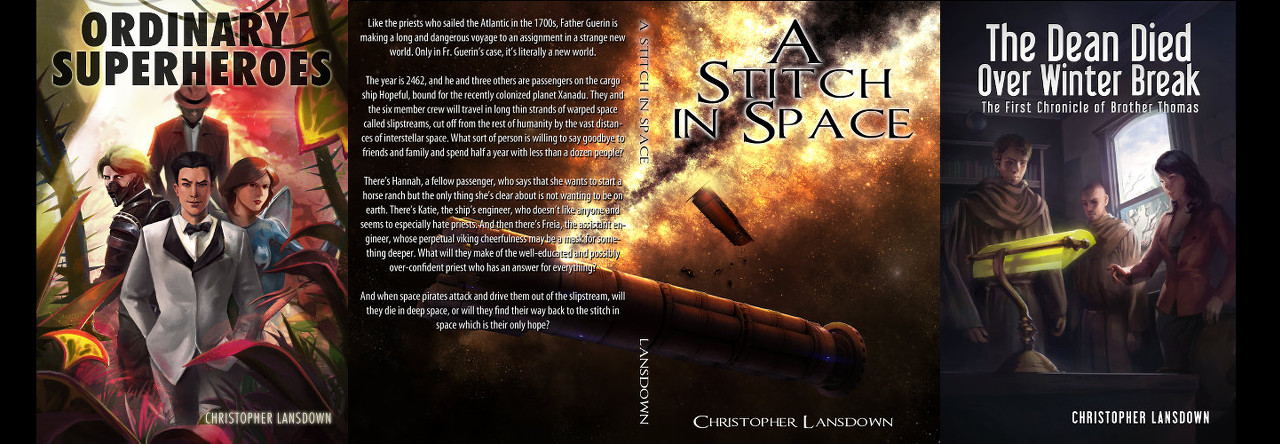
If you like mystery novels, and especially Lord Peter Wimsey novels (with interesting characters who are described), you might like my murder mystery, The Dean Died Over Winter Break.

tddowb

When I Feel Sorriest For Atheists

Of all the things which rightly make an atheist an object of pity, the one I feel sorriest for the atheist for is when he realizes that all pleasure, satisfaction, and joy that he experiences is (according to him) nothing more than some chemicals in his brain. For two main reasons:

First, because he then accords Joy no significance. When this happens one can almost hear the sound of the cell door slamming shut on the mental prison in which he is trapped. It is a prison with no windows and no sunlight can enter it.

Second, because he will soon notice that there is, therefore, no distinction in kind between real happiness and what is produced with recreational drugs. And recreational drugs—the hard-core ones, I mean—are basically a form of slow suicide. (Not because their side-effects cause death, but because their main effect is basically a temporary suspension of living in a haze of mere feeling.)

There are many things for which to pity this atheist, but this one has always affected me the most. Once the door of this mental prison has been shut, I do not know of any natural force which can open it. I doubt that there is anything to do for a person in such a case but pray for them.

Review: Unnatural Death by Dorothy L. Sayers

Unnatural Death is the third Lord Peter Wimsey mystery novel which Dorothy L. Sayers wrote, following Whose Body? and Clouds of Witness. We are still several books away from Sayers’ best work—the Harriet Vane trilogy—but Unnatural Death is still very good. It is a solid, though flawed, mystery filled with interesting characters which Sayers writes extremely well.

The premise of Unnatural Death is that Lord Peter and Inspector Parker accidentally make the acquaintance of a doctor in a restaurant. Their interest is piqued when he tells them the story of trouble he had because he insisted on a post-mortem (examination) for a woman with cancer who died suddenly, several months at least before the disease should have taken her. No cause of death was found in the post-mortem but Lord Peter suspects murder and sets out to prove it, as well as to figure out who murdered her and why.

Unnatural Death is very much worth the read and I do recommend it, though it does have its flaws. The biggest of these flaws is that much of the mystery hinges on the murder method, and once it is revealed it would not work as described. However, something similar, if far less practical, would work, so I think that the book can be forgiven on those grounds. The pacing is also somewhat off. Progress is made in the case and then stalls out in an unsatisfying way, only to plunge us into an almost breathless final act. Patience with this is rewarded with a satisfying ending, however. In short it is not one of Sayers’ masterpieces, but if one goes into it with the right expectations it is a very enjoyable mystery.


If you like murder mysteries and especially if you like Dorothy L. Sayers’ Lord Peter Wimsey stories, you might like murder mystery, The Dean Died Over Winter Break.

tddowb


(If you haven’t read the story and don’t want spoilers, stop reading here.)

(In what follows, I discuss the structure and execution of Unnatural Death with the purpose of learning from it because it is a good story. Everything I say should be understood as an attempt to learn from a master mystery writer. Criticism should in no way be taken as disparagement, as I dearly love the Lord Peter stories.)

Sayers starts out Unnatural Death in a manner she would repeat more than once in her short stories: by not naming Lord Peter for quite some time. If I recall correctly, Lord Peter’s name isn’t mentioned until the end of Chapter 2. I’m not sure what the purpose of this is within Unnatural Death as it’s fairly obvious who the pair discussing crime in a restaurant are. It’s possible that it was just Sayers being playful. Also possible was that it was meant to tell the story partially from the perspective of the doctor. This approach I really can’t figure out. I’ve never liked it when Sayers did it, but evidently she did given how often she used it. I can’t help but wonder at the purpose.

The first mystery which Lord Peter needs to solve is the identity of the doctor and his patient. This is an interesting choice on Sayers’ part because it didn’t serve any large structural purpose in the plot; Lord Peter would have had to send Miss Climpson to visit Leahampton anyway, so it was not necessary in order to bring her into the story. This may serve simply for realism, then, as doctors tend to be reticent to give details of their patients to strangers.

And of course Unnatural Death introduces us to Miss Alexandra Katherine Climpson, whose most famous performance is probably in Strong Poison. She is a very interesting character both in herself and in her broader role. For various reasons, a great many of the early detectives in fiction were male, though quite often written by women. In fact three of my favorite detectives (Poirot, Lord Peter, and Brother Cadfael) are male detectives written by women. But however good the reasons were for most of the very early detectives being male, they were not essential. Women are inquisitive and social, but what they tend to lack, which a detective requires, is free time. One obvious solution to this problem is age: old women have social skills sharpened over many decades and quite a lot of free time to go with them. And with this observation, we have Miss Climpson. (Lord Peter put it in a more in-character way, but I think you can see the wheels turning in the authoress’s head as he explains it.)

It’s also interesting to note that Miss Marple would first appear in a short story a year after Unnatural Death was published and would first appear in a novel two years after that. The characters are not particularly similar past both being old spinsters, but it would be interesting to know if there was any influence.

Miss Climpson represents a very interesting complementarity to Lord Peter. They are both clever with great skill at conversation, yet they engage in very different conversations. Both also command instant respect; Lord Peter because of his rank and Miss Climpson because of her age. They are also both experts at sizing people up in a few sentences, within their respective spheres.

On the other hand, she might be better considered a counterpoint to Charles Parker. Both of them get saddled with the grunt work of things like looking up every death certificate in a county or every lawyer in a London neighborhood. They are both at the direction of Lord Peter, though Inspector Parker has some modest independence.

Putting them together, I think that Miss Climpson is something new. Looking over the various roles played by people in detective stories, her’s bares some resemblance to partner and some resemblance to subordinate who gets stuck with the gruntwork. Yet her role is not quite either of those (in spite of her being on Lord Peter’s payroll). She might be best described as a sort of sub-contractor. It’s an interesting role.

Speaking of roles within a detective story, Inspector Charles Parker’s role stays much the same as it was in Clouds of Witness and Whose Body?, though it is slightly diminished because there is not an official crime as far as the police are concerned. And here we come to a bit of a limitation of Parker as a constant companion to Lord Peter. Being a policeman grants him all sorts of privileges and access Lord Peter would not have on his own, but it also comes with limitations. If Parker were more of an equal to Lord Peter intellectually, this would not be a problem as Parker could at least converse with Lord Peter about the problem. And to be fair, a bit of that does go on, but Parker simply doesn’t contribute much. His main contribution is to throw cold water on all of Lord Peter’s conjectures. And that’s not really long-term sustainable.

That said, most murder mysteries do eventually feature a body, so it’s hardly an insurmountable obstacle for Inspector Parker as a companion to Lord Peter. Ultimately I suspect that he was replaced by Harriet Vane because she was simply a better fit.

Miss Climpson’s investigations prove very useful, though the downside to her mode of intelligence gathering being gossip means that one needs to read through a fair amount of gossip. Sayers does a good job of rendering it tolerable, but at least to me it was not the highlight of the book.

With the advertisement Lord Peter puts in for the Gotobed sisters and the subsequent murder of Bertha Gotobed, the plot shifts gears. What had started as a cold case mystery suddenly became an ongoing mystery. I have mixed feelings about ongoing mysteries, though I should note that they’re popular for good reason. They are, however, not nearly as calm as mysteries about crimes which are completed by the time the narrative begins. Much of that will come down to mood and temperament on the part of the reader. Having, as I do, three young children, I always appreciate calm since every day of real life is an adventure.

In this case the ongoing murders make good something Lord Peter says several times in the book—that murderers can cover up their tracks so excessively as to leave more clues than had they not covered their tracks. And indeed this happens here, with each murder (or attempt) getting progressively more daring and sloppy. This is very well for Lord Peter and Inspector Parker, who in the end do not have enough evidence to charge Miss Whittaker for her original crime.

Which brings up the issue of the method which Miss Whittaker used to kill her victims.  It is true that air bubble introduced in the blood stream can kill a person, but from everything I’ve heard and read they have to be very large bubbles. Small bubbles—I was once assured by a nurse—are no problem at all and simply dissolve away without causing any harm. The reason why one always sees doctors (in TV, anyway), holding syringe up and flicking it to get the air bubbles out has to do with accurate dosing, not with the bubbles themselves being a problem. Ultimately I don’t know the exact quantity of air which would be necessary to kill a person, but it’s large. This is not an insurmountable problem for a murderer, as one could ultimately hook up a bicycle pump to an IV. Such an apparatus would be a bit silly and take away some of the sinister element of a merely empty syringe, but it would be doable. One would tend to suspect that such a thing would be detectable by the large quantity of air to be found in the circulatory system, but Miss Whittaker did tend to kill people in ways where their body would not be examined for some time, and I suspect that between blood settling and gas absorption, it seems at least plausible that such a method of killing would be hard to spot unless it was looked for.

On the other hand, I can’t recall ever having heard of this method of killing people since, either in fiction or in reality, which suggests that it is not really a practicable method of killing people. Which, it must be noted, is just as well, since it’s good for people to be hard to kill without leaving a trace. Both for the sake of fiction and for the sake of reality.

The other curious element of Unnatural Death is the way that in the end, Miss Climpson is very nearly murdered. What’s particularly curious about this choice is that she is both put in danger by a series of coincidences and saved literally at the last moment also by coincidence. Had Wimsey and Parker been sixty seconds later in breaking into “Mrs. Forest’s” flat, Miss Climpson would have been dead. Given that they had no idea that Miss Climpson was in any danger, this is very fortunate indeed. But on the other hand, it was pure luck that Vera Findllater had confessed to a priest that she had lied for Mary Whittaker and moreover written down notes to her confession complete with an street name in London, and moreover had dropped the note in a place that Miss Climpson found because she had dropped something in the same place. And had this string of coincidences not been enough, she still would have been safe had she not spotted Mary Whittaker (dressed in her disguise as Mrs. Forest) on the street. And that would not have been sufficient had Miss Climpson had an unerring memory for backs.

I must confess that I’m very dubious about the claim that while faces may be confusing, backs are unmistakable even in disguise. I’ve mistaken enough strangers from the back that this just doesn’t seem plausible to me.

So, ultimately, what to make of this string of improbably coincidences culminating in a last-moment salvation from death? Sayers did make it work, but I don’t think that it’s something to emulate. Improbably coincidences are most at home in comedies and Greek tragedies. The events starting with the faked gang-attack are probably my least favorite part of the book, as they really feel like they’re part of a different story. They’re well written, of course, but when I re-read Unnatural Death I tend to read this part very quickly.

In the final act of the story, Mary Whittaker kills herself. This seems to happen fairly often in Lord Peter stories, and I’m really not sure what to make of it. It’s seems far more accepted than makes sense for a putatively Christian society, though really devout Christians seem pretty thin on the ground among people of action in Lord Peter stories. I find this part very distasteful, though I’m not sure that there’s much to learn from it other than “don’t do it”. Dorothy L. Sayers was, from what I’ve read, a devout Christian, so I’ve really no idea what to make of suicide coming up so often and so little remarked upon. Perhaps Brittain of the 1920s was more pagan than is appreciated today.

Lucky Detectives

Within detective fiction, luck plays a very strange role. In traditional hero stories, luck should always favor the bad guy so that the good guy can win by the exercise of virtue. For this reason, luck helping an investigation is disappointing—it feels like cheating.

The problem in detective fiction, however, is that all clues which allow the detective to solve the mystery are pieces of luck because they are mistakes on the part of the murderer (or other culprit). A perfect murder simply couldn’t be solved.

Because of this the detective must be lucky, and the writer of the mystery has to figure out how to deal with this luck. I’ve seen it dealt with in a variety of ways, most of which work. Of the methods for dealing with this luck, I think that hanging a lampshade on it is probably the least satisfying. That’s usually of the form

Inspector Lieusew had no idea what made him think to stop and enter the ordinary-looking dry-cleaner’s shop, but later he was glad that he did.

Of course I’ve seen it done far more skillfully, as in Chesterton’s first (and excellent) Father Brown story, The Blue Cross:

He alighted at Liverpool Street, however, quite conscientiously secure that he had not missed the criminal so far. He then went to Scotland Yard to regularise his position and arrange for help in case of need; he then lit another cigarette and went for a long stroll in the streets of London. As he was walking in the streets and squares beyond Victoria, he paused suddenly and stood. It was a quaint, quiet square, very typical of London, full of an accidental stillness. The tall, flat houses round looked at once prosperous and uninhabited; the square of shrubbery in the centre looked as deserted as a green Pacific islet. One of the four sides was much higher than the rest, like a dais; and the line of this side was broken by one of London’s admirable accidents–a restaurant that looked as if it had strayed from Soho. It was an unreasonably attractive object, with dwarf plants in pots and long, striped blinds of lemon yellow and white. It stood specially high above the street, and in the usual patchwork way of London, a flight of steps from the street ran up to meet the front door almost as a fire-escape might run up to a first-floor window. Valentin stood and smoked in front of the yellow-white blinds and considered them long.

The most incredible thing about miracles is that they happen. A few clouds in heaven do come together into the staring shape of one human eye. A tree does stand up in the landscape of a doubtful journey in the exact and elaborate shape of a note of interrogation. I have seen both these things myself within the last few days. Nelson does die in the instant of victory; and a man named Williams does quite accidentally murder a man named Williamson; it sounds like a sort of infanticide. In short, there is in life an element of elfin coincidence which people reckoning on the prosaic may perpetually miss. As it has been well expressed in the paradox of Poe, wisdom should reckon on the unforeseen.

Aristide Valentin was unfathomably French; and the French intelligence is intelligence specially and solely. He was not “a thinking machine”; for that is a brainless phrase of modern fatalism and materialism. A machine only is a machine because it cannot think. But he was a thinking man, and a plain man at the same time. All his wonderful successes, that looked like conjuring, had been gained by plodding logic, by clear and commonplace French thought. The French electrify the world not by starting any paradox, they electrify it by carrying out a truism. They carry a truism so far–as in the French Revolution. But exactly because Valentin understood reason, he understood the limits of reason. Only a man who knows nothing of motors talks of motoring without petrol; only a man who knows nothing of reason talks of reasoning without strong, undisputed first principles. Here he had no strong first principles. Flambeau had been missed at Harwich; and if he was in London at all, he might be anything from a tall tramp on Wimbledon Common to a tall toast-master at the Hotel Metropole. In such a naked state of nescience, Valentin had a view and a method of his own.

In such cases he reckoned on the unforeseen. In such cases, when he could not follow the train of the reasonable, he coldly and carefully followed the train of the unreasonable. Instead of going to the right places–banks, police stations, rendezvous– he systematically went to the wrong places; knocked at every empty house, turned down every cul de sac, went up every lane blocked with rubbish, went round every crescent that led him uselessly out of the way. He defended this crazy course quite logically. He said that if one had a clue this was the worst way; but if one had no clue at all it was the best, because there was just the chance that any oddity that caught the eye of the pursuer might be the same that had caught the eye of the pursued. Somewhere a man must begin, and it had better be just where another man might stop. Something about that flight of steps up to the shop, something about the quietude and quaintness of the restaurant, roused all the detective’s rare romantic fancy and made him resolve to strike at random. He went up the steps, and sitting down at a table by the window, asked for a cup of black coffee.

As a side now, if you haven’t read it, I strongly recommend that you do. (It’s available online. Like all Father Brown stories it’s a short story, so it won’t take long.)

This is probably the best that I’ve seen the lampshade-hanging done and because Chesterton is a master, it works. But it’s not entirely pure lampshade-hanging. It has elements of what I think is the best approach, which is to have the detective earn his luck. Of course, in a strict sense one can’t earn luck because luck comes from God and all that comes from God is grace. But one can, through work, make oneself a fit vessel for grace—that is, a vessel without leaks that will not spill the grace poured into it.  (That too is, of course, grace, but life and language is easier if one just recognizes at the outset that all is grace and what is not distinct need not be pointed out in every sentence.)

The detective can earn his luck by doing the hard work to be in the right place to receive the luck. He can ask many questions that eventually turn up a useful answer. He can look into many places to find something there.

But there is an opposite danger, too, which the writer must avoid. A detective story is not interesting if the detective merely grinds his way through every possible place to look for clues. There is the tedium of that, of course, but tedium is very easy to elide. It takes only a few words to say:

After seven weeks of fourteen hour days spent knocking on every door in a five mile radius, Detective Inspector Drumwalt at last found somebody who had seen Wolfgang Gruenwald on the night he was murdered.

The problem to be avoided is not tedium for the reader. It’s a lack of imagination on the part of the detective. There’s no fun in trying to match wits with someone who evidently doesn’t have any.

There is of course a traditional solution to that, too, which is an army of people to do the grunt work for the detective. One can see this in the way CSI labs and uniformed policemen are used if the detective is himself formally with the police, but you can also see it in Sherlock Holmes’ Baker Street Irregulars.

This of course must be used sparingly and only for initial clues; the detective ceases to be the detective if somebody else hands him the solution together with conclusive evidence. In mystery novels—which need twists and turns before the solution becomes obvious to the reader—the solution to the problems raised by this solution is often to make the clues turned up by grunt-work misleading. This can often serve double-duty by putting an innocent person under suspicion and thus raising the stakes.

A popular way to play with that, by the way, is to have the evidence planted by the culprit to intentionally mislead the investigators. A clever murderer will make the evidence require some work to get, playing on human nature’s inability to believe that hard work does not come with rewards.

One of the great things about mystery novels is that at this point—130 years after Sherlock Holmes and 90 years after the golden age—every possible solution to every problem in the genre has been done straight, as a fake-out, and as a faked-out-fake-out. If you’re at all familiar with detective fiction, there’s really no way to guess which way the writer is playing it this time based solely on the form of what’s happened so far.

Suppose a suspect has confessed. Well, perhaps it’s a false confession to shield someone else, but it might also be a true confession with enough lies in it that it will be taken as a false confession and so suspicion will be thrown elsewhere. At this point, the mere fact that someone has confessed doesn’t tell you anything about who did it. This keeps things surprisingly fresh.

In fact, about the only think that you can be sure of, at this point, is that the butler didn’t do it.


If you like my discussion of murder mysteries, you might like my murder mystery, The First Chronicle of Brother Thomas: The Dean Died Over Winter Break.

tddowb

Clouds of Witness by Dorothy L. Sayers

Clouds of Witness is the second novel featuring Lord Peter Wimsey, following Whose Body?. While my general recommendation is to start with Strong Poison, as my favorite Lord Peter novels are the Harriet Vane quadrilogy, Clouds of Witness would also be a good place to start with Lord Peter Wimsey if you’re new to him.

Clouds of Witness is a good, solid armchair cozy. There is a dead body in the first chapter, at an English hunting lodge rented by the Duke of Denver (Lord Peter’s brother) and occupied by several friends. The Duke was the first to discover the body, and is put on trial for having been the one who put it there. The victim was engaged to the Duke’s sister, and he can give only a very unsatisfactory account of his whereabouts at the time of the murder. In fact, most everyone at the hunting lodge contradicts the story of everyone else there. It is from this tangled situation that the title comes: the whole situations is fogged by clouds of witness.

Clouds of Witness has everything you expect in a Lord Peter Wimsey story:  detection, reasoning, speculation, wit, engaging characters, and 1920s England. I highly recommend it.


If you like Lord Peter Wimsey mysteries even half as much as I do, then you might enjoy my murder mystery, The Dean Died Over Winter Break.

tddowb


(If you don’t want spoilers, stop reading here.)

Analysis

(This analysis is an attempt to learn from a master. Anything which may sound critical should be read in the spirit of being a close examination of an excellent novel.)

Clouds of Witness is very interesting both as a second novel about a detective and as a followup to Whose Body?. There’s a lot to talk about, but what stands out to me the most is the character of Inspector Charles Parker. As in Whose Body? he is both Lord Peter’s sidekick and his partner in detection. This is a curious choice as the requirements of sidekick are different and to some degree contradictory to those of a partner.

That’s not to say that such a thing is impossible to pull off. Sayers pulled it off in the character of Harriet Vane, for example. But it feels like she hasn’t quite gotten the balance right in Charles Parker; one can never quite be sure which he’s being in any given scene. And the difference was really in the personality of the characters themselves. Or perhaps it would be better put that the difference was in their skill sets.

Harriet Vane was a mystery writer and her strengths were aligned with this. She understood human behavior well, she was clever, imaginative, and had a great command of language. She was quite intelligent, though not the match of Lord Peter. But the advantage which he really had over her was in experience. Being older and richer, he had a far broader experience of humanity than Harriet did. It made for an extremely good pairing.

Charles Parker’s skills were far more similar to Wimsey’s. Wimsey was established as being more observant than Parker, but Parker was observant. Wimsey had a lot of experience of humanity, but Parker—as a policeman—had a great deal of experience of humanity as well. Wimsey was skilled at research, but Parker was also good at research and had the resources of Scotland Yard behind him. There’s nothing in this which is inherently a problem, but it doesn’t allow the character to be strong at times and weak at times. Watson—the character who needs things explained to him—can’t be played by an equal. It will simply feel wrong that he needs explanations—or it will feel wrong when he doesn’t.

Now, I don’t want to overstate what I mean, because there is a significant personality difference between Parker and Wimsey—Parker is more methodical and cautious, while Wimsey is more inclined to speculate and take up theories provisionally. This has the benefit of making Wimsey need to prove his steps—to Parker, if not to himself—which helps to move the investigation along in a more orderly way which is easier for the reader to follow.

Above and beyond this, though, I suspect that Sayers became a bit surprised by Charles Parker. Especially in Whose Body? but continued in Clouds of Witness, it feels like his original purpose was to be an assistant to Lord Peter. Every writer of an amateur detective has the fundamental problem of why on earth the detective is permitted to go where he goes and do what he does. For much of the detection there can be trade-offs, because the amateur is not restricted by rules of evidence in the way the police are. But there are some places the detective really needs to go which are hard to explain. Viewing the body and scene of the murder being two of them.

There are a variety of solutions to this problem, but the author does need to solve it for the mystery to have any plausibility. And a friend in the police force who is in charge of the case does solve this problem very handily. And while in a certain (very limited) sense this is cheating, I suspect most readers don’t care because what they want to read is detection, not a spy thriller in a deerstalker hat. I know that, as a reader, I’m quite forgiving of improbable though logically possible things which let me get to the good parts.

And this felt like the role that Charles Parker was meant to fulfill. He had many of the requisite attributes—other than being a police inspector, I mean. He looked up to Lord Peter as a genius, thought Lord Peter highly likely to catch clues which he himself missed, and even told Wimsey about his cases.

But then a curious thing happened—Parker also turned out to be a close friend of Wimsey’s. This introduced a tension which built over the course of the novels: brilliant, well educated men don’t have dumb friends. And Parker wasn’t a dumb man. But the more intelligent Parker becomes, the less need he has of Lord Peter.

I want to say that Clouds of Witness was the high-water mark for Charles Parker, but I’m not sure why I want to say that because it’s not true, or at best true from a very narrow perspective. He features very prominently in the next book—Unnatural Death—in fact he’s on the very first page. But then a decent chunk of the book is about a detective in the employ of Lord Peter—Miss Climpson—rather than about Parker or Lord Peter.

After Unnatural Death comes The Unpleasantness at the Bellona Club, which also features Charles Parker heavily, but only in (roughly) the second half. Then comes Strong Poison, which is the last novel in which he really features heavily. He’s all but not in The Five Red Herrings and Have His Carcass. He is somewhat more present in Murder Must Advertise, then has a small role in The Nine Tailors. He isn’t in Gaudy Night and is only mentioned briefly in Busman’s Honeymoon.

So while Inspector Parker does have a fairly long run, he peters out in the end. I can’t help but wonder if his role as the official access-granter prevented the further development of his role as friend. The problem with being an access-granter is that he can’t be everywhere. A friend might visit a friend anywhere, but a police inspector would not have jurisdiction throughout the entire country and be assigned every interesting case throughout the country. It’s only a speculation, of course, but it’s something to think about in the construction of friends and assistants for a detective.

Setting aside the question of Charles Parker, the construction of Clouds of Witness is very interesting too. It begins with a brief connection to the previous novel, then jumps into a long recital of the facts of the case by way of a transcription of the inquest over the murder victim. This is an interesting approach to handling the exposition necessary in a mystery. Though it should be noted that mysteries have an enormous advantage over most other genres when it comes to exposition since at least some of the characters in a mystery don’t know what happened and want to know. So straight-up information dumps are often in-character.

But the same is true of a British inquest, at least as presented in Lord Peter novels, and that’s the device Sayers used. And I have to say that it was pretty efficient at communicating the setup in detail. Though not very quickly; it did drag on a little. It felt like we could have used a little more investment into the story before that many pages of facts delivered in rapid succession. Still, it is an interesting approach. In America we don’t have inquests, but we do have the grand jury which serves a similar function. Unfortunately, our grand juries our secret (I believe to protect the innocent in case the grand jury returns the verdict that there is not enough evidence to bring a trial). Probably the closest American version of this would be to have a trial end in a hung jury and a new trial scheduled. (Though Sayers had that option, too, in British courts and took advantage of it in Strong Poison.)

It is also interesting that given us all of the principle evidence, Lord Peter still has detection to do when he arrives. This is arranged in two stages because Inspector Parker has already done some of the investigation, but only after the local police have bungled the initial investigation, leading to the Duke of Denver being charged. This sequence of events sets up the main jeopardy of the story—the Duke’s life—while still putting the Parker and Wimsey in charge.

This also respects an observation of Chesterton’s (in The Mirror of the Magistrate):

“Ours is the only trade,” said Bagshaw [a police detective], “in which the professional is always supposed to be wrong. After all, people don’t write stories in which hairdressers can’t cut hair and have to be helped by a customer; or in which a cabman can’t drive a cab until his fare explains to him the philosophy of cab-driving.

By the arrangement of the local police bungling and Scotland Yard swooping in to help, the professional is given some of his due. It certainly is in keeping with the elements of realism Sayers weaves in to the Lord Peter stories. (Which, it must be said, form a counterpoint to Lord Peter himself, and keep him grounded.)

Parker and Wimsey of course find a number of clues which the local police overlooked, which is simply necessary to the story being a detective story at all. Their hottest clue is the footprints of Mary’s second fiance, Goyles, who wears a number 10 shoe, but I find it hard to be as enthusiastic as Lord Peter and Mr. Parker in their hunt for the fellow. It’s just not very plausible that a stranger came from far away to kill Cathcart whom he expected to find outside using the Duke of Denver’s revolver.

To some degree this must be chalked up to the eagerness of Lord Peter and Inspector Parker to exonerate the Duke of Denver, but I think it would have felt better if they were pursuing the owner of the number 10 shoes as an important witness since that was the overwhelming likelihood of what he was.

These investigations bring Lord Peter to meet Mr. and Mrs. Grimmethorpe of Grider’s Hole. Mr. Grimmethorpe is a curious character. He is a man so consumed by jealousy that he has become almost pure rage. I’ve always found him an intensely unpleasant character, though that is the point of him. And I suspect that he is actually realistic, given how often jealousy has led to murder.

I suspect that my dislike of the character is because he is a little out of place in an armchair cozy mystery. He is certainly not cozy. And he is important to the plot. He’s not quite central, but at the same time he’s not far from the center of the mystery and is at least tangentially related to (perhaps) half the plot. Given his relevance to the mystery, it would have been very difficult for him to be less involved in the plot. But there’s another reason why he had to show up once again towards the end, and it relates to the fundamental structure of murder mysteries.

A murder mystery is the story of a man who distorts the natural order by the wrong use of reason, put right by the detective’s right use of reason. It is the salvation of the world, in the manner of a medieval miniature. At the end of every good murder mystery, then, what is wrong must be put right. And Mr. Grimmethorpe of Grider’s Hole is very wrong. The book cannot end with him continuing to be the monster that he is, and it doesn’t. In the end he is killed trying to kill the Duke of Denver. (Or possibly Mrs. Grimmethorpe; I’ve read the passage several times and still can’t figure out exactly what happened.) There is not really any other possible outcome given the constraints of the situation.

Though it must be said that Mrs. Grimmethorpe is not right either. She has committed adultery. And indeed, so has the Duke. I find it odd how much this is passed over as inconsequential. Its only real significance seems to be that the Duke won’t say where he was when Cathcart was killed. Neither repents in any way of their sin; they basically simply agree to forget about it. Which is a resolution of sorts, but a very cheap resolution that is not really fitting. But leaving that aside, it’s rather strange just how cavalier everyone else is about the Duke having committed adultery. The characters all seem to think it inconsequential that he adulterates he marriage, and completely inconsequential whether news of his infidelity reaches his wife. No one seems to think any less of him for it.

I don’t know what to make of it. Perhaps it was plausible at the time. The 1920s is known as a very immoral time—a reaction against the stricter Victorian era, which was itself a reaction against the more morally lax Georgian period. (Clouds of Witness was published in 1926.) And that itself was a reaction against the era which came before it. And moreover every era is a combination of many threads; people are never uniform. (Also, curiously, the greatest saints tend to show up during the generally worst times.)

The conclusion of the mystery is also interesting, where Lord Peter tracks down Cathcart’s former lover in America then has a harrowing and dangerous trans-Atlantic flight to bring the evidence back to the trial. The audacity of this flight is, I think, lost on modern people who can safely travel the Atlantic in a jet which cruises several miles above the clouds for $100 per seat (one way, on a really good sale). As I mentioned, Clouds of Witness was published in 1926. The first non-stop trans-Atlantic flight was made in 1919 (and of the three teams making the attempt on the same day, two didn’t make it across). Charles Lindbergh had not yet become the first to cross the Atlantic solo—he would do that the next year in 1927. In 1926 going between New York and London by airplane was only just slightly more realistic than science fiction. It’s a curious thing to stick into a detective story. Consulting detectives are already quite unrealistic, though, so perhaps it does go together.

The one part of Clouds of Witness which I think was a mistake in what was otherwise an excellent book is the very end, where Inspector Sugg finds Lord Peter and Inspector Parker slobbering drunk—one comatose, the other talking with a statue. It’s not that I disapprove of drunkenness—I do, but that’s not my issue here—since after all saving the life of one’s brother after nearly dying excuses a lot. It’s that it’s very out of character for Lord Peter to want to lose himself in the manner that one loses himself in drunkenness. And if it’s out of character for Lord Peter, it’s even more out of character for Charles Parker. I suspect that it was meant as a comedic note to end on. Another possibility is that it was meant to humanize Lord Peter and make him more relatable. I don’t think it really does either. It would have felt far more in character if Lord Peter took Parker out to an opera or even if Parker invited Lord Peter to go with him to church and after all of the emotional exhaustion, Lord Peter went with him. (Of the two, the opera would be more likely.) Or even brought Parker to his flat and played music and sang into the wee hours of the night. And even if Lord Peter got drunk, Parker really shouldn’t have. A moment of sober conversation between Parker and Sugg over the drunk Lord Peter would have been more interesting than Sugg calling Peter and Parker a cab.

You Can’t Get an Ought From an Is In Hell

One of the questions which comes up in discussions of morality is whether you can get an “ought” from an “is”. This is relevant primarily to discussions of atheism, since to the atheist everything is a brute fact, i.e. an “is” which is not directed towards anything, and therefore an atheist cannot get any “oughts” out of their description of what is. Or in simpler language, if God is dead then all things are permitted. (Note for the unpoetic: by “God is dead” we mean “there is no God”.)

There are two reasons why if God is dead all things are permitted:

  1. If God is dead, who is there to forbid anything?
  2. If God is dead, then there is no ultimate good because all is change and therefore nothing has any lasting reality.

If you argue this sort of stuff with atheists long enough, somewhere along the line while you’re explaining natural ends (telos) and natural morality, you may come by accident to a very interesting point which the atheist will bring up without realizing it. It often goes something like this:

OK, suppose that what God says is actually the only way to be eternally happy. Why should you be eternally happy? Why shouldn’t you do what you want even though it makes you unhappy?

This question sheds some very interesting light on hell, and consequently on what we mean by morality. Our understanding of morality tends to be like what Saint Augustine said of our understanding of time:

What then is time? If no one asks me, I know what it is. If I wish to explain it to him who asks, I do not know.

Somehow or other atheists tend to assume that ought means something that you have to do, regardless of what you want to do. It’s very tempting to assume that this is a holdover from childhood where ought meant that their parents would make them do it whether or not they wanted to. It’s tempting because it’s probably the case and because that’s not an adult understanding of ought. And it’s not because ultimately we can’t be forced to be good. (Or if this raises your hackles because I’m “placing limits on God”, then just take it as meaning that in any event we won’t be forced to be good.)

Hell is a real possibility. Or in other words, it is possible to see two options and knowingly pick the worse option.

What we actually mean by saying that we ought to do something is that the thing is directed towards the good. And we can clarify this if we bring in a bit of Thomistic moral philosophy: being is what is good. Or as the scholastic phrase goes, good is convertible with being. But being, within creation, is largely a composite entity. A statue is not just one thing, but many things (atoms, molecules, etc.) which, in being ordered toward the same end, are also one thing which is greater than their parts.

And you can see a symphony of ordering to a greater being, in a human being. Atoms are ordered into proteins (and many other things like lipids, etc), which are ordered into cells, which are ordered into organs, which are ordered into human beings. But human beings are not at the top of the hierarchy of being, for we are also ordered into community with other created things. (Please note: being part of a greater whole does not rob the individual of his inherent dignity; the infinite goodness of God means that creation is not a competition. Also note that God so exceeds all of creation that He is not in the hierarchy of being, but merely pointed to by it.)

And so we come to the real meaning of ought. To say that we ought to do something is to say that the thing is ordered towards the maximum being which is given to us. But we need not choose being; we can instead choose non-being. The great lie which the modern project (and, perhaps not coincidentally, Satan) tells us is that there is some other being available to us besides what was given to us by God. That we can make ourselves; that we can give ourselves what we haven’t got. And, not at all coincidentally, are the things which we ought not to do—that is, those things are not ordered toward being. They’re just what the atheist says that all of life is—stimulating nerve endings to fool ourselves that we’ve accomplished something.

And yet atheists complain when one says that, according to them, they’re in hell.

God, at least, has a sense of humor.

Gold Covered Chicken Wings

If you haven’t heard, there’s a restaurant which came up with the idea of gold-covered chicken wings. While there are all sorts of things which could be said about about the wisdom of buying such things, the thing I really want to talk about is the symbolism of the thing.

(Since there’s too much outrage on the internet, I think I should note in passing that due to gold’s astonishing brilliance with only a few atoms of thickness the wings are not actually wildly expensive. You can get 10 wings for $30, which for the location is probably a 3x markup—wasteful, but not very wasteful in absolute terms. You can easily get less food for more money in Manhattan.)

To see the symbolism of the thing, we need to consider what gold-plated food is. Unlike many heavy metals, metallic gold is (basically) inert, which is why it is safe as a food additive. But the fact that it’s inert also means that it has exactly no nutritional value, either. It’s not bad for you, it’s not good for you; it’s just there.

As such it’s an almost pure waste. I say “almost” because it does look pretty, though its beauty in the wrong place. If gold is to be present, it should be on the plates, where its beauty is not destroyed by the act of eating. It should not be on the food itself, where the beauty is destroyed by the act of eating. And that is, I think, the key to the symbolism.

My favorite version of the baptismal promises includes the questions:

Do you reject Satan?

And all his empty promises?

But there is another translation of the second question:

And all his empty show?

Gold-covered chicken wings seem to me an almost perfect illustration of Satan’s empty show. It looks like it has value—but has none—and the acceptance of it destroys even the slight good it uses as a bait.

Hearing the Same Story Twice

One of the great benefits of having friends who are at least twenty years older than oneself is that they have a wealth of life experiences that they are happy to share. This enables one to circumvent the problem in the popular saying:

Good judgment comes from experience and experience comes from bad judgment.

Having significantly older friends means that one can benefit from their experience. (The same is true of parents, if one can bring oneself to listen to them.)

But there is a problem with listening to the stories of people who are several decades one’s senior: they tend to tell you each story several times. Contrary to popular belief, this is not because they’re old, but because while stories are memorable, the act of telling them isn’t. In fact, telling a story is actually quite hard to remember because the storyteller’s attention is on the story, not on the telling.

Further, older people simply have far more to remember because they’ve got much fuller lives than young people do. Our culture’s obsession with youth not withstanding, older people have far more friends and acquaintances than young people do. They also have vastly more people’s lives and concerns to keep track of.

And since one very remarkable experience—that is, one good story—will touch on many aspects of life, in conversation with one’s older friends their especially good stories will come up from time to time, and they will probably not remember that they already told you that story three years ago. As I said, the story is far more memorable than the telling of it.

There are, at this point, three options:

  1. Interrupt them to tell them they already told you the story.
  2. Let them tell it then tell them that they already told you the story.
  3. Let them tell the story and appreciate it again.

Of the three, the second is the worst option. It’s basically throwing a gift back in the giver’s face. Don’t do this.

The first can be polite, but it’s tricky to pull off. If the story is recognizable in its first few words, you can probably find a pause in the first sentence (or so) to interrupt and ask if it’s the story you’re thinking of—and bear in mind you might be wrong because sometimes different stories sound similar. If it is, then tell the friend how much you like the story. The danger of interrupting them is that you might seem ungrateful or unappreciative of the wisdom being conveyed and telling them how much you appreciate the story—not merely appreciated it in the past, but kept its lessons with you—will ensure that the proper reaction of gratitude is conveyed.

The third option is often the best option. First, because it is the most grateful option. Second, because the same story is often told with different details filled in, so one gets a more complete version of it by putting the two together. Third, because one will probably learn new things from hearing it again. And fourth, because the impossibility of perpetual novelty (while maintaining quality), happiness depends upon the ability to appreciate good things one has already experienced. Hearing a good story again is excellent practice at this.

One should not lie and pretend that one has not heard the story before, but it almost never comes up, and if it doesn’t, there’s no need to bring it up.

And you’re vastly better off having heard the same story twice than not at all.

Atheists’ Bluster

Around a quarter century ago, in my early teens, I did online Christian apologetics in various forums (AOL, usenet, etc.). And something I came across was the habit of atheists using bluster—the extremely confident assertion of things that, if pressed, they couldn’t defend.

In my later teens I took a hiatus from apologetics to spend time learning, to better prepare myself. It ended up being a fairly long hiatus, and by the time I was ready to get back to apologetics I was Catholic and now it was called evangelization. And in the great dealing of thinking and reading and so forth that I did in those years, I  came to the conclusion that reasoned argument was not what most people needed. Atheism was not so much an intellectual position as it is a mental prison. The atheist is in a tiny, cramped little universe, so much smaller than a human mind. What atheists really need—as Chesterton said of the madman in his masterpiece, Orthodoxy—is not arguments, but air. He needs to come in contact with enough truth that he will realize it can’t fit inside his prison, at which point he will realize that he’s not actually inside of a prison, and leave.

But being an open Catholic online and hanging out with the sort of people I hang out with does bring one into contact with a lot of atheists—though almost all of a few related kinds. And in meeting the same sorts of people I was arguing with 25 years ago, I found that they were still using bluster—making assertions with impressive confidence. But as an adult in my 30s, this was nowhere near as intimidating as it was to me when I was 13. And I found something very interesting when I would respond to bald-faced assertions with contrary bald-faced assertions.

I somewhat naively expected to simply come to a standstill of assertions that would result either in agreeing to disagree or providing space for a real discussion to take place. Instead, the atheists tended to get angry. Very angry. And what was curious was that it was the sort of anger one sees from a dog owner who isn’t any good at dog training when their dog fails to perform on command. It’s the anger of, “you’re not doing what you’re supposed to!”

You’ll see this all over the world, from all sorts of people. Doubtless many atheists have gotten this from irate grandmothers. But they were holding themselves up as rational inquirers. But if you scratch the surface, like with gold leaf, you find out that their rationality is just a coating which is only a few molecules thick.

And I started noticing that this applied in other places, too. The people who scream, “only believe things because of evidence!” get awfully huffy when you ask them for evidence of their honesty. They don’t put it that way, but apparently that, you’re supposed to take on faith.

“Don’t believe things without evidence!”

“OK, do you have any evidence that you’re not a moron?”

Again, their principle apparently comes with a lot of unstated qualifications. In theory, this should be an entirely reasonable question since you’re just asking for evidence. Instead you’ll typically hear about “ad homs” (argumentum ad hominem, i.e. arguing that the man is bad as if that proved his conclusion is false, see here for more), which is rather bizarre since a question cannot be a fallacious argument since it is not any kind of argument.

It’s been rather fascinating to see, since these people have great conviction, but it’s not conviction in their own principles. I still haven’t really found what their conviction is in. (I have my suspicions, and it will vary with the individual, of course. But I haven’t come to any definite conclusions yet.)

But it’s been very interesting to see how little there is behind atheists’ bluster.

Lack of Belief in Belief-Capable Entities

Recently my friend Eve Keneinan had a Twitter Thread in which she talked about the problems with defining Atheism as “a lack of belief in God”:

There is a problem she doesn’t mention with this definition, which is that there are no useful sentences which you can construct.  In order to have a useful sentence using a word, there has to be something you can predicate of all of the things described by the word. And (ignoring the problem of rocks and krill being caught up in the lack-of-belief definition), there is nothing you can predicate of people who believe God doesn’t exist, people who aren’t sure he exists, babies, the mentally retarded, and people who’ve never heard of the concept. They’re not all tall or short, stupid or intelligent, fat or thin, nor anything else. You can say that they exist, but that’s about it. This disqualifies it as a possible definition by what should be called the “uselessness test”. That said, let’s ignore it for now.

Eve mentioned a possible way of amending this definition to avoid catching up rocks and bricks and such-like as atheists:

However, this amended definition still leaves it a completely useless definition for a different reason than the one above (which still applies). Actually, before I even get to that, there’s a problem which needs addressing: it’s under-specified. Specifically, what sort of beliefs must the atheist be capable of forming?

There are different ways of defining “belief”, but since atheists are pretty much all materialists and thus don’t believe in a soul nor an intellect (in the traditional sense), they have to define “belief” as some sort of behavioral relation to the outside world. As such, it is clear that a rat which nibbles on a block of rat chow “believes” that the rat chow is food. So we still have the problem that under this amended definition, most atheists are bacteria and funguses, followed by higher-order life forms like krill and beetles. OK, so let’s grant the atheist the ability to use a theist’s definition of “belief” such that it’s the sort of thing which only human beings have, despite there being absolutely no way for a materialist to do this at all consistently.

We now get to the problem I mentioned about under-specificity. What sort of beliefs must these beings be capable of forming? To give an overly simplistic example to illustrate the point, it is utterly uninteresting that a man whose ability to form beliefs encompasses nothing more than the belief that cucumbers exist does not believe in God. This generalizes to the real point: if a man is for some reason limited in that he’s not capable of forming a belief in God, it is not an interesting property that he doesn’t believe in God. It is uninteresting for the same reason that we don’t count a man who can’t do even 1 pushup as as physically unfit if the reason he can’t do a pushup is because he has no arms. An armless man who can run a sub-6 minute mile is still quite physically fit. And further, his being fit but unable to do pushups tells us nothing about a couch potato with arms who cannot do pushups because he does nothing all day long. In the same way, if a man has a cognitive defect where he cannot form a belief in God he is unfortunate, but he has nothing whatever in common with someone who can form a belief in God but has formed the belief that God does not exist instead.

But really, either way, this definition cannot be applied to anyone given the limits of human knowledge. We have no way of finding out whether a man is capable of forming a belief in God except that he actually forms it. And even if we retreat from that we have no way of knowing that a man is capable of forming beliefs at all (without being him). We can tell us that he does, but I can easily program a computer to say that it forms beliefs, too. Heck, one could easily write on a rock, “I, this rock, can form beliefs”. If one rejects noetic knowledge as most online atheists do and demand evidence from the one making the claim, it is impossible to know whether anyone is an atheist since we can’t know what’s actually going on inside of his head. And this is different from taking his word about whether or not he in fact believes in God, since that presupposes he’s the sort of being which could have a word to give. The amended definition of “atheism” now requires us to find out whether he’s the sort of thing which can give his word before we know whether the definition applies to him.

Of course atheists tend to take the practical solution of demanding that theists merely assume the theistic worldview at all necessary places in order to make sense of what the atheist is saying, but to then reject it wherever it is not necessary for the atheist’s statements to be other than raving gibberish. At some point I think that everyone is tempted to say of online atheism what King Arthur said of Camelot, “No, on second thought, let’s not go there. It is a silly place.”

The Death of Rock-n-Roll

In this interesting article, the author says that Rock-n-Roll is now dead. I recommend reading the whole article—which is mostly about how the fans of Rock-n-Roll loved the stupid things that Rock Stars did, and don’t any more—but the part I want to talk about is the conclusion:

At some point we seemed to have changed our minds about what we expect from these people. Today our idea of a famous person is a tepid Hillary Clinton supporter.

Maybe as a culture this means we have moved past rock and roll. If that’s the case, fine. There are certainly dated things — handwritten letters, for example — that are more worthy of being defended.

Somebody call Tipper Gore and let her know she won.

(For those who don’t know, Tipper Gore led a public decency campaign.)

The issue which I have is that the author of the article credits the wrong person. Tipper Gore didn’t win. Rock-n-roll did. The problem is that it was a revolution, and revolutions are inherently temporary things. As G.K. Chesterton noted (in What’s Wrong With the World):

A revolution is a military thing; it has all the military virtues; one of which is that it comes to an end. Two parties fight with deadly weapons, but under certain rules of arbitrary honor; the party that wins becomes the government and proceeds to govern. The aim of civil war, like the aim of all war, is peace… They do not create revolution; what they do create is anarchy; and the difference between these is not a question of violence, but a question of fruitfulness and finality. Revolution of its nature produces government; anarchy only produces more anarchy. Men may have what opinions they please about the beheading of King Charles or King Louis, but they cannot deny that Bradshaw and Cromwell ruled, that Carnot and Napoleon governed. Someone conquered; something occurred. You can only knock off the King’s head once. But you can knock off the King’s hat any number of times. Destruction is finite, obstruction is infinite: so long as rebellion takes the form of mere disorder (instead of an attempt to enforce a new order) there is no logical end to it; it can feed on itself and renew itself forever.

I don’t mean that Rock-n-Roll intended to be a revolution. In many ways I think that the Rock stars were the overgrown children that they were usually charged with being and, like children, wanted to play and have the grown-ups watch over them and clean up after them. They were only playing; they didn’t want to destroy the house they were playing in. To use Chesterton’s language, they only ever meant to knock the King’s hat off.

But they missed and his head came off instead. Whatever the particular historical reasons for the victory they never meant to achieve, Rock-n-Roll changed the culture. It would be more accurate to describe it as one branch of the military which overthrew the culture—it didn’t do anything all on its own—but it won. And the problem which all successful rebels face is that they must now become conservatives. They must conserve what they have changed things into.

There’s a certain irony involved in the hedonists having become the respectable people, but they did, and they now face the same restrictions which respectable people always face.

That’s the problem with rebelling against morality: even when you win, you lose.

Superman’s Secret Identity

I had a conversation with my friend Andrew Stratelates recently about the question of why no one figures out that Clark Kent is actually Superman. And I figured something out about it when he pointed out that mannerisms can be very suggestive to people, but it would be very difficult to fool facial recognition software: trying to figure out Superman’s secret identity presupposes that he has a secret identity. And why on earth would anyone think that?

Superman doesn’t wear a mask, and is even clean shaven. Since one can plainly see his face, which he makes no effort to hide, there’s absolutely no reason to think that he has some sort of alternate persona he’s hiding. Moreover, if you think about it for a moment, it’s actually really quite strange that Superman does have an alternate persona. It serves no practical purpose. In most tellings, superman is not a vigilante who is wanted by the police and in any event he has a fortress of solitude which is a reasonable commute away, so it’s not like he has to pay rent to avoid capture. And if Superman did want money, he could take advantage of his super powers to earn hugely more than he could pretending to be an ordinary man. There are much more lucrative things he could do, but since he can travel at super-sonic speeds while carrying multiple tons of material, he could make a fortune as a high speed courier. The list of better ways to make money than working an office job would be quite long, and moreover, obviously quite long to everyone.

Further, there’s the fact that superman is basically an olympian god compared to ordinary men. Why would he choose to do the drudgery the rest of us are forced to do? It’s an imperfect analogy, but consider the following hypothetical:

Suppose you work for a company which makes inkjet printers, and suppose you have a co-worker in your office named Fred who looks like Donald Trump, except that he is polite, self-effacing, drives a 6-year-old Nissan Sentra, and wears glasses. And suppose another co-worker one day whispered to you, “You know what, I think that Fred is Donald Trump’s secret identity!”

Would you:

(A) Say, “You know what, if you take away the glasses he does look exactly like Donald Trump. You must be right!”

(B) Ask, “Why on earth would Donald Trump have a secret identity working a mediocre job in our printer company?”

(If Donald Trump is too polarizing a figure, you could easily substitute Jeff Bezos, Mark Zuckerberg, or the Duke of Cambridge (Prince William), and the point will remain unchanged.)

Superman’s having a secret identity makes about as much sense has his wearing his underwear on the outside of his clothing—it’s interesting, it’s very historically contingent, and it’s plausible only in the sense that life has a lot of quirks to it that we’d never expect. That it is plausible in the sense that life is stranger than fiction does actually lend people not discovering Superman’s secret identity some plausibility. And I think the wild implausibility of Superman having a secret identity is the best defense he has, since it would be trivial to detect superman otherwise, even if he wore an astonishingly realistic face mask. Just use an x-ray scanner and find the guy who’s completely solid. Alternatively, look for people the right height and build and poke them with a very thin, sharp pin until you find the guy where the pin breaks instead of going into his skin. And if you’re a villain, just do it like they did in the movie Pumaman and throw likely candidates out of high windows until you find someone who survives.

Over the Hills and Far Away

I recently discovered the singer/hury gurdist Patty Gurdy. Originally part of the band Storm Seeker, she seems to be striking out on her own. I’ve really been enjoying her songs on YouTube, and I’m particularly fond of her cover of a Storm Seeker song called The Longing:

However, the song I want to talk about is Over the Hills and Far Away:

It’s extremely reminiscent in theme of the Johnny Cash song The Long Black Veil, though I don’t know that there’s any influence:

Either way, it’s very interesting to compare the two songs. And despite the similarity of subject matter, the biggest difference is what kind of song they are: Over the Hills and Far Away is a (sort-of) love song, while The Long Black Veil is a tragedy.

This is of course facilitated by the different penalties for the different crimes. In The Long Black Veil, the man is accused of murder and his refusal to provide an alibi results in his execution, while in Over the Hills and Far Away he refuses to provide an alibi for a robbery and consequently is sentenced to 10 years in prison. This enables the latter to have the theme of eventual return, and it’s this theme which turns the song into a love song.

Which is unfortunate because the man should not return to the arms of his best friend’s wife. He should stay out of the arms of any man’s wife but even more so those of his best friend’s wife. In the song where the adulterer died, it becomes possible to take it as a simple tragedy where he was not directly punished for his adultery, but none the less was being punished indirectly because his adultery prevented him from proving his innocence. He got what he deserved, if indirectly, sort of like the plot of The Postman Always Rings Twice.

Unfortunately that sort of interpretation isn’t possible for a man who doesn’t understand what he did to be wrong (only socially unacceptable). But I find it interesting that the woman sings a song about adultery as a love song and the man sings it as a tragedy. This touches on a theme I’ve noticed in stories written by women: a man is so captivated by a woman’s beauty that he’s willing to destroy himself (and often her) because of it. This isn’t a universal theme, nor anything like that, but I’ve noticed that this is a common theme in material that I didn’t usually read until recently.

There’s a lot to say about the theme of a man so entranced by a woman’s beauty that he becomes a monster, which alas I don’t have time for now, but it is an interesting question to ponder how much the becoming a monster is intrinsic to the fantasy or whether it’s a way of defending against the accusations of wish-fulfillment which the story would be accused of if the woman’s beauty captivated the man and helped him to overcome his vices and become a saint. That latter one would be a very good story, though.

Sometimes People Surprise You

Human beings are, obviously, very complex creatures. For any given person we deal with, we understand them to a degree, but only so far. And then on top of that they have free will and can choose to do things contrary to their nature. So we’ll never fully understand another human being—on this side of death, anyway.

Having said that, sometimes when people do things we thought they would never do it becomes clear that we misunderstand people’s motivations and thoughts. This happened to me recently with the YouTuber Logicked. A while back, as a joke for the beginning of Deflating Atheism’s 2,500 subscriber special livestream, I collaborated with Rob to make a satirical sketch with the premise that the YouTuber atheist “Rhetoricked” was criticisng the livestream before it even happened. The video on my channel where I put it up included a few minutes of context if you haven’t heard of Logicked before:

Just a few days ago, he made a serious response video to my comedic sketch! Here’s the description:

Missing the Mark is still mad that I didn’t like a few dumb things he said, so he parodied my videos in an evil beekeeper costume. I’m sure it will be a deeply honest representation and not remotely hypocritical.

For the record, I wasn’t mad. I found the idea of him making 3 videos criticizing things I said in the Deflating Atheism 1000 subscriber special—which was a hangout among friends just chatting, having fun, and reminiscing—to be a little absurd, and since my sense of humor tends towards absurdism, I decided to add to the absurdity with a comedic sketch on the Deflatheism 2,500 subscriber special. I actually didn’t expect him to watch the video. Or, really, for all that many people to watch the video. Livestreams rarely get all that many views and though it would probably be reasonably popular with my scubscribers—all of my Just For Fun videos are—I don’t have all that many subscribers (at the time I uploaded it, I had around 1500).

Anyway, I never dreamed that Logicked would do a response video to it. And yet he did. Being that wrong means I need to rethink some things. But first, I’ll explain my reasoning:

First, Logicked rarely does response videos. Full disclosure: I haven’t actually watched more than two of his videos in their entirety (one about me which I responded to in two parts, and an early, very short one in which he’s tempted by some sort of devil in exchange for subscribers). But I skimmed the titles and also searched on YouTube and he’s got the word response in something like 2 other videos besides this response. His videos are almost entirely critiques. That is, he takes videos which weren’t about him and then criticizes them. So this was just atypical.

Second, his YouTube channel is a business for Logicked. Keeping on-brand is good business. Giving free air-time to people criticizing you is not a good business practice. This is summarized in the phrase “never punch down”, though people have been using the phrase “punching down” to mean other things, so it might perhaps be best summarized as, “never give publicity to critics who can’t hurt your bottom line on their own”. Now, as several friends of mine have pointed out, judging by his comment section, Logicked’s core fans are several dozen light bulbs short of a full picnic basket (i.e. they’re not intelligent), but core fans typically draw much of their energy from peripheral fans, and peripheral fans are the people more likely to be swayed by criticism. Not that any one act of criticism will hurt all that much, but why take unnecessary risks with your primary source of income?

Third, the draw of YouTube atheists is the air of superiority which they assume. They are basically selling confidence. I described this in my video The Value of Atheist Hacks:

And it seemed to me that on some level Logicked understood this because by sticking to critiques he maintained his position of superiority from which his viewers could derive vicarious confidence. Doing a response video puts him in a position of equality with me. He can maintain as superior a tone as he wants in the video, but fundamentally in a response he is defending himself rather than being on the attack. Again, this isn’t going to change anyone’s opinion of him drastically—and certainly not consciously—but it comes back to the question: why take unnecessary risks with one’s primary source of income?

Being a professional YouTuber is a one of the professions in which a person is being professionally popular. Being popular—even with a sub-group—is not an easy thing to do. Humans are incredibly fickle creatures. The mob which one day shouts “hosannah!” may be shouting “crucify him!” the next week.

There’s also just the fact that as a professional YouTuber, Logicked needs to be charismatic, and seeming thin-skinned is very un-charismatic. And giving a serious rebuttal to an obvious joke does seem very thin-skinned.

Now, the problem with taking chances is not that they always go wrong, but you become vulnerable to two things going wrong at once. And that’s where the bad stuff tends to happen to people—when two things go wrong at once. And that’s why people with responsibilities like a wife and child tend to avoid risks. This way when the bad stuff that you can’t control happens, you’ve got a chance you can survive it without taking any damage.

And I thought that Logicked knew all this. And maybe he does, in which case there was some other force in his life which resulted in this very odd action on his part. For example, it could be that Max Kolbe is right and atheists are all narcissists. An older version of this would be Saint Thomas More’s maxim, “The devil, that proud spirit, cannot endure to be mocked”. (It should be noted he was comment on prayer, as the beginning of that quote is, “Prayer makes mock of the devil”.) I would still need to personally be a little important to Logicked, though, and I really doubt that I personally matter to him at all.

It’s possible that the parody was too spot-on and since it was public he felt embarrassed, but the thing is, it wasn’t a very spot-on parody. I was just being silly—which I think is very obvious from the costume I used, as well as how over-the-top the things I said were—and obviously played very fast and loose for fun. I don’t think that anyone could take the specifics of what I said to be a cogent criticism of Logicked.

It could be that Logicked is desperate for material and is confident in his ability to pull off seeming thick skinned and just having fun. Of the ideas I’ve seen, this may be the most likely.

Whatever the answer, it is clear that my misprediction of his behavior means that I misunderstood him. By which I really mean people like him, since I don’t know much about Logicked the man. It’s important to be able to recognize these signs of being mistaken and learn from them both with less confidence in predictions as well as in needing to do further research in understanding human beings.

Without Midwits, Geniuses Would be Useless

Over at Amatopia, Alex wrote an interesting post called, The Curse of the Midwit:

One of the worst things to be is a midwit. And I am one. Let me explain what I mean by “midwit.” I have seen the term used many ways, and they boil down to these six points: Someone who is not as smart as the truly intelligent, but is of above-average intelligence, Who wants other […]

As usual, it’s a post worth reading, but Alex only tells half the story. He talks about the dangers of midwits but every danger is just the flip side of a virtue. (Of a natural virtue, specifically. The natural virtues are things like intelligence, strength, physical beauty, health, and so on; they are distinct from the moral virtues like courage, self control, etc.; which are again distinct from the theological virtues of faith, hope, and love.)

In short, Alex leaves out the virtue unique to midwits. Now, in what follows I’m going to paint with a very broad brush because I don’t have time to give a full description of the hierarchy of being, so I ask you to use your imagination to fill in all that I’m going to leave vague.

As I’ve said before, God’s fundamental theme within creation is delegation (technically, secondary causation). He doesn’t give to each creature everything he gives to them directly, but instead gives some of his gift to other creatures to give to their fellow creatures on his behalf. Through this He incorporates us into his love of creation and into His creative action. But within creation, this theme of delegation echoes. Instead of one intermediary, God orders the world so that there are several intermediaries. He spreads the love around, as it were.

The part of that which we’re presently concerned with is that it is not (usually) given to geniuses to be able to give their knowledge to the great mass of humanity directly. And since it is (usually) not given to them, they generally can’t do it. When a genius speaks to a common man, he’s usually quite unintelligible. If the common man knows the genius to be a genius by reputation, he’ll assume the man is saying something too genius for him to understand, rather than to be raving nonsense, but he will typically get about as much from it as if the genius was raving nonsense. This is where the midwits come in.

A midwit can understand a genius, but he can also speak in ways that common men can understand. Thus God’s knowledge is given to the common man not directly, but first to the genius, who gives it to the midwit, who then gives it to the common man. Geniuses need midwits at least as much as midwits need geniuses. In truth, all of creation needs the rest of creation since we were created to be together.

Of course the distinction of men into three tiers—genius, midwit, and common—is a drastic oversimplification. In reality there are levels of midwits and levels of geniuses, each of which tends to receive knowledge from the level above it and pass knowledge down to the level below it. For example, Aristotle would have had the merest fraction of the effect he has had were it not for an army of teachers, down through the millenia, who have explained what he taught to those who couldn’t grasp it directly.

Of course in this fallen world every aspect of this can and often does go wrong in a whole myriad of ways. And Alex is quite right that midwits can be very dangerous when they consider themselves geniuses—or really, any time that they’re wrong—because the sacred burden of teaching the great mass of common men has been given to them. Midwits have the power to do tremendous good, which means that they have the power to do tremendous harm.  But the tremendous good which midwits were given to do should never be forgotten just because many of them don’t do it.

Thinking about Hell

One of the questions within Christian theology is how many people (i.e. human beings) will end up in hell? There is no definitive answer. While there are people the Church knows to be in heaven (canonized saints), there are no people which the church definitively knows to be in hell. As such, it’s theoretically possible that the answer to the question of how many people wind up in hell is zero.

Theoretically possible, but not very likely. A bit of experience with humanity suggests that the number is definitely higher than zero. And our Lord Himself spoke rather more often about the narrowness of the gate to heaven than about anything which can be taken to be about universal salvation. Which is why many pre-modern scholars such as Saint Thomas Aquinas and Saint Augustine held that most people would be damned.

There’s a lot one can say on this subject, but it’s not really what I want to talk about now. Instead, the thing I want to talk about is how poorly suited to this subject human reason is. And the problem is that, as far as nature goes, we should all go to hell. That heaven is not devoid of human beings is super-natural. It is mercy surpassing justice.

And because it is not a natural state, but a super-natural state, which we are in, our intuition is pretty much useless on the subject.

Christ Change the World Twice

There were two ways in which Christ utterly and completely changed the world forever.

First, by the incarnation, Christ forever elevated the status of matter. No longer could matter be looked down upon as something unworthy of spirit, because God took on a body.

Second, by rising from the dead Christ defeated death. No longer is death the victor over life; now we can say with the Apostle, O Death, where is thy sting?

I find this interesting because human reasoning would tend to expect the savior of the world to change the world in only one way—by saving it. Elevating its dignity as well seems like too much to ask.

Acquiring Murder Weapons

Much of what drives the plot of a murder mystery are the problems with a murderer who wishes to avoid capture has to solve. In no particular order, the big ones are:

  • Finding an opportunity to commit the murder
  • Planning how to commit the murder
  • Acquiring the tools necessary for the murder
  • Committing the murder without (living) witnesses
  • If possible, having an alibi for the time of the murder
  • Disposing of the murder weapon
  • Disposing of the corpse (I’m including making it look like accident/suicide here)

(Some of these problems are really alternatives to each other; for example if one has an alibi for the time of the murder, one doesn’t need to bother with disposing of the body. If one can acquire the murder weapon in an untraceable way, one can leave it next to the corpse with a label “murder weapon” helpfully attached to it. Etc.)

In writing a murder mystery, these are the questions the writer needs to answer and—at least the way I work—before writing the actual mystery. Actually, let me back up for a second and explain by way of my theory of murder mysteries:

A murder mysteries is actually two stories: a drama told backwards, and a detective story told forwards.

I think it’s fine to write a murder mystery by the seat of one’s pants as long as it’s only the detective story one is “pantsing”. If you’ve written the drama (the murderer’s story) ahead of time, you can’t get into too much of a mess with the detective story. Where people go wrong is in not having first figured out the drama in its natural order so that they can gradually tell it backwards. (NOTE: there will be people who can successfully write murder mysteries in a completely different way. I’m not trying to lay down laws everyone must follow.)

That’s what I mean by needing to figure out the murderer’s solution to his intrinsic problems first. Once you’ve figured out how the murderer has planned his murder, you can then work out how the murder actually happened, at which point you now have a coherent story for the detective to detect. I find this order of doing things very helpful for two main reasons:

  1. This mirrors reality; it’s the order in which murders actually do happen. This means that there’s precedent for it being a workable system.
  2. One has complete freedom for the first decisions one makes. And it’s in the murder itself where plot holds are the most damaging to a murder mystery. Thus starting here gives one the fewest temptations to try to hide a plot hole in order to preserve what’s already been done.

This also lets you decide ahead of time, in a coherent way, what mistakes the murderer made (i.e. what evidence they left), so that you know where to direct your detective to look.

Types of Murder Weapons

So, the question I want to consider is how the murderer acquires the murder weapon. There are several categories which each have their advantages and their shortcomings:

  1. Ready to hand
  2. Store-bought
  3. Home-made

A ready-to-hand murder weapon, such as a kitchen knife used to murder someone in the kitchen, has the benefit of being untraceable, since there is an obvious explanation for what the kitchen knife was doing there. The downside is that such things are unreliable and so unlikely to be in a planned murder. (Of course, one can always abscond with the knife beforehand then bring it so that it looks like it was snatched up in the heat of the moment.) Ready-to-hand weapons are also very likely to be simple—knives, pokers, hammers, etc. People very rarely leave loaded guns, crossbows and bolts, etc. lying about. This means that ready-to-hand weapons will require one to get very close to the victim and use a great deal of physical force. This eliminates squeamish murderers. And most modern people are pretty squeamish.

A store-bought murder weapon is likely to be in good working order and quite possibly useful for killing at a distance and without much force. The downside is that they are—at least in theory—traceable. Guns, crossbows, etc. have serial numbers. Shop keepers have memories and many big box stores have comprehensive video surveillance. Acquiring these things in an untraceable way can be done, but it takes far more work and premeditation, since the best bet here will be to buy them on the secondary market, in cash, months or better yet years before the murder. This requires a very patient—or lucky—murderer.

Home-made murder weapons offer a good compromise between ready-to-hand and store-bought. Building supplies like plywood, hinges, rubber bands, and so on are basically untraceable. And there are a ton of very deadly weapons one could very realistically make. If you don’t believe me, just watch a few episodes of The Slingshot Channel. The downside here is that one requires a fairly competent murderer with at least a few tools. The problem this introduces is one of personality: people who are patient and good at problem solving just don’t seem like the murdering sort. However much of a problem the victim is, there’s probably also a non-lethal way around the problem they pose.

Accomplices Make Everything Easier

One practical way around most of the problems brought up in the murder weapon section is an accomplice. Even better for the problem of murder weapon acquisition is the anonymous accomplice. As long as the murder weapon isn’t directly traceable to a name (i.e. isn’t a new gun/crossbow recently bought at a gun/bow shop), this will greatly obfuscate the trail of the weapon. If the detective doesn’t know whose footsteps to retrace, he will have a very hard time retracing them.

An anonymous accomplice can also go a long way in solving the problems of personality introduced by the choice of a murder weapon. Two people can be more patient than one, an accomplice who wouldn’t murder anyone himself might still help a lover or friend to buy or make a weapon, and so on.

(In fact, the ability for two people to have two personalities is sometimes revealed in just this way—the detective is talking about the contradictions in the murderer’s behavior and someone says, “It’s like our murderer is two different people… wait a minute!”)

Of course, this introduces its own set of problems since now the relationship must be explained. I think that the most typical motivations for the assistance are:

  1. Romantic interest
  2. Financial interest

Though this makes sense since they are the two big motivations for nearly everything and especially for nearly everything which is really bad. The other big motivation in human life is religious zeal, and while you probably could come up with a story in which a radical Muslim murders a Jew out of religious zeal, it would be hard to come up with a story in which he wanted to conceal it (though you could have friends do that over his objections) and in the current environment I doubt that such a story would be well received.

There is another way in which accomplices make things easier, though: being twice as many people they make twice as many mistakes—that is, they leave twice as many clues. Worse yet from the perspective of the murderer and better yet from the perspective of the detective, they can have the motivation to double-cross each other.

As with all solutions to a problem in a murder mystery, an accomplice solves some problems and causes others. This is why it’s better in real life to always do right, of course, because then all of your problems will at least be good problems to have, but in fiction it’s what has made mystery such an enduring genre.


If you enjoy murder mysteries, please consider checking out my murder mystery, The Dean Died Over Winter Break.

tddowb

The Evolution of Scientism

There’s a curious thing which happens to those who believe that the only real knowledge comes from science: they start to believe that nearly everything—except what they want to reject—is science. Ultimately this should not be shocking, since people who live with a philosophy will invariably change it—gradually—until it is livable.

The people who become Scientismists generally start out extremely impressed with the clear and convincing nature of the proofs offered in the physical sciences. It would be more accurate to say, with the few best proofs in the physical sciences which are offered to them in school—but the distinction isn’t of great import. In practice, most of the impressive results tend to be in the field of Chemistry. It doesn’t hurt that Chemistry is a bit akin to magic, with the astonishing substances it allows people to make, but what it’s really best at is interesting, counter-intuitive predictions. Physics, at least as presented in school, generally allows you to predict simple things like where a thrown object will land or how far a hockey puck will skid on the ice. These aren’t very practical, and the results tend to be intuitive. Chemistry, by contrast, involves the mixing of strange chemicals with the results ranging from anything to nearly nothing to things which glow to explosions to enormously strong plastics.

And Chemistry does this with astonishing accuracy. If you start with clean reagents and mix them in the appropriate steps, you actually do end up with close to the right amount of what you’re supposed to end up with. If you try to run a physics experiment, you’ll probably be nowhere close to correct simply because the experiments are so darn finicky. I still remember when my high school honors physics class broke into groups to run an experiment to calculate acceleration due to gravity at the earth’s surface. The results were scattered between 2.3m/s and 7.3m/s (the correct answer is 9.8m/s).

The problem for our budding Scientismist  is that virtually nothing outside of chemistry and (some of) physics is nearly as susceptible to repeatable experiment on demand. Even biology tends to be far less accommodating (though molecular biology is much closer to chemistry in this regard than the rest of biology is). Once you get beyond biology, things get much worse for the Scientismist; by the time you’re at things like morality, economics, crime & punishment, public decency, parenting and so forth, there aren’t any repeatable controlled experiments which you can (ethically) perform. And even if you were willing to perform unethical controlled experiments, the system involved is so complex that the very act of controlling the experiment (say, by raising a child inside of a box) affects the experiment. So what is the Scientismist to do?

What he should do, of course, is realize that Scientism is folly and give it up. The second best thing to do is to realize that (according to his theory) human beings live in near-complete ignorance and so he has nothing to say on any subject other than the hard sciences. What he actually does is to then declare all sorts of obviously non-scientific things to be science, and then accepts them as knowledge. Which is to say, he makes Scientism livable. It’s neither rational nor honest, but it is inevitable. In this great clash of reality with his ideas, something has to give—and the least painful thing to give up is a rigorous criteria for what is and is not science.

Telling Reality From a Dream

“What if real life is actually a dream?”  is a favorite question of Modern philosophers and teenagers who want to sound deep. It’s a curious thought experiment, but in reality—that is, when we’re awake—we can all easily tell the difference between reality and a dream. But how? The answer is, I think, very simple, but also telling.

Thought experiments aside, we can tell reality from a dream because—to put it a little abstractly—reality contains so much more information than a dream does. Anything we care to focus on contains a wealth of detail which is immediately apparent to us. Whether it’s the threads in a blanket or the dust in the corner of the room or just the bumps in the paint on the drywall, reality has an inexhaustible amount of complexity and detail to it. And what’s more, it has this even in the parts we’re not focusing on. Our eyes take in a truly enormous amount of information that we don’t exactly notice and yet are aware of.

Dreams, by contrast, are very simple things. They do feel real while we are in them, but I think this comes from two primary causes. One is that we’re so caught up in the plot of our dream that we’re not paying enough attention to ask ourselves the simple question, “is this a dream?”

And I think that this is because dreams are natural to us. We often lose sight of this fact because dreams are involuntary and strange. But many things we do are involuntary, in the sense of sub-conscious; our breathing is most involuntary and our heartbeat always is. Our stomachs go on without our concentrating on them and our intestines wind our food through them whatever our conscious thoughts may be. Merely being involuntary does not make a thing unnatural. And since it is natural to us to dream, it is natural that we do not ordinarily try to escape our dreams. As with our other bodily functions, we ordinarily do what we’re supposed to do.

The other reason that dreams feel real to us is because our attention is so focused in a dream that we never consider the irrelevant details. If you ever try to call a dream back in your memory, though, you’ll notice that you can recall almost no detail in them—detail which was irrelevant at the time, I mean. The things in dreams only have properties where one is paying attention. The enormous amount of information we can see without paying attention to it is missing. This is also why they have a “dreamlike” quality to them—if we turn away then come back, they may not be the same because they stopped existing while we weren’t looking at them.

Dreams lack this stable, consistent, overwhelming amount of information in them precisely because they are our creations. We can’t create an amount of information so large that we can’t take it in.

And here we come to the fitting part: the difference in richness between reality and dreams shows what inadequate Gods we are. Our creations are insubstantial, inconsistent wisps. We can tell reality from a dream at a glance between it only takes one glance at reality to know that we couldn’t have created what we’re looking at.

(Note: This is a heavily revised version of a previous post, Discerning Reality From a Dream.)

Discerning Reality From a Dream

“What if real life is actually a dream?”  is a favorite question of Modern philosophers and teenagers who want to sound deep. It’s a curious thought experiment, but in reality we can all easily tell the difference between reality and a dream. But how? The answer is, I think, very simple, but also telling.

Thought experiments aside, we can tell reality from a dream because—to put it a little abstractly—reality contains so much more information than a dream does. Anything we care to focus on contains a wealth of detail which is immediately apparent to us. Whether it’s the threads in a blanket or the dust in the corner of the room or just the bumps in the paint on the drywall, reality has an inexhaustible amount of complexity and detail to it.

Dreams, by contrast, are very simple things. They feel real only because we’re so caught up in the plot of our dream that we’re not paying enough attention to ask ourselves the simple question, “is this a dream?” But if you pay attention, dreams have almost no detail in them; the things in the dream only have properties where one is paying attention. This is also why they have a “dreamlike” quality to them—if we turn away then come back, they may not be the same because they stopped existing while we weren’t looking at them.

And here we come to the fitting part: the difference in richness between reality and dreams shows what inadequate Gods we are. Our creations are insubstantial, inconsistent wisps. We can tell reality from a dream at a glance between it only takes one glance at reality to know that we couldn’t have created what we’re looking at.

UPDATE: I’ve rewritten and expanded this post in a way that makes its point clearer: Telling Reality From a Dream

The Influence of Art

Over at Amatopia, Alex talks about The Influence of Art. As usual, it’s worth reading. Unfortunately, Alex fails to make the critical distinction which everyone else always fails to make when discussing the influence of art: moral influence versus behavioral influence.

This distinction is most clearly distinct when considering violence versus pornography. Violence is a behavior. It can be immoral, as in the case of murder, or moral, as in the case of self defense. Pornography, by contrast, is inherently immoral because pornography specifically includes its purpose within its definition.

When people talk about whether violent video games cause people to be violent, they never specify what sort of violent video games. Do games in which people act in strictly moral ways, such as defending themselves and others or participating in a just war, make them more likely to act in immoral ways, such as committing murder or arson? Well, why would it? Let’s consider another case where people engage in morally justified violence: a surgeon’s job is to engage in morally upright violence—they slice people’s bodies open with knives. Does anyone think that this practice of justified violence makes surgeons desperate to commit unjustified violence? This is ridiculous even to suggest. Yet it is the same sort of suggestion; we don’t think that surgeons wander the streets slashing away with daggers and swords because of their frequent exposure to cutting people.

And if this sounds like an absurd example, that’s only because it’s an example of an absurd idea. Suggesting that violent video games make people violent is absurd precisely because it is confusing an action—violence—with a moral dimension—justification for violence.

By contrast, consider pornography, which contains its immoral object within its definition. Pornography is art which is designed to arouse sexual desire at an object which is not the proper object of sexual desire. Exposing oneself to pornography and using it to indulge in lustful behavior is training oneself to direct sexual energy at objects other than those it should be directed at (one’s husband or wife). It is obvious how this will have an effect on behavior because it consists in training oneself to misuse a faculty. It repetitively breaks the link between the sexual act and its proper use; it violates the habit of looking only at one’s spouse as one’s spouse.

And if we look at other cases of people repetitively misusing sex, we expect them to misuse sex. We do not expect someone who engages in many one-night stands to be faithful in marriage. Nor do we expect a (voluntary) prostitute to be faithful in a marriage. Granted, they will loudly proclaim that it’s not impossible. Which is true, but unimportant. Liars will very loudly proclaim that just because they were lying the last twenty three times, they could be telling the truth this time. And so they could. But the fact that a great many people want respect that they haven’t earned is of no consequence to the present subject.

Making this distinction solves the entire problem. It is not that art has no effect, or art has complete control over the viewer, or that art has 15% control. Art affects the viewer, but it affects the viewer along several dimensions. It affects them in what they do, and it affects them morally. I’ve no doubt that people who play violent video games with morally justified violence will be at least a little less sensitive to the sight of blood and the sound of gunfire, but that could easily mean that they are slightly more able to help people during a terrorist attack. Immoral video games, by contrast, will train people to act a little worse when they get the chance.

As is always the case with morality, it is not enough to ask what a man is doing, you must also ask why he is doing it.