A Easy Way To Filter Out Bad Faith Atheists

On the internet it’s very useful to quickly tell whether someone is asking questions about Christianity in good faith or just trying to waste your time. There are lots of ways, I’m going to show one easy one.

It’s this: Point out that the existence of gravity cannot be empirically verified, it can only be shown through its effects. Then see what they do.

Now, this is unarguably true. Something which can be empirically verified is something which can be directly observed by the senses (possibly with the aid of an instrument, such as a magnifying glass or stethoscope). Gravity:

  1. Has no color and cannot be seen*.
  2. Has no taste.
  3. Has no smell.
  4. Does not feel like anything. (if you push on it, there’s no resistance. Your arm might feel heavy, but the gravity itself doesn’t feel like anything.)
  5. Has no sound.

It is easy to discover that there is gravity, though the difficulty depends on exactly what you mean by gravity (gravity as described by general relativity is hard to discover), but it must be done by observing the effect of gravity upon things. After observing this effect one can then infer the existence of gravity, but the gravity itself cannot be observed.

Gravity is, in this regard, like observing wind purely by sight. You cannot see the wind, you can only see the effect of the wind.

This is not a controversial point, and it’s not a difficult point. If you can empirically observe something you can say what color it is, how loud it is, what it tastes like, what it smells like, or what it feels like. You can do none of these things with gravity. This is what makes it a useful test.

If an atheist acknowledges this point (and proceeds in a manner consistent with acknowledging this point), he’s probably sincere and not merely trying to waste your time. If he twists himself up into self-contradictory knots trying to fight this point, he’s just trying to waste your time.

The only reason anyone ever has for denying something which is obviously true is because their primary goal is not the truth.


*This is not quite 100% true as one can argue that gravitational lensing is actually directly observing gravity. The only problem with this is that no one has actually seen gravitational lensing. It has been observed in radio frequencies by radio telescopes, but humans do not see in radio frequencies. Once you have an instrument which translates what we cannot see (etc) to something that we can, you have to make arguments for why the translation is correct, and those arguments cannot be empirically verified. Thus anything which rests upon observations through translating equipment is not empirically verified by rests upon indirect observation and argument.

The Marbles of Matt Dillahunty

I got a request to look at an analogy originally presented by Matt Dillahunty, so I explain why it’s a bad analogy. (Oddly, some atheists don’t seem to understand that to call something trivial is to say that it’s true. They seem stuck on the idea I’ve missed the point that reserving judgment is not identical with affirming a negative; which is true but only important in cases where one doesn’t have to act on the truth or falsity of the proposition, which has nothing whatever to do with whether God exists.) There’s a correction or two I should note, such as the original example was gumballs instead of marbles, and in some examples he specifies whole gumballs.

(I’m coming out with a scripted version of this video which will be much tighter, by the way.)

You can of course watch it on YouTube, too:

Deflatheism on Good People Doing Bad Things

Over at Deflating Atheism, Rob examines the quote, “For good people to do evil, that requires religion.”

I love that he tackles it by just taking it at face value. I don’t come across this quote much—it’s the sign of a complete idiot if you see someone think there’s anything to it, and I tend to avoid complete idiots—but the few times I have I just look at how ridiculous the idea is that people are naturally good. As if theft, murder, rape, adultery, lying, and so forth never occurred to anyone on their own but only came from directives they were taught!

So I found it especially fun that he demolished it from the opposite end.

Models vs. Reality

A little-known change in the attempt to learn about nature happened, in a sense, several hundred years ago. People replaced Natural Philosophy with mathematical Science, in which the attempt to know what nature is was replaced with mathematical models of nature which can predict measurable aspects of nature.

The difference between these two things is that a model may, possibly, tell you about what the underlying reality is. On the other hand, it may not. Models can be accurate entirely by accident.

Trivial examples are always easier, so consider the following model of how often Richard Dawkins is eaten by an alligator, where f is the number of times he’s been eaten by an alligator and t is the time (in the sense of precise date):

f(t) = 0

This model is accurate to more than 200 decimal places. If you conclude from this model that Richard Dawkins is alligator-proof and throw him in an alligator pit to enjoy the spectacle of frustrated alligators, you will be very sadly mistaken. But it’s so accurate!

This is of course a silly example; no one would ever confuse this model or its accuracy for a full description of reality. However, there’s a very interesting story from astronomy where people did exactly that.

I’m speaking, in particular, of the long-running Ptolemaic model of the planets and its eventual overthrow of the Copernican model. The Ptolemaic model was the one where the earth was at the center of the solar system and the planets traveled in cycles and epicycles around it. The thing about this model is that it was actually extremely accurate in its predictions.

(If you’re wondering how it could be so accurate while being so wrong, the thing you have to realize is that Special Relativity actually means that it’s just fine for the earth to be taken as the center of the coordinate. The math just gets harder for some calculations; this is basically what happened. The Ptolemaic model was, basically, a close approximation of that more complicated math.)

However, there is a yet simpler example of incorrect models producing correct results: just consider, for two minutes, that for most of history everyone believed that the Sun orbited the earth and yet they still had highly accurate calendars. Despite not thinking of a year as the time the earth takes to orbit the Sun they nevertheless recorded the years and predicted the solstices with great precision.

Incidentally, if you’re interested in a full history of the shift from the Earth being the center of the solar system to the Sun being at the center, be sure to read the extraordinarily good series of articles by TOF, The Great Ptolemaic Smackdown (originally published in Analog magazine). It is very well worth your time.

Accuracy vs. Charity

A curious experience I have from time to time is when discussing some sort of sin or other moral error, when I identify the lesser good aimed at, I’m told that I’m very charitable. This confuses me somewhat because my goal is not to be charitable, but merely to be accurate.

All sin is the seeking after of some lesser good in place of a higher good. The clearest and easiest example is idolatry—this is worshiping some created good as if it were the Creator. But that means that the idolater is seeking God in a creature. It’s not particularly charitable to note this; it’s simply accurate.

To take a slightly less obvious example, when a person is wrathful—i.e. indulging in excessive anger—they are placing the rectification of some wrong above the good of the injured party and the culprit. In true justice, a wrong done is rectified and a balance restored between aggressor and victim, so that they can return to their proper relationship of friends. When one is wrathful one seeks only to redress the wrong done to the victim, but not to restore the relationship between creatures. By giving an infinite weight to the good of which the victim was deprived, the wrathful person is never satisfied at the restitution and therefore ignores the greater good (once proper restitution has been made) of restoration of the proper relationship between sinner and victim. But saying that the wrathful person goes wrong by over-valuing the victim (or the good of which the victim was deprived which constitutes the injury to the victim) is not—in any way that I can see, at least—being charitable to the wrathful person. It’s just being accurate.

I suppose it’s possible that this is taken for charity because commonly people ascribe sin to the desire to do evil, but this is not actually possible. It’s simply a point of metaphysics that the will can only move towards some good, though it can move toward a lessor good in place of a greater good. As such, whenever a person goes wrong, you know with iron certainty that they were seeking some good, however minor. This doesn’t lessen their sin since it’s inherent in their sin being sin that they are seeking some (lesser) good.

Perhaps people think I mean that the one whose sin I’m explaining must therefore have sinned by accident, or been misled through no fault of their own? That certainly does not follow; we know from the fact that sin is voluntary that one can knowingly choose a lesser good over a greater good.

Oh well. Perhaps some day I’ll understand this.

Reality vs. The Meaning You Give to Life

I suspect everyone who knows atheists has encountered people who say that atheism does not entail nihilism, because “life has the meaning you give it”. I just want to mention a small point regarding that.

My favorite definition (more a description) of “reality” is:

That which, when you stop believing it, doesn’t go away.

It’s not a complete description, but it’s a pretty good working description, especially in our confused times. Anyway, it’s worth noting that “the meaning you give to life” goes away when you stop believing in it.

The atheist retort that atheism does not entail nihilism thus amounts to:

Life doesn’t have any meaning, but I can pretend that it does.

Which no fool ever doubted.

Pride Vs Stupidity

Over on his blog, Mr. John C. Wright asks the question:

Why is the proud man angry or peeved with the stupidity (real or imagined) of his fellows? I ask because one would think a saint would be very patient with someone who was stupid, if it were honest stupidity, and not merely laziness in thinking. Whereas the devil (or Lex Luthor) is always in a state of haughtiest annoyance, because he is brighter than those around him. Their stupidity proves his superiority – yet it irks him. Why?

To answer this question we have to first answer the question, “what is pride?” (I’m taking the distinction between pride and vanity as a given.) A generally workable description of pride is an inflated sense of the worth of the self. This is, however—when properly considered—a symptom rather than a cause.

The cause of pride is a mistake about the nature of the self. This is inescapable because the value placed on something is inherently a description of its nature. (I should probably clarify that pride is an inflation of the inherent worth of the self—it’s not a utilitarian measure of the worth of the self to someone else’s purposes, as a means to their end. That’s actually a form of vanity.)

There are two possible mistakes to make about the nature of the self which aggrandize it:

  1. That one is a higher creature than one is, but still subordinate to God
  2. That one is God

While #1 is possible, I suspect it’s not the common mode of pride since it’s too subject to correctives. A human being who thinks that he’s an angel, for example, will have a hard time not noticing that he has a physical body and is, therefore, actually a human being. If he still thinks himself subordinate to God, he will in humility accept this recognition. It is, therefore, hard to see how #1 can be a long-lived error. Even Gulliver couldn’t think himself a Houyhnhnm for long at a stretch.

This leaves #2 as the common form of pride, and it is this form of pride in which stupidity angers the proud man. It angers him because it is proof that he is not God. The proud man wills that the people around him are not stupid and yet they are. This proves his limitations and therefore disproves his opinion of his own power. The larger the difference between what he wills reality to be and what it is, the greater the proof that he is not God, and therefore the greater is his anger.

It’s the Same Old Song

There are a lot of traps which humanity falls into over and over again. The one on my mind lately goes something like this. Some atheist, proto-atheist, or other person who has never studied history nor thought about human nature says:

People have been evil because it never before occurred to them to be good. I have gotten the idea that I will be good. Come, follow me, and you will be happy in the perfect society I will construct because it has occurred to me to do a good job this time!

And some other atheist, proto-atheist, or person who has never studied history nor thought about human nature replies:

Finally, someone has explained why it is that things are not perfect. Life would be much better if things were perfect, and here is a man who is setting out to make them perfect. Since I would prefer life to be perfect, I will follow him and live in the perfect society he will build. What fools my fellow men are to stay in their imperfect world when perfection is so easily attainable!

Then the first atheist, proto-atheist, or other person who has never studied history nor thought about human nature tries to build his perfect society and things go wrong. He refuses to acknowledge this and tries to hide it. In time this is noticed. He blames his followers. They say, “He lied to us!” But they do not agree after that. Some say:

The problem was that we followed a bad man. Let us find a good man to implement the good ideas and all will turn out well.

Others say:

The problem was that we trusted a man. Let us no longer trust anyone for all ideas are bad.

The children of the first people would go on to distrust organizations because their parents were so often duped. The children of the second people would go on to trust organizations because their parents’ life was difficult, working entirely on their own.

And along came an atheist, a proto-atheist, or other person who has never studied history nor thought about human nature who said:

People have been evil because it never before occurred to them to be good. I have gotten the idea that I will be good. Come, follow me, and you will be happy in the perfect society I will construct because it has occurred to me to do a good job this time!

Atheists Want to Feel Smart?

I’ve heard the explanation that some atheists become atheists because they want to feel smart. That never made much sense to me, but I’ve recently gotten some insight into what it might mean and I present that interpretation of the idea for consideration. You can also watch this on YouTube if you prefer:

I’ve Got You, Babe

I recently came across a performance of I’ve Got You Babe done by Sonny and Cher in 1987:

This performance was approximately 12 years after their divorce (if you’re not familiar with Sonny & Cher, they were a husband-and-wife singing duo in the 1960s and 1970s). This makes many of the lyrics quite ironic.

They say we’re young and we don’t know
We won’t find out until we grow

You were young and didn’t know.

Well I don’t know if all that’s true
Cause you got me, and baby I got you.

It was true.

[HER:] They say our love won’t pay the rent
Before it’s earned, our money’s all been spent

To be fair, here, their love did pay the rent. They were a very popular singing duo. But like many things in this life, it did until it didn’t. After their divorce, they ceased to be popular.

They would each eventually recover in their own way, but their attempt to continue singing together failed. There’s an interesting subject here about popular figures selling an idea, not themselves, and when the idea turns out to be an illusion, the figures cease to be popular. It’s an interesting subject that popular people often have to deal with—that it’s not them that their fans love, but who they are when they perform. And yet, who else could their fans love?

Fame is a very curious thing, because while not bad in itself, in this fallen world it makes all sorts of very empty promises.

[HIM:] I guess that’s so, we don’t have a pot
But at least I’m sure of all the things we got

Yeah. That turned out to be mistaken certainty. There’s a great line in either C.S. Lewis or Chesterton which I cannot find again, which was itself quoting something that was, if my memory isn’t deceiving me, a line given to a fictional pagan:

In this way can man best the gods: he can keep his promises.

The Greek and Roman gods set a very low bar for behaving better than them and yet so often human beings fall below it all the same.

Anyway, back to the song:

[HIM:] I got flowers in the spring
I got you to wear my ring

That’s a start. Alas, the promise implied in wearing the ring turned out to be a false promise.

[HER:] And when I’m sad, you’re a clown
And if I get scared, you’re always around

Well, not always.

[HER:] So let them say your hair’s too long
Cause I don’t care, with you I can’t go wrong

Eventually he cut his hair and, according to her divorce filing, she went wrong with him. (Cher alleged involuntary servitude for his withholding of money they made together.)

[HIM:] Then put your little hand in mine
There ain’t no hill or mountain we can’t climb

But long before the end, they couldn’t climb any hills together. Let alone any mountains.

[HIM:] I got you to hold my hand
[HER:] I got you to understand
[HIM:] I got you to walk with me
[HER:] I got you to talk with me
[HIM:] Igot you to kiss goodnight
[HER:] I got you to hold me tight
[HIM:] I got you, I won’t let go
[HER:] I got you to love me so

[BOTH:] I got you babe
I got you babe
I got you babe
I got you babe
I got you babe

They did. Then they didn’t.

It’s a truism of human life that promises are easy to make and hard to keep; the trick to making a lot of money as an entertainer is to sell the illusion that you’re keeping a promise when all you’re doing is making it. (That enables you to make mutually exclusive promises, increasing your revenue.)

And then figuring out a new shtick when people find out that all you were doing was making promises you weren’t going to keep.

For some reason I always connect this song with Cher’s much later song If I Could Turn Back Time.

There’s no actual connection between these two songs, of course. If I could Turn Back Time was released in 1989. Sonny and Cher had long-since moved on from each other and by this time Cher’s public persona was utterly disconnected from Sonny’s. Moreover, given her desperation for fame (fun fact: Cher was 43 at the time the music video was filmed and it was her creative decision to be semi-nude), it seems unlikely that Cher actually had regrets about not fulfilling her personal responsibilities.

And yet. And yet, the songs do go really well together as a pairing. One of those odd coincidences of life, I suppose.

When Mary Met Sue

At his inimitable blog, author John C. Wright has an interesting blog post (which is mostly a quote of one of his readers’ comments) about what makes a Mary Sue. The key insight is that the defining characteristic of a Mary Sue is not that she is super-awesome. It’s that she’s super-awesome but we’re supposed to treat her as a young, innocent ingenue:

Rey is great at everything she does. The reasoning behind that may be justified…but that is not the issue.

The issue is that Abrams clearly expects us to think of her as a sort of female Luke Skywalker. Except Luke was nothing like that! We are asked to accept that she is a natural born pilot, better mechanic than Han Solo, better natural Jedi than Luke was at the same point of his training, and a natural swordsman…but we’re ALSO supposed to think of her as a plucky orphan farmgirl.

I think that’s right. A 35 year old queen who is beautiful, intelligent, a skilled warrior and a crafty statesman wouldn’t be a Mary Sue if she’s presented as someone with a past who’s used her 35 years to good effect—if she’s someone who’s already been on the hero’s journey and come out of it having learned some lessons. The real problem comes in when she’s all of those things and only 16 years old.

The commentor which Mr. Wright is quoting calls it fundamental dishonesty, and while I think that he’s right, I’d prefer to call it a fundamental contradiction in the character. What really makes Mary a Mary Sue is when she’s got all of the benefits of experience without having any of the experience. I think that it really comes down to sympathy.

Growing up is rough so (sane) human beings have sympathy for people who are still doing it. We are willing to tolerate all sorts of mistakes in those who are young and inexperienced which we will never tolerate in the old and experienced. (This is why it’s so important to not waste one’s youth and to learn how to be competent while people will still be forgiving of your mistakes.) The upshot is that young protagonists are much easier to write—the audience will naturally be sympathetic with them. The author’s mistakes will get much of the forgiveness that the character gets since the author’s mistakes often are also the characters’ mistakes.

The other thing is that this makes character development a snap. Children don’t know anything and make (nearly) all the mistakes one can make, so giving them something to improve about is trivial. Because of the instinctual forgiveness given to children, they don’t cease to be sympathetic merely because they start out awful, either.

This creates a temptation on the part of the author to make his character younger than he should be because it’s easier to write. A competent adult is much harder to make sympathetic, especially if he has a character arc. It’s easy enough to give him a character arc if you make him start off as a bastard who deserves to be shot. (This is the reason why the Loveable Rogue™ is to popular, by the way—just be careful to say that he’s a rogue rather than show it or the sympathy goes away. Show don’t tell does not apply to flaws in characters you want the reader to like!)

What’s really hard is writing a competent adult with a character arc who starts off as a decent human being. The reason this is much harder, of course, is that the writer has to be better than minimally decent. Because one can’t give what one doesn’t have, one can’t fake wisdom. And the character arcs of decent adults are all about growing in wisdom. A child has the (easy from an adult’s perspective) task of becoming a minimally competent adult. A minimally competent adult has the task of becoming a wise old mentor. Children generally succeed; adults often fail. For that reason, nearly anyone can write a coming-of-age story. It takes a real man to write a story about someone who already came of age.

A Mary Sue is the attempt to have it both ways—to write a coming-of-age story about a competent adult.

Outraged Detectives

I’ve been watching the British detective show Death in Paradise. It’s about a British detective who is assigned for a few years to the fiction Caribbean island, Sante Marie. It’s a great premise in that it involves beautiful people with beautiful accents investigating murders in beautiful places, so there’s very little to not like.

Due to the difficulties of the shooting schedule (the actors have to live in Guadalupe for 6 months out of the year), they’re currently on their third detective. It’s made for an interesting study in character since the setting and formula (and many of the supporting characters) are the same.

So far my favorite detective has been the third, Jack Mooney, who’s an Irishman. Granted, I’m something of a sucker for anyone who will talk about God sincerely, but somewhat apart from that he had a very friendly, jovial style. The first detective was serious but detached. The second was bumbling and clueless and solved mysteries largely as an intellectual exercise. The third started off as more grounded. He was a widower with a teenage daughter whose faith in God let him weather all storms.

But unfortunately TV writers—who are mostly miserable wretches, from what I gather—can’t really write happy characters. The effort at pretending to be healthy is too much for them, I suppose. Anyway, they shipped his daughter off to university and gave him angst over it. Worse, they’ve significantly toned down his joviality. And what’s really disappointing me is that they’ve starting having him scold the murderers.

Outraged detectives are fairly common, but I’ve never seen an instance of it which didn’t strike me as a mistake. I think that it originates in the idea of trying to write realistic characters, but it’s doing so about the wrong thing.

Consulting detectives—whether independent or technically on the police force—are extremely unrealistic. Murders which are caught are almost never clever, either in their commission or afterwards. For all we know there are brilliant murders carried out that are never detected, but they are never detected. Murder mysteries as a genre invents a combination of the two which simply doesn’t happen, and moreover makes it common enough for someone to specialize in it. This is fundamentally unrealistic.

The other thing is the real-life context: people read murder mysteries for fun. The main detective being outraged at the murderer—without whom the reader would not have had several hundred pages of fun—is simply not pleasant. It’s effectively scolding the reader for enjoying the book. Or in the example I started with, for having enjoyed watching the TV episode. Now, there are all types of people in this world. There are people who pay others to insult them while they do calisthenics; I assume that there are people who want to be lectured about how they shouldn’t have enjoyed the book they just read. That said, I think the world would be a better place if this were an under-served market.

Whether Magic Should Have Rules

I came across an interesting series of tweets recently about whether Magic should have rules (within fantasy fiction):

In case it goes away, Andrew said:

To explain the mechanism is bad. To explain the rules for the magician can be good.

Andrew is right, though only in the case where the magician is either one of the protagonists or antagonists. If the magicians are all omniscient mentors or the long-dead creators of artifacts, then there is no need to create rules for their magic.

Long-dead artificers are constrained not by rules but by causality. They did what they did and not what they didn’t and they aren’t doing anything any more. Further, their actions were based on their own time and not the present so the author is free to have them create the artifacts with any combination of powers and limitations the author wants. In essence, rules aren’t necessary for the magic because rules are already present for time.

With respect to omniscient mentor wizards, there is no need for rules because the mentor is not necessarily ignorant of the plot. Not that he’s breaking the fourth wall but rather his omniscience, wisdom, and benevolence means that he will often refrain from doing what he is capable of doing for reasons of his own. Such characters aren’t really part of the plot so much as intermediate authors. Analogous to how God gives us the power of secondary causation, the omniscient mentor is a sort of secondary author to the story. Characters need limits, but authors do not.

Authors only need wisdom.

Punk Rock Can Be Quite Tame

Over at Amatopia, Alex has a post about Geek Conformity. The main subject is a former drummer of the band Nirvana who left to join the army. When asked why he left, he explained that punk rock was too stifling. About this, Alex says:

But his comments–“strict rules for practicing the right kind of individualism”–perfectly encapsulate the contempt I feel for a lot of so-called scenes involving “free thinkers.”

And this is something I find interesting. I grew up with music from my parents’ generation, not my own. The Beatles, Simon & Garfunkel, Peter, Paul, & Mary—that’s what I listened to while I was growing up in the 1980s. The closest I came to anything contemporary was borrowing my father’s Billy Joel’s Greatest Hits CD. Punk Rock was something very foreign to me that moreover seemed dangerous.

Then as an adult, I actually listened to some. (Note: I’m enough enough of an expert to tell the various genres of people in death-inspired makeup apart. If this is Emo or some other genre I don’t know the difference between and regarded as equally dangerous in my youth, please forgive me.) And I found that it wasn’t actually very different.

Granted, there’s what for simplicity I’ll call “shout rock”, which tends to be very fast and might as well not have lyrics because one can’t tell what any of them are, but amongst the supposedly dangerous stuff where the singers actually sing, well, it turns out to be a bit underwhelming in its satanic majesty.

Readers of this blog might have seen me mention that song before, because it was the opening theme to Friday Night Live’s performances. Anyway, this is hardly scary. In fact, it sounds somewhat reminiscent of The Beatles. Compare it to Hard Day’s Night:

I’m not saying that you’re going to mistake the one song for the other, but if it turned out that Friday I’m In Love was inspired by Hard Day’s Night—or even was intended as a tribute to it—it would hardly be surprising.

There’s another song by The Cure which I discovered I like:

It’s a nice song. Granted, the lead singer is gotten up to look a bit like Pinhead from Hellrazer, but it’s basically a breathy love song. The music itself sounds a bit unfamiliar because of its heavy use of synthesizer, but as this acoustic cover shows, you can easily substitute a wind instrument and it sounds similar:

At the end of the day, it looks strange, but it isn’t actually that strange. And that makes sense when one remembers the context: punk music is a performance. It was also a product, but that just means that it was a performance intended for a large audience.

Now, the thing about performances is that in order to be successful they must be intelligible to the audience. I know that it’s popular for artists to say that they make their art for themselves but that’s (about 99%) nonsense. If they did that, they wouldn’t perform it. And the thing about audiences is that they don’t vary that much in what they find intelligible. They do vary—hence the existence of shout rock and jazzy noise (I don’t know the technical term for the genre of jazz in which the musicians, all heavily under the influence of mind-altering drugs, play random notes for interminable lengths of time with traditional jazz instruments)—but the further outside of common experience one goes, the vastly more one limits the potential size of one’s audience.

Anyone who wants to make a living off of their performances requires either an impressively rich audience or a fairly large one and the former is much harder to come by than the latter. The consequence is that the performer—if he wants to be different—must clever disguise what the audience is familiar with as something that it isn’t. Those who wish to be popular may only ever use novelty as a spice, never as a main course.

All the same, it’s tempting to thing that Rob Parvonian is right: “Punk Music’s such a joke, it’s really just baroque.”

The Best Defense Can Be Recognizing What’s Not A Threat

A few days ago, I was stung by a yellow jacket. (If you’re not from the north-eastern United States, they’re a type of wasp.) I was mowing the lawn in a section where I had let the grass grow a little too long and so didn’t notice their burrow. They felt threatened by my presence and so one stung me.

It was quite painful, and has been for a few days since, but ultimately, that’s not too important. I can simply avoid the nest. But my children play in my back yard and young children can’t be expected to remember where the yellow jacket nest is. So, shortly, the yellow jackets are going to die.

There’s an interesting lesson here—neither I nor my children would normally bother with the nest at all, except that they consider us a threat. By playing it safe—in the sense of not taking chances on what’s a danger and what isn’t—they’re actually playing it dangerous. Because when my children’s safety is on the line, I’ve got some very powerful tools to ensure that not a single one of the things survives to sting my children. And unlike them, I can make sure that they’re completely gone.

There’s a lesson in there, when it comes to dealing with potential threats. In a sense it’s related to Ed Latimore‘s dictum:

Never make enemies for free.

But the general rule is fairly simple. If you’re not sure that somebody is an enemy, be sure that you can beat them before you guarantee that they’re an enemy.

Actually, there’s an additional aspect to that rule. Before you make somebody an enemy make sure that you can beat them and their friends. In this case, the yellow jackets don’t stand a chance against my friends Amazon and the Sawyer company, who will provide me with this rather potent insect poison to pour into their nest:

//ws-na.amazon-adsystem.com/widgets/q?ServiceVersion=20070822&OneJS=1&Operation=GetAdHtml&MarketPlace=US&source=ss&ref=as_ss_li_til&ad_type=product_link&tracking_id=chrislansdown-20&language=en_US&marketplace=amazon&region=US&placement=B001ANQVZE&asins=B001ANQVZE&linkId=cd598c3b7cd746efd95f6c511dabeb77&show_border=true&link_opens_in_new_window=true

(There are a lot of alternatives; I’m actually trying permethrin out for the first time. Something I’ve done before which is cheap and effective is to pour 91% isopropyl rubbing alcohol into the nest. Note: when doing this, keep your eyes open and be ready to run quickly when they notice who is disturbing them. If you’re dealing with hornets—who I’ve heard will pursue people long distances—dress appropriately and have an escape plan to indoors you can get to quickly. In that case, though, you should probably invest in a more special-purpose wasp killer than can be deployed from 20+ feet away. And as always, since this is the internet: don’t do anything yourself and instead hire a professional to do it for you. Including hiring the professional. Hire a professional hirer to hire the professional.)

It’s Not Easy Watching Movies Any More

If one pays attention to how movies are made, it’s hard not to notice that they’d probably be more virtuous enterprises if they were written, directed, performed, etc. by prison inmates. I’m not even really referring to what Rob Kroese described in this tweet:

(If it ever gets deleted, he said, “Nice to see celebrities taking time off from raping each other to condemn prayer”.)

That doesn’t help, of course, but ultimately that concerns the personal virtue of the people involved, which is between them and God. As Chesterton said in a different context, “for [their] god or dream or devil they will answer not to me”.

What really bothers me is the degree to which Hollywood wants to sell evil as good. It’s not a single-minded occupation; they also want to make money, to be praised, and the fulfillment of several other self-interests. But the problem is that there’s a certain amount of trust involved in listening to someone’s story, and people who actively mean you harm are hard to trust.

Part of how I work around this is that I rarely watch new movies and—when I watch movies—tend to re-watch movies I already know are good. But even that is getting harder. Part of it is becoming aware of how long Hollywood has desired to destroy the concepts of decency and goodness in those who watch their movies. Merely watching old movies isn’t safe. Part of it is that it’s easy to become paranoid; to borrow an analogy, when 23 out of 24 M&Ms in the bowl are poisoned, one begins to wonder about one’s skill at picking out the good ones.

The thing is: fear is not a good master. Paranoia is rational, in a certain sort of very limited sense, but it’s not healthy. I suspect that the right way forward is to emphasize how not everyone in Hollywood is actively attempting to be evil, and good can slip through the cracks. The devil is not well organized. He can’t be, since evil is the privation of good and order is good. Or, as Saint Paul said, “where in abounds, grace abounds much more.”

There Was a TV Show Called Grand Jury

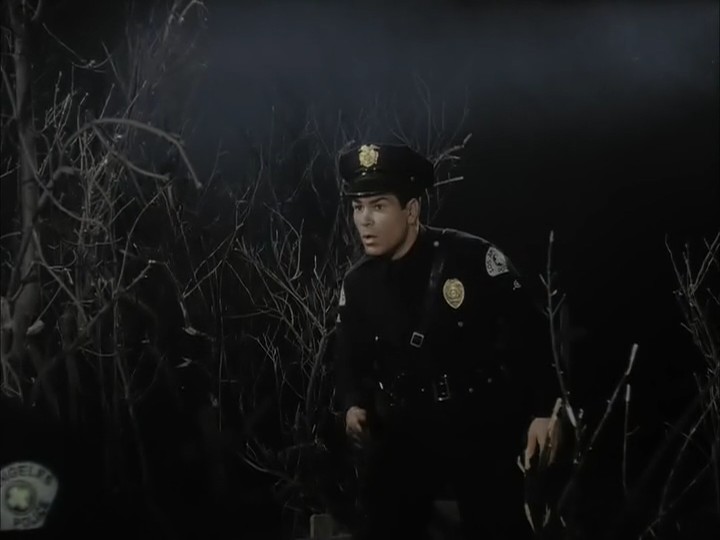
I was recently watching the Mystery Science Theater 3000 episode featuring the movie The Sinister Urge, and then I watched Plan 9 From Outer Space with the Mike Nelson commentary. Out of curiosity, I looked it up the cast, because one of the major villains in Sinister Urge was a good guy in Plan 9. His name was Carl Anthony. Here’s a picture of him:

mpv-shot0001

He’s the one in the police uniform. Here’s another picture of him.mpv-shot0002.jpg

His IMDB page only lists four credits:

  • Plan 9 From Outer Space (1959)
  • The Sinister Urge (1960)
  • Grand Jury: Boxing Scandal (1960)
  • Raw Force (1982)

Two things caught my attention. The first was that after some initial success, it was 22 years before he got another part. It’s not much of a movie, but it is a real movie. The IMDB synopsis for Raw Force is:

A group of martial arts students are en route to an island that supposedly is home to the ghosts of martial artists who have lost their honor. A Hitler lookalike and his gang are running a female slavery operation on the island as well. Soon, the two groups meet and all sorts of crazy things happen which include cannibal monks, piranhas, zombies, and more!

The second thing I noticed was that there was a TV show called Grand Jury. Carl Anthony was in the episode called Boxing Scandal. The Wikipedia page has next to no information beside an episode list. Yet there are writers for each episode, and it has actors, so presumably it was some sort of crime drama or detective show about a grand jury. I’m very curious what their premise was since grand juries don’t have continuity. They’re assembled for a few weeks, hear a bunch of cases, determine whether there is sufficient evidence to proceed to trial, then disband. Their goal is not to determine guilt or innocence, which would make it a very odd fit for a detective series.

Then it occurred to me to check to see whether there are any episodes on YouTube. Luck! There is:

It’s curious, to be sure. After a bit more research I discovered that Grand Juries actually do have investigative functions, such as the ability to compel witnesses to testify. The basic format is that some people committed a crime, then the grand jury investigates and tries to catch them. It’s actually a bit reminiscent of Columbo, in the sense of being a how-catch-em rather than a who-dunnit. That said, at least the episode Fire Trap is really more about the tragedy of how crooks fall apart than about investigations by the grand jury.

The acting was decent. The writing was… adequate. Really, it was kind of minimal. It wasn’t subtle, to be sure. To some degree it actually felt like a morality play—somebody made the choice to do a wicked deed and his life fell apart because of it. Of course, I have no way of knowing whether this was a typical episode. Still, I can see why this was not one of the great TV shows which is still remembered. That might be why Carl Anthony got a part in it (this was after Plan 9 but before The Sinister Urge).

This ties in to my earlier post, Most of Life is Unknown. People worked on this show and—presumably—people watched it. Most of them are probably dead by now, and the show is barely known. The wikipedia page which gives its list of episodes is presumably copied from somewhere since most of the entries are TBA. Even the things which we think should last disappear quite quickly from human memory. Fame promises so much and delivers so very little.

It’s a good thing that God is in charge of the world, or we’d be really screwed.

Of All Things To Predict, The Future is the Hardest

Yesterday, I wrote about The Future of Cars According to (Disney in) 1958. This reminded me of a conversation I had, about two decades ago, when I was a freshman in college. One of my majors was computer science (at the time I was tripple-majoring in Math, Computer Science, and Philosophy) and I was speaking with a senior who was also a computer science major. We were discussing Windows versus Linux. I can’t recall exactly how it came up, but he said, very confidently, that in 10 years neither Linux nor Windows would exist any more, both having been replaced by something completely new.

Twenty years later, both Windows and Linux are going strong, though the writing is on the wall for windows and it is gaining ever-more Linux-like features. (Including, recently, a way to easily install Linux within a virtual machine.) Which brings me to the title of this post—the future is notoriously difficult to predict. And I’d like to consider a few of the things which people tend to get wrong.

Adaptation

For some reason, people tend to think of current companies, products, etc. as either completely changing or completely static. Which really amounts to the same thing—the idea that whatever comes next will be completely new. And yet, this is rarely the case. Not never, of course, but rarely.

What prognosticators tend to leave out, here, is the market forces which operate on technology. Most people don’t like completely new interfaces; that means a lot of learning for marginal benefit. Far preferable are modifications to existing tools, so that the amount of learning requires is in proportion to the benefit received. An extra button or two is a small price to pay for new capabilities; having to learn all-new muscle memories for mostly old capabilities and some new ones is a price which is usually too large.

In many cases there is also the issue of interoperability. Computers benefit tremendously from backwards compatibility, but so do tools. A drill which cannot take normal drill bits renders one existing collection of drill bits worthless. Or worse, drill bits which can’t be chucked into one’s drill collection renders one’s drill collection worthless—and one generally as more money in the drills than in the bits.

These are powerful forces which tend to make new technology look and feel like old technology wherever possible.

And of course, people don’t like going out of business. Those who already have tools are motivated to improve them in order to stave off replacements—and this often works.

Technology Changes, Human Beings Don’t

Another place where prognosticators often fall down is that the human beings who are served by technology don’t change. We still have two eyes, two hands, are social, need to eat and sleep, etc.

So for example people look at the steering wheel, see that it’s been around for a long time, and think “that’s due for a change!” What they don’t consider is the problem at hand: we need a control interface to a car which translates fairly large movements into fairly small movements (for precision) while still allowing large movements, but where large movements are impossible to do by accident. This interface needs to control one dimension (left-to-right), should be usable for long periods of time without fatigue, and should be operable without looking at it. The steering wheel does all these things and does them well. Joysticks, nobs, and other such video-game replacements do at least one of these things poorly. It is of course possible that other sorts of interface will be made that can do the job just as well, but how much better is it possible to do the job, given the limitations of human physiology?

There’s a related example in 3D movies. Some people take 3D as the next obvious step, since silent movies to talkies went well and black-and-white to color went well and low-definition to high-definition went well. But what they miss is that all of these things made movies more realistic. Stereoscopic 3D information gives us distance information—and for typical movies these distances are almost always wrong for our viewing. Granted, they would probably be about right for The Secret of Nimh (which is about mice) in a 50″ TV about 10′ away—if the director would refrain from close-up shots. If you watch a movie, you will realize that there is almost no configuration of movie shots and TV size/location that will make the distance information to the characters correct for the viewer. Worse, if it were, instead of an immersive world of photographs, you’d have a window you’re looking through onto a stage play. The Nintendo 3DS had this problem, with its tiny screen—looking at it one had the feeling of watching a tiny animated diorama. It was novel, but not really interesting. The problems here are that the human being is simply not being taken into account.

Which is why, incidentally, the filming of 3D movies using two cameras at approximately eye-distance apart has all but been abandoned. Instead, 3D is (essentially) painted into a scene in post-processing by artists, who artistically fake the 3D to make it look good when viewed. I’m told that this can really help with scenes that are very dark, making it possible to distinguish dark grey blurs from a black background. This is adapting the technology to the realities of the human being, which is why it’s actually successful. But it’s also quite expensive to do, which greatly limits the appeal to viewers since it translates into much higher ticket prices.

Better Implementation Often Trumps A Better Idea

This is one of the more under-appreciated aspects of technological change. A mediocre idea implemented well is often superior to a good idea implemented in a mediocre way. I’m not just referring to actual fabrication; ideas for technology are themselves developed. Mediocre ideas which are developed well can produce better results than good ideas which are not much developed.

Perhaps the best example of this I can think of is the x86 processor. It has what is called a Complex Instruction Set. This is in contrast to the ARM processor which has a Reduced Instruction Set. (These give rise to the acronyms CISC and RISC.) The x86 processor was developed during the days when CISC was popular because computer programs were largely hand-coded in machine instructions. The complex instruction sets saved the programmers a lot of time. The trade-off was that it took far more silicon to implement all of the instructions, and this resulted in slower CPUs. After the advent of higher level languages and compilers, the idea of RISC was born—since a program was generating the machine instructions anyway, who cares how hard a time it had? The trade-off was that the compiler might have to do more work, but the resulting CPU used far less silicon and could be much faster (or cheaper, or both). In the modern environment of all programs being compiled, RISC is clearly the better approach to computing. And yet.

Because Intel CPUs were popular, Intel had a ton of money to throw at the engineering of their chips. AMD, who also manufactured x86 processors, did too. So RISC processors were only a little faster and actually significantly more expensive. And then something interesting happened—Intel and AMD figured out how to make processors such that they didn’t need nearly so much silicon to implement the complex instruction set they had. In effect what they did was to introduce a translation layer that would translate the complex instruction set into a series of “microcode” instructions—basically, internal RISC instructions. So now, with x86 processors being interally RISC machines, the penalty paid for supporting a RISC instruction set is an inexpensive translation layer in hardware—a pentalty which generally isn’t paid unless the complex instructions are actually used, too. And compilers generally don’t bother with most of the complex instructions.

The result is that ARM processors have a small advantage in not having to do translation of opcodes to an internal microcode, but this usually takes only 1 step out of the 12 execution steps in an x86 pipeline anyway. And Ahmdal’s law should always be born in mind—the maximum improvement an optimization can produce is the total execution time of the process being optimized. That is, eliminating 1 step out of 12 can produce at most a 1/12th improvement.

But then modern Intel and AMD CPUs also do something interesting—they cache the results of decoding instructions into microcode. So this decode penalty is only paid for code that isn’t executed very often anyway. The most performance-critical code—tight loops—don’t pay the decode penalty. As I said, a better implementation often trumps a better idea.

(People familiar with x86 versus ARM may point to the difference in performance on mobile phones, but this is really about what the respective CPUs were designed for. x86 processors are designed for achieving the maximum efficiency possibly at high power draws, while ARM CPUs are designed to achieve the maximum efficiency at low power draws. ARM CPUs are therefore better in very low power draw environments but simply cannot be scaled up to high power draw environments. There is no power configuration possible in which an ARM processor will come close to the single-threaded performance of an x86 processor. The tradeoff they make for the low-power efficiency is that they cannot be scaled up. This has nothing to do with technical superiority of either x86 or ARM processors, but the fact that they’re designed for extremely different workloads and environments. The thing which Intel and AMD need to be careful about is that the amount of processing power which they can provide at 15W, 35W, or even 60W may simply be far more than is necessary in a laptop (since the tasks which laptops are asked to do is becoming more standardized as the development of software slows down), at which point ARM might eat their lunch not because of technical superiority but because of its capabilities becoming a better match for a changing problem-space.)

The Future of Cars According to (Disney in) 1958

In the 1950s, Walt Disney started a television show in order to fund the theme park he wished to build called Disneyland. In 1958, this television show featured a segment called The Magic Highway, which discussed the future of cars:

I am very fond of historical projections of the future, and this is an especially well-done one. Though I should mention that one bit of the future it predicted—larger, straighter highways designed for faster travel—was not much of a prediction as the US interstate highway system was already underway (it began in 1956).

There are some things which are remarkably common to predictions of the future which can be seen in this movie too. One is the way that user interfaces are either predicted to change when they won’t or remain static when they will change. In this case the computer which drives the car is given its destination via punch card. (In another scene data is entered via toggle switches.) On the other hand, the steer wheel was replaced by by joysticks, which are actually a terrible interface for driving a car. By contrast, steering wheels are actually a very good interface for driving a car, so there’s no real reason to replace them.

There is also the assumption that energy will be free and consequently used in the most lavish of fashions (like heating highways to dry them off from the rain). I think that was related to the expectation of the coming nuclear age and how it will provide almost unlimited power. That was still highly optimistic since at a minimum one needs to maintain an electrical distribution grid, and wires have to be sized to the electricity they’re carrying, which means copper or aluminum fabrication and distribution.

But details like distribution aside, the predictions that nuclear power would result in free power never panned out for the simple reason that the nuclear part of a nuclear power plant is actually a small fraction of the work which goes on in a nuclear power plant. At their heart, nuclear power plants are giant hot-water heaters. The electricity is produced in turbines which are turned by steam. The only significant difference between a nuclear power plant and a coal power plant (or oil, natural gas, etc.) is what heats the water.

Anyway, check it out. It’s very interesting to see the ways in which futurians are often wrong and sometimes right.

The Three Endings of Clue

If you’re not familiar with the movie Clue, it’s based on the boardgame of the same name (known as Cluedo in Britain). It’s not the greatest movie ever made, but it’s a lot of fun. I own it both on DVD and Blu-ray and recommend it if you like murder mysteries and fun.

A curious feature of the movie is that it was filmed with three different endings. Movie theaters would be given one of the three endings, so viewers would see a different ending depending on which movie theater they saw it in. However, this posed something of a problem for the VHS version of the movie.

Technically, of course, it was possible that they could have made three copies of the VHS cassettes, but probably would have been prohibitively expensive. Thousands of people see the copy of a movie sent to a theater, whereas each VHS cassette would have cost $15 or $20 at the time. The labor involved in shuffling the cassettes couldn’t have been worth it.

Whatever the reason, three different copies of the movie was not the approach taken by the makers of the VHS. And since VHS was a linear medium, it wasn’t possible to shuffle the endings. So the of the endings were presented as possible endings, while the third was presented as “what really happened”. A nice touch is that this information is presented in the sort of text cards that one might see in a silent film; it fits nicely with the setting in the 1950s (desipte that being long after the era of silent films, curiously) and with the fact hat it’s a movie based on a board game. (Which would be ludicrous except that the movie doesn’t take itself seriously, though not in the modern wink-at-the-audience way which we all know and hate.)

About ten years after the release of Clue (the movie), DVDs hit the market. Unlike VHS cassettes, DVDs did not have to be linear and it became possible to play one of the theatrical endings at random. And the first DVD of Clue that I bought indeed had that option, though thankfully it also had (and defaulted to) the option to play the VHS ending, i.e. the three endings together with the title cards identifying the first two endings as possibilities. I’m thankful because I far prefer that ending; it’s in keeping with the fun and tone of the rest of the movie.

But this raises the interesting question: if VHS hadn’t had the technical limitation of being purely sequential, would the three-in-one ending ever have been made? There’s no way to know, of course, but it points to a larger issue of providence and limitations. Limitations often force people to be creative in ways they would not have been without them. Perhaps the best example of this I can think of is Star Wars episodes IV-VI. When one compares them to episodes I-III, when George Lucas, now very rich, had (effectively) no limits, he did much worse work.

The issue of providence is probably fairly obvious, but we as finite creatures don’t see the big picture; we chafe at our limitations. But our limitations often guide us to the work which we’re supposed to be doing. The things which frustrate us are often safety rails. Not so much that they protect our health—though they occasionally do that—but they protect the good work which we’ve been given to do. This is all the more helpful because we so rarely recognize that work until long after it was (all but) forced on us. If we even recognize it then. Something to remember is that God loves Beetles.


Moana Is Kind of OK as a Movie

Having a two year old daughter I’ve had to watch “boana” a bunch of times now, and I’ve come to the conclusion that it’s just not a good movie. It’s kind of OK. It’s mostly pretty. It’s got a few halfway decent songs. That’s about as much as can be said for it.

The first problem is that it’s not uniformly pretty. Why is it that Disney animators can’t draw adult males any more? I heard that some Polynesians were offended that Maui was drawn as an obese semi-giant-semi-dwarf, and their point is quite fair, since Maui looked bad. But this wasn’t just Maui, it was also Moana’s father. It was true of the father in Brave, too. I’m sure that somebody will say that they’re not ugly, they’re stylized. I’d consider accepting that if:

  1. This was how females were drawn, too.
  2. They didn’t look ugly.

Frankly, it’s probably largely laziness. Animation has gotten ever-more expensive over time with less money becoming available to it, and so it’s gotten noticeably worse over time as the animators have to come up with ways to save time and money.

I suspect it’s also partially that Disney has given up on its cartoons being for the whole family. Since they’re now primarily advertisements for dolls, backpacks, etc., there’s no point in making them enjoyable by the whole family. They’re only supposed to appeal you very young girls, and very young girls probably don’t pay much attention to father figures in movies. To most children’s story writers, parents are at best a necessary evil.

This almost makes talking about the story of Moana pointless, since it’s largely just an excuse for set pieces, but I had to watch the thing so I feel entitled to talk about it anyway. What I find most disappointing is that it’s an adventure story with no hero.

Moana is the closest thing that one finds to a hero in the story but she’s just not competent enough to be a hero. Granted, she’s a child, but that’s just the problem—the protagonist is someone who can’t be expected to be competent.

Or rather, they throw her into circumstances she’s not competent enough for. “Competence” does, after all, take an object—it only makes sense when you specify what one is competent at. They put Moana into circumstances which require a skilled adult and have her succeed either by sheer luck or outright cheating. For example, never having sailed before, Moana is able to sail a boat on the high seas. There’s no reason given for this, she just succeeds. And the wind is, for some reason, always at her back.

When she finally flips over the boat—many hours (or days?) after she should have—the ocean then just puts her where she should be. Why it didn’t do this at first is never even hinted at. You can get away with that on a wise character who has the best interests of the character at heart, but nowhere in the movie is the ocean portrayed as wise. Which reminds me—where are any of the other gods? Specifically, where is the god of the sea? This is a theoretically polytheistic story and yet the events of the story happen in a vacuum. This is just nothing like the actual mythology one gets within polytheistic cultures.

Then we get to Maui, who makes no sense and even less sense when considered as a demigod. Leaving aside the ridiculousness of doing various things for humans in order to feel wanted, he would have been celebrated. There’s a ridiculous scene where Maui admits that everything he did for humans was to try to make them love him, but it was never enough. The amount of cussing that would be require to convey how nonsensical this is would be tedious, so I’ll just omit it, but seriously, what? After Maui did the various feats that he did there would be shrines to him everywhere. Polytheists are only too willing to worship anything they thought brought them benefits and might bring them more.

Oh, and Maui was intending to imprison Moana in a cave on his Island in order to steal her boat. There will certainly be gods and demi-gods like this in polynesian mythology, but they don’t come round to doing the right thing after a pep talk. Consider how utterly gratuitous imprisoning her in a cave without food was—he could easily have just stolen her boat—at least as far as he knew at the time. He was basically just murdering her for fun. Which he did again by throwing her into the ocean. And what’s with him trying to jump off the boat—just a few minutes before, he explained that he needed the boat because he can do everything but float.

Oh, and when Moana rescued Maui from Tamatoa, she lifted him up and half carried him out of his cave. This is another example of outright cheating in order to make her competent. Moana probably weighs somewhere in the vicinity of 100 pounds. Probably less, but let’s be really generous and say 100. Maui is going to weight somewhere around 400 or 500 pounds. Let’s give them the benefit of the doubt that say that he’s stylized and only weighs around 300 pounds. A 100 pound teenage girl is not going to be able to lift or carry a 300 pound limp weight. Even if Maui were helping a little bit, he would just crush Moana. She’s had no real physical training and her exercise had all been running around and climbing. I’ve no doubt that she can do a lot of pullups and has great endurance, but a 300 pound weight would just crush her. It makes no sense at all that they had Moana carry Maui out of the cave. The weaker companion rescuing the stronger companion who just got beaten in combat and was soon to be killed has been done many times. The right way to do it is to have the weaker one distract the opponent (which, granted, she did) giving the hero time to retreat. When it’s done well the hero uses his remaining strength to save the weaker one too, making them an actual team. Instead, for no discernible reason, Moana picks up things she shouldn’t be able to pick up.

And I should point out that this isn’t a male-vs-female thing. The boy in Last Action Hero never carried Arnold Schwarzenegger.

And then we come to Te-Ka. Given that Te-Ka is actually Te-Fiti, her placement on a barrier island simply makes no sense. My eight year old son also noticed this. Why, when Maui steals the heart of Te-Fiti, did Te-Ka instantly arise on a barrier island? And, for that matter, why did Maui try to directly fight Te-Ka rather than just, say, turning around and going a different way?

Which then brings up the question, where did the rest of the barrier island come from? Why was there even a barrier island? With Te-Fiti gone, why was Te-Ka protecting the worthless rock where Te-Fiti used to be? And how was the rest of the barrier island formed in a ring? There’s no indication that anyone ever tried to sail to where Te-Fiti had been, so why did Te-Ka produce lava there to hard into rock? It was obviously necessary that the barrier island form a ring around where Te-Fiti had been or Moana could have just sailed around it, but there’s just no in-plot explanation for this.

For that matter, why did the writers think that the barrier island was even necessary? It would have made more sense and solved more problems if Te-Ka had arisen on the Island which Te-Fiti had been. In particular this would have solved the problem of: why didn’t Maui fly over Te-Ka? Heck, why didn’t Maui fly around Te-Ka? Moana was able to outsail Te-Ka sideways. Why would a shape-shifting trickster have full-frontal-assault as plan A?

And finally, why do girl-power movies always have to have the power involved being—not actual power—but willful stupidity? Moana decides that she’s going to return the heart on her own. (Not that it matters, but why doesn’t she ask the sea to give her the heart again? Why on earth is the pacific ocean only 30 feet deep where she is, miles away from any island?) She then—predictably—fails and is saved by Maui. So much for empowerment. Defeating a giant lava monster is not something which one mortal on a boat is going to be able to do—incidentally, someone at Disney really should have looked up the difference between sail boats and motor boats—so why did Moana decide to do it? This doesn’t make her strong, it makes her dumb. If she had tried to recruit some allies, even unwitting ones—for example, luring the kakamura in to fight Te-Ka—that would have made vastly more sense. Had she recruited the ocean to help her get past Te-Ka, that too would have made vastly more sense. Anything which could at least possibly have worked would have made vastly more sense.

Alternatively, Disney could have scaled down the lava monster so that Moana at least had a chance of defeating it herself.

It’s not that I necessarily disagree with the writer’s goals—whatever they were—the problem is that what they wrote served no possible purpose. It just didn’t hang together at all.

Incidentally, who thought it would be a good idea to have the climax of the movie in slow motion and to have Moana sing a really dumb song where a mortal reassures a goddess that being a lava monster doesn’t define her? Seriously? The tone of this is almost perfectly wrong.

Oh, and as for the ending—who on earth is going to let their toddler sit unguarded on the pontoon of a boat going at fifteen or twenty knots?

Man Was Always Small

In Orthodoxy, Chesterton has a great line:

It is quite futile to argue that man is small compared to the cosmos; for man was always small compared to the nearest tree.

To give context:

Herbert Spencer would have been greatly annoyed if any one had called him an imperialist, and therefore it is highly regrettable that nobody did. But he was an imperialist of the lowest type. He popularized this contemptible notion that the size of the solar system ought to over-awe the spiritual dogma of man.

It’s something I’ve seen various versions of from contemporary atheists. The most common is that the universe is so large that even if God existed he couldn’t possible care what human beings do. Other versions tend to run along the lines that the universe is so big our petty concerns can’t matter.

Chesterton’s point is a very good one—that man never took his importance from his size relative to the world. It reminds me greatly of a quote from C.S. Lewis in his book The Problem of Pain:

It would be an error to reply that our ancestors were ignorant and therefore held pleasing illusions about nature which the progress of science has since dispelled… even from the beginnings, men must have got the same sense of hostile immensity from a more obvious source. To prehistoric man the neighboring forest must have been infinite enough, and the utterly alien and infest which we have to fetch from the thought of cosmic rays and cooling suns, came snuffing and howling nightly to his very doors… It is mere nonsense to put pain among the discoveries of science. Lay down this book and reflect for five minutes on the fact that all the great religions were first preached, and long practiced, in a world without chloroform.

Of course, few atheists will put the idea this baldly—atheists rarely state any of their ideas without dressing them up a bit, or simply failing to consider how they relate to their other ideas, in my experience—but that one meets this sort of thing at all is very curious. One of the problems which some atheists seem to have in relating to older ideas is that they can’t relate to older peoples.

To the degree that there are solutions to this, I suspect that they are largely going to be narrative. The modern narrative is one of being utterly cut off from our ancestors. And yet we’re also seeing counter-narratives emerging; the revival of older traditions, the preference for older ways of doing things. It’s not material whether the putatively older ways of doing things are in fact accurate to how they used to be done, what matters to this purpose is whether they are believed to be in continuity. When they are—when people believe themselves to be in continuity with their ancestors—that’s when they’ll stop seeing their ancestors as aliens and see them as human, instead.

The Unpleasantness At the Bellona Club by Dorothy L. Sayers

Following my reviews of Whose Body?, Clouds of Witness, and Unnatural Death, I re-read the fourth Lord Peter Wimsey mystery, The Unpleasantness at the Bellona Club. This time old General Fentiman is discovered dead in his high backed chair in the smoking room of the gentleman’s club called the Bellona Club. I believe that “Bellona” comes from the Latin root bellum, meaning war, as all the members seem to have been in the army and served in some war or other.

Old General Fentiman’s death would have been remarkable only for life imitating art—there were (apparently) plenty of jokes at the time about someone dying in a gentleman’s club and no one noticing because of the rules against disturbing other members—except for the very curious circumstance that his aged sister had died at about the same time and the terms of her will left her fortune to her brother only if he was alive at the time of her decease; should she have outlived him her fortune was to go to a distant relative to lived with her. The general’s family solicitor happens to be the same Mr. Murbles who is the family solicitor of the Wimseys, and he asks Lord Peter to investigate to see if a definite time of death can be established for the old man.

The mystery takes a few twists and perhaps the same number of turns and introduces a new friend of Lord Peter—the sculptor Marjorie Phelps—who we’ll meet again in Strong Poison. It’s a bit less conventional than the first three Lord Peter mysteries, but I recommend The Unpleasantness at the Bellona Club. An exploration of English upper class society in the 1920s is always interesting. Incidentally, the title is partially a reference to this—people keep referring to the old General’s death as “unpleasant” or “the unpleasantness” so often Lord Peter starts remarking on it. It’s a decent mystery, and though not one of Sayers’ best, it’s quite enjoyable.


If you like murder mysteries and especially if you like Dorothy L. Sayers’ Lord Peter Wimsey stories, you might like my murder mystery, The Dean Died Over Winter Break.
tddowb


(If you haven’t read the story and don’t want spoilers, stop reading here.)

(In what follows, I discuss the structure and execution of The  Unpleasantness at the Bellona Club with the purpose of learning from it because it is a good story. Everything I say should be understood as an attempt to learn from a master mystery writer. Criticism should in no way be taken as disparagement, as I dearly love the Lord Peter stories.)

The first and most curious thing to note about The Unpleasantness at the Bellona Club is that it is really two (connected) stories. The first half of the book is the story of trying to figure out when old General Fentiman died. The second half is trying to figure out who murdered him. This is an interesting choice in that the first half of the book feels less important than it really is. It also has the effect of shifting who the important characters are halfway through the book. In the beginning it was Major Fentiman and the mysterious Oliver. Well, the somewhat mysterious Oliver. He’s not really a very plausible character on one’s first read through the book, and I think it’s nearly impossible to suspend one’s disbelief about him on subsequent read-throughs. It doesn’t help that Lord Peter doesn’t believe in Oliver either. On the other hand, this does give the book a twist, and it gives the characters a chance to act in ways they might not have, had murder been suspected from the beginning.

Now, this sort of twist can be done in one of two main ways:

  1. The solution to the early mystery is provided by solving the murder.
  2. The solution to the early mystery leads us to the mystery of the murder.

The Unpleasantness at the Bellona Club is a variant of #2. Technically the early mystery (when General Fentiman died) is solved shortly before the murder mystery is discovered, but Lord Peter has arranged things so that the exhumation of the body proceeds anyway and the murder is discovered. Upon consideration, this may actually be a third way for this twist to be done:

3. The sleuth investigates the early mystery as a pretext for investigating what he believes is a murder but can’t yet prove is.

Once it is discovered that General Fentiman was poisoned, it is revealed that Lord Peter expected it and wrangled the exhumation of the body specifically to prove it. I do wish that Lord Peter wasn’t quite so subtle about it, though, as the early investigation doesn’t feel connected to the murder investigation, at least on my first two readings. So when Inspector Charles Parker congratulates Wimsey on having handled the case masterfully, it feels a little un-earned.

Which brings up the subject I find very interesting of the good Inspector. This is the second to last book in which he plays a major role, and he only plays that roll in the second half of it. Since the early mystery about when old General Fentiman died was not a police matter, Parker had nothing to do with it. Now, one could chalk this up to the limitations of a police officer as a friend to a sleuth, but this need not be the case at all. Charles Parker was a good friend of Lord Peter; the two could have discussed Lord Peter’s case over cigars and wine at Lord Peter’s apartment. And yet Sayers didn’t do that. And in the very next book we get introduced to Harriet Vane, with whom Lord Peter falls instantly in love. (In fact, I believe he fell in love with her prior to the first page of Strong Poison.) I can’t help but wonder if Sayers tired of Charles Parker, or simply felt he was deficient as a foil for Lord Peter. In any event, he had given her good service and she in turn gave him a good retirement—he would be promoted to Chief Inspector and marry Lady Mary Wimsey.

I think that part of the problem with Charles Parker was that Sayers never really let him become interesting. She gave him a trait which had the potential to be very interesting, but didn’t commit to it. I mean, specifically, that he read theology in his spare time. So far, so good. The problem is that he didn’t seem to learn anything from it. He never talked about it—even when it would be relevant. I don’t think that Sayers would have had any difficulty in writing such a character since she was a religious and well educated woman. Yet still, she didn’t. For whatever reason she seemed most fond, and most comfortable, with writing non-religious or even irreligious characters. At least intelligent ones. She had no real trouble with the middling or unintelligent religious characters. The one exception I can think of being a priest in Unnatural Death. He was very well done, though he only appeared for a page or two.

Of course, the lesson seems to be a rather obvious one: always commit to your characters. Whatever their traits, commit. And if you can’t commit to a character, pick a different character.

Speaking of characters, like Clouds of Witness, there’s an extremely unpleasant character in The Unpleasantness at the Bellona Club. Which, I suppose, does at least fit in with the title. I’m speaking, of course, of Captain George Fentiman. I suppose that he was to some degree a commentary on World War I, but I found the constant fighting with his wife—and nearly everyone else—was wearying.

I don’t mean to suggest that such an unpleasant character serves no purpose, however. Captain George was a suspect, and so his aggressiveness and anger do serve to cast suspicion upon him. For that matter, Farmer Grimmethorpe was a minor suspect in Clouds of Witness. But in neither case were they really developed as suspects. Grimethorpe was given a good alibi, and in any event he would have been far more of a suspect had the victim been beaten to death, not shot at close quarters. Simlarly, Captain George would have been far more of a suspect had old General Fentiman been, well, shot at close quarters, not poisoned.

Further, Captain George pretty clearly had no opportunity to murder old General Fentiman. It is hardly plausible that he kept a fatal dose of digitalin on hand should he happen to run into his grandfather on the street in a place he would never have expected to meet him and to then somehow talk the old man into taking it in a place (a taxi cab) where it is most unnatural to eat or drink anything.

I think that when it comes to lessons for writing murder mysteries, if one is going to give a character traits which make them unpleasant to read about, it is best to make them a highly credible suspect. This can also make some tension where the detective would be only too happy for the unpleasant character to be the murderer, which makes them second guess evidence against the character because they are worried about confirmation bias. It can also serve to make the detective more virtuous when he exonerates someone he has come to dislike. At the same time this can become a trap of making a suspect too obvious so that he isn’t suspected; which can make for a good twist where the unpleasant, angry man did actually commit the murder.

(Incidentally, a complication one doesn’t see too often is an accessory after the fact who is the brains of the operation. One sees often enough an angry man who does the brutal work collaborating with an intelligent man who designs the murder for him, but an intelligent accomplice who enters only to clean the murder up is, I think, uncommon.)

When it comes to the murder in The Unpleasantness at the Bellona Club, I’m not sure what to make of it. It is established very early that the old general went to Dr. Penberthy shortly before he died, and therefore that Dr. Penberthy had basketfuls of opportunity to poison him. And of course as a doctor he had ample access to digitalin. The only thing he lacked was a motive. And the motive he had was comprehensible enough, though it does feel rather a lot like coincidence. Granted, an explanation is given, though it’s one that’s guessed at. Being old General Fentiman’s doctor, he heard about the family quarrel that would result in Lady Dormer’s money going to Ann Dorland, and so he made her acquaintance and seduced her. But this is still a bit far fetched since the old man never spoke of his sister and I don’t see why he’d take the doctor into his confidence on a matter too painful for him to ever speak of. Especially since he blamed his sister and didn’t feel any guilt he needed to try to rid himself of.

Granted, it’s often a good idea for the murderer to be connected to the deceased in a manner that is not generally suspected. Still, Penberthy just never felt like he was enough of a character to me to justify the secret engagement. I think it’s that he never showed up except in his official capacity as a doctor. This puts him in the same class a butlers and other servants; one fails to suspect him not because one is misled by a clever disguise but because one knows nothing about the character at all, and as mysteries go, everyone whom one knows nothing about is interchangeable.

The obvious exception to the above is where one learns about the culprit under a different identity, learning more and more, until one starts to suspect the service characters of being the other identity. I’m talking about plots where long lost cousin Ernesto, who will inherit, took a job as the butler (having shaved his famous mustaches) in order to poison his wealthy relative and intends to inherit from afar and fire the domestic staff so that they won’t recognize him when he takes possession. That sort of thing is tricky, but can be made to work. Agatha Christie did it well in Murder in Mesopotamia. Chesterton also did it well in The Sins of Prince Saradine, though a short story has different rules than a novel does.

This does not apply to Penberthy, though, since he is revealed to have been Ann Dorland’s fiance on the same page that it was revealed that she had a fiance.

I’m also a bit dissatisfied with Ann Dorland’s appearance at Marjorie Phelp’s apartment. When Lord Peter asked Marjorie about Ann, she barely knew the girl. That makes Marjorie a strange confidant to fly to when Ann thinks she’s about to be accused of murder.

On the other hand, Ann Dorland is a pleasingly interesting character. Intelligent but innocent, we meet her in the position of having made many mistakes but is able to learn from them quickly with a bit of guidance. Her likability redeems many of the circumstances surrounding how we meet her and I think ultimately pulls the story together. In that last part it’s especially important to notice that the character, though largely a plot point in the beginning of the story, becomes a real character with real personality in the end. There’s a good lesson in that, which is to make sure to give even minor characters their own personality. It doesn’t have to be a lot, and more importantly it doesn’t even have to be at he beginning. One shouldn’t push that too far, but when the reader learns about a character’s personality, their memory fills it in for them earlier in the book, too. (It is important that the author know who the character is early on, though, so that the character is consistent when he is finally developed.)

And in the book we come once again to the murder committing suicide rather than facing justice. It’s not really the suicide that I dislike so much, but the way that Lord Peter approves of it and worse, helps it happen. Granted, Lord Peter isn’t Christian and so it’s not out of character for him, but I don’t like having my nose rubbed in how he isn’t Christian. I suspect that’s what really gets me about it. It’s one thing to enjoy the virtues which pagans have, but it’s quite another to have to look at their vices.
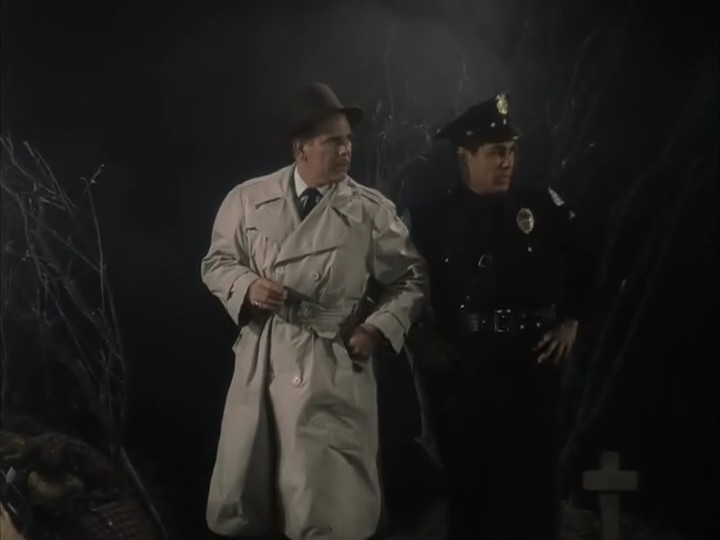
Most of Life is Unknown

We live so awash in stories and news that we get a very skewed perspective on how much of real life is know to more than a few people and God. What got me thinking about this was watching the following song:

It was the theme song used by a sketch comedy group at the university I went to for my undergraduate degree. They were called Friday Night Live (as an homage to the TV show of similar name) and would put on a show about three times a semester. They had apparently been hugely popular when they started, which was at least a few years before I attended. I was in the rival sketch comedy group, Pirate Theater. At the beginning of my freshman year the attendance at our shows was lower than that of Friday Night Live, but by the end of my senior year the positions had reversed. Our audiences were 3-4 times larger and theirs were smaller even than our audiences had been in my freshman year.

A few years ago I ran into someone who was currently a student at the university and I asked about the shows. He said that Pirate Theater was still reasonably popular but Friday Night Live no longer existed. In fact, he had never even heard of it.

There had been a reasonably friendly rivalry between the two shows, and it turned out that our efforts brought success, in a sense. I don’t think that any of us pirates wanted to kill of Friday Night Live, and ultimately I suspect that it was the quality of their writing which did them in. For whatever reason (I never wrote sketches for FNL, so I couldn’t say what it was like to do so), Pirate Theater managed to attract far more of the skilled writers on campus. It also didn’t help that FNL insisted on having an intermission and hiring a local band to play in it. I think in all the time I was there—and I didn’t miss an FNL show all four years—they had one band that I didn’t leave the auditorium to get away from. Really, really cheap bands tend to be so inexpensive for a reason.

As you might imagine, I was never alone outside the doors when the band was playing. And they were always ear-hurtingly loud, too. Adding injury to insult, I suppose.

Towards the end of my senior year, there were probably less than a hundred people attending the Friday Night Live shows. The total number of people who saw their trajectory for those four years I watched it was not very large; the number who remember it now is probably much smaller. And yet the actors did work on their sketches, however little humor was in them. The “turrets family” where the “joke” was that there was a lot of yelling and cussing may not have been entertaining to watch, but it’s no easier to memorize unfunny lines, or to say them at the right time when you’re live on stage. (There was at approximately one of those per show, for all four years, by the way.)

One of the actors was limber and would do physical comedy with a folding chair, getting stuck in it. It wasn’t brilliant physical comedy, and (due to the lack of skilled writing) never really fit into the sketches it was in; one could see it coming a mile away as the sketches it was used in were basically an excuse to do the wacky chair antics. But someone did write the sketch, and people memorized it, and the actor did twist himself through a chair on stage which is not an easy thing to do. And I do have to say that the final time he did it—which was the last FNL show I attended since he graduated the same year I did—was actually kind of funny because it was actually a protracted goodbye dance with the chair, complete with sad music and longing glances.


This was all very real; people put real work, went through real happiness and sadness, and now it is mostly forgotten. That is ultimately the fate of (almost) all human endeavors. This was captured quite well, I think by Percy Blythe Shelley in his poem Ozymandias:

I met a traveller from an antique land,
Who said—“Two vast and trunkless legs of stone
Stand in the desert. . . . Near them, on the sand,
Half sunk a shattered visage lies, whose frown,
And wrinkled lip, and sneer of cold command,
Tell that its sculptor well those passions read
Which yet survive, stamped on these lifeless things,
The hand that mocked them, and the heart that fed;
And on the pedestal, these words appear:
My name is Ozymandias, King of Kings;
Look on my Works, ye Mighty, and despair!
Nothing beside remains. Round the decay
Of that colossal Wreck, boundless and bare
The lone and level sands stretch far away.

Most things fade from memory far faster, of course. How many people now remember more than a few fragments of Friday Night Live’s sketches? I don’t think I remember more than a few fragments of the Pirate Theater sketches which I wrote, let alone those I merely performed in. I do have a DVD with a collection of the video sketches we did (many of which I’m in), but it’s been quite some time since I watched it.

It may well be longer until I watch it again. In the intervening decade and a half, I’ve gotten a profession, married, bought a house, had three children, published three novels, made a YouTube channel with over 1,973 subscribers, and a whole lot more. As much a I value my memories of my college days, I don’t want to go back in the way that video takes one back.

But the thing is, that’s not a strength. I just don’t have the time and energy for it. But all the things I’ve done since which so occupy me now will also fade in time. Eventually I will die; eventually this house will fall down or be demolished; eventually my children will die. Nothing has any permanence within time.

So the only hope we have is for permanence outside of time. There’s a great metaphor, which Saint Augustine uses in his Confessions, of God, at the end of time, gathering up the shattered moments of our lives and putting them together as a unified whole. And that’s really the only hope we have for any of our lives to be real.

The Death of Rock and Roll With Zarathustra’s Serpent

You may recall my blog post The Death of Rock-n-Roll. After writing it, I invited Zarathustra’s Serpent to talk with me about the subject because he’s studied popular music quite extensively. This is the conversation we had. You can also watch the video on YouTube:

In-Genre Fiction is Dull Outside of It

In an interesting blog post about Pulp writing (such as that of Edgar Rice Borroughs or Robert E Howard) and Japanese Light Novels, Cheah Kai Wai quoted a bit of description from a popular JLN and said about it:

This is from the first chapter Goblin Slayer, a famous dark fantasy series about the eponymous adventurer obsessed with conducting goblin genocide. The text is compact and easy to read, but it is all tell and no show. Phrases like ‘took her breath away’ and ‘taken aback’ lack power, because the sparse descriptions lack emotive power. The sentence ‘No one would tolerate the existence of armed toughs if they were not managed carefully’ feels aimed at the reader instead of being an organic component of the story.

This excerpt is simply a straightforward report of sights and peoples and business functions, revealing nothing substantial about Priestess, the people around her, the town or the rest of the setting.

(The blog post has the quote that this is a comment about, but the particular accuracy is not my point so I’m omitting it for the sake of brevity and hope that you will trust the description is accurate for the sake of argument.)

The thing I’m wondering about is whether the particular example and Japanese Light Novels in general might be suffering not from being poorly written, but from being what I’m going to call genre-referential. (This is something of an extension of ideas I talked about in my earlier post Predictability vs. Recognizability.) What I mean by this is that some stories rely on referencing ideas and patterns established in other stories—generally progenitors in their genre. This sort of referencing makes for great economy of writing, but it also lightens the reading burden for readers who are very familiar with the genre and know what you’re talking about so much that explicit description actually becomes boring.

(As a side note, this can actually make it difficult for people who started with later works in a genre to fully enjoy the original works which defined the genre—since they had nothing to reference and readers were unfamiliar with the genre, they described it in detail which, to a reader already familiar with the genre, is just unnecessary and therefore slow and over-wrought.)

I’ll give an example. Suppose a story started out like this:

“I can’t take this thing any more!” Ian said as he took off the Imperial shock-trooper helmet. “If I get a headache in this after five minutes, how on earth are we going to infiltrate the governor’s palace in this armor?”

“You complain too much,” Duke replied. “At least it’s laser-proof.”

“That doesn’t do you much good, kid, if they pick you up and throw you into a smelting pit,” Ian replied with a sour grin.

No one would mistake this for the beginning of a masterpiece, but at the same time, despite the fact that I have given approximately no description of—well, anything—I suspect that most readers who are at least 30 years old (in the year of our Lord’s incarnation 2018) will still have a fairly vivid idea of what just happened. They will know:

  1. There is an empire run by a ruthless and evil emperor who
  2. dominates the solar system or possibly the entire galaxy
  3. squashing the freedom of all people through it.
  4. The empire has some sort of elite units of soldiers issued full-body armor complete with head-encasing helmets. Basically, storm trooper from Star Wars before we found out that they can’t hit anything.
  5. Ian and Duke are at least somewhat friends, but probably not intimately so
  6. Ian is impetuous and cynical
  7. Duke is idealistic and optimistic

The list goes on; people who have seen a lot of space opera know quite a lot about these characters and the setting. As I said before, this is obviously not the start of a masterpiece, but it could easily be a lot of fun. But imagine what someone who’s never read any space opera would make of this. Really, if you can stretch your imagination that far, not very much. There are a few blanks established to be filled in later, but the only description of the characters given is the single word “kid” which might erroneously suggest that Duke was, in fact, a child.

Now, consider how much is changed and what a person familiar with space opera now knows if I add just two words:

“I can’t take this thing any more!” Ian Tolo said as he took off the Imperial shock-trooper helmet. “If I get a headache in this after five minutes, how on earth are we going to infiltrate the governor’s palace in this armor?”

“You complain too much,” Duke Landwalker replied. “At least it’s laser-proof.”

“That doesn’t do you much good, kid, if they pick you up and throw you into a smelting pit,” Ian replied with a sour grin.

Now you know that this is a parody of Star Wars, but a reasonably subtle parody of Star Wars, not a Mad Magazine style over-the-top parody. More like a toned-down Mel Brooks parody.

But suppose that those weren’t the characters last names. Consider how a few extra lines can signal that this is going in a very different direction than Star Wars:

“I can’t take this thing any more!” Ian said as he took off the Imperial shock-trooper helmet. “If I get a headache in this after five minutes, how on earth are we going to infiltrate the governor’s palace in this armor?”

“You complain too much,” Duke replied. “At least it’s laser-proof.”

“That doesn’t do you much good, kid, if they pick you up and throw you into a smelting pit,” Ian replied with a sour grin.

“True,” Duke said. “But the Dakat is with us. We can’t fail.”

Ian sighed and stared down at his feet, thinking. Then he stretched out his hand, said the words “Dakat Zadum” and an imperial laster-rifle materialized under his hand. Grabbing it before it fell in a long-practiced motion, Ian put it in the empty holster on his armor. He looked up at Ian.

“You’re right,” he said, without enthusiasm.

With the same formula, Ian made a blaster to go with his armor.

“You know I am,” he said. “Now let’s go.”

The fan of space opera is put on notice that while it has some thematic similarities to Star Wars, this is by no means a mere rip-off of star wars. Granted, there are space wizards, but here we have two teammates who are space wizards; there isn’t a master and an apprentice. Though it taps into a similar setting—including high technology versus magic—it’s a very different cast of characters. And the space magic is very different, too. One of the curious questions is whether or not the space wizards will have a magnetically contained plasma torch (*cough* light saber *cough*) or any similar weapon. In fact, there are a whole host of questions in the back of the mind of the studied fan of space opera:

How are the space wizards arranged. Are they independent? Is there a guild? Is there an organization in place to dominate the space wizards since magic is dangerous? What are the limits to the magic? How common is magic? They have lasers which seem to be used as guns, how high is the technology? Obviously if they have high technology too magic can’t be that common, so what is the relationship between the technology users and the magic users?

And so on. There are tons of questions which pop up unbidden because they’ve been brought up by a whole host of previous books and movies answering these things in different ways. But none of these questions are likely to occur to a reader who knows nothing about space opera. While the imagination of the fan of space opera may be flooded by memories of his favorite—and not so favorite—space opera stories, the one who knows nothing about space opera has none of this occupying his attention. So we have two radically different experiences:

For the fan of space opera, we have an economy of language, giving him hints as to what sort of space opera this is, letting him imagine all sorts of possibilities as his mind races to figure out the universe being described.

For the one who knows nothing about space opera, we have a scene in which two people who are not described in any way—except that one regards the other as being younger—talk about how some armor is uncomfortable and partially useful, say some words and guns appear, and (may) be ready to go somewhere to do something.

Now, another criticism which Cheah Kai Wai leveled against the light novel he cited was that it told everything rather than showing it. But consider the above dialog recast into pure exposition:

Ian removed the imperial shock-trooper helmet he had been wearing. He had only been wearing it for a few minutes and he already had a headache. Granted, it was laser-proof but there are a lot of ways to die and no armor can protect you from all of them. Duke, younger and with every bit of of the optimism and idealism that comes would youth, hashed this out with Ian for a bit before Duke pulled out his trump card and pointed out that the Dakat was with them.

There was no arguing the point. The Dakat was with them, so whatever risks they were taking, they could succeed. Wearily, Ian acknowledged the fact by using Dakat magic to materialize a laser rifle and put it in the holster of his armor. Duke smiled, likewise made his own, and they were ready.

Now, this is obviously less energetic than the original, but for someone who loves space opera, I would argue that it is not disqualifyingly so. The lover of a genre is generally in the position of having already read all of the best stuff, and the mediocre stuff is at least evocative of the best the genre has to offer. The lover of space opera is, by this uninspired bit of exposition, at least promised shiny armor, laser rifles, an evil empire, and space wizards. Neither the paint on the wall—long since dried—nor his shoes offer any of these things. And on the plus side, the lover of space opera is not wearied by ornate world-building, most of which he can guess anyway. The writer at least skips to the parts he can’t guess.

To someone who is not a lover of space opera, however, this is profoundly disqualifying. It gives no background, no orientation, no idea of what’s to come, and very little happens in it.

All of this brings us to one of the fundamental problems for writers: figuring out who your reader is. The fundamental problem (which the above quickly written examples are only meant to sketch) is that the same work is radically different when read by someone who lives and breathes a genre than it is when it’s the first dipping of the reader’s toe into the genre. Or even when he’s not yet up to his ankle in it.

Now, I’m not trying to claim that Cheah Kai Wai is wrong in his characterization of Japanese Light Novels. I haven’t read them and it would be absurd to speak with any certainty about them in any case. And I’m not trying to argue with Mr. Rawle Nyanzi’s (low) opinion of Japanese Light Novels either. Both men have obviously read more of these novels than I have (since I’ve read about 3 paragraphs of them so far) and for all I know are experts in the genre. But if they are not experts in the genre, it is interesting that their cogent criticisms may in part come from being outsiders looking in on genre-referential fiction. And since no one is an expert in all genres, we will all have this problem with genre-referential fiction in some genres.

And as writers, there is the problem that genre-referential fiction has a smaller potential base of readers, but we know that they read way more stories in the genre than general readers do.

(There is another problem which comes from what one is looking for in fiction. This post is already very long, so to sketch the problem: when I was young, I craved adventure stories of people becoming heroes. Now that I have three young children and every day is an adventure where I am sometimes literally saving someone’s life—though by  intensely mundane activities like shutting a door at the top of a staircase so the two year old doesn’t fall down, or making sure that the five year old doesn’t microwave a fork and burn our house down—I find that I crave stories about calm, security, and wisdom far more than those of adventure and heroism. It stands to reason, then, that Japanese teenagers on the train home from cram school might crave something different from either. It’s possible, for example, that vivid description would be too much for their over-saturated brains.)