
On the twentieth day of October in the year of our Lord 1985, the fourth episode of the second season of Murder, She Wrote aired. Titled A School for Scandal, it’s set at Crenshaw College in Vermont. (Last week’s episode was Murder In The Afternoon.)

It opens with a man solemnly reading from a book:
Clothilde watched the dying rays of sunset fade on the boats that had been beached on the sand and marveled at the colors that defied the onslaught of night. It was a sight worthy of van Gogh at Sainte-Marie’s and she shivered slightly, though the air was warm and no breeze stirred. It was then that she sensed his presence. She turned and felt the power of Jean-Paul’s hard, sinewy arms pulling her against him. Her arms moved to encircle and hold him, her mouth seeking his, speaking urgently in hungry tongues of rippling desire.
The camera pans down as we hear this and we find out who is reading:
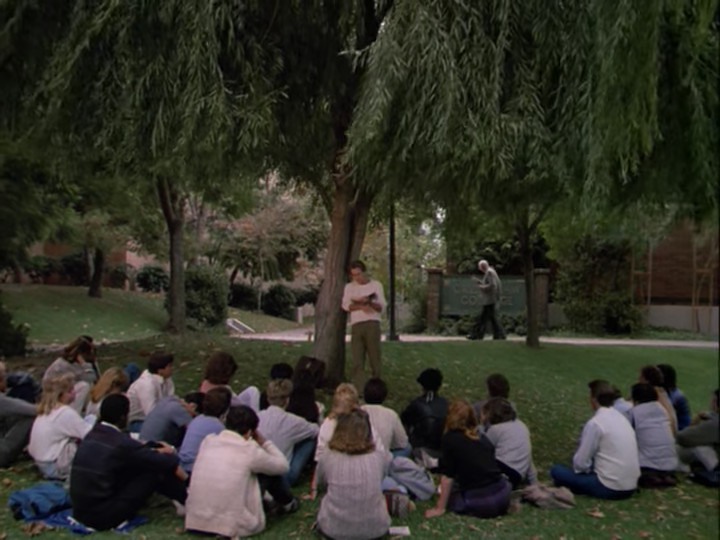
It’s a college professor in the English department, reading to his class. (His name is Ron Mercer.)
He then asks for comments and a student volunteers that it’s garbage. Ron challenges them, but not very effectively. In the ensuing discussion we find out that the author of this romance novel, Daphne Clover, is the daughter of the head of the English department at the university. One student heard that Professor Laird (Daphne’s mother) tried to get her daughters’ books banned from the campus bookstore, but Ron replies that the student heard wrong.
And then he concludes, “Now, let’s get back to James Joyce,” as if it had been the students who changed the subject from James Joyce, rather than him who read the trashy romance novel in class.
The scene then shifts to Jessica standing at what is supposed to be a train station.
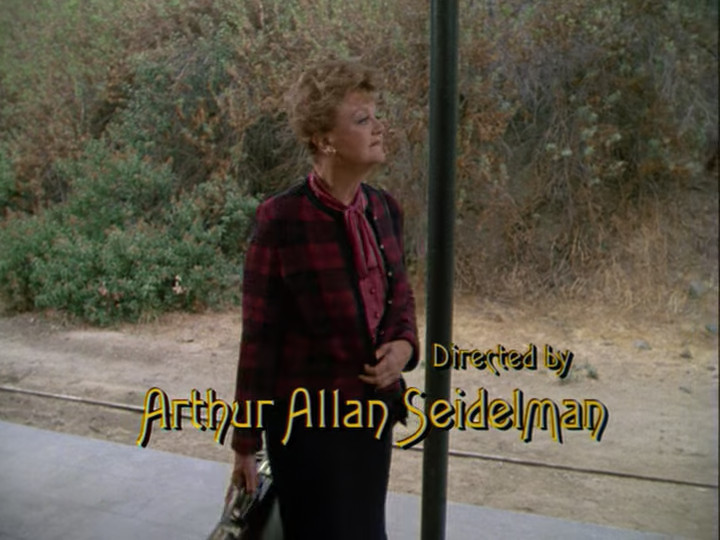
Here’s another angle on the train station:
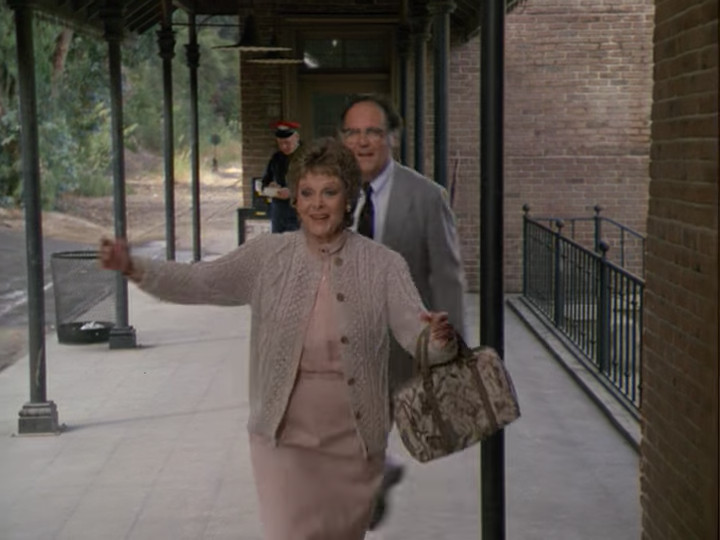
(Those are friends of Jessica’s here to pick her up; she’s going to get an honorary degree and give a commencement speech at the local university. He’s Henry Hayward and is the president of the university; Beryl is his wife.) Those do look like metal rails on the ground, but I don’t know what to make of there being no railroad ties underneath them. Also, this isn’t an elevated platform. Which, of course, is not strictly required for trains.
We get another shot of the train station station from the outside:
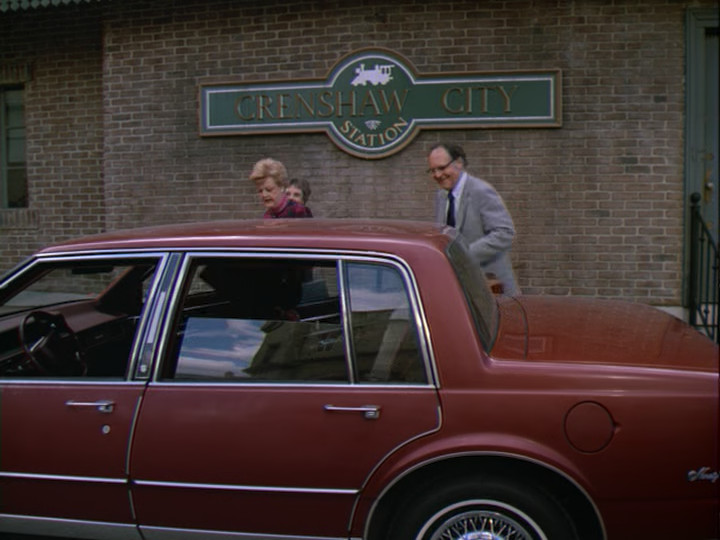
I wonder what this building really was.
Oh, and we get the news that Jocelyn Laird, head of the English department, is holding a party in Jessica’s honor tonight.
We then meet the head of the English department whom we’ve heard so much about.
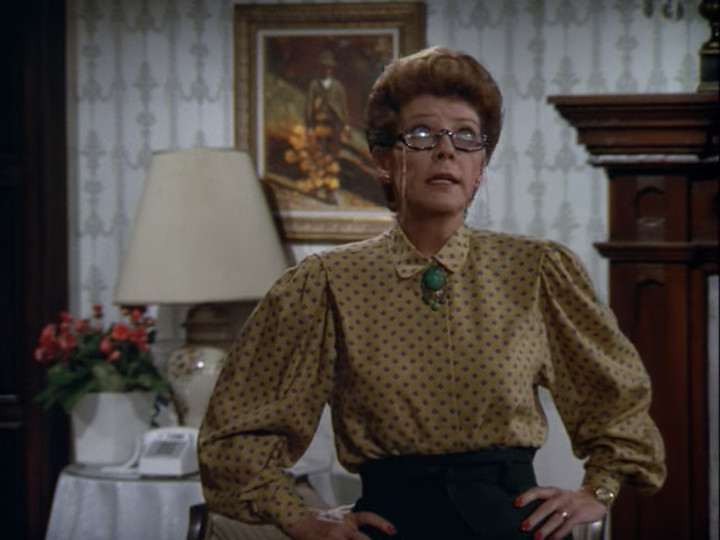
We also meet Alger, another English professor.
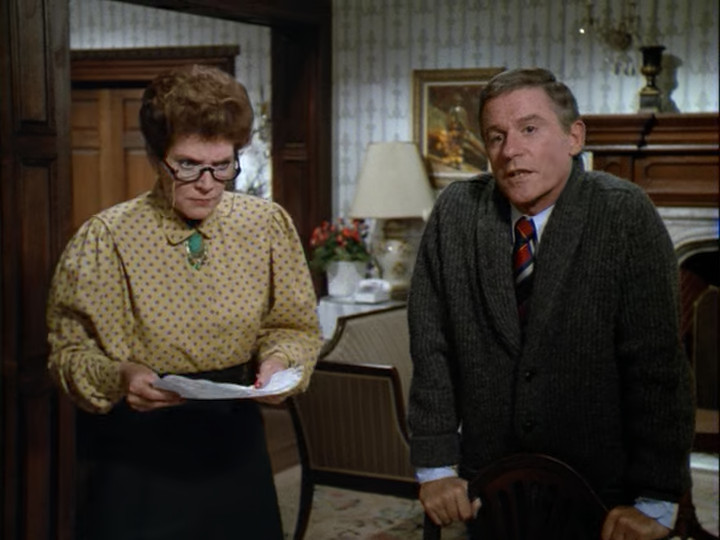
His sweater tells you most of what you need to know about the character. And yes, that’s Roddy McDowell playing him.
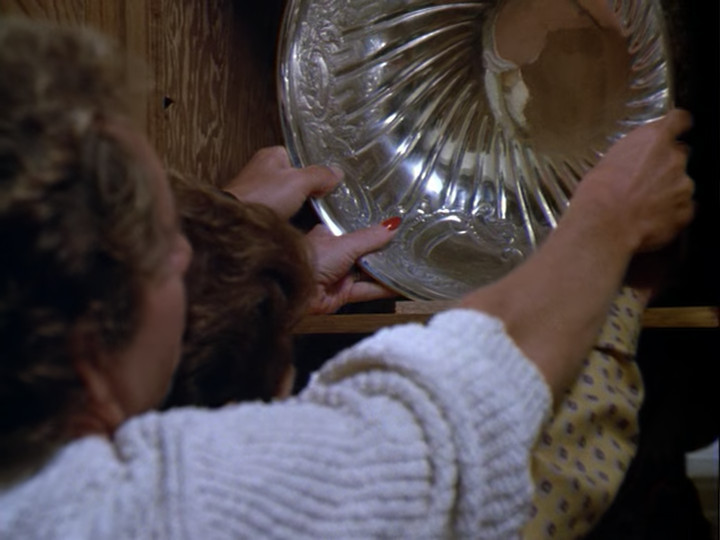
Then they ever-so-subtly hint that there’s something going on between Ron Mercer and Jocelyn Laird when he helps her get a bowl for punch.
He then asks if they can talk about the position of assistant department head. She replies that they’ve already discussed it and she can’t promote him if he doesn’t publish. He replies by arguing that the academic publication system is stupid; they’re supposed to be teaching, not writing articles no one reads.
This may possibly be one of the most realistic exchanges to have ever happened in Murder, She Wrote. Far more realistic than many of the exchanges which happen when Hollywood screenwriters are involved, which one would assume the writers of Murder, She Wrote would know something about. This makes me wonder if the realism was an accident. But, as the saying goes, truth is truth, even when spoken by a fool, and in error. I actually witnessed just such an argument between a professor and the department head when I was in grad school (for Math).
Shortly afterwards, the doorbell rings, and it turns out to be Daphne.
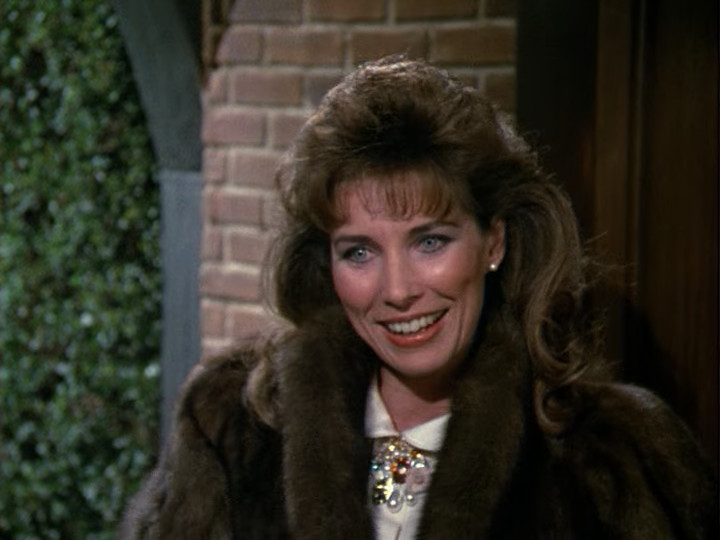
Jocelyn isn’t happy to see her and Daphne seems to enjoy the discomfort she brings. She kisses Alger on the cheek, much to his chagrin, and greets Ron as “Mom’s cute protegé”. Then she introduces her boyfriend, Nick, who came with her.
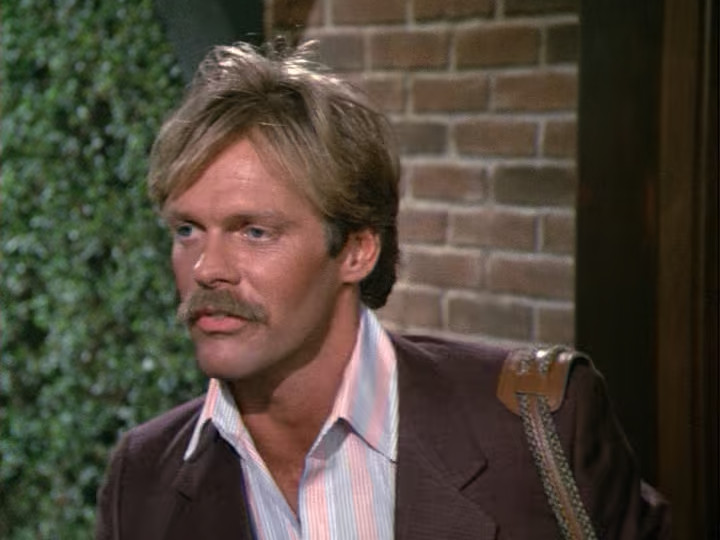
They’re here to spend the weekend to get away from all of the work of being a huge celebrity in New York City. The good news, given Jocelyn’s party, is that they will spend most of their time in her guest house.
The scene then shifts to the party that night. There’s various incredibly pretentious small talk, then we pan over to Jessica talking with Jocelyn. Jessica remarks, “That is such a beautiful table. It has to be an original Duncan Phyfe.”
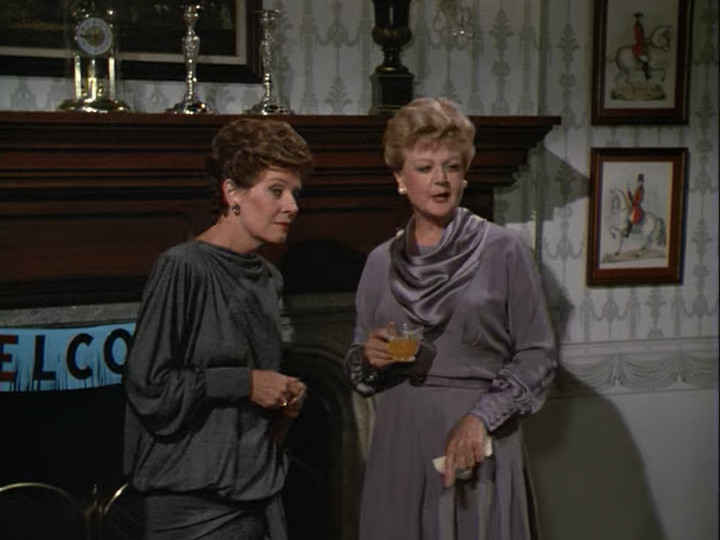
Jocelyn delightedly replies, “You have very discerning taste, Mrs. Fletcher.”
I looked this up and Duncan Phyfe was a furniture maker who worked primarily in the first half of the 1800s (he was born in 1768 and died 1854). He was a furniture maker who interpreted European fashions in a neoclassical style and his work was widely admired and often copied.
I wonder when Jessica became an expert in furniture, to be able to spot an original from across a room.
Anyway, she says that Jocelyn obviously loves beautiful things, and call her Jessica. Jocelyn replies that she loves Jessica’s books; Jessica says this is high praise coming from a scholar of her stature. She adds that she enjoyed Jocelyn’s book Walt Witman’s Life and Times.
Jocelyn is then interrupted by Ron Mercer’s wife telling her that they need more cucumber sandwiches, and after she leaves Alger comes over and introduces himself. This includes volunteering that he loves her books and he writes about seven articles per year on Elizabeth Browning, his first love, but doesn’t expect to write any the next year because he will be taking on the duties of assistant department head.
He’s then distracted by seeing Jocelyn talk to Ron Mercer.
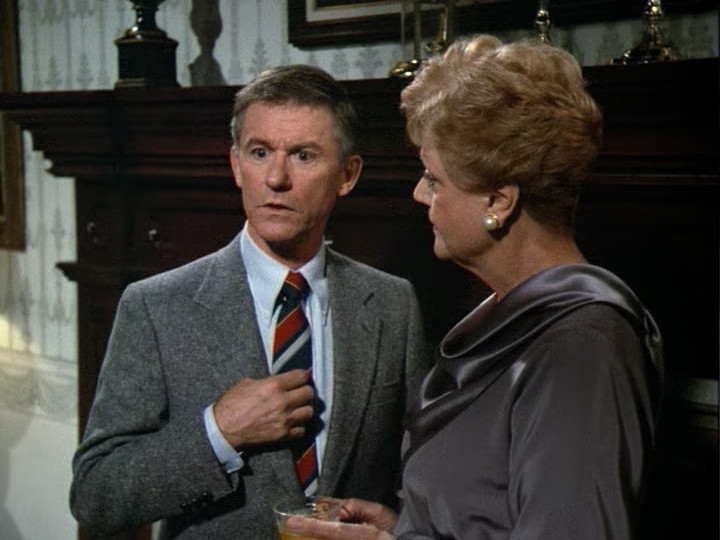
This is interrupted by the sound of splashing outside and the voice of Nick saying “that ought to cool you off.” The guests all rush outside and Daphne is swimming naked in the pool while Nick is standing next to the pool, shirtless, with a bottle of wine in his hand. One of the professor’s wives comments in a scandalized voice that Daphne isn’t wearing any clothes and Jessica agrees in a tone of mild amusement.
Back inside, President Hayward and his wife explain to Jessica that the young man, Nick Fulton, used to be a student at the university and left under a terrible cloud.
Then Nick and Daphne come into the party, with Daphne in a fur coat. Nick goes around (still without a shirt) offering people champagne from the bottle he brought while Daphne introduces herself to Jessica. She tells Jessica she loves her books, and Jessica replies that she thinks that Daphne writes well—she has a very real talent for setting a scene. “You create very evocative word pictures, like beautiful paintings. It’s a talent that I wish that I had.”
Daphne’s reply is curiously air-headed. She mentions that “art is where it’s at” and that her business manager bought her some paintings so she could keep her money where she could see it, and she hears that Picasso is really hot. Jessica replies that his paintings may be, but she’s heard that Picasso is dead. (Pablo Picasso died in 1973, so only 12 years before.)
This odd conversation is interrupted by Nick trying to drag Ron Mercer’s wife out of the party. This is interrupted by Ron Mercer, who pulls his wife away from Nick, who then punches Ron, knocking him down into a table on which a precious vase was precarious perched, shattering it when it hits the floor. Oddly, or perhaps realistically given that these are college professors, everyone just stares awkwardly.
Alger goes over to Daphne and, after inquiring as to whether she has no decency at all, asks her to please just leave. Daphne agrees, calls Nick over, and, right before leaving, turns and wishes everyone a good night while opening her coat to display her nakedness.
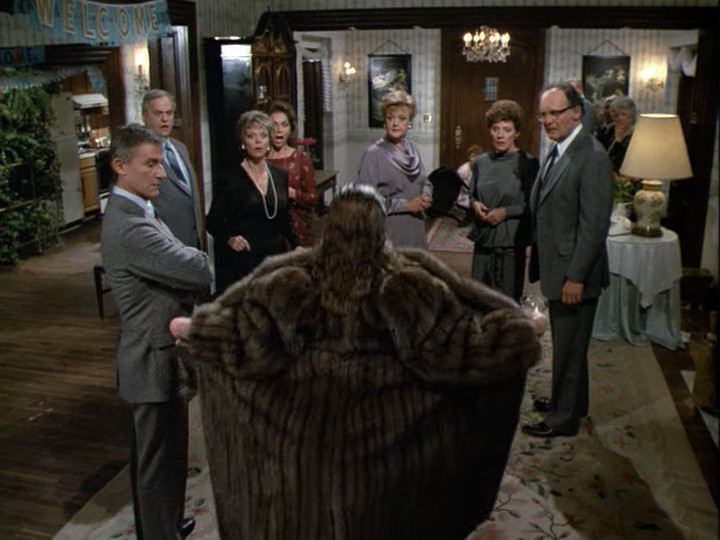
One of the sophisticated women from the party gasps, indicating how demure the gathering is. (I really can’t decide whether that’s realistic or not; mature women do tend to take a dim view of young women being sexually unrestrained, especially in male company, but on the other hand the naked female form isn’t intrinsically shocking to a woman and unlike the naked male form it’s not threatening, either.)
After a few reaction shots, we cut to that night, where Joscelyn is sitting in front of a mirror in a nightgown in her room. We hear a loud bang and Nick and Daphne shouting at each other.
Nick: Yeah, well maybe I’m pushing the wrong lady
Daphne: What happened to what I gave you last week?
Nick: It’s not enough.
Daphne: It’s never enough.
Nick: Is that any way to treat a partner?
Daphne: It’s over, Nick. Get out!
Nick: It’s over when I say it’s over, and don’t you forget that.
Daphne: You know what you are, don’t you, Nick?
Nick: Me? What about you?
Daphne: You’re disgusting. You don’t care about me. You’re just using me. One of these days you’re gonna push me too far, Nicky!
Nick: I told you. I got debts. I need it.
Daphne: No. No more money, Nick.
Nick: Look, honey. What I get from you, I earn. And don’t you forget it.
During this argument Joscelyn comes out of her room and looks across the pool into the guest house, whose door is open. At one point Nick pulls Daphne’s hair.
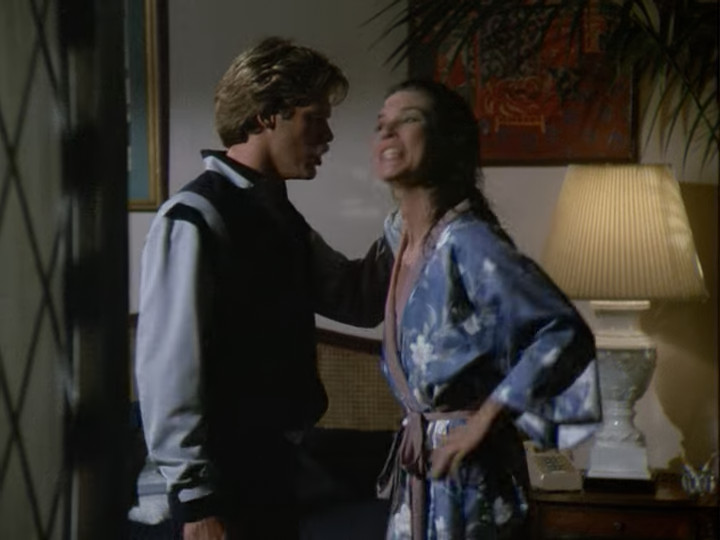
This doesn’t really intimidate her, though. Right after the exchange above, she slaps him, and he slaps her back, and harder, knocking her onto the bed. He walks off and she gets up and screams after him, “You touch me again, I’ll kill you!”
I think we’ve just learned who the victim in this episode is and also one person who certainly didn’t do it.
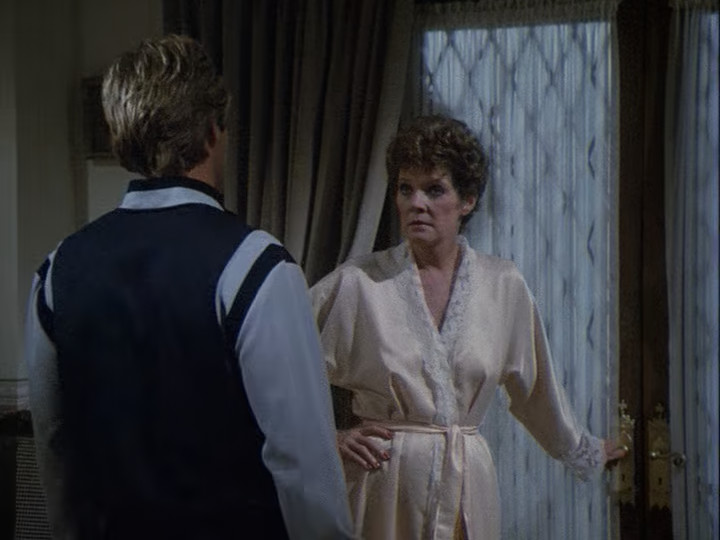
Joscelyn goes back into her room and closes the door (her bedroom has a door that opens to the outside). A few moments later, Nick knocks on it. For some reason Joscelyn opens the door and Nick comes in. Neither of them says anything, but Joscelyn gives him quite a look.
The scene then cuts to Jessica on her early morning jog. These early morning jogs are perfect for finding corpses before anyone else is awake, not only because they’re early, but because jogging covers so much distance, which increases the odds of running into the corpse (sometimes literally). Perhaps that’s why Jessica is so into them.
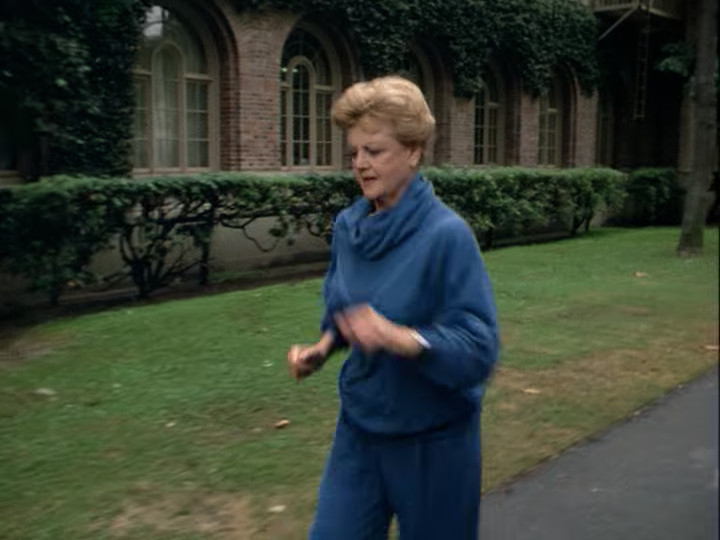
Jessica gets a rock in her shoe and stops to get it out. As she is putting the shoe back on, she happens to notice a hand amongst some construction debris.
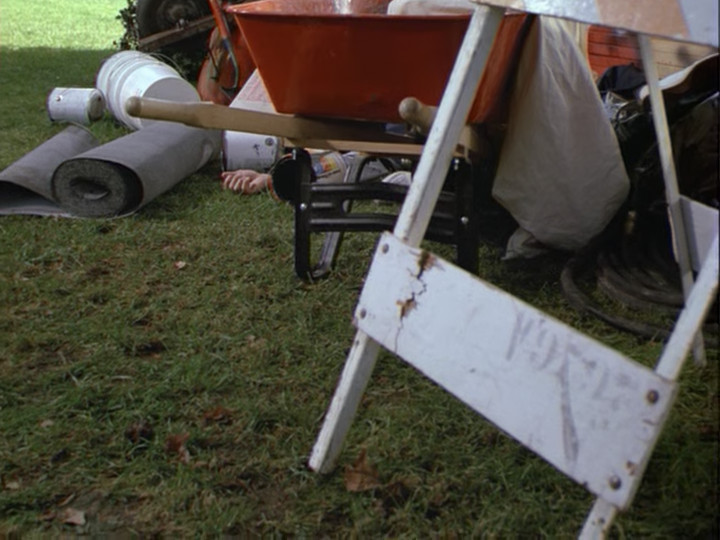
Jessica gets up to examine it more closely, and it turns out to be Nick.

We then get a dismayed reaction shot from Jessica, who then looks up at a window at the nearby building:
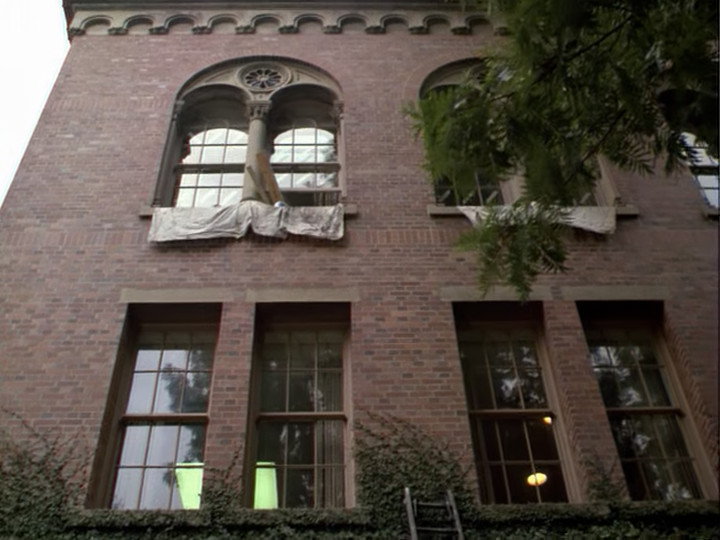
I suppose the idea is to suggest that he somehow fell out of the window. I can’t say that looks very plausible.
Then we fade to black and go to commercial.
Had you been watching back in 1985, you might have seen a commercial like this:
When we come back, the police are examining the body. Jessica then gets introduced to Chief Griffin, the head of the local police department. He isn’t used to dealing with major crimes.
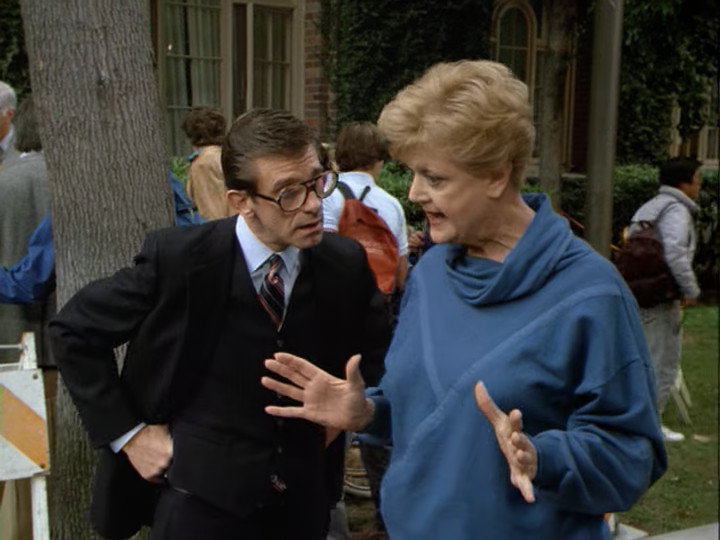
Jessica seems to sense this and tells him that this may not have been an accident. The room from which he is supposed to have fallen has a floor covered in plaster dust (she just examined it) and the soles of his shoes are clearly clean.
When he finds out who Jessica is, he’s delighted to meet her. This will be his first murder case and he’s only in the middle of a correspondence course on criminology and would love any help Jessica can give him. Since the writers consider the most important thing to be Jessica contradicting whatever the episode’s police detective says about how much help he wants Jessica to give, she replies that she doesn’t want to interfere. However, she relents quickly and tells him that she heard from a student that he was driving by late last night and saw a light-colored station wagon parked very close to where the body is now.
She’s being such a big help, and since she seems to know everyone around here, would she do the investigation for him tag along and help him out. Jessica agrees, but asks for a few minutes to get changed out of her jogging outfit.
The first person they interview is Daphne, who’s rather surprised to hear that Nick was murdered. Chief Griffin loses no time in asking her where she was after the party in a manner that strongly suggests he suspects her of the crime.
Daphne’s alibi isn’t great. She came back to the guest house. She was tired, took a few sleeping pills, and went straight to bed. Nick was here with her when she fell asleep.
Interestingly, he calls her “Miss Laird” when he denies having accused her of the crime, and she corrects him to “Clover.” I guess that suggests that her mother didn’t take her father’s name, or else remarried. It’s weird that they make a big deal of this but don’t tell us why.
Daphne also gives the back-story on Nick. She knew him vaguely from the campus and ran into him in a disco in New York City. A week later he moved into her townhouse. When asked what she’s doing in Crenshaw, she replies that she sometimes comes here to escape the Big Apple and write in peace, especially when she’s been inspired by a hunk like Nick Fulton.
She then asks them to leave and they do.
Jessica tells the chief to go ahead without her, she wants to pay her respects to professor Laird.
She has tea with Joscelyn, who claims to have known Nick Fulton only very slightly. Jessica assures her that Daphne isn’t too seriously under suspicion, then politely excuses herself to go work on her speech that she’ll give the next day. (She really should have had that written already, but I guess that doesn’t matter.)
Jessica’s next stop is President Hayward’s house. President Hayward is deeply upset as Alger is giving him the news that there’s been a murder on campus and it’s all anyone can talk about. Jessica asks about him having been away and Alger explains that he was visiting his ailing mother and had to take the late train to Boston last night after the party.
Usually the only reason someone in a Murder, She Wrote episode volunteers this kind of information is because it’s a lie, so presumably he didn’t actually take the late train. Also, what are the odds that there’s a train to Boston that late at night in a tiny little station like this? In England during the time of Sherlock Holmes, perhaps. But in Vermont in the 1980s? There’s no real chance of it. That said, it’s an absurd thing to lie about since it’s so easily checked, so there’s a very slight chance he’s actually telling the truth.
Alger then excuses himself because he should call his mother now (she’s not doing at all well).
Which, of course, raises the question of what good he could possibly have done her by showing up well past midnight then leaving again so quickly that he was back here before lunchtime. No part of Vermont is close to Boston. The old girl would almost certainly have been asleep. Or did she need him to pick something up off the floor for her?
Anyway, as Alger is leaving Chief Griffin comes in to ask President Hayward some questions. When he sees Jessica, though, he first gives her some facts. According to the Coroner’s Report, the time of death was about 1:00 in the morning. The cause of death was a massive skull fracture with a blunt instrument (not the ground).
In the ensuing discussion, Beryl mentions that she saw Ron Mercer at about 1:00 in the morning, walking towards Joscelyn’s house. A phone call then comes in for Chief Griffin. It’s an anonymous tip about Daphne Clover.
Chief Griffin, a deputy, and Jessica go to Joscelyn’s guest room and find what the tip said would be there—a blackmail note demanding $10,000 dollars (about $30,800 in 2026 dollars). The tip also said that there’d be a murder weapon, and they would find a candlestick on the mantle with blood on it.
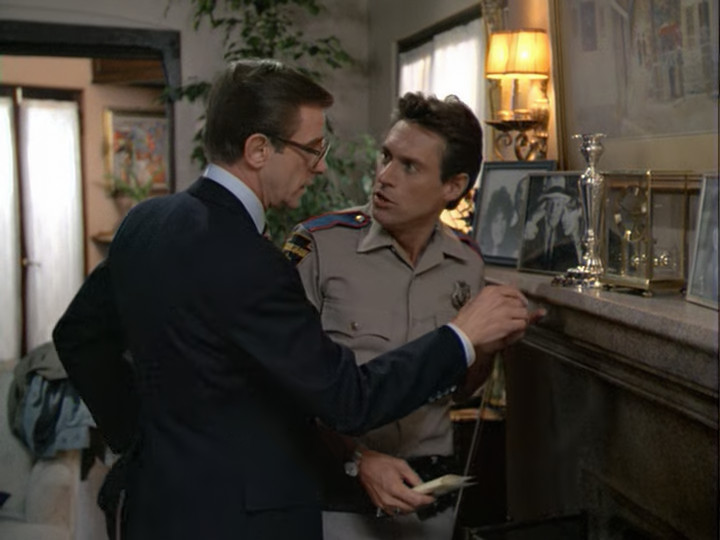
At this point Daphne comes in and asks to know what’s going on, whereupon Chief Griffin arrests her for the murder. Jessica tries to stop him because this is such an obvious setup, but he doesn’t listen to her because we’re almost at a commercial break and we really need something dramatic to end on. In this case, it’s Daphne shaking her head and saying, “No. No.”
And on that note, we go to commercial break.
When we come back, Jessica goes to Joscelyn’s house where she finds the mate to the bloodstained candlestick.
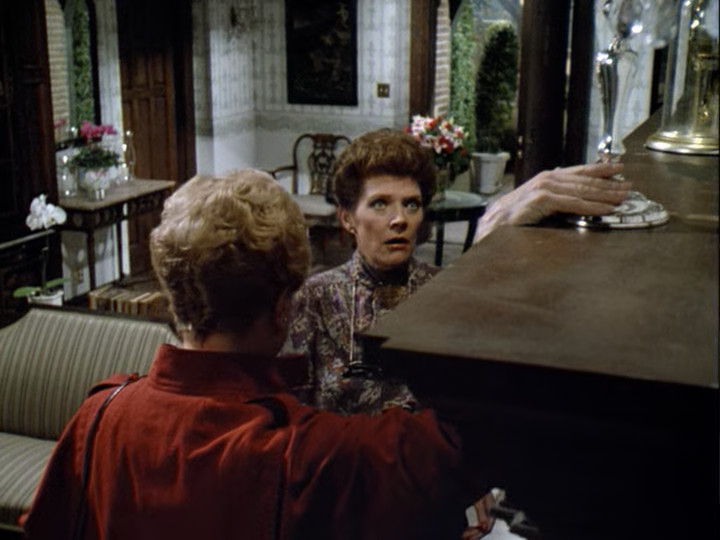
The scene then shifts to Chief Griffin’s office with Jessica, Daphne, and Joscelyn.
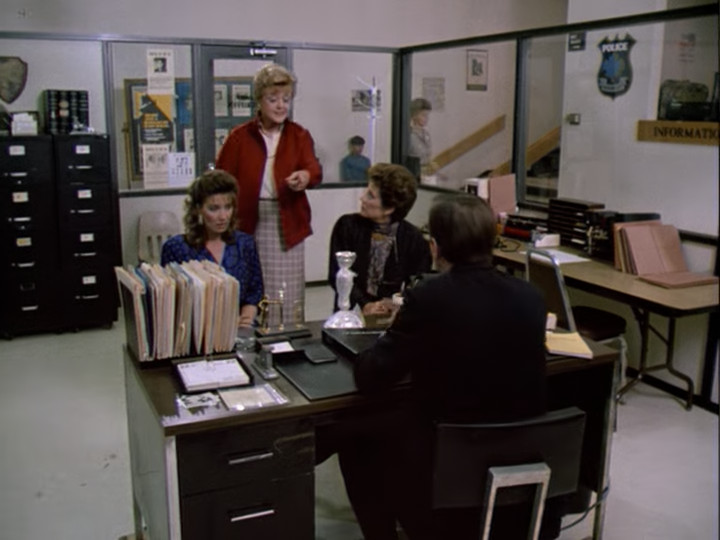
I love this office. It’s got no ceiling and is separated from the stairs and a head-high information desk by a few feet. One of its main tables is a portable table with folding legs and two different kinds of chairs that one often finds in school buildings.
Anyway, Jessica points out that the candlestick was taken from the main room and planted in Daphne’s room. When Jessica points out that anyone could have taken the candlestick, Chief Griffin remarks that anyone includes Daphne. Jessica replies that she doubts that—a candlestick couldn’t be hidden in the pocket of a fur coat and Daphne graphically demonstrated that there was nothing underneath the coat.
Chief Griffin is inclined to grant this, but wants an explanation for the blackmail note. Jessica asks to see the note and Chief Griffin hands it to her (it’s in a plastic bag).
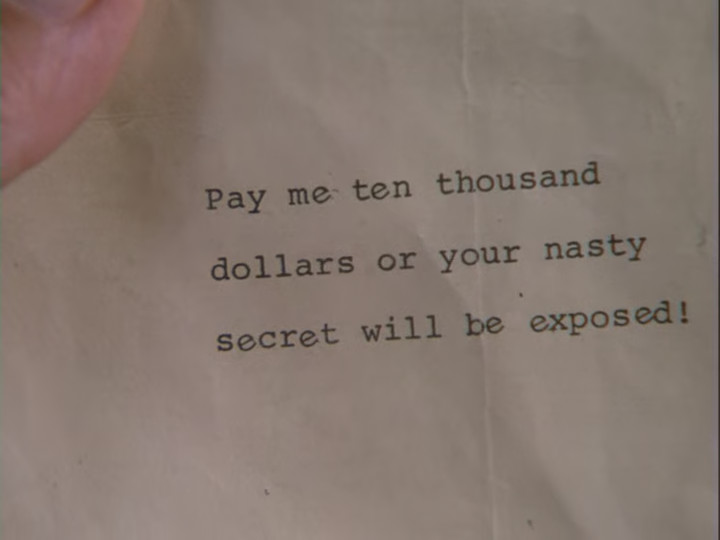
Jessica notes that it’s been typed on a machine with a slightly bent ‘e’.
Jessica then points out the obvious: given that Daphne and Nick were sharing a bed, why on earth would he type up a blackmail note rather than just tell her the demand? Jessica then points out the painfully obvious: the candlestick and note were almost certainly planted in the guesthouse by the person who phoned in the anonymous tip. After thinking about it, Chief Griffin relents and releases Daphne.
Chief Griffin then drives Jessica to the train station. On the way, she asks about Nick Fulton’s background and Griffin tells her that Nick was arrested twice for assault but charges were never pressed.
He then tells Jessica that in spite of her “fancy talk” Daphne is the killer, he just has to prove it. “Anybody who’d write scuzzy books the way she does doesn’t have the same moral code the rest of us do.” When Jessica asks if he’s actually read any of them, he replies, “Oh sure. All of them.”
At the train station, she checks connections to Cabot Cove via Boston. The trains to Boston leave every hour on the quarter hour until 20:15 (8:15pm). Jessica notices that the schedule says that there are later trains, but the clerk at the info desk tells her that the schedule changed two weeks ago. (Which explains why Alger thought the lie would not be so obvious.)
On her way to walk back to the college, Ron Mercer’s wife Trish gives Jessica a lift for some reason.
This gives Jessica a convenient opportunity to interrogate Trish, who admits that she did know Nick Fulton from before. Nick was on an athletic scholarship and would come over to the house for tutoring, and then he started coming over to the house when Ron wasn’t home. Trish then tries to alibi Ron but Jessica tells her that someone saw Ron near the time of the murder and someone else saw their station wagon parked near the body at the time the body was moved.
Trish breaks down and admits that she thinks that Ron may have been seeing another woman.
Jessica then goes to see the other woman (Joscelyn). During the conversation, she admires Joscelyn’s house as she walks around it. She noticed the word processor, which Joscelyn says that the university got for her but she’s never learned to use.
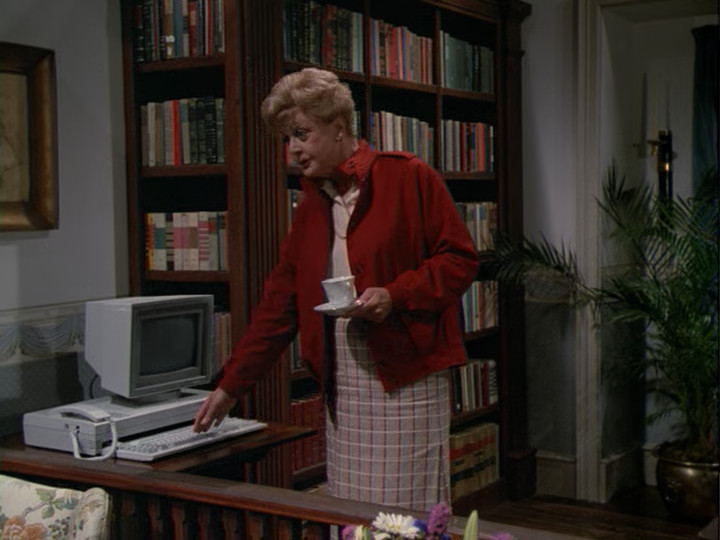
Jessica then wanders over to the typewriter and says that she just got a flash for her speech and asks if she can use Joscelyn’s typewriter. Joscelyn replies that if she had typed the blackmail note, she would have been smart enough to get rid of the typewriter she used. (I’d have used someone else’s typewriter, myself, but each to their own.)
Jessica laughs and admits that her ploy was a bit obvious. Which is understating how obvious it was by two orders of magnitude.
The conversation then awkwardly transitions to Jessica letting Joscelyn know that she knows that Joscelyn writes the romance novels and Daphne just pretends to be the author. Joscelyn then launches into a monologue about her Walt Witman biography barely earned enough money to pay off a second-hand car. What the public really wants is sordid sex. While she was one of the proper paupers of the literary world, hacks with a third-rate vocabulary were living like royalty, so she decided that if you can’t beat them, join them. She wrote the first novel in six weeks. She asked Daphne to submit it to a publisher under her name since Joscelyn couldn’t use her own and, apparently, she’s never heard of pen names.
Jessica prompts her to continue by saying that Nick found out about the arrangement.
Joscelyn then confesses to killing Nick in self defense.
At the police station, Daphne rushes in and snatches the typed confession from her mother before she has a chance to sign it, declaring that she, Daphne, killed Nick Fulton in self defense.
And on that bombshell, we fade to black and go to commercial.
When we come back from commercial, Chief Griffin is telling Jessica that two people confessing was the damndest thing he ever saw. And we get a look at the back of Chief Griffin’s office:
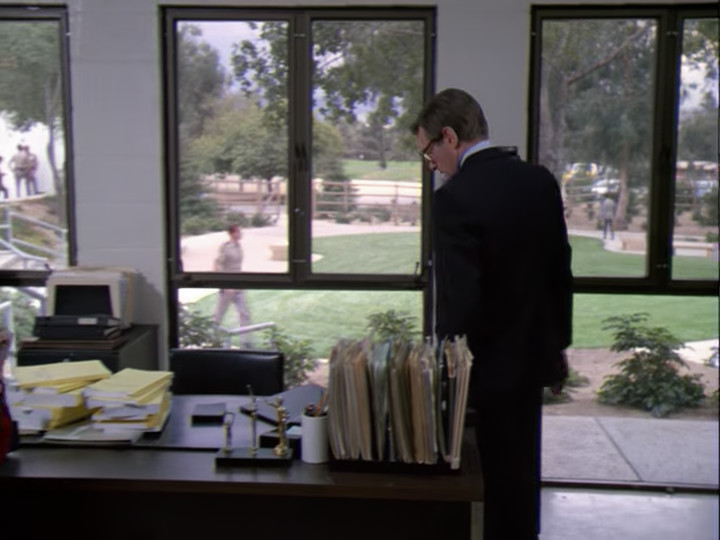
This is quite the office Chief Griffin has. It almost looks like a repurposed school cafeteria.
Anyway, Jessica points out that obviously one is lying to protect the other, then remembers she has a speech to go make and says she has to leave.
On her way out, Jessica points out that it’s unlikely that either Daphne or her mother could have carried Nick Fulton’s body up the stairs to the third floor unaided.
Over at the Hayward residence everyone is preparing for the commencement when Beryl hands her husband a letter from Alger. He can’t find his glasses so he asks Jessica to read it to him.
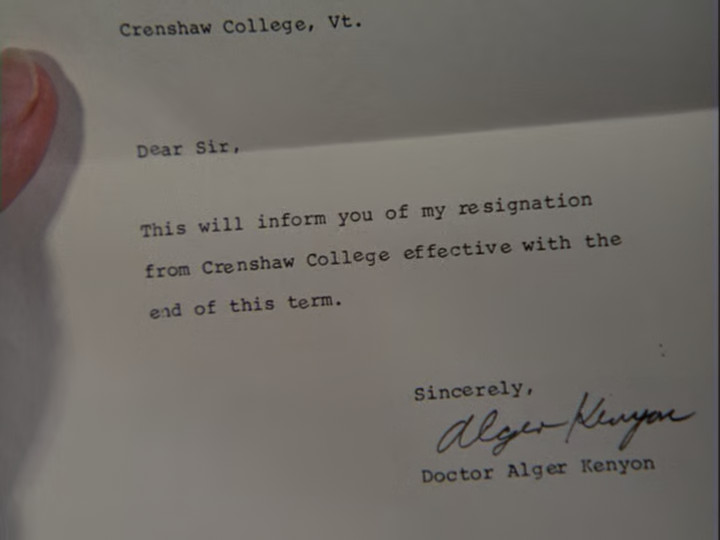
President Hayward is astonished that Alger is resigning but Beryl thinks it’s obvious—Alger is is madly in love with Joscelyn and is resigning because Joscelyn gave the assistant department head job to Ron Mercer.
This bit of news enables Jessica to figure out who did it. Jessica asks how long until the commencement and when she’s told it’s about an hour she replies, “good, I have a couple of phone calls to make. Then, can I borrow your bicycle?”
The scene then cuts to Jessica walking into a room with Alger Kenyon, who says he doesn’t have much time because he has a lot of packing to do. It turns out to probably be the English department, as Ron Mercer and his wife are there too. The episode a bit light on extras, though, or else this is a three-professor department and the job of assistant head of the English department isn’t very prestigious.
Anyway, Jessica explains that she couldn’t just stand by while Joscelyn and Daphne confess to something that they didn’t do. Had Joscelyn done it, she wouldn’t have framed Daphne with the bloody candlestick. And Daphne would never have left it on her own mantel. She then explains to Trish that the woman Ron was having an affair with was Joscelyn, in order to get the position of assistant department head. She invited him back after the party and he knew what she had in mind, but Nick was already dead when he got there.
This begins a flashback.
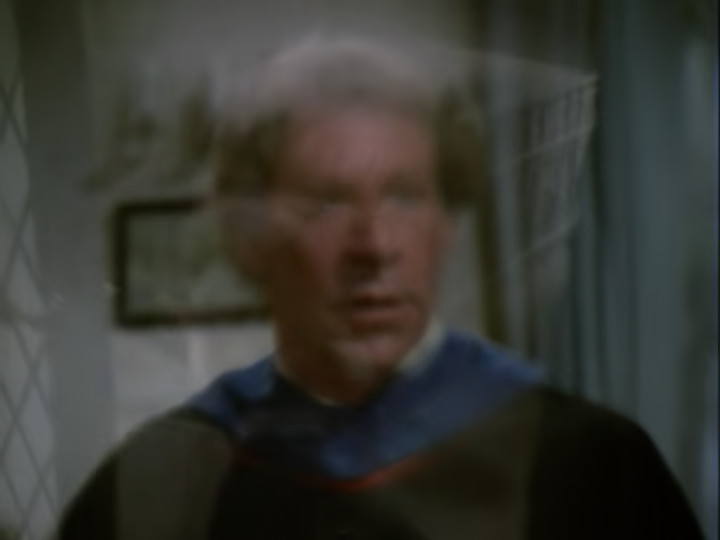
(I love the visual imagery used for flashbacks—wavy distortion combined with fading to the other scene.)
Joscelyn explained the dead body to Ron by saying that there had been a terrible accident and she would give Ron the job of assistant department head if he would move the body and make it look like the terrible accident happened somewhere else.
After the flashback is over, Ron assures Trish that making love to Joscelyn wasn’t his idea, he only did it to get the job.
Hearing about Joscelyn using her position of power to bribe/pressure Ron into fornicating with her is too much for Alger, who loudly protests. This can’t be true. He and Joscelyn were very close. Never physical, of course, because their relationship didn’t need that. But they loved each other.
Jessica replies, “You may not really understand Jocelyn, Alger.”
Given that he thought of her as a morally pure intellectual while she in fact wrote pornography and sold academic positions to unqualified men in exchange for sexual favors, I’d say that Jessica is on very safe ground, here. Oddly, Jessica says it in a manner that suggests Alger doesn’t realize that old women have voracious sexual appetites, which seems to me to miss the mark a bit.
Anyway, she adds, “but I think you love her too much to let her take the blame for something you did.”
Alger initially denies it, but then Jessica points out that the blackmail note was typed on the same typewriter which typed Alger’s letter of resignation—the one with the bent ‘e’. This makes Alger one of the stupider murderers in the history of detective fiction, but c’est la vie.
The thing which gets him to confess is asking why he framed Daphne. Of course, the answer is quite predictable: everything was Daphne’s fault. (I’m guessing he’s supposed to not know that Joscelyn actually wrote the books, which makes the blackmail note a little strange.)
It turns out that while their friendship was discrete, Joscelyn had given Alger a key. He came back later that night to cheer Joscelyn up. He heard her voice from the bedroom and she sounded frightened. He grabbed a candlestick and got closer. He only heard a little bit of the conversation but caught that Nick Fulton was demanding money. Joscelyn went to another room to get her checkbook and Alger snuck up and struck Nick on the back of the head while he waited for Joscelyn. After killing Nick, Alger went out through the door before Joscelyn came back.
Jessica calls Chief Griffin then runs off to give her speech because she’s late.
As Jessica rides her borrowed bicycle over to the commencement, we freeze frame and go to credits.
This episode combined a really fun setting with a very strange plot. Universities make great places for a murder mystery for two primary reasons that work together:
- They are a normally peaceful place where it is incredible difficult to see through surface appearances.
- They are complex places with a lot of history where many things are mysterious but have explanations
Or, as Dorothy L. Sayers put it in the foreword to Gaudy Night:
It would be idle to deny that the City and University of Oxford (in aeternum floreant) do actually exist, and contian a number of colleges and other buildings, some of which are mentioned by name in this book. It is therefore the more necessary to affirm emphatically that none of the characters which I have placed upon this public stage has any counterpart in real life. In particular, Shrewsbury College, with its dons, students and scouts, is entirely imaginary; nor are the distressing events described as taking place within its walls founded upon any events that have ever occurred anywhere. Detective-story writers are obliged by their disagreeable profession to invent startling and unpleasant incidents and people, and are (I presume) at liberty to imagine what might happen if such incidents and people were to intrude upon the life of an innocent and well-ordered community; but in so doing they must not be supposed to suggest that any such disturbance ever has occurred or is ever likely to occur in any community in real life.
So, I repeat, it was a good setting.
But the plot suffers from what is often a problem in Murder, She Wrote—who the sympathetic characters are supposed to be. The writers of Murder, She Wrote only ever held three sins to be bad:
- Direct violence
- Making a lot of money
- Being the antagonist of an episode
Since Joscelyn Laird was none of these things, her being a lying pornographess who abused her position of power to force a married man to adulterate his marriage in order to satisfy her lust didn’t affect how sympathetic she was in any way.
Indeed, one of the really strange parts of the character of Jessica Fletcher, after the first few episodes of Season 1, was how she was New York socialite living in Cabot Cove, Maine. She spent most of her time hobnobbing with the rich and famous and to her the greatest virtue was sophistication and the greatest sin was harshing people’s buzz, though of course she would have phrased it in the language of the New York socialite—being uncouth. Jocelyn Laird was extremely couth, so of course Jessica loved her to death and considered everything she did wrong to be the most minor of peccadilloes. I mean, whomst among us hasn’t used a servant to scratch an itch during a dry spell? Let he who is without sin cast the first stone, and all that, what?
(I slipped into 1920s British foppery at the end there because I do find it interesting how the stereotypical New York socialite and the 1920s British fop actually have a lot in common. They’re both extremely well educated and highly polished nihilists trying to escape their existential dread through pleasure, habit, and social collaboration. So there may actually be something of an homage to golden age detective stories in Jessica turning into a New York socialite.)
As for the plot… I tend to think that it’s a bit of a problem that the crux of the entire episode is that an English professor has never heard of the concept of a pen name.That blackmail is necessary to the plot and it is necessary for the blackmail to be possible that the books actually be published under Daphne’s name, but this just makes no sense. It makes even less sense for Daphne to be living the life of a socialite author when she’s really neither a socialite nor an author. It also makes no sense why she’s so antagonistic toward her mother when they’re secretly working together. One could justify this public antagonism by being a ruse to protect Dr. Laird’s reputation, but that only works if there’s some reason she has to risk her mother’s reputation by visiting. But there really isn’t. Also, flashing everyone while she’s naked is really committing to the bit far beyond any possible need to commit; but if Daphne is actually antagonizing her mother for fun and exposing herself to strangers for fun, why on earth did her mother trust her to publish the romance novels? Not only has Joscelyn Laird never heard of a pen name, she’s either a horrible judge of character or has no sense of self preservation.
Also, we’re never actually told why Daphne comes to visit; all we get is the cover story that she’s here to write, which Jessica easily disproves. But we’re not given the real reason that she came because, presumably, there isn’t a real reason. At least, I cannot imagine what that real reason could be. If she needed to talk to her mother, she could just call her on the phone. If her mother needed to send her the text of the next novel, she could just mail it to her. Being in the same place at the same time served no purpose that couldn’t be accomplished more conveniently by less dangerous means. There was no possible reason for the visit, and since Daphne and her mother were working together, unless it was an emergency there was no reason for the visit at such an inconvenient time.
Speaking of things that there was no reason for, why on earth did Joscelyn give Alger a key to her house? I would think that the last thing she’d want would be for Alger to come inside her house without having to knock.
I suppose the actual murder should be considered, but I think it’s a problem that the main thing to say about it is: what is there to say about it? It’s a little weird that, on the spur of the moment, Alger decided to assassinate Nick and then run away, but if they had made Alger more of a character I think it could actually be workable. First, there would have to be his silent rage during the party as he saw Joscelyn being treated as she was by Nick and Daphne. I think he’d need to misunderstand Nick’s demand for money as being a threat to Joscelyn rather than blackmail for something Joscelyn didn’t want to come out. Then something snaps in him and he decides the world would be better off without Nick. That could work, but it wouldn’t work with Alger just running away at that point. If he had the kind of grit to kill Nick like a rabid dog that needed killing, he wouldn’t have just panicked and abandoned Joscelyn. I really don’t see any way of him not taking Joscelyn into his confidence, with the possible exception of him having removed the body immediately. That could still have left some blood stains he didn’t notice, or something like that, allowing the rest of the plot to happen (with Daphne and Joscelyn protecting each other). It would have meant we couldn’t have the subplot with Ron Mercer having been an accomplice, but since that accomplished nothing, I think that would be a very small sacrifice.
Oh well. Next week we’re in London, England for Sing a Song of Murder.
Discover more from Chris Lansdown
Subscribe to get the latest posts sent to your email.


Pingback: Murder She Wrote: Sing a Song of Murder – Chris Lansdown