Reality vs. The Meaning You Give to Life

I suspect everyone who knows atheists has encountered people who say that atheism does not entail nihilism, because “life has the meaning you give it”. I just want to mention a small point regarding that.

My favorite definition (more a description) of “reality” is:

That which, when you stop believing it, doesn’t go away.

It’s not a complete description, but it’s a pretty good working description, especially in our confused times. Anyway, it’s worth noting that “the meaning you give to life” goes away when you stop believing in it.

The atheist retort that atheism does not entail nihilism thus amounts to:

Life doesn’t have any meaning, but I can pretend that it does.

Which no fool ever doubted.

Pride Vs Stupidity

Over on his blog, Mr. John C. Wright asks the question:

Why is the proud man angry or peeved with the stupidity (real or imagined) of his fellows? I ask because one would think a saint would be very patient with someone who was stupid, if it were honest stupidity, and not merely laziness in thinking. Whereas the devil (or Lex Luthor) is always in a state of haughtiest annoyance, because he is brighter than those around him. Their stupidity proves his superiority – yet it irks him. Why?

To answer this question we have to first answer the question, “what is pride?” (I’m taking the distinction between pride and vanity as a given.) A generally workable description of pride is an inflated sense of the worth of the self. This is, however—when properly considered—a symptom rather than a cause.

The cause of pride is a mistake about the nature of the self. This is inescapable because the value placed on something is inherently a description of its nature. (I should probably clarify that pride is an inflation of the inherent worth of the self—it’s not a utilitarian measure of the worth of the self to someone else’s purposes, as a means to their end. That’s actually a form of vanity.)

There are two possible mistakes to make about the nature of the self which aggrandize it:

  1. That one is a higher creature than one is, but still subordinate to God
  2. That one is God

While #1 is possible, I suspect it’s not the common mode of pride since it’s too subject to correctives. A human being who thinks that he’s an angel, for example, will have a hard time not noticing that he has a physical body and is, therefore, actually a human being. If he still thinks himself subordinate to God, he will in humility accept this recognition. It is, therefore, hard to see how #1 can be a long-lived error. Even Gulliver couldn’t think himself a Houyhnhnm for long at a stretch.

This leaves #2 as the common form of pride, and it is this form of pride in which stupidity angers the proud man. It angers him because it is proof that he is not God. The proud man wills that the people around him are not stupid and yet they are. This proves his limitations and therefore disproves his opinion of his own power. The larger the difference between what he wills reality to be and what it is, the greater the proof that he is not God, and therefore the greater is his anger.

It’s the Same Old Song

There are a lot of traps which humanity falls into over and over again. The one on my mind lately goes something like this. Some atheist, proto-atheist, or other person who has never studied history nor thought about human nature says:

People have been evil because it never before occurred to them to be good. I have gotten the idea that I will be good. Come, follow me, and you will be happy in the perfect society I will construct because it has occurred to me to do a good job this time!

And some other atheist, proto-atheist, or person who has never studied history nor thought about human nature replies:

Finally, someone has explained why it is that things are not perfect. Life would be much better if things were perfect, and here is a man who is setting out to make them perfect. Since I would prefer life to be perfect, I will follow him and live in the perfect society he will build. What fools my fellow men are to stay in their imperfect world when perfection is so easily attainable!

Then the first atheist, proto-atheist, or other person who has never studied history nor thought about human nature tries to build his perfect society and things go wrong. He refuses to acknowledge this and tries to hide it. In time this is noticed. He blames his followers. They say, “He lied to us!” But they do not agree after that. Some say:

The problem was that we followed a bad man. Let us find a good man to implement the good ideas and all will turn out well.

Others say:

The problem was that we trusted a man. Let us no longer trust anyone for all ideas are bad.

The children of the first people would go on to distrust organizations because their parents were so often duped. The children of the second people would go on to trust organizations because their parents’ life was difficult, working entirely on their own.

And along came an atheist, a proto-atheist, or other person who has never studied history nor thought about human nature who said:

People have been evil because it never before occurred to them to be good. I have gotten the idea that I will be good. Come, follow me, and you will be happy in the perfect society I will construct because it has occurred to me to do a good job this time!

I’ve Got You, Babe

I recently came across a performance of I’ve Got You Babe done by Sonny and Cher in 1987:

This performance was approximately 12 years after their divorce (if you’re not familiar with Sonny & Cher, they were a husband-and-wife singing duo in the 1960s and 1970s). This makes many of the lyrics quite ironic.

They say we’re young and we don’t know
We won’t find out until we grow

You were young and didn’t know.

Well I don’t know if all that’s true
Cause you got me, and baby I got you.

It was true.

[HER:] They say our love won’t pay the rent
Before it’s earned, our money’s all been spent

To be fair, here, their love did pay the rent. They were a very popular singing duo. But like many things in this life, it did until it didn’t. After their divorce, they ceased to be popular.

They would each eventually recover in their own way, but their attempt to continue singing together failed. There’s an interesting subject here about popular figures selling an idea, not themselves, and when the idea turns out to be an illusion, the figures cease to be popular. It’s an interesting subject that popular people often have to deal with—that it’s not them that their fans love, but who they are when they perform. And yet, who else could their fans love?

Fame is a very curious thing, because while not bad in itself, in this fallen world it makes all sorts of very empty promises.

[HIM:] I guess that’s so, we don’t have a pot
But at least I’m sure of all the things we got

Yeah. That turned out to be mistaken certainty. There’s a great line in either C.S. Lewis or Chesterton which I cannot find again, which was itself quoting something that was, if my memory isn’t deceiving me, a line given to a fictional pagan:

In this way can man best the gods: he can keep his promises.

The Greek and Roman gods set a very low bar for behaving better than them and yet so often human beings fall below it all the same.

Anyway, back to the song:

[HIM:] I got flowers in the spring
I got you to wear my ring

That’s a start. Alas, the promise implied in wearing the ring turned out to be a false promise.

[HER:] And when I’m sad, you’re a clown
And if I get scared, you’re always around

Well, not always.

[HER:] So let them say your hair’s too long
Cause I don’t care, with you I can’t go wrong

Eventually he cut his hair and, according to her divorce filing, she went wrong with him. (Cher alleged involuntary servitude for his withholding of money they made together.)

[HIM:] Then put your little hand in mine
There ain’t no hill or mountain we can’t climb

But long before the end, they couldn’t climb any hills together. Let alone any mountains.

[HIM:] I got you to hold my hand
[HER:] I got you to understand
[HIM:] I got you to walk with me
[HER:] I got you to talk with me
[HIM:] Igot you to kiss goodnight
[HER:] I got you to hold me tight
[HIM:] I got you, I won’t let go
[HER:] I got you to love me so

[BOTH:] I got you babe
I got you babe
I got you babe
I got you babe
I got you babe

They did. Then they didn’t.

It’s a truism of human life that promises are easy to make and hard to keep; the trick to making a lot of money as an entertainer is to sell the illusion that you’re keeping a promise when all you’re doing is making it. (That enables you to make mutually exclusive promises, increasing your revenue.)

And then figuring out a new shtick when people find out that all you were doing was making promises you weren’t going to keep.

For some reason I always connect this song with Cher’s much later song If I Could Turn Back Time.

There’s no actual connection between these two songs, of course. If I could Turn Back Time was released in 1989. Sonny and Cher had long-since moved on from each other and by this time Cher’s public persona was utterly disconnected from Sonny’s. Moreover, given her desperation for fame (fun fact: Cher was 43 at the time the music video was filmed and it was her creative decision to be semi-nude), it seems unlikely that Cher actually had regrets about not fulfilling her personal responsibilities.

And yet. And yet, the songs do go really well together as a pairing. One of those odd coincidences of life, I suppose.

When Mary Met Sue

At his inimitable blog, author John C. Wright has an interesting blog post (which is mostly a quote of one of his readers’ comments) about what makes a Mary Sue. The key insight is that the defining characteristic of a Mary Sue is not that she is super-awesome. It’s that she’s super-awesome but we’re supposed to treat her as a young, innocent ingenue:

Rey is great at everything she does. The reasoning behind that may be justified…but that is not the issue.

The issue is that Abrams clearly expects us to think of her as a sort of female Luke Skywalker. Except Luke was nothing like that! We are asked to accept that she is a natural born pilot, better mechanic than Han Solo, better natural Jedi than Luke was at the same point of his training, and a natural swordsman…but we’re ALSO supposed to think of her as a plucky orphan farmgirl.

I think that’s right. A 35 year old queen who is beautiful, intelligent, a skilled warrior and a crafty statesman wouldn’t be a Mary Sue if she’s presented as someone with a past who’s used her 35 years to good effect—if she’s someone who’s already been on the hero’s journey and come out of it having learned some lessons. The real problem comes in when she’s all of those things and only 16 years old.

The commentor which Mr. Wright is quoting calls it fundamental dishonesty, and while I think that he’s right, I’d prefer to call it a fundamental contradiction in the character. What really makes Mary a Mary Sue is when she’s got all of the benefits of experience without having any of the experience. I think that it really comes down to sympathy.

Growing up is rough so (sane) human beings have sympathy for people who are still doing it. We are willing to tolerate all sorts of mistakes in those who are young and inexperienced which we will never tolerate in the old and experienced. (This is why it’s so important to not waste one’s youth and to learn how to be competent while people will still be forgiving of your mistakes.) The upshot is that young protagonists are much easier to write—the audience will naturally be sympathetic with them. The author’s mistakes will get much of the forgiveness that the character gets since the author’s mistakes often are also the characters’ mistakes.

The other thing is that this makes character development a snap. Children don’t know anything and make (nearly) all the mistakes one can make, so giving them something to improve about is trivial. Because of the instinctual forgiveness given to children, they don’t cease to be sympathetic merely because they start out awful, either.

This creates a temptation on the part of the author to make his character younger than he should be because it’s easier to write. A competent adult is much harder to make sympathetic, especially if he has a character arc. It’s easy enough to give him a character arc if you make him start off as a bastard who deserves to be shot. (This is the reason why the Loveable Rogue™ is to popular, by the way—just be careful to say that he’s a rogue rather than show it or the sympathy goes away. Show don’t tell does not apply to flaws in characters you want the reader to like!)

What’s really hard is writing a competent adult with a character arc who starts off as a decent human being. The reason this is much harder, of course, is that the writer has to be better than minimally decent. Because one can’t give what one doesn’t have, one can’t fake wisdom. And the character arcs of decent adults are all about growing in wisdom. A child has the (easy from an adult’s perspective) task of becoming a minimally competent adult. A minimally competent adult has the task of becoming a wise old mentor. Children generally succeed; adults often fail. For that reason, nearly anyone can write a coming-of-age story. It takes a real man to write a story about someone who already came of age.

A Mary Sue is the attempt to have it both ways—to write a coming-of-age story about a competent adult.

Punk Rock Can Be Quite Tame

Over at Amatopia, Alex has a post about Geek Conformity. The main subject is a former drummer of the band Nirvana who left to join the army. When asked why he left, he explained that punk rock was too stifling. About this, Alex says:

But his comments–“strict rules for practicing the right kind of individualism”–perfectly encapsulate the contempt I feel for a lot of so-called scenes involving “free thinkers.”

And this is something I find interesting. I grew up with music from my parents’ generation, not my own. The Beatles, Simon & Garfunkel, Peter, Paul, & Mary—that’s what I listened to while I was growing up in the 1980s. The closest I came to anything contemporary was borrowing my father’s Billy Joel’s Greatest Hits CD. Punk Rock was something very foreign to me that moreover seemed dangerous.

Then as an adult, I actually listened to some. (Note: I’m enough enough of an expert to tell the various genres of people in death-inspired makeup apart. If this is Emo or some other genre I don’t know the difference between and regarded as equally dangerous in my youth, please forgive me.) And I found that it wasn’t actually very different.

Granted, there’s what for simplicity I’ll call “shout rock”, which tends to be very fast and might as well not have lyrics because one can’t tell what any of them are, but amongst the supposedly dangerous stuff where the singers actually sing, well, it turns out to be a bit underwhelming in its satanic majesty.

Readers of this blog might have seen me mention that song before, because it was the opening theme to Friday Night Live’s performances. Anyway, this is hardly scary. In fact, it sounds somewhat reminiscent of The Beatles. Compare it to Hard Day’s Night:

I’m not saying that you’re going to mistake the one song for the other, but if it turned out that Friday I’m In Love was inspired by Hard Day’s Night—or even was intended as a tribute to it—it would hardly be surprising.

There’s another song by The Cure which I discovered I like:

It’s a nice song. Granted, the lead singer is gotten up to look a bit like Pinhead from Hellrazer, but it’s basically a breathy love song. The music itself sounds a bit unfamiliar because of its heavy use of synthesizer, but as this acoustic cover shows, you can easily substitute a wind instrument and it sounds similar:

At the end of the day, it looks strange, but it isn’t actually that strange. And that makes sense when one remembers the context: punk music is a performance. It was also a product, but that just means that it was a performance intended for a large audience.

Now, the thing about performances is that in order to be successful they must be intelligible to the audience. I know that it’s popular for artists to say that they make their art for themselves but that’s (about 99%) nonsense. If they did that, they wouldn’t perform it. And the thing about audiences is that they don’t vary that much in what they find intelligible. They do vary—hence the existence of shout rock and jazzy noise (I don’t know the technical term for the genre of jazz in which the musicians, all heavily under the influence of mind-altering drugs, play random notes for interminable lengths of time with traditional jazz instruments)—but the further outside of common experience one goes, the vastly more one limits the potential size of one’s audience.

Anyone who wants to make a living off of their performances requires either an impressively rich audience or a fairly large one and the former is much harder to come by than the latter. The consequence is that the performer—if he wants to be different—must clever disguise what the audience is familiar with as something that it isn’t. Those who wish to be popular may only ever use novelty as a spice, never as a main course.

All the same, it’s tempting to thing that Rob Parvonian is right: “Punk Music’s such a joke, it’s really just baroque.”

The Best Defense Can Be Recognizing What’s Not A Threat

A few days ago, I was stung by a yellow jacket. (If you’re not from the north-eastern United States, they’re a type of wasp.) I was mowing the lawn in a section where I had let the grass grow a little too long and so didn’t notice their burrow. They felt threatened by my presence and so one stung me.

It was quite painful, and has been for a few days since, but ultimately, that’s not too important. I can simply avoid the nest. But my children play in my back yard and young children can’t be expected to remember where the yellow jacket nest is. So, shortly, the yellow jackets are going to die.

There’s an interesting lesson here—neither I nor my children would normally bother with the nest at all, except that they consider us a threat. By playing it safe—in the sense of not taking chances on what’s a danger and what isn’t—they’re actually playing it dangerous. Because when my children’s safety is on the line, I’ve got some very powerful tools to ensure that not a single one of the things survives to sting my children. And unlike them, I can make sure that they’re completely gone.

There’s a lesson in there, when it comes to dealing with potential threats. In a sense it’s related to Ed Latimore‘s dictum:

Never make enemies for free.

But the general rule is fairly simple. If you’re not sure that somebody is an enemy, be sure that you can beat them before you guarantee that they’re an enemy.

Actually, there’s an additional aspect to that rule. Before you make somebody an enemy make sure that you can beat them and their friends. In this case, the yellow jackets don’t stand a chance against my friends Amazon and the Sawyer company, who will provide me with this rather potent insect poison to pour into their nest:

//ws-na.amazon-adsystem.com/widgets/q?ServiceVersion=20070822&OneJS=1&Operation=GetAdHtml&MarketPlace=US&source=ss&ref=as_ss_li_til&ad_type=product_link&tracking_id=chrislansdown-20&language=en_US&marketplace=amazon&region=US&placement=B001ANQVZE&asins=B001ANQVZE&linkId=cd598c3b7cd746efd95f6c511dabeb77&show_border=true&link_opens_in_new_window=true

(There are a lot of alternatives; I’m actually trying permethrin out for the first time. Something I’ve done before which is cheap and effective is to pour 91% isopropyl rubbing alcohol into the nest. Note: when doing this, keep your eyes open and be ready to run quickly when they notice who is disturbing them. If you’re dealing with hornets—who I’ve heard will pursue people long distances—dress appropriately and have an escape plan to indoors you can get to quickly. In that case, though, you should probably invest in a more special-purpose wasp killer than can be deployed from 20+ feet away. And as always, since this is the internet: don’t do anything yourself and instead hire a professional to do it for you. Including hiring the professional. Hire a professional hirer to hire the professional.)

It’s Not Easy Watching Movies Any More

If one pays attention to how movies are made, it’s hard not to notice that they’d probably be more virtuous enterprises if they were written, directed, performed, etc. by prison inmates. I’m not even really referring to what Rob Kroese described in this tweet:

(If it ever gets deleted, he said, “Nice to see celebrities taking time off from raping each other to condemn prayer”.)

That doesn’t help, of course, but ultimately that concerns the personal virtue of the people involved, which is between them and God. As Chesterton said in a different context, “for [their] god or dream or devil they will answer not to me”.

What really bothers me is the degree to which Hollywood wants to sell evil as good. It’s not a single-minded occupation; they also want to make money, to be praised, and the fulfillment of several other self-interests. But the problem is that there’s a certain amount of trust involved in listening to someone’s story, and people who actively mean you harm are hard to trust.

Part of how I work around this is that I rarely watch new movies and—when I watch movies—tend to re-watch movies I already know are good. But even that is getting harder. Part of it is becoming aware of how long Hollywood has desired to destroy the concepts of decency and goodness in those who watch their movies. Merely watching old movies isn’t safe. Part of it is that it’s easy to become paranoid; to borrow an analogy, when 23 out of 24 M&Ms in the bowl are poisoned, one begins to wonder about one’s skill at picking out the good ones.

The thing is: fear is not a good master. Paranoia is rational, in a certain sort of very limited sense, but it’s not healthy. I suspect that the right way forward is to emphasize how not everyone in Hollywood is actively attempting to be evil, and good can slip through the cracks. The devil is not well organized. He can’t be, since evil is the privation of good and order is good. Or, as Saint Paul said, “where in abounds, grace abounds much more.”

There Was a TV Show Called Grand Jury

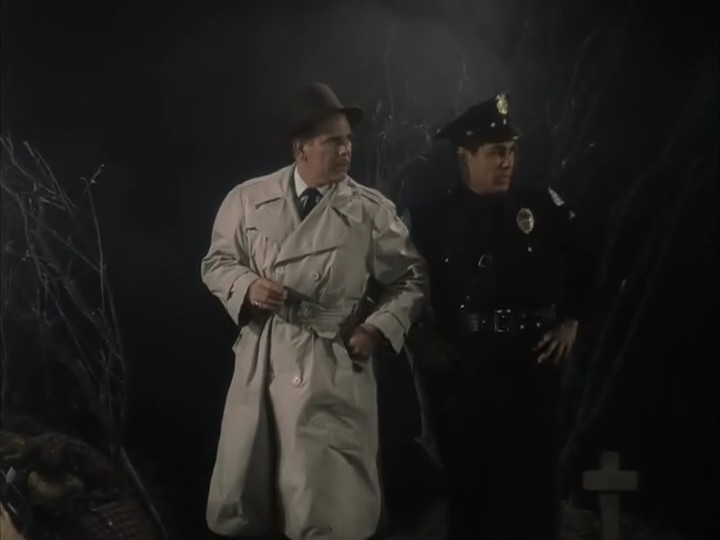
I was recently watching the Mystery Science Theater 3000 episode featuring the movie The Sinister Urge, and then I watched Plan 9 From Outer Space with the Mike Nelson commentary. Out of curiosity, I looked it up the cast, because one of the major villains in Sinister Urge was a good guy in Plan 9. His name was Carl Anthony. Here’s a picture of him:

mpv-shot0001

He’s the one in the police uniform. Here’s another picture of him.mpv-shot0002.jpg

His IMDB page only lists four credits:

  • Plan 9 From Outer Space (1959)
  • The Sinister Urge (1960)
  • Grand Jury: Boxing Scandal (1960)
  • Raw Force (1982)

Two things caught my attention. The first was that after some initial success, it was 22 years before he got another part. It’s not much of a movie, but it is a real movie. The IMDB synopsis for Raw Force is:

A group of martial arts students are en route to an island that supposedly is home to the ghosts of martial artists who have lost their honor. A Hitler lookalike and his gang are running a female slavery operation on the island as well. Soon, the two groups meet and all sorts of crazy things happen which include cannibal monks, piranhas, zombies, and more!

The second thing I noticed was that there was a TV show called Grand Jury. Carl Anthony was in the episode called Boxing Scandal. The Wikipedia page has next to no information beside an episode list. Yet there are writers for each episode, and it has actors, so presumably it was some sort of crime drama or detective show about a grand jury. I’m very curious what their premise was since grand juries don’t have continuity. They’re assembled for a few weeks, hear a bunch of cases, determine whether there is sufficient evidence to proceed to trial, then disband. Their goal is not to determine guilt or innocence, which would make it a very odd fit for a detective series.

Then it occurred to me to check to see whether there are any episodes on YouTube. Luck! There is:

It’s curious, to be sure. After a bit more research I discovered that Grand Juries actually do have investigative functions, such as the ability to compel witnesses to testify. The basic format is that some people committed a crime, then the grand jury investigates and tries to catch them. It’s actually a bit reminiscent of Columbo, in the sense of being a how-catch-em rather than a who-dunnit. That said, at least the episode Fire Trap is really more about the tragedy of how crooks fall apart than about investigations by the grand jury.

The acting was decent. The writing was… adequate. Really, it was kind of minimal. It wasn’t subtle, to be sure. To some degree it actually felt like a morality play—somebody made the choice to do a wicked deed and his life fell apart because of it. Of course, I have no way of knowing whether this was a typical episode. Still, I can see why this was not one of the great TV shows which is still remembered. That might be why Carl Anthony got a part in it (this was after Plan 9 but before The Sinister Urge).

This ties in to my earlier post, Most of Life is Unknown. People worked on this show and—presumably—people watched it. Most of them are probably dead by now, and the show is barely known. The wikipedia page which gives its list of episodes is presumably copied from somewhere since most of the entries are TBA. Even the things which we think should last disappear quite quickly from human memory. Fame promises so much and delivers so very little.

It’s a good thing that God is in charge of the world, or we’d be really screwed.

Of All Things To Predict, The Future is the Hardest

Yesterday, I wrote about The Future of Cars According to (Disney in) 1958. This reminded me of a conversation I had, about two decades ago, when I was a freshman in college. One of my majors was computer science (at the time I was tripple-majoring in Math, Computer Science, and Philosophy) and I was speaking with a senior who was also a computer science major. We were discussing Windows versus Linux. I can’t recall exactly how it came up, but he said, very confidently, that in 10 years neither Linux nor Windows would exist any more, both having been replaced by something completely new.

Twenty years later, both Windows and Linux are going strong, though the writing is on the wall for windows and it is gaining ever-more Linux-like features. (Including, recently, a way to easily install Linux within a virtual machine.) Which brings me to the title of this post—the future is notoriously difficult to predict. And I’d like to consider a few of the things which people tend to get wrong.

Adaptation

For some reason, people tend to think of current companies, products, etc. as either completely changing or completely static. Which really amounts to the same thing—the idea that whatever comes next will be completely new. And yet, this is rarely the case. Not never, of course, but rarely.

What prognosticators tend to leave out, here, is the market forces which operate on technology. Most people don’t like completely new interfaces; that means a lot of learning for marginal benefit. Far preferable are modifications to existing tools, so that the amount of learning requires is in proportion to the benefit received. An extra button or two is a small price to pay for new capabilities; having to learn all-new muscle memories for mostly old capabilities and some new ones is a price which is usually too large.

In many cases there is also the issue of interoperability. Computers benefit tremendously from backwards compatibility, but so do tools. A drill which cannot take normal drill bits renders one existing collection of drill bits worthless. Or worse, drill bits which can’t be chucked into one’s drill collection renders one’s drill collection worthless—and one generally as more money in the drills than in the bits.

These are powerful forces which tend to make new technology look and feel like old technology wherever possible.

And of course, people don’t like going out of business. Those who already have tools are motivated to improve them in order to stave off replacements—and this often works.

Technology Changes, Human Beings Don’t

Another place where prognosticators often fall down is that the human beings who are served by technology don’t change. We still have two eyes, two hands, are social, need to eat and sleep, etc.

So for example people look at the steering wheel, see that it’s been around for a long time, and think “that’s due for a change!” What they don’t consider is the problem at hand: we need a control interface to a car which translates fairly large movements into fairly small movements (for precision) while still allowing large movements, but where large movements are impossible to do by accident. This interface needs to control one dimension (left-to-right), should be usable for long periods of time without fatigue, and should be operable without looking at it. The steering wheel does all these things and does them well. Joysticks, nobs, and other such video-game replacements do at least one of these things poorly. It is of course possible that other sorts of interface will be made that can do the job just as well, but how much better is it possible to do the job, given the limitations of human physiology?

There’s a related example in 3D movies. Some people take 3D as the next obvious step, since silent movies to talkies went well and black-and-white to color went well and low-definition to high-definition went well. But what they miss is that all of these things made movies more realistic. Stereoscopic 3D information gives us distance information—and for typical movies these distances are almost always wrong for our viewing. Granted, they would probably be about right for The Secret of Nimh (which is about mice) in a 50″ TV about 10′ away—if the director would refrain from close-up shots. If you watch a movie, you will realize that there is almost no configuration of movie shots and TV size/location that will make the distance information to the characters correct for the viewer. Worse, if it were, instead of an immersive world of photographs, you’d have a window you’re looking through onto a stage play. The Nintendo 3DS had this problem, with its tiny screen—looking at it one had the feeling of watching a tiny animated diorama. It was novel, but not really interesting. The problems here are that the human being is simply not being taken into account.

Which is why, incidentally, the filming of 3D movies using two cameras at approximately eye-distance apart has all but been abandoned. Instead, 3D is (essentially) painted into a scene in post-processing by artists, who artistically fake the 3D to make it look good when viewed. I’m told that this can really help with scenes that are very dark, making it possible to distinguish dark grey blurs from a black background. This is adapting the technology to the realities of the human being, which is why it’s actually successful. But it’s also quite expensive to do, which greatly limits the appeal to viewers since it translates into much higher ticket prices.

Better Implementation Often Trumps A Better Idea

This is one of the more under-appreciated aspects of technological change. A mediocre idea implemented well is often superior to a good idea implemented in a mediocre way. I’m not just referring to actual fabrication; ideas for technology are themselves developed. Mediocre ideas which are developed well can produce better results than good ideas which are not much developed.

Perhaps the best example of this I can think of is the x86 processor. It has what is called a Complex Instruction Set. This is in contrast to the ARM processor which has a Reduced Instruction Set. (These give rise to the acronyms CISC and RISC.) The x86 processor was developed during the days when CISC was popular because computer programs were largely hand-coded in machine instructions. The complex instruction sets saved the programmers a lot of time. The trade-off was that it took far more silicon to implement all of the instructions, and this resulted in slower CPUs. After the advent of higher level languages and compilers, the idea of RISC was born—since a program was generating the machine instructions anyway, who cares how hard a time it had? The trade-off was that the compiler might have to do more work, but the resulting CPU used far less silicon and could be much faster (or cheaper, or both). In the modern environment of all programs being compiled, RISC is clearly the better approach to computing. And yet.

Because Intel CPUs were popular, Intel had a ton of money to throw at the engineering of their chips. AMD, who also manufactured x86 processors, did too. So RISC processors were only a little faster and actually significantly more expensive. And then something interesting happened—Intel and AMD figured out how to make processors such that they didn’t need nearly so much silicon to implement the complex instruction set they had. In effect what they did was to introduce a translation layer that would translate the complex instruction set into a series of “microcode” instructions—basically, internal RISC instructions. So now, with x86 processors being interally RISC machines, the penalty paid for supporting a RISC instruction set is an inexpensive translation layer in hardware—a pentalty which generally isn’t paid unless the complex instructions are actually used, too. And compilers generally don’t bother with most of the complex instructions.

The result is that ARM processors have a small advantage in not having to do translation of opcodes to an internal microcode, but this usually takes only 1 step out of the 12 execution steps in an x86 pipeline anyway. And Ahmdal’s law should always be born in mind—the maximum improvement an optimization can produce is the total execution time of the process being optimized. That is, eliminating 1 step out of 12 can produce at most a 1/12th improvement.

But then modern Intel and AMD CPUs also do something interesting—they cache the results of decoding instructions into microcode. So this decode penalty is only paid for code that isn’t executed very often anyway. The most performance-critical code—tight loops—don’t pay the decode penalty. As I said, a better implementation often trumps a better idea.

(People familiar with x86 versus ARM may point to the difference in performance on mobile phones, but this is really about what the respective CPUs were designed for. x86 processors are designed for achieving the maximum efficiency possibly at high power draws, while ARM CPUs are designed to achieve the maximum efficiency at low power draws. ARM CPUs are therefore better in very low power draw environments but simply cannot be scaled up to high power draw environments. There is no power configuration possible in which an ARM processor will come close to the single-threaded performance of an x86 processor. The tradeoff they make for the low-power efficiency is that they cannot be scaled up. This has nothing to do with technical superiority of either x86 or ARM processors, but the fact that they’re designed for extremely different workloads and environments. The thing which Intel and AMD need to be careful about is that the amount of processing power which they can provide at 15W, 35W, or even 60W may simply be far more than is necessary in a laptop (since the tasks which laptops are asked to do is becoming more standardized as the development of software slows down), at which point ARM might eat their lunch not because of technical superiority but because of its capabilities becoming a better match for a changing problem-space.)
The Future of Cars According to (Disney in) 1958

In the 1950s, Walt Disney started a television show in order to fund the theme park he wished to build called Disneyland. In 1958, this television show featured a segment called The Magic Highway, which discussed the future of cars:

I am very fond of historical projections of the future, and this is an especially well-done one. Though I should mention that one bit of the future it predicted—larger, straighter highways designed for faster travel—was not much of a prediction as the US interstate highway system was already underway (it began in 1956).

There are some things which are remarkably common to predictions of the future which can be seen in this movie too. One is the way that user interfaces are either predicted to change when they won’t or remain static when they will change. In this case the computer which drives the car is given its destination via punch card. (In another scene data is entered via toggle switches.) On the other hand, the steer wheel was replaced by by joysticks, which are actually a terrible interface for driving a car. By contrast, steering wheels are actually a very good interface for driving a car, so there’s no real reason to replace them.

There is also the assumption that energy will be free and consequently used in the most lavish of fashions (like heating highways to dry them off from the rain). I think that was related to the expectation of the coming nuclear age and how it will provide almost unlimited power. That was still highly optimistic since at a minimum one needs to maintain an electrical distribution grid, and wires have to be sized to the electricity they’re carrying, which means copper or aluminum fabrication and distribution.

But details like distribution aside, the predictions that nuclear power would result in free power never panned out for the simple reason that the nuclear part of a nuclear power plant is actually a small fraction of the work which goes on in a nuclear power plant. At their heart, nuclear power plants are giant hot-water heaters. The electricity is produced in turbines which are turned by steam. The only significant difference between a nuclear power plant and a coal power plant (or oil, natural gas, etc.) is what heats the water.

Anyway, check it out. It’s very interesting to see the ways in which futurians are often wrong and sometimes right.

The Three Endings of Clue

If you’re not familiar with the movie Clue, it’s based on the boardgame of the same name (known as Cluedo in Britain). It’s not the greatest movie ever made, but it’s a lot of fun. I own it both on DVD and Blu-ray and recommend it if you like murder mysteries and fun.

A curious feature of the movie is that it was filmed with three different endings. Movie theaters would be given one of the three endings, so viewers would see a different ending depending on which movie theater they saw it in. However, this posed something of a problem for the VHS version of the movie.

Technically, of course, it was possible that they could have made three copies of the VHS cassettes, but probably would have been prohibitively expensive. Thousands of people see the copy of a movie sent to a theater, whereas each VHS cassette would have cost $15 or $20 at the time. The labor involved in shuffling the cassettes couldn’t have been worth it.

Whatever the reason, three different copies of the movie was not the approach taken by the makers of the VHS. And since VHS was a linear medium, it wasn’t possible to shuffle the endings. So the of the endings were presented as possible endings, while the third was presented as “what really happened”. A nice touch is that this information is presented in the sort of text cards that one might see in a silent film; it fits nicely with the setting in the 1950s (desipte that being long after the era of silent films, curiously) and with the fact hat it’s a movie based on a board game. (Which would be ludicrous except that the movie doesn’t take itself seriously, though not in the modern wink-at-the-audience way which we all know and hate.)

About ten years after the release of Clue (the movie), DVDs hit the market. Unlike VHS cassettes, DVDs did not have to be linear and it became possible to play one of the theatrical endings at random. And the first DVD of Clue that I bought indeed had that option, though thankfully it also had (and defaulted to) the option to play the VHS ending, i.e. the three endings together with the title cards identifying the first two endings as possibilities. I’m thankful because I far prefer that ending; it’s in keeping with the fun and tone of the rest of the movie.

But this raises the interesting question: if VHS hadn’t had the technical limitation of being purely sequential, would the three-in-one ending ever have been made? There’s no way to know, of course, but it points to a larger issue of providence and limitations. Limitations often force people to be creative in ways they would not have been without them. Perhaps the best example of this I can think of is Star Wars episodes IV-VI. When one compares them to episodes I-III, when George Lucas, now very rich, had (effectively) no limits, he did much worse work.

The issue of providence is probably fairly obvious, but we as finite creatures don’t see the big picture; we chafe at our limitations. But our limitations often guide us to the work which we’re supposed to be doing. The things which frustrate us are often safety rails. Not so much that they protect our health—though they occasionally do that—but they protect the good work which we’ve been given to do. This is all the more helpful because we so rarely recognize that work until long after it was (all but) forced on us. If we even recognize it then. Something to remember is that God loves Beetles.


Man Was Always Small

In Orthodoxy, Chesterton has a great line:

It is quite futile to argue that man is small compared to the cosmos; for man was always small compared to the nearest tree.

To give context:

Herbert Spencer would have been greatly annoyed if any one had called him an imperialist, and therefore it is highly regrettable that nobody did. But he was an imperialist of the lowest type. He popularized this contemptible notion that the size of the solar system ought to over-awe the spiritual dogma of man.

It’s something I’ve seen various versions of from contemporary atheists. The most common is that the universe is so large that even if God existed he couldn’t possible care what human beings do. Other versions tend to run along the lines that the universe is so big our petty concerns can’t matter.

Chesterton’s point is a very good one—that man never took his importance from his size relative to the world. It reminds me greatly of a quote from C.S. Lewis in his book The Problem of Pain:

It would be an error to reply that our ancestors were ignorant and therefore held pleasing illusions about nature which the progress of science has since dispelled… even from the beginnings, men must have got the same sense of hostile immensity from a more obvious source. To prehistoric man the neighboring forest must have been infinite enough, and the utterly alien and infest which we have to fetch from the thought of cosmic rays and cooling suns, came snuffing and howling nightly to his very doors… It is mere nonsense to put pain among the discoveries of science. Lay down this book and reflect for five minutes on the fact that all the great religions were first preached, and long practiced, in a world without chloroform.

Of course, few atheists will put the idea this baldly—atheists rarely state any of their ideas without dressing them up a bit, or simply failing to consider how they relate to their other ideas, in my experience—but that one meets this sort of thing at all is very curious. One of the problems which some atheists seem to have in relating to older ideas is that they can’t relate to older peoples.

To the degree that there are solutions to this, I suspect that they are largely going to be narrative. The modern narrative is one of being utterly cut off from our ancestors. And yet we’re also seeing counter-narratives emerging; the revival of older traditions, the preference for older ways of doing things. It’s not material whether the putatively older ways of doing things are in fact accurate to how they used to be done, what matters to this purpose is whether they are believed to be in continuity. When they are—when people believe themselves to be in continuity with their ancestors—that’s when they’ll stop seeing their ancestors as aliens and see them as human, instead.

Most of Life is Unknown

We live so awash in stories and news that we get a very skewed perspective on how much of real life is know to more than a few people and God. What got me thinking about this was watching the following song:

It was the theme song used by a sketch comedy group at the university I went to for my undergraduate degree. They were called Friday Night Live (as an homage to the TV show of similar name) and would put on a show about three times a semester. They had apparently been hugely popular when they started, which was at least a few years before I attended. I was in the rival sketch comedy group, Pirate Theater. At the beginning of my freshman year the attendance at our shows was lower than that of Friday Night Live, but by the end of my senior year the positions had reversed. Our audiences were 3-4 times larger and theirs were smaller even than our audiences had been in my freshman year.

A few years ago I ran into someone who was currently a student at the university and I asked about the shows. He said that Pirate Theater was still reasonably popular but Friday Night Live no longer existed. In fact, he had never even heard of it.

There had been a reasonably friendly rivalry between the two shows, and it turned out that our efforts brought success, in a sense. I don’t think that any of us pirates wanted to kill of Friday Night Live, and ultimately I suspect that it was the quality of their writing which did them in. For whatever reason (I never wrote sketches for FNL, so I couldn’t say what it was like to do so), Pirate Theater managed to attract far more of the skilled writers on campus. It also didn’t help that FNL insisted on having an intermission and hiring a local band to play in it. I think in all the time I was there—and I didn’t miss an FNL show all four years—they had one band that I didn’t leave the auditorium to get away from. Really, really cheap bands tend to be so inexpensive for a reason.

As you might imagine, I was never alone outside the doors when the band was playing. And they were always ear-hurtingly loud, too. Adding injury to insult, I suppose.

Towards the end of my senior year, there were probably less than a hundred people attending the Friday Night Live shows. The total number of people who saw their trajectory for those four years I watched it was not very large; the number who remember it now is probably much smaller. And yet the actors did work on their sketches, however little humor was in them. The “turrets family” where the “joke” was that there was a lot of yelling and cussing may not have been entertaining to watch, but it’s no easier to memorize unfunny lines, or to say them at the right time when you’re live on stage. (There was at approximately one of those per show, for all four years, by the way.)

One of the actors was limber and would do physical comedy with a folding chair, getting stuck in it. It wasn’t brilliant physical comedy, and (due to the lack of skilled writing) never really fit into the sketches it was in; one could see it coming a mile away as the sketches it was used in were basically an excuse to do the wacky chair antics. But someone did write the sketch, and people memorized it, and the actor did twist himself through a chair on stage which is not an easy thing to do. And I do have to say that the final time he did it—which was the last FNL show I attended since he graduated the same year I did—was actually kind of funny because it was actually a protracted goodbye dance with the chair, complete with sad music and longing glances.


This was all very real; people put real work, went through real happiness and sadness, and now it is mostly forgotten. That is ultimately the fate of (almost) all human endeavors. This was captured quite well, I think by Percy Blythe Shelley in his poem Ozymandias:

I met a traveller from an antique land,
Who said—“Two vast and trunkless legs of stone
Stand in the desert. . . . Near them, on the sand,
Half sunk a shattered visage lies, whose frown,
And wrinkled lip, and sneer of cold command,
Tell that its sculptor well those passions read
Which yet survive, stamped on these lifeless things,
The hand that mocked them, and the heart that fed;
And on the pedestal, these words appear:
My name is Ozymandias, King of Kings;
Look on my Works, ye Mighty, and despair!
Nothing beside remains. Round the decay
Of that colossal Wreck, boundless and bare
The lone and level sands stretch far away.

Most things fade from memory far faster, of course. How many people now remember more than a few fragments of Friday Night Live’s sketches? I don’t think I remember more than a few fragments of the Pirate Theater sketches which I wrote, let alone those I merely performed in. I do have a DVD with a collection of the video sketches we did (many of which I’m in), but it’s been quite some time since I watched it.

It may well be longer until I watch it again. In the intervening decade and a half, I’ve gotten a profession, married, bought a house, had three children, published three novels, made a YouTube channel with over 1,973 subscribers, and a whole lot more. As much a I value my memories of my college days, I don’t want to go back in the way that video takes one back.

But the thing is, that’s not a strength. I just don’t have the time and energy for it. But all the things I’ve done since which so occupy me now will also fade in time. Eventually I will die; eventually this house will fall down or be demolished; eventually my children will die. Nothing has any permanence within time.

So the only hope we have is for permanence outside of time. There’s a great metaphor, which Saint Augustine uses in his Confessions, of God, at the end of time, gathering up the shattered moments of our lives and putting them together as a unified whole. And that’s really the only hope we have for any of our lives to be real.

The Death of Rock and Roll With Zarathustra’s Serpent

You may recall my blog post The Death of Rock-n-Roll. After writing it, I invited Zarathustra’s Serpent to talk with me about the subject because he’s studied popular music quite extensively. This is the conversation we had. You can also watch the video on YouTube:

When I Feel Sorriest For Atheists

Of all the things which rightly make an atheist an object of pity, the one I feel sorriest for the atheist for is when he realizes that all pleasure, satisfaction, and joy that he experiences is (according to him) nothing more than some chemicals in his brain. For two main reasons:

First, because he then accords Joy no significance. When this happens one can almost hear the sound of the cell door slamming shut on the mental prison in which he is trapped. It is a prison with no windows and no sunlight can enter it.

Second, because he will soon notice that there is, therefore, no distinction in kind between real happiness and what is produced with recreational drugs. And recreational drugs—the hard-core ones, I mean—are basically a form of slow suicide. (Not because their side-effects cause death, but because their main effect is basically a temporary suspension of living in a haze of mere feeling.)

There are many things for which to pity this atheist, but this one has always affected me the most. Once the door of this mental prison has been shut, I do not know of any natural force which can open it. I doubt that there is anything to do for a person in such a case but pray for them.

You Can’t Get an Ought From an Is In Hell

One of the questions which comes up in discussions of morality is whether you can get an “ought” from an “is”. This is relevant primarily to discussions of atheism, since to the atheist everything is a brute fact, i.e. an “is” which is not directed towards anything, and therefore an atheist cannot get any “oughts” out of their description of what is. Or in simpler language, if God is dead then all things are permitted. (Note for the unpoetic: by “God is dead” we mean “there is no God”.)

There are two reasons why if God is dead all things are permitted:

  1. If God is dead, who is there to forbid anything?
  2. If God is dead, then there is no ultimate good because all is change and therefore nothing has any lasting reality.

If you argue this sort of stuff with atheists long enough, somewhere along the line while you’re explaining natural ends (telos) and natural morality, you may come by accident to a very interesting point which the atheist will bring up without realizing it. It often goes something like this:

OK, suppose that what God says is actually the only way to be eternally happy. Why should you be eternally happy? Why shouldn’t you do what you want even though it makes you unhappy?

This question sheds some very interesting light on hell, and consequently on what we mean by morality. Our understanding of morality tends to be like what Saint Augustine said of our understanding of time:

What then is time? If no one asks me, I know what it is. If I wish to explain it to him who asks, I do not know.

Somehow or other atheists tend to assume that ought means something that you have to do, regardless of what you want to do. It’s very tempting to assume that this is a holdover from childhood where ought meant that their parents would make them do it whether or not they wanted to. It’s tempting because it’s probably the case and because that’s not an adult understanding of ought. And it’s not because ultimately we can’t be forced to be good. (Or if this raises your hackles because I’m “placing limits on God”, then just take it as meaning that in any event we won’t be forced to be good.)

Hell is a real possibility. Or in other words, it is possible to see two options and knowingly pick the worse option.

What we actually mean by saying that we ought to do something is that the thing is directed towards the good. And we can clarify this if we bring in a bit of Thomistic moral philosophy: being is what is good. Or as the scholastic phrase goes, good is convertible with being. But being, within creation, is largely a composite entity. A statue is not just one thing, but many things (atoms, molecules, etc.) which, in being ordered toward the same end, are also one thing which is greater than their parts.

And you can see a symphony of ordering to a greater being, in a human being. Atoms are ordered into proteins (and many other things like lipids, etc), which are ordered into cells, which are ordered into organs, which are ordered into human beings. But human beings are not at the top of the hierarchy of being, for we are also ordered into community with other created things. (Please note: being part of a greater whole does not rob the individual of his inherent dignity; the infinite goodness of God means that creation is not a competition. Also note that God so exceeds all of creation that He is not in the hierarchy of being, but merely pointed to by it.)

And so we come to the real meaning of ought. To say that we ought to do something is to say that the thing is ordered towards the maximum being which is given to us. But we need not choose being; we can instead choose non-being. The great lie which the modern project (and, perhaps not coincidentally, Satan) tells us is that there is some other being available to us besides what was given to us by God. That we can make ourselves; that we can give ourselves what we haven’t got. And, not at all coincidentally, are the things which we ought not to do—that is, those things are not ordered toward being. They’re just what the atheist says that all of life is—stimulating nerve endings to fool ourselves that we’ve accomplished something.

And yet atheists complain when one says that, according to them, they’re in hell.

God, at least, has a sense of humor.

Gold Covered Chicken Wings

If you haven’t heard, there’s a restaurant which came up with the idea of gold-covered chicken wings. While there are all sorts of things which could be said about about the wisdom of buying such things, the thing I really want to talk about is the symbolism of the thing.

(Since there’s too much outrage on the internet, I think I should note in passing that due to gold’s astonishing brilliance with only a few atoms of thickness the wings are not actually wildly expensive. You can get 10 wings for $30, which for the location is probably a 3x markup—wasteful, but not very wasteful in absolute terms. You can easily get less food for more money in Manhattan.)

To see the symbolism of the thing, we need to consider what gold-plated food is. Unlike many heavy metals, metallic gold is (basically) inert, which is why it is safe as a food additive. But the fact that it’s inert also means that it has exactly no nutritional value, either. It’s not bad for you, it’s not good for you; it’s just there.

As such it’s an almost pure waste. I say “almost” because it does look pretty, though its beauty in the wrong place. If gold is to be present, it should be on the plates, where its beauty is not destroyed by the act of eating. It should not be on the food itself, where the beauty is destroyed by the act of eating. And that is, I think, the key to the symbolism.

My favorite version of the baptismal promises includes the questions:

Do you reject Satan?

And all his empty promises?

But there is another translation of the second question:

And all his empty show?

Gold-covered chicken wings seem to me an almost perfect illustration of Satan’s empty show. It looks like it has value—but has none—and the acceptance of it destroys even the slight good it uses as a bait.

Hearing the Same Story Twice

One of the great benefits of having friends who are at least twenty years older than oneself is that they have a wealth of life experiences that they are happy to share. This enables one to circumvent the problem in the popular saying:

Good judgment comes from experience and experience comes from bad judgment.

Having significantly older friends means that one can benefit from their experience. (The same is true of parents, if one can bring oneself to listen to them.)

But there is a problem with listening to the stories of people who are several decades one’s senior: they tend to tell you each story several times. Contrary to popular belief, this is not because they’re old, but because while stories are memorable, the act of telling them isn’t. In fact, telling a story is actually quite hard to remember because the storyteller’s attention is on the story, not on the telling.

Further, older people simply have far more to remember because they’ve got much fuller lives than young people do. Our culture’s obsession with youth not withstanding, older people have far more friends and acquaintances than young people do. They also have vastly more people’s lives and concerns to keep track of.

And since one very remarkable experience—that is, one good story—will touch on many aspects of life, in conversation with one’s older friends their especially good stories will come up from time to time, and they will probably not remember that they already told you that story three years ago. As I said, the story is far more memorable than the telling of it.

There are, at this point, three options:

  1. Interrupt them to tell them they already told you the story.
  2. Let them tell it then tell them that they already told you the story.
  3. Let them tell the story and appreciate it again.

Of the three, the second is the worst option. It’s basically throwing a gift back in the giver’s face. Don’t do this.

The first can be polite, but it’s tricky to pull off. If the story is recognizable in its first few words, you can probably find a pause in the first sentence (or so) to interrupt and ask if it’s the story you’re thinking of—and bear in mind you might be wrong because sometimes different stories sound similar. If it is, then tell the friend how much you like the story. The danger of interrupting them is that you might seem ungrateful or unappreciative of the wisdom being conveyed and telling them how much you appreciate the story—not merely appreciated it in the past, but kept its lessons with you—will ensure that the proper reaction of gratitude is conveyed.

The third option is often the best option. First, because it is the most grateful option. Second, because the same story is often told with different details filled in, so one gets a more complete version of it by putting the two together. Third, because one will probably learn new things from hearing it again. And fourth, because the impossibility of perpetual novelty (while maintaining quality), happiness depends upon the ability to appreciate good things one has already experienced. Hearing a good story again is excellent practice at this.

One should not lie and pretend that one has not heard the story before, but it almost never comes up, and if it doesn’t, there’s no need to bring it up.

And you’re vastly better off having heard the same story twice than not at all.

Atheists’ Bluster

Around a quarter century ago, in my early teens, I did online Christian apologetics in various forums (AOL, usenet, etc.). And something I came across was the habit of atheists using bluster—the extremely confident assertion of things that, if pressed, they couldn’t defend.

In my later teens I took a hiatus from apologetics to spend time learning, to better prepare myself. It ended up being a fairly long hiatus, and by the time I was ready to get back to apologetics I was Catholic and now it was called evangelization. And in the great dealing of thinking and reading and so forth that I did in those years, I  came to the conclusion that reasoned argument was not what most people needed. Atheism was not so much an intellectual position as it is a mental prison. The atheist is in a tiny, cramped little universe, so much smaller than a human mind. What atheists really need—as Chesterton said of the madman in his masterpiece, Orthodoxy—is not arguments, but air. He needs to come in contact with enough truth that he will realize it can’t fit inside his prison, at which point he will realize that he’s not actually inside of a prison, and leave.

But being an open Catholic online and hanging out with the sort of people I hang out with does bring one into contact with a lot of atheists—though almost all of a few related kinds. And in meeting the same sorts of people I was arguing with 25 years ago, I found that they were still using bluster—making assertions with impressive confidence. But as an adult in my 30s, this was nowhere near as intimidating as it was to me when I was 13. And I found something very interesting when I would respond to bald-faced assertions with contrary bald-faced assertions.

I somewhat naively expected to simply come to a standstill of assertions that would result either in agreeing to disagree or providing space for a real discussion to take place. Instead, the atheists tended to get angry. Very angry. And what was curious was that it was the sort of anger one sees from a dog owner who isn’t any good at dog training when their dog fails to perform on command. It’s the anger of, “you’re not doing what you’re supposed to!”

You’ll see this all over the world, from all sorts of people. Doubtless many atheists have gotten this from irate grandmothers. But they were holding themselves up as rational inquirers. But if you scratch the surface, like with gold leaf, you find out that their rationality is just a coating which is only a few molecules thick.

And I started noticing that this applied in other places, too. The people who scream, “only believe things because of evidence!” get awfully huffy when you ask them for evidence of their honesty. They don’t put it that way, but apparently that, you’re supposed to take on faith.

“Don’t believe things without evidence!”

“OK, do you have any evidence that you’re not a moron?”

Again, their principle apparently comes with a lot of unstated qualifications. In theory, this should be an entirely reasonable question since you’re just asking for evidence. Instead you’ll typically hear about “ad homs” (argumentum ad hominem, i.e. arguing that the man is bad as if that proved his conclusion is false, see here for more), which is rather bizarre since a question cannot be a fallacious argument since it is not any kind of argument.

It’s been rather fascinating to see, since these people have great conviction, but it’s not conviction in their own principles. I still haven’t really found what their conviction is in. (I have my suspicions, and it will vary with the individual, of course. But I haven’t come to any definite conclusions yet.)

But it’s been very interesting to see how little there is behind atheists’ bluster.

Lack of Belief in Belief-Capable Entities

Recently my friend Eve Keneinan had a Twitter Thread in which she talked about the problems with defining Atheism as “a lack of belief in God”:

There is a problem she doesn’t mention with this definition, which is that there are no useful sentences which you can construct.  In order to have a useful sentence using a word, there has to be something you can predicate of all of the things described by the word. And (ignoring the problem of rocks and krill being caught up in the lack-of-belief definition), there is nothing you can predicate of people who believe God doesn’t exist, people who aren’t sure he exists, babies, the mentally retarded, and people who’ve never heard of the concept. They’re not all tall or short, stupid or intelligent, fat or thin, nor anything else. You can say that they exist, but that’s about it. This disqualifies it as a possible definition by what should be called the “uselessness test”. That said, let’s ignore it for now.

Eve mentioned a possible way of amending this definition to avoid catching up rocks and bricks and such-like as atheists:

However, this amended definition still leaves it a completely useless definition for a different reason than the one above (which still applies). Actually, before I even get to that, there’s a problem which needs addressing: it’s under-specified. Specifically, what sort of beliefs must the atheist be capable of forming?

There are different ways of defining “belief”, but since atheists are pretty much all materialists and thus don’t believe in a soul nor an intellect (in the traditional sense), they have to define “belief” as some sort of behavioral relation to the outside world. As such, it is clear that a rat which nibbles on a block of rat chow “believes” that the rat chow is food. So we still have the problem that under this amended definition, most atheists are bacteria and funguses, followed by higher-order life forms like krill and beetles. OK, so let’s grant the atheist the ability to use a theist’s definition of “belief” such that it’s the sort of thing which only human beings have, despite there being absolutely no way for a materialist to do this at all consistently.

We now get to the problem I mentioned about under-specificity. What sort of beliefs must these beings be capable of forming? To give an overly simplistic example to illustrate the point, it is utterly uninteresting that a man whose ability to form beliefs encompasses nothing more than the belief that cucumbers exist does not believe in God. This generalizes to the real point: if a man is for some reason limited in that he’s not capable of forming a belief in God, it is not an interesting property that he doesn’t believe in God. It is uninteresting for the same reason that we don’t count a man who can’t do even 1 pushup as as physically unfit if the reason he can’t do a pushup is because he has no arms. An armless man who can run a sub-6 minute mile is still quite physically fit. And further, his being fit but unable to do pushups tells us nothing about a couch potato with arms who cannot do pushups because he does nothing all day long. In the same way, if a man has a cognitive defect where he cannot form a belief in God he is unfortunate, but he has nothing whatever in common with someone who can form a belief in God but has formed the belief that God does not exist instead.

But really, either way, this definition cannot be applied to anyone given the limits of human knowledge. We have no way of finding out whether a man is capable of forming a belief in God except that he actually forms it. And even if we retreat from that we have no way of knowing that a man is capable of forming beliefs at all (without being him). We can tell us that he does, but I can easily program a computer to say that it forms beliefs, too. Heck, one could easily write on a rock, “I, this rock, can form beliefs”. If one rejects noetic knowledge as most online atheists do and demand evidence from the one making the claim, it is impossible to know whether anyone is an atheist since we can’t know what’s actually going on inside of his head. And this is different from taking his word about whether or not he in fact believes in God, since that presupposes he’s the sort of being which could have a word to give. The amended definition of “atheism” now requires us to find out whether he’s the sort of thing which can give his word before we know whether the definition applies to him.

Of course atheists tend to take the practical solution of demanding that theists merely assume the theistic worldview at all necessary places in order to make sense of what the atheist is saying, but to then reject it wherever it is not necessary for the atheist’s statements to be other than raving gibberish. At some point I think that everyone is tempted to say of online atheism what King Arthur said of Camelot, “No, on second thought, let’s not go there. It is a silly place.”

The Death of Rock-n-Roll

In this interesting article, the author says that Rock-n-Roll is now dead. I recommend reading the whole article—which is mostly about how the fans of Rock-n-Roll loved the stupid things that Rock Stars did, and don’t any more—but the part I want to talk about is the conclusion:

At some point we seemed to have changed our minds about what we expect from these people. Today our idea of a famous person is a tepid Hillary Clinton supporter.

Maybe as a culture this means we have moved past rock and roll. If that’s the case, fine. There are certainly dated things — handwritten letters, for example — that are more worthy of being defended.

Somebody call Tipper Gore and let her know she won.

(For those who don’t know, Tipper Gore led a public decency campaign.)

The issue which I have is that the author of the article credits the wrong person. Tipper Gore didn’t win. Rock-n-roll did. The problem is that it was a revolution, and revolutions are inherently temporary things. As G.K. Chesterton noted (in What’s Wrong With the World):

A revolution is a military thing; it has all the military virtues; one of which is that it comes to an end. Two parties fight with deadly weapons, but under certain rules of arbitrary honor; the party that wins becomes the government and proceeds to govern. The aim of civil war, like the aim of all war, is peace… They do not create revolution; what they do create is anarchy; and the difference between these is not a question of violence, but a question of fruitfulness and finality. Revolution of its nature produces government; anarchy only produces more anarchy. Men may have what opinions they please about the beheading of King Charles or King Louis, but they cannot deny that Bradshaw and Cromwell ruled, that Carnot and Napoleon governed. Someone conquered; something occurred. You can only knock off the King’s head once. But you can knock off the King’s hat any number of times. Destruction is finite, obstruction is infinite: so long as rebellion takes the form of mere disorder (instead of an attempt to enforce a new order) there is no logical end to it; it can feed on itself and renew itself forever.

I don’t mean that Rock-n-Roll intended to be a revolution. In many ways I think that the Rock stars were the overgrown children that they were usually charged with being and, like children, wanted to play and have the grown-ups watch over them and clean up after them. They were only playing; they didn’t want to destroy the house they were playing in. To use Chesterton’s language, they only ever meant to knock the King’s hat off.

But they missed and his head came off instead. Whatever the particular historical reasons for the victory they never meant to achieve, Rock-n-Roll changed the culture. It would be more accurate to describe it as one branch of the military which overthrew the culture—it didn’t do anything all on its own—but it won. And the problem which all successful rebels face is that they must now become conservatives. They must conserve what they have changed things into.

There’s a certain irony involved in the hedonists having become the respectable people, but they did, and they now face the same restrictions which respectable people always face.

That’s the problem with rebelling against morality: even when you win, you lose.

Superman’s Secret Identity

I had a conversation with my friend Andrew Stratelates recently about the question of why no one figures out that Clark Kent is actually Superman. And I figured something out about it when he pointed out that mannerisms can be very suggestive to people, but it would be very difficult to fool facial recognition software: trying to figure out Superman’s secret identity presupposes that he has a secret identity. And why on earth would anyone think that?

Superman doesn’t wear a mask, and is even clean shaven. Since one can plainly see his face, which he makes no effort to hide, there’s absolutely no reason to think that he has some sort of alternate persona he’s hiding. Moreover, if you think about it for a moment, it’s actually really quite strange that Superman does have an alternate persona. It serves no practical purpose. In most tellings, superman is not a vigilante who is wanted by the police and in any event he has a fortress of solitude which is a reasonable commute away, so it’s not like he has to pay rent to avoid capture. And if Superman did want money, he could take advantage of his super powers to earn hugely more than he could pretending to be an ordinary man. There are much more lucrative things he could do, but since he can travel at super-sonic speeds while carrying multiple tons of material, he could make a fortune as a high speed courier. The list of better ways to make money than working an office job would be quite long, and moreover, obviously quite long to everyone.

Further, there’s the fact that superman is basically an olympian god compared to ordinary men. Why would he choose to do the drudgery the rest of us are forced to do? It’s an imperfect analogy, but consider the following hypothetical:

Suppose you work for a company which makes inkjet printers, and suppose you have a co-worker in your office named Fred who looks like Donald Trump, except that he is polite, self-effacing, drives a 6-year-old Nissan Sentra, and wears glasses. And suppose another co-worker one day whispered to you, “You know what, I think that Fred is Donald Trump’s secret identity!”

Would you:

(A) Say, “You know what, if you take away the glasses he does look exactly like Donald Trump. You must be right!”

(B) Ask, “Why on earth would Donald Trump have a secret identity working a mediocre job in our printer company?”

(If Donald Trump is too polarizing a figure, you could easily substitute Jeff Bezos, Mark Zuckerberg, or the Duke of Cambridge (Prince William), and the point will remain unchanged.)

Superman’s having a secret identity makes about as much sense has his wearing his underwear on the outside of his clothing—it’s interesting, it’s very historically contingent, and it’s plausible only in the sense that life has a lot of quirks to it that we’d never expect. That it is plausible in the sense that life is stranger than fiction does actually lend people not discovering Superman’s secret identity some plausibility. And I think the wild implausibility of Superman having a secret identity is the best defense he has, since it would be trivial to detect superman otherwise, even if he wore an astonishingly realistic face mask. Just use an x-ray scanner and find the guy who’s completely solid. Alternatively, look for people the right height and build and poke them with a very thin, sharp pin until you find the guy where the pin breaks instead of going into his skin. And if you’re a villain, just do it like they did in the movie Pumaman and throw likely candidates out of high windows until you find someone who survives.

Over the Hills and Far Away

I recently discovered the singer/hury gurdist Patty Gurdy. Originally part of the band Storm Seeker, she seems to be striking out on her own. I’ve really been enjoying her songs on YouTube, and I’m particularly fond of her cover of a Storm Seeker song called The Longing:

However, the song I want to talk about is Over the Hills and Far Away:

It’s extremely reminiscent in theme of the Johnny Cash song The Long Black Veil, though I don’t know that there’s any influence:

Either way, it’s very interesting to compare the two songs. And despite the similarity of subject matter, the biggest difference is what kind of song they are: Over the Hills and Far Away is a (sort-of) love song, while The Long Black Veil is a tragedy.

This is of course facilitated by the different penalties for the different crimes. In The Long Black Veil, the man is accused of murder and his refusal to provide an alibi results in his execution, while in Over the Hills and Far Away he refuses to provide an alibi for a robbery and consequently is sentenced to 10 years in prison. This enables the latter to have the theme of eventual return, and it’s this theme which turns the song into a love song.

Which is unfortunate because the man should not return to the arms of his best friend’s wife. He should stay out of the arms of any man’s wife but even more so those of his best friend’s wife. In the song where the adulterer died, it becomes possible to take it as a simple tragedy where he was not directly punished for his adultery, but none the less was being punished indirectly because his adultery prevented him from proving his innocence. He got what he deserved, if indirectly, sort of like the plot of The Postman Always Rings Twice.

Unfortunately that sort of interpretation isn’t possible for a man who doesn’t understand what he did to be wrong (only socially unacceptable). But I find it interesting that the woman sings a song about adultery as a love song and the man sings it as a tragedy. This touches on a theme I’ve noticed in stories written by women: a man is so captivated by a woman’s beauty that he’s willing to destroy himself (and often her) because of it. This isn’t a universal theme, nor anything like that, but I’ve noticed that this is a common theme in material that I didn’t usually read until recently.

There’s a lot to say about the theme of a man so entranced by a woman’s beauty that he becomes a monster, which alas I don’t have time for now, but it is an interesting question to ponder how much the becoming a monster is intrinsic to the fantasy or whether it’s a way of defending against the accusations of wish-fulfillment which the story would be accused of if the woman’s beauty captivated the man and helped him to overcome his vices and become a saint. That latter one would be a very good story, though.

Sometimes People Surprise You

Human beings are, obviously, very complex creatures. For any given person we deal with, we understand them to a degree, but only so far. And then on top of that they have free will and can choose to do things contrary to their nature. So we’ll never fully understand another human being—on this side of death, anyway.

Having said that, sometimes when people do things we thought they would never do it becomes clear that we misunderstand people’s motivations and thoughts. This happened to me recently with the YouTuber Logicked. A while back, as a joke for the beginning of Deflating Atheism’s 2,500 subscriber special livestream, I collaborated with Rob to make a satirical sketch with the premise that the YouTuber atheist “Rhetoricked” was criticisng the livestream before it even happened. The video on my channel where I put it up included a few minutes of context if you haven’t heard of Logicked before:

Just a few days ago, he made a serious response video to my comedic sketch! Here’s the description:

Missing the Mark is still mad that I didn’t like a few dumb things he said, so he parodied my videos in an evil beekeeper costume. I’m sure it will be a deeply honest representation and not remotely hypocritical.

For the record, I wasn’t mad. I found the idea of him making 3 videos criticizing things I said in the Deflating Atheism 1000 subscriber special—which was a hangout among friends just chatting, having fun, and reminiscing—to be a little absurd, and since my sense of humor tends towards absurdism, I decided to add to the absurdity with a comedic sketch on the Deflatheism 2,500 subscriber special. I actually didn’t expect him to watch the video. Or, really, for all that many people to watch the video. Livestreams rarely get all that many views and though it would probably be reasonably popular with my scubscribers—all of my Just For Fun videos are—I don’t have all that many subscribers (at the time I uploaded it, I had around 1500).

Anyway, I never dreamed that Logicked would do a response video to it. And yet he did. Being that wrong means I need to rethink some things. But first, I’ll explain my reasoning:

First, Logicked rarely does response videos. Full disclosure: I haven’t actually watched more than two of his videos in their entirety (one about me which I responded to in two parts, and an early, very short one in which he’s tempted by some sort of devil in exchange for subscribers). But I skimmed the titles and also searched on YouTube and he’s got the word response in something like 2 other videos besides this response. His videos are almost entirely critiques. That is, he takes videos which weren’t about him and then criticizes them. So this was just atypical.

Second, his YouTube channel is a business for Logicked. Keeping on-brand is good business. Giving free air-time to people criticizing you is not a good business practice. This is summarized in the phrase “never punch down”, though people have been using the phrase “punching down” to mean other things, so it might perhaps be best summarized as, “never give publicity to critics who can’t hurt your bottom line on their own”. Now, as several friends of mine have pointed out, judging by his comment section, Logicked’s core fans are several dozen light bulbs short of a full picnic basket (i.e. they’re not intelligent), but core fans typically draw much of their energy from peripheral fans, and peripheral fans are the people more likely to be swayed by criticism. Not that any one act of criticism will hurt all that much, but why take unnecessary risks with your primary source of income?

Third, the draw of YouTube atheists is the air of superiority which they assume. They are basically selling confidence. I described this in my video The Value of Atheist Hacks:

And it seemed to me that on some level Logicked understood this because by sticking to critiques he maintained his position of superiority from which his viewers could derive vicarious confidence. Doing a response video puts him in a position of equality with me. He can maintain as superior a tone as he wants in the video, but fundamentally in a response he is defending himself rather than being on the attack. Again, this isn’t going to change anyone’s opinion of him drastically—and certainly not consciously—but it comes back to the question: why take unnecessary risks with one’s primary source of income?

Being a professional YouTuber is a one of the professions in which a person is being professionally popular. Being popular—even with a sub-group—is not an easy thing to do. Humans are incredibly fickle creatures. The mob which one day shouts “hosannah!” may be shouting “crucify him!” the next week.

There’s also just the fact that as a professional YouTuber, Logicked needs to be charismatic, and seeming thin-skinned is very un-charismatic. And giving a serious rebuttal to an obvious joke does seem very thin-skinned.

Now, the problem with taking chances is not that they always go wrong, but you become vulnerable to two things going wrong at once. And that’s where the bad stuff tends to happen to people—when two things go wrong at once. And that’s why people with responsibilities like a wife and child tend to avoid risks. This way when the bad stuff that you can’t control happens, you’ve got a chance you can survive it without taking any damage.

And I thought that Logicked knew all this. And maybe he does, in which case there was some other force in his life which resulted in this very odd action on his part. For example, it could be that Max Kolbe is right and atheists are all narcissists. An older version of this would be Saint Thomas More’s maxim, “The devil, that proud spirit, cannot endure to be mocked”. (It should be noted he was comment on prayer, as the beginning of that quote is, “Prayer makes mock of the devil”.) I would still need to personally be a little important to Logicked, though, and I really doubt that I personally matter to him at all.

It’s possible that the parody was too spot-on and since it was public he felt embarrassed, but the thing is, it wasn’t a very spot-on parody. I was just being silly—which I think is very obvious from the costume I used, as well as how over-the-top the things I said were—and obviously played very fast and loose for fun. I don’t think that anyone could take the specifics of what I said to be a cogent criticism of Logicked.

It could be that Logicked is desperate for material and is confident in his ability to pull off seeming thick skinned and just having fun. Of the ideas I’ve seen, this may be the most likely.

Whatever the answer, it is clear that my misprediction of his behavior means that I misunderstood him. By which I really mean people like him, since I don’t know much about Logicked the man. It’s important to be able to recognize these signs of being mistaken and learn from them both with less confidence in predictions as well as in needing to do further research in understanding human beings.

Without Midwits, Geniuses Would be Useless

Over at Amatopia, Alex wrote an interesting post called, The Curse of the Midwit:

One of the worst things to be is a midwit. And I am one. Let me explain what I mean by “midwit.” I have seen the term used many ways, and they boil down to these six points: Someone who is not as smart as the truly intelligent, but is of above-average intelligence, Who wants other […]

As usual, it’s a post worth reading, but Alex only tells half the story. He talks about the dangers of midwits but every danger is just the flip side of a virtue. (Of a natural virtue, specifically. The natural virtues are things like intelligence, strength, physical beauty, health, and so on; they are distinct from the moral virtues like courage, self control, etc.; which are again distinct from the theological virtues of faith, hope, and love.)

In short, Alex leaves out the virtue unique to midwits. Now, in what follows I’m going to paint with a very broad brush because I don’t have time to give a full description of the hierarchy of being, so I ask you to use your imagination to fill in all that I’m going to leave vague.

As I’ve said before, God’s fundamental theme within creation is delegation (technically, secondary causation). He doesn’t give to each creature everything he gives to them directly, but instead gives some of his gift to other creatures to give to their fellow creatures on his behalf. Through this He incorporates us into his love of creation and into His creative action. But within creation, this theme of delegation echoes. Instead of one intermediary, God orders the world so that there are several intermediaries. He spreads the love around, as it were.

The part of that which we’re presently concerned with is that it is not (usually) given to geniuses to be able to give their knowledge to the great mass of humanity directly. And since it is (usually) not given to them, they generally can’t do it. When a genius speaks to a common man, he’s usually quite unintelligible. If the common man knows the genius to be a genius by reputation, he’ll assume the man is saying something too genius for him to understand, rather than to be raving nonsense, but he will typically get about as much from it as if the genius was raving nonsense. This is where the midwits come in.

A midwit can understand a genius, but he can also speak in ways that common men can understand. Thus God’s knowledge is given to the common man not directly, but first to the genius, who gives it to the midwit, who then gives it to the common man. Geniuses need midwits at least as much as midwits need geniuses. In truth, all of creation needs the rest of creation since we were created to be together.

Of course the distinction of men into three tiers—genius, midwit, and common—is a drastic oversimplification. In reality there are levels of midwits and levels of geniuses, each of which tends to receive knowledge from the level above it and pass knowledge down to the level below it. For example, Aristotle would have had the merest fraction of the effect he has had were it not for an army of teachers, down through the millenia, who have explained what he taught to those who couldn’t grasp it directly.

Of course in this fallen world every aspect of this can and often does go wrong in a whole myriad of ways. And Alex is quite right that midwits can be very dangerous when they consider themselves geniuses—or really, any time that they’re wrong—because the sacred burden of teaching the great mass of common men has been given to them. Midwits have the power to do tremendous good, which means that they have the power to do tremendous harm.  But the tremendous good which midwits were given to do should never be forgotten just because many of them don’t do it.

Thinking about Hell

One of the questions within Christian theology is how many people (i.e. human beings) will end up in hell? There is no definitive answer. While there are people the Church knows to be in heaven (canonized saints), there are no people which the church definitively knows to be in hell. As such, it’s theoretically possible that the answer to the question of how many people wind up in hell is zero.

Theoretically possible, but not very likely. A bit of experience with humanity suggests that the number is definitely higher than zero. And our Lord Himself spoke rather more often about the narrowness of the gate to heaven than about anything which can be taken to be about universal salvation. Which is why many pre-modern scholars such as Saint Thomas Aquinas and Saint Augustine held that most people would be damned.

There’s a lot one can say on this subject, but it’s not really what I want to talk about now. Instead, the thing I want to talk about is how poorly suited to this subject human reason is. And the problem is that, as far as nature goes, we should all go to hell. That heaven is not devoid of human beings is super-natural. It is mercy surpassing justice.

And because it is not a natural state, but a super-natural state, which we are in, our intuition is pretty much useless on the subject.

Christ Change the World Twice

There were two ways in which Christ utterly and completely changed the world forever.

First, by the incarnation, Christ forever elevated the status of matter. No longer could matter be looked down upon as something unworthy of spirit, because God took on a body.

Second, by rising from the dead Christ defeated death. No longer is death the victor over life; now we can say with the Apostle, O Death, where is thy sting?

I find this interesting because human reasoning would tend to expect the savior of the world to change the world in only one way—by saving it. Elevating its dignity as well seems like too much to ask.

The Evolution of Scientism

There’s a curious thing which happens to those who believe that the only real knowledge comes from science: they start to believe that nearly everything—except what they want to reject—is science. Ultimately this should not be shocking, since people who live with a philosophy will invariably change it—gradually—until it is livable.

The people who become Scientismists generally start out extremely impressed with the clear and convincing nature of the proofs offered in the physical sciences. It would be more accurate to say, with the few best proofs in the physical sciences which are offered to them in school—but the distinction isn’t of great import. In practice, most of the impressive results tend to be in the field of Chemistry. It doesn’t hurt that Chemistry is a bit akin to magic, with the astonishing substances it allows people to make, but what it’s really best at is interesting, counter-intuitive predictions. Physics, at least as presented in school, generally allows you to predict simple things like where a thrown object will land or how far a hockey puck will skid on the ice. These aren’t very practical, and the results tend to be intuitive. Chemistry, by contrast, involves the mixing of strange chemicals with the results ranging from anything to nearly nothing to things which glow to explosions to enormously strong plastics.

And Chemistry does this with astonishing accuracy. If you start with clean reagents and mix them in the appropriate steps, you actually do end up with close to the right amount of what you’re supposed to end up with. If you try to run a physics experiment, you’ll probably be nowhere close to correct simply because the experiments are so darn finicky. I still remember when my high school honors physics class broke into groups to run an experiment to calculate acceleration due to gravity at the earth’s surface. The results were scattered between 2.3m/s and 7.3m/s (the correct answer is 9.8m/s).

The problem for our budding Scientismist  is that virtually nothing outside of chemistry and (some of) physics is nearly as susceptible to repeatable experiment on demand. Even biology tends to be far less accommodating (though molecular biology is much closer to chemistry in this regard than the rest of biology is). Once you get beyond biology, things get much worse for the Scientismist; by the time you’re at things like morality, economics, crime & punishment, public decency, parenting and so forth, there aren’t any repeatable controlled experiments which you can (ethically) perform. And even if you were willing to perform unethical controlled experiments, the system involved is so complex that the very act of controlling the experiment (say, by raising a child inside of a box) affects the experiment. So what is the Scientismist to do?

What he should do, of course, is realize that Scientism is folly and give it up. The second best thing to do is to realize that (according to his theory) human beings live in near-complete ignorance and so he has nothing to say on any subject other than the hard sciences. What he actually does is to then declare all sorts of obviously non-scientific things to be science, and then accepts them as knowledge. Which is to say, he makes Scientism livable. It’s neither rational nor honest, but it is inevitable. In this great clash of reality with his ideas, something has to give—and the least painful thing to give up is a rigorous criteria for what is and is not science.

Telling Reality From a Dream

“What if real life is actually a dream?”  is a favorite question of Modern philosophers and teenagers who want to sound deep. It’s a curious thought experiment, but in reality—that is, when we’re awake—we can all easily tell the difference between reality and a dream. But how? The answer is, I think, very simple, but also telling.

Thought experiments aside, we can tell reality from a dream because—to put it a little abstractly—reality contains so much more information than a dream does. Anything we care to focus on contains a wealth of detail which is immediately apparent to us. Whether it’s the threads in a blanket or the dust in the corner of the room or just the bumps in the paint on the drywall, reality has an inexhaustible amount of complexity and detail to it. And what’s more, it has this even in the parts we’re not focusing on. Our eyes take in a truly enormous amount of information that we don’t exactly notice and yet are aware of.

Dreams, by contrast, are very simple things. They do feel real while we are in them, but I think this comes from two primary causes. One is that we’re so caught up in the plot of our dream that we’re not paying enough attention to ask ourselves the simple question, “is this a dream?”

And I think that this is because dreams are natural to us. We often lose sight of this fact because dreams are involuntary and strange. But many things we do are involuntary, in the sense of sub-conscious; our breathing is most involuntary and our heartbeat always is. Our stomachs go on without our concentrating on them and our intestines wind our food through them whatever our conscious thoughts may be. Merely being involuntary does not make a thing unnatural. And since it is natural to us to dream, it is natural that we do not ordinarily try to escape our dreams. As with our other bodily functions, we ordinarily do what we’re supposed to do.

The other reason that dreams feel real to us is because our attention is so focused in a dream that we never consider the irrelevant details. If you ever try to call a dream back in your memory, though, you’ll notice that you can recall almost no detail in them—detail which was irrelevant at the time, I mean. The things in dreams only have properties where one is paying attention. The enormous amount of information we can see without paying attention to it is missing. This is also why they have a “dreamlike” quality to them—if we turn away then come back, they may not be the same because they stopped existing while we weren’t looking at them.

Dreams lack this stable, consistent, overwhelming amount of information in them precisely because they are our creations. We can’t create an amount of information so large that we can’t take it in.

And here we come to the fitting part: the difference in richness between reality and dreams shows what inadequate Gods we are. Our creations are insubstantial, inconsistent wisps. We can tell reality from a dream at a glance between it only takes one glance at reality to know that we couldn’t have created what we’re looking at.

(Note: This is a heavily revised version of a previous post, Discerning Reality From a Dream.)

The Influence of Art

Over at Amatopia, Alex talks about The Influence of Art. As usual, it’s worth reading. Unfortunately, Alex fails to make the critical distinction which everyone else always fails to make when discussing the influence of art: moral influence versus behavioral influence.

This distinction is most clearly distinct when considering violence versus pornography. Violence is a behavior. It can be immoral, as in the case of murder, or moral, as in the case of self defense. Pornography, by contrast, is inherently immoral because pornography specifically includes its purpose within its definition.

When people talk about whether violent video games cause people to be violent, they never specify what sort of violent video games. Do games in which people act in strictly moral ways, such as defending themselves and others or participating in a just war, make them more likely to act in immoral ways, such as committing murder or arson? Well, why would it? Let’s consider another case where people engage in morally justified violence: a surgeon’s job is to engage in morally upright violence—they slice people’s bodies open with knives. Does anyone think that this practice of justified violence makes surgeons desperate to commit unjustified violence? This is ridiculous even to suggest. Yet it is the same sort of suggestion; we don’t think that surgeons wander the streets slashing away with daggers and swords because of their frequent exposure to cutting people.

And if this sounds like an absurd example, that’s only because it’s an example of an absurd idea. Suggesting that violent video games make people violent is absurd precisely because it is confusing an action—violence—with a moral dimension—justification for violence.

By contrast, consider pornography, which contains its immoral object within its definition. Pornography is art which is designed to arouse sexual desire at an object which is not the proper object of sexual desire. Exposing oneself to pornography and using it to indulge in lustful behavior is training oneself to direct sexual energy at objects other than those it should be directed at (one’s husband or wife). It is obvious how this will have an effect on behavior because it consists in training oneself to misuse a faculty. It repetitively breaks the link between the sexual act and its proper use; it violates the habit of looking only at one’s spouse as one’s spouse.

And if we look at other cases of people repetitively misusing sex, we expect them to misuse sex. We do not expect someone who engages in many one-night stands to be faithful in marriage. Nor do we expect a (voluntary) prostitute to be faithful in a marriage. Granted, they will loudly proclaim that it’s not impossible. Which is true, but unimportant. Liars will very loudly proclaim that just because they were lying the last twenty three times, they could be telling the truth this time. And so they could. But the fact that a great many people want respect that they haven’t earned is of no consequence to the present subject.

Making this distinction solves the entire problem. It is not that art has no effect, or art has complete control over the viewer, or that art has 15% control. Art affects the viewer, but it affects the viewer along several dimensions. It affects them in what they do, and it affects them morally. I’ve no doubt that people who play violent video games with morally justified violence will be at least a little less sensitive to the sight of blood and the sound of gunfire, but that could easily mean that they are slightly more able to help people during a terrorist attack. Immoral video games, by contrast, will train people to act a little worse when they get the chance.

As is always the case with morality, it is not enough to ask what a man is doing, you must also ask why he is doing it.