The Basil Rathbone Hound of the Baskervilles

I grew up with Jeremy Brett as the quintessential Sherlock Holmes and I still think that he is—especially his early portrayals of Holmes. In my youth, though, I met people who held that Basil Rathbone was the quintessential Holmes. Eventually this intrigued me enough to look into it.

Basil Rathbone played Holmes fourteen times, though (from what I’ve read) only the first two were big(ish) budget movies which attempted to the faithful to the Conan Doyle stories. The first, and by some accounts, the greatest, of the Basil Rathbone Holmes movies was The Hound of the Baskervilles. So I bought a copy and watched it.

I can definitely see the attraction to Basil Rathbone’s portrayal of Holmes. It doesn’t have Jeremy Brett’s energy and intensity, but he probably looks the part a little more than Jeremy Brett did and he does portray Holmes’ intelligence and confidence as well as Brett did.

The movie itself was curious. There were a few parts which were more faithful to the original story than in the Jeremy Brett version, but for the most part it was considerably less faithful. I think that the unfaithful parts were primarily about making the movie shorter—it had a running time of only an hour and twenty minutes. (The Jeremy Brett version was a full twenty five minutes longer.)

The section with the escaped convict was shortened; we heard nothing about the escaped convict before we saw him and he was discovered almost immediately, as was the connection between Barryman and the convict. In the novel, this formed a considerable part of the initial mystery which Watson investigated. They also omitted Watson’s investigations of the figure who turned out to be Holmes; they had Holmes show up as a peddler trying to sell odds and ends and then leave a note for Watson to come to his hut. Oh, and they also omitted Laura Lyons and completely left out the question of the murder of Sir Charles Baskerville. (I think that this omission is why they added Stapleton trying to shoot Sir Henry with a revolver in London; it gave Holmes a reason to go to Baskerville Hall that wasn’t investigating Sir Charles’ death.)

Also curious was the choice to turns Stapleton’s “sister” into his actual sister. And they had her marry Sir Henry Baskerville. It’s tempting to think that this was meant to make the story more exciting by introducing an uncomplicated romance into the story, but I think that it may have been more about trying to shorten the story. By making turning the relationship into an uncomplicated romance they needed to spend considerably less time on it.

By contrast, I think that the change from exposing Sir Henry to danger from fog to exposing Sir Henry to danger from a broken carriage wheel (and Holmes and Watson arriving late) was really just about saving money. In 1939, it would have been expensive to create a convincing amount of fog. Not impossible, of course; dry ice was commercially manufactured in the US starting in 1925 and putting dry ice into water is a decent way of producing a fair amount of fog. (There are others, and I couldn’t easily find the history of them to know when they were first produced.)

I suspect that cost savings is also why they didn’t get a particularly large dog nor did they put any kind of glowing material on him. (I actually wonder whether they put glowing material on the dog in the Jeremy Brett version; the effect looks a bit weird and it’s possible that it was applied in post-production.)

I’m at a loss to explain why, after Sir Henry Baskerville was mauled by the hound and Holmes and Watson shot the hound, they then had Holmes get imprisoned in the hound’s cave, Stapleton go to Sir Henry and tell Watson Holmes wanted him, then Stapleton try to poison Sir Henry only for Holmes to show up and knock the glass out of Sir Henry’s hand. The speech that Dr. Mortimer gave about how Sherlock Holmes is the greatest Englishman and every man, woman, and child in England sleeps better knowing that Sherlock Holmes is watching over them—that’s not quite the speech, but it’s of that ilk. Anyway, The reason for that speech also escapes me.

For all that, it’s an enjoyable movie.

The timing of it is interesting to consider. It came out in March of 1939, which places it shortly before the start of World War 2 and almost two years before America would enter the war. The Great Depression was in many ways over (at least by economic metrics) though people did not think of the hard times as having past. It had been thirty-seven years since The Hound of the Baskervilles had been published and twelve years since the final Holmes short story was published (The Adventure of Schoscombe Old Place). This, too, may have had an influence on all of the changes. When a thing is sufficiently new, people are more inclined to variation for the sake of it; if you want the original it’s reasonably fresh itself. When enough time passes, faithfulness to the original becomes more valued.

I don’t want to overstate that; true fans of a work will always look for faithfulness in movie adaptations and when things come out of copyright there are always very loose adaptations because that’s easier than writing original stories. For all that, though, I think that there is something to what I said, and the timing of the Basil Rathbone version had some influence on how much of it was changed.

That said, it is interesting to note that—according to Wikipedia—this was the first Holmes film to be set in Victorian times, rather than to be made contemporaneous.

Unfortunately, I don’t have the grand conclusion that I feel like I should have at this point. It’s an interesting film; mostly at this point for historical reasons. I can’t imagine preferring this to the Jeremy Brett version. On the other hand, it probably did help to increase Sherlock Holmes’ popularity; it’s possible for movies to help readership of a book among people who never saw the film. I certainly recommend it if you’re interested in the history of film, detective fiction, or both.

Star Trek: Discovery Has Some Bad Writing

A friend of mine gave me this link for the first episode of the current (and final) season of Star Trek: Discovery. It starts partway into the episode, but I don’t think that matters. It’s also almost irrelevant who all of the characters are to the plot, which you can take as a bad sign but can also be a criteria of writing that an episode allows new viewers to come on without having to do a lot of reading first.

What really struck me about the episode was the degree to which the writers made decisions which moved the plot forward right before they needed it. Very little was set up beforehand, so everything felt contrived. And stupid.

The episode is mostly a chase for a McGuffin and so the bad guys need to get away a lot. I mean, they don’t need to, per say, but the episode wanted to go with the high-tension constant-near-miss type of chase, so the bad guys had to be always within sight so we could have chases and fast-moving CGI on screen. This meant that the bad guys had to get away a lot, and this was never accomplished through good planning on the bad guy’s part, or superior skill on the bad guy’s part, or really much of anything that the bad guys did right or the good guys did wrong. It was always just a random plot contrivance.

When the bad guys roll some kind of explosive at Captain Burnham, does she move? No. Does she have the ship transport her somewhere else (they have instant teleportation since this is set 800 years later than TNG)? No. She just watches until it cuts a hole in the ship straight through to outer space and sucks Burnham out. Which isn’t a problem because her CGI space suit instantly deploys from her uniform. She then rockets over to the bad guys’ ship (it’s small and nearby, there are only two of them), then magnetizes her boots onto the ship’s hull and stands on it as it goes to warp. She calmly starts using her hand phaser to disable the ship’s engines, which are on the outside for some reason, though nothing ever comes of this because another star trek vessel (who was sent to go on the mission with Burnham’s ship) shows up and puts the ship in a tractor beam. While both are at warp speed.

Which is fine, but apparently the warp bubble is in danger of collapsing for some reason and so Burnham spends a minute or so yelling at the captain of the other ship to disengage while she continues to phaser random stuff on the hull of the bad guys’ ship to no discernable effect.

Then she finally yells at the other captain enough and he terminates the tractor beam and everyone comes out of warp for some reason and Captain Burnham gets off of the bad guys’ ship for some reason and the bad guys deploy warp decoys and warp out, and now it will take too long to track them all down so Captain Burnham has to bring in an old smuggler friend because it takes a thief to catch a thief. Fair enough, though it loses some of the punch when he picks out the correct warp signature in about five seconds.

Then they go to Tatoine where they get to have a speeder bike chase with the bad guys who they narrowly missed (by actually plausible timing) and then somehow the bad guys are on their ship which is flying through the atmosphere and the speeder bikes are keeping up. The bad guys are headed for a tunnel system which will allow them to come out someplace else and then they can go to space and warp out without being detected because the star fleet ships (the same two as before) can only track a ship which is in visual range of the camera, I guess. They say it breathlessly so we’re supposed to not notice. Why no more ships have been assigned to this super important mission (which is revealed to be hundreds of years old) is also not explained.

Then someone identifies the tunnel that they’re going to use because there’s an explosive charge on it and Captain Burnham is against shooting it because there’s a 30% chance of it causing an avalanche which would kill lots of innocent people somewhere and the other Captain thinks it’s the only way and orders his ship to do it and things are fine but then the bad guys use a photon torpedo to trigger an avalanche and Burnham blames the other captain, saying, “you gave them an idea” as if the bad guys aren’t the ones who planted an explosive charge on the tunnel.

Then the avalanche happens and for minutes heads over across a flat plain towards the Tatoine settlement that they had been speeder biking away from for the last several minutes and now are speeder biking towards and all of these innocent people will be killed unless both star ships shove their noses into the ground and merge their shields and oh man is it really stupid.

I can’t say for sure whether there’s some possible way for an avalanche (of rocks and dust, not snow) to travel at full speed along a plain to a place so far away that the mountains look small, but it certainly isn’t plausible. Moreover, with the absurdly advanced technology of Burnham’s ship, it’s a bit ridiculous that putting both ships in the way is the only possible way to save the settlement. They don’t even try phasering the avalanche, they just state it won’t work. But, dramatically, it really should work. It really just feels like they need something to happen so damn it, this is the way things work this minute.

And then, after this ridiculous maneuver where both ships slam their noses into the ground for no obvious reason and the merged shields hold and the settlement is saved, as the dust settles the bad guys warp out and oh well, the ships couldn’t track them because… we’re not told.

And then Captain Burnham and her smuggler friend just sit around for a while and talk about old times as if the episode is over and we’re in a post-credits sequence. It makes no sense why there’s zero urgency to do anything about the McGuffin anymore. Including from the guy in charge of the centuries-old super-secret code double-red mission who’s been laser-focused on the galaxy-shattering consequences of getting the McGuffin before the bad guys do and who has emphasized that lethal force is authorized because it’s this damn important.

Characters’ motivations last only as long as the scene they’re in requires, technology only works whenever the plot wants it to, Bad Guys who will blithely kill (or at least endanger) thousands of innocent people set their weapons to stun when shooting our heroes, Captain Burnham has the priorities of a 1980s Sunday morning cartoon super hero, which wouldn’t be bad if it wasn’t done with no humility and everyone likes her anyway despite her being basically an anti-social narcissistic egomaniac. And also being a soldier on a mission.

The thing is, 1980s cartoon superheroes had the priorities they did because they were essentially reactive. Life was going on and then a super-villain endangered innocent people and so they went and protected those innocent people. That’s good and morally coherent.

This can be complicated by introducing other factors, like a much bigger threat to far more people that the superhero needs to stop, and so he may not have time to rescue just one person. That can make for painful dilemmas where the hero needs the maturity to recognize that no everything is given to everyone and maybe saving that one person wasn’t given to you even though, if you forsook what was actually given to you, you could have done it. Captain Burnham just ignores the bigger issues whenever she doesn’t feel like paying attention to them, which is extremely immature and irresponsible.

It’s good to stop and smell the flowers, but not when you’re rushing a transplant organ to a recipient and it needs to get there within the hour or the organ will die and then the recipient will too.

It’s weird to me how utterly bad this writing is. It would not have been hard to make the script a thousand fold tighter than the plot-hole-ridden contrived mess it was.

Also, and this is related to the entire series, they’ve cranked the technology level up so high that location barely matters anymore. People hold conversations with other people around the universe in realtime, people can find and bring aboard people from far-off planets in minutes—basically, location barely imposes any restraints anymore. And the result is that nothing feel real. It takes on an almost dreamlike quality to it which is not pleasant. (It’s also responsible for the plot being lace, since without limitations it’s impossible to have logically consistent problems.)

It’s really cool for people to be able to teleport around like Q, but the problem with the rule of cool is that you have to be careful with it or you’ll get frostbite.

Murder She Wrote: It’s A Dog’s Life

On the fourth day of November in the year of our Lord 1983, the fourth episode of Murder, She Wrote aired. Titled It’s a Dog’s Life, it’s set in Tennessee, or at least some Tennessee-like place. (Last week’s episode was Hooray for Homicide.)

mpv-shot0001

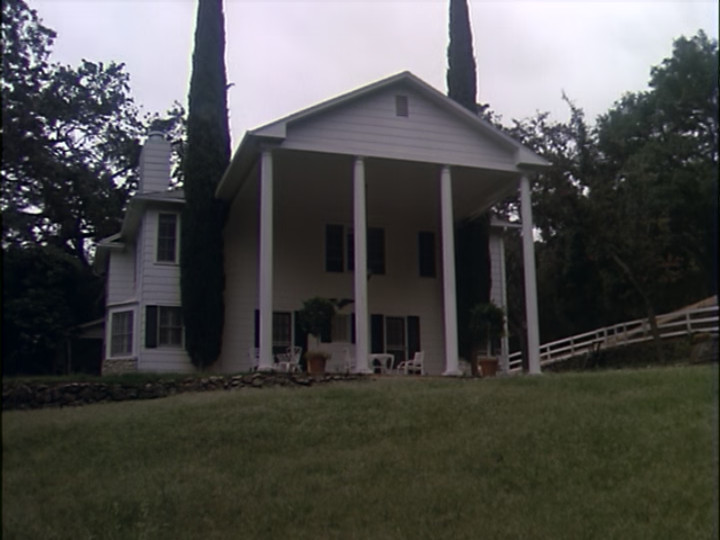
It’s set on a horse farm, specifically, as an establishing shot of horses frolicking on rolling fields, well… establishes. We also get an establishing shot of a grand house where I assume most of the action will take place.

mpv-shot0002

Though I am a mite suspicious, given this camera angle, that the house is not in fact all that big and is just wide but narrow. Not that it matters; uneducated actors play professors, so there’s no reason that houses can’t play mansions.

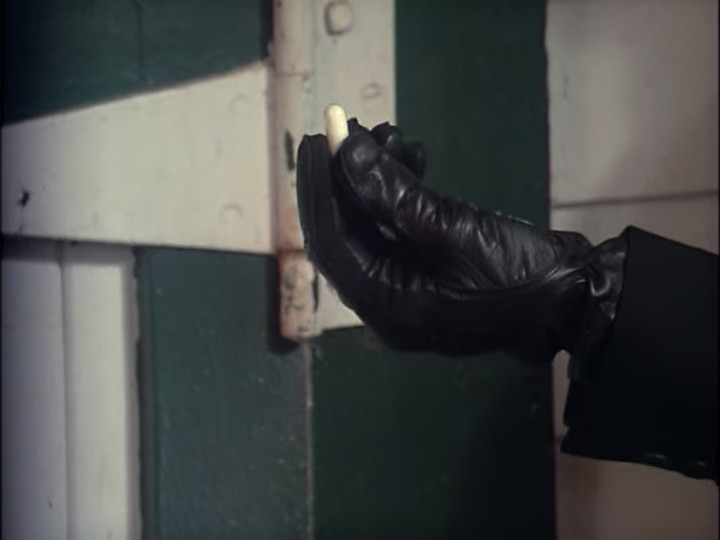
We then get an establishing shot of some stables which I believe are actually big and ominous music plays. A figure clad all in black, including wearing black gloves, sneaks up and feeds a horse named Sawdust some kind of pill.

mpv-shot0013

Sawdust eats it as ominous music plays.

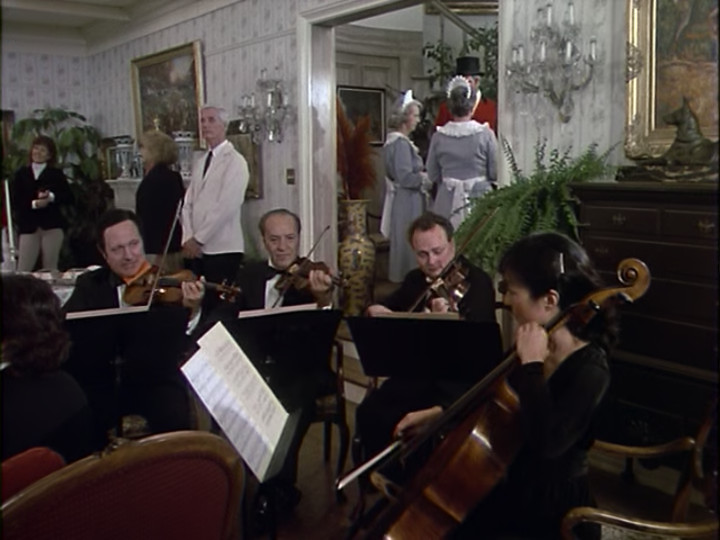
When the horse has completely finished eating the pill, the camera cuts to inside the house and a string quartet is playing classic music as a large, expensive party takes place.

mpv-shot0003

There are so many servants that two maids just stand around. They’ve spent something like four different shots establishing that there is a lot of money here, so that will, presumably, be important.

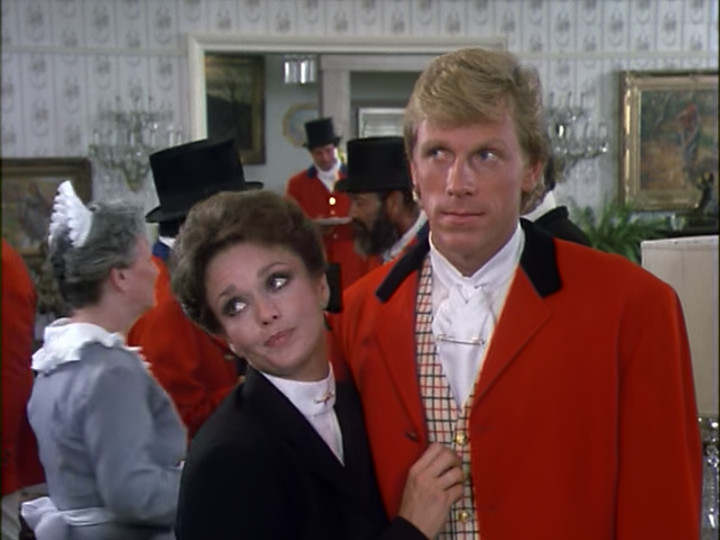
As the camera pans around we see that most of the people are in fox-hunting clothes. We then meet some characters. First is Trish and Anthony.

mpv-shot0005

Then comes in her brother, Spence.

mpv-shot0004

He tells Anthony that the family is sorry that his wife couldn’t make it.

Both Trish and Spence speak their lines like they hate each other, which is impressively poor manners in front of guests, especially for the South. We then get another relative who walks up and asks if they’re having a good fight.

mpv-shot0006

Her name is, apparently, “Echo,” or at least her nickname is. She’s Trish’s niece, not sure whether Spence is her father, but I can guess how much hair spray she uses a day. Boy is it ever the 80s. She and Trish are extremely catty at each other then Spence asks for peace, if not for his sake, than for the sake of his father. At this, Trish leaves.

We then meet another of Spence’s sisters.

mpv-shot0007

Her name is Morgana, and she’s very fond of her astral projectionist. Spence is appropriately rude, by which I mean he makes a gratuitous and unnecessarily mean-spirited comment which is carefully calculated to accomplish nothing whatever, then he walks off.

And then we come to the main characters.

mpv-shot0008

His name is Denton and he’s a famous lady’s man about whom Jessica has been warned. They move on and Denton introduces a friend of his—the owner of a nearby horse farm, and Denton’s old drinking buddy. His name is Tom Cassidy.

mpv-shot0009

His small talk explains why Jessica is here—she’s visiting her cousin, Abby, who works on Denton’s horse farm. It also comes up that he owns a neighboring 600 acres, which is described as small, though in a tongue-in-cheek way. Tom leaves to get Jessica a refill on her coffee, and we meet Jessica’s cousin.

mpv-shot0010

They make a little small talk; she tells Denton, in an English accent, to not be “an old lech.” Tom returns and interrupts the banter by saying “how about a toast?” Before he can propose one, though, Spence interrupts from across the room to say that a toast is a marvelous idea.

mpv-shot0011

I find the blocking of this shot interesting. The characters are in a line to be easily seen by the camera, but it makes no sense at all as a grouping of people who had been talking to each other, and not much more as a group of people who hate each other’s company and are standing next to each other in embarrassed silence for no reason.

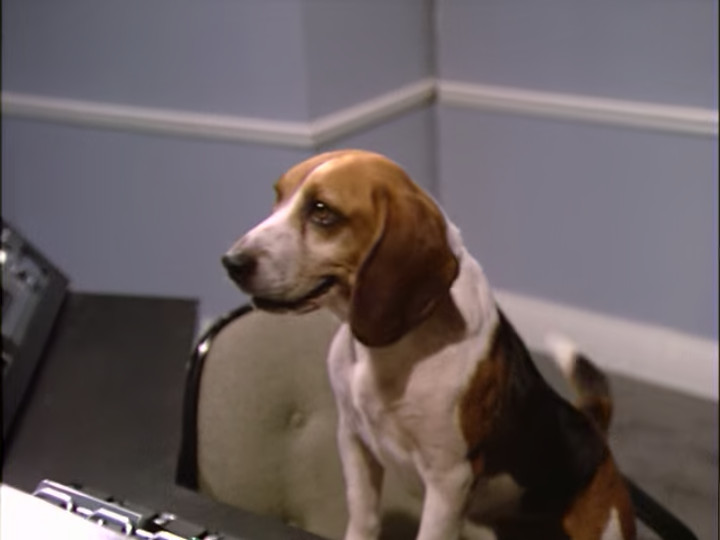
He proposes a toast to his father, on his 80th birthday, and many more. Morgana adds a note of affection. Denton rudely takes no notice and merely looks about and asks, “where’s that damn dog of mine?” That damn dog of his is a beagle named Teddy, who comes running from across the house. Spence and his siblings look crestfallen. I guess we can see where Denton’s children got their bad manners from. Oddly, no one else in the crowd seems to have noticed any of this, despite everyone having spoken in a loud, clear voice, to be heard.

Then a man comes in and announces, Ladies and Gentlemen: to horse.

Outside as people are getting on, Trish walks up to her horse with a champagne glass in land, takes a sip, then throws the partially full glass on the ground and mounts her horse. Abby runs over, grabs the bridle, and says, “Trish, you shouldn’t be riding in your condition. It’s dangerous to the horse.”

Trish merely tells her to go away and kiss up to Father while she has the chance. “The day he goes, Honey, so do you.”

Denton calls out to Jessica and Abby, telling him that he’s picked out their horses for them. Jessica thinks that Sawdust is for her, but he tells her that Sawdust is only fit for him; he hasn’t broken out of a trot for years (the horse). He then presses a button and tells Barnes, a security guard, that they’re ready to go and he should open the gates. Barnes, who is sitting in a room filled with monitors and controls, obliged by pressing the Gate 1 button (there are four) which opens the main gates, which we can see on video camera from two different angles.

We then get scenes of the fox hunt over beautiful countryside with swelling music. At one point Denton tells Abby, who is riding next to him, to go on because it can’t be much fun to ride next to an old slowpoke like him. Right after he says this, Trish comes up right next to Denton spurring her horse into a gallop with loud cries, which alarms Sawdust, causing him to bolt. Denton tries to reign sawdust in, but to no effect. Sawdust eventually runs at a bench in front of a hedge and jumps over it. Denton does his best during this, shouting “Tally Ho!”

mpv-shot0012

The camera then cuts away during the landing.

Many people run up, deeply concerned, because this kind of thing can be easily fatal to an eighty year old man.

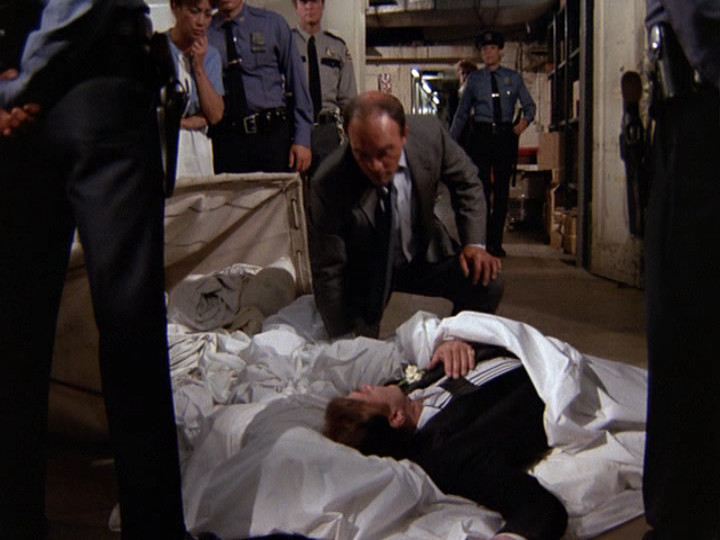
As, indeed, it proves to be. We cut to Denton lying dead on the ground and a moment later we screen wipe to a police deputy covering the corpse with his jacket.

After a bit of mourning, Jessica, Abby, and Tom go talk to the Sheriff, who says that it was a terrible accident but Denton led a full life. Jessica says that she thinks that Denton didn’t want to take the jump and Tom agrees, saying that Denton was under Doctor’s Orders to take it easy.

The vet is standing next to the Sheriff and Jessica asks if there’s a test he can perform on the horse. He understandably has no idea what Jessica is talking about, so Abby explains that a calm old horse like Sawdust doesn’t suddenly go wild. The Sheriff asks if Jessica is suggesting foul play and instead of answer we cut to Denton’s children getting into a police car (presumably to drive them home) and then we then cut to the cottage where Abby is staying.

Jessica is looking over papers saying to Abby, “I was so certain that there was something wrong with that horse. I feel so foolish. But, tests don’t lie.”

Abby asks, “Don’t they?” She points out that it was hours before they found the horse and there are drugs which leave no trace. Jessica acts like Abby is just being emotional, but of course she’s right. In fact, we know she’s right since we saw somebody give Sawdust a pill shortly before the hunt. This is an interesting choice, both in the showing us and in having Jessica act contrary to what we know to be true. She was wrong when she felt foolish, but we know that she’s now being foolish. Perhaps this is meant to make Jessica relatable by “not being too perfect”? Another possible explanation is putting the investigation on hold in order to get the episode to last the approximately 47 minutes it needs to.

Abby then goes on about what a great man Denton was, but underneath it all he was unhappy because of his selfish relatives.

Which brings up an uncomfortable issue: if Denton’s children are all awful, why didn’t he raise them better? I know that children are their own people and make their own decisions. Great sinners can be the children of great saints, and great saints can be the children of great sinners. That said, being raised well helps and being raised badly does make being a saint harder, and if all of a man’s children are terrible, it’s only fair to ask whether he raised them in a way that made being good, hard.

Anyway, there’s a bit of odd dialog which implies that Abby was in love with Denton and Jessica offers to stay with her for a few days. Abby asks her to stay until the will is read.

Which is necessary to keep Jessica around for the investigation, of course, but it’s really weird. Why would Abby be sticking around for the reading of the will?

We then cut to the day of the reading of the will, or maybe it’s the hour. The exact amount of time that’s passed isn’t specified, and all we get by way of that is an establishing shot of the front door with a black wreath on it.

Spence and Trish fight a bit, but they do establish that “Boswell,” presumably the family lawyer, is expected any minute. After some more bickering, he comes.

mpv-shot0014

Denton’s will is done on video. This was quite a new technology in 1983. The first VHS player came to the United States in the summer of 1977 and they would become popular pretty quickly, but consumer video cameras that recorded onto VHS took longer. The first consumer ones actually came out in 1983. A rich man like Denton could afford to rent professional video equipment to make his will, but the thing would have felt very cutting edge at the time. Boswell describes it as “cutting edge will technology.”

Denton starts out by saying that it’s all legal as hell, so don’t get any ideas. This sets the tone. He then has a hate message for each of his children and grand daughter (it turns out that Morgana is Echo’s mother). That parting spite finished, he gets down to brass tacks.

He gives a shotgun that Tom admired to Tom (his old drinking buddy) and there are cash gifts to each of the servants with something extra for the guard. All of the paintings in the house go to the national gallery. He then says, gleefully, “that’s right, Children, a fast three million in oils now on the way to Washington.” Bosley looks remarkably smug at this.

mpv-shot0015

There’s so much wrong here, but I don’t think that we’re supposed to notice.

Anyway, the rest of his estate comes to about fifteen millions dollars and, except for a modest family trust, goes to his dog, Teddy. Denton’s descendants are upset at this but Boswell assures them that they won’t be able to break the will and if Teddy dies of anything but natural causes, the entire fortune (including the family trust) goes to the SPCA.

And on that bombshell, we go to commercial break.

When we get back, Jessica is on the phone with Ethan, telling him she’ll be gone for a few more days, and adds that Abby is convinced that somebody murdered Denton. And Jessica is afraid that she just might be right.

We then move to a scene where Abby has a pointless fight with Trish, but it is at least established that Teddy is her employer and as such only Marcus Bosley can fire her, and she’s not going anywhere until she finds out who killed Denton.

Interestingly, Morgana warns Abby to be careful of Trish. She does it with some astrological mumbo jumbo, though, so Abby takes no notice. (I say mumbo jumbo because really doubt that the writers got the astrology right, quite apart from my belief that there is nothing to astrology.)

Then there’s yelling, a horse runs out, and Spence is in a horse stall defending himself from Teddy. The scene shifts to the vet examining Teddy and holding up a test tube of clear liquid and saying, “giving this stuff to a dog is like giving loco weed to a horse,” though when asked he didn’t find any in Sawdust. The vest asks who Teddy bit, since he found blood on his collar. The Sheriff then pulls up with a man in the passenger seat who identifies Teddy as his assailant.

mpv-shot0016

In the next scene Marcus Boswell is on the phone with Abby, telling her that Teddy has been released on his own recognizance and she can pick him up from the Sheriff at any time.

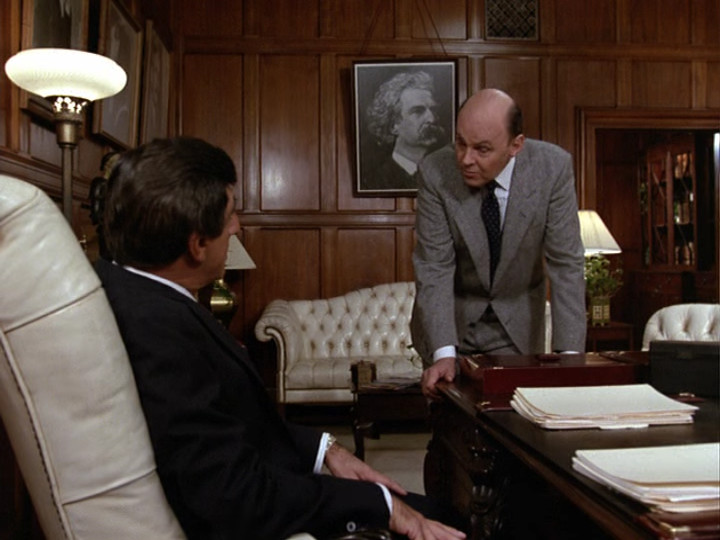
Jessica and Abby talk about the situation and Jessica thinks that they need to talk to Marcus to get more information. The shot of them waiting in his office is interesting, especially with how large and posh the office is.

mpv-shot0017

To drive the point home, Jessica remarks that Marcus has done very well working for the Langley estate.

After a minute, Marcus and another lawyer come out. The lawyer says that he could drive a freight train through “that loophole” and Marcus replies that his clients need to consider the costs; it could be a long and bloody battle. Then Morgana walks out of Marcus’ office and says goodbye.

To highlight just how much of a suspect Marcus is, as Jessica and Abby enter the office, his secretary tells him, in an exasperated tone, that it’s his broker and it’s the third time he’s called today. That could, of course, mean anything—and in real life would most likely mean that the broker was trying very hard to sell something to Marcus. In Murder, She Wrote, though, it almost certainly means that Marcus is in financial trouble.

Marcus’ office is even more impressive than his waiting room:

mpv-shot0018

They get down to business. Jessica asks about whether the man who Teddy bit has filed a lawsuit and Marcus says that while he’s made noises, he hasn’t yet and Marcus intends to head him off (whatever that means). They then switch subjects to the will, and the fancy lawyer’s supposed loophole is the question of “sound mind.” Not Denton’s mind, but the dog’s. If a court rules Teddy mentally incompetent…

He doesn’t finish his sentence and I can’t imagine what the end of it might be. You don’t need to be of sound mind to inherit under a will. If Teddy was ruled not of sound mind, he’d require a guardian appointed for him. But he’s a dog, so he needs a guardian anyway. This could only be an issue of the dog literally, rather than figuratively, inherited the money. But that would be nonsense. Animals can’t own property. I assumed that what Denton meant was that a trust was set up with Marcus as the administrator for the benefit of Teddy. That would certainly be, in colloquial English, Teddy inheriting, but it would make legal sense and the fact that Teddy requires a guardian would be irrelevant. I can’t believe that the episode is trying to claim that a dog has literally inherited money and land. You don’t need a loophole, that would be simply impossible. You can only give your property, in your will, to some kind of legal entity capable of owning it. (It can be a fictional person, as in the case of giving it to a corporation, but it has to be some kind of legal person.) I wouldn’t bring this up except that they’re actually making a plot point of it having been done in an impossible way.

Anyway, Marcus says that Denton’s descendants won’t win, but it might take long years and a lot of legal feels to win the battle. He leaves off how much this would benefit him and also explain away the missing money he’d embezzled. (I’m just guessing about that last part, of course.)

He’s interrupted by yet another call from his broker, who insists on speaking to him. Why his secretary seems to work for the broker and not for her employer is not explained. Anyway, he takes the call and after some embarrassing half-phrases, he promises his broker that he’ll send a check today and even put a stamp on the envelope this time.

After hanging up, Marcus tells the women to never, ever buy stock touted by Spencer Langley. His only consolation is that Spencer bought more of it than Marcus did.

This can, in no way, explain why his broker needs a check. No matter how badly a stock does, you’ve paid all of the money when you bought it and can only recoup some money, even if far less, after its sale. Between the purchase and the sale, you do not use money for anything. The only possible way for stock transactions to need cash quickly is if you sold futures and need to buy the stock to cover the future. There’s no way that’s what happened, though.

Jessica only picks up that Spencer is in debt, and Marcus replies, “right up to his Adam’s apple.”

This is not even slightly how stocks work. The only way for a stock doing badly to sink you into debt is… well, there is no direct way. You simply have to take on the debt separately. But you can take on debt in order to buy stock, which you intend to pay off and get profits from when you sell the stock at a higher price. But in that case it would be your banker, not your broker, who is calling you demanding money.

I’m really not sure which is more ridiculous: a dog literally inheriting property or a broker calling demanding money because a stock you bought is doing badly.

Oh well.

We then get a shot of the moon at night to establish that it’s nighttime. Since all pictures of the moon are basically the same, I’ll use one that I took instead of a screenshot. It’s not exactly the same, but you get the idea, and I only use screenshots when they’re necessary for my commentary on the episode:

wp-1709233371763672911081908387795

We then cut to Barnes, the security guard, sitting in front of his collection of monitors. I wonder if the idea is that he lives here in the cave of security cameras on twenty four hour duty. No wonder he got something extra from Denton’s will.

He then hears a sound and the door and goes to open it. It’s Teddy. Barnes says something about “like clockwork,” implying that Teddy always comes to be with Barnes at this time. “I guess you know you’re safe in here,” Barnes explains.

He then notices Trish’s car pulled up to the front gate. He comments that she shouldn’t be allowed to drive. On the security camera she stumbles out of her car and buzzes for Barnes to open the gate. He presses the button and as the gate begins to open she falls down with her head between the gates that just opened.

Barnes puts Teddy down saying that he needs to go check that she’s OK. He leaves, with Teddy remaining behind on his chair.

When Barnes gets near, the gates start to close. Barnes runs to try to save her but he’s too late. The gates crush her head (off camera, of course). We then cut back to Teddy in the guard room, partially standing on the console, wagging his tail.

mpv-shot0019

And on that bombshell, we go to commercial break. (I think that the implication is that Teddy pressed the button and killed Trish.)

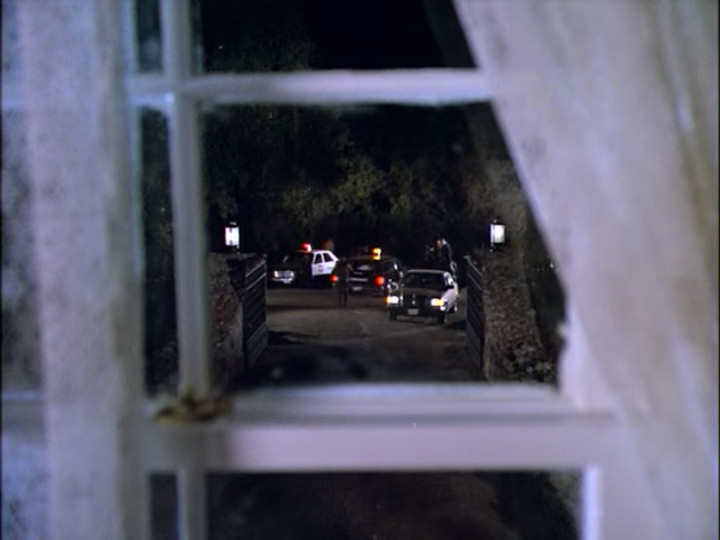
When we get back from commercial break, we’re outside by the gate while a bunch of police cars are in the area, presumably investigating. Inside the guard room, someone is dusting for fingerprints on the gate button.

Then in a large room with the Sheriff and the family gathered, Morgana says that she saw her sister’s ghost rising from her earthly form and crying like a morning dove. We get some other backstory about her aura thriving on moonlight and such-like, but we also learn that her bedroom has the only clear view of the gate, and she looked out because she heard a car’s horn.

The doorbell rings and it’s Marcus. He’s come as soon as he heard, for some reason.

Then the Sheriff’s deputy comes in and tells him that they found a print on the gate button, but not a fingerprint—a paw print.

Given that they found it by dusting, blowing away the dust and then using tape to pick up the dust which remained after being blown away, I guess we’re supposed to believe that the digital pads on a dog’s paws leave oil residue? I can’t easily find out whether dogs even have oil pores in their digital pads (they do have sweat pores) but my experience of dog feet is that they are very, very dry. I really doubt that they have sufficient skin oil as to leave enough residue to be able to lift a paw print. It’s not impossible, so far as I know, but it’s still a bit… far fetched. And even so would leave entirely open the possibility that someone used Teddy’s paw to press the gate button so as to leave no fingerprints. It can’t be supposed that Teddy understood that pressing the button would hurt Trish as a human could.

Anyway, there’s some arguing and bickering over how this gets rid of the will—I guess everyone has forgotten that if Teddy dies of anything but natural causes, all of Denton’s money goes to the SPCA. Though I don’t see how that would come into play since the dog would likely just be put into prison for life—even if he got sentenced to death, it takes so long to work through the appeals and so on that he would die of natural causes anyway.

I can’t believe I’m actually thinking that through. Why is this episode demanding that we take a dog seriously as a human being?

Anyway, Marcus shouts, “Sheriff, you cannot possibly believe that a dog is capable of murder!” At that, Abby says, “of course not. He’d have to be trained.” Then everyone stairs at her since she’s an animal trainer.

The scene shifts to Jessica going down to the front gate. She runs into Tom driving up in an old blue pickup truck. He asks how the family is doing then says he came as soon as he heard on the police band on his CB radio. He then drives on up to see what he can do to help.

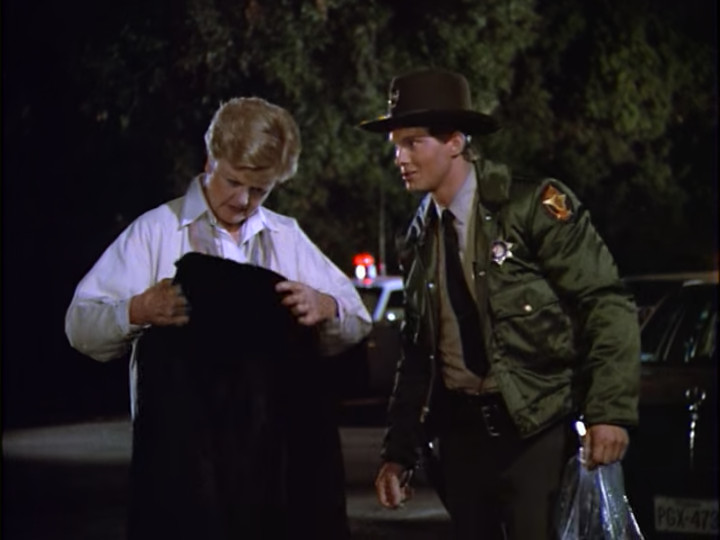
Jessica wanders on down and meets Will, who’s trying to get the victim’s coat into a large plastic bag. Jessica offers to help and examines the coat in the process. Will gratefully accepts the help because he feels that the coat requires a “lady’s touch” to fold.

mpv-shot0020

As you can see, the deputy is a young man and Jessica comes on with a matronly tone. This part actually feels quite realistic. Also, Jessica’s examination shows that the coat is quite new but the seams are split, just like her “car coat.”

After a bit of small talk, Jessica then walks around, examining the ground. After that she goes and interviews Barnes in the security room.

He left Teddy alone and the door automatically locks when it’s closed. He’s got the only key, and Teddy was left alone in the room. When he asks Jessica if she really thinks that Teddy pushed the button, she replies that she’s quite sure of it. She asks if he heard anything unusual while he was on his way to the gate and he replies no, just the usual. Crickets and a night bird calling.

She then asks the way to Morgana’s room.

mpv-shot0021

Morgana’s room does, indeed, have a decent view of the gate. While Jessica is looking, we also hear some music which suggests that this is an important clue.

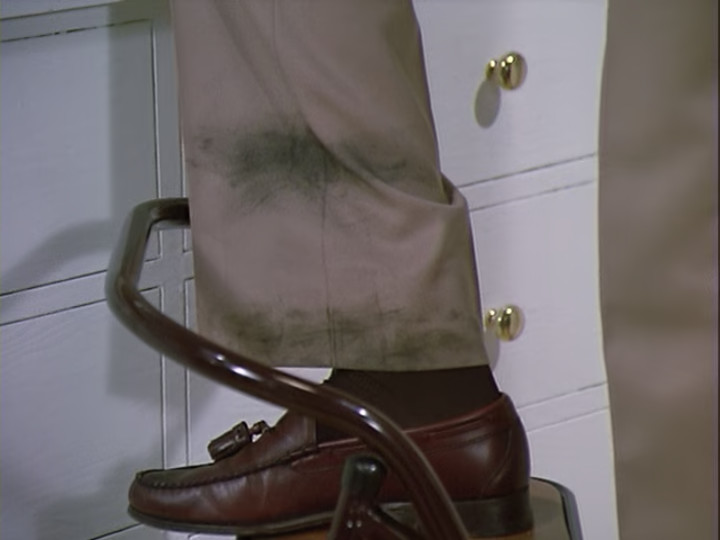
Jessica then joins Abby in the kitchen for tea. (When stressed, the English always go for tea.) When Marcus comes in to fetch ice because everyone in the main room needs a drink, Jessica notices that he has a nasty grease mark on his trousers. It’s important to the plot because we get the kind of closeup necessary in 1980s televsion to make sure we can see the clue even if there’s interference in the signal.

mpv-shot0022

He says that he had a flat tire on the way over and he supposed that he got some grease off of the jack. A jack is a device for lifting the car up so that one can put the wheel on and take it off, which a human could not possibly do if the weight of the car is still on the tire. They look something like this:

(Not shown is a bar that goes through the hole and is used to give the mechanical advantage necessary to turn the screw.)

There is no realistic way those grease marks came from a jack. Given that this episode has several impossible things already, I’d have figured that this was yet one more unrealistic thing, but the fact that they gave us a close-up suggests that it’s meant to be a clue and not a plot hole.

Jessica then asks where he got it and how long he stopped. He figured about half a mile away and he stopped for about twenty minutes. Jessica asks if that means that anyone who left the house would have had to pass by him.

Marcus says that Jessica is right, but that no one passed by him. Abby says that that means that the killer had to be someone in the house, and Marcus concurs.

After he leaves, Jessica asks Abby how one would go about training a dog to press a button. The answer is endless repetition, and the command could be anything. A voice, snapping your fingers, a whistle—at that Jessica perks up. A whistle was just the kind of thing she had in mind.

Some bickering later, Jessica is forced to explain her theory to everyone, including the Sheriff. Basically, it’s that someone impersonated Trish—whoever got out of the car never spoke on the intercom. At this point Trish was inside the car. After a minute the person impersonating Trish got up, dragged Trish (who was drunk or unconscious) to the spot where her head was in the way of the gate, then gave Teddy the signal over the intercom.

The Sheriff then asks if a whistle like the one he’s holding would do it. When Jessica says that it’s possible, the Sheriff asks if anyone in the house has the initials A.B.F. and Abby replies “Abigail Benton Freestone.” The Sheriff adds that they found the whistle down by the driveway.

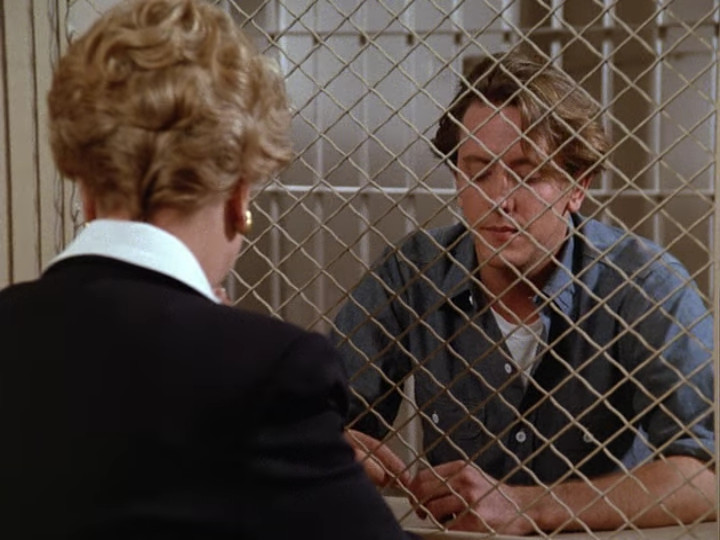
The scene then shifts to the Sheriff’s office, where both Abby and Teddy are in jail.

I really don’t know what, if anything, we’re expected to take seriously anymore.

We cut from Abby bemoaning her fate to Teddy to Jessica being angry at the Sheriff. After she insults him and complains at him, he says that the inquest is on Friday and until then Teddy is going to be held as an accessory after the fact. Which is not what he would be. An accessory after the fact is somebody who did not take part in the crime but did take part in trying to help the person who committed the crime to evade justice. Even if you ignore the fact that Teddy is a dog, that’s not what he did. He took part in the commission of the crime, which would make him an plain old accessory. At this point I’m starting to wonder if they’re just getting things wrong on purpose. I guess we should count our blessings that on the fox hunt they rode the horses and followed the hounds, rather than riding the hounds and having the horses follow the scent trail.

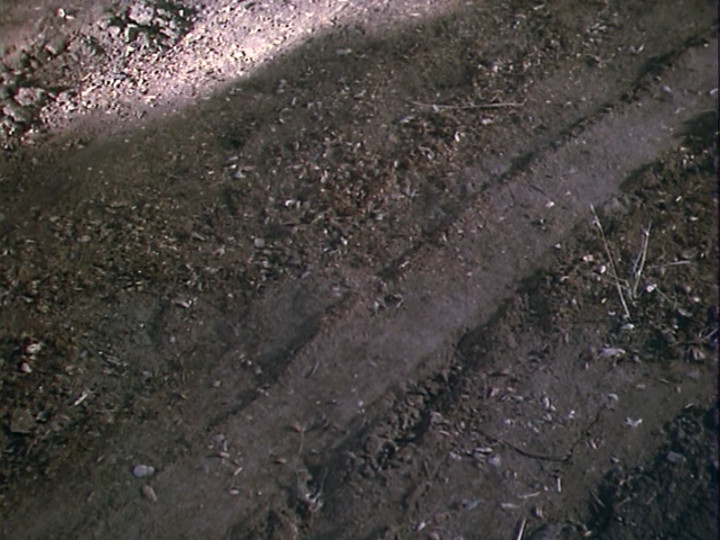
In the next scene Jessica is given a lift back to the house by Marcus. She has him drop her off about a half mile away from the house, saying that she needs some exercise. He drives off and she looks at his tire tracks.

mpv-shot0023

I’m going to guess that the issue is that both tires are bald, or else both tires are the same size, meaning that Marcus did not, in fact, have a flat tire recently. It’s a bit of a problem for this clue to show us that because we’re only seeing the marks of two tires (kind of next to each other, from when the car was turning slightly to get back onto the road). The flat could have been on the other side of the car, which stayed on the road and whose tracks we don’t see. Marcus never said which tire went flat. However, the fact that they’re showing this to us pretty much means that the flat tire had to be disproved. Things are not looking good for Marcus; we’ve had two close-ups on clues related to him.

As Jessica is looking around, the nice young deputy Will shows up and asks her what’s up. He asks if she’s looking for something and she said just a hunch. She asks if he has one of the Sheriff’s new metal detectors and he says that he can get it. She’s looking for a bicycle clip. A plain, ordinary bicycle clip. He doesn’t know what she means and she says that he’ll know it when he sees it.

Later on Jessica is mounted on a horse when Echo comes up. She asks where Jessica is going, and she says that she’s going to see a man about a dog bite. (Jessica asks about Spencer, whose horse is missing.)

We cut to Potts operating a chainsaw while his arm bandage is on a shotgun. Jessica rides up the horse then sneaks up and steals Potts’ arm bandage. When she gets back to her horse it’s actually Spencer’s horse, he took the liberty of putting her horse in the stable. He then calls Potts.

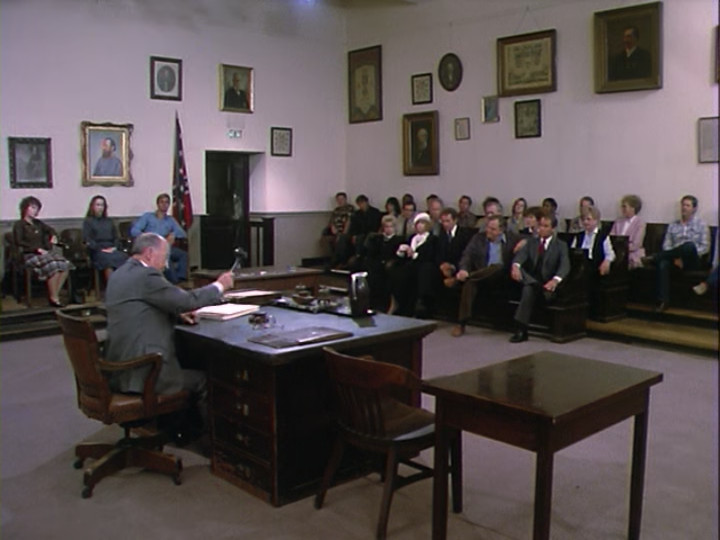
Potts and Spencer interrogate Jessica at gunpoint. Potts is in favor of killing her and hiding the body, but she talks him out of it, saying that his little scheme of fraud will hardly be noticed once she reveals who killed Trish. There’s a bit of bickering, but then we cut to a court house. Well, some kind of building in which court is in session. It feels more like a gymnasium.

mpv-shot0024

I’m not sure what it’s supposed to actually be. When the deputy brings in a speaker on a long wire, the judge—or whoever he is—asks what’s going on and Jessica says that this is part of her presentation. I suppose that this is actually supposed to be an inquest, and I must confess that I need to do more research on them to get a sense of whether this set makes any sense. It doesn’t feel like it, and from the rest of this episode I would guess that it doesn’t.

The judge indicates that the proceeding is going to begin with Mrs. Fletcher acting as an amicus curiae. He then says that, for the yahoos in the back, that’s a friend of the court.

Jessica get up, makes an introductory remark, and then says that to keep this short she’s only going to call one witness: Teddy.

Sure. Whatever. I don’t see any way to care at this point that an Amicus Curiae presenter (they’re more normally written briefs, but this is TV) would have no right to call witnesses. She’s calling a dog as a witness and everyone is OK with it, so I guess we’re just in clown world.

Teddy is carried in by a deputy and put in the chair next to the small table. Jessica then has the deputy blow on the whistle that was found by the gate. No one hears it but Teddy because it’s an ultrasonic whistle. She then has the deputy go into the other room and blow the whistle over the speaker. After he says that he blue the whistle, Jessica notes that Teddy didn’t react, because the whistle is above the range of the speaker. She actually says “any loudspeaker” which is probably wrong, but it probably would be above the range of a speaker system used in a security system, even back in the 1980s when they were all analog. (Most modern digital systems have a hard cutoff at either 22.05 or 24KHz, while according to Wikipedia most dog whistles are in the 23-54KHz range, so for most dog whistles it would be impossible to record or transmit them over normal digital systems. I only bring this up because it relates to adapting this kind of idea to modern stories.)

Jessica then explains that it was Marcus—he desperately needed the money years of litigation would bring him. He persuaded Trish to drug Denton’s horse by lying to her about whether she would inherit under Denton’s will. Trish was, of course, furious when she found out the truth, but he had prepared for this and trained Teddy long in advance.

She then starts interrogating him. Does he own a bicycle, does he ride out by the Langley manor, etc. When he denies having ridden by the Langley manner on the night of Trish’s death, Jessica then confronts him with the bicycle clip. While he quite reasonably points out that the bicycle clip could have belonged to anyone, she counters with her observation of the characteristic grease stains of a bicycle chain being on his pants that night. When he claims it came from changing a tire as he said that night, she counters that all four of his tires had identical tread, while a spare tire should have had deep, new tread. She then suggests settling the matter by looking in his trunk.

Before he can answer, she calls out to Will to “go ahead, please” and places the gate button next to Teddy. When a mockingbird whistle plays over the loudspeaker, Teddy presses the button several times, then goes over to Marcus and looks to him for a treat.

mpv-shot0025

Jessica in fact asks him, “why don’t you feed him his treat? Just like you did when you trained him to help you murder Trish.” Marcus looks around and seeing no way out sinks into a chair, crying, his face in his hands.

Back at the Langley manner Jessica and Abby are talking. Abby confesses that she doesn’t understand why Marcus did it and Jessica points out the obvious that he would have found a hundred ways to bleed off as much money as he needed from Teddy.

Then Tom drives up and takes Teddy, while Abby and Jessica say that Teddy will be very happy in his new home. After a bit of small talk in which he promises to do absolutely nothing for Denton’s children, he drives off with Teddy in the back of his pickup truck and we go to credits.

mpv-shot0027

What an episode.

I have no idea what to make of this—is it supposed to be a parody? It’s early enough in the first season that they may well have tried several different kinds of episodes to see what felt right or hit it off with fans. If this wasn’t meant to be a campy parody-type episode, a lá the 1960s Batman series starring Adam West, then this was a really stupid episode. If it was supposed to be a campy parody, it wasn’t very funny.

I really don’t know what to say about it.

If we ignore all of the asinine stuff about the dog actually inheriting the money directly, being charged with murder, etc. we do have the skeleton of a decent murder mystery. The family lawyer needed money and convinced one of the millionaire’s heirs to murder him, then when she found out she wasn’t inheriting, he murdered her. That’s pretty solid. Training a dog to do it isn’t wonderful, but it does have a bit of a golden-age “clever twist” feel to it.

Unfortunately, the dog training doesn’t really make sense in this story. For one thing, how on earth did Boswell train Toby to scratch on the door every night? He’d have to be there to do it, and are we really to believe that the security guard didn’t notice Boswell there giving Toby treats every time he scratched on the door? For another, dog training isn’t a context-independent thing. When you train a dog to a command in a place, it mostly only responds to the command in that place. This is why police dogs get trained to a command in about twenty different contexts—that’s what’s necessary to get them to respond to a command in any context. And the specificity of pressing a specific button out of a collection of buttons—that’s doable, but it would basically require training Toby in the security guard’s office. All of which might possibly be a stretch of the imagination if Boswell lived on the grounds and had constant access to the contexts necessary to train Toby. As somebody who did not have regular access either to Toby or to the grounds? That’s just not how dog training works.

Of course, I don’t know why I’m bothering with that because this is an episode where a dog inherits money and is arrested for murder.

Ultimately, I’m inclined to write this episode off as an early episode where the writers hadn’t decided on the tone for Murder, She Wrote yet. It had some nice visuals and the hint of a decent mystery, but if this was what Murder, She Wrote was generally like, well, I don’t think I’d be writing these reviews, forty years later.

Next week we go to Virginia for Lovers and Other Killers.

The World’s Fastest Indian

The Critical Drinker recently put an interesting review of a movie his Dad recommended to him twenty years ago and he finally watched a few weeks ago:

Indian, here, refers to an Indian brand motorcycle. If you didn’t watch the review I linked above, the tl;dw is that it’s the story of Burt Monro who is a New Zealand retired farmer, motorcycle salesman, farmer, and motorcycle racer (he did various things to earn his living) who now, in his sixties, spends much of his time tinkering on his old Indian motorcycle. He dreams of traveling to the Bonneville salt flats and setting a world record, eventually saves up barely enough money to try, goes, and eventually succeeds. (It’s based on a true story.)

In the Drinker’s review, there’s an interesting quote (salty language warning):

The story of a little guy with big dreams given a once-in-a-lifetime shot at glory is the stuff of cinema legend at this point and it’s been done so many times that it’s easy to become cynical about movies like World’s Fastest Indian. What, prey tell, is the angle? You might ask. What makes it stand out from the crowd? How does it subvert the tropes of the genre? The answer, quite simply, is that it doesn’t. And fuck you for asking. Because it doesn’t need to. Because not every movie needs to reinvent the wheel just to get your attention.

This is an interesting point. I think that this is related to the difference between watching movies as a reviewer and watching them as an ordinary human being. Reviewers watch a ton of movies, and moreover they watch them with an eye to evaluating them. That is, they watch the movies for the sake of the movies. Ordinary human beings watch movies for entertainment or enjoyment or to witness art—in short, as a means to something else. We watch movies for the sake of humor, or to have pretend friends for a few hours, to be inspired, to be reminded that happiness is possible, to consider human sadness, for the thrill of romance or the romance of adventure—whatever it is, we watch movies for the things that they depict. If what we want is to be inspired by seeing a man defy the world for the sake of something nobler or even if we just want to see a proud man humbled by being hit in the balls, the things that we want are timeless. Different movies will bring out different aspects of these timeless things, and some will do them better than others. Variation helps us because at times we need different help in contemplating the timeless truths, whether they’re big or small. But the variation is only helpful because the help we need in contemplating the timeless things varies. The variation is not good in itself and variation from what we need at the moment is anti-helpful.

A man who has watched a thousand movies about two a man and a woman falling in love may be desperate to be reminded that there is humor in a man being hit in the crotch with a baseball, but very few of us watch a thousand movies about two people falling in love. We watch however many we need to be reminded of what we wanted to remember, then we get on with life.

So the Critical Drinker is right. Movies don’t need to surprise people who are tired of their genre to be good. They just need to be good at their genre. If a genre has gotten less popular, that means that there will be fewer people who are interested in it, but that’s OK. Sometimes you have to wait twenty years until you’re in the mood for it a movie. The nice thing about movies is that they’ll still be there when you’re ready.

Murder, She Wrote: Hooray for Homicide

On the twenty eighth day in October of the year of our Lord 1984, the third episode of Murder, She Wrote aired. Titled Hooray for Homicide, it is mostly set in Los Angeles but begins in Cabot Cove. (Last week’s episode was Birds of a Feather.)

mpv-shot0001

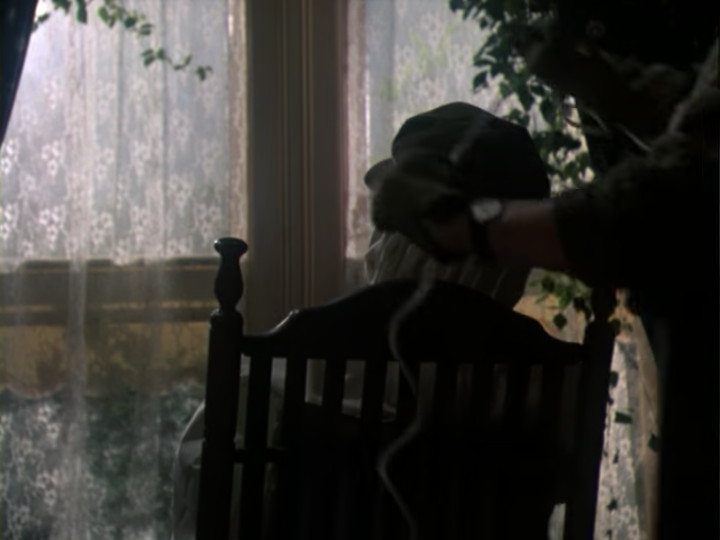
After a few scenes of waves breaking on the rocks and an establishing shot of Jessica’s house, we then see a figure rocking in a rocking chair, looking out the window. A stealthy figure holding a rope in its hands creeps up behind the rocking chair and the music turns ominous.

mpv-shot0002

Suddenly, the figure throws the rope around the neck of the figure and begins to strangle it. The music hits hard and then the camera angle shifts so we can see who the murder is, and it’s Jessica! The figure is only a few pillows, a sheet, and a hat.

mpv-shot0003

She considers for a moment, then is disappointed and shake’s her head. Walking back to her kitchen, she calls out that she’s decided to go back to the bayonet because it’s cleaner. The camera pans enough and reveals Ethan working on the pipes under Jessica’s sink. Jessica then sits down at her table and types on her typewriter. She’s not at it long before the phone rings. It’s someone named Agnes, who tells her that one of her books is being talked about on television. Jessica, accordingly, turns the TV on and watches. A producer is being interviewed about his newest movie, a film adaptation of Jessica’s book The Corpse Danced at Midnight. When asked if this will be another hit, the producer says that the movie will have everything that young audiences want: music, sex, and violence. When asked if it’s too much violence—he names a scene where a psychotic killer uses a flame thrower on a group of brake dancers—Jessica can take no more and rushes to the phone to call her publisher, saying that she’s going to put a stop to this nonsense even if she has to fly out to Hollywood. We jump cut, of course, to an airplane landing on a runway.

This is an interesting approach to starting the episode. It takes about three minutes and gives us a bit of Jessica in Cabot Cove and also Jessica as a mystery writer. We didn’t get any of that in last week’s episode, so it’s nice to refresh it, even though we’re going to spend the remaining 44 minutes in Hollywood. I also suspect it was necessary because the main thrust of the episode is Jessica’s old fashioned small-town values vs. the modern world. It’s a nice theme, even if in most episodes Jessica doesn’t have old fashioned or small-town values.

Jessica’s first stop in Hollywood is at her lawyer’s office. They are Carr, Strindberg & Roth. The lawyer to whom she’s speaking is Mr. Strindberg and he tells her that the film is box office magic.

mpv-shot0004

It’s a combination of Porky’s, Halloween, and Flashdance. His advice is that she should follow it up quickly. She’s not very receptive to this advice and just wants to know what her legal rights to stop the producer are. He’s got no idea because he only makes deals, he doesn’t remember what deals he made in the past, so he’ll assign someone to dig up her contract and they’ll be in touch.

I love the idea that their filing system is so bad that they cannot readily find active contracts.

Jessica accepts this flimsy excuse to move the plot along and goes to the movie studio itself. As she’s arguing with the guard at the gate who won’t let her in without a pass, a Miss Marta Quintessa, who is coming into the lot, overhears the argument and tells the guard to put Mrs. Fletcher down as her guest. Amidst Jessica’s thanks we find out that Marta is the costume designer for The Corpse Danced at Midnight.

The scene then shifts to the dressing room of the lead actress.

mpv-shot0008

Her name is Eve Crystal. The producer, Jerry Lydecker, is there to confront her about lying to him and not telling him that she canceled her lessons with her drama coach. She meant to tell him, honest. He tells her that he knows that she’s seeing some guy, and he wants her to stop. He lays great emphasis on how important he is to her career and how she’ll have no time for anyone else when she’s a big star.

Then we go to Marta Quintessa telling Jessica how much she loved her book…

Marta Quintessa

…and how little she loved the screenplay. When Jessica said that she never saw it, Marta gives her a spare copy which she has in her large purse.

Then the scene shifts to introduce the screenwriter.

I don't return anyone's calls

He asks why Jerry doesn’t return his calls and Jerry replies that it’s nothing personal, he doesn’t return anyone’s calls. After appreciating that line, the screenwriter gets to why he’s there: the contract came through and the points that he was supposed to get for writing the screenplay on the cheap weren’t in it. (Points are a percentage of profits.) What happened?

Lydecker explains how he wasn’t worth the points because of his backstory: he had an oscar nomination when he was twenty five but is an aging wunderkind who burned out on booze and pills by the time he was thirty. The screenwriter admits to being a recovering alcoholic, but he’s also a damn good screenwriter. Lydecker counters that he had to do a page-one rewrite, and the screenwriter counters that it was to remove every line that required acting talent so he could cast his playmate as the star. At this, Lydecker tells him to get off studio grounds. As he leaves, the screenwriter tells him “Remember: the picture’s not over till the credits roll.”

At this point I think that we can tell that Lydecker is going to get killed as we’ve already got two potential suspects set up. The scene with the screenwriter is a bit… weird. Normally, a screenwriter doesn’t write a screenplay before he has a contract. It is possible to write a spec script, of course—”spec” is short for “speculation” and means that the screenwriter writes it and then tries to sell it. But the key part, there, is that they sell it. Before the movie company does anything with it. A movie company never starts filming before they have a contract which secures the right to use a screenplay. They need this to protect themselves. It would not be hard for a screenwriter to find a lawyer to take on the copyright infringement lawsuit that would result from filming a movie based on someone’s screenplay without an agreement to let them do it. It would be trivial to register the copyright ahead of time, too, in which case there are presumptive triple damages. Trying to use copyrighted material without an agreement which permits this is so dumb no one in Hollywood even considers trying to do it. So yeah, the screenwriter has a grievance, but it makes no sense. And it’s not like it would have been hard to come up with a real grievance. People get shafted all the time in Hollywood.

Anyway, Marta and Jessica walk onto the tail end of the scene and after some painfully insincere pleasantries from Marta to Lydecker, she introduces Jessica. Jessica asks to talk to him and they make an appointment for after lunch.

Jessica then sneaks into the sound stage where filming is going to happen and sees the director coaching Eve about the scene they’re about to do.

Director

She’s not sure why her character’s boyfriend wants to have sex in a cemetery. The director explains that it’s an act of defiance. His friends have just been brutally murdered and he wants to defy death with an act of joy. As far as people pretending that smut is art goes, that’s top notch.

Also, yes, that is John Astin who played Gomez in The Adams Family.

The male lead comes in, also in a bathrobe. Unlike Eve, he has no questions so they clear the set for the nude scene and start filming.

Jessica leaves, incredulous, and we go to her meeting with Lydecker, who is arguing that nudity is necessary for the story. It reveals Jenny’s character. Jessica objects that in her story, “Jenny” was “Johnny,” the ten year old son of a Presbyterian minister.

Some arguing later, Lydecker reveals that he bought the rights to the book, not for the book itself or because it was a best-seller, but just for the title. To be fair to him, it’s a great title. A much better title to a murder mystery than to a horror film, I think it needs to be said, but a great title. Anyway, Lydecker points out that he bought all of the rights and can do whatever he wants. Jessica then tells him she’ll do whatever she has to do in order to stop the picture from being made, though of course her phrasing is such that the police will take it to have been a threat to kill him.

Incidentally, Jessica uses an interesting phrase to say that she doesn’t accept the situation: “Just because the Almighty gave people a taste for lobsters doesn’t mean that He gave lobsters a taste for being boiled alive.” It almost sounds like an old Downeast (a slang term for Maine) saying, but it’s just too wordy. Angela Lansbury does yeoman’s work making it sound natural, but let’s just say that when you google this phrase, the only things which turn up are quotations from this episode.

In the next scene, the low-level person from Carr, Strindberg & Roth shows up.

Norman

He’s Norman Lester, a junior member with the firm. He’s brought a copy of the contract with the publisher. Jessica reads it, in spite of Norman’s protests that it’s in legalese, and is chagrined to learn that Mr. Lydecker was right and she signed away all rights to interfere with the film. Jessica concludes that there’s nothing to do but to give Lydecker an apology.

There’s no explanation given as to why Jessica signed this contract. All they do is hang a lampshade on it by having Jessica say, “I can’t believe I signed this.” Yeah, that makes two of us. I suppose that’s the screenwriter asking us for a gimme, and what else are we going to do?

So Jessica goes to see Mr. Lydecker, but he’s not in. The secretary tells her to call Lydecker tomorrow, but Jessica replies, ominously, “What I must do cannot be done on the telephone.” I wonder who they’re going to suspect when Lydecker turns up dead?

Jessica goes looking for Lydecker on the sound stage and it looks interesting.

mpv-shot0013

Other than light through a blue filter I don’t know what could be casting that blue light in and the ominous fog is just as unlikely. Also, I’m unclear on why she’s continuing to look around here since it’s obviously deserted. She wasn’t told that Lydecker was here and normally when you’re looking for a live person and come into a place that obviously doesn’t contain a living soul you look elsewhere rather than investigate every nook and cranny.

Fortunately for the plot, though, Jessica looks around to see if Lydecker is hiding.

When she gets near the “cemetery,” she finds him:

TK insert picture

And we go to commercial break.

When we get back, Jessica spots a clue…

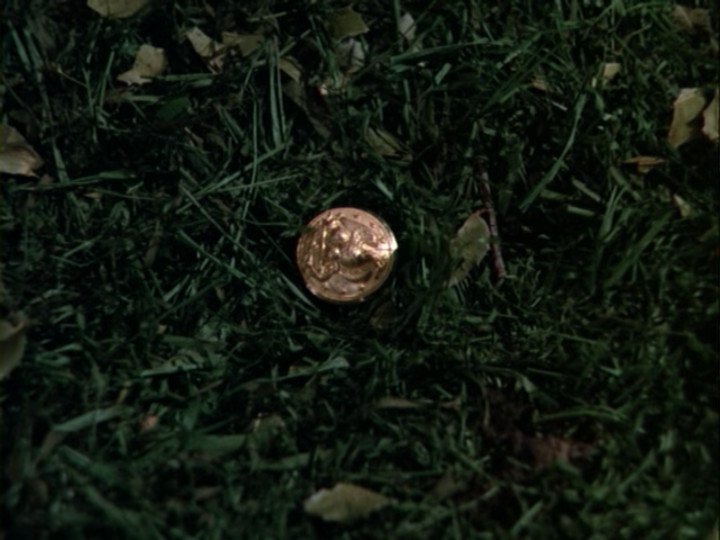
mpv-shot0015

…then runs into a security guard as she’s going for help. Literally. She bounces off a bit. He then asks her what she’s doing and she says, in the most guiltily unconvincing voice possible, that she was going to try to find the police because there’s been a dreadful accident on the stage.

The security guard, understandably, doesn’t believe her—I think he suspects her of being a thief—and brings her by the arm to go investigate the accident. Jessica points out Lydecker’s body and tells the guard that she thinks Lydecker was hit on the head with a heavy urn right next to him. The security guard uses his radio to call in the murder, then grabs Jessica and adds that he thinks he’s got the killer.

In the next scene police Lt. Mike Hernandez is examining the body. I guess the guard let her go when the police arrived without actually putting her in their custody, because after a few moments Jessica walks in and begins examining the crime scene.

mpv-shot0016

The music is appropriately comedic. Lt Hernandez asks her whether she’s lost something and she tells him about the gold button. It’s not there now, though. Jessica doesn’t understand it because she was only gone for thirty seconds. She speculates that the killer was hiding behind the set, saw her find it, then retrieved it while she was going for help.

When Lt Hernandez asks who she is and she introduces herself, he recognized her name from the book the movie is based on, though he had mistakenly thought that J.B. Fletcher was a man. Jessica explains that the ‘B’ is for ‘Beatrice.’

Just as an aside, while male authors sometimes don’t like their first names and use initials, such as Clive Staples Lewis or Gilbert Keith Chesterton, when it comes to murder mysteries I’ve gotten the impression that women are more likely to go with initials than men are. In her autobiography, Agatha Christie mentions that she wanted to do that (or use a pseudonym, I forget which) because she didn’t think the books would sell with a woman’s name on them. Her publisher (A) thought that they would and (B) thought that “Agatha Christie” was a great name for an author. In retrospect, she admitted that the publisher was right and she was wrong.

Anyway, it turns out that Lt. Hernandez is thrilled to meet her—he’s a writer himself, though he hasn’t sold anything yet, but there is interest in his screenplay for a TV movie—and he asks her if she has any theories. Jessica then says that she leaves theories to the experts and she’s only a mystery writer, not a detective.

This is basically a bald-faced lie that she contradicted with looking for the button and will soon be contradicting again, so I’ve no idea why she said it. I guess the idea is to try to reluctantly draw her into the investigation, but that’s a bit silly after the previous two episodes we’ve seen. I’d say that it might be early days and they haven’t figured the character out, but they will occasionally, if rarely, do this throughout the rest of the show.

Anyway, Marta and the director come in. They had been in the women’s wardrobe discussing costumes and don’t know what happened—which they find out fairly directly. Marta is very affected and nearly faints. When Lt. Hernandez asks if either of them would know of someone with a motive to kill Lydecker, the director replies, “Anyone? Try everyone. Would the suspects please form a double line.”

The director then asks whether Eve shouldn’t be told. She left right after filming wrapped. He’d tell her but he has to talk to the studio executives. Marta says that there was no love lost between her and Eve, so it would probably be worse if she told Eve. Lt. Hernandez assigns the task to Jessica, which seems ludicrous, but she agrees.

Eve lives at Jerry’s beach house and the police give Jessica a ride there.

When she gets there, Jessica finds Eve drunk. After Jessica explains who she is and turns down several offers of alcohol and various kinds of recreational drugs, she asks where Jerry is and Jessica almost breaks the news to her but then decides that Eve needs to sober up first so she’ll understand. So she gives Eve a cold shower and some coffee, then breaks the news of Lydecker’s death. Eve is reluctant to believe it and takes it hard. She finally asks what happened, an accident or what, and Jessica tells her that somebody killed him. She’s devastated and hugs Jessica, who holds her as we fade to commercial break.

When we come back, Jessica is mobbed by reporters as she’s going back to her hotel room. Lt. Hernandez is with her and comes into her hotel room. He remarks on how nice it is, and she concurs.

mpv-shot0017

As well she should; this is palatial. That said, I think it’s best to let this one go because small sets are very difficult to light without casting harsh shadows. It’s doable, but it requires effort, which is expensive. It’s the sort of thing that’s more worth it on movies.

He has some questions, one of which is whether she touched the urn. Someone went to the trouble of wiping the finger prints off of it, which an ordinary killer in a hurry wouldn’t think to do, but a mystery writer might. This isn’t his idea, mind. His Captain doesn’t have his writer’s mind and keen insight. He just sees that she had motive, means, and was caught leaving the scene of the crime. Jessica admits that when it’s put this way, she does sound like a suspect. He tells her that if she has any ideas, now is the time to share them.

She tells him, quite firmly, that she has no intention of trying to help him solve this murder. Quite a tone change from the previous two episodes, and again, this is basically a bald-faced lie. I don’t see how she expects him to believe it since she met Lt. Hernandez while she was trying to help solve the murder by finding an important clue (the button). Anyway, she is leaving tomorrow on the noon flight, unless that’s no longer an option.

Lt. Hernandez doesn’t directly answer that but instead said that he thought she’d want to stick around to see what Ross (the director, now also the new producer) does with the movie. That plus a look with a lot of subtext convinces Jessica to stick around.

The next day she is on the studio lot and meets the writer. He loved her book and is sorry he couldn’t have put more of it into his screenplay. (Ross invited the writer back, which is why he’s here.) The writer dishes on Ross; he’d spent a long time with no project until this one and he was originally the producer. Then Lydecker horned in, installed Eve, and forced Ross to withdraw as producer.

Lydecker’s death was a stroke of good luck for everyone. With this movie, they can now make it big. He takes her into the sound stage to show her.

mpv-shot0018

Oh my. (Some pop/rock and roll music is playing, and there’s dancing.)

I looked it up and the music video to Michael Jackson’s Thriller was shown for the first time on MTV in December of 1983, less than a year before this episode aired. It seems a stretch to suggest it, I know, but it might have been an influence.

If you’ve never seen it, btw, it’s a bit long but definitely part of the cultural landscape which influenced this episode:

Anyway, Jessica runs into Marta, who remarks that Jessica looks bewildered. Jessica merely remarks that she thought that there was supposed to be a high school marching band parade and Marta says that the schedule has been changed since Eve said that her costume wasn’t ready. There was nothing actually wrong with it, though, she just likes to make Marta’s life difficult. The implication is that Eve is a prima donna, though it is also possible that the real reason she complained was that her uniform was missing a gold button. They are the sort of thing you find on high school marching band uniforms.

Jessica remarks that Marta said that there was no love lost between Marta and Eve, and Eve starts to give examples. On the first day of shooting, in a scene in which she was supposed to be drinking, someone put real vodka into her glass. Eve turned bright red and accused Marta of doing it. Why her? Because, before Eve wiggled her way into Lydecker’s heart, Marta used to live at Lydecker’s beach house. Jessica is enlightened.

Lt. Hernandez then comes in with Lydecker’s secretary and asks her to point out who threatened Lydecker in front of her and she identifies Jessica. She then repeats both of Jessica’s incriminating lines (about doing whatever needs to be done, and how what she needs to do cannot be done over the telephone). Lt. Hernandez then arrests Jessica, who is very surprised.

At the station he reveals that he isn’t actually arresting her, this was just a charade to throw off the real killer and give Jessica a chance to “do her thing.” Well, not a charade, exactly. On the secretary’s testimony she’s been upgraded to the prime suspect by the DA, but Lt. Hernandez still has faith that she’ll find the real killer and clear herself. This finally convinces Jessica to start solving the murder.

In the next scene, Norman the lawyer shows up at Jessica’s hotel and she puts him to work doing research on Eve’s medical history, the screenwriter’s alcoholism, the director’s financial status, and Marta’s relationship with Jerry Lydecker. While he does that research, Jessica has some stuff to do at the studio.

Since Norman mentioned that she’s been banned from the studio lot as a disruptive influence, she sneaks in on a tour bus, wearing a big hat. She finds Norman’s uncle who happens to be a camera operator in one of the small private theaters on the studio (people do have odd connections all over the place in Hollywood) and she watches what Mr. Lydecker was watching shortly before he was killed. It contains a scene with Eve in it where she is making out the lead actor. The scene is called (for some reason, with a snap board, which is only used for sound synchronization) and they continue to make out. Even after someone walks up asking them to stop because they need to move on.

mpv-shot0019

Jessica has what she needs and leaves. She finds the male lead on the movie, which I think may be the same guy that Eve was making out with in the footage that Jessica just watched. Jessica tells him that she was just watching some rushes and he was wonderful. The buttering up works wonderfully and he offers to give Jessica a signed picture of himself to take back to Vermont with her. Jessica gratefully accepts. She then probes and finds out that he and Eve are, indeed, an item.

Jessica then goes to the wardrobe department.

She runs into a plump middle-aged woman named Eleanor, who is working on a costume. A little gossip later, she finds out that Marta and the director left the wardrobe department, on the day of the murder, before the police sirens. Also, Marta left first, they didn’t leave together. Jessica then gets a look at the old costumes and notes that there’s no drum majorette’s costume. Eleanor knows who took it and didn’t bring it back. (She may tell Jessica but if so it’s not on camera.)

We next see Jessica investigating Eve’s trailer when her repeated knock doesn’t bring anyone to the door. As she’s snooping around, the director bursts out of some of the clothes, knocks Jessica down as he rushes past her, and runs away. As Jessica gets out of the trailer and calls out, “Stop that man!” we go to commercial.

When we get back, Norman happens to round a corner in front of the director, hears Jessica’s call, and tackles him. Lt. Hernandez and another police officer arrive on the scene. They search the director and find the gold button in the director’s pocket. Lt. Hernandez takes this to mean that Ross was planting the gold button in Eve’s trailer. He arrests Ross and takes him away.

Norman congratulates Jessica on finding the real killer and clearing herself, but she still wants the information she sent him to find. He did find it, so he gives it to her. Ross was over-extended including a mortgage on his house. The screenwriter successfully kicked drugs but still has an alcohol problem. Eve has diabetis mellitus and takes oral medication. Marta used to be Lydecker’s mistress and once threatened to turn him into shish kabob for fooling around with younger women.

Norman suggests that they have a party for her solving the case and Jessica says that a party is a great idea. The next scene is at the beach house with all of the suspects (except for Ross, of course, who is in police custody).

mpv-shot0020

I can’t imagine how they’d all agree to come to this party, so it’s probably a good thing that they didn’t try to explain. Various people propose toasts, and Jessica’s toast is to Ross, who was wrongfully accused of murder. Marta and the screenwriter then excuse themselves. Next Scott (the male lead) makes his excuses and leaves, insincerely saying that he’ll call her.

That leaves just Jessica and Eve.

Jessica tells her that (according to his confession) while Jessica was busy with the guard, Ross came onto the scene by another entrance, knew at once who killed Lydecker, took the button, polished the urn, and left as he came in.

Jessica tells Eve that there’s still time to tell her story to Lt Hernandez. Lydecker caught on that she was having an affair with her co-star, right before he went to the set to discuss the costumes she didn’t like, which was why she was wearing the drum majorette costume at the time.

Eve starts talking.

Lydecker wanted to drop Scott from the movie. Moreover, he was going to try to ruin Scott’s career by spreading it around that he was fired for not learning his lines, not showing up on time, etc. So she had to do something; she hit him with the urn. She didn’t know she’d lost a button, she drove to the beach house in the costume.

Jessica says that this was why Ross couldn’t find the costume in her dressing room. He was trying to put the button back on it when Jessica walked in on him. It wasn’t to protect Eve so much as to protect the picture. He desperately needed a success and couldn’t afford to have his star arrested for murder.

Jessica admits that Eve’s pretending to be drunk fooled Jessica. She adds that people don’t give Eve enough credit as an actress. She only thought about it later and realized that real drinkers don’t mix scotch whiskey with diet cola. And then there was the story about her turning red from vodka—there’s a diabetic medication which will do that. Jessica realized Eve was just faking being drunk to give herself an alibi.

When Jessica asks if Eve wants to make the phone call to the police or wants Jessica to do it, Eve gets pensive and replies, “It’s funny. I never wanted to be a movie star. That was Jerry’s idea. I’d have done anything for him. Jerry. Scott. I sure know how to pick ’em, don’t I, Mrs. Fletcher?”

And with that, we go to credits.

mpv-shot0021

It’s often the case that the writers of a TV show don’t really know what the show wants to be at first and Murder, She Wrote certainly seems to be no exception to that. This episode is quite at odds with the previous two as far as Jessica wanting to investigate the murder. Frankly, I can’t imagine why the writers ever thought it would be interesting to have the main character keep wanting to not do what we want to see her do. It’s not like in an action film where there are moral reasons for the hero to try everything else before using violence.

The episode is also quite comedic in nature, almost to the point where you can’t take it seriously. Approximately everything about the movie is satire that pushes well past the point of plausibility. In the 1980s, slasher films were low budget films. They could be popular enough and certainly could be profitable—Halloween grossed $70M on a budget of $300K—but they weren’t prestigious and generally weren’t shot on sound stages or had hundreds of custom-made costumes by workers in a costume department. (In Halloween, many of the actors wore their own clothes.)

I’m not sure how much the things the episode gets wrong about movies would impact its satire/plausible balance among the average viewer. For example, the interview with Lydecker that gets Jessica onto a plane makes no sense. The interviewer asks Lydecker about the scene in which the psychopath uses a flame thrower on a gang of break dancers. There was no way for him to know that since it wasn’t in the book and movies don’t hand their scripts out to the public and B-movie producers don’t give national TV interviews about specific scenes in a movie which is only partway through principal photography. The scene is funny, but so detached from reality that to me it only registers as parody.

Now, it may well have been meant as parody. I kind of think that it was. But that’s a bit strange coming after the previous two episodes, which certainly had moments of humor but were serious. And then, given how much of this episode was a parody, it ended on a serious note rather than with a joke.

It’s also curious to see that when we get to something that the writers (presumably) know a lot about—Hollywood—the episode is no more realistic than it’s about things that they almost certainly know nothing about. Big business, for example. And it’s not just a case of sacrificing realism for the demands of the plot. They just don’t care. There are all sorts of things which would have been no harder to make realistic. To give an example: Lydecker could have broken promises he assured the screenwriter didn’t need to be in the contract, rather than a contract coming through after principle photography already started and it being talked about as if the screenwriter had no choice about whether to accept it.

The mystery was also a little bit thin in this episode. There was a single clue—the button—and it was never explained how this clue got where it was. Yes, they established it was from the costume that Eve was wearing, but how did it come off? There was no struggle and Eve just hit Lydecker with the nearest object to hand and he went down immediately. Nothing there would have ripped a button off of her costume. And the thing is, a clue like a button should have some relationship to the crime. This is just an artistic thing—buttons do sometimes randomly fall off for no observable reason—but random events are far less satisfying. A button randomly falling off is better than the murderer accidentally leaving his wallet at the scene of the crime, but they’re both towards the bottom of the barrel.

Actually, I’m being a bit unfair when I say that was the only clue—there was also the clue that Eve never drunk alcohol. And, I suppose, there was the clue that Eve was having an affair with her co-star. That last one came quite late, though.

I’m not sure what to make of Norman reporting that Eve has diabetes. On the one hand, diabetics shouldn’t drink a lot of alcohol, but on the other hand plenty of diabetics do things which aren’t great for their health. And either way, how on earth did Norman find this out? Even in the 1980s doctors didn’t just give out medical information on their patients to random strangers. And how was he supposed to get that information? Call up every doctor in the county and ask if she’s their patient? This isn’t an insuperable problem, but it does feel more than a little far-fetched.

Eve’s character is a bit weird in this episode, too. She seems to want to be a good actress, but then at the end she says that she never wanted to be an actress—that was Lydecker’s idea. She would have done anything for him. Except for not publicly cheat on him with her co-star, apparently. Be that last part as it may, why on earth did Lydecker take a non-actress girlfriend and turn her into an actress? And in films with sex scenes? For a jealous man, this is an obviously counter-productive thing to do. I find his speech about how, when she’s a big star, she won’t have time for anyone but him. Why did he get her into acting? Had she just been his wife, she’d have had a lot more time to be around him and be put into the arms of younger men quite a bit less.

I also can’t help but comment on her motive for murder. I usually don’t do this in Murder, She Wrote because limiting murder mysteries to to realistic motives for murder would tend to make them monotonous and predictable (at least if by “realistic” we mean “common”). However, hearing that her lover intended to ruin the career of her other lover has a much safer solution than murder: she could have threatened to leave Lydecker if he spread rumors about Scott. On any realistic appraisal, being fired from a low budget slasher film wouldn’t hurt anyone’s career if Lydecker left it at that. Which makes me wonder why they didn’t have Lydecker attack her in a rage and she strike him in fear. That would be more common for later Murder, She Wrote episodes and would explain the button better.

Oh well.

Looking at things that worked, I do think that the humor worked as humor, if not always as the setup for a murder mystery.

I enjoyed the character of Lt. Hernandez. I’m conflicted over whether he was a simple character or a Colombo-style clever man pretending to be simple. I’d far prefer him to be the latter, though the way that he needed Jessica to point out his grounds for searching the director makes me fear it might be the former. All the talk about what his Captain and the DA think would have worked very well as a Colombo-style ruse. The way he answered Jessica asking if she was free to go home with his sly answer of thinking she’d want to see what was going on which worked some intriguing clues into his reasoning felt Colombo-like. The problem with my preferred theory was that it had no payoff—no moment where the mask was dropped. I think that’s a real pity.

It might be objected that if the police are smart there’s nothing for Jessica to do and it’s Murder, She Wrote not Murder, Somebody Else Solved. While the point about the titles is correct, it’s not actually a problem to have an intelligent police officer as long as Jessica has access to some clues which he doesn’t have. It would also give Jessica an opportunity to have an intelligent conversation with someone, which would be a nice change of pace.

Another strong point of the episode are the characters of Marta Quintessa and the screenwriter. They were both likable. They had personalities which felt real. I appreciated that they got good send-offs which made them feel like characters with a future.

I also liked the beginning of the episode. It was nice to have Jessica start out at home. I appreciate the grounding that provides. I also appreciated the episode showing her working on the plot to one of her books. A big part of the fun of murder mysteries is thinking about them and it was nice to see Jessica thinking about her plot and not merely typing away at her typewriter.

Next week’s episode brings us to the south for It’s a Dog’s Life.

Jessica Fletcher’s Family Tree

After a bit of googling, I found an interesting post on a blog called Murder, She Watched. (As a side note: female fans of Murder, She Wrote have a definite leg up when it comes to naming their writing about it.) It contains Jessica’s family tree as portrayed on all the episodes.

(Out of respect, I’m only posting a thumbnail. You have to go to her blog for a legible version, which she clearly put a lot of work into.)

Some of the notes on it confirm a suspicion I have about this project: a lot of the episodes are very vague about Jessica’s connection to her relatives. Many of them we don’t get last names or maiden names on, so there are a lot of possible family trees which would match.

Another interesting thing which I learned from the chart and should have known but never thought of is that Grady Fletcher, Jessica’s favorite nephew and far-and-away most often shown relative, is actually Frank’s nephew and only related to Jessica by marriage.

One other thought on this is that Jessica actually had a lot fewer nieces than one gets the impression she has. Murder, She Watched counted twenty relatives seen on screen, of whom only eleven are adult nieces or nephews (I’m not counting the two young children of one of Jessica’s nieces). That’s actually less than one per season.

Murder She Wrote: Birds of a Feather

On the fourteenth day of October in the year of our Lord 1984 the second episode of Murder, She Wrote aired. Titled Birds of a Feather, it features one of Jessica’s nieces and takes place in San Francisco. (Last week’s episode was Deadly Lady.)

mpv-shot0001

We open with a man in an ugly track suit jogging on a road next to the sea. A man in a white suit gets out of his small car and starts jogging next to the man in the track suit, saying that they need to talk.
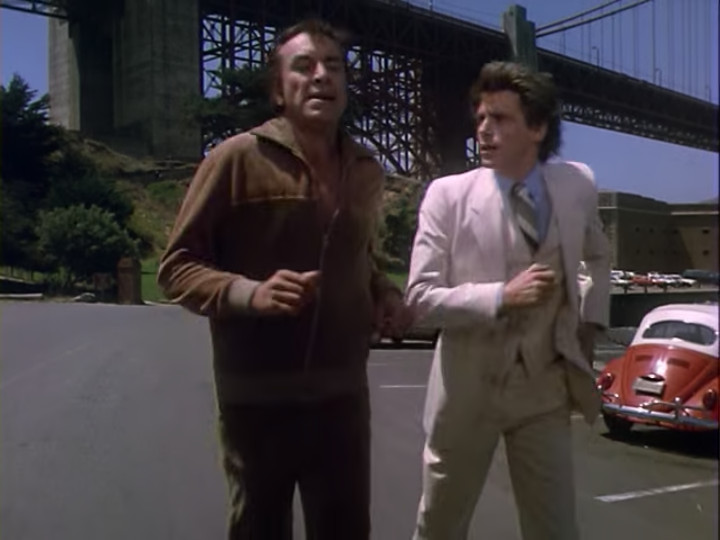
mpv-shot0002

The man in the white suit needs his money, and the man in the track suit says that the man in the white suit will get it when he’s finished. We learn that the man in the white suit is named Howard, and that he won’t get a time unless he is “there” tonight. Howard is unhappy but accepts this answer and the man in the track suit runs off.

When he gets to his car, it turns out that another man in a white suit is waiting for him.
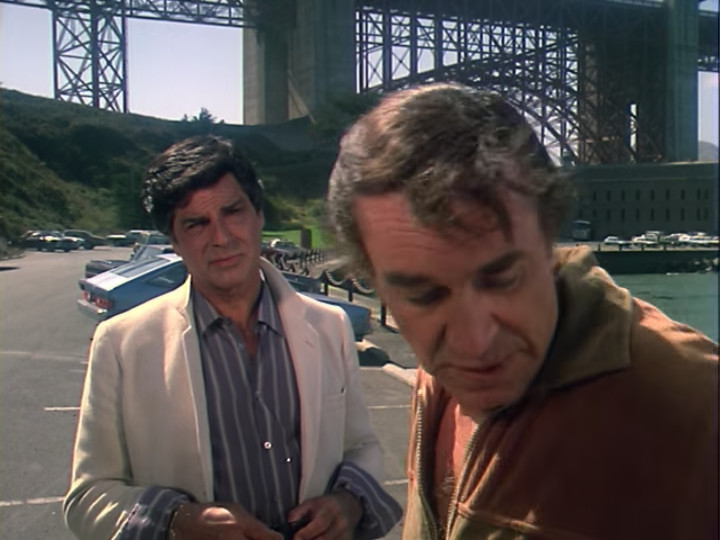
mpv-shot0003

Well, a man in a white jacket, at least. His name is Mike. He calls the guy in the brown track suit Al. Mike thought that they had a deal, and Al says that they do, Mike just needs to be patient. Mike says that he’s been patient for six months and he thinks that Al is just pulling his chain. Al asks if he got the money, and Mike replies that that’s his problem. Al then tells him to be careful. Things have been going real good, but he can live without Mike. Mike pokes Al in the chest for emphasis as he replies that anybody can live without anybody. Mike then leaves.

The dialog is intentionally vague to stir up the audience’s curiosity. If we want to learn what this is all about we won’t change the channel or go to bed early. Ironically, though, it’s actually far more realistic than the exposition one normally finds at the beginning of episodes. A typical show might begin with, “Well, if it isn’t Al Drake, manager of my favorite night club.” “Hi there Mike Dupont. Still hoping to buy out the contract of my lead act?” No one actually talks like that, though through exposure we come to accept it. I find it amusing that the realism is an accidental byproduct.

The scene then cuts to a young woman named Victoria who’s talking to a priest about her upcoming wedding.
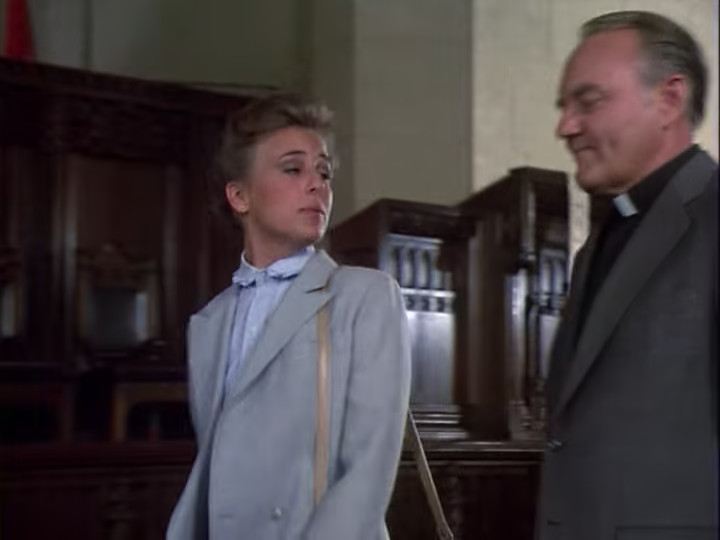
mpv-shot0004

It’s going to be a very simple wedding. Intimate. The priest says that they can still make it festive, with flowers on both sides of the alter, but Victoria says that she’s allergic to flowers.

When the priest asks exactly how intimate this wedding will be, she says that she just arrived from NY, her Aunt just arrived from Maine, and then just Howard and maybe a few of his friends.

Yes. That Howard.

He comes in a minute later and apologizes for being late, saying that traffic was terrible when he came from the office. Victoria tells him about dinner reservations she made and a minor fight ensues as he says that he can’t make it. In the fight we get a little backstory that he’s been busy every night for the last five nights.

The scene then shifts to Victoria and Jessica at the restaurant, where a small joke about the lobsters being Maine lobsters is made before they’re shown to their table. (The lobsters aren’t active; when Jessica asks if he’s sure that they’re Maine lobsters he says that they’re flown in fresh every day. Jessica says that perhaps the lobsters have jet lag.)

It’s an interesting restaurant.
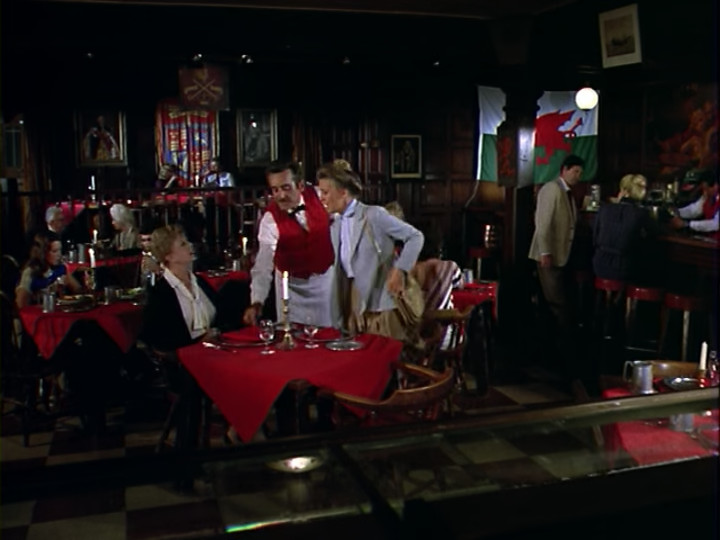
mpv-shot0005

Not very crowded, despite this being, in theory, a dinner engagement. That’s cheaper to film, of course. It’s very fancy in a dimly lit, hard-to-see-the-details kind of way. There were real restaurants like that back in the 1980s and for all I know, still are. It’s cheaper to look fancy if people can’t look to closely at the fancy stuff, both in TV and in real life.

Over dinner, Victoria tells Jessica about her history with Howard—she met him about a year ago in New York City. He was acting in an off-broadway show. He works in insurance (as his latest job—he had been a cab driver in New York), but aspires to be an actor. Then she breaks down and tells Jessica about her worries. She’s been in town five days but they haven’t gone out at night even once. And she went to Howard’s office the day before to surprise him and they told her that Howard hadn’t worked there for a month. Jessica says, knowingly, “Oh,” and takes a drink of wine.
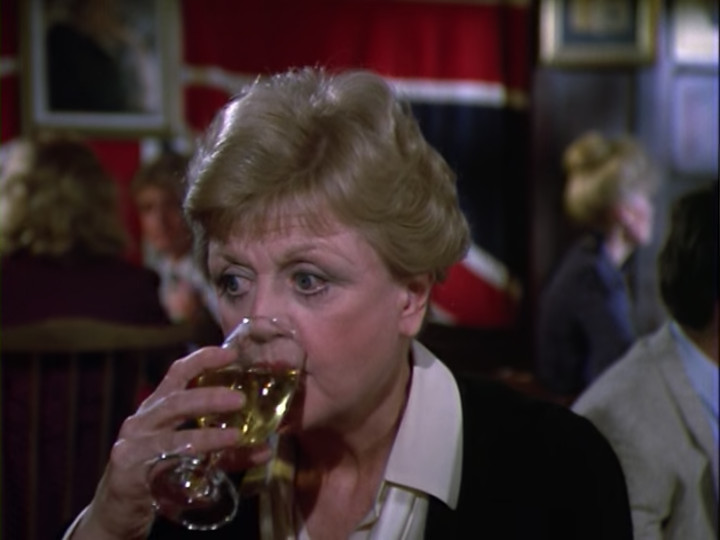
mpv-shot0006

She drinks it as if she wants the alcohol in it. I know I’m skipping ahead a bit, but this is very unusual for Jessica. (She rarely drinks except to comment on how fine the extremely rare wine which requires a refined palate to enjoy is.) I guess they’re still feeling the character out at this point.

Anyway, yesterday, Howard had circles under his eyes and smelled like perfume. And today he lent her a handkerchief and the lipstick on it was not her shade. And matches from a nightclub were all over his apartment. She’s considered going to the nightclub, but if she loves Howard, how can she justify spying on him?

Jessica replies, “For your own peace of mind, I think you have to.” Her tone suggests that this is sage advice, but it really isn’t. She could have said, “You can do it for Howard’s sake. If there’s something he’s afraid to tell you about, you can have the courage for him.” Or, “For the sake of the children you may have with Howard, you owe it to them to make sure you can both go through with the marriage.” Or “marriage shouldn’t be entered into with secrets and if he’s not strong enough to tell you his secrets, you should do it for him in case it’s something you can accept.” All of these actually address Victoria’s concern. Jessica’s reply that Victoria just needs to be more selfish is… bad advice.

The scene cuts to the night club, which is a relatively classy place.

mpv-shot0007

Before long the camera goes to Al, who is filling in for the host, and a well-dressed man named Patterson walks in.
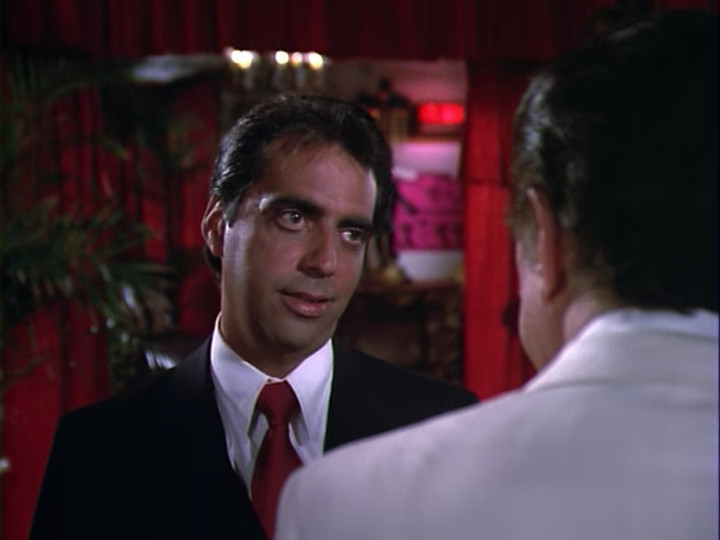
mpv-shot0008

It turns out that he’s the agent for Freddy, a comedian with a four-year contract at the club. Al’s interpretation of their contract is that Freddy can’t do anything else, while Patterson’s interpretation is that Freddy is free to do other stuff on the side. Patterson recently got Freddy on a talk show and now he’s hot. Al, however, is unmoved, except in the sense that he says “this is what we have courts for” and walks off.

Jessica and Victoria come in. They ask for a table for two but the host says that he can seat them next Thursday. Victoria then identifies Al as being in charge from some posters on the wall and walks up to him, explains that she and her Aunt want a table, and then explains how famous Jessica is. Al sees to it that they’re seated immediately.

I’d like to pause to take note of what she actually says. Assuming that she’s telling the truth—and I suspect that she is—Jessica has six best-seller books, was on a talk show this morning, and will meet the mayor the next day. Since the pilot episode depicts Jessica’s first book being published, obviously a lot of time has passed between the pilot and the main series.

The first act we see is Freddy York, the performer whose agent showed up and talked with Al a few minutes ago.
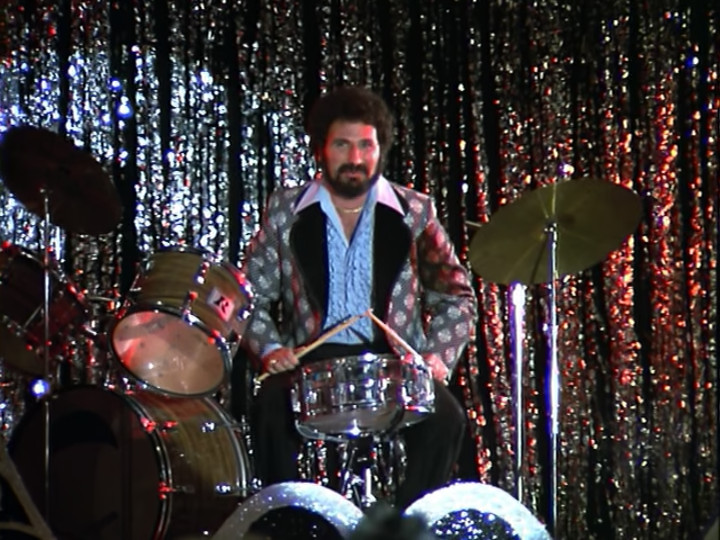
mpv-shot0009

His shtick is that he plays the drums as his own backup and does the rim-shots for his own jokes. His outfit is really amazing; I believe it’s intended to be sincere. The episode was shot in 1984, which was only four years after the 1970s when collars like this were hot stuff. I suspect it’s meant to indicate that he’s a little stuck in the past, but not very much. His jokes, incidentally, aren’t terrible, though they are neither very witty nor very classy. After a few of them, we cut to a glamorous older woman walking in.

mpv-shot0010

It turns out that this is Al’s wife. Since Al’s last name is Drake, she’s Mrs. Drake. The host greets her very politely, but there’s a bit of ice in the air. When he asks if Al is expecting her, she replies she very much doubts it. She’s shown to her table immediately, of course. Once she’s on her way to her table, the host grabs a bus boy and tells him to go find Al and tell him that his wife is here.

As the busboy is looking for Al back stage, he runs into a woman who asks him what he’s doing back stage.

mpv-shot0011

We actually saw her before and it seemed so minor an interaction I didn’t think it worth mentioning. She had some banter with Al before Freddy’s agent came in. Since she may play a bigger role than I anticipated: her name is Barbara. Anyway, she tells the busboy to go back to the front and she’ll tell Al.

The moderately funny comedian who does his own rim shots tells a final joke—which Mrs. Drake applauds vigorously—then he profusely tells the crowd that they’re beautiful, wonderful, and every good thing, then takes his leave. Jessica then asks Victoria if she’s noticed that there’s something a little off about this club. Victoria doesn’t know what Jessica means. Frankly, neither do I.

Somebody in a silver dinner jacket then introduced the “chanteuse” they’ve all been waiting for.

mpv-shot0012

After a few introductory bars and the length of time it takes to sing “There’s a somebody I’m longin’ to see. I hope that he turns out—” we hear a scream. Then a female figure in a fancy dress runs off the stage and through the crowd, towards the front door. Right behind it, Barbara runs onto the stage and calls out, “Stop him! He’s a murderer!”

mpv-shot0013

A police officer shows up at the front door cutting off that exit, so the figure then tries several other avenues of escape before crashing into Jessica and Victoria’s table. His wig falls off and we get to see who it is.
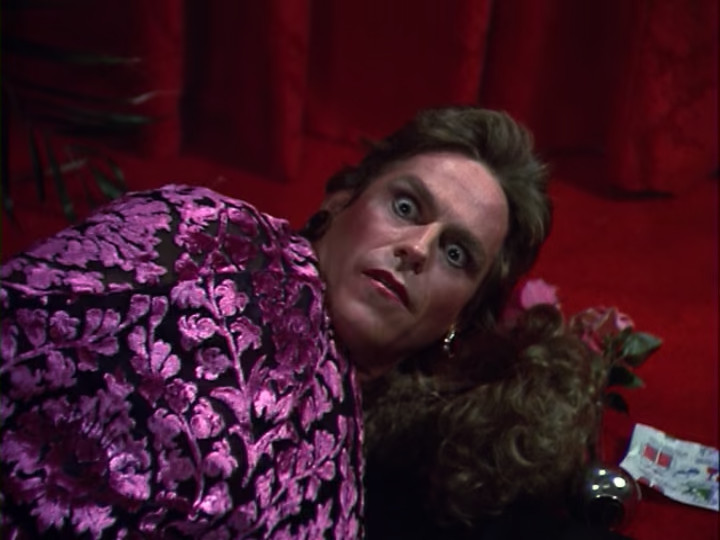
mpv-shot0014

It’s a surprise, though it shouldn’t be. This is exactly the kind of twist that TV shows of the 1980s loved, all the more, right before a commercial break. Which is what happens after some shocked recognition between Howard and Victoria and Jessica being surprised that this is Howard.

We come in from commercial to an establishing shot of a police car driving with its sirens on, followed by an interior of the club in confusion. Amidst the confusion we do learn that Al was shot.

Howard is being kept locked in a room with a security guard keeping watch on the door. Victoria comes up and persuades the guard to let her in. She’s so happy that it turns out the thing he was hiding was just a job that most of what they do is kiss until Lt. Novak shows up and is surprised to see them passionately embracing. He takes it in stride, however, and merely asks the security guard which one is the suspect (“the tall one”) then directs that he be taken down to the station and booked.

The scene then shifts to the scene of the murder, with Lt. Novak entering and taking charge.

mpv-shot0015

His manner is very matter-of-fact. Interviewing the assembled crowd of people, he asks who saw the murder and Barbara answers that she did, or, rather, she walked past the open door and saw Howard standing over Al holding the gun. The Lt. looks at the ground and sees a gun. Picking it up with a pencil he remarks that, having a smooth grip, they may get some fingerprints from it.

This musing is interrupted by the sound of a bird—a white cockatoo—cawing and then Jessica interrupts to ask if Lt. Novak noticed a small white feather on Al’s jacket. Instead of answering, the Lt. asks her to leave. The manner is curious; he asks if she’ll do him a big favor and she eagerly replies that she’ll do anything at all to help. He then asks her to get out of here and she is crestfallen. Apparently, by now, Jessica is used to joining the police on murder investigations.

The scene changes to the next day, at the police station, in Lt. Novak’s office, with Lt. Novak finishing interviewing Freddy York (in the same clothes as he was wearing on the night before). After signing his statement, Freddy express his lack of sympathy and leaves. Right after, Jessica knocks on the door and enters. Novak doesn’t want to talk with her but she uses her clout and fame to bully him into cooperating.

He relents and gives her a brief infodump. The suspect was seen standing over the body holding the gun. The only fingerprints on the gun belong to the suspect. It was common knowledge that he’d been arguing with Al Drake about money. The gun was stolen from a pawn shop about six months ago, in New York city, where Howard lived at the time.

She asks if he conducted a nitric acid test to determine whether Howard fired the gun. He replies that they haven’t gotten to it yet, and she tells him that he’d better get to it soon because after a few hours the test is meaningless. (According to Wikipedia, this is accurate. Gunshot residue tends to only last on living hands for 4-6 hours since it is easily wiped off by incidental contact with objects.) Since the murder took place the previous night and it is now past sunrise, the crucial window has already expired, so it’s a bit weird that Jessica is telling the Lt. to get to the gunshot residue test soon. (A nitric acid solution is used to swab the area to be tested as the first step, which is, I believe, why she’s referring to it as a nitric acid test.)

She then demands to see Howard and doesn’t take ‘no’ for an answer.

Howard is brought to the Lt.’s office, who gives them privacy for some reason. Howard is confused since he’s never met Jessica before, but she takes charge. Jessica directly asks him if he killed Al Drake and he says he did not, Al was dead when he walked into the room. He had just finished his act and went into Al’s office to get his money and quit. This is a bit odd because we saw the act right before Al was found dead and it was Freddy’s comedy routine. (I suspect that this is just a plot hole and not a hole in his story.) We get a flashback which seems plausible enough with Howard having a one-sided conversation with Al for a bit, since Al was facing the wall, and he only realized that Al was dead when he turned Al’s chair around to make him talk to him. Since this may be important later (someone may have thought Al was alive when he was actually dead), let’s look at how the chair was when Howard entered the room:

mpv-shot0016

You can’t see anything that indicates that Al is dead, but on the other hand this is a very weird thing for a living man to do. If you came into a room and saw a man sitting in a chair motionless staring at a dark wall, I think you’d be a lot more likely to check on him than to just assume he’s lost in thought. That said, there’s a good chance that this indicates a significantly earlier time of death.

Anyway, after finally turning the chair around when he got tired of Mr. Blake “ignoring” him, he staggers around in shock for a bit, notices it’s incriminating that he’s holding the gun that probably shot Mr. Blake, then Barbara comes in the door, sees the scene, and screams, at which point Howard panics and bolts.

Jessica says that she’s quite relieved because there’s only been one killer in the family, in 1777, and the red coat shot first. She then pivots to wondering what Barbara was doing in the office and Howard bowdlerizes to “Everyone knew that she and Mr. Drake worked late. A lot. Together.”

Jessica knowingly says, “I get the idea.”

She then says that she’s got the name of a very good lawyer and asks if there’s anything else he needs, to which he sheepishly replies, “pants.”

The scene then shifts to Jessica on the phone with Lt. Novak, presumably some time later. He lets her know that they’ve narrowed the time of the murder down to between 9:50 and 10:05. Jessica asks if that isn’t a bit precise for a medical examiner and he replies that it didn’t come from the medical examiner, it’s when York was performing and the banging of his drums covered the sound of the shot.

There’s an interesting exchange which follows the end of their conversation. Lt. Novak asks his assistant, “What is it about that woman that makes me nervous?” The assistant replies, “I think she’s kind of cute.”

mpv-shot0017

I find it interesting because it’s explicitly framing Jessica’s investigations. The police are officially not thrilled with Jessica investigating, but we—the audience—know that this is a mistake on their part. The assistant thus provides some ambiguity here. It certainly makes more sense than Amos Tupper taking both roles, as he did in Deadly Lady.

The scene changes to Jessica at the club during the day. She runs into Freddy’s agent for some reason. He asks if she has an agent on the west coast, but she does. He directs her to where she can find Barbara (she asked), and then takes a moment to look suspicious for the camera.

mpv-shot0018

I think that the equivalent of this, in a novel, is to give us a glimpse into the characters thoughts which is highly misleading if taken out of context, which is how we get it. “‘I hope she doesn’t find out,’ he thought.” Then later we discover it was a different ‘she’ and the thing to not find out was something completely unrelated—if the book is halfway decently constructed, a red herring that the detective uncovers and this explains “why you were acting so funny when I spoke about [name].” It’s a bit of a cheap trick, but it does make the viewer/reader feel like they need to keep on their toes, which they want to feel like.

We then see Mrs. Blake talking to two men—the host and someone I don’t recognize. The upshot is that she’s intending to run things now that Al is gone. She also picks a fight with their leading female impersonator, who storms off to his dressing room. She yells at him to never turn his back on her and follows. Once they’re in his dressing room and close the door their manner changes entirely, they embrace, and passionately kiss. And on that bombshell, we go to commercial break.

When we get back, Jessica walks into Freddy’s dressing room by mistake, where he’s sitting at his mirror for some reason. He says that it’s too bad about Howard, the kid’s got talent and not just at wearing dresses. He makes some jokes about how his own talent is wasted in a dump like this; in Las Vegas a llama who’s part of an act has a better dressing room that he does. Jessica says that it’s not so bad and at least he’s got a window with a great view. He jokes that it’s his manager, Patterson: he couldn’t get Freddy any more money so he got him a window. When he asks if Jessica wanted to see him about something she excuses herself for intruding and leaves.

When Jessica finally finds Barbara, Mrs. Drake is firing her.

Jessica catches her carrying a box full of her stuff out of the office and offers to give her a lift in the taxi she’s in. Barbara accepts.

Jessica reads Barbara as a gossipy sort of woman and so plays a gossip herself. She shares the news that Al was already dead when Howard got there and Barbara accepts it without question. She goes on to say that she wouldn’t be surprised if Mrs. Drake did it. She also is aware of the affair she’s having with the female impersonator (his name is Mike). He was actually trying to buy the club. She also could believe that Mr. Patterson killed him because Freddy was under a seven year contract.

She gets out at her apartment and the scene shifts to Mike waiting near the ocean for Mrs. Drake. I’ve just realized that Mike was the second guy who talked to Al at the very beginning of the episode. Asking Mike if he raised the money was probably a reference to buying the club.

Anyway, he complains that Mrs. Drake kept him waiting and asks if this is a sign of things to come. She’s apologetic and gets to the point: she wants to know if he killed Al (which, she professes, wouldn’t make any difference to her if he did). Funnily enough, he had the same question for her, and it also wouldn’t make any difference to him if she did. After some closeups in which the actors try to look as suspicious as humanly possible, the scene ends.

This sort of scene will become a staple of Murder, She Wrote episodes, especially towards the middle. Once you notice them it becomes way easier to figure out who the murderer is: whoever doesn’t get a closeup of them looking suspicious.

In the next scene Jessica catches up with Lt. Novak at the club. She inquires about the nitric acid test and it came back negative. The Lt. says that Howard could have been wearing gloves when he shot Al and Jessica points out that if he was, there wouldn’t have been finger prints all over the gun and he can’t have it both ways.

Jessica then questions Lt. Novak’s theory about the gunshot being masked by Freddy’s drum act, so they do some experimentation with the assistant firing a gun in the murder room and Jessica and Lt. Novak in front of the stage with various amounts of noise being produced, and no matter how much noise, they still hear the shot. Lt. Novak takes that to mean that the only possible explanation is it being covered by the sound of Freddy’s drums. Why they tested every other source of noise except for Freddy’s drums isn’t explained.

Anyway, Freddy comes out and demands to know what’s going on—is Mrs. Fletcher suggesting that one of them killed Al? At that moment a string of heavy stage lights falls down almost killing Jessica and Freddy.
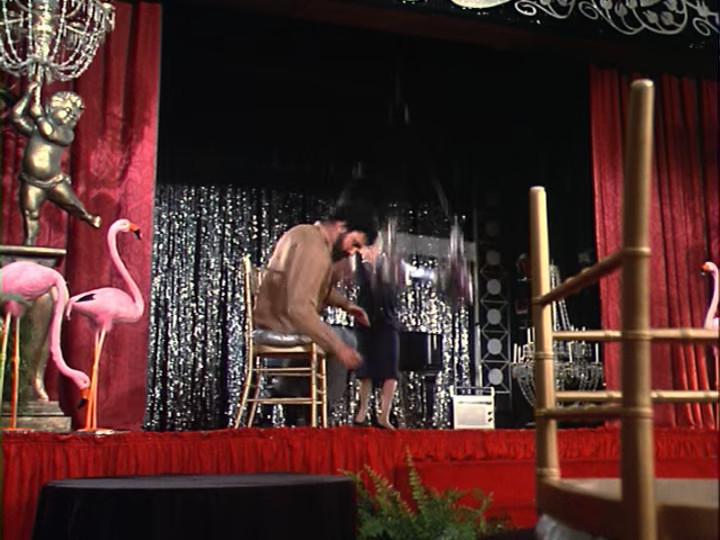
mpv-shot0019

Freddy dives in front of the lights, Jessica steps back to avoid them. When the camera finds Freddy he’s on the ground holding his neck in great pain, probably from the dive and landing on the ground.

The scene then shifts to Jessica knocking on the door of Lt. Novak’s apartment the next morning. She woke him up but is only very slightly concerned at this given that Lt. Novak has been working all night again. She needs to talk to him about Howard.

He’s friendlier than normal, explaining that his hates-everyone approach is just his office persona. They go over the list of possible suspects, but for some reason he’s convinced that Howard is guilty. I don’t really get this because it’s at odds with his theory that the drums covered the sound of the gun—unless he’s willing to postulate that, after shooting Al, Howard just stood around holding the gun for up to a quarter of an hour.

Anyway, after Jessica goes over some facts which incriminate other suspects including the affair between Mrs. Drake and Mike—which Lt. Novak didn’t know—he tells her that she’d have made a great cop but asks her to leave the policing to the police. She responds that she wouldn’t dream of interfering, which is odd because she’s very clearly happy to interfere, for example demanding that Lt. Novak do a nitric acid test and demanding that he take time out of the investigation to talk to her or she’ll badmouth him on television.

Anyway, he clarifies that her interfering isn’t what he’s worried about. Lab results indicate that the lights falling wasn’t an accident. The rope was eaten through with acid. Jessica’s interpretation was that someone was trying to kill Freddy York. Lt. Novak’s interpretation was that she was the target. We get a wide-eyed reaction shot from Jessica then switch scenes to a courtroom where Howard is bailed out. Jessica apparently posted bail for him, since she tells him that if he jumps bail the state of California has an option on her next four books.

In the hallway as they are leaving, Jessica asks Howard if he saw Mrs. Drake backstage during Freddy’s performance and he’s sure that he didn’t, but he did see her come in the stage door just before he went on. This isn’t very helpful to us because we never saw him on stage and there wasn’t really a time for him to have been on stage, but it helps Jessica because she isn’t deterred by plot holes in the same way that the audience is.

Accordingly, she goes and visits Mrs. Drake, who is playing golf. In between insincere condolences Jessica asks if Mrs. Drake saw her husband shortly before he died and she said that she didn’t, she came in during Freddy’s set. Jessica replies that it’s strange, then, that someone said they saw her come in before Freddy’s set. Mrs. Drake takes offense at this and says that she didn’t kill her husband, and if Jessica insists on sticking her nose where it doesn’t belong, she should look into Freddy York. His contract was a personal services contract with Al, not with the club, and when she brought Freddy flowers in the hospital, Freddy gave her notice that he was quitting.

I do need to partially take back what I said about us never seeing Howard on stage. Just in case I missed something I went back and it looks like Howard actually was on stage a little before Jessica and Victoria came in. If you look closely during the opening shot at the club, you can see Howard on the stage:

mpv-shot0021

You never see him clearly and almost immediately the camera pulls back and focuses on other things. And we’re looking at this in DVD quality. In broadcast quality back in 1984, it would have been extremely hard to make that out as Howard. Anyway, this introduces a timing problem. Howard confronted Al Drake after Freddy York’s set was over, but according to Howard, also, “I finished my act, then I went back to his office to quit and get my money.” In the flashback he was wearing his stage costume. This means he spent the entire length of Freddy’s performance doing nothing before he went to confront Al.

Anyway, Jessica takes Mrs. Drake’s story about visiting Freddy in the hospital to mean that Freddy is well enough to receive visitors and decides to pay a visit to Freddy herself. Accordingly, the scene shifts to the hospital, where Freddy and his agent are drinking champagne and celebrating all of the great things they’re going to do now that Freddy is free. Jessica walks in and Bill Paterson (the agent) basically yells at her to stop investigating, since neither he nor Freddy killed Al, and Freddy was not only on stage when it happened, someone later tried to kill him with the lights. Jessica replies that that’s a bit of a puzzler, since Mike thinks the lights were an attempt to kill him, Lt. Novak thinks that they were an attempt to kill Jessica, and Bill thinks that they were an attempt to kill Freddy. And on that… bang snap… we go to commercial break.

When we get back, Jessica is walking to her hotel room while Howard and Vicki argue over whether they should postpone the wedding (Howard says yes until he’s cleared, Vicki says no, they should get married right away). They ask Jessica what she thinks and what she thinks is that she needs a nap. Vicki asks if the builders working away in the room next to Jessica’s won’t keep her awake.
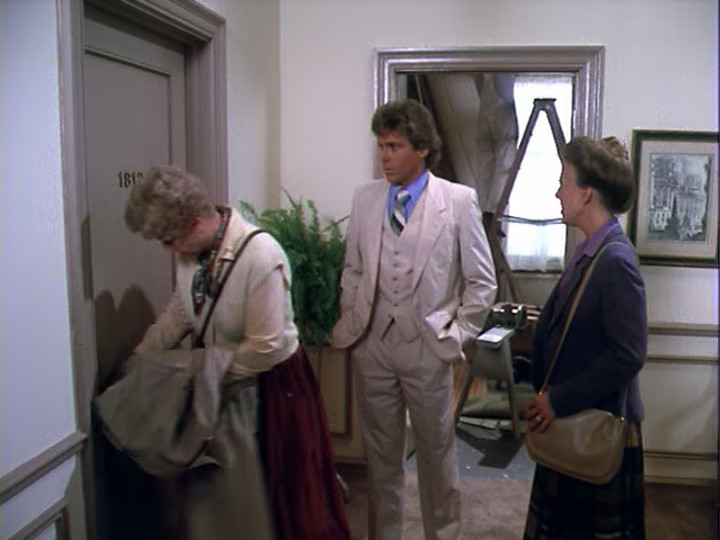
mpv-shot0022

Jessica replies that right now she could sleep through Armageddon. She then tells them that she promises that they will get to the bottom of this. She’s sure she’s overlooking something, and it will come to her if she get some sleep.

Jessica goes and lies down, but contrary to her imagined ability to sleep through Armageddon, all of the power tools do keep her up. She then holds the pillow over her ears…

mpv-shot0023

…and comes to a realization of what she had been overlooking.

She then shows up in Lt. Novak’s apartment. What she had forgot was the small white feather on Al Drake. Drake wasn’t shot during Freddy’s performance because the killer used a silencer! When Lt. Novak objects that they don’t make a silencer for that kind of gun, Jessica says that it wasn’t a metal silencer. It was a pillow. That explains the small white feather, which didn’t come from the cockatoo in Drake’s office. (It was an office pet.)

They then go to the scene of the murder and Lt. Novak picks up the pillow in the office and it has no bullet hole. But, Jessica points out, the pillow wasn’t there on the night of the murder. Don’t take her word for it, look at these police photos. When asked how she got police photos, Jessica says that his assistant, Charlie, gave them to her. He really is a very nice man.

Anyway, this shows that the pillow that’s there now was placed there after the investigation, presumably because the one that was there had to be removed because it was damaged when it was used to muffle the sound of the shot.

Jessica then asks Lt. Novak to take part in an experiment. They go to the stage and she has Lt. Novak stand in a precise location on the stage, then goes backstage and drops some sandbags on him. Or would have, had Lt. Novak not stepped out of the way when he heard the sandbags descending. She points out that he heard it, and he replies that of course he did, he’s not deaf. Jessica replies, “and neither was Freddy York.”

At this, Freddy steps out from back stage, applauding. He tells Jessica that she’s quite a performer. She says that it was quite a performance that he put on, diving off the stage when he didn’t have to.

Freddy counters that all she’s proved is that he could have staged the falling lights.

I’m not sure how she’s supposed to have proved that. All she proved—to the degree that she proved anything—was that Freddy was able to get out of the way of the lights because he would have heard them. But that was never at issue. He did get out of the way of the lights, so he got out of the way somehow, and hearing them just as Lt. Novak did is as good a way as anything else. Weirdly, though, it required no proof that he could have staged the lights because the rope was eaten through with acid, which he could have put on the rope before coming out on stage, because anybody could have put the acid on the rope before Freddy came out on stage.

Anyway, he goes on to say that this doesn’t prove that he had anything to do with what happened to Al Drake and while Freddy would love to stick around, he’s got to fly to Vegas—he hopes his arms don’t get tired. He then tells them that they’re beautiful and leaves.

Jessica motions to Lt. Novak to follow, and they do.

In Freddy’s dressing room Jessica points out that the pillow which was used to replace Al’s pillow was from Freddy’s dressing room because it is sun-faded, just like his settee, and it’s the only one that is because Freddy’s is the only dressing room in the building with a window. (The pillow does have a lighter side, though until Jessica said that it was sun-faded I thought it was just two-toned.)

Somehow it being the pillow from Freddy’s dressing room which was used to replace Al Drake’s pillow  in the days following the murder means, conclusively, that Freddy is the murderer. Luckily for Jessica Freddy can’t see any way out of this logic and admits it. “It’s my luck. It’s my dumb luck. Half the people in this club wanted Drake dead, and your niece’s boyfriend’s gotta get tagged for it. I knew you were trouble as soon as I saw you. What was I gonna do? Spend the rest of my life working in this rinky-dink club? You ever try to tell jokes when someone’s got their hand on your throat?”

Jessica shakes her head and says, “Surely, murder isn’t the answer.”

This prompts Freddy into a monologue.

You call it murder. I call it a career move. Look at me. What do you see? I’m not just another comedian. I’m Freddy York. I’m the first guy who did his own rim shots. I’m like the Edison of Comedy. I’m Robert Fulton on the drums. So Al Drake sees me one Sunday night. He says, “Kid, you’re good. Here’s a long-term contract. It’s your shot. Your big break.” He broke my spirit. That man broke my heart. I couldn’t let him do that. I’m a creative genius. Fair is fair. He gave me a shot. I gave him a shot. Ba dum bum. Should’ve shoved you under that stage light.

When Lt. Novak asks him why he rigged the lights, he merely replies that Novak should ask Jessica. She says the obvious, that he thought the charges against Howard would get dropped and a murder attempt on him would point suspicion elsewhere. Freddy then says, “Boy, you are good. I mean, you are really, really good. You ever think of taking your act on the road? You should play Vegas. That reminds me, I better cancel my tickets. Doesn’t look like I’m going. It’s too bad. I could’ve knocked ’em dead.”

Jessica nods and says, gently, “I’m sure you would have.”

We then cut to the wedding ceremony for Howard and Victoria. There are a few curious things about it; one is that we come in on “by the power vested in me by the state of California, I now pronounce you man and wife.” But this is in a church and it’s a priest who’s performing the ceremony. Those are the words spoken by a justice of the peace at a state ceremony. It’s interesting that here in 1984 they’re so hard-core secular.

The other interesting thing is the guest list:

mpv-shot0024

It’s just the people from the episode, none of whom had a connection to Howard or Victoria. A cynical man might think that this was mostly done just to save money on casting.

I might be that man.

Anyway, after the vows are over and the guests congratulate the couple, Bill Patterson comes up the isle and tells Howard that he’s been on the phone for an hour and got him a job on a soap opera for two days a week. It starts on Monday.

Victoria is all for it but Howard is ambivalent because it means canceling the honeymoon in Hawaii which Jessica had given them as a wedding present. Howard asks Jessica what they should do and she replies that she usually doesn’t give advice (which causes Lt. Novak to shake his head in disbelief behind her), but she thinks they should go for it.

Then everyone cheers and we go to credits.
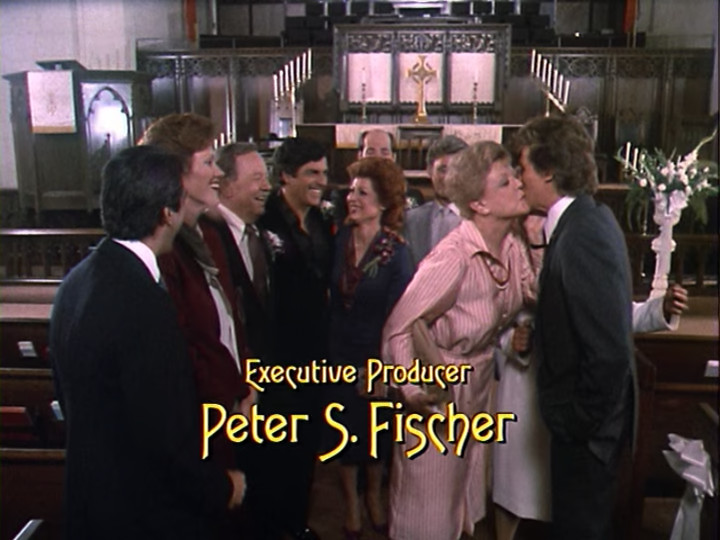
mpv-shot0026

This was a very interesting episode. Quite different from Deadly Lady. It was far less of a classic mystery and perhaps a bit closer to a typical Murder, She Wrote episode. Jessica is nosy more than clever, most of the investigation was of red herrings, and Jessica solves it at the end in a moment of inspiration which gives the audience time to figure it out first.

It also had some really big plot holes. Bigger than I’m used to seeing on Murder, She Wrote.

Right at the very beginning, the intended wedding between Victoria and Howard makes no sense. Somehow Victoria and Howard are getting married in a day or two and she’s discussing basic initial planning with the priest. He’s literally never met the groom and doesn’t care; his only concern is interior decoration and some brief rehearsal. Very brief, in fact, because he has to get to chorus rehearsal in five minutes. There is literally only one person from her side of the family coming, and that’s Jessica. No parents, siblings, cousins, aunts, uncles, or friends—just Jessica. Howard also has no family, though for all she knows he could have a few friends he’s made in the last six months. None of this bothers Victoria because she’s head-over-heels in love with Howard and would do anything, absolutely anything, for him. Howard’s lying to her about his job and having various indications that he’s having an affair with another woman only very slightly ruffles her, though it in no way deters her from going through with the wedding.

And somehow, this doesn’t bother Jessica in the slightest.

The timing of Howard’s performance is basically irreconcilable with the presented facts. He seems to have waited around, in the dress he didn’t like wearing, for the entire length of Freddy York’s performance doing absolutely nothing before he angrily went into Al Drake’s office to demand his money and quit.

Howard’s certainty at seeing Mrs. Drake come in right before his performance also goes nowhere, which is probably because it couldn’t have gone anywhere. What could Mrs. Drake have done, back stage, for however long it took Howard to perform, before leaving and re-entering through the front door? If we’re to believe that Howard was right, then presumably it was to visit Mike. Which seems more than a little far-fetched. She could hardly have hoped to be unobserved during such a busy time. And since this is a night club, they had plenty of time for hanky panky during the day.

Speaking of timing, there’s kind of a plot hole with how they filmed the episode. Al is alive and well in front of the club when he directs the host to give Victoria and Jessica a table. They walk directly to their table and Freddy York is introduced and starts his act within ten seconds of them sitting down (in a continuous shot). Al would have had to have sprinted to his office in time for Freddy to shoot him, and then Freddy would have had to sprint on stage, and I doubt that even that would have worked. Timing it, it’s twenty four seconds from when we last saw Al alive to when the curtain parted as the announcer came out to introduce Freddy and we catch a glimpse of Freddy behind the curtain. (The announcer would have seen if Freddy was absent and wouldn’t have announced him if he didn’t see him before stepping out through the curtain, but seeing Freddy is even more certain.) Granted, there were two cuts, but they were very clearly meant to cover continuous time. Twenty four seconds is not much time to sprint to his office in order to get murdered in his chair. (There was even less time for Freddy to have murdered Al after his set, though it’s clearly established that’s not what he did.) So there’s no way that Freddy could have done it. Which is great. I don’t think that there can be a bigger plot hole than “the murderer couldn’t have done it.”

Oh well.

Moving on, what was the whole thing about Barbara telling Mr. Blake that his wife is at the club, then not doing that? I suppose she’s meant to and this is the reason why she went to his office, but it was over a minute of screen time between when that happened and when we hear the scream. Also—and I had to go back and double check to remember this—she isn’t in a hurry to go find Al. In fact, she watches the bus boy leave then peers to make sure that he’s gone.
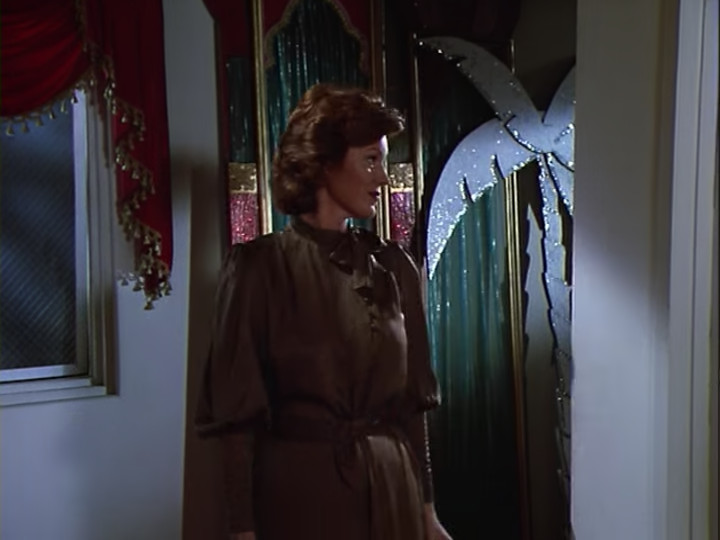
mpv-shot0027

I can think of no reason whatever that she could want to get rid of the bus boy. Yet she was more concerned with that than with telling Al his wife was here. What was that about? I doubt that the writers knew, either. And the whole thing where Jessica wanted to find out why Barbara was at Al’s office and so saw Howard with the gun? Completely dropped. Jessica never found out that Barbara was carrying a message for the bus boy.

When Jessica meets Lt. Novak, her manner suggests that she expects him to know who she is and to want her help. It’s meant to set up her being disappointed when Lt. Novak tells her to get lost, but it feels weird. She’s old enough to know that it requires some introduction to put yourself into someone else’s business, and that the police don’t do murder investigations for fun.

It’s not a plot hole, just a bit of sloppy writing, but nothing ever comes of Al’s corpse having been facing the wall. He couldn’t have been shot in that position. Freddy had to have turned him around after shooting him. The only reason to have turned him around was to make it look like he was alive when he was already dead. Yet absolutely nothing comes of it. (This is the sort of thing I mean when I say that Jessica isn’t as clever as in Deadly Lady. An observation like that would have been an obvious point in her favor with Lt. Novak.)

Then there’s the “scientific testing” of the hypothesis that the sound of the gun shot was masked by Freddy’s drum playing, which didn’t involve testing that hypothesis. I suppose that they were testing the related hypothesis that other things could have covered the sound, but why did they never test whether Freddy’s playing would have covered it? Especially for the people back stage, where the gun would have been closer to them than Freddy’s drums? Guns are very, very loud. Far louder than drums.

I guess it was OK that Freddy staged the thing with the lights nearly falling on him and Jessica, but why on earth did Lt. Novak remain convinced that Howard did it after that? Howard was in police custody at the time. Why did Jessica not point this out?

And why was the stuff with the pillow supposed to be remotely convincing? The pillow being sun-faded in a way that exactly matches the settee in Freddy’s dressing room and in no other room works to prove that the pillow came from Freddy’s dressing room, but how on earth does that prove that Freddy murdered Al Drake? The pillow was placed there after the police investigation was over, which means that anyone could have done it. You can make an argument that the murderer would have had to use his own pillow in some sort of exigent circumstance, but not when the murderer was replacing a pillow at his leisure. The murderer would have had to be an idiot to use his own dressing room’s pillow. (Unless he was going for a double-bluff by trying to make it look like someone was trying to frame him.) If I were making a list of the top ten airtight cases, I doubt that I would include: “Somehow, long after the victim was dead, your office pillow wound up on the victim’s couch. How do you explain that, if you didn’t kill him!”

This is an especially big problem when you consider what they don’t have: a pillow with a bullet hole in it. They don’t even have anyone testifying that Al’s settee definitely had a pillow on it shortly before he was killed. In short, there’s no evidence that a pillow was involved in the murder.

And this is leaving out the fact that a pillow only makes a gun very slightly quieter. I’ve seen people test it and a gun with a pillow in front of it is is perceptibly less loud. You could definitely pick it out in blinded A/B testing. But that’s about it. It’s still around the threshold for causing hearing damage. But this is just a subset of TV silencers, which work about 1000 times better than real silencers—part of why people who know what they’re talking about tend to call them “sound suppressors” rather than “silencers”. To get an actually quiet gun which only goes “ffft” you need a specially designed silencers with multiple rubber wipers the bullet shoots through (making it require replacement after a few shots). And that only works if you use specially loaded sub-sonic bullets. Ordinary bullets, which travel much faster than the speed of sound, make a loud bang because all hypersonic objects do. Only sub-sonic bullets have the possibility of being quiet and the trade-off is that they have far less power in them. That is, they’re less likely to be lethal. This is just part of TV fantasy, though, so there really isn’t a point in complaining that TV silencers are magic, and if we’re allowing TV silencers, I suppose we need to be forgiving of TV pillows, too.

It’s really lucky that Al didn’t think of any of this and just confessed.

The importance of that confession in Murder, She Wrote is often overlooked, I think. It’s nice when the evidence is clear, but it’s absolutely crucial when it’s not. When the evidence is as flimsy as it often is, the only thing that makes Jessica look smart is the proof that she’s right which a confession offers. Otherwise she’d seem over-confident in wild guesses.

Incidentally, this is one major reason it bugs me so much when people suggest, as if it’s clever, that Jessica was wrong about who did it or committed the murders herself. The murder always confesses. Always. This is like suggesting the clever twist in Harry Potter that Harry was deathly afraid of brooms which is why you never saw him touch one! It’s brilliant! Except for the part where he did touch them, prominently, so this is stupid. Or imagine this wonderful idea where in Star Trek Kirk is really Spock, in disguise. That’s why you never see them in the same room together! Except that you see them together in the same room in every episode.

It’s really easy to be clever if you don’t let facts get in the way.

Anyway, with all that said, and not taking any of it back: it was still fun to watch this episode. A lot of that comes down to the acting. Some of it is the pacing, though. Even when not much is happening, you always feel like something is about to happen, which keeps your interest. And I think it does a decent job of making you forget all of the stuff that was never paid off or flat-out contradicted the conclusion. I also suspect that ending on a happy note for Howard and Victoria helps that. A murder investigation produces a liminal space in which normal life can’t happen. That liminal state also allows us to look into things we normally would not be able to see, which is where most of the fun of a murder mystery comes from. The resumption of normal life with something like a wedding definitively closes that liminal state—it brings us over the threshold and back into normality. It’s not required, but I suspect that it greatly helps the story to feel satisfactory. Even when it shouldn’t.

Next week we move south along the coast to Los Angeles in Hooray for Homicide.

The Rise of Skywalker: Initial Thoughts

My oldest son is hoping that, having finally seen Star Wars Episode IX: The Rise of Skywalker, I will write a review of it that is similarly long and humorously criticial as my review of episode 8: The Least Jedi. (He’s had me read it to him several times now, as he enjoys my performance of it.) I’m not sure that I can, though.

The reason why is that I’m not sure that TRoS was serious. And there’s no humor in pointing out the way that a joke doesn’t work as a serious story: that’s just not getting the joke.

TRoS was in an essentially impossible position, coming, as it did, after The Last Jedi. The Last Jedi was not merely a bad movie, but it was a mean-spirited and evil movie. It tried hard to sell the viewer that nobility and virtue are bad, that nothing means anything, and that life isn’t worth living. It ended with the resistance being down to a few dozen people and it being authoritatively established that the entire galaxy is now hopeless and unwilling to fight the First Order. There’s nowhere good to go from there.

I am reminded of an episode in the TV show Sports Night where the main characters (who are sports commentators on a small sports TV show) won the right to cover a very popular and much-anticipated boxing match, and had hours of coverage blocked out. Then one fighter knocks the other out with one lucky punch seven seconds into the first round. A bit later as they’re joking about how they’re going to cover the match nanosecond by nanosecond, the director complains to the producer that they’re turning it into a joke, and he replies, “Where else are they going to go with it?”

That same question applies to TRoS, and it feels like J.J. Abrams knew it and decided to embrace it. Yes, there was no plausible way that Palpatine could have come back, but there was no plausible way that anything interesting would happen, so he didn’t bother trying to make it plausible. Was Palpatine being back good? Hell no. But J.J. established it in the first few minutes, hung a lampshade on it, and at that point, I guess you might as well go with it. Did it make sense that planet Spaceball wanted to steal Druidia’s air rather than install some air filters? No, but they established it in the first few minutes and it’s not like suspension of disbelief was ever a goal. President Skroob breathed Perry-air from a can. You knew where you stood with Space Balls. And when Palpatine uses the force to lift thousands of star destroyers with death star canons on their bellies out of the ground and into the air, you basically know where you stand, here, too. And if you didn’t, you sure do when Kylo Ren has his mask rebuilt and the actor playing the guy doing the welding is a chimpanzee.

So, yes, the plot is filled with plot holes. Nothing is ever justified (unless you want to count “Palpatine did it for his own complex and sinister reasons”). But at some point, when there are enough plot holes, it’s time to consider the thing as lace. And, as a lace doily under the lamp to keep it from scratching the table, it kind of works.

And here’s where we get to possibly the biggest reason I don’t know if I can make fun of it: its heart was mostly in the right place. Sure, the adventures made no sense, Rey got even more force powers for no reason, most of the time death is now a minor inconvenience, as are things that should cause death, and characters become loyal to our main characters just because they’re there. But all of this nonsense is in service of giving the main characters heroic adventures, personalities, and character arcs. With the exception of General Hux, all of the long-term characters are given good send-offs, including Luke. Don’t get me wrong, I still don’t consider the sequel trilogy as being actually related to the original trilogy. But J.J. Abrams seems to have considered them related and he tried to do good by them. That’s not something I want to make fun of.

People Confuse Liking Scenes With Liking a Story

Something I’ve come across is that there are people who like some of the scenes from a movie who confuse that with liking the whole movie. This is understandable in a movie like Dr. Strangelove, where people simply forget all of the dull parts where nothing happens. It’s much weirder when it comes to a profoundly stupid movie like Legion.

If you haven’t seen it, I have a review of Legion up on my YouTube channel called Legion: World’s Stupidest Movie?

It probably is, by the way. It’s a horror movie in which Jesus is about to be born a second time to save humanity (again?) and God “got tired of all the bullshit” so he sends a legion of angeliac zombies (demoniacs, but they’re angels, and mostly behave like zombies) to try to kill the Christ-child before he can be born so that humanity won’t be saved and God can kill everyone. Only the renegade angel Michael (who cut off his literal wings when he rebelled against the order to go murder the Son of God in utero, because humanity is worth saving) and seven random people in a diner in the middle of the desert stand against the army of angeliac zombies who are attacking them. Oh, and this time it’s not a virgin birth, the waitress carrying the second coming of Jesus just got knocked up during a one-night stand almost nine months ago. (In a special feature on the DVD, the writer/director says that this is actually a retelling of the story of Abraham and Isaac.)

I published that video eight years ago, and, as of the writing of this post in the year of our Lord 2024, I still occasionally get comments on that video from people telling me that they like that movie or I’m missing the point.

Movies are complex things, as are all stories. They involve many parts and due to human fallibility the parts often don’t all fit together. Movies add several layers on top of this because there are the actors, the costumes, the sets, the performances, and the music which all can have their own virtues and capture the audience’s attention. You can have a terrible movie with great acting, or awful acting done on beautiful sets, or awful sets with magnificent music. Now, it’s often the case that quality tends to go together, but it doesn’t always, and in movies it’s especially the case that someone can have far better visual taste than they do narrative taste.

You can see that same thing, though it’s more subtle, in novels. You can have a novel where the dialog is excellent even though the characters’ actions aren’t consistent, or are taken more from tropes than the characters themselves, or aren’t what human beings would do but are only driven by the plot. There are authors who can paint fabulous scenes which are vivid and compelling even though there’s no way that they come from what happened before.

To give an analogy, consider a baseball triple-play. The batter takes a mighty swing and hits the ball deep into the outfield, so deep it will surely be a home run, then in a breathtaking move the outfielder leaps up, kicks off of the back wall, and manages to catch the ball a full ten feet off the ground. It’s an amazing out. Then, without throwing it, the first basement suddenly has the ball and is midway between first and second base, tags out the guy who was running back to first base, then throws the ball into the dugout where it pops out of the opposite dugout and into into the glove of the third basement who tags out the runner who thought he’d gotten a home run but instead had to run back to third base, just a half inch away from the plate as he’s dramatically sliding. Is this a great scene in total? No, because baseballs don’t suddenly teleport and that’s integral to the plot. On the other hand, you can enjoy the descriptions of each play as long as you don’t pay any attention to what connected them.

I don’t know why, but a lot of people have trouble admitting that what they like in a story isn’t the story, but just some of the scenes, or something common to the scenes such as the dialog or narration.

Robin Hood: Prince of Thieves Was a Strange Movie

I first saw Robin Hood: Prince of Thieves when I was not yet a teenager and it made a deep impression on me. For some reason I was thinking about the movie recently and I realized that it’s a strange movie.

Part of this is that, these days, I tend to look at movies through the lens of “do I want to show this to my children?” It’s a question that brings a lot of things into focus. Children grow up (relatively) quickly and we only have so much time with them; how one wants to spend it is an important question. Some movies are absolutely worth it. The Errol Flynn movie The Adventures of Robin Hood is an unquestionable yes (already have with the oldest).

Robin Hood: Prince of Thieves is a modern twist on an ancient tale. To paraphrase Nietzsche: that is to say, it’s a bad twist. The basic premise is that Robin Hood was a spoiled rich kid who got captured in the crusades and was forced to grow up while in prison, escaped, made his way back to England, and then assembled a ragtag band of misfits to overthrow the tyranny which had taken over England. It’s a joyless retelling, where everyone is dirty and unhappy. No one has faith in what they’re doing, they’re just desperate and have no other real options. Maid Marrion is pretty in a technical sense, but completely unappealing, while Kevin Costner’s Robin Hood was heavy and plodding. The two had a sort of anti-chemistry where it made no sense for them to be together.

I know a lot of bad movies get made in Hollywood, including a lot of big budget bad movies. It remains perplexing every time why people would make such obviously bad choices. (I don’t mean all of the bad choices; some things—both good and bad—only become obvious in final cuts, after all of the color-correction and with the music.)

One good thing did come from this movie, though. Because of Robin Hood: Prince of Thieves, Mel Brooks made Robin Hood: Men In Tights. Despite being a Mel Brooks slapstick parody, it’s actually a better Robin Hood movie than Prince of Thieves and even a better adventure movie. Plus, this was the only time that Carry Elwes played Robin Hood, which was a role he was clearly born to play.

Murder, She Wrote: Deadly Lady

On the seventh day of October in the year of our Lord 1984 the first regular episode of Murder, She Wrote aired. Unlike the pilot episode of the series, it was set in Cabot Cove and was called Deadly Lady.

mpv-shot0001

The lady to which the title is referring is a hurricane as the giant wave in the overly dark opening scene suggests. (My guess is that it’s so dark in order to disguise a model set; the coastline of Cabot Cove was played by Mendocino, California and it would probably be difficult to get a hurricane at a convenient time in California, since they don’t occur on the west coast of the USA. (To be fair, they can get cyclones, which are basically the same thing, but waiting around for one would be impractical and getting helicopter photography during one would be of dubious safety.))

After the establishing shot and opening credits we go to Jessica typing on her typewriter.

mpv-shot0002

The lights flicker, then go out. As Jessica gets some matches and an oil lamp, we hear knocking and a male voice. Jessica goes to the door and opens it. It turns out to be a friend of hers named Ethan. She upbraids him that he shouldn’t be out of doors on a night like this.

mpv-shot0003

He replies, “I know that, woman. You think I’m a nitwit?” She replies that he shouldn’t ask questions he doesn’t want answered, and after a bit of banter we find out that he’s here to check on Jessica and provide some exposition. It’s a real bad hurricane and the coast guard is picking up signals from some fools in a yacht. No one can get out to them before the storm clears, so they’re on their own.

His exposition delivered, he bids Jessica a good night and leaves to go to his own bed.

The next scene opens with clear blue skies and Jessica taking a morning jog along the docks. She meets a fisherman sorting through something who tells her that Ethan went out about an hour ago to see if he could help the people on the yacht. He couldn’t say what happened to them because he lost radio contact with them. Jessica asks him to have Ethan call her when he gets back.

She then jogs home to find a strange man trimming her hedges.

mpv-shot0004

She tries to explain to him that her yard is private property but he only remonstrates with her about having let weeds get a toe-hold in her garden. His name is Ralph and he’s mighty hungry but doesn’t believe in taking handouts, so he’ll happily work for his breakfast. After a bit of discussion, they agree and Jessica cooks him some eggs and bacon after he finishes with the hedges.

As they sit down to eat Ralph claims to have been hoboing around for about as long as he can remember, but he’s not a bum, he works for what he gets. He then recognizes her from a book on her counter, saying that he read it and it was a good book.

Jessica tells him to sit down to breakfast as she points out the problems with his story. First, the book is a pre-publication copy and not available to the public yet. Second, his clothes may be faded but they are exquisitely tailored. Third, the term is “boin'” not “hoboing.” Fourth, there’s an imprint on his wrist from where a wristwatch used to be. She asks where he has it stashed.

He grins and pulls the watch out. It’s rather expensive looking. He says that he didn’t steal it and Jessica replies that she didn’t think that he did.

Ralph comes clean or makes up a more plausible story, we’ll find out later. He has been hoboing, just not for very long. He was just forced into retirement and decided that he wanted to see America “from the ground up.”

He asks if Jessica is mad and she replies that she’s willing to stick to their arrangement if he wants to do work around the house. They’re then interrupted by a call from Amos Tupper. Ethan just came in with the yacht and something peculiar has happened. Murder, peculiar. Jessica says she’ll be right there. Ralph is surprised to hear about a murder in this town. Jessica excuses herself and Ralph says that he’ll keep busy outside, but watches her go out of her window and doesn’t seem to be in a hurry to get outside.

mpv-shot0005

Jessica gets down to the dock and after a bit of pointless bickering between Ethan and Amos, Amos explains to Jessica what’s up. Some rich fellow, by the name of Steven Earl—he sells cosmetics and Jessica recognizes the name, “Mark of Earl”—was out sailing with his four daughters and last night, during the storm when… Ethan interrupts him demanding that the “girls” tell their story and Jessica concurs.

Amos agrees and introduces Jessica to the “girls” and asks them to tell Jessica their story, but Jessica insists on meeting them first.

First is Nancy Earl, who goes by Nan.

mpv-shot0006

Jessica admires her sweater and asks if she knitted it herself. She didn’t, but she did design it. Jessica thinks it’s lovely. Next Maggie Earl comes forward and introduces herself.

mpv-shot0007

She’s read Jessica’s latest book and it was a hoot. Jessica thanks her, saying that it was a hoot to write. Then comes Lisa Earl Shelby. Her husband has been notified and is on his way.

mpv-shot0008

Jessica thinks this is nice. And finally there’s Grace Earl Lamont.

mpv-shot0009

Her husband hasn’t been notified and isn’t coming. She last saw him four years ago.

Which rounds out the lot. Jessica then suggests that they would be more comfortable “inside,” I presume because it’s cheaper to film indoors than on a dock.

Anyway, they left Bridgeport (I assume, Connecticut) four days ago. They thought surely the storm would blow out to sea, this far north, but when they realized their mistake it was too late. Around midnight they were huddled in the cabin in their boat when they realized that their father was still topside. Lisa was the first one up, then Grace after her. Lisa was almost to her father when Grace saw a huge wave come over the boat and knock their father off.

It then turns out that we’re here because Grace asked the Sheriff how soon they could expect a coroner’s inquest, which he thought a mite suspicious. Given the suspicious circumstances, he’s not very inclined to hold an inquest until he has a body. Ethan says that, given the tides, the body should show up within a day or so.

The four daughters walk off. Amos asks Jessica what she thinks and she says that she doubts that any of them will be wearing black for long. Amos asks about the death—one hundred million dollars is a whale of a motive. Ethan accuses him of reading too many of Jessica’s books, but Amos retorts that he hasn’t read any of them.

Jessica leaves them to invite the four women to stay at her house, but they decline as they already have hotel reservations. Most of them walk off but Jessica gets a moment with Grace. She extends her condolences and Grace says that none of them will miss their father. He broke up her marriage and has prevented Nan from getting into any relationships, and turned Maggie into “a dull hausfrau.” There’s really no love lost between any of them. She then excuses herself.

Jessica watches her go with a look of perplexity.

mpv-shot0010

And we go to commercial break.

When we get back, Jessica comes home on her bicycle and goes into her house. She calls to Ralph but he’s not inside. A phone call comes in and it’s Latisha from the phone company letting Jessica know the charges for her call to Paris. She finds Ralph outside resting in her hammock and listening to Mozart on his walkman since the weeding was done and there’s not much else he can do without supplies. She asks him about the call. At $9.97, it must have been a short call to France, she says. He clarifies that it’s Paris, Kentucky—he has a friend who is a horse breeder down there, and he will take care of the charges.

He then takes her to look at some rotten wood on the inside of the house which needs some putty and paint. He can fix it but it will take $10-$15 in supplies. Jessica says it’s a bargain and goes to get the money. While she does this, Ralph admires a pipe that was sitting out on a table. It belonged to Frank—Jessica’s husband who died years ago. He remarks, pensively, “I guess besides a good meal, the thing I enjoy most is a good pipe.” After confirming that it was her husband’s, he compliments Frank’s taste in pipes. It’s an excellent Meerschaum.

mpv-shot0011

Jessica then offers it to him, perhaps because she was touched by the sappy background music which has been playing since Ralph started looking at the pipe. He tries to refuse but she presses him. “I want you to have it. Better you should smoke it than it should sit there gathering dust.” She looks like she’s about to cry and hurries off.

Ralph puts it in his pocket and the scene then shifts to a helicopter landing in a grassy field. Lisa runs up to it and greets her husband. They proceed immediately to the Sheriff’s office.

mpv-shot0012

His concern is that the death of Steven Earl could throw Mark of Earl cosmetics into a financial tail-spin. He wants an immediate inquest so that the reins of leadership can smoothly pass on to Steven Earl’s successor.

This attitude—that corporations are like feudal baronies on the borderlands and that stability comes from the loyalty of the soldiers to the individual under whose banner they will fight—is something we’re going to see a fair amount of on Murder, She Wrote. I don’t know how much the writers actually believed it and how much it was just an excuse to move the plot along because they need dramatic tension. In reality, large profitable companies do not live by their day-to-day stock prices and those stock prices can’t lose 99% of their value from a few days or even a few weeks of uncertainty in who the CEO is. Companies—and especially large, established companies—take a long time to develop their products and marketing campaigns. It is possible for an army to get a significant advantage over another because uncertainty in leadership causes one to stay where it is rather than repositioning itself when the one with active leadership moves, but there’s nothing that can happen to a large cosmetics company that requires a response within hours or it could be devastated. It’s just not a thing.

Anyway, Amos stands on his insistence that there will be no inquest until they have a body, and we go back to Jessica talking with Ralph.

Ralph tells Jessica about how he lost his wife years ago, and for a long time couldn’t bear to think about it. He asks if she has children and she replies that she and Frank were never blessed that way. He repeats the word blessed and chuckles. He then gets up and leaves because he has things to do, bidding Jessica a good night. After he leaves she goes to do the dishes and after unplugging the drain in her sink sees the water swirling down the drain and gets an inspiration. She runs over to the docks where she finds Ethan. She needs his help and advice. The help seems to largely consist of letting her have a map and a compass, which she uses to draw a circle on the map.

Ethan’s advice seems to primarily consist of saying, “Well, I’ll be a skinned lizard” and then asking Jessica how she knew. Her answer is, “Didn’t it seem strange to you that those girls knew exactly where they were in the middle of a storm?”

A call to Amos Tupper and a trip over to the local hotel later and Jessica confronts the four sisters with the fact that at midnight, in the location they said they were at (3 miles due east of Monhegan Island), they would have been in the eye of the hurricane and there would have been no waves to sweep anyone over. Lisa makes the extremely obvious statement that they must have been mistaken as to their location but Maggie won’t have it. She confesses to murdering her father.

Their father didn’t die the night before, but rather two nights before. Maggie and her father were alone on deck, he was drunk, and they fought as usual. She has a gun in her purse she keeps for protection and when he came at her she fired, twice. When the sisters got up on deck there was blood everywhere and his pipe was still warm, but he wasn’t there. Amos arrests her.

Amos, as we will get to know about him, will arrest anyone at the drop of a hat. That said, this time it seems pretty justified.

Jessica isn’t satisfied but can’t explain it. Then a newspaperman comes it with a fresh edition about the millionaire who drowned. Jessica looks in it and sees the photo of Steven Earl—an old photo, taken from the dusk jacket of his autobiography called Grease Paint Millionaire about how he started as an actor and got into makeup almost by accident. Jessica asks if the book was old and the newspaperman says perhaps twenty years out of print.

Jessica goes to her house (with Ethan) looking for Ralph but can’t find him. Some comedic misunderstandings later, Jessica explains to Ethan that Ralph is Steven Earl. Ethan thinks that she’s batty, but agrees to help her look around Cabot Cove for him.

Unfortunately, Ralph/Steven Earl is found by some kids the next morning.

mpv-shot0013

And with the reveal of the body we go to the midpoint commercial break.

When we get back Nan and Lisa identify the body with Amos Tupper. Then Jessica arrives  as they’re leaving the chapel where the body is. Then a car screams up and parks. A man gets out who Nan recognizes as “Terry.” He says that he just heard the news in Kentucky and flew right in. Lisa explains to Jessica that he isn’t a relative but would like to be—about a year ago he and Nan were engaged and then he just walked out of her life.

Jessica goes inside and identifies the body as Ralph. This angers her and she swears vengeance in her folksy way.

Then there’s an unpleasant scene between Lisa and her Husband in their hotel room which doesn’t really advance the plot but is there to make them both seem like suspects.

Then we go to the Sheriff’s station and he brings Maggie out to interview her with Jessica present. He tells her that the body was found, shot twice in the chest, just as she described. She’s shocked and says that it’s impossible. He can’t be dead. He left the yacht on an inflatable raft he hid away before they left. It—the trip, everything—was all a scheme to unmask a fortune hunter named Terry Jones.

A year ago he paid Terry half a million dollars to disappear but after suffering a heart attack six months ago he was afraid Terry would show up again when he was dead. So they cooked up this scheme in order to lure Terry out of the woods so Steven could prove to Nan what a terrible guy Terry is. How, Maggie does not say, because I can see no plausible way for that to work, especially without revealing how Steven paid him to leave, which he wanted to keep from Nan. “My beloved daughter, I faked my death, causing you tremendous grief, in order to lure your former fiance to come back to you, which he did. Don’t you see how this proves he is the one who doesn’t really love you?” He could try to gussy that up, but it does not seem plausibly persuasive. Nor loving.

Anyway, Amos isn’t buying any of it but Jessica is, and leaves Amos to wait for the coroner to tell him what Jessica already knows. She bicycles over to the hotel to look for Terry Jones but he and Nan went to the church about twenty minutes ago. As Jessica leaves she encounters Maggie, who was released because the shots that killed her father didn’t come from her gun. Lisa’s husband tries to tell Jessica to butt out of a family affair, but Jessica retorts that Steven Earl was no stranger to her. She wishes him a good day in a way that makes it clear that she very much hopes he will have a bad day—somewhere far away from her.

We then see Terry talking with Nan in a cemetery. He claims to her that he left because her father threatened to ruin him if he didn’t. She’s not buying it.

mpv-shot0014

He proposes to her and she doesn’t know what she wants to do. She says she needs to be alone and walks off.

As she does, Jessica rides up on her bicycle and greets Terry. With little formality, she tells him that he lied when he said he heard about the death this morning. In reality, he heard it from a phone call yesterday from Steven Earl. He replies that the guy on the phone said he was a reporter, but it might have been Earl—he was a good actor. Terry explains that he flew into Portland last night and to his surprise found Nan waiting for him. Maggie had told her about their father’s plan to trap Terry. He says that some people, like Maggie, secretly believe in him. He and Nan spent the night together at a hotel near the airport. She left early in the morning, he slept in. When he heard the news of Steven Earl’s real death, he immediately came to be by Nan’s side.

Jessica then goes to the Sheriff’s office but Amos isn’t there. She overhears a conversation with one of his deputies and someone else on the radio that Amos is down at Cotter’s Beach with a search party because he got an anonymous note shoved in the mailbox which said that there were funny goings-on at about 10pm the night before.

Jessica goes down to Cotter’s Beach and asks Amos to see the note, which he shows her, but the camera does not show us. Then one of the searchers runs up because he found a pair of new-looking pink high-heel shoes half-buried in the sand. One had a heel broken off of it. Jessica remarks that half-buried means half-exposed and scampers off. After a few moments of searching next to where the shoes were, she finds the missing heel.

mpv-shot0016

Amos praises Jessica for finding it and says that all they have to do now is to find to whom the shoes belong. Jessica says that without doubt they belong to Nan and we go to commercial break.

When we come back from commercial break, Jessica and Amos are in Nan’s room as Nan is searching for the shoes. She never unpacked them and yet is somehow certain that they were here last night. Amos shows her the shoes and she identifies them as hers—she designed them and had them custom made.

Jessica asks Nan to try them on. Nan doesn’t understand, but complies. Presumably this is so that Jessica can get a look at the bottom of Nan’s foot (the shoe fits, but we knew that before she tried it on):

mpv-shot0018

I assume that the thing Jessica was looking for are scratches or something like that, since if Nan was there and broke a heel and lost both of her shoes she’d have had to scramble over the rocks barefoot and she’s a city slicker with, presumably, tender feet. Let’s zoom in:

foot

I can’t see any sign of scrambling over cliffs, though the resolution really isn’t wonderful for that. Presumably Jessica will confirm this soon. Anyway, Amos takes the fact that the shoe fits to mean that he has to arrest her for the murder of her father. Jessica objects saying that Nan isn’t guilty, then gets an idea and advises Amos to take Nan into custody. Jessica then asks Amos and Nan to keep the evidence absolutely confidential.

The scene then shifts to the Sheriff’s office, where Terry Jones shows up, angry that Nan has been arrested. He protests that there’s no way Nan could have killed her father because she was with him. Amos suggests that perhaps they were in it together. The Portland hotel desk clerk saw them check in but didn’t see either of them leave. They easily could have snuck back to Cabot Cove and committed the murder together. Terry starts to panic and says that he didn’t have anything to do with Steven Earl’s death, but if Nan did kill him before she came to Terry, he would have no idea. Amos says that he better not, since in Maine being an accessory to murder is about as bad as being the murderer. But as long as he’s here, Amos sees no reason why Terry can’t see Nan. Terry then excuses himself, saying that he has business to take care of, and beats a hasty retreat.

Amos then goes to the door to the jail cells, which this conversation took place next to, opens it, and asks Nan (who walks out) whether she heard it. Finally disillusioned about Terry, Nan replies, “Yeah. I heard it.”

The scene then shifts to the hotel, where Lisa, her husband, Maggie, and Grace come back, all of them laughing and perhaps a bit drunk. Lisa’s husband is shouting in jubilation. They’ve all been celebrating Maggie’s exoneration. Jessica breaks the news about Nan’s arrest. When asked why, Jessica lies and tells them that the Sheriff found a heel from a shoe, which Nan admitted was hers, on the beech very near where the body of their father was found, but the shoes are missing. Jessica then says she knows how sisters are, and how they trade clothes, and asks if it’s possible if one of them wore those shoes.

Lisa asks if Jessica wants to search their rooms and Jessica says, “something like that.” Lisa replies not without a warrant, and not by Jessica, then leaves with her husband. Grace says that she has nothing to hide and so Jessica can search her room if she wants. Maggie says that Jessica can search her room, too, but she and Nan are different shoe sizes and besides, she doesn’t wear pink.

Later, Maggie walks Jessica out of the hotel and Jessica tells Maggie that she’s exhausted and will sleep in late. She also says that the Sheriff will be over later and asks Maggie to give the Sheriff a bag that she was holding (we were not shown what was in it).

The scene then shifts to Jessica’s house where a gloved hand breaks the window to Jessica’s door, reaches through, and opens it. The dark figure who belongs to the gloved hand then slowly and softly walks in and starts walking upstairs but stops when it hears creaking. It reverses course and then Jessica calls out, “that wasn’t very thoughtful.”

mpv-shot0019

The figure walks up and we see who it is.

mpv-shot0021

I like the TV burglar outfit Maggie is wearing. Also, this turns the title of the episode into a curious pun.

She asks, “You were expecting me, weren’t you?”

Jessica replies, “You know I was.”

In fact, Maggie wasn’t sure. But she looked inside of the bag and found a blue heel to a shoe and figured that it was a message. She asks if she slipped and Jessica points out that she said that she doesn’t wear pink, but Jessica never mentioned the color of the shoes.

Jessica adds that if it makes Maggie feel any better, she knew Maggie was guilty because everything pointed to an obvious framing of Nan. Maggie objects that it wasn’t obvious; Nan and Terry could have done it. Jessica points out that the shoes prove that she didn’t; had she lost her shoes her feet would have been scratched, which she found they were not when she asked Nan to try on the shoes.

Anyway, once it was clear that Nan was being framed, it was also clear who did it: the only person with the requisite knowledge to set up the frame by telling Nan about Terry Jones’ arrival at Portland.

Maggie tells Jessica that she’s very clever but Jessica demurs. She was merely logical; Maggie was the clever one. Confessing to the murder knowing that the police investigation would exonerate her was brilliant.

Maggie then explains her motive. She spent her whole life taking care of her father, making a home for him, keeping the peace, and for what? The only one who her father actually loved was Nan. After a bit of crying, she apologizes to Jessica for having to murder her in order to get away with the murder of her father. She explains her plan: it will look like she surprised a burglar who killed her in a struggle.

Jessica chides her for this plan. For one thing, they don’t have burglars in Cabot Cove. Second, and perhaps more to the point, the moment the back window was broken she called Sheriff Tupper, who has been listening in to the whole conversation. Jessica then moves some dead flowers in a wicker basket to reveal the phone off its hook.

mpv-shot0022

I must confess, given how low they were speaking, Amos couldn’t have heard much, but this is enough to dissuade Maggie from murdering Jessica. Jessica picks up the phone and says that Maggie wants to give herself up, then hands Maggie the phone so she can confirm this with him.

The scene shifts to the next morning, at the hotel, where Nan and Jessica are talking as Nan goes to her taxi. She tells Jessica that she understands how her sisters feel but her father was actually a decent man. Jessica concurs, reminding Nan that she did know him, if only for a short time. Jessica summarizes, saying that in her experience if you give love, that’s what you get back. Nan laughs and says, “Not always.” She then considers that her father was right about Terry and she didn’t see it, but Jessica tells her not to be too hard on herself. Terry was a very clever young man and she pities whoever gets him next.

Nan bids her farewell and gets in her taxi, then Ethan pulls up in his pickup truck and offers to take Jessica out to fish for sea bass, as he’s heard that they’re biting. Jessica accepts and tells Ethan that she’s going to teach him some of the finer points of deep-sea angling. As the pickup drives off, Ethan asks if that means that she’s going to want him to bait her hooks, too, and she replies, “Of course. You always do, don’t you?”

Then we go to credits.

mpv-shot0023

This was a very interesting episode. While there was also a pilot episode that aired the week before, this was still very much an introductory episode. More, perhaps, than the pilot, since this episode took place in Cabot Cove while the pilot took place in New York City. That is arguable, since most Murder, She Wrote episodes don’t take place in Cabot Cove (in most seasons it’s between a quarter and a third), but still something to consider. Another sense in which this is an introductory episode is that it’s the first regular-length episode, so it’s the first time we’re seeing what the show is really going to be like. It’s also quite likely to be the first time many people saw the show since there are all sorts of reasons to not see the pilot. (Among other things, people would take their guesses as to what they would like when a new TV seasons rolled round but they might be disappointed and try other shows. Plus there would be recommendations from people who did watch the pilot, etc.)

This being an introductory episode manifests itself in all sorts of ways, but part of it is that they put a lot of effort into showing how clever Jessica is. In particular, she shows off her deductive skill far more than she would come to later. For example, before the first commercial break she tells Ralph why he’s “full of clam chowder” with a four-point list of observations. She sees through the sisters’ story about their father being washed away in the storm by plotting their location on a map with a compass. She rushes off and finds the missing heel from the shoes and off-handedly knows that they belong to Nan. And all this is well before she solves the mystery. In later episodes Jessica will do a fair amount of investigation, but it’s rare that the next bit of investigation comes from clever deduction from the previous piece of investigation. In this episode each step follows from Jessica having been clever in a way we can clearly see. I suspect that this faded in no small part because it’s hard to write, but that’s a pity because it’s a lot of fun.

There’s another interesting aspect to this being an introductory episode, which is that they’re trying to paint Jessica’s personality. I think you can really see the influence of Miss Marple on the initial conception of Jessica in this episode.

(This is probably a subject that merits its own post, but if you’re not aware: Miss Marple was one of the main inspirations for Jessica Fletcher. The creators acknowledge this if you watch the special features, but even without that, it would be obvious. Miss Marple was both an old woman who lived in a small, obscure village solving crimes and also an extremely popular detective. The last Miss Marple novel was published in 1976, a mere eight years before Murder, She Wrote first aired. There’s also an interesting connection with the title of Murder, She Wrote. There was a 1961 movie based upon the Miss Marple novel The 4:50 From Paddington which did not use the book’s title. Instead, it used the title: Murder, She Said.)

In contrast with later episodes, Jessica seems far more embedded in the Cabot Cove community. This is not so much about people knowing her, but rather that she seems to be a part of it, and more importantly, it seems to be a part of her.

Another interesting thing is that she seems to have small-town manners. Small town manners tend to be more oriented around building relationships because in a small town you’re fairly likely to see people again. Plus you meet few enough people you have the time and energy to spend on them. Cosmopolitan manners, by contrast, tend to assume more between people but at the same time have an emotional distance that is maintained because actually getting to know people or forming relationships is work that is quite likely to not pay off since for any given person you’re not very likely to ever see them again. Before too long, Jessica would have cosmopolitan manners, but in this episode she had small-town manners. You can see this in the way she insisted on being introduced to the four sisters before hearing their story. You can also see this—to some degree—in the way she related to Ralph. She had neither  cosmopolitan easiness nor cosmopolitan coldness.

When we come to the episode itself, it’s something of a mixed bag. The plot is interesting, though the events which form the mystery don’t hold together overly well. Starting with the boat trip: how did Steven Earl convince all four of his daughters to go on a boat trip with him? Nan might be willing to do it out of affection and Maggie did it as part of the plan to murder her father, but why on earth did Lisa or Grace consent to the trip?

Then we come to the faked death. I can’t help but ask why Steven Earl thought that faking his death was a good idea. In theory this was to draw Terry out of cover, but I can see no possible purpose drawing Terry out of cover would actually serve. Steven knew where Terry was—he had this phone number—so it wasn’t about finding Terry. And I don’t see any way this could possibly convince Nan that Terry was a bad guy. About the only possible good this could serve was proving to Steven that he still had to worry about Terry, but that’s really more about how Nan feels about Terry rather than whether Terry is interested in Nan. Further, the right way to handle that would be to set up something with his lawyers where Terry would get periodic payments, made by the lawyers, if he stayed away from Nan, so this could carry on after Steven’s death.

But if we pass over this and just accept that he wanted to fake his death, I can see no possible explanation for the faking of his death being done by pretending that Maggie shot him. Unless, of course, that wasn’t his plan but Maggie’s. She did this faking long after he had rowed away. It is possible that she was supposed to say that he had fallen overboard or something like that. He was long gone so she could say anything she wanted and since this was premeditated she could have brought the fake blood and then staged it as she described to Amos. The question is never asked, though Steven’s reaction to hearing that the supposed murder was actually just an accident makes this seem like it was not what was intended.

The character of Ralph/Steven Earl is another issue within this episode. Ralph was interesting, though that is limited by how much of what he said was lies. There’s the further problem that it’s hard to make the parent of bad children out to be sympathetic. Children are their own people, of course, and one bad child may be misfortune. Several bad children sounds like bad parenting. Especially when the children seem to have bad principles and worse manners. Basically, spoiled children have to be spoiled by someone, and there’s no way for that to happen which lets the father off the hook.

The murder itself was clever, and there were a decent number of twists and turns. They did a pretty good job of making Maggie the least likely suspect without making her being the murderer seem completely unbelievable. I’m not sure that Maggie hating her father made all that much sense, and I especially think that they never justified Grace thinking that their father ruined Maggie’s life. She told Jessica that he turned Maggie into a “Hausfrau” but I don’t see how he could have. It is not believable that Steven Earl was such a regular homebody that he was constantly around to dominate Maggie’s time, or that he kept an elaborate home which he made her constantly clean because he was too cheap to hire any help. It would make more sense that she tried to earn his love by being a “hausfrau” and it didn’t work and she resented him for it. To some degree they did hint at this in Maggie’s confession, though her saying, “I hated him for what he did to me” undermined that.

I think that this was less of a big deal here than it might be in later episodes because this episode was more about the investigation than it was about the murder.

The character of Amos Tupper is also curiously inconsistent in this episode. For most of it he seems annoyed by Jessica’s interference. This is hard to reconcile with the fact that Jessica is involved because he asked for her help. Even more, he told the sisters that Jessica is there because she’s a “good friend of mine who from time to time I like to look to for advice.”

Ethan is also a curious character. Clearly a long-time friend of Jessica’s, he’s got a great voice but it is annoying how much he bickers with everyone, especially Amos. To a great degree this was just the nature of television at the time. Conflict makes people less likely to change the channel, which was the all-pervading fear of TV writers.

One thing I think a pity is that Jessica didn’t have any female friends. I suspect that this was because male-female interactions always have a bit of electricity to them, even where they are completely non-sexual, in a way that male-male and female-female interactions don’t. That ever-present fear of the viewer changing the channel probably meant that the energy always needed to be turned up to 11.

That said, it’s possible that this hits differently, now, watching the episodes via DVD where I’m extremely unlikely to change the channel and there isn’t just one family TV that someone might want to change the channel on “just for a minute”. That makes for a different viewing environment, too. The overall more stressful environment of the one family TV in the living room was more stressful, and so the energy on everything being turned up probably seemed less unnecessarily high-energy. Oh well.

All told, as a first episode, I think that Deadly Lady was pretty good. Next week we’re going to San Francisco for Birds of a Feather where one of Jessica’s many nieces is going to get married.

Murder She Wrote: Trial By Error

On the twelfth day of January in the year of our Lord 1986, the Murder, She Wrote episode Trial By Error aired. It was the thirteenth episode of the second season. (I’m reviewing this one out of order because I just served on a jury, though in a civil trial, not a criminal trial, so I thought it would be fun to review this episode while the memory is still quite fresh.)

mpv-shot0002

The show opens at the scene of an accident. A red sports car has slammed into a telephone pole. The driver is out, not very injured, and seems to have sustained only minor injuries. The passenger is his wife and is in very bad condition. There’s a tense moment as the rescuers use the jaws of life to remove the door so that they can get her out. When they get the door off, she’s alive but very injured.

mpv-shot0004

She doesn’t seem able to move. They put her on a gurney and move her towards the ambulance. As they do, the distraught husband asks repeatedly if she’s going to die while no one answers him.

Laying on the gurney, she sobs to her husband, “I don’t understand.” He replies, “it was the kid on the bike. I swerved to avoid him.”

The scene then shifts to the hospital while some guy in green scrubs (possibly a doctor) talks to the distraught husband. He says that, according to the EMTs, he fractured his collarbone. The husband says that he’s fine. The doctor then asks the husband if he wants to be with his wife and he says no.

mpv-shot0003

“I can’t look at her, knowing that I’m the one who…”

The doctor says that he understands. He then relays that if the guy’s wife wakes up, it won’t be for several hours. She does have a good chance of pulling through, but it’s also likely that she’ll never walk again due to severe spinal damage.

The husband, whose name turns out to be Mark Reynolds, exclaims, “Oh, my God!” and runs away.

We next see the husband in a bar. He takes a seat next to a woman in red, who is concerned for him.

mpv-shot0005

She has absolutely enormous shoulder pads, since this is the mid 80s. As they’re talking to each other about the accident, a weird creepy guy comes into the bar and looks intently at them.

mpv-shot0006

A few moments later, when a waiter comes up and asks for his order, he asks, “Who’s that talking to Becky Anderson?”

Several hours later Becky notices the time and says she has to go. She offers to give him a lift to the hospital but he says that he can’t face his wife until the morning. She then offers to make him a cup of coffee, and at first he refuses, but then he accepts and the two leave together.

The creepy guy comes and sits down where they were and we learn from the bartender that his name is Mr. Detweiler. He says that this looks like a sympathy jump in the making and the bartender disagrees. Detweiler asks for another beer then goes and makes a phone call.

mpv-shot0008

The call is for the man in blue, whose name is Cliff. It turns out that Becky is his estranged wife on a trial separation and he’s very incensed when Detweiler tells him that she just picked up some guy at the bar and they’re going back to her place. As he leaves the apartment he announces that he’s going to “kill that broad.”

The scene fades to an establishing shot of a courthouse, then we go to the interior where a judge is charging a jury. Apparently, Reynolds is charged with the murder of Cliff Reynolds, while his defense is that he killed Reynolds in self defense. It’s a TV charging of the jury, containing information that the audience needs but making no reference to the law that the jury must consider, nor any instructions on how to consider testimony, etc.

As the judge is speaking, the camera slowly pans over the jury. Then we find out why.
mpv-shot0009
Somehow Jessica is already the foreman of the jury, despite deliberations not having started yet. (That’s not impossible, since the jury could have decided on who their foreman was at any time when they were together outside of the courtroom, but I don’t see how the judge would have known that since judges are careful to not talk to the jury about the case except inside the courtroom and on the record.) The judge then sends them out to deliberations.

mpv-shot0010

There is some initial discussion, wherein several people firmly express the opinion that it’s an open-and-shut case and they’ll be done with their deliberations very soon. Jessica then takes charge of the discussion since she’s the foreman—which, as far as I can tell, is just a TV thing. Perhaps it’s different on criminal juries, but our instructions were that the foreman’s only role was to write any questions we had for the judge (they had to be submitted in writing) and to read the verdict. Turning the foreman into an authority figure makes the scene more tense, or at least makes it easier for Jessica to take charge, but this seems to be purely a dramatic thing.

One of the jurors suggests that everyone is in agreement so they should just take a vote immediately. Jessica replies, “Don’t you think that we should examine the evidence first?”

This makes a ton of sense from the perspective of a TV show which skipped to the jury room and needs to tell the story in flashbacks. In real life it would be very reasonable for any of the jurors to reply that they already examined the evidence during the trial, as it was being presented. Important evidence does not go by in a flash during a trial. Trials are slow and methodical even when there is no repetition. If the lawyers involved are even slightly competent, any important evidence will be repeated and there’s plenty of time to examine the evidence presented during the trial itself, plus plenty of time to think about it after one goes home for the day. I found it hard to think about anything else when I went home, and that was just a civil trial over breech of contract.

That’s not to say that deliberation is pointless. On the contrary, thinking things through with other people can be highly profitable. My issue, here, is that Jessica says what she did as if no one at the table knows what the evidence is. That’s absurd. There were more realistic ways to try to get the flashbacks started.

Anyway, another juror declares that the evidence shows that Mark is innocent, and this begins some general discussion. One juror declares that the only thing that Reynolds is guilty of is picking the wrong time to go bed with another man’s wife. At this point another juror objects that this is putting too little weight on the fact that Mark was in bed with another man’s wife—and killed that man when he walked in.

They end this commotion by taking a vote. They do this anonymously, with folded pieces of paper. I’m not sure why they do this; presumably because it’s more dramatic. In real life, since the next step is for people to try to persuade each other of their point of view, it’s very helpful to know who you’re talking to and of whom you’re asking questions. It is the duty of a jury to try to reach a verdict so it’s not like staying out of the fray is a responsible option. And once you start arguing for a conclusion, everyone will know how you voted anyway.

The vote is nine in favor of not-guilty, two in favor of guilty, and one undecided.

Jessica suggests that they start reviewing the evidence now that they know where they stand. Finally, the flashbacks can begin.

They start with a flashback to some testimony about how Mark Reynolds felt and why he went to the bar. He felt guilty and wanted to die and went to the bar to get drunk and drown out reality. On cross-examination, the DA asks him why he went to that particular bar, since there were six closer to the hospital. He asks if it was to meet Becky Anderson.

Several jurors discount this for some reason which is not clear to me, then they move on to recalling Mark’s later testimony. He and Becky went back to Becky’s place, then as they were naked in bed together they heard a noise. Mark got up and put his pants on, then Becky’s husband barged through the door holding a gun. Mark fought him for it.

mpv-shot0011

They struggled into the next room and over to the fireplace. In the struggle the gun went off, then Mark picked up a poker from the fireplace and hit Cliff on the head with it, hard. Then Becky called the police and they came and picked Mark up. He used his phone call, not to call a lawyer, but to call the hospital, where they told him that his wife had died without regaining consciousness.

We come back from the flashback to some fighting among the jury. One of the jurors is utterly convinced that Mark Reynolds is guilty as sin and lying, though he only knows it by his gut. He says that they can stay there until Christmas if everyone wants, but he will never change his mind. (They go to commercial break on this statement.) I wish I could say that this part sounds like dramatic exaggeration but something similar happened on the jury on which I served. It didn’t have as much impact because the jury in a civil trial in Pennsylvania only requires ten jurors to agree in order to reach a verdict, but I can say from experience it is possible to have people who are convinced of a conclusion and will neither listen to persuasion nor attempt to persuade others, and their inability to even begin to try to convince others (possibly due to a lack of relevant social skills) can make them angry. I could easily see how the heightened tension of a murder trial could make them even more angry.

Anyway, after a bunch of angry shouting, Jessica talks them into reviewing more evidence.

They go to a flashback of Becky Anderson’s testimony. Becky says that not only was she separated from her late husband, but she had a restraining order against him. This is a bit remarkable since a restraining order generally requires evidence of physical danger to get. Further, the DA presses her on the reason for the divorce. She says that it was irreconcilable differences but the DA then asks if Cliff counter-sued for divorce on the grounds of infidelity. All of this is dramatic, but at the same time hard to square with Cliff having believed that they were only on a trial separation. I don’t see how one can counter-sue for divorce on the grounds of infidelity and expect that you’ll remain married and get back together in a few months. The existence of a restraining order is also hard to square with a “trial separation.” There’s then some pointless questioning about how many men she’s picked up from bars. The defense objects and the judge sustains it, admonishing the DA. The odd thing about this is that the only point which makes sense for the DA to make is that she never picks up men, making his theory that she and Mark already knew each other more likely. It’s played as if he was trying to paint her as a slut, but that’s the opposite of what he would want to do.

Back in the jury room they fight a bit more. Someone refers to Mark as rich and used to having his own way and another juror objects that it was the wife who was rich, not Mark. After some bickering and insults, they go to a flashback of the testimony of a Mr. Fenton Harris (played by Alan Hale Jr. who is probably best known for playing the Skipper on Gilligan’s Island).

Incidentally, while this part of my experience is not something to generalize from, while some jurors did express offense, none of us ever insulted any of the other jurors. The one juror who picked her words badly and gave offense made a point, after she realized it, of being more careful. This is only practical; in order to get out of deliberations and in order to get a verdict which one thinks is just, one needs to persuade the people to whom one is speaking. Open insults are too obviously a way to spend a long time then return no verdict, making the whole thing a colossal waste of time. It’s one thing to give up a lot of time and inconvenience one’s family and co-workers to help justice be done. It’s another thing to do it for no benefit to anyone. That said, after we decided on a verdict and were waiting around to return it some people compared this experience of jury duty to other times that they’d served and one told of a time she was on a criminal trial where some of the jurors were openly accusing other of the jurors of being racists. (They did not return a verdict and it was declared a mistrial.)

mpv-shot0012

Mr. Fenton runs a motel called the Bide-A-Wee. It’s located about fifteen miles out of town, on Route 37. In his business it’s a good practice never to recognize the customers, but he does recognize Mark. He came to the hotel somewhere between four to six times. He thinks he saw Becky once with Mr. Reynolds, but she didn’t come into the office; she stayed outside in the car.

This generated a ton of talking in the courtroom and the judge had to bang his gavel, calling for order in the court. (I don’t know if the judge in our trial even had a gavel; he certainly never banged it nor did anyone lack the self control talk audibly about what a witness just said.)

The DA concluded by asking about the timing, which put it about three months before Mark Reynolds and Becky Anderson claim to have met for the first time.

We then come back to the jury room, where they discuss the fact that Mr. Fenton only thinks that he saw her but isn’t sure. I’m not sure why no one brings up how difficult it would be, from inside an office, to recognize someone sitting in a car. For one thing, this would require the office to have a clear view of where Mark parked. This would be entirely under Mark’s control (assuming he was driving), which would mean that Mark was unbelievably careless while trying to be discrete. Even apart from that, seeing someone you don’t know, inside a car, well enough to be able to recognize them months later, in a different context—that’s really hard to do even under favorable circumstances.

Anyway, they argue and bicker for a while.

Eventually Jessica points out that if Becky and Mark knew each other beforehand, that their pretending to meet at a bar where Becky was a regular and where many of Cliff’s friends were known to hang out meant that they meant to be seen and to attract Cliff’s attention.

They then flash back to the testimony of the guy Cliff was living with (they were fishing buddies). When questioned, he said that Cliff had no gun when he left to confront Becky.

Jessica says that this is puzzle piece number one: where did Cliff get the gun? It was midnight when he got the call. He couldn’t have bought it.

With the help of some flashbacks to the testimony of a ballistics expert as well as just general recall, Jessica establishes that the gun had the fingerprints of both Mark and Cliff on it but no other fingerprints, that a nitrate test showed that both men had held the gun when it was fired, that only one shot was fired, and that a matching bullet had been taken out of the wall.

After some more bickering and insults (which, frankly, are beginning to feel like an attempt to pad out the episode), they then proceed to consider the testimony of Becky Anderson’s neighbor.

mpv-shot0013

When he came home Cliff’s car was in the way and he had to park in the street. He didn’t say anything because Cliff Anderson had a volatile temper; it was a good thing that Mark Reynolds grabbed that poker because if he hadn’t, when he looked through the window a few hours later it would have been Mark’s body taken out on a stretcher, not Cliff’s.

No one remarks on the several hours between when the guy tried to park and when he was looking through the window and seeing Cliff’s body being removed. Instead, we just get some remarks on how reliable it was to get Cliff to show up angry, then a flashback of the DA’s closing argument where he gives his theory of what happened. The two were not in bed, they were waiting for Cliff. Cliff came in, then as he went to talk to his wife, Mark killed him in cold blood. Mark had the gun, not Cliff, and used it after Cliff was dead to create a claim of self defense.

We come back to the jury room and as people are starting to agree that it was murder, Jessica says that the one thing that she’s willing to believe is that Cliff did bring the gun himself. She reminds them about the testimony of a traffic officer from a year ago who stopped Cliff and confiscated a gun in his glove box. Jessica says that a man like Cliff would almost certainly have gotten another gun soon after. Jessica doesn’t explain why she’s only just thought of that now when she listed it as a puzzle piece only a few minutes before.

After some more bickering and insults, which have crossed the point of being tiresome, Jessica points out that they’ve been overlooking something. According to the paramedics, Mark had broken his collarbone in the accident. How, then, was he able to successfully struggle with Cliff for the gun? The paramedics testified that his left arm was practically useless, yet the powder traces were on his left hand.

They then go back to a bunch of angry bickering.

Then Jessica says that one of the people made a good point, that it seems a bit ludicrous that these two people with Mark’s wife lying critically ill in a hospital bed chose this particular night to lure Becky’s husband to his death.

They then go back to a bunch of angry bickering.

Jessica then says that there is a third possibility between Mark murdering Cliff and Mark killing him in self defense, which none of them have yet considered. Instead of stating it, she brings up the time discrepancy between Mark and Becky’s timeline and what the neighbor said. She then says that this leads to only one inescapable conclusion, and only one possible verdict.

We then go to the court, where the jury returns the verdict of Not Guilty.

They get the basic procedural stuff wrong, I think just because they want to skip it for the sake of brevity.

Jessica then approaches the DA, who says that he guesses he might as well not bother going after Becky Anderson. Jessica says that it’s more important now than ever and asks if they can meet in his office in thirty minutes. She then asks him to have Becky and her lawyer present. He asks what this is about and Jessica explains off-camera.

The next scene is thirty minutes later, in the DA’s office. Jessica is late for some reason which is never explained and doesn’t add anything. They might really have wanted to pad this episode out, which is the opposite of most episodes of Murder, She Wrote where they don’t have the time to fit everything in.

mpv-shot0014

The DA’s office has a curious layout, with his desk in an anteroom to the conference table (I think that this is just a standard Murder, She Wrote set that they repurposed to be the DA’s office). Anyway, over a fairly protracted discussion with a lot of interruptions by Becky and her lawyer, Jessica explains what really happened. For brevity I’m going to present it together with bits that Becky added toward the end:

Mark and Becky were lovers but Mark’s wife of less than a year had all the money. Mark wanted both, so he tried to murder his wife, who never wore a seatbelt, by slamming their car into a telephone pole, passenger-side first.  This is what she meant by asking him “Why?”—she was asking him why he tried to kill her. Later, at the hospital, when he heard that she might regain consciousness (and incriminate him), he panicked and called the one person whose help he could rely on—Becky. They arranged to meet at the bar then for her to take him home so she—a supposed stranger—could give him an alibi for when he had to go back to the hospital and finish his wife off.

Unfortunately for them, Cliff found out and came to Becky’s apartment demanding to know where the man was. When he finally believed that no one was there, he demanded to know who the man was. Cliff became abusive and threatened to find the man and kill him, and then to kill her. As part of this, he threw Becky to the ground she picked up the poker and struck him in self defense. Half an hour later Mark came back from finishing his wife off in the hospital by smothering her with a pillow. He told Becky that, in his wife’s weakened condition, she died almost instantly. Their problem now was that they couldn’t let anyone know that Cliff had found Becky alone so they came up with the idea that Mark had been the one to kill Cliff in self defense. In fact, this was an even stronger alibi than just spending time with her.

Becky admits everything and takes a plea deal from the DA because he really wants Mark.

After this, in some building which I assume is meant to be the same building as both the courthouse and where the DA’s office is, Mark runs into Jessica and thanks her for her verdict. She says that there’s no need—the satisfaction is knowing that the right thing has been done. Mark then says that he’ll always remember her. Jessica replies, “Oh yes, I’m quite sure you will.”

He makes it about ten steps towards the exit when two police officers arrest him. He looks over his shoulder at Jessica.

mpv-shot0015

She looks at him.

mpv-shot0016

Then she turns and begins to walk away and we go to credits.

mpv-shot0017

This was an interesting episode, and not just because I got the chance to compare it with my recent service on a jury. As Murder, She Wrote goes, it’s more of a pure puzzle than many of the episodes are. As a puzzle, it’s well constructed. The story is set up in such a way that we’re operating within a framing that the murderer chose, though with some additional clues that came about despite the murderer’s efforts. Within the framing the murderer provided, the story together with the facts the murderer tried to exclude don’t really make sense. That’s an excellent setup for a murder mystery.

My biggest complaint about this episode is the incessant bickering. It got so bad that they even gave one of the characters the role of the audience in telling one of the worst offenders to shut up. To some degree this is an artifact of the medium; television needed to be maximally compelling at all times out of the constant fear that viewers would change the channel. One way writers tried to cope with this was to create as much conflict as possible, since conflict tends to demand the attention of people who see it and makes us want to see if it’s resolved. It’s a cheap trick and hurt the episode, but the temptation to it was, perhaps, understandable. It’s a good lesson, I think, in how the accidents that can give rise to good things can also impose limitations on them.

A much smaller complaint is that the episode didn’t entirely take its premise of being about jury room deliberations seriously. This is always forgivable in little things for practical reasons, such as the judge’s instructions being for the audience, not the jury. A skilled writer could have done a better job making it for both, but forgiveness is a highly practical virtue in a fallen world, and this is a very minor thing, more or less on the level of how characters don’t need to use the bathroom on television. Less minor is that the jury tended to act like they hadn’t heard a piece evidence until a flashback of it happened. This was practical, but false to how juries actually work. Unless jurors are shirking their duty, they are actively listening to testimony and trying to fit it in and make sense of it as they hear it. This is part of why each side in the case has an opening statement—in their opening statement they explain the framing of the evidence that they propose so that jurors can do this kind of analysis. The jurors in this case, except for Jessica, had conclusions, but no independent thoughts.

Well, that’s not quite true. A Mr Lord made the point that picking the night of Mark’s car accident which killed his wife to lure Cliff Anderson to his death would have been a crazy plan. He didn’t explain, but he was right that it was too filled with contingencies that had to happen correctly for Cliff Anderson to die at all, and if they didn’t work out, the couple would have then been in a terrible position to try to kill Cliff again.

Other than that, I can’t think of an example of a juror having an independent thought from Jessica. Which is a pity, because Jessica navigating actual thoughts instead of meaningless ranting and insults would have been more interesting.

All that said, the presentation of the case was quite interesting. We get about six minutes of the case as it happens, which throws a lot at us, then we move to a retrospective examination in the jury/court room. This change of perspective is, on its own, an interesting setup. There’s less to keep track of and it presents itself as more of a challenge to try to remember it. The flashbacks which follow, and present further evidence, are also very clearly delineated as evidence being presented. In a normal Murder, She Wrote episode, while clues are given, they are disguised as being part of the action which is there to move the plot forward (while red herrings tend to be held out as obvious evidence). In a normal episode it’s easy to sit back and watch the action, as it were. Here, our attention is focused.

I also like how the episode misdirects us on the question of who the principle murderer is and who the accomplice is. With the initial setup, if Mark and Becky had actually planned to kill Becky’s husband, she would be the murderer and Mark the accomplice. The reversal to Mark being the principal murderer and Becky the accomplice, and for a different death, was an extremely well-done bit of misdirection.

I’m not sure whether a jury-room setting could be made to work for a novel. As I’ve mentioned, TV is really, structurally, a short story. I think a jury-room short story would be very doable. It would be difficult to actually get a detective on to a jury for a murder trial—previous experience that might bias you is a for-cause strike and both sides have an unlimited number of for-cause strikes. Still, it could be fun. I think that the main thing to take from this episode in terms of story construction—since very few people are writing short stories these days—is the interesting structure of the framing provided by the murderer vs. the correct framing, especially with regard to a putative victim and a real victim and a putative principal murder vs. the real principal murderer.

Just as a side note, I found it amusing that two of the witnesses had Maine accents (Mr. Fenton and the next-door neighbor) while the rest had standard Californian accents. That’s typical of Murder, She Wrote episodes set near Cabot Cove. So few people try for Maine accents that it sounds a bit weird when someone actually does one. It makes me wonder how the few guest actors who did Maine accents ended up doing them.

Oh, one final thought on the episode: a big part of the mystery and twists and turns of the case was done by how the episode directed our attention throughout.  We saw Mark when his shoulder was injured but then we saw him months later, healed up, before we saw the flashback in which we saw the actor (with a perfectly good shoulder) wrestling for the gun. This made it a lot easier to forget this crucial piece of evidence and for it to be a revelation when Jessica reminds us of it. It’s a good lesson in the importance of being careful to direct the audience’s attention away from the important things so they will feel fooled when the detective reveals the solution.

A second final thought on the episode: while most episodes feel rushed, this episode actually took its time, which I think also helped. It took its time so much it may have run into the opposite problem of a normal episode, and actually included things for padding. Towards the end the bickering felt really pointless. That said, the bickering was annoying but not too hard to ignore, and I really appreciated the less rushed pace. It could have been used better, but it gave characters more time for characterization, making the episode feel a bit richer, I think.

Incredible Motives for Murder

Having recently watched the Murder, She Wrote episode Deadpan with my oldest son, the superficially far-fetched motive for murder became a subject of conversation. I pointed out how it amounted to  the motive being narcissistic injury and the murderer was portrayed as a raging narcissist so it did have psychological truth to it. The issue, I suspect, is that the murder was complex and clever and it doesn’t feel true to life that someone who could plan in this careful and patient way could take this kind of insult so seriously that he would change the course of his life over it and then eventually murder the person who insulted him so many years later.

But then it occurred to me, this may be a bias that in real life we’re only familiar with the motives of murderers who are caught. There are unsolved murders. For all we know, people do carry twenty year long grudges and eventually kill people because of them in carefully planned ways but they plan the murders well enough that they never get caught, so we never find out why they did it. (This may be especially true of poisons which mimic death by natural causes; absent a brilliant detective to bring the poisoning to light, these deaths would never even be known as murders.)

I’m not saying that it does happen frequently; it would be absurd to argue from a lack of evidence that they happen at all to the conclusion that they happen frequently. That said, it is not much better an argument that the lack of evidence means that they never happen. I get why it’s easy to make that latter argument, though. The death of people who are not old and sick is rare, so murder must be rare, and it is not easy to believe that rare things are real. Further, most obvious murders take place in cities and seem to be intertwined with criminal gangs or with semi-professional thieves, so a murder like one sees in this episode of Murder, She Wrote must be extremely rare, since it was an obvious murder. (This, incidentally, is probably why so many clever murderers try to pass off their murders as having been committed by thieves as adjuncts to the theft.) But this is a mere prejudice; it is the mistake of going from statistical certainty to real certainty. It is like going from the fact that for any given man it is vanishingly unlikely that he will ever be president of the United States to concluding that there are no presidents of the United States.

Of course, it doesn’t actually matter if the thing is realistic; being realistic is not the point of murder mysteries. What matters in murder mysteries is being logically consistent. Murder mysteries must have no plot holes (I mean, as an ideal). Murder Mysteries do not need to be historical documentaries with the names changed. Indeed, the latter would largely defeat the purpose of fiction.

Modern fiction has, for the last several centuries, adopted the art of using fake details to lend an air of reality to stories. This is fun, but it can be misleading. The reason why we read stories is because they condense the events they describe into intelligible patterns, so that we can learn to recognize these patterns in real life where the far greater level of detail makes it harder to see the patterns in real life for what they are.

In real life, people do carry grudges which harm relationships for decades. It’s more often against family members than against newspaper critics, but that doesn’t matter to the symbolism. Indeed, making it less familiar can make it easier to see since it gets past the defenses people have erected to fool themselves into believing that they are not behaving as badly as they are. For the more common case of people reminding themselves of these truths lest the fall into them, a less common presentation can help to make the pain feel unreal while the intellectual lesson is not diminished.

That said, you never do know. It is always possible that murder mysteries are more realistic than we give them credit for because we don’t have the brilliant detectives, in real life, to bring these crimes to light.

David Suchet’s Murder on the Orient Express

I was recently watching the interesting documentary Being Poirot and was reminded of the very strange decision that the series which starred David Suchet made in their version of Murder on the Orient Express to cast Poirot as deeply angry at the killers and appalled by their lack of respect for the law which had failed to punish the murder of young Daisy Armstrong. What perplexes me is that this agrees neither with the book nor with Poirot’s general style.

In the book, Poirot propounds two solutions. The first is that Mr. Rachett was killed by an assassin who boarded the train, killed him an hour earlier than everyone thought because of an explanation having to do with clocks not having been changed for the time zone, and then who got off before the train got stuck in the snow.

After Poirot propounds this theory and explains away various objections that people have, Dr. Constantine objects.

Then everyone jumped as Dr. Constantine suddenly hit the table a blow with his fist.

“But no,” he said. “No, no, and again no! That is an explanation that will nto hold water. It is deficient in a dozen minor points. The crime was not committed so—M. Poirot must know that perfectly well.”

Poirot turned a curious glance on him.

“I see,” he said, “that I shall have to give my second solution. But do not abandon this one too abruptly. You may agree with it later.”

Then, after Poirot reveals the real solution, he gives it to M. Buoc, a director of the Wagon-Lit company, and Dr. Constantine, to decide which is the right solution.

Poirot looked at his friend.

“You are a director of the company, M. Buoc,” he said, “What do you say?”

M. Buoc cleared his throat.

“In my opinion, M. Poirot,” he said, “the first theory you put forward was the correct one—decidedly so. I suggest that that is the solution we offer to the Yugo-Slavian police when they arrive. You agree, Doctor?”

“Certainly I agree,” said Dr. Constantine. “As regards the medical evidence, I think—er—that I made one or two fantastic suggestions.”

“Then,” said Poirot, “having placed my solution before you, I have the honor to retire from the case…”

Does that sound like Poirot being deeply conflicted? It certainly doesn’t sound like that to me.

I do not understand the weird obsession that many TV writers have with trying to turn detectives into Javert from Les Miserables, obsessed with the law over justice. Even weirder, David Suchet suggested that for Poirot this was a conflict between his Catholic faith and his idea of what was right. But the Catholic faith, while it places a very high value on obedience to legitimate authority, does not hold civil law to be identical with justice, or that civil law is the highest good, or that the only right to justice in all cases  belongs exclusively to civil law, or that civil law must always and everywhere be maximally cooperated with, or anything necessary for this to be a fight between Poirot’s Catholic faith and his morals.

To be fair to him, David Suchet, though Christian, is not Catholic, so it is understandable if he is not sufficiently familiar with Catholic moral philosophy. Still, I can’t help but wonder where he got this idea. from.

It certainly wasn’t from the book.

Also, this was not the first time that Poirot decided that the blunt instrument of the police would do more harm than good if they knew all that he knew. He even made that decision while he was still on the Belgian police force (in The Chocolate Box, published in 1923, more than 10 years before Murder on the Orient Express).

Murder She Wrote: Snow White, Blood Red

On the thirteenth day of November in the year of our Lord 1988, the Murder, She Wrote episode Snow White, Blood Red aired. It was the fourth episode of the fifth season, and it’s one of my all-time favorites. (Last week’s episode was Mr. Penroy’s Vacation.)

Jessica has come to the mountains in order to enjoy a ski vacation with her nephew, Grady, who has not yet arrived. (This is merely a setup; Grady is not in this episode.)

The episode starts out on a foreboding note. A figure in a red ski jacket (who turns out to be Jessica) is skiing down the slopes as opening credits and ominous music play, then another skier in a white jacket begins to follow her.

At the bottom we discover that it was only a friend of hers named Johnny.

There’s something charming about a ski scene on an indoor set with a picture of mountains behind the fake trees…

They joke a bit about Jessica being out of practice. (Johnny said she skied rather well, and, indeed, the stunt double we watched ski down the slopes did look to be in good practice.) It then comes up that there’s a big snowstorm expected the next day which will prevent all skiing, which Jessica takes relief at as she expects to pay for her heightened activity today. It’s a decent working-in of the upcoming plot point of the storm, but I’m not sure it’s really necessary. Storms, as acts of God, do not require foreshadowing in a mystery story.

It comes out that Johnny, as well as many other people present, are hopefuls for the US world cup ski team. There is one person present who has already made it, a fellow by the name of Gunnar Tilstrom. Johnny then excuses himself to help a cute young woman having trouble attaching her boots to her skis and the scene shifts to inside the pro shop.

Shoulder pads under the sweater!

The woman on the left is Anne. The man is Mike. They’re married and own the place. Mike is reminding Anne that she has to keep track of the inventory and she angrily replies that she made a mistake and asks how long he’s going to keep berating her. It’s an overreaction to his gentle tone, which suggests that she’s over-sensitive for some reason.

Jessica then walks in and witnesses a bit of the fight. She’s there to pick up something she ordered, which came in about an hour ago. As Anne gets the box, Jessica notices the crossbow on the wall:

Jessica remarks on it and Anne jokes that they use it to shoot beginners who clog up the expert course.

Jessica’s order turns out to be a blue ski suit she’s bought for Grady as a present, and remarks that the entire vacation is a present to him as she hasn’t seen him for three months.

The phone rings and Anne acts about as guilty as humanly possible, saying it would be better if the caller called back later. Mike comes over and takes the phone and asks if it’s Gunnar, but the person on the other end hangs up. Jessica asks if the coat can be put on her bill and high-tails it out of there, while Anne asks Mike how he could humiliate her like that and he replies that he was about to ask her the same thing. I guess we’ve found out why she’s over-sensitive to criticism.

We then cut to the bar, where we see Gunnar returning a landline telephone he borrowed to make the call.

Isn’t that more of a golf sweater Gunnar is wearing?

We then cut over to a young woman named Pamela who is about to join Gunnar, having watched his disappointment as he handed back the telephone.

This sweater feels almost Nintendo-themed.

“Pitty, Gunnar. The old Swedish charm’s beginning to fail you,” she purrs in a delightful posh British accent.

There is some banter, but it turns out that she represents a ski product company which has an endorsement deal with Gunnar that she negotiated, and she remonstrates with him because she’s heard rumors that he won’t compete in the world cup. He explains that he’s won plenty of things before now and is pushing thirty years old and could end up crippled like Mike and have to spend the rest of his years running a ski resort like Mike. (Interestingly, the actor, Eric Allan Cramer, was 26 at the time the episode aired, making this a rare case of playing older. Fun fact: five years later Cramer would play Little John in the Mel Brooks movie Robin Hood: Men In Tights)

Meanwhile, Gunnar still has some skills, such as attracting women, and he sees himself marrying a rich widow who hasn’t been too ravished by the passage of time. Pamela counters that she heard he doesn’t confine himself to widows, and offers as evidence the rumor that a month ago he had an adventure in Tahoe was with the wife of a vindictive gangster.

Gunnar tells Pamela, basically, that he’s sorry for her that she was enough of a sucker to believe in him but that doesn’t alter his plans. Pamela leaves, disappointed, while Gunnar smiles.

Next, after an establishing shot of the ski slopes, we meet Gunnar’s coach, Karl.

This episode has a lot of great sweaters. This may be my favorite.

He just spoke to Pamela and is concerned that Gunnar isn’t going to enter the world cup. They’ve worked together for two years on this! Gunnar says that he hasn’t decided what he’s going to do, but whatever it is, it will be without Karl. Karl grabs Gunnar’s arm and says, “You need me!” Gunnar shoves him to the ground and replies, “I need no one, least of all, you.”

I think we’ve got a decent number of suspects planted, now.

We now shift to evening in the hotel restaurant. Pamela is talking to a young skier named Larry McIvor.

I had a swear in those colors, though not quite that design, in the 1980s.

He’d love to endorse her products, but he wonders what she needs him for since she has a contract with Gunnar. She likens the business world to a downhill course laced with rocks. He’s her insurance policy in case something goes wrong. He golly gosh sure could use the money ma’am, and proposes that they sleep on it. When Pamela raises her eyebrows, he’s deeply embarrassed and tries to assure her that’s not what he meant. Pamela smiles at his naive wholesomeness and says that he really is a delight, and offers her hand. They shake and the camera moves on to a new couple who Jessica runs into.

They’re husband and wife. His name is Ed McMasters, hers is Sylvia, and they’re from New York City. He invites Jessica to join them for dinner, “if you don’t mind eating with a cop.” She replies, “Not at all. They’re some of my favorite people.”

They talk over dinner for a bit, then at the end of the song that was playing the lead singer welcomes everyone to the Sable Mountain lodge and then calls out some of the world-class skiers present. “I don’t have to tell you, they stand to win a few gold medals at the next world-cup meet.” I wonder if they would have had to pay money to be able to say, “the winter Olympics.”

Anyway, they put the spotlight on the various people that he calls out for applause, and this results in everyone seeing who Gunnar was having dinner with.

Anne makes the best of this, then the camera gives a closeup of Anne picking up a highly distinctive gold lighter. These kind of closeups tell us that the thing in the center of the camera is important, so take a good look.

She looks around and here eye catches her husband staring at her from right behind Jessica, who looks and sees it. He walks off and the scene changes to outside, in the morning at first light. The storm has started and the snow is falling, but Gunnar is going for a ski.

As he’s going down on the slopes we see a crossbow raised. We then see the view through the crossbow’s scope and the crosshairs take aim at Gunnar. Right as he jumps a small rise the bolt finds its way home and Gunnar falls. He rolls to a stop, dead.

The camera fades to black and we go to our first commercial break.

When we come back from commercial break, Jessica is looking outside as a weather report says that the storm is looking to be far worse than feared and roads are becoming impassible. She walks down into the crowded lobby with her suitcases and meets Pamela, who says, “welcome to Bedlam. They say it’s going to be an hour but I suspect it’s going to be a lot longer than that.”

They’re not explicit but I suspect that everyone wants to leave because the storm has made skiing too dangerous. I’m not sure if that’s really a thing at mountain ski resorts, but it is at this one.

The van to drive people down the mountain and into town has temporarily broken, btw, and the scene shifts to Larry trying to help Mike with it. He pronounced the fuel line frozen and it is possible that the pump has gone bad too. (I’m a bit suspicious of this diagnosis since since the freezing point of gasoline is around -100F.) Mike asks Larry if he can fix it and Larry isn’t sure. Then Johnny walks in and brings the news that Gunnar has been found, dead, by some dumb teenagers who were skiing in the storm.

The scene shifts to the pro shop where the crossbow and all of its bolts is missing. The glass was shattered and a uniformed security guard reports that the back door was smashed in. Mike says that they need to get the cops up here but Anne walks in and says that there’s no way that’s going to happen. All of the roads are closed and will be until the storm lets up.

The scene shifts to Jessica’s room, where Mike and Anne ask her to investigate the death. People are beginning to panic and the appearance of something being done will help keep them calm. Jessica points out that they have a policeman staying with them—Lt. McMasters. Anne shakes her heard. The McMasters left early this morning, driving off before the storm hit.

Jessica doesn’t know what she can do but to the great relief of Mike and Anne, she agrees that whatever it is, she will do it.

The scene shifts to her taking a look at the body.

The man standing with her is a doctor. Dr. Lewis. He objects that he is a gynecologist, not a forensic pathologist, but Jessica merely answers that necessity creates strange bedfellows.

Ed McMasters then walks in through the curtain and explains that they ran into a snow bank “about the size of the Chrysler building” and turned around. He looks at the body and asks Jessica for her opinion. Jessica tries to turn the case over to him but he demurs and agrees only that he will help her. He leaves, then Dr. Lewis asks if he can go and Jessica gives him permission.

She then begins to look through Gunnar’s jacket. She finds a room key, specifically room 301. She ponders the meaning of this as a mournful clarinet considers the question with her.

The scene then shifts to Jessica coming into the main room from outside. One of the things that’s done very well in this episode is visually suggesting the strength of the storm.

Still images only partially convey how inhospitable it is outside. Part of it is the difficulty people have in opening doors and the speed with which they come in and get the door closed again. The episode does a good job of showing how much everyone is at the mercy of the storm.

Anne stops Jessica and gives her a clue. After he left a phone message came in for Gunnar. “Urgent. Call me. (702) 555-0980. Vicki.” Jessica recognizes 702 as a Nevada number. She goes to her room and calls the number. A tough-sounding male voice answers and says, “Tartaglia residence.” Jessica asks to speak to Vicki and the voice replies, “Mrs. Tartaglia isn’t here at the moment. Who’s calling?” The tough voice is insistent on asking the question, “Who is this?” when Jessica doesn’t answer. Instead, she just hangs up the phone and picks up the room key that had been in Gunnar’s pocket.

We then see Mike go into a dark room and begin looking for something.

Jessica walks out and shows him Anne’s golden cat lighter. Mike assures Jessica that Anne didn’t kill Gunnar. He left around 6am and Anne left around 7am. Mike knows because he was in an empty room at the end of the corridor watching.

These are the facts salient to the mystery; there is some interesting characterization where Mike explains that he and Ann were engaged prior to the accident which crippled him and while Anne went through with the marriage, he couldn’t bring himself to believe that she really loved him for him, rather than for the athlete he had been. This drove them apart, and you can see that he regrets it, giving some hope for the couple.

The scene shifts to a bunch of young men who are all, I assume, hopefuls for the world cup team who are drinking and sharing raucous memories of Gunnar. Larry gets up and excuses himself because he can’t drink and be merry with Gunnar dead.

Jessica walks up to Lt. McMasters, who watched the scene, and asks him what just happened (she saw Larry walking off looking upset). He replies, “I don’t know. I think it’s an Irish wake.”

Jessica then asks him if he’s made any progress on the murder weapon, but he hasn’t. Anne isn’t keen on a room-by-room search since everyone is already on edge. Neither of them point it out, but it would be a bit far-fetched for the crossbow to be in someone’s room, anyway. When you have the great outdoors to hide something in, it’s a far more sensible choice than storing it in a place which is tied to oneself.

Jessica then spies Pamela and joins her.

Pamela wastes little time in saying that she barely knew Gunnar and had no reason to kill him. Backing off from the abruptness, this turns into a conversation about Gunnar and how the list of people who wanted to kill him was long, though he could turn on the charm when he wanted to. She runs off a list of Gunnar’s flirtations with women that made the tabloids, including the one where he took up with the wife of a mobster and barely made it out of town with his life. This catches Jessica’s attention. She then asks Pamela why she sounds so bitter and Pamela admits that Gunnar was about to ruin the $3M endorsement contract with his womanizing.

Then scene then changes to a storage room where ominous music plays as gloved hands uncover the crossbow and pick up an arrow, showing it off to the camera.

Then we fade to black and go to the midpoint commercial break.

When we come back from commercial break, pamela is working out on an exercise bicycle while larry is doing overhead press on a weight machine. After a few seconds of introductory noises to let people hurry back from the bathroom, Larry says, “Maybe I’m just a dumb farm boy, but where I come from people have respect for the dead.”

Pamela tries to comfort him, saying that they didn’t mean harm and tragedy affects people differently. He’s in no mood for it, though, an accuses her of being there to make sure he will sign the contract. She denies it and he walks off to the locker room. Then Karl the trainer walks in and drunkenly accuses her of murdering Gunnar and threatens to kill her if he finds out he’s right.

After this threat session, Pamela goes to the woman’s locker room where, to her surprise, she hears the shower running. She sees clothes on the ground and, going to inspect them, finds them soaked with blood. She then goes into the shower room and finds Larry’s corpse, dripping blood, hung by the neck with a rope tied to the shower head, the water running over him. As you might imagine, the music is extremely tense. This is probably the most dramatically tense scene that’s been in a Murder, She Wrote episode. The tension is especially heightened by the fact that the murderer had to be close by since there wasn’t much time for the crime to be committed.

Pamela does the sensible thing and screams as loud as she possibly can. (That’s not a joke. This is a situation for attracting as much attention as humanly possible.)

The scene changes to her in her bedroom with Jessica. She is distraught, wondering who could possibly want to have killed such a nice kid. Lt. McMasters then walks in and says that, as near as they can figure—the gynecologist is a bit outside of his field of expertise—Larry was knocked unconscious in the men’s locker room, dragged to the women’s locker room, stabbed with an arrow, stripped, and hung up in the shower. Jessica says that this makes no sense and McMasters replies that (of course it makes no sense) they’re dealing with a luny, a certified hazel nut.

Anne comes into the room to say that there’s more bad news—the phone lines are down. They can keep up internal communications with their generator, but they are completely cut off from the civilized world.

Jessica asks if Sylvia (Lt McMasters’ wife) can stay with Pamela for the time being. She saw a vehicle with a CB radio in it—red, with a Massachusetts license plate—and she thinks that they should try very hard to get in touch with the police. Anne says that she’ll try to find out who owns it. McMasters says that he’s going to talk to the Norwegian ski coach, who seems not entirely right in the head.

In the next scene Jessica and Mike Lowry go to the red vehicle and call the Sheriff. They manage to report the second murder, but the Sheriff says that the roads are impossible and the helicopter can’t fly in this storm. They’ve got to hang on. Then everything goes to static for some reason which isn’t obvious but doies at least get us out of the conversation.

Mike and Jessica retreat to the pro shop, where Mike laments that this could destroy their business, into which they invested every cent they had.

Jessica then notices the photograph of the last US World Cup team and asks if it was Mike’s idea to invite everyone up. The people in the picture are Gunnar, Larry, Johnny, and Mike (before his accident). Now two of the men in the photograph are dead. Jessica doesn’t know what it means, but there must be some reason for these killings.

Then they hear a crash and begin to investigate. As they do, Johnny comes through the door, his left arm bleeding.

In the next scene Johnny is in bed, the gynecologist tending to his wound.

At first blush the wound looks a bit low, but it could possiby be an attempt to stab Jonny in the heart. Johnny says that he was grabbed from behind and stabbed. Lt. McMasters says that they found another arrow nearby on the floor. Johnny didn’t see who it was, not even a sleeve. He fell to the ground and passed out, then woke up when he heard Jessica and Mike.

In the hall the gynecologist remarks that he used to think his practice was dull and repetitive, but has never been so eager to get back to his dull, boring routine in his life. He then quickly walks off.

Lt. McMasters remarks that he can’t blame the good doctor. It’s not much of a vacation to have some screwball going around trying to knock off the next world cup ski team.

Jessica is not so sure. The doctor said that the wound was superficial. Perhaps Johnny stabbed himself to divert suspicion?

McMasters thinks it unlikely. Jessica has done some checking up and Johnny is good but not that good; with Gunnar and Larry out of the way he’s got a much better chance of making the team. McMasters says that it’s a flimsy motive for murder, but Jessica counters that she’s heard worse.

Jessica then says that there is a third possibility—that Gunnar was the only real target. The killer probably planned to hit and run but got stuck in the snowstorm and had to create a smoke screen. McMasters says that this third one is a hell of a theory. Jessica replies that theories are easy to come by, the truth is much harder. She then says that they better hope that the weather clears up so that the police can come in the morning and take the investigation over from them.

The storm, however, rages through the night.

A few hours later Jessica, in bed, receives a call from a panicked Sylvia McMasters. With the sound of sleigh bells jingling in the background she asks if Ed is there with Jessica. Jessica, who was nearly asleep, says that he isn’t. Ed got a call a few minutes ago and rushed out. She doesn’t know who the call was from, but Ed took his gun. Jessica tells her to stay calm and that she’ll try to find Ed.

Jessica puts on her coat and braves the storm, looking for Ed.

She checks the ski shop but it’s locked. As she does Ed pops out from behind the building with his gun pointed at her and tells her to freeze. After she identifies herself he explains that some guy with a muffled voice called him and said to meet him outside the ski shop because he had information about the case. It sounded like a trap to him so he hid himself and waited.

As they talk a crossbow aims at them from the car barn and then fires, but misses, hitting the wall behind them. As they try to spot where the shot came from, the sound of a motor roars and a ski-mobile drives out of the car barn. McMasters orders the driver to stop, then fires three shots at him. The driver runs up a snow bank and topples over. They rush up and it’s Karl, the ski instructor, dead. Beside him lays the crossbow with two arrows left in its quiver.

The scene fades to black and we go to the final commercial break.

When we come back, Jessica is examining Karl’s ski jacket while Ed is telling Mike and Anne that he got the feeling, when Gunnar was pushing Karl around, that something was going to snap in the big trainer.

Mike says that it’s hard to believe, since Karl was like a father to them.

A phone call comes in with the news that the phone lines are back in operation. Ed is delighted by the news and looks forward to going home to NY. He says he’s going back to the lodge and asks Jessica if she’s coiming, but she’s nowhere to be found.

Outside Jessica is standing with Karl’s coat as the gynecologist comes running up. He begs her to promise that this is the last time she will press him into service as an amateur coroner. She asks if he got “them”, and he replies that he did. While surgery on corpses is not his long suit, he does believe that he extracted the bullets with a minimum of damage. Jessica looks at the bag he handed her and proclaims them two .38 caliber bullets, but did they come from the same gun?

The gynecologist doesn’t understand. He thought it was known that Karl was shot by Lt. McMasters. Jessica replies, “yes, but was he also shot by someone else?” The gynecologist looks confused, then horrified, then says, “You know, I’m afraid that if I ask you what you mean by that, you’re liable to tell me.” Without giving her the opportunity to say anything, he then very politely wishers her a good day and leaves, saying that he’s giving up skiing for something less rigorous, such as needle-point.

Jessica smiles, then goes into the car-barn and looks around. She then notices the jingle-bells on the wall next ot the telephone by the door.

Jessica then catches Sylvia on her way to meet Ed, who is warming up the car. Jessica says that they need to talk. Jessica is surprised that Ed wants to go home so soon and Sylvia explains that she’s anxious to get back to her cat. Ed then walks up and says that they have a busted fuel line, so will be stuck for a while. Jessica then invites Ed to have a seat, saying that there’s been a development.

Jessica then reveals that Karl didn’t kill anyone, he was murdered like the rest. There were two bullets in Karl, but only one of them struck him when he was alive. (If you recall the picture of his jacket, there was only one bullet hole with blood on it. Jessica then shows a second bullet hole in the jacket which we couldn’t see earlier because there’s no blood on it.) When the police check the ballistics, they’re going to find that both bullets came from the same gun. Moreover, they’re going to find that there is no Ed McMasters who works for the NYPD. Also, it was Sylvia who fired the crossbow at them; Jessica heard the sleigh bells in the background of the telephone call and didn’t think about it until she saw the sleigh bells hanging up next to the phone in the barn, but they place Sylvia not in her room, but in the barn. Also, another question is why, having killed Gunnar, didn’t the killer leave? The only people who tried to leave were the McMasters, who only came back because the road was impassable.

Jessica surmises that he was hired by Tartaglia to take vengeance on Gunnar and got trapped by the snowstorm. The rest of the killings were a cover-up when they couldn’t get away.

As the McMasters indignantly rise to leave we can hear the sound of a helicopter overhead and two security guards come out and detain the McMasters at gunpoint. When they clearly give up trying to escape, Jessica turns to Anne, who had just announced that the police have arrived, and we go to credits.

As I said at the outset, this is one of my favorite episodes. It’s tightly plotted with good characters and an intriguing mystery. By means of a powerful act of nature we have a closed cast of characters. The ongoing murders adds tension and makes the threat of the killer being loose present, while it also creates new clues as well as new things for them to fit into, creating satisfying complexity.

That is not to say that this episode is perfect. Like all the works of man it does have mistakes. For example, we see Jessica packed and ready to leave before Grady even shows up. It’s also a bit weird that Vicki left a message for Gunnar asking him to call her at a phone number that could easily get her husband. I’m not sure what her alternative would be since this was long before cell phones and she probably didn’t have a private phone line, but it’s still a bit unlikely. Also… actually, that’s about the only mistakes which comes to mind, and the first one doesn’t even matter because the plot only needed her to be in the lobby, which required no excuse anyway, and the second one could have been a slightly different message and serve the same purpose. This may be one of the reasons I like this episode so much.

Getting back to what this episode does well, we have a good setup which introduces a large but manageable cast of characters. I think that part of what keeps the large cast manageable is that they fall into several categories. We have the owners, the adjuncts to the ski team (the business woman and trainer), and some fellow guests. This is not the only approach, of course. The best alternative I know of is to give every character a hook to make remembering them easy. That said, this is an excellent approach and gives us manageable complexity.

Another great point is the economy of the setup. We get introduced to everyone, but we also have our corpse before we go to the first commercial break. This balance maximizes the mystery involved. If we were introduced to fewer people, we would have no scope for speculation. If we waited too much longer, we would need some kind of story that would compete for time with the mystery. This point is probably specific to the short-story form (which TV resembles more than it does novels), but it’s worth bearing in mind.

Next on the list of great things about this episode is the snow storm. It is a wonderful complication in the story, both helping and hindering the murderer and the detective alike. It brings in the eternal theme of how man is subject to nature, for all of our technological mastery. It also removes the possibility for modern forensic evidence, turning the mystery into more of a classic and making it more accessible. We all have wits, we do not all have forensic tools.

The gynecologist who is brought in to do the medical work has a real function but also brings in a touch of comic relief which balances out the threat of a killer on the loose who is willing to kill again. This is part of the general excellent pacing, where moments of examination and detection alternate with moments of tension and the killer acting.

The murderer is also well done in this episode. “Ed McMasters” pretending to be a New York City cop is a good way to divert suspicion from himself, but if you pay attention he does play it in a way that’s cagey and not comfortable with the role. He will happily drop the name of recognizable places (like the Major Deegan Expressway), but he mostly refuses to actually do anything that would require the knowledge of how to do real policework. Even when he does, he makes his actions ineffective. Tasked with finding the crossbow, he proposes a room-to-room search which he knows that Anne and Mike will object to and which wouldn’t do any good anyway, while looking like he’s trying.

The one part where he really slipped up in a way that doesn’t make a lot of sense to have slipped up was in actually shooting Karl’s corpse on the snowmobile. There was no reason for him to actually aim at the corpse and he had to know that a bullet which didn’t cause any bleeding would have had to be suspicious. There are two reasonable ways to explain this, though. The first is that he had to be aiming at approximately the right place because Jessica was watching him and he got unlucky and hit the corpse when he meant to miss it. It is not easy to put your bullets where you mean to with a handgun, so this could simply have been, as the kids these days would say, a “skill issue.” The other explanation is that he thought that the most convincing thing to Jessica would be method acting—to actually try to do the thing he was pretending to do—and he expected to fool her long enough to drive away once the roads were clear and then “Ed McMasters” would disappear and it wouldn’t matter that the coroner would discover that Karl was shot after he was dead. And to be fair to this second possibility, the only reason he didn’t escape was because Jessica was quick witted enough to examine the corpse and figure out what it meant.

This episode was just great from start to finish.

In next week’s episode we’re off to the mountains of West Virginia for Coal Miner’s Slaughter.

There’s Something Interesting About Murder In a Minor Key

It’s been a few years since I reviewed the Murder, She Wrote episode Murder In a Minor Key. I recently re-watched that episode and re-read my review and while I don’t take back a single thing I said in the review, I do think that I missed something, because in spite of all of the cheesiness and the plot holes, there is something captivating about that episode.

On reflection, I think that for all of its foibles (such as a tuning fork being used as a murder weapon) and plot holes (a woman carrying on an affair and saying that her lover wasn’t involved because her husband was “her problem” killing her husband in a moment of frustration because he neglected her), it did capture the sense of excitement and adventure that golden age mysteries had.

The first element of this is that it had a sense of something unusual breaking into the ordinary. This is often missing from Murder, She Wrote episodes because there are, generally, long-standing hatreds and rivalries established early on. Here, we have an apparently placid environment which suddenly breaks down. That’s much more of a golden-age feel, and also produces much more of a sense of mystery. “Which of the people who hated the victim finally got him?” is a fine question, but it’s not nearly so much a golden-age question.

Another major element of the golden-age mystery is the helplessness of the police, to the point of them barely investigating. This can be taken almost to the point of being silly, and this was remarked upon even during the Golden Age. Consider the opening of G.K. Chesterton’s short story The Mirror of the Magistrate, first published in 1925:

JAMES BAGSHAW and Wilfred Underhill were old friends, and were fond of rambling through the streets at night, talking interminably as they turned corner after corner in the silent and seemingly lifeless labyrinth of the large suburb in which they lived. The former, a big, dark, good-humoured man with a strip of black moustache, was a professional police detective; the latter, a sharp-faced, sensitive-looking gentleman with light hair, was an amateur interested in detection. It will come as a shock to the readers of the best scientific romance to learn that it was the policeman who was talking and the amateur who was listening, even with a certain respect.

“Ours is the only trade,” said Bagshaw, “in which the professional is always supposed to be wrong. After all, people don’t write stories in which hairdressers can’t cut hair and have to be helped by a customer; or in which a cabman can’t drive a cab until his fare explains to him the philosophy of cab-driving. For all that, I’d never deny that we often tend to get into a rut: or, in other words, have the disadvantages of going by a rule. Where the romancers are wrong is, that they don’t allow us even the advantages of going by a rule.”

“Surely,” said Underhill, “Sherlock Holmes would say that he went by a logical rule.”

“He may be right,” answered the other; “but I mean a collective rule. It’s like the staff work of an army. We pool our information.”

“And you don’t think detective stories allow for that?” asked his friend.

“Well, let’s take any imaginary case of Sherlock Holmes, and Lestrade, the official detective. Sherlock Holmes, let us say, can guess that a total stranger crossing the street is a foreigner, merely because he seems to look for the traffic to go to the right instead of the left. I’m quite ready to admit Holmes might guess that. I’m quite sure Lestrade wouldn’t guess anything of the kind. But what they leave out is the fact that the policeman, who couldn’t guess, might very probably know. Lestrade might know the man was a foreigner merely because his department has to keep an eye on all foreigners; some would say on all natives, too. As a policeman I’m glad the police know so much; for every man wants to do his own job well. But as a citizen, I sometimes wonder whether they don’t know too much.”

This would be taken into account in later detective stories; it became common for the amateur to work with the police and leave to the police the things that the police are good at, such as knocking on every door for three blocks and asking everyone if they saw something until they find someone who did, or asking every hardware store within a hundred miles if they recently sold a large crescent wrench to someone who did not look like a plumber. Indeed, Poirot would come to say that it is for the police to assemble the facts and for Poirot to figure out what they mean. This is eminently reasonable and in some sense an improvement in the genre, but that development did trade something for what it gained: anyone might go and investigate for himself; the police will only cooperate with a select few.

Murder in a Minor Key had that feeling of the main characters doing something that anyone could do. Chad and Jenny were just college students who happened to be friends with the composer who was accused of the crime. They had no official connections with anyone, no credentials, and until the end, no cooperation from anyone. (How they got cooperation for the re-enactment is not explained because I don’t think it could possibly have been justified. The police detective who is present says that he’s only there because the school asked him to cooperate, but why on earth did the school ask him to cooperate?)

This sort of setup is very hard to do well, but it is also very exciting, and that can make up for a lot.

Writing Older Heroes

A problem that has come up recently in movies that are sequels to beloved movies, but also in more long-running books, is the problem of how to write the heroes now that they’re older and have already gone through a character arc. The standard Hollywood approach is to just reset the character so they can go through the same arc again, since (approximately) the only thing Hollywood writers know how to write is the coming-of-age story which is sometimes called the Hero’s Journey, loosely modeled after Joseph Campbell. This sort of mistake is not limited to Hollywood writers, though.

The problem that all of these writers have is that they don’t understand that human beings have life stages. (As an aside, this is also why they tend toward stupid political philosophies that would work great if everyone was born, lived, and died in their twenties.) The Hero’s Journey as it is usually described is by no means a universal story for heroes, but it is an archetypal story in that it is (very approximately) the adolescent maturation process. This is why the call to adventure has supernatural aid to overcome threshold guardians and find a mentor; people must be called to adulthood by someone other than their parents, who erect a barrier (a minor barrier, if they’re doing it right) to ensure that the child only starts when they’re ready. Once they cross this, they must then find a figure who can teach them how to be an adult (using the preparation which their parents gave them). The descent to the underworld/death & rebirth is something everyone does when they are finally acting like an adult and try and fail and pick themselves up and learn to deal with real failure. Etc.

All of this is proper to the maturation process of an adolescent. That is where it stops, though, because the point of it is that at the end of it the adolescent is now an adult. This makes any attempt to do this with an older hero fundamentally wrong. (The desire to do this also explains why so many older heroes are portrayed as broken and dispirited old men; it’s putting them in the position to go on this kind of maturation process again.)

This is not to say that an older hero can’t learn and improve. They can. What they learn and improve at are things appropriate to what they already know. There are several possible areas for this, but they all involve a focus on others. The short version is that an older hero can learn to be a leader, a mentor, or a parent. He is someone who has learned to achieve what he sets out to do; now he must pass this on and help other people become people who can achieve things worth achieving.

In all of these variations of passing on what one has learned there are two key features to development as a teacher. The first is what would properly be called condescension, from its etymological root of “coming down to be with”. That is, he must learn how little an inexperienced person knows. You can view this in high theological terms of being an image of God taking the form of a slave, if you like, but even if you don’t, it is a truism of teachers that they must learn to (imaginatively) put themselves in the position of someone who is ignorant. That is, to teach someone, they need to be able to squint and see the subject they have mastered only dimly, as through a mirror, darkly. That is, they need to be able to imagine being someone who knows so little that he needs to be taught, while still remembering what he knows about the subject so he can teach it. In some metaphorical sense, if he is to save his pupil from ignorance, he must unite two natures in one person: the lower nature able to reach the pupil, the higher nature able to lift him up.

The second key feature in a master becoming a teacher is that he must love his student. I mean love in the sense of ἀγάπη (agape; Latin: charitas)—willing the good of the other for his sake. Condescension is a challenge of skill that the master faces; loving is what makes him vulnerable, and thus interesting in the story. Loving his student is also what will make the relationship between master and student complex. Since the master wills the good of his student for his student’s sake, this necessarily means that his actions are beyond the student’s understanding. It is exactly his mastery of the thing he’s teaching which means that he can see goods his student cannot see, and so his actions must be mysterious to the student. This creates work for both sides; the master must win the trust of the student while the student must have faith in his teacher. The student must act in faith because his teacher must do some teaching as well as winning of his trust. (I’m using “faith” in the ordinary sense, that is, believing what one knows to be true when the evidence for it is no longer present.) If all the teacher ever did was win the pupil’s trust, the pupil wouldn’t learn anything.

As I alluded to above, all of this holds whether the older hero is a leader, a mentor, or a parent. The exact responsibilities of each will vary, but all of them have these two overarching characteristics that will form the main points of interest in the story. A parent changing diapers is not interesting; neither is a mentor setting up the targets before the student practices aiming and neither is a leader doing paperwork so that everyone clearly knows what his orders are. Getting his child to be on time may well be the greatest challenge a parent faces, just as completing his paperwork done may be the lion’s share of labor for a leader. None the less, they are not interesting, and they are not interesting because they are easy for a human being to remember. It is the truths that we have difficulty holding onto that we enjoy being reminded of.

This, then, is how older heroes should be written. It is far more difficult to write than it is to write a coming-of-age story, for the simple reason that it is far more difficult to be a good teacher than it is to come of age. It’s not impossible, however, and if you want to write older characters well, it’s the only option. All of the other options consist of writing characters who never grew up. They’re not interesting, they’re just sad. And people don’t really want flawed characters.


†This, incidentally, is what makes parts of The Karate Kid so great. Is doing household chores actually a good way to learn how to fight? Of course not. But it is symbolically perfect. Daniel does things whose relationship to his goals are completely unintelligible to him—except for seeming to be selfishness on the part of his teacher—and it is only through acting in faith and patience that he receives the benefit of Mr. Miagi’s knowledge. It would have been far more realistic had Mr. Miagi made Daniel strong through having him lift and carry heavy things which Daniel didn’t see the point in, but it would not have been nearly as symbolically intelligible. And The Karate Kid was a movie, not an instructional manual. The job of movies is to teach big truths in a short time, not to teach a large number of small truths in a long time. If you want to know how to actually get good at fighting, you’ll need to hire a teacher and spend years.

‡ I am assuming that the character is too old to still be a hero in the more direct sense. If that is not the case and he can still best opponents in direct combat—or whatever version of that is appropriate to the kind of hero he is—then it is also quite viable to tell the simple story of one of his adventures. Indeed, this can be quite fun, especially with people assuming he can’t do what he is perfectly capable of doing. An excellent example of this is the Miss Marple stories. People assume, because of her age, that Miss Marple has no idea what’s going on. In reality her wits are still sharp and she’s a better detective than any of the younger people around her, and her constant besting of them is quite amusing. The same thing could easily work for a wizard who only comes out of retirement when younger mages can’t get the job done. You can probably stretch this for a sword master, but only up to a point. I would trust a fifty year old fencing master to carve up a thirty year old swordsman, and I don’t think it’s stretching credibility too much for an especially talented sixty year old master of the blade who has kept in practice to beat a thirty year old mere proficient. I think this begins to lose credibility once the old hero is pushing seventy. That said, it is widely reported that Jack Dempsey, at the age of 74, knocked down two young guys who tried to mug him as he was getting into a cab, so you never know.

People Don’t Really Want Flawed Characters

I was recently watching some commentary on movies in which someone trotted out the complaint that none of the main characters in poorly written movies are flawed, and therefore they are boring. If I recall correctly, Rey from the Star Wars sequel trilogy was an example. I know I’ve heard this complaint many times about the main characters in Star Trek: The Next Generation, too. I’ve heard it about many boring movies and TV shows, and it’s wrong.

The first and most illustrative problem with this critique, though not the greatest problem, is that all of the characters invoked are flawed. On first meeting Finn, Rey chases him rather than trying to talk to him, hits him with a staff rather than using the minimal amount of force necessary to get him to stop fleeing, and consents to BB-8 electrically torturing Finn in order to get him to talk when he hadn’t even refused to talk. The TNG cast would be too detailed to go into, so just to use Picard as an example, the man was extraordinarily arrogant, treating a vastly superior being (Q) as a mere annoyance and trying to bully him into doing what Picard wanted. (This directly led to Q introducing Star Fleet to the Borg, and in consequence getting an extraordinary number of people killed when the Borg came to invade.)

These are not flawless characters. They’re deeply flawed characters.

What they are is uninvolved characters.

They don’t care about anything, they just do whatever is necessary in order to move the plot forward. This is to say, they are not vulnerable. Rey is a boring character because nothing is at stake for her. She will do whatever the plot requires because she’s just a puppet dancing on the writer’s strings. Picard and crew were, likewise, uninvolved, acting only for the sake of moving the plot along.

Oddly, but very interestingly, the one exception to that in TNG which I can think of is Lt. Commander Data. He did, occasionally, want things. The two examples which come to mind are The Ensigns of Command in which Data struggled to figure out how to convince primitive settlers to abandon an outpost before it was wiped out by advanced aliens in a few days, and Deja Q, where Q becomes human and Data tries to teach him how to exist as a human based on what Data has learned so far. These examples are important precisely because they are not vulnerabilities within Data, but in his love for others. (I use love, here, in the sense of the Greek ἀγάπη (agape)—willing the good of the other for his sake.) Data is not vulnerable because he will, personally, be diminished if he does not achieve his goals. He is vulnerable because the object of his love may be diminished if he does not succeed. This is also why Data is far and away the most interesting character on all of Star Trek: The Next Generation.

What was true in TNG is true elsewhere. Where you find boring characters, you don’t find flawless characters. If nothing else, writers who can’t write interesting characters sure as hell can’t write perfect ones. No, where you find boring characters, you find invulnerable characters. They are invulnerable because there is nothing that they want which they are not sure of getting. Mostly, all they want is to do whatever it is the writer needs them to do in order to move the plot forward, though there are some variants. For example, some characters only want whatever is necessary in order to set up the current joke.

In short, boring characters are boring because they are not, properly speaking, characters. They are lifeless puppets, a mere locus of dialog with a convenient label. They are boring because they have no will of their own. There is no breath of life in them. But it is important not to mistake this; having a will of one’s own does not mean being selfish. Indeed, the most interesting characters are those who love—who will the good of those who can receive good from them. They are the most interesting because they have the most at stake. Fools who are being selfish are not nearly so interesting because—painting with a broad brush—they would usually be better off if they don’t get what they want.

So can we please stop with this nonsense about flawed characters? We don’t want flawed characters. We want vulnerable characters.

A Mighty Wind

A Mighty Wind, directed by Christopher Guest and written by Christopher Guest and Eugene Levy, is an interesting movie. Generally described as a “mockumentary” and in some days a direct descendant of This is Spin̈al Tap, it’s a fun and light-hearted movie which lovingly pokes fun at folk music.

I say lovingly because, while many of the songs are intentionally bad, they’re bad primarily in an over-the-top way and include a lot of good elements that make them fun. And there are actually some genuinely good songs, too. (When You’re Next To Me being my favorite.)

If you haven’t seen it, the basic plot is that in tribute to the death of a man who had been a major producer of folk music back in the day, his children decide to put on a tribute concert featuring three of the major bands which he had produced. Those three bands are The Folksmen, The Main Street Singers, and Mitch & Mickey. The Main Street Singers are made up of nine people and aren’t available anymore, but there is a group called The New Main Street Singers which currently plays (primarily on cruises and similar small venues) and is only too willing to take the place of their predecessors. The Folksmen happily re-form, not having seen each other in decades, but have little trouble getting back together. And then there’s Mitch & Mickey, whose relationship became explosive and eventually separated acrimoniously. Somehow they are talked into re-forming for the performance, and do. (Mitch & Mickey have the best songs of the three groups, btw.)

The concert goes off, and is fun, though there are all sorts of back-stage issues which are the material for a lot of gags. This culminates in all three groups, after the main performance is over, taking the stage and singing what is obviously an old standard, A Mighty Wind.

The people and groups are not simple copies of any real folk singers, though you can certainly see elements of this or that group in them. For example, Mitch & Mickey certainly have some elements of Simon & Garfunkel, for example, but they’re also very much their own thing, both in having had a romantic past and also in singing mostly in counterpoint rather than in harmony.

The songs, also, though strongly representative of their genres, are not merely versions of some other songs. For example, the song A Mighty Wind seems to occupy the space of Blowin’ In the Wind, but it’s a very different sort of song. While Blowin’ In the Wind was a lament, if sometimes sung as a partially hopeful lament, A Mighty Wind is triumphant.

It is interesting how much the movie is about one brief, unsustainable moment. All performances are temporary, of course, but this one is even more temporary since it can never be again: it is a tribute to a past which has gone. The musicians work hard for it—most of them even care deeply about it, because these sorts of moments were what their lives were once about and they’re desperate for one last taste of that feeling. And yet, somewhat ironically, it is all blowing in the wind.

That the world is temporary is in many ways the primary philosophical problem faced by humanity. If everything is temporary, how can anything be real? There are only a few solutions to that question, and the ones that answer it positively generally look like either Platonism, Christianity, or Hinduism. However, even people who do not know the answer to the question can experience the fact that things are real, even if it is a mystery how they are real in spite of their temporary nature. This is what the climax of A Might Wind is about. Within the pretend world of the movie, the people are genuinely happy for a few moments, even if they soon won’t be, again, and in spite of all rational calculation, that happiness is real.

(I probably don’t need to add this, but it would be a disaster for any of the people involved to try to cling to that reality as the source of reality; to try to live in it or for it. This is the sort of mistake a great many people make. If one is wandering in the desert and finds a canteen filled with water it is an amazing gift to be given, but if one then sets up camp and tries to live off of the canteen forever, one will surely die, and quickly.)

Clue Has an Interesting Setup

If you’ve never seen the movie Clue (based on the board game of the same name), stop reading this post and go watch it. It’s a great comedy and a beautiful visual portrayal of a classic murder mystery setting.

Just as in the board game, there are six guests at a dinner party: Mr. Green, Miss Scarlet, Professor Plum, Mrs. Peacock, Colonel Mustard, and Mrs. White. Before long, Mr. Body is killed and the guests need to figure out who killed him.

While that’s enough for a board game, the movie does have a bit more setup and that’s what I’d like to discuss.

The movie is set in New England in 1954, and introduces several new characters. There is Wadsworth the butler, Yvette the maid, a cook, a motorist, a policeman, and a singing telegram girl. All of these except for Wadsworth eventually end up murdered as well.

While the board game doesn’t need to specify why the dinner party is happening or how well the guests know each other, the movie can’t be so threadbare. The guests are all strangers to each other and were invited to the dinner party because they were all being blackmailed by Mr. Body.

This setup solves several problems caused by the decision to make the guests strangers to each other. The first is why they’re all here; it is very rare to give a dinner party to complete strangers. True, it is also not the most common for everyone at a dinner party to know each other, but the reverse is even more unusual. Furthermore, if all of the people are strangers they will probably have some connection such as all being in the same profession, or all physicists working on the same problem, or something like that.

The other problem it solves brought up by everyone being strangers is that it provides a motive for murder. Strangers do not, as a rule, have a reason for murdering each other. Blackmail victims have, almost by definition, a compelling reason for murder.

The movie does not manage to incorporate the element of the board game of determining the room and murder weapon. While the former could be a bit defensible, so long as you have the body it would be almost impossible to not be able to tell whether someone was shot, stabbed, strangled, or hit by a blunt instrument. (It could be possible to be in some doubt as to whether the blunt instrument was a wrench, a candlestick, or a lead pipe.) The location of the murder is a bit more workable as an unknown, though even that requires a fair amount of creativity. Unfortunately, the movie setup, which keeps all of the suspects together until Mr. Body is found (definitely) dead, doesn’t really permit this ambiguity. A setup in which the guests mingled in different rooms and moved about would have lent itself far better to making it a question of in which room Mr. Body was killed.

All this taken into account, Clue did an admirable job of making a go of a premise that was designed for a board game. It’s silly, of course, but it leans into this silliness to make a movie which is a great deal of fun, while putting in a decent amount of effort to come as close as possible to taking its premise seriously. It has plot holes, to be sure, but they’re not gaping plot holes. And that’s a lot better than most attempts at this movie would have come.

What If Jessica Killed All Those People!

I don’t know why there are so many people who think that suggesting that it would somehow be clever if Murder, She Wrote ended by revealing that Jessica actually killed all of the people and framed all of the people who supposedly did it in each episode. Not only is this an obvious joke, it would be a truly terrible ending.

It is a comparatively minor objection, but this would require contradicting many of the episodes; it’s probably more than half in which the murderer confesses in the end. I suppose you could get around that by making it a science fiction show and giving Jessica mind control powers.

Which brings me to the real problem with this: it’s completely wrong for the genre. If the writers did this, it would just make Murder, She Wrote a comedy, or perhaps some sort of psychological horror show or something. What it would not be is a mystery show.

In this spirit, I’d like to propose a few similarly terrible final episodes for Star Trek: The Next Generation.

  • Picard wakes up from surgery after being stabbed by the Tuskan Raider Nausicaan. He’s still a young ensign. He goes back to the bar and all of the main cast are patrons or servers. (Guinan is a dance hall girl wearing mostly huge pink feathers.)
  • Picard wakes up from taking magic mushrooms in a native american ceremony and the rest of the cast are his fellow shamans. All of the dialog is in Navajo, with subtitles.
  • Instead of the poker game, we then flash to a bunch of kids playing in the back yard of a late 1960s house, with the suggestion that they just watched an episode of the original and TNG has all been them playing pretend. One of the kids is named Beaver. Another is named Dennis.
  • It is revealed that the entire show was actually the Star Trek fanfic of a prematurely balding teenager who looks kind of like Patrick Stewart, which he just finished reading to a hot girl who then flat-out rejects him the moment he’s done, and he commits suicide by drinking a mixture of crushed glass and wine.
  • In the final episode, it is revealed that the main cast are all patients in a lunatic asylum in the 1980s, and Q is actually one of the nurses.
  • We pull back from the final episode to see Lee Harvey Oswald in a chair with one of those things on his face holding his eyes open. It turns out that TNG was actually a torture device people wearing grey robes used to break down his will and make him complacent. We hear him saying, over and over, “I will kill President Kennedy.” This fades to black and Leonard Nemoy walks out and says, “And perhaps this was how the Illuminati killed JFK.”

Aren’t those all brilliant? Wouldn’t it have been so cool if they’d done those instead of what they actually did? Can there be a better way to end a long-running TV show than with a giant out-of-genre F.U. to the fans?

Yes, actually. There can be.

Admittedly, though, this still isn’t as bad as the people who blame superheroes for the actions of supervillains.

GPT4 And Movie Scripts

I asked a friend to have GPT4 (the successor to chatGPT) write a prompt for itself to write a movie script. Here’s the prompt it came up with:

Craft an engaging and original movie script that revolves around an enigmatic object with mysterious powers. The story should include a diverse and dynamic ensemble of characters, each with their own unique backstory, who must come together to uncover the truth behind the object. The plot should feature unexpected twists and turns, with a focus on character development and emotional depth, while incorporating elements of suspense, action, and heartwarming moments. Please provide a complete script, including character dialogues, scene descriptions, and visual details.

I love how generic this description is. To a great degree that’s what chatGPT/GPT4 specializes in; it’s an engine for generating the most probable text that the people who wrote what it was trained on would say. That is, it is a cliché engine.

I should also note, in fairness, that chatGPT/GPT4 is woefully underpowered to generate a full movie script. Those are usually about 100 pages long (the rule of thumb is 1 minute per page for a competently written script), while chatGPT/GPT4 is limited to 4096 “words” (where “word” is defined a bit weirdly, almost more like “syllable”, though not quite). That said, it’s interesting to take a look at what little it can do.

So, here’s the script generated from the prompt:

Title: The Enigma of the Eon Orb

INT. MUSEUM – NIGHT

A dimly lit room is filled with ancient artifacts. We focus on a particular exhibit: a small, glowing ORB, encased in glass. This is the EON ORB.

Right off the bat, this is not right for a movie script. A movie script describes what the audience sees and hears, it does not give exposition to the reader as if it’s a narrator in a novel. Movie scripts are essentially the blueprints for creating a movie; you can’t do anything with “This is the EON ORB.” You could probably get away with “The camera focuses in on the exhibit with the EON ORB, though it’s only labeled ‘mysterious artifact'” That lets the prop department know which prop to use.

EXT. MUSEUM – NIGHT

Establishing shot of the museum. A heist is taking place; masked THIEVES break in and steal the Eon Orb.

Again, this is not how movie scripts work. In a movie script you have to say things like how many people we see, vaguely what they look like, and it needs to describe in detail what they do. This is more like the prompt you might give to an improv group.

Further, how are we supposed to see that they steal the EON ORB from outside the museum? There is a lot of detail available in HD movies these days, especially if you spring for the 4K version, but showing a heist inside a museum from the outside of the museum is asking a lot even of 4K.

CUT TO:

INT. CIA HEADQUARTERS – DAY

AGENT JAMES PARKER (40s, experienced, determined) is briefed about the theft. He learns about the Eon Orb’s mysterious powers and its ability to manipulate time.

Again, not how movie scripts work.

Also, if people knew about the Eon Orb’s mysterious powers and its ability to manipulate time, why was it just left in a museum, rather than in a securely guarded vault?

PARKER
(serious)
We need to assemble a team to retrieve this artifact before it falls into the wrong hands.

Who is he talking to? Why does he believe that it has not already fallen into the wrong hands?

CUT TO:

INT. VARIOUS LOCATIONS – DAY

That’s not how movie scripts work! You can’t cut to several different places. Or is this meant to be split-screened like the Ang Lee hulk movie which I never saw but I heard was unwatchable because he show several scenes simultaneously in split-screen?

Parker recruits a diverse group of experts for his team:

This is more like a summary than a script, and barely even that.

DR. OLIVIA MARTINEZ (30s, intelligent, strong-willed), an archaeologist with knowledge about the Eon Orb
LENA JONES (late 20s, athletic, tech-savvy), a skilled thief with a troubled past
RAYMOND “RAY” SMITH (40s, charismatic, mysterious), a history professor with expertise in ancient artifacts
RUBY ZHANG (early 20s, quiet, empathetic), a gifted artist who can recreate any object she sees

OK, the archaeologist with knowledge about the Eon Orb I get. A history professor expertise in ancient artifacts… I guess is defensible. Why is the CIA recruiting a tech-savvy skilled thief with a troubled past? Don’t they have tech-savvy people with thief-like skills but without the troubled past in the CIA already? And what on earth could the point be of recruiting an artist who can recreate any object she sees? Is she supposed to make commemorative figurines to help them remember their adventures once it’s over?


INT. CIA HEADQUARTERS – DAY

The team gathers, and Parker briefs them on the mission.

Yeah, this isn’t how you write a movie script, but it’s also pointless because it’s summarizing one of the few lines of dialog that comes immediately after.

PARKER
We have intel that a powerful criminal organization is behind the theft. Our mission is to retrieve the Eon Orb before they discover its true power.

The team agrees to work together, despite their differences.

GPT4 really believes in “tell, don’t show.” That said, why does having different jobs mean that they have to agree to work together “despite their differences”? Also, isn’t that what they did when they were recruited? Were they only recruited to hear the briefing and then they’d decide on what they were committing to?

EXT. VARIOUS LOCATIONS – DAY

The team travels to different parts of the world, following clues and leads. Along the way, they encounter dangerous situations and form strong bonds.

This is impressively generic, even by chatGPT standards. Also, it’s not a movie script. I need a macro for that…

INT. ABANDONED WAREHOUSE – NIGHT

The team discovers the ORGANIZATION’s hideout. They devise a plan to retrieve the Eon Orb.

The place where they discover the hideout of the ORGANIZATION (what a creative name for a criminal organization!) is outside of an abandoned warehouse? This is also where they devise their plan? They walked up to it planless and only when they were sitting around outside did they devise a plan???

Also, why is the team who is going to infiltrate a hideout in an abandoned warehouse a CIA agent, an archaeologist, a history professor, a thief with a troubled past, and an artist? Remember, these weren’t thrown together by coincidence, they were recruited by the CIA agent. When it comes to sneaking into a criminal organization’s hideout, there’s no one he’d rather have by his side than these people with (possibly aside from the thief) no relevant skills?

INT. ABANDONED WAREHOUSE – NIGHT

The team infiltrates the hideout in an intense action sequence. They succeed in retrieving the Orb, but they accidentally activate its powers.

CUT TO:

EXT. ANCIENT CITY – DAY

The team is transported back in time to an ancient civilization, where they meet the original GUARDIANS of the Eon Orb. They learn about the Orb’s true purpose: to maintain balance between the past, present, and future.

GUARDIAN
You must return the Orb to its rightful place in your time. The balance of the world depends on it.

Wow. What a plot. So the Eon Orb’s purpose is to maintain the balance of past, present, and future. It does this by being in the time where it’s supposed to be. So why does it have a user interface which you can accidentally trigger that sends it to the wrong time? Seriously. The thing’s function is best accomplished by not doing anything with it. Why does it have the ability to allow people to screw that up when literally nothing good can come of it. That would be like putting a self destruct button on a sandbag used for holding floodwaters back. That’s not helpful.

The team faces moral dilemmas and confronts their personal pasts. They grow and learn from their experiences.

Man did this follow the prompt to “feature twists and turns with an emphasis on character development”.

INT. ABANDONED WAREHOUSE – NIGHT

They return to the present, but are discovered by the Organization. A thrilling chase ensues.

I guess we’re supposed to take the script’s word for it that the chase was thrilling.

EXT. CITY STREETS – NIGHT

The team is cornered, but they use their individual skills to outsmart the Organization and escape.

I really want to know which skill the history professor used to outsmart the Organization and escape. No, scratch that, I want to know which object the soft-spoken artist copied perfectly during a thrilling chase which allowed her to escape.

INT. MUSEUM – NIGHT

The team returns the Eon Orb to its rightful place, restoring balance to the world.

The script never actually mentioned anything bad happening because the Eon Orb was gone, but OK.

EXT. MUSEUM – DAY

The team says their goodbyes, having formed lifelong bonds.

MARTINEZ
We’ve come a long way. I’m proud to call you all my friends.

RAY
Our paths crossed for a reason. I’ll never forget our journey together.

LENA
Who knows? Maybe we’ll cross paths again someday.

RUBY
(softly)
I hope so.

PARKER
Until then

Oh wow is that dialog original!

GPT4 suggests that the title of the movie should be “The Enigma of the Eon Orb,” but I suspect “Action Team Cliché: Origins” would be a better title.

I guess this wasn’t an entirely fair request. It’s not easy to write an original, engaging, heart-warming movie that focuses on character development. Let’s give it something easier.

Here’s GPT4’s attempt at a script for a sequel to Star Wars Episode VII: The Force Awakens:

Title: Star Wars Episode VIII: Shadows of the Past

INT. RESISTANCE BASE – DAY

Commander POE DAMERON is briefing a group of pilots, including REY and FINN.

POE
We’ve discovered an old Imperial outpost on the distant planet, Tython. Our intel indicates that there might be valuable information on the whereabouts of other potential Force-sensitive individuals.

REY
We can’t let the First Order get their hands on that information.

FINN
Agreed. We have to get there first.

EXT. SPACE – DAY

The Millennium Falcon and several X-wing fighters blast off towards Tython.

EXT. TYTHON – DAY

The Resistance team arrives on Tython and enters the ancient outpost.

INT. IMPERIAL OUTPOST – DAY

The team explores the outpost, uncovering hidden rooms and ancient artifacts.

REY
(sensing something)
There’s a strong presence of the Force here.

FINN
Let’s find that information and get out of here.
[4:26 PM]
As they continue to search, they discover a holocron with the data they need. However, they also awaken an ancient DARK SIDE ENTITY, which attacks them.

INT. IMPERIAL OUTPOST – BATTLE

The team fights the dark side entity. Rey’s powers are tested as she struggles to protect her friends.

EXT. TYTHON – DAY

The team escapes the outpost, but the entity follows them. A massive battle ensues between the Resistance and the dark side entity.

REY
We can’t defeat it alone. We need help.

POE
Rey, you have the power within you. Trust the Force.

Rey takes a deep breath and focuses her energy. She harnesses the power of the Force and defeats the entity.

EXT. RESISTANCE BASE – DAY

The team returns with the information and is greeted by General Leia Organa.

LEIA
Well done. With this information, we can find and train others like you, Rey.

FINN
The First Order won’t know what hit them.

REY
We’ll be ready.

The movie ends with the promise of a new generation of Jedi and the hope of defeating the First Order once and for all.

Yup. It was better than the one Rian Johnson wrote. (If you’re curious, here’s my twenty seven thousand word review of Star Wars Episode VIII: The Least Jedi.)

Of course, that’s a very low bar to clear. You have to dig in order to find it.

Murder She Wrote: A Little Night Work

On the thirtieth day of October in the year of our Lord 1988, the second episode of the fifth season of Murder, She Wrote aired. Titled A Little Night Work and set in New York City, it features the introduction of the recurring character Dennis Stanton, though he may not have been intended as a recurring character in this episode. (Last week’s episode was J.B. As In Jailbird.)

The scene opens at a party in a hotel. (The party has something to do with celebrating the candidacy for the senate of business magnate Axel Weingard.) Here is Axel and his wife Marta:

Is it just me or does it look like Axel is wearing a tuxedo-printed t-shirt under his jacket?

They make it clear in a few short sentences that they are both loathesome people, the sort that make one regret that Murder, She Wrote almost never has a double-murder in it.

A couple who they know come over and the woman gushes over Marta’s necklace. The man asks if it’s wise for Marta to actually wear the necklace, especially in New York City. Axel says that normally he would agree, but in this case they live in the hotel (top floor), so Marta won’t be wearing it on the streets.

As Axel walks off, a busboy named Andy looks at him ominously:

If looks could… mildly insult people.

I think this puts the probability of one of Axel or Marta being killed at about 99%, and the odds that Andy did it at about 0.1% but the odds that he’s suspected of it at at least 80%.

Next Theo Wexler, played by Klinger Jamie Farr, comes up and introduces himself to Axel.

I don’t like to type-cast actors, but it’s weird seeing Jamie Farr in a suit.

He’s a literary agent, and, as it turns out, he’s Jessica’s new agent. He calls Jessica over as she walks into the room and introduces her to Axel (one of the businesses he’s in charge of is Windsong House, which is, presumably, a publisher). Axel is delighted to meet her, but when Theo tries to talk business he is very stern that he conducts business during business hours. I’m not sure if the idea is that he is rigorous about enforcing a work/life balance or that he’s trying to get elected to the senate right now and this is not time to discuss other kinds of business, or just that he deals with shlubs like Theo only when he has to.

After Axel excuses himself, Jessica is rather annoyed with Theo because he is not, in fact, her new agent. Her long-time agent just retired and Theo merely bought out his agency. Jessica has not signed with Theo and isn’t sure that she will. I guess that a man who tried to get out of the Korean war by wearing a dress doesn’t seem to be Jessica’s type of agent.

The star of this episode then walks in.

Even in this still shot you can feel the charisma waft off of him.

It’s interesting to pause a moment and think of the extras in a scene like this. The woman in green and the man whose arm she’s holding didn’t have speaking parts so they weren’t credited and there’s no way (for me, at least) to find out who they were. It must be an odd experience to go to Hollywood and try very hard to be an actor and to get a part that involves being on screen for all of about two seconds, and that in the background as a character with lines walks in. They act well; it’s as easy as anything to forget that they’re not actually a well-to-do couple coming to this party for whatever reason a well-to-do couple would come here. They do a good job of looking like they know each other and like each other and have the concerns of a couple at a party. The actors may well have just met this day; they could have been assigned together as a couple no more than an hour before. Each may well have taken acting classes and this was the pinnacle of getting to use those skills that they developed. I don’t know whether anyone would consider it worthwhile to go to Hollywood to be an extra in an episode of Murder, She Wrote, but it is important work, relative to the importance of any acting work. We watch for the main characters, but without the extras it would very difficult to suspend our disbelief and enter into the pretend reality of the story.

There is a useful analogy, I think, to the minor characters in novels. Characters with only three or four lines can still be very important to get right.

Back to the story, a man who was standing by himself and looking glum notices Dennis Stanton and walks over, greeting him.

By contrast, this guy sucks charisma in from nearby.

He remembers Dennis from a party at South Hampton over the summer. His name is Miles Hatcher and he’s in real estate. After some banter, Dennis walks off. We then see Miles talking with Theo and Jessica. He tries to push some luxury apartments he’s developing. They’re called Shinnecock Park. Theo says that he’ll run it past his business manager, and they arrange to meet later.

Theo notices someone he wants to try to get as a client and excuses himself. Noticing the opportunity, the busboy, Andy, comes over and offers Jessica some more coffee, then tells her that he’s an admirer of her work, and that he’s writing a novel, and he’d be just so gosh darn golly gosh grateful if she’d take a look at it. He then notices that his boss sees him bothering one of the guests and says he has to go.

If looks could fire.

This is another actor who wasn’t credited. His one scene was far more expressive than the line of some of the actors who only got one line and are thus in the credits, but we have no way of knowing who he was. Perhaps he, too, took years of acting classes and this was his biggest role. If that’s true, I have no way of knowing whether he considered them worthwhile, but at least he did a good job here. (Or perhaps he went on to be a famous actor I just don’t recognize and this was an important stepping stone in his career.)

Jessica is now alone at her table, but only for a moment. Dennis Stanton walks up, introduces himself, and asks for the honor of this dance. They flirt with each other a bit; he says that it speaks poorly of Theo’s intelligence and upbringing that he’s left the most attractive woman in the room totally alone. Jessica replies that it’s been a long time since she’s been picked up by a tall, handsome stranger. They talk as they dance, and he professes to be a fan of her work. The song ends and a more energetic one begins, and he galantly leads her through it; people on the dance floor begin making space for them.

We then fade to later that evening with Jessica alone in her room. It’s a bit past midnight but the time probably doesn’t matter much because the camera doesn’t stay on the clock long enough for us to see it clearly. As Jessica is getting ready for bed, Dennis Stanton drops down onto her balcony. Well, I say drops down, but he’s actually climbing up over the railing:

He explains that he had been outside on his balcony getting some night air when he discovered that he’d locked himself out. So he dropped down onto her balcony because it was either that or jump, and he’d misplaced his parachute. He goes to leave but before he can get out the door he suddenly comes back in (we hear some commotion outside). He asks Jessica if he can stay longer, which she is not happy about. He then explains that he was actually in the room of a married woman and her husband just returned, though he describes this in very delicate terms. For some reason Jessica is extremely understanding of this. He then checks the door again and the coast is clear, so he takes his leave of her. He says that meeting her has been a delight that he will cherish forever, kisses her on the cheek, and leaves. Jessica just laughs and goes to bed. He really is delightfully charming, and everything he does is done well.

At the bottom of the hotel, as people are leaving the party and being photographed by the press for some reason, we hear the sound of police sirens. We then see Dennis Stanton coming out of the hotel’s underground parking garage. He, too, hears the sirens and looks around the corner, then abruptly pulls back when he sees the police cars coming.

After observing where the police cars went to, he sneaks off in the other direction. Clearly Dennis has been up to something, though equally clearly (because of Murder, She Wrote conventions) it wasn’t murder.

We fade to black and go to commercial break.

When we come back it’s the morning and Andy brings Mrs. Fletcher the room service she ordered. Jessica is surprised to see him and remarks that they seem to work him twenty four hours a day. Andy laughs and says that he bribed the head waiter to let him take her food up. He hopes that she doesn’t mind and Jessica says not at all. When he starts to tell her about his novel, though, she’s distracted by the morning’s newspaper. It has an article with the headline, “Thief makes Off With Million Dollar Necklace.”

Actually, I can’t help but pause here and look at the newspaper.

I doubt that one would have been able to make out the type in the original TV broadcast, it’s quite difficult to do in this still. But here’s the left hand column:

There was a jewel robbery here at the hotel last night. And it was stolen some time between midnight and twelve thirty from Mr. Axel Weingard’s penthouse suite.
Craig reside in a facility we could use for [bringing] a wide cross-section of people closer to the museum,” Attiyah said. “The type of individuals who are really able to help us are individuals who appre-ciate the personal touch of being in the director’s home.”

Black’s housing allowance is considered taxable income, and

The columns to the right, also under the headline, are also about the purchase of a house by a museum, and how this probably doesn’t violate applicable regulations. If you look closely, the part about the jewel robbery isn’t even in the same typeface as the rest of the article and isn’t properly formatted with it; this was just pasted on top of some real newspaper article. Thanks to google, I found out it’s an article from the December 29, 1987 edition of the LA Times. I suppose that in 1988 it would have been harder to print off a newspaper page with random text than it would be today. The image was only on screen for a few seconds and there was no real danger of anyone reading the text.

Back to the story, the time of the robbery gets Jessica to thinking. She asks if Axel Weingard’s penthouse would be on this side of the building. Andy thinks about it for a bit and answers that yes, in fact it’s right above her room. Andy then tries to talk to her about his book but she is preoccupied with the theft. She gathers her things, tells him that she’ll talk to him later, and leaves.

As Jessica comes out of the elevator she sees some uniformed police offers walking with purpose, so she follows them. Axel Weingard’s body has just been found in a laundry cart (the body rolled out after the cart was dumped).

The police officer stooping over him is Lt. Bert Alfano. He says that there are bruises all over the corpse’s neck, so he must have been strangled. In another shot we can see that his right hand is bloody, though Alfano does not remark on it.

Jessica comes up and says that she may know something relevant, though she begins by asking questions. Alfano gets her back on track and she tells him about Dennis Stanton’s midnight visit to her hotel room balcony.

The scene shifts to Theo’s office, where Miles Hatcher is trying to get him to invest in the luxury apartments Miles is developing.

White leather and wood paneling are a striking contrast. The Portrait of Mark Twain is a nice touch for a literary agent.

Miles tries to convince Theo to invest, but Theo says that he talked to his business manager and he said “better I should invest in igloos in Saudi Arabia.” Miles offers to show him financial reports and Theo says that the word on the street is that Axel Weingard is in for 40% of the apartments but is about to pull out. Miles admits that he’s having trouble with Weingard, but that’s all the more reason for Theo to join in. “For God’s sake, Theo, you hate him worse than I do.” Jessica walks in right as Miles says this.

Theo, spotting Jessica, ushers Miles out. As he ushers Jessica into his office, he tells his secretary to hold all calls, “and if Norman Mailer calls, tell him I’m in conference with Rupert Murdoch.”

Rupert Murdoch, at the time, was the owner of a collection of newspapers, mostly in Australia and the UK, though in 1985 he had bought Twentieth Century Fox (a movie studio). Norman Mailer was an novelist, journalist, actor, director, playwright, etc. etc. who seems to be the sort of Extremely Important Author who doesn’t actually matter at all. As far as I can tell, he wrote two kinds of stuff: “important” (read: bad) that no one read, and sexual-when-it-wasn’t-everywhere that sold well. He’s the sort of person that Jessica should have heartily disapproved of but actually respected because he had cultural cache with the sort of people that Angela Lansbury hung out with, though not with the kind of people that Jessica Fletcher hung out with.

Be that as it may, this lie is quite interesting for several reasons. The first is that he’s telling it to impress Jessica, which is a weird kind of miscalculation. You don’t want to impress your potential clients with your dishonesty. The second reason is that it doesn’t even make sense for its primary purpose. Telling Norman Mailer that he’s in conference with Rupert Murdoch suggests that Jessica is not as important as Rupert Murdoch, while his ostensible goal (apart from the pretense that Norman Mailer might call) is to show Jessica that he thinks that she is extremely important. This certainly does not do that. It actually contains a strange insult to Jessica, because it implies that telling Norman Mailer that Theo is unavailable because he’s talking with Jessica Fletcher would be completely unacceptable.

I also find his secretary interesting.

She doesn’t have any lines, she just gives him this look, so she’s not credited. She communicates quite a bit of disdain, though, which is interesting. Why does he keep her around? You’d expect a man like Theo to have a secretary who’s—at a guess—thirty years younger, and a lot more eager to please.

In his office, Jessica tells Theo that she’s had a long and very comfortable working relationship with her former agent, which makes me wonder if the writers forgot that Jessica is a retired school teacher from Maine who only started writing after her husband died. Jessica is speaking as if he had been her agent for almost half a century, when in reality he couldn’t have been her agent for even a decade. At her age, that’s almost the blink of an eye. I’m only forty three years old and I think of people I’ve worked with for seven or eight years as recent acquaintances.

Theo begs her to not leave him as his business is hanging on by a thread. Axel Weingard recently dropped four of his clients out of personal spite for Theo. “That’s the kind of guy he is.”

Jessica corrects this to “was” and explains that Axel Weingard is dead. Theo practically jumps for joy, then immediately calls his business manager and instructs him to sell shares of Weingard’s company short. (For those unfamiliar: this means to sell shares in the future which he does not have now but will then; if the market price of the shares is lower at the time of sale than the agreed on price, the short seller makes money.) “I’ll get back everything that S.O.B. has cost me, and then some!”

Jessica is not enthused by this attitude toward murder, and in any event Theo is busy, so she departs. On her way out she runs into Dennis Stanton, who explains his presence by her having mentioned that she had a morning appointment with Theo, so he decided to take a chance. He invites her to lunch, and won’t take “no” for an answer.

Jessica insists on some straight answers, which Dennis does not give. He does mention that he has an alibi for the time Jessica identified him, which is that he was playing gin rummy from 11pm until 2pm on the night in question with his brother-in-law, who is a city counselman. Dennis shifts the subject to lunch, which he observes Jessica is not enjoying, so he invites her to come have dinner at his place where he can cook something really good for her. She declines, citing that she has a 5:00pm flight home. She promises to have a date with him the next time she comes to town.

Later on, as Jessica is packing her clothes, someone drops down from the floor above.

Jessica locks the door, but the person takes off her hat revealing that she’s a pretty young woman and thus safe because pretty young women always have someone else do the violent stuff for them, and then shows her identification.

We’re getting to the late 1980s and her cat burglar suit only has small shoulder pads.

Her name is Shannon MacBride and she works for the Susquehanna Fire & Casualty insurance company as a special investigator. They insured the diamond necklace which was stolen. She’s sure it was Dennis Stanton who stole it—she’s been on his trail for years, but she’s never been able to catch him. She gives Mrs. Fletcher her card and asks her to tell Dennis that there’s a one hundred thousand dollar reward for the return of the necklace, no questions asked. When Jessica voices her disinterest in passing on the message or ever seeing Dennis Stanton again, Shannon offers Jessica fifty thousand dollars (personally) if Dennis returns the necklace.

Jessica coldly wishes her a good day as the phone rings. It’s Lt. Alfonso. He just wants Jessica to know that he’s arrested Andy for the murder and, he doesn’t want a lawyer, he wants to talk to Jessica. She looks shocked as we fade to black and go to commercial.

When we come back, Jessica is in the police station talking to Lt. Alfonso. When she asks what evidence he has against Andy, Alfonso explains that Andy wrote a book and sent it to Weingard about a year ago. He has since accused Weingard of ripping off his book. To that end, he sent Weingard a threatening letter.

Dear Mr. Weingard,

As you steal my work so you steal my name, my very soul. I beg of you, take your fingers from my throat. I am neither rash nor vengeful but there is something in me, dangerous, which you would be wise to fear.

Jessica then goes to see Andy.

Jessica begins by asking Andy why he threatened Weingard with Shakespeare. I haven’t read every Shakespearean play, so my not recognizing the lines isn’t dispositive, but if this is actually Shakespeare and I just don’t recognize it, I find it weird that if you google any of the sentences in the letter all you come up with is a transcript of this episode. I found it strange that the writers would fake a Molière quote in Deadpan. I find it very strange to fake a Shakespeare quote, since Shakespeare is far better known.

UPDATE: Thanks to reader Dennis Hefferman who points out that it’s a paraphrase of Hamlet, Act 5, Scene 1, when Laertes comes out of Ophelia’s grave and grapples with Hamlet:

I prithee take thy fingers from my throat,
For though I am not splenitive ⟨and⟩ rash,
Yet have I in me something dangerous,
Which let thy wisdom fear. Hold off thy hand.

The way Andy wrote it could be considered a translation, though “I beg of you” isn’t a great translation of “prithee”, and “vengeful” is a poor translation of “splenitive” which meant tending towards actions of the spleen—things fiery and full of energy. The second half is a better translation. It’s very misapplied, though, since the original context was Laertes literally having his hand on Hamlet’s throat, having just lept out of Ophelia’s grave and blaming Hamlet for his sister’s death and seeking vengeance bodily. Which is decent characterization of Andy, as we’ll come to see. Thanks again to Dennis for identifying this! (end update.)

Be that as it may, Andy explains that every time he put his thoughts in his own words it just sounded dumb.

Andy then launches into telling Jessica about his book. It’s set on an asteroid in the year 3001. It’s about a tyrannical father and his four sons. The oldest is is a fortune hunter. He and his father fall in love with the same woman. The old man dies accidentally, but since the oldest son had threatened to kill the father, he’s arrested and put on trial.

Jessica remarks that this seems very familiar.

Andy brushes this aside and says that three months ago Weingard came out with a book, set in the Canadian Yukon, about a logging family which has all of the same characters and plot points. To his impassioned cry that they stole his book, Jessica points out that Andy stole his book from Dostoevsky’s book, The Brothers Karamazov. Andy protests that he didn’t steal from The Brothers Karamazov, he adapted it, and he thought of adapting it first. Jessica’s reaction is apt:

She leaves Andy and goes back to talking with Lt. Alfonso. She asks about how the thief managed to steel the jewels from around Marta Weingard’s neck. Alfonso then narrates a flashback of what happened. Around 11:30pm, Marta Weingard was feeling the effects of way too much champagne.

She wants to go outside. She and her husband argue, then Axel demands that if she goes outside she must at least give him the necklace. She pulls it from around her neck and throws it to him, then goes outside. Axel goes back to his hotel room. When Marta comes back to their suite at 12:30, she finds the safe open and the necklace missing, so she called the police.

Jessica points out that if Andy killed Weingard—which she thinks is unthinkable for some reason she doesn’t explain—the motive would have been revenge, not theft. Alfonso doesn’t even bother to point out that a person can steal after committing murder in order to try to disguise the motive of the crime, and Jessica drops the point in favor of arguing about Dennis Stanton being in her room at 12:30. I find it curious that neither of them brings up that Axel Weingard’s body was hidden in a laundry cart and, as a result, only discovered in the morning. Moving the body through the hotel involved a not-inconsiderable risk of being seen doing it. The killer had to have a motive for that. It’s hard to see a jewel thief having such a motive; his best bet would be to simply get away.

Anyway, Jessica argues with Alfonso about Dennis Stanton—Alfonso doesn’t want to upset city hall by calling the Counselman a liar—but Jessica bullies him into looking into Dennis Stanton as a suspect. Jessica suggests that she accept Stanton’s dinner invitation while wearing a listening device, and Alfonso goes along with this. Jessica calls Dennis on the phone to make the arrangements.

The scene of Dennis receiving the call is fascinating. Here’s Dennis before the phone rings:

There is taste and class, here. The gold-and-ivory telephone with separate mouth piece and ear piece is elegant and has a curious sort of timelessness to it. It looks to be of modern construction. It’s got a vinyl-covered coil cord, which as far as I can tell was first made in the 1940s, but by then phones had moved to smaller and more integrated handles. This may even have been the era when the telephone company owned the telephone and they were all black plastic and nearly indestructible. Dennis’ phone is a callback to the early mouth piece and ear cup designs, though with modern conveniences, and fits very much into Murder, She Wrote‘s theme of appreciating old things.

Also fitting into this theme, as well as into the character of Dennis, is that his leisure is spent reading a leather bound book. The camera panned over it closely enough, for a moment, that it was possible to see the gold letters on the spine proclaiming it to be The Return of the Native. It’s a novel from the late 1800s, written by Thomas Hardy. From reading the description of the plot I’m not sure that it’s a good book—it seems to be, for the most part, a bunch of people doing bad things and then suffering the miserable consequences of their iniquity. According to Wikipedia:

Because of the novel’s controversial themes, Hardy had some difficulty finding a publisher; reviews, however, though somewhat mixed, were generally positive. In the twentieth century, The Return of the Native became one of Hardy’s most popular and highly regarded novels.

The point is that Dennis is reading a classic and highly regarded novel in his leisure time when no one is watching (we don’t count). His erudite manner is no pose; he really is highly cultured.

Jessica tells Dennis that her plans have changed, and they make dinner plans for her to come over to his apartment.

On her way over, Lt. Alfonso goes over the plan, including the listening device Jessica will keep in her purse.

It’s funny now times change. Jessica asks if the transmitter is powerful enough since it’s so small. Looking at it in 2023, it looks huge. Alfonso says that she has guts and it’s not too late to back off. Jessica muses that the murder is the one thing that doesn’t fit (she doesn’t explain why).

She then double-checks about some things in the reports. In particular, a petal from a red carnation was found on the floor with minute drops of blood on it. The victim was wearing a white carnation, so the petal must have come from the murderer’s flower. There were also lacerations on the victim’s right hand. (They had showed us this in a closeup when his body was found; that they’re bringing it up again here shows that it must be a very important clue.)

At dinner, Dennis is charming as always. He asks about the change in her plans, and Jessica replies that she came on business—she conveys Shannon’s offer. Dennis laughs and says that Shannon MacBride is a persistent little terrier with the instincts of a bloodhound. He goes on, “for several years now, she’s deluded herself that I’m sort of modern-day Raffles, the gentleman jewel thief.”

This is rather interesting because, if you look up “gentleman thief” on Wikipedia, Raffles seems to be the first example (in literature). I’ve only skimmed the first of the Raffles stories, and I can’t say that I’m likely to read more. They were written by the brother-in-law of Sir Arthur Conan Doyle, apparently for money, and to some degree in imitation of Sherlock Holmes but in, as it were, photographic negative. The reference to Raffles is interesting because it serves to ground Dennis in a tradition, though I don’t know that it’s really important to do so. The “gentleman jewel thief” is a fairly self-defining thing. He must be charming to be able to gain the access he needs to rich high-class people, and he must steal from them because, as Willie Sutton was supposed to have said when asked why he robbed banks: that’s where the money is. A gentleman thief could never support his life style stealing rags and broken cooking pots from the poor.

A gentleman thief must, then, steal from the rich. If he steals from the rich, he must, then, be charming. If he steals from people he knows socially and manages to not be caught for some time, he must also be patient, clever, an observer of human beings, and a decent judge of character. From this it follows that he will almost certainly be well read and cultured, as his intellect will need something to feed upon when he is not stealing.

There are many gentlemen thieves possible, of course, but the point is that we don’t really need a prototype; the moment one hears that a person is a gentleman thief, one knows all this. It doesn’t matter, therefore, that most people will have no idea who Raffles is.

Dennis goes on to reveal his backstory, though in the guise of being hypothetical. Years ago his wife died of a catastrophic illness and the Susquehanna Fire & Casualty insurance company found a loophole and avoided paying anything, leaving him with a quarter million dollars in medical debt (in 2023 dollars, this would be about $630k). He decided to get out of debt by stealing things insured by Susquehanna Fire & Casualty. He did have a code, which is that he would never steal anything that the victim couldn’t afford to lose (which would be most anything insured) and he would never steal anything of sentimental value.

Jessica asks about the murder of Axel Wineguard. Dennis says that not only did he not kill Axel, but, “I fact, I hate to admit it, I didn’t even steal the necklace.” He then recounts what happened. He went to the roof of the hotel and lowered himself onto the balcony. He jimmied the lock and let himself in, when he heard voices. Axel and a woman’s voice he couldn’t identify. They were arguing and at one point Axel shouted, “Put that gun away. Are you out of your mind?” He started toward the bedroom door so Dennis went back out onto the balcony. Axel came in, but then went back out. Dennis waited for twenty minutes, but as he heard nothing he went to investigate. He listened at the bedroom door and didn’t hear anything, so he chanced it and opened the door. There was no one there and the wall safe was open. Just then, Marta Weinguard entered and noticed the open safe.

If this were a novel, her fingernails would be described as looking like bloody talons.

She ran to the phone and asked the desk to call the police. At this point there was nothing more to be gained by staying, so he left.

Jessica clarifies that he never actually went into the living room, and Dennis responds that he hadn’t. This doesn’t make sense to Jessica because the police report said that a petal from a red carnation was found in the living room. At the mention of the police report, Dennis figures out what’s going on.

“Oh. And are you in the habit of reading police reports?” he asks. For some reason she initially denies it, which I find weird because not only is she in the habit of reading police reports, it’s an extremely natural habit for her to be in. Her reticence tells Dennis what he needs to know, though. He snatches up her purse and pulls the transmitter out, saying, “Forgive me. This isn’t gentlemanly, I know, but this isn’t exactly ladylike.”

He steps to his balcony and observes a surprisingly high number of unmarked black cars. The police start to bang on the door. After telling Jessica, “You’ll understand if I don’t buy your next book,” Dennis leaves by the balcony. Jessica gets up and lets the police in, but it’s too late. Dennis has escaped. Then we fade to black and go to commercial.

When we come back from commercial we’re at police headquarters where Lt. Alfonso and Jessica play the tape from the recording device for Shannon MacBride, for some reason. It’s a meeting that makes no sense—at least one of Jessica and Shannon are out of place here. I think Shannon is here, as much as anything, to express disbelief at Dennis’ story. They wanted someone to do it, and if they use Shannon, that’s one less person to cast. After she leaves, Jessica and Lt. Alfonso talk a bit more. It comes up that he’s put a tap on the phone of Dennis’s brother-in-law. Jessica points out that it looks like Andy wasn’t involved, and Alfonso tells Jessica to “get the kid outta here before I get myself into a lousy mood.” I suppose Jessica has been officially deputized, by this point, so that the lower ranking police officers will take instructions for Andy’s release from her.

In the next scene Jessica is at her hotel and Alfonso calls her. The wire tap on the city councilman’s phone line paid off. Dennis called and said, “I have to leave town, but as soon as I dispose of the merchandise, I’ll send you a piece of the action.”

Jessica then looks at a red flower petal that fell from the rose in her room, considers it, then goes and looks at the newspaper on her desk.

This is from outside the hotel as a press team photographed the guests as they left. I still have no idea why the press photographed people as they left this party. The headline seems to be something like “PROMISES 2.1 MILLION POLITICAL I.O.U.’S.” So I suppose that the picture was supposed to be an illustration of a major campaign event? It all seems more than a little unlikely, especially since this was the sort of party at which pretty unimportant people like Jessica’s agent and a guy trying to peddle luxury condominiums showed up.

Be that as it may, after looking at the photograph in the newspaper, Jessica then figures out who killed Wineguard and picks up the phone as we cut to a bus station.

After a bit of sinister music and some showing to us of someone walking in only by his feet, we then discover that Miles is meeting Dennis.

Even in a incognito disguise, Dennis cuts a dashing figure.

Dennis complains that Miles is late and Miles says that he got stuck in traffic. “A couple of young hoods tried to rob a liquor store.” Dennis replies, “Crime runs rampant.”

Miles then gives Dennis the diamond necklace and says that this is where it ends. The necklace buys Dennis’s silence. If he ever tries to shake Miles down again, Miles will kill him. The announcement comes on for Dennis’ bus, and he bids Miles adieu with, “I’d wish you good luck, but the fact is, I hope they catch you.”

As he walks off, Lt. Alfonso gets in his way. As Miles tries to inconspicuously leave, the police stop him too.

The scene changes to Miles Hatcher being interrogated in the police station by Lt. Alfonso, Jessica, and Shannon MacBride. Miles protests his innocence but Alfonso tells him to not waste his effort. They have the whole picture thanks to Mrs. Fletcher.

Jessica then explains the evidence against Miles. It’s not just Dennis’ testimony, it’s also the missing carnation. If you look in the newspaper picture, the carnation is missing from Miles’ tuxedo. It was destroyed when Axel Wineguard grabbed out as he was being strangled.

They then give us a flashback to Jessica’s supposition about how Axel’s hand got mangled as he grabbed out in desperation.

One of the more gentle strangulations depicted on television. I doubt this grip could even reduce blood flow.

Alfonso suggests that if they test Miles’ tuxedo around the lapel, they’ll probably find traces of Wineguard’s blood. This does it. Miles sighs and says that they probably will.

After a recounting of the murder from his perspective, we cut to outside. Dennis walks out of a room with a tall, solemn man. He congratulates Shannon that her tenacity has paid off and his days of larceny are over. She replies, “for ten years, at least” and walks off. Dennis then remarks to Jessica that Shannon will be so disappointed when she finds out. When Jessica asks what, Dennis explains that he is to receive a suspended sentence and a few years probation because of his cooperation in prosecuting Miles.

He then changes the subject. “The thought of pursuing steady employment is absolutely terrifying and it occurred to me that there might be some profit to be made out of lending my name to a book, or a series of books, about a roguish jewel thief. A wonderful idea, isn’t it? I’ve already been contacted by an agent who wants to represent me. In fact, I think you know him—a fellow called Wexler. Says he’s been your agent for years.”

We get Jessica’s reaction, then go to credits.

This was a fun episode. Having said that, my enjoyment of this episode may be colored by how much I enjoyed Dennis Stanton when he was a detective (technically, insurance investigator) in later seasons. I find it impossible to watch this episode except through the lens of it being an introduction to an interesting character. Which brings up the question of how much Dennis Stanton was intended to be a detective in the show. He wouldn’t appear again until the eighth episode of season 6—more than a full season into the future. He wouldn’t investigate a crime on his own until the nineteenth episode of season 6, meaning that if they were setting that up now, they were playing a long game.

Trying to consider this episode without knowing that Dennis would be back, as one certainly would not when this episode first aired: it’s still good. Jessica does very little actual detecting in it but she spends most of the episode chasing a very charming red herring. The murder itself holds together well enough. Miles had a motive, and approximately everyone had the opportunity. Miles’ motive was sufficiently pressing. In fact he was nearly the only person who did have a motive, if we discount the attempt to make Theo a suspect.

I’m not sure that it’s entirely fair to discount Theo as a suspect, but he was never very plausible. His motive would have been either revenge for Weingard dropping his clients, or else to make money off of Weingard’s death. The former doesn’t really work since he now has a new, shiny client (Jessica) that Weingard won’t be able to help but want. Theo is clearly an opportunist who would not hold a grudge where he has the power to get what he wants. The latter motive would have been incredibly risky. Short-selling Weingard’s company would have been excellent evidence that he knew about Weingard’s death, and waiting for Jessica to tell him about Weingard’s death—when it was pure luck that Jessica found out about it before the newspapers did—would have been a ludicrously risky way to make money. When you put it together, he’s just not much of a suspect.

This murder does suffer from what a lot of Murder, She Wrote murders suffer from—the means of inducing decease probably wouldn’t have worked nearly as well as the murderer needed it to. In this case, strangling a taller man from the front with your bare hands is not an easy thing to do. This is not helped by Miles Hatcher being a middle-aged businessman in the 1980s when a businessman playing squash once a week was in the top 10% of athletic shape for businessmen, and Miles probably wasn’t in the top 10%. It’s not impossible to kill someone this way, it’s just very difficult. The person being strangled is close in and at a mechanical advantage, compared to the person doing the strangling who is reaching further away. (This is why effective strangulation is usually from behind.) Also, with Axel being taller than his attacker, he could out-reach him and just push him away—assuming he was being gentlemanly and didn’t attack Miles’ eyes.

All that said, there was nothing about this murder that required strangulation from the front. Axel could have turned his back and Miles surprised him, or else stabbing would have been entirely viable as well. I think, in consequence, this sort of slip-up is easy to forgive.

There are a few parts of the story that don’t hold together well, though in general they’re inconsequential. When Denis was about to leave Jessica’s room, there was no reason for him to suddenly come back in just because he heard some people talking. No one had seem him in the Weingard suite and there was no one it could have been trouble to run into in the hallway. It also was not in Denis’ interest to do this, as it just annoyed Jessica. It doesn’t really matter, but it is a little bit irksome that there is no payoff to it.

It’s also a bit annoying that the joke at the end of the episode, where Denis says that he was approached by Theo Wexler, who claims to have been her agent for years, contradicts Denis’ suave approach to Jessica at the beginning of the episode where he tells her that it speaks ill of Theo’s intelligence and breeding that he left the most attractive woman at the party totally alone. It doesn’t matter, but again, it’s irksome.

That’s about it, though, and for Murder, She Wrote that’s very tight writing.

It’s interesting to consider how the episode handled Andy, the bus boy. He was introduced in a slightly sinister way, then he was a likable youngster, then he was a plagiarizing idiot, then we heard no more about him. He wasn’t any of these things for very long; I suspect that he was just an excuse to keep Jessica in town when she would rather have gone home. But if that’s the case, why have her want to go home? I suppose it does add a little bit of drama—at least a reversal of intention or two—but the episode would have been fine without Andy at all and with Jessica in town for a few more days rather than changing her plans. It’s interesting to consider whether the unnecessary complication added anything.

Another consideration is that every moment Andy was on screen, Denis wasn’t.

Oh well, next week we’re back in Cabot Cove for Mr. Penroy’s Vacation.

Murder She Wrote: J.B. As In Jailbird

On the twenty third day of October in the year of our Lord 1988, the fifth season of Murder, She Wrote opened with the episode J.B. As In Jailbird. (Last season ended with The Body Politic.)

The episode begins with Michael Hagarty (an MI6 agent) walking through the shadows in a dingy apartment building. He cocks his revolver, then knocks on a door and claims to be the maintenance man, here to fix a bad pipe. A sweaty man (“the Bulgarian”) sitting on the bed tells him to come back later.

There’s a bit of arguing and he tries a passphrase on Michael.

It may snow in the Sierras before the weekend.

This is proper spy stuff. Unfortunately, Michael doesn’t know the countersign, so he just keeps up with the maintenance man act. The sweaty man exits out the window as Michael kicks the door open. The man fires some bullets at the door, then goes down the fire escape. Just outside the fire escape is Jessica getting out of a car.

He man demands the keys from Jessica, but she doesn’t have the keys. When he threatens to kill her if she doesn’t give him the keys, Michael shoots him dead.

Moments later, as James Bond-inspired music plays, a police car drives up. Michael, hearing the sirens, runs away. The cops see Jessica standing over the corpse and arrest her.

The camera moves over to a front business where a British man named Lancaster berates Michael.

It turns out, though, that it wasn’t Michael who shot the sweaty man, it was “The Cobra”. No one knows who he is, and even this time Michael never saw him. His theory is that The Cobra doesn’t like loose ends, and the sweaty man was a loose end, so The Cobra tied him up when he panicked.

The subject then turns to Jessica. Michael ran into her at the airport and thought that she would be good cover for him leaving the airport, so he offered her a ride to his hotel. When Lancaster called him on his car-phone and told him about the meeting, he had no choice but to leave her in the car while he went in to try to fix the Bulgarian’s plumbing. Lancaster is worried that Jessica will talk to the press but Michael says that he’s taken care of that, temporarily.

The scene then goes to the police station where Jessica is waiting to be processed. Jessica talks to a Sergeant, who asks her who she really is. The real Jessica Fletcher reported her purse and luggage stolen at the airport. They book Jessica as “Jane Doe”. Jessica says that her nephew, Grady, will vouch for her.

The scene then goes back to the place with Lancaster and Michael. They are reviewing the case “from a damage control perspective.” In two days, Leonard Matoso will give a speech at Berkeley.

He’s an opponent of his African nation’s government, but he’s too popular for them to assassinate him at home. For some reason that isn’t specified, they can do it in America, however, “with clean hands”. I guess in America any number of people might want to kill him, whereas at home only the government would? Seems a bit backwards, but I’m not a spy. Anyway, this is why there are Bulgarians in this episode—to provide the hitman. Michael suggests that Matoso’s own people might be the ones who have hired the Bulgarians, in order to be the match which sets off the powder keg back home.

Be that as it may, the word from the Bulgarian embassy is that Cobra has accepted the contract. The Americans doubt the British information, and their official position is that their security is adequate for Matoso to come give his speech ad Berkley.

There’s another British agent in the room who’s somehow involved, though it’s not at all clear how. His name is Roger Travis.

He and Michael don’t get along. He implies that Michael killed the Bulgarian contact, while Michael says something about how he (the other agent) was supposed to be guarding someone that The Cobra killed, vaguely implying (I think) that maybe this agent is actually the Cobra. Michael ends up grabbing Roger by the lapels, and Lancaster threatens them both with disciplinary action to calm things down.

The scene shifts to the police station where Grady comes in to identify Jessica, but says that he’s never seen her before in his life. We fade to black and go to commercial break.

We come back to Jessica begging Grady to identify her, and he overdoes it on the denials. After he leaves, he talks with the Sergeant, who explains that she “iced a commie agent” and they have her figured for being an enemy agent.

The Sergeant, whose name is Nash, goes back to his office, where he meets another Sergeant, Joe Santiago, from the Miami PD. He’s here to extradite someone. While he was waiting in the office, he was looking over the file about the Bulgarian. It reminded him of another case that was like this, with a Greek national iced in an alleyway and a woman who looked a bit like their Jane Doe spotted at the scene. He asks to speak to her and Nash says that’s fine.

The scene shifts to Michael and Grady walking along a street and Michael asks how it went. Grady is upset and Michael explains that it’s for Jessica’s protection. He tells Grady a bit about how there’s an assassination attempt in the works and tells Grady to go home and call him if anyone comes nosing around about Jessica.

The scene shifts back to police headquarters where the two Sergeants are interrogating Jessica. Eventually she demands to call her lawyer. They inform her that her lawyer is here now and she can talk to him. Her lawyer is, of course, Michael Hagarty, under cover as a southern lawyer Derek Dawson. I wonder if he showed up and said, “Hi, I’m Jane Doe’s lawyer. We put tracking devices on all of our clients, which is why I’m here without having been called” and instead of blinking an eye they put him in a conference room and asked him if he wouldn’t mind waiting for a few minutes while they interrogate his client without him present.

Anyway, they’re talking, and after a bit Michael drops the act and fills Jessica in on the Cobra.

When Grady goes back to his apartment a strange looking woman is knocking on his door.

Her name is Glenda Morrison, she’s a reporter from “The Chronicle”. She had an appointment to do an interview with Jessica. When Grady indicates some recognition, she says that he might have heard of her from a series she did on the Afghanistan war, or the assassination of a Nicaraguan general. Glenda leaves her number asking for Jessica to call her immediately.

Back at the British spy warehouse, Lancaster and Michael are talking about Cobra. Michael says that the Cobra is too good, like he’s working with inside information. Lancaster mentions that The Cobra made a fool of him before in Kenya. The Cobra managed to blow up a bus full of police. Lancaster wonders whether that was the reason he was exiled to California. He intends to retire in three months, though, and the Cobra will be somebody else’s problem.

They’re doing a good job of spreading around suspicion of who The Cobra is, I’ll give them that. So far it could be any of Joe Santiago, Glenda Morrison, Lancaster, or Roger Travis.

Lancaster then gives Michael a message that Roger took from Grady. Michael goes off to get lunch.

Roger Travis then walks in and talks to Lancaster, saying that his source at the Bulgarian embassy said that the sweaty man definitely took the payment with him. Yet no money was found on the body. Travis says that this is a troubling contradiction if one believes Michael’s version of events. Lancaster warns Travis not to make accusations without hard evidence. They then discuss Jessica, but don’t really say anything of substance.

Michael meets Grady. Grady tells him about Glenda Morrison. Michael is dismissive at first, but then Grady says that he phoned the chronicle and they’ve never even heard of a Glenda Morrison. Michael asks to see the phone number she gave him. While Grady is fishing it out of his pocket, a car pulls up, a tinted window lowers, and a gun with a silencer sticks out of the slit at the top.

Michael notices the gun, grabs Grady, and dives to the ground. The gun fires but doesn’t hit anything and the car speeds away. We see that Grady and Michael are fine, then fade to black and we’re off to commercial.

So far, they’ve done a pretty good job with the spy thriller elements. Suspicion is everywhere and the tension is high.

When we get back we’re at the police station. Kevin Styles, special attorney with the State Department shows up and introduces himself to Lt. Nash. He’s there unofficially, and is asking about the situation. He says that they’ve told the Bulgarians that it was a non-political robbery gone bad. He’s also certain that he’s seen Joe Santiago before. He wonders if it was in Paris last year. Joe says that he was in Paris last year on some liaison work with Interpol, but he didn’t attend any parties, and he says that if they’d met, he’d have remembered. Styles asks Lt. Nash to get him a copy of the file, and not to tell anything to the press without running it by him, first.

Back in the jail cell, Jessica is examining the book she had been holding when she was arrested—she asked if she could have it back and Sergeant Nash was indulgent. She finds a postcard in it.

She’s interrupted in her investigations by Roger Travis, who’s dressed as a uniformed policeman. He talks to Jessica, identifies himself as British counter-intelligence, and asks her to testify against Michael, but she protests that she wasn’t working with him and didn’t see him do anything. Travis tells her that she’ll never see a penny of the half million dollars, but she has no idea what half million dollars he’s talking about. She threatens to call Sgt. Nash to talk this over with him and Travis sneaks away.

The next scene is back at the hotel where Jessica is supposed to be. Glenda Morrison comes to the door, knocks, calls out Mrs. Fletcher’s name, and enters. Michael then tackles her and pins her to the couch. She admits that she exaggerated her resume and she’s just a freelance reporter who was hoping to score an interview with Jessica Fletcher which she hoped to sell to Rolling Stone, but people usually aren’t interested in talking to freelance reporters writing on spec.

Back at the station, Jessica meets with Michael (posing as her lawyer) again, where she tells him about Roger Travis’ visit. There’s some speculation, but the big piece of info is that the money would not have been passed as cash, that would be too bulky. It would have been something like a claim ticket or a swiss bank account number.

Back in her cell, Jessica looks at the post card again, this time taking a close look at the stamp.

At Jessica’s hotel, Glenda Morrison is hanging out in the lobby and Grady is watching her. Lt. Joe Santiago comes in and asks the desk clerk for Jessica’s room. Glenda casually walks up to hear the conversation. He flips his badge and tells the clerk that Mrs. Fletcher reported a robbery at the airport.

Glenda follows him. Grady follows her. Music that’s as close to James Bond music without legally infringing on its copyright plays.

Joe looks around in the room like he’s trying to find something hidden, then notices Glenda and Grady. He pulls out his gun and demands to know who they are. We fade to black and go to commercial.

When we get back there’s a bunch of prevarication but not much that’s interesting, then Joe leaves. Glenda stays and there is some comedic bickering, as well as a scene where Donna (Grady’s wife) calls and hears the voice of another woman in Grady’s room, but of course there’s no chance to explain because Glenda tries to steal the phone to talk (she thinks to Mrs. Fletcher) and accidentally unplugs it. I suppose now that she’s comic relief, we can scratch her off the suspect list.

The next scene is back in Jessica’s jail cell. For some reason Kevin Styles is talking with Jessica.

She explains that she knows a lot of influential people in Washington and needs his help to get out of jail. She points out that if he goes to any bookstore he’ll see her face on the dust cover jacket. He says that he’ll do just that. He asks if there’s anything he can do for her in the meantime, if she wants fruit or anything to read, then notices that she has a book. He proclaims that he, too, is a Zane Grey fan, though he hasn’t read this one.

He examines it very closely with his back to Jessica for some reason, then hands it back to her when Sgt. Nash and a police woman come to the cell door. Styles says that he’ll be in touch and leaves.

The woman in the cell next to Jessica is about to go for her court appearance, so Jessica asks her to make a phone call to Grady. “You might even say it’s a matter of life and death.”

The next scene is back at the spy office, where Lancaster is feeding fish.

The music is about as sinister as the lighting.

Travis explains to Lancaster that he saw Jessica in the police station and it confirms his theory that Michael Hagarty is dirty. Lancaster points out that the interview, based on Travis’ description, provides exactly no support for this theory, but sighs and says that they should get this out in the open. He asks Travis to summon Hagarty, but he’s nowhere to be found.

We then go back to Jessica’s cell, where Kevin Styles returns. His manner is entirely changed. He says that he’s really rather pressed for time and wants the stamp. He pulls a knife out and tells her to give it to him. He adds that “we have your nephew” and if he doesn’t walk out of the cell now, and with the stamp, Grady will die. Jessica says that he’s very persuasive and that it’s in the toe of her shoe. She kicks it off and it lands across the cell.

He picks it up and as he stands up, Michael Hagarty disguised as the woman who used to be in the cell next to Jessica’s reaches through the bars and grabs Styles around the neck, points a gun at his head, and tells him to relax or the next sound he’ll hear is a .38 soft nose crashing through his brain pan.

In the next scene Jessica is being released, and Nash apologizes for the mixup. Jessica is very understanding and tells him that it wasn’t all his fault. Nash asks how she knew that the stamp was the payoff to the hitman. Jessica explains that she didn’t notice it at first but then it struck her that the cancellation marks didn’t run across the stamp, but rather the stamp was on top of the marks. (For those who have never sent a letter, the post office marks stamps that are used to prevent their re-use. The mark not appearing on top of the stamp showed that the stamp was never used to pay for the post-card being used.) So she took off the stamp and replaced it with another one. When Styles came to see Jessica, he was very interested in the book, and after he left, the postcard was missing.

Michael comes up and tells Jessica that all’s well that ends well, to which Jessica enthusiastically agrees. Michael then says that she’ll be at the airport in plenty of time for her flight, and Jessica says that she hates to put Michael to all this trouble. He replies that it’s no trouble at all, but he did promise his chief that he’d pick up some microfilm from an agent in Chinatown, it will only take a minute, and it’s on their way. Jessica then tells Grady to call a cab, and we go to credits.

Well. That was a weird episode to begin the season with. It was, at least, better done than the last episode that tried to be a spy-thriller (Murder Through the Looking Glass). Like a lot of spy thrillers, though, it made a lot of interesting promises and fell apart when it came time for there to be a payoff.

The person who turned out to be the Cobra barely had any screen time and only showed up after the second commercial break. None of the characters doing suspicious things had any payoff, not even a threadbare explanation for the suspicious things that they were doing. I suppose Lancaster is an exception in that (by default) he turned out to just have been embarrassed by The Cobra before and it’s a coincidence that the Cobra showed up here. I suppose that Roger Travis is another exception; we can conclude that he just groundlessly suspected Michael Hagarty because he’s overly suspicious and not concerned with evidence. But what’s the deal with Lt. Joe Santiago?

Did he really just leaf through a report that was on Lt. Nash’s desk to pass the time? Did he really think that a Greek killed in an alleyway in Miami and a Bulgarian killed in an alley in California were actually similar enough to warrant suspicion? Was there really a woman whose description by a cab driver was similar to Jessica’s? Why did he go looking for something in Jessica’s hotel room? So far as he knew it wasn’t Jessica Fletcher who was found with the body. What could he possibly have hoped to find in her hotel room? Why did Glenda Morrison wait in the lobby for Lt. Santiago when she’d never seen him before and had no idea who he was? Why did she listen in to his conversation? How on earth did a freelance reporter working on a spec article on Mrs. Fletcher for Rolling Stone Magazine get a key to Mrs. Fletcher’s room?

None of this is answered, and given the ending, it can’t be answered. It’s all fake mystery.

Not as mysterious, but still something that needs explanation: why did someone (The Cobra?) take a shot at Grady or Michael Hagarty? Which actually was it? If this was The Cobra who shot at one of them, how did he find them? If he followed Grady, how did he know how to do it? This was before Kevin Styles got a copy of the file on the case so he had no way of knowing that the woman in the alley was Jane Doe claiming to be Jessica Fletcher or where she was staying in the city. So how did he follow Grady? Or, if he followed Michael instead, how did he follow Michael? Why did he follow Michael? Why did he take a shot at either of them? How could the death of either benefit the Cobra in any way?

The setup of the episode also bears very little scrutiny. Why did the African nation hire an extremely expensive assassin to take out Leonard Matoso? Why did this involve payment being handled by Bulgarians? Why did the handling of payment by Bulgarians involve sending it through the Bulgarian embassy in America? Why was the Bulgarian embassy in America reporting its handling of funds for assassins to the British intelligence service? Bulgaria was never part of the USSR, but in 1998 it was still within the USSR’s sphere of influence and not exactly on friendly terms with Britain. Or was there supposed to be a British spy within the Bulgarian embassy in America?

For that matter, why did The Cobra shoot the Bulgarian who was supposed to pay him? The Bulgarian had no idea who he was, all he knew was a sign and countersign to recognize the guy he was supposed to deliver payment to. From his perspective, if the Bulgarian got away, he might still get payment when a new location for the handoff was decided on. If he shot the Bulgarian in the alley, it was extremely unlikely he’d ever receive payment because dead men don’t make handoffs. And how did he even know that the guy who just ran out of the fire escape was the guy who was supposed to give him the payment? They were using a recognition code to meeting at a hotel room. Was he walking up and just assumed that a guy running out of a fire escape was the guy who was supposed to give him payment, and so needed to be shot for some reason? Had he memorized the hotel layout ahead of time so he knew which fire escape window belonged to the hotel room he was meeting his payment at? And why was The Cobra there but didn’t pick up the payment? This may come down to the prop and special effects departments more than the writers, but we can see approximately where The Cobra needed to be:

He flinches as if he was shot in the back.
Not sure how, if the bullet made it out the front, it didn’t hit Jessica.

Based on the angles, The Cobra actually should have been in view directly behind the Bulgarian. We can see that there was no entrance wound on the man’s upper back in this shot before he falls over:

So that rules out a shot from above. It almost rules out a shot from behind, too. But if you look at how close he was to Jessica when he was shot, it would have been very hard to shoot from behind her (behind her would be in front of the Bulgarian). Above and behind her might work, but then he’d be in full view of Michael Hagarty.

And, frankly, whether The Cobra was above and behind Jessica or even higher above Michael and the special effects department just got this wrong, neither place makes any sense for him to be when his purpose is to pick up a payment. Taking a sniper position in case a British agent shows up at the hotel door and the courier flees out of the window seems counter-productive to the goal of getting paid.

My point, in all of this, is not to nitpick. My point is that the air of mystery and intrigue which this episode relied on was formed by the hints that all of these details gave. If you got rid of these details, or changed them into other details that didn’t need an explanation, you wouldn’t have much of an episode.

The ending was also extremely strange. Jessica spent the entire episode angry at Michael for getting her into jail and keeping her there. Then, after catching The Cobra, all is immediately forgiven. So much so that Jessica says that she doesn’t want to put Michael to the trouble of driving her to the airport. Huh? Forgiving this quickly isn’t like Jessica at all. Especially since Michael never expressed contrition or even apologized.

And speaking of Michael, what the heck was the ending where Michael was dressed up as the woman in the cell next to Jessica? How did he get there? Jessica indicated surprised to Kevin Styles that he was back so soon. Given that he was just walking to a bookstore to look at the dust cover of a book by J.B. Fletcher, she could not have reasonably expected him to take long. And Jessica’s message went by way of someone going to a court hearing, to Grady, who got in touch with Michael, who came to the police station and… what? If people can just waltz into the cells, it’s not much of a protection for Jessica. Did Michael confide in Lt. Nash and get his cooperation? Would a California police station really let a British spy into their jail with a gun on his say-so?

Overall, this was not one of the better episodes, but it did have good qualities. They did a good job of pacing the hints in the first half of the episode to create a lot of intrigue. They didn’t have to have the thing completely fall apart; whichever writer pitched “instead of paying off anything we suggested in the first half of the episode, how about we introduce a new character and he’s the bad guy, and once he’s caught we pretend that nothing ever happened?” didn’t need to be listened to. Either of Roger Travis or Lancaster would have been a much better Cobra. So, for that matter, would Joe Santiago. Glenda Morrison as someone working for the Cobra would have been a big improvement, and would also explain her garish makeup as a disguise to make her hard to recognize, like a lone ranger mask. (Lone Ranger masks work shockingly well, since we have a tendency to focus on details that visually distinguish someone from everyone we could confuse them with, and an obvious detail like a lone ranger mask or garish makeup would do that, resulting in not paying attention to any other features that the person has.)

What probably would have been even better would be for several people to be “the Cobra.” It would have explained how “the Cobra” was too good. Roger Travis and Joe Santiago working together as “the cobra”, plus Glenda Morrison as a helper, would have been a vastly more satisfying ending and far more interesting. It might have even allowed Lancaster to have done something useful—say, catching Roger Travis—which would have been a cool arc for that character. Lancaster was an interesting character.

Next week we meet Dennis Stanton, one of the better characters of Murder, She Wrote, in the episode, A Little Night Work.

Murder She Wrote: The Body Politic

On the eighth day of May in the Year of our Lord 1988 the last episode of the fourth season of Murder, She Wrote aired. Called The Body Politic, it’s about an old friend of Jessica’s whose is running for the US senate in some unspecified state in the middle of America. (Last week’s episode was Deadpan.)

It begins with a black-and-white slideshow of the main not-Jessica character (Kathleen) for this episode as she is campaigning. Over this slideshow the sounds of a convention play as people are enthusiastically nominating someone. Then it fades to color and Kathleen is on a talk show debating with her opponent.

Kathleen’s opponent is Arthur Drelinger. He’s seated on the far right. The man in the middle, Edmund Hall, is the reporter who is moderating the show Face the Issues. We’ve come in at the end, and Edmund asks Kathleen about rumors in a newspaper that she’s sleeping with her campaign manager. She denies it. He then says that five years ago when she was governor that there were persistent rumors that she had an affair with a married man. Before she can substantively answer, he says that’s all the time they have. Drelinger interrupts Edmund’s goodbye with, “Thank you, Edmund. And I, for one, am certainly willing to overlook and forget any of Mrs. Lane’s past indiscretions.”

During the banter, we get a picture of a bunch of the characters for this episode.

On the left is Bud Johnson, Kathleen’s campaign manager, and the man she’s accused of sleeping with currently. Next to him is Nan Wynn, who also works for Kathleen’s campaign. To the right of Nan (our right, her left) is C.W. Butterfield, who runs Drelinger’s campaign. On the far right is Jackson Lane, Kathleen’s husband. Interestingly, James Sloyan, who plays C.W. Butterfield, previously played Lt. Spoletti in the episode Corned Beef and Carnage.

Bud excuses himself to go make some phone calls. The only one we see is to Cass Malone, who is at campaign headquarters.

She gives him the bad news that the speechwriter that they had been wining and dining has quit. Bud is disappointed, but takes it in stride. He then tells her that his wife is taking their children up to the farm for a few weeks, and invites Cass out to dinner. She tells him not to start. (Apparently, they have some kind of romantic history, but it’s long-dead and she wants it to remain that way.)

This does pretty effectively show that the rumors about Kathleen and Bud are false, though it doesn’t put Bud in a good light.

After the show, Jackson (Kathleen’s husband), Kathleen and Edmund talk. They complain about his attacking Kathleen, and Edmund tells Jackson to be glad that he’s digging up dirt on Kathleen and not him. Apparently there are various issues with back-taxes he owes, which he claims to have paid off.

In the next scene Butterfield and Nan talk to each other. There’s a bit of back-and-forth, but the gist is that he offers her a job in Drelinger’s campaign for the main race once he beats Kathleen. (Apparently, this is only the primary race.)

The next scene is Bufferfield talking with Edmund. Edmund says that The Post was fed the story on Kathleen and her campaign manager, but he’d really appreciate it if the next bit of dirty attack material was fed to him. Butterfield tells him that the Drelinger campaign would never smear an opponent, but if anything does get sent to Edmund—no promises—it would come from an anonymous source. Edmund says that he understands perfectly.

Next we get an establishing shot of a large and luxurious-looking hotel:

Jessica is talking to a desk clerk, who says that there is no reservation for her. She didn’t make it herself, so she doesn’t have a confirmation number. Kathleen shows up, warmly embraces Jessica (they’re old friends), and tries to deal with the problem, though she is embarrassed by assuming that the desk clerk would know who she is and he has no idea.

She and Jessica talk about the problems of running for the senate. Then she asks Jessica to write her speech for an upcoming event because her head speech writer just quit. Jessica declines, but Kathleen talks her into it.

Part of this talking Jessica into taking the job is that shortly before she tried to ad-lib a speech and nearly promised maternity leave to a group of veterans of foreign wars. I believe that this is supposed to make her endearing, but it has me questioning her qualifications as senator on several levels.

The scene cuts to a TV station and Edmund Hall gets a call from an anonymous source with dirt. He says that he’s interested, and we cut to a bus station where Edmund hall is waiting dressed in what I can only describe as a spy getup.

A phone call comes in on a pay phone and a muffled voice tells him to check the phone book. He does and in it there is a key. He asks who the guy is and he hangs up. The key turns out to be to a locker, in which there is a manila envelope. Hall opens it and looks at what’s inside (which is out of frame) and his jaw drops open.

In the next scene, Jessica is writing at Kathleen’s headquarters. She asks Bud how the speech is going (she shows him a copy) and they discuss it. Then Nan comes in and says that she left Kathleen at an elderly center, and she’ll be back late because she’s going to see the party chairman who asked her to come over for a meeting.

The scene then fades to Jessica in bed. Before the camera pans over, though, we get an establishing shot of a travel clock:

The time is going to be significant, of course, but it’s interesting how much these sorts of closeups were necessary because of the quality of broadcast TV at the time. If things were going well, on an expensive TV, it might look a lot like the picture above. On the other hand, if one had a cheaper TV, and if one wasn’t in a great place, if the weather wasn’t cooperating, if one’s antenna wasn’t well aligned, or if there was just electromagnetic interference, it might have looked more like this:

The camera pans over to Jessica, who’s reading a book. She then checks the time, sets it aside, and turns on the TV. There is a special broadcast by Edmund Hall. He has obtained photographs of Kathleen and Bud:

There’s a second picture, as well, which looks more incriminating:

“According to campaign sources, her husband was out of the country at the time.”

Jessica tries to call someone but gets no answer, so she leaves her room. She runs into Nan, who also saw the broadcast. She asks if Jessica has seen Bud, who is not in his room. Jessica answers that she hasn’t seen him and that Kathleen is not in her room, either.

The scene shifts to the front of the hotel, where Kathleen is getting out of a sedan as a police car pulls up. A large number of people are milling about an area with police tape around it. Kathleen sees Cass, and asks what’s happened. Cass replies, “Oh Kathleen, he must have fallen from the balcony.” Kathleen looks down and sees Bud on the ground in a bathrobe, he head in a pool of blood. We fade to black and go to commercial.

When we come back, Kathleen, Jessica, and Nan are sitting in a hotel room and Lt. Gowans is interrogating Kathleen. His opening question is whether she had any idea why he might have killed himself. His theory is that he saw the news, knew he had finished her chances of winning the nomination, and ended himself so he wouldn’t have to face that.

Kathleen protests that they were not lovers, but Lt. Gowans asks why he jumped from her balcony. When she can’t answer, he asks her if he recognizes a bracelet. It’s hers, and was found in his bathrobe. She last saw it when she took it off to shower. While she’s answer this question, Nan looks a bit surprised and concerned, like perhaps it concerned her somehow. Lt. Gowans doesn’t notice this, though, and goes on to say that every guest of the hotel is issues a bathrobe, all identical, but hers is missing.

Jackson calls and Gowan says that she can take the call in the bedroom. He’s then called over to look at some evidence in Bud’s room, so Jessica has a minute to inspect the door to the balcony, which a forensics man is busy with.

Jessica finds Lt. Gowans and points out that it’s strange that there were no fingerprints on the handle of the balcony door. Who goes out on a balcony to end it all but wipes his prints off of the door handle first?

Lt. Gowans does some more interrogation of Kathleen. She had gone out to meet the party chairman, but apparently the message got fowled up because no one was there. She waited for a bit, then drove back to town. Gowans points out that since the valet saw her arrive right after Bud’s body was discovered, and he was the only witness she had, she could easily have arrived earlier, threw him off the balcony, left, and came back. Kathleen angrily storms off to her new room.

On the way out of the room Lt. Gowans finds a piece of paper which says “A.D. 53|K.L. 46”. Jessica suggests that it’s poll information. Nan confirms this, saying that they’re preliminary figures from a poll taken this afternoon. Gowans asks if she gave them to Kathleen or Bud, and she didn’t. They were phoned over at 10pm and she brought them to Kathleen but she wasn’t back yet. She knocked and no one answered, so she slipped the note under the door. Jessica finds that odd—how did the note get onto the table?

The scene moves to Jackson and Kathleen talking. She explains that the photos were innocent. She had just beaten Bud at ping pong and he began to pout, so she consoled him. Jackson asks what the score was and she says twenty one to three. He encourages her to continue with her campaign. They go to bed, then the scene shifts to the next day where Kathleen is at a press conference. She denies any impropriety, and will continue running. A reporter asks Jackson about whether he was really there and he says that he was on a business trip in the Bahamas, but has total faith in his wife. He then adds that when she started she was twenty points behind Drelinger but now is only seven points behind. He predicts that Kathleen will win on primary day.

There are some more questions, and Edmund Hall argues with Kathleen a bit. He then asks, if she wasn’t at the hotel, if Bud had his own key to her room. At this, Jackson storms toward Hall to attack him, and it requires four or five people to hold him back. Jessica shakes her head, the scene fades to black, and we go to commercial.

When we come back, we’re at police headquarters. You can tell because the building actually has the words “Police Headquarters” engraved in stone above its entrance:

There’s something fascinating about establishing shots. Somehow a few seconds of the outside of some building and you really believe that the next scene takes place in it. Here’s the Lieutenant’s office, or at least half of it because the camera just panned over from him pulling darts out of a dart board:

As he took the darts out, he told Jessica, “Yeah, it’s murder, and yeah, I think she did it. But proving it: I’m not so sure about that.” Jessica replies, “Meanwhile, she’s being convicted on the front page of every newspaper in this state.” Both intone it as if they agree, but they don’t agree at all. It’s a pretty weird exchange.

Jessica suggests that she’s being framed to destroy her candidacy, and Gowans admits that it’s possible. Jessica tries to bully him into looking elsewhere because Kathleen is incapable of deceit or subterfuge or murder, etc. etc.

On her way back to her hotel, Jessica runs into Edmund Hall. He asks her to come on his Sunday show, and she says that she will consider it if he tells her who gave him the photos. He admits that he doesn’t know, and could hardly admit to getting them from an anonymous source in a bus station locker. She asks if it never occurred to him that it was Drelinger’s campaign and he levels with her—C.W. Bufferfield suggested he had something, but he doesn’t know if it was the photos.

Jessica then talks to Kathleen. She talked to the party chairman, who never asked for a meeting with Kathleen. The message came in through Nan. Jessica then goes off to see the Arthur Drelinger campaign.

Lt. Gowans beats her to it, though. He interrogates Drelinger and Butterfield. They were at the Onyx lodge for Drelinger to receive the man of the year award from 8pm-11pm, but Gowans heard that they left at 10:30. Butterfield clarifies that they were in his car at 11pm, went to Drelinger’s hotel room, and stayed there until midnight. Drelinger confirms this with an air of bewildered surprise, and Gowans says that if he needs anything more he’ll be back.

Gowans runs into Jessica coming on his way out. He says that her speech got to him and he decided to work on those loose ends, but he’s turned up nothing. She goes in to see Drelinger and Butterfield.

She accuses them of the taking the photos and giving them to the press, but they deny it. Then Nan Wynn walks in. She doesn’t notice Jessica and says that new poll numbers are out and Kathleen Lane is officially dead. Then she sees Jessica, the scene fades to black, and we go to our final commercial break.

When we come back, Nan and Jessica are walking in a park and talking. Nan insists that she was not a spy for Drelinger, and Jessica asks about the phone message. The man on the phone said that he was an aide to the party chairman.

Jessica then turns the subject to why Nan has left Kathleen’s campaign. It’s because Kathleen’s polling numbers have taken a nosedive. Jessica objects to polls as a self-fulfilling prophecy, and Nan replies that self-fulfilling or not, they’re taken and thus meaningful. She shows Jessica Kathleen’s polling over time. She started at 20 points behind, then moved on to 12, then 10, then 5. Jessica asks about that, and it was the day Bud died. Jessica points out that the poll numbers on the piece of paper were 7 points apart, and Nan says that that was a mistake. She then says that she told Jessica and Lt. Gowans and no one else.

Classic clue-face

This makes Jessica realize who the murderer is.

This is curious because there don’t seem to be many options. There are Drelinger and Butterfield, of course, but neither is very likely. Drelinger wasn’t a real character and Butterfield is too obvious. Plus, it’s not obvious that Butterfield had exhausted all his dirty tricks, which he’d certainly do before resorting to murder for the sake of his job. There’s Cass and Nan. Of the two I’d say that Cass would have been the most likely if Bud had fallen off of his own balcony. As it is… I’m not really seeing either of them. It could turn out to be either, as we just need a new bit of evidence to show that Bud tried to force himself on one of them, but we haven’t got it so far. It is possible that it will turn out that Kathleen did it, but that’s unlikely in the extreme. Jessica declared her incapable of murder, and Jessica is never wrong about that. There’s Edmund Hall, but that would make absolutely no sense. The only other character is Jackson Lane, Kathleen’s husband. He’s got no motive and while he’s gotten a fair amount of screen time it’s never been as much of a character. That said, he did make reference to a seven point spread which was the spread on the piece of paper that was the one solid clue found near the scene of the crime, and no one else is connected to it.

Anyway, this is surprisingly early in the episode for Jessica to figure out who did it: there are about nine minutes left. Which makes me wonder how they’re going to pad the episode out.

It turns out that about a minute and a half of that padding is Jessica self-righteously haranguing Edmund Hall about how journalists shouldn’t report on the crimes and bad actions of politicians that Jessica likes. Or possibly that journalists should stick to “the issues,” whatever that’s supposed to mean. Kathleen is in favor of spending enormous amounts of money, so perhaps that would mean pointing out that all of the things she’s in favor of would mean either unsustainable debt or huge tax increases? Jessica probably wouldn’t like that either.

I do remember in the late 1980s people expressed a great distaste for “mudslinging” in campaigning. I heard about how awful “mudslinging” was a lot during the Bush-Clinton campaigns. Admittedly, that was actually the early 1990s; 1987 was the Bush-Dukakis campaign, which I don’t remember as well. anyway, there was a great deal of complaining about this, as if big character flaws in elected representatives don’t matter when their actual policies were not that far apart, as they weren’t in the 1980s. This is especially the case in primaries where the candidates will mostly agree. In any event, this has aged very poorly.

It’s also weird that there’s so much complaining about mudslinging instead of focusing on “the issues” but literally the first words out of Kathleen’s mouth in this episode were, “If my opponent can’t find a way to pay back the $600,000 he owes from his last campaign, then how can the voters expect him to do anything about the federal budget?” That’s more of a personal attack than Dilinger’s response, “I certainly wish I had a millionaire spouse like Mrs. Lane, here. Perhaps the fairness doctrine would allow your husband to help repay my debts.” Kathleen’s opener was more of a personal attack and no more about “the issues” than Dilinger’s reply was. I suppose that this is one of those episodes in which if Jessica didn’t have double standards, she’d have no standards at all.

Jessica goes inside the house and finds Kathleen and Jackson. Kathleen says that she’s ending her campaign. She’s found out the hard way that the media has two stories; when she was twenty points behind they built her up as the underdog, when she closed the gap they started tearing her down. She just can’t take it anymore. Her attempt at public service cost her her dignity, her sanity, and nearly cost her her marriage.

She goes out to publicly announce the end of her campaign. Jessica asks Jackson if she can talk with him for a minute. She tells him that she knows who took the photos of Kathleen and Bud and leaked them to Channel 8. Partway through her explanation Gowans shows up, but doesn’t interrupt. Jessica explains that he is relieved that Kathleen withdrew, because his business dealings couldn’t stand the kind of media scrutiny involved in running for office. His slip was quoting Kathleen as having been seven points behind Drelinger when the only place that information ever existed was a mistaken memo slipped under Kathleen’s door.

This clinches it, and Jackson confesses. Bud had found out that he wasn’t really in the Bahamas. When the photos came out, Bud would start to put it together that Jackson was the one who took the photos and was trying to sink Kathleen’s campaign. Then it came to him that Bud’s suicide would finish off Kathleen’s campaign for good. So he got Kathleen out of the way, called Bud to his room, hit him on the head with a hammer, dressed Bud in Kathleen’s robe, and threw him off Kathleen’s balcony.

He summarizes his motive:

The people that I dealt with in those day— well, the people I deal with now… I didn’t get where I am by being a choir boy. And they were getting awfully nervous about those rumors. It wasn’t jail. I was looking at… much worse, and I couldn’t think of what else to do.

Gowans takes him away. Jessica steps out as Kathleen is finishing her announcement,

And now I’m going to step out of the goldfish bowl and once again become Mrs. Jackson Lane—the devoted wife of a wonderful, loving husband.

Jessica looks on and is sad, and we go to credits.

I really did not like this episode. It was an unpleasant subject that was mostly an excuse to complain about politics, and that complaining about politics took up so much time that there was approximately no characterization of any of the characters and very minimal plot.

To be fair, Jackson’s slip-up did at least appear on-screen, unlike the evidence in last week’s episode, but that’s about all that I can say for this. He doesn’t make any sense as the murderer. Even apart from it being absurd that he thought it would be all fun and games for his wife to try to get elected as a senator when he was involved in very illegal things. Just logistically, how did he have access to Kathleen’s hotel room? Her campaign is moving all over the place, it’s not like the hotel is a long-term headquarters that she’d have given him a key. Another weird issue is the casting. Eddie Albert, who played Jackson Lane, was 82 years old at the time the episode aired. Even if he was playing younger, Jackson Lane would be in his seventies, and he certainly didn’t look like he exercised as regularly as, say, Jack Lalanne. Are we really supposed to believe that he killed Bud with a hammer, changed his clothes (changing the close of someone who is not cooperating requires a surprising amount of strength, because it’s awkward) and threw his corpse over a balcony?

And then why on earth did he try to frame his wife when all he was doing was trying to make Bud’s death look like suicide? Sending her on a wild goose chase to keep her away, I get, since he needed her to not be on hand to interfere. But why dress Bud up in her bathrobe, and why throw him off of her balcony? Neither of those things were necessary to get Kathleen to lose the primary. Further, Jackson had a major interest in his beloved wife not being convicted of murder.

It is a relatively minor issue, but once again we also have no obvious way for Jessica and Kathleen to be good friends. We’re not told what state this is, but Jackson identifies it as “middle America.” Five years ago Kathleen was the mayor of her “home town” in this state. I get that Jessica and Kathleen being old friends is just a setup so that we can have this episode, but at the same time the writers could have spent a few seconds explaining how this unlikely friendship between a small-time politician in Middle America and a retired schoolteacher from Maine was formed in the early 1970s. Or between a housewife in middle America and a schoolteacher from Maine, given that Kathleen might not have been in politics at the time and Jessica probably hadn’t retired yet.

The whole episode was badly conceived. Even the opening makes no sense because it’s the sounds of someone being nominated for something, while the episode takes place before the primary has happened. People aren’t nominated to run in their primary. Worse, this episode is about politics. Politics is not merely the setting for a murder mystery, the murder mystery is an excuse for the setting. The complaining about mudslinging in politics gets undermined by the solution to the murder—it turns out that it wasn’t the Drelinger campaign playing dirty, it was Kathleen’s own husband trying to get her to quit. If he hadn’t been trying to sabotage her campaign, there wouldn’t have been all of the mudslinging.

I really wish I could say something good about this episode—that’s why I do these reviews—but I can’t think of anything. Eddie Albert gave a really good performance during his confession scene, but that’s just a credit to him as an actor. Oh well.

Thus ends the fourth season of Murder, She Wrote. Season 5 will begin with J.B. As In Jailbird.

Murder She Wrote: Deadpan

On the first day of May in the year of our Lord 1988, the episode Deadpan aired. It was the second to last episode of the fourth season of Murder, She Wrote. (Last week’s episode was Showdown in Saskatchewan.)

We’re in New York for the opening of a play based on Jessica’s book. The play is called Mainely Murder, based on Jessica’s book Murder Comes to Maine.

We then meet our first character.

His name is Elliot Easterbrook and he’s a TV theater critic, and has an impressively negative tone. His first line is, “It has been said that the theater is a temple. If so, it is a temple which has often worshiped false gods. Only time and astute critical judgment will tell if Mainely Murder, which opens here tomorrow night, will honor the gods or, yet again, profane them.”

He goes on to interview some of the major cast members—the cast of the episode, not the cast of the play.

The first is Shayna, the producer of the play.

Elliot says that she has brought the theater such notable works as the musical biography of King Louis XVI titled Heads You Lose. He says it as if the play was terrible, but Shayna points out that it ran for 524 performances.

Jessica is also here. The Elliot remarks in his acid tones that Jessica looks just like one would picture a mystery writer from Maine to look.

Then we meet another character:

The young man is new to writing for the theater, but is the person who adapted Jessica’s book into a play. His name is Walter Knapf. Elliot asks how it was that Jessica, an experienced writer, allowed a neophyte to adapt her play. Jessica answers that Walter was a very talented student of hers. Being a protegé of Jessica’s makes it very likely that the police will suspect him for the murder that will happen this episode, if not outright arrest him for it, poor kid.

Elliot is confrontational, trying to pin Jessica down about predicting the play’s success. She says, “Isn’t it true that the only thing you can predict about the theater is that it is unpredictable?” Elliot replies, “Oh bravo, Mrs. Fletcher. You must have stayed up all night thinking that one up.” Jessica answers, “No, actually. Molière did it for me about 200 years ago.”

It’s a good zinger, but there are a few issues with it. Molière was, if you don’t know, a French playwrite and actor (I had to look it up to find out that he was also an actor). Googling, I can’t find that Molière ever said anything like this; quotes of this episode are the only things that turn up when you search for it. That’s not dispositive but what are the odds that no one has ever talked about this quote other than this episode of Murder, She Wrote? Especially since you can find pages of Molière quotes? Also, and this is a smaller thing, Molière lived from 1622 to 1673. At the time of this episode, the most recently Molière could have said this was 315 years ago. So Jessica’s zinger was made up and off by at least a century. Now the question is: was that intentional? Was Jessica meant to be better educated than Elliot and the writers used fake facts to portray that, or was she meant to be just to be a good actress who could pull off the authority to convince Elliot that he didn’t know a fake quote which he probably should have known? Both would work for their intended purpose, with the former just being a short-cut over real research to come up with a legitimate zinger. It would be interesting to know.

Anyway, the last part of this happens as we watch it on TV:

The camera pulls back to reveal two new characters. I’m going to get to them in a moment, but I find this very interesting. Why would the people who edit Elliot’s show leave this in? There’s no way that something as unimportant and likely to involve downtime that should be edited out as a pre-show interview would be broadcast live, so the presence of this exchange had to be a deliberate decision on the part of the editor. I don’t think that there’s really any way of defending it and it’s just a cute way of segwaying into introducing the new characters—a rival theater critic and his assistant. So, about them:

I find her tiny shoulder pads disappointing. I guess all the size went into her hair.

The theater critic—his name is Danny O’Mara—is the guy in the blue sweater vest. His assistant—Denise Quinlan—is the woman sitting in the chair. He writes a column in a newspaper (“The Chronicle”). Evidently he has a strong antipathy for Elliot. The scene began with him celebrating Jessica’s put-down (“Pow! Right in the kisser!”) and ended with him saying that everyone forgets what Elliot said by the time the woman is on to give the weather. The only reviews anyone remembers are Danny’s.

The scene shifts to a restaurant where Jessica, Walter, and someone we haven’t met before but whose name turns out to be Barney Mapost and whose job is publicist are having lunch. As they discuss how much Jessica doesn’t want to do more interviews Danny comes in and introduces himself. He professes himself to be an admirer of her work, by which he means her putting down of Elliot. When he hears that she will see a dress rehearsal of the play right after lunch, he suggests that—from what he’s heard—it would be advisable to make it a light lunch, his tone implying that the play is quite bad. He leaves, but his assistant reassures them that he’ll give them a fair shot. She then says she’ll see them tonight at the party. After she leaves, Jessica expresses surprise at inviting critics to the opening night party. Barny says that it’s Shayna’s idea, then says that they need to rush over to get to the dress rehearsal. I suppose it was a very light lunch indeed, since they never ordered.

Then we go to the dress rehearsal.

The scene of the play we come into has a farm set, and on it a witch casts a spell.

The still image doesn’t convey how much she was chewing the scenery.

Double
Trouble,
Spoil the bubble!
Make the haystack
Turn to
Rubble!

The lights flash, and a pyrotechnic special effect at the top of the haystack fails.

It seems that Danny O’Mara heard correctly.

There is some humorous dialog where various people ask Jessica what she thinks and she tries her best to be diplomatic.

Then we skip to opening night. Walter is nervous and Jessica tries to calm his nerves. Danny O’Mara finds his seat as an announcer says that the part of the woodsman, normally played by Tony Jasper, will be played by Craig Donner. I must confess that I’ve never actually been to a broadway play (once, in middle school, I attended a school trip to a dress rehearsal of a broadway play, but I don’t think that’s the same thing). That said, do they really announce cast substitutions? (Update: a commenter has said that, based on their experience at Broadway plays it is, in fact, standard to announce cast substitutions.)

Elliot arrives late and Shayna personally ushers him into the play. He remarks to her, “I hope you don’t think by inviting me to your postprandial party you’ll color my reaction to your little play.” Shayna graciously replies, “No, but missing the first scene might,” and opens the door into the theater for him.

I wonder if the misuse of “postprandial” is intentional. “Postprandial” means “after a meal,” and usually refers to something happening right after a meal since human beings eat several times per day and so everything a person does, except in a famine, is normally not many hours after some meal. The opening night party of a play is going to be right after the play, not right after a meal. If anything, it’s likely to have food served at it because it’s been a while since anyone has eaten. “Postprandial” is not the word to use to describe an after-play party.

This reminds me of a joke my oldest son told me recently: “I use big words I don’t understand in order to seem more photosynthesis.”

So, is Elliot Easterbrook the sort of man who would use ten dollar words he doesn’t know the meaning of in order to impress people, or did the writers of the episode just get it wrong? Or did they just not care? In television in the 1980s writers tended to rate accuracy below everything else—it would be easy to imagine them mis-using a word because they figured that 99% of the viewers wouldn’t know what the word meant and would assume it was used correctly. This is actually a bit frustrating as it would shed more light on the character to know the answer. On the other hand, he probably won’t be alive for much longer, so it may not matter much.

We skip to the intermission, where we follow Walter on his way to the bar and pass various people who are complaining about how bad their day was. Walter takes it as a bad sign that no one is talking about the play. Danny O’Mara then walks up to Elliot Easterbrook and tells him, “all you TV blowhards know about theater is makeup and hair.” They trade insults for a while until Elliot leaves. Walter tells Jessica that he needs many more drinks that he just had (he brought Jessica white wine and had ordered, for himself, a “double anything”). He leaves, telling her that he’ll see her at the party.

The scene then fades to the party.

There’s some small talk, then a broadcast of Elliot Easterbrook’s review of the play. I question how influential his reviews can be if they’re are broadcast close to midnight, but in any event I think it’s worth quoting the review in its entirety:

It is always difficult to review a mystery without giving away the plot. This unpalatable witch’s brew is such a muddle of clichés and troll dialogue that it is impossible to figure out the plot. Neophyte playwright Walter Knapf at least has the excuse of inexperience. As for the cast, Vivian Cassell brings her usual long-in-the-tooth charm to the lead. And Barbara Blair shines briefly as a witch. Tony Jasper as the woodsman is appropriately wooden. If you’re looking for a good thriller, walk right by the Woolcott Theater. The only mystery about this one, folks, is how it ever got to Broadway in the first place.

The scene fades to later on with Jessica putting her coat on to leave. Shayna asks her to stay until the early newspaper reviews are out but Jessica protests that it’s after 1am. They then notice that Elliot Easterbrook has accepted the invitation to join the party, which everyone finds surprising. Walter then staggers in, drunk, holding an early editing of the next day’s newspaper. He proclaims that the play will run forever: Danny O’Mara wrote them a glowing review.

Mainely Murder is mainly magnificent, the one must-see of the season. This is a real audience-pleaser, just the kind of show a certain low-caliber, high ego TV critic is sure to hate. You know who I’m talking about. That Live at Five guy who thinks he’s smarter than you. If he hates this show, maybe you should let his TV station know you’ve had enough of his condescending crap.

Jessica’s reaction while Walter reads this aloud is interesting:

This review is indeed quite surprising. It doesn’t square with what O’mara’s warning to Jessica, nor with common sense.

Anyway, Elliot Easterbrook expresses outrage at this review and declares that “someone has to silence this undereducated, ill-informed windbag… permanently.” He then storms off.

The police get a call reporting that shots were fired and dispatch units to the location of the call. Two uniformed officers break down a door, then see the corpse of Danny O’Mara lying on the floor with Elliot Easterbrook standing over the corpse holding a gun pointing at the corpse. They never show the whole thing in a single shot, but I think that the most interesting part is how the gun is being held:

Very poor trigger discipline. Never put your finger on the trigger of a gun unless you intend to shoot!

After the camera pans up to Elliot’s face, which registers minor confusion and surprise, we fade to black and go to commercial.

It turns out I was wrong about who was going to get murdered. It’s easy to imagine a lot of people wanting to kill Elliot. Who would want to kill Danny?

When we come back from commercial break, Danny’s assistant, accompanied by Jessica for some reason, show up at the scene of the crime. The detective for the case, Lieutenant Jarvis, is interviewing Elliot.

Elliot claims that he arrived only moments before the uniformed police officers and picked up the gun because he was worried that the assailant was still present. Jarvis isn’t buying it, so Jessica pulls him aside and points out that Mr. Easterbrook left the restaurant only moments before they did and they came straight here, so Elliot wouldn’t have had time to kill Danny. Further, if the shots were just fired, wouldn’t there be a smell of gunpowder and furthermore, why does Danny’s skin have a bluish tint?

Jarvis, who is at the end of a double-shift and exhausted, doesn’t have time to think about these things and directs that Elliot be arrested. As Elliot is being escorted to the police station, he rudely tells Mrs. Fletcher to mind her own business and to leave his defense to more capable hands.

The next scene is back at the theater, where Shayna and the director talk about how wonderful things are, largely thanks to Danny O’Mara’s positive review. There is also some discussion of a positive review by another critic. When Barny is asked if he’d read it, he replies that he wrote it. Writing columns for reviewers in their voice makes their lives so much easier they’re much more likely to give you positive coverage in exchange for saving them the time of doing the writing themselves. Not too much is made of this but it’s clearly foreshadowing of the only possible explanation for why Danny O’Mara wrote such a glowing review of such an awful play.

There’s also some discussion of Shayna wanting Walter to make more changes, and then he privately talks to Jessica to ask for help. She just wants to get back to Cabot Cove, but he reminds her of the theme in her book upon which this play is based—not walking away from injustice. So Jessica resolves to stay and figure out who killed Danny.

This scene is quite weird. I get that Jessica wants to get away from the play as soon as possible but this is the first time I can remember that she ever wanted to desert a place more than to solve a murder, even for a moment. Usually someone is trying to get her to leave and she’s refusing. It feels out of character.

The first stop in Jessica’s quest to satisfy justice is to go to the office at his newspaper. The scene at the newspaper opens with an interesting joke about the former theater critic that Danny replaced. He was a very gentlemanly reviewer and the best theater critic that the paper ever had, but after his stroke he couldn’t handle broadway anymore and so is reviewing television programs. Murder, She Wrote doesn’t often go in for self-referential humor, but this is certainly not the first time. In Steal Me A Story, a producer suggests to Jessica doing a show called The Jessica Fletcher Mystery Hour, about the real-life exploits of a famous mystery author solving crimes. Jessica replies that she doesn’t write fist fights, bedroom scenes, or car chases, so who would watch it?

Like in that case, I think that this joke relates to the Murder, She Wrote theme of old things still being valuable. It’s a bit tangentially; the theater being so much more important than television isn’t going to be deeply relatable. Not many people born in the 1910s or 1920s (and hence be in their 60s and 70s in the 1980s) will have gone to shows on broadway, or even off-broadway. They might, as youngsters, have attended local plays before movies largely replaced them, but I doubt that they’d have remembered those as high art since they probably weren’t high art. People born in the 1930s and after almost certainly would not have gone to any meaningful number of plays.

The gentlemanliness of the former critic is also interesting. Supposing that he was seventy at the time of his stroke, and that this was five years ago, he’d have been born in 1913. The 1910s, 1920s, and 1930s were not a time people were gentlemanly—being modern was the big craze then. So his formative years would not have valued gentlemanliness. People might have tried to be gentlemanly in the 1940s and 1950s, and perhaps into the 1960s, so maybe he adopted it, but that was not a big thing in the 1970s. On balance, I’d guess that this aspect of him having been gentlemanly was pure wistfulness, without any direct reference in reality. That is, it was mere, abstract, “things were better back then”. (Of course, it can be simply explained as individual quirkiness, and need not be taken symbolicly.)

Anyway, Jessica pretends to be doing research for a new book, and pumps the editor for information. It turns out, though, that Danny didn’t come into the newspaper to write his column. He wrote from home. There’s an interesting bit where Jessica asks if it was picked up by courier, and the editor laughs and says that they’re all using computers, these days. O’Mara wrote it on his home computer and send it in via modem. The computers time stamp everything, so he can say that the review came in at 11:15pm.

Jessica next goes to visit Denise at Danny’s apartment. It’s a little odd that she should be cleaning up his effects at his apartment rather than a family member doing that, but it saves on time and casting, and Murder, She Wrote generally fits a ton into a fairly short time, to say nothing of having a cast so large they rarely get to develop a character in more than a few lines.

Denise shows Jessica Danny’s program from the night before, on which he took notes. Jessica looks it over and remarks that it’s odd that the notes are nothing like Danny’s review. Denise says that she didn’t have a chance to look at it, does so now, and remarks, “Well, this is weird. Why would his review be so favorable?”

This is a very strange question for Denise to make, seeing as how she was Danny’s assistant. Barney Mapost introduced her as “Danny’s right hand, his left hand, and entire brain.” She said that this was inaccurate and she was more like the guy who walks behind the elephant in the parade. Either way, it’s weird that she had no idea what he thought of the play since she sat next to him at the opening performance.

At Jessica’s request, Denise then shows her the original review which was on a 5 1/4″ floppy disk.

Murder.rev is a weird filename for a review of “Mainely Murder”.

This is the same thing as what Walter read out loud the night before. Curiously, it contains no reference to Jessica, despite the director remarking in the banter I summarized above that Danny had given Mrs. Fletcher “quite a nice mention.” But there’s plenty of space on the screen below the text, and nothing there. Be that as it may, Jessica looks it over and remarks that it doesn’t square with Danny’s notes.

Denise replies, “I gather you don’t write on a computer, Mrs. Fletcher.” This makes no sense as a reply; writing on a computer doesn’t make people radically change their opinions of the quality of fiction. Instead of pointing that out, Jessica merely replies that she doesn’t, and far prefers her bucket-of-bolts typewriter. It’s noisy, but comfortable. Denise then says that she should consider switching, but Jessica refuses, saying that she’s heard too many stories of people pressing the wrong button and losing everything. Denise then demonstrates that it’s not quite that easy. She deletes the review from the disk, then undeletes it to show that things are recoverable.

I wonder where the people who used computers in the 1980s got their HollywoodOS that used such TV-friendly commands.

Jessica, eagle-eyed as always, remarks on there being two files that were undeleted. They then look at the file which had been deleted before they started:

Denise is perplexed at the existence of this review, so different from the one that published. Why did he change his mind so drastically, she asks in a way that suggests she doesn’t have two brain cells to rub toghter? Jessica theorizes that whoever killed Danny O’Mara also killed his review.

The scene shifts to Police headquarters where Jessica gives his information to Lt. Jarvis. Jarvis says that the substitution of the review doesn’t rule out Easterbrook, but Jessica says that he was on the air giving his review of Mainely Murder at 11:15pm and she checked—it was a live broadcast. I find that more than a bit odd—who would watch a theater review at 11:15pm at night? And why bother broadcasting it live? That first part is probably more germane to the episode as a whole—how influential can a TV theater critic be if his reviews are broadcast live at 11:15pm at night? Granted, New York City is the city that never sleeps, but even so.

Anyway, in the conversation some weird details come out. The police got an anonymous call saying that shots were fired, but O’Mara was killed with only one bullet and no other bullets were found in the apartment. None of the other tenants ever heard any bullets being fired. And the coroner’s report indicates that O’Mara might have died earlier than he was found.

Jessica suggests that the killer must have been someone from the play, but Jarvis says that it’s likely that everyone can alibi each other at the party, and asks her to try to recall who showed up late. (Answer: Walter, but Jessica only realizes what she’s done as she walks out.) Jessica calls Walter from a pay phone at the police station but only gets his answering machine, and leaves a message saying that it’s urgent that she talk to him.

She then goes to see Elliot, who has quite an office.

Are we really to believe that a TV theater critic whose reviews are broadcast at 11:15pm at night has a corner office? Anyway, Elliot has his unpleasantness dialed up to 11, as usual. Jessica asks him if it doesn’t get tiresome being so tiresome, but he just replies in a tiresome way. They hit something of a detente and discuss the case.

Jessica wonders who wrote the fake O’Mara review, and Elliot suggests the director, since O’Mara had panned his last five plays. Jessica goes to talk to him.

The directory, though, is only interested in blaming Jessica for finding the real review of Mainely Murder, saying that now the play is doomed. I have trouble believing that a glowing review could do much to save a play as bad as Mainely Murder is supposed to be, but I guess that’s neither here nor there. The only thing that really comes up is that everyone was at the party, the whole night, except for Walter.

Jessica tries to find Walter at his apartment, but he’s not there. Jessica runs into Barney, taking down the quote from the O’Mara review. She all but accuses him of having written the fake review, but he replies that he never tried to imitate O’Mara because O’Mara wasn’t the kind of critic who appreciated being sent plugs. Walter is in the back of the theater working on rewrites. (I wonder why this theater would have office space for writers, but again this probably just a time-saving thing.)

Walter is saying that he put a lot of the original stuff back in and Shayna actually likes it. With all of the changes that went on, she doesn’t remember what she cut anymore! He thinks this will save the play. Jessica tells him to nevermind the play and to tell her where he was during the cast party. Lt. Jarvis walks in and says that the way he figures it, Walter was busy murdering O’Mara. He arrests Walter, and we go to commercial.

When we come back, Jessica and Jarvis are interrogating Walter in Jarvis’ office. Before anyone can say anything of substance, though, Jarvis sends for Mrs. Rizzo, who after some complaining says that she saw Walter in the hallway. She lives on the first floor of the building where O’Mara lived on the third. It was 11pm—she knows because the news just came on—and Walter banged on her door saying that he needed to speak to Mr. O’Mara. She told him that O’Mara lived upstairs, and Walter went away.

As a side note, I’m really curious how Walter was supposed to know what building O’Mara lived in. For that matter, why on earth did Mrs. Rizzo know that Danny O’Mara lived in her building, two floors up? A lot of people live in her building, and NYC is not a place where people get to know their neighbors, especially not their neighbors who live on a different floor.

Anyway, she leaves and Walter gives his version. He was hoping to find O’Mara and beg for mercy. When he couldn’t find O’Mara’s apartment he realized he was so drunk he couldn’t think straight, so he gave up and went out to get even more drunk. There is some general bickering, and a reference to a different casting for a part gives Jessica an idea.

She visits Martha Blair, who played the witch who, in the play, cast a spell to reduce a haystack to rubble. It turns out that she was romantically involved with Elliot Easterbrook in a very minor way. She had dinner with him, which consisted of four hours of him talking about himself. This was at Shayna’s instigation, so Jessica goes to talk to Shayna.

The conversation with Shayna doesn’t reveal much, but when she is previewing a tape of Elliot Easterbrook’s review in order to pull a few words out of context to seem favorable, it repeats the part where he said that Tony, as the woodsman, was appropriately wooden. This gives Jessica the clue she needs.

Not your typical clue-face for Murder, She Wrote.

Jessica excuses herself to Shayna, saying that she needs to see a man about a play.

It’s interesting how Murder, She Wrote has a visual language all its own. The next scene has Jessica sitting (apparently) alone, on stage. We hear a door close, which means that Jessica has invited the murderer to her impromptu accusing parlor.

She calls out to him. It’s Elliot Easterbrook. She thanks him for coming, and he assures her that it is nothing more than curiosity.

Jessica explains how Elliot did it, though she frames it in a proposal for the plot of a new book. The setting is the theater, and the killer plans his crime meticulously. After the play he kills the victim, then two hours later puts in a fake call about gun shots in order to have the police arrive with him standing over the body and frame himself. Once the time of death is established to have been two hours earlier, he’ll be exonerated and it will be extremely unlikely anyone will look his way again. He created an alibi for himself by transmitting the fake review he’d planted to the newspaper from his own office, rather than from the victim’s apartment.

Elliot says that it sounds far fetched, but like a perfect crime. Jessica said that it would be, except that Molière was right—the theater is unpredictable. There was a last-minute cast change which Elliot didn’t know about because he came late. Thus he got it wrong in his TV review, but, critically, also in the fake review.

Elliot points out that even a fictional jury wouldn’t be likely to accept this as conclusive proof. Jessica agrees, but says that they would be willing to accept his TV station’s phone log. It shows a five minute call to the Chronicle at 11:15pm.

Elliot, crestfallen, says,”Even the finest works of art have their flaws. Congratulations, Mrs. Fletcher. The only thing missing is a motive.”

Jessica says that she’s wondered about that.

Elliot decides to tell her. It’s fascinating, so I’m going to quote it in full:

Imagine a young and impressionable writer who has his first play produced off-off-off Broadway. It’s not perfect, but he has talent, and it’s a start. And imagine a critic from a second-rate newspaper trying to make a name for himself. His review of the play is devastating. So devastating the young playwright never writes another play. No, instead, he becomes a critic himself and vows to best his destroyer at his own game. But it’s not enough. It’s not enough to eradicate the pain. Only one thing can do that.

At this point Lt. Jarvis walks in from the wings (Elliot had moved onto the stage, with Jessica) and announces his presence.

Elliot looks at Jessica in surprise.

The detective in the wings, Mrs. Fletcher? I suppose I should have expected a climax so cliché.

The uniformed officers escort Elliot away. Jarvis remains and talks to Mrs. Fletcher. He asks how she knew that the TV station logged its phone calls. Jessica replies, “Well, if they don’t, they ought to.”

And on that note we go to credits.

This was an ambitious episode, so I think its many plot holes can be at least partially forgiven. That said, it has a lot of them. I think, for me, the biggest is that the key evidence—the evidence by which Jessica knew who the murderer was and the only evidence she didn’t make up when she confronted him—never appeared in the episode. At no point when the fake review was read or put on screen did it mention the actor who played the woodsman. This is unusual for Murder, She Wrote. They’re normally better about showing us all of the evidence (that Jessica doesn’t lie about—they could hardly show us that). It’s not like there was any other evidence to lose track of and no excuse can be made on account of time. They put up the text of the review a second time, so they could have put up the relevant section of the review instead of just repeating the part that Walter read aloud at the party.

There’s also the issue that—if it had done so—the fake review failing to mention the cast change hardly proves that Easterbrook was the culprit. Anyone who wrote the fake review earlier in the day would have used the name of the actor who had been cast in the role, as would anyone who just didn’t pay close attention to the announcement, was in the bathroom, etc. Since the purpose of the fake review was to be discovered and cast suspicion on someone who would benefit from the play getting a good review it didn’t deserve, it’s not like there was a motive to get the fake review right. Mistakes in the fake review would draw attention to its inauthenticity, and thus help it serve the murderer’s purpose. So, not only did they not show us this evidence, it doesn’t really point to Elliot as the murderer anyway.

The part about Elliot Easterbrook framing himself is hard to know what to make of. On the one hand, framing himself with a fake time of death that will be disproved has some merit as a way of leading suspicion away from himself, but it only really makes sense if suspicion was at all likely to go his way. There was no real connection between him and Danny O’Mara, so there’s no reason why it would have. If anything, O’Mara seemed to hate him far more than he seemed to hate O’Mara. All clumsily framing himself did was connect him to the murder more than he would have been otherwise. That said, he was a narcissist with an obsession. It’s not entirely unbelievable that he loomed much larger in his own imagination than he did in anyone else’s and so he might assume he would be suspected because he assumed that everyone thought about him all the time.

That said, his approach to framing himself was riskier than the episode made it out. Estimating the time of death is not an exact science and it was so close to when he framed himself for that there was no guarantee that he would be exonerated. Indeed, all the autopsy report showed was that the time of death could have been hours earlier. “Could have been earlier” is not a slam-dunk acquittal. The transmitting of the review at 11:15pm would be a stronger alibi, but only if the falsity of the review was discovered (only if it is false does it show that the murderer did it rather than the victim). That only happened by accident and Elliot was in no position to do it himself if no one else did it for him, so this instance of framing himself is particularly weak.

To be fair, though, given that it would have taken the police several minutes, at minimum, to arrive at Danny O’Mara’s apartment after getting a report of “shots fired,” holding that Elliot had just shot Danny would entail him standing over the body, gun in hand, for several minutes. That would be quite strange, to say the least. I suspect that a defense attorney could make a lot of that.

Perhaps oddly, I actually find the motive in this episode to be on the more believable side. Superficially, of course, it’s ridiculous. Who could want to kill a person because they wrote a scathing review of his play twenty years before? And yet, Elliot Easterbrook comes off as a man consumed by hatred. Especially as Dean Stockwell plays him, he is an Ahab character. He cares for nobody and nothing because he’s obsessed with his white whale. Indeed, the part about him dating the young woman who played the witch didn’t add anything to the plot but it did add some very interesting characterization of Elliot—he spent four hours talking about himself. A man who can spend four hours with a beautiful woman talking about himself is the sort of man who can resent a scathing review of his play to the point of murder, and hang onto this resentment for decades. Also, the time frame works well. A man like Elliot wouldn’t go for murder immediately. He would brood for a long time before going there. Having spent decades wrapped up in his hatred, trying and failing to destroy Danny O’Mara through lesser means—that might might work him up to the point of murder. Especially considering how, in his early fifties, he might be starting to reflect on how his quest for revenge deprived him of a wife and children. He would blame O’Mara for that, too. Most people would not react this way, but this sort of hatred is the kind of mistake a human being can make. There’s no such thing as a good reason to make a bad decision, so motives for murder cannot be evaluated on the basis of whether there was a good reason to commit the murder. They can only be evaluated on the basis of there being a human reason to commit the murder. Offended pride, nursed for a long time—that is a human reason.

There’s an interesting question about how this episode falsifies all sorts of details in order to fit things in. For example, there’s no way that a TV theater critic is going to do a live broadcast of his review of a new play at 11:15pm at night. Similarly, there is such a thing as the morning edition of a newspaper, but it doesn’t come out on the streets for purchase before 2:00 am. Mrs. Rizzo knowing where Danny O’Mara lived when she lived on the first floor of her building and Danny on the third is beyond improbably. In NYC, people are extremely outgoing if they know who lives in the apartments right next to them. They have no idea who lives on other floors of their building.

The fake review and the real review being on the same disk is also an issue. If Elliot brought the fake review on his own floppy disk, he would have either had to write the “real” review which accorded with Danny’s notes on his program or else he would have had to copy his fake review onto the floppy disk that Danny saved his review on (or vice versa and copied the real review onto his own disk). This would have involved copying it to the hard drive, then removing his disk and inserting Danny’s disk. Further, the name he gave the file relied on Danny misspelling his version of it. Or else he did some weird file renaming. None of which is impossible, but is oddly convoluted and I’m pretty sure was not intended by the writers since Jessica didn’t mention it. A little more plausible would be to have typed the review onto Danny’s disk, but it would still have been an oddly lucky stroke that Danny had misspelled the filename of his review (since the real review being discovered was part of Elliot’s alibi and framing of someone else for it).

Many of these things were important to the plot, and in fairly irreplaceable ways. On the other hand, many of them were just shortcuts. I think that it’s important to cut Murder, She Wrote slack on these sorts of things because it’s hard to cram so much into 48 minutes as it is. This is something that may apply to a short story, but does not really carry over into novels. Shortcuts are nowhere near as forgivable when time is not so precious. (A big part of what I seek to do in my reviews of Murder, She Wrote episodes is to see what can be learned from them to bring over to my novels; Murder, She Wrote was great in spite of most episodes having fairly large plot holes, so if we can figure out what made it great in spite of them, perhaps we can borrow some of that and have something even better when our novels don’t have plot holes.)

The way that Jessica and Denise find the deleted file may possibly be classed under the heading of “shortcut,” but I can’t help but think it could have been done much better. They segway from the review being irreconcilable with Danny’s notes on his program (to say nothing of common sense) to a demonstration of undeleting files without any kind of natural hook for the change of subject. It’s not even a single change of subject, either. Jessica complains about pressing the wrong button and losing everything, not about how easy it is to accidentally delete a file. Back in the 1980s it was common for computer programs to crash and far too many people didn’t save their work until they were done. File corruption on disk was also a not-uncommon problem. Undeleting a file doesn’t address either. The issue is not that they didn’t take the time to address all possible failure modes on a computer, but that they could have written what they meant in the same time. Instead of “pressing the wrong button and losing everything” Jessica could have said “accidentally deleting the wrong file”. And instead of the business with the program, Jessica could have just asked if Denise really liked working on a computer. I’m not sure Denise being caught completely off guard by Danny’s not liking the show is fixable, though. She sat through the play with him. How could she be under the impression that it was possible he liked it? Even if he didn’t talk about it and she never noticed a single one of his reactions, shouldn’t she have picked up on what he likes and doesn’t like in plays?

Overall, and despite the many plot holes, I think that this episode was a lot of fun. As I mentioned at the start, this was an ambitious episode. It contained a play, drama about the production of a play, and even a layer about criticism of the play. Also, while the story has plenty of plot holes, it also has things which stick together. For example, it actually makes sense that Elliot chose the play that he did to use for his murder. He needed a bad play, but it would help if it had a lot of money riding on it, as, presumably, Mainely Murder did because of J.B. Fletcher’s name would attract investors. I think that what really makes it, though, is the ending. Elliot’s explanation of why he murdered Danny was poignant. Some of this is up to the skill of the actor, of course, but the writing rings true. “It’s not perfect, but he has talent, and it’s a start.” That is how an awful lot of writers starting out feel. And I think his ending, which probably should have been the actual ending, was great.

“The detective in the wings, Mrs. Fletcher? I suppose I should have expected a climax so cliché.”

There is a sense in which this is Murder, She Wrote poking fun at itself, but there is another level to it. Elliot is just a man, and not, in truth, a special man. It is fitting that when he is caught, he is caught as other men are. The essence of sin, in a sense, is the refusal to recognize that one is man. But Elliot should, indeed, have known that.

Next week’s episode, which is the final episode of season four, is The Body Politic.

The Far Side Really Likes Westerns

I recently came across a Far Side cartoon (unfortunately there’s no point linking it because they disappear after a few days and they don’t allow any kind of embedding) which was subitled “Cattle Drive Quartets”. In it four tough-looking cowboys are sitting around a campfire playing stringed instruments. One of them is saying to another:

Gus, what the hell you doin’? This is “Eine Kleine Nachtmusik,” third movement, minueto allegreto, you brainless horned toad!

Part of the humor is, of course, based on familiarity with the tropes of Westerns. These are four tough, grizzled men. They’ve spent many years able to survive on their own or in very small groups, hundreds of miles from civilization. They’ve braved outlaws, desperados, wild animals, and all manner of things. And they’ve endured enormous amounts of solitude.

For a long time, this was standard cultural knowledge. But when I had to explain some of this after showing it to my son, I realized just how much westerns are no longer part of the broader culture. In one sense this is normal enough; trends in entertainment come and go. There are various things that made Westerns especially popular in movies and TV during the 1950s and 1960s—how cheap they were to film near Hollywood, for example. And yet they were no flash in the pan. Something I learned in the biography of William Gillette (“America’s Sherlock Holmes”) was that westerns were popular in plays long before they were popular in movies, and their popularity did not abate before they became popular in movies. They were popular in radio before they became popular in television, as Gunsmoke can attest. Bonanza, which ran from 1959-1973, was commonly available as re-runs on television when I was growing up in the 1980s. For a decent time afterwards, all sorts of shows would feature a western episode, with the characters riding horses in some sort of cowboy getup.

Narrative entertainment hasn’t entirely lost its taste for westerns. In the 1990s you had films like City Slickers and Tombstone. Even as late as 2007 there was 3:10 To Yuma. Though not a western, per se, 2019’s Once Upon A Time In Hollywood was about westerns, if to some degree about their demise.

Though they’re not gone, Westerns are certainly no longer ubiquitous. I can’t help but think that’s in no small part because the sorts of virtues they make it easy to explore, people are no longer interested in. I suspect that, even more than that, Hollywood is no longer interested in them.

Murder She Wrote: Showdown in Saskatchewan

On the tenth day of April in the year of our Lord 1988, the Murder, She Wrote episode Showdown in Saskatchewan first aired. It was the third from last episode in the fourth season. As the title implies, it takes place in Canada, making it the second episode this season to be set in the Great White North. (The first was Witness For the Defense.)

After some scenes of people driving in, we meet two of our main characters:

Her name is Jill Morton. She’s one of Jessica’s many nieces, which is why Jessica is going to be in this episode.

Here’s a better picture of the man she’s with:

His name is Marty Reed. As you might be able to guess, he’s a professional cowboy. Rodeo star is probably more accurate, since he does not in fact ranch cattle but ride ornery bulls and ornery horses and such-like.

After some discussion of dinner (and after-dinner) plans, Marty leaves and we meet another character:

Her name is Carla Talbot. She’s the wife of (aging) big time rodeo star, Boone Talbot. It comes up that it was Carla who invited Jill to spend the summer with her and Boone on the circuit; this places her in a difficult spot because she’s supposed to be watching over Jill, not being a pretext for Jill to live with Marty as if she was his wife. Jill’s mother has been calling Carla, making life difficult for her.

In the next scene, Jessica gets a call from Jill’s mother (Louise).

This was right after an establishing shot of Jessica’s home. I find this extremely domestic shot of Jessica quite interesting. They could have picked nearly anything for Jessica to be doing. They could have had her working at her typewriter or reading over galley proofs or reading a book or any number of book-related things. Instead, they chose to depict her cleaning her oven.

Jessica as detective is meant to contrast with Jessica as retired schoolteacher in Maine; with Jessica going to Canada there won’t be many opportunities to establish this dynamic. Taking a moment to lay it on thickly, here, works, I think.

In the next scene Jill is called to Carla’s trailer, but when she knocks, instead of Carla, Jessica comes out. Jill is pleased to see Jessica, but then realizes what she’s there for. Jessica owns up to having come in order to spy on Jill on behalf of her mother. They go for a walk to talk to each other. Jessica is compassionate and understanding, but also points out that Jill’s mother has a right to know what sort of a man Marty is, and what the situation really is. Jill doesn’t like it, but understands that Jessica is right.

Jessica meets Marty, who is very charming to her. We then meet another character:

His name is Luke Purdue. He works with Marty as some sort of partner/assistant. Marty invites Jessica to join them all for dinner at the restaurant that night, and she accepts.

At the restaurant there’s music and dancing. A rodeo clown named Wally introduces himself to Jessica by commiserating about not being able to go all night (she had begged off dancing again as the scene began, and he has a bum leg). Then we meet a new character:

He came to be a drunk jerk and eat lollipops and he’s all out of lollipops.

His name is Doc Shaeffer. He’s the rodeo association’s official doctor, but Luke and the rodeo clown give him the reputation of not doing a good job. In fact, the rodeo clown used to be a rodeo player until he broke his leg and Doc Shaeffer set it wrong. In the present, Doc is drunk and ornery, and tries to force Carla to dance with him, but Boone intercedes, angering the doc. The Doc’s wife, Consuela, comes up to try to get him to back off. Doc does back off, though angrily, and Consuela apologizes to Boone.

It looks funny in this still, but Boone was just telling Consuela that Doc isn’t her fault.

A few minutes later, Doc comes over and issues a challenge: whichever of Boone and Marty can stay on Doc’s bull the longest gets $500 ($1206 in 2022 dollars). The bull is apparently an extremely mean bull, even by rodeo standards. Boone accepts, since it was a public challenge, despite this being an obviously stupid idea.

The bull is in an open pen and no one actually manages to get on the bull. It chases them around and hurts Luke pretty badly. In Doc’s trailer, he pronounces Luke to have a hairline fracture in his leg, and he’s going to give Luke a walking cast. Marty was also hurt, though slightly; the Doc says that he got a concussion and he’s medically disqualifying Marty for the next day at least. When Marty protests, he tells Marty to leave before he medically disqualifies him from the whole rodeo. Marty storms off. He runs into Jill, who tries to calm him, but he yells at her too and then leaves.

That evening Boone is looking pensively at the bull when he notices smoke coming from the medical trailer. He runs over to it and it turns out to be very much on fire.

A red gel over a light is much safer than a real fire, in addition to being cheaper.

After calling for help, Boone goes in, calling to Doc. Instead of finding Doc, he stumbles over Luke, on the floor, who he drags out. Others run up and he tells them that Doc and Consuela are still in the trailer, but they only find Doc, who is dead. Consuela comes running up. She cries out when she finds out that he’s dead, and she cradles his body, sadly repeating “Doc, doc.”

The scene fades to black, and we go to commercial.

When we come back it’s the next day and the rodeo is starting. Amongst others riding through the gates to kick things off are the mounties. The camera zooms in on the mounty who will conduct the investigation into Doc’s death:

His name is Inspector Roger McCabe. He begins his investigation by interrogating Boone. He seemed to think it a suspicious coincidence that Boone was up and saw the fire. He also asks about their previous altercation with Doc. When Boone asks what’s up, McCabe says that the preliminary report indicates that the fire may not have been an accident, and if it’s not, he’s going to have a lot more questions so Boone should keep himself available.

Jessica runs into Jill, who is upset because Inspector McCabe is asking questions about Boone and Marty. She doesn’t seem very concerned about Boone, but is very worried about Marty. She hasn’t seen him since their fight the previous day (this is when Marty yelled at her when she tried to calm him down when he said that Doc suspended him for a day due to concussion). She asks Jessica to investigate, for Marty’s sake.

Jessica wanders around until she finds Inspector McCabe. At first, he’s none to pleased to see her (she crossed a police tape to find him), but his manner changes completely when he discovers who she is, as he’s read most all of her books. When she explains what she’s doing there, he invites her in to the scene of the crime, to fill her in on what’s known.

The fire was started on the couch, and didn’t actually get much farther than that.

The fire marshall found traces of a “flammable liquid” sloshed on the couch. Further, a crude time-fuse fashioned out of a matchbook and a cigarette was used to ignite the flammable liquid. Jessica notices a warped piece of plastic which Inspector McCabe explains was an x-ray. Possible, he suggests, used as fuel to help start the fire, though if so the perpetrator was unaware that x-ray film doesn’t burn well. Also, the window above the couch was found shut, but not locked.

Jessica asks if his theory is that someone tossed the flammable liquid and the time-fuse in through the window and didn’t enter at all. McCabe says that it’s a possibility. Neither of them seem to consider that it would be unlikely that the perpetrator also tossed an x-ray in through the window.

Jessica asks why someone would do this. To kill the doctor? To kill Luke? To frighten someone? Just to destroy the trailer? McCabe says that the reason is immaterial; the doctor died of smoke inhalation and everyone know that he had emphysema, so any way you look at it, it’s murder. I think he missed the point of Jessica’s question, but she doesn’t press it.

In the next scene, Jill finally finds Marty, who is flirting with (or at least being flirted with by) a blond woman in a shiny red shirt.

She brings the only shoulder pads to this rodeo I’ve seen, but at least it’s still the 80s for one character.

After getting rid of the blond woman, Jill demands to know where Marty was. His story is that he was playing cards with “some of the boys”, had a few beers, and slept it off. She doesn’t entirely believe him, but he points out that she doesn’t own him.

The scene shifts to the rodeo, where Boone rides a bronco. He looks like he does a great job. The announcer says that it wasn’t a great ride. (There’s a bunch of dramatic looking from Boone to Inspector McCabe, so I suppose McCabe was supposed to have ruined Boone’s ride by making him unable to concentrate.)

The scene then shifts to the hospital, where Jessica runs into Consuela (Doc’s wife). After expressing her condolences, and just as Consuela turns to leave, Jessica remarks that it was very lucky that Consuela wasn’t in the trailer when the fire started. Conseuela says that it was unfortunate, as she never let Doc smoke his cigars. Jessica asks if there was a particular reason she wasn’t in the trailer, and she says that she wanted no part of Doc when he was drunk, so after helping him with Luke she spent the night with a friend. At this point she picks up on Jessica’s questions being pointed and asks what’s up. This is a frequent thing in Murder, She Wrote—Jessica asks remarkably non-subtle questions as if she is being subtle. I never really understand it; it mostly just makes Jessica look incompetent. Given that she’s an older woman she should be able to make being nosy look perfectly natural. Maybe it’s just that I’ve recently been reading Miss Marple stories. Miss Marple never arouses suspicions.

Anyway, Jessica tells her that the fire wasn’t an accident. Consuela isn’t surprised. Doc was a mean man and not good at what he did, so he had a lot of enemies. She mentions that before he worked at the rodeo he worked in a prison for ten years, and she wondered if he might have been on the wrong side of the bars. She’s not sorry he’s dead, she only feels relief.

That conversation over, Jessica visits Luke. He’s fine except for his leg, but when the orderly offers to get him an x-ray, he aggressively refuses it. As he’s going to leave Inspector McCabe shows up. Luke is in a hurry to get back to the rodeo, so McCabe offers to drive him there.

Rear projection is never less than delightful.

Luke scoffs at the idea that anyone was trying to kill him. His enemies would face him down with a knife, not set a fire. When Jessica asks if he remembers anything, he says that he kind of woke up at one point and heard footsteps and a jangling, like of fancy spurs. He was on a lot of pain killers, though, so he’s not sure of anything.

In the next scene Jill is giving Marty a massage while she tries to talk about their future. Marty will have none of it. Their agreement was one season on the circuit then she would go back to college and hit the books.

In the next scene Jessica talks with Carla. It comes up that Wally (the rodeo clown) had Luke as a manager when he was injured; he didn’t like the look of the bull but Luke made him ride it.

In the next scene Inspector McCabe is talking to Consuela. Jessica comes up and asks if it was generally known that Luke was heavily sedated. Consuela says that it is, but Doc kept asking Luke questions anyway, such as where Luke worked before the rodeo and where he lived. Consuela takes her leave, then Jessica tips McCabe off about the rodeo clown.

Jessica is pulled away from this conversation by Jill, who wants to talk to Jessica. She asks Jessica for advice about Marty, who she loves and she feels loves her too, but who she also suspects isn’t ready for commitment. Jessica gives her the advice to talk to Marty about her concerns, and to ask the hard question, and if he won’t answer, then that is her answer. At this point Marty steps out of his trailer and a child cries out “Daddy! Daddy!” and runs up. He picks up the child, then kisses the woman who was with the child and asks what she’s doing here.

Well, we now know why Marty is afraid of commitment (with Jill). We get a few significant looks between the various parties, and we go to commercial break.

When we get back from commercial break, we get a very strange scene:

Her name is… actually, we don’t learn her name. Based on the credits, it might be Mona. Anyway, she’s his wife. She stays home during the rodeo season because they have a little ranch back home, and Buster is too young for all of the traveling. She’s just so gosh-darn lucky to be married to Marty, who is the greatest. She’s so naive it’s cute, if completely implausible. She’s from a small town in Montana. If small town folk are known for anything, it’s for suspecting sexual interaction when attractive women are hanging around attractive men without supervision. I mean, have the people who wrote Murder, She Wrote never listened to country music? (An example that leaps to mind is Dolly Parton’s song Jolene, in which she begs a prettier woman to not steal her husband. It came out in 1973.) In the 1980s, a hick from Montana might not suspect something new like cocaine use or recently popular sexual perversions. Infidelity is as old as the hills. Be that as it may, Marty comes over to get her and she says it was nice meeting some of his friends—it’s the first time she’s ever met any of them.

The next scene is more rodeo, this time bull riding. Boone has a great ride, at least according to the announcer, though it doesn’t look any better than his bronco ride (which looked good but was called bad). Next up is Marty, who is thrown from the bull and then attacked by it while he’s on the ground. We see Boone, who hadn’t left the arena yet, start to run over and the scene goes to Jessica receiving a phone call in her hotel room (Jill is with her). It’s Carla. Boone’s been hurt. Jessica says that they’ll be right there.

The next scene is Marty talking to Boone. He asks Boone what he did that for, was he going for hero of the year? Boone asks if there’s any prize money for that, and Marty replies, “not as I’ve heard of.”

We get more of the story from the rodeo clown, who met Jessica on the way. The bull was going for Marty and Wally couldn’t distract the bull but Boone ran out in front of the bull, which then started going after Boone, and Boone is lucky to be alive.

They talk to Boone a bit, then Marty comes up, and when asked says that he feels fine except for his arm. “The medic says that it’s not broken, but what does he know?” Luke then walks up and angrily demands what Marty thinks he’s doing, pulling out of the competition. He only needs one more event to beat Boone. Marty explains that his arm hurts too much. (Marty’s arm is obviously fine, and is throwing the competition in gratitude, so that Boone will get the prize money.) Luke angrily storms off.

After this, as Jessica and Jill are walking away, a woman we haven’t seen before is in Doc’s trailer and calls out to no one in particular that someone is calling Doc long distance, and she doesn’t know what to do. (For those too young to remember, in the late 1980s telephone numbers were tied to particular locations, and telephone numbers for locations that were far away were expensive to call—often in the range of $.25/minute or more. Such calls were called “long distance”.) Jessica says that she will take the call. When she asks to whom she’s speaking, it turns out to be Warden Barnes of the Oregon State Penitentiary.

He’s been trying to return Doc Shaeffer’s phone call from last night. Doc had called at about 9pm, which Jessica says would have been 11pm Saskatchewan time. Jessica asks, and it turns out that the prison Doc Shaeffer had worked at was the Oregon State Penitentiary. He had quit 8 years ago, but for the decade prior had been the prison surgeon there. Jessica thanks the Warden, saying that he’s been extremely helpful. More than she can tell him.

Jessica then calls Inspector McCabe. She asks about whether there was oxygen in the trailer, since Doc suffered from emphysema. He checks the report, then says that there was. An oxygen tank was found on the floor inside the door, nearly empty. He remarks that it was strange that it was empty, but Jessica says, “No, not strange at all.”

The scene then shifts to a bar.

Jessica and Inspector McCabe come up. He gets Luke to identify a picture of Wally, but it was just a ruse to get his thumb print on the photo when he handled it to look at it. McCabe tells him this, saying that Mrs. Fletcher has a theory that Luke is actually an escaped prisoner from the Oregon State Penitentiary. He’s going to hold Luke in protective custody until he finds out. Luke strikes him down with a beer mug and tries to steal his gun, but police officers rush in from both entrances and point their guns at him. Luke knows that he had it and surrenders.

The explanation comes in the next scene, in Boone’s room at the hospital. Luke’s real name is Carl Mattson. He escaped from the Oregon State Penitentiary thirteen years ago. He grew his hair out and grew a beard, which is why Doc didn’t recognize him. Presumably Doc recognized his own handiwork in the x-ray he took of Luke’s leg, though, which is why the x-ray was destroyed. Luke must have heard Doc’s phone call to the penitentiary and knew he had to do something quickly. He staged the fire, ensuring that the x-ray was destroyed, and then used Doc’s oxygen tank to keep himself alive until Boone broke the door down.

Jessica then tells Jill that they need to go as they have a plane to catch. Outside, Jill worries because her Mom will kill her. Jessica says that if she does, it will be asphyxiation from excessive hugging. Then she hugs Jill and we go to credits.

This was a fun and interesting episode.

It was more complex than the typical episode, or at least the complexity was more pleasing. The character of Boone Talbot was interestingly drawn—the aging athlete who still has it but is recovering from injury and won’t have it for too much longer. This is a very real phenomenon. People do come back from injury to be on top, but it’s very hard, and over time it’s not even so much that the athletes are older as that they’ve got a lot of accumulated injuries, especially smaller ones. For a while they can work around this because they’re getting more skilled and doing fewer stupid things like staying up late drinking, but eventually the injuries add up. I like that he’s a genuinely good guy, too.

The character of Marty Reed is a great contrast to Boone, especially once we learn his true character. Initially he’s charming and has great manners and is a young up-and-comer with a very bright future. He turns out to have few morals and poor self control. Eventually this helps explain how he was working well with as bad a character as Luke. It also fit in that when his wife turned up and so his using Jill was exposed for what it was, he didn’t say anything at all to her. He was not a good man, but he was a polite man, and there was nothing polite to say.

I do wish that Carla had been given more depth. I’m not sure how old Carla was supposed to be. Cassie Yates, who played Carla, was 37 at the time the episode came out, and Larry Wilcox, who played Boone, was 41. Presumably they were both playing younger, so perhaps Boone was supposed to be in his mid thirties and Carla her early thirties? It’s a bit strange that there was no mention of children, for example, or how she got involved with Boone or even what she does other than come with him.

Jill Morton, Jessica’s niece, was also an under-drawn character. She’s foolish and a slave to her impulses, which wouldn’t be too bad as a starting point if there was some character growth from learning this about herself. There really isn’t. As she is, she’s mostly an excuse to get Jessica up to Canada and into this strange world with which she has nothing to do.

The murder itself was interesting and, by Murder, She Wrote standards, the motive was fairly plausible. Luke was a bad guy and the sort of person who would murder in order to protect himself, especially as far away from where his motive for murder would be known. He’s been a criminal and caught before, and he’s got no morals, so taking a criminal risk that didn’t look too big but turned out to be is in character. He was made just clever enough to do it but not so clever as to not do it. It was a nice touch that big prize money seemed within reach, which is why he didn’t just run away as soon as he figured out that Doc suspected him. On the other hand, that suspicion was a weak link in this plot.

Doc Shaeffer suspecting that Luke was actually an inmate at an Oregon penitentiary thirteen years ago who escaped, and suspecting this because he recognized something in Luke’s leg that showed up on an x-ray is… implausible. There’s really no aspect of this which is believable. It’s hard to believe that Luke had some sort of thing in his leg which would really stand out as so unique it would be memorable to someone who looked at a lot of x-rays. The idea that it was Doc Shaeffer’s handiwork is even less plausible unless Luke’s leg was badly damaged and the bone had to be held together with an unusually high number of titanium bolts, or something like that. Merely setting a broken leg badly isn’t likely to be as unique as a fingerprint. Moreover, even if Doc Shaeffer had seen something in Luke’s leg thirteen years ago which was highly memorable, why would he have heard about Luke escaping in a way that he would connect with what he remembered in the x-ray? Unless for some reason he knew that Luke had been in prison for a very long sentence (and why would a prison doctor know this?), on recognizing Luke in the present day from his x-ray, he’d have no reason to think that Luke had escaped. At most he’d think that he knew Luke a long time ago. On top of all this, Doc Shaeffer was a drunkard. They’re not known for their powers of recall.

All of this relates to two small plot holes: Luke’s aversion to x-rays. If, somehow, Doc Shaeffer had recognized Luke by the x-ray of his leg, this was a power unique to Doc Shaeffer. Luke had no reason to burn the x-ray Doc had taken of his leg and no reason to avoid an x-ray at the hospital. No one else could have recognized Doc Shaeffer’s handiwork from thirteen years ago when he was a prison doctor. This could be explained away, though, as Luke panicking because murdering someone makes one paranoid.

Next week we’re back to New York City for the episode Deadpan, where a critic is murdered after the opening night of a play based on one of Jessica’s books.

Murder She Wrote: Just Another Fish Story

The episode Just Another Fish Story first aired on March 27, 1988 putting it late in the fourth season of Murder, She Wrote. It is a Grady episode, set in New York City, and features Grady being engaged to a young woman named Donna.

The first scene opens with an introduction to a shady character:

“Listen, just because it’s you, how about 1,000 for the lobster and 2,000 for the caviar?” he says quietly, so no one can hear. He asks if the other party wants it delivered at the usual time, and answers some question with, “Hey, they haven’t noticed so far. Why should they now?”

We then cut to Jessica in a taxi cab looking at her watch and saying to the driver that she would like to stop off at her hotel and freshen up but Grady said that they can’t change the time of the reservation for anything, so she doesn’t have time. The driver replies that if they hit cross-town traffic, she’ll be lucky to get there for desert, if the place is still open by then. A lot of places have opened and quickly closed on the block she’s going to.

Well do I remember NYC cabs with their raised back seats and lack of windshields.

Jessica mentions that Grady advised her to invest in this restaurant, and it seems to be doing well. The driver mentions that he took a lot of people to a Serbo-Croation restaurant at the same address last year, and it was doing well, then, too. This cab ride fit a lot of exposition into a short space, and made it all the more entertaining with glorious rear-projection and the occasional camera shake to make it seem like the car was going over a bump.

When they get to the restaurant, Grady is outside, dressed like a cowboy for some reason.

He really looked like he was about to draw a six-gun.

Apparently this is the dress code for accountants at Alice’s Farm Restaurant, where Grady works. Or perhaps it’s Donna, his fiancé, who works there, and Grady is just dressing appropriately for a theme restaurant. He doesn’t say.

Their sign is interesting:

I can’t help but wonder if this is meant to be a reference to Arlo Guthrie’s song, Alice’s Restaurant. It was a somewhat famous 1967 anti-vietnam war song (sort of) and also a film of the same name based on the song. I’m pretty sure that the plot has nothing to do with the song or the movie; at most it would be meant for a humorous moment.

When they get inside it turns out that the shady character from the first scene—his name is Chaz—is the maître d’ of the restaurant and cannot find their reservation. He keeps interrupting the conversation to welcome famous people and bring them to their table.

Chaz excuses himself to see to someone exceptionally famous and a new character, Doug, walks over and greets Grady.

That is a weird, weird necktie.

He’s apparently the brother of the Alice after whom the restaurant is named. They have a convenient arrangement: he stays out of her kitchen and she stays out of his books. Once he finds out that their reservation has been lost he angrily finds Chaz and points him to the reservation. Chaz claims he mis-heard the name and sheepishly says he’ll have their table ready in a few minutes. Doug takes them to the bar to buy them some drinks.

A famous video artist named Narissa walks in and hands Chaz money to get her a table, which he gladly does. Doug walks up and tells him that he’s had it with Chaz selling off tables and snatches the bribe, but Chaz snatches the money back and replies, “Look, amigo, I don’t take orders from some punk who rides in here on his sister’s apron strings.” Doug angrily walks off to the kitchen where he talks with his sister about what a problem Chaz is.

Ah, the 80s, where even casual blouses for professional kitchens had shoulder pads.

Doug suggests buying Chaz out but Alice doesn’t really care that Chaz takes bribes since he brings in a lot of investors and also attracts the right sort of clientele. In her words, “Look, he brings in the right kind of people, OK? The kind of people who think there’s something chic in paying $22.50 for fried chicken.” That would be $53.47 in 2022 dollars, which for an exclusive Manhattan restaurant isn’t all that expensive. Considering that in 2018 you could get 10 gold-covered chicken wings for $30 (I’ve got a post talking about its symbolism, btw), this is closer to the value-side of Manhattan pricing than it is to the Ritz.

It also puts the character of Chaz in a strange light. He’s sleazy, but his partners accept him being sleazy. Also, for that matter, he’s a partner. It’s a bit weird that he’s stealing from the restaurant for relatively petty amounts, considering that the restaurant is, at the moment, highly profitable, and he’s making plenty of money on bribes for tables, too. Greed knows no bounds, however, so it’s not implausible.

Back at the bar, the bartender, Harry, is pouring wine for Jessica. The same wine he poured for “Tennessee”, presumably Tennessee Williams. Jessica likes it.

He looks really familiar but, oddly, was in only one other episode (Dead Heat)

Given that Tennessee Williams died five years prior to this episode, that bottle must have been open for a long time. He then does something where we get a closeup. I don’t know what it means, but it’s got to be a clue—Murder, She Wrote doesn’t give closeups for non-clues.

He said that he’s got a wine cork signed by Hemmingway. Given that Ernest Hemmingway died in 1961 and this restaurant is only a year old, it’s a bit strange that he keeps this treasured memento here. Anyway, we can see that the drawer has no handle and Harry uses some sort of knife to open it; it has scratches from where he did that many times before.

Shortly after, another character comes up.

I wonder if you can see a message in her coat if you look at it through red cellophane.

Her name is Mimi and she writes a gossip column. Harry introduces her to Jessica with, “meet a real writer.” She’s rude and brash, and also seems to be given Jessica and Grady’s table.

They don’t have long to lament that their table has been given to another, though, as Grady’s fiancé Donna walks in.

Ah, the late 80s, where even accountants wore shoulder pads.

Fun Fact: in real life Michael Horton, who played Grady, and Debbie Zip, who played Donna, are married (and were at the time of filming, too).

Donna is thrilled to meet Jessica and, if anything, is even more nervous than Grady is. She also has the news that her parents are throwing a party for her and Grady at their house up in Fishkill and she’d like terribly if Jessica could come. Her parents are looking forward to meeting both Jessica and Grady.

It strikes me as a bit odd that Grady is engaged to their daughter and they’ve never so much as met him, but the 80s were a strange time.

Jessica asks them to tell her about their plans for the wedding, and is greeted with an embarrassed silence. Neither one wants to be responsible for making any decisions and the conversation devolves into them assuring the other that whatever the other wants would be fine.

Finally they’re seated at a table and Jessica tries to order caviar. The restaurant is out of caviar, though, but the waiter recommends “Alice’s Farm Caviar”, where instead of fish eggs it’s made of “oeufs de poulet”, aka chicken eggs.

Presumably they’re out of caviar because Chaz sold it. This means that he’s not only greedy and dishonest, but also stupid. It’s one thing to steal some lobster and caviar such that they need to be ordered more frequently than makes sense. It’s another thing to clean the place out; that just draws attention.

By the way, given how the place is southern-country themed and sells fried chicken for $22.50, why do they have lobster and caviar in their freezer?

Alice comes over and thanks Jessica for her investment and asks how the food was. Jessica says that it was marvelous. She didn’t know it was possible to get yellowtail on the east coast, and Alice admits that it was frozen. Jessica is surprised; she never would have guessed that.

In the next scene, Grady and Jessica drop Donna off at her place, then Grady smashes his fingers in the door getting back into the cab. Jessica relates the story of how Frank (her deceased husband) had a broken leg when she and he got married.

The scene then shifts to Chaz stacking up boxes of frozen lobster in the empty kitchen (presumably it’s late at night). He checks his watch, then the scene shifts to the next morning. The phone rings while Grady is singing in the shower so Jessica answers the phone. It’s Donna, in distress.

Does her dressing gown have shoulder pads?

The police have come to her apartment to take her to the restaurant. Chaz was just found murdered at there. Then the scene fades to black and we go to commercial break.

It seems a bit weird that they are escorting Donna to the scene of the crime, but there is an explanation and we find out what it is as soon as we come back from commercial break:

It turns out that there is a ledger that has entries whited out, and the detective wants to know what they were. When Donna says that she doesn’t know off the top of her head. He asks her to find out. Now.

Lt. Rupp goes to look at the body and Jessica follows to ask if Donna can look up the books after the weekend (because of the party). In the freezer, where the corpse was frozen, Jessica finds a pocket knife tucked away.

How did it get wedged between the boxes?

We never got a good look at the tool that Harry used to open the drawer, but it might well have been a pocket knife, which means it’s highly like that this is his pocket knife.

The cause of death is currently unknown. The victim was slashed across the chest but the wounds seem too shallow to cause death. He was also hit on the head by something. After Rupp is done examining the body he talks to Doug about a slip found on the body. Alice interrupts to announce that they’re missing six cases of lobster (Lt. Rupp had her check). That’s about $1,500 worth of lobster ($3,564 in 2022 dollars). Lt. Rupp suggests that Chaz interrupted a thief at work.

That’s a curious suggestion because, while in real life it might be plausible, we know it wasn’t the case because we’re watching a murder mystery and that would be a completely unsatisfying solution. As a result, it makes Rupp look a little dumb, or at the very least not clever, since we know he has to be wrong.

There’s a small interlude where Grady is reluctant to go up to meet Donna’s parents because, he reveals to Jessica, several years ago he worked for Donna’s father for a few days then was fired. Then Mimi calls and asks for a breakfast date with Jessica, and Grady accepts on Jessica’s behalf. Jessica doesn’t like this but since it would be convenient to pump Mimi for information, she goes.

Mimi gossips about the restaurant they’re at and in so doing reveals that it’s the restaurant at which Alice had worked before opening up her farm restaurant. Moreover, Alice took Harry and Chaz with her when she left. Valentino, the owner of the restaurant, was absolutely furious. I suppose Chaz could have been the maitre d’ here, though his style would certainly seem to clash. But what did Harry do? This doesn’t seem like the kind of restaurant to have a bar, and certainly when we pan over the restaurant, none is visible. So what did Harry—a lifelong bartender—do there?

Mimi then gets a message on her beeper, asks the waiter for a phone, and calls whoever paged her. She discovers that her fingernail designer has been arrested and—since she has a major party to go to that evening—she has to go and bail him out. She asks Jessica to messenger her a bio for the article Mimi is writing, then leaves after handing Jessica money for her portion of the breakfast since she always pays her own way because of journalistic ethics.

There’s an interesting gag which happens as they leave. Someone tells Valentino to turn off the ambiance tape as no one is listening anymore, which he does, and and the restaurant goes silent. As Jessica comes up to the register, we see that she and Mimi were the only customers.

The camera panned to get here and there was no one anywhere else.

Jessica goes to pay the bill and Valentino tells her the meal is on the house. Besides, he adds, it’s easier than starting a new register tape. This gives Jessica an idea, which she presents to Lt. Rupp over at police headquarters.

I think the American flag in the corner really pulls the office together.

Jessica explains that perhaps Chaz closed the register out early and pocketed the money from later meals. Donna explains that it’s consistent with the white-out entries, which always had smaller amounts written in—after Donna paid the larger amount. Rupp asks why Chaz would rip himself off and Donna explains that Chaz was ripping off the investors in the restaurant.

Rupp asks for a list of the investors and who had access to the books, since anyone who found this out could have a motive to kill Chaz. When Jessica objects, he threatens to arrest them for suspicion of murder. While the charges wouldn’t stick, it would take all weekend to process them, so it would be faster for them to just get him the information he wants.

In response to an accusation from Jessica that he’s having them do all of his work, he tells her that he found out that the blade which caused the wound was “a sickle-shaped, jagged-edged knife.”

At lunch the next day, Jessica is enjoying the fish, which was also previously-frozen yellowtail. it was left out over night to defrost, Alice thought by Doug but he disclaimed this. Jessica says “Oh my.”

“I think I just found our sickle-shaped murder weapon, and we just ate it,” Jessica says. (This makes the title of the episode a bit on-the-nose.)

“Yellowtail” can actually refer to several different species, but apparently the yellowtail amberjack is the most common. Here’s what it looks like before eating:

I can see the sick-shape of the dorsal and anal fins, but I’m having trouble believing that the fins could be strong enough to cut deeply enough into a human being’s chest to cause fatal wounds. There’s a lot to get through, and the vital stuff is protected by ribs. A fin, when frozen, might be sharp, but I doubt it’s got the structural integrity to cut through bone.

Actually, I guess the writer’s thought the same thing because in the next scene—Alice and Jessica are in Rupp’s office—it comes up that the wounds were not the cause of death. (The police did find traces of the victim’s blood on the fins, btw.) Rupp wonders who would use a fish as a weapon to attempt to murder someone in a kitchen full of much better weapons.

Jessica suggests that the person caught Chaz steeling, then Chaz attacked them and they defended themselves with the fish because it was close at hand. It fits the position of the body, Jessica says, and he might have bumped his head as he stumbled back. Rupp replies that he needs to read one of Jessica’s books. (Also, it comes up that Alice was home with her brother when Chaz was murdered. They live together because no one can afford to live alone in Manhattan.)

The only problem with this theory is that it doesn’t account for how the fish got out of the freezer and into the kitchen. If the frozen fish was the closest thing to hand in the freezer, where Chaz was killed, the killer would have had to carry it out to the kitchen and leave it on the counter in order for Alice to have found it there, defrosted, the next day. It’s hard to see how anyone could have a motive to do that, but that is especially the case for someone who struck out in self defense.

In the next scene, Jessica visits Grady and Donna, who are working on the information that Rupp wants. Grady can’t make the investors’ investments add up to the total capitalization of the restaurant and Jessica suggests that there are silent partners. There is also a list of initials nearby, one of which matches Mimi Harcourt’s initials, and Jessica takes a cab ride over to see if she can find out from Mimi that this is correct.

It is. Chaz talked her into investing, promising her secrecy, then blabbed all over town about Mimi’s involvement. Jessica all but accuses Mimi of murdering Chaz, so Mimi produces an alibi—she was in her apartment all night with Doug (Alice’s brother).

Jessica confronts Alice about this, who admits that she lied, but now swears that she didn’t leave her apartment all night. She lied, not for herself, but to give Doug an alibi. (I don’t know that a sister swearing her brother was home would count as an alibi… for precisely this reason. A sister might be 1% better than a mother as an alibi, but that’s not saying much.) Doug takes offense that she thought he needed an alibi, and they squabble for a bit. Then Jessica asks if there would be many people interested in cases of stolen lobster.

This leads Jessica to talk to Valentino, who, after all, is not an unreasonable guess for the purchaser. Chaz had a relationship with him, and he had no great love for Alice’s Farm Restaurant. Jessica’s pretext is that she is thinking of setting a novel in a restaurant and wants to do research. Of course, Jessica discovers the boxes of lobster left out on the counter.

Odd that he’s thawing all of it out at once.

She accuses him of it and he more-or-less admits to buying them from Chaz. How else can I get lobster and caviar at reasonable prices, he asks? Then Grady calls calls her at the restaurant because Donna broke off the engagement.

They talk, then Lt. Rupp comes and finds Jessica. He thanks her for putting him onto Valentino, as his alibi “won’t hold minestrone.” Jessica points out that this doesn’t make any sense—Valentino had no motive. Perhaps there’s someone they hadn’t thought of, though. Chaz wouldn’t have done his own deliveries. Harry then goes to show somebody his Hemmingway cork, but can’t find his pocketknife to open the drawer. Rupp notices this and accuses him of being the owner of the pocketknife found at the scene of the crime.

He denies it, but Jessica points out that it wouldn’t be hard to get fingerprints from the pocketknife, or to get Valentino to identify the guy who dropped off the stolen supplies. Harry admits that he worked with Chaz to scam the restaurant, but last night was weird because the supplies were out but Chaz was nowhere to be found. He went into the freezer to get one more box of lobster tail to complete the order—how he knew what the order was, he didn’t say—and then he saw Chaz just lying there. (He guesses that the pocket knife fell out of his pocket as he was backing up. Pocketknives jumping out of pockets is a common problem when walking backwards, and why one should always stick to walking forward if carrying a pocket knife in one’s pocket.)

Jessica goes back to Grady, who is trying to figure out what’s wrong and says that he snapped a little bit when Donna said that she was calculating the value of the lobster and caviar that was stolen—Jessica interrupts him in surprise that caviar was stolen, too. When she confirms that Donna said lobster and caviar, she realizes who did it.

We get clue face.

Jessica then excuses herself.

We next see Donna packing when there’s a knock on her door.

I don’t believe that Donna would have that awful modern art on her wall. The unicorn on the desk, I believe.

Jessica points out that the only way she (Jessica) knew about the stolen caviar was because Valentino told her. The only way Donna could have known about it was if she had seen it the night Chaz was killed.

Donna tearfully admits that this is true. She thought she made a mistake when she heard at dinner that they were out of caviar, since she had just paid for a shipment of it the day before. She asked Chaz and he told her to come back later. When she arrived, he let her in and wasn’t even trying to hide what he was doing. He tried to bribe her to join him and got angry when he refused. He hit her and she ran away, accidentally going into the freezer. He followed her and was about to hit her again when she grabbed the frozen yellowtail.

I get why they used a styrofoam prop, but they could have cut a sickle shape into the fin.

He was going to hit her again, so she struck out with it.

The scene shifts from this recollection to Lt. Rupp’s office, where Jessica asks if he agrees that it was self defense. He says that it looks like it, but they should talk to the DA first thing on Monday morning.

Grady comes to the police station and he and Donna are reunited. There’s a cute bit where Grady finally confesses that he’s already met her father, and he fired him. Donna replies, “Oh, that’s fine. He fires everyone. He probably won’t remember it. He fired me, once…”

And we go to credits.

There’s something always a bit disappointing about a mystery whose solution is that the killing was done in self defense but the person who committed the justified homicide just didn’t admit it. It robs the mystery of the element of the detective restoring the right order of things, since things were not actually disordered. The detective still provides a service, but it’s not much of a service to explain that everything’s actually the way it should be. Instead of the brilliance of the detective, all that would have been required was a little bit of courage on the part of the innocent killer.

This episode was pleasantly low on plot holes, though to some degree that was because very little actually happened. No one had a motive to kill Chaz and no mysteries were untangled before coming to the solution; we kind of killed time until Jessica figured out that Donna did it.

The one plot hole I can think of is that it makes very little sense for Valentino to spend $3000 on lobster and caviar when he doesn’t have any customers. Where is he getting the money from, and who is he planning to feed them to? The problem is that if his business was only a little hurt, it wouldn’t be possible to set him up as a suspect (which I think the episode was trying to do). If his business was badly hurt, he shouldn’t have the money. It would have made more sense if his business was doing fine but he was unreasonably angry at Alice and was buying the stolen goods just to hurt her. That would have been a very minor alteration to the story.

Speaking of Valentino, it’s a historical curiosity that Sonny Bono played the character. It was later in 1988 that Bono became mayor of Palm Springs and thus began his political career. At the time this episode was cast, he was just a former rock star doing bit parts on TV.

Oddly, I can’t find much to talk about in this episode. The only real human drama in it was Grady and Donna. I’m more sympathetic to Grady than most people I know are, but instead of Donna being written to temper Grady, the writers took everything that people dislike in Grady (his cluelessness, social awkwardness, and timidity) and turned it up to 11. I think that this was done to make it believable that Grady could find a woman who would tolerate him, but this was the wrong way to go about that. It would have been much better to have a more normal woman—only a little mousy—who could see past his flaws. As it was, one is just left hoping that the scenes with Donna in them would be over sooner than they were.

(I want to be clear that I don’t think that this is a question of the actress, but of the part she was given.)

Lt. Rupp wasn’t a sympathetic police detective, given how much he bullied Grady and Donna to do accounting work for him, but he then was shifted into that role towards the end, especially in his collaborations with Jessica. This made him hard to like. You need enough consistency to feel like he’s a person in order to like him. A bully who suddenly turns nice just feels like a manipulative bully.

Alice and Doug were barely characters in the story, and the plot twist where Mimi spent the night of the murder with Doug was, perhaps, the least believable part of the episode. I think that they just cast about to find some man who was actually a character and since Harry was unavailable because he had to be at the scene of the crime to drop his pocket knife, the only other option was Lt. Rupp, and that would have been even less believable. I suppose that there was also Valentino, except they needed his alibi to be unable to hold minestrone. Anyway, I don’t think that Mimi was ever a very plausible suspect. There wasn’t much of a reason for her to avoid publicity about investing in the restaurant—she wrote a gossip column, not a restaurant review column—so even by the standards of Murder, She Wrote she didn’t have much of a motive.

Ultimately, I suspect that the episode was more of a comedy episode than a mystery episode. Grady is always played for laughs, and much of the beginning of the episode was making fun of expensive gimmick restaurants. As such, it’s bound to be a bit disappointing as a mystery. There can be jokes in mysteries—there certainly were plenty of funny parts in the Father Brown mysteries—but I don’t think that a comedy can really be a mystery. Actually, that’s not quite right. It can. But it is very difficult and must be a certain sort of comedy—the sort where the comedy is over at the end. Since the essence of a mystery story is that something wrong is put right, the problem the detective is trying to solve can generate comedy, but when the detective solves it, there should be nothing left to generate the comedy. If there is, the detective has not really put things right; at most he put a small thing right.

A good example of this is the movie Clue. It has some plot holes which are excusable for the sake of the comedy but make it hold together poorly as a mystery. Even if they had been resolved, though—for example, had Mr. Body’s butler been given a plausible motive for why he showed up and acted as he did—it would still not have been a satisfying mystery because the characters were all too shallow for the sake of the comedy. The third ending is my favorite because it comes closest to a satisfying mystery ending, but even so it’s a thing that needs to be enjoyed for the jokes, not the mystery.

That said, while I’m sure it can be done, it would need a very deft touch indeed. Clue didn’t try—part of why it was excusable that they didn’t succeed—but it feels like Just Another Fish Story tried a little bit. It also tried just a little bit at being a comedy, though. I suppose the lesson we can take away from it is: if you’re going to do something, commit.

Next week’s episode is Showdown in Saskatchewan. Jessica is going to go to the Great White North (in summer, when it’s green) to track down a wayward niece who’s at a rodeo. If nothing else, it should be picturesque.

Murder, She Wrote: Benedict Arnold Slipped Here

Benedict Arnold Slipped Here first aired on March 13, 1988, which puts it in the later part of the fourth season of Murder, She Wrote. “Slipped here”, in the title, is, of course, a play on “slept here.” For those not familiar: there was a trend—or at least a supposed trend—of making places such as bed & breakfasts in the United States more interesting by claiming that a famous person once slept there. George Washington was a popular figure for this.

Also for those who aren’t familiar: Benedict Arnold was an American general in the American revolutionary war who switched sides and fought for the British. In consequence, he is regarded as a traitor in America and his name became, here, synonymous with betrayal and treason. Curiously, I don’t know how much that is still the case. American history largely isn’t taught, anymore, and the current fashion against patriotism heavily mitigates against being angry at someone for switching sides. Some of the punch of the episode will thus be lost to modern audiences.

The scene opens with Jessica and Seth entering an old and very cluttered house, with Seth holding a paper bag and asking Jessica, “Now what did you get for her?”

Cardboard boxes are surprisingly organized for decades of unattended clutter.

The “her” is an old woman named Tillie who doesn’t leave her house much owing to her age and health. They talk a little bit about what poor repair the house is in and what little evidence there is that the cleaning woman does anything, then they go up to see Tillie.

You’d think Seth would know to not take a person’s pulse with his thumb.

Tillie, however, is dead. Jessica and Seth are somber, but not shocked.

The scene shifts to a pawn shop:

It’s not Tatoine, but it’s a pretty wretched hive of scum and villainy.

The young fellow is Kevin Tibbles, son of Benny Tibbles (in the center), and on the right is the cleaning lady who doesn’t clean, Emily Goshen. She tries to buy something back from him at the price he paid for it six months ago, $30, but the price has gone up to $50 now. ($70 and $118 in 2022 dollars.) She accuses him of trying to cheat her and he accuses her of stealing it from Tillie’s house. Emily leaves and Kevin gives the news that Tillie is dead. Benny declares he had nothing to do with it and Kevin tells him that she died of natural causes. Benny begins to calculate what money he can make off of Tillie’s estate if he can get his hands on it.

The funeral is not very big.

Characterization of a lonely old woman or cheaping out on extras: you decide.
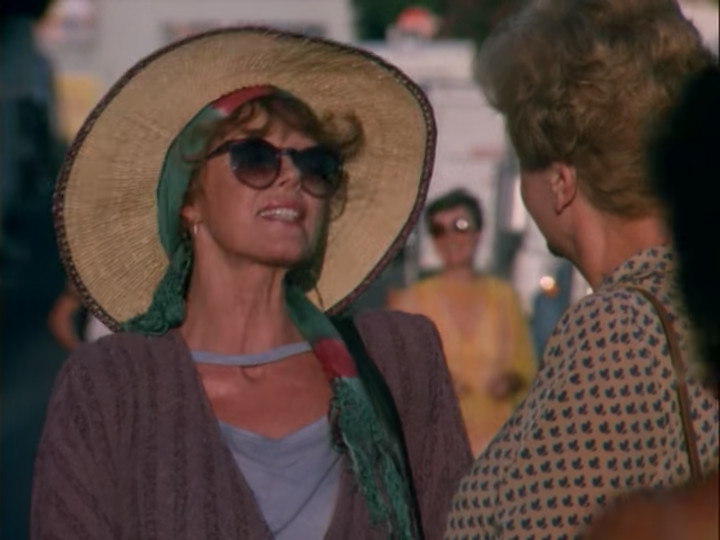
Nothing happens at the funeral, other than Benny loudly sobbing and everyone rolling their eyes at him. I’m not sure who he was trying to impress; no one there had any power over the disposition of Tillie’s stuff. The scene then shifts to Jessica’s house after the funeral, where Amos Tupper visits.

It’s always fun to see that smiling face coming through that door.

Amos missed the funeral because he had to be in court, but while there he ran into Tillie’s lawyer, who told him about the contents of Tillie’s will. Tillie left her house to her grand niece, and the contents of the house to Benny Tibbles. Jessica was named executor of the will. Jessica is honored, but Seth points out that this leaves a lot of work for Jessica, since she’ll need to catalog what all it is so that death taxes can be paid.

The next scene is in a fancy antique shop, where Benny’s younger brother, Wilton, receives a call from Benny.

Wilton is far more successful than his older brother.

Benny asks him to come down to help him with Tillie’s stuff. Initially reluctant, he decides to go when he finds out a customer just purchased a settee for twelve thousand dollars which he bought from Benny for seventy (the $12k would be about $28k in 2022 dollars). He decides to go to Cabot Cove since there might be more where that came from.

In the next scene Eve Simpson, the town real estate agent, comes in and talks to Jessica and tells her that the house is in truly awful condition.

Jessica asks if there isn’t some redeeming feature? She recalls there being a legend about some American revolutionary war figure who slept there. Eve breaks the news that it was Benedict Arnold, which is hardly likely to make the house go up in value.

After Eve leaves, Jessica talks with Emily Goshen, who tells her that Tillie (who was a relative of Benedict Arnold on the wrong side of the sheets) told her that there was treasure in the house, though no one knows where it is hidden.

That night, Liza Adams, Tillie’s grand niece, shows up.

She is a gruff, unpleasant person. She says that she heard that Tillie is dead and has come for her inheritance—in cash. Jessica raises her eyebrows and the scene moves to early the next morning.

Jessica answers the phone and it’s Eve Simpson, who has a gentleman from out of town who is very interested in buying Tillie’s house. Jessica says that this may be premature, as legal ownership hasn’t been established yet, but she will certainly introduce Eve to Tillie’s grand niece.

Seth comes over while Jessica is on the phone. After she hangs up, he notices that Jessica has a squatter in her back yard.

Jessica told Eve, in Seth’s hearing, that she had advised Liza to stay close. When Jessica identifies the squatter as Liza Adams, Seth remarks, “Appears she took your advice. Couldn’t be much closer unless she moved in.”

The scene then shifts to Tillie’s house, where Jessica is taking inventory and Seth is sitting around complaining about how Tillie never threw anything out. Jessica then pauses to reflect on the sampler on the wall, saying that she’s gone past it many times but never really noticed it.

Samplers normally have an alphabet and a homely motto that shows off the worker’s skill. Whoever made this one was short on either skill or patience. (That’s Jessica’s appraisal.)

Shortly after, Benny, his Brother Wilton, Wilton’s lovely assistant, Liza Adams, and Emily Goshen show up (at slightly separate times) and, though bickering, insults, and general unpleasantness, all establish that they all have motives for whichever of them is going to be murdered.

Later that evening, Mr. Andrews—the gentleman from out of town who’s interested in buying Tillie’s house—shows up at Jessica’s house.

He’s hoping to get a look at the house. Jessica asks why he’s so eager and he explains he has a fascination with Benedict Arnold. He had worked in cryptographer during the war (World War 2) and in doing so worked with Americans, one of whom was a new Englander who made a joking reference to General Arnold’s mistress. He’s been writing a book on Benedict Arnold from a whole new perspective, and he requests to see the house.

Jessica says that she can’t let him in on his own and is so far behind in her writing that she can’t spare the time to accompany him. She offers to arrange with Eve Simpson to show him the house the next morning. He thanks her and leaves.

The scene shifts to somewhere—I think Benny’s pawn shop—where Wilton is adding numbers on an antique adding machine.

You have to admire a man who wears formal clothing to try to cheat his brother.

After each number he enters, he pulls the handle back to add it to the total. I can’t imagine why the thing is there. Perhaps to show how utterly cheap Benny is that he hasn’t bought an electronic calculator in the decades that they’ve been out?

Anyway, Wilton makes Benny an offer which is ridiculously low and Benny ridicules it, then tells Wilton to leave. Wilton tells Benny, “Well, there’s more than one way to skin a cat.” Benny says that he’s heard it all his life and still doesn’t know what it means. “Be careful,” replies Wilton. “You might find out.” This raises the odds of the victim being Benny, but there were no witnesses to the threat, which is unusual for Murder, She Wrote.

The next day Jessica and Seth come to Tillie’s house but find the door unlocked. When they go in the door to the den is open, too. Jessica suggests perhaps Emily came back, and tells Seth to remind her to ask Emily for her key.

Then they find the corpse.

This looks a lot more like the body fell, lifeless, than the typical Murder, She Wrote corpse

Seth goes to it and turns the corpse over, recognizes it as Benny, then takes a pulse and pronounces him dead.

Then we go to commercial break.

When we come back, Amos Tupper is at the house, investigating. He identifies the poker by the floor as the murder weapon and goes to pick it up until Jessica stops him and points out it should be checked for finger prints. Seth puts the time of death at around midnight, give or take an hour.

Eve shows up with Mr. Andrews, who asks about the presence of the ambulance and police car, but Eve tells him to nevermind all that and begins showing him the house. Then they wheel the body through. Eve tries to keep showing him the house but Amos puts the kabosh on that. Mr. Andrews agrees, saying that he’ll have to see the original part of the house some other time.

Some conversation ensues in which it comes out that Mr. Andrews intends to buy the house, have it dismantled and shipped to England, where it will be reassembled as a shrine to Benedict Arnold. Amos is none to pleased at this, taking a more traditional American view of Benedict Arnold, and is sent by Jessica out to get his police tape while he mutters, “next thing you know we’ll be celebrating Mussolini’s birthday.”

Mr. Andrews takes his leave and Eve stays behind to tell Jessica that she is in dire financial straights and desperately needs the sale of this house. She asks Jessica to give her some support in getting it sold, and upbraids the doctor for doing nothing. After she leaves Jessica remarks to Seth that Eve’s behavior is strange; she never even asked who had been murdered. This is an interesting detail; I don’t know that it makes Eve a suspect, though. Her interest is in selling the house and murdering Benny couldn’t help with that. If anything, it would get in the way since he was going to clean out all of the junk which a buyer wouldn’t want to have to haul away.

Seth and Jessica begin their inventory work, and Jessica notices that the sampler is missing. Seth says that there was a picture of it in the gazette last year; Tillie stood in front of it for a picture for her ninetieth birthday. He’ll see if he can get her a copy.

He wonders if everything will go to Kevin and Jessica suspects it will, then wonders how many people will attend Benny’s funeral. In the next scene we get the answer:

Nice that it’s a different coffin & flowers even though this was probably shot minutes apart.

It’s the same number as attended Tillie’s funeral. Like at Tillie’s funeral, the scene lasted a few seconds and no one spoke a word.

The next scene involves Wilton, his assistant, and Kevin, and further cements that they are unpleasant characters. The one practical upshot is that Wilton and Kevin agree to go in together to buy Tillie’s house so that they can take possession of the antiques inside of it without Liza Adam’s interference. (That said, while Liza spoke some nasty words about Benny’s taking the stuff he inherited, she’s not actually causing any trouble for the disbursing of the goods. The holdup, if there even is one, is that Jessica and Seth are taking a long time to inventory the place.)

After that, Jessica talks to Liza Adams, who heard about Benny’s murder on Jessica’s radio and who was not in her tent last night because she went out for a walk. Also, she has no form of identification, having burned her birth certificate in 1970 and her driver’s license in 1972, which Jessica points out will make it difficult for her to establish a legal claim to the house. Liza is offended by this, rather than taken aback that her actions rendered it difficult for people who don’t know her to recognize her claim, proving that she’s stupid and unimaginative.

Hippy Moonbeam leaves and Eve Simpson calls Jessica and asks for help. She’s got a second bidder on Tillie’s house, but Mr. Andrews insists on seeing the rest of the house today. Can Jessica show him around? Jessica reluctantly agrees.

That evening, she shows Mr. Andrews around in the house. Just as they’re getting to the original room the doorbell rings and Jessica excuses herself. It turns out to be Amos who saw the light on and wanted to check that everything was OK. When they get back to the room, the light is on and Andrews is standing by the fireplace, soaking in the presence of Benedict Arnold. He talks about how magnificent it is, then excuses himself as he has to go home and write down the feeling before he loses it. Amos offers to give Jessica a ride home, which she accepts.

On the way out of the room Amos goes to turn off the light but there’s no switch by the door. Instead it’s on another wall by a bookshelf.

That is a weird place for a light switch.

Amos remarks on how this is a strange place for a light switch, and Jessica explains that when they wired up these old houses they sometimes had to put things in rather strange places. What she doesn’t explain is why anyone bothered with a light switch in such a strange place. If a switch is that far out of the way, it’s easier to just use the knob or pull chain on the lamp itself.

They talk about the case as they leave and Amos says that his deputies looked all over the house and couldn’t find any sign of forced entry. If Benny got there after the killer, then the killer had to break in unless he had a key. The only people with keys, though, were Jessica, Eve Simpson, and Emily Goshen. The sheriff suspects Emily, but Jessica can’t bring herself to think that Emily is a thief, to say nothing of a murderer.

In the next scene Emily Goshen breaks into the pawn shop and tries to steal the brooche she was trying to buy back earlier in the episode, but she’s caught by Kevin and Wilton’s assistant who heard the sound of the breaking glass while they were discussing antiques in the next room.

Whatever they were doing, the state of their clothes and hair shows it wasn’t athletic.

Amos gets Jessica out of bed to come get Emily Goshen, as apparently they only have a single cell and he wouldn’t want to put a drunk in with Emily should one be arrested before morning. This clearly isn’t Jessica posting bail (Jessica later says that the Sheriff is releasing Emily into Jessica’s custody), so I guess Jessica is supposed to lock Emily up in a closet in her house?

Anyway, they get Emily out of the cell and upon seeing Jessica Emily asks if Jessica has been arrested too. Jessica asks Emily if she understands why she’s been arrested and Emily replies, “I can’t say that I do.” I guess she’s supposed to be mentally retarded? She didn’t seem like it before, but from this point on Jessica talks to her as if she’s a child and she replies much as if she is. Jessica asks if Emily took the sampler on the wall and she says that she wouldn’t want it. The words on it didn’t make any sense.

The next day Seth is over at Jessica’s house with a blow-up of the section of the photo that had the sampler in it. Jessica points out that Emily is right, the words don’t make sense. It should be “Pause and Relfect” not “Reflect and Pause”. Then Jessica suddenly realizes what this means: it’s a key to the treasure. Jessica looks at the picture of the sampler in the mirror. Most letters stay the same in the reflection, but capital ‘E’ becomes a 3 and the small ‘r’ becomes a 7. Seth points out the B, so it’s 3B7. Jessica figures that this might mean the third brick in the seventh row on the fireplace.

Jessica decides to set a trap by calling Eve Simpson, who was concluding a deal where Liza Adams was selling the house to Wilton for a handsome price, to tell her that the building inspector said that the fireplace was about to collapse and that the house would be closed until the fireplace was completely rebuilt. This is a little ironic because fireplaces are generally the most structurally sound part of a building—they’re masonry resting directly on the foundation. They often survive the building burning down or rotting away. That said, it’s not like anyone Jessica was trying to bait was likely to know that. Seth, who was standing next to Jessica, remarks, “Now that’s what I call throwing the fat into the fire.”

(For those not familiar, fat, once in a fire, will burn very intensely, producing a large flame.)

We next see the murderer letting himself into the trap:

The figure remains in shadows, his face framed out of the shot as he walks along with a flashlight, giving us time to talk over who it is with the people we’re watching with.

The murderer removes the brick in question and Amos switches on the lights, remarking, “Looks like you were right, Mrs. Fletcher.”

Then we see who the murderer is.

I wonder what the purpose of the burglar costume is.

Jessica presents the theory that he let himself into the house and found the sampler while he was looking for the den. Being a cryptographer, he recognized the simple code and knew at once what it meant. Benny surprised him and was an excitable person. Mr. Andrews figured he could kill Benny to keep him quiet and return later, so he killed Benny, then stole the sampler on his way out in order to prevent anyone else from figuring out the secret.

Mr. Andrews points out that this is pure conjecture and he will swear that he knew the location through other sources. Jessica then points out earlier when he revealed he knew the location of the light switch despite it being in a stupid location since he found it in a few seconds, in the dark.

He crumbles at this and admits his guilt. He asks if he can take a look at the contents of the hiding place, and Amos says that it can’t hurt and he is curious, himself. Andrews looks inside and find a box which contains a very old letter. Andrews says that if his theory is correct, the document will prove that Benedict Arnold was under the direct orders of George Washington when he surrendered West Point to the British.

It turns out to be an angry letter from Benedict Arnold’s mistress saying that he betrayed not only his country, but his mistress with one of her maids.

Andrews remarks, “It’s ironic. It seems that I, too, was betrayed by Benedict Arnold.”

The episode ends in Jessica’s house, where she makes a present of the chess set from Tillie’s house that Seth fell in love with because it was an 18th century British chess set with intricate workmanship—he saw one like it in a museum once. After Seth thanks Jessica in a very unpracticed way, they sit down to a game of chess and we go to credits.

This was better than the last two episodes, but it was not one of the greats. It’s also much better in the way I related it, with most of the scenes of anyone with the last name Tibble in them left out. Both generations of Tibbles were terrible, the older generation focused on greed and the younger generation on greed and lust (I’m counting Wilton’s assistant as an dishonorary Tibble for these purposes). Emily Goshen was unpleasant in every scene she was in and Liza Adams really should have been shot. Eve Simpson, who is, as always, a comedic figure, was practically having a panic attack in every scene instead of being funny. That’s the majority of the characters in the episode.

Standing against this, Seth was a lot of fun. He’s often a curmudgeon, but in this episode his sense of humor wasn’t nearly as biting as it often is and his detachment was, most of the time, detached amusement. He was one of the bright points of the episode.

Amos Tupper was also fun in this episode. He wasn’t at his best, but he was in good form. (As a side note, this is the last episode he appears in.)

Cabot Cove outside of Jessica’s house didn’t show up too much, but Jessica’s house did show up a lot, which is always pleasant because it’s familiar and homely. Jessica is at her best in Cabot Cove, and especially in her home.

Alistair Andrews, the Benedict-Arnold loving Brit, was mostly enjoyable. He was constantly impatient, which wasn’t great thought it was necessary to the plot, and at least he was impatient in a very polite way. It also helped to give him character flaws which make him turning to murder more plausible. It was not wildly plausible, but by Murder, She Wrote standards it was in character. It at least wasn’t directly contrary to both his immediate and long-term interests, though, unfortunately, it wasn’t directly in line with them, either. It would probably have made more sense to just offer to pay Benny for the letter, or at least a copy of it—it would not have been hugely valuable to anyone else—but he was shown to be impatient and to not have the greatest self discipline. Also, fun fact: the author who played Alistair Andrews played Robin Hood in the 1973 Disney movie of the same name where Robin Hood was a fox and Little John was a bear.

There were a few plot holes in the story, though not really major ones. It doesn’t make any sense how Liza Adams heard of her great aunt’s death and got to Cabot Cove so quickly. The last anyone had heard of her was around the time of Woodstock (the Woodstock Music and Art Fair was in 1969, which was 19 years before this episode). No one even knew if she was dead or alive. Since she showed up on the night of Tillie’s funeral, this gives us a rough idea of how much time she had to show up—about a week, at most. How on earth did the news of Tillie’s death reach wherever Liza was in that time? We can expect that there was an obituary for Tillie in the Cabot Cove Gazette, but I doubt that’s a daily paper and its circulation is going to be limited to Cabot Cove. It’s hardly likely that Jessica would have put a notice in more major newspapers, though to be fair that was the thing to do if you have no idea where the relatives are. That said, even if she did, I can’t imagine that Liza would regularly read the obituary section of major newspapers. And she didn’t seem like the sort to have friends, let alone friends who would read the newspaper and tell her about it. (I’m not counting this has a major plot hole, by the way, because the episode would have been improved had Liza been written out of it, and that would certainly have solved this problem.)

It’s also never explained how Alistair Andrews managed to make a duplicate key to the house for himself. How would he have stolen the key to have a duplicate made? I suppose he could have stolen it from Eve Simpson; this is not as hard to work around as Liza Adams hearing of her great Aunt’s death. It would have been nice to have it addressed, though.

Another minor plot hole is that it’s not explained why Benny showed up to the house at night (the night he was murdered) despite not having a key and thus not being able to expect to get in. What possible motive could he have had to go to the house and peer in the windows so late at night?

There’s also the question of why anyone hid this letter from Benedict Arnold’s mistress in the house and kept it secret. I can’t really see a possible motive for this. Still less can I see a motive for it that would extend as far as creating a sampler with secret instructions as a sort of homely treasure map. Who could have thought it valuable but also in need of such secrecy? And since the house belonged to Benedict Arnold’s mistress, why would she write the letter and then not send it but keep it in her own house in a secret hiding spot and then make a low quality sampler as a coded treasure map to it? Who could she want to hide it from? And who could she have wanted to find it?

(On the plus side, Benedict Arnold did actually go through Maine, though I doubt by where present day Cabot Cove would theoretically be, so having a mistress in Maine has some slight historical plausibility.) Still, though there is no obvious solution to this problem, it can be waved away through the quirks of people long dead. Human beings do occasionally do strange things, and when we know so little about them because they’ve been dead for two hundred years, who are we to say that it didn’t make sense to them at the time?

A related problem is why Alistair Andrews removed the sampler. As a cryptographer he could recognize the code, but it wasn’t likely anyone else would have—most of them had seen it for years and took no notice of it. This wasn’t something just discovered in a box, it was hanging on the wall in front of the noses of everyone but Andrews. And, in fact, removing the sampler had the predictable effect of drawing attention to it. This could have been fixed by simply having taken the sampler down to examine it and put it back up slightly wrong because of some mishap, or having disturbed the dust that Emily Goshen never disturbed, or something like that.

Those are the only plot holes that come to mind. Compared to the previous two episodes (A Very Good Year for Murder and Murder Through the Looking Glass), this is doing very well!

Not really a plot hole but just a kind of loose thread, Eve Simpson’s odd behavior of not even asking who was murdered was never explained. It was only ever meant to confuse suspicion, of course, but it’s always nicer when those red herrings get explained in the story.

The main problems with this episode were related to the characters, not the plot.

This episode is marred by a lot of scenes that are both hard to watch because of the characters in them and are also irrelevant to the mystery. Mostly these involve any of the Tibbles and/or Wilton’s assistant, though Emily Goshen is such an unpleasant character that I can’t think of any scene with her in it that’s a good scene. I also don’t understand whether she was meant to be mentally retarded or not. She seemed to understand what was going on some times, but not others. Not understanding why she was arrested for breaking and entering in order to steal something suggests she should be in somebody’s custody who has power of attorney over her. On the other hand, living independently and being hired to do cleaning for an old woman suggests that she was trusted on her own.

One real lesson of this episode is the difference between making a character unpleasant and making him a suspect. Most of the characters were unpleasant, I suspect to try to cast suspicion in their direction. But none of them were given motives. Well, that’s not quite true—Kevin could have murdered his father to inherit the family pawn shop—he asked his father for money to go start his own business in Boston and was refused—and Wilton could have murdered his brother because Benny dismissed him and he thought Kevin might have been easier to manipulate. Neither of these seems a serious possibility, though. Wilton is too delicate to commit murder, and his assistant was only really interested in getting her leg over Kevin (to use a British expression). Kevin was, perhaps, a bit more plausible, except that as a jock type that likes restoring old cars it’s hard to see him coveting a pawn shop—and it would be a hard thing to convert into ready cash.

This brings up a problem with Murder, She Wrote as a game where you’re supposed to guess who did it that applies to the concept of fair play in general but is especially significant in Murder, She Wrote—it’s very hard to account for plot holes when trying to make deductions. There was no way for Kevin or Wilton to get into the house before Benny, but it was kind of a plot hole that Alistair Andrews had a key, too. None of the Tibbles had a plausible motive, but Alistair Andrews’ motive was… not very convincing. If a Tibble had wanted to put an end to Benny, they could have done it anywhere—but there was equally no reason for Benny to go the house at night. This makes guessing the murderer as much an exercise in mind reading as it is in deduction. Even if a particular episode doesn’t have plot holes, since so many other episodes do it still requires telepathy to know that this one is the exception. That said, I suspect that the best we can do is to guess at who the murderer is if there are no plotholes, and merely give ourselves credit anyway if the episode’s murderer required a plot hole to do it.

Next week’s episode is Just Another Fish Story, which is a Grady episode. Those are always fun.

Murder, She Wrote: A Very Good Year for Murder

In the later half of the fourth season of Murder, She Wrote was the episode A Very Good Year for Murder. The episode is set in a vineyard, so the title is a reference to a thing commonly said of wines. Fine wines don’t really enter into the murder, though, so the pun, such as it is, is not great. Pretty scenery, though.

The title card is an overview of the Gambini vineyard. We know because of a voiceover provided by Marco Gambini. The Gambinis grow the finest grapes in the world, using love. The voiceover turns out to be a conversation between Marco and Jessica, as they walk their horses on a trail:

I imagine that actors walking horses is less expensive than having the actors ride them.
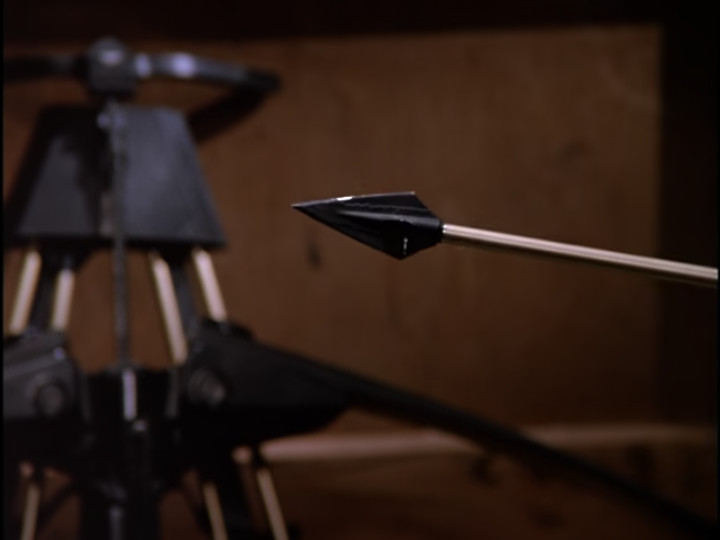
Can you believe that a penniless immigrant (his father) created all of this from nothing, he asks? Speaking for myself, I can’t. And I don’t even mean that only God can create ex nihilo. I strongly suspect he had to have some seed money to at least buy the land and some starting grape vines (grapes are grafted, not grown from seed). Still, it does help to establish characters; there is an intense sense of ownership and pride in the vineyard because it was built by the family. There’s also a weird exchange where Marco says “Papa did all of this” and asks Jessica what she thinks and she replies, “I’d say that you are very proud of him, Marco.” Answering a request for an opinion with not giving one is normally an insult, since it implies that anything you could say would be too painful and you’re trying to spare the other person. Marco takes it well, though, saying, “Proud? You bet.”

Jessica is in town for Papa Gambini’s seventy fifth birthday party, because apparently she’s an old friend of the family. How a school teacher in Maine became a family friend of rich vineyard owner in California, I doubt we’ll get an explanation for because I don’t think an explanation is possible. One advantage of Jessica being in her sixties is that she’s had a long time to make friends. Still, this is stretching things, given her small-town backstory.

Here, by the way, is the family mansion:

We then meet one of Marco’s children, Paul, and also (to my surprise) find out how Jessica is a family friend:

It turns out that she used to tutor Paul in English, and in fact Jessica is the reason he was able to stay on the football team in… they don’t say. College is the most likely answer, but how on earth would a kid from California require summer tutoring in English from a high school English teacher in Maine? Are we to suppose he somehow ended up playing football for a university right next to Cabot Cove that had a major football program that fed to the NFL? Jessica’s backstory was that for most of her life she lived in a small town (Cabot Cove), teaching English in the local high school until she retired. She only became a literary titan when her nephew Grady stole a manuscript for a murder mystery that she wrote—to keep busy during her retirement—and showed it to a publisher. (This happened in the pilot episode, The Murder of Sherlock Holmes.)

All that said, stranger things have happened. But how did she go from tutoring Paul in English to being a family friend? Even if Paul was somehow in Cabot Cove during the summers he was at college, that doesn’t explain how any other members of his family met her.

Anyway, another of Marco’s children arrives. His name is Tony:

He introduces himself to Jessica as Paul’s younger brother, and she says that she remembers him. No details on where or how, of course. It’s clear that she hasn’t seen him in years, though.

Paul asks Tony if their sister is coming. He says that she is, presumably with her latest boyfriend. Tony and Paul explain to Jessica that their sister has a constant stream of new boyfriends which she uses to make her father think that she’s going to settle down, but it’s just for show as she’s having too much fun being free. We then meet their aunt, Marco’s sister, Stella:

She tells Tony in a disappointed voice that she got a message from a “John” in Tahoe. John apparently knows horses like Tony knows nuclear physics, which is said in a way that suggests John knows a lot about horses and Tony knows a lot about nuclear physics. He goes off to see about the phone call. After Tony leaves, Paul remarks to Jessica that Tony has a gambling problem, which is a pity because he’s got more brains than the rest of the family put together.

We then meet two more characters:

The woman is Fiona, Marco’s wife. The old man is Salvatore Gambini, the patriarch of the family and the immigrant that Marco spoke about building the vineyard up from nothing. She’s trying to get him to take his medication, but he out-stubborns her and she gives up and hands the pill bottle to Jessica as she leaves. Salvatore asks Paul to leave her and Jessica alone.

Paul overhears Tony on the phone with some gambling associate; there’s not much to the conversation but Tony tells his associate to not threaten him, and moreover he’s definitely good for the money he owes.

We next see Salvatore showing some special wine to Jessica that they’ll have at the evening meal; it’s made from special grapes from northern Italy that he imported 18 years ago and he only drinks it with special people. He then talks to Jessica about how, when he’s dead, all of this will belong to Marco, and he hopes that Marco and his children will value it as much as he (Salvatore) does. He clearly doesn’t believe that they do.

Jessica goes to the kitchen and talks with Stella. She says that Salvatore doesn’t look as good as he should. Stella explains that there’s a company from out east who wants to buy the vineyard. Salvatore is fighting it, but how much fight does he have left? Jessica reasonably points out that if Salvatore doesn’t want to sell, that’s the end of it, but Stella refutes this by saying that the men who want to buy the vineyard wear suits. (I’m not kidding. Her exact words are, “Do you know what kind of people we’re talking about here? Men in fancy suits who make screwdrivers and shaving cream.”)

The conversation is interrupted by the arrival of Michelle with her boyfriend-of-the-week, Ben Skyler. (Michelle is the wayward sister Paul and Tony talked about before.)

I will miss giant hair and shoulder pads when we get into the later seasons.

Paul and Tony come out to meet their sister and are introduced to Ben. He makes some small talk which makes Ben seem as dumb as a box of rocks, then they go in.

The camera pulls back to Marco’s room, where he was watching this happen through a window. Fiona is sitting on a chair in front of a mirror in a dressing gown, brushing her hair. He mutters frustration at how Michelle can’t keep a boyfriend, but Fiona changes the subject to how oppressive living on a vineyard is and how she and Marco are just part of the farm equipment. Fiona is not at all a sympathetic character, and I suspect that she’s being set up as a suspect for Salvatore’s murder. Time will tell, though.

The scene shifts to dinner, which is quite awkward. Paul talks about his recent football games which Stella finds offensive because of the violence. Tony accuses Paul of accepting bribes to throw games, or at least that the team is even if Paul isn’t. There’s a lot of complaining and not much in the way of manners. Marco interrupts the bickering with a toast to his father. Salvatore then makes a speech about how happy he is to have his family (plus Jessica, who is like family) gathered together, and how it warms his heart that they will all toil for the rest of their lives on his precious vineyard, long after he’s gone. (That’s not quite how he puts, but it’s not too far off.)

The next morning Tony wakes Salvatore to tell him that he’s got to run off to Tahoe for business but will be back in time for the party—he’s chartered a plane. Salvatore is very understanding. He intends to sleep in, though, so he asks Tony to go fetch some wine from the basement so it can be decanted. He then tells Tony not to do anything dumb, and that if he gets in trouble he should come to his grandfather.

As Tony goes into the cellar one of the steps gives way and he falls. The rest of the family wakes up and finds Tony on the floor at the bottom of the steps.

Hard to see how he hit the front of his head but is lying unconscious on his back.

Then we go to commercial break.

When we come back, Tony is sitting on a stool in the kitchen having his wound cleansed by Stella.

Jessica goes to the cellar, where Paul is installing a makeshift new step. Jessica examines the old step. Paul remarks that it’s just an old step that gave way. Jessica says that in spite of the splintered wood, it’s obvious that the step had been sawed through:

The prop department went to town on this board.

Maybe this is a Californian wood I’m unfamiliar with, but that’s not how normal wood breaks when you support it on two ends and put pressure in the middle. For one thing, the fibers are bent in both directions (up and down). Really, the fibers look like they were raised by being banged with a hammer edge-on, or perhaps with a chisel. When wood fails from weight being applied to the middle, it’s one of two ways: either you get tensile failure (the fibers are pulled apart from each other) or you get delamination (layers of wood grain that correspond to growth rings separate from each other). This is neither of those.

Perhaps worse, the part of the board that was clearly sawed through is about 5% of the total cross-sectional area of the board. On a step as big and thick as the one shown, that wouldn’t even make it creak. There’s no way it would not result in catastrophic failure.

Now, based on what Jessica said, it is established that, plot-wise, the board failed from being tampered with, so that’s what we need to base our understanding of the plot on. So, we’ll do that. I just don’t understand the purpose of a close-up of the evidence that’s completely wrong.

Paul and Jessica don’t do anything with this information, though. The scene shifts to Tony leaving to go to Tahoe and having an argument with his father while doing it, but it’s just yelling and a rehash of what we already know. Then we move on to the party that night.

Jessica strikes up a conversation with Ben Skyler. He’s not dancing with Michelle, and Jessica asks if it’s not his kind of music. He says that when it comes to dancing, he’s all thumbs. He then tells her that he grew up on a little farm outside of Moline, Illinois, and wrote stories. He asks for advice on novel writing. Jessica’s advice is to read, read, and read some more.

This isn’t the worst advice in the world, to be sure, but at the same time writing is actually pretty important, too. Writing is a skill that takes practice, and some advice about going for it and not waiting around until you think you can do it perfectly would probably be better advice than just doing copious amounts of reading.

Be that as it may, Jessica says that she’s in the middle of a gripping novel by P.D. James. Ben says that he loves “his” (James’) work. Jessica corrects him that P.D. James is a she, not a he—the P is for Phyllis—and Ben laughs and says that he knew that. This establishes pretty clearly that Ben is lying, though not why. Whatever the reason, though, he clearly isn’t the sharpest light bulb in the picnic basket

Later on at the party the local police chief, Thaddeus Kyle, introduces himself to Jessica and asks her about the accident that morning. He’s got men stationed around the place, and asks if she has any ideas who might have done it—he’s heard of her reputation as an amateur solver of crimes. Jessica demurely says that her reputation is exaggerated, then gets down to business but doesn’t have any ideas.

The next morning everyone gathers in the kitchen and Salvatore invites Jessica to pick the wine for lunch. They go down to the wine cellar and discover Ben Skyler, dead on the floor.

The wine cellar’s constant temperature should help with the time of death.

This was definitely an unexpected turn of events. It’s hard to imagine who could want the poor dope dead. No one even knew him.

Anyway, as soon as Jessica stoops over the body and announces who it is, we go to commercial break.

When we come back Thaddeus Kyle is overseeing the body being put into an ambulance to be taken to the morgue. Then Jessica questions Michelle and asks if Ben could have had a heart condition she didn’t know about. Michelle says that she didn’t really know him well. She met him eight weeks ago when he came to the agency she works for and asked her boss for a copywriting job.

Jessica confers with Thaddeus and he tells her that the doctor puts the time of death at around 2am, give or take an hour. The cause of death is uncertain, but could be poison. Another thing that concerns Thaddeus is that the door to the wine cellar was locked, and there’s only one key—Salvatore’s. He keeps it in the nightstand by his bed. Jessica asks if Thaddeus is accusing Salvatore, and Thaddeus says no, someone could have copied the key or even borrowed it while the old man was sleeping—he’s reputed to be a sound sleeper. What he’s getting at is that it points at someone inside the house.

Jessica asks to see Ben’s luggage, and Thaddeus agrees. They go to do it and it’s revealed that Marco was listening in from behind a nearby door.

I know that look. It means he’s not the killer but we’re supposed to think he is.

Jessica and Thaddeus go through Ben’s luggage. Jessica finds a receipt from a gas station in Long Island City, NY. It’s dated nine weeks ago, which is one week before Michelle met him. However, he had told her (in their brief conversation) that he had spent the last four months in California researching lost gold mines. Jessica wants to know why he lied about that. Thaddeus points out, reasonably, that he didn’t exactly lie; a short trip to New York City over two months ago would hardly be worth mentioning in small talk at a party. Jessica admits the possibility in a way that makes it clear she doesn’t believe it for a second.

This is a weakness that Murder, She Wrote has because of time constraints. It doesn’t really have the time to put many clues out and very little time for red herrings. As a result, when it tries to make it seem possible that clues are red herrings, it tends to overdo it because it doesn’t have time to provide the counter-evidence that the clue is a real clue. In this case, it isn’t even a little bit strange that the guy didn’t mention being in New York nine weeks ago while making small talk—he wasn’t very conversationally skilled, but irrelevant details are precisely the sort of thing one should leave out at a party when you get a once-in-a-lifetime opportunity to talk with a famous author.

Also, he never actually said he was in California for the last four months. His exact words were, “For the last four months, I’ve been writing every day on a piece about lost California gold mines.”

In the next scene Jessica is snooping around the outside of the house when Salvatore walks up and asks what she’s doing. She says that she’s almost embarrassed to tell him, and he surmises that she’s “playing detective.” She explains that Thaddeus thinks that someone inside the house killed Ben, so she was hoping to find some indication that someone broke into the house. Salvatore angrily says that Thaddeus is crazy for thinking it was someone inside the house. This indignation is odd, since how could an outsider sneak Ben into Salvatore’s private wine cellar? Jessica changes the subject to asking about Ben, though of course Salvatore knows nothing. Michelle has a new boyfriend each month; they’re all the same so why should he take notice? Jessica says that there’s something different about this one. She relates the P.D. James story to no effect, then says that he drove a luxury car and wore expensive clothes, despite claiming to be an unsuccessful writer who grew up on a farm in Illinois.

They’re interrupted by the news that Tony is back. Apparently he didn’t show up for the party as he’d promised; no one mentioned it at the party so this is the first we’d found out about it. There’s some pointless bickering, then a call comes in from Thaddeus for Jessica, so she excuses herself. The Coroner’s report is in and the cause of death was, indeed, poison. (No poison is named. Just… generic poison.) That’s not the only news he has, however. On a hunch, he sent Ben’s fingerprints “to the central file in Washington” (I assume this means with the FBI). Ben Skyler’s real name is Benito Soriano. He is, or was, a hitman for the mob.

(“Benito Soriano” seems to me to be quite a stretch. The guy had no accent; certainly not a NY Italian accent, and I suspect that the actor, Grant Goodeve, is about as Italian as Angela Lansbury. I mention this not to nitpick, but to say that the casting/acting was misleading. I suppose, though, he could have been actually quite intelligent and merely faking his accent as well as pretending to be dumb in order to make people not suspect him.)

In the next scene Michelle is sitting in Thaddeus’ office, telling him about Ben.

I really admire the set decoration. It feels like a real office.

The only thing is that she doesn’t have anything to tell. They met when he came in looking for a copywriting job, one thing led to another, and they went on a date the following evening. Jessica asks who initiated the date and it was Ben. I’m not sure what the point of that is, though, since it would be unusual for the woman to ask the man out, just given social norms. Jessica also asks if he ever tried to pump her for information about anyone in the family, but he didn’t.

Thaddeus lets Michelle go and Marco takes her home. Jessica stays behind to speculate with the chief. He asks who Ben would have been there to kill, and Jessica says that if Tony’s accident was Ben’s handiwork, the target must have been Salvatore. Thaddeus asks who might have done it; he wonders about Tony’s shady Tahoe contacts.

Jessica dismisses this because Tony was injured; Thaddeus says that he just got a bump on the head and for all anyone knows didn’t even fall. The problem with this counterpoint, that otherwise could have raised suspicion, is that we, the viewer, saw Tony fall when he was alone. Be that as it may, both of these arguments seem to miss the fact that there’s no reason to suppose that—if Tony had hired the mob hitman—that he’d know who the hitman was, and still less that he’d know how the hitman planned to perform the hit. Since (I assume) Tony isn’t the culprit, though, I suppose it’s OK that they miss this.

In the next scene, a weird, open-mouthed fellow whose name turns out to be Steve Ridgely shows up at the Gambini mansion in a blue car.

His mouth was open before he got out of the car.

I don’t know why he keeps his mouth open so much of the time; it’s a very strange acting choice. It doesn’t seem to be part of the character, though, as it’s never remarked on. He’s come to talk to Paul, explaining that he took the first flight he could could get when he heard about the murder on TV in LA. Paul suggests that they go for a drive.

As they drive off the scene shifts to Salvatore’s office, where Salvatore wants to know who it is and Marco says that he will ask the deputy later. Right now he wants to grill Tony about the fifty thousand dollar check he wrote when he doesn’t have fifty dollars in his bank account. Tony whines that “they were threatening me!” Marco is furious, and Salvatore tells him to leave. Salvatore then gives Tony a check and a lecture about how he needs Tony to take over the vineyard when he and Marco are gone, since he’s the smart one.

There’s an interesting part to the conversation where he says, “I’m an old man. I don’t have much time left. I don’t want to die with things like they are now.” Tony replies that Salvatore won’t die, and Salvatore corrects him, “Everybody dies. It’s what you do before you die that’s important.”

I like this scene both for the content and the characterization. The episode hasn’t been subtle about Salvatore being concerned with the vineyard, but it does establish that he has a sense of urgency about fixing the problems with his wayward grandchildren, but doesn’t know how to do it.

After this Jessica runs into Steve and Paul. Paul introduces Steve, and Jessica asks if he’s on Paul’s football team. Steve laughs, and Paul hesitates, then says that Steve is an investment advisor. Whatever he is, he’s clearly not an investment advisor.

Salvatore then asks Jessica to come into his office. He’s upset because Thaddeus had called him and asked questions about the company that wanted to buy his winery, because Jessica told him about it. He then yells at her that his business dealings have nothing to do with the death of the hired killer.

Ordinarily, I’d take that to be a slip—that he shouldn’t have known Ben was a hired killer—but since he was recently talking to Thaddeus, it’s possible that Thad told him.

Jessica suggests that it might be related—that the so-called accident was clearly aimed at him, not at Tony. Salvatore angrily replies, “I don’t know what that New York bum was up to. The guy is dead. Who cares?”

Again, this is information that Salvatore shouldn’t know, unless Thaddeus told him, which he very well might have done. It’s also suspiciously bizarre. How could what the “New York bum” was up to not be relevant to his murder investigation?

Salvatore insists that Ben’s death has nothing to do with anything, and the people who want to buy the winery have nothing to do with anything, and in fact nothing has anything to do with anything, and Jessica should just go home.

Jessica leaves to pack her things and we go to commercial break.

When we come back from commercial break, Jessica finds Steve Ridgley sneaking around some room he’s not supposed to be in. She rushes away but Paul catches her before she makes it many steps and tells her that it’s not what she thinks, but he can’t tell the rest of the family. In a private conference Steve shows his credentials—it turns out that he’s a special investigator working for the football commission investigating gambling. There had been rumors that some of Paul’s teammates had thrown some games and Paul was working with Steve to find out if they were true, and if so, who was involved.

Jessica says that she now understands; when Steve heard that a mob killer turned up on the Gambini house, he thought that the mob might have hired a killer to put an end to the investigation. Paul then says that it doesn’t make sense that anyone would go to that much trouble to kill him. They could have killed him anytime, anywhere—he’s a proverbial sitting duck. (Which is a slightly odd metaphor because it is his frequent traveling that makes him accessible, but the point is that one hardly needs to lay months of groundwork to get at him to kill him.)

Jessica agrees, and then in a moment of inspiration says that the same is true of Tony. She doesn’t say it, but she knows of whom that isn’t true.

Clue face.

She excuses herself and goes off to confront Stella.

Just kidding.

After clue face, it’s the kiss of death for Jessica to walk in on you alone.

The odd thing, here, is that Jessica has maintained throughout the entire episode—at least since Ben Skyler turned out to be a hitman—that the real target had to be Salvatore. How she had a revelation of what she already knew, I can’t figure.

Jessica confronts Salvatore and he admits it. He researched all of Michelle’s boyfriends through contacts of his, and when he research “Ben Skyler” he found out who he was. He let Ben come because he figured that him being murdered might finally bring his family together. His health is bad and he only had a few months to live, anyway. He willed the winery to the entire family in equal portions, where none could sell unless they all agreed on it, and wrote up a letter explaining what happened in an envelope marked “To be opened in the event of my death”

Those don’t look like Angela Lansbury’s hands, to me.

Salvatore soured on this plan when Tony was almost killed, so he brought Ben down and gave him a very special wine—the first wine that Salvatore ever bottled. Ben’s palate was so dull he didn’t taste anything; neither the wine nor the poison. Salvatore remarks in disgust that he shouldn’t have wasted the good wine on Ben; he should have given him junk. (How a fifty year old wine wasn’t junk, he didn’t say. Most wines go bad after a few years.) He then asks Jessica to make sure that his family gets that letter and collapses. Salvatore was drinking wine while talking with Jessica and it’s implied, but not stated, that he laced his wine with poison as he was confessing to Jessica. Or possibly that he just kept the bottle of poisoned wine from when he murdered Ben and that’s what he drank.

The scene shifts to a hospital waiting room, where the family plus Jessica and Thaddeus are gathered.

That’s quite the hospital waiting room, even for the 80s.

After a bit, Fiona gets up and walks to Jessica (who is sitting next to Paul) and tells her that they all want her to know that, whatever happens, the family is going to fight to keep the winery. Jessica is very relieved by this, and Fiona continues that she’s been very selfish and never realized how much Marco was like his father—how much he loved the place.

Then the doctor walks in and says that Salvatore is going to make it. He’s asked for Marco. Marco and Fiona go off to his room.

Jessica and Thaddeus then talk, privately. Thaddeus remarks that there are parts of his job that he hates (that he’s going to have to arrest his friend for murder). Jessica points out that the only real evidence against Salvatore is his confession, and it’s fading fast in her memory. By the time the county prosecutor got around to questioning her, she wouldn’t be surprised if she’d forgotten it entirely. Thaddeus thinks on this and remarks that if Salvatore got himself a good lawyer, it would be six months, at least, by the time they got him to trial. By that time, it hardly seems worth the bother of the paperwork. Jessica says, “That was my thought,” and we go to credits.

Overall, I’d say that this was in the bottom half of Murder, She Wrote episodes. In many ways it suffered from the limitations of TV of its era. For example, Jessica is a close family friend of the Gambinis but we’ve never heard of these people before and never will again. Worse, from the perspective of consistent characterization, she is a dear family friend despite the fact that she spent her life teaching high school English in Cabot Cove, Maine, while Salvatore and Marco, if not necessarily their children, spent their lives growing grapes in California. Also, despite being a close family friend, she hasn’t seen them in a long time and this is the first time she’s seen the vineyard. There’s just no way to take this and the characters seriously. But television writers, in the 1980s, largely didn’t take their characters seriously. They were so focused on the individual episode that they generally were willing to sacrifice the characters for the needs of the moment. (I’ve read about this in books about TV screenwriting.)

Another thing typical of 1980s screenwriting was the focus on the drama of the moment. This was driven in large part by the existence of TV remotes and the (comparative) plethora of channels which had become recently available; it was important to always hold people’s attention so they wouldn’t flip the channel. Thus we get the nonsensical drama of Ben Skyler being killed right where Tony was almost killed the night before. It made for a great moment to go to commercial break on. It would really hook the viewer to not flip the channel, or at least to come back after a minute. But it made absolutely no sense.

Ben’s murder was premeditated and carried out at Salvatore’s convenience. Why would he do it in his private wine cellar and lock the door? He couldn’t really expect that the police wouldn’t investigate, and killing Ben in a place where only a member of the family could have done it was just asking for trouble.

The whole thing about Ben having been killed by “poison” was also badly done. That’s just not how cause-of-death works. Poisons kill people by some actual means, such as cardiac arrest, asphyxiation, etc. Cyanide, for example, (in high doses) generally kills by cardiac arrest. If you look at a corpse killed with a high dose of cyanide, you’ll find, basically, that they died of heart failure (I’m oversimplifying). To find out that it was cyanide, you have to run tests to detect cyanide in their body. And so it goes with other poisons; they kill by making some part of the body fail, so to the degree that you can tell how they died, you’ll find that they died of something-failure. It’s chemical tests for particular poisons that let you find out that the poison was in sufficient quantities in the body to determine that it was the poison that caused the whatever-failure.

This is why there are undetectable poisons—because there are no specific tests for the poison. It’s also why there are many detectable poisons that often go undetected—because no one thinks to test for that poison. This is why recognizing the symptoms of rare poisons was a somewhat popular subject in golden age mysteries—without knowing what to test for, the odds of finding it were essentially nil. Without knowing that the person was poisoned, it was very hard to prove that someone murdered his uncle to inherit the title and fortune since as far as anyone could tell, the uncle died of natural causes.

Here, all we have is that Ben Skyler died of “poison.” And this isn’t a detail. The kind of poison really matters; did it kill almost instantly or hours later? That’s going to dramatically effect questions like where was he killed and who did it?

That said, it won’t affect questions like, “how did he get into Salvatore’s locked wine cellar?”

Which is a question which Salvatore really should have asked himself before killing Ben there. It’s a question which should have been central to the investigation and was only dropped in favor of investigating Ben’s background as a mob killer because, I suspect, it would have led directly to Salvatore too quickly.

Also, why did a New York organized crime syndicate want to buy the Gambini winery so badly that they’d first offer a lot of money then send a hitman on a multi-month assignment to kill Salvatore in order to get it? If they just really want to make good wines, there are plenty of wineries in the finger lakes region of upstate New York that they could try to acquire. If they want to make money, making wine isn’t exactly a get-rich-quick scheme. It’s even less of a get-rich-quick scheme if you pay a high price for the winery, which is usually what happens if you make a very handsome offer and the offer gets accepted. So what was the idea?

And why would this crime syndicate pick a dumb hitman to go off to pretend to be Michelle’s boyfriend for months in order to get into the house? Jessica tried to explain it as Salvatore rarely leaving the house anymore, but it’s a big house with few people in it, not a fortress. I assume Marco and Fiona live there too, but Marco works in the vineyard, most days, and I’d tend to assume that Fiona likes to drive elsewhere. It wouldn’t be that hard to wait for Stella to go to the grocery store, or the beauty parlor, or somewhere, and then go into the house and push Salvatore down the stairs. Heck, it would be pretty easy to pretend to be a burglar and kill Salvatore when the old man caught the “burglar”. If he had a flair for the dramatic, he could have just shot Salvatore through a window then left a note saying, “In the old country you shot my father through a window before you fled. Finally, justice has caught up with you.” They might have thought a lot of things, but probably not, “let’s not sell to that eastern company because the crime syndicate that they’re a front for probably had Papa killed this way so they could buy it.”

Becoming someone’s boyfriend for two months is such an uncertain way to gain access to their grandfather, too. She could get tired of him and move on at any moment.

The character of the football investigator was an interesting plot thread, though it was only there for about seven minutes (by timestamps). That’s something of another issue with this episode—instead of front-loading possibilities then working through them, the episode tended to deal with one thing at a time. There was Ben’s mysterious identity, which was answered almost immediately. There was the question of what Michelle could tell us about Ben—which was absolutely nothing. Then there was the mysterious investment advisor, who turned out to be a football investigator two scenes later. Had these things been re-ordered—and had Michelle even had so much as a red herring to tell about Ben—it would have given us a lot more to chew on during the episode.

There’s also an issue that comes up in a lot of Murder, She Wrote episodes, which is that the murderer didn’t have much of a motive for the murder. Usually, though, it’s more that the murderer turning to murder is an over-reaction. This is excusable because we need a murder each week and human beings do occasionally overreact. In this case, it’s contrary to the murderer’s immediate and long term motives. Salvatore permitted the hitman to come because he thought that being murdered might help to solidify the family. OK. But when the hitman proved to be dangerous to others, why kill the hitman? Why not simply tell him to leave? Either he leaves, which makes him not a danger to the grandkids, or he kills Salvatore then and there since his cover was blown, which is what Salvatore wanted.

Then we come to the issue of what Salvatore wants, which is a major driver of the plot of this episode: that all of his descendants will spend their lives working on his vineyard. This is always portrayed as a noble thing, but it isn’t. Don’t get me wrong, there’s nothing wrong with growing excellent wine on a vineyard and making a lot of money by selling it to people. There is just nothing especially wonderful about it, either. It’s simply a way to earn one’s living, and perhaps an art form. There are many ways to earn a living and many forms of art. The vineyard is his dream. To be fair, it’s also Marco’s dream. But if it’s not his grandchildren’s dream, that’s either the way things go or his fault, depending on whether God didn’t make his grandchildren to be wine makers or whether they had the potential to love making wines as he did and were never shown what’s good about it.

I suspect that the grandchildren taking an interest in the winery is related to Murder, She Wrote‘s theme that old things are still good. There was a generational disconnect which existed, and which older people partially blamed younger people for. The younger generation didn’t value the things the older generation did, and they should. Etc. etc. So I suspect it was enough that this had that structure; it was referencing a problem that most of the audience would recognize, so it didn’t need to be plausible in itself.

In thinking about what went wrong in this episode, it seems to me that a big part of it is that there were a lot of characters, but they were all wasted. The grand children had potential, but none of them were taken anywhere with it. Paul is somewhat dutiful but mostly uninvolved. Further, being a professional football player would have made him financially independent of the winery, but this never comes up. He neither seems to show interest in the winery nor disinclination for it; the closest we come is a moment when Thaddeus offers Paul a job as a deputy and Salvatore says no, he’s going to work in the winery when he retires from football. Paul says nothing, positive or negative.

Tony’s gambling problem drives a lot of yelling in the episode, and some lecturing and some sighing, but very little else. Tony isn’t emotionally connected to anyone else, except his father who is angry with him, so his gambling problem just kind of takes up space. I think it was supposed to provide an alternative target for the hitman, but Tony will drive up to Tahoe so that his gambling associates can beat him up, so it’s not a very realistic possibility.

Michelle is barely even a character. She’s in the story to bring Ben to the house. Apart from that and being the occasion of a bit of complaining, she ads nothing to the episode.

When we come to their parents, it’s no better. Fiona resents Salvatore and the winery, even though she married into it, then repents of wanting luxury for no reason we can see.

Marco is angry at his sons for bickering, angry at Tony for gambling, secretly angry at Michelle for not settlng down, and annoyed with Thaddeus for questioning Michelle when her boyfriend turns out to be a mob hitman, as if Thaddeus should just ignore the presence of a mob hitman. Other than a few lines here and there about being proud of his father, all he brings is negativity. Even the part where he’s praising his father, he does negatively: “When I die, I hope the only thing they say about me is, ‘he was the son of Salvatore Gambini’.” Granted, he adds “and that, ‘he was a credit to his father’.” Still, that’s not much in the way of positivity.

Also, when my children come to die, I hope that people will be able to say more about them than that they were my children.

Anyway, with all of these wasted characters, there wasn’t much time to do anything good. Though that’s only a partial excuse; what they had could have been better had they re-ordered it to produce some mystery.

So, I’ve pointed out a lot of problems with this episode; is there anything good to say about it?

Salvatore Gambini’s accent was a lot of fun and the actor who played him (Eli Wallach) played him quite well. The police chief, Thaddeus Kyle, was a fun character. He didn’t get a ton of screen time, but he was intelligent and humble. Murder, She Wrote could use more police chiefs like him.

Ummmm.

I’m having trouble, here. Most of the things that weren’t problems were merely… serviceable. You’d think a California winery would at least provide beautiful scenery, but all we get is an overview at the title card and a narrow path with greenery on the side during the horse walking. There are some overview shots of the house, too, but they’re nothing spectacular. So even the setting is merely serviceable.

Oh well. Next week’s episode is Benedict Arnold Slipped Here, set in Cabot Cove. That’s promising.