Hobgoblins Arrived

I recently got the 20th anniversary DVD of the movie Hobgoblins. Not the MST3K of it, mind you. Look as hard as you want, you won’t see Mike and the bots:

hobgoblins

Granted, that’s not the best screenshot to show it. How about this:

hobgoblins-boss

What’s that, you say? You don’t recognize that from the MST3K episode? Indeed you don’t, and neither do I. I haven’t watched the movie yet, but I’ll be interested to see what it’s like as it was meant to be seen. In my previous experience watching the original movies (MST3K: Werewolf is the only one I wrote up so far), they didn’t cheat by editing the movie to make it more laughable, so I don’t expect that to here, either. But while I’ve only watched up to the title so far, the tone is quite different from the MST3K episode. The impression I got from the episode was that the movie was goofy; watching the original it feels more like mostly-incompetent horror. Certainly the beginning sequence is played entirely straight, even though the tension was so not-tense that you couldn’t cut it with a laser-chainsaw.

Once I watch the entire movie I’ll write up a review of it. I find this sort of dive into movie history to be very interesting.

Articles About The Poor Should Define Their Terms

I don’t have a particular article in mind here, I’m talking about many articles I’ve seen over the years, but there’s almost a genre of article using the poor as a club with which to beat Christians. This originates from the fact that Christians have a very important and undeniable duty to the poor. Christ himself said, in a parable, “inasmuch as you have done it unto the least of these, you have done it unto me”. There’s a lot to say about about the poor, but it seems to me that much of it is never said.

The most obvious thing to say about the poor being, who is the poor. There are lots of definitions which are used in practice, but at the same time the sort of article I’m thinking of almost goes to trouble to avoid defining the poor. The most popular definition implicitly used seems to be “people whose annual income is below 20% of the GDP”. Of course, the moment an author admitted that he was using this definition he’d have very little to say. For several reasons, not the least of which is that someone earning 19% of the GDP and someone earning 1%  of the GDP have very different incomes. In writing the sort of article I’m thinking of, the author always treats everyone in the group as if they’re in the 1% group. But almost worse than this is that what really matters to quality of life (except as modified by envy) is not relative income, but buying power. If it is reasonably possible to feed yourself, clothe yourself, keep your thirst slaked, etc. on 5% of GDP, then this is not the poor Jesus was talking about when he said “I was naked and you clothed me”. There are legitimate things to say about the poor when defined this way, but they’re not the same things one can say about a naked, hungry man who hasn’t had a drink of clean water in a day and a half.

Then there are the attempts to define poverty in terms of access to almost infinitely expensive things like unlimited medical care or financial security. Under those definitions, probably 99% of the population is the poor, so this sort of thing borders on silly. Not silly, but still problematic, is the attempt to define poverty in terms of things like “access to basic medical care”. And indeed one’s heart does go out to people who can’t afford even inexpensive medicines. But here are two big problems with this. The first and most obvious is that no one in Jesus’ day had access to what we now consider basic medical care, and it’s likely that no one alive today has access to what will be considered basic medical care in 200 years. And it would make many things Jesus said absurd if everyone he was talking to was poor because they didn’t have access to penicillin or hydrocodone. The other problem is that much of what we consider basic medical care is worthless or actively harmful. Using antibiotics for a viral infection, for example, leaves you worse off. Powerful opioids which leave you addicted were harmful. Gastric bypass surgery is most likely a terrible idea. And so forth. It doesn’t make sense to be the poor because you can’t harm yourself in the way rich people often do. This is not in any sense to say that it is not a tragedy when people suffer or die from diseases which are easily preventable with a few dollars’ worth of medicine, or that we as Christians shouldn’t endeavor to get those people that medicine. But that also doesn’t mean that people aren’t often glib about what “life saving medicine” actually is or how much it costs.

Then of course there are also simply outlandish things said about the poor. I’ve come across statements like “our entire economic system is built around exploiting the poor”. This is obvious balderdash under any reasonable interpretation. The poor—if you’re not defining them as anyone below the upper middle class—have fairly low economic output. This is not, of course, to blame them, but it remains that the poor don’t manufacture goods, or drive trucks, or provide professional services, etc. Poor people—in the sense of people who, say, can’t afford to eat every day—might possibly wait tables at cheaper restaurants, but this is  not a significant part of the modern economy. It’s a minor luxury which places from McDonalds to Panera show most people are quite willing to do without. The homeless man begging by the subway station obviously has no economic output at all. It’s quite defensible that Christians should be doing more for these people, but it’s utterly untenable that these people are the basis of the modern economy.

(I should note that it’s possible that people are referring to Chinese and other foreigner workers in countries with lower wages than that of the US when they say this sort of thing. If so, there are several problems here which are being ignored. First, that these people are working class, not poor, in their own lands. Perhaps they would be poor if they lived in America, but they’d also be rich if they lived in some parts of Africa. But they live in neither, they live in their own land. Second, this ignores all the goods which are actually made in America, which is—despite propaganda—actually quite large. American manufacturing is far more mechanized than it was 100 years ago or is today in many other countries, so it may be harder to notice this, but the US economy is not based on China. I looked up recent numbers and US imports from China were less than $500 Billion in a year, while the US economy was around $20 Trillion. That is, trade with China made up one fortieth of the US economy. Are there lots of things with “Made In China” on them? Yes. Would our economy crumble if we had to make 100% of our own stuff? Hardly. Even worse for the case at hand, this trade imbalance is a strategic decision on the part of China’s government which has worked to subsidize the export of goods in order to jump-start their manufacturing economy. This means that some of the costs that make Chinese labor cheap are born by the government as a form of investment. N.B. none of this is commentary on working conditions in China, which as I understand are improving but also related to Chinese cultural norms as Chinese factories are largely run by Chinese people. Working conditions should improve in China, but are not related to the present discussion except in the fantasies of people who have no idea how factories are run who imagine that safety standards are extremely expensive when in fact mostly they just require discipline, training, and awareness of how to manufacture goods safely. But—as should be a shock to no one—heat-stroked, exhausted workers aren’t very productive. About the only thing which does cost money is reducing environmental pollution, but pollution affects rich Chinese as well as poor Chinese, since everyone breathes the same air. Again, though, since all of Chinese trade is a small fraction of the US economy, a small increase in cost to goods through the Chinese improving their environmental regulations would have a very negligible impact on the US economy.)

And then there’s the problem with considering the rich in America because we have a fiat currency. That is, our money is not a physical thing of which there is a determinate amount. Our money is created by fiat by our government. (More properly, by a semi-autonomous organization created by the government for the purpose.) The fabulous wealth of the most wealthy citizens is, therefore, highly suspect. Don’t get me wrong, Jeff Bezos and Marc Zuckerberg are both very wealthy men, but even though Zuckerberg should be about to buy something like 42 aircraft carriers with his fortune, he certainly couldn’t. The further fact that much of our economy is debt-based rather than wealth based—while pretty obviously not a good idea—means that figuring out how wealthy or poor someone is is even more complicated. People of very modest incomes have way more buying power than you would expect on paper.

Since this is the internet, I will emphasize that I am not saying that there is no such thing as poverty, or that poverty isn’t a problem. What I am saying is that poverty is a complicated thing, with the word “poor” meaning many very different things. The poor, however one is defining them, should always be an object of love since they are God’s creatures, and not a club with which to beat people. Since everything seems to require a name these days, I suggest the preferential option for clarity.

Fraternizing with the Frank Friar

I had the great pleasure of talking for over an hour with The Frank Friar. Father Nicholas is a Carmelite friar who ministers in New York City. We talked about how he became a friar and a priest, and plenty of other things along the way. If you don’t subscribe to him on YouTube, I recommend doing so. He makes some really great videos reflecting on spirituality which I’ve gotten a lot from. You can of course also watch the conversation on YouTube:

The Irrationality of Lack of Belief Atheism

I’ve written about lack of belief atheism before, and no doubt will again. (Enough that I can’t pick out a particular post to link to.) To give a one-sentence history: it was a failed attempt to get out of having to argue for atheism by then-atheist Antony Flew in a 1973 essay titled, “The Presumption of Atheism“. It really should be a hint as to what the purpose of this move was when the title is saying that he would really rather win by default than have to support his position.

Stupid as such a request is, laziness is certainly an understandable temptation. What I find curious is the depths to which ordinary atheists who seized on it have sunk. Most, if pushed, will claim that their position is a sub-rational one in which their head is as empty as a rock, and therefore absolutely no rational thoughts can be expected to come from them. Though in a sense as a point in their favor, they turn this tragedy in farce by then saying that it is Christians who are irrational. I’ll give one example. It’s been in my thoughts recently because I’m working on a script for a video about it.

Lack of Belief Atheists (who I will refer to from here on out as LoBsters) love to say that “atheism is just a lack of belief, that’s it, nothing else” but do not consider that the alternatives to God not existing entail more than just the proposition that God exists. For simplicity, I’m going to restrict this to Christianity (it only gets worse for the LoBster when you include other religions). The easiest of which are moral proposition. If Christianity is true, then:

  • Forgiveness is good
  • Mercy is good
  • Love (willing the good of someone for their own sake) is good
  • Knowledge is worthwhile for its own sake
  • The truth is worth dying for
  • Fornication is wrong
  • Adultery is wrong
  • Masturbation is wrong
  • Murder is wrong

The complete list would be much longer, but that’s plenty for now. If someone disagrees with any of these things, they are, by logical necessity, holding Christianity to be false. It’s a simple Modus Ponens.

Modus Ponenes:
P → Q
~Q
∴ ~P

Please bear in mind that affirming Q tells you nothing about P. (Trying to draw positive conclusions about P from Q being true is called the fallacy of affirming the consequent.) Modus Ponens in one of the elementary logical syllogisms which everyone who studies formal logic for even a few days learns. So the only way that a LoBster can legitimately claim to lack a belief in whether Christianity is true is by holding that Christianity is entirely correct in all of the morality which it teaches. Well, that’s not quite true. All that they have to hold is that it might be true in all the morality it teaches. But that itself has implications for how one lives, because if an act might be fine and the upside is that it’s fun, or it might be terribly evil, the better bet is to avoid it. So by and large, such a LoBster would have to live almost as if Christianity is true since he holds that it might be.

They don’t do that, of course, but their only way out is to disclaim all rational thought on the subject, and basically on all subjects. (Except Mathematics, of course, but LoBsters seem to have studied almost no math.) It’s really quite sad. Pray for them.


Mills

I was recently looking up mills, and came across this fascinating picture of a Roman flour mill:

Urn_holder_of_Publius_Nonius_Zethus_01_-_Vatican_museum

(Photo Credit: By Chris 73 (Own work) [CC BY-SA 3.0 (https://creativecommons.org/licenses/by-sa/3.0) or GFDL (http://www.gnu.org/copyleft/fdl.html)%5D, via Wikimedia Commons)

I’m so extremely used to the wheel type of mill that this almost shocked me. Just to be clear, I mean this kind of mill:

Hacienda_La_Laguna-Museo_del_Olivar_Y_del_Aceite-Molino_antiguo-20110918-09618

(Photo Credit: By Daniel Villafruela. (Own work) [GFDL (http://www.gnu.org/copyleft/fdl.html) or CC BY-SA 3.0 (https://creativecommons.org/licenses/by-sa/3.0)%5D, via Wikimedia Commons)

Interestingly, the wikipedia page called it an edge mill, and the wikipedia page for edge mills claims that edge mills were invented in China in the third century. Which, if true, means that the sort of mill stone I normally think of as a mill stone wouldn’t have existed at the time of Christ. Perhaps even more interesting, the sort of mill which quite possibly did exist then (the roman one in the first picture) looks to me far more complicated and advanced than the sort of flour mill which apparently superseded it. Very interesting.

The thing which led me to discover this was looking up Friedrich von Logau’s poem about the mills of God. The original poem is:

Gottes Mühlen mahlen langsam, mahlen aber trefflich klein,
ob aus Langmut er sich säumet, bringt mit Schärf ‘er alles ein.

Which was translated into English (according to Wikipedia, by Henry Wadsworth Longfellow) as:

Though the mills of God grind slowly; Yet they grind exceeding small;
Though with patience He stands waiting, With exactness grinds He all.

Snow is Peaceful

There’s something very peaceful about snow. Snow causes all sorts of problems, of course, but it is in fact these problems from which the peacefulness of snow arises. Snow is peaceful precisely because it causes most creatures to go home. But it does more; since it takes footprints so readily, snow also proves when it has kept men away from a place:

20180113_0018

Isolation is not the best kind of peace, of course. Peace, most properly considered, is the ordering of creation according to God’s will. Among human beings, peace refers to harmony, not merely to the cessation of fighting. But in a fallen world one must often accept second-bests, and snow gives us a respite from many of the troubles which burden us in a fallen world.

It is interesting to consider that rain also drives men indoors and away from causing mischief, but rain is not peaceful. It seems to me that this different comes from three differences between rain and snow. The first is that rain is loud. Snow is not only quiet but even muffles sound, a bit. Snow gives one quiet in which to think.

The second difference is that human beings, in our natural state, are rain-proof but are not snow-proof. Except in very cold weather—which is not our predominant experience of rain—going out in the rain will make one wet but do one no harm. This is actually most inconvenient when one is wearing clothes (which is, admittedly, almost all the time). Snow will kill a naked man. Rain is only really a problem because we wear clothing, and then it’s really on uncomfortable. Our retreat from snow is, therefore, more dignified.

The third reason is that snow is less dangerous to us when we have shelter. Rain is just an inconvenience until one gets too much of it, in which case it causes floods which are extremely destructive and deadly even when we have shelter. And while these are unusual circumstances, they’re not unheard of. In the places where people have floods, floods happen every few years, if not more often. In the places that get snow, enough snow to collapse buildings is very rare. Water moves and combines its power but snow mostly falls where it lands. That’s not true of mountains where avalanches happen, of course, but I imagine that snow isn’t nearly as peaceful there.

But in more ordinary places, snow only keeps men indoors where they give each other little trouble, and so it’s deep snowfall is very peaceful.

20180113_0007

Judging The Last Jedi By Its Title

You should never judge a book by its cover, but sometimes you should judge a movie by its title. In this episode I talk about why I judged The Last Jedi as not being worth seeing. This is somewhat a followup on my post Star Wars Movie Titles. You can also watch the video on YouTube:

The Internet Needs Distributed Recomendations

It is widely recognized that centralization, such as one sees in most social media (Facebook, Twitter, etc.) has strengths which bring concomitant dangers. Possibly the biggest danger, and certainly the most pressing on people’s minds, is censorship.

Distributed media, such as blogs, make censorship much harder. However, this has (so far) been at the cost of making discovery much more difficult. Finding new blogs is a very haphazard things, to a great degree relying on cross-promotion in blogs. By contrast YouTube is able to leverage its centralized information to provide a list of recommended videos to the user after each video. Given the massive data available to them of what people watched and how long they watched it for, this enables them to make recomendations for videos which are often good. Almost every YouTube channel I’m subscribed to I found through recommended videos.

It probably goes without saying, but unfortunately recomendation engines are extraordinarily succeptible to manipulation by hosts with an agenda. Moreover, it would be virtually impossible to discover such manipulation as it’s only relevant to people who are not aware of particular video makers anyway.

In order to make distributed media truly competitive with centralized media, what we really need is a system for making distributed recomendations. It’s not immediately obvious that this is doable, unfortunately. A system of distributed recomendations would be a spammer’s dream ifi they could figure out how to manipulate it. In fact, most parties would be deeply desirous of manipulating this system. This guarantees that a lot of effort would be put into trying to figure out how to game the system. Worse, the system would almost certainly need to be anonymous, so as not to track people’s reading habits, which makes fake recomendations all the harder to defend against.

The most obvious approach to avoiding spam would be to attach micro-payments to the recomendation system. That brings with it its own problems, but it also has benefits. There are probably other options, too. Especially if one were to somehow include negative reviews as well as positive reviews, the correlations required to spam people might need to be far too complex to allow for useful spamming.

Anyway, if you know anyone who likes to develop algorithms, try planting the seed of a distributed recomendations network. It may not be doable, but the internet would benefit tremendously from it if it is.

Generational Warfare

Over at Amatopia, Alex wrote a post titled On Boomer Hate. It’s a good post which I recommend reading. Here’s a sample:

t’s trendy to hate Boomers. Literally, everyone is doing it. I did as well. But when something is trendy, it’s usually garbage. But a funny thing happened on the way to critical thinking: I’ve changed my opinion.

The more I thought about generational struggles, the more I realized that generational warfare hurts us all: What I’m getting at is that I think generational warfare is stupid and counterproductive. And I’m not just talking about the young. Us older folks do it too and we should to stop it.

The more I think about it, the more obvious it becomes that the righteous Gen X indignation against Boomers is pretty hypocritical, especially since many of us express the same sentiments towards Millennials.

As they say, read the whole thing. What I find interesting about this is the way my mother—who is towards the end of the baby boom, but still solidly inside it—spoke about the demonization of her generation and the lionization of her parents generation. She objected to both.

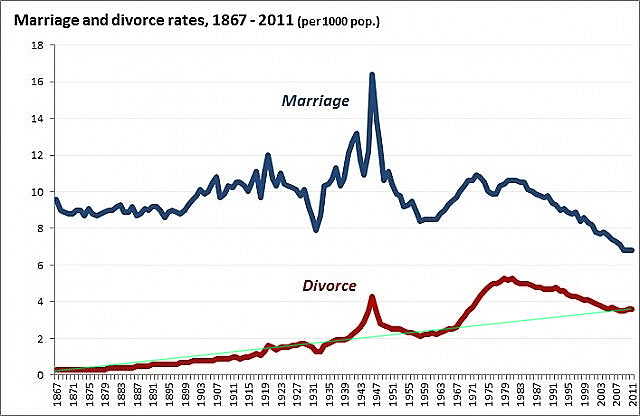
The “greatest generation” were the people who endured the great depression then fought in World War II. It is certainly true that they went through a lot. However, they didn’t do it voluntarily. It was not an ascetic practice, nor (in the main) a job they volunteered for. It happened and there was nothing to do about it and they put up with it as best they could. The great depression, which overlapped Prohibition, was filled with crime, both organized and disorganized. If you look at divorce statistics they had been trending up since the 1860s and showed a dip during World War II followed by a much larger spike afterward:

marriage_and_divorce_over_time 1867-2011 new _with-trend

That spike in divorces afterwards is somewhat typical of how much mother characterized the generation before her: finally done with deprivation, they finally wanted to get theirs. By the way, I added that trend line, and it brings us to another thing blamed on the boomers. People complain about the introduction of no-fault divorce, but if you look at the data, it really seems that no-fault divorce led to a spate of divorces on stocked-up divorces which then let off once the backlog had been processed. Granted, marriage is down and so one would expect divorce to be as well, but it’s very far from obvious that the boomers had any real causal relationship to the boom of divorces which happened in the late 1960s and early 1970s. Especially when you look up the history of no-fault divorce and find out it was done because people were lying about having cause for divorce so often that people feared that respect for the truth was going to disappear.

And so it goes with many of the problems of the boomers. To quote a famous boomer/songwriter, they didn’t start the fire. And they were handed quite a lot to deal with in the form of a deeply racist society, too.

Did the boomers do a lot wrong? Of course they did. Every generation does a lot wrong. We live in a fallen world. Which brings me to where it brought Alex: inter-generational warfare is stupid. There’s no way to judge the raw materials that any given generation was given to work with, and in any event it’s deeply ungrateful. The previous generation gave us life. Imperfect life, to be sure, but life that’s quite a lot better than nothing.

And thinking about it as a parent, it’s painfully obvious to me how imperfectly I’m raising my own children. I suspect something like this applied to every generation. Our children always suffer for our mistakes. It does no good to blame our parents. What we really should do is ask God to have mercy on us all.

Popularity in the Digital Age

I don’t know how many of my readers aspire to publish publicly and have their words read by an audience. I suspect that it’s a fairly large percentage. I know this is something that I have always been drawn to, since I was young. It’s not that I wanted to be famous, though I suspect that all human beings are tempted by fame. Fame makes some very empty promises very loudly. But there are othaser good reasons to want to have an audience. In particular, having an audience enables one to give away knowledge that one has been given. Next to learning, there is nothing more satisfying than teaching. (In learning we are looking at the goodness of God directly, in teaching we are (by God’s gift) taking part in God’s self-gift to others.)

The commonality of wanting an audience for one’s writing, combined with the way that technology has made publishing all but free, has resulted in there being so much writing that finding things is incredibly difficult. Further, with so many options on offer, we all look for those voices which speak to us very effectively. Since there’s so much available, there’s a lot of sifting to find the things we really like. Thus the problem in the age of handwriting was copying, the problem in the age of print was distribution, and the problem in the digital age is discovery. How does one find an audience, which is really the question: how does one’s audience find one?

Aside from large amounts of money, there do not seem to be any sure-fire answers. At least quick answers. How does one get a sizable audience in six months without spending a ton of money on advertising and cross-promotion? Heaven knows. But it does seem to be the case that longevity is a major component of finding an audience without a ton of spending. This is for two reasons, I think.

The first is that much of stumbling into an author that one enjoys reading is by luck, and luck takes time. Over the course of several years, some people will stumble into one’s blog and like it. The other is that recommendation (posting on social media, emailing, etc) is itself something which grows with the size of one’s audience. A small audience rarely recommends posts, a larger audience recommends posts more often. Thus the few people who find one initially will occasionally recommend one’s work in a way that puts other people who enjoy it together with that work. Over time that builds, as well, both because there’s more time for that to happen but also because there’s more time for older posts to become relevant to some conversation or topic.

In essence, the key to winning the lottery is to buy a large number of tickets; the way one does that in blogging is by writing a lot of blog posts over a lot of time. Something similar applies to YouTube channels, Twitter accounts, etc.

Once again it turns out that patience is the most practical of the virtues.

Game Design and the Rule of Cool

The Rule of Cool is, I believe, actually a TV trope, it applies to video games as well. The variant I’m thinking of is when all inconsistencies between game play and the story are waved away as game play being more important than consistency with the story.

Now, in fairness, games must be unrealistic in order to be games. If a game was perfectly realistic, it would be a simulator, not a game. And people would mostly only do them to train for doing the real version. Thus wounds must heal in seconds or minutes, not weeks or months. Thus is should take minutes to build a hut, not days. And so on; there are a lot of things which need to be cheated in order to have a game and not a simulator. This I grant.

Having granted that, it’s important to point out that it does not follow that no thought should go into how one cheats reality in order to make a game. This is not true, of course, of pure games, such as tic-tac-toe or tetris. But in games that have a story, it is extremely important to consider how the gameplay fits in with the story. Recently I’ve been playing ARK: Survival Evolved, so I’ll draw my examples from there. The one thing that you need to know about ARK is that it’s a survival-type game (i.e. you gather resources and craft tools, structures, etc) with dinosaurs. An the dinosaur models are gorgeous.

Of course, the first problem is that ARK isn’t really a survival game. It’s a team assault game where the weapons are gathered in a semi-survivalist sort of way. I say semi-survivalist because after a certain point all of the resources are gathered by heavy machines. It just so happens that the heavy machines are dinosaurs, but aside from having a setting where they can aimlessly wander around and having a breeding mechanic, they are designed just like heavy machines would be. There are heavy trucks (brontosauri), light trucks (diplodocuses), tanks (rexes), armored assault vehicles (allosauruses), and so on. There are even spy helicopters (pteranodons), attack helicopters (tapejaras) and cargo helicopters (quetzals). You might think that flying reptiles would be more like planes, but they’re all slow, very maneuverable, and extremely good at hovering. The more heavily laden they are, the slower they move. It makes sense as a game mechanic but makes absolutely no physical sense. If a slow moving animal flapped very slowly, it would fall like a rock.

And the problem is that this takes you right out of the story. When flying reptiles are actually swimming through the air in entirely impossible ways, the beauty of the models loses most of its effect. The same is true of the walk-cycles which don’t adapt to the ground, but I think for different reasons.

Granted, walk cycles which don’t use physics to adjust the skeleton in natural ways for locomotion will never look entirely right, but I think that we’d forgive scripted walk cycles far more if the dinosaur which was walking imperfectly was actually moving with a purpose. But in ARK they aren’t. Or rather, they almost never are. On occasion a predator does run at another dinosaur to attack it. But under normal circumstances the dinosaurs simply wander around completely aimlessly. The herbivores do not eat, nor do the walk towards plants. They are simply on a random walk. And I think that the fact that their movements are completely pointless make you far more likely to notice that they’re not walking correctly.

And this problem carries over to appreciating the models for another reason. It’s great that the triceratops looks almost exactly how you’d picture it, but it’s hard to notice that when they’re not behaving at all like how you’d expect. They’re a herd animal. You should see them in groups and they should move around with some relationship to the others in the herd. That they don’t just breaks the illusion even more.

And of course everything has terrible eyesight in ARK. Predators don’t notice prey until they’re within about 50 yards. Prey doesn’t notice predators until the predators have  actually bitten them. No creature in ARK has a nose.

Of course, none of these are likely to be overly noticeable if you’re playing in team-versus-team since you have to be on constant lookout for other teams who will try to kill you if you’re alone.

I should note that the dinosaur taming also suffers from the idea of gameplay-over-story. With exceptions, dinosaur taming is accomplished by using tranquilizers to knock a dinosaur unconscious, then feed it its favorite foods while it’s unconscious. Once it’s eaten enough it then instantly forms a lifelong bond to you where it is willing to go on suicide missions on your command. Granted you have to cheat taming an animal somehow for this to be a game and not as simulator, but this is extremely stupid. Worse, as you are shooting the dinosaur with tranquilizer-soaked crossbow bolts in order to knock it out, once it’s torpor falls below a certain point it realizes that you are trying to tranquilize it and runs away at its top speed. This is very stupid because tranquilizers make animals slower, not faster, but it also makes taming dinosaurs frustrating. There’s also no way to vary the amount of tranquilizer being delivered per shot, so larger, higher level dinosaurs require very large numbers of shots to tranquilize. That’s tedious, not fun. (This is another case where the game is made for multi-player, because using one of the many multi-person dinosaur mounts makes chasing after dinosaurs much easier since one person drives the dinosaur while the other person shoots. It’s also the case that, for example, four people can deliver 4x as many tranquilizing shots so chasing may not even be necessary for teams.)

A mechanic where you feed the awake dinosaur until it likes you would have been much better. This does actually exist with a few dinosaurs, but even here this has been screwed up so that it isn’t too easy, by which I really mean, too fun. There’s a dolphin-like marine reptile which likes to come up to survivors (what the players are called) and nuzzle them. You can give them meat and this tames them, except that once they realize you’re trying to tame them, they run away. This makes no sense, and is no fun. Apparently the most important game mechanic is that the player must struggle for everything.

Ultimately, ARK is an absolutely beautiful games which isn’t very much fun to play in single player mode because its central theme is being a tribal warfare simulator where it takes hundreds of hours to build up assets that get destroyed in a few minutes during a raid. The later stages of the games are even fought with automatic weapons and heavy artillery; the dinosaur seem almost out of place among auto-turrets and C4 bombs.

But the upshot is that the game really doesn’t work as a single player game. It really looks like it should work as a single player game. There should be an enormous amount to do all on one’s own. But it’s mostly ruined by inattention to the story. It’s not possible to suspend one’s disbelief long enough to enjoy it. Which is a great pity because the dinosaur models are gorgeous.
Advance Review Copies of The Dean Died Over Winter Break

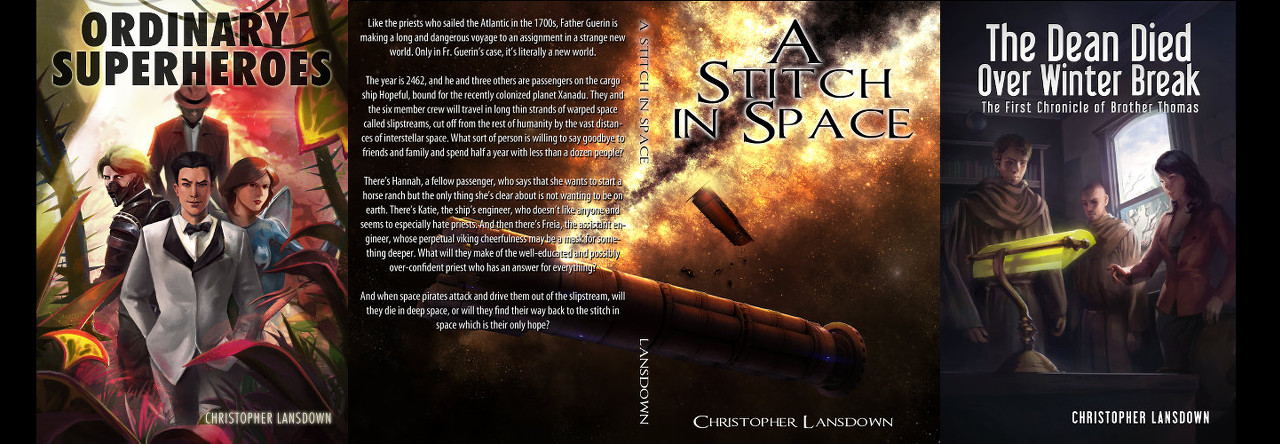
The first bit of news is that Silver Empire Publishing will be publishing my novel The Dean Died Over Winter Break. It’s due out on early February. And as you might be able to guess from the title, it’s a murder mystery.

tddowb

And on that note, if you are interested in an advance review copy of The Dean Died Over Winter Break, please contact Russell at Silver Empire (russell at silverempire dot org). As I understand it the only requirement is that you agree to read it and leave an Amazon.com review on the publication date. Which, I should point out, is a very kind service to perform. Amazon reviews are extremely helpful in connecting books with people who might enjoy reading them.

Falcons Are Murderous Parrots, Not Raptors

At least, so says this biologist. Basically, the idea is that instead of being a splinter off of raptors (hawks and eagles) which specialized for speed, falcons are actually a splinter off of parrots who specialized for speed and meat eating.

The article goes on at length about how shocking this is, but having been very into studying falconry in my youth and having once had a pet parrot (well, a cockatiel, but it’s in the parrot family), I’m actually not very surprised. Eagles (mostly) look kind of like large hawks, but falcons just don’t look much like hawks at all. They actually look more like short-tailed parrots. This is especially true of their wing shape. Falcons have long, narrow wings where the flight feathers stick together forming a (mostly) solid surface. Hawk’s and eagle’s flight feathers stick out independently, looking almost like outstretched fingers. Parrot’s wings look extremely similar to falcon’s wings, with the flight feathers touching each other.

Granted, looks aren’t dispositive, which is the point of the original article. I just think it’s worth noting that it goes out of its way to emphasize the ways that falcons look like hawks but not how they look dissimilar.

And it should be noted that the results of convergent evolution are, in the end, convergence. That falcons are more closely related to parrots than to hawks means very little; you can train hawks and falcons for falconry (hunting), but you can’t train parrots to hunt. Falcons don’t talk like parrots do, and you interact with them much more like hawks than like parrots. Hawks, eagles, and falcons are all fairly solitary creatures.

So while it’s fascinating trivial that falcons are more closely related to parrots than to hawks, it’s not actually useful information. You still shouldn’t name your gyrfalcon polly, or offer it a cracker.

That Story That Modern Screenwriters Can Tell

Recently, I wrote about The Story Modern (Western) Screenwriters can Tell. I realized that the modern story can be put even more succinctly: the main character decides whether he’s going to be completely worthless or only mostly worthless.

Usually the thing which precipitates this crises is that the main character wants to be completely worthless, but the plot makes it such that if he is as completely worthless as he wants to be, many people will die (or at least suffer). In the end, we find out if he’s willing to go beyond himself to alleviate their suffering in the way that only he can do.

This has nothing to do with heroism, but it is mistakable for heroism by people who primarily think in terms of story beats (i.e. of plot points broken down by scene, the way that screenwriters do when writing or editing stories). Real heroism is not about whether someone will do the minimum necessary, but whether he will go beyond what is necessary. At its core, heroism is about generosity. That’s why it moves us so much—it’s about being a true image of God.

I suspect that it’s not a coincidence that modern writing is primarily concerned with how imperfectly the main character will be an image of hell.

What Atheists Would Actually Do If They Came to Believe in God

Apparently there’s a popular type of video for YouTube atheists to do where they answer the question, “If you became convinced that God exists, would you worship him?” I explain what they’d actually do if they came to believe in God. You can also view the video on YouTube:

Star Trek TNG: Sub Rosa

I forget why, but I was recently reading about the Star Trek: The Next Generation episode, Sub Rosa. It was an unusual episode, being described by Memory Alpha as a foray into gothic horror. It was a (sort of) ghost story, centering about an “anaphasic entity” which had been haunting the women of Beverly Crusher’s family. Haunting isn’t quite the right word, as it seemed to live symbiotically with them. Though like all TNG episodes, it had its share of plot holes.

For one thing, it was said to have lived symbiotically with the “Howard Women” for centuries, except that family names are patrilineal, not matrilineal, so they would have been Howard women for a single generation. (You could get around this by skipping a generation, going from grand-mother to grand-daughter, which happened in the case of Beverly Crusher but didn’t at any other time.) I bring this up not to nit-pick, but because it’s a good symbol of how much the TNG writers cared about plot holes: not very much.

A bigger plot hole was that the anaphasic entity was supposed to be sinister, but it seemed to be symbiotic, not parasitic. Beverly came into contact with it because she was burying her grandmother at a very old age, and the Howard women were, if I recall correctly, generally described as hardy. This suggests that the anaphasic entity kept them healthy. It also, according to Beverly’s grandmother’s diary, kept them happy. Why, then, it was supposed to be bad was completely unclear. It did eventually murder someone, though there was no obvious reason that things got to that point.

As I said, it’s not that I particularly care about the plot holes in TNG episodes, at least not any more. When I was watching them as a teenager I would immediately call up a close friend and the two of us would nitpick the night’s episode for the better part of two hours, but I’ve gotten over that. What I do find interesting is what this suggests about resource allocation: most of these plot holes would not have been at all hard to fix. The producers of Star Trek: The Next Generation just didn’t care. And what I found most interesting about the Memory Alpha article were some quotes from the writers at the end. First, from Jeri Taylor, the showrunner at the time:

Rick and Michael were very distrustful of this story. They considered it a romance novel in space and felt the possibility for embarrassment was monumental, but I just knew it would work. It’s a different kind of story for Star Trek to tell. It is a romance but we do have women in our audience and women do traditionally respond to romantic stories.

This from Bannon Braga:

It was the best performance I’ve ever seen. I just thought she did a wonderful job. Picard catches Beverly masturbating for crying out loud! What a tough role to play. When I was writing the words, ‘She writhes around in the bed having invisible sex,’ I just thought, ‘Oh man, we’re asking for trouble. Are they gonna be able to pull this off?’ Thanks to [director] Jonathan Frakes and Gates, it was not hokey. It was very good. Look, I scripted the first orgasm in “The Game“. This was mild by comparison. Sure it was racy. Even Rick Berman had said, ‘I can’t believe we’re doing this.’ I think they trimmed quite a bit out of the writhing sequences.

And finally, this from René Echevarria:

“I can still reduce Brannon to shudders when I go into his office and say, ‘I can travel on the power transfer beam’. But the cast loved it. Every woman on the lot who read it was coming up to Brannon and patting him. Ultimately I think it was worth doing because it was campy fun and the production values were wonderful. The sets look great and everybody threw themselves into it. Gates did a wonderful job. It just got bigger and broader and to the point of grandmother leaping out of the grave. Just having Beverly basically writhing around having an orgasm at 6 o’clock on family TV was great. For that alone it was worth doing. We got away with murder.”

That last line really summed up a sneaking suspicion I have about the writing on The Next Generation. “We got away with murder.” They weren’t trying to tell good stories. They were trying to be clever.

(I should note that I mean good in the sense of, well, good. Not in the sense of “addictive”.)

What People Mean To Their Fans

I was recently reading about John Denver. Probably my favorite song of his is Thank God I’m a Country Boy (which described, to some degree, the life I aspired to as a child, not the one I had):

I was also extremely fond of Christmas for Cowboys:

Anyway, he had a somewhat tumultuous life and died in a plane crash where we was piloting an experimental plane that he was flying. He was also somewhat politically active, championing environmental concerns, being against the NRA, backing Jimmy Carter, and so on. Still, this was from the time when celebrities didn’t—or weren’t allowed to—mix their politics into their art by way of expressing venomous hatred for fans who disagreed. And without the internet, one didn’t tend to run into their off-duty political rants nearly as often. Ah, the good old days. But it brings up a very interesting point: John Denver meant something very different to a ten year old me than he meant to himself.

In one sense that’s obvious. To me he was primarily his music while to him he was primarily a man. But in another sense, it does bring in a fascinating point about God’s governance of the universe.  As I’ve written about, You Rarely Know What Good You Do. Electronic reproduction, which brings out lives into contact with people we’ll never meet, makes this even more obvious. I don’t know whether John Denver was a humble man, but I do know that his song Thank God I’m a Country Boy did help to teach a very young me about humility. I don’t know if he even thought of that song as being about humility. He may well have thought of it as being about not being suckered in by the promises of city life and/or living within your means. But even if he did, it still taught me lessons about humility.

I’ve never understood when people get hung about what their “identity” is. How on earth do they know? First, they’re a work in progress. Second, they don’t know most of what they do. How on earth are they supposed to know what their “identity” is. For the most part our identity is out of our control, anyway. How we relate to others is dominated by the world, not by us. Which means that it’s almost entirely under God’s direction, not ours, even in the limited sense in which our choices are not God’s direction of the world. (Which is a useful sense, even if not the truest sense.)

And John Denver is a good example of this. He was someone important to me but he never knew that I existed and consequently had no idea who he was to me.

Life must be lived in faith, since it sure as hell can’t be lived in present knowledge of what we’re doing.

Star Wars Movie Titles

While in general it is a good idea not to judge a book by its cover—and that cuts both ways; just because a book has an awesome cover doesn’t mean that the book is any good—it is instructive to look at movie titles . They can be deceptive, but unless they’re outright lies, they do give you a sense of what a movie is about. So, in story order, here are the titles so far:

  1. The Phantom Menace
  2. I don’t Remember and don’t care enough to look it up.
  3. This one wasn’t good enough to justify looking up its title either.
  4. A New Hope
  5. The Empire Strikes Back
  6. Return of the Jedi
  7. The Force Awakens
  8. The Last Jedi

Now, I’d like to point out items 6 and 8, in particular. Two movies after Return of the Jedi comes The Last Jedi. So apparently the Jedi didn’t return for long. So, it apparently turns out that the Jedi’s return consisted of one guy. This is bad story telling. This is very bad story telling. This is story telling so bad that improv actors with no time to think about their lines usually don’t make this sort of mistake. Let me explain.

One of the golden rules of improv is: always agree. That is, you never contradict what another actor said, because that’s not funny. I saw it explained like this: Consider the line, “I have the finest sword in all the land.” A bad response is, “No you don’t.” It’s not funny for a variety of reasons, but the most relevant one is that it shatters the immersion which is where the enjoyment in watching the thing at all comes from. A good response is, “Then it’s a good thing that I import my swords!” This works because it builds on the previous line, even though it does so in order to go in a different direction. In other words, don’t be Agent Michael Scarn (first four seconds of the clip):

And you can see, right in the titles, that they were pulling an Agent Michael Scarn. “Talk! Shut Up!”

And in fact there’s another bit of The Office wisdom which the Disney writers would have benefited from learning. Don’t start with the gun:

It’s likely that episode 8 got its title from someone saying, “Wouldn’t it be amazing if we killed the Jedi off? No one would see that coming!” Of course, the first problem is that it wouldn’t be awesome. It would be daring. Mostly in the sense that seeing your six year old brother building a complicated scene out of legos and smashing it to bits would be daring. He sure will cry for a long time. And Dad will yell at you for a long time. It will be an enormous reaction! But it wouldn’t be awesome, because destruction, though emotionally significant, is easy. And you have to be a fool to believe that modern writers could possibly build something even better in its place, given that they can only tell one story, and it isn’t a very good one.

And I feel like at this point someone (possibly not someone who reads my blog, though) will say, “but for all you know the movie was awesome anyway!” And here’s the thing: no it isn’t. Because, stupid and dishonest as the average hollywood critter is, they’re not going to name a movie in which the Jedi get more numerous, The Last Jedi. And there is no movie which can plausibly be titled The Last Jedi which is a good sequel, involving some of the same characters, to Return of the Jedi. They might as well have titled it, Never Mind. These days no one makes any references to the prequel trilogy, except to Jar Jar Binks. I’ll be shocked if in ten years anyone makes reference to sequel trilogy either.

Except perhaps to Luke drinking milk fresh from the testicle-teats of the uglybeast:

Happy Christmas!

Somehow in America we switched to predominantly saying “merry Christmas” instead of “happy Christmas”. I haven’t had time to look up when, but I’m curious when it happened since it can’t have been that long ago. The final line of Twas The Night Before Christmas is:

And I heard him exclaim, ere he drove out of sight, “Happy Christmas to all, and to all a good night!”

That poem was published in 1823. And yes, I know the original title was A Visit From St. Nicholas. Anyway, I prefer the original (and what’s still said in England, as I understand it) because “happy” is one of the translations of the Greek “makarios”. The other translation being, “blessed”. It’s the primary attribute described in the beatitudes in the sermon on the mount. Both are good, but happy just encompasses more than merry.

May you have a very happy Christmas.

If Disney Didn’t Hate Star Wars

I’ve read and heard enough about Star Wars: The Last Jedi (henceforth TLJ), both from people who liked it and people who hated it, to know that I’m never going to willingly see it. This review makes a fairly good case that TLJ is Star Wars for those who hate Star Wars. Before I get to my main point, I should put in a defense of some people who liked TLJ. I don’t think that you have to hate Star Wars to like TLJ. I think it’s sufficient to simply not care about Star Wars. The original movies, I mean, not the franchise.

A close friend of mine enjoyed TLJ, and one of the curious things about him (in the sense of being very different from me) is that he almost never re-watches or re-reads anything. Fiction is, for him, an experience which is then over. Characters don’t live in his memory, as far as I can tell. As a result, once he’s watched a movie, when he watches a sequel to it the original movie is simply backstory they don’t need to cover with exposition to him. As such he simply doesn’t care whether a sequel urinates all over an original movie; he was never going to go back and re-watch the original movie anyway. All that matters to him (as far as I can tell) is how much he enjoys the story he’s in right now. In other words, complete indifference to the original Star Wars movies will suffice.

Anyway, as I was explaining to this friend why some people loathe TLJ so much, he objected that you can’t have Star Wars without an Empire. He was at least correct that Star Wars is not Beaurocraaaaaaaats Iiiiiiiiiin Spaaaaaaaaace (henceforth BIS). But you don’t need the Empire to be reset as if it was a syndicated TV show to avoid making the sequels to the original movies BIS. Granted, though, this is a place where having a few scraps of historical knowledge would really come in handy, so writers “educated” within the last 50 years are pretty screwed. Here’s the thing about empires collapsing: they don’t just get replaced by another empire as if a democratic election just took place. They fracture into smaller empires and kingdoms. The Empire in Star Wars was patterned on the Roman empire even down to having regional governors. When the roman empire collapsed, at first the big difference was that taxes stopped flowing from the governor to Rome, and stayed with the governor. In some places the governor was too weak to stop local kings from rebelling, while in other places they were. The exact same thing would happen in the Star Wars universe after the events in Return of the Jedi. Regional Governors who were several weeks journey away would not suddenly swear fealty to Leia and the rebellion; they would simply give themselves all of their orders instead of most of their orders, with a few orders coming from the emperor.

Likewise, the Rebellion would not suddenly become supremely powerful. As they work to reconstitute the Republic, a few planets most directly under the emperor and far away from regional governors would probably join them, augmenting their strength considerably. And the regional governors would probably not just unite, since most likely they were men of ambition, so their fights with each other over territory would probably keep them from just outright crushing the rebels in retribution for killing the emperor. But thirty or forty years after the death of the Emperor the Rebellion-turned-New-Republic would probably still be one of the smaller forces in the galaxy.

And this is a perfect setting for what you want to do with the next trilogy: shift the old actors to advisory roles for rising young stars. You want to do this for many obvious commercial reasons (as the death of Carrie Fisher demonstrated), but also because this is actually how life works. Heroics are a young man’s job; mentoring is an old man’s job. Transitioning the older actors’ characters into age-appropriate activities—political leadership, mentoring, etc.—would not only be good commercial sense, it would be good story telling. And equally importantly, it would pay tribute to the characters which fans of the original movies loved. I mean, I know that these days the concept of not hating the fans of your work is quite alien to the writers of popular fiction, but couldn’t the suits who are supposed to oversee the creative types have enforced a little bit of discipline? That is, in theory, why the investors entrust their money to the suits and not directly to the creative types.

Incidentally, I think that this hatred of fans stems from the fact that fame is hollow. Fame makes huge promises; fame claims that it is the face of God smiling on the famous. But it isn’t. And I think that people who do popular art in order to become famous so often end up hating their fans precisely because they find out that their fans are not God. That realization makes the pain of their separation from God all the worse. There are two and only two viable ways of dealing with fame and not hating one’s fans:

  1. Purely as a business transactions. This isn’t ideal, but it will at least admit of gratitude. It will probably predispose the artist to too much fan service, but many well-executed stories have been done this way that ended well.
  2. As service to God, since much of the work he gives us to do is service to our fellow man. This is much harder, but it is obviously the better route, and one is more likely to keep a level head whether one is loved or hated (or as is common for public figures, both). If one is service God, praise by one’s fellow men is nice, but beside the point, while hatred is inevitable and also beside the point. And you’re very unlikely to hate your fans since the only reason you’re doing what you’re doing is to love them even if they hate you for it.

Anyway, that (or a direction similar to it) is how the third Star Wars trilogy should have gone had Disney not hated Star Wars.

The Story Modern (Western) Screenwriters can Tell

I’ve lost interest in modern American movies. (Fair warning: I’m going to paint with a very broad brush for simplicity. Keep a grain of salt on hand.) If I’m being brief, I just say that Hollywood is made up of atheists and atheists have no interesting stories to tell. That’s not quite true, though; there’s one (mildly) interesting story atheists can tell, and it’s the only story they’ve been telling for decades now.

This is not to say that movies all have the same plots in the details; it’s a bit like how pop songs have different words but all use the same four cords:

The analogy breaks down because pop songs can be about anything, even about good subjects. But the basic story which all recent movies are about is the “hero” deciding that he won’t be a villain after all. Not, it should be pointed out, in the sense of overcoming temptation. That was done very well in this star trek scene:

Instead, the modern story is about choosing an identity. The difference is that in the modern story, being the villain is a live option in the sense of being a good option. When a man is tempted, he may do what’s wrong, but he knows that he’s the worse for it. In the modern story, when the man is tempted he doesn’t see the villain as any worse. He just chooses (for no rational reason) to not be the villain.

And when I say that it’s mildly interesting, most of its interest comes not from the story itself but from the story it can feel like: whether a man will resist temptation. Resisting temptation is a religious story, though. At least in the sense of it having religious premises. For there to be a real story about whether a man will resist temptation, there must be good and evil, and there must be free will. You don’t have any of those things in a materialist universe. (Some will call it a naturalist universe. Quibbling over terms that mean the same thing is a waste of time.)

But if one is telling stories within a religious framework—and especially within a Christian framework—far more types of stories become possible. With real virtues available, it becomes possible to tell stories about choosing between virtues. The meson (balance between competing virtues) of Aristotle can be an excellent basis for a story. There are also stories of redemption. It’s true that modern atheistic stories may have what is called the heel-face turn, but by and large that’s just a switching of sides. True redemption involves things like contrition (which is the hatred of the evil done, not anguish over one’s current place in society). They involve things like performing restitution. And they involve things like trying to help others to turn away from evil. People who have truly repented tend to be the most evangelical, not the most mopey. Basically, those who have been given much more than they deserve want to share it.

I do think that there’s another culprit behind the bland homogeneity of modern screenwriting: modern education is primarily organized around training people to be good factory workers in a socialist utopia (thank you, John Dewey). Screenwriters have almost never read any of the classic stories of western literature; they’re familiar primarily with TV and movies. And the result seems to be a kind of literary inbreeding. The family nose is getting ever more pronounced, even as the family lungs are getting ever weaker and more wheezy.

Update: I’ve written a followup post. That Story That Modern Screenwriters Can Tell.

Fun Troll: Science Doesn’t Exist

As I’ve described more than a few times, one of the big problems that modern atheists have is that they are hyper-reductionists. They will not admit that composite entities are real. If a human body is made of atoms, they will not admit that a human being is anything more than atoms. They will of course use the word “human being” in the same way that normal people do, but they will balk at any implication of the word which they don’t like. Consistency is not their strong point.

And indeed consistency is so little their strong point that they are never hyper-reductionists elsewhere. I once joked about proposing alinguism (that language doesn’t exist, only words do). It would be even more fun, I think, to troll atheists with the proposal that Science doesn’t exist. Scientists do, of course, but not science. One could go all the way, asking where it is, how much it weighs, etc. I think the most fun would be to ask for a peer-reviewed scientific paper which describes the repeatable experiment that shows that science exists.

There isn’t really a point in this, because (in my experience) atheists never recognize their reasoning applied to anything but what they apply it to. I am coming to believe that the reason for this is that their reasoning is not in fact an attempt to understand the world. If it were, they would be interested in trying to apply it to the world. Instead, it’s mostly an attempt to get out of applying their putative beliefs to the world. That’s because their beliefs are primarily cultural. Belief is part of what unites people, and most atheists’ beliefs are held in that way—as a form of tribal identification. You can see some people hold beliefs about the best football team in a similar sort of way. It’s not that they’ve really analyzed all of the football teams in the league(s?), but that loudly espousing one team as being the best has a unitive function amongst fans. You see a similar sort of thing in religious observance, where many people like the community more than they care about the actual religion. In a possibly ironic way, this applies as much to irreligion as to religion.

And in consequence, much of what the irreligious say is not an attempt to think, but an attempt to avoid thinking. Like with those who are religious for purely social reasons, it’s not an admirable thing for a human being to do.

Facebook Had a Bad Year

Having recently talked about how Social Media is Doomed and Another Perspective on Facebook as Social Poison, I just saw this article: 2017 Was a Bad Year For Facebook, 2018 Will Be Worse.

The article is mostly about taxation, but it does mention this:

Facebook has reacted nervously to Palihapitya’s accusations, saying he hadn’t worked at the company for a long time (he left in 2011) and wasn’t aware of Facebook’s recent initiatives. But I can’t see any practical manifestations of these efforts as a user who has drastically cut back on social networking this year for the very reasons cited by Parker and Palihapitya.

To outsiders and regulators, Facebook looks like a dangerous provider of instant gratification in a space suddenly vital to the health of society. It’s also making abuse and aggression too easy — something the U.K. Committee on Standards in Public Life pointed out in a report published on Wednesday. Sounding one of the loudest alarm bells on social media yet, the panel urged the prime minister to back legislation to “shift the balance of liability for illegal content to the social media companies.”

The article also talks about concerns related to targeted advertising.

I haven’t talked about targeted advertising, but its problems are partially related to the problems of push-based social media. One part of targeted advertising is only showing advertisements to people who might want to see them. This is a net-positive for all involved, since irrelevant advertisements are just a waste of everyone’s time. The part that’s about figuring out how to manipulate people into buying things they don’t think are a good idea, though, is far worse. It’s also related to the fundamental problem of push-based media because it’s trying to get around the adaptations people made to their environment in order to live in peace with it. Unfortunately from the advertiser’s perspective, those adaptations involve a great deal of not buying things; and hence the temptation on the part of advertisers to upset that balance which the viewer has constructed for himself.

I’d like to reiterate that my point is not that social media is evil, but rather that the push-based social media as we know it today is fundamentally flawed for human use; this makes changes to it inevitable. What form those changes take is less clear, but they are certainly coming.

Whence Comes the Book?

I read a curious article about a fan of The Mists of Avalon which is about her reaction to learning that the author of the book (Marion Zimmer Bradley) (allegedly) sexually abused her own daughter and other children. It’s curious because of the degree to which it regards the author indulging in astounding amounts of sexual evil as if it were simply a ritual impurity, rather than as something which might be woven into the book itself. A book which, by the reader’s own admission, was very unlike anything else:

I still cannot imagine anything more perfectly aligned with my thirteen-year-old sensibilities than Marion Zimmer Bradley’s masterpiece. Bradley opened my eyes to the idea that, when we look at the past, we are only ever seeing a small part of it — and usually, what we are seeing excludes the experiences of women. Encountering the vain, self-serving, diabolical Morgan le Fay transformed into the priestess Morgaine compelled me to question other received narratives in which women are to blame for the failures of men. The Mists of Avalon also gave me a glimpse of spiritual possibilities beyond male-dominated, male-defined religions. In retrospect, I can see that it gave me ways of seeing that helped me find the feminine even within patriarchal systems while studying religion as an undergrad. The impact of this book lingers in my feminism, certainly, but it also influenced my scholarly interest in folklore, and it still informs my personal spirituality.

And this is her analysis of the book in light of the revelations about the author:

The sexual act described [above] takes place around the Beltane fire. As a young reader, I was disturbed by it, but I saw it as a description of people who have passed beyond the normal world and into the sacred time of a fertility ritual. The scene was frightening for me as a child, and repellent, but also, I must admit, fascinating. In context, this passage made sense: The horror of the scene was an element of its power. And that was all I found. Everything I had always loved about the book was still there, and I didn’t find anything new to hate. So, what was I going to do with this book?

And finally, here is her conclusion:

So, what to do with this once-beloved book? I’ve read it once since Greyland spoke out, and I don’t know if I will read it again. Probably not, I’m guessing. Discovering that powerful men are predators is disturbing, but not surprising. Learning that the author who introduced me to feminine spirituality and the hidden side of history abused children — girls and boys, her own daughter — was horrifying in an existential kind of way. I’m a writer and an editor and I know that characters can exceed their creators. I would go so far as to say that that’s the goal. So I can keep Morgaine — what she has meant to me, what she has become in my personal mythology — while I reject Bradley.

This is a common thing I see in the modern world: assuming that all propositions stand alone, unconnected from all others, as if truth is not things fitting into each other but like a butterfly collection on unconnected facts.

This woman never asks herself whether the book teaching her to “question other received narratives in which women are to blame for the failures of men” is just Bradley trying to escape the blame for her own evil, projected. If in most other parts of the world, people who don’t rape their (and other) children take responsibility for their own wrongs, but a rapist teaches how to shuffle the blame off on others, perhaps the right course of action is not to keep the lesson that you should always shuffle the blame onto others.

Virtue is not a simple thing. Virtue is required for people to live together. Virtue is required for people to live together with everything, in fact, even nature. Virtue is what places us into a right relationship with the hierarchy of being. Evil people reject the hierarchy of being; they substitute their own for the real one. At the extremes you have Satan’s nolo servire—I will not serve. The more vicious an author is, the more one expects this to permeate every aspect of their being, because the fundamental solipsism of their orientation to the world cannot but touch on every interaction they have with the world. To learn life lessons from the book of a thoroughly wicked man is a fool’s errand; they will be right by accident. And since they will be right by accident, their effort will not be in making the truth attractive.

In short, if you’re going to sell your soul to the devil, don’t do it in exchange for wisdom.

Fine Tuning the Fine Tuning Arguments: A Response to Mr. John C. Wright

This is a response to two posts by Mr. John C. Wright: The Fine Tuning Argument Needs More Fine Tuning and Argument from Design is Well Designed. While I think that Mr. Wright’s criticism of the argument in itself is correct, I think that he misses the context of why it is a useful argument none the less. (It shakes the poorly-founded confidence on which a belief in materialism is typically based.) As usual, you can also watch it on YouTube:

Another Perspective on Facebook as Social Poison

This is a follow-up to my posts Social Media is Doomed and Staying Sane on Social Media.

I ran into an article which discusses what a former facebook executive said about Facebook’s effect on people:

Palihapitiya’s criticisms were aimed not only at Facebook, but the wider online ecosystem. “The short-term, dopamine-driven feedback loops we’ve created are destroying how society works,” he said, referring to online interactions driven by “hearts, likes, thumbs-up.” “No civil discourse, no cooperation; misinformation, mistruth. And it’s not an American problem — this is not about Russians ads. This is a global problem.”

He went on to describe an incident in India where hoax messages about kidnappings shared on WhatsApp led to the lynching of seven innocent people. “That’s what we’re dealing with,” said Palihapitiya. “And imagine taking that to the extreme, where bad actors can now manipulate large swathes of people to do anything you want. It’s just a really, really bad state of affairs.” He says he tries to use Facebook as little as possible, and that his children “aren’t allowed to use that shit.” He later adds, though, that he believes the company “overwhelmingly does good in the world.”

Here’s the original video, in case the article goes down, or if you’d like to verify The Verge’s description of what was said:

(I haven’t verified it myself, mostly because mention it as a good expression of a concern I already have, and not as information supporting a conclusion.)

The ability social media gives to people to form instant mobs is something I haven’t talked about yet, but it’s another major problem that social media brings with it. Mobs are dangerous things; technology which allows them for form more readily is certainly dangerous. There is yet another element of push-vs-pull social media at work, but only in degree. Pull-based social media (i.e. social media where you have to actively go look at someone’s feed rather than there feed being pushed in front of you) still drastically reduces the amount of energy necessary to whip up a mob, but not as much as push-based social media. (To recap: Facebook, Twitter, etc are push-based social media while blogs, etc. are pull-based social media.) Much of the difference comes from speed: in pull-based, you have to get others to go look at the inciting material, and they will get to it when they get to it. In push-based media people can repost/retweet/etc the inciting material and spread it much faster. The faster it spreads, the more people will be having an emotional reaction to it at the same time.

There is a flip side to the information hose that push-based media causes, though, which is that no one has a good enough memory to drink from the information fire hose of push-based social media and keep track of all the things to be outraged about. This mitigates against the online mob-forming tendencies of push-based social media, in that a mob’s ire will usually not be directed at any particular target for any great length of time. Burning something requires both intensity of heat as well as duration of the heat being applied; anything can withstand a blowtorch applied for only a ten-thousandth of a second. And in fact savvy miscreants are learning how to use this to their advantage in order to avoid blow-back from their misdeeds.

To be clear, it’s not that I think that push-based social media is an unalloyed evil; only that it is fundamentally incompatible with human nature. My contention is not that push-based social media is impossible to use well. My contention is that push-based social media is simply too much strain on a human being for human beings to continue using it in its current form. I don’t think that Facebook et al will die off, but rather transform into something with so many content-curation tools as to effectively be pull-based rather than push-based. I.e. they will become something dissimilar to what they are now, though possibly under the same name.

The Value of Atheist Hacks: A Response to The Distributist

The Distributist made a video (which is very worth watching) called Atheist Hacks:

While I don’t disagree with anything he said, I do think he was missing one purpose that the atheist hacks serve within the skeptical community. So I made this video. You can watch it on YouTube instead of listening to it, if you prefer:

Heinlein’s Sexual Morality, Good & Evil in Novels, & More: A Conversation with Mr. John C. Wright

I had the pleasure of having the always-interesting science fiction author Mr. John C Wright (who blogs at scifiwright.com) on my show. It was a somewhat wide-ranging conversation, though it stuck (in my mind) surprisingly closely to the topic we set out to talk about throughout. It’s also available on YouTube:

How Joking About Evil Can Make You Evil

It’s popular to think of joking as completely harmless (probably in reaction to the people who can’t tell the difference between a joke and a serious philosophical position), but while joke are not the same thing as policy papers, that does not mean that they are always harmless. I take a look at the conditions in which joking about evil can predispose one toward evil. Of course you can watch it on YouTube instead:

Why You Can’t Have a Scientific Morality

I’ve occasionally seen references to using science to construct morality, so I discussed why this is impossible. (This is also a position which any who believes in scientisim—that the only source of knowledge is science—is forced into if they don’t want to hold morality and all associated human actions, such as law and criminal justice, to be completely irrational. They’re not going to want to do that because then they’d be holding that all the most important things in life are irrational.) And of course you can view this on YouTube: