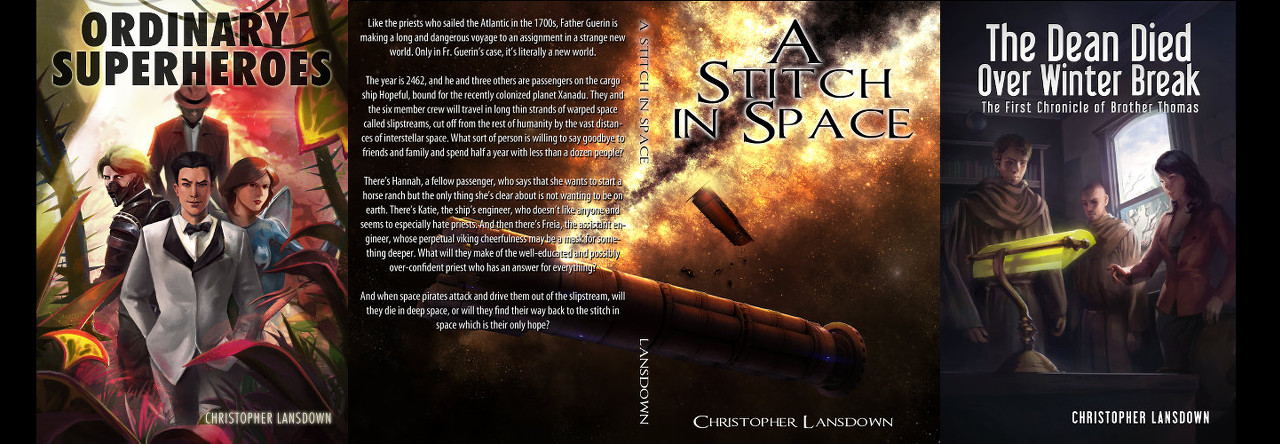
What Bad Guys Get Right

Recently, I wrote about Writing Villains and Satanic Banality and Bad Guys Who Think They’re the Good Guys. In the latter, I mentioned an annoying habit some writers have where they mangle bad guys thinking that they’re good guys into bad guys actually being good guys. This leaves them with the problem of coming up with who the real bad guy is, and they usually do a bad job at this since the real bad guy’s motivations and actions are (typically) an afterthought. The way I put it, when explaining how the good guy was convinced that another good guy was actually a bad guy, was:

There’s only one way to do this, and Miss Bennet hit upon it in Pride & Prejudice when she was trying to exculpate both Mr. Darcy and Wickham: interested people have misrepresented each to the other. But there is a problem with this. As Elizabeth Bennet observed in reply, if you cannot clear the interested people, one will be obliged to think ill of someone. It is not an accident that in this sort of story the good guy inevitably discovers that he’s actually working for the real bad guys. The only other way out is the way the X-Files took: behind each good guy who seems to be a bad guy is some other apparent bad guy responsible for the deception. Every time you peel the onion, there’s another layer. If one doesn’t go that sort of unsatisfying route—perhaps because one is writing in a book or movie and not a TV story with hundreds of episodes coming down the pike—then what we end up with are villains who had plausibly convinced the good guy that they were good guys who are performing their evil for no real reason. They always want to take over the world because it’s there, or kill off three fourths of the population of the world because by some convoluted logic this would drive the share price of their company up by fifteen percent.

I want to go into a bit more depth on why the bad guy killing three fourths of the world to drive a stock price up by fifteen percent makes no sense despite the thing making a bad guy a bad guy being a fundamental error about what is good. Or, in other words, I want to discuss what it is that bad guys get right. Having them get the things wrong that they would get right is as bad as having them get nothing wrong.

The key to knowing what mistakes a villain will necessarily make and those he would never make comes from knowing which other beliefs about the world the villain will hold at the same time as he is considering his fundamental mistake. I probably need to pause here to explain what I mean.

When a person makes a mistake about the world, they will inevitably believe something else which contradicts that mistake. That is because there is only one completely consistent set of beliefs about the world—the correct ones. But a person who makes a mistake is unlikely to make all of the mistakes required to be completely consistent with that mistake; in general that would involve believing all sorts of weird things, like dogs not existing or trees being a figment of one’s imagination. For those who have not studied logic, there is a problem that immediately arises: anything follows from a contradiction. What this means is that if you believe two contradictory things, you can logically derive, through entirely valid logic, any conclusion that you want. You can, but the thing is: people don’t actually do that.

There are various ways to work around the problem that anything follows from a contradiction (I discuss one of the more common ways in my post Kant’s Version of Knowledge), but they all have the basic feature that the world becomes fractured to the person who believes the contradiction. The fracture lines are the contradictions. On one side of the contradiction, the person believes a fairly consistent set of beliefs which they only apply when that truth value of the contradiction is relevant. On the other side is another fairly consistent set of beliefs, many of which contradict the first one, which are only applied when the other side of the truth value is relevant. It is the selective application of universal worldviews which is how the person avoids having to deal with the contradiction.

Let’s get back to our hypothetical bad guy who would do anything to raise the price of his company’s stock. His fundamental error is that he takes the price of his company’s stock to be a much greater good than it is. When he is worshiping at the altar of the stock market, he sets the value of human life at zero, or close enough to that. So why is killing three fourths of the population off not something this villain would do? Because it would cause the price of his company’s stock to plummet in the long term. When thinking about the exaggerated value of a stock price, the villain would certainly include those things which are consistent with valuing a stock price, and knowledge of what raises and lowers a stock price most certainly are compatible with exaggerating the value of the stock price. No one would worship the price of stock but ignore what actually affects the price of stock. In fact, his worship of stock prices would lead him to know better than most men what makes stock prices go up and what makes them go down.

There are two things that affect the value of stock more than the performance of the individual company. They are, roughly in order of importance:

  1. General demand for stock
  2. Market stability

If three fourths of the population die off, markets will be horrifically unstable. This will push what investors remain away from the stock market and into things with more stability, like gold. But in our apocalyptic scenario, and more to the point, if three fourths of the population of the world die off, there won’t be many people left to buy the stock and most of them will be putting all of their money into surviving the post-apocalypse hellscape, not into stocks, if the stock market were even to survive.

If you were to ask anyone, “would killing three fourths of the population of the world off be good for the price of a stock, any stock?” If they were at all knowledgeable about stocks, they would answer “no”. The more knowledgeable, the faster and more emphatic the answer would come. If you found a man so twisted by over-valuing the price of the stock of a company for which he works, he will answer your question before you’ve even finished asking it, since you are causing him to think about the thing which is to him the most painful in the world—the price of his company’s stock dropping like a rock.

None of this in any way contradicts that, at least when he’s thinking about his true love—stock prices—he would set the value of human life near zero. He might not care whether men live or die, but he would care very much what those worthless men would pay for his stock. Something that kills off a few people, he would not mind at all. Something that kills off enough people to affect the markets, he would not give a hearing to.

Now, to fully consider the nature of the fractured mind that results from moral error, none of this means that the villain would not care about the lives of people he interacts with in ways that do not affect stock prices. When that beloved subject is sufficiently far from his mind—and no one can concentrate on one thing forever—he will, mentally, live in a very different world. He will live in a world in which people have value apart from what they will pay for a stock. He might be quite fond of the person who makes the best smoothies at his favorite juicery. He might be quite fond of his wife, or children, when he is home and not working; he might be a dog lover when he is on vacation. He might be strongly in favor of welfare for the poor, when he gives them a thought, at a party.

None of these things are required, but they are all entirely realistic. I nearly said “consistent,” which they would not be. They would be a highly realistic inconsistency, though.

The final thing required, to understand this mentality, is to understand what happens when conflicts do arise between the two worldviews. What happens is that one will win, but it will very rarely win completely. The victory will look like a subordination of the less dominant worldview to the more dominant worldview. But to understand what this subordination will look like, it’s important to bear in mind that the mistake is real and thus the thing which is regarded with exaggerated value really is regarded as having that value. In our example, the villain really does believe that his company’s stock price is of truly enormous importance, far beyond individual human life. When the world view where the person who makes his favorite smoothie contradicts, such as the person being put out of work by a corporate merger, his love for the smoothie maker will subordinate to the value of the share price. That is, he will make out some way that this suffering has value, and that value given by the increase in share price.

Here, if one was writing this character, some knowledge of how corporations actually work would be quite valuable. Unfortunately, writers (especially Hollywood writers) seem to live in an almost perfect ignorance of the stock market, apart from having heard a few terms and know that stocks are bought and sold. There are only two ways in which the price of a company’s shares actually benefit the company, and only of them actually benefits the company. The first is that the company can raise money by creating new shares to sell (diluting the value of the existing shares, but in theory it being worth it to existing shareholders because the value created exceeds the dilution incurred). The other is that shareholders vote for the board of directors, who pick the CEO and determine his salary, and they have a strong tendency to reward CEOs who drive up stock prices and punish CEOs who let share prices fall. That affects behavior, but it doesn’t actually do the company any good. (There is also the fact that a sufficiently high share price protects a company against a hostile takeover, since no one would have the money to buy the company, but this is not typically very relevant.)

The person who worships the stock price will know that this allows the company to gain funds to expand the business, so he would probably rationalize the smoothie guy’s suffering as being for the greater good by pointing to how the increased efficiency makes more capital available to the corporation to grow and provide its services. The mere fact that growth and increased services are secondary goods to the stock-price-worshiper does not mean that he is unaware of them, and this knowledge will be very useful to him when trying to reconcile his love for the smoothie maker with his greater love for the stock price which was increased by the merger.

In short, when faced with this, he will not say that the smoothie maker’s doesn’t matter, but that his (involuntary) sacrifice is for the greater good, and so the smoothie maker, in accepting his fate, is noble and should be praised. He might even try to help the smoothie maker out, so long as there’s a way he can do it which won’t hurt his company’s share price.

A person worshiping a stock price is a somewhat silly example, though not so silly that it has not been done before in fiction. However that goes, it does serve to show how the villain’s thought process works. And if you ever wondered how Hitler could be a vegetarian who loved dogs and also a mass murderer, this is how. Rest assured, he had theories as to how his mass murder was really, truly, in the end, humanitarian. Villains always do.

These explanations that the villain has of how his villainy is really virtuous will always seem convoluted, but only to outsiders. They will not appear convoluted to the villain himself. They seem natural to the villain because he has learned to live with a fractured mind; to reconcile contradictory worldviews. It only seems convoluted to outsiders because they have not learned this mental agility.

Bad Guys Who Think They’re the Good Guys

This post is a followup to my post on Satanic Banality And Writing Villains. In it, I said:

These sorts of mistakes are often confused for rationalizations, that is, for excuses made to others. This is to mistake the nature of evil. The evildoer really believes these things, precisely because in his sin he has missed what he’s aiming at. When trying to write a realistic villain, this sort of mistake is not optional. Villains are villains precisely because they are wrong about some moral judgement. These mistakes will have consequences beyond merely doing evil, precisely because the villain actually believes these moral errors.

This phenomenon is why it feels realistic when the bad guy thinks that he’s the good guy. Unfortunately, that trope in stories is very often misunderstood by people who do not understand what evil really is. It is quite true that bad guys will often think that they are the good guys. What isn’t true is that they seem like the good guys to anyone but themselves.

This mistake has resulted in a great deal of bad storytelling, where the bad guys are shown to actually have a point. Instead of them having mistaken evil for good and thus be pursuing evil as good, they have, in fact, correctly having identified a good and are legitimately pursuing it. But if that’s the case, why on earth is the good guy in the story fighting these other good guys? There needs to be some explanation for why the good guy thought that the other good guy was actually a bad guy.

There’s only one way to do this, and Miss Bennet hit upon it in Pride & Prejudice when she was trying to exculpate both Mr. Darcy and Wickham: interested people have misrepresented each to the other. But there is a problem with this. As Elizabeth Bennet observed in reply, if you cannot clear the interested people, one will be obliged to think ill of someone. It is not an accident that in this sort of story the good guy inevitably discovers that he’s actually working for the real bad guys. The only other way out is the way the X-Files took: behind each good guy who seems to be a bad guy is some other apparent bad guy responsible for the deception. Every time you peel the onion, there’s another layer. If one doesn’t go that sort of unsatisfying route—perhaps because one is writing in a book or movie and not a TV story with hundreds of episodes coming down the pike—then what we end up with are villains who had plausibly convinced the good guy that they were good guys who are performing their evil for no real reason. They always want to take over the world because it’s there, or kill off three fourths of the population of the world because by some convoluted logic this would drive the share price of their company up by fifteen percent.

There’s rarely a satisfying explanation—in the sense of an explanation where the villains actions could plausibly be connected to his goals, even according to the mistakes he is making. To use the example of killing off most of the world driving the share price of his company up by fifteen percent, the fundamental mistake the villain is making, that is, the evil he is mistaking for good, is the share price of his company being all-important. This is a dubious mistake for someone to make, but it is possible. One can become idolatrous about almost anything. But given this mistake, it is not plausible that the villain would think that killing off three fourths of the world (say, with a bio-engineered plauge of super-locusts) would actually be good for the price of his company’s stock in a way that’s useful to his goal. Sure, in the extremely short term the stock would go up, but it would shortly thereafter crash when no one has the money to buy shares any more since they’re busy eating the rats which died of starvation. His mistake is about the good of his company’s share price, not about how markets work. In fact, his idolatry of his company’s share price would make him the last person who would misunderstand how markets respond to major events. The problem—apart from many writers not understanding how markets work themselves—is often due to the real villain’s character and motivation being an afterthought, because it’s all revealed in the last few pages (or last few minutes).

(It should be noted that this goodguy-as-badguy plotline is largely driven by misunderstanding why a badguy thinks that he’s a goodguy, but once this mistake was made it appealed to writers who want to personally rebel against goodness in order to indulge in some evil of their own, and so to make the world more comfortable for their evil they want to make readers (or viewers) distrustful of the institutions which exist to guard against the sort of evil they wish to indulge in. I think that they merely stumbled on this from the structure, rather than set out to undermine these organizations and incidentally got—partially—closer to a better plot.)

None of this sort of the-good-guys-are-actually-bad-guys would seem necessary if the writer recognized that evil is fundamentally a perversion of good. In grasping at the shadow rather than the substance casting the shadow, the one doing evil does not plausibly think that he’s doing good. He merely thinks that he’s doing good anyway.

The villain will have reasons for his evil deeds, but they will be bad reasons. This is necessarily so. It is not possible to have a good reason for a bad decision.

Writing Villains and Satanic Banality

One of the best videos on my YouTube channel is called Satanic Banality. It’s only tangentially about what is commonly called “the banality of evil”. It is really about the concept of “satanic grandeur” and how evil always looks small from the outside, it only looks impressive from the inside. If you haven’t watched it, I’ll embed the video in case you’re interested:

The applicability to writing is in making realistic villains, and especially in showing that they’re evil in realistic ways. In daytime cartoons for children, villains are shown to be evil by just choosing to be evil for the sake of Evil, then laughing about it. This works well in cartoons for children because children need things intelligible more than they need them realistic. Children only pick up on the broadest strokes, like that evil should be opposed. For children, at the level they understand them, cartoons are actually highly realistic.

In fiction for adults, who understand the narrative in much greater detail, we need it to be realistic on all of the levels that the adult reader understands it. This is the real reason for the addage “show, don’t tell”. It’s not that there’s anything wrong with telling the reader something, it’s just that if you do that in place of showing, you will have a contradictory character. If you tell the reader that the man is evil but then show him being humble, gentle, courteous, kind, thoughtful, brave, reverent, etc.—this is bad writing because he isn’t actually evil.

This brings me to satanic banality as a writing tool. Something important to remember about evil people is that they are always vastly more impressed with themselves than everyone else is. This does not mean that they are vain. They may or may not be vain—vanity consists in wanting others to recognize their greatness. But whether they are vain, they are quite impressed with themselves. They think that their vices are actually virtues. This comes from the nature of evil.

Evil is not a positive thing, but a privation of good. It is like a shadow cast by being; it looks like it has a shape, but it has no actual substance. A person who is evil is trying to act like the shadow is real—as if it can be touched and picked up and used. Thus, to them, what they do when they are evil looks magnificent. It must, or they would not try to do it. To those who see the shadow for what it is, they look banal. To somewhat mix a metaphor, imagine someone shadow boxing who thinks he’s beating the shadow that he’s hitting, and is therefore a great warrior. In his mind, he’s magnificent. To those watching, he cannot be impressive, because they can see that he’s not hitting anything.

This does not mean that the villain is bad at everything he does, of course. It means that the villain is going to think himself grandiose precisely where he is evil. He may not care whether others think he is great—that is, he may or may not be vain—but he will at least expect that they will think him great, or will expect that the smart ones will. This will be one of his weaknesses, since he will be wrong. (If he’s not wrong, here, it will be because he thinks that there are no smart ones, which will be a different sort of weakness.)

The other thing is that the villain will do things that just seem absurd. He will make statues to himself for things that he didn’t do, but thinks that he did. The Kim family in North Korea is a good example of this; you can find monuments they’ve built to themselves about how much of a champion of the people they are, what great movies they’ve made, etc. They are an extreme example, but it’s not hard to dial this back if one wants a less evil sort of villain. A warlord who wants to take over the world will think that he is bringing peace, and may well build statues to himself as a protector of the people. A cheater at sports who has not been caught will think of himself as as great role model for children. A thief will think of himself as enforcing justice, being a Robin Hood who robs from the rich and gives to the poor (in this case, himself). (They never consider that Robin Hood actually robbed from a rapacious government to give to those who were overly heavily taxed.)

These sorts of mistakes are often confused for rationalizations, that is, for excuses made to others. This is to mistake the nature of evil. The evildoer really believes these things, precisely because in his sin he has missed what he’s aiming at. When trying to write a realistic villain, this sort of mistake is not optional. Villains are villains precisely because they are wrong about some moral judgement. These mistakes will have consequences beyond merely doing evil, precisely because the villain actually believes these moral errors. Working these sorts of systemic errors into the villains actions will make him far more realistic, as well as adding a great deal of depth and insight into the story.

Lord Peter Short Stories: The Necklace of Pearls

The Necklace of Pearls is a short story about a pearl necklace given by Sir Septimus Shale by his daughter, its theft, and Lord Peter Wimsey’s finding of the necklace and catching of the criminal. It follows the general structure of a detective short story, giving us the setup, the crime, the production of clues, and then on the last page the solution, and as a puzzle, it is enjoyable.

One does not really read a Lord Peter story for a mere puzzle, and The Necklace of Pearls does provide some comedy of manners. The main point of comedy is the Christmas traditions of Sir Septimus. A brief quotation from the beginning of the story will make this clear:

Sir Septimus Shale was accustomed to assert his authority once in the year and once only. He allowed his young and fashionable wife to fill his house with diagrammatic furniture made of steel; to collected advanced artists and anti-grammatical poets; to believe in cocktails and relativity and to dress as extravagantly as she please;d but he did insist on an old-fashioned Christmas. He was a simple-hearted man, who really liked plum-pudding and cracker mottoes, and he count not get it out of his head that other people, ‘at bottom’, enjoyed these things also. At Christmas, therefore, he firmly retired to his country house in Essex, called in the servants to hang holly and mistletoe upon the cubist electric fittings; loaded the steel sideboard with delicacies from Fortnum & Mason; hung up stocking at the heads of the polished walnut bedsteads; and even, on this occasion only, had the electric radiators removed from the modernist grates and installed wood fires and a yule log. He then gathered his family and friends about him, filled them with as much Dickensian good fare as he could persuade them to swallow, and, after their Christmas dinner, set them down to play ‘Charades’ and ‘Clumps’ and ‘Animal, Vegetable, and Mineral’ in the drawing-room , concluding these diversions by ‘Hide-and-Seek’ in the dark all over the house. Because Sir Steptimus was a very rich man, his guests fell in with his invariable programme, and if they were bored, they did not tell him so.

This juxtoposition of modernist furniture in steel with an old-fashioned English Christmas is very hard to appreciate for an American in 2020. The traditional English Christmas is not my tradition, even in mutated form, and steel furniture seems almost the height of stupidity. We have some steel in our kitchen; an aesthetic whose aim is to suggest the appliances are fit for a commercial kitchen, where stainless steel is used because it is easy to clean and no one really cares whether employees have anything pleasing to look at while they work in oppressive heat. Other than that, steel is rarely seen in an American household, so it seems, rather than modern, merely in bad taste.

There is the further remove that people don’t really want to be modern any more. Even extremely modern things, like smart watches, almost go out of their way to at least partially disguise themselves in inconspicuous colors. In the 1930s, new technology was promising. In the 2020s, it’s commonplace and best known for its frustration, addictive properties, and general propensity for making people less social and less happy. (This is actually somewhat unfair, as technology does enable all sorts of great conversations to happen, but general regard is not always fair.)

The mystery itself is the disappearance of the necklace, and there are really two parts to this mystery:

  1. Where did the pearl necklace go?
  2. Who stole the pearl necklace?

The short story only concerns the first question. Lord Peter searches carefully, with Sir Septimus following him as witness. This turns up a small, fine pin, of the sort that an entomologist might use to pin a butterfly to a display board. Lord Peter asks if anyone has a hobby of collecting beetles, and when Sir Septimus says that they don’t, Lord Peter knows where the pearls are, and how they were hidden there.

This is where we come to the weakness of a comedy of manners in a short story—we have too many characters and with many of their interactions being governed by their rigid manners, we can’t really get to know any of them well enough to guess who stole the necklace, or why. To be fair to the reader, neither does Lord Peter, so instead he sets a trap. I think that the game here turns into who can spot the person falling into the trap first. The only real downside is that, since we don’t know anything about the culprit—just the name of the guy who shows up in the trap—it’s not very satisfying.

The real payoff is the way in which the pearls were hidden. The villain cut them from the necklace and used the pins to hide the separated pearls among the mistletoe. At this point, I should note that European mistletoe has white berries, unlike the holly which is commonly used in the place of mistletoe in America, and is sometimes confused for it because of that. It’s an interesting technique for stealing pearls in a house so completely made of smooth, hard surfaces that there is nowhere to hide things.

Odd Short Stories

Having recently read through the collected Lord Peter short stories of Dorothy L. Sayers, I can’t help but notice that a few of them are fairly odd. The one which comes to mind as an example of this is the story where Lord Peter is driven in a car to a castle (or perhaps it was a mansion) to pick up some secrets from the scientist who lives there and upon entering meets another Lord Peter, whereupon the scientist proposes a wine identification contest to determine which Lord Peter is the real Lord Peter. (The real Lord Peter turns out to be the chauffeur. ) This is rather far off of the beaten track of Lord Peter stories. Granted, his expertise in wines does sometimes come up, but never before (or after) has it been critical.

Then it occurred to me: I have no idea where this story was published.

For all I know, Ms. Sayers wrote the story for a friend who ran a magazine called Wine Tasting Monthly. If that were the case, it would make perfect sense why she wrote such an unusual Lord Peter story. It would be fun for the (hypothetical) readers of Wine Tasting Monthly and would be very unlikely to confuse anyone who was merely an ordinary reader of Lord Peter Wimsey stories since they would be unlikely to ever see it.

I am, of course, just speculating. In fact, I doubt that I got it right; I think it more likely that not that this story was not written for Wine Tasting Monthly. It’s a good illustration, though, that there may have been context which makes oddities make perfect sense. Just to come up with another, to illustrate, perhaps there was an “adventure issue” of Detective Stories Weekly where the theme was seeing all of one’s favorite detectives but in an adventure story. The point is that with the right expectations, this story would be fun (and possibly funny) rather than just weird.

There’s a lesson in there…

Amatopia on Nihilism

Over at Amatopia, Alexander Hellene discusses nihilism, primarily in art. It’s a good post, worth reading. There’s one segment of it that I want to discuss, though, because I think that it somewhat misses the bigger picture:

But endless moping about the meaninglessness of everything isn’t a harmless amusement. It’s a dangerous idea that spreads despair and brutalizes people into looking into the sewer, metaphorical or otherwise, for meaning when they should be looking to something higher, whatever that may be. Instead of aspiring to lofty heights, those at the top would rather wallow in filth, and they want to drag you down with them.

There are two ways in which this misses the bigger picture.

The first is that, unless you believe in God, nihilism is true. That is, based upon one’s worldview, if there is no God, then nihilism is the correct conclusion. Atheists, as so much of the elites of American culture are, are either nihilists or lying to themselves.

This brings me to the second way in which it misses the bigger picture: if an atheist comes up with a meaning for his life, it will necessarily be an idol. You can see this in progressives/wokesters. They have decided that the meaning of their life is helping the downtrodden and oppressed. They would do far less harm, even to the downtrodden and oppressed, if they just wallowed in filth in the gutter. Everyone would be better off if atheists do not make up secular meaning in their life. That’s how people get to guillotines and death camps.

The biggest reason, though, that I think that it’s actually healthy to encourage atheists (who are the only people who can be nihilists) to take nihilism seriously is that it is here that they face their own beliefs directly and without disguise. It’s a commonplace observation that people rarely get out of self-destructive habits before they hit rock-bottom. Nihilism is atheists hitting rock bottom. The longer they go on pretending that everything is fine, the more entrenched in this mistake they will get.

In short, nihilism is a symptom, and it is a mistake to treat symptoms rather than the diseases that create them.

Just don’t let your kids watch the product of nihilistic artists until you’ve prepared them to see through it. But, you know, prepare them at an early age.

The Queen’s Square (A Lord Peter Wimsey Short Story)

The Queen’s Square, a short story by Dorothy L. Sayers featuring Lord Peter Wimsey, is a murder mystery set at a costume party. It’s a great setup for a murder mystery, but for some reason it doesn’t seem to live up to this. It’s not a bad story, of course, but it feels a little bit like Miss Sayers is going through the motions.

To recap briefly, for those who’ve not read the story and don’t intend to, Lord Peter is at a costume ball, and a bunch of people we’ve never met before are dancing several dances and talking to each other. Then the fiancé of a woman discovers her corpse—she’d been strangled—and the police come and investigate. There’s a tangle of witness of who was where and when, then Lord Peter solves the case by figuring out that one of the guests was mistaken for another by a trick of colored light, the two guests costumes being identical except for color.

The initial part of the story gives atmosphere, a few introductions, and Lord Peter a chance to have a little conversation. Unfortunately, there are only two characters who are really introduced, and one is an older lady who has nothing to do with the rest of the story. The other is the victim, but other than being a “fast” woman, nothing revealed about her is relevant to the story.

The gathering of clues by the police is somewhat lengthy and in a way reminds me of The Five Red Herrings. That, too, was a timetable mystery in which the timetable was wrong, and therefore didn’t really matter. I’m being a little unfair, here, because the basic setup is that the victim was seen at a certain time, but couldn’t have been killed after it. Of course, that means that it was not the victim who was seen but someone mistaken for the victim, which means that the solution to the mystery revolves around who could have been mistaken for the victim. That said, it is an examination of the time table that shows clearly that this must be, so the timetable is not irrelevant.

I actually wonder if I’m not reading this incorrectly. It is overly tedious to commit all of these details to memory, but perhaps the reader is not supposed to. Such stories may be intended more like logic problems, where one is meant to construct a table that helps to keep track of the relationships and x out all of the squares that cannot be, with only a single stroke through the boxes that we have evidence against but it’s not conclusive. Those are fun to do, though having grown up in the 1980s I was used to the tables being drawn for one in the logic puzzle books.

Lord Peter figures out the solution to the puzzle in the darkroom, when he sees a red thing change color when the red darkroom light is switched off and the white light is switched on. There was a colored lamp which threw red light into the hallway in which the victim was last seen, and this made red costume which was seen appear to be white. Or, possibly, the white costume appear to be red. I don’t remember exactly, now, and either is possible depending on how much ambient light the witness saw.

It’s by no means my favorite story, but it is worth reading. Something seems a bit off with its structure, however, as the various parts give us time to meet characters who never do anything, followed by an information dump which is mostly unimportant, followed by Lord Peter and Bunter doing some photography and Lord Peter realizing the key to the mystery. The story is disjointed and we don’t get to have much fun with Lord Peter or any of the other characters. Had the cast been a little smaller and the best characters had some involvement during Lord Peter’s investigation, I think it would have been a significant improvement.

All of this said, I wonder if I wasn’t more correct in thinking that this was meant to be more like a logic puzzle and less like a story. There is a solution which is actually set off with some space, told as the policeman having told Wimsey about the criminal’s confession. One unfortunate aspect of the book in which I’m reading the short stories is that it gives no information about where they were originally published.

The People That You’ll Meet

I recently met an oddly aggressive person on Twitter (a shock, I know, please pardon me, dear reader, for not having warned you to sit down first) and that made me think of a line from the delightful song, I’ll See Your Six.

The line I’m thinking of is

The things you will run into
the people that you meet
Walking all alone along
a New York City Street.

Twitter can be much like New York City streets. You meet the strangest people there. For much the same reason; just as in NY during the time the song is referring to crime was rampant and largely not prosecuted, there are very few repercussions for being unnecessarily aggressive with people on Twitter. I don’t mean that as a call for greater policing of Twitter, mind. Just an observation on the relationship between inducements and behavior in our fallen world.

And possibly also the observation that, like in the song, it is well to travel armed—as is appropriate to the circumstances—in such places.

Benjamin Kit Sun Cheah on Wuxia

Over on Twitter, Benjamin Kit Sun Cheah wrote a very interesting thread on Wuxia (Chinese heroes) and the meaning of this genre. He kindly gave me permission to quote it in full here since that’s much easier to read than a Twitter thread if you’re not used to Twitter.

Among the hottest fiction trends today, and the genre I’m working on next. I’ve been looking into the genre for years, but everywhere I looked I found too many power fantasies, too few actual wuxia. It shows a lack of understanding of the genre. Wuxia should be the stuff of legends. Highly-skilled warriors in a milieu of danger and respect. Adventure in exotic realms. A world where you can earn your place with your sword. But beyond that, wuxia has one more element: Ethics.

It’s right there in the name. Wuxia is commonly translated as ‘martial hero’ into English. The meaning of ‘hero’ is well-known. ‘Martial’ has a neutral connotation. It means the ways of war. The meaning of wuxia seems obvious: a hero who uses martial arts. But this is not what wuxia means in Chinese. Chinese is a logographic language. Every ‘word’ is a written character that carries certain meanings. Every character in turn is made up of radicals. Radicals are smaller characters that convey pronunciation, and most importantly, MEANING. Keep this in mind.

Wuxia is a transliteration of 武侠. 武 carries the meanings of ‘martial, weapons, military’. 侠 means ‘chivalry, gallantry, hero’. But this is in English. In Chinese it carries a much, much deeper meaning. 武 is composed of two major radicals. 止: Stop 戈: A dagger-axe, an ancient Chinese weapon. (When used as a radical, the word loses a stroke.) Therefore, the true meaning of 武 is: to stop the dagger-axe. The English ‘martial’ has a neutral connotation. 武 has an innately noble purpose: to stop the dagger-axe, to defend and protect.

Morality is hard-coded into Chinese martial arts. The Chinese took it very, very seriously. Some Chinese martial arts masters worked as police officers, soldiers, and bodyguards. Others were civilians, but they assisted the police in arresting outlaws. Others ‘took back the art’ by defeating (and crippling or killing) bandits who had trained in martial arts.

侠 is an interesting case. This is the simplified version of an older word: 俠. 侠 has two radicals: 人: man 夹: squeeze, pinch, wedge, carry under your arm This implies that 侠 is ‘a man who wedges’ or ‘a man who carries’. 夾 from 俠 can be interpreted in two interesting ways. The ‘official’ interpretation I’ve seen is of two smaller men lifting up a larger man. My other, artistic interpretation is a large man wedging himself between two others. With this artistic interpretation, if we look at 俠 again, we see this: A man who places himself in between a tall man (on the left) and two smaller men (behind him). A big man protecting two smaller men with his body. What is the deeper meaning of 侠? A man who lifts up and supports other people. This is how the Chinese viewed chivalry and gallantry. Or, if you look at it artistically: A man who shields the innocent with his body.

Put these characters together and we get the meaning of the true meaning of 武侠: A man who stops the dagger-axe and supports others. Martial skill is thus used to protect the innocent, NOT to puff up your ego. To be a hero is to help others, NOT to merely be strong. Many stories tagged as ‘wuxia’ miss that. Without this element of ethics, of a hero willing to shield others from the dagger-axe with his own body, there is no wuxia. Today, there are ‘dark wuxia’ stories where the MC is a VILLAIN, which defeats the genre altogether!

With this in mind, let’s examine Xianxia. Xianxia is the transliteration of 仙侠. 侠 is known by now. But what about 仙? English says it means ‘immortal, fairy, sylph’. But that’s not quite what it means. 仙 has two radicals: 人: Man 山: Mountain A 仙, an immortal, is thus a man who goes up to the mountains. But why? Isolated in the mountains, free from the concerns of the mortal world, a man can tap into the abundant qi of nature. Through cultivation, a Daoist becomes an immortal. Through cultivation, a Buddhist gains enlightenment. They do not gain superpowers.

More precisely, these powers are NOT the point of cultivation. They serve as way markers. Confirmation that you are on the right path. And, if needed, skills TO HELP OTHERS. To pursue powers at the expense of your own development is to lose the Way and fall into delusion. Not only that, the archetypal xian is a hermit. He goes up the mountain AND STAYS THERE. Cultivation is a long, difficult, tedious process. He needs to be free of worldly distractions. Why would he climb down the mountain?

The answer, for this genre, is 侠. What is the deep meaning of xianxia? A man who goes up the mountain to cultivate himself and gains powers along the way, then climbs down the mountain to use his skills to help others. Modern-day xianxia show ‘heroes’ gaining power, beating up bad guys, attracting a girl, gaining more power, ad infinitum. This is a power fantasy, with optional harem elements. The purpose of power is not MOAR power. It is to be used to help others – or not at all. Without this moral element, a wuxia / xianxia story is not wuxia / xianxia. It is a mere power fantasy. But it is the dominant trope today. A mere aesthetic to dress up a hollow fantasy, no more. A shadow of the true meaning of the genre.

Only one thing left to do: Overturn the heavens and the earth. SAGA OF THE SWORDBREAKER, coming 2021 / 2022.

I have a small comment of my own to add, which is that you see the sort of perversion of a genre which Benjamin has described almost anywhere in which you see vivid world-building, no more than ten to twenty years later. It will inevitably come about when there are people who grew up with the world-building but who reject the heroism in it for the various reasons that people reject heroism. (Mostly it’s because they’re bad people and contemplating great virtue makes them feel bad about their vices, rather than encouraging them to increase their virtues, but that’s a topic onto itself.) These people, having spent so much time in such worlds in their imagination, long to tell their own stories in the same setting, though not at all to tell the same sorts of stories.

(This is a reason, by the way, that you will tend to see a golden age in which a type of new fiction has some particular excellence at the beginning, but then the genre becomes a swamp in which it is still possible to find diamonds. At first, people enter the genre to tell the sorts of stories this new fiction lets them tell especially well. Later, people who are used to the genre it want to tell all sorts of stories that have a superficial resemblance to the originals, and most of them are bad because they do not fit. The diamonds are those stories telling stories which do actually fit the genre.)

Hollywood Rat Race is Quite Interesting

Earlier I mentioned I got the book Hollywood Rat Race by Edward D. Wood Jr. of Plan 9 From Outer Space fame. I don’t have time for a full review now, but I do want to say that for people interested in the history of film, it is definitely worth reading.

It’s a weird book, which I suppose is no great surprise because it was written by a very weird man. Equally famous for Glen or Glenda, a semi-autobiographical movie about crossdressing in which understanding for people so afflicted is pleaded to the audience, Hollywood Rat Race more than once comments fairly negatively on men and women who dress in such a way that one cannot tell the difference between them, and also on men who wear women’s clothing. There’s something very curious there, because Ed Wood had publicly admitted to wearing women’s underwear many years before he ever started writing this book, so it’s not like he could have been trying to draw attention away from himself. (A lot of public hypocrisy around moral issues is frequently much less about actual hypocrisy and more a smoke screen by the vicious in the hope that publicly condemning their vice makes them less likely to ever be suspected of it.)

This is but a small part of the book, though. The various ways in which people who want to be stars are taken advantage of when they get to Hollywood is the main subject, at least by page count. It’s actually primarily financial predation, though he does talk about other types, as well. This is intermixed with advice on practical matters like having a 24 hour messaging service because you can’t carry your phone around with you in your pocket and how to get room and board cheaply. Some of this includes very practical advice, like taking into account the cost of gasoline to go to a further away grocery story with slightly better prices.

Also quite interesting is a section on just how great movies are. It begins by being against actors, writers, etc. who rail against Hollywood, and this section really shows just how much Ed Wood loves movies. I think that this is why people like me who love Mystery Science Theater 3000 so enjoy laughing at Ed Wood’s movies—we’d love to make movies too and if the best we could afford to do was a movie in which the grave stones are cardboard and the airplane steering wheels are artfully cut paper plates, we’d make that movie. To paraphrase G.K. Chesterton, a thing worth doing is worth doing even if you can only do it badly. In laughing at Ed Wood’s movies, we’re laughing at a friend, and in so doing, we’re laughing at ourselves.

There’s also a very curious reminiscence of when Bella Lugosi felt bad because he learned fans didn’t know whether he was alive or dead, and so Ed Wood put together a public appearance for Bela, who used it as a springboard into comedic performances in Las Vegas. Just how much Ed Wood loved Bella comes across.

It’s a very quirky book. I’m not sure if it was ever edited past basic grammar. I believe it was unfinished at the time of Ed Wood’s death. For example, there’s a chapter in it which consists of three paragraphs, none longer than three sentences, all of which fit on a single page.

There is no earth-shattering insight in this book, but I none the less recommend it, at least if you like movies. It’s an unfinished and not-well-organized book about a bygone time, but it is very personal about a curious figure.

The Pleasure of Sarcasm

Somehow or other, my ten year old son discovered my blog post The Least Jedi, wherein I make fun of one of the worst movies of all time, point-by-point. He’s actually having me read it to him in place of a bedtime story and finds it very funny. (This is not actually the first time; he made me watch The Last Jedi with him, and now has me reading it to him again.)

This got me to wondering why he’s enjoying it so much. I think that part of it is the same reason I enjoy Mystery Science Theater 3000—I’d love to be involved in making a movie so much I’d be willing to help make a bad movie. As G.K. Chesterton once said, “anything worth doing is worth doing [even if one can only do it] badly”. But I think that there’s another aspect to this, too.

Sarcasm is not polite. Sarcasm about a work of art, however, is (except in particularly grumpy company) not impolite. It can be very mean to make fun of a person, but it is not mean to make fun of a movie. And the problem with politeness, especially from a child’s perspective, is that you never quite know what people who are being polite really think.

I think, then, that part of the pleasure of sarcasm, especially for younger people—who, after all, are the people who generally enjoy sarcasm the most—is that one can take it far more at face value than most of the things one comes across. It is a vacation from veiled meanings and subtle hints. In sarcasm, we find good and bad openly called by their names.

There is a lesson, there, for people who write sarcastic things. They have a special appeal to children for a reason; it behooves us to make sure to write them very well, since children will absorb errors when they see them far more than will adults.

Twitter Has a Lot of Complaining

Something I’ve noticed about Twitter is that I frequently come away from it feeling less emotionally balanced than when I went to it. The obvious thing to do, therefore, is to figure out why, so that I can figure out what to do better, or at least how to approach it or whether it’s possible to approach it usefully. The first thing I notice when I consider this is that Twitter—by which, of course, I mean the tweets of the people I follow on Twitter—contains a great deal of complaining.

This is a little bit odd because I’ve generally selected people to follow on the basis of having said something insightful or something funny. So the first question is: what did I do wrong in how I’ve selected people to follow?

The answer there seems to have several parts. One of which is just that it’s far easier to complain than to come up with anything insightful to say. When people run out of insight, they may simply turn to complaining because it’s better than nothing. Another explanation is that there simple are people who one needs to turn retweets off for, because they will retweet things that they will not write. That’s easily done, and not the majority of what tends to cause my day to be worse after going to Twitter. I think that another part of it is that there are people who have valuable things to say, but minimal self-control when they themselves become upset. I don’t think that there’s anything practical to do with these people other than to unfollow or mute them. A happy medium is actually to only read lists, and just leave these people off of the lists.

There are also people who have valuable things to say, but fundamentally misunderstand the medium in which they are saying them. Twitter is called “micro-blogging” for a reason, though people frequently think of it as merely conversing with friends. This dissonance can produce things that would make sense if heard only by the person to whom they were written but are highly liable to misunderstanding in public, where they actually are. Much of the above about people with little emotional self-control does apply, though on rare occasions it may be helpful to point out to these people that they are making public statements that really are meant for private audiences; since this is, fundamentally, a mistake, they may possibly be helped.

There is also a problem with Outrage Quoting. This is harder to know what to do with; one thing that helps is to block the idiots who are frequently quoted. And, of course, using lists, muting, and unfollowing are all options.

Ultimately, I suspect that the correct approach is just to narrow down yet more carefully the list of people whose tweets I see and to double-down on my rule about only reading twitter via Tweetdeck using lists.

Still, I think it’s also worthwhile to do some introspection on why I’ve broken down on that rule I imposed on myself; what am I looking for? I’ve got more than enough to do, I certainly don’t need Twitter in order to stave off boredom. I’ve got enough to read (and write) that I shouldn’t have time to be bored in the next twenty years (God willing). It could be looking for human contact, or hoping to find people to help me think through some topics that I’m thinking about. I could just be craving a certain sort of stimulation, since the current environment requires more patience than I’m used to practicing.

Still Gonna Die

I can’t recall if I’ve mentioned this before, but this is a really great song:

There’s a slow intro that takes about 50 seconds before it gets to the song, which is upbeat and fun. The basic theme is it doesn’t matter what you do or how healthy you get, you’re still gonna die. The whole song is fun, but I’ve got two favorite lyrics:

You can search for UFOs, up in the sky.
They might fly you to Mars, where you’re still gonna die.

The other is in reference to the idea, popular for a while, of cheating death by disease by using cryogenics to become frozen and being thawed out at a later date when the disease is finally curable, to be able to live out the rest of one’s natural life then.

You can have yourself frozen, suspended in time.
But when they do thaw you out, hehehe, you’re still gonna die.

My third favorite lyric is probably:

You can get rid of stress, get a lot of rest, get an AIDs test, enroll in Est, move out west, where it’s sunny and dry,
and you’ll live to be 100 but you’re still gonna die.

It’s not a perfect song; the ending, in particular, where the moral they draw is that you should have some fun before you say bye bye, is so much less than it could have been. Still, the song is so well constructed you don’t need them to draw better conclusions for you; that’s easy enough to do for oneself.

Were Plays the TV of Previous Centuries?

Being, as I am, a fan of English Literature from previous centuries, especially of Pride & Prejudice and golden age detective stories, something I couldn’t help but note is that if anyone was near London (or another big city), going to plays was a common form of entertainment. Something else I’ve learned, in doing research about early detective stories, is that a lot of detective stories and tropes seem to be from plays more than novels.

Putting these together, I’ve begun to wonder whether plays were not, speaking broadly, the television of yesteryear.

In my own experience of plays, these are either some of the cream of English writing, as in the case of Shakespeare, or else are at least fairly time-tested things that are quite expensive and one travels a long distance to see. But plays are not generally talked of that way in earlier British fiction; they were as often a spur-of-the-moment thing as planned, and if planned, just an alternative to something like having people over for dinner. What is, or at least was, talked of like this in my experience is television.

Further, there are parallels. People usually didn’t seem to expect the plays to be very good, and they really didn’t expect them to last. And, indeed, most plays did not. As far as I can tell, the typical play had a short run in a small theater, and then everyone local had seen it and they’d move on.

If this is the case, it makes sense that plays would be frequently formulaic, since they were written on tight schedules and without any expectation of being remembered, and so it would be possible for the theater critic in the story What, No Butler? to say that in all the plays he saw, the butler always did it. (I’ve got a bunch of posts about the trope that the butler did it, btw.) This would be a lot like saying that in Murder, She Wrote the businessman’s wife did it. (There is, by the way, a hilarious formula for a typical Murder, She Wrote episode that illustrates some of what I’m talking about.)

Obviously, there are differences between plays back in the day and television today, even apart from the technology. Television shows have long runs of consistent characters, and occasionally the episodes try to be consistent with each other. (After Babylon 5, it became common to have a “show arc” where there was a long-running story that would make up some and occasionally all of each episode. In a sense these are just a return to the days of the serials, though.)

That said, I think that this might be a useful interpretive key to understanding the attitudes characters would show toward plays in older literature. Even more importantly, I think, it suggests that when trying to work out the development of genres like mystery, it means that by not having access to many of the plays people were seeing, we’re lacking one of the major influences on writers of the novels and short stories that we do have access to. In some ways, it might be like, in the future, trying to understand the development of Science Fiction through the present time without having seen Star Trek or Babylon 5. People who, in the early 2000s, write science fiction novels certainly have seen these influential things and moreover expect that their audiences to have seen them, too. It would be interesting to get a hold of some of those short-lived detective plays from the 1900s.

Why Atheists Can’t Write Good Stories, Short Version

I have previously written at some length about why atheists can’t write good stories. If you want to read a more in-depth treatment, there’s Why Moderns Always Modernize Stories and Why Do Moderns Write Morally Ambiguous Good Guys? However, for convenience, I’ve come up with a very succinct version:

Unless an atheist pretends that God exists in his story, his story is set in Hell. There are no good stories in Hell.

The Weird Idea That Writing Should Hurt

I saw this rather odd writing tip on Twitter the other day. I’m quoting it, rather than another, because it does such a good job of summarizing an attitude towards writing I’ve seen over the years.

Writing Tip: If “editing” your first draft consists of fixing a few typos and changing a word here and there, you’re not doing it right. A first draft should be ripped apart, refashioned, and sewn back together. Anything less is vanity.

It’s that last part that’s the key to this weird attitude. If a particular writer has a writing style where the first draft is essentially a protracted brainstorming session and that works for them, then good for them. The weird attitude is that this is how it should be.

In reality, for at least some people, writing a decent first draft is a viable option. If you’ve done enough planning that you’ve constructed the characters and planned out the setting and written the plot in such a way that it flows out of the characters in their circumstances—substantial changes wouldn’t be editing, they’d be just writing a different book where some of the characters have the same names.

Now, again, there is nothing intrinsically wrong with this. If for some reason a writer cannot bring themselves to do this sort of planning and thinking before they start writing, then I understand doing a book-length brainstorming session in order to generate some material to work with. I’ve written a few first drafts of novels which I haven’t carried through to publishing, and there’s even a very loose sense in which The Dean Died Over Winter Break can be thought of as a substantial rewrite of a previous novel called A Murder At Yalevard—though it was really more of a different book in which I borrowed some elements of the original. But I find it very strange that the writer quoted above cannot conceive of someone who can plan out their books.

There is of course the explanation that such a writer just cannot see beyond their own limitations, but I can’t help but wonder if this attitude isn’t tied in to the idea of the tortured genius. It was an idea that, so far as I know, became popular somewhere in the 1800s, around the time of Byron and Shelley, who were tortured not so much be genius as by their inability to control their lust. Shelley, in particular, seems to have been afflicted in this way, and his vices seem to have been excused by himself and his wife and friends as, not weaknesses, but virtues. To try to say it was not bad for Percy Bysshe Shelly to cheat on his pregnant wife, they invented a new kind of morality where artists were excused from being halfway decent human beings because of the enormous value they gave to humanity. Their art, I mean.

I’m not sure why this idea was popular, but it does seem to have had some currency through at least the 1930s—at least if golden age detective stories are anything to go by. It also seems, curiously, to be more popular with women than with men; it seems to have been female writers who wrote about it approvingly, and within their fiction it was generally only the women (and occasionally a close male friend) who bought the nonsense. Why that is, I’m not sure. Perhaps it’s related to the “bad boy” phenomenon. And for that reason, the idea that one should tear a first draft up in a passion of anger at how far it falls short, and completely rework it, may be related.

As a related side-note, actual geniuses never seem to have been tortured, except occasionally by actual problems, like Beethoven being deaf. Shakespeare was, so far as we know, as reasonably happy as a recusant Catholic could have been in England in the late 1500s. Mozart seems to have no greater troubles than having a period when he didn’t make much money because a war made it hard for musicians; summary biographies don’t mention anything which would interest modern people by similarity, such as profound depression.

Shelly’s genius, to the degree that anyone still holds that he was a genius, seems very overrated. Ozymandias is a good poem, but certainly nothing worth excusing adultery for.

Casting the mind’s eye over other examples of tortured geniuses and actual geniuses, it seems like perhaps the thing that’s really attractive about the tortured genius is not the genius part, but the torture part. And I can’t help but think that this attitude that writing should be torture—what else can throwing away something one worked long and hard at be?—is an attempt to try to find some shreds of life in pain, by people who have no idea where to find life in this world.

Video Games Are Great and Dangerous

A wag I know one described the characteristic masculine and feminine addictions on the internet as:

Men play video games to pretend to be good at doing things. Women use social media to pretend to have friends.

I’m going to leave the second half of that alone, but the first half is interesting. Video games, at least for males, are great and dangerous for really the same reason: they have a much lower effort-to-reward ratio than real life does.

I should clarify that by “real life” I mean skills that still work when the electricity is out. For example, lifting heavy things, carving wood, playing a piano, flying a kite, boxing, riding a bicycle (fast), shooting a bow and arrow, building a miniature ship inside of a bottle, dancing, building a fire from gathered wood and starting it, etc. All of these skills, and many, many more, take a very long time to get good at, typically with a long time at the beginning which has little result besides besides frustration.

In video games, by contrast, one can typically learn the relevant skills to get some rewards within an hour, and often within a few minutes. It is true that they will sometimes have skills which are difficult to master, but even those tend to only require hundreds of hours to master, not tens of thousands, and they almost never involve enduring physical pain along the way.

All this is correct for video games for their intended purpose: relaxation. Video games, used well, are fun. They are a restorative to a weary soul who has been ground down by the trials and tribulations of doing real things, in situations and environments which were not designed to be enjoyable. The quick fun and easy rewards help one to remember the slow enjoyment and eventual rewards of good work in the real world.

The problem is something that really is more dangerous to young men—it is possible to become so used to the ease and comfort of video games that the difficulty of real life becomes insurmountable. Without the rewards of accomplishment coming on the schedule a young video game player has been trained to expect them, he may face crushing disappointment. Instead of being a restorative to a fallen creature in a fallen world, enabling him to face the world in which he lives, it may be an impediment which makes it harder for him to do real things.

As in all things, the trick is to use things in the right way and to avoid their pitfalls.

Hollywood Rat Race is Interesting

I’ll write about it more soon, but I do have to say that Hollywood Rat Race is an interesting book. It gives some interesting insight into Ed Wood. He’s definitely a far more sympathetic figure from this book than just from the movies. Something else which comes across very clearly is how much he loved movies. You can see it in the movies themselves, of course; he would do anything to make movies and that included making bad movies, if that’s what it took to make movies. I’m reminded of G.K. Chesterton’s often misunderstood epigram, “if a thing is worth doing, it’s worth doing badly.”

Much of the book is a warning to people not to come to Hollywood, for one reason and another. The last two lines in the book are very interesting, especially in light of just how much movies were Ed Wood’s life:

But that’s the extent of it. That’s the Hollywood as an insider knows it. Trouble. Problems. Heartaches…

Believe it or not, your life is more real than the Hollywood scene.

Movies Are Very Visual

I was recently thinking about how awful a movie The Least Jedi is, and how much better a movie Plan 9 From Outer Space is, except in the visual aspects—costumes, props, sets, lighting, photography, and special effects. I’ve joked that I want there to be a $150M shot-for-shot remake of Plan 9 From Outer Space to be used as the yardstick by which all sci-fi movies are judged.

Then it occurred to me that in lieu of this to suggest to people that they watch Plan 9 but imagine all of the bright colors, amazing special effects, and so on. Curiously, I could not picture anyone even trying. “Why should I have to do that work for them, that’s their job?” I can hear my interlocutor say. And yet, such people want me to do the exact same thing with the plot. They want me to imagine the motivations, the extra dialog we didn’t see, the equipment we weren’t told about, the things we don’t know anyone did—in short, because the thing is pretty, they want me to do the work of the writer and think that this is quite reasonable to expect me to do, while they are utterly unwilling to do the work of the special effects department.

I think that this suggests that for many people, movies are an extremely visual medium. Perhaps there is even a fraction of the population with a very weak imagination for whom movies are vicariously indulging in having a powerful imagination. If a weak imagination is coupled with a poor memory, that would explain a lot about what movies tend to be mega-blockbusters.

(Note: I’m not, here, criticizing people who were not given as much of some natural virtues as I was. Rather, I think that this makes liking truly awful movies more forgivable and perhaps, even, a little understandable.)

In the Mailbag

In the not too distant past, a relative gave me a copy of the book Hollywood Rat Race. What’s really notable about it is that it was written by Edward D. Wood, Jr. (If the name doesn’t ring a bell, he’s famous for such movies as Bride of the Monster, Glenn or Glenda, and most of all for Plan 9 From Outer Space.) The text on the back bills it as “part how-to manual, part memoir,” and certainly the beginning certainly seems like a how-to manual.

I’m not sure when I’ll have the time to read it, but it can’t help but be interesting. Curiously, the beginning is actually fairly reminiscent of some dialog in the Ed Wood movie The Sinister Urge.

Something else curious is that the book was written mostly during the 1960s, but wasn’t published until twenty years after the authors’ death. (Wood died in 1978, at the age of 54, and the book was first published in 1998.)

Lepers And Social Distancing

A curious thought occurred to me recently with regard to how we talk about lepers in the bible, and especially in the new testament. It’s fairly common to hear about how lepers were feared, had to stay outside of society, etc. and this is often connected to people in modern times who are on the outskirts of our society. Jesus was not afraid of lepers, and so we should not be afraid of those on the outskirts of society, either. (That this means that, among others, we should love neo-nazis and KKK members and the like is rarely mentioned, though, nor is the fact that love does not always look like acceptance, as it would not in those cases.)

What this modern approach seems to miss is that ancient people avoided lepers because lepers had a communicable disease. They weren’t outcasts because they looked different, or had a different culture, or pronounced words in a strange way; they were outcasts because being too close to them might cause one to catch a serious disease. That is, people practiced social distancing from lepers.

In these modern times of COVID-19, we have an exceedingly similar practice with people who have COVID-19, though with our modern understanding of diseases and the conditions of transmissibility, we do admit some exceptions who are wearing a great deal of anti-germ-armor (“PPE”). Medical personal in body suits with respirators aside, people with COVID-19 are outcasts, except we phrase it, “they should self-quarantine”. If someone with COVID-19 comes to a hospital, we expect them to call ahead to warn the staff, and to come through a different entrance, which is a slightly more technologically advanced version of clapping a bowl and calling out “unclean!”

If Christ were conducting his earthly ministry today, there would undoubtedly be COVID-19 patients who came within six feet of him hoping to be cured, and instead of lecturing them to maintain social distancing, he would, undoubtedly, cure them. But he would not come within six feet of someone with COVID-19 because he doesn’t recognize human prejudices and is not afraid of human superstitions—disease is not a human superstition and people with a communicable disease can actually spread it. He would come within six feet of people with COVID-19 because, as Lord of the world, he is Lord of diseases, too. As the one through whom all things were made and nothing was made apart from him, COVID-19 could not hurt him. The one who can make the blind see and the lame walk and clense lepers cannot be harmed by disease, unless he were to choose to permit it.

In short, Jesus did not care about social distancing with lepers because his miraculous power made him immune to communicable diseases. The closest parallel I can think of was when he angered a crowd who brought him to the top of a cliff to throw him off, but it was not his time, so he just walked away from them. This was a demonstration of Christ’s power, not an instruction that Christians should treat angry mobs as if they aren’t dangerous. In like way, Christ was not afraid of lepers because he could cure them, not because communicable diseases are, to use another modern phrase, fake news.

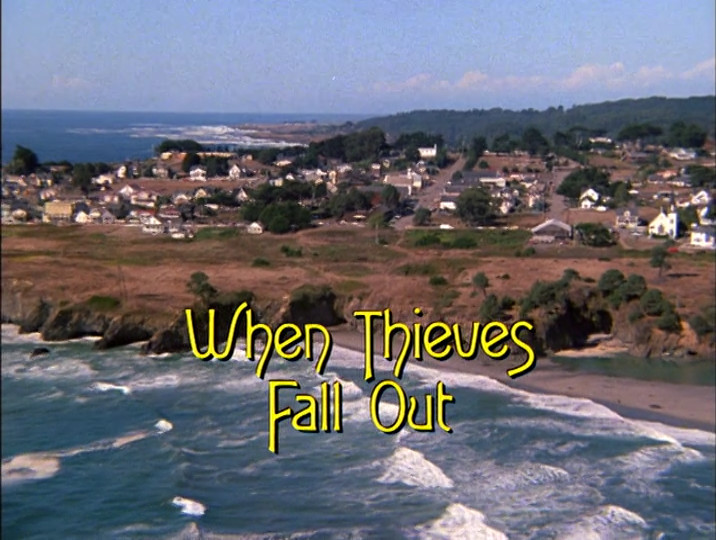
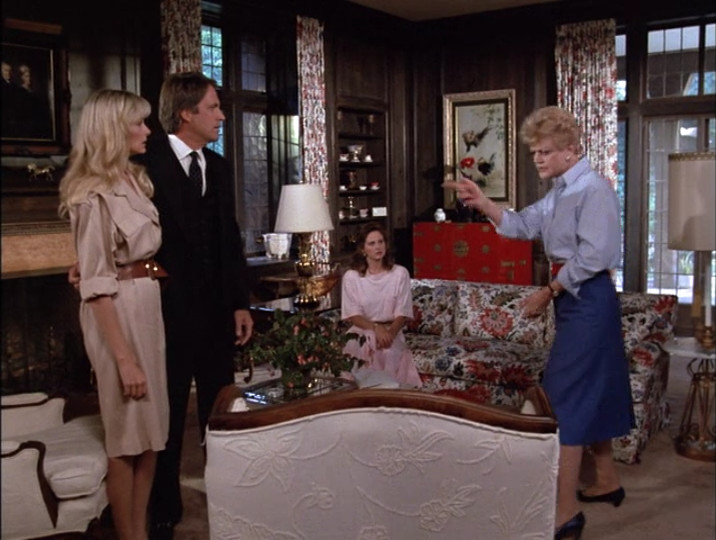
Murder She Wrote: When Thieves Fall Out

The second episode of the fourth season of Murder, She Wrote, is titled, When Thieves Fall Out. It’s a very unusual episode of Murder, She Wrote.

The episode begins with the owner of a car dealership firing a drunk salesman. After that we meet a rather enigmatic character. I’m not sure whether to call him the protagonist or the antagonist, and in many ways the episode isn’t sure, either.

His name is Andrew Durbin. It’s a bit complicated, but we learn his backstory: he just got out of prison for a murder he claims he didn’t commit 20 years ago. He had been a hitchiker, and a wealthy businessman was giving him a ride. A car swerved almost into their lane and they swerved to avoid it, crashing. The businessman was injured and Durbin ran to a nearby farmhouse for help, but they didn’t hear his banging on the door. When he got back someone had bashed the businessman’s head in with a rock, and $100,000 in bearer bonds were missing. At that moment the police showed, and he was taken to be the murderer, and was convicted.

He’s back in Cabot Cove because he recognized a kid in the car (in a prom outfit; it was prom night) that ran them off of the road, and he wants vengeance and to know who the driver is.

The kid turns out to be Bill, the owner of the car dealership.

Somewhere around here, the car dealership owner recognizes that some weird things are going and her husband is very scared, so she goes to Jessica for help.

Andrew Durbin goes to the car dealership and says that there seems to be some electrical trouble with his car.

Bill says that he’s busy and will need some time to get the repair done. He suggests that Andrew come back at 9pm to pick up his car. Andrew agrees. Jessica shows up and talks to Bill, but not much really comes from this. He denies everything. Jessica leaves, and Bill calls a confederate—presumably the other person in the car, that fateful night.

Interestingly for a Murder, She Wrote episode, while we’re pretty sure that someone is about to be murdered, we don’t really know who.

It turns out to be Bill, which is an interesting turn of events because it leaves the field so wide open for who the murderer could be. One obvious suspect is the man with whom he had an appointment at around the time he was killed, Andrew Durbin, but it turns out that Durbin has an air-tight alibi. He was eating dinner for 2 hours at a restaurant where several reliable witnesses could vouch for him.

The alibi is useful, structurally, but it’s also very curious that Durbin never showed up to the appointment. It’s somewhat implied, later in the episode, that this was really a setup; he expected this to stir up Bill’s confederate and get him to kill Bill. It’s never explained in detail, and doesn’t make all that much sense as a plan. Unless he figured that Bill’s killer would be sloppy and get caught, this plan would most likely result in the trail going cold and Durbin’s only hope of justice being extinguished. That said, for whatever reason he does it, he never shows up and is careful to have an excellent alibi for before, during, and after the murder is committed.

Convinced that Durbin is both innocent and telling the truth, Jessica interviews Bill’s old high school friends who were with him that night.

They lie to Jessica, of course, in order to protect Bill’s memory, and say that he was with them the whole time. Eventually it comes out that Bill was drunk and left early. There’s some further investigation and a sub-plot where one of Bill’s old football friends who is pretending to have been crippled in a car crash and is suing Bill turns out not to be crippled and to only be scamming.

I probably should have mentioned earlier that high school football was a big theme. All of Bill’s male friends from high school were on the football team with him, and they were the only team from Cabot Cove who ever won the state championship. This is important because it turns out that the driver, and the murderer both of Bill and of the driver 20 years ago was the beloved high school football coach.

There was actually a pretty good line from his confession, when he talked about how the business he had invested his share of the $100,000 into went bust almost immediately: “I guess I should have known that nothing good would come of that money.”

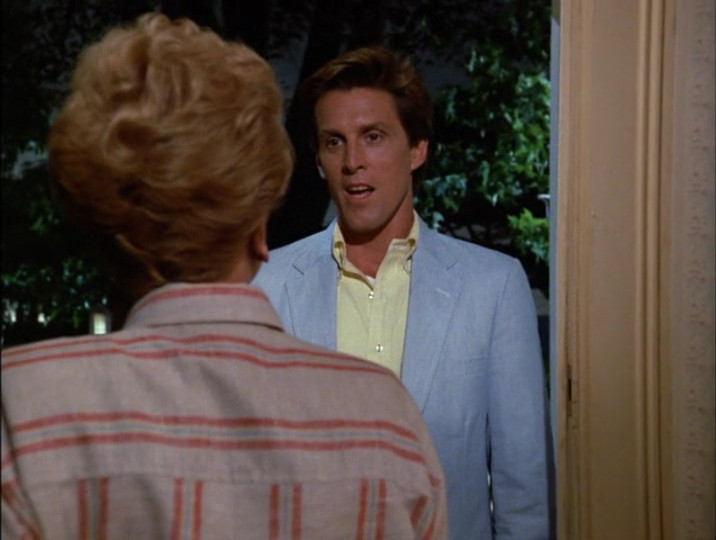
What really makes this episode special, though, is that it doesn’t stop here. Later that night, as Jessica and Amos are having dinner, Andrew Durbin shows up at Jessica’s doorstep to thank her.

Jessica says that she wishes he wouldn’t. She acknowledges that he was telling the truth and spent 20 years in prison unjustly, but he knew what would happen when he came. He replies that he did warn her that he was after justice.

Jessica acknowledges this, but says, “I can’t help but think that justice could have been served in a better way.” Durbin is taken aback.

After thinking for a moment he then delivers one of the all-time great lines in Murder, She Wrote. He says it slowly, thoughtfully, and very fairly.

“Oh? Well you give it some thought, Mrs. Fletcher, and when you figure out what could have been, you let me know.”

Jessica is at a loss for words. He turns and leaves, and she closes the door. She then leans against it, thinking.

And there the episode ends.

Something I touched on in my blog post about how Jessica Fletcher is an oddly libertine scold is that she has an extremely strong but highly selective sense of indignation. She deplores violence but not, in general, any of the things which tend to make it necessary.

She dislikes, tremendously, that people she cared about were made to suffer. This is understandable, but it is a fault in Jessica that she didn’t rise above her feelings and stick to her principles and acknowledge that Durbin was in the right. Instead, she resents being made to be the one to find them out. In short, she is entitled to grieve, but not to be indignant, and Durbin’s final line points out to her how little she is entitled to her indignation.

Jessica does not learn from this moment, of course. First, because she’s written by television writers. Second, because Murder, She Wrote was episodic, with episodes not being related to each other. Frankly, I think it’s really more the former than the latter, though. All that said, it’s pretty satisfying for Jessica to get a comeuppance, for once.

Apart from all this, it’s an interesting episode. Detectives investigating long-ago mysteries is interesting, because the evidence is so limited (at least when people don’t have oddly good memories about things long-past to which they hadn’t attached any great significance at the time). This is done much better in Agatha Christie’s Five Little Pigs, but it’s an unfair comparison. That was a novel. A forty eight minute long TV episode cannot be as good. It does partake of some of what made that novel so good, though, even if it takes the easy route and uses photographs instead of people’s partial memories.

Further Preliminary Thoughts on Dorothy L. Sayers on Gaudy Night

This is a continuation of my post from yesterday, giving some prelimary thoughts on Dorothy L. Sayers essay Gaudy Night in the book Titles to Fame. Today something Ms. Sayers said about the development of a character over many books caught my attention. I’m going to quote it here because I think that the expression of Ms. Sayers own words are necessary to understand the thing she is trying to communicate:

I had from the outset, of course, envisaged for Peter a prolonged and triumphal career, going on through book after book amid the plaudits of adoring multitudes. It is true that his setting forth did not cause as great a stir as I had expected, and that the adoring multitudes were represented by a small, though faithful, band of adherents. But time would, I hoped, bring the public into a better frame of mind, and I plugged confidently on, putting my puppet through all his tricks and exhibiting him in a number of elegant attitudes.  But I had not properly realized—and this shows how far I was from understand what it was I was trying to do with the detective novel—that any character that remains static except for a repertory of tricks and attitudes is bound to become a monstrous weariness to his maker in the course of eight or nine volumes.

I cannot contradict Ms. Sayers from my own experience, yet, as I’m only beginning work on my third Brother Thomas novel. However, there is something here on which I think she is mistaken, or, rather, about which she is over-generalizing.

Before saying what, I also think it’s worth considering the Lord Peter bibliography, bearing in mind that Ms. Sayers had tired of Lord Peter and set off to retire him in Strong Poison:

  1. Whose Body?
  2. Clouds of Witness
  3. Unnatural Death
  4. The Unpleasantness at the Bellona Club
  5. Strong Poison
  6. The Five Red Herrings
  7. Have His Carcase
  8. Murder Must Advertise
  9. The Nine Tailors
  10. Gaudy Night
  11. Busman’s Honeymoon

The eight or nine volumes in which Lord Peter had become a monstrous weariness to his maker was, in fact, four volumes. It’s worth considering what those four volumes were like. In Whose Body? we (and the authoress) meet Lord Peter, and everyone is interesting when you first meet them. Clouds of Witness was an excellently crafted mystery, and there was some character development in it, though in the sense of revealing the character of Wimsey rather than changing it. In Unnatural Death we see a great deel more of Miss Climpson and not nearly as much of Wimsey, and that quite often to serve the plot. In The Unpleasantness at the Bellona Club, we see more of Wimsey, but his personality has largely retreated. Over the stories, we also see the diminution of Charles Parker, in whom Sayers seemed to initially place some personality and intend character development.

What we see, when we look at him, is that he became somewhat more of a puppet in these stories; he was there because someone had to investigate the mysteries, and Sayers balked at introducing a new detective in each story after her experiment with doing so in Unnatural Death. The problem, though, is not really that Lord Peter wasn’t changing. The problem is that Lord Peter didn’t have much of a personality (yet). You can see this in what Ms. Sayers said she needed to do in order to humanize him in order to pull off the romance which was started in Strong Poison but which didn’t work there:

If the story was to go on, Peter had got to become a complete human being, with a past and a future, with a consistent family and social history, with a complicated psychology and even the rudiments of a religious outlook.

None of this requires Peter to change throughout the books. All it requires is to actually do it.

To give an example of what I mean, in the first four books we do learn that Lord Peter likes music, but he never says anything about it. We don’t know what he likes about which pieces. He collects first editions, but we don’t know why he collects first editions, and rarely which things he collects first editions of. He has read literature, but we don’t know what he thinks of it. And then, of course, he’s the sort of pointlessly non-religious character which was extraordinarily common amongst golden age detectives, for no discernible reason.

I don’t mean to keep harping on this point, but it is closely related to the problem Ms. Sayers has with Lord Peter—that he can’t articulate a reason for anything that he does other than sheer curiosity is a massive problem to him being a flesh-and-blood human being. All human beings have curiosity; the detective merely being curious is not enough. He must also either overcome the inhibitions which people have to investigating murders, or he must simply lack them. A religious reason for risking death and people disliking you can overcome this inhibition, as they did for Father Brown. The other detectives of the time seem to merely lack this inhibition. This may partially be why they are all eccentric, but they are mostly eccentric without being interesting because of it.

While there was still the thrill of working out the form and nature of the mystery novel, this could be overlooked. One detective might do as well as another when the reader wasn’t much paying attention to him anyway. As Chesterton showed, however, this was in no way necessary. And I think that this is what Ms. Sayers discovered when she finally started putting flesh onto her detective.

Dorothy L. Sayers on Gaudy Night, Preliminary Thoughts

As I mentioned, I’ve gotten a copy of Dorothy L. Sayers essay in the book Titles to Fame, in which she discussed the creation of her novel, Gaudy Night. I’ve read it over twice, and will be writing a more in-depth analysis of it, but at the moment I wanted to give some preliminary thoughts.

One of the things which leaps out at me is that she described the nature of detective stories in the early 1920s as being very focused on plot, to the exclusion of character. They were not supposed to be “serious”. Especially interesting to me is that she gave, as the exception that proved the rule, G.K. Chesterton’s Father Brown mysteries. He introduced philosophy into the detective story, but he was also an acknowledge master of paradoxes, and popular detective stories which were philosophical were simply one more paradox in his rather large bag of them.

She goes on to describe a trend, from the twenties into the thirties, of detective stories becoming more fleshed-out stories and less pure puzzles. This trend I find interesting, because, depending on whether you count the detective story as starting out with Sherlock Holmes or C. Auguste Dupin, it didn’t really start as a pure puzzle. In fact, even if you count the detective story as starting out with C. Auguste Dupin, you can still observe the trend of moving more toward pure puzzles, with the final Dupin story being entirely about reasoning from newspaper articles.

Be that as it may, it does raise an interesting question: why would people prefer detective stories that were pure puzzles, without real characters?

Before attempting to answer that, I think it worth noting that I’m not sure that Ms. Sayers was entirely correct. My evidence for this is hardly conclusive, but for example I can find no major support for it in the book Masters of Mystery, published in 1930. That was a few years too late to be in the full sway of what Ms. Sayers is describing, so it does not suffice. On the flip side of the 1920s, the 1907 The Red Thumb Mark and 1911 The Eye of Osiris Dr. Thorndyke novels were both almost as much love stories as they were detective stories. They are even further in time from the early 20s than Masters of Mystery was, though. The only thing with which I am familiar and which is right about that time is The Mysterious Affair at Styles, which was published in 1920 (in the United States; early 1921 in England). I am afraid I must confess that I haven’t actually read the book—I’ve only read a handful of the Poirot stories—I’ve only seen the David Suchet TV production of it. While it certainly is not a novel of manners, nor is it Gaudy Night, neither is it merely a crossword puzzle in literary form. That said, a handful of further exceptions will not disprove a general rule, and most of the detective fiction of the time period has been lost to us in the mists of time.

To return to the question at hand, I think that there is an excellent reason for detective stories to have moved, for a time, in the direction of pure puzzles: they were new and people had not yet worked out how to do the puzzles. This was true both of readers as well as writers; both were figuring out what the puzzle inside of a detective story was.

When something is new, there is, of course, the pleasure of novelty, but there is also the difficulty of novelty. The structures which make up the new thing are unfamiliar, which makes initial learning easy, but the unfamiliarity of the structures of the new thing also makes it hard to do anything else other than learn them. Accordingly, it makes sense to prefer the things in a purer form.

To give an example of what I mean, early on a person may not be suspected by the reader merely because his presence seems obvious, though it might not have been necessary. Once this is learnt, however, it becomes possible to trick the reader by casting suspicion on a character by the trick of obviously diverting suspicion from him. Once this trick is learnt, it becomes unclear what sort of trick is being played, and so the reader knows to suspend his judgement merely because a character appears innocent.

There are many such examples that can be given; writers and readers have gone through bluffs and double bluffs and triple bluffs, until finally the rules of the game have been pretty well learnt by both and it is interesting rather than taxing to add in other elements.

To put the thing in another way, it took a while for Fr. Knox’s Decalogue to come about. As I’ve argued elsewhere, the issue with fair play is not really about a guessing game between reader and writer, but rather that it keeps the writer honest and makes the story a much better detective story. Once the rules of detective fiction were worked out, the detective story became good enough to make alloys of it with other sorts of stories.

I do not know that this is what happened, of course, and still less do I know, if this did happen, that this is why it happened. If it did happen, though, this does seem to me the most likely reason why.

Materialist Detectives

One of the things which I disliked about the second Dr. Thorndyke novel, The Eye of Osiris, is that all of the principal characters were Materialists. (For those not familiar: materialism, in this sense, is the belief that the only thing which exists is matter and its interactions; it denies things like God, the soul, free will, etc.) While the characters were not religious in the first book, it was far more explicit here and the book was, in consequence, less enjoyable.

The main problem with Materialists as detectives is that their position is a false one with regard to the main activities of a detective. A detective detects, yes, but for a purpose. In a mystery, the world has become corrupted through the wrong use of reason, and the detective enters it in order to restore the world to its proper order through the right use of reason. It is true that detective stories sometimes aimed to be pure puzzles, as if they were a long-form version of a logic problem where “The baker is sitting next to the red haired man, and across from Sally”. That is simply false, though. The moment that there are characters who are moving through time, they must have motives; they must have a theory of the world and be acting according to it or against it, and thinking well of themselves or being self-reproachful. In short, once you have characters not not mere chess-pieces, they must be human. They might be failed human beings, as in the classic creature of pure habit who goes to work, comes home, watches TV until it’s bedtime, and repeats the process every day merely because it is his habit, with no more thought than we can perceive a rabbit gives to munching grass. But the very fact of telling us what a man does during the day tells us what he doesn’t do, by exclusion. In short, the pure puzzle does not work.

The Materialist cannot do anything other than a pure puzzle. To the Materialist, a human being is merely a clump of matter that happens to be more interesting than an equally sized clod of dirt for reasons of pure sentimentality. The mystery cannot actually be a problem, to the Materialist, because he has no theory of the world in which one organization of matter is superior to any other. He cannot be restoring the world to its proper order because it has no proper order. The Materialist, in truth, has no reason to do one thing instead of another; all he has are the tendencies he has inherited from men who did have a reason to get out of bed in the morning.

This problem is exacerbated in The Eye of Osiris because the person whom Dr. Thorndyke is helping cannot pay Dr. Thorndyke’s fee. Some reason must be put forth for Dr. Thorndyke helping, and since charity is not a permissible reason, as Materialists may neither give nor receive charity for reasons a little too involved to go into here, Dr. Thorndyke is in the absurd position of insisting that he is not in the least helping the old man intentionally, but purely as a by-product of satisfying his own curiosity in the case. In fact, he goes so far as to reject the old man’s thanks.

This is reasonably true to life; Materialists cannot actually exist in society with other Materialists, because their mutual philosophy leaves no room for human beings. It is not, however, interesting. The wretched state of the Materialist is true, so in that sense the book does embody a truth about real life, but it is an unpleasant truth. Unpleasant truths are not what we look for in mystery novels. We look to mystery novels, not for the temporary truth that the world has fallen, but for the eternal truth that the world has been saved. It’s hard enough to remember in this world of sin and woe; we don’t need our reminders of it to make it harder to remember.

Jessica Fletcher is a Weirdly Libertine Scold

I am a big fan of Murder, She Wrote. I watched it very fondly as a kid, and I own the DVD box set of all 12 seasons. I enjoyed it then and I enjoy it now. I am a fan. This must be distinctly understood, or nothing wonderful can come of the thoughts I am going to relate.

One of the really weird things, that’s obvious to me now that I’m watching it as an adult, is that Jessica Fletcher is a weirdly libertine scold. She absolutely deplores violence, and also murder. She also has absolutely no patience for selling drugs. Other than that, she really doesn’t care what people do and will smile at just about anything.

This is odd for several reasons, not the least of which is how completely at odds this is with her background. Jessica is a retired school teacher from a small town in New England. This is a place where people are expected to pull their weight and screwing over friends and family for personal selfishness is frowned upon. The sort of selfishness involved in cheating on a spouse, prostitution, casual sex, leaving someone to move to a big city and follow ones dreams, and the like—these are the sorts of things which city-folk don’t care about, in part because half of them have done these things and the other half expect that they will in the not too-distant future. These aren’t part of the things small-town America approves of because they see the damage they cause.

Another odd thing about this is Jessica Fletcher’s age. She was a retired schoolteacher, which means that she had to have been in at least her late 50s in 1984 (the shows are contemporary). The latest she could have been born would have been around the year 1930. (Angela Lansbury was born in 1925, and was generally about the age of Jessica Fletcher.) A woman who grew up in small-town America in the 1930s and was a young woman in the late 1940s and early 1950s would not have been someone who instinctively approved of fornication, adultery, infidelity, and selfishness.

It may be objected that we normally see Jessica take in all of these acts unphased during an investigation, when, as a detective, she needs the confidence of the people she’s pumping for evidence. This might work if she weren’t willing to turn scold if one of the few things which offended her popped up. Moreover, she never scolds anyone about these things after the investigation, though she will scold them, then, for murder and violence.

This is most easily attributed, of course, to the loose morality of the people writing Murder, She Wrote. They, being in Hollywood, didn’t really disapprove of much of anything at all, though at times they were obliged to pretend to. That said, if we refrain from drawing back the curtain and only consider the work of fiction on its own terms, Jessica Fletcher is a very strange character.

Murder, She Wrote, for all that it’s fun, is often corny, though I admit it with great reluctance. That Jessica Fletcher was never given any actual principles, which is to say that she was never given any definite beliefs about the meaning of life and the attendant consequences of that, is I think what really kept the show from ever being great. She is, in a certain way, a direct descendant of the early detectives, who were often supposed to be mere calculating machines with legs. She had traits, but never really a personality.

I think that this is a great pity, though I doubt that it could have been otherwise in American television in the 1980s.

The Eye of Osiris

So, I’ve read the second Dr. Thorndyke novel, The Eye of Osiris. I didn’t entirely expect to do that, but I was curious how Dr. Freeman introduced the inverted detective story (“howchatchem” as opposed to “whodunnit”). I didn’t find out, though, because it turns out that he didn’t do it in this novel, either. The villain was relatively obvious, but his identity was not revealed until the second to last chapter.

I doubt that there is a point to spoiler warnings on works so old that they were published before any reader of this blog post was born. Moreover, if one wants to read the story The Eye of Osiris in a state of total ignorance as to what the next page carries, it seems improbably in the extreme that one would read a blog post with that title, and whose first paragraph purports to be about that very book. That said, if such is your aim, dear reader, stop reading this post and go read the book.

Rather to my surprise, The Eye of Osiris is narrated, not by Dr. Jervis, but by another doctor whose name I forget. Whereas Jervis was unemployed and came into the employ of Dr. Thorndyke, this doctor—his name is Berkeley, I just looked it up—is filling in for another doctor, who owns a private practice, and who is now on vacation. Dr. Berkeley is young, and was taught in school by Thorndyke, which is how he knows him. Other than these variations, he fulfills much the same role that Dr. Jervis did in the first book. It is for Dr. Berkeley to become a friend of the household, to extract information about it from passing conversation, and to fall in love with the beautiful and intelligent young lady who lives in it. Dr. Jervis, presumably now married to the beautiful and intelligent young lady from the household of the previous case, has precious little to do in this story. This will sound more significant when the reader understands that about a third of each book is taken up with its respective doctor falling in love with its respective lady.

The mystery, itself, is interesting, though the chief of the mystery isn’t really who did it—there are only two plausible suspects, and one of them swears that the other didn’t know about the will which could be his only motive. To give the barest summary of the plot: a rich man, John Bellingham, called on his cousin, Mr. Hurst, after a month-long overseas trip, but when Hurst came home and checked in his study, Bellingham was not there despite the maid not seeing him leave. Hurst rushed over to Bellingham’s layer, Mr. Jellicoe, and together they went to Bellingham’s brother’s house, where Jellicoe found a scarab Bellingham always wore on his watch chain. Two years later, bones from an apparently dismembered body started showing up in pools and rivers in an area near to where the missing man’s house was. John Bellingham’s will left a few thousand pounds to Mr. Jellicoe, who shared Bellingham’s interest in egyptology, and left the bulk of his estate to his brother if he was burried within his family parish and to Mr. Hurst if he was not burried there. This bizarre will caused much confusion and trouble.

It’s fairly clear from the description—which also involved Mr. Jellicoe being the last person to see John Bellingham alive before his trip—that it was Mr. Jellicoe who committed the crime. Murderers really should be more careful than to find chance evidence themselves. (It was also clear that when “Mr Bellingham” called on his cousin after his trip, no one who would recognize him actually saw him.) What is unclear, though, is why the body was cut up into so many pieces, and why it was done with medical precision—it was severed in places an anatomist might sever it, and moreover it was done without any scratching on the bones. Why did the murderer take such care to dissect his victim?

Having some experience of butchering large vertebrates (deer), and hence being familiar with why one would cut the arm with the shoulder blade rather than at the ball joint, I partially guessed at the answer: the victim had done a good deal of rotting prior to his body being dissected. It turns out that the egyptology was more relevant to the plot than one might have suspected, and the body was not that of John Bellingham but instead a mummy which Bellingham had gifted to the British museum. John Bellingham’s corpse had been concealed within the cartonnage that concealed the mummy.

The grand reveal, here, was done with x-ray photography of the mummy, revealing various features of John Bellingham such as a tattoo of the eye of Osiris on his chest as well as silver wire in his kneecaps from when they were surgically repaired after being broken. I think that this was a much more exciting reveal in 1911, a mere 16 years after x-rays were discovered and while they were still very much in their infancy as a technology.

Overall, The Eye of Osiris is a somewhat strange book. It’s enjoyable to read, though I did find myself skimming some of the more melodramatic parts of the romantic plot. Dr. Jervis, who was the best developed character in the first book, barely appears. Even Dr. Thorndyke shows up less than he did in The Red Thumb Mark. The scientific evidence, which in this case essentially means the medical evidence—is emphasized to an enormous degree over all other kinds of evidence. I suppose that this makes a certain amount of sense with a doctor both as the actual writer and the fictional writer of the story, but medical evidence tends to be the least interesting sort of evidence there is, with the possible exception of accounting evidence. And then there is the very strange ending where the crime is revealed, not to be murder, but merely to be concealing the body of a man who died by accident, together with casting suspicion upon innocent people for the murder of the man who wasn’t murdered. This was a very strange decision, since the book goes to some lengths to show just how uncaring of his fellow creatures Mr. Jellicoe was, but then instead of the strange events being the plot of Jellicoe they are merely his best attempt to avoid being convicted of murder for the accidental death of his friend.

I should note, though, that The Eye of Osiris, like The Red Thumb Mark before it, has the occasional clever wordplay. In fact, it may have a bit more of it. For example, in a probate court in which an interested party is trying to get John Bellingham declared dead:

“…As the time which has elapsed since the testator was last seen alive is only two years, the application [to presume death] is based on the circumstances of the disappearance which were, in many respects, very singular, the most remarkable feature of that disappearance being, perhaps, its suddenness and completeness.”

Here the judge remarked in a still, small voice that, “It would, perhaps, have been even more remarkable if the testator had disappeared gradually and incompletely.”

I doubt that I would recommend The Eye of Osiris to anyone, though neither would I counsel anyone to not read it. It is pleasant enough and is, at least, curious as an element of history.

Historical Research is Interesting

I recently paid approximately $10 to get a copy of a chapter that Dorothy L. Sayers wrote in the book Titles To Fame, which is an anthology book in which “Ten eminent novelists … give us the ‘biographies’ of their most successful books” (supposedly, according to the forward). I applied to and filled out a form with the Marion E. Wade Center to get the copy of that chapter. It was a most curious feeling, finding a document mostly forgotten that sheds insight into a subject which is not forgotten.

There was even a certain fitting aspect to this, in that the chapter is about the book Gaudy Night, which is about scholarship, and its plot even turns on a document which was found and stolen in a remote library. Further, Harriet’s cover story for her presence in Oxford is research into the life of the victorian era novelist Sheridan Le Fanu. (Le Fanu was an Irishman best known for ghost stories; I’ve only been able to find a little bit about his mystery stories, and I’m not sure, from the descriptions I’ve seen, that they’re really in the same sort of genre as what we commonly call mystery, i.e. where there is a detective and an explanation to which the reader comes to know. I suppose I will need to find some of his works and actually read them to find out for myself. That said, as an interesting tidbit, Le Fanu was writing primarily from the 1830s to the 1870s; Harriet investigating him in 1935 is actually rather like me researching Dorothy L. Sayers now, that is, in the year of our Lord 2020.)

I’m going to write at least one post and possibly several on the contents of the chapter. For the moment, I just wanted to mention the curious feeling that accompanies digging up things which have been mostly lost to time. It’s got a certain exhilaration to it which is often rendered accurately in golden age mysteries which feature Egyptologists and archaeologists more generally.

Servants in Mysteries

An extremely common feature of golden age detective mysteries is the presence of servants in a household. They acted as witnesses for the police, to place people at the scene of a crime as well as to provide alibis. They were also invaluable sources of information when discretely pumped. It is very difficult to come up with any modern equivalent, though, at least outside of exceedingly rich households.

In real life, servants occupied a curious niche in British culture during the early 1900s; with the rise of the middle class servants were relatively commonplace, since the middle class was comparatively wealthy and the transition from farms to a modern economy was still underway, supplying a large number of people who had few specialized skills but just as much need to earn a living as anyone else. This made servants affordable, and the middle class’s pretensions to be like the aristocracy, combined with a lack of the modern labor-saving devices, made servants indispensable of one could at all employ them.

From the detective writer’s perspective, they were enormously valuable, since they lived intimately with families to whom they rarely had any great allegiance. A brother might lie to protect a brother, or a mother her son, but there was no reason to suppose that a valet would lie to protect his master or a cook to protect her mistress. I can’t recall a single instance of anyone supposing that a charwoman would so much as j-walk for an employer.

In books, servants were not omniscient; it was possible to fool them or even to hide a body on the premises and dispose of it without their seeing. Neither were they disloyal. They would answer the questions of the police, so far as they were legally obliged to, but they did, in general, hold that repeating what they saw to strangers was no business of theirs. Discretion was important no less in maids than in doctors. However close to reality this was, it was plausible—if for no other reason than in keeping with other fiction from the timer period—and phenomenally useful to the detective writer.

The writers of mysteries has two opposing problems, and they arise out of the two principle characters of the mystery story. On the one hand, there must be sufficient evidence of the crime that the detective can detect it. On the other hand, there must be sufficiently little evidence of the crime that the murderer is willing to commit the crime at all. The near-ubiquity of servants, combined with their limitations, answer this need quite admirably, which goes a long way to explaining how frequently they showed up for the purpose.

Times have changed and servants no longer make any economic sense, outside of the homes of the unbelievably rich. The most significant factor here is that the transition in farming is mostly complete. In the United States, approximately 2% of the population are farmers; mechanization has taken its toll and the toll has been paid. Immigrants do supply a small stream of unspecialized labor, but even here the economy as a whole has developed enough jobs for people who can learn specialized skills that they do not concentrate in any particular industry. Even where they do show up in service jobs, these service jobs tend to be done on a contract basis. People no longer employ gardeners but lawn services. People rarely have maids though they may have a cleaning service. Much of the work a maid might do has been rendered doable in a short time by a washing machine, a dryer, or a vacuum cleaner. In short, live-in servants are no longer plausible. Are there any other professions which might fill the role?

I fear that, for the most part, there are not. Where people congregate they tend to pack in too closely, for the sake of efficiency, to make it easy for someone to slip something by the witnesses. Where people do not congregate, they tend to live only with people whose testimony is worthless for an alibi.

There are, of course, exceptions. Resorts will have people who work at them and at least temporarily live there, but who live in sufficiently low density that they will not observe everything which goes on. Museums, art galleries, libraries and the like also (sometimes) have approximately the right density of impartial witnesses, though they tend to be closed outside of business hours and over-packed with guests during business hours. That said, they will have slack times, of course. There are also some academic settings, such as a laboratory, that may work for the purpose, too.

All of these substitutes will have their peculiarities that will, perforce, change the stories set with them. This is no disaster, but it will make some of the spirit of the golden age mysteries harder to recapture because part of that spirit was the ordinariness that the extraordinary events took place in. One cannot make an extraordinary setting feel ordinary. Even if an volcanic observation post has the same density of impartial witnesses that a Victorian home might, it will need to be filled with the sort of odd people who might live an work in a volcanic observation post. Nearly anyone might be forced into the circumstances which make a job as a cook the only job they can get, but few people are forced by the need to avoid starvation into being a librarian. Modern writers, if we try to recapture the atmosphere of golden age mysteries, are forced to turn the characters who in the original would have been comic relief into everymen. Circumstances having changed, we must work very hard to have both the circumstances and the humanity that golden age mysteries had.

It’s a Hot Day Today

According to the tribal witch doctors we call weathermen, it’s going to hit 90 degrees today. Yesterday wasn’t too far from that, and where I live it tends to be at least fairly humid most of the time. Plus, I’ve just always dealt better with the cold than with the heat. But this put me in mind of something interesting—why people used to get up so early in the day.

There was a tree that had sprung up in the middle of a large bush and went unnoticed for long enough that its trunk was now about 4 inches around. This is close enough to the neighbor’s house that the tree was growing over the fence and getting in the way of her lawn crew. Both to be a good neighbor and for the sake of the lilac bush it was growing it, it was time for the tree to go.

I don’t own any kind of powered saw; when I remove small trees and thick branches, I do it with my bow saw. It’s not that hard, but it is work, and work creates heat. Generating a lot of heat isn’t much fun on a cold day, and it’s miserable on a hot day, so I decided to saw the weed tree down in the morning, before work, and before the heat of the day settled in. This got me to thinking about why it was that farmers—who for most of history was most of humanity—would get up at the crack of dawn. If you’re going to be doing a lot of manual labor, it’s far preferable to do it early in the morning, before the day has gotten hot. Once the day gets hot it takes a long time to cool off again, and often doesn’t cool much before the sun sets.

Whether or not people actually kept working throughout the day, there would have been basically no way for them to have continued to work at the same level of output as before it got hot. The human capacity for work is dependent on the environment. Of course where it gets really hot people have a tendency to eat a big meal then take a nap during the hottest part of the day. As the saying from tropical regions goes, only mad dogs and Englishmen go out in the midday sun. Even outside of hot regions, though, it makes sense to take advantage of the times when one can actually put in hard work, rather than just slowly suffer.

This, I think, helps to explain why waking up late is so associated with laziness. If a man who works outside waits to get up until it’s hot, he’s not going to be able to get much nearly as much done in a day. There is, also, the issue of light availability; one does not do much farming by lamplight. I don’t want to entirely discount it, but especially in summer, there is just a ton of daylight available. Outside of farming and other outdoor labors, the issue of heat, in the days before air conditioning, is far more pressing than the issue of light. Even inside of buildings, it gets quite hot on a hot day. It may be delayed by an hour or two from how hot it gets outside, but having put in work inside of an unairconditioned building in summertime, it doesn’t stay cool nearly as long as one would like. Granted, one can still write as quickly in the heat, but many of the other trades still involve moving and pushing and pulling; things that generate heat.

I’ve no way of knowing if this really was it, but it does strike me that someone who waits to get out of bed until one can no longer reasonably expect him to do work would seem very lazy, and indeed might well be very lazy. (Programmers, who always work in air conditioned environments and who move exceedingly little while they do so are notorious for preferring to work at night, rather than during the day. Having a wife and children I’ve mostly adapted to working during normal hours, but it would be very easy to slip back to a more natural way of working…)

[Update: Paul, in the comments, pointed out that I got the phrase about mad dogs and Englishmen. It comes from a 1931 Noel Coward song, Mad Dogs and Englishmen, and contains the refrain “Mad dogs and Englishmen go out in the midday sun”, as well as descriptions of how everyone else is too sensible to go out in the midday sun. You an see Mr. Coward performing the song on YouTube.]

Does Anyone Use the WordPress.com Reader?

I’m currently hosting this blog on wordpress.com, but since I rent my own server anyway, I’m thinking of doing the work to move over to hosting my blog on my own server. WordPress does make a plugin for integrating in the wordpress social features, like the wordpress.com reader. It’s about $40/year to use, so, I’m wondering whether anyone actually uses the wordpress.com reader to read this blog. If you do, could you leave a comment letting me know?

Having a Character Read a Book

I had a reasonably major character who was waiting someplace for some other characters to arrive, and she was reading a book to pass the time. Then I decided to go for it. Not only am I going to actually say which book it is, it’s going to be Pride and Prejudice.

Not only is she going to like the book, I think she’s going to talk about it with the brothers.

For some odd reason, this feels almost transgressive. I don’t know why; there’s no rule against having a character read a good book. In fact, there are plenty of instances in golden age mysteries of characters talking about other fictional detectives. There’s no reason I can’t have the characters talk about an interesting subject on occasion.