
In this video I answer a question from a viewer about the torment of despair and whether anihilation would be better than despair for all eternity. To do that, I also look at the related question of whether annihilation is even possible, given the immortality of the soul.
Author: Christopher Lansdown
http://www.chrislansdown.com/
An Update To Captain Power and the Soldiers of the Future
In my previous post about Captain Power And the Soldiers of the Future I had questioned the value of the space ship light gun toy that was sold as a tie-in to the series. A reader who enjoyed the show as a kid mentioned that the space ship toy came with an animated VHS tape so you could use it whenever you wanted, not just when the show was airing. Also, the ships could shoot at each other so you could play a form of laser tag with them. This does make them a better value than they initially sound, though I don’t think it significantly changes the outcome of the value calculation parents were likely to make and, in fact, did make (in the aggregate).
How to Not Be Bored
In this video I talk about how to not get tired of things but to keep finding them interesting.
Captain Power And the Soldiers of the Future
In one of those curious tangents one comes across when looking up something, I discovered the existence of the 1987 TV show Captain Power and the Soldiers of the Future. It was a grimdark dystopian live action science fiction show (with then-cutting-edge-now-horribly-dated CGI) with adult themes funded by Mattel in order to sell a line of tie-in toys to children.
(I found it when reading about the costume design for the Borg from Star Trek. There seems to have been some re-use of costume elements from the costume for the villain, Lord Dread, possibly by people who had worked on both.)
YouTube has the first episode:
The show only lasted one season. Apparently, while initial sales of the toys were strong, sales declined quickly. There were action figures, of course, but also a hand-held space ship that you could point at the TV and “shoot” at characters on the screen to score points (much like the Nintendo “light gun” that one could use to play duck hunt). The TV could also shoot back and you had to dodge—if your ship was “hit” too much, your pilot would be ejected, indicating you lost. It sounds like a cool toy, for its day, but it cost $40 in 1987, which an inflation calculator says is about equivalent to $92 in the year of our Lord 2021. That’s a lot of money for a toy that you mostly use when watching a particular TV show (see update below for other ways to use the toy). To put it into perspective, for $99 (1987 dollars) you could get a Nintendo Entertainment System bundled with Super Mario Bros. Two and a half times the money, it’s true, but a much better investment. Since both are probably birthday or Christmas presents, rather than something the kid buys with his allowance or lemonade stand money, I suspect parents were far more likely to go for the nintendo, or to buy the light gun and duck hunt if they already had one.
It’s also not surprising that the show was not very popular. About the only thing that it had in common with kids shows was that it had a fair amount of shooting and explosions. You can’t take a show aimed at adults and make it for children by adding explosions, though, anymore than you can turn a movie like The Predator into a chick flick by giving one of the marines a girlfriend and adding thirty seconds where they talk about their feelings before they’re killed.
It also doesn’t work to make an action show for adults, give it a kids show title, and show it on Saturday mornings between cartoons which actually are for kids. Even if it’s a decent action show for adults.
There really does seem like there was any way that this show could have worked. Even if they somehow managed to create a hit it wouldn’t make any sense for the toy company that was funding it. Adults just don’t buy toys to shoot their television with, especially not in 1987. In some ways I think that all of the creatives involved with the show really just wanted to work on Babylon 5, which many of them, including head writer J. Michael Straczynski, did at the earliest opportunity. (Babylon 5 first aired in 1994.)
I don’t know that this show was influential in any way other than probably contributing to the Borg costumes (Q Who aired in 1989 and it seems that some of the same costume people worked on both, also, just look at the costume for Lord Dread).
UPDATE: A reader who enjoyed the show as a kid mentioned that the space ship toy came with an animated VHS tape so you could use it whenever you wanted, not just when the show was airing. Also, the ships could shoot at each other so you could play a form of laser tag with them. This does make them a better value than they initially sound, though I don’t think it significantly changes the outcome of the value calculation parents were likely to make and, in fact, did make (in the aggregate).
USA All-Cause Mortality Data Through January 2021
UPDATE: I have a post with the most recent data here.
It’s been a while since I talked about all-cause mortality data for the USA so I wanted to look at the most recent numbers. Just as a refresher, all-cause mortality data is so important because it’s unambiguous. Doctors may diagnose a particular death as due to one cause or another for a variety of reasons, but they all diagnose a dead person as having died. For example, did someone with COPD and COVID-19 die of the COPD or the COVID-19? Both answers are legitimate, and either might be preferred for a variety of reasons. No matter what the doctor who signs the death certificate puts down as the cause of death, though, he puts down the fact of death just the same. A trend for diagnosing death in a particular way might look like an underlying trend in the disease when it’s really just a trend in bookkeeping. Or a trend in diagnosis might make a new disease seem like it’s not killing people when it is. Looking at the absolute number of people who are dying, regardless of cause, can help us tell the difference. That’s why it’s so good to look at all-cause mortality. It doesn’t tell us much, but at least it can’t lie. So, without further ado, let’s look at the most recent data. (As before, you can get the data and see the latest data after this post becomes outdated here.)

Always ignore the data for the most recent week, and based on recent trends the second most recent week is likely to change a lot, too. It takes oddly long for mortality data to come into the CDC (up to two months to get all of it), so they have to do some guesstimating on more recent weeks. In the last few months they’ve tended to under-estimate rather than over-estimate it (I believe around six months ago they were over-estimating it a bit and over-corrected from that). Accordingly even a few weeks back may increase some. (Later on in this post I have a comparison to what this looked like a month ago so you can see for yourself.)
The orange line is the threshold for “excess mortality”, i.e. if the all-cause deaths/week is above that, this is more than we would expect from normal variation, based on previous years, and there might be something up. They also helpfully put a red plus sign above each week where the mortality exceeds the excess mortality threshold. Here is a zoomed-in shot to the last year or so:

Unfortunately this format, though good for having a sense of what’s going on with overall mortality, doesn’t make it easy to compare excess mortality across weeks since there is normal seasonal fluctuation in deaths. To help with this, I downloaded the data as a CSV file from their website and created a graph of excess mortality that’s much easier to compare (note that this is the full data, i.e. going back to January 2017):
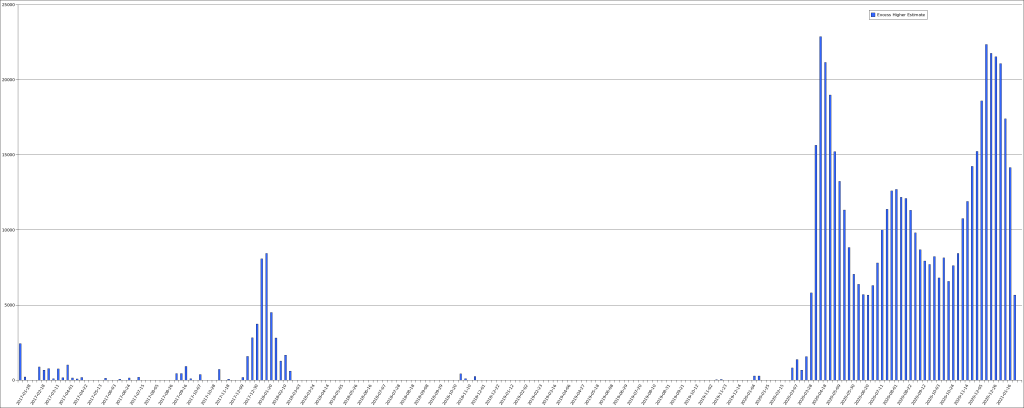
This third wave is turning out to be the biggest yet, at least in terms of area under the curve. That said, since the definition of excess mortality is only a guess, though a guess made by applying statistics to historical data, I don’t think that we can put much stock in small differences. That is, the first wave having a very slightly higher peek in excess mortality probably doesn’t mean much. On the other hand, its peak was during the time when mortality is normally going down (heading into spring) while the peak in excess mortality in the third wave was close to the worst time (winter). Probably the best thing to do is to not worry about small differences and consider them equivalent in peak, but with the peak being sustained longer in this third wave.
The third wave looks like it has peaked but unfortunately the data isn’t really reliable enough to tell, yet. Here is the graph from my previous post, which only contained data through January 1st:

That had looked like it was peaking, too, and it turned out that even several weeks back on that graph were still incomplete. Again, for reference, here’s the graph I made from the CSV data at the time:

This may make it even clearer how far back the data can be revised. One thing that’s very clear is that, as a country, we need more timely mortality reporting. Having to wait two moths to get accurate data makes the data hard to use for any practical purpose. I do get that there will always need to be some revisions—someone who dies at home and is only discovered days or weeks later, for example—but it’s hard to believe that this is such a large fraction of deaths. It seems far more likely that antiquated reporting standards are to blame. That said, I don’t know that for sure; I think it is worth spending resources to find out why the data takes so long to be reliable.
So, given that the data is subject to revision, if diminishing revision, for up to two months, what can we make of this data? Not a whole heck of a lot, frankly. Just to refresh our memories, here’s the latest graph one more time:

It is inarguable that something is going on; it is equally inarguable that this is not the second coming of the black death (which killed off around a third of Europe). It is clear that we’ve had three waves of significant excess mortality, which do correspond pretty well to the three waves of COVID-19 infections we’ve detected as well as the three waves of deaths attributed to COVID-19. It is, of course, not possible just from these numbers to say what is up, however. It could be that COVID-19 is killing people. It could be that lockdowns meant to stem the flow of COVID-19 are killing people. It could be that there are homicidal maniacs running about killing extra people in three waves. This is the limitation of all-cause mortality. That said, if you compare the numbers of COVID-19 attributed deaths and excess mortality, they actually do tend to line up reasonably well. I don’t have the time to generate the side-by-side graph of that which would make it clear just how closely they do or don’t track, this is just me having done some quick approximations, so take it with at least one grain of salt, more being better.
Assuming that the numbers in December 2020 are not revised higher, I do find it interesting that the excess mortality was not significantly higher, on a weekly basis, than it was during the peak of when COVID-19 first hit the US. COVID-19’s first entry was only into some locations. Though it spread quickly, it was doing this spreading during the time when the weather was getting mild and people tended to be outdoors, which seems to correlate with when COVID-19 infections (and deaths) are at their lowest. During the third wave, COVID-19 was already well spread out through the country, such that when winter set in and infections began to spike, it didn’t need to spread in order to bloom everywhere.
Though infection numbers are not directly comparable across time because testing is so much more widespread and available as time progresses, testing was pretty available by the middle of the summer, so you can see COVID-19’s prepositioning for the third wave in the infection numbers:
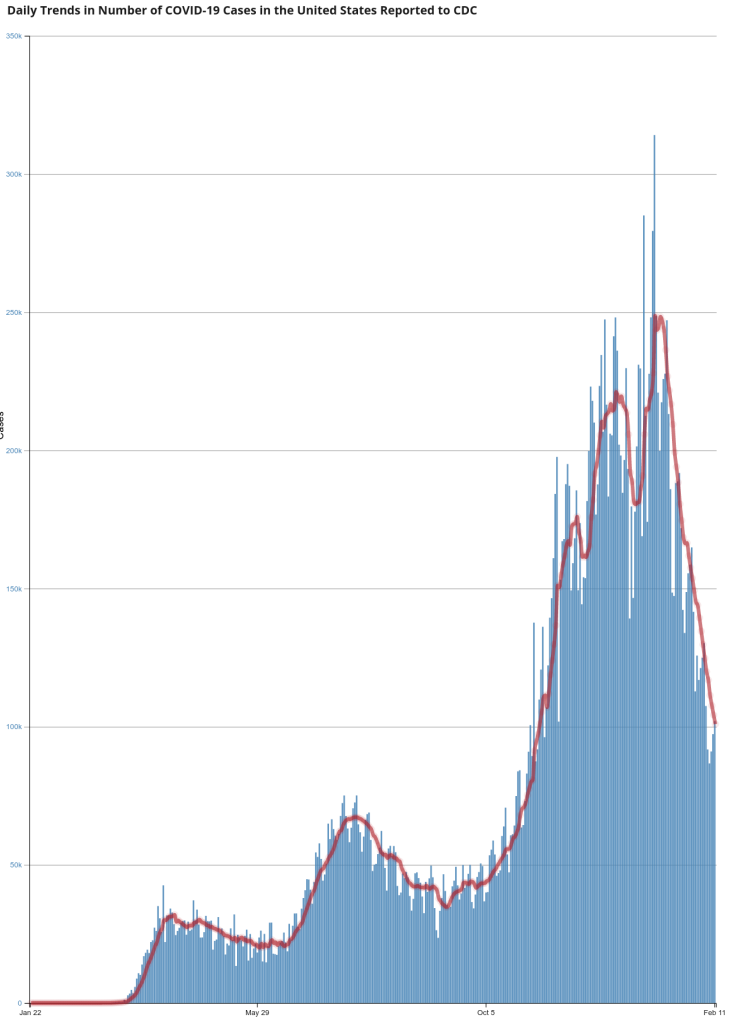
In spite of these advantages that COVID-19 had in the winter of 2020 over the spring of 2020 we don’t see a similarly massive increase in all-cause mortality. There are various possible explanations for this but the data doesn’t really support any of them better than the others, so far as I can tell. It may be that the virus spread far more widely among the population during the first wave than we had any idea of. It may be that the most vulnerable people already died from COVID-19 in the first two waves, or it may be that treatment got better, or it may be that the virus became less deadly, or it may be that we got better about isolating the most vulnerable people. It may be a combination of all of these things, each contributing something to the outcome. Undoubtedly there are other possibilities I didn’t name, too.
I don’t have any grand conclusions to this post; I don’t make these posts about the all-cause mortality data to argue for any particular point. My goal is to highlight the little bit of highly reliable data we have, because I think we’re all better off if we’re at least familiar with it.
Heroes and Success
In a recent blog post Mary says:
Our hero is returning in triumph from his quest and going from success to success —
No.
He’s going success to nerve-wracking attempt to success.
This is fundamentally correct, of course—it’s not very interesting to read about someone who is merely doing chores. When sweeping the floor (in the ordinary course of things) every stroke is an unchallenged triumph of debris-moving. Even someone who could not sweep, such as a man with no arms, would probably not find the blow-by-blow of someone sweeping spilled cheerios off of the floor attention-grabbing.
The one major exception to this, which G.K. Chesterton has noted, are very young children.
…a child of seven is excited by being told that Tommy opened a door and saw a dragon. But a child of three is excited by being told that Tommy opened a door. Boys like romantic tales; but babies like realistic tales—because they find them romantic. In fact, a baby is about the only person, I should think, to whom
a modern realistic novel could be read without boring him.
(Orthodoxy, Chapter 4: The Ethics of Efland)
The one thing I take issue with in Mary’s formulation is the “nerve-wracking” part. This is a common feature of entertainment, but it is not a necessary feature of entertainment. I know this from experience. Since having young children, I don’t like nerve-wracking challenges anymore. I want calm challenges. My children wrack my nerves from when they wake up until they are asleep. My nerves can’t really take more wracking. (I do suspect that this will change when my youngest child is old enough.)
To some degree this is a matter of sensitivity, just as one must shout in the ear of a person who is hard of hearing and speak very softly to someone who is hung over. To some degree, though, I think that the amount of entertainment which can be gotten out of low-stakes challenges calmly dealt with is underrated.
Or perhaps, now that I say that, it’s not. My favorite genre, mystery, frequently is a calm investigation without huge stakes on the line. It is full of challenges, of course; they just tickle the brain without torturing the nerves.
It’s not a big point, of course. I just want to highlight, perhaps from self-interest, that the size of the challenge is not at all the same thing as how dire the consequences of failure are, nor how close to those consequences one comes prior to solving the problems.
The Rise and Fall of Short Stories
In my post The Poirot Short Stories Are Interesting I said:
To some degree this is just a historical curiosity. I think that the market for short stories is never coming back. It’s moved into television and the streaming that is replacing television. It’s interesting to look at short stories, though, since they were so influential in the early development of the mystery genre.
I should clarify that there is still a market for short stories; it’s merely a small one in comparison to the market for novels. I should probably add that the market for novels is not huge, in comparison to the market for other forms of entertainment, but I don’t think that it ever really was all that large. On the plus side, that also means that it is less likely to shrink considerably as times change. (It is always the biggest things which are the most volatile, in this world.)
To understand the history of short stories is largely to understand the history of technology relating to the distribution of images. I’m only going to give the barest sketch of the relevant part of history, in part because I haven’t done any deep research into the subject yet and do not know enough to give more than this sketch. But even this bare sketch will show how dependent on certain aspects of overall technology the short story was, and therefore why it is a market that isn’t coming back.
Prior to the invention of the printing press, writing had to be copied out by hand, which was a laborious and therefore expensive process. As a result, it was popular to do this writing on very high quality (read: durable) materials, such as velum. Paper came into Europe during the late middle ages, but its advantage for being able to be made cheaply wasn’t very important so long as it was still expensive to copy things. (Technically there were hand presses that predated the printing press, but they were only about ten times as efficient as the printing press, so we can neglect them here.) With the advent of the printing press, it suddenly became much cheaper to make books, at which point there became a real purpose to trying to make other aspects of bookmaking cheaper. To reduce the cost of something from (to make up numbers) $500 to $495 is not very significant, but to reduce its cost from $20 to $15 is. This is why you tend to get two main price points on goods: very cheap, and very expensive. In the former, one economizes on everything, in the latter, one uses the best of everything. There isn’t much point in paying top dollar for something that will be ruined by one cheap ingredient. (Due to psychology there is often a third price point in the middle because people don’t want to feel like they’re cheaping out nor being wasteful, but that’s a discussion for a different day.)
Once printing was becoming cheap, two things happened: people started working on making it even cheaper, and new markets opened up because it was now economically viable to make things to sell to people who won’t pay more than a relatively small amount for them. Thus, in a commercial sense, were born newspapers. I’m concentrating on English-speaking history here, so for practical purposes we’re talking about the 1700s.
Advances in being able to make things cheaply create markets, which in turn take time to develop thus increasing demand and putting more money into satisfying these markets. Roughly by the early 1800s we’re seeing the market for newspapers growing tremendously, and as a result there becomes a need for material to fill these newspapers. News at this time still travels slowly and newspapers (and worse yet, TV news) haven’t yet utterly destroyed people’s sense of proportion, so the newspapers often sell on the strength of various kinds of arts that they include, such as poetry, in some cases sermons, and works of narrative fiction. Of course, you can’t print very much of a story on a newspaper that might only be one large sheet of paper, so the stories have to be short. I believe it’s not also long before it’s discovered that if you break the story up over several issues, customers are more likely to buy all of the issues necessary to read the story.
We’re now in, roughly, the mid 1800s. Newspapers are popular, but still fairly small. They are primarily of interest for their works of art and sports scores, but their ability to convey fiction is limited by their size. Other ways to get fiction for entertainment include novels, going to a play, and having a friend or family member tell you a story while you sit next to a fireplace. (The fireplace is not, strictly speaking, necessary.) You can also listen to local gossip, though there is the danger there that occasionally bits of it might be true. Novels are quite expensive, still, since after buying the novel you have to pay someone to bind it for you. Plays are not cheap, and unless you’re fairly rich and in London, there is not much of a variety in plays available at any given time, at least in comparison with one’s ability to watch them and remember their plots.
With a widespread demand for entertainment and cheap printing to supply it, but with the size of a newspaper restricting what can go in it, the magazine is born. Larger than a newspaper and weekly or monthly, it costs more but provides more. The format allows the printing of multiple short stories in full. At the same time advertising is coming to provide much of the profit for publication. With tremendous demand there was a lot of money in them, and with magazines competing for popular stories, they paid very well. This is part of why so many novels from the late 1800s and early 1900s were first published as serializations in magazines and only later as novels—the author might make more money from the serialization than from the novel. This is also why anyone who wrote novels about a detective tended to also write short stories about them—the real money was in the short stories.
Competition from radio would only really get started in the 1890s and though very popular was, for various reasons such as transmission power, transmission distance, limited bandwidth, etc., limited in its ability to replace magazines. Once we hit the 1920s, competition from movies would get started in earnest. This was a bigger competition than radio, but it was not a very direct competition. Movies took much longer than reading a short story, you had to go to a movie theater, you couldn’t interrupt them if something came up; in short movies would not, on their own, have killed off short stories, and didn’t.
Where we start to see the decline of the short story is really with the advent of television. Television is watched in the home, is paid for entirely by advertising and so doesn’t even have the small cost of a magazine. It would take a decade or two for television to really get going but by the 1980s with dozens of channels available there was likely to be something interesting to watch. A television show takes half an hour or an hour, but they are easy to pick up if you’ve missed a bit. Since they’re free (paid for by advertising) one might as well try to see if there’s anything good to watch, when one is in the mood for entertainment. It works well when one is tired, too, since the work of imagination is largely done for you. Television can even be watched during certain kinds of chores. (Hence the “soap opera”.)
People only have so much capacity for entertainment; if they’ve already consumed hours of it on the television, the relative advantage of a magazine begins to fade. Worse for the magazine, and thus the short story, television tells the same kinds of stories. Short, fun stories that are stimulating then forgotten are what television specializes in. Basically television shows are short stories that are acted out, and thus easier to consume than written short stories.
This is not true of novels, though. Novels are far more complex and substantial. They’re meant to last, in the sense of to stick with one. Moreover, this is what those of us who read novels want from a novel. We don’t read a novel to pass a few moments in a way we’ll forget. We read novels to encounter new worlds, to spend time with interesting people, and to engage our imaginations. You can see that this is so because of how much people who love a book always say that the book was much better.
The one exception to this that I can think of proves the rule: the A&E-BBC co-production of Pride & Prejudice starring Colin Firth and Jennifer Ehle was almost as good as the novel. It was, however, a six hour miniseries.
In the end, short stories being so popular that novel writers needed to write short stories—or at the very least, serialize their novels—was largely a product of a particular stage in the development of entertainment and technology. As technology and the state of entertainment moved on, other forms of entertainment moved into the niche that had been occupied by short stories.
Video did not entirely kill the radio star and television has not entirely killed off short stories. They are still written, on occasion. There are a few magazines left, and perhaps more common are collections of short stories. There are a few genres in which short stories are a more natural fit, too—the foremost one that comes to mind is horror. It is rare for a genre to completely die off—there are even places where one can get rids in horse-drawn carriages. The thing which is gone, I think forever, is the primacy of the short story.
Lord Peter Wimsey and the Unprincipled Affair of the Practical Joker
The Unprincipled Affair of the Practical Joker, first published as Beyond the Reach of the Law in Volume 61 of Pearson’s magazine, in February of 1926 (according to this discussion of the bridge talk in it), is a curious Lord Peter Wimsey story in which there isn’t any mystery.
The story begins with a Mrs. Ruyslaender, who happens to see Lord Peter’s name in the hotel book of a hotel she is spending the night at. She knocks on his door and asks for help. It turns out that her husband had given her a diamond necklace and it was stolen by a distant relative of her husband, a Mr. Paul Melville. He also stole a portrait with names and a very indiscreet inscription. The portrait plus incriminating inscription was of a man she had had cheated on her husband with a few years ago. He’s now married to someone else. If the police were to get involved, both the necklace and the portrait would be found, her husband would find out about the affair, he would divorce her, and what’s worse from her perspective is that her ex-lover would be ruined. Though she hates him and would like him to be ruined, she couldn’t bear to be the means of his ruination.
For some reason Lord Peter agrees to help her get the diamond necklace and the portrait back discreetly, so as to avoid scandal. This is such an unsympathetic case that I wonder whether the Victorian (and post-victorian) horror of blackmail isn’t partially an invention of detective stories in order to justify plots. In this case a woman who cheated on her husband holds on to a terribly incriminating piece of evidence after coming to hate the man with whom she adulterated her marriage. She then actually put it into the clutches of a man she didn’t trust because she kept the piece of evidence in a hidden drawer in her jewelry box. A jewelry box which was actually her husband’s and so the knowledge of the secret compartment was in her husband’s family. I rather wonder that Lord Peter didn’t tell her to make up whatever story she could and deal with the consequences.
I suppose what makes no sense to me in the Victorian and post-Victorian stories of blackmail is that the people in them are horrified at the blackmail but think nothing whatever of the adultery (or perhaps more often, fornication). Blackmail is bad, but it only works in a society which disapproves of the action the person is being blackmailed for. If that’s the case, we should see some of that disapproval. Things are unbalanced without it.
Anyway, Lord Peter then cultivates the acquaintance of Melville and frames him, in front of witnesses, for cheating at cards. In particular, Lord Peter uses his card sharping skills we didn’t know he had in order to give Melville a run of extraordinary luck, then uses his sleight-of-hand skills we didn’t know he had in order to plant an ace up Melville’s sleeve and make it fall out in front of those witnesses.
He then blackmails Melville into returning the diamond and the portrait, then leaving the club. He then goes to the witnesses (who are friends of his) and asks them what they think of blackmail, and they both remark in one fashion or another that it’s the worst crime in the world because the law can’t touch it. Sir Impey Biggs, in particular, mentions that he has always refused to represent a blackmailer and has never consented to prosecute someone who murdered a blackmailer. Lord Peter then demonstrates his card sharping ability as well as his sleight-of-hand ability to his friends, and asks them not to mention anything about the events of the evening because there are some crimes the law cannot reach.
I don’t know what to make of this story. It’s neither a mystery nor an adventure; to some degree it’s just giving Lord Peter a super-power in a one-off fashion. (At least, I cannot recall another time when Lord Peter was a card sharp.) Indeed, the number of skills Lord Peter keeps in practice in is rather astounding, if one takes all of these stories as meant to be simultaneously true.
I’m not sure how much they are meant this way, actually. When Dorothy L. Sayers was dealing with trying to turn Lord Peter into a fleshed out character in the aftermath of Harriet Vane refusing to marry a charicature, Ms. Sayers mentioned having as raw materials the “random attributes as I had bestowed upon him over a series of years in accordance with the requirements of various detective plots” (Gaudy Night, Titles to Fame).
I don’t want to accuse Ms. Sayers of careless workmanship, at least any more than she accuses herself of it, but at the same time I think it fair to say that this was an early Lord Peter story, coming only three years after the introduction of Lord Peter in Whose Body? It seems that, during this early period, she didn’t take the detective story as seriously, or at least she didn’t take the short stories as seriously. To be fair she set out to write Whose Body? as more of a novel and less of a conventional detective story, but even she said that in retrospect it was “conventional to the last degree”. She attributes this to a person not being able to write a novel unless they have something to say about life, and she had nothing to say because at that point in her life she knew nothing. I actually suspect, having written two detective novels and working on a third, that it may be as much that the technical aspect of writing a detective story can become very consuming. Though fundamentally unrealistic in that crimes are rarely cleverly committed or afterwards disguised by complicated circumstances, detective stories are, after that conceit, highly realistic stories. It’s not easy to make the whole thing work out naturally and with internal consistency. Worse, from the author’s perspective, is that the detectives have some very determined ideas of how to proceed (characters can only ever be partially controlled by their author) and this has a tendency to put the plot on rails. The author can bend these rails, but it takes a great deal of effort to do it in such a way that the train doesn’t derail. This is the origin of a great many stupid lies told by people who are not guilty but complicate matters; if the author needs the detective to go talk to someone, some poor character has to be the one to point him in that direction.
This, incidentally, is where we can see part of the genius of Gaudy Night. By having the campus poltergeist only striking occasionally, Harriet is given opportunities to go do things in the quiet interludes. The initial absence of evidence together with its occasional dripping out gives space for the author to push Harriet into meeting people without some poor sap having to lie about whose handkerchief they saw at the crime scene.
How Ms. Sayers would have regarded short stories during this early period of Lord Peter I do not know. This was the time period in which short stories were where the real money was in fiction, for most authors at least, and so she would have had ample motivation to just make the stories work in order to meet deadlines. It was only after her failure to marry Lord Peter to Harriet that she started working on fleshing him out as a character, so I suspect that she didn’t much regard him in this way yet. Putting this together, I suspect that this story was meant to be an interesting moment that would pass and then be forgotten about, as most of the material of a monthly magazine would be. Granted, detective short stories had a habit of being published as a collection in book form once enough of them had been written, still, I suspect that at least part of the reason it’s hard to know what to make of this story is that the authoress never intended us to make anything of it. It contains the interesting idea, “what if one blackmailed a blackmailer?” and featured Lord Peter as much because name recognition of a character is probably better for sales than name recognition of an author is.
Determinism as a Fairy Tale for Philosophers
I was recently speaking with a friend of mine who’s a Franciscan friar and retired philosophy professor. During a discussion of Spinoza he mentioned that he tends to take determinism in philosophers not literally but as a metaphor for the limits of philosophical argumentation. This is a very interesting idea.
The basic problem with determinism (other than it being false) is that, if taken seriously, it would result in complete paralysis, or at least complete philosophical paralysis. If determinism is true, there is no purpose in telling anybody anything because there is nothing he can do with it. His thoughts are all predetermined. There isn’t even a point in telling him that there is no point, because even that cannot change what he will do—even to help him to make peace with being a slave. Of course, the same applies to the philosopher himself, so he can always say that he’s engaging in pointlessly telling people they are not free because he is predetermined to do so. Determinism means never having to say you’re sorry. Unless you have to.
Even so, determinist philosophers do not, as a rule, tend to acknowledge that everything that they write is pointless. Why is that? The utter pointlessness of telling a man that he has no more choice than does a rock is obvious. So obvious that we instinctively know it about rocks. Never yet has a man preached to the rocks that they cannot do other than what their nature and circumstances foreordain them to do. Not even to rocks which someone has carved ears into. Why, then, if one’s philosophy dictates that men are no more free than rocks will the philosopher preach this bad news to men?
(If it be objected that they do not preach to rocks because rocks cannot hear, I answer that this is irrelevant. There is no practical difference between something that cannot hear and something that, though it can hear, can do nothing with the words spoken to it. A man who speaks only Russian can still hear English, but we do not waste our time preaching to him in English. To object that he cannot understand changes nothing; we do not preach things a man cannot do even to men who understand. No one walks around in their native language telling men that it would be exhilarating to jump to the moon or very convenient if they were to grow thirty feet tall. It is the usefulness of the words which governs whether they leave our lips, not the intelligibility of them.)
So why on earth do determinist philosophers preach determinism? The answer, suggests my friend, and I suspect he’s right, is that they don’t mean it. What they actually mean is a metaphor for how little philosophical argumentation sways people, even the philosopher himself. As Saint Paul complained, “I do not understand my own actions. For I do not do what I want, but I do the very thing I hate.” Determinism is, thus, a metaphor for the fallen state of humanity. And, in practice, it does seem to be a popular idea more with men who have difficulty restraining their passions. I can’t think of any extremely virtuous men who were determinists.
That said, this probably is more about how little philosophical argumentation sways the masses than about the philosopher himself. When the philosopher sees things clearly which seem to him momentous and the ordinary man shrugs his shoulders if he takes note at all—this requires some sort of explanation. There are better explanations than determinism but determinism does have a sort of superficial appeal. “Men do not care about the thoughts of the gods because they are mere beasts” is an explanation that does, to some degree, explain. That’s an important quality in an explanation—one that is missing in far more explanations than it should be.
Speaking of explanations which explain, I think that this idea makes sense of determinism, and especially why it is that its proponents never seem to take the idea seriously. They do take it seriously, just as a fairy tale to comfort them for why no one listens to them.
(I should note that I think this works synergistically with what has seemed to me to be the primary motivator of determinism: it simplifies the world. If one has to take into account many origins of causation, the world will not fit inside of one’s head. Determinism is appealing, then, because it eliminates a great deal of complexity. Even where the determinist is not an atheist, I think it functions as a sort of vicarious solipsism.)
Captain Hastings in Dumb Witness
Dumb Witness (originally titled Poirot Loses a Client), published in 1937, is the seventh and penultimate appearance of Captain Hastings in a Poirot novel. (The last would be the final Poirot novel, Curtain, which was written in the early 1940s and put in a bank vault until 1975, when Agatha Christie knew she would write no more novels.) The portrayal of Captain Hastings, in Dumb Witness, represents something of a strange development of the character.
The Wikipedia article on Dumb Witness has a quote from an E.R. Punshon, in a review of the novel, who said that Poirot, “shows all of his usual acumen; Captain Hastings – happily once more at Poirot’s side – more than all his usual stupidity…” This seems an adequate description. His stupidity is only slightly more pronounced than it was in the previous novel with him, The A.B.C. Murders. In fact, I wrote about this aspect of the portrayal of Hastings in it. In both, Hastings seems to have had a turn for the worse, compared to his earlier portrayals. I find myself wondering all the more why he did.
One thing I will say for Hastings in Dumb Witness over The A.B.C. Murders is that he does not, at least, lose his head over pretty women. This may be that Christie only put one beautiful woman in Dumb Witness and she was engaged, but happily Captain Hastings at least behaved like a married man. he seems to have become even dumber, though.
Hastings’ stupidity in Dumb Witness seems to be channeled primarily into one action—complete certainty that Emily Arundel died of natural causes. Why he is so certain is given no explanation whatever. He at first bases this certainty on the casual word of a real estate agent—and one who only got his news from local gossip, at that. Each person who had no better knowledge of Miss Arundel’s death thinking it was natural causes would have strengthened this conviction if it didn’t start out as complete certainty, but it certainly didn’t weaken it. This feels like it is here to serve some practical purpose, but I can’t imagine what that practical purpose is.
Hastings started off as a Watson, that is, as a character of ordinary intelligence who narrated the stories, was impressed by the detective, and asked questions which gave the detective an opportunity to explain clues to the reader. As a mild variation, the Watson can have an intelligence very slightly below the average reader, as commanded in the decalogue of Fr. Ronald Knox.
Hastings seems, here, to be a complete idiot. He is, until about three quarters of the way through the book, unable to consider the possibility that Emily Arundel might have been murdered. He holds as absolutely certain, for no reason whatever, that a rich old woman, upon whose life one attempt had been made, must have died of completely natural causes. This might have served some literary function if it prompted Poirot to explain why there is doubt, but it long-since lost that purpose after the first such explanation. Especially since Hastings’ doubts were often in the narrator’s commentary, it took on the character of a simple monomania.
I suppose that this might have been meant to produce a contrast when Poirot turned out to be right, except that we already knew that. There is not going to be a Poirot novel in which Poirot turned out to be wasting his time and there was nothing whatever to discover. This is as implausible as a Poirot novel in which Poirot doesn’t appear, or shave his mustache, or dies on the first page. So why spend so much time and effort suggesting such a thing?
Even stranger, this seems to be at odds with the character’s function as a Watson. Watson admires Holmes. He all but worships Holmes. He doesn’t bemusedly play chauffeur all the while thinking his friend is senile and wasting his time. This is all the more the case given that this is a late case of Poirot’s and Hastings should, by now, have an ample store of experience to draw on that Poirot’s instincts are usually right. What’s the point of bringing a character back if he isn’t the same character from the previous stories—or acts like he wasn’t in them. What’s the purpose of a close friend of Poirot’s who grows to trust Poirot less and less as time wears on?
I think that there must be an answer because Agatha Christie was an intelligent, thoughtful woman. I don’t think that writing Hastings this way was a good choice but it seems very likely that it was at least an intelligible idea. Of course, given that this was his last appearance before the final Poirot novel, I suspect that Mrs. Christie also came to think that it wasn’t a good choice. But what on earth was the goal with him that didn’t work out? She did, after all, pack him off to Argentina in Murder on the Links. Bringing him back was a choice.
I’m in some danger of repeating myself, but I find the whole thing very perplexing. Approximately every character but Hastings has a reasonably consistent psychology to them. Hastings, alone, seems more a collection of a pointless literary devices than a character. Even Poirot seems to tire of him. Since Hastings refuses to think, Poirot doesn’t explain anything to him. His function even as a literary device seems to be lost.
Perhaps Hastings was merely meant as comic relief? There is some possibility here, except that for the most part he isn’t funny.
Perhaps I’m merely biased because Hugh Frasier’s portrayal of him in the David Suchet Poirot is so compelling. It just seems like such a pity. Captain Hastings had the potential to be so interesting but he simply wasn’t used. Perhaps Mrs. Christie thought that he was beloved by the fans and so brought him back for their sake, but reluctantly, and that’s why she didn’t make any use of him. If so, it’s a great pity. It is an explanation which explains, at least.
I hope it’s not true, though.
I’ve Made a Map!
Working on my third Brother Thomas mystery, I learned how to use the vector graphics program inkscape and have made a map of the resort camp where the novel takes place! I’m not sure it’s finished, but it’s close:
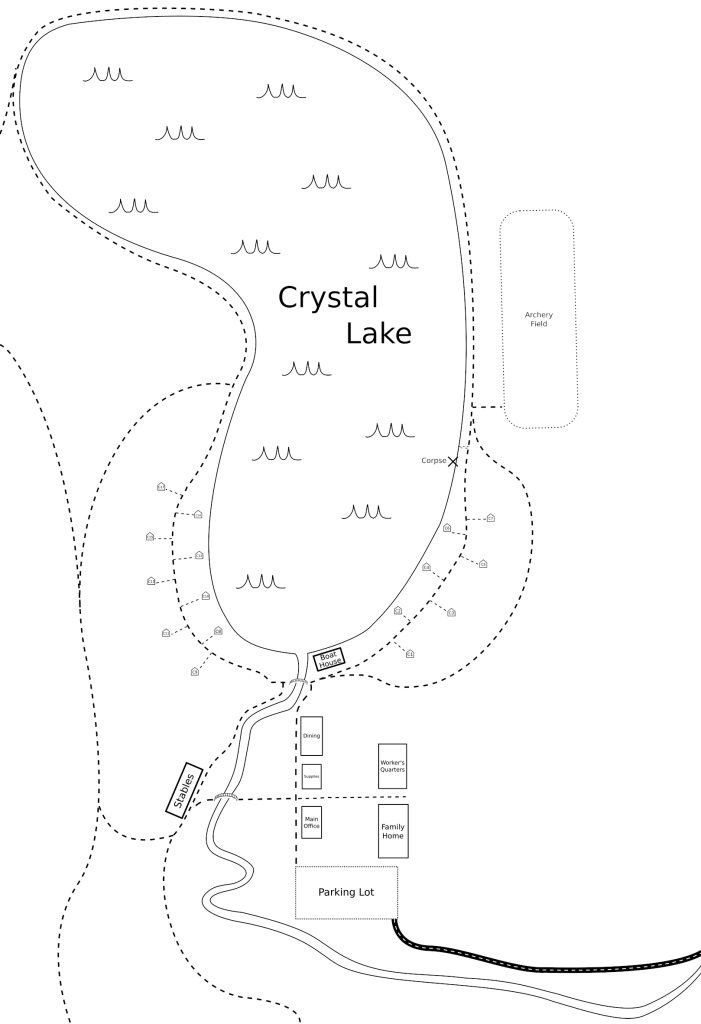
I think I’m going to add a legend to it. Some of the detail work is hard to see, so I might have to include a zoomed in section to spare people having to use a magnifying glass. Still, I think it’s come out pretty well.
(I might also add some trees to indicate where there is forest, but that’s most places, so it might make it too crowded.)
Best Spells for Industrial Purposes
Over at her blog, Mary Catelli asks:
If you were thrown into a D&D universe, and wanted to play the Connecticut Yankee and improve things, what spells would be the best ones to substitute for industrial processes?
The first few that come to mind are Rock to Mud and Polymorph Other. The first would be incredibly useful for making level roadways to transport goods (critical to industry) and the second would be helpful for turning mice into elephants. Beasts of burden are a great substitute for hydraulics in a lot of cases. Dig would also be of some use. The various fire spells would probably have some utility, too.
All that said, in at least classic D&D there really aren’t spells that have the equivalent power of a hundred tons of coal or a thousand barrels of oil. If the fantasy world in question doesn’t have unimaginable reserves of easily harnessed power lurking beneath the ground, you’re not really going to get the industrial revolution off the ground, magic or no magic.
Probably the best approach in such a scenario would be to teach the people about electricity and use magic to get as many hydro-electric dams built as possible, with everything that needs electricity being located near one of these dams. You could also get small generators anywhere you’ve got enough fall of water to power a water wheel like one would use for grinding flour.
That sort of hybrid setup might be interesting for a fantasy world, where electricity and industry is plentiful in a few rare places, and scarce everywhere else. There’s a good chance, btw, based on what makes for good hydro-electric dams on earth, that the good farmland and the good hydro-electric are not located in the same places, which would be beneficial to the fantasy setting in terms of making for good stories.
Murderers Call In Poirot a Lot…
As I’ve been reading the Poirot short stories and novels, it’s struck me that it’s not just once or twice that it was the murderer who called Poirot into the case. I don’t want to go into a list, since merely to name them would consist of spoilers, but off the top of my head I can think of at least four novels and a short story in which the murderer called Poirot into the case and two more short stories about robbery rather than murder in which the thief called Poirot in. I’m confident that this is not an exhaustive list. I’m really not sure what to make of this.
If it happened merely once, it would be an interesting twist. Happening so often, it feels like something else. What, I’m not entirely sure. A few possibilities recommend themselves.
One possibility is that by frequently having the person who called Poirot in be the criminal it keeps the reader more on his toes. I’m not sure this really works, though; there’s a certain foolishness in calling in the world’s greatest detective to investigate your crime. It becomes more foolish still after reading about his cases in the newspaper (or in Captain Hastings’ records of them) and seeing how often he’s willing to accuse the person who hired him. If I murdered someone in the 1930s and I was determined to call a detective in to investigate the case, I would far rather call in Giraud than Poirot.
Another possibility is that this was merely a solution to the problem that all mystery writers face of how on earth you get your detective in on the case. It is, of course, possible to go the Jessica Fletcher route and simply have the astonishing coincidence that the detective just happens to be around murders ten to twenty times per year. Those who want a little more realism need to be more creative. The problem with calling a detective in before the crime is committed is that, in general, there is only one person who knows that the crime will be committed—the criminal. The major alternative I can think of is a person who suspects that attempts have been made before against his life calling in the detective. This works, but requires either a remarkably incompetent murderer or slow poisoning. The murderer calling in Poirot does open the field a bit.
The tradeoff is that it is mostly not in the murderer’s interest to call the world’s greatest detective in, which makes it very hard to make this plausible. Of all the times that it happened with Poirot, I’m inclined to say that the A.B.C. Murders was probably the most plausible. The murderer had a legitimate (from his perspective) reason for it to be Poirot and not someone less well known. The murderer also produced a very clever series of murders, complete with a scapegoat who believed that he did it, so it was plausible that Poirot might have been fooled, or else that he would have been overruled by the police.
As for the other times, the criminal calling in Poirot seems far less excusable. It was mostly pretty gratuitous. Granted, Poirot tries to be underestimated by criminals, but it seems odd for so many criminals to take such an unnecessary risk. Especially because it’s usually with very little gained by bringing him in.
Which leads me to suspect that it really is done merely as a way of bringing Poirot into the story. I’m hesitant to believe that’s the case, though, since Agatha Christie is such a master of plotting. Overall, I’m not sure what to make of it. All I’m sure of is that it’s strange.
Snake Talk Episode 6: Aphrodite Update
In this episode I give an update on how she’s doing, including some lessons I’ve learned in keeping her, such as how I’ve trained her to recognize when it’s feeding time and how much she loves burrows in the substrate over hides above it.
The Problem of Evil: Depression
This video is a response to a question. Gadowscar asked, “[M]y question regarding the problem of evil would be triggered by my own personal experience and be fairly narrow, and be an inquiry into how God can allow for such rampant depression among society. I wholeheartedly believe God exists with my intellect, there’s no doubt in my mind that He exists. However, because I suffer with depression(to the point of being suicidal at times), I have difficulty on an emotional and spiritual level believing that God loves me. How would you answer this?”
Here’s my answer.
When a Contradiction is True
In this video I look at the times when an apparent contradiction is actually true, without it being a violation of the principle of non-contradiction (the key is in the word “apparent”). I take a look at two verses from the book of proverbs as an example that shows how this works (Proverbs 26:4 and Proverbs 26:5):
Answer not a fool according to his folly, lest you be like him yourself.
Answer a fool according to his folly, lest he be wise in his own eyes.
Captain Hastings In the ABC Murders
Having recently finished reading The A.B.C. Murders (and I must remark, in passing, that the David Suchet adaptation was remarkably faithful to the book, in this case) I find myself confused by the character of Captain Hastings. As I mentioned before, he started out as a near-clone of Dr. Watson. In only the second Poirot novel, Agatha Christie gave him a wife and sent him off to Argentina. She then used him in more than twenty short stories and another dozen short stories that would become the novel The Big Four. He then periodically showed up in the novels a few more times, the second-to-last of which was The A.B.C. Murders. He’s an odd character, there.
Captain Hastings is an odd character in The A.B.C. Murders for two reasons:
- He’s changed in ways that don’t quite make sense.
- He’s stayed the same in ways that make no sense at all.
To give an example of the second one first, Captain Hastings still hankers after beautiful women. It’s natural enough that he would notice them, or even to be a bit weak-minded about them. What isn’t natural is the way he does so exactly as if he was still twenty years old and unmarried. He never mentions his wife. He openly wants to escort the young and pretty Miss Thora Grey when he should, in fact, be actively avoiding her. Now, it’s no good to say that Hastings was always weak for a pretty face, because he was so in the context of being a completely decent and honorable man. That’s what made it charming. Moreover, that’s what drew Poirot to Hastings. Hastings had a beautiful nature which Poirot admired. He really should have been on the point of refusing to accompany Miss Grey.
Further, he really should have mentioned his wife when Poirot was teasing him about being weak-headed to Miss Grey’s pretty face. “I’m off the market, old chap” or some such line really should have come to his lips. So, for that matter, should some talk about how wonderful his wife is and how happy they are together. That’s just the sort of man that Hastings was.
Similarly, Hastings has learned next to nothing in all of his years with Poirot. That’s not quite 100% true, as he does mention on some of Poirot’s more strange actions that he’d learned that when Poirot was least explicable was when Poirot was hunting down an especially important clue. Still, you’d think that after so many years following the great detective around, he would have learned a little bit. He might have occasionally made a prosaic guess just because Poirot had so frequently told him that he went wrong by being too romantic in his imagination. It’s hard to take the age of their relationship entirely seriously when it seems to have had no effect whatever on Hastings.
The changes that don’t quite make sense are, perhaps, stranger. In some sense they are related to Hastings not changing with his changing circumstances, but he no longer has that beautiful nature which Poirot so admired in Hastings’ youth. His instincts are no longer pure, if for that reason frequently misleading. To some degree I suppose Hastings is merely out of his element. The murderer being presumed to be a madman, the inordinately sane Hastings has nothing really to say. But that brings me to my main question: why on earth did Agatha Christie bring Captain Hastings back for this story? He doesn’t really seem to have a place in it.
The thing that Captain Hastings has to contribute to a story that he’s in is common humanity. He’s a thoroughly decent man. He’s honest, honorable, and generous. He is also romantic. To Poirot, he gives two things. The first is that, never being cynical, he counterbalanced Poirot’s own cynicism. Poirot sees through everything; Hastings sees through nothing. Hastings, therefore, reminds Poirot of the value of the surface. This is related to the second thing he offers Poirot: the perspective of an ordinary person. It is something that Poirot, in his brilliance, is apt to miss on the rare occasions when he forgets to take it into account.
We do get a little bit of that in The A.B.C. Murders. It is Hastings who wonders whether the third note might have had the wrong address written on it intentionally. It’s not much, though, and the story seems to barely notice it.
Overall, I don’t know what to make of it. There was no need to bring Hastings back from Argentina for this story, but little use seems to have been made of him. The problem seems to me that anything which explains the second part will run aground of the first. If there was some reason not to make use of Hastings, why not just leave in him Argentina? He was made much better use of in Peril at End House, and that was written before The A.B.C. Muders. Perhaps Mrs. Christie was so preoccupied with the clever plot that she forgot the good captain. In favor of this hypothesis, she didn’t seem to pay that much attention to the other characters, either.
Suicide in Gold Age Detective Stories
A feature I’ve commented on in Golden Age detective stories is how often the detectives condone or even approve of suicide. To some degree I find this strange because of how un-Christian it is, in spite of the fact that England in the early 1900s was not really a Christian country anymore. Yet you even find this in Poirot, who is a bon catholique. To some degree, I suppose that it was simply part of the culture. That said, another idea has occurred to me.
It is often the case that in order to make the murder difficult to solve, the evidence which the detective uses to solve the is often… thin. At least in the legal sense. There is a tangle of evidence which the detective’s story explains very nicely so that it all makes beautiful sense. It is satisfying. What it often isn’t, though, is sufficient legal proof to obtain a conviction. One solution to this problem is to have the villain confess in front of witnesses. This can be hard to pull off convincingly, though. Why go to all the trouble of trying to frame someone else for the murder in order to get away with it, only to confess in the face of legally flimsy evidence? There is a second solution, though. If the villain kills himself it obviates the need for legal evidence of any kind, and killing himself is not the same action as confessing. To confess is to guarantee that one will be convicted and hanged with all of the social shame and anxiety that entails. To kill oneself can be portrayed as the murderer hedging his bets. It’s easier to pull off, I think, when the murderer’s social status would be destroyed by the detective spreading the word that he did it, even if no criminal conviction could be obtained, and the murder having been committed in order to gain social status. It can be done “offscreen,” too, which means that the reader will probably not examine it as closely.
I should note that there is a humorous Mitchell & Webb sketch which contains this idea. I had seen it many years ago and remembered it after I thought of this the other day:
Murder On The Links: Sniffing For Clues
Murder On The Links is the second novel featuring the detective Hercule Poirot. Published in March of 1923, it came very slighty after the first few Poirot short stories published in The Sketch magazine. However, publishing schedules being what they are, it was probably written before they were. It’s a very interesting story both in its own right and for its place within the history of detective stories. (If you haven’t read it yet and dislike spoilers, go read it now.)
One of the very curious elements of the story is the rivalry between Poirot and Giraud, the famous detective from the Sureté of Paris. Giraud focuses with single-minded determination on finding minute clues, like remnants of footprints and a match discarded in the grass. He painstakingly combs every inch of every crime scene on his hands and knees, looking closely at every surface. This is in strong distinction to Poirot, who lets others find the small clues while he remains standing and contents himself with figuring out what the clues mean. There is a wonderful section of dialog with Hastings in which Poirot defends his method (Hastings, who narrates the story, begins):
“But surely the study of finger-prints and footprints, cigarette ash, different kinds of mud, and other clues that comprise the minute observation of details—all these are of vital importance?”
“But certainly. I have never said otherwise. The trained observer, the expert, without doubt he is useful! But the others, the Hercules Poirots, they are above the experts! To them the experts bring the facts, their business is the method of the crime, its logical deduction, the proper sequence and order of the facts; above all, the true psychology of the case. You have hunted the fox, yes?”
“I have hunted a bit, now and again,” I said, rather bewildered by this abrupt change of subject. “Why?”
“Eh bien, this hunting of the fox, you need the dogs, no?”
“Hounds,” I corrected gently. “Yes, of course.”
“But yet,” Poirot wagged his finger at me. “You did not descend from your horse and run along the ground smelling with your nose and uttering loud Ow Ows?”
There is another section, in which Giraud discounted a two foot section of lead pipe because it did not fit into his theory of the case, but scoured the ground for other clues such as an unburnt match. Poirot remarks:
Mon ami, a clue of two feet long is every bit as valuable as one measuring two millimetres! But it is the romantic idea that all important clues must be infinitesimal!
You also see this in the much later Five Little Pigs, where the client uses this very fact that Poirot does not crawl on his knees in the dirt for clues to persuade him to take a seventeen year old case. He objected that after so much time there would be no clues to find, and she pointed out that he doesn’t use those clues anyway. (He had just boasted of that when she was taken aback by how old Poirot was.)
The context of all of this disparagement of physical clues is interesting to consider. Sherlock Holmes started the detective crazy in 1891 and was known for his magnifying glass, chemical analyses, and sharp eye for detail. He was, perhaps, more known for it than was entirely fair; he certainly did consider psychology, at least on occasion. That said, he was famous for his monograph on cigar ash, for being able to distinguish the tread of every make of bicycle tire, etc. And in 1923 the Holmes stories were by no means complete. Holmes Short stories were published in the 1920s until the last one was published in 1927.
There is also the at-the-time popular detective Dr. Thorndyke, whose entire stock-and-trade was careful observation, extensive medical knowledge, and for-the-time high tech experiments. (The for-the-time high tech may in part explain why he was enormously popular in his day and has had very little staying power after it.) He was relatively early on in his career at this point, having started in 1909 and appearing in five novels by the end of 1922.
I should also mention that from things I’ve read in the time period, there was something of a flood of works that have not generally been remembered but which imitated Sherlock Holmes to greater or lesser extents (often greater). These often, I get the impression, focused on physical evidence to seem clever. Imitation frequently involves exaggeration, especially when it is imitation by writers who are not extraordinary.
Standing against this context, however, is G.K. Chesterton’s Father Brown. Father Brown did not crawl about with a magnifying glass any more than Poirot did, and he started solving cases in 1910. Father Brown was immensely popular in his day (and is still beloved at least by fans of Chesterton). I am not certain of the history but I believe that Father Brown formed the other end of the spectrum from Sherlock Holmes, being primarily a psychological sleuth.
What, then, should we make of Poirot’s looking down on the gathering of minute physical evidence? I think it is probably best classed as a preference among the existing spectrum of detective stories, rather than as anything new, even though it is presented as something of a novelty to the people in the story. Detective stories have something of a tradition of commenting on detective stories as a genre. Especially during the golden age, it is common for detectives to do this by discussing their “theory of detection”. Another common approach was what we see here—for some character to have a rival theory of detection. I think it was most often the Watson character, but police detectives also commonly would clash with the brilliant detective over the right way to go about solving a case.
This commentary had two main purposes, but I think that the second was far more important than the first. The less important purpose was as a commentary on the genre. The more important purpose was to make the brilliant detective seem brilliant. He could not, after all, be all that brilliant if he went about things in the same manner as everyone around him but was merely luckier. Or to put it another way: in order to achieve magical results, one must have some magic. The detective’s commentary on the theory of detection provides this magic; it is his unique theory of detection which is the key to his success.
I think, therefore, the rivalry between Poirot in Giraud should be taken primarily in this light. Instead of as commentary on other fictional detectives, it is meant primarily to be a humorous way to make the brilliance of Hercule Poirot shine. It just happens to be funny, too.
Murder She Wrote Recap
Almost a year ago I started doing deep dive posts on Murder, She Wrote episodes. As I’ve recently put up the tenth, it seems like as good a time as any to do a recap post for anyone who may have missed them.
I should probably say a few words about what they actually are. These deep dives serve several purposes. The main purpose is to analyze the story in depth, to look at its structure and storytelling, to see what was done well and what was not, what worked and what didn’t. A secondary purpose is to analyze the thing as it what it was—a Hollywood production in the 1980s and 1990s—and to understand its cultural significance as well as the factors that shaped it. And along the way I will poke fun at parts that are funny, because there certainly were plenty of those, too.
I should note that I do this from a place of love and also from a place of retrospection. I was a child when Murder, She Wrote first aired and it was a household institution as I was growing up. I doubt that my parents and I ever missed an episode, and certainly we never missed one without our trusty VCR taping it for us. (I can’t swear that there was never a power outage which happened at just the wrong time, but at least I don’t remember one.) That said, looking at it thirty years later, no longer a child and now with children of my own, I have to be honest about its flaws as well as its virtues. So it is with all artistic works in a fallen world—we must take from them the good that they have to offer and leave behind the mistakes that went into them. And it’s always nice to laugh while doing it.
My Murder, She Wrote deep dives, as of January 14, 2021, in the order they were published:
- Murder She Wrote: A Lady in The Lake
- Murder She Wrote: Night Of The Headless Horseman
- Murder She Wrote: One White Rose For Death
- Murder She Wrote: When Thieves Fall Out
- Murder She Wrote: The Bottom Line is Murder
- Murder She Wrote: Murder in a Minor Key
- Murder, She Wrote: It Runs in the Family
- Murder, She Wrote: Obituary for a Dead Anchor
- Murder She Wrote: If The Frame Fits
- Murder She Wrote: The Days Dwindle Down
Why Advertisers Covet the 18-35 Demographic
The short, cynical version is that after about 35, people are too old and wise for advertising to work on them. That’s meant tongue-in-cheek, so please give me a chance to explain, but there really is a rational reason why advertisers covet the 18-35 demographic.
Before getting into the meat of it, I should clarify that there are two main types of advertising. For convenience, I’ll call them persuasive advertising and product-awareness advertising. Product-awareness advertising is telling people about products they don’t know exist. Examples might be a new kind of jar opener, but probably more common are things like books which have just been published. This sort of advertising works on all ages, but in general on such a small subset of people in all of those ages that it is rarely worth it in general-audience advertising. Highly targeted advertising, like Amazon advertising and Facebook advertising can work fairly well for it, where there is more demographic data available than approximate ages.
When it comes to advertising which is to persuade people to try something, rather than to let people know that it exists, this will have a spectrum of efficacy. There are few people immune to truly enormous amounts of persuasion, but persuasion by advertising is expensive. There are, therefore, only two sorts of things for which it makes sense to spend a lot of money trying to persuade people to buy:
- Extremely expensive things
- Things people will buy an awful lot of
Thus we have the two main categories of things we see advertising for: very expensive things like cars, and things we use a lot of, like beer and toothpaste. These all have something in common, though: people have a tendency to find a brand they like and stick with it. This is perhaps less true of cars than it is of toothpaste, but only so much, and I believe that car advertising tends to be less concentrated in its demographic preferences.
Because we tend to develop brand preferences—which is, itself, a rational optimization of mental effort; once we find something good enough we can spend time on other things which bring us greater benefit—it is cheaper to persuade people to try a product who do not yet have brand preferences. The strong the brand preferences, the more expensive it will be to persuade people to try to give them up.
There is a second factor which pulls in the same direction. The younger you are, the more years you will be buying toothpaste, beer, etc. and therefore the greater the return on the investment of persuading you to trying their brand.
These two factors produce a double-whammy: it is at once more expensive to persuade an older person to try your product and the return you will get for success is smaller. It is clear, therefore, that the preference advertisers have for the 18-35 demographic is rational.
It is the case, of course, that there are season to life, and at each stage in life there are products one is considering for the first time. There’s no point in trying to sell luxury cars to people in the 18-35 demographic, almost none of them have the disposable income to buy such luxuries. There’s no point in trying to sell Depends or Ensure to the 18-35 demographic, because they don’t need them. Older demographics still are rational for advertisers to market to, it’s just that the markets tend to be more niche or otherwise smaller. You might realistically sell toothpaste to someone for fifty years or more; you probably won’t be selling adult diapers to anyone for even thirty years.
The reason why I bring all of this up is that I believe that this is a structural phenomenon, not merely a passing fad from the youth culture of the 1970s which still hasn’t gone away. Accordingly, anything which is paid for, not by the people watching it, but by advertising being shown to the people watching it, will have a strong tendency to come to focus on trying to capture the 18-35 demographic.
My Superdwarf Retic Eating Like a Green Tree Python
In this video I describe something interesting about how my superdwarf eats like a green tree python and also show video of the whole thing (with background music!).
Murder She Wrote: The Days Dwindle Down
Towards the end of the third season of Murder, She Wrote is the episode, The Days Dwindle Down. It’s one of my favorite kinds of mystery stories—a historical mystery. Jessica is asked to investigate a killing which took place thirty years ago.
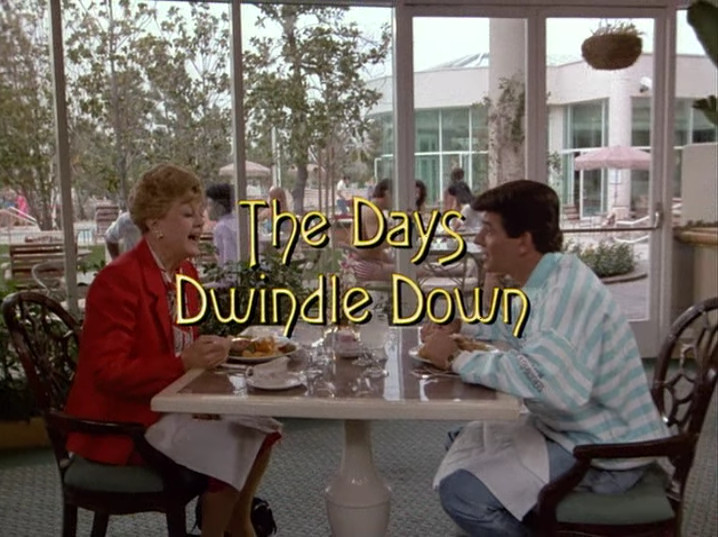
Very unusually for a Murder, She Wrote title screen, it features Jessica in it. She’s talking with a publicist, who wants to use the real-life murders she’s solved in order to sell books. I’m not clear on what his actual plan is, but it doesn’t matter because he’s not really a character in this story. He’s only here to introduce the information that Jessica solves real-life crimes to one of the real characters:
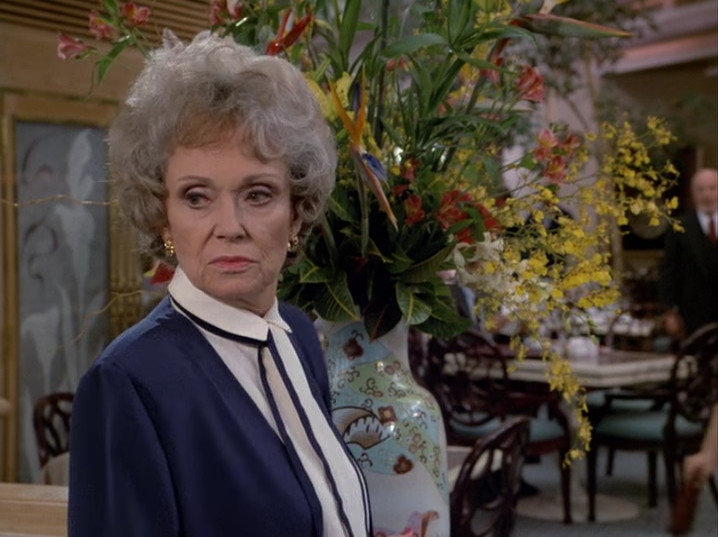
This is Georgia Wilson. She’s the one who asks Jessica to solve the thirty year old mystery. It happens not long after the breakfast meeting. She shows up at Jessica’s room and asks if she can come in because she could be fired if anyone sees her bothering Jessica. It turns out that her husband just got out of prison for a murder he didn’t commit, and she wants Jessica to… actually, she never really says. He’s a broken man and she wants him to be repaired so they can enjoy whatever years they have left, but she doesn’t say what Jessica can do to bring this about. She does ask Jessica to come and listen to his story, though, which is at least actionable.
When Jessica arrives, Sam is sitting in his chair, staring out of the window.

After a minute or so in which Sam is grumpy, he agrees to tell the story of what happened. And here we come to something fascinating about this episode: it is actually based on a movie. The movie is called Strange Bargain and was released in 1949. Since this episode first aired in 1987, the events depicted really took place thirty eight years before. Everyone in Hollywood always plays younger, even the movies themselves, it turns out. It works, though, and the flashbacks are done using footage from the movie.
Sam’s story starts out with Gloria talking Sam into asking his boss, Mr. Jarvis, for a raise. He makes an appointment and manages to get past Mr. Jarvis’s personal secretary, who was an intimidating character in her own right.
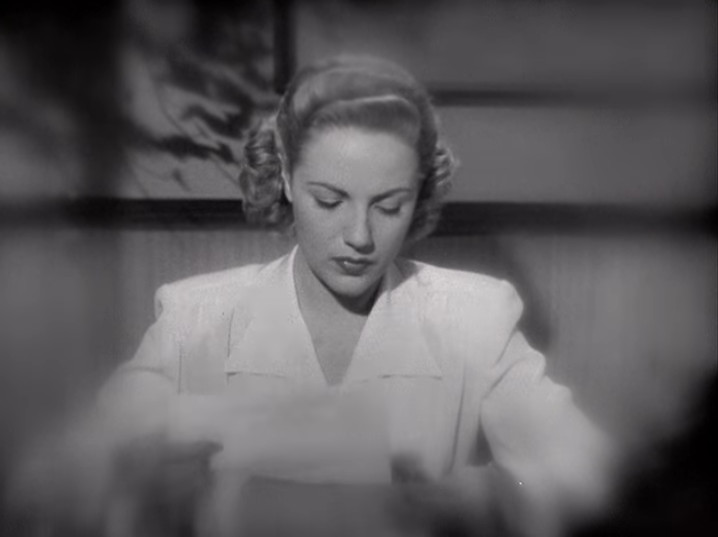
He did get past her, though, and saw Mr. Jarvis. Unfortunately, after he asked for the raise, Mr. Jarvis told him that he was fired because the company is in financial trouble and they have to cut costs.
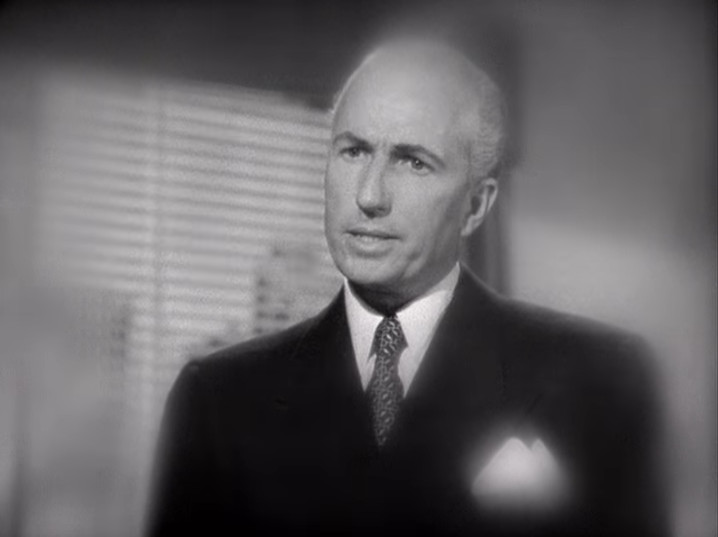
He, himself, had sunk all of his money into the firm except for about $10,000 dollars. (That would have been worth in the neighborhood of $50,000 in 1987 dollars and $109,000 in 2020 dollars.) Later that day, Mr. Jarvis took Sam out for a drink and offered a, well, a strange bargain. He had recently increased his life insurance policy to $250,000 (about $2.7M in 2020), and was planning to kill himself so that his wife and child would get the money. He would give Sam the $10,000 he had left if Sam would clean up the crime scene to make it look like murder instead of suicide so that his family would get the insurance money.
Sam at first refused, but Jarvis called him at home and told him that he was going through with it earlier than he originally planned and begged Sam to help him. Sam drove there to talk him out of it but by the time he got there Mr. Jarvis was already dead. The envelope with the money was there, and Jarvis had already done it, so Sam took the money and did as Jarvis had asked him to do. He forgot to fire the shots when he was in the library, though, so he fired them through the library window. Before going home he drove to the Santa Monica peer and threw the gun away underneath the pier.
Unfortunately, after he washed the blood off of his hands he forgot to wash the blood off of the steering wheel in his car. Also, the next day, when they went to pay their respects to the widow, Lieutenant Webb was there and told them that though the gun hasn’t been found the three bullets matched—the one in the body and two that were fired into the wall. When Webb said this, Sam looked at where he fired the shots into the wall. Webb was looking for it.

“Ah, yes, Mr. Wilson. Right there.” From this point on, Webb was convinced that Sam did it and was out to get him, at least according to Gloria. She also had a complaint that Sam had done everything he could to help Mr. Jarvis but Mrs. Jarvis and Sidney (Jarvis’s son) didn’t lift a finger to help him.
Sam telling Gloria that the Jarvis’s couldn’t have known about Jarvis’ plan is interrupted by Sam and Gloria’s son Rod and his very pregnant wife Terry coming in.

Jessica said she would like to meet Lieutenant Webb, but Rod wishes her luck. He tried, himself, but was told that Webb was retired and “unavailable”.
Rod gives Jessica a lift back to her hotel, where he fills her in on a few more details. He became a police officer in order to try to clear his father. The police file on the Jarvis case was missing, so he assembled his own file on the case full of newspaper clippings, court depositions—every scrap of evidence and information he could get his hands on. He lends this to Jessica. Jessica speculates that the reason why it wasn’t possible to prove suicide is that perhaps there’s a possibility that no one had yet considered: what if someone else had murdered Jarvis and only made it look like suicide when Sam found the body?
While this is an intriguing possibility, I’m not sure that it’s really justified. It would be different if there should have been evidence of the suicide which wasn’t there, but in fact the evidence was there, where you would have expected it. Furthermore, its disappearance is adequately accounted for. The reason that there is no evidence to prove suicide is that Sam destroyed it all. Speculating that someone actually murdered Mr. Jarvis doesn’t account for anything. Jessica seems to really like this idea, though, and takes it as a working hypothesis.
The next day they go to the house where Mr. Jarvis died.

This is one of those cases where it’s unfortunate that Murder, She Wrote wasn’t filmed in widescreen, because the house was so big that a 4:3 image can’t capture it all (at this distance away). It’s a big house. So big, in fact, that I wonder how on earth the family paid for it. If we use 2020 money throughout, $2.7M over thirty years is only $90k/year. Granted, it probably would have been smarter to invest the money and live off of interest or dividends or what-have-you, but if you assume that they were able to get 5% above inflation, that would still only amount for $135k/year. Comfortable, yes, but hardly wealthy. It wouldn’t surprise me if the property taxes on this palace consumed half of that. The gardening and maintenance bills would eat into a decent chunk of it, too. This isn’t a big problem; had it been about four to eight times bigger the results would have been far more in keeping with what we’re shown here. (An alternative would have been for Mrs. Jarvis or Sidney to have invested the money in some business which succeeded, but that clearly didn’t happen.)
On the way there, Jessica speculates that the killer might have forced Mr. Jarvis to call Sam. That would explain why Jarvis said that the plan was going ahead sooner than expected. Rod raises the excellent question of, why? Why kill someone you knew was intending to commit suicide? Jessica gives the only possible answer: perhaps the killer thought that Jarvis wouldn’t go through with it.
They go up to the doors of the house and Sidney opens them before anyone can ring the doorbell.

They explain that Jessica is here looking into the case, and Sidney dislikes the whole thing. In the discussion, it comes up that Jarvis’s business partner, Mr. Hearst, had lied about not visiting the home shortly before Jarvis was killed. Eventually Jessica persuades Sidney by pointing out that now that his prison sentence is over, Sam has nothing to gain by stirring up the past. Sidney relents. Jessica asks to talk to his mother, but unfortunately his mother is dead. Sidney then shows them to the library.
On the way, Jessica notices a clue. On the sideboard, there’s a letter written to Mrs. Jarvis in the mail.

They do not want us to miss this clue. Fair enough. Obviously this means that Sidney is lying about his mother being dead, though in reality it’s not uncommon to get mail addressed to someone who is dead for years afterwards. Anyway, why is Sidney lying about his mother being dead? We’ll find out.
Not right now, though. We don’t see the examination of the library, possibly because it would be too much work to come up with a set that closely matches the set from the movie. Instead, we cut to Jessica having an appointment with a “Mrs Davis”.

Mrs. Davis is the granddaughter of Mr. Jervis’ business partner, Mr. Herne. (He’s the one who wanted Jervis out of the business and lied to the police about not visiting Jervis at his house the day of the murder.) Susan Strasberg, the actress who plays Mrs. Davis, looks tiny compared to Jessica. I looked it up and she’s just a hair over 5′ tall. This made me wonder how tall Angela Lansbury is, since she towers over Ms. Strasberg, but normally looks small herself. It turns out that she’s 5’8″, which makes me think that they make a point of surrounding her with taller actors. That is, at least, one explanation for me never having noticed this before.
Be that as it may, Jessica pumps Mrs. Davis for information in a surprisingly clumsy way. She offends Mrs. Davis, who had been misled into thinking that Jessica was there to look for investment advice. In the course of the heated conversation which follows, Mrs. Davis said that Jervis had been in the process of completing a deal for her grandfather to take over the firm. This contradicts what Mrs. Jarvis said, that Herne took over the firm after Jarvis’s death. She accuses Mrs. Jarvis of lying, and says that Mrs. Jarvis lied doesn’t surprise her, though not why it doesn’t.
The sub-plot with the granddaughter is hard for me to figure out. The actress who played her was 49 at the time of this episode, so if we go with the Hollywood standard that actors play characters 10 years younger than they are, the character would be 39. That would make her about 9 years old at the time of the murder, which generally fits. She wouldn’t have known anything about it and what she did know would have all been second or third hand, learned much later. She can’t have inherited the firm more than about ten years ago, so her knowledge of the state of it twenty years before that would be minimal at best.
The attempt to set Herne up as a suspect in Jarvis’ murder seems to me a bit clumsy. There’s extremely little evidence given. Herne wanted the firm without Jarvis, and since Herne had money and Jarvis didn’t, and since the firm was going under, it seems quite superfluous to murder Jarvis to get the firm. This could be worked in such a way as to give him a motive—Jarvis was going to run the firm into the ground before giving it up—but Jessica never tries to establish this or anything like it.
I also don’t understand why Jessica is so aggressive with Mrs. Davis. I am inclined to suspect that the hostility created was meant to take the place of evidence that makes Herne a suspect. Be that as it may, on her way out Jessica talks to an older woman in a nearby office and finds out the address of Thelma Vante, Mr. Jarvis’s personal secretary. She then goes to visit her.

Thelma is delighted to meet Jessica. “Wait till I tell the girls. Me, in a book by J.B. Fletcher.” She shows Jessica an old photo book, and also relates a little personal history. Her ex-husband was beautiful but never worked a day in his life. Also, they had a beautiful home. Jessica doesn’t come out and say it but you can see that she’s wondering where the money came from for that beautiful home. Jessica also brings up the idea of Mrs. Jarvis having killed her husband—she didn’t get to the beach house until well after Mr. Jarvis was dead. Thelma poo-poos the idea because Mrs. Jarvis didn’t have the guts to murder anyone.
As soon as Jessica drives off in a cab, Thelma goes inside and places a phone call. She says that “there seems to be some new interest in our problem.” I suppose this isn’t giving away too much because she was awfully suspicious when Jessica interviewed her, especially with the evidence of her nice house, workless husband, and complaints that she didn’t get anything when Jarvis died.
Over a family dinner at the Wilson house, Jessica discusses the case with them. Sam Wilson thinks that Mrs. Davis is lying about when her grandfather took over the firm. His recollection is that even after Mr. Jarvis’ death, Mr. Herne (Mrs. Davis’ grandfather) didn’t know if he’d be able to take over the firm. Jessica thinks that Mrs. Davis was lying to protect her grandfather’s reputation, or the reputation of the firm. Rod comes in and delivers the news that Mrs. Jarvis is not dead, she’s living at a rest home. Jessica and Georgia Wilson decide to pay her a visit in the morning.
Before they can do that, someone comes to Jessica’s hotel room, points a gun in her direction while she’s sleeping, and fires.
If you ask me, this is playing a little unfair with the audience. We know that Jessica is not going to be killed in an episode, but here the gun is actually pointing at her. The camera does move to showing only the gun, from the side, when it fires, though. The next scene (which I suspect is after a commercial break, in the original airing) has Rod coming over to check on Jessica.

The guy in blue who is kneeling is extracting the bullet from the cushion of that chair. Now, granted, the gun is not in focus in the earlier frame, but it really looks like it’s pointing directly at Jessica and nowhere near the chair. The bullet is from a .38 pistol and hasn’t been made in twenty years, btw. Jessica asks the police detective (the guy in the blue suit who pulled the bullet from the cushion) to humor her and compare the ballistics of the bullet to the one from the Jarvis case.
The next morning, Jessica and Georgia follow through on their plan to visit Mrs. Jarvis.
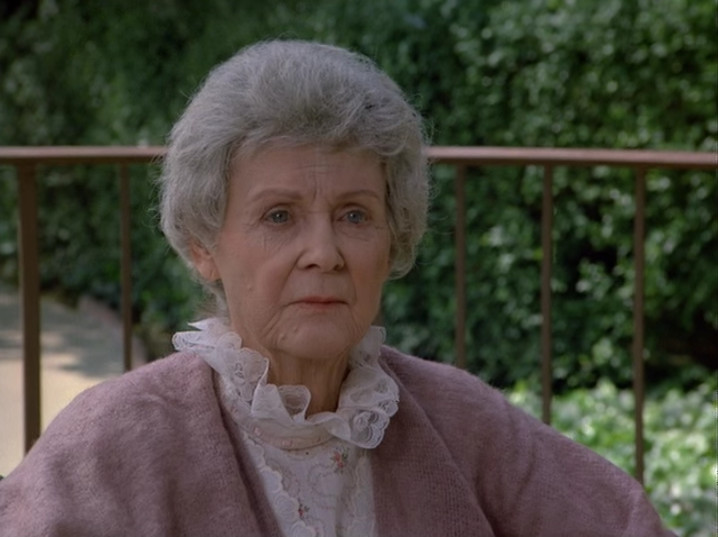
Unfortunately, it turns out that she has dementia and doesn’t even know that her husband is dead. Sydney walks in on them after Mrs. Jarvis tells them about the roses that her husband grows and they question him a bit more. He claims that Mrs. Davis is lying about when her grandfather took over the firm and it happened in a “proxy fight”, which was a matter of public record. This implies that the company was publicly traded, because proxy voting of shareholders is only a thing in publicly traded companies. That’s not of great significance, except that if it is a publicly traded company, stock purchases that give somebody more than 5% ownership of the company are public record, which Jessica should know. That said, proxy fights are about getting the shareholders to vote for somebody (or some bodies) for the board of directors of the corporation, they’re not about ownership. I think we need to chalk this one up to Hollywood writers having no idea how corporations actually work.
After saying goodbye to Sydney, Jessica and Georgia take a minute to discuss the shot fired into her hotel room chair. Whoever it was, Jessica points out, it certainly wasn’t Mrs. Jarvis. Further, it clearly wasn’t an attempt on her life. The shooter had all the time in the world to aim carefully, or even to fire a second or third shot, if he really wanted Jessica dead. Jessica then asks for a lift to back to Herne and Jarvis (the firm).
At first Mrs. Davis is reluctant to see her but, through an intercomm trick, Jessica gains entry. They talk for a bit, but nothing really comes of it. After Mrs. Davis angrily tells Jessica to leave, Jessica replies, “If you’ll forgive me, Mrs. Davis, it appears to me that you suspect your grandfather more than anyone.” As far as I can tell, that includes the audience. This is the last we see of Mrs. Davis, and we’ve still got fifteen minutes to go.
I still don’t understand why she was here. I suppose it’s supposed to be a red herring but at best it’s a pink herring. Mrs. Davis is angry and defensive but we’re never given any reason why she’s angry and defensive. Or if Jessica is right that Mrs. Davis suspects her grandfather, there’s no reason why she suspects him—at least none that we’re given—so her defensiveness doesn’t feel like it comes from anywhere.
Later on, in her hotel lobby, Jessica tells Sam and Georgia that unfortunately the ballistics report on the Jarvis case went missing with the rest of the case file. After they leave she gets a telephone call from someone claiming to have information on the Jarvis case but she has to come alone. He won’t give his name but Jessica goes anyway. She takes a taxi.
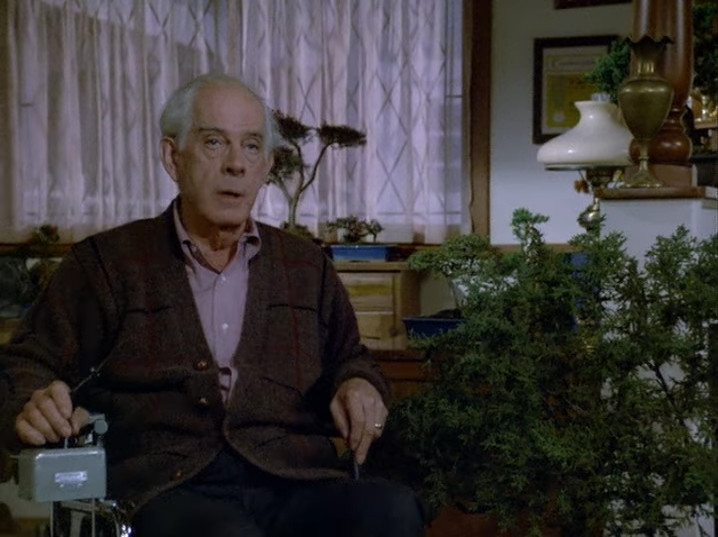
It turns out that it’s Colonel Potter in a wheelchair. Recognizing the actor by his most famous role aside, it’s actually Lieutenant Webb, who had been in charge of the case thirty years ago. He apologizes for all of the intrigue but it had to be strictly unofficial. How waiting until Jessica got to his house to admit to his name makes it any less official than telling her his name over the telephone, he doesn’t explain. He also couldn’t face the Wilsons, because he always had the feeling that Sam Wilson was innocent. He couldn’t do anything, though, because the DA told him to wrap up the case quickly and that his job was to collect evidence, not to judge the case. This bit of backstory out of the way, he gets to the reason he asked her to come—he’s got the old case files, including the ballistics report from the Jarvis case.
The bullets match.
They discuss the case for a while, which is fun because Harry Morgan is a wonderfully charismatic actor. They don’t really add anything to the case, though. Jessica suggests that perhaps the killer thought that he would benefit, but was wrong. Webb said that he entertained that theory, in particular that Thelma Vantay, the secretary, might have been having an affair with Jarvis and thought she would benefit, but they checked it out and Jarvis seemed to be faithful to his wife. He wishes Jessica well on her investigation of the case, and she leaves to go see Thelma again.
Thelma is initially reluctant to talk but Jessica points out that the statute of limitations for blackmail has passed. Once she understands the significance of this, Thelma opens up, though curiously she mostly just confirms what Jessica guesses. She knew about the life insurance policy increase and she had heard Jarvis talk about suicide a few times, so when he ended up dead, she figured out what happened and blackmailed the Jarvises. In particular, she blackmailed Sydney. What, exactly, she blackmailed him with is not entirely obvious, though. She didn’t know anything that the police didn’t know—certainly they knew about the life insurance policy. I suppose she could have told them that Jarvis had talked about suicide before, which might corroborate Sam’s story, but it’s thin material to blackmail someone with.
Jessica and Rod get to talking about it. He thinks that they can now prove suicide but Jessica is bothered by the gun being used to shoot near her. Why? It doesn’t really make any sense to attract this sort of attention to the case so unnecessarily.
Jessica then has an epiphany.
They go to the Jarvis house and press Sydney until he makes a slip and says that the gun was thrown under the Santa Monica pier. This wasn’t public knowledge; all that the public was told was that the gun was disposed of. Sydney admits to following Sam to the pier and retrieving the gun, because, he says, he killed his father. Jessica asks if he isn’t covering for his mother, instead. The Wilsons point out that Mrs. Jarvis couldn’t have fired the gun near Jessica the other night and she agrees—it was a mistake to think that the same person who killed Jarvis fired the gun near Jessica. Sydney did it to direct attention away from his mother, who had the perfect alibi for the second crime.
Sydney admits to it all. His mother didn’t mean to kill his father. She came back to the library to retrieve a book and came across him when he was in the process of trying to commit suicide. She grappled with him, but in the struggle the gun went off and he was killed. It was an accident but with the insurance money no one would believe that. So Sydney tried to cover it up. He even tried to protect Sam by putting pressure on the DA to close the case quickly, except that backfired when Thelma figured out what was going on and blackmailed him. He had to choose between Sam and his mother, and chose his mother.
The Wilsons and Jessica leave. On the way out Rod says that he will call the DA but Sam tells him not to. He has the closure he wanted—it would be absurd to prosecute Mrs. Jarvis, who didn’t really commit a crime, and Sydney was only trying to protect his mother. They know what happened, which is enough for him. Rod appeals to Jessica, who says that justice is imperfect and that sometimes there’s a difference between serving the ideal of justice and doing what’s best. Sam and Georgia kiss and the episode ends with Jessica smiling on them.

Before I get into further analysis of the story and it’s ending, I have to say that it’s frustrating how utterly incompetent Hollywood writers are at moral philosophy. Justice is not always imperfect. Human attempts to achieve justice are always imperfect. Worse still is the consequentialist conclusion that when a principle doesn’t produce the consequences you want, to hell with the principle. What they really want to get at is the perfectly legitimate conclusion that they do not have it within their power to achieve justice and invoking the criminal justice system, which is a blunt instrument wielded by flawed human beings, is not permissible because it will not achieve the end for which it will be invoked.
That said, it seems likely that the statue of limitations on withholding exculpatory evidence for a charge for a crime that was not committed has probably run out quite a while ago, so the whole thing is almost certainly moot. If the DA could not bring any charges calling him doesn’t matter, one way or the other.
That out of the way, it is curious that this episode has a different ending than the movie it used as a source did. In Strange Bargain, it turned out that Mrs. Jarvis actually did kill her husband and set the murder scene to look like suicide. The movie ends with her admitting this to Sam before she kills him; Lieutenant Webb arrives just in time to save Sam.
Obviously, they did have to change the ending to the movie in order to justify the episode and I think that on the whole they did change it in a way that at least made sense. They could have done a better job than an accidental death that basically was a suicide, just with someone else trying to claw the gun away when the suicide was committed. It really having been the business partner, for example, would have been a more interesting reveal, though they couldn’t have the weird sub-plot where the same gun was used to shoot at Jessica had they done that. The other odd thing about this ending is that it doesn’t really change anything for the characters in the story. Jarvis did really kill himself and the only people who have learned that are people who already believed it. Why Sam was brooding when the episode started and now is willing to forgo public exoneration is not really explained. Such character development is possible, of course, it just didn’t happen in this episode.
On the other hand, TV shows are, structurally, short stories. Short stories are about sketching out stories, not about painting them in full. We could certainly imagine a story in which a man who was wrongfully convicted of murder at first broods but then in the course of helping a sleuth investigate what really happened comes out of his shell and, though he can’t prove the truth, has spent enough time focusing on something that is not himself that he no longer needs to prove it to anyone.
Though it is not a conventional detective story, it is possible to tell a detective story in which the detective uncovers the truth but it doesn’t do anyone any good. To some degree the Poirot story Five Little Pigs is that. Poirot uncovers the truth but the only person he helps by doing so believed it, or at least part of it, already. (She believed that the person convicted was innocent; she did not know who was guilty.) A few other people who didn’t know it now do, but that’s it. Yet, it is profoundly satisfying because the mystery was such a tangle and everything about it makes so much more sense when it is untangled. It is not merely satisfying to see a puzzle unraveled; it also gives insight into how possible it is to misunderstand fragmentary facts. It’s an extremely good story and I think that The Days Dwindle Down is an enjoyable episode in part because there are fuller versions of it like Five Little Pigs.
Overall, I think that The Days Dwindle Down could have been, realistically, better than it was. Probably the better outcome would be to have revealed someone else as the murderer. Failing that, it would still have been better to come up with some sort of exculpatory evidence which did actually prove suicide. It’s hard to think what that could have been since the premise was that Sam had destroyed it all; some sort of witness is about all that could be done. To be fair, that’s actually what they did, except that the witness still refused to talk publicly. I think that the best way out, here, would have been the route of Five Little Pigs—a witness who misunderstood what he saw all these years. This would have been easier if there had been something else in Strange Bargain such as a bump on the head that could have been caused in a previous struggle. Unfortunately, that movie had a different purpose in mind, so it didn’t provide these things. With what we’re given, I’d say that it would have made more sense for Herne to have brought his granddaughter in the car, somehow, perhaps after the death but before Sam arrived, and she got bored and came out and saw her grandfather in the room with the corpse, and thought that he did it. Unfortunately, we couldn’t have a flashback for any of this, since it wasn’t in Strange Bargain, but a flashback isn’t a strict requirement here. The flashback that they had was very incomplete, as it was.
If a flashback was an absolute requirement then I think it would have been better to go through with how Strange Bargain actually ended, with Mrs. Jarvis having murdered her husband because he wouldn’t go through with it. Sydney could have protected his mother. That would make him an accessory after the fact, though, so he still wouldn’t be able to come forward (depending on the jurisdiction). If they had gotten rid of the shooting at Jessica, he could have been merely a witness who didn’t come forward, though, which wouldn’t have been so bad. They could have changed the ending around so he would have been willing to publicly exonerate Sam, now that his mother has dementia (or she could have recently died). That would have been better, and still allowed the use of flashbacks from the movie in the denouement. Not as good as the other options, but still an improvement over an accidental death.
All told, yes, it could certainly have been a better episode, but The Days Dwindle Down was a good episode and the idea of using flashbacks from a 38 year old movie was a lot of fun.
Money: What Is It & Why Is It?
Money is an often misunderstood subject, especially because there are so many accidental things which grow up around it that are common and often mistaken for its substance. In this video I look at the history of how money develops as a medium for intermediating barter between people where only one person has something the other wants and how that develops into the sorts of monetary systems we have now. This also leads to what properties are essential to money and which are merely accidental, as well as what conditions are necessary for money to work and what conditions destroy money’s utility.
How To Not Be Afraid of the Dark
In this video I discuss how to not be afraid of the dark. Granted, most people watching it will already know, at least in a practical sense, but this video may help to explain it to others.
The Assumption That Physics Explains Everything Physical
In this video I talk about the assumption that physics explains everything physical—basically the idea that biology is applied chemistry, and chemistry is applied physics. I do not argue that physics is incomplete, I just point out that we have no reason to believe that physics (that is, that branch of science which studies matter at the lowest level) in fact does explain everything, because we can only study physics at extremely high energy levels and almost all of the interesting stuff happens at (comparatively) very low energy levels. If you were to study human beings by throwing them against a wall at 600 miles per hour, you would miss out on all sorts of interesting things that they do.
The Wages of Cynicism?
I’ve come to wonder about a trend I’ve seen in baby boomers that they tend to be very cynical but then have a streak of unbelievable credulity. It’s not all baby boomers, of course; no generation of people is homogeneous. This is merely a surprisingly large number of them, in my experience, and I’m wondering if it points to a more general human tendency (rather than merely being a strange product of the times in which it came to be). In particular, I’m wondering if, in general, being extremely cynical has a tendency to produce a sort of pressure-valve of credulity in some one thing.
The thing I most notice this in is the absurd credulity that many of the baby boomers in my life have towards news, especially newspapers. News, so they will tell me, is a bastion of the people and our one safeguard of liberty and all sorts of other nonsense, and all this in the face of things like newspaper articles which one can tell are lies simply by looking up the actual sources that the article references.
To give an example of what I mean, I read an article (sent to me by one of these boomers) which justified a claim of the Obama administration begging a heard-hearted republican congress for expanding PPE stockpiles by linking to an article which actually said that Obama’s refusal to compromise on the budget triggered automatic across-the-board 5% cuts to everything (a provision in the previous budget), that no one wanted. The most charitable interpretation of this event is that Obama wanted unlimited money and with it would have increased the budget for everything. This still gets nowhere near what the original article was trying to say, and if we limit ourselves to non-silly interpretations, Obama was clearly willing to take a 5% cut to the budget for medical stockpiles so that he wouldn’t have to compromise on things which were a higher priority to him. This is, literally, the opposite of what the source was invoked to claim. Unless one invokes the insanity defense, the article was, simply, lying. It didn’t matter, though. No matter how many lies an article tells, it is still the bullwark of the people, our sole preserver of liberty, etc.
(Oh, and the putatively supporting article also mentioned that even had the medical stockpiles seen a funding increase, they would have spent the money on rare drugs, which is their top priority, because (under normal circumstances) PPE is cheap and plentiful and easy to get more of on short notice. I did start to wonder if I was the only person who actually clicked through to verify the claims about the cited source. The degree to which it destroyed the article it was linked from was shocking, even to me.)
The more general human fault that I suspect this is an example of is the difficulty in living with ignorance. As human beings we necessarily do live in ignorance; we know very little about the very large world in which we live. The only real solution to this problem is to trust God, to whom the world is small and known. Since we are fallen creatures, however, this is hard. To be uniformly cynical to flawed sources of knowledge requires that we be able to repose in trust in God. This suggests that human credulity is, approximately, a fixed quantity; however much we fail to trust in God, that much will we be credulous. The only question is whether we will concentrate that credulity narrowly, trusting a few things far too much, or whether we will spread it out and trust many things a bit too much.
And to bring this back to the baby boomers with which this started (who are, by definition, American). I suspect that this is where history shaped the particular outcome. Having grown up during the civil rights era, the Vietnam era, and to a lesser extent the Watergate era, they learned to be cynical toward leaders and more generally the people that society normally trusts (priests, elders, etc). So they contracted their credulity towards a few sources like university professors and newsmen. Thus they were generally cynical, but with a few glaring gaps of credulity.
As I said, this is by no means all of the baby boomers, and my interest is at most only partially in the baby boomers I’m describing. Far more interesting is what general human weaknesses this is an expression of, and how to avoid them, even with different expression.
Request for Subjects
In this video, I put out a request for subjects. I have plenty of ideas of my own, but I’m also quite open to questions/requests/suggestions. I should note, here, that that goes for the blog as well as for my videos. I’ve got plenty of subjects to work on without requests, but would be very happy to take requests, too.
All Cause Mortality
Update: I’ve got a post with the most recent data (through April 3, 2021) here.
I previously wrote about finding All-Cause Mortality Data for the USA. Since I’m seeing hits for that, and the post is somewhat old, I figured I’d make an updated post with the latest information. (As before, you can get the data here.)

And to zoom in a bit on the last year of data:
As before, disregard the blue bar all the way on the right. That data is only 10 days only, and it only starts getting close to complete at about 17 days old (i.e. after being on this chart for two updates. It isn’t fully complete until it’s two months old, though as I’ve been watching it, it tends to change very little after about 24 days (i.e. after the week has been on this chart for three updates). That said, with Christmas and New Years happening so close together, it wouldn’t surprise me if the data took a little longer to come in than usual, which would mean the most recent few weeks might be a bit under-represented.
The orange line is the “excess death” line, which is a statistical threshold that indicates when deaths (from any cause) exceed what we’d expect within normal variation, and there is probably something going on. (That said, there was a cluster of excess deaths around January 2018, and I don’t know that there was any specific cause ever found for that.) It is not constant because there tend to be more deaths in winter and fewer in summer; its exact value isn’t overly meaningful, but it works fairly well as a trend line.
As you can see, there have been three distinct waves of excess mortality, which correspond to the arrival of COVID-19, air conditioning season in the south, and winter. Whether that’s actually the cause of it, the data itself does not say, of course, though they are at least reasonable suggestions. It is also interesting to note that the magnitude of the waves is not equal; the all-cause mortality was highest in the first wave.
As I mentioned in my first post on the subject, all-cause mortality data is so important because it does not involve interpretation. Whether someone with COPD who caught COVID-19 and died was killed by COPD or COVID-19 is a matter of interpretation, and there are reasonable arguments to be made on both sides. Whether they’re dead is not a matter of interpretation. It is thus a number one can look at without having to do great research into it, and further it’s a number that can directly be compared across medical systems, countries, etc. The trade-off is, of course, that it is very limited in what it tells us. In this case it does clearly tell us that something has been going on because mortality has been elevated relative to previous years, and moreover elevated in three distinct waves. It also tells us that mortality has not been very elevated, and that the severity of the waves is not getting worse, and may even be a little bit better.
Update: I pulled down the CSV of the data and graphed just the excess deaths, to make the three waves more directly comparable.

(As in the graphs above, ignore the right-most week as the data is almost certainly significantly incomplete.)
This makes it much clearer that the third wave is, so far, a little bigger than the first. With the last week being almost certainly incomplete, there is, at present, no reason to suppose it’s over, from this graph. As I said in my previous post on the subject, I think it’s too early to make predictions. It is not, however, too early to rule out some predictions that people have made. There are certainly more than enough contradictory predictions that some of them have to be proven wrong, by now.
Detectives as Christ Figures in Mystery Stories
In this video I talk about the detective as a Christ figure in mystery stories. (I also talk about what Christ figures really are and how they’re not the absurd where’s waldo game sometimes played in high school English classes..)
The Poirot Short Stories Are Interesting
A few weeks ago I bought a book of the complete Poirot short stories. I’m not through it; there are a lot of them. I’ve made a lot of progress, though.
Interestingly, the short stories are in three major groups. The first is a series of short stories written for The Sketch magazine. This comprises possibly the majority of short stories, by number, since it was a weekly magazine. The next grouping consists of various short stories that came out as one-offs. A good example of this is the short story How Does Your Garden Grow, which was originally published in Ladies’ Home Journal, and was, so far as I know, the only Poirot story ever published there. (To be fair, that was in America; it was published in Strand magazine in the UK a few months later.) Finally there was the collection of twelve short stories which made up the collection The Labours of Hercules. Each of these bore a tenuous relationship to one of the twelve labors of Hercules from Greek mythology.
(There was a series of short stories right after the ones in The Sketch magazine which then formed the novel The Big Four, but they’re a connected series of short stories rather than traditional, independent, short stories, so I’m not counting them. They’re closer to a novel first being published in serialized form than true short stories.)
One of the things I’ve found interesting about the Poirot short stories is how often they are not fair play mysteries; in many cases they’re not even so much mysteries as they are tales of something interesting. They are told in a mystery format. In The Nemean Lion, for example, (spoiler alert) the reader has no real way to guess that one of the lady’s companions has a trained Pekingese dog which gets substituted for the real one and is trained, once its leash is cut, to run home. Frankly, there was no need for such a solution; if the Lady’s Companion was in on it, a confederate to walk the Pekingese home would have worked just as well. Further, that Poirot’s client was poisoning his wife in order to be able to marry his secretary was justified by what was said, but was a shot in the dark even for Poirot. It was an entertaining story to read, but mostly because of the revelations and not because of any sort of detection. It was interesting to find out the unusual criminal enterprise and the revelation that the apparently dumb Lady’s companion—who herself complained about being untrained and unskilled—was an organizational criminal genius.
I find this sort of short story curious because I had been used to thinking of short stories as being primarily about setting up complex puzzles with ingenious solutions. On the other hand, The Labours of Hercules dates from 1939 through 1947 (though most were published in 1940), and short stories were probably changing by then. It would be a while before the market for short stories fell out, but tastes were undoubtedly changing, especially as we’re getting into early World War II, here.
To some degree this is just a historical curiosity. I think that the market for short stories is never coming back. It’s moved into television and the streaming that is replacing television. It’s interesting to look at short stories, though, since they were so influential in the early development of the mystery genre.
Progress!
So, I’ve finally begun work on the text of the third chronicle of Brother Thomas. Up til now, I’ve been working on what really happened, developing characters, working out plot elements, etc. Now, I’ve finally begun work on the part that people will actually read (God willing). My working title for it had been He Didn’t Drown in the Lake, but I’m now leaning more towards The Corpse in Crystal Lake. Both are tentative titles, so we’ll see what I decide on when I’m done with the novel. Here’s the first paragraph:
It began, as so many things do for small businesses, with a referral, made on the morning of the thirtieth day of June, in the year of our Lord 2015. Properly speaking, the Franciscan Brothers of Investigation did not a run a business, for they did not charge their clients, but then it was no ordinary referral, either. It would be some time before Brother Thomas would learn of the referral, but the effects of it he learned within the hour.
This is, of course, a first draft, and everything is subject to change.
By the way, if anyone is interested in being a test reader for me and reading chapters as I finish the first draft of them, let me know. (Having read my previous Brother Thomas novels is not a requirement for this.)
It’s been a difficult year for getting writing work done. Overall I’ve been doing extremely well, considering. My family is in good health and my job hasn’t been affected by COVID. The big problem is really that my children haven’t been able to go anywhere, so they’ve needed me quite a lot. Perhaps it’s ironic, but I’m an introvert who has had almost no time alone since COVID-19 hit. Things could be wildly worse, but it’s been very hard to muster up creative energy, or perhaps it’s creative focus I’ve found difficult. Anyway, between things stabilizing out a bit and I’ve been figuring out how to get my ideas in order on shorter notice and with less contiguous writing time available. This has the potential to mean that more editing time will be needed, but I’m trying to help that with more careful planning before I start. Now I’ve got so many files with notes in them that flipping between them is starting to take time!
There’s always something, isn’t there?
 Chris Lansdown
You must be logged in to post a comment.