
In this video I talk about how authenticity is overrated—just pick a worthwhile goal, pursue it because it’s good, and hey presto you’re authentic, but if you’re doing it right, you won’t notice because you’ll be focused on your worthwhile goal.
Author: Christopher Lansdown
http://www.chrislansdown.com/
Murder She Wrote: Murder Through the Looking Glass
In the fourth season of Murder, She Wrote towards the later middle of the season was the episode Murder Through the Looking Glass.

The car we see in the opening title pulls up at the peer and two men get out. The older, grey-haired one pulls out a gun and tells the other to face him.
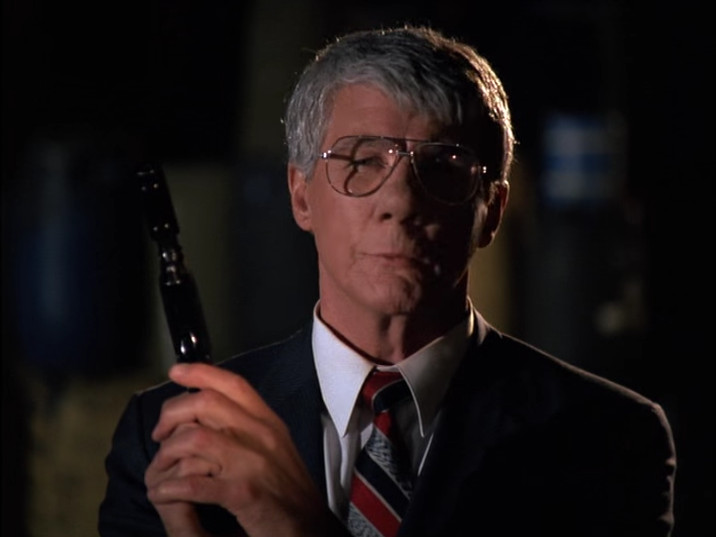
The man who is about to be shot asks who it was who ordered the hit, but the hitman says that it would do him no good and then shoots him twice. The shots are off-screen while the camera pulls in on a headlight. In theory, this is supposed to be to shield the viewer from witnessing even simulated violence. In practice, I suspect that it’s a heck of a lot cheaper to just film a headlight and put the sound of two bullets and a splash over it in post-production than it would be to use special effects and do a stunt.
The hitman gets back in the car and drives off.
The scene then changes to a sign saying that the guest speaker of tonight’s meeting of the New England Booksellers’ Association is J.B. Fletcher. She leaves amid thunderous applause, and accepts the organizer’s invitation to get some coffee up the street. As they’re going to the coffee place, the hitman suffers a heart attack and crashes his car next to her. He asks for a priest, and Jessica calls out for one. A priest actually pulls up in a car, across the street, and she calls him over. The hitman, in his delirium, he seems to mistake Jessica for the priest and gives her his dying confession. “I killed a man tonight: Karl Kosgrove from Farmington. H&H.”
He then slumps over dead, and the priest gets there. He asks what the man said, and Jessica merely says that he asked for a priest. The priest checks the hitman’s pulse and pronounces him dead. Jessica widens her eyes in shock, and we move onto police headquarters the next day. There we meet the police detective for our episode.
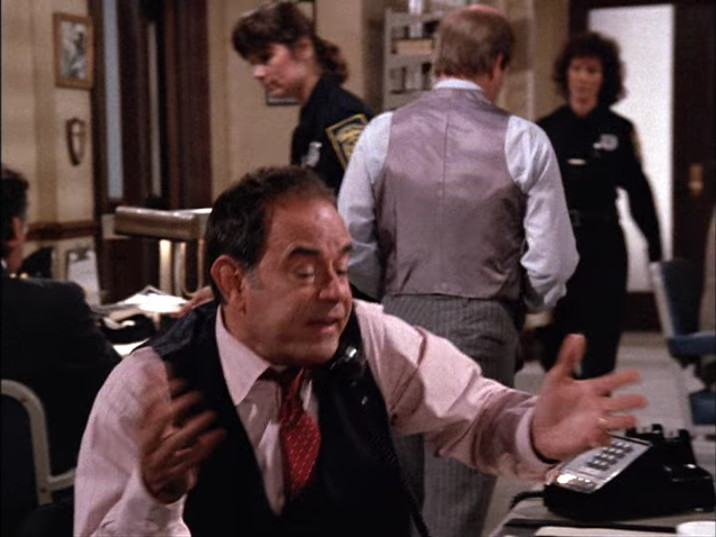
His name is Sergeant Cooper. He’s telling a woman named Edie the story of how he insulted her sister the previous night. From context, Edie’s sister is Cooper’s wife, and she’s left their house and he doesn’t know where she is and is trying to find her. Jessica walks in and talks to him about the man who had the accident last night whose death she reported to him half an hour ago. Yeah, that doesn’t make sense to me either, but it’s going by very quickly and I think that they’re just trying to get it over with as quickly as possible.
Anyway, Jessica is surprised to hear that he didn’t have any identification on him. He was driving a car so he should have, at least, a driver’s license. Unless, she adds, he wanted to conceal his identity because he was a professional killer. Sergeant Cooper is amused by the idea that he was a professional killer and wonders where Jessica got that idea. She said from his dying confession—he said H&H, which according to her research means “head and heart”; a bullet in both places is the mark of a professional killing.
She doesn’t explain why the assassin’s union—or would it be a guild?—would have this standard. I suppose the idea of two bullets is to ensure that the victim can’t possibly survive, but why not two bullets in the head and two in the heart? If the idea is that they only need two in order to show off their skill, why not one?
Be that as it may, why would a professional killer benefit from not having identification on him? If he’s arrested for the murder he just committed, not having ID will not help him at trial. If he were pulled over for a traffic violation, it could get him in extra trouble for not having his driver’s license. I can see why he might have a fake ID, but not why he would have no ID.
Be that as it may, Sergeant Cooper finds Jessica’s very amusing. Jessica makes clear her expectation that the police will investigate, starting with Carl Cosgrove in Farmington. Cooper is in the mood to humor her, so he dials directory assistance to get Cooper’s phone number and calls it.
At the residence that the phone number reaches, a woman dressed in black comes down the stairs and answers the phone.

She says that she’s Mrs. Cosgrove and that Mr. Cosgrove is alive and well. Cooper asks to speak to Carl but Mrs. Cosgrove says that he can’t—he was working in the rose garden and had an asthma attack, but she can have him call Sergeant Cooper when he recovers. Sergeant Cooper says that that won’t be necessary.
Jessica is satisfied, and the episode ends only 8 minutes in.
Just kidding.
Since Sergeant Cooper will not help, Jessica takes a taxi over to the Cosgrove house to investigate for herself. The house has a gated driveway with a security guard at the gate. As he talks with her and asks if she has an appointment, several people inside watch the security camera footage of this in some sort of command center.
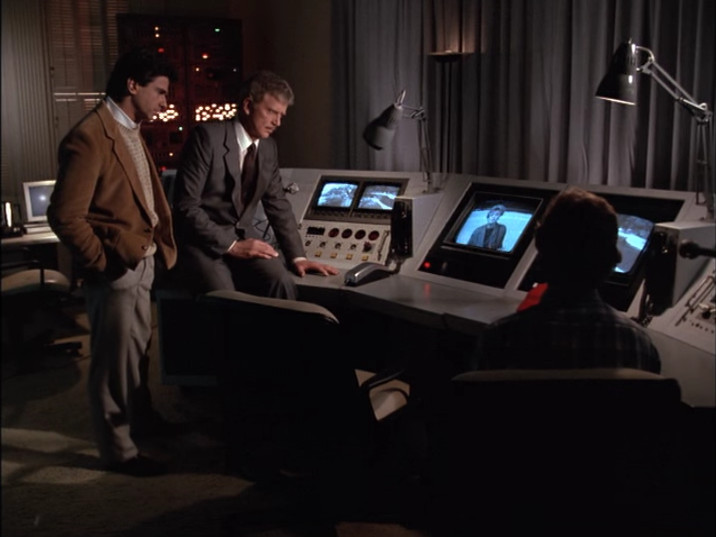
What has Jessica stumbled into? On the other hand, when you hear the dying confession of a professional killer, it’s probably not something ordinary. Still, this is one heck of a control room. They’ve got a super-computer in the corner (look at all the blinkenlights) and also some very serious grey drapes to keep the tone somber.
The security guard is reluctant but calls the command center to ask what to do. The youngest one says that perhaps they should ask “Adams,” but the middle one (the one with the mustache) who seems to be the most authoritative says that Adams isn’t here. The one in the tan sport coat says that a woman this persistent could be trouble, and the authoritative one with the mustache says, “Let’s get this over as quickly as possible.” After being told she can go in, Jessica thanks the security guard and for some reason gets back into her cab, which then pulls up to the house.

I find the houses in Murder, She Wrote very interesting. There was a lot that they were trying to convey with an establishing shot. At least, normally. In this case, I’m really not sure. This sort of estate is a strange place in which to run a… well, whatever this is. And whatever it is, who is supposed to live here? As a cover story, I mean? A gated property with a security guard manning the gate is no trivial matter, but it’s hardly enough to keep out an attacking force. On the other hand, if the purpose of the security guard is not to defend against direct attacks, what purpose does he serve? If people don’t know what’s here to attack it, the security guard would, if anything, draw attention.
Jessica comes to the front door and Mrs. Cosgrove lets her in. Jessica apologizes for Sergeant Cooper’s phone call, as if somehow the problem was Sergeant Cooper’s manner and not the call itself or Jessica’s refusal to believe Mrs. Cosgrove. There’s some chitchat and Jessica says, suggestively, that the police have reason to believe that something happened to Carl Cosgrove. Mrs. Cosgrove replies that it’s time to introduce Mrs. Fletcher to her husband, and leads the way upstairs.

When she introduces Jessica, he weakly waves his hand. Jessica expresses her condolences on his asthma attack. While she’s doing this, the shot changes to the other side of a one-way mirror in the room, where the same people who were in the control room are watching:
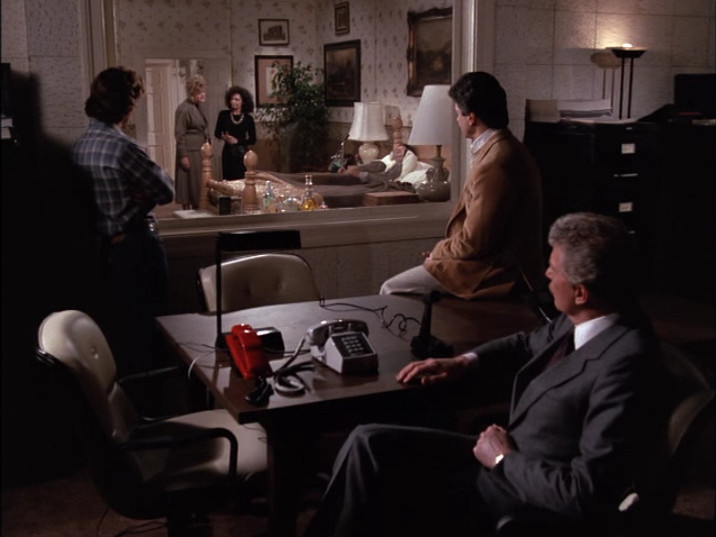
The mustached fellow in the grey suit asks if Jessica buys it, and the man in the tan sports jacket expresses the opinion that Jessica isn’t even slightly fooled. Mrs. Cosgrove then leads Jessica out to show her the rest of the house (for some reason). Once the door is closed the man pretending to be Carl Cosgrove—his name turns out to be Señor Delgado—gets up and talks to the mirror, saying that he does not like role-playing. Mustache Man acknowledges this, but says that it’s sometimes necessary for security. Another man walks in—he appears to be some sort of aide and refers to Señor Delgado as “Comandante”. They speak in Spanish and he translates, despite Delgado seeming to speak English perfectly well.

Delgado feels uneasy in the house and wants to return to Washington. Mustache Man says that this cannot be arranged, but they will bring him back to Washington the next day. Delgado demands to speak with Adams but is told that Adams is in Washington arranging the security for his appearance before “the committee”. Delgado says that he doesn’t believe them, and on that bombshell the scene fades out.
We’ve gotten some definite clues about what Jessica as stumbled into, though I’m not sure that they make sense. Delgado is some sort of South-American dictator, or at least military figure. It doesn’t make sense why a South American dictator would be hiding out in a safe house, so presumably he’s a military commander who has run away from his country to testify in front of congress that… who knows?
This is apparently a safe house run by some government agency. Why they let Jessica in and why they picked Delgado to pretend to be Carl Cosgrove, I can’t make out. Perhaps it will eventually be explained.
The next scene is of Jessica in her hotel room. A desk clerk recognizes her as she walks past and tells her that Father Francis was looking for her. He left a message for her to meet him at his church, Saint Jerome’s, which is only two blocks away.
Jessica goes there directly.
Fr. Francis calls out to her by name as she’s walking along the nave of the church, which startles her. She asks how he knew her name. He says that he described her to the desk clerk who identified her. He asked her to come because he wanted to know what the dying man said in his confession, as the confession was meant for a priest. Jessica acknowledges this and, knowing nothing about how the sacrament of reconciliation (“confession”) works, tells him.
He responds that a parishioner who is a police officer told him that the man who died was identified as a professional killer from another city. He asks if the confession included who hired him to kill Mr. Cosgrove.
Frankly, this isn’t a great impression of a priest. (It’s pretty obvious by now that “Fr. Francis” is not a real priest.)
Jessica says that no, the killer didn’t say, and she just met Mr. Cosgrove and he seemed very much alive.
“Fr. Francis” then asks if she’s sure that it was the Mr. Cosgrove. Jessica starts to ask him what it is he wants to know, but they’re interrupted by the actual pastor of the church who calls out, “Anything I can do for you, Father?”
“Fr. Francis” replies, awkwardly, “No. Thank you very much, Father.”
He then turns back to Jessica and explains why he wasn’t recognized, “Father Sweeney. His eyes aren’t what they used to be.”
Jessica replies, “Well, in the words of Saint Thomas Aquinas, we are much as we see. Faith is sight and knowledge.”
“Father Francis” grins, thinks for a moment, then replies, “and the old boy certainly knew what he was talking about.”
You’d think he’d be better at imitating a priest than this if he took the time to actually get black clothes and a roman collar. They’re laying it on pretty thick, but I suppose it’s for an audience who knows nothing about priests. Or Saint Thomas Aquinas. I mean, you don’t even need to have read any Saint Thomas to know that this isn’t a quote from him. That said, Saint Thomas isn’t a great choice to catch someone up on—if you’re not making the quote obviously impossible—since he wrote so much you have to be a Saint Thomas scholar to recognize every possible quote from him. That said, it’s not even a great test since it’s rude to correct somebody on a misquotation, and a person may let it slide out of politeness rather than ignorance.
The actual pastor of the church then gets a message from a boy in a cassock and surplice who apparently wears them to do office work:

The message turns out to be that there is a phone call for a Mrs. Fletcher. The priest asks if Jessica is Mrs. Fletcher, and tells her that she can take the call in her office. When she takes the call in her office, she notices the nameplate that the camera zoomed in on which says, “Reverend Paul Kelly.” This is for the slow witted, I assume, though given that they think that churches employ 10 year old alter servers in full vestments as office secretaries, perhaps they thought that they were actually being subtle and the nameplate was necessary.
The phone call turns out to be from Sergeant Cooper, who knew where to find her from the desk clerk at her hotel. He would take it as a personal favor if she came down to police headquarters immediately because they just pulled a body out of the Connecticut river with two bullets in him, one in his head and one in his heart, and his ID says that he’s Carl Cosgrove of Farmington.
Jessica arrives at the police station and there is some banter between her and the sergeant, but she explains what she found in Farmington and Sergeant Cooper says that it’s time for a house call.
When they’re let in, the fellow in the tan sportscoat says that Mrs. Cosgrove is not at home, but he’s her brother and asks if there’s anything he can do. Sergeant Cooper starts to go up the stairs to look around, but his way is blocked by the Spanish assistant, then Tan Sportscoat pulls a gun on Cooper. Mrs Cosgrove comes out and checks Cooper’s badge, then Mustache Man comes out and asks everyone to join him in the living room.
In the living room Mustache Man says that their insistence on coming might have compromised the security of a DSS safe house. Jessica is unfamiliar with the acronym DSS, and Sergeant Cooper explains that it stands for “Department of Special Security”—which is a made up department, explaining why Jessica never heard of it. Mustache Man is angry with Sergeant Cooper for coming to the house as DSS authority supercedes local authority, but since he has no idea why Sergeant Cooper is there and Sergeant Cooper couldn’t have known that it was a DSS safe house, this makes no sense.
There’s some banter where Jessica deduces that the “Carl Cosgrove” she saw was their house guest and Mustache Man says that he expected no less deductive ability from a mystery writer who outwitted a KGB agent to help a pair of Russian ballet dancers defect (a reference to a first season episode). Jessica surmises that they have a file on her and he rattles off a bunch of harmless facts about her like her maiden name and marital status. Jessica is deeply upset by this recital of information that might as well have come from the jacket cover of one of her books, for some reason. Anyway, they finally get to who “Carl Cosgrove” is—a house identity that they all use when they go out on house business. Sergeant Cooper then shows a picture of the stiff, and it turns out that it is Adams. “Mrs. Cosgrove” then cries at Mustache Man that he lied—he had said that Adams was on assignment in Washington. Tan Sportscoat then says, “Meeting with somebody he didn’t know in a deserted parking lot was stupid. You should have stopped him.” Mustache Man replies, “I didn’t know anything about it.” He then reminds them that they’re secret agents in front of non-agents. Tan Sportscoat takes Mrs. Cosgrove out for some fresh air.
Why they’re blaming Mustache Man is very non-obvious. He was clearly Adams’ subordinate. Also, how did Tan Sportscoat know that Adams met with somebody he didn’t know in a deserted parking lot when Mustache Man didn’t? This seems like a pretty typical Murder, She Wrote slip up, though you never can be 100% certain. There’s some more banter between Mustache Man, Jessica, and Sergeant Cooper. The only really interesting part is when Cooper asks if Mustache Man and Adams were friends, and Mustache Man replies, “I found his company bearable… most of the time.”
We still have no explanation for why on earth they used the person they’re guarding as a pretend Mr. Cosgrove to try to fake Jessica out. For that matter, if Mr. Cosgrove was a name that they all used when going out, why did Mrs. Cosgrove pretend that “Mr. Cosgrove” wasn’t home? Why didn’t she just fetch one of the men who had a driver’s license that said “Mr. Cosgrove” on it to the phone?
Come to think of it, why did every agent in the house use the same fake ID? It would get very awkward if they had to come into contact with the same person twice—by all pretending to be the same person, they would need to coordinate who they met so the rest could avoid them. If everyone had his own ID, it would simplify their safe house business and also provide an explanation for why they would pretend that Mr. Cosgrove was just fine without actually getting him because Adams was out.
Be that as it may, the scenes at the safe house are done and Jessica goes back to her hotel. Incidentally, I really love the hotel rooms in Murder, She Wrote:
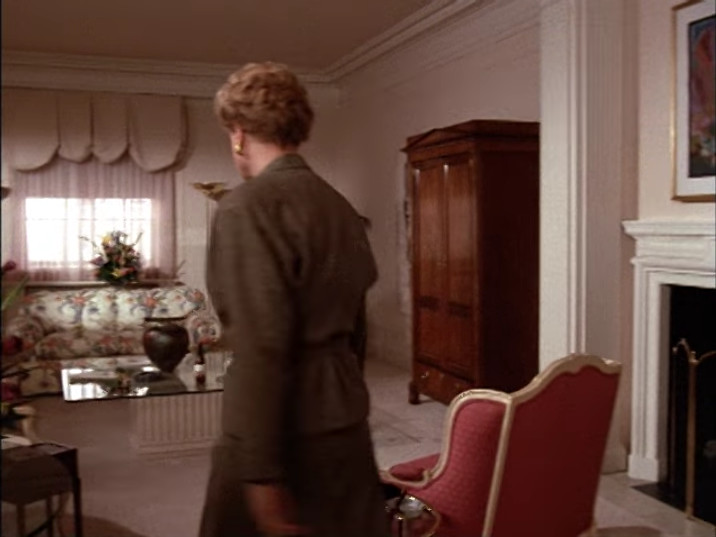
Jessica had to walk down the hallway inside her hotel room to get this this enormous living room, btw. To be clear, I don’t mean the hotel hallway. Inside of her hotel room was a hallway past other rooms to get to this one.
The New England Bookseller’s Association sure put her up in style.
She notices the beer on the table and “Father Francis” walks out of the shadows and says that they need to talk. Jessica suggests that he talk to the police and explain why he broke into her room, but he merely says that she nailed him on the quotation in the church. He had to look it up—it wasn’t Saint Thomas Aquinas, it was Henry David Thoreau.
I’m actually quite surprised that this was a real quote—I mean apart from it being very stupid. “We are much as we see. Faith is sight and knowledge” doesn’t mean anything. Actually, it’s a slight mis-quotation. The real quotation is “We are as much as we see…” That doesn’t make sense either, though. And it’s not just that it’s taken out of context. Take a look at the quotation in context (it’s from the seventh volume of Henry David Thoreau’s collected writings):
How much virtue there is in simply seeing! We may almost say that the hero has striven in vain for his pre-eminency, if the student oversees him. The woman who sits in the house and sees is a match for a stirring captain. Those still, piercing eyes, as faithfully exercised on their talent, will keep her even with Alexander or Shakespeare. They may go to Asia with parade, or to fairyland, but not beyond her ray. We are as much as we see. Faith is sight and knowledge. The hands only serve the eyes. The farthest blue streak in the horizon I can see, I may reach before many sunsets. What I saw alters not; in my night, when I wander, it is still steadfast as the star which the sailor steers by.
To be fair, the passage as a whole is merely wrong, not meaningless. But the part about “faith is sight and knowledge” is meaningless, especially when you realize in context that he’s talking about literal eyesight since the whole is a panegyric to eyesight.
Anyway, the real reason I assumed that it was not a real quote was not that it’s meaningless prattle, but that if you use a real quote you might accidentally get something that two people said. I’m quite certain that Jessica never read so much as a word of Saint Thomas Aquinas, and frankly it would be a bit shocking if she even knew who he was. Even having heard of his name is a bit of a stretch. Since she could have no idea what he’d actually said, for all she knew Thoreau got it from Aquinas. No, if you want to catch someone out on a quotation, you should make it up yourself so you can be sure it’s not real.
Anyway, Father Patrick reveals that he works for the DSS in internal affairs—investigating all the other DSS agents to keep them honest. Jessica asks if he can show her identification, and he laughs—he can, but it all says, “Father Patrick Francis”. He asks if they can go outside to talk and Jessica agrees but only somewhere with people around. He very readily agrees to that suggestion and asks her to name the place. She picks a public park.
I like this turn of events. Finally having a good guy in the story is pleasant. Also, I like that he recognizes the difficulty of proving who he is and takes steps that demonstrate trust and make Jessica feel safer, such as going someplace public and letting her pick the place. It doesn’t prove he’s telling the truth, but it’s consistent with him telling the truth and also with being able to see things from her perspective. That’s a good trait for a character to have.
They go the park and he gives Jessica some backstory.
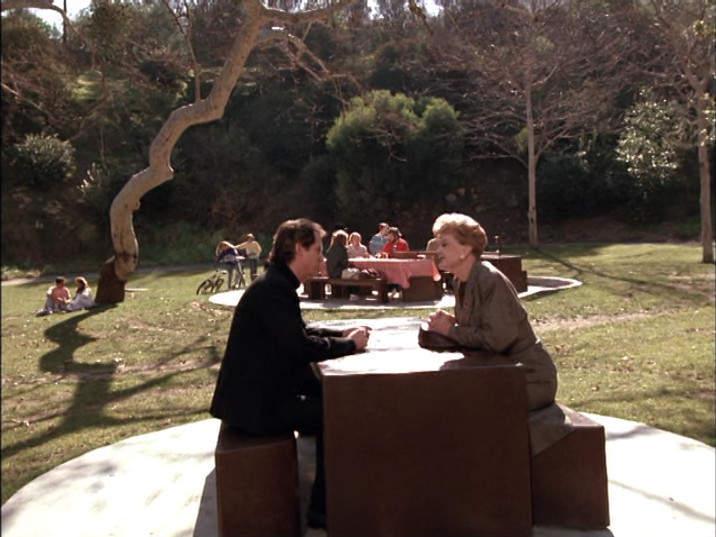
Last week Adams called internal affairs and said that he suspected that there was a traitor in the DSS safe house. We get a bit of backstory on the people there; Mustache Man was passed over for promotion for a younger man. Tan Sportscoat was a hotshot recruited off of an Ivy league campus, but hasn’t gone anywhere because of his lack of leadership material. The young timid guy is young and timid. Delgado, not that I can see how it matters, is actually the leader of a revolution in his country here to ask Washington for more money for his revolution. Sanchez is his bodyguard, factotum, personal servant, etc.
He then tells what he knows about Adams death: Adams telephoned “Fr. Francis” last night and told him that he heard from an informant who would reveal the traitor. They arranged to meet at the Trinity College parking lot, and Adams told no one about this. It didn’t smell right to “Fr. Francis” so he persuaded Adams to wear a tracking device. Adams spoke to the so-called informant briefly then got in his car and they drove off. “Fr. Francis” followed at a safe distance but well within range of the tracking device. As he was going over the Connecticut river, the signal suddenly stopped. He retraced his steps but couldn’t pick it up again. He waited a bit but then saw the “informant’s” car, so he tailed him back to the city, only to see him crash in front of Jessica’s hotel.
Jessica then asks what he wants, and he wants her to do the investigation for him, since the people in the safe house will just close ranks if he shows up and identifies himself as being with internal affairs. Jessica absolutely refuses to be a spy for him—despite that being exactly the same thing as investigating the murder that she wants to investigate.
In the next scene Jessica is in her hotel room and runs in a bath robe to catch the phone which is ringing.

It turns out to be “Mr. Secretary.” She does remember meeting at at the cocktail party at the state department, and—short story even shorter—in the next scene she’s being prepped for going into the safe house to dig up what she can. This includes a lipstick that is actually an emergency beacon.
Interestingly, the cover Jessica is using is that she wants to gather information about the safe house for an upcoming book and has pulled strings with friends in Washington to get her access. I do like this twist on what really happened—that Washington used their connection with her to get her to do it. It’s got a nice plausibility to it, though, given that within the world of Murder, She Wrote Jessica is a literary titan who routinely attends everything, everywhere, and knows everyone. She certainly could pull strings to get access, if she wanted to.
Mustache Man is reluctant, then Tan Sportscoat (now wearing a sweater, and his name was revealed to be Van Buren, but for consistency I’m going to keep calling him Tan Sportscoat) comes in and he and Mustache Man bicker until a call comes in from the gate that Sergeant Cooper is there and wants in to discuss a development in Adams’ murder. (Incidentally, Mustache Man’s actual name—or at least code name—is Jackson, but again I’m going to keep using the name I first had for him since we learned his name pretty late in the episode.)
The new development is that Sergeant Cooper ran Adams’ prints and he had a rap sheet a mile long. This isn’t a development, though, since this is just leftover from a previous cover identity. However, while Cooper and Mustache Man are bickering, a real development happens:
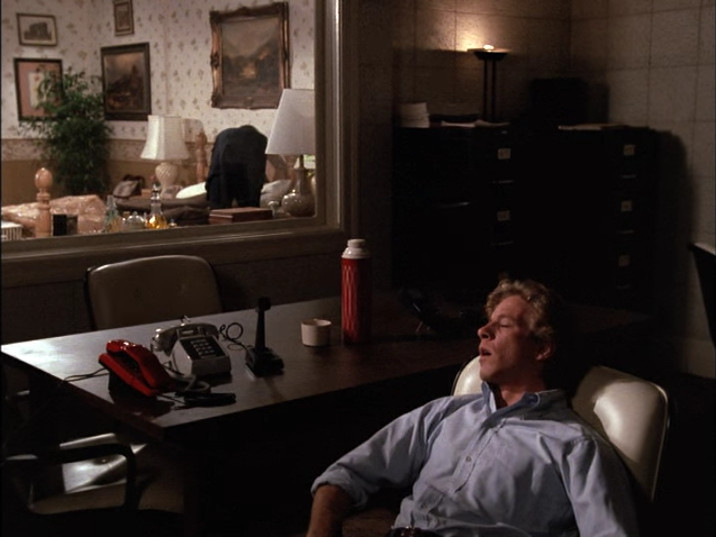
Sanchez can’t wake up Delgado, and not in the “he’s sleeping very deeply” sense. As opposed to Timid Guy, who is sleeping pretty deeply but quite alive. We’ve got a second murder on our hands. I guess it’s convenient that Sergeant Cooper is on the premises.
Timid Guy wakes up and hears from Sanches that Delgado is dead and runs off to bring the news to Mustache Man. Everyone runs out of the room except for Jessica, who goes and activates her lipstick beacon for some reason. “Father Francis” picks up a walkie talkie and tells everyone to surround the house. Then we go to commercial break.
When we come back, Sergeant Cooper is yelling into the phone that he needs the homicide team. The camera then pans over to the next room where Timid Guy is being interrogated. He admits he fell asleep, which had been a problem before, but those times were late at night. That’s why he thought switching to taking a morning shift would be a good idea. But it didn’t work, even with an entire thermos of black coffee.
Cooper then interrupts and starts his own line of questioning, which leads to how Timid Guy saw saw Sanchez shaking Delgado, but couldn’t actually see what he was doing, so Cooper leaps to the conclusion that Sanchez strangled Delgado while he pretended to try to wake him.
Jessica decides to confront Sanchez, says that he was more loyal to his Comandante than to the revolution, and asks if he would be so even if Delgado was stealing money meant for food for the people and to fund the revolution. Sanchez angrily says this was a lie, that Delgado was a good man, and that he never would have stolen from his people. I’ve no idea what the point of this is, since Sanchez is literally the least likely suspect in the building (after Jessica).
Francis and Cooper come and arrest Delgado for the murder, but Jessica isn’t buying it. Sanchez could have had no way of knowing that Timid Guy was asleep, and it seems more than a bit foolish to kill Delgado right in front of someone watching him. Francis says that Sanchez was the only one who could have done it, but I don’t see how this was the case since they have no idea what happened while Timid Guy was asleep.
Jessica is more bothered that this wouldn’t link the murder to the murder of Adams, and she’s convinced that there must be a link.
A little later Mrs. Cosgrove talks to Jessica and plaintively says that Adams would never have let this happen. He was omniscient, I suppose, except when it came to obvious traps. Jessica suggests that the impossibility of killing Delgado with Adams around might be why he was killed. Mrs. Cosgrove wonders why he went off on his own without telling anyone where he was going and Jessica replies, “I don’t think he meant to hurt you. I think he wanted to prevent any possibility of a leak by not confiding in anyone.”
Then she realizes what she just said and we get clue-face:
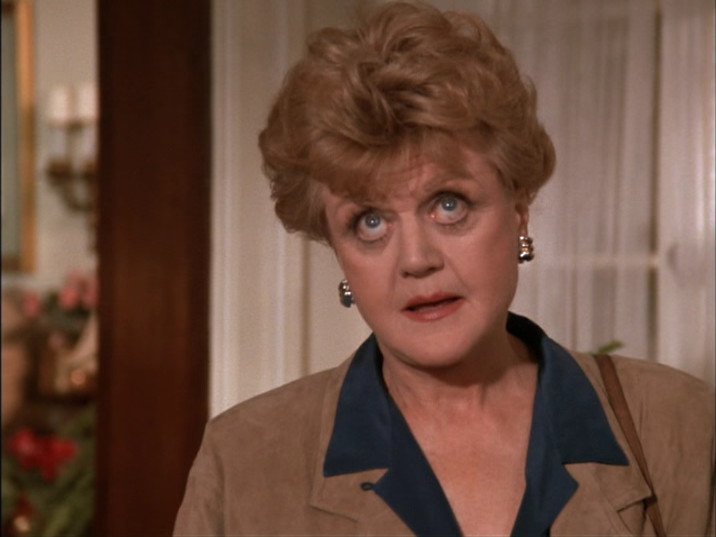
So, the good money is on Tan Sportscoat’s remark about Adams meeting someone he didn’t know in an abandoned parking lot being a real slip.
Jessica anounces that she knows who killed Adams and Delgado.
We next see her in the murder room.
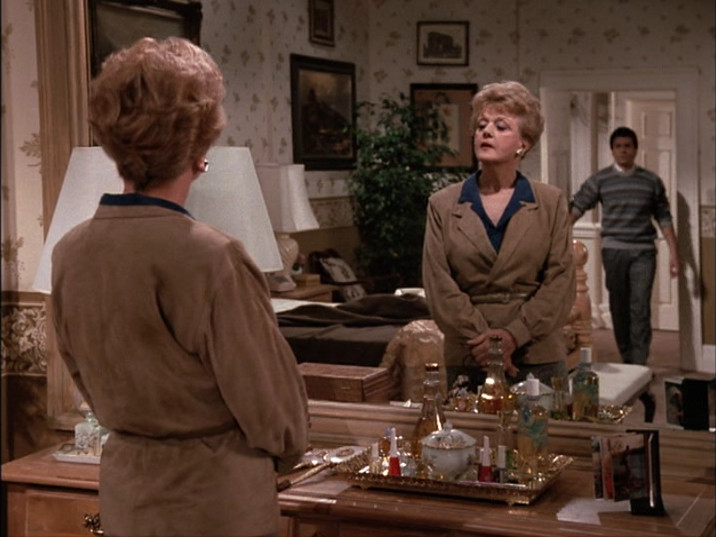
Yup, the murderer is Tan Sportscoat (now wearing a sweater). To seal the deal, he says, “You wanted to see me?” (I can’t recall a time that Jessica wanted to see someone with less than 5 minutes to go in the episode who wasn’t the murderer.)
Jessica asks Tan Sportscoat if he’ll give her his opinion on a theory she has: the killer was assigned to the safe house and felt his career had reached a dead end. He was restless, and Delgado’s country contacted the killer and offered a large sum of money for the assassination of Delgado.
Oddly, Tan Sportscoat doesn’t stop her here and ask how on earth the head of some South American country would be aware of the personnel in a safe house in Connecticut, to say nothing of how they would know that Delgado would be assigned to this safe house ass presumably the DSS has more than one. Both of those seem effectively impossible, ruling out this theory, but we hear not a word about this.
In fact, he says nothing and Jessica continues. First, the killer had to get rid of Adams, who kept a very watchful eye on the safe house. Which meant the killer had to contact a hit man.
Also oddly, Tan Sportscoat doesn’t object that Adams wasn’t omniscient and could hardly personally watch the safe house 24/7, so there was no need to kill him. Instead he observes that Mustache Man had access to the department’s list of hit men. Jessica pounces, saying, “Oh, you know about the list?” He replies that he’d heard of it.
He asks how Mustache suckered Adams, and Jessica says it was with a scenario. First, creating suspicion about a traitor in the ranks, then having the hitman contact Adams with an offer of information of who it was. Tan Sportscoat says that he didn’t think Mustache had it in him, and Jessica says that he didn’t—she’s talking about Tan Sportscoat. He then walks over to the mirror and asks who’s behind it—the cop or the internal affairs man. Jessica replies, “both.”
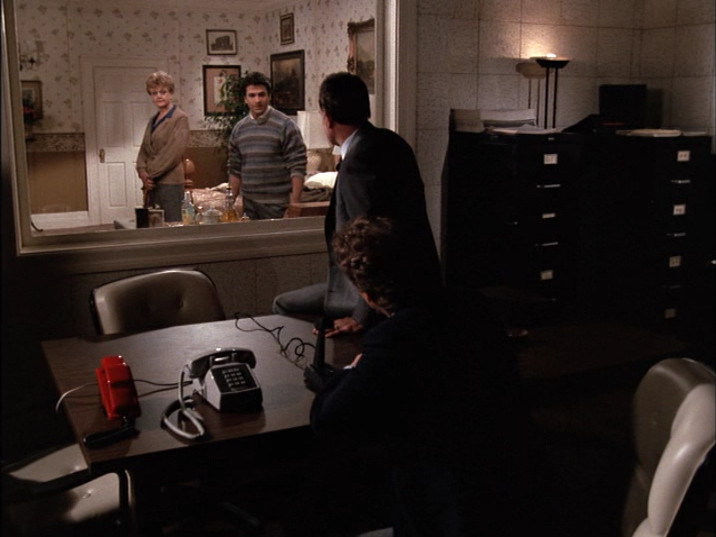
This is a very strange setup. I can’t see how it accomplishes anything for Jessica to accuse Tan Sportscoat with people watching from behind a mirror instead of being in the room with them. For that matter, why does the safe house have a room behind a one-way mirror at all? If they want to be able to observe the person that they’re guarding, closed circuit TV would work perfectly well and be less cumbersome. Plus if they had closed circuit TV throughout the house they could then watch the person that they’re guarding at times other than when they’re sleeping. And they do have closed circuit TV watching the gatehouse. (Presumably the answer is that the plot wouldn’t work with closed circuit TV since that would almost certainly be recorded on 24 hour loop, making the murder impossible.)
Be that as it may, there’s an interesting twist that comes up: Tan Sportscoat says that he can account for his whereabouts during every minute of Timid Guy’s shift. Jessica replies that he didn’t kill Delgado during Timid Guy’s shift, he killed him during his own shift, then made it look like Delgado was still sleeping so that Timid Guy would assume Delgado was still alive and everyone would think that Delgado was killed during Timid Guy’s shift (Tan Sportscoat had been drugging Timid Guy’s coffee and increased the dose today).
He replies, “Well, your theory… turned out to be better than I thought.”
“Father Francis” asks him why he did it, and he replies that Jessica got it right—for the money. Jessica gives him a disapproving look, and he asks her, “Or would you prefer if I did it because I believed in a cause?” Jessica says, in her dour way, “Either way, it was murder.”
Oddly, this is not the end of the episode. There’s a final scene at police headquarters where Sergeant Cooper tells Jessica that Mr. Francis called and Tan Sportscoat is singing like a bird about the people who paid him to murder Delgado. This is interrupted, briefly, by a call from his wife, to which he habitually replies, “I can’t talk now, Norma” then goes back to talking to Jessica. She interrupts him to point out that he’s been trying to get in touch with his wife for days, and he realizes what he did and asks somebody to trace the call. Then we go to credits:
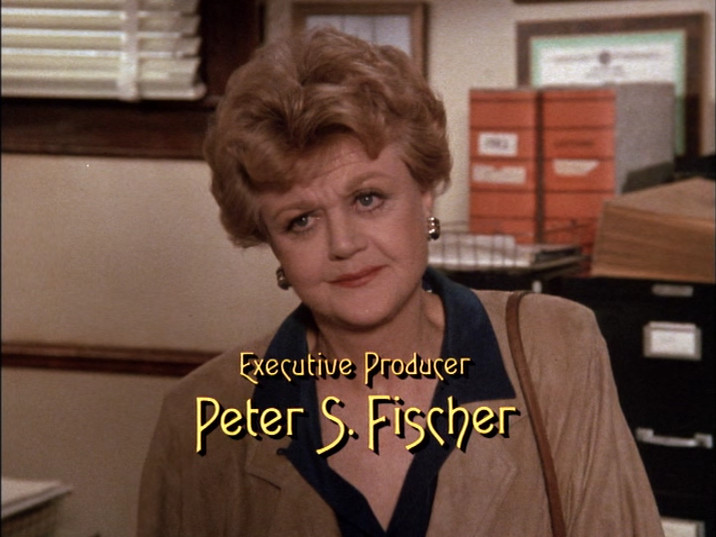
This is a really weird episode. On the face of it a spy-thriller should mix well with a murder mystery, but I’ve never heard of that being done in a way that isn’t just a spy thriller. This episode is, of course, not really a spy thriller. It only pretends to be one as a red herring for the murder mystery. Still, that takes enough time away from the episode that it doesn’t feel like a murder mystery.
For one thing, there isn’t really much of an investigation in this episode. Much of Jessica’s time is spent uselessly trying to figure out who the hitman killed, only to have that eventually revealed by forces outside of her control. Another large chunk is figuring out the identity of the pretend priest, but he turns out to be another investigator, and investigators are (in legitimate mysteries) outside of the mystery.
Of course, ultimately, it turns out that the spy thriller is a red herring and this is a murder mystery, but we only get the murder to investigate 10 minutes from the end of the episode. Better late than never, but it robs a lot of the fun, especially since Jessica knows who did it 5 minutes from the end of the episode. The problem with using the appearance of being the wrong genre as a red herring is that, “it only looks like it’s in the wrong genre,” is still not in the right genre for most of the episode.
The story also had a lot of problems with its plot, too. The way everyone at the safe house stonewalls about Adams’ death makes no sense. They’re running a safe house on US soil, not a fake business in foreign territory. There’s no one they need to convince that nothing has happened. Moreover, there’s no real reason for the agents to be under cover at all, but still less is there a reason to have them rotate through the same cover identity. However, given that they rotate through the same cover identity, there was absolutely no reason to pretend that “Carl Cosgrove” was having an asthma attack. Since any man there could be Carl Cosgrove, one of them should have been. And if not, there was no reason to say he was having an asthma attack rather than just saying that he’s on a business trip. And given that they said that he was having an asthma attack, why on earth did they pick Delgado to play Carl Cosgrove? In the entire house, only two men did not have ID which said Carl Cosgrove, and they picked one of them. In the house, only two people did not speak English natively, and of the two they picked the one who spoke English worse. Also, in the house, everyone there is guarding one person, who is being kept in the house anonymously, and that’s the guy they picked to introduce to a stranger??? In what way did picking Delgado to pretend to be Carl Cosgrove make even a shred of sense?
Next, and though it’s a comparatively small thing, why did they have Tan Sportscoat say that Jessica didn’t buy Delgado-as-Cosgrove for a minute? She seems to have dropped the matter when we see her next and in fact she protested to “Father Francis” that Carl Cosgrove seemed very much alive when she saw him. As far as we can tell, she did buy it.
The parts with Father Francis were laid on thick, but were fine, if more spy thriller than murder mystery.
We run into problems, again, when we get to the background on the people at the safe house. First, only two of the five people assigned there have anything like a motive to murder Adams (since Adams didn’t order the hit on himself). Of the two, Mustache Man’s motive is a bit weird. Supposedly he’s jealous that a younger man was chosen for promotion ahead of him. The thing is, Adams doesn’t look like the younger man:
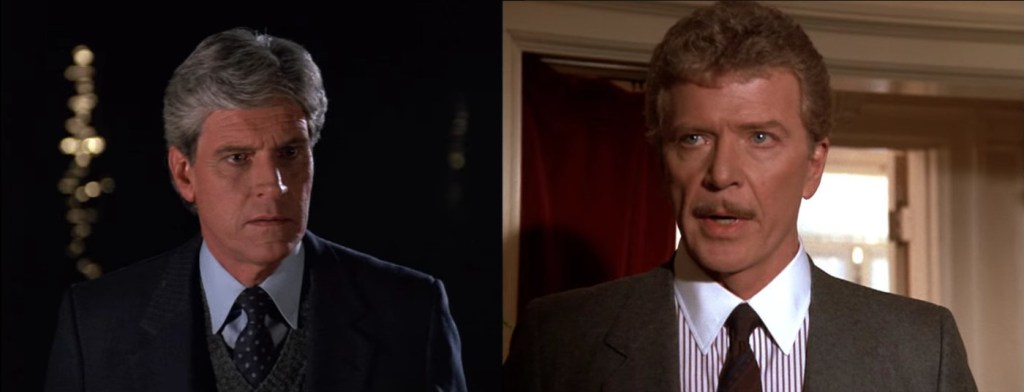
To be fair, Robert Reed, who played Mustache Man, was 56 at the time of filming while Kirk Scott, who played Adams, was 52. That’s not much of an age gap, though. Also, we’re told that Jackson was shunted aside when Adams was put in charge of the safe house, but how long are agents assigned to the safe house for? And how much can being in charge of a safe house be worth killing for? It’s basically a high (ish) security secret one-room hotel. Apart from when the head of it gets assassinated, the routine must be very dull.
Speaking of which, I can’t help asking again: why on earth do these people have cover identities? They’re just running an extremely small hotel that, presumably, they all live in. They don’t need to go to work, or really to go to anywhere. Is it really critical that they have a fake ID when they go to the grocery store or the hardware store, or run out to the drug store to pick up some extra toothpaste when they’re running low? Can’t they just pay in cash and not need an ID at all?
If this safe house was the home of a couple who was stationed at it, I can see why they’d have fake ID, just so that the people aren’t really traceable when they get reassigned because somebody’s name needs to be on the deed to the house. But in this case everyone had a unique code name despite most of them would not be listed on any official documents, plus they had the “Carl Cosgrove” fake identity to use when going outside of the house. No matter which way you look at it, it seems to serve no conceivable purpose. It’s intrigue just for the sake of having something more complicated.
Speaking of things just for the sake of having something more complicated, Sanchez being suspected of Delgado’s murder makes no sense. Granted, motive isn’t everything. Still, it’s a lot, especially when it would have been utterly idiotic to kill Delgado in the way he would have had to do it then when he could have killed Delgado at any time. It’s not even slightly plausible, and just makes Francis and Cooper look like idiots. That’s especially unfortunate for Francis since he started off seeming intelligent.
But that brings me to Cooper: why was he part of the episode? Does Murder, She Wrote simply have to have a policeman in every episode because of some sort of clause in the contract with the studio? He served no purpose that I can see. He didn’t even help Jessica find Carl Cosgrove of Farmington—he used directory assistance to find the number. He did tell Jessica about Carl Cosgrove being pulled out of the Connecticut river and give Jessica a ride into the safe house the second time she went there, but she just as easily could have taken a taxi after reading, in a newspaper, about the body being found.
So, was there anything good about this episode?
Yes.
I really liked how they snuck Jessica into the safe house. Pretending that she pulled strings in Washington to get in when Washington pulled strings with her to get her to go was a very nice twist. It was also a clever cover story because it was both plausible and gave her a reason to snoop and ask questions. It also played nicely into the character of Musctache Man who is inclined to defer to his superiors on everything and to do what he is told without question. This is somewhat marred by the fact that she didn’t actually do any investigating under her cover story, though.
I also liked the twist where Tan Sportscoat had given himself an alibi for the entire time that Timid Guy was on duty. This was diminished by the statement of the alibi and Jessica’s solution taking only 46 seconds from start to finish. It’s the sort of difficulty which should have taken most of an episode to unravel, or at least should have posed some sort of challenge that Jessica would need to think about. They could easily have cut Cooper’s part to make more time for this. It would have been a much better use of time.
I also like the beginning of Tan Sportscoat’s confession at the end. After she broke his alibi, he said, “Your theory… turned out to be better than I thought.” A moment later, after Francis asked him why he did it, he replied, “She got it right.” The calmness in being caught aligns with the way both murders were cold and calculating. They also contain a certain amount of respect at being bested by a superior intellect.
There were also a few comedic moments that were enjoyable. For example, when Jessica activated her lipstick beacon, she first tried the motion on her actual lipstick, but all that happened was lipstick came out. Not high comedy, but it was fun in the moment, and I think helped to distract from there not really being a reason to turn on the emergency beacon. Cooper’s arguing with his various female relatives and in-laws, followed by habitually hanging up on his wife when she finally called him, was mildly amusing.
Overall, I’m not sad to see this episode over. I don’t watch Murder, She Wrote for spy thrillers, and certainly not for nonsensical spy thrillers. I think that main lesson of this episode is that it’s good to stay within one’s genre, and very good to at least stay within a genre one can write competently.
Next week’s episode is A Very Good Year for Murder, which takes place in a vineyard, which is certainly more promising than a spy thriller.
Thoughts on Dr. Thorndyke
I recently finished the first book of Dr. Thorndyke short stories, by R. Austin Freeman. It included stories such as The Man With the Nailed Boots, The Moabite Cipher, and The Message From the Deep Sea. Not included in this edition were the pictures which were included with the original (famously, the stories would include pictures of what Dr. Thorndyke would have seen through his microscope, etc).
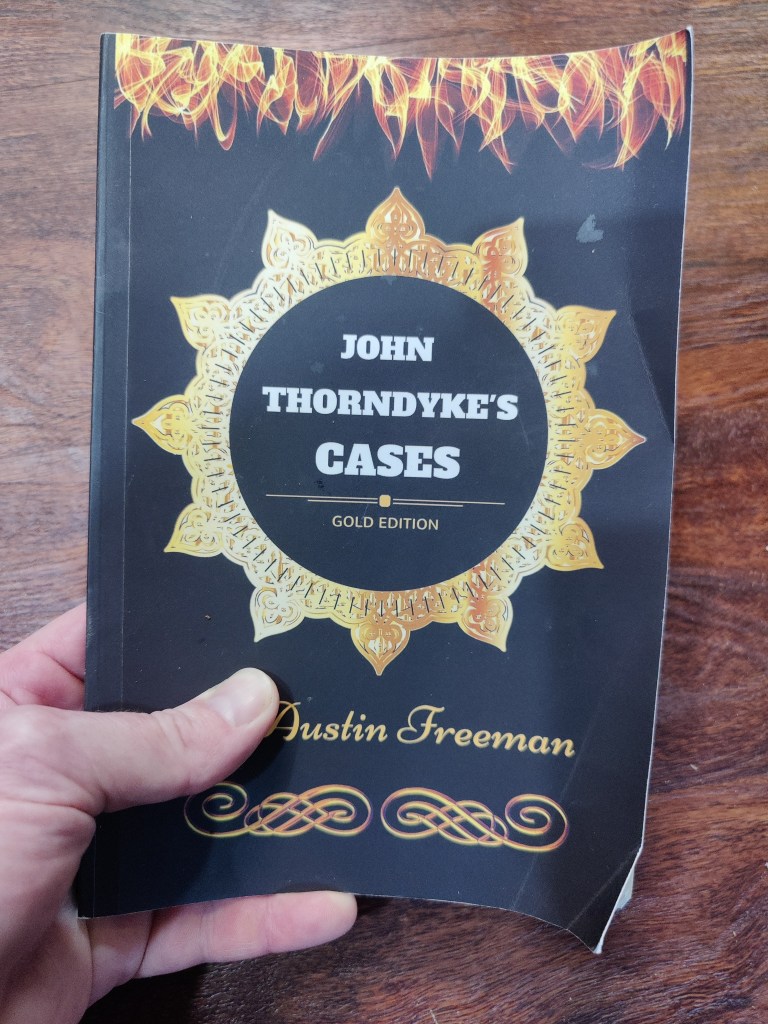
They were… interesting. Much less so for themselves, frankly, and much more so as history. As I mentioned in Dr. Thorndyke’s Scientific Wizardry, the stories as mysteries are often very noticeably contrived to make the wizardry possible. The writing is perfectly workmanlike, though it is not inspired nor does it try to be. Freeman’s main interest was the scientific aspect of the stories.
In the novels, where more is required between scientific deductions because the case must take longer, there was often a victorian, flowery melodramatic romance added, at least in the novels I read, which were the first three. I suspect that Freeman (who was born in 1862) enjoyed flowery Victorian romances as a young man and so wrote them when he had the chance.
I would definitely recommend the short stories to anyone interested in the history of detective fiction. Dr. Thorndyke was, apparently, enormously popular at the time and thus had a significant influence, though I think that the modern stories which are most similar—police procedural TV shows involving extensive crime scene analysis—have no direct influence from him. I think it was more a case of convergent evolution; the police procedurals trace their influence most directly from Dragnet, which (so far as I know) was not influenced by the Dr. Thorndyke stories. If anything Dragnet (which started as a radio drama in the 1950s) was influenced by American hard-boiled detective stories, and in any event focused on the details of police procedure rather than on evidence and logical deduction.
So far as I’m aware, Dr. Thorndyke has, other than as a historical curiosity, largely disappeared beneath the sands of time, and I would venture to say deservedly so. I can’t imagine myself ever re-reading one of these stories for pleasure and I wouldn’t even have known about it except for an off-hand reference to Dr. Thorndyke in Dorothy L. Sayers’ Lord Peter novel, Have His Carcass. (Which, incidentally, goes to prove the value of pop-culture references in stories; they can help the study of history immensely.)
Bishop Barron And Jonathan Pageau
There are a lot of conversations which happen on YouTube, and by and they can range rather widely in quality, though most aren’t nearly as good as individual videos are. This conversation between Bishop Barron and Jonathan Pageau was on the very high end of quality:
I watched it about four times, if I recall correctly. There are a great many interesting things that they bring up. The theme, fairly later on, that the main purpose of humanity before the fall was priestly—to lead all of creation in the right praise of God—was quite fascinating. Also the detail thrown out which I had never considered before that Eden had to be an elevated place because several rivers flowed from it in different directions, and of course it is on mountains where God is so often worshiped and encountered.
I also liked Jonathan’s observation that the people who want to make the Church worldly will inevitably fall away because they will, at some point, realize that they don’t need to go to Church to be worldly, and will stop going. This may be described as a particular instance of how the meek will inherit, but it is something we are seeing. On may, in particularly strict times, attract followers by promising laxity, but it does not work at all in lax times. You can see that in how many of the largest women’s religious orders which modernized and wear frumpy clothes from k-mart are collapsing but the traditionalist religious orders who are more cloistered and habited are flourishing.
Earlier on there was an interesting discussion of atheism, and how it can have something of a cleansing quality when catechesis has gotten too bad. I think that there is something to this; atheism can serve as a fire to burn away dead wood. Though I think that much of the new atheism was really about being anti-Islamic in the aftermath of 9/11, you can see that to some degree this has happened anyway. You don’t find many unthinking Christians these days, nor are there nearly so many merely cultural Christians. This is to the good; Christianity must be entered into as a whole person, mind with the rest. And merely cultural Christianity is a desecration.
It’s a really fascinating conversation that very much rewards listening to. Both men are quite sharp, in addition to being quite knowledgeable, and I very strongly recommend it.
I’ve Never Been Nostalgic for Star Trek: The Next Generation
I recently looked up a few clips of Star Trek: The Next Generation and noticed, to my surprise, that it evoked no feelings of nostalgia whatever. This is curious because I was watching it at the same time as I watched Murder, She Wrote, which certainly evokes nostalgic feelings. (Murder, She Wrote ran from 1984-1996, while ST:TNG ran from 1987-1994.) Moreover, I liked The Next Generation back when I first watched it.
There might be various reasons for this. Science fiction may be less conducive to nostalgia because it is supposed to be set in the future. Since different science fiction stories are set in the same future (ours) and thus contradict each other, there is a certain degree to which it is simply impossible to suspend one’s disbelief, and hence to enter into it in a way conducive to nostalgia. This may be related to how the costumes have changed with current fashions, and possibly a great deal more how the computer technology of the day is largely an extrapolation from current technology and thus becomes horribly dated and in no way plausibly The Future.
Of course, if that were the issue that it should be even less possible to feel nostalgic for Star Trek than for Star Trek: The Next Generation. But, at least for me, it’s not. In some ways I think that the original show has aged better than its successor despite its successor having far more accurate technology. The original was simpler and had something of the utilitarian feel of a navy warship. Much of it was almost cartoonish (in the sense of abstract but representational art). It was almost like a sketch of the future rather than a fully done painting. TNG was, by contrast, more filled out and directly representational. You can see this in how they ate colored cubes, cylinders and such-like (the futuristic food was probably variously food-colored marshmallows, to give you an idea of what it looked like if you haven’t seen it). In TNG they just ate normal food produced by a “replicator”. The result was that you are inclined to take TNG more at face value. The problem with taking TNG at face value, however, is that it was a heavily armed and armored diplomatic science vessel upholstered something like a luxury cruise ship that also had a school and a daycare, whose saucer section could separate from the main part of the ship for combat because it makes no sense to bring the daycare into battle, but they never separated after the first season. (For that reason; looking it up they did separate it during the battle with the Borg and Wolf 359 for tactical purposes, i.e. to have two targets).
Another possibility is that Star Trek: The Next Generation was an episodic show with inconsistent characterization. It’s hard to feel nostalgic for characters who one didn’t feel like one knew because they could (and did) change so much from episode to episode. Murder, She Wrote was episodic, but Jessica was mostly a consistent character—as were any of the other characters that did recur. Plus there were elements that were just consistent, even if the show is (somewhat) incorrectly described as formulaic. (This spoof is highly recognizable despite actually describing very few of the episodes.) The only thing that was really reliable in Star Trek: The Next Generation was the technobabble.
Which gets us to what I think is the real reason I don’t feel nostalgic for the show.
Star Trek: The Next Generation just wasn’t very good. Bureaucrats in Space are not really more interesting than bureaucrats are anywhere else. The writers didn’t really care about quality, as far as I can tell. Legend has it that the technobabble was filled in by consultants after the script was written, with placeholders in the script for the technobabble. The ship itself was nonsensical; no one who could conceive of the greatest warship of the federation being a science daycare could not possible care about quality.
In some ways nothing sums up the approach of the series so much as the episodes Best of Both Worlds parts 1 and 2. They started with a neat idea that they didn’t think through at all, painted themselves into a corner, then used technobabble that made no sense to get themselves out of it. (The Borg were a hive mind, not a computer; they should have had no problems at all with reconciling different impulses since their hive mind was always the summation of many individual minds.)
It’s almost enough to make me want to watch Chaos On the Bridge.
The technobabble could have been forgivable if there was some reason to forgive it, but there never was. I think that this might be part of the reason that the Q episodes were, generally, the best episodes: the Q episodes didn’t have technobabble. It’s not that the technobabble was bad in itself, but it was cheating. Q threw all rules out the window, so the episodes with Q in them were the rare episodes in which the writers didn’t cheat.
That may be the real key, here. Murder, She Wrote, for all of its flaws, was written in earnest. If the writers made mistakes they were honest mistakes where the writers didn’t notice. They occasionally had Jessica trick the murderer into confessing, but Jessica at least figured out who it was she needed to trick on her own, and generally legitimately. She never made up a way to extract fingerprints from thin air, only to forget about it in later episodes. She never just added tachyon particles to the murder weapon and suddenly the murderer was in prison, already convicted.
In short, I don’t think it’s possible to feel nostalgic for something that the writers didn’t take seriously.
A Fascinating Video on the Historical Context of National Socialism
TIK recently put out a very interesting video on the history of the German revolution of 1918 and the context of how the socialists gained power then split into multiple groups during the power struggle in the aftermath. This leads directly to how Hitler conceived of National Socialism, and by putting things in this context it makes a lot of World War 2 make more sense. It is very much worth watching. (And don’t be put off that its title mentions the Weimar hyperinflation or that it’s episode 2, it’s not really about either and stands very much on its own.)
It’s Weird What Works, Sometimes
A long-running struggle in my house has been teaching children that if I ask them to relay a message to someone, they should not stand where they are when I’m talking to them and shout across the house. So far I’ve managed to progress to where they will walk several feet in the direction of where they think their sibling is and then yell.
I’ve recently discovered that if I ask them, “please walk over to where [your sibling] is and then tell them [message],” they actually do it.
Sometimes it’s weird what works.
Attracting Women With Purpose, A Response to @BASSFZz
In this video response I look at some of the things that BASSFZz has said about “having a purpose” and its relationship to men attracting women, and how this sort of advice needs to be understood like advice for interviewing for a job—how to not screw up if you’re already qualified for the job.
The two BASSFZz videos that most prompted this were:
and:
Bureaucraaaaaats iiiiiin Spaaaaaaaaace!
In a climactic scene in the episode Ensigns of Command, Picard manages to out-maneuver the Sheliak who are intent on clearing out human settlers on a planet in Sheliak space (by accident; a settlement ship went way off-course 90 years ago and these are their descendants). They have given 3 days notice as required in a treaty, but it will take 3 weeks to clear out the settlers due to some technobabble. The Sheliak intend to wipe out the remaining humans after 3 days, but Picard finds a way to get the time he needs:
The episode, overall, is a good one. It primarily focuses on Data and the theme of Data trying to understand humanity and also to be human, though he cannot be human since he is an android. This scene, though, really encapsulates the difference between Star Trek and Star Trek: The Next Generation.
Captain Kirk had regulations used against him, though even this was rare. Kirk never defeated an enemy by reading a contract more closely.
I’m not really sure what to make of this. Next Generation had things going for it but somehow always managed to be, as my mother put it, bloodless. Data was, in many ways, more human than the rest of the crew. In 1984, I am told, there is the image of the future as a boot stamping on a human face—forever. Star Trek: The Next Generation softened this to a dress shoe placed firmly but no more than firmly on top of a human foot, except on Sundays and Saturdays from 9am-4pm and alternate Wednesdays from 7pm-9pm.
I’m not sure what made TNG the way it was. Presumably Gene Rodenberry should take much of the blame. I can’t help but think that TNG was also a product of its time, though, which makes me wonder what about the late 1980s and early 1990s produced this.
Updated All-Cause Mortality Stats for the USA
It’s been a while since I wrote about all-cause mortality for the USA, and I’ve been meaning to write an update. With the curious incidence of the omicron variant (if that’s what’s responsible), this has become more timely. So, first, here’s the most recent all-cause mortality data for the USA:

And let’s zoom into the last year and a half:

As you may notice, the average and upper-bound threshold lines are thicker than they used to be; this is to better represent the statistical uncertainty involved in them. Please note that the last two weeks are almost certainly under-reporting of deaths, because the USA is bad at reporting all-cause mortality until about 4 weeks later (a week only makes it onto the chart when the last day in the week is 10 days ago, but even so the first few lines on the right always under-count, though by how much varies). I’m not sure why we’re so bad at it, but we are, so that’s the grain of salt with which to take those last numbers.
Looking at these graphs, it seems like not much is going on in the last few months. Mortality is slightly raised from normal, but not by very much. It’s still the case that if you scales the y-axis not to the highest number of deaths per week but to the US population (329.5 million, as of 2020), the weekly all-cause mortality would barely be distinguishable from the x-axis, i.e. you wouldn’t be able to visually tell that anyone is dying at all.
Now let’s consider COVID-19 statistics (also from the CDC):

As it says in the graph, the red line is the 7-day average for daily new cases, and the orange line is daily new hospital admissions for COVID-19. Let’s also look at the daily deaths the CDC attributes to COVID-19:

The orange line is the same daily new admissions for COVID-19 (and thus the same line). The red line is 7-day average of deaths attributed to COVID-19. As I’ve mentioned before, this is intrinsically a less reliable number since reasonable people and indeed reasonable medical guidelines can differ as to what the cause of a death is in the case of multiple interacting causes. To give an example, if someone has COPD and catches COVID-19 and dies, which killed him? He’d have eventually died of the COPD, but died earlier than if he hadn’t caught COVID-19. Both answers are reasonable, and the logic behind them is lost when these are aggregated into statistics. That’s why all-cause mortality is so important—everyone diagnoses death itself the same (the exceptions being statistically irrelevant).
All that said, the CDC’s statics on COVID-19-attributed deaths are still interesting to look at, over time, since the judgement as to the attribution of the cause of death is likely to be the same, over time. It’s not guaranteed, of course, but it is likely in the absence of large cultural shifts.
These various graphs are interesting, but the one I find the most interesting is the bottom one—COVID-19 attributed deaths vs. COVID-19 attributed hospital admissions.
Naively, you would expect the two graphs to look very similar but with a slight right-shifting of the death line since people tend to be admitted to the hospital then die some number of days later. Similarly, once the prevelance of the SARS-CoV-2 virus in the population goes down, you’d expect the admissions to start going down and then the deaths will start going down a bit later as the people who were already admitted who are going to die, do so. And we in fact do see this relationship from roughly September of 2020 until about March of 2021. It’s wider than we’d expect to see—somewhere around a month—but it’s there. The line of deaths that we’re looking at is a 7-day average, and the hospital admission line is too smooth to not be some kind of average, so possibly the horizontal distance between them is partly just about how the statistics are collected rather than reflecting the real day-to-day numbers.
After March of 2021, the relationship we would expect to see breaks down. Around April of 2021 we see a spike in covid-related hospital admissions while there is a decline in covid-attributed deaths. In June through august of 2021 we see the relationship seem to come back, but the distance between the bars is now bigger, and the lines no longer have the same basic shape. Hospital admissions also spike much higher relative to the previous trough than do deaths (bear in mind they’re not on the same scale, so their heights can’t be directly compared, only their shapes can be compared). Then the falling in admissions actually lines up, for a while, with the fall in deaths, which it shouldn’t. After that, there is no apparent relationship between the two.
If you look back at the graph of daily cases, the hospital admissions actually coincides much better with it’s 7-day average daily-cases line. I don’t know of a great explanation for that; it’s just interesting to note that hospital admissions track positive COVID-19 tests far better than they track deaths. (Again, the y-axes are very different so you can’t compare the lines and hospital admissions are a drop in the bucket of positive COVID-19 tests so you can’t attribute the rise in positive COVID-19 tests to increased hospital admissions.)
As before, my main conclusions are that the USA’s all-cause mortality data is hopelessly laggy and that the other data available still doesn’t support any obvious conclusions. We’re very clearly not facing any kind of existential threat and anyone who tries to take emergency powers appropriate to an existential threat should be thrown out of office as soon as possible. Beyond that, I think that SARS-CoV-2 and COVID-19 continue to illustrate how little we know about the natural world.
Characters Above Suspicion
A question that comes up in mystery stories is having characters who are above suspicion. In golden age mysteries it was extremely popular to make precisely these people the murderer. Sometimes it was even a game to try to make the murderer as far above suspicion as possible. I am coming to think that this is a mistake, though, or at least that it can be.
Casting my eye over my favorite mysteries, the most interesting characters are usually the ones who are above suspicion. These are the people who are affected by the mystery but are not part of it; they’re the most interesting because we can take them seriously. People who are under suspicion are part of the mystery and thus everything that they do, say, and (appear to) think is all suspect.
To be fair, this is at least partially remedied upon re-reading. Knowing who is and who is not false lets us take the true characters seriously. However, this is only a partial remedy because the other characters in the story cannot trust the suspected characters and thus cannot form meaningful relationships with them.
Now, it is necessary in a mystery story to have suspects, and the plural is important. I’m not trying to suggest that one should do without them. Worse, if one had no suspects then everyone would be a suspect. The key, I think, is the distinction between suspect and non-suspect. Some people must be seen to be under suspicion, and others must be clearly elevated above it in an authentic way. But how to do that, especially when the game in golden-age mysteries was to elevate the murderer above suspicion as much as possible?
Obviously recurring characters help a great deal in this. No one suspects Amos Tupper or Seth in Murder, She Wrote since we know that they’ll be back in future episodes and that Cabot Cove wouldn’t be the same without them. It is also typical that people who were called into the mystery after the crime was committed are above suspicion, hence the police and the detective usually are. This is not always so, though; occasionally people who show up later were there before, secretly. Newcomers are actually above suspicion when they have what makes anyone above suspicion: an alibi.
Of course, in mysteries, alibis are made to be broken. The more cast-iron the alibi, the greater the glory in breaking it.
Some alibis simply stand, though. Being seen continuously in front of unimpeachable witnesses from before the last time someone was seen alive until after they were found dead is, in fact, unbreakable. As long as it wasn’t murder by poison, booby-trap, or anything else that doesn’t require the murderer to be present.
And it doesn’t rule out accomplices.
So, other than a character being a recurring character, is there a way to make someone above suspicion so that the reader can take them seriously and the characters can form meaningful relationships with them?
I think that there is, at least sufficient for our purposes: the author can treat the character as above suspicion. That is, not only is the character established to have a good alibi, but the author proceeds on that basis. The character is given development and other characters form meaningful relationships with them. The possibility of their alibi being breakable, for the wrong time, or irrelevant because of an accomplice is simply never brought up. In effect, the author gives the detective confidence in the character and this allows the desirable consequences.
The example of this which comes to mind most readily is the character of Dean Letitia Martin in Gaudy Night. Harriet tells the dean that she simply refuses to consider her a suspect because the dean is too level-headed. Dean Martin objects that this isn’t really valid, but doesn’t otherwise object since she knows herself to be innocent. And the story proceeds with Dean Martin being an interesting character.
(What brings this to mind is that the character of Rhodri Ap Huw, in my favorite Cadfael story, Saint Peter’s Fair, was partially wasted because Ellis Peters held him out as a suspect.)
Modern Disney Cartoons’ Weird Idea of “Perfect”
Being the father of a little girl I am more aware of Disney cartoons than I suspect most men my age without a daughter are. Due to this knowledge, I couldn’t help but notice that a common theme in Disney princess movies is how some woman or other tries very hard to be “perfect” but can’t be “perfect” and needs to find out how to be “loved” in spite of being “imperfect”.
I’m using the scare quotes because they keep using these words, but I don’t think they mean what they think they mean. (Princess Bride reference.)
As far as I can make out, the concept of “perfect” that they are using is, roughly, “completely convenient.” It tends to be phrased in terms of “doing what she’s supposed to” except this isn’t meant in a moral sense—it is never used to describe being a saint. Instead it seems to be something along the lines of, “never disappoints anyone.”
By contrast, as saint tends to disappoint a lot of people because the saint lives according to God’s will, not according to human wills. Of course, by the same token, the saint also doesn’t need human beings to love them. The saint can pray for people who are busy stoning the saint to death because the saint really disappointed them.
This is, incidentally, what made Frozen such a shockingly Christian movie. Elsa gives up trying to be a “good girl” and becomes the villain, then repents when she realizes that both were mistaken and the real answer is love—in the sense of agape, the generous love of God (to will the good of the other for their own sake). I’ve no idea how they accidentally did that, though. It is very much the exception to the standard Disney plot. The typical Disney movie tends to focus on some overbearing figure in a girl’s life with too many expectations of her, and after she rebels, the authority figure eventually relaxes and only presses on her expectations she can actually fulfill. Then they get along.
This is an improvement in a relationship, so it’s not wrong. It’s a little disappointing that its sights are set so low, but I have a sneaking suspicion that it is roughly the counterpart fantasy to the boy into whose lap adventure and heroism falls, and then he’s regarded as a hero and people now treat him with respect. In both cases the fantasy is about life (by which I mostly mean the people around one) magically getting more convenient.
It would be nice if they could use words correctly, though. “Perfect” does not mean “useful” or “convenient.” I get why the authority figure might misuse these terms—to cover their own imperfections—but it would be far better if the heroin would repudiate this mistake rather than ask the authority figure to not reject them despite them not being maximally convenient with the words “love me even though I’m imperfect”. But Disney is not a Christian company so I can’t really expect them to make Christian movies.
It was really cool that they somehow did, that one time, though.
An Interesting Covert WW2 Assassination Pistol
In this video Ian of Forgotten Weapons describes the Welrod Mk IIA covert assassination pistol developed during World War 2 by British Special Operations Executive (S.O.E.) to outfit special operations units as well as resistance units in German-occupied countries.
Its strange appearance is partially intentional, because without the magazine (which doubles as the grip) it looks somewhat like a bicycle pump and, more importantly, not like a gun. As Ian says in the video, if you’re stopped by German soldiers, you really don’t want them realizing that you have in your possession an assassination pistol.
Possibly the most interesting thing about it, from a mystery writer’s perspective, is that it actually achieves the sort of quietness that one sees in Hollywood depictions of silencers. (Normal sound suppressors, aka “silencers,” only reduce the unimaginably loud bang of the gun to an imaginably but very loud bang that, however, is not going to cause instant hearing damage.)
Ian says that about 14,000 were made. Further, they are still in occasional use by special forces, though special forces don’t particularly admit to it so this is slightly speculative. From the perspective of someone wanting to use a silenced gun in a murder mystery, these are sufficient numbers that one could reasonably find itself into the hands of an ordinary person.
Something else I find curious is that the manual for them says that their effective range is about 25 yards during the day and 7-8 yards at night. This is partially explained by the poor ergonomics and partially by having to use a slow bullet—a bullet traveling faster than the speed of sound will produce a supersonic boom when it hits the air and there’s nothing a silencer can do about that.
Now, nighttime shooting without special optics is always difficult, but I find it curious that in the daytime 25 yards is an easy shot with a bow and arrow, especially for a modern compound bow with carbon fiber arrows. A pistol is, of course, far easier to conceal than a bow and arrows are—to say nothing of being easier to carry—so I’m not trying to suggest that a bow and arrows would be better for the purpose than this gun. I merely find it interesting.
Tonight On Murder, She Wrote
Every episode of Murder, She Wrote began, before the theme song and title credit, with some clips from the upcoming episode. A moment into these clips, Angela Lansbury would say, “Tonight, on Murder, She Wrote.” The clips invariably made the episode seem more exciting than it was, and frequently misdirected as to the villain and just as often made the episode seem like it was a very different episode.
I find it curious that this was a part of every episode. It was by no means standard on TV shows of the time. Morever, Murder, She Wrote episodes were packed very full so it’s not like they needed to pad the episode out.
I suspect that the main reason for the clipjob of the episode we’re about to watch is that Murder, She Wrote normally starts out a bit slow. It’s quite uncommon to have a body in the first sixty seconds and only about half of the episodes have a body by fifteen minutes in. This isn’t a problem for regular viewers, since we know what we’re getting into and in any event murder mysteries are meant to be considered, not action-packed. Murder, She Wrote was distributed via broadcast (and later cable) television, however, which had some peculiar quirks to it, relative to how people watch TV shows now.
In particular, if one changed the channel something else would be instantly on. This differs from modern streaming in that no choice is necessary prior to viewing something else; one simply would start seeing a different show and could evaluate without any decision-paralysis whether it was better. If one is watching a show on a streaming service, or via DVDs, or what-have-you, switching from the current show involves some amount of time spent evaluating options while not watching anything, and the new things may not be a replacement of the same length. This meant if you didn’t grab someone, they might easily decide to change the channel to see if something better was on.
This phenomenon was exacerbated by the way one got a decent fraction of one’s viewership: they were watching whatever was on in the timeslot before you. Of the ones who didn’t come in this way, some decent fraction had been watching something else and flipped channels to see what else was on. They might not even be intending to check out the channel on which your show is playing, so you have only a moment or two to grab them before they follow their original intention and flip away.
The longer one watches this on-demand, and thus intentionally, the stranger this seems. I stopped watching linear TV about twenty years ago. In college I would catch Mystery Science Theater 3000 on the shared TV in the dorm lounge, but when I moved into my own apartment for grad school not paying for cable TV was a very easy savings and I was not tempted to get an antenna for broadcast TV, either. And I’ve never been tempted to get TV service since then, either, despite the internet company all but throwing it in for free with my internet service.
(Incidentally, I’ll never forget the look of horror on my oldest son’s face when I explained to him how broadcast TV worked, where if you missed it when it broadcast you simply didn’t get to see it until re-run season.)
I have no idea if “Tonight, on Murder, She Wrote” served its intended purpose. If you had any experience of the show you know that at best it was irrelevant to the episode and most of the time it was misleading; thus it was just annoying. On the plus side, though I only realized it later in life, you didn’t need to bother avoiding it because it never contained any spoilers. It’s curious to see it now, watching the episodes on DVD. It’s an odd connection to when I was a child and watched it over broadcast (we didn’t have cable back then), in spite of it being a bad memory.
It’s curious how one can become nostalgic for things one didn’t like; perhaps it is in some way connected to the improved powers of enjoyment one gains as one ages, providing one doesn’t waste the time.
Murder Mysteries and Cursed Gemstones
An interesting theme that gets brought up on rare occasion in murder mysteries is gemstones said to be cursed. Often this takes the form of a murderer trying to cover his murder with the legend of the curse. Something I think more interesting, that does not get explored nearly so often, is the idea that the curse is fulfilled even when it a man fulfills the curse accidentally.
Let us say that there is some great sapphire, the size of a man’s fist, which was dug up from the ground in India in some ground supposed to be sacred to someone or other, and a curse attaches to whoever defiles the sacred ground by keeping the sapphire for himself. Let us say that it was dug up by three men, and shortly afterwards one, in a fit of greed, murders the other two in order to keep the sapphire for himself. On his way back to England, a fellow passenger discovers the sapphire and murders the last of the gang and steals the stone. Back in England the thief is himself murdered while trying to fence the stone. Unfortunately for the fence who killed the thief, the unscrupulous nobleman to whom he showed the sapphire became obsessed with it despite his inability to pay for it. The nobleman hired some thugs to kill the fence and steal his jewels, then killed them after they delivered the stolen property to him.
Here the sapphire remained until the nobleman died of old age, as he would not show it to anyone out of jealousy, but when he came to die and his nephew inherited the dilapidating estate, the sapphire was found as were the old man’s writings about his beloved stone, including the history of it and the curse that follows it. In these writings the old man attributes his miserable, lonely life to the curse of the stone, but cannot bring himself to get rid of it. This gets widely known and the nephew’s heir murders him to inherit the sapphire, but tries to pin the murder on the curse, perhaps by attempting to disguise the murder as a fake suicide.
When the case is closed and the sidekick says to the detective, “so the curse wasn’t real after all?” the detective can reply, “I wonder, my friend. Does the sapphire need its own hands to enforce its curse? Is its curse less a curse because it uses men’s hands to do its evil?”
It’s a good question. To some degree we’re straying into the territory of Jonathan Pageau and Jordan Peterson, describing the curse as a pattern that follows because of how men react to the gemstone and ascribing agency to it is true at least insofar as people reliably react to it in a particular way.
This did more-or-less come up in a Poirot short story, btw. It was one of the Labours of Hercules, specifically, the Apples of Hesperides. In it there was a chalice which was stolen from an art collector and he hired Poirot to get it back. Deaths had followed it; it had originally been used to poison people with a secret compartment that can hide the poison and release it into the drink, and later people would kill to have the chalice. At the end of the story, when Poirot returns the cup, he begs the art dealer to give it back to the cloister where it had found its way, as there people only used it as a chalice and it was in this way purified by their innocence and deaths would no longer follow it.
This is an interesting theme to explore in detective fiction. I wish it were explored more often.
Murder She Wrote: Curse of the Daanav
In the latter half of the fourth season of Murder, She Wrote is the episode Curse of the Daanav. This episode is set in the mansion of Seth Hazlitt’s estranged brother, Robert. As settings go, mansions are one of the best.

The episode actually begins in India, though, some unspecified amount of time before the episode begins. It begins, specifically, with two guys in a cave using an oil lamp.

The non-Indian guy looks like he’s wearing a suspiciously modern style of clothing, but the oil lamp makes this likely to be quite some time ago. Flashlights with tungsten filament bulbs were invented in 1904 and had sold millions by 1922 in the United States. They are here to steal a ruby from a golden cobra.

A golden cobra statue, I mean.
The non-Indian guy tries to lift the statue, but it’s too heavy, so instead he uses a knfie to pry the gem loose. The camera goes wonky, the Indian guy screams and collapses, and then the non-Indian guy grabs at his throat and collapses. Then the Indian guy wakes up in a bed, screaming.

So perhaps it was all a dream? Or perhaps he was just remembering something that happened. Given that he seems to be in the present day, I assume it’s just a dream because the guy hasn’t aged at all from when he was in the cave with the oil lamp.
We then cut to Seth’s brother, Richard, giving the ruby to his young wife, Alice.
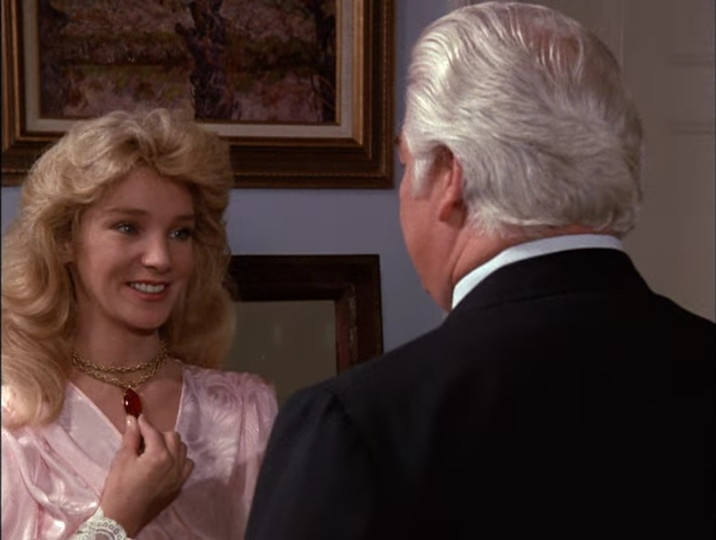
He says that it’s not half as beautiful as the woman wearing, but that it will turn a few eyes at the party tonight. Alice is distressed by this. She says that his friends will take one look at it and think that she married him for his money. Also, it puts the gift she gave him to shame. He laughs this off, but she protests that being swept off her feet and honeymooning all over Europe, and the jewels and the parties are nice and all, but they’re also overwhelming.
He tells her that she’ll get used to it.
They’re interrupted by Richard’s daughter from his first marriage, Carolyn:

She comes in with the cattiness turned up to 11. About the necklace, she remarks, “It doesn’t surprise me at all. But then he’s always been very generous. Haven’t you, Daddy?”
He replies, “To a fault, in some cases.”
She then says, “Aww, come now, Daddy. What’s the point of having money if you don’t spend it? Besides, all I want is a measily thou. You can call it an advance on my inheritance.”
Richard sighs and, as he picks up his checkbook, says, “Carolyn, honey. These advances are becoming an all-out major assault.”
He tells her that money is not unlimited and he works hard for it. He then says that she has to learn that she can’t buy everything she wants.
She asks, “Why not? You have.”
She grabs the check from him and leaves. He remarks, “that’s a chip off the old block.”
That last part is interesting, because it acknowledges that her patterns of behavior had to come from somewhere, and that’s probably mostly her parents. You usually don’t see that in murder mysteries; spoiled children are typically treated as if they sprang fully formed from their parents and went wholly wrong entirely on their own.
Which is not to say that people do not have free will and do not make their own choices. They do. Bad people can make themselves that way despite being raised well, just as saints can overcome having been raised badly. These are not the norm, though. It’s far more common that if people don’t have principles, it’s because they were raised without them. And this makes the rich old man with the awful children not nearly so much an object of pity as he’s typically made out to be. There is something sad about a man reaping what he has sewn, but that is tempered by the fact that it’s only justice.
We then meet the spoiled brat’s brother, Mark:
She’s walking down the stairs quickly and he asks her what the rush is—is she afraid that some trendy new fashion will start without her?
I get that Murder, She Wrote needs to be time-efficient in its characterizations, but this level of casual antagonism is dysfunctional. I suppose it’s meant to help make him a suspect—Carolyn suggests that if their father and her young wife have a son together, Alice will ensure that her own issue takes over the bank when their father dies, not Mark.
This is basically just taking aristocratic primogeniture from golden-age detective mysteries and pretending that it applies to American businessmen. Even there, Mark would have to be a nephew with Richard having no male issue, so far. As the oldest son, his position under primogeniture would be assured.
In the actual circumstance, this is absurd. Richard Bradford, the actor who plays Richard Hazlitt, was born in 1934 and was thus 54 years old in 1988 when this episode aired. I suspect he was playing older, though, since his children are clearly in their thirties and Richard Hazlitt was unlikely to have fathered them in his early twenties. But heck, let’s suppose the character was supposed to be the same as as the actor—and it’s weird for a thirty year old to talk of a fifty year old as being “old”—this means that in twenty years he’ll be 74. Even if he survived this long, he’ll probably retire, and the oldest his son with his new wife could be is nineteen years old. Are we really to expect a bank to be run by a nineteen year old with no experience in preference to a fifty year old who’s worked in the bank for the last thirty years? Primogeniture will pass a title and estate to a child. American corporations don’t work that way.
This is one weakness that Murder, She Wrote sometimes runs into when it tries to pay tribute to golden age mysteries—some of them simply don’t work in modern America. (See The Lady in the Lake.)
In the next scene Seth and Jessica are in a car with glorious rear-projection of Washington DC behind them.
I can’t help but wonder what it was like shooting rear-projection scenes. Did they feel as silly as they looked, or was it just a part of the business? My mother likes to say that people were more innocent and accepting back then, but I have dim childhood memories of my father making fun of rear projection even back then.
They were in Washington D.C. to confer with their congressman, and that done, Jessica is trying to talk Seth into accepting an invitation to a polo match from his estranged brother (Richard). With effort, she talks him into it, but he makes it conditional on Jessica coming with him, which she reluctantly agrees to.
The scene shifts to the polo match. Richard and Alice are watching, while Mark is playing. The game ends moments after red team (Mark is on blue team) scores a winning point. Richard upbraids Mark for bad playing.
I find it interesting that Richard is not a sympathetic character. Earlier, it was a bit more ambiguous, where he was pulling in the reigns on a spoiled child; it’s possible to not notice who it must have been who spoiled the child. Here, he’s just being pointlessly critical and cruel. I wonder if this is to help make Seth more sympathetic for being estranged from his brother for so many years.
Mark asks his father why he doesn’t get off his (Mark’s) back, and Richard asks Mark why the hell he doesn’t learn to play the game. He then says, “and there’s someone who could teach you,” and calls out to Vikram Singh, and congratulates him on a good match.
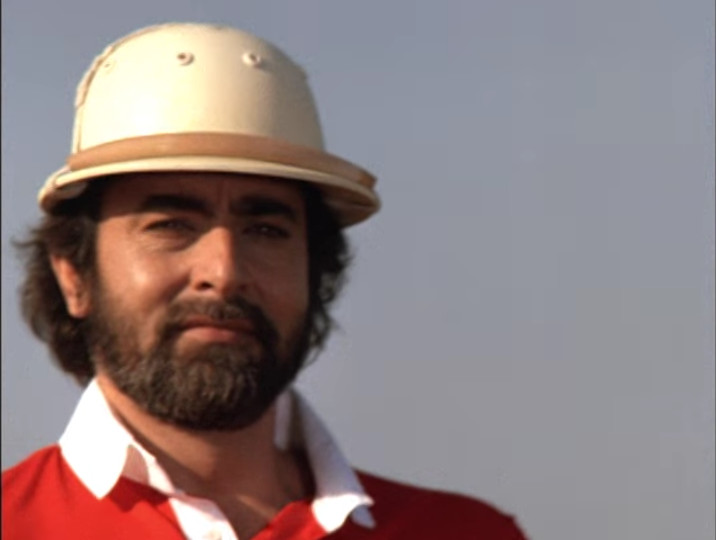
It’s the same guy as in the dream!
Jessica and Seth come up and Jessica observes that they seem to have missed the entire match. “So much for that driver’s short-cuts.” This is a cute way to get them there at the right time, story-wise. It’s not a big deal, but saves a bit of time.
We then meet Alice’s father as the two of them walk up to Jessica and Seth.
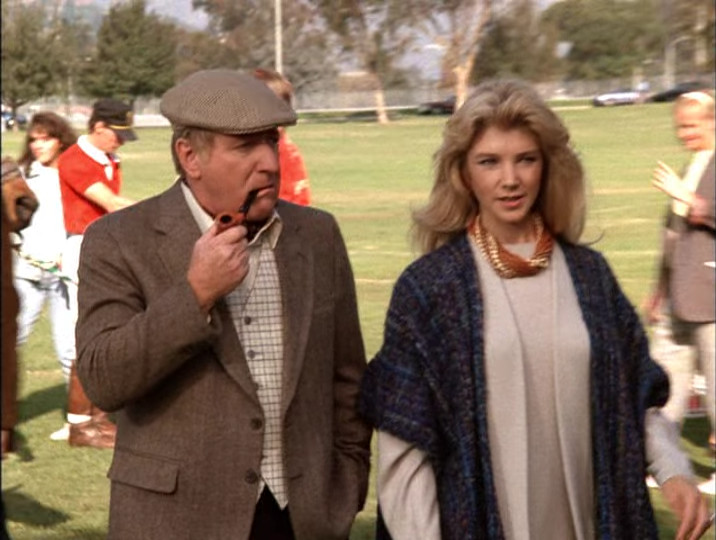
Seth guesses that she’s Caroline, but she clarifies that she’s Richard’s wife. She introduces her father, whose name is Burt Davis
Richard then notices Seth, and the two of them stare at each other warily.
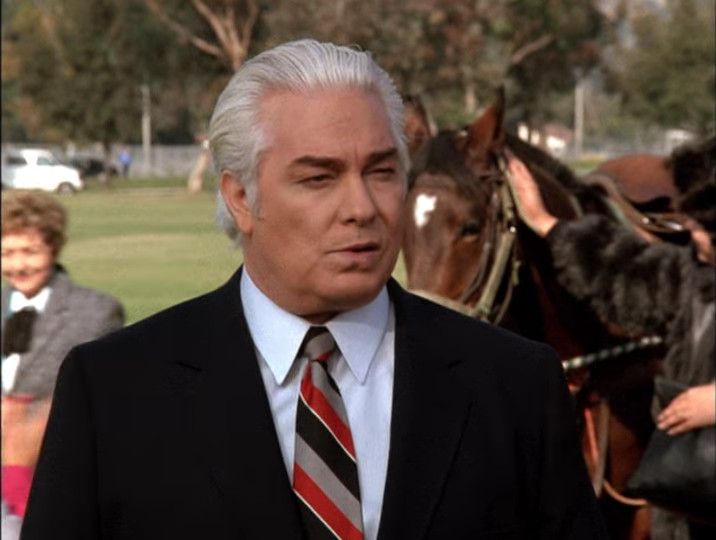
It then comes up that Richard was not the one who invited Seth, it was Alice who took the liberty. She then tells Seth and Jessica to come stay at the house, and Richard can’t say no to her so it is arranged. She has a forceful personality, but also means well, which is unusual in a murder mystery.
The scene shifts to the party that evening, where we see Burt eating and drinking off of the plates that servants (or catering staff) are carrying. I think this may be meant to establish his character as low class and unused to the events, or else just someone who really enjoys eating and drinking. He wanders into Seth, and then Jessica walks up with Vikram Singh, and it turns out that they’re standing next to Caroline and Mark.
The children complain, as is their habit. Jessica tells them that she was just saying to Singh that she was sorry they missed the polo match. Mark says that she didn’t miss anything but Vikram begs to differ; prior to his fall Mark scored three goals, which Singh considers most impressive.
Richard and Alice join the group, and Vikram Singh notices the ruby she’s wearing (the one from the dream which Richard gave to Alice at the beginning of the episode). Singh identifies it as “The Eye of the Daanav” and tells them about its curse. The ruby, he explains, is the all-seeing eye of a powerful demon called “The Daanav”. It’s a golden-headed cobra which controls all that is dark and evil in this world.
I’m kind of curious what religion this legend is from, because it doesn’t really match up with Hinduism, Buddhism, or Islam, the three major religions you’ll find in India. (I wonder if this is like the episode where there was a Sheik with thirty six wives.) Anyway, the Daanav was angered by the theft of its all-seeing eye (more than a century ago), and laid a curse on it that would rob the breath of life itself from one whose heart is less than pure, killing them most horribly.
Richard thinks that this is merely a scare tactic, though, as Singh has already, on behalf of his government, offered Richard twice what he paid for the jewel. Richard, however, is adamant that he won’t sell it. Why, is not stated. It’s hard to see how he could have a strong attachment to it, but as we will see the plot requires him to not be willing to give it up. Perhaps this is why he was shown to be such a selfish, inconsiderate bastard earlier.
At this awkward juncture Alice excuses herself as having a ton of people to meet, then remembers that she hasn’t given Richard his gift yet and tells him to wait in the study while she goes to get it. It turns out that she left it in her car in the garage. When she gets there an engine is running. She leaves the door slightly ajar and goes to investigate, but the car’s doors are locked. Then the door she left ajar is slowly and quietly closed. She bangs against the door, calling for help, as she coughs from the carbon monoxide. She eventually falls to the ground, unconscious and we fade to commercial.
When we come back from commercial, Burt and Mark are walking to the garage because Burt had thought he’d lost his pipe then remembered he’d left it in the car in the afternoon. Mark tries the door to the garage and remarks that it’s locked, which is unusual. He thinks he’s left his keys “upstairs” (this is a detached garage so “back in the house” would have been more accurate, but Mark appears to be drunk). Burt holds up the key to the garage and asks, “what’s this?” Mark replies, “Oh, what do you know?” They then hear the sound of the car engine and rush in to investigate and find Alice.
They rush her back into the house, Mark carrying her, and Seth takes charge while he instructs Richard to call the paramedics. This done, Richard comes to tell Seth that the paramedics are on their way and he tells her that it’s OK, Alice is coming around. Burt then insists on calling the police as he thinks that someone tried to kill Alice. Richard thinks this is ridiculous, but the next scene shows a police car so someone called the police.
Jessica meets Lt. Ames in the garage, looking at the scene of the crime.

Lt. Ames tells Jessica that this is probably a failed suicide attempt. Jessica finds this ridiculous because who commits suicide by turning on a car and closing the garage door so the garage will fill up with fumes and then going off to a party only to leave in the middle to kill themselves, since it must have taken longer than the fifteen minutes that Alice was gone for the garage to have filled up with fumes (It’s an enormous, many-car garage).
Larry looks at her with new interest, closes the door, and asks who she is. She lets it slip that she had been in Washington to meet with Congressman Hale. Ames recognizes the name; Hale is the head of the House Committee on Secret Intelligence. He concludes that Jessica is some sort of secret agent who cannot reveal her identity. He then gives Jessica all of the evidence he has.
The entirety of his evidence amounts to Alice’s key having been in the ignition of the car with the doors locked. Alice admits that it’s her key, but protests that she always kept it on a hook in the garage and anyone could have taken it. Under questioning, she said that she pushed the button that should have opened the garage a few times and it didn’t work, then she tried to go out the side door but found it locked.
Ames notes that when he tried the electric garage door opener, it worked fine. Seth interrupts and suggests that she might have been confused. Inhaling that much carbon dioxide was bound to cause a certain amount of confusion.
Alice then interjects that the paramedics said it could have caused far worse than that, had Seth not been there. Seth acknowledges this with an smug nod.

This is a thing that the writers try to develop during the episode—Seth’s medical prowess. The only real problem is that so far as I can see, he didn’t do anything at all. The only thing we know he did was listen to some part of her with a stethoscope and say that it was going to be OK because she was coming round. He didn’t even do as much as Dr. Watson often did (give the patient brandy). Nor do I see what he could have done, given that he didn’t have an oxygen canister on hand to administer oxygen with—the main treatment of carbon monoxide poisoning. There isn’t really a way to administer higher levels of oxygen without an O2 tank (that I’m ware of), and some searching that I did didn’t turn up anything besides administering O2 that will help (in the short term).
A bit of debate happens in which Richard suggests that the carbon monoxide confused Alice and she locked the door herself, while Jessica points out that carbon monoxide confusion still doesn’t explain who started the car. Richard declares that it was an accident, and Lt. Ames accepts that and leaves.
On his way out Lt. Ames tells Jessica, sotto voce, that if she needs his help on this she has it, on the record or not.
Alice goes back to her room and Jessica comes with her and helps her undo her hairdo. As she does so, Alice tells Jessica that she’s confident that she didn’t lock the door herself. Jessica asks who knew where the gift was and Alice says that Caroline was the one who suggested the garage. Burt, who was getting Alice an aspirin, reminds her that Mark knew as well, since he drove up just as Burt and Alice were hiding the present.
After this Jessica and Richard are talking and Richard said that it had to be an accident and it was just luck that Alice wasn’t killed. Jessica replies, “Luck, and your brother.” Richard admits that Seth was impressive and he didn’t realize that Seth had it in him to be so cool under pressure.
Again, I don’t get what Seth is supposed to have done. He didn’t have oxygen or any medicines with him. Is he supposed to have elevated her head in a way that made her breath twice as well, or something? There is an experimental technique where administering a small amount of carbon dioxide can speed the person’s breathing and help them to expel the carbon monoxide faster. He didn’t have any canisters of carbon dioxide on hand either, though.
Structurally speaking, it makes a lot of sense that the writers want Seth to have shown off his medical prowess and to have saved his estranged brother’s beloved wife, but I don’t see any legitimate way to have that here. Had there been an older person on oxygen whose tank could have been borrowed for a few minutes at a critical moment, this could have made sense. As it was, though, how impressive is it supposed to be that he laid her down on a couch and then listened to her lungs? I think that the lack of doing anything really hurt the emotional effect, because all of this talk about Seth saving Alice has the effect, not of drawing one’s attention to the brothers, but of making the viewer wonder what the heck Seth was supposed to have done.
This might not be an issue in a romantic comedy, but this is a mystery show. The viewers are self-selected for being interested in poisons, medical details, and exactly what happened. This is the worst genre to hand-wave away crucial details.
They then run into Vikram Singh, who is still in the house for some reason. He expresses his personal condolences. Richard thanks Singh then excuses himself. Singh interrupts him leaving, though, and says, “Mr. Hazlitt, but for the grace of a god we cannot hope to understand, your wife could very well be dead. Now will you trust that the curse of the ruby is true?”
Richard responds to this about as well as can be expected, but he catches himself at “Listen, you son of a-” and then moderates his language because a lady (Jessica) is present. He informs Singh that the ruby is not for sale, now or ever.
Again, why he has such an attachment to the ruby is never explained or even hinted at. It’s a bit hard to imagine why; so far as we know it’s just a pretty stone he bought as a present for his wife on a lark.
He adds that if he finds out that Singh was responsible for Alice’s almost dying, he will kill him. Singh finally departs.
Richard puts the ruby away in the safe in his study and runs into Seth, who was sitting in a chair in the study. Richard invites him to share a drink and Seth accepts. They begin reminiscing, then talk over what drove them apart—a woman named Molly. It seems that Seth was romantically involved with her, or at least interested in her, but she and Richard eloped. When they got back Seth had already left for Portland, and Richard couldn’t find the words. Then his business took off, and the kids came, and then Molly got sick and died very quickly.

Richard apologize, but Seth says that he should be the one to apologize, since his blindness was what drove Richard and Molly to have to run away. Then Seth did his own running away, and even after he married Ruth he couldn’t bring himself to make the first move toward reconciliation. “And now, Ruth’s gone too. And here we sit. Two of the biggest fools that ever drew breath.” (They then formally reconcile.)
It’s a very well done scene. I think it lacks a little punch because as a TV show it’s hard to take seriously since Seth is an ongoing character and Richard didn’t exist in anyone’s imagination before this episode and won’t exist in anyone’s imagination after it, either, not even in impact on Seth’s character. If this were a one-off story such that both characters existed equally, I’d say it was a superb scene. Both actors are really excellent, though that’s a thing specific to television and not really generalizable to writing mysteries in print form. I think that there’s a lesson, here, though: scenes of large emotional impact should generally be between equal characters.
Actually, a second lesson is that if you’re writing anything episodic or otherwise can’t live with the consequences, make sure to have the big stuff happen to non-major characters who will not be around in the future. We can then give them, in our imaginations, the consequences of their actions and the character changes of their significant improvements. Giving it to characters you will have to take it away from is simply wasting the character development.
General lessons aside, there is another problem, which is that it’s not entirely in character for Seth. He’s a cranky curmudgeon who never thinks deep thoughts. Also, what he said was too eloquent for him. I wouldn’t normally complain about improvements, but this gets back to the part about knowing that it won’t last.
Shortly after they reconcile.
A few hours later we see Alice in a nightgown coming down the stairs and looking for Richard. She seems to believe that he’s in the study. She knocks increasingly loudly and calls to him, but the door is locked. This brings Jessica and Caroline to the top of the stairs.
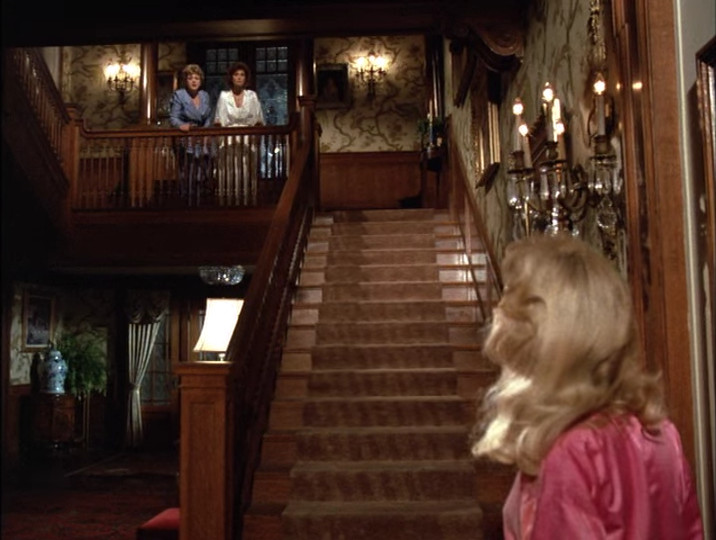
Jessica asks if something is wrong and Alice says that she thinks Richard must be hurt. This general commotion brings the rest of the house out of bed. Seth says that he left Richard in the study not half an hour ago. Unfortunately there is no key; the latch is an old-fashioned hinge-latch that can only be opened from the inside.
They break the door down and find Richard on the floor, dead.
Caroline then says, “Oh my God. The ruby. It’s gone.” And we get a closeup of Richard.

I think that this is supposed to illustrate that the ruby is gone. Since the ruby was never on any part of Richard that we can see, I’m not sure how it does that. So far as anyone knew, he had put it in the safe. (In fact, he hadn’t, since he was interrupted in that by Seth, but no one else could have known this, and we’ve no reason to suppose he didn’t put the ruby back after his conversation with Seth was over.) The scene then fades to black; I suspect that this would be to the mid-point commercial break. We come back to someone from the police pulling a sheet over the corpse.
Jessica talks to Seth and he tells her about the reconciliation, then goes to get fresh air. Lt. Ames is talking to the rest of the family, asking about secret passages, but Mark assures him that the only way in or out was through the door or windows, all of which were locked.
So, we have a locked room mystery.
I really should be more excited about them than I am but my experience with locked room mysteries is that they’re always disappointing. I’m beginning to think that they have to be. The problem is that a murderer can only get out of a locked room by some trick, and tricks are not very satisfying. Latches can be lowered after a door is closed, for example. In The Mirror Cracked From Side to Side, for example, the latch on the door would close if it was propped up and the door banged shut. A lot of play has been made about the breaking down of the door removing the evidence of how it was locked, too. So, for example, the deadbolt can be broken open and only the catch used to lock the door, and when the innocent people break the door open they will see both the deadbolt and catch broken and so assume that they broke both. (Another approach which I associate more with pre-1930s mysteries, though examples can be found afterwards, are the use of devices to kill the victim such that they were actually killed in a locked room, and the device is disguised or removed later.)
The other issue here is that locked rooms only matter in a mystery when there is the suspicion of suicide that the locked room strengthens. Oddly, we’re never told what the cause of death was, but there is no suspicion of suicide ever brought up.
Pausing for a moment to talk about the cause of death, since it’s very strange that we’re not told: in the establishing shot there was no knife sticking out of the corpse and in the shot above we can see no ligature marks on the neck. There are also no pools of blood, so we can rule out stabbing and strangulation, but beyond this we’re given no information about how he came to be an ex-Richard. We’re not even given the proximate cause of death, such as heart failure, stroke, asphyxiation, etc. My guess is that he was struck from behind on the head with a blunt instrument. The half-hour window since Seth left him until when he was found dead leaves very little time for poisoning and the body wasn’t contorted, the lips not blue, etc. There is also the possibility of being shot since the dark clothes might not show a small bloodstain and if he was shot in the chest and fell backwards, and if the bullet didn’t exit the body (as they frequently don’t), there would not be obvious blood. Still, my money is on a blow to the head from behind.
Assuming, of course, the writers ever figured out a cause of death. I actually suspect that they didn’t.
The one thing we do know is that Lt. Ames treats this as a murder investigation from the beginning and everyone seems to agree with that. So this brings up the question of the locked room: what purpose did it serve? If everyone agrees that Richard was murdered, figuring out how the murderer locked the room after leaving is just a detail. The room being locked from inside only helps the murderer if there is some plausible alternative to “well, you must have done it somehow, as clearly somebody did it somehow”.
Anyway, at this point Caroline brings up the curse of the ruby . This brings Vikram Singh to Lt. Ames’ attention. It’s interesting, btw, how the writers dance around him being Indian. When Ames asks who Singh is, Jessica replies, “He’s the cultural attaché at his country’s embassy in Washington.” Also curious is that Ames tells one of the police extras to check on Singh and see if he was connected to the muslim protests a few weeks ago. Jessica tells Ames that Singh said he had attended a Divali festival last year, which would make him Hindu, not Muslim. Also possible is that he’s in some wierd made-up-for-TV Indian religion and happened to go to a Divali. (Divali is a festival of lights that is celebrated by Hindus, Jains, and Sikhs; it thus seems to be largely a secular festival to which people attach various religious meanings as they care to.) This impresses Ames, anyway.
It’s getting late so Jessica suggests that Ames wrap up and he does so. He then asks her which federal service she’s with, but Jessica again protests she’s just a mystery writer from Cabot Cove, Maine. Ames takes this to mean that she’ll reveal her real identity when he needs to know and not before then, which he is content with.
This running joke serves the larger purpose of securing police cooperation for Jessica, and is an enjoyable way to do it. Every Murder, She Wrote episode needs to handle the question of how Jessica relates to the police; the episodes run the gambit from complete hostility to fawning admiration. This one is more on the fawning admiration side, but does so with a touch of dignity. Just a touch, but at least he’s clever about his mistake.
The next morning Ames runs into Jessica examining the outside of the room. After some further protestations that she isn’t a government agent, to which Ames enthusiastically (though insincerely) agrees, he asks what she has for him and she replies, “unfortunately, nothing.” The windows were not tampered with and except for their own footprints there are no marks in the flower beds outside the windows. Jessica concludes that the murderer wants them to believe in the curse.
They walk on and the camera pans up to Caroline, who had been watching them from a second floor window.

I believe that this is supposed to make us think Caroline is a suspect. She was the one who drew everyone’s attention to the ruby being missing. She was the one who told Lt. Ames about the curse. Of course, in a Murder, She Wrote, a suspicious close-up like this rules her out as a suspect.
The next scene of Mark, Mark is on the phone with, presumably, the family lawyer and angrily demands a copy of his father’s will today. Ames walks in on the tail end of this and finds it suspicious. There is some interesting word-play, though. “In a pretty big rush to see the will, aren’t you, considering your father is lardy cold?” He replies, “Lieutenant, my father was never anything but cold.”
In the ensuing conversation Seth protests and Mark points out that Seth is in no position to say what Richard was like. The long estrangement makes Ames suspicious until Jessica tells him that Seth can be trusted, which Ames takes to mean that Seth is also a government agent.
Jessica and Ames then go to investigate the study. Jessica figured out how the locked room was accomplished—a lit cigarette that propped up the latch while the door was closed.

As I said, it’s always some sort of trick. Oddly, no one raises the question of what the purpose of this trick was. Ames asks who would go to all this trouble for a ruby, and the scene cuts to interrogating Vikram Singh in the lounge. When Jessica says that Seth was killed by a man, not a curse, Singh leaves. As he goes he puts on black leather gloves, but then pauses as he puts the second one on, then takes it off again, looking quizzically at the glove.
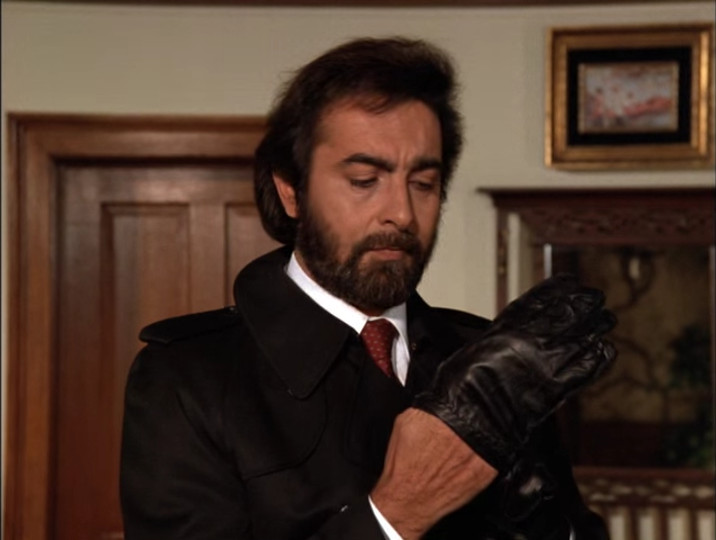
Jessica, eagle-eyed as ever, spots his perplexity about what’s inside his glove. She calls him on it and it turns out to be the Eye of the Daanav.
Back at police headquarters, Jessica doubts that Singh is guilty. For one thing, he couldn’t have known that Alice was going to get Richard’s present from the garage, making it very hard for him to have tried to kill her that way. Also, he’s far too intelligent to have brought the ruby he stole the night before back to the victim’s house to hide it in his own glove without knowing it and then all but show it to Jessica and Lt. Ames. OK, Jessica only says, “Well, frankly, I doubt that an intelligent man like Mr. Singh would have deliberately hidden the ruby in the glove and then put it on in front of us.” She forgets to mention that this is the next day and Mr. Singh did not sleep at the house—it’s never explained why he was questioned there—and so he would have had to bring the ruby back to the house after stealing it the night before in order for it to be at the house.
I think that the writers wanted to write an isolated English country house murder with its closed set of suspects, but forgot that they didn’t actually do that. There’s kind of a lot of stuff that they forgot to do, when you get down to it.
Caroline is summoned to Lt. Ames’ office and questioned about her spending habits. She denies murdering her father for money—he had refused to pay her debts to a collection agency a few weeks ago. She suggests that if they want a financial motive, they should look to Alice, who will receive millions because of an outrageous insurance policy which she forced Richard to take out during their honeymoon.
In the denouement, Lt. Ames, Jessica, Seth, Alice, and Burt are in the accusing parler. They accuse Alice of murdering her husband (and faking the attempt on her own life), but it turns out to be a ruse to force Burt to confess. Well, not so much to confess as to make a slip. Lt. Ames suggests that Alice used one of her cigarettes in the latch and Burt points out that she smokes English cigarettes, not Turkish. Of course, he could only have known that it was a Turkish cigarette used to prop up the latch if he was the murderer.
Burt asks if Jessica is accusing him of trying to kill his own daughter and she says no, it was not meant to be fatal and only meant to raise the specter of the curse.
There’s a problem, here. People—and especially Burt—only learn about the curse moments before Alice goes to the garage to get her present to Richard. As Jessica established, the car had to have been running for a while before this. If Singh couldn’t have known that Alice was going to go to the garage to get her present to Richard, Burt couldn’t have known about the curse in order to make it look like Alice was nearly a victim to it. I think that this is just a plot hole.
Jessica tells Burt she had wondered at how lucky it was that Burt “just happened” to go to the garage and find Alice. When he protests that he had forgotten his pipe in the garage, Jessica reminds him that he had his pipe at the party and put it in his pocket in order to shake hands. There’s also a bit earlier where Burt had told Alice that the ruby was found in Singh’s glove, when Burt couldn’t have known that if he didn’t plant it there himself.
Any one of these is sufficient (in a Murder, She Wrote) to prove Burt is the murderer on its own, so all three together clinches it. Alice is astonished and asks her father why he locked her in the garage—he nearly killed her. He tells her that he had it planned down to the second. He had the key in his pocket and if Mark hadn’t found his key, Burt would have blown it there and then and opened the door and got her out.
He then explains why he killed Richard—he saw the kind of man Richard was: cold, possessive, king of the bloody world. And now he owned Alice, and would show her off to make people think more of him. What kind of a life could she have with a man like that?
Then we get to the real reason: But without Richard, she’d inherit. Oh, they could have been so happy, Burt and Alice. Going first class, never needing a by-your-leave from anybody. It would have been grand.
When this fails to get the reaction he was hoping for, he asks Alice, “You do see, don’t you? I was thinking of you.”
Since he very obviously wasn’t and she may be innocent but she’s not an idiot, she doesn’t say anything and tearfully hugs him. The scene ends and that’s all we get of her character.
The final scene is of Lt. Ames helping Jessica and Seth with their bags. He tells Jessica that it was a privilege to work with someone of her security clearance. She tries one last time to convince him that she’s not a secret agent by showing him her social security card, library card, and voter’s registration card. (Why she’s carrying the social security card and voter’s registration card in her wallet, she does not say.) He looks at them but then Seth calls to Jessica, “You’d better hurry if you want to meet with that agent before he goes to Moscow.”
This is a callback to a line from the scene in the car where Jessica is trying to talk Seth into accepting his brother’s invitation and he’s trying not to: “You’ve got to see that real estate agent about your vacant lot before he runs off to that family reunion of his up in Moscow, Idaho.” Without that context, which of course he doesn’t know, Ames takes it to have its more plain meaning. He looks at her cards again and remarks, “Best phony ID I’ve ever seen.”
Jessica only stares in disbelief, and we go to closing credits.
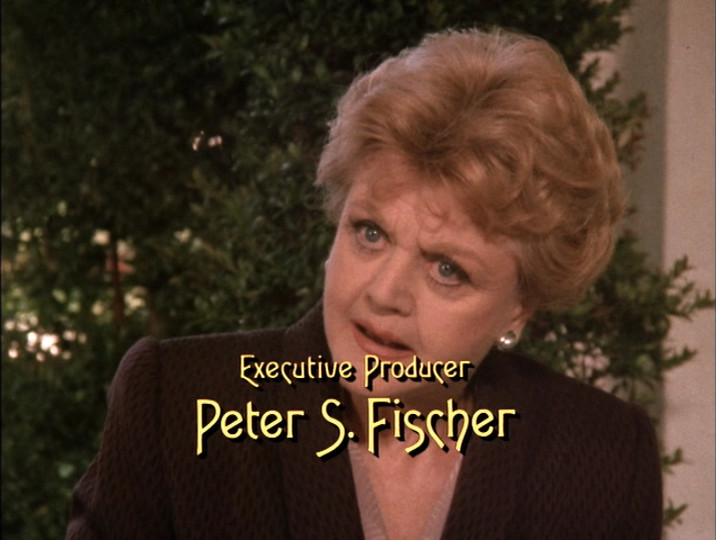
Overall, it was a very enjoyable episode. It was clearly inspired by the classic English manor house murder, which is always very fun. The theme of the reunion of brothers was well done and well acted, even if Seth was the wrong choice for the part. Alice, the young wife, was also a real asset to the episode. Her innocence and universal good will was really touching.
This was not an episode that stands up to scrutiny, though. You can see the amount that the writers paid attention to detail in things like the cause of death never being mentioned. For that matter, how was the murder supposed to have happened? Did Burt wait up until Seth left the study to creep in and kill Richard? Did he sneak in without Richard noticing him, or did he talk with Richard and wait for him to be standing there with his back turned?
However he did that—and neither options seems very practical—why steal the ruby if the idea was to try to blame the curse? If the ruby could steal itself, presumably it would have done so a long time ago and be back in the golden cobra’s head. If, on the other hand, the idea was to frame Vikram Singh, why wait for a time when Singh almost certainly couldn’t have been in the house? And what was the purpose of the locked room except to use a Turkish cigarette to frame Singh? But why bother using it to lock the door? It would have done as well to leave it in an ash tray.
Less of a fundamental problem, but still showing how little detail mattered, is the way that Burt started the car for the plot to pretend to have the curse try to kill Alice before he learned about the curse. To be fair, this would not have been easy to fix, since the episode started on the day of the party and Murder, She Wrote is generally so packed that the episodes are on a tight deadline. Even so, it’s still a mistake.
I’m also not sure what to make of Richard having been a lousy man and a terrible father to his Children. They did touch on the interesting theme of Alice’s goodness, with the aid of her beauty, reforming him. I wish that they could have done more with it but having the victim alive until the halfway mark is already pushing it in a murder mystery.
Which brings me to the abrupt ending.
One flaw in Murder, She Wrote is that the amount that they cram into less than 47 minutes doesn’t permit them to give characters a real farewell. They tend to just disappear. We never see Mark again after his telephone conversation with his lawyer. We never see Vikram Singh again after he’s arrested for having the ruby in his glove. We last see Caroline in the police station where she tells the police about Alice’s large inheritance. These aren’t well developed characters, though, so it’s not much of a loss to see them go without any closure. It’s far more of a pity that we don’t learn about what Alice will do. If this weren’t an episodic TV show where nothing that happens in it will affect future episodes, she might even lean on Seth for support which he would provide in his recently reconciled dead brother’s stead. Your father murdering your husband and your step children (who are older than you) hating you is a position in which you will want a friend, wealth or no. Alice would be a very interesting character to meet again, though unfortunately that won’t happen. They could at least have cut the opening sequence with the dollar-store Indiana Jones stealing the ruby in exchange for an extra minute in which to give Alice some closure.
The relationship between Jessica and Lt. Ames was also an interesting part of this episode. As I said, Murder, She Wrote has to establish some kind of relationship between Jessica and the police, and if they’re friendly, some sort of reason for them to be friendly. The more usual reason for them to be friendly is that they’ve been impressed by Jessica’s books. Mistaking Jessica for a high ranking secret agent accomplished this in a more fun manner. It’s also nice that while Ames wasn’t brilliant, he wasn’t an idiot, either. He merely had a mistaken premise that he stuck to. It also played, to some degree, on the fact that as the main character in the show Jessica was, in fact, as special as Ames assumed, just in a different way. It’s interesting as an example of how far one can go with taking a bit of comedy seriously without damaging the seriousness. It would have hurt had Jessica required Ames’ belief in order to succeed, but he was initially friendly anyway, so it remains plausible that Jessica could have secured his cooperation without the mistake, and this permits us to enjoy it.
Overall I would rate this in the top half of Murder, She Wrote episodes. It has many flaws but I think that they’re all forgivable in light of its good qualities.
Next week’s episode is Mourning Among the Wisteries. Jessica is off to the south to visit a playwrite friend of hers.
Merry Christmas!
I’d like to wish everyone a merry Christmas today, so: merry Christmas!
Also, here’s my favorite secular Christmas song:
If you haven’t heard it before and have 3 minutes to listen to it, I hope you enjoy it, and either way, God bless you and yours.
Miles Bredon was a Strange Detective
F.r Ronald Knox (of Detective Decalogue fame) wrote a number of detective stories. His first, The Viaduct Murder, might best be described as a serious satire on detective fiction. It was interesting, in a way, but not, frankly, satisfying. To some degree it was really more of a very long-winded attack on the Historical-Critical method than a detective story. After that he wrote a far more conventional detective story, The Three Taps.
Even there, while it was a more conventional story, it featured an unconventional detective, Miles Bredon. The first unusual thing was that the detective worked for an insurance company. Humorously, it was called The Indescribable Insurance Company (i.e. “The Indescribable,” for short). Here’s some of the initial description of him:
…[T]he Indescribable retained its own private detective. This fact was not advertised; nor was he ever referred to in the official communications of the Company except as ‘our representative’. He carried neither a lens nor a forceps—not even a revolver; he took no injections; he had no stupid confidential friend, but a private detective he was for all that. An amateur detective I will not call him, for the Company paid him, as you would expect, quite handsomely; but he had nothing whatever to do with Scotland Yard, where the umbrellas go to.
It’s also quite fascinating how F.r Knox described Miles Bredon being married (some paragraphs down, after talking about how he was lazy but very capable when his interest was roused):
He was well thought of, in fact, by everyone except himself. For himself, he bitterly regretted the necessity that had made him become a spy—he would use no other word for it, and constantly alarmed his friends by announcing his intention of going into the publishing trade, or doing something relatively honest. The influence which saved him on these occasions was that of—how shall I say it?—his wife. I know—I know it is quite wrong to have your detective married until the last chapter. But it is not my fault. It is the fault of two mocking eyes and two very capable hands that were employed in driving brass-hats to and fro in London at the end of the war. Bredon surrendered to these, and made a hasty but singularly fortunate marriage. Angela Bredon was under no illusions about the splendid figure in khaki that stood beside her at the altar. Wiser than her generation, she realized that marriages were not ‘for the duration’; that she would have to spend the rest of her life with a large, untidy, absent-minded man who would frequently forget that she was in the room. She saw that he needed above all things a nurse and a chauffeur, and she knew that she could supply both these deficiencies admirably. She took him as a husband, with all a husband’s failings, and the Indescribable itself could not have guaranteed her more surely against the future.
It’s interesting that the detective is married, and especially interesting that Fr. Knox actually addresses this in a way that breaks the fourth wall. “I know—I know it is quite wrong to have your detective married until the last chapter. But it is not my fault.”
Fr. Knox wrote The Three Taps in 1927 (or, more accurately, it was published then). This was fairly late in the golden age of detective fiction, though as I’ve noted this was a thing almost from the beginning. In A Study In Scarlet, Holmes comments on C. Auguste Dupin, as well as Monsieur Lecoq. (Lecoq was a fictional french detective published in France in the 1860s, though available in English translation.)
I really don’t know what to make off all this; none of Fr. Knox’s stories were really great, and his detective is not an exception. Miles Bredon is clever and does the deduction which the plot requires. He figures out the story in a flash of brilliance after playing a complicated game of solitaire (“patience”). But he feels almost as if his author was careful not to make him great. There seems to have been a convention in the golden age that detectives must have as many drawbacks as they have traits to their credit; in consequence they were often ugly, rude, or clumsy. The only real exception I can think of is Fr. Brown, who was a really great character and whose only balancing handicaps were being short, a roman catholic priest, and bad at remembering where his umbrella was.
Fr. Knox seems to have thought that if his detective was brilliant and capable of keeping a wife he couldn’t also be interesting or it would be too much.
I can only say that I once made a similar mistake in a novel I never published (or, strictly speaking, finished). Afraid of having the character called an author self-insert I made him completely unlike me. This meant, among other things, that he had no interests that I found even remotely interesting. The consequence, once I put it like this, is not surprising: I found him extraordinarily boring. This is not a good way for the author to relate to the main character of the book.
Perhaps a detective who is brilliant and capable of keeping a wife and also an interesting person is too much for this world, but for all that he’d be much more interesting to read about.
It may be that Fr. Knox didn’t really want to write detective fiction. That his first novel was a satire on detective fiction with only one joke in it does suggest this. However, unlike G.K. Chesterton—who did not write conventional detective stories either—Fr. Knox did not go off in his own direction. In writing Fr. Brown Chesterton had a positive vision for what he wanted to write, and wrote that. He did put it within the detective genre of his time, if only barely, but he pursued his own ends. Fr. Knox seems to be pursuing neither his own ends nor anyone else’s, and only sticks to convention, if in general he tries to stick to the edge of it rather than the center.
Fr. Knox was a man of no small accomplishments, and given that he took the trouble of writing up his detective decalogue and of being a member of the Detection Club, I can’t help but wonder why he went this way.
Causes of the Great Depression
An overlooked cause of the Great Depression is the move from agriculture to industry as a source of employment. In the USA, something like 25% of the population transitioned from being farmers to being factory workers in a decade or so, and the great depression was, in part, the working out of the readjustment of the economy to so large a fraction of the population changing occupations.
Something that was just pointed out in a TIK video (BankWars Episode 1) was that during World War 1 governments created a massive quantity of weapons and in order to do so paid large wages for factory workers (in arms industries) while hurting the price of farm goods. This was a significant stimulus to people moving off of farms and into factories during this time. I’m not sure—I need to do more research—that this happened as much in the USA as in Europe, but this is an intriguing piece of the puzzle to fit in.
I had mainly attributed this move to falling prices for farm goods due to an increase in efficiency due to mechanization (things like large, powerful diesel powered tractors, for example). I’ve no doubt that this is a significant part of the move, as further mechanization of farming has resulted in even more people moving out of the farming sector while more food is being produced in the US than ever. (It’s been more than a few years since I last looked it up, but I believe that only about 5% of the population of the US works in agriculture.)
However, this transition being massively speeded up by government interference would certainly help to explain it happening so quickly as to cause a great depression (which had, at its peak, something like 25% unemployment). The timing is a little iffy for this; the great depression began in the late 1920s while the great depression ended in 1918. I really need to do more research to see if this actually fits in. (Another place I need to look is how things were going in Europe because the Great Depression was a worldwide phenomenon with interlocking problems caused by international trade collapsing.)
Interesting Voicemail Message
Most calls from strange numbers don’t leave messages, and of those that do, few begin by saying anything other than my car’s extended warranty is about to expire. Today was an exception.
Hi Christopher, good afternoon, this is [name] calling from Reader’s Magnet. Chris, your book has the potential to become the next best-seller. Because of that [long pause while she finds her place in the script] we plan pick you and your book to be featured in the special edition of Publisher’s Weeklies [unintelligible] Anniversaries featured authors, this coming April 19 issue. We are in lookout for books with great stories to tell. As Publisher’s Weeklies special edition highlights on uplifting and edgy stories. And your book has also been selected to be displayed in the Tucson Festival of Books and Los Angeles Times Festival of Books. These are also especial events as these two book fairs are the first to reopen since pandemic started which means the fairgoers to these events will likely be doubled. So do not waste this chance to be part of this momentous affairs as this comes limited to a few chosen. To join and for more details, call me at 619-514-[redacted] extension 3119. You can reach me before 7pm Eastern Time Mondays through Fridays. Bye for now and stay safe always.
I presume that they’re trying to sell me author services, though it could be a credit card scam. The woman’s first language was clearly not English and in the age of voice-over-IP she could easily have been in a country that doesn’t have an extradition treaty with the US despite having a US phone number. (I assume the 4 digit extension is to seem more legitimate.) That said, since predatory author services are perfectly legal while credit card fraud is not, I’m more inclined to guess the former.
I think it’s a nice touch that she doesn’t even mention which of my books is poised to become the next best-seller.
Marxism: Factory Workers vs. Farmers
Something interesting I learned from several videos by TIK History on the Soviet Union before, during, and after WW2: Marxism in the Soviet Union was largely factory workers vs. farmers. This got me thinking about Marxism more generally, and the implications of class conflict being central to Marxist theory.
On a surface-level reading, Marxism is about pitting workers against owners. This is evil since all people should love each other, of course, but more relevant here (because it’s not so obvious) is that the owner-worker distinction fails to capture a large fraction of humanity. A great many people are neither the owners of someplace other people work, nor workers in a business owned by someone else. There are, of course, children, which Marxism utterly fails to deal with (except by, in effect, putting them into childcare/indoctrination factories). There are people (mostly women) whose primary work is raising their children and doing other domestic work. And there are people who own their own means of production.
In this latter group are—during the time of much of the soviet union—farmers. Family-owned farms are still common even today, despite the predominance of large factory farms, but they were extremely common in the Soviet Union for various reasons relating to the state of technology. It is true that there was a major push to collectivize the farms, but this only got so far, especially since the collective farms so often failed miserably. Part of the problem is that farms are intrinsically large and so people simply have to be spaced out enough that they exercise their own judgement. Farms also are not factories—you need knowledge (both general and local) and to exercise judgement to farm successfully.
The upshot is that farmers simply aren’t like factory workers. They have different interests. And factory workers desperately need what farmers produce—food. Factory workers—or those concerned with them—are also necessarily removed from farmers, since the factories tend to be located in or near cities. It is easy for factory workers to view farmers simply as a nuisance. The more food costs, the less money factory workers have for other things. And farmers are remote and their concerns unreal to city dwellers with extremely different concerns. Moreover, under any even slightly socialist system factory workers cannot earn more money by working harder or longer. Their income is fixed; only their expenses vary. In consequence, they only benefit (so far as they can see) the more farmers are squeezed.
And factory workers fit the Marxist model far better than farmers do. Farmers will always have independence and some degree of ownership, at least if you don’t want everyone to starve to death. Farmers can very naturally own their own means of production, but also be the laborers. Non-collectivized farms simply break the Marxist model since they are owner-workers. The perennial temptation, then, will be for Marxists to hold that these owner-workers are evil in virtue of being owners and thus are exploiting the workers who buy the food the farmers produce.
Since something like 60% of the people in the Soviet Union worked in agriculture, especially in the first half of its existence, this meant that a minority of the population was oppressing a majority of the population in the name of preventing that majority from oppressing it.
Curiously, if you look at Marxists today, they tend to want to do the exact same thing—to oppress the majority in the name of protecting themselves from oppression, while saying that they’re on the side of everyone.
I suppose a tiger doesn’t change his stripes after all.
Do You Need Money To Be Happy?
I look at the question of whether you need money to be happy, as Aristotle would have said, and as Ed Latimore recently (on a historical scale) suggested. Ed’s tweet:
“Extremism” is a Stupid Word
Something that has been fashionable to complain about in the last few decades is “extremism”. What is actually meant is something that is extremely out of the mainstream, but the problem is that it’s well known that the majority of people can be quite wrong. Indeed, given how recently deep racism was the mainstream in the United States (and analogous things can easily be found elsewhere, such as anti-semitism in Europe), simply accusing people of being a minority is not viable. So this is done under the cover of claiming that the problem isn’t that the person is in a minority position, but that his views are on the extreme of some spectrum, making them wrong, since truth always lies in the middle of all extremes.
The thing is, this is—to put it mildly—extremely stupid.
The truth is not always in the middle. This is very easy to see by just considering cases where no one is a moderate today. Everyone is an extremist about how much slavery should be allowed. Everyone is an extremist on whether the human race should be extinguished (most people hold an extreme ‘no’, some people hold an extreme ‘yes‘, but no one holds a moderate position). You will find exceedingly few moderates on the subject of whether the Jews should be wiped out.
This gets even clearer if you consider cases where no one was ever on the opposing side. Should we build as many nuclear weapons as possible and detonate them over all of the landmasses of the earth? The correct position is not a moderate one between “yes” and “no”. Should we salt all of the farmland on the earth? Should we beat people who go out in public? Should we mandate dragging a 500 pound rock if a person leaves his house? Should rape be legal? Should rape be state-sponsored, with generous bounties paid to rapists?
The correct position on all of these is not moderation.
By the way, I just happened to pick examples where the correct position is an extreme ‘no’. One can easily come up with examples where the correct answer is an extreme ‘yes’: should babies be suffered to live? Should we permit people to breathe air? Should we appreciate beauty? Should we love people? Should we try to be good? Should we be honest?
The correct position on all of these is not moderation, either.
Now, if you point this out to the people who say that the problem is extremism, they will get angry at you because this isn’t what they meant. And, indeed, it’s not. The problem is that it’s what they said. The reason that they’re getting angry is that they don’t like being called out on the fact that they’re lying to you. They are actually complaining about people being outside of the mainstream despite knowing that that isn’t a valid criticism.
Curiously, liars always seem to think it rude to point out that they’re lying.
There is an exception to the above, by the way, and that is what amounts to a heresy. It is always a mistake to take a single virtue (that isn’t the all-encompassing virtue of love, as in agape, the love of God) and to value only it at the expense of all other virtues. Thus courage is good, but not to the exclusion of honesty, mercy, faith, love, etc. Mercy is good, but not to the exclusion of justice, honesty, etc. This is not normally how people use the term “extremism” as a critique, but if they were to, that would be a valid critique. It would be better to criticize this as a heresy, since the idea of a heresy is that it takes one or a few parts of orthodoxy and leaves the rest, and this is what picking a virtue and valuing only it to the exclusion of other virtues is doing. But it is also going to an extreme, and a bad form of doing so, so the word would not be inapplicable.
As I said, that’s not what people normally mean by using “extremism” as a derogative, but if anyone does, my critique above does not apply to them.
Dozens of Major Cancer Studies Can’t Be Replicated
I recently came across an interesting article in Science News on widespread replication failure in cancer studies. It’s interesting, though not particularly shocking, that the Replication Crisis has claimed one more field.
If you’re not familiar with the Replication Crisis, it has to do with how it was widely assumed that scientific experiments described in peer-reviewed journals were reproducible—that is, if someone else performed the experiment, they would get the same result. Reproducibility of experiments is the foundation of trust in the sciences. The theory is that once somebody has done the hard work of designing an experiment which produces a useful result, others can merely follow the experimental method to verify that the result really happens and that after an experiment has been widely reproduced, people can be very confident in the result because so many people have seen it for themselves and we have widespread testimony of it. Or, indeed, people can perform these experiments as they work their way through their scientific education.
That’s the theory.
Practice is a bit different.
The problem is that science became a well-funded profession. The consequence is that experiments became extraordinarily expensive and time-intensive to perform. The most obvious example would cloud-chamber experiments in super-colliders. The Large Hadron Collider cost somewhere around $9,000,000,000 to build and requires teams of people to operate. Good luck verifying the experiments it performs for yourself.
Even when you’re on radically smaller scales and don’t require expensive apparatus—say you want to assess the health effects of people cutting out coffee from their diet—putting together as study is enormously time-intensive. And it costs money to recruit people; you generally have to pay them for their participation, and you need someone skilled in periodically assessing whatever health metrics you want to assess. Blood doesn’t draw itself and run lipid panels, after all.
OK, so amateurs don’t replicate experiments anymore. But what about other professionals?
Here we come to one of the problems introduced by “Publish Or Perish”. Academics only get status and money for achieving new results. For the most part people don’t get grants to do experiments that other people have already done and get the same results that they got. This should be a massive monkey wrench in the scientific machine, but for a long time people ignored the problem and papered over it by saying that experiments will get verified when other people try to build on the results of previous experiments and fail.
It turns out that doesn’t work, at least not nearly well enough.
The first field in which people got serious funding to try to actual replicate results to see if they replicate was in psychology, and it turned out that most wouldn’t replicate. To be fair, in many cases this was because the experiment was not well-described enough that one could even set up the same experiment again, though this is, to some degree, defending oneself against a charge of negligence by claiming incompetence. Of those studies which were described well enough that it was possible to try to replicate them, something like less than half replicated. They tended to fail to replicate in one of two ways:
- The effect didn’t happen often enough to be statistically significant
- The effect was statistically significant but so small as to be practically insignificant
To give a made-up example of the first, if you deprive people of coffee for a few months and one out of a few hundred see a positive result, then it may well be you just chanced onto someone who improved for some other reason while you were trying to study coffee. To give an example of the second, you might get a result like everyone’s systolic blood pressure went down by one tenth of a millimeter of mercury. There’s virtually no way you got a result that common in the group by chance, but it’s utterly irrelevant to any reasonable goal a human being can have.
Psychology does tend to be a particularly bad field when it comes to experimental design and execution, but other fields took note and wanted to make sure that they were as much better than the psychologists as they assumed.
And it turned out that many fields were not.
I find it interesting, though not very surprising, that oncology turns out to be another field in which experiments are failing to replicate. After all, in a field which isn’t completely new, it’s easier to get interesting results that don’t replicate than it is to get interesting results that do.
Onion Breaking News
From many years ago, back when The Onion was funny (warning: colorful language):
It’s really quite accurate, and possibly even better than Charlie Booker’s version (warning, colorful language):
I can’t help but think that the days of this sort of news broadcast have to be numbered, if for no other reason that the median age of people who still watch TV news is probably 75. The damage that news has done to society and to the people who watch it is incalculable; I hope that it does end soon and that it isn’t replaced by something worse. (Not everything is replaced by something worse, after all. That only happens quite often, not every time.)
How Many Times Must the Cannon Balls Fly Before They’re Forever Banned?
This is a profoundly stupid lyric in an otherwise truly great song. If you’re not familiar with it, it’s Blowin’ in the Wind by Bob Dylan. He sang it first, but it was covered by nearly all of the folk singers of the 1960s, and pretty much all of them sang it better than Dylan sung it. My favorite version is by Peter, Paul, and Mary:
I should note that this song is truly great if it’s taken as a lament of sin; if the questions are rhetorical because the poor, we will always have with us. And I do think that this was—not, perhaps with perfect understanding—Bob Dylan’s intention:
There ain’t too much I can say about this song except that the answer is blowing in the wind. It ain’t in no book or movie or TV show or discussion group. Man, it’s in the wind — and it’s blowing in the wind. Too many of these hip people are telling me where the answer is but oh I won’t believe that. I still say it’s in the wind and just like a restless piece of paper it’s got to come down some … But the only trouble is that no one picks up the answer when it comes down so not too many people get to see and know … and then it flies away.
The answer to all of the questions is, “when everyone becomes a saint,” and indeed the answer is readily available but people won’t pick it up.
The one question in the song which cannot be taken as anything but an infantile cry for mommy and daddy to make everything better is the line I quoted in the title. The first and most obvious reason it’s just an infantile cry is: who will ban the cannon balls, and how will they enforce this ban? The only way to enforce a ban is by force, so in a direct sense whoever has better weapons than cannon balls can ban them. Nations possessing nuclear weapons could impose a cannon ball ban, for example. This is directly opposite to the intention of the song, but it is in fact the only possible answer.
Except that cannon balls were obsolete long before Blowin’ in the Wind was written. Cannon balls were a military weapon that answered the musket and pike formation which superceded bows on the battlefield. Musketeers were very slow, but a lot of them, shooting in alternation, could be fast. Because they were individually slow they were very vulnerable to cavalry, who could close the distance to musketeers before the latter could get off a second shot. The answer was to keep the musketeers close together and defend them with pikemen. Pikes were, basically, very long spears, which were good at keeping horses at bay.
The answer to the musket-and-pike formation was the cannon ball. An enormous ball of iron traveling at high speed would do enormous damage to a dense formation of men, as it would roll through them injuring or killing everyone in a straight line. This is why it was a cannon all rather than a shell; the rolling was integral to how it was used.
The answer to the cannon ball were the wide lines that were only 3 men deep which characterized infantry battles in the 1700s. With the lines being only 3 men deep, a cannon ball would injure at most only a few men as it rolled on (unless the lines made the grave mistake of maneuvering perpendicular to the enemy’s cannons). Cannon balls were a specialty item, and as military tactics adapted to them, they ceased to be used. Things like exploding shells with shrapnel, “grapeshot” (basically loading cannons with shrapnel rather than a single large projectile) etc displaced the cannon ball because they were better suited to the new military conditions.
Cannon balls were on their way out during the American civil war and were not used during World War 1 or World War 2 or the Korean war. They were most certainly not used during the “police action” in Vietnam with which much of the 1960s protest movement was concerned.
No one knows how many times cannon balls flew in history, but by the time Blowin’ in the Wind was written, the number of times they flew before their use was discontinued was a definite, if uncertainly known, quantity.
But they weren’t banned. They were only put down in favor of better weapons.
As a curious historical side-note, the use of poison gasses on the battlefield was banned. But the ban was enforced by the threat to use chemical weapons too. So, in effect, the use of chemical weapons was banned by the use of even more chemical weapons.
Not the answer that the protest movement wanted, but very much in keeping with the rest of the song.
The answer is blowin’ in the wind, and people don’t stop to pick it up.
UPDATE: Thanks to Paul for pointing out that I used the wrong spelling of “cannon”.
Has Gone With the Wind Went With the Wind?
One of the curious things about being a parent is that it raises a question about movies which really clarifies how good one thinks it is: is it worth showing this movie to my child?
Curiously, despite Gone With the Wind being one of the all-time classics, when I ask myself this the answer is a resounding “no”.
There’s only one scene in it that I can think of which is worth passing on (the first, roughly, 15 seconds of this clip):
Unfortunately, this scene lacks most of its power if you haven’t seen the movie, so I don’t know that I’ll even pass this on. It would probably be more effective to just tell the kids about it.
This is not to say that I think Gone With the Wind is not a good movie. It is a good movie. I think that my problem with it is that its main theme is that if a person makes relentlessly bad decisions and suffers misfortune, they will have neither the consolation of virtue nor the consolation of pleasant circumstances.
Which is certainly true.
It’s just one of those things which seems to me obviously true and if you try to orient your life such that your primary concern is to be a saint, you hardly need this symbolically represented for over four hours. It is very true that the wages of sin are death. At the end of the day, I think my reaction is because (using the American generic “you”): if you need a movie like Gone With the Wind to realize that the wages of sin are death, you’ve got bigger problems than (I hope that) my children have. This could, of course, be wishful thinking on my part.
On the other hand, a lot of great art in the last 200 or so years was people rediscovering what, as G.K. Chesterton put it, they could have learnt in their catechism—had they ever read it. Much of the power of it was people asking the question, “but perhaps it is true after all?”
Just in a very limited sense.
The Reason for Post WW1 Revolutions
TIK has a very interesting video about HItler’s Socialism:
I’m only about 1 hour into this nearly 5 hour video, and it covers (as you might imagine) a wide range of topics, but something TIK mentioned almost casually as an aside really struck me: the reason for the revolutions after World War 1 was that the nations that took part in it took an enormous amount of wealth from its people and destroyed it. This immense destruction of wealth impoverished the people, who grew sick of it and revolted.
Something very important to understand about war is that it is bad for business. There are some select businesses that it is good for; gun makers and canon makers and the like benefit from war, though in practice only so much because they have a tendency to get very squeezed for profits since making a profit during a war is generally seen as unpatriotic, and the governments buying the weapons have far more negotiating power than the weapon-makers do, since only one gets to send the police to put the other in prison.
Apart from these extremely limited cases, most business suffers greatly from war. Raw materials get diverted from industrial uses to war-time uses, labor gets taken away, demand for goods shrinks because heavy taxation removes the money with which people would buy products, and in the 1900s there was like a 90% chance that goods would be rationed so people can’t buy as many of your products as they want to even if they had the money and weren’t off fighting in a war.
Worse for the economy, this isn’t even a temporary re-allocation of resources than can be shifted back afterwards. Tanks and battleships and the like can be scrapped for iron, but it’s a difficult and costly process and they have no value other than as scrap (or as museum pieces). Bombs and bullets simply blow up when they’re used, so they get expended in use and all of the resources and labor that went into making them literally goes up in a puff of smoke. Going to war is taking a nation’s resources and burning them (in many cases literally).
And all of this assumes that the war isn’t on your soil, so that your factories are getting demolished in the fighting. If that’s happening, it’s even more economically destructive.
War is always a waste of labor and resources (even a just war; it may simply be a necessary waste), but World War 1 was an especially wasteful war, and moreover was perceived to be an especially wasteful war. Enormous amounts of men and materiel were ground up in order to do basically nothing. For everyone but France and Germany, this largely consisted of taking one’s men and resources and sending them to far away lands to be ground up to accomplish nothing for other people.
This really helps to explain why the Russian Revolution happened. I had always wondered why a mostly agriculatural society would undergo a marxist revolution. Marxist revolutions never make sense, but they didn’t have the mass of factory workers necessary to have a worker’s revolution. And farmers don’t revolt, for the most part, unless you try to heavily tax them.
Well, there’s my answer.
You pay for wars with taxes. You pay for big wars with heavy taxes. And heavy taxes that aren’t perceived to bring massive benefits tend to produce revolutions.
Obviously this is painting the cause of a complex historical event with a ludicrously broad brush, and I’m not describing it very well. But this does make a lot more sense of the Russian Revolution than I had understood up til now.
The Baby Boom Had a Lot of Babies
I was talking with my parents, recently, about children and childhoods. My mother lamented that Halloween was on the wane, and attributed it, in no small part, to helicopter parents who won’t let their children roam the streets unattended. There may be some truth to this, but it struck me that the Baby Boomers’ childhoods were different in no small part because their generation was named for a very real boom in the number of babies. Here’s an interesting graph of the number of births in the US:

The population of the US has been far from constant, though, so let’s put that into context (births per thousand people):

One interesting thing to note is that the baby boom was only a boom relative to what came shortly before and especially what came after it. It was more common to have children in the early 1900s than during the baby boom, but that’s a subject for another day. The other key thing to consider, with regard to the baby boom, was that it lasted for a while. There aren’t hard edges on it, but it’s traditionally dated from 1945 to 1962, which is 17 years long. I think that’s significant in the experience of people like my parents, who were born in the middle of the baby boom.
Childhood, as described by people in their late sixties here in the year of our Lord 2021, was a fun time of independence and play, with children roaming neighborhoods without parental supervision. Part of that, though, was that older kids were expected (and usually did) look out for the younger kids. And I think a big reason why that worked out was that there were plenty of older kids around to do it.
Another thing that contributed to this phenomenon, I suspect, was the housing boom which happened (in America) after World War 2. Part of it was developments like Levittowns, but housing, in general, became much less labor-intensive as large machines and industrial processes replaced human labor with machine labor. The development of trucks (for World War 2) which could carry heavy things really helped with this, with more building materials able to be constructed efficiently then transported cheaply. We don’t tend to think of how trucks improve efficiency by separating things by distance but it’s far less efficient to make something on-site than in a place designed around making it.
There were also effects from the G.I. Bill which made it possible for many returning veterans to take out mortgages, which also helped to spur the market for cheap housing. That is often a cycle, as once a thing becomes cheaper you start getting additional demand from elsewhere. While that will drive prices up in the short term, it will also tend to drive up volume which (absent restricted resources) will tend to drive up economies of scale and to overall lower prices further.
When you put this all together it resulted in a lot of communities which were predominantly made up of people of child-bearing age, rather than the more normal age distribution one gets in stable communities. Baby Boomers who grew up in these communities would have experienced an especially large number of children around.
This will have effects on things like secular Halloween celebrations (Halloween is, after all, the celebration of the coming of All Saint’s Day, i.e. “All Hallows Eve”). When you have a ton of kids who will come out for candy, it becomes fun to stock up on candy and give it out. When you expected between 0 and 3 kids showing up, it takes a lot of the fun out of it. You’re just more likely to turn off your lights and pretend you’re not home.
The fewer kids who go out, the more the children who go out are alone, too. It’s one thing to send one’s children out on their own when the streets are crawling with children. It’s another thing to send them out into the night with no one around. What I’ve discovered is that, in practice, young kids really don’t want to go out alone at night when “alone” means “alone” and not “surrounded by other people, many of whom one knows, just not one’s parents”.
I think the absence of young kids also tends to discourage teenagers. It’s one thing to show up when unescorted children are around; you’re at least partially escorting them yourself by your presence. It’s another thing to be a teenager and the only person within view and be asking for candy from adults.
When you put all of this together, I think that much of how baby boomers experienced childhood differently than later generations was at least as much because they were born during a baby boom—and during a housing boom that often concentrated child-bearing families—as it was because of cultural shifts. Yes, this was before the news did its best to constantly scare parents about letting their children out of their sight, and yes this was when parents tended to have more children so they didn’t worry as much about each individual child because they had spares, and yes this was before designer children and helicopter parents. There are many threads that go together to weave a cloth.
All that said, I think that the boom in babies is an often under-estimated factor in what life was like for baby-boomers.
Are They Really Christmas Songs?
I don’t know if people still complain about Christmas songs being played early; like most things about “people” I suppose it depends on who one talks to. Anyway, while I’m sympathetic to the idea of “keep the waiting in advent,” it has occurred to me that there is a reason that recently traditional secular Christmas songs are song before Christmas and not after: if you look at them, they are really advent songs. Secular advent songs, of course, but advent songs. (I’m taking the list of Christmas songs from XKCD’s list which I discussed earlier.)
Have Yourself a Merry Little Christmas and Have a Holly Jolly Christmas both have titles (and main lyrics) in the future tense. Santa Claus is Coming To Town is technically in the present progressive tense, but all of the lyrics are anticipatory—primarily warning about present behavior in light of future rewards. Chestnuts Roasting on an Open Fire is set on Christmas Eve, but that is still, technically speaking, during Advent (unless you’re measuring days from sundown to sundown, in which case I think that the present-tense of the song would have to be taken as anticipatory).
I’ll Be Home for Christmas, though I rarely here it played or sung, is another one clearly set in the future tense and thus an advent song. I’m Dreaming of a White Christmas would most naturally be taken to be about anticipation though it could, technically, be set on Christmas. That is, until you get to the later lyrics where he dreams of a white Christmas with every Christmas card he writes. It would be absurd to suppose the song is about somebody who sends out Christmas cards after Christmas, since their purpose is to wish someone a happy Christmas.
Rocking Around the Christmas Tree is harder to place, temporally. Its subject is a Christmas party, which I’m used to being held prior to Christmas but in 1958 when it was released it might have been the custom to have Christmas parties on Christmas day itself, though I am inclined to doubt it.
Blue Christmas (which, again, I never hear anyone sing and don’t hear played) clearly talks about Christmas in the future tense in the lyrics (“I’ll have a blue Christmas without you”).
Silver Bells could be set on Christmas or even after it. That said, it’s about Christmas decorations and such which are generally put up before Christmas, so the smart money is on it being an anticipation of Christmas.
It’s Beginning to Look a Lot Like Christmas is another one whose very title shows it to be set before Christmas.
It’s the Most Wonderful Time of the Year is, like Silver Bells, not explicit, but it seems to be about the (secular) season of preparation for Christmas, placing it before Christmas.
The other songs on the XKCD list (with one exception) aren’t about Christmas at all, or at least not a present Christmas. Winter Wonderland, Let It Snow, Jingle Bell Rock, and Sleigh Ride are all just about winter. (So, for that matter, is Baby It’s Cold Outside, which is increasingly be played as if it’s a Christmas song.) Rudolph the Red Nosed Reindeer is primarily about the time before Christmas, and culminates in Rudolph’s triumph on Christmas Eve, but al of this was in the distant past. Frosty the Snowman is about a magical snowman and has nothing whatever to do with Christmas. (Admittedly, the animated movie Frosty the Snowman is set on Christmas Eve, but that’s still anticipating Christmas.)
The only real exception on the entire list is Little Drummer Boy, which is actually set after Christmas. It seems to be based on the visitation of the Magi, which is traditionally celebrated on Epiphany, which for many years in the western Church has been celebrated in January. Since the song doesn’t reference anything that sets its date, it could be anywhere from the day of Christ’s birth (e.g. when the angels gave the good news to the shepherds) to months after the Magi visited. I suspect that no one pays attention to the lyrics of this song, though, since approximately 20% of them are “pa”, 20% are “rum” and 45% are “pum”.
So, all things considered, I think we have some of the reason why these songs are all played before Christmas, rather than after it—they are, in fact, (secular) advent songs. As Chesterton often noted, the common man often has his heart in the right place, even when it’s there for the wrong reasons in his head.
Why Meaning Matters
Some thoughts on why meaning matters, why Dawkins’ statement that “why is a stupid question” is stupid, why “life has the meaning you give it” is worthless, and related subjects.
Warm Feet While Hunting in Western Pennsylvania
I’m a bowhunter who hunts in western Pennsylvania, so one of the problems that I face in the late season is keeping warm when it’s cold out. Much of this is pretty easy, and is the same answer as anywhere else—layers. The only difference is that the outer layer is camouflage. That said, this does not apply as much to the feet, since most people out in the cold are doing different things than hunters are. In particular, hunters need to walk to their hunting spot, then they sit or stand still in the cold for hours on end. That last part is particularly important, because they don’t generate as much bodyheat as someone moving does.
Before I get to that, I should mention that it also doesn’t apply as much to the hands, and I’ve found some very good hunting mittens made by Hot Shot Gear. They’re called pop top hunting mittens, and they’re both warm mittens but also allow you to slide your fingers out of the mittens in thin gloves, which is essentially for your string hand. I shoot with a trigger release, so I only need one finger, though a thumb release or traditional finger guard would require more fingers and this allows that. They’re warm and very functional for archery. As a bonus, the index finger has a tab on it that can work with capacitive touchscreens, which is very helpful for texting someone to complain about the deer not coming by.
Anyway, there are two main solutions I’ve been able to find to the problem of keeping one’s feet warm. The first are enormous boots which are both heavy and cumbersome. They’re tiring to walk in and they clomp noisily as one can only really step with one’s full foot in them; the best one can do to not clomp is a mild heel-to-toe motion. On the plus side, they’re warm and waterproof.
The other main solution are thinks like mukluks. Mukluks were designed for seriously cold conditions but they are also lightweight and flexible. The only downside is that they’re not waterproof. In the places where they were developed this isn’t really a problem, since below about 15F (-9.4C) water can be relied upon to be hard and stay hard (that is, to be ice and not melt) and so being waterproof is irrelevant because the only liquid water you will be exposed to is in your water bottle. My understanding of places like North Dakota, Canada, Alaska, etc.—where people really love mukluks—15F is spring weather and people tend to wear tennis shoes and light jackets in it. I may be exaggerating slightly, but they’re concerned with whether the boots are good below -30F, not 15F. (Moreover, if the weather is frequently colder than 15F, a warm day that gets up to there or even into the 20s isn’t going to melt any ice.)
In western Pennsylvania, though, winter frequently oscillates between being a bit below freezing and just above it. Even on fairly cold days it’s not uncommon to find mud in places where the sun hits for a few hours or leaves provide some insulation, unless it’s been well below freezing every day for a few days. We need waterproof footgear, but I really don’t want to pay the penalty of clomping around in massive, inflexible boots. So I got a good idea from this post: making a winter boot out of galoshes and a thick felt bootliner plus insoles. I tried it out and it worked extremely well. The results were light, flexible, comfortable, waterproof, and warm.
I’m a size (men’s US) 11 wide and ordered the boot liner true to size and the overboot sized to 11-13 shoes. The result had plenty of room inside without being too big, and comfortable fit me wearing a thick winter socket plus a second, even thicker winter sock. I absolutely loved their performance and feel.
To give a list of the particulars that I used:
- Overboot: Tingley PVC 10″ Workbrutes (note: at the time of writing they’re cheaper on Amazon)
- Felt liner: Steger Mukluks 9mm Felt Boot Liners
- Insole: Steger Mukluks Wool Felt Insole
- Thick sock: Darn Tough Heavyweight Tactical Sock
- Super Thick Sock: J.B. Felds Icelandic Socks
Something to note about this approach is that the total cost for the parts that weren’t the socks (which you’d have to buy separately with any boot) was $67.46 (not including tax or shipping) which is extremely cheap for a pair of insulated boots. With the socks it came to $113.36 (the Darn Tough socks were expensive, but in my experience Darn Tough socks are worth it, especially because they honor their no-questions-asked lifetime guarantee). For a comfortable way to avoid pain and possibly frostbite, I found it well worth it.
One thing I need to note is that this approach gives no “support” of any kind. I hate “support” in shoes because it mostly means some sort of uncomfortable rigid thing that prevents the foot from bending naturally and makes a natural gait extremely difficult. That said, I spent a year or two wearing vibram five-fingers, so I developed strong feet whose arch comes from the muscles and tendons in the foot, as it’s supposed to, and not from resting on top of something that pushes the middle of the foot up. If you haven’t developed the muscles and tendons in your foot to be able to walk naturally, you will probably not find this approach nearly as comfortable. If you haven’t, I recommend trying to do so. (If you can get them to fit your foot, or make do with ones that are too large as I had to, vibram five fingers are a great way to do this. Just take it slowly. You don’t want to walk through a large box store your first time out—concrete is very tiring to walk on naturally. After a few weeks, your feet will be strong enough that it’s not tiring anymore, but you have to walk a little before you can walk a lot. Once you’ve done this, though, walking is a lot more pleasurable to do, and it pays dividends for hunting where you can more easily use the ball-first walking style that allows you to feel if you’re stepping on a branch and pick your foot up, so you don’t announce to everything with ears in the forest that you’re coming.)


You must be logged in to post a comment.