How to Balance Gratitude With Ambition

I was watching a Chris Williamson Q&A video recently and a question he was asked was how to balance gratitude with ambition (or aspiration for improvement, if you dislike the term ambition). The exact phrasing of the question was:

How do I manage the dichotomy between being grateful for how far I’ve come and wanting to become more? The dichotomy between working for my future and being present in the moment.

There are several answer to this, and the thing is, they’re all primarily religious. It’s actually kind of interesting how often hard-won, top-level secular wisdom is beginning religious education. The Jewish sabbath is exactly this. God created the heavens and the earth in six days, and on the seventh day God rested, so human beings will work for six days and rest on the seventh. (Bear in mind that rest implies contemplation, not merely sleeping.) There you go, there’s your management of the dichotomy between working and gratitude. (The Christian moving of the day of rest to Sunday is an interesting and rich topic, but all of that rich symbolism doesn’t materially affect the current subject.) To put this in secular terms, a regular 6-to-1 balance of time dedicated to work with time dedicated to contemplation will keep your balance. If you keep it regular (that is, according to a rule), it will ensure that the effects of contemplation do not wear off. And guess what: you need to impose rules on yourself to make yourself do it because human beings don’t perfectly auto-regulate. (Just don’t make the rules so rigid you can’t live; the sabbath was made for man, not man for the sabbath.)

Another answer, here, is to keep God always in mind. This will make you strive to be perfect as your Father in heaven is perfect and also make you grateful for all that He’s already given you.

Here’s where Jordan Peterson’s language of “God is the highest good” falls a bit short, since keeping the highest good in mind will stimulate ambition, but it doesn’t tend nearly so much to gratitude. For gratitude you need to keep in mind the nothingness from which you came and which you could, apart from the positive action of The Good, become again. This requires a leap of faith that the world is not evil, though. If you can do this, you’re not going to be secular for long, and the whole exercise of trying to put this into secular language will be unnecessary. If you can’t take this leap of faith that the world exists because of good, then you’ll never actually be grateful anyway. People try to use “grateful” as an intransitive verb, but it’s not. It’s a transitive verb. You don’t have to conceive of God as a person to be grateful to Him, though it helps. But if the world is just a cruel joke with no punchline which no one told, gratitude is nonsensical. But here’s the thing: if you aren’t sure whether life is a cruel joke with no punchline that no one has told, that is equally paralyzing.

To see why, consider this thought experiment: you receive a text message from a friend which says something complementary about you, but there are enough odd word choices that you think it might just be his phone unlocked in his pocket interacting with auto-correct. Try to feel grateful for this message which you think might be a real compliment and might just be random noise that accidentally looks like a message. You will find that you can’t do it.

Nevertheless, it can still be interesting to say what is true, even if it will do no one any good: the way you keep perspective is by comparing, not to one thing, but to two things. If you want to keep perspective on your achievements, you must compare them both to the fullness of what you can achieve as well as to the nothing which is the least you could have achieved. Comparing to only one will not give you a proper perspective, because neither, on its own, is the full picture. Only by looking at the full picture will you have a correct perspective on where your achievements are within it. This is as true of metaphorical photographs as it is of literal photographs.

Socially Awkward Women Have a Really Hard Time

I came across the subject of how women interact with each other socially when studying female bullying, originally with the books Queen Bees and Wannabes and Odd Girl Out. (They’re both very interesting books and I recommend them.) I’ve studied more about it since then and one of the conclusions I’ve come to is that socially awkward women have an incredibly hard time. (This probably includes, but certainly is not limited to, women on the autism spectrum.)

The background you need to know (and will probably know better than I am if you are female, in which case please bear with me) is that women tend to prefer, within social interactions, subtle interactions to explicit ones. You can tell Just So evopsych stories about women being more vulnerable and needing to not offend people to explain it if you like, but the preference for more subtle nudging than direct confrontation means that women are (as a rule) highly attuned to subtle signals. (None of this comes with any value judgement attached; like all natural substrates it is the canvas upon which moral virtues are painted—in other words, it can be used well or badly.) In general this works out, in much the same way that if you have a quiet speaker and a sensitive microphone, you get a recording at a normal volume. Or to vary the metaphor, if you have a dim light and a wide-open pupil, your eye sees clearly.

By contrast—and of course I’m painting with a broad brush—men tend to dislike subtlety in social interactions. We value openness and directness. It does need to be said that that’s not the same thing as being a bull in a china shop. You can be direct, quiet, and precise—hence Teddy Roosevelt’s famous advice to speak softly and carry a big stick.

Now, it’s fairly obvious that these two strategies don’t mesh perfectly; when the male is trying to communicate to the female this can be like shouting into a sensitive microphone, and when the female is trying to communicate to the male this can be like whispering into a mic with the gain turned really low. This often causes problems to males and females who are just starting to communicate with each other (i.e. teenagers) but women pretty quickly learn to stop looking for subtle queues from men, often with the explanation that “men are simple” or “men are dumb.” A similar phenomenon happens when a woman is first married—she’ll often be trying to figure out what’s wrong all the time until she figures out that if something’s wrong the man will say, and most of the time she can’t figure out what’s going on with him, it’s not that he’s being too subtle or she not sensitive enough, it’s that nothing (relevant) is going on. This is the classic case of the woman wondering why the man is staring off into space and trying to guess why he’s angry at her while he’s just trying to figure out whether he thinks it’s actually plausible that batman could be superman in a fight. I mean, superman has super-speed, so even if batman has cryptonite…

And, again, after a while most young wives figure out that a husband staring off into space probably doesn’t mean anything, and “men are just weird/simple/stupid/big children/different”.

All well and good for women interacting with males.

But for the most part, it seems that women can’t learn to make these allowances for other women.

And this causes enormous problems for women who need them.

I’m speaking, of course, of socially awkward women. They don’t give off appropriate subtle queues, especially the positive ones, which often causes other women to take offense. This probably needs some explanation.

Often, the way women communicate that they have been offended is to somewhat reduce the amount of positive signals they’re giving, or to still give them but to make them less enthusiastic. Since the other woman is hyper-vigilant and analyzes her behavior in great detail to see where she might have given offense, she’ll probably figure this out and take action to repair the relationship. If the woman does not do this analysis and take that action, this communicates her disinclination to a close relationship, i.e. is an insult. Hence the offense.

A socially awkward woman may or may not notice the subtle variations in the other woman’s positive signals, but if she does she’ll have no idea how to respond and so the other woman is highly likely to take offense when she gets it wrong.

There’s also a pretty good chance that the socially awkward woman will have no idea how to respond properly to when her female friends try to do collaborative emotional processing with her, making the experience unsatisfying for them if they don’t interpret her actions as being judgmental or all negative and taking offense when this doesn’t seem right.

All of this will cause female friendships to be very stressful for the socially awkward woman, and in all likelihood, short-lived.

None of these problems apply to friendships with males, though, so there’s a pretty good chance that you’ll find socially awkward women having mostly male friends. This has its own pitfalls, of course, because a woman who shares a man’s interests and likes talking to him about them is extraordinarily attractive to males who are looking for a wife. There’s the further issue that women of marriageable age usually won’t talk (extensively) to males of marriageable age unless they’re open to romantic interest because they’re very sensitive to whether there’s interest and careful to not encourage it. Again, I’m painting with a very broad brush and there are tons of exceptions to that—especially in contexts which are not purely social, such as workplaces. But the point is, there’s a real danger in her friendships with males that the male will develop romantic interest in the socially awkward woman and if she’s not interested that will kill the friendship.

So we come back to the title of this post. Life is really hard for socially awkward women, and I think they deserve more sympathy than they often get.

Testing Computer Programs

My oldest son, who does yet know how to program, told me a great joke about programmers testing the programs they’ve written:

A programmer writes the implementation of a bartender. He then goes into the bar and orders one beer. He then orders two beers. He orders 256 beers. He order 257 beers. He order 9,999 beers. He orders 0.1 beers. He orders zero beers. He orders -1 beers. Everything works properly.

A customer walks in and asks where the bathroom is. The bar catches fire.

It’s funny ’cause it’s true.

It’s easy, when you design a tool, to test that it works for the purpose the tool exists for. What it’s very easy to miss is all of the other possible uses of the tool. To take a simple example: when you’re making a screwdriver, it’s obvious to test the thing for driving screws. It’s less obvious to test it as a pry bar, a chisel, an awl, or a tape dispenser.

This disparity is inherent in the nature of making tools versus using them. Tools are made by tool-makers. The best tool makers use their own tools, but they are only one person. Each person has his way of solving a problem, and he tends to stick to that way because he’s gotten good at it. When he goes to make a tool, he makes it work well for how he will use it, and often adds features for variations on how he can think to use it to solve the problems he’s making the tool to solve. If he’s fortunate enough to have the resources to talk to other people who will use the tool, he’ll ask them and probably get some good ideas on alternative ways to use it. But he can’t talk to everyone, and he especially can’t talk to the people who haven’t even considered using the tool he hasn’t made yet.

That last group is especially difficult, since there’s no way to know what they will need. But they will come, because once the tool exists, people who have problems where this new tool will at least partially solve their problem will start using it to do so, since they’re better off with it than they were before, even though the tool was never meant to do that.

This isn’t much of a problem with simple tools like a screwdriver, since it doesn’t really have any subtleties to it. This can be a big problem with complex tools, and especially with software. When it comes to software design, you can talk to a bunch of people, but mostly you have to deal with this through trial-and-error, with people reporting “bugs” and you going, “why on earth would you do that?” and then you figure it out and (probably) make changes to make that use case work.

The flip side is a big more generally practical, though: when considering tools, you will usually have the most success with them if you use them for what they were designed to do. The more you are using the tool for some other purpose, the more likely you are to run into problems with it and discover bugs.

For me this comes up a lot when picking software libraries. Naive programmers will look at a library and ask, “can I use this to do what I want?” With more experience, you learn to ask, “was this library designed to do what I want to do?” Code re-use is a great thing, as is not re-inventing the wheel, but this needs to be balanced out against whether the tool was designed for the use for which you want to use it, or whether you’re going to be constantly fighting it. You can use the fact that a car’s differential means that its drive wheels will spin in the mud to dig holes, but that will stop working when car manufacturers come out with limited-slip differentials because they’re making cars for transportation, not digging holes.

That’s not to say that one should never be creative in one’s use of a tool. Certainly there are books which work better for propping up a table than they do for being read. Just be careful with it.

Murder, She Wrote: Hooray for Homicide

On the twenty eighth day in October of the year of our Lord 1984, the third episode of Murder, She Wrote aired. Titled Hooray for Homicide, it is mostly set in Los Angeles but begins in Cabot Cove. (Last week’s episode was Birds of a Feather.)

mpv-shot0001

After a few scenes of waves breaking on the rocks and an establishing shot of Jessica’s house, we then see a figure rocking in a rocking chair, looking out the window. A stealthy figure holding a rope in its hands creeps up behind the rocking chair and the music turns ominous.

mpv-shot0002

Suddenly, the figure throws the rope around the neck of the figure and begins to strangle it. The music hits hard and then the camera angle shifts so we can see who the murder is, and it’s Jessica! The figure is only a few pillows, a sheet, and a hat.

mpv-shot0003

She considers for a moment, then is disappointed and shake’s her head. Walking back to her kitchen, she calls out that she’s decided to go back to the bayonet because it’s cleaner. The camera pans enough and reveals Ethan working on the pipes under Jessica’s sink. Jessica then sits down at her table and types on her typewriter. She’s not at it long before the phone rings. It’s someone named Agnes, who tells her that one of her books is being talked about on television. Jessica, accordingly, turns the TV on and watches. A producer is being interviewed about his newest movie, a film adaptation of Jessica’s book The Corpse Danced at Midnight. When asked if this will be another hit, the producer says that the movie will have everything that young audiences want: music, sex, and violence. When asked if it’s too much violence—he names a scene where a psychotic killer uses a flame thrower on a group of brake dancers—Jessica can take no more and rushes to the phone to call her publisher, saying that she’s going to put a stop to this nonsense even if she has to fly out to Hollywood. We jump cut, of course, to an airplane landing on a runway.

This is an interesting approach to starting the episode. It takes about three minutes and gives us a bit of Jessica in Cabot Cove and also Jessica as a mystery writer. We didn’t get any of that in last week’s episode, so it’s nice to refresh it, even though we’re going to spend the remaining 44 minutes in Hollywood. I also suspect it was necessary because the main thrust of the episode is Jessica’s old fashioned small-town values vs. the modern world. It’s a nice theme, even if in most episodes Jessica doesn’t have old fashioned or small-town values.

Jessica’s first stop in Hollywood is at her lawyer’s office. They are Carr, Strindberg & Roth. The lawyer to whom she’s speaking is Mr. Strindberg and he tells her that the film is box office magic.

mpv-shot0004

It’s a combination of Porky’s, Halloween, and Flashdance. His advice is that she should follow it up quickly. She’s not very receptive to this advice and just wants to know what her legal rights to stop the producer are. He’s got no idea because he only makes deals, he doesn’t remember what deals he made in the past, so he’ll assign someone to dig up her contract and they’ll be in touch.

I love the idea that their filing system is so bad that they cannot readily find active contracts.

Jessica accepts this flimsy excuse to move the plot along and goes to the movie studio itself. As she’s arguing with the guard at the gate who won’t let her in without a pass, a Miss Marta Quintessa, who is coming into the lot, overhears the argument and tells the guard to put Mrs. Fletcher down as her guest. Amidst Jessica’s thanks we find out that Marta is the costume designer for The Corpse Danced at Midnight.

The scene then shifts to the dressing room of the lead actress.

mpv-shot0008

Her name is Eve Crystal. The producer, Jerry Lydecker, is there to confront her about lying to him and not telling him that she canceled her lessons with her drama coach. She meant to tell him, honest. He tells her that he knows that she’s seeing some guy, and he wants her to stop. He lays great emphasis on how important he is to her career and how she’ll have no time for anyone else when she’s a big star.

Then we go to Marta Quintessa telling Jessica how much she loved her book…

Marta Quintessa

…and how little she loved the screenplay. When Jessica said that she never saw it, Marta gives her a spare copy which she has in her large purse.

Then the scene shifts to introduce the screenwriter.

I don't return anyone's calls

He asks why Jerry doesn’t return his calls and Jerry replies that it’s nothing personal, he doesn’t return anyone’s calls. After appreciating that line, the screenwriter gets to why he’s there: the contract came through and the points that he was supposed to get for writing the screenplay on the cheap weren’t in it. (Points are a percentage of profits.) What happened?

Lydecker explains how he wasn’t worth the points because of his backstory: he had an oscar nomination when he was twenty five but is an aging wunderkind who burned out on booze and pills by the time he was thirty. The screenwriter admits to being a recovering alcoholic, but he’s also a damn good screenwriter. Lydecker counters that he had to do a page-one rewrite, and the screenwriter counters that it was to remove every line that required acting talent so he could cast his playmate as the star. At this, Lydecker tells him to get off studio grounds. As he leaves, the screenwriter tells him “Remember: the picture’s not over till the credits roll.”

At this point I think that we can tell that Lydecker is going to get killed as we’ve already got two potential suspects set up. The scene with the screenwriter is a bit… weird. Normally, a screenwriter doesn’t write a screenplay before he has a contract. It is possible to write a spec script, of course—”spec” is short for “speculation” and means that the screenwriter writes it and then tries to sell it. But the key part, there, is that they sell it. Before the movie company does anything with it. A movie company never starts filming before they have a contract which secures the right to use a screenplay. They need this to protect themselves. It would not be hard for a screenwriter to find a lawyer to take on the copyright infringement lawsuit that would result from filming a movie based on someone’s screenplay without an agreement to let them do it. It would be trivial to register the copyright ahead of time, too, in which case there are presumptive triple damages. Trying to use copyrighted material without an agreement which permits this is so dumb no one in Hollywood even considers trying to do it. So yeah, the screenwriter has a grievance, but it makes no sense. And it’s not like it would have been hard to come up with a real grievance. People get shafted all the time in Hollywood.

Anyway, Marta and Jessica walk onto the tail end of the scene and after some painfully insincere pleasantries from Marta to Lydecker, she introduces Jessica. Jessica asks to talk to him and they make an appointment for after lunch.

Jessica then sneaks into the sound stage where filming is going to happen and sees the director coaching Eve about the scene they’re about to do.

Director

She’s not sure why her character’s boyfriend wants to have sex in a cemetery. The director explains that it’s an act of defiance. His friends have just been brutally murdered and he wants to defy death with an act of joy. As far as people pretending that smut is art goes, that’s top notch.

Also, yes, that is John Astin who played Gomez in The Adams Family.

The male lead comes in, also in a bathrobe. Unlike Eve, he has no questions so they clear the set for the nude scene and start filming.

Jessica leaves, incredulous, and we go to her meeting with Lydecker, who is arguing that nudity is necessary for the story. It reveals Jenny’s character. Jessica objects that in her story, “Jenny” was “Johnny,” the ten year old son of a Presbyterian minister.

Some arguing later, Lydecker reveals that he bought the rights to the book, not for the book itself or because it was a best-seller, but just for the title. To be fair to him, it’s a great title. A much better title to a murder mystery than to a horror film, I think it needs to be said, but a great title. Anyway, Lydecker points out that he bought all of the rights and can do whatever he wants. Jessica then tells him she’ll do whatever she has to do in order to stop the picture from being made, though of course her phrasing is such that the police will take it to have been a threat to kill him.

Incidentally, Jessica uses an interesting phrase to say that she doesn’t accept the situation: “Just because the Almighty gave people a taste for lobsters doesn’t mean that He gave lobsters a taste for being boiled alive.” It almost sounds like an old Downeast (a slang term for Maine) saying, but it’s just too wordy. Angela Lansbury does yeoman’s work making it sound natural, but let’s just say that when you google this phrase, the only things which turn up are quotations from this episode.

In the next scene, the low-level person from Carr, Strindberg & Roth shows up.

Norman

He’s Norman Lester, a junior member with the firm. He’s brought a copy of the contract with the publisher. Jessica reads it, in spite of Norman’s protests that it’s in legalese, and is chagrined to learn that Mr. Lydecker was right and she signed away all rights to interfere with the film. Jessica concludes that there’s nothing to do but to give Lydecker an apology.

There’s no explanation given as to why Jessica signed this contract. All they do is hang a lampshade on it by having Jessica say, “I can’t believe I signed this.” Yeah, that makes two of us. I suppose that’s the screenwriter asking us for a gimme, and what else are we going to do?

So Jessica goes to see Mr. Lydecker, but he’s not in. The secretary tells her to call Lydecker tomorrow, but Jessica replies, ominously, “What I must do cannot be done on the telephone.” I wonder who they’re going to suspect when Lydecker turns up dead?

Jessica goes looking for Lydecker on the sound stage and it looks interesting.

mpv-shot0013

Other than light through a blue filter I don’t know what could be casting that blue light in and the ominous fog is just as unlikely. Also, I’m unclear on why she’s continuing to look around here since it’s obviously deserted. She wasn’t told that Lydecker was here and normally when you’re looking for a live person and come into a place that obviously doesn’t contain a living soul you look elsewhere rather than investigate every nook and cranny.

Fortunately for the plot, though, Jessica looks around to see if Lydecker is hiding.

When she gets near the “cemetery,” she finds him:

TK insert picture

And we go to commercial break.

When we get back, Jessica spots a clue…

mpv-shot0015

…then runs into a security guard as she’s going for help. Literally. She bounces off a bit. He then asks her what she’s doing and she says, in the most guiltily unconvincing voice possible, that she was going to try to find the police because there’s been a dreadful accident on the stage.

The security guard, understandably, doesn’t believe her—I think he suspects her of being a thief—and brings her by the arm to go investigate the accident. Jessica points out Lydecker’s body and tells the guard that she thinks Lydecker was hit on the head with a heavy urn right next to him. The security guard uses his radio to call in the murder, then grabs Jessica and adds that he thinks he’s got the killer.

In the next scene police Lt. Mike Hernandez is examining the body. I guess the guard let her go when the police arrived without actually putting her in their custody, because after a few moments Jessica walks in and begins examining the crime scene.

mpv-shot0016

The music is appropriately comedic. Lt Hernandez asks her whether she’s lost something and she tells him about the gold button. It’s not there now, though. Jessica doesn’t understand it because she was only gone for thirty seconds. She speculates that the killer was hiding behind the set, saw her find it, then retrieved it while she was going for help.

When Lt Hernandez asks who she is and she introduces herself, he recognized her name from the book the movie is based on, though he had mistakenly thought that J.B. Fletcher was a man. Jessica explains that the ‘B’ is for ‘Beatrice.’

Just as an aside, while male authors sometimes don’t like their first names and use initials, such as Clive Staples Lewis or Gilbert Keith Chesterton, when it comes to murder mysteries I’ve gotten the impression that women are more likely to go with initials than men are. In her autobiography, Agatha Christie mentions that she wanted to do that (or use a pseudonym, I forget which) because she didn’t think the books would sell with a woman’s name on them. Her publisher (A) thought that they would and (B) thought that “Agatha Christie” was a great name for an author. In retrospect, she admitted that the publisher was right and she was wrong.

Anyway, it turns out that Lt. Hernandez is thrilled to meet her—he’s a writer himself, though he hasn’t sold anything yet, but there is interest in his screenplay for a TV movie—and he asks her if she has any theories. Jessica then says that she leaves theories to the experts and she’s only a mystery writer, not a detective.

This is basically a bald-faced lie that she contradicted with looking for the button and will soon be contradicting again, so I’ve no idea why she said it. I guess the idea is to try to reluctantly draw her into the investigation, but that’s a bit silly after the previous two episodes we’ve seen. I’d say that it might be early days and they haven’t figured the character out, but they will occasionally, if rarely, do this throughout the rest of the show.

Anyway, Marta and the director come in. They had been in the women’s wardrobe discussing costumes and don’t know what happened—which they find out fairly directly. Marta is very affected and nearly faints. When Lt. Hernandez asks if either of them would know of someone with a motive to kill Lydecker, the director replies, “Anyone? Try everyone. Would the suspects please form a double line.”

The director then asks whether Eve shouldn’t be told. She left right after filming wrapped. He’d tell her but he has to talk to the studio executives. Marta says that there was no love lost between her and Eve, so it would probably be worse if she told Eve. Lt. Hernandez assigns the task to Jessica, which seems ludicrous, but she agrees.

Eve lives at Jerry’s beach house and the police give Jessica a ride there.

When she gets there, Jessica finds Eve drunk. After Jessica explains who she is and turns down several offers of alcohol and various kinds of recreational drugs, she asks where Jerry is and Jessica almost breaks the news to her but then decides that Eve needs to sober up first so she’ll understand. So she gives Eve a cold shower and some coffee, then breaks the news of Lydecker’s death. Eve is reluctant to believe it and takes it hard. She finally asks what happened, an accident or what, and Jessica tells her that somebody killed him. She’s devastated and hugs Jessica, who holds her as we fade to commercial break.

When we come back, Jessica is mobbed by reporters as she’s going back to her hotel room. Lt. Hernandez is with her and comes into her hotel room. He remarks on how nice it is, and she concurs.

mpv-shot0017

As well she should; this is palatial. That said, I think it’s best to let this one go because small sets are very difficult to light without casting harsh shadows. It’s doable, but it requires effort, which is expensive. It’s the sort of thing that’s more worth it on movies.

He has some questions, one of which is whether she touched the urn. Someone went to the trouble of wiping the finger prints off of it, which an ordinary killer in a hurry wouldn’t think to do, but a mystery writer might. This isn’t his idea, mind. His Captain doesn’t have his writer’s mind and keen insight. He just sees that she had motive, means, and was caught leaving the scene of the crime. Jessica admits that when it’s put this way, she does sound like a suspect. He tells her that if she has any ideas, now is the time to share them.

She tells him, quite firmly, that she has no intention of trying to help him solve this murder. Quite a tone change from the previous two episodes, and again, this is basically a bald-faced lie. I don’t see how she expects him to believe it since she met Lt. Hernandez while she was trying to help solve the murder by finding an important clue (the button). Anyway, she is leaving tomorrow on the noon flight, unless that’s no longer an option.

Lt. Hernandez doesn’t directly answer that but instead said that he thought she’d want to stick around to see what Ross (the director, now also the new producer) does with the movie. That plus a look with a lot of subtext convinces Jessica to stick around.

The next day she is on the studio lot and meets the writer. He loved her book and is sorry he couldn’t have put more of it into his screenplay. (Ross invited the writer back, which is why he’s here.) The writer dishes on Ross; he’d spent a long time with no project until this one and he was originally the producer. Then Lydecker horned in, installed Eve, and forced Ross to withdraw as producer.

Lydecker’s death was a stroke of good luck for everyone. With this movie, they can now make it big. He takes her into the sound stage to show her.

mpv-shot0018

Oh my. (Some pop/rock and roll music is playing, and there’s dancing.)

I looked it up and the music video to Michael Jackson’s Thriller was shown for the first time on MTV in December of 1983, less than a year before this episode aired. It seems a stretch to suggest it, I know, but it might have been an influence.

If you’ve never seen it, btw, it’s a bit long but definitely part of the cultural landscape which influenced this episode:

Anyway, Jessica runs into Marta, who remarks that Jessica looks bewildered. Jessica merely remarks that she thought that there was supposed to be a high school marching band parade and Marta says that the schedule has been changed since Eve said that her costume wasn’t ready. There was nothing actually wrong with it, though, she just likes to make Marta’s life difficult. The implication is that Eve is a prima donna, though it is also possible that the real reason she complained was that her uniform was missing a gold button. They are the sort of thing you find on high school marching band uniforms.

Jessica remarks that Marta said that there was no love lost between Marta and Eve, and Eve starts to give examples. On the first day of shooting, in a scene in which she was supposed to be drinking, someone put real vodka into her glass. Eve turned bright red and accused Marta of doing it. Why her? Because, before Eve wiggled her way into Lydecker’s heart, Marta used to live at Lydecker’s beach house. Jessica is enlightened.

Lt. Hernandez then comes in with Lydecker’s secretary and asks her to point out who threatened Lydecker in front of her and she identifies Jessica. She then repeats both of Jessica’s incriminating lines (about doing whatever needs to be done, and how what she needs to do cannot be done over the telephone). Lt. Hernandez then arrests Jessica, who is very surprised.

At the station he reveals that he isn’t actually arresting her, this was just a charade to throw off the real killer and give Jessica a chance to “do her thing.” Well, not a charade, exactly. On the secretary’s testimony she’s been upgraded to the prime suspect by the DA, but Lt. Hernandez still has faith that she’ll find the real killer and clear herself. This finally convinces Jessica to start solving the murder.

In the next scene, Norman the lawyer shows up at Jessica’s hotel and she puts him to work doing research on Eve’s medical history, the screenwriter’s alcoholism, the director’s financial status, and Marta’s relationship with Jerry Lydecker. While he does that research, Jessica has some stuff to do at the studio.

Since Norman mentioned that she’s been banned from the studio lot as a disruptive influence, she sneaks in on a tour bus, wearing a big hat. She finds Norman’s uncle who happens to be a camera operator in one of the small private theaters on the studio (people do have odd connections all over the place in Hollywood) and she watches what Mr. Lydecker was watching shortly before he was killed. It contains a scene with Eve in it where she is making out the lead actor. The scene is called (for some reason, with a snap board, which is only used for sound synchronization) and they continue to make out. Even after someone walks up asking them to stop because they need to move on.

mpv-shot0019

Jessica has what she needs and leaves. She finds the male lead on the movie, which I think may be the same guy that Eve was making out with in the footage that Jessica just watched. Jessica tells him that she was just watching some rushes and he was wonderful. The buttering up works wonderfully and he offers to give Jessica a signed picture of himself to take back to Vermont with her. Jessica gratefully accepts. She then probes and finds out that he and Eve are, indeed, an item.

Jessica then goes to the wardrobe department.

She runs into a plump middle-aged woman named Eleanor, who is working on a costume. A little gossip later, she finds out that Marta and the director left the wardrobe department, on the day of the murder, before the police sirens. Also, Marta left first, they didn’t leave together. Jessica then gets a look at the old costumes and notes that there’s no drum majorette’s costume. Eleanor knows who took it and didn’t bring it back. (She may tell Jessica but if so it’s not on camera.)

We next see Jessica investigating Eve’s trailer when her repeated knock doesn’t bring anyone to the door. As she’s snooping around, the director bursts out of some of the clothes, knocks Jessica down as he rushes past her, and runs away. As Jessica gets out of the trailer and calls out, “Stop that man!” we go to commercial.

When we get back, Norman happens to round a corner in front of the director, hears Jessica’s call, and tackles him. Lt. Hernandez and another police officer arrive on the scene. They search the director and find the gold button in the director’s pocket. Lt. Hernandez takes this to mean that Ross was planting the gold button in Eve’s trailer. He arrests Ross and takes him away.

Norman congratulates Jessica on finding the real killer and clearing herself, but she still wants the information she sent him to find. He did find it, so he gives it to her. Ross was over-extended including a mortgage on his house. The screenwriter successfully kicked drugs but still has an alcohol problem. Eve has diabetis mellitus and takes oral medication. Marta used to be Lydecker’s mistress and once threatened to turn him into shish kabob for fooling around with younger women.

Norman suggests that they have a party for her solving the case and Jessica says that a party is a great idea. The next scene is at the beach house with all of the suspects (except for Ross, of course, who is in police custody).

mpv-shot0020

I can’t imagine how they’d all agree to come to this party, so it’s probably a good thing that they didn’t try to explain. Various people propose toasts, and Jessica’s toast is to Ross, who was wrongfully accused of murder. Marta and the screenwriter then excuse themselves. Next Scott (the male lead) makes his excuses and leaves, insincerely saying that he’ll call her.

That leaves just Jessica and Eve.

Jessica tells her that (according to his confession) while Jessica was busy with the guard, Ross came onto the scene by another entrance, knew at once who killed Lydecker, took the button, polished the urn, and left as he came in.

Jessica tells Eve that there’s still time to tell her story to Lt Hernandez. Lydecker caught on that she was having an affair with her co-star, right before he went to the set to discuss the costumes she didn’t like, which was why she was wearing the drum majorette costume at the time.

Eve starts talking.

Lydecker wanted to drop Scott from the movie. Moreover, he was going to try to ruin Scott’s career by spreading it around that he was fired for not learning his lines, not showing up on time, etc. So she had to do something; she hit him with the urn. She didn’t know she’d lost a button, she drove to the beach house in the costume.

Jessica says that this was why Ross couldn’t find the costume in her dressing room. He was trying to put the button back on it when Jessica walked in on him. It wasn’t to protect Eve so much as to protect the picture. He desperately needed a success and couldn’t afford to have his star arrested for murder.

Jessica admits that Eve’s pretending to be drunk fooled Jessica. She adds that people don’t give Eve enough credit as an actress. She only thought about it later and realized that real drinkers don’t mix scotch whiskey with diet cola. And then there was the story about her turning red from vodka—there’s a diabetic medication which will do that. Jessica realized Eve was just faking being drunk to give herself an alibi.

When Jessica asks if Eve wants to make the phone call to the police or wants Jessica to do it, Eve gets pensive and replies, “It’s funny. I never wanted to be a movie star. That was Jerry’s idea. I’d have done anything for him. Jerry. Scott. I sure know how to pick ’em, don’t I, Mrs. Fletcher?”

And with that, we go to credits.

mpv-shot0021

It’s often the case that the writers of a TV show don’t really know what the show wants to be at first and Murder, She Wrote certainly seems to be no exception to that. This episode is quite at odds with the previous two as far as Jessica wanting to investigate the murder. Frankly, I can’t imagine why the writers ever thought it would be interesting to have the main character keep wanting to not do what we want to see her do. It’s not like in an action film where there are moral reasons for the hero to try everything else before using violence.

The episode is also quite comedic in nature, almost to the point where you can’t take it seriously. Approximately everything about the movie is satire that pushes well past the point of plausibility. In the 1980s, slasher films were low budget films. They could be popular enough and certainly could be profitable—Halloween grossed $70M on a budget of $300K—but they weren’t prestigious and generally weren’t shot on sound stages or had hundreds of custom-made costumes by workers in a costume department. (In Halloween, many of the actors wore their own clothes.)

I’m not sure how much the things the episode gets wrong about movies would impact its satire/plausible balance among the average viewer. For example, the interview with Lydecker that gets Jessica onto a plane makes no sense. The interviewer asks Lydecker about the scene in which the psychopath uses a flame thrower on a gang of break dancers. There was no way for him to know that since it wasn’t in the book and movies don’t hand their scripts out to the public and B-movie producers don’t give national TV interviews about specific scenes in a movie which is only partway through principal photography. The scene is funny, but so detached from reality that to me it only registers as parody.

Now, it may well have been meant as parody. I kind of think that it was. But that’s a bit strange coming after the previous two episodes, which certainly had moments of humor but were serious. And then, given how much of this episode was a parody, it ended on a serious note rather than with a joke.

It’s also curious to see that when we get to something that the writers (presumably) know a lot about—Hollywood—the episode is no more realistic than it’s about things that they almost certainly know nothing about. Big business, for example. And it’s not just a case of sacrificing realism for the demands of the plot. They just don’t care. There are all sorts of things which would have been no harder to make realistic. To give an example: Lydecker could have broken promises he assured the screenwriter didn’t need to be in the contract, rather than a contract coming through after principle photography already started and it being talked about as if the screenwriter had no choice about whether to accept it.

The mystery was also a little bit thin in this episode. There was a single clue—the button—and it was never explained how this clue got where it was. Yes, they established it was from the costume that Eve was wearing, but how did it come off? There was no struggle and Eve just hit Lydecker with the nearest object to hand and he went down immediately. Nothing there would have ripped a button off of her costume. And the thing is, a clue like a button should have some relationship to the crime. This is just an artistic thing—buttons do sometimes randomly fall off for no observable reason—but random events are far less satisfying. A button randomly falling off is better than the murderer accidentally leaving his wallet at the scene of the crime, but they’re both towards the bottom of the barrel.

Actually, I’m being a bit unfair when I say that was the only clue—there was also the clue that Eve never drunk alcohol. And, I suppose, there was the clue that Eve was having an affair with her co-star. That last one came quite late, though.

I’m not sure what to make of Norman reporting that Eve has diabetes. On the one hand, diabetics shouldn’t drink a lot of alcohol, but on the other hand plenty of diabetics do things which aren’t great for their health. And either way, how on earth did Norman find this out? Even in the 1980s doctors didn’t just give out medical information on their patients to random strangers. And how was he supposed to get that information? Call up every doctor in the county and ask if she’s their patient? This isn’t an insuperable problem, but it does feel more than a little far-fetched.

Eve’s character is a bit weird in this episode, too. She seems to want to be a good actress, but then at the end she says that she never wanted to be an actress—that was Lydecker’s idea. She would have done anything for him. Except for not publicly cheat on him with her co-star, apparently. Be that last part as it may, why on earth did Lydecker take a non-actress girlfriend and turn her into an actress? And in films with sex scenes? For a jealous man, this is an obviously counter-productive thing to do. I find his speech about how, when she’s a big star, she won’t have time for anyone but him. Why did he get her into acting? Had she just been his wife, she’d have had a lot more time to be around him and be put into the arms of younger men quite a bit less.

I also can’t help but comment on her motive for murder. I usually don’t do this in Murder, She Wrote because limiting murder mysteries to to realistic motives for murder would tend to make them monotonous and predictable (at least if by “realistic” we mean “common”). However, hearing that her lover intended to ruin the career of her other lover has a much safer solution than murder: she could have threatened to leave Lydecker if he spread rumors about Scott. On any realistic appraisal, being fired from a low budget slasher film wouldn’t hurt anyone’s career if Lydecker left it at that. Which makes me wonder why they didn’t have Lydecker attack her in a rage and she strike him in fear. That would be more common for later Murder, She Wrote episodes and would explain the button better.

Oh well.

Looking at things that worked, I do think that the humor worked as humor, if not always as the setup for a murder mystery.

I enjoyed the character of Lt. Hernandez. I’m conflicted over whether he was a simple character or a Colombo-style clever man pretending to be simple. I’d far prefer him to be the latter, though the way that he needed Jessica to point out his grounds for searching the director makes me fear it might be the former. All the talk about what his Captain and the DA think would have worked very well as a Colombo-style ruse. The way he answered Jessica asking if she was free to go home with his sly answer of thinking she’d want to see what was going on which worked some intriguing clues into his reasoning felt Colombo-like. The problem with my preferred theory was that it had no payoff—no moment where the mask was dropped. I think that’s a real pity.

It might be objected that if the police are smart there’s nothing for Jessica to do and it’s Murder, She Wrote not Murder, Somebody Else Solved. While the point about the titles is correct, it’s not actually a problem to have an intelligent police officer as long as Jessica has access to some clues which he doesn’t have. It would also give Jessica an opportunity to have an intelligent conversation with someone, which would be a nice change of pace.

Another strong point of the episode are the characters of Marta Quintessa and the screenwriter. They were both likable. They had personalities which felt real. I appreciated that they got good send-offs which made them feel like characters with a future.

I also liked the beginning of the episode. It was nice to have Jessica start out at home. I appreciate the grounding that provides. I also appreciated the episode showing her working on the plot to one of her books. A big part of the fun of murder mysteries is thinking about them and it was nice to see Jessica thinking about her plot and not merely typing away at her typewriter.

Next week’s episode brings us to the south for It’s a Dog’s Life.

Tzvi Reading The Lantern Bearers

My friend Tzvi put up a video in which he gave a reading of the Robert Louis Stevenson essay, The Lantern Bearers. You can watch it on his substack.

It’s an interesting essay and Tzvi reads it well. I especially like the part where Stevenson discusses the interior life of the miser, though it’s only next to the main point of the essay. The main point, or at least what I take to be the main point, is that the makers of art are too apt to think themselves full, because they know themselves, and to think other men empty because they do not know them. (Admittedly, Part 1 of the essay is a little slow, though it was appropriate to the style of the day, which was necessary to make the point it made in the time in which it was written. It very much rewards bearing with it.)

This is a bit of a tangent, but the essay calls to mind this section out of G.K. Chesterton’s book The Well and the Shallows:

It is not an idle contradiction to say that Mr. Shaw is flippant because he is serious.  A man like Mr. Shaw has the deliberate intention of getting people to listen to what he has to say; and therefore he must be amusing.  A man who is only amusing himself need not be amusing.  Generally, when he is a perfect and polished stylist, he is not.  And there is a good deal of misunderstanding about the relative moral attitude of the two types; especially in connection with the old morality of modesty.  Most persons, listening to these loud flippancies would say that Mr. Bernard Shaw is egotistical.  Mr. Bernard Shaw himself would emphatically and violently assert that he is egotistical; and I should emphatically and violently assert that he is not.  It is not the first time we have somewhat tartly disagreed.  And perhaps I could not more effectively perform the just and necessary public duty of annoying Mr. Shaw than by saying (as I do say) that in this matter he really inherits an unconscious tradition of Christian humility.  The preaching friar puts his sermon into popular language, the missionary fills his sermon with anecdotes and even jokes, because he is thinking of his mission and not of himself It does not matter that Mr. Shaw’s sentences so often begin with the pronoun “I.” The Apostles Creed begins with the pronoun “I”; but it goes on to rather more important nouns and names.

Father Ronald Knox, in his satire on Modernism, has described the courteous vagueness of the Oxford manner which

….  tempering pious zeal
Corrected, “I believe” to “One does feel.”

And though I have much of such courtesy to be thankful for, both in conversation and criticism, I must do justice to the more dogmatic type, where I feel it to be right.  And I will say firmly that it is the author who says, “One does feel,” who is really an egoist; and the author who says, “I believe,” who is not an egoist.  We all know what is meant by a truly beautiful essay; and how it is generally written in the light or delicate tone of, “One does feel.” I am perfectly well aware that all my articles are articles, and that none of my articles are essays.  An essay is often written in a really graceful and exquisitely balanced style, which I doubt if I could imitate, though I might try.  Anyhow, it generally deals with experiences of a certain unprovocative sort in a certain unattached fashion; it begins with something like.  .  .  .

“The pond in my garden shows, under the change of morning, an apprehension of the moving air, hardly to be called a wave; and so little clouding its lucidity as to seem rather vacuity in motion.  Here at least is nothing to stain the bright negation of water; none of those suburban gold-fish that look like carrots and do but nose after their tails in a circle of frustration, to give some sulky gardener cause to cry ‘stinking fish’.  The mind is altogether carried away upon the faint curve of wind over water; the movement is something less solid than anything that we can call liquid; the smoke of my light Virginian cigarette does not mount more unsubstantially towards the sky.  Nor indeed inaptly:  it needs some such haven of patriarchal mildness to accent sharply the tang of mild tobacco; alone perhaps, of all the attributes of Raleigh’s red-haired mistress, rightly to be called virginal.”

I think I might learn to do it some day; though not by a commercial correspondence course; but the truth is that I am very much occupied.  I confess to thinking that the things which occupy me are more important; but I am disposed to deny that the thing I think important is myself.  And in justice not only to myself but to Mr. Shaw and Mr. Belloc and Mr. Mencken and many another man in the same line of business, I am moved to protest that the other literary method, the method of, “One does feel,” is much more really arrogant than ours.  The man in Mr. Shaw’s play remarks that who says artist says duellist.  Perhaps, nevertheless, Mr. Shaw is too much of a duellist to be quite an artist.  But anyhow, I will affirm, on the same model, that who says essayist says egoist.  I am sorry if it is an alliteration, almost a rhyme and something approaching to a pun.  Like a great many such things, it is also a fact.

Even in the fancy example I have given, and in a hundred far better and more beautiful extracts from the real essayists, the point could be shown.  If I go out of my way to tell the reader that I smoke Virginian cigarettes, it can only be because I assume the reader to be interested in me.  Nobody can be interested in Virginian cigarettes.  But if I shout at the reader that I believe in the Virginian cause in the American Civil War, as does the author of The American Heresy, if I thunder as he does that all America is now a ruin and an anarchy because in that great battle the good cause went down — then I am not an egoist.  I am only a dogmatist; which seems to be much more generally disliked.  The fact that I believe in God may be, in all modesty, of some human interest; because any man believing in God may affect any other man believing in God.  But the fact that I do not believe in gold-fish, as ornaments in a garden pond, cannot be of the slightest interest to anybody on earth, unless I assume that some people are interested in anything whatever that is connected with me.  And that is exactly what the true elegant essayist does assume.  I do not say he is wrong; I do not deny that he also in another way represents humanity and uses a sort of artistic fiction or symbol in order to do so.  I only say that, if it comes to a quarrel about being conceited, he is far the more conceited of the two.  The one sort of man deals with big things noisily and the other with small things quietly.  But there is much more of the note of superiority in the man who always treats of things smaller than himself than the man who always treats of things greater than himself.

Dogmatists, being fallen creatures, have faults. But I think it worth saying that among their faults, one does not find that they assume other men’s interior lives to be empty merely because they do not know them. Dogmatists are the great democrats of life, in the Chestertonian sense of the word “democrat”—they believe all men equal before the Law. Quite annoyingly to their neighbors, they also have a tendency to believe that all men are equally interested in the law. This may annoy their neighbors, but at least it does not insult them.

Murder She Wrote: Birds of a Feather

On the fourteenth day of October in the year of our Lord 1984 the second episode of Murder, She Wrote aired. Titled Birds of a Feather, it features one of Jessica’s nieces and takes place in San Francisco. (Last week’s episode was Deadly Lady.)

mpv-shot0001

We open with a man in an ugly track suit jogging on a road next to the sea. A man in a white suit gets out of his small car and starts jogging next to the man in the track suit, saying that they need to talk.
mpv-shot0002

The man in the white suit needs his money, and the man in the track suit says that the man in the white suit will get it when he’s finished. We learn that the man in the white suit is named Howard, and that he won’t get a time unless he is “there” tonight. Howard is unhappy but accepts this answer and the man in the track suit runs off.

When he gets to his car, it turns out that another man in a white suit is waiting for him.
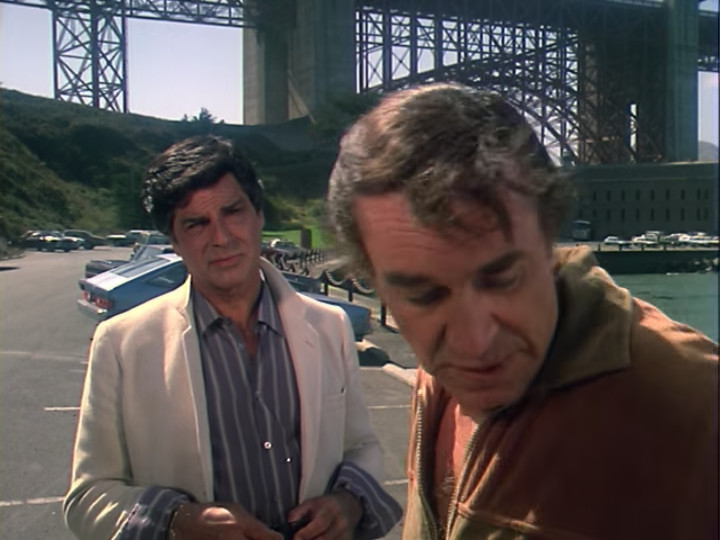
mpv-shot0003

Well, a man in a white jacket, at least. His name is Mike. He calls the guy in the brown track suit Al. Mike thought that they had a deal, and Al says that they do, Mike just needs to be patient. Mike says that he’s been patient for six months and he thinks that Al is just pulling his chain. Al asks if he got the money, and Mike replies that that’s his problem. Al then tells him to be careful. Things have been going real good, but he can live without Mike. Mike pokes Al in the chest for emphasis as he replies that anybody can live without anybody. Mike then leaves.

The dialog is intentionally vague to stir up the audience’s curiosity. If we want to learn what this is all about we won’t change the channel or go to bed early. Ironically, though, it’s actually far more realistic than the exposition one normally finds at the beginning of episodes. A typical show might begin with, “Well, if it isn’t Al Drake, manager of my favorite night club.” “Hi there Mike Dupont. Still hoping to buy out the contract of my lead act?” No one actually talks like that, though through exposure we come to accept it. I find it amusing that the realism is an accidental byproduct.

The scene then cuts to a young woman named Victoria who’s talking to a priest about her upcoming wedding.
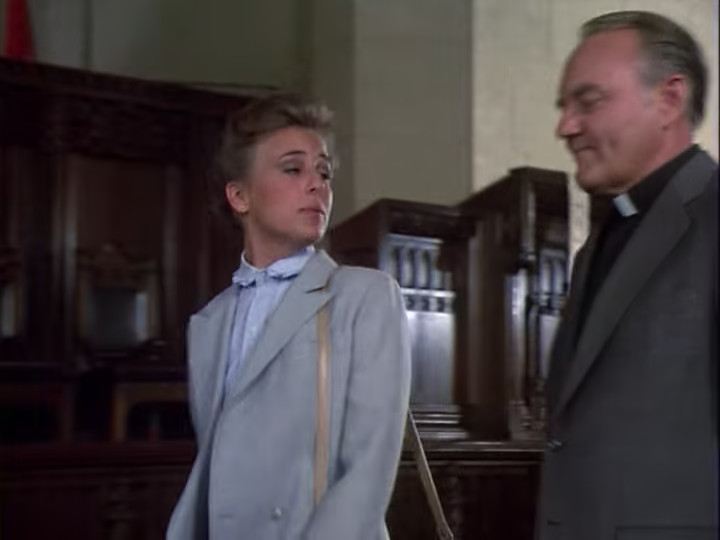
mpv-shot0004

It’s going to be a very simple wedding. Intimate. The priest says that they can still make it festive, with flowers on both sides of the alter, but Victoria says that she’s allergic to flowers.

When the priest asks exactly how intimate this wedding will be, she says that she just arrived from NY, her Aunt just arrived from Maine, and then just Howard and maybe a few of his friends.

Yes. That Howard.

He comes in a minute later and apologizes for being late, saying that traffic was terrible when he came from the office. Victoria tells him about dinner reservations she made and a minor fight ensues as he says that he can’t make it. In the fight we get a little backstory that he’s been busy every night for the last five nights.

The scene then shifts to Victoria and Jessica at the restaurant, where a small joke about the lobsters being Maine lobsters is made before they’re shown to their table. (The lobsters aren’t active; when Jessica asks if he’s sure that they’re Maine lobsters he says that they’re flown in fresh every day. Jessica says that perhaps the lobsters have jet lag.)

It’s an interesting restaurant.
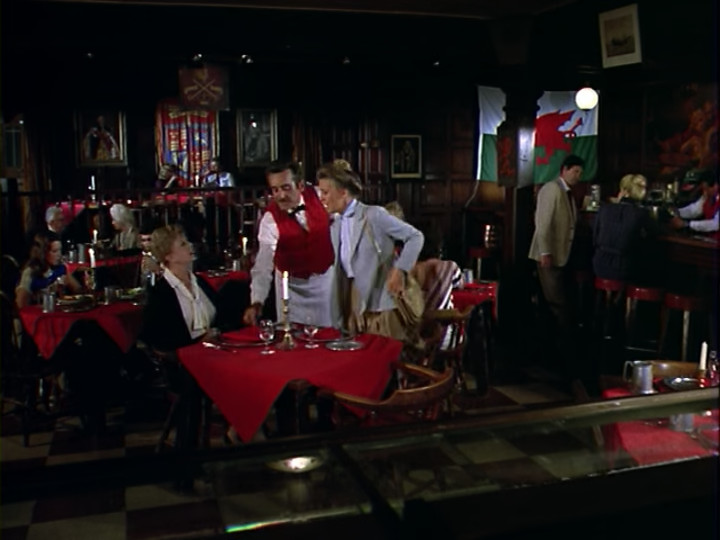
mpv-shot0005

Not very crowded, despite this being, in theory, a dinner engagement. That’s cheaper to film, of course. It’s very fancy in a dimly lit, hard-to-see-the-details kind of way. There were real restaurants like that back in the 1980s and for all I know, still are. It’s cheaper to look fancy if people can’t look to closely at the fancy stuff, both in TV and in real life.

Over dinner, Victoria tells Jessica about her history with Howard—she met him about a year ago in New York City. He was acting in an off-broadway show. He works in insurance (as his latest job—he had been a cab driver in New York), but aspires to be an actor. Then she breaks down and tells Jessica about her worries. She’s been in town five days but they haven’t gone out at night even once. And she went to Howard’s office the day before to surprise him and they told her that Howard hadn’t worked there for a month. Jessica says, knowingly, “Oh,” and takes a drink of wine.
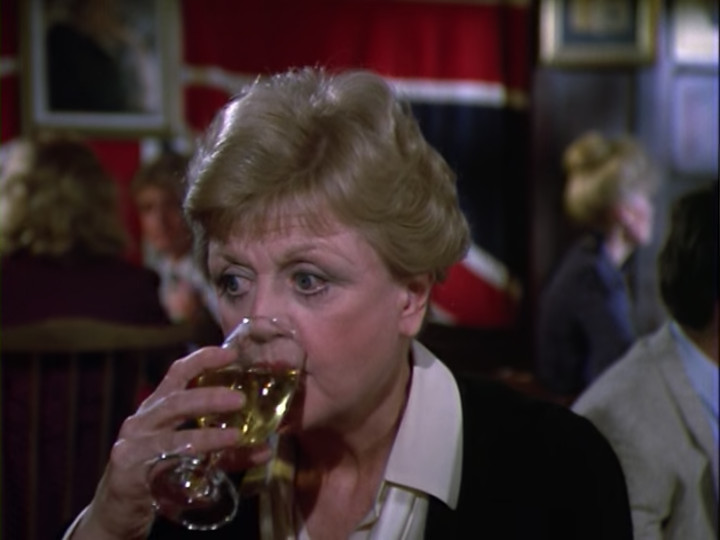
mpv-shot0006

She drinks it as if she wants the alcohol in it. I know I’m skipping ahead a bit, but this is very unusual for Jessica. (She rarely drinks except to comment on how fine the extremely rare wine which requires a refined palate to enjoy is.) I guess they’re still feeling the character out at this point.

Anyway, yesterday, Howard had circles under his eyes and smelled like perfume. And today he lent her a handkerchief and the lipstick on it was not her shade. And matches from a nightclub were all over his apartment. She’s considered going to the nightclub, but if she loves Howard, how can she justify spying on him?

Jessica replies, “For your own peace of mind, I think you have to.” Her tone suggests that this is sage advice, but it really isn’t. She could have said, “You can do it for Howard’s sake. If there’s something he’s afraid to tell you about, you can have the courage for him.” Or, “For the sake of the children you may have with Howard, you owe it to them to make sure you can both go through with the marriage.” Or “marriage shouldn’t be entered into with secrets and if he’s not strong enough to tell you his secrets, you should do it for him in case it’s something you can accept.” All of these actually address Victoria’s concern. Jessica’s reply that Victoria just needs to be more selfish is… bad advice.

The scene cuts to the night club, which is a relatively classy place.

mpv-shot0007

Before long the camera goes to Al, who is filling in for the host, and a well-dressed man named Patterson walks in.
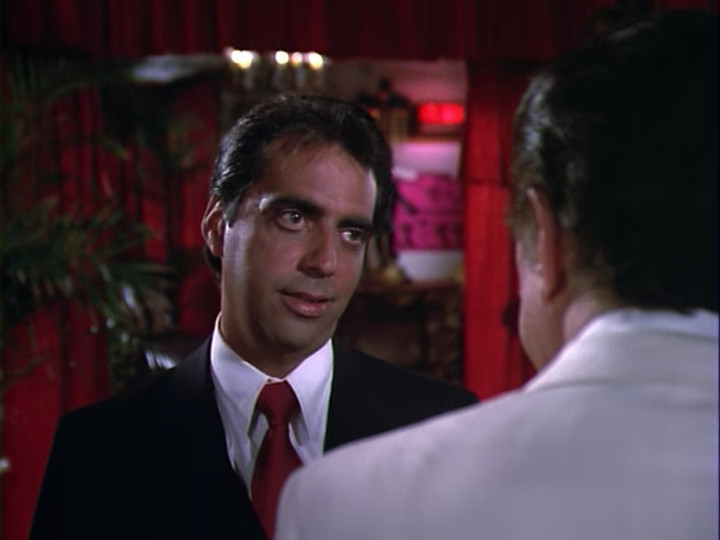
mpv-shot0008

It turns out that he’s the agent for Freddy, a comedian with a four-year contract at the club. Al’s interpretation of their contract is that Freddy can’t do anything else, while Patterson’s interpretation is that Freddy is free to do other stuff on the side. Patterson recently got Freddy on a talk show and now he’s hot. Al, however, is unmoved, except in the sense that he says “this is what we have courts for” and walks off.

Jessica and Victoria come in. They ask for a table for two but the host says that he can seat them next Thursday. Victoria then identifies Al as being in charge from some posters on the wall and walks up to him, explains that she and her Aunt want a table, and then explains how famous Jessica is. Al sees to it that they’re seated immediately.

I’d like to pause to take note of what she actually says. Assuming that she’s telling the truth—and I suspect that she is—Jessica has six best-seller books, was on a talk show this morning, and will meet the mayor the next day. Since the pilot episode depicts Jessica’s first book being published, obviously a lot of time has passed between the pilot and the main series.

The first act we see is Freddy York, the performer whose agent showed up and talked with Al a few minutes ago.
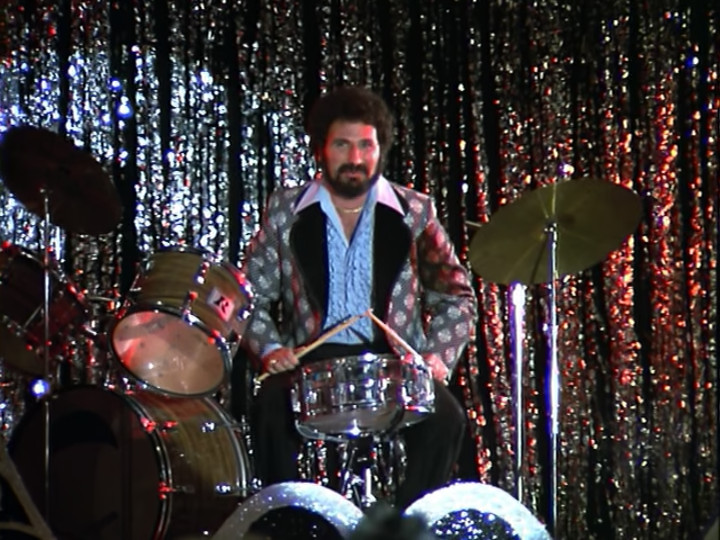
mpv-shot0009

His shtick is that he plays the drums as his own backup and does the rim-shots for his own jokes. His outfit is really amazing; I believe it’s intended to be sincere. The episode was shot in 1984, which was only four years after the 1970s when collars like this were hot stuff. I suspect it’s meant to indicate that he’s a little stuck in the past, but not very much. His jokes, incidentally, aren’t terrible, though they are neither very witty nor very classy. After a few of them, we cut to a glamorous older woman walking in.

mpv-shot0010

It turns out that this is Al’s wife. Since Al’s last name is Drake, she’s Mrs. Drake. The host greets her very politely, but there’s a bit of ice in the air. When he asks if Al is expecting her, she replies she very much doubts it. She’s shown to her table immediately, of course. Once she’s on her way to her table, the host grabs a bus boy and tells him to go find Al and tell him that his wife is here.

As the busboy is looking for Al back stage, he runs into a woman who asks him what he’s doing back stage.

mpv-shot0011

We actually saw her before and it seemed so minor an interaction I didn’t think it worth mentioning. She had some banter with Al before Freddy’s agent came in. Since she may play a bigger role than I anticipated: her name is Barbara. Anyway, she tells the busboy to go back to the front and she’ll tell Al.

The moderately funny comedian who does his own rim shots tells a final joke—which Mrs. Drake applauds vigorously—then he profusely tells the crowd that they’re beautiful, wonderful, and every good thing, then takes his leave. Jessica then asks Victoria if she’s noticed that there’s something a little off about this club. Victoria doesn’t know what Jessica means. Frankly, neither do I.

Somebody in a silver dinner jacket then introduced the “chanteuse” they’ve all been waiting for.

mpv-shot0012

After a few introductory bars and the length of time it takes to sing “There’s a somebody I’m longin’ to see. I hope that he turns out—” we hear a scream. Then a female figure in a fancy dress runs off the stage and through the crowd, towards the front door. Right behind it, Barbara runs onto the stage and calls out, “Stop him! He’s a murderer!”

mpv-shot0013

A police officer shows up at the front door cutting off that exit, so the figure then tries several other avenues of escape before crashing into Jessica and Victoria’s table. His wig falls off and we get to see who it is.
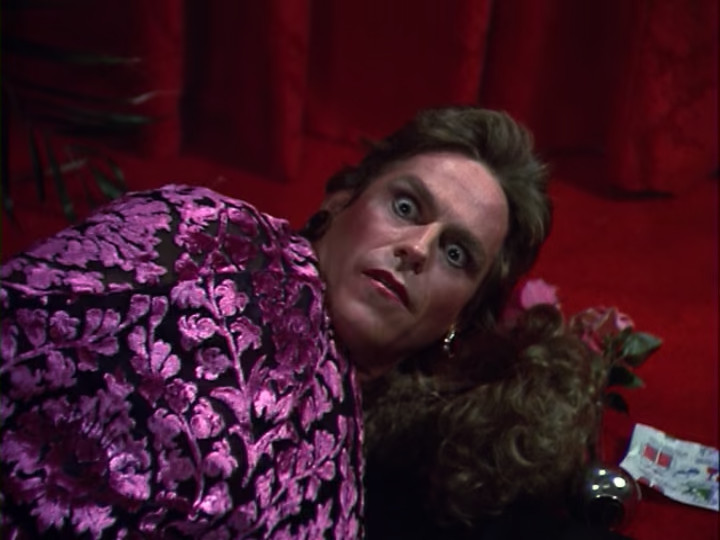
mpv-shot0014

It’s a surprise, though it shouldn’t be. This is exactly the kind of twist that TV shows of the 1980s loved, all the more, right before a commercial break. Which is what happens after some shocked recognition between Howard and Victoria and Jessica being surprised that this is Howard.

We come in from commercial to an establishing shot of a police car driving with its sirens on, followed by an interior of the club in confusion. Amidst the confusion we do learn that Al was shot.

Howard is being kept locked in a room with a security guard keeping watch on the door. Victoria comes up and persuades the guard to let her in. She’s so happy that it turns out the thing he was hiding was just a job that most of what they do is kiss until Lt. Novak shows up and is surprised to see them passionately embracing. He takes it in stride, however, and merely asks the security guard which one is the suspect (“the tall one”) then directs that he be taken down to the station and booked.

The scene then shifts to the scene of the murder, with Lt. Novak entering and taking charge.

mpv-shot0015

His manner is very matter-of-fact. Interviewing the assembled crowd of people, he asks who saw the murder and Barbara answers that she did, or, rather, she walked past the open door and saw Howard standing over Al holding the gun. The Lt. looks at the ground and sees a gun. Picking it up with a pencil he remarks that, having a smooth grip, they may get some fingerprints from it.

This musing is interrupted by the sound of a bird—a white cockatoo—cawing and then Jessica interrupts to ask if Lt. Novak noticed a small white feather on Al’s jacket. Instead of answering, the Lt. asks her to leave. The manner is curious; he asks if she’ll do him a big favor and she eagerly replies that she’ll do anything at all to help. He then asks her to get out of here and she is crestfallen. Apparently, by now, Jessica is used to joining the police on murder investigations.

The scene changes to the next day, at the police station, in Lt. Novak’s office, with Lt. Novak finishing interviewing Freddy York (in the same clothes as he was wearing on the night before). After signing his statement, Freddy express his lack of sympathy and leaves. Right after, Jessica knocks on the door and enters. Novak doesn’t want to talk with her but she uses her clout and fame to bully him into cooperating.

He relents and gives her a brief infodump. The suspect was seen standing over the body holding the gun. The only fingerprints on the gun belong to the suspect. It was common knowledge that he’d been arguing with Al Drake about money. The gun was stolen from a pawn shop about six months ago, in New York city, where Howard lived at the time.

She asks if he conducted a nitric acid test to determine whether Howard fired the gun. He replies that they haven’t gotten to it yet, and she tells him that he’d better get to it soon because after a few hours the test is meaningless. (According to Wikipedia, this is accurate. Gunshot residue tends to only last on living hands for 4-6 hours since it is easily wiped off by incidental contact with objects.) Since the murder took place the previous night and it is now past sunrise, the crucial window has already expired, so it’s a bit weird that Jessica is telling the Lt. to get to the gunshot residue test soon. (A nitric acid solution is used to swab the area to be tested as the first step, which is, I believe, why she’s referring to it as a nitric acid test.)

She then demands to see Howard and doesn’t take ‘no’ for an answer.

Howard is brought to the Lt.’s office, who gives them privacy for some reason. Howard is confused since he’s never met Jessica before, but she takes charge. Jessica directly asks him if he killed Al Drake and he says he did not, Al was dead when he walked into the room. He had just finished his act and went into Al’s office to get his money and quit. This is a bit odd because we saw the act right before Al was found dead and it was Freddy’s comedy routine. (I suspect that this is just a plot hole and not a hole in his story.) We get a flashback which seems plausible enough with Howard having a one-sided conversation with Al for a bit, since Al was facing the wall, and he only realized that Al was dead when he turned Al’s chair around to make him talk to him. Since this may be important later (someone may have thought Al was alive when he was actually dead), let’s look at how the chair was when Howard entered the room:

mpv-shot0016

You can’t see anything that indicates that Al is dead, but on the other hand this is a very weird thing for a living man to do. If you came into a room and saw a man sitting in a chair motionless staring at a dark wall, I think you’d be a lot more likely to check on him than to just assume he’s lost in thought. That said, there’s a good chance that this indicates a significantly earlier time of death.

Anyway, after finally turning the chair around when he got tired of Mr. Blake “ignoring” him, he staggers around in shock for a bit, notices it’s incriminating that he’s holding the gun that probably shot Mr. Blake, then Barbara comes in the door, sees the scene, and screams, at which point Howard panics and bolts.

Jessica says that she’s quite relieved because there’s only been one killer in the family, in 1777, and the red coat shot first. She then pivots to wondering what Barbara was doing in the office and Howard bowdlerizes to “Everyone knew that she and Mr. Drake worked late. A lot. Together.”

Jessica knowingly says, “I get the idea.”

She then says that she’s got the name of a very good lawyer and asks if there’s anything else he needs, to which he sheepishly replies, “pants.”

The scene then shifts to Jessica on the phone with Lt. Novak, presumably some time later. He lets her know that they’ve narrowed the time of the murder down to between 9:50 and 10:05. Jessica asks if that isn’t a bit precise for a medical examiner and he replies that it didn’t come from the medical examiner, it’s when York was performing and the banging of his drums covered the sound of the shot.

There’s an interesting exchange which follows the end of their conversation. Lt. Novak asks his assistant, “What is it about that woman that makes me nervous?” The assistant replies, “I think she’s kind of cute.”

mpv-shot0017

I find it interesting because it’s explicitly framing Jessica’s investigations. The police are officially not thrilled with Jessica investigating, but we—the audience—know that this is a mistake on their part. The assistant thus provides some ambiguity here. It certainly makes more sense than Amos Tupper taking both roles, as he did in Deadly Lady.

The scene changes to Jessica at the club during the day. She runs into Freddy’s agent for some reason. He asks if she has an agent on the west coast, but she does. He directs her to where she can find Barbara (she asked), and then takes a moment to look suspicious for the camera.

mpv-shot0018

I think that the equivalent of this, in a novel, is to give us a glimpse into the characters thoughts which is highly misleading if taken out of context, which is how we get it. “‘I hope she doesn’t find out,’ he thought.” Then later we discover it was a different ‘she’ and the thing to not find out was something completely unrelated—if the book is halfway decently constructed, a red herring that the detective uncovers and this explains “why you were acting so funny when I spoke about [name].” It’s a bit of a cheap trick, but it does make the viewer/reader feel like they need to keep on their toes, which they want to feel like.

We then see Mrs. Blake talking to two men—the host and someone I don’t recognize. The upshot is that she’s intending to run things now that Al is gone. She also picks a fight with their leading female impersonator, who storms off to his dressing room. She yells at him to never turn his back on her and follows. Once they’re in his dressing room and close the door their manner changes entirely, they embrace, and passionately kiss. And on that bombshell, we go to commercial break.

When we get back, Jessica walks into Freddy’s dressing room by mistake, where he’s sitting at his mirror for some reason. He says that it’s too bad about Howard, the kid’s got talent and not just at wearing dresses. He makes some jokes about how his own talent is wasted in a dump like this; in Las Vegas a llama who’s part of an act has a better dressing room that he does. Jessica says that it’s not so bad and at least he’s got a window with a great view. He jokes that it’s his manager, Patterson: he couldn’t get Freddy any more money so he got him a window. When he asks if Jessica wanted to see him about something she excuses herself for intruding and leaves.

When Jessica finally finds Barbara, Mrs. Drake is firing her.

Jessica catches her carrying a box full of her stuff out of the office and offers to give her a lift in the taxi she’s in. Barbara accepts.

Jessica reads Barbara as a gossipy sort of woman and so plays a gossip herself. She shares the news that Al was already dead when Howard got there and Barbara accepts it without question. She goes on to say that she wouldn’t be surprised if Mrs. Drake did it. She also is aware of the affair she’s having with the female impersonator (his name is Mike). He was actually trying to buy the club. She also could believe that Mr. Patterson killed him because Freddy was under a seven year contract.

She gets out at her apartment and the scene shifts to Mike waiting near the ocean for Mrs. Drake. I’ve just realized that Mike was the second guy who talked to Al at the very beginning of the episode. Asking Mike if he raised the money was probably a reference to buying the club.

Anyway, he complains that Mrs. Drake kept him waiting and asks if this is a sign of things to come. She’s apologetic and gets to the point: she wants to know if he killed Al (which, she professes, wouldn’t make any difference to her if he did). Funnily enough, he had the same question for her, and it also wouldn’t make any difference to him if she did. After some closeups in which the actors try to look as suspicious as humanly possible, the scene ends.

This sort of scene will become a staple of Murder, She Wrote episodes, especially towards the middle. Once you notice them it becomes way easier to figure out who the murderer is: whoever doesn’t get a closeup of them looking suspicious.

In the next scene Jessica catches up with Lt. Novak at the club. She inquires about the nitric acid test and it came back negative. The Lt. says that Howard could have been wearing gloves when he shot Al and Jessica points out that if he was, there wouldn’t have been finger prints all over the gun and he can’t have it both ways.

Jessica then questions Lt. Novak’s theory about the gunshot being masked by Freddy’s drum act, so they do some experimentation with the assistant firing a gun in the murder room and Jessica and Lt. Novak in front of the stage with various amounts of noise being produced, and no matter how much noise, they still hear the shot. Lt. Novak takes that to mean that the only possible explanation is it being covered by the sound of Freddy’s drums. Why they tested every other source of noise except for Freddy’s drums isn’t explained.

Anyway, Freddy comes out and demands to know what’s going on—is Mrs. Fletcher suggesting that one of them killed Al? At that moment a string of heavy stage lights falls down almost killing Jessica and Freddy.
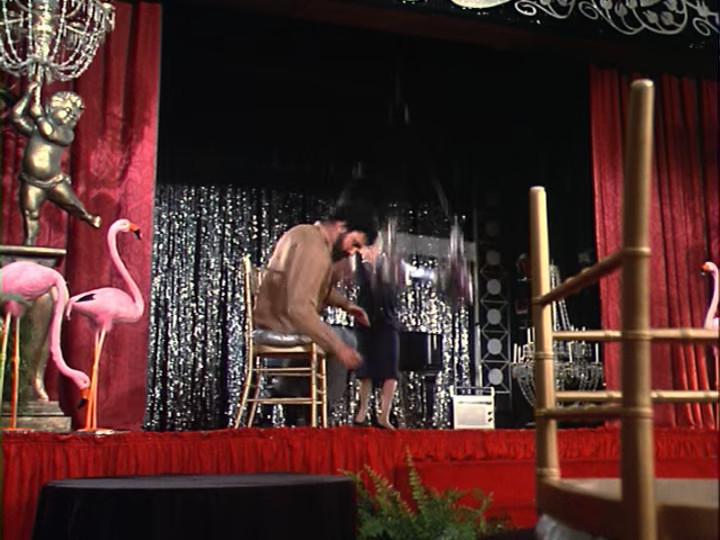
mpv-shot0019

Freddy dives in front of the lights, Jessica steps back to avoid them. When the camera finds Freddy he’s on the ground holding his neck in great pain, probably from the dive and landing on the ground.

The scene then shifts to Jessica knocking on the door of Lt. Novak’s apartment the next morning. She woke him up but is only very slightly concerned at this given that Lt. Novak has been working all night again. She needs to talk to him about Howard.

He’s friendlier than normal, explaining that his hates-everyone approach is just his office persona. They go over the list of possible suspects, but for some reason he’s convinced that Howard is guilty. I don’t really get this because it’s at odds with his theory that the drums covered the sound of the gun—unless he’s willing to postulate that, after shooting Al, Howard just stood around holding the gun for up to a quarter of an hour.

Anyway, after Jessica goes over some facts which incriminate other suspects including the affair between Mrs. Drake and Mike—which Lt. Novak didn’t know—he tells her that she’d have made a great cop but asks her to leave the policing to the police. She responds that she wouldn’t dream of interfering, which is odd because she’s very clearly happy to interfere, for example demanding that Lt. Novak do a nitric acid test and demanding that he take time out of the investigation to talk to her or she’ll badmouth him on television.

Anyway, he clarifies that her interfering isn’t what he’s worried about. Lab results indicate that the lights falling wasn’t an accident. The rope was eaten through with acid. Jessica’s interpretation was that someone was trying to kill Freddy York. Lt. Novak’s interpretation was that she was the target. We get a wide-eyed reaction shot from Jessica then switch scenes to a courtroom where Howard is bailed out. Jessica apparently posted bail for him, since she tells him that if he jumps bail the state of California has an option on her next four books.

In the hallway as they are leaving, Jessica asks Howard if he saw Mrs. Drake backstage during Freddy’s performance and he’s sure that he didn’t, but he did see her come in the stage door just before he went on. This isn’t very helpful to us because we never saw him on stage and there wasn’t really a time for him to have been on stage, but it helps Jessica because she isn’t deterred by plot holes in the same way that the audience is.

Accordingly, she goes and visits Mrs. Drake, who is playing golf. In between insincere condolences Jessica asks if Mrs. Drake saw her husband shortly before he died and she said that she didn’t, she came in during Freddy’s set. Jessica replies that it’s strange, then, that someone said they saw her come in before Freddy’s set. Mrs. Drake takes offense at this and says that she didn’t kill her husband, and if Jessica insists on sticking her nose where it doesn’t belong, she should look into Freddy York. His contract was a personal services contract with Al, not with the club, and when she brought Freddy flowers in the hospital, Freddy gave her notice that he was quitting.

I do need to partially take back what I said about us never seeing Howard on stage. Just in case I missed something I went back and it looks like Howard actually was on stage a little before Jessica and Victoria came in. If you look closely during the opening shot at the club, you can see Howard on the stage:

mpv-shot0021

You never see him clearly and almost immediately the camera pulls back and focuses on other things. And we’re looking at this in DVD quality. In broadcast quality back in 1984, it would have been extremely hard to make that out as Howard. Anyway, this introduces a timing problem. Howard confronted Al Drake after Freddy York’s set was over, but according to Howard, also, “I finished my act, then I went back to his office to quit and get my money.” In the flashback he was wearing his stage costume. This means he spent the entire length of Freddy’s performance doing nothing before he went to confront Al.

Anyway, Jessica takes Mrs. Drake’s story about visiting Freddy in the hospital to mean that Freddy is well enough to receive visitors and decides to pay a visit to Freddy herself. Accordingly, the scene shifts to the hospital, where Freddy and his agent are drinking champagne and celebrating all of the great things they’re going to do now that Freddy is free. Jessica walks in and Bill Paterson (the agent) basically yells at her to stop investigating, since neither he nor Freddy killed Al, and Freddy was not only on stage when it happened, someone later tried to kill him with the lights. Jessica replies that that’s a bit of a puzzler, since Mike thinks the lights were an attempt to kill him, Lt. Novak thinks that they were an attempt to kill Jessica, and Bill thinks that they were an attempt to kill Freddy. And on that… bang snap… we go to commercial break.

When we get back, Jessica is walking to her hotel room while Howard and Vicki argue over whether they should postpone the wedding (Howard says yes until he’s cleared, Vicki says no, they should get married right away). They ask Jessica what she thinks and what she thinks is that she needs a nap. Vicki asks if the builders working away in the room next to Jessica’s won’t keep her awake.
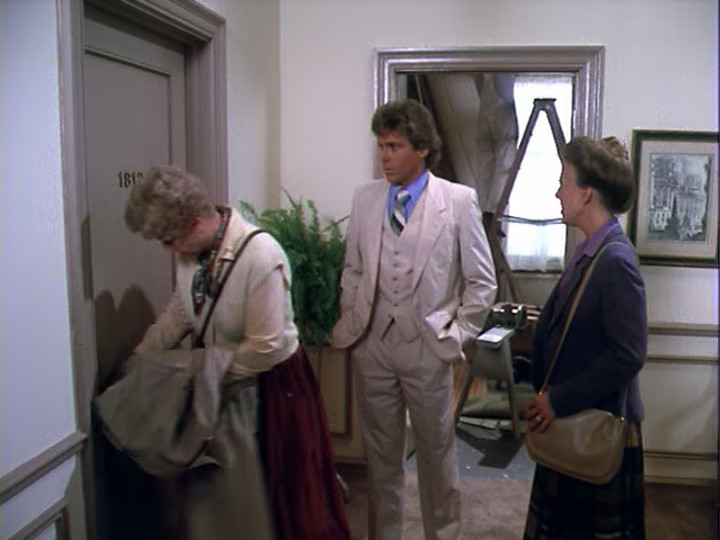
mpv-shot0022

Jessica replies that right now she could sleep through Armageddon. She then tells them that she promises that they will get to the bottom of this. She’s sure she’s overlooking something, and it will come to her if she get some sleep.

Jessica goes and lies down, but contrary to her imagined ability to sleep through Armageddon, all of the power tools do keep her up. She then holds the pillow over her ears…

mpv-shot0023

…and comes to a realization of what she had been overlooking.

She then shows up in Lt. Novak’s apartment. What she had forgot was the small white feather on Al Drake. Drake wasn’t shot during Freddy’s performance because the killer used a silencer! When Lt. Novak objects that they don’t make a silencer for that kind of gun, Jessica says that it wasn’t a metal silencer. It was a pillow. That explains the small white feather, which didn’t come from the cockatoo in Drake’s office. (It was an office pet.)

They then go to the scene of the murder and Lt. Novak picks up the pillow in the office and it has no bullet hole. But, Jessica points out, the pillow wasn’t there on the night of the murder. Don’t take her word for it, look at these police photos. When asked how she got police photos, Jessica says that his assistant, Charlie, gave them to her. He really is a very nice man.

Anyway, this shows that the pillow that’s there now was placed there after the investigation, presumably because the one that was there had to be removed because it was damaged when it was used to muffle the sound of the shot.

Jessica then asks Lt. Novak to take part in an experiment. They go to the stage and she has Lt. Novak stand in a precise location on the stage, then goes backstage and drops some sandbags on him. Or would have, had Lt. Novak not stepped out of the way when he heard the sandbags descending. She points out that he heard it, and he replies that of course he did, he’s not deaf. Jessica replies, “and neither was Freddy York.”

At this, Freddy steps out from back stage, applauding. He tells Jessica that she’s quite a performer. She says that it was quite a performance that he put on, diving off the stage when he didn’t have to.

Freddy counters that all she’s proved is that he could have staged the falling lights.

I’m not sure how she’s supposed to have proved that. All she proved—to the degree that she proved anything—was that Freddy was able to get out of the way of the lights because he would have heard them. But that was never at issue. He did get out of the way of the lights, so he got out of the way somehow, and hearing them just as Lt. Novak did is as good a way as anything else. Weirdly, though, it required no proof that he could have staged the lights because the rope was eaten through with acid, which he could have put on the rope before coming out on stage, because anybody could have put the acid on the rope before Freddy came out on stage.

Anyway, he goes on to say that this doesn’t prove that he had anything to do with what happened to Al Drake and while Freddy would love to stick around, he’s got to fly to Vegas—he hopes his arms don’t get tired. He then tells them that they’re beautiful and leaves.

Jessica motions to Lt. Novak to follow, and they do.

In Freddy’s dressing room Jessica points out that the pillow which was used to replace Al’s pillow was from Freddy’s dressing room because it is sun-faded, just like his settee, and it’s the only one that is because Freddy’s is the only dressing room in the building with a window. (The pillow does have a lighter side, though until Jessica said that it was sun-faded I thought it was just two-toned.)

Somehow it being the pillow from Freddy’s dressing room which was used to replace Al Drake’s pillow  in the days following the murder means, conclusively, that Freddy is the murderer. Luckily for Jessica Freddy can’t see any way out of this logic and admits it. “It’s my luck. It’s my dumb luck. Half the people in this club wanted Drake dead, and your niece’s boyfriend’s gotta get tagged for it. I knew you were trouble as soon as I saw you. What was I gonna do? Spend the rest of my life working in this rinky-dink club? You ever try to tell jokes when someone’s got their hand on your throat?”

Jessica shakes her head and says, “Surely, murder isn’t the answer.”

This prompts Freddy into a monologue.

You call it murder. I call it a career move. Look at me. What do you see? I’m not just another comedian. I’m Freddy York. I’m the first guy who did his own rim shots. I’m like the Edison of Comedy. I’m Robert Fulton on the drums. So Al Drake sees me one Sunday night. He says, “Kid, you’re good. Here’s a long-term contract. It’s your shot. Your big break.” He broke my spirit. That man broke my heart. I couldn’t let him do that. I’m a creative genius. Fair is fair. He gave me a shot. I gave him a shot. Ba dum bum. Should’ve shoved you under that stage light.

When Lt. Novak asks him why he rigged the lights, he merely replies that Novak should ask Jessica. She says the obvious, that he thought the charges against Howard would get dropped and a murder attempt on him would point suspicion elsewhere. Freddy then says, “Boy, you are good. I mean, you are really, really good. You ever think of taking your act on the road? You should play Vegas. That reminds me, I better cancel my tickets. Doesn’t look like I’m going. It’s too bad. I could’ve knocked ’em dead.”

Jessica nods and says, gently, “I’m sure you would have.”

We then cut to the wedding ceremony for Howard and Victoria. There are a few curious things about it; one is that we come in on “by the power vested in me by the state of California, I now pronounce you man and wife.” But this is in a church and it’s a priest who’s performing the ceremony. Those are the words spoken by a justice of the peace at a state ceremony. It’s interesting that here in 1984 they’re so hard-core secular.

The other interesting thing is the guest list:

mpv-shot0024

It’s just the people from the episode, none of whom had a connection to Howard or Victoria. A cynical man might think that this was mostly done just to save money on casting.

I might be that man.

Anyway, after the vows are over and the guests congratulate the couple, Bill Patterson comes up the isle and tells Howard that he’s been on the phone for an hour and got him a job on a soap opera for two days a week. It starts on Monday.

Victoria is all for it but Howard is ambivalent because it means canceling the honeymoon in Hawaii which Jessica had given them as a wedding present. Howard asks Jessica what they should do and she replies that she usually doesn’t give advice (which causes Lt. Novak to shake his head in disbelief behind her), but she thinks they should go for it.

Then everyone cheers and we go to credits.
mpv-shot0026

This was a very interesting episode. Quite different from Deadly Lady. It was far less of a classic mystery and perhaps a bit closer to a typical Murder, She Wrote episode. Jessica is nosy more than clever, most of the investigation was of red herrings, and Jessica solves it at the end in a moment of inspiration which gives the audience time to figure it out first.

It also had some really big plot holes. Bigger than I’m used to seeing on Murder, She Wrote.

Right at the very beginning, the intended wedding between Victoria and Howard makes no sense. Somehow Victoria and Howard are getting married in a day or two and she’s discussing basic initial planning with the priest. He’s literally never met the groom and doesn’t care; his only concern is interior decoration and some brief rehearsal. Very brief, in fact, because he has to get to chorus rehearsal in five minutes. There is literally only one person from her side of the family coming, and that’s Jessica. No parents, siblings, cousins, aunts, uncles, or friends—just Jessica. Howard also has no family, though for all she knows he could have a few friends he’s made in the last six months. None of this bothers Victoria because she’s head-over-heels in love with Howard and would do anything, absolutely anything, for him. Howard’s lying to her about his job and having various indications that he’s having an affair with another woman only very slightly ruffles her, though it in no way deters her from going through with the wedding.

And somehow, this doesn’t bother Jessica in the slightest.

The timing of Howard’s performance is basically irreconcilable with the presented facts. He seems to have waited around, in the dress he didn’t like wearing, for the entire length of Freddy York’s performance doing absolutely nothing before he angrily went into Al Drake’s office to demand his money and quit.

Howard’s certainty at seeing Mrs. Drake come in right before his performance also goes nowhere, which is probably because it couldn’t have gone anywhere. What could Mrs. Drake have done, back stage, for however long it took Howard to perform, before leaving and re-entering through the front door? If we’re to believe that Howard was right, then presumably it was to visit Mike. Which seems more than a little far-fetched. She could hardly have hoped to be unobserved during such a busy time. And since this is a night club, they had plenty of time for hanky panky during the day.

Speaking of timing, there’s kind of a plot hole with how they filmed the episode. Al is alive and well in front of the club when he directs the host to give Victoria and Jessica a table. They walk directly to their table and Freddy York is introduced and starts his act within ten seconds of them sitting down (in a continuous shot). Al would have had to have sprinted to his office in time for Freddy to shoot him, and then Freddy would have had to sprint on stage, and I doubt that even that would have worked. Timing it, it’s twenty four seconds from when we last saw Al alive to when the curtain parted as the announcer came out to introduce Freddy and we catch a glimpse of Freddy behind the curtain. (The announcer would have seen if Freddy was absent and wouldn’t have announced him if he didn’t see him before stepping out through the curtain, but seeing Freddy is even more certain.) Granted, there were two cuts, but they were very clearly meant to cover continuous time. Twenty four seconds is not much time to sprint to his office in order to get murdered in his chair. (There was even less time for Freddy to have murdered Al after his set, though it’s clearly established that’s not what he did.) So there’s no way that Freddy could have done it. Which is great. I don’t think that there can be a bigger plot hole than “the murderer couldn’t have done it.”

Oh well.

Moving on, what was the whole thing about Barbara telling Mr. Blake that his wife is at the club, then not doing that? I suppose she’s meant to and this is the reason why she went to his office, but it was over a minute of screen time between when that happened and when we hear the scream. Also—and I had to go back and double check to remember this—she isn’t in a hurry to go find Al. In fact, she watches the bus boy leave then peers to make sure that he’s gone.
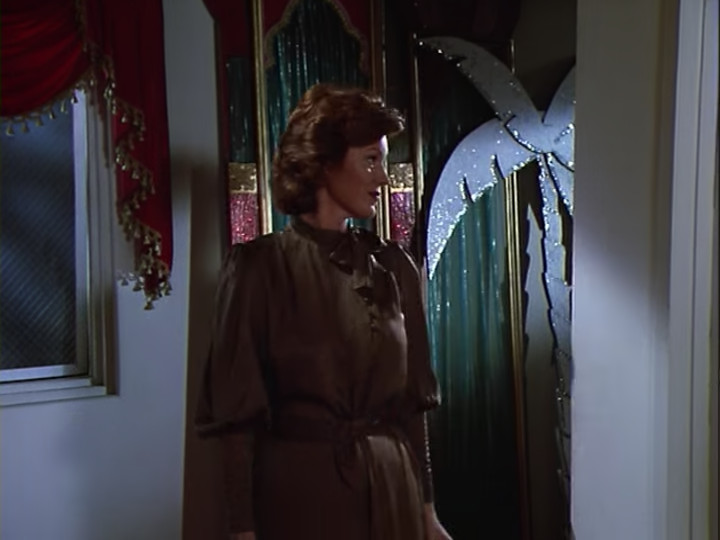
mpv-shot0027

I can think of no reason whatever that she could want to get rid of the bus boy. Yet she was more concerned with that than with telling Al his wife was here. What was that about? I doubt that the writers knew, either. And the whole thing where Jessica wanted to find out why Barbara was at Al’s office and so saw Howard with the gun? Completely dropped. Jessica never found out that Barbara was carrying a message for the bus boy.

When Jessica meets Lt. Novak, her manner suggests that she expects him to know who she is and to want her help. It’s meant to set up her being disappointed when Lt. Novak tells her to get lost, but it feels weird. She’s old enough to know that it requires some introduction to put yourself into someone else’s business, and that the police don’t do murder investigations for fun.

It’s not a plot hole, just a bit of sloppy writing, but nothing ever comes of Al’s corpse having been facing the wall. He couldn’t have been shot in that position. Freddy had to have turned him around after shooting him. The only reason to have turned him around was to make it look like he was alive when he was already dead. Yet absolutely nothing comes of it. (This is the sort of thing I mean when I say that Jessica isn’t as clever as in Deadly Lady. An observation like that would have been an obvious point in her favor with Lt. Novak.)

Then there’s the “scientific testing” of the hypothesis that the sound of the gun shot was masked by Freddy’s drum playing, which didn’t involve testing that hypothesis. I suppose that they were testing the related hypothesis that other things could have covered the sound, but why did they never test whether Freddy’s playing would have covered it? Especially for the people back stage, where the gun would have been closer to them than Freddy’s drums? Guns are very, very loud. Far louder than drums.

I guess it was OK that Freddy staged the thing with the lights nearly falling on him and Jessica, but why on earth did Lt. Novak remain convinced that Howard did it after that? Howard was in police custody at the time. Why did Jessica not point this out?

And why was the stuff with the pillow supposed to be remotely convincing? The pillow being sun-faded in a way that exactly matches the settee in Freddy’s dressing room and in no other room works to prove that the pillow came from Freddy’s dressing room, but how on earth does that prove that Freddy murdered Al Drake? The pillow was placed there after the police investigation was over, which means that anyone could have done it. You can make an argument that the murderer would have had to use his own pillow in some sort of exigent circumstance, but not when the murderer was replacing a pillow at his leisure. The murderer would have had to be an idiot to use his own dressing room’s pillow. (Unless he was going for a double-bluff by trying to make it look like someone was trying to frame him.) If I were making a list of the top ten airtight cases, I doubt that I would include: “Somehow, long after the victim was dead, your office pillow wound up on the victim’s couch. How do you explain that, if you didn’t kill him!”

This is an especially big problem when you consider what they don’t have: a pillow with a bullet hole in it. They don’t even have anyone testifying that Al’s settee definitely had a pillow on it shortly before he was killed. In short, there’s no evidence that a pillow was involved in the murder.

And this is leaving out the fact that a pillow only makes a gun very slightly quieter. I’ve seen people test it and a gun with a pillow in front of it is is perceptibly less loud. You could definitely pick it out in blinded A/B testing. But that’s about it. It’s still around the threshold for causing hearing damage. But this is just a subset of TV silencers, which work about 1000 times better than real silencers—part of why people who know what they’re talking about tend to call them “sound suppressors” rather than “silencers”. To get an actually quiet gun which only goes “ffft” you need a specially designed silencers with multiple rubber wipers the bullet shoots through (making it require replacement after a few shots). And that only works if you use specially loaded sub-sonic bullets. Ordinary bullets, which travel much faster than the speed of sound, make a loud bang because all hypersonic objects do. Only sub-sonic bullets have the possibility of being quiet and the trade-off is that they have far less power in them. That is, they’re less likely to be lethal. This is just part of TV fantasy, though, so there really isn’t a point in complaining that TV silencers are magic, and if we’re allowing TV silencers, I suppose we need to be forgiving of TV pillows, too.

It’s really lucky that Al didn’t think of any of this and just confessed.

The importance of that confession in Murder, She Wrote is often overlooked, I think. It’s nice when the evidence is clear, but it’s absolutely crucial when it’s not. When the evidence is as flimsy as it often is, the only thing that makes Jessica look smart is the proof that she’s right which a confession offers. Otherwise she’d seem over-confident in wild guesses.

Incidentally, this is one major reason it bugs me so much when people suggest, as if it’s clever, that Jessica was wrong about who did it or committed the murders herself. The murder always confesses. Always. This is like suggesting the clever twist in Harry Potter that Harry was deathly afraid of brooms which is why you never saw him touch one! It’s brilliant! Except for the part where he did touch them, prominently, so this is stupid. Or imagine this wonderful idea where in Star Trek Kirk is really Spock, in disguise. That’s why you never see them in the same room together! Except that you see them together in the same room in every episode.

It’s really easy to be clever if you don’t let facts get in the way.

Anyway, with all that said, and not taking any of it back: it was still fun to watch this episode. A lot of that comes down to the acting. Some of it is the pacing, though. Even when not much is happening, you always feel like something is about to happen, which keeps your interest. And I think it does a decent job of making you forget all of the stuff that was never paid off or flat-out contradicted the conclusion. I also suspect that ending on a happy note for Howard and Victoria helps that. A murder investigation produces a liminal space in which normal life can’t happen. That liminal state also allows us to look into things we normally would not be able to see, which is where most of the fun of a murder mystery comes from. The resumption of normal life with something like a wedding definitively closes that liminal state—it brings us over the threshold and back into normality. It’s not required, but I suspect that it greatly helps the story to feel satisfactory. Even when it shouldn’t.

Next week we move south along the coast to Los Angeles in Hooray for Homicide.
The Rise of Skywalker: Initial Thoughts

My oldest son is hoping that, having finally seen Star Wars Episode IX: The Rise of Skywalker, I will write a review of it that is similarly long and humorously criticial as my review of episode 8: The Least Jedi. (He’s had me read it to him several times now, as he enjoys my performance of it.) I’m not sure that I can, though.

The reason why is that I’m not sure that TRoS was serious. And there’s no humor in pointing out the way that a joke doesn’t work as a serious story: that’s just not getting the joke.

TRoS was in an essentially impossible position, coming, as it did, after The Last Jedi. The Last Jedi was not merely a bad movie, but it was a mean-spirited and evil movie. It tried hard to sell the viewer that nobility and virtue are bad, that nothing means anything, and that life isn’t worth living. It ended with the resistance being down to a few dozen people and it being authoritatively established that the entire galaxy is now hopeless and unwilling to fight the First Order. There’s nowhere good to go from there.

I am reminded of an episode in the TV show Sports Night where the main characters (who are sports commentators on a small sports TV show) won the right to cover a very popular and much-anticipated boxing match, and had hours of coverage blocked out. Then one fighter knocks the other out with one lucky punch seven seconds into the first round. A bit later as they’re joking about how they’re going to cover the match nanosecond by nanosecond, the director complains to the producer that they’re turning it into a joke, and he replies, “Where else are they going to go with it?”

That same question applies to TRoS, and it feels like J.J. Abrams knew it and decided to embrace it. Yes, there was no plausible way that Palpatine could have come back, but there was no plausible way that anything interesting would happen, so he didn’t bother trying to make it plausible. Was Palpatine being back good? Hell no. But J.J. established it in the first few minutes, hung a lampshade on it, and at that point, I guess you might as well go with it. Did it make sense that planet Spaceball wanted to steal Druidia’s air rather than install some air filters? No, but they established it in the first few minutes and it’s not like suspension of disbelief was ever a goal. President Skroob breathed Perry-air from a can. You knew where you stood with Space Balls. And when Palpatine uses the force to lift thousands of star destroyers with death star canons on their bellies out of the ground and into the air, you basically know where you stand, here, too. And if you didn’t, you sure do when Kylo Ren has his mask rebuilt and the actor playing the guy doing the welding is a chimpanzee.

So, yes, the plot is filled with plot holes. Nothing is ever justified (unless you want to count “Palpatine did it for his own complex and sinister reasons”). But at some point, when there are enough plot holes, it’s time to consider the thing as lace. And, as a lace doily under the lamp to keep it from scratching the table, it kind of works.

And here’s where we get to possibly the biggest reason I don’t know if I can make fun of it: its heart was mostly in the right place. Sure, the adventures made no sense, Rey got even more force powers for no reason, most of the time death is now a minor inconvenience, as are things that should cause death, and characters become loyal to our main characters just because they’re there. But all of this nonsense is in service of giving the main characters heroic adventures, personalities, and character arcs. With the exception of General Hux, all of the long-term characters are given good send-offs, including Luke. Don’t get me wrong, I still don’t consider the sequel trilogy as being actually related to the original trilogy. But J.J. Abrams seems to have considered them related and he tried to do good by them. That’s not something I want to make fun of.

People Confuse Liking Scenes With Liking a Story

Something I’ve come across is that there are people who like some of the scenes from a movie who confuse that with liking the whole movie. This is understandable in a movie like Dr. Strangelove, where people simply forget all of the dull parts where nothing happens. It’s much weirder when it comes to a profoundly stupid movie like Legion.

If you haven’t seen it, I have a review of Legion up on my YouTube channel called Legion: World’s Stupidest Movie?

It probably is, by the way. It’s a horror movie in which Jesus is about to be born a second time to save humanity (again?) and God “got tired of all the bullshit” so he sends a legion of angeliac zombies (demoniacs, but they’re angels, and mostly behave like zombies) to try to kill the Christ-child before he can be born so that humanity won’t be saved and God can kill everyone. Only the renegade angel Michael (who cut off his literal wings when he rebelled against the order to go murder the Son of God in utero, because humanity is worth saving) and seven random people in a diner in the middle of the desert stand against the army of angeliac zombies who are attacking them. Oh, and this time it’s not a virgin birth, the waitress carrying the second coming of Jesus just got knocked up during a one-night stand almost nine months ago. (In a special feature on the DVD, the writer/director says that this is actually a retelling of the story of Abraham and Isaac.)

I published that video eight years ago, and, as of the writing of this post in the year of our Lord 2024, I still occasionally get comments on that video from people telling me that they like that movie or I’m missing the point.

Movies are complex things, as are all stories. They involve many parts and due to human fallibility the parts often don’t all fit together. Movies add several layers on top of this because there are the actors, the costumes, the sets, the performances, and the music which all can have their own virtues and capture the audience’s attention. You can have a terrible movie with great acting, or awful acting done on beautiful sets, or awful sets with magnificent music. Now, it’s often the case that quality tends to go together, but it doesn’t always, and in movies it’s especially the case that someone can have far better visual taste than they do narrative taste.

You can see that same thing, though it’s more subtle, in novels. You can have a novel where the dialog is excellent even though the characters’ actions aren’t consistent, or are taken more from tropes than the characters themselves, or aren’t what human beings would do but are only driven by the plot. There are authors who can paint fabulous scenes which are vivid and compelling even though there’s no way that they come from what happened before.

To give an analogy, consider a baseball triple-play. The batter takes a mighty swing and hits the ball deep into the outfield, so deep it will surely be a home run, then in a breathtaking move the outfielder leaps up, kicks off of the back wall, and manages to catch the ball a full ten feet off the ground. It’s an amazing out. Then, without throwing it, the first basement suddenly has the ball and is midway between first and second base, tags out the guy who was running back to first base, then throws the ball into the dugout where it pops out of the opposite dugout and into into the glove of the third basement who tags out the runner who thought he’d gotten a home run but instead had to run back to third base, just a half inch away from the plate as he’s dramatically sliding. Is this a great scene in total? No, because baseballs don’t suddenly teleport and that’s integral to the plot. On the other hand, you can enjoy the descriptions of each play as long as you don’t pay any attention to what connected them.

I don’t know why, but a lot of people have trouble admitting that what they like in a story isn’t the story, but just some of the scenes, or something common to the scenes such as the dialog or narration.

Get Woke, Go Broke?

I was recently discussing the idea of “Get Woke, Go Broke” with a friend, and as so often happens my best insights in the conversation came after it was over. For those who don’t know, the phrase refers to entertainment franchises that change to become ideologically “Woke” (which is, long story short, basically academic Marxism mutated to be about race rather than economics) and then are greatly disliked by their fans, often resulting in poor sales.

The claims about the economic performance of entertainment franchises which become Woke are just a matter of statistics and not something I find very interesting. That these things are frequently hated by the fans of the franchise, I do find interesting. Why that is, I’m going to discuss.

Before I get into it, something I want to put on the side is the very real phenomenon of people who make bad movies blaming audiences thinking they’re bad not because they’re bad, but because the audience is un-woke. Hence the incompetents who made Star Wars Episodes 7-9 claiming that fans disliked Rey because they are misogynists rather than because she’s a badly written character. This is common enough, but people clutching at straws to excuse their incompetence isn’t very complex and requires no explanation. (There is also a tribal element; “they hate me because I’m part of our tribe” will rally the tribe to one’s defense, while “they had me because I did a truly terrible job” won’t.) So yes, this happens a lot, and for any given movie where its poor performance is being blamed on its fans being bigots of some kind or other, this is probably the horses in “when you hear hoof beats, think horses, not zebras.” However, what I’m interesting in talking about, today, is the zebras.

The much more interesting aspect to “Get Woke, Go Broke” is the indirect causal relationship between a franchise going woke and its fans starting to hate it. This relates to what Jonathan Pageau often calls “one’s hierarchy of values”. What is most important? The answer to that question will dictate what sorts of trade-offs one will make. Once the most important value is satisfied, what is next most important? That, too, will dictate what sorts of trade-offs one will make. This world is one in which we never get exactly what we want and must always choose between alternatives; one’s hierarchy of values will dictate what choices we make. And this is the key to explaining “Get Woke, Go Broke”: if the top of one’s hierarchy of values is making a good movie, every decision one makes will be oriented toward that goal. If at the top of one’s hierarchy of values is making a woke movie, then making a good movie is not at the top of that hierarchy, and one’s choices will follow from what is at the top. One will make a good movie only by accident—if the stars line up and what makes a maximally woke movie just happens to also make a good movie.

You can see the same thing in a lot of “Christian” movies, by which I mean low budget movies which are about everything in the movie being culturally Christian according to a particular Christian culture. These are notoriously bad, and for good reason: at the top of the hierarchy of values of the people making them is not making a good movie.

(I should pause for a moment to explain that the nature of a hierarchy is that everything on the hierarchy is at the top of what is below it, thus we can consider only a portion of the hierarchy and refer to what’s at the top of that portion. Obviously if what truly mattered most to a human being in all of life was making a good movie, he might lie, cheat, steal, rape, murder, burn, pillage, defraud and do all manner of evil in order to make the best movie he could. In short, a man with the wrong thing at the top of his entire hierarchy of values will be an evil man. (That said, evil men may, of course, do good by accident.) When I refer to what is at the top of the hierarchy of values of the people making a movie, I mean that sub-set of their hierarchy of values which is particular to making a movie. Obviously such people should of course have God at the top of their hierarchy and loving their neighbor in the same manner that they love themselves just below that. Making a good movie should come further down in their hierarchy. That said, it is not convenient to talk about the very top of the hierarchy when talking about particular actions because the things at the top apply to literally everything that one does, meaning that talking about them conveys no information which a person should not have already known. That is, they’re obvious. It is sometimes useful to occasionally point out the obvious, but it is never useful to always point out the obvious.)

The idea of a movie “going woke” is somewhat often described in relationship to the races of the actors relative to the races of previous actors for a role. While woke movies will frequently feature “race swapping,” this on its own in no way makes a movie woke, and certainly doesn’t make it bad.

A good example of the actor’s race not lining up with the character’s race which was both excellent and not-woke is Kenneth Branagh’s version of Much Ado About Nothing. In it, Denzel Washington played Don Pedro, who was the prince of Aragon (an area in northern Spain). In the late 1500s (which is around when the play was set) it would have been fairly strange for a prince of Aragon to have sub-saharan African features, but Denzel Washington is an extremely talented actor, and in watching the movie we (the audience) are playing pretend anyway, so this is one more thing to pretend in exchange for getting to watch a fabulous performance. Truth be told, the mostly English cast looked English, not like Spaniards or Italians, either. One always has to make allowances for movies, and it only takes a few seconds to figure out that this is just one more such allowance to make, rather than it being a change to the thing we’re all pretending is going on.

And this is really the key to the whole difference between it being fine that actors don’t match their parts, and things going woke and fans hating it.

Denzel Washington wore the exact same historical costumes that everyone else in the film did (who knows how historically accurate they actually were?). He spoke the exact same lines written by Shakespeare that any other actor in the part would speak. He had the same sort of mannerisms (body language, cadence of voice, etc) as everyone else in the cast, which they used to convey to the audience that they were in Messina in the 1500s. In short, he played the part, he didn’t change the part. And being an excellent actor, he played the part excellently, and we the audience benefited.

When movies (and other entertainment) go woke, they don’t merely make different casting decisions. They change the part. This is because, being racists, to a woke person the race of the actor is more important than the character they’re playing. When a movie goes woke, it is not merely the race of the actor that changes, but also the race of the character. But you must remember that race, in this sense, is—as it always is to racists—far more than skin deep. To a woke person, being a racist, it must influence what the character does, and how people interact with the character. This often involves the inclusion of to-a-woke-person cathartic moments where some characters acts non-woke and the woke character rebukes them. This is where wokeness being at the top of their hierarchy of values instead of making a good movie being at the top of their hierarchy of values shows itself.

A good thought experiment, by the way, which will make much of this clear is to consider a Nigerian movie of Murder on the Orient Express which casts entirely Nigerians with sub-Saharan African features (as, currently, most Nigerians have). Suppose further that it is extremely faithful to the Agatha Christie novel, making only those changes necessary in adapting a book into a movie. It would be set on the Orient Express in 1934 starting in Istanbul and heading to London. It would feature Hercule Poirot, speaking English in as good a Belgian-French accent as the actor can do. The other characters would be Russian, American, English, and so-forth as they were in the novels, again featuring the appropriate period clothing and with the actors doing the best accents they can (English actors cannot always do good American accents; it’s not easy to do accents in different languages, so Nigerian actors may fair no better than English actors, on average). Such a thing would be excellent or terrible or anywhere in between according to the skill of the actors and the many other people working on it, from makeup artists and costumers to set designers and photographers. For the sake of this thought experiment, let us suppose that they’re all quite skilled, and everyone does their job extremely well.

Now, consider people’s reactions to it.

Ordinary fans of Agatha Christie would, except those very few with very weak imaginations, enjoy it. The novelty of the thing might be talked about, but on the whole, its faithfulness to the original would be appreciated.

By contrast, one would expect woke people to not like it at all. They would find the way that the black people (it’s unlikely they’d deign to distinguish Nigerians from any other people with sub-Saharan African features) took on European attributes to be “problematic”. They would complain about how it didn’t “challenge” anything but instead reinforced “white supremacy”. In short, they would complain about how it was not woke.

Now, all that is required to see why “Get Woke, Go Broke” has a causal connection to fans hating woke movies is to consider that the artistic taste of the artist matters as much as his talent does to the quality of the art he makes. If he thinks it bad, according to his taste, he will keep working on it until he thinks that it’s good, according to his taste. If the thing at the top of his hierarchy of values is not artistic quality, he can only make an artistically good movie by accident.

There’s nothing unique to Wokeness about this; as I noted it applies just as much to “Christian” movies which are basically trying to be Sunday School lessons. It also applies to patriotic movies whose goal is to beat patriotism into the thick skulls of the people watching. It applied to the anti-drug commercials of the 1980s whose makers had “don’t use drugs” higher up on their hierarchy of values than “be truthful”.

It’s not that people always violate what is lower down on their hierarchy of values. That’s why it’s a hierarchy; if the top is satisfied one can work to satisfy the things of lower importance, too. It’s just that it’s rare that we get to satisfy them all at once, and the hierarchy tells us what goes when they’re in conflict.

Cutting Edge Detective Fiction Has Grown Dull

A topic I keep coming back to is the changing focus of detective fiction. Murders on the Rue Morgue (generally held to be the start of the genre) was, in the original sense of the term, empirical. That is, Dupin reasoned to the solution only from the direct evidence of his senses. By the time of Sherlock Holmes, though, when the genre really comes alive, Holmes uses all manner of scientific investigation to supplement the evidence of his senses.

Starting only fifteen years later and still very much in the early days of the golden age of detective stories, Dr. Thorndyke barely looks at things except through a microscope or camera. Most of his analyses are chemical analyses. He was wildly popular and his whole shtick was being on the cutting edge of technology.

Even where this was pushed back against, as it would start to be in the 1910s, the alternatives were still presented as something new. Father Brown did not use a microscope, but he used human psychology in a way no one had before. Poirot did not get down on all fours with a magnifying glass, but he emphasized order and method as no one had yet done.

I’ve heard the claim often enough I’m willing to believe it that part of the detective craze of the late 1800s was a series of highly publicized failures by the police in the early and mid-1800s. Scotland Yard was founded in 1829. (More accurately, the Metropolitan Police were; they only expanded their buildings to address on Scotland Yard and thus gained the name later on.) While they, like the Sûreté they were based on, reduced crime, they far from got rid of it. Being organized for that purpose, their failures would be all the more noticeable. Another possible factor is the rise of newspapers. Already popular in the 1700s, in the 1800s technological progress made them cheaper and easier to run than ever, as well as cheaper to distribute. I don’t have hard facts, so take this with a grain of salt, but I believe that newspapers proliferated and became more popular throughout the 1800s. Newspapers hungered for news, the more sensational the better, and were not shy of publicizing police failures.

A history of prominent police failure produced an appetite for stories of people with greater abilities. This worked together with the improvements of technology (in which I include greater availability) such as magnifying lenses and refined chemicals for chemical analysis to produce a hope for improvements.

In this environment, detective stories emerged with fictional accounts of people who used new methods of logic and deduction as well as the latest advances in forensic science. This makes sense; it also makes sense of how little interest there seems to be at present for fictional depictions of people using the latest technology to catch criminals. Thrill as the police detective sends a sample off to the lab for the latest and most advanced test and waits for a month for the results to come back!

I do not know who could thrill to that.

Which puts us, now, in the curious position of the art of detection being something of a throwback, or even an anti-technological genre. In the twenty first century, what is interesting about detection is what anyone can do with the resources of an ordinary person. This does not exclude technology, but if a modern detective takes a photograph and zooms in on it to show a detail, the interesting part is the detail that they noticed, not the photograph itself. In the days of Dr. Thorndyke, the photograph fascinated readers and the loving care with which he set up the apparatus and took the photographs was the focus of the tale. In court, he provided transparent photographs of footprints to be super-imposed over each other to show that they could not match; this was described in detail. He then mentioned off-handedly that the number of nails in the two footprints was different, though the patterns of the nail was indeed similar. In a modern detective story, this kind of attention to detail is far more interesting than the fact of photographs.

I don’t think that this is primarily about relatability, though. The most interesting part of the detective story is not the clues, but the investigation. A detective solving a puzzle in complete isolation would really just be the story of a lab technician doing his job, even if he does it creatively. The investigation involves the people principally concerned in the crime. For these people, the crime, until it is solved, creates a strange, liminal state. The investigation takes advantage of this liminal state and exposes it, allowing the revelation of character and human nature that would stay veiled under normal circumstances. Modern technology can be used to create this, though only by its conclusions. It is not interesting to discuss a detective taking dozens of samples with q-tips and carefully putting them into sterile plastic bags. It is not interesting to discuss a lab technician unsealing the plastic bags and swirling the q-tip in a solvent, adding reagents, then putting it on a shelf with a label for the next day to look at it, or placing it in a PCR machine and hitting the “start” button. But it is interesting when the results come back and it shows that the DNA of someone descended from the victim was found at the scene of the crime. (As long as there’s more than one person descended from the victim, or the only person who is has an unbreakable alibi, or the detective is convinced that the only person known to be descended from the victim is innocent.) They’re interesting because they create a liminal space where things can’t go on as they had (someone is going to get hanged or go to jail) but we don’t know what’s on the other side of that threshold and it’s important to find out.

There is, however, a genre, or perhaps a sub-genre, or perhaps it would be better to say a thread, of detective fiction which is definitely anti-technological. I think that this is mostly accidental, but one of the great sins of modern technology, or more accurately modern man’s use of modern technology, is hubris. Modern forensic technology is claimed to be infallible, or at least is generally regarded as infallible. Modern science is often spelled with a capital ‘S’ and claims unquestioning authority. More often, people who are not scientists and who are doing no science spell it with the capital ‘S’, say that it must be unquestioningly believed, and also state firmly that it says whatever it is they want it to say. Against this hubris, sane people have an instinct to rebel and one such outlet is in detective stories. Teams of experts come in with their fancy machines and high tech laboratories an a human being using nothing but the eyes and wits God gave him is able to figure out what they missed. It’s only one kind of detective story, but if you want to see the proud humbled, detective fiction is eminently fit for the purpose.

Don’t Optimize the Fun Out of Life

There’s a very interesting game called Hypixel Skyblock. It’s a Massive Multiplayer Online Role Playing Game (MMORPG) built on top of the game Minecraft, which is a block-based building and slightly RPG game which is as much a game engine as an actual game itself. MMORPGs, if you don’t know, are games where tens of thousands of people play in the same virtual world and can interact with each other. The ability for players to trade items and in-game currency means that virtual economies will arise, and Hypixel has leaned into this hard with Skyblock.

In addition to the usual NPCs who will buy and sell items, Skyblock features two marketplaces that intermediate transactions between players. The first is the bazaar, which is a commodities marketplace where people put up buy and sell offers (with money or items in escrow, as appropriate) and the ability to immediately sell or buy by fulfilling these standing offers (automatically taking advantage of the most advantageous offers). Supply and demand work themselves out in realtime as the prices fluctuate based on how many sell offers are put up vs. how many of them are fulfilled; if offers exceed purchases then sellers drive down the price in an attempt to get their items sold first. If demand exceeds supply, then the cheap sell offers get used up and prices go up as buyers move on to more expensive sell-offers. (It also works in reverse for sellers who want quick cash and will take less money for it.) The bazaar allows large amounts of trading, so one way that players can make money is by taking advantage of price fluctuations to buy low and sell high. This can make and lose people a lot of money, and as in the real world, it adds liquidity to the market.

The other major marketplace is basically a clone of Ebay called, simply enough, The Auction House. It allows ebay-style non-realtime auctions, as well as ebay-style buy-it-now offers. Prices fluctuate here, too, based on supply and demand, though it is often complicated by the items themselves. Armor with good enchantments on it will sell for more money than the same armor with no enchantments, but it scales with how difficult the relevant enchantments are to get and apply.

It’s a topic for another day, but my children learned some extremely valuable macro-economics lessons from playing skyblock, including the nature of price being governed by supply-and-demand, the time-value of money (e.g. it can be worth it to take a lower price for something because you want the money now), the fact that a lot of people really want to cheat you if you will let them, that day-trading is highly volatile and you can lose a lot of money on it as well as make money, that in order to sell something you need people who actually want to buy it; the list could go on. Playing skyblock, for people who pay attention, would be a pretty reasonable Economics 101 course. That’s not the point of this post, though.

The other half of the economy of Skyblock is the activities which actually fuel the economy—the acquisition of items. Skyblock has a variety of ways of doing this. The main ones are fighting monsters in dungeons, fishing, forestry, farming, mining, and to a limited extent running factories. (The factories are called “minions.” They’re upgradable enchanted automatons who slowly produce resources. This method of producing resources is fairly limited, though, as you can have a maximum of 35 minions. While their effect on an individual player is limited, they add up over the scale of the entire economy, though.) My children’s preference is doing dungeons, and they got me involved in the game because they needed an extra player but also, later on, because, as they discovered, I’ve got a lot more patience for making money in skyblock than they do.

Part of this is just being at a different stage of life. I’ve got a full time job and three children; I don’t long for adventure anymore because I have it. Granted, being a programmer and a father isn’t the kind of adventure they put in movies, but real things ride on my performance and there are constant challenges coming my way, so I sure don’t need to fantasize about having even bigger problems or more stress. What I want in a game is relaxation, and mining in Skyblock provides that. There are very few split-second decisions in mining, but there are plenty of small decision points as you decide which way you’re going to mine. The pretend accomplishments come quickly, helping me to remember the real-life connection between effort and effect. (This is one of the great uses of video games—in real life it’s a three hour project to put a carpet in your daughter’s bedroom, and that only if you spent hours preparing first. In a video game, you can build things in a few seconds, and it reminds you that there does come a payoff at the end of work.) So I progressed in mining and now can make, in terms of in-game currency, ten or twenty times, per hour, what my children can make. So I end up buying them swords and armor to use in the dungeons. It’s satisfying and also a lot cheaper than buying them real swords and I don’t even know where to find real zombies for them to really kill. Or, er, re-kill.)

But as I’ve done this, I’ve noticed discussions people have about making money in Skyblock (people put up a lot of guides, talk to each other in the game, and there are a lot of forums) and there’s a very common theme: people complaining that Skyblock is not fun. I’ve looked into it, and I’ve discovered that they’ve pulled a reverse Mary Poppins: they’ve turned the game into a job. In their quest to make the most money per hour it’s possible to make, they’ve optimized out the fun. This is structurally necessary in the question to maximize coin-per-hour. Fun—when you’re not talking about the pleasure of movement in sports-type games—comes from making decisions. Decisions, however, take time, and time in which you’re not doing the thing you’re deciding to do. That is, the decisions from which the fun comes don’t make you money, and if maximizing the amount of money you make is all that matters, the decisions which produce the fun need to go.

This is almost certainly the wrong way to play a game, since the purpose of the game is to have fun. This is far more defensible in a job, since you do a job because things like feeding your family and putting a roof over their heads is far more satisfying than the fun you’re missing out on by being more efficient.

But.

Even in a job, no one is ever 100% efficient. Often the biggest gains in efficiency don’t even come at the expense of what fun there is to be found in them. When I was making bowstrings (admittedly, as a hobby) I massively improved my productivity by making a small tool out of a dowel to hold the two halves of the string far enough apart that I could wrap serving much faster. This actually improved my enjoyment of making bowstrings because pulling the strings apart over and over was just annoying. This will not always be the case, but it is often enough that it’s worth taking a look at the parts of a job one wants to optimize and seeing if it’s getting rid of what fun there is in the job, and if it is, seeing if there’s someplace else to optimize. Every job requires periods of rest within it, both short periods of rest more frequently and longer ones less frequently. It is often the case that small but fun decisions which are not 100% efficient can be used as the short periods of rest.

The same thing can apply to chores around the house, like sweeping or doing dishes. Mary Poppins’ “You find the fun and snap! The job’s a game” is an exaggeration, but it does have an element of truth to it. While it is possible to throw everything into the trash as if it were a basketball game, I suspect that would actually get tedious quickly because it’s nowhere near as good as real basketball and makes the job takes many times how long it would take normally. The basketball laundry hampers—if they still make them—are probably more on the mark, since it adds very little time to the chore of putting dirty clothes into the laundry basket. At least for people with good aim. Less gimmicky, though, is looking for the decision points which are actually within the task at hand. To take the example of sweeping, each time you place the broom involves the act of aiming, and how you choose to divide the area up into strokes of the broom can be done with creativity so as to minimize the number of strokes. Or to maximize the effectiveness of each stroke. Or to make the dirt collected uniform. These variations may make the job very slightly less efficient, but not much less efficient, and by creating decision points—or just paying attention to the decision points that exist and making them consciously—they do introduce an element of fun. Not great fun, of course, but chores don’t need to be great fun. Making them just a little fun can make them far more endurable.

If you’re in something for the long run, there will always be periods of rest and inactivity. Judiciously and thoughtfully spreading a little bit of them into the practical labor to be done can turn drudgery into simple work.

In conclusion: by all means optimize the work that you’re doing, but don’t do it so much that you optimize the fun out.

The Universe Can’t Have Always Existed

One of the stranger things that one comes upon from atheists is the idea that the universe always existed. This is obviously impossible because it’s a simple contradiction in terms because simple observation shows that things happen because of causal linkage. Though it is more common for people to describe this model as “a causal chain that never started”, it would be more accurate to describe this model as “an infinite series that terminated.” I’m referring to the mathematical concept of an infinite series, so I think it might make sense to pause for a moment to explain what little you need to know about the mathematics of infinite series because most people don’t study higher mathematics.

Speaking a little loosely, an infinite series consists of two things:

  1. A starting value (optional)
  2. A way to generate the next value from its index in the list, the previous values, or both

One example of an infinite series, N, is: N1=1, Ni+1=Ni+1. That is, the first element in the series is 1 and each successive element is the element before it, plus one.

That’s it. That’s all infinite series are. They can be defined any way you want; you can reference more than one element, such as in the famous Fibonacci sequence where (starting with the third element) each element is the sum of the previous two. You can define them without reference to the previous element, such as a series of numbers where each is the index squared (1, 4, 9, 25, 36…). But in each case, what you have is a rule for how to generate all of the elements. What you don’t have is the elements. Yet.

This gets us to the famous mathematical fact that “infinity is not a number.” Infinity isn’t a thing, it’s rather the concept of, “you never stop.” If you ever stop, it’s not infinity. And as you can see in how we defined the infinite series above, it never stops. That’s what makes it an infinite series.

Now, the moments of time clearly form a series; they are ordered not merely by the passage of time but also by causal connections. If I push a glass off of the table, it falls after I pushed it and not before.

Now, the thing is, the set of all moments leading up to the present moment forms a sequence with a final element. A sequence with a final element, by definition, is a finite sequence. However, by the hypothesis of the world always having existed, this would be a finite sequence with infinitely many elements. That’s a contradiction, and since it is indisputable that the sequence of moments leading up to the present moment has a final element, the number of elements in that set cannot be infinite. Quod Erat Demonstrandum.

Uncowed by mere logic and obvious truth, the atheists who hold this kind of thing will then say that there’s no reason you have to stop when counting backwards. It could be infinite in that direction! Whether or not that’s true, it’s irrelevant, because time doesn’t go that way. Time moves forwards, not backwards. God, or the laws of physics, or brute facts, or a drunken elf named Fred, or something clearly already picked a direction for time to flow, and we’re all stuck with it. All manner of things might be true if we lived in a completely different universe than the one we live in, and the first rule of tautology club is the first rule of tautology club if tautology club has rules and they’re well ordered. (Mathematically, a well-ordered set is an ordered set which has a first element. Not all ordered sets do. The rational numbers greater than zero under the standard ordering are not well-ordered, for example, because for any hypothetical first element, simply divide it in half an you have a rational number which comes before it.)

Interestingly, it has been a common theme in arguments for God to simply side-step the problem and give arguments which do not rely on the universe having started. The argument from motion (change) and the the argument from contingency and necessity are the two most obvious examples. Plenty of others don’t require it, either. (The Kalam cosmological argument is the obvious exception, of course.) I can see the appeal of simply side-stepping the problem since it’s irrelevant, but I do somewhat wonder at the wisdom of it. It may be falling on the wrong side of answering a fool according to his folly; by allowing people to persist in holding as true something that’s obviously wrong, it has allowed the fools to be wise in their own eyes.

Then again, they’d do that anyway. Most of them are clearly not seriously thinking through their own ideas. But for the few of them who are, I think it’s worth at least pointing out that the universe can’t have existed forever before explaining why it doesn’t matter anyway.

You Can Tell Whether an (Older) Actor Has Died By His Profile Picture

Something I’ve noticed, when looking up the biographies of actors who are in movies or TV shows I’m researching, is that you can instantly tell whether an older actor has died by their profile picture. If their profile picture is often them looking old, they’re still alive. If they look young, they’ve died. This can be really fast, too. I confirmed that Angela Lansbury had died on the day I heard the news by going to her Wikipedia page and seeing that her profile pictures was of her when she was twenty five.

This makes a certain amount of sense, I think. So long as a person is alive, what they look like right now (for which what they looked like within the last few years will suffice) is what’s most important. But once they die, it makes sense that what was most characteristically them is what’s most important. But that does raise a question as to what is most characteristically that person. In Angela Lansbury’s case, her picture at twenty five certainly is more beautiful, in the sense of having smoother skin and looking far more fertile, than her at fifty nine (the age she was when Murder, She Wrote first aired). I’m not sure that she looked better (if sex appeal is not the sole criteria of beauty) at twenty five, and I think she was far more recognizable at fifty nine.

There are broader philosophical questions that this raises, of course, which the sort of people who choose profile pictures are probably not interested in, but it is curious to ask what picture is most representative of a person’s whole life. Naively one might answer them at the end of it, however old or young that was, because that is the summation of it. That’s not really true, though. Life has phases, and as we age we leave behind phases. If we lived well, we leave them behind completed, but if we survive long enough we will inevitably leave them behind. And then at some point we’re done with all of our phases and leave this life behind entirely. This is the point of memento mori: to remember that we’re in the prologue to life, not in the real story. It is not a tragedy that we leave phases of our life behind because we were only ever getting them ready for eternity. It would be a tragedy to prepare without end and never truly live with what has been prepared. (What this consummation in eternity of what is merely prepared in time will look like we cannot imagine, of course, since all we can imagine comes from our experience and this is unlike our experience.) But to return to the main subject: perhaps, then, the picture which most represents a person is a picture of them at the height of their powers.

It’s not a very practical question for people who do not select profile pictures for the dead, but it is none the less an interesting question.

Eugène François Vidocq, Founder of the Sûreté and the First Private Detective

I recently ran into mention of Vidocq, would was the founder of France’s equivalent of Scotland Yard, the Sûreté nationale. I only know what I read in his biography on Wikipedia, but he’s an interesting character. He is possibly the first private detective, though perhaps more likely to be the first documented private detective. Interestingly, his being a detective predated the word detective as a noun by quite a few years—not that it would matter, since Vidocq was French.

He had a strange life, spending much of the first third of his life a scoundrel on the wrong side of the law. He eventually decided to turn his life around and so became an informant to the police. After providing them with a fair amount of help, he became employed by them, the Sûreté being founded with his hiring and him put in charge of it. This was during the time of Emperor Napoleon I, and Vidocq would work (on and off) for several French governments before his death. He also supplemented his income with private detection as well as running a private detective agency, though it doesn’t seem to have gone uniformly well.

The Sûreté became the model for many detective police forces in the world, including Scotland Yard. Also Vidocq published an autobiography, which may have even been partially true, which in turn spawned a fair number of entirely fictional stories based upon him or his life; this may well have influenced Edgar Allen Poe when he created the character of C. Auguste Dupin, and with him the genre of detective fiction.

Twitter Trending Is One of the Worst Ideas Ever

I’ve talked before about how bad social media is (in its current forms) in Social Media is Doomed and talked about some ways to deal with it (in its current forms) in Staying Sane on Social Media. Today I want to talk a little bit about how Twitter Trending is either designed or might as well be designed to amplify the worst aspects of social media. (If you’re not familiar with it, Twitter Trending shows you a realtime-updated list of hot topics that a lot of people are discussing this minute.

Twitter Trending, since it is a snapshot of what is being discussed in high volumes, necessarily captures what people are not taking the time to think about. When people take time to think about a subject, they do not all take the same amount of time to think, and so they will not post at the same time. To post the same time, people must be posting almost immediately upon hearing about the subject. (There is some complex stochastic mathematics I’m oversimplifying, but the conclusion is the same.) To post upon hearing something, one must either be a subject matter expert who can instantly recognize context people will need in order to understand the hot topic, or else one must fool enough to think that one’s immediate, unthinking reaction is worth other people’s time. The latter will naturally predominate among the people posting immediately, for the simple reason that subject matter experts are rare.

So we have a collection of posts, mostly by fools. How to make this work? How about not using a criteria for what to show people which has nothing to do with quality. Most recent, most viewed, and most responded-to would all do well to give the highest likelihood of not getting the best tweets (or are they called xits, now?) without having to laboriously rate all of the tweets for quality then pick the lowest.

Now that we’ve selected what may well be the worst of the worst, and is at best the average of the worst, Twitter Trending now adds one more layer of awful: importance. The very act of showing people these randomly (with respect to quality) selected tweets makes them important. Since they’re likely to be the dumbest comments of fools, this will naturally spark outrage, because it is particularly bad when the worst fools have to offer is elevated within society. Worse still, Twitter Trending presents this, not as a window into the dregs of what humanity has to offer, but as something neutral. Since, among non-psychopaths, the default reason to call someone’s attention to something is because their life will be better for it, Twitter Trending implicitly calls this garbage, good.

Some day Twitter will be able to use AI to show people a curated feed of the worst things ever tweeted, but until then, Twitter Trending is about the closest humanity can currently come.

There is, however, some good news. At least if you use Chrome, or one of its derivatives, like Brave (which is what I use): Twitter Control Panel. It removes a bunch of the worst features of Twitter, as well as doing some other stuff I don’t much care about (mostly changing the rebranding of Twitter to X). It’s still social media, but it helps to limit the worst excesses of present-day social media.

(Note, because internet: so far as I know Twitter Control Panel is not a commercial enterprise and I have no affiliation with whoever it is who makes it.)

Looking Up MST3K Callouts Can Be Interesting

Mystery Science Theater 3000 callouts often involved references to movies, television shows, commercials, and other things in popular culture which the writers expected people to recognize. Since MST3K ran (scripted) from AD 1989 through 1999, and since people tend to assume that most people recognize things they experienced as universal, and since the writers were adults at the time MST3K started, and since people remember things since they were about five years old, this means that the writers tended to reference things from, roughly, 1965 through 1999. That’s not quite accurate, though, since in the 1970s and 1980s re-runs of television shows were quite common. So the references tended to be of things, roughly, 1960-1999. Since I grew up in the 1980s, I get a lot of these references, but there are also plenty I don’t get. And it can be very interesting to look these up.

For example, in Manhunt in Space there was the callout:

“Hazel, will you cook up something for dinner?”
“OK, Mr. B.”

Each was done in a voice that was not the host’s, especially the “OK, Mr. B,” so it was clearly a reference. I threw “Hazel OK Mr. B” into google and discovered that there was a TV show called Hazel which ran from 1961-1966. It was based on a single-panel comic strip of the same name and starred Shirley Booth as the eponymous Hazel. She was a live-in maid for the Baxter family and referred to Mr. Baxter as “Mr. B.” The comic strip upon which it was based was created by a man by the name of Ted Key in 1943. The strip finally ended in 2018. (Key was born in 1912 and died in 2008.)

Looking it up on YouTube, it looks like it was a funny show:

Sometimes Superstition is About Laziness

As I said in Naturalistic Superstition, superstition—whether supernatural or natural—is frequently aimed at trying to achieve control over the world that one does not actually have. It is obvious why someone would do this when they have no control. No one likes to feel helpless. Oddly, though, people will also try to use superstitious means to exert control over the world even when they do have control, but don’t like the kind of control that they have.

An example I used of naturalistic superstition is the attribution to vitamins of powers that they don’t actually have. Vitamins are miracle cures for vitamin deficiency diseases, but they (or at least the known vitamins) are building blocks for processes that go on in the body, not regulatory hormones. Once we have enough, further intake of them doesn’t do anything. (Unlike, for example, anabolic steroids.) Take vitamin C for example. If you don’t have enough, your body doesn’t have all of the building blocks it needs for your immune system to function well, and you get sick easily. Once you get enough vitamin C, that part of your immune system can be built to full capacity and it will function as well as it can. However, there are other things that go into one’s immune system, one of the big ones being getting enough sleep. But getting enough sleep is hard, while taking extra vitamin C is easy. By putting enough superstitious weight onto the power of vitamin C to boost their immune system a person can fool himself into believing that he’s compensating for a chronic lack of sleep. The person does have the control that he wants. The problem is that he doesn’t want it that way. So they he invents another way to (pretend to) have that control so that he can feel like he’s exercising control without the hard work of actually doing it.

Another common place I’ve seen this is organic food. Organic food may be more dense in micro-nutrients than conventionally grown food is. (I suspect it depends greatly on the particular organic farm vs. the particular conventional farm.) But if we suppose, for the sake of argument, that organic food is more micro-nutrient dense than conventional food, and is therefore healthier, the difference may be measurable, but it is not huge. Moreover, while there may be a difference in micro-nutrient content, what no one disputes is that there is no significant difference in macro-nutrient content. That is, organic cane sugar may or may not have more zinc, copper, iron, and manganese than conventional cane sugar. (Neither, in any event, has a ton of them.) What it most certainly does not have, and what no one suggests that it has, is less sugar. If you are eating a fixed amount of cane sugar, it may well be a little healthier to make it organic cane sugar. But that pales in comparison to the health benefits of eating less sugar (unless you already only eat very little sugar except for special occasions, which by definition are rare). But sugar tastes very, very good, so eating less sugar is hard.

So when you make lemonade you use organic cane sugar instead of conventional cane sugar, or coconut sugar instead of cane sugar, or use honey instead of coconut sugar, or use honey with pollen in it instead of filtered honey. There are natural explanations you can put forward for why those are better than the alternative sugar, and that’s not identical with the supernatural explanation for why using holy water to make your lemonade will protect you from all of the sugar in it, but in both cases you’re using some means you have no reason to suppose will achieve the effect you want in order to avoid achieving the effect by means you know are reliable—in this case, not drinking the lemonade.

Once you start looking for this pattern, you’ll notice it’s all over the place. People frequently prefer easy means that don’t actually work to difficult means that do—when the effect is uncertain or won’t happen for a while. People are a lot less superstitious about what prevents one from slipping on ice while they’re walking on ice. People are almost never superstitious about what will slake their thirst when they’re thirsty. I’ve never yet heard of a man who was superstitious about what will keep his hands from getting burned while he’s taking a pan out of the oven.

But when there’s any plausibility that the easier means will work—well, human beings are often lazy.

Naturalistic Superstition

According to the Catholic Encyclopedia, there are four species of superstition:

  • improper worship of the true God (indebitus veri Dei cultus);
  • idolatry;
  • divination;
  • vain observances, which include magic and occult arts.

What most, or possibly all, of these have is the desire to control things beyond one’s power. Creating idols, for example, is the attempt to localize God (or some minor power) into a place where one can interact with it on one’s own terms, so one can convince it to do what one wants through worship. (Interestingly; this is the purpose of the golden calf—it is not supposed to be a strange god. Once it is cast the people said, “This is your God1, O Israel, who brought you out of Egypt.” The whole point is that they want to be able to worship it directly, rather than having to wait for Moses to come back down from the mountain.)

I will not waste your time, dear reader, pointing out how divination and vain observances are attempts to go beyond one’s power.

The exact same thing—the vain attempt to go beyond one’s own power—can be done in entirely naturalistic ways. From my observations, it behaves in exactly the same ways superstition. But we don’t have a word for it.

I suspect that we’ve all seen this sort of thing. Vitamins and other supplements are a very common form of it. Vitamins are real, of course, as are all manner of nutrients. But people attribute all sorts of powers to these things which they have no reason to believe that the things have, and with no curiosity whatever to find out what their real powers are.

People go from the fact that vitamins are miracle cures for vitamin deficiency diseases to holding that the vitamins have unlimited powers to confer their effects. They ignore that the vitamins work by doing something, and that the body does not need an unlimited amount of that thing. For example, vitamin C is used by the body in the process of making collagen (it’s just one of many things, but it’s noticeable here for our body not being able to make it). If you have no vitamin C, you stop being able to make collagen, and the parts of your body that need to make new collagen start to greatly suffer from not being able to make it. But contained in this is the natural limit to the effects of vitamin C: once your body has made all of the collagen it wants to make, more vitamin C does no good. (I’m oversimplifying, of course, because vitamin C is used elsewhere in the body, too, but to the best of human knowledge it’s the same story all over—once you have enough, your body can do what it needs to and more does nothing.) It’s like building a house. If you don’t have enough wood, you will build a rickety and drafty house. If you have twice as much wood as you need, you will have a well built house and a big pile of wood. If you have three times as much wood as you need, you will have an equally well built house and a pile of wood that’s twice as big.

Taking large amounts of vitamins as if their effect scales with their dose is directly analogous to superstition, especially to the improper worship of God (such as holding that if one says a prayer in a particular way it will automatically be granted exactly the way you ask for it). Then we come to other ways which are more analogous to divination and vain observances: attributing vague positive benefits to things.

Example of this sort of thing are saying that garlic is “anti-cancer” or that 5G makes chickens lay fewer eggs. Cancer isn’t even one thing, and there’s no reason to suppose that a somewhat improved packetization scheme for data in the radio transmissions used to transmit data to and from cellular phones could have any effect whatever on the way that chickens lay eggs. (I suspect that the fear of 5G was actually about millimeter-wave cell bands, but those are deployed in very few places because they’re so high frequency that they penetrate approximately nothing; on millimeter-wave bands standing in front of your cell phone is enough to have no reception. So far as I’m aware they’ve only been deployed in a few cities and in a few sports stadiums. Most phones don’t even bother incurring the expense of supporting millimeter-wave radio.)

The world is a strange place, we know very little about it, and all sorts of things have effects that we do not know that they have. The problem is not the supposition that effects we do not understand are occurring. The problem is the wild mismatch of certainty to evidence. This is selectively believing in our ignorance; it is believing in it only where one wants to. Is it possible that despite us having no idea how, garlic can cure all forms of cancer? Yes. But there’s just as much reason to believe that garlic causes cancer, or that garlic causes cancer if you take more than twice as much garlic as you eat olive oil, or that garlic causes strokes if you eat more of it than you eat oregano. Lots of things are possible. When one has moved from possible to probable or certain only out of the desire to achieve the effect, this is the naturalistic analog to superstition.

And I really wish we had a word for it.


1. Technically the Greek is plural and many English translations render it as “These are your gods,” but I suspect the translations which take this to be a plural of respect are the more likely to be correct. (An example of the plural of respect is a king saying “we” instead of “I”.) The Jews were certainly not monotheistic at this point, but it makes no sense for them to attribute the bringing them out of Egypt to multiple gods, and still less sense to call one calf multiple gods. No matter how you take it with respect to “theoi”, you certainly have the problem of the plural being used to refer to one thing in the calf.

I Can Believe It’s Not Butter

Margarine, which was originally named oleomargarine, was developed in the second half of the nineteenth century by Hippolyte Mège-Mouriès. Butter was in short supply and Napoleon offered a prize for anyone who could create a butter substitute. Hippolyte’s “oleomargarine” was made with beef tallow and skimmed milk (and a somewhat involved process) but produced something very similar to butter that was cheaper and more readily available, helping to lessen the impact of the butter shortage.

As time wore on, processes became more advanced and cheap vegetable oils (for a long time, partially hydrogenated, produce trans fats) were used to make margarine instead of animal fats. This was especially exacerbated by the various shortages of the second World War. However, once butter became widely available again, the attraction of margarine waned.

Then Science came to the rescue with the utterly incorrect and now-discredited but then-widely-believed hypothesis that cholesterol causes heart disease . Butter has plenty of cholesterol, but margarines made from plant oils don’t. Talk about a marketing win for margarine!

The only problem was that it didn’t taste nearly as good as butter. Then in 1979 the J.H. Filbert company came to the rescue with a margarine that actually tasted like butter and one of the greatest product names that ever named a product. Here’s the ad I remember seeing as a child when this was new:

I think it’s a great pity that more products aren’t named this way. Imagine how well Hydrox might have sold if, instead of something that sounding like a villain that G.I. Joe defeated on a regular basis they had been called “I Can’t Believe They’re Not Oreos.”

I Really Prefer Later MST3K

I’ve been watching a fair amount of Mystery Science Theater 3000 lately. I should say, re-watching it, as I’ve been watching episodes I’ve already seen before, often several times before. And I’ve come to the conclusion that I really prefer later seasons of MST3K. I used to think that I had preferred Mike to Joel as the host, but I’ve discovered that’s a bit of an artifact of how I saw MST3K.

I began watching MST3K in college. I would watch it in the common room of the dormitory I was in, which was how I was introduced to it (someone had put it on the TV in the common room and it caught my attention). This was towards the end of season 8. Later on I started collecting MST3K DVD box sets and that’s where I ran into Joel episodes. With a few exceptions (most notably Cave Dwellers and Manhunt in Space) I didn’t like them nearly as much as I enjoyed the Mike episodes I had seen back in college. I concluded, naturally enough, that I just preferred Mike to Joel.

Then I got even more boxed sets and watched some of the Mike episodes from seasons five and six.

While it is still true that I do generally prefer Mike to Joel, I’ve come to realize that the biggest factor is that the writers just got better over the years. Having watched some special features, they put more time and effort into the jokes as the years went on, which certainly improved the quality. More than anything else, though, the writers learned to work with the movies, rather than working against them.

In the early years, it was not uncommon for Joel or the bots to talk over important parts of the movie, making the movie hard to follow. This made the entire experience less fun, since you didn’t get a chance to enjoy any of the movie, but worse was that it eliminated the possibility for jokes about plot holes. You can’t make jokes about plot holes if no one knows what the plot is.

Allowing the audience to hear the movie had a second benefit, which was that it encouraged the jokes to be about the movie. Obviously, they weren’t always about the movie, and there were plenty of good jokes which were tangential to the movie or just based on visual coincidences or whatever. Still, a lot of the really enjoyable jokes were about the movie that we were watching, and that was a lot more fun.

I don’t want to make too much of this. Cave Dwellers is one of my favorite episodes and it’s from the third season. I also really enjoyed King Dinosaur, which was from the second season. Still, I find that the pattern holds that later seasons tended to be better, and it’s not really surprising that the MST3K crew got better at what they did when they had more practice.

Throwing Out Food is Hard

My mother’s side of the family is all Greek (my maternal grandparents were a Greek immigrant and a first generation American whose parents were both Greek immigrants). From that side of the family I inherited the idea that it is a sin to waste food. (Well, that it is especially sinful, since all waste is, technically speaking, imperfect and in that sense sinful.) Part of this is that Greece has always been poor; as someone put it—I don’t know who—there’s little in Greece besides goats, olives, rocks, and philosophy. However, I’ve been coming to learn that it’s not just that.

Greece had been oppressed by Turkey for hundreds of years, which certainly did nothing to make food plentiful. Then the first World War made food scarce throughout Europe because war is always destructive, and of food in particular it is destructive in a variety of ways. Then there was the Great Depression and the various food scarcities that that introduced. So the idea that food is very precious and never to be wasted certainly came from somewhere.

But that’s the thing—I know where it came from. My Greek relatives thought it terrible to waste food because food was scarce and it was important to eat every Calorie you could because you might have to rely on them for days, weeks, or more. During the second World War, starvation was a real problem in Greece. One German administrator (the Nazis had conquered Greece during WW2) famously wired his superiors in Germany, “send wheat or coffins.”

Starvation is not a problem in modern America. Apart from the way that obesity is the major health concern of our times, this was really brought home to me by an African grad student I knew when I was in grad school, who asked me the simple question: “what’s the longest you ever went without eating involuntarily?” I had never considered the question before and was shocked that my best guess was six hours, perhaps eight. (This was radically different from his own experience in Africa, despite being the son of a chief, if not the first son and not of the chief’s first wife.)

This is not to say that food cannot become scarce in America. Disasters can happen. Times can change. But we live in the times in which we live, not in times that may come. And while it can be wise to prepare for bad times, it’s not really practical to lay in five+ decades worth of multi-decade-shelf-life food stores and in any event that’s not the food we buy to eat on a daily basis, anyway.

(There is also no point in bringing up places which don’t have the abundance of food that America does, because their main problem is not the inability to grow food but poor logistics (roads, economic & political stability, etc.) which means we can’t, realistically, ship them our excess food no matter what we do.)

In our current environment and for the foreseeable future, we can grow quite a bit more food than we can eat. And what’s more, we should. In an uncertain world it would be madness to try to grow exactly the amount of food that people will eat. That would mean that anything going wrong, anywhere, would result in people starving. We absolutely should aim to grow more food than we can eat so that even when things go wrong—and they certainly will—we still have plenty of food. Which means that the only open question is whether we waste that food at the individual level or whether we are individually efficient and waste the food as part of government programs where we pay people to collect the uneaten food and destroy it (once it’s too old to be eaten). Between those two, the former is more efficient, especially at the edges of individual uncertainty, such as suddenly needing more food or mice getting into one’s pantry and needing to lean more heavily on the food in the fridge.

Despite all that, I still find it very hard to throw out food. A part of me really wants to hoard it and let it choke up my shelves until I finally get around to using it—even though I’ve no interest in eating it anymore and it is probably six months past tasting good. That would certainly make sense if the Turks or the Germans were making starvation a reality, but in America , right now, that does no one any good, and does everyone who lives here very minor harm (it’s harder to find the things that people do want because the shelves are too clogged).

It’s curious how this sort of thing works. Sometimes it’s very hard to accept what one knows to be true.

(These thoughts were occasioned by me developing the willpower to actually throw a bunch of stuff out and clean out a bunch of the shelves, so don’t fear for me. I’m in no danger of being crushed by seven foot tall piles of stuff.)

A Lot of Classics Aren’t Classics

As my children grow older and I continue to consider what books, movies, and TV shows to recommend, I’m increasingly coming to the realization that a great deal of what made up the “classics”—stuff from the 1930s through the 1970s—actually aren’t classics. They spoke to the generation they were written for, and a little bit after that, but they don’t speak to the universal human condition. It only felt universal at the time because it was the dominant lens through which everything was viewed.

Take classic Science Fiction: it’s not all garbage, but a shockingly large amount of it actually was. It’s not its fault, precisely; the problem is that it reflected the societal chaos of the inter-war and post-ww2 periods. Unmoored from any sense of human nature, it expresses nothing of any value to people who haven’t grown up in a similar cultural maelstrom.

Even a lot of Englightenment and post-Enlightenment era classics suffer from a similar sort of limitation. Take one of the great romantic-era poems, The Tyger, by William Blake. That’s the one that begins:

Tyger Tyger, burning bright,
In the forests of the night;
What immortal hand or eye,
Could frame thy fearful symmetry?

It’s a very well constructed poem, but when we come to one of its best verses:

When the stars threw down their spears
And water’d heaven with their tears:
Did he smile his work to see?
Did he who made the Lamb make thee?

The problem is: the answer is yes. Any well-educated child knows that. God looked on all he made and saw that it was very good.

Don’t get me wrong, it’s a good poem. But it loses a lot of its power when you’ve received an even mildly decent education.

A lot of classic science fiction boils down to, “maybe we can fornicate a lot on other worlds.” Maybe you can, but it will still be wrong. It will still be lying to yourself about what you’re actually doing. On a lonely planet with no sun, warmed only by volcanic activity where every man who visits automatically gets twenty concubines with ten breasts each, fornication will still just pretending that one can have the happiness of having children without any of the work of having them. (At its best; at its worst, it will still just be drug addiction to endogenously produced drugs.) A story in which unhappy people pretend that they’re happy and then that’s it, that’s the end, the author is pretending the guy is happy too—that isn’t a good story even if you set it on Mars.

All of this stuff was new and exciting when desperately unhappy people who still had the optimism of youth thought that perhaps technology offered a way to escape and then told each other fantasies of that working out. That’s really what a shockingly large amount of classic science fiction really was.

Movies, oddly, tended to be better, in that they tended to be morality plays. They were mostly variations on men whose reach exceeded their grasp trying to take the power of gods and then being smashed by the natural consequences of their inability to control the power they put their hands on. In some ways the greatest of these, or at least the most explicit, is Forbidden Planet.

I don’t have any grand conclusions to this. There is good stuff among these “classics.” It’s just so much fewer and farther between than I had realized when I was a kid, and I’m realizing this is quite a surprise to me.

Buying a Car is Strange

My wife and I recently got into the market for a new car and in consequence did some car shopping. This is a strange experience.

In one sense it’s a fairly straightforward activity. You decide on approximately what you want, then read up on the various offerings in that niche and pick suits you best. The car market is so mature (and regulated) these days that while there are better and worse options, there aren’t any bad options. But the very fact that there are no bad options makes the process more difficult.

If there were bad options, they would be easy to rule out, and one would feel like one has done some definite work. When all of the options are good options, a lot of research can leave one feeling like one still doesn’t know anything.

Worse, this is a very expensive decision that one gets very little practice in making.

Even worse, it’s more-or-less the industry standard to lie in various standard ways that, because they’re universally known, aren’t really dishonest.

The biggest example of this standard lying are the prices of vehicles on carmaker’s websites. The prices listed are the price of the vehicle at the factory at which it was made. However, no one buys vehicles at the factory (with some incredibly rare exceptions that mostly apply to foreign sports cars, as I understand). In consequence there is always a delivery charge on the vehicle, usually somewhere in the range of about $1200. It is not cheap to bring a car thousands of miles away so it is not unreasonable that it must be paid for, but it is misleading that the prices are quoted in a configuration that is not a normal way to get it.

Speaking of which, the starting prices are usually for models which are not how anyone gets the vehicle, as can be evidenced by the way that they’re virtually never in stock in the dealer’s inventories. Admittedly, in the last several years very little has been in stock due to the vehicle shortages caused by the non-expansion of fabrication capacity of obsolete semiconductor nodes. This has finally eased, at least somewhat, though, and yet a search of dealer inventories almost always shows no base models available. (The major exception to this in my area is Tesla, who actually had base model 3 vehicles in stock, some even to the point of being slightly discounted for being on the lot for over a month.)

The higher-end models frequently (though not always) involve important features before you get to the “luxury” version, too. Adaptive cruise control was often missing on the base model and available on higher end models. The result was that cars which looked cheaper than competitor’s models turned out to be extremely similar in price once one selected the models which gave feature-parity. This probably shouldn’t be surprising since car-making is largely mature and is certainly highly competitive.

The main exception to this is electric cars, which is nowhere near a mature market. The landscape for electric cars is different, though in parallel ways. On the one hand, electric cars tend to be very feature-rich in their base models, often the result of going the route of complete computer-control of features. The epitome of this is probably Tesla, though others are fairly similar; instead of an array of buttons there’s one large touchscreen and the central computer controls everything. This saves on cost (injection-molded buttons are not cheap, and nor are wire harnesses to connect them all to inputs, and buttons are notoriously failure-prone in the electrical engineering world) but without sacrificing quality, at least if the touchscreen interface is done well. The result of having a computer control everything is that it’s inexpensive to add features which are normally only found on high-end cars. The bigger thing you sacrifice on the low-end model of electric cars is range. Higher-end models typically feature 300-350 miles of range, while low-end models will feature 200-250 miles of range. And these are right in the area for driving that makes a big difference. It wouldn’t matter much of it was 800 miles vs 900 miles of range; people can’t drive that far without long rests anyway. 200 miles of range is less than three hours of driving at seventy miles per hour, which is very much within the range of what’s possible and even normal for human beings to drive.

And, of course, the range numbers on electric vehicles are misleading, too. This is largely the EPA’s fault because they developed the standard for measuring range which everyone quotes. As far as I can make out, their estimation of range is based on driving at thirty miles per hour at 65 degree Fahrenheit in beautiful weather. That’s actually a bit of an exaggeration, but they do make the range estimates very heavily city-driving based, which tend to be a best-case for electric cars for two main reasons: speed and regenerative braking. Speed is really the big one; regenerative braking just means that all of the stopping imposes very little inefficiency. City driving is typically done at speeds of 20-40 miles per hour and wind resistance is pretty negligible at these speeds. When you’re going at 65 or 70 miles per hour, wind resistance becomes far more significant and this meaningfully cuts into the range of electric vehicles. (This is part of why electric vehicles work so hard to be aerodynamic.) This is an issue on gasoline vehicles as well, though people tend not to notice nearly so much because gasoline engines are generally designed to be able to power far more acceleration than they normally provide and so they never get near their peak efficiency. This is why some hybrid designs add an electric motor on the rank shaft to help with acceleration and thus size the gasoline engine to be at peak efficiency at highway speeds (The Honda Insight of the early 2000s used this approach and with its tiny 3-cylinder engine got 49MPG highway.)

Anyway, once you figure in the inefficiency of driving at 65MPH, possibly needing to spend energy on heating or headlights or other things, and take into account the fact that you want to always keep at least about twenty miles in reserve for emergencies, 200 EPA miles of range makes for a very iffy proposition on road trips. This is a place where Tesla does better than most—in contrast to its “lie to me” button on the order page which defaults to showing an imaginary number that takes into account every possible savings they can think of including not having to do oil changes over the course of five years as if it were the purchase price. The websites of Ford and Kia feel like they’re trying to hide the range of the base model until the last possible moment. (Of course, all of this changes frequently, I’m only speaking of how things were in October through December of the year of our Lord 2023.)

The electric car situation is likely to improve significantly within a few years. There are several improvements in battery chemistries which are currently in the process of commercialization which promise to improve energy density, cost, and charging rate. Moreover, it’s likely that at least some of these will work out because there are so many different approaches, many of which can be combined into other batteries. There are solid-state and semi-solid-state batteries which are very promising. There are also improvements in LFP (aka LiFePO4, aka Lithium-Iron-Phosphate) batteries, including ones that add manganese to achieve Lithium-Ion like levels of energy density. And there are a bunch of other improvements in battery chemistries that are being worked on; it seems likely that at least some of these will work out. If we can get to base models with 350 miles of range and charging times cut in half, that cost about $10k less than current base models, it will be a huge improvement in the viability of electric cars for most people, and I think that these improvements are plausible by 2040. That also gives time for the building out of the infrastructure to support charging electrical vehicles, which needs to happen no slower than the rate of adoption of electric vehicles. The good news is that most of the time people who live in houses can charge their cars at home, and the electric grid is already well build-out to houses. (You don’t need to charge super fast at home; if you charge at a rate of 8kW you can fully charge an 80kWHr battery in 10 hours. That’s the power draw of a moderate-sized house AC unit or around twice the draw of an electric oven. And it’s rare to need to pull into your house with 0% left.)

Anyway, it’s weird to have to learn all of this stuff and for a $30k to $50k decision to rest on the results of this research in a relatively short space of time, and with no practice, and to have to get used to the standard lies in order to understand what they’re actually communicating just to forget it all for, God willing, another ten years.

The Idolatry of Art

Something I’ve come across in real life, but far more in (English) literature from the early-through-mid 1900s, is a weird idolatry of art. In real life this tends to be an excuse by young women to tolerate things they shouldn’t tolerate from good looking men they’re attracted to. In literature, though, there is generally far less of an obvious explanation for it.

Chesterton talked about the phenomenon as “art for art’s sake” and the thing always strikes me as having one of the great hallmarks of desperation: a mighty struggle to pretend that a thing is what one wants it to be.

I think I would do well, at this point, to give an example of what I mean. A good one that comes to mind is in Dorothy L. Sayers’ masterpiece, Gaudy Night.

“You see how easy it is, when you stick to the rules,” said Wimsey. “Miss Vane feels no compunction. She wipes me out with a firm hand, rather than damage my reputation. But the question isn’t always so simple. How about the artist of genius who has to choose between letting his family starve and painting pot-boilers to keep them?”

“He has no business to have a wife and family,” said Miss Hillyard.

“Poor devil! Then he has the further interesting choice between repressions and immorality. Mrs. Goodwin, I gather, would object to the repressions and some people might object to the immorality.”

“That doesn’t matter,” said Miss Pyke. “You have hypothesized a wife and family. Well—he could stop painting. That, if he really is a genius, would be a loss to the world. But he mustn’t paint bad pictures—that would be really immoral.”

“Why?” asked Miss Edwards. “What do a few bad pictures matter, more or less?”

“Of course they matter,” said Miss Shaw. She knew a good deal about painting. “A bad picture by a good painter is a betrayal of truth—his own truth.”

Now that I’ve typed it out it’s not quite what I had in mind. You can see it, perhaps more clearly, in The Unsolved Puzzle of the Man With No Face. I can’t give details without spoiling the story (it’s a short story), but murder is committed because of an obsession with art and offense taken at the quality of the art not being recognized.

You also see this kind of thing, though not shared by the rest of the cast, in the character of Henrietta Savernake in The Hollow. She is disconnected from the rest of humanity because she is so intensely an artist, and art is more important than life. She went around in a daze trying to find the perfect model for a statue she was sculpting, then destroyed it because she realized she had, in some indefinable way, included the spite of the model (who blathered on self-importantly while modeling) into the face which otherwise had exactly what she wanted. But she wasn’t just discontent with it, she woke up from sleeping with this terrible revelation and had to run and destroy the sculpture immediately while she still had the power to do it and wasn’t too attached to it. You can also see this in how she couldn’t mourn the victim, she could only make a sculpture to express her grief.

You can see a similar thing, though in negative, in the discussion of Ann Dormer’s paintings in the Lord Peter story The Unpleasantness At the Bellona Club. Ann Dorland’s paintings were judged terrible. Not merely incompetent, but outright bad. It has something of the flavor of the ancient Greek horror at hubris.

I’ve seen many similar things which, unfortunately, are not coming to mind; hopefully you have too and know to what I am referring.

The phenomenon of artist-as-creative-god seems to be a phenomenon of, primarily, the first half of the nineteen hundreds. As far as I can tell it did predate the first world war, though it does not seem to have outlasted the second.

I can’t help but wonder if this is related to what G.K. Chesterton said (in Orthodoxy) about the will-worshipers:

At the beginning of this preliminary negative sketch I said that our mental ruin has been wrought by wild reason, not by wild imagination. A man does not go mad because he makes a statue a mile high, but he may go mad by thinking it out in square inches. Now, one school of thinkers has seen this and jumped at it as a way of renewing the pagan health of the world. They see that reason destroys; but Will, they say, creates. The ultimate authority, they say, is in will, not in reason. The supreme point is not why a man demands a thing, but the fact that he does demand it. I have no space to trace or expound this philosophy of Will. It came, I suppose, through Nietzsche, who preached something that is called egoism. That, indeed, was simpleminded enough; for Nietzsche denied egoism simply by preaching it. To preach anything is to give it away. First, the egoist calls life a war without mercy, and then he takes the greatest possible trouble to drill his enemies in war. To preach egoism is to practise altruism. But however it began, the view is common enough in current literature. The main defence of these thinkers is that they are not thinkers; they are makers. They say that choice is itself the divine thing. Thus Mr. Bernard Shaw has attacked the old idea that men’s acts are to be judged by the standard of the desire of happiness. He says that a man does not act for his happiness, but from his will. He does not say, “Jam will make me happy,” but “I want jam.” And in all this others follow him with yet greater enthusiasm. Mr. John Davidson, a remarkable poet, is so passionately excited about it that he is obliged to write prose. He publishes a short play with several long prefaces. This is natural enough in Mr. Shaw, for all his plays are prefaces: Mr. Shaw is (I suspect) the only man on earth who has never written any poetry. But that Mr. Davidson (who can write excellent poetry) should write instead laborious metaphysics in defence of this doctrine of will, does show that the doctrine of will has taken hold of men. Even Mr. H.G.Wells has half spoken in its language; saying that one should test acts not like a thinker, but like an artist, saying, “I FEEL this curve is right,” or “that line SHALL go thus.” They are all excited; and well they may be. For by this doctrine of the divine authority of will, they think they can break out of the doomed fortress of  rationalism. They think they can escape.

The Modern world, which was very much confronting the problems of Modern Philosophy in the late 1800s, faces the problem of the radical skepticism which defined Modern Philosophy. It is in the prison of doubt and has trouble bringing itself to that faith required even for simple things like getting up in the morning. (If anyone doubts this, one merely needs to look at the rate of prescriptions for antidepressants.) It strikes me that there might be a relation, here. That is, the worship of art was, perhaps, a moderately disguised worship of will in an attempt to evade the mental paralysis of Modern Philosophy. It was not sensible because it was driven by desperation.

I don’t know if this is the explanation, but it does explain the phenomenon.

Murder, She Wrote: Deadly Lady

On the seventh day of October in the year of our Lord 1984 the first regular episode of Murder, She Wrote aired. Unlike the pilot episode of the series, it was set in Cabot Cove and was called Deadly Lady.

mpv-shot0001

The lady to which the title is referring is a hurricane as the giant wave in the overly dark opening scene suggests. (My guess is that it’s so dark in order to disguise a model set; the coastline of Cabot Cove was played by Mendocino, California and it would probably be difficult to get a hurricane at a convenient time in California, since they don’t occur on the west coast of the USA. (To be fair, they can get cyclones, which are basically the same thing, but waiting around for one would be impractical and getting helicopter photography during one would be of dubious safety.))

After the establishing shot and opening credits we go to Jessica typing on her typewriter.

mpv-shot0002

The lights flicker, then go out. As Jessica gets some matches and an oil lamp, we hear knocking and a male voice. Jessica goes to the door and opens it. It turns out to be a friend of hers named Ethan. She upbraids him that he shouldn’t be out of doors on a night like this.

mpv-shot0003

He replies, “I know that, woman. You think I’m a nitwit?” She replies that he shouldn’t ask questions he doesn’t want answered, and after a bit of banter we find out that he’s here to check on Jessica and provide some exposition. It’s a real bad hurricane and the coast guard is picking up signals from some fools in a yacht. No one can get out to them before the storm clears, so they’re on their own.

His exposition delivered, he bids Jessica a good night and leaves to go to his own bed.

The next scene opens with clear blue skies and Jessica taking a morning jog along the docks. She meets a fisherman sorting through something who tells her that Ethan went out about an hour ago to see if he could help the people on the yacht. He couldn’t say what happened to them because he lost radio contact with them. Jessica asks him to have Ethan call her when he gets back.

She then jogs home to find a strange man trimming her hedges.

mpv-shot0004

She tries to explain to him that her yard is private property but he only remonstrates with her about having let weeds get a toe-hold in her garden. His name is Ralph and he’s mighty hungry but doesn’t believe in taking handouts, so he’ll happily work for his breakfast. After a bit of discussion, they agree and Jessica cooks him some eggs and bacon after he finishes with the hedges.

As they sit down to eat Ralph claims to have been hoboing around for about as long as he can remember, but he’s not a bum, he works for what he gets. He then recognizes her from a book on her counter, saying that he read it and it was a good book.

Jessica tells him to sit down to breakfast as she points out the problems with his story. First, the book is a pre-publication copy and not available to the public yet. Second, his clothes may be faded but they are exquisitely tailored. Third, the term is “boin'” not “hoboing.” Fourth, there’s an imprint on his wrist from where a wristwatch used to be. She asks where he has it stashed.

He grins and pulls the watch out. It’s rather expensive looking. He says that he didn’t steal it and Jessica replies that she didn’t think that he did.

Ralph comes clean or makes up a more plausible story, we’ll find out later. He has been hoboing, just not for very long. He was just forced into retirement and decided that he wanted to see America “from the ground up.”

He asks if Jessica is mad and she replies that she’s willing to stick to their arrangement if he wants to do work around the house. They’re then interrupted by a call from Amos Tupper. Ethan just came in with the yacht and something peculiar has happened. Murder, peculiar. Jessica says she’ll be right there. Ralph is surprised to hear about a murder in this town. Jessica excuses herself and Ralph says that he’ll keep busy outside, but watches her go out of her window and doesn’t seem to be in a hurry to get outside.
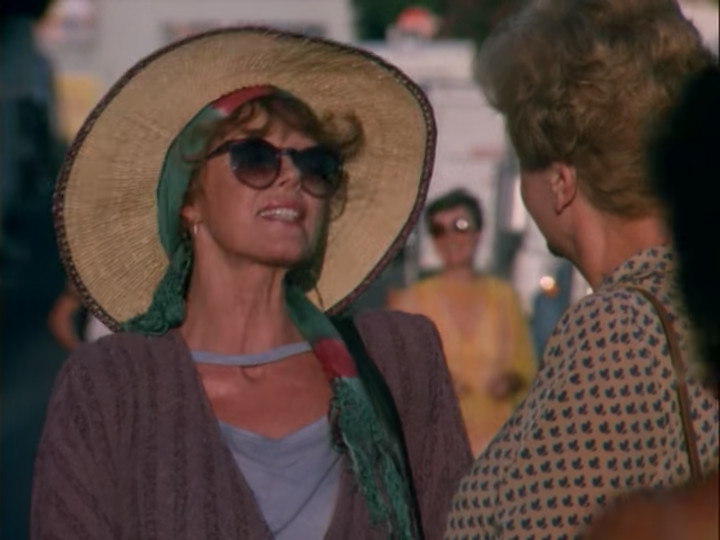
mpv-shot0005

Jessica gets down to the dock and after a bit of pointless bickering between Ethan and Amos, Amos explains to Jessica what’s up. Some rich fellow, by the name of Steven Earl—he sells cosmetics and Jessica recognizes the name, “Mark of Earl”—was out sailing with his four daughters and last night, during the storm when… Ethan interrupts him demanding that the “girls” tell their story and Jessica concurs.

Amos agrees and introduces Jessica to the “girls” and asks them to tell Jessica their story, but Jessica insists on meeting them first.

First is Nancy Earl, who goes by Nan.

mpv-shot0006

Jessica admires her sweater and asks if she knitted it herself. She didn’t, but she did design it. Jessica thinks it’s lovely. Next Maggie Earl comes forward and introduces herself.

mpv-shot0007

She’s read Jessica’s latest book and it was a hoot. Jessica thanks her, saying that it was a hoot to write. Then comes Lisa Earl Shelby. Her husband has been notified and is on his way.

mpv-shot0008

Jessica thinks this is nice. And finally there’s Grace Earl Lamont.

mpv-shot0009

Her husband hasn’t been notified and isn’t coming. She last saw him four years ago.

Which rounds out the lot. Jessica then suggests that they would be more comfortable “inside,” I presume because it’s cheaper to film indoors than on a dock.

Anyway, they left Bridgeport (I assume, Connecticut) four days ago. They thought surely the storm would blow out to sea, this far north, but when they realized their mistake it was too late. Around midnight they were huddled in the cabin in their boat when they realized that their father was still topside. Lisa was the first one up, then Grace after her. Lisa was almost to her father when Grace saw a huge wave come over the boat and knock their father off.

It then turns out that we’re here because Grace asked the Sheriff how soon they could expect a coroner’s inquest, which he thought a mite suspicious. Given the suspicious circumstances, he’s not very inclined to hold an inquest until he has a body. Ethan says that, given the tides, the body should show up within a day or so.

The four daughters walk off. Amos asks Jessica what she thinks and she says that she doubts that any of them will be wearing black for long. Amos asks about the death—one hundred million dollars is a whale of a motive. Ethan accuses him of reading too many of Jessica’s books, but Amos retorts that he hasn’t read any of them.

Jessica leaves them to invite the four women to stay at her house, but they decline as they already have hotel reservations. Most of them walk off but Jessica gets a moment with Grace. She extends her condolences and Grace says that none of them will miss their father. He broke up her marriage and has prevented Nan from getting into any relationships, and turned Maggie into “a dull hausfrau.” There’s really no love lost between any of them. She then excuses herself.

Jessica watches her go with a look of perplexity.

mpv-shot0010

And we go to commercial break.

When we get back, Jessica comes home on her bicycle and goes into her house. She calls to Ralph but he’s not inside. A phone call comes in and it’s Latisha from the phone company letting Jessica know the charges for her call to Paris. She finds Ralph outside resting in her hammock and listening to Mozart on his walkman since the weeding was done and there’s not much else he can do without supplies. She asks him about the call. At $9.97, it must have been a short call to France, she says. He clarifies that it’s Paris, Kentucky—he has a friend who is a horse breeder down there, and he will take care of the charges.

He then takes her to look at some rotten wood on the inside of the house which needs some putty and paint. He can fix it but it will take $10-$15 in supplies. Jessica says it’s a bargain and goes to get the money. While she does this, Ralph admires a pipe that was sitting out on a table. It belonged to Frank—Jessica’s husband who died years ago. He remarks, pensively, “I guess besides a good meal, the thing I enjoy most is a good pipe.” After confirming that it was her husband’s, he compliments Frank’s taste in pipes. It’s an excellent Meerschaum.

mpv-shot0011

Jessica then offers it to him, perhaps because she was touched by the sappy background music which has been playing since Ralph started looking at the pipe. He tries to refuse but she presses him. “I want you to have it. Better you should smoke it than it should sit there gathering dust.” She looks like she’s about to cry and hurries off.

Ralph puts it in his pocket and the scene then shifts to a helicopter landing in a grassy field. Lisa runs up to it and greets her husband. They proceed immediately to the Sheriff’s office.

mpv-shot0012

His concern is that the death of Steven Earl could throw Mark of Earl cosmetics into a financial tail-spin. He wants an immediate inquest so that the reins of leadership can smoothly pass on to Steven Earl’s successor.

This attitude—that corporations are like feudal baronies on the borderlands and that stability comes from the loyalty of the soldiers to the individual under whose banner they will fight—is something we’re going to see a fair amount of on Murder, She Wrote. I don’t know how much the writers actually believed it and how much it was just an excuse to move the plot along because they need dramatic tension. In reality, large profitable companies do not live by their day-to-day stock prices and those stock prices can’t lose 99% of their value from a few days or even a few weeks of uncertainty in who the CEO is. Companies—and especially large, established companies—take a long time to develop their products and marketing campaigns. It is possible for an army to get a significant advantage over another because uncertainty in leadership causes one to stay where it is rather than repositioning itself when the one with active leadership moves, but there’s nothing that can happen to a large cosmetics company that requires a response within hours or it could be devastated. It’s just not a thing.

Anyway, Amos stands on his insistence that there will be no inquest until they have a body, and we go back to Jessica talking with Ralph.

Ralph tells Jessica about how he lost his wife years ago, and for a long time couldn’t bear to think about it. He asks if she has children and she replies that she and Frank were never blessed that way. He repeats the word blessed and chuckles. He then gets up and leaves because he has things to do, bidding Jessica a good night. After he leaves she goes to do the dishes and after unplugging the drain in her sink sees the water swirling down the drain and gets an inspiration. She runs over to the docks where she finds Ethan. She needs his help and advice. The help seems to largely consist of letting her have a map and a compass, which she uses to draw a circle on the map.

Ethan’s advice seems to primarily consist of saying, “Well, I’ll be a skinned lizard” and then asking Jessica how she knew. Her answer is, “Didn’t it seem strange to you that those girls knew exactly where they were in the middle of a storm?”

A call to Amos Tupper and a trip over to the local hotel later and Jessica confronts the four sisters with the fact that at midnight, in the location they said they were at (3 miles due east of Monhegan Island), they would have been in the eye of the hurricane and there would have been no waves to sweep anyone over. Lisa makes the extremely obvious statement that they must have been mistaken as to their location but Maggie won’t have it. She confesses to murdering her father.

Their father didn’t die the night before, but rather two nights before. Maggie and her father were alone on deck, he was drunk, and they fought as usual. She has a gun in her purse she keeps for protection and when he came at her she fired, twice. When the sisters got up on deck there was blood everywhere and his pipe was still warm, but he wasn’t there. Amos arrests her.

Amos, as we will get to know about him, will arrest anyone at the drop of a hat. That said, this time it seems pretty justified.

Jessica isn’t satisfied but can’t explain it. Then a newspaperman comes it with a fresh edition about the millionaire who drowned. Jessica looks in it and sees the photo of Steven Earl—an old photo, taken from the dusk jacket of his autobiography called Grease Paint Millionaire about how he started as an actor and got into makeup almost by accident. Jessica asks if the book was old and the newspaperman says perhaps twenty years out of print.

Jessica goes to her house (with Ethan) looking for Ralph but can’t find him. Some comedic misunderstandings later, Jessica explains to Ethan that Ralph is Steven Earl. Ethan thinks that she’s batty, but agrees to help her look around Cabot Cove for him.

Unfortunately, Ralph/Steven Earl is found by some kids the next morning.

mpv-shot0013

And with the reveal of the body we go to the midpoint commercial break.

When we get back Nan and Lisa identify the body with Amos Tupper. Then Jessica arrives  as they’re leaving the chapel where the body is. Then a car screams up and parks. A man gets out who Nan recognizes as “Terry.” He says that he just heard the news in Kentucky and flew right in. Lisa explains to Jessica that he isn’t a relative but would like to be—about a year ago he and Nan were engaged and then he just walked out of her life.

Jessica goes inside and identifies the body as Ralph. This angers her and she swears vengeance in her folksy way.

Then there’s an unpleasant scene between Lisa and her Husband in their hotel room which doesn’t really advance the plot but is there to make them both seem like suspects.

Then we go to the Sheriff’s station and he brings Maggie out to interview her with Jessica present. He tells her that the body was found, shot twice in the chest, just as she described. She’s shocked and says that it’s impossible. He can’t be dead. He left the yacht on an inflatable raft he hid away before they left. It—the trip, everything—was all a scheme to unmask a fortune hunter named Terry Jones.

A year ago he paid Terry half a million dollars to disappear but after suffering a heart attack six months ago he was afraid Terry would show up again when he was dead. So they cooked up this scheme in order to lure Terry out of the woods so Steven could prove to Nan what a terrible guy Terry is. How, Maggie does not say, because I can see no plausible way for that to work, especially without revealing how Steven paid him to leave, which he wanted to keep from Nan. “My beloved daughter, I faked my death, causing you tremendous grief, in order to lure your former fiance to come back to you, which he did. Don’t you see how this proves he is the one who doesn’t really love you?” He could try to gussy that up, but it does not seem plausibly persuasive. Nor loving.

Anyway, Amos isn’t buying any of it but Jessica is, and leaves Amos to wait for the coroner to tell him what Jessica already knows. She bicycles over to the hotel to look for Terry Jones but he and Nan went to the church about twenty minutes ago. As Jessica leaves she encounters Maggie, who was released because the shots that killed her father didn’t come from her gun. Lisa’s husband tries to tell Jessica to butt out of a family affair, but Jessica retorts that Steven Earl was no stranger to her. She wishes him a good day in a way that makes it clear that she very much hopes he will have a bad day—somewhere far away from her.

We then see Terry talking with Nan in a cemetery. He claims to her that he left because her father threatened to ruin him if he didn’t. She’s not buying it.

mpv-shot0014

He proposes to her and she doesn’t know what she wants to do. She says she needs to be alone and walks off.

As she does, Jessica rides up on her bicycle and greets Terry. With little formality, she tells him that he lied when he said he heard about the death this morning. In reality, he heard it from a phone call yesterday from Steven Earl. He replies that the guy on the phone said he was a reporter, but it might have been Earl—he was a good actor. Terry explains that he flew into Portland last night and to his surprise found Nan waiting for him. Maggie had told her about their father’s plan to trap Terry. He says that some people, like Maggie, secretly believe in him. He and Nan spent the night together at a hotel near the airport. She left early in the morning, he slept in. When he heard the news of Steven Earl’s real death, he immediately came to be by Nan’s side.

Jessica then goes to the Sheriff’s office but Amos isn’t there. She overhears a conversation with one of his deputies and someone else on the radio that Amos is down at Cotter’s Beach with a search party because he got an anonymous note shoved in the mailbox which said that there were funny goings-on at about 10pm the night before.

Jessica goes down to Cotter’s Beach and asks Amos to see the note, which he shows her, but the camera does not show us. Then one of the searchers runs up because he found a pair of new-looking pink high-heel shoes half-buried in the sand. One had a heel broken off of it. Jessica remarks that half-buried means half-exposed and scampers off. After a few moments of searching next to where the shoes were, she finds the missing heel.

mpv-shot0016

Amos praises Jessica for finding it and says that all they have to do now is to find to whom the shoes belong. Jessica says that without doubt they belong to Nan and we go to commercial break.

When we come back from commercial break, Jessica and Amos are in Nan’s room as Nan is searching for the shoes. She never unpacked them and yet is somehow certain that they were here last night. Amos shows her the shoes and she identifies them as hers—she designed them and had them custom made.

Jessica asks Nan to try them on. Nan doesn’t understand, but complies. Presumably this is so that Jessica can get a look at the bottom of Nan’s foot (the shoe fits, but we knew that before she tried it on):

mpv-shot0018

I assume that the thing Jessica was looking for are scratches or something like that, since if Nan was there and broke a heel and lost both of her shoes she’d have had to scramble over the rocks barefoot and she’s a city slicker with, presumably, tender feet. Let’s zoom in:

foot

I can’t see any sign of scrambling over cliffs, though the resolution really isn’t wonderful for that. Presumably Jessica will confirm this soon. Anyway, Amos takes the fact that the shoe fits to mean that he has to arrest her for the murder of her father. Jessica objects saying that Nan isn’t guilty, then gets an idea and advises Amos to take Nan into custody. Jessica then asks Amos and Nan to keep the evidence absolutely confidential.

The scene then shifts to the Sheriff’s office, where Terry Jones shows up, angry that Nan has been arrested. He protests that there’s no way Nan could have killed her father because she was with him. Amos suggests that perhaps they were in it together. The Portland hotel desk clerk saw them check in but didn’t see either of them leave. They easily could have snuck back to Cabot Cove and committed the murder together. Terry starts to panic and says that he didn’t have anything to do with Steven Earl’s death, but if Nan did kill him before she came to Terry, he would have no idea. Amos says that he better not, since in Maine being an accessory to murder is about as bad as being the murderer. But as long as he’s here, Amos sees no reason why Terry can’t see Nan. Terry then excuses himself, saying that he has business to take care of, and beats a hasty retreat.

Amos then goes to the door to the jail cells, which this conversation took place next to, opens it, and asks Nan (who walks out) whether she heard it. Finally disillusioned about Terry, Nan replies, “Yeah. I heard it.”

The scene then shifts to the hotel, where Lisa, her husband, Maggie, and Grace come back, all of them laughing and perhaps a bit drunk. Lisa’s husband is shouting in jubilation. They’ve all been celebrating Maggie’s exoneration. Jessica breaks the news about Nan’s arrest. When asked why, Jessica lies and tells them that the Sheriff found a heel from a shoe, which Nan admitted was hers, on the beech very near where the body of their father was found, but the shoes are missing. Jessica then says she knows how sisters are, and how they trade clothes, and asks if it’s possible if one of them wore those shoes.

Lisa asks if Jessica wants to search their rooms and Jessica says, “something like that.” Lisa replies not without a warrant, and not by Jessica, then leaves with her husband. Grace says that she has nothing to hide and so Jessica can search her room if she wants. Maggie says that Jessica can search her room, too, but she and Nan are different shoe sizes and besides, she doesn’t wear pink.

Later, Maggie walks Jessica out of the hotel and Jessica tells Maggie that she’s exhausted and will sleep in late. She also says that the Sheriff will be over later and asks Maggie to give the Sheriff a bag that she was holding (we were not shown what was in it).

The scene then shifts to Jessica’s house where a gloved hand breaks the window to Jessica’s door, reaches through, and opens it. The dark figure who belongs to the gloved hand then slowly and softly walks in and starts walking upstairs but stops when it hears creaking. It reverses course and then Jessica calls out, “that wasn’t very thoughtful.”

mpv-shot0019

The figure walks up and we see who it is.

mpv-shot0021

I like the TV burglar outfit Maggie is wearing. Also, this turns the title of the episode into a curious pun.

She asks, “You were expecting me, weren’t you?”

Jessica replies, “You know I was.”

In fact, Maggie wasn’t sure. But she looked inside of the bag and found a blue heel to a shoe and figured that it was a message. She asks if she slipped and Jessica points out that she said that she doesn’t wear pink, but Jessica never mentioned the color of the shoes.

Jessica adds that if it makes Maggie feel any better, she knew Maggie was guilty because everything pointed to an obvious framing of Nan. Maggie objects that it wasn’t obvious; Nan and Terry could have done it. Jessica points out that the shoes prove that she didn’t; had she lost her shoes her feet would have been scratched, which she found they were not when she asked Nan to try on the shoes.

Anyway, once it was clear that Nan was being framed, it was also clear who did it: the only person with the requisite knowledge to set up the frame by telling Nan about Terry Jones’ arrival at Portland.

Maggie tells Jessica that she’s very clever but Jessica demurs. She was merely logical; Maggie was the clever one. Confessing to the murder knowing that the police investigation would exonerate her was brilliant.

Maggie then explains her motive. She spent her whole life taking care of her father, making a home for him, keeping the peace, and for what? The only one who her father actually loved was Nan. After a bit of crying, she apologizes to Jessica for having to murder her in order to get away with the murder of her father. She explains her plan: it will look like she surprised a burglar who killed her in a struggle.

Jessica chides her for this plan. For one thing, they don’t have burglars in Cabot Cove. Second, and perhaps more to the point, the moment the back window was broken she called Sheriff Tupper, who has been listening in to the whole conversation. Jessica then moves some dead flowers in a wicker basket to reveal the phone off its hook.

mpv-shot0022

I must confess, given how low they were speaking, Amos couldn’t have heard much, but this is enough to dissuade Maggie from murdering Jessica. Jessica picks up the phone and says that Maggie wants to give herself up, then hands Maggie the phone so she can confirm this with him.

The scene shifts to the next morning, at the hotel, where Nan and Jessica are talking as Nan goes to her taxi. She tells Jessica that she understands how her sisters feel but her father was actually a decent man. Jessica concurs, reminding Nan that she did know him, if only for a short time. Jessica summarizes, saying that in her experience if you give love, that’s what you get back. Nan laughs and says, “Not always.” She then considers that her father was right about Terry and she didn’t see it, but Jessica tells her not to be too hard on herself. Terry was a very clever young man and she pities whoever gets him next.

Nan bids her farewell and gets in her taxi, then Ethan pulls up in his pickup truck and offers to take Jessica out to fish for sea bass, as he’s heard that they’re biting. Jessica accepts and tells Ethan that she’s going to teach him some of the finer points of deep-sea angling. As the pickup drives off, Ethan asks if that means that she’s going to want him to bait her hooks, too, and she replies, “Of course. You always do, don’t you?”

Then we go to credits.

mpv-shot0023

This was a very interesting episode. While there was also a pilot episode that aired the week before, this was still very much an introductory episode. More, perhaps, than the pilot, since this episode took place in Cabot Cove while the pilot took place in New York City. That is arguable, since most Murder, She Wrote episodes don’t take place in Cabot Cove (in most seasons it’s between a quarter and a third), but still something to consider. Another sense in which this is an introductory episode is that it’s the first regular-length episode, so it’s the first time we’re seeing what the show is really going to be like. It’s also quite likely to be the first time many people saw the show since there are all sorts of reasons to not see the pilot. (Among other things, people would take their guesses as to what they would like when a new TV seasons rolled round but they might be disappointed and try other shows. Plus there would be recommendations from people who did watch the pilot, etc.)

This being an introductory episode manifests itself in all sorts of ways, but part of it is that they put a lot of effort into showing how clever Jessica is. In particular, she shows off her deductive skill far more than she would come to later. For example, before the first commercial break she tells Ralph why he’s “full of clam chowder” with a four-point list of observations. She sees through the sisters’ story about their father being washed away in the storm by plotting their location on a map with a compass. She rushes off and finds the missing heel from the shoes and off-handedly knows that they belong to Nan. And all this is well before she solves the mystery. In later episodes Jessica will do a fair amount of investigation, but it’s rare that the next bit of investigation comes from clever deduction from the previous piece of investigation. In this episode each step follows from Jessica having been clever in a way we can clearly see. I suspect that this faded in no small part because it’s hard to write, but that’s a pity because it’s a lot of fun.

There’s another interesting aspect to this being an introductory episode, which is that they’re trying to paint Jessica’s personality. I think you can really see the influence of Miss Marple on the initial conception of Jessica in this episode.

(This is probably a subject that merits its own post, but if you’re not aware: Miss Marple was one of the main inspirations for Jessica Fletcher. The creators acknowledge this if you watch the special features, but even without that, it would be obvious. Miss Marple was both an old woman who lived in a small, obscure village solving crimes and also an extremely popular detective. The last Miss Marple novel was published in 1976, a mere eight years before Murder, She Wrote first aired. There’s also an interesting connection with the title of Murder, She Wrote. There was a 1961 movie based upon the Miss Marple novel The 4:50 From Paddington which did not use the book’s title. Instead, it used the title: Murder, She Said.)

In contrast with later episodes, Jessica seems far more embedded in the Cabot Cove community. This is not so much about people knowing her, but rather that she seems to be a part of it, and more importantly, it seems to be a part of her.

Another interesting thing is that she seems to have small-town manners. Small town manners tend to be more oriented around building relationships because in a small town you’re fairly likely to see people again. Plus you meet few enough people you have the time and energy to spend on them. Cosmopolitan manners, by contrast, tend to assume more between people but at the same time have an emotional distance that is maintained because actually getting to know people or forming relationships is work that is quite likely to not pay off since for any given person you’re not very likely to ever see them again. Before too long, Jessica would have cosmopolitan manners, but in this episode she had small-town manners. You can see this in the way she insisted on being introduced to the four sisters before hearing their story. You can also see this—to some degree—in the way she related to Ralph. She had neither  cosmopolitan easiness nor cosmopolitan coldness.

When we come to the episode itself, it’s something of a mixed bag. The plot is interesting, though the events which form the mystery don’t hold together overly well. Starting with the boat trip: how did Steven Earl convince all four of his daughters to go on a boat trip with him? Nan might be willing to do it out of affection and Maggie did it as part of the plan to murder her father, but why on earth did Lisa or Grace consent to the trip?

Then we come to the faked death. I can’t help but ask why Steven Earl thought that faking his death was a good idea. In theory this was to draw Terry out of cover, but I can see no possible purpose drawing Terry out of cover would actually serve. Steven knew where Terry was—he had this phone number—so it wasn’t about finding Terry. And I don’t see any way this could possibly convince Nan that Terry was a bad guy. About the only possible good this could serve was proving to Steven that he still had to worry about Terry, but that’s really more about how Nan feels about Terry rather than whether Terry is interested in Nan. Further, the right way to handle that would be to set up something with his lawyers where Terry would get periodic payments, made by the lawyers, if he stayed away from Nan, so this could carry on after Steven’s death.

But if we pass over this and just accept that he wanted to fake his death, I can see no possible explanation for the faking of his death being done by pretending that Maggie shot him. Unless, of course, that wasn’t his plan but Maggie’s. She did this faking long after he had rowed away. It is possible that she was supposed to say that he had fallen overboard or something like that. He was long gone so she could say anything she wanted and since this was premeditated she could have brought the fake blood and then staged it as she described to Amos. The question is never asked, though Steven’s reaction to hearing that the supposed murder was actually just an accident makes this seem like it was not what was intended.

The character of Ralph/Steven Earl is another issue within this episode. Ralph was interesting, though that is limited by how much of what he said was lies. There’s the further problem that it’s hard to make the parent of bad children out to be sympathetic. Children are their own people, of course, and one bad child may be misfortune. Several bad children sounds like bad parenting. Especially when the children seem to have bad principles and worse manners. Basically, spoiled children have to be spoiled by someone, and there’s no way for that to happen which lets the father off the hook.

The murder itself was clever, and there were a decent number of twists and turns. They did a pretty good job of making Maggie the least likely suspect without making her being the murderer seem completely unbelievable. I’m not sure that Maggie hating her father made all that much sense, and I especially think that they never justified Grace thinking that their father ruined Maggie’s life. She told Jessica that he turned Maggie into a “Hausfrau” but I don’t see how he could have. It is not believable that Steven Earl was such a regular homebody that he was constantly around to dominate Maggie’s time, or that he kept an elaborate home which he made her constantly clean because he was too cheap to hire any help. It would make more sense that she tried to earn his love by being a “hausfrau” and it didn’t work and she resented him for it. To some degree they did hint at this in Maggie’s confession, though her saying, “I hated him for what he did to me” undermined that.

I think that this was less of a big deal here than it might be in later episodes because this episode was more about the investigation than it was about the murder.

The character of Amos Tupper is also curiously inconsistent in this episode. For most of it he seems annoyed by Jessica’s interference. This is hard to reconcile with the fact that Jessica is involved because he asked for her help. Even more, he told the sisters that Jessica is there because she’s a “good friend of mine who from time to time I like to look to for advice.”

Ethan is also a curious character. Clearly a long-time friend of Jessica’s, he’s got a great voice but it is annoying how much he bickers with everyone, especially Amos. To a great degree this was just the nature of television at the time. Conflict makes people less likely to change the channel, which was the all-pervading fear of TV writers.

One thing I think a pity is that Jessica didn’t have any female friends. I suspect that this was because male-female interactions always have a bit of electricity to them, even where they are completely non-sexual, in a way that male-male and female-female interactions don’t. That ever-present fear of the viewer changing the channel probably meant that the energy always needed to be turned up to 11.

That said, it’s possible that this hits differently, now, watching the episodes via DVD where I’m extremely unlikely to change the channel and there isn’t just one family TV that someone might want to change the channel on “just for a minute”. That makes for a different viewing environment, too. The overall more stressful environment of the one family TV in the living room was more stressful, and so the energy on everything being turned up probably seemed less unnecessarily high-energy. Oh well.

All told, as a first episode, I think that Deadly Lady was pretty good. Next week we’re going to San Francisco for Birds of a Feather where one of Jessica’s many nieces is going to get married.

When Helping Someone Compose a Short Message

I just want to share a small tip I’ve learned from experience when helping someone to compose a short message, such as an apology, condolences, etc. This is for when they don’t know what to say and feel lost and you’re giving them a sample to help them write their own message, but the most realistic outcome is that they’re going to use what you gave them with small modifications. And the tip is: do a good but not great job. In particular, leave an obvious improvement or two possible. I don’t mean to leave anything that would be bad if the person were to send it as-is, just something where it’s highly likely they’ll see how to improve it before sending it.

This serves several purposes.

The first is that the person will feel better if they make some modification so that they will feel like the message did come from them. When a person wants to do something to help a human connection—the purpose of sending written messages—they want it to come from them in more senses than just having been the person who hit the “send” button. (Even if that’s all they do, that’s still more than doing nothing, but it can easily feel like very little more than nothing.) Leaving an obvious improvement or two will help the person to feel like the message sent actually did come from them and not just the message, but some of its goodness.

The second purpose is that it will help the person to not feel bad about asking for help. If you want to do something and have to ask for help and then the help you receive was so overwhelmingly superior that the only changes you have the ability to make will make it worse, that will leave a bad taste in your mouth over having asked for help. In theory, of course, it shouldn’t, but we’re fallen creatures and properly appreciating other people’s superiority is very difficult for us.

A third purpose it serves is to sound more true to the person’s own voice. A person who finds the task of composing a message so difficult that he asks for help is unlikely to compose something really eloquent. If you make it too good, in an absolute sense, you make it less fit for its main purpose of connecting the person who is sending the message to the person receiving it.

Science vs. Religion Show Why Heresy Matters

The “war between science and religion” does not really exist according to those English words in that order, and was a terrible name for what it actually did refer to. What it really should have been called was “the war between science and a particular widespread-in-the-english-speaking-world Christian heresy.” Because that’s what it actually was. I’m going to explain, briefly, before I get to the main point, which is that heresy matters.

The Book of Beginnings (more commonly known as the Book of Genesis since it frequently gets left untranslated) is obviously not meant to be anything like a science textbook, for the very obvious reason that it contains, back-to-back, two creation stories which disagree with each other about the sorts of things that a science textbook primarily concerns itself with. Whether Human Beings are the pinnacle of material creation as the end of a triumphant process or whether they are the pinnacle of creation as being given the right to name everything does not much matter to the central point of Human Beings being the pinnacle of material creation, but it matters very much to the question of which came first: the human or the chicken? It does not take a genius to figure out that the book can’t have been written primarily to answer questions it treats as irrelevant.

It doesn’t take a genius, but it does take someone who has thought about this a bit and can understand things like literary purpose. That’s not everyone. And here we come to the heresy of Sola Scriptura.

Sola Scriptura, which is the doctrine that scripture is the only authority, requires a somewhat lengthy treatment to be dealt with in full. This lengthy treatment can be found in many places so I’m not going to present it here. The relevant part to the moment is that Sola Scriptura means, as a necessary consequent, that any person (of good will/faith) who reads the bible must understand it fully and completely. (Martin Luther tried to get around this problem, in On the Bondage of the Will, by claiming that the parts of scripture that are hard to understand say the same thing as other parts, just less clearly, and so it’s not necessary to understand any part that’s hard to understand. Setting aside the astonishing hubris of claiming to fully and completely understand scripture, that doesn’t actually help anyway.)

This means that people who don’t get the concept of literary purpose, metaphor, etc. must be able to entirely understand scripture. Worse, this must be without any learning, because there are plenty of uneducated people in the world and even if there weren’t the educators would then have some of the authority since they would be teaching how to properly interpret.

The unintended consequence of this is that people who believe Sola Scriptura and who know any uneducated people or people who otherwise don’t understand things like literary intent and metaphor are forced to hold that the Book of Genesis is in fact meant as a science textbook. This puts them at war with actual science, because actual science disagreeing with the parts of Genesis which were never meant to be a science textbook will show that Sola Scriptura is false. This is “the war between science and religion.”

And this is where we come to the part where ideas have consequences: “the war between science and religion” has hurt a lot of people. Sola Fide has hurt even more people, since Sola Scriptura is just a consequence of Sola Fide. Sola Fide wouldn’t even be so bad except for Martin Luther having redefined faith from meaning, roughly, “acting according to truths we know but for which the evidence is no longer apparent” to “the will creating reality.” More colloquially, “trusting someone trustworthy” to “generating an interior feeling of certainty.” Moving faith from an act of the intellect and will in harmony to an act of the will against the intellect is, in essence, rejecting truth. And here’s the thing: Jesus is the way, the truth, and the life. What Martin Luther tried to do, with Sola Fide, was to have Christianity without Christ. But you can’t do that. Which is why Martin Luther’s protestantism is proto-atheism. At some point you can’t keep up the pretense of having Christianity without Christ. Or to put it more simply: the fact that, within Christianity, there is nothing more important than the truth will eventually reassert itself. The bible cannot be the only authority because it cannot be any kind of authority. It’s a book. It is the thing authored, it is not an author itself. If the bible is the only authority, then there is no authority, and that this is logically necessary can only be evaded by an act of the will for so long. Historically, that turned out to not be very long.

It is not pleasant to call a heresy a heresy. When Saint Thomas More called William Roper, who had just asked for the hand of Sir Thomas’s daughter, a heretic, Roper replied, with great feeling, “Now that’s a word I don’t like.” To which Sir Thomas replied, “It’s not a likable word. It’s not a likable thing.” That gets to the heart of it: it’s not a likable word because it’s not a likable thing. It’s natural that people don’t like things which are not likable, but it remains important none the less.

Ideas have consequences. It is not pleasant to fight over ideas, but if we don’t fight over ideas we will still end up fighting. We will just fight over the consequences.

Starting Murder, She Wrote From the Beginning

I’m thinking of going back to the beginning with my reviews of Murder, She Wrote. When I started writing the reviews I was doing it in a very haphazard way, just picking out ones that struck me fancy. Then, starting with an episode that was towards the last quarter of the fourth season, I started doing them in order, where I would end each review with what “next week’s” episode would be. I like this format as it captures a bit of the feel of having watched them back in the day, and also forces me to review the episodes which aren’t as good, which I think has value since the exercise is largely about learning from a great show and analyzing mistakes is valuable, if not as valuable as analyzing what was done well.

While I like this format, it does feel a bit funny to start it partway through season 4. So I’m considering going back to season 1 and doing the episodes in order from there. (Where I come up to episodes I already reviewed I’m just going to edit them into the appropriate format with the link to the previous one at the top and the link to the next one at the bottom.) I do plan to skip the pilot episode, The Murder of Sherlock Holmes, for two reasons:

  1. At an hour and a half long, it would be a ton of work.
  2. It’s a pilot episode and like most pilot episodes it’s fairly different from the main series.

It’s that second one that makes me put so much weight on the first point; a lot of extra work would be worth it if there was a lot more to get out of it. But analyzing a pilot will, generally, not help in understand a show because there are always so many changes. For example, in the pilot Jessica is shocked by encountering murder for real, even though it’s someone she didn’t know, and was deeply cut up about figuring out who the murderer was, despite barely having known him (admittedly, there was a bit of a romantic sub-plot between them). That would have been hard to stomach on a regular basis and so it was, wisely, dropped. (Or at least was dropped for most of the episodes. The ones that took it up again tended to suffer for it, the exception I can think of being When Thieves Fall Out.)

It’s going to be a few days before I start on the next review, so if anyone has any thoughts to share on this, I’d be grateful for them.

Coal Miner’s Slaughter

On the twentieth day of November in the year of our Lord 1988 the Murder, She Wrote episode Coal Miner’s Slaughter first aired. (Last week’s episode was Snow White, Blood Red.)

mpv-shot0001

Set in rural West Virginia it’s in a small town where the major employer is the Colton Mining Company, which mines for coal. The episode opens at the Coal Miner’s Shindig, where a banner proclaims that the shindig is celebrating “Top Productivity.”

The camera pans over many people dancing to fiddle music, until it finally comes to rest on three people.

mpv-shot0002

The older man on the right is Tyler Morgan. The man in the middle is his son, Reese Morgan, and he hates everything about this shindig, declaring it to be a waste of good company money. The woman is  Nora Morgan. She is Tyler’s husband and Reese’s mother. From everything he says, they seem to have done a terrible job raising him.

The shindig is Tyler’s way of getting the men to accept a work speedup. Reese thinks that they should instead use computers to run the company, which would save them 20%. Tyler answers that he ran the company at a profit for thirty years, not by using computers, but by using his brain, and he’s going to keep it that way until they carry him out feet-first.

I don’t know whether they’re going to carry this through, but they’re setting up a John Henry type story of man vs. machine. It’s a very unrealistic man-vs-machine scenario. Computers, and especially the computers of the late 1980s, could not run a mine in any meaningful sense. What they could do is a whole lot of calculations. The labor that they would replace would have been done, not by the wise old man, but by a group of clerks whose names he probably didn’t know because he treated them, insofar as he could, like machines. The flip side of this is that the old man’s only real objection to computers would be their cost and reliability. The John Henry story they’re setting up is less John Henry vs. the spike driving machine and more John Henry who wanted to keep using a rock to drive spikes rather than upgrading to a hammer.

That said, realism is, of course, not the point. Rather, this is setting up a favorite theme of Murder, She Wrote: that old things are still valuable.

The issue with bringing computers into a business, apart from their expense and reliability, is that they are specialized tools which most people are not familiar with because they are new tools. Older people will have developed considerable skills with tools that are used differently—slide rules, desk calculators, binders of paper, etc. The new tools require different skills and so the older people will feel like their built-up skill’s value has become diminished (because it had). This has some unfortunate side-effects, though in reality it mostly made people uncomfortable for a year or two and then they became more productive with the new tools. There did become something of a class of maintenance workers for the new machines which were not needed for the old tools, just as the advent of cars created the job of car mechanic which did not exist in the age of horses. This did also create a feeling of dependency which many found unwelcome. Again, though, in practice people got used to this very quickly since almost none of them did their own plumbing or their own electrical work, and they owned cars which (in the 1980s) most of them took to mechanics to keep in working order. The modern world is highly interdependent because of all of the specialized tools that we have, and that does come with tradeoffs. They are, for the most part, livable tradeoffs. Civilization has always involved interdependence and it was no less doable to run away from civilization and live off of squirrel stew in the mountains in the 1980s than it was in the 1680s.

Murder, She Wrote did not address the real concerns of people actually doing the work, though. It addressed the concerns of people who saw this coming in their future or else (judging by the denture and term life insurance commercials which tended to play at commercial breaks) had retired and would never be taking the trouble to learn the new ways because they were never again going to do that work. Portraying computers as something that replaced human beings’ humanity, rather than low-level clerks drudgery, speaks to those concerns far more symbolically.

Anyway, Tyler walks off and Reese remarks to his mother that his father can’t die soon enough to suit his tastes. His mother rebukes him, saying that he owes his father respect. Reese replies by asking what kind of respect his father showed his mother, cheating on her all these years?

They’re certainly planting the motives thick for the old man’s death.

Taylor gets up and makes a speech, thanking everyone for coming, saying that the mine has been extremely profitable, and that what’s good for the mine is good for the miners. When he says this last part, a woman calls out, “That’s a lie and you know it!”

mpv-shot0003

(It’s good to see that shoulder pads are still alive and well in 1988.)

She walks forward. He says, “I don’t believe we’ve met,” and she replies, “Actually, we have. Ten years ago, at my father’s funeral.” Her name is Molly Connors.

Tyler lays the southern stuff on thick, “Joe’s little girl? Well. Well. Well. You certainly have turned into a right fine filly.”

They talk back and forth a bit, but the upshot is she’s just passed the bar exam and her first case is to prove that he killed her father.

He replies that it will be quite hard to prove what never happened, especially from the inside of a jail cell, and directs the Sheriff to arrest her for trespassing on private property by attending a private party at a private venue to which she was not invited.

mpv-shot0004

She says that he’ll never make this stick. He says maybe so and maybe not, but it might take a while to find out. (The judge is fishing at Tyler’s private fishing lodge and while Tyler will give the judge a call, if the trout are biting, the judge may well refuse to come back early from his vacation.)

As the Sheriff is taking Molly out of his car next to the police station, her grandfather (name of Eben) shows up and demands her release.

mpv-shot0005

The Sheriff refuses. Eben goes for his shotgun but the Sheriff tells him, at gunpoint, to not pick it up. Molly pleads that she’ll be alright. She is entitled to a phone call and she knows someone who will help.

That someone is, of course, Jessica.

She arrives by bus, presumably the next day.

The next scene is the Sheriff talking with Molly; he offers her the advice not to fight fights she can’t win. She tries to accuse him of following his own advice, but he maintains that he does his best to uphold the law. He then opens the cell and tells her to get going as her bail has been paid in person.

(Obviously, this aspect of getting the legal system wrong is probably pure convenience, but for the record: bail is set by a judge at the defendant’s initial arraignment (which is required to take place within 48 hours of arrest or, if the arrest was on a weekend, within 72 hours). Bail is not set by Sheriffs or by a standard schedule. With the judge out of town, it would not be possible for Molly’s bail to have been set, so Jessica could not possibly bail her out.)

They do some chit-chatting to establish that they know each other (she was one of Jessica’s brightest protegés), then leave the Sheriff’s office. On the way out they run into Carlton Reid.

mpv-shot0006

He came to bail her out as well. He’s the local miner’s union representative. He’s mighty glad to see that she’s out.

Tyler shows up at this exact moment and walks over and politely tells Molly that he seems to have underestimated her resourcefulness. This is a bit odd because all he really wanted was for her to stop interrupting the shindig, but whatever. I guess his villain nob needs to be turned up to eleven.

He then looks disapprovingly at Jessica and says, “I’m not sure about the wisdom of bringin’ a stranger in on something that’s none of her affair.” I’m not really clear on how Molly isn’t effectively a stranger since she was last here as a young child.

Jessica objects to this on the grounds that she and Molly aren’t strangers. I suppose she’s deliberately missing the point for some reason that’s not immediately obvious.

Tyler replies that it’s good that they’re so close since Eben’s place is hardly big enough for him and Molly. A young boy then offers that Jessica can stay with “us.” The camera then pans over to them.

mpv-shot0007

The boy’s name is Travis and his mother is Bridie Harmon. They own a boarding house up the road. Rooms are $10 a day, meals are extra, and she locks up at 11:00pm. Jessica accepts. As Bridie tries to leave she has to call Travis several times because he’s busy having a staring contest with Tyler.

After they leave, Tyler bids Jessica welcome to Colton, then walks off and the scene shifts to dinner at Eben’s house. Jessica compliments the cooking and they reminisce about how Molly’s mother helped with the PTA and when Molly was in Jessica’s class, lugging around a huge book of Shakespeare. Apparently she and her mother moved to Cabot Cove after her father died. From West Virgina to Cabot Cove is quite a move, though it’s later explained that this was because her mother had kin in Maine. Anyway, the big Shakespeare book was the one thing of Molly’s father that she brought with her to Maine. We also get the detail that everyone in town knows that the explosion which killed Molly’s father was no accident (according to Eben).

Next we see Tyler receiving a phone call from an unnamed caller. Tyler recognizes the caller, though, as he says, “I thought I’d be hearing from you.” He then accepts an appointment to meet the caller at the cabin in half an hour. After the caller hangs up he thinks that Nora is listening in on the phone again, though when he asks if that’s her listening in, the phone just clicks. He then puts on his coat and leaves his house.

Then we see Molly dropping Jessica off at the boarding house. After she says goodbye Bridie asks if Jessica needs anything else because she’d like to lock up and get to bed. A minute later, Jessica goes to close the window and sees Bridie, outside, putting on a coat and covertly hurrying off somewhere.

Over at the cabin, we see the shadow of someone with a gun walking along.

mpv-shot0008

The mysterious figure looks in the window and sees Tyler putting logs on the fire. It puts the handgun away and then slowly opens the door and takes a rifle from a rifle stand next to the door, aims at tyler, cocks, and shoots. We get an exterior shot of the cabin in the storm for a moment, then fade to black and go to commercial.

It’s pretty irresponsible for the rifles to be kept loaded in the rifle stand, but I suppose that was mostly just to save the time of creeping around and finding the ammunition and loading the rifle.

We come back from commercial to a bright and cheerful day.

mpv-shot0009

After a few seconds of panning the camera to allow people to get back from the bathroom, Jessica walks along a bridge. When she gets to the other end Tyler’s son, Reese, tells her, at gun point, to stop moving. The scene then shifts to inside of the cabin where the Sheriff asks Jessica whether it’s a bit early for a city woman to be prowling about and she replies that she wouldn’t know, being from a small town, herself.

Apparently Jessica was walking to Eben’s house and took the wrong path, bringing her onto Morgan land. The Sheriff tells Reese that he can handle it alone and doesn’t take no for an answer, so Reese leaves. Jessica catches on that Tyler is dead and begins asking about it. The Sheriff says that, from the condition of the body, he died somewhere between 11:00 and 11:30 last night, but he’ll know more when the county boys in Yanceyville get done with him. He’s got plenty of ideas for who killed Tyler but no evidence to back up any of them.

He asks Jessica where she was between 11:00 and 11:30 last night. She tells him that she was in bed then sleeping, but would be hard-pressed to prove it. The Sheriff tells her to not worry about it since she doesn’t seem like the kind of woman to kill a man she barely knew and moreover she looks about as handy with a gun as he is with knitting needles. She asks why he asked where she was if she didn’t need an alibi, and he replies that he was hoping she might be able to supply an alibi for someone who does need one.

So far, the Sheriff is my favorite character in this episode, by far.

The Sheriff and Jessica go to Eben’s house, where Molly is surprised that Tyler is dead and Eben merely calls it hill justice. The Sheriff points out that the law calls it murder and he needs to know where they were. Molly got a flat tired on the way home from dropping Jessica off and so she didn’t get home until 11:30. Eben stayed put the whole night.

The scene then shifts to town, where Jessica and Molly come out of some building. Carlton Reid comes up and offers to give them a lift home. With the way tongues are wagging they’re likely to run into trouble if they stay. Molly will not be intimidated, though, and, spotting Mrs. Morgan and Reese, goes up and gives her condolences. These are about as well received as you might imagine, given that the Morgans believe she killed their husband/father.

Jessica and Carlton come up to try to make matters worse, Jessica in a somewhat conciliatory tone and Carlton in a far more aggressive tone (he all but accuses Reese of killing his father).

The Sheriff interrupts this to bring the news that he found Tyler’s rifle in molly’s car when he took her up on the offer to search where he wanted that she indignantly made when he was talking with them earlier.

He arrests her for the murder of Tyler Morgan and we go to commercial break.

When we come back we hear Jessica asking the Sheriff “What do you mean, no bail?”

He explain that mountain folk have long memories and short fuses, not to mention funny ideas about the law, and if he let Molly out on bail he might as well hang out a sign saying “hunting season is open.”

Jessica’s protests are interrupted by Eben storming to get Molly. When the Sheriff tells him that he can see her but he can’t take her home, Eben threatens that he’ll be back and he won’t be alone. (There’s also some talk by Jessica of appealing to higher authorities which Eben disregards.)

The scene shifts to the boarding house where Jessica is talking with Carlton Reid about how the miner’s legal society will help out. They’re interrupted by Bridie arguing with Travis. She demands to know where he was and he says that he was out hunting. She asks, incredulously, “until 3am?” He replies that he’s not a baby anymore and can stay out at night if he wants to, then adds in a highly accusatory tone that she does.

Carlton follows Travis outside and talks with him a bit. It’s done in such a way as to incriminate Travis, which almost certainly means that he’s innocent.

After Carlton leaves Jessica gets Bridie to come help her open a window that always sticks after the rain, then tries to ask her about her having gone out as if it was small-talk. Bridie lies, though, and says that she didn’t go out. After some pressing, she admits that she was Tyler’s mistress because she needed financial help. Though they got closer over time. However, she was worried Travis would find out since he was nearly grown.

I’m not sure what she’s talking about here; Travis looks like he’s twelve and the actor was fourteen at the time of filming, which is not “nearly grown.” He’s still quite a bit shorter than she is. Be that as it may, this was her concern and so she went up the cabin last night to try to end it once and for all.

When she got there, Tyler was dead.

She didn’t call the Sheriff because that would have let the whole town know about her and Tyler. Jessica was surprised that no one knew and she said that Nora (his wife) had an idea a few years ago and she threw such a fit it scared Tyler off of seeing her for a while. She doubts that Nora knew he’d started up again, though. If she did, she’d probably have killed Tyler.

Jessica takes this as her cue to go interview Mrs. Morgan.

Her pretext is asking for Mrs. Morgan’s help in calming down the situation which Reese is stoking. Not much comes of it except for admiring Reese’s skill with a gun, which she takes to be responsible for the shooting ribbons near a bunch of guns over the fireplace and Mrs. Morgan saying that they’re actually hers, not her son’s.

mpv-shot0010

Jessica congratulates her but she demurs. Around here most people can shoot the petals off of a daisy before they’re ten years old. They’re interrupted by a phone call from the funeral parlor and Jessica goes to leave. As she’s almost out the door Nora tells her that she’s sorry that she couldn’t help—Reese is much like his father: it takes a loaded gun to get his attention.

On her way home Carlton drives by and picks her up, saying that there’s trouble—the Sheriff says that he’s got Molly cold. Jessica objects that the loaded gun was obviously planted. Carlton concurs, saying “Hell yes. I mean, anybody could have grabbed that gun out of that unlocked rack by the door and shot Tyler.”

After making this unnecessarily detailed and thus incredibly self-incriminating statement he then explains that that’s not all the Sheriff has, though. Reese went through the cabin and found a ledger sheet had been stolen out of the company’s 1978 payroll. (This is the year that Molly’s father was killed.) The Sheriff thinks this cinches it.

Complicating the matter, Eben has gathered his friends and is planning to storm the jail to take Molly. Jessica suspects that if Reese finds out, there’s likely to be an all-out war.

They arrive at the Sheriff’s office just as Eben and his mob are coming.

mpv-shot0011

Jessica tells Carlton to get the Sheriff while she tries to hold them off. The sound of a gun being cocked announces that Reese and his men have showed up. Both groups file into the area in front of the Sheriff’s office. You can’t see it in this picture but a surprising number of the men on both sides are armed only with sticks or gardening implements, which is a bit odd given that they would all almost certainly own a half-dozen rifles each.

mpv-shot0012

Jessica looks back and forth, worriedly, and we go to commercial break.

When we get back, there’s some yapping on all three sides until the Sheriff comes out, explaining that he’s going to follow his duty in keeping Molly in jail, but without any uninvited help from Reese.

He points out to Eben that Molly’s innocence is for a court to decide, not them, and Molly would be the first to agree. Eben relents, but with the warning that if any harm comes to Molly a court will not be involved in settling the score. He and his men leave. Reese and his men also leave.

Jessica follows the Sheriff inside.

Jessica makes the point that Molly would not have bothered to steal the payroll records when a subpoena would have forced the company to hand it over, and she told Jessica (in front of the Sheriff) that she was planning to subpoena those very records.

The Sheriff very reasonably points out that this doesn’t make sense as an attempt to frame Molly since only Molly, Jessica, and the Sheriff knew that she was planning to subpoena those records. Jessica admits this and says it leads her to the conclusion that somebody stole the record because he or she didn’t want what was on the records found for his own reasons. (Why old payroll records were kept at Tyler’s cabin rather than at the mining company headquarters was not discussed.)

The Sheriff’s phone call that he was trying to make while he was talking to Jessica finally goes through and he manages to talk to someone who he asks help from, explaining that he lost the key to his rifle rack and needs the guy on the other end of the phone to pick the lock. Jessica suddenly realizes what she heard earlier and leaves.

We next see Jessica finishing up a phone call back at the boarding house. Bridie comes in and brings her black coffee. Jessica asks Bridie about the explosion which killed her husband and Molly’s father. Bridie said that she and Tyler spoke about it and he always swore that he wasn’t involved. Jessica points out that this phrasing makes it sound like Bridie doesn’t believe it was an accident either and Bridie says that it was a long time ago and best forgotten about.

Jessica pushes and Bridie tells what happened. Her husband had told her that Joe Connors had found some document that proved that there were fishy doings on at the mine and that he was going to read the document aloud at the union meeting the next night but when he went into the mine in the morning he never came out again. That was that. Molly’s mother took her to kin in Maine. Eben and some friends nearly tore Joe’s place apart looking for the proof but never found anything.

Jessica then says that she may know who killed Tyler Morgan and why, and when she goes to Eben’s house she may find the evidence to prove it. Bridie asks if she oughtn’t to tell the Sheriff her suspicions and Jessica replies, “the moment that I have proof.” This allows the setting up of the complicating factor of Travis eaves-dropping on them. His face looks like he’s planning trouble. Then, after an establishing shot of Eben’s house…

mpv-shot0013

Eben gets cold-cocked while sharpening an ax in his shed. When Jessica comes up to the house, no one answers. So she goes in and checks out the big Shakespeare book which was the one thing of her father’s that Molly had brought to Cabot Cove (meaning that it wasn’t left behind to be searched). Jessica finds a paper carefully hidden in it.

mpv-shot0014

Perhaps he hid it so carefully because he expected someone to come and try to find it while he was in the mine. A bit of a strange precaution to take against his house being searched, but not crazy.

Jessica looks at the document and, her suspicions confirmed, she uses the telephone to call the Sheriff’s office. (She asks the operator to connect her.) While she waits, someone uses an ax to cut the telephone line. And by “someone,” I mean the guy who had earlier provided unnecessary details that incriminated himself in the murder of Tyler Morgan.

mpv-shot0015

After ensuring that the blade is still sharp, Carlton walks toward the front of the house. As he’s on his way, Jessica notices that the phone line is dead, puts down the phone, and takes a closer look at the payroll and notices some evidence.

mpv-shot0016

A bit weird to put this on the books, but I suppose there was no real downside from the Mine’s perspective. (According to an inflation calculator, $10,000 in 1978 would be worth $49,124.16 in 2023.)

Carlton intercepts Jessica as she walked out the front door. She tries to lie her way out of it but Carlton was looking through the window and saw her find the document in the book. He asks her how she knew he killed Tyler.

She replies that she didn’t know but did suspect because of what he said about the unlocked gun rack next to the door (we even get a flashback). Only someone who had been to the cabin would have known that the gun rack was unlocked and next to the door. Also, Jessica checked up on the union meeting that Carlton was at and while he was there earlier in the evening no one remembered seeing him after the meeting started.

He says that Jessica must think that she’s real smart. Tyler thought he was real smart when he threatened to expose their financial arrangement unless he (Carlton) got Molly off of Tyler’s back.

Jessica asks how far back those financial arrangements went—it must have been a long time. Carlton replies that he never meant to kill Joe. He even offered to cut Joe in on the take, but Joe wouldn’t do it. And as for Danny Harmon (Bridie’s husband), it was just his bad luck that he was working with Joe when it happened. Just like it was her bad luck that she found out the truth with no one around. He pulls out his gun and marches her to his pickup truck. There are places in these hills that only the wolves know about.

As they drive off the front left tire blows out and the car runs through a fence and stops next to a tree that keeps the driver’s side door from opening. Jessica gets out and starts running away. Carlton gets out on the passenger side and starts to follow her but a bullet strikes the ground in front of his feet.

mpv-shot0017

Carlton puts his hands in the air. Travis looks to Mrs. Fletcher to see whether she thinks it would be a good idea to shoot Carlton and Jessica shakes her head in the negative. Travis then relaxes but keeps his gun trained on Carlton, and we fade to Molly and Eben with Jessica at the bus stop.

There’s some minor talk where they ask Jessica the obvious questions and Jessica gives the obvious answer. Then Molly says that the miner’s union has asked her to help with the prosecution against Carlton and if it works out they’re going to put her on retainer to handle all of their litigation. Why, is not said, since she’s done precisely nothing to indicate that she’s a good lawyer.

Jessica gets on the bus and waves, and we go to credits.

mpv-shot0018

I have to say that I’m disappointed that the few remaining moments were spent with Eben and Molly rather than with the Sheriff. I get why they went the way they did, but the Sheriff was the more interesting character.

This was a good episode, overall. It had a complicated mystery with multiple genuine suspects and a least-likely murderer that both legitimately seemed unlikely but also had believable motives for what he did. It also had some decent characters and even a likable and respectable Sheriff.

My biggest complaint is about missed opportunities. Tyler Morgan is a man of tremendous influence within the small town of Colton but half the time is portrayed as if he is the unjust administrator installed by a foreign power who conquered the area. These things are not interchangeable. A man of influence has his influence because he benefits a lot of people in ways that they recognize. A territorial governor can exert influence through power over people he does nothing for, though even that doesn’t tend to last because exerting power costs money while obtaining cooperation tends to be profitable. (For a good example of this, look into why Pontius Pilate was eventually replaced as governor of Judea.)

Tyler Morgan was not the territorial governor of Colton, installed by some foreign power to keep the locals in check. He merely owned the biggest company in town. His having influence would be primarily through the benefits that he gave people and the respect he earned by being beneficial to those people. This is especially true in tight-nit small communities where people had long memories, funny ideas about the law, and most people could shoot the petals off of a daisy by the time that they’re ten. A rich man may be able to get away with bullying people into submission using his money in a city; no one knows each other in a city and everyone is replaceable. In a small town it’s the opposite. A man who wants influence can’t afford to alienate people who have kin nearby that aren’t going anywhere.

The funny thing is that they got this right in the opening scene, where Tyler smiles at all of his workers at the shindig while his fool of a son scowls. He needs the good will of the men there and he knows it. Moreover, he’s clearly well-practiced at being likable to ordinary people, and they generally react well to him. And these are the men who work in his coal mine. How much more must the ordinary people in the community love him, who only benefit from his largess?

All of this is a very missed opportunity in the episode for dramatic tension. Molly’s certainty that Tyler was guilty would be an interesting contrast against the equal certainty of someone who thinks Tyler a saint who would never do something like that. The revelation of Tyler’s affair would hit harder when you think of all the people he let down by it besides just his wife and son. Molly having been wrong that Tyler killed her father would hit harder if there was someone to whom she had to admit that they were right.

That would have been great.

My only other real complaint is mostly just how much we more could have been done had the episode been twice as long, which is not the fault of the writers! They managed to fit a lot into forty seven minutes and they sketched out a bunch of characters who would have been great to learn more about.

There are some nits I am inclined to pick. The biggest among them is that I find it a bit odd that ten-plus year old payroll records were kept in Tyler’s private cabin. It is, frankly, a bit surprising that ten year old payroll records were kept at all. I realize that data retention policies were more primitive back in the 1980s (before a number of high-profile cases of record keeping bit companies in the rear end, as well as some instances of irregular record destruction). And it’s fairly easy to hang onto relatively small records when land (and therefore storage space) is cheap.

Another thing which is not entirely clear to me is why Carlton was “on the take” to such a large degree. As a union rep, the amount that he could do for the company was not trivial, but nor was it enormous. In theory, he could overlook violations of the union contract or of labor laws, but in practice this would probably be substantially limited by his fellow workers having eyes and ears. He could fail to report some fraction of violations, but if he tried to report none of them he would be found out pretty quickly.

The part where Tyler threatened to expose Carlton unless Carlton got Molly off of Tyler’s back was also a bit weird. There has to be something illegal about bribing a union rep to not report labor law violations and even if not, revealing that he’s been doing it for the last ten years would certainly hurt Tyler’s standing within the community. Further, this would rather unnecessarily tie him to the death of Joe Connors in the minds of the town folk since now he would have (to their minds) a motive for it, whereas mine accidents certainly don’t benefit the mining company and decent people need a reason to commit murder. That said, this was only established in a single line and the crime, if anything, makes more sense without this line, so it’s easy to ignore.

Carlton would have gotten nervous with Molly trying to dredge up the ten year old murder that he committed, so his desire to get rid of the old copies of the records makes sense on its own. What makes a little less sense is why there was only one payroll record he needed to destroy. Presumably he would have needed to get rid of all of the records since they’d all contain payments to him. Perhaps he only got paid once a year or something like that; if he was being paid nearly $50k (in today’s money) that might not be a monthly payment. However that goes, it would make sense that at just about his first opportunity he would sneak off to where the records were kept and try to steal them. On finding Tyler there (which he really shouldn’t have been, given the storm) it could easily have made sense to him to kill Tyler in order to get at the records and that, as a bonus, this would allow him to frame Molly which would pretty effectively end her threat of digging up the past.

Those nits picked, I’ve got to say that I really appreciated how the episode had mostly decent characters. Tyler’s son was an awful cardboard cutout, in part the result of the tyrannical aspect of Tyler that the episode occasionally flirted with, but other than that they were all good.

The Sheriff was, of course, my favorite. He had real depth and felt like he had an actual history to him which shaped his character now. He was a decent man doing his best in difficult circumstances, but he was doing a fairly good job. So often the decent Sheriff in this kind of circumstance has basically given up until he finally finds his backbone because of a stirring speech from the hero. Here, he had a backbone from the beginning, and wasn’t pushed around by Jessica any more than he was pushed around by the local figures.

Bridie was one of the better depictions of a prostitute I’ve seen. She had a weakness of character that would make her give into it, but she had other qualities too; she became emotionally attached to Tyler, for example, and she did care about her son. It was a very human touch that she wanted to break off things with Tyler because her son was getting old enough to realize what was going on, but she was several years too late because he understood much better than she knew. People are very prone to think that they’re getting away with things that they aren’t.

Molly was an interesting kind of ingenue. She grew up in Cabot Cove and went on to get a law degree and pass her bar examines in West Virginia but was still very innocent and had an extremely simplistic view of the world. She accepted without question her grandfather’s fairy tale of the wicked mine owner who smited her father with impugnity but who, for some reason, her grandfather never shot as hill justice, despite whole-heartedly endorsing the concept of hill justice. Since she was one of the last characters we saw, it would have been nice if we saw some growth from having learned the truth that her initial understanding was way off.

Travis, the young son of the miner who was killed as collateral damage of murdering Molly’s father, got a nice ending to his story, where he saved Jessica and captured the man who murdered his father. It was a bit of a pity that the actor didn’t look like he was fourteen years old, as the coming-of-age aspect didn’t come across as much because Travis looked like he was still very much a child. Still, it’s a nice touch that he was the one who brought Carlton to justice.

Next week we’re back to New York city for the episode, Wearing of the Green.

It Is Good to Be Easily Amused

Occasionally, throughout my life, I’ve had people tell me that I was easily amused. Their tone of voice made me think that this was a tone of reproach, but I was very tempted to answer in the words of the Dread Pirate Roberts (from the movie The Princess Bride) when Inigo Montoya told him that he was wonderful (as the two were fencing to the death):

Thank you. I’ve worked hard to become so.

It would be absurd to pretend that I didn’t understand what they meant by the reproach. I know why it is a reproach. It’s just wrong. It’s the same mistake that Ahab made in Moby Dick.

Gifted with the high perception, I lack the low, enjoying power.

It’s a common mistake. People who strive to enjoy something difficult to enjoy can lose the power to enjoy things that come more naturally because comparison makes it hard to see the good they’ve previously seen. This is an understandable weakness, but it is disastrous when it’s taken to be a virtue.

And, indeed, Ahab knew this, which you can clearly see if you read the whole passage:

Dry heat upon my brow? Oh! time was, when as the sunrise nobly spurred me, so the sunset soothed. No more. This lovely light, it lights not me; all loveliness is anguish to me, since I can ne’er enjoy. Gifted with the high perception, I lack the low, enjoying power; damned, most subtly and most malignantly! damned in the midst of Paradise!

A Charlie Brown Christmas is an Advent Movie

Since the cold weather has finally arrived in the part of the world in which I live, I would like to take this opportunity to remind everyone that the short film, A Charlie Brown Christmas, is, properly speaking, an Advent movie, not a Christmas movie. If you pay attention as you watch it, you’ll see that it is all about the preparations to celebrate Christmas, but Christmas is, as the children sing Hark! The Herald and the closing credits start to roll, yet to come.

In consequence, if I start watching it now, you can accuse me of celebrating Advent early, but not of celebrating Christmas early.

Thank you.