God’s Blessings on February 7, 2017

God’s blessings to you on this the seventh day of February in the year of our Lord’s incarnation 2017.

I got in a conversation about church hymns today. For anyone who doesn’t know, after the switch from Latin to the customary vernacular which happened in the 1960s, the Catholic Church in America was in great need of English language hymns, and the hymnal which was put together very quickly, well, sounds like it was. There are some really good songs in the hymnal—in the sense of both having beautiful music as well as having theological content in the words—but then there are also some songs whose inclusion is hard to understand apart from the poor judgment which goes along with desperation and lack of sleep. Or possibly very weird taste born of living in a very strange time, which the 1960s in America certainly seems to have been. I do think that people get too worked up over this; if the worst cross one has to bear is singing some bad hymns while getting to celebrate our salvation by eating the body and drinking the blood of God, one has very little to complain about. And I expect that better hymnals will be produced within a few decades; on the scale of a 2000 year old church that’s nearly the blink of an eye. Still, that’s not quite so fast by the standards of a human life, and while Marty Haugen wrote some competent melodies it seems that anything to which he wrote the words is a penance to sing. So, for anyone who’s suffered through the hymns of Marty Haugen and his similarly-talented contemporaries, take solace with me in this fun parody (no idea who to attribute it to):

Glory to God in the highest.

Time Chasers

One of my favorite episodes of Mystery Science Theater 3000 is Time Chasers. It’s not my favorite—that’s Overdrawn at the Memory Bank—but it’s up there. I was recently reminded of the scene where Bob Evil (actual name: J.K. Robertson; President of Gencorp) quotes a clause in the contract his company has with Nick Miller (the main character) saying that if anything in the time transport project is deemed of value or a threat to national safety, the government will appoint a project supervisor, and that supervisor will have total control overriding any previous agreements established within the contract. Bob evil then goes on to say, with impressive defensiveness, “That’s a government law, not a Gencorp one.” As opposed to all those other Gencorp laws, I assume. I don’t think that was intentional self-parody; I think it really was an impressively fiction-based understanding of reality. If you like MST3K and haven’t seen this episode, I highly recommend it, it’s a huge amount of fun.

God’s Blessings on February 7, 2017

God’s blessings to you on this the seventh day of February in the year of our Lord’s incarnation 2017.

I got the video about the asymmetry between good and evil up, if you’re interested:

And my friend Eve Keneinan mentioned an interesting approach to describing this sort of asymmetry, which is that of truth. Truths cannot contradict each other, but falsehoods can contradict both truth and other falsehoods. It’s not precisely the same relationship, but it does describe a similar asymmetry.

Towards the end of my video I mentioned that it has implications on writing. I do think that this is another source for the idea that flawed characters are essential to good writing. Flaws in characters can’t help but remind us of goodness by contrast, since flaws are in a sense the shadows cast by virtues; they are in any event a painful reminder of where virtues are supposed to be. And this is, I think, another reason why I dislike the flawed character dictum; it would be much better to call to mind virtue by actually calling it to mind, rather than by using shadows which remind us of virtue. Of course, it’s more work, which is why it’s done less often. Also, I’m thinking of changing the thumbnail on the video to this:

thumbnail2

I’m curious whether it’s an improvement. It’s meant to be suggestive of the metaphor of evil like a shadow—a thing with a purely negative existence, not a positive existence. It’s by no means a perfect representation of the shadow metaphor since evil is the privation of good, not merely the absence of good. That is, it is the absence of good where there should be good. Hence why lying is evil, but staying silent when there is no need to talk is not evil. But, even though it’s definitely not perfect as an illustration, I do kind of like it aesthetically. And as a thumbnail rather than an illustration within the video, I think it wouldn’t be likely to confuse anyone. If you had a moment to tell me what you think in the comments, I’d be grateful for the feedback.

Glory to God in the highest.

God’s Blessings on February 5, 2017

God’s Blessings to you on this the fifth day of February in the year of our Lord’s incarnation 2017.

I recorded a video today which I hope to get up about the asymmetry between good and evil. It’s a curious thing which occurred to me recently because some people mistakenly say that we need evil in order to appreciate good. That’s not true, since evil is the privation of good (privation comes from the same root as deprivation; it means that evil is the absence of good where there should be good; evil is like a shadow—it looks like something, but that’s an illusion caused by the things that do exist around it). But there is, therefore, this asymmetry: you can consider good without thinking of evil, because good has a positive existence, but you can’t consider evil without thinking of good, because evil is defined only by where good should be, but isn’t.

Glory to God in the highest.

God’s Blessings on February 4, 2017

God’s Blessings to you on this the fourth day of February in the year of our Lord’s incarnation 2017. When I was young, there was a TV show I sometimes watched called Movie Magic. It was about special effects in particular, but it could have been a much more general title, because everything about movies has a certain magic to it.

As I write this, I’m watching the Mystery Science Theater 3000 episode for the movie The Dead Talk Back. According to Wikipedia, it was filmed in 1957 but never screened. It eventually was found in a warehouse and went direct-to-video in 1993, and appeared on MST3K a year later. I wouldn’t call it a good movie, but I sometimes put it on in the background while I’m programming because I find it works well for that. (I can only watch movies I’ve seen more than once before while programming or I find them distracting. I never do this with really good movies because I don’t want to ruin my appreciation of them.) It’s a murder mystery, which I love dearly, and all of the production elements were decent but not good. The acting was OK, the cameraman filmed it so the people were reasonably large in the shots, it was lit so that you could see what was being filmed, etc. The story itself is, while not great, at least coherent and the pacing isn’t bad. And I’ve found that this is what really makes for the best MST3K episodes; the underlying episode needs to be relatively watchable. (I say this as someone who owns more than 20 boxed DVD sets of MST3K.) I very rarely re-watch episodes where the underlying movie was unwatchable.

I’m going to write more about this in depth some day, but I think that the basic underlying reason for it is that MST3K is fundamentally most enjoyable to people who are—fundamentally—laughing at themselves by proxy. It’s great to people who intuitively understand the magic of movies, and would love to be a part of it in making a movie (or TV, etc.; same basic thing for my purpose here). Those of us who do understand just how willing we’d be to take short-cuts if it meant the difference between coming in under-budget with a movie, versus going over-budget and having to shut down production with nothing. Like is Plan 9 From Outer Space, if you have everything set up and need to get the shot now or give up because you don’t have the budget for another day’s shooting, who wouldn’t just shrug their shoulders at the wrinkle in the blue sheet used to represent the sky behind the colonel giving the orders to shoot? The set used to represent an airplane’s cockpit is absurd, but it does at least remind one, if only a little, of the cockpit of an airplane, and that’s a lot better than (1) nothing in the form of sitting at a desk in a cafeteria or (2) nothing in the form of no movie. B movies might have as their theme song repeating the phrase “don’t let the perfect become the enemy of the good” repeated like a mantra. But of course these aren’t good movies. And that’s unfortunate, but in a sense OK. And that’s why MST3K is so funny. Because it is pointing out these two truths which are hard to hold simultaneously: these aren’t good movies, and all being, as such, is good. Also, they’re not really bad movies. If you want truly bad movies, watch wretched things like The House on the Edge of the Park or Slave of the Cannibal God. I learned early that when you want to watch bad movies to make fun of them with your friends, you need to be very careful, because there’s another barrel buried deep in the ground underneath the barrel that Plan 9 From Outer Space at the bottom of.

Anyway, that juxtaposition of truths which are hard to hold at the same time is perhaps the easiest to notice in movies which aren’t good, but are close to good, hence movies like The Dead Talk Back. But I’ve noticed this in other contexts, too. If you want to make fun of things for humor, don’t look for the worst things there are, because no one can stand them even to laugh at them. Pick things that are nearly good but not quite.

And there are exceptions to the rule about B movies, by the way. Gunslinger was on an MST3K episode, and it was actually a good movie. Low budget, to be sure, but a plot worthy of a greek tragedy and with decent enough acting to make it believable. One of the later scenes involves a man and a woman who’ve fallen in love but are on opposite sides of the law professing their love for each other as they shoot at each other, and when the woman hits the man, she rushes over to cradle him in her arms as he dies (which he does). That’s the thing about fiction; no matter what signifiers of quality it comes with, you can never quite be sure what you’re going to find.

Glory to God in the highest.

God’s Blessings on February 3, 2017

God’s blessings to you on this the third day of February in the year of our Lord’s incarnation 2017.

Like a lot of people, I read about the violence used to shut down a talk by Milo Yiannopoulos. And like a lot of people, I’ve seen more than a few instances of left-wingers on twitter applauding this violence or defending the idea of punching people they designate as Nazis. It is upsetting, but I think it is upsetting in disproportion to how significant it really is. There is a great deal of human evil in the world, and while we should do what we can to prevent and counteract it, what we can actually do about almost all the evil in the world is, basically, nothing. This is just common sense; there is no way I can prevent the murder of people I don’t even know in a country I don’t live in; and so it goes for nearly everything.

Of course, newspapers and later TV news specialized in telling me about things I cannot control as if somehow, by knowing about them, I could in fact control them. This is obvious nonsense. In some vague theoretical sense, knowing about some problem in Australia means that I could give up my life in the United States and travel to Australia to right that wrong, except that (1) I probably can’t and (2) I would be committing a much graver injustice against my family by abandoning them than I have any real chance of doing good in Australia. (And apart from that, one may not do evil that good will result. So abandoning my family is right out.) I think that the usual dodge is that I can call my congressman and senators and tell them how important fixing whatever it is that’s going on in Australia is. Except, let us be honest, American congressmen and senators are not going to actually drop their pressing American concerns to—do what? They could declare war on Australia, I suppose. Establishing burdensome trade restrictions which mostly hurt innocent people would also be doable, I suppose. But even there, it would only work if more than one congressman and two senators were in favor of it, and I have even less influence over congress critters I don’t vote for. And what’s extraordinarily true of events in other countries is only marginally less true of events within my own country. Countries are big places, and the United States is one of the bigger countries.

And, in fact, when looked at realistically, my sphere of influence drops off to almost 100% uninfluential pretty rapidly; most of what’s in it are my family, friends, and co-workers. In fact, a cynical man might conclude that this is why Christ talked so much about neighbors and so little about society.

Anyway, there’s another phenomenon I’ve noticed, which is that if you talk with most liberals—or at least when I do, with the ones in my life—they don’t tend to know a lot about the extreme left wingers that I read about a lot. Now, you can call them useful idiots if you like, and there may even be an element of that going on, but at the same time I’m not very familiar with whoever the extremists on my side are supposed to be, such as David Duke, the Westboro Baptist Church, Sean Spencer, etc. It’s not that I literally have no idea who they are (since liberals bring them up all the time) but that I pay no attention to them because they’re minority idiots. And rightly or wrongly, that’s how the liberals in my life tend to view many of the worst leftists. There is an asymmetry, to be sure, because some awful leftists are quite mainstream to the point where it’s impolite to point out how awful they are, but none the less, when it comes to things like punching Nazis, that doesn’t appear to be a mainstream thing. And to be fair there was a bunch of rather shameful celebrating of the guy who punched Spencer—with ritual incantations of “I don’t condone violence” as if that makes celebrating it harmless.

So, yeah, I don’t know. I was going to say that both sides cherry-pick the worst of the other side, which gives both sides a skewed view of the other side, especially when it comes to the ordinary people who aren’t so involved, but I don’t know any more.

Hopefully I’m just having a bad day, but in any event it’s a damn good thing that God is in charge of the world and not people.

Glory to God in the highest.

Beauty and the Beholder

In a recent blog post, John C Wright discusses beauty and where it is located. Now, there is nothing wrong with what he says, but I do submit that he is somewhat taking the meaning of a person who says the words to be overly related to the words that they say. You can see a similar thing when people criticize doing evil that good may come of it with the words, “the ends don’t justify the means”. Taken literally, this is nonsense. Of course means are justified by ends, because nothing else can justify means. There is no such thing as a self-justifying means. Pushing a sharpened piece of steel into somebody’s bodies is justified or not entirely on the basis of why you’re doing it. Is it to shiv him in revenge for a minor transgression? Or are you a surgeon cutting out a cancer to save his life? Plunging the metal into him is merely a means, and as such must find its justification in the ends for which it is used. What people really mean, of course is one of  “this end don’t justify those means” or more commonly, “remote ends do not justify proximate, intermediate ends”. But it’s less catchy, so you can see why people don’t say what they literally mean. Plus most people would have to look up what proximate means (in the proximity of; right next to, approximate meaning an estimate by way of analogy to not-right-next-to).

I submit that the same thing applies to the phrase, “beauty is in the eye of the beholder”. Taken literally, it is as Mr. Wright says a denial of beauty as a concept. But many if not most people do not mean it literally. (I’m on relatively safe ground here; when discussing anything less practical than passing the salt at dinner, people rarely mean what they say literally.) There is a real thing which is being described, which is that beauty is a direct perception of the goodness of God as reflected by the goodness in creation, and each person is given a different (if largely overlapping) perspective on the goodness of God, and hence what precise goodness each man is able to perceive does vary. Thus when beholding any particular beautiful thing, one man may see the goodness of God revealed clearly in it because it matches what he was made to see, while another may see it only dimly because he was given something else to see clearly. To generalize, there are those who like roller coasters and in them appreciate the power of God in velocity and turning; this is an aspect of God’s goodness I see only dimly, while I appreciate the stillness of a forest and the loudness if leaves falling to the ground in it quite a lot. Now, my inability to perceive God’s goodness in the rush of the roller coaster does not mean that it is not there, any more than a deaf man’s inability to hear the beauty in Mozart’s music does not mean that it is not beautiful.

It is quite wrong to say that beauty is in the eye of the beholder, but it is quite accurate to say that perceiving beauty depends on the eye of the beholder. But the second phrase is harder on the ear, and when it comes to expressing truths most people are far more traditionalists than they are philosophers, and those of us who are capable of saying what we mean should always look out in charity for those who are not. On the other hand, it is always good to give people who misuse common phrases a (metaphorical) hard slap upside the head to try to bring them to their senses, which I think is what Mr. Wright intends. So please take this post as an elaboration on the subject Mr. Wright is speaking about, and not a contention with Mr. Wright’s post.

God’s Blessings on February 2, 2017

God’s blessings to you on this the second day of February in the year of our Lord’s incarnation 2017.

I found an interesting referrer linking to my interview with the editor of Cirsova magazine. It’s a blog post by Rampant Coyote about how the covers on old pulps were often quite misleading. It’s an interesting post and I recommend reading the whole thing. I found this part especially interesting:

The covers … well… as much as I love them now, they aren’t great representations of the stories themselves. The Weird Tales cover here, for example… if you’ve actually read “Queen of the Black Coast,” the only thing about this image that resembles the story is the monster. Kind of, but it’s supposed to be more ape-like. The dude is not Conan, and the girl isn’t acting (or dressed like) like Bêlit. In the story… well, Conan pretty much meets his match in Bêlit. She is a bloodthirsty, avaricious, fearless pirate. She commands some men and slaughters others, and her name strikes fear in the heart of captain . As I recall, she’s the one who does the rescuing (if posthumously… it’s complicated. They borrowed that idea for the 1982 movie. Read the story, it’s awesome!)

This was in part an effect of the business model of the time, or more properly of the specialization involved in having a publishing house. The people who commissioned the art for the covers were people who had a keen sense of what sells books, which was their job, and not nearly so much of how to accurately represent a story in a picture, which was (in practice) no one’s job. This is one thing that always annoyed me as a reader and something I’ve fixed as a self-published author. Since I commission the cover art, I have the artist depict a scene from the book. Whether that negatively affects sales I don’t know, but I far prefer the honesty of it.

Anyway, I had gotten so used to the phrase “don’t judge a book by its cover” being used metaphorically, especially about judging a person’s moral character from his looks, that I had all but forgotten that it was also literal advice based on how much book covers might be outright lies.

There is another very interesting section later on in the post, about what the stories were actually like:

This is especially true in some recent efforts I’ve seen to deconstruct / subvert older stories… folks should know what they are trying to build on. If you are writing a “pulp-style” story and you think you are being bold and original because it’s about a female warrior / pirate who totally has to rescue a Conan-analog character… it’s been done. Magazine covers notwithstanding, Howard has already been there. Lots of the pulps have. They may not be what you think they are.

Which brings up an interesting fact about the pulps: there were a lot of them. Writers wrote many stories, and though there undoubtedly were formulaic stories (any industry which needs a lot of writing is going to publish a lot of bad writing, for the simple reason that bad writing is easier to come by than good writing) writers of successful stories needed to come up with new things so as not to become stale. People did not buy the pulps because the previous issue sufficed for the new one, and subverting expectations is a very old trick for surprising the reader and keeping  his interest. It’s done much better by people who want to do it in order to make their stories interesting than by people who want to overthrow morality so that they have license to be bad, since the former will only subvert things which do no harm when subverted while the latter will subvert things which do a lot of harm, but the general concept of subverting expectations is not new at all. In fact, God even used that trick when he took on flesh, being born a helpless baby in an insignificant part of an insignificant country, in a stable for animals. As Chesterton said in The Everlasting Man, there is something very strange in picturing the hands that made the universe being too small to reach the enormous heads of the cattle.

Glory to God in the highest.

God’s Blessings on February 1, 2017

God’s blessings to you on this the first day of February in the year of our Lord’s incarnation 2017.

John C Wright has a fascinating review of ARMAGEDDON 2419 A.D., by Philip Francis Nowlan. The story is better known as the introduction of Buck Rogers, who Mr. Wright notes is not known for this story but rather for the comic strip, radio play, movies, and later TV show in which he was the main character.

It’s an interesting review which is very much worth reading, but the thing which particularly caught my attention was when Mr. Wright, after detailing the bad aspects of how the story is written, then talks about why the story had such an impact, or in other words what was good in it. And the main thing was, roughly, the setting. It was an imaginatively great setting, full of possibilities for adventure. To over-simplify, the basic idea of a man frozen in time and emerging into a world of marvels who becomes great because he is able to merge knowledge now-forgotten with new marvels really captures the imagination in a strong way. There are other very interesting aspects, relating to the specifics of the story, which Mr. Wright outlines as important; how people are living a life of low civilization in hiding because a more powerful group of people are hunting them, and how they have grown strong through suffering while the more powerful group has grown decadent and weak through comfort. (Which is an interestingly Christian theme, by the way.)

Now, the curious thing about the power of a good setting, which is essentially the power of a good idea, is that good ideas are not generally regarded as very important by writers. I don’t mean that writers think that bad ideas make for good stories, but rather that usually a good idea is not the hard part. The hard part is writing the story. Furthermore, the same basic story, written by two different writers, can come out very differently, including one coming out well and the other terribly. As I remarked once before, bad as well as good stories can be written with the basic plot and setting of Pride & Prejudice, and indeed many have been. If anyone has ever read fan fiction in high school written by friends,  one will be familiar with how good plots can be made unreadable by poor execution. (Or by intermixing; one chap I knew gave himself the quickening from highlander while he was fighting the emperor from Star Wars. This did not turn out as well as mixing chocolate chips and butterscotch chips in cookies does.)

And there are plenty of examples of great works with completely unoriginal plots; I’ve heard it said that Shakespeare didn’t come up with a single original plot, and certainly at least his histories didn’t claim to be original. Further it is said that mediocrity borrows; genius steals.

And yet. It does seem like there are occasionally ideas which are just so good that they irresistibly capture people’s imaginations even if one can barely stand to read the stories they’re in. Light sabers were not the original energy swords, but aside from the flaming sword given to the angel guarding the garden of Eden, they are at this point the most iconic, and given how successful the prequels and now the whatever-you-want-to-call-them to Star Wars have been successful in spite of not always being very good, I think it reasonable to call the light saber a billion dollar idea. Though to be fair, they probably wouldn’t have been as successful without the Force. Be that as it may, this is an example of an idea which was extraordinarily successful in spite of sometimes bad execution. Like demonstrated in the video, The Totally Phantom Menace:

I don’t have any conclusions about such ideas; in one sense it seems counter-intuitive that they should even exist. And yet they seem to; there were well done lightsaber duels, but even a poorly executed lightsaber duel is fascinating to watch.

Glory to God in the highest.


God’s Blessings on January 31, 2017

God’s blessings to you on this the thirty first day of January, in the year of our Lord’s incarnation 2017.

Today is going to be exceedingly short because I’m crazy-busy today. First, I noticed an article by John C Wright about the history of Buck Rogers I’m really looking forward to reading.

Yesterday I read an article by Jasyn Jones about the disappearance of pulp SciFi, Star Wars Stole Pulp. It was an interesting article, but I was even more intrigued because of a comment which gave a counter-point. First, the point:

Post-WWII was the era of the Campbellian Silver Age, the era of “Men with Screwdrivers” SF. Action and adventure were childish and frankly embarrassing, as were purple prose and laser swords. Barsoom? Silly. Buck Rogers? Childish. Northwest Smith? A gunslinger, not a scientist. And this was the age of SCIENCE.

Science was the focus, technology the touchstone. Stories had to be cerebral, intellectual. They had to be REALISTIC. Real science, none of this fuzzy-headed soft science stuff. SF had to shake off the wooly-headed thinking of Fantasy, the embarrassing antics of Space Opera, the adolescent focus on Adventure and Action. SF was serious business. Real Literature. It was time to grow up.

Then the counter-point, by someone calling himself K-bob:

I grew up reading the pulps because I could get a stack of them for 75 cents. I loved them more than comics, and some even had a few great illustrations. But I was also a kid when the Mercury 7 program began.

To me, the screwdriver period was new and exciting. Maybe it’s because I lived on the Space Coast back then and got to see astronauts live a few times. So I shifted to the New Kids because of the general level of excitement for real space exploration and engineering.

It’s very interesting to see that perspective, and the point about how Big Men With Screwdrivers (which is, I believe, a Niemeierian phrase, if inspired by Mystery Science Theater 3000) would have been fresh when it came out and moreover something that was exciting because it tied into the zeitgeist of an age which expected nuclear-powered flying cars in a decade or two. Going by descriptions of people who lived through the early post-war period, real life was a bit like living in the preface to a SciFi book. Basically, people thought of this as the near future:

It didn’t work out that way, of course. But if you think that the Stanford Torus is realistic, it makes a lot more sense why realistic tales of engineering in the near future would be so fascinating. I know for a fact a friend of mine who is very interested in space travel (he watches rocket launches over the internet and has as a bucket list item seeing one in person—a bucket list item he checked off). One of the things he loved so much about Andy Weir’s The Martian was its realism; how it was set in a plausible near future. And my friend does not really like literature; his favorite entertainment is usually about giant robots. One of his favorite giant robot shows involved robots so giant that they could hurl galaxies like frisbees and punch holes in the fabric of reality in order to get at different dimensions.

I recommend reading the rest of K-bob’s comment, because he talked about how this fresh and exciting new trend grew stale, as most fresh and exciting things do. And I’ve no doubt that the cultural marxists and the snobs had a hand in making SciFi worse—it is in their (fallen) nature to do so. It’s a bit like expecting scorpions to sting. But when that is given proper weight, I think that K-bob is onto something; that Big Men With Screwdrivers was able to push aside older and better things in part because it was fresh and new and in part because it spoke to an age that lived in very unusual conditions. Most people these days think of nuclear power in terms of weapons and disasters; those who are familiar with nuclear power (I know a nuclear engineer) think of it in terms of cheaper electricity with no carbon footprint. But in the post-war period nuclear power was going to turn us into gods and propel us to the stars. Given how detached from reality those expectations were, it is perhaps understandable why they found realism to be fantastic.

Glory to God in the highest.

God’s Blessings on January 30, 2017

God’s blessings to you on this the thirtieth day of January in the year of our Lord’s incarnation 2017.

A life tip which is on my mind today for very practical reasons is that if one is out of sorts for whatever, but to take my example a lot of work to get done by a deadline which is not far off and a lack of sleep making it hard to get that work done. Now, one should always try to avoid making one’s problems someone else’s problems, and that extends very much to being out of sorts. If I’m having a bad day that should not mean that anyone else around me has a bad day because of it.

Alas, for people—like me—who are not perfect, keeping our troubles to ourselves doesn’t always happen, even though it should. (N.B. I’m not referring to keeping things bottled up, but rather keeping them from affecting one’s patience, tone of voice, charity, etc.) Because this sort of failure is something one can often predict, one should be on the lookout for it, and wherever it seems to be happening, it’s a good idea to tell the people affected about your stressors, so that they have context. I’m not talking about complaining at them, because that just makes their day worse. (Asterisk; if you know how to use self-deprecating humor to make complaining palatable, that can work, though it does take a lot of skill. That’s more something that should be plan B for if you catch yourself complaining that being plan A.) Rather, one should warn others not to take you too seriously right now because you are under stressors that make your actions and reactions atypical. Now, to be clear, this is not something that others owe one; it is asking for a specific type of charity. But it’s usually not a difficult charity to give, and if people are fore-warned they’re usually pretty indulgent if they don’t need to indulge you in this way too often. And one doesn’t have to be highly specific, something as general as, “I’m sorry, I’m just having a really bad day so please don’t take anything I say today too seriously? Thanks, and I’m sorry.” In my experience, people are very understanding of that sort of thing since we all have bad days where we could benefit from some charity applied to the things we say and how we say them.

Also very important on bad days: don’t forget to smile at people. Smiles which are unconscious reflexes are cute in babies, but really fairly private things in adults. Smiling at someone is primarily a form of communication, conveying:

  1. I mean you good, not harm
  2. I consider you a net positive in my life
  3. Things are, for the next few moments anyway, OK

Whether or not you feel these things to be true, if you know them to be true, you should smile at people to communicate those things to them. Feelings can be highly misleading, and in the same way that if the “gas tank is empty light” on your car has burned out you should still put fuel in the tank when the needle is on empty, you should communicate true things to people even if you don’t feel them. This will improve:

  1. their day
  2. everyone else’s day who comes in contact with them, including
  3. your day
  4. and at least as importantly, your honesty

Yes, your honesty. Honesty consists of giving people truth. There are lies of omission, and if your honesty is not “authentic” in the sense of being spontaneously done without thinking about it, all that means is that you need to build better habits. In the mean time, you’re supposed to use your rational control over yourself to act according to what you know to be true, and that includes what you communicate to other people. Because, unfortunately for our laziness, a neutral expression or an unhappy expression communicates things to, and often things which aren’t true. Being a social animal requires more work than being a hermit. That may be inconvenient, but it beats the alternative.

Glory to God in the highest.

God’s Blessings on January 29, 2017

God’s blessings to you on this the twenty ninth day of January in the year of our Lord’s incarnation 2017.

Today’s a super busy day so I don’t really have time to write much. So I wanted to share a fun quote with you:

Marriage, n: the state or condition of a community consisting of a master, a mistress, and two slaves, making in all, two. –Ambrose Bierce

Though I will say that my preferred metaphor for marriage is a two-person military unit. Two people bound together to accomplish great things under very harsh conditions. No metaphor is ever perfect, though.

Glory to God in the highest.

God’s Blessings on January 28, 2017

God’s blessings to you on this the twenty eighth day of January in the year of our Lord’s incarnation 2017.

I was reminded recently of the advice I’ve given to young people a few times on picking a career. At least when I was in school the vast array of possible choices meant that a lot of emphasis was placed on this, and it was generally suggested that one should figure out what one was most passionate about, and try to pursue that as a career. Obviously, what one was most passionate about that could be a career. Taking naps was right out. And many things require modification to be a career, such as painting landscapes of dogs might have to turn into painting portraits of people’s pets.

And of course some dreams are just very hard to follow, like being an astronaut or a professional novelist. In many cases, you have an only slightly better chance of these than of professionally winning the lottery.

But, still, those caveats aside, it was the general advice given, and it never struck me as good advice. It has, for a very long time, struck me as a much better idea to pick one’s second favorite thing and turn that into a career. All work done for pay involves compromise, because the person paying the money has a say in the work. If this is one’s favorite thing in life, those compromises are extraordinarily painful, and there is little one can do for solace. By contrast, compromising in one’s second favorite thing isn’t great, but it’s not too bad (assuming one is talking about things like aesthetic or prudential judgment and not morality), but one can always take solace in something one loves better. The compromises necessary to make such an activity something other people will pay for is also much easier to tolerate.

Good for thought, anyway.

Glory to God in the highest.

God’s Blessings on January 27, 2017

God’s blessings to you on this the twenty seventh day of January, in the year of our Lord’s incarnation 2017.

I didn’t post a God’s Blessings post yesterday, but I did post an interview, so I’m going to call that a wash.

I recently came across a private discussion about the nature of forgiveness, and how my Christian friend was having to point out to a secular co-worker that forgiveness does not mean automatically pretending that nothing has happened, especially when there has been no repentance. Let’s call the people A and B, and stipulate that as co-workers B betrayed A’s trust and in fact stabbed him in the back on some occasion to A’s significant detriment. Let’s further stipulate that B does not admit to any wrongdoing, and has never apologized, repented of his wickedness, nor tried to make any sort of amends.

Now, I know what Christians mean when they say that they are not required to forgive in such a circumstance, but that’s technically incorrect. Christians are to forgive in all circumstances, because forgiveness just means that one does not cease loving a person. And as Bishop Barron puts it, love is to desire the good of the other as other. Which means that pouring out the infinite goodness of God which we ourselves are given, we give to others according to our ability to give and their ability to receive. That last part is key, and is the key to this whole problem.

Forgiveness means that we should not withhold any good from a man that we can give him, but it does not mean that we should give goods to a man who cannot receive them. In this case, a man who betrays trust is not trustworthy. Forgiving him means that if he needs help, one should help him. By all means A should (if practical) take a day off work to help B move his stuff from one apartment to another. If B is hungry, A should feed him. But there is absolutely nothing in the concept of forgiveness that means that A should trust B when there is no reason to believe that B is trustworthy and good reason to believe that B is not. Forgiveness means not holding grudges, it does not mean being unrealistic. Now, I should probably add that it is possible for people to reform, and for a man who was untrustworthy to become trustworthy. And forgiveness should be open to that possibility. But that does not in any sense mean that forgiveness should assume that such a thing has happened in default of evidence that it has, and still less in the face of evidence that it hasn’t.

And in fact, it is uncharitable to tempt a man who struggles with temptation. If B has a hard time keeping trust, it is uncharitable to place trust in him and thus expose him to the temptation to violate that trust. Telling secrets to a gossip is not only unwise, but it is unkind.

There are those who want to simply forget the past, of course, mostly because they had conflict and want it to magically disappear. That’s not forgiveness, that’s cowardice. Of course, cowardice will always try to disguise itself as something else; that’s part of the nature of cowardice. After all, you can’t expect cowardice to have the bravery to admit what it is.

In short, forgiveness means being willing to give what you can, even to a man who has hurt you. It does not mean being willing to give what you can’t.

Glory to God in the highest.

Cirsova Magazine

I recently had the pleasure of interviewing P. Alexander, editor of Cirsova Magazine, over email. If you’re unfamiliar with Cirsova magazine, here’s the cover of their first issue:

They’ve got four issues out, and are working on their 2017 issues. Anyway, without further ado, here’s the interview:

Cirsova is subtitled, “Heroic Fantasy and Science Fiction Magazine”.  In modern western culture, stories of heroism are often associated, I think, with children, because children are not yet sufficiently beaten down by the all-doubt of modern culture. But as Harry Potter showed, there are plenty of adults who are not cowed, even in adulthood. So who is the audience you’re looking for with Cirsova Magazine?

Well, the appellation of Heroic Fantasy is, in part, to distinguish it from much of post-modern fantasy where there are no heroes or the heroes are so horribly flawed that they are often shown as being as bad as, or worse than, the villains. While we have the occasional exception, most of our stories are about individuals performing brave and heroic deeds in fights against injustice and absolute evils.

I think that stories of heroism may be associated with children because of the post-war movement to destroy the notion heroism as childish. During their heyday, pulps were wildly popular not with children, but adults. In fact, Argosy, the first pulp magazine, abandoned children as its target demographic very early on in an attempt to save the publication from going under; they went on to decades of success and were the home to the most iconic and influential literary hero of the 20th century – Tarzan.

By the late 40s and into the 50s, the notion of heroes was dismissed and deconstructed. Romance and heroism as it had once been understood was being undermined in and removed from many outlets of publication and media in the maelstrom created by post-war cynicism, the Cold War, and critical theoreticians in pop-culture. Heroes became the domain of cheesy and banal Comics Code censored rags of the Silver Age, making it that much easier to place SFF heroics in the ‘age ghetto’.

The desire to see heroes and heroics, however, can’t be stamped out. It’s why everyone loves and still talks about Die Hard, Star Wars, and Alien. People like it when good guys stop bad guys and monsters against all odds. Cirsova Magazine is for every person who has loved science fiction and fantasy adventure, opened a book or a magazine with a spaceship or a guy or gal with a sword on the cover, and been let down. I can’t tell you how many times people have said that they’re tired of actionless, sometimes storyless, fluffy-puff pieces of thinkery masquerading as SFF that one seems to see coming out of the more well known houses and publications. Cirsova is for those people who have been let down and want those stories about heroes again. We will not let them down.

That sounds great! You mentioned the pulps, and indeed I’ve heard Cirsova mentioned in
connection with a revival of the pulps as well. (In this article by Jasyn Jones.) Did you conceive of Cirsova as being a revival of the pulps? Or do you even think of it as a revival of the pulps now? Or is it more like a spiritual fellow-traveller to the pulps? In short, what is Cirsova’s relationship to the pulps?

I originally conceived Cirsova when I’d been reading Planet Stories and thinking “I want to create something like THAT!” We ended up leaning a bit heavier towards fantasy than the sort of Raygun Romance that PS published, but that’s really the magazine that has the most direct influence on the publication, even down to the choice of interior fonts.

That said, we aren’t really “retro pulp”, but it may not be easy to explain why. I won’t say that pulp revival is a new thing or that we’re even an important part of what’s referred to as Pulp Revival or New Pulp. Those have been going on to varying degrees of success or influence for decades now. Pulp Revolution, on the other hand, is a fairly recent term that a few of our fans have tossed around to describe us and those like us and our approach to pulp.

Here is the biggest difference in my mind: a lot of what is “Pulp Revival” and “New Pulp” seems to focus largely on the campy aesthetic aspects of pulps, almost as though playing off the assumptions one would have from merely seeing a catalog of magazine covers rather than from actually reading the stories within. It’s cheesy and fun, I suppose, but the best way I can describe it is that it’s like the little kid who puts on dad’s shoes and suit from the closet to play businessman. You also see a lot strange politicization in submissions guidelines – I’ve actually seen a recently launched “Retro Pulp” zine that specifically positions itself as a ‘progressive’ outlet, warning off a lot of common (or assumed to be common) pulp tropes. The only thing we don’t really want to see at Cirsova are Big Men With Screwdrivers SF stories or stories about elves. As a result, we’ve ended up with a pretty incredible array of stories ranging from those that could be considered “progressive” to those that HAVE been ridiculed as puerile and full of unexamined privilege.

What we’re doing with Cirsova is not about being part of “Pulp Revival” or being part of a “retro” movement. We don’t want to confine ourselves to that niche. What we really want to do is bring the kind of story that was being told in the pulps, not the aesthetic, into the mainstream conversation about SFF fiction. We’ve been accused of being “regressive” publication by those who are ignorant of pulps, those who assume that pulps were full of nothing but racist and sexist trash, but in a sense they’re right about us – we’ve embraced the idea that SFF needs to regress harder. We’re using the pulps as a starting point and going forward as though the Campbellian Revolution never happened, as though Burroughs was still held as above ‘the Big Three’, as though Leigh Brackett was still the Queen of Science Fiction rather than LeGuin or Atwood, as though fun, adventure, heroics, and romance were still a good thing in SciFi.

I have nothing against any of the Pulp Revival, New Pulp, or Retro Pulp folks or those movements; we’re just doing something different and have very different goals.

It’s interesting that you mention people whose ideas of pulps are drawn purely from a catalog of magazine covers. One thing which comes to mind is that magazine covers often have little to do with the stories they are meant to represent, and I believe were in fact often done by artists who had not read the stories but only had the barest description of what the cover should look like. And further many of those publishing sci-fi magazines were businessmen at least enough to avoid going out of business, and had some realistic notions about what would catch the eye and how different that might be from the story which captures the imagination.

Have you drawn inspiration from other places, such as, for example, the penny dreadfuls which predated pulp fiction? And either way, have you read G.K. Chesterton’s  A Defense of Penny Dreadfuls, which I think has much wider applicability than just to the penny dreadfuls of his day?

Back then, as today, artists were frequently working on the cheap and under tight deadlines. Only back then, you didn’t have digital, which is a huge time-saver for many artists today. While Anderson’s work on Planet Stories turned out some gorgeous pieces, it’s pretty noticeable that he’d re-use several of the same reference photos for poses – there are a number of covers where the only real differences are color of the dame’s hair, her outfit and what she’s holding over her head (usually a sword or a whip). It was also part of a magazine’s brand, as much as anything else. Weird Tales often had lurid and provocative danger. Planet Stories had sexy and romantic action. Astounding had “wholesome” action (i.e. no dames), and as it reshaped itself post-war, it tended to have a lot of men standing around. or floating heads to indicate how much more serious it was, I suppose. Similarly, Magazine of Fantasy & Science Fiction has often had a more abstract or impressionist aesthetic that jibed with its status as the ‘literary’ science fiction magazine.
As far as other inspirations, from the publishing end, I can’t really think of any, but from the storytelling end, I’d recommend Appendix N as a starting point for those curious to see just what it is I’d be looking for. When putting together the Dungeon Masters Guide for the 1st edition of Advanced Dungeons & Dragons, Gary Gygax, Tim Kask and others at TSR compiled a list of works and authors that had influenced the design and development of the game so that players would have a better understanding of where they were coming from. Any arguments about the cultural significance of the list itself aside, Appendix N undeniably includes many of the best action-packed SFF stories ever written. Jeffro Johnson, who has regularly contributed columns to Cirsova, recently published a bestseller on the topic.
I’d be lying if I said I was particularly familiar with the Penny Dreadfuls, though I am aware of them and did manage to make it a decent way into Malcolm Rymer’s Varney the Vampire before setting it down and not getting around to finishing it (the story itself was great, however the critical modern edition made the poor layout choice to use single column with tiny font in a volume roughly the size of a phone book).
You mentioned how modern technology helps artists to be more productive, and thus how art is cheaper for those who commission it. That segues rather nicely into the business side of things, which is, I think, a question on a lot of people’s minds. The pulps are today best known for certain types of writing and—to be blunt—a certain quality of writing. Not that reputation is more accurate here than it tends to be anywhere else in life, but one of the things which the pulps certainly were was cheap. Wood pulp paper was much cheaper than smooth, glossy paper, and so the pulp magazines could make money on fewer readers or smaller margins. Are you using a similar business model to the pulps but relying on the cheaper-still nature of digital distribution, or are you using a new sort of business model, or what?

Well, I would like to clarify that I don’t mean modern technology necessarily makes art cheaper, but it does offer a much greater degree of flexibility that did not exist in the past to collaborate and hash out what the art should look like (quick turn-around time on sketches and, in some cases, quick digital touch-ups and tweaks which were otherwise impossible).

Print on demand publishing has made indie and self-publishing more viable than it has ever been. Until fairly recently, self-publishing usually meant going to a vanity publisher and having several hundred books you’d never sell printed up only to languish in a closet. For Cirsova, Print on Demand through Createspace and Lulu means we don’t have any real overhead on stock. Our biggest per issue operating costs are paying our authors, commissioning cover art, and ordering proof copies, in that order. Once the issue is out there and we fulfill pre-orders/subscriptions, it doesn’t cost us anything.

We do have digital distribution, but Cirsova is meant to be something on your shelf. Interestingly enough, about half of our sales or more are physical, which is counter-intuitive to conventional wisdom about today’s market. Our softcovers are pretty cheap – with the exception of our first issue, which we have for $7.50, our regular issue price has settled into $8.50 on Amazon with an SRP of $10 (we did have a double-sized winter issue that’s $14.99). They’re a little over 100 pages, and 50k-60k words per issue. We do offer an edition for connoisseurs through Lulu that is hardbound with a dust jacket and foil lettering; these are a bit pricier, but they’re absolutely gorgeous. Prior to the Print on Demand revolution, putting out hardcovers with that degree of quality in those small quantities would be prohibitively expensive. This way, we can offer a quality product for a reasonable price, get a reasonable cut, and not have to be sunk out of pocket on physical copies we can’t move. Best of all, since we are not actually the ones selling physical products directly our readers, we don’t have to keep track of sales tax receipts. When I had a record label, the worst thing was having to fill out and mail in reports of 0 sales for months where we didn’t have any tables at shows or cutting checks for one or two bucks when we only sold a couple buttons or patches.

Our digital distribution includes typical eBooks and PDFs and the sort of stuff you’d expect from any sort of work published these days, but I’m not a fan and mostly make them available out of obligation to our fans and readers who prefer e-Readers or just don’t want the clutter of owning physical books. I always hate them, because to make Cirsova e-Reader friendly, we have to strip out all of the layout work that we put into it to give it a pulp magazine look and feel (columns, dropcaps, etc.).

The part about art being cheaper is more drawn from my own experience commissioning covers for my novels. A skilled digital painter can take advantage of the medium to be more efficient than, say, an oil painter can be. (Layers, undo, no need to wait for anything to dry, etc. seem to permit faster work for those who know how to take full advantage of them, allowing an artist to serve more clients.) I certainly don’t mean to suggest that digital painting has devalued art, because good art is of tremendous value. Anyway, thank you very much for your time, it’s been very interesting.
Fair point. Both have their advantages when it comes to economy. For instance, an artist working in a physical medium can sell the rights while still holding onto the physical piece, which they can then still sell; this allows for art to be more affordable for someone commissioning it because the artist can sell the rights and still have something of monetary value. As an example, I don’t own physical copies of any of the first four covers by Jabari Weathers, though I believe that one was purchased as a gift for a writer; if Jabari wanted to sell the originals, he absolutely could, and I know that’s part of why I was able to get such a great deal on his incredible artwork.
With all-digital art, it can be cheaper, as there’s no physical media required and an experienced artist can knock out a commission quickly, but there’s not an “original” that can be sold as well, so the artist makes their money solely on what they charge for the commission and whatever use rights they retain.
Interestingly enough, our cover for issue 5 is a hybrid – it’s digitally colored, but I got both the commercial use rights and the original line-art. (I was tempted to put it up on the block for this Kickstarter to defray costs, but decided I wanted to own at least one piece of original Cirsova artwork). 
Thank you for taking the time to talk with me about the Magazine!  I enjoyed it.
If you’re interested, here’s Cirsova’s 2017 kickstarter.

Writing Formulas and Formulaic Writing

Recently, John C. Wright blogged about the formula used by Lester Dent to write the Doc Savage stories. He began his post with this defense of writing formulas:

There are people who object to formula fiction. Myself, I like formula fiction much better than experimental fiction, because the formula at least means the story will be workmanlike. Some complain formulas make yarns too predictable. But that is like saying the recipe for cheesecake is predictable: depends on well the cook uses the recipe, does it not?

As a small aside, though in the main Mr. Wright’s point about cheesecake is well made, there are—I get the impression—far more people who like to be surprised by fiction than like to be surprised by food. This may be related to the relative difficulty of finding new fiction to finding new foods, but at least I’ve never encountered a restaurant review which gave spoiler warnings so one could avoid hearing about what the food tastes like. Or perhaps a better analogy would be that very few people go to a winery and refuse to avoid the wine tastings because they don’t want to tarnish the experience of drinking the wine they are going to buy with the knowledge of what it tastes like. For people who thus primarily enjoy surprise in fiction, formula fiction is somewhat poorly suited. Being more a re-reader than a reader of new things I’m not very familiar with this, but I’ve heard that there are such people in the world—from their own lips, on some occasions.

Not long after Mr. Wright published his post, Brian Niemeier blogged about writing formulas, linking Mr. Wright’s blog post. Something in it caught my eye, and seemed related to what Mr. Wright said:

A long-running controversy in writing circles rages around the validity of formulas. Keep in mind that I don’t mean formulaic writing, which is just predictable and derivative.

The interplay of the two is this: formulas that work to make enjoyable stories will—with certainty, and possibly of necessity—result in more stories which are predictable and derivative. It will do this because it will result in more stories by fixing other aspects of the stories that otherwise would have died still-born on their author’s fingers or the editor’s in-box. This is in no way a criticism of formulas, but rather an entry-point into considering what it is that formulas actually do.

There are many ways in which a story can be good or bad. One dimension of good stories is characters. Specifically, are they interesting people? Does the story show off their virtues realistically? The wrong character in an interesting situation will be uninteresting because none of their virtues (especially natural virtues) will be relevant and they will remain background non-entities or automatons moved about because the plot requires it and for no other reason. A formula is not likely to help much with this.

Another dimension of good stories is the narration. A good narrator makes observations about human nature that are interesting to read. A formula will not help with this at all, and this is perhaps one of the most neglected aspects of story telling. But consider such amazing narration as you find in Pride & Prejudice:

It is a truth universally acknowledged, that a single man in possession of a good fortune, must be in want of a wife.

However little known the feelings or views of such a man may be on his first entering a neighbourhood, this truth is so well fixed in the minds of the surrounding families, that he is considered the rightful property of some one or other of their daughters.

Or again:

“[Miss Bingley speaking at length to Mr. Darcy, criticizing every feature of Elizabeth.]”

Persuaded as Miss Bingley was that Darcy admired Elizabeth, this was not the best method of recommending herself; but angry people are not always wise; and in seeing him at last look somewhat nettled, she had all the success she expected.

Or again:

Miss Darcy and her brother appeared, and this formidable introduction took place. With astonishment did Elizabeth see that her new acquaintance was at least as much embarrassed as herself. Since her being at Lambton, she had heard that Miss Darcy was exceedingly proud; but the observation of a very few minutes convinced her that she was only exceedingly shy.

Fresh observations on human nature cannot be taught by formula, but only by extensive education and observation.

Another dimension of good stories is expression. This can be word choice, but it also is related to the judgment of what to describe and what not to; using an apt quotation in place of a lengthy explanation. Formulas cannot teach one a wealth of quotations and which are apt, and when a character might use a quotation rather than an explanation.

Another dimension of writing quality is whether the author as written something the reader did not expect. As Chesterton observed (I can’t find the quote with more than a little googling, unfortunately), the only reason to read anything is to read something one did not expect to read. I think in the original context he said that the only reason to listen to a man is because one expects him to say something one did not expect him to say. Otherwise you could leave off listening and still know what he said. This is why I find it so annoying whenever a hero has been all but utterly defeated by insurmountable numbers of enemies and all he has is a baseball bat and his baseball bat just broke. We know that on the next page—since it is not the last page—that either his friends will show up or the magic amulet he’s been wearing will start to glow and imbue him with the power to defeat all his foes, depending on whether he’s been wearing a magic amulet. This is why I think it’s such a mistake to raise the stakes so much that they die of asphyxiation. The corpse of the stakes is very predictable, in the sense that one need not see how the author wrote the story to know how it was written. There was only one way to write it, excepting a deus-ex-machina which is pure cheating and worse than the predictable next scene. Formulas can help with this, in that a well-designed formula can keep a writer from getting into a situation in which there is only one way out, but it needs to be a very well designed formula to do that. And as a practical matter, it should be noted that formulas do seem especially attractive to people who have a hard time thinking of one way out of the situations they’ve gotten their characters into, but that’s just from my personal experience of a not very representative sample of people.

And finally one dimension of good writing is a plot that holds together. A series of events with no rational relationship to each other is not interesting to read, at least for those who are sober. There is nothing in them to engage the rational mind. And this is where a formula can greatly improve writing. Formulas can help a great deal with structure, and keep the author from writing the protagonist into a corner, and thus keep the author from merely teleporting the protagonist to a new location. I mean a good formula, of course. A bad formula will not keep the author from writing the protagonist into a corner, but then a bad crutch will not support a man’s weight. That does not mean that crutches are a bad idea for a man with a broken leg, and equally it doesn’t mean that formulas are a bad idea for a writer. All tools must be judged by good examples of the tool, not the worst versions of them. Judging all formulas by a bad formula is as much a mistake as judging all saws by a dull saw.

But human nature being what it is, the ability to make a story good in several dimensions tends to go together. This is related in part to the many effects of intelligence and education, but in any event it will be rare to find a man who can write excellent characters, can write fascinating insights into human nature, can do all this with language that is well suited to the needs of the moment (tight in action, luxurious in moments of leisure, and so on), and can always foresee the possibilities of his present course to ensure that there are always multiple viable paths ahead, but who can’t for the life of him come up with a way to get his characters to do what they need to do. Such a man is not impossible, but he is uncommon. By contrast, a man who can’t write characters very well, can’t say much about human nature worth reading, can barely put words together grammatically, to say nothing of concisely and clearly, and who can’t foresee the present course enough to stock the future with possibilities, but who can follow a formula in order to come up with a plot that at least has his characters acting like human beings and connecting his scenes in some sort of rational way—such a man is far more common.

The upshot of this is that if good writing formulas are well known and widely used, it will result in writing which is more predictable and derivative, because while it will elevate the occasional good writing into very good writing, and some mediocre writing into good writing, it will elevate far more bad writing into mediocre writing. And the thing is—contrary to what snobs say—mediocre is not the same thing as bad, and mediocre writing is worth reading.

Now, it should be noted that I am not at all saying that formulas will turn good writing into mediocre writing. Such a thing is, I suppose, not entirely outside of the realm of possibility, but I think it very unlikely. My point is that writing formulas, by their very function of improving writing, will—because they improve it unevenly—result in more mediocre writing. But, like the doctrine of purgatory carves a chunk of hell off and results in fewer people being damned—if, in a sense, it does lower the average quality of the blessed—a writing formula which improves writing will carve a chunk out of terrible writing and make it mediocre. This is in no way a criticism of writing formulas, but instead a studious in how counter-intuitive results can be. Perhaps it can be called a study in the law of unintended consequences.

So again, to be crystal clear—since writing formulas come under a lot of probably undeserved criticism—nothing in what I said is an argument against using writing formulas. At most, it is an argument for trying to improve one’s writing in more ways than just using a writing formula. And that, I suspect, no fool ever doubted. And certainly the men whose blog posts I linked above are no fools.

Glory to God in the highest.
God’s Blessings on January 25, 2017

God’s blessing to you on this the twenty fifth day of January in the year of our Lord’s incarnation 2017.

So I missed yesterday, too. It’s not entirely my fault; I meant to write something in the evening but then fell asleep when I was putting my children to bed. It’s one of the hazards of parenthood, especially when tired. But at the same time I put it off because I didn’t have a subject I felt like writing about. But not because my mind was blank; I think I’m letting the times I wrote on a more important subject raise the threshold of what I consider fit for writing about, and the problem with that is that it’s not what the daily blog post is supposed to be about. I’d love for everything to be great, of course, and will certainly do the best I can, but when that means I’m not writing at least one post a day, this has certainly ventured into the territory of letting the perfect become the enemy of the good.

Incidentally, while it’s a great sentiment that one shouldn’t do that, I really don’t like how imprecise the saying is.  In a truly strict sense, Hell consists in letting the good become the enemy of the perfect. In that sense, therefore, the perfect should always be the enemy of the good. And I mention this because I’ve seen people use the phrase “don’t let the perfect become the enemy of the good” to mean preferring mediocre solutions to spending more effort on better solutions. More fully specified, the saying would be, “don’t let an unattainable level of quality stop one from achieving an achievable level of quality”. Less catchy, but it can’t be the slogan of hell, so that’s a plus.

In other news, I put out a video yesterday in which I answered a rhetorical question posed by Deflating Atheism in one of his videos:

I’ve used the idea of answering a rhetorical question in some of my novels. I don’t do it much myself, but I really like it in fiction because it’s a nice reversal of expectations. I have done it in real life, though, like when I was speaking with an acquaintance who said, rhetorically, “You can’t have everything. If you did, where would you put it.” I immediately answered, “Right where it is, since you’d own that too, wouldn’t you?” Now, his saying did speak to a real truth; that while human greed is infinite the human capacity for enjoyment is finite and so greed is pointless. But my reversal does speak to a real truth too, which is that if you owned everything you’d have a fundamentally different relationship to it than a man who owns only one house. Since you owned everything you wouldn’t need to change anything; and there’s the hint that you might as well let the people currently using your stuff go on using it because this way at least they’ll take care of it rather than letting it fall apart. It touches on a mistake atheists make, though not very directly, and only abstractly; but a universal relationship is not a particular relationship multiplied out. It’s a fundamentally different kind of relationship.

Glory to God in the highest.

God’s Blessings on January 23, 2017

God’s blessing to you on this the twenty third day of January in the year of our Lord’s incarnation 2017.

Well, I missed yesterday. The odd thing is I didn’t even notice that I did until I was writing out the date for today’s post. My apologies; yesterday was an extremely hectic day. I took my middle son to a classmate’s fifth birthday party, and there was a magician there performing for the children. I was surprised by how accurate depictions of magicians doing children’s parties on television turned out to be.

On a slightly related subject, I recently saw this rant by Harlan Ellison:

It’s a very interesting subject about which much can be said. First I’d like to mention that given the way he uses a German pronunciation of Dachau, I might have not realized he was talking about the Nazi concentration camp either, though I’m certainly aware of it. I’m only really used to seeing it written.

The copyright on the video is from 1993, and Ellison says that the story was from a few years ago, and given that at the time he was in his late fifties, that probably doesn’t mean just two years. (The older people get, the longer a period of time is covered by “a few years”.) So we’re likely talking about the late 1980s, or at the latest the very early 1990s. That makes this story especially egregious (if it’s not a matter of pronunciation) because Dachau was in living memory then; plenty of soldiers who fought in World War II were in their sixties and seventies in 1990; it was only 45 years after the liberation of the concentration camps. Incidentally, having grown up in the 1980s, I imprinted on the idea of World War II being in living memory for many people, which it isn’t any more. I’m sure that there are a few World War II veterans still alive as of the time of this writing, but World War II ended 71 years ago.

Anyway, it is a real problem that modern people are not well educated in history. The ever-increasing efficiency of distribution is making this all the more the case; with tends of thousands of books being published every year, it’s impossible to know more than the tiniest handful of them. Of course, this has long been the case; the great library at Alexandria is estimated to have had somewhere between 40,000 and 400,000 books. Even without television, no one could be familiar with them all.

This was, in part, why there was the idea, within education, of teaching the classics. It ensured that there was a common set of references that (educated) people could make that others would recognize. There was also the part about the classics being very, very good, of course, but that’s a different subject. Actually, it’s not, entirely, because the excellence which made the classics, well, classics, also made them not very accessible. This meant that the classics were in a head-on collision with widespread education, and not surprisingly widespread education won. But that’s not really what killed off the classics. Secular education was what killed off the classics, for the very simple reason that nothing secular transcends time.

This is almost true by definition, of course; especially if one permits materialists in the room what counts as secular is purely bound by the moment, and inherently has no consequence past the conditions it has bequeathed to us as the present moment, together with our (pointless) memories of it. But even apart from that, even if we permit a little bit of humanity to leak in around the edges of strict secularism, such that we actually consider ourselves to have some continuity with the past in a more meaningful sense than the historical curiosity of how present conditions came to be, it doesn’t matter very much because there are too many crimes in history for remembering them to be practical. No one’s distant ancestors were innocent of others’ blood, so on purely practical grounds—to borrow a phrase from Pride & Prejudice—in matters such as these a good memory is unpardonable.

The result is that as education became secular, it forgot history. It also forgot classics of literature and art because human nature is not a thing to be learned, but a thing to be made. Of course, having jettisoned all standards (it can take a generation or two), there becomes no reason to mold human nature into one shape rather than into another. The only thing we have to decide between alternatives is our inclinations, and to simply do what our impulses dictate requires no action. One cannot become an adept at doing whatever you feel like. So in the end, the mastery over human nature which was the goal becomes a total passivity. Learning about the raw material of human nature is useful for forging a new human nature, but since in the end the secularist has nothing to forge it to besides what it already is, he quickly discovers there’s no point to even knowing what it is. Even if there is no value to knowledge conceived of beyond control, people who do not desire self-control have no use for self-knowledge.

At which point the only value to any sort of modern classics which replace older classics is that of shared reference, but the problem is that there’s not much call for shared references. They’re not of practical value, and people with nothing to communicate don’t need a language to do it in.

As I was writing this I was thinking of the book The Catcher in the Rye, which I recall disliking. It’s a relatively recent book which is highly praised in the sorts of places which should rightly make one suspicious of it. And there’s the fact that I couldn’t remember any of it so I had to read Wikipedia’s plot summary to refresh my memory. From what I can piece together from my memory augmented by Wikipedia’s plot summary, it’s the book of a horribly disaffected boy who doesn’t fit into his world and feels very dislocated because no one gets him. But there’s nothing to get; he’s empty. There’s nothing to say about nothing. He wanders around New York City trying to find something, but looks in all the wrong places. It wouldn’t have sold nearly so well if he actually wandered into a church and realized that nothing but God could fill the emptiness inside of him, but it would have been a far more worthwhile book. But then perhaps my memory is faulty. According to Wikipedia, it was highly praised by noted promise-breaker/tax-raiser George H. W. Bush.

Anyway, while the cultural illiteracy which Harlan Ellison complains about is certainly a problem for science fiction authors, it’s somewhat combatable by picking a niche audience and writing for them. For example, you can rely on Christians getting (at least fairly commonly made) biblical references. As Chesterton said, the modern world is one wild divorce court. But in himself, Christ brings all men together.

Glory to God in the highest.

God’s Blessing on January 21, 2017

God’s blessing to you on this the twenty first day of January in the year of our Lord’s incarnation 2017.

Previously I talked about my new mirror lens. In that post I said I’d put up some pictures taken with it. I did manage to take a few. I’m still learning how to use lens, and I think that my manual focusing is rusty, so the pictures didn’t look very good at full size, but since I think that they shrink down to decent photos, I’ve decided to put the four best up here.

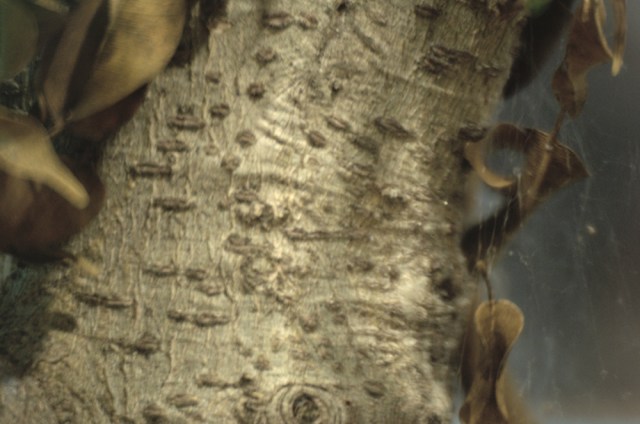
The first is macro-photography of the trunk of my ficus. The minimal focal distance is about 1.5 meters, so at 500mm, it’s hardly the lens to take picture’s of a fly’s eye, but it gets closer than many lenses do. Incredibly short focal depth at that distance, though. (That’s a problem with most macro photography, though.)

20170120_0009

The next is the roof of a shed my neighbor has. It’s been up for a long time, and has accumulated some interesting lichens. (I should note that it was a grey, overcast day.)

20170120_0019

The clouds were looking interesting, so I decided to try some cloud photos. I figured that since they were so far away at the very least I should have a decent depth of field. On the other hand, my not being very skilled at manual focusing didn’t help.

20170120_0052

And finally while I was out shooting, a red-tailed hawk landed on my neighbor’s roof to look for mice in the yards around it. Unfortunately I didn’t get any great photos, but this wasn’t bad:

20170120_0045

I was shooting at 1600 iso to get a 1/400th shutter speed, which is still sub-optimal for a 500mm lens. I suspect that when taking photos of living subjects, I really need a bright sunny day to get enough light to shoot at a fast shutter speed and low ISO (the higher the ISO, the more noise you get). If I get a chance to take pictures on a bright sunny day, I’ll post some of those for comparison. And I suspect that I need to practice at manual focusing, too.

Glory to God in the highest.

God’s Blessings on January 20, 2017

God’s blessings to you on this the twentieth day of January in the year of our Lord’s incarnation 2017.

Yesterday I wrote about some thoughts I had after reading Brian Niemeier’s short story, Izcacus. Brian mentioned my post in a post on his blog, where he clarified something I said:

One item I should point out, since Christopher discloses that he’s not normally a horror reader, is that I did some pretty extensive research before writing the story. One of my goals was clear away the accretions artificially heaped upon vampire mythology since the 19th century and depict vampires closer to how they were understood in the original folklore. What I found wasn’t a clandestine society of suave, neck-biting supermodels. In the old tales, vampirism presents much more like a disease.

This is actually something which Brian had mentioned when I interviewed him, but had slipped my mind in the intervening time, so I really should have remembered it and clarified my thoughts. The relevant section from my post yesterday was this:

This is a very interesting take on vampirism, adding some very interesting technical detail to the mechanism of becoming a vampire. It’s not as blood-centric as vampirism traditionally is… So while it’s an interesting step forward for the mechanics of vampirism, it seems to come somewhat at the expense of some of the (recent) traditional lore of vampirism.

(That is not in itself bad, of course; I gather one staple of horror is re-interpreting older horror stories so as to create fresh lore; essentially producing a sense of realism by treating previous fiction as existing but inaccurate. Horror is not one of the genres I normally seek out, so I’m not very familiar with its conventions—or perhaps I should say its unconventions.

There are two parts to what I said that should be distinguished, the more subtle one I stand by and the less subtle one I stand corrected on. Since corrections are more important than new material, I’ll address the part I stand corrected on first.

It was a simple mistake on my part to talk about Dracula as the beginning of vampire lore. Doubly so because Brian had mentioned in our conversation that he had gone back to earlier vampire mythology. This was partially an error of communication and partially an error of thought on my part. By lore, I meant the world-building done by authors writing for entertainment. I’ve heard the term used that way metaphorically in science-fiction, where it is unambiguous because no one has actually told putatively true stories of the distant future or other planets. I then used it without thinking in a context in which there is a great deal of literal lore. This was just poor use of language on my part, because there was no way for someone unable to read my thoughts to read my words as I meant them. So for that, mea maxima culpa.

This was also an error of thought on my part because my strong interest in the stories of vampires in fiction (that is, relatively modern entertainment) obscured to my thinking about the significance of the vampire lore before the advent of modern fiction. This also was an error, and Brian’s goal of going back to the source and making it fresh again is a legitimate and noble goal. I didn’t mean to imply that it wasn’t, but I may have implied that by omission—I can certainly see how my words can be reasonable read in that way—in which case mea culpa.

I have only a passing familiarity with a little bit of the traditional vampire lore that Brian mentioned, by the way. I don’t mean to imply that I already knew it and I simply forgot to mention it. I was aware that the idea of vampires being able to be seductive is relatively new, possibly originating with Dracula. I was under the (possibly mistaken) impression that vampires were originally closer to sorcerers, that is, men who sold their soul to the devil for power and lost much of their humanity in the process, becoming recluses who may fall into outright cannibalism. I’ve got no sources for any of this, and might well be mistaken in my recollections of what I heard more knowledgeable people say many years ago.

Now, as to the more subtle part which I do stand by, but would like to elaborate on, I want to defend the modern accretions which have been artificially heaped upon vampire mythology. Not as better, mind you, but merely as something with enough meaning in them as to deserve their existence as something separate.

As a small bit of background, the way that greek mythology was presented to me in school as a child was as a unified thing, with particular gods and beliefs and stories about them. That is, it was presented as if there was a canon. I’m not sure if that was intentional or just a by-product of being so familiar with Christianity the people who wrote books for children just naturally presented it in more-or-less that way, which was then filtered through the simplicity of a child unfamiliar with religions without a canon. Anyway, this turned out to be wildly inaccurate. The Greeks had different gods, different conceptions of the same gods, the same stories about different gods, and wildly different stories about the same gods. Probably the best analogy today would be if you were to ask about Spiderman. He’s appeared in at least four different comic books about him (five if you count Spiderman 2099, though that was about Miguel O’Hara, not Peter Parker), countless others where he showed up for an issue or a few issues, at least four animated series that I know of and probably several more, and maybe a dozen movies. His origin story has been retold half a dozen times, and differently. His personality has varied widely with different authors, and it is absolutely impossible to even come close to giving a chronology of his life and actions which are consistent with half of the things he’s been in, let alone all of them. And so it was with the greek myths. The gods had very different personalities when different poets were telling their stories, and again when playwrights were. None of them were official; to a great degree you just pick what you like and stick with that.

And so it is with popular re-interpretations of folklore. Dracula portrayed a vampire as someone only very slightly inhuman, but attractive rather than repulsive. Fast forwarding to Interview with the Vampire—which was an excellent movie I really need to do a review about—you get to what Brian described as neck-biting supermodels. Well, that’s not quite true because I don’t think it’s implied that all vampires become beautiful. They’re seductive, but it’s not the same thing. All vampires becoming beautiful really comes into its own with Twilight, I think. In Interview with the Vampire the vampires are still relegated to the darkness where their seduction is by candlelight. And if I recall properly there were vampires who (by movie standards) were not particularly nice-looking in the vampire theatre. There is the minor detail that the leading roles are played by movie stars, who are beautiful, but in fact I believe that was something Ann Rice objected to in the casting of Tom Cruise. And later repented of, I heard, because he undeniably did an amazing job in the role of Lestat. Anyway, in Interview the vampires are seductive because they are hypnotic; they are not naturally attractive but rather supernaturally attractive. And this seductiveness does work with the idea of damnation, which certainly is a theme in Interview. Satan lures people with empty promises, and so too do the vampires in Interview. It is suggested, though not outright stated, that their seductiveness is only active when they are hunting; that is, it is generated by their intention to kill. It is not the sort of thing which can be used as a superpower precisely because it is only in giving into their bloodlust that they have the power at all.

And this, I should note, is quite representative of something real. We’re all familiar with art that has its power by titillation; and there is no good use of this titillation. It only has its specific power as a misuse of something because the proper use necessarily curtails it. Kind of like how a wine bottle only becomes a weapon if you break it. This is a very good representation of the sort of empty promise with which Satan tempts people. Vampires live forever, but only by killing human beings. Vampires are attractive, but only when they are hunting. You can see the same thing in people who use sex to gain influence; as soon as they stop the sex they lose the influence. Thus as soon as pop stars gain enough wisdom to stop peddling sex, drugs, and rock-and-roll, they lose their platform to distribute this wisdom. Someone else still peddling those things has replaced them on stage.

So these new vampires are very different from the old vampires, though as we see in Twilight, they can easily go bad. By which I mean, revealing nothing about the human condition. (The central conundrum of Twilight is, what if you were irresistibly attracted to someone who could barely control their desire to kill you? Even if it is mildly interesting, it’s not exactly a question with broad applicability. The answer is, move out of town and change your phone number. Sometimes putting yourself out of the reach of temptation is the right answer. When someone can barely control their urge to kill you, that’s one of those times. Relatedly, if you can barely control your urge to kill someone, leave town. Leave the country if you have to. Even if it means having to call in sick to high school more often because there is less cloud coverage.) Still, abusus non tollit usum. There are good vampire stories about modern vampires left to tell.

(N.B. I don’t mean that last point to sound contradictory to Brian, who so far as I know has never claimed otherwise. I mean it more in contrast to the generally sound heuristic that modern things are bad. It’s one of the exceptions, I’m arguing.)

Glory to God in the highest.

God’s Blessings on January 19, 2017

God’s blessings to you on this the nineteenth day of January in the year of our Lord’s incarnation 2017.

I recently read Brian Niemeier’s free short story, Izcacus. It was an interesting read, both while I was reading it and afterwards. It’s a good use of fifteen minutes. Unfortunately short stories lend themselves to short reviews, because (when well written) they’re so tightly written that talking about them gives away too much information. At least I have that problem. Russell Newquist would probably find a way around it, as he’s very good at writing reviews, I’ve noticed.

But I am going to talk about Izcacus, so this is your warning that there will be spoilers. If you don’t like spoilers, stop reading here (until you’ve gone and read the story, at which point please come back).


Or here, that would work too.


Even here, really. But that’s it. The next paragraph will have spoilers in it, so stop reading now if you haven’t read it and don’t want to encounter spoilers.


I should begin by saying that I went in knowing that Izcacus was written as an attempt to bridge the gap between religious vampires and scientific vampires. So I didn’t some at it with perfectly fresh eyes, as it were. That will naturally color my thoughts on the story, but probably it has a bigger impact on my reaction to it than my considered thoughts about it.

The first thing I find interesting about Izcacus is that it uses what my friend Michael referred to as epistolary narration. That is, several characters narrate the story in the form of emails, letters, blog posts, journal entries, and most interestingly letters to a dead brother. It’s by no means an unheard of device, but it’s not overly common, and as Michael reminded me, it is also the narrative device in Dracula, by Bram Stoker. I doubt that coincidence is accidental, though I haven’t asked Brian about it. He uses the device well and avoids its weakness—it can easily become very confusing to have multiple narrators—while taking advantage of its strength. In particular, it allows a lot of character development in few words, since the voice of the character tells you a lot about them. Not merely the words they choose or their commentary, but also what they choose to talk about and what they leave out. Editorial decisions tell you as much about a person as creative decisions, if they tell it to you more subtly.

Second is that one of the problems that every horror author is faced with in the modern world is that horror and modern technology don’t blend well. I don’t mean that they can’t, but a person with a cell phone can—in normal circumstances—call for help so that they won’t feel alone. Of course, that doesn’t always do much. (There was a news story a while back about a russian teenager who called her mother on the phone while a bear was eating her. She died before any help could arrive. More locally, there was a hunter who shot himself with a crossbow and called 911 but was dead before they arrived. If a broadhead cuts a major blood vessel, you can bleed to death in as little as about 45 seconds. I’ve seen a deer pass out in about 20 seconds.) But there is still a big difference in mood between knowing that help is on its way and won’t arrive in time versus not even being able to call for help. By setting the story on a remote mountain without cell service, and further where they had to trespass russian law to even be, this problem was solved very neatly. There are plenty of very remote places in the world and if you haven’t told anyone that you’re going there, no one will ever come looking for you there. (One reason why the Pennsylvania hunter safety course emphasizes telling people where you are going hunting and when you will be back, every single time.) Structurally, I really like this.

The mood is done well about isolation and danger and so on, but in general I’m far more interested in structure than mood—possibly because I have a very powerful and active imagination and can imagine the mood for myself even if it is not described, but my philosophical side rebels against plot holes. Pleasantly, there are no plot holes in Izcacus, which I appreciated. And the structure is very interesting indeed when we come to the central point of the story: vampirism. Izcacus, we find out, means “blood-drinker” in the local dialect, and the mountain climbers eventually find a cave with some old but suspiciously fresh corpses. And here is where Brian marries religious with scientific vampires. Vampirism is a form of demonic possession, but possession requires the cooperation of the possessed. And so the demons have created a virus—which walks the line between living and inanimate—as a means of entering healthy hosts. The virus acts in its natural fashion to weaken the host; by putting them in extremes of pain and weakness, the host becomes more willing to accept the possession which will rid them of the pain. And as the story (or rather, one of its characters) noted, after death the body becomes merely material. This is a very interesting take on vampirism, adding some very interesting technical detail to the mechanism of becoming a vampire. It’s not as blood-centric as vampirism traditionally is, and in fact one weakness of the story is that it isn’t made very clear why the vampires are called blood-drinkers at all. No one is exsanguinated that I can recall, and any wound seems to suffice for entrance of the virus. Granted, one of the characters was bitten on the neck, but another seemed to be infected by a cut on her shoulder. And this is somewhat inherent in the nature of blood-born viruses. If saliva will work for transmission, blood-to-blood contact will as well. (As will semen-to-blood transmission, but fortunately Izcacus is not that sort of story.) So while it’s an interesting step forward for the mechanics of vampirism, it seems to come somewhat at the expense of some of the (recent) traditional lore of vampirism. (Update: Brian clarified what I misunderstood.)

(That is not in itself bad, of course; I gather one staple of horror is re-interpreting older horror stories so as to create fresh lore; essentially producing a sense of realism by treating previous fiction as existing but inaccurate. Horror is not one of the genres I normally seek out, so I’m not very familiar with its conventions—or perhaps I should say its unconventions. And if you want to take that as a semi-punning reference to the undead, I’m powerless to stop you. But if you do, please feel a deep and lasting sense of shame because of it. That’s not really a pun.)

But, what it sacrifices in traditional vampire lore, it makes up for in the reason why anyone is going near the wretched things in the first place. My two favorite vampire stories are Dracula (by Bram Stoker) and Interview with the Vampire (the movie; I’ve never read the book, which a good friend has told me isn’t as good; the screenplay for the movie was written by Ann Rice who wrote the book, so it is plausible that her second try was better than her first). In both cases the vampires can pass as living men and come into human society on their own, though in Dracula he does at first lure Jonathan Harker to his castle in Transylvania by engaging his legal services. But it is really Harker’s legal services which are required, there, he isn’t interested in Harker as food (at least not for himself). In Izcacus the vampires are not nearly so able to pass in human society, so the humans must come to them. This is in line with other stories (most of which I haven’t seen or read) where the humans venture into the vampire’s territory. I think that there the lure is some sort of treasure, whether real or actual, but while greedy protagonists make for relatively pity-free vampire chow, they don’t make for sympathetic protagonists. In Izcacus there are really two motives which drive the characters; a noble motive which drives all but one of them, and a far more sinister motive which drives her. The official reason for this clandestine meeting is to recover the bodies of people who had died trying to summit Izcacus, while the hidden reason is to recover samples of the disease which was the reason the Russians sealed off access to Izcacus in the first place. Thus it is the backers of terrorism who are funding the expedition in the hope of retrieving such a virulent virus to be used as a bio-terrorism weapon (thinking of it only as deadly, and not as diabolical). I find that very satisfying because instead of a pedestrian tale like greed going wrong (who doesn’t know greed will go wrong?), it’s the much more richly symbolic tale of the problem with making deals with the devil. As Chesterton noted, the devil is a gentleman and doesn’t keep his word. The devil may promise power, but has no interest in delivering on it. I’m told there’s a line in one of the tellings of Faust where after selling his soul for knowledge, mephistopheles tells faust he doesn’t have that knowledge to give, whereupon Faust is indignant that he had been lied to. As I understand it, Mephistopheles basically said, “I’m a devil, what did you expect?” It’s one of the reasons why I’m so fond of the short form of the baptismal vows in the Catholic rite of baptism. “Do you reject Satan? And all his works? And all his empty promises?” It’s a terrible idea to expect the devil to keep his promises; it’s more his style to bite the hand he’s shaking.

Glory to God in the highest.

God’s Blessings on January 18, 2017

God’s blessings to you on this the eighteenth day of January in the year of our Lord’s incarnation 2017.

There’s a really interesting question in why it is that we teach children to say “thank you” even when they don’t “mean it,” by which we mean, that it’s something done by choice or habit rather than a spontaneous outpouring of gratitude. When a child says “thank you” without meaning it, it is an acknowledgement of a situation in which something was done for them which they were not owed. They may not recognize this in the moment, but the acknowledgement still exists, and is something which they can contemplate (unconsciously) as time permits. A great deal of childhood is the building up of data to be understood later, even if not consciously recalled later, and taking a physical action (like speaking) to recognize something that has happened makes it far more memorable. This gets to the incarnational nature of human beings; we are body and soul united, not merely joined.

The “cartesian dualism” which predates Descartes by quite a bit—the gnostic divided soul and body, and were not the first to do so either—is an interesting thing. It seems to be very natural to our fallen nature to turn this distinction into a division. In some sense I suppose that this is inevitable because our souls can survive the death of our bodies, so the things are in fact divisible, but fallen humanity seems to want to divide them earlier than necessary. I’ve noticed that in other places, too, where people seem to want to die before they’re dead. A person having an identity is an example of that. You’ll have an identity after you’re dead. Right now, you’re a work in progress and might end up being anything. I wonder if this isn’t a fear of making choices. Making choices means that we can make bad choices, and the reality of that can be scary. It might also be related to how many people like to make the world comprehensible by reductionism. People, as origins of causality, make the world horribly complicated. Far too complicated for our finite minds to comprehend. It might be something else too; it’s an interesting question to contemplate, anyway. (Usually things don’t have single causes but are caused by multiple threads intertwining; this is especially true when multiple people do the same thing, with different threads having different amounts of influence in each person.)

In other news, I finally put up my interview with professional science fiction and horror author Brian Niemeier:

We talk about writing, fiction, theology, and more. It’s almost three hours long, but I found it very interesting when I was in it, and when I listened to it afterwards during editing. 🙂

Glory to God in the highest.

God’s Blessings on January 17, 2017

God’s blessing to you on this the seventeenth day of January in the year of our Lord’s incarnation 2017.

I’m thinking about doing a video about the topic of the burden of proof. This is something of a pet peeve for my friend Eve Keneinan, who has a hilarious post on The Burden of Proof Fairy and the You Have To Believe Everything Monster. The topic under consideration is usually phrased, “the person making the claim has the burden of proof”. Which, as Eve rightly points out, is a claim, so she immediately invites the claimant to abide by their own principle and shoulder the burden of proof for that claim. For some reason she attracts a lot of stupid atheists on twitter so the results can be funny. The best are the people who add “this is not a claim” to the end of their claims, as if they’re children saying, “no tag-backs” in a game of tag.

I’m not sure what direction I want to go in my video. I’m thinking of starting out talking about the burden of proof in law, which is where one man (the prosecution) claims the right to punish another man (the defendant). The prosecution must meet some threshold of evidence for his claim to be granted, while the defense may try to poke holes in the prosecution’s attempt to demonstrate this. The thing is, the threshold for what evidence the prosecution must bring varies widely. In some places merely alleging the guilt of the defendant is meeting it, and the defendant must work very hard to show that the prosecution is in error. In other places, at least in theory, the prosecution must work hard to show that he’s correct beyond a reasonable doubt, while the defense does not need to prove the prosecution mistaken, only to cast doubt that the prosecution is correct. Whoever has the harder job is said to have the burden of proof, though in truth the prosecution always must meet some threshold in order to prosecute, and a defense which merely rested without saying anything will virtually never win.

Now, ordinarily no fool ever thought that courts of law provided epistemological certainty. I think many people—possibly not just fools—thought courts generally reliable. But no one ever thought the courts infallible. I’m not sure who ever thought to try to make this practical principle an epistemological one, but certainly one meets people who try to establish it as such.  (Epistemology is the study of knowledge.) Of course, no one consistently applies this as an epistemological principle. I’ve yet to hear of the man who replied to, “Hi, my name is Brian” with “Prove it.” Or, “It’s a nice day, isn’t it?” with “Where’s your evidence that it’s a nice day?” No, in general the burden-of-proofers will just look up, investigate the natural world for themselves, come to their own conclusion, and then share it. That is, they’ll say, “yes it is” or possibly, “for now, but it looks like it’s going to rain”.

Of course what’s going on is that this isn’t a principle at all, it’s more of a heuristic. When it isn’t just an excuse to get out of thinking, that is. I wrote about that in We Are All Beasts of Burden. And that is really my main critique of the concept of the burden of proof as it is commonly used. It’s an attempt to avoid thinking while retaining the respect accorded to one who thinks. That’s almost a theme of the modern world. What is divorce but the attempt to retain the respectability of marriage while breaking the vows of marriage? As Chesterton said, our world is one wild divorce court, divorcing all things from each other but pretending not to.

And it’s that last part that I think is so especially troubling. A society which is pretending it is doing something other than it is doing is very far from recovery. On the other hand this is just restating the truism that the first step in solving your problem is admitting that you have a problem.

In any event, it is amusing to ask somebody who states the burden of proof is on the person making the claim if they have any evidence that they’re not a moron. In my experience the will stutter and be outraged that you would transgress the social norm of assuming that they’re not. It’s always amusing when people are angry with you for following their principles.

Glory to God in the highest.

God’s Blessings on January 16, 2017

God’s blessing to you on this the sixteenth day of January in the year of our Lord’s incarnation 2017.

So a twitter atheist I was talking to for weeks went silent. To sum up the backstory, he discovered me because of my alinguism tweets, and then we tangled when I pointed out that “morality is subjective” just means “there is no such thing as morality” (when it isn’t just a clumsy way of saying that it depends on the circumstances; e.g. plunging a sharp piece of metal into someone is right or wrong depending on whether you’re a surgeon cutting out a cancer or a street-tough murdering someone for his shoes). Then he started asking me questions, and said that he wanted to understand what I thought. Later on, he suggested a very stupid interpretation of the story of Abraham and Isaac where he was trying to show that God had to know the choices men would make without men ever making those choices. His eventual goal was to show how God shouldn’t have created people who would end up in hell because he would know before they rejected salvation that they would. Except that “before” in this case means “logically prior”, since I had explained that God is not inside of time, and so what he was trying to claim was that God should have known what choices people would have made had they existed and made choices. That is, he’s the latest person in a long line of people who deny the existence of free will and consequently the reality of human life. (Though he generally denied it when it was put that bluntly.) And when I pointed out that his interpretation of the (almost) sacrifice of Isaac is very stupid, he criticized me by saying that calling it stupid doesn’t help prove my claims about God. (I did also point out that under his interpretation, it should be described as “the pretend test of Abraham”, since according to him the test ended before anything was actually proved anyway, and therefore the entire thing just makes no sense; why go part-way through a charade which doesn’t prove anything to anyone? As saint Augustine advised to some monks who were questioning free will, interpretations of scripture which make scripture very stupid are bad interpretations.)

Anyway, I re-iterated that I wasn’t trying to prove anything to him. He wanted to know what I thought, so I told him. And that his interpretation of the test of Abraham was stupid was one of the things I thought. I haven’t heard from him since. Perhaps I will again, we’ve had several day lulls before. But in any event it comes back to something I’ve noticed with twitter and youtube atheists. They really, really want their interactions with Christians to be Christopher Hitchens style debates. Or perhaps even more, they really, really want a Christian to be trying to convince them that God exists so they can criticize the attempt. Now, I appreciate artistic heckling as much as the next guy. Probably more, considering how many boxed sets of Mystery Science Theater 3000 I own. But like most things it’s best done honestly. Honestly both in terms of being open about what you’re doing, and honestly in terms of giving credit where credit is due and not merely refusing to be pleased at everything. There’s a great line in The Importance of Being Earnest where John Worthing was asked if he could deny that his name was John. He replied, “I could deny it, if I liked. I could deny anything, if I liked. But I won’t. It certainly is John and has always been John.” I wonder if there were people who were surprised by Oscar Wilde’s deathbed conversion to Catholicism. Presumably not. After all, he gave one of the highest praises I’ve ever heard of the catholic church:

The Catholic church is for saints and sinners alone. For respectable people, the Anglican church will do.

Glory to God in the highest.

God’s Blessings on January 15, 2017

God’s blessing to you on this the fifteenth day of January in the year of our Lord’s incarnation 2017.

John C. Wright posted recently about the villains in Ayn Rand’s novels, giving them more praise than I’ve generally seen, but for a somewhat plausible reason. And in fairness I’ve seen an interesting argument that Ayn Rand is a sci-fi author. Certainly her plot seems to involve technologies far beyond what we have at present. At the very least rearden metal is closer to Star Trek’s duranium than it is to anything we have at present.

Anyway, I do have to concur that my favorite villains are true villains, who have made bad decisions, and not merely misunderstood good guys. This takes skill to write, since reasonably successful people who have made bad decisions tend to generally make good decisions and to have their bad decisions somewhat constrained in scope. That is to say, realistic characters aren’t easy to write. Big surprise.

I think that the most successful of these was Shakespeare’s Iago, the main villain from Othello. Iago is a soldier under Othello’s command, and has taken a hatred to Othello for promoting someone else over him. So he is out to ruin the other fellow and Othello, and has chosen to do this by convincing Othello that his wife is cheating on him with the fellow he promoted. But the real cunning of the plan is that he gets Othello to force him to plant this idea in his head. Having given Othello the idea that he (Iago) has some suspicion, he then becomes coy and refuses to divulge it, and Othello is asking for it. Then Iago says:

Good my lord, pardon me,
Though I am bound to every act of duty
I am not bound to that all slaves are free to.
Utter my thoughts? Why, say they are vile and false,
As where’s that palace whereinto foul things
Sometimes intrude not? Who has that breast so pure
Wherein uncleanly apprehensions
Keep leets and law-days and in sessions sit
With meditations lawful?
I don’t know that it can get better than the line, “I am not bound to that all slaves are free to.” And then when Othello pushes Iago further, Iago says:
I do beseech you,
Though I perchance am vicious in my guess,
As, I confess, it is my nature’s plague
To spy into abuses, and oft my jealousy
Shapes faults that are not, that your wisdom,
From one that so imperfectly conceits,
Would take no notice, nor build yourself a trouble
Out of his scattering and unsure observance.
It were not for your quiet nor your good,
Nor for my manhood, honesty, and wisdom
To let you know my thoughts.
And when Othello asks why, Iago explains:
Good name in man and woman, dear my lord,
Is the immediate jewel of their souls.
Who steals my purse steals trash. ‘Tis something, nothing:
‘Twas mine, ’tis his, and has been slave to thousands.
But he that filches from me my good name
Robs me of that which not enriches him
And makes me poor indeed.
And with more prodding, Iago cautions Othello:
Oh, beware, my lord, of jealousy!
It is the green-eyed monster which doth mock
The meat it feeds on. That cuckold lives in bliss
Who, certain of his fate, loves not his wronger,
But, oh, what damnèd minutes tells he o’er
Who dotes, yet doubts— suspects, yet soundly loves!
Poor and content is rich, and rich enough,
But riches fineless is as poor as winter
To him that ever fears he shall be poor.
Good heaven, the souls of all my tribe defend
From jealousy!
And the thing is, this is excellent analysis and sound advice. Here and elsewhere Iago explains with exacting precision exactly why what he’s doing is wrong. He even explains clearly that he’s not benefiting in any way. “he that filches from me my good name robs me of that which not enriches him and makes be poor indeed” is an exact description of what Iago is doing. And what makes this play so great is that Iago is a very believable villain.
This is, in a sense, the counterpoint to my contention that a protagonist does not need flaws to be interesting because it is the virtues and not the flaws which are the interesting thing in a character. This is also where the interest comes even in a villain, but the villain does need to be flawed in order to be a villain. I was going to say it’s strange that the modern world has just about reversed this, with heroes that are misunderstood bad guys and villains who are misunderstood good guys. But with a nod to Captain Renault, well… maybe not so strange.
Glory to God in the highest.

God’s Blessings on January 9, 2017

God’s blessings to you on this the fourteenth day of January in the year of our Lord’s incarnation 2017.

I managed to get to the monthly meeting of my local Chesterton society. It’s a chapter of the American Chesterton Society, and if you’re at all interested in G. K. Chesterton’s writings and would enjoy talking about them with other people who do as well, I suggest checking the website to see if there’s a chapter near you.

In other news, I recently was reminded of the concept of “custody of the eyes”.  Throwing that phrase into google I get about 8.5 million results, so there’s plenty of reading material on it, virtually all of which I haven’t read. But the basic idea is to look at one chooses to look at, rather than merely letting one’s eyes wander. Properly speaking it’s a form of Christian asceticism, but it must be remembered that the point of Christian asceticism—unlike most other forms—is not to conquer the body but to rightly order it. One of the more pressing problems addressed by custody of the eyes is that the body naturally reacts to the sight of attractive people by getting excited. In itself this is natural and not a problem, but since we are fallen creatures who do not rightly order ourselves with our reason in charge of our passions, allowing this to happen can lead us into trouble because though the initial reaction is natural, what follows (in this case, lust) is not natural. What should have happened is that the intellect notices the excitement and merely takes it in as information and does nothing else with it (where sexual excitement is inappropriate, of course; a husband and wife in their bedroom may properly cooperate with this excitement and encourage it).

There are two big points to note. The first is that the degree to which one should guard against this sort of reaction is of course commensurate with the degree to which one is liable to fall into error. Those who are very excitable must be very careful; those less so need not be as careful. For example, most doctors have no trouble examining the bodies of people of the opposite sex, so there’s no call for them to avert their eyes while doing so, and obvious reasons that they should look at their patients. As a counterpoint, of course, it’s easy to suppose one is less tempted than one is, but the chief point here is realism, not blind adherence to general rule. (Realism in fallen creatures must always include caution, of course.) But it is important to note that since we cannot know to what degree our fellow creatures are tempted by what they see, we are in no position to judge whether they are being careless or properly cautious. And advice which assumes that people will always err in one direction and so the advice itself errs in the other direction must always be taken with a grain of salt. Practical advice should never be confused with theoretical truths.

The other big point to note is that lust is only one vice to which we can be tempted by looking at things which we have no good reason to look at. To dwell upon someone’s fatness or ugliness is a temptation to judgement and pride. Even looking too long at one pretty thing may make us ignore all of the other beauty around us; we can get so enamored of paintings that we forget to enjoy trees.

Now, of course all of this is supposed to be in service of becoming perfect. Of always doing the right thing, at the right time, in the right way, for the right reasons. And if we do that, we shall be immensely happy, because one of the primary purposes for which God made us was to enjoy his goodness. In our disordered state we are far too prone to enjoy some small thing instead of enjoying better things, so we should be on our guard against getting caught in these small traps. But if we do nothing but worry about avoiding traps, we’ve only traded one form of focusing on creation to the exclusion of God for another. The Catholic Church has tended to be legalistic (in practice, rather than in theory) because the people in its care want it to be legalistic; rules are much easier to follow for many people than a wholesale dedication of one’s every thought to God and to his creation in light of Him. Because legalism is basically a series of sign posts warning you that you’re off the trail; when regarded properly legalism is entirely compatible with being a saint; a saint will follow all the laws without thinking of them as laws because he sees the reason for their existence. And many people have trouble seeing that connection, but can see the sign posts and so go right by avoiding the sign posts saying that they’re off the trail they have trouble seeing. As long as one never forgets that the sign posts are an aid to walking the trail, and are not the trail itself, all will be well. Alas, it’s a thing too often forgotten and all too often not even taught to children because it’s harder, and children are exhausting.

And of course as with all attempts to be perfect, it’s important to remember that we do not achieve perfection through our own efforts, but by God’s grace, so however often we fail, God has more than enough grace to make up for our deficiencies. All we have to do is the best that we possibly can; God will make up the difference between that and what’s needed. And when we fail, it is well to remember that actions can fail but a man cannot be a failure so long as he’s alive because he’s not finished yet. It is utterly pointless to attempt to judge a work in progress. If it’s a bad idea to judge a book by its cover, it’s a worse idea to judge a book only by its front cover because there’s no back cover yet.

Glory to God in the highest.

God’s Blessings on January 13, 2017

God’s blessings on this the thirteenth day of January in the year of our Lord’s incarnation 2017.

I apologize for not posting yesterday. I don’t mean to let that become a habit.

So I discovered that the method I had been using to record video of me talking for my youtube channel fails after a few minutes. It’s actually an nondeterministic amount of time, but the problem is that if the camera skips any frames, guvcview doesn’t know about it and so the video and the audio go out of sync. I’m pretty sure that the video I have where this happened is just lost, because it’s not a gradual problem which can be cured by speeding up the audio; it’s that just something the time between the two permanently changes. On the plus side, I can always record it again.

But not with guvcview. And cheese is out too. (I use ubuntu, and these are all Linux software.) A friend recommended using ffmpeg, which is a command line utility. I’ve been a linux user for about 20 years now, so that’s not scary, but it does mean a ton of command line options to get ffmpeg to do what I want (because it’s an incredibly flexible piece of software). On the plus side, I’ve downloaded the source and compiled it, so I’ve got it working with nvenc which lets it do video encoding on my video card. So after a bunch of playing around, I got it to work. If anyone got to this blog post because they’re searching for a decent way to reliably capture a webcam in Linux, this is the command line I ended up using:

ffmpeg -f v4l2 -input_format mjpeg -video_size 1280×720 -framerate 30 -i /dev/video0 \
-f pulse -sample_rate 48000 -channels 1 -i default \
-c:v h264_nvenc -preset slow -profile:v high -rc vbr -cq 18 \
-c:a flac \
-copytb 1 \
$OUTPUT

I put it in a shell script (so I wouldn’t have to type that out all the time), so $OUTPUT is the name of the file to store the video in (whatever.mkv). This is for capturing video from my Logitech C920 and audio from whatever I’ve configured as the input source in pulse audio (which is to say, in the default sound configuration utility). Normally I use a shotgun mic, but of course one can also use the microphone built into the webcam. Using mjpeg (motion jpeg) from the webcam seems to produce higher quality output then getting h264 from it, and since I’m recompressing it anyway, I might as well use mjpeg as the source. Btw, you’ll need to use the apeture priority mode for the automatic exposure control in order to achieve 30 frames per second, otherwise there’s a good chance the camera won’t have enough light to achieve that framerate and it will go to a lower framerate, which looks awful.

Video is a surprisingly tricky thing. Video codecs are kind of amazing, when you get down to it. Using inter-frame compression, they’re able achieve huge levels of compression. But the tradeoff is that they’re very complex things, and complexity and reliability are usually enemies. And so it is with video standards; they are very complex things, which enables them to be implemented widely in both expensive and inexpensive devices, but the downside is that implementations vary and not all implementations work with each other. And what I’m finding is a common thing: it’s often best to go with the most popular solution because it will be best debugged. That’s not strictly true, though, because I still use guvcview to manipulate the camera’s settings. For example, I’ve turned off automatic focus because I stay in one place and this way the camera doesn’t try to re-focus if I lift my hands up.

Anyway, I’m also considering investing in a decent camcorder, like this. The solution I have works, but a camcorder produces much better video because it has a much larger lens and sensor. That means far less noise in the pixels. And it’s got thoroughly tested software on board to make sure that it never drops frames and that the audio and video are perfectly synced up. It also has a zoom mode which means I could set the camera up further away from me, which would make my face look more normal. Cameras close to their subjects distort faces because they exaggerate roundness. That’s why portrait artists often use 100mm lenses from 10-12 feet away. (100mm is about a 2x magnification, if you’re comparing it to binocular magnification.) It makes the face look more natural to have some distance between you and the face. The magnification is irrelevant except to get quality because in portraiture you want the face, not the background. It’s all about the change in angle between the surface and the camera sensor; the further away one is, the smaller the change in angularity.

But, while that’s not very expensive, it’s not cheap either, so I’m going to see if I can get decent results using my current setup, at least for a while.

Glory to God in the highest.

God’s Blessings on January 11, 2017

God’s blessing to you on this the eleventh day of January in the year of our Lord’s incarnation 2017.

Yesterday I put up a quick video I did about Occam’s Razor:

So far it got 105 views in the less than 24 hours it’s been up compared to 85 views for my quick review of Groucho Marx’s autobiography which has been up for almost four days.

This is something of a testament to the effect of making videos on subjects which people are interested in. I’ve heard that described by some popular youtubers as the viewers won’t let you make videos off of your main subject, which seems unfair to me. People have limited time and watch what they find interesting. I’m certainly no exception to that and I doubt that more popular youtubers are either. Not everyone finds everything interesting, and while certainly some people grow to trust a youtuber and watch whatever they make because that trust has been rewarded in the past, most subscribers subscribe because they like something that a youtuber does and want to see if he does more of that. Which strikes me as entirely reasonable.

But it also brings up the interesting and complicated question which Russell Newquist and I talked about as the chief one of the age in which distribution is nearly free: discoverability. If a youtuber makes videos about swords—a fairly popular subject—and one of his videos gets widely shared, that will result in him getting discovered by a fairly large number of people. This has compound effects because youtube makes recommendations for watching videos on the basis of how many people have watched a video before, so more watched videos tend to get more recommendations, and hence even more views. Good for server caching for fast playback, bad for unknown youtubers. Be that as it may, it does mean that a great deal of discovery for youtubers tends to be relatively narrow. It also poses a big problem for people just starting out: with no views on your videos, youtube (effectively) won’t recommend them, including ranking in search results.

What eventually got my videos views and hence my channel subscribers was when I met some people on Twitter with similar interests and more twitter followers, and who told their followers about my videos. Technically this can be called promotion, but it’s actually far more organic than that. I made friends based on shared interests, then made something which I thought my friends would find interesting and so I showed it to them, and because of the shared interests they told their twitter followers about it. That got me enough views to start getting youtube recommendations, and my channel has been growing since. As of this writing it has 217 subscribers, which is up by 54 subscribers over the last 30 days. (In the last few months I also did a few hangouts with other youtubers, which helped to gain me subscribers because there was enough overlap in what we did that some of their viewers checked it out and found my stuff interesting too.)

So this does illustrate the importance of sticking with things; every video, or every blog post, or every novel, or every whatever is a lottery ticket, and most win at least very small; but small adds up over time and a few big ones can really be significant since viewers and readers (etc) tend to stay. It also illustrates the benefit of making friends. And contrary to sleazy salesmen depicted in movies, the best thing about this is that friends helping each other is mostly in mutual interest. At least these days in the age of cheap distribution. Back when having a book printed required an investment of thousands of dollars in a book run then access to a distribution network that was very expensive to maintain, it was possible for someone to do you a big favor where they gave you a lot and didn’t get much in return commensurate with what they gave you. But for someone on twitter, telling their followers about something their followers will probably find interesting reinforces why the followers are following. After all, they’re following in order to come across interesting things. And there’s no point in them promoting something which their followers won’t find interesting, because their followers won’t click through and won’t stick around if they do; the result being that everyone’s interests line up.This sort of promotion is not asking for something like a free commercial from a TV network, it’s much closer to telling a friend about a book they’ll enjoy reading. Only you happen to be the author.

This requires honesty, of course, but the good news is that the incentives are lined up such that it only requires ordinary amounts of honesty and not heroic honesty. Compulsive liars will have problems, but by and large ordinary people with ordinary amounts of honesty and patience will only tell their friends about things their friends are likely to find interesting, and their friends are only likely to tell their followers/readers/whatever about things they will find interesting, and things will work out to everyone’s benefit. The only downside is that this requires time, but that’s not all that big a downside, when you think about it, because the alternative where stardom can happen in an instant is that it doesn’t last. Today’s hot model is replaced by next year’s hot model and forgotten about. And to some degree that works whether you’re talking about cars or people.

Glory to God in the highest.

God’s Blessing on January 10, 2017

God’s blessing to you on this the tenth day of January in the year of our Lord’s incarnation 2017.

I apologize for not posting anything yesterday. A subject hadn’t recommended itself to me in the morning and then things got very hectic. On the plus side—at least if you watch my youtube channel—I interviewed Brian Niemeier last night. I hope to have it edited and published in the next few days. It was a very interesting conversation covering a variety of topics, but generally linked to writing. (Brian is a professional writer of fiction.)

In other news, The Daytime Renegade wrote an interesting blog post about what he calls people dressed in grey. That is, the sort of mandarin class America has saddled itself with where almost twenty years of schooling has taught the managerial class to be masters at conformity, if at little else. It’s an interesting take on a societal problem which I recommend reading, but there’s one part I wanted to comment on. He talks about how the sort of bad manager most of us have gotten used to are—however imperfect—at least familiar, and therefore after a fashion comfortable, and when given the opportunity for change most of us end up preferring the devil we know. Not being willing to go quietly into that good night, he says:

Maybe we should support those who want to shake things up, or at the very least think about said changes, before reflexively dismissing them. If we say we really want change and resent these non-entities, maybe we should act like it.

In the limited sense in which he means it, I believe he’s right. But in another sense, I’m not so sure. Americans all (or almost all) grow up with what I can only call a sense of potential greatness.  I don’t mean that there’s something special about us as Americans, but rather that we all have the sense that greatness is something actually achievable if only we work hard enough. That should be tempered with the caveat, “and if God smiles on our endeavors,” but, well, there’s a reason why we’re a nation in decline. Anyway, this is something at the back of why Americans do most of the things we do—whether we’re motivated by it or shamed by it and compensating, we have the sense that everyone should be aiming high.

And this sort of makes sense in a nation of immigrants because a nation of immigrants is self-selected from the general pool of humanity to be the especially ambitious ones. But something which befalls all self-selected societies is that however uniform the personalities of the people who self-selected into a group of like-minded individuals, their children will be representative of the variety of humanity. This is why the only narrow societies which last are those that are made up of people who have forsworn having children and live within a larger society where they can recruit similarly unusual people to join their ranks. Basically, monastics. (The shakers made a go of living in what can be thought of as co-ed monasteries, but for the most part men and women find that if they’re not going to be having children, the opposite sex is far more trouble than it’s worth. If you are going to be having trouble, then of course the opposite sex is indispensable not just for the engendering of children but the raising of them into healthy adults. It’s all a matter of figuring out which cross is yours to carry and carrying it rather than someone else’s. Like Simon of Cyrene, sometimes you must carry someone else’s cross for a bit, but that’s a temporary thing, and temporary things work very differently than life-long ones.)

So while we were a nation of immigrants and frontiersmen, this idea of greatness was a fairly viable one, even if it was typically more theory than practice. Though considering it more theory than practice may under-estimate the difficulty of raising a family where the children are better-off than their parents; in any event it is not the norm for children to be better off than their parents; in a sense it’s even somewhat unnatural. The nature of begetting is to make something like yourself; and in this sense it is most natural for children to be neither better nor worse off than their parents, but like their parents. However that goes, it is not statistically normal for children to be better off than their parents, except in the sense of having a universally rising standard of living by dint of technological improvement.

And here’s where we come to the Daytime Renegade’s point: if we can’t make things much better, it is often a better bet to try to keep them the same. It’s all too easy to slip up and make things worse; and so I think that many people would prefer the bosses dressed in grey because they seem a good bet for stability. It may well be that those of us who want to pursue the dreams of greatness that being an American makes unavoidable (the dreams, not the pursuing) is for us to form small enclaves within society from which we recruit other like-minded people. It’s a good argument in favor of small companies because exceptions must always be small.

As a sort of post-script, I should add that I don’t mean that the bosses dressed in grey in fact are our best bet for stability. As Chesterton said:

We have remarked that one reason offered for being a progressive is that things naturally tend to grow better. But the only real reason for being a progressive is that things naturally tend to grow worse. The corruption in things is not only the best argument for being progressive; it is also the only argument against being conservative. The conservative theory would really be quite sweeping and unanswerable if it were not for this one fact. But all conservatism is based upon the idea that if you leave things alone you leave them as they are. But you do not. If you leave a thing alone you leave it to a torrent of change. If you leave a white post alone it will soon be a black post. If you particularly want it to be white you must be always painting it again; that is, you must be always having a revolution. Briefly, if you want the old white post you must have a new white post.

Glory to God in the highest.

God’s Blessings on January 8th, 2017

God’s blessings to you on this the eighth day of January in the year of our Lord’s incarnation 2017.

I was talking on twitter with someone recently who apparently hadn’t encountered the idea of aeviternity. It’s a scholastic term (scholasticism being most closely associated with Saint Thomas Aquinas) which denotes a created eternity. And eternity refers to, not an infinite amount of time, but timelessness. We live in linear time, that is, we exist in a succession of moments , one after another, which have no access to each other except that each is causally related to the moment directly following. Thus our existence is spread over a collection of moments we have no access to; we are not so much beings as becomings. We are continually coming into being, but at the same time, departing from it; what we are is, at any given moment, a razor-thin slice. Though our memory we remember the past, that is, we re-member it, but this is only calling it to mind and does not make it any more real, but it does enable us to forget how our being is scattered over myriad moments we have no control of.

By contrast, eternity is an eternal present, where there is neither coming into being nor fading out of being, but the fullness of being. You can spell it with a capital B, i.e. Being, if you like; but it’s what our memory integrating our past moments merely hints at. Since eternity is not a succession of moments, it does not interact with us as if it were a succession of moments, but rather it interacts with all of our moments simultaneously—from eternity’s perspective. Of course from our perspective, which consists of nothing but moments, eternity interacts with us moment by moment. But it has this advantage over us: since our future is equally present to eternity as our now is and our past is, eternity can foretell our future (where our future is not disturbed by this revelation).

A common analogy for this interaction of eternity with time is an author writing a book. It’s far from perfect because human authors exist in linear time, but they at least exist in a different linear time from the sequence of events which takes place in the book they’re writing. Thus they can put foreshadowing or even prophecy of events to come into the earlier parts of books because they’ve already read the later parts of the book. This is also not a great analogy because characters in a book don’t really have free will—though, I will say, having written several novels by now, it can really feel like they have free will to the author. I’ve had characters decide to do things that I never meant for them to do, and even a few times didn’t want them to do. I don’t mean that this feeling proves that they have free will—I don’t think that they do. I’m just noting it in case I’m somehow wrong, and they in fact do. 🙂

When I had explained this, my interlocutor brought up a curious objection I hadn’t heard before:

[The idea of aeviternity] negates the punishment of Satan somewhat. He is in hell forever, but also enjoying his actions as a sinner forever as well.

Of course my first thought is, “who cares?” I mean, given that separation from God is the worst possible thing, if there were some minor consolation, well, why would one begrudge that to Satan? Doesn’t vindictiveness miss the point? But then a moment’s actual consideration shows that to be anthropomorphising Satan. In particular, thinking of him as being in time. It is invoking the separation between sin and action which is possible to creatures in time but not creatures out of time. Because for those of us in time, sin is said to be pleasurable not in itself, but because of its effects. The pleasurable effects are, themselves, good. The pleasure “of sin” is thus derived from natural goods which were used incorrectly.

This will be easiest to explain by example. Take adultery. When a man cheats on his wife and has sex with another woman, this is both sinful and pleasurable. But it is the cheating which is sinful and the sex which is pleasurable. The sex is, in itself, good, and so in the moment when the sex is happening it is this good which is enjoyed. Sex, whether in wedlock or not, is cooperating with God in the creation of new people, and our bodies know this. Or rather they presume it, because of course we can use contraceptives and lie to our bodies, etc. (Sex during infertile periods is still ordered towards procreation, even if it doesn’t achieve it, and thus is still taking part in the goodness from which the pleasure is naturally derived.) The main problem with this procreation is that the man is in no position to be a good father to any children which he engenders, and further that if he does engender children he will cease to be a good father to the children he has made with his wife—if he ever was a good father to them. There are other damages which it causes, though most of them are dependent on this (whether the people so injured understand it as such or not). The sin consists in the damage caused (or very technically, in the good not participated in), and since no one can take pleasure in harming his children, it is clear, I think, that the pleasure of this sin is not in the sin, but in the goodness which is obtained sinfully. This is possible only because the good obtained and the damage caused are separated by time; even in more direct cases the good obtained and the knowledge of the damage caused are separated by time such that it is possible to enjoy the goodness before receiving the knowledge of the evil caused by taking the good incorrectly.

This is not possible for an aeviternal being; there can be no separation between a good participated in and the damage caused by it such that there is space between them to enable the enjoyment of that good. Aeviternal creatures can sin by looking for good in the wrong place, but unlike temporal sinners they can’t be temporarily mistaken about whether they’ve found it. Satan may sin, but he can’t be sinning by obtaining illicit pleasure. He must be doing it for some other reason than that.

And while concupiscence (basically, inordinate desire) may be why many human beings sin, it cannot be why angels sin. For anyone who is confused at this point how an angel can sin, then, it might help to remember that there are other deadly sins besides lust, greed, and gluttony.

Glory to God in the highest.

God’s Blessings on January 7, 2016

God’s blessings to you on this the seventh day of January in the year of our Lord’s incarnation, 2017.

The world of photography is an interesting one. I’m very much an amateur, but owing to my mother’s much greater interest and budget for pursuing her passion, together with the progress in DSLRs (Digital Single-Lens Reflex cameras) I have a hand-me-down Nikon D300S. It’s an 8 year old camera which has been superseded by a subsequent model, but it was a great camera when it came out and it still takes better pictures that I’m capable of taking. Also, it takes the same lenses that all other Nikons do, and as a very rough rule-of-thumb, the lens is more important than the camera body. Some day I’ll probably invest in a newer body, but especially given the amount of time I have to devote to photography, it will undoubtedly be years before I’ve developed my skill to the point where the camera body is holding me back.

As a Christmas present, I was given a 500mm mirror lens. Whereas normal lenses focus light be refraction inside of glass, mirror lenses work like telescopes and focus light by reflection off of the surface of a pair of concave and convex mirrors. (The larger, concave mirror concentrates light onto the smaller, convex mirror, which then straightens it out and directs it at the camera’s sensor.) Oh, and a 500mm lens is a zoom lens roughly equivalent to 10x magnification from like a telescope or binocular. The curious thing about mirror lenses is that they are wildly cheaper than glass lenses. The cheapest glass-based 500mm lens that Nikon makes is over 12x more expensive than the lens I was given, and why this is the case is, I think, quite interesting.

Refracting light through glass has the problem that different wavelengths of light refract different amounts. This varies with the material, but the problem is that, to oversimplify, red, green, and blue light will actually have different focal points, which results in what is called “chromatic aberration”, or to be less technical, weird, slightly blurry colors. So to combat this, telephoto glass lenses have to be made out of very carefully engineered glasses. I use the plural, because in order to correct the light, telephoto lenses will actually have somewhere between 7 and 14 “elements” (i.e. a telephoto lens is really a system of a bunch of lenses), many of them made of different materials to correct imperfections in what the previous lenses did. As you can imagine, this is expensive, both because of the careful engineering, the precision of assembling that many lenses together, and just making and grinding that many pieces of optically clear glass.  It’s sort of a miracle that lenses are as cheap as they are. And the good ones run into the tens of thousands of dollars!

In comparison, reflection works the same for all wavelengths of light, so a mirror lens can be made of just two mirrors as I described above. And mirrors are cheaper to make than polished optically clear glass with no internal distortions. So when you put it all together, mirror lenses are wildly cheaper than glass lenses. (Incidentally, you can also probably see why “mirror lens” is a contradiction in terms, and why the technical term for them is catadioptric  optical systems.)

At this point you’re probably wondering why, if mirror lenses are so much cheaper to make at the same quality, they aren’t the standard. To some degree I wonder the same thing, but possibly one of the bigger reasons is that people generally don’t like the bokeh of a mirror lens. (Bokeh is basically how the things which are out of focus blur; glass lenses blur things into circles, which mirror lenses blur them into donuts.) There are shots where bokeh isn’t relevant, but it’s relevant in an awful lot of photography, hence the dominance of glass lenses. There’s also the fact that glass lenses come with auto-focus, and diaphragms to change the amount of light allowed onto the sensor (narrower openings give you greater depth-of-field, but require slower shutter speeds, while bigger openings give you a narrower depth of field; which is better depends on what sort of shot you’re going for). I’m not sure that’s inherent to glass lenses, though; I suspect that mirror lenses have basically found the niche of cheap, and as long as they’re going for that, they’ll sell best if they’re very cheap. At 12x cheaper than a glass lens, a 500mm mirror lens makes sense to play around with; if it was only half the cost of a glass lens, I suspect most people would just pay the extra money for the glass lens. Which brings up, once again, the curious topic that all sorts of things are technologically possible and would even make a lot of sense but aren’t done simply because there’s no market for them. Anyway, as I figure out how to get good results from my mirror lens, I’ll post some pictures on the blog.

(At 500mm, even slight shake in the camera makes the images blurry, so a tripod and a shutter-release remote are necessities, but it turns out that the camera shake caused by mirror-slap is a problem too. If you don’t know, an SLR uses a mirror in front of the sensor to allow you to look through the lens in the viewfinder. This mirror must get out of the way during photographs, and so it does, but you can’t move mass around quickly without it applying force to the body of the camera, and the sensor is mounted to the body of the camera, so it shakes. Normally this doesn’t matter, but for telephoto shots, and especially since a mirror lens is very light and thus doesn’t have enough mass to damp down the vibration, this is a real problem. Fortunately, there’s a mode my camera has where you can press the shutter button once to move the SLR mirror out of the way, and a second time to actually take the shot. Unfortunately, there’s nothing you can do about the shake from the shutter moving, at least unless you have a really top-of-the-line DSLR. Come to think of it, this is another reason to prefer glass telephoto lenses. The fact that they weight anywhere from 5-15 pounds (for the really huge ones) damps vibrations, which will give a clearer shot.)

Glory to God in the highest.