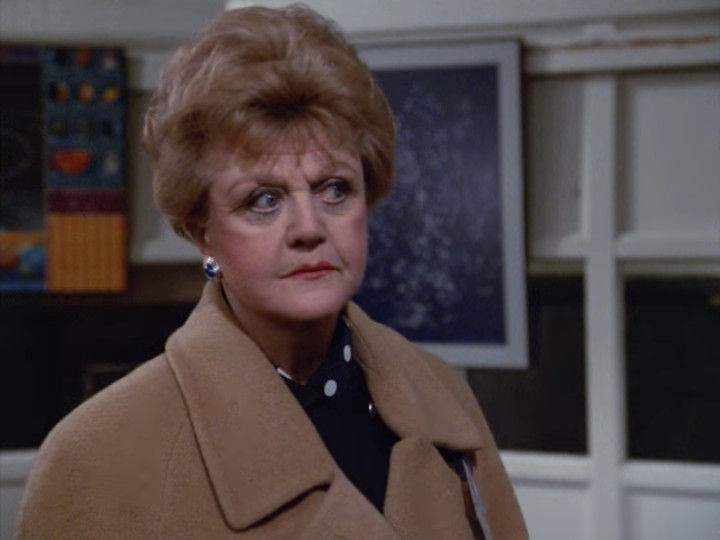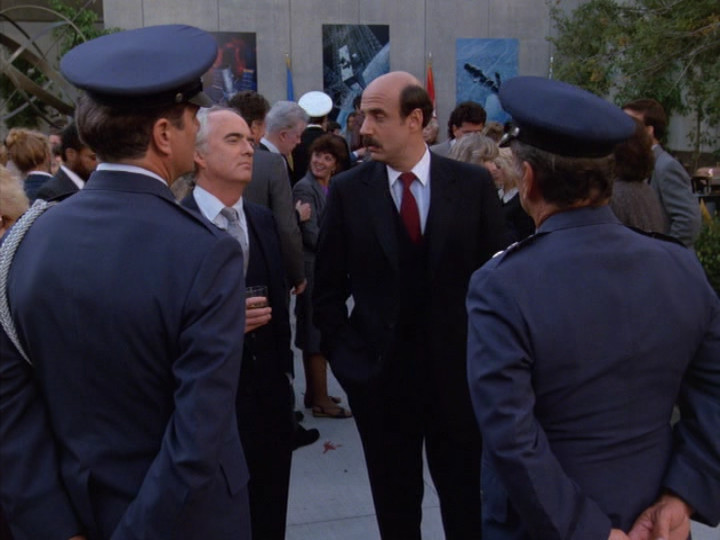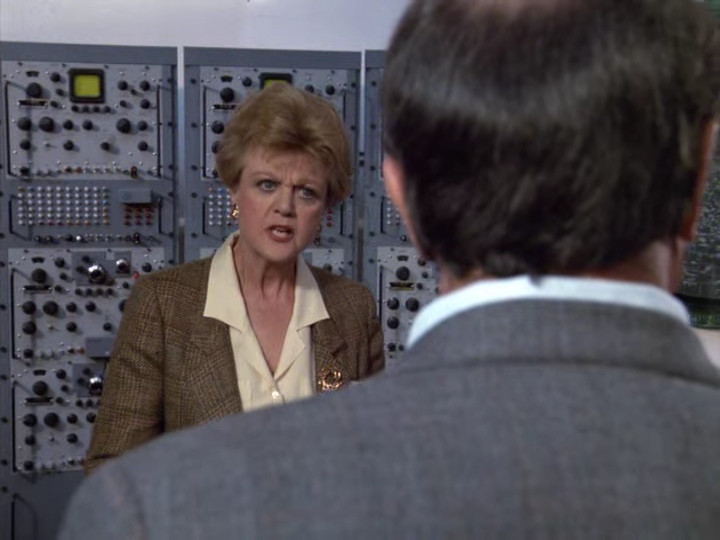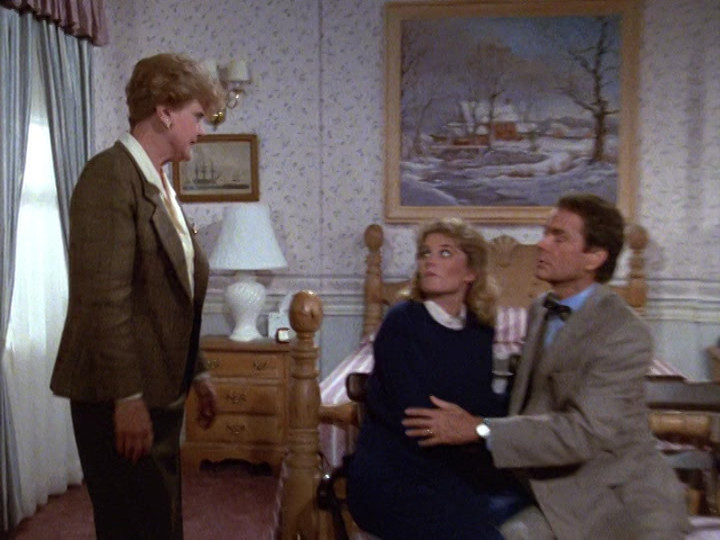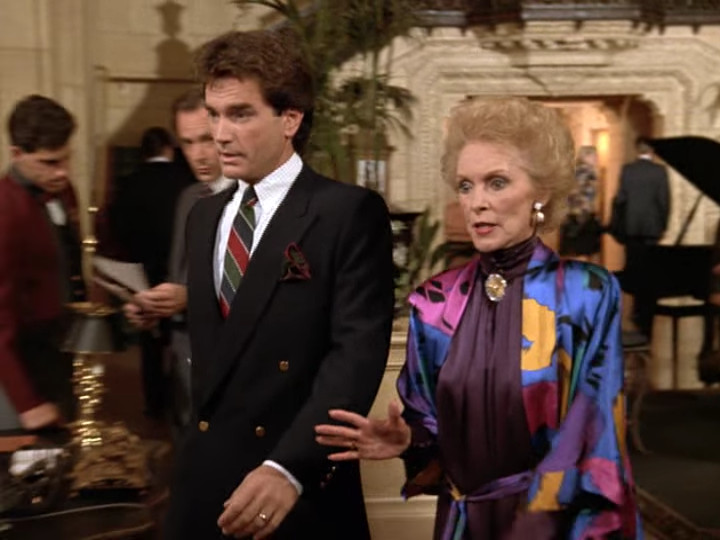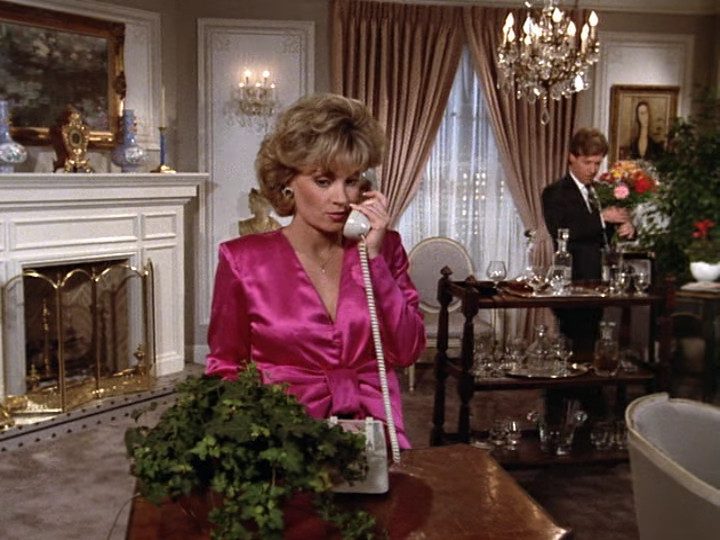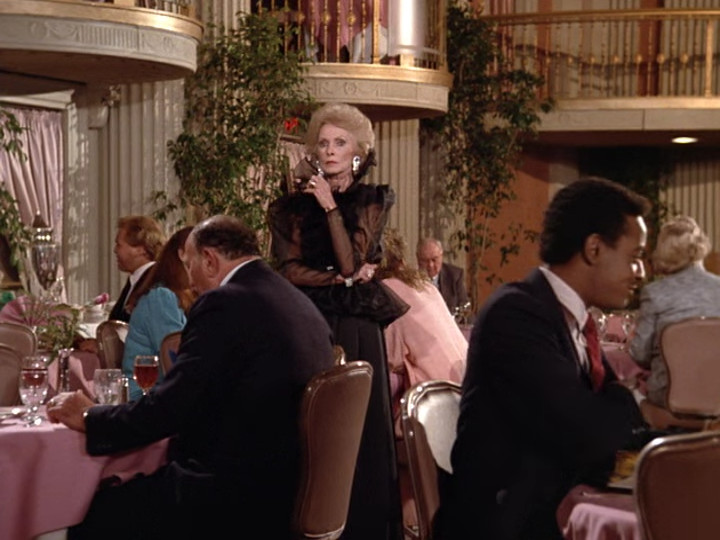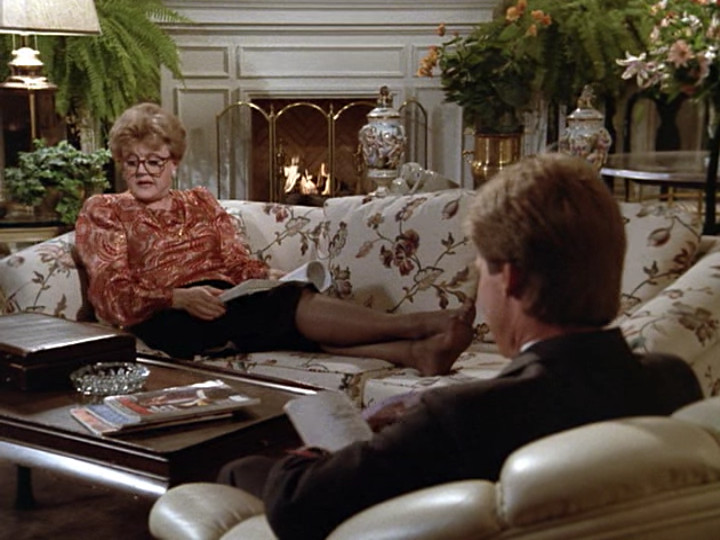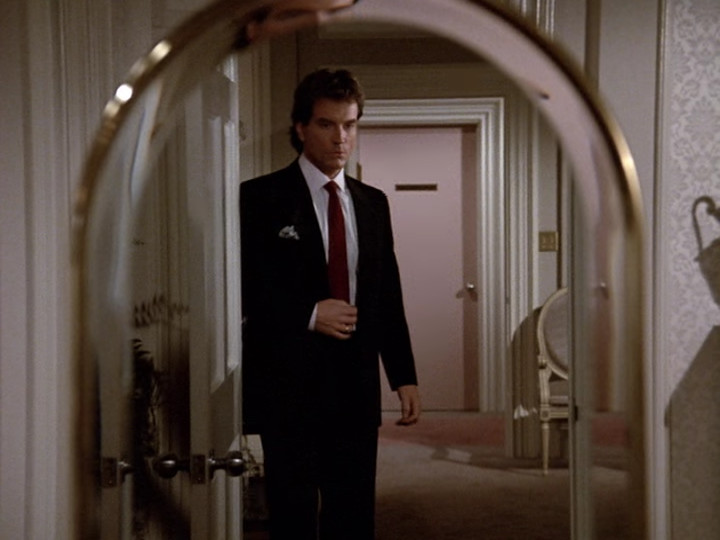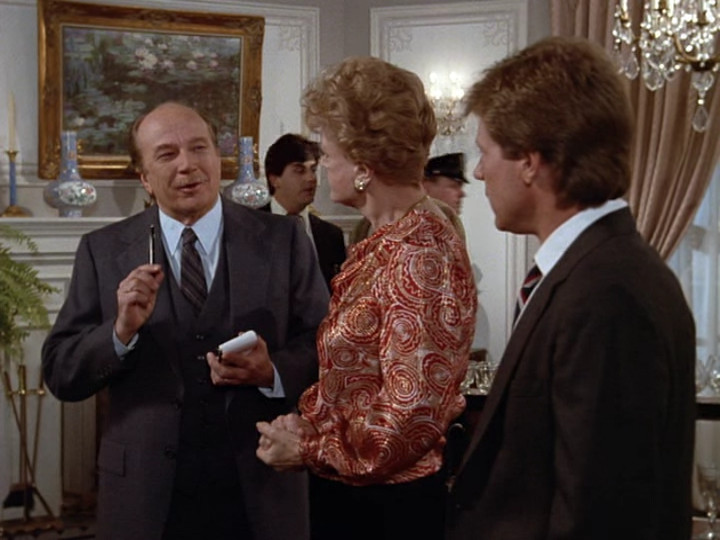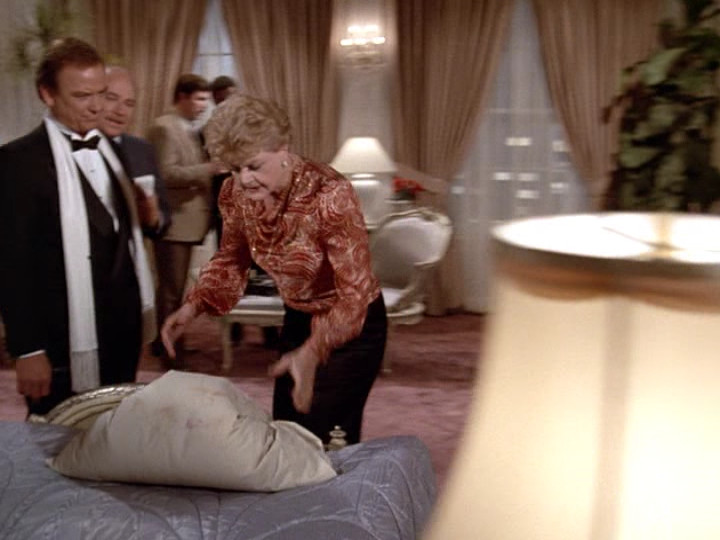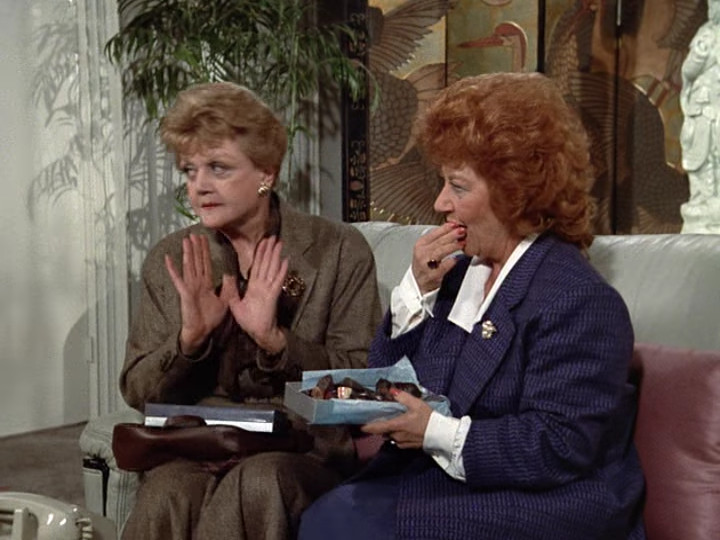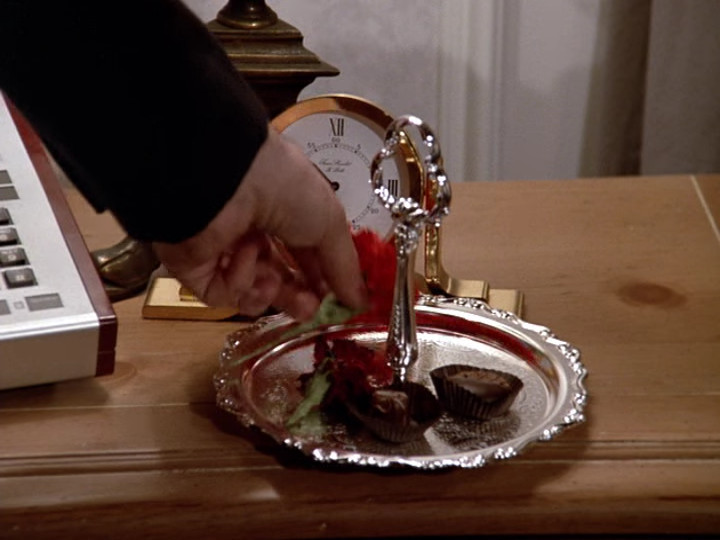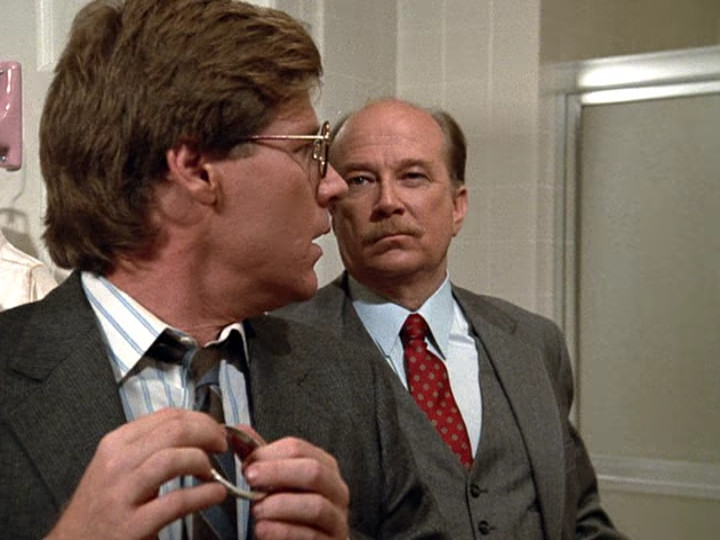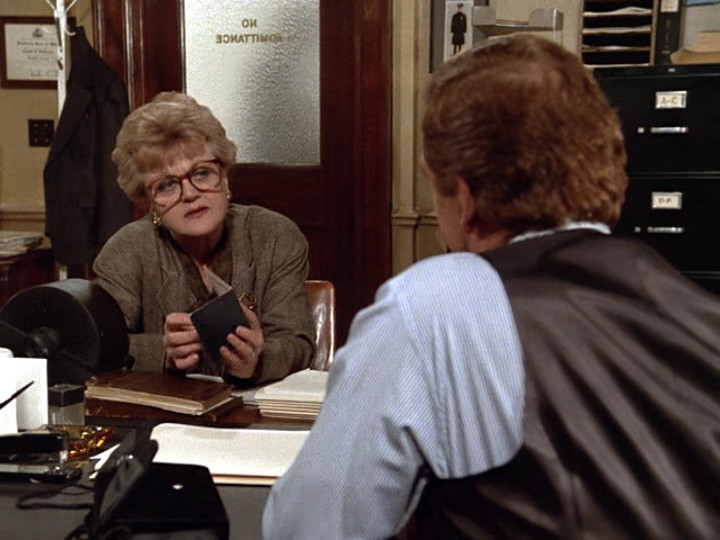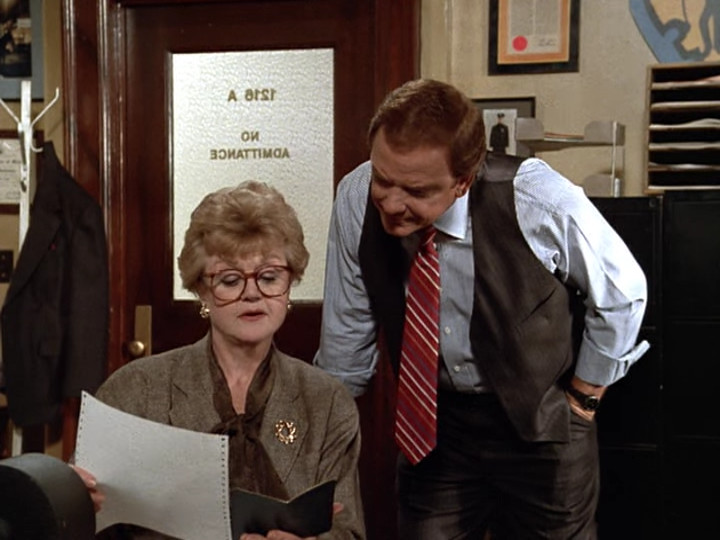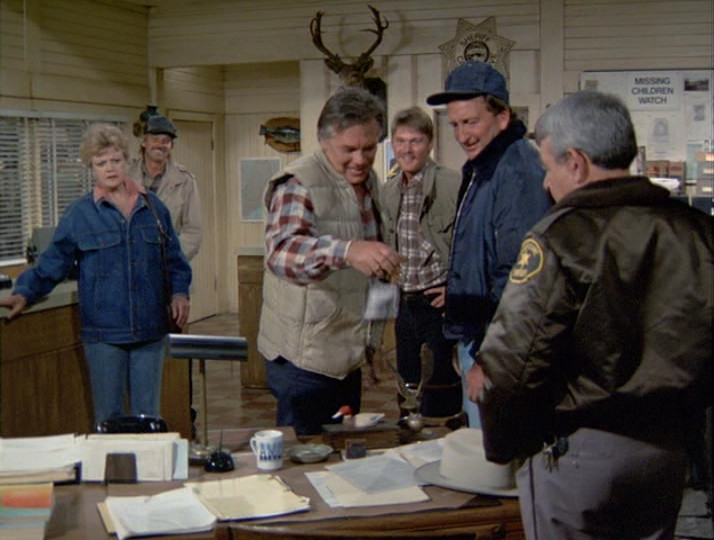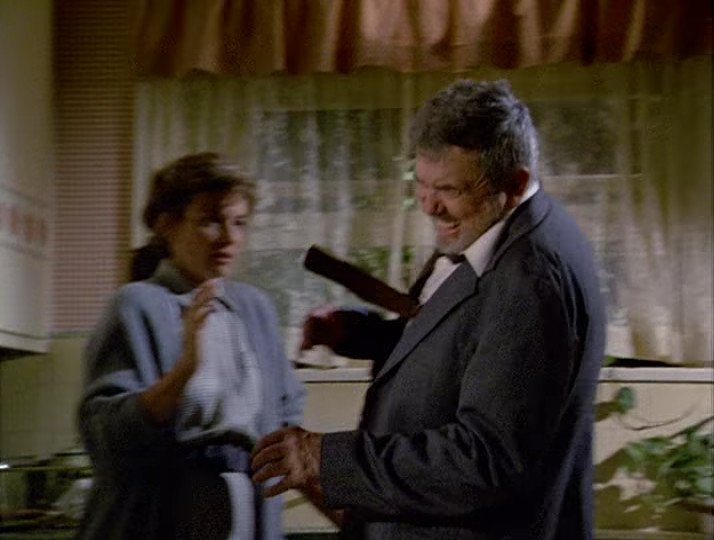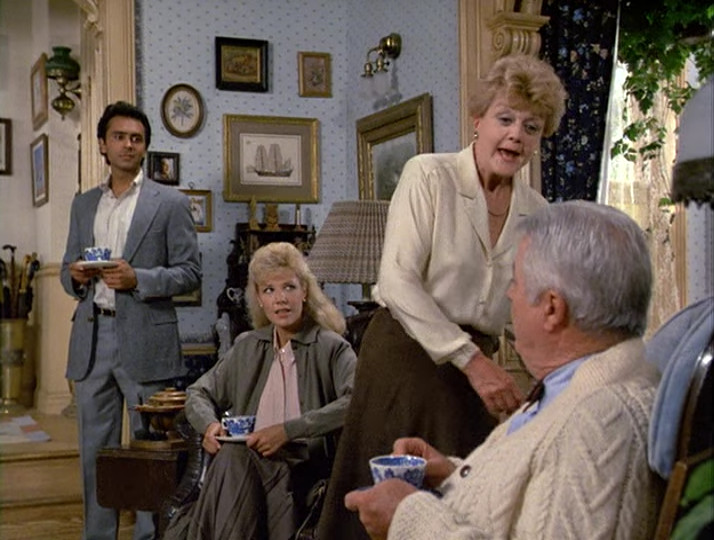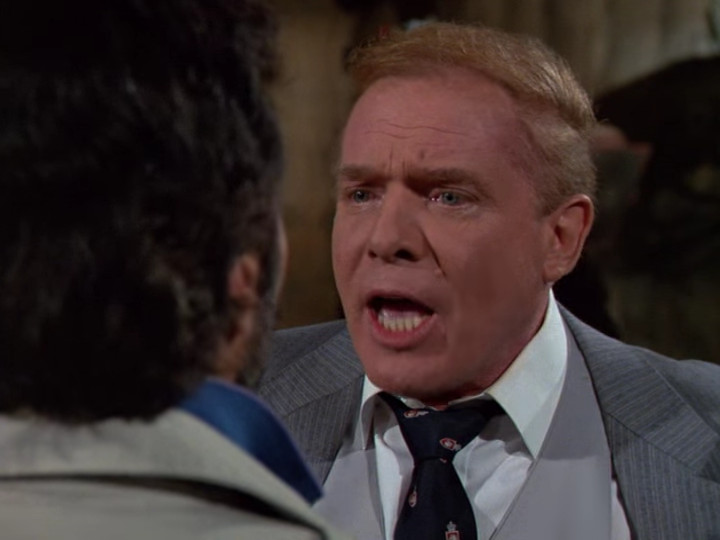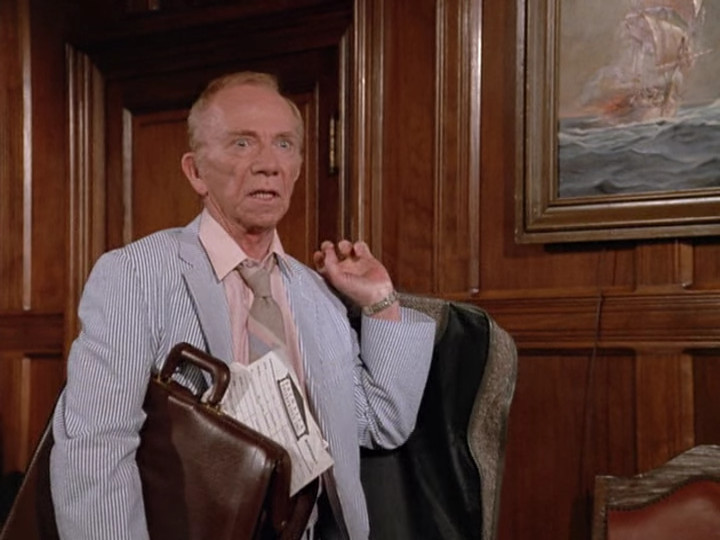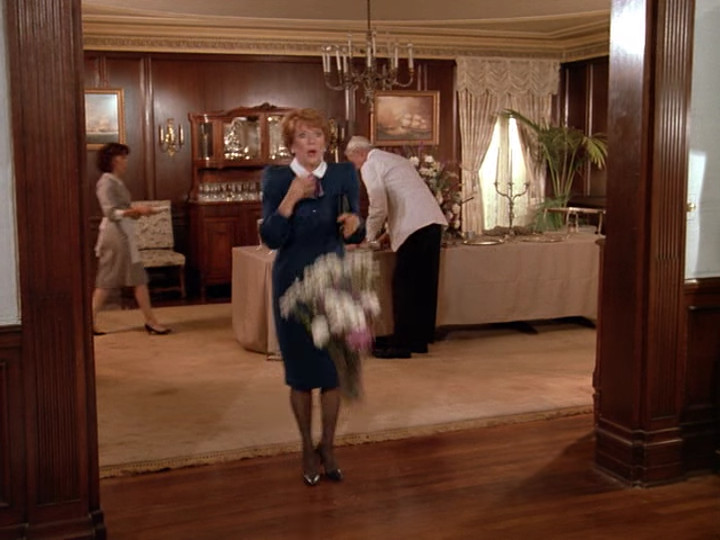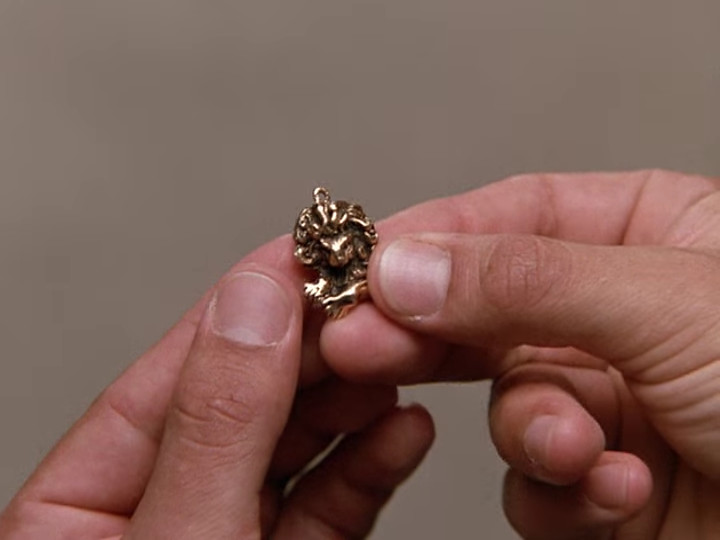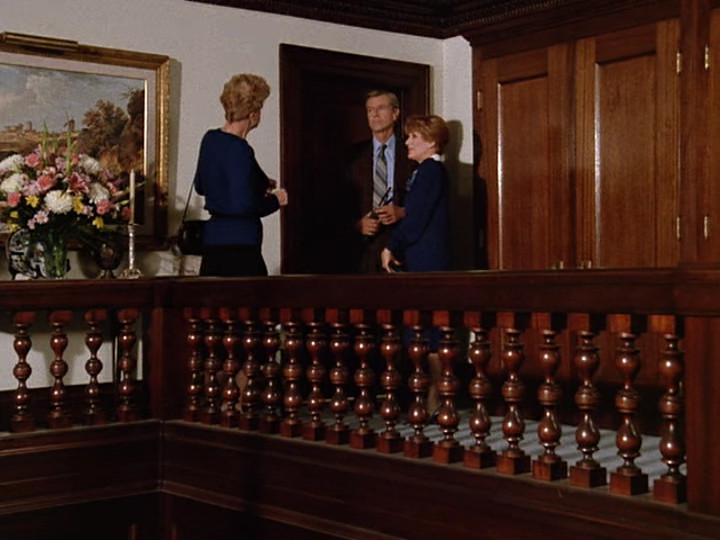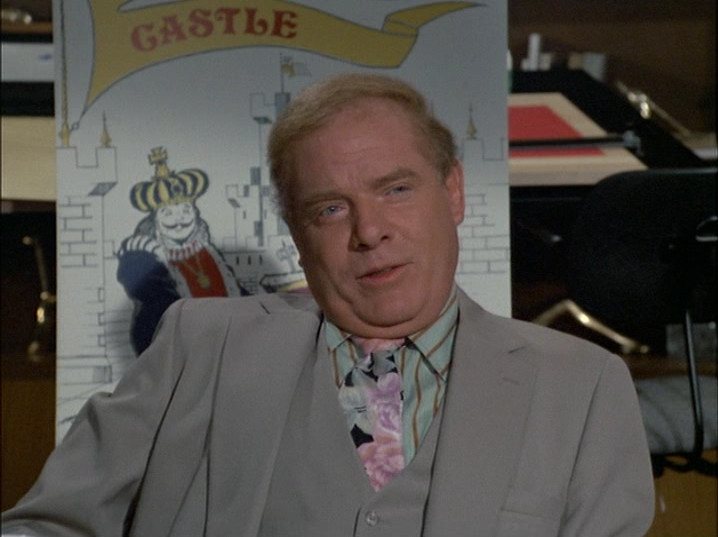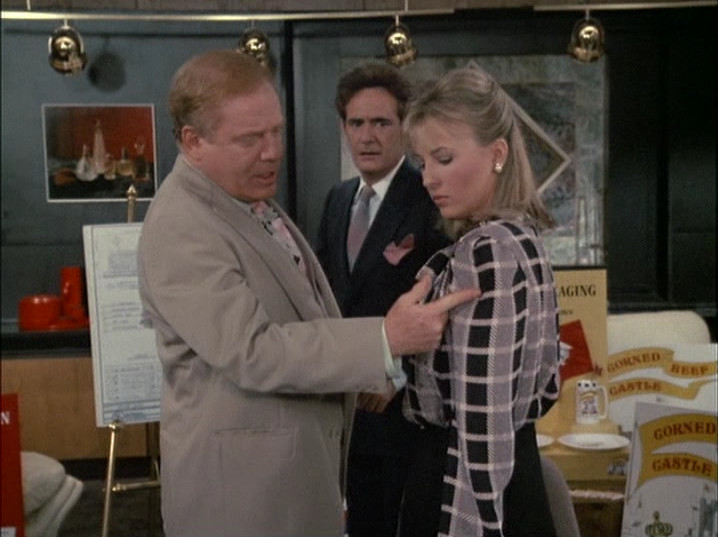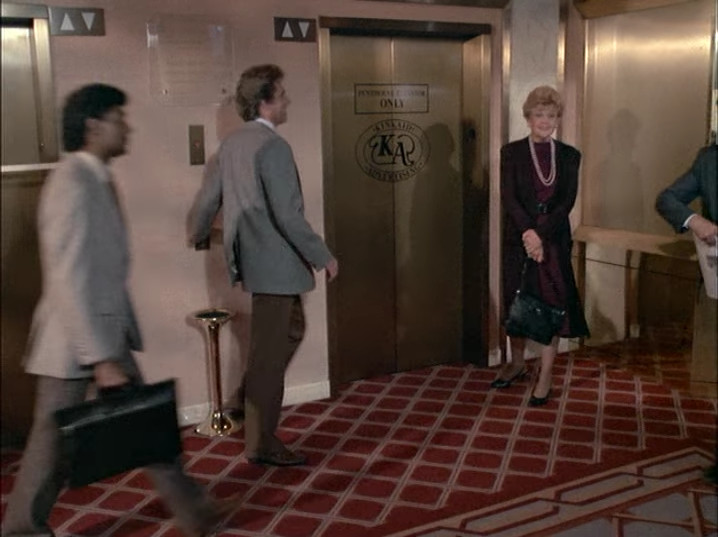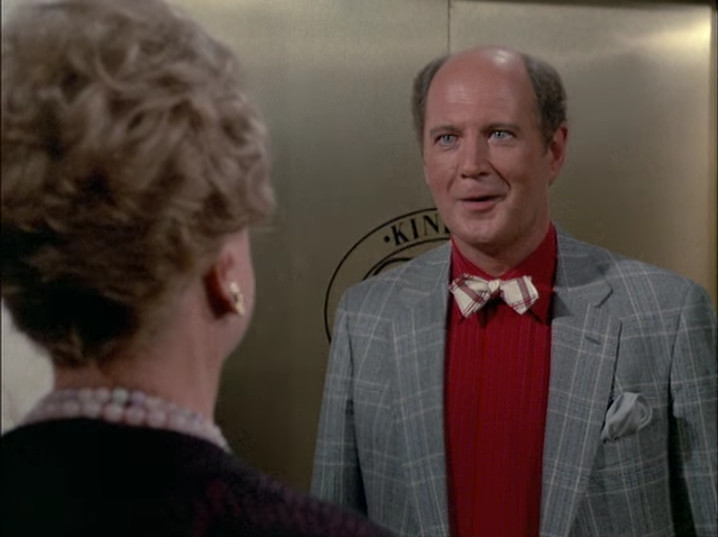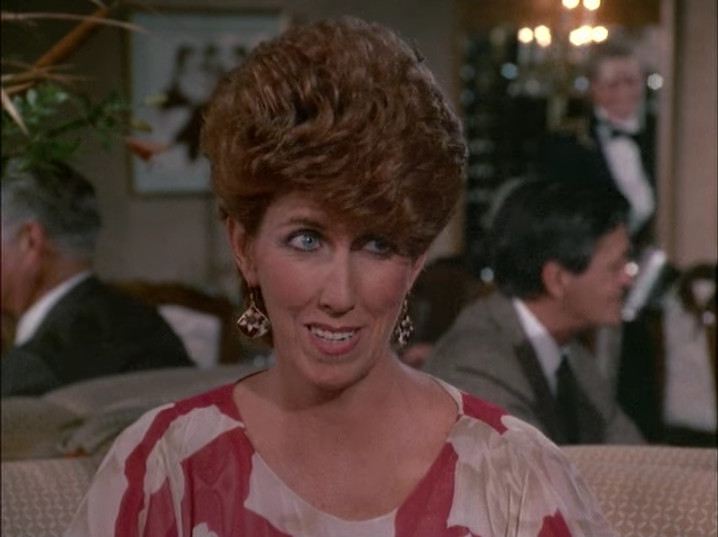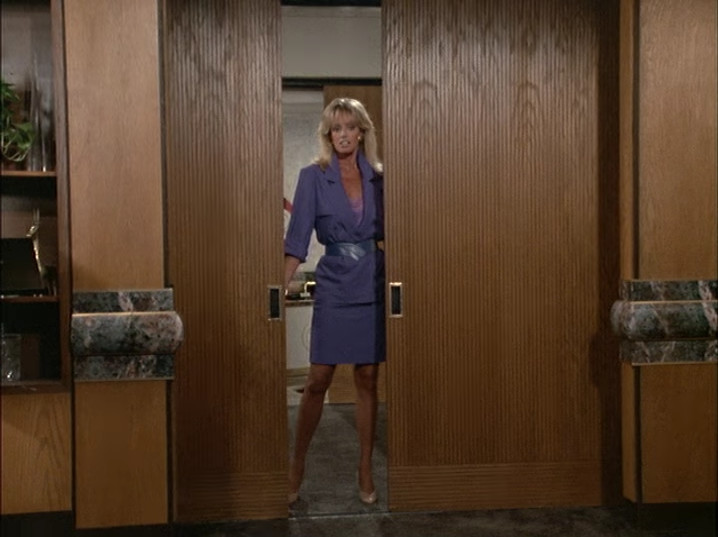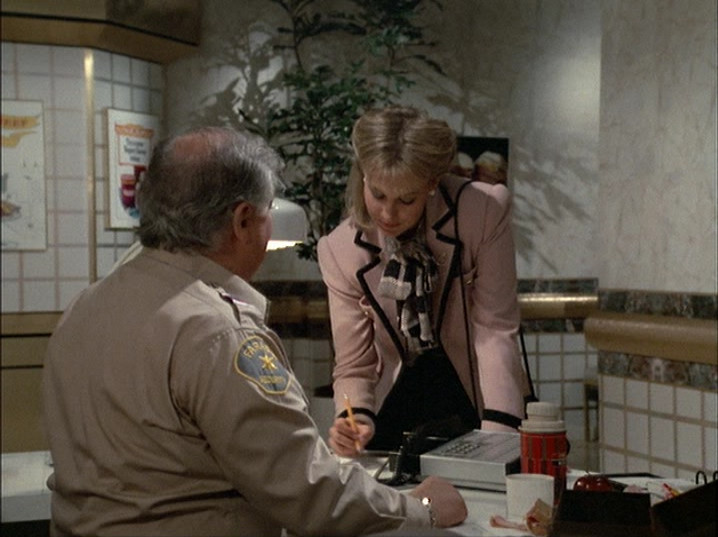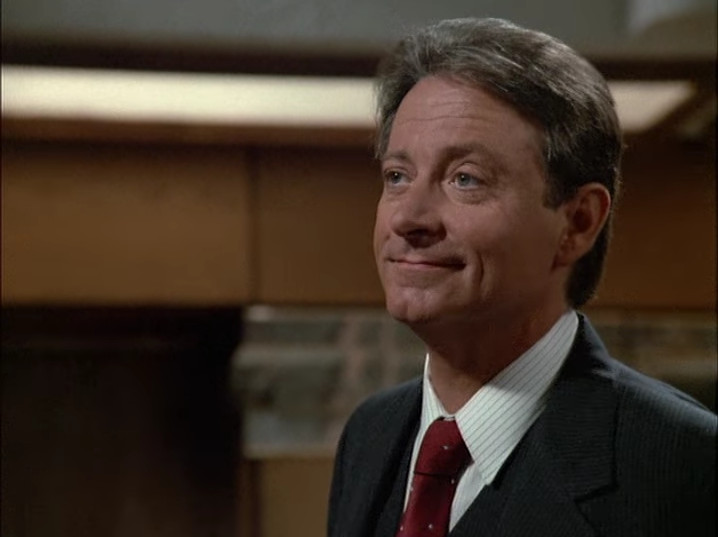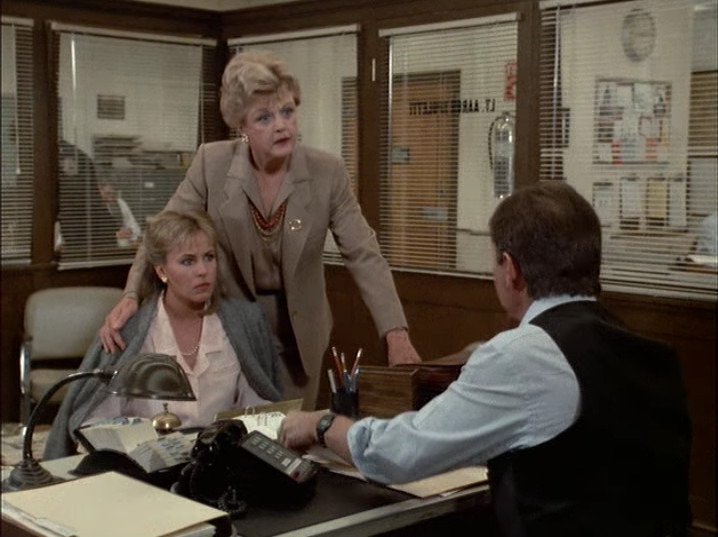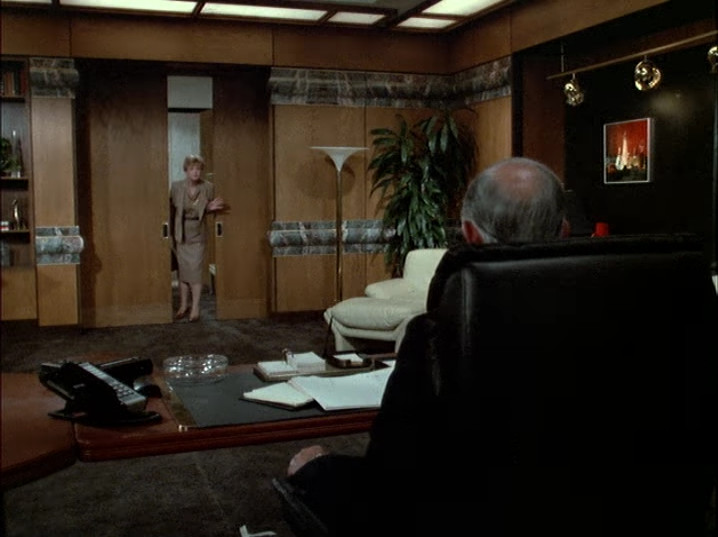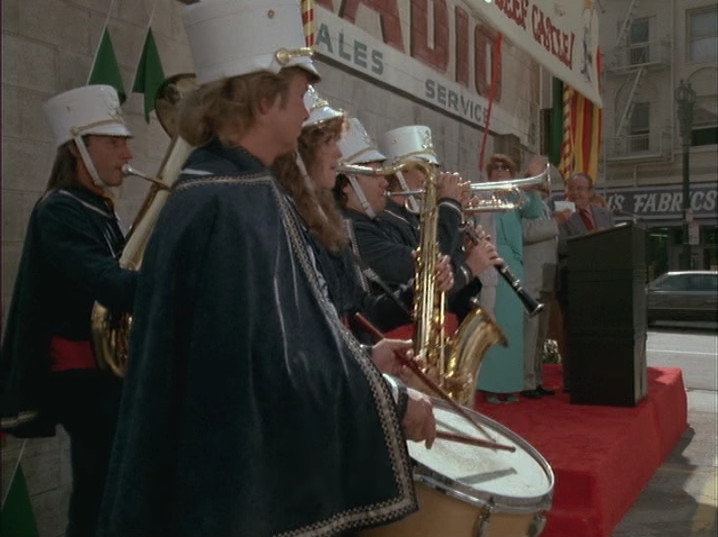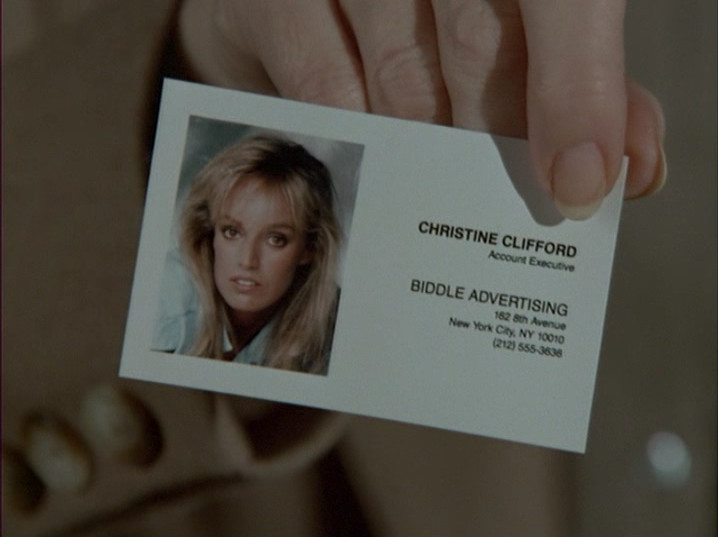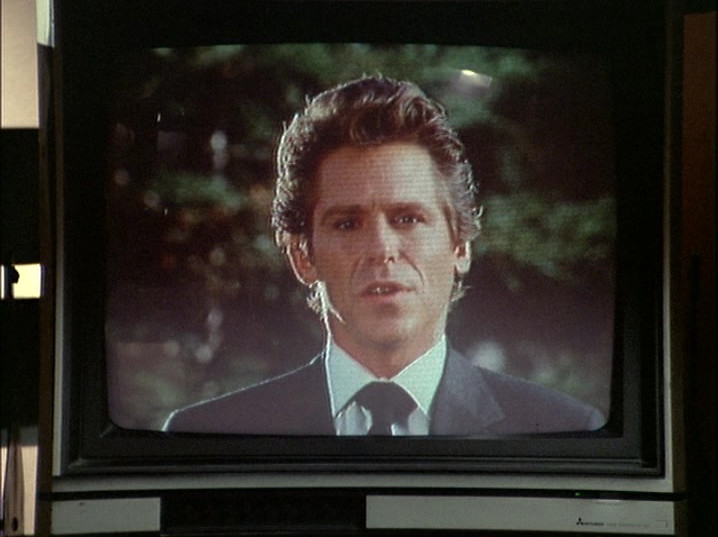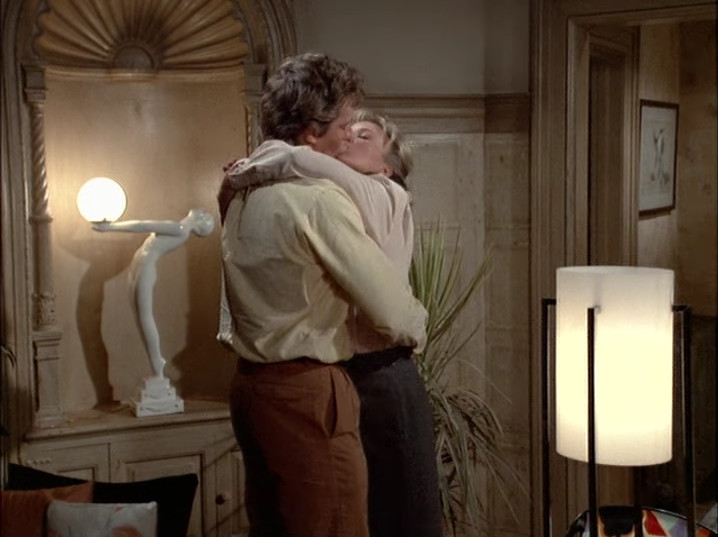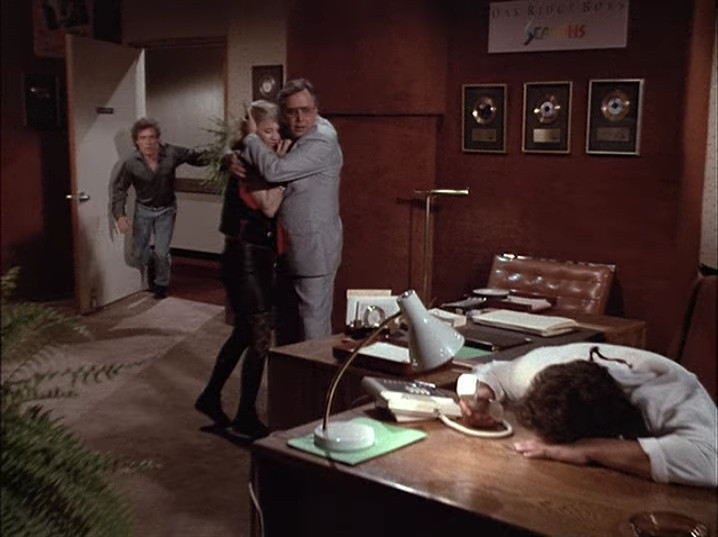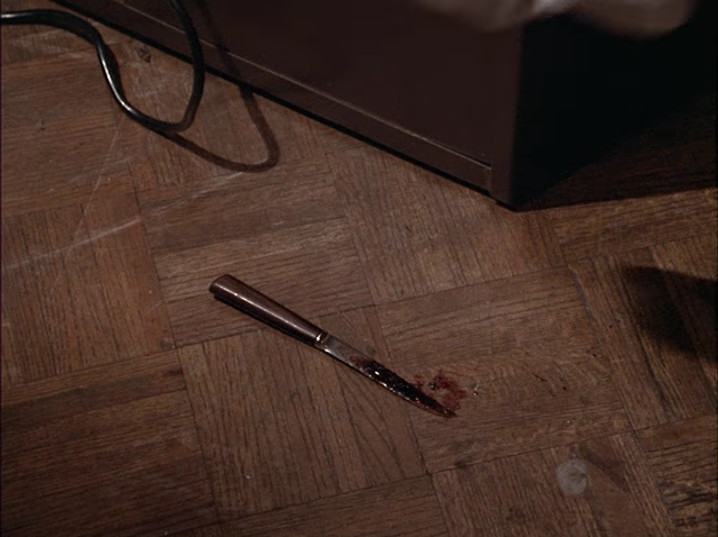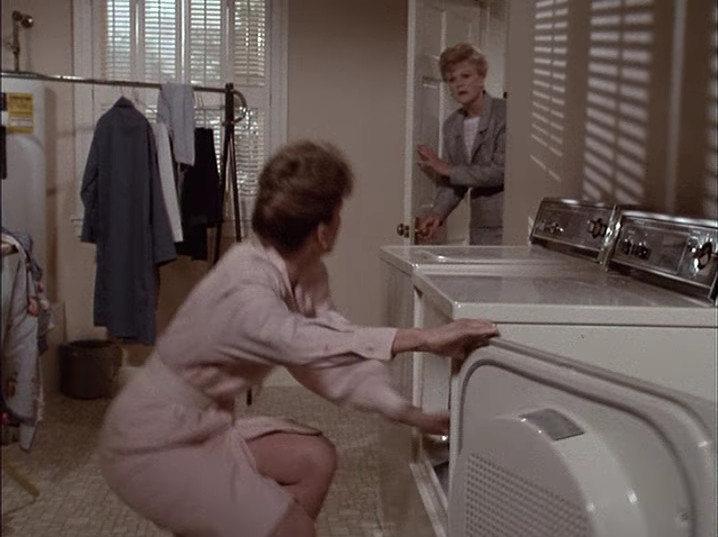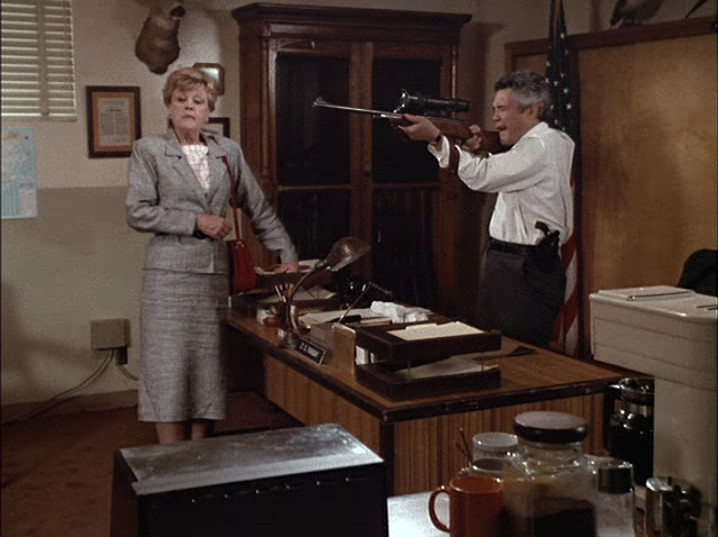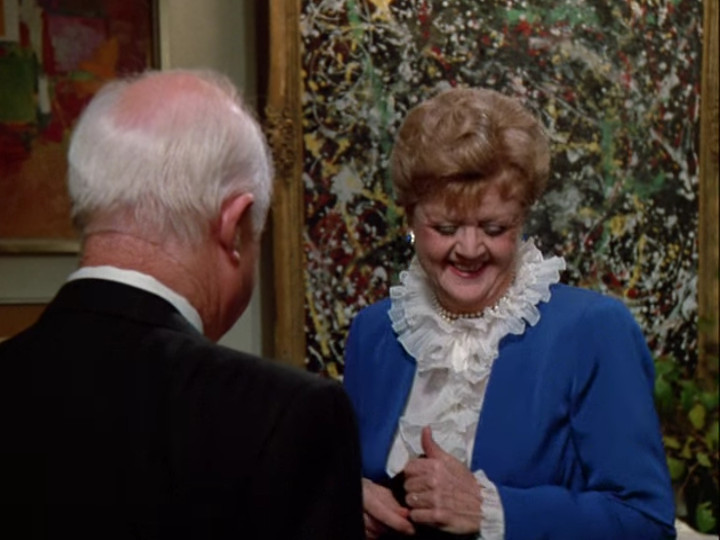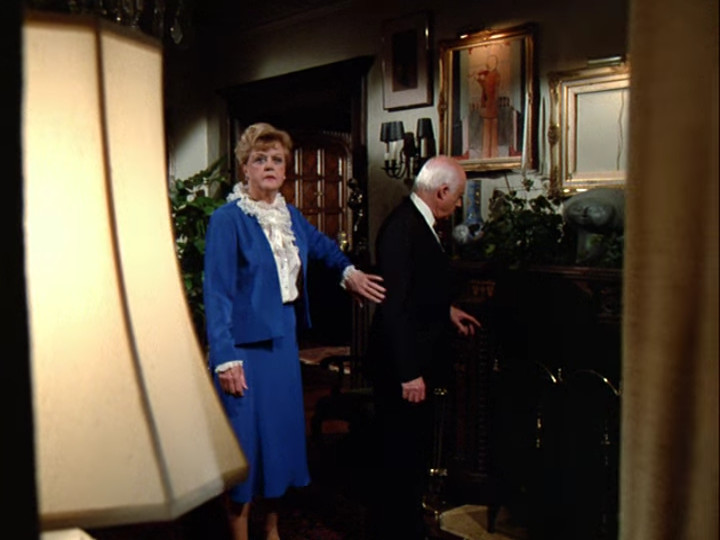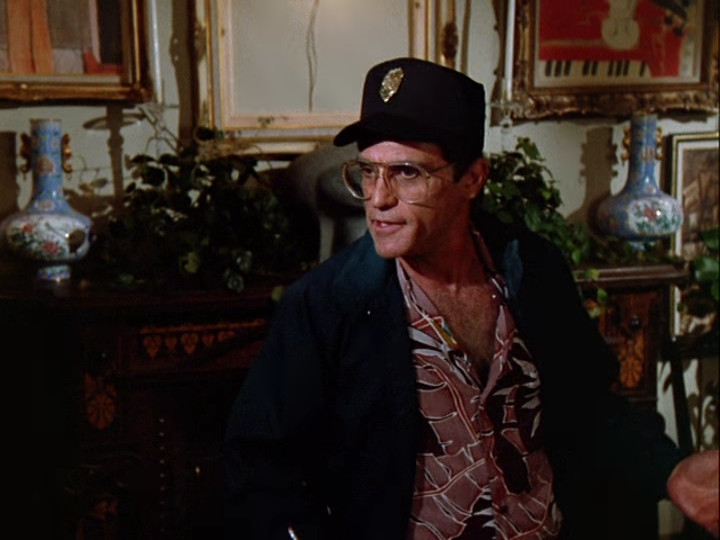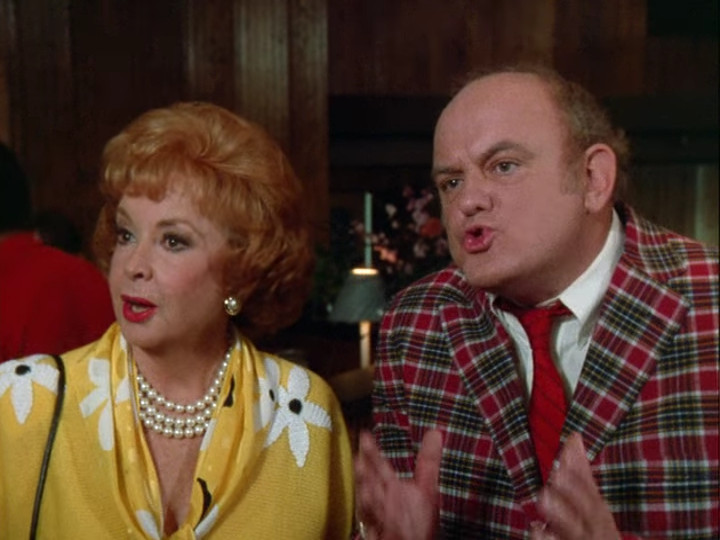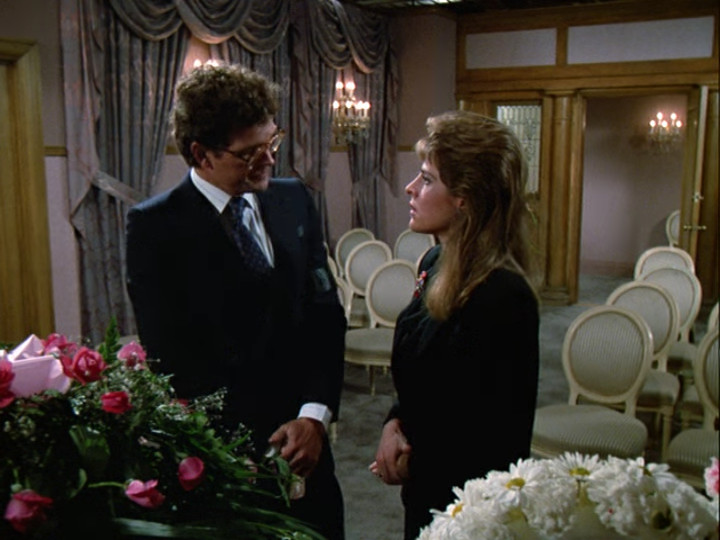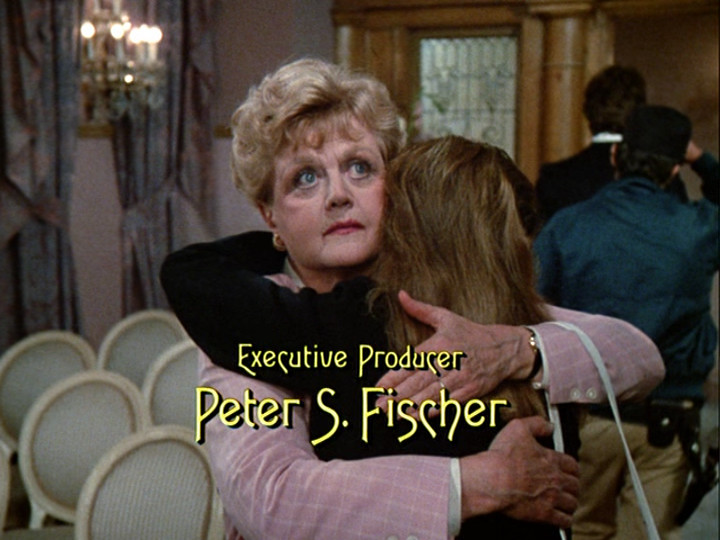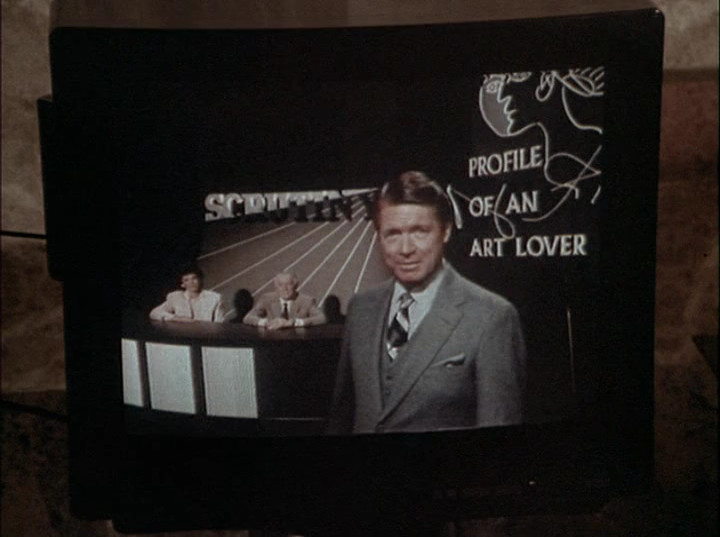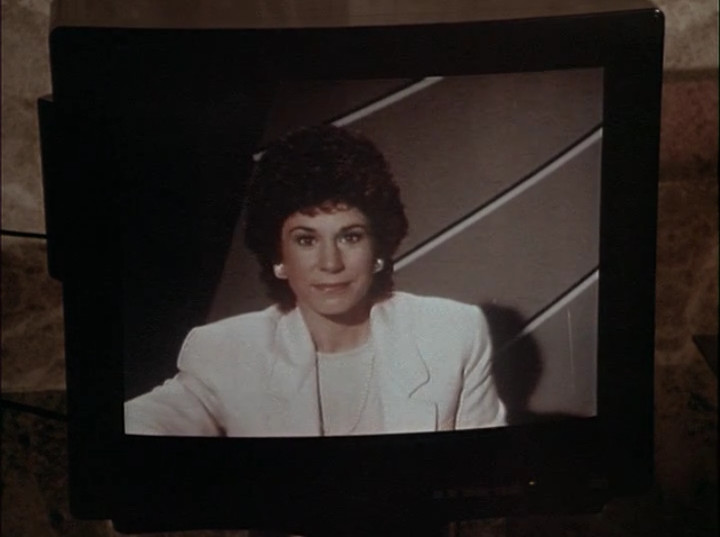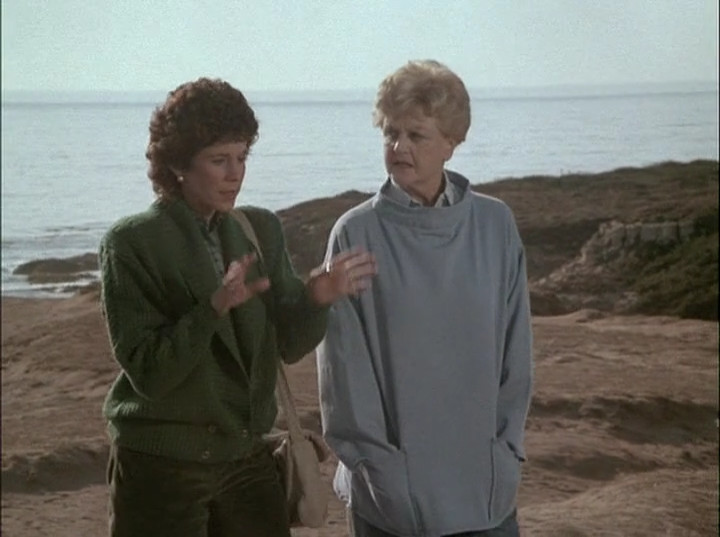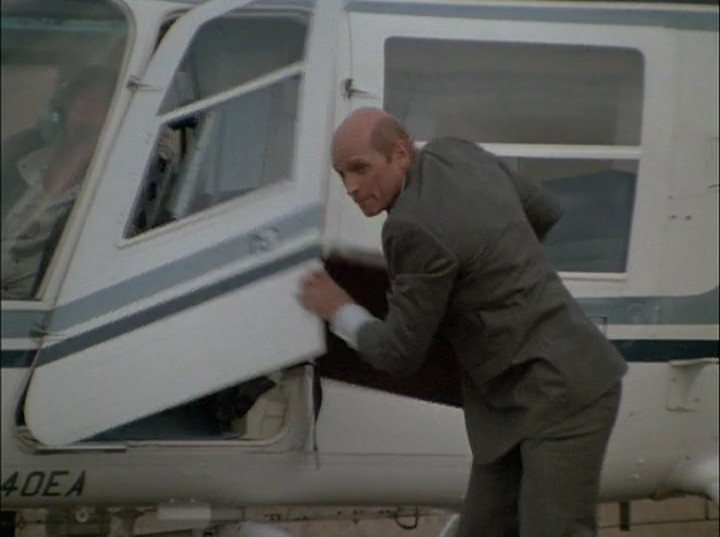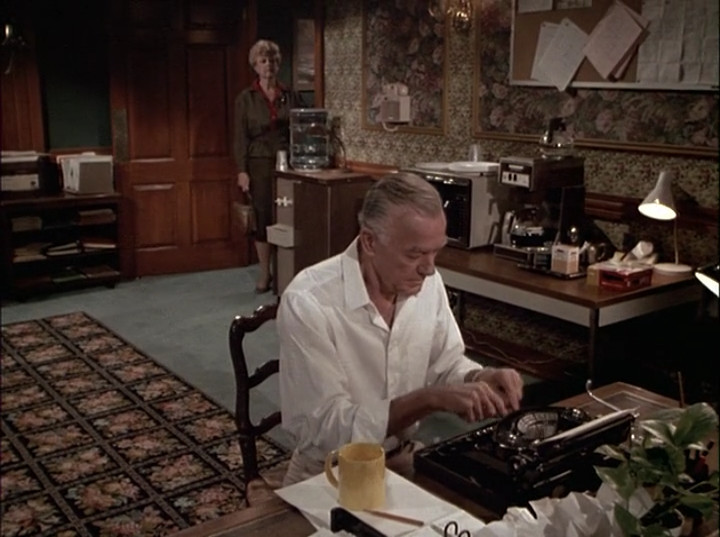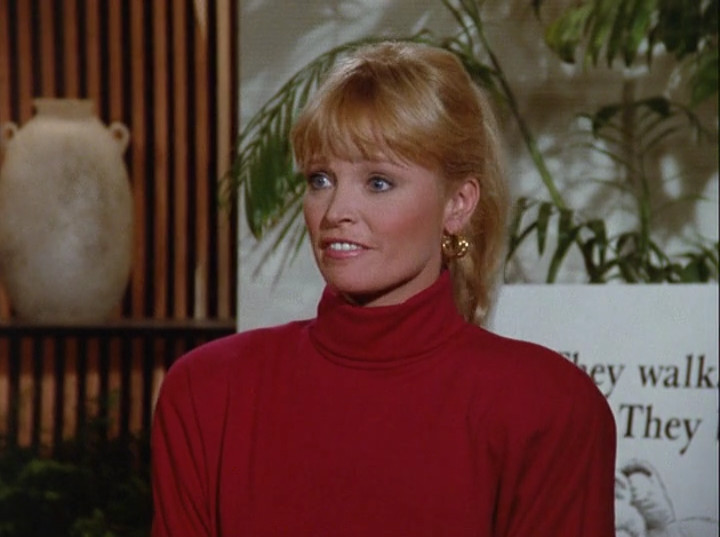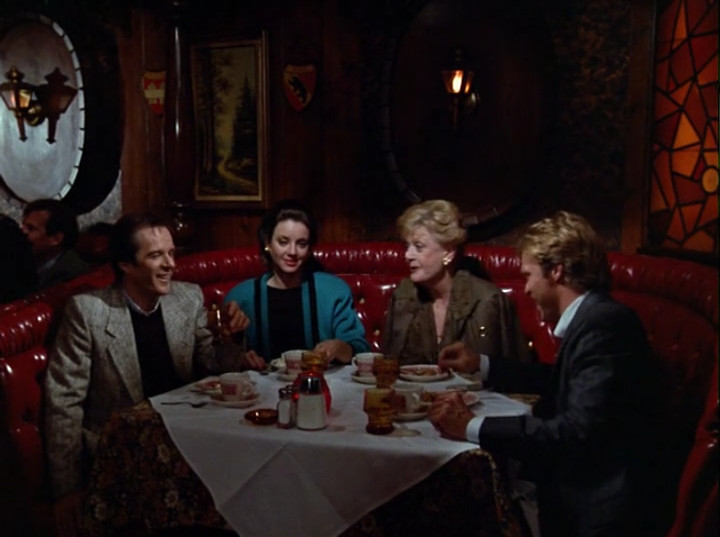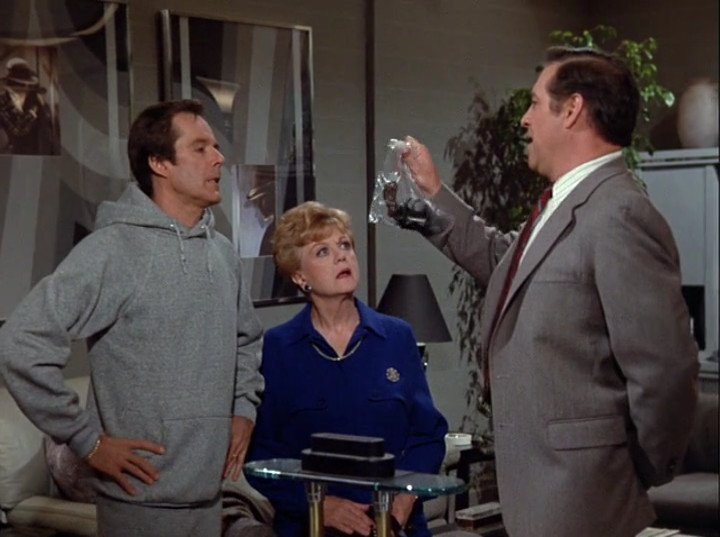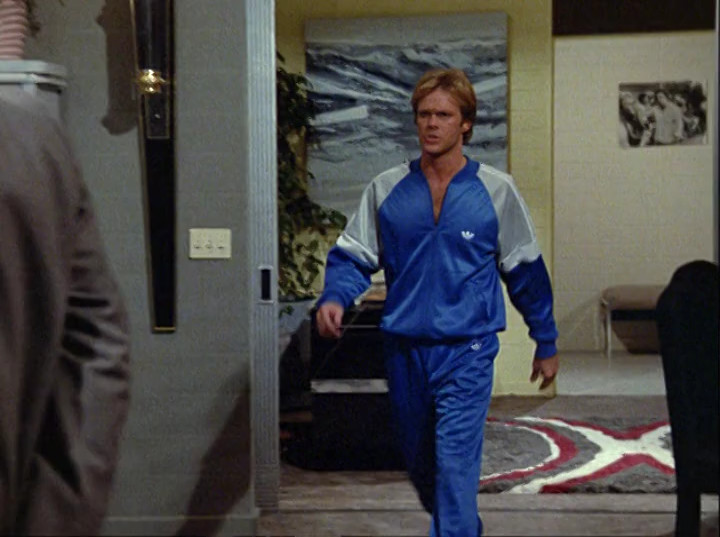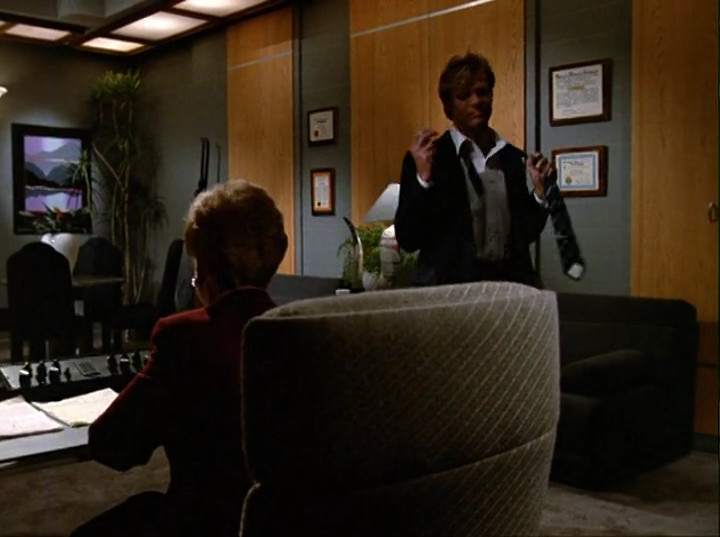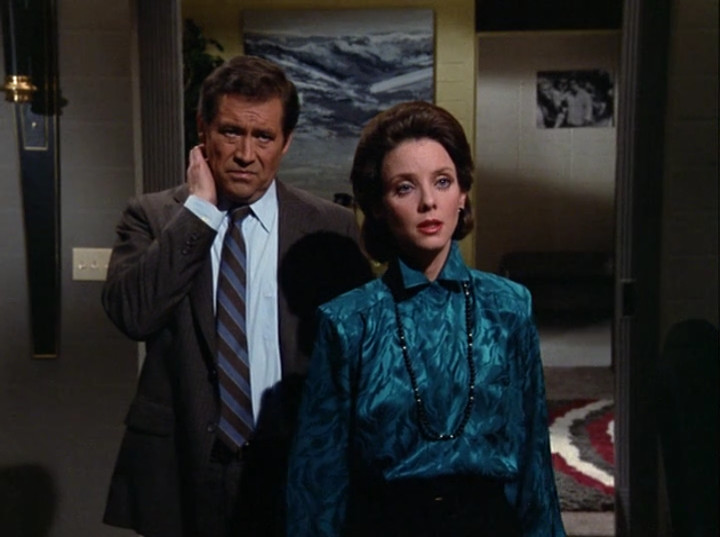
Murder She Wrote: Murder Through the Looking Glass

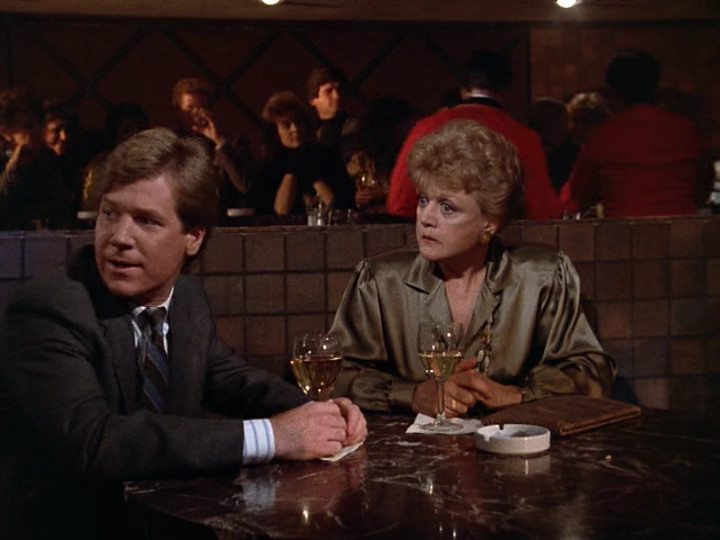
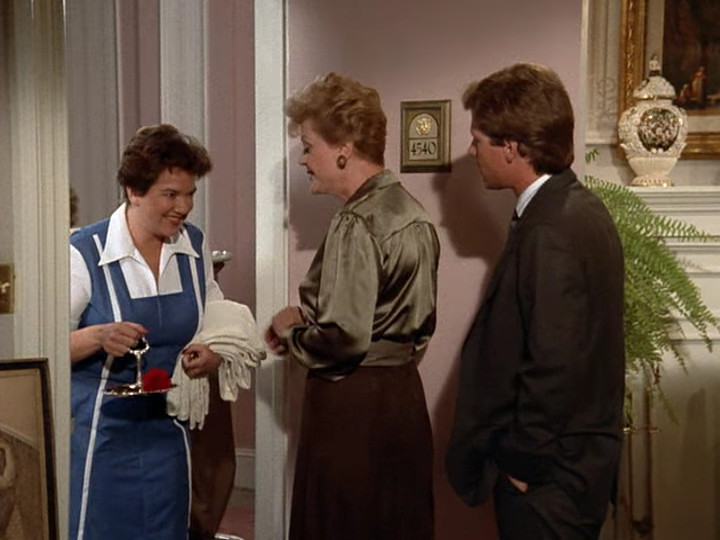
In the fourth season of Murder, She Wrote towards the later middle of the season was the episode Murder Through the Looking Glass.

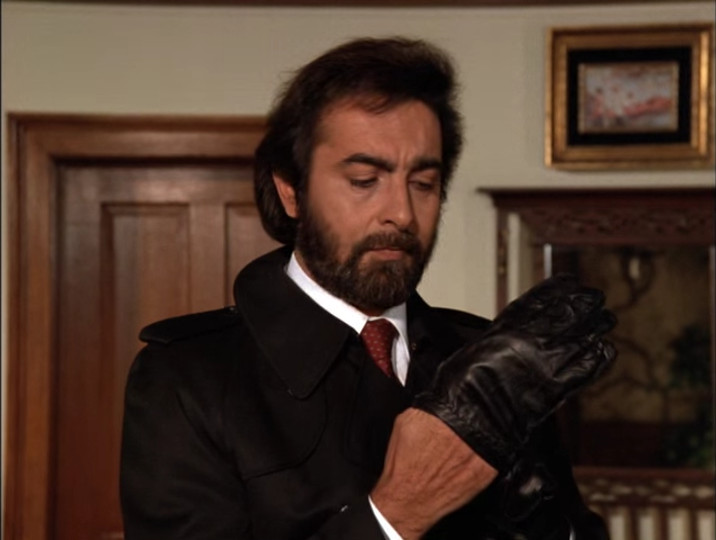
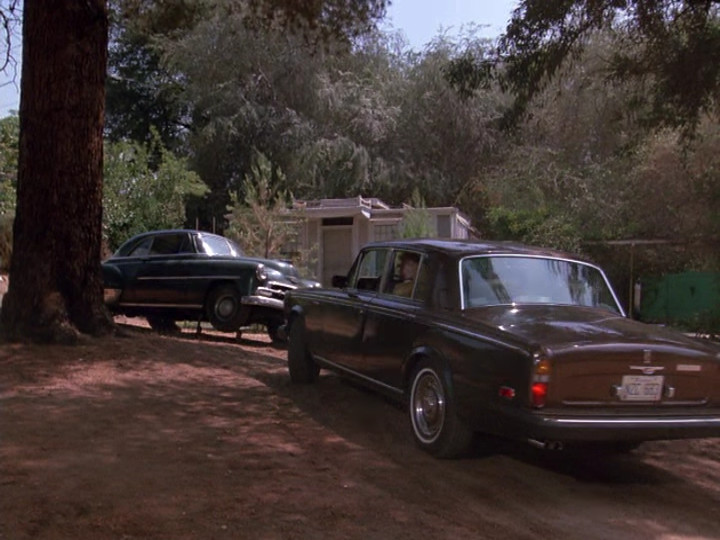
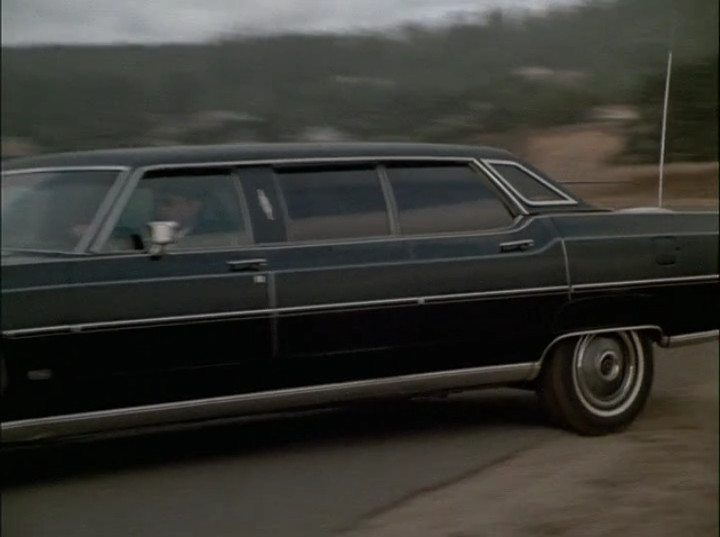
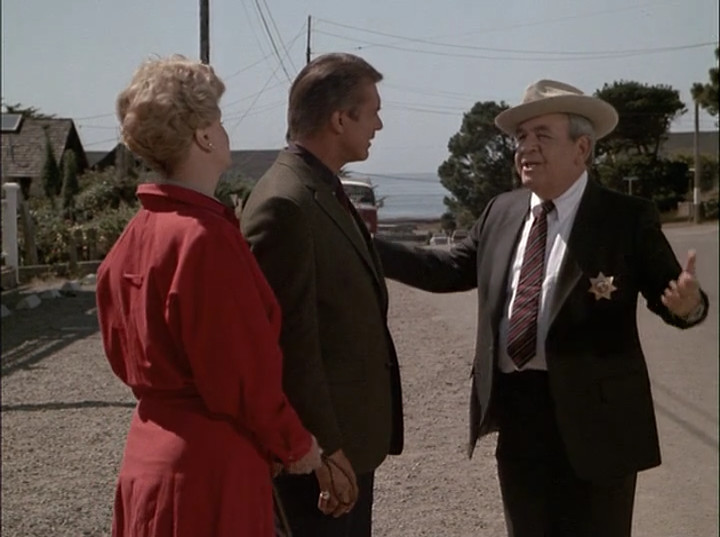
The car we see in the opening title pulls up at the peer and two men get out. The older, grey-haired one pulls out a gun and tells the other to face him.
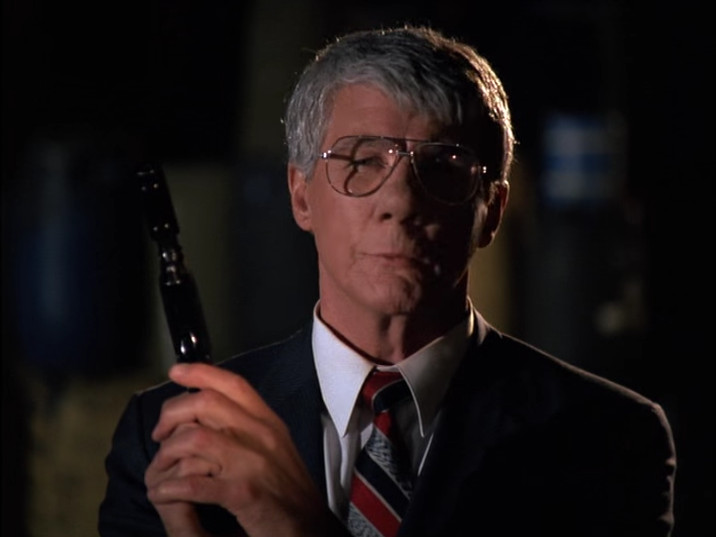
The man who is about to be shot asks who it was who ordered the hit, but the hitman says that it would do him no good and then shoots him twice. The shots are off-screen while the camera pulls in on a headlight. In theory, this is supposed to be to shield the viewer from witnessing even simulated violence. In practice, I suspect that it’s a heck of a lot cheaper to just film a headlight and put the sound of two bullets and a splash over it in post-production than it would be to use special effects and do a stunt.

The hitman gets back in the car and drives off.

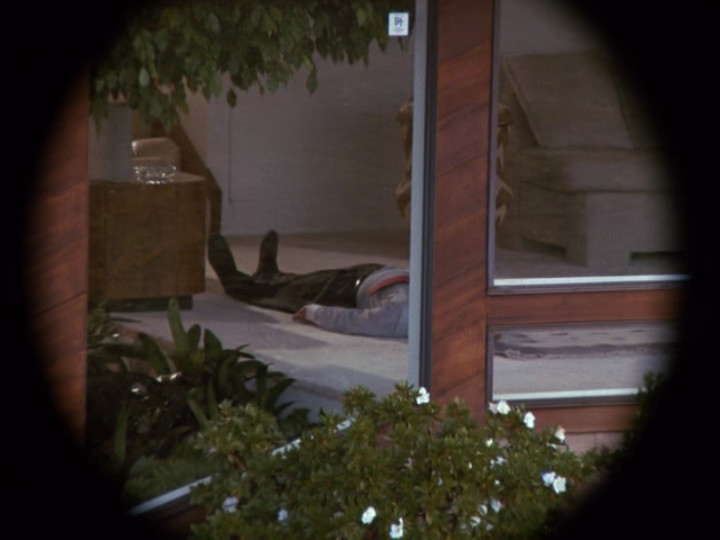
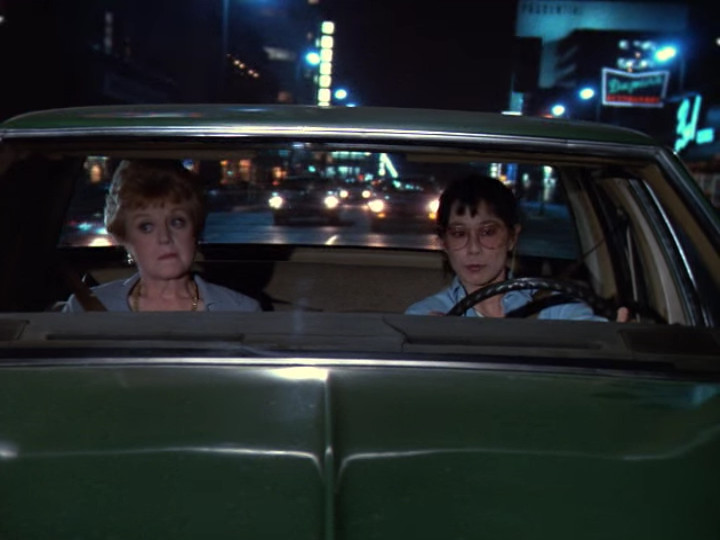
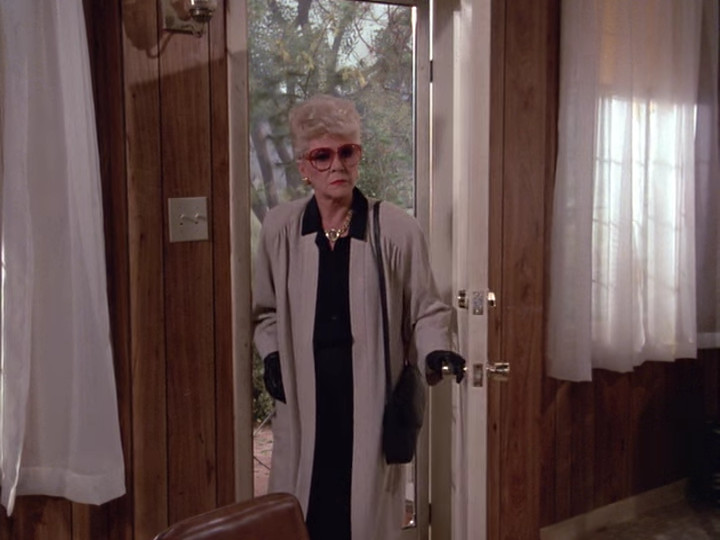
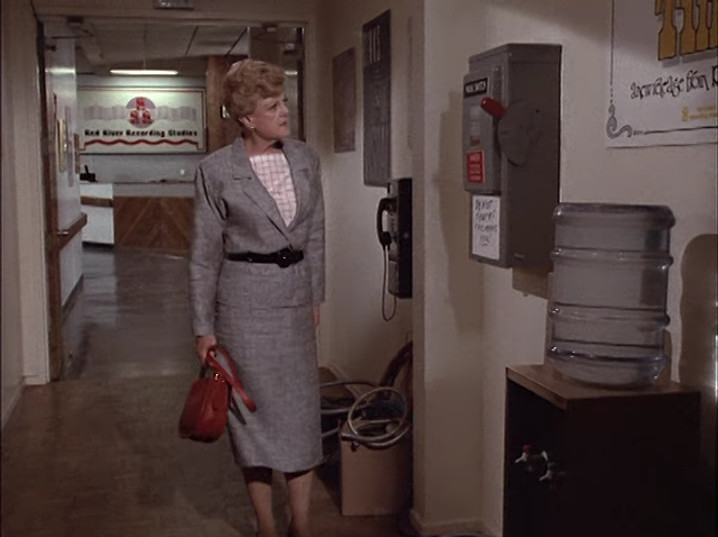
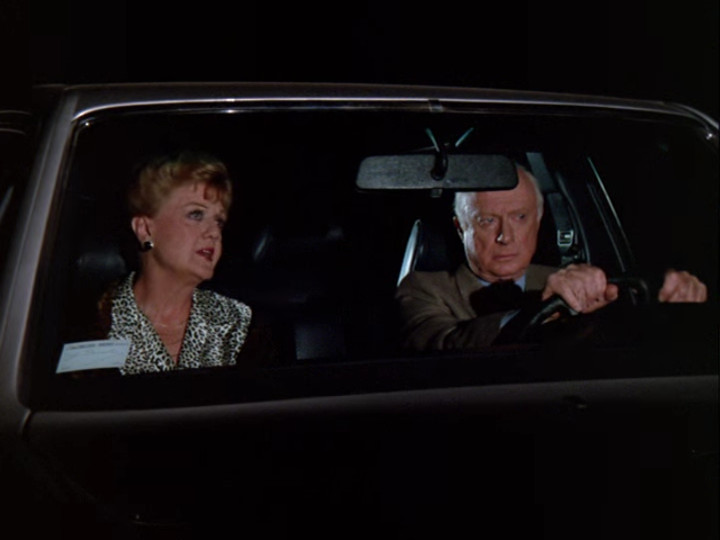
The scene then changes to a sign saying that the guest speaker of tonight’s meeting of the New England Booksellers’ Association is J.B. Fletcher. She leaves amid thunderous applause, and accepts the organizer’s invitation to get some coffee up the street. As they’re going to the coffee place, the hitman suffers a heart attack and crashes his car next to her. He asks for a priest, and Jessica calls out for one. A priest actually pulls up in a car, across the street, and she calls him over. The hitman, in his delirium, he seems to mistake Jessica for the priest and gives her his dying confession. “I killed a man tonight: Karl Kosgrove from Farmington. H&H.”

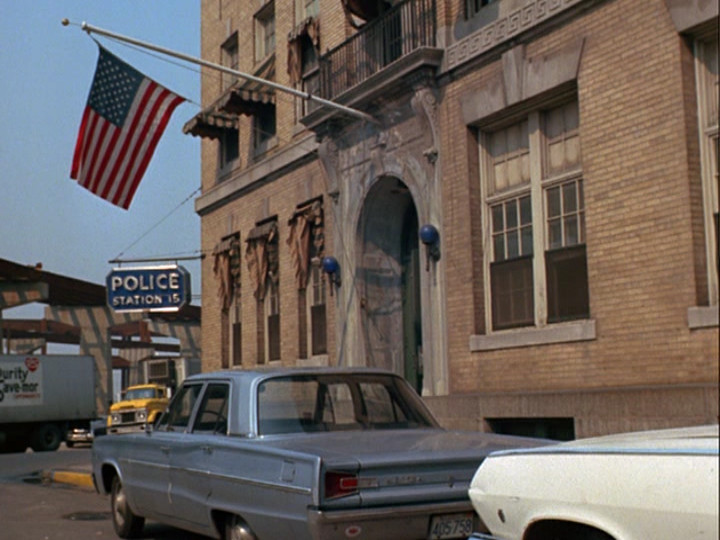
He then slumps over dead, and the priest gets there. He asks what the man said, and Jessica merely says that he asked for a priest. The priest checks the hitman’s pulse and pronounces him dead. Jessica widens her eyes in shock, and we move onto police headquarters the next day. There we meet the police detective for our episode.
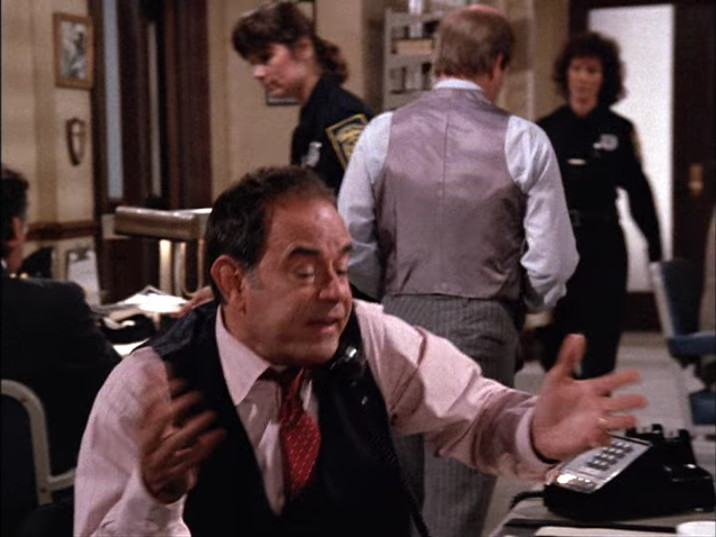
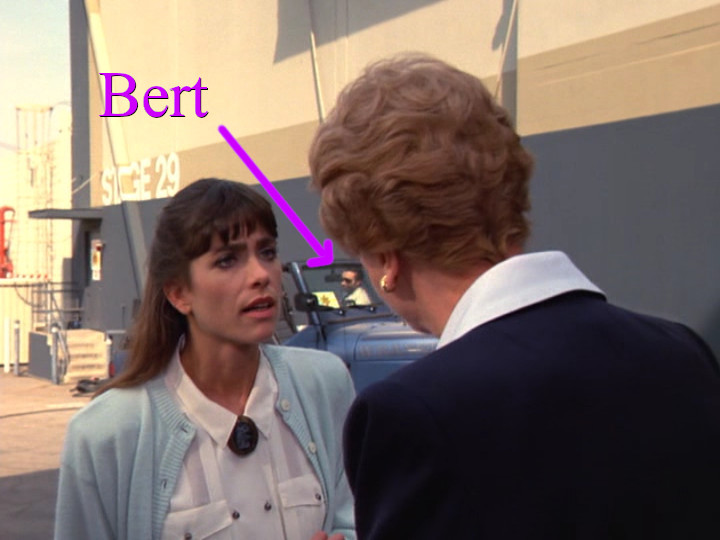
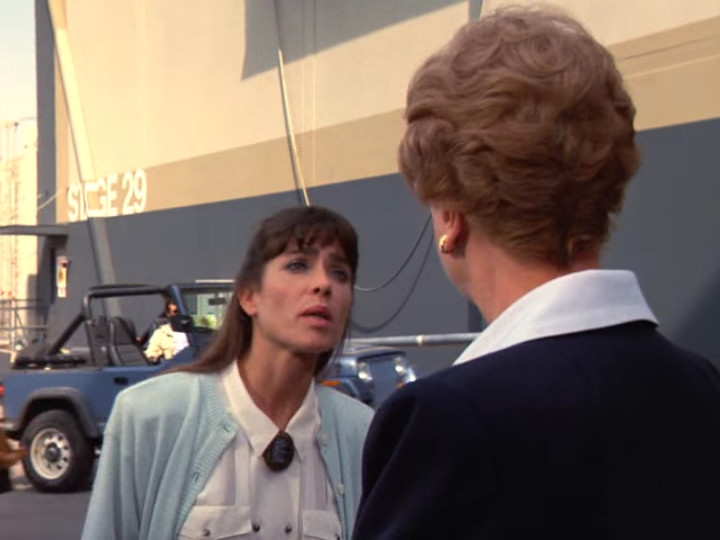
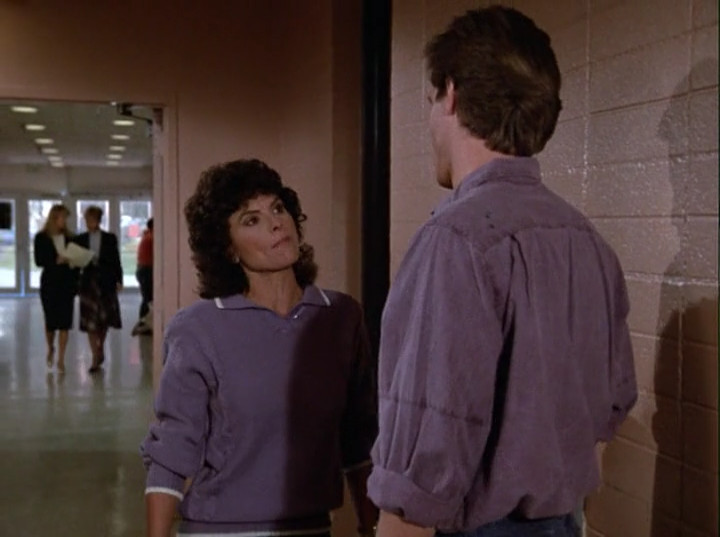
His name is Sergeant Cooper. He’s telling a woman named Edie the story of how he insulted her sister the previous night. From context, Edie’s sister is Cooper’s wife, and she’s left their house and he doesn’t know where she is and is trying to find her. Jessica walks in and talks to him about the man who had the accident last night whose death she reported to him half an hour ago. Yeah, that doesn’t make sense to me either, but it’s going by very quickly and I think that they’re just trying to get it over with as quickly as possible.

Anyway, Jessica is surprised to hear that he didn’t have any identification on him. He was driving a car so he should have, at least, a driver’s license. Unless, she adds, he wanted to conceal his identity because he was a professional killer. Sergeant Cooper is amused by the idea that he was a professional killer and wonders where Jessica got that idea. She said from his dying confession—he said H&H, which according to her research means “head and heart”; a bullet in both places is the mark of a professional killing.

She doesn’t explain why the assassin’s union—or would it be a guild?—would have this standard. I suppose the idea of two bullets is to ensure that the victim can’t possibly survive, but why not two bullets in the head and two in the heart? If the idea is that they only need two in order to show off their skill, why not one?

Be that as it may, why would a professional killer benefit from not having identification on him? If he’s arrested for the murder he just committed, not having ID will not help him at trial. If he were pulled over for a traffic violation, it could get him in extra trouble for not having his driver’s license. I can see why he might have a fake ID, but not why he would have no ID.

Be that as it may, Sergeant Cooper finds Jessica’s very amusing. Jessica makes clear her expectation that the police will investigate, starting with Carl Cosgrove in Farmington. Cooper is in the mood to humor her, so he dials directory assistance to get Cooper’s phone number and calls it.

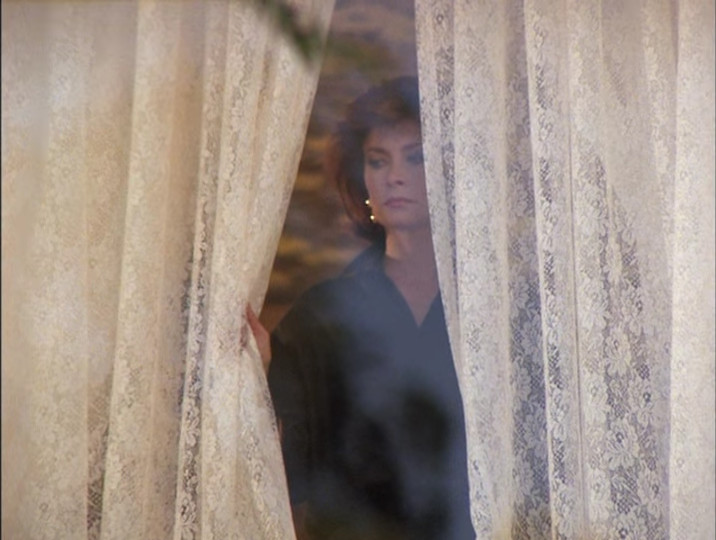
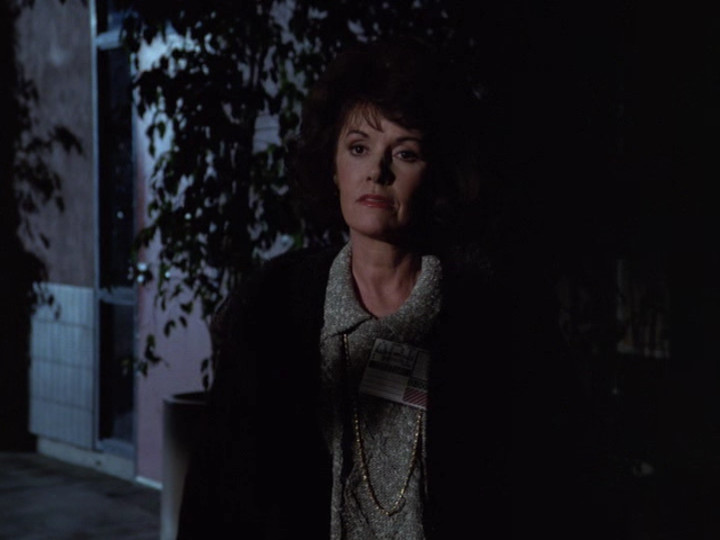
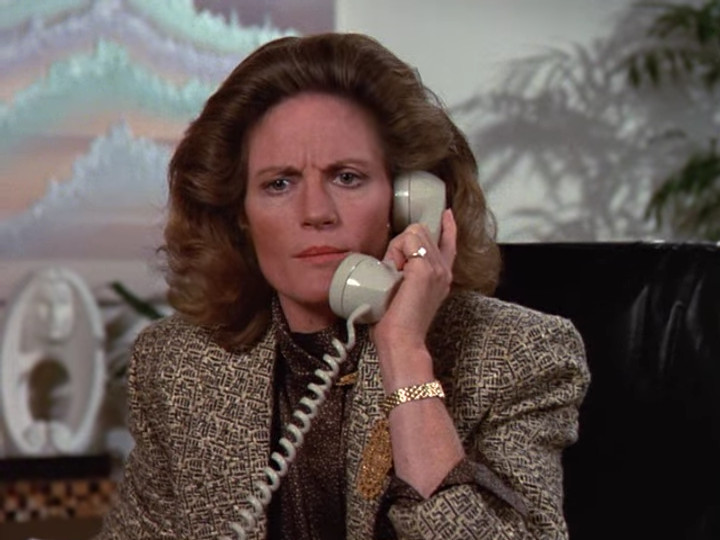
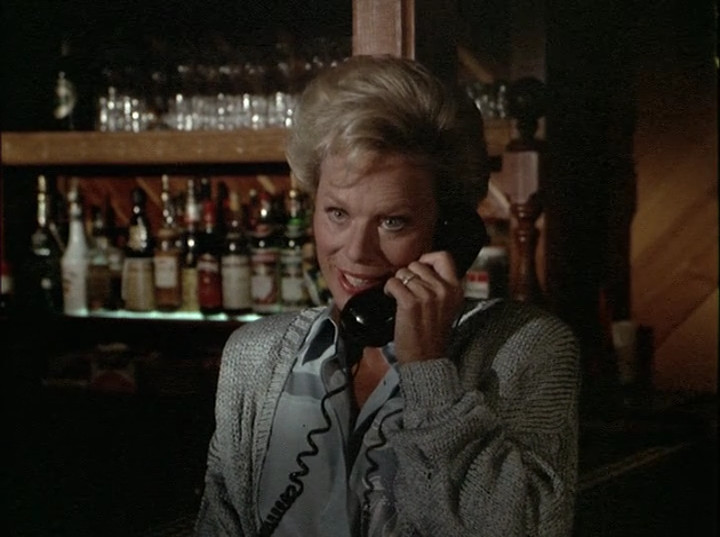
At the residence that the phone number reaches, a woman dressed in black comes down the stairs and answers the phone.

She says that she’s Mrs. Cosgrove and that Mr. Cosgrove is alive and well. Cooper asks to speak to Carl but Mrs. Cosgrove says that he can’t—he was working in the rose garden and had an asthma attack, but she can have him call Sergeant Cooper when he recovers. Sergeant Cooper says that that won’t be necessary.

Jessica is satisfied, and the episode ends only 8 minutes in.

Just kidding.

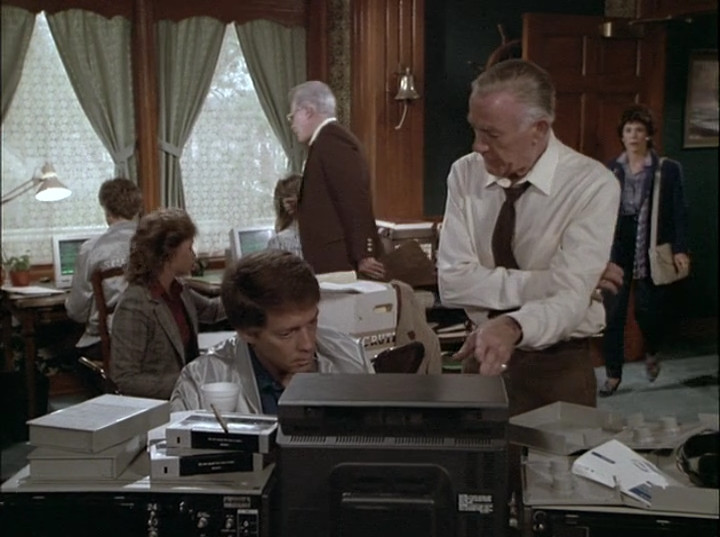
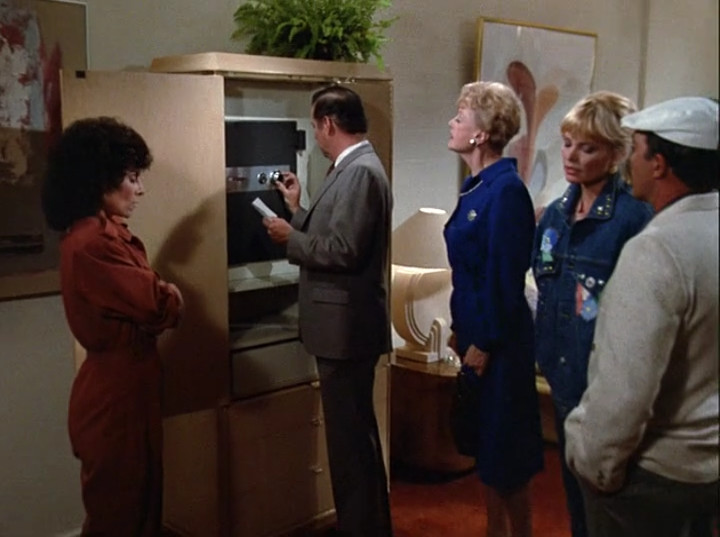
Since Sergeant Cooper will not help, Jessica takes a taxi over to the Cosgrove house to investigate for herself. The house has a gated driveway with a security guard at the gate. As he talks with her and asks if she has an appointment, several people inside watch the security camera footage of this in some sort of command center.
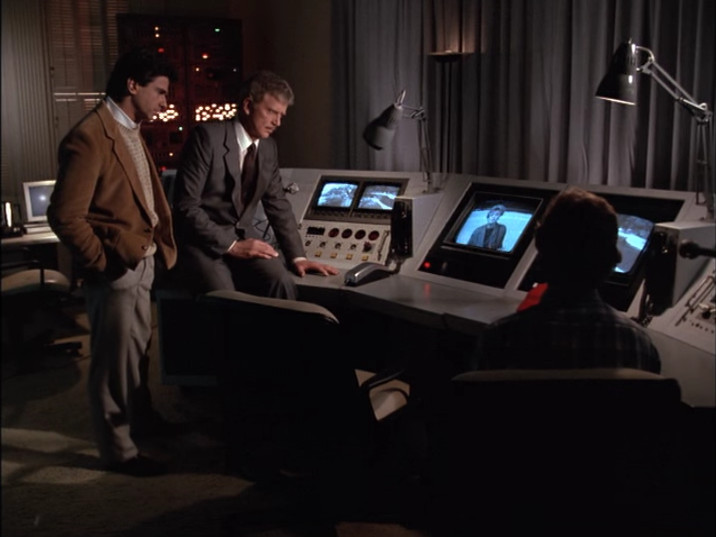
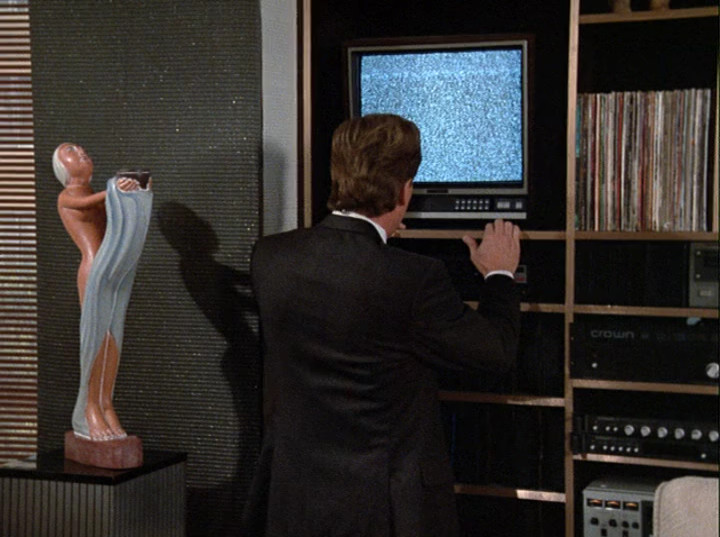
What has Jessica stumbled into? On the other hand, when you hear the dying confession of a professional killer, it’s probably not something ordinary. Still, this is one heck of a control room. They’ve got a super-computer in the corner (look at all the blinkenlights) and also some very serious grey drapes to keep the tone somber.

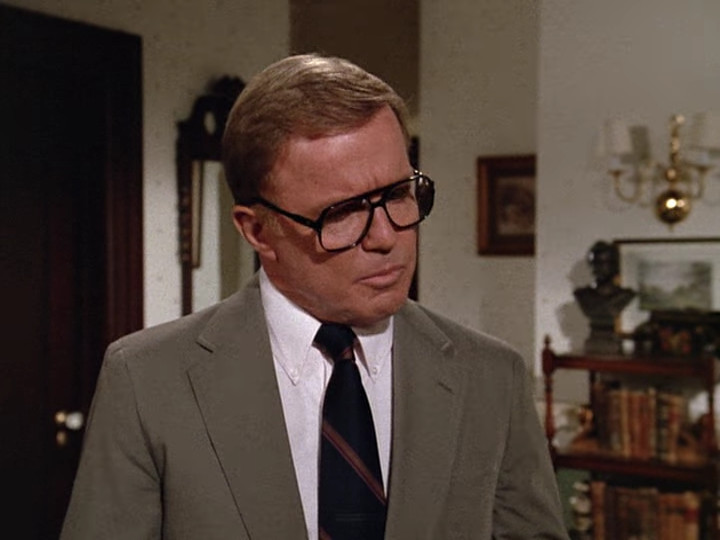
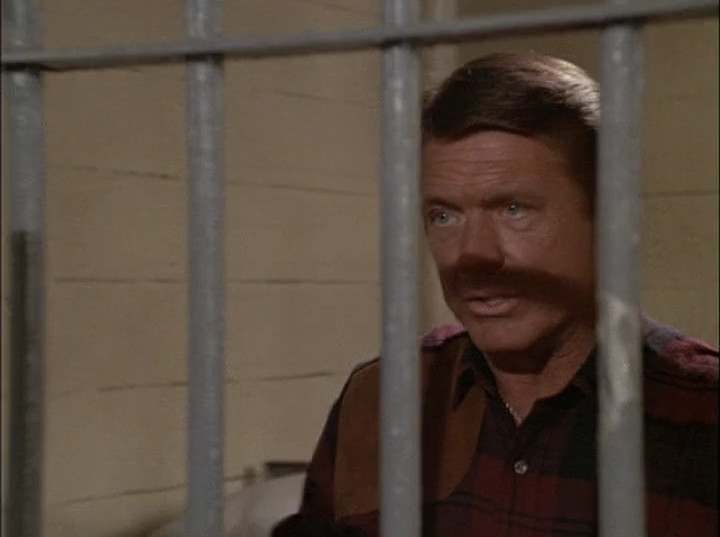
The security guard is reluctant but calls the command center to ask what to do. The youngest one says that perhaps they should ask “Adams,” but the middle one (the one with the mustache) who seems to be the most authoritative says that Adams isn’t here. The one in the tan sport coat says that a woman this persistent could be trouble, and the authoritative one with the mustache says, “Let’s get this over as quickly as possible.” After being told she can go in, Jessica thanks the security guard and for some reason gets back into her cab, which then pulls up to the house.

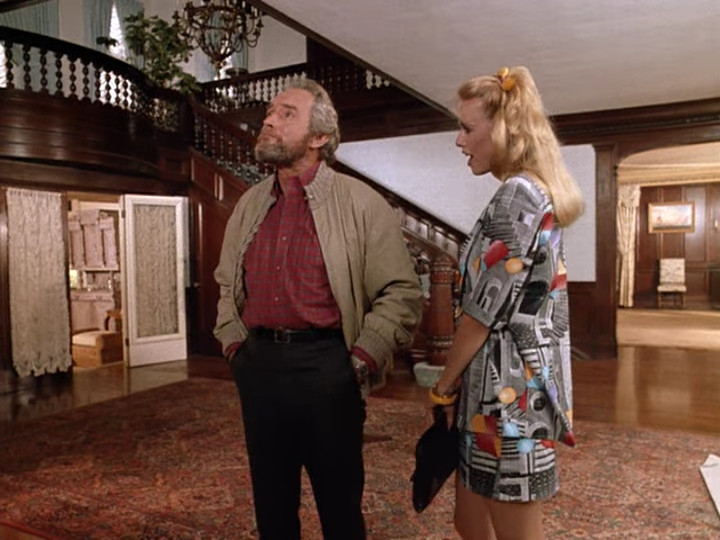
I find the houses in Murder, She Wrote very interesting. There was a lot that they were trying to convey with an establishing shot. At least, normally. In this case, I’m really not sure. This sort of estate is a strange place in which to run a… well, whatever this is. And whatever it is, who is supposed to live here? As a cover story, I mean? A gated property with a security guard manning the gate is no trivial matter, but it’s hardly enough to keep out an attacking force. On the other hand, if the purpose of the security guard is not to defend against direct attacks, what purpose does he serve? If people don’t know what’s here to attack it, the security guard would, if anything, draw attention.

Jessica comes to the front door and Mrs. Cosgrove lets her in. Jessica apologizes for Sergeant Cooper’s phone call, as if somehow the problem was Sergeant Cooper’s manner and not the call itself or Jessica’s refusal to believe Mrs. Cosgrove. There’s some chitchat and Jessica says, suggestively, that the police have reason to believe that something happened to Carl Cosgrove. Mrs. Cosgrove replies that it’s time to introduce Mrs. Fletcher to her husband, and leads the way upstairs.

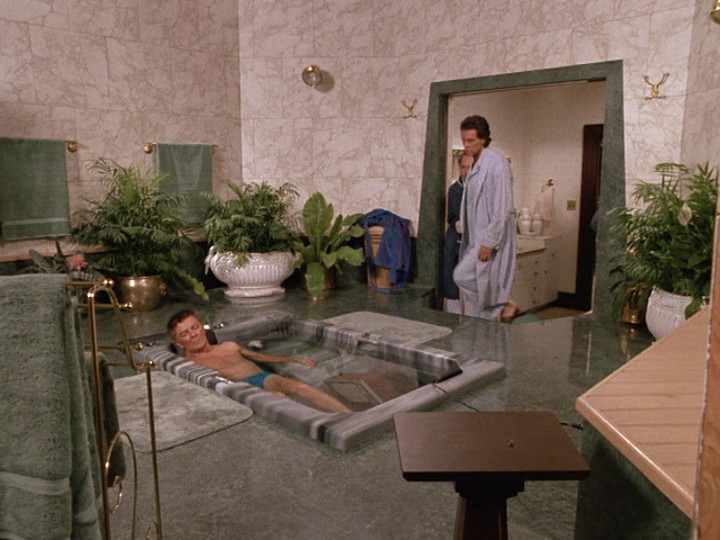
That’s one heck of an asthma attack.

When she introduces Jessica, he weakly waves his hand. Jessica expresses her condolences on his asthma attack. While she’s doing this, the shot changes to the other side of a one-way mirror in the room, where the same people who were in the control room are watching:
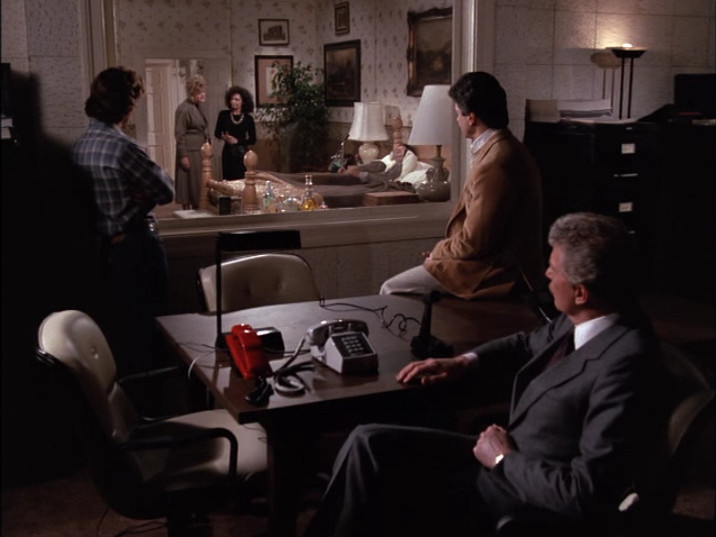
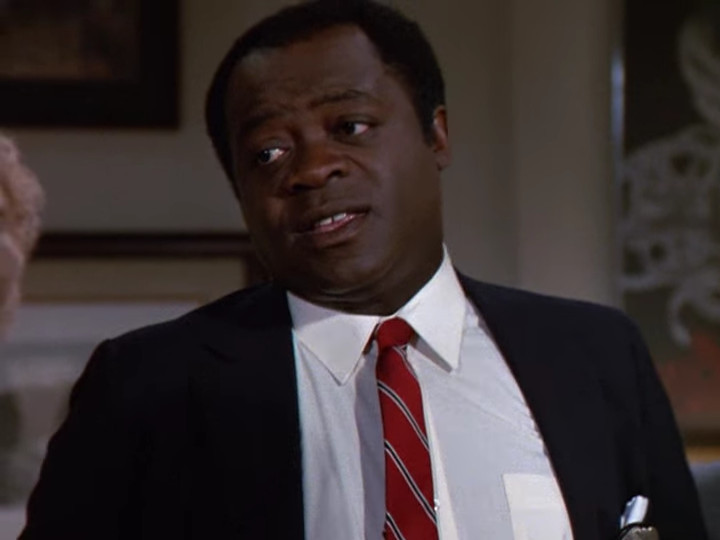
The mustached fellow in the grey suit asks if Jessica buys it, and the man in the tan sports jacket expresses the opinion that Jessica isn’t even slightly fooled. Mrs. Cosgrove then leads Jessica out to show her the rest of the house (for some reason). Once the door is closed the man pretending to be Carl Cosgrove—his name turns out to be Señor Delgado—gets up and talks to the mirror, saying that he does not like role-playing. Mustache Man acknowledges this, but says that it’s sometimes necessary for security. Another man walks in—he appears to be some sort of aide and refers to Señor Delgado as “Comandante”. They speak in Spanish and he translates, despite Delgado seeming to speak English perfectly well.

Delgado feels uneasy in the house and wants to return to Washington. Mustache Man says that this cannot be arranged, but they will bring him back to Washington the next day. Delgado demands to speak with Adams but is told that Adams is in Washington arranging the security for his appearance before “the committee”. Delgado says that he doesn’t believe them, and on that bombshell the scene fades out.

We’ve gotten some definite clues about what Jessica as stumbled into, though I’m not sure that they make sense. Delgado is some sort of South-American dictator, or at least military figure. It doesn’t make sense why a South American dictator would be hiding out in a safe house, so presumably he’s a military commander who has run away from his country to testify in front of congress that… who knows?

This is apparently a safe house run by some government agency. Why they let Jessica in and why they picked Delgado to pretend to be Carl Cosgrove, I can’t make out. Perhaps it will eventually be explained.

The next scene is of Jessica in her hotel room. A desk clerk recognizes her as she walks past and tells her that Father Francis was looking for her. He left a message for her to meet him at his church, Saint Jerome’s, which is only two blocks away.

Jessica goes there directly.

Fr. Francis calls out to her by name as she’s walking along the nave of the church, which startles her. She asks how he knew her name. He says that he described her to the desk clerk who identified her. He asked her to come because he wanted to know what the dying man said in his confession, as the confession was meant for a priest. Jessica acknowledges this and, knowing nothing about how the sacrament of reconciliation (“confession”) works, tells him.

He responds that a parishioner who is a police officer told him that the man who died was identified as a professional killer from another city. He asks if the confession included who hired him to kill Mr. Cosgrove.

Frankly, this isn’t a great impression of a priest. (It’s pretty obvious by now that “Fr. Francis” is not a real priest.)

Jessica says that no, the killer didn’t say, and she just met Mr. Cosgrove and he seemed very much alive.

“Fr. Francis” then asks if she’s sure that it was the Mr. Cosgrove. Jessica starts to ask him what it is he wants to know, but they’re interrupted by the actual pastor of the church who calls out, “Anything I can do for you, Father?”

“Fr. Francis” replies, awkwardly, “No. Thank you very much, Father.”

He then turns back to Jessica and explains why he wasn’t recognized, “Father Sweeney. His eyes aren’t what they used to be.”

Jessica replies, “Well, in the words of Saint Thomas Aquinas, we are much as we see. Faith is sight and knowledge.”

“Father Francis” grins, thinks for a moment, then replies, “and the old boy certainly knew what he was talking about.”

You’d think he’d be better at imitating a priest than this if he took the time to actually get black clothes and a roman collar. They’re laying it on pretty thick, but I suppose it’s for an audience who knows nothing about priests. Or Saint Thomas Aquinas. I mean, you don’t even need to have read any Saint Thomas to know that this isn’t a quote from him. That said, Saint Thomas isn’t a great choice to catch someone up on—if you’re not making the quote obviously impossible—since he wrote so much you have to be a Saint Thomas scholar to recognize every possible quote from him. That said, it’s not even a great test since it’s rude to correct somebody on a misquotation, and a person may let it slide out of politeness rather than ignorance.

The actual pastor of the church then gets a message from a boy in a cassock and surplice who apparently wears them to do office work:

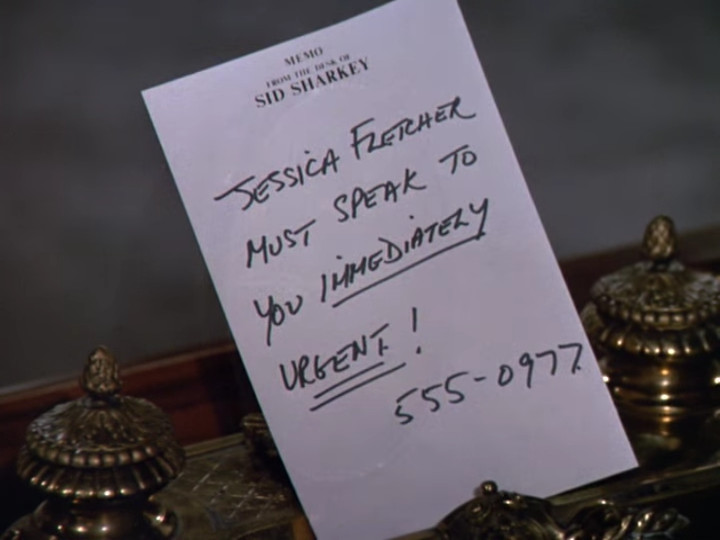
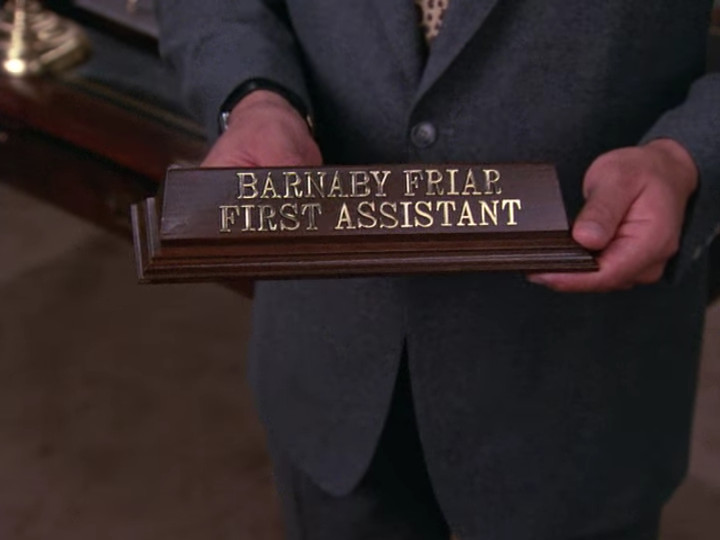
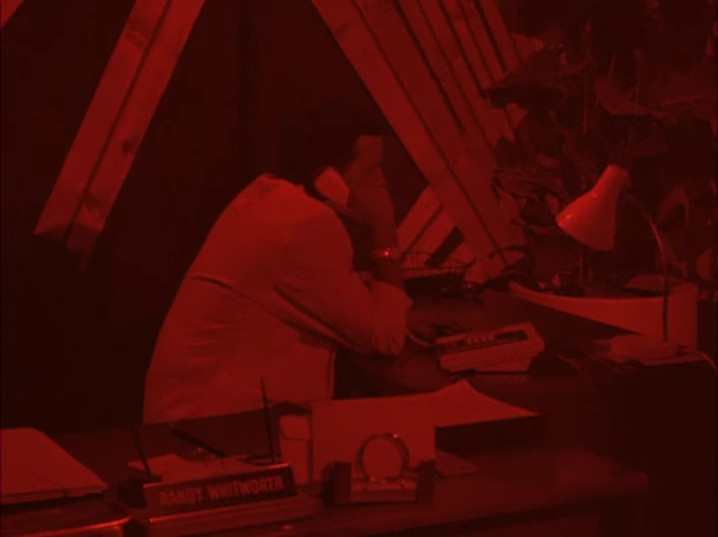
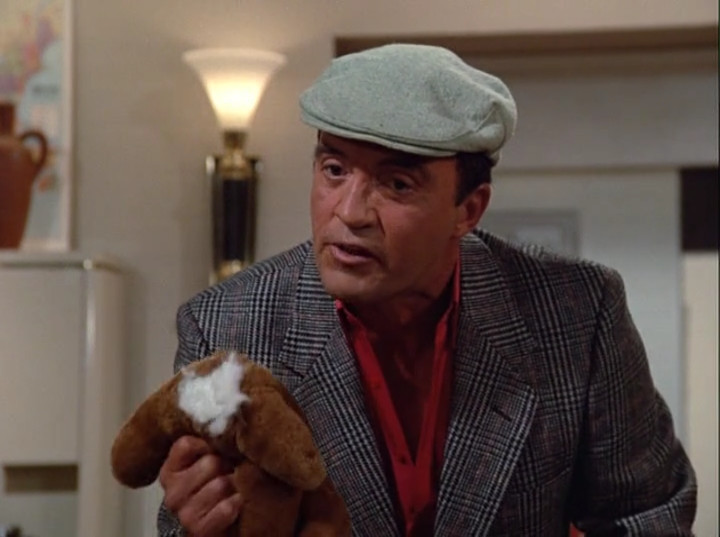
The message turns out to be that there is a phone call for a Mrs. Fletcher. The priest asks if Jessica is Mrs. Fletcher, and tells her that she can take the call in her office. When she takes the call in her office, she notices the nameplate that the camera zoomed in on which says, “Reverend Paul Kelly.” This is for the slow witted, I assume, though given that they think that churches employ 10 year old alter servers in full vestments as office secretaries, perhaps they thought that they were actually being subtle and the nameplate was necessary.

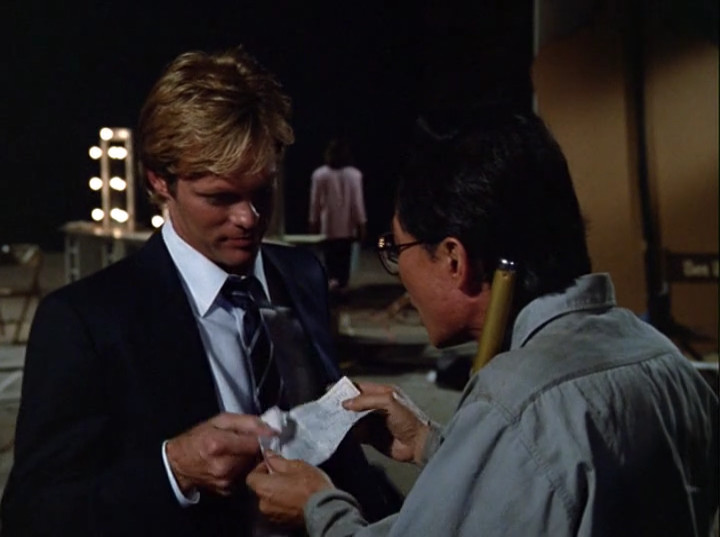
The phone call turns out to be from Sergeant Cooper, who knew where to find her from the desk clerk at her hotel. He would take it as a personal favor if she came down to police headquarters immediately because they just pulled a body out of the Connecticut river with two bullets in him, one in his head and one in his heart, and his ID says that he’s Carl Cosgrove of Farmington.

Jessica arrives at the police station and there is some banter between her and the sergeant, but she explains what she found in Farmington and Sergeant Cooper says that it’s time for a house call.

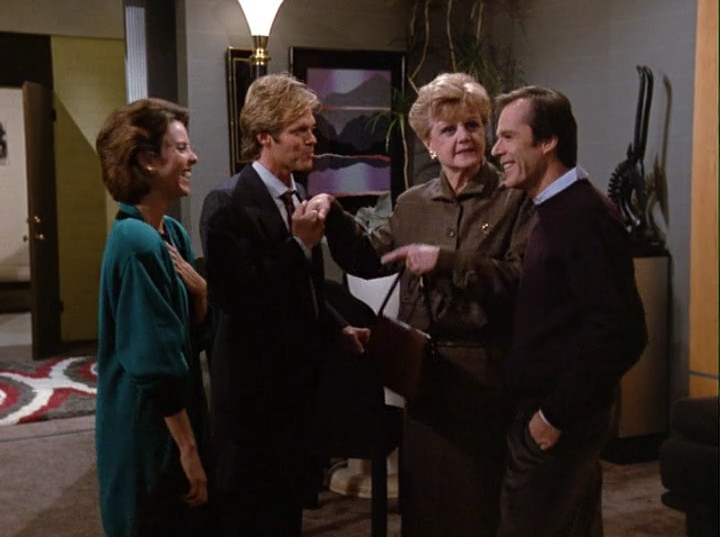
When they’re let in, the fellow in the tan sportscoat says that Mrs. Cosgrove is not at home, but he’s her brother and asks if there’s anything he can do. Sergeant Cooper starts to go up the stairs to look around, but his way is blocked by the Spanish assistant, then Tan Sportscoat pulls a gun on Cooper. Mrs Cosgrove comes out and checks Cooper’s badge, then Mustache Man comes out and asks everyone to join him in the living room.

In the living room Mustache Man says that their insistence on coming might have compromised the security of a DSS safe house. Jessica is unfamiliar with the acronym DSS, and Sergeant Cooper explains that it stands for “Department of Special Security”—which is a made up department, explaining why Jessica never heard of it. Mustache Man is angry with Sergeant Cooper for coming to the house as DSS authority supercedes local authority, but since he has no idea why Sergeant Cooper is there and Sergeant Cooper couldn’t have known that it was a DSS safe house, this makes no sense.

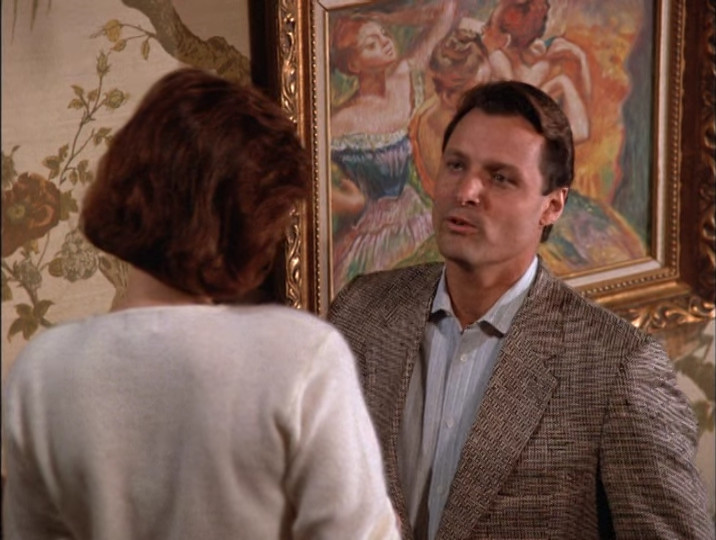
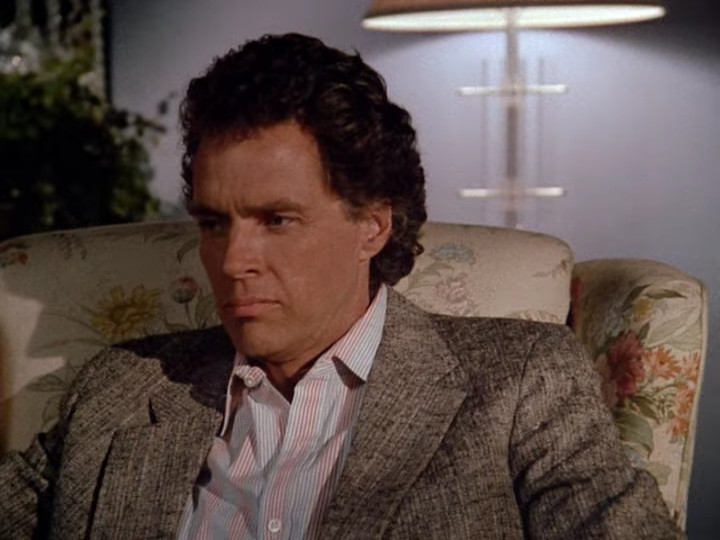
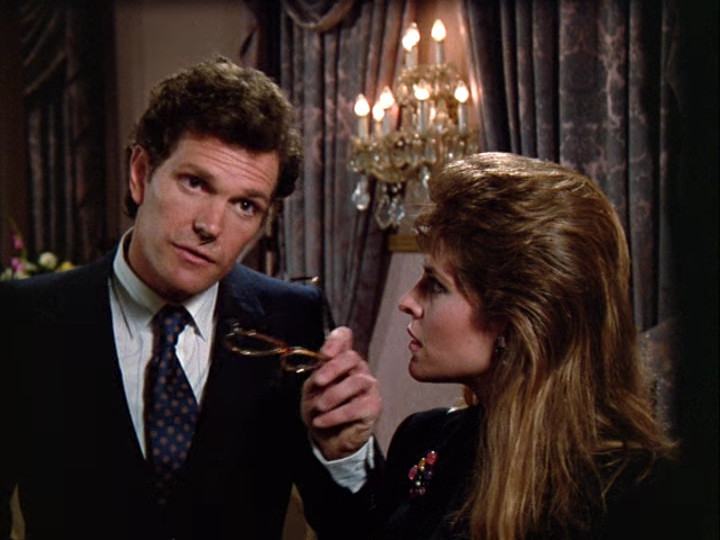
There’s some banter where Jessica deduces that the “Carl Cosgrove” she saw was their house guest and Mustache Man says that he expected no less deductive ability from a mystery writer who outwitted a KGB agent to help a pair of Russian ballet dancers defect (a reference to a first season episode). Jessica surmises that they have a file on her and he rattles off a bunch of harmless facts about her like her maiden name and marital status. Jessica is deeply upset by this recital of information that might as well have come from the jacket cover of one of her books, for some reason. Anyway, they finally get to who “Carl Cosgrove” is—a house identity that they all use when they go out on house business. Sergeant Cooper then shows a picture of the stiff, and it turns out that it is Adams. “Mrs. Cosgrove” then cries at Mustache Man that he lied—he had said that Adams was on assignment in Washington. Tan Sportscoat then says, “Meeting with somebody he didn’t know in a deserted parking lot was stupid. You should have stopped him.” Mustache Man replies, “I didn’t know anything about it.” He then reminds them that they’re secret agents in front of non-agents. Tan Sportscoat takes Mrs. Cosgrove out for some fresh air.

Why they’re blaming Mustache Man is very non-obvious. He was clearly Adams’ subordinate. Also, how did Tan Sportscoat know that Adams met with somebody he didn’t know in a deserted parking lot when Mustache Man didn’t? This seems like a pretty typical Murder, She Wrote slip up, though you never can be 100% certain. There’s some more banter between Mustache Man, Jessica, and Sergeant Cooper. The only really interesting part is when Cooper asks if Mustache Man and Adams were friends, and Mustache Man replies, “I found his company bearable… most of the time.”

We still have no explanation for why on earth they used the person they’re guarding as a pretend Mr. Cosgrove to try to fake Jessica out. For that matter, if Mr. Cosgrove was a name that they all used when going out, why did Mrs. Cosgrove pretend that “Mr. Cosgrove” wasn’t home? Why didn’t she just fetch one of the men who had a driver’s license that said “Mr. Cosgrove” on it to the phone?

Come to think of it, why did every agent in the house use the same fake ID? It would get very awkward if they had to come into contact with the same person twice—by all pretending to be the same person, they would need to coordinate who they met so the rest could avoid them. If everyone had his own ID, it would simplify their safe house business and also provide an explanation for why they would pretend that Mr. Cosgrove was just fine without actually getting him because Adams was out.

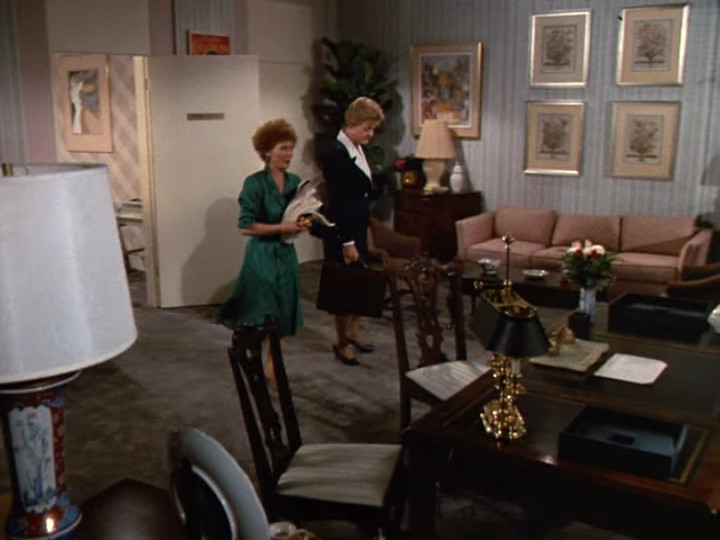
Be that as it may, the scenes at the safe house are done and Jessica goes back to her hotel. Incidentally, I really love the hotel rooms in Murder, She Wrote:
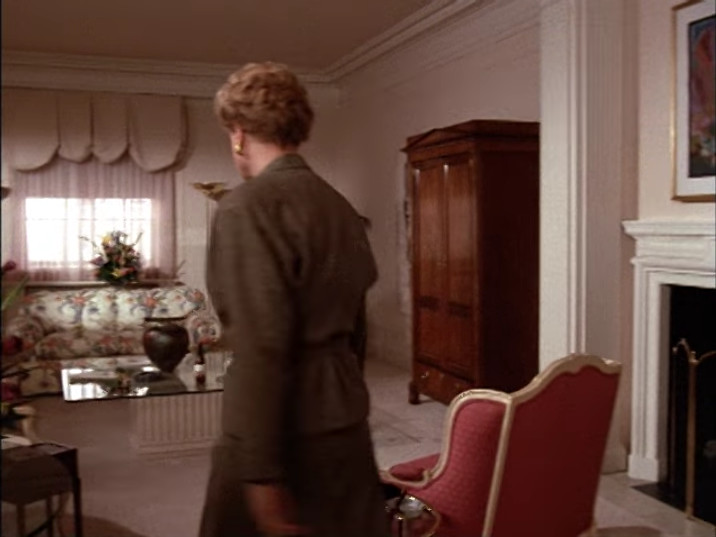
Jessica had to walk down the hallway inside her hotel room to get this this enormous living room, btw. To be clear, I don’t mean the hotel hallway. Inside of her hotel room was a hallway past other rooms to get to this one.

The New England Bookseller’s Association sure put her up in style.

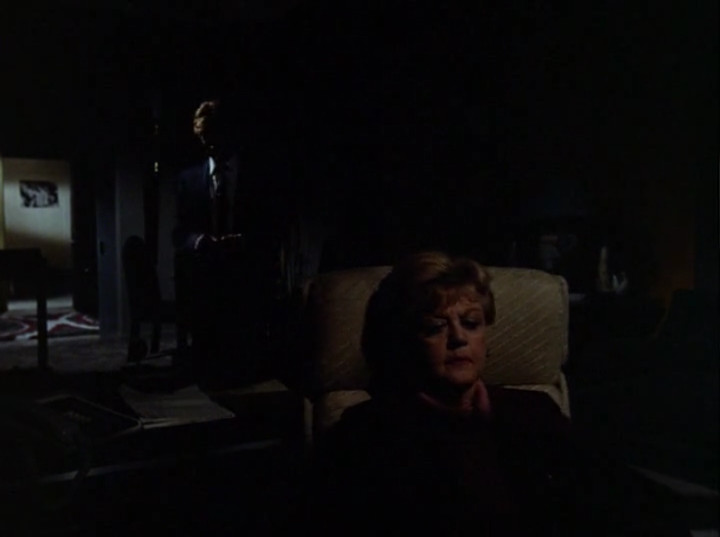
She notices the beer on the table and “Father Francis” walks out of the shadows and says that they need to talk. Jessica suggests that he talk to the police and explain why he broke into her room, but he merely says that she nailed him on the quotation in the church. He had to look it up—it wasn’t Saint Thomas Aquinas, it was Henry David Thoreau.

I’m actually quite surprised that this was a real quote—I mean apart from it being very stupid. “We are much as we see. Faith is sight and knowledge” doesn’t mean anything. Actually, it’s a slight mis-quotation. The real quotation is “We are as much as we see…” That doesn’t make sense either, though. And it’s not just that it’s taken out of context. Take a look at the quotation in context (it’s from the seventh volume of Henry David Thoreau’s collected writings):

How much virtue there is in simply seeing! We may almost say that the hero has striven in vain for his pre-eminency, if the student oversees him. The woman who sits in the house and sees is a match for a stirring captain. Those still, piercing eyes, as faithfully exercised on their talent, will keep her even with Alexander or Shakespeare. They may go to Asia with parade, or to fairyland, but not beyond her ray. We are as much as we see. Faith is sight and knowledge. The hands only serve the eyes. The farthest blue streak in the horizon I can see, I may reach before many sunsets. What I saw alters not; in my night, when I wander, it is still steadfast as the star which the sailor steers by.

To be fair, the passage as a whole is merely wrong, not meaningless. But the part about “faith is sight and knowledge” is meaningless, especially when you realize in context that he’s talking about literal eyesight since the whole is a panegyric to eyesight.

Anyway, the real reason I assumed that it was not a real quote was not that it’s meaningless prattle, but that if you use a real quote you might accidentally get something that two people said. I’m quite certain that Jessica never read so much as a word of Saint Thomas Aquinas, and frankly it would be a bit shocking if she even knew who he was. Even having heard of his name is a bit of a stretch. Since she could have no idea what he’d actually said, for all she knew Thoreau got it from Aquinas. No, if you want to catch someone out on a quotation, you should make it up yourself so you can be sure it’s not real.

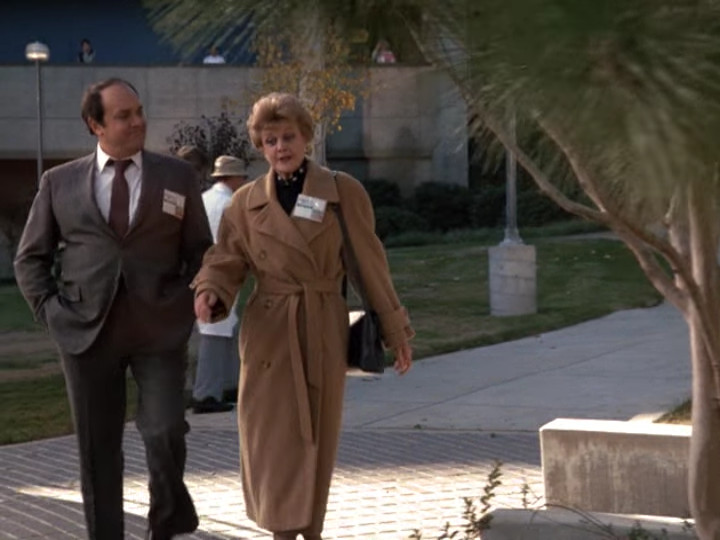
Anyway, Father Patrick reveals that he works for the DSS in internal affairs—investigating all the other DSS agents to keep them honest. Jessica asks if he can show her identification, and he laughs—he can, but it all says, “Father Patrick Francis”. He asks if they can go outside to talk and Jessica agrees but only somewhere with people around. He very readily agrees to that suggestion and asks her to name the place. She picks a public park.

I like this turn of events. Finally having a good guy in the story is pleasant. Also, I like that he recognizes the difficulty of proving who he is and takes steps that demonstrate trust and make Jessica feel safer, such as going someplace public and letting her pick the place. It doesn’t prove he’s telling the truth, but it’s consistent with him telling the truth and also with being able to see things from her perspective. That’s a good trait for a character to have.

They go the park and he gives Jessica some backstory.
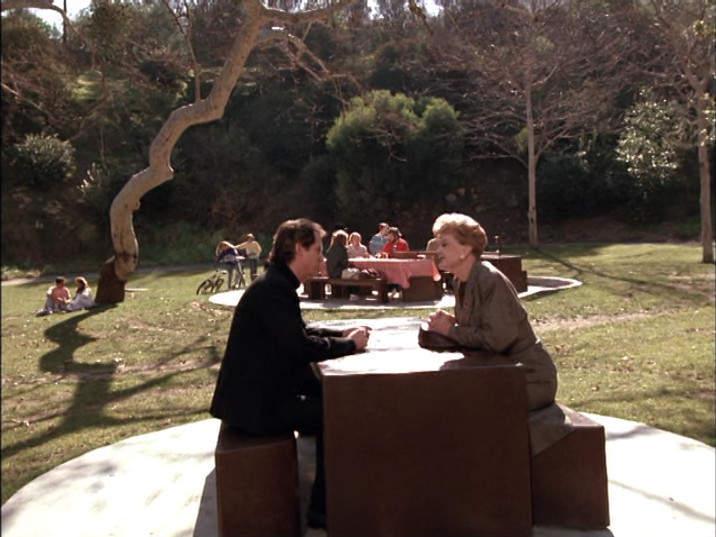
Last week Adams called internal affairs and said that he suspected that there was a traitor in the DSS safe house. We get a bit of backstory on the people there; Mustache Man was passed over for promotion for a younger man. Tan Sportscoat was a hotshot recruited off of an Ivy league campus, but hasn’t gone anywhere because of his lack of leadership material. The young timid guy is young and timid. Delgado, not that I can see how it matters, is actually the leader of a revolution in his country here to ask Washington for more money for his revolution. Sanchez is his bodyguard, factotum, personal servant, etc.

He then tells what he knows about Adams death: Adams telephoned “Fr. Francis” last night and told him that he heard from an informant who would reveal the traitor. They arranged to meet at the Trinity College parking lot, and Adams told no one about this. It didn’t smell right to “Fr. Francis” so he persuaded Adams to wear a tracking device. Adams spoke to the so-called informant briefly then got in his car and they drove off. “Fr. Francis” followed at a safe distance but well within range of the tracking device. As he was going over the Connecticut river, the signal suddenly stopped. He retraced his steps but couldn’t pick it up again. He waited a bit but then saw the “informant’s” car, so he tailed him back to the city, only to see him crash in front of Jessica’s hotel.

Jessica then asks what he wants, and he wants her to do the investigation for him, since the people in the safe house will just close ranks if he shows up and identifies himself as being with internal affairs. Jessica absolutely refuses to be a spy for him—despite that being exactly the same thing as investigating the murder that she wants to investigate.

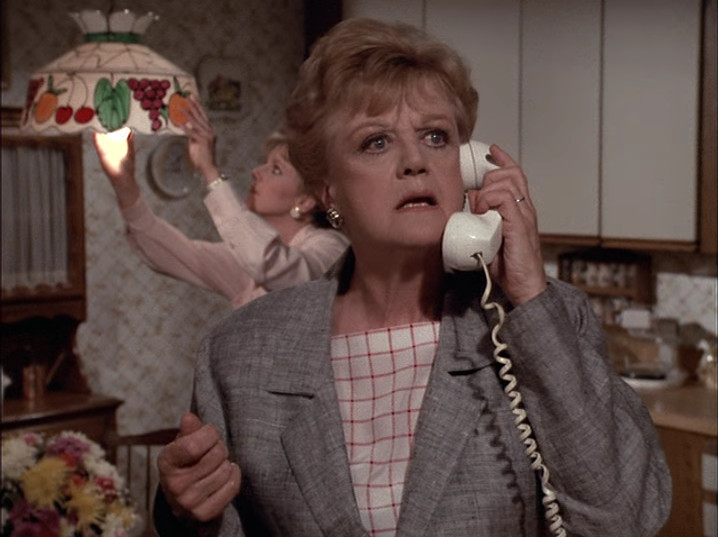
In the next scene Jessica is in her hotel room and runs in a bath robe to catch the phone which is ringing.

It turns out to be “Mr. Secretary.” She does remember meeting at at the cocktail party at the state department, and—short story even shorter—in the next scene she’s being prepped for going into the safe house to dig up what she can. This includes a lipstick that is actually an emergency beacon.

Interestingly, the cover Jessica is using is that she wants to gather information about the safe house for an upcoming book and has pulled strings with friends in Washington to get her access. I do like this twist on what really happened—that Washington used their connection with her to get her to do it. It’s got a nice plausibility to it, though, given that within the world of Murder, She Wrote Jessica is a literary titan who routinely attends everything, everywhere, and knows everyone. She certainly could pull strings to get access, if she wanted to.

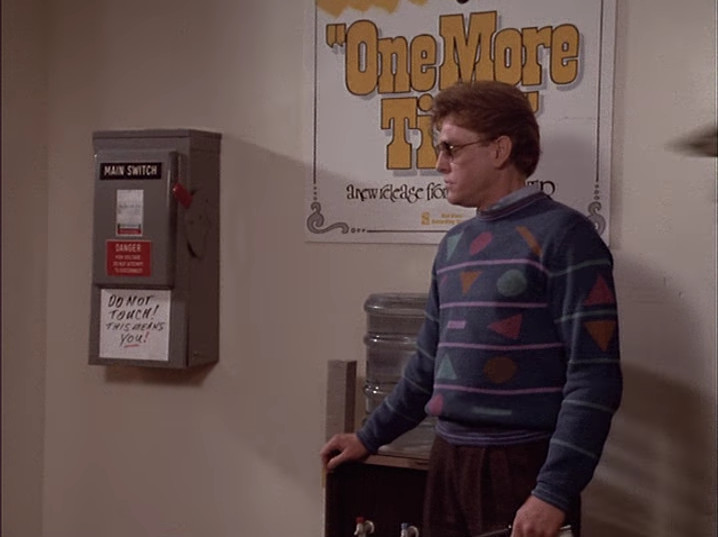
Mustache Man is reluctant, then Tan Sportscoat (now wearing a sweater, and his name was revealed to be Van Buren, but for consistency I’m going to keep calling him Tan Sportscoat) comes in and he and Mustache Man bicker until a call comes in from the gate that Sergeant Cooper is there and wants in to discuss a development in Adams’ murder. (Incidentally, Mustache Man’s actual name—or at least code name—is Jackson, but again I’m going to keep using the name I first had for him since we learned his name pretty late in the episode.)

The new development is that Sergeant Cooper ran Adams’ prints and he had a rap sheet a mile long. This isn’t a development, though, since this is just leftover from a previous cover identity. However, while Cooper and Mustache Man are bickering, a real development happens:
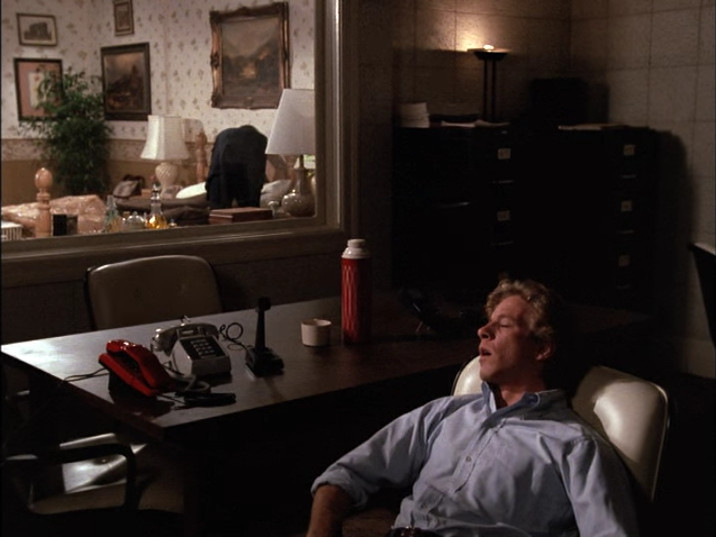
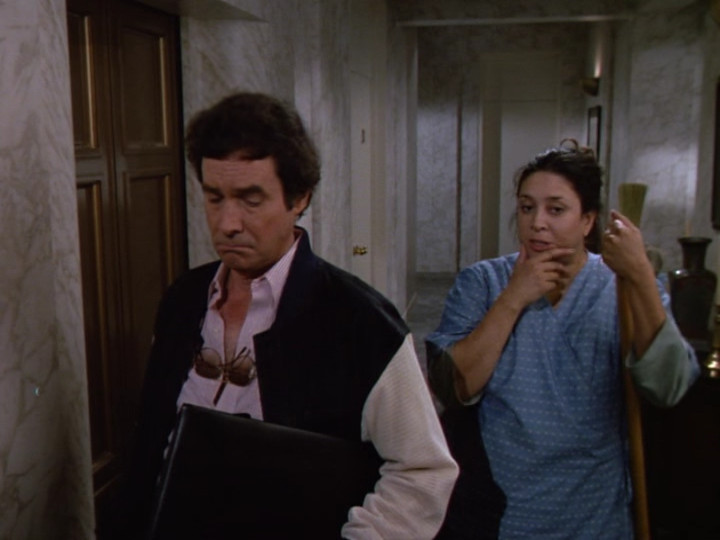
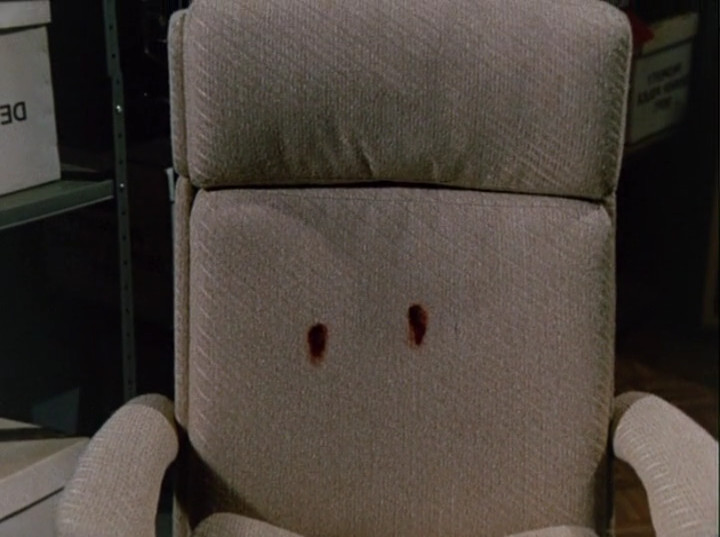
Sanchez can’t wake up Delgado, and not in the “he’s sleeping very deeply” sense. As opposed to Timid Guy, who is sleeping pretty deeply but quite alive. We’ve got a second murder on our hands. I guess it’s convenient that Sergeant Cooper is on the premises.

Timid Guy wakes up and hears from Sanches that Delgado is dead and runs off to bring the news to Mustache Man. Everyone runs out of the room except for Jessica, who goes and activates her lipstick beacon for some reason. “Father Francis” picks up a walkie talkie and tells everyone to surround the house. Then we go to commercial break.

When we come back, Sergeant Cooper is yelling into the phone that he needs the homicide team. The camera then pans over to the next room where Timid Guy is being interrogated. He admits he fell asleep, which had been a problem before, but those times were late at night. That’s why he thought switching to taking a morning shift would be a good idea. But it didn’t work, even with an entire thermos of black coffee.

Cooper then interrupts and starts his own line of questioning, which leads to how Timid Guy saw saw Sanchez shaking Delgado, but couldn’t actually see what he was doing, so Cooper leaps to the conclusion that Sanchez strangled Delgado while he pretended to try to wake him.

Jessica decides to confront Sanchez, says that he was more loyal to his Comandante than to the revolution, and asks if he would be so even if Delgado was stealing money meant for food for the people and to fund the revolution. Sanchez angrily says this was a lie, that Delgado was a good man, and that he never would have stolen from his people. I’ve no idea what the point of this is, since Sanchez is literally the least likely suspect in the building (after Jessica).

Francis and Cooper come and arrest Delgado for the murder, but Jessica isn’t buying it. Sanchez could have had no way of knowing that Timid Guy was asleep, and it seems more than a bit foolish to kill Delgado right in front of someone watching him. Francis says that Sanchez was the only one who could have done it, but I don’t see how this was the case since they have no idea what happened while Timid Guy was asleep.

Jessica is more bothered that this wouldn’t link the murder to the murder of Adams, and she’s convinced that there must be a link.

A little later Mrs. Cosgrove talks to Jessica and plaintively says that Adams would never have let this happen. He was omniscient, I suppose, except when it came to obvious traps. Jessica suggests that the impossibility of killing Delgado with Adams around might be why he was killed. Mrs. Cosgrove wonders why he went off on his own without telling anyone where he was going and Jessica replies, “I don’t think he meant to hurt you. I think he wanted to prevent any possibility of a leak by not confiding in anyone.”

Then she realizes what she just said and we get clue-face:
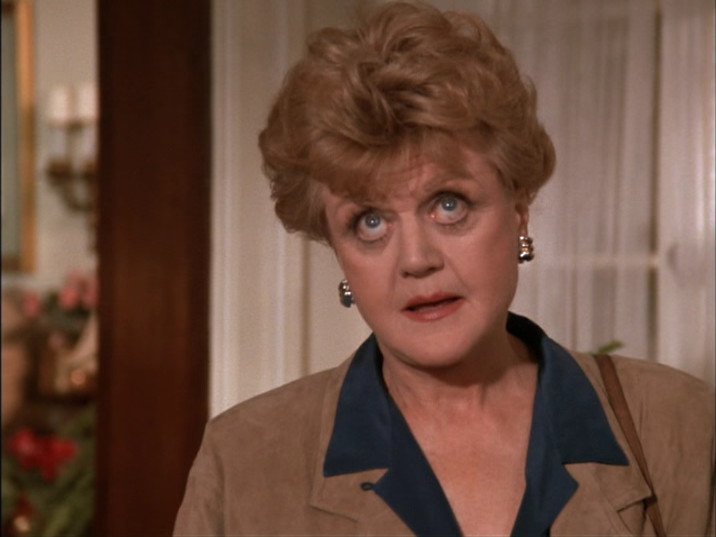
So, the good money is on Tan Sportscoat’s remark about Adams meeting someone he didn’t know in an abandoned parking lot being a real slip.

Jessica anounces that she knows who killed Adams and Delgado.

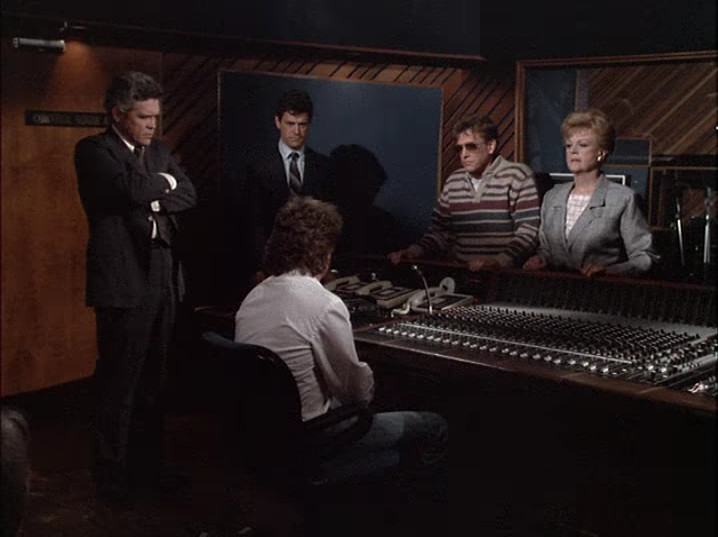
We next see her in the murder room.
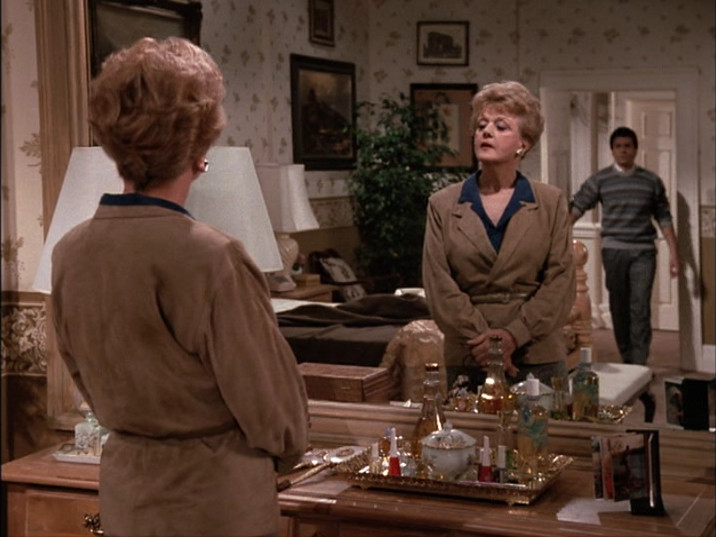
Yup, the murderer is Tan Sportscoat (now wearing a sweater). To seal the deal, he says, “You wanted to see me?” (I can’t recall a time that Jessica wanted to see someone with less than 5 minutes to go in the episode who wasn’t the murderer.)

Jessica asks Tan Sportscoat if he’ll give her his opinion on a theory she has: the killer was assigned to the safe house and felt his career had reached a dead end. He was restless, and Delgado’s country contacted the killer and offered a large sum of money for the assassination of Delgado.

Oddly, Tan Sportscoat doesn’t stop her here and ask how on earth the head of some South American country would be aware of the personnel in a safe house in Connecticut, to say nothing of how they would know that Delgado would be assigned to this safe house ass presumably the DSS has more than one. Both of those seem effectively impossible, ruling out this theory, but we hear not a word about this.

In fact, he says nothing and Jessica continues. First, the killer had to get rid of Adams, who kept a very watchful eye on the safe house. Which meant the killer had to contact a hit man.

Also oddly, Tan Sportscoat doesn’t object that Adams wasn’t omniscient and could hardly personally watch the safe house 24/7, so there was no need to kill him. Instead he observes that Mustache Man had access to the department’s list of hit men. Jessica pounces, saying, “Oh, you know about the list?” He replies that he’d heard of it.

He asks how Mustache suckered Adams, and Jessica says it was with a scenario. First, creating suspicion about a traitor in the ranks, then having the hitman contact Adams with an offer of information of who it was. Tan Sportscoat says that he didn’t think Mustache had it in him, and Jessica says that he didn’t—she’s talking about Tan Sportscoat. He then walks over to the mirror and asks who’s behind it—the cop or the internal affairs man. Jessica replies, “both.”
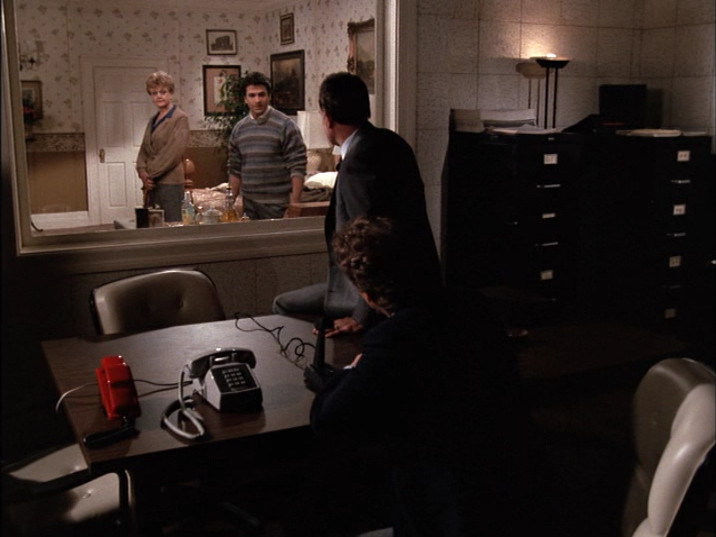
This is a very strange setup. I can’t see how it accomplishes anything for Jessica to accuse Tan Sportscoat with people watching from behind a mirror instead of being in the room with them. For that matter, why does the safe house have a room behind a one-way mirror at all? If they want to be able to observe the person that they’re guarding, closed circuit TV would work perfectly well and be less cumbersome. Plus if they had closed circuit TV throughout the house they could then watch the person that they’re guarding at times other than when they’re sleeping. And they do have closed circuit TV watching the gatehouse. (Presumably the answer is that the plot wouldn’t work with closed circuit TV since that would almost certainly be recorded on 24 hour loop, making the murder impossible.)

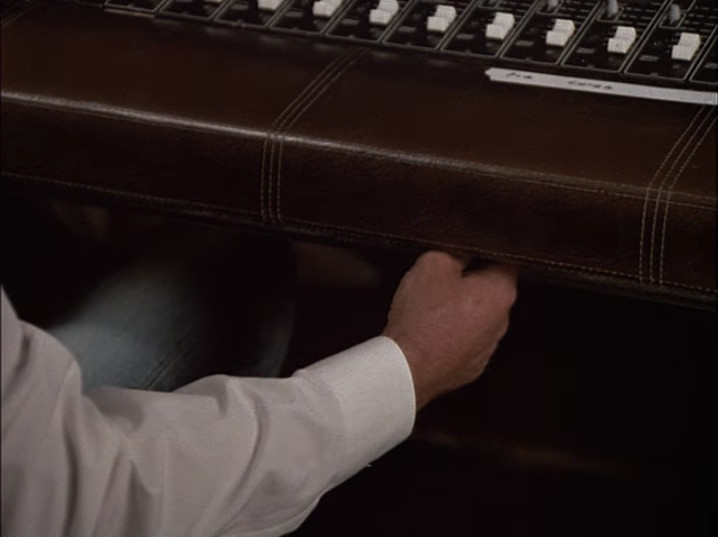
Be that as it may, there’s an interesting twist that comes up: Tan Sportscoat says that he can account for his whereabouts during every minute of Timid Guy’s shift. Jessica replies that he didn’t kill Delgado during Timid Guy’s shift, he killed him during his own shift, then made it look like Delgado was still sleeping so that Timid Guy would assume Delgado was still alive and everyone would think that Delgado was killed during Timid Guy’s shift (Tan Sportscoat had been drugging Timid Guy’s coffee and increased the dose today).

He replies, “Well, your theory… turned out to be better than I thought.”

“Father Francis” asks him why he did it, and he replies that Jessica got it right—for the money. Jessica gives him a disapproving look, and he asks her, “Or would you prefer if I did it because I believed in a cause?” Jessica says, in her dour way, “Either way, it was murder.”

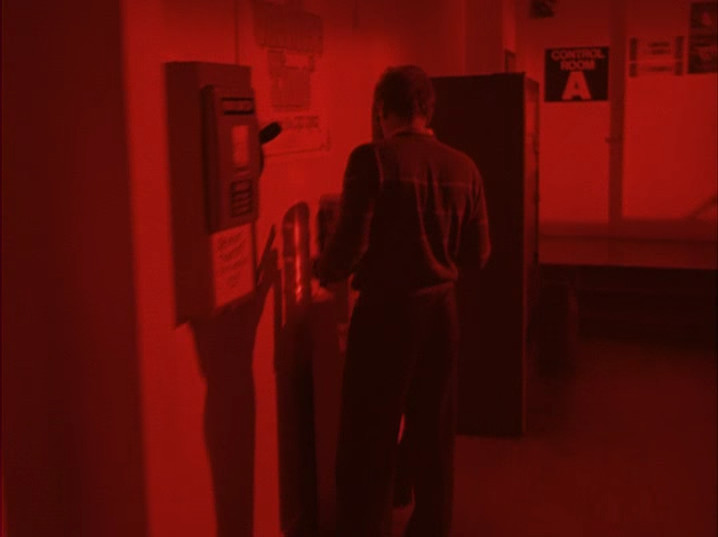
Oddly, this is not the end of the episode. There’s a final scene at police headquarters where Sergeant Cooper tells Jessica that Mr. Francis called and Tan Sportscoat is singing like a bird about the people who paid him to murder Delgado. This is interrupted, briefly, by a call from his wife, to which he habitually replies, “I can’t talk now, Norma” then goes back to talking to Jessica. She interrupts him to point out that he’s been trying to get in touch with his wife for days, and he realizes what he did and asks somebody to trace the call. Then we go to credits:
This is a really weird episode. On the face of it a spy-thriller should mix well with a murder mystery, but I’ve never heard of that being done in a way that isn’t just a spy thriller. This episode is, of course, not really a spy thriller. It only pretends to be one as a red herring for the murder mystery. Still, that takes enough time away from the episode that it doesn’t feel like a murder mystery.

For one thing, there isn’t really much of an investigation in this episode. Much of Jessica’s time is spent uselessly trying to figure out who the hitman killed, only to have that eventually revealed by forces outside of her control. Another large chunk is figuring out the identity of the pretend priest, but he turns out to be another investigator, and investigators are (in legitimate mysteries) outside of the mystery.

Of course, ultimately, it turns out that the spy thriller is a red herring and this is a murder mystery, but we only get the murder to investigate 10 minutes from the end of the episode. Better late than never, but it robs a lot of the fun, especially since Jessica knows who did it 5 minutes from the end of the episode. The problem with using the appearance of being the wrong genre as a red herring is that, “it only looks like it’s in the wrong genre,” is still not in the right genre for most of the episode.

The story also had a lot of problems with its plot, too. The way everyone at the safe house stonewalls about Adams’ death makes no sense. They’re running a safe house on US soil, not a fake business in foreign territory. There’s no one they need to convince that nothing has happened. Moreover, there’s no real reason for the agents to be under cover at all, but still less is there a reason to have them rotate through the same cover identity. However, given that they rotate through the same cover identity, there was absolutely no reason to pretend that “Carl Cosgrove” was having an asthma attack. Since any man there could be Carl Cosgrove, one of them should have been. And if not, there was no reason to say he was having an asthma attack rather than just saying that he’s on a business trip. And given that they said that he was having an asthma attack, why on earth did they pick Delgado to play Carl Cosgrove? In the entire house, only two men did not have ID which said Carl Cosgrove, and they picked one of them. In the house, only two people did not speak English natively, and of the two they picked the one who spoke English worse. Also, in the house, everyone there is guarding one person, who is being kept in the house anonymously, and that’s the guy they picked to introduce to a stranger??? In what way did picking Delgado to pretend to be Carl Cosgrove make even a shred of sense?

Next, and though it’s a comparatively small thing, why did they have Tan Sportscoat say that Jessica didn’t buy Delgado-as-Cosgrove for a minute? She seems to have dropped the matter when we see her next and in fact she protested to “Father Francis” that Carl Cosgrove seemed very much alive when she saw him. As far as we can tell, she did buy it.

The parts with Father Francis were laid on thick, but were fine, if more spy thriller than murder mystery.

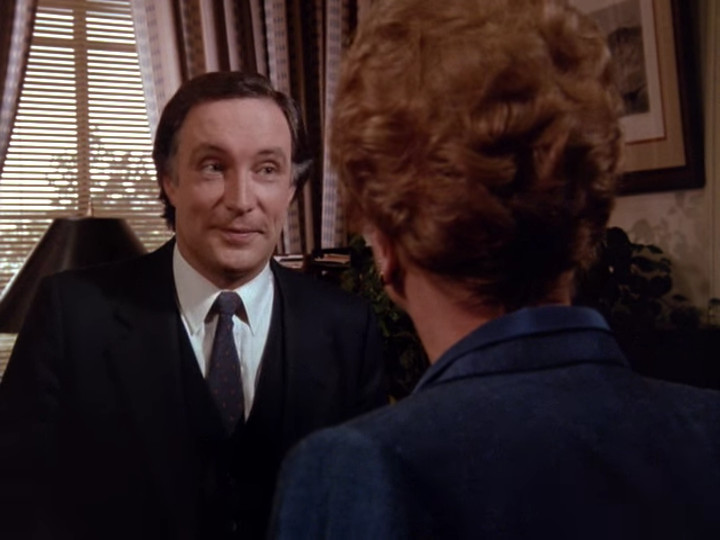
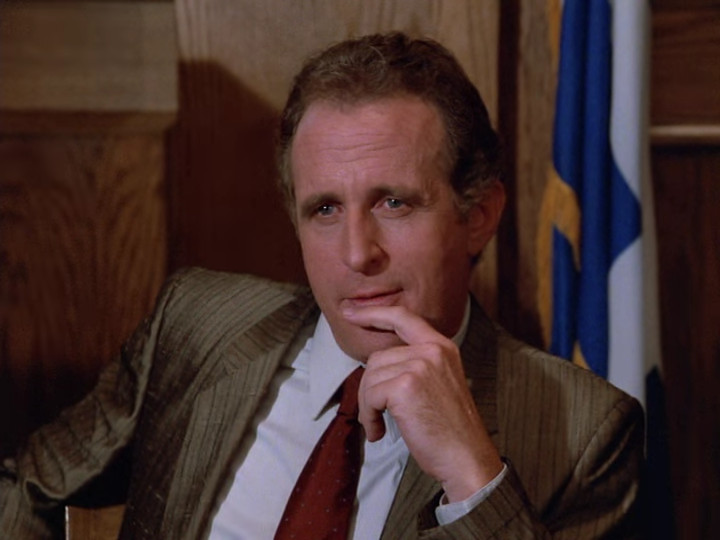
We run into problems, again, when we get to the background on the people at the safe house. First, only two of the five people assigned there have anything like a motive to murder Adams (since Adams didn’t order the hit on himself). Of the two, Mustache Man’s motive is a bit weird. Supposedly he’s jealous that a younger man was chosen for promotion ahead of him. The thing is, Adams doesn’t look like the younger man:
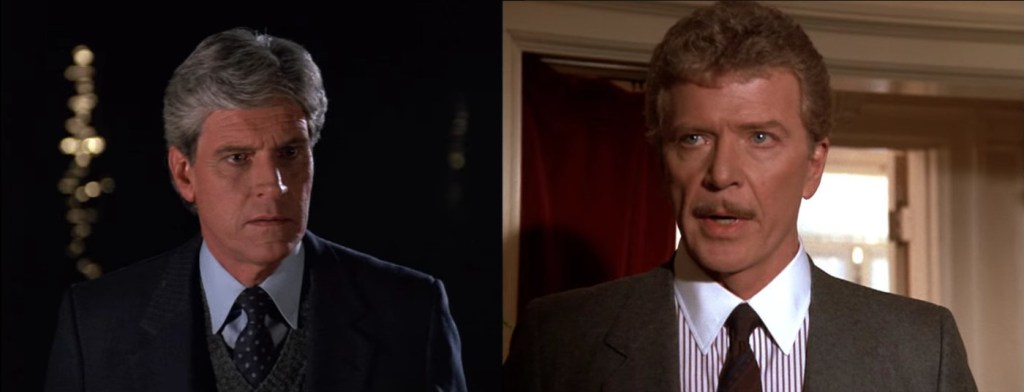
To be fair, Robert Reed, who played Mustache Man, was 56 at the time of filming while Kirk Scott, who played Adams, was 52. That’s not much of an age gap, though. Also, we’re told that Jackson was shunted aside when Adams was put in charge of the safe house, but how long are agents assigned to the safe house for? And how much can being in charge of a safe house be worth killing for? It’s basically a high (ish) security secret one-room hotel. Apart from when the head of it gets assassinated, the routine must be very dull.

Speaking of which, I can’t help asking again: why on earth do these people have cover identities? They’re just running an extremely small hotel that, presumably, they all live in. They don’t need to go to work, or really to go to anywhere. Is it really critical that they have a fake ID when they go to the grocery store or the hardware store, or run out to the drug store to pick up some extra toothpaste when they’re running low? Can’t they just pay in cash and not need an ID at all?

If this safe house was the home of a couple who was stationed at it, I can see why they’d have fake ID, just so that the people aren’t really traceable when they get reassigned because somebody’s name needs to be on the deed to the house. But in this case everyone had a unique code name despite most of them would not be listed on any official documents, plus they had the “Carl Cosgrove” fake identity to use when going outside of the house. No matter which way you look at it, it seems to serve no conceivable purpose. It’s intrigue just for the sake of having something more complicated.

Speaking of things just for the sake of having something more complicated, Sanchez being suspected of Delgado’s murder makes no sense. Granted, motive isn’t everything. Still, it’s a lot, especially when it would have been utterly idiotic to kill Delgado in the way he would have had to do it then when he could have killed Delgado at any time. It’s not even slightly plausible, and just makes Francis and Cooper look like idiots. That’s especially unfortunate for Francis since he started off seeming intelligent.

But that brings me to Cooper: why was he part of the episode? Does Murder, She Wrote simply have to have a policeman in every episode because of some sort of clause in the contract with the studio? He served no purpose that I can see. He didn’t even help Jessica find Carl Cosgrove of Farmington—he used directory assistance to find the number. He did tell Jessica about Carl Cosgrove being pulled out of the Connecticut river and give Jessica a ride into the safe house the second time she went there, but she just as easily could have taken a taxi after reading, in a newspaper, about the body being found.

So, was there anything good about this episode?

Yes.

I really liked how they snuck Jessica into the safe house. Pretending that she pulled strings in Washington to get in when Washington pulled strings with her to get her to go was a very nice twist. It was also a clever cover story because it was both plausible and gave her a reason to snoop and ask questions. It also played nicely into the character of Musctache Man who is inclined to defer to his superiors on everything and to do what he is told without question. This is somewhat marred by the fact that she didn’t actually do any investigating under her cover story, though.

I also liked the twist where Tan Sportscoat had given himself an alibi for the entire time that Timid Guy was on duty. This was diminished by the statement of the alibi and Jessica’s solution taking only 46 seconds from start to finish. It’s the sort of difficulty which should have taken most of an episode to unravel, or at least should have posed some sort of challenge that Jessica would need to think about. They could easily have cut Cooper’s part to make more time for this. It would have been a much better use of time.

I also like the beginning of Tan Sportscoat’s confession at the end. After she broke his alibi, he said, “Your theory… turned out to be better than I thought.” A moment later, after Francis asked him why he did it, he replied, “She got it right.” The calmness in being caught aligns with the way both murders were cold and calculating. They also contain a certain amount of respect at being bested by a superior intellect.

There were also a few comedic moments that were enjoyable. For example, when Jessica activated her lipstick beacon, she first tried the motion on her actual lipstick, but all that happened was lipstick came out. Not high comedy, but it was fun in the moment, and I think helped to distract from there not really being a reason to turn on the emergency beacon. Cooper’s arguing with his various female relatives and in-laws, followed by habitually hanging up on his wife when she finally called him, was mildly amusing.

Overall, I’m not sad to see this episode over. I don’t watch Murder, She Wrote for spy thrillers, and certainly not for nonsensical spy thrillers. I think that main lesson of this episode is that it’s good to stay within one’s genre, and very good to at least stay within a genre one can write competently.

Next week’s episode is A Very Good Year for Murder, which takes place in a vineyard, which is certainly more promising than a spy thriller.

I’ve Never Been Nostalgic for Star Trek: The Next Generation

I recently looked up a few clips of Star Trek: The Next Generation and noticed, to my surprise, that it evoked no feelings of nostalgia whatever. This is curious because I was watching it at the same time as I watched Murder, She Wrote, which certainly evokes nostalgic feelings. (Murder, She Wrote ran from 1984-1996, while ST:TNG ran from 1987-1994.) Moreover, I liked The Next Generation back when I first watched it.

There might be various reasons for this. Science fiction may be less conducive to nostalgia because it is supposed to be set in the future. Since different science fiction stories are set in the same future (ours) and thus contradict each other, there is a certain degree to which it is simply impossible to suspend one’s disbelief, and hence to enter into it in a way conducive to nostalgia. This may be related to how the costumes have changed with current fashions, and possibly a great deal more how the computer technology of the day is largely an extrapolation from current technology and thus becomes horribly dated and in no way plausibly The Future.

Of course, if that were the issue that it should be even less possible to feel nostalgic for Star Trek than for Star Trek: The Next Generation. But, at least for me, it’s not. In some ways I think that the original show has aged better than its successor despite its successor having far more accurate technology. The original was simpler and had something of the utilitarian feel of a navy warship. Much of it was almost cartoonish (in the sense of abstract but representational art). It was almost like a sketch of the future rather than a fully done painting. TNG was, by contrast, more filled out and directly representational. You can see this in how they ate colored cubes, cylinders and such-like (the futuristic food was probably variously food-colored marshmallows, to give you an idea of what it looked like if you haven’t seen it). In TNG they just ate normal food produced by a “replicator”. The result was that you are inclined to take TNG more at face value. The problem with taking TNG at face value, however, is that it was a heavily armed and armored diplomatic science vessel upholstered something like a luxury cruise ship that also had a school and a daycare, whose saucer section could separate from the main part of the ship for combat because it makes no sense to bring the daycare into battle, but they never separated after the first season. (For that reason; looking it up they did separate it during the battle with the Borg and Wolf 359 for tactical purposes, i.e. to have two targets).

Another possibility is that Star Trek: The Next Generation was an episodic show with inconsistent characterization. It’s hard to feel nostalgic for characters who one didn’t feel like one knew because they could (and did) change so much from episode to episode. Murder, She Wrote was episodic, but Jessica was mostly a consistent character—as were any of the other characters that did recur. Plus there were elements that were just consistent, even if the show is (somewhat) incorrectly described as formulaic. (This spoof is highly recognizable despite actually describing very few of the episodes.) The only thing that was really reliable in Star Trek: The Next Generation was the technobabble.

Which gets us to what I think is the real reason I don’t feel nostalgic for the show.

Star Trek: The Next Generation just wasn’t very good. Bureaucrats in Space are not really more interesting than bureaucrats are anywhere else. The writers didn’t really care about quality, as far as I can tell. Legend has it that the technobabble was filled in by consultants after the script was written, with placeholders in the script for the technobabble. The ship itself was nonsensical; no one who could conceive of the greatest warship of the federation being a science daycare could not possible care about quality.

In some ways nothing sums up the approach of the series so much as the episodes Best of Both Worlds parts 1 and 2. They started with a neat idea that they didn’t think through at all, painted themselves into a corner, then used technobabble that made no sense to get themselves out of it. (The Borg were a hive mind, not a computer; they should have had no problems at all with reconciling different impulses since their hive mind was always the summation of many individual minds.)

It’s almost enough to make me want to watch Chaos On the Bridge.

The technobabble could have been forgivable if there was some reason to forgive it, but there never was. I think that this might be part of the reason that the Q episodes were, generally, the best episodes: the Q episodes didn’t have technobabble. It’s not that the technobabble was bad in itself, but it was cheating. Q threw all rules out the window, so the episodes with Q in them were the rare episodes in which the writers didn’t cheat.

That may be the real key, here. Murder, She Wrote, for all of its flaws, was written in earnest. If the writers made mistakes they were honest mistakes where the writers didn’t notice. They occasionally had Jessica trick the murderer into confessing, but Jessica at least figured out who it was she needed to trick on her own, and generally legitimately. She never made up a way to extract fingerprints from thin air, only to forget about it in later episodes. She never just added tachyon particles to the murder weapon and suddenly the murderer was in prison, already convicted.

In short, I don’t think it’s possible to feel nostalgic for something that the writers didn’t take seriously.

Bureaucraaaaaats iiiiiin Spaaaaaaaaace!

In a climactic scene in the episode Ensigns of Command, Picard manages to out-maneuver the Sheliak who are intent on clearing out human settlers on a planet in Sheliak space (by accident; a settlement ship went way off-course 90 years ago and these are their descendants). They have given 3 days notice as required in a treaty, but it will take 3 weeks to clear out the settlers due to some technobabble. The Sheliak intend to wipe out the remaining humans after 3 days, but Picard finds a way to get the time he needs:

The episode, overall, is a good one. It primarily focuses on Data and the theme of Data trying to understand humanity and also to be human, though he cannot be human since he is an android. This scene, though, really encapsulates the difference between Star Trek and Star Trek: The Next Generation.

Captain Kirk had regulations used against him, though even this was rare. Kirk never defeated an enemy by reading a contract more closely.

I’m not really sure what to make of this. Next Generation had things going for it but somehow always managed to be, as my mother put it, bloodless. Data was, in many ways, more human than the rest of the crew. In 1984, I am told, there is the image of the future as a boot stamping on a human face—forever. Star Trek: The Next Generation softened this to a dress shoe placed firmly but no more than firmly on top of a human foot, except on Sundays and Saturdays from 9am-4pm and alternate Wednesdays from 7pm-9pm.

I’m not sure what made TNG the way it was. Presumably Gene Rodenberry should take much of the blame. I can’t help but think that TNG was also a product of its time, though, which makes me wonder what about the late 1980s and early 1990s produced this.

Tonight On Murder, She Wrote

Every episode of Murder, She Wrote began, before the theme song and title credit, with some clips from the upcoming episode. A moment into these clips, Angela Lansbury would say, “Tonight, on Murder, She Wrote.” The clips invariably made the episode seem more exciting than it was, and frequently misdirected as to the villain and just as often made the episode seem like it was a very different episode.

I find it curious that this was a part of every episode. It was by no means standard on TV shows of the time. Morever, Murder, She Wrote episodes were packed very full so it’s not like they needed to pad the episode out.

I suspect that the main reason for the clipjob of the episode we’re about to watch is that Murder, She Wrote normally starts out a bit slow. It’s quite uncommon to have a body in the first sixty seconds and only about half of the episodes have a body by fifteen minutes in. This isn’t a problem for regular viewers, since we know what we’re getting into and in any event murder mysteries are meant to be considered, not action-packed. Murder, She Wrote was distributed via broadcast (and later cable) television, however, which had some peculiar quirks to it, relative to how people watch TV shows now.

In particular, if one changed the channel something else would be instantly on. This differs from modern streaming in that no choice is necessary prior to viewing something else; one simply would start seeing a different show and could evaluate without any decision-paralysis whether it was better. If one is watching a show on a streaming service, or via DVDs, or what-have-you, switching from the current show involves some amount of time spent evaluating options while not watching anything, and the new things may not be a replacement of the same length. This meant if you didn’t grab someone, they might easily decide to change the channel to see if something better was on.

This phenomenon was exacerbated by the way one got a decent fraction of one’s viewership: they were watching whatever was on in the timeslot before you. Of the ones who didn’t come in this way, some decent fraction had been watching something else and flipped channels to see what else was on. They might not even be intending to check out the channel on which your show is playing, so you have only a moment or two to grab them before they follow their original intention and flip away.

The longer one watches this on-demand, and thus intentionally, the stranger this seems. I stopped watching linear TV about twenty years ago. In college I would catch Mystery Science Theater 3000 on the shared TV in the dorm lounge, but when I moved into my own apartment for grad school not paying for cable TV was a very easy savings and I was not tempted to get an antenna for broadcast TV, either. And I’ve never been tempted to get TV service since then, either, despite the internet company all but throwing it in for free with my internet service.

(Incidentally, I’ll never forget the look of horror on my oldest son’s face when I explained to him how broadcast TV worked, where if you missed it when it broadcast you simply didn’t get to see it until re-run season.)

I have no idea if “Tonight, on Murder, She Wrote” served its intended purpose. If you had any experience of the show you know that at best it was irrelevant to the episode and most of the time it was misleading; thus it was just annoying. On the plus side, though I only realized it later in life, you didn’t need to bother avoiding it because it never contained any spoilers. It’s curious to see it now, watching the episodes on DVD. It’s an odd connection to when I was a child and watched it over broadcast (we didn’t have cable back then), in spite of it being a bad memory.

It’s curious how one can become nostalgic for things one didn’t like; perhaps it is in some way connected to the improved powers of enjoyment one gains as one ages, providing one doesn’t waste the time.

Murder She Wrote: Curse of the Daanav

In the latter half of the fourth season of Murder, She Wrote is the episode Curse of the Daanav. This episode is set in the mansion of Seth Hazlitt’s estranged brother, Robert. As settings go, mansions are one of the best.

The episode actually begins in India, though, some unspecified amount of time before the episode begins. It begins, specifically, with two guys in a cave using an oil lamp.

The non-Indian guy looks like he’s wearing a suspiciously modern style of clothing, but the oil lamp makes this likely to be quite some time ago. Flashlights with tungsten filament bulbs were invented in 1904 and had sold millions by 1922 in the United States. They are here to steal a ruby from a golden cobra.

A golden cobra statue, I mean.

The non-Indian guy tries to lift the statue, but it’s too heavy, so instead he uses a knfie to pry the gem loose. The camera goes wonky, the Indian guy screams and collapses, and then the non-Indian guy grabs at his throat and collapses. Then the Indian guy wakes up in a bed, screaming.

So perhaps it was all a dream? Or perhaps he was just remembering something that happened. Given that he seems to be in the present day, I assume it’s just a dream because the guy hasn’t aged at all from when he was in the cave with the oil lamp.

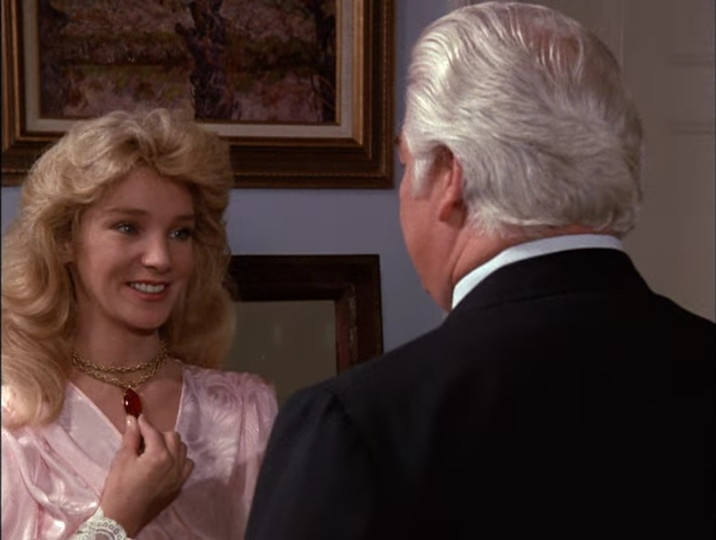
We then cut to Seth’s brother, Richard, giving the ruby to his young wife, Alice.

He says that it’s not half as beautiful as the woman wearing, but that it will turn a few eyes at the party tonight. Alice is distressed by this. She says that his friends will take one look at it and think that she married him for his money. Also, it puts the gift she gave him to shame. He laughs this off, but she protests that being swept off her feet and honeymooning all over Europe, and the jewels and the parties are nice and all, but they’re also overwhelming.

He tells her that she’ll get used to it.

They’re interrupted by Richard’s daughter from his first marriage, Carolyn:

She comes in with the cattiness turned up to 11. About the necklace, she remarks, “It doesn’t surprise me at all. But then he’s always been very generous. Haven’t you, Daddy?”

He replies, “To a fault, in some cases.”

She then says, “Aww, come now, Daddy. What’s the point of having money if you don’t spend it? Besides, all I want is a measily thou. You can call it an advance on my inheritance.”

Richard sighs and, as he picks up his checkbook, says, “Carolyn, honey. These advances are becoming an all-out major assault.”

He tells her that money is not unlimited and he works hard for it. He then says that she has to learn that she can’t buy everything she wants.

She asks, “Why not? You have.”

She grabs the check from him and leaves. He remarks, “that’s a chip off the old block.”

That last part is interesting, because it acknowledges that her patterns of behavior had to come from somewhere, and that’s probably mostly her parents. You usually don’t see that in murder mysteries; spoiled children are typically treated as if they sprang fully formed from their parents and went wholly wrong entirely on their own.

Which is not to say that people do not have free will and do not make their own choices. They do. Bad people can make themselves that way despite being raised well, just as saints can overcome having been raised badly. These are not the norm, though. It’s far more common that if people don’t have principles, it’s because they were raised without them. And this makes the rich old man with the awful children not nearly so much an object of pity as he’s typically made out to be. There is something sad about a man reaping what he has sewn, but that is tempered by the fact that it’s only justice.

We then meet the spoiled brat’s brother, Mark:

She’s walking down the stairs quickly and he asks her what the rush is—is she afraid that some trendy new fashion will start without her?

I get that Murder, She Wrote needs to be time-efficient in its characterizations, but this level of casual antagonism is dysfunctional. I suppose it’s meant to help make him a suspect—Carolyn suggests that if their father and her young wife have a son together, Alice will ensure that her own issue takes over the bank when their father dies, not Mark.

This is basically just taking aristocratic primogeniture from golden-age detective mysteries and pretending that it applies to American businessmen. Even there, Mark would have to be a nephew with Richard having no male issue, so far. As the oldest son, his position under primogeniture would be assured.

In the actual circumstance, this is absurd. Richard Bradford, the actor who plays Richard Hazlitt, was born in 1934 and was thus 54 years old in 1988 when this episode aired. I suspect he was playing older, though, since his children are clearly in their thirties and Richard Hazlitt was unlikely to have fathered them in his early twenties. But heck, let’s suppose the character was supposed to be the same as as the actor—and it’s weird for a thirty year old to talk of a fifty year old as being “old”—this means that in twenty years he’ll be 74. Even if he survived this long, he’ll probably retire, and the oldest his son with his new wife could be is nineteen years old. Are we really to expect a bank to be run by a nineteen year old with no experience in preference to a fifty year old who’s worked in the bank for the last thirty years? Primogeniture will pass a title and estate to a child. American corporations don’t work that way.

This is one weakness that Murder, She Wrote sometimes runs into when it tries to pay tribute to golden age mysteries—some of them simply don’t work in modern America. (See The Lady in the Lake.)

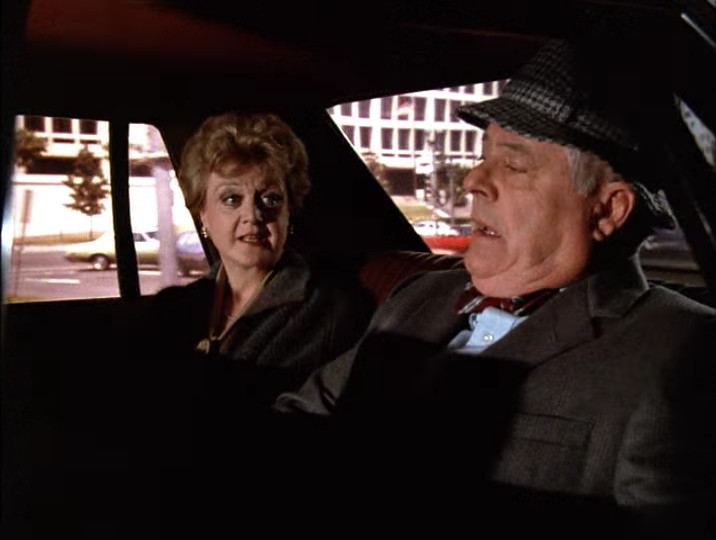
In the next scene Seth and Jessica are in a car with glorious rear-projection of Washington DC behind them.

I can’t help but wonder what it was like shooting rear-projection scenes. Did they feel as silly as they looked, or was it just a part of the business? My mother likes to say that people were more innocent and accepting back then, but I have dim childhood memories of my father making fun of rear projection even back then.

They were in Washington D.C. to confer with their congressman, and that done, Jessica is trying to talk Seth into accepting an invitation to a polo match from his estranged brother (Richard). With effort, she talks him into it, but he makes it conditional on Jessica coming with him, which she reluctantly agrees to.

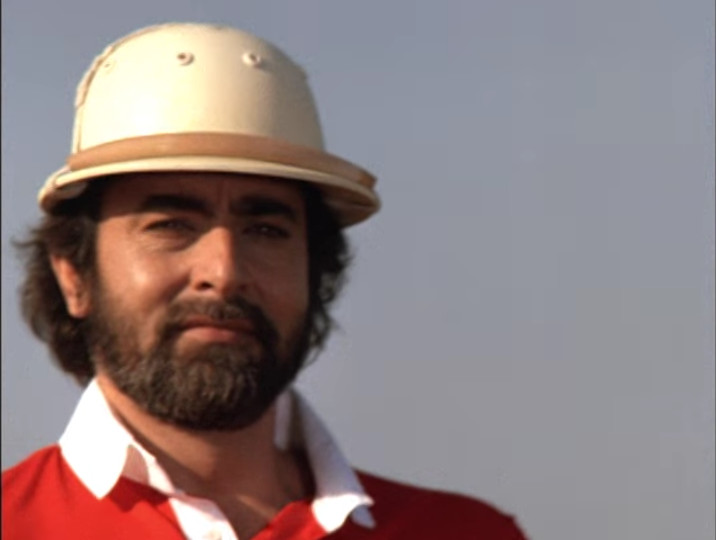
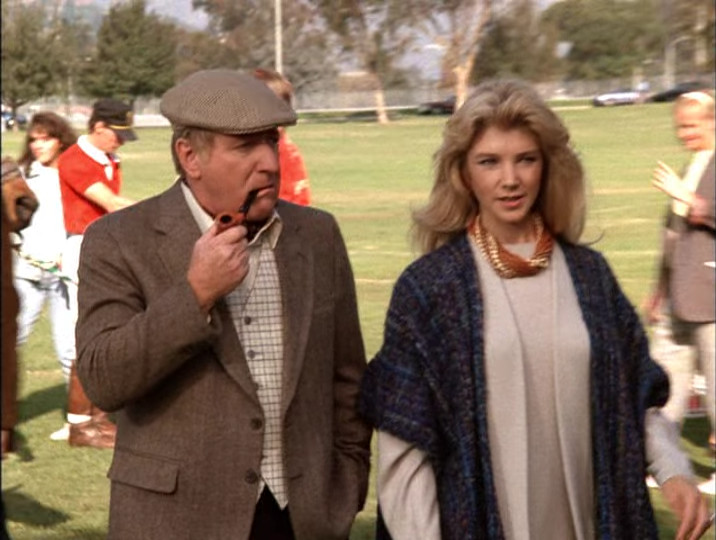
The scene shifts to the polo match. Richard and Alice are watching, while Mark is playing. The game ends moments after red team (Mark is on blue team) scores a winning point. Richard upbraids Mark for bad playing.

I find it interesting that Richard is not a sympathetic character. Earlier, it was a bit more ambiguous, where he was pulling in the reigns on a spoiled child; it’s possible to not notice who it must have been who spoiled the child. Here, he’s just being pointlessly critical and cruel. I wonder if this is to help make Seth more sympathetic for being estranged from his brother for so many years.

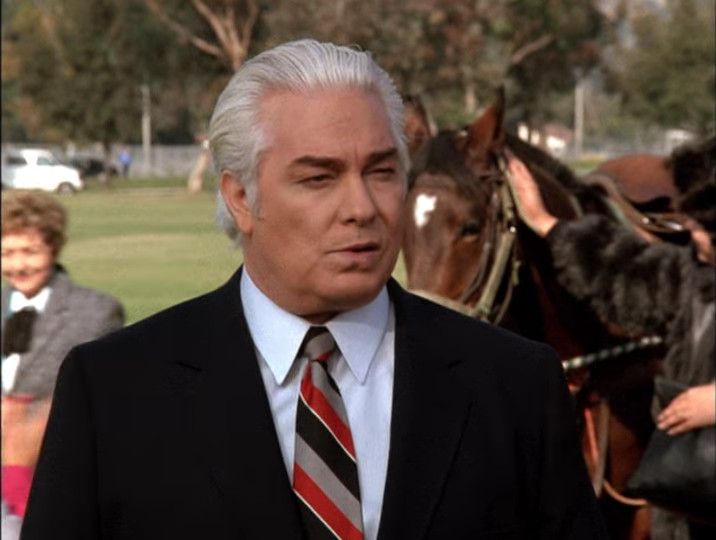
Mark asks his father why he doesn’t get off his (Mark’s) back, and Richard asks Mark why the hell he doesn’t learn to play the game. He then says, “and there’s someone who could teach you,” and calls out to Vikram Singh, and congratulates him on a good match.

It’s the same guy as in the dream!

Jessica and Seth come up and Jessica observes that they seem to have missed the entire match. “So much for that driver’s short-cuts.” This is a cute way to get them there at the right time, story-wise. It’s not a big deal, but saves a bit of time.

We then meet Alice’s father as the two of them walk up to Jessica and Seth.

Seth guesses that she’s Caroline, but she clarifies that she’s Richard’s wife. She introduces her father, whose name is Burt Davis

Richard then notices Seth, and the two of them stare at each other warily.

It then comes up that Richard was not the one who invited Seth, it was Alice who took the liberty. She then tells Seth and Jessica to come stay at the house, and Richard can’t say no to her so it is arranged. She has a forceful personality, but also means well, which is unusual in a murder mystery.

The scene shifts to the party that evening, where we see Burt eating and drinking off of the plates that servants (or catering staff) are carrying. I think this may be meant to establish his character as low class and unused to the events, or else just someone who really enjoys eating and drinking. He wanders into Seth, and then Jessica walks up with Vikram Singh, and it turns out that they’re standing next to Caroline and Mark.

The children complain, as is their habit. Jessica tells them that she was just saying to Singh that she was sorry they missed the polo match. Mark says that she didn’t miss anything but Vikram begs to differ; prior to his fall Mark scored three goals, which Singh considers most impressive.

Richard and Alice join the group, and Vikram Singh notices the ruby she’s wearing (the one from the dream which Richard gave to Alice at the beginning of the episode). Singh identifies it as “The Eye of the Daanav” and tells them about its curse. The ruby, he explains, is the all-seeing eye of a powerful demon called “The Daanav”. It’s a golden-headed cobra which controls all that is dark and evil in this world.

I’m kind of curious what religion this legend is from, because it doesn’t really match up with Hinduism, Buddhism, or Islam, the three major religions you’ll find in India. (I wonder if this is like the episode where there was a Sheik with thirty six wives.) Anyway, the Daanav was angered by the theft of its all-seeing eye (more than a century ago), and laid a curse on it that would rob the breath of life itself from one whose heart is less than pure, killing them most horribly.

Richard thinks that this is merely a scare tactic, though, as Singh has already, on behalf of his government, offered Richard twice what he paid for the jewel. Richard, however, is adamant that he won’t sell it. Why, is not stated. It’s hard to see how he could have a strong attachment to it, but as we will see the plot requires him to not be willing to give it up. Perhaps this is why he was shown to be such a selfish, inconsiderate bastard earlier.

At this awkward juncture Alice excuses herself as having a ton of people to meet, then remembers that she hasn’t given Richard his gift yet and tells him to wait in the study while she goes to get it. It turns out that she left it in her car in the garage. When she gets there an engine is running. She leaves the door slightly ajar and goes to investigate, but the car’s doors are locked. Then the door she left ajar is slowly and quietly closed. She bangs against the door, calling for help, as she coughs from the carbon monoxide. She eventually falls to the ground, unconscious and we fade to commercial.

When we come back from commercial, Burt and Mark are walking to the garage because Burt had thought he’d lost his pipe then remembered he’d left it in the car in the afternoon. Mark tries the door to the garage and remarks that it’s locked, which is unusual. He thinks he’s left his keys “upstairs” (this is a detached garage so “back in the house” would have been more accurate, but Mark appears to be drunk). Burt holds up the key to the garage and asks, “what’s this?” Mark replies, “Oh, what do you know?” They then hear the sound of the car engine and rush in to investigate and find Alice.

They rush her back into the house, Mark carrying her, and Seth takes charge while he instructs Richard to call the paramedics. This done, Richard comes to tell Seth that the paramedics are on their way and he tells her that it’s OK, Alice is coming around. Burt then insists on calling the police as he thinks that someone tried to kill Alice. Richard thinks this is ridiculous, but the next scene shows a police car so someone called the police.

Jessica meets Lt. Ames in the garage, looking at the scene of the crime.

Lt. Ames is played by Larry Linville, best known for playing Frank Burns in M*A*S*H.

Lt. Ames tells Jessica that this is probably a failed suicide attempt. Jessica finds this ridiculous because who commits suicide by turning on a car and closing the garage door so the garage will fill up with fumes and then going off to a party only to leave in the middle to kill themselves, since it must have taken longer than the fifteen minutes that Alice was gone for the garage to have filled up with fumes (It’s an enormous, many-car garage).

Larry looks at her with new interest, closes the door, and asks who she is. She lets it slip that she had been in Washington to meet with Congressman Hale. Ames recognizes the name; Hale is the head of the House Committee on Secret Intelligence. He concludes that Jessica is some sort of secret agent who cannot reveal her identity. He then gives Jessica all of the evidence he has.

The entirety of his evidence amounts to Alice’s key having been in the ignition of the car with the doors locked. Alice admits that it’s her key, but protests that she always kept it on a hook in the garage and anyone could have taken it. Under questioning, she said that she pushed the button that should have opened the garage a few times and it didn’t work, then she tried to go out the side door but found it locked.

Ames notes that when he tried the electric garage door opener, it worked fine. Seth interrupts and suggests that she might have been confused. Inhaling that much carbon dioxide was bound to cause a certain amount of confusion.

Alice then interjects that the paramedics said it could have caused far worse than that, had Seth not been there. Seth acknowledges this with an smug nod.

This is a thing that the writers try to develop during the episode—Seth’s medical prowess. The only real problem is that so far as I can see, he didn’t do anything at all. The only thing we know he did was listen to some part of her with a stethoscope and say that it was going to be OK because she was coming round. He didn’t even do as much as Dr. Watson often did (give the patient brandy). Nor do I see what he could have done, given that he didn’t have an oxygen canister on hand to administer oxygen with—the main treatment of carbon monoxide poisoning. There isn’t really a way to administer higher levels of oxygen without an O2 tank (that I’m ware of), and some searching that I did didn’t turn up anything besides administering O2 that will help (in the short term).

A bit of debate happens in which Richard suggests that the carbon monoxide confused Alice and she locked the door herself, while Jessica points out that carbon monoxide confusion still doesn’t explain who started the car. Richard declares that it was an accident, and Lt. Ames accepts that and leaves.

On his way out Lt. Ames tells Jessica, sotto voce, that if she needs his help on this she has it, on the record or not.

Alice goes back to her room and Jessica comes with her and helps her undo her hairdo. As she does so, Alice tells Jessica that she’s confident that she didn’t lock the door herself. Jessica asks who knew where the gift was and Alice says that Caroline was the one who suggested the garage. Burt, who was getting Alice an aspirin, reminds her that Mark knew as well, since he drove up just as Burt and Alice were hiding the present.

After this Jessica and Richard are talking and Richard said that it had to be an accident and it was just luck that Alice wasn’t killed. Jessica replies, “Luck, and your brother.” Richard admits that Seth was impressive and he didn’t realize that Seth had it in him to be so cool under pressure.

Again, I don’t get what Seth is supposed to have done. He didn’t have oxygen or any medicines with him. Is he supposed to have elevated her head in a way that made her breath twice as well, or something? There is an experimental technique where administering a small amount of carbon dioxide can speed the person’s breathing and help them to expel the carbon monoxide faster. He didn’t have any canisters of carbon dioxide on hand either, though.

Structurally speaking, it makes a lot of sense that the writers want Seth to have shown off his medical prowess and to have saved his estranged brother’s beloved wife, but I don’t see any legitimate way to have that here. Had there been an older person on oxygen whose tank could have been borrowed for a few minutes at a critical moment, this could have made sense. As it was, though, how impressive is it supposed to be that he laid her down on a couch and then listened to her lungs? I think that the lack of doing anything really hurt the emotional effect, because all of this talk about Seth saving Alice has the effect, not of drawing one’s attention to the brothers, but of making the viewer wonder what the heck Seth was supposed to have done.

This might not be an issue in a romantic comedy, but this is a mystery show. The viewers are self-selected for being interested in poisons, medical details, and exactly what happened. This is the worst genre to hand-wave away crucial details.

They then run into Vikram Singh, who is still in the house for some reason. He expresses his personal condolences. Richard thanks Singh then excuses himself. Singh interrupts him leaving, though, and says, “Mr. Hazlitt, but for the grace of a god we cannot hope to understand, your wife could very well be dead. Now will you trust that the curse of the ruby is true?”

Richard responds to this about as well as can be expected, but he catches himself at “Listen, you son of a-” and then moderates his language because a lady (Jessica) is present. He informs Singh that the ruby is not for sale, now or ever.

Again, why he has such an attachment to the ruby is never explained or even hinted at. It’s a bit hard to imagine why; so far as we know it’s just a pretty stone he bought as a present for his wife on a lark.

He adds that if he finds out that Singh was responsible for Alice’s almost dying, he will kill him. Singh finally departs.

Richard puts the ruby away in the safe in his study and runs into Seth, who was sitting in a chair in the study. Richard invites him to share a drink and Seth accepts. They begin reminiscing, then talk over what drove them apart—a woman named Molly. It seems that Seth was romantically involved with her, or at least interested in her, but she and Richard eloped. When they got back Seth had already left for Portland, and Richard couldn’t find the words. Then his business took off, and the kids came, and then Molly got sick and died very quickly.

Richard apologize, but Seth says that he should be the one to apologize, since his blindness was what drove Richard and Molly to have to run away. Then Seth did his own running away, and even after he married Ruth he couldn’t bring himself to make the first move toward reconciliation. “And now, Ruth’s gone too. And here we sit. Two of the biggest fools that ever drew breath.” (They then formally reconcile.)

It’s a very well done scene. I think it lacks a little punch because as a TV show it’s hard to take seriously since Seth is an ongoing character and Richard didn’t exist in anyone’s imagination before this episode and won’t exist in anyone’s imagination after it, either, not even in impact on Seth’s character. If this were a one-off story such that both characters existed equally, I’d say it was a superb scene. Both actors are really excellent, though that’s a thing specific to television and not really generalizable to writing mysteries in print form. I think that there’s a lesson, here, though: scenes of large emotional impact should generally be between equal characters.

Actually, a second lesson is that if you’re writing anything episodic or otherwise can’t live with the consequences, make sure to have the big stuff happen to non-major characters who will not be around in the future. We can then give them, in our imaginations, the consequences of their actions and the character changes of their significant improvements. Giving it to characters you will have to take it away from is simply wasting the character development.

General lessons aside, there is another problem, which is that it’s not entirely in character for Seth. He’s a cranky curmudgeon who never thinks deep thoughts. Also, what he said was too eloquent for him. I wouldn’t normally complain about improvements, but this gets back to the part about knowing that it won’t last.

Shortly after they reconcile.

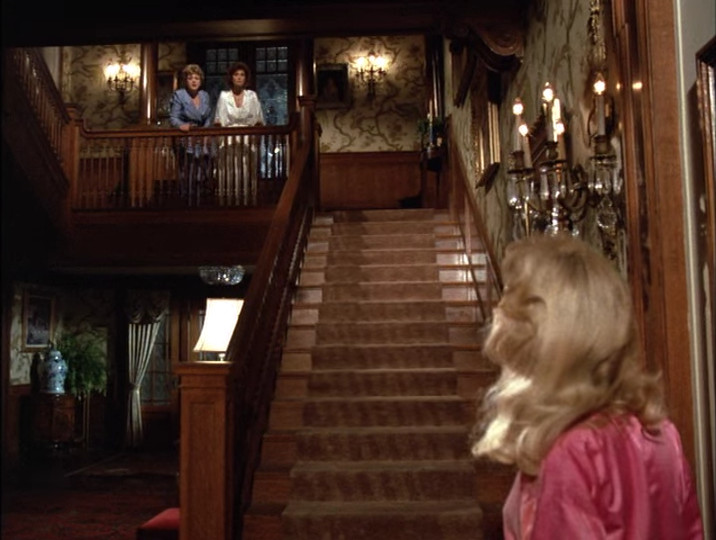
A few hours later we see Alice in a nightgown coming down the stairs and looking for Richard. She seems to believe that he’s in the study. She knocks increasingly loudly and calls to him, but the door is locked. This brings Jessica and Caroline to the top of the stairs.

Jessica asks if something is wrong and Alice says that she thinks Richard must be hurt. This general commotion brings the rest of the house out of bed. Seth says that he left Richard in the study not half an hour ago. Unfortunately there is no key; the latch is an old-fashioned hinge-latch that can only be opened from the inside.

They break the door down and find Richard on the floor, dead.

Caroline then says, “Oh my God. The ruby. It’s gone.” And we get a closeup of Richard.

I think that this is supposed to illustrate that the ruby is gone. Since the ruby was never on any part of Richard that we can see, I’m not sure how it does that. So far as anyone knew, he had put it in the safe. (In fact, he hadn’t, since he was interrupted in that by Seth, but no one else could have known this, and we’ve no reason to suppose he didn’t put the ruby back after his conversation with Seth was over.) The scene then fades to black; I suspect that this would be to the mid-point commercial break. We come back to someone from the police pulling a sheet over the corpse.

Jessica talks to Seth and he tells her about the reconciliation, then goes to get fresh air. Lt. Ames is talking to the rest of the family, asking about secret passages, but Mark assures him that the only way in or out was through the door or windows, all of which were locked.

So, we have a locked room mystery.

I really should be more excited about them than I am but my experience with locked room mysteries is that they’re always disappointing. I’m beginning to think that they have to be. The problem is that a murderer can only get out of a locked room by some trick, and tricks are not very satisfying. Latches can be lowered after a door is closed, for example. In The Mirror Cracked From Side to Side, for example, the latch on the door would close if it was propped up and the door banged shut. A lot of play has been made about the breaking down of the door removing the evidence of how it was locked, too. So, for example, the deadbolt can be broken open and only the catch used to lock the door, and when the innocent people break the door open they will see both the deadbolt and catch broken and so assume that they broke both. (Another approach which I associate more with pre-1930s mysteries, though examples can be found afterwards, are the use of devices to kill the victim such that they were actually killed in a locked room, and the device is disguised or removed later.)

The other issue here is that locked rooms only matter in a mystery when there is the suspicion of suicide that the locked room strengthens. Oddly, we’re never told what the cause of death was, but there is no suspicion of suicide ever brought up.

Pausing for a moment to talk about the cause of death, since it’s very strange that we’re not told: in the establishing shot there was no knife sticking out of the corpse and in the shot above we can see no ligature marks on the neck. There are also no pools of blood, so we can rule out stabbing and strangulation, but beyond this we’re given no information about how he came to be an ex-Richard. We’re not even given the proximate cause of death, such as heart failure, stroke, asphyxiation, etc. My guess is that he was struck from behind on the head with a blunt instrument. The half-hour window since Seth left him until when he was found dead leaves very little time for poisoning and the body wasn’t contorted, the lips not blue, etc. There is also the possibility of being shot since the dark clothes might not show a small bloodstain and if he was shot in the chest and fell backwards, and if the bullet didn’t exit the body (as they frequently don’t), there would not be obvious blood. Still, my money is on a blow to the head from behind.

Assuming, of course, the writers ever figured out a cause of death. I actually suspect that they didn’t.

The one thing we do know is that Lt. Ames treats this as a murder investigation from the beginning and everyone seems to agree with that. So this brings up the question of the locked room: what purpose did it serve? If everyone agrees that Richard was murdered, figuring out how the murderer locked the room after leaving is just a detail. The room being locked from inside only helps the murderer if there is some plausible alternative to “well, you must have done it somehow, as clearly somebody did it somehow”.

Anyway, at this point Caroline brings up the curse of the ruby . This brings Vikram Singh to Lt. Ames’ attention. It’s interesting, btw, how the writers dance around him being Indian. When Ames asks who Singh is, Jessica replies, “He’s the cultural attaché at his country’s embassy in Washington.” Also curious is that Ames tells one of the police extras to check on Singh and see if he was connected to the muslim protests a few weeks ago. Jessica tells Ames that Singh said he had attended a Divali festival last year, which would make him Hindu, not Muslim. Also possible is that he’s in some wierd made-up-for-TV Indian religion and happened to go to a Divali. (Divali is a festival of lights that is celebrated by Hindus, Jains, and Sikhs; it thus seems to be largely a secular festival to which people attach various religious meanings as they care to.) This impresses Ames, anyway.

It’s getting late so Jessica suggests that Ames wrap up and he does so. He then asks her which federal service she’s with, but Jessica again protests she’s just a mystery writer from Cabot Cove, Maine. Ames takes this to mean that she’ll reveal her real identity when he needs to know and not before then, which he is content with.

This running joke serves the larger purpose of securing police cooperation for Jessica, and is an enjoyable way to do it. Every Murder, She Wrote episode needs to handle the question of how Jessica relates to the police; the episodes run the gambit from complete hostility to fawning admiration. This one is more on the fawning admiration side, but does so with a touch of dignity. Just a touch, but at least he’s clever about his mistake.

The next morning Ames runs into Jessica examining the outside of the room. After some further protestations that she isn’t a government agent, to which Ames enthusiastically (though insincerely) agrees, he asks what she has for him and she replies, “unfortunately, nothing.” The windows were not tampered with and except for their own footprints there are no marks in the flower beds outside the windows. Jessica concludes that the murderer wants them to believe in the curse.

They walk on and the camera pans up to Caroline, who had been watching them from a second floor window.

I believe that this is supposed to make us think Caroline is a suspect. She was the one who drew everyone’s attention to the ruby being missing. She was the one who told Lt. Ames about the curse. Of course, in a Murder, She Wrote, a suspicious close-up like this rules her out as a suspect.

The next scene of Mark, Mark is on the phone with, presumably, the family lawyer and angrily demands a copy of his father’s will today. Ames walks in on the tail end of this and finds it suspicious. There is some interesting word-play, though. “In a pretty big rush to see the will, aren’t you, considering your father is lardy cold?” He replies, “Lieutenant, my father was never anything but cold.”

In the ensuing conversation Seth protests and Mark points out that Seth is in no position to say what Richard was like. The long estrangement makes Ames suspicious until Jessica tells him that Seth can be trusted, which Ames takes to mean that Seth is also a government agent.

Jessica and Ames then go to investigate the study. Jessica figured out how the locked room was accomplished—a lit cigarette that propped up the latch while the door was closed.

As I said, it’s always some sort of trick. Oddly, no one raises the question of what the purpose of this trick was. Ames asks who would go to all this trouble for a ruby, and the scene cuts to interrogating Vikram Singh in the lounge. When Jessica says that Seth was killed by a man, not a curse, Singh leaves. As he goes he puts on black leather gloves, but then pauses as he puts the second one on, then takes it off again, looking quizzically at the glove.

Jessica, eagle-eyed as ever, spots his perplexity about what’s inside his glove. She calls him on it and it turns out to be the Eye of the Daanav.

Back at police headquarters, Jessica doubts that Singh is guilty. For one thing, he couldn’t have known that Alice was going to get Richard’s present from the garage, making it very hard for him to have tried to kill her that way. Also, he’s far too intelligent to have brought the ruby he stole the night before back to the victim’s house to hide it in his own glove without knowing it and then all but show it to Jessica and Lt. Ames. OK, Jessica only says, “Well, frankly, I doubt that an intelligent man like Mr. Singh would have deliberately hidden the ruby in the glove and then put it on in front of us.” She forgets to mention that this is the next day and Mr. Singh did not sleep at the house—it’s never explained why he was questioned there—and so he would have had to bring the ruby back to the house after stealing it the night before in order for it to be at the house.

I think that the writers wanted to write an isolated English country house murder with its closed set of suspects, but forgot that they didn’t actually do that. There’s kind of a lot of stuff that they forgot to do, when you get down to it.

Caroline is summoned to Lt. Ames’ office and questioned about her spending habits. She denies murdering her father for money—he had refused to pay her debts to a collection agency a few weeks ago. She suggests that if they want a financial motive, they should look to Alice, who will receive millions because of an outrageous insurance policy which she forced Richard to take out during their honeymoon.

In the denouement, Lt. Ames, Jessica, Seth, Alice, and Burt are in the accusing parler. They accuse Alice of murdering her husband (and faking the attempt on her own life), but it turns out to be a ruse to force Burt to confess. Well, not so much to confess as to make a slip. Lt. Ames suggests that Alice used one of her cigarettes in the latch and Burt points out that she smokes English cigarettes, not Turkish. Of course, he could only have known that it was a Turkish cigarette used to prop up the latch if he was the murderer.

Burt asks if Jessica is accusing him of trying to kill his own daughter and she says no, it was not meant to be fatal and only meant to raise the specter of the curse.

There’s a problem, here. People—and especially Burt—only learn about the curse moments before Alice goes to the garage to get her present to Richard. As Jessica established, the car had to have been running for a while before this. If Singh couldn’t have known that Alice was going to go to the garage to get her present to Richard, Burt couldn’t have known about the curse in order to make it look like Alice was nearly a victim to it. I think that this is just a plot hole.

Jessica tells Burt she had wondered at how lucky it was that Burt “just happened” to go to the garage and find Alice. When he protests that he had forgotten his pipe in the garage, Jessica reminds him that he had his pipe at the party and put it in his pocket in order to shake hands. There’s also a bit earlier where Burt had told Alice that the ruby was found in Singh’s glove, when Burt couldn’t have known that if he didn’t plant it there himself.

Any one of these is sufficient (in a Murder, She Wrote) to prove Burt is the murderer on its own, so all three together clinches it. Alice is astonished and asks her father why he locked her in the garage—he nearly killed her. He tells her that he had it planned down to the second. He had the key in his pocket and if Mark hadn’t found his key, Burt would have blown it there and then and opened the door and got her out.

He then explains why he killed Richard—he saw the kind of man Richard was: cold, possessive, king of the bloody world. And now he owned Alice, and would show her off to make people think more of him. What kind of a life could she have with a man like that?

Then we get to the real reason: But without Richard, she’d inherit. Oh, they could have been so happy, Burt and Alice. Going first class, never needing a by-your-leave from anybody. It would have been grand.

When this fails to get the reaction he was hoping for, he asks Alice, “You do see, don’t you? I was thinking of you.”

Since he very obviously wasn’t and she may be innocent but she’s not an idiot, she doesn’t say anything and tearfully hugs him. The scene ends and that’s all we get of her character.

The final scene is of Lt. Ames helping Jessica and Seth with their bags. He tells Jessica that it was a privilege to work with someone of her security clearance. She tries one last time to convince him that she’s not a secret agent by showing him her social security card, library card, and voter’s registration card. (Why she’s carrying the social security card and voter’s registration card in her wallet, she does not say.) He looks at them but then Seth calls to Jessica, “You’d better hurry if you want to meet with that agent before he goes to Moscow.”

This is a callback to a line from the scene in the car where Jessica is trying to talk Seth into accepting his brother’s invitation and he’s trying not to: “You’ve got to see that real estate agent about your vacant lot before he runs off to that family reunion of his up in Moscow, Idaho.” Without that context, which of course he doesn’t know, Ames takes it to have its more plain meaning. He looks at her cards again and remarks, “Best phony ID I’ve ever seen.”

Jessica only stares in disbelief, and we go to closing credits.

Overall, it was a very enjoyable episode. It was clearly inspired by the classic English manor house murder, which is always very fun. The theme of the reunion of brothers was well done and well acted, even if Seth was the wrong choice for the part. Alice, the young wife, was also a real asset to the episode. Her innocence and universal good will was really touching.

This was not an episode that stands up to scrutiny, though. You can see the amount that the writers paid attention to detail in things like the cause of death never being mentioned. For that matter, how was the murder supposed to have happened? Did Burt wait up until Seth left the study to creep in and kill Richard? Did he sneak in without Richard noticing him, or did he talk with Richard and wait for him to be standing there with his back turned?

However he did that—and neither options seems very practical—why steal the ruby if the idea was to try to blame the curse? If the ruby could steal itself, presumably it would have done so a long time ago and be back in the golden cobra’s head. If, on the other hand, the idea was to frame Vikram Singh, why wait for a time when Singh almost certainly couldn’t have been in the house? And what was the purpose of the locked room except to use a Turkish cigarette to frame Singh? But why bother using it to lock the door? It would have done as well to leave it in an ash tray.

Less of a fundamental problem, but still showing how little detail mattered, is the way that Burt started the car for the plot to pretend to have the curse try to kill Alice before he learned about the curse. To be fair, this would not have been easy to fix, since the episode started on the day of the party and Murder, She Wrote is generally so packed that the episodes are on a tight deadline. Even so, it’s still a mistake.

I’m also not sure what to make of Richard having been a lousy man and a terrible father to his Children. They did touch on the interesting theme of Alice’s goodness, with the aid of her beauty, reforming him. I wish that they could have done more with it but having the victim alive until the halfway mark is already pushing it in a murder mystery.

Which brings me to the abrupt ending.

One flaw in Murder, She Wrote is that the amount that they cram into less than 47 minutes doesn’t permit them to give characters a real farewell. They tend to just disappear. We never see Mark again after his telephone conversation with his lawyer. We never see Vikram Singh again after he’s arrested for having the ruby in his glove. We last see Caroline in the police station where she tells the police about Alice’s large inheritance. These aren’t well developed characters, though, so it’s not much of a loss to see them go without any closure. It’s far more of a pity that we don’t learn about what Alice will do. If this weren’t an episodic TV show where nothing that happens in it will affect future episodes, she might even lean on Seth for support which he would provide in his recently reconciled dead brother’s stead. Your father murdering your husband and your step children (who are older than you) hating you is a position in which you will want a friend, wealth or no. Alice would be a very interesting character to meet again, though unfortunately that won’t happen. They could at least have cut the opening sequence with the dollar-store Indiana Jones stealing the ruby in exchange for an extra minute in which to give Alice some closure.

The relationship between Jessica and Lt. Ames was also an interesting part of this episode. As I said, Murder, She Wrote has to establish some kind of relationship between Jessica and the police, and if they’re friendly, some sort of reason for them to be friendly. The more usual reason for them to be friendly is that they’ve been impressed by Jessica’s books. Mistaking Jessica for a high ranking secret agent accomplished this in a more fun manner. It’s also nice that while Ames wasn’t brilliant, he wasn’t an idiot, either. He merely had a mistaken premise that he stuck to. It also played, to some degree, on the fact that as the main character in the show Jessica was, in fact, as special as Ames assumed, just in a different way. It’s interesting as an example of how far one can go with taking a bit of comedy seriously without damaging the seriousness. It would have hurt had Jessica required Ames’ belief in order to succeed, but he was initially friendly anyway, so it remains plausible that Jessica could have secured his cooperation without the mistake, and this permits us to enjoy it.

Overall I would rate this in the top half of Murder, She Wrote episodes. It has many flaws but I think that they’re all forgivable in light of its good qualities.

Next week’s episode is Mourning Among the Wisteries. Jessica is off to the south to visit a playwrite friend of hers.

The Old Discovery Channel Ad

For those who haven’t seen it, over a decade ago the Discovery Channel made and ran this ad to promote their television shows:

Now, when it comes to advertising, a great deal of skepticism and even cynicism is warranted. I think that this is expressed nowhere so well as in what might be one of The Last Psychiatrist’s best posts, The Dove Sketches Beauty Scam. It’s well worth reading the whole thing, and gives a good perspective on supposedly wholesome advertisements. Here is possibly my favorite part, though it loses something out of context:

“Oh my God,” you might say, “I know it’s just an ad, but it’s such a positive message.”

If some street hustler challenges you to a game of three card monte you don’t need to bother to play, just hand him the money, not because you’re going to lose but because you owe him for the insight: he selected you.  Whatever he saw in you everyone sees in you, from the dumb blonde at the bar to your elderly father you’ve dismissed as out of touch, the only person who doesn’t see it is you…

I think that TLP is substantially correct.

So, all that said, I think that there is something of value in this ad, despite it being an ad. The value is two-fold, and I say this as someone who hasn’t watched TV, and hence hasn’t watched the Discovery Channel, in close to two decades now. Actually, before I get to those, let me quote the main conclusion (which is in the penultimate section) of TLP’s post:

That Dove wants you to think of it as the authority on beauty so it can sell you stuff makes sense, there’s nothing underhanded about it and hardly worth the exposition.  The question is, why do they think this will work?  What do they know about us that makes them think we want an authority on beauty– especially in an age where we loudly proclaim that we don’t want an authority on beauty, we don’t like authorities of any kind, we resist and resent being told what’s beautiful (or good or moral or worthwhile) and what’s not?…

“But I hated the ad!”  Oh, I know, for all the middlebrow acceptable reasons you think you came up with yourself.  Not relevant.  The con artists at Dove didn’t select these women to represent you because you are beautiful or ugly, any more than the street hustler selected you for your nice smile.   They were selected because they represent a psychological type that transcends age/race/class, it is characterized by a kind of psychological laziness: on the one hand, they don’t want to have to conform to society’s impossible standards, but on the other hand they don’t want the existential terror of NOT conforming to some kind of standard.  They want an objective bar to be changed to fit them– they want “some other omnipotent entity” to change it so that it remains both entirely valid yet still true for them, so that others have to accept it, and if you have no idea what I’m talking about look at your GPA: you know, and I know, that if college graded you based on the actual number of correct answers you generated, no curve, then you would have gotten an R…

“Everybody gets something out of every transaction,” said Joe, explaining why people want to be conned.  That’s what ads do for you.  They’ll let you complain that they are telling you what to want, as long as you let them tell you how to want.

Again, TLP is substantially correct. (I, personally, tended to get almost every answer on every test right, and teachers tended to ignore me as an outlier when setting curves, but that’s irrelevant to the point.) So how does the Discovery Channel ad have value when it is substantially similar to the Dove Beauty Sketches ad?

It does because of the description of human beings implicit by contrast in my favorite description of God: He who accomplishes all things according to the intentions of His will. The effects of human actions are mostly accidents, because we don’t know enough to know most of what we’re actually doing.

The Discovery Channel was trying to establish itself as the source of awesome, as being on team love-reality; much like Dove it’s trying to establish itself as an authority on what is interesting and awesome, and also as the source for these things. Yes, they’re doing these things, but that’s not all that they’re doing, because they’re human and so most of what they do they did not intend.

The goal was to present themselves as being the gateway to the awesomeness of the world, as well as having the brand identity of being on team awesome. The key distinction between this ad and the dove beauty sketches is that the latter used entirely artificial things—descriptions and a drawing—while the Discovery Channel ad uses real things—a picture of the earth from a satellite (the astronauts were, admittedly, obviously fake), real video of a great white shark flying out of the water as it tries to catch a seal, a picture of a real mummy, real video of lava and spiders, etc. While Dove was trying to sell a fiction as reality, the Discovery Channel ad has some reality in it.

The other key difference is that the Dove ad sets Dove up as the expert, while the Discovery Channel ad is largely supplicating itself to the grandeur of something else which existed before and will exist after the Discovery Channel.

Maybe the Discovery Channel is on Team The World is Awesome and maybe they’re just pretending, but if they are, then it is a case of hypocrisy being the tribute that vice pays to virtue. Either way, there is tribute being paid to virtue. And you don’t need to watch the Discovery Channel to appreciate that tribute to virtue.

I don’t watch it.

Murder She Wrote: Harbinger of Death

In the middle of season four of Murder, She Wrote is the episode Harbinger of Death. It’s set in a research university, and specifically in the astronomy department, which is a setting I would expect Hollywood writers to not know much about. (Spoiler: they don’t.)

The episode begins looking inside of the observatory, where the main character of the mystery—if we can designate a main character beside Jessica—is typing away at a computer. His name is Dr. Leonard Palmer, and he’s looking for a new comet.

I really love the blinkenlights panels on the side. It’s hard to imagine what they’re supposed to represent (especially with no massive computer behind them), but they really brighten the place up. I suspect that this is an actual observatory which has been set-dressed to look more sciency, but you never do know. A lot of science equipment in universities is one-off stuff that lasts a surprisingly long time.

His assistant, Fay Hewitt, walks up in the semi-dark. She remarks that if he ever finds this comet, they’ll probably name it after him posthumously. “Here lies Leonard Palmer, asleep at last.”

He tells her not to worry about him, but she says that she can’t stop now—she’s been conditioned to do it. He asks if his wife, Carrie, called. She says no.

The scene shifts to the next day. We meet two more characters:

The guy with the mustache and the red tie is Russell Armstrong (fun fact: he’s played by Jeffrey Tambor, who played George Bluth Sr. in Arrested Development). The man with white hair and the grey necktie is Dr. Thor Lundquist. (Interestingly, it comes up that Dr. Lundquist has a popular television program where he presents astronomy to the public. That’s only characterization, though, it’s not relevant to the plot.)

Armstrong says that he’s delighted that Lundquist could come, and Lundquist says that he detects the smell of filthy lucre in the air. Armstrong asks if there’s any problem with that and Lundquist says that no, unlike Leonard Palmer “who scans the night skies trying to discover the undiscoverable”, he’s a pragmatist and if the government wants to fund his lifestyle, he’s more than happy to give them what they want. He assumes his involvement would cement the proposed defense contract, and Russell confirms that.

This is very succinct characterization, so to give credit where credit is due, it does tell us a lot about these characters very quickly. The only issue is that what it tells us about them is absurd.

Where to begin?

First, the defense department doesn’t give grants to entire university departments. They give grants to research labs, or teams of research labs (collaborating across universities). Universities don’t go all-in on one particular line of research with a bunch of professors all doing the same thing, so it makes no sense to hire all of them to work on one project.

Next, the Department of Defense doesn’t award defense contracts to a research university. Defense contracts are for people who build things, such as jets and guns and body armor. The DoD gives research grants to a research university. They give research grants and not defense contracts because they do research at research universities, they don’t build stuff.

Further, research grants are to teams and largely on the basis of what the research is. Having a particular scientist in a department isn’t going to cement a research grant, especially in the absence of his current research projects being what the grant is actually for and him being part of the grant proposal.

Which brings me to grant proposals. Academics need money, and contra “Leonard Palmer is too idealistic to take DoD money,” academics will all take whatever money they can get because the way it works is you figure out what research you want to do then when you write up the grant proposals to everyone who might give it to you, you then try to describe your research as integral to their goals. This can result in almost contradictory descriptions, but organizations that give grants do not compare notes. Since you’re just doing whatever research it was you wanted to (if it gets funded), there’s no reason to object to any particular funding source. This is related to this being a research grant, not a defense contract. A factory that makes things and receives a contract from the DoD may well be giving them something that will be used to kill people (though, unless they’re actual weapons, probably not, in practice). If you research the effect of fertilizer runoff on frogs mating, it can’t really matter to you whether the DoD pays for it or the NiH does or the national dairy counsel does. You’re going to publish your results for all of them to read anyway (not that any of them will actually read it).

Finally, THIS IS AN ASTRONOMY DEPARTMENT. How is the Department of Defense supposed to be interested in anything that they’re doing? There is no such thing as a battle telescope. You can’t even hit someone on the head with the things—they move too slowly. How on earth is an astronomer supposed to kill anyone? Are they going to try to bounce lasers off of asteroids in order to blind soviet truck drivers? It won’t work. Nothing an astronomer can do will work. Granted, the DoD is notoriously willing to fund long-shots and basic research that affects all sorts of things including research that might improve materials, computers, and even fuel efficiency in vehicles—the army runs a lot of trucks to move things about and they don’t enjoy having to move gasoline around to fuel those trucks. All that said, even they would balk at proposals to try to weaponize observations of deep space.

I’d say that this would be easily fixed by picking any other department, but the observing telescope is central to the plot, so I’m not sure that this really can be fixed. It would possibly work if the department head wanted to raise funds for the department by publishing a nude calendar of the staff and Dr. Palmer could object on moral grounds, but people don’t object on sexual moral grounds to anything in Murder, She Wrote, so I don’t think that would work either.

I think we must, as Sherlock Holmes once said on a different occasion, have an amnesty in this direction.

UPDATE: A friend pointed out that in 1988 an astronomy department could conceivably get a defense contract for monitoring satellites, since optical telescopes can be used for this purpose. My criticism is thus over-stated, in that the plot is more fixable than I had said. It is still unrealistic as written, because, as you will see soon, the writers had in mind making weapons, not conducting observations. (end update.)

The two men keep walking to Russell’s office, and on their way run into Fay. Russell introduces her as a computer whiz. She says that she spends most of her time helping Leonard to look for his comet. He interjects, “Leonard is a brilliant scientist, my dear—perhaps born a century or two too late. He’s chasing a myth. A mysterious comet, last seen perhaps by a starving colonist. And now scheduled to return when? Tonight? Before or after supper?”

This note of Leonard being a brilliant scientist who is pursuing a fool’s errand is weird. I’ll admit that this sort of official skepticism might be appropriate to someone looking for planet X after Voyager 2’s flyby of Neptune in 1989 allowed the more accurate calculation of Neptune’s mass in 1992 and the anomaly in Uranus’ orbit that Planet X was meant to explains disappeared. It’s pretty weird to see this sort of skepticism about discovering a comet. There are thousands of known comets in the solar system and estimates of billions of undiscovered potential comets out in the Oort cloud. Discovering a new comet is not a fool’s errand and finding it would not be an earth-shaking discovery.

Anyway, shortly after the above, Leonard barges into Russell’s office complaining that it’s fine if Russell wants to try to get a government contract, “but don’t ask me to join a cocktail chit-chat with those warmongers from Washington.”

He then notices Lundquist and is appalled, asking what he’s doing here. Russell explains that Lundquist is being brought on as a consultant as there are several projects that need his assistance. Leonard replies, “Don’t you mean, a letterhead that needs his name?”

This is perhaps the least realistic thing depicted yet. People in academia stab each other in the back, never in the chest.

He leans over on Russell’s desk and says, desperately, “For Lord’s sake, Russell, we are a research institute, not a weapons factory.”

I’m glad that someone noticed.

“Our work is scientific. And peaceful.”

I wonder if he’s afraid that they’re going to melt his telescope down to make rifles. Also, what happened to it being fine if Russell wants to try to get a government contract, the only problem being Leonard needing to chit-chat with public-sector employees?

Russell replies, “Yes. Well, times change. We have to change with them.”

What are any of them talking about? Are they planning to beat their telescopes into canons? The reason you can beat a plowshare into a sword (or vice versa) is that both are strong metal meant to cut through things. If you tried to put gunpowder and a canon ball into a telescope, all you’d get is shrapnel as the telescope exploded and the canon ball would probably just fall off onto your foot. As I said, there is nothing astronomers do that can be weaponized.

UPDATE: as I mentioned in the update above, while astronomy cannot be weaponized, it is possible to use telescopes to monitor satellites. That is not what the writers had in mind, as can be evidenced by Leonard saying “we are a research institute, not a weapons factory.” That said, much of what Leonard says could be rationalized as inaccuracy due to a passionate hatred of the military, which some academics had, especially (I gather) ones with communist leanings. Leonard is portrayed as being extremely led by his emotions and with very little self-control in this episode, so that explanation would fit. (end update.)

Leonard leaves and we move on to the next scene, in which Jessica arrives. Leonard arrives at the hotel moments after Jessica’s taxi did. He apologizes for not meeting her at the train station, but didn’t expect her until weeks later. She’s there to celebrate their third wedding anniversary, but he got the date wrong. He thought his anniversary was on the seventeenth, but in fact it’s on the seventh (today is the sixth). He apologizes that he forgot his own wedding anniversary, and to make matters worse Carrie (his wife) is off helping her Aunt Edna, whose bursitis has been acting up again. Jessica is surprised at this, but makes no comment.

He helps her bring her stuff into the hotel.

She takes the opportunity while waiting for the bellhop to arrive to ask him if anything is wrong with his marriage. He says no, of course not. He doesn’t see Carrie as much as he should because he’s so preoccupied with his comet. Also, at his wedding, he sensed a certain hostility because of the difference in his age and Carrie’s from everyone but Jessica.

Her bags settled in the room, he takes Jessica up to the observatory so that he can show her some real science.

I’m beginning to get the impression that the observatory is shot in a museum somewhere. Let’s do that computer zoom-in-and-enhance thing they always do in the movies:

That sure looks like like the sort of turnstile they put into museums to see how many people saw the exhibit.

Also, over in the corner there’s a suspicious looking poster:

There’s only so much that my computer can do to enhance the image (what with my computer being real and all), but this sure looks like the kind of educational poster that a museum would put up in order to have something for guests to read while other people are in front of the interesting thing.

Jessica is surprised to see a computer, which Leonard explains controls the telescope. Jessica is a little scared by this, but computer-controlled telescopes were not new in 1988. Computer control is extremely valuable for making observations because the earth is constantly moving and so the telescope must be constantly adjusted to keep pointing at the same thing.

Fay walks in with computer printouts for Leonard and is surprised to discover Jessica, who she recognizes (presumably) by description. She introduces herself and says that they almost met three years ago, at the wedding, but she was sick and had to miss the whole thing. (If you can’t guess by now, she seems to have a great deal of affection for Leonard. A very great deal, if you get my meaning.)

Fay shows something to Leonard and says that they need to recompute it, and Leonard agrees, saying, “as soon as possible”. He then asks if there’s any word from Carrie, but there isn’t . Fay offers to call, but Leonard says no, she’s probably got her hands full with Aunt Edna. Jessica seems to find this implausible:

(I don’t think that they’ve made this explicit, yet, but Carrie is Jessica’s niece, and so she’s likely to be aware of the health of one of her many sisters.)

The scene shifts to the cocktail party were people from Washington are there to be schmoozed.

“I’m telling you, General, the Gamma 3 program can put us five years ahead of the Soviets. Dr. Lundquist has examined it thoroughly.”

“It’s a masterpiece of scientific engineering. The staff of the Institute is to be congratulated for farsightedness.”

I really love this dialog. It’s beautifully generic. I wonder if “the Gamma 3 program” really is about bouncing lasers off of asteroids in order to blind soviet truck drivers. I can’t imagine why else generals would be at a luncheon at a university considering whether to fund an astronomy department.

Jessica and Leonard show up and Russell steals Leonard to talk to a NASA lobbyist who is (somehow) a fan of Leonard’s work. Jessica goes to the open bar and gets herself water with a twist of lemon. Then we meet some more characters:

The woman is Madeline DeHaven, an unpleasant and self-important woman who is the director of defense spending review with the General Accounting Office. (The name of the General Accounting Office was changed in 2004 to the Government Accountability Office.) The man is Drake Eaton, her lovely (administrative) assistant. They meet Jessica over at the wet bar.

Drake is a curious character; he seems to very much enjoy being connected to high places and even more he enjoys bragging about it. After Madeline excuses herself, Drake tells Jessica, “The Gamma 3 contract connection, Mrs. Fletcher. Some people actually think Madeline has some control over the ultimate contract award. You know something? They’re right.”

He walks off and Fay walks up to Jessica. Jessica comments that Leonard looks very lonely and she wishes that Carrie could be there. Fay comments that though Jessica is Carrie’s Aunt, she wishes that Carrie could be there for Leonard more when he needs her, but she supposes that young people don’t think of things like that.

The scene shifts to Thor Lundquist and Drake Eaton talking. Lunquist asks about Drake’s relationship with Madeline DeHaven and he says that he makes her feel important and because of her he’s in line to head up any of three new departments monitoring defense spending.

This conversation is interrupted by a fight between Leonard and Russell. Leonard is angry that Russell wants to hold a party in the observatory and Leonard will have none of it. They yell at each other, then Leonard runs off. Jessica meets him and he says that he just made a dreadful fool of himself and is leaving but she should stay if she wants to. She asks what on earth for, and he replies, “Let’s go find ourselves a comet. Tonight’s the night!” Fay sees them go off and follows.

At the observatory Fay hands Leonard some computer printouts and he remarks that it will take some time to input into the computer. He then tells Fay that he made Russell very angry, perhaps angry enough to fire Leonard, and asks Fay if she can go pour some oil on the troubled waters—she’s so much better at that than he is. She replies, “that’s my job.” He thanks her, she says, “See you in the morning,” and he doesn’t even bother to respond, he’s too caught up in the computer. She waits a moment but then concluding she won’t get anything more from him, walks off.

Fay brought Leonard some coffee, which he promptly spills a little of as soon as Fay is gone and Jessica wipes it up, though she doesn’t wipe the cup. He sets it down on the computer printout. A few moments later we get a clue-cam shot of the coffee stain left on the computer printout:

If it’s shot with clue-cam, you know it’s important. Presumably whatever is on the page will be faked with a printout that doesn’t have a coffee stain on it, because exposing substitutions is the main function of coffee stains in Murder, She Wrote.

Jessica excuses herself as being as useful to Leonard as a parasol in a hurricane, then heads off to her hotel room, but with instructions that he should call her if he finds the comet.

At her hotel room, Jessica gets a call from Carrie.

Carrie apologizes for not being there to meet Jessica. Jessica asks how Edna is doing and Carrie says that her bursitis is acting up again. Jessica replies that she had visited Edna on the way over and yesterday she was going bowling.

Jessica then adds, “when I called her earlier [today] she tried to cover for you, but she isn’t a very good liar.”

Carrie says that she’s sorry, she just needs to get away for a while. Jessica says that she doesn’t want to pry, but is there anything that she can tell Leonard? She says, “tell him that I do love him.”

The scene shifts to the observatory, where a night guard coming on duty (or back from an evening stroll, or something) sees Leonard running down the stairs and out the door. The camera then pans over to the clock on the wall, which reads 12:35.

The next morning Russell comes into the observatory with Fay and Jessica. He’s saying that it’s outrageous that Leonard ran out of the observatory without signing out. Also, what’s the telescope doing cranked so far down? He goes up and looks at it, and this is what he sees:

At seventeen and a half minutes in it’s not overly late to find the body, but it could have been snappier.

We cut to Russell and he says, “That’s my place, and there’s a body on the floor.”

Here is a wider shot of the house, from the beginning of the next scene where the police have arrived:

Detective Seargant Kettler is investigating the case. Russell owns the house but hasn’t been there in a few weeks. He’s letting a friend stay there.

The body turns out to be Drake Eaton.

A policeman comes up to Detective Kepler with Leonard’s scarf (which no one but Jessica recognizes) and says, “this must be the victim’s, it’s got blood on it.” Kepler replies, “alright, bag it.”

Jessica asks how Eaton was killed, and the Detective replies that he was shot right in the ticker (the heart, for anyone not familiar with this slang). She asks if there were powder burns and the Kettler says no, then asks who she is. She introduces herself, then Russell says, with some asperity, “Mrs. Fletcher is a guest of the Astro-Physics Institute. She is also a writer of some repute.”

Kettler takes that last part very well. “Oh, yeah? My wife’s a writer too.”

Jessica’s response is not, precisely, encouraging.

“Oh.”

The question about powder burns, by the way, helps to indicate the range that the person was shot at. Technically, powder burns only apply to black powder, which may actually fling burning grains of powder out of the barrel which land on the skin and literally burn it. With modern “smokeless powder” (i.e. nitrocelluose, used commonly since the later mid 1800s) the combustion is cleaner, but there are still tiny bits of stuff that can be flung out at great speed and leave marks from impact velocity. Small things lose velocity very quickly in air, however, and while the exact distance varies with several variables, modern hand guns will typically only leave “powder burns” if the victim is one to two feet away when shot. The absence of powder burns tells us that Drake Eaton was at least a few feet away from the murderer when he was shot.

The conversation is interrupted by a phone call—Russell asks if he can answer it and Kettler gives him permission. It’s Fay. She called to ask, “who is it?” He tells her it’s Drake Eaton and she breathes a sigh of relief. She asks if she can do anything, and he says that Madeline DeHaven needs to be told. Fay volunteers to call her immediately.

This, presumably, tells us that Fay was worried it might have been Leonard, and also establishes that she knew the phone number at the house. (Technically she might have just looked it up in a phone book or in the company phone directory, but people don’t usually call each other on Murder, She Wrote in front of Jessica unless the phone number is unlisted. (For those below a certain age, there used to be books printed on cheap paper and distributed to everyone that listed people’s phone numbers. These books were called “phone books” and for a fee one could have one’s phone number not included in the book.))

After the call, Jessica walks in on the detective taking notes in a bedroom. The bed was mussed but not slept in. (Neat people who are careful to make their beds every morning are invaluable to detectives.)

As they walk out, Kettler asks Jessica what kind of books she writes and Jessica replies murder mysteries. “Oh yeah, a nice lady like you?” He asks if she makes any money from it, and Jessica replies, embarrassed, “Well, actually, yes.”

They’re interrupted by Carrie saying, “Oh, God, no!” Then run over and Jessica asks Carrie what she’s doing there. Kettler asks who she is. Russell replies, “This is Mrs. Palmer. The lady I’ve been lending this vacation house to.”

As a side note, why is his vacation house only thirty three miles away from the Institute? That’s not much of a vacation.

Kettler takes her to police headquarters for questioning and Jessica, naturally, comes with her.

Her story is that she had some problems to work out so she took a drive. She drove up into the hills and parked in a deserted place. She fell asleep, then woke up a few hours ago.

Kettler is skeptical because the story is absurd, but Jessica says that she spoke briefly with Carrie the evening before and what Carrie is saying is consistent with her state of mind at the time. This is stretching things, but to be fair Carrie was, at least, distraught.

Jessica takes Carrie home, though with a warning from Kettler not to go too far because he’s going to want to speak to her again. Home, in this case, is the hotel where Jessica is staying. As they’re walking into the hotel Jessica herself points out that the story she told was absurd, but Carrie asks Jessica to trust her. Before Jessica can point out that only a fool would trust her, Leonard interrupts—I guess he’s been waiting in the hotel lobby for Jessica?

Carrie rushes into his arms and says that she’s sorry and has been stupid. Leonard tells her that everything is going to be fine, but Jessica points out that everything is not going to be fine. She asks him about the plaid scarf he had been wearing last night when he was seen rushing from the observatory, but he pretends he doesn’t remember wearing it.

They’re interrupted by Madeline DeHaven and Thor Lundquist walking up. Jessica expresses her condolences. Madeline says, “Believe me, whoever shot him is going to feel even sorrier.”

I have to wonder how she knew that he had been shot. She said that she just heard about Drake’s murder from “a Miss Hewitt” (that would be Fay), but Fay wasn’t told about how Drake was killed. On the other hand, the timing is a bit off, here. Fay learned about the death hours ago—before Carrie was taken to police headquarters for questioning. Given that the observatory is 33 miles away from Russell’s vacation house and I assume that there isn’t a direct highway to it, it had to be hours since Fay said that she would telephone DeHaven right away. It could have taken time to find Madeline, of course, but there’s enough wiggle-room here that this might not be the gotcha it appears.

Lundquist tells Leonard, in a very hostile voice, that there are policemen crawling about his observatory. Again, this is not how academics act, and especially not in front of others. They hate conflict, which is why, when they say mean things, they do so where the subject can’t hear.

Over at the observatory, Leonard tells Sergeant Kettler that he worked in the observatory all night until morning. Jessica interrupts telling Kettler that Leonard is on the verge of finding a comet. Kettler replies, “I didn’t know one was missing.”

Leonard continues that in the morning he went to bed and took the phone off of the hook. Kettler points out that the security guard saw Leonard run out of the building at 12:35. Leonard says that the security guard is mistaken.

Kettler asks if Leonard owns a gun and he denies it. When Kettler points out that a .38 is registered in Dr. Palmer’s name, Leonard says that he forgot that he owns one and he hasn’t seen it for months—it’s probably in a closet.

When Kettler says that’s good, as the two men over at Leonard’s place with a search warrant will probably find it.

Jessica is shocked.

“A search warrant? Aren’t you rather racing to a conclusion, Sergeant Kettler?”

Jessica’s family biases sometimes make her a little unimaginative when it comes to how her family members must look to the police, but this is beyond absurd. With Leonard obviously lying about everything and an attractive young man murdered at the place where his wife was staying, it would take a remarkably credulous and dim-witted detective to come to any other conclusion.

Kettler points some of this out, and Fay objects saying that the telescope couldn’t have been pointing at the house during the night because it was locked in a computer-controlled track that she entered. Kettler asks how the telescope ended up pointing at the house with Leonard’s wife in it, and no one has an answer. Jessica suggests that someone might have done it later to frame Leonard. This is… of dubious plausibility.

Fay hands Kettler a prinout of the computer program that was running the night before, saying that it proves that the telescope was pointed nowhere near the house during the night.

This isn’t shot in clue-vision so I’m not sure whether we’re supposed to notice it, but there is no coffee stain on the printout. (There’s a closeup of it in a moment, but it’s so close-cropped the coffee stain might be elsewhere on the page and we wouldn’t know.) Kettler looks at it and, not being able to make heads or tails of it, looks to Jessica for guidance. She seems to suggest trusting Fay, which seems to be good enough for Kettler, as he doesn’t pursue the matter further.

The next scene is in Jessica’s hotel room, where Carrie professes her undying love to Leonard if he’ll still have her and he tells her that she doesn’t have to explain anything. Jessica interrupts to say that she’d really like it if they explained some things to her.

Such as, why are they both lying to the police?

Carrie opens by saying that she did see Drake Eaton the night before—she asked him to come. Then we cut to commercial—the screen fades to black and when it comes back, Leonard is getting a glass of water from across the room which he slowly carries over to Carrie and hands to her. It’s curious how important it was for commercials to end on a dramatic moment and start with something you can miss to give people a chance to come back from the bathroom or kitchen when someone shouts, “it’s back on!”

Carrie had been with Drake long before she met Leonard. She thought she had lost Leonard to his work—she was lonely and felt neglected. She borrowed the vacation house to think things through. A few weeks ago she had gotten a call out of the blue from Drake Eaton because he was coming to the conference. Last night she sent a note to his hotel asking him to come out to see her. He had always been a friend—someone she could talk to, and that’s what she wanted. Someone to talk to. At least that’s what she told herself.

When he arrived he was drunk and had more carnal plans than talking. He dragged her into the bedroom but she managed to escape and ran away. She did in fact spend the night in her car, though she didn’t sleep.

Leonard says that he understands and that they will never speak of this again. Jessica objects, but Leonard insists.

Something I can’t help but wonder is if Carrie felt neglected and alone, why did she need to pretend to be on a trip to have time to think? Her problem is that she has little else but time to think at home. Basically, if her problem is that Leonard was never at home, why did she need to go somewhere to get away from Leonard?

Anyway, in the next scene, Jessica goes to the police station and talks with Sergeant Kettler. There’s something weird about the scene, because she shows up to talk to him but then he acts like she’s there because he asked her to come. He explains that his wife has been writing up his cases, but she hasn’t been published yet so she has no name. Since Jessica has already successfully published, he offers to give her the writeups his wife did and she can submit them to her publisher and they can split the proceeds 50/50.

At first Jessica is at a loss for words, but then realizes that this could give her the access she craves to the police information on the Drake Eaton case, so she tells him yes. “Drake Eaton’s murder might make a very juicy potboiler. Of course, I’d have to have access to all of your data: autopsy, medical reports, interrogations, absolutely everything.”

She has no intention of seeing this through, of course, so I suppose that she figured that with everyone else lying, she might as well get a few good lies herself. Oddly, despite this being nothing like what Kettler had proposed, he delightedly agrees.

In the next scene Jessica waylays Madeline DeHaven who is still hanging around for some reason. She’s on her way to a meeting with Thor Lundquist though what there could be to talk about after all of their previous meetings is anyone’s guess. Anyway, Jessica clumsily accuses Madeline of the murder, since she’s the only one there who knew him. Madeline corrects her, saying that Eaton was also intimately involved with Jessica’s niece.

Jessica is surprised that she knows this, but attributes it to her being close with Eaton. She denies this and says that he was just an employee.

Jessica says that she’s surprised since they had adjoining rooms at the hotel and, “well, I couldn’t help but take a peek inside, and I did notice all of your toiletries right next to his and, well, I assumed…”

Madeline points out, reasonably, that they had adjoining rooms to facilitate their work schedule. She then says that she put a lot of heat on the detective and that he knows that it was Jessica’s niece’s jealous husband who killed Drake. He has everything but the murder weapon. “He even has the scarf with Leonard Palmer’s blood on it.”

This is one of those strange details that isn’t very natural to say, so it probably means that she’s the murderer. How would she know that it was Leonard’s blood? Kettler almost certainly doesn’t know that. (I can’t be certain, of course, but why mention this in such an awkward way if it’s not a clue?)

Ms. DeHaven walks off to her meeting and Fay approaches Jessica with the news that Leonard has been fired. (I guess he doesn’t have tenure?) Jessica barges into Russell’s office and demands to know what happened to “innocent until proven guilty?” He points out, reasonably enough, that if they wait until Leonard is proven guilty, it will be too late. Jessica drops that line and asks who knew that Carrie was staying in the guest house and he says no one, at least not from him. She asks if anyone could have found out by calling the house and he said no, he doesn’t like being disturbed when he’s there so it’s an unlisted number. (See, I was right!)

Jessica will, shortly, realize that Fay called Russell at his vacation house and so must know the number. It doesn’t really follow that she knew that Carrie was there, though, as Carrie would have to be an idiot to have picked up the phone while she’s hiding at the house. Murder, She Wrote doesn’t tend to have time for that sort of detail, though.

Sergeant Kettler calls the office and asks for Jessica. The scene then shifts to Russell’s guest house, where Kettler has assembled the suspects (Leonard and Carrie). He produces a .38 and asks if it belongs to Leonard. Leonard can’t be sure. Kettler says that it is registered to Leonard, and was found in a storm drain half a mile from the house.

He then produces the scarf and asks Leonard what his scarf was doing at the crime scene with Drake Eaton’s blood on it. Leonard replies that it’s not Drake Eaton’s blood, it’s his. Kettler deduces that Leonard and Carrie got into an argument before Leonard shot Eaton.

Carrie passionately cries that it’s not true. She had brought the gun to the house because she was afraid to be alone. She kept in the night stand drawer by the bed. When Drake tried to force himself on her, she broke free and grabbed the gun. He took it from her, and she fled the house.

When Kettler begins to arrest Carrie, Leonard protests. He shot Drake Eaton.

We go to commercial, and come back to Kettler and Jessica listening to Leonard’s confession on Kettler’s tape recorder.

A curious detail of the confession is that when Leonard arrived, he saw shadows and heard a woman’s voice, which he assumed was Carrie. They don’t listen to much more of the confession, and as Jessica is trying to talk Kettler out of thinking that anyone she loves could be guilty, it comes up in conversation that Kettler thinks that Carrie did it and Leonard is only trying to cover for her.

In the next scene Jessica and Carrie are in Jessica’s room talking over the case. Jessica asks how Leonard knew to point the telescope at Russell’s vacation home, and Carrie said that he didn’t. According to Leonard, the telescope just moved there on its own while he was trying to take observations. Carrie says that there was no reason for it to have done that, but Jessica gets an idea. Perhaps there was a reason for it to do that after all.

Of course that reason is going to be the person who programmed the telescope.

Jessica comes in and asks if she’s found the comet, and Fay says no, not yet. Jessica says, “You know, it’s ironic. In medieval days, people were terrified of comets. They thought of them as omens of evil, harbingers of death. I’ve never been much for portents, but the last couple of days… it must have been very difficult for you, Fay.”

The shift in tone is interesting; Jessica lulling her into a false sense of security then springing it on her. I don’t know how well this really works. In my very limited experience people with guilty secrets tend to be fast thinkers because they live in fear of their secret coming out.

That said, Fay doesn’t really make any slip, here, so I guess it doesn’t matter. Jessica accuses Fay of being in love with Leonard. She then points out that the computer program printout that Fay showed to Sergeant Kettler was fake, since it’s clean and the one that was entered that night had a large coffee stain on it.

Fay breaks down and says, desperately, “My God, I never dreamed Leonard would kill him.”

Jessica says that she only wanted Leonard to see that Carrie wasn’t worthy, and Fay replies that Carrie couldn’t love Leonard the way that she did. She shared his life more than Carrie ever could.

Jessica says that she should have put it together sooner; she phoned Russell at the vacation house but the number is unlisted. Fay said that she overheard Carrie telling Drake Eaton that she was going to spend a few days at the vacation house.

That last part makes no sense. It’s neither an explanation for how Fay had the phone number nor is there any plausible way for Fay to have overheard Carrie telling Drake that she was going to spend a few days at the vacation house. Carrie told Drake where to find her via a note sent to his hotel. Prior to that, he phoned her out of the blue at her actual house weeks before.

I don’t know that this is really salvageable. About the only way that having the phone number could have done Fay any good in discovering Carrie would be if she called and Carrie answered. She’d have had no reason to call Russell’s vacation home while Carrie was there—since Russell was known to not be there—and Carrie would have had no reason to answer the phone.

Even just from a what-we-saw plot construction standpoint, without Russell’s vacation home phone being how she found out about Carrie—and an explanation for how Fay had the number would not have been easy, given that they can’t go with her having spent time with Russell since she’s utterly devoted to Leonard, unless they were going so far as her having slept with Russell to protect Leonard’s job—there was no reason for her call to the vacation home to have been significant.

I suppose that we’re just going to need an amnesty in this direction, too.

Anyway, Fay says that she figured if Leonard could see what Carrie was up to, everything would be better. Jessica then says that Fay went up to the vacation house to make sure everything went according to plan, but Fay says no. Jessica is confused, since Leonard heard a woman’s voice. Fay, however, was home in bed, as far away from Drake Eaton, Carrie, and Leonard as she could get. Fay then says, “It’s ridiculous, Mrs. Fletcher. How could anyone in their right mind assume that Leonard Palmer, of all people, would shoot someone?”

This jogs Jessica’s memory .
“What?”
“I said…”
“Nevermind, I heard what you said.”
and then clue-face:

This means that it’s last call to place your bets on who the murderer is.

Unfortunately, there’s no commercial break, here, so if you didn’t figure it out by now you don’t have much time to think about it, at least back in the days when you’d have been watching this on broadcast television. There wasn’t much of a way around this, though, since you can’t really place a commercial break that close to the end, when there would be more commercials right after.

Murder, She Wrote episodes were usually just under 48 minutes (including “tonight on Murder, She Wrote” and the introduction). Since the time slot was an hour long, that left just 12 minutes for commercials. The actual length of the commercial breaks varied but they were rarely less than two minutes nor longer than four. That gives us three to six commercial breaks, but the typical structure was four—three during the show and one after, giving approximately three minutes of commercials per break. They would be placed approximately at the quarter hour marks, though not that you could set a watch by. In this episode, for example, the first commercial break is at 17:45. The second is much closer to the mark. It’s at 27:02, which, if you remember that there would have been a 3 minute commercial break that happened, would put us almost exactly at the half hour mark. (In practice the first might only be a 2 minute commercial break to make room for a 4 minute break at the halfway point, which would then have us line up very well with the commercials at the end of any half hour shows that were running.) The third break is at 37:04, which if you add in 6 minutes of commercial time puts it at the 43 minute mark. If this spot is 3 minutes long, that means we have only three minutes of commercials left and there have to be commercials at the end of the episode.

All of this could (in theory) be rejiggered, of course; one could shave a minute off of a previous block or two in order to add in a fourth commercial spot at the 52 minute mark (or so), but this would have made Murder, She Wrote atypical amongst TV shows at the time which probably went against the grain of how TV shows operated. Television was, primarily, a means of delivering commercials. The shows were secondary to that.

Back to the episode, this time guessing the culprit is simpler because we know that it was a woman who killed Drake and there’s only one woman other than Carrie and Fay, and also only one woman who assumed that Drake was shot…

Jessica begins innocuously enough. She thought that Madeline would be interested to learn how Leonard came to be at the vacation house. Madeline assumes that he was spying on his wife but Jessica corrects her that it was Fay who programmed the computer to move the telescope. Madeline has an interesting line, here: “Did she? I wonder why. Oh, I see. Hell hath no fury, hmmm?” I like this insight into human nature, especially because it’s related to why she killed Drake. Self-awareness is nice in characters.

Jessica then asks if she followed Drake to the vacation house or if she saw the note. Madeline then asks, “Say, Mrs. Fletcher, what happened to that nice little lady from Maine act of yours?”

This reminds me of I, Claudius when Livia (who poisoned more than a few relatives in the imperial family) was dying and invited Claudius (her grandson) to dinner and he dropped his half-wit act.

Livia: Castor is ill and Thrasyllus says he won’t recover. He also says that Tiberius will choose Caligula to succeed him.
Claudius: Why?
Livia: Vanity. Tiberius wants to be loved – at least after his death if not before. And the best way to ensure that…
Claudius: Is to have someone w-worse to follow him. Yes, naturally. Well, he’s certainly no fool.
Livia: He’s the biggest fool in my family. I always thought that that was you… but I think now I was wrong.
Claudius: Grandmother, after all these years, you didn’t invite me to dinner just to tell me this.
Livia: The wine has made you bold, hasn’t it.
Claudius: You said you kept in with Caligula because he was to be the next Emperor.
Livia: Lost your stutter too, I see.

I, Claudius was first broadcast by the BBC in 1976, so this could even be directly inspired by it. If not, it’s certainly the same sort of thing. Not done as well, of course, but that’s a difference of degree and not of kind. A villain seeing clearly, too late, is always a great moment.

Jessica goes on to point out that Madeline had to have been there. She said that the scarf with Leonard Palmer’s blood on it had been found but even the police didn’t know that until a few hours ago. Marking Dehaven out as one of the rare murderers who can actually think on her feet, she replies, “A slip of the tongue, Mrs. Fletcher, and I’ll deny I said it.”

Granted, more careful phrasing would have been better in case Jessica wasn’t alone, but she’s entirely right that if it came down to Jessica’s word against Madeline’s, Jessica is hardly impartial. She’s trying to get her niece’s husband exonerated.

Jessica leaves this—I think because she knows Madeline is right—and tells the story as it happened. Along the way she surmises that Leonard was knocked unconscious in the fight with Drake, and this is why, when he came to, he thought that Carrie had killed Drake.

Madeline replies that it’s all theory and Jessica can’t prove any of it. Jessica counters with Madeline’s remark that whoever shot Drake is going to be sorry. That was made in front of witnesses.

The only problem with that is that three out of four of the witnesses are Jessica, Leonard, and Carrie—and their testimony is worthless. This only leaves Thor Lundquist. The smart bet is on him being willing to remember Madeline as saying, “whoever killed Drake” in the expectation that the institute will get the “Gamma 3” contract as thanks. Plus, he hates Leonard.

Unfortunately for her, she doesn’t take that gamble and instead puts all her chips on saying that Fay had told her. Jessica points out that Fay didn’t know at the time, and with Sergeant Kettler walks out of the shadows, Madeline knows that she’s had it.

Unadvisedly, she decides to confess in front of Sergeant Kettler, who is exempt from the rules of hearsay. “That nickel-and-dime hustler was climbing over me to make a name for himself, and all the while he was telling me…” She pauses and summarizes, “Nobody uses Madeline DeHaven the way he did.”

On one level, I get it. On another level, it doesn’t feel right. She, presumably, got to where she was by climbing her way over others to make a name for herself. Moreover, he was considerably younger than she was. (Going by the age of the actors, he was 16 years her junior.) She seems far too cynical to have taken his advances at face value.

“Finding that gun in the bedroom was like an omen. A portent, Mrs. Fletcher.”

This is a nice callback to when Jessica said that comets used to be omens.

“I didn’t even hear it go off.”

Jessica shakes her head in disapproval, because she’s only sympathetic to fornicators and adulterers, not to murderers. I know I harp a lot on how Jessica is a big town character, not a small town character, but simple disgust at murders is unrealistic to murder mystery writers.

This is something I think that Columbo did far better (and he was just a policeman, not a writer). Columbo was often quite sympathetic to the murderer, without shirking his duty. I think that one of my favorites was the episode in which the murderer (played by Robert Culp) used subliminal images in a movie to make his victim go into the hallway for a drink of water so he could shoot him unobserved and while he was supposedly on stage giving a presentation, though behind a curtain and using a tape recorder. Columbo couldn’t find the murder weapon and so used subliminal images to make Culp go make sure that the murder weapon wasn’t found, revealing its location because Columbo was waiting for him. When Culp realizes that Columbo used his own subliminal image technique, he said, noting the irony of his subliminal image technique being proved useful, “You know one thing, Lieutenant, you never would have solved it without using my techniques.” Columbo replies, “That’s right, Doc. If there was a reward I’d support your claim to it.” One gets the sense that Columbo meant it. He really would have supported such a claim.

I suppose, though, in a sense, that this is another big-city character trait. Big city folks, being immoral in their principles in order to get along in big cities, need to assuage their consciences by looking down on anyone they can find to look down on.

The scene fades into Jessica and Sergeant Kettler walking and talking at the institute the next day.

“You know, I gotta hand it to you, Mrs. Fletcher. You are pretty slick.”
“Well, you’re not so bad yourself, Sergeant.”

She actually says this enthusiastically, which is unusual for Jessica. She doesn’t usually respect police officers who charge her relatives with murder, no matter how reasonable they were in doing so.

Anyway, he brings up the writing deal and says that he can’t go through with it because there’s a Hollywood producer who is extremely interested in exclusive rights. Jessica tells him to go ahead and not to give her another thought. Kettler is grateful and Jessica leaves him to go see Carrie and Leonard.

Leonard and Carrie say that they’ve had so little time together, they’d like Jessica to reconsider and stay for a few more days. She replies, “Not a chance. Please, get me to the station before Sergeant Kettler changes his mind.”

I know that this is supposed to be cute, but I have difficulty taking it that way. On the one hand, Detective Kettler’s proposal was a bit absurd. On the other hand, Jessica straight-up lied to Kettler and took advantage of his inexperience and naivete in order to get access to his investigation. Of the two, Kettler is the more aggrieved.

Overall, I would say that this is a mid-tier episode with a few above-average moments. The comet, and to a lesser degree, the observatory, form a nice backdrop for the story. The university might also have been a nice backdrop, had the story been set in a university. The setting is really more a family estate that the oldest brother is considering selling to the army to build a military base on. Or something; I’m not sure if even that would match the story as it existed. Perhaps closer would be a family factory that manufactures telescopes and has an observatory on the top, and the older brother is looking to get a contract to manufacture advanced optics for sniper rifles? That would actually work fairly well.

UPDATE: It would also work to modify the defense contract to be for monitoring satellites with Leonard being a commie-leaning ex-hippie who instinctively hates the military without any trace of rational thought, and thus cannot separate out purely defensive things they do from waging offensive war. I think that the telescope factory that wants a contract to make sniper scopes would work better, but Leonard was at no point in this episode reasonable, so it would probably be a smaller modification to go with the satellite monitoring. (end update.)

The sub-plot, or rather, the plot, with the ex-lover coming into town while the neglected wife is holed up in a friend’s house is also a bit… of plot lace. There’s nothing fundamentally wrong with an old lover coming back into someone’s life causing trouble. That is quite plausible. There’s also nothing wrong with odd coincidences bringing the old lover back into someone’s life. Those happen too, and are fine as long as they don’t help the detective. There isn’t even anything wrong with the old lover hoping to rekindle the old flame. That makes the old lover immoral, but it is within the realm of what real human beings do.

Things start to unravel with how the contact happens, though. Drake calling Carrie out of the blue with the information that he’s coming to her town implies that he knows where she is and what her phone number is. How would he have this knowledge? 1988 is before the internet was available outside of universities and sixteen years before Facebook existed. Keeping track of people tended to require their cooperation—or the cooperation of friends and family, or a lot of hard work. Drake was working in Washington and was, presumably, not amongst her contact network. How would he have known where she was? There are solutions to this problem, though not really great ones. An ex-boyfriend calling to find out the location of a newly married woman isn’t likely to be given it by her family. Some mutual friend without great judgment might be the explanation for how he had her location and phone number, of course. (Her location, if fairly specific, might suffice, as there was an information service one could call to ask for phone numbers in other locations, in the 1980s.)

The bigger problem comes in with Carrie fleeing her house because she feels like she’s losing her husband to his work. This just isn’t a natural action. A person flees their own home to take refuge in solitude because they can’t handle being with the other people who are in their home. This can be because of safety, or because of constant fights, or merely because of constant irritation or some other significant stressor. The one thing that won’t make them flee into solitude is feeling oppressed by solitude.

She then sends Drake a note at his hotel to come visit her. Assuming that she didn’t mail this note, it’s going to be an awkward note to send, since in 1988 that would be done by calling the hotel and dictating the note to one of the desk clerks. This would not be a trivial note to dictate, by the way, since it would have to include directions on how to get to the vacation house. Drake is not from the area and the vacation house is 33 miles away. If the note didn’t include directions but only an address, Drake would have had to have borrowed a map from somewhere—the hotel might have had one but my recollection is that was not guaranteed—and have spent considerable time reading it over to find the street then figure out how to get there. All while drunk.

Even had Carrie’s note included directions, we next have Drake being able to follow them in a completely unfamiliar place, in the dark, while drunk. We know he was drunk and not merely tipsy since he showed up drunk enough that his opening move was to try to rape her when she wanted to talk before they got to adultery. That’s pretty darn drunk.

We then have Madeline DeHaven following him. It’s never made clear whether she saw the note from Carrie or whether she merely followed Drake, though the former is more plausible because following someone for 33 miles on lonely roads—even a very drunk someone—is hard to do without them noticing. Especially at night, when your headlights will be very bright in their rear view mirror. So she found the note and drove up after him. I suppose it’s not a big deal that he left the note around for her to find because he was drunk. Or she could have found it before he did. OK, except for the question of what did she drive? It isn’t likely that both Madeline and Drake rented separate cars. Madeline certainly doesn’t seem like the sort of person to drive if she doesn’t have to, nor the sort of person to rent a separate car for her underlings if not forced to. Especially an underling who she was romantically entangled with and whose company she enjoyed. So how did she get up there? I doubt she hopped into a cab and said, “follow that car!”

Actually, speaking of cars, the driveway at the vacation house had to have been crowded. When Madeline got there, there was Carrie’s car, Drake’s car, and then Madeline’s car. It’s very convenient that they didn’t block Carrie’s car in and Carrie was able to get away. But why didn’t she notice the extra car? Then Leonard got there and saw two cars that he didn’t recognize and went in anyway.

I suppose it could be argued that Madeline might have hidden her car nearby, but concealment wasn’t her purpose. She walked in and confronted Drake and only got the idea to murder him after Drake hustled Madeline away when Leonard showed up. Which, come to think of it, is another oddity. Why hustle Madeline away and then answer the door? It wasn’t his door, and he shouldn’t have been there any more than Madeline should have. In fact, of the two of them, Madeline would have been the more innocent one to answer the door. Perhaps it was some instinct to avoid scandal for Madeline? But why answer the door at all?

Then there’s the issue of how Leonard saw Carrie. Recall what was visible through the telescope:

Where was Carrie in that room that Leonard would have recognized her? Leonard doesn’t seem like the sort to be observant enough to recognize someone from the waste down. Was she sitting on the floor?

There is, admittedly, the very edge of the couch she could have been sitting on, but without an arm on the couch, that would be uncomfortable. Also, why did he come running out of the observatory? With the vacation home being 33 miles away from the observatory, he couldn’t have seen Carrie with Drake. There wasn’t an emergency, at least not of the kind to make a person abandon their telescope without locking up and signing out for the night. If he saw Carrie in the telescope, he’d have seen that she was alone (at the time).

None of this really makes sense, though it’s not outright self-contradictory.

Pulling back a bit, we have a curious cast of characters. Leonard Palmer and Carrie don’t really make sense, especially since the actors have no chemistry together. At no point does either seem to have the least bit of affection for the other. How on earth did they meet? Why on earth are they together? Also, Leonard seems far more likely to forget his work in order to please his wife than to neglect his wife because of his work. Which brings us to Fay. She’s jealous of Carrie but spends far more time with Leonard than Carrie does. Granted, she doesn’t get to lay down beside Leonard at night, but he spends all night at the observatory anyway. The triangle just seems backwards. It would have made far more sense for Carrie to be pulling Leonard away from his work and for Fay to have killed her in order to free Leonard up to search for the comet.

Madeline DeHaven and Drake are also odd characters. She is a world-weary, self-important bureaucrat who climbed to a position of power, but is completely taken in by the young, ambitious man she should have seen through in half a second. She also treats him with no affection. He doesn’t really treat her with affection, either, making it especially strange that she is taken in by him.

Russell Armstrong is also an odd character. He is antagonistic to Leonard but on such terms with Leonard’s wife that when she felt like she needed to get away from her husband for a few days to think things over—despite having her own house to herself to think in—she told him and he offered her his vacation house to stay in. Having trouble with a spouse is a profoundly personal thing, especially when reconciliation still seems possible. This means that she is on extremely close terms with Russell. Especially so since she could easily have stayed in a motel. She had money, and whatever decision she came to, it would be easy enough to explain to Leonard. That said, there was no need to hide her going away. It would be easy enough to come up with a real trip to go on in order to be away, whether to the beach, or to go camping, or to go sight seeing. People don’t unpredictably develop a sudden need to get away from someone they feel is neglecting them, so the time to plan would not be a problem. Given all of this, it is remarkable that Carrie ended up confiding in Russell enough for him to lend his vacation house to her in order to flee from Leonard not being home often enough.

Thor Lundquist is another odd character. A TV scientist whose involvement with the university would somehow cement a defense contract, he’s often around the action but doesn’t really do anything (other than insult Leonard). I can’t help but think that he was originally meant to be a suspect and the writers couldn’t figure out a way to use him as that. Admittedly, it would have been hard to make him a suspect without changing other things in the episode, but as it stands I can’t figure out what purpose he served in the episode.

Sergeant Kettler is, perhaps, the one character who really belongs in the episode. Of course, he’s kind of a given, since there has to be a police detective involved if there’s been a murder. As Murder, She Wrote detectives go, he’s in the top 50%. He’s not the sharpest light bulb in the picnic basket, but he is competent. His conclusions about the relatives of Jessica—both of whom lied like a pair of rugs—were reasonable. He was wrong mostly because of plot holes, or if not precisely holes, at least a bunch of threadbare spots in the plot.

So far, I’ve been mostly negative about this episode. It does have some upsides. The observatory at night was a nice location and most of the settings were pleasant to look at. The question of why a telescope would be pointing at a house with a corpse in it is definitely an interesting question to base a mystery around. Unfortunately, the episode doesn’t have a good answer. I mean this apart from everything I’ve said about it above; if one ignores every iffy part of the plot, the telescope pointing at the corpse is a coincidence. I suppose it could be argued that Madeline DeHaven only found the gun because Leonard showed up and Drake hustled her off to the upstairs bedroom, which would establish a causal connection, but it’s still an entirely coincidental causal connection, and further it’s entirely possible that Madeline would have found the gun even without Leonard. That being said, on any reading it was purely by chance that Drake was shot where he was and further that his corpse fell in the very narrow view of where the telescope was looking.

Still, even if the answer was the extremely disappointing, “by accident,” the question, “why was the telescope pointed at a corpse in a vacation house?” was an interesting question. Perhaps it forms a challenge to write a tightly plotted story with that premise.

The one thing I can really give the plot, that it actually did reasonably well, is the whole comet-as-harbinger thing. Except for there not being a comet, which, admittedly, was a bit of an oversight, the comet as a symbol of fate is a great theme to explore in a murder mystery. This is especially true for the murderer; it is interesting to look at a person believing himself to not have free will being what allows him to use his free will to do murder. The same thing leading people to wonder, “are there really gods, and are we cursed by them?” is also a very interesting temptation to subject characters to. It can also be interesting to have the characters consider that looking at a very small part of God’s plan which seems intelligible can make it tempting to think one understands the whole plan, and thus to consider portents and omens as being intelligible signs of what the plan is. Murder, She Wrote, being secular, couldn’t do it well, but they could brush on it, and even that was fun.

Next week’s episode is Curse of the Daanav. Jessica and Seth are off to Washtington DC to meet with their congressman, and after that to visit Seth’s brother, from whom he’s been estranged for decades.

Monty Python and the Holy Grail & God Appearing in the Clouds

In Monty Python and the Holy Grail, there’s a scene where the knights of the round table have a vision of God in the heavens and he commands them to find the holy grail. About 50% of MPatHG is quite funny, while the other half is very stupid. This scene is meant to be in the former, but it in the latter. It’s very stupid in a kind of interesting way, though, because it is stupid in a way that is profoundly typical of its time.

MPatHG was released in 1975 and made by men (the pythons) who were in their mid 30s at the time. (They ranged from 32 to 36 years old.) Having grown up primarily in the immediate aftermath of World War 2, they were at the height of the rejection of the old institutions which had failed Europe so spectacularly in two world wars separated by a scant 31 years. When Jack Weinberg famously said, in 1964, that his group didn’t trust anyone over the age of 30—he didn’t really mean it, he was just trying to annoy a reporter, but he accidentally captured a zeitgeist, which is what really matters, not his intended meaning—that put the cutoff at being born in 1934, while the oldest python (John Cleese) was born in 1939. What’s important to remember is that this spirit was not about age per se, but about generation; the new generation didn’t trust the previous generations. The pythons were in the trusted generation, and did not trust anything before them.

The scene of God giving the knights their quest begins with the knights showing respect at the heavenly vision, by kneeling and averting their eyes, and the pythons have God being annoyed at this. This is stupid beyond description, of course, which can get distracting, but its stupidy perfectly captures that spirit, pervasive in the 1960s and 1970s that everything traditional is bad. To the pythons it was funny to have even God himself annoyed at things merely because they were old, since God was part of what was old, but also an authority figure for what was old.

There was a second aspect to this humor which was also bound up in its time period. Part of the rejection of the old was the rejection not merely of the particular ceremonies of the old, but of all ceremonies. Not merely of the particular signs of respect that were old, but of all signs of respect. The pythons depict God as tired of signs of respect and wanting to just get to the point, just as the zeitgeist of the culture was to get rid of everything “superfluous” and get to the point.

This gets to the curious idea of “relevance” which mattered so much at the time, perhaps most notoriously in the priests who put on street clothes and picked up acoustic guitars in an effort to be “relevant”. History has not been kind to them, and I doubt that it should be, but this may at least make the action somewhat intelligible. The spirit of the time was to strip away everything rich, everything meaningful, everything symbolic—and to get as close to a bare animal immediacy as rational language would permit. It is that strange state of mind that permitted intelligent, educated men like the pythons to have the God who told Moses that he would shield Moses when he passed by because Moses could not see God’s face and live, complain when people averted their eyes.

The Youth Movement of the 1960s was made up of very timid people, which is why they were so allergic to symbols and rituals. They could only deal with things that mean nothing more than themselves, and even then often only with the help of drugs. Of course, they told themselves that they had the courage to deal with things as they were instead of hiding behind symbols—which is why they often seemed like idiots.

But they weren’t idiots, they were merely (frequently) neglected. Those born during the war and those born in its aftermath (the boomers) were born to exhausted parents who had lost faith in everything and were too scared to really raise their children. That’s why the main thing they really passed on to their children was their fear. (Let me reiterate, I’m only really talking about that fraction of these generations that became the Youth Movement.)

It has been said that great movies transcend their time and speak the human condition, while bad movies are mired in their times; thus it is bad movies that are most useful for historical research. Monty Python and the Holy Grail shows that it need not be entire movies; bad moments in good movies do just as well. (That said, I don’t think that you can really call MPatHG a good movie; it’s barely even a movie. It’s really an hour and a half long loosely connected series of (mostly) medieval-themed sketches which range anywhere from brilliant to terrible, though even the terrible sketches occasionally have a brilliant line in them.)

Why Isn’t The Tomorrow War The Yesterday War?

There is a movie called The Tomorrow War, which has the premise that in the year 2050 (or thereabouts) humanity is almost wiped out by an alien invasion. So they go to the only place they can to recruit more soldiers… the past!

But why not go to the future to get soldiers? They’ll probably have even more awesome technology to bring back with them, too, and the possibilities for genetic engineered super-soldiers are almost limitless.

It might be objected that the problem with going to the future to find the soldiers to save humanity is that until you save humanity, there are no people in the future to bring back. But there are people in the future because you’ve saved humanity, so you can go get them. But you can’t do that until you’ve already saved humanity! a friend of mine cried when I brought this up (or at least typed; he was too far away to hear how loudly). Ah, but this isn’t a problem in time travel, because there is a future for you to go to in order to bring back soldiers to save humanity because by the time they would have died off you’ve already brought soldiers from the future back to save them. Problem solved.

“OK, once this loop got going it can keep going, but what about the first time?” an eagle-eyed defender of the movie might ask. I’ve been assured by atheists that this is simply an invalid objection, though. Things can keep going forever without having to start. There just never was a time when the soldiers from the future didn’t go even further into their future to recruit soldiers to bring back into the past, and it keeps working because it already worked, without ever having to have gotten started. No matter how far into the past of the time-loop you go, it’s explained by the previous loop. Obviously, this is a highly satisfying explanation for a movie because atheists are quite satisfied with it for the universe.

Not to mention, if the people from 2050 can come to 2021 and convince everyone of the severity of the situation such that a world-wide draft gets instituted in 2021, why on earth is the answer to go forward to 2050 and fight in small groups alongside a tiny remnant of humanity against a mostly dominant alien force? Why not send everyone to 2049 alongside the still numerous humanity to try to overwhelm the invaders? Or why go forward in time at all? It would be far more effective to instead stay in 2021 and focus on building up humanity’s numbers and weapons stockpiles and such-like using the technology brought from the future to speed up development. It would make far more sense for the remnant of humanity from 2050 to come back to 2021 to help us prepare then fight alongside us than for us to go and fight alongside them. Or, rather, to warn us in 2021 then go back to 2045 to fight alongside us then.

All time travel stories intrinsically have plot holes in them, but I find it interesting—suggestive, even—that they so often make the worst decisions they can, given their premises. It’s almost like the sort of people who would tell time travel stories don’t really care about plot holes.

Murder She Wrote: Doom With a View

In the middle of the fourth season of Murder, She Wrote was the episode Doom With a View. An episode set in New York City, it also features Jessica’s nephew, Grady. There is always something special about episodes with Grady since he is the reason that Jessica is a literary titaness who travels the country solving murders—he is the one who showed her first manuscript to a publisher when Jessica was just a retired school teacher and was unwilling to show her manuscript to anyone.

Jessica arrives at Grady’s apartment as he is being temporarily evicted because of cockroaches (they moved in from the apartment above when that was sprayed). Instead, they’ll be staying at the Montaigne plaza hotel, an extraordinarily expensive hotel owned by Cornelia Montaigne. They’re going there because his old college buddy, Garrett, married Cornelia and is going to comp him the hotel room. Jessica is surprised because Cornelia Montaigne is Jessica’s age, at least, though she doesn’t phrase it that way. How a retired school teacher from Maine has any idea who Cornelia Montaigne is, I don’t know. Even if she is supposed to be a fictionalized version of Paris Hilton’s mom, this was before reality television and people outside of the hotel industry had any idea who owned the things. (That said, perhaps Cornelia was featured in a woman’s magazine, which Jessica read while having her hair done a the beauty parlor. I almost forgot about that possibility since I never read women’s magazines or went to beauty parlors.)

In the next scene we meet Garrett and Cornelia:

They are not the two lovebirds with but one soul that Grady described them to Jessica as, though. We catch them in the middle of an argument. She spent the entire night vacating the 32nd floor and he went and put the countess into one of the rooms! If he weren’t her husband, she’d have his job for it! Oh, when will he learn to check with her first?

Cornelia’s right hand man, Mark Havlin, interrupts to say that he moved the Countess to the blue room on the thirty ninth floor an hour ago.

Cornelia asks why he didn’t tell her and he replies, “Oh, If I let you know all the wonderful things I do around here, you’d have to give me a raise.”

Garret sees Grady and excuses himself. He greets Grady and Jessica affectionately. In the course of conversation with reminiscences he invites them to dinner at 7:00 sharp. His mother will be there, and he could also invite Sandra Clemens. Grady gets wobble-kneed at the mention of her. She was at homecoming, third cheerleader from the left. Jessica doesn’t remember and attributes this to being distracted by watching the game.

They walk over to Cornelia and she greets them even more affectionately than Garrett did, commenting that Grady has lost weight and that she’s absolutely delighted to meet Mrs. Fletcher. Interestingly, she doesn’t pretend to have read Jessica’s books. “I must confess, I don’t have time to read your books, or anyone else’s, I’m afraid, but I am delighted you’re staying with us.”

She excuses herself because she’s expecting a call from the Secret Service to make arrangements for the following week.

Jessica and Grady go up to their room. On the way, they run into Sandy.

(I love those 80s shoulder pads.) Jessica identifies her as the third cheerleader on the left at homecoming, and Sandy comments that Jessica has a remarkable memory. Jessica denies this; she explains it as Grady having a picture on his coffee table. I’m honestly not sure if she’s trying to embarrass him or be his wing-woman. Jessica goes on to their room, leaving Grady and Sandra alone.

Grady can barely talk, despite Sandy’s smiling encouragement. Sandy invites herself to dinner, tells him to pick her up at her room, 4553, at 7, and excuses herself since Grady clearly won’t be able to say anything for a while.

In the lobby Garret sees her and walks up to her, asking if she saw Grady. She replies that she did, and met his Aunt, and in a very changed voice from when she talked with Grady says, “You know Garry, this is dumb. This is really dumb.” Garret replies, “Look. Anything to keep Cornelia off my back. If she catches on, the party’s over… for both of us.”

Until this moment I had expected Cornelia to be the murder victim, but it strikes me as now just as likely for Sandra to be the victim.

There’s also a curious aspect to this story that we’re being let in on evidence that Jessica doesn’t have. I’m not sure what to make of that. I’ve argued that play-fair rules of evidence in mysteries are good for mystery construction, and I stand by that. I don’t think that it follows, however, that it’s good to give the reader clues that the detective doesn’t have. It’s frequently a form of misdirection, but where it isn’t, I think it serves the dubious purpose of making leaps of logic on the part of the detective more believable. We are naturally less interested in the specifics of how a person came to a conclusion we already know to be true, so authoritatively telling us the conclusion before the detective gets to it means that the writer doesn’t need to construct the plot to justify the detective’s deductions.

That evening, Grady shows up at Sandra’s room to pick her up for dinner. Right after she lets him in, she receives a phone call, which she takes while Grady looks for somewhere to put the flowers he brought her.

I love the opulence of the hotel. Set decoration did a really good job making this seem like a truly high-end hotel. This is not directly related to the plot, but it’s part of what makes the episode enjoyable. It’s fun to look at pretty things and spend an hour vicariously living in the lap of luxury. This is something to keep in mind when evaluating plots; a little weakness in a plot that makes for a more enjoyable setting can be a worthwhile tradeoff.

Sandra tells the person that she’s speaking to that something won’t do, and neither will a second option presented to her. “Look, I can’t really get into it right now. Can I call you back?” She puts the phone down, fetches a pen and an envelope from her purse, then writes down the number. That completed she looks over at Grady and notes that he put the flowers into vermouth (she had just made them martinis).

We then go to dinner, where Garret, his mother, and Jessica are sitting at the table waiting for Grady and Sandra.

Garrett’s mother is a very overbearing woman. (As a side note, it’s interesting to see how well Charlotte Rae played this character because she is best known for the kindly maternal figure Edna Garret in the TV show The Facts of Life, which she left the year before.) Not merely overbearing, she’s manipulative and somewhat mean-spirited, though she has an excellent sense of how to avoid stepping over the line of plausible deniability.

She asks Grady for a kiss and kisses him on the cheek, then loudly tells him, “I hope you enjoyed that, young fella, because that’s about as good as it’s gonna get for you, tonight.”

Sandy asks, “another fun-filled dinner, eh, Nettie?” Nettie replies, “Speak for yourself, Sandra.”

Jessica asks for the menu and looks it over, saying that the wine list is excellent. She then insists that tonight, the wine will be on her.

Nettie says, sotto voce, “Forget the wine list, Jessie. You’re missing the big picture. Look at her. Look at her.” (the camera obligingly does.)

“Her eyes haven’t left this table since Grady arrived with Miss Sis-boom-bah. She knows we’re talking about her, too.” (Here, she waves at Cornelia.) “Mark my words, Jessie. There’s gonna be fireworks tonight. And I love it.”

The last few words are said intensely, almost in a growl. It’s a powerful performance which demonstrates one of the real advantages that television has: actors. The words are not insignificant, but Charlotte Rae gives them a great deal more significance. In the context of this performance, Nettie is a force to be reckoned with.

The scene shifts to after dinner where Cornelia accuses Garrett of cheating on her with Sandra. Garrett tries to convince her that she is merely Grady’s friend, but she’ll have none of it.

The scene shifts to Jessica and Grady’s room, where Jessica is laying on a couch reading a manuscript.

She is having trouble staying awake for it, though. “If I read one more paragraph tonight, this manuscript is going to start looking like one big typo. I’m gonna go to bed.”

Grady asks if she wants to play gin rummy, and she says, “not tonight.” She encourages him to go out to enjoy himself. It’s pouring rain, but he has two good friends right here in the hotel. Grady asks if she’s sure she doesn’t mind, and she replies that not only doesn’t she mind, she insists that he does. He excitedly leaves.

The moment he’s out the door, it turns out that Jessica was lying to her nephew. She sighs in relief, then picks up the manuscript and goes back to reading.

Grady goes over to Sandra’s room, but the door is open. He goes in, calling her name, but the lights are off and no one responds. He goes into her bedroom to investigate.

Murder, She Wrote sometimes goes in for artsy shots, but it’s hard to not notice that the silver tray with the flower and chocolates there in the foreground had to have been put there by someone, and that’s going to establish a time after which the murder had to have happened. (It may seem like I’m spoiling that the murder happened, but in the episode they’re playing murder discovery music so we know by this point Grady is going to find a body.)

He has to walk a little further into the cavernous bedroom, but then he finds it:

At not even fifteen minutes into the episode, this is pleasantly early for the body to be found. Grady checks for a pulse, then when he doesn’t find one gets up and goes to the telephone to call the police. There he sees Garrett in a mirror.

Garrett looks for a moment then runs away.

In the next scene the police are there, as is Mr. Rice, the head of hotel security:

Rice complains that Grady should have notified him first. They don’t like to bother the guests with accidents. Jessica is astonished that he said accident. Shirley, he can’t be serious. He is serious, though, and don’t call him Shirley. (They don’t actually make the Airplane reference, but Jessica does say, “You can’t be serious, Mr. Rice,” and he assures her that he’s very serious.)

Garrett walks by and catches Grady’s eye. He excuses himself and goes into the hallway to talk to Garrett. Grady demands to know why Garrett was in Sandy’s room, and he explains he came to see how it went between them. When he got there he saw Grady bending over the body and figured that he should go get help.

Then Inspector Matheney arrives.

Rice apologizes for Matheney having to be dragged out for this, and Matheney says that it looks routine, and with luck he can get back to the ballet in time for the Rose Adagio. The Rose Adagio (I had to look this up) is a scene in the ballet Sleeping Beauty. It’s a scene in Act 1—of 3, there is also a prologue—so Inspector Matheney seems to expect to spend very little time here indeed.

The inspector asks where “Mrs. Harper” is and Rice replies that they’re trying to locate her. The Inspector looks around and concludes that he’s not needed, and begins to head off to the ballet. Jessica stops him on his way out and remarks that Mr. Rice has described this as an accident. Matheney replies that he’s sure that Rice has. “Mr. Rice has an instinct for… public relations.” Jessica replies, “but perhaps not for homicide? May I show you something?”

Matheney willingly comes with her.

“She seems to have hit her head here.”

Jessica then asks what she tripped over? The spacious room doesn’t have much in the way of tripping hazards nearby. Matheney points out that she might have had a fainting spell.

Jessica admits that it’s possible, but then points out the pillow on the foot of the bed.

The pillow is crumpled and stained with lipstick and makeup. Perhaps, says Mr. Rice, she had to lie down because of a fainting spell. But if she laid down, asks Jessica, why is the rest of the bed unrumpled, and freshly turned down.

A small note about what turn-down service is: this is where the bed is stripped of things that are unconducive to sleeping, such as the decorative heavy comforter, and the sheets are pulled back a bit to make it easy for the person to climb into bed. We never get a full view of the bed, but I think that the writers, or at least the set decorators, confused turn-down service with making the bed in the morning. (The silver tray with the flower and chocolates would be a normal part of turn-down service in a fancy hotel, though, so they got that part right.)

Jessica then suggests that if they can’t find Mrs. Harper, whoever she is, that he speak with Mark Havlin, the hotel manager. Inspector Matheney says that he will wait for Cornelia for a few more minutes, which suggests to me that they changed Cornelia’s last name in the script at some point and didn’t change it in all of the places. Actually, having looked it up, Harper is Garrett’s last name, so Mrs. Harper is, presumably, referring to Cornelia by her married name, and this is merely confusing because no one has done that yet.

He then adds that if there was foul play, he’d like to speak to Grady, which disconcerts Jessica greatly. “My dear Lady,” says Inspector Matheney, “He was alone with the corpse. He was intimately involved her. How intimately, I don’t know… yet.”

Jessica sighs in frustration. For a mystery writer and a great detective, she tends to be very bad at seeing things from other people’s perspectives, at least where her relatives are concerned.

In the next scene Jessica gets Mark Havlin out of bed. She apologizes for it, but explains that his phone was off the hook. Why waking him up by calling him on the phone would have been superior, she doesn’t explain. He merely says that the situation is dreadful and Jessica says that it won’t get any better with Mr. Rice representing the hotel. Havlin agrees. He puts the phone back on the hook and explains that he had been up for twenty four hours before he managed to snatch three hours sleep.

He then says that the Sheik arrives at midnight with all 36 of his wives, which means 37 bathrooms and all on the same floor. As he says this, he puts down his old, wilted carnation and picks up a new carnation from the silver tray that’s part of turn-down service.

Since they switch to clue-cam, we know that this has to be related to the murder, somehow. Presumably it establishes something about a time, since turn-down service happens at a particular time and clearly happened in his room. (Incidentally, the clock shows that it’s 10:30, Havlin’s arm didn’t obscure it for the entire shot.) The obvious conclusion is that he was not sleeping when he said that he was. That doesn’t guarantee that he is the murderer—it could be a red herring of a liason with a woman or conducting a drug deal or receiving a late night shipment of stolen lobsters or something like that, but they don’t zoom in on things like this without it being quite significant.

The thing about a Sheik having thirty six wives is pretty strange, by the way. “Sheik” is an Arabic term that refers either to scholars or to kings and other rulers within the Islamic world (it literally means “elder”). The problem, here, is that Islam forbids a man from having more than four wives. Having thirty six wives would be a very public thing, too, not like having a private stash of alcohol brought out for guests. A Sheik wouldn’t get to half of thirty six wives before running into quite a lot of trouble and rapidly ceasing to be whichever kind of Sheik he is.

If you want a character with thirty six wives in 1987, you’d have to make him an extraordinarily wealthy African king, and even that would be stretching things. (Back in grad school, a fellow grad student was from Cameroon and his father had, if memory serves, about a dozen wives, and he was the chief of a moderately large tribe.)

Anyway, back to the episode, Havlin remarks, “and now this accident. Death. Whatever. Night shift came on at 8:00. At least all the beds have been turned down.” (Which means that his room would have gotten turn-down service half an hour after he’d gone to sleep, if he was being precise when he said that he snatched three hours of sleep.) He then leads her out.

We next see Jessica talking with Grady in their room. Grady is depressed because Matheney suspects him. Grady laughs at the inspector thinking that he and Sandra were intimately involved. The most exciting thing that happened was when he put the flowers in the martinis. He then relates, in detail, the phone call and Sandra writing the number down on an envelope. Jessica’s ears perk up at this. She insists that Grady tells the Inspector about it because the phone number might be important, but Grady replies that he did and the Inspector said that no envelope was found. He wonders if the killer might have taken it because his phone number was on it.

Jessica asks what Sandra did for a living, and Grady said that she was a computer operator. Jessica wonders how she could have afforded to stay at the Montaigne, and Grady suggests that Garret probably picked up her bill.

Jessica goes to Mark Havlin and talks to her about Sandra. She wants to do something to help, but flowers seem insufficient. Perhaps if there’s any trouble about her hotel bill?

Havlin tells her that she can put away her fishing rod; he is as perplexed as she is about how Sandra could afford to stay at the Montaigne. She paid by credit card, and there’s never been a problem with it. The tantalizing question is: who’s been paying the credit card bill?

Jessica next goes to see Nettie, who is staying at the hotel. As she comes up to Nettie’s room, the door is open because room service is leaving.

Nettie is having a loud conversation with Garrett on the telephone, which Jessica can’t help but listen to. Nettie even has her back turned to the door.

“Wait a minute. Wait a minute. What’s so complicated, Gary? However it happened, it’s a stroke of luck. Now you really can divorce Cornelia.”

She then turns and sees Jessica in the doorway and hastily ends her phone call then invites Jessica in. They sit down and Nettie offers Jessica hotel chocolates, which she says she has to steal like everyone else. She even gives Jessica a box.

Jessica then says that this is a condolence call, as she’s sure that Nettie was devasted by Sandra’s death. Nettie disclaims this, saying that she and Gary hardly knew the girl, or at least never really saw her since the kids went to Purdue. Jessica is surprised, since Sandra stayed at the Montaigne regularly. Nettie replies that she didn’t know that and Gary must have forgot to mention it. She shifts the subject to how sorry she feels for Grady. “A fool could see how he felt about Sandra. And then to find himself mixed up in her death.”

Jessica says that Grady found the body, that’s all. “Oh, but of course. Did I sound like I implied otherwise? How terrible of me. Oh, no no no no. I’m sure he’s going to get off. I don’t think they have a lick of real proof that he was involved in any way. Mmm. Oh, try one of those dark ones on the end. Brazil nuts and brandy.”

Jessica looks at the chocolate, then looks away and declines.

Jessica then folds her hands and doesn’t know what to do. Nettie is not a likeable character, but she is very good at what she does, and that’s impressive to watch. Few people can really see Jessica off when Jessica is sniffing for clues, but Nettie does it masterfully.

Speaking of masterful, this is actually an excellent job of setting Nettie up as a suspect. She is demonstrated to be cunning, cold, and self-possessed. The part where she blurted out the clue about Garrett now being able to divorce Cornelia was a bit absurd—she didn’t leave the door open, that was room service, but I can’t believe that she was really stupid enough to have this conversation in front of a hotel employee. People sometimes treat hotel staff like movable furniture, but schemers tend to be even less trusting than they are inclined to take menial staff for granted. Every person a true schemer meets is either someone to be manipulated or a threat. This clumsy and out-of-character way for Jessica to get the clue aside, Nettie seems very capable of murder where it would suit her ends. There’s a further skill of execution, here, in the way that Nettie uses the chocolates as a prop. Back when we were looking in clue-vision at the silver tray in Mark Havlin’s room, there were two things we saw on the tray. One was the carnation which Mark exchanged. The other were two hotel chocolates.

There is not, at this point, an obvious connection with Nettie’s chocolates, and there may in fact be no connection between them. Nettie may not be the murderer, in which case there probably wouldn’t be a connection. However, there is a possible connection here which helps to make her a truly plausible suspect.

In the next scene, Garret and Grady have lunch among some very yellow tables, chairs, and umbrellas, presumably on the patio of the hotel. Garrett is scared because there is an incriminating bracelet which he gave Sandra years ago and she still has. In fact, it’s in the pocket of her bathrobe. Garret needs Grady to go into Sandra’s room and retrieve it for him. Grady is reluctant, but Garrett reminds Grady of who dragged him out of that beer joint when three goons from Ohio State were going to turn Grady into a pretzel. He then gives Grady the master key. Grady, overly loyal and not the brightest, does it. Also, not being the brightest, he does it badly:

Grady cuts open the letter on the door which is acting as a seal using the master key, tearing it very obviously. He made no attempt to peel it off so he could replace it, and didn’t even try to cut it subtly. Which probably doesn’t actually matter that much because when he sneaks into the room, he leaves the door wide open.

He goes into the bathroom, and there hanging on the door is a bathrobe.

Well, some sort of robe. That sheer silky thing doesn’t exactly look very absorbent. I really want to know how Garrett knew where the bracelet was. There’s no obvious way for him to have, and the implication that he had been hiding out in the living room when Grady came in really doesn’t fly; we saw the room in previous shots and there’s no obvious place to hide, nor is there an obvious reason for Garrett to have hidden even if he was the murderer.

Grady reads the inscription: “To Sandra. Forever, G.”

That’s conveniently vague.

Speaking of convenience to the plot, House Detective Rice catches him:

It turns out that ripping the “keep out” notice and leaving the door wide open were as bad an idea as they seemed.

We cut (presumably after a commercial) to Jessica walking through the grand lobby of the Montaigne.

It takes Jessica several seconds to cross it, which is part of what makes me think that there was a commercial break here. When one scene directly followed another, it was important to keep things moving, lest people change the channel. After a commercial break, by contrast, it was important to give people a few seconds to realize that the commercials were finally over—often people would be in other rooms with one person left behind to watch and call out, “it’s back on!”

As she walks on, Cornelia Montaigne calls her name and rushes out to talk to her. She just heard about Grady and she can’t believe it! Jessica can, however, since Grady has a frequently misplaced sense of loyalty. Cornelia is shocked that Jessica thinks that Grady committed the murder, and Jessica sets her straight. Grady was found with a passkey, that had to come from Cornelia’s husband. Moreover, the bracelet probably was a gift from her husband, not from Grady, and Grady was merely retrieving it. Moreover, it won’t be hard to prove.

Cornelia admits it, and says that the bracelet only confirmed her suspicions. She had the hotel manager—Mark Havlin—looking into Sandra for weeks, but he hadn’t come up with anything. She hated herself for being jealous, but had been sure that there was something. Jessica expresses her condolences but excuses herself as she has to get Grady out of jail. Cornelia decides to be helpful. “If it’s Matheney you want, I wouldn’t waste my time going to police headquarters.”

She’s right. Matheney is… somewhere. “…but even if the exhibit is a trifle deficient—certainly not the best of Van Gogh—at least it is Van Gogh. Although there’s always the possibility of forgery, given the recent developments in…”

Then he spies Jessica and excuses himself. I suppose that this is some sort of opening of an art exhibition. I can’t imagine who the people he’s talking to are. They all are listening to him with a rapt air, but this implies that they value his opinion. A police inspector on the NYPD is not going to command the attention of high society people in New York City merely by virtue of his rank. This suggests he not only enjoys high culture, but has something valuable to say on it. That has the makings of an interesting sort of detective, which makes it a pity that we barely see much of him in this episode.

Anyway, he makes his way over to Jessica, who demands to know what Grady has been charged with. Instead of answering her, Matheney merely replies that when a prime suspect in a murder investigation breaks into a crime scene to remove a piece of evidence, it’s hardly surprising that he’s been incarcerated.

Jessica then tells him that (she suspects) Grady was doing a favor for Garret, who was the person who gave Sandra the bracelet and whose initial was on it. He replies that Garret Harper would hardly have bought a mistress such an inexpensive trinket. Jessica replies, “If you spent more time on this case and less time at art exhibits, you would know that Gary Harper didn’t always have money.”

She also accuses him of not following up leads such as the envelope with the phone number that Grady told him about. How she would know whether or not he’s following up that lead, she doesn’t say. I’m not even sure what following up that lead would even look like. Is Inspector Matheney supposed to be scouring every garbage can in New York City to find an envelope that, had the murderer removed it, he surely would have destroyed, or kept as a souvenir, or done anything with it besides leaving it somewhere that the police could find it?

He tells her that she certainly as a writer’s imagination. I’m not sure that a highly active imagination is really required to look into a phone call that the victim received within hours of being murdered. Jessica thanks him, and he said that he didn’t mean it as a compliment. Jessica replies that she knows what he meant and she didn’t come to pick a quarrel, she’s only interested in getting the ridiculous charges against her nephew dismissed. Matheney’s reaction is expressive, but of what, I’m not really sure.

Oddly, though, this works. The next scene is of Jessica and Grady walking into their room. That said, I don’t think that the charges against Grady were all that ridiculous. He was caught red-handed breaking into a crime scene to tamper with evidence in a murder investigation. That seems more like an open-and-shut case, than ridiculous.

Anyway, back at the hotel room, Jessica asks for the truth. Grady says that he was just helping a friend. Garrett said that his wife would be jealous, and he owed him that much, considering everything he’s done for Grady. Jessica asks what Garrett has actually done for Grady besides giving him a free room in his wife’s hotel. Oddly, Grady doesn’t tell Jessica about Garrett rescuing him from the Ohio State goons in the beer joint. Instead, he says, “That’s not fair. He was very supportive when we found Sandra’s body.”

This is an odd thing to blurt out because it’s simply not true. Garrett wasn’t supportive in the least. In fact, he ran away the moment Grady noticed him, and the next time he saw Grady he begged Grady not to tell the police. There is no way whatever to characterize that as “supportive.” I think that the writers just needed Grady to tell Jessica about Garrett being there and this was the best that they could come up with.

Jessica tries to convince Grady to go to the police and tell them, but he’ll have none of it. Jessica has Garrett all wrong. Jessica tells Grady to take a good, hard look at the case—there’s a real possibility that Garret is the killer.

This seems very unlikely. It would entail him having gone into Sandra’s room leaving the door open, killed her, then hid out in the living room for a while in case Grady should happen to come by, then when Grady actually did come by instead of sneaking out of Sandra’s suite he went up to the door to the bedroom and looked straight at Grady in order to catch his eye, then left. The murderers in Murder, She Wrote are not always geniuses, but this strains credulity.

Grady takes this hard, though, and goes for a walk. Jessica then receives a phone call from Inspector Matheney—he’s got something he thinks Jessica would find interesting. She goes over to police headquarters immediately.

He hands Jessica Sandra Clemens’ bank book—back in the day, bank transactions were often recorded in bank books (by the bank) to make it easy for the person to review their finances, and people might keep these books, though rarely on their person unless they intended to go to the bank. Jessica looks it over while Matheney summarizes.

Twenty to twenty five thousand dollars each, over a dozen of them. Where does a computer operator get that kind of money, Matheney asks? Jessica says that while it could be a lot of things, the one that jumps to mind is blackmail.

Matheney replies, “Yes, I know. But who? And why?” I like Matheney. The actor who plays him does a good job, and moreover he’s actually intelligent, which is rare for a Murder, She Wrote detective.

Jessica asks how long it would take to get a list of all of the dates that Sandra stayed at the Montaigne, and Matheney replies he ordered it yesterday and it arrived this morning. As I said, I like that Matheney is competent, and it’s also interesting that he’s taking his job more seriously than Jessica thought when she was indignant that her nephew was arrested for the crime he provably committed. They look over it together.

“Just as I thought. The deposits and the checkin dates match exactly.”

Matheney points out that while that tells them that she came to New York to get her payoffs, it still doesn’t tell them who the victim was. Jessica points out that the visits and the deposits started shortly after Garrett married Cornelia. Matheney responds that even if Garrett was the victim, with Sandra dead we can hardly expect him to tell them what he was being blackmailed for. Jessica muses that perhaps they don’t need the victim to tell them.

Jessica goes to see Nettie.

She asks Nettie about the conversation which Nettie had with Garrett, where she said that now Garrett could divorce Cornelia. If there was a time when they couldn’t get divorced, perhaps it’s because they were never legally married. Nettie demurs, but Jessica points out that the marriage which took place wouldn’t be valid if Garrett were already married to someone else.

When she claims that it would be easy to prove, Nettie breaks down and admits it. “Do you know how much anguish, and cash, that secret has cost over the past years?… Gary was foolish. So foolish. And that little tramp carried the marriage license in her purse and waved it under Gary’s nose until the day she died.”

The scene then shifts to a jazz club, where Grady and Jessica are waiting for Garrett.

This is a weird place to meet Garrett. It is true that a crowded place can be a good place to meet somebody, but that’s somebody you don’t want to be seen meeting. There’s absolutely no reason for Garrett to not just come to their hotel room.

This scene also has odd television timing. It begins with Grady exclaiming “So Garrett and Sandy were married?!?” but shortly afterwards Jessica doubts that Garrett will show up because he’s already an hour late. Why would Jessica have waited an hour to tell Grady about the marriage?

Anyway, Jessica doubts that Garrett will level with them now. The only reason that Nettie blurted out what she did was that she thought that the death of the first wife made the marriage to Cornelia valid. Even Grady is surprised at such a mistake, but no one’s perfect, not even Nettie. That said, Jessica then says, “That’s why she was pushing for Gary to go for a settlement now, before Cornelia found out that her own marriage was invalid.” That is the opposite of what Nettie believed, though. If Nettie believed that the marriage was now valid, she would have no reason to believe that there was a rush to obtain a settlement.

This is a weird mistake because it’s fixable; Nettie could have thought that with the marriage having become retroactively valid, there was no longer a need to wait to try to obtain a settlement.

Grady then makes a non-sequitur of a response: “You mean, Gary was paying Sandy blackmail money?” There is absolutely nothing in what Jessica said that means or even implies this. Again, this would be easily fixable; Grady could have said, “So what was Sandy doing there? Trying to win Gary back? But then why was she pretending to be interested in me?” And with a knowing look from Jessica, Grady could have then come to that conclusion. Or Jessica could have made the conclusion for Grady.

Grady then points out that this doesn’t mean that Garrett murdered Sandra because Nettie had (approximately) as much of a motive for murdering Sandra as Garrett did. Unlike much of the earlier conversation, this both makes sense and is appropriate to what came before it.

Grady then apologizes for earlier, when he was rude and wouldn’t listen to Jessica about going to the police. Jessica kindly replies, “Look, Grady, the day that you and I can’t have a good old-fashioned argument, I’m gonna start wondering where I went wrong.” This is a nice bit of characterization and, for a change, is actually appropriate to a retired school teacher from a little town in Maine. Unlike in big cities, where moving on is always easy, in small towns the ability to reconcile is an important skill.

The next scene is on the roof of the hotel, where Garret finds Cornelia, who had gone there to be alone.

They argue. She seems to already know that Garrett had been married to Sandra and had been paying him blackmail, though it’s not obvious how she would have learned that. The argument goes on for a while, but Garrett is slick and woos Cornelia back. (He makes an interesting gambit of asking her to give up the money and power and go live with him in a little cabin in upstate NY.)

This is one of the longer scenes in the episode, but it’s not very germain to the mystery and I don’t like either character much, so it seems to me an unfortunate use of time.

In the next scene Garrett offers House Detective Rice $5,000 to “remember” something which will fix the blame for Sandra’s murder on Grady.

Rice accepts, though only if Garrett throws in a raise, too.

Unfortunately for Garrett, Grady was right around the corner and heard everything.

Grady gives Garrett back his master key, which I suppose the police allowed him to keep for some reason despite it being evidence of the crimes that Grady was caught committing. Garrett tries to pass what he did with Rice off as testing Rice to see how far he’d go.

Grady replies, “You know something, Gary? You’re good. Ten, maybe eleven years, and I never saw it. I guess maybe I’m not too bright. But the funny thing is, there was a time when I probably would’ve taken the rap for you. But like I said, I guess maybe I’m not too bright.”

This is interesting characterization. Eleven years is a bit long to be led on like this, but on the other hand for years of it they hadn’t seen each other, so it’s probably not too unrealistic. Guys like Garrett—smooth liars who can explain everything—really do exist, and Garrett is a good representation of them. His downfall is that he gets sloppy. There was no real need to pay Rice to frame Grady, and it was foolish to do it in a hallway rather than someplace private. But the thing is, liars like Garrett tend to get sloppy. Success goes to their head, to some degree, but it’s as much that the reason that they lie their way out of everything is because they’re lazy and don’t want to do things for real. They don’t want to spend time and energy actually apologizing to people. They don’t want to put in the work of patching up relationships. This same laziness makes them take chances, and sometimes, to use a gambling metaphor, they roll snake eyes.

Grady is also very realistic as the loyal sort of person who wants to believe Garrett and thus is easy prey. They really want everything to be OK, they want the liar to actually be honest, so they make excuse after excuse and bend over backward. They will keep doing it as long as they can because they really want everything to work out—and they want the work they did making allowances for earlier lies to have had some value. They may be gullible and hopeful, but they also have a memory, and eventually the idea that all of the lies were true becomes unmaintainable, and the relationship snaps.

In the next scene, Grady is moping while watching the TV and Jessica tells him come with her to dinner. They’ve got a reservation in forty five minutes, and the exercise will do them good. Jessica tells Grady that he’s not allowed to bring his long face, however, and he tells her that she’s his favorite person in the world. As they’re leaving they run into the maid who came to do turn-down service.

Because this was too subtle, Jessica stares at the silver tray and we look at it in clue-vision:

Jessica then tells Grady that they have a stop to make, first. This is the notice to the viewer that if you’re placing bets on who the murderer is, this is the last call to get them in.

The clue-vision show of the silver turn down service platter prettymuch guarantees that the silver turn-down service platter that we got a clue-vision shot of in Mark Havlin’s room was the key to solving the mystery, though it doesn’t guarantee how. It makes it likely that Mark wasn’t in his room when he claimed to be, though why he wasn’t is not as certain. That said, the only other serious suspect at this point is Nettie, since she had a real motive. Cornelia would too, actually, if she knew about the marriage and the blackmail, but as far as we can tell in the episode, she didn’t.

So really it comes down to Nettie and Mark. She’s the better suspect, but he’s the one in whose room the first clue-vision focused on a silver, so it turns out to be him.

Jessica confronts him with a made-up story about Cornelia having gotten into her head that Mark and Garrett contrived together to bring Sandra Clemens into the hotel. She claims that Garrett implicated Havlin, and that it was Havlin that was principally responsible for rekindling their college romance. Havlin asks if Garrett also told them that he and Sandra had been married for the past several years. Jessica laughs and corrects him that Sandra was Garrett’s mistress, not his wife. He goes to his safe and pulls out the marriage certificate to prove it, then hands it to her. He claims that it came in the mail this morning from the Fort Wayne hall of records.

Unfortunately for him, that’s the envelope that Sandra had written down the phone number on. (Oddly, as you can see, the envelope is not even addressed, so claiming that the certificate had come in the mail that day was especially silly.)

Jessica calls him on it, but he denies it. She mentions how Nettie told her that Sandra kept the marriage certificate on her person at all times to wave under Garrett’s nose. She then calls to Grady, who had been hiding out in the next room. He walks in and identifies the envelope. “That’s the envelope, Aunt Jess, I’m sure of it.”

Being able to positively identify a blank envelope with a phone number on it is… not impossible, but Grady never—that we saw—got a good look at it. Given how he never took his eyes off of Sandra, and he was about fifteen feet away from her when she wrote the number down, it’s not even very plausible. On the other hand, it would not be hard to check with the Fort Wayne hall of records to see if they ever sent Mark Havlin a copy of the marriage certificate, so I guess this can just be chalked up to being a shortcut.

We then come to the motive, since there wasn’t an obvious one: Mark Havlin wanted to blackmail Garrett himself. He demurs, but Jessica points out the problem of the turn-down dish, and how if Havlin had gotten three hours of sleep ending at 10:30 he had to have gotten to bed at 7:30 and turn-down service is at 8:00 and it would be easy to check with them if he was asleep in his bed when they came in. That said, if he got to bed at 8:05 instead of 7:30, that’s not much of a discrepancy.

That clinches it, though. Havlin decides to confess. Every time he asked Cornelia for a raise, she turned him down. So this was his ticket. It wasn’t hard to figure out where Sandra was getting the money from. He went to her room to propose splitting the blackmail money with her, but she laughed in his face. They argued, and he hit her hard, which knocked her down and she accidentally hit her head on the dresser. While she was barely conscious, he smothered her with the pillow so he could have it all. “If she hadn’t picked up that phone call, it would have been perfect.”

I mean, sort of. It would have been awkward when he went to blackmail Garrett. Still, he might plausibly have gotten away with it.

The next day, Grady and Jessica are checking out. Grady says that he’ll feel much better when they’re out of the hotel. He asks if Jessica ever found out what the phone number that Sandra wrote down was. Jessica did, it was Sandra’s periodontist’s office. They were calling to reschedule an appointment with her. (According to perio.org, “A periodontist is a dentist who specializes in the prevention, diagnosis, and treatment of periodontal disease, and in the placement of dental implants.” The periodontium is the support structures of the teeth, including the bones that hold them, the ligaments that hold them, and the gums which cover them.)

This is a very curious explanation. On the one hand, it’s interesting that Mark Havlin’s undoing was something trivial. That is a theme one finds in murder mysteries, where a brilliant murder was undone by one of those trivial details that no one can control. You see that in the first Lord Peter Wimsey story, Whose Body?, where the murderer is undone by the victim having chanced to meet someone in the street who he knew while on his way to the secret appointment at which the murderer killed him. (It took most of the book to figure out the significance of that chance meeting.) It is almost something out of Greek tragedy, where hubris is always punished; the murderer is playing at being God and his inability to control details proves that he isn’t.

The only major problem here is why would a periodontist’s office be calling to reschedule an appointing at 7:00 pm?

Garrett and Cornelia come up to give them the good news that they’ve had a long, hard talk and worked things out and are going to give it another try.

Jessica takes the news in stride. She remarks, choosing her words carefully, “Well, I can’t imagine two people more ideally suited to each other.”

Garrett then says to Grady, “Now that Havlin has confessed, how would you like to be my best man?”

Grady responds that he’d really like to but he’s going to be busy that day. When Garrett points out that he hasn’t told Grady the day, Grady merely smiles and replies, “I know.”

The desk clerk gives Grady the bill. Garrett tells her that he’s taking care of it, but Grady refuses and takes out his wallet. He is then stunned that it comes to $2,5000 (that would be approximately $5,900 in 2021 dollars). The desk clerk then tells Grady that there’s been a mistake… they forgot to add the restaurant charge.

And we go to credits.

Overall, I’d say that Doom With a View is in the top twenty percent of episodes. It’s got a lot going for it, including an efficient setup, an early appearance of the corpse, more than one plausible suspect, a beautiful setting, and a creative problem that drove the mystery. (As much as killing a rich person for his money never gets old, it’s nice to have plots which aren’t that, too.) That last part is especially difficult in a modern context where easy divorce and loose morality means that there’s very little left to blackmail anyone for. Doubly so in a big city where most people wouldn’t even mind if an acquaintance had committed a string of murders—if anything, it would give them something to talk about at cocktail parties. (Obviously the police would care, but there’s a big difference between sufficient evidence to blackmail somebody to avoid exposure to his friends, and sufficient evidence to blackmail somebody to avoid criminal conviction.)

I know that in my own mysteries I have all too easy a time forgetting to include the pleasures of a setting that the reader might have a fun time vacationing in, so I always like to notice this when it’s a feature of a Murder, She Wrote episode. A super-fancy hotel is this in spades. The cavernous rooms are actually fun, rather than head-scratching, as they often are when they’re business offices.

I also really like the timing of this episode. A typical Murder, She Wrote episode often has the murder happening twenty or even twenty five minutes into the episode. The setup is nice and efficient, with the full introduction of characters taking place as much after the murder as before. That tends to be a much better construction, as much of the point of a murder mystery is that the investigation of the murder creates a liminal space in which people can say and do things that would not normally be permitted on either side of that threshold.

I also really like the driving force for the episode. As I said, blackmail is not nearly so easy to pull off in modern times, since the evidence threshold to obtain legal consequences is quite high and the loose morals and complete lack of principles of modern people mean that social blackmail just isn’t as effective as it used to be. This is doubly true with anything sexual. To pull off a plausible blackmail story with regard to a marriage is, therefore, quite impressive. I also like the construction of the blackmail victim not being innocent. That’s not unheard of, in blackmail stories, but an awful lot of them consist of “I wrote a letter to a former lover which was indiscreet and suggested more than actually happened”. (That said, when the fair lady tells the great detective that the letter was merely written with poor word choice owing to youth, it’s not obvious how much we’re supposed to believe this versus it being revisionist history which the great detective politely does not inquire into.) In this case, Garrett is pulling off a scam, and he’s being blackmailed about that scam. There is also the interesting psychological insight that a woman who would marry Garrett is not going to be an honest woman. There’s even a good chance that she could have stopped the wedding to Cornelia but instead let it happen so that she could take advantage of it.

In that light, I even like the choice of murderer. Blackmail is a dangerous profession, but that’s usually because the victim may take revenge. In this case, it’s dangerous because someone else might want to take over the blackmail. I also like that at first Mark Havlin only wanted to be cut in on the money. It’s not that often talked about, but blackmailers are, themselves, open to blackmail. Not merely for revealing the crime they’ve committed by blackmailing, but possibly even more forcefully, by threatening to cut off their cash flow. (If the secret gets revealed, there is no further reason for the victim to pay the blackmailer.)

That being said, I think that Nettie would also have been a good choice for the murderer. Cunning, manipulative, and ruthless, she would have been great for the part. I suppose because of that she might have been a touch obvious, but at the same time it could have been worked out well. The scene of Sandra’s death would have had to have been better disguised, probably framing someone well, and Nettie would have been harder to catch. Probably the way to have caught her would be in a defect of framing someone else. Even with the path the writers took, though, Nettie was a great red herring to distract from Mark Havlin.

All of that said, this episode was not perfect. One of the key clues was blurted out by Nettie in a gratuitous and, frankly, out-of-character way. Havlin using evidence he stole from Sandra, rather than holding his tongue or actually requesting a copy of the marriage certificate from the Fort Wayne hall of records, was a bit sloppy. Also, the timing on his claim to have snuck in three hours of sleep when at most he could have gotten about two and a half hours of sleep is… almost Enclopdia Brownic in its fixability by the bad guy. “Did I say three hours? I meant two. I haven’t got much sleep lately and arithmetic is not my strong suit when I’m tired” would have entirely fixed that slip. (Encyclopedia Brown stories often catch the culprit by a slip which the culprit could easily explain away.)

I also thought it disappointing that Inspector Matheney disappeared from the episode after showing Jessica the victim’s bank book and travel records. He was an interesting character and, for a pleasant change among policemen in Murder, She Wrote, competent. For all that Jessica complained about him, she complained that he wasn’t doing things that he either was doing, or couldn’t have done. And while he wasn’t quite Dennis Stanton, his suave, cultured manner was fun. His initial entrance where he basically said, “a healthy young woman slipping on the carpet and hitting her head on the corner of the desk seems entirely routine, nothing to look at here” was a bit silly, but his manner was as much that the forensic team would do a sufficient investigation of the crime scene and his investigation would need to be along different lines.

Overall, it’s a really fun episode that was well constructed and its flaws were mostly of the easily fixed variety, which are the most forgivable sort of flaws.

Murder She Wrote: Indian Giver

Midway through the fourth season of Murder, She Wrote is the episode, Indian Giver. It is a Cabot Cove episode and concerns the esoteric subject of historical land grants. It opens with a helicopter shot of a forest near Cabot Cove:

The helicopter moves around and closes in on our eponymous Indian:

We later learn that his name is George Longbow. This is a curious name for an American Indian since the longbow is an English weapon of only historical interest by the time that the English made contact with anyone in Maine (the first English colony was Popham Colony in 1607, though it only lasted 14 months).

From this high place he looks down on Cabot Cove, where he will soon make his appearance.

This is a very interesting view of Cabot Cove. Obviously it’s only a part of it, but it’s curious to consider that this is the place that can supply a high school large enough to have a football team (see When Thieves Fall Out).

Down in Cabot Cove, they’re having a celebration, possibly Founder’s Day, of the long history of Cabot Cove. There’s a shot of the crowd which is quite interesting:

It’s an interesting picture of what small-town America is supposed to look like, back in the mid 1980s. That said, it may even be somewhat accurate to whatever small town in California it was shot in; it is not that uncommon to hire extras on location—you wouldn’t want to pay to transport people with no lines, after all.

The mayor, Sam Booth, begins to give a speech when some boys run up and say “Hey look! Look what’s coming! Look!” The camera then looks down the street and George Longbow comes galloping around the corner:

I know that I can be a little prone to nit-picking, but I can’t imagine how the boys saw George from far enough away that they had time to run up to shout about “what’s coming”. Horses can’t gallop at full speed on pavement, but they still move way faster than ten year old boys do. Also, I can’t help but wonder how that derelict car with the bright green hood got into this shot. George then gallops down main street to the gathering, though he brings his horse up to a walk as he comes to the crowd, which parts for him.

George then throws his spear into the podium.

I’ve got to say, that’s a pretty good shot. It’s hard to see the actual distance, but I’d guess it was about ten yards, and mounted on horseback, too. George has to be either very good or very reckless to have taken that shot; had he been about 8″ higher he’d have skewered the mayor, and had he been about 18″ lower he might well have run him through the leg, which could be fatal if he hit a major blood vessel. George then turns and gallops away.

The white thing behind the feathers turns out to be a piece of paper, which Jessica takes off of the spear and reads. She then says “oh dear.” The mayor tells everyone that it’s nothing, but then he, Doc Hazlet and Amos drive off. On the drive over to wherever they’re going, the three discuss the piece of paper. It’s a photocopy of a land grant. “Granted to chief Manitoka and his heirs in perpetuity, all those lands ending at the waters edge which can be seen from the hill of the god that creates rain, also known as Algonquin peak, to the east, to the north, and to the south as far as the eye can see on a day of bright sunshine.”

Sam appoints doc Hazlet and Jessica Fletcher as a committee of two to get to the bottom of whether the land grant is authentic. There’s no indication of who actually made this land grant, but I suppose we can’t have everything. They go to an expert at a nearby university:

Unfortunately he can’t speak to whether the land grant is genuine until he examines the original. Jessica thinks that, since the Indian is media savvy, he may put in an appearance and be willing to show the original document if he gets a big enough audience. Jessica persuades Sam to call a town hall meeting for that night, which he does.

We then meet one of the Cabot Cove characters in the episode:

His name is Norman Edmonds, and he works for and/or owns a bank that holds most of the mortgages in Cabot Cove. (If you recognize him, the actor played the dentist in Night Of The Headless Horseman.) He’s talking with Harris Atwater, but he isn’t much of a character in this episode. He does drive some of the plot, though. His company is going to build a $17 million resort hotel in Cabot Cove, but not if there’s any legitimacy at all to the land grant.

Attwater runs into Addison Langley and his wife Helen:

Addison has a piece of land that he wants to sell to Attwater, but Attwater isn’t interested until the business with the Indian land grant is resolved. Addison is wholely unreasonable, possibly because he is drunk. He seems violent, too. He starts berating her for interrupting while he was talking business, and her brother walks up and interrupts.

His name is Tom Carpenter, and he’s none too happy about the way that Addison treats his sister.

At the last minute George Longbow shows up, this time dressed in a suit and carrying a briefcase.

the shot of the Cabot Cove town meeting is interesting:

As is obvious, the age skews older, here, as is typical for all kinds of government, including local government. That said, unless the citizens of Cabot Cove are generally uninterested in George Longbow’s claims, Cabot Cove is not that big of a place, and certainly not the sort of place to have its own high school large enough to have a football team.

The angry members of the community speak up and demand… what, is not really clear. Some sort of undefined end to the threat hanging over them.

George speaks up. It turns out that the land grant is from 1758. Manitoka helped the British to win a major battle against the French and the British governor-general granted the land that includes Cabot Cove to Manitoka and his descendants, and George is the eleventh direct descendant of that chief. In response to a question from Jessica about what he intends to do if his claim is legitimate, he says that he’s not planning to evict people from their owns, only to have them pay rent.

It’s a bit difficult to take this premise seriously, since a British land grant from the mid 1700s is not, in practice, going to overthrow everything that’s happened in the two hundred and thirty years since. The hundreds of years of not acting like the land belonged to them by Longbow’s ancestors will constitute abandonment of title. If nothing else, adverse possession will render the whole question moot, as the people of Cabot Cove clearly were in open and notorious possession of the land. Even if we were to set aside all of that—and it would be effectively impossible to set it aside in practice—he’s going to have a hard time proving that none of his ancestors ever sold any of their land to any of the founders of Cabot Cove.

There are some other issues that might make George unwilling to press his claim, even apart from the claim being completely untenable. For one thing, he’s going to have one heck of an inheritance tax bill to pay. For another, he’s going to have a heck of a lot of legal liability for all of the accidents that happen on his property owing to his negligence in keeping the place in good repair.

The residents of Cabot Cove apparently are not familiar with basic law concerning real estate—let me take this opportunity to mention that it’s a great idea to take one business law course, by the way—so Addison Langley insults George, who gets into a shoving match because he objects to the description Langley used of him, “redskin.” This fight is broken up, and the meeting adjourns to a room with a select few:

It comes up that George met Donna, the expert’s daughter, while he was doing research at the university. We then move onto proof. He takes out of his briefcase the original document, which he found several months ago among his late mother’s possessions. He hands it to the professor. The professor is professorly—it’s “very interesting.” It appears to be genuine but he’ll have to conduct some tests.

George thought of that, though. He hands the professor validation reports from several experts. The professor reads through the reports and concludes, “if all this checks out, it appears that this man does indeed own Cabot Cove.”

Norman (the banker) shouts that there are courts in this country, yadda yadda. George replies that he’s a graduate of Harvard law school, so he’s not intimidated by legal fights. If he’s telling the truth—and apart from the fact that he should be aware of the laws about adverse possession—while he might not be intimidated by the threat of legal action, he should be aware that legal action tends to be very slow.

This is apart from the threats of legal actions being backwards. It’s not up to the people (putatively) squatting on what he claims to be his land to sue Longbow, it’s up to him to sue them to either evict them or force them to pay rent that they owe him.

More bickering ensues which Jessica interrupts to ask Longbow what he intends to do, and he says that he intends to assess a rent on every landowner of one half of one percent of value, and the average resident will pay only $200 per year. This is downright silly, given how much in property taxes he’s going to owe, the maintenance he’s going to be responsible for, etc. I’m really starting to question whether he actually went to Harvard law school. If he did, I’m certain that he never took any basic business accounting classes at wherever he got his undergraduate degree.

The meeting ends, rather than concludes. Outside the building, George is accosted by a bunch of angry townsfolk. Jessica tries to stop them, calling them by name, but they are in no mood to listen to her. Donna, the professor’s daughter, drives up in a car and calls to George. He hits, with his briefcase, a townsperson who lunges for him, then runs into the car, which pulls away.

The next scene is of George and Donna arguing. She feels used, and he admits to not telling her about the land grant because he didn’t know how she’d react. (what other motive could he have had for not telling her?) She asks if he has any sense of self preservation, and he says that he has lots, which is why no one knows where he’s staying. On the other hand, he didn’t seem to have much of an escape plan from the town meeting, and he’s implying that he’s staying not that far away, rather than in, say, Portland or some other large city in Maine where the police don’t have a dog in the fight. Heck, Obituary for a Dead Anchor episode establishes that Cabot Cove is only a six hour drive from New York City. He could have stayed in New Hampshire or even Massachusetts and been a reasonable drive away from Cabot Cove. He had no real need to be nearby, if he actually had a sense of self preservation.

Donna has a fun line, “I hope that your reign as emperor of Cabot Cove is a long and happy one.” He asks her to drop him off at where his pickup truck is parked outside of town. (Was his plan for leaving safely really to walk all the way to his pickup truck???) She agrees, but first gives him the warning to be careful. The people of Cabot Cove feel threatened, and it doesn’t take a whole lot of fear to turn a crowd into a mob.

The next scene is in the motel room in Cabot Cove of Donna. Her father drops in and asks why she didn’t tell him about George, and she says that she did, twice. He just didn’t listen. He asks if there’s anything that he should know about her and George, and she says no, they’re just friends. (The scene is actually well written, with good characterization; they offend each other but immediately apologize.) She also didn’t help George with the land grant. he bids her a good night, but instead of going to his room, he goes off somewhere. We don’t see where; the next scene is in Cabot Cove in the morning.

Jessica is going for a morning walk when she pauses because she sees Helen Langley and Attwater talking. The conversation over, Helen then walks back to her house and trips over nothing:

I know I’m nitpicking, here, but her weight was already on her front foot when she started to “trip” on her back foot. Jessica runs up to help her and Helen explains it “I just got a little dizzy, that’s all.” It’s funny how “woman trips” was just a plot point that writers would use back in the day. I think that it a sort of fashion; I don’t recall seeing a woman tripping over ordinary ground being a plot point in movies from the 1930s or 1940s. The apotheosis of this must be the novel Twilight, in which the protagonist running in a forest resulted in her falling so many times her arms and legs were covered in scrapes, and when she was about to be assaulted by a gang of people a block and a half over from a movie theater she adopted a fighting stance rather than running to safety because she didn’t expect to be able to run a few hundred feet on smooth pavement without falling (and she was wearing sneakers, so improper footwear was not an excuse).

Anyway, Helen tripping is really just an excuse for Jessica to see that Helen’s forearm is covered in bruises.

Jessica walks her inside and then gets her a cup of tea. As she’s going into the kitchen to get the tea, we see it in clue-vision:

Murder, She Wrote occasionally does artsy shots but they never crop out the top half of a person without good reason. There’s a pretty good chance that either the murder victim has wet paint on them, or someone who shouldn’t have been visiting Helen will have wet paint on him.

Jessica notices that her eye looks puffy, too, which Helen attributes to doing a lot of crying over the Indian business. Jessica observes that Helen and Addison are fixing up the kitchen, which will look lovely, and Helen says that it’s her handiwork. “Ad’s a dreamer, not a doer.” Helen pauses, looks like she’s about to cry, then says that it’s no secret that Ad’s been drinking again. She hasn’t even seen him since the night before.

She also explains, after a question of Jessica’s, that a few years back Addison got the idea that a piece of land by a creek would be worth something, so he bought an option on it, and it turns out that’s the exact piece of land that Mr. Attwater wants to build his resort on.

In the next scene, Jessica goes over to police headquarters, where Seth, Amos, and the mayor are already in conference. There’s the minor news that the professor left town an hour ago after getting a call from Norman Edwards. A call then comes in that there’s trouble over at city hall, concerning Addison Langley, and the doctor better go too.

There is no way, if that blow from the spear could have killed Langley, that it did so with that little blood. Jessica, instead, notices lots of sand on Langley’s feet (that the camera didn’t show us). Apparently there are traces of sand all along the floor and out a side door.

Seth tells Jessica that Langley definitely didn’t die here, as there isn’t enough blood. He’s right, of course, but he could have gone a step further and said that he wasn’t killed with the spear, either, for the same reason. (To be fair, though, in a stabbing wound much of the bleeding can be internal.)

Amos walks over and asks if there’s anything else he should know about the body, like was there any bruising. Seth says no, just a little varnish on one hand. The time of death was midnight, give or take an hour or two.

Jessica is on her way into somewhere when she runs into Mr. Attwater. Jessica accuses him of the murder (her phrasing is just that the murder is very convenient), and he takes reasonable offense.

In the next scene a truck full of Cabot Covers spot George Longbow in his truck and run him off the road, then chase him down on foot. They bring him, beaten and bloodied, to the Sheriff’s office.

While that’s going on, Jessica tracks Norman down. He’s working on something relating to a mortgage on a house where a nice couple from Boston is buying it. Jessica is surprised that he’s intending to hold the mortgage, given the uncertainty, but Norman is certain that Longbow will pose no more trouble. Jessica asks why everyone in Cabot Cove is so certain that Longbow killed Langley.

I’d like to know why they think that George Longbow having murder Langley would in some way invalidate his property claim. I could see that if this was England during the golden age of detective fiction where Longbow would be hanged for the murder in a few weeks and, dying without issue, his property claim would go away. (More properly the land would revert to the crown, but close enough.)

Jessica grills Norman about his phone call to the professor, and he admits that this morning he offered the professor fifty thousand dollars for irrefutable proof that George Longbow’s claim is fraudulent. Jessica is shocked at that amount of money, and Norman replies, “if that man is who he says he is, my bank is ruined. I’m ruined.” It was a little dense of Jessica not to know this, but I think the goal here is to set Norman up as a suspect.

And to think he’d only have had to pay a lawyer a few hundred dollars! Seriously, they bring in a university professor who’s an expert on Indian history, but no one thinks to ask a lawyer anything. There literally isn’t a lawyer character in the entire episode.

At the Sheriff’s office, Amos is none too happy about the condition in which the people who brought Longbow in delivered him. They show no repentance and Amos doesn’t push the matter, though.

A few minutes later, Tom (Helen’s brother and Addison’s brother in law) shows up with Longbow’s truck. He returns Longbow’s wallet, keys, etc.

Jessica goes and sees George in the jail cell, because apparently no one thought that medical attention was appropriate for Longbow. Seriously, people can die from beatings due to internal bleeding. Bringing him to the hospital (in police custody) would have been entirely appropriate. Jessica’s speech is a little odd, too. Right after she sits down next to him, she says:

Now, listen to me, young man. At the moment, you and I may be the only two people in Cabot Cove who think that you are innocent of this murder. But retreating into stony, self-righteous silence isn’t going to help the situation one bit. Now, you’re much too intelligent to commit such a stupid murder. Now, suppose you tell me the truth, starting with why you really came to Cabot Cove.

He tells her that he doesn’t want to bilk the people of the town for his own personal gain. The money is to be used to fund a scholarship program for Indian youth who otherwise wouldn’t get a chance to go to college. Jessica asks why he used such a confrontational way to open up negotiations, and he said that if he had used conventional means to approach the “town fathers” he would have just been ignored.

Given that the only way to enforce his claim would be through the courts, that really wouldn’t have mattered, though. I’m starting to have my doubts about him being too intelligent to commit a stupid murder. If it weren’t for the varnish on the victim’s hand, which presumably is a continuity error from “wet paint” we saw in Helen’s kitchen, I’d start suspecting George of the murder.

Jessica asks where he was at the time of the murder, and if he can prove it. He was at a motel, and he arrived there at 11:30, after the office had closed, so he can’t prove it.

Amos interrupts saying that he just got a call from the mayor and that they’re to go there right away because the professor has news. Jessica gets up and tells George that she believes him and she’ll do what she can for him. Since he doesn’t know her from Eve, I’m not sure how comforting that is to him.

On their way to their meeting, Amos tells Jessica that his deputy found beach sand in the back of George Longbow’s pickup truck, the same sand they found on Ad Langley’s body.

At the meeting, the professor says that George Longbow is a fraud.

The land grant is genuine enough. No, I’m talking about Longbow himself. Do you remember the flu epidemic that hit this country in 1918, especially in the northeast? Thousands died in this area, and particularly hard hit was the Indian population. The survivors were adopted by the few families that remained intact. Well, under the circumstances, Longbow cannot possibly claim direct and provable lineage to Chief Manitoka.

I don’t see how this is supposed to make such a claim impossible. Longbow could have been from a line that moved elsewhere in the early 1900s. Perhaps he’s trying to claim that when so many were killed by the flu of 1918, all of the Indian birth records were destroyed, and so no one can prove ancestry back that far? But why would the flu destroy Indian birth records? (If, indeed, such records were even kept.) Of all the ways to defeat this claim, this seems like the least certain way to do it.

The mayor and the professor go off to talk to George Longbow. Jessica and Amos pick up George’s motel key and go off to search his motel room. There are shoes with beach sand on them, and there’s beach sand around the floor of the motel, too. There’s only one problem.

The soles of the shoes are gummed soles, and there isn’t a trace of sand on them. (Gum soles are, by the way, soles of shoes made from natural rubber, which is very durable and very sticky, giving good traction. These were what sneakers used to be made from before the switch to the lighter polyurethane.)

Jessica is now sure that George Longbow is being framed.

She and Amos go to Helen’s house. Her brother, Tom, is there, keeping his sister company. Amos doesn’t believe in beating around the bush, she he accuses Helen and Tom of being up to the framing of George Longbow up to their hip pockets.

Jessica points out that Tom knew the motel that George Longbow was staying at because he arrived separately, carrying the motel key and George’s wallet. He used the key to plant the false evidence.

How the timing on this works out, I have no idea. Presuming that he didn’t just donate his own shoes to frame Longbow, he would have had to have been carrying around sand with which to frame Longbow when he and his friends were looking for Longbow to not have to drive over to the beach to get some. Even if he did that, he only arrived slightly after Longbow was brought to the Sheriff’s office, and he had to get Longbow’s truck out of the ditch that it had been driven into, on his own if he didn’t wait for a tow truck.

Jessica points out to Helen that the Sheriff can prove that she was involved, since varnish was found on Addison’s hand and there was wet varnish on the furniture that she was refinishing. Jessica is also pretty sure that no matter how hard she scrubbed she couldn’t get Addison’s blood out of the kitchen floor. Jessica suggests that she tell them what happened—by the way, never take legal advice from Jessica Fletcher—and she does.

Addison came home late last night after walking the beach looking for George Longbow. He really wanted to hit someone and she was the only one around, so he hit her. He wouldn’t stop, so she grabbed a kitchen knife and stabbed him.

She then called Tom. She was out of her mind with fear when he got there. He then explained how he covered up the murder and framed Longbow, stabbing the spear into the kitchen knife wound to cover over the real cause of death.

There is an ending scene with Seth, Jessica, George Longbow, and Donna.

Jessica just came from the telephone, and she brings the news that Attwater’s company has been put off by the murder, and are now exploring property in New Jersey. Because murders don’t happen in New Jersey.

Seth and Jessica are thrilled, since they hate anything that brings more people to Cabot Cove. George and Donna have to get going, and Seth offers to drive and Jessica is coming with them, so they go over to Donna’s hotel.

Jessica asks George and Donna what their plans are. They don’t have any solid plans yet, but they’re working on it.

Jessica also mentions to George that there’s a lot of support for the idea of forming a scholarship for worthy young American Indians, and they’ve already formed a committee to get it going. George asks Jessica if she has an Algonquin blood in her. She says that with her complexion she very much doubts it, but if she did, she would be very proud of it.

The professor then comes into the scene and explains that he had gotten halfway back to the university, then turned around. He apologizes to Donna—heaven knows for what—and asks if they can go inside and have lunch. They can make it a table for three. Donna is overjoyed at… something. She says, “Come on, George. I think we’re about to negotiate a peace treaty.”

The three of them then walk into the hotel arm in arm. Once they’re gone, Jessica and Seth start to go home. Jessica asks Seth why, when everyone else was terrified that they were going to lose their homes, Seth was as calm as a mountain lake. He replies that he’s much too old to get caught up in that kind of hysteria. Besides, he rents. Despite Jessica not laughing, we go to credits.

This is definitely not one of the better Murder, She Wrote episodes. It is interesting to consider that it could never be made now, despite TV viewership being much, much lower than it was back when this episode first aired, and despite much of the episode’s (avowed) purpose being to be against anti-Indian racism.

Now, don’t get me wrong. Starting off George Longbow in war paint and throwing a spear was only meant to be sensational and much of the rest was probably as much an excuse to have the beginning as it was anything else. Virtue signaling is not an exclusively modern phenomenon.

I also suspect that this appealed on Murder, She Wrote as much because it was a throwback to the youth of the typical viewer, when they watched Hollywood Indians on TV shows like The Lone Ranger, Gunsmoke, Wagon Train, etc. TV in the 1980s could not be what it was in the 1950s, though. Hollywood was degenerating; TV and movies were increasingly about explicit and illict sex, recreational drugs, and pointless violence (that is, violence which was not about achieving justice in a rough world but merely about titillating the viewer, much like feeding Christians to starving baboons in a circus). They had to pretend to be better about something; various progressive social issues then, as now, served to numb their consciences. Possibly even more to the point, it served as an excuse for people who wanted to excuse it, in much the same manner as you can find people who will tell you that the nude brothel scenes in Game of Thrones were absolutely integral to the plot. Full disclosure: for all I know—I never watched the show—the brothel scenes were essential to the plot as written, but I don’t find it plausible that it would have been impossible for the writers to set the scenes elsewhere, or at least in a brothel before people took their clothes off or after they put their clothes back on.

Something important to understand television is that many people don’t want the writers to be ingenious enough to write Game of Thrones without the brothel scenes. They want moral laxity which they can defend, because they do not want the stringency of being moral, but they also don’t want to admit to themselves that they don’t want it. Hollywood’s hypocrisy is somewhat intrinsic to a town full of people competing to be famous and liked, but it is also intrinsically a reflection of the people who watch it, at least in aggregate.

Be that as it may, the very special episode aspect to the episode is… weird, not well done, and frankly a bit half-hearted. The redneck mob is a staple of Hollywood probably because they love cities and hate small towns, and it’s just as much a caricature here as it always is.

There’s also the very strange aspect of how superfluous to the mystery the whole Indian land grant is. To be fair, it’s entirely reasonable to have a driving force in a murder mystery which is a giant red herring for the mystery. Traditionally the murder has something to do with the main driving force of the story, though; creating an opportunity or stirring into motion something only tangentially related. (In the latter category would be taking advantage of the big distracting thing to commit the murder while it’s going on in the hope of disguising it.) Here, the only relationship was that the thing that Addison was mad about this night was the land grant. That’s pretty trivial.

There is the further problem that, as I said, the whole premise of Cabot Cove being in danger from a two hundred and thirty year old British land grant is… absurd. This just isn’t how land ownership works. The old saying that possession is nine tenths of the law isn’t strictly accurate, but there is something to it, especially when it comes to land. Land must, in some sense, be defended, to remain in one’s possession. I think it stems from the intuition that it is the one who maintains land who really has the right to its fruits, and though that’s not the legal principle, the legal principles aren’t too far from it. You will find exceedingly few instances (that last) where a different person pays for the maintenance of land than the person who owns it. (Renters pay rent, and they will vacuum the carpets, but they do not replace bathtubs or replace worn out electrical wiring.)

The problem with absurd premises is not that they are absurd, but that they mean that all rational rules are temporarily suspended. This removes much of the enjoyment from a mystery. Most of the fun of a mystery is that, while it is a tangle, it is a rational tangle. If the writer of a mystery tells you to stop thinking so hard, it’s just entertainment, he’s writing for the wrong genre. It would be like the writer of a crossword puzzle telling players to stop worrying so much about spelling words correctly when he needs “book” spelled with a “u” in order to make the crossword fit.

Another issue that comes up in this episode is that when the murder is only tangentially related to the driving force of the plot, the driving force of the plot must be resolved on its own terms or most of the story will be a waste of time. Thus we need the story about the Indian land grant to be interesting on its own terms. Since the land grant can’t work out (because this is episodic television), this means we need some ancillary characters. Thus we have the professor and his daughter.

There are two main scenes between them. The first is exploring their relationship and the harm that his workaholism has caused it; how they love each other in spite of having a difficult time communicating. This scene was well done and even compelling.

The other scene was of the two of them reconciling from some huge fight. The only major problem with it was that there was no huge fight for them to reconcile from. Their previous scene together ended on them being on good terms, and with no outstanding problems. Their reconciliation almost seems like it was meant to be the father coming to terms with his daughter wanting to marry George Longbow, except that according to the rest of the episode they’re just friends and only, at the end of the episode, exploring the possibility of their friendship becoming romantic.

Given the rest of the episode, I suppose it’s possible that the father was supposed to object to his daughter wanting to marry an Indian. If that was supposed to be it, they forgot to actually include that part. The other problem with it is that he’s a workaholic who’s dedicated his life to studying Indian history. It’s implausible in the extreme that he would be horrified by his daughter marrying an Indian. But even if this was supposed to be it—I mean, after the land-grant being taken seriously, anything is possible—they straight-up forgot to include it in the episode. So, at best, we’re left with a touching reconciliation scene of two people who never quarreled. Also, it’s never explained why, after he and Donna reconciled at the motel, he went to his room but then turned and walked into the night.

The character of Norman Edwards is kind of an odd non-entity in this story. He’s played by an actor with tremendous presence, but has nothing much to do. I think that he’s meant to be set up as a suspect, since so much was on the line for him. He’s not a very plausible suspect, though, since killing a random Cabot Cover and framing George Longbow for it isn’t much of a plan to save his bank. Granted, the writer may not realize that George Longbow would still have property rights even in prison—as I said, this is one of the problems with reality being arbitrarily suspended.

The other weird quasi-non-entity in the story is Harris Attwater. His intention to build a resort next to Cabot Cove is a driving force for some of the episode, but his presence as a character is completely unnecessary for that. Despite the fact that Jessica accuses Attwater of murdering Addison Langley, he’s never a plausible suspect. Business people don’t go murdering the people they want to buy land from in order to frame someone who might actually own it in order to get rid of that claim of ownership. They either move on, or wait to find out who owns the land and then negotiate with him. Assuming that George Longbow’s absurd claim actually held legal water, he is just as capable of selling the land next to the creek to Attwater as Langley was. Indeed, of the two, I suspect that Longbow would be the preferable one to deal with.

As a side note, it’s curious how often the threat of development near Cabot Cove was a threat. This gets, I think, to the nostalgia of Murder, She Wrote and its theme that old things are still good. Land development implies that things were not good enough the way that they were, or at the very least threatens that the old things will go away.

All of that said, we do at long last have a Cabot Cove episode, and moreover one in which Cabot Cove is actually a small town. That’s a lot of fun. The redneck stereotypes detract from that fun, but it’s enjoyable when Amos knows the owner of the motel and his habits—it would be nice to live in a place where people actually know each other.

Overall, Indian Giver is not a great episode and doesn’t have much in the way of redeeming features. If this had been the typical Murder, She Wrote episode, it would never have lasted twelve seasons. On the other hand, this gets to the heart of what made TV what it was at the time—most of it wasn’t very good, but some of it was, and there wasn’t much else to do, so it was worth it to tune in every week to see whether this was a week we got lucky. And it was easy to guess who the murderer was, since it was pretty obvious the moment that Seth mentioned varnish on the hand of the corpse. It’s a gimme, but those can contribute to the fun.

Next week’s episode is Doom With a View. Jessica is off to New York City to visit Grady.

Murder She Wrote: Steal Me a Story

Midway through Season 4 of Murder, She Wrote is the episode Steal Me a Story. Having recently watched an episode in which the writers had no idea what they were talking about (The Way To Dusty Death), we now have an episode where I actually believe that the writers know a lot about the subject: it’s set around a TV show.

The show is called Danger Doctor and is about a doctor who solves murders. The show is stylized, of course.

Dr: “If that don’t beat all. See that scar?”
Nurse: “Well, good heavens, Doctor. That looks like an old knife wound.”
Dr: “It sure does. I guess we know what that means.”
Nurse: “I’m sorry, doctor. You’re way ahead of me, as usual.”
Dr: “Unless I miss my guess, Dalton Ramsey was severely wounded… Oh, I’d say no more than two months ago. Which means he was the one who hid in the alley waiting for Agatha Baxendale’s chauffeur to respond to the blackmail note that had been sent to Agatha’s brother-in-law Sidney, the night before Naomi Randall’s elopment with [Sigfried Permutter]”

We’re actually watching the taping, so the actor doesn’t remember the name of the man with whom Naomi Randall eloped, but it gives a flavor of what the show is like.

The camera pulls back from this recording to show two people talking:

The man is Avery Stone, and he’s one of the producers of the show. The woman is Gayle Yamada, an aspiring TV writer. He explains the important parts of the show, that Gary’s down-home easy going style contrasts with Brenda’s big city point of view. She gets the show access to younger female viewers but isn’t so tough that she turns off the male viewers. (He uses the actors’ names; the doctor is “Dr. Steve Valiant,” I’m not sure that the nurse is ever named.)

Basically, Avery Stone is the businessman who doesn’t care about the art and only cares about numbers and dollars. These people seem very much to exist in Hollywood, from everything I’ve read about it. Hollywood writers like to pretend that the businessmen are unnecessary, that “great art” will attract an audience and take care of everything else. Given how few shows ever succeeded this was delusional at best, but for the most part so was the idea that you could make a TV show people wanted to watch as a frankensteinian mish-mash of popular elements, so there were no good guys here.

At the end, she summarizes the series to see if she understands as, “So, every week Dr. Steve Valiant gets involved with a major crime and Dr. Valiant solves the case with foxy down-home common sense assisted by his street-smart big-city nurse. In the end, Dr. Valiant beats up the bad guys and hands them over to the police.”

When he says that’s correct, Gayle replies that she’s not ungrateful for the opportunity, but she doesn’t think that she could come up with a story that he would like. Stone tells her not to worry, as he came up with a great plot last night.

After she reads it, Gayle thinks that it’s very good. The only problem is that “this business with the poison and the dead brother who faked his death and then the switch at the end with the fire at the mortuary” is the same as J.B. Fletcher’s new book. Gayle isn’t sure that she can just steal J.B. Fletcher’s plot.

Stone is astonished. “Honey, what do you think television’s all about? We haven’t got time to think up new plots.”

I said that I think that the writers are writing about something they know about, and I did mean it, but this conversation is a bit absurd. Plots are not proprietary things, that it is stealing to steal them. When it comes to writing, the saying is “mediocrity borrows, genius steals.”

Moreover, it would be very difficult to take someone else’s plot and put it into a very different setting and not change enough things to make it your own plot. Heck, in television, they’d almost have to change the plot just for cost savings. It costs books nothing to be extravagant but TV shows need to economize on settings. One change leads to another, and pretty soon you will have a legally distinct story even if you didn’t mean to.

Even apart from that, writers tend to want to do things their own way. Just think of how many stories are based on a play by Shakespeare—especially Romeo and Juliet. Are any of them better than Romeo and Juliet? Hardly. And yet they keep getting made, because people want to make their own versions of it.

Even more to the point, network interference is almost always in the direction of changing a story to make it more fit for television—to include car chases, fist fights, and sex scenes that were not in the source material. This is true even when a story is billed as a faithful adaptation of the original! The ideal that a network would insist on keeping a plot from a novel exactly the same in a television episode is… far fetched.

I think what’s going on, here, is oversimplification. It certainly is true that Hollywood was not built on respecting people or ideas or ownership—in fact, aside from having plenty of sunlight for filming, a big part of why the movie industry set up in Hollywood was that it was too far away from New York for it to be practical for Thomas Edison to enforce his patents there.

This setup, absurd as it is, also gives the writers a way to bring Jessica in. Gayle, her conscience troubled, finds Jessica at a local book signing.

She asks Jessica if they can talk privately, and Jessica invites her up to her hotel room. I don’t know what happens to the rest of the people who want a book signed by Jessica, though in fairness there doesn’t seem to be a long line. I do wonder who all of the people milling around the hotel lobby are—they look more like an art gallery crowd than a book signing crowd.

Gayle explains her dilemma—she doesn’t want to throw the opportunity away but she feels bad about stealing the plot to Jessica’s book. Jessica, always willing to help, proposes that they work together to come up with a new story. I have to wonder, though: why is Gayle trying to be a professional TV writer if she can’t come up with even one story on her own? She does realize that TV writers have to come up with a new story for each episode, right?

This is a strange case of writers putting the needs of their plot over verisimilitude that should bother them. TV writers love to come up with stories. The chance to come up with so many stories is a big part of what attracts them to television over writing movies or novels or other media where they come up with only one story every few years.

Gayle says that she couldn’t impose on Jessica, but Jessica asks, “why not? I think it would be a lot of fun.” Yes, it would. Why on earth does it not seem that way to Gayle?

The episode then shifts to what I assume is the next day, where we get to meet some more characters in our episodes. Here’s Gary and Brenda, who we saw above from the back:

Gary doesn’t like the lines he’s given in the upcoming episode such as, “You’re out on a ledge, Rocco. Come to grips with your iniquity while you still have a chance.” After they discuss how little they like the dialog, Brenda goes to see Bert Puzzo, the director:

Brenda asks him, “Perhaps you can tell me what the dramatic values are in this scene we’re about to shoot.” He replies, “It’s about two pages long and we have to have it in the can by 4:00 which means we hit our marks and say our lines.” As character introductions go, I’d say this one is pretty good. We get a good sense of how much this guy is here to get the job for which he is being paid done, and how little it’s about art to him.

This scene doesn’t last, though. We next see Gary talking to someone named “Leo” about how Gary doesn’t want to invest any further money into Leo’s business ventures. He then complains to his girlfriend that he only makes $50,000 an episode and 10% goes to his manager, 10% to his agent, and then after a bunch of other fees there’s barely anything left for him.

I can’t help but feel that he’s being set up as a suspect. (Interestingly, by the way, the actor who played Gary, Doug McClure, played the sheriff in Night Of The Headless Horseman.)

We next meet Sid Sharkey, who comes to chew out the directory for being late:

(If Sid Sharkey looks to you like Grover Barth, owner of the now-bankrupt Corned Beef Castles fast food empire from the episode Corned Beef and Carnage, you’re right.)

He chews Bert out for filming being late, and Bert then complains that the crew he’s working with is terrible. He’s got a blind cameraman, the gaffer is loaded by 10am, and Gary can’t remember two lines in a row.

Sid tells him that he needs to straighten Gary out, and then dangles the carrot in front of him of a new show called Undercover Urchins about 5 rag-tag street kids who work for the cops solving crimes, and if it goes he’s going to use Bert—if Bert can straighten Gary out. Bert doesn’t seem to buy it, but the conversation ends there.

This seems to be part of the realism of the episode—from everything I can tell from reading non-fiction about Hollywood written by people who were in Hollywood, it’s a great deal like the Soviet Union: everyone lies and everyone knew that everyone is lying, but there’s no point in calling anyone on it, and it’s not like you tell the truth either. Heck, one of William Goldman’s books is titled “Which Lie Did I Tell?” (William Goldman is a famous screenwriter who wrote a bunch of important stuff like Butch Cassidy and The Sundance Kid, All the President’s Men, and A Bridge Too Far, but most importantly wrote The Princess Bride.)

Next, Gayle pitches the story that she and Jessica came up with to Avery Stone. The dialog is very interesting, primarily as a commentary on television:

G: “And then she starts down the stairs into the dark, damp basement. The dark figure in the shadow steps forward but we only see his feet.”

A: “Yeah, yeah, it’s… it’s… it’s nice. It’s very nice. Listen, Miss Yamada.”

G: “Very nice?”

A: “Well, it’s even pretty good. But it’s not our kind of story. Honey, it’s too original. Our audience doesn’t wanna think about what’s going on. They tune in Danger Doctor to see something familiar.”

Gayle says that Jessica was afraid that this would happen, and Avery is appalled that she went and told Jessica about them ripping off her book. She says that she couldn’t, in good conscience— and he interrupts her to tell her that she should do herself a favor and lose the conscience. This seems very realistic advice for Hollywood.

Gayle talks to Jessica, who says that she has leverage because the network has been negotiating for the rights to one of her books as a miniseries. She makes an appointment with Kate Hollander, who is some sort of generic high-level executive:

She’s on the phone with Sid Sharkey, who pitches her the Undercover Urchins show. She dislikes it and she dislikes him. When that call is over, Jessica comes in. As a side note, I love her 1980s giant hair and giant shoulder pads.

Kate Hollander is insincere, though she fakes sincerity better than did Avery Stone or Sid Sharkey. Jessica calls her on it, for some reason, though that doesn’t go anywhere. Kate knows it, so closes the conversation saying that she’s going to deal with Sid Sharkey in the strongest possible terms. Presumably that means that Sid is going to be murdered and Kate will be a suspect.

In the next scene Sid Sharkey calls Avery Stone into his office and accuses him of sucking up to Kate Hollander behind his back. He then fires him, which it seems unlikely that he can do since they’re partners with a contract. Stone threatens to have his lawyer eviscerate Sharkey. I’m now really guessing that Sharkey is going to get killed, and Stone is going to be another suspect.

The one thing which makes me hesitant that Sharkey will be the victim, though, is that there is no way for Gayle to be a suspect, which would be normal for Murder, She Wrote.

The next scene is of a problem on set, where Gary just walked off stage and Bert (the director) wants Sid to handle it. Sid demands that Bert does, and reminds Bert of several years ago when he found Bert half-fried from cocaine in a Tijuana hotel. He makes it clear that he’s blackmailing Bert, so at this point, with 3 credible-ish suspects, I think it’s a certainty that Sid Sharkey is going to be the victim, even if the police can’t suspect Gayle.

Brenda then accosts Sid and says that she needs to be written out of 3 episodes in order to do a part in a movie, and he tells her flat-out no, she’s stuck in the series because of her contract. “Now it may be a trap but it’s lined with mink so as they say, lay back and enjoy it.” So we’re now up to four credible-ish suspects for Sid Sharkey’s death.

Later that evening, Jessica goes to see Sid Sharkey for some reason, but he’s not in. She meets Frieda, Mr. Sharkey’s secretary, though:

Her hair is even taller than Kate Hollander’s! Frieda takes a phone call about a lunch at a polo lounge, then Jessica asks if she can use the phone to call a cab. Frieda instead offers to drive her to her hotel, since there’s nothing waiting for her (Frieda) at home. She leaves a note for Sid Sharkey, though.

Then we find out what will stand in for Gayle as the innocent that Jessica must save:

Jessica. This seals it. Sid Sharkey is going to be murdered and Jessica is going to be accused of it and is going to have to get herself off.

Later on that evening, Avery Stone was working late and is just going home. He’s talking with the cleaning lady while he waits for the elevator, and they hear somebody near Sid’s office.

“That’s strange, I thought that you were the last person still here.” Unfortunately for Avery, Sid Sharkey was in the elevator he was waiting for. Sid wants Avery to deal with all of the trouble, though, so he apologizes for the blowup earlier.

“No hard feelings?” “No more than usual.”

Sid tells him about the various problems going on that Sid wants straightened out, and among them are the director (Bert) being in his trailer with an anxiety attack. Sid says that they’re going to dump him and replace him in the morning, so Avery needs to find someone to replace Bert with.

This is another time when the writers sacrificed accuracy for the sake of the plot. TV shows do not have a single director for all their episodes. They don’t even have just two or three. In the first four seasons of Murder, She Wrote they tended to average, per season, around eight directors for twenty two episodes. Also, individual directors tended to also work on several TV shows at once. John Llewellyn Moxey, the director of this episode, also worked on the following shows during the same years that he worked on Murder, She Wrote: Jake and the Fatman, Lady Mobster, Outback Bound, Sadie and Son, Deadly Deception, Matlock, Magnum, PI, Blacke’s Magic, When Dreams Come True, Miami Vice, Legmen, and Masquerade. Some of those were TV movies, but I think it makes the point.

Still, while it is a dramatic oversimplification (pun, unfortunately, intended), this does capture the spirit of Hollywood: insincere, back-stabbing, cutthroat, and unstable. If one reads about Hollywood as written by Hollywood people who aren’t promoting a movie or TV show, most of the time you will hear people criticized but sometimes you will hear them praised. On those occasions, I have heard people praised for being skilled, thoughtful, patient, and even (rarely) for being kind. I’ve never heard anyone praised for being honest or loyal.

Sid walks into his office and sees a wrapped present on his desk:

He picks it up and beings to open it with an expression of childish glee on his face. We then cut to watching the result from the next room:

We then get an exterior shot of police cars and ambulances pulling up, and we fade to Jessica making her way to Sid’s ex-office. She runs into Gayle waiting in an office nearby, and asks what happened. Gayle tells her what little she knows. Lieutenant Bradshaw, who is in charge of the case, then comes in.

The detective investigating the case in a Murder, She Wrote tends to come in one of several flavors. This one is gruff. He mentions that a few years back he read several of Jessica’s books, but they were a waste of time. (Why, if they were a waste of time, he read several, isn’t explained.)

Apparently the cleaning lady described the footsteps as a woman’s footsteps, so Lt. Bradshaw suspects everyone woman even remotely connected with Sharkey. This is about as far as it goes with suspecting Jessica, though.

In the next scene Gayle drives Jessica home (well, to her hotel) in glorious rear-projection:

They commiserate over Bradshaw’s aggresiveness. Gayle mentions that she was home, writing from 4:00 until 10:00 when the policeman came to get her. Her only witness was a canary, though since there’s no reason to believe that she ever met Sid Sharkey she isn’t exactly a credible suspect. She asks Jessica where she was at the time of the murder, and Jessica was soaking in a hot tub. Gayle suspiciously asks, “was anyone with you?”

This is a very odd turn for her character to take. It’s far more initiative than she’s ever shown before, and even has a whiff of wanting to take Jessica’s place as a murder-solving writer… which she has shown absolutely no desire for before. It would be an interesting bit of character development if they follow through with it—how Hollywood corrupts even those who hate it—but I really doubt that it’s going anywhere. Gayle only really exists as a plot device in this episode, and I fear she’s going to stay that way until she leaves it.

The next day, Jessica goes to the set of Danger Doctor, where everyone is gathered in a moment of silence for Sid. Avery Stone tearfully says that they will be dedicating the rest of the season to Sid’s memory. This is another bit of Hollywood realism—the moment that someone is dead and no longer a threat, everyone loves him, at least in public.

Jessica overhears Avery Stone telling Bert that he doesn’t want a repeat of last night—he heard that Bert went to his trailer a half hour before dinner break and the assistant director had to do the directing work. This is passed off as characterization, but it does establish that Bert doesn’t have an alibi for part of the night—though without knowing when dinner break was, we don’t know if this happened during the crucial time or not.

As a side note: why would the director have a trailer? This is a TV production on a studio lot, it’s not a movie set on location. People in movies have trailers because they need temporary housing for the short time that they’re at a location. In Hollywood TV shows on studio lots, people commute in to work like a normal job. Bert would live (reasonably) nearby. I suspect that this is as much just because people are more familiar with how movies are shot than how TV shows are shot, but it may also be to make things convenient for the plot—to keep people closer than they would otherwise be.

Jessica talks with Avery, but he doesn’t really want to talk with her. He points out that she has no right to be on the set or on the studio grounds—it’s unclear how Jessica even got onto the studio grounds; they tend to have security guards and fences and what not to keep random people away—and asks her to leave. He then walks off, rather than seeing that she does leave, and Diane Crane (Gary’s girlfriend) approaches Jessica and asks Jessica to come talk with Gary. Jessica complies with this request.

The conversation isn’t very interesting except for one bit where Jessica says that she remember’s Gary’s movies and Gary says that he hasn’t done movies in over 9 years. “I don’t care to. Television: that’s where it’s at. Reaching tens of millions of people, week in and week out.”

There was, back in the day, an interesting cycle that existed, where actors would often get their first roles in television, but would pine for the glory of movies. The lucky few would make it into movies, and the lucky few of them would make it big. They’d be stars for a while, but aside from Clint Eastwood, Tom Cruise, and Julia Roberts, every star fades and eventually they would come back to television. Angela Lansbury didn’t start in Television—she was too early—but clearly she ended up in television. (In fact the last movie she starred in before doing Murder, She Wrote was Disney’s Bedknobs and Broomsticks in 1971.)

He also says, “if you watch television, I’m sure that you know that good writers are scarcer than snowballs in Tallahassee.” He is correct, though I expect that the writers of the show didn’t mean that line seriously.

Anyway, the upshot is that he offers Jessica a job writing for the show. I’ve no idea how he can do this, but Jessica accepts because it gives her access to the studio to investigate the murder. He also claims to have been in his dressing room (or whatever the room is) trying to make sense of his lines from 8:30-9:30 the night before, which is a very oddly specific way to put it. When Jessica asks if he was alone, he clearly lies and says that Diane was with him, and she backs him up.

In the next scene Frieda shows Jessica her new office apologizing that they don’t have any of the good offices but those are given to the movie people.

This is the same set they use for every office, though they redecorate it for every one. It’s cavernous and always has an anteroom with no one in it, I suspect because a hallways would be a lot more expensive to decorate. It’s kind of fun to see all of the different ways they have to make the same office set look different.

Jessica talks with Frieda, who had been with Sid Sharkey for seventeen years. Originally she was supposed to get a chance to produce, but Sharkey never made good on the promise and he paid her too well for her to leave. It’s an interesting bit of character development, and does get to the truth that a great many people in Hollywood never intended to do what they ended up doing but they had to make ends meet while they waited for their chance, which never came, and at least they’re connected to show business.

A clue does come up that Frieda noticed that Sid’s office, post-explosion, had a file drawer that was open, and Frieda would never have left it open. It held Sid’s personal files, such as correspondence, contracts, etc.

There’s a very confusing scene which comes up soon after where Diane finds Jessica and begs her, on Gary’s part, to polish the script for the latest episode. Jessica refuses because it’s a television script, despite having just accepted a job writing television scripts for the show. I really don’t get why Diane is so insistent, and I especially don’t get why Jessica refuses to do the job she just accepted.

Jessica turns the conversation to asking about Diane and Gary, and asks where they really were because obviously they were lying about being together going over a script the whole time, despite Diane’s insistence that they were. I don’t know why this matters much, since her insistence isn’t worth much of anything in a court of law, but in any event Jessica pressures her and she breaks down and admits that she ran home (they live nearby) to get some medicine for Gary, but she was only gone for a short time.

For some odd reason Diane asks Jessica if she thinks that they did the wrong thing by lying to cover up this short absence (since a woman’s footsteps were heard), and Jessica gives the terrible advice to tell the truth to Lieutenant Bradshaw. “He’s a bulldog, but he’s fair, and until he has all the facts, I don’t think that he’ll make any wild accusations.” I don’t think that I’d recommend taking Jessica’s advice about anything, but should you ever find yourself in the odd circumstance of being offered her advice on talking to the police, do yourself a favor and don’t take it. We actually never find out if Diane takes the advice, because this is the last scene that she’s in.

Ironically, though (the irony is intentional), the next scene is of Lt. Bradshaw making the wild accusation that Kate Hollander killed Sid Sharkey.

For some reason there is a reporter and a photographer present for this accusation / interrogation, and Miss Hollander’s publicity agent directs the reporter to take down important information such as how Miss Hollander was about to buy a new series from Sid Sharkey. A mousy guy who might be her lawyer tries to get her to stop answering questions and the publicity guy to stop volunteering information, but to no avail.

Bradshaw asks her if she did or did not say, to Mrs. J.B. Fletcher, “I’m going to deal with Sid Sharkey in the strongest possible terms. You have my word he will no longer be a problem.” I knew that was going to come up again! She laughs, but he declares it to be a threat. He then demands to know where she was from 8 to 10, and she says that she was in bed reading scripts and her secretary was in bed with her, taking notes. That ends the interrogation.

Gayle shows up again in Jessica’s office. She thanks Jessica for her help on their script, and doesn’t want to seem ungrateful, but she’s decided that television isn’t for her. She’s got forty pages of a novel in her desk drawer, and though it means starvation for a while, she wants to give it another try. Jessica wishes her the best and offers to read the novel when it’s finished. They hug and Gayle leaves. It’s interesting that this character gets closure (of a kind), given that she was a very minor character who was basically just a plot device. It also means that what little character development she seemed to have on the car ride with Jessica went nowhere, which is a pity.

After Gayle leaves, Frieda comes into Jessica’s office with the news that she dug through the file drawer and Brenda’s personal services contract with Sid Sharkey is conspicuously absent. Jessica goes and talks to Brenda, who says she doesn’t know what Jessica is talking about. Just then, Lt. Bradshaw shows up.

I really like his line, here. He addresses Mrs. Fletcher: “Maybe we came up with the same three cherries on the slot machine, but I’ve got the warrant.” He arrests Brenda. After arresting her, he interrogates her in Jessica’s office.

No, I’m not kidding. Look:

I can only assume that they didn’t have the budget for a police station set, because this makes precisely zero sense. He’s just placed her under arrest with a warrant for her arrest—he’s supposed to take her to the police station, and from there to jail. He’s not supposed to take her to Jessica’s office. We’re also given no explanation as to why Jessica is there.

He presents the evidence against her, which is that she’s an actress who wanted to do a movie and Sid wouldn’t let her. Motive enough for him.

She replies, “Who says that he wasn’t going to let me off? The fact is: Bert Puzzo told me that Sid was having lunch with Perlman the next day at the Polo lounge. You know what that says to me? Sid was going to sell me off for a big price.” She couldn’t have known that at the time, but no one notices that. (Sid never actually accepted that appointment, either, but I suppose that doesn’t really matter because no one knew that except for Jessica and Frieda.)

She gives as her alibi that she was asleep in her trailer. Jessica plants a trap for her, telling her that the assistant director knocked several times but she didn’t answer. Brenda replies that she herd the knock but ignored it, then Jessica says that she just made it up. Bradshaw pounces and demands the truth, now that Jessica has disproved the hopelessly weak alibi Brenda initially offered.

Brenda admits that she went to Sid’s office to steal the personal services contract, because Sid wouldn’t have copies of important documents like that in a safe deposit box or on file with his lawyers. It was her footsteps that people heard shortly before 9pm. Jessica asks if she saw the pink package, and though she initially said that she didn’t notice, she thinks about it harder and is sure that she did see it on the desk.

Lt. Bradshaw exclaims, “Oh, great. That means anyone could have left it there earlier.”

Apparently he didn’t trust the alibi of being alone in her trailer, but he does believe the alibi of being at the crime scene shortly before the murder. Is that even an alibi? Perhaps he just believes in the force of his imperious commands to start telling the truth?

Be that as it may, Jessica replies, “Not just anyone. Someone specific.” Bradshaw asks her to share, but Jessica instead asks Frieda to come in, after ascertaining that the company is working until midnight. She knows who did it, but they have no proof, so they’re going to need a trap. I love how Jessica puts it: “Look, I don’t know how legal this is or if it’ll work, but without any real proof, it may be the only chance we have to catch the killer.”

I also love Bradshaw’s face when he hears this:

We next see Frieda confronting Bert and telling him that she knows that he murdered Sid, explaining that she knew he was in Sid’s office that night because he told Brenda about the appointment Sid had with Buddy Perlman and that call came in at 7pm, so he could only have known about it when he was putting the bomb on Sid’s desk. She then blackmails him and Avery Stone interrupts saying that he needs some notes typed up. Frieda complains that it will take hours, but Stone insists. Frieda says that she’ll talk with Bert later.

The Lieutenant and Jessica wait in Jessica’s office while Frieda types, but Puzzo never comes in to try to murder her. A police officer comes up and tells them that Puzzo never took the bait. The company broke only once for half an hour to eat, and during that time Puzzo only left to put his briefcase in the trunk of his car. Jessica finds this suspicious, because she has seen his car and it has no trunk.

Technically, she’s right. Earlier in the episode, when Diane was talking with Jessica, we did see Bert get into his jeep. This is the rare case of having to see something in the background of an episode:

A moment later he pulled back, revealing that in fact his jeep does not have a trunk, per se:

That said, saying that he put something into his trunk as a description for putting something into the storage area behind the seats would be a very natural way of describing that. It’s also very curious that they actually worked subtle detail into this scene when something else was going on.

Still, as I said, it’s not very convincing detail. Which is why, I suppose, they had to work into the script that it wasn’t. Jessica asks what kind of car was it Bert put the suitcase into, and where was it parked.

The next scene is a final scene of one of the Danger Doctor episodes:

I find it a little bit amusing that they’ve blocked the actors from our perspective, not from the perspective of the camera which is ostensibly filming. The director then calls cut and it’s a wrap. Jessica urgently talks to Bert. She tells him that something is up with Frieda, but he won’t believe it. When they walk to Bert’s trailer, Frieda approaches them carrying a gun. She demands that they go to her car, as she’s taking Bert in to the police.

When they get into the car, Frieda demands that Bert start the engine. When Bert refuses, Jessica says, “then I’ll do it” and reaches for the ignition. Bert shrieks “no!” and jumps out of the car in a dramatic roll, covering his head:

Police walk in from all angles. Lt. Bradshaw tells Bert that they already removed the bomb from the car that he’d planted. I’m not sure how he’d have planted an ignition-triggered bomb in the trunk, but perhaps he pulled an electrical line from the trunk light switch and wired into that. Bert just looks confused and scared.

The next day, Lt. Bradshaw thanks Jessica for her help. “Well, Mrs. Fletcher, I guess I oughta say thanks. You may not be much of a writer, but you’d make one hell of a cop.” Jessica replies, “Well, I’ll take that in the spirit in which it was intended… I think.” He offers her a ride, but she declines, saying that she needs to go resign as a writer for the show.

On her way to do that, she’s waylaid by Kate Hollander, who pitches the Jessica Fletcher Mystery Hour: the real life adventures of a crime-busting mystery writer. It will be “new, different, original… but familiar.”

Jessica replies, “Miss Hollander, I don’t write gun fights, car chases, or bedroom scenes, so who would watch? I’m sorry, but that is absolutely the worst idea that I have ever heard.” Then she laughs and we go to credits.

Overall, it’s a decent episode. It has interesting actors more than interesting characters, but they’re enjoyable to watch. I think that the weak characters were due to the episode having a larger than ordinary cast, so there wasn’t time to develop any of the characters. Frieda and Kate Hollander could have been cut from the episode with very little loss to it, though obviously with some minor changes. Brenda could have blackmailed Bert, and Sid Sharkey could have taken Kate’s role except for her closing joke (since he was dead by then; Avery Stone could have pitched the new show). Gayle could easily have been cut as well, with only a small modification necessary to bring Jessica in, or else her character could have been expanded if some others had been removed. It also would have done very little harm to the episode if Diane hadn’t been in it.

The plot… was also a bit weak.

There were two main drivers of the plot:

  1. Avery Stone stealing the plot of Jessica’s latest book.
  2. Everyone getting the current episode of Danger Doctor filmed.

Neither of these is really very interesting. I don’t care if anyone steals the plot to Jessica’s book for a TV show where they have to adapt it significantly for it to make any sense on the TV show, and neither, frankly, does Jessica. There’s no way that the episode of Danger Doctor would reduce the readership of Jessica’s book by even a single reader. Apart from changing out the detective, they’re going to change the tone and pacing, and leave out most of what people read novels for. They’re also going to have to restructure the story so that Dr. Valiant could solve the case with a fist fight. I doubt the book would even be recognizable in the episode. Jessica only make’s a (half-hearted) attempt to complain to Kate Hollander as a favor to Gayle.

Speaking of Gayle, I think that her career was meant to be a driver of the plot, too, except that it clearly didn’t drive anything except Jessica that one time. She was being forced on Avery Stone in order to have a female writer—for simplicity they leave out all of the male writers the show would have had, because a hit show at the time would have had a bunch of staff writers—and so all she has to do in order to have the job is accept it. So the episode is forced to have her not want the job, which is more than a little strange. However, her career path is that if she wants the job, it’s hers. There isn’t any danger, there, or at least nothing for Jessica to do, nor for anyone else to do. This is all on Gayle, so it can’t really drive the plot in any way. So much so that in order to try to keep Gayle alive in the story they pretended that Lt. Bradshaw summoned her to the scene of the crime in order interrogate her, despite her never having met the victim and having precisely zero motive.

The other main driver of the plot—getting an episode of Danger Doctor filmed—is only slightly more interesting than is the stealing of a plot from one of Jessica’s books. There are several problems here, one of which is just that as pretend within pretend that we don’t see much of and won’t see the result, it doesn’t really matter to us if the episode is filmed on time. A bigger problem is that none of the characters are invested in Danger Doctor. It is supposed to be a popular show, and yet no one on it is any good, and no one on it even cares. The producers only care that episodes get finished, the director only wants to get the producers off his back, and the actors don’t even want to act. And to be fair to the actors, the scripts are pretty bad, or at least the parts we’ve heard them read are. So why on earth should we, the viewers, care if the episode gets finished?

This is a problem that a lot of murder mysteries can fall into. In order to have suspects, people have to have motives. It’s easier for people to have motives when everyone’s relationships are highly disfunctional. The problem with that is that it’s not interesting to read about highly disfunctional groups of people, since everyone is bad and no one deserves any better than they already have. This can be overcome if the detective, in solving the case, fixes everyone such that the disfunction is made functional, but that’s not easy to do and so is rarely done.

Far more interesting is mostly functional people, were the murderer has a lapse where they give into temptation, rather than the murderer being the person among the group who would have done it given time except that one of them happened to do it first.

Which makes me think of another weakness in the plot: the murder didn’t really affect any of the characters, other than making some people’s lives a little more convenient. Catching the murderer didn’t do anything to restore the community damaged by the murder since the community wasn’t really damaged by the murder, since there wasn’t really a community to be damaged by the murder. It takes much of the satisfaction out of the solution.

The last thing I’d like to consider are the jokes about Murder, She Wrote itself. There were a few, but the final one is sufficient. By the time that Jessica says that The Jessica Fletcher Mystery Hour would never work, Murder, She Wrote was in its fourth season. They couldn’t know it at the time, but it would go on to have eight more seasons. Still, they knew that the concept worked well.

Now, I think the joke would have been funny had Jessica left it at saying that she doesn’t write car chases, gun fights, or bedroom scenes, so who would watch? This implies that there are better things, but perhaps only special people appreciate them. It leaves the door open for most people appreciating them and car chases, gun fights, and bedroom scenes not being as popular as the makers of TV think that they are. When Jessica goes on to say that the Jessica Fletcher Mystery Hour is the worst idea she’s ever heard, this feels more like it’s meant to make fun of people who were iffy on green-lighting Murder, She Wrote. It feels like this all the more because it breaks character for Jessica, since it’s rude. You can see this in Miss Hollander’s reaction to Jessica calling it the worst idea she’s ever heard:

I know I harp on it a lot that, despite being from Cabot Cove in about four episodes per season, Jessica is really a big city character. That’s true, but even people from big cities have manners.

It’s even weirder that Jessica’s reaction to hurting Miss Hollander’s feelings with her rudeness is to then laugh. If you scroll back and look at the freeze frame on the closing credit, that was right after looking at the pain in Miss Hollander’s face.

Murder She Wrote and Cabot Cove

I’ve often heard it said that Murder, She Wrote tended to be set in Cabot Cove less often later on in the series, so I’ve decided to go through the first season episodes and look at their setting:

  1. The Murder of Sherlock Holmes — Cabot Cove (8 minutes), New York City (84 minutes)
  2. Deadly Lady — Cabot Cove
  3. Birds of a Feather — San Francisco
  4. Hooray for Homicide — Hollywood
  5. It’s a Dog’s Life — Someplace in the South (Virginia?)
  6. Lovers and Other Killers — Seattle
  7. Hit, Run, and Homicide — Cabot Cove
  8. We’re Off to Kill the Wizard — Chicago
  9. Death Take s a Curtain Call — Boston, Cabot Cove
  10. Death Casts a Spell — Lake Tahoe (California/Nevada)
  11. Capitol Offence — Washington DC
  12. Broadway Malady — New York City
  13. Murder to a Jazz Beat — New Orleans
  14. My Johnny Lives Over the Ocean — Cruise Ship
  15. Paint me a Murder — Private Island (someplace warm)
  16. Tough Guys Don’t Die — Cabot Cove for a few minutes, New York City
  17. Sudden Death — A University somewhere other than Cabot Cove
  18. Footnote to Murder — New York City
  19. Murder Takes the Bus — A bus & bus stop outside Cabot Cove
  20. Armed Response — Texas
  21. Murder at the Oasis — Somewhere near Las Vegas, I think?
  22. Funeral at Fifty-Mile — Wyoming

By my count that’s approximately two and three quarters episodes that were in Cabot Cove in the first season. That’s a mere 12.5% of the first season episodes. I suppose you could argue that Murder Takes the Bus is a Cabot Cove episode since it has Amos Tupper in it, but Tough Guys Don’t Die doesn’t have Amos (or anyone else from Cabot Cove), so that would still only bring us to about 3.5 episodes or 16%.

I don’t know if Cabot Cove episodes ever accounted for a majority of the episodes of any season. There are good reasons for that, since twenty two murders a year in Cabot Cove would be too ridiculous to keep up, even if it was mostly out-of-towners coming in to get murdered. I think that the perception of Murder, She Wrote starting out in Cabot Cove has more to do with Cabot Cove being so picturesque and the characters in it more vivid. They were more vivid in part because we saw them more than once, so they were actual characters rather than stereotypes for quick reference.

Why anyone has the impression that the Cabot Cove episodes had been more common and became less common, I’m not sure. It may be a confusion with the experiments that were done with having detectives other than Jessica (in, if I recall correctly, Seasons 7 through 9), when Jessica appeared in fewer episodes. It may also be the assumption that things tend to degrade over time, so it would be more natural for it to have gotten worse. It may even have been the perception that Murder, She Wrote became lower in quality towards the end of its run and a probable cause being assigned.

Whatever the reason for it, it’s interesting that Murder, She Wrote started off barely set in Cabot Cove.

Murder She Wrote: The Way To Dusty Death

In the fourth season of Murder, She Wrote is the episode The Way To Dusty Death. It is one of the greatest of the Big Business episodes, in the sense of being most about Big Business without knowing anything about business, especially big business. You can see this even in the opening card:

The episode is not set anywhere in New York City, or at least not in any of the buildings pictured here, yet what symbolizes big business better than lower Manhattan with its dominating skyline?

The title of the episode is, of course, a reference to MacBeth’s most famous solliloquy, said immediately after learning that Lady MacBeth had just died:

She should have died hereafter.
There would have been a time for such a word.
Tomorrow, and tomorrow, and tomorrow
Creeps in this petty pace from day to day
To the last syllable of recorded time.
And all our yesterdays have lighted fools
The way to dusty death. Out, out, brief candle.
Life’s but a walking shadow, a poor player
That struts and frets his hour upon the stage,
And then is heard no more. It is a tale
Told by an idiot, full of sound and fury,
Signifying nothing.

MacBeth did murder for a kingdom. In this episode, murder is done for a corporation, setting it up as an ersatz kingdom. In many ways this will be the theme of the episode, which is what makes this episode the epitome of Murder She Wrote Big Business episodes.

Murder, She Wrote had an attitude towards big business which was typical of its time in Hollywood. It’s equal parts disgust, envy, distrust, and scapegoat. Businessmen were all, in the eyes of Hollywood writers, unscrupulous and greedy. In many ways they were written as jocks with big wallets instead of big muscles.

This episode will pay tribute to the play MacBeth in a variety of ways. For example, right after the opening credits, the first scene is a psychic rubbing a watch.

He foretells wealth and power for those bold enough to take quick and decisive action for it that most men would shrink from. I suppose having one witch instead of three can be attributed to budget cuts, and it being a man instead of a woman makes it an homage rather than mere copying. He’s telling this fortune to a woman and a man.

This is our Lady MacBeth for the episode (sort of). The episode’s MacBeth is played by a familiar face:

The actor is Richard Beymer. We last saw him as Sydney in The Days Dwindle Down. Here he’s Morgan MacCormack, an ambitious businessman.

The psychic goes on to say that Mr. McCormack must beware of a very determined woman whose will is even more powerful than his.

After the psychic leaves, the wife (whose name is Virginia, by the way) decides that the fortune means that Morgan will be appointed chairman (we’re not told of what, yet). As they debate this, the phone rings. It’s the chairman of the board of directors of Company Corp. He invites the couple to come to his house for the weekend. The chairman intends to make a big announcement. Virginia is certain this means that he’s going to resign and make Morgan the new chairman (because that’s how companies work in Hollywood—though, to be fair, in reality if a former chairman of a board of directors who is leaving under good circumstances and makes a strong recommendation, it is likely to be heeded by the board). The one thing she wonders is who is the determined woman with a strong will? Then we cut to this scene:

The episode strongly implies that the determined woman of strong will is Jessica, though I’m not certain that’s right, in the end. I’ll get to that in the episode analysis later. The woman to the left of Jessica is Lydia Barnett, wife of Duncan Barnett, the chairman of the board of directors of Barnett Industries. (You’ll recall that the king who MacBeth killed to take over the throne was named Duncan.) They are admiring Lydia’s garden when Duncan comes up:

When Jessica turns down the (joking) offer of being gardener on their estate because after all of the effort it took to tame her garden she doesn’t have the heard to begin again, Duncan remarks that Jessica is afraid of nothing, which is why he asked her to join their board of directors. This is slightly odd as it’s normally publicly traded corporations that have a board of directors and the board members of a publicly traded corporation are elected by the shareholders. (Granted, often at the recommendation of the top management of the company.)

Jessica has, apparently, been on the board for some time as she makes reference to the most recent board meeting. Also, apparently the company owns a paper mill near Jessica’s home town which Barnett wants to close and Jessica wants to keep open because its closure will put many of her neighbors out of work (the size and composition of Cabot Cove varies considerably with each episode).

We’re then introduced to two more suspects characters:

The guy on the left is Spruce Osborn, a competitor to Barnett, and the woman is Serena. These two are the first characters who don’t have any obvious analog in MacBeth. Lydia receives them ungraciously for some reason. She directs a manservant (“James”) to show Spruce to a suite that adjoins Duncan’s suite—it was her husband’s specific wish.

It comes up in conversation, once Spruce leaves, that he’s been trying to take over the company—he made Jessica “a very generous offer” for her shares. This really makes me wonder about the ownership of the company. If the majority of shares are owned by Duncan, then Spruce has zero chance of acquiring the company without Duncan selling to him. If Duncan owns a minority of the shares, it’s not his company. I don’t think that we’re ever going to find out because I don’t think that the writers ever thought it through.

The action moves to the tennis courts on Duncan’s estates. We meet another couple who have been summoned to this weekend:

The wife is Kate Dutton, and the husband is Tom Dutton. We also meet another “vice president” who is also a board member—the writers really don’t keep the corporate structure straight—Anne Hathaway:

The name is curious, as it’s another Shakespeare reference, though not to The Tragedy of MacBeth. Anne Hathaway was the name of Shakespeare’s wife. We know approximately nothing about her beyond her name, so in this case it really is the case that any similarity to real people, living or dead, are purely coincidental.

The scene moves to Jessica and Kate Dutton, who are sitting at a table drinking iced tea. Kate remarks to Jessica that she has trouble keeping up with modern women, and Jessica replies that she doesn’t think that modern women are really all that different. I suppose Jessica should know, since she is one.

I know I keep beating on this drum, but Jessica is always written as a big city character. She holds to no traditions and the only thing she disapproves of is getting in the way of other people’s fun. For all that Jessica is supposed to be from Cabot Cove, the only way to tell is that she frequently says it. Though not in this episode, as I recall. If this episode was the only episode anyone saw, they’d quite possibly come away with the impression that Jessica lives in New York City.

That aside, it was a strange remark for Kate Dutton to have made. You can find all sorts of modern women—in the sense Kate means—back in the 1920s. In the late 1980s she really should have been used to them since they were common enough when she was still a babe in arms. Kate doesn’t really defend her remark, though, she just shifts slightly and says that she could never keep up with Anne Hathaway. There’s a bit more discussion where Kate admits that the wives of senior executes go through all sorts of scrutiny and put on performances to help their husbands ascent the corporate ladder.

Another facet of big business, as written by hollywood writers, is that they really want to be writing stories about kings and dukes and court intrigues, and seem to figure that a CEO and vice presidents are basically the same thing, or at least are close enough. I don’t know that this is harmless; I’ve met people whose stupid politics seem to have been based on this sort of nonsense in TV shows. Of course, they also usually thought that kings didn’t have responsibilities, either, so possibly the bigger problem was that all they knew of anything came from TV shows, and I doubt that well written TV shows would have helped all that much for a person in such dire intellectual straits.

That evening, there is a party in formal dress outside of the Barnett mansion:

Duncan comes in talking with Anne Hathaway and his wife reminds him of his medication. He orders a selters with no salt and Spruce Osborn objects, telling the bartender to give Duncan a brandy. Duncan demurs, saying that his doctor only allows him one brandy—before bed—and that’s it. Then he finally makes his announcement. He plans to continue continue being the whatever-the-hell-he-is of Barnett Industries for a very long time. (The writers actually side-step what on earth he is by having him say “the rumors of my imminent resignation have been greatly exaggerated.”)

He then bids his guests a good evening, and retires for the night.

Virginia and Kate follow him and assure him that they’re delighted to hear that he’s going to remain king. He laughs in their faces, and continues on his way to bed.

The next scene shows Morgan and Virginia talking in their room about their disappointment. Morgan reassures his wife that time is on their side, and she suggests that they speed things up. Morgan is reluctant, but she resolves to do it.

We then see a spoon drop white powder into a brandy snifter while Virginia’s voice says that the only reason he can’t do it is that he doesn’t have the guts:

This is a bit of a departure from MacBeth, as in the play lady MacBeth only urges MacBeth to kill his king, she doesn’t actually do it herself. She only takes over after, in performing the coverup.

Though it is a small departure from MacBeth, it is a large departure from Murder, She Wrote. It does not, normally, show us who the murderer is before the investigation has started. This leaves us with only two options:

  1. It is not Virginia or Morgan who is poisoning the brandy.
  2. It is not the brandy that kills Duncan.

In a few seconds, we find out that it’s option #2.

The camera pans over to show that the TV is plugged in, but that doesn’t matter much. Interestingly, when Jessica comes into Duncan’s bedroom to comfort his grieving widow, the glass of brandy is still sitting on the night table. Jessica notices it, too.

They didn’t make this subtle, so we find out that the brandy didn’t kill him within moments of seeing it be poisoned. (I do suspect that there was a commercial break inbetween, so the writers would have expected it to be several minutes, rather than seconds. Also, there’s a short scene of Jessica reading a book, the night before, and the lights dimming for a bit, causing her to look at her clock.)

I’m really not sure what to make of this, because what’s the point in pointing us in one direction only to conclusively change the direction moments later?

There’s an interesting clue presented in the next scene. It’s some time later and Jessica is comforting Lydia (Duncan’s wife) while Spruce Osborn gives her his condolences. He says, “I just wanted to extend my sympathies, Mrs. Barnett. Duncan and I were adversaries, but I wish it hadn’t had to be this way.” Jessica asks, “had to be this way?” and Osborn replies, “I didn’t mean that the way it sounds.” I think that this is meant to be a red herring, though it suffers a little bit from the typical Murder, She Wrote issue of anything that’s too obvious being certain to be a red herring. Plus, you wouldn’t expect the murderer to make so obvious of a slip before anything has had a chance to go wrong.

Spruce makes his goodbyes and leaves with Serena, then Dr. Chatsworth says that Duncan probably suffered very little.

With his weak heart, the electrical shock killed him almost instantly. The doctor figures that he had a heart attack and in struggling to get out of the tub, he pulled the TV in with him. Now, this is the only shot they give us of the TV stand and the tub before things might have been moved:

(the TV stand is the dark wooden stand in the foreground) and it’s not great because of the foreshortening, but in a later panning shot they establish that the stand is a good three or four feet away from the tub. The cord is at basically full extension and is at least 6′ long, with the outlet being right next to the stand. If he had knocked it off of the stand, it would have fallen on the floor. He’d have had to carry it backwards several steps to be able to drop it in the tub. Granted, this isn’t the sort of thing one has an entire course on in medical school, but it does make me question the good doctor’s judgment.

Jessica asks if it could have been the other way around, and the TV could have fallen in the water before the heart attack. The doctor says that he supposes that it was possible it happened that way. Lydia then starts unburdening herself to Jessica, saying that she used to warm him about watching TV in the tub, and even gave him a stand because he used to perch the TV on the edge (confirming that the TV really was quite far away from the tub).

As Lydia gets more emotional, Jessica offers her a drop of brandy. She gestures over at the brandy glass, but it’s missing!

“Strange, I thought I saw a glass of brandy there.”

It is helpful to point out that the glass of brandy is missing, but it is more than a bit strange to offer someone brandy from an already poured glass when you don’t know who the owner of the glass is. Even if she presumed it to be Duncan, “would you like to drink the brandy your freshly dead husband poured for himself but never got a chance to drink?” is not a question I would normally expect Jessica to ask.

I suspect that the problem is that this is not something that they can be subtle about, precisely because it’s a TV show, and a TV show from the late 1980s. That caused two problems which made subtlety difficult.

The first is specific to the 1980s: televisions didn’t show detail well, especially because so many people watched TV on broadcast television and so static was an issue in addition to the relatively low resolution of TVs at the time. As a result, if you wanted viewers to see things clearly, you had to be cropped in fairly closely on what you wanted them to see. As you can see above, to show us that the brandy glass is missing they have to zoom in. In these close-cropped shots, you can’t tell where you are within the room; if they merely showed an empty night-stand we might reasonably think we’re just being shown a different night-stand.

The second problem is more general to television: continuity problems abound in TV shows, so we might also reasonably conclude that a missing brandy glass which the script doesn’t mention was just a continuity error. If you compare the shot of the white powder being poured into the brandy glass with the shot of the missing brandy glass, you can see that they’re not in the same place relative to the lamp, they’re not next to the same lamp, and they’re not next to the same wall. (If you compare to wider shots of the room, they’re not even in the same room.)

Technically, the scene of the powder being poured into the brandy glass could have been meant to take place in an entirely different room, but that doesn’t make sense with either the plot or with the way the scene with the powder was shot. After the powder was poured, the spoon was used to stir the brandy very quietly, as if to avoid detection. Who would bother to quietly stir a glass of brandy in the privacy of their own room, before carrying it over to Duncan’s room? Who would switch brandy glasses and thus have to get the level very close to perfectly accurate, not to mention having to take the trouble of wearing gloves while carrying it or else wipe it afterwards? It was clearly meant to be lacing the glass that Duncan had already poured himself (and told the assembled crowd about at the party, earlier). Yet if you look at the subtleties, the details are all wrong, except for the glass itself. Heck, even the room wrong—in Duncan’s room the bottom 3′ of the wall are a dull green color with dark wood baseboard and a beige carpet, whereas in the scene with the powder we can see a white wall with white baseboard and a tiny amount of green carpet. (You can see the wall-to-wall carpet and baseboard in other shots of Duncan’s bedroom.) So we’re left with two possibilities: the person poisoning Duncan’s drink acted in an absurd manner, or there were continuity errors. My money is on the latter.

Regardless of which way you choose to interpret the different rooms, stands, and lamps, the fact that it’s an open question makes it difficult to rely on subtleties in TV shows. The writers have to work anything the audience is supposed to notice into the dialog, or at least into the plot—such as having a character pick something up and examine it. It could have been done more naturally than offering the widow her dead husband’s glass of brandy he didn’t get to drink, but I think it is more forgivable when one considers the necessities of TV shows, especially from this era.

Anyway, Morgon interrupts Jessica’s observation that there had been a brandy glass on the table by expressing his condolences, then asking to borrow Jessica for business. He informs her that he’s called an emergency meeting of the board of directors for that evening. Jessica is surprised that it’s tonight and asks if that isn’t a little hasty. I can’t imagine why she’d think it would be hasty—Duncan is very clearly dead. It would be one thing if he were lost at sea, or in the woods, or anyplace that he might still be alive and in consequence presuming him to be dead could be hasty. In this case, the doctor has given a death certificate. Also, the board of directors is less than a dozen people. It’s not like there are thousands of members of the board, many of whom will not be able to arrive for days. There’s nothing to wait for that could make this hasty.

Instead of pointing any of this out, Morgan merely says “perhaps” but that there are things that the board must decide before the market opens on the morrow, and that this tragedy is all that Spruce Osborn needs to stage a takeover. How this could help Spruce Osborn to stage a takeover is never mentioned, probably because there is no way for it to help that. Takeovers consist of buying shares from people who own them, not in riding up to castles with armies before the castle has had time to prepare and before they can be sure of who will support them during a siege. Duncan dying is not going to make a large number of people instantly willing to sell, especially if Duncan owned the majority of shares anyway. I think that this is probably just best understood as the need to elect a new king before the French seize on the moment of disarray to invade. There would actually be some truth to that necessity and possibility.

Morgan says that he understands that it’s short notice and that Jessica is very busy and he will understand if she can’t make it. She says that of course she’ll be there and he very clumsily tries to talk her out of it, saying that it will be very boring. Jessica points out that they’ll be choosing a new chairman of the board, and he guiltily admits that they will. If he was trying to lose her vote, he couldn’t have done a better job.

We then get an establishing shot of the king’s castle:

I mean, of the Barnett industries office building. Morgan and Tom Dutton are at each other’s throats, especially Tom Dutton. When Jessica arrives, Morgan welcomes her, and strangely Jessica says that she doesn’t expect to be able to help much, since she doesn’t know much about business. This is a complete change from her earlier stance of it being critical that she be there because they will be electing a new chairman of the board. I suppose that complete change makes Morgan’s complete change of reassuring her that her input will be valuable (“it’s people like you who keep us honest”) at least intelligible. Why any of this happened, I cannot tell.

Then the final board member shows up:

His name is Q.L. Frubson, the former assitant secretary of the treasury (of what, we’re not told; but he makes a point of saying that his boss was the one who was indicted, he resigned without a blemish on his record). He’s played by Ray Walston. Walston was in a ton of things (he has acting 155 credits on IMDB). I knew him best as the judge from Picket Fences, though he wouldn’t do that until 1992. Here, he plays a professional board member who is gruff and doesn’t want to be here. He arrives complaining about the travel to get here and how he as to take a 2am flight to get to his next board meeting the next day at the next company (whose name he can’t recall).

Jessica suggests that they begin with a moment of silence in Duncan’s memory, but Frubson objects saying that there is nothing in the rules of order about moments of silence, and besides Duncan would never have observed one himself. Given that he had to refresh his memory about what company he’s in, it’s curious that he seems to have known Barnett personally.

During an interlude where Jessica speaks confidentially with the secretary, it comes out that Duncan had been taking digitalis since his heart attack, and took two pills every day, one in the morning and one in the evening. Jessica calls the doctor and asks if it would be possible to find out if he had been given an overdose of the medication. The doctor says that it would, but the test needs to be done soon. He hangs up to order it.

It would be a bit odd if Duncan had been poisoned by brandy that we know he didn’t drink, so I’m not sure what’s on Jessica’s mind, here. It would not have been easy for anyone to have poisoned Duncan after dinner when he wouldn’t be likely to eat or drink anything before bed except that brandy.

I want to take a moment to look at the shot of the doctor when Jessica calls him:

Jessica opens her purse before calling, as if to pull out a paper and look up something. It strikes me as a bit odd that the doctor gave Jessica his home phone number, but perhaps she managed to wrangle that out of somebody else, and made a few calls and we’re only seeing the last, successful one. What I find more interesting is the setup. The whole thing just oozes eurdite authority. There’s the bookshelf filled with old books, many of them bound in leather. There’s the high backed chair, the table with tasteful nicknacks, and of course the jacket worn over his dress shirt which is only unbuttoned at the neck. Who, in 1987, gets home after a hard day of work, takes off only his tie, and puts on a jacket to relax? In 1887 Sherlock Holmes might do this because (1) no clothing was particularly comfortable at the time, knit cotton jersey not being common yet and (2) without central heating, indoor jackets were useful for comfort in the cool of British evenings. I really love how antique everything about this shot is except for the electric light and the telephone. It really fits Murder, She Wrote well.

The first order of business is to elect a new chairman of the board. Morgan and Tom each vote for themselves plus each gets one other vote. Anne Hathaway abstains, Frubson votes for Anne Hathaway, and Jessica doesn’t know what to do, so the vote is postponed. Tom and Morgan begin courting her for her vote, with Tom going first, over takeout dinner in the chairman’s office. We get the backstory that Tom has been with the company since he was seventeen, and has been everything from mail boy to factory foreman. Duncan as good as promised him that he would take over at some point.

After they’re done, they walk into Morgan telling Frubson that he knows why Frubson gave his support to Anne and he won’t let Frubson get away with it. Morgan then apologizes to Anne saying that she’s qualified but he’s only being realistic about the market’s perception of a chairwoman. Anne tells him that she understands. It makes no sense that Morgan waited this long to say this to Frubson, given that he wasn’t waiting for privacy to say it. The viewer needed to see it, though, so it’s one of those cases where we just pretend that no one is doing anything while the camera is away. Frubson excuses himself to go call the airline to change his flight.

Jessica forgot her sandwich in Duncan’s office, so she goes back to get it. She walks in on Frubson talking to Spruce Osborn on the phone. He doesn’t notice her as she walks in, but when he finally notices her he pretends he’s talking to the airport. This scene fades to an establishing shot of the next day, on what I’m pretty sure is a different building than the one we saw at night:

It’s hard to be absolutely sure that this is a different building, since the shot at night was not exactly a 4k HDR shot, but at a minimum the angle is very different. That said, I’m 99% sure it has a different number of windows per vertical column. This gets to what I was talking about before—that a problem television has is that you can’t trust visual details because they may simply be a lack of continuity. Frankly, it’s actually doubtful that the outside establishing shots were shot for this episode; if they weren’t straight-up stock footage, they may well have been shots gathered on an expedition (seasons before) to get some b-roll to be used for establishing shots on other episodes. At the time of shooting, they may never have been intended to represent the same thing at all.

(A curious example of this reuse of footage for a different purpose is in the movie Terminator 2, the closing shot of a car driving in the dark over which Sarah Connor gives her closing narration in voiceover was actually shot on approach to the hospital, earlier in the film. It lacked any detail to give away that it wasn’t Sarah and John driving away from where the T-1000 hunted them, though, so it was used in a way to suggest that. TV, with lower budgets than movies, tended to be even more economical about these sorts of things.)

In short, when writing a TV show you can’t expect the viewer to look closely at shots to find clues because the entire nature of television shows is that you don’t want the viewer looking too closely.

Inside the building, the board is still in the board room arguing over who should be the chairman of the board. Jessica gives one of her moral scoldings that might have had some weight if she ever disliked anything besides unpleasantness. (See the conclusion to Murder She Wrote: When Thieves Fall Out.) The upshot is that Tom moves to make Morgan temporary chairman for ninety days. Anne Hathaway, who is the only one really selling the idea that they’ve been up all night, moves that they make the motion unanimous, and everyone agrees, though Frubson is very reluctant to do so.

This is one of those issues with TV, btw, that all of the people who are, theoretically, completely exhausted are all being played by actors who got plenty of sleep the night before the scene was filmed. It’s not very important to the plot, here, but it sometimes is (as in the case of drunks played by sober people). It’s related to how Movies Are Intrinsically Misleading. It actually gets worse later that day, though, when the people who should be even more tired are now all completely wide awake.

Jessica comes into Morgan’s office and talks to him about his accusation to Mr. Frubson the night before. She did some digging and it turns out that Frubson served on four boards of companies that had been taken over by Spruce Osborn. Morgan assures her that he’s going to get Frubson off of the board as soon as possible. How, I’ve got no idea, since that’s not really how boards of directors work, but who cares? This episode isn’t really about corporations.

In the next scene Jessica walks into a room where Anne Hathaway and Tom Dutton are talking in a conspiratorial manner. Anne says that she agrees with Tom, but can be of most use to him if she keeps her nose clean. He insists that she can “get those proxies signed”. Why he thinks this, I’ve no idea. Proxy solicitation is the sort of thing that proxy solicitation companies do. It’s labor-intensive work to try to convince shareholders to have someone be their proxy in shareholder voting. A vice president/member of the board of directors isn’t going to have any special ability to “get proxies signed,” unless she happens to be personal friends with a major shareholder. Who, incidentally, is likely to be Duncan’s widow. At least if the suggestions that Duncan held a controlling fraction of the shares of his company are true, it would basically be up to Lydia to determine who is on the board of directors, so you’d expect the members of the board to be sucking up to her.

Jessica asks for directions to Spruce Osborn, and for some reason Anne knows his home address. Jessica goes and visits him. He tells her that if she’s come to sell her shares, he’s no longer buying, and has withdrawn his bid. Jessica asks him about Frubson, and he admits that Frubson is his man, and because Frubson was unable to complete his mission, he has withdrawn his bid. He sold his Barnett Industries stock this morning, before the news of Barnett’s death got out. He does plan to buy it back if the stock goes low enough. I don’t really follow the logic, here; nothing Frubson could have done would have resulted in Osborn wanting to not sell his stock prior to its value dropping because of the news of Duncan’s death. In fact, as far as I can tell, Frubson’s mission was to prevent a new chairman from being elected, which would, presumably, make the stock plummet even more. That would give him even more incentive to get out of the stock, not less. I really hope that the writers of this episode kept their money in bonds, or gold, or pork bellies, or something that they understood at least a little bit.

Jessica accuses Osborn of killing Duncan (not in those words) and Osborn said that if he had wanted to win, he would have. His advice to Jessica is to look at who did win.

The next scene is of Morgan talking to Virginia about how Jessica knows what they did. He realizes that she must have seen the brandy glass before he took it away. Again, this is strange because it’s just rehashing how they didn’t kill Duncan. Given how pressed for time Murder, She Wrote is, it seems like a waste of time. There is a callback to the fortune teller from the opening, when Morgan identifies Jessica as the woman with a will more powerful than his. Perhaps it was to keep that opening alive? But why? We’ve (pretty) clearly established that Morgan and Virginia didn’t kill Duncan. Maybe this is an attempt at a red herring?

Jessica talks with the doctor on the way into the Barnett house for the funeral. The digitalis test is taking a long time, so instead Jessica proposes counting the pills. The doctor only needs to call his office to find out how many Duncan should have had left. He goes off to do that and Jessica talks with Lydia. When Jessica tells her that she thinks it was murder, Lydia tells Jessica that she knew that Duncan was having an affair with some woman. The doctor comes back and tells Jessica that four pills are missing, and that would have been sufficient to induce a heart attack. Lydia exclaims, “then it was murder!”

Kate Dutton, who was just walking into the room, drops the vase of flowers she was carrying when she hears the word, “murder.” Jessica and the doctor go up to look at the hot tub, and Kate follows them. She tells Jessica that the night Duncan died she passed by his room and heard voices coming from the hot tub. Duncan was in there with Serena—the girl who came with Spruce Osborn.

Jessica and the doctor examine the hot tub area and Jessica finds a gold charm.

The next scene is at the close of the funeral. Some guy (who later turns out to be police Lieutenant Grayson) comes up and gives the results of the digitalis test—there was no overdose of digitalis in Duncan’s system. They ran the test twice just to be absolutely sure.

At the reception at the house, Jessica sees Serena go up to Duncan’s hot tub to look for her missing charm. Jessica follows Serena and confronts her with it. Serena admits to being in the hot tub but claims that she and Duncan never did anything, and Jessica concludes that Duncan had Serena insinuate herself with Spruce to gather information on him, which she admits.

Jessica then goes off to find Morgan to accuse him of attempting to murder Duncan. Morgan denies it but Jessica blackmails him and Virginia admits it. She talks with Jessica privately (and promises to deny everything she will say). She begins by telling Jessica about their psychic’s prediction to be ware of a woman with a powerful will. Jessica asks her about what happened because she’s more interested in figuring out who did kill Duncan than in proving that Morgan and Virginia only tried to. It turns out that Morgan was going to do it but was scared off by the sound of a woman’s voice coming from the bathroom. Jessica remarks, “Oh, yes, Serena.” Virginia doesn’t know, however, because it was impossible to identify the voice with the water gushing and the door closed.

The remark, “the door closed,” gives Jessica the critical insight. Cue clue face:

Jessica then sets the trap to catch the murderer:

The guy is Lieutenant Grayson. (I had to look him up on IMDB.) They mention him elsewhere in the episode, but he got exceedingly little screen time. They go to where Kate said she heard Serena, and Jessica asks if she’s sure that it was Serena. Kate is absolutely positive. Lt. Grayson then uses his radio to tell people in the hot tub to start talking, and we hear muffled voices. Kate says that the door was slightly open that night, and they slightly open the door, though the voices are still too muffled to identify.

Kate then says that she actually saw Serena. Unfortunately for her, Serena left by the connecting door, as Duncan had placed Spruce (and thus Serena) in the room right next to his. The only way she could have known that Serena was there was if she were hiding in Duncan’s room, waiting for Serena to leave.

Kate, confused and scared, said that she doesn’t know what Jessica is talking about, this is obviously Serena’s voice. The Lieutenant leads the way, and it turns out to be the doctor and Anne Hathaway.

Kate tries to blame Anne, though that makes no sense whatever and Lt. Grayson says that Anne has an airtight alibi.

Kate then breaks down, saying that she didn’t mean to kill Duncan. She only wanted to talk to him. It was so unfair the way she had been treating Tom. She begged him to give Tom a chance and his only response was to ask her to adjust the horizontal hold on the way out. (For those not familiar, analog TVs had timing signals that controlled what information was on which line; they could be manually adjusted with dials because the timing signals were not always picked up on properly by the television, especially if there was interference.) As she adjusted it for him, she got angry and threw the television in.

Curiously, in the flashback she walks several steps over to put the TV in the far side of the tub. This is actually consistent with where it was found, which is almost surprising. I wonder why they put it so far from where the stand was, though? The character had no real reason to do it, and I can’t even think of why the TV crew would want the prop there instead of closer.

Interestingly, Kate says that she’s not sorry that she did it. You only get one of those exclamations in about one out of ten Murder, She Wrotes, if that. “He was a horrible man and he just used people. He’d find good men, and just use them up.”

The final scene is at the Barnett industries corporate building. I think that the building in the establishing shot is a a different building yet again, making that three different buildings in three establishing shots of the same building:

As I said, you really can’t trust details in a TV show.

Curiously, we actually get a fair amount of closure on the non-murder plot in this episode. Anne Hathaway is voted chairman of the board, nominated by Tom Dutton. Jessica commends him because it had to be hard, and Tom replies that there was no other choice, with Morgan’s resignation. He would just be a liability, and he doesn’t think that he’s going to be around much longer. Anne tells Jessica that the paper mill is going to stay open. Jessica says that it’s very public-spirited of Anne, but Anne replies that it’s just a business decision. They’ve bought three magazines and her figures show that if they can make their own paper, they will save a lot of money.

Jessica says that the company seems to be in good hands, and Anne gives Jessica her word that it is. “I’m a very determined woman.” Jessica smiles—possibly connecting this with the psychic’s prediction she was told about—and we go to credits.

All things considered, this is a very strange episode. It derives a certain amount of inspiration from The Tragedy of MacBeth, but not really enough to be called an homage. It doesn’t take any of the real insight into human nature from MacBeth, which is what an homage should do. It doesn’t even much steal any of the plot from MacBeth, either. All in all, it’s about as related to MacBeth as Murder She Wrote: Night Of The Headless Horseman was to The Legend of Sleepy Hollow. I suppose it was a bit much to expect more, but there was a certain amount of promise in the beginning.

One thing that I will give this episode is that it was beautiful. The major locations were luxurious and opulent. Duncan’s home was delightful to look at, the board room had beautiful wood paneling and excellent furniture.

The plot, itself, is fairly basic; a rich man was killed in order to take what was his. The setup was a bit complicated but the mystery itself was relatively simple. Since we can rule out Morgan and Virginia, the only other suspects were Lydia (Duncan’s wife), Spruce Osborn, Serena, and the Duttons. We can rule out Spruce because he’s not the sort of man to do his own dirty work just to complete one more business deal that wasn’t that important to him. We can rule out Serena because her only motive would be… I don’t know. I can’t even think of a motive. Maybe doing Spruce’s dirty work, except that wouldn’t even make sense. So we can cross her off too. As far as I can tell, she was only in this episode in order to have someone in the hot tub with Duncan shortly before he was killed.

Other than the Duttons, that only leaves Lydia. She’s unlikely since she starts off seeming like an old friend of Jessica’s, but that’s not impossible. Old friends of Jessica do occasionally murder people in Murder, She Wrote. She’d have been a good choice in terms of being the least likely suspect, since the entire episode pointed to a business reason for the murder. If Lydia killed Duncan because she was enraged at his infidelity, that would be a reasonable motive and a great way to foil expectations. The real problem was that she just wasn’t enough of a character in the story. She’s a loyal wife in the beginning and seems to have affection for her husband. After that, she’s a grieving widow in about two scenes. Granted, Kate Dutton didn’t have that much more screen time, still, we did at least get some of her motivations. We really have no idea what motivated Lydia.

Actually, it’s a bit worse than that. We really have no idea what Lydia’s relationship to anyone was. She and Jessica speak to each other in affectionate ways about gardening, but there’s no indication that the two actually knew each other before that day. She barely talks to her husband, but does show some concern for him, at least enough to remind him to take his medication. She also cared enough to be jealous of Anne Hathaway. On the other hand, she slept in a separate bedroom and was sure that Duncan was having an affair with someone.

Those last two are a bit strange, actually. I’m pretty sure that she slept in a separate bedroom because it would have been near-impossible to have Duncan murdered in his hot tub if Lydia slept in the same bedroom as her husband. The justification for it we were offered was that Duncan’s idea of relaxing was to listen to stock quotes before going to sleep, which is fair enough. Wanting to go to sleep at different times is a legitimate reason to sleep in different rooms, though Duncan could easily have watched TV in a recliner somewhere before he walked off to bed, which makes one wonder if this was less about simple practicality and more about the state of their marriage.

The part where Lydia was sure that Duncan was having an affair with someone, though, really needed more explanation. Why was she sure of this? Why did she even suspect it? This was the last substantive thing that Lydia ever said in the episode, though. She was interrupted by the doctor coming in, and her only other line in the scene—which is the last scene she’s in—is her telling Kate not to worry about the dropped flowers. I suppose Lydia not getting any closure on her character doesn’t matter all that much with her character never having been developed.

I do want to consider the character of Serena a little bit more, as it doesn’t really make sense either. She was only substantively in one scene, where it’s revealed that her airhead demeanor earlier on was merely for show. She was actually a spy for Barnett, who had planted her as Spruce Osborn’s girlfriend in order to gain information. Completely unexplained was how she and Barnett knew each other. Since she invokes copulating with Spruce on the night of Duncan’s death as an alibi, this would make her a prostitute as well as a spy if she’s being paid for it, and if not, what terms could she possibly be on with Barnett to do this for free? If she was being paid for it, though, why would she undress to get into the hot tub with Barnett in order to convey the information she was being paid for? In 1987 she wouldn’t have had a cell phone to call him to relay this information but landline telephones were easy to come by. She would hardly have moved in with Spruce having only started dating him a few weeks before, so she’d have her own telephone, too. Even if she didn’t want calls to Barnett to show up on her telephone bill for fear of Spruce finding out (somehow), in the late 1980s pay phones were plentiful. There was absolutely no reason to meet Barnett clandestinely at night in order to relay the secrets she acquired, to say nothing of getting undressed to do it. On the other hand, she was very clear that she and Duncan never did anything physical, and had no reason to lie about this. No matter how you slice it, I can’t make out a motivation for her to go to the lengths she did to spy on Spruce Osborn or why she was in the hot tub with Duncan in order to tell him about it.

To some degree I suspect that she was in the hot tub with Duncan only in order to give Kate a way to give herself away. Which brings me to how Kate gave herself away.

It was very curious to have Kate drop the vase when the word “murder” was spoken. Murder, She Wrote doesn’t usually foreshadow the murderer in that way. This is the first way she gave herself away, and I don’t really know what to make of it. On its own, it doesn’t prove anything, but it does make one feel more like she was built up to as a murderer. I’m undecided on whether it’s a fair way of doing it, though. Ambiguous evidence should really be more about things said or done that are related to the murder, not merely to feeling guilty. I suppose that this could be meant as being related to MacBeth, where Kate, and not Virginia, is the Lady MacBeth being eaten by guilt. It’s a bit of a one-off, if it is, though.

The more substantive way that Kate gives herself away is by telling Jessica about hearing Serena in the hot tub with Duncan. There is some reason for it, though not a great reason. In theory she could want to try to frame Serena for Duncan’s murder. I don’t know that this would have seemed all that plausible, though. Serena had no motive and Kate’s testimony is the only evidence that Serena was there (so far as she knew). Even stranger is that she had no motive to actually succeed in framing Serena; all she could have cared about was diverting suspicion away from herself. This is important because, had she been more careful and merely said she thought it was Serena but couldn’t be sure, she wouldn’t have been caught. She could have said that it sounded like a young woman and Serena was the only young woman in the house. She could have said she heard a woman, but couldn’t tell what woman. Jessica even gave her an opportunity to say that she didn’t hear clearly, but Kate expressed certainty that it was Serena. Her conviction that it was Serena did her no good, and proved her undoing.

It’s also a bit curious that she broke down and admitted to the murder with extremely little evidence against her. She said that she was certain that the re-creation voice was Serena, but it turned out to be Anne Hathaway. Had she expressed surprise and then said that she isn’t certain at all, now, because clearly she’s not as good at identifying muffled voices as she thought, she would still have gotten away with it.

It’s always unfortunate when the thing which catches the killer is something that they did afterward, and not a piece of evidence about the murder, itself. This is no exception. Heck, until Kate confessed, not only could Jessica not prove that it was her, Jessica couldn’t even have proved that Duncan was murdered.

Duncan is also a curious character in this story, by the way. He is initially played as affable, but is quickly revealed to be cruel and eventually to be immoral. He invited a bunch of people up to his house at short notice just to get their hopes up in order to enjoy dashing them. He hired or otherwise influenced Serena to prostitute herself to Spruce Osborne in order to spy on him for corporate secrets. In the end, Kate’s description that he was a cruel man who took good men and used them up seems entirely plausible. Which takes this even further away from MacBeth.

Then there’s the subject of how much the writers of this episode misunderstood how corporations work. Heck, they couldn’t even keep CEOs and Vice Presidents straight with chairmen and members of the board of directors. Boards of directors are not the same thing as senior management. Also, public companies can only be purchased in a hostile takeover if a majority of their shares are available for purchase. If Duncan owned a majority of the stock in his company, Spruce Osborne couldn’t have dreamed of taking it over. If he didn’t, he couldn’t have told Spruce Osborne that the company wasn’t for sale.

Oh, and the chairman of the board of directors is not a position for life. Duncan couldn’t announce that he’ll never leave. Well, unless he was the majority shareholder, in which case the board of directors were people that he simply voted onto the board himself, and thus would be yes-men, not corporate climbers. They’d be people like Jessica and Q.L. Frubson—outsiders who did very little, selected mostly for prestige.

It is possible to take the line that this is a murder mystery, not a corporate documentary, so verisimilitude doesn’t matter. There is a sense in which this is correct, but it only goes so far. First, it is possible to get things far more correct than they did here while maintaining the plot. Many of the mistakes were just straight-up laziness. Worse, getting this stuff wrong makes it harder to follow the plot. If a man was killed by a computer programmer and it turns out that the janitor did it because his janitorial work isn’t mopping floors but is actually programming computers, this would be cheating. Bleating, “but it’s just a work of fiction, who cares if janitors don’t really program all the time!” would not excuse it, any more than it is excusable to make perfectly harmless substances poisonous or to have somebody travel two hundred miles an hour on a highway in order to get around their alibi. Since no one’s relationship to anyone else makes any sense in this episode, it’s more difficult to figure out who is and is not a suspect. Would Spruce Osborne murder Duncan in order to seize his company? Who knows? In real life that wouldn’t be possible, but maybe it’s easy in this episode. Would Anne Hathaway try to get Duncan to divorce his wife who gave him no children so she could give him a male heir so his company won’t fall into civil war after he dies? Maybe, given how little the writers understand business. Could she have killed him so that their illegitimate son could inherit the company? Why not? Given that reality is not a tether, here, the sky is the limit!

(There’s also the issue that some poor, unfortunate souls learn about business from TV like this, and so become astonishingly badly informed. I don’t think it’s fair to put too much about general education on the shoulders of television, but it is another reason to not make pointless mistakes.)

Ultimately, this was an ambitious episode that didn’t work. It was beautiful, and to that degree it was a lot of fun, but it was confusing and a bit infuriating in its sloppiness, and Jessica only caught the murderer because the murderer was stupid after the fact. The references to MacBeth were mostly dropped once the episode got going and neither served to make the episode better nor to give any insight into the play. Not that it really could have; a play in which the murderers mentally fall apart is approximately the opposite of a murder mystery.

I called it the greatest of the business episodes, and yet in many ways it’s one of the worst of the Murder, She Wrote episodes. To some degree, those are the same thing. Murder, She Wrote did worst when episodes had any form of business in them.

Murder, She Wrote & Stereotypes

Murder, She Wrote has been accused of being formulaic, sometimes in very funny ways, but that’s not really true unless you construe the formula so generally that a show with a genre must be formulaic. (On that subject, you might want to read Writing Formulas and Formulaic Writing and In-Genre Fiction is Dull Outside of It.)

What people are really referring to is that Murder, She Wrote generally used very clichéd characters. Writers, businessmen, police detectives, lawyers, real-estate agents—these were all variants on the standard cliché of them. Businessmen did business and they cared about numbers and money, especially if the numbers represented money. Real estate agents were always desperate to make sales, no matter what. TV actors were always full of themselves and demanding. (When I say “always” what I really mean is “almost always.) There was a reason for this, though.

Once you subtract out the commercials, an episode of Murder, She Wrote were approximately 45 minutes long (once you subtract the coming attractions, intro sequence, and closing credits). That’s not a long time to tell a complicated story, and if—as I’ve done recently writing episode reviews—you pay close attention to how many plot elements there are in a typical episode, you’ll discover that they’re actually quite densely packed. Once I started describing and analyzing all of the plot elements, it started taking me about a week to review one. This comes from the need to establish why Jessica is present, to give several people plausible motives, to do some basic investigation to uncover clues, and to throw in a red herring or two. Once you consider how much needs to be done, it becomes clear that there just wasn’t much time for characterization.

The characters in Murder, She Wrote were not, in the main, clichés because the writers had no creativity. I don’t want to oversell this; the writers were TV writers. They churned product out on a tight schedule and were not, for the most part, brilliant people. However, they did tend to flavor their characters in creative ways, if sparingly. What they were really doing was using clichéd characters in order to save time. We’ve all seen the characters they’re referring to a hundred times, generally more developed in those other places. Even if not more developed in those other places, a hundred variants on the same idea fleshes it out in our imagination. This is shorthand.

Had Murder, She Wrote used really original characters in each episode, the episodes would have had to be two hours long. That is, they would have been movies.

This shorthand is also part of what makes Murder, She Wrote a kind of comfort food. We’re familiar with all of these characters; we’ve spent a long time with them and now we’re seeing them again. Sometimes even played by the same actors we’re used to watching play them in the old days. This isn’t really a coincidence, it’s part of the show’s theme that old things are still good.

Murder She Wrote: Corned Beef and Carnage

Midway through the third season of Murder, She Wrote is the episode Corned Beef and Carnage. It features two Murder, She Wrote staples: one of Jessica’s many nieces and high flying corporate business.

The episode opens in Kinkaid advertising, where Larry Kinkaid and Jessica’s niece, Victoria Griffin, are giving a presentation to Grover Barth, owner of a large corned beef sandwich fast food franchise. I’ve got to say that I think that this is a really brilliant send-up of fast food places. Various fast food places get known for a certain kind of sandwich, but they’re not (usually) named for it, as if it’s the only thing they serve. Further, corned beef is a niche food, which makes it a funny thing to base a country-wide fast food empire on. Here’s Grover, owner of Corned Beef Castle:

The presentation starts out with a wonderfully generic advertising pitch:

We’re goosing up the 18-24 demographics by 17 million impressions. If we can squeeze the franchise holders another 2% of gross for advertising, we’re going to have Grover Barth’s corned beef sandwich over the billion served this year.

When Grover asks how much this is going to cost, Larry replies, “we’ve haven’t fine-tuned it yet, but, rough cut: $11 million.” (According to an inflation calculator, that would be $26.5 million in 2021 dollars.)

It’s very business-y language that sounds legit. Squeezing the franchise-holders for 2% of gross (i.e. revenue before expenses) is actually huge on thin-margin businesses like fast food (i.e. businesses where their prices are only slightly higher than their expenses, including rent and payroll). On the other hand, Larry Kinkaid is supposed to be a slimy character so talking about extracting a huge amount of money from the franchise holders as if it’s trivial may just be him being dishonest.

We then come to one of the driving forces of the episode: Corn Beef Castle is coming up for renewal of its contract with Kinkaid Advertising. Larry tries to get him to sign the renewal, but Grover says that he will look it over and get his wife’s input. Larry suggests that they all have lunch together. Grover then introduces one of the other driving forces of this episode:

“That’s a beautiful blouse, Victoria. Just kinda sets off that peaches and cream complexion.”

Despite that, it’s not Grover who gets murdered. (Larry, by the way, is the guy you can see between Grover and Victoria.)

Grover leaves and Larry panics. Grover didn’t like the presentation and he’s stalling on the renewal contract. The one thing he did like was Victoria. Larry wants her to sit next to Grover at lunch and be nice to him. Victoria says that she can’t make lunch because she’s going to be having lunch with her husband and aunt, but Larry tells her to forget it because they’re talking survival.

There is some dissonance, here, with the setup of the episode. Here is an overview of the advertising suite that Kinkaid advertising has:

It’s also revealed, shortly afterwards, that this is the penthouse suite that comes with a private elevator.

As Victoria’s husband, Howard (the man pressing the button, opposite from Jessica), puts it, “part of the privilege of overpaying for the penthouse suite: you get your own elevator.”

All of this is going to be expensive. Yet the cost for the advertising campaign that Larry was pitching was only eleven million dollars. One has to assume that the majority of that would go to the actual advertising—that is, to paying for television spots, pages in magazines, etc. If we assume that Kinkaid takes ten percent of the advertising campaign for itself, that’s only a little over a million dollars. I doubt that would even cover the rent on the penthouse suite, to say nothing of payroll. This could be fixed by changing the amount Larry quoted, though. Even if so, it’s not obvious what all of the people in the penthouse suite are doing if Corn Beef Castles is their only real account, but perhaps it’s a small advertising agency which is trying to grow past their one good client and is overspending in order to impress future clients. That would certainly be realistic, and in keeping with the character of Larry Kinkaid.

Next we meet Aubrey Thornton, “another one of Larry’s galley slaves”. He ran up, asking them to hold the elevator for him, but they didn’t realize until they were too far away and the door closed by the time they tried to hold it. They apologize and Aubrey says to nevermind.

This is a little odd as the whole point of a private elevator is that it will not be summoned to another floor. It would just be right there waiting for someone to push the button. They needed an excuse to introduce Aubrey, I suppose, but since he knows Howard and says hello to him, merely passing would have been sufficient anyway.

Howard introduces Aubrey and Jessica and Aubrey says that Victoria is great and has everything needed to do well in this business—brains, youth, and a high tolerance for humiliation. When Jessica asks if he’s the resident cynic, he says that he would be but he doesn’t have tenure. He then excuses himself to go to lunch before all of the best bar stools are taken.

Victoria comes out and greets Jessica but says that an emergency with a client has come up and she can’t have lunch. This is another detail that’s a bit odd since Larry explicitly said that he would make the reservation with Grover for 4pm, which is more like an early dinner, and Jessica was here in time for actual lunch. I think this was done to make room for some character building for the couple as Howard complains about this but Jessica says that she’ll stay over and they’ll have dinner. Victoria asks if it can be 9pm and Jessica says that’s perfect.

We next see the lunch. Polly, Grover’s wife, explains that Grover wasn’t impressed by the advertising campaign laid out earlier that day.

With her hair always around for comparison, I can’t imagine Grover would be impressed by anything else.

Grover clarifies that it’s the same thing they did last year, only with bigger budgets. Larry takes this well, saying he’s glad that Grover said this because he thinks it’s time for a whole new approach. A totally new concept. Larry rattles off some more buzzwords like “fresh” and “exciting.” He wants them to come in tomorrow and he’s going to show them a whole new advertising campaign that will blow them away.

Polly says to her husband that perhaps they will be able to renew with Kinkaid advertising after all. Larry says that he will drink to that and Grover says to Victoria, in as suggestive a voice as he can muster, that this means that they’ll be working closely together. Polly looks at Victoria then her husband, but the look doesn’t seem to convey anything and nothing ever comes of it.

The camera then moves to another table where a man and a woman are talking:

The man’s name is Leland Biddle and the woman’s name is Christine. She remarks that $50M in advertising isn’t chopped liver and he replies that another $50M in corned beef would look very good on the balance sheet. (I wonder who is wrong about how much money Corned Beef Castles is spending on advertising.)

Anyway, she says, in a sultry voice, that the account can be had. He offers her a $100,000 bonus if she brings it in. (Adjusting for inflation that would be roughly a quarter of a million dollars in 2021.) She asks if he’ll throw in a vice presidency and he agrees—if she brings in the account. They drink to her success and we go back to the table with the main characters.

As an introduction of these two new characters it was pretty good. It sets up intrigue, we can see future complications, and it seems plausible that they can cause trouble for our heroes (Jessica and her relatives, since we don’t want Victoria to lose her job). It’s a bit odd for them to be having lunch at a nearby table—they had no way of knowing that Kinkaid was going to take Barth out for dinner as it was a last-minute thing, but this may just be a convenient-for-TV thing.

Back the Barth-Kinkaid table Polly excuses herself saying that talking business makes her nose shiny. She gets up to go to the bathroom. Victoria says that’s a good idea and she’ll join Polly. Once they’re gone Grover sidles up to Larry and confidentially tells him that Polly is going to be out of town tonight and he wants to have dinner with Victoria. Grover makes a horse analogy explaining that Victoria excites him and says he thinks Larry can explain to Victoria how important the dinner is to her future on the account. Larry grins and says that he will ensure that she understands.

At this point I’m starting to wonder if we might be rooting for Christine to get the account. It would at least take Victoria out of harm’s way.

The next scene is of Jessica and Howard sitting on a park bench eating some street cart food and talking. Howard says that Victoria’s career is going well and, considering that she’s got an unemployed actor for a husband, she’s doing great. He barely sees her, though, as most nights she works late. He then switches to mentioning that Larry Kinkaid uses people and then throws them away. For all he knows one of these days Larry’s going to ask Victoria to put her body on the line for a client. Jessica replies that Victoria is “too level-headed for that sort of thing.” Howard then tearfully says that he loves Victoria and feels like she’s slipping away.

It’s an interesting b-plot for the story, since it’s romantic but the couple is already married. It’s a little silly since it’s obvious that Victoria isn’t slipping away and it quickly comes out that Victoria is working the job to allow Howard to be an actor. It’s got overtones of The Gift of the Magi (the sappy Christmas story by O. Henry about a woman who sells her hair to buy a watch chain for her husband, who sells his watch to buy her fancy combs), but at the same time it’s a bit of danger that misunderstanding will lead to worse that can be resolved within the confines of a day or two, which is all the time the episode has.

The next scene is back in Kinkaid advertising, where we meet Larry’s brother and the controller of the company, Myron, is telling him that the company is in serious financial trouble.

They’re spending more money than they take in, receivables are in arrears, and the major account, Corned Beef Castles—they’re holding almost $4M in media bills that Barth hasn’t paid yet.

This is interrupted by Victoria who comes in with a folder containing some new ideas for the Corned Beef Castles advertising campaign, which Larry tells her to put on his desk. That’s interrupted by Aubrey Thornton coming in and asking why he wasn’t notified about the Corned Beef Castles presentation this morning. Larry says that it’s because he’s no longer on the account. Aubrey protests that it’s his account. He brought it to Kinkaid three years ago. Kinkaid replies that when Aubrey brought it, it was a Mom & Pop delicatessen in Buffalo. “You were over your head then, you’re over the hill now.”

I don’t know how to square Corned Beef Castles being a Mom & Pop delicatessen three years ago and now (supposedly) being within striking distance of the billion served mark. It took McDonalds 8 years to go from 1 million served (in 1955) to 1 billion served (in 1963). That 1 million in 1955 was after the McDonald brothers opened their first McDonalds restaurant in 1940 and began franchising it out in 1953 (they started selling franchises in 1952, the first franchise opened in 1953). Copying an existing plan can go faster, of course, but this is doing in 4 years what it took McDonalds somewhere between ten and twenty years to do. That’s not impossible, but it hardly seems likely. Especially given the popularity of corned beef, though that part is as much a joke as anything else. It makes it even weirder for this to be the account that the company depends on for survival, though.

Victoria protests that Aubrey has a lot of good ideas, and Larry replies that she’s a smart kid but not an advertising genius and the only reason she’s on the Corned Beef Castles account is because Grover Barth has the hots for her. He then informs her that she’s going to have dinner with Grover tonight. She refuses. He threatens to fire her and she tells him off.

During the telling-off, she picks up the award on his desk as a prop (she refers to him accepting the fancy awards).

In her conclusion when she announces her resignation, she slams the award down dramatically.

Larry stands up defiantly and replies, “I don’t need you. I don’t need any of you. I am still the best advertising man on this street. I’m going to work here tonight—all night, if I have to—and tomorrow morning when Mr. and Mrs. Corn Beef Castle come marching in here I’m going to show them a new campaign that’s gonna knock their socks off. Now get out of here, all of you!”

He then sits down and starts looking through the folder of ideas which Victoria had put on his desk. As he starts to do that, some sexy saxophone music plays and Christine opens the door to his office.

She says in a sultry voice that his secretary seems to have wandered off, but they had a 4pm appointment.

Christine is an interesting counterpoint to Victoria. They’re both intelligent and pretty, but while Victoria has principles—we assume—Christine is purely ambitious. I think this serves to highlight Victoria by contrast.

In the next scene Aubrey and Victoria talk. Aubrey gives Victoria the advice not to quit before lining something up, but Victoria is adamant that enough is enough. Aubrey says that he intends to go home early, as usual.

The scene goes back to Christine talking to Larry. She seductively asks him for a job and he says that he probably has something for her. He suggests that they get dinner next week and he can look at her portfolio. She’s all smiles. He walks her out of the office saying he has to go put out some fires, then when he’d walked off she recollects she forgot her purse in his office and goes into the empty office to get it… and some other things.

(That’s the folder containing Victoria’s ideas.)

In the next scene Victoria gets home and no one is there. She listens to some answering machine messages. The first is from Howard saying his audition went well, the next from Jessica saying she’s tied up at her publisher’s, and last from someone from the audition calling Howard to let him know he didn’t get the part. Victoria is distraught, and decides to go back to the office, presumably to ask for her job back, though we’re not told.

As she signs in at the desk, the security guard asks if she’s working late again and she replies that there’s something she has to settle with Mr. Kinkaid. This is odd wording for asking for her job back, and the tone she uses sounds more like she intends to have a fight. That doesn’t make sense, though, since she came here out of desperation because Howard didn’t get the part.

She walks off to Mr. Kinkaid’s office and a few seconds later she screams. If you guessed that the victim was Kinkaid, in his office, with the advertising award, congratulations, you win.

Given that Kinkaid fell to the right, I wonder if it’s going to be a left handed killer. It would be really hard to strike a right-handed blow and have everything also end up on the right-hand side. The security guard rushes in and sees this, then looks at Victoria suspiciously and asks her what happened.

I’m not sure what his theory of the crime is—I can’t see how Victoria had the time to commit the murder. I counted based on frames and she was out of the security guard’s sight for seven seconds when she screamed (it’s a continuous shot of him at his desk). We’re never shown the layout of the building but when the security guard was running to her, we see where he started from the door here to when he got next to Victoria, and that took 3 seconds:

That three seconds was running, too, albeit slowly. If it takes only a single second to get from the corner past the security guard to the outer door to Larry’s office, that only leaves her three seconds to murder Larry. That would be enough time if she walked in and immediately picked up the award and whacked him with it, but that would only work if he never looked up. There’s no way to deal a deadly blow across a table with a small award to someone who has any amount of forewarning. All they’d have to do is to lean back and the person swinging the small blunt object would have to reach too much to put any power into the blow. Especially a small woman like Victoria. I looked it up and Genie Francis, the actress playing Victoria, is only 5’5″ tall. Also, 1980s shoulder pads not withstanding, she doesn’t exactly look like she makes a habit of lifting weights. An adult woman, even a small adult woman, certainly has the power to kill, especially if using tools, but not typically when using a poor tool in an extremely mechanically disadvantaged position. I suppose she could have walked around the desk to get a better shot at him but there’s no way he wouldn’t have noticed her and a small piece of metal isn’t such a force multiplier that it would overpower him holding his arms up to ward off the blow.

Then we get to the fact that there wasn’t, by any stretch of the imagination, enough time for the two to argue, which would mean that this was premeditated. When it comes to plans to murder someone, signing in, walking into his office, killing him, then screaming to attract the security guard is just implausibly stupid.

Don’t worry, though, this won’t stop the police from jumping to conclusions because her finger prints will be found on the murder weapon—remember the scene above where she held it up to make her point about how Larry takes credit for the work of others, right before she quit?

The next scene is of the police investigating the crime scene, of course. Here’s Lt. Spoletti:

(If you’ve watched Murder, She Wrote his face should be familiar. The actor was in seven episodes, mostly as Dennis Stanton’s boss.)

He reads the inscription, aloud, which says “Outstanding achievement in the field of advertising. Larry Kinkaid.” He then remarks that, like they say, this one had his name on it.

He then interviews Victoria and asks her why she screamed. “What did he do to you?”

This is a possibility that hadn’t occurred to me—that she hadn’t killed Kinkaid until after she screamed—but there was no time for Kinkaid to have done anything to her by the time she screamed, so this possibility doesn’t work, either.

He asks what she was doing in his office, whether it was business-business or personal business. Before she can answer, Howard pushes his way past a uniformed officer and Lt. Spoletti says that it’s OK. Jessica comes in with Howard. He then gives the uniformed officer instructions to call the coroner and say that he wants the report on his desk first thing in the morning, and also to call his wife and tell her that he won’t be able to make it tonight. I would have thought that the uniformed officer’s job would be to stand guard over the crime scene and keep people out (like he just didn’t). It’s also slightly odd that the uniformed officer would know Spoletti’s home phone number. I suppose they don’t have the budget for a partner for him, though, so this will have to do.

Howard asks Victoria why she came back to the office. Before she can answer, Spoletti asks Howard if she worked late a lot. He indignantly asks what that question is supposed to mean and before Spoletti can answer he notices Jessica looking at the desk. He asks her who she is and Victoria indignantly tells him that Jessica is her aunt, J.B. Fletcher the mystery writer.

This is the point where the detective either is impressed and thinks that Jessica can help or is dismissive and thinks that she’s an interfering amateur. In this case it’s the latter.

Jessica ignores this and says that the corned beef sandwich on the desk is curious.

It looks like an ordinary corned beef sandwich on rye, but the astute observer will notice that it is entirely intact. Not even a bite has been taken out of it. This raises the question of why didn’t he eat the sandwich? Perhaps because he was killed before he got the chance?

Spoletti proves that he’s a master of deduction by dismissing the corned beef sandwich because the victim was bludgeoned to death, not poisoned.

Jessica points out that if the sandwich wasn’t eaten… no, wait, she doesn’t. She says that if a sandwich was delivered, perhaps it can help to establish the time of death. Spilotti retorts that the body was still warm, which means that Kinkaid had to have been killed around the time that Victoria claims to have found it. Jessica says that it must have occurred to him that someone else had to have been there and suggests that the night watchman might have kept a record of who came in and out.

Apparently this didn’t occur to Spoletti because the next scene is of Jessica and Spoletti interrogating the night watchman. He was at his desk the whole time. Everyone but Kinkaid cleared out by 6:30. Grover Barth visited Kinkaid from 7:00-7:10. A “Mary Jones” signed in and out around 8:30. She’s the interior decorator. The delivery guy for the sandwich was there at about 8:00pm. Victoria came at 9:15, and the watchman mentions what she said about needing to settle something with Kinkaid.

The next scene takes place the following morning. Victoria is cleaning out her office when Aubrey and Myron walk in. Myron looked at the ideas that Victoria gave Larry and they’re very good. Aubrey concurs. As the only living relative Myron inherits the business and they’re planning to save the Corned Beef Castles account and thus the agency. Victoria agrees to stay on and give it a go.

As a side note, the importance of the Corned Beef Castles account is hard to square with the rest of what we’re presented in the episode. Even if we prefer Leland Biddle’s $50M estimate to the $11M that Larry had quoted to Grover, or even if we increase it, it’s very unclear how the agency can be so dependent on the corned beef castles account if it was just a mom-and-pop delicatessen three years before. It’s not impossible to square this, of course; the great success of Corned Beef Castles two years before can have led them to rapid expansion last year and now their obligations are too big to carry without Corned Beef Castles. On the other hand, there’s important evidence throughout the episode that they’ve been in this office for years and didn’t just move here.

Another possible explanation would be that the business has been going downhill for a while except for the Corned Beef Castles account. All anyone has mentioned is foolish expenditures, not lost customers, though. I suspect that the writers never bothered to figure this out, which is a pity, because it would have been good world-building. The scene ends with Aubrey giving Victoria a ten thousand dollar raise. ($23,316.64 in 2021 dollars.) How he has the authority to do this is not explained.

The next scene is of Jessica and Victoria eating dinner together. Victoria unburdens herself about her relationship troubles with Howard. Basically she has the same problems; she only works this high pressure job because it takes the financial pressure off so Howard can devote himself to his acting. Jessica asks if the two ever talk to each other and before she can answer, Christine from Biddle Advertising interrupts them. After a bit of schmoozing, she offers Victoria a job for whatever she’s making now plus ten thousand more. Victoria gratefully declines, saying that she feels she has a commitment to the Kinkaid agency. Christine says that Leland might be willing to go higher, gives Victoria her card, and says, “call me.” As she walks off Jessica looks at Christine’s card and recognizes her name from Larry Kinkaid’s appointment calendar. Victoria asks why she’d have had an appointment with Larry and before Jessica can answer, Lt. Spoletti walks up and arrests Victoria.

The next scene is, of course, in police headquarters where Jessica and Victoria are discussing the evidence that Lt. Spoletti has with while he sits at his desk.

The scene begins with Jessica saying, “this is preposterous.” Why she didn’t say this at the restaurant isn’t explained.

Actually, this was probably the way the episode went out to a commercial break. I’m watching on DVD so I can’t really tell but it has all of the hallmarks—a dramatic moment followed by a break to a scene that you don’t have to have seen what happened right before to follow what’s going on, plus a dramatic moment right before the end of a scene to make sure you come back after the commercial break.

Spoletti lays (or, I should say, shouts) out his air-tight case: the advertising award was definitely the murder weapon and Victoria’s fingerprints were the only fingerprints on it (other than Kinkaid’s).

To be fair, that’s not terrible evidence and Spoletti doesn’t seem to have taken the trouble of finding out how long she was with Kinkaid before the guard got there.

Victoria explains that she had picked up the award earlier in the day to make a point and there are witnesses to that. Jessica adds that if the killer wore gloves, that suggests premeditation. Jessica further suggests that the security guard might have been mistaken about who had come or gone.

Spoletti replies, “The rent-a-cop? the agency fired him. Probably figured that they weren’t getting their money’s worth.” This is useful to know, but not really an answer to what Jessica said. Fired or not, his memory might be fallible, and he’s still available for questioning. It’s not like he was a robot that was smelted for scrap metal.

There’s a bunch more back-and-forth that involves a lot of yelling which recaps evidence already presented. I wonder if this is for the benefit of people who had just tuned in. We’re at slightly over the halfway mark (25 minutes in with 22 minutes to go), which means that people might have just changed the channel after a half-hour show they were watching. This back-and-forth that reviews evidence already presented will help to catch people up who didn’t see the first half of the show. The pig-headedness of Lt. Spoletti may simply be an excuse to re-tread this ground without it being, “now, let’s review what’s happened so far.” (In the more recent show Death in Paradise, they make this more explicit by having a moment when the detectives are stuck and so review the case from the beginning to “come at it with fresh eyes”.)

Finally Jessica points out that the sandwich was delivered at 8:00. If Kinkaid died at 9:15, some explanation must exist for why the sandwich remained uneaten all that time. Spoletti finally admits Jessica might have a point. He gives Jessica twenty four hours to prove her niece didn’t do it. That’s some interesting police-work, but it does give us an excuse for the next ten or so minutes of the episode.

The first place Jessica goes is to Larry’s office, which apparently is no longer a crime scene. Myron is sitting at Larry’s desk and Aubrey is giving him a situation report when she walks in and says that she hopes she’s not interrupting anything important.

I can’t help but notice, again, how cavernous this office is. I suspect it’s the same basic set that was used as both offices in The Bottom Line is Murder, though decorated differently. That also had the strange ante-chamber to the office. It’s possible that it’s so large in order to suggest high-flying luxury, though possibly it’s really just to make it easy to fit all of the camera equipment in the room (it looks like it possible does in fact have four walls). The ante-chamber is especially curious. It served no purpose whatever in The Bottom Line Is Murder, but here is the location of the secretary’s desk. The only time I can remember her being there is when Christine went back to get her purse; every other time anyone went by they tended to mention that the secretary was away from her desk.

Jessica gives her condolences on Larry’s death and mentions that the place is so charming and she wonders why they would want to redecorate it. Myron angrily says that he never heard of Miss Jones, the interior decorator, and Larry just had the place redone last year. “We don’t throw money around for nothing!”

Jessica asks if it was Myron who fired the guard—to save money—and Aubrey replies that it was him. Letting the owner of the company get killed practically under your nose doesn’t speak highly of your qualifications as a security guard.

The next scene is really spectacular. It’s a grand eventually-opening ceremony for a new Corned Beef Castle.

It’s being held on an empty lot to commemorate how there will be a new Corned Beef Castle on this site a year from now. They unfurl a banner proclaiming this (with less specificity) while the band plays slightly medieval music.

Grover introduces the man who will be manager and co-owner of this Corned Beef Castle, and who “in the grand tradition of American free enterprise, will be investing $100,000 in this community.”

Polly then directs the band to play in further celebration. And what a band it is.

The ceremony concludes with a special treat: corned beef, on the house, for everybody!

The images above only hint at the true absurdity of this scene. There have been ceremonies for the intention to start doing something, but they are rare. I can’t imagine anyone spending time and money to announce that someone intends to open a fast food restaurant on a corner parking lot next to a dilapidated radio store. Even harder to imagine would be around two dozen people showing up to watch the ceremony.

There’s some foreshadowing, btw, when the ceremony is over and Polly discreetly asks Grover if the check is certified. He doesn’t get a chance to answer—people are interrupted a lot in this episode—because Jessica approaches them. Apparently they recognize her, though they’ve never met her before. Perhaps an earlier scene where they met was cut. I can’t imagine where it would have gone, but otherwise it’s a very strange oversight.

Jessica asks about Grover’s visit to Larry Kinkaid the night he died. Polly is surprised—Grover told her that he was going to the movies. She explains to Jessica that she was visiting her sister and Grover can’t stand her sister. Grover says that he did go to the movies, but he stopped by Larry’s office because he thought he left his extra pair of glasses there. It turns out, though, that they were in another suit. Polly then drags Grover off because she wants to get to the bank before it closes.

Next, Jessica goes to interview the security guard at his new job.

The scene begins with the guard telling Jessica that he always knew when Mr. Kinkaid was going to work late because he would order a sandwich at around 8pm. On the fateful night, the sandwich delivery guy came up, he phoned Mr. Kinkaid, then sent the sandwich guy in to deliver it—a security guard never leaves his post.

Jessica asks if he was sure it was Mr. Kinkaid’s voice on the line and the security guard thinks it was. He’d only talked with Mr. Kinkaid “two or three times,” but he does think it was his voice. Jessica asked if he could be sure, and he replied, “He only said, ‘OK’.” I’m not sure how to square the security guard always knowing when Mr. Kinkaid was going to work late with only having talked with him two or three times.

Jessica then asks about “Mary Jones.” After the security guard describes her, Jessica shows him Christine’s business card and he identifies her as Mary Jones.

As a side note, I don’t know if they actually used the actress’s head shot for the card or took their own picture, but it really looks like they just used one of her head shots. One convenient thing about actors is that they all have head shots that can be used whenever a photo of them is required. The security guard is surprised that the card says Christine Clifford, and supposes that Mary Jones is her professional name. A towering intellect, that one. Jessica condescendingly agrees, saying, “like a stage name.”

When Jessica gets back to Howard and Victoria’s apartment, Howard is rushing out the door because he’s got a tryout for a TV commercial. It’s with Biddle Advertising and he’s “supposed to see a Christine Clifford.” Jessica asks if she can tag along.

The tryout they give is an ad for Slumberland, which is a cemetary.

“Remember, when final repose arrives for your loved one, Mr. Slumberland is waiting.”

“One phone call makes all the arrangements. Slumber ceremonies are available that fit all budgets. Major credit cards accepted.”

Howard thinks he could have done it better but Jessica assures him that he was fine. Christine and Leland think that he’s terrific, but, to no one’s surprise but Howard’s, there’s a catch. He’s got to bring Victoria with him, and she has to bring the Corned Beef Castles account with her.

After Leland leaves, Jessica asks Christine whether she went back to see Larry Kinkaid. When she denies it, Jessica tells her that the security guard will identify her, and basically accuses her of the murder. Christine explains about stealing the folder with Victoria’s ideas in it. Actually, she just says she borrowed “something,” Jessica supplies what it was. I don’t recall Jessica ever having heard of the folder or what was in it; perhaps she saw it when she was leafing through Kinkaid’s desk, though. Or maybe it was in a scene that got cut, just like the first time that Jessica met the Barths.

The big reveal is that Larry Kinkaid was already dead when Christine got there.

The next scene is Christine in police headquarters telling Lt. Spoletti about it. Apparently Jessica talked her into this. It should be noted that Jessica gives absolutely terrible legal advice. PSA: If anyone suggests you voluntarily go to the police and tell them things they can use to try to convict you of a crime you didn’t commit, don’t. You should be especially suspicious of their advice if their niece has been arrested for the murder the police might try to pin on you. Anyway, back to the episode.

Some banter later, Spoletti dismisses Christine by telling a uniformed officer take her statement. Once she’s gone, Jessica pushes him and he admits that if Christine is telling the truth, they got the time of death wrong. (Even if she’s lying that she didn’t kill him, it’s very unlikely that the time of death of 9:15 was correct, since that would entail the death being at about 8:30, which isn’t 9:15.)

Leland Biddle walks into the office saying that he got a confused and hysterical call from Christine asking for his help, so he came to sort things out. When it is brought up that she stole something, he fires her on the spot (even though she’s not there). Then he says that they’re no longer interested in the Corned Beef Castles account. He did some digging and the Barths have filed for Chapter 11 bankruptcy.

Jessica points out that he didn’t know that at the time, though. He counters that he has an alibi. He was having dinner with Aubrey Thornton from 7pm untill well after 9pm. The police arrived just as they were leaving. Thornton will verify that he never left the table except for a few minutes to make a phone call, which the barman will verify.

The next scene is at Victoria and Howard’s apartment. Jessica breaks the news that Corned Beef Castles is bankrupt, which means that both of them are out of jobs. Howard says that he can go back to his old job at the insurance company, Victoria asks him what about this career, and he says that all he ever cared about was her. They start kissing and don’t stop for the rest of the scene. Jessica, after paying a very rude delivery boy for pizza that was completely wrong, looks at the couple who doesn’t notice her and says that she’s heading out for a while.

The only answer they give her is Howard picks Victoria up and carries her over to the bedroom. It’s kind of refreshing for the passionate implied coupling on a TV show to be between a husband and wife, for once.

This is the last we see of the couple and it’s a satisfying conclusion to the sub-plot of their marital problems. In fact, one of the great things about murder mysteries is that the murder creates a liminal space in which people can have conversations that they wouldn’t normally have. People can be pushed to extremes where we see their true colors. This is especially true of virtues like courage and self-sacrifice, which can only be legitimately displayed when the circumstances force them on a person. This is part of what makes murder mysteries so interesting.

In the next scene we see what Jessica is up to; she’s doing the police legwork of chasing down where the sandwich came from. I’ve been accused of having the police not do obvious stuff in my first murder mystery (The Dean Died Over Winter Break) but that made sense as it was a college town police department that’s used to dealing with theft and drunk and disorderly conduct. This episode is set in New York City during the 1980s—homicide was a daily affair. Be that as it may, Jessica finally finds the delicatessen the sandwich came from on her seventh try.

The gentleman behind the counter seems to think that Jessica is there about some sort of complaint, but he helpfully finds the ticket. No one delivered the sandwich, however, since the guy called and canceled the order.

The next scene is a bit odd. Jessica and Lt. Spoletti are talking to the night watchman in what I presume is an interrogation room. It’s kind of weird to arrest someone on suspicion of… a sandwich not being delivered.

Jessica asks him what the delivery man looked like. He couldn’t remember as all delivery men look alike to him. Jessica asks if the delivery man was wearing gloves. The guard thinks about it for a moment and yes, the guy was. Also a woolen hat, a mustache, and shades (sunglasses).

Jessica has an idea, and asks if Lt. Spoletti would be willing to try it. They bring Aubrey Thornton down to the police station and have him wait with the security guard. The security guard doesn’t recognize Aubrey, though. Jessica then asks if they can talk with Aubrey, as long as they brought him down to the police station.

They discuss the case with him. Jessica accuses him of the murder and talks about how he did it. He had Kinkaid’s habits down very well, knew where he ordered his food from, etc. So on the night he waited for one of Leland Biddle’s frequent phone calls then grabbed the cooler he had hidden somewhere on the ground floor with his disguise and the sandwich in it, and went up the private elevator. He put on the disguise as he was going up. The security guard was fairly new and Aubrey was careful to always leave early so that the guard would never have seen him before. He even took the precaution of having the guard fired the next day.

When she said that, Aubrey exclaims, “So that’s your little game, is it? You kept me cooling my heels out there in the hallway hoping that that security guard would recognize me. Well, it didn’t work, Lieutenant. That guard wouldn’t know me from Adam. He’s never seen me before in his life. You’ve got nothing.”

Jessica asks, “Guard? How did you know that that man sitting out there was the security guard, Mr. Thornton?”

It takes Spoletti a second or two to figure this out, but I love the grin on his face when he does:

Hey! That’s right! He wasn’t in uniform!

Thornton is crestfallen. He tries to bluff for a second, but then gives up. He describes how he did it. Kinkaid didn’t even look up, he just threw the money on the desk. Thornton really wanted Kinkaid to know it was him, though, so he held up the advertising award and took off his glasses. I really love the re-enactment.

There’s a very strange part of the reenactment, though. Kinkaid sees Thornton and the murder in his eyes and slowly starts to get up:

He gets up pretty far, then Aubrey begins the blow. To say that it was telegraphed is an understatement:

That’s a decently powerful position if he was striking right in front of him, but he’s striking at an object a yard or more away. He’s going to have to reach out to hit it. That’s weak position. Especially because Kinkaid was all but standing when Thorton started his strike, which would put his target at shoulder-height or higher. Also, with Kinkaid facing him, a downard blow from in front like this would hit the forehead, which is the thickest, toughest part of the human skull. To be fair, I wouldn’t want to let someone strike me in that position… but then that’s kind of the point. Kinkaid had to let Thornton hit him for Thornton to have any hope of actually hitting him. Further, the same thing I mentioned when Victoria was the suspect applies here: if Kinkaid held up his arms to ward off the blow, there’s no way that it would have been a lethal strike. Worse, Kinkaid was standing. All he had to do was to take a step back and Thornton couldn’t have reached him at all.

Oh well. Kinkaid merely froze, the blow landed, and Kinkaid died without saying anything, which was convenient. It would have been awkward had the guard walked into the office because he heard Kinkaid cry out.

Back at the police station, Aubrey adds that using the award wasn’t improvisation. That was part of the plan. He then, in an almost childlike way, asks, “Nice touch, don’t you think?”

Rather than give him his due that it was a nice touch from the artistic perspective, Jessica’s face falls a little because she will show sympathy to anyone but a murderer, and we go to credits.

Overall, this was a very fun episode whose plot is a bit all over the place. The setting—a high flying Manhattan ad agency with a private elevator—was a lot of fun but I don’t think it’s possible to resolve how big Corned Beef Castles was or how the Kinkaid agency came to be dependent on them. On the one hand Corned Beef Castles had to be huge, on the other hand it had to recently be small enough for Aubrey to have brought it but to no longer be in charge of it.

Lt. Spoletti is played with terrific energy but makes Amos Tupper look like the height of competence. Part of this can be chalked up to TV rhythms. Jessica didn’t point out the corned beef sandwich wasn’t eaten so that it could be pointed out later, so that Spoletti could arrest Victoria right before a commercial break only to let her go right afterwards. And so on.

There are also a lot of loose ends which are left by the end of the episode. Why did Victoria go back to the office and say that she had something to settle with Mr. Kinkaid in that aggressive way? We never do find out why she went back to the office. If it was to ask for her job back, as seems likely, why did she then pack up her stuff the next day rather than talking to Myron?

Why did Christine steal the Corned Beef Castles idea folder? There’s no obvious reason these things would be helpful in getting the Corned Beef Castles account. On the other hand, there’s no indication that she ever talked to Grover Barth, which would be the most obvious route to take. He certainly was… susceptible to a pretty face.

Speaking of Grover Barth, why did he come to the office to visit Larry for ten minutes? If it was to find out about dinner with Victoria, surely a phone call would have been much more natural. Even if it was to ask about dinner with Victoria, that would have taken about two minutes, three at most, since he’d have found out that she quit. Or perhaps Larry would have lied and told Barth that she wasn’t feeling well because he wasn’t exactly the man to give anyone bad news. Either way, that explains at the outside five out of the ten minutes that Barth was there. What was he actually doing?

Also, poor Myron. He wasn’t much of a character but he’s left with a worthless advertising agency and no one to run it. I guess he’ll close it down and move on, but it would have been nice to have some sort of closure on that character.

And then we come to the actual murder. Aubrey was given nothing to do for years but plot the murder of Larry Kinkaid, so I suppose it does make sense that it was elaborate. Given that it was planned so meticulously, though, it was oddly coincidental. His plan depended on:

  1. Larry working late while
  2. Aubrey was having a multi-hour dinner with someone who
  3. would reliably take a several minute long phone call out of view of the table during
  4. the few minute window between when Larry Kinkaid called in his order for a corn beef sandwich and when it would have been made and sent off to be delivered and
  5. the maitre d’ was helping someone to a table both when Aubrey left the restaurant and when he came back so he wouldn’t have destroyed Aubrey’s alibi

I don’t know about you but if I spent months planning to murder someone, I would come up with a plan that didn’t need so many things to go right all at the same time.

Another issue that comes up is that there just aren’t many suspects. If we exclude Victoria on the grounds that Jessica’s niece never does it, and Howard on the grounds that no nephew-in-law of Jessica’s commits murder, then we’re left with the following list of named characters in the episode:

  1. Aubrey Thornton
  2. Myron Kinkaid
  3. Mary, Larry’s secretary
  4. Grover Barth
  5. Polly Barth
  6. Christine Clifford
  7. Leland Biddle
  8. The security guard

We can cross Mary off because she has zero lines of dialog and the murderer always has at least a line or two. We can cross off Polly Barth for having no opportunity. We can cross off Grover Barth for having absolutely zero motive. We can cross Leland off the list because he had no real motive and more importantly he was not the sort of man to do his own dirty work. We can cross the security guard off the list because he’s got absolutely zero motive and was so dim that he probably would have called the cops on himself if he did it.

We can cross off Christine Clifford for having no motive—the Corned Beef Castles account was no more achievable with Kinkaid dead since Victoria was the real brains in the operation and Christine knew it. That’s not quite 100% true, actually. Kinkaid could have caught Christine trying to return the folder and she killed him in order to avoid prosecution, but the body would have had to have been moved after death because she wouldn’t have just walked into his office with him at the desk, and there was no indication that the body had been moved.

So this only leaves us with Aubrey and Myron. Myron had no motive to kill Larry the night he was trying to save the agency, though. That’s not to say that Myron couldn’t have had a motive if the plot had been changed a little. If the agency had other business that Larry was neglecting in favor of Corned Beef Castles, who wasn’t worth it, he could have had a motive to kill his brother to save the business they built. That’s not this episode, though.

That only leaves us with Aubrey Thornton. He had motive and until moments before it’s revealed that he is the murderer, so far as we knew he didn’t have an alibi. The only thing that really mitigated against him was his forgetability. That, plus even apart from how he achieved his leaky alibi, intercepting a corned beef sandwich order would require somewhat implausible timing given that he had no way of knowing when the order was placed. The murder being implausible is not the best way to shield the murderer from suspicion.

There remains the question of why this episode was so much fun, then. I am inclined to attribute this to the combined effect of several things:

  1. A fun setting — anything that few people have access to is fun to play with in one’s imagination
  2. Intrigue — Biddle Advertising trying to steal the Corned Beef Castles account from Kinkaid Advertising is fun, since subterfuge always involves cleverness; plus it created red herrings
  3. Howard and Victoria are a fun couple — their problems are contrived and sappy, but you root for them anyway

The first one is something I’m trying to work on in my own novels; I think I tend to underestimate how much a pleasant escape from ordinary life is a nice spice to add to a novel. I suspect one difficulty I have here is the hang-up of wanting the setting to be realistic but I don’t have experience of such places. The solution, I suspect, is to sufficiently make up such a place that there is nothing real to be unrealistic about. To make up an example to illustrate the point, perhaps I could do something like a Caribbean cruise on steroids: a connected set of barges that form a floating city. Such a thing would be sufficiently different from a real cruise ship that I don’t need to know how real cruise ships work, while at the same time it would be evocative of something real.

The second is only one legitimate style of murder mystery—having an active plot ongoing, especially during the investigation, can be a lot of fun and certainly is a good way of making red herrings for the detective. It’s possible to make red herrings from other things which aren’t so exciting, though, and this can be better if one wants to relax with a book rather than be excited by it. Since becoming a parent, I’ve often preferred calm books to pulse-pounding ones.

I think that there is a lot to be said for having romantic sub-plots going on during mysteries. One thing, especially, is that the promise of new life intrinsic to romance is a good counterpoint to the end of a life in the murder. It’s not necessary, but it can be used to very good effect.

On the other hand, I do wish that Jessica would show some sympathy toward the murderers she catches. This was something that Colombo did much better. I especially like the episode where the murderer tells Columbo that he couldn’t have caught him without using his subliminal techniques and Columbo agrees. “If there was a reward, I’d put you up for it.”

Winston Churchill once said, on the subject of formal declarations of war, “When you have to kill a man it costs nothing to be polite.” In like way, when you catch a murderer, it costs nothing to be magnanimous.

Murder She Wrote: Witness For the Defense

Early in the fourth season of Murder, She Wrote is the episode Witness For the Defense. It’s a courtroom drama, which is rare for the series. The action takes place mostly outside of the courtroom, it’s true, but that also tends to be true of courtroom dramas. Interestingly, it takes place in Canada where the court system is pleasingly British.

Jessica, by the way, is the eponymous witness for the defense. She’s been called up to Canada to be a witness in the murder trial of a friend of hers. The scene opens with Jessica being shown into the law office of Oliver Quayle. She meets, however, not Mr. Quayle but his assistant, Barnaby Friar.

Barnaby is an affable, likeable fellow who, it turns out, is much of the reason that people will deal with Oliver Quayle at all. That plus his amazing record at winning murder trials. Which brings us to the subject of why Jessica is there: she was asked to come as a witness in the trial of the Crown vs. James Harlan. Barnaby suggests letting the great man do the explanation. This, by the way, is the great man:

If you can imagine it, his speech is even more pompous than he looks. He’s also very busy; his tailor is fitting him for a new suit while he’s on the telephone. (The call was about a friend who wanted to borrow his jet for a few weeks.)

Instead of telling Jessica what the trial is all about, he has her narrate the events of the fateful night that Jim’s wife died. Jessica, for once, complies instead of demanding answers. I suppose exposition is more important than Jessica’s principles.

It was about six months ago, and Jim was about to publish his second novel, and he had invited her up to look at the galleys…

As a side note, it’s curious how many writers ask Jessica to read their book, regardless of what genre they’re writing in. I suppose her having been a high school English teacher comes in handy, here. Why they all invite Jessica over rather than sending her the manuscript I don’t know; it seems like an inefficient use of time. The writers do need to get Jessica out of Cabot Cove somehow, though, and (I suppose) this is as good an excuse as any. Even so, I can’t help but wonder how Jessica is on such close terms with people all over the world as to read their manuscripts and give them advice on their life’s work. Her myriad of nieces is more plausible.

Jessica explains by saying that she had shown him encouragement on his first book and they had become close. This reminds me of C.S. Lewis’s comments on saying that life started on earth because aliens planted it here: it’s just kicking the can down the road. If memory serves, his analogy was that it’s no answer to where did the ghost in the cemetery come from to say that it came from a neighboring cemetery. She was asked to give him advice on his second book because she had given him advice on his first book doesn’t really answer anything.

Still, I can be sympathetic to the problem of how you call your amateur detective in. It’s not easy, and the writers of Murder, She Wrote had to do it two hundred and sixty four times. With that many times of calling Jessica in, they can’t all be winners.

Here’s Jim worriedly asking what she thought of the book:

(If you recognize him, that’s because Christopher Allport, the actor playing Jim, had previously played Donald Granger in If The Frame Fits.)

After Jessica talks about how wonderful his book is, a car pulls up outside. Jim goes to the window and announces that Patricia is back. Patricia is his wife, and in the picture below is the one in blue. As she and a friend named Monica Blane walk out of her expensive sports car…

They look over at the gardener, who winks at Patricia.

She nods her head in acknowledgement, then goes into the house. How Jessica knew either about the winking or the nodding I have no idea, because Jessica was toward the back of the room with a curtain on the window and couldn’t possibly have seen either. (She’s in the same place in the room you can see in the picture of Jim asking her how she liked the book.)

There’s some schmoozing and Jim and Patricia seem genuinely affectionate. There are a few important points, though:

  1. Monica has to leave on a 7:40pm flight
  2. Patricia has a lovely brooch that is a gift from her husband on their first anniversary and
  3. a family heirloom that belonged to his grandmother.
  4. Patricia booked an appointment to have her hair done at 6pm so she asks Jim to run Monica to the airport for her.
  5. Jim agrees and talks about stopping for some drinks with Monica on the way to the airport in a highly suggestive manner.

When this clue session is over, Jessica then skips the narration to that evening, when they gathered for dinner at precisely 8:30pm in the Harlan town house in the city. Jim’s mother, Judith, will let nothing interfere with her routine.

After a bit of chatter in which Judith seems to imply that Jim’s book isn’t any good, a servant comes in and tells her that there was a fire at the country house.

Jessica then returns to the present and tells Mr. Quayle that Jim was devastated when he learned that Patricia died in that fire. Mr. Quayle then goes on about what a great witness Jessica will make, with her national standing and Cabot Cove Maine down-home background. He asks if she has a straw hat with violets in it and says that Barnaby will get her one to complete the look. Jessica indignantly protests that she will not play a country bumpkin for him or for anyone else when he’s interrupted by a phone call from his ex-wife.

I find it difficult to take Jessica’s indignation seriously. She is not so scrupulously honest that she never lies during her investigations. In Night of the Headless Horseman she pretended to be Dorian Beecher’s mother. Mr. Quayle isn’t even asking her to lie—he’s just asking her to dress in a way that will be particularly sympathetic to the jury. This isn’t the sort of thing that anyone should be indignant about, let alone a woman who will lie and wear costumes during an investigation and who is never bothered adultery to say nothing of fornication.

As Quayle’s phone call with his ex-wife—which, oddly, contained an amount of affection which might have been excessive had it been his wife—concludes, Barnaby reminds him of his next appointment and he leaves a flustered Jessica without answers. The next scene goes to the Harlans’ town house at night where Jessica asks Jim why he’s been charged for murder. He explains that the authorities believe that the fire was arson. His mother then comes down and he goes up to bed. During the conversation with Judith, it comes out that Judith thought that Patricia was a bad woman. “Jim was such a serious, studious boy, that he really had no experience with that sort of person.”

In the next scene we go to the courtroom where the prosecutor for the crown (Miss Pirage, pronounced “peer-ahj”) asks a witness what he concluded after his laboratory investigations. I can’t tell what her accent is supposed to be; she pronounces laboratory “lah-bohr-a-tory” as the posh English do, but this is in Canada. Quebec, even, which makes it strange that the trial is conducted in English, and even more strange that the judge, learned counsel, etc all have quasi-English accents rather than French accents. C’est la vie, I suppose.

In his laboratory investigations, he discovered that a gas line in the hot water heater in the basement was disconnected, allowing gas to escape. A gas jet in the stove had been left on upstairs, causing a gas explosion. I’d have thought that all this would have been easier to determine in a crime-scene investigation than a laboratory investigation, but perhaps in Canada they have better lighting in their laboratories and no flashlights. It’s been a long time since I’ve been to Canada. I don’t remember what it’s like up there.

Mr. Quayle cross-examines in a pompous style that’s pretty funny. He begins by clarifying whether it’s Miss Pirage or Mrs. Pirage, and explains that he prefers to be precise and would hate to begin by giving her a husband she does not have. She quips back that if she decides she wants a husband, she’ll remember his generous offer. The actors pull it off, and it does come across as funny.

Mr Quayle then begins his cross-examination; he very theatrically elicits from the witness that all he found was an open valve on the stove which is the limits of his knowledge, and is merely surmising that it was left on and was the cause of the fire.

The next witness is the gardener, who testifies that on the day she died he heard Patricia and Jim yelling at each other. She wanted a divorce. Jim’s answer to this request was, “before I give you a divorce I’ll see you dead.”

Mr. Quayle’s cross-examination is basic character assassination; he brings up that the gardener passed a course in auto-repair from a penitentiary institution, and was fired for theft. He concludes, from the way that the gardener shouts that it was a lie, that he was going to ask if the (the gardener) bears the Harlan family ill-will, but the question is no longer necessary.

The next witness is a doctor who testifies that autopsy was very difficult because the fire had almost entirely destroyed the remains. They could only identify the body from the jewelry on it—a engagement ring and engraved wedding band. She does elicit from him—he’s prone to tangents—that what was left of the victim’s skull had a large fracture in the frontal lobe, and there’s no question about it, the victim died from the blow to the head.

We do not see Quayle’s cross-examination. Instead we go back to Mr. Quayle’s office where Jessica, Judith and Jim are sitting on a couch while Barnaby is pouring them tea and Mr. Quayle is asking Barnaby for a list of doctors they’ve used in the past. What they’re all doing here, I’ve no idea; I can’t see why Jessica and the Harlans would go back to their barrister’s office. Anyway, Jessica goes into Mr Quayle’s office as he’s doing research and informs him that it seems to her that Patricia was dead before the fire started. Mr. Quayle asks if she has some medical expertise and she replies that it’s just a matter of common sense—it must have taken some time for the gas to have gotten up to the top floor and if she were alive she would have smelled it.

Quayle replies that it’s up to the crown to prove that she didn’t die in the fire. Jessica answers that it’s not a matter of proof, it’s a matter of logic. I think this is supposed to come off as dishonest Quayle vs. honest Jessica, but she just seems a bit thick-headed to not realize that in a murder defense, ambiguity is on the side of justice if the defendant is innocent.

Quayle is interrupted by his secretary, who tells him that his ex is on the line. This turns out to be another ex-wife, who he addresses in terms equally affectionate as he addressed his previous ex-wife.

Jessica walks back into the waiting room and talks to Jim. She tells him that if Patricia did die prior to the fire, he may need to establish his whereabouts. He reminds her that he took Monica to the airport. How that’s supposed to help, I’m not sure. Her flight was at 7:40pm and even back then you didn’t drop someone off at 7:39 for a 7:40 flight. Unless these things are far apart he would have had plenty of time to get back, murder Patricia, and arrive on time for dinner. Jessica decides that it’s very important to track Monica Blane down. She goes and asks Mr. Quayle if he’s tried to track her down and he tells her that he has decided that her (Jessica’s) testimony will not be necessary, Barnaby will reimburse her for expenses, and he wishes her a pleasant trip back to Maine. (Judith slipped into Quayle’s office before this; it seems possible that she might have had something to do with it.)

Jessica and Jim then go for a walk past a Mounty to talk over the case.

Jessica then asks Jim about the gardener’s testimony. He says that Patricia had been going through a lot of money and refused to account for it. They both got upset and said things that they didn’t mean, but he didn’t threaten Patricia and never would have hurt her. Jessica says that the question is, then, why the gardener was lying.

Jessica then takes a cab to the gardener’s shack where he’s working on a vintage car.

Jessica pretends to be a country bumpkin who is hoping to get a story into the Cabot Cove Gazette. I suppose she won’t pretend to be a country bumpkin for Mr. Quayle or anyone else; she’ll only pretend to be a country bumpkin for herself. I believe that in modern parlance that sort of selfishness is supposed to be independence, or integrity, or something. Be that as it may, it’s things like this that make it very hard to take Jessica’s indignation seriously. And be that as it may, she does manage to pump the gardener for a little information. It turns out that he saw Patricia lying on the floor (presumably dead) through a window before the fire. He didn’t say anything about it because he doesn’t get involved with the police and he would deny what he told her if anyone else asked about it.

For some reason we now get back to the cross-examination of the crown’s medical witness by Mr. Quayle. He asks whether the skull could have been crushed by a falling beam during the fire, or if in fact it is not most probable that the skull was crushed in that fashion. The medical examiner admits that it is possible.

The crown next calls Nathan Klebber, whoever he is.

He turns out to be the owner and operator of the Blue Sky Motel on Aviation Boulevard near “the airport”. I find that last little imprecision amusing because it makes sense for television but is out of character. If the learned counsel is going to the trouble of specifying the Blue Sky Motel and the street it’s on, it would be natural to specify its distance from the airport and also which airport. I haven’t checked but it seems likely that there is more than one airport in Canada. That’s the sort of detail that screenwriters often leave out, in part because it’s (almost) certain you won’t get sued by a real person or business if you don’t actually name them. It’s a little odd not to make up a fake name for it, though.

The learned counsel for the crown asks if on May 14 “of last year” whether he rented a room to an attractive blond woman in her early thirties. He replies that he did; he punched “the card” at 6:53pm. He then leans forward and in his sleasiest voice says that with everyone travelling he sometimes rents by the hour. She gave the name “Monica Blane” on the registration card. She came into the office alone but there was a man with him, and he saw the man. He then identifies Jim Harlan.

This is a strange turn of events for several reasons. The one that stands out most in my mind is that the sleazy motel owner makes a remarkably confident identification for a man he saw out his office window and in a car, somewhere around a year ago.

Actually, this time frame is itself a problem because when Jessica gives her narration to Mr. Quayle in the beginning of the episode she says that the events she narrated took place “about six months ago”. Six months from May 14th would be in November of the same year. Even if one stretched eight months to be “about six months” that would only place the episode in early January. As I’ve previously noted, I’m not an expert on Canada. That said, it is my distinct impression that Canada, in January, tends to be cold. It’s not really the sort of place that a person would work on a car outdoors with rolled up sleeves. Moreover, the exterior scenes we’ve seen so far all showed the lush greens of late spring or summer. Jessica’s flashbacks, likewise, showed lush greens—the gardener was outside trimming bushes—so I don’t see any way for this trial to be less than about a year ago, despite Jessica’s putting it only six months ago.

So how valuable is the identification provided by one of the sleaziest witnesses ever to sit in the witness box of a man he saw a year ago, through his office window, sitting inside a car? Moreover, when there was absolutely no reason for the motel owner to have attached any significance to the event?

To be fair on that last point, it’s likely that the police, during their investigation, would have questioned him days or weeks after the event. Presumably he would have identified Jim from a photograph then and his testimony in court a year later is merely referencing his earlier identification. They don’t show that, but it’s more reasonable and plausible with what they’ve said. Even so, though, that identification would have been under the really terrible circumstances I described above. I also have to question why a motel owner who rents by the hour would even look at his guests enough to notice them. When you deal with the general public they tend to become a blur. Perhaps Jim stood out because Monica was so pretty and he was curious who was with her? That’s not absurd, but it would have been nice to establish.

However that goes, Mr. Quayle does not tear the motel owner to shreds but instead asks to cross-examine at a later time, which the judge grants. The crown then calls Jessica Fletcher to the stand!

Some very dramatic music plays. Mr. Quayle looks surprised then looks at Jessica as if she’s betrayed Jim. She looks around as if he might have been looking at someone else.

Or perhaps she was just looking away in shame.

The sum total of what she’s asked is all she would have testified had Mr. Quayle called her—that Jim and Monica left the country house just before six o’clock and dropped her off at the Harlan town house just after 6:30. He then left with Monica and the next she saw Jim was at 8:30 for dinner. The learned counsel for the crown dramatically asks if Jessica has no knowledge of Jim’s whereabouts between 6:30 and 8:30 and Jessica confusedly says that’s correct.

The learned counsel for the crown then states that these two hours were plenty of time for the defendant to go back to the country house, murder his wife, then get back to the city for dinner.

Perhaps so, but if it takes over half an hour to get from the country house to the city house, as the learned counsel for the crown just established, what on earth is her theory of the crime given that she was the one who called the witness to testify Jim was checking into a by-the-hour motel with Monica Blane at 6:53pm? I suppose that the airport could be right next to the country house, but unless that’s the case and we’re further to suppose that Jim and Monica didn’t actually do anything in the hotel room they rented, the learned counsel for the crown just established Jim’s alibi.

Instead of thanking the Queen’s Counsel for proving the innocence of his client, Mr. Quayle immediately cross-examines Jessica and engages in one of the most entertaining courtroom character-assassinations I’ve ever seen.

He begins by asking if she has ever used the alias “J.B. Fletcher,” and when she says that it’s the name she uses on her books, he asks, “So, you admit that you are a writer?” When she admits this, he asks, “And it was in the guise of a writer that you wheedled your way into the confidence of the Harlan family?” A moment later he asks, “Do you deny that the plot for your next book was stolen from an unpublished manuscript by James Harlan?” Quayle replies to her denial that it’s a matter that they will leave to the civil courts to decide. He then asks if she remembers being committed to the State of Maine Institute for the Criminally Insane in 1985.

The learned counsel for the crown objects and the judge sustains the objection, but Jessica answers anyway—she wasn’t committed, she entered the institution voluntarily. Mr Quayle asks if it was under the care of Dr. Sidney Buckman, a specialist in the field of criminal psychosis (whatever that is). Jessica says yes, she was researching a book. Mr. Quayle then commends it as a perfect subterfuge. Jessica replies that the book was called Sanitarium of Death and was dedicated to Dr. Buckman. Mr. Quayle surmises out of gratitude for the care which she received.

He proceeds to ask whether Jessica’s neice, Victoria Griffin, was arrested for murder last year. Jessica says yes. (This is referring to the third season episode Corn Beef & Carnage.) He also asks whether another neice, Tracy Magill, was also arrested for murder. (This is referring to the second season episode Dead Heat.) And that her nephew, Grady Fletcher, was arrested for murder not once but twice? (I forget which episodes this would be and there are too many with Grady to spend the time refreshing my memory of the plots of them all, unfortunately.) He concludes that “it seems that one of New England’s most respected families is a breeding ground for homicidal lunatics!”

Part of what I love about this character assassination is how completely pointless it is. Quayle had no interest in discrediting Jessica’s testimony—she gave Jim an alibi up to 6:30pm and placed him at the townhouse at 8:30pm, which was better than he was doing without her. Moreover, this testimony was in no way different than what he had previously said was a small but vital role for her to play in getting Jim off of the charge. In any event, it’s not like the jury is going to not believe Jessica about being dropped off at the townhouse at 6:30pm because she comes from a family that’s frequently arrested for murder. About the only possible reason that Mr. Quayle had for performing this pointless character assassination was to keep in practice.

It was a lot of fun to see an episode of Murder, She Wrote that actually acknowledges previous episodes, though. Further, the actor playing Mr. Quayle (Patrick McGoohan), plays him very over-the-top. It’s just delightful.

Quayle says that he has no further questions and Jessica, bewildered and appalled, gets up. The learned counsel for the crown buries her head in her hand as if something bad just happened for her case.

As I noted, I think that something bad did just happen for her case, but it was what the last two witnesses which she called testified to. Quayle did her a favor in discrediting Jessica, if indeed we are to assume that he succeeded in that. No one seems to notice this, however, so we move to the next scene in some sort of cafeteria, where Jessica, sits down with the Queen’s Counsel at her invitation.

The QC condoles with her, saying that it feels like being mugged. Jessica asks whether she really believes that Jim Harlan murdered his wife, and Miss Pirage (the QC) says that she intends to prove that Jim Harlan conspired with Monica Blane to kill Patricia.

Next we see Jessica and Jim driving in a car. Jessica asks Jim for the truth, and he agrees to tell her. He and Patricia tried to keep up appearances but their marriage was sinking fast. Patricia went through money like Jessica wouldn’t believe. Even on the day she died she took out twenty thousand dollars in cash. (It was never found.)

Jessica asks about Monica Blane and the motel. Jim admits that it’s true. He left at 8pm. Monica took a taxi to get to her flight. Given that her flight was at 7:40pm, that taxi must have driven awful fast for her to make it on time. Jim went straight back to the town house to it make it there for dinner. Jim says that he’s embarrassed by it, but Jessica points out that at least Monica Blane could give Jim an alibi. If she could be found.

That evening while Jessica is getting ready for bed, Judith knocks on her hotel room door and asks if she can come in. She apologizes for the vicious way that Mr. Quayle attacked her. After some conversation, it comes up that Judith found out that Patricia had spent a year in jail for embezzling funds from a previous employer and that she had been nothing more than a common Las Vegas showgirl when Jim had met her. Jessica surmises that Monica Blane was not an old schoolmate of Patricia’s but in fact had met her in prison, and was blackmailing Patricia. Judith had paid Monica a great deal of money to disappear through an intermediary—a private investigator.

The next day Jessica goes to Mr. Quayle’s office and talks to Barnaby where she gets him to show her a copy of the police report. It’s got a picture of the jewelry that Patricia’s body was identified with. Jessica asks where the diamond brooch is that Monica was wearing, and Barnaby tells her that there was no mention of a brooch.

Just then a private investigator walks in and announces that he’s there to see Mr. Quayle with information about the location of Monica Blane in exchange for “five large”.

Since Mr. Quayle isn’t around, Jessica goes to meet the private investigator instead. Then Mr. Quayle shows up. It doesn’t matter much because either way they get the location of Monica Blane.

The next day in court, before Mr. Quayle can call Monica Blane the Queen’s Counsel does instead. Monica testifies that she did spend time with Jim at the motel, but then she took a taxi to the airport because she had a 7:40 flight. When asked if it’s true that Jim did not drive her, she said that no, he said that he had to go to the country house to straighten some things out with his wife. Jim stands up and shouts that this is a lie and Mr. Quayle tells him to sit down.

At this point I don’t think that the timing works out no matter who you believe. The motel owner testifies that they booked the room at 6:53pm. Even back in 1987, arriving 47 minutes before an international flight was cutting it close. But she didn’t teleport to the airport, she spent time with Jim and then called a cab. Given the time it would take to call a cab, for a cab to arrive, then to drive Monica to the airport, it’s not very plausible that she spent any time with Jim and still made her flight.

More relevantly to the case, if we assume that the couple only spent ten minutes together… coupling, then Jim has an alibi until 7:03pm. Since it takes well over half an hour to get from the country house to the town house, where Jessica put him at 8:30, this gives him less than an hour to go from the motel by the airport to the country house to kill his wife and arrange the gas. I suppose that this depends on where the airport is, but my impression was that the town house was on the way to the airport, which would make the timing extremely close and pretty implausible. Outright impossible if the couple was together for twenty minutes and the airport was at least ten minutes further away from the country house than the town house was.

No one bothers to think about this, though. The next scene is at Mr. Quayle’s office, where Jessica and the Harlans are seated, talking. Jessica offers the suggestion that if Monica was blackmailing Patricia, perhaps she was trying to incriminate Jim in order to distract from her own crimes. This possibility really should have occurred to Jessica when she was spending so much effort to try to locate Monica to help Jim.

Mr Quayle arrives, yells at Jessica, then demands the Harlans come with him into his office. Mr. Quayle’s secretary comes in looking for an earing, which Jessica finds for her. She remarks that it’s not worth much but has a lot of sentimental value to her. Jessica then realizes who murdered Patricia.

The problem is how to prove it. Jessica talks to Barnaby and explains her idea. The gardener had told her that he went back to the house long after everyone had left. Perhaps he killed Patricia and stole the brooch. It would be stupid to sell the brooch so soon after the death, so if he took it he probably still has it hidden somewhere. Barnaby interrupts Mr. Quayle’s conference with the Harlans to propose this idea (Jessica thought Mr. Quayle would be more receptive if it came from Barnaby), and Mr. Quayle thinks he may be on to something. He instructs Barnaby to telephone a judge to get a search warrant. I guess in Canada private citizens can get search warrants? What a strange country.

Anyway, the next thing we see is a shadowy figure in a fancy car driving up to the gardener’s shack (where Jessica had interviewed him).

Oddly, for Murder, She Wrote, they didn’t disguise the figure very well, and in fact in the very next scene they show us that it’s Judith, wearing sunglasses and gloves but also distinctive jewelry and with her unusual hair on full display.

This strikes me as being about a 3% disguise. I suppose that there was no real point in trying to hold out the suspense of who the murderer was since the options were:

  1. Jim
  2. Judith
  3. Monica Blane
  4. The Gardener

Option 1 isn’t impossible, but it’s highly unlikely since Jim is a friend of Jessica’s and also a writer. I don’t think that they’re ever the murderer. Also, I can’t remember Murder, She Wrote ever pulling a bluff by having Jessica working to clear the murderer the whole episode while the dumb police officer turned out to be right.

Option 3 would be very difficult to believe, even given the sloppy way that this episode plays with time. Jim alibis Monica until some time after 7pm and at a motel near the airport. Wherever exactly the airport is, it’s clearly not in walking distance of the country house, so Monica would have had to take a cab or rent a car to get there, both of which would have been idiotic. Plus, Patricia was Monica’s cash cow. The blackmailer doesn’t kill the victim for the same reason that children are told the story of the goose that laid the golden eggs.

Option 4 is unlikely, too, since the gardener had no motive to kill Patricia and also didn’t use the time-delay given by the gas leak to try to establish an alibi for himself. It’s not outright impossible. If Jessica was wrong about the blackmail, the gardener could have seen the twenty thousand dollars in cash and tried to steal it, killing Patricia in the process. The only problem, there, is that he would have had no way to know that anyone was searching for the brooch so he couldn’t be caught moving it to a better hiding place and we could hardly expect him to sneak into his own shack to plant the brooch on himself to throw suspicion onto himself.

That just leaves Judith. Since we don’t have any options, I guess that there was no point in pretending that we did.

As a small point, I wonder how Judith knew or expected that the gardener would be away from his shack. It would be very awkward for him to have found her there. She does call to him several times to make sure he’s not there, but I can’t imagine what she would have done had he been there.

Be that as it may, Judith is caught planting the brooch…

…by Jessica and the Queen’s Counsel, Miss Pirage. Normally, I’d say that this was a strange choice for an authority figure since prosecutors never go on searches for evidence because if anything happens during the search, they will be unable to prosecute the case because they are now a witness in the case. Who else could do it, though? There is no police detective in the case and it’s too late to bring one in. Jim wouldn’t be a great choice and Mr. Quayle or Barnaby would be worse choices. The gardener would technically be a possibility, but I know I wouldn’t want to rely on his testimony. It’s kind of curious that he’s not there, though, since without his permission Jessica and Miss Pirage are trespassing. Perhaps that’s not illegal in Canada?

Judith asks Jessica how she knew, and Jessica says that she had to ask herself who would take an antique brooch and leave a five karat diamond. The answer is someone to whom it was a family heirloom. Judith says that her mother was very fond of it, and it was a gift from her father.

Judith decides to confess to everything. Patricia’s appointment was not with her hairdresser (what a shock!) but with Judith. She was going to confront Patricia with everything that the private investigator had found out about her background. She offered Patricia a lot of money to quietly divorce Jim, without scandal. Patricia was not only greedy but abusive; she hit Judith. Judith grabbed whatever was nearby—the poker in the fireplace—and struck her down. She’s the one who disconnected the gas. She calculated that she had enough time to get to the town house before the fire consumed Patricia’s body. She couldn’t bear to see her mother’s brooch destroyed so she removed it from the body.

I find it curious that the brooch was the only thing of sentimental value in the entire country house. It was fortunate, I guess, that all of Judith’s sentimental attachments were stored in the town house.

Miss Pirage leads Judith away as if she has some sort of authority to arrest her, and before leaving the shack Judith turns to Jessica and says, “I hope you realize that I never would have let Jim be convicted for something I had done.” Jessica nods.

The closing scene is of Jessica and Barnaby talking. Barnaby says that their ploy worked, so I guess he was in on it. Jessica replies that she hopes Mr. Quayle appreciates what Barnaby did for him, and Barnaby shows off his new title.

Jessica comments that it has a “good, solid sound.” Mr Quayle walks in and Jessica says goodbye to him. He corrects her that it’s not goodbye, but au revoir. He’ll see her again a few months for the trial. He’s going to defend Judith. “Even the guilty deserve their day in court. I’m going to get her off. I always get them off.” Jessica says that it’s a trial she would rather skip, and Mr. Quayle says that she can’t. He’s going to call her as a witness.

The episode ends on Jessica’s look of horror.

There are a few things which are not small points that this episode leaves unanswered. Why did the gardener testify that Patricia asked for a divorce and that Jim replied that he’d kill her first? I suppose we’re meant to assume that he lied about it to try to hurt the Harlans in revenge for having been fired, but this would have been nice to establish. It’s also a somewhat strange motive. Again, we have to assume that this is based on testimony he gave the police in the days or weeks after the crime; without knowing that the fire was started intentionally, it would be a somewhat odd lie to tell. On the other hand, if he was telling the truth about having seen Patricia’s body before the fire, perhaps he thought that Jim really did do it and was trying to help the police get him. Which would be out of character, since he doesn’t like to talk to the police. Come to think of it, why did he cooperate with the police enough to lie about the fight but not enough to tell the truth about having seen the body on the floor prior to the fire? I don’t see any way that this makes sense.

Another question that is left unanswered is what actually happened with Jim Harlan and Monica Blane? I don’t see any way that she actually made her 7:40pm flight, but if she didn’t, what happened to her? Why did she try to incriminate Jim in the death of Patricia if she wasn’t involved? It doesn’t help her to make an enemy of Mr. Quayle (even if she doesn’t know him by reputation). Having just testified that they spent time together then she took a cab to the airport would have been her safest bet.

Another weird point is how on earth the two ended up getting a room together. They were, so far as we can tell, barely in each other’s company prior to driving Jessica to the town house and in Jessica’s company from then until about twenty minutes before they got a motel room next to the airport. I realize that some people move quickly but this rivals how fast Pepe le Pew falls in love. Perhaps Monica Blane, with her criminal background, might be this impulsive. Jim Harlan, the studious and sensitive soul, would hardly be likely to jump into bed with Monica twenty minutes into what seems to be his first private conversation with her. Especially since he wanted his marriage to work out.

Another question that’s completely unanswered is what existed between Patricia and the gardener? If Monica Blane was blackmailing Patricia and Patricia was paying, that would mean that Patricia wanted to stay in her marriage. Why would she cheat with the gardener if she wanted to remain married to Jim? Was she even cheating with the gardener? The only real evidence we have is the gardener winking at her and her nodding back—all of which happened in Jessica’s retelling and which Jessica couldn’t have known.

Also, on the assumption that Patricia was paying Monica blackmail money, why was she? The things that Judith’s private investigator found out about were that Patricia had spent a year in prison for embezzling money and that she was a las vegas showgirl when Jim met her. Presumably Jim already knew she was a showgirl when he met her, so what harm was there in her past coming out. It would be embarrassing to have served prison time for a crime, but why would she wreck her marriage over keeping this secret?

These questions aside, I was really shocked when the completely unidentifiable corpse turned out to be who it was assumed to be on the basis of jewelry and not the person who has been missing ever since then. I had assumed that the corpse was actually that of Monica Blane until she was located. That the mystery was not so complicated was a kind of twist, but not the good kind. Nothing was made of it; none of the characters were misled by it. Nothing was covered up by it. It almost seems like it was just an accident that this was possible until it wasn’t anymore.

The unwritten rule of mysteries is that it only counts as a twist if the story turns out to be more clever than it seems.

Overall, this is a very curious episode. As a mystery, it isn’t very good. It’s overly simple. Absent Jessica’s interference, the learned counsel for the crown had probably proved Jim’s innocence herself. Failing that, the murderer would have revealed herself had the person Jessica was trying to save been convicted. Most of the ends were loose ends; very little was made to fit. On the other hand, as an episode of a TV show, it was extremely entertaining. The courtroom scenes were enjoyable, especially Oliver Quayle’s over-the-top pomposity. It was especially fun to see a nod toward the ridiculousness of all of the episodes when put together. The supporting characters were also fun, except for Judith who was kind of grating but she turned out to be the murderer so that was OK.

All things considered, Witness For the Defense is a good lesson in how strong characters can carry a weak story. It’s better to have strong characters in a strong story, of course, but strong characters are, clearly, worth an awful lot.

Murder, She Spoke

The final episode of the third season of Murder, She Wrote is titled Murder, She Spoke and for some odd reason is one of the episodes that stands out in my memory most from when I saw it as a kid (explaining why will involve spoilers, so I’m leaving that to later in this discussion of the episode).

The episode opens with a band recording a country song.

They sing for a bit about a fellow named Lucky who has a silver dollar in his pocket but doesn’t have a woman to his name. As a side note, having a silver dollar in his pocket is pretty unusual for any recent historical time. The last silver dollar coins that were in general circulation were minted in 1935.

The singer’s name is Stony Carmichael, and he’s played by Charlie Daniels, perhaps most famous for his song The Devil Went Down to Georgia. If you’ve never heard it, here’s Charlie and his band playing it in a concert:

I’ve no idea how they got Charlie Daniels to do this but he’s great in the part and it explains why Stony’s band sounds so good. Anyway, we then discover why we’re here. In another booth in the studio, Jessica is recording an audio book version of one of her books.

The body was discovered by Edie Babbage on November 2nd, at 3:30 in the afternoon. She knew it was 3:30 because she was late returning from her marketing. She checked her watch in the elevator, bothered the dinner wouldn’t be ready. Nothing fancy, just her husband’s favorite stuffed cabbage. But it took at least four hours. She was equally certain about the location of the body—the man’s throat had been slit and he was making a dreadful mess all over her freshly scrubbed kitchen floor. It had not been Edie’s day…

The sound engineer interrupts and asks her to take two steps back because her voice is too authoritative. She does, but then can’t read the manuscript. The woman who seems to be directing her from within the recording studio, where her breathing and every moment would be caught on the microphone, moves the stand for her and calls that “emergency procedure number 483.” The sound engineer says that they’re ready to roll, but she says that she wants to give someone another minute, he should have been here by now. I’ve no idea why it was OK to roll before, but not now, or why they didn’t figure out where Jessica was supposed to stand before recording.

The scene moves back to Stony, who just finishes up. The sound engineer says that it’s pure gold, but Stony says that Al would say that the partridge family was platinum if it would get them out of the recording studio. This, by the way, is Al:

Stony wants him to play the recording back. Al is reluctant, but Stony insists and Al acquiesces. We then go back to the studio with Jessica, where the woman has finally given up on the man coming and tells the sound engineer to start recording, then instructs Jessica to forget that there’s a microphone in front of her. Just then the man she was waiting for walks in. He introduces himself as Greg Dalton. He’s the producer of the audio book.

He doesn’t wear sunglasses indoors because he’s cool, though. It turns out he’s blind. We find this out by him bumping into the music stand that Jessica’s manuscript is on. Somebody, he concludes, must have moved the stand. The camera pans over to show his cane. He doesn’t need it in places that he’s familiar with, except when people move things on him. They kind of got this wrong because he went to where Jessica was now, rather than where she would have been had the music stand not been moved. And it would have been a bit weird for him to try to walk between where the music stand had been and Jessica, standing (what he thought was) several feet behind it. It would have made more sense to walk around it.

The woman turns out to be Greg’s wife, by the way. There’s then a weird joke where he reaches out to take his wife’s hand and she takes his, then he kisses the music stand as if he didn’t have her hand in his. He then makes a joke about it. I’m not sure why, but they’re really doing a bad job with setting up the blind jokes. (These are actually a setup for character development later, they’re not here to make fun of him for being blind. It would probably be more accurate to call them blindness-related mistakes.)

We then get a few more characters introduced.

The guy in the white jacket walked in from an outside door and just ran into the woman in denim. Her name is Cheryl and she seems to be the executive assistant to the head of the studio, which seems to be him. She relays several messages he missed while he was at dinner.

We then get a bit of character development on the young woman with the band. She turns out to be Stony’s niece. She tells him to stop treating her like a kid, but replies, “Honey, you are a kid.” He then tells her that the first rule of being a musician is to take care of your band and orders her to go get them some sodas.

Stony walks into the sound engineering room where the head of the studio stopped in to listen. He shows them a bootleg cassette tape which he found at a “swap meet” for $20. They’re even using the official cover.

Granted, covers aren’t always complicated, but this cover is just some words on white over a picture of Stony (from what I can only assume is a long time ago). That’s actually about the quality I would expect of a bootleg-original cassette cover. The only thing even slightly difficult about it in 1987 would be the lettering. I’m so used to doing that sort of thing on a computer that I’m not even sure how one would have done it back then. Other than that, it could easily be made on the photocopy machine at the library by having two strips of paper with the words on them over the photo of Stony.

The studio head says that he told Stony that there was a risk in pushing back the release date, and that he’s equally mad about them since it’s money out of his pocket, too. Stony replies that he talked to a fancy uptown lawyer who said that if he can prove that the bootleg cassettes are coming out of the studio, it will nullify his contract with them. The studio head says that he’s Stony’s friend and if Stony wants out of the contract, all he has to do is say so. Stony points out that according to the contract he signed if he does that he’ll be liable for all expenses the studio incurred, plus fifty percent of any future contract he comes up with. The studio head replies that no one held a gun to Stony’s head to sign the contract when he found him “in that dive in Waco”. Stony replies maybe not, but somebody got him mighty drunk. “I guess I’ll even be billed for the liquor, too, huh?”

It’s pretty well established that these two are not on good terms. Odds are pretty good that one of them will be a corpse before the episode is over.

The studio head then asks Al what he knows about it and Al replies that the place used to be very loose before security was beefed up—anybody could have come in and dubbed the masters. Something not said is how all of this happened while the album is still being recorded. Even lax security won’t let people dub master tapes that weren’t recorded yet.

The studio head then notices a monitor of a different room in which Jessica is recording and remarks that no one would mistake her for a rhythm and blues girl. “That’s the last book for the bleeding blind you’re gonna catch outa here.”

In the next scene the studio head is in the recording studio telling Jessica, “Thanks for being here, Mrs. Fletcher. This is such an important series.” He then ignores Jessica’s reply as he talks to the sound engineer.

Greg then gives them the news that this is the last of the Mystery Books For the Blind series that will be recorded in this studio. That was why the studio head had taken him out to dinner—to tell him.

Both his wife and Jessica are aghast. Jessica says, “but can’t you take the series to another company?” He replies, “That’ll be tough. This isn’t exactly a money-making proposition. I can’t say I blame him.”

At this point we can be pretty confident that it’s the studio head who’s going to end up dead, given how many people have been established to have motives to hate him. This one is a bit weird, though. By 1987, audio books were being regularly made. The Sony Walkman—which helped in no small part to create demand for audiobooks because of the many places they could now be played such as when going for walks, commuting to and from work, etc.—had been released in 1979. Eight years later, there was a real and growing market for audio books. Moreover, mysteries are popular and Jessica’s mysteries, which were best sellers, would almost certainly have been financially worthwhile to any company to do. This feels like someone had taken a plot for a different show, written about ten years before, and just recycled it to Murder, She Wrote. It’s the plot we’ve got, though, so we’re going to have to run with it.

As they discuss what to do, Jessica notices the studio head having an argument with the sound engineer. (“Perhaps this isn’t the best time to approach Mr. Witworth.”) The studio head, whose name turns out to be Randy Witworth, then goes back to his office. It turns out his wife is waiting for him there:

Her name is Margaret Witworth, and if you’re wondering about the apparent age disparity, she’s rich. That said, the actors are only six years apart. Constance Towers, who played Margret, was born in 1933 while Patrick Wayne (second son of the legendary John Wayne) was born in 1939. This would have made them fifty-four and forty-eight, respectively. It’s atypical, but not a huge gap at their ages. They were recently married, by the way.

She expresses some jealousy over how late his secretary works and he assures her that she has nothing to worry about. She drops her purse while they kiss and he picks it up for her (odds are good that something will have fallen out of her purse that will be a clue, later). He tells her to go home and start one of her special bubble baths and he’ll join her at 10 O’Clock. He’s got a business appointment with a “Carl” in a few minutes.

We next go to Jessica continuing her reading.

But what really bothered Mrs. Babage was, the body was dressed in her only fromal gown…

They then laugh over the typo and Greg excuses himself to go get a drink. I really don’t get why both and he his wife are in the recording studio with Jessica. The only things they can add are unwanted noises. That’s why there’s a room that can see in and talk over microphones to the sound room, but normally is isolated from it, where the sound engineer sits.

We move over to the other recording studio, with Stony, and Al places a call to Randy. Then we cut to outside where the businessman that Randy is waiting for arrives.

If audio books not being profitable was an anachronism, that car is a straight-up antique. Lord Peter Wimsey might have owned it at one point.

The lights on the recording studio go off just as he’s walking up to the door. The scene cuts to complete blackness and we hear Al complaining to Randy that this is the third time this month and that he and “Carl” have to get some people in who know what they’re doing. Randy replies that the electricians were just in. Curiously, during this conversation, Al doesn’t let Randy interrupt him and just keeps on talking.

Various people talk to each other. Greg’s wife tells Jessica that this has happened before and she knows her way around so she’s going to go look for the circuit breaker. The businessman who came up walks in and asks what happened to the lights. Then the lights come back up.

Al, on the phone, asks Randy if he’s OK, and Randy replies that he’s hurt. Somebody…

Sally Ann starts screaming, and the camera moves over to her. It pans out as the Texan businessman comes in and holds her to comfort her and Al is just getting to the room.

Randy, it turns out, has been stabbed to death. Actually, that’s not quite right, since he isn’t dead yet. He’s able to say “help me,” “stabbed me,” and “somebody stabbed me. in the dark.” He’s rushed off in an ambulance. He doesn’t make it, though, so it’s close enough.

The police arrive, including Lieutenant Farady, played by G.W. Bailey. He had, only three short years before, played Lieutenant Harris in the slapstick comedy, Police Academy.

Bailey played a straight man in Police Academy, and seems to play a different sort of straight-man here. In Police Academy he was a rigid disciplinarian. Here is is a rigid misogynist. That’s not quite the right word; he doesn’t hate women, he merely regards them as children. He has a Kinder, Küche, Kirche attitude, except without any respect for these things. Why he was written this way, I have no idea. I imagine that it’s supposed to be funny, except it isn’t.

In the old vaudeville days they said if you have a funny man you have a bit, if you have a straight man, you have an act. There is some truth to this because the funny man does much better when he has a straight man to play off of. Humor is related to contrasts and the straight man sets up a stream of contrasts for the funny man to play off of. What somebody seemed to have missed in this episode is that the act does, in fact, also require the funny man. If all you have is the straight man, you don’t even have a bit.

This strange shtick comes up in every scene that the Lieutenant is in but it serves no identifiable purpose. It’s not funny, it doesn’t advance the plot, it doesn’t hinder Jessica—it doesn’t do anything but annoy the viewer. It continues throughout the rest of the episode, but I’m going to ignore it from here on out.

Jessica points out to the Lieutenant that if someone had been in the office with Randy when he was stabbed that person could easily have left and no one would have seen since it was dark. While true, this is of dubious relevance because Randy probably would have mentioned the person with him if there had been anyone. It’s also just unlikely that someone would be with Randy, with a knife at the ready, and just luck out that a blackout happened right then.

The Lieutenant is in Randy’s office speculating with his deputy when Jessica brings Greg in. He was taking a pill at the water fountain—he has a circulation problem in his leg—when he heard someone run past him and something drop. The Lt. asks if this was when the lights were out and Greg says that he doesn’t know, since he’s blind.

Jessica sees something on the floor.

The Lt. says that the cleaning lady will get that in the morning, and he noticed it too. It’s a splash of paint. How there was supposed to be a splash of wet paint on the carpet in the middle of an office in which no painting is going on, he doesn’t explain. Apparently he didn’t notice the bottle of nail polish that’s pretty obvious. Jessica asks to borrow his pocket handkerchief and use it to pick the bottle up, then screw the lid on, though I can’t imagine that any fingerprints survived the vigorous wiping she gave the bottle while she screwed the lid on. Before moving on, I really would like to know how on earth the nail polish was supposed to splash like that then bounce 8″ over without leaving any nail polish, then lay on its side not dripping at all.

The Lieutenant suggests that Jessica take the bottle of nail polish home with her as a souvenir. At this point I’m going to refer to him as Lt. Idiot, and also reference my previous statements about how a straight man without a funny man isn’t even a bit.

Jessica identifies the nail polish as “Moné Mauve,” an extremely expensive brand of nail polish. It’s still wet, which means that it must have been dropped very recently. So recently that I really doubt that it would be still damp, given the time it took for the police to come and begin their investigation. It really should have stank to high heaven, though, given how man VOCs (Volatile Organic Compounds) nail polish gives off while it dries. Oddly, no one comments on that.

Jessica recommends that Lt. Idiot find out who it belongs too but he seems reluctant to follow up on clues. A phone call comes in on the phone in Randy’s office, which Lt. Idiot picks up. Randy Witworth was dead on arrival at the hospital, making this a murder investigation. How on earth the hospital had Randy’s office phone number or why on earth they called it is not explained.

Shortly afterwards, they find the murder weapon behind a soda machine.

Jessica says that it must be what Greg heard drop. Jessica notices that Greg’s wife recognizes it.

It was the sharp intake of breath that Alerted Jessica.

The scene moves to the next day, where Greg and Jessica are taking a morning run. Jessica tells Greg, as they run, that she admires how he doesn’t let anything stop him. They get home and Greg’s wife is making breakfast. Greg does basically everything himself, barely letting her do anything. Then he gets a call from Carl, who I believe was the Texan businessman, who cancels Mystery Books for the Blind. “Does he have the power to do that?” Jessica asks. “Guess he must have,” Greg replies. I’m not so sure, Jessica says. So they visit Carl at his house.

In the conversation, it comes up that the Stony Carmichael tape that Jessica saw on Randy’s desk was a bootleg. Jessica pursues the subject of ownership of the company, because the previous night she saw a sizable cashier’s check attached to a contract transferring Carl’s ownership to Randy. Carl replies that a lot has changed since last night.

When they get back from this meeting, Lt. Idiot is waiting at Greg’s house. Lt. Idiot has a warrant to search the house. It turns out that they had a barbeque at their house a few days ago and most everyone from the studio attended. Jessica goes to help Greg’s wife with the coffee, and finds her reaching into the dryer.

Jessica chides her that Lt. Idiot isn’t stupid and will look in the dryer, too. Given that he told Jessica to take a bottle of nail polish from the crime scene home as a souvenir, I find this highly doubtful. Anyway, Nancy (Greg’s wife) had hid their knives in the dryer because one is missing—the murder weapon. Jessica tells Nancy that she can’t withhold evidence, and the knife may clear Greg.

In the next scene they’re standing in the living room and Jessica is exasperatedly telling Lt. Idiot that anyone could have stolen the knife at the barbecue, as the prints were wiped off the murder weapon. Lt. Idiot replies that Greg was standing next to the master switch when the lights went off. Apparently they put the master switch to the electricity in the building not in a locked service closet on an exterior wall where the electrical service comes in, like it normally is in commercial buildings, but on the wall next to a drinking fountain in the hallway.

Lt. Idiot’s main case is that the person most capable of operating in a blackout is a blind man, hence Greg must be guilty. He does have a motive, though. Randy said that he was cancelling books for the blind and Greg got angry. He said that Randy owed him.

Greg then elaborates. “A man owes something to somebody he blinds in a car accident. But not his life. A job, maybe. But not his life.”

This eloquence falls on deaf ears, as the next scene is in the police station with Greg under arrest. For some reason Jessica is interrogating Greg and no police are present.

She asks Greg if he can identify anything about the person who ran past him. Greg replies that sometimes he can tell the difference between a man or a woman, but not when they’re wearing soft-soled shoes. Jessica asks if he can say anything about it, such as “but did they sound heavy or light, did they move fast, were they young?” Given that they were running, I’d say he already answered the question of whether they were moving fast.

Nancy tartly tells Jessica that he’s not an eyewitness, he’s blind. When Greg objects, Nancy yells at him that he’s not superman and can’t do everything by himself, and it will never be the same as it was before the accident. Greg objects that he’s happy, with a good life, and she asks why he has to be so damn happy.

Basically, she complains that he’s dealing with his problems like a man, by dealing with them directly, and not like a woman, by talking about them with other women (note: generalization with exceptions). She also complains that he doesn’t confide in her anymore. This is the character development I said that the earlier issues with him stumbling into things were leading towards. I didn’t like this sub-plot, but it was intentional and worked for its intention.

After Jessica finished interrogating Greg, she and Nancy left and Jessica asked her about the previous power outages. Nancy asks if she thinks that they were related and Jessica says that if she were going to pull a murder in total darkness and frame a blind man, she’d want a few dress rehearsals under her belt.

Jessica then goes back in to talk to Lt. Idiot.

He’s checking out a “night scope” on his hunting rifle. “This night scope is great! The deer don’t even see you coming.”

Aside from this being obviously related to the plot, night vision scopes, before the advent of digital ones, did not work during the day. In fact for many of them it would damage them to be used during the day with bright light going into them.

Lt. Idiot then gets a call from someone or other and he has the last piece of evidence he needs—the blood on the knife matches the victims. As if a knife covered in fresh blood could have been dropped behind the vending machine from some other stabbing and be unrelated to this case! Anyway, now that the blood type matches (they weren’t doing DNA ID in 1987), the case against Greg is complete, so Lt. Idiot orders the studio unsealed. Jessica goes to the studio just as the police are removing the tape from it.

Jessica walks in and we get a shot of the main power switch:

Actually, this is the second shot of it. We got another shot of it ealier, for a moment, when people were running past Greg:

You can see the sign saying “DO NOT TOUCH! THIS MEANS YOU!” on it better in the shot with Greg in it.

It’s really convenient that they have a master switch for the electricity for the entire building here, where if you’re doing electrical work you’ll be plunged into complete darkness and then have to grope your way over to wherever they have the switch breaker panel, since installing new electrical lines or changing out switch breakers is the only reason to shut off the power to the entire building, rather than to shut off just one circuit. I wonder why they didn’t go whole hog and have it be an old time two-pole knife switch.

As Jessica examines this weird plot device attached to the wall, Stony and his neice arrive, as does Al on his motorcycle, not wearing a helmet.

As he goes into his office Jessica walks up to him. He asks if there’s anything she can do for him and she says says. As he comes in and puts his leather jacket next to his motorcycle helmet on the coat rack…

…Al says that Greg used to invite them over for barbecues, so he can’t believe Greg did it. He then excuses himself because he has a ton of work to do.

Jessica mosies on over to the other sound engineer’s recording booth, where she asks him some questions. The most important of which is whether it’s possible to tell the difference between a power outage due to electrical failure and one due to the master switch being thrown. The recording engineer says that they look the same, but he knows that it wasn’t the master switch because during other blackouts he checked the master switch and it was in the on position. The lights just come back on when they want to. The electricians can’t figure it out and it always happens during a recording session. Jessica asks if it’s during a recording session of mystery books for the blind, and he says, “come to think of it, during Stony Carmichael’s sessions too, as I recall”.

Jessica then asks the engineer about his fight with Randy. Randy accused him of selling the bootleg Stony tapes and he took exception to that. But he never saw anyone mad like Stony was about them. If Stony wasn’t in the recording studio at the time Randy was stabbed…

Jessica then goes out and runs into Sally Ann trying to work a vending machine. Under cover of helping her with the vending machine, she asks Sally Ann where she was in the blackout and is surprised that Sally Ann said she waited until the lights went on to leave because Sally Ann was the first to discover Randy. Sally Ann takes offense at this clumsy attempt to pump her for information because it looked like she was being accused of murdering Randy. Why Jessica sometimes does these clumsy interviews when she’s capable of tact, I don’t know. Perhaps Sally Ann’s angry reaction is meant to make us suspect her?

Jessica goes into Randy’s office and looks around. Margret Witworth (the widow) walks into the office with Carl. He leaves to get Jessica’s tape from the sound engineer. Jessica notices Margaret’s nail polish. When Margaret claims she last saw her husband in the morning, Jessica calls her on it. That goes nowhere, she just does and the scene ends. The end is coming so we need some suspicion to be sprinkled around, I guess.

After Carl escorts Jessica out to a Taxi, Stony accosts him and tells him to stay away from his neice.

Apparently she came to him to help her with her singing career. “Yeah, she came onto Randy too and I straightened him out just I’m going to straighten you out right now. What you got in mind for my neice sure ain’t no singing career. She’s got a tin ear and a voice like a screech owl which means that she’s only good for one thing.”

As a side note, Charlie Daniels turns in a good performance here. I’m surprised he didn’t do more acting than this (at least, I didn’t see on IMDB that he did any other fiction work).

This scene ends with Carl looking embarrassed as Jessica stops peeping and gives the taxi driver directions.

The next scene is that night at Greg and Nancy’s house. Jessica says that something has been bothering her, which is that how did the person who ran past Greg run in the dark? Greg replies, “maybe he had a flashlight?” Nancy says that she didn’t see one, but I don’t know that she would have.

Greg then plays the tape of Jessica, which he is eager to do because all he can think of is trying to salvage the mystery-books-for-the-blind program with some other company. That he needs this tape that has Jessica reading a few paragraphs—when it is made clear by earlier dialog that they have already produced completed audio books—makes no sense. It’s a ploy to have the tape playing, but it would have been just as natural to play the tape for fun. This is the part of the book Jessica was reading on the tape. It seems to have come right after what he had heard before:

…only ten minutes before Lt. Garfield arrived. Garfield took in the scene quickly. It wasn’t a pretty picture but he’d seen worse. He noted the swarthy man with the hideous bloody grin cut into his throat, noted the gown he was wearing, and dryly observed that he appeared to be wearing a size 12. It seemed bizarre that he was wearing a dress belonging to the lady of the house, but as Garfield said, we’re lucky at least the corpse wasn’t wearing makeup. Even more bizarre was the fact that there were no bloodstains on the dress.

During this reading Lt. Idiot calls on the phone to talk to Jessica. He hears the tape playing and asks what all this is about the corpse wearing makeup. Jessica replies that it wasn’t her, well, it was, but not her on the phone…

Jessica then realizes who did it and how it was done. As I’ve mentioned before, Jessica having to be given an idea by someone accidentally, which allows her to solve the mystery, is primarily there not because it makes for a good story but because it gives the audience time to process the clues and make a guess as to who did it. This isn’t necessary in a book, though you sometimes see it there just to distance the final clue from the realization that it’s the final clue and thus not draw excessive attention to it. In broadcast television, though, one cannot set the episode down for a minute to think about the story so far so the writers have to consciously give the audience time.

Lt. Idiot doesn’t see this look on Jessica’s face, though, so he proceeds to tell her what he called to tell her: he really wishes that she hadn’t accused Margret Witworth, because Mrs. Witworth has been talking his head off for the last hour about it. All rich people have the privilege of talking the heads of police detectives off, it seems, even though there’s no indication that this is a small town or that Mrs. Witworth is rich enough to get everyone on the city council elected and thus be owed favors. American rich people are basically just the English aristocracy from the early 1900s, I guess.

Jessica tells the chief to never mind Margret Witworth, she didn’t do it. Jessica knows who did it, and how, but she doesn’t know how to prove it. (This means that an elaborate stunt is going to be required to make the killer confess.) Greg shouts, “Who did it? Who?” and Jessica wheels around. I suspect that this was the out to a commercial break. The next scene is at the recording studio as the members of a rock band pack up their van. (Their band name appears to be Larry & The Lashers.)

We then cut to inside the recording studio where Al and the other sound engineer are talking. Al thanks him for the help and suggests that he go home for the night. The other sound engineer thinks that’s a good idea and leaves. Al then takes a screwdriver out of his pocket, turns toward his sound board, and the lights go out.

The door to the recording room—in desperate need of oiling—loudly creeks. Al asks who’s there. It’s Greg. He asks Al why he wanted to frame him (that is, to frame Greg). “You knew I could move around in the dark, Al. And I can. I’m getting closer.” Al then shouts at him that he’s crazy and to stay away, then hits a switch on the bottom of his sound board, which turns the lights back on.

Apparently Al has a switch on the bottom of his sound board which can turn on the lights to the building even if it wasn’t the switch used to turn them off. I’ll get to this more in a bit, but I guess when he installed the switch it was a 3-way switch with whatever switch Jessica & friends used to turn the lights off. That was very forward thinking of Al, assuming that he wanted to get caught.

Al then looks up and sees an unwelcome sight.

Somehow all four of these people, none of whom were familiar with the room and only one of whom was blind, managed to walk in and surround Al without bumping into anything. At this point they proved that anyone could have pulled off Randy’s murder, but no one remarks on this.

Al says, “What do you know, the lights came back on.” Jessica replies, “No, Al, you switched them on. Just as you switched them on the night you killed Randy Witworth.” When Al says, “I have no idea what you’re talking about,” Lt. Idiot reaches down to a different place on the sound board than Al had used and flicks the lights off, then flicks them back on again.

You can very clearly see that Randy used his right hand, to the right of his leg, to hit the switch. Lt. Idiot is equally clearly reaching to the left of Randy’s left leg. I really should check the credits to see if there was a continuity person… I just checked. No, there was no continuity person in the credits. That might explain a lot.

Anyway, Jessica tells Al that she realized he had to have rigged a way to turn the studio power on and off and he wouldn’t have had time to dismantle it with the studio being sealed and then recording sessions all day from the backlog. Al replies, “Just because I have a master switch here doesn’t prove anything. How could I see in the dark?”

Not exactly the greatest comeback of all time.

Lt. Idiot replies, “With this! We figure.” and picks up Al’s motorcycle helmet. Jessica points out that he didn’t wear it into work that morning but when she went into his office it was already there, which means that it had to have been left in the studio since the night of the murder. That seems odd. Was it because he figured he would be searched and in being searched the police would discover that the motorcycle helmet has an infrared visor?

They go over some other details, then we get a shot of infrared motorcyle helmet vision:

Curiously, this is why this episode stuck with me all those years. Here’s another shot of infrared motorcycle helmet vision:

I’m going to include one more shot of infrafred motorcycle helmet vision because it shows a few major problems with the plot, taken together with the previous one:

That door on the left is the door to recording studio A, which is Al’s studio and where he returns in a moment. You can’t see her clearly in this picture because of motion blur, but standing perhaps 8 feet away from the door to Studio A is Nancy, Greg’s wife. In other words, in order for Al’s brilliant plan to work, he had to somehow open the door to the studio, slip in, and close the door, all with neither Greg nor Nancy hearing the door move. The plausibility of this is… low.

And then we come to infrared motorcycle helmet vision.

While it is true that there is such a thing as night vision which can use illumination from an infrared light source to see in the dark, it’s a system of optics that tends to give a narrow field of view, it’s not a thin sheet of plastic with a wide field of view. It also requires an infrared flashlight to do that illumination. They’re also horribly blinded by daylight, so Al would have had to have brought a regular visor for his motorcycle helmet if he was going to wear the thing into work while driving anyway. In the 1980s infrared scopes were analog and those processes tended to make the night vision tinted green, not red. What they’ve actually done—and this is related to why it stuck in my head, so bear with me—is to just put a red filter on top of the camera and shoot in regular light. Probably the easiest way to tell is that things do not reflect infrared light the same way they reflect visible light. They do to a surprising degree; white things tend to reflect infrared well and black not nearly so well, so black letters on a white background is often readable. Where you really see the difference is in colors. Some blues and greens reflect infrared well and look white under infrared. The greens of plants, in particular reflect fairly well. Under a red filter, greens and blues tend to look black—like in the images above—rather than white, as in real infrared vision.

All of this went together to make me think that Al just had a red-tinted visor. I must have misheard “infrared visor” as “red visor”, which was then confirmed by the shots of what Al saw which were, clearly, just using an ordinary red filter. I puzzled over this at the time because it doesn’t make sense that removing light helps you to see in the dark, but I recall that I chalked it up to not quite understanding it. I may have even tried turning off the lights and looking through red cellophane, and been disappointed. I vaguely recall that I did.

All this while, it turns out that the episode just got it wrong. A motorcyle helmet could be tinted red, but it can’t give you infrared night vision. Infrared night vision doesn’t look like daylight filtered through red plastic. Oh, and you’re not going to have a simple toggle switch to the master power for the building hidden in a sound board.

The more direct way of doing this would be to run the main power lines to the building through Al’s sound board, but they’re probably about 2″ thick and he’d have no way of running them over or of hiding them in a sound board. Only slightly more plausible, then, would be for the switch in Al’s sound board to run over thin wires that remotely control a battery-powered switch that interrupts the electrical feed to the building. He’d still have to run these wires from the bottom of his sound board over to the ceiling and through the ceiling over to someplace he has access to the electric feed to the building. Oh, and he’d have to shut off the power to the building while he was installing this switch. All without anyone noticing what he was doing.

I suppose he could have stayed late, past when everyone else went home, then waited out the cleaning staff, then in the wee hours of the morning shut off the building’s power and installed a remote-operated cutoff switch. A cutoff switch that the electricians who had been called in to diagnose the blackouts missed.

So it turns out that several decades of me wondering how it’s possible to use a thin piece of red plastic to see in the dark is just the writer of this episode having no idea how technology works and the film crew being lazy.

Back to the episode, Al says that Jessica is crazy, that anyone could have rigged up the board, and that his lawyer will make sushi out of them. Lt. Idiot tells Jessica not to feel bad, he’ll find a way to make Al confess. Jessica points out that since they searched Al the night of the murder, and didn’t find a cassette tape on him—why would anyone have taken note if they did find a cassette tape on him?—it must still be there, in the recording studio. Unless Al wasn’t an idiot and erased the tape or recorded over it while he was there all day, of course. Probably not a big worry in this episode.

The next day Jessica is packing her bags into a taxi at Greg and Nancy’s house when Lt. Idiot drives up. He got Al to confess—he was the bootlegger. Jessica asks if he found the tape, then, and Lt. Idiot replies, “after 10 hours”. I guess Al was an idiot, after all. Lt. Idiot sees her into her taxi, and thanks her for her help in wrapping up the case. His final words are, “as long as I live, I will never again underestimate the power of women’s intuition. Jessica laughs and we go to credits.

It’s interesting how often Murder, She Wrote ends on Jessica laughing. This is something I forgot to comment on in my analysis of Mourning Among the Wisterias. Probably three out of four episodes end with Jessica laughing, about one out of four on a more somber note. There doesn’t seem to be any rhyme or reason to why some end on a somber note—it may just be timing as much as anything else. Part of the ending-on-laughing is probably just that it’s a good note to end on. As it says in the old song, always leave them laughing when you say goodbye.

I think it does have a greater artistic significance than this, though. As I’ve described in my post Detectives as Christ Figures in Mystery Stories, the detective story is a suspension of normal. With the crime the world has been broken by the misuse of reason and the detective, through the right use of reason, steps in and fixes it. During the investigation the detective takes on many attitudes and passes as many different characters. When the investigation is over, laughter serves to indicate that things are back to normal. It’s not the only way for a mystery to end, of course, that serves this purpose. It’s merely a very succinct way to achieve the purpose.

So, watching this episode again, thirty four years later, I have to admit that I’m a bit disappointed that one of the most (to me) memorable episodes was not one of the best. It had its charms, of course. Charlie Daniels was great as Stony Carmichael, though it’s a pity that he and Jessica never got to interact. The title was great. Really, that’s about it, though.

The plot was a mess. It depended entirely on technology which was completely misunderstood at every level. This isn’t like the murder weapon in Unnatural Death being an empty syringe whereas in reality it would have to be an extremely large empty syringe. At no point was the size of the syringe of any great consequence to the plot. How the killer would have gotten a syringe of sufficient size might pose some difficulties, but not insuperable difficulties. In the worst case they had bicycle pumps and needles hooked up to tubing in the 1920s. Dorothy L. Sayers got the details wrong, but not in a way that mattered much to the plot.

By contrast, night vision equipment and how it could be concealed and detected was central to the plot of Murder, She Spoke. Had Al been given a realistic night vision scope, if he didn’t hide it like a moron Jessica would have had no reason to suspect he had it at all, and that’s what led her to him. There was no realistic way for Al to have switched off the electricity to the building from his sound board. Without that, he could not have carried his plan out. There was no way for him to get into and out of his office without making any sound and his plan required a blind man—someone they go out of their way to point out has extra keen hearing—only a half dozen paces from the door. Moreover, his plan involved running past that blind man and into his own office and following a trail of sound is easier than locating an isolated noise.

The other major problem I have with the plotting of this episode is that the solution to the central problem is just the obvious technology for it. How could anyone see in the dark? It can be an intriguing question, but not if the answer is, “by using the technology specifically designed to do that.” It would be like having the reveal to, “how did the killer manage to reach such a high place?” be, “he used a ladder to climb up to it.” Or “how did the killer manage to separate the paper into two pieces so cleanly?” be “he used scissors.” It doesn’t take a detective to figure out that the killer did the thing in the obvious way when there was no misdirection away from the obvious way. Al’s plan only came close to working because Lt. Idiot didn’t bother searching the recording studio for clues.

I’m not saying anything about the weird sub-plot of Mystery Books for the Blind being unprofitable making no sense in 1987 because, though they spend a bunch of time on it, it really has no effect on the plot. It sort-of gives Greg a motive for killing Randy, but since Randy was established to be responsible for Greg’s blindness and bum leg, it’s superfluous. (Frankly, it’s actually slightly a problem because it’s pretty ridiculous to suppose that Greg had brought a steak knife from his house to dinner just in case Randy should cancel the mystery books for the blind program that night.)

Oh, and the motive for the murder doesn’t make any sense, either. Al made bootleg tapes of Stony Carmichael’s comeback album, which Randy didn’t know, so he murdered Randy and framed Greg. He had been rehearsing the murder for weeks prior to Stony discovering the bootleg tapes in a “swap meet”. Worse, Randy had no evidence that Al was behind the bootlegging and didn’t even suspect him. In fact, he suspected the other sound engineer, not Al. Moreover, killing Randy didn’t solve any problem for Al. Stony still knew about the bootleg tapes and was still boiling mad about them. Whoever inherited the studio would still try to investigate to find out who was responsible for the bootleg tapes.

Killing Randy didn’t even get rid of any evidence. The way to track the bootlegger down would be by asking the person selling the tape at the swap-meet where he got it from and tracing this back. As far as I can see, killing Randy would have achieved exactly nothing for Al. He might as well have killed the other recording engineer or even the janitor. At least, then, he could have planted evidence on their corpses that they were the bootlegger. As it was, Al had precisely no motive.

I’ve got nothing more to say about the episode as a mystery, but I want to take a moment to put together all of the text of Jessica’s book as we heard it:

The body was discovered by Edie Babbage on November 2nd, at 3:30 in the afternoon. She knew it was 3:30 because she was late returning from her marketing. She checked her watch in the elevator, bothered the dinner wouldn’t be ready. Nothing fancy, just her husband’s favorite stuffed cabbage, but it took at least four hours. She was equally certain about the location of the body—the man’s throat had been slit and he was making a dreadful mess all over her freshly scrubbed kitchen floor. It had not been Edie’s day… But what really bothered Mrs. Babage was, the body was dressed in her only fromal gown… only ten minutes before Lt. Garfield arrived. Garfield took in the scene quickly. It wasn’t a pretty picture but he’d seen worse. He noted the swarthy man with the hideous bloody grin cut into his throat, noted the gown he was wearing, and dryly observed that he appeared to be wearing a size 12. It seemed bizarre that he was wearing a dress belonging to the lady of the house, but as Garfield said, we’re lucky at least the corpse wasn’t wearing makeup. Even more bizarre was the fact that there were no bloodstains on the dress.

I suspect that snippets like these are as much jokes as anything, but it is curious to see what J.B. Fletcher’s best sellers are supposed to be like. I do find it curious that they don’t give Jessica a detective that appears in more than one of her novels. Ariadne Oliver had Sven Hjerson and Harriet Vane had Robert Templeton. I suppose that the less continuity they had the easier it was to farm scripts out to non-staff writers. It’s a pity, though. It would have been fun for people to ask her what her fictional detective would do in various circumstances.

Murder She Wrote: The Days Dwindle Down

Towards the end of the third season of Murder, She Wrote is the episode, The Days Dwindle Down. It’s one of my favorite kinds of mystery stories—a historical mystery. Jessica is asked to investigate a killing which took place thirty years ago.

Very unusually for a Murder, She Wrote title screen, it features Jessica in it. She’s talking with a publicist, who wants to use the real-life murders she’s solved in order to sell books. I’m not clear on what his actual plan is, but it doesn’t matter because he’s not really a character in this story. He’s only here to introduce the information that Jessica solves real-life crimes to one of the real characters:

This is Georgia Wilson. She’s the one who asks Jessica to solve the thirty year old mystery. It happens not long after the breakfast meeting. She shows up at Jessica’s room and asks if she can come in because she could be fired if anyone sees her bothering Jessica. It turns out that her husband just got out of prison for a murder he didn’t commit, and she wants Jessica to… actually, she never really says. He’s a broken man and she wants him to be repaired so they can enjoy whatever years they have left, but she doesn’t say what Jessica can do to bring this about. She does ask Jessica to come and listen to his story, though, which is at least actionable.

When Jessica arrives, Sam is sitting in his chair, staring out of the window.

After a minute or so in which Sam is grumpy, he agrees to tell the story of what happened. And here we come to something fascinating about this episode: it is actually based on a movie. The movie is called Strange Bargain and was released in 1949. Since this episode first aired in 1987, the events depicted really took place thirty eight years before. Everyone in Hollywood always plays younger, even the movies themselves, it turns out. It works, though, and the flashbacks are done using footage from the movie.

Sam’s story starts out with Gloria talking Sam into asking his boss, Mr. Jarvis, for a raise. He makes an appointment and manages to get past Mr. Jarvis’s personal secretary, who was an intimidating character in her own right.

He did get past her, though, and saw Mr. Jarvis. Unfortunately, after he asked for the raise, Mr. Jarvis told him that he was fired because the company is in financial trouble and they have to cut costs.

He, himself, had sunk all of his money into the firm except for about $10,000 dollars. (That would have been worth in the neighborhood of $50,000 in 1987 dollars and $109,000 in 2020 dollars.) Later that day, Mr. Jarvis took Sam out for a drink and offered a, well, a strange bargain. He had recently increased his life insurance policy to $250,000 (about $2.7M in 2020), and was planning to kill himself so that his wife and child would get the money. He would give Sam the $10,000 he had left if Sam would clean up the crime scene to make it look like murder instead of suicide so that his family would get the insurance money.

Sam at first refused, but Jarvis called him at home and told him that he was going through with it earlier than he originally planned and begged Sam to help him. Sam drove there to talk him out of it but by the time he got there Mr. Jarvis was already dead. The envelope with the money was there, and Jarvis had already done it, so Sam took the money and did as Jarvis had asked him to do. He forgot to fire the shots when he was in the library, though, so he fired them through the library window. Before going home he drove to the Santa Monica peer and threw the gun away underneath the pier.

Unfortunately, after he washed the blood off of his hands he forgot to wash the blood off of the steering wheel in his car. Also, the next day, when they went to pay their respects to the widow, Lieutenant Webb was there and told them that though the gun hasn’t been found the three bullets matched—the one in the body and two that were fired into the wall. When Webb said this, Sam looked at where he fired the shots into the wall. Webb was looking for it.

“Ah, yes, Mr. Wilson. Right there.” From this point on, Webb was convinced that Sam did it and was out to get him, at least according to Gloria. She also had a complaint that Sam had done everything he could to help Mr. Jarvis but Mrs. Jarvis and Sidney (Jarvis’s son) didn’t lift a finger to help him.

Sam telling Gloria that the Jarvis’s couldn’t have known about Jarvis’ plan is interrupted by Sam and Gloria’s son Rod and his very pregnant wife Terry coming in.

Jessica said she would like to meet Lieutenant Webb, but Rod wishes her luck. He tried, himself, but was told that Webb was retired and “unavailable”.

Rod gives Jessica a lift back to her hotel, where he fills her in on a few more details. He became a police officer in order to try to clear his father. The police file on the Jarvis case was missing, so he assembled his own file on the case full of newspaper clippings, court depositions—every scrap of evidence and information he could get his hands on. He lends this to Jessica. Jessica speculates that the reason why it wasn’t possible to prove suicide is that perhaps there’s a possibility that no one had yet considered: what if someone else had murdered Jarvis and only made it look like suicide when Sam found the body?

While this is an intriguing possibility, I’m not sure that it’s really justified. It would be different if there should have been evidence of the suicide which wasn’t there, but in fact the evidence was there, where you would have expected it. Furthermore, its disappearance is adequately accounted for. The reason that there is no evidence to prove suicide is that Sam destroyed it all. Speculating that someone actually murdered Mr. Jarvis doesn’t account for anything. Jessica seems to really like this idea, though, and takes it as a working hypothesis.

The next day they go to the house where Mr. Jarvis died.

This is one of those cases where it’s unfortunate that Murder, She Wrote wasn’t filmed in widescreen, because the house was so big that a 4:3 image can’t capture it all (at this distance away). It’s a big house. So big, in fact, that I wonder how on earth the family paid for it. If we use 2020 money throughout, $2.7M over thirty years is only $90k/year. Granted, it probably would have been smarter to invest the money and live off of interest or dividends or what-have-you, but if you assume that they were able to get 5% above inflation, that would still only amount for $135k/year. Comfortable, yes, but hardly wealthy. It wouldn’t surprise me if the property taxes on this palace consumed half of that. The gardening and maintenance bills would eat into a decent chunk of it, too. This isn’t a big problem; had it been about four to eight times bigger the results would have been far more in keeping with what we’re shown here. (An alternative would have been for Mrs. Jarvis or Sidney to have invested the money in some business which succeeded, but that clearly didn’t happen.)

On the way there, Jessica speculates that the killer might have forced Mr. Jarvis to call Sam. That would explain why Jarvis said that the plan was going ahead sooner than expected. Rod raises the excellent question of, why? Why kill someone you knew was intending to commit suicide? Jessica gives the only possible answer: perhaps the killer thought that Jarvis wouldn’t go through with it.

They go up to the doors of the house and Sidney opens them before anyone can ring the doorbell.

They explain that Jessica is here looking into the case, and Sidney dislikes the whole thing. In the discussion, it comes up that Jarvis’s business partner, Mr. Hearst, had lied about not visiting the home shortly before Jarvis was killed. Eventually Jessica persuades Sidney by pointing out that now that his prison sentence is over, Sam has nothing to gain by stirring up the past. Sidney relents. Jessica asks to talk to his mother, but unfortunately his mother is dead. Sidney then shows them to the library.

On the way, Jessica notices a clue. On the sideboard, there’s a letter written to Mrs. Jarvis in the mail.

They do not want us to miss this clue. Fair enough. Obviously this means that Sidney is lying about his mother being dead, though in reality it’s not uncommon to get mail addressed to someone who is dead for years afterwards. Anyway, why is Sidney lying about his mother being dead? We’ll find out.

Not right now, though. We don’t see the examination of the library, possibly because it would be too much work to come up with a set that closely matches the set from the movie. Instead, we cut to Jessica having an appointment with a “Mrs Davis”.

Mrs. Davis is the granddaughter of Mr. Jervis’ business partner, Mr. Herne. (He’s the one who wanted Jervis out of the business and lied to the police about not visiting Jervis at his house the day of the murder.) Susan Strasberg, the actress who plays Mrs. Davis, looks tiny compared to Jessica. I looked it up and she’s just a hair over 5′ tall. This made me wonder how tall Angela Lansbury is, since she towers over Ms. Strasberg, but normally looks small herself. It turns out that she’s 5’8″, which makes me think that they make a point of surrounding her with taller actors. That is, at least, one explanation for me never having noticed this before.

Be that as it may, Jessica pumps Mrs. Davis for information in a surprisingly clumsy way. She offends Mrs. Davis, who had been misled into thinking that Jessica was there to look for investment advice. In the course of the heated conversation which follows, Mrs. Davis said that Jervis had been in the process of completing a deal for her grandfather to take over the firm. This contradicts what Mrs. Jarvis said, that Herne took over the firm after Jarvis’s death. She accuses Mrs. Jarvis of lying, and says that Mrs. Jarvis lied doesn’t surprise her, though not why it doesn’t.

The sub-plot with the granddaughter is hard for me to figure out. The actress who played her was 49 at the time of this episode, so if we go with the Hollywood standard that actors play characters 10 years younger than they are, the character would be 39. That would make her about 9 years old at the time of the murder, which generally fits. She wouldn’t have known anything about it and what she did know would have all been second or third hand, learned much later. She can’t have inherited the firm more than about ten years ago, so her knowledge of the state of it twenty years before that would be minimal at best.

The attempt to set Herne up as a suspect in Jarvis’ murder seems to me a bit clumsy. There’s extremely little evidence given. Herne wanted the firm without Jarvis, and since Herne had money and Jarvis didn’t, and since the firm was going under, it seems quite superfluous to murder Jarvis to get the firm. This could be worked in such a way as to give him a motive—Jarvis was going to run the firm into the ground before giving it up—but Jessica never tries to establish this or anything like it.

I also don’t understand why Jessica is so aggressive with Mrs. Davis. I am inclined to suspect that the hostility created was meant to take the place of evidence that makes Herne a suspect. Be that as it may, on her way out Jessica talks to an older woman in a nearby office and finds out the address of Thelma Vante, Mr. Jarvis’s personal secretary. She then goes to visit her.

Thelma is delighted to meet Jessica. “Wait till I tell the girls. Me, in a book by J.B. Fletcher.” She shows Jessica an old photo book, and also relates a little personal history. Her ex-husband was beautiful but never worked a day in his life. Also, they had a beautiful home. Jessica doesn’t come out and say it but you can see that she’s wondering where the money came from for that beautiful home. Jessica also brings up the idea of Mrs. Jarvis having killed her husband—she didn’t get to the beach house until well after Mr. Jarvis was dead. Thelma poo-poos the idea because Mrs. Jarvis didn’t have the guts to murder anyone.

As soon as Jessica drives off in a cab, Thelma goes inside and places a phone call. She says that “there seems to be some new interest in our problem.” I suppose this isn’t giving away too much because she was awfully suspicious when Jessica interviewed her, especially with the evidence of her nice house, workless husband, and complaints that she didn’t get anything when Jarvis died.

Over a family dinner at the Wilson house, Jessica discusses the case with them. Sam Wilson thinks that Mrs. Davis is lying about when her grandfather took over the firm. His recollection is that even after Mr. Jarvis’ death, Mr. Herne (Mrs. Davis’ grandfather) didn’t know if he’d be able to take over the firm. Jessica thinks that Mrs. Davis was lying to protect her grandfather’s reputation, or the reputation of the firm. Rod comes in and delivers the news that Mrs. Jarvis is not dead, she’s living at a rest home. Jessica and Georgia Wilson decide to pay her a visit in the morning.

Before they can do that, someone comes to Jessica’s hotel room, points a gun in her direction while she’s sleeping, and fires.

If you ask me, this is playing a little unfair with the audience. We know that Jessica is not going to be killed in an episode, but here the gun is actually pointing at her. The camera does move to showing only the gun, from the side, when it fires, though. The next scene (which I suspect is after a commercial break, in the original airing) has Rod coming over to check on Jessica.

The guy in blue who is kneeling is extracting the bullet from the cushion of that chair. Now, granted, the gun is not in focus in the earlier frame, but it really looks like it’s pointing directly at Jessica and nowhere near the chair. The bullet is from a .38 pistol and hasn’t been made in twenty years, btw. Jessica asks the police detective (the guy in the blue suit who pulled the bullet from the cushion) to humor her and compare the ballistics of the bullet to the one from the Jarvis case.

The next morning, Jessica and Georgia follow through on their plan to visit Mrs. Jarvis.

Unfortunately, it turns out that she has dementia and doesn’t even know that her husband is dead. Sydney walks in on them after Mrs. Jarvis tells them about the roses that her husband grows and they question him a bit more. He claims that Mrs. Davis is lying about when her grandfather took over the firm and it happened in a “proxy fight”, which was a matter of public record. This implies that the company was publicly traded, because proxy voting of shareholders is only a thing in publicly traded companies. That’s not of great significance, except that if it is a publicly traded company, stock purchases that give somebody more than 5% ownership of the company are public record, which Jessica should know. That said, proxy fights are about getting the shareholders to vote for somebody (or some bodies) for the board of directors of the corporation, they’re not about ownership. I think we need to chalk this one up to Hollywood writers having no idea how corporations actually work.

After saying goodbye to Sydney, Jessica and Georgia take a minute to discuss the shot fired into her hotel room chair. Whoever it was, Jessica points out, it certainly wasn’t Mrs. Jarvis. Further, it clearly wasn’t an attempt on her life. The shooter had all the time in the world to aim carefully, or even to fire a second or third shot, if he really wanted Jessica dead. Jessica then asks for a lift to back to Herne and Jarvis (the firm).

At first Mrs. Davis is reluctant to see her but, through an intercomm trick, Jessica gains entry. They talk for a bit, but nothing really comes of it. After Mrs. Davis angrily tells Jessica to leave, Jessica replies, “If you’ll forgive me, Mrs. Davis, it appears to me that you suspect your grandfather more than anyone.” As far as I can tell, that includes the audience. This is the last we see of Mrs. Davis, and we’ve still got fifteen minutes to go.

I still don’t understand why she was here. I suppose it’s supposed to be a red herring but at best it’s a pink herring. Mrs. Davis is angry and defensive but we’re never given any reason why she’s angry and defensive. Or if Jessica is right that Mrs. Davis suspects her grandfather, there’s no reason why she suspects him—at least none that we’re given—so her defensiveness doesn’t feel like it comes from anywhere.

Later on, in her hotel lobby, Jessica tells Sam and Georgia that unfortunately the ballistics report on the Jarvis case went missing with the rest of the case file. After they leave she gets a telephone call from someone claiming to have information on the Jarvis case but she has to come alone. He won’t give his name but Jessica goes anyway. She takes a taxi.

It turns out that it’s Colonel Potter in a wheelchair. Recognizing the actor by his most famous role aside, it’s actually Lieutenant Webb, who had been in charge of the case thirty years ago. He apologizes for all of the intrigue but it had to be strictly unofficial. How waiting until Jessica got to his house to admit to his name makes it any less official than telling her his name over the telephone, he doesn’t explain. He also couldn’t face the Wilsons, because he always had the feeling that Sam Wilson was innocent. He couldn’t do anything, though, because the DA told him to wrap up the case quickly and that his job was to collect evidence, not to judge the case. This bit of backstory out of the way, he gets to the reason he asked her to come—he’s got the old case files, including the ballistics report from the Jarvis case.

The bullets match.

They discuss the case for a while, which is fun because Harry Morgan is a wonderfully charismatic actor. They don’t really add anything to the case, though. Jessica suggests that perhaps the killer thought that he would benefit, but was wrong. Webb said that he entertained that theory, in particular that Thelma Vantay, the secretary, might have been having an affair with Jarvis and thought she would benefit, but they checked it out and Jarvis seemed to be faithful to his wife. He wishes Jessica well on her investigation of the case, and she leaves to go see Thelma again.

Thelma is initially reluctant to talk but Jessica points out that the statute of limitations for blackmail has passed. Once she understands the significance of this, Thelma opens up, though curiously she mostly just confirms what Jessica guesses. She knew about the life insurance policy increase and she had heard Jarvis talk about suicide a few times, so when he ended up dead, she figured out what happened and blackmailed the Jarvises. In particular, she blackmailed Sydney. What, exactly, she blackmailed him with is not entirely obvious, though. She didn’t know anything that the police didn’t know—certainly they knew about the life insurance policy. I suppose she could have told them that Jarvis had talked about suicide before, which might corroborate Sam’s story, but it’s thin material to blackmail someone with.

Jessica and Rod get to talking about it. He thinks that they can now prove suicide but Jessica is bothered by the gun being used to shoot near her. Why? It doesn’t really make any sense to attract this sort of attention to the case so unnecessarily.

Jessica then has an epiphany.

They go to the Jarvis house and press Sydney until he makes a slip and says that the gun was thrown under the Santa Monica pier. This wasn’t public knowledge; all that the public was told was that the gun was disposed of. Sydney admits to following Sam to the pier and retrieving the gun, because, he says, he killed his father. Jessica asks if he isn’t covering for his mother, instead. The Wilsons point out that Mrs. Jarvis couldn’t have fired the gun near Jessica the other night and she agrees—it was a mistake to think that the same person who killed Jarvis fired the gun near Jessica. Sydney did it to direct attention away from his mother, who had the perfect alibi for the second crime.

Sydney admits to it all. His mother didn’t mean to kill his father. She came back to the library to retrieve a book and came across him when he was in the process of trying to commit suicide. She grappled with him, but in the struggle the gun went off and he was killed. It was an accident but with the insurance money no one would believe that. So Sydney tried to cover it up. He even tried to protect Sam by putting pressure on the DA to close the case quickly, except that backfired when Thelma figured out what was going on and blackmailed him. He had to choose between Sam and his mother, and chose his mother.

The Wilsons and Jessica leave. On the way out Rod says that he will call the DA but Sam tells him not to. He has the closure he wanted—it would be absurd to prosecute Mrs. Jarvis, who didn’t really commit a crime, and Sydney was only trying to protect his mother. They know what happened, which is enough for him. Rod appeals to Jessica, who says that justice is imperfect and that sometimes there’s a difference between serving the ideal of justice and doing what’s best. Sam and Georgia kiss and the episode ends with Jessica smiling on them.

Before I get into further analysis of the story and it’s ending, I have to say that it’s frustrating how utterly incompetent Hollywood writers are at moral philosophy. Justice is not always imperfect. Human attempts to achieve justice are always imperfect. Worse still is the consequentialist conclusion that when a principle doesn’t produce the consequences you want, to hell with the principle. What they really want to get at is the perfectly legitimate conclusion that they do not have it within their power to achieve justice and invoking the criminal justice system, which is a blunt instrument wielded by flawed human beings, is not permissible because it will not achieve the end for which it will be invoked.

That said, it seems likely that the statue of limitations on withholding exculpatory evidence for a charge for a crime that was not committed has probably run out quite a while ago, so the whole thing is almost certainly moot. If the DA could not bring any charges calling him doesn’t matter, one way or the other.

That out of the way, it is curious that this episode has a different ending than the movie it used as a source did. In Strange Bargain, it turned out that Mrs. Jarvis actually did kill her husband and set the murder scene to look like suicide. The movie ends with her admitting this to Sam before she kills him; Lieutenant Webb arrives just in time to save Sam.

Obviously, they did have to change the ending to the movie in order to justify the episode and I think that on the whole they did change it in a way that at least made sense. They could have done a better job than an accidental death that basically was a suicide, just with someone else trying to claw the gun away when the suicide was committed. It really having been the business partner, for example, would have been a more interesting reveal, though they couldn’t have the weird sub-plot where the same gun was used to shoot at Jessica had they done that. The other odd thing about this ending is that it doesn’t really change anything for the characters in the story. Jarvis did really kill himself and the only people who have learned that are people who already believed it. Why Sam was brooding when the episode started and now is willing to forgo public exoneration is not really explained. Such character development is possible, of course, it just didn’t happen in this episode.

On the other hand, TV shows are, structurally, short stories. Short stories are about sketching out stories, not about painting them in full. We could certainly imagine a story in which a man who was wrongfully convicted of murder at first broods but then in the course of helping a sleuth investigate what really happened comes out of his shell and, though he can’t prove the truth, has spent enough time focusing on something that is not himself that he no longer needs to prove it to anyone.

Though it is not a conventional detective story, it is possible to tell a detective story in which the detective uncovers the truth but it doesn’t do anyone any good. To some degree the Poirot story Five Little Pigs is that. Poirot uncovers the truth but the only person he helps by doing so believed it, or at least part of it, already. (She believed that the person convicted was innocent; she did not know who was guilty.) A few other people who didn’t know it now do, but that’s it. Yet, it is profoundly satisfying because the mystery was such a tangle and everything about it makes so much more sense when it is untangled. It is not merely satisfying to see a puzzle unraveled; it also gives insight into how possible it is to misunderstand fragmentary facts. It’s an extremely good story and I think that The Days Dwindle Down is an enjoyable episode in part because there are fuller versions of it like Five Little Pigs.

Overall, I think that The Days Dwindle Down could have been, realistically, better than it was. Probably the better outcome would be to have revealed someone else as the murderer. Failing that, it would still have been better to come up with some sort of exculpatory evidence which did actually prove suicide. It’s hard to think what that could have been since the premise was that Sam had destroyed it all; some sort of witness is about all that could be done. To be fair, that’s actually what they did, except that the witness still refused to talk publicly. I think that the best way out, here, would have been the route of Five Little Pigs—a witness who misunderstood what he saw all these years. This would have been easier if there had been something else in Strange Bargain such as a bump on the head that could have been caused in a previous struggle. Unfortunately, that movie had a different purpose in mind, so it didn’t provide these things. With what we’re given, I’d say that it would have made more sense for Herne to have brought his granddaughter in the car, somehow, perhaps after the death but before Sam arrived, and she got bored and came out and saw her grandfather in the room with the corpse, and thought that he did it. Unfortunately, we couldn’t have a flashback for any of this, since it wasn’t in Strange Bargain, but a flashback isn’t a strict requirement here. The flashback that they had was very incomplete, as it was.

If a flashback was an absolute requirement then I think it would have been better to go through with how Strange Bargain actually ended, with Mrs. Jarvis having murdered her husband because he wouldn’t go through with it. Sydney could have protected his mother. That would make him an accessory after the fact, though, so he still wouldn’t be able to come forward (depending on the jurisdiction). If they had gotten rid of the shooting at Jessica, he could have been merely a witness who didn’t come forward, though, which wouldn’t have been so bad. They could have changed the ending around so he would have been willing to publicly exonerate Sam, now that his mother has dementia (or she could have recently died). That would have been better, and still allowed the use of flashbacks from the movie in the denouement. Not as good as the other options, but still an improvement over an accidental death.

All told, yes, it could certainly have been a better episode, but The Days Dwindle Down was a good episode and the idea of using flashbacks from a 38 year old movie was a lot of fun.

Murder She Wrote: If The Frame Fits

The final episode of Season 2 in Murder, She Wrote is titled If The Frame Fits. It’s a really good episode. It’s got good structure, good dialog, good acting, good settings—it’s very well done. Other than not being set in Cabot Cove, it’s the sort of episode that’s why one falls in love with Murder, She Wrote.

The opening is dramatic. We go from the establishing shot of a grand house (used in the title screen) right to a burglar breaking in.

Shortly after, Jessica and her friend Llyod Marcus come driving up. It turns out that this is Llyod’s house.

They came home early from a party because Llyod wanted to discuss a manuscript with Jessica. A “friend” wrote a draft of a murder mystery, and he wants Jessica’s thoughts on it. They go inside and he calls for his valet, but then remembers that it’s the valet’s day off. Jessica then recognizes one of the paintings. “That’s a Desmond DeVries, isn’t it?” “I wouldn’t know,” Llyod responds. “One of those splatter paintings is the same as the next, to me.”

It turns out that it was his late wife who was the collector. In turn, Jessica reminisces about Frank’s model car collection, until Llyod reminds her that they are there to discus his “friend’s” manuscript. Jessica fetches her copy from the library and we get an ominous shot of the thief hiding behind a curtain, his boxcutter knife held in a vaguely threatening way. Jessica doesn’t notice, though, and returns to Llyod. She tells him it might be better if she spoke directly with the author, and Llyod says that would be impossible because he lives in Tibet. Then they hear a sound from the library. When they examine the library, a painting which was there a minute ago is now missing.

Soon thereafter, we meet the police chief, named Cooper, and, so far as we know, the only policeman in the community. He was originally from New York, as we could tell by his accent if he didn’t mention it in his backstory. Also, his wife wants him to be a plumber, since it pays better. This is a recurring theme in his conversation.

To be fair, he looks more like a plumber than a police chief. He also doesn’t seem to be very good at the police stuff. Later on, Jessica has to stop him from handling evidence with his bare hands.

Anyway, it comes out that this is but the latest in a rash of burglaries in Cedar Heights. There’s been one approximately every three months. The thief leaves no clues and none of the paintings have been recovered. This conversation is cut short by the appearance of Llyod’s valet. He’s in his late fifties or early sixties and has a very English accent, which feels a little out of place. The episode tries to make him a character in the story, but not very hard, so I’m not going to bother with the extremely minor sub-plot that involves him. His entrance through the kitchen door did give Jessica the opportunity to examine the door, though, and she finds that there was a piece of tape on it. The piece of tape that’s left isn’t in a place to do anything useful, but it does suggest that the thief had taped the latch to prevent it from engaging and locking the door.

The next day, at some sort of country club, we meet the mayor and his wife, Mr. and Mrs. Tilley.

Apparently being the mayor is a side-hustle for him; he makes his living selling insurance. In fact, he’d insured all four huge art claims this year. He’s worried he’s going to be fired for… insuring paintings that art thieves like to steal? Would they have preferred that he not sell policies to people? Would replacing him with a different insurance salesman be at all likely to result in only selling insurance to people who buy paintings that art thieves don’t want? I’m unclear what he’s nervous about. Now, if he worked for a small insurance company, or better yet owned a small insurance company (not that small insurance companies can really exist anymore, but that’s a more esoteric detail), it would make sense for him to worry about it going out of business because of all of the claims. Alternatively, it would make sense for him to worry that with premiums going up so much because of all of the thefts, no one will buy insurance anymore and all of his commissions will disappear.

Be that as it may, we’re introduced to the next character—Lloyd’s oldest daughter, Julia.

You may not be able to tell from the picture of her, but she is a deeply unpleasant woman. Within all of her complaining, we learn that her father doesn’t approve of her marriage, and we get the idea that she blames his disapproval for her marriage not being what she wanted it to be.

Julia takes Jessica for a walk, to show her “how the leisured class lives”. Somehow or other this ends up at a golf course, and we meet another of the important characters in our story: Binky Holburn. He’s played by the inimitable John DeLancie (if you know him, there’s a good chance that it’s as Q from Star Trek: The Next Generation).

With him is Ellen Davis. She’s… somehow attached to the country club. I’ve no idea how; she seems to be simultaneous a golf instructor, bill collector, and manager.

Binky is delighted to meet Jessica. So much so that Llyod remarks, “Binky was so anxious to meet you he came by my house yesterday before I’d even left to meet your plane.”

Murder, She Wrote needs to strike a balance between disguising the clues so that one needs to be watching out for them and also obvious enough that many if not most people will catch them. Indeed, this is a needle that all mystery writers must thread, though in a novel one has a much larger amount of hey in which to hide the needle, if you’ll pardon me for switching metaphors mid-stream. A TV show—even an hour-long one—doesn’t have nearly as much time and so disguising the clues is much harder.

Binky then brings up the subject of the art thief, remarking on Jessica nearly meeting him. He mentions that one of his was the first painting stolen, and advances the theory that it’s a drug addict, since he only takes mediocre paintings and leaves the masterpieces.

Binky then invites everyone to a dinner party in Jessica’s honor. Ellen declines because of too much paperwork to catch up with. Julia declines saying that she planned a very quiet evening because she and Donald, her husband, so rarely get to spend time together.

In the next scene, Jessica, Llyod, and Julia are having lunch. After Julia is monstrously unpleasant for a bit (can you guess by now who is going to get murdered?), her husband and younger sister, Sabrina, walk in to join the lunch. There’s a curious tension about this, like there’s more to it than a brother-in-law merely helping out his sister-in-law.

This completes the cast of major characters in the episode. It’s an interesting collection of characters; there are many relationships and many possible relationships, though still a small enough group to keep track of. Not much happens at lunch before the scene is over. Jessica is introduced to Donald and Julia gets the double martini she had ordered. She and Donald are a little cold, though they don’t say much past the minor discussion of why he’s late.

The next scene is Binky’s dinner party with Jessica and Llyod. Binky finishes up a story about his favorite cafe in Paris, laments that Donald has a business meeting and Sabrina a headache, then remembers Llyod’s book. Jessica (who signals to Binky that she doesn’t want to read it) says that she left her manuscript back at the house. Binky suggests to Llyod that he go get it. Llyod delightedly jumps up and says that he won’t be ten minutes.

On the car ride home, Llyod looks crestfallen, while Jessica tells him that his friend would be far better off writing about something closer to his personal experience.

Llyod dejectedly says, “That’s allright, Jessica, your comments were very helpful.” He then pulls up in front of his daughter’s house (it was established that they live “practically nextdoor”) and peers out of the window. Then he says, “That’s odd. Julia’s front door is open.” Llyod cranes his neck to look out of the windshield, and they show us what he’s looking at:

If you look very carefully, you can see that the front door is in fact open, but Llyod couldn’t have seen this when he started to slow down. In fact, he comes to a stop before he looks closely at the door. It’s pretty clear that he knows something is up.

They go to investigate, and if your money was on Julia as the corpse, congratulations, you win. They find her crumpled on the floor with a rope around her neck.

I’m guessing that there’s a commercial break here, because we cut to the chief of police crouching over the dead body, saying that the situation is under control. What situation he’s referring to is unclear. It seems unlikely that anyone is worried about Julia reanimating as a zombie or a vampire—other than that, I’m not sure what control there is to worry about. He doesn’t seem to have done any investigating yet past having removed the cord from around the victim’s neck.

Jessica offers to take Llyod home and he refuses since he might have things that he can tell. Jessica relents and starts investigating. It’s unlike her to have waited for the police chief to have arrived. Normally she’d have investigated than said to the police chief, “surely you’ve noticed…” after he arrived. This way plays a little better, though, so I suppose we just have to forgive it.

Jessica asks how long the clock on the mantle had been broken, and Llyod says that it was perfectly fine the day before. The police chief concludes that it was “broke in the struggle” and provides a time of death. Jessica, very sensibly, asks what struggle it was supposed to have been broken in. Everything else on the mantle is in good condition, nothing is in disarray, and the body is nowhere near the clock. Jessica recommends that he takes the clock in for lab analysis and he starts to grab it. She reminds him, “including for fingerprints” and he then thinks to pull out a handkerchief to use to pick it up. I generally like it when the police invite Jessica’s help, but it’s stretching credulity a little far that he wouldn’t think to look for fingerprints. In fact, the more incompetent an investigator the more I would expect him to want to lean on easy evidence like fingerprints.

Jessica then looks at Julia’s neck, now that the cord has been removed, and there’s a thin cut along it. The cut is the sort of thing that would be made of she were strangled with wire, not with a thick rope like was around around her neck. The clues are beginning to add up that we are not looking at a pristine crime scene. Clearly, what we found was staged. But by whom, and why?

Jessica notices a button clasped in Julia’s left hand.

Victims ripping buttons off of their murderer’s clothes is a somewhat overdone trope since grabbing your attacker’s buttons and yanking is neither useful nor instinctive. Even grabbing one’s murderer’s buttons and hanging on until you’re dead so that the murderer must yank his sports jacket away from your corpse’s steel grip isn’t exactly a strong instinct in our species. Moreover, even if one were to rip a button off of one’s murderer’s coat, it would be incredibly hard to do it between the thumb and palm, as it’s shown in the picture above. All that said, for reasons we’ll get to soon, the button being where it is actually fits in this case.

The button turns out to have the initials “DG” on it. Llyod proposes that they stand for “Donald Granger,” as he recognizes the button from a suit Donald had made in Saville Row on his honeymoon. I guess we’re supposed to believe that he put on his honeymoon blazer to murder his wife out of sentiment?

Just as Llyod is explaining his theory as to why Donald did it, Donald walks in and says hello, then notices the chief of police and the corpse on the floor. Llyod rushes over, shouting about how Donald killed his daughter. Then they go to Donald’s wardrobe and match the button to the blazer. When it matches, Donald says, “Stop it! Everything is all wrong. This is insane. I didn’t kill her.” Jessica ignores this and asks Donald where he was. Llyod interjects that no business dinner lasts until one (presumably, AM). He must, therefore, have been cavorting with a floozie. He movies to attack Donald once more, but Jessica restrains him.

The next day Llyod is pacing the floor, having refused food as well as not sleeping, apparently waiting for a telephone call. It arrives just as Jessica walks in the room. The police chief called to let Lloyd know that he has formally charged Donald with the murder of Julia. After Sabrina says that Donald couldn’t have done it and Lloyd explodes at her the evidence is clear, then storms off, Sabrina tells Jessica that Donald wasn’t a fortune hunter—at Lloyd’s insistence he signed a prenuptial agreement which means that he wouldn’t get a penny of Julia’s estate. This clue duly delivered, Sabrina leaves to get Donald a lawyer. I’m kidding, slightly. She said it in Donald’s defense because her father had just called Donald a fortune hunter. It works the information in naturally. The problem is just that the information stands out so much that we can’t help noticing it. And if somehow you did miss it, Jessica pauses and looks thoughtful to make sure you know that something important just happened.

If I were inclined to be flippant, I might call this “clue face”.

Mrs Fletcher then goes to see the police chief. The police station is interesting, by the way:

Cedar Heights is generally discussed as if it’s a secluded enclave for rich people an hour or more outside of New York City. The chief of police does his own plumbing and doesn’t have so much as a single deputy that we’ve ever seen. And yet, to go by this establishing shot, it’s got multi-story buildings and elevated train tracks. Also, the sign says “Police Station 15”. That’s an awful lot of police stations to have with a single policeman in town.

Anyway, as he’s trying to fix the pipes in the sink in the office attached to his bathroom, the police chief says that Donald Granger’s story doesn’t hold water any more than the pipes do. His business meeting had been canceled earlier in the day. His story is that he went to the seafood shanty, met a friend, and had a late supper. However, the police chief says, no body drops in to the seafood shanty. It’s way out near the beach somewheres. The kind of place people go where they don’t want to be seen. He won’t name the friend, either. The chief’s analysis is that for someone who is supposed to be bright, Granger committed one hell of a stupid murder. Jessica emphatically agrees. Granger’s lawyer then shoes up to bail him out.

We now move to the country club, where Ellen Davis hand-delivers a bill to the mayor’s wife.

Mrs. Tilley makes an impressively catty comment. After complementing Ellen on her outfit, she observes that if you’re going fishing, it pays to have attractive bait. Ellen smiles, and attributes not receiving a payment from the Tilleys in several months to the mail being dreadful, lately. It’s a decent disguising of information, but I, suspect that the writers actually wanted to draw attention to it and so didn’t disguise it too carefully. Jessica isn’t around to draw our attention to it with clue-face, so they can’t afford to be as subtle, I suppose.

Ellen smiles and walks off. I still wonder what her job is supposed to be at this country club, but we never do find out. The mayor’s wife then walks into Jessica, who is at the country club for some reason. She invites Jessica to a dinner party, but Jessica declines because she can’t make any plans under the circumstances. Mrs. Tilley interprets that to be about investigating the case, and starts talking with her about it. It’s hard to tell whether she’s interested in the case as a mystery or just loves nothing so much as gossip. Either way, she’s got information to share, and is eager to do it sotto voce.

She tells Jessica to cherchez la femme, in this case, the younger sister, Sabrina. It turns out that Donald had originally been with Sabrina, but then she introduced him to her sister and he switched to the older sister. However, Donald has had lots of late-night business meetings in Manhattan… need she say more? Jessica replies that she’s said quite enough enough already. Why Jessica disapproves of gossip now, when it helps her investigation, I don’t know. She’s normally happy to smile at any sexual impropriety, and in fact will again later in this episode. Mrs. Tilley goes on to say that it would be convenient if the murderer were Donald, though, since it would mean that her husband’s firm wouldn’t have to pay up on the million dollar life insurance policy that her husband sold them the day after they were married. I guess they must have waited to take their honeymoon. That one warrants clue-face with eyebrows.

Jessica goes off to see the police chief. For some reason, she runs into him at the scene of the crime. She tells him about the life insurance motive that Donald Granger has, but he gets a phone call from someone confirming that Donald Granger was, in fact, at the Seafood Shanty at the time of the murder. They didn’t recognize who he was with; she was a brunette and a “real looker”. Chief Granger remarks that none of it makes any sense, and Jessica agrees. She goes through the list of contradictory evidence.

Supposedly Julia tore the button off of the tailored blazer, but her carefully manicured nails suffered no damage. The cuts on the neck were unlikely to be made by a thick rope. Then Jessica notices the painting on the wall. The chief of police looks at it too, and remarks that they all look alike to him.

Eagle-eyed viewers will notice that this is Lloyd’s Desmond Devries splatter painting.

Jessica goes to Lloyd’s house and confronts him. The other day, on the drive home, she thought he was preoccupied because of her comments on his manuscript, but now she thinks otherwise. As much as he believes that all splatter paintings look alike, they don’t, she recognizes that the painting now hanging over Julia’s fireplace was in Lloyd’s library the day before. Further, she has to wonder about his having been gone fetching the manuscript for forty minutes when he said he’d back in less than ten minutes. This last part isn’t playing fair with the audience as the length of time he was gone was never mentioned. For all we knew until now, he had indeed returned in less than ten minutes.

That bit of hiding evidence from the audience aside, the revelation that Lloyd had found Julia dead on his way to pick up the manuscript and rearranged the scene of the crime to frame Donald does certainly make sense of many of the things we saw that night. Lloyd was excessively preoccupied, and stopped by Julia’s house before he could have seen the front door was open. His having already known that Julia was dead makes more sense of what we saw, so I do think this twist is entirely fair.

At the police station, Lloyd tells the police chief what happened. The painting over Julia’s mantle was missing from the frame, and the room was in a horrible mess.

They all go to the crime scene where Lloyd describes what he had found. The painting had been cut out of its frame, and the wire from the painting was wrapped around Julia’s neck. A pizza cutter was lying on the floor nearby, presumably used to cut the painting from the frame. The lock on the reader door was taped over, just like at Lloyd’s house. There was a small penlight outside the door. The clock had been smashed on the floor, he just replaced it. He cleaned the crime scene up, replaced the stolen painting with one of his own, ripped off the button and pressed it into Julia’s stiff fingers, then left the door open and went to rejoin Binky and Jessica.

In response to Jessica’s question about what happened to the frame and wire, he threw them in the garbage, which according to the police chief is incinerated every day, so all of the evidence has been destroyed. Daily garbage pickup is pretty impressive. This evidence being gone somehow allows the police chief to conclude that Lloyd killed his daughter himself, since (according to him) the only reason to frame someone is if you committed the crime yourself. Frankly, I’m not sure how the empty frame and the wire and pizza cutter being found in the trash would have exonerated Lloyd. There would have been no reason to switch paintings if the painting had not, in fact, been taken. Strangling his daughter with a wire then substituting a rope also served no possible purpose if she hadn’t been killed as part of an art theft, and the chief is not accusing Lloyd of being the art thief.

At the wake for Julia, Jessica delivers the news to Donald and Sabrina. He’s surprised that Lloyd hated him so much, and Sabrina is, as ever, confused. She asks what to do and Jessica says that the only way to exonerate Lloyd is to find the Cedar Heights art thief. Donald says that there must be some evidence—finger prints, or foot prints, or perhaps they could trace the pizza cutter?

Apparently waving one’s glasses back and forth signifies cutting a painting with a pizza cutter.

Unfortunately, Jessica says, Lloyd destroyed all of the evidence. They need to go to the country club to begin at the beginning. Donald gives her a ride and drops her off. She runs into Ellen Davis, and asks where Binky Hoburn is. Ellen says she just left him, and Jessica gives her the good news that Donald Granger is no longer under suspicion for the murder. Ellen looks confused and agrees that it is good news. Jessica continues that it’s especially convenient for her because it relieves her of the obligation to give Donald an alibi. She surmises that while the employees at the Sea Shanty didn’t know her name, they would probably recognize her photograph. Ellen says that she was just checking out the place and ran into Donald there. She recommends not reading too much into that, it might prove embarrassing, and Jessica asks, embarrassing for who? Ellen doesn’t answer, she just walks off.

She finds Binky on the putting green, and apparently he is absolutely terrible at golf. In response to her question, he says that the night his painting was stolen he was on his evening constitutional. He always goes for a walk after dinner, and you could practically set the town clock by him.

Next she talks with the Tilleys, since theirs was the next painting stolen. Their painting was definitely insured. Mayor Tilley was offended at the idea that he wouldn’t ensure his own property—insurance isn’t about the money, it’s about peace of mind. Anyway, they were at the opera in New York when it happened. Everyone who was anyone was there. It was also the maid’s night off. Jessica then goes to see the police chief. He’s doing more work on the pipes on the sink in his office.

Mayor Tilley is with them, and somehow got the information that by pure luck “a friend of Carpenter spotted [one of the stolen paintings] in an Edinburgh gallery.” In the ensuing discussion, it comes out that in every theft it was the servants’ night off and the owners weren’t home either. This suggests to Jessica that the thief is someone with intimate knowledge of the community—one of its members.

Jessica then pays a call on Ellen Davis. (She actually first runs into Lloyd’s valet, but the conversation doesn’t really add anything besides the suggestion that the Tilleys are in financial difficulties, which we already knew and which probably didn’t change what Jessica did anyway.) Somehow the subject of Donald Granger comes up, with Jessica implying that there’s something between them. Ellen replies, “You mean, were we having an affair? This is the ’80s, Mrs. Fletcher. Promiscuity is not, exactly, page one news.” In contrast to her scolding tone of Mrs. Tilley talking about infidelity, here Jessica just indulgently nods her head and looks at Ellen.

Jessica is, as always, remarkably selective in what she shows disapproval of. Moreover, she’s remarkably cosmopolitan in what she shows disapproval of. She dislikes gossip, but isn’t phased by cheating and adulterating a marriage. One of the great weaknesses of Murder, She Wrote writing is that Jessica is in no way a small town character. In a small town, you have to deal with the fallout of people adulterating marriages because people still live with each other afterward; adultery can be a hardship on an entire community. In a big city, adultery just means that people stop going to the same parties which they probably won’t be invited to anyway, and otherwise they never see each other again. Quite apart from the moral aspect of adultery, someone who comes from a small community will instinctively dislike the way this is community-wrecking behavior. It’s only city-folk, who have no community, who don’t give a thought to the communal impact of decisions.

Jessica stares Ellen down, and Ellen discards her bravado and explains. She had worked in Donald’s club in New York. He was very unhappy in his marriage and was going to ask his wife for a divorce. (For some reason, on television, mistresses always believe that the married man is going to leave his wife and marry her and then be faithful to her. How similar this is to reality, I have no idea, though since adultery is hardly a smart idea, it would not be shocking if the people doing it are prone to not thinking it through in real life.)

She took the job at the country club—whatever it is—to be closer to Donald. This I find a little odd, since part of the problem in the marriage is that he spends all of his time away from home. Working at the country club should actually put her further away from him while he spends all of his evening in business meetings. (If “business meetings” was code for sleeping with her after work, it’s unclear how moving to cedar heights could have put her closer.)

Her friendship with Buinky Holburn is just a ruse. In reality, she finds him a bore. He talks incessantly of his house and art and his trips to England and Scotland and other places that art might be fenced, approximately every 3 months. Jessica asks if Binky is in financial trouble, and Ellen replies that while the idle rich are notoriously slow payers, Binky is the exception. She just wishes she knew where he got the money from.

Well, if she can’t put two and two together, Jessica can. Her next stop is at Binky’s house, with the chief of police and a warrant to look at his passport. I wonder on what basis the chief got a warrant; having money and supposedly making trips to Great Britain every three months isn’t exactly slam-dunk evidence, especially when all we have is the word of some guy that one of the paintings turned up in an Edinburgh gallery. Fortunately, the warrant is unnecessary—Binky admits it and is delighted that it took someone of Jessica’s caliber to catch him. He opens his safe and produces Lloyd’s painting.

The odd thing about it is that the painting goes all the way to the edge. The thing is, canvases always go several inches past that, in order to wrap around the wooden stretcher and be nailed or stapled into it with the edge folded over so that it won’t fray loose. If the painting were actually cut from the front, it would ruin the painting as it couldn’t be re-mounted without losing several inches. Unless we’re going to chalk this up to the prop department, it seriously calls into question Binky’s competence as an art thief. Especially with this being his sixth time—surely some art gallery he fenced it at would have complained by now. More on this in a bit.

Binky remarks that it was great fun while it lasted. He never took the real masterpieces, the insurance always settled so no one was hurt financially, and no one got hurt. The chief adds, “until Julia Granger caught you.” Binky laughs at this. He was having créme caramel with Jessica when Julia was murdered. The chief wonders if this means that they have a second art thief, and Jessica says, “not exactly.” They go over the evidence, and when they get to the pizza cutter, Binky exclaims in surprise. What on earth would a pizza cutter be doing there. He always used a single-edged razor. A pizza cutter is ridiculous because it would ruin the painting. Upon hearing this, Jessica sees the light.

The light Jessica sees, of course, is that a pizza cutter is an inappropriate tool to the task, which means that the “thief” had no idea what he was doing. There’s actually a secondary significance to this, which I’ll get to in a minute. Before we get there, there is a problem with this evidence.

Actually, before we get to the problem with the evidence, I want to mention the problem with Binky’s response to it. He protests that he doesn’t have a pizza cutter. In fact, he’s never eaten a pizza in his life!

The logic is somewhat odd; to not have eaten a pizza is not the same thing as to not have a pizza cutter. In the recesses of my pantry I somehow own a slap chopper, and I’ve never in my life slap-chopped anything. When I chop things, I use either a kitchen knife, a cleaver, a hatchet, or an ax (depending on the thickness of the thing to be chopped). With a knife one cuts to chop, with an ax one swings to chop. Never once have I slapped anything to chop it, and yet there the thing somehow is. That said, Binky has an alibi for the time of the murder so the fault in his logic is of no great significance. So let’s move on to the problem of the pizza cutter being a bad tool for stealing paintings.

The episode doesn’t give full details on how the painting was actually removed in Julia’s house, but in general there seems to be the suggestion that the cutting tool would be used to cut the painting from the front. If you did this with a pizza cutter, this would indeed ruin the painting, but no more than if you did it with a single-edge razor. Heck, you could cut it with a high-tech laser or a sci-fi monomolecular saw. The problem, which I mentioned above, is that the canvas for a painting is several inches wider and taller than the part that you see because it has to be wrapped around the wooden stretcher that holds the painted surface taught. If you cut it from the front, you’d lose several inches of the painting when you wrapped it around a new stretcher. Now, there is something for a competent art thief to cut when stealing a painting, but it’s not the canvas.

When mounting a painting on a wooden stretcher into a frame, it is typically taped, from the back, to the frame. This is done with a specialized tape called, uncreatively, “framing tape”. It’s a brown, papery tape which has an adhesive that’s meant to last years and ensure that the painting never falls out. If you are going to steal a painting, it would be more convenient to remove the frame and it would be a pain in the neck to peal the framing tape off, so the easiest option is to turn the framed painting around and cut the framing tape on the back. The painting will not be wedged tightly into the frame, so there’s room for a knife to go in without harming the canvas. So here’s the thing: this is equally true of a pizza wheel as it is of a single-edged razor. You are no more likely to damage the canvas with a pizza wheel than with a razor. In general, I would expect art thieves would normally go for a razor over a pizza wheel simply because the razor, being smaller, is easier to carry, and less likely to make noise since pizza wheels are frequently prone to rattle. That said, you can find tools meant for cutting fabric which are basically extra-sharp pizza wheels with a bit smaller blade because they don’t need to worry about the axle getting caught in cheese. Here’s a picture of my wife’s:

When I cut fabric I just use fabric scissors. The wheel cutter requires, or at least does best, with the backing mat you see it resting on in this picture, which is too fussy for my taste. Still, it exists and, I’m told, works well. A pizza cutter is more optimized for cutting pizza, but the things are just as capable of taking a sharp edge as any other piece of thin metal, and it would be perfectly fit for purpose, as the British say.

What we’re left with is that a pizza cutter is a slightly unusual choice for the imitation art thief to have picked. That is sufficient, though, because we did hear somebody who knew about this odd choice without being told.

Before we get to that, though, we have one final scene with Sabrina and Donald Granger. They’re at the funeral home, getting the flowers ready.

If you’re familiar with Murder, She Wrote, you’ll know this means that there’s a 98% chance that one of them did it. Sabrina seems to be implying that she wants to move on from being brother and sister in law to having a romantic relationship. Jessica even interrupts them by telling Sabrina that they’ve discovered the identify of her sister’s killer. This is so much the setup for the revelation that Sabrina did it that it might almost make one forget that Donald Granger had mentioned the pizza cutter without having been told about it.
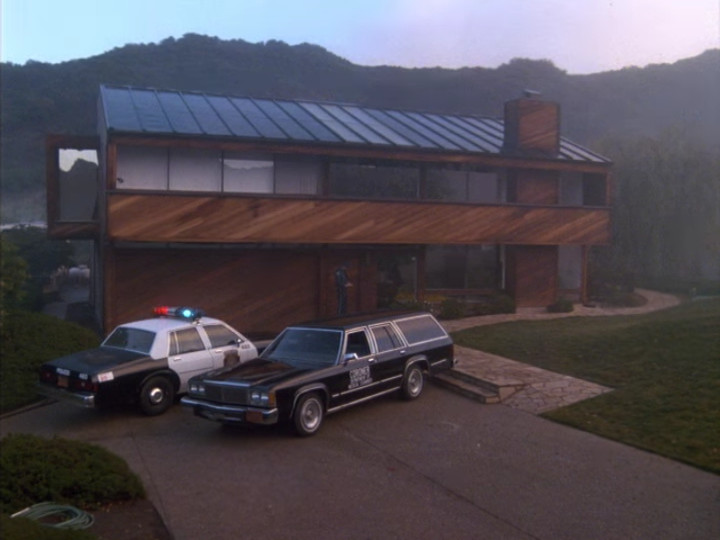
Jessica presents the evidence, except for his slip about the pizza cutter. It’s not very strong and he argues with her. He presents his alibi, of being at the seafood shanty with Ellen Davis, but Jessica counters that the medical examiner couldn’t be so precise with the time of death. He counters that it had to be 9:45 because the clock was broken during the struggle. Whereupon the chief of police walks in from just offscreen and asks him how he knew that, since it wasn’t made public and he had bagged the clock for evidence before Donald had come into the house. Moreover, Lloyd said that when he planted the jacket button in Julia’s hand, her fingers were stiff, which means that she had to have been dead some hours. (That said, I don’t think that Lloyd’s evidence is worth a damn against his son in law, given that he’s already tried to frame him once, but that’s OK because catching Donald doesn’t hang on this.) As he tries to struggle out of this, Jessica then reveals his slip up with the pizza cutter. Then the dramatic music signaling that the case is proved plays.
Sabrina, troubled by everyone’s silence and the conclusive music, declares that she doesn’t believe it. Donald tells her, “Believe it, Sabrina. It was a million dollar craps shoot, and I lost. Count your blessing, kid. It could have been you in that box.” Sabrina attacks Donald uselessly. He pushes her off and Jessica holds and comforts her as the police chief leads Donald Granger off to one of the many police stations in the small town of Cedar Heights. Interestingly, the episode ends here, on a somber note:

I would be curious to know how the writers decide between ending solemnly and ending slightly after the denouement, with everyone laughing. This ending fits, though I actually think it’s a pity that we don’t get to see Ellen Davis anymore. It would be interesting to know whether she blames Jessica for catching Donald or thanks her. It would also be interesting to see Lloyd’s reaction to learning that he had framed a guilty man.

Be that as it may, I hope you can see why I think that (despite not taking place in Cabot Cove) this is one of the great Murder, She Wrote episodes. It has an interesting cast of characters that are pleasant and interesting, with the exceptions of Julia (who, thankfully, is murdered fairly quickly) and Sabrina (who doesn’t get a ton of screen time). Despite having at least fifteen police stations, Cedar Heights has a small-town feel, which partially makes up for not being in Cabot Cove. The particular settings are mostly pretty, and even the awful splatter art is at least partially redeemed by its badness actually being a plot point.

The episode takes a little while to introduce all of the characters and for the murder to happen, but it makes up for that by starting off with the art theft and keeping that mystery going while we meet the characters. It both makes the episode more interesting and also makes it more complex. At the same time, it’s not merely complicated; the two mysteries intertwine in important ways. Even the murder mystery is done in stages, where we first have to unravel that the crime scene was substantially tampered with before we can get on to solving the murder. Once that progress is made, the art theft mystery becomes of primary importance, and only once that’s settled can we properly tackle the murder mystery. There’s a lot to sink one’s teeth in, and with how the plot is constructed, it all matters.

One tradeoff, due to the limited time in a Murder, She Wrote, to fit all of this in, is that the case against Donald Granger is a bit weak. The evidence against him is almost entirely having slipped up and mentioned the pizza cutter he shouldn’t have known about. Even that wasn’t worked in very naturally. He was trying to seem eager to catch the killer, but he should have waited a little bit longer, so he could make the slip while he was caught up in the conversation. The way it was done, he basically volunteered the information unprompted. This might have been OK if he wanted to seem clever, but what he actually wanted to seem was eager, not clever. Passion, conviction, and sincerity are what are needed to sound eager, not information or deductions. Other than this, there was no real evidence against him.

Which is actually a little bit odd, since he set the clock’s time while holding it in his bare hands.

This one I’m going to chalk up to an error in production. There’s no way that he would have forgotten to have worn gloves during such a carefully premeditated murder. Further, the chief bagged the clock for evidence, so unless we’re to suppose that Lloyd somehow smudged all of Granger’s fingerprints, he had to have worn gloves when he set the clock and wardrobe just forgot to give him gloves for this shot.

During the accusation, Granger does give a second piece of evidence against himself—his knowledge of the clock having been broken “in the struggle”. Realistically, these do seem to enough to get a conviction, but it’s a little unfortunate that the proof had to be manufactured rather than discovered. Still, it was at least manufactured through Jessica’s skill rather than by sheer chance, like the knowledge about the pizza cutter. It was also manufactured by presenting the case against Granger, rather than through lying to him about having lost an earring that never existed, or something like that.

Overall, I also think that the episode was pretty fair, as far as giving us all of the clues goes. We got a hint that the art thief was Binky pretty early, when Lloyd mentioned that he had been at Lloyd’s house the morning of the robbery—the clue which comes later about Binky taking trips every three months is confirmation of our suspicions, it’s not wholly new. (That Binky has plenty of money could go either way; we have no reason to suppose he didn’t inherit sufficient wealth to pay his dues at a country club on time. That said, his not being hard up certainly doesn’t cast doubt on his identity as the art thief.)

We also were given plenty of clues that the murder scene was tampered with. The clock was smashed in the struggle but there was no struggle. Julia was clearly strangled with a wire, but there was a cord around her neck. They did conceal from us that Lloyd took forty minutes to get the manuscript when it should have taken him less than ten, but I think that they made up for it by having Lloyd clearly stop before he could have seen that Julia’s door was open.

As to the murder itself, there was only one real clue that it was Donald and that was his slip up about the pizza cutter. Actually, that’s not quite true. Lloyd did mention Julia’s stiff fingers, which suggested that she had been dead for hours by the time he found her—not that they actually told us when that was—which does carry the suggestion that Donald’s alibi wasn’t good. That said, if the time of death was much earlier, Binky wasn’t having créme caramel with Jessica when it happened. In fact, I don’t think he was anyway, because the murder had to have happened before Lloyd left to get the manuscript, and they hadn’t started the créme caramel yet—Binky told Lloyd that if he hurried he’d just in time for it. Binky might still have Jessica for an alibi, but it would have had to have been long before desert.

All that said, Binky having been the killer doesn’t fit with the modus operandi of the art thief. He stole paintings every three months, and had just stolen a painting from Lloyd the night before. This was never brought up, but it was actually a bit of a slip-up on Donald Granger’s part. The art thief, having had such a regular schedule before, might hurry it up a bit, but it doesn’t seem plausible that he would hurry it up from every three months to every three thirds of a day. I think, though, that we simply need to forgive this as time compression so that Jessica can be present when the murder happens, in which case it wouldn’t be fair to use it to exonerate Binky. I think we’ll need to fall back on Jessica being Binky’s alibi earlier in the evening. He had invited everyone over for a dinner party, and even though they finished the evening somewhere in the viscinity of 1am and were having créme caramel some time after 9:45pm, they probably started dinner before 8:45pm, which is the time that Donald Granger started setting the clock forward from in the flashback. Rigor Mortis sets in anywhere from 1-6 hours after death (averaging 2-4), so if Lloyd found Julia at 9:50pm, that puts the time of death anywhere from 8:50pm to 3:30pm. The latter might run into the late lunch that Julia was at, but it seems unlikely that Binky had Jessica as an alibi for that entire time. If we suppose that the dinner party started with wine and snacks at around 6pm, though, I think that Binky is probably pretty safe.

Obviously, If the Frame Fits is not perfect, but at the same time its imperfections admit of explanations that are (reasonably) satisfying. It gives one meat to chew on. Oh, and it has a remarkably clever title. Quite early on, it seems to suggest that the art thief is the killer, but ends up referring to the guilty man having been framed for the crime. Even better, this is in distinction to the framing of the thief for the murder which the real murderer tried to do. That frame didn’t fit.

There Was a Casablanca TV Series

Looking up the credits of an actress in a Murder, She Wrote episode, I discovered that there was a Casablanca TV series made in 1983 (she guest starred in an episode). It only ran for five episodes, though the reviews for the DVD on Amazon say that this was a pity because it was actually good.

I’m skeptical.

There is a clip of the title sequence on YouTube, which uses the song As Time Goes By as the theme song for the show:

I’ll admit that it looks better than I expected, though it still doesn’t fill me with confidence. At the time of writing, the DVD is out of production and used copies are going for $80 and up, so I’m not likely to find out for myself what it was really like. This sort of thing is the reason why copyright should have a relatively short initial term (like 20 years) and require active renewal in order to be extended, if extensions are really necessary. It would be really interesting to find out what the heck this show was, and I really doubt that anybody is seeing royalty checks from it these days anyway.

Supposedly this was a prequel show to the movie, focusing on the small, local adventures of Rick. It’s kind of crazy that this got as far as having one episode made, let alone five!

Knight Rider and Driverless Cars

I was recently passed this interesting tweet which embeds a few seconds of video where you can see how the special effects department of the old 1980s TV show Knight Rider pulled off KITT (Knight Industries Two Thousand, a super-advanced car, voiced by William Daniels) doing his super-high-tech driverless driving.

This sort of thing happened a lot in special effects, in the days before everything was done with CGI. Special effects people tended to be ruthlessly practical and also to have an excellent sense of exactly what would show up on the televisions of the day. And the televisions of the day were not great.

The actual technical specifications are complex, but, approximately (in America), televisions had about 640×480 pixels, and only drew half of them at any given time (even rows were drawn in one frame, odd rows in the next frame, alternating, so that any given row was drawn 30 times per second). Then when you combined the various aspects of transmission and manufacturing, colors weren’t as precise so the whole image would be fuzzier. You got a decent image, but you didn’t see details. Special effects people knew this very well.

The result is that high-definition blu-ray editions of early special-effects-heavy TV shows actually do something of a disservice to the show. In Knight Rider, you can see the guy driving the car when it was supposedly driving itself. In Star Trek you can see that the rubber texture on the gorn’s suit. These really don’t enhance one’s enjoyment of the show.

I’m not sure what the solution is, or if there even is one. Not that many shows from the age of special effects are really worth watching, these days, so it’s not too big a problem.

One thing that helps a bit when I watch the bluray of Star Trek with my eleven year old son is that we watch it on my computer monitor while we sit on a couch twelve feet away. You can’t see the textures on the gorn suit quite as well on a 28″ monitor when you’re that far away.

Murder, She Wrote: Obituary for a Dead Anchor

In the middle of season three of Murder, She Wrote is another episode about newsmen. This time it’s TV news rather than newspaper news, but other than that, it’s much the same.

Unusually for Murder, She Wrote the title card has a person in it. This is the titular anchorman, no less. His name is Kevin Keats and he’s a hard hitting reporter and also a self-important jerk.

He is conducting what is ostensibly an interview about art with Ronald Ross, who has one of the finest private collections of abstract expressionism in the country. This lasts for a few seconds, then Keats starts accusing him of being a drug dealer. Ross says that he’s very disappointed, because he loves to show off his art collection. He walks off, and his enforcer, Gerald Foster, a big bald man, signals that the interview is over by blocking the camera.
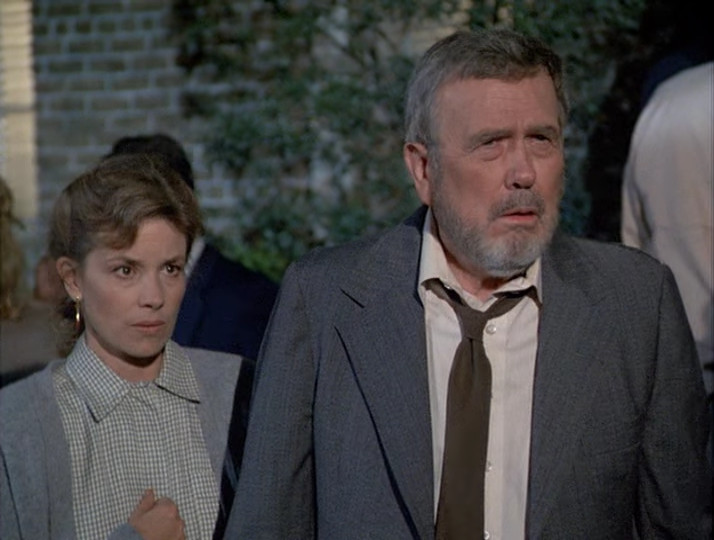
The TV that’s being watched in this shot belongs to Mr. Ross, btw, who is watching it with his enforcer. As a side note, I love the close, personal friendship that crime bosses almost invariably have with their enforcers. It’s so helpful for the casting departments of TV shows and movies that crime bosses never have intermediates so as to have plausible deniability if their enforcers are caught in one of the many criminal assaults they commit. Also nice to know that enforcers aren’t, generally, unpleasant psychopaths who enjoy hurting people but rather cultured and sophisticated gentle souls who by preference would discuss art and are merely willing to do the dirty jobs that someone has to do, out of a deep sense of loyalty to their best friend and employer.

The show cuts to Kevin Keats talking about how he’s got new and explosive information to reveal next week. Mr Ross throws a towel at the television and shouts at it, “You’re a dead man!”

I wonder if, in the whole history of Murder, She Wrote, the murderer has ever shouted a death threat at the victim? Certainly, I can remember no instance of it. Granted, we’re only three seasons in at this point so it’s harder for the audience to be sure that Mr. Ross’s threat entirely exonerates him of the murder soon to take place, but even at this point in the series it’s a good bet.

The end of the show is interesting, btw.

When they’re done they sign off in a curious way. Keats says, “Goodnight, Nick.” Nick replies, “Goodnight. And goodnight, Paula.” She looks up at the audience and says, “Goodnight, America.”

It reminds me a bit of how 60 Minutes ends, though it’s been decades since I saw the show and I can’t easily find any clips to verify that they sign off like this. My recollection is that it did have a bit of a Waltons feel (“Good night, John Boy”), but I’ve no idea if that’s accurate. Either way, I suppose that this is at heart a callback to Edward R. Murrow’s “Good night and good luck.”

I often confuse Edward R. Murrow with Walter Cronkite, who was, back in his day, “the most trusted man in America.” In hindsight, that was largely a testament to how gullible Americans were in the post-war period. From what I’ve gathered from family stories, Murrow was regarded in a similar way, though Murrow acquired a halo of sanctity around him, granted by marxists in the media, because of his supposed role in the takedown of Joe McCarthy (how much of an influence Murrow had is a subject of debate, but popular history will always be simplified history). Be that as it may, the real news had, in this time, acquired a tone of faux-familiarity that was very ingratiating. I suspect that this pretense of being part of the family watching—together with other things, such as the relatively few television channels, the imprimatur implicitly granted by the US government in its fairness doctrine, and many other reasons—was part of why so many people now in their sixties and older regard the news with a completely unreasonable level of trust.

The faux news show in this episode, coming, as it did, in 1986, is in an interesting time. Older people still regarded the news with obsequious gullibility, but children (I was not yet ten) did not, and even in this show one can see a certain amount of cynical realism about the news starting to creep in even to the way it’s presented here in Murder, She Wrote. News was, by this time, a business. Nick, the old man of the three, represents the old time, respected news. Confidential audience research suggests that audiences don’t like him nearly as much as his two younger, better-looking co-stars.

(As a side note, the sub-plot of the network wanting to replace him with a younger, more attractive reporter is a bit silly. It was at the time, and even still is, common practice to have at least one older, respectable-looking character on a show to reflect respectability onto the younger, prettier ones. It would be far more realistic to move him to a small part where he’s often visible but not doing anything of substance.)

The show, Scrutiny, presents itself as beyond reproach, but we do catch a glimpse of what goes on behind closed doors, and the sausage making is not attractive. But I’m getting ahead of the episode. Before we see the inner workings of the show, Paula Roman pitches a feature on Cabot Cove to Jessica Fletcher.

Apparently Scrutiny has down-to-earth, gentle segments, and Paula does those. That feels quite dissonant with the segments that Kevin Keats does, but perhaps Nick does some sort of middle-ground which acts as the glue for these two very different kind of segments. Anyway, Paula insists that unlike Kevin’s mean-spirited exposés, her segment will be like a television post card.

Jessica isn’t sure, but Paula’s assurances that the interview will be a gentle, lovers’ caress of Cabot Cove makes Jessica say that she’ll bring it up with the town council and see what they think (spoiler alert: they love the idea).

Then we get a plot twist!

In a meeting with the producer, the anchors, and the guy whose job it is to liaise with the “network” (his title is “vice president in charge of the news”), after they abuse the network guy for thinking about the people who pay for everyone’s fun and he leaves, it turns out that they’re killing part 2 of Kevin’s show about the drug dealing art collector and instead he’s going to be doing Paula’s Cabot Cove segment. She’s been reassigned to do a story on a boy who joined a girl’s basketball team.

Oh, and it comes out that the “network” is very concerned about the shows’ ratings. Nick is an American institution and Kevin and Paula are young and attractive, but the show is not doing so well anyway. This will be a major plot point, later, but it does feel a bit dissonant. Within TV-land, what is the show supposed to do to get higher ratings?

In reality they need to move more niche and pretend that the world is constantly about to end and only watching their show will save it. Even that is a short-term solution as TV news is constantly slipping in ratings to the point where many brand-name news shows have lower viewership than some of the bigger YouTube channels, but that would make for a very different episode. And TV news’ falling ratings doesn’t seem to result in personnel changes anyway.

But what are they supposed to do in TV land? Usually there is some unsavory alternative presented, such as bringing on women in bikinis or covering more sensational events even though they aren’t as Important. This show already covers sensational things that aren’t important. I suppose they could have Paula wear a bikini, but nothing like this is mentioned. It’s just left in the air that things aren’t great despite Scrutiny being a smash hit that enough people watch that Kevin Keats’ face is almost as well known as that of Ronald McDonald (this is mentioned later in the episode).

This being left completely unresolved, we move to Cabot Cove, where the residents are getting ready for their closeup. Interestingly, this episode, despite being in Cabot Cove, does not feature Seth Hazlet. Filling in for him while he’s visiting his sister is Wylie.

Wylie is only in two Murder, She Wrote episodes. The other is Dead Man’s Gold. (The actor, Robert Hogan, showed up in two other episodes, one as Lt. Bergkamp and one as FBI Agent Guilfoyle.) He’s a fun character. He’s got Seth’s crusty cynicism, except with more charm. He notes that the town is going crazy with the coming of the TV show. Then we get the gag of the TV news crew overwhelming Jessica’s house with TV equipment (mostly lights).

I really wonder how realistic this is. It’s made by a TV show who knows how to film outdoors, so I expect they could use very realistic equipment if they chose to. On the other hand, I doubt they would have chosen to. For one thing, not a single one of those lights is like the other and real lighting has a tendency to be symmetric about the subject it’s trying to illuminate. For another, I suspect that the crew who set up would have found it funny to make the lighting as unrealistic as possible. Also, these aren’t the days of technicolor with its huge light requirements because they’re exposing three films, one with a red filter in front of it, one with a green filter, and one with a blue filter. How many lights do they really need outdoors on a sunny day, for a TV show?

Jessica demands that they get the lights out of her flower gardens (you’d think, if they were setting up, they’d have wanted to get her flower gardens as background), and Kevin Keats introduces herself.

We then cut to Amos Tupper, in an ugly brown suit which he apparently bought just for the occasion, driving along the coast road. (I’ve got a screenshot of the ugly brown suit later on.) He pulls over when he sees a helicopter descending towards a stretch limo. The helicopter lands…

…and out of it steps the drug trafficing art collector’s enforcer, carrying a suitcase. He runs to the stretch limo.

As soon as he’s in, the stretch limmo tears onto the road, wheels screeching.

All of this sure attracts Amos’ attention, but it serves absolutely no discernible purpose. There is no reason for the enforcer to be in such a rush, or at least no reason that we are ever told about. There’s no obvious reason for the guy to have taken a helicopter when there’s an airport near Cabot Cove that everyone else uses. There’s no reason for him to have a stretch limo waiting in a field for him. There’s no reason for him to run from the helicopter to the stretch limo. There’s no reason for the stretch limo to tear onto the road so fast its wheels squeak. Literally the next thing we know that the enforcer does is to show up the next morning at the docks. There is absolutely no plausible reason for all of this haste. Moreover, if the enforcer is here to murder Kevin Keats, he would need to wear one of those one-man-band outfits with all of the instruments tied to him in order to draw more attention to himself. It’s almost a small thing, in comparison, that there is no way (we know of) for the enforcer to know that Kevin Keats is in Cabot Cove. It was in no way the obvious place to look for him, and with them worrying about death threats against Keats, it’s a bit odd that they’d publicly mention where they’re filming taped segments.

However improbable, though, this dramatic appearance moves the plot along. Amos shows up in the middle of Kevin Keats interviewing Jessica and tells her all about the big ugly bald guy, which makes Keats request the Sheriff (in private) to quietly hire a boat for him.

I don’t want to entirely skip over that interview, though. We come to it as Keats is asking Jessica, “It makes you wonder, J.B. Fletcher, how you came to buried in a tiny town in the back of Maine where the people are, if you’ll forgive me, hardly your intellectual equals.”

Her intellectual equals? She’s not a philosopher, or even someone who is reputed to write Great American Novels about people without principles or religious beliefs being depressed that life is meaningless and full of suffering. (Those aren’t, in fact, intellectually great, but I would at least see why a pretentious TV news anchor would treat them as if they were works of agonizing brilliance.) She’s a mystery writer! She writes whodunnits where a law student from the deep south catches a murderer because his friend who is accused of the murder claims he didn’t see a light flashing on an extension when he was hiding in the music closet. Mystery stories are actually quite deep, at least when done well, but it’s implausible in the extreme Kevin Keats would regard them that way. The detective being a Christ figure who descends into a world broken by the misuse of reason in order to, by the right use of reason, restore right order to it, is not something it is slightly plausible Kevin Keats would appreciate.

Besides, if she was living in an apartment in New York City she’d be likely to have a corporate lawyer on one side of her, a banker on the other, and the personal assistant to an executive across the hall. Why on earth would these be her “intellectual equals”? People in big cities like a variety of ethnic foods, unusual shops, fornication, committing crimes, and stepping over homeless people to get to all of these things. They would be far more urbane than Jessica’s Cabot Cove neighbors, but why on earth would he think that they’re intellectually superior? If you’ve ever encountered city dwellers, plenty of them can go several weeks at a time without having a single thought in their heads that a dog would not. Liking varied entertainment is not at all the same thing as being intelligent. If anything, it’s a symptom of intellectual weakness to require constant variety in order to sustain interest.

None of which Jessica says because she’s written by people who live in a big city (Los Angeles). Instead she tells Keats that if he’s going to insult her friends and neighbors, he’s going to have to do the segment without her. He apologizes and they do it over again. He asks roughly the same question but without the insults, and she talks about how this is where her roots are, and how she’s lived for decades in that old, drafty house with Frank…

I really wish she gave an answer that had something to do with loyalty and how each place is good in its own way, and she’s good at appreciating the goodness of this particular place. Of course, the problem here, too, is that she’s being written by Hollywood writers, which means people who gave up their roots to move to Los Angeles in order to pursue their dreams of fame and fortune. That is, they are nearly the worst people in the world to answer this question, and not nearly imaginative enough to think of how someone unlike them would answer it for real. All they can do is give the pat answer, “I’ve had lots of experiences here.” I doubt that it’s ever occurred to Hollywood writers that there actually are people you couldn’t pay to move to Los Angeles.

Anyway, Amos Tupper interrupts this interview which Jessica has to know is going to be cut up and mangled, but goes along with anyway, because he’s got extremely important news that just can’t wait. There’s a not very funny bit where he pointedly ignores Keats and tells Jessica about the guy he just saw get out of a helicopter and into a limo.

Amos doesn’t even notice when Keats tells the TV crew to cut the film. Eventually he asks who this fellow is. It’s mildly amusing, but I don’t think it was worth sacrificing Amos’s manners for. It’s also nearly the only time I can think of where Amos was in a hurry for anything. Anyway, he eventually finds out that it’s Kevin Keats, and is embarrassed, though not very embarrassed. He shakes Keats’ hand and says that he looks a lot taller on TV.

The scene is very odd because Amos bought a new suit to show off for the TV cameras and yet doesn’t care about them and even partially looks down his nose at them. I don’t know what to make of it; I guess they just had to stitch the next plot element to the current scene and wanted to get through it as quickly as possible (when writing). It does, at least, do that; we’re now on to the next part of the plot.

Oh, almost. We have a few things to get out of the way, first. It’s now night time and Kevin Keats’ estranged wife calls him at his hotel to vaguely threaten him.

That phone call over, it’s time for Dough, the producer, to walk in and have a fight with Kevin in front of the hotel manager.

“This assignment was a change of pace. A fresh approach. Don’t take it personally.”
“Oh, but I do. Scrutiny is a hit for one reason, and you’re looking at him. They toss out producers like so many empty beer cans but I keep rolling along. So you get off my back, before I do something you’ll regret.”

Scrutiny is a hit but the network is worried about the ratings. OK, whatever. This publicly-witnessed threat session over with, we can finally get to the important part: in the morning Kevin gets on the boat the Sheriff Tupper rented for him. Sheriff Tupper then turns around and sees the bald enforcer standing by the dock, watching Kevin. He shouts to him to hold it, whereupon the enforcer runs away and Tupper sighs in disappointment since running after the man is clearly out of the question.

Kevin Keats’ boat makes it about 100 yards away from the dock and then we get the murder.

It was kind of whoever planted the bomb to put it on a timer after the ignition started so that it wasn’t right next to the dock when it exploded. Sure, he destroyed an innocent man’s boat, but at least he didn’t cause unnecessary damage to the dock, which having the bomb go off as soon as the ignition was started would probably have done.

Anyway, we go to commercial and when we came back the big bald enforcer calls the art collector from a phone in the limo and tells him that the situation has resolved itself. The art collector replies that he’s late—he’s watching Paula Roman live, from the scene of the explosion.

I find this perplexing since it entirely rules the enforcer out as a suspect. We’re seeing him in a private conversation where he would have no motive to lie. So what is the point of these characters? If they’re not suspects, why spend time on them? I suppose they could be trying to suggest that the art collector actually carried out the hit without telling his enforcer and was using the enforcer as a blind, but neither appears again in the episode.

We go to Paula Roman, live on the dock only an hour or so later. After she signs off, she talks to Jessica. She claims that she took the first flight over. Jessica looks dubious, but says nothing. They leave together.

They get to the hotel, where Paula doesn’t recognize the busy-body hotel manager, and he directs them to the private dining room where the “TV folks” have set up a temporary field office.

Nick is there, running things in the absence of anyone else. Paula asks where Doug is and Nick says that nobody knows. He checked into his hotel late last night, left early this morning, and nobody has seen him since. He’s probably off climbing a mountain somewhere. This being a potentially identifying personal detail in a Murder, She Wrote, you can bet that it will be significant before the end of the episode.

Paula and Jessica have coffee, and Paula asks about the look Jessica gave her when she said she flew in on the first flight this morning. Jessica tells her that she was on the air a half hour before the first flight from NYC landed in Portland. Paula then admits to having flown in the night before with Doug, the producer. Jessica knows that Paula spent the night with Kevin because she didn’t recognize the hotel manager, which meant that she didn’t go to her own room. We also learn that Richard Abbott, the vice president in charge of news, is also missing (back in NYC).

Some comic relief later, Jessica calls the hotel manager on the phone and asks about the phone call from Keats’ wife. She wasn’t calling from California, it turns out, she “left a local number”. It’s the phone number of a nearby motel. How she left a number when the hotel manager never talked to her other than to say “hello” is unclear. This is before the days of caller ID and the phone had no caller ID screen on it anyway. It’s useful information, though, because it enables Jessica to go interrogate Kevin Keats’ wife, which she does.

It turns out that she came to Cabot Cove in order to try to reconcile with her husband, but he saw Keats with Paula and realized that there was no chance of it when she saw the look of love in his eyes when he looked at Paula. This makes the timing a bit suspect, since Paula arrived with Doug the producer but Mrs. Keats called her husband both after she saw Paula with Kevin but also before Doug walked in the front door.

Plot holes aside, Jessica is busy rudely observing that now that Kevin is dead Mrs. Keats will get all of his assets when the bartender says that there’s a call for a Jessica Fletcher. It turns out it’s Wylie.

He asks Jessica to ask Mrs. Keats how many toes her husband has. Jessica asks, and before she can relay the answer, Wylie tells Jessica, “Unless she said eight, the fellow I’ve got lying here on my table is not the late Kevin Keats.”

Amos, Jessica, and Wylie meet to discuss this new development. Amos, as usual, takes the changing of facts personally. He saw Kevin Keats get on the boat, and doggone it, it’s not fair that it isn’t Kevin Keats who’s dead. Poor Amos. Life as a small-town sheriff is supposed to be simple.

Incidentally, it’s definitely the case that whoever it is on the table didn’t lose the toes in the explosion, they were surgically amputated some time ago. Also, Wylie checked with Seth (who, you will recall, is on vacation) and no one in Cabot Cove is missing those toes. Jessica then brings up another mystery, in addition to whose is the body: where is Kevin Keats? (Apparently it doesn’t occur to anyone that there could have been two people on the boat and Keats was in fact killed but his body not found because they stopped looking after finding the first body.)

Curiously, the next thing we see is where Kevin Keats is.

To be fair, it takes a minute to actually show us Kevin; he’s watching the news where somebody or other is interviewing Cabot Cove’s mayor, but eventually we pan over to him on the motel’s bed.

I love Kevin’s outfit. It’s the pointless leather patch on the flannel shirt that really makes it, for me. That said, the bag of potato chips and the drink in a red plastic cup really pulls the shot together. That’s about it, though. All of the action takes place in the newswoman asking the mayor questions and him not having answers. Then Kevin picks up the phone and dials someone as we fade out.

I’m very unclear on why this scene exists; all it serves to do is to remove the mystery about what happened to Kevin Keats only a few seconds after the mystery was raised. In that way it’s reminiscent of the scene in which the bald enforcer calls his art collector boss and tells him that he didn’t have to kill Keats after all. Is this meant to be a help to the audience? Does Murder, She Wrote have a maximum amount of mystery it’s supposed to maintain in order to not be too confusing to the viewer? I don’t know if that’s the case but it’s an interesting thought. This is television, probably at its height in terms of numbers of viewers of an episode—at that time when an enormous number of people were watching but there were not, yet, hundreds of TV channels competing for viewers. According to Wikipedia, at its height Murder, She Wrote had about forty million viewers, and even in its eleventh season it had about fifteen million viewers per episode. Perhaps in order to be most comfortable to a general audience they wanted to keep the number of things the audience had to keep track of to a minimum.

The next scene has the vice president of TV news, Richard Abbot, walking into the make-shift office in the hotel in Cabot Cove. He and Nick argue, though it’s difficult to characterize what the argument is about. Nick is mad that Richard was missing, and Richard is angry that… I don’t know. He seems annoyed that Nick is annoyed, as much as anything else. Jessica walks in and interrupts them to say that Kevin Keats is very much alive—a thing she doesn’t actually know, btw, unless she knew it by reading the script. It certainly has not been proven yet.

Nick asks whose body was pulled out of the water. Jessica hypothesizes that it’s actually Doug Helman, the producer, because earlier Nick joked that Doug was probably off climbing a mountain, which she free-associated to frostbite, and then noted that the body was missing two toes on its left foot. No one actually knows whether Doug was in fact missing any toes on his left foot, but this is taken as sufficient evidence to conclude it definitely was Doug. (And see, I told you that it being a random personal detail, it would definitely come up again!)

Paula walks in when Richard is asking where she is and she says, “so it was Doug.” Nick tries to get her to work on the rewrites that they have to do but she only wants to talk to Jessica. Nick grabs her by the elbow and tries to pull her to the typewriter, saying “Listen, Helman didn’t even want you up here, the only reason you came is because Kevin insisted, now come on, now let’s get to work.” This being a Murder, She Wrote episode, a random bit of detail about someone other than the person speaking must be a clue. They do a halfway decent job of disguising it by putting it in a heated moment, but it doesn’t really fit very well. The biggest thing is that it stands out for not really being in character, in the sense that there were far more persuasive things that Nick could have said which would also have been far more natural for him to say. If this wasn’t a murder mystery, he’d have given some speech about journalists having to put aside their feelings for the sake of the public, or some such. That instead of that natural thing he went for irrelevant detail is a huge red flag.

There’s also the problem of this not really being in character. Nick’s motivation to drag Paula in is very slight. Granted, he seems to be angling for the producer job by filling in for Doug in this pinch, but Paula isn’t a writer and isn’t even an investigative journalist. Her beat is doing TV postcards of small towns. It’s pretty far fetched that he even wants Paula at a typewriter. It would be different if he needed her pretty face to go in front of the camera, but that’s not what he wanted. Paula refuses, and she and Jessica leave.

As they’re walking, Jessica tells Paula that Kevin called her. Paula asks how Jessica knew, and instead of referencing Paula’s inflection when she said “so it was Doug Helman who was killed on the boat” which would have been decent evidence for it, she instead said that Paula trusts Jessica, and who would Kevin trust? His mistress isn’t entirely implausible, but you’d think he’d have a few friends, too. Paula’s reaction was much better evidence, but oh well. Jessica talks Paula into talking Kevin into coming forward to the Sheriff because staying in hiding could be too easily misconstrued. You’d think that Jessica would know Amos by now. We’re not at the end of the episode, so no matter what Kevin did, Amos would misconstrue it. It’s what he does.

It turns out that the fight Doug had with Kevin over reassigning Doug to Cabot Cove was a put-on. They’d planned it together. The goal was to fake the drug dealing art collector into thinking that the series was dropped (how the art collector was supposed to know this is anyone’s guess) when in reality he was in Cabot Cove because there was a witness in New Hampshire who would only talk to Kevin. The boat thing was “cover”; he wanted people to think that he was on a boat in the harbor when he was really driving to New Hampshire to see the confidential witness.

Augie Wilkin had the only boat in town for rent, and the Sheriff couldn’t get in touch with him until about eight O’clock that night. Once he told Kevin about it, Kevin called Doug and told him to get up to Cabot Cove on the double. Doug must have gotten in very late if he didn’t know he was going to be taking a plane to Cabot Cove until after 8pm. Still, this was before 9/11 and was probably doable.

The fight between Doug Helman and Kevin Keats in front of the hotel manager was staged. “Just another part of the act.” Why there was this is act is… very unclear to me. I’m not sure what could be gained by convincing the hotel manager that Kevin Keats and his producer were fighting. If they were on the best of terms, it wouldn’t make the dropping of the drug dealing art collector story any less plausible. It also wouldn’t make him supposedly running away by boat any less believable, either, which was all he really wanted to disguise. It feels like the sort of thing that’s normally in a story that features people worried about there being a mole in the organization, and so they had to deceive everyone because they didn’t know who it was. Except, there was no mole. There was no reason to not tell Paula and Nick about the plan to disguise Kevin’s going to a secret informant. Also, given that they were keeping up this pretense of a fight, why on earth did Kevin insist that Doug bring Paula up to Cabot Cove with him? He couldn’t keep his pants on for one whole night? From all of the other precautions they took, Paula could only get in the way of the plan. Besides that, no one was covering the boy on a girl’s basketball team in Nebraska. From Kevin and Doug’s perspective, someone should have been covering that, no? They expected there to be a show that would air the next week.

This story is pretty much nothing but loose ends, which makes me somewhat sympathetic to Amos for arresting Kevin. He reasons that whoever planted the bomb had to know about the boat, and since only Kevin and Doug knew about the boat, that means it had to be one of them. It being Doug seems unlikely, so by process of elimination, it had to be Kevin. For once, Jessica has no objections.

Paula visits Kevin in jail and they talk. It comes out that Nick and Richard haven’t sent a lawyer to get him out on bail because they figure it will be better for ratings, at least when the special which is the former Kevin Keats eulogy is broadcast. The Sheriff has even kindly given his permission to let Kevin tape his segment in the jail cell! Amos is nothing if not thoughtful. Why Kevin can’t hire his own lawyer is never said.

Next we see Jessica go interview Mrs. Keats one last time.

I’m not sure if the writers are trying to keep her alive as a suspect or are just using her to give the next clue. She does give a clue, anyway—she thinks that Kevin was about to be fired because the network had just done confidential audience research. The writers really can’t decide whether Scrutiny is more famous than apple pie or going under. Why on earth he told his estranged wife about this, I’ve no idea. She described it as “in a fit of paranoia,” though trying to make her think that she couldn’t get much out of him in divorce would have been more plausible.

Jessica goes and takes this up with Richard Abbott (the vice president in charge of news). He’s cagey, but she gets out of him he didn’t want to discuss the confidential network research in front of the anchors because it concerned one of them. Also, when Doug Helman was killed he (Richard) was in NY having breakfast with the president of another network. “You see, in television land, when the canoe springs a leak, one doesn’t bail water, one just looks for a new canoe.”

And now we go to Jessica’s house, where she’s playing chess with Wylie.

In a Murder, She Wrote episode a scene unrelated to hunting clues, this late in the episode, means that all of the clues we’re going to get have been given. It’s time to guess who the murderer is.

Wylie puts Jessica in check, with mate in one. Usually she beats Seth, so Wylie was able to beat her because she’s distracted—she can’t stop thinking about Kevin Keats’ story. Wylie says that there had to be an easier way to slip out of down, and Jessica says that she didn’t remember telling Wylie about Keats’ plan. “You didn’t. I overheard you talking to Sheriff Tupper on the phone.” And now Jessica realizes who the murder is. She just has to go the jail to be certain.

In jail, Jessica goes over the phone call with Kevin, and indeed Doug had gone over the time table in detail to make sure that he got everything right. Keats was sure that Doug would never have talked about it with a third party present, but Jessica asks, “What if he didn’t know, or care, that there was a third party present?” She means what if it was a third party that he didn’t care about, but it was badly phrased coming right after Kevin saying that he was certain that Dough would never have discussed their plan in front of a third party. Anyway, the scene closes and we open on our murderer, who Jessica visits, alone.

That’s right, it was Nick Brody. He’s working late on a rewrite. Jessica tells him about the confidential audience survey, whose result was that the audience preferred the younger Kevin and Paula to him. Why this means that he needs to be fired is not explained, but that’s OK. Jessica informs him that he was there when Kevin called Doug and worked out their plans, a fact proved by his knowledge that Paula was only in town because Kevin insisted—which they had only ever discussed on the phone.

This is the only actual piece of evidence which Jessica has. It’s a bit like an Encyclopedia Brown case where there is literally one clue, and if you pick up on it you can solve the case and if you don’t, you can’t. It’s an interesting balancing act, but I think it probably gets back to the issue of having such a large, general audience. Too many clues and a large fraction of the audience will think that the mystery is too easy. (Fewer than one clue and the mystery will be too hard, and not just for some people.)

Anyway, it’s enough, and he admits it. Jessica asks how he got to Cabot Cove and he replies that he drove all night. It’s only 350 miles. (Averaging 60 miles an hour, that would take just under six hours. If he left at 9pm he’d have gotten in at the earliest at 3am—he should be tired!)

It’s curious how they deal with the question of how Nick got the bomb. “Oh, about the bomb? Well, you don’t get to be a 63 year old reporter without learning something.” I doubt that there were any reporters of any age in 1986 who could put together a bomb with the explosive power of a few pounds of TNT on a moment’s notice, late at night. Or worse, in the middle of the night in Cabot Cove.

Jessica asks him why he did it—Doug was just following the network’s orders. Nick’s reply was interesting, so I’m going to quote it in full. He said:

Without Helman, I had a better than even chance of staying with the show. I had more experience than any of them. To hell with the audience research. So I wasn’t young, vicious, or even pretty. But I was the one who could talk sense to them. I’m a news man. I’m not a performer. I tried to tell Doug that. And whatever he started out believing, in the end he bought the idea that the wrapping paper—the wrapping paper!—was more important the package.

If you don’t mind, I’d like to finish this rewrite while we’re waiting for the Sheriff. Just dial 9 for an outside line.

One of the unusual things about Murder, She Wrote is that its star was not young. Born in 1925, Angela Lansbury was 59 when the show started and 61 when this episode aired. The primary recurring characters in Cabot Cove were not spring chickens either. The guest stars were frequently actors who had been famous twenty or thirty years before, and now were getting small parts as older people. What’s true of the actors is true of the viewers, as well. The audience of Murder, She Wrote famously skewed much older than for most of prime time television. My mother remembers the commercials frequently being for things like denture creams while I remember them as being for life insurance that you can’t be turned down for no matter how old and sick you are. The final episode of Murder, She Wrote was even titled Death By Demographics.

(To be fair to the networks, they didn’t care. It was advertisers who paid top dollar for younger viewers and much less for older viewers, quite possibly because younger viewers bought more things and also were more malleable; if you could turn an eighteen year old just starting to buy his own toothpaste onto your brand of toothpaste you might have a loyal customer for decades.)

The theme of Nick’s monologue is that, despite being old, he’s still, in reality, valuable. More than that, he’s actually the most valuable. This is a theme that resonates with an older audience, but especially with an older audience in the 1980s. People born in the 1920s and 1930s saw truly enormous amounts of change in the world by the 1980s, not just technologically but even socially. The worship of youth was (partially) socially dominant in the 1970s, with people proclaiming that one should never trust anyone over 30. With the advent of the birth control pill and labor-saving devices like washing machines, traditional restraints and traditional divisions of labor seemed to many pointless and anachronistic. The future was in plastics, as the uncle in The Graduate foretold. The future was in computers, as many people told Jessica when suggesting she replace her old typewriter with a word processor. What place was there for people who vividly remembered horse-drawn milk delivery and wartime rationing?

Nick’s impassioned speech proclaims that there is a place for them, that the world hasn’t actually changed that much. I think this is why Jessica doesn’t say anything. You can see in her face that she agrees with him, but he crossed the line in blowing Doug up. She slowly walks over to call the Sheriff, and he goes back to typing, then pauses a moment in thought.

I’m not sure what he’s supposed to be thinking about. At first it looks like he’s pausing to regret getting caught, but then his look of consternation is replaced by a very slight smile. The music is sad, though.

(Incidentally, the story was by Bob Shayne who was born in 1941 and the teleplay was written by Robert van Scoyk who was born in 1928.)

There’s also the curious theme of this lionization of news. He’s not this new breed of reporter, who is all glitz, he’s a News Man! As if the news was some deeply respectable thing, back in his day. Back in the days of Edward R Murrow (hah!). It is interesting to consider the timing, though. People born in the 1920s and especially the 1930s were young when radio and later TV news journalism were new. Growing up they might have felt that they were so much better informed because of the increased immediacy of these things. One didn’t have to wait for a newspaper, an authoritative voice would boom them over the radio or television might even show you pictures of the things as they happened! There were not many channels and they were more regulated than the newspapers were; it seems plausible that some reasonable fraction of people growing up then might have thought of themselves as better informed than their predecessors, and better informed than younger people today who watch news that’s all about sensationalism and glitz.

Incidentally, this is a separate issue from Baby Boomers who trust the news. They were young adults during the era when TV news was turning glitzy. Someone born in 1946 (approximately the oldest baby boomer possible) would have been forty years old in 1986. Chad Everett, who played Kevin Keats, was born in 1937. In 1986, when this episode was filmed, he was 51 years old. Granted, TV actors usually play younger than they are, but not usually more than about a decade down. In other words, the youthful TV anchor was supposed to be the same age as the oldest baby boomer watching and was, in reality, a decade older than them. (Mark Stevens, who played Nick Brody, was born in 1916. He was 70 playing 63. Kathleen Lloyd, who played Paula Roman, was born in 1948, making her 38 at the time of filming—young enough to be Mark Stevens’ daughter, but no spring chicken.)

Looking back from the vantage point of the year of our Lord’s incarnation 2020, the view of news as something that was once reliable but is now turning commercial and unreliable is quaint to the point of being laughable. The multiplicity of viewpoints expressed when cable television was just getting off of the ground is nothing in comparison to what news is like these days, with each news source trying to cater to its very specific niche, which largely means that the reporters are just being somewhat honest about their biases. Moreover, as a remove from the events sheds light on the biases of the newsmen of old, the rosy view which people had when there were only three major networks seems more like gullibility. Still, we’re all prone to such myopia; to not seeing what is not easily within our horizon.

One other interesting thing about this episode is how much Jessica does not believe in sexual morals at all, or if she does, she keeps them entirely to herself despite being willing to criticize people for all sorts of lesser moral failings or things that aren’t even moral failings but she just dislikes (such as violence in movies and other entertainment). Paula Roman is sleeping with a married man. Even worse, she is getting in the way of that married man reconciling with his wife, which his wife was trying to do. Jessica fawns over Paula like a dear child when Paula is, in fact, very much an adult and actively engaged in adulterating a man’s marriage. Jessica doesn’t even bat an eye. She’s supposed to be a small-town retired English teacher but she’s really a big-city cosmopolitan socialite.

So, all that said, what’s good about this episode?

It has interesting characters. Not all of them, but at least the trio of reporters from Scrutiny are. The character of Richard Abbott, though under-developed, is also interesting for his extreme calm and forthright cynicism about his business. Wylie is great as the doctor. Tom Bosley as Amos is always fun for his manner.

OK, but this is the stuff which comes from good casting, rather than good writing. What about the story?

It is difficult to praise the story because, in part, it’s really a bunch of unrelated stories happening near each other and with some minor relationships to each other. At that level of abstraction, it’s merely the description of a mystery story with red herrings, but these don’t really feel like red herrings because of the way that they are almost serial in their presentation.

The sub-plot of the drug dealing art collector is at the start of the show and gets things in motion, but then is dropped as soon as the murder happens. The sub-plot of a small town preening itself for the cameras and not getting what it hoped is also dropped before the murder happens. We then get a sub-plot of a small town overrun with TV news crews because a famous TV man was (supposedly) murdered in it, but this never really goes anywhere. We have the sub-plot of the vindictive estranged wife who had wanted to patch things up with her husband, but that never really goes anywhere. (I don’t think that she’s ever a realistic suspect.) We get the sub-plot of the two anchors who are romantically involved with each other, adulterating the one’s marriage, but this only really serves to get Kevin Keats out of hiding, and then goes nowhere. The sub-plot of trying to get over to a confidential witness results in a cockamamie scheme whose time table is highly questionable, and in any event it’s linked to the story about the drug dealing art collector, and that plotline being dropped, this one goes nowhere too.

The upshot is that the episode is interesting while it happens, but since all of the sub-plots go nowhere, it’s disappointing once it’s over. Even the theme that was raised of the big city versus the small town ends up nowhere. Jessica is really part of the big city, so the small-town end of this theme has to be held up entirely by Wylie, which he stops doing as soon as there’s a body for him to examine.

About the one thing I can say for the story—rather than the characters, acting, sets, etc—is that it does have an interesting premise of outsiders bringing their troubles someplace else in order to settle them by being unknown in the place they’ve gone to. That is a structure that can be quite interesting. It’s the premise of my favorite Cadfael story, Saint Peter’s Fair. It’s the premise of my third and upcoming Brother Thomas novel, tentatively titled He Didn’t Drown in the Lake. It’s an interesting premise. It’s disappointing when an interesting premise isn’t used to its full, but it’s still something just to have the interesting premise.

Actually, there is a second thing I can say for the story. It does have a nice twist partway through. The corpse being identified as someone other than Kevin Keats was interesting, both simply as a twist and also as a way of changing who the suspects were. Or, rather, raising the question of who the intended victim was, and whether this changes who the suspects were. (It didn’t really change who the suspects were because the suspect who might remain—the enforcer—was already ruled out by the time of this reveal.)

That’s probably about the best that I can say for this story. Like so much of television, it had a lot of promise that it didn’t fulfill, but it was fun while it seemed possible that the promise would be fulfilled. Also like so much of television, it gains quite a lot from having interesting people and interesting sets. Television is a very visual medium, and this (legitimate) visual interest can make up for a lot of weakness in writing.

Murder She Wrote: Murder in a Minor Key

Murder in a Minor Key is a very special episode of Murder, She Wrote, because it’s the only episode in which we actually get to find out what murder she wrote. Unlike the typical episode it doesn’t even start with the title card. After an establishing shot of Jessica’s house, we begin with Jessica walking down the stairs.

But she’s not just walking down the stairs. She’s talking to the camera. She tells us that she had changed into something more comfortable as she has a long night of reading ahead of her because her publisher just sent her the galley proofs for her latest book, Murder in a Minor Key.

She adds that she doesn’t know why they bother sending her the galley proofs as she’s the world’s worst proof reader. I can’t help but wonder what sort of English teacher she made if that’s actually true. (Jessica had been an English teacher for decades before retiring.)

Jessica then walks over and sits in a comfy chair and says that it’s so good to sit down. She spent half the day on her feet at the power company, trying to get her last bill sorted out. Meanwhile, the audience is wondering why Jessica knows we’re here and why she is telling us about the minutiae of her day as if we’re old friends. Those of us who watched Mr. Rogers as a kid might have been wondering if she had recently installed any model trains. But wait, it gets weirder.

Jessica not only is wearing “slippers” with 2″+ heels and pink ostrich feathers, she calls our attention to them and explains that she is wearing them because they’re actually very comfortable, though she only wears them around the house when no one else can see them. For bonus points, her nephew Grady gave them to her.

Jessica laughs about this, then gets down to business. She starts telling us about her book. She’s very pleased with it—it’s a “nice little puzzle” about some young students at a southern California university.

This is certainly not what I expected Jessica to be writing about. What does she know about young students at a southern California university? Aside from book tours, teaching university courses in NYC about crime writing, visiting dozens of nieces and hundreds of wealthy and/or famous friends, she’s spent her entire adult life in Cabot Cove, Maine. I wouldn’t necessarily expect her to write about a fictional small town in Maine, but then I wouldn’t necessarily expect her to not write about that, if you get my meaning. At the very least I would expect her books to feature a consistent detective.

Jessica introduces us to three friends who will be the main characters. There’s Michael Prentice, who’s a “bright, budding music composer”. His best friends are Chad Singer, a law student from the deep south, and Jenny Coopersmith, a quirky young lady from New York. As a testament to Angela Lansbury’s stage background, she delivers the exposition in one take, which is no mean feat as it’s comprised of several different topics. Anyway, our main characters introduced, we finally get to the title screen. Oh, but before we do, fun fact: Shaun Cassidy, the actor who played Chad, previously played the character of Joe Hardy. That was eight years before this episode, on a Hardy Boys TV series. Shaun Cassidy only acted for another year, then a few years later started producing shows. Anyway, we finally get to the title.

The trio goes to a night club that has a singer who also plays the piano. Even in the 1980s, this feels a little odd. Perhaps it was more common in southern California, though. Anyway, the singer says that she’s got an advance copy of a song from a broadway musical. She starts to play and Michael recognizes the music as his. He goes to the piano player and looks at the sheet music, then hands it to her and sits down and plays several measures. He asks how he’s doing and she says that he hasn’t missed a note.

Michael storms off and confronts Professor Tyler Stoneham, who is a music teacher. Stoneham is conducting a quartet, and icily says that he and Michael will discuss the sheet music in his office, in half an hour, but in the meantime will he cease being rude and let Stoneham finish his rehearsel. Michael accepts this for some reason, and the next scene is in Stoneham’s office.

Stoneham denies any wrongdoing and tells Michael that if he goes to the Chancellor nothing will come of it. Irate college students who feel that they’ve been wronged are a dime a dozen, and besides it’s Michael’s word against Stoneham’s. This admission of guilt made, Michael issues some threats as Professor Papasian (played by Rene Auberjonois) walks in in order to witness the threats and Michael holding a tuning fork in a threatening way.

The next scene is at Professor Stoneham’s house, at breakfast with his wife.

Her hands tremble while she pours herself tea and he asks her “What the devil is wrong with you, Christine?” She replies, “are you being solicitous, Tyler, or merely polite?”

Eating breakfast at opposite ends of a long dinner table is effective symbolism for the state of their marriage. She accuses him of infidelity when he’s been away on business trips and she can’t reach him, and he laughs at her fears. He seems genuinely amused that she was worried he was dallying with other women when he was actually engaged in non-sexual criminal enterprises.

That said, the very next scene is of a woman being called on the phone by her friend to draw her attention to a picture in the newspaper.

The picture is of professor Stoneham, and she clearly recognizes it as the man she worked with. So, it turns out that the composer she had worked with—and, it is implied, slept with—who called himself Alden Gilbert turned out to be Professor Stoneham. (Alden Gilbert is also the name on the sheet music which had Michael’s music in the earlier scene with the piano.)

This brings up the question: why did Stoneham find the idea of him cheating on his wife so funny? He actually was. Was that supposed to be a bluff? But I thought that the joke was that she was worried that he was cheating on her when in fact he was engaged in criminal fraud, so what amused him was that for a moment he thought she was on to him and then it turned out that she was way off. If that wasn’t it, it was a very missed opportunity.

The scene now shifts to the campus, at night, where there’s a protest going on creating a lot of noise, making it a great night for murder as no one would be likely to hear a gunshot so the murderer can easily get away.

That makes it a bit strange that the victim is actually killed with a tuning fork. I mean, that’s strange even on its own. A tuning fork is not exactly easy to kill a man with. It’s blunt, so the speed and force required to make it pierce skin would be enormous. And then, well, it’s blunt, so how is it supposed to kill? It’s not very likely to sever blood vessels, and I really don’t believe that a human being is going to be able to hit someone else with a tuning fork with enough momentum to kill by trauma. Then again, given where it was, perhaps it cracked the sternum and a sharp piece of bone severed an artery.

Be that as it may, death by tuning fork isn’t the sort of thing one needs loud noise to cover. Perhaps it was just to cover the killer’s voice? But I’m getting ahead of myself.

We don’t really find out what the protest is about. There seems to be a company called “Transcomm” who caused some professor to be fired, and the students are protesting this firing. There’s a scene of the Vice Cancellor asking a journalism student if this protest is his doing and he admits it may have been caused by his editorial at the school newspaper.

During the protest Michael goes into the music office building to raid professor Stoneham’s filing cabinets to get his music back. However, Stoneham is still there so Michael hides out in a music room that has an open window to the protest outside and also a dashboard that shows when the phones in the nearby offices are getting used. Actually, it’s a shared phone, presumably so one can receive a call in the music room during a class, park it, then pick it up in one’s office. Either way, it’s convenient that one of the primary suspects was able to keep close surveillance on the victim’s phone usage.

Stoneham makes a number of phone calls and is also visited by a drunk professor Papasian who is angry over not getting credit in their new music dictionary. Stoneham promises him the headship of the music department, whenever he decides to leave, if he still feels like it, then.

Clearly, no one is going to miss Stoneham after he’s gone. Which will be quite soon. The next sequence of events isn’t quite clear, but eventually Michael hears Stoneham’s door close, waits a little bit, then goes and burgles the professor’s office using the narrowest flashlight I’ve ever seen.

Seriously, that tiny circle of light wouldn’t be big enough to illuminate the whole area one plans to put one’s foot, to say nothing of where one is going. Perhaps owing to his flashlight, Michael goes into Stoneham’s office with laser-like focus to the filing cabinets and doesn’t notice Stoneham’s corpse near his chair. He’s interrupted by a security guard who, on account of turning on the lights, does notice the corpse.

I just want to note again that I really doubt that tuning fork could have been a deadly weapon, to say nothing of it having killed Stoneham so quickly that he was unable to cry out, go for help, etc. What was he even supposed to have died of? Clearly it wasn’t blood loss. The wound looks too low to have punctured either the lungs or the heart.

Let’s take another look at that tuning fork, when Michael was holding it in a threatening manner.

Let’s do that thing where the computer enlarges and enhances.

Hm. It usually works better in the movies. Still, we can pretty clearly see that the ends of this are not sharp. They might be rounded or like most tuning forks end abruptly because a change in width would cause a change in resonant frequency. Either way, it would take enormous power to drive those 6″ tongs 4″ deep into a human body through a sweater and a broadcloth shirt, no less.

I suspect that I’m just going to have to let this one go.

We now cut to Jessica pouring herself a cup of tea and talking to us about the story.

This bouncing back and forth between the story and Jessica talking to the audience is really weird. Don’t get me wrong, Angela Lansbury pulls it off. But it’s still really weird. And it was completely unnecessary, too. She could easily have had a friend come over who wanted to hear about her latest book.

Jessica says that when the security guard came in and found Michael then saw Stoneham’s body, he put two and two together and came up with five. Granted, Jessica does deal with a lot of people who leap to bad conclusions, but under the circumstances I don’t think that we can blame the security guard for holding Michael until the police arrived.

The next scene is back to the story, with Chad talking to Michael in prison. Chad asks for all of the details and Michael asks why. Is Chad going to represent him? Chad says no, but it’s like his uncle always said, “Finding a fox in the hen house don’t mean a thing. Unless the fox is picking feathers out of his teeth.” What does this have to do with Michael and why Chad wants to know all the details? Your guess is as good as mine.

Chad then talks with Jenny and they agree to investigate the crime together. Jenny makes the observation that it seems like Professor Papasian must have killed Stoneham, since Michael didn’t and Papasian was the last one to talk to Stoneham before Michael went in (that they know about at the time). The counter-evidence to this is that Papasian claims that Stoneham was alive when he left and he passed a polygraph test with flying colors, while Michael’s polygraph test was inconclusive. They agree to investigate together, Chad on campus and Jenny on broadway. This part of the story is quite solid.

Chad next goes to read back-issues of the campus newspaper, which seems to be a pretty major affair.

Chad’s friend at the paper has his own desk, and it’s only one of several. The room itself is quite large, what you see in the image above is only one corner of it. It’s only a slightly scaled-down version of the sort of set Murder, She Wrote would use for a full-blown newspaper. Chad asks to read through their files to dig up old information, and the mustache guy makes giving him an exclusive interview about Michael a condition. Why the school newspaper has secret files that only some students have access to, we are never told. In fact, I’m unclear on why the mustache guy is a character at all. (He’s the guy in the earlier scene about the protest and it possibly being because of an editorial he wrote in the school newspaper.) The idea that the school newspaper has such a huge effect strikes me as a bit silly. Granted, I went to college about 10 years after this episode was written and in a small school rather than a large state school, but I can’t even remember clearly if we had a school newspaper. I do remember we had a student-run radio station that more people DJ’d for than listened to and a student-run local TV show that I never heard of anyone watching. I assume that we had a school newspaper. Looking it up, it turns out that we did. I can’t remember ever seeing anyone read it and I have a lot of trouble believing that anyone could stir up trouble with an editorial in it. (Also, looking it up, it seems like the school newspaper came out about once a month, not daily, as the newspaper in this story seems to.) Why it is that TV shows in the 1980s (and 1990s) took newspapers of all kinds to be enormously important affairs, I’m really not sure. Wishful thinking, perhaps?

Be that as it may, Chad gives his interview than does his research and goes off to question people. He starts with the vice-chancellor, who he gathered from back-issues of the school newspaper used to be something of an item with Christine (the now-widow of professor Stoneham). The school newspaper was apparently so complete it even had a gossip column, I guess. Chad said something about seeing them in photographs together, but this strains credulity. Anyway, the vice-chancellor admits that he and Christine were friends, but nothing more, and he remained on excellent terms with Christine and Stoneham after their marriage.

He then interviews professor Papasian. They start out in the room that Michael had hidden in the night before, which turns out to be an instrument storage room. A call comes in which Papasian answers and it turns out to be for professor Stoneham, from someone who doesn’t know he’s dead. Papasian then explains that Stoneham’s phone also rings in the instrument storage closet because professor Stoneham use to spend a lot of time there, noodling around on the piano.

I find this explanation a bit thin, for two reasons. The first is that this is a terrible room to noodle about on a piano in. The acoustics will be terrible and there will probably be sympathetic noise from many of the loose instruments. Second, when trying to compose music one presumably does not want to get interrupted by every phone call that comes in. However, it’s necessary to set up how the killer is caught, so I guess we have to let Jessica have this one. Professors of music do get tons of important phone calls that they have to take, after all.

Chad and Papasian talk a bit. Papasian said that it was a great pity that Michael killed Stoneham, as Michael was a great guy. In the ensuing conversation Chad mentions the fight that Papasian had with Stoneham, and Papasian says that it was a disagreement, not a fight. To borrow a line from the MST3K episode of The Dead Talk Back: and another brutal interrogation scene… peters out.

We next see Jenny talking to someone named Rhoda.

I really love the shoulder pads on her sweater. I know that there was a time in the late 1980s where shoulder pads were high fashion for women, but Jenny looks like she just got back from football practice and didn’t have time to take off her armor before she had to throw on a sweater and make some phone calls. Either that or she does a truly impressive number of lateral raises and no other exercises.

Jenny’s idea of fashion aside, she dug up some info through the grapevine of her network of girlfriends (she comes from NY, you will recall). It turns out that there is a broadway play called Blue Lights and the producer is a man named Max Hellinger. She even got a phone number for Hellinger, though he is out of town for a while. There was no number of Alden Gilbert, he always called Hellinger, not the other way around. All correspondence went to a P.O. Box in Westwood, NY. Chad concludes that Stoneham was living a double life.

Next he goes to visit Mrs. Stoneham at her mansion.

OK, mansion might be an exaggeration, but the home is clearly large and impressive. This might possibly be intended to suggest that Stoneham had more than a professor’s income, but I have a hard time believing that he could really make all that much money selling his brilliant students’ compositions to broadway producers. Christine—Mrs. Stoneham—invites him in. She reminisces that Stoneham and Michael used to work together all the time in their music room. That was in the past, though. Lately he had been travelling to San Diego very frequently for… school business.

Anyway, time to question the suspect. He asks her if she talked to her husband that night, and she said that she called him and he said he was waiting for Professor Papasian to drop off the galley proofs of his new book. He asks what time she called and she works out that she called at about 9:45 because it was during a commercial break in a comedy show she was watching that started at 9:30. They talked a bit more, she did some crying about having lost her husband, then he bid her adieu, though not before commenting on how Mr. Stoneham must have been from a wealthy family because it’s one heck of a house.

Curiously, right after Chad leaves the vice-chancellor walks down the grand staircase and remarks that it was a strange visit.

I really can’t tell if the shirt collar and vest being unbuttoned are meant to indicate that he was in the process of taking off his clothes, or in the middle of recently putting them back on again. That said, it was about three seconds between when Chad rang the door bell and when Christine opened the door, so she had to be almost next to it when he rang the bell. The vice chancellor could have taken longer to get dressed than she took, but even so it was a bit odd for them to have been on completely separate floors no matter what the reason. I’m inclined to say that the two are meant to have recently slept together and the writers were a bit sloppy with the details.

Before we go to the next scene, Christine mentions that she got the impression that Chad thought that she might have been involved in her husband’s death.

Next we go back to Jessica, doing something with a pet bird I don’t think we’ve ever seen before or will see again.

Birds are terrible pets for people who travel a lot and by season three (which this episode is from) Jessica was travelling a lot, including teaching courses in a NYC university. As an interesting tie-in, the bird is yellow, and during the episode in which Angela Lansbury played both Jessica and Jessica’s English cousin, the English cousin sang the song, “Hello, Little Yellow Bird.”

Jessica notes that the vice-chancellor had claimed to only be friends with Christine, but then why was he hiding out in another room? If you ask her, it was hanky panky of the highest order. But she’s the writer! It’s up to her whether it was hanky panky or not. Literally. She can choose to make it either one. This isn’t a reminiscence she’s telling, it’s her own invention. She’s the creator. And if this was hanky panky, why is she telling us this only moments after hinting about it? Is she relaying what the narrator of her book says, or is she adding commentary on her own story as she goes? And what sort of mystery writer is she, giving away plot points partway through telling someone about the story???

Oh well. Having done taking care of the bird she walks back to her favorite sitting chair, plops down, and gets us back into the story.

Professor Papasian has just been promoted by “the board,” whoever they are, to professor Stoneham’s job, whatever it is. His celebrations are cut a bit short by Max Shellinger rifling through Professor Stoneham’s filing cabinets. He’s looking for two songs that Stoneham composed under the name Alden Gilbert. Upon learning that Papasian is now the head of the department, he makes him a proposition.

Why Shellinger is dressed like Sherlock Holmes (minus the deerstalker cap) is unclear, and it seems to put Papasian somewhat on edge. When he hears that Shellinger will give him “five big ones” if Papasian can find the other two songs that Stoneham owes him, his ears perk up, though. He agrees to help.

Next Chad goes back to the apartment he shares with Jenny, where she’s playing and singing one of Alden Gilbert’s songs. She gets to musing who wrote the lyrics, because it sure wasn’t Stoneham, and it definitely couldn’t have been Michael either. Chad deduces that there must have been a lyricist. The next day Jenny is going to use a contact she has in the business office to check all of Stoneham’s outgoing calls with a 619 area code to see if they can find the lyricist (since Stoneham had spent a lot of time in San Diego). There’s an odd moment where Jenny is reluctant to do more investigation and demands that Chad bribe her with sex in order to get the information he wants. Jessica’s small town mores are, shall we say, a bit questionable.

Next we get a scene where professor Papasian is burgling the Stoneham house, but clumsily, so Christine hears him. She takes a gun and goes to investigate. He runs out through a large window in the music room and she shoots at him.

The next day Chad pesters Professor Papasian, whose right arm is clearly almost useless. He then offers to shake his hand, which Papasian reluctantly agrees to, then he winces in tremendous pain at the handshake. Frankly, it was rather unkind of Chad, as Professor Papasian was obviously injured, going to great lengths to use his left hand instead of his right hand.

Chad then tells Papasian about the events of the previous evening, and Papasian admits that it was him. I guess he figures that the injury is sufficient evidence, and he hopes to keep Chad quiet. It’s a plausible enough reason to talk, though talking is risky. Anyway, he says that he was looking for the songs because of an offer from Max Hellinger.

Chad meets Hellinger coming from police headquarters where he wasn’t able to see Michael. Chad and Hellinger go to a bar, where they talk. Hellinger admits that he knew Stoneham must have been taking someone else’s music because up till now he had been giving Hellinger mediocre-at-best songs, then suddenly this. He had arrived in town the evening that Stoneham was killed, but all he did was phone him at about 9:30 to make a breakfast date, but Stoneham didn’t show up then Hellinger found out why.

It was a pretty reasonable fact-finding interview. He got Hellinger to talk by semi-accusing Hellinger of the murder (after showing that he knew Hellinger had arrived that evening and was not in NY as he had claimed). It’s an odd trope that a detective can get a person to tell everything he knows by accusing the person of the crime. It seems to me far more plausible that a person would take offense and moreover decide that if they say nothing, they cannot be caught in either mistakes or lies. That said, it is a common trope so it mostly won’t be noticed if employed.

Also, if Stoneham had mostly composed shlock until he started stealing from Michael Prentice last year, how did he manage to afford his gorgeous house? There’s no indication that they had moved into it just a few months ago. And if writing shlock for broadway really paid that well, why bother stealing Michael’s work?

Be that plot hole as it may, Chad returns home, where Jenny has the lyricist (Reagan Miller) sitting on the couch with her.

It turns out that Reagan is a big fan of shoulder pads too.

Anyway, she doesn’t have much to tell that we don’t already know. She wrote the lyrics but Stoneham took credit for them. She came to the campus to confront him but couldn’t find his office, then the police showed up. She then excuses herself because she needs to go home to tape an real estate commercial that she wrote a jingle for. This prompts Chad to go into a deep trance. Jenny tells Reagan to ignore him, he gets like this sometimes, then goes over, snaps her fingers in front of his face, and asks if she gets a prize. He replies, “Darling, you’re not going to believe this, but I think I just figured out which fox got in the hen house.”

We then get interrupted by Jessica again.

“Well how about you?” she asks. “Have you figured out who killed the good doctor? You can’t be hurting for suspects. Heaven knows, there were plenty of people with motive and opportunity. But if you’ve been paying attention there’s one particular clue that should pinpoint the guilty party.”

This is quite a change in tone from her commentary on how the vice chancellor hiding in another room in the Stoneham house probably meant that hanky panky of the highest order was going on. If we were supposed to be guessing who did it, why was Jessica commenting on the story, earlier, as if she was trying to figure it out too?

It’s also curious that this makes very explicit the murder-mystery-as-game. That’s not everyone’s idea of what a murder mystery should be, and it’s only somewhat an aspect of Murder, She Wrote. It is, I maintain, why Jessica typically solves murders by inspiration, often from some innocuous phrase that someone says—that’s to give people time to solve the mystery themselves after all of the clues necessary to do it are in. If Jessica solved it immediately, there’d be no time (or at least very little time) for people to guess. Worse, it would drive home what the clinching clue was. By delaying Jessica coming to the conclusion, it both avoids highlighting the clinching clue and also gives the audience time to guess or even to discuss with the other people watching who each person thinks did it. Here, that time is provided by Jessica asking who did it. It’s weird—which may be why they never did it again—but it does kind of work.

Then we fade back to the campus, where Chad has organized a recreation of the events of the night. Each person who was involved is supposed to do and say what they did the night of the murder. They even bring Reagan, who didn’t say or do anything so she’s supposed to not do that… again. The recreation of the events is pretty long (four minutes of screen time) and frankly it drags. The climax comes when Christine uses the payphone to place the call to her husband she placed that night, and Michael Prentice comes out of the instrument storage closet to say that the phone call going through at that moment didn’t happen the night of the murder.

Everyone looks at Christine and Chad says, “that’s right, Ma’am. It never rang. The call you said you made to your husband during the commercial break never happened… a fact I believe will be validated by your next month’s phone bill. It’s a toll call.”

For those too young to remember this, it used to be the case that people only got free telephone calls (made over landline phones) to regions within a mile or two, and calls more than a short distance away were “toll” calls, i.e. calls for which one paid by the minute, though not very much. (More expensive still were long-distance calls, such as calls between states.) Since toll calls were charged by the minute, phone bills would have an itemized list of what numbers were called, when, and for how long.

Christine does not respond until Chad says, “The only thing I don’t know is: was [the vice-chancellor] in on it with you?” Christine angrily replies, “No. No he wasn’t… Tyler was my problem.”

The police detective who was there in custody of Michael then walks toward her to (presumably) arrest her and we fade back to Jessica, who is still in her kitchen.

“Poor Christine,” she says. “It was only a little slip, but those are the ones that get you. She’s come to the office to surprise her husband, they fought, and long-suffering Christine finally went over the edge.”

And this slender woman in her fifties who looks incapable of lifting a full bag of groceries then plunged a tuning fork four inches into her husband’s chest, instantly killing him. Somehow.

I know I’m a bit obsessed with this, but seriously. I’m a reasonably large guy—I’m 6 feet tall, my best deadlift is 385 pounds (for 5 reps) and my best bench press is 300 pounds—and if you handed me that tuning fork to kill someone with and for some crazy reason I actually needed to kill them, I’d go for the eyes then throw the tuning fork away, get behind the person, and strange them with my bare hands. In all honesty I think that a large music textbook would have been a more plausible murder weapon. Even a small music textbook used to give someone a paper cut on the jugular vein would have been more plausible, though admittedly that’s in the same ballpark as the tuning fork.

OK, that aside, Jessica’s explanation of what happened seems very hard to reconcile to what Christine said about how Tyler was her problem. That really makes it sound like she killed him in order to get rid of him in order to enable her affair with the vice-chancellor. Further, how are we supposed to reconcile her affair with the vice-chancellor with the fight she had with Stoneham over his frequent business trips and shutting her out. A woman with a lover would welcome her husband going on frequent business trips where he was completely out of contact. She might or might not feel jealous about there being another woman, but if she’s at the point of murdering her husband in order to get rid of him—and Stoneham really seemed like the sort of person who wouldn’t even notice if his wife divorced him—another woman would probably be welcome news because it would make it easier to get rid of him.

Christine as the killer just makes no sense, no matter how you cut it. If she wanted to go with her lover, she would have just divorced her husband. If she was content having a lover on the side, she wouldn’t show up to his office to surprise him, nor, having done so, would she have fought with him and killed him in a fit of rage.

Leaving that aside, her “little slip” was also astonishingly unnecessary. Why on earth did she make up a story about calling her husband during a commercial break in a TV show when she didn’t and the phone records wouldn’t back her up? It would be one thing if she had set up some device to place a phone call at that time in order to establish an alibi (and actually picked the phone up herself, in the office, in order to complete the call to give herself the alibi), but she did the exact reverse. She invented a falsifiable story that served no purpose. OK, not precisely no purpose—it did provide an alibi that would have been difficult for the law student with no authority talking to her to have disproved. But he also could not have even superficially confirmed it, either, and she didn’t need to give him an alibi. Saying that she was home watching TV would have worked just as well.

The other problem with the demonstration was that—if we take Michael’s word for how many calls there were—all it proved was that of the several people who claimed to call him, one of them didn’t. They were not precise enough about the time of their calls to say it had to happen during the few minutes Michael was in the closet. He got there while a call was already going.

The timing of this murder is also really weird. On the night of the murder, Michael leaves off listening to Papasian and Stoneham shouting at each other to go to the window to look at the protest outside, and is attracted back when he hears Stoneham’s door closing. Given that he was next to an open window letting in a lot of noise, the door needed to be slammed shut for him to have heard it, which would be a weird thing for Christine to do as she’s leaving the office after just having murdered her husband. Anyway, these two events are less than 60 seconds apart. That’s not much time for Papasian to storm out, Christine to come in, them to fight, Christine to stab him with the tuning fork in a fit of rage, wipe her fingerprints off of it, and run away. Doubly so when you consider that she either had to walk down the hallway past the music storage room or Papasian did, in order for them to not meet on the stairs Papasian took to go to Stoneham’s office. As a side note, she also had to fly home in order to be there when the police found her husband’s body only minutes later then came to notify her.

When you put this all together, this seems like very sloppy plotting by Jessica, doubly so with there being no evidence of any kind that points to Christine except for a lie she told for minimal reason. Worse, she either would already have been interviewed by the police or would be soon, and she surely would not have told them such a disprovable lie as having made a phone call she didn’t make. So she either told them an obviously disprovable lie or gave them a different story than she gave Chad. Either way stretches belief.

Leaving all that aside, this is still a really strange story to be her latest book. I really would have expected to meet her world-famous detective. That said, established authors will occasionally create a new detective. Agatha Christie gained her fame with Hercule Poirot, but she also created Miss Marple and also Tommy and Tuppence. Still, it’s kind of odd that this is merely her “latest book” when it’s got an all-new detective. She should be nervous about this change of direction. Instead, she mentions that she’s been noodling around with an idea for a sequel where, on the way to Mississippi to meet Chad’s parents, they run into a defrocked priest and a professional wrestler. She interrupts herself and says, “maybe we just better wait for the sequel”.

“Thanks for dropping by, and goodnight.”

The whole episode is weird. It’s tempting to think that Angela Lansbury had some time commitments and so they didn’t have time to film a real episode with her, and that would explain some things. On the other hand, they had plenty of those episodes, featuring all sorts of other detectives (my favorite were the ones with Dennis Stanton, the ex-jewel-thief who worked for an insurance company). Maybe this was an unsuccessful first attempt? Frankly, it is a bit odd that they never got into what Jessica’s famous stories were, besides this really weird episode.

Anyway, I think that the lessons are clear: if you’re going to write murder mysteries about a murder mystery writer, invest some time in giving the detective some good stories of his own. And either way, if you’re going to stage a recreation of the night of the murder, don’t make it drag on with everyone complaining about it, with the denouement hinging on the word of the police’s prime suspect. Also, have the victim killed with a weapon that could plausibly kill a person without them having superhuman strength. Seriously, a tuning fork???

Update: I forgot about the missing song sheets that Stoneham owed Hellinger. There was absolutely no resolution on those. Who has them? Why were they missing? So far as I can see, absolutely no one had a motive to hide the missing song sheets. And the thing is, this isn’t a minor point. The missing song sheets drove much of the plot. Michael was looking for them in Stoneham’s office and was still there when the police came in because he didn’t find them. Max Hellinger flew to California in order to get them. He met professor Papasian because he was rifling through files in the school office looking for them. Papasian was shot while burgling the Stoneham residence in order to find them, which led to him telling Chad about Hellinger. Hellinger talked with Chad in the bar and gave him information because he wanted the song sheets. And then… nothing. The missing song sheets are completely forgotten about. (Papasian says that he suspects that Stoneham had put them in a safe deposit box, but we’re given zero evidence that this happened, there’s no obvious reason for it to have happened, and either way we get no resolution on it.)

Speaking of things being completely forgotten, Professor Papasian having been shot in the arm and unable to use his right arm or hand was completely forgotten about during the re-creation. He waves his hand around and at one point carelessly stuffs it into his pocket. Earlier that day he couldn’t move it enough to start to take his coat off. Perhaps he took some extra strength aspirin which he kept in his desk drawer at work.

Murder She Wrote: The Bottom Line is Murder

Late in Season 3 of Murder, She Wrote we get an episode set in a Denver TV sation called The Bottom Line is Murder.

As is fairly common with titles, it’s something of a pun on the episode itself—the TV show in the enter of the episode is called The Bottom Line.

It is a hard-hitting investigative journalism show which focuses on faulty consumer products. The show feels like a reference to something, but as it originally aired in February the year of our Lord 1987, I don’t know what it was referencing. I wasn’t even 10 at the time the episode originally came out, and even if I remembered much from that time I wouldn’t have watched the sort of TV shows this was referencing.

I was tempted to say it this was a generalized Dateline: NBC, as I have a vague memory of them having done the sort exposé journalism that The Bottom Line does, but Dateline: NBC first aired in 1992. Even if the writers could be that prescient, they would not have referenced something their audience wouldn’t know for another five years, so that possibility is right out.

It does seem like it was quite prescient, though. I looked up Dateline: NBC on Wikipedia and there was a section about a show that Dateline did about a GMC pickup truck purportedly exploding on impact because of poor design. The only problem was that their demonstration was completely fabricated. They planted remote control incendiary devices on the truck that they crashed and those were what caused the explosion that Dateline showed the public. An investigation actually found the burned husk of the vehicle in a junkyard and did analysis on it, finding that the fuel tank had remained intact. As a minor detail, they drove the truck into the barrier at about forty miles per hour but lied and said that it was at thirty miles per hour. It turns out that sanctimonious people are not always honest.

Actually, the entire format has a problem designed into it. A show which is focused on finding outrageous things can only find as many outrageous things as the world produces; if this is fewer per year than the number of episodes the show has, it must either cancel episodes or fabricate outrages. Worse, if someone looks at thirty outrages a year (one per week), they will become numb and require a higher dose to achieve the same level of outrage. Since the world can be relied upon to not produce ever-growing levels of outrageous material every week, either honesty or the show will have to give. (It should be noted that this also forms a selective pressure for bad judgement, which is more effective than outright dishonesty.)

Anyway, the show opens with a graphic demonstration of a bulletproof vest that doesn’t stop bullets.

The only problem is that the vest does stop the bullet, which causes the host doing the demonstration, Kenneth Chambers, to go into a meltdown. In fairness to him, though, he claims that they tried it ten times before filming and the bullet went through every time when the cameras were off. He then yells at everyone for everything, establishing that he’s a self-centered egomaniac without manners or human kindness. In other words, we establish who is 98% likely to get murdered in this episode.

We’re then introduced to a few more characters:

The guy on the left is Steve. He’s the producer of the show. The woman has a name I’ll remember at some point but she’s played by Adrienne Barbeau, which is far more memorable. (If you confuse her with Sigourney Weaver, you’re not alone.) This is Ms. Barbeau’s second (and final) appearance in Murder, She Wrote. She’s a tough-as-nails career woman who doesn’t like anyone and isn’t afraid to let them know. A few moments later we get introduced to another character, Ryan, but even though his introduction establishes that he was probably dallying with a female staffer in a closet, he’s so minor I’m going to use the shot which only shows the back of his head. We almost never see his face again, anyway:

Adrienne chews Ryan out and sends him to Mr. Chambers. Ryan is some sort of assistant and Mr. Chambers clearly needs assistance. Then we finally find out what Jessica has to do with this bunch of people:

The woman driving the car is Dr. Jayne Honig. It’s likely that Jayne isn’t one of Jessica’s many neice’s as there’s a reference made to Jayne’s wedding seven years ago and how she rescued Jessica from a dance marathon with Jayne’s Uncle Buck. Jessica also asks “how is your dear husband” which suggests that of the two it’s Jayne she knows better.

This question brings up an awkward moment, apparently the couple are having trouble related to Steve constantly being stressed and working late. Jayne has given up her career as a psychiatrist to be a full time wife in order to save the marriage, though why this is necessary as the problem is that Steve is never home is unclear.

Also, it turns out that Jessica is in town because she’s going to do a book review segment for the TV show. It’s not spelled out, but presumably this is a favor to Jayne. This was during the days of broadcast television when local TV stations were common and KBLR (the name of the station) certainly seems like a local affair. Maine to Denver is an awfully long way to go in order to review books on a local TV station.

Next we get more establishing of what a sleazeball Kenneth Chambers is. There was a segment where the police chief, acting as an expert for the show, said that while the Acme bulletproof vest (the vest from the opening of the show) is cumbersome, in a dangerous situation it’s the best safety equipment he knows. Kenneth had “the boys” do some editing, and he changed the testimonial around to have the police chief say that in a dangerous situation, he wouldn’t put it on his dog.

Steve objects that this is dishonest and unethical. Kenneth asks who cares, because it’s great television. Steve, defeated, says that he cares. Apparently no one stopped to think that this is the sort of thing which can generate lawsuits and, if nothing else, make an enemy of the chief of police which doesn’t seem like a great strategy.

Adrienne Barbeau then walks in saying that after weeks of intensive effort, she has finally dug up the evidence on some cheese producer that will “throw them into the fondue, as it were”. Kenneth declares that the story is dead, which does not please Adrienne.

Kenneth walks out, Adriene storms out, then Jessica and Jayne walk in. As a side note, these offices are really huge. It takes Adriene twelve steps to get from Steve’s desk to the door of his office. Adriene Barbeau is 5’3″ tall, so if we assume she has a 5′ stride, that makes it 30′ from the desk to the door. My house, which admittedly is not large, is shorter than that from one side to the other. This is one heck of an office.

“*Ahem* Got a minute for a famous author?” Jayne asks. Warm greetings ensue, and then we meet the final character who will make up the suspects cast. His name is Robert Warren and he is the station manager. He begins by asking Jayne when she’s going to leave Steve for him, and then remarks, after some banter, that when your best friends steals the love of your life it’s either “Laugh, Clown, laugh” or slit your wrists, and he had no blood to spare. He then charms Jessica, kissing her hand and saying that if there’s anything she wants, she has but to command. The character is played as flamboyant and over-the-top, but even so the professions of love for Jayne are far too sincere to just pass over. It’s a clue, of course—if someone is not the main suspect, background information about them is just about guaranteed to be a clue—but it’s not that well disguised. Especially because a TV station manager couldn’t plausibly be that light-hearted and unserious.

He then offers to take Jessica on the “fifty cent tour”. I’m genuinely unsure whether that’s meant to be a grand tour or a meagre one. Throwing fifty cents from 1987 into an inflation calculator, that’s worth approximately $1.15 now (it would be worth $1.19 if we use 1986, presuming that the script was written at least two months before it aired, but what’s $.04 between friends?). On the other hand, it sounds like a throwback phrase, though to when I’m not sure. If we were to go all the way back to 1925, it would be the equivalent of a $7.44 tour today. At the end of the day I don’t often go on tours that I have to pay for, so I’m out of my element here.

Either way, Jessica goes on the tour. She’ll soon get to see how unpleasant Kenneth Chambers is for herself, but first we get the semi-obligatory scene of a tough guy threatening the victim.

The tough guy, who is the owner of toy bears that Mr. Chambers is going to do an exposé on, demonstrated on the bear how he would touch Chambers if Chambers did a show about his bears. This character does show up again, but not as a suspect. For the most part people who were heard to threaten the victim are only suspected by the police if they are a friend of Jessica’s.

Shortly after this we get a scene of Mr. Chambers yelling for his assistant because his assistant was supposed to fix his TV.

This is a clue, of course—I would be hard pressed to think of a time in a Murder, She Wrote episode where a piece of technology was broken that wasn’t a clue—but it is disguised fairly well as a scene of showing just how awful Kenneth Chambers is by how he is short-tempered and yells at his subordinates.

There’s an argument that Robert Warren has with Chambers about the toy bears, saying that the tough guy (his name is Rinaldi) spends a lot of money advertising with the station and maybe they should cool it with the antagonistic episode. Chambers stands firm on principle. Then we meet someone who is, technically, a member of the cast, but she so consistently seems to be unambitious, reactive furniture that it’s impossible to consider her a suspect.

She lets it slip that she has a romantic relationship, as well as a business relationship, with Kenneth Chambers because she calls him Kenneth and then corrects herself to Mr. Chambers. This is something of a dated way of letting that information slip, since even at the time the transition from last names to first names in workplaces in America was well underway. In this case it’s especially strange since she appears on the show with Chambers, helping out in his demonstrations. Being both a mousy secretary and an on-air personality is really weird, almost to the point of saving on casting. I suppose giving her a romantic relationship with Chambers gives her some sort of motive for killing him, making him a suspect, but I don’t think that at any time it’s plausible. (Of course, the very fact that it’s implausible can be a red herring; one should always be on the lookout for the least suspicious person in a murder mystery.)

There’s some small talk, Mousy Girl says that Mr Chambers has been looking forward to her coming because he’s such a fan, etc. Then we get another clue. Kenneth leans back into his chair, knocking over the cup of coffee that Ryan the assistant was holding while fiddling with the knob on a sound system in order to get the VCR to give a video signal to the TV.

I know I always hold coffee while fiddling with nobs. How else would the detective be able to tell two identical chairs apart? There’s an attempt to disguise this clue by having Chambers fly off the handle and fire Ryan but if you’re at all familiar with the habits of Murder, She Wrote, there’s no missing this clue.

What the clue means is a different matter, though. You know that this chair and another chair will be switched, but—credit where credit is due—you don’t know why they will be switched.

Next we see Jessica, Jayne, Steve, and, for some reason, Robert, at a restaurant. Jessica works it into the conversation that Robert was a former patient of Jayne’s. Steve says, speaking of a racketball game he played with Robert, that Robert is competitive to the point of compulsion. Jessica then says, “Oh, perhaps your former psychiatrist could give us some insight into that.” But Jayne demures, saying that there are strict rules about doctor-patient confidentiality. Yeah, no kidding. Of course Jessica knows that; I don’t think that the attempt to disguise this clue as dinner banter works at all. The actors do a good job making it feel like trading wit but it really stands out.

Steve excuses himself because he has to go back to the station to work. Kenneth Chambers has demanded it, though how Chambers is in a position to demand it is not clear, since Steve is, in theory, Chambers’ boss. Shortly afterwards Robert says that he can commiserate with Steve, having worked at the station every night for the past week he can say that the station is a very lonely place when you’re the only one there. Robert then goes off home to get a good night’s sleep.

As he drives off, Jessica notices that Jayne looks upset. Asked, Jayne says that Steve had said he had worked late at the station every night that week, but Robert just let it slip that he had been there all alone.

In the next scene George Takei, sorry, Bert the janitor, discovers Kenneth Chambers slumped over in a chair. He turns the chair around and then is horrified, though of what we can’t see. It’s dark, and the bullets didn’t seem to penetrate through to the front of Chambers, so we don’t see any blood.

In the next scene Jayne is driving Jessica to the station in the morning.

Curiously, they both forgot to wear their seatbelts. This is consistent with other times that they’re shown in the car. I wonder if it was deliberate or if the actors just forgot because they were filmed in a stationary car with the driving just being a rear-projected film. The rear projection is pretty good, except that they’re on a two-lane highway that ends in the parking lot of the TV station without any kind of turning off. The station parking lot is filled with police cars and camera crews, so Jayne and Jessica discover that something happened.

We then meet Lieutenant Lou Flanagan, the police detective for the case. He turns out to be the expert that Chambers had dishonestly edited, though he never actually learns this and nothing comes of it.

He tells the reporters that Chambers was shot twice, and Jessica manages to get out of him that Chambers was shot between 10pm and midnight before he asks who she is. She is familiar, but he can’t place her, but thinks that she’s part of the media. She says no, she’s just a friend, but when he loses interest in talking to her, she pretends to be a reporter (though with plausible deniability in her wording) and was impressed that he “saw through” her.

Steve shows up from a run he was on—the man is certainly dedicated to exercise. Despite having gotten to be after 1am, he was up in the morning before his wife so he could go on a run in a sweatsuit. It’s a bit of an odd choice to do that early morning run and return to the office in need of a shower, rather than to return home, take a shower, then go to work. Nothing really comes of it, though, since it was his absence the night before which makes him a suspect. (He’s a friend of Jessica’s with no alibi, so the Lieutenant is, of course, convinced that he did it.)

During the investigation, Lieutenant Flanagan helpfully shows an ashtray with a large cigar ash in it to the camera, but it’s so blatant an action that even Jessica notices.

He then blows on the cigar ash (for good luck?) and puts the ashtray back on the desk. It’s instincts like that for bringing clues to the attention of other people which got him all the way to Lieutenant!

Then another clue turns up. The murder weapon (a revolver) was found in the back seat of Steve Honig’s car! A deputy spotted it when he looked in the window!

Flanagan asks if Steve has a permit for the gun, but Steve dismissively says that it isn’t his. Flanagan doesn’t believe him, and Jessica has had enough. She goes on a tirade about how there’s no common sense here. Why would Steve, if he was the killer, come to the scene of the crime with the murder weapon in plain sight in his car when he had hours to dispose of it?

Before he can answer, Robert Warren shows up in an exercise outfit that puts Steve’s to shame.

Warren asks what’s going on and Flanagan says that he is taking Steve into custody on suspicion of the murder of Kenneth Chambers. Apparently Flanagan has a very short memory. Warren says that he will send a lawyer along with Steve.

We’re almost halfway through the episode and the middle of a Murder, She Wrote rarely contains any clues. I think that this is to give the audience some time to think over the clues that they were already presented with. We’re given a bunch of suspicious stuff, of course. Jessica asks Jayne when Steve actually came home and it was around 1am. Adrienne Barbeau talks the blond assistant to become the new host of The Bottom Line.

Jessica walks onto the set of the new The Bottom Line and talks with Adrienne, who is the new producer. She observed that Steve never wanted the job anyway. He really wanted to be the producer, but Kenneth Chambers had made sure that Warren got that job. This might have been an interesting sub-plot, but we never learn any more about it.

Jessica talks to the blond assistant, but not much comes out. The subject of Rinaldi (the teddy bear thug) comes up. They look for the tapes of the show, but can’t find them. Jessica Fletcher talks to Rinaldi about the missing tapes, and he tells her that he paid Chambers twenty five thousand dollars in cash to buy the tapes and kill the show. This leads to a scene of a bunch of people standing around while Lieutenant Flanagan opens a safe in what I assume was Chambers’ office.

It turns out that Kenneth Chambers accepted bribes to kill stories. The cheese maker story that was killed towards the beginning of the episode was also in the safe. The blond assistant is disillusioned, and Adrienne Barbeau is excited because now she knows why the story was killed and as the new producer she’s going to run it.

This new evidence should have opened up the possibility of Chambers being killed for some reason relating to his criminal enterprise. It doesn’t, though. Flanagan gives Jessica a ride to somewhere and while riding they talk about the case and Flanagan comes up with the theory that Steve planted the tapes and money to smear Chambers’ good name and Chambers surprised him to Steve had to shoot him. How Chambers ended up sitting in his chair and turning his back to Steve isn’t mentioned, and the idea is so absurd Jessica just asks to see pictures of the crime scene instead.

Jessica notices that the chair was shot in the back, meaning that his back had to be to the door. Unfortunately for this revelation we already saw it when George Takei found the body. Flanagan says that he must have been watching TV, but Jessica points out that this is impossible since his TV was broken. Somehow it never occurs to either of them that he could have been shot while facing another direction then his chair rotated afterwards, e.g. to make people think that he was doing something so as to delay the finding of the body. Fortunately, that wasn’t the case so our sleuths not thinking of it doesn’t matter.

The next morning Jessica talks with Robert Warren to get some more information. It turns out that it was Adrienne Barbeau’s idea to revive the show with the blond assistant as the star. Warren went on to say that Chambers wanted to take the show to the national network and leave everyone behind, but with him dead everyone comes out ahead, especially the blond assistant. Personally, I don’t think that this red herring is very plausible based on the character herself, but I do have to admit that the motive was a decent one and innocents with big doe eyes have turned out to be murderers before and will again.

Jessica then steps in to watch the filming of the new Bottom Line, with the blond assistant as the star.

Claire flubs a line and they move on to another scene. Jessica runs into Ryan, who Chambers had fired by Adrienne Barbeau re-hired. Jessica says that she finds it perplexing how much better off everyone his. Ryan tells her the secret of show business. “The secret to this business is hustle. Any boob can do these jobs. You just have to make sure that you’re the any boob who gets hired.” There’s another minor interaction, but that’s the last we see of this character. He had a good line before we went, at least.

Now we finally move on to the last act before the denouement. Jessica meets George Takei, who has a bunch of evidence to give her. Jessica tries to throw away her coffee cup but George grabs it before it lands in the garbage.

It turns out that he has a collection of trash from famous people, which he offers to show her. Jessica agrees to see it because she would like to talk to him. Pleasantly, he not merely collects trash but he preserves it in a way that sanitizes it.

I thought that the embedding the trash in lucite was a nice touch. (He also bronzed an apple core someone threw out.) I suspect that this would have been funnier back in the late 1980s because there was more of a trend for preserving things in bronze and lucite back then—more typically things like baby shoes and comic books—but it’s still amusing now.

During the course of the conversation George reveals three important clues. The first is that he cleaned Steve’s office when Steve and Kenneth were fighting. The second was that Steve actually was working late every night for the past week. The third was he spilled coffee from his coffee mug, making Jessica think to look for the chair with the coffee stain, which turns out to be in Steve’s office.

Can you see the coffee stain? I can’t. We just have to trust Jessica that it’s there.

Jessica runs over to police headquarters and gets Lieutenant Flanagan to let her look at the murder chair.

Personally, I don’t see a coffee stain here about as much as I don’t see one on the other chair.

No coffee stain! That proves it!

What does it prove? We’ll have to wait for Jessica to set a trap for the killer to find out.

George helpfully plants the bait. He very conspicuously says that the chair in Steve’s office needs to be replaced because of the terrible coffee stain that no power on earth can get out. So, of course, the killer will come to take the chair away at night once everyone has left in order to… OK, I’ve got nothing. Once it’s publicly known that the chair had an awful coffee stain, removing it will accomplish precisely nothing. Still, someone has to go to the trap and threaten to kill Jessica to hush her and her flimsy evidence up.

Jessica actually waited in the chair, in the dark, for the murderer. You’ve got to give it to her—when she sets a trap, she’s willing to use herself as bait. And the murderer turns out to be…

Robert Warren!

But, there’s a twist. He wasn’t trying to kill Kenneth Chambers, he was trying to kill Steve Honig. All those things about being madly in love with Jayne? Yeah. It turns out that they were true. Robert wanted Jayne for himself and tried to kill Steve to make room for himself. But when he discovered that the man he shot in Steve’s chair was actually Kenneth—who was watching Steve’s TV because his own was broken—he figured that framing Steve for the murder would serve the same purpose.

Steve does what any Murder, She Wrote killer does when Jessica presents him with extremely flimsy evidence alone, at night—he announces his intention to kill her.

He doesn’t say it, but one gets the distinct impression he’s planning to strangle her with his necktie. Jessica asks if his solution is to kill her too, and he replies that it shouldn’t be too hard to find another writer for their book review show.

Jessica then says that he needs help. Specifically, help from Jayne. I really don’t get that last part; she’s given up her practice and a man who is madly in love with his psychiatrist probably should get help from just about anyone but the object of his fixation. However that may be, as is the case in about 9 out of 10 episodes, Jessica has witnesses waiting in the wings to hear the killer’s confession. As is often the case, one of them is the police detective.

Oddly, the other witness is Jayne. This is a very odd choice for a witness, but it gives her the opportunity to talk to him. She says that violence didn’t work before, and it won’t work this time.

Yeah, no kidding. That’s kind of the meaning of that police offer standing there in the background looking glum.

He says that she shouldn’t be there and she asks why. Would he kill her too? Then she caresses his face.

This seems wildly inappropriate no matter which way you look at it—as a psychiatrist or a married woman or the woman he murdered someone for or the wife of the woman he framed for the murder. Maybe that’s why, when she looks over at Jessica, Jessica just looks down.

The next morning Jessica talks to Steve and Jayne on the front stairs of the television station and explains why she set the trap. Steve says that he can’t thank her enough, both for getting him off of the murder charge and also for the brilliant interview she gave. Apparently they didn’t bother talking about what happened the night before until after they filmed her book review show. That’s show biz for you, I guess.

Lieutenant Flanagan then walks out of the station, followed by a gaggle of reporters. What he was doing in the station or why the reporters were in their with him, I cannot imagine. He stops at the top of the stairs and tells the reporters that it takes a trained eye to spot something like the switched chairs because of the coffee stain. He’s going to take credit for it but then spots Jessica. However, she gives him her blessing to take credit.

Which he does, with aplomb. The episode ends with Jessica, Jayne, and Steve laughing when Flanagan said, “I said to myself, ‘mere furniture? I think not.'”

The Bottom Line is Murder is, overall, a strange episode. It is very memorable, but not really for the mystery, which was not all that well crafted. Don’t get me wrong, it holds together well enough, minus it being a bit strange that the janitor didn’t hear the gunshots and the direction the chair was facing in no way being an indication of the direction it was facing when the victim died. The coffee stain indicating the switched chair was solid enough, though it was extremely contrived that the chair had a coffee stain. Likewise the broken TV causing the victim to be in the wrong place was fine, if the significance of the broken TV was a bit telegraphed. (Also fairly coincidental. It isn’t very plausible that Chambers would have had hours of footage to watch, so the odds of catching him in Steve’s office, sitting down and watching, would not have been very high. Granted, it’s fine for coincidence to be involved in the murder itself, but only up to a point.)

I think that what really makes the episode so memorable is that it has so many talented actors playing well defined—if not always sensible—characters. Adrienne Barbeau’s tough, ambitious producer leaps off the screen, even if she is barely related to the plot. Barry Corbin’s Lieutenant Flanagan is, despite his foibles, deeply likable. Judith Chapman’s Jayne makes you feel all of the trouble and pain her character is going through; one believes that she was a magnificent psychiatrist before she gave it up. She is plausible as a woman worth killing for. George Takei’s janitor was a fascinating character. He’s almost like a happy grouch, with a completely unrelatable love of garbage. One might almost want to see his collection of immortalized trash. Even Pat Klous’s blond assistant was a vivid character—so innocent, fragile, and trusting. That makes no sense for a woman who was romantically involved with a man like Chambers, not to mention being both his secretary and an on-air co-host makes absolutely zero sense. Still, she was a vulnerable almost-child, and you felt that. And then there’s Morgan Steven’s Robert Warren. He is plausible as a charming psychopath, especially the charming part.

So, ultimately, the story structure doesn’t make much sense but the setting is great and the actors are phenomenal. To some degree they’re under-developed because there are so many great characters, development takes time, and there is only 47 minutes divided by the number of characters available to develop them. None the less, it makes for a very memorable episode. I am almost fixated on structure, so I have trouble regarding it as a really good episode, but it is certainly an extremely memorable one.

I also have to say that I found the set decoration very interesting in both Steve and Kenneth’s office. (It was pretty clearly actually the same set just redecorated, with the TV/sound equipment on the back wall not even being different.) The cavernous office was so large it had quite a lot of furniture in it, so there was plenty to look at. Wall sconces, art on pedestals, five varieties of things to sit on, statues, paintings—there was a ton of visual interest. It was just an interesting place to watch a murder mystery.

When Changes For Television Make Sense

I recently watched the Jeremy Brett version of the Sherlock Holmes story, The Adventure of the Red Circle. There were a number of changes from the original short story, as there inevitably are in translations of Holmes stories to the screen.

Some of these changes make perfect sense—these are generally of the form of filling in the minor actions which can be elided in prose, or creating dialog which was merely described. Of the former, an example might be greetings exchanged with a servant, the giving of hat and walking stick, etc. Of the latter, an author may write “he gave his consent enthusiastically,” but an actor must actually say specific words. These sorts of things are just a necessary act of translation of the written word to the performed word.

Some of these changes are mere additions. One such are things done to set the scene and tone. Examples of this might be showing the man merely described as a teacher actually teaching a class, or showing a blacksmith working iron. Another mere addition is padding. This is often an issue in the Jeremy Brett Sherlock Holmes episodes based on short stories, as the short story really gave material for about half an hour, while the TV episodes were an hour. It varied from episode to episode, but some of them involve a fair amount of padding. A good example of this might be from the Adventure of the Blue Carbuncle—the TV episode begins with showing the lady who owned the gemstone coming to her hotel after shopping, going to her room, order a bath to be drawn for her, and finally discovering the stone to be missing. None of this appeared in the short story itself, but as presented it was congruent with it. It also served no discernible function beyond avoiding the credits being twenty minutes long.

Padding can be done well, though in later Jeremy Brett episodes the padding often consisted of revealing a good chunk of the mystery right at the beginning. An extreme example of this is the Jeremy Brett version of The Three Gables, in which the opening depicted the relationship between the dead man and the rich lady which was the reveal toward the end of the short story. I don’t think that there’s really any defense of this which can be given; it makes no sense to turn a Sherlock Holmes story into an episode of Colombo. That said, this is just a question of execution; padding need not hurt the story that is being added to.

And then we come to the changes which make no sense, in which something that appeared in the original story was removed and something else substituted in its place. I will draw my example from The Red Circle, since it’s what inspired this blog post. In the short story, Holmes meets inspector Gregson on the street as Gregson had been working with a Pinkerton detective to follow and try to arrest Black Gorgiano of the Red Circle, and Black Gorgiano was after the lodger that Sherlock Holmes had been called in to investigate. In the TV episode, Holmes met Inspector Hawkins (who replaced Gregson, presumably for casting reasons) at the murder scene of an invented character named Enrico Formani, and then the two joined forces. It might be argued that this was done in order to pad the story out, though, so I will move on to another, though shorter, change, as my example.

In the TV episode, Inspector Hawkins insists that Emilia and her husband Gennaro must be tried for the murder of Black Gorgiano, though he expects that they will not be convicted because it was self defense. He even takes tickets for departure on a ship from Gennaro. (There is also a post-script by Watson which says that they were aquitted and lived happily ever after in Australia.)

In the short story, Emilia surmises that it was her husband who killed Gorgiano and tells the story of what happened—how Gorgiano was following them to murder them, and how he must have come upon her husband and he defended himself. At the end, she asks, ” And now, gentlemen, I would ask you whether we have anything to fear from the law, or whether any judge upon earth would condemn my Gennaro for what he has done?” Here’s the rest:

“Well, Mr. Gregson,” said the American, looking across at the official, “I don’t know what your British point of view may be, but I guess that in New York this lady’s husband will receive a pretty general vote of thanks.”

“She will have to come with me and see the chief,” Gregson answered. “If what she says is corroborated, I do not think she or her husband has much to fear.

There was absolutely no need to change the ending in this way. It might be argued it followed from the earlier change of pushing the explanation from the scene of the death to Holmes going into Emilia’s room, but that change did not entail this one. Emilia could just as easily have asked if they had anything to fear this way. This change accomplished nothing except to slightly dehumanize the character of the inspector and create an element of fear for the couple which was immediately put to rest by Watson’s postscript.

I can think of no explanation for this sort of change except to try to make the story feel a bit more like a cookie cutter TV episode. The mantra of the time, in television (though more in the US than in the UK) was to “raise the stakes”. This was, more often than not, bad advice, though it made sense in the context of an era in which people had recently gained remote controls for their television and, with a much larger number of available channels than two decades before, people growing restless and changing channels was the TV writer’s greatest fear.

(Less talked about, but also interesting, was the concomitant effect on TV episodes that the writers had to bear in mind that the viewer at any given moment may not have watched the episode from the start and thus cannot be relied upon to remember what happened before the current scene. Keeping a viewer from losing interest and changing channels was of utmost importance, but keeping a viewer who lost interest in his original show and changed channels to yours was also very important, and this definitely had an effect on how TV shows were written.)

Family in Star Wars

There’s an interesting complaint about what might be the most famous plot twists of all time: Luke and Leia being brother and sister, and both being the children of Darth Vader. The complaint, which is not entirely illegitimate, is that, though interesting, this also takes a galactic adventure story and turns it into a family feud.

There is, of course, an element of truth to this, but in another way it is actually a mistake. It is not true that everyone is related to everyone else, and by the time of Return of the Jedi, Darth Vader, Luke, and Leia are actually somewhat minor characters, with regard to the fate of the galaxy.

This is not as true in A New Hope, though even there, it’s mostly because Leia had been entrusted with the plans to the death star and Luke takes the critical shot which blows up the death star. If one doesn’t pay attention, it’s possible to get the idea that Leia is in charge of the rebellion, but it’s really not the case. Even Vader says as much; he objects to Leia saying that she was on a diplomatic mission for Alderaan by saying “You are part of the rebel alliance, and a traitor” (emphasis mine). She’s not the head of it.

Luke does take a critical role in blowing up the death star, and there’s no getting around that. However, his role fades after this. He spends much of The Empire Strikes Back training on Dagoba, then gets his ass handed to him by his father. (Not literally; it’s actually his hand which gets handed to him, except he doesn’t catch it.) His major contribution to the rebel alliance is to blow up a couple of AT-ATs, which doesn’t accomplish much as the AT-ATs destroy the shield generator anyway. In terms of his importance to the galaxy in this movie, he has none. In Return of the Jedi, it might be argued that Luke trying to save Vader distracted the Emperor, which is why the Rebels were able to destroy the second death star and kill the Emperor, but that’s actually quite unclear. The emperor was not omniscient, and everything had been proceeding as he had foreseen right up until it didn’t. The only thing we really know for sure is that Luke saved his father’s soul. (I will grant that he did help to save the team sent to blow up the shield generator from the ewoks, but for the most part all he did was levitate C3PO so that the ewoks would take his anger seriously; there probably was another way to get them to take C3PO seriously.)

Vader has a very interesting roll in the Star Wars trilogy. On the one hand, he is the apprentice of the Emperor and his right hand man. On the other hand, he only sort-of is even in the military hierarchy of the Empire. In A New Hope he takes orders from Grand Moff Tarkin (“Enough of this pointless bickering. Vader, release him.” “As you wish.”). Even Leia remarks on this, “I should have known I’d find you holding Vader’s leash.”

In The Empire Strikes Back, we are told that Vader is intent on pursuing the rebels as a sort of monomania because he is obsessed with finding young Skywalker. He is free to direct some imperial star destroyers, but not that many. He’s even forced to employ bounty hunters. He is a major character in this movie and a major driver of its events, but The Empire Strikes Back is, on a galactic scale, a very small movie. The rebels seem to be able to fit on a single planet, and not very much in the way of imperial resources have been dedicated to hunting them down at this point.

In Return of the Jedi, Vader has an even smaller role. He shows up at the new Death Star to oversee its construction. Other than that, he’s present when Luke surrenders and the Emperor tries to tempt Luke to the dark side. In galactic terms, he basically does nothing.

Leia’s ark is somewhat similar to Luke’s, though in a different direction. She starts out smuggling plans to the death star in A New Hope. In The Empire Strikes Back she’s clearly important, but at the same time doesn’t seem to be in charge in a highly practical sense. She spends most of the movie being chased aboard the Millennium Falcon. On a galactic scale, big whoop. In Return of the Jedi, she joins the special ops team led by (now general) Han Solo. The team does important work, but Leia is only a small part of that work, and not really critical to it.

So, when we really consider it, yes three major characters from the first movie turn out to be closely related to each other, but the curious thing about this is that while they loom large in the story, it’s because the story zoomed in and wasn’t so big. After A New Hope, no one in the Skywalker bloodline did anything of any real galactic importance, at least that would not likely have happened without them, and shortly afterwards.

Which is, actually, fine. The truth is that it’s people who matter, not nations or empires or republics or even rebellions.

I think that it was a mark of brilliance on the part of George Lucas that it was Lando Calrissian who fired the shot that destroyed the second death star, and with it, the Emperor. He wasn’t even in the first movie. This is, indeed, what life is often like. Most of the time, people only make one big contribution, and after that they tend to only help the next guy who makes the huge accomplishment. And Lando wasn’t even a major character in the second or third movies. He wasn’t in the movie poster for The Empire Strikes Back and barely made it into the poster for Return of the Jedi. And yet, he’s the guy who destroyed the second death star.

Life is often like that.

Hollywood Rat Race is Quite Interesting

Earlier I mentioned I got the book Hollywood Rat Race by Edward D. Wood Jr. of Plan 9 From Outer Space fame. I don’t have time for a full review now, but I do want to say that for people interested in the history of film, it is definitely worth reading.

It’s a weird book, which I suppose is no great surprise because it was written by a very weird man. Equally famous for Glen or Glenda, a semi-autobiographical movie about crossdressing in which understanding for people so afflicted is pleaded to the audience, Hollywood Rat Race more than once comments fairly negatively on men and women who dress in such a way that one cannot tell the difference between them, and also on men who wear women’s clothing. There’s something very curious there, because Ed Wood had publicly admitted to wearing women’s underwear many years before he ever started writing this book, so it’s not like he could have been trying to draw attention away from himself. (A lot of public hypocrisy around moral issues is frequently much less about actual hypocrisy and more a smoke screen by the vicious in the hope that publicly condemning their vice makes them less likely to ever be suspected of it.)

This is but a small part of the book, though. The various ways in which people who want to be stars are taken advantage of when they get to Hollywood is the main subject, at least by page count. It’s actually primarily financial predation, though he does talk about other types, as well. This is intermixed with advice on practical matters like having a 24 hour messaging service because you can’t carry your phone around with you in your pocket and how to get room and board cheaply. Some of this includes very practical advice, like taking into account the cost of gasoline to go to a further away grocery story with slightly better prices.

Also quite interesting is a section on just how great movies are. It begins by being against actors, writers, etc. who rail against Hollywood, and this section really shows just how much Ed Wood loves movies. I think that this is why people like me who love Mystery Science Theater 3000 so enjoy laughing at Ed Wood’s movies—we’d love to make movies too and if the best we could afford to do was a movie in which the grave stones are cardboard and the airplane steering wheels are artfully cut paper plates, we’d make that movie. To paraphrase G.K. Chesterton, a thing worth doing is worth doing even if you can only do it badly. In laughing at Ed Wood’s movies, we’re laughing at a friend, and in so doing, we’re laughing at ourselves.

There’s also a very curious reminiscence of when Bella Lugosi felt bad because he learned fans didn’t know whether he was alive or dead, and so Ed Wood put together a public appearance for Bela, who used it as a springboard into comedic performances in Las Vegas. Just how much Ed Wood loved Bella comes across.

It’s a very quirky book. I’m not sure if it was ever edited past basic grammar. I believe it was unfinished at the time of Ed Wood’s death. For example, there’s a chapter in it which consists of three paragraphs, none longer than three sentences, all of which fit on a single page.

There is no earth-shattering insight in this book, but I none the less recommend it, at least if you like movies. It’s an unfinished and not-well-organized book about a bygone time, but it is very personal about a curious figure.

Hollywood Rat Race is Interesting

I’ll write about it more soon, but I do have to say that Hollywood Rat Race is an interesting book. It gives some interesting insight into Ed Wood. He’s definitely a far more sympathetic figure from this book than just from the movies. Something else which comes across very clearly is how much he loved movies. You can see it in the movies themselves, of course; he would do anything to make movies and that included making bad movies, if that’s what it took to make movies. I’m reminded of G.K. Chesterton’s often misunderstood epigram, “if a thing is worth doing, it’s worth doing badly.”

Much of the book is a warning to people not to come to Hollywood, for one reason and another. The last two lines in the book are very interesting, especially in light of just how much movies were Ed Wood’s life:

But that’s the extent of it. That’s the Hollywood as an insider knows it. Trouble. Problems. Heartaches…

Believe it or not, your life is more real than the Hollywood scene.

Movies Are Very Visual

I was recently thinking about how awful a movie The Least Jedi is, and how much better a movie Plan 9 From Outer Space is, except in the visual aspects—costumes, props, sets, lighting, photography, and special effects. I’ve joked that I want there to be a $150M shot-for-shot remake of Plan 9 From Outer Space to be used as the yardstick by which all sci-fi movies are judged.

Then it occurred to me that in lieu of this to suggest to people that they watch Plan 9 but imagine all of the bright colors, amazing special effects, and so on. Curiously, I could not picture anyone even trying. “Why should I have to do that work for them, that’s their job?” I can hear my interlocutor say. And yet, such people want me to do the exact same thing with the plot. They want me to imagine the motivations, the extra dialog we didn’t see, the equipment we weren’t told about, the things we don’t know anyone did—in short, because the thing is pretty, they want me to do the work of the writer and think that this is quite reasonable to expect me to do, while they are utterly unwilling to do the work of the special effects department.

I think that this suggests that for many people, movies are an extremely visual medium. Perhaps there is even a fraction of the population with a very weak imagination for whom movies are vicariously indulging in having a powerful imagination. If a weak imagination is coupled with a poor memory, that would explain a lot about what movies tend to be mega-blockbusters.

(Note: I’m not, here, criticizing people who were not given as much of some natural virtues as I was. Rather, I think that this makes liking truly awful movies more forgivable and perhaps, even, a little understandable.)

In the Mailbag

In the not too distant past, a relative gave me a copy of the book Hollywood Rat Race. What’s really notable about it is that it was written by Edward D. Wood, Jr. (If the name doesn’t ring a bell, he’s famous for such movies as Bride of the Monster, Glenn or Glenda, and most of all for Plan 9 From Outer Space.) The text on the back bills it as “part how-to manual, part memoir,” and certainly the beginning certainly seems like a how-to manual.

I’m not sure when I’ll have the time to read it, but it can’t help but be interesting. Curiously, the beginning is actually fairly reminiscent of some dialog in the Ed Wood movie The Sinister Urge.

Something else curious is that the book was written mostly during the 1960s, but wasn’t published until twenty years after the authors’ death. (Wood died in 1978, at the age of 54, and the book was first published in 1998.)