On the seventh day of January in the year of our Lord 1990, the twelfth episode of the sixth season of Murder, She Wrote aired. Titled Good-Bye, Charlie, it is Jessica telling us the plot of her latest book. And, oh my, is it bad. It’s so bad. It’s how-is-she-a-famous-author bad.
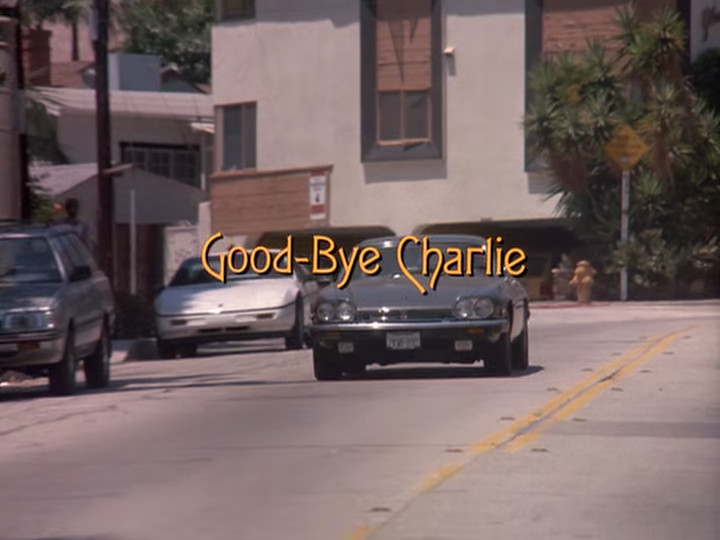
I’ll get to the beginning of the novel in a moment, but first I just want to mention the framing story:
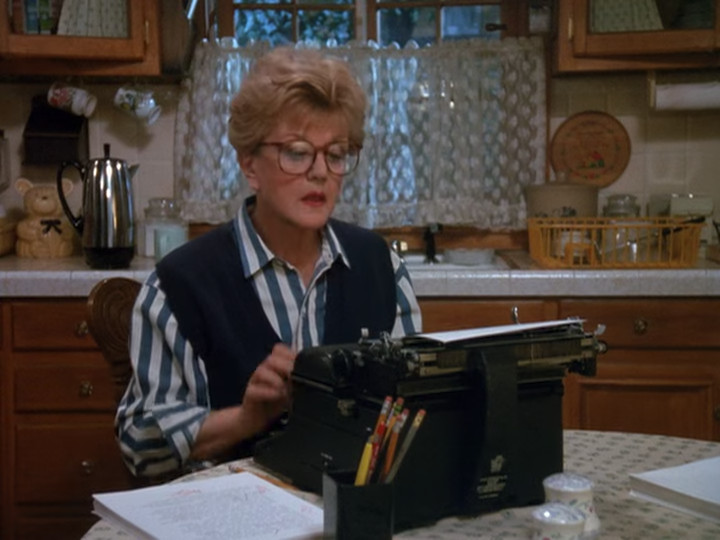
Well, it’s not really a story. It’s Jessica just talking directly to us, the audience. She begins with, “Oh, hello,” after looking up from her typewriter. The basic idea is that the TV is actually a magic portal into Jessica’s house, because that’s the only thing that would explain her being surprised by its appearance. There’s no possible way to be surprised by a TV camera—they’re enormous things, and the various lights to get professional lighting can’t be snuck in either. For reference, here’s a TV camera from another episode:
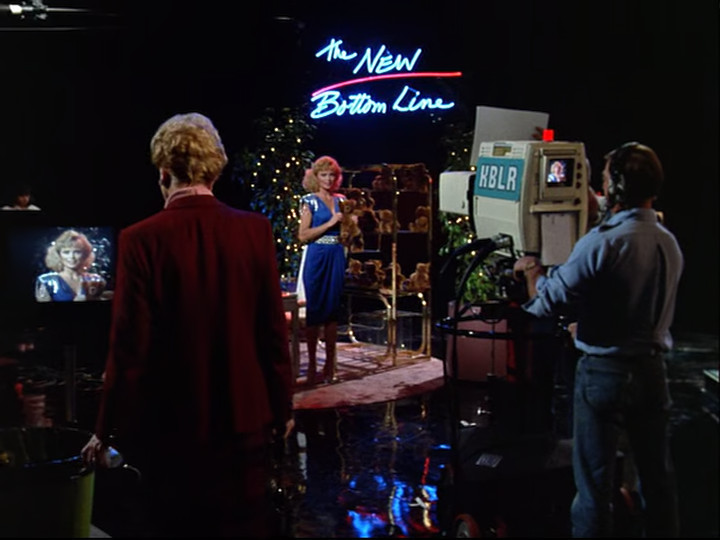
Can you imagine that thing being wheeled in by a crew so discreetly Jessica don’t notice it until she looked up? Neither can I. Which makes me wonder why she’s not surprised by the magic portal that just appeared in her kitchen. Does it follow her around in the regular episodes, too, and she just pretends that it’s not there?
Anyway, Jessica tells us that every novel is an adventure and when she begins she has no idea what it will be like. Some are pure agony. Others just flow from the typewriter like sap from a maple tree. (Which is an odd metaphor because it would mean very slowly, only in early spring, and still mostly water that needs to be boiled down considerably before it can be sold.) That’s how it was with Goodbye, Charlie. She wishes that they were all this much fun to write.
This is an interesting setup because it offers the viewer a bit of a taste of what it’s like to write a novel without any of the work. It is, certainly, true that novels can be fun to write, but the odd thing here is that it’s a really bad novel (just trust me on this part right now—it will become obvious soon enough). In fact, it feels a bit like a lesser NaNoWriMo novel—if you’re not familiar, National Novel Writing Month is where one writes a 50,000 word novel in a month, and the (for most) break-neck speed means that one pushes on no matter how bad it is at the moment in order to get a first draft done by the end of the month. (The month is November, by the way.) While it’s a bad way to get a finished draft, it’s actually a really good writing exercise that I highly recommend for people who find writing a novel alluring but intimidating, and have no objection to hard work. I also recommend the book No Plot, No Problem by Chris Baty as an introduction to it. But while NaNoWriMo is a great way to write a first draft, especially when you don’t have the discipline to write a first draft without community support, it’s a horrible way to write a finished novel. And Goodbye, Charlie is supposed to be a finished novel.
Anyway, back to the novel: it begins with an establishing shot of the Hollywood sign…
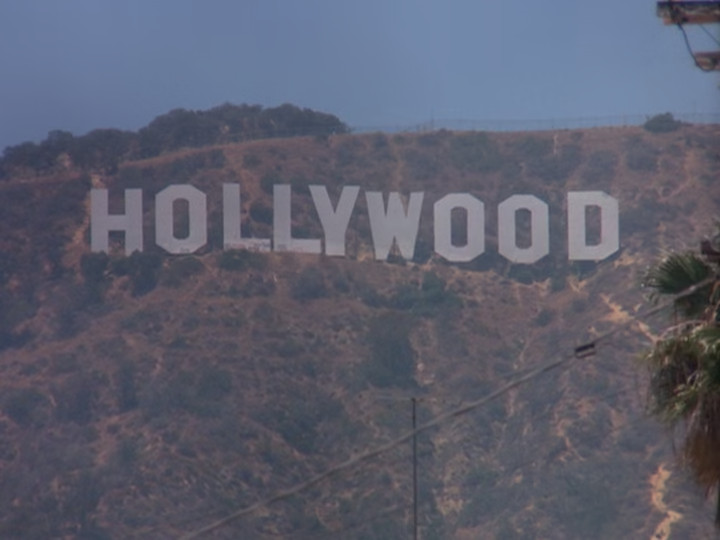
…and then it pans down to the car in the title screen driving along, as an instrumental version of the song Hooray for Hollywood plays in the background. But I’d like to pause a moment on that song. It comes from a 1937 movie called Hollywood Hotel.
It’s a comedy about a musician who goes to Hollywood and falls in love with a woman who doubles as a famous actress, and the various strange things that happen as he ends up doing the singing for the actress’s boyfriend and eventually gets recognized in his own right. I don’t know that anyone actually cares about the movie, but the song has had tremendous sticking power. It’s mostly played as an instrumental, but the lyrics are a lot of fun:
Hooray for Hollywood
That screwy ballyhooey Hollywood
Where any office boy or young mechanic
Can be a panic
With just a good looking pan
And any barmaid
Can be a star maid
If she dances with or without a fanHooray for Hollywood
Where you’re terrific if you’re even good
Where anyone at all from Shirley Temple
To Aimee Semple
Is equally understood
Go out and try your luck
You might be Donald Duck
Hooray for HollywoodHooray for Hollywood
That phoney super-Coney Hollywood
They come from Chillicothes and Paducas
With their bazookas
To get their names up in lights
All armed with photos
From local rotos
With their hair in ribbon and legs in tights
Hooray for Hollywood
You may be homely in your neighborhood
But if you think that you can be an actor
See Mr. Factor
He’ll make a monkey look good
Within a half an hour
You’ll look like Tyrone Power
Hooray for Hollywood
The lyrics did a good job of capturing the insanity of the movie business; I would not be surprised if this is part of why the song caught on.
What I’m not sure of is why it’s in this episode. The episode does, technically, begin in Hollywood, but it quickly moves to a small town in Nevada and nothing in the episode has anything to do with show business. The main character is an incompetent private detective.
How incompetent is he?
When he photographs the husband of his client cheating, he runs up to the man and his mistress and takes the photo from eight feet away…
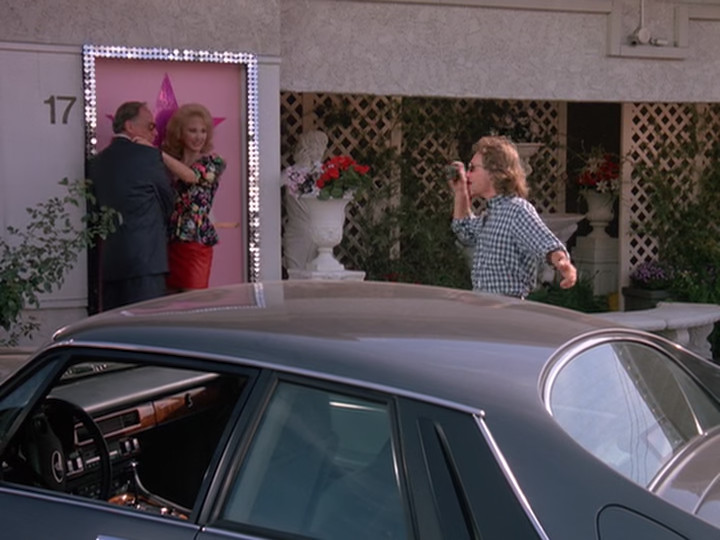
… and then stands there while the much older man walks over, beats him up, and takes the camera.
He then goes back to his apartment with a torn shirt and bloody lip, where he finds his wife talking with a lawyer:
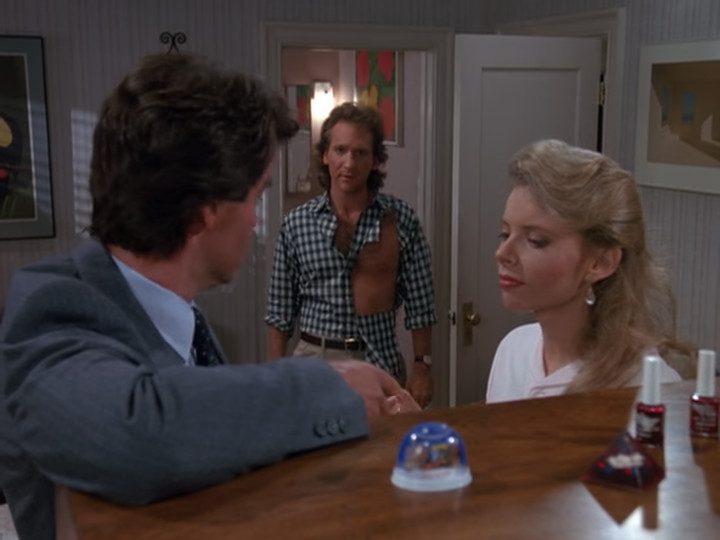
The lawyer is there to find out about the private detective’s uncle, Charlie, but the detective (I’m going to call him Bill after the actor, Bill Maher, even though the character does technically have a name) hears some cheesy dialog meant to sound like the lawyer and Bill’s wife are having sex. It’s not convincing; it doesn’t even really plausibly sound like they’re having sex. Really, it’s just a dumb joke but for some reason Bill calls out like he might be interrupting something inappropriate.
Sunny (Bill’s wife) cheerfully tells him to come into their room and explains she was showing the lawyer some of their memorabilia of his uncle Charlie. The lawyer then explains that an old girlfriend of Uncle Charlie’s left him her entire fortune, which is considerable. As an executor of the will, he’s trying to locate Charlie.
Unfortunately, Bill has no idea where he was. About five years ago, Uncle Charlie dropped in for a weekend and stayed for three years, without contributing anything to the household budget. About two years ago Bill gave Uncle Charlie $100 and put him on a bus to Nevada and hasn’t heard from him since. They got a couple of Christmas cards from him, the last one with a return address in Reno, but when Sunny sent him a card it came back with “Not Known At This Address”.
When Bill says that for all they know Uncle Charlie is dead by now the lawyer replies that it’s a pity that he can’t prove it, since as Charlie’s only living relative he’d inherit the fortune. On that, he leaves and Bill starts laughing. Sunny asks him why he’s laughing and we go back to Jessica, who explains the joke: for three years they supported Uncle Charlie and now he’s rich and they’re facing repossession and eviction.
Perhaps “explains,” was a bit strong. Jessica said some words which were, if looked at in the right way, related to what we just saw.
Anyway, Jessica also tells us that Bill’s client didn’t fire him, so we cut back to Bill sitting in his car, staking out the same motel, when he notices something in his newspaper:
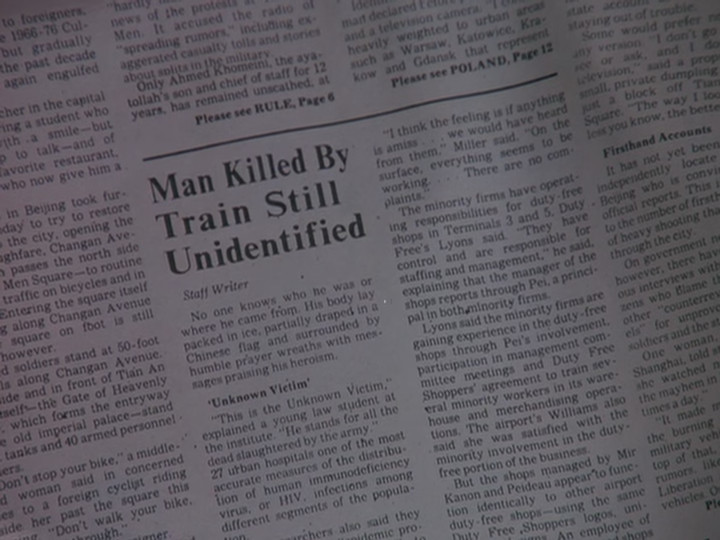
Then Bill got an idea. An awful idea. Bill got a wonderful, awful idea.
He also gets spotted by the person he’s supposed to be following, and as the guy is about to beat him up again, blinds him with a flash photograph and drives off.
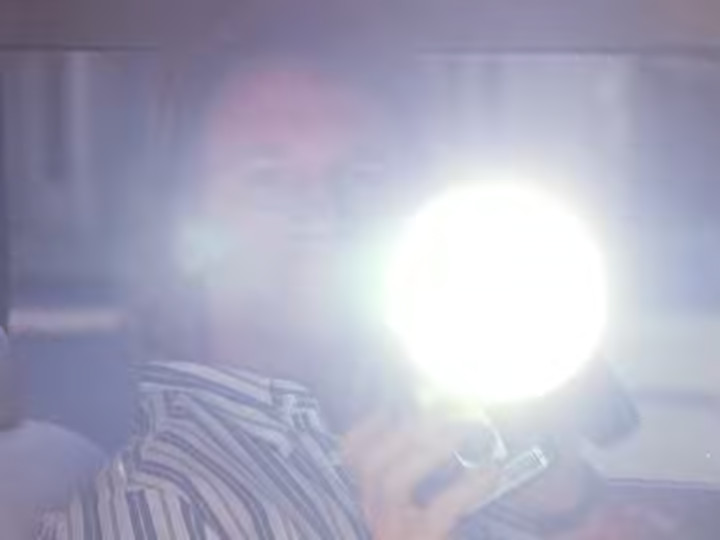
Now, the thing is, you don’t get the full picture (no pun intended) of how stupid this is without seeing the frame immediately before this:
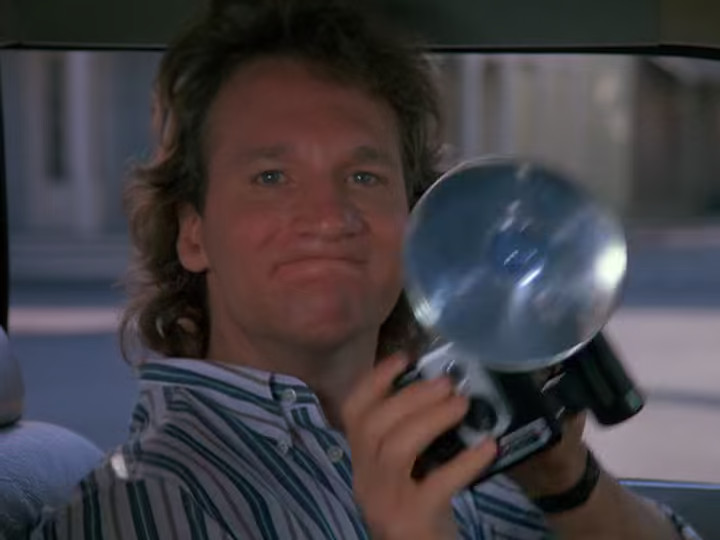
There are, of course, less appropriate cameras he could have brought to this stakeout. He could have used one of those old-timey cameras where the photographer put a cloth over his head and manually ignited flash powder, for example. Or a pinhole camera made from a shoebox. Or he could have forgone the camera entirely and brought along a sketch pad.
But short of something like that, this is about the least appropriate camera to bring to a stakeout during the day one could imagine. It has a tiny lens for taking wide-angle shots and an absolutely enormous flash with a parabolic collector dish to focus the light onto a subject. At the time, he’d have been able to buy a used camera with a used telephoto lens for under $200 ($492 in 2025 dollars). That’s significantly less than the fees he’d have paid to become a private investigator, and a camera with a good telephoto lens is the primary tool of his trade.
However, you still don’t get just how stupid this is until you look at the frame immediately after the one with the flash, which shows the picture he took:
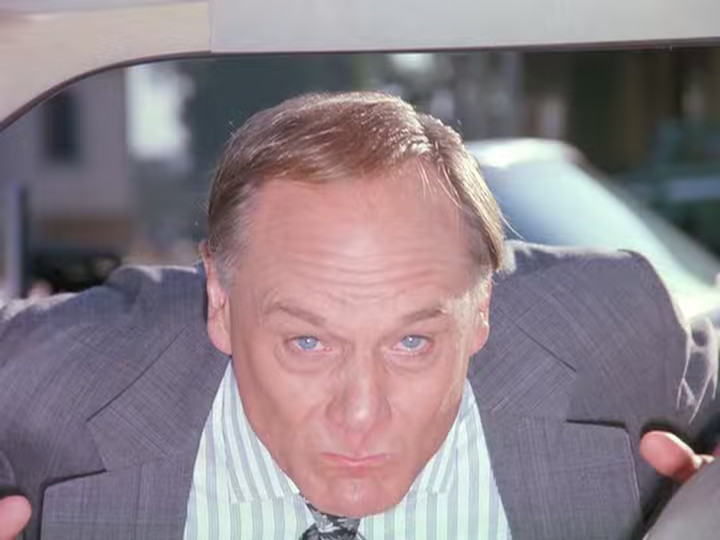
He didn’t even get the woman in frame.
Bill then drives off, tires squealing, and the scene shifts to him showing his wife the newspaper article about the unclaimed body. The body was found in Huckabee, Nevada, which is about fifty miles east of Reno, where Uncle Charlie’s last Christmas card was from. Bill doesn’t think this actually was Uncle Charlie, of course, but since no one has come forward to claim the body, this is a great opportunity to claim it as Uncle Charlie, which would make Uncle Charlie legally dead, and then they can inherit the money which Uncle Charlie recently inherited. Sun (Bill’s wife) is reluctant, but Bill eventually talks her into it with some specious arguments about how this is somehow honoring the real Uncle Charlie, wherever he (presumably? maybe? technically it’s not impossible that he?) dropped dead.
In the framing story, back in the beginning, Jessica said, “Our hero… Well, now let me see, is Hero the right word? Maybe not. I promise you, he’s not very heroic.” She sure wasn’t kidding!
Truth to tell, I’m really not sure why we’re reading about Bill at all. So far, he has no redeeming characteristics that make him interesting, and the only way for him to not fail is by the author giving him plot armor. And he deserves to fail, so I resent Jessica giving him plot armor. It makes the story (even) less enjoyable.
There’s then a small fakeout where we think that Bill and Sun have gone to Huckabee, Nevada:
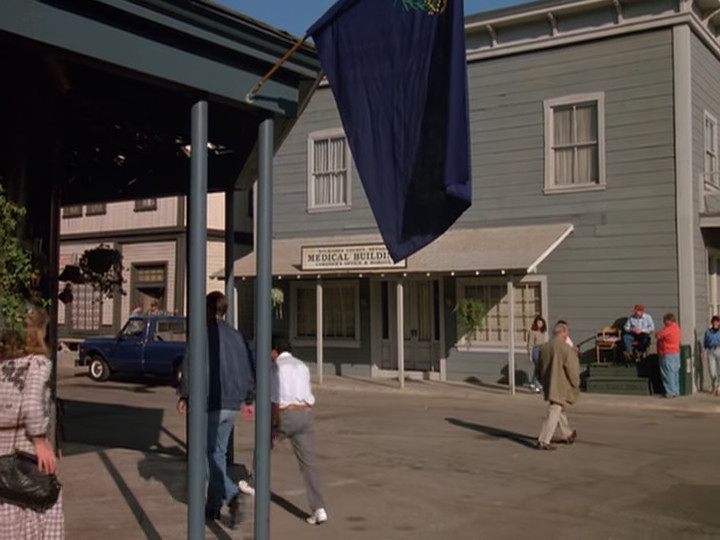
Except inside we meet this character (his name is Lon Ainsley; he’s the coroner’s assistant):
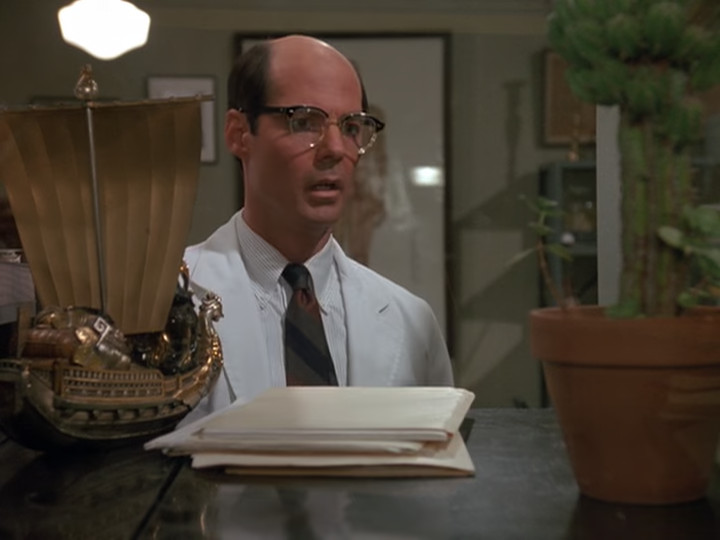
and hear the phone ring.
It turns out that Bill and Sun are taking turns making calls, pretending to be various people, to “try” to identify the body over the phone. In reality, they’re collecting information about it (height, weight, eye color, etc) with each wrong guess because the coroner’s assistant tells them what they got wrong on each attempt. This is the one (marginally) clever thing which happens in this episode.
After a bunch of physical characteristics about the body and a variety of regional accents from Bill and Sunny, we finally conclude with a description that was pretty accurate and when Bill asks Sunny how she got such a good description of the corpse, she replies, “I was describing Uncle Charlie.” And on that bombshell, we fade to black and go to commercial.
Had you been watching in 1990, you might have seen a commercial like this:
When we come back, we see Jessica at her typewriter again.
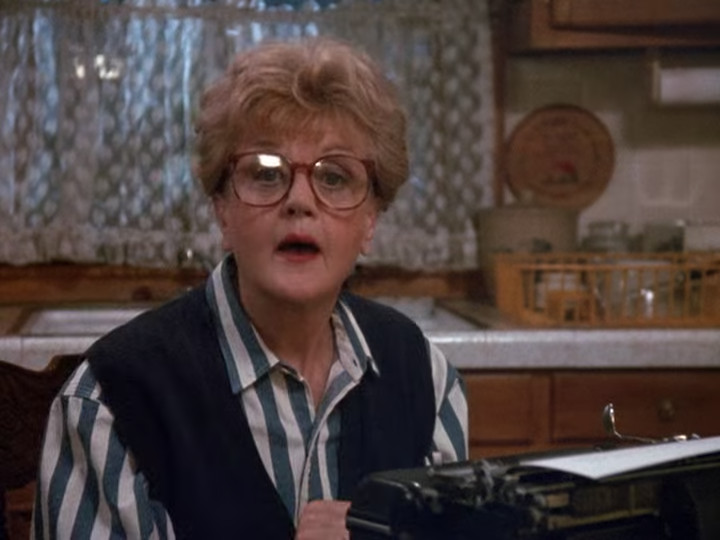
She explains that, having pumped the coroner’s office dry, Bill and Sunny head off to claim the corpse. Though with the ominous warning, in Jessica’s words, “unaware that they were about to lock horns with Huckabee’s unique version of law and order.” (The Sheriff’s name is Ed Ten Eyck, and in spite of this warning, he seems to be the best character in the episode.)
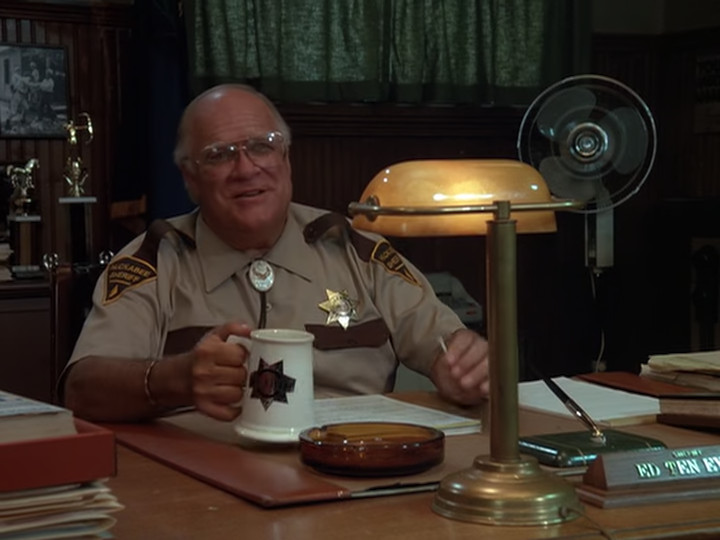
There’s some interesting banter where Bill has a crick in his back from having slept in the car because the motel was closed. The Sheriff laughs and says that ol’ Roscoe believes in “early to bed, early to rise” because anyone sneaking into town at night is up to no good. He’s clearly suspicious of them as he should be, because Bill is as believable as three-dollar bill.
He then tells them that their identification of the corpse was excellent. The Sheriff asks them why “he”Uncle Charlie” was near the train tracks in Huckabee and Bill spins a story about how Uncle Charlie became a hobo during the great depression and went back to his old way of life, but in his old age he couldn’t hop into freight trains as well as he could in his youth and it cost him his life.
The Sheriff asks some questions about why the guy who died didn’t have identification, or in fact anything at all in his pockets. “A man usually has something in his pockets.” He obviously doesn’t believe them, which shows good sense on his part since they’re obviously lying. Sunny seems uncomfortable but Bill just brazens it out, making him even more despicable.
When they try to get going, they find out that they’re not the first people to lay claim to John Doe. Nor the second, in fact. They’re the third.
The scene then shifts tot he Huckabee Motel:
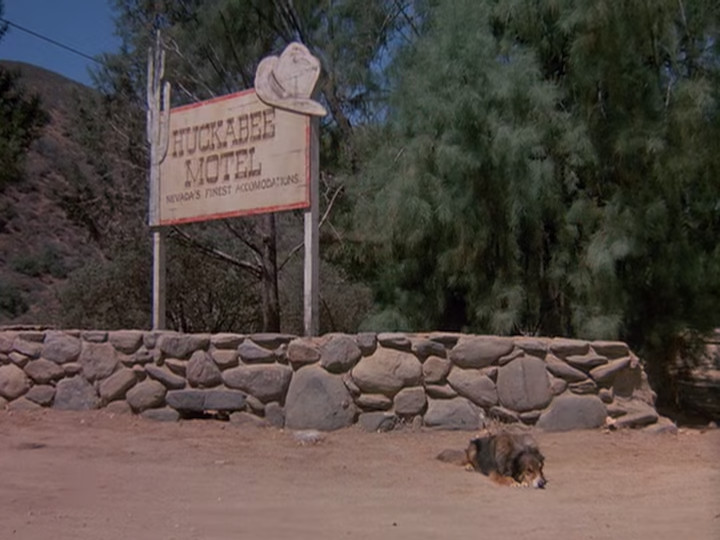
We stay on this sign a while in order to facilitate a joke: Bill moans lines like “Oh! oh, Sunny, that is so good.” and “Oh, yeah, right there. Oh, don’t stop! Oh, yeah. Oh, yeah.”
She is, of course, giving him a massage.
Which was a joke so obvious that it was actually a bit painful.
Anyway, Sunny suggests that they just go home but Bill is determined to see it through. His logic is that, since at least one of the other people who have identified the body must be wrong, the odds are that both of them are wrong. Or, rather, he says that they’re both lying—he doesn’t explain the stretch from wrong to lying. On the other hand, liars normally assume everyone else is lying, too, so this is at least realistic, even if it’s not very sensible.
Bill then goes to a bar to see a man whose name he read upside-down on the sheriff’s desk.
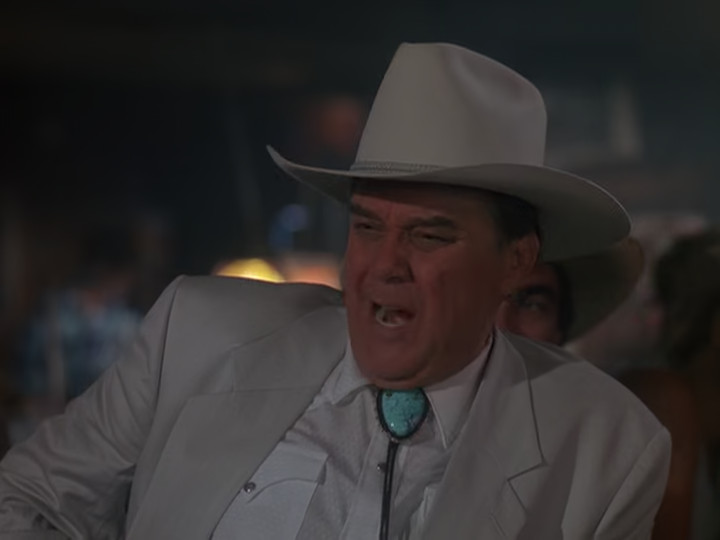
His name is Bart Mahoney and he’s a sleazy lawyer who’s representing one of the claimants—Marcia Mae. She’s the daughter of Ole Roper, who Bart identified the corpse as. Somehow he concludes that Bill—who identified himself as a private investigator—is working for the railroad and explains how he is intending to sue because a railroad crossing light was out. For no discernible reason Bill plays along and claims that there was a bell as well as the light, but Bart counters that Roper was deaf from an old rodeo injury.
I really have no idea why any of this is happening. It’s not meant to be funny, but it’s also not useful information since we know that the corpse is almost certainly not, in fact, Ole Roper. And if it was Ole Roper, this would be pointlessly sleazy behavior on Bill’s part.
Back at the hotel, Bill tries to whine about Bart Mahoney but Sunny tells him that he needs a “nap” and starts kissing him. Just as she pulls him down on top of her, the phone rings and for some reason Bill picks it up. It’s the Sheriff. Bart called him—we’re not told why on earth he Bart called him—and the Sheriff, who doesn’t seem all that happy with Bill, wants him to come down to his office in 10 minutes because, “I want you to meet a little lady that might be a kin of yours.”
The potential “kin” is Tilly Bascomb:
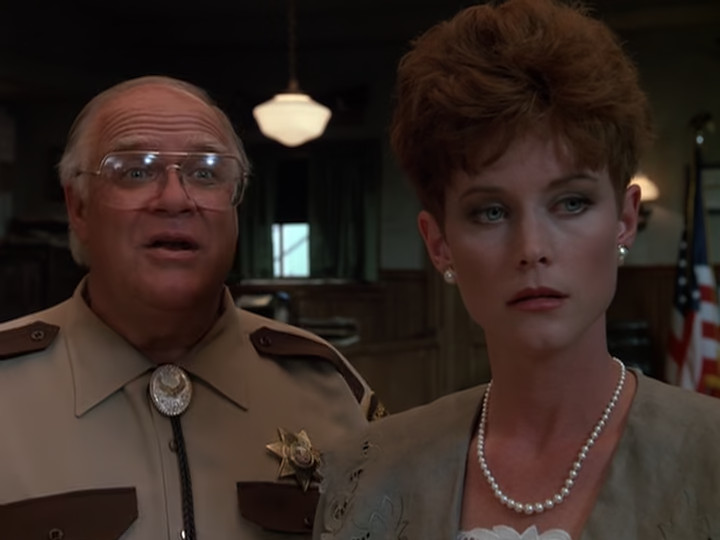
Tilly identified the corpse as her husband Mort. Which, if these are the same person, would make her Bill’s Aunt Tilly. Which I don’t think has the slightest bit of plausibility, but then I don’t think the Sheriff believes any of the claimants to the corpse and is a wee bit annoyed that everyone is lying to him.
In fact, this reminds me of the refrain in the theme song of much later (comedic) detective TV show called Psych, in which a detective who is very good at observation and deduction pretends to be a psychic to get the police to take him seriously (he named his pyschic consulting business, whose services the police sometimes employ, Psych):
I know, you know,
that I’m not telling the truth.
I know, you know,
they just don’t have any proof.
The Sheriff then asks them to pull out photos of their respective loved ones, which they then compare. First we see Tilly’s husband Mort…
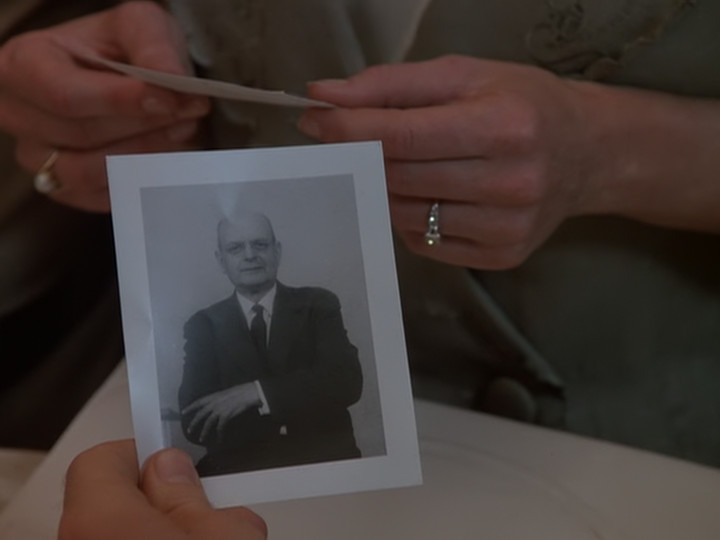
…who looks way too old to be Tilly’s husband.
Then we see Uncle Charlie…
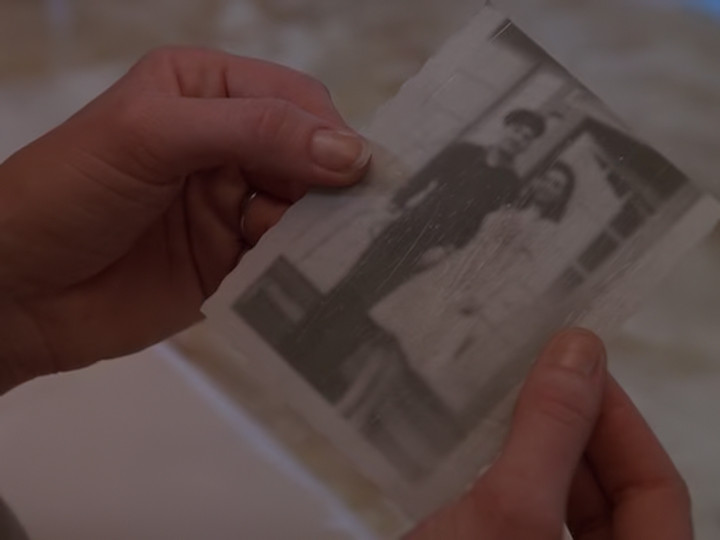
…from thirty years ago, and blurry.
I’ve got no idea what the point of this comparison was.
They then bicker for a while until Tilly suggests that her husband would have had his wallet while going on a midnight walk to deal with his insomnia and perhaps the train knocked the wallet out of his pocket. Bill then suggests that they comb the area to see if they can find the wallet and the Sheriff then says his Deputy already has and didn’t find anything. He can’t spare the manpower to search again.
Bill then asks if Huckabee has a “pony league baseball team” and suggests employing them to do the search.
(“Pony League” is a youth baseball and softball league—PONY is actually an acronym which stands for Protect Our Nation’s Youth. They cover ages 4 through 23 in 2-year age brackets.)
The Sheriff seems to like this suggestion and says that he’ll have the kids turn out and sunup.
Bill and Sunny then go at night and plant a bunch of Uncle Charlie’s stuff along the railroad tracks. This is so stupid and obvious that I’m surprised that the Sheriff didn’t turn up to catch them. I blame Jessica for that not happening.
Anyway, we then fade to black and go to commercial.
When we get back, Jessica is fixing something she typed with her pencil.
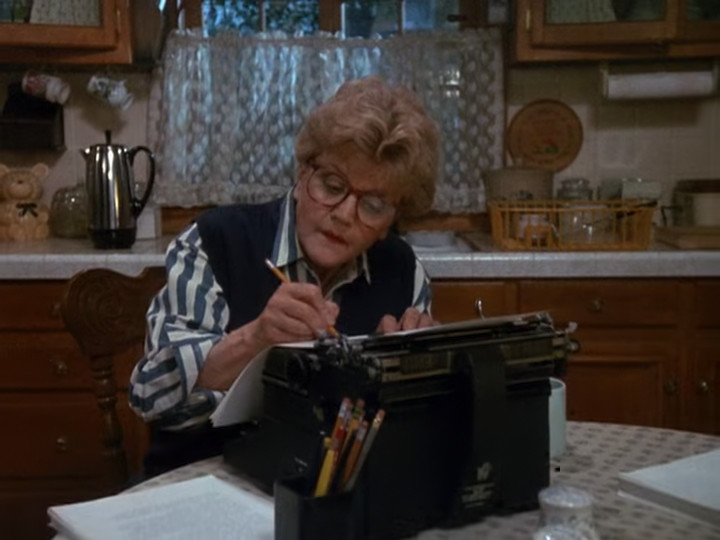
Jessica’s description of where we are in the plot is:
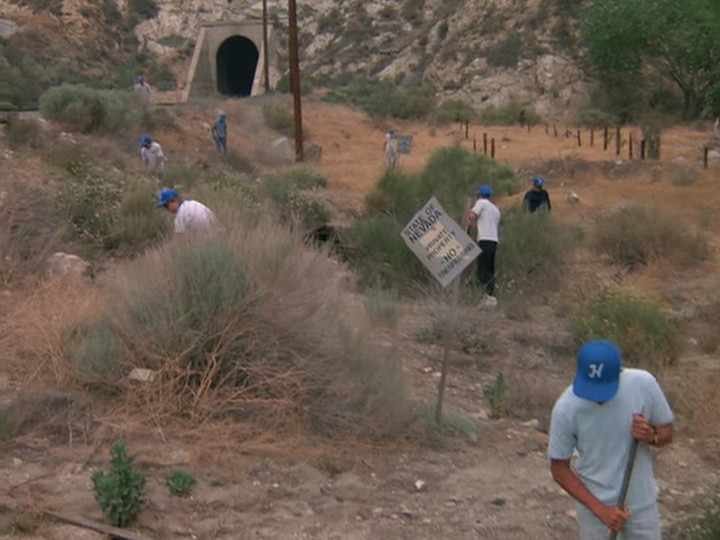
Well, having salted the railroad tracks with Uncle Charlie’s last few remaining possessions, Frank approached the following morning’s search with ill-concealed enthusiasm. His joy was short-lived. The Huckabee Hornets had problems hitting the curve ball and the fastball, and they weren’t all that good at judging pop-ups. They were definitely not very good at finding the obvious.
Here, by the way, is them searching next to the railroad tracks:
Shortly after this, some guy who is very familiar with Tilly drives up and tries to convince her to go home.
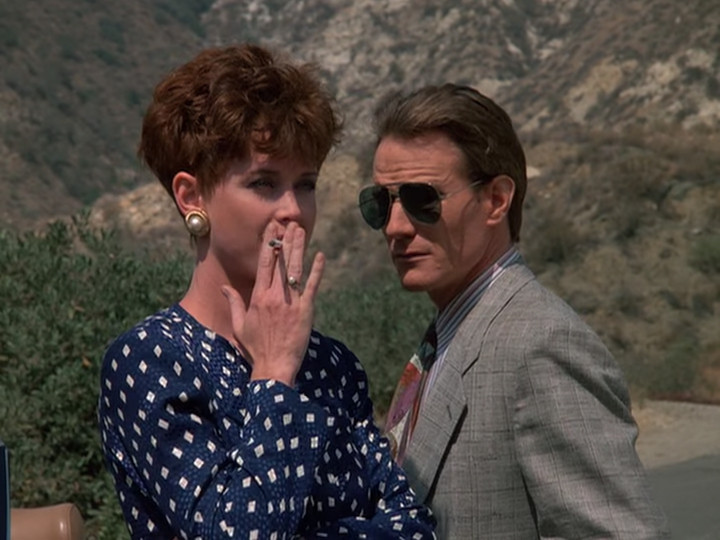
Bill asks the Sheriff who he is and the Sheriff identifies him as her cousin, Jerry Wilbur. He works for her husband’s microchip company.
After a shot of the sun to establish the passage of time and the heat of Nevada, the lawer, Bart Mahoney drives up and objects to the search. His client then gets out of the car. We start with her feet as some sexy saxophone music plays, then the camera slowly pans up her legs:
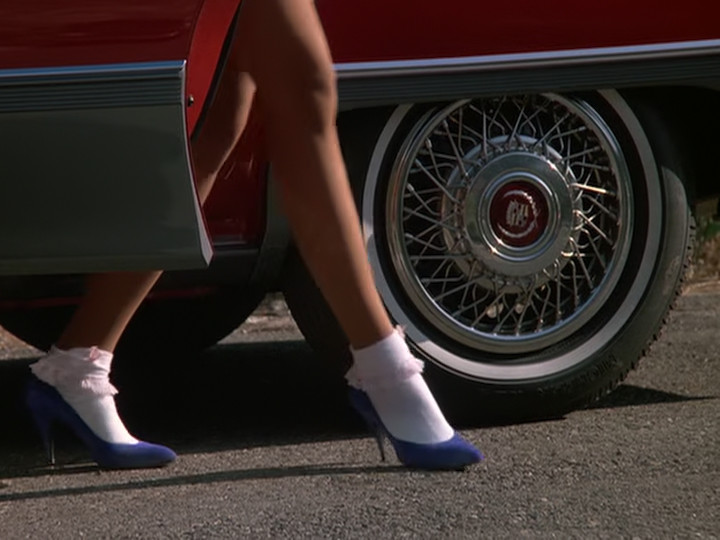
I’d love to know how Jessica described this in her book.
Slowly, a woman’s legs come out of the car. They’re not wearing much besides four inch stiletto heels in blue velvet and bobby socks. A few feet up from the bobby socks is a tall drink of whiskey in a short skirt.
That’s about the only thing that would match the saxophone music and slow camera work.
However Jessica described it, the camera eventually gets to her face and we finally meet little Marcia Mae.
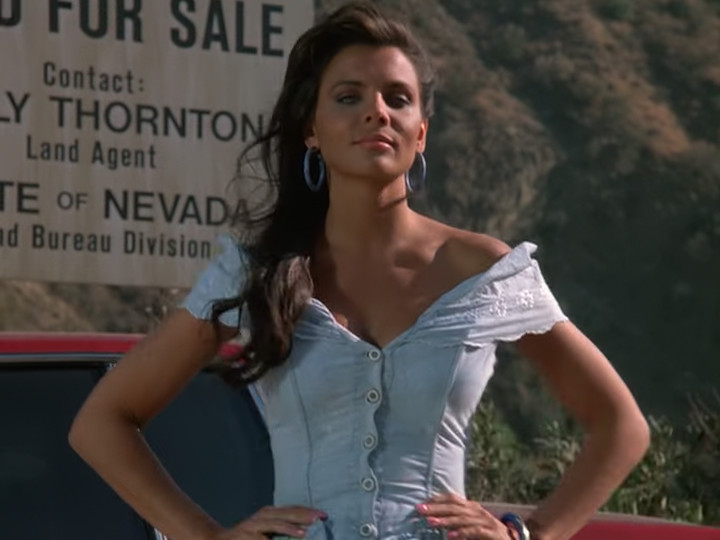
Sure, why not.
And then the young baseball players finally find something. Or, rather, several things all at once.
Back at the Sheriff’s office the Sheriff examines the stuff with Uncle Charlie’s initials. Also the dog tags with his name on them.
The Sheriff then examines the stuff in his own pockets, details each item to Bill and Sunny, and explains, “I was just wondering how many things I had in my pockets with my initials on them. The answer is none.”
After pointing out again that it’s funny that his deputies didn’t find any of this stuff when they looked, he shakes his head and tells them to go to Jack Yomoto, the coroner, to claim the body. Which they do.
I do enjoy the magazine which Sunny glanced at while waiting as Bill signed some paperwork:
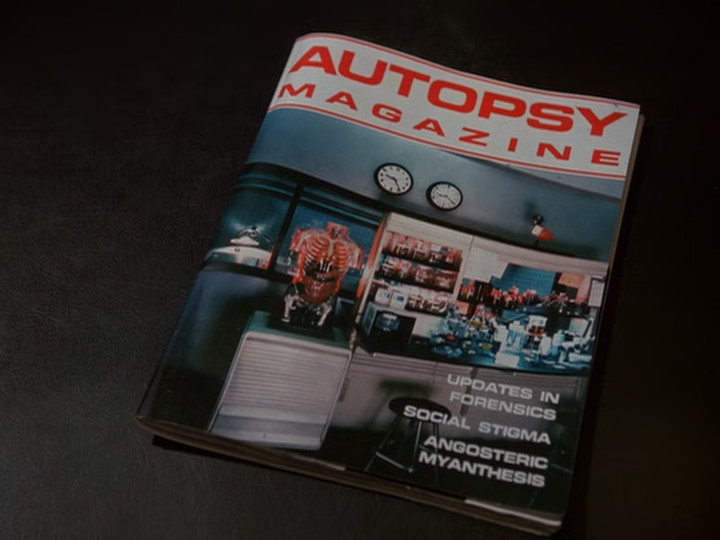
I think that my favorite is “angosteric myanthesis.” It sounds convincingly like real medical words. (It’s completely fake, there’s no such thing as “angosteric myanthesis.”)
On their way out, the death certificate in hand, they run into the Sheriff. He got a call from the Sheriff in a neighboring town who brought in a vagrant the night before. It seems that the vagrant had found an expensive-looking wallet with $200 in it. He says he found it hear the railroad track near Huckabee right after the accident. The driver’s license inside was for Mort Bascomb.
The Sheriff then arrests Bill. (I cheered.)
In the cell in the Sheriff’s office, Bill meets a man who’s stuffing paper into a new pair of white shoes:
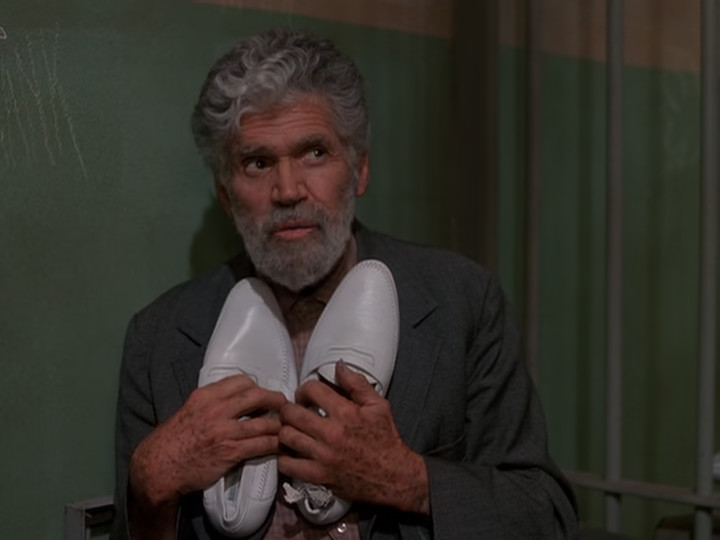
The man’s name is Clarence, and you can tell from the way he speaks he’s not quite all there in the head, if you know what I mean.
The stuffing paper into his shoes makes Bill think about the body and he gets an idea, which he excitedly tells the Sheriff. Bill’s idea is that had the corpse been knocked out of his shoes, they’d have been 100 yards down the track, not laying beside him. Presumably, the shoes were left next to him to make it look like he was walking down the track and weren’t put on the body because they didn’t fit. (He is guessing that the man was killed elsewhere and placed on the track shortly before the train came, which was when the killer noticed that the victim was in bare feet and so tried to put his own shoes on the victim.)
The Sheriff considers this plausible enough to try, so he goes to the morgue, where they try the shoes on the corpse.
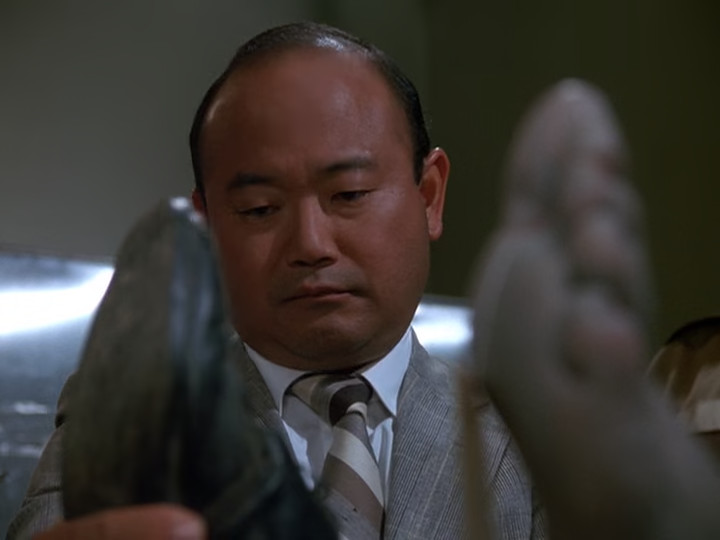
Yamoto says, “He’s right. The shoe’s too small. It was murder.”
And on that bombshell, we go to commercial.
When we get back, Bill has been released from jail for some reason and is interviewing the bartender in the bar where he (Bill) first met Bart Mahoney. It turns out that tending bar is not the only thing that the bartender does. He also owns himself a little grocery store, and Marcia Mae does herself all her shopping there.
And it turns out that Marcia Mae always bought Mexican beer and chewing tobacco for her daddy, in addition to the food she would buy for them, and just yesterday she came in and bought just as much as ever. (Strongly suggesting that Roper is as alive as he always was.)
Bill takes this information to the Sheriff (along with an over-sized receipt from the grocery store for what Marcia Mae bought that includes her charge number, signature, and probably a notarized sworn statement from a dozen witnesses). The Sheriff points out that if he finds Ole Roper Bailey in little Marcia Mae’s attic, it means she had no reason to kill John Doe. Bill agrees and says that it leaves the widow Bascomb.
Bill suggests that Tilly and her husband weren’t getting along and she would lose too much in a divorce settlement, so she and her cousin may have done him in. The Sheriff thinks this is sufficiently plausible that he goes to see Tilly at her house, along with his two deputies, and Bill and Sunny for some reason that is never explained, probably because it couldn’t possibly be explained, just like why Bill isn’t still in jail because falsifying evidence to support a fraudulent claim to a corpse doesn’t cease to be a crime just because the corpse became a corpse by murder rather than accidentally death.
Anyway, they all bust into Tilly’s bedroom.
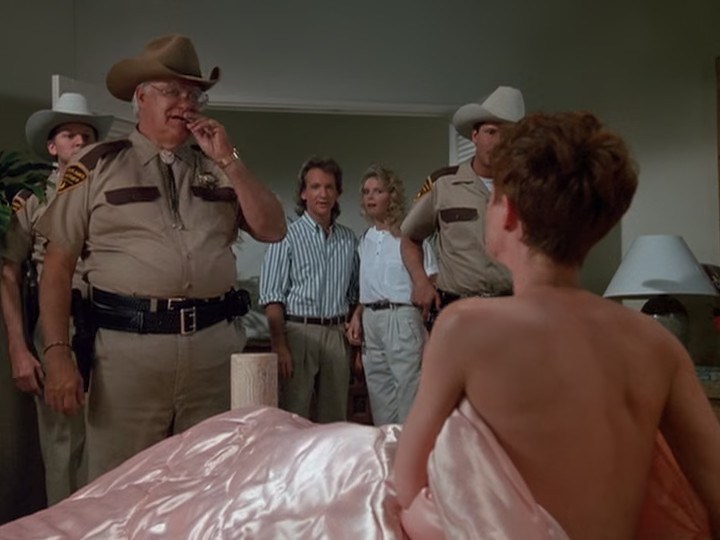
When she orders the sheriff to leave her bedroom, she wakes her cousin, who was sleeping beside her.
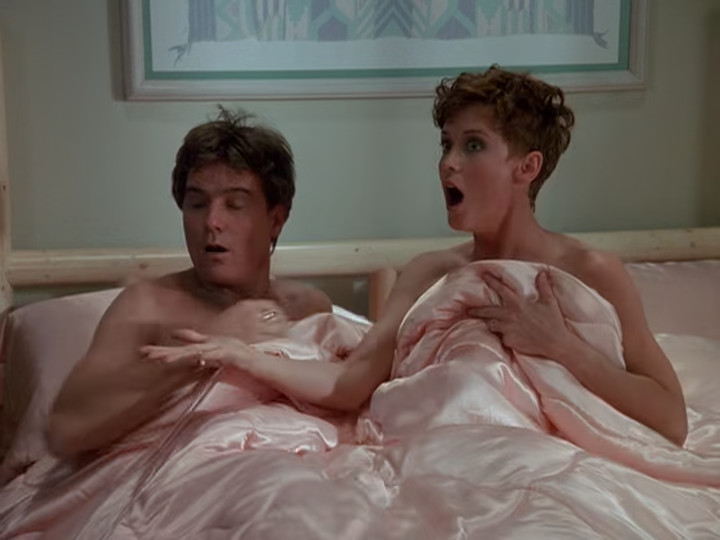
When the Sheriff asks them whose idea murdering Tilly’s husband was, the cousin shakes his head and says, “I told you we wouldn’t get away with this! Didn’t I tell you that?”
Unfortunately for the investigation of John Doe, it turns out that they buried Mort in the back yard.
Back at the Sheriff’s office, the Sheriff tells Bill that Bill is the only claimant left and he’s sick and tired of John Doe, so if Bill wants him, he can have him. He’s still got strong doubts that it’s actually their uncle Charlie, but they did give the best description and it will save the county the expense of a burial.
Bill, ever the man of principle, immediately accepts.
The Sheriff adds that he suggests a brief ceremony and a quick departure, and that they should be sure to shut the door on their way out.
Back at their apartment, they of course run into their Uncle Charlie, who already found out about his inheritance and is now wearing fancy clothes and is in the company of a fluzie.
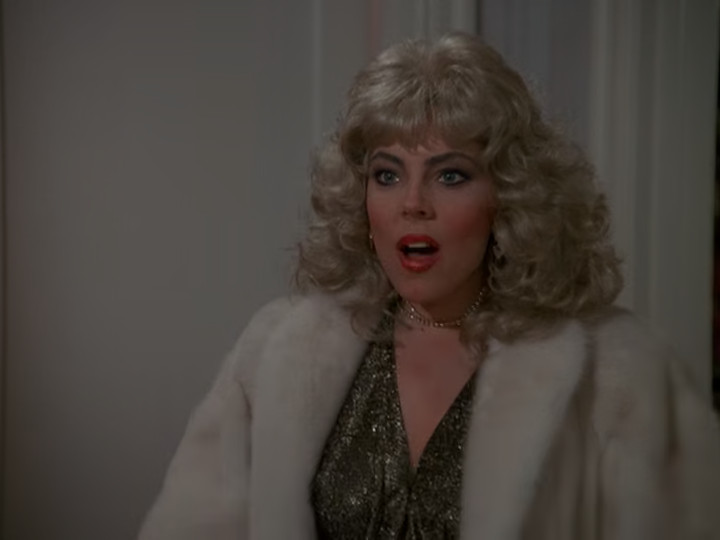
Her name is Doreen and she’s actually his wife.
We then go back to Jessica for an epilogue, since the mystery of who John Doe actually was is still completely unresolved.
Jessica explains that, three days later, an ad appeared in local newspapers all over the country. It was offering a reward of $100,000:
…for information regarding the whereabouts of Jason T. Rucker, President of Santa Carmela Savings and Loan, who disappeared on June 4th, one day prior to a scheduled audit by state banking officials. Rucker was 66 years old, grey haired, heavyset, about 5’10”, last seen wearing a brown windbreaker, tan slacks, and white oxford shoes. Also wanted for questioning is the man Rucker was last seen with, identified as a freight-train hopping hobo named Clarence Dobkin.
The Sheriff (who read this aloud for us) then sits back in his chair, laughs, and we go to credits.
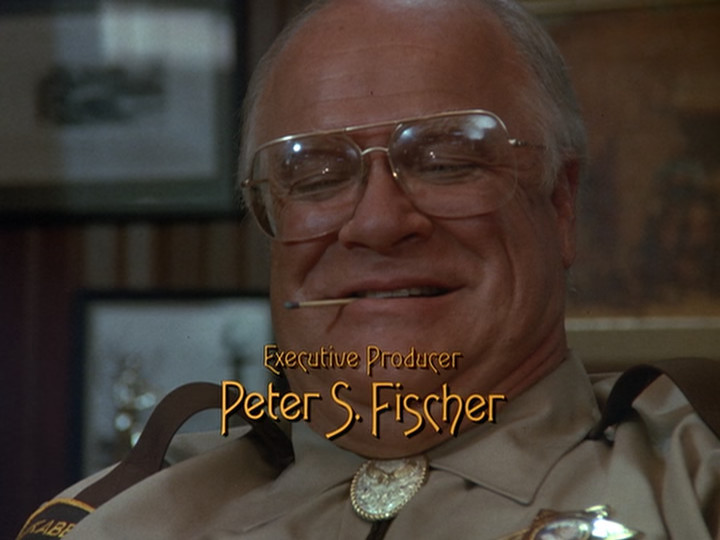
Well… that sure was an episode.
It is really hard to believe that Jessica is a famous author if this is the kind of book she writes. Murder in a Minor Key was bad enough, but at least it was a murder mystery and had a few likable characters. This had no likable characters and wasn’t even a murder mystery!
The problems start from the very beginning. Jessica tells us that the novel is set in Hollywood, but it isn’t. It’s actually set in Huckabee, Nevada. We get a bunch of setup of Hollywood for no reason.
The worst has got to be Bill Mahr’s character, though. This is just an awful character. He’s dishonest, incompetent, unlikable, and not bright. The one moment of insight that he has is way too late and also mostly wrong. Jessica is even upfront that he’s not a hero. But he’s not an anti-hero, either. He’s just a schmuck who we’re following for no discernible reason. Why on earth are we supposed to care about the stupid scam that a stupid man is pulling incompetently and without anything amusing like extreme luck?
I will get into specifics soon, but the biggest problem is that there’s absolutely nothing good about this story. There’s no reason to sit through any of the bad parts. So the rest is kind of academic. But, I’m going to go through it anyway, because somehow this was actually made into a TV episode and shown to millions of people, and to my knowledge no one resigned in shame or ritually disemboweled themselves to apologize for it.
If I really had to guess, this premise is supposed to be funny. But the problem is that watching an idiot be an idiot isn’t funny. Worse, there are only stakes in the episode if we care about the idiot succeeding at his immoral quest for money because he’s worse at his job than he has any right to be. This means that we’re supposed to be rooting for an unsatisfying ending—because a satisfying ending would involve the main character getting what he deserves, which in this case means the idiot suffering for his idiocy.
It’s actually quite hard to analyze the plot of this episode because it’s really just a series of events. It’s reminds me a lot of the famous talk on plotting by Trey Parker and Matt Stone:
The tl;dw is that if you write out the beats of your story, the connecting words should be either “therefore” or “but”, never “and then”. In this episode, the connecting words were usually, “and then”.
Bill Mahr is incompetent at his job, and then a lawyer walks in and says he will inherit money if his uncle Charlie is dead. And then Bill spots a news article about an unclaimed corpse. And then he decided to pretend it’s his uncle Charlie. And then he calls the coroner a hundred times and gets a good description of the body. And then they go to claim the body. But there are other claimants. And then Bill goes and talks to one of them. And then the Sheriff introduces Bill to another. And then Bill decides to plant evidence that it was his uncle Charlie, therefore he proposes having the pony league baseball team search for the clues he will plant. And then they find the clues and then Bill gets the corpse and then a wallet is found and then Bill is arrested and then Bill gets an idea about shoes, therefore they test the idea and it turns out the shoes don’t fit and then Bill is let out of jail for some reason and then Bill is told that Roper Bailey isn’t dead and then Bill suggests that maybe Tilly killed her husband and then the Sheriff and half the town barge into Tilly’s bedroom and then Tilly’s cousin is there and then Tilly’s cousin confesses to an unrelated murder and then they get the body and then Uncle charlie is still alive and then Jessica remembers that there was a mystery in the story therefore she tells us some story about a random guy we’ve never heard of who ran away from someplace we’ve never heard of for a reason completely unrelated to the story, and then it turns out that the shoes didn’t fit the dead guy because they actually belonged to a hobo who had stolen the dead man’s shoes after the train him him.
(And I think a few of those “therefores” were generous.)
Every mystery series will naturally have uneven quality—none of us are perfect, so we can’t always produce our best work—but this one is just outright baffling. It’s outright terrible. And it only has a murder in the most trivial sense—the murder and the solution are discovered in the same sentence.
I think I’d have preferred a clip-job episode.
And something I really can’t figure out is why the writers put the least work into the episodes which featured stories that Jessica supposedly wrote. I’ve gained a whole new appreciation for the characters in other episodes who tell Jessica that her books were bad. It turns out, those are the people with decent taste of a modicum of sound judgement.
This is particularly baffling because the format of Jessica telling us about her book would allow the writers to make her books seem way better than they actually were. This format would allow Jessica to give us a highlight reel, and to skip over difficult-to-write sections with a general description of them. Things like “a bit of smooth talking allowed him to find out that…” is so much easier to write than the actual smooth-talking. A bunch of pain-staking finding of clues that is not easy to make interesting on the page can be summarized with a list of the clues and a mention of how difficult it was to find them.
The general rule in fiction is “show, don’t tell” but the one major exception one gets to that, as a writer, is when people are giving summaries because there’s too much to tell. If you can say, as Inigo Montoya did, “Let me explain. No, there is too much. Let me sum up,” then you can get away with telling instead of showing, and the audience will be inclined to take you at your word. Then you just have to make damn sure that everything you do show is compatible with what you told, and the emotional impact will be similar. It can’t be the same, but it can be a heck of a lot more than you can achieve in a regular episode.
Telling an awful story, instead, is such a wasted opportunity.
Discover more from Chris Lansdown
Subscribe to get the latest posts sent to your email.

