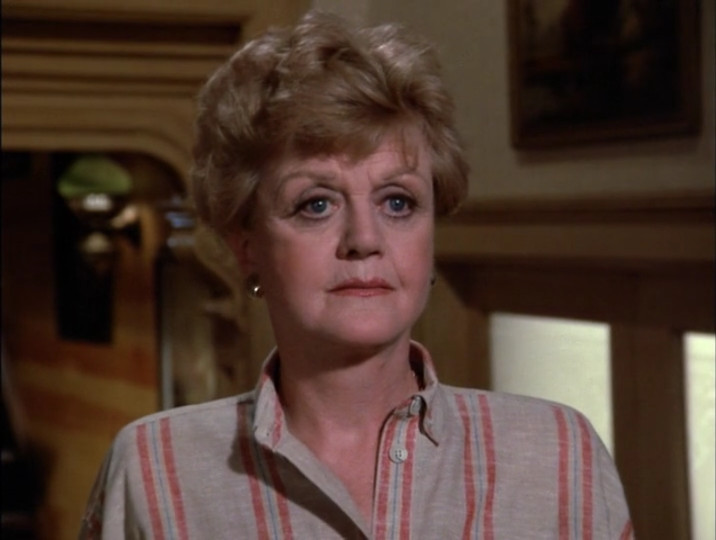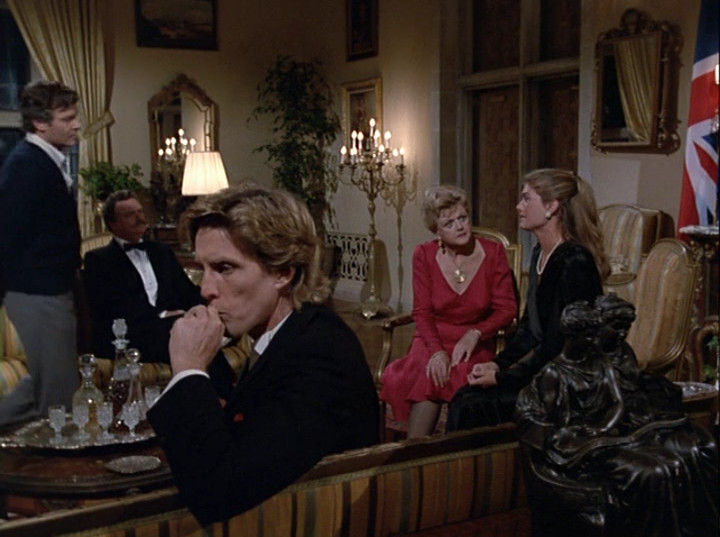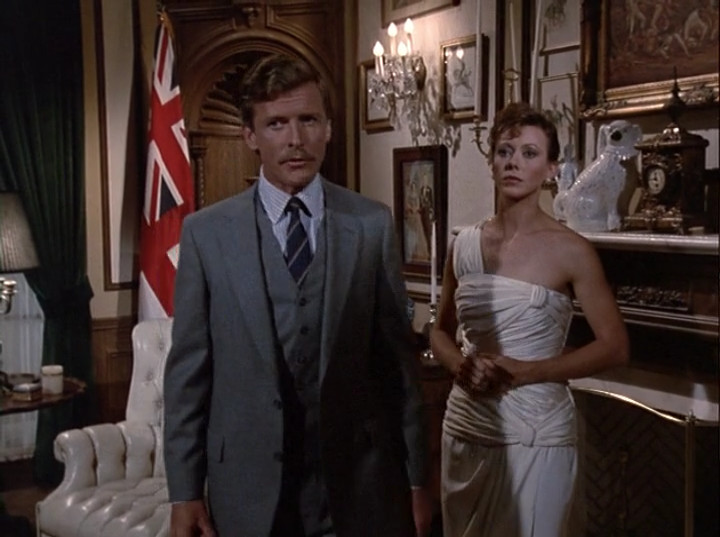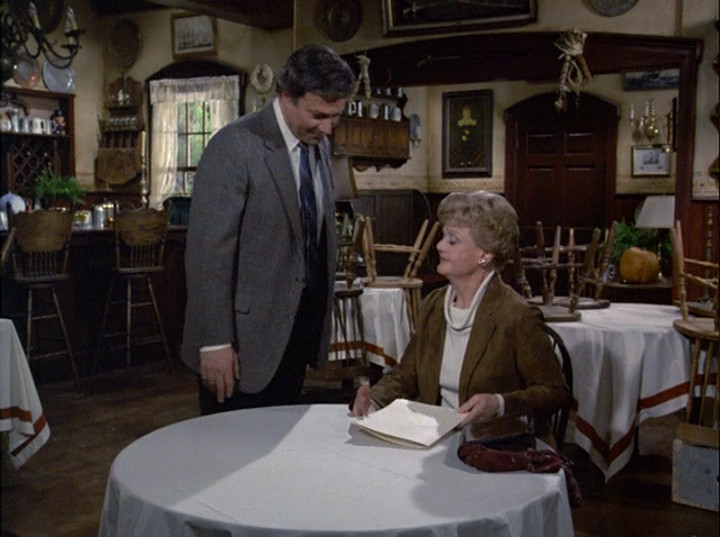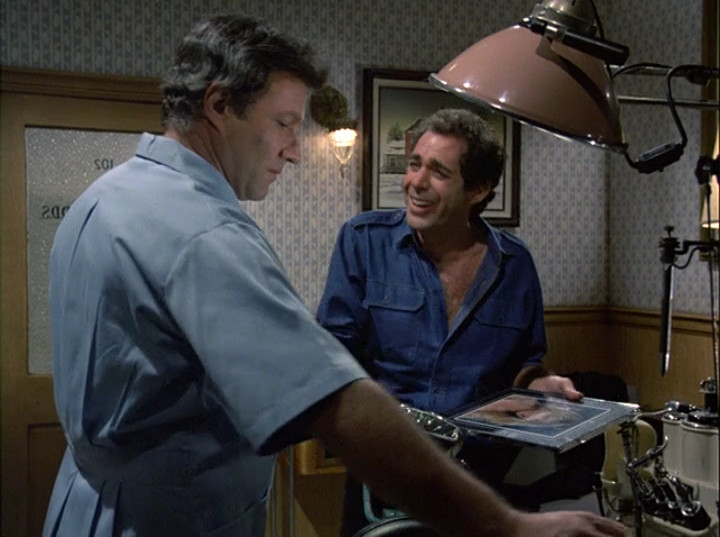
Murder She Wrote: The Bottom Line is Murder

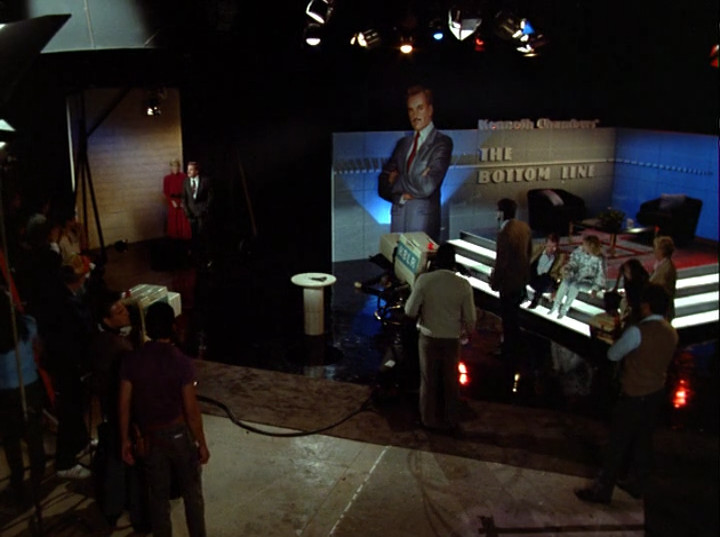
Late in Season 3 of Murder, She Wrote we get an episode set in a Denver TV sation called The Bottom Line is Murder.

As is fairly common with titles, it’s something of a pun on the episode itself—the TV show in the enter of the episode is called The Bottom Line.

It is a hard-hitting investigative journalism show which focuses on faulty consumer products. The show feels like a reference to something, but as it originally aired in February the year of our Lord 1987, I don’t know what it was referencing. I wasn’t even 10 at the time the episode originally came out, and even if I remembered much from that time I wouldn’t have watched the sort of TV shows this was referencing.

I was tempted to say it this was a generalized Dateline: NBC, as I have a vague memory of them having done the sort exposé journalism that The Bottom Line does, but Dateline: NBC first aired in 1992. Even if the writers could be that prescient, they would not have referenced something their audience wouldn’t know for another five years, so that possibility is right out.

It does seem like it was quite prescient, though. I looked up Dateline: NBC on Wikipedia and there was a section about a show that Dateline did about a GMC pickup truck purportedly exploding on impact because of poor design. The only problem was that their demonstration was completely fabricated. They planted remote control incendiary devices on the truck that they crashed and those were what caused the explosion that Dateline showed the public. An investigation actually found the burned husk of the vehicle in a junkyard and did analysis on it, finding that the fuel tank had remained intact. As a minor detail, they drove the truck into the barrier at about forty miles per hour but lied and said that it was at thirty miles per hour. It turns out that sanctimonious people are not always honest.

Actually, the entire format has a problem designed into it. A show which is focused on finding outrageous things can only find as many outrageous things as the world produces; if this is fewer per year than the number of episodes the show has, it must either cancel episodes or fabricate outrages. Worse, if someone looks at thirty outrages a year (one per week), they will become numb and require a higher dose to achieve the same level of outrage. Since the world can be relied upon to not produce ever-growing levels of outrageous material every week, either honesty or the show will have to give. (It should be noted that this also forms a selective pressure for bad judgement, which is more effective than outright dishonesty.)

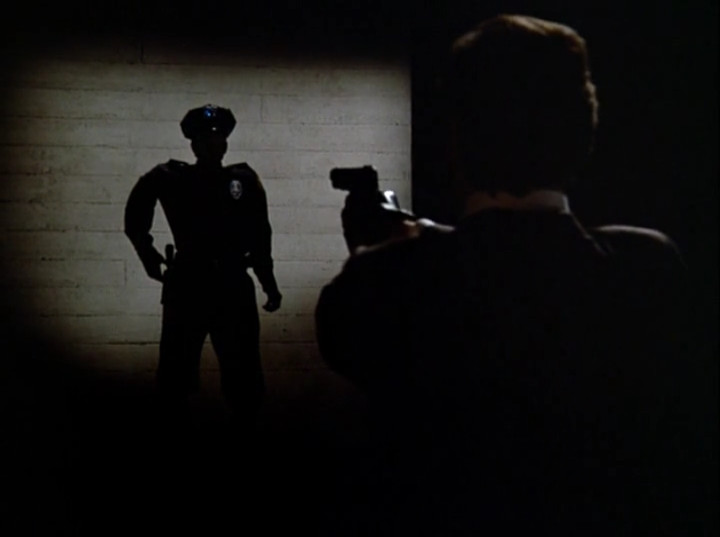
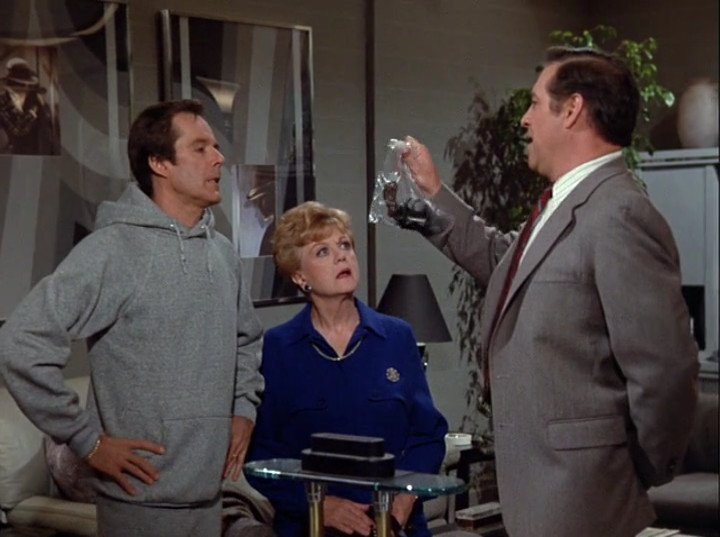
Anyway, the show opens with a graphic demonstration of a bulletproof vest that doesn’t stop bullets.

The only problem is that the vest does stop the bullet, which causes the host doing the demonstration, Kenneth Chambers, to go into a meltdown. In fairness to him, though, he claims that they tried it ten times before filming and the bullet went through every time when the cameras were off. He then yells at everyone for everything, establishing that he’s a self-centered egomaniac without manners or human kindness. In other words, we establish who is 98% likely to get murdered in this episode.

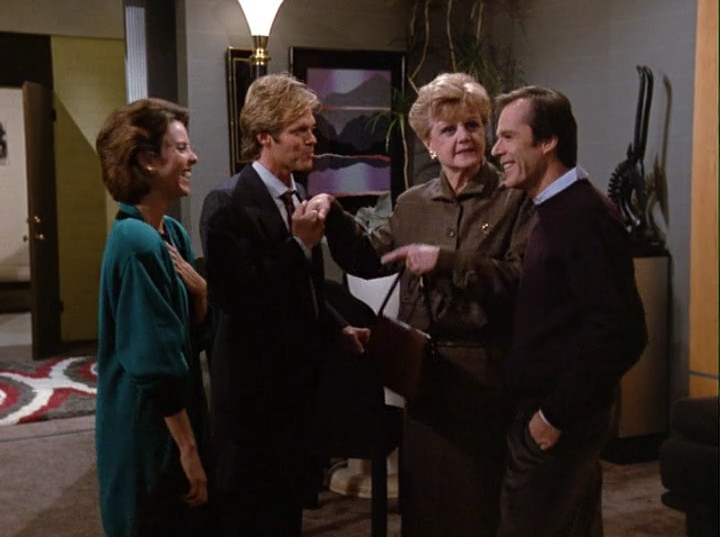
We’re then introduced to a few more characters:

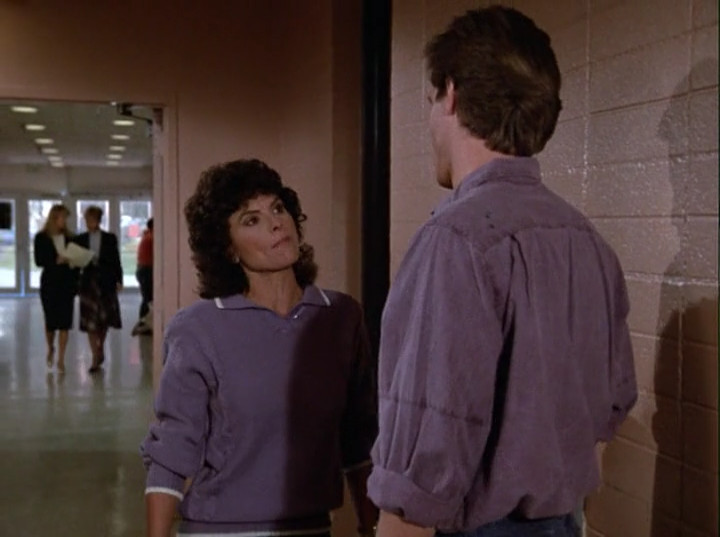
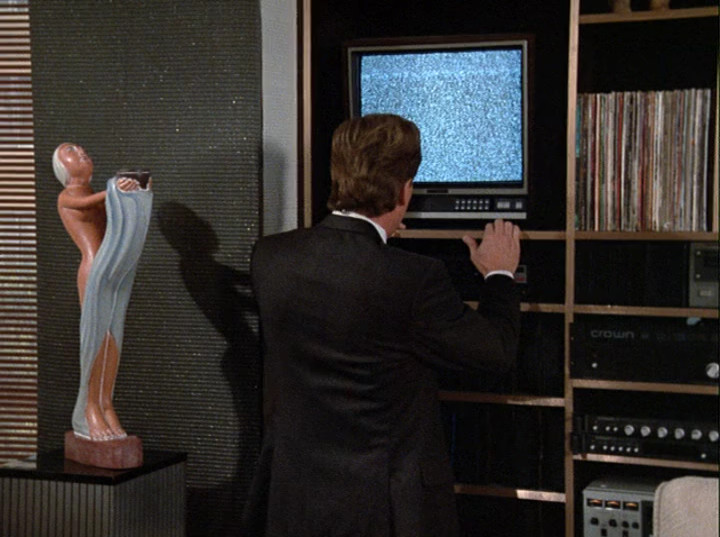
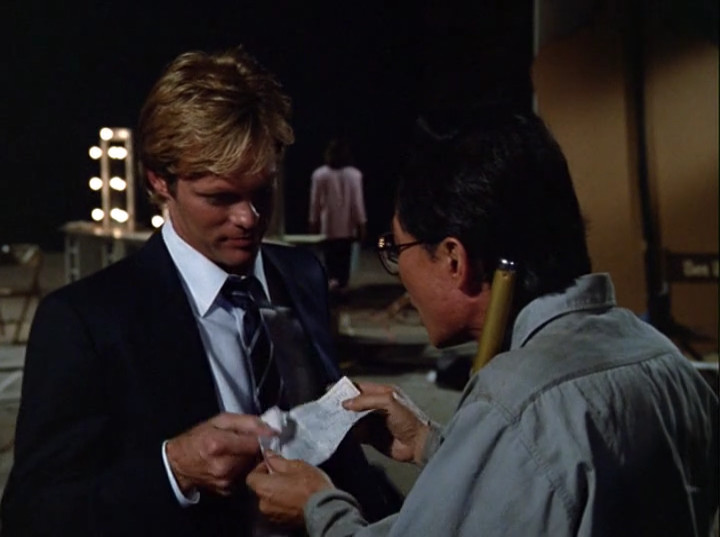
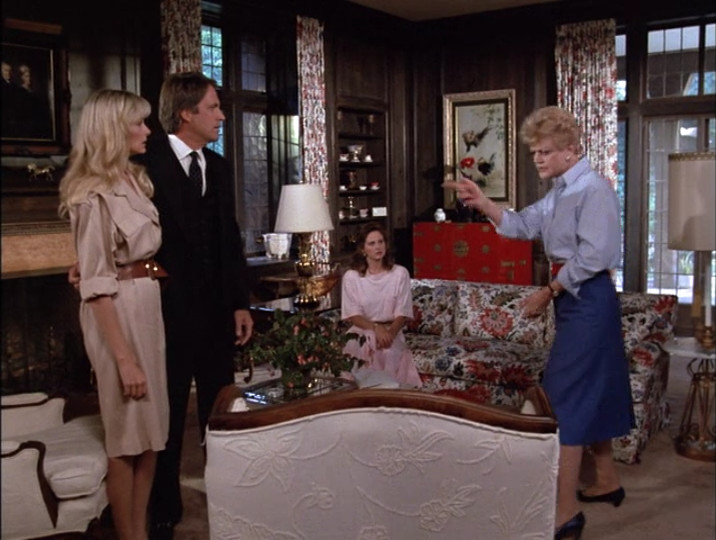
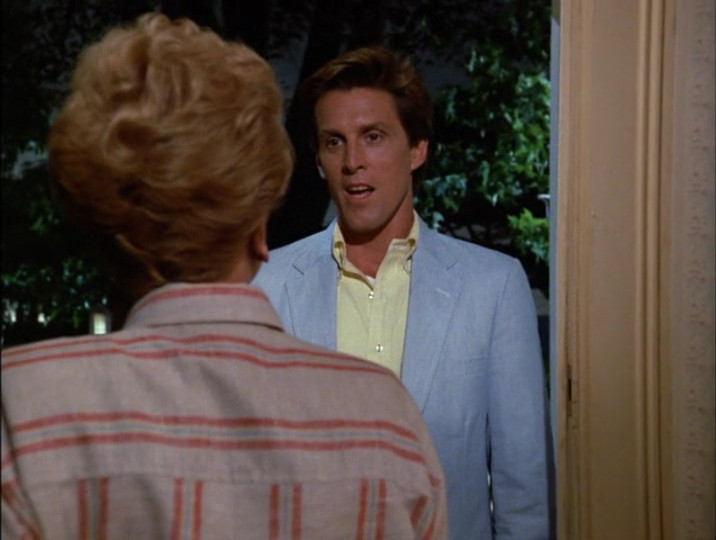
The guy on the left is Steve. He’s the producer of the show. The woman has a name I’ll remember at some point but she’s played by Adrienne Barbeau, which is far more memorable. (If you confuse her with Sigourney Weaver, you’re not alone.) This is Ms. Barbeau’s second (and final) appearance in Murder, She Wrote. She’s a tough-as-nails career woman who doesn’t like anyone and isn’t afraid to let them know. A few moments later we get introduced to another character, Ryan, but even though his introduction establishes that he was probably dallying with a female staffer in a closet, he’s so minor I’m going to use the shot which only shows the back of his head. We almost never see his face again, anyway:

Adrienne chews Ryan out and sends him to Mr. Chambers. Ryan is some sort of assistant and Mr. Chambers clearly needs assistance. Then we finally find out what Jessica has to do with this bunch of people:

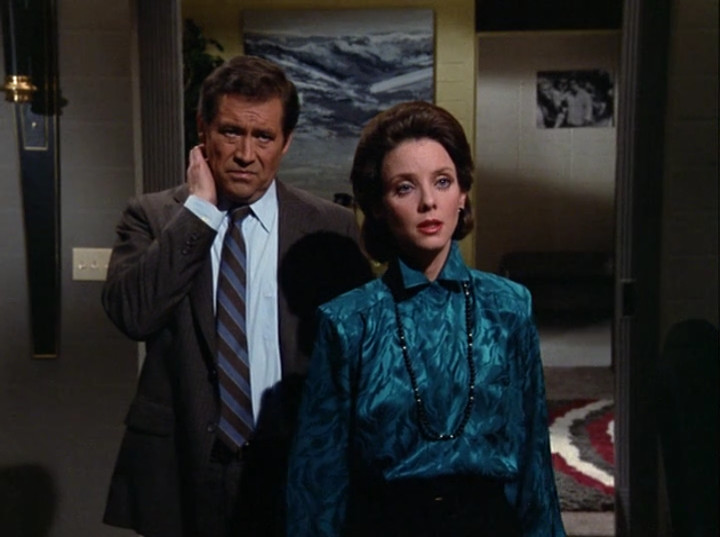
The woman driving the car is Dr. Jayne Honig. It’s likely that Jayne isn’t one of Jessica’s many neice’s as there’s a reference made to Jayne’s wedding seven years ago and how she rescued Jessica from a dance marathon with Jayne’s Uncle Buck. Jessica also asks “how is your dear husband” which suggests that of the two it’s Jayne she knows better.

This question brings up an awkward moment, apparently the couple are having trouble related to Steve constantly being stressed and working late. Jayne has given up her career as a psychiatrist to be a full time wife in order to save the marriage, though why this is necessary as the problem is that Steve is never home is unclear.

Also, it turns out that Jessica is in town because she’s going to do a book review segment for the TV show. It’s not spelled out, but presumably this is a favor to Jayne. This was during the days of broadcast television when local TV stations were common and KBLR (the name of the station) certainly seems like a local affair. Maine to Denver is an awfully long way to go in order to review books on a local TV station.

Next we get more establishing of what a sleazeball Kenneth Chambers is. There was a segment where the police chief, acting as an expert for the show, said that while the Acme bulletproof vest (the vest from the opening of the show) is cumbersome, in a dangerous situation it’s the best safety equipment he knows. Kenneth had “the boys” do some editing, and he changed the testimonial around to have the police chief say that in a dangerous situation, he wouldn’t put it on his dog.

Steve objects that this is dishonest and unethical. Kenneth asks who cares, because it’s great television. Steve, defeated, says that he cares. Apparently no one stopped to think that this is the sort of thing which can generate lawsuits and, if nothing else, make an enemy of the chief of police which doesn’t seem like a great strategy.

Adrienne Barbeau then walks in saying that after weeks of intensive effort, she has finally dug up the evidence on some cheese producer that will “throw them into the fondue, as it were”. Kenneth declares that the story is dead, which does not please Adrienne.

Kenneth walks out, Adriene storms out, then Jessica and Jayne walk in. As a side note, these offices are really huge. It takes Adriene twelve steps to get from Steve’s desk to the door of his office. Adriene Barbeau is 5’3″ tall, so if we assume she has a 5′ stride, that makes it 30′ from the desk to the door. My house, which admittedly is not large, is shorter than that from one side to the other. This is one heck of an office.

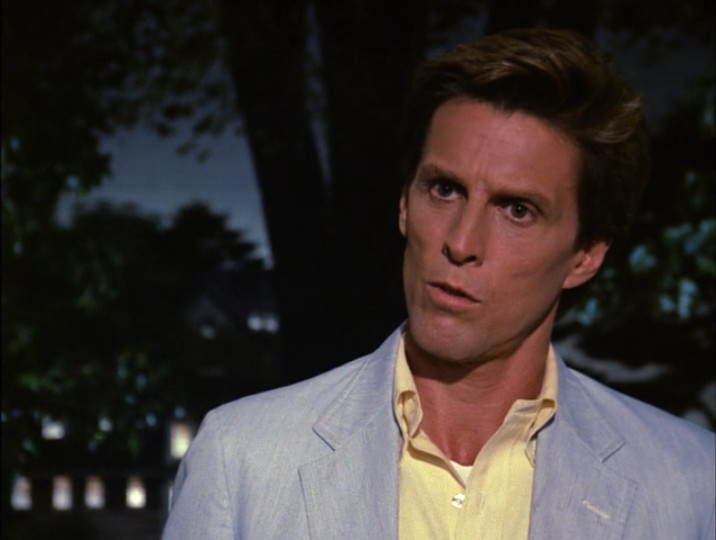
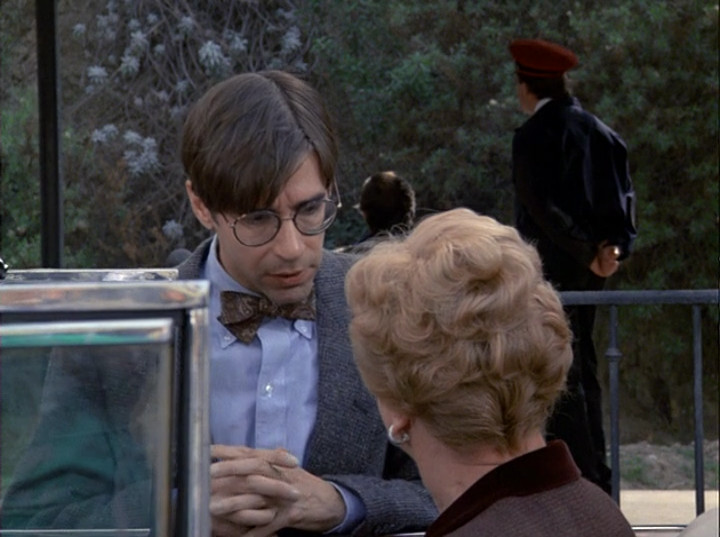
“*Ahem* Got a minute for a famous author?” Jayne asks. Warm greetings ensue, and then we meet the final character who will make up the suspects cast. His name is Robert Warren and he is the station manager. He begins by asking Jayne when she’s going to leave Steve for him, and then remarks, after some banter, that when your best friends steals the love of your life it’s either “Laugh, Clown, laugh” or slit your wrists, and he had no blood to spare. He then charms Jessica, kissing her hand and saying that if there’s anything she wants, she has but to command. The character is played as flamboyant and over-the-top, but even so the professions of love for Jayne are far too sincere to just pass over. It’s a clue, of course—if someone is not the main suspect, background information about them is just about guaranteed to be a clue—but it’s not that well disguised. Especially because a TV station manager couldn’t plausibly be that light-hearted and unserious.

He then offers to take Jessica on the “fifty cent tour”. I’m genuinely unsure whether that’s meant to be a grand tour or a meagre one. Throwing fifty cents from 1987 into an inflation calculator, that’s worth approximately $1.15 now (it would be worth $1.19 if we use 1986, presuming that the script was written at least two months before it aired, but what’s $.04 between friends?). On the other hand, it sounds like a throwback phrase, though to when I’m not sure. If we were to go all the way back to 1925, it would be the equivalent of a $7.44 tour today. At the end of the day I don’t often go on tours that I have to pay for, so I’m out of my element here.

Either way, Jessica goes on the tour. She’ll soon get to see how unpleasant Kenneth Chambers is for herself, but first we get the semi-obligatory scene of a tough guy threatening the victim.

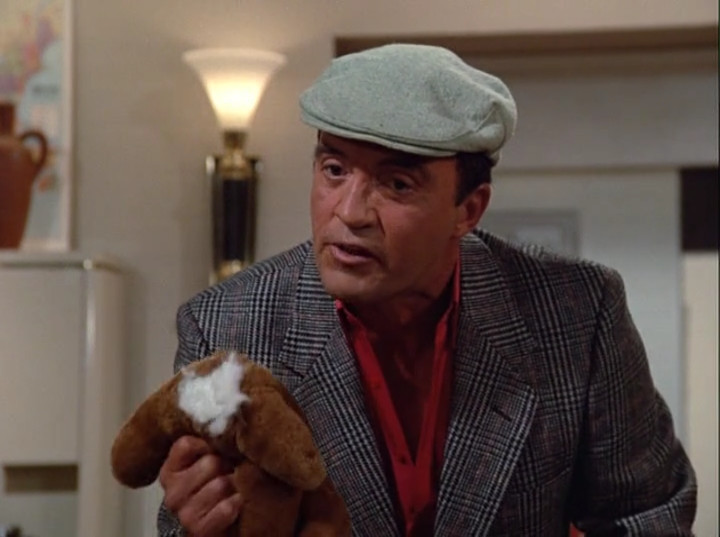
The tough guy, who is the owner of toy bears that Mr. Chambers is going to do an exposé on, demonstrated on the bear how he would touch Chambers if Chambers did a show about his bears. This character does show up again, but not as a suspect. For the most part people who were heard to threaten the victim are only suspected by the police if they are a friend of Jessica’s.

Shortly after this we get a scene of Mr. Chambers yelling for his assistant because his assistant was supposed to fix his TV.

This is a clue, of course—I would be hard pressed to think of a time in a Murder, She Wrote episode where a piece of technology was broken that wasn’t a clue—but it is disguised fairly well as a scene of showing just how awful Kenneth Chambers is by how he is short-tempered and yells at his subordinates.

There’s an argument that Robert Warren has with Chambers about the toy bears, saying that the tough guy (his name is Rinaldi) spends a lot of money advertising with the station and maybe they should cool it with the antagonistic episode. Chambers stands firm on principle. Then we meet someone who is, technically, a member of the cast, but she so consistently seems to be unambitious, reactive furniture that it’s impossible to consider her a suspect.

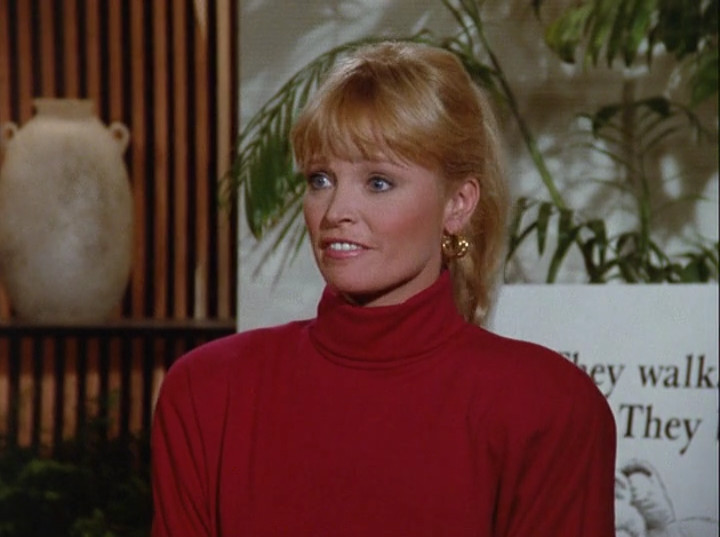
She lets it slip that she has a romantic relationship, as well as a business relationship, with Kenneth Chambers because she calls him Kenneth and then corrects herself to Mr. Chambers. This is something of a dated way of letting that information slip, since even at the time the transition from last names to first names in workplaces in America was well underway. In this case it’s especially strange since she appears on the show with Chambers, helping out in his demonstrations. Being both a mousy secretary and an on-air personality is really weird, almost to the point of saving on casting. I suppose giving her a romantic relationship with Chambers gives her some sort of motive for killing him, making him a suspect, but I don’t think that at any time it’s plausible. (Of course, the very fact that it’s implausible can be a red herring; one should always be on the lookout for the least suspicious person in a murder mystery.)

There’s some small talk, Mousy Girl says that Mr Chambers has been looking forward to her coming because he’s such a fan, etc. Then we get another clue. Kenneth leans back into his chair, knocking over the cup of coffee that Ryan the assistant was holding while fiddling with the knob on a sound system in order to get the VCR to give a video signal to the TV.

I know I always hold coffee while fiddling with nobs. How else would the detective be able to tell two identical chairs apart? There’s an attempt to disguise this clue by having Chambers fly off the handle and fire Ryan but if you’re at all familiar with the habits of Murder, She Wrote, there’s no missing this clue.

What the clue means is a different matter, though. You know that this chair and another chair will be switched, but—credit where credit is due—you don’t know why they will be switched.

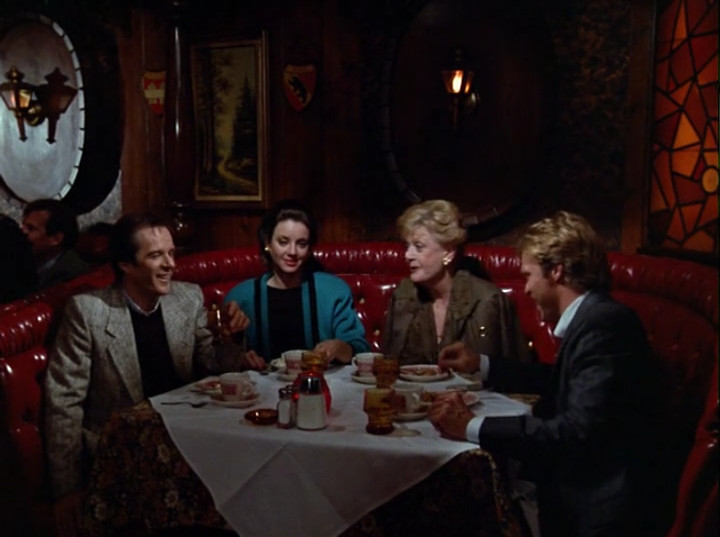
Next we see Jessica, Jayne, Steve, and, for some reason, Robert, at a restaurant. Jessica works it into the conversation that Robert was a former patient of Jayne’s. Steve says, speaking of a racketball game he played with Robert, that Robert is competitive to the point of compulsion. Jessica then says, “Oh, perhaps your former psychiatrist could give us some insight into that.” But Jayne demures, saying that there are strict rules about doctor-patient confidentiality. Yeah, no kidding. Of course Jessica knows that; I don’t think that the attempt to disguise this clue as dinner banter works at all. The actors do a good job making it feel like trading wit but it really stands out.

Steve excuses himself because he has to go back to the station to work. Kenneth Chambers has demanded it, though how Chambers is in a position to demand it is not clear, since Steve is, in theory, Chambers’ boss. Shortly afterwards Robert says that he can commiserate with Steve, having worked at the station every night for the past week he can say that the station is a very lonely place when you’re the only one there. Robert then goes off home to get a good night’s sleep.

As he drives off, Jessica notices that Jayne looks upset. Asked, Jayne says that Steve had said he had worked late at the station every night that week, but Robert just let it slip that he had been there all alone.

In the next scene George Takei, sorry, Bert the janitor, discovers Kenneth Chambers slumped over in a chair. He turns the chair around and then is horrified, though of what we can’t see. It’s dark, and the bullets didn’t seem to penetrate through to the front of Chambers, so we don’t see any blood.

In the next scene Jayne is driving Jessica to the station in the morning.

Curiously, they both forgot to wear their seatbelts. This is consistent with other times that they’re shown in the car. I wonder if it was deliberate or if the actors just forgot because they were filmed in a stationary car with the driving just being a rear-projected film. The rear projection is pretty good, except that they’re on a two-lane highway that ends in the parking lot of the TV station without any kind of turning off. The station parking lot is filled with police cars and camera crews, so Jayne and Jessica discover that something happened.

We then meet Lieutenant Lou Flanagan, the police detective for the case. He turns out to be the expert that Chambers had dishonestly edited, though he never actually learns this and nothing comes of it.

He tells the reporters that Chambers was shot twice, and Jessica manages to get out of him that Chambers was shot between 10pm and midnight before he asks who she is. She is familiar, but he can’t place her, but thinks that she’s part of the media. She says no, she’s just a friend, but when he loses interest in talking to her, she pretends to be a reporter (though with plausible deniability in her wording) and was impressed that he “saw through” her.

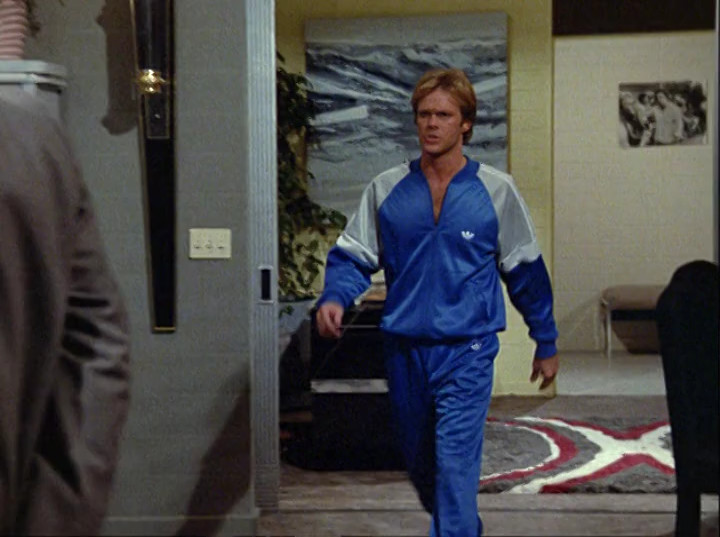
Steve shows up from a run he was on—the man is certainly dedicated to exercise. Despite having gotten to be after 1am, he was up in the morning before his wife so he could go on a run in a sweatsuit. It’s a bit of an odd choice to do that early morning run and return to the office in need of a shower, rather than to return home, take a shower, then go to work. Nothing really comes of it, though, since it was his absence the night before which makes him a suspect. (He’s a friend of Jessica’s with no alibi, so the Lieutenant is, of course, convinced that he did it.)
During the investigation, Lieutenant Flanagan helpfully shows an ashtray with a large cigar ash in it to the camera, but it’s so blatant an action that even Jessica notices.

He then blows on the cigar ash (for good luck?) and puts the ashtray back on the desk. It’s instincts like that for bringing clues to the attention of other people which got him all the way to Lieutenant!

Then another clue turns up. The murder weapon (a revolver) was found in the back seat of Steve Honig’s car! A deputy spotted it when he looked in the window!

Flanagan asks if Steve has a permit for the gun, but Steve dismissively says that it isn’t his. Flanagan doesn’t believe him, and Jessica has had enough. She goes on a tirade about how there’s no common sense here. Why would Steve, if he was the killer, come to the scene of the crime with the murder weapon in plain sight in his car when he had hours to dispose of it?

Before he can answer, Robert Warren shows up in an exercise outfit that puts Steve’s to shame.

Warren asks what’s going on and Flanagan says that he is taking Steve into custody on suspicion of the murder of Kenneth Chambers. Apparently Flanagan has a very short memory. Warren says that he will send a lawyer along with Steve.

We’re almost halfway through the episode and the middle of a Murder, She Wrote rarely contains any clues. I think that this is to give the audience some time to think over the clues that they were already presented with. We’re given a bunch of suspicious stuff, of course. Jessica asks Jayne when Steve actually came home and it was around 1am. Adrienne Barbeau talks the blond assistant to become the new host of The Bottom Line.

Jessica walks onto the set of the new The Bottom Line and talks with Adrienne, who is the new producer. She observed that Steve never wanted the job anyway. He really wanted to be the producer, but Kenneth Chambers had made sure that Warren got that job. This might have been an interesting sub-plot, but we never learn any more about it.

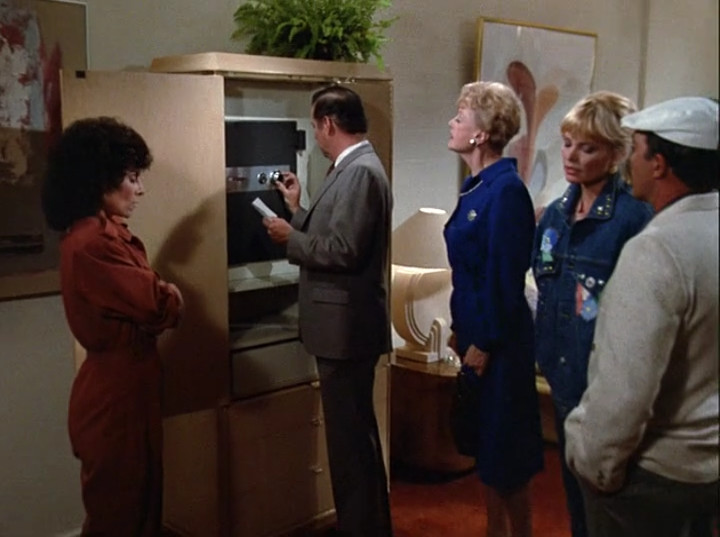
Jessica talks to the blond assistant, but not much comes out. The subject of Rinaldi (the teddy bear thug) comes up. They look for the tapes of the show, but can’t find them. Jessica Fletcher talks to Rinaldi about the missing tapes, and he tells her that he paid Chambers twenty five thousand dollars in cash to buy the tapes and kill the show. This leads to a scene of a bunch of people standing around while Lieutenant Flanagan opens a safe in what I assume was Chambers’ office.

It turns out that Kenneth Chambers accepted bribes to kill stories. The cheese maker story that was killed towards the beginning of the episode was also in the safe. The blond assistant is disillusioned, and Adrienne Barbeau is excited because now she knows why the story was killed and as the new producer she’s going to run it.

This new evidence should have opened up the possibility of Chambers being killed for some reason relating to his criminal enterprise. It doesn’t, though. Flanagan gives Jessica a ride to somewhere and while riding they talk about the case and Flanagan comes up with the theory that Steve planted the tapes and money to smear Chambers’ good name and Chambers surprised him to Steve had to shoot him. How Chambers ended up sitting in his chair and turning his back to Steve isn’t mentioned, and the idea is so absurd Jessica just asks to see pictures of the crime scene instead.

Jessica notices that the chair was shot in the back, meaning that his back had to be to the door. Unfortunately for this revelation we already saw it when George Takei found the body. Flanagan says that he must have been watching TV, but Jessica points out that this is impossible since his TV was broken. Somehow it never occurs to either of them that he could have been shot while facing another direction then his chair rotated afterwards, e.g. to make people think that he was doing something so as to delay the finding of the body. Fortunately, that wasn’t the case so our sleuths not thinking of it doesn’t matter.

The next morning Jessica talks with Robert Warren to get some more information. It turns out that it was Adrienne Barbeau’s idea to revive the show with the blond assistant as the star. Warren went on to say that Chambers wanted to take the show to the national network and leave everyone behind, but with him dead everyone comes out ahead, especially the blond assistant. Personally, I don’t think that this red herring is very plausible based on the character herself, but I do have to admit that the motive was a decent one and innocents with big doe eyes have turned out to be murderers before and will again.

Jessica then steps in to watch the filming of the new Bottom Line, with the blond assistant as the star.

Claire flubs a line and they move on to another scene. Jessica runs into Ryan, who Chambers had fired by Adrienne Barbeau re-hired. Jessica says that she finds it perplexing how much better off everyone his. Ryan tells her the secret of show business. “The secret to this business is hustle. Any boob can do these jobs. You just have to make sure that you’re the any boob who gets hired.” There’s another minor interaction, but that’s the last we see of this character. He had a good line before we went, at least.

Now we finally move on to the last act before the denouement. Jessica meets George Takei, who has a bunch of evidence to give her. Jessica tries to throw away her coffee cup but George grabs it before it lands in the garbage.

It turns out that he has a collection of trash from famous people, which he offers to show her. Jessica agrees to see it because she would like to talk to him. Pleasantly, he not merely collects trash but he preserves it in a way that sanitizes it.

I thought that the embedding the trash in lucite was a nice touch. (He also bronzed an apple core someone threw out.) I suspect that this would have been funnier back in the late 1980s because there was more of a trend for preserving things in bronze and lucite back then—more typically things like baby shoes and comic books—but it’s still amusing now.

During the course of the conversation George reveals three important clues. The first is that he cleaned Steve’s office when Steve and Kenneth were fighting. The second was that Steve actually was working late every night for the past week. The third was he spilled coffee from his coffee mug, making Jessica think to look for the chair with the coffee stain, which turns out to be in Steve’s office.

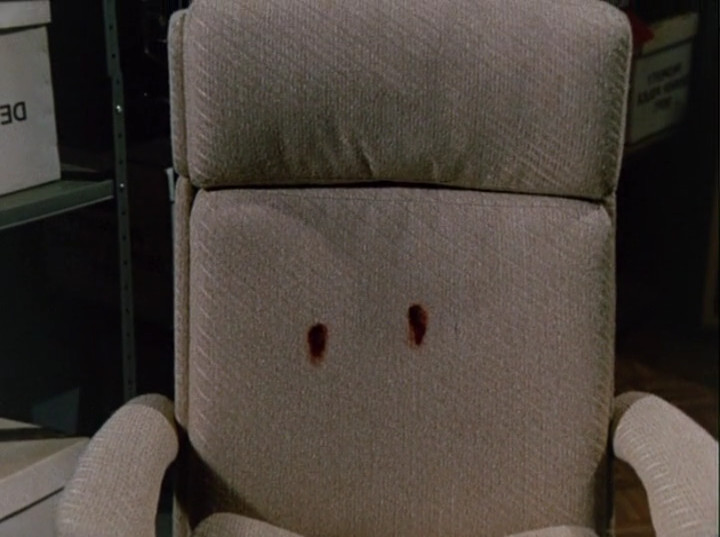
Can you see the coffee stain? I can’t. We just have to trust Jessica that it’s there.

Jessica runs over to police headquarters and gets Lieutenant Flanagan to let her look at the murder chair.

Personally, I don’t see a coffee stain here about as much as I don’t see one on the other chair.

No coffee stain! That proves it!

What does it prove? We’ll have to wait for Jessica to set a trap for the killer to find out.

George helpfully plants the bait. He very conspicuously says that the chair in Steve’s office needs to be replaced because of the terrible coffee stain that no power on earth can get out. So, of course, the killer will come to take the chair away at night once everyone has left in order to… OK, I’ve got nothing. Once it’s publicly known that the chair had an awful coffee stain, removing it will accomplish precisely nothing. Still, someone has to go to the trap and threaten to kill Jessica to hush her and her flimsy evidence up.

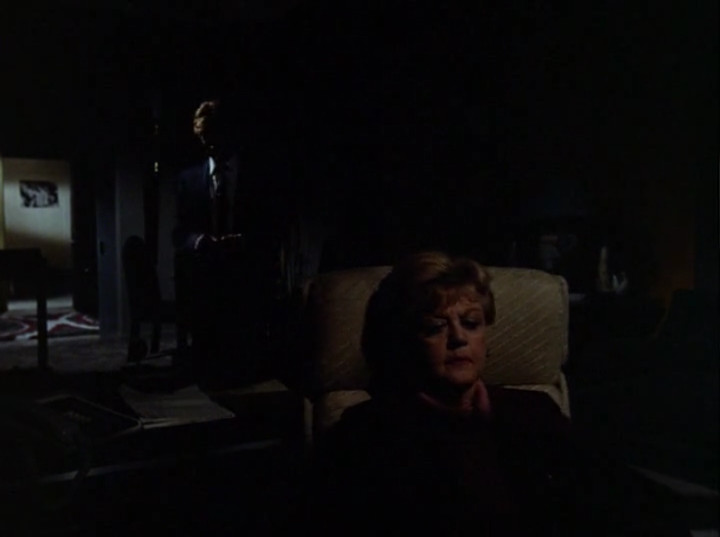
Jessica actually waited in the chair, in the dark, for the murderer. You’ve got to give it to her—when she sets a trap, she’s willing to use herself as bait. And the murderer turns out to be…

Robert Warren!

But, there’s a twist. He wasn’t trying to kill Kenneth Chambers, he was trying to kill Steve Honig. All those things about being madly in love with Jayne? Yeah. It turns out that they were true. Robert wanted Jayne for himself and tried to kill Steve to make room for himself. But when he discovered that the man he shot in Steve’s chair was actually Kenneth—who was watching Steve’s TV because his own was broken—he figured that framing Steve for the murder would serve the same purpose.

Steve does what any Murder, She Wrote killer does when Jessica presents him with extremely flimsy evidence alone, at night—he announces his intention to kill her.

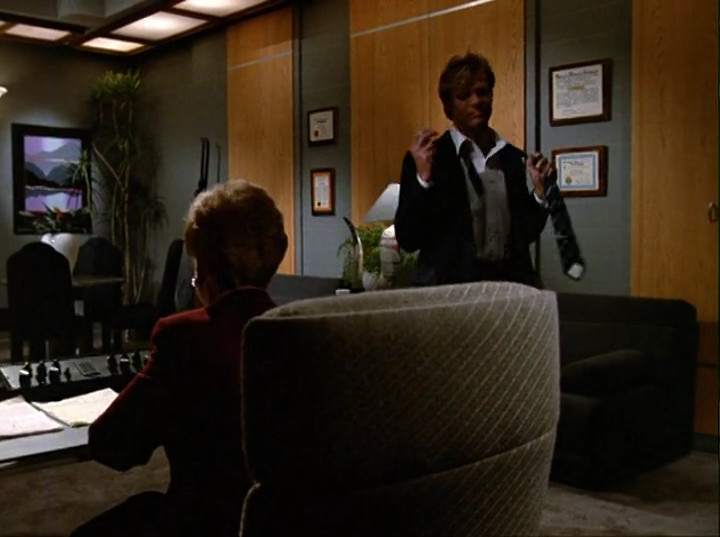
He doesn’t say it, but one gets the distinct impression he’s planning to strangle her with his necktie. Jessica asks if his solution is to kill her too, and he replies that it shouldn’t be too hard to find another writer for their book review show.

Jessica then says that he needs help. Specifically, help from Jayne. I really don’t get that last part; she’s given up her practice and a man who is madly in love with his psychiatrist probably should get help from just about anyone but the object of his fixation. However that may be, as is the case in about 9 out of 10 episodes, Jessica has witnesses waiting in the wings to hear the killer’s confession. As is often the case, one of them is the police detective.

Oddly, the other witness is Jayne. This is a very odd choice for a witness, but it gives her the opportunity to talk to him. She says that violence didn’t work before, and it won’t work this time.

Yeah, no kidding. That’s kind of the meaning of that police offer standing there in the background looking glum.

He says that she shouldn’t be there and she asks why. Would he kill her too? Then she caresses his face.

This seems wildly inappropriate no matter which way you look at it—as a psychiatrist or a married woman or the woman he murdered someone for or the wife of the woman he framed for the murder. Maybe that’s why, when she looks over at Jessica, Jessica just looks down.

The next morning Jessica talks to Steve and Jayne on the front stairs of the television station and explains why she set the trap. Steve says that he can’t thank her enough, both for getting him off of the murder charge and also for the brilliant interview she gave. Apparently they didn’t bother talking about what happened the night before until after they filmed her book review show. That’s show biz for you, I guess.

Lieutenant Flanagan then walks out of the station, followed by a gaggle of reporters. What he was doing in the station or why the reporters were in their with him, I cannot imagine. He stops at the top of the stairs and tells the reporters that it takes a trained eye to spot something like the switched chairs because of the coffee stain. He’s going to take credit for it but then spots Jessica. However, she gives him her blessing to take credit.

Which he does, with aplomb. The episode ends with Jessica, Jayne, and Steve laughing when Flanagan said, “I said to myself, ‘mere furniture? I think not.'”

The Bottom Line is Murder is, overall, a strange episode. It is very memorable, but not really for the mystery, which was not all that well crafted. Don’t get me wrong, it holds together well enough, minus it being a bit strange that the janitor didn’t hear the gunshots and the direction the chair was facing in no way being an indication of the direction it was facing when the victim died. The coffee stain indicating the switched chair was solid enough, though it was extremely contrived that the chair had a coffee stain. Likewise the broken TV causing the victim to be in the wrong place was fine, if the significance of the broken TV was a bit telegraphed. (Also fairly coincidental. It isn’t very plausible that Chambers would have had hours of footage to watch, so the odds of catching him in Steve’s office, sitting down and watching, would not have been very high. Granted, it’s fine for coincidence to be involved in the murder itself, but only up to a point.)

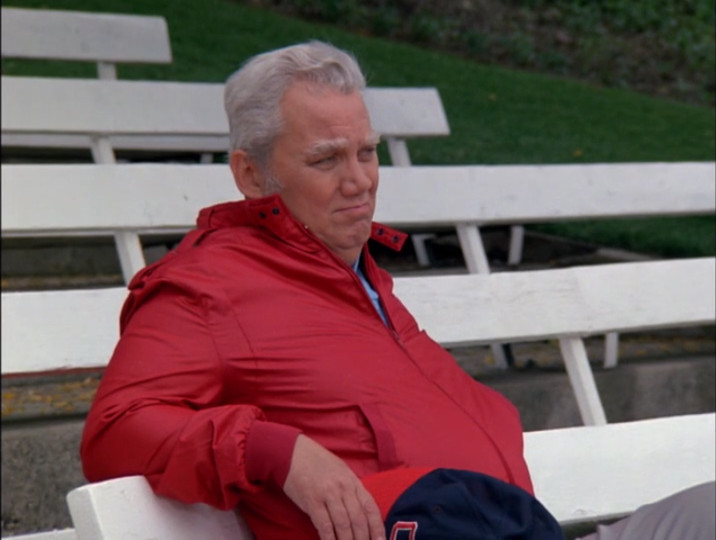
I think that what really makes the episode so memorable is that it has so many talented actors playing well defined—if not always sensible—characters. Adrienne Barbeau’s tough, ambitious producer leaps off the screen, even if she is barely related to the plot. Barry Corbin’s Lieutenant Flanagan is, despite his foibles, deeply likable. Judith Chapman’s Jayne makes you feel all of the trouble and pain her character is going through; one believes that she was a magnificent psychiatrist before she gave it up. She is plausible as a woman worth killing for. George Takei’s janitor was a fascinating character. He’s almost like a happy grouch, with a completely unrelatable love of garbage. One might almost want to see his collection of immortalized trash. Even Pat Klous’s blond assistant was a vivid character—so innocent, fragile, and trusting. That makes no sense for a woman who was romantically involved with a man like Chambers, not to mention being both his secretary and an on-air co-host makes absolutely zero sense. Still, she was a vulnerable almost-child, and you felt that. And then there’s Morgan Steven’s Robert Warren. He is plausible as a charming psychopath, especially the charming part.

So, ultimately, the story structure doesn’t make much sense but the setting is great and the actors are phenomenal. To some degree they’re under-developed because there are so many great characters, development takes time, and there is only 47 minutes divided by the number of characters available to develop them. None the less, it makes for a very memorable episode. I am almost fixated on structure, so I have trouble regarding it as a really good episode, but it is certainly an extremely memorable one.

I also have to say that I found the set decoration very interesting in both Steve and Kenneth’s office. (It was pretty clearly actually the same set just redecorated, with the TV/sound equipment on the back wall not even being different.) The cavernous office was so large it had quite a lot of furniture in it, so there was plenty to look at. Wall sconces, art on pedestals, five varieties of things to sit on, statues, paintings—there was a ton of visual interest. It was just an interesting place to watch a murder mystery.

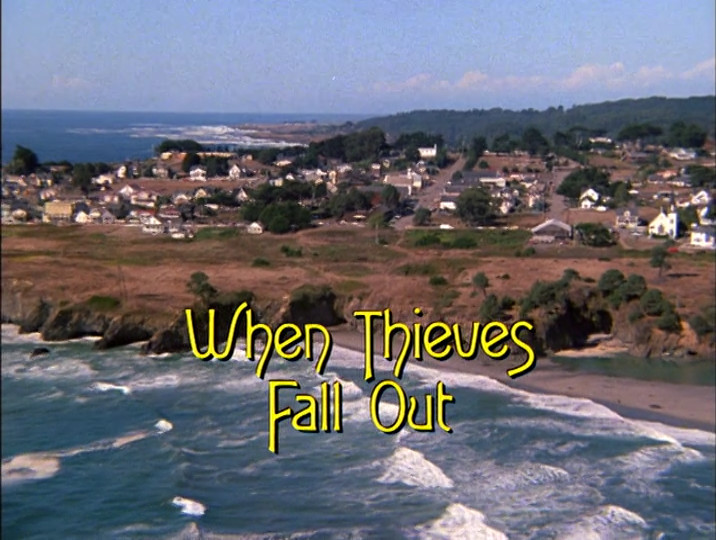
Murder She Wrote: When Thieves Fall Out

The second episode of the fourth season of Murder, She Wrote, is titled, When Thieves Fall Out. It’s a very unusual episode of Murder, She Wrote.

The episode begins with the owner of a car dealership firing a drunk salesman. After that we meet a rather enigmatic character. I’m not sure whether to call him the protagonist or the antagonist, and in many ways the episode isn’t sure, either.

His name is Andrew Durbin. It’s a bit complicated, but we learn his backstory: he just got out of prison for a murder he claims he didn’t commit 20 years ago. He had been a hitchiker, and a wealthy businessman was giving him a ride. A car swerved almost into their lane and they swerved to avoid it, crashing. The businessman was injured and Durbin ran to a nearby farmhouse for help, but they didn’t hear his banging on the door. When he got back someone had bashed the businessman’s head in with a rock, and $100,000 in bearer bonds were missing. At that moment the police showed, and he was taken to be the murderer, and was convicted.

He’s back in Cabot Cove because he recognized a kid in the car (in a prom outfit; it was prom night) that ran them off of the road, and he wants vengeance and to know who the driver is.

The kid turns out to be Bill, the owner of the car dealership.

Somewhere around here, the car dealership owner recognizes that some weird things are going and her husband is very scared, so she goes to Jessica for help.

Andrew Durbin goes to the car dealership and says that there seems to be some electrical trouble with his car.

Bill says that he’s busy and will need some time to get the repair done. He suggests that Andrew come back at 9pm to pick up his car. Andrew agrees. Jessica shows up and talks to Bill, but not much really comes from this. He denies everything. Jessica leaves, and Bill calls a confederate—presumably the other person in the car, that fateful night.

Interestingly for a Murder, She Wrote episode, while we’re pretty sure that someone is about to be murdered, we don’t really know who.

It turns out to be Bill, which is an interesting turn of events because it leaves the field so wide open for who the murderer could be. One obvious suspect is the man with whom he had an appointment at around the time he was killed, Andrew Durbin, but it turns out that Durbin has an air-tight alibi. He was eating dinner for 2 hours at a restaurant where several reliable witnesses could vouch for him.

The alibi is useful, structurally, but it’s also very curious that Durbin never showed up to the appointment. It’s somewhat implied, later in the episode, that this was really a setup; he expected this to stir up Bill’s confederate and get him to kill Bill. It’s never explained in detail, and doesn’t make all that much sense as a plan. Unless he figured that Bill’s killer would be sloppy and get caught, this plan would most likely result in the trail going cold and Durbin’s only hope of justice being extinguished. That said, for whatever reason he does it, he never shows up and is careful to have an excellent alibi for before, during, and after the murder is committed.

Convinced that Durbin is both innocent and telling the truth, Jessica interviews Bill’s old high school friends who were with him that night.

They lie to Jessica, of course, in order to protect Bill’s memory, and say that he was with them the whole time. Eventually it comes out that Bill was drunk and left early. There’s some further investigation and a sub-plot where one of Bill’s old football friends who is pretending to have been crippled in a car crash and is suing Bill turns out not to be crippled and to only be scamming.

I probably should have mentioned earlier that high school football was a big theme. All of Bill’s male friends from high school were on the football team with him, and they were the only team from Cabot Cove who ever won the state championship. This is important because it turns out that the driver, and the murderer both of Bill and of the driver 20 years ago was the beloved high school football coach.

There was actually a pretty good line from his confession, when he talked about how the business he had invested his share of the $100,000 into went bust almost immediately: “I guess I should have known that nothing good would come of that money.”

What really makes this episode special, though, is that it doesn’t stop here. Later that night, as Jessica and Amos are having dinner, Andrew Durbin shows up at Jessica’s doorstep to thank her.

Jessica says that she wishes he wouldn’t. She acknowledges that he was telling the truth and spent 20 years in prison unjustly, but he knew what would happen when he came. He replies that he did warn her that he was after justice.

Jessica acknowledges this, but says, “I can’t help but think that justice could have been served in a better way.” Durbin is taken aback.

After thinking for a moment he then delivers one of the all-time great lines in Murder, She Wrote. He says it slowly, thoughtfully, and very fairly.

“Oh? Well you give it some thought, Mrs. Fletcher, and when you figure out what could have been, you let me know.”

Jessica is at a loss for words. He turns and leaves, and she closes the door. She then leans against it, thinking.

And there the episode ends.

Something I touched on in my blog post about how Jessica Fletcher is an oddly libertine scold is that she has an extremely strong but highly selective sense of indignation. She deplores violence but not, in general, any of the things which tend to make it necessary.

She dislikes, tremendously, that people she cared about were made to suffer. This is understandable, but it is a fault in Jessica that she didn’t rise above her feelings and stick to her principles and acknowledge that Durbin was in the right. Instead, she resents being made to be the one to find them out. In short, she is entitled to grieve, but not to be indignant, and Durbin’s final line points out to her how little she is entitled to her indignation.

Jessica does not learn from this moment, of course. First, because she’s written by television writers. Second, because Murder, She Wrote was episodic, with episodes not being related to each other. Frankly, I think it’s really more the former than the latter, though. All that said, it’s pretty satisfying for Jessica to get a comeuppance, for once.

Apart from all this, it’s an interesting episode. Detectives investigating long-ago mysteries is interesting, because the evidence is so limited (at least when people don’t have oddly good memories about things long-past to which they hadn’t attached any great significance at the time). This is done much better in Agatha Christie’s Five Little Pigs, but it’s an unfair comparison. That was a novel. A forty eight minute long TV episode cannot be as good. It does partake of some of what made that novel so good, though, even if it takes the easy route and uses photographs instead of people’s partial memories.

Jessica Fletcher is a Weirdly Libertine Scold

I am a big fan of Murder, She Wrote. I watched it very fondly as a kid, and I own the DVD box set of all 12 seasons. I enjoyed it then and I enjoy it now. I am a fan. This must be distinctly understood, or nothing wonderful can come of the thoughts I am going to relate.

One of the really weird things, that’s obvious to me now that I’m watching it as an adult, is that Jessica Fletcher is a weirdly libertine scold. She absolutely deplores violence, and also murder. She also has absolutely no patience for selling drugs. Other than that, she really doesn’t care what people do and will smile at just about anything.

This is odd for several reasons, not the least of which is how completely at odds this is with her background. Jessica is a retired school teacher from a small town in New England. This is a place where people are expected to pull their weight and screwing over friends and family for personal selfishness is frowned upon. The sort of selfishness involved in cheating on a spouse, prostitution, casual sex, leaving someone to move to a big city and follow ones dreams, and the like—these are the sorts of things which city-folk don’t care about, in part because half of them have done these things and the other half expect that they will in the not too-distant future. These aren’t part of the things small-town America approves of because they see the damage they cause.

Another odd thing about this is Jessica Fletcher’s age. She was a retired schoolteacher, which means that she had to have been in at least her late 50s in 1984 (the shows are contemporary). The latest she could have been born would have been around the year 1930. (Angela Lansbury was born in 1925, and was generally about the age of Jessica Fletcher.) A woman who grew up in small-town America in the 1930s and was a young woman in the late 1940s and early 1950s would not have been someone who instinctively approved of fornication, adultery, infidelity, and selfishness.

It may be objected that we normally see Jessica take in all of these acts unphased during an investigation, when, as a detective, she needs the confidence of the people she’s pumping for evidence. This might work if she weren’t willing to turn scold if one of the few things which offended her popped up. Moreover, she never scolds anyone about these things after the investigation, though she will scold them, then, for murder and violence.

This is most easily attributed, of course, to the loose morality of the people writing Murder, She Wrote. They, being in Hollywood, didn’t really disapprove of much of anything at all, though at times they were obliged to pretend to. That said, if we refrain from drawing back the curtain and only consider the work of fiction on its own terms, Jessica Fletcher is a very strange character.

Murder, She Wrote, for all that it’s fun, is often corny, though I admit it with great reluctance. That Jessica Fletcher was never given any actual principles, which is to say that she was never given any definite beliefs about the meaning of life and the attendant consequences of that, is I think what really kept the show from ever being great. She is, in a certain way, a direct descendant of the early detectives, who were often supposed to be mere calculating machines with legs. She had traits, but never really a personality.

I think that this is a great pity, though I doubt that it could have been otherwise in American television in the 1980s.

Murder She Wrote: One White Rose For Death

One White Rose For Death is the fourth episode in the third season of Murder, She Wrote.

It’s not one of the most memorable episodes, probably because the setup of Jessica being used to help a classical performer from behind the Iron Curtain to defect while on an American tour was used in the first season (Death Takes a Curtain Call) and had the extremely memorable Major Anatole Karzof of the KGB. That said, this is a fun and interesting episode.

The plot is very different; instead of a former Russian defector and relative of the performer, who brought Jessica to the theater, being the one to help the couple, it’s a British secret agent they met at the theater, and instead of hiding out at Jessica’s house they end up hiding out at the British embassy in whatever country they’re in (most everyone has a British accent, but they hide out at the British embassy so the one country they can’t be in is Great Britain). It’s this later part that makes the episode so interesting: since the murder is committed inside of the embassy, it becomes a closed-mansion mystery.

The murderer is one of these people (or the host’s wife, not pictured).

There is the added tension from the defection story; only the brother (Franz) defected—he had been a spy for the British after the secret police murder his wife—while his sister (Gretta) was dragged along and isn’t happy about it. Then they find out that the East German secret police is holding their parents hostage. This spy-thrilleresque thread vies with the murder mystery thread to be the main plot; it keeps the tension up for the entire episode.

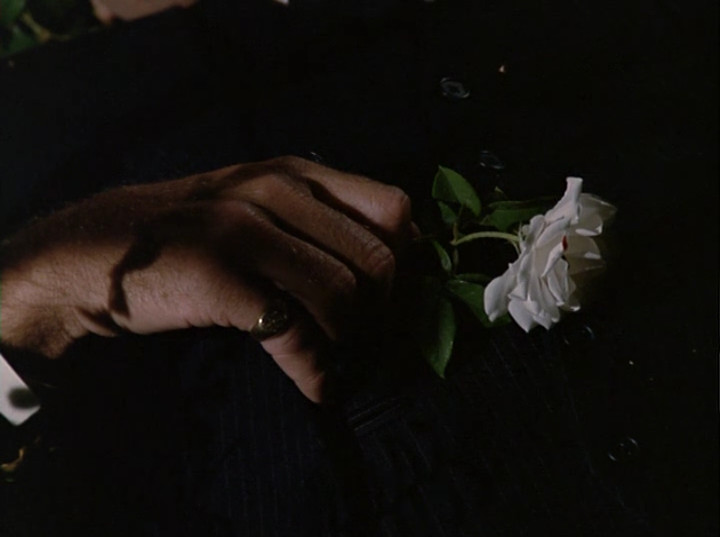
The murder victim gives us a clue—his dead hand clutches the titular white rose.

Jessica overheard the victim asking spy headquarters for information on a mission that had been called White Rose. Fortunately, Michael, the spy who got Jessica into this mess, knows what it was about—it was a failed mission to protect an anti-apartheid activist in South Africa, ten years before. (The activist was assassinated.)

The victim was also a spy, in fact Michael had recruited him into the spying business, so he took the murder very personally. He came from a long line of stuffy bankers and his “banker’s face” made him perfect for the spy businesses. The most important thing about being a spy is to be able to pass oneself off as anything, such as a tradesman.

Fortunately for everyone, not least of all the audience, because everyone in the embassy is a suspect, the diplomat in charge of the embassy gives Jessica free run to investigate the murder. I didn’t quite follow his logic, here, but it’s always more pleasant when the detective has the right to investigate, so I don’t want to look a gift horse in the mouth.

Initial investigations turn up that:

  1. the doctor had ties to anti-apartheid activists in South Africa
  2. the diplomat’s wife is from Rhodesia
  3. the victim’s fingernails and eyes show “moons”. He was killed with a fast-acting poison, which Jessica takes to mean a poisoned weapon.

#3 means that the murder weapon was probably professional; not many people besides professionals carry poisoned stabbing weapons. With the white rose connection, it seems likely that the victim recognized the assassin from operation White Rose. #1 gets dismissed fairly quickly because he was on the wrong side to have assassinated the activist being protected in operation White Rose. #2 bears more investigation, which happens fairly quickly.

The diplomat and his wife come clean.

While she came from Rhodesia, she was the daughter of a light-skinned servant who had been raped by one of her white masters. She was taken from Rhodesia as a child and grew up in England; she hadn’t been near South Africa in over a decade when the assassination happened. The diplomat was stationed in Hong Kong back then. They had been secretive and not forthcoming with their alibis because they wanted to keep the wife’s background a secret due to the diplomat’s needing social standing for his job. After this is revealed Michael walks in with the news that the doctor can be ruled out too because he was in prison (for having participated in a peace march) the day that the activist was killed.

Michael declares the theory that the victim was killed because he recognized the assassin a bust. “I mean, what would a professional assassin be doing here at the embassy?” This question is the spark which gives Jessica the answer. “Unless here is not where he was supposed to be,” she replies.

At this point we can figure out who did it by simple process of elimination. There’s no way it could be the East Germans, so the only person left is the literary agent who met Jessica at the airport and accompanied her to the concert.

Fans of Hogan’s Heroes will recognize him as Colonel Crittendon.

There’s a brief scene at the beginning where we meet the literary agent who escorts Jessica and he apologized for the person, Jeffrey, who she expected wasn’t able to meet her because he got tied up in some meeting. Jessica reveals that she just called her agency and they knew nothing about Jeffrey being on any sort of assignment. The police went to his apartment and found him strangled in bed.

The literary agent pulls out his pipe, which the secret agent grabs from him. It turns out that there was a secret stiletto blade in it, presumably poisoned. Later on, we see him arrested. Jessica complains to the British spy that the faux literary agent used her to try to get at the Prime Minister to assassinate him, and it would have worked had the British spy not brought them to the embassy at gunpoint.


The setting of this episode is really excellent. Especially when it comes to a TV show, the embassy of a reasonably rich country like Great Britain makes for a spectacular setting. It’s one of the few places where you can have an ornate, old-fashioned mansion outside of England. Even more, it’s one of the few places where you can have a sealed mansion in America that’s not on a private island. It’s a really great setting. It’s not surprising that embassies are a popular place to set a murder. Really, it’s only surprising that they’re not more popular. After all, there are a lot of embassies in the world.

The construction of this episode is interesting. The dramatic event of an East German trying to defect to the west is merely the setting for the murder. This complicates the plot and serves as an excellent distraction. Further, it does a very good job of hiding the murderer to have him brought along at gunpoint to where he would rather not be. As Chesterton put it:

A great part of the craft or trick of writing mystery stories consists in finding a convincing but misleading reason for the prominence of the criminal, over and above his legitimate business of committing the crime. Many mysteries fail merely by leaving him at loose ends in the story, with apparently nothing to do except to commit the crime. He is generally well off, or our just and equal law would probably have him arrested as a vagrant long before he was arrested as a murderer. We reach the stage of suspecting such a character by a very rapid if unconscious process of elimination. Generally we suspect him merely because he has not been suspected. The art of narrative consists in convincing the reader for a time, not only that the character might have come on the premises with no intention to commit a felony, but that the author has put him there with some intention that is not felonious.

Now, the device of the murderer having to improvise a murder because he was recognized by someone he was thrown together with by chance fulfills this criteria exceedingly well. It does so with a trade-off, of course. That trade-off is that there is exceedingly little that could point to one person instead of another as the murderer. Structurally, the murderer could be anyone since he has an entirely secret relationship to the victim. There is no alternative to examining each person in turn and arriving at the correct conclusion by a process of elimination.

The best the author can do is to eliminate all of the suspects, in which case there is some deductive work to do in figuring out which suspect should not have been eliminated. The second best one can do is what was done in this episode, where it merely seems that all of the suspects have been eliminated because there was one we never thought of.

There is a difficult question which comes up here of giving the murderer an opportunity to murder the victim. This is difficult precisely because it must be done in a way that the reader sees, but not in a way that he notices.

That was done in this episode by an exchange where the faux literary agent demanded to leave and when he was told that he was not yet free to leave no matter who in the home office he knows, he excused himself to go to the bathroom. This exchange was colorful and mildly humorous, which seemed to explain its presence. It did put him alone for a time, which gives him opportunity, but it didn’t give him much opportunity. The body is discovered about two and a half minutes later in the episode, which is close to what it would have been in the story. There’s only one scene break, and it’s Jessica going to find Gretta—they discover the body together after their conversation. This gave the faux literary agent very little time to find his man, stab him, and make his escape. Other than that very brief time, he was always in the lounge, at least as far as we can tell, and always with one or more others there with him. It was enough time, but only if he was lucky and ran into his man, alone, almost immediately.

One thing that was never explained—and possibly because this would have been difficult, never questioned—was what the victim was doing in the garden. We last saw him trying to dig up information on operation White Rose on the telephone. There’s no obvious reason for him to go into the garden. And the body was not hidden, so it pretty much had to have been killed in the garden. If the body was moved to the garden, it would have been hidden. The last thing that the faux literary agent wanted was for the body to be found. The garden was clearly large enough to hide a body such that it would take a while for people who weren’t looking for it to find it. Where it was, Gretta only found it by tripping over an extended foot. (Also, had the body been moved, the killer would presumably have removed the white rose which pointed to him.)

The final thing to discuss, I think, is the choice of killer and victim. The killer was a professional assassin and the victim a professional spy. Granted, the professional assassin murdered the victim only in order to protect himself from being recognized and not because he was being paid for it, but it still removes the murder from those ordinary motives and passions which make murder mysteries morality plays. It’s just difficult to relate to someone being able to identify one as a professional assassin when one has never killed for money.

(Also, come to think of it, how on earth did the victim recognize the killer? The activist who was killed during operation White Rose was stabbed to death, but the assassin escaped into the crowd “before anyone knew what had happened”. That’s not really the sort of circumstance under which one will get a really good look at the assassin, to recognize him 9 years later in a completely different context. And, given that the victim did recognize him, why did the victim let him get within stabbing range in the garden? He was stabbed in the chest, not in the back. A solitary garden, even in the dark, is a sub-optimal place to sneak up on a man to stab him in the chest. I suppose he could have sneaked up on the victim from behind and at the last moment the victim heard him and wheeled around, too late to defend himself.)

Overall, I think that the plotting and structure of this episode are above average for Murder, She Wrote. It’s a fun episode, though of course part of that is the setting. That said, the setting is a choice, and it was a good one. A good setting can go a long way to making a good plot easier to pull off.

Murder She Wrote: Night Of The Headless Horseman

I first watched Murder, She Wrote when it aired on television and had seen more than a single season before reaching my tenth birthday. Most episodes, though enjoyable, are not all that memorable, but some really stick with me. One such episode is The Night of the Headless Horseman.

It’s an episode in the middle of the third season and borrows heavily, as the title implies, from The Legend of Sleepy Hollow. It’s a very interesting episode and I’m going to discuss its plot and characterization, but first I’m going to give a brief recap of the plot in the reader has not watched this episode recently.

We begin by being introduced to Dorian, a tall, gaunt poetry teacher in a rural boarding school/horse riding academy. He is very much Ichabod Crane. He is reading a poem to the lady he’s courting, Sarah, who is the daughter of the wealthy owner of the school/riding academy. She, too, is very much Katrina Van Tassel (Ichabod’s love interest, if you don’t remember).

The school is set in the south, at least to the degree that the actors can do southern accents (it varies), so we even have the plot element of Dorian being a Yankee outsider (in The Legend of Sleepy Hollow, Sleepy Hollow it was a Dutch settlement). Further borrowing from the famous story, as Dorian walks home, he is comes to a covered bridge:

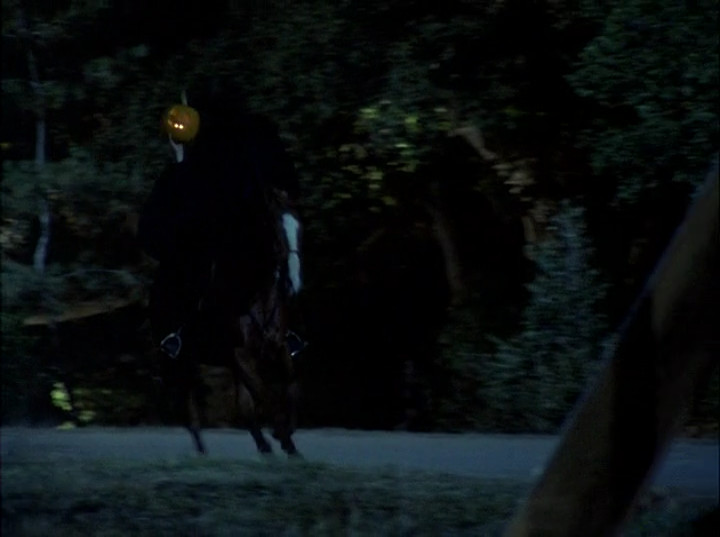
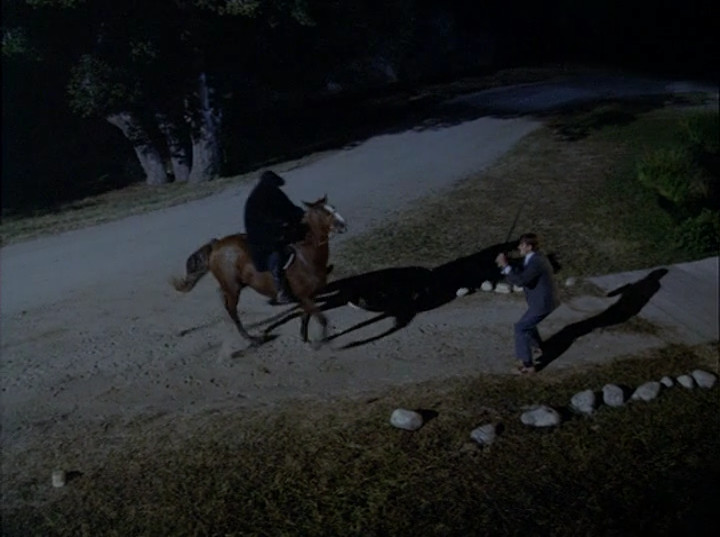
And then, to pay off the title, out of nowhere a headless horseman carrying a jack-o-lantern rides up.

The rider chases Dorian onto the bridge and throws the jack-o-lantern at him. As the rider rides off, Dorian shakes his fist and exclaims, “Damn you, Nate Finley!”

So far, we have a remarkable homage to The Legend of Sleepy Hollow. We’re only about three minutes in, however, and things will begin to diverge, as they must, when Jessica arrives. Speaking of which…

The scene now changes to Jessica arriving from Cabot Cove via the train; Nate picks her up at the station. They begin to catch up, then in what is ostensibly an explanation of what Dorian is doing at the prestigious Wenton Academy (the school/riding academy), we get some obviously important backstory.

Dorian has the job because over the summer the previous poetry teacher, a beautiful young woman named Gretchen, died under mysterious circumstances. The daughter of the Academy’s stable master, she drowned in the river, and—hint, hint—rumor has it that there was a man with her who was the one behind the wheel. If you can’t guess that the earlier mystery will drive the murder we haven’t seen in this episode, you clearly haven’t been watching Murder, She Wrote for long. They do work it in as backstory and gossip well enough that you can feel clever for spotting it, though.

Next, Dr. Penn Walker, the town dentist, shows up:

In this encounter we learn two major things:

  1. The doctor has a strong interest in jewelry; it’s a hobby of his.
  2. He thinks that Jessica is Dorian’s mother.

On the car ride from the train station, Dorian tries to stall Jessica with conversation, in which we learn that the good doctor was engaged to Gretchen, the poetry teacher who died under mysterious circumstances. Also, he was in Europe when it happened. (This simultaneously clears the doctor of being the man behind the wheel and also sets him up with a very strong revenge motive.)

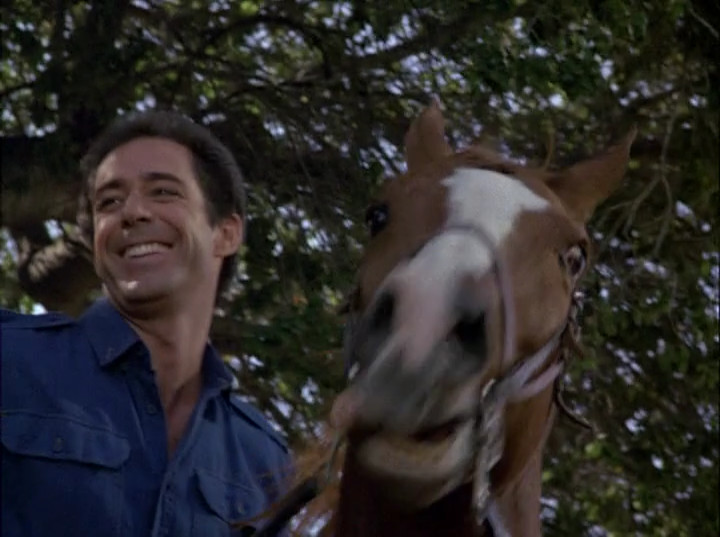
After these important details, Jessica forces Dorian to come clean, and he admits that he’s fallen in love but his intended fiancé’s father has a fixation with pedigrees and so, being an orphan, he wanted to present at least one parent and so lied that Jessica is his mother. This conversation is interrupted by Nate Finley, who rides his horse in front of their car for no reason, then laughs at them.

Clearly, we’re not meant to feel sorry for him when he turns up dead.

(Nate Finley does match the character of Abraham Van Brunt, in being the other suitor for Sarah’s hand and a far better physical specimen, though less socially adept. His character does depart from Van Brunt’s, though, as we’ll see.)

Jessica and Dorian get to the school where some awkwardness ensues as Jessica isn’t sure whether to play along with the lie of being Dorian’s mother. We then get introduced to a trio of boys who play a prank on the stablemaster (driving the horses off, out of the stable). The stablemaster appears to be German; he is named Van Stottard and has a thick German accent, anyway.

Nate Finley happens to be around and threatens the stablemaster that he will find a new stablemaster if the current one cannot keep control of the horses. It’s a noble effort on the part of the writers to distract from the characters just introduced by highlighting what a bad guy Nate Finley is, but one of the problems that Murder, She Wrote writers labor under is that they don’t have the budget for unimportant characters. That said, they do at least have the freedom to make characters important for surprising reasons, so we don’t really know what part the boys play in this.

Dorian accuses Nate Finley of being the headless horseman, which he doesn’t deny. Finley then rides off.

In the next scene, we get the owner of the school telling the headmistress that he wants Nate Finley fired.

This is an unusual move for a television show; ordinarily bullies on TV have the unconditional support of authority figures. The headmistress tells him to calm down; he knows as well as she does that Nate Finley is as good as they come in the saddle, and their riding program is, for some reason, of the utmost importance to the school. Why, is never explained. Even in the 1980s it was a bit of a stretch that wealthy parents would choose to send their children to a boarding school primarily on the basis of its riding program.

The headmistress surmises that the owner is afraid for his daughter, and suggests he should look out for the new English teacher instead. Some more introductions are made and the stablemaster barges in holding all three boys we met earlier. He charges them with committing pranks and they do not deny it; the headmistress says that she will deal with them later.

That night, the headmistress interrupts Nate Finley saddling up his horse to tell him to stay away from the owner’s daughter.

“I want you to stay away from Edwin’s daughter. Satisfy your needs elsewhere.”
“Is that an order, or an offer?”

This dialog is a bit odd in that we learn moments later that the two were involved with each other; she threatens to fire him if he doesn’t stay away from the owner’s daughter and he threatens to tell the owner that they were together. Either way, though, Nate Finley clearly deserves the murdering he’s about to receive, and I suppose that this scene serves to establish the headmistress as a possible culprit.

The next scene moves to a restaurant in which the wait staff dress up in period costume for some reason, and we meet the waittress, Bobbie.

She seems to be set up almost as a love interest for Dorian, except that he never really pays any attention to her. The dentist comes in and sits down with Jessica and Dorian. He notices Bobbie’s neclace, and asks where she got it. She replies, “Nate Finley, Doc. Guess he figures it will get him somewhere, which it won’t.” And before anyone else has a chance to speak, Nate Finley walks into the bar. Jessica warns Dorian not to start anything, but in vain, because Finley starts it.

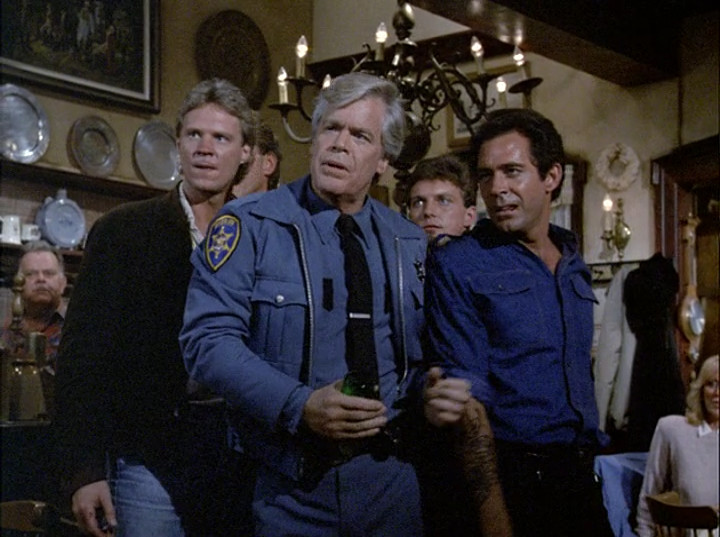
Finley tries to warn Dorian off of Sarah, but Dorian punches him in the mouth. They fight for a while, and Dorian gets shoved against the wall where he knocks down an old saber. He picks it up, as several of Nate Finley’s friends are standing around him.

If you think that there’s any chance that Dorian isn’t holding the murder weapon, you haven’t seen Murder, She Wrote before. Nothing happens here, though, because the Sheriff—who had been conveniently on his way to dinner, I suppose—breaks up the fight.

The fight over, Nate mentions that he thinks he broke a tooth, and a raw nerve in his mouth being exposed, he does the logical thing and asks for a stiff drink from the bartender.

Dorian leaves. As Jessica leaves, she notices the leader of the three trouble-making students feeding Nate Finley’s horse. She says hello to him, but he just walks off.

Dorian goes to Sarah’s house, but no one is home. On his way back, right before the covered bridge, Nate Finley’s friends show up in a yellow pickup truck. He asks them for a ride back to the academy but instead they give him the murder weapon.

They drive off. Dorian only makes it a few more steps before the headless horseman rides again. Dorian tries to defend himself with the sabre…

…but only gets knocked down. His head hits a rock and he falls unconscious.

The next day the stablemaster and headmistress are concerned about Nate Finley’s horse. He had been ridden hard but not cleaned. The sweat has dried into his fur. (This is a problem for horses because the tack the wear—bridle, saddle, etc—will tend to rub the sweat into their skin, causing irritation. Any good horseman will always clean his horse after riding him, for the horse’s sake.) The attentive viewer will infer that Nate Finley has finally been murdered, though the characters don’t catch on just yet. This does yield an interesting problem for the viewer, though, since as far as we know Nate Finley was the headless horseman, and the headless horseman was the last person we saw alive.

Dorian stumbles into the stable and announces his intention to get even with Nate Finley. No one knows where Finley is, though.

Jessica, out on her morning bike ride, runs into the police who have found Nate Finley’s body. The Sheriff asks if Jessica knows where “her son” is, but she doesn’t. No sooner has she said this than a car pulls up with the headmistress and Dorian in it. Dorian launches into a complaint at the Sheriff about how Nate Finley had attacked him the night before. The Sheriff is interested, and asks questions that don’t seem entirely related. Jessica puts two and two together and realizes that Nate Finley has been killed. They see the body under a tarp, or possibly a black cloak. Jessica notices something about the feet:

The boots are on the wrong feet! I’m not giving anything away here, at least by more than a few seconds, as Jessica starts pointing this out to anyone who will listen almost immediately.

It is revealed that Nate Finley was decapitated, so the Sheriff arrests Dorian as having recently threatened Nate Finley with a saber. Curiously, it never occurs to anyone to ask whether a wall decoration at a restaurant was actually sharp. It’s actually pretty rare for wall decorations to be kept in fighting condition. I suppose we’re meant to assume that it was, since the saber is later referred to as “bloody”.

Jessica argues with the Sheriff, pointing out problems with his case, and finishes with the fact that Dorian has sworn that he didn’t do it. That’s supposed to hold weight because Dorian doesn’t lie. When the Sheriff points out that of course she thinks that, being his mother, Jessica accidentally admits that she’s not his mother. As he puts Dorian into the jail cell, he tells Jessica that it’s encouraging to hear that Dorian doesn’t lie.

In the next scene, Jessica and Dorian talk over the situation.

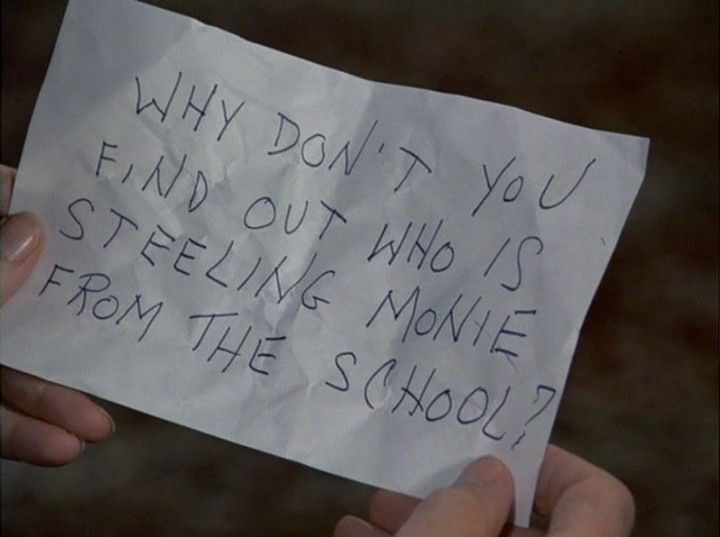
A little bit is added to what we already know. Dorian saw the owner of the school driving off from his house in a hurry. When Jessica talks to Sarah about it, Sarah claims to be the one who drove off, but is obviously lying. The owner comes out and admits to being the one who nearly ran Dorian over. He had gotten an anonymous note that the headmistress was embezzling funds, so he waited until his daughter was asleep and drove off in a hurry to confront her. He did, she denied it, the owner said he would retain an independent auditor, then returned home. (The owner also asks her to tell Dorian to stay away from his daughter or there would be another killing.)

Back at the academy, Jessica runs into one of the three boys, but he runs off when he’s questioned. She runs into the stablemaster, but he refuses to answer questions, except to say that he had no reason to kill Finley but there are others who did. He walks off when Jessica asks if he meant the headmistress, perhaps. So, on to the headmistress.

We get a small scene of the three boys in a secret room at the top of the stables, where one says that they need to tell someone, and the ringleader says that they won’t tell anyone. What won’t be told is, of course, suggestively left off.

When Jessica talks with the headmistress, she says that there is a problem but she’s not the thief. Jessica wonders who knew about the problem and the headmistress gets defensive, asking if she’s trying to implicate her in Nate Finley’s death. Jessica deflects by asking if she’s seen the note.

The spelling is so bad it could even be written by a German! (The stablemaster, you will recall, is German.)

The next scene takes place at the restaurant; it turns out that Dorian has been released from jail, though whether on bail or what is unclear. The waitress, Bobbie, comes over and tells Dorian that she believes that he’s innocent, but if he did kill Finley she could totally understand. It comes out that Bobbie saw Nate riding through town with his black cloak and black floppy hat pulled down low. This was at 11:30, but the Sheriff said that Nate was at the restaurant until 10:30. What happened in that missing hour?

Dorian then breaks a took on an olive, which necessitates a trip to the dentist.

It turns out that he only loosened a cap, which the dentist can re-cement for him. Jessica asks if the doc noticed anything odd about Nate’s dress last night, as he was found with his boots on the wrong feet. The doc observed it would be hard to walk like that; perhaps he had gotten undressed and re-dressed in a hurry. He heard Nate did that quite often, usually with an irate husband in the vicinity.

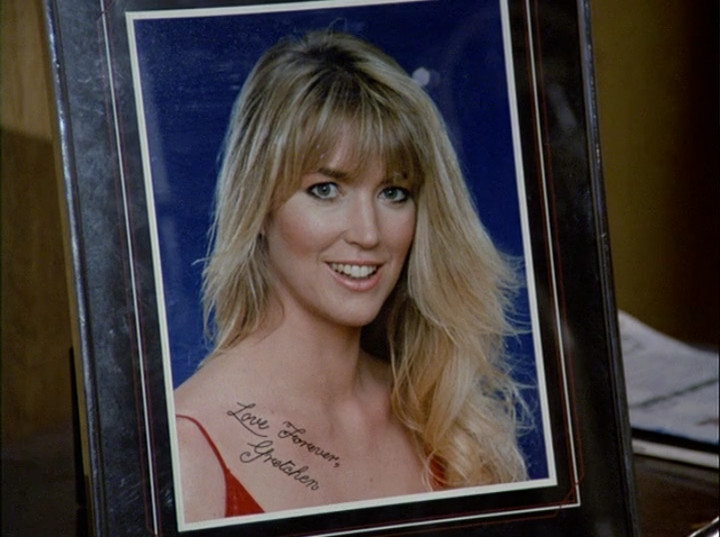
Jessica then notices a picture on the Dentist’s bureau.

(The inscription reads, “Love Forever, Gretchen”. It’s curious how often people in TV murder mysteries give each other signed headshots as keepsakes.)

That night we see a fight between the owner and his daughter, then one of the three boys spies the stablemaster burying something in a horse stall.

The next morning Jessica is with the headmistress, who tells her that it is the stablemaster who stole the money. Jessica goes to talk to him, but can’t find him. She does, however, hear the boys in their secret loft in the stables, and goes to investigate. She uses the secret knock she heard earlier, then as she opens the door tells them, “When I was a little girl, if you knew the secret knock it entitled you to enter.”

She talks to the boys and they admit to having been the headless horsemen who harassed Dorian the first time, but had nothing to do with the second time. Also, one of them saw the stablemaster bury something (he took to be Nate’s head) in a sack.

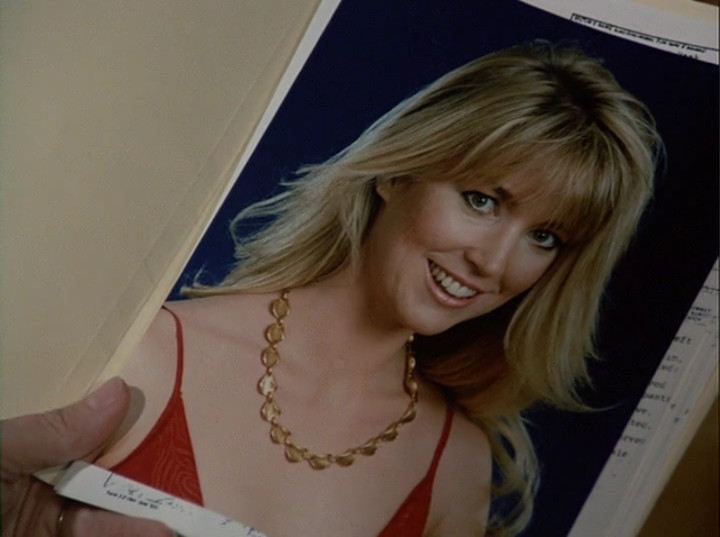
In the next scene the Sheriff has his deputy digging up the spot. As the Sheriff goes to open the box that had been buried, Jessica shields the boys from the terrible sight, but it turns out that the box contains only money. The stablemaster had been embezzling money in order to pay a detective to investigate the death of his daughter. He hands over the file that the detective had assembled. There was nothing of value in it, but for some reason it did include another headshot of Gretchen.

Luckily for Jessica, this time Gretchen was wearing a necklace. Jessica recognizes it and solves the puzzle.

In the next scene the dentist comes to visit Jessica in the restaurant which hasn’t yet opened. Dorian told him that Jessica wanted to talk to him.

Come into my parlor, said the spider to the fly.

This can mean only one thing. If you hadn’t figured it out from the clues or by simple process of elimination, the doctor is the killer.

She realized that the necklace Gretchen was wearing in the headshot was the same necklace that Nate Finley had given to Bobbie. The dentist, who makes jewelry as a hobby, had made it and given it to Gretchen and recognized it when it was on Bobbie’s neck. He couldn’t help but know what it meant—that Nate Finley had been the man with Gretchen when she died. (Presumably he snatched the necklace off of her neck before swimming to safety and leaving her to drown.)

Finley had complained of a busted tooth after his altercation with Dorian, and presumably went to a dentist about it. A lot of things in the case didn’t make sense, like the severed head, unless there was something about the head that would instantly point to the killer, such as fresh dental work.

The dentist broke down and told Jessica what happened. Finley did come, and, seeing the picture of Gretchen, started laughing and telling the dentist all about how he had been drunk and drove the car into a lake and abandoned Gretchen to die. Finley was apparently very drunk, because in the re-enactment, he found the whole thing very funny.

At his bragging about leaving Gretchen to die, something snapped in the dentist and he jammed a pick into Nate’s neck. He died quickly. The dentist then figured that he had to make it seem like Nate died elsewhere, so he stripped Nate, put on the clothes, and rode Nate’s horse out of town, making a lot of noise to ensure he would be noticed. He ran into Dorian and knocked him out, then got the idea to frame Dorian using the saber Dorian was holding. The rest, we already know.


The use of the Legend of Sleepy Hollow setting is definitely very interesting, but it faded pretty quickly. Really, after the first few minutes the only thing that was left was the headless horseman. To some degree this was inevitable as they made the horseman the victim, rather than the murderer. That is simply unrelated to the original story.

Now, variation from Sleepy Hollow was inevitable, since that was not a murder mystery. However, I can’t help but think that they didn’t really make as much use of the headless horseman as they could have. First, I’d like to explain why, then I’d like to talk about how they could have made more use of it.

The big problem that the writers had was that in the original story, Ichabod Crane was not the hero. He was wooing Katrina Van Tassel for her money, not out of love. Worse, Katrina didn’t love him, either. The original story isn’t explicit, but it is very strongly hinted that Ichabod proposed marriage to her and she rejected him. It is further implied that her reason for encouraging Ichabod was to stoke the interest, by jealousy, of Abraham Van Blunt. Van Blunt is not as smart as Ichabod, nor as socially graceful, but he was the man Katrina wanted. This, coupled with Ichabod’s mean motive for wooing Katrina really make him a thoroughly unsympathetic character. So right off the bat, making Dorian the underdog-hero of the story creates a lot of distance from the original.

Further, the structure of the story just isn’t paralleled, because the headless horseman (a decapitated Hessian soldier) was a local legend and Ichabod Crane was an extremely superstitious man. Van Blunt used the legend and Ichabod’s cowardice and superstition to drive him out of town. Indeed, for all of his quicker wits, Ichabod was in a way the intellectual inferior for being superstitious. It’s an evocative story in which a pretentious man was shown up for what he truly was. Except for the way that Dorian is a bit full of himself—which is portrayed in a sympathetic way by the writers—none of this comes forward.

To now consider how it could have been used: the more traditional approach to dealing with this sort of thing is for the murderer to try to use the legend or story which everyone knows and to use it to divert suspicion onto the person who most fits the villain of the original legend or story.

If this were a Scooby Doo episode, then someone could pretend to be the headless horseman in order to try to get people to believe that it was actually the headless horseman who committed the crime. Since this isn’t Scooby Doo, we would need the Ichabod Crane figure to be the victim and the Van Blunt character to be the suspect.

Now, obviously the setup in this episode is nothing like that, but that’s why the episode didn’t really live up to its first few minutes. In fact, they stuck to it too closely at the time of the murder—it really makes no sense for the victim to have knocked the killer unconscious immediately prior to his own murder.

There is, admittedly, something interesting about the idea of the headless horseman turning up to be really headless, but I don’t think that idea can really be made to last any longer than the words necessary to describe it.

The other typical way to handle something like this would be to have someone who rides as the headless horseman then try to frame the victim as the headless horseman, and frame someone else for the murder, as revenge.

This approach would still entail a large divergence from the original story, but it would at least keep up the appearance of being related to the original story, and on purpose. The killer would need to benefit from getting rid of both the victim and the person he frames for the death, of course. This motive would be obscured behind the bigger grudge between the victim and the one framed.

This approach could have been made to fit much better with the setup, though it would need to be the horse instructor who was Jessica’s friend, not the Ichabod character. The doctor, instead of seeking revenge for his dead (unfaithful) fiancé, would be in love with Sarah, too. The doctor would have ridden as the headless horseman, possibly two or three times, then would have killed the Ichabod character. The riding instructor friend of Jessica would then come under strong suspicion of the crime, and she would need to clear his name. The gullible Sheriff could actively point to the legend of sleepy hollow, and how it pointed to the riding friend as the guilty party. If they wanted, they could even have made the parallel stronger by making the death accidental, with the doctor only meaning to scare off the Ichabod character and instead frightening the coward into jumping into the river, where he drowned because he couldn’t swim, or the river was too fast, or whatever. His original plan could have been to just frame the riding instructor for being mean to the poet, and using that to make Sarah dislike him as a suitor, with the homicide and subsequent framing of the riding instructor for murder being accidental.

All that said, this is a very memorable episode, owing largely to the first few minutes and how well they remind one of The Legend of Sleepy Hollow. However much they could have done better, it is a testament to the power of being evocative that this episode sticks with one.

Give people something to remember you by, and they will probably remember you.

Murder She Wrote: A Lady in The Lake

On the tenth day of November in the year of our Lord 1985, the seventh episode of the second season of Murder, She Wrote aired. Titled A Lady in The Lake, it’s set at a resort not too far from Cabot Cove. It’s an interesting episode; I’m not entirely sure why, but I still have fairly vivid memories of the first time that I saw A Lady in The Lake. (Last week’s episode was Reflections of the Mind.)

Jessica is off for a writing retreat at a lakeside resort near Cabot cove. But before we learn this, the camera spends a while taking in the scenery around Stone Lake as swelling music plays and we get the credits.

We definitely take our time; part of this is spent follow the car bringing Jessica. The proprietrix, played by Lee Meriwether (perhaps best known for playing Catwoman in Batman: The Movie starring Adam West), apprehensively watches her pull in to the parking lot from a stop story window. Clearly, this is not a rushed episode.

Then Harry and Jessica get out of the car…

While Harry explains to Jessica that when he heard she was writing a book called Murder At The Inn, he knew this would be perfect for her. Edgar Allen Poe even stayed at it, once! Not this version of it; the original inn burnt down, of course.

Inside the inn, there’s a painting of Edgar Allen Poe.

In the lobby/main area, Jessica meets the proprietrix, Grace Overholtz.

Grace has a six month lease on the place with an option to buy it.

Later on, after Harry leaves, Grace is showing Jessica her room and Jessica notices that it, too, has a picture of Edgar Allen Poe above a fireplace.

Grace explains that the pictures of Poe were Harry’s idea. Grace doesn’t seem overly thrilled with them, but she’s humoring him for some reason. She then sees something out of the window and excuses herself.

The thing she sees out of the window is her boat house manager, Jack Turney, giving some hands-on instruction to one of the guests.

The guest’s name is Betty Jordan, and it turns out that she’s married. Grave gives him a talking to about not looking for trouble with the female guests, but he’s unreceptive to her advice.

Also, here’s a better view of the shorts he is wearing:

Ah, the 1980s.

We then meet more of the guests. First is Carolyn Crane.

She’s playing gin rummy with her unbelievably unpleasant husband, Howard:

We then meet Father Mulcahy Burton Hollis, a teacher on vacation who is devoted to bird watching.

There she meets an assortment of guests—a wealthy, older, overbearing husband (Howard Crane) and put-upon younger wife (Carolyn Crane), an older man who is devoted to bird watching (Burton), a young woman who loves to run naked in the forest (Joanna), and a younger husband and wife where the husband (Kyle Jordan) likes to go fishing and the wife (Betty Jordan) likes to fool around with the boat house manager (Jack Turney) while her husband goes fishing. Not entirely surprisingly, at least given how much screen time the overbearing husband gets, while on a morning bird-watching walk that Burton invited her to, Jessica sees Howard and Carolyn in a boat, wrestling with each other. She calls out, but the wrestling continues then Carolyn goes into the water.

Apparently she doesn’t come back up; what happens in the immediate aftermath happens off screen. Sheriff Tupper arrives soon afterward and looses no time in jumping to the conclusion that Howard Crane murdered his wife.

Jessica isn’t so sure, but doesn’t say much. Kyle Jordan approaches the Sheriff and gives some damning evidence. He had asked the Cranes to go fishing many times, but the they always declined. He thinks Howard couldn’t have meant to go fishing otherwise the Jordans would have come with them; clearly this meant Howard needed them out of the way to commit the murder.

Worse, the previous night Kyle and his wife overheard the Cranes having a loud argument in their room. Carolyn wanted a divorce but Howard said that she wouldn’t get a penny of his money.

After this, Sheriff Tupper goes to the room where Doctor Hazlet is tending to Howard Crane (he jumped in the lake after his wife, which apparently requires medical attention for some reason) to interview him.

Doctor Hazlet gave him a sedative (apparently, getting wet in a lake takes a lot out of you and rest is important), so the interview will need to be short. Howard says that his wife just went crazy and jumped out. He jumped in after her and tried to save her, but he can’t swim so he had to keep a hand on the boat and thus couldn’t reach her. In answer to a question, he says that not only could Caroline swim but she had actually won medals for it in school.

Jessica and Sheriff Tupper confer, and Jessica thinks that Howard’s version makes more sense than the idea that he tried to kill his wife. Inspiration strikes and Jessica goes to look at the boat. In the boat room she finds Betty Jordan and Jack Turney kissing. Betty is bold, saying that her husband doesn’t mind how she amuses herself so long as she doesn’t disturb his fishing, but Jack hopes that Jessica won’t mention it to Betty’s husband. Jessica assures him that she has no intention of telling anyone, anything. She then examines the boat and finds a hook on the bottom of it.

Jack has no idea what that’s doing there, nor when it got there. Some time passes and Sheriff Tupper and Jessica confer. Sheriff Tupper’s research confirms that Carolyn was a champion swimmer, which he takes to mean that Howard must have held her under the water.

Jessica points out that it’s implausible that a non-swimmer would try to kill a champion swimmer by drowning her in a lake. It occurs to Jessica that another explanation would be that Carolyn had made the thing up, to pretend that her husband tried to kill her in order to get a big divorce settlement. This tête-a-tête is broken up by the discovery of Carolyn’s body. It was on the north side of the lake, which apparently is pretty far away from where the resort is (they never say that they’re on the south side of the lake, nor how big the lake is). Sheriff Tupper says that this blows Jessica’s theory out of the water and clearly Howard killed as Tupper had been saying all along. Jessica asks him how the body got to the other side of the lake so quickly, to which Sheriff Tupper has no answer.

Some time later, Jessica is investigating something in a bird book.

What she is looking up we are almost conspicuously not told. This leads to a conversation with the owner of the hotel, who we find out is also a widow. Jessica asks to look at the reservation book, and makes an interesting discovery: Joanna and the Cranes both made their reservation from the same telephone number. Jessica goes and confronts Joanna.

It turns out that Joanna was Howard’s mistress. Howard had been talking like he was going to divorce his wife and marry Joanna, but then this trip came along. It turns out that the trip was actually Carolyn’s idea, and Joanna made the reservations for Howard to prove that there were no hard feelings. She did, however, make reservations for herself and come up early, to disguise her connection to Howard.

Jessica surprises Burton, who was taking (poloroid) pictures of birds, and asks to borrow one that also has a picture of Jack Turney in it. They then see the Sheriff arresting Howard, and Burton says that Howard won’t like jail, as he can’t stand to be cooped up.

Jessica accompanies the Sheriff and Howard Crane back to Cabot Cove. On the car ride it comes out that Howard is claustrophobic, and he accuses Jessica of having talked to his psychiatrist.

It also comes out that Howard is indeed rich, but has no living relatives. He was an only child and his parents are dead. His only uncle and aunt are dead. Even his cousin Arthur died a few years ago, or at least so he’d heard.

Back in Cabot Cove, Jessica, Dr. Halzet, and Sheriff Tupper confer over the autopsy report.

It turns out that Carolyn Crane did indeed drown, but she hand mud in her lungs. Further, she had bits of glass embedded in the skin of her skull. Also, she was wearing a bathing suit under her dress.

At this point a deputy comes in with the information that Jack Turney is a wanted man, for blackmailing married women with whom he’d had affairs and even for assaulting one of them.

We then jump to a scene between the Jordans.

It turns out that Mr. Jordan tried to surprise Mrs. Jordan on her bike ride, only to find out that no bicycles had been taken out that day. He asks her what is going on, then figures out that she’s having an affair with Jack Turney. Apparently, he does actually care how his wife amuses herself while he’s fishing.

There’s some very unimportant events that happen where Jessica and Sheriff Tupper talk to the owner of the inn, where it turns out that Jack Turney is her brother and she’s been protecting him, but didn’t know the extent of his crimes. We then move to the boat house where Mr. Jordan is threatening to kill Jack Turney.

Sheriff Tupper and Jessica arrive, and we have the denouement. Jessica explains the whole thing, though only after a series of misunderstandings and jumped conclusions by Sheriff Tupper.

It turns out that scuba equipment was missing, which Jack Turney had forgotten to mention. Carolyn Crane had a lover, with whom she had planned to fake an attempt on her life by her husband. She had attached the stolen scuba gear to the bottom of the boat via the hook she had installed, then when she was sure of her witness she wrestled with her husband and jumped out of the boat. She put on the scuba gear under water and leisurely swam, under water, to the north shore of the lake. There, her lover met her, but instead of love and support he killed her. He hit her with a pair of binoculars, the only weapon he had to hand.

It turns out that Burton is actually cousin Arthur—that’s how he knew that Howard was claustrophobic—and had planned the whole thing from the start, including killing Carolyn. Howard’s father had accused Burton’s father of embezzling money and had stolen the family business from him. Burton went through the whole elaborate murder scheme in order to get the money he was owed back.

Later on Jessica is asked what made her suspect Burton was not just an innocent birdwatcher, and she replies that he said that he would look for the nest of the yellow bellied flycatcher in a tree. They nest on the ground, she confirmed in the book on birds in that scene where she conspicuously didn’t say what she found.

As she and Harry are leaving, he tells her that she’s far and away the best mystery writer who ever stayed in this lodge. Jessica closes the door behind them, and at that, the portrait of Edgar Allen Poe falls down with a crash. Jessica opens the door again and looks, astonished, at the fallen painting. And on that, we free frame and go to credits.

This is a very fun episode, and takes advantage of what may be one of the cardinal rules of murder mysteries: have a beautiful setting that the reader (or viewer) would love to visit. It’s also got a great setup, and takes a number of well-paced twists and turns on its way to the ending. Something is clearly up with Jack Turney, and they play out the discovery of this at a fairly good pace to distract from the main murder investigation. The reveals on Jack Turney with Betty Jordan work especially well in this regard, as it does hint at the possibility he might have been involved with Carolyn, too. Additionally, the simple human drama of it is distracting.

Speaking of human drama, I didn’t hit on it much in my plot summary, since I was focusing on the murder, but there was a sub-plot in which the widow who is renting the hotel is trying to figure out what to do with her life and whether she wants to run the inn. It’s done sparingly, but comes up often enough to introduce a thread of human interest which pretty clearly as nothing to do with the murder. This is a good move, I think, because it helps to leaven the murder story. It keeps the story more anchored; murder mysteries tend to be better when real life goes on during the murder investigation.

The big problem is the ending. It doesn’t make sense, and ignoring that, it has a significant plot hole in the murder. Ignoring that, a key piece of evidence is very contrived.

I’ll start with the contrived evidence, which is Burton saying, as he and Jessica watched Sheriff Tupper taking Howard into custody, “Howard is not going to like jail. He can’t stand to be cooped up.” There was no earthly reason for him to say this. No one likes jail. It was just volunteering information, that he shouldn’t have had, for no reason whatever. It’s almost on par with the bad guy in Encyclopedia Brown saying, “I never looked inside the kid’s box. I certainly didn’t eat the chocolate chip oatmeal cookies with just a hint of cinnamon that were in it!” It’s one thing when the murderer reveals something he should have known to further his own ends, such as telling a fact he shouldn’t know that implicates someone else in the murder. The distraction of framing the other person can cover for the fact that he shouldn’t have known it. At the very least, there was some temptation for him to do it. Here, there was no reason for Burton to have said anything.

Let’s move on to the plot hole. According to Jessica’s theory of the murder, Cousin Arthur, that is, Burton, planned the whole thing before any of them ever got to the inn. He was, therefore, fulfilling his plan to murder Carolyn when he met her at the shore. Why on earth were his binoculars the only weapon to hand? Had he only put a single minute into the planning, he could have picked up a rock or a stick. Several minutes of planning might have yielded a better weapon still. When it comes to murder weapons, one’s own pair of binoculars, which one not only has been seen with but even drew attention to, is a terrible choice. And without the binocular glass embedded in Carolyn’s skin, there would have been no physical evidence linking him to the murder.

The other problem with the ending is even harder to get over—why on earth did Cousin Arthur kill Carolyn? Both Jessica and Burton seemed to talk as if he would inherit Howard’s money, now that the only other possible heir was dead. The problem, however, is that Howard Crane was still alive, and would presumably remain so for decades. The worst that would happen to him would be that he would be convicted for murder and go to prison for a long time. A person going to prison keeps their money. It does not get disbursed to heirs. (For those curious, the state of Maine abolished the death penalty—for the final time—in 1887.)

In Maine in the 1980s, framing Howard for the murder of Carolyn would mean that Cousin Arthur would never see a penny of the money he believed to be rightfully his. In fact—assuming he didn’t murder Howard—the only way for Cousin Arthur to have gotten his hands on any of Howard’s money would be to keep Carolyn very much alive and marry her after she got a large divorce settlement.

This feels almost like someone ripped the plot off from a British golden age detective story in which a man being convicted of murder would mean that he was hanged within a few weeks and thus framing a man for murder was an effective means of inheriting money from him. In that context, this ending—apart from volunteering private information about Howard and using binoculars as a murder weapon—would make sense. In Maine in the 1980s, it’s quite a head scratcher.