
In this video I look at how jocks-vs-nerds is fiction—primarily a projection of insecure hollywood writers.
Beware of Praise From Popular People
In this video I talk about why one should beware of praise from popular people.
Is (New) Atheism Boring?
This video, which is a response to a video by Dave the Distributist, which was titled (New) Atheism is Boring, Stop It, considers the question of whether (new) atheism actually is boring. (Obviously people should stop it, regardless.)

Murder She Wrote: If The Frame Fits
The final episode of Season 2 in Murder, She Wrote is titled If The Frame Fits. It’s a really good episode. It’s got good structure, good dialog, good acting, good settings—it’s very well done. Other than not being set in Cabot Cove, it’s the sort of episode that’s why one falls in love with Murder, She Wrote.
The opening is dramatic. We go from the establishing shot of a grand house (used in the title screen) right to a burglar breaking in.

Shortly after, Jessica and her friend Llyod Marcus come driving up. It turns out that this is Llyod’s house.

They came home early from a party because Llyod wanted to discuss a manuscript with Jessica. A “friend” wrote a draft of a murder mystery, and he wants Jessica’s thoughts on it. They go inside and he calls for his valet, but then remembers that it’s the valet’s day off. Jessica then recognizes one of the paintings. “That’s a Desmond DeVries, isn’t it?” “I wouldn’t know,” Llyod responds. “One of those splatter paintings is the same as the next, to me.”
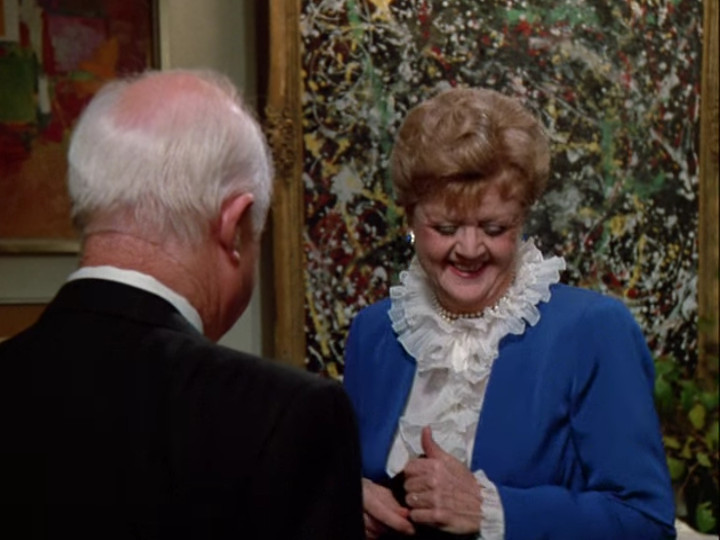
It turns out that it was his late wife who was the collector. In turn, Jessica reminisces about Frank’s model car collection, until Llyod reminds her that they are there to discus his “friend’s” manuscript. Jessica fetches her copy from the library and we get an ominous shot of the thief hiding behind a curtain, his boxcutter knife held in a vaguely threatening way. Jessica doesn’t notice, though, and returns to Llyod. She tells him it might be better if she spoke directly with the author, and Llyod says that would be impossible because he lives in Tibet. Then they hear a sound from the library. When they examine the library, a painting which was there a minute ago is now missing.
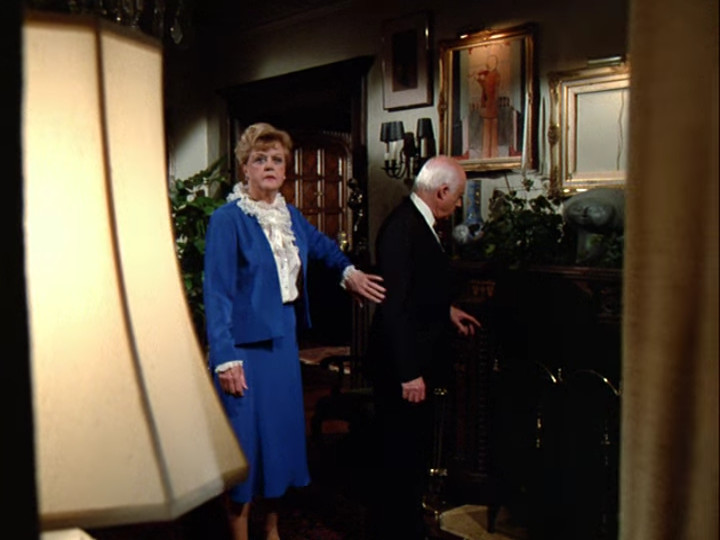
Soon thereafter, we meet the police chief, named Cooper, and, so far as we know, the only policeman in the community. He was originally from New York, as we could tell by his accent if he didn’t mention it in his backstory. Also, his wife wants him to be a plumber, since it pays better. This is a recurring theme in his conversation.
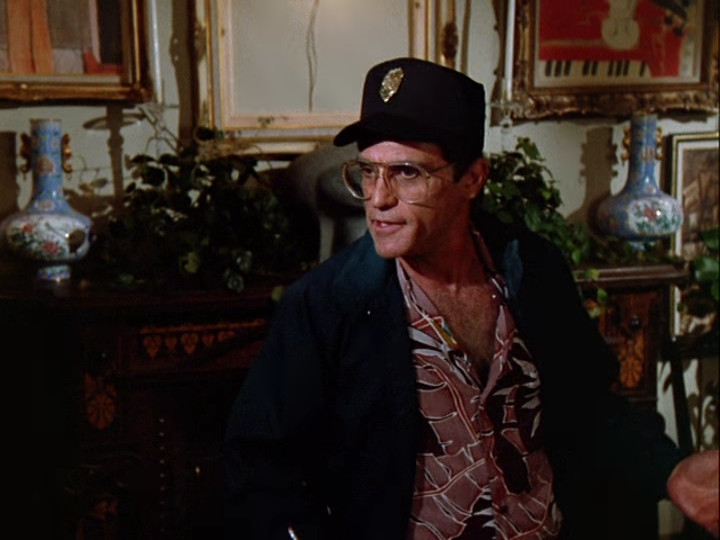
To be fair, he looks more like a plumber than a police chief. He also doesn’t seem to be very good at the police stuff. Later on, Jessica has to stop him from handling evidence with his bare hands.
Anyway, it comes out that this is but the latest in a rash of burglaries in Cedar Heights. There’s been one approximately every three months. The thief leaves no clues and none of the paintings have been recovered. This conversation is cut short by the appearance of Llyod’s valet. He’s in his late fifties or early sixties and has a very English accent, which feels a little out of place. The episode tries to make him a character in the story, but not very hard, so I’m not going to bother with the extremely minor sub-plot that involves him. His entrance through the kitchen door did give Jessica the opportunity to examine the door, though, and she finds that there was a piece of tape on it. The piece of tape that’s left isn’t in a place to do anything useful, but it does suggest that the thief had taped the latch to prevent it from engaging and locking the door.
The next day, at some sort of country club, we meet the mayor and his wife, Mr. and Mrs. Tilley.
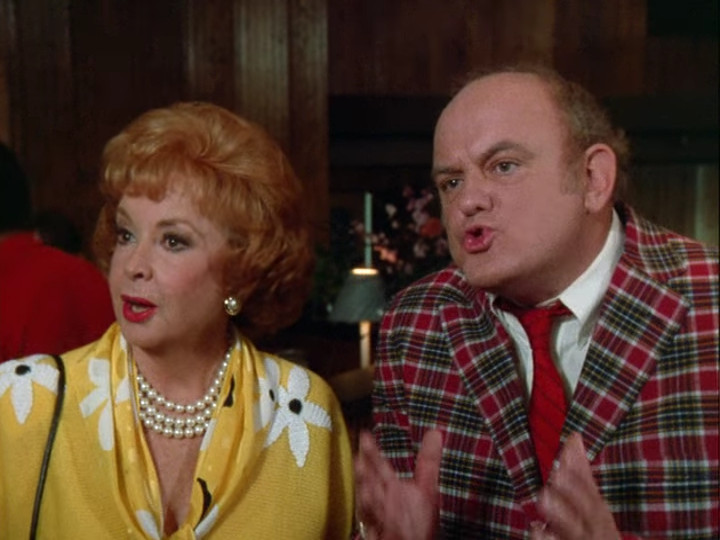
Apparently being the mayor is a side-hustle for him; he makes his living selling insurance. In fact, he’d insured all four huge art claims this year. He’s worried he’s going to be fired for… insuring paintings that art thieves like to steal? Would they have preferred that he not sell policies to people? Would replacing him with a different insurance salesman be at all likely to result in only selling insurance to people who buy paintings that art thieves don’t want? I’m unclear what he’s nervous about. Now, if he worked for a small insurance company, or better yet owned a small insurance company (not that small insurance companies can really exist anymore, but that’s a more esoteric detail), it would make sense for him to worry about it going out of business because of all of the claims. Alternatively, it would make sense for him to worry that with premiums going up so much because of all of the thefts, no one will buy insurance anymore and all of his commissions will disappear.
Be that as it may, we’re introduced to the next character—Lloyd’s oldest daughter, Julia.
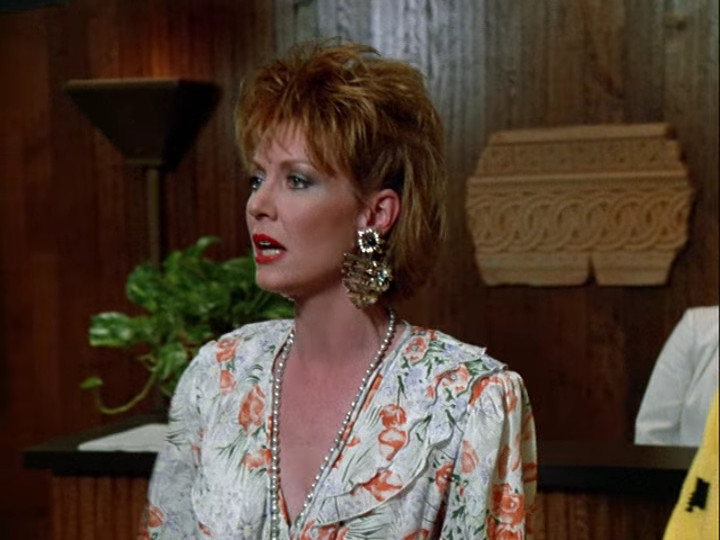
You may not be able to tell from the picture of her, but she is a deeply unpleasant woman. Within all of her complaining, we learn that her father doesn’t approve of her marriage, and we get the idea that she blames his disapproval for her marriage not being what she wanted it to be.
Julia takes Jessica for a walk, to show her “how the leisured class lives”. Somehow or other this ends up at a golf course, and we meet another of the important characters in our story: Binky Holburn. He’s played by the inimitable John DeLancie (if you know him, there’s a good chance that it’s as Q from Star Trek: The Next Generation).
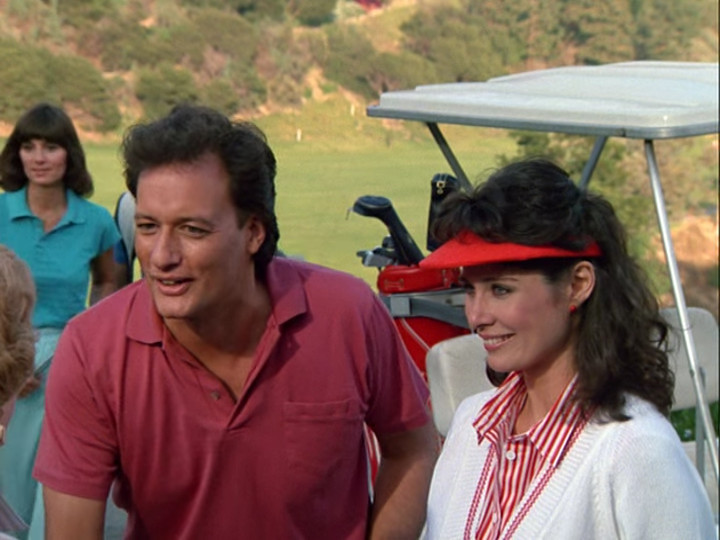
With him is Ellen Davis. She’s… somehow attached to the country club. I’ve no idea how; she seems to be simultaneous a golf instructor, bill collector, and manager.
Binky is delighted to meet Jessica. So much so that Llyod remarks, “Binky was so anxious to meet you he came by my house yesterday before I’d even left to meet your plane.”
Murder, She Wrote needs to strike a balance between disguising the clues so that one needs to be watching out for them and also obvious enough that many if not most people will catch them. Indeed, this is a needle that all mystery writers must thread, though in a novel one has a much larger amount of hey in which to hide the needle, if you’ll pardon me for switching metaphors mid-stream. A TV show—even an hour-long one—doesn’t have nearly as much time and so disguising the clues is much harder.
Binky then brings up the subject of the art thief, remarking on Jessica nearly meeting him. He mentions that one of his was the first painting stolen, and advances the theory that it’s a drug addict, since he only takes mediocre paintings and leaves the masterpieces.
Binky then invites everyone to a dinner party in Jessica’s honor. Ellen declines because of too much paperwork to catch up with. Julia declines saying that she planned a very quiet evening because she and Donald, her husband, so rarely get to spend time together.
In the next scene, Jessica, Llyod, and Julia are having lunch. After Julia is monstrously unpleasant for a bit (can you guess by now who is going to get murdered?), her husband and younger sister, Sabrina, walk in to join the lunch. There’s a curious tension about this, like there’s more to it than a brother-in-law merely helping out his sister-in-law.

This completes the cast of major characters in the episode. It’s an interesting collection of characters; there are many relationships and many possible relationships, though still a small enough group to keep track of. Not much happens at lunch before the scene is over. Jessica is introduced to Donald and Julia gets the double martini she had ordered. She and Donald are a little cold, though they don’t say much past the minor discussion of why he’s late.
The next scene is Binky’s dinner party with Jessica and Llyod. Binky finishes up a story about his favorite cafe in Paris, laments that Donald has a business meeting and Sabrina a headache, then remembers Llyod’s book. Jessica (who signals to Binky that she doesn’t want to read it) says that she left her manuscript back at the house. Binky suggests to Llyod that he go get it. Llyod delightedly jumps up and says that he won’t be ten minutes.
On the car ride home, Llyod looks crestfallen, while Jessica tells him that his friend would be far better off writing about something closer to his personal experience.
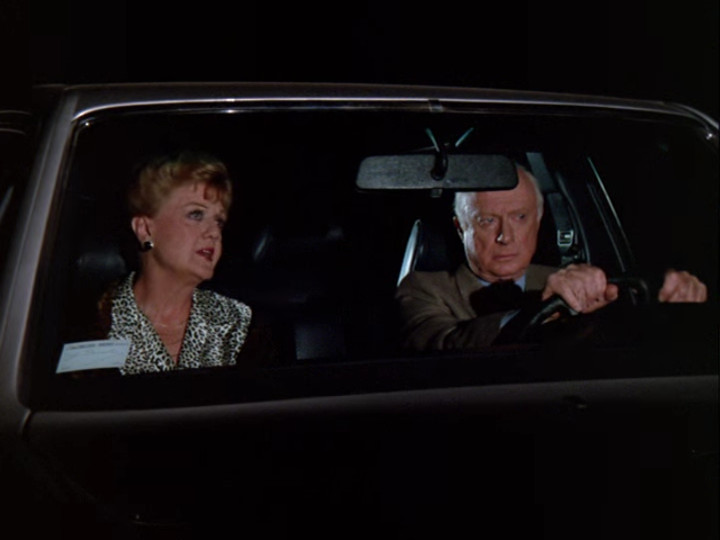
Llyod dejectedly says, “That’s allright, Jessica, your comments were very helpful.” He then pulls up in front of his daughter’s house (it was established that they live “practically nextdoor”) and peers out of the window. Then he says, “That’s odd. Julia’s front door is open.” Llyod cranes his neck to look out of the windshield, and they show us what he’s looking at:

If you look very carefully, you can see that the front door is in fact open, but Llyod couldn’t have seen this when he started to slow down. In fact, he comes to a stop before he looks closely at the door. It’s pretty clear that he knows something is up.
They go to investigate, and if your money was on Julia as the corpse, congratulations, you win. They find her crumpled on the floor with a rope around her neck.

I’m guessing that there’s a commercial break here, because we cut to the chief of police crouching over the dead body, saying that the situation is under control. What situation he’s referring to is unclear. It seems unlikely that anyone is worried about Julia reanimating as a zombie or a vampire—other than that, I’m not sure what control there is to worry about. He doesn’t seem to have done any investigating yet past having removed the cord from around the victim’s neck.
Jessica offers to take Llyod home and he refuses since he might have things that he can tell. Jessica relents and starts investigating. It’s unlike her to have waited for the police chief to have arrived. Normally she’d have investigated than said to the police chief, “surely you’ve noticed…” after he arrived. This way plays a little better, though, so I suppose we just have to forgive it.
Jessica asks how long the clock on the mantle had been broken, and Llyod says that it was perfectly fine the day before. The police chief concludes that it was “broke in the struggle” and provides a time of death. Jessica, very sensibly, asks what struggle it was supposed to have been broken in. Everything else on the mantle is in good condition, nothing is in disarray, and the body is nowhere near the clock. Jessica recommends that he takes the clock in for lab analysis and he starts to grab it. She reminds him, “including for fingerprints” and he then thinks to pull out a handkerchief to use to pick it up. I generally like it when the police invite Jessica’s help, but it’s stretching credulity a little far that he wouldn’t think to look for fingerprints. In fact, the more incompetent an investigator the more I would expect him to want to lean on easy evidence like fingerprints.
Jessica then looks at Julia’s neck, now that the cord has been removed, and there’s a thin cut along it. The cut is the sort of thing that would be made of she were strangled with wire, not with a thick rope like was around around her neck. The clues are beginning to add up that we are not looking at a pristine crime scene. Clearly, what we found was staged. But by whom, and why?
Jessica notices a button clasped in Julia’s left hand.
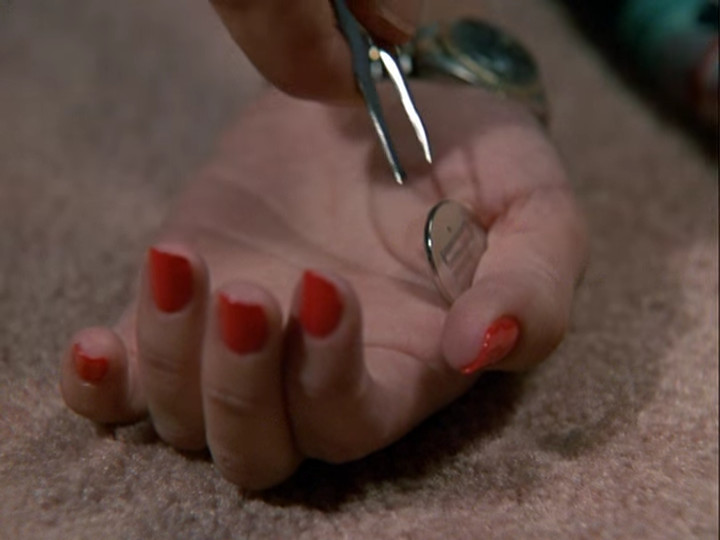
Victims ripping buttons off of their murderer’s clothes is a somewhat overdone trope since grabbing your attacker’s buttons and yanking is neither useful nor instinctive. Even grabbing one’s murderer’s buttons and hanging on until you’re dead so that the murderer must yank his sports jacket away from your corpse’s steel grip isn’t exactly a strong instinct in our species. Moreover, even if one were to rip a button off of one’s murderer’s coat, it would be incredibly hard to do it between the thumb and palm, as it’s shown in the picture above. All that said, for reasons we’ll get to soon, the button being where it is actually fits in this case.
The button turns out to have the initials “DG” on it. Llyod proposes that they stand for “Donald Granger,” as he recognizes the button from a suit Donald had made in Saville Row on his honeymoon. I guess we’re supposed to believe that he put on his honeymoon blazer to murder his wife out of sentiment?
Just as Llyod is explaining his theory as to why Donald did it, Donald walks in and says hello, then notices the chief of police and the corpse on the floor. Llyod rushes over, shouting about how Donald killed his daughter. Then they go to Donald’s wardrobe and match the button to the blazer. When it matches, Donald says, “Stop it! Everything is all wrong. This is insane. I didn’t kill her.” Jessica ignores this and asks Donald where he was. Llyod interjects that no business dinner lasts until one (presumably, AM). He must, therefore, have been cavorting with a floozie. He movies to attack Donald once more, but Jessica restrains him.
The next day Llyod is pacing the floor, having refused food as well as not sleeping, apparently waiting for a telephone call. It arrives just as Jessica walks in the room. The police chief called to let Lloyd know that he has formally charged Donald with the murder of Julia. After Sabrina says that Donald couldn’t have done it and Lloyd explodes at her the evidence is clear, then storms off, Sabrina tells Jessica that Donald wasn’t a fortune hunter—at Lloyd’s insistence he signed a prenuptial agreement which means that he wouldn’t get a penny of Julia’s estate. This clue duly delivered, Sabrina leaves to get Donald a lawyer. I’m kidding, slightly. She said it in Donald’s defense because her father had just called Donald a fortune hunter. It works the information in naturally. The problem is just that the information stands out so much that we can’t help noticing it. And if somehow you did miss it, Jessica pauses and looks thoughtful to make sure you know that something important just happened.

Mrs Fletcher then goes to see the police chief. The police station is interesting, by the way:
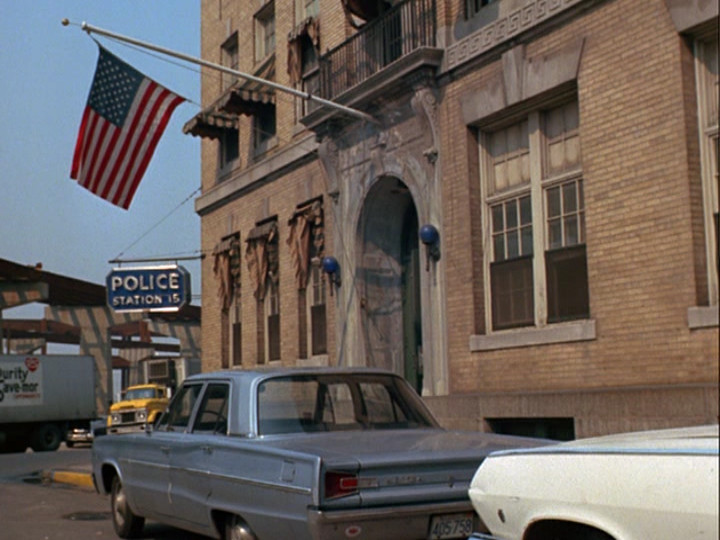
Cedar Heights is generally discussed as if it’s a secluded enclave for rich people an hour or more outside of New York City. The chief of police does his own plumbing and doesn’t have so much as a single deputy that we’ve ever seen. And yet, to go by this establishing shot, it’s got multi-story buildings and elevated train tracks. Also, the sign says “Police Station 15”. That’s an awful lot of police stations to have with a single policeman in town.
Anyway, as he’s trying to fix the pipes in the sink in the office attached to his bathroom, the police chief says that Donald Granger’s story doesn’t hold water any more than the pipes do. His business meeting had been canceled earlier in the day. His story is that he went to the seafood shanty, met a friend, and had a late supper. However, the police chief says, no body drops in to the seafood shanty. It’s way out near the beach somewheres. The kind of place people go where they don’t want to be seen. He won’t name the friend, either. The chief’s analysis is that for someone who is supposed to be bright, Granger committed one hell of a stupid murder. Jessica emphatically agrees. Granger’s lawyer then shoes up to bail him out.
We now move to the country club, where Ellen Davis hand-delivers a bill to the mayor’s wife.

Mrs. Tilley makes an impressively catty comment. After complementing Ellen on her outfit, she observes that if you’re going fishing, it pays to have attractive bait. Ellen smiles, and attributes not receiving a payment from the Tilleys in several months to the mail being dreadful, lately. It’s a decent disguising of information, but I, suspect that the writers actually wanted to draw attention to it and so didn’t disguise it too carefully. Jessica isn’t around to draw our attention to it with clue-face, so they can’t afford to be as subtle, I suppose.
Ellen smiles and walks off. I still wonder what her job is supposed to be at this country club, but we never do find out. The mayor’s wife then walks into Jessica, who is at the country club for some reason. She invites Jessica to a dinner party, but Jessica declines because she can’t make any plans under the circumstances. Mrs. Tilley interprets that to be about investigating the case, and starts talking with her about it. It’s hard to tell whether she’s interested in the case as a mystery or just loves nothing so much as gossip. Either way, she’s got information to share, and is eager to do it sotto voce.
She tells Jessica to cherchez la femme, in this case, the younger sister, Sabrina. It turns out that Donald had originally been with Sabrina, but then she introduced him to her sister and he switched to the older sister. However, Donald has had lots of late-night business meetings in Manhattan… need she say more? Jessica replies that she’s said quite enough enough already. Why Jessica disapproves of gossip now, when it helps her investigation, I don’t know. She’s normally happy to smile at any sexual impropriety, and in fact will again later in this episode. Mrs. Tilley goes on to say that it would be convenient if the murderer were Donald, though, since it would mean that her husband’s firm wouldn’t have to pay up on the million dollar life insurance policy that her husband sold them the day after they were married. I guess they must have waited to take their honeymoon. That one warrants clue-face with eyebrows.

Jessica goes off to see the police chief. For some reason, she runs into him at the scene of the crime. She tells him about the life insurance motive that Donald Granger has, but he gets a phone call from someone confirming that Donald Granger was, in fact, at the Seafood Shanty at the time of the murder. They didn’t recognize who he was with; she was a brunette and a “real looker”. Chief Granger remarks that none of it makes any sense, and Jessica agrees. She goes through the list of contradictory evidence.
Supposedly Julia tore the button off of the tailored blazer, but her carefully manicured nails suffered no damage. The cuts on the neck were unlikely to be made by a thick rope. Then Jessica notices the painting on the wall. The chief of police looks at it too, and remarks that they all look alike to him.
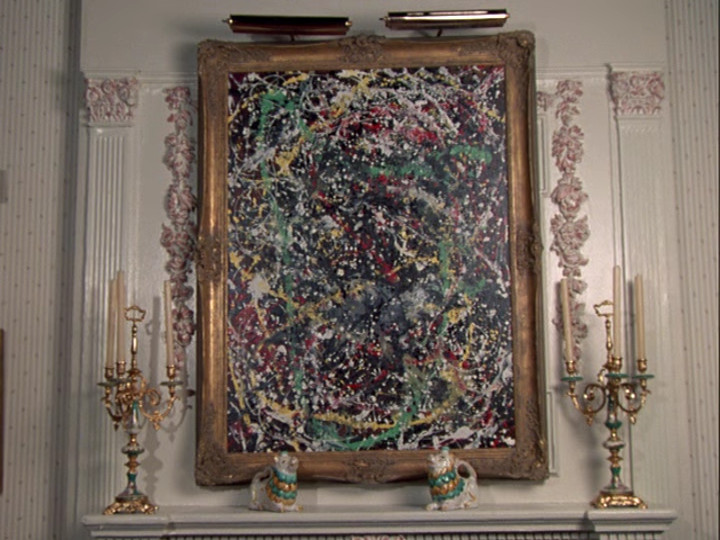
Jessica goes to Lloyd’s house and confronts him. The other day, on the drive home, she thought he was preoccupied because of her comments on his manuscript, but now she thinks otherwise. As much as he believes that all splatter paintings look alike, they don’t, she recognizes that the painting now hanging over Julia’s fireplace was in Lloyd’s library the day before. Further, she has to wonder about his having been gone fetching the manuscript for forty minutes when he said he’d back in less than ten minutes. This last part isn’t playing fair with the audience as the length of time he was gone was never mentioned. For all we knew until now, he had indeed returned in less than ten minutes.
That bit of hiding evidence from the audience aside, the revelation that Lloyd had found Julia dead on his way to pick up the manuscript and rearranged the scene of the crime to frame Donald does certainly make sense of many of the things we saw that night. Lloyd was excessively preoccupied, and stopped by Julia’s house before he could have seen the front door was open. His having already known that Julia was dead makes more sense of what we saw, so I do think this twist is entirely fair.
At the police station, Lloyd tells the police chief what happened. The painting over Julia’s mantle was missing from the frame, and the room was in a horrible mess.

They all go to the crime scene where Lloyd describes what he had found. The painting had been cut out of its frame, and the wire from the painting was wrapped around Julia’s neck. A pizza cutter was lying on the floor nearby, presumably used to cut the painting from the frame. The lock on the reader door was taped over, just like at Lloyd’s house. There was a small penlight outside the door. The clock had been smashed on the floor, he just replaced it. He cleaned the crime scene up, replaced the stolen painting with one of his own, ripped off the button and pressed it into Julia’s stiff fingers, then left the door open and went to rejoin Binky and Jessica.
In response to Jessica’s question about what happened to the frame and wire, he threw them in the garbage, which according to the police chief is incinerated every day, so all of the evidence has been destroyed. Daily garbage pickup is pretty impressive. This evidence being gone somehow allows the police chief to conclude that Lloyd killed his daughter himself, since (according to him) the only reason to frame someone is if you committed the crime yourself. Frankly, I’m not sure how the empty frame and the wire and pizza cutter being found in the trash would have exonerated Lloyd. There would have been no reason to switch paintings if the painting had not, in fact, been taken. Strangling his daughter with a wire then substituting a rope also served no possible purpose if she hadn’t been killed as part of an art theft, and the chief is not accusing Lloyd of being the art thief.
At the wake for Julia, Jessica delivers the news to Donald and Sabrina. He’s surprised that Lloyd hated him so much, and Sabrina is, as ever, confused. She asks what to do and Jessica says that the only way to exonerate Lloyd is to find the Cedar Heights art thief. Donald says that there must be some evidence—finger prints, or foot prints, or perhaps they could trace the pizza cutter?
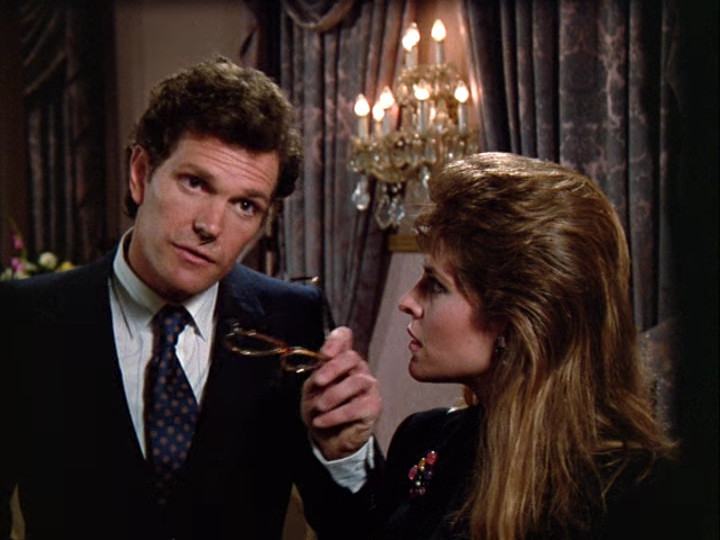
Unfortunately, Jessica says, Lloyd destroyed all of the evidence. They need to go to the country club to begin at the beginning. Donald gives her a ride and drops her off. She runs into Ellen Davis, and asks where Binky Hoburn is. Ellen says she just left him, and Jessica gives her the good news that Donald Granger is no longer under suspicion for the murder. Ellen looks confused and agrees that it is good news. Jessica continues that it’s especially convenient for her because it relieves her of the obligation to give Donald an alibi. She surmises that while the employees at the Sea Shanty didn’t know her name, they would probably recognize her photograph. Ellen says that she was just checking out the place and ran into Donald there. She recommends not reading too much into that, it might prove embarrassing, and Jessica asks, embarrassing for who? Ellen doesn’t answer, she just walks off.
She finds Binky on the putting green, and apparently he is absolutely terrible at golf. In response to her question, he says that the night his painting was stolen he was on his evening constitutional. He always goes for a walk after dinner, and you could practically set the town clock by him.
Next she talks with the Tilleys, since theirs was the next painting stolen. Their painting was definitely insured. Mayor Tilley was offended at the idea that he wouldn’t ensure his own property—insurance isn’t about the money, it’s about peace of mind. Anyway, they were at the opera in New York when it happened. Everyone who was anyone was there. It was also the maid’s night off. Jessica then goes to see the police chief. He’s doing more work on the pipes on the sink in his office.
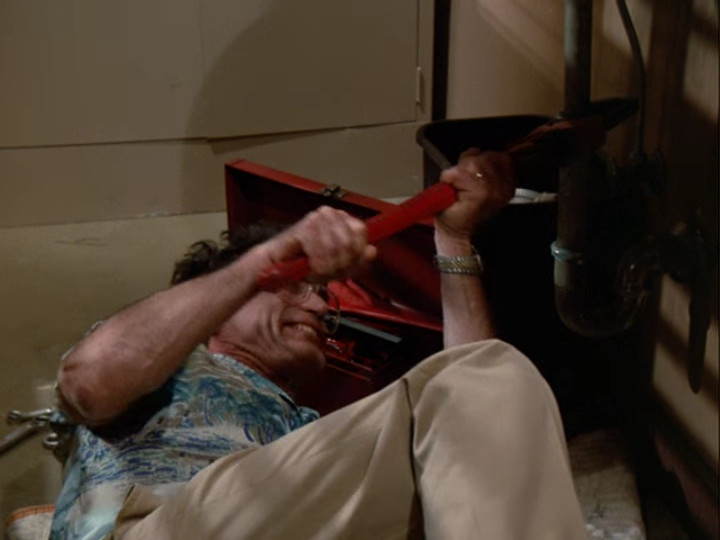
Mayor Tilley is with them, and somehow got the information that by pure luck “a friend of Carpenter spotted [one of the stolen paintings] in an Edinburgh gallery.” In the ensuing discussion, it comes out that in every theft it was the servants’ night off and the owners weren’t home either. This suggests to Jessica that the thief is someone with intimate knowledge of the community—one of its members.
Jessica then pays a call on Ellen Davis. (She actually first runs into Lloyd’s valet, but the conversation doesn’t really add anything besides the suggestion that the Tilleys are in financial difficulties, which we already knew and which probably didn’t change what Jessica did anyway.) Somehow the subject of Donald Granger comes up, with Jessica implying that there’s something between them. Ellen replies, “You mean, were we having an affair? This is the ’80s, Mrs. Fletcher. Promiscuity is not, exactly, page one news.” In contrast to her scolding tone of Mrs. Tilley talking about infidelity, here Jessica just indulgently nods her head and looks at Ellen.

Jessica is, as always, remarkably selective in what she shows disapproval of. Moreover, she’s remarkably cosmopolitan in what she shows disapproval of. She dislikes gossip, but isn’t phased by cheating and adulterating a marriage. One of the great weaknesses of Murder, She Wrote writing is that Jessica is in no way a small town character. In a small town, you have to deal with the fallout of people adulterating marriages because people still live with each other afterward; adultery can be a hardship on an entire community. In a big city, adultery just means that people stop going to the same parties which they probably won’t be invited to anyway, and otherwise they never see each other again. Quite apart from the moral aspect of adultery, someone who comes from a small community will instinctively dislike the way this is community-wrecking behavior. It’s only city-folk, who have no community, who don’t give a thought to the communal impact of decisions.
Jessica stares Ellen down, and Ellen discards her bravado and explains. She had worked in Donald’s club in New York. He was very unhappy in his marriage and was going to ask his wife for a divorce. (For some reason, on television, mistresses always believe that the married man is going to leave his wife and marry her and then be faithful to her. How similar this is to reality, I have no idea, though since adultery is hardly a smart idea, it would not be shocking if the people doing it are prone to not thinking it through in real life.)
She took the job at the country club—whatever it is—to be closer to Donald. This I find a little odd, since part of the problem in the marriage is that he spends all of his time away from home. Working at the country club should actually put her further away from him while he spends all of his evening in business meetings. (If “business meetings” was code for sleeping with her after work, it’s unclear how moving to cedar heights could have put her closer.)
Her friendship with Buinky Holburn is just a ruse. In reality, she finds him a bore. He talks incessantly of his house and art and his trips to England and Scotland and other places that art might be fenced, approximately every 3 months. Jessica asks if Binky is in financial trouble, and Ellen replies that while the idle rich are notoriously slow payers, Binky is the exception. She just wishes she knew where he got the money from.
Well, if she can’t put two and two together, Jessica can. Her next stop is at Binky’s house, with the chief of police and a warrant to look at his passport. I wonder on what basis the chief got a warrant; having money and supposedly making trips to Great Britain every three months isn’t exactly slam-dunk evidence, especially when all we have is the word of some guy that one of the paintings turned up in an Edinburgh gallery. Fortunately, the warrant is unnecessary—Binky admits it and is delighted that it took someone of Jessica’s caliber to catch him. He opens his safe and produces Lloyd’s painting.

The odd thing about it is that the painting goes all the way to the edge. The thing is, canvases always go several inches past that, in order to wrap around the wooden stretcher and be nailed or stapled into it with the edge folded over so that it won’t fray loose. If the painting were actually cut from the front, it would ruin the painting as it couldn’t be re-mounted without losing several inches. Unless we’re going to chalk this up to the prop department, it seriously calls into question Binky’s competence as an art thief. Especially with this being his sixth time—surely some art gallery he fenced it at would have complained by now. More on this in a bit.
Binky remarks that it was great fun while it lasted. He never took the real masterpieces, the insurance always settled so no one was hurt financially, and no one got hurt. The chief adds, “until Julia Granger caught you.” Binky laughs at this. He was having créme caramel with Jessica when Julia was murdered. The chief wonders if this means that they have a second art thief, and Jessica says, “not exactly.” They go over the evidence, and when they get to the pizza cutter, Binky exclaims in surprise. What on earth would a pizza cutter be doing there. He always used a single-edged razor. A pizza cutter is ridiculous because it would ruin the painting. Upon hearing this, Jessica sees the light.

The light Jessica sees, of course, is that a pizza cutter is an inappropriate tool to the task, which means that the “thief” had no idea what he was doing. There’s actually a secondary significance to this, which I’ll get to in a minute. Before we get there, there is a problem with this evidence.
Actually, before we get to the problem with the evidence, I want to mention the problem with Binky’s response to it. He protests that he doesn’t have a pizza cutter. In fact, he’s never eaten a pizza in his life!

The logic is somewhat odd; to not have eaten a pizza is not the same thing as to not have a pizza cutter. In the recesses of my pantry I somehow own a slap chopper, and I’ve never in my life slap-chopped anything. When I chop things, I use either a kitchen knife, a cleaver, a hatchet, or an ax (depending on the thickness of the thing to be chopped). With a knife one cuts to chop, with an ax one swings to chop. Never once have I slapped anything to chop it, and yet there the thing somehow is. That said, Binky has an alibi for the time of the murder so the fault in his logic is of no great significance. So let’s move on to the problem of the pizza cutter being a bad tool for stealing paintings.
The episode doesn’t give full details on how the painting was actually removed in Julia’s house, but in general there seems to be the suggestion that the cutting tool would be used to cut the painting from the front. If you did this with a pizza cutter, this would indeed ruin the painting, but no more than if you did it with a single-edge razor. Heck, you could cut it with a high-tech laser or a sci-fi monomolecular saw. The problem, which I mentioned above, is that the canvas for a painting is several inches wider and taller than the part that you see because it has to be wrapped around the wooden stretcher that holds the painted surface taught. If you cut it from the front, you’d lose several inches of the painting when you wrapped it around a new stretcher. Now, there is something for a competent art thief to cut when stealing a painting, but it’s not the canvas.
When mounting a painting on a wooden stretcher into a frame, it is typically taped, from the back, to the frame. This is done with a specialized tape called, uncreatively, “framing tape”. It’s a brown, papery tape which has an adhesive that’s meant to last years and ensure that the painting never falls out. If you are going to steal a painting, it would be more convenient to remove the frame and it would be a pain in the neck to peal the framing tape off, so the easiest option is to turn the framed painting around and cut the framing tape on the back. The painting will not be wedged tightly into the frame, so there’s room for a knife to go in without harming the canvas. So here’s the thing: this is equally true of a pizza wheel as it is of a single-edged razor. You are no more likely to damage the canvas with a pizza wheel than with a razor. In general, I would expect art thieves would normally go for a razor over a pizza wheel simply because the razor, being smaller, is easier to carry, and less likely to make noise since pizza wheels are frequently prone to rattle. That said, you can find tools meant for cutting fabric which are basically extra-sharp pizza wheels with a bit smaller blade because they don’t need to worry about the axle getting caught in cheese. Here’s a picture of my wife’s:

When I cut fabric I just use fabric scissors. The wheel cutter requires, or at least does best, with the backing mat you see it resting on in this picture, which is too fussy for my taste. Still, it exists and, I’m told, works well. A pizza cutter is more optimized for cutting pizza, but the things are just as capable of taking a sharp edge as any other piece of thin metal, and it would be perfectly fit for purpose, as the British say.
What we’re left with is that a pizza cutter is a slightly unusual choice for the imitation art thief to have picked. That is sufficient, though, because we did hear somebody who knew about this odd choice without being told.
Before we get to that, though, we have one final scene with Sabrina and Donald Granger. They’re at the funeral home, getting the flowers ready.
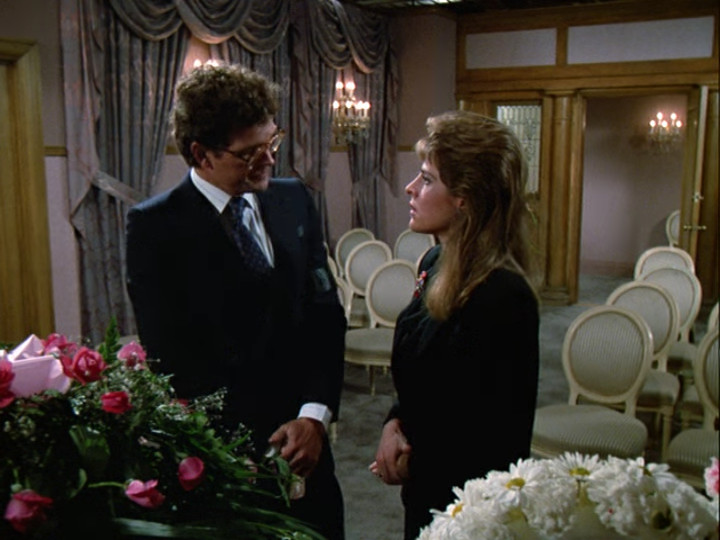
If you’re familiar with Murder, She Wrote, you’ll know this means that there’s a 98% chance that one of them did it. Sabrina seems to be implying that she wants to move on from being brother and sister in law to having a romantic relationship. Jessica even interrupts them by telling Sabrina that they’ve discovered the identify of her sister’s killer. This is so much the setup for the revelation that Sabrina did it that it might almost make one forget that Donald Granger had mentioned the pizza cutter without having been told about it.
Jessica presents the evidence, except for his slip about the pizza cutter. It’s not very strong and he argues with her. He presents his alibi, of being at the seafood shanty with Ellen Davis, but Jessica counters that the medical examiner couldn’t be so precise with the time of death. He counters that it had to be 9:45 because the clock was broken during the struggle. Whereupon the chief of police walks in from just offscreen and asks him how he knew that, since it wasn’t made public and he had bagged the clock for evidence before Donald had come into the house. Moreover, Lloyd said that when he planted the jacket button in Julia’s hand, her fingers were stiff, which means that she had to have been dead some hours. (That said, I don’t think that Lloyd’s evidence is worth a damn against his son in law, given that he’s already tried to frame him once, but that’s OK because catching Donald doesn’t hang on this.) As he tries to struggle out of this, Jessica then reveals his slip up with the pizza cutter. Then the dramatic music signaling that the case is proved plays.
Sabrina, troubled by everyone’s silence and the conclusive music, declares that she doesn’t believe it. Donald tells her, “Believe it, Sabrina. It was a million dollar craps shoot, and I lost. Count your blessing, kid. It could have been you in that box.” Sabrina attacks Donald uselessly. He pushes her off and Jessica holds and comforts her as the police chief leads Donald Granger off to one of the many police stations in the small town of Cedar Heights. Interestingly, the episode ends here, on a somber note:
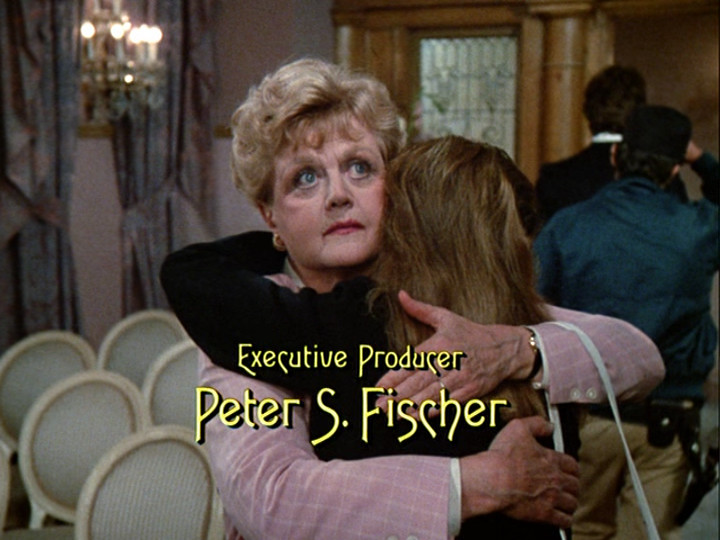
I would be curious to know how the writers decide between ending solemnly and ending slightly after the denouement, with everyone laughing. This ending fits, though I actually think it’s a pity that we don’t get to see Ellen Davis anymore. It would be interesting to know whether she blames Jessica for catching Donald or thanks her. It would also be interesting to see Lloyd’s reaction to learning that he had framed a guilty man.
Be that as it may, I hope you can see why I think that (despite not taking place in Cabot Cove) this is one of the great Murder, She Wrote episodes. It has an interesting cast of characters that are pleasant and interesting, with the exceptions of Julia (who, thankfully, is murdered fairly quickly) and Sabrina (who doesn’t get a ton of screen time). Despite having at least fifteen police stations, Cedar Heights has a small-town feel, which partially makes up for not being in Cabot Cove. The particular settings are mostly pretty, and even the awful splatter art is at least partially redeemed by its badness actually being a plot point.
The episode takes a little while to introduce all of the characters and for the murder to happen, but it makes up for that by starting off with the art theft and keeping that mystery going while we meet the characters. It both makes the episode more interesting and also makes it more complex. At the same time, it’s not merely complicated; the two mysteries intertwine in important ways. Even the murder mystery is done in stages, where we first have to unravel that the crime scene was substantially tampered with before we can get on to solving the murder. Once that progress is made, the art theft mystery becomes of primary importance, and only once that’s settled can we properly tackle the murder mystery. There’s a lot to sink one’s teeth in, and with how the plot is constructed, it all matters.
One tradeoff, due to the limited time in a Murder, She Wrote, to fit all of this in, is that the case against Donald Granger is a bit weak. The evidence against him is almost entirely having slipped up and mentioned the pizza cutter he shouldn’t have known about. Even that wasn’t worked in very naturally. He was trying to seem eager to catch the killer, but he should have waited a little bit longer, so he could make the slip while he was caught up in the conversation. The way it was done, he basically volunteered the information unprompted. This might have been OK if he wanted to seem clever, but what he actually wanted to seem was eager, not clever. Passion, conviction, and sincerity are what are needed to sound eager, not information or deductions. Other than this, there was no real evidence against him.
Which is actually a little bit odd, since he set the clock’s time while holding it in his bare hands.

This one I’m going to chalk up to an error in production. There’s no way that he would have forgotten to have worn gloves during such a carefully premeditated murder. Further, the chief bagged the clock for evidence, so unless we’re to suppose that Lloyd somehow smudged all of Granger’s fingerprints, he had to have worn gloves when he set the clock and wardrobe just forgot to give him gloves for this shot.
During the accusation, Granger does give a second piece of evidence against himself—his knowledge of the clock having been broken “in the struggle”. Realistically, these do seem to enough to get a conviction, but it’s a little unfortunate that the proof had to be manufactured rather than discovered. Still, it was at least manufactured through Jessica’s skill rather than by sheer chance, like the knowledge about the pizza cutter. It was also manufactured by presenting the case against Granger, rather than through lying to him about having lost an earring that never existed, or something like that.
Overall, I also think that the episode was pretty fair, as far as giving us all of the clues goes. We got a hint that the art thief was Binky pretty early, when Lloyd mentioned that he had been at Lloyd’s house the morning of the robbery—the clue which comes later about Binky taking trips every three months is confirmation of our suspicions, it’s not wholly new. (That Binky has plenty of money could go either way; we have no reason to suppose he didn’t inherit sufficient wealth to pay his dues at a country club on time. That said, his not being hard up certainly doesn’t cast doubt on his identity as the art thief.)
We also were given plenty of clues that the murder scene was tampered with. The clock was smashed in the struggle but there was no struggle. Julia was clearly strangled with a wire, but there was a cord around her neck. They did conceal from us that Lloyd took forty minutes to get the manuscript when it should have taken him less than ten, but I think that they made up for it by having Lloyd clearly stop before he could have seen that Julia’s door was open.
As to the murder itself, there was only one real clue that it was Donald and that was his slip up about the pizza cutter. Actually, that’s not quite true. Lloyd did mention Julia’s stiff fingers, which suggested that she had been dead for hours by the time he found her—not that they actually told us when that was—which does carry the suggestion that Donald’s alibi wasn’t good. That said, if the time of death was much earlier, Binky wasn’t having créme caramel with Jessica when it happened. In fact, I don’t think he was anyway, because the murder had to have happened before Lloyd left to get the manuscript, and they hadn’t started the créme caramel yet—Binky told Lloyd that if he hurried he’d just in time for it. Binky might still have Jessica for an alibi, but it would have had to have been long before desert.
All that said, Binky having been the killer doesn’t fit with the modus operandi of the art thief. He stole paintings every three months, and had just stolen a painting from Lloyd the night before. This was never brought up, but it was actually a bit of a slip-up on Donald Granger’s part. The art thief, having had such a regular schedule before, might hurry it up a bit, but it doesn’t seem plausible that he would hurry it up from every three months to every three thirds of a day. I think, though, that we simply need to forgive this as time compression so that Jessica can be present when the murder happens, in which case it wouldn’t be fair to use it to exonerate Binky. I think we’ll need to fall back on Jessica being Binky’s alibi earlier in the evening. He had invited everyone over for a dinner party, and even though they finished the evening somewhere in the viscinity of 1am and were having créme caramel some time after 9:45pm, they probably started dinner before 8:45pm, which is the time that Donald Granger started setting the clock forward from in the flashback. Rigor Mortis sets in anywhere from 1-6 hours after death (averaging 2-4), so if Lloyd found Julia at 9:50pm, that puts the time of death anywhere from 8:50pm to 3:30pm. The latter might run into the late lunch that Julia was at, but it seems unlikely that Binky had Jessica as an alibi for that entire time. If we suppose that the dinner party started with wine and snacks at around 6pm, though, I think that Binky is probably pretty safe.
Obviously, If the Frame Fits is not perfect, but at the same time its imperfections admit of explanations that are (reasonably) satisfying. It gives one meat to chew on. Oh, and it has a remarkably clever title. Quite early on, it seems to suggest that the art thief is the killer, but ends up referring to the guilty man having been framed for the crime. Even better, this is in distinction to the framing of the thief for the murder which the real murderer tried to do. That frame didn’t fit.
The Danger of Finding Your Meaning in Another Human Being
In this video I talk about the danger of finding one’s meaning in another human being.
(It has been pointed out, correctly, that this would constitute idolatry, but it’s a specific kind of idolatry which is somewhat easier to fall into because it doesn’t involve casting gold jewelry into statues, and bears some specific investigation.)
An Interesting Murder Technique: Snake Venom
Unusual poisons are not that popular as a means of murder in mystery stories these days, but all the same, I just got an idea for an interesting one: injected snake venom with the same symptoms as a poison.
One of the difficulties with poisons is that it’s really hard to have an alibi with one. The benefit to a snake venom is that if people don’t look for injections, they won’t be able to find out how the poison was administered, because it wasn’t. A person who thus had no access to the food of the victim could probably put themselves out of suspicion this way.
As an additional benefit, if the police do not specifically suspect snake venom, it is exceedingly unlikely that the lab will run any assays for snake venom. Even if they did, they would tend to look for the venom of native species rather than rare imports.
This is only a half formed idea so far, but it has some interesting possibilities.
Snake Talk Episode 2: My Superdwarf Reticulated Python
In this episode of Snake Talk I introduce Thomas Aristotle, my 50% superdwarf reticulated python from Reach Out Reptiles. At the time of this video he was about 6 months old.
Life is Not a Simulation
A discussion of the “simulation hypothesis” (though more realistically, the simulation hypotheses), what they are, why they’re wrong, and why they are attractive to the people they attract.
She’s Always a Woman
Among the classic Billy Joel songs is the sort-of love song, She’s Always a Woman. It’s a really fascinating song.
Wikipedia gives this explanation of the song’s lyrics:
It is a love song that Joel wrote for his then wife, Elizabeth Weber. Elizabeth had taken over management of Joel’s career, and was able to put his financial affairs in order after Joel had signed some bad deals and contracts. She was a tough and savvy negotiator who could “wound with her eyes” or “steal like a thief”, but would “never give in”. Because of her tough-as-nails negotiating style, many business adversaries thought she was “unfeminine,” but to Joel, she was always a woman.
This may be true, but is uninteresting. What Billy Joel’s then-wife was like is of no concern to anyone but them and the people with whom she negotiated. As such, it’s not really helpful. So what, if anything, can the rest of us make of this song?
The first few lines give a good idea of the tone:
She can kill with a smile, she can wound with her eyes
And she can ruin your faith with her casual lies
And she only reveals what she wants you to see
She hides like a child but she’s always a woman to me
The first two descriptions suggest captivating beauty, which make a great deal of sense for what will follow. After that comes a collection of faults, following by the conclusion, “but she’s always a woman to me”. It’s by no means the clearest of conclusions, since, after all, how could she be anything else?
One possible explanation is in the final line preceding the conclusion. She hides like a child, but is always a woman to him. That is, to her she embodies the ideal of the adult, even when she behaves like a child. Taken this way, the refrain makes sense since all vices are a privation of virtue; a woman, as such, is honest. To ruin one’s faith with her casual lies is the act not of a woman, but of a sinful woman; a woman damaged by sin and only part woman.
Interpreted this way, it fits in with the rest of the song. Consider the next few lines:
She can lead you to love, she can take you or leave you
She can ask for the truth but she’ll never believe you
And she’ll take what you give her as long as it’s free
Yeah she steals like a thief but she’s always a woman to me
All of these things are privations, yet she remains a whole woman to him. The next few lines are more of the same:
Oh, she takes care of herself, she can wait if she wants
She’s ahead of her time
Oh, and she never gives out and she never gives in
She just changes her mind
And she’ll promise you more than the garden of Eden
Then she’ll carelessly cut you and laugh while you’re bleeding
And then we finally get more explanation:
But she brings out the best and the worst you can be
Blame it all on yourself ’cause she’s always a woman to me
These lines are extremely interesting both because they give an explanation of why he insists on treating her like a woman when she is such a damaged woman, and also because it is advice to someone else who is dealing with her. I’m going to get back to that in a moment but I want to look at the final verse first:
She is frequently kind and she’s suddenly cruel
But she can do as she pleases, she’s nobody’s fool
And she can’t be convicted, she’s earned her degree
And the most she will do is throw shadows at you
But she’s always a woman to me
The first line here is interesting because like the first line of the first verse, it’s not wholly negative. It begins with a virtue. The conclusion which immediately follows—but she can do as she pleases, she’s nobody’s fool—can be taken two ways. It can either be a general sort of permission because she is not a fool, or it can be taken to mean that she has no loyalty and explains it as not belonging to anyone (a common way that disloyal people try to portray loyalty as a vice). Either interpretation works with the rest of the song.
The line about how she can’t be convicted because she’s earned her degree is a very curious cause-and-effect. Presumably this refers not to a criminal conviction but is saying (metaphorically) that one cannot win an argument with her. She is too experienced at dueling with words (which I take to be the metaphorical significance of “she’s earned her degree”).
The final fault attributed to the woman—and the most she will do is throw shadows at you—brings us back to the explanation that I want to come back to. The crux of why she’s always a woman is that she “brings out the best and the worst you can be”. That is, in being devoted to her he finds motivation, both to good and to evil. She gives him a reason to live. It is, however, an insufficient reason. We know that because she’s not God, but he explains it in more concrete terms. The most she does is throw shadows at him. Shadows are curious things because they have form without substance. A shadow is merely the privation of light; it looks like something but isn’t real. You cannot touch it or taste it or hear it; you cannot even, in the strictest sense, see it. All you can see is where the shadow isn’t, from which you infer the shadow. Shadows are, in the strictest sense, illusions. All she ever gives is appearance without substance.
There are, then, two possible reactions. One is realism. To admit her faults, and do whatever seems appropriate with that information. (If she really is as bad as she sounds from this song, that would be leaving her if she were not one’s wife and trying to help her as best one can if she was.)
The other is what the singer recommends to the man who has replaced him, to whom he is singing this song: pretend that she’s what you want her to be, even though she obviously isn’t.
There is another interpretation of this song. It’s more pleasant but harder to square with the lyrics. In this interpretation, “she’s always a woman to me” connotes forgiveness. This basically requires ignoring almost all of the other lyrics, as they describe ongoing faults which are not repented of, but where there is a will, there is a way.
Snake Talk Episode 1: Aphrodite the Ball Python
In this inaugural episode of Snake Talk, I show off my firefly (pastel fire) ball python, Aphrodite.
A Note About Marching To Different Beats
Henry David Thoreau once said:
If a man does not keep pace with his companions, perhaps it is because he hears a different drummer. Let him step to the music which he hears, however measured or far away.
Depending on the context, this can be good advice. Still, it’s good to remember that if you march to the beat of a different drummer, don’t be surprised if people think that you have no rhythm.
Aquinas Fifth Proof for the Existence of God
In this video I talk about Saint Thomas Aquinas’ fifth proof for the existence of God (the governance of the world) and why it is so often misunderstood in the modern world.
There Was a Casablanca TV Series
Looking up the credits of an actress in a Murder, She Wrote episode, I discovered that there was a Casablanca TV series made in 1983 (she guest starred in an episode). It only ran for five episodes, though the reviews for the DVD on Amazon say that this was a pity because it was actually good.
I’m skeptical.
There is a clip of the title sequence on YouTube, which uses the song As Time Goes By as the theme song for the show:
I’ll admit that it looks better than I expected, though it still doesn’t fill me with confidence. At the time of writing, the DVD is out of production and used copies are going for $80 and up, so I’m not likely to find out for myself what it was really like. This sort of thing is the reason why copyright should have a relatively short initial term (like 20 years) and require active renewal in order to be extended, if extensions are really necessary. It would be really interesting to find out what the heck this show was, and I really doubt that anybody is seeing royalty checks from it these days anyway.
Supposedly this was a prequel show to the movie, focusing on the small, local adventures of Rick. It’s kind of crazy that this got as far as having one episode made, let alone five!
Why Heaven is above us and Hell is Below Us
In this video I look at the standard metaphor that heaven is above us and hell is below us, what these positions means, symbolically, and why they are so commonly used.
A Comment on The Butler Did It
On my recent post The Butler Did It: Poirot Style, I got an interesting comment from Paul. It brings up some points which I would like to discuss at greater length.
Somewhere I heard the phrase “nobody’s a hero to his valet” which could apply to his butler.
So I disagree that a murder by the butler is out of bounds because the butler is an employee “thus” not personally connected to the victim.
An employer could very well give an employee Very Good Reasons for the employee to want his boss dead.
And yes, a valet or a butler could quit (although getting a good reference might be a problem), but have other reasons to not quit.
One thought on the butler, as I understand the job, the butler manages the household staff so might likely know “when the best time/place to kill somebody without witnesses”. 👿
On the subject of no one being a hero to his valet, I believe that this is because the man is an object of professional aid to the valet; he is passive while the valet helps him to dress. The valet, though a servant, is an intrinsically superior position during the performance of his duties. This is not precisely the same for a butler, who would not, in the ordinary course of things, lay his hands upon his master. Which brings us to the last point, about the butler managing the household staff. This will depend to some degree on the particular household, as the jobs of servants were somewhat elastic with the actual number of servants present.
In Victorian times and through (about) World War II, butlers did tend to be in charge of the servants in midsize to large households. They did not tend to be present in smaller houses, and in the very great houses there might be a steward who was in charge of the domestic staff with the butler taking on his more historical role of being in charge of the wines, or somewhat more expansively, of the food and drink. (The term “butler” comes from words in older languages meaning, basically, bottler, i.e. one in charge of the bottles.) Murder mysteries don’t tend to be set in the mansions of kings or similar, though, so I think it would be reasonable to presume butlers will be in charge of the household staff and thus in a good position to arrange a time that is especially convenient for murdering someone. But this, in fact, raises something of a problem in choosing the butler as the murderer—it makes it too easy for the murderer.
I know that most most of the rules of detective stories focus on not making it too easy for the detective, but it is actually the case that if one makes it too easy for the murderer, it spoils the fun. Murder mysteries are meant to be a human drama, and in a human drama the reader sympathizes with both sides of the puzzle. We want the detective to win, but at the same time we do also need to be able to see ourselves in the role of the murderer, if for no other reason than we have to think like him in order to try to catch him before the detective does. A murderer who merely has special powers (such as being able to arrange everyone to avoid witnesses) is too unlike us. And then there’s the even more basic problem that the puzzle has to be difficult to solve or there’s no fun in solving it. That’s why the dumb police detective always arrests some poor servant, since the servants have obvious opportunity. Abusing a position of trust is too easy.
All that said, I think that Paul is right that the butler could make a reasonable choice for the murderer within the bounds of the murder having to be personal. Off the top of my head, he could know that the victim was carrying on some evil that he thought needed to be stopped. The employer taking advantage of serving women would work for this. The butler could know that his employer committed some heinous crime and got away with it (but without sufficient legal proof to ensure a conviction). The butler could do it for the sake of a child that the victim was mistreating, or even just to bring the inheritance to the adult child from whom help was being cruelly withheld in getting started in the world. The butler could even secretly desire to have an affair with his master’s wife and hope that by killing his master he will have cleared his chance to take his master’s place.
I think that if one wanted to take this approach, it would be important to make sure that the butler is noticed as a character. He would need to be active during the investigation. Doing things outside of his duties, and speaking not only when spoken to. If he remained entirely passive and looking like the normal servant, who is there in the typical mystery only to furnish some alibis and clues, the typical reader would, I think, feel he had been treated unfairly. Yes, the reader is hoping that the writer will try hard to trick him, but at the same time the trickery has to be of a certain sort. A double-bluff, such as having somebody else frame the murderer for the crime, is a great sort of trick. Bluffing that someone is out of bounds when they’re not isn’t the right sort of trick. In real life someone might creep over to his neighbor’s house during a dinner party to murder him, hoping to throw suspicion on the guests. In a murder mystery, if someone dies during a dinner party in an mansion and it isn’t one of the guests, but it is revealed in the last page that the detective found the neighbor’s footprints, the writer has played foul. Granted, I’ve emphasized it by having the writer play double-foul by not revealing the clue which incriminated the neighbor, but even if there were some tracks leading to the neighbor’s house, if they were not cunningly planted by a dinner guest in order to make the absurd suggestion that it was the neighbor, the reader would still justifiably feel aggrieved. It’s not on any of the lists, but we do need some reason to doubt that the murderer committed the crime. Having an obvious criminal and not going with it because the detective is too clever for his own good is the stuff of parodies. (Quite literally. If you want to read such a parody, The Viaduct Murder is an excellent example of exactly this.)
I think that a decent example of what I mean about how to do this well can be found in the Poirot story which my previous blog post was about: The Adventure of the Italian Nobleman. In it the butler is quite prominent. We get all sorts of information from him which he volunteers beyond the scope of the ordinary butler. He stayed to overhear a conversation with his master; a thing which no ordinary butler would have done. He is an obvious suspect, but manufactured for us a still more obvious suspect. Moreover, there is evidence in the beginning to make us suspicious of the butler’s story, such as the last course not having been eaten by anyone, and the telephone having been on the receiver, requiring the dying man to have replaced the receiver as he gasped out his last breath. These incongruities make us notice the butler early on, such that his being the culprit is a shock we were prepared for. Moreover, he did not merely hide in his job. He took an active role in the misdirection after the crime. He was caught, not by process of elimination, or by fingerprint identification as being a notorious criminal, but by having made mistakes which Poirot noticed and caught him by. This, I think, is the sort of template to follow if one wants to write a mystery in which the butler did it.
The Hardest Christian Doctrine to Believe is Forgiveness
In this video I talk about why forgiveness is, of all of the Christian doctrines, the hardest to believe.
The Butler Did It: Poirot Style
I have a series of posts about the onetime common phrase, “the butler did it”. The first was The Butler Did It? The short version is that it’s curious that this phrase exists since it’s hard to find examples, in mystery novels, of when the butler actually did it. In the series I present a few theories as to how this could be, as well as look at the few examples I could find of when the butler actually did it. I had thought that I was done with this series, but I just came across another example! (Without counting, I think that brings me up to four.) If it’s not obvious, by the way, spoilers will follow, so if you haven’t read the Poirot short stories yet, go do that before continuing.
The story in question is The Adventure of The Italian Nobleman. It was first published in The Sketch magazine, issue 1604, published on October 24, 1923. This is a scant three years after the publication of the first Poirot story, The Mysterious Affair At Styles. According to Wikipedia, Agatha Christie wrote these short stories for The Sketch at the suggestion of its editor, Bruce Ingram. (The Sketch was an illustrated weekly journal which began its run in February of 1893.) It came towards the end of the group of short stories which would later be collected in the book Poirot Investigates, though of course we can’t be sure that it was not written earlier and merely published later.
Before proceeding, in the interests of full disclosure I should note that, technically, the murderer is not, very strictly speaking, a butler. He is a “valet-butler.” I think I am not being unreasonable in saying that this is close enough, though.
The structure of this story may be closer to the quintessential “the butler did it” than the other examples I can think of, with the possible exception of The Door by Mary Roberts Reinhart. In The Adventure of the Italian Nobleman, the butler had obvious access to the victim but concocted a complicated story which implicated someone who had a more obvious motive. The pursuit, at least by the police, of this other man, distracted us from considering the butler’s story too closely.
Having said that, I should perhaps take a moment to defend the idea of a quintessential “the butler did it” story. If the thing can barely be found in literature and mostly exists mostly as a joke, what right do I have to claim that there is such a thing as an ideal of it? And yet, I think that we can take a stab at it because of some of its features.
In particular, “the butler did it” seems to be describing the murderer being the person least suspected because he is akin to the furniture. S.S. Van Dine’s reason for prohibiting servants from being the criminal, though overstated (and a touch snobbish), gives some insight here:
11. Servants–such as butlers, footmen, valets, game-keepers, cooks, and the like–must not be chosen by the author as the culprit. This is begging a noble question. It is a too easy solution. It is unsatisfactory, and makes the reader feel that his time has been wasted. The culprit must be a decidedly worth-while person–one that wouldn’t ordinarily come under suspicion; for if the crime was the sordid work of a menial, the author would have had no business to embalm it in book-form.
I think that it’s actually related to another prohibition, number seventeen, which states that a professional criminal must not be the murderer. The unifying theme is stated in rule number nineteen, that the motive for murder must be personal. What all of these things are getting at is that there must actually be some connection between murderer and victim. It’s not enough merely to have been in the same place at the same time. This is what the butler doing it gets wrong (most of the time). A butler’s relationship to his employer is, by definition, that of an employee. This is the opposite of having a personal connection to the victim.
There are exceptions to this, of course. He could have taken on the job of butler merely to gain access to his victim, as part of a revenge plot. He could be a long-lost relative who will be an heir to the victim. There are, undoubtedly, other such schemes for which buttling gives the murderer an excuse to get near his victim. They will all have in common that being the butler is merely a cover story, even if he did actually buttle. What they also have in common is that—this trope aside—the butler is not someone you would ordinarily suspect of having a relationship with the victim. People do not, customarily, employ their relatives. Therefore, if you suspect the author of playing fair you will tend to not suspect the butler.
And here we come to what I think is likely to be the reason for this trope existing, that is, what the trope of “the butler did it” really means. I think that it means that the murderer is the person we least expect because the story is structured so that he would be one of the people who is normally “out of bounds.” (To borrow a sporting metaphor.) I’ve mentioned before in this series that I think that the trope was probably far more common in plays that in novels. If plays were the TV shows of yesteryear, it makes sense that they would tend to be written by hack writers who would try to be clever but would have trouble being really clever. Thus they would be more prone to pick someone the audience has no reason to suspect, like the butler. They can’t just have it be the butler, though, because they would seem random and hence unfair. As a compromise, they then reveal (without warning) that the butler is actually a long lost cousin or an illegitimate nephew or some such. The adage that the butler always did it probably, then, was conceived in response to this sort of plot device. It is advice to expect a hack plot in which the least likely person can be relied upon to be the culprit, though with some contrived connection as an excuse.
If my guess is correct, The Adventure of the Italian Nobleman does not really fit the mold. Its butler is too much in the foreground. Apart from the suspect for whom we have only the butler’s word was there, the butler is in fact the only person with the opportunity to commit the murder. Mrs. Christie is, in this way, playing fair with the audience more than the prototypical butler-did-it story would. The butler is a legitimate suspect, and we are distracted from him only by his own ingenious misdirection. If one stops to think for a moment, one would suspect the butler.
So, all things considered, I’m not sure if it’s right to classify The Adventure of the Italian Nobleman as a butler-did-it story. The butler did do it, of course. That’s not at issue. The question is whether he did it in the right way. With that the question, I don’t think that it’s an example of the trope, if the-butler-did-it even can be called a trope. Still, it’s worth mentioning, since, after all, the butler did do it.
Channel Update (August 2020)
Just a quick channel update on where the channel was, back in August of this year.
Efficiency and Robustness Are Enemies
In this video I look at how efficiency and robustness are intrinsically enemies. (The short-short version is that robustness means the ability to take damage without reducing output, while efficiency means that every part is contributing to output.)
Don’t Watch the News
In this video I explain why watching the news is a terrible, very bad, horrible, no good idea, inimical to peace, happiness, and doing the work that God has actually given you to do (but I repeat myself).
What Intentional Plot Holes Look Like
Yesterday, I asked the question, Are Plot Holes Like the Dark Side? This brought in some interesting comments on the idea of intentionally including plot holes. As my friend Alexander Helene said, “I never thought plot holes were deliberately used for the sake of ease. I always figured they were unintentional.”
I want to clarify that I don’t think that anybody says to himself, “Man, these plot holes I’m including will make audiences think I’m a genius! Muahahahaha!” Intentional plot holes look different.
The most common kind of intentional plot hole is the mysterious event which the author intends to figure out later. “Man, wouldn’t it be cool if the space wizard was off on a far away planet with a cryptic map leading to him? [I’ll figure out why on earth he left his friends to the mercies of the Sith but left a very hard-to-find map behind later. I’m sure there’s some good reason which could explain it. I need to get on with the story now.]”
This sort of thing is much worse, of course, in TV shows, where the authors have already published the really cool stuff by the time they come to trying to figure out how to explain it. Perhaps the best example of this is the Star Trek: The Next Generation episode The Best of Both Worlds Part I. It is the final episode of season 3. It ends with Picard having been assimilated by the Borg and the Enterprise about to fire a super-mega-ultra blast from its main deflector dish which is powerful enough to destroy the Borg cube and which they haven’t seen before so they have not yet adapted to it. So what do the writers do when they come back at the beginning of Season 4 and need some way of getting out of this mess?
They decide that since Picard knew about it and was assimilated, the Borg could just pre-adapt to it, so the mega-ultra-hyper weapon of doom… does nothing and they move on as if nothing happened. This is what an intentional plot hole looks like when you can’t avoid dealing with it. The episode goes on to have to deal with the insuperable problem of the Borg as created in part 1 by the absurd idea that the hive mind can be given a “sleep” command, which it obeys because the way hive minds work is accepting commands as if they’re a computer from a single drone. It was stupid, but the entire episode had to be stupid, because the lack of planning had foreclosed all non-stupid possibilities.
It’s not that the writers of The Best of Both Worlds set out to foreclose every non-stupid possibility for how the episode would end. They just kept upping the stakes and raising the tension and introducing cool stuff without any thought as to how it would work with what they needed to do later on in the episode. This is the normal pattern for intentional plot holes. The writers don’t think of them as plot holes, they just make them plot holes by refusing to think about them. It is, however, the same thing which makes these cool ideas that makes them plot holes.
There is an analogy to sin, here. Sin is hamartia, missing the mark. It is aiming at something but not hitting it. In particular, the person, when sinning, desires some good he mistakenly thinks that he will achieve by sinning. What he gets is, instead, and evil. Sinners are always surprised by this evil because it was not their intention. They are not innocent of it, though, because they could have foreseen the evil that they have wrought, but refused to look, honestly, at what they were actually doing.
In like manner, the author putting plot holes into his writing to make it more interesting does not intend for them to be plot holes, as such. He merely aims for the interest that they lend to the story and does not think about them as actual parts of the plot that are supposed to cohere with the rest. He focuses on the details and ignores the big picture. This intentional ignorance is why he doesn’t realize that the plot holes he is introducing are plot holes, much like the man who cheats on his wife with another man’s wife does not intend to adulterate both marriages. He only aims for the pleasure of intimacy. Both go in roughly the same way, too—it was great until everything fell apart.
(Because this is the internet, I should probably explicitly state that I do not think that writing a story with plot holes has the same degree of evil as adulterating two marriages, though the way that society is going at present perhaps some day soon this disclaimer will be taken to mean that I do not have the audacity to say that adulterating marriages is more than a matter of taste, whereas plot holes are objectively evil, if only a very minor evil. However one wishes to take that, the two are similar in kind, not in degree.)
Occam’s Razor Cuts Both Ways
In this video I look at Occam’s razor, and how it’s not very useful because in practice it always amounts to calling one’s preferred explanation simple and sweeping the complexity under a rug.
Knight Rider and Driverless Cars
I was recently passed this interesting tweet which embeds a few seconds of video where you can see how the special effects department of the old 1980s TV show Knight Rider pulled off KITT (Knight Industries Two Thousand, a super-advanced car, voiced by William Daniels) doing his super-high-tech driverless driving.
This sort of thing happened a lot in special effects, in the days before everything was done with CGI. Special effects people tended to be ruthlessly practical and also to have an excellent sense of exactly what would show up on the televisions of the day. And the televisions of the day were not great.
The actual technical specifications are complex, but, approximately (in America), televisions had about 640×480 pixels, and only drew half of them at any given time (even rows were drawn in one frame, odd rows in the next frame, alternating, so that any given row was drawn 30 times per second). Then when you combined the various aspects of transmission and manufacturing, colors weren’t as precise so the whole image would be fuzzier. You got a decent image, but you didn’t see details. Special effects people knew this very well.
The result is that high-definition blu-ray editions of early special-effects-heavy TV shows actually do something of a disservice to the show. In Knight Rider, you can see the guy driving the car when it was supposedly driving itself. In Star Trek you can see that the rubber texture on the gorn’s suit. These really don’t enhance one’s enjoyment of the show.
I’m not sure what the solution is, or if there even is one. Not that many shows from the age of special effects are really worth watching, these days, so it’s not too big a problem.
One thing that helps a bit when I watch the bluray of Star Trek with my eleven year old son is that we watch it on my computer monitor while we sit on a couch twelve feet away. You can’t see the textures on the gorn suit quite as well on a 28″ monitor when you’re that far away.
Channel Update, February 2020
OK, I’m really working through the backlog here. Still, we’re catching up to the present. Anyway, it was just giving an explanation of where things were, what was going on with video production at the time (behind, as usual) and such.
Are Plot Holes Like the Dark Side?
In Star Wars Episode V: The Empire Strikes Back, Luke famously asks Master Yoda if the dark side of the force is more powerful than the light side of the force. Yoda’s answer is no, it’s not more powerful. It’s only faster. That is, one gains power more quickly on the dark side, but there isn’t more power to be gained. And, of course, that faster power comes at a price.
I’ve been wondering if there isn’t something analogous in writing, where plot holes make interesting stories easier to write.
In one sense this is obviously true. Shoddy workmanship is easier than good workmanship. On the other hand, Rian Johnson supposedly worked for weeks on the opening word crawl for Star Wars Episode VII: The Last Jedi, and the first two sentences contradicted each other. Shoddy workmanship requires less effort, but apparently it is not always the result of less effort. In any event, this isn’t what I’m wondering about.
There are two ways in which something being easier is interesting. The first is that easier things, if one keeps the results the same, require less effort and are thus more comfortable. It’s in this sense that doing a bad job is easier than doing a good job. The other way in which something being easier is interesting is if it allows one to produce better results. A lever is a good example of this: a lever allows a man who is pushing his hardest to push more weight. Or to give another example, a wheel allows a man who is pulling as hard as he can to pull far more weight. This is what I’m wondering about.
Do plot holes allow a writer of a given skill level to write a more interesting story than his skill level would normally allow?
Obviously, I mean before one gets to the end and finds out that the implicit promises of an explanation will not be fulfilled.
What makes a story interesting are questions which are raised and which the story (implicitly) promises will be answered at the end. One of the most intriguing questions which can be raised is an apparent contradiction which admits of some deeper explanation which shows that the appearance is deceiving and the contradiction is not really a contradiction. In Silver Blaze, Holmes draws the inspector’s attention to the curious incident of the dog in the night. But the dog did nothing in the night, which is, itself, the curious incident. How can this be? There seems to be a contradiction here.
The solution of this apparent contradiction is that the dog would have barked had a stranger been about, so his doing nothing was positive evidence that no stranger had come by. The apparent contradiction of an interesting-nothing was paid off, and paid off well. So well, it was imitated so often as to make its way onto a list in 1920 of tricks that should be dropped for being too well-used (Silver Blaze was first published in 1892).
Plot holes are contradictions in a story. As such, they have the appearance of being a contradiction. Until the story is over, however, the reader cannot know that there will be no explanation of them. They thus make the story more interesting, as the reader keeps trying to guess what the solution will be. This can go badly for the author, but it need not. It will only go badly if the reader remembers the plot hole when the story is over.
There are two main ways of making the reader forget that there was a plot hole in a story:
- Distract the reader
- Give a bad explanation
In the first case, if there are enough twists and turns and the characters no longer are concerned with the events in which the plot hole occurred, the reader may simply forget the plot hole entirely. This will work better with readers who have bad memories, but they certainly can be found. (It probably works better in movies and television.)
In the second case, if the author only gives part of the bad explanation and has the characters are seen to accept it, many readers won’t pause to think through the rest of the explanation and how it doesn’t work. The more quick-witted readers, as well as the more dogged readers, will, of course, but there are plenty of readers with little patience and not much more wit.
If the author is able to disguise his plot holes in this manner, he will have gotten the advantage of his book being more interesting while the reader was reading it. The use of this technique—possibly without the author even realizing what he is doing it—might well enable him to write books which, to an inattentive reader, seem far more interesting than they really are. In this way, plot holes may be like the dark side of the force. It’s not that they let one write better stories—clearly they don’t do that—but they may make it much faster in the learning of the craft of writing to write stories which capture readers’ interest.
And this may be why we see stories with plot holes so often.
Thoughts on Ash Wednesday, 2020
In this video I give some thoughts about Ash Wednesday. Yeah, I’m still working through the backlog of videos…
Murder at a Dinner Party in a Mansion
As I mentioned in Fun Settings for a Murder Mystery, murder at a dinner party held in a mansion is one of the most iconic golden-age settings for a murder mystery. It’s so iconic that the (sort of) murder mystery board game Clue (or Cluedo, if you’re British) has exactly this setting. It was necessary, but fitting, that the movie Clue had it as well. Parodies must be instantly recognizable.
There may not be a more recognizable setting for a murder mystery. And yet, I can’t actually think of them being done very often in golden age mysteries.
I cannot think of any Sherlock Holmes stories like this, though a few came close. Of all of the Lord Peter Wimsey novels, only Clouds of Witness comes close, though that was a rented hunting lodge, not a mansion, and there was no dinner party and the murder happened in the middle of the night. I’m sure that there was at least one Poirot with this. A quick search turns up Murder in Three Acts, which has more than one poisoning at a dinner party. As I’ve mentioned, Murder on The Orient Express is similar in structure to a dinner party at a mansion, though it is, of course, a train and not a mansion. I can think of a Miles Bredon case, The Body in the Silo, which is a fairly classic example of it. I can’t think of any Father Brown stories with this setting. I’ve only read two Dr. Thorndyke stories, so I can’t speak with any authority on them. I find the dinner party plot unlikely in a Dr. Thorndyke story unlikely, though, and a quick search doesn’t turn anything up.
To be fair, I suspect that murder at a dinner party is likely to have been the plot of plays more often than of novels. They’re a fun and interesting setting for a novel, but they have a much greater benefit to a play: they put everyone into very few settings that don’t need to be changed out. As I discussed in Were Plays the TV of Previous Centuries? most of these were lost.
So, why is this setting, despite being so richly suggestive and iconic, so (relatively) uncommon in novels?
I think that the answer is that it’s hard to pull off. Especially if the murderer does not use poison, getting time alone with the victim in order to do away with him is not easy in the context of a dinner party, with cigars, billiards, tea, etc. following. The timing is tight, and that is not easy to manage with many people going about the activities of a party, even a low-key party. This is not merely a problem for the writer; it is also a problem for the murderer. There must be some reason, then, why the murderer would wait for such a difficult time to commit his murder, and moreover one that undeniably puts him, if not at the scene of the crime, at the most a room or two over from it.
Novels, being so much longer than either short stories or plays, give the reader time to think about the story. They spend time with all of the characters in a way that they don’t in a play or short story (or movie, though those are less common). The audience to a play will forgive a playwright for taking liberties with a story that are necessary to fit the story onto a stage. The reader of a novel is not nearly so forgiving because the writer of a novel does not need to take liberties to fit a story into a book.
I think that the rock upon which this setting falters, in novels, is plausibility from the murderer’s perspective. At a dinner party in a mansion is an absolutely terrible place to murder someone. All of the things which make it interesting also make it a bad plan. This can be made to work by springing the need for the murder upon the murderer—a sudden realization that he has mere minutes to silence the victim before he is ruined, for example. This is a workable condition, but a limiting one.
Another possible way of working around it is for the murderer to have as part of his plan the framing of someone. He might be killing two birds with one stone, as it were—killing the one and getting the other out of the way through a conviction for murder. That said, this was a better plot back in the golden age of mysteries, in England, where execution was common and swift. In the modern US, where execution is rare and often takes decades, the amount accomplished by framing someone for murder is less. Not nothing, though. It could effectively get a love-rival out of the way, or open up a coveted job.
In summation, I think that this is an under-used setting, which can be made greater use of, and should.
How to Enjoy Movies Made by Bad People
In this video I talk about the problem posed by movies so frequently being made by bad people, and how to deal with it and get the good that there is to get out of movies without being hurt by the bad which bad men put into their movies out of the store of evil in their hearts.
Why Christianity is Not a Cuckold Religion
This video is a response to Jonathan Pageau’s very interesting video in which he looked at the question of whether Christianity is a Cuckold religion. If you want to watch it first, that video is here:
His video is very interesting, but somewhat surprisingly he doesn’t look at the symbolism of what cuckolding is. So in my video I look at the cuckoo, then at human cuckolding, and then show how these are unlike Christianity.
A Monograph on Cigar Ash
In the first Sherlock Holmes story, he identifies the brand of cigar which a murderer smoked by its ash. As he explained to Dr. Watson:
I have made a special study of cigar ashes—in fact, I have written a monograph upon the subject. I flatter myself that I can distinguish at a glance the ash of any known brand, either of cigar or of tobacco. It is just in such details that the skilled detective differs from the Gregson and Lestrade type.
I wonder if anyone ever read this monograph.
I should, perhaps, explain my curiosity, as well as my meaning. This scene reminds me of a list of 20 rules for detective fiction which S.S. Van Dine wrote in 1920. The twentieth rule included a list of then-overused plot elements:
20. And (to give my Credo an even score of items) I herewith list a few of the devices which no self-respecting detective-story writer will now avail himself of. They have been employed too often, and are familiar to all true lovers of literary crime. To use them is a confession of the author’s ineptitude and lack of originality.
A. Determining the identity of the culprit by comparing the butt of a cigarette left at the scene of the crime with the brand smoked by a suspect.
B. The bogus spiritualistic séance to frighten the culprit into giving himself away.
C. Forged finger-prints.
D. The dummy-figure alibi.
E. The dog that does not bark and thereby reveals the fact that the intruder is familiar.
F. The final pinning of the crime on a twin, or a relative who looks exactly like the suspected, but innocent, person.
G. The hypodermic syringe and the knockout drops.
H. The commission of the murder in a locked room after the police have actually broken in.
I. The word-association test for guilt.
J. The cipher, or code letter, which is eventually unravelled by the sleuth.
As you can see, identifying the culprit by the brand of cigarette he smokes was hackneyed by 1920. Granted, that’s 33 years after the publication of A Study in Scarlet. Moreover, a thing being hackneyed implies that it was commonly used. And, of course, identifying the brand of a cigarette by its end is not the same thing as identifying a cigar by its ash.
Still, when I think over the golden age detectives with which I’m familiar (that, admittedly, mostly come after 1920), identifying people by their unusual preference in tobacco was quite uncommon. Indeed, the only instance I can recall where tobacco brand comes up as a means of identification at all was a red herring in the Miles Bredon story The Three Taps by Fr. Ronald Knox (published in 1927). I can’t remember it at all in Poirot, Lord Peter Wimsey, or Father Brown. I’ve only read two Dr. Thorndyke stories, but neither of them ever features identification via tobacco products. My memory may simply be failing me, but I’m not sure that cigar ash was ever used for identification again even by Mr. Sherlock Holmes. In The Hound of the Baskervilles, he identified Watson by a cigarette end, not by ash.
Overall, the use of identification by tobacco products (or a favorite candy wrapper, etc) occupies a very curious place in detective fiction. We can probably lump these in with other identifying things, such as monogrammed handkerchiefs, cigarette cases, fingerprints, the victim having written the murderer’s name in his own blood, etc. What these things all have in common is that they are simple evidence. If they mean what they seem to mean, no cleverness is required in order to catch the murderer. That is, no cleverness is required on the part of the reader.
At least in the very early 1900s, some cleverness on the part of the detective was required to take finger marks. Occasionally even modern shows will have a police detective using some clever means to take fingerprints off of an unusual surface in a low-tech setting. All of that may be interesting, but it is not very satisfactory for the reader. It is the fictitious equivalent of watching a reality TV show about someone doing his job with cameras following along. There’s nothing mysterious about finding out that, after some tricky work, the fingerprints of Mr. John Smithington were found on the knife plunged into the back of his creditor, Mr. Dalrymple Worthorford, so the police went and arrested him and he confessed. It might possibly be interesting that if one mixes equal parts vanilla icecream, superglue, and hand sanitizer one can cause fingerprints on cork-bark handles to fluoresce under infrared light (I made all that up), but if all that happens is the detective asks his assistant for these items, he gets them, then shines the light and takes a picture of the fingerprints, we might as well have been watching a science show for children.
The problem, then, is that for our mystery story to be a mystery story, the simple clues must be, in some measure, misleading. They tend to be misleading in only two ways, however. Either they mean that the murderer is trying to frame someone, or else they mean that the person they identify was at the scene of the crime (probably) before or (possibly) after it occurred. These are great features of a mystery story, but they are only sometimes used, and of all of the ways to use them, cigar ash is probably the weakest form of evidence to achieve the desired end. (Cigarette ends are not that much stronger, unless one is going to drag in modern forensic teams and do DNA analysis, but that is largely to drain the fun out of the story.)
All of which adds up to why I wonder whether anyone ever read Mr. Holmes’ monograph on cigar ash. There have been many detectives since Holmes with approximately his brilliance and attention to detail. I don’t know whether any of their authors have ever given them cigar ash to identify, though.
Asking Garrett Hartle About Superdwarf Reticulated Pythons
In this video I have the privilege of having Garrett Hartle, founder and owner of Reach Out reptiles, and main figure of the Reach Out Reptiles YouTube channel, over as a guest to talk about superdwarf reticulated pythons. He brought some of his snakes over with him and I got a chance to hold one while we talked. If you’re interested in snakes, it’s a really fascinating conversation. Garrett is always interesting, and the snakes provided plenty of eye candy.
Why The Stock Market Makes No Sense But Works Anyway
In this video I explain how the stock market works, why that makes no sense, how it got there from someplace that did make sense, and why it still works despite making no sense (basically being a distributed Ponzi scheme).


You must be logged in to post a comment.