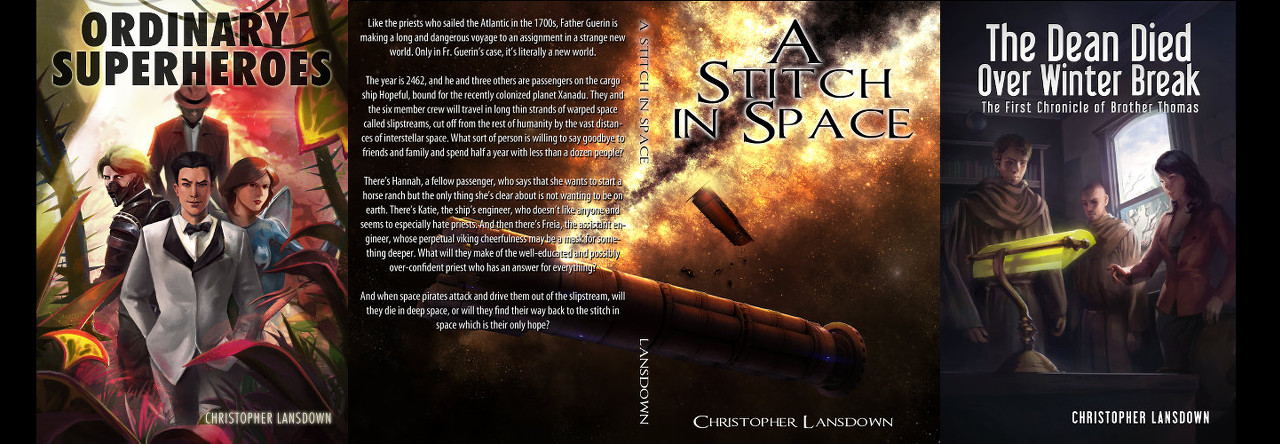
I got word from the publisher that the cover isn’t finished yet, so they’re pushing the publication date back to April 7th.
Author: Christopher Lansdown
http://www.chrislansdown.com/
Silver Empire Launches Book Club
One of the great problems in the modern world where distribution is (by historical standards) extremely cheap is discovery: it’s very hard to sift through all that is available in order to find things one wants. Russell Newquist, owner of Silver Empire Publishing (who has published several of my novels and will soon publish Wedding Flowers Will Do for a Funeral) has been wracking his brain trying to come up with a solution to it, and he’s hit on a partial one: he’s launching a book club for the modern era.
Book clubs, back in the day, sometimes worked and often didn’t because of technological limitations. In the modern age of ebooks and print-on-demand, the technological limitations which pitted the interests of the people running the book club against the interests of the people in the book club are gone. Book clubs can now be win-win.
Unlike Amazon, who ten seconds of looking at their website will prove doesn’t care about books, Russell is passionate about books. In his youth, he used to spend so much time in his local bookstore they jokingly offered to lend him a cot to save him the trouble of going home at night. One of his big goals is to make sure that the book club will enable readers to find books that they would enjoy reading.
Here is their press release:
Huntsville, AL March 1, 2020 — Today, Silver Empire, publisher of heroic, wondrous, adventure fiction, launches its new Book Club service. Fans of fantasy, science fiction, and other genre fiction will now be able to save money on ebooks, paperbacks, or hardcovers of their choice through our new subscription service.
“We wanted to give our fans a way to get all of our latest stuff easily and at the best possible price,” Russell Newquist, Co-founder and Publisher at Silver Empire confirmed.
Subscriptions come in the forms of monthly or annual credit allotments. Monthly plans provide a monthly allotment of credits suitable to purchase a book in the user’s preferred format – ebook, paperback, or hardcover. However, credits can be used interchangeably on alternate formats and they never expire.
Silver Empire found that Amazon’s Kindle Unlimited service fails to provide many readers with books they actually want to read. Furthermore, it means that readers are only renting books rather than owning their favorites. Most of all, it had no options for those readers who still prefer the feel of an actual book in their hands.
Subscription services are live now and can be purchased here. Early subscribers will be able to score notable savings on hardcover subscription plans through March 31.
If you’re interested, you can find at more at https://silverempire.org/book-club/.
The Problem With Fair Play In Mysteries
In the golden age of mystery writing there was the idea that a murder mystery was a game between the author and the reader. The author would give all of the clues necessary and would win if the reader couldn’t guess the solution before the detective reveals it; the reader would win if he guessed first.
The idea was all over the place at the time. For example, you can see aspects of this in Fr. Ronald Knox’s 10 Commandments of Detective Fiction. Most of the rules ensure that the necessary evidence is actually given to the reader.
Fair play is a great idea, and makes for good books. The only problem is that it—mostly—doesn’t actually work for its intended purpose.
The problem with “fair play” in murder mysteries, as a game, is that there are usually too many degrees of freedom. Ambiguity can be resolved in too many ways. For example, it is possible that the murderer managed to pretend to come into the room he was already in, but then it was also possible someone in the séance circle holding hands with the victim could have let go and stabbed the victim before he could cry out. Neither is probable and neither is impossible. Which is more likely? The reader is not really solving the problem, but instead reading the mind of the author.
This sort of ambiguity comes up a lot because ambiguity is the heart of mystery. If there’s only one interpretation, there’s nothing to detect, or at least there’s no value in the detective being brilliant. More than that, there is always ambiguity so long as there is a next page—it is always possible that the next page will contain new evidence which changes the meaning of evidence which showed up before.
On the flip side, if sufficient evidence to obtain a criminal conviction is given prior to the suspects gathering in the accusing parlor, the game will be too easy. If there is insufficient evidence for a conviction, the solution will be unsatisfying. It seems like there should be a happy medium, but there isn’t. The most common attempt is for the detective to withhold from the reader some conclusive peace of evidence and only present it when the formal accusation is made. This does not solve the problem, though, because it is almost always the case that a different piece of conclusive evidence could be given for at least one other suspect. In short, if there is any point in guessing, there will always be more than one reasonable guess.
Fair play doesn’t really work for its intended purpose, but it does make for good book.
There are two main reasons for this. The first is that fair play unites the reader with the detective. The second is that fair play forces the writer to make the mystery mysterious because it is clever.
When the author hides clues from the reader, it means that the reader doesn’t know why the detective does what he does. The detective, himself, becomes a mystery. In this case the reader is united, not to the detective, but to the Watson. (To some degree this explains the original Watson, who was, in theory, the author of the stories and hence they were from his perspective.) On the plus side, this multiplies the mysteries. The downside is that it makes the detective an unsympathetic character, in the strict sense that the reader cannot sympathize with him.
Interestingly, Sherlock Holmes was originally meant to be an unsympathetic character in the other sense—aloof, unapproachable, eccentric in the extreme. It did not last; Holmes was humanized, over time. Part of this was that there were often sub-mysteries which Holmes would explain, allowing us to get close to the detective.
The other aspect of fair play—that it forces the writer to write good mysteries—is also important to a good novel. A mystery in which the mystery is maintained only by withholding clues is, generally, a very simple mystery. If there is nothing much for the detective to think about, the solution will not be very satisfying when it is finally offered.
Another effect fair play has on plot construction is that it forces the author to be careful with the rate at which clues are given, and the circumstances which produced them. If the author has to reveal what the clue is when the reader has time to think about it, it being unreasonable for the culprit to have left the clue will stand out more.
For these reasons, and probably for others, too, fair play is as important now as it ever was. I think we merely lack the societal explanation which was never really adequate, even in its own day.
Wedding Flowers Will Do for a Funeral Due in Mid-March
Russell, one of the owners of Silver Empire Publishing, the publisher of The Dean Died Over Winter Break, said that he should have Wedding Flowers Will Do for a Funeral (the second chronicle of Brother Thomas) available in Silver Empire’s bookstore in mid-March, with wide availability (Amazon, etc) by the end of March. I will, of course, post when it is actually up.
Murder for Quid Pro Quo
It has been said that the two main motives for murder as sex and money, especially money. The problem this produces is that it tends to make it relatively obvious who the murderer is—whoever gets the money or gets the lover.
One of the traditional solutions to this problem is for the murderer to invent a clever way to kill the victim without being there. Another is for them to fake an alibi, or to fake the time of death so that they can establish an alibi.
The final of the classical solutions is for the murderer to have an accomplice. This produces the problem of motive for the accomplice.
Probably the simplest solution is economic—for the accomplice to share in the proceeds through the primary murderer’s discretion afterwards. Other motives involve love, a shared desire for revenge, and being tricked into it without understanding what was going on (then either not being aware of the significance of the help or being afraid to speak up).
An interesting alternative was used in the Death in Paradise episode, A Dash of Sunshine (Series 2, Episode 6). Here, the murder was perpetrated entirely by an accomplice, in exchange for the murderer having murdered the accomplice’s victim in another country, several months before. That is, each murder was committed by a person with no connection to the victim, as a quid pro quo. This was a very interesting setup, as it led to some unusual qualities in the murder.
Ordinarily, a murderer who has no connection to the victim is impossible to catch. In these modern days of DNA evidence, that may be somewhat less true, if the murderer has been foolish enough to use an online DNA service, or if a close relative has. Even there, though, that isn’t tremendously useful if there was no other evidence linking the murderer to the crime. Moreover, it’s not overly likely to be present.
There was a time, in the dawn of forensic science, where fingerprints were new technology and criminals did not know to wear gloves. That time did not last long. Similarly, there was a time when criminals did not know to avoid letting their DNA get onto a crime scene, but they do know it now. Admittedly, avoid fingerprints is easier than avoiding leaving any DNA, but at the same time, it’s not that hard. Gloves will do it for anything that one touches, and beside that, some simple precautions like wearing pants and a long-sleeved shirt, and ensuring that one’s hair doesn’t shed (a hat, a hair net, etc) will generally suffice. It’s not like the police are going to swab every inch of the floor in the hope of catching a stray skin cell. Tests cost money.
DNA evidence is much more of a problem for the mystery writer in crimes of passion, where the murderer would not have thought to take precautions beforehand. On the other hand, it is far more likely in crimes of passion that here will be an innocent excuse for why the murderer’s DNA is present at the crime scene. If a man lives in the same mansion as the victim, it is of no significance that his DNA was found in the same room as the victim. It would almost be odd to not have found it.
All that allowed for, it is still nearly impossible to catch a murderer with no connection to his victim. This makes the quid-pro-quo murderer very difficult to catch—unless the murderer makes a mistake and leaves physical evidence, the only way to catch him is through his connection to his partner—the one who benefits.
Interestingly, in the Death in Paradise episode, the killer made mistakes and left forensic evidence and this is how the detectives caught the pair. Perhaps the biggest of these mistakes was killing the victim in his own rental house. This was especially odd as the other murderer had made the reservations at the rental house, meaning that they cooperated in the terrible decision to proceed with a link from the murderer to the victim. It was explained, and I think reasonably, that the murderers were careless because they were arrogant. They assumed that across the ocean, in a country with a minimal police force, a staged robbery would be accepted as such and murder would not be suspected. It was still a terrible idea, and one that they didn’t make with the first murder, back in England.
I can’t think of any examples of the other way around—of finding the connection between the murderers then finding the connection between the killer and the victim. Given how many murder mysteries have been written in the last 100+ years, it probably has been written, of course, but it would be interesting to write the second.
Efficiency vs. Robustness
Efficiency and robustness are enemies. The more you have of the one, the less you have of the other.
Intrinsically.
Efficiency means that every part is producing an effect. Robustness means that damage can happen and the effect can still be produced. The only way that it is possible to take damage and keep productivity up is if there was some spare capacity which was activated to take the place of what was damaged. That spare capacity was, by definition, inefficiency.
(The subject is sometimes confused by there being standards of robustness, and efficiency being contextually defined to be having no more spare capacity than that standard; this context-specific usage is not what I’m talking about. I’m talking about efficiency and robustness as such.)
You can see this trade-off very well in birds. Birds, in order to fly, must be extremely efficient. The price that they pay is that they are very fragile. Their bones are famous for being hollow, which is awesome, but their bones are also extremely easy to break with blunt-force impact. Birds are very muscular with little fat, but the cost of that is that they need to eat frequently and can starve to death quickly.
This same thing applies to large organizations. Young people are often astonished at the inefficiency of large organizations. They are right that large organizations tend to inefficient. What they don’t realize—because they’ve never experienced it—is how much inefficiency is required for the organization to survive when things go bad. And things can go very bad.
Probably the most frustrating example of this is the small amount of trust typically placed in employees and in consequence the difficulty they have actually getting work done. This must be understood in the context of how many problems a single employee can create.
It is not merely a rogue employee who intends to do evil which is the problem. They can cause truly enormous amounts of damage, but they are also vanishingly rare. Far more common are things like:
- Taking vacation
- Getting sick
- Personal problems
- Leaving for another job
- Incompetence
All of these things create problems, and some of them are so predictable as to be reliable (like taking vacation and getting sick). The result is that organizations which have protections against these things tend to be far more robust and thus last longer.
These protections will tend to look like:
- Having multiple people who can do the same job and are sufficiently involved with the particular job that they can take over while the other person is away or otherwise not doing his job.
- Requiring non-trivial decisions to be filtered through at least one other employee, so that there is a sanity-check in place.
- Requiring extensive documentation of what’s going on so that others can take over
- Using tools which, while not the best suited to the task, are wildly used, so that replacing a person who uses them is easier
- Having a corporate culture, created by things like too many meetings, so that people tend to solve similar problems in similar ways, so that people are more replaceable
All of these things are inefficient, but they do create robustness.
It should be noted that there is something of a catch-22 here, too. These practices are not pleasant to work under, so they tend to create a culture of zero loyalty to the organization, and in many cases encourage people to leave to find something better elsewhere. In more extreme cases, they actually create a selective pressure for only awful people who couldn’t get hired elsewhere to remain, which is a vicious cycle since they make the workplace worse for competent people.
I want to be clear that I am not saying that these things are actually good, or a good way to run a business. I’m only saying that we should understand that they do exist for a reason, and it is important to know what that reason is if one wants to try to prevent smaller companies that are growing from falling into the same traps.
I also want to note that not all behaviors of large companies are ascribable to this cause. In some cases, I think that there are behaviors which are analogous to cancers and autoimmune disorders.
An example of the former would be divisions which pursue growth over profitability and suck resources away from profitable divisions, often to cause enormous damage when they fail and have to downsize.
An example of the latter would be an accounting department becoming so hyper-active in combating waste that they make it nearly impossible for employees on trips to get reimbursements for anything, resulting in lost opportunities and costly workarounds.
Setting for Book 4?
I’ve only written about 1 paragraph of the Third Chronicle of Brother Thomas (edits are finished on the Second Chronicle of Brother Thomas and Silver Empire has it slated for publication in March). And it’s got a great setting: a remote vacation resort in the Adirondack mountains where there isn’t internet, cell service, or even electricity. I’m really looking forward to writing that one. (The very tentative title for the book is “He Didn’t Drown in the Lake”.) But I thought of a great setting for Book 4.
A renaissance fair.
I was thinking that the fair grounds could be next to a benedictine abbey, and the fair itself could be named after the abbey next to it. So the book could be titled, for example, Saint Paul’s Fair. Or Saint Anselm’s Fair (that one has a ring to it). Or Saint Benedict’s Fair. (All three are real Abbey names in the US.)
An especially fun coincidence would be that my favorite Brother Cadfael mystery, Saint Peter’s Fair, happens to be the fourth chronicle of Brother Cadfael.
I have no idea who the victim or the murderer will be. For stuff like that I probably should get a lot further in book 3, first.
The Evolution To a Parody
If you missed it, back in 2012, Gotye released the brilliant song Somebody That I Used To Know:
As a side note, it’s so good I made a video about the ideas in it:
What’s important to the moment, however, is that it was covered by a band called “Walk Off The Earth,” playing in an unusual and resourceful style:
Then, finally, The Key of Awesome parodied this version of it:
I think my favorite line from the parody is “Tony is addicted to a wide array of narcotics. He says they help him write, but we’re a cover band.”
Frozen is a Surprisingly Christian Movie
My four year old daughter was lent a DVD of the Disney movie Frozen, and in consequence I’ve seen it about a dozen times (so far). It really surprised me just how Christian the movie actually is, especially because it’s almost certain that was not intentional.
I’m going to run through the main plot elements to show what I mean.
The plot begins with two princesses, Anna and her older sister Elsa, playing at night. Elsa has the magic power to create ice is various forms, both solid and snow. Right away, there is an interesting sort of contradiction contained in this power, since on the one hand cold is negative—the absence of heat—and on the other hand she is able to create water, though frozen, from nothing. She has the power to create, but in a very limited way.
Now, normally when a female character has some sort of power, it tends to be a symbol for that great feminine power—fertility. You can generally see this because in the typical case everyone loves her for it (except for other women who are jealous, of course). That is not the case, here. Her ice powers work much better as a symbol of intellectual power and as we will see later, like intellectual powers her ice power isolates her from people.
As the children are playing with the snow Elsa creates, she slips and accidentally hits her sister in the head with a blast of ice, freezing her head. Anna lays comatose and cold as ice, and Elsa calls out to her parents for help. They come and take the children to the trolls, who as magical creatures can deal with magic. The chief troll tells the King that it is fortunate that she was not hit in her heart:
You are lucky it wasn’t her heart. The heart is not so easily changed. But the head can be persuaded.
Here, we really see the symbolism of Elsa’s power almost explicitly. She has the ability to affect the heart and the head. Of the two, it is more fortunate to be injured in the head, because the head can be more easily changed. This is quite correct. Purely intellectual errors can be fixed relatively easily, and even somewhat adversarially. By forcing a man who holds an idea merely as an idea to defend it, one can force him to realize that it is indefensible. Rarely, it is true, will he admit it in the heat of argument, but if it was purely an intellectual attachment to the idea, it will happen soon afterwards, when he has had time to think it through. To change his heart, he must repent.
The chief troll gives Elsa a warning:
Listen to me, Elsa. Your power will only grow. There is beauty in it but also great danger. You must learn to control it. Fear will be your enemy.
While giving this warning he conjures up a vision of people turning on her because of her power, and she’s scared. Her father, not she, responds:
We’ll protect her. She can learn to control it, I’m sure. Until then, we’ll lock the gates. We’ll reduce the staff. We will limit her contact with people, and keep her powers hidden from everyone. Including Anna.
There are several things wrong with this. The biggest problem is that it is a fundamental misunderstanding of what control is. Control is the ability to use force precisely—to accomplish one’s intentions without causing other effects. Control is what allows an adult that can snap a tree branch in half to make a crib for a baby then caress it while it’s lying down to go to sleep. What the King intends is for Elsa to suppress her power.
The difference between those two is stark. Elsa’s power is natural to her—this was made explicit when the troll chief asked if she was born with the power or cursed, and her father answered “born with it”. To control her power is to become fully herself, that is, to act in full accord with her nature. To suppress her power is to act against her nature and to be less than herself.
The other major problem is that the King is entirely passive in this, despite being Anna’s father. He uses the passive voice, “She can learn,” not “We will teach her.” He wants the problem to just go away—he wants Elsa to raise herself.
Indeed, his only real contribution to helping Elsa even to suppress her powers as she grows is to give her gloves and the extremely unhelpful advice:
Conceal it. Don’t feel it. Don’t let it show.
A person can direct their attention, to some degree at least, but cannot control what they feel. What they can do is control how they act in spite of their feelings. Control requires some positive goal, however, that can be focused on in spite of whatever feelings the world may thrust upon one. This, Elsa is not given. (We’ll come back to this, because the movie does.)
We then fast-forward in time, and the King and Queen die in a storm at sea, leaving the two girls orphans. Some time later, it is “Coronation Day” when Elsa is old enough to be crowned queen. (How the government of Arandel works is not explained, and even the technology is a weird mismash of the mid-1800s, the late middle ages, and everything inbetween.)
At the coronation party, Anna spends time getting to know a man she met earlier that day when he bumped into her. His name is Prince Hans, of the Southern Isles. They have a whirlwind romance in the space of an hour or two, culminating in Prince Hans proposing marriage and Anna accepting. When they ask the new Queen for her blessing, she refuses, and getting angry in response to Anna’s anger, she impulsively creates a large wall of ice as a barrier to keep Anna way. Her powers revealed to everyone, she runs away into the mountains, where we get the most famous song of the movie:
The snow glows white on the mountain tonight
Not a footprint to be seen
A kingdom of isolation
And it looks like I’m the queen
The wind is howling like this swirling storm inside
Couldn’t keep it in, heaven knows I’ve tried
Don’t let them in, don’t let them see
Be the good girl you always have to be
Conceal, don’t feel, don’t let them know
Well, now they know
Let it go, let it go
Can’t hold it back anymore
Let it go, let it go
Turn away and slam the door
I don’t care what they’re going to say
Let the storm rage on
The cold never bothered me anyway
…
It’s funny how some distance makes everything seem small
And the fears that once controlled me can’t get to me at all
It’s time to see what I can do
To test the limits and break through
No right, no wrong, no rules for me
I’m free
Let it go, let it go
I am one with the wind and sky
Let it go, let it go
You’ll never see me cry
Here I stand and here I stay
Let the storm rage on
My power flurries through the air into the ground
My soul is spiraling in frozen fractals all around
And one thought crystallizes like an icy blast
I’m never going back, the past is in the past
Let it go
The cold never bothered me anyway
Let it go, let it go
And I’ll rise like the break of dawn
Let it go, let it go
That perfect girl is gone
Here I stand in the light of day
Let the storm rage on
the cold never bothered me anyway
The music and Idina Mendel’s singing sound great, but if you pay attention to the lyrics, they are basically the lyrics of a villain. And, in fact, Elsa is the villain of this movie. She is a realistic villain, though, not a cartoon villain. I think the reason that has confused so many people is that this movie is a cartoon. Still, it is what it is; Elsa is a realistic villain, who is scared and afraid and wrong and doesn’t really mean anyone any harm even though she causes them harm she is culpable for.
Anna goes after her sister to try to bring Elsa back. (Along the way she finds Christoff, who agrees to help her in exchange for carrots for his reindeer.) When she finds Elsa, Elsa tells her to go away, that she’ll be safe as long as Elsa is alone. Anna tells Elsa that in fact Elsa has created a perpetual winter of Arandel, and no one is safe. Elsa is distraught, partially at what she’s done, but mostly that it means that she can’t be free. During a musical number when Anna is singing that they can solve the problem together and Elsa is complaining that she can’t be free, she lets out a blast of her power that hits Anna in the heart. She tells Anna to leave, then when Anna refuses to abandon Elsa, she creates a snow monster to force Anna to leave.
Here we see Elsa more-or-less explicitly choosing to be a villain when confronted with the choice between selfishness and love. She does, after this, try to stop the snow on Arandel by repeating to herself, over and over, “Don’t feel. Don’t feel,” as if that could somehow do some good. It’s not that she doesn’t care about Arandel at all; the problem is that she will only care about it on her terms. Even if she couldn’t stop the eternal winter, her power, used in Arandel, could do much to alleviate the suffering the eternal winter is causing. She doesn’t even consider this, because she lets her fear control her.
Anna begins to feel the effects of Elsa’s blast, and Christoff takes her to the trolls to get her help. There the troll chief tells her:
Anna, your life is in danger. There is ice in your heart, put there by your sister. If not removed, to solid ice will you freeze, forever.
Christoff asks if the troll chief can remove it.
I cannot. I’m sorry, Christoff. If it was her head, that would be easy, but only an act of true love can thaw a frozen heart.
One of the trolls suggests that a “true love’s kiss” might be such an act of love, and Christoff takes Anna to Prince Hans. He leaves her in Arandel, trusting that she will be taken care of. Anna is brought by the servants to Prince Hans, and there left alone with him. He reveals that he never loved Anna but only sought power, and her desperation to be loved made her easy prey. He douses the fire and leaves her to die while he goes off to kill the queen and usurp the throne.
However, Elsa escapes from the dungeon and creates a raging storm that obscures most things. Christoff sees the storm and comes back to help Anna. She sees him riding his reindeer toward her and stumbles out of the castle In the climax of the movie, just as Christoff and Anna almost find each other Anna sees Prince Hans about to kill Elsa. Anna rushes in and protects her sister with her body. She turns to solid ice a moment before the sword hits her, and in a magic blast from her turning to ice the sword is shattered and Prince Hans is knocked back, unconscious.
Elsa, seeing her sister turned into an ice statue, weeps over her, but a moment later Anna begins to thaw. Elsa asks Anna why she sacrificed herself for Elsa, and Anna replies, “because I love you.” Elsa, enlightened, realizes that love can end the raging storm, and she thaws Arandel, ending the permanent winter.
It is tempting to take all this as a mere reversal of the common trope; instead of the man saving Anna she saves herself. It is entirely possible that was how this plot came to be. It doesn’t matter. Whatever the writer was trying to do, what she did was to write a very Christian story.
Anna was saved, not by another creature’s romantic love for her, but by her generous love for another. “Greater love hath no man,” says Christ, “than to lay down his life for a friend.”
Anna was not, however, alone. Had Christoff not first loved her (in the sense of generous love) enough to take her to Prince Hans, what followed would not have happened. Had he not loved her enough to come back for her when he saw that Arandel was in danger, she would not have left the castle where she was huddling next to the fire for warmth, and would not have been near Elsa when Prince Hans moved to strike her down. In short, she was only able to make her sacrifice for her sister because of the love she was shown.
And then we get to the fascinating metaphor of there being ice in her heart put there by her sister. Here we have a recognition that a person can, if they let themselves, become twisted by another. Eve Keneinan has pointed out, more than once, that in the modern world we like to believe that victims are, by virtue of their victimhood, virtuous. Quite the contrary, victims often become vicious. And here we have that acknowledgement—Anna will die, if she cannot love, because of her sister’s hurting her.
We also, in all this, see how well Elsa’s power works as a metaphor for intellectual power. When she merely, through her power, gave her sister a wrong idea, the troll chief could fix that. But when, through her selfishness, she hurt her sister’s heart, fixing that could not be done by another. It’s an excellent metaphor for Modern Philosophy and things like Classical Liberalism (a la Voltaire). Where someone is merely wrong about these things as an idea, he can be set right by another through simple argumentation. When people act on these bad ideas, they injure themselves and others in ways that mere argumentation cannot fix. Having put theory into practice, it no longer suffices to change the theory. They must now repent. The Greek for “repent” is μετάνοια (metanoia). More literally, to turn around. Ideas are dangerous, but practice is more dangerous. Ideas have consequences.
There is another fascinating bit, when Christoff brings Anna to the trolls to heal her, they misunderstand at first and think that he brought Anna as a potential wife. When they find out that she’s reluctant, they sing a song asking her why. In this song they say that he’s a bit of a fixer-upper, and talk about some of his superficial flaws, but point out (obliquely) that these are merely superficial. There is, however, a very curious caveat that they put into the song:
We’re not saying you can change him, ’cause people don’t really change
We’re only saying that love’s a force that’s powerful and strange
People make bad choices if they’re mad, or scared, or stressed
Throw a little love their way (throw a little love their way) and you’ll bring out their best
True love brings out their best!
The first thing to note is that this caveat, though important, is (as stated) wrong. People do change. People can also change each other. Heck, the main plot point of the movie is that Elsa changed her sister (“put ice in her heart”).
What is true is that people can very rarely change other people according to their intentions. Most of the time the effect we have on others is not the effect we intend to have. The other important thing to note is that we can only change others when they are ready to change. You can’t take a drunkard and make him sober. You can, possibly, help him to become sober when he’s ready to become sober. And you probably won’t know when that is.
This is especially true with romantic partners, because (God willing) romantic partners are soon to become parents. They will soon have a ton of work to do in raising new people to be human beings. This means that they will both be under a lot of stress, rely on each other constantly, and will have very little in the way of energy left to try to change each other anyway. In short, the last people who can intentionally change each other are romantic partners.
Except about superficial stuff. Then they’re really good at it.
A husband and wife, if they’re even quarter-way decent human beings, want to get along with each other. They need to be tolerant of each other’s failings, but in general they will be pretty willing to load the dishwasher differently or accommodate themselves to toilet paper being put on the roll incorrectly, or what-have-you. Superficial similarities are worthless, because the superficial stuff does change pretty readily.
The big problem, in mate selection, is mistaking something important like character or honesty for something superficial like how one prefers the toilet paper to be on the roll. Unrefined people can become refined fairly readily, and if they don’t, it doesn’t actually matter all that much. People can compromise that muddy clothes can come into the basement, but they have to stay there. By contrast, vicious people can become virtuous, but it’s a terrible bet to make with one’s children’s future.
Plus, vicious people becoming virtuous often requires something dramatic, like sacrificing one’s life for them.
Christianity is Not a Cuckold Religion
In a very interesting video, Jonathan Pageau (of The Symbolic World) discussed the question of whether Christianity is a Cuckold religion:
He did an excellent job discussing cuckolding in human society and patterns related to it one sees in human society (such as war rape and sexual taxes to a chief/lord). He also did a good job talking about how Christianity got rid of those patterns.
What’s really weird is that he didn’t talk about the symbolic structure, either of cuckolding, or of Christianity. That sort of thing is usually his bread and butter.
So let’s do that.
In order to see the structure of cuckolding and why Christianity is not a cuckold religion, it will be helpful to start with etymology. The word “cuckold” comes from the Cuckoo bird.

The Cuckoo is a nest parasite. It looks for the nests of certain other species of birds and when it is unguarded, it throws an egg from the nest out and lays one of its own in its place. When the baby Cuckoo hatches, it generally throws the rest of the eggs, or if it didn’t hatch first, the other baby birds, out of the nest, too. The parents of the nest then feed the baby Cuckoo until it is old enough to care for itself.

(Both images are from the Wikipedia page on Cuckoos.)
The symbolic structure of the Cuckoo’s nest parasitism is replacement. The Cuckoo replaces the offspring of another bird with its own offspring; its line continues at the expense of the line of the other birds. They do the work of raising it and get nothing out of it.
In humans, by analogy, cuckolding is when a woman is unfaithful to her husband, and another man fathers a child with her that her husband raises as if it were his. Here, too, we see replacement, but in humans it is an incomplete replacement. Human beings, when we raise children, do a heck of a lot more than just feed them. We raise our young; we teach them and shape them. An extremely large fraction of who they are as an adult is given to them not by genetics, but by their upbringing. An adopted son is not a biological son, but he is still a son. When his adopted father and his biological father are old, he will care for his adopted father, not his biological father. This does not make cuckolding OK, but it is important to note that the replacement is incomplete. This will be relevant later.
So now we come to the part of Christianity which some describe as Cuckolding: the virgin birth, and Joseph raising the child as his own.
In order to see whether the virgin birth of Jesus was cuckolding, we need to look at the structure of what happened. Recall, cuckolding is replacement. Was there replacement? The answer is: no.
In a normal birth, God creates a new human being, giving a portion of the creation of his body to a father and a mother who come together to make it. The technical term for what the parents do is secondary causation. God could create a new human being entirely on his own, but instead he gives it to human beings to be part of his act of creation. In the case of Jesus, only one human being was given the privilege of secondary causation—Mary, his mother. What’s important to notice is that this does not change God’s role in the creation of the Jesus’ human nature. God is not more active, as if he somehow normally depends on a human father and without his help he had to do more work.
A useful analogy to consider is an author writing a story. If the author normally has two characters have sex and this gets the woman pregnant, the author does not do any less work than if he writes the woman getting pregnant without a man. (If anything, he does slightly more work, in that it would take more words to set up and describe, but this may just be the analogy breaking down.)
So in the conception of Jesus, there is no replacement of Joseph, he simply is not given a part in it. There is no other creature who has taken his part. There is just no father at all. Importantly, God did not take the part of the human father, he took the part he always takes in giving existence to all of creation at every moment of time. He simply didn’t give a portion of that work to a creature to be part of.
So the conception of Jesus was not cuckolding, because there was no replacement. What of the other aspect—of raising a child as one’s own?
This Joseph does with Jesus. However, this is the same raising of a child as one’s own that happens in any case of adoption. And, indeed, Joseph raising Jesus is clearly a case of adoption:
This is how Jesus Christ came to be born. His mother Mary was betrothed to Joseph; but before they came to live together she was found to be with child through the Holy Spirit. Her husband Joseph, being an upright man and wanting to spare her disgrace, decided to divorce her informally. He had made up his mind to do this when suddenly the angel of the Lord appeared to him in a dream and said, “Joseph son of David, do not be afraid to take Mary home as your wife, because she has conceived what is in her by the Holy Spirit. She will give birth to a son and you must name him Jesus, because he is the one who is to save his people from their sins.” Now all this took place to fulfill what the Lord had spoken through the prophet: “Look! the virgin is with child and will give birth to a son whom they will call Immanuel,” a name which means “God-is-with-us”. When Joseph woke up he did what the angel of the Lord had told him to do: he took is wife to his home; he had not had intercourse with her when she gave birth to a son; and he named him Jesus.
God clearly asks Joseph to be a father to Jesus, and Joseph accepts. And this is the key: in so doing, Jesus becomes a son of Joseph. Joseph gives Jesus his name. Not only his first name, but his family name—Jesus is in the line of David through Joseph.
So if you want to say that Christianity is a religion of adoption, you won’t be wrong. In fact, adoption is one of the main themes of Christianity. You might almost say that God was adopted by man so that man might be adopted by God.
This is why—among other reasons—Christianity had the effects which Jonathan described. God is not merely the highest, but unlike human beings. As Bishop Barron might say, God cannot cuckold a human being because God is not in competition with human beings. The milkman can cuckold a human being. Ghengis Khan did. Zeus could have, if he was real. God simply can’t. All things have their limits, even omnipotence. In particular, omnipotence can’t be limited.
Well, except for the incarnation. But when he could compete with people, Christ didn’t.
Jesus never cuckolded anyone.
And a servant is not greater than his master.
Watching On-Demand TV
Occasionally my ten-year-old son and I will watch an episode of Murder, She Wrote together. I received the DVD complete box set for Christmas last year, which means that we can watch an episode whenever we want. Curiously, the result has been that we don’t watch all that often.
When I was a kid my parents and I would watch Murder, She Wrote with absolute regularity. We never missed an episode. So I got to thinking about why it is that my Son and I watch it so irregularly.
Part of it, of course, is that he likes it, but doesn’t love it as much as I do. There are a myriad of reasons for this, but it’s natural enough, since I love it quite a lot—most people will tend to be less extreme than that. But there is another reason.
When I was a kid, you had to watch the episode when it came on or you missed it. It would eventually be available as a re-run, but that would be in months, and without great predictability, as the TV stations didn’t do something simple (so far as I can recall, anyway) like air re-runs in the same order they ran in. Plus, you could never be certain you would catch the episode when it re-ran, which meant a longer and still less predictable time till you could watch it.
All of this produced an urgency to watching the episode when it aired that was both a good excuse for making it happen but also helped to make it happen. When one can watch an episode whenever one wants, one needs a good reason to watch now, as opposed to tomorrow. And tomorrow can easily turn into the day after. And the day after can easily turn into next week. And next week can easily turn into next month.
In some sense, this is just removing an artificial limitation which made the episodes seem more important than they were. It is, in a real sense, regarding TV episodes with their actual value. Because, truth be told, TV episodes just aren’t that great. They were made in a hurry. Regularity was more important than quality. Getting people to sit through commercials and come back was more important than quality, too.
In spite of that some TV shows really were special; there were TV shows with genuinely good episodes. Murder, She Wrote did have some well constructed mysteries. They couldn’t really compare to a good mystery novel, though, and when one can watch the episode any time, it quite frequently seems like a better use of time to read the novel. The episode will always be there tomorrow, if one really wants to watch it.
There is something lost in all this, which I think is no small part of the fondness which people like me who grew up with broadcast television feel the loss of. Broadcast television gave a rhythm to life. When favorite shows were on Monday at 6:00, Tuesday at 6:30, and Thursday at 7:00, these made Mondays, Tuesdays, and Thursdays feel like Mondays, Tuesdays, and Thursdays. Even if one went into another room and read a book because one didn’t like a show, one went into that other room and read a book every Monday. There was not only a rhythm, but a shared rhythm.
There are much better places to get shared rhythms for life than from entertainment paid for by copious commercials. I am not here saying that the death of broadcast television is not for the best. It is. I’m only saying why it doesn’t entirely feel like it.
(And yes, this phenomenon still applies in its entirety to the practice of watching live sports, and may explain a portion of that activity’s ongoing popularity.)
Poirot’s Voice
In Masters of Mystery, by H. Douglas Thomson, there’s a chapter called The Orthodox Detective (as opposed to “the realistic detective story,” “the domestic detective story,” “the thriller,” etc). Curiously, it is entirely about Agatha Christie. I suppose that this is almost fitting, as in 1930 she was something of a genre unto herself.
In some ways, she still is.
Anyway, there’s a section where Thomson talks about Poirot’s voice, in the sense of how he speaks, and he translates a small section from the Sherlock Holmes story Silver Blaze into how it would read as a Poirot story. I think he does a excellent job of it, so I wanted to quote it here as it’s very interesting to compare and contrast.
In Silver Blaze:
“Is there any other point to which you would wish to draw my attention?”
“To the curious incident of the dog in the night-time.”
“The dog did nothing int he night-time.”
“That was the curious incident.”
In translation:
“Is there any other point to which you would wish to draw my attention?”
“There is the dog,” he said. “Always I think of that dog in the night. Always it perplexes, that one. It is of a mystery the most profound.”
“But the dog did nothing in the night-time.”
“Précisément,” he replied softly. “That is the mystery, mon ami.”
Thomson goes on to note that when Poirot is in the thick of things, his language becomes more direct and even “mon ami” gets softened to “my friend”.
This is intentional on the part of Christie, she talked about it outside of the stories and even Poirot occasionally talked about it within his stories. Poirot tended to speak in Frenglish in one of two circumstances:
- When he wanted to disarm people. A man who has difficulty speaking the language will presumably have difficulty understanding the language and so he can’t be much of a threat.
- When he was dealing with people who disliked foreigners. He found that with such people the best way forward was to be very frankly a foreigner and so to give them the opportunity of forgiving him for it.
To some degree Poirot’s being a Belgian refuge from “The War” (i.e. World War I) served to explain why he was a private detective rather than a police officer—he had been a police officer in his native country but could hardly become a police detective in England.
His being a Belgian refuge also helped to make him interesting, and moreover, exotic enough to feel realistic in the unrealistic genre of the murder mystery. Unfortunately—or fortunately, as one sees it—crimes are rarely plotted out with brilliant intricacy and still less often are they unraveled by a brilliant detective who puts together the clues which other people miss. Whether this is because of the rarity of the brilliant crime or simply the rarity of catching the brilliant criminal, we cannot say for we do not know. It may be that brilliant people never commit carefully planned out murders. It may be that carefully planned murders happen all the time and people either do not suspect that the deaths are murders or the patsy who was framed is framed successfully and pays for the crime he didn’t commit, or perhaps these are just unsolved crimes where we know the crime was committed but have no leads.
Be that as it may, the brilliant detective solving a murder simply does not happen in real life (or at least nowhere near often enough for a man to build up a reputation, to say nothing of supporting himself on the proceeds of investigating such crimes). This creates a sort of tension in detective fiction because the fun comes from most of the story being realistic.
The solution generally seems to be to make the detective eccentric in some fashion. Not just any eccentricity will do, however. It has to be an eccentricity which pervades his interactions with his fellow creatures. If the reader’s normal experience of the detective is outside of the reader’s normal experience of real life, then the unreality of him being a detective at all is much easier to forget.
A Great Map Projection Joke
Today’s XKCD on the South America map projection is pretty funny:

The thing is, you have to read the alt text to really get the joke. It is:
The projection does a good job preserving both distance and azimuth, at the cost of really exaggerating how many South Americas there are.
(If you aren’t familiar with the debates over map projections, the fundamental problem a map has is that it’s impossible to correctly project the surface of a sphere onto a flat (uniform) 2-dimensional surface like a piece of paper. Something must be distorted in order to do it; the typical Mercator map greatly exaggerates the size of things at extreme latitudes. Other projections, such as the orange peel projection, tend to get relative sizes more correct at the expense of not being able to measure distances accurately. There are other kinds of map projection with other tradeoffs, too, each with those who strongly favor them while criticizing the rest.)
Weird Al’s CNR
My post yesterday about Chuck Norris Facts reminded me of a song by Weird Al about Charles Neson Reilly:
The song is a bit hit or miss, and I’d never heard of Charles Nelson Reilly prior to the Weird Al song and so have grave doubts that the man lives up to the legend nearly as much as Chuck Norris lives up to his. Still, I do like one of CNR’s achievements mentioned in the song:
Charles Nelson Reilly won the tour de france with two flat tires and a missing chain.
(If you don’t know, the tour de france is a bicycle race, possibly the premier bicycle race in the world.)
Chuck Norris Facts
I recently introduced my children to the style of humor called Chuck Norris “facts”. If you don’t know who Chuck Norris is, here’s him as a young man fighting Bruce Lee:
And here is an older Chuck Norris playing Walker, Texas Ranger:
Since he (that is, his character) eventually loses in the fight with Bruce Lee, I presume that Walker, Texas Ranger has more to do with Chuck Norris’s reputation. Be that as it may, there is a popular style of humor which is a list of facts about Chuck Norris that describes how tough and good at fighting he is. For example
A cobra once bit Chuck Norris on the leg. After five agonizing days, the cobra finally died.
Another great Chuck Norris fact is:
Chuck Norris’s periodic table only has one element on it: the element of surprise.
My boys (at the time of writing, 10 and 7) have really taken to these facts, and even tried inventing their own. The seven year old understands the element of exaggeration, but he (unsurprisingly) has difficulty with the element of setting up an expectation. So his versions tend to be things like:
Chuck Norris can punch a black hole and blow it up.
I’m not normally one for puns, but it lacks punch. Anyway, there are a lot of great Chuck Norris facts. I’m not going to reprint an entire archive of them (many of which can be found with a simple google search), but here is a selection of my favorites:
- On a math test, Chuck Norris answered “violence” for every problem and got an A+, because Chuck Norris can solve every problem with violence.
- Chuck Norris can speak French, in Russian.
- Chuck Norris can kill two stones with one bird.
- Chuck Norris can strangle you with a cordless phone.
- Chuck Norris can pick apples from an orange tree and make the best lemonade you’ve ever tasted.
- Chuck Norris tells Simon what to do.
- When the Bogeyman goes to sleep at night, he checks under his bed for Chuck Norris.
- Chuck Norris doesn’t cheat death. He wins fair and square.
- Bigfoot claims he once saw Chuck Norris.
- Superman owns a pair of Chuck Norris pajamas.
- Chuck Norris once won a staring context with the sun.
- Fear of spiders is called arachnophobia, fear of confined spaces is called claustrophobia, and fear of Chuck Norris is called common sense.
This Should Be Interesting
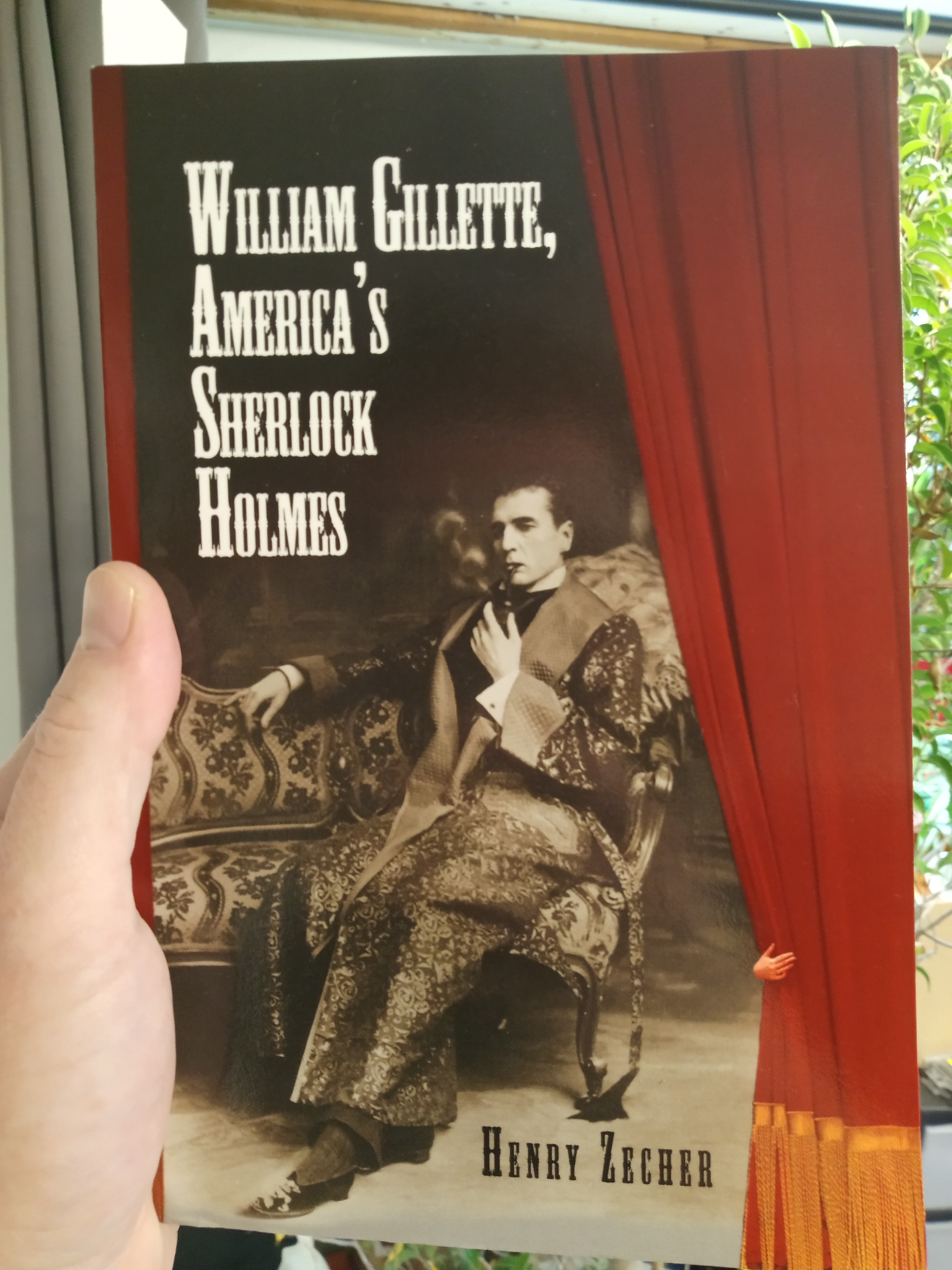
Got this biography of William Gillette for Christmas. Should be interesting!
Starting a Cast List
So despite the fact that I’m supposed to be taking a break, I’ve begun work on the characters and plot of the third chronicle of Brother Thomas, tentatively titled He Didn’t Drown in the Lake.
The murder takes place at a rustic resort in the Adirondack mountains of upstate New York where there is no internet, no cell reception, and not even any electricity. I’ve worked out who the victim is, who the murderer is, and why it was done. I’ve still to figure out how it was done, but I’m working on the other characters, first, since that may well impact how it was done.
So now I’m working out a list of who will be vacationing at the mountain resort. There are a lot of possibilities. So far, I’m considering having two novelists on a writing retreat, one in his twenties and the other in his forties.
Fun times.
Forgotten Literary Influences
As I’ve mentioned, I’m reading the book Masters of Mystery: A Study of the Detective Story, written by H. Douglas Thomson in 1931. One of the things which I’ve been getting out of it is an idea of what the popular mystery novels were at the time, which I’ve never heard of.
For full disclosure, the mystery authors I’ve actually read something by, from the early days and the golden age of mystery, are, in no particular order: Edgar Allen Poe, Sir Arthur Conan Doyle, G.K. Chesterton, Fr. Ronald Knox, Dorothy L. Sayers, Agatha Christie, S.S. Van Dine, and Mary Roberts Rinehart.
It’s not a long list, and not all of them have been by recommendation. I read Poe’s Murders in the Rue Morgue because it was the first detective story. I read S.S. Van Dine’s The Benson Murder Case out of curiosity since Van Dine had written up a set of rules of detective fiction I’ve seen referenced numerous times on Wikipedia. I read The Door by Mary Roberts Rinehart because it was supposed to be the origin of the phrase, “The Butler Did It”. (See my series on that phrase, if you haven’t read it yet.) And I’ve read most of Fr. Knox’s mysteries, but I started because he was a friend of G.K. Chesterton and because he wrote a famous ten commandments of detective fiction.
So if we subtract those, the mystery writers from that era which I’ve actually read because someone recommended them to me are: Conan Doyle, Chesterton, Sayers, and Christie. In my youth, that was my impression of the time period.
As I grew older, I realized that there must be other mystery writers of the time period that I was just unfamiliar with, but it was only in recent years that I came to appreciate just how popular a genre mystery was in those days, both to read and to write.
The thing which really drove it home to me was a short story entitled What, No Butler? about the accidental detective, Broadway. Here’s what I wrote about it at the time:
Incidentally, I looked up the two works cited. “What, No Butler?” seems to be a short story by Damon Runyon. I can’t find much information about it; according to Wikipedia it was in a book called Runyon on Broadway. It was performed on radio in 1946 and that performance is available on youtube. I don’t know when it was originally published. The story does have humor in it, but to call it satire seems like quite a stretch. Early in the story, the character Broadway (who I believe is a theater critic) says authoritatively upon finding out that a man was murdered that the butler did it. When he’s told that the victim didn’t have a butler, he insists that they have to find the butler, because in every play he sees with a murder in it, the butler did it.
What caught my attention was the reference, not to novels or even to magazine stories, but to plays. I know of literally one detective play, The Mousetrap, by Agatha Christie, which I only know about only because I was reading the wikipedia article about Ms. Christie. (Incidentally, it is the longest running play ever put on, being continually put on since 1952. Its 25,000th performance was in 2012.) There is evidence, though, that detective plays were fairly common.
This escaped me in no small part because plays have largely gone away as a form of common entertainment. Aside from high schools and community theater, plays are mostly a broadway affair for wealthy people and tourists in NYC. (This is not quite true, as there are actually plays elsewhere, but it is approximately true.) Back in the day, however, they seem to have had more of the role of television, these days, with plays being frequently written and performed for only a short time to be replaced by others. Television is a superior medium for this sort of fast-paced churn of mediocre writing, so it is natural that it would have eliminated it. But in that vane, we might take all of the episodes of a show like Murder, She Wrote to be somewhat representative of what plays of the era might have been like. Here today, gone tomorrow, and only meant for an evening’s entertainment.
Another blind spot in my knowledge of the time were short stories printed in magazines. Because novels are the dominant form of written fiction in our day, I tend think primarily of the novels written during the early days of detective fiction, or of collections of short stories. But in the late 1800s and early 1900s, magazines had enormous circulations and were apparently where the real money was in writing fiction. Even novels which we read today as novels, from the time period, were frequently originally published as serializations in a magazine. But of course short stories were extremely popular.
Of these blind spots, I was to some degree cognizant. What Masters of Mystery really drove home to me was the great number of popular detectives even available in novels which I had never heard of.
I had seen a few references to Dr. Thorndyke in the Lord Peter Wimsey stories—it turns out that he was a character in Dr. Austin Freeman’s popular detective stories. There were many others I had not heard of, though, and the push and pull of what constitutes the ideal detective story, as each writers takes in his turn to write his own detective, is quite interesting to see.
Possibly the most interesting to me at the moment is Mr. A.E.W. Mason’s Inspector Hanaud. First appearing in a story published in 1910, he is thought to have had some influence on Agatha Christie’s Hercule Poirot, especially when it comes to physical description, but also to brilliant intuition and a psychological approach. Interestingly, in looking this up to confirm some points on Wikipedia, I ran into this:
Poirot’s name was derived from two other fictional detectives of the time: Marie Belloc Lowndes’ Hercule Popeau and Frank Howel Evans’ Monsieur Poiret, a retired Belgian police officer living in London.
So it seems that perhaps the second most famous detective of all time (the most famous being Sherlock Holmes) drew very heavy inspiration from a number of sources, most of which (aside from Holmes) have been long forgotten.
It is yet more evidence that it is not originality which matters, but the quality of execution.
That said, Agatha Christie was a very original writer. Not, precisely, in her subject matter, but in her approach to it. She managed to pull off things which others could not. Perhaps the greatest example of this is The Murder of Roger Ackroyd. Prior to this, Fr. Knox, in his decalogue, had given two rules which are here relevant:
- (1) The criminal must be mentioned in the early part of the story, but must not be anyone whose thoughts the reader has been allowed to know.
- (7) The detective himself must not commit the crime.
The Murder of Roger Ackroyd broke both, and did so not only well, but even fairly. So well and so fairly that in a 1938 commentary on his rules, Fr. Knox said:
The second half of the rule is more difficult to state precisely, especially in view of some remarkable performances by Mrs. Christie. It would be more exact to say that the author must not imply an attitude of mystification in the character who turns out to be the criminal.
One such ingenious story would be enough for everyone, but Mrs. Christie pulled off at least a second, with her Murder on the Orient Express. This one did not break one of the rules of the decalogue, but it did break the generally unstated rule that there should be one or two murderers. Instead, Mrs. Christie pulled off a story in which everyone (with a few minor exceptions) did it. Every suspect (and several non-suspects) turned out to be guilty. Her originality consisted not in the idea—”everyone did it” is the sort of thing anyone might think of—but in figuring out how to make it work.
This is something those of us writing today should take to heart. In English class in high school we hear much about originality and genius. The reality of writing novels is that what really matters is doing a good job.
Question for Readers
One of the downsides to blog statistics is that one gets relatively little information about what people are reading. (Except in the archives, but that’s +/- more about search engine results than anything else.) So I have a question for you, gentle reader.
Of the various things that I write about, is there anything you’d like to see me write more about? Or, somewhat equivalently, when do you think this blog is at its best?
I thank you in advance for any answers you might give.
A Modern Inventor At Work
I’m fond of Joerg Sprave’s YouTube Channel, called The Slingshot Channel. He’s a former strongman who is very into slingshots, as well as pretty much any device which stores muscular energy in order to fire a projectile.
He has often made various sorts of slingshots, which he has sold, but recently he’s been getting into bows with magazines to enable rapid fire. From there, he’s recently developed a magazine-fed slingshot. This reminds me a great deal of the sort of inventions one often saw in the 1800s, except he’s developing them right now.
Here is his video where he presents his first prototype of the “instant rufus”:
It’s very interesting indeed to see someone develop a novel machine that can be made from parts one can buy at a hardware store. It’s quite a bit of creativity on display, here.
One of the Great Mystery Endings
As I’ve mentioned, I’m reading the book Masters of Mystery: A Study of the Detective Story, written by H. Douglas Thomson in 1931. It’s an interesting book that I will share more from soon(-ish), but there was one little snippet which stands on its own and which I just have to share.
The reprint of The Leavenworth Case attracted some attention. A post-prandial pronouncement of Mr. Baldwin was presumably the origin of this venture, for on the jacket we read in bold black type from some continental foundry:
“Mr. Baldwin—speaking at a dinner of the American Society in London on the 29th of November, 1928, said: ‘An American Woman, the successor of Poe, Anna K. Green gave us The Leavenworth Case, which I still think one of the best detective stories ever written.'”
Something must have been wrong with the dinner. The Leavenworth Case is not by any means a first-class detective story. The detection is singularly elementary. The plot is hopelessly drawn out, and the melodrama is a sample of unnatural and stilted writing. It may be unfair to cut out a sentence or two from its context, but the climax cries aloud for glorious isolation:
“A silence ensued which, like the darkness of Egypt, could be felt. Then a great and terrible cry rang through the room, and a man’s form, rushing from I knew not where, shot by me and fell at Mr. Gryce’s feet shrieking out, ‘It is a lie! A lie! Mary Leavenworth is innocent as a babe unborn! I am the murderer of Mr. Leavenworth. I! I! I!”
I know nothing about The Leavenworth Case, and even my deep curiosity about all things will likely not involve me actually reading the thing. It is interesting to contemplate, however, that such a story was not only written, but published, and a room full of people who had just eaten was told that it was one of the finest detective stories ever written.
There is hope for us all.
The Early Days of the Detective Story
As I mentioned, I’ve been reading the book Masters of Mystery: A Study of The Detective Story. The first chapter deals with the question of whether the detective story is literature, and if so, whether it is good literature. There are two things that particularly caught my attention: the enormous popularity of the detective story, and the basic morality of the detective story.
The first is very interesting because I’ve seen it in detective fiction from the era, but I never knew what to make of that. The example which most leaps out at me is Harriet Vane’s reception by the dons in Gaudy Night. A great many of them had read her books and were fans. It almost has the same feeling as the near-universal name recognition of Jessica Fletcher in Murder, She Wrote. In Jessica’s case, however, we know this to be a tremendous exaggeration. It was more plausible in the case of Harriet Vane, though, because television had not yet been invented and talkies (movies with recorded dialog) were only in their infancy. It is, therefore, interesting to see a description, if, granted, from an interested party, of how widespread was the interest in detective stories around the time of 1930. It was popular with educated people, with common people, with respectable people—in short, there was no notable group of people not reading detective stories at this time.
The other interesting thing which leapt out at me was the critique of the detective story as dangerous to morals, and the response that the detective story was, fundamentally, a moral story. That is, the detective story takes as given the ordinary moral framework of right and wrong and man’s duty to do right and to refrain from doing wrong. This interests me so much, not because it is a revelation—it is, after all, obviously true—but because I’ve seen it used as an explanation for why the detective story is so enduringly popular even until our own times (I write this at the end of the year of our Lord 2019).
It has been argued (possibly even by me) that the detective story and its modern television cousin, the police procedural, is the only modern story in which basic morality is taken for granted. It is curious to see that this was to some degree true even in the early days of detective stories.
An example given as contrast was An American Tragedy, which was the only assigned reading in highschool I never finished. I just couldn’t stand the book; I made it about halfway through and gave up, reading the Cliff’s Notes instead of finishing the wretched thing. The short short version of it is that a young man makes all sorts of awful life choices during the great depression and is eventually executed for murdering a woman he seduced (in order to be available to marry a rich woman). The main character is a bad man who learns nothing, and the book does not even appreciate the justice of him paying for his crime.
It was published in 1925.
Bad books have been around for quite a long time.
Talking of the Past in the Past
A few years ago a dear friend of mine gave me the book Masters of Mystery: A Study of The Detective Story, and I’ve finally started reading it. I’ll be writing about what it says about the detective story in another post; here I want to talk about something interesting in the timing of the book, and of the introduction which came later, as the copy I was given is actually a reprint.
Masters of Mystery was written by H. Douglas Thomson and originally published in 1931. The reprint and its foreward were made in 1978, three years short of the book’s fiftieth anniversary.
The book itself was written at an interesting time, given that 1931 was only the middle of the golden age of detective fiction and had yet to see most of the work of Agatha Christie, Dorothy L. Sayers, to name just two giants of the genre.
Further making it an interesting time, detective fiction was not that old. Granted, the first detective stories are generally reckoned to be Edgar Allen Poe’s Dupin stories, the first of which, Murders in the Rue Morgue, being published in 1841. There seems to be fairly little—in English—before Conan Doyle published Sherlock Holmes in 1887. 1931 was a scant 44 years later. That is enough time for much to have happened, but it was still early days.
We come, now, to the foreward which interests me, being written a slightly longer time in the future, and taking a historical look at how Masters of Mystery held up. It was written by a E.F. Bleiler, who according to Wikipedia was “an American editor, bibliographer, and scholar of science fiction, detective fiction, and fantasy literature.” He worked as an editor at the American publisher Charles Scribner’s Sons at the time of the reprint, but as he only left Dover in 1977 and it was Dover that did the reprint, it is possible that he wrote it while an editor at the publisher. He may have been, therefore, less an expert sought out for his opinion and more a man who happened to be around.
He praises the book, but also notes some weaknesses. Some may be fair, such as noting that Thomson leaves off much about the early days of detective fiction—for the understandable reason that not much was known, especially then and even now, of it.
He makes the somewhat odd claim that Detective mysteries were at the time Thomson wrote predominantly “house party” crimes. This is odd in that it’s simply false if predicated of the famous stories of the time. It was a common enough setting, but among the detective stories which have come to us at the time of my writing, it certainly did not predominate. How common it was amongst the stories which have long since been forgotten, I cannot say.
The really interesting claim, though, is rooted firmly in its time:
Thomson’s critical standards were often a function of his day, but two more personal flaws in his work must be mentioned. His worst gaffe, of course, is his failure to estimate Hammett’s work adequately. While Hammett-worship may be excessive at the moment, it is still perplexing that Thomson could have missed Hammett’s imagination, powerful writing, and ability to convey a social or moral message. Related to this lacuna is Thomson’s lack of awareness of the other better American writers of his day, men who stood just as high as the better English writers that he praises. It was inexcusable to be unaware of the work of Melville D. Post, F.I. Anderson and T.S. Stribling. It is also surprising, since all three men were writers of world reputation at this time.
To deal with the last, first: I’ve never heard of Post, Anderson, or Stribling. F.I. Anderson does not even have a wikipedia page. Such is the short duration of fame, I suppose, that a man can be castigated for not talking about famous men 48 years after his book that, 44 years later, are generally unknown.
Dashiell Hammett, I do of course know of. That said, it is funny to me to speak of Hammett as some sort of master that everyone must talk about. I’ve met exactly one person who seriously likes Dashiell Hammett’s writing, and I don’t even know his name—I struck up a conversation with him while waiting to pick up Chinese food one night.
I suspect that Hammett’s reputation in the 1970s was a product of the success of the movies based upon his books. The casting for The Maltese Falcon and The Thin Man were excellent, and anyone having seem them—as an editor working for Dover in 1977 almost certainly would have—cannot help but read the tremendous performances of the actors into the words on the page. If one does not picture Humphrey Bogart as Sam Spade, much of the magic is lost.
Again, I should note that in the main Blieler’s foreward is positive and mostly about how Masters of Mystery is worth reading. I was merely struck by how much the retrospective criticisms of it were a product of their time, but were phrased as if they were now timeless.
Especially the Lies
There was a very interesting character in Star Trek: Deep Space 9 who was a deeply enigmatic character that was basically a spy and/or secret police officer who had possibly defected. More or less he was in the position of possibly being a gestapo agent who fled from Nazi Germany prior to the Nazis losing WWII. Instead of the Nazis, it was the Cardassians, and instead of the Gestapo, it was the Obsidian Order, but the basic structure holds.
This is an interesting character because one doesn’t know whether he left as a matter of principle, or if he was driven out merely by political considerations, or if he never left at all and his job as a tailor and status as a refugee is merely a cover. He is, of course, charming and charismatic, and denies ever having been of any importance, or a member of the Obsidian Order, and always claims that he’s “Just plain simple Garak.”
There’s an episode (or possibly a few episodes) in which his past is explored. I should note, in passing, that my suspicion is that in usual TV fashion, I don’t think that the writers ever did decide on a backstory. TV writers are much better at hints than worked-out ideas. Be that as it may, it was interesting, and there were a number of highly conflicting stories that surfaced about Garak’s past. When the episode (or arc) ended, Garak spoke with his friend, Dr. Bashir, who asked him about the stories.
Bashir: You know, I still have a lot of questions to ask you about your past.
Garak: I’ve given you all the answers I’m capable of.
Bashir: You’ve given me answers all right, but they were all different. What I want to know is: out of all the stories you told me, which ones were true and which ones weren’t?
Garak: My dear doctor, they’re all true.
Bashir: Even the lies?
Garak: Especially the lies.
If you want to watch the exchange, here’s a clip of it on YouTube:
This was a great exchange, and, in a different context, it would have been a brilliant conclusion. The problem, of course, is that it gets its power by hinting at a cohesive story behind the fragments Bashir (and hence, the viewer) are allowed to see. This is a problem because there was no cohesive story behind the fragments; they were just fragments thrown out in order to contradict previous fragments.
I don’t mean that they had literally no ideas; it was clearly established that Garak was in fact, at least at one point, a high ranking member of the Obsidian Order. What was not established was what principles he actually had.
Nebulous hints are only interesting if there is something good at the back of them. If a man simply lies because he is so warped and twisted that he doesn’t know the truth, this is not interesting. This gets back to something I’ve said more than a few times: it is a man’s virtues, not his flaws, which are interesting. Flaws are, at most, a crutch to make it easy to show off a man’s virtues.
What would have made this great is if there was some principle—that was not just loose consequentialism plus a goal—which was being served, and, therefore, all of the lies actually conveyed a truth, if properly understood. That is, this would be great if all of the lies were actually cyphers, and at some time later the key would be given which would decypher the lies into truths.
You can see an example of this, though not a great example, in the retcon of how Obi Wan Kanobi explained why he said that Anakin Skywalker was killed by Darth Vader. When he said it, he meant that the good man who called himself Anakin Skywalker was gone forever, replaced by the evil man who called himself Darth Vader. It wasn’t great, but the lie does make sense as containing a truth, when interpreted under that rubric.
That’s what enigmatic characters should all be, though in general it works best if the writers create the cypher key before encrypting things with it. When the writers do that, they do have the potential to create something great.
For it is good, indeed, when it turns out that the lies are all true.
Throwing Is Not Automatic
I’m a fan of Tom Naughton, and his movie Fathead helped me out a lot. But recently he had something of a headscratcher of a blog post. Mostly he just mistake coaching cues that happen to work for him with the One True Way to swing a golf club—which is a very understandable mistake when in the grips of the euphoria of finally figuring out a physical skill one has been working on for years—but there was this really odd bit that I thought worth of commenting on:
If you ask someone to throw a rock or a spear or a frisbee towards a target, he’ll always do the same thing, without fail: take the arm back, cock the wrist, plant the lead foot, rotate the hips, sling the arm toward the target, then release. Ask him exactly when he cocked his wrist, or planted his foot, or turned his hips, he’ll have no idea – but he’ll do it correctly every time. That’s because humans have been throwing things at predators and prey forever, and the kinematic sequence to make that happen is hard-coded into our DNA. We don’t have to learn it. Our bodies and brains already know it.
The basic problem is: throwing is not automatic. It’s learned.
I can say this with certainty because I’ve spent time, recently, trying to teach children to throw a frisbee. They do not, in fact, instinctively do it correctly. Humans have very few actual instincts, at least when it comes to voluntary activities. We instinctively breath, and we will instinctively withdraw our hand from pain, but that’s about it. Oh, and we can instinctively nurse from our mother, though even their we need to learn better technique than we come equipped with pretty quickly or Mom will not be happy.
Now, what we do, in fact, come with naturally is the predisposition to learn activities like throwing. This is like walking: we aren’t born knowing how to walk, but we are born with a predisposition to learn to walk. We’re good at learning how to walk and we want to do the sorts of things that make us learn how to walk. Language is the same way—we’re not born speaking or understanding language, but we are predisposed to learn it.
Another odd thing is the “he’ll do it correctly every time”—no he won’t. Even people who know how to throw things pretty well occasionally just screw up and do it wrong. When teaching my boys to throw a frisbee, occasionally I just make a garbage throw. It’s not just when my conscious thoughts get in the way of my muscle memory—muscle memory needs to be correctly activated, and not paying sufficient attention is a great way to do that wrong.
Finally, the evolutionary biology part is just odd: “That’s because humans have been throwing things at predators and prey forever, and the kinematic sequence to make that happen is hard-coded into our DNA.”
There’s an element of truth to this, in that we can find evidence of spear use in humans going back hundreds of thousands of years. The problem is that the kinematic sequence to throw a spear and the kinematic sequence to hit a golf ball is not the same thing at all.
Here’s a golf swing:
By contrast, here’s someone throwing a javelin:
And just for fun, here are some Masai warriors throwing spears:
Something you’ll notice about the Masai, who throw actual weapons meant to kill, is that the thing is heavy, and they throw it very close. Alignment is incredibly important, since a weak throw that hits point-on is vastly more effective than a strong throw that hits side-on. The other thing is that the ability to actually throw quickly without a big wind-up matters, since they’re practicing to hit moving targets. They don’t have time for a huge wind-up. Also, they tend to face their target, rather than be at a 90 degree angle to it—when your target has teeth and claws, you need to be able to protect yourself if the target starts coming for you.
Anyway, if you look at these three activities, they’re just very kinematically different. Being good at one of those things will not transfer to being good at the others. The Masai warrior needs accuracy, timing, and power on a heavy projectile. The javelin thrower needs to whip his arm over his body as fast as possible, from a sprint. His arm is straight and his shoulder hyper-extended. The golfer needs to whip the head of a long stick as fast as possible, below his body, from a standing position. His arms are bent and his elbows are kept in to generate more force than arm-velocity, since the greater force translates to greater velocity on the end of the stick. The golf swing probably has more in common with low sword-strikes using a two-handed sword than it does with swinging a spear.
Anyway, I don’t have a major point. I just think it’s interesting what we will tell ourselves in order to try to figure out motion patterns.
On The Seventh Day God Rested
On the seventh day, God rested.
This is an interesting thing to contemplate since as a American Northerner, I don’t really understand the concept of rest.
Granted, every now and again I take breaks, and every night I sleep. The thing is, I can’t help but think of these as weaknesses, as concessions to a fallen world. Chesterton described this attitude toward work and rest very well in Utoptia of Userers, though he was talking about employers and not individuals:
The special emblematic Employer of to-day, especially the Model Employer (who is the worst sort) has in his starved and evil heart a sincere hatred of holidays. I do not mean that he necessarily wants all his workmen to work until they drop; that only occurs when he happens to be stupid as well as wicked. I do not mean to say that he is necessarily unwilling to grant what he would call “decent hours of labour.” He may treat men like dirt; but if you want to make money, even out of dirt, you must let it lie fallow by some rotation of rest. He may treat men as dogs, but unless he is a lunatic he will for certain periods let sleeping dogs lie.
But humane and reasonable hours for labour have nothing whatever to do with the idea of holidays. It is not even a question of ten hours day and eight-hours day; it is not a question of cutting down leisure to the space necessary for food, sleep and exercise. If the modern employer came to the conclusion, for some reason or other, that he could get most out of his men by working them hard for only two hours a day, his whole mental attitude would still be foreign and hostile to holidays. For his whole mental attitude is that the passive time and the active time are alike useful for him and his business. All is, indeed, grist that comes to his mill, including the millers. His slaves still serve him in unconsciousness, as dogs still hunt in slumber. His grist is ground not only by the sounding wheels of iron, but by the soundless wheel of blood and brain. His sacks are still filling silently when the doors are shut on the streets and the sound of the grinding is low.
Again, Chesterton is talking about employers, but this also encompasses an American attitude toward the self which need have nothing to do with money. Chesterton goes on:
Now a holiday has no connection with using a man either by beating or feeding him. When you give a man a holiday you give him back his body and soul. It is quite possible you may be doing him an injury (though he seldom thinks so), but that does not affect the question for those to whom a holiday is holy. Immortality is the great holiday; and a holiday, like the immortality in the old theologies, is a double-edged privilege. But wherever it is genuine it is simply the restoration and completion of the man. If people ever looked at the printed word under their eye, the word “recreation” would be like the word “resurrection,” the blast of a trumpet.
And here we come back to where I started—that on the seventh day, God rested. We are not to suppose, of course, that God was tired. Nor are we even to suppose that God stopped creating creation—for if he were to do that, there would not be another moment, and creation would be at an end. Creation has no independent existence that could go on without God.
So what are we to make of God’s resting on the seventh day, for it must be very unlike human rest?
One thing I’ve heard is that the ancient Jewish idea of rest is a much more active one than our modern concept of falling down in exhaustion. It involves, so I’ve heard, the contemplation of what was done. Contemplation involves the enjoyment of what is done. What we seem to have is a more extended version of “and God looked on all that he had made and saw that it was good”.
There is another aspect, I think, too, which is that God’s creative action can be characterized into two types, according to our human ability to understand it—change and maintenance. In the first six days we have change, as human beings easily understand it. There are arising new forms of being different enough that we can have words to describe them. We can, in general, so reliably tell the difference between a fish and a bush that we give them different names. But we cannot so reliably tell the difference between a fish at noon and that same fish ten minutes later, even though it has changed; we just call them both “fish” and let that suffice because we cannot do better. Thus God’s rest can also been as the completion of the large changes, which we easily notice, and the transition to the smaller changes, which we have a harder time noticing or describing.
I’m thinking about this because I recently sent the manuscript of Wedding Flowers Will Do for a Funeral off to the publisher. It’s not done, because there will be edits from the editor, but for the moment there is nothing for me to do on it. I finally have time—if still very limited time owing to having three young children—to do other projects, but I’m having a hard time turning to them.
My suspicion is that I need to spend some time resting, which is what put me in mind of this.
Wedding Flowers Is Off to the Editor
For anyone who is interested my my novels: a few days ago I sent the manuscript of Wedding Flowers Will Do For a Funeral (the second chronicle of Brother Thomas) off to Silver Empire publishing (they published the first Chronicle of Brother Thomas). Next comes edits, and if all goes well it will be published in the first half of 2020. It’s been a long time coming, and I’m really looking forward to finally having it published.
Why Do Moderns Write Morally Ambiguous Good Guys?
(Note: if you’re not familiar Modern spelled with a capital ‘M’, please read Why Moderns Always Modernize Stories.)
When Moderns tell a heroic story—or more often a story which is supposed to be heroic—they almost invariably write morally ambiguous good guys. Probably the most common form of this is placing the moral ambiguity in the allies who the hero protagonist trusts. It turns out that they did horrible things in the past, they’ve been lying to the protagonist (often by omission), and their motives are selfish now.
Typically this is revealed in an unresolved battle partway through the story, where the main villain has a chance to talk with the protagonist, and tells him about the awful things that the protagonist’s allies did, or are trying to do. Then the battle ends, and the protagonist confronts his allies with the allegations.
At this point two things can happen, but almost invariably the path taken is that the ally admits it, the hero gets angry and won’t let the ally explain, then eventually the ally gets a chance to explain (or someone else explains for him), and the protagonist concludes that the ally was justified.
In general this is deeply unsatisfying. So, why do Moderns do it so much?
It has its root in the modern predicament, of course. As you will recall, in the face of radical doubt, the only certainty left is will. To the Modern, therefore, good is that which is an extension of the will, and evil is the will being restricted. It’s not that he wants this; it’s that in his cramped philosophy, nothing else is possible. In general, Moderns tend to believe it but try hard to pretend that it’s not the case. Admitting it tends to make one go mad and grow one’s mustache very long:
(If you don’t recognize him, that’s Friedrich Nietzsche, who lamented the death of God—a poetic way of saying that people had come to stop believing in God—as the greatest tragedy to befall humanity. However, he concluded that since it happened, we must pick up the pieces as best we may, and that without God to give us meaning, the best we could do is to try to take his place, that is, to use our will to create values. Trying to be happy in the face of how awful life without God is drove him mad. That’s probably why atheists since him have rarely been even half as honest about what atheism means.)
The problem with good being the will and evil being the will denied is that there’s no interesting story to tell within that framework.
A Christian can tell the story of a man knowing what good is and doing the very hard work of trying to be good in spite of temptation, and this is an interesting story, because temptation is hard to overcome and so it’s interesting to see someone do it.
A Modern cannot tell the story of a man wanting something then doing it; that’s just not interesting because it happens all the time. I want a drink of water, so I pick up my cup and drink water. That’s as much an extension of my will as is anything a hero might do on a quest. In fact, it may easily be more of an extension of my will, because I’m probably more thirsty (in the moment) than I care about who, exactly, rules the kingdom. Certainly I achieve the drink more perfectly as an extension of my will than I am likely to change who rules the kingdom, since I might (if I have magical enough sword) pick the man, but I can’t pick what the man does. And what he does is an extension of his will, not mine. (This, btw, is why installing a democracy is so favored as a happy ending—it’s making the government a more direct extension of the will of the people.)
There’s actually a more technical problem which comes in because one can only will what is first perceived in the intellect. In truth, that encompasses nothing, since we do not fully know the consequence of any action in this world, but this is clearer the further into the future an action is and the more people it involves. As such, it is not really possible for the protagonist to really will a complex outcome like restoring the rightful king to the throne of the kingdom. Moderns don’t know this at a conscious level at all, but it is true and so does influence them a bit. Anyway, back to the main problem.
So what is the Modern to do, in order to tell an interesting story? He can’t tell an interesting story about doing good, since to him that’s just doing anything, and if he does something reader is not the protagonist, so it doesn’t do him any good. Granted, the reader might possible identify with the protagonist, but that’s really hard to pull off for large audiences. It requires the protagonist to have all but no characteristics. For whatever reason, this seems to be done successfully more often with female protagonists than with male protagonists, but it can never be done with complete success. The protagonist must have some response to a given stimulus, and this can’t be the same response that every reader will have.
The obvious solution, and for that reason the most common solution, is to tell the story of the protagonist not knowing what he wants. Once he knows what he wants, the only open question is whether he gets it or not, which is to say, is it a fantasy story or a tragedy? When he doesn’t know what he wants, the story can be anything, which means that there is something (potentially) interesting to the reader to find out.
Thus we have the twist, so predictable that I’m not sure it really counts as a twist, that the protagonist, who thought he knew what he wants—if you’re not sitting down for this, you may want to sit now so you don’t fall down from shock—finds out that maybe he doesn’t want what he thought he wanted!
That is, the good guys turn out to be morally ambiguous, and the hero has to figure out if he really wants to help them.
It’s not really that the Moderns think that there are no good guys. Well, OK, they do think that. Oddly, despite Modern philosophy only allowing good and evil to be imputed onto things by the projection of values, Moderns are also consequentialists, and consequentialists only see shades of grey. So, yes, Moderns think that there are no good guys.
But!
But.
Moderns are nothing if not inconsistent. It doesn’t take much talking to a Modern to note that he’s rigidly convinced that he’s a good guy. Heck, he’ll probably tell you that he’s a good person if you give him half a chance.
You’ll notice that in the formula I’ve described above, which we’re all far too familiar with, the protagonist never switches sides. Occasionally, if the show is badly written, he’ll give a speech in which he talks the two sides into compromising. If the show is particularly badly written, he will point out some way of compromising where both sides get what they want and no one has to give up anything that they care about, which neither side thought of because the writers think that the audience is dumb. However this goes, however, you almost never see the protagonist switching sides. (That’s not quite a universal, as you will occasionally see that in spy-thrillers, but there are structural reasons for that which are specific to that genre.) Why is that?
Because the Modern believes that he’s the good guy.
So one can introduce moral ambiguity to make things interesting, but it does need to be resolved so that the Modern, who identifies with the protagonist, can end up as the good guy.
The problem, of course, is that the modern is a consequentialist, so the resolution of the ambiguity almost never involves the ambiguity actually being resolved. The Modern thinks it suffices to make the consequences—or as often, curiously, the intended consequences—good, i.e. desirable to the protagonist. So this ends up ruining the story for those who believe in human nature and consequently natural law, but this really was an accident on the part of the Modern writing it. He was doing his best.
His best just wasn’t good enough.
Sequels Shouldn’t Reset To the Original
One of the great problems that writers have when writing sequels is that, if there was any character development in a story at all, its sequel begins with different characters, and therefore different character dynamics. If you tell a coming-of-age story, in the sequel you’ve got someone who already came of age, and now you have to tell a different sort of story. If you tell an analog to it, such as a main character learning to use his magical powers or his family’s magic sword or his pet dragon growing up or what-have-you, you’ve then got to start the next story with the main character being powerful, not weak.
One all-too-common solution to this problem is to reset the characters. The main character can lose his magic powers, or his pet dragon flies off, or his magic sword is stolen. This can be done somewhat successfully, in the sense of the change not being completely unrealistic, depending on the specifics, but I argue that in general, it should not be.
Before I get to that, I just want to elaborate on the depending-on-the-specifics part. It is fairly viable for a new king with a magic sword to lose the sword and have to go on a quest to get it back, though it’s better if he has to entrust it to a knight who will rule in his absence while he goes off to help some other kingdom. Probably the most workable version of this is the isekai story—a type of story, common in Japanese manga, light novels, and animation, where the main character is magically abducted to another world and needs to help there. Being abducted to another world works pretty well.
By contrast, it does not work to do any kind of reset in a coming-of-age story. It’s technically viable to have the character fall and hit his head and forget everything he learned, but that’s just stupid. Short of that, people don’t come of age then just become people who no experience who’ve never learned any life lessons again.
So why should resets be avoided even when they work? There are two main reasons:
- It’s throwing out all of the achievements of the first story.
- It’s lazy writing.
The first is the most important reason. We hung in with a character through his trials and travails to see him learn and grow and achieve. If the author wipes this away, it takes away the fact that any of it happened. And there’s something worse: it’s Lucy pulling the football away.
If the author is willing to say, “just kidding” about character development the first time, why should we trust that the second round of character development was real this time? Granted, some people are gullible—there will be people who watch the sequel to The Least Jedi. I’m not saying that it’s not commercially viable. Only that it makes for bad writing.
Which brings me to point #2: it’s lazy writing to just undo the events of the original in order to just re-write it a second time. If one takes the lazy way out in the big picture, it sets one up to take the lazy way out in the details, too. Worse, since the second will be an echo of the first, everything about it will either be the first warmed over or merely a reversal of what happened the first time. Except that these reversals will have to work out to the same thing, since the whole reason for resetting everything is to be able to write the same story. Since it will not be its own story, it will take nearly a miracle to make the second story true to itself given that there will be some changes.
A very good example of not taking the lazy way out is the movie Terminator 2. Given that it’s a movie about a robot from the future which came back in time to stop another robot from the future from killing somebody, it’s a vastly better movie than it has any right to be. Anyway, there’s a very interesting bit in the director’s commentary about this. James Cameron pointed out that in most sequels, Sarah Connor would have gone back to being a waitress, just like she was in the first movie.
But in Terminator 2, she didn’t. James Cameron and the other writer asked themselves what a reasonable person would do if a soldier from the future came back and saved her from a killer robot from the future, and impregnated her with the future leader of the rebellion against the robots? And the answer was that she would make ties with gun runners, become a survivalist, and probably seem crazy.
We meet her doing pullups on her upturned bed in a psychiatric ward.
Terminator 2, despite having the same premise, is a very different movie from Terminator because Terminator 2 takes Terminator seriously. There are, granted, some problems because it is a time travel story and time travel stories intrinsically have plot holes. (Time travel is, fundamentally, self-contradictory.) That said, Terminator and Terminator 2 could easily be rewritten to be about killer robots from the Robot Planet where the robots have a prophecy of a human who will attack them. That aside, Terminator 2 is a remarkably consistent movie, both with itself and as a sequel.
Another good example, which perhaps illustrates the point even better, is Cars 2. The plot of Cars, if you haven’t seen it, is that a famous race car (Lightning McQueen) gets sentenced to community service for traffic violations in a run-down town on his way to a big race. There he learns personal responsibility, what matters in life, and falls in love. Then he goes on to almost win the big race, but sacrifices first place in order to help another car who got injured. (If you didn’t figure it out, the cars are alive in Cars.)
The plot of Cars 2 is that McQueen is now a champion race car and takes part in an international race. At the same time, his buddy from the first movie, Mater, is mistaken for a spy and joins a James Bond-style espionage team to find out why and how an international organization of evil (I can’t recall what they’re called; it’s C.H.A.O.S. from Get Smart or S.P.E.C.T.R.E. from James Bond) is sabotaging the race. McQueen is not perfect, but he is more mature and does value the things he learned to value in the first movie. The main friction comes from him relying on Mater and Mater letting him down.
As you can see, Cars 2 did not reset Cars, nor did it try to tell Cars over again. In fact, it was so much of a sequel to Cars, which was a coming-of-age movie, that it was a completely different sort of movie. This was a risk, and many of the adults who liked Cars did not like Cars 2, because it was so different. This is the risk to making sequels that honor the first story—they cannot be the first story over again, so they will not please everyone who liked the first story.
Now, Cars 2 is an interesting example because there was no need to make it a spy thriller. Terminator 2 honored the first movie and was still an action/adventure where a killer robot has come to, well, kill. But there was a practical reason why Cars 2 was in a different genre from its predecessor but Terminator 2 was not: most everyone knows how to grow up enough to not be a spoiled child, but pretty few people in Hollywood have any idea how to keep growing up to become a mature adult from a minimally functioning adult.
If one wants to tell a true sequel to a coming-of-age film, which mostly means a film in which somebody learns to take responsibility for himself, the sequel will be about him learning to take responsibility for others. In practice, this means either becoming a parent or a mentor.
This is a sort of story that Hollywood has absolutely no skill in telling.
If you look at movies about parents or mentors, they’re almost all about how the parent/mentor has to learn to stop trying to be a parent/mentor and just let the child/mentee be whatever he wants to be.
Granted, trying to turn another human being into one’s own vision, materialized, is being a bad parent and a bad mentor, just letting them be themselves is equally bad parenting and mentoring. What you’re supposed to do as a parent or a mentor is to help the person to become themselves. That is, they need to become fully themselves. They must overcome their flaws and become the perfect human being which God made them to be. That’s a hard, difficult process for a person, which is why it takes so much skill to be a parent or a mentor.
There’s a lot of growth necessary to be a decent parent or mentor, but it’s more subtle than growing up from a child. Probably one of the biggest things is learning how much self-sacrifice is necessary—how much time the child or mentee needs, and how little time one will have for one’s own interests. How to balance those things, so one gives freely but does not become subsumed—that is a difficult thing to learn, indeed. That has the makings of very interesting character development.
The problem, of course, is that only people who have gone through it and learned those lessons are in a position to tell it—one can’t teach what one doesn’t know.
At least on purpose.
Art is a great testament to how much one can teach by accident—since God is in charge of the world, not men.
But I think that the world really could do with some (more) decent stories about recent adults learning to be mature adults. I think that they can be made interesting to general audiences.
The Scientific Method Isn’t Worth Much
It’s fairly common, at least in America, for kids to learn that there is a “scientific method” which tends to look something like:
- Observation
- Hypothesis
- Experiment
- Go back to 1.
It varies; there is often more detail. In general it’s part of the myth that there was a “scientific revolution” in which at some point people began to study the natural world in a radically different way than anyone had before. I believe (though am not certain) that this myth was propaganda during the Enlightenment, which was a philosophical movement primarily characterized by being a propagandistic movement. (Who do you think gave it the name “The Enlightenment”?)
In truth, people have been studying the natural world for thousands of years, and they’ve done it in much the same way all that time. There used to be less money in it, of course, but in broad strokes it hasn’t changed all that much.
So if that’s the case, why did Science suddenly get so much better in the last few hundred years, I hear people ask. Good question. It has a good answer, though.
Accurate measurement.
Suppose you want to measure how fast objects fall. Now suppose that the only time-keeping device you have is the rate at which a volume of sand (or water) falls through a restricted opening. (I.e. your best stopwatch is an hour glass). How accurately do you think that you’ll be able to write the formula for it? How accurately can you test that in experimentation?
To give you an idea, in physics class in high school we did an experiment where we had an electronic device that let long, thin paper go through it and it burned a mark onto the paper exactly ten times per second, with high precision. We then attached a weight to one end of the paper and dropped the weight. It was then very simple to calculate the acceleration due to gravity, since we just had to accurately measure the distance between the burn marks.
The groups in class got values between 2.8m/s and 7.4m/s (it’s been 25 years, so I might be a little off, but those are approximately correct). For reference, the correct answer, albeit in a vacuum while we were in air, is 9.8m/s.
The point being: until the invention of the mechanical watch, the high precision measurement of accurate time was not really possible. It took people a while to think of that.
It was a medieval invention, by the way. Well, not hyper-precise clocks, but the technology needed to do it. Clocks powered by falling weights were common during the high medieval time period, and the earliest existing spring driven clock was given to Phillip the Good, Duke of Burgundy, in 1430.
Another incredibly important invention for accurate measurement was the telescope. These were first invented in 1608, and spread like wildfire because they were basically just variations of eyeglasses (the first inventer, Hans Lippershey, was an eyeglass maker). Eyeglasses were another medieval invention, by the way.
And if you trace the history of science in any detail, you will discover that its advances were mostly due not to the magical properties of a method of investigation, but to increasing precision in the ability to measure things and make observations of things we cannot normally observe (e.g. the microscope).
That’s not to say that literally nothing changed; there have been shifts in emphasis, as well as the creation of an entire type of career which gives an enormous number of people the leisure to make observations and the money with which to pay for the tools to make these observations. But that’s economics, not a method.
One could try to argue that mathematical physics was something of a revolution, but it wasn’t, really. Astronomers had mathematical models of things they didn’t actually know the nature of nor inquire into since the time of Ptolemy. It’s really increasingly accurate measurements which allow the mathematicization of physics.
The other thing to notice is that anywhere that taking accurate measurements of what we actually want to measure is prohibitively difficult or expensive, the science in those fields tends to be garbage. More specifically, it tends to be the sort of garbage science commonly called cargo cult science. People go through the motions of doing science without actually doing science. What that means, specifically, is that people take measurements of something and pretend it’s measurements of the things that they actually want to measure.
We want to know what eating a lot of red meat does to people’s health over the long term. Unfortunately, no one has the budget to put a large group of people into cages for 50 years and feed them controlled diets while keeping out confounding variables like stress, lifestyle, etc.—and you couldn’t get this past an ethics review board even if you had the budget for it. So what do nutrition researchers who want to measure this do? They give people surveys asking them what they ate over the last 20 years.
Hey, it looks like science.
If you don’t look to closely.
The Greatest Music Video
In case you’ve never seen the music video of David Hasselhoff singing Hooked On a Feeling, prepare yourself for greatness. And to laugh. But mostly for greatness. And a lot of laughing.
Taking a Page from Scooby Doo
It strikes me that an interesting plot for a murder mystery would be to borrow a page from Scooby Doo and to have the murderer disguise a murder by taking advantage of a local legend.
Of course, this is hardly original to Scooby Doo. This basic structure for a plot can be found in The Hound of the Baskervilles, published some 67 years before Scooby Doo began his crime fighting in the classic TV show, Scooby Doo, Where Are You!
We live in a different time from either, which would make a somewhat different approach necessary, but I think it’s interesting to consider how, and why.
Scooby Doo originated at a time when there was tremendous interest in the “paranormal.” I’m not sure exactly when it started, and I think it had mostly died down by the 1990s, but for a while, in America at least, there was great interest in things like the Loch Ness monster, the Bermuda triangle, alien abductions, big foot, and such-like. I think that there was a relationship to the great popularity of self-help, self-actualization, consciousness-raising, and other such things that gave rise to a lot of cult activity. People knew that there was more to the world than the official explanation (that is, what they learned in public school and what was said in newspapers), and searched for it in some very strange places.
Scooby Doo, Where Are You! took this cultural pervasiveness as a starting point, and just ran with it. The eagerness of people to believe in more than the oversimplification they learned as children made for a ready setting to find strange things behind every tree and under every rock. (Scooby Doo was also a comedy, of course, so the American preference for exaggeration in comedy must also be taken into account.)
The Hound of the Baskervilles, by contrast, comes from an age which is more content with the simplistic answers that a rationalist oversimplification tends to give. Coming before the two world wars, when technology turn on its creators and the promised heaven-on-earth of Science became hell-on-earth, people had a different sort of relationship to Science than they did shortly after the second world war, which was when Scooby Doo was written and set. Given the long stretch of comparative peace within the United States, our modern time has come much more to hope in Science once again, and accordingly to be more content with rationalistic oversimplifications, so I think that we are culturally closer to The Hound of the Baskervilles. So we must look closer to the roles that the putatively supernatural plays.
Rationalistic ages tend to reject superstition, but very curiously they do it for a very different reason than Christian ages do. To the Christian, superstition is sinful because it is primarily a means of trying to step outside the natural order to control it. Bear in mind, that in a Christian context things like Angels are natural; a properly Christian distinction between natural and super-natural is created and creator. To a Christian, only God is super-natural. So stepping outside of the natural order largely means things like consorting with fallen angels, who are willing to abuse their power for their own dark ends. Superstition is sinful, then, because it is trying to be something one is not, and abusing the natural order in order to do it.
So to take an example of a superstition, trial by combat or trial by ordeal are both superstitious because they are an attempt for force the hand of God’ to serve men’s purposes. This is inverting the natural order; we were given senses to find out who is guilty, but the superstitious does not want to use our senses and our reason to determine guilt. So the superstitious man resorts to something which he thinks will give him control and force the world to do his will, that is, to tell him guilt without taking the trouble to determine it.
(Laziness is very ingrained in fallen humanity, and it took the Church many centuries to finally extirpate trial by combat and trial by ordeal.)
Also worth noting is that the first casualty in such abuse will tend to be a person’s reason; in order to act badly one must also think badly. Thus superstition always goes along with lousy reasoning; it must in order to seem like a good idea. Hence also why we get the sort of immense practicality of the monk who was trying to help a woman who said that she had the power to fit through keyholes. He locked his door, took the key out, then chased her around the room hitting her with a stick and telling her to get out of the room if she could. It might be difficult to get past a Human Subjects Review Board these days, but it’s a sound experimental design, and proved the point quite well.
Rationalistic ages, by which I mean ages which believe themselves to know everything, and approximate this by refusing to acknowledge the existence of anything they do not know, hold a radically different view of superstition. To them, superstition is anything which is super-natural where nature is defined as, basically, what they know. Thus to a rationalist, the super-natural is anything outside of his knowledge. (This is why things like big-foot will be considered supernatural even though they are supposed to be exactly as much flesh-and-blood as a Spaniard or an orangutan.)
The problem which rationalists have is that on some level they do know that they do not, in fact, know everything. They are confident, but they know that their confidence has no basis in reality. The only way to prove a negative is by contradiction; the Christian has a contradiction to people being able to achieve total power by stepping outside the natural order. (That contradiction is the providence of God; demons tremble at the name of Christ, etc.) But the rationalist has only the fallacy of ignorance (assuming that an absence of evidence is evidence of absence). Material fallacies are not very comforting at night, when it’s cold and hard to see, and one hears a sound which one cannot identify.
Thus rationalistic ages will always lend themselves to superstition (in both senses, really). Fear will never leave a man forever, and if he has no comfort from a higher power, he has no protection. There’s a section from Chesterton’s The Everlasting Man which describes it quite well:
Superstition recurs in all ages, and especially in rationalistic ages. I remember defending the religious tradition against a whole luncheon table of distinguished agnostics; and before the end of our conversation every one of them had procured from his pocket, or exhibited on his watch-chain, some charm or talisman from which he admitted that he was never separated. I was the only person present who had neglected to provide himself with a fetish. Superstition recurs in a rationalist age because it rests on something which, if not identical with rationalism, is not unconnected with scepticism. It is at least very closely connected with agnosticism. It rests on something that is really a very human and intelligible sentiment, like the local invocations of the numen in popular paganism. But it is an agnostic sentiment, for it rests on two feelings: first that we do not really know the laws of the universe; and second that they may be very different to all we call reason. Such men realise the real truth that enormous things do often turn upon tiny things. When a whisper comes, from tradition or what not, that one particular tiny thing is the key or clue, something deep and not altogether senseless in human nature tells them that it is not unlikely.
So when it comes to writing a story about someone using a legend as a disguise, the best place to put it will be in a group of rationalists. Some will violently protest against it, but all will be liked to be haunted by it. You can see this sort of thing in Chesterton’s story The Blast of the Book, where there is a book which is supposed to have some dark power to make the people who read it disappear. It is followed around a bit, with various people disappearing from it, and it turns out to be a practical joke by the subordinate the main character of the story (Professor Openshaw, which is, of course, a rationalist).
There was another long silence and then Professor Openshaw laughed; with the laugh of a great man who is great enough to look small. Then he said abruptly:
‘I suppose I do deserve it; for not noticing the nearest helpers I have. But you must admit the accumulation of incidents was rather formidable. Did you never feel just a momentary awe of the awful volume?’
‘Oh, that,’ said Father Brown. ‘I opened it as soon as I saw it lying there. It’s all blank pages. You see, I am not superstitious.’
Chesterton might, I suppose, be accused of poking fun at his enemies in this fashion, but it is actually rather good psychology. In the same way that one cannot write a devout Catholic racked by guilt—if he is so racked, he will go to confession and discharge the guilt—it does not work to write a devout Christian trembling in superstition. If one is really devout, one would make the sign of the cross, invoke the name of Christ, and open the thing one is not supposed to open. Or, failing that, take it to a priest to have a blessing said over it or perhaps an exorcism performed. A simple nameless dread does not make sense because the Christian has a definite idea of what to do with things he does not personally understand, because while he doesn’t know all the particulars, he does know the hierarchy.
Now, there is what might be called a middle ground, which we can described as undiscovered beasts. It is possible that there is a sixty foot long alligator swimming in the swamps by some campground, and the thing to do with alligators, even with large ones, is to not stand next to them. Everyone should be cautious of an insect with a poison so deadly one sting can kill twelve grown men. While these things would be superstition to the rationalist, they would not be superstition to the Christian, and would be things to investigate the within the ordinary course of probability. Demons do not leave footprints, but sixty foot alligators do.
Legends of a species of sixty foot alligators in a deep, unexplored swamp are of course possible, but do not lend themselves as well to detection, I think, for the simple reason that faking their presence requires the sort of effort that a single person is not likely to be able to put into things. Making footprints that big, and tail-tracks, and such-like would be time consuming and difficult.
This sort of unknown beast is very doable, but is more problematic in that it’s the sort of thing which should be observable, and moreover would make a lot of people interested in observing them. And since they should be observable, the perpetrator will be almost obligated to provide some physical evidence of the beastie. If there is a hyper-deadly wasp in the area, blaming deaths on it will not be very plausible unless somebody swats one of the things and it can be analyzed to find its hyper-deadly poison. Moreover, by the time one is faking the cause of death in a remote area, one might as well fake a more conventional cause of death, or even just find a way to inject the poor victim with a real disease, like tetanus or malaria or what-not. Or poison them plus give them a real disease.
So I think that the thing one would want to fake, as a murderer, would be the sort of supernatural which would not leave physical evidence of its crimes. Ghosts, etc. are a much better patsy than an undiscovered beast; they leave off all sorts of problems of having to produce evidence afterwards.
I think that the time is ripe for such stories again.
 Chris Lansdown
You must be logged in to post a comment.