
On the twenty ninth day of September in the year of our Lord 1985, the first episode of the second season of Murder, She Wrote aired. Set in the tropics, it’s titled Widow, Weep For Me. (Last season’s finale was Funeral At Fifty Mile.)
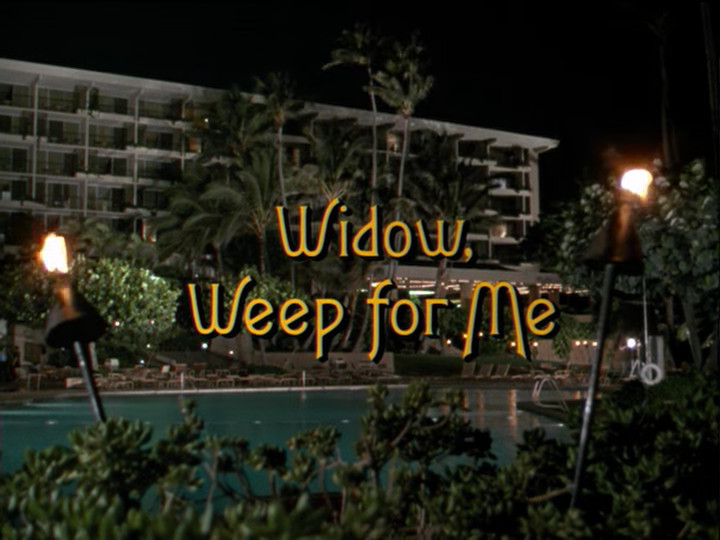
This must have been very exciting for the cast and crew of Murder, She Wrote because a second season means that you’re a success. Of course, a second season in no way guarantees a third, and they would have no way of knowing, at this point, that Murder, She Wrote would run for a total of twelve seasons. It’s also an interesting time for viewers because TV shows would often change fairly substantially between the first and second seasons. The lead-up to the second season was a time to take stock of what worked and what didn’t, what could be improved, and what needed to be streamlined. So now we find out whether all of that made it better or worse.
After the establishing shot of someplace that’s supposed to be the tropics but could be California with a few tiki torches in the foreground, we then get an opening scene of a wealthy woman who writes a letter to Jessica, posts it in the hotel post box, then gets murdered.

We then see the figure wearing all-black raise a knife that he had previously used to jimmy open the door from the balcony:
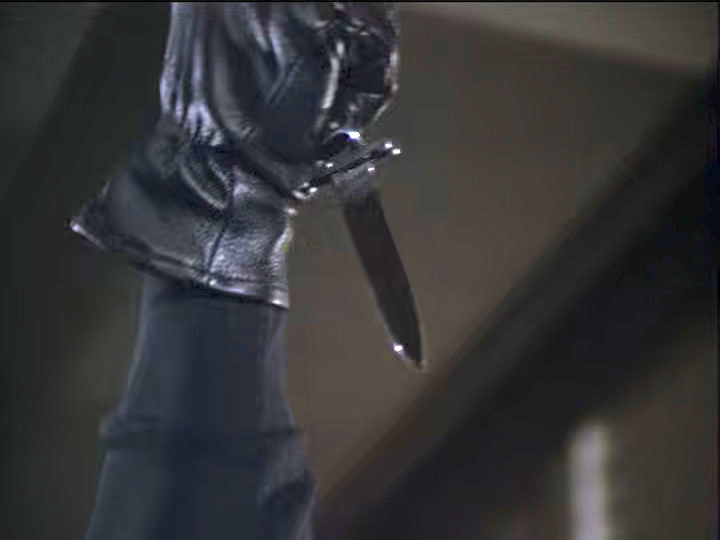
I love how often burglars in Murder, She Wrote wear all black clothing, including black gloves. I suppose it would, actually, help one to hide in shadows, though I can’t help but think that it would look a bit odd while you’re on your way to those shadows.
The hand plunges down and we smash-cut to a wave crashing on the rocks at Cabot Cove:

Instead of seeing Cabot Cove, though, we then cut to a white limousine pulling up to the same hotel. A moment later, Jessica gets out, speaking in her best rich-woman accent:

She asks the man in the uniform to see to her matched luggage. They’re unmarked, and she’d like to leave with them in the same condition.
At the desk, she lays it on quite thick. Evidently, she’s trying to give the impression of a rich, self-important woman.
A woman named Myrna Montclair then approaches Jessica and introduces herself.
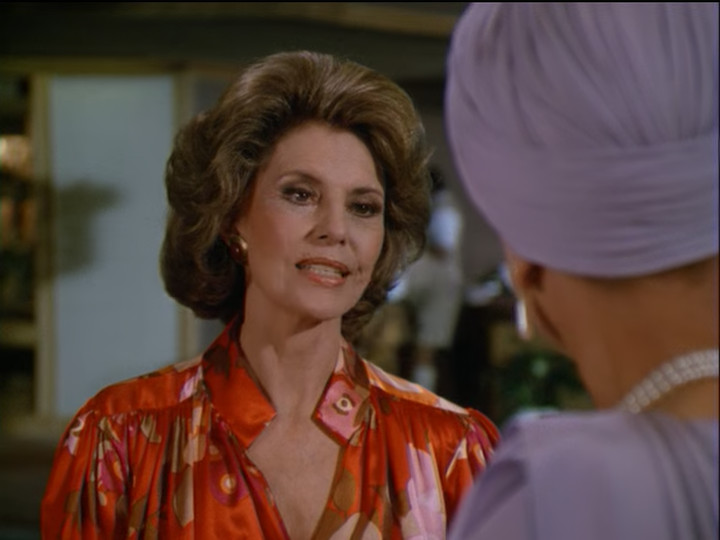
Jessica (who is going by the name Mrs. Canfeld, from Nebraska) asks if they’ve met before and is sure that they have. Myrna suggests that Jessica might be recognizing her from her previous career—the movies.
(The actress playing Myrna is Cyd Charisse, who was, perhaps, most famous for being the leading lady opposite Fred Astair in two MGM movies, though she did a lot of other things too and I’m not very familiar with her career. Here’s a clip of her dancing with Fred Astaire in the movie 1953 The Bandwagon🙂
It’s very interesting that they lamp-shade the fact that Cyd Charisse would have been recognizable by having the character be a former movie star.
Anyway, Jessica continues to lay on the “self-important rich woman” shtick. She lays it on quite thick; this shot gives a sense of just how thick Jessica is laying it on:

Up in her hotel room, Jessica takes off the ridiculous turban and reads the letter we saw the woman in the opening write. Before I get to that, I have to say that the outfit looks better without the turban:

I really wonder why those were a thing.
Anyway, the letter says:
Jessica,
I’m in trouble. Desperately need your help and advice. I sense a terrible danger, but I can’t leave the island. Will explain when you arrive.
–Antoinette
Jessica’s thinking about what she just read is interrupted by a man who calls her “Madam Fletcher” in a French accent:

His name is Chief Inspector Claude Rensselaer, of the Island Police. He then reminds her that they spoke on the phone. (He warned her to not come.)
He’s concerned for her safety as she’s showed up in a manner designed to invite trouble. Jessica explains that Antoinette’s last act was to ask for her help and she’s not going to ignore that request. The two were very close—like sisters—until five years ago when Antoinette’s husband died and Antoinette tried to lose herself in travel, parties, love affairs, and drink.
The Chief Inspector tells her that she was killed by a thief—he’s been operating in the area recently—but Jessica cannot accept that. He says that it is widely known that the victim wrote Jessica a letter right before she died and this might put Jessica in danger. Oddly, Jessica doesn’t point out that this would only be true if the inspector is wrong and it wasn’t just a thief after jewelry who snuck into the room after the letter was posted. Instead, she just explains that’s why she came under the assumed name of Marguerite Canfield (who the Chief Inspector remarks is a famous recluse).
He also asks if she realizes that all of the gaudy jewelry makes her a target for the thief and Jessica replies that she certainly hopes so. Then she asks what they have actually found out.
He says that they have no physical evidence and those who knew Antoinette best all have alibis. Jessica then gets a list from the Chief Inspector of who those people are.
We then meet the first person on the list, Eric Brahm, the hotel manager:
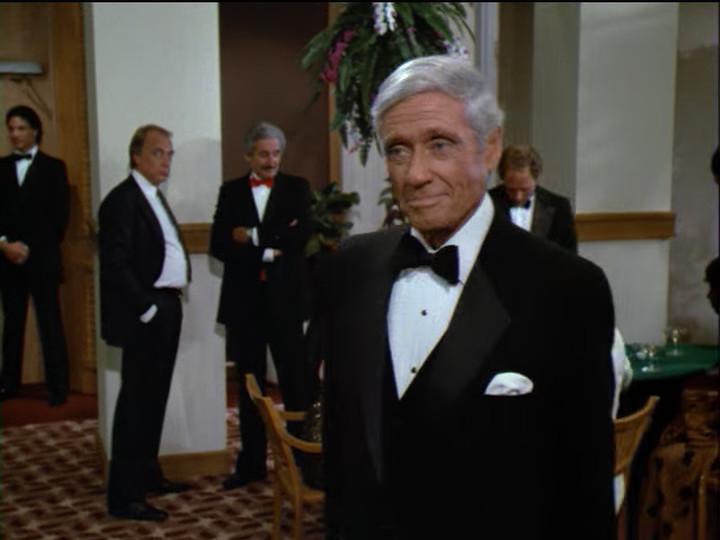
He tried to put the moves on “Mrs. Canfield,” though according to the Chief Inspector he tries that on all unattached ladies in the hotel.
Speaking of unattached ladies, Jessica meets Alva Crane at the roulette table:
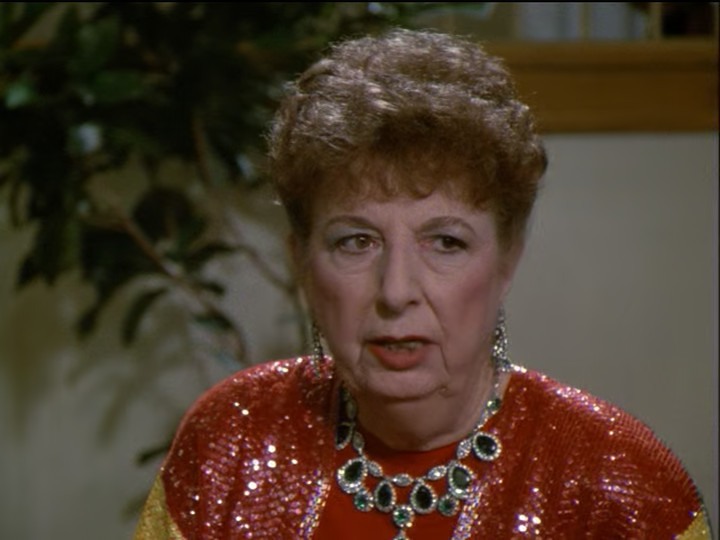
Shortly after they introduce themselves, a timer goes off and Alva says that she needs to take her blood pressure medication. As she fumbles in her purse for the medication, we get a closeup of a key in her purse:
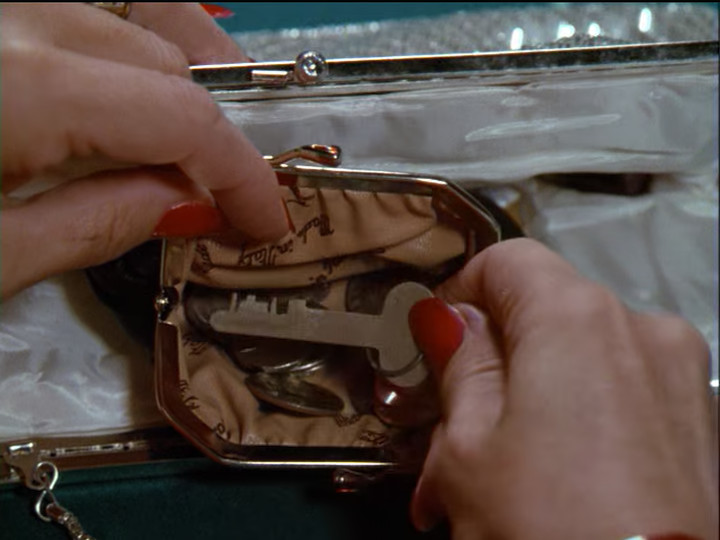
I’ve no idea what this is supposed to be a clue for, but they never show us a closeup in Murder, She Wrote without it being important. This one is a bit odd because this was during the time when hotels would use keys rather than disposable key-cards, so we would expect her to have a key in her purse.
After she gives a bit of chatter, a couple comes up, the woman obviously drunk.

She places a bet on number seventeen, as seventeen is the number on her classroom door in Curtis Road Elementary School in Davenport, Iowa. (She loses, of course. It comes up number twenty two.)
When she tries to place another bet the man tells her that it’s time to go to bed and she marvels to the older women that this beautiful man is with her.
After they depart, a middle-aged man with an Irish accent walks up and introduces himself as Michael Haggerty.

There’s a bit of witty dialog—she asks if they’ve been introduced and he says that he believes he just accomplished that formality—then he invites Jessica (as Maggie Canfield) to join him on the terrace and for some reason she accepts. He’s charming and claims to be a man of independent means, saying something vague about the British police thinking that he and some friends of his robbed the bank of England of a million pounds.
Later on, as they’re walking, Jessica asks about the man with the schoolteacher and Michael says that he is “Sven Torvald”. A few years ago he won two gold medals for skiing. These days he a member of the international jet set. A bit of conversation later, as Michael is inviting Jessica to go tour a waterfall with him, a thief grabs Jessica’s purse and runs. Michael gives chase but is knocked down by another man who claims that it was an accident.

The man who knocked Michael down, allowing the thief to get away, turns out to be Sheldon Greenberg, the head of hotel security. When Jessica asks why he’s been watching her all evening, he says that it was because he was worried that something like this might happen because she wears her jewelry so conspicuously. He then excuses himself to go report the theft to the police.
Oddly, we don’t fade to black when going to commercial, but, regardless, had you been watching back in 1985, you might have seen a commercial like this:
When we get back, Jessica calls Inspector Rensselaer. She asks him if Sheldon Greenberg really did report the theft of her purse, and he tells her that Greenberg has not. She asks what he knows about Greenberg and Rensselaer says that he doesn’t know much, but his credentials check out. He had been a New York City policeman for twenty years with a good record.
After this phone call Jessica spies the drunk woman from the night before running along, stops her, and introduces herself. The woman’s name is Veronica Harrold. She’s on the trip because she won it at a supermarket giveaway. The funny thing is that she doesn’t even remember entering. Also, it was a vacation for one—she met Sven here.
Veronica gets on to reminiscing. The woman who died—Antoinette—was super nice to her on the first day she got here. When Jessica (still posing as Maggie Canfeld) remarks that this was very nice of her, Veronica replies that it was, but also a little strange—it was as if Antoinette had singled her out. Antoinette didn’t get along well with Sven, though.
Veronica then notices Miss Montclair standing by the tennis courts in a tennis outfit and talks about how beautiful she is and how much she (Veronica) loved her (Miss Montclair) in her movies. She saw The Sin of Andrea Crown six times. (Miss Montclair played a woman whose husband is cheating on her so she systematically kills all of his mistresses. This is invented for this episode; it has nothing to do with the movies Cyd Charisse was in, so far as I can tell.)
This is interupted by Sven coming up. He’s rented a boat at the marina and thought they might do some scuba diving. Veronica thinks this is a great idea and excuses herself to Jessica.
The scene then shifts to the hotel manager’s office, where the hotel manager tells Michael Haggerty that he’s checked and there is no Michael Haggerty associated with the whiskey importing business, which puts him in a distressing position since Michael has run up a casino obligation of more than ten thousand pounds under false credentials.
Michael replies that he won’t explain; his using an alias is a personal quirk. However, he hands the hotel manger a cashier’s check for twenty five thousand pounds and tells him that it should ease his misgivings.
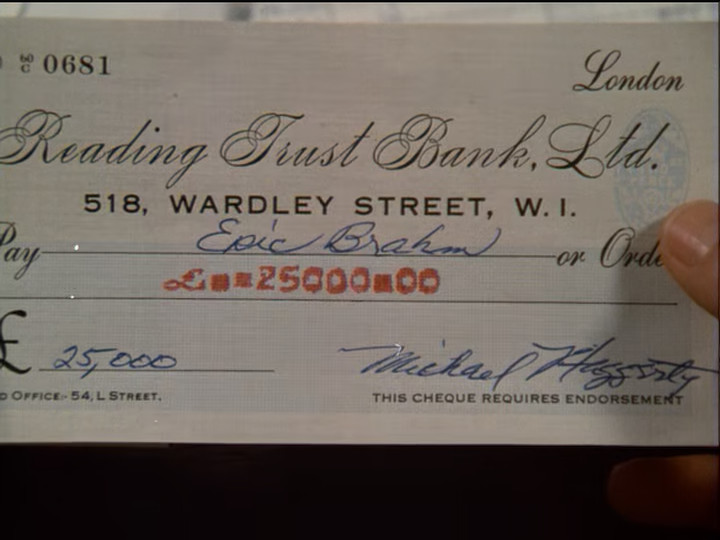
It’s a bit odd that he’s made it out to the hotel manager personally, rather than to the hotel, but in any event this does ease the hotel manager’s misgivings and the scene ends.
In the next scene Jessica notices the hotel security man talking, in the lobby of the hotel, with the man who stole her purse the night before.

After the man in the striped shirt leaves and Greenberg goes into her office, Jessica goes in and confronts him. He claims that he found it (full of cash, no less) after scouring the grounds for a few hours, but Jessica asks about him talking with the thief.
Instead of answering, he shows Jessica one of her books with her picture on the back. (I love how in Murder, She Wrote all of Jessica’s books have a large picture of her on the back cover instead of a blurb or book reviews. This wasn’t super-common, though it did happen in the 1980s, perhaps most prominently with Danielle Steele.)
He had her purse stolen because he wasn’t certain she wasn’t Marguerite Canfeld and wanted to look at her passport to be sure.
The conversation then takes a strange turn as he seems to take her presence personally—that she came to make him look bad. Jessica responds by flattering him and even suggesting that she would make him a character in her next book. He takes this well, saying that he’s read all of her books and they’re good, so he offers to help her if there’s anything he can do.
Jessica then calls Inspector Rensselaer and asks if they can meet someplace where they won’t be seen. He says he will meet her in a private place in Turtle Bay in 30 minutes. (Why she can’t just say what she wants to say over the phone, which is not much less private, she does not say. Also, it’s a bit odd that he says he knows where it is but doesn’t tell her where it is.)
There’s then a scene where the hotel manager has a conversation with miss Myrna Montclair, who turns out to be his wife but they’re keeping it secret because of company policy. He tells her that they will be able to go public in few months at the most, suggesting, I think, that he’s supposed to be a suspect for the robberies. Which, of course, guarantees that he’s innocent.
We then cut to Jessica waiting for a cab but Michael Haggerty drives up and insists on giving her a ride, which for some reason she accepts. After Michael passes the correct turn, Jessica asks him to stop the car but he says that he needs a minute to lose the person following them, first. After some evasive maneuvers, he does.
He then pulls up to an overlook and talks with Jessica. She asks if he knew Antoinette and he did, including that she had two marriages, the first of which her father paid to have annulled. When Jessica says it’s curious that he knows that because her marriage to Leon Savitch was a secret she shared with no one, he remarks that it’s interesting that she knows the first husband’s name and asks who the hell she is, adding that he once met Marguerite Canfeld many years ago, and unless she’s grown five inches in the intervening time, Jessica is definitely not Marguerite Canfeld.
And on this bombshell we fade to black and go to commercial.
When we get back, Sergeant D’arcy (who was the one following them) pulls up and asks Jessica, by her real name, if she’s fine, to which she replies that she is. Haggerty takes note of the name. D’arcy shows Jessica his badge and asks her to come with him immediately. The Inspector wants to see her at the hotel—there’s been another murder.
Back at the hotel, Jessica meets up with Rensselaer, who mentions that it wasn’t luck that Sergeant D’arcy caught up with them—he took the precaution of having a homing device put into Michael Haggerty’s car before they drove off. (When Jessica replies, “of course, the doorman,” Rensselaer replies, “let’s keep that our little secret”.)
The victim is a Alva Crane, who was murdered at around six in the morning.
Jessica disagrees that this is the work of a professional thief—Alva Crane’s jewels were good fakes, but they were fakes. And if Jessica could spot that they were fakes, surely a professional thief could, too.
They then check out whether Alva Crane was merely wearing fake jewels to keep the real ones safe or if she actually had little worth stealing. They do this by taking the key which was in her purse, but now is on her dresser, which turns out to be the key for her hotel safe deposit box.
When they open the safe deposit box they don’t find anything of value—only about $1,000 in American money. Greenberg disagrees with Jessica about Alva Crane’s jewels being fakes, though. He thinks that they were real—unlike the jewels that Jessica was wearing.
The subject of fake jewels that someone can spot with the naked eye is rather interesting, because it was somewhat iffy in 1985 and certainly didn’t last much beyond it. In the late 1970s, cubic zirconia became commercially available and high quality cubic zirconia is exceedingly difficult to distinguish from real diamonds with the naked eye—and almost impossible to tell while someone is wearing them, where you can’t control the lighting and angles to see the subtle differences with diamonds. (Synthetic sapphires, rubies, and emeralds were all widely available by the 1960s and the only way to distinguish them from their natural variants is by their lack of flaws—but a lack of flaws is also what you find in more expensive natural gemstones.)
Prior to the 1970s, it was the case that glass might be used as fake diamonds and the trained eye might spot them. If you’ve seen references to “paste” jewels, by the way, it was to this. “Paste” referred to heavily leaded crystal because of the way in which it was made—the ingredients in the leaded glass were mixed as a paste prior to firing in order to ensure uniform mixing. By 1985 leaded crystal glass had largely been replaced by cubic zirconia as fake diamonds, though one might plausibly stretch this that an older lady might have fake jewels she bought at least five or six years before, and hasn’t seen the need to upgrade.
I should add, because most people’s experience with cubic zirconia is with low-grade cubic zirconia, that there are 5 basic grades which are related to the quality of manufacturing (zirconium oxide tends to be monocrystaline a room temperature, not cubic structured; dopants such as yttrium or calcium oxide are used to stabilize the cubic structure at room temperature, each manufacturer having their own recipe). The lowest grade might be sold at prices that teenagers shopping in malls could afford, and consequently his is often what people think of when they think of cubic zirconia. Not only was the recipe used in making these grades chosen for economic efficiency rather than clarify of the resulting gemstone, they were generally machine cut and received only some polishing. The stuff sold in jewelry stores as fake diamonds would be the highest grade, hand-cut, and thoroughly polished. It’s this high-end cubic zirconia that is difficult to distinguish from diamond with the naked eye. It’s also the kind that a rich woman getting a cheap copy made of real jewelry would get when she asked her jeweler to make the copy.
Considering mysteries written today: this is a plot point that isn’t plausible since the widespread commercial availability of moissanite—which simply cannot be distinguished from diamonds by the visible light spectrum, even with tools. Moissanite can be distinguished from diamond, but the tools to do so use electrical and fluorescent properties, not visible light. (Moissanite cost around 10% what diamonds did by the early 2000s and have come down even more significantly in cost since the patents on their manufacture expired in 2018.) In a mystery written today, a person would only be able to spot fake jewels if the fake jewelry was an heirloom piece, made decades before.
Getting back to the episode, Jessica asks Greenberg to explain his theory of the case and he obliges. He suspects the hotel manager, Eric Brahm. He was sucking up to both of the women who died and he’s always on the lookout to make money—always trying to put together some scheme or other.
Jessica then goes and interviews Eric Brahm, the hotel manager. He reveals that everyone knows who she really is, now, so Jessica drops the act and asks forgiveness for having been deceitful. Brahms is understanding, saying that it was probably a wise precaution. She then denies helping the police, but does have one question—could Alva Crane have been wearing paste jewels because she was in financial trouble? Brahm assures her that Alva was extremely solvent—her security holdings are worth millions. And, not only that, her checks were good.
When Jessica gets back to her room, Michael Haggerty is waiting for her. When she asks how he got in, he replies that it’s another of his talents that are best left unexplained. He asks why she was hiding letters from Antoinette and Jessica asks how he knew Antoinette. He explains that didn’t know her, he only knew of her, and says that they should go elsewhere to talk. Which turns out to be a golf course:

There is, I think, a certain wisdom in going to wide open places to have a private conversation. It would be very unlikely for people who want to listen in to have planted microphones in the grass. They are, perhaps, a bit close to the shrubbery, but then they’re moving, so no one hiding in a shrub will overhear much.
He then reveals that Antoinette gave birth to a child six months after the annulment of her marriage to the poet Leon Savitch. Her very wealthy father was furious and refused to recognize the issue of a non-marriage. He threatened to cut her off without a cent unless she gave the child up for adoption. Michael then explains that now, with “the hot breath of his maker warming down the back of his neck” he’s seeking to atone for past sins and searching for the grandchild.
Jessica says that the grandchild would be Veronica Harrold, and Michael praises her deductive skill. The contest idea was the old man’s idea. He’s dying, but still has his wits about him. When Jessica asks how long he’s been working for the old man, Michael replies, “off and on for ten years or more.” He’s done odd jobs that required discretion or involved risk.
Jessica asks, “like robbing the Bank of England?”
Haggerty replies, “You may well laugh, Ma’am, but I actually had to do that once, some years back, by order of the Prime Minister. I was attached to MI5.” (MI5 is the domestic counterpart to MI6, Britain’s more famous intelligence service.)
After thinking some things through, Jessica says that they must go to the marina at once. (Clearly, she suspects Sven, though what danger Veronica could be in I’ve no idea since Sven couldn’t inherit anything from her as a boyfriend and she’d have had no time to make out a will in his favor.)
On the way, Jessica mentions to Michael that several of the letters were mailed from alpine ski resorts. And one of the letters mentions having met a delightful young man there. They’ve spent nights sharing secrets and shutting out the rest of the world. Jessica explains that if this was Sven and Antoinette in a drunken moment told him about her daughter, this would certainly explain Sven suddenly becoming romantically involved with an Iowa school teacher and also why Antoinette and Sven didn’t get along.
When Michael points out that Sven has no reason to kill Veronica, Jessica says that it might be something worse than that. (You don’t see many references to “a fate worse than death” in the 1980s.)
They get to the docks just as Sven and Veronica’s boat is pulling in, and Veronica announces that she and Sven are going to be married in the morning.
Michael and Jessica confront Sven with his acquaintance with Antoinette. Michael adds that the wedding will have to wait until after Sven has had a chat with the police about a murder. At this, Sven tries to run. Michael heads him off and they both end up in the water with Michael holding Sven by the shirt.
And on this bombshell we fade to black and go to commercial.
When we get back, Sven is being interrogated in Inspector Rensselaer’s office, along with Michael Haggerty (Jessica is off comforting Veronica). Sven confirms that Antoinette did tell him about her daughter one night, while she was drunk. He ran into her again on this island, saw Antoinette with Veronica, and put two and two together. However, he denies killing Antoinette, and the scene ends with that.
As Jessica is comforting Veronica, Veronica recalls some useful information that Sven couldn’t have committed the first robbery as he showed up two days after it (the robbery was the day after Veronica arrived).
Jessica goes to see Eric Brahm and interrupts the ending of a meeting with an investigator from the company which insured Alva Crane’s missing jewels. This conclusively proves that the jewels were real, or at least that she owned real jewels. It does make me wonder who contacted the insurance company to file the claim, but it’s usually best not to ask after trifles like this in Murder, She Wrote. After the investigator leaves, Jessica lets Eric know that they won’t find Alva’s jewels in Sven Torvald’s room, as he didn’t arrive until three days after the first robbery.
Brahm then suspects that Jessica suspects him and tells her that he’s planning to fire Sheldon Greenberg—not only is he a total incompetent, but his accuastions against Brahm are beyond the pale. Myrna then shows up and tells Jessica that Brahm was sharing her bed and her affections at the time that Alva Crane was murdered. There’s a really funny bit where she says, “If you’re shocked, Mrs. Fletcher” and Jessica interrupts to say, emphatically, “Oh, I’m not.” Myrna goes on to say that they’re married and have been for nearly a year, which Jessica responds to with “My congratulations to you both, belatedly,” which shows she hadn’t deduced that they were married, which means that, clearly, she thought that Myrna was a loose woman. Fortunately, Myrna doesn’t seem to notice the implication.
When Myrna says that Eric has been trying to put together a hotel on the Mexican Riviera, Eric adds that it may take longer, now. The thing that’s holding it up is money—they key to everything. At the mention of a key, Jessica realizes the solution to the murders, and hurriedly excuses herself to go call Inspector Rensselaer.
She then drops in on Sheldon Greenberg, who is packing up his things—Brahm already fired him. Jessica asks if Eric Brahm had a master key to the safe deposit boxes but Greenberg says no, there’s only one and it never leaves his possession.
Jessica then reveals that it was Greenberg who killed the women, in order to steal their jewelry. Her proof is that Alva kept the key to her safe deposit box inside of a small change purse in her larger purse, but when her body was discovered the key was lying on her dresser, in plain sight. And since Greenberg hadn’t mentioned it, the user must have been him, since no one could have gotten into the box without both Alva and Greenberg’s key at the same time.
As Greenberg reaches for a gun in his desk drawer, Michael Haggerty walks in with a small cloth bag and tells him that the authorities got a search warrant and went through his luggage. Even removed from their settings, the gems will be easy enough to trace to their owners.
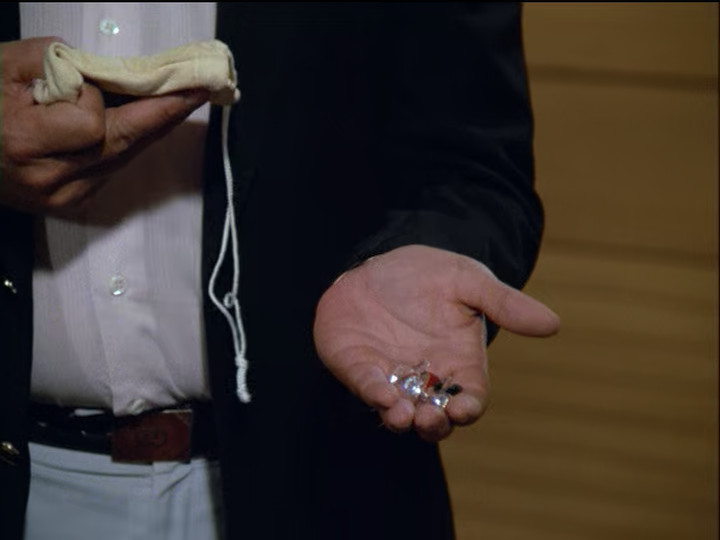
Why they authorities let Michael hold the jewels for this confrontation, he does not say.
As Greenberg starts reaching for his gun again, Jessica cautions him not to, and the camera pulls up to Inspector Rensselaer, holding a gun:
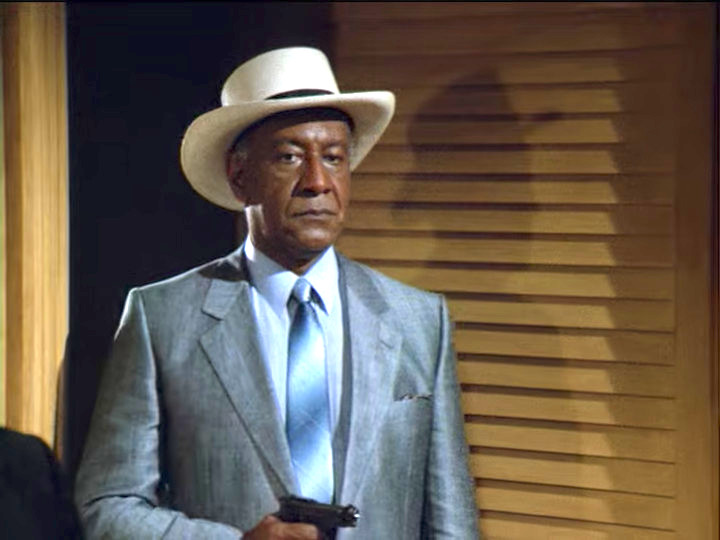
This is dramatic but a bit silly, as he’s directly between Jessica and Michael, it would have been impossible for Greenberg to not see him as he was reaching for the gun in his drawer.
Greenberg gives up and says, “A million bucks. Thanks, lady. I could have lived like a king.”
I can’t help but mention that his math is a bit off. If he tried to live off of this for ten years, that would mean he’d have to make due on $100,000 per year (just under $302,000 in 2025 dollars). If he was staying at hotels the entire time, he’d be able to afford one that cost $273/day ($834 in 2025 dollars)—assuming he could photosynthesize or otherwise do without food. That’s hardly living like a king. To live like a king, he’d need to blow it all in one year, or perhaps in an even shorter time span.
Anyway, the next morning Jessica bids farewell to Veronica. After that, Michael bids Jessica a fond farewell, and we go to credits.
This was a curious episode to start off the second season with. On the one hand, I can see how they could have thought of it as pulling out all the stops. We have an interesting exotic location. We have Jessica pretending to be a rich recluse to solve the murder of a friend who wrote to her right before being murdered. We have the intrigue of a long-lost child. We have a jewel thief who has killed multiple times. We have a charming and mysterious Irishman. We even have a dapper police inspector with a delightful accent.
And yet, the impression I have when it’s over is not that this was a special episode. I’m not entirely sure why.
I think part of it is that I found the character of Marguerite Canfeld insufferable. To be fair, she was probably intended to be insufferable. But pretend-insufferable is still insufferable. Jessica dropped the character roughly halfway through the episode, but that was, really, far too late.
Thinking it over, though, I think that the biggest problem with this episode is that its parts do not relate to each other. Antoinette was murdered for her jewels and it was a complete coincidence that she was meeting her long-lost daughter, that her former boyfriend was now wooing her daughter, and that she sent a letter to Jessica moments before she was murdered. While it is true that red herrings are a staple of murder mysteries, they’re not supposed to be the majority of the story and they’re certainly not supposed to be the most interesting parts.
It’s even worse that this makes Jessica wrong without ever acknowledging it. Jessica repeatedly told Inspector Rensselaer that she can’t accept that Antoinette’s murder was just a coincidence after sending Jessica that the letter saying that she sensed danger. Her being convinced that the motive for Alva Crane’s murder was more than simple robbery is pretty iffy, too. About the only defense possible for it is that the motive was mildly complex robbery rather than simple robbery; that’s not an impressive defense. But Jessica goes on to say that the robbery was a cover for another motive, and here she was simply wrong. She never acknowledges either mistake, I think because it would highlight how much the solution turned out to be uninteresting. (Also, Jessica’s mistakes were not the result of the murderer being clever but simply because the unbelievable coincidences turned out to be true anyway.)
Now that I write that, it occurs to me that that may well be as big a problem as is most of the episode being a red herring. When you get down to it, the solution to the murders is that a person in a position of trust is abusing this trust to steal jewels. This is ordinary crime, and not very interesting. The only mildly clever thing about it was that the guy with the master key to the safe deposit boxes had to kill his victims in order to cover that he was using the master key. But this problem only cropped up immediately before the solution—and if you blinked, you’d miss that it even was a problem. For a mystery to be satisfying, you need to puzzle over the mystery throughout the story then receive a satisfying explanation to it. The puzzle should not be why the solution made sense, requiring you to remember seemingly unimportant bits of dialog to figure out that there was even a problem that the solution solved.
As far as characters go, there’s really only two: Michael Haggerty and Veronica Harrold, and Veronica is only barely more than a rural schoolteacher stereotype, which leaves us with Michael Haggerty. He’s a fun enough character; he does the “man of mystery” fairly well. Interestingly, Len Cariou, the actor who played him, played Sweeney Todd in the same production of Sweeney Todd: The Demon Barber of Fleet Street that Angela Lansbury played Nellie Lovett in, and reportedly the two actors became friends. It would be interesting to know if this had anything to do with Len Cariou’s casting.
Inspector Rensselaer is played by an extremely charismatic actor, but there isn’t much to the part. It feels like half his lines are “Madam Fletcher!” Shelley Greenberg is mostly annoying. Eric Brahm and Myrna Montclair are tolerable, though the attempt to use them as suspects falls flat, at least to me. “The hotel manager was seen talking to a guest” is remarkably poor evidence of… anything. And their secret marriage because of company policy couldn’t motivate anything that happened other than, perhaps, motivating robbery, but since the episode spends all of its time insisting that robbery was not the motive, they’re simply not plausible as suspects until after the real murderer has been caught. Alva Crane was fun for the one scene she was in, but all of her lines could have been cut and nothing about the episode would need to be changed, which is to say that she was just there, she wasn’t a part of the story. At least not when alive. Oh, and I nearly forgot that, technically, Sven Torvald was in this. He’s very structurally important, but he’s practically a non-entity in all of the scenes he’s in.
Which reminds me, why on earth did Sven try to run away before the last commercial break? The only thing he had to hide was his relationship to Antoinette, but the only person he had to hide that from was Veronica and running away, if anything, confirmed it to her. I mean, I get that the reason it’s in the episode was to go to commercial break on an exciting cliff hanger, but there was no payoff because, with him not being guilty of any crime, there couldn’t have been a payoff. It made life worse for Sven, and I don’t see how it could have seemed like a good idea to him at the time.
Oh well. Next week we’re back in Cabot Cove for Joshua Peabody Died Here…Possibly.
Discover more from Chris Lansdown
Subscribe to get the latest posts sent to your email.
 Chris Lansdown
Pingback: Murder She Wrote: Funeral At Fifty Mile – Chris Lansdown
Err —
“those who Antoinette her best all have alibis.”
?????
LikeLiked by 1 person
Fixed. Thanks!
LikeLike
Pingback: Murder She Wrote: Joshua Peabody Died Here… Possibly – Chris Lansdown