
On the sixth day of January in the year of our Lord 1985, the ninth episode of the first season of Murder, She Wrote aired. Called Capitol Offense, it takes place in the swamps of Washington, D.C. (Last week’s episode was Death Casts a Spell.)

It opens with a congressman talking with some lobbyists in a richly furnished room. We’ll find out later that the taller one is Roy Dixon and the shorter one (mostly obscured in the picture below) is Harry Parmel. The congressman (getting a drink) is Dan Keppner.

For some reason the woman serving drinks has a camera in her lighter, which she uses to take pictures of the congressman doing nothing incriminating. He’s drunk, but that won’t show up in photographs, especially photographs from tiny cameras using 1980s technology.

A few moments later Congressman Joyner shows up and tries to take Dan “home.” The lobbyists try to get him to stay and Joyner unloads into them, calling them rattlesnakes and saying that the next day he will make a full complaint to the house ethics committee. For what, I cannot imagine and he does not say because he immediately has a heart-attack and dies. (As the scene closes, someone says to call an ambulance and someone else replies, “No. No ambulance.” The waitress then takes a picture of them over the body with her cigarette lighter.)
The scene then shifts to Cabot Cove, where Jessica answers her door to an aid from the governor. Congressman Joyner was found by his housekeeper dead in his bed this morning. Why on earth the other congressman and the lobbyists moved the body will, I presume, be something Jessica has to figure out, but it seems quite absurd on its face.
Anyway, the long and short of the rest of the conversation is that Jessica is named as Joyner’s replacement on an interim basis, until an upcoming primary takes place, so Jessica is off to Washington, D.C.
Before Jessica shows up, we see her soon-to-be-secretary, Diana Simms, answering the phone:
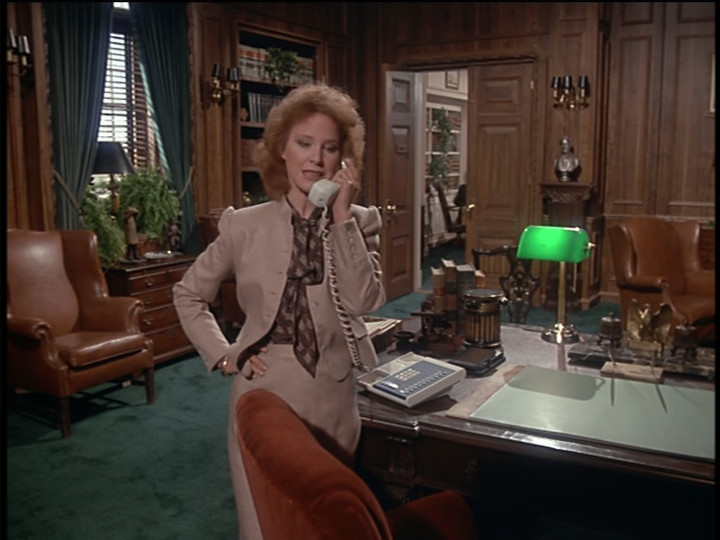
For once, I can actually believe the set decoration.
We then see Jessica arriving in town. She’s been picked up from the airport by Joe Blinn, the Media Liaison Officer.
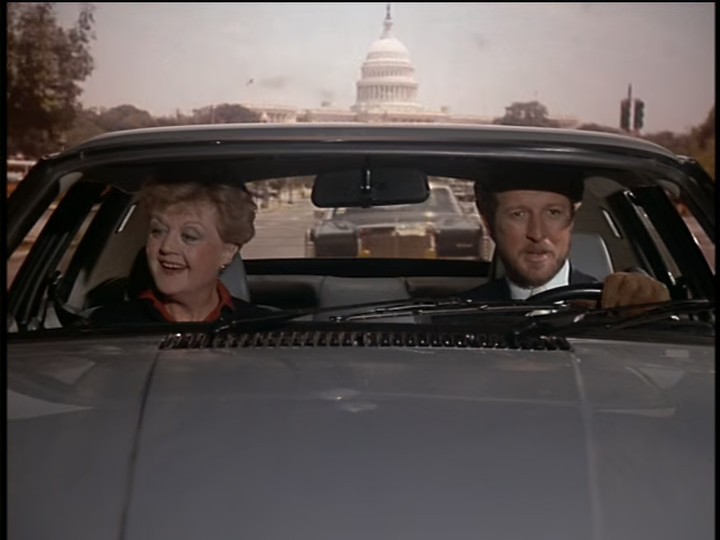
Joe’s job is to get her name in the papers, or to keep it out, whichever she prefers.
On the way in to her office in the capitol building, she meets congressman Keppner. He asks to stop by later to discuss the Maine cannery bill and others.
Inside her office she meets Diana. Diana tells her that her resignation is already on Jessica’s desk but she’s prepared to work closely with Jessica’s incoming staff. Jessica retains Diana, however, for pretty obvious reasons. This is portrayed as Jessica being pure and honest, but it’s a little absurd to expect a mystery writer from Maine who is only serving for a few weeks to hire her own staff.
Right after Jessica crumples up Diana’s resignation letter and throws it in the trash next to her desk, Harry Parmel comes in and introduces himself.

He tries to invite Jessica to lunch, but Diana signals to not accept. After he leaves, she tells Jessica, “Most lobbyists are good people. They know the rules. Harry not only breaks the rules, he’s never heard of them.”
Later that night, Dan Keppner calls Jessica from a payphone in a bar. He’s sorry if he woke her, but there’s something he really needs to talk to her about. Jessica asks if it can be in the morning and he says sure, and makes an appointment to have breakfast.
He goes outside the bar and runs into Marta Craig. She was the bartender with the camera-lighter.
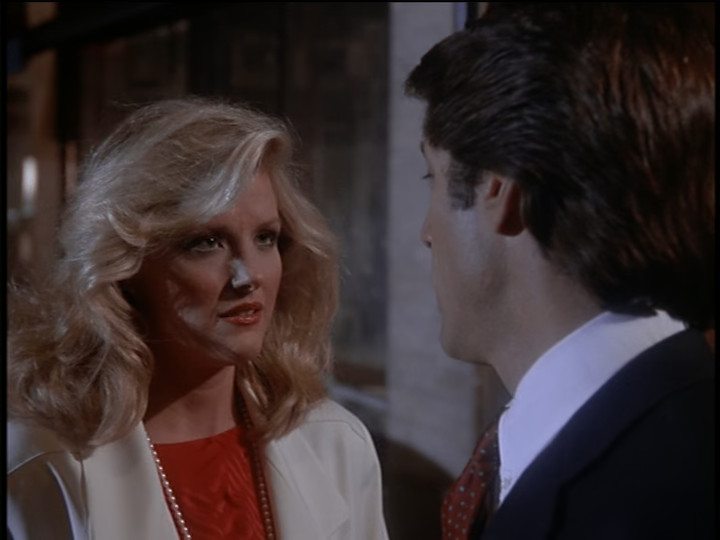
She tells him that she’s scared about the other night and moving the body. She then hands him a photograph of Keppner and the lobbyists crouched over Joyner’s body.
We then fade to some guy.
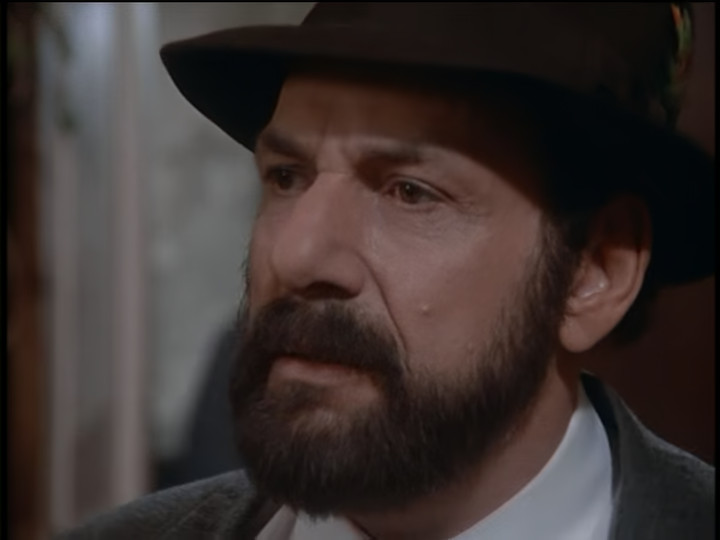
He kind of looks like he’s following Jessica, except that he loses her and she turns up behind him. When she asks who he is, he flashes his badge and introduced himself as Detective Lieutenant Avery Mendelsohn. He tells Jessica that he’s following her in the hopes of finding out who killed Congressman Joyner. And on that bombshell, we fade to black go to commercial.
Here’s a Northwestern Mutual life insurance commercial you might have seen, had you been watching on that fateful night in January of 1985:
When we come back the Detective Lieutenant is massaging his foot while talking to Jessica in the lobby. He says that maybe Joyner wasn’t murdered, but somebody moved the body. When people move a body, he asks himself why. After a bit of a comedic routine about taking pain medicine for his bad back, his stomach gurgles, and he says that perhaps he’s making something out of nothing, but when his stomach starts to growl, it’s a sure sign there’s a fox loose in the china shop. He then pauses in perplexity as his own metaphor and takes his leave.
It’s unlike Murder, She Wrote to run an investigation of a crime we saw in the beginning of the episode, Columbo-style. I guess we’re still in early-first-season experimentation.
Later that morning congressman Keppner wakes up in an alley with a bum going through his pockets:

He chases the bum away then runs after the bum and a passing police car notices him and picks him up. They have a photo of him for some reason.
At the police station Detective Lieutenant Mendelsohn is interviewing the congressman. Apparently, Marta Craig is dead. She was beaten to death in her apartment some time the night before. His jacket was found in her apartment and his hands have blood on them, so he’s got some questions to answer.
Back at Capitol Hill, Jessica is talking with Diana about the cannery bill, which would permit the building of a fish cannery on McHenry’s Point, which is only a few miles from Cabot Cove. It’s a classic case of business interests vs. the environmentalists. (Given that this is 1985, the business interests are supposed to be the bad guys.) Congressman Joyner was going to vote against the measure. Jessica says that she may also vote against it, after she’s shifted through the testimony herself and had a chance to make up her own mind. No mention is made of the opinion of the people from the congressional district she is representing.
Jessica then asks Diana where Joyner was the night before his body was found and there was nothing on his schedule but Diana remembers that Harry Parmel invited him to a party that evening but Joyner turned him down.
There’s then a bit of congress-related stuff where Jessica attends a committee meeting where testimony is heard from one of the lobbyists. This involves some digs at how things are done in Washington, including people reading out their prepared testimony. This was very much in the style of a kind of quasi-populism that was popular in the 80s and early 90s. The post-war consensus was breaking down and people who grew up with it didn’t know what to make of what government looks like when not everyone agrees, and one popular explanation was that there was just some imperfection in the system, and if common folks with common sense were put in charge, everything would be fine.
It was certainly a seductive idea at the time, but it’s absurd if you think about it for more than a few seconds. If common folks with common sense would do such a great job, and the populace was not to blame for the failures of democracy, then why does the populace not elect these common folks with common sense?
Anyway, back in Jessica’s office, Joe Blinn is remonstrating with Jessica for not having lunch with Kaye Sheppard, who is “the empress of Washington gossip, syndicated in 98 papers.” After this bit, the Lieutenant is waiting in Jessica’s office. He asks about her breakfast date with Keppner. Jessica says that she overslept and he never showed up. It’s not like Jessica to oversleep; she’s normally a very early riser. Frankly, I’m a bit surprised that we didn’t get any shots of Jessica jogging around D.C. in her sweat suit. Anyway, he tells her that they’re holding Keppner for the murder of Marta Craig. His feet hurt, which is a sign that something isn’t exactly kosher, so he asks if she can spare him a minute.
In the next scene Jessica is talking with Keppner in the Lieutenant’s office, explaining that it was dumb to move Joyner’s body but he was too drunk to think straight. No explanation is offered for why it seemed like a good idea to him drunk, because I don’t think that there can be one. Anyway, he explains that Marta was at the party where Joyner died and last night met him at the bar he called Jessica from (he doesn’t remember which) and showed him a photograph of him over Joyner’s body. He went with her to her apartment and had a drink—ginger ale. That’s the last thing he remembers.
He says that the key to her apartment was planted on his jacket and the Lieutenant says that doesn’t explain the blood and makeup found on his shirt. He says that he doesn’t understand it but he’s not a killer. He turns to Jessica and begs her to believe him. And on that bombshell, we fade to black and go to commercial.
When we come back from commercial break, Jessica views the body. After being suitably disgusted and the Lt. saying that he told her it wasn’t pretty, Jessica says that Keppner certainly didn’t kill Marta. While there was blood and makeup on his shirt, there wasn’t that much, and there was only blood on his hands—no makeup. Had he beaten her as severely as she was beaten, he’d have had both blood and makeup on his hands.
Jessica has the Lt. take off his coat then demonstrates how the killer—who had blood and makeup on his hands—would have moved the unconscious body of congressman Keppner.

Thus explaining the blood and makeup found on Keppner’s shirt. The Lt. is impressed and says, “maybe you should have been a cop.” She replies, “I am a cop, when I’m at a typewriter.” He replies, “you’re not at a typewriter now.”
In the next scene we’re back at Jessica’s office and Diana is giving us some backstory on Keppner, with Joe filling some details in. He used to be an alcoholic, then recovered about 6 years ago—attended meetings, etc. Then a few months ago his wife left him, took the kids, and went to New York. Keppner started drinking again. Jessica then tells Diana and Joe that Keppner was framed, very clumsily, and assigns Joe to dig up everything possible on Marta Craig since he’s an expert in this town. Joe protests that he’s not a detective, but promises to do his best.
The next scene is at a restaurant where Roy Dixon (the lobbyist from the first scene) is waiting for a senator to show up and Harry Parmel comes in and tells him that his job doesn’t include covering up murders, before, during, or after the fact, and at the first sign of trouble, he covers his own rear end, not anyone else’s. This is clearly meant to implicate Dixon, who then tries to look guilty for the camera.
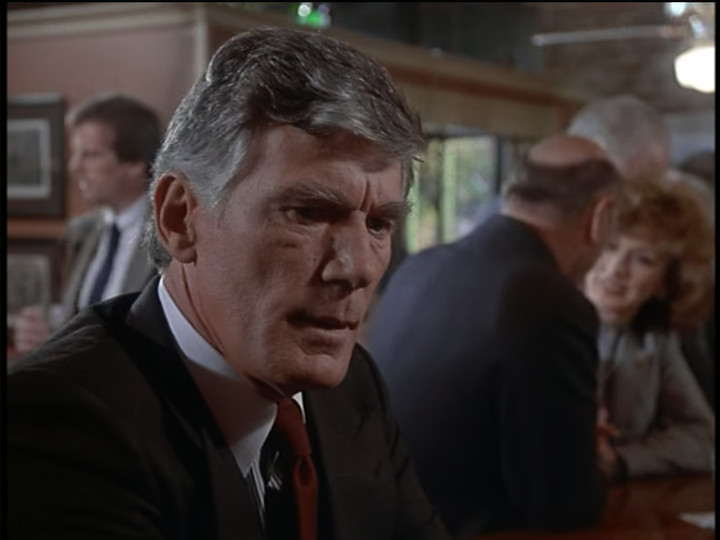
Which, of course, means that he definitely didn’t do it. The murderer never tries to look guilty for the camera.
In the next scene Diana gets home and is started to see a man standing there. But only for a moment, then she recognizes him. He’s a lobbyist we only saw for a few seconds who Diana directed Jessica to treat rudely. His name is Thor, and he comforts Diana about the news about Marta.
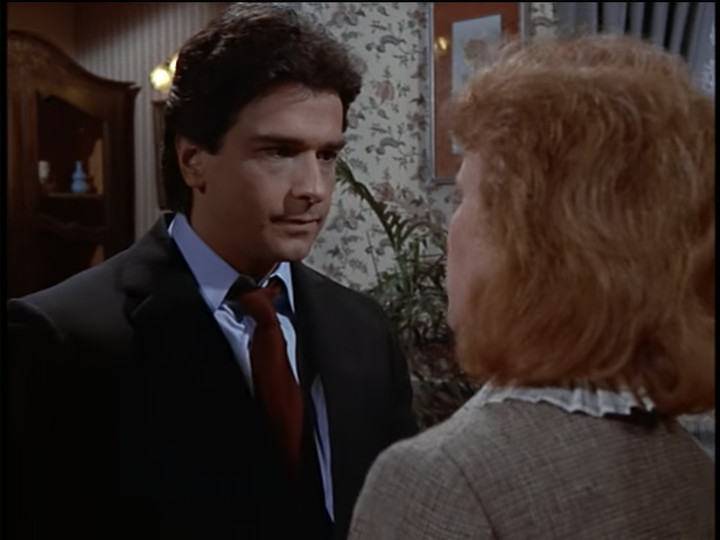
After embracing her, he tells her that some photos came in the mail. He shows her one.
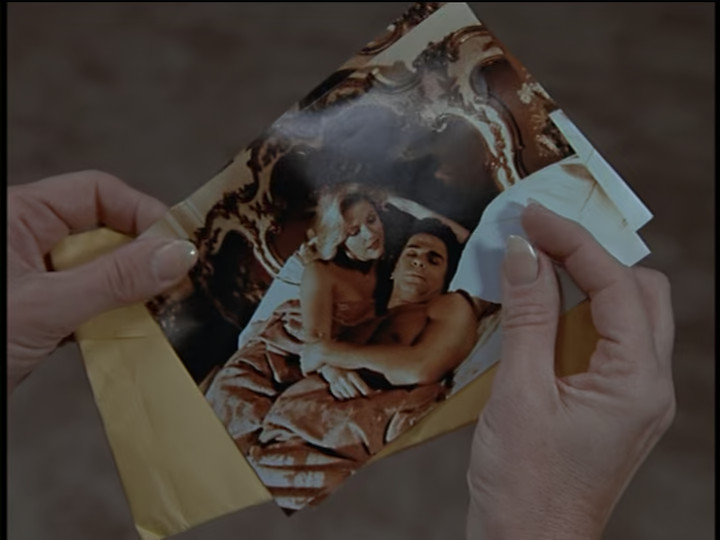
She says that he showed her these photos a week ago and said that they were faked and she believed him. He then says that they came with a note.

The music then turns dramatic and we get a dramatic closeup of Diana. I don’t know what that’s supposed to mean. Possibly nothing more than this is supposed to be important. We still have almost twenty minutes to go in this episode so perhaps they will pay this off.
The scene then shifts to Marta Craig’s apartment.
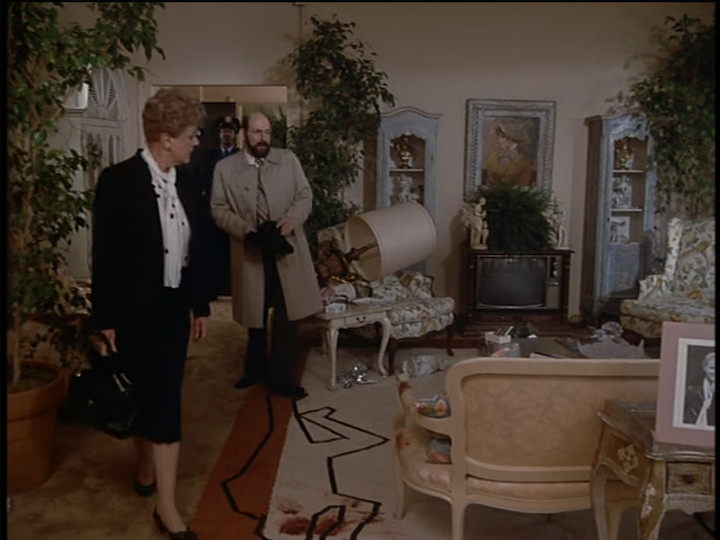
Jessica observes that Marta lived very well for a secretary. Jessica says that she didn’t know the woman—all she knew was what was on the police report, which wasn’t very much.
The Lt. incredulously asks, “you call two charges of extortion and blackmail, ‘not very much?'”
While the Lt. makes small talk about how he should have been a doctor, Jessica finds a picture in a frame which has Diana in it.
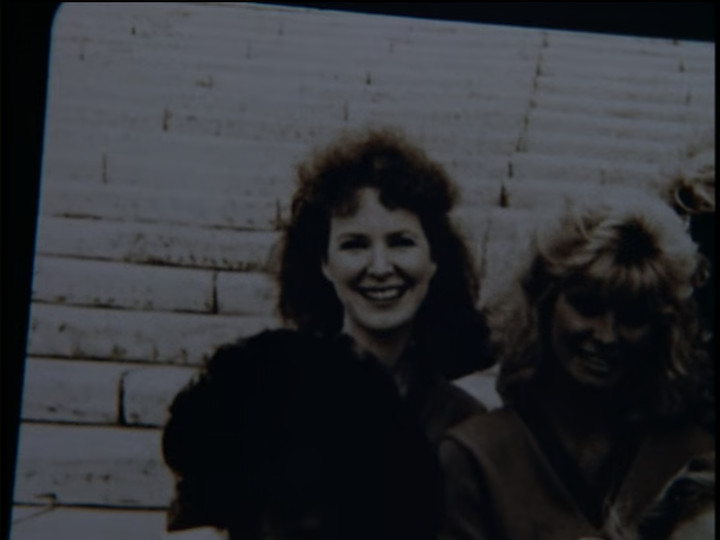
Jessica has then seen enough and they leave. She asks the Lt. to drop her off at the library of congress, though the next scene is at a restaurant called Sans Souci. Apparently she accepted Kaye Sheppard’s invitation after all.
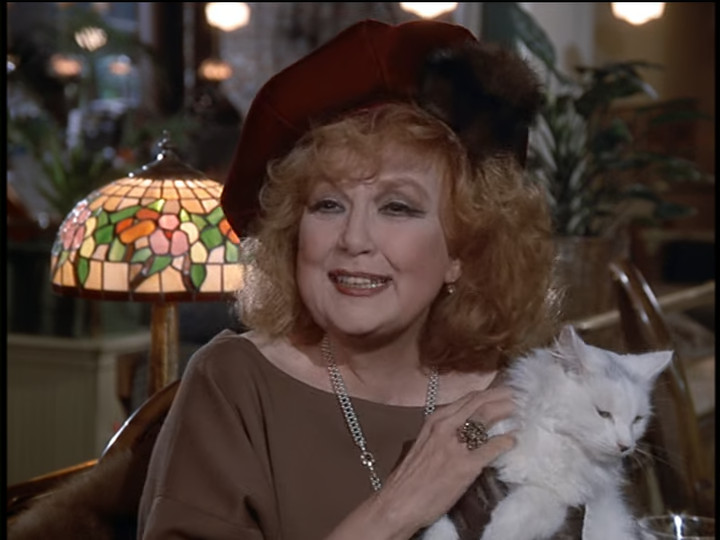
(This was in the era before people called their pets emotional support animals to bring them to places where animals weren’t allowed, so her having a cat in a restaurant (which is a health code violation) is a sign of her enormous importance.)
It turns out that Jessica is there because Kaye sent her a note saying that she has information that might help Jessica about Marta Craig’s murder. She does have a price for her information, though. When Jessica solves the case, she wants an exclusive.
Kaye’s sources tell her that Marta was playing both sides of the aisle. Also, three nights ago, Marta came running out of the Watergate hotel and Roy Dixon came running after her and looked mad enough to kill.
Back at Jessica’s office, Joe comes in and reports what he learned about Marta. She had six jobs in the last four years and did the party circuit 5-6 nights per week. That’s all he learned. Also, Diana called in sick after lunch.
After Joe leaves for a “hot date,” congressman Keppner comes in. He thanks Jessica for all she did for him but asks her to not go to any more trouble. He’s decided that he’s not going to seek reelection. He’s got a phone call into someone or other to make that official. Jessica talks him out of it, and to instead go back to New York and to see his wife and talk to her and find out what she thinks about whether he should seek reelection. “She might surprise you. Women in love do that.” Keppner hugs her and tells her that this is the first time in 8 weeks he’s felt good about himself. He then says that he’s going to cancel his call, but he will stay around an extra day to vote against whatever Ray Dixon (the lobbyist) wants him to vote for.
That night, Jessica visits Diana at home. Diana doesn’t want to let Jessica in, but Jessica politely forces herself in, saying she has some important questions about the cannery bill. She then says that perhaps they can ask Thor to help. Jessica suggests asking him to come out of the bedroom. (She points out the heavily used ashtray and the no smoking sign on the desk in Diana’s office.)
Thor asks how she knew it was him. Jessica explains that she noticed a Lion’s head tie pin Thor was wearing during the moment she met him in the hall when Diana was rude to him, then she noticed it was the same as on the cheerleading costume that Diana and Marta wore in the picture in Marta’s apartment, and went to the library of congress and dug up an old yearbook and found that the three had gone to school together.
We then get a bit of backstory: they used to be good friends with Marta, but then Marta started hanging out with the wrong crowd. She worked with Harry Parmel and men like him, working the “party circuit”. They didn’t say anything because they were scared. Thor figured he’d be at the top of the suspect list. And on that rather tepid bombshell, we fade to black and go to credits.
When we come back, Thor is showing the photos to the Lt. in his office. He points out that they’re faked, which you can tell because he’s clearly unconscious in the photo. Marta had asked him up to her place and he had one drink—she must have drugged him. Diana says that Thor wanted to show the police the photos but she stopped him since it would cost him his lobbying job at the ecological foundation at which he works since they’re very publicity-shy.
The Lt. says that they can go. But, of course, don’t leave town.
After they’re gone, he remarks that the case is very complicated, but it seems to him that with all of the bad stuff that Marta was into, it’s likely that the guy she worked for is the one who beat her to death. Jessica asks why she says “guy,” since it could just as easily have been a woman.
In the next scene Joe is driving Jessica around and gives her a bit more information on Marta. At 6:30 she had lunch with a married mid-level man from the state department. They left separately, and she picked up Keppner at around 9:30 outside the Stockman’s bar. She had no close friends and had no known associates.
In the hall of congress Dixon runs into Jessica. She presses him on Marta, he denies knowing her, Jessica says that he’s very good at lying—it’s a difficult skill—and he says that they play a game in this town. Those good at it get things done. It’s the amateurs who get hurt.
Back in her office, Jessica finds out that the vote starts in less than two hours, then says she has to go out and to not let them start the vote without her.
Some time later, when the committee meeting started, Jessica finds Joe and brings him into her office and tells him that she got a great lead from Kaye Sheppard. It seems a jilted boyfriend of Marta’s was hanging around her apartment when she brought Dan home with her. A few minutes later the boyfriend saw another man go inside. He didn’t get a good look, but Jessica says that it had to be Ray Dixon. He must have the photos that Marta took of Joyner. They need to get into his penthouse. Right now she needs to go to the committee meeting, but she wants him to meet her afterwards. They’ll talk to the Lt. and get a court order.
Jessica arrives at the committee meeting and has some brilliant idea that solves all problems (including jobs for her community) while still sticking it to Ray Dixon. And everyone claps when she’s done talking because her common-sense speech was so common-sensical and brilliant and moral and good.
Over at Ray Dixon’s penthouse, Joe breaks in to plant the photographs Jessica expects to find. Unfortunately for him, Jessica and the Lt. are waiting for him. The Lt. isn’t impressed with the hiding spot that Joe had chosen and remarks, “Give us cops a little credit. Ray Dixon would have been smarter than that.”
Jessica admits that she was baffled until this morning. She asks Joe what happened—did Marta get greedy? He still protests his innocence, so Jessica asks Joe what happened to the fancy driving gloves he had been wearing the first time she met him. He stopped wearing them after Marta was killed. Clearly that’s because he wore them when he beat Marta to death. It’s almost impossible to get blood and makeup out of suede, so he had to get rid of them.
That’s only part of it, though. He slipped up badly when he said the name of the bar that Marta picked up Keppner from. It wasn’t in the police report and Keppner didn’t remember it. They checked with the bartender and the waitress who worked at Stockman’s Bar that night and neither remember Keppner, so the only person Joe could have learned it from was Marta herself.
Joe is done in by this. His confession starts out interestingly
I’m no different than anyone else in this town, Mrs. Fletcher. You buy and you sell. People. Legislation. Influence. There’s a price tag on everything and everyone. And I was doing real well, too. Until Marta got just a little bit too big for her pantyhose.
When he’s done, Jessica asks him if he thought that he was the only one allowed to buy and sell. After he’s led away by the uniformed officer present, the Lt. asks Jessica if he can take her out to lunch. There’s a deli run by a friend of his cousin Sadie and they make a lox and cream cheese platter you could die from…
And with that, we freeze frame and go to credits.
Well, this episode definitely doesn’t make my top ten favorites list. Hollywood is never good when it touches politics, and Murder, She Wrote was no exception. It’s not that was unrealistic. It was, but TV was generally unrealistic about everything. It’s how smugly self-satisfied Hollywood always is. Hollywood is generally populated by the worst people, and they’re convinced that they’re the best, and their self-congratulations are quite grating. For example, after Jessica’s speech about re-using canneries that have closed down even if it’s less profitable and the round of applause from everyone, the committee unanimously voted against the bill. It’s really unpleasant to watch narcissists convinced that everyone loves them taking a victory lap in their own imaginations.
About the only thing to learn from this episode is: don’t do this.
The one decent thing in this episode is the character of Detective Lieutenant Avery Mendelsohn. This is as much the actor who plays him as the character, but he was quite likable. It’s also the case that non-stupid detectives who work with Jessica tend to be more fun.
As far as the plot goes, there are fewer plot holes (in a strict sense) because the episode doesn’t explain much. Why did they move Joyner’s body? The closest thing to an explanation which we’re given is, “I was too drunk to think straight.” There’s some vague hints that Keppner shouldn’t have been at the party, but there’s no obvious reason why that would have been compromising. And even if there was, all that would have to happen would be for Keppner to leave before the ambulance arrived.
We’re never given any kind of explanation for why Dan Keppner has puppydog-like faith in Jessica. It’s so strong that despite having spoken only a half dozen words with her, he drunkenly calls her up at her hotel—how on earth did he get the number and memorize it?—and plans to confess to moving Joyner’s body to her the next morning.
And why did Marta bring Keppner to her apartment and drug him? She drugged Thor to take incriminating pictures of him in bed with her. She didn’t need incriminating pictures of Keppner in bed with her since she already had incriminating pictures of him over Joyner’s dead body at, presumably, a place he shouldn’t have been.
It’s a huge coincidence that Diana and Thor happened to be friends with Marta Craig, though on the other hand nothing came of this coincidence, so it doesn’t matter much. Much more important to the plot is the enormous coincidence that Marta happened to be working for congressman Joyner’s media liaison officer. That’s part of why Joe is such a surprise murderer at the end—there was no on-screen connection to the victim other than living in the same large city. We do get on-screen clues that Joe was the murderer, though as clues go not wearing driving gloves in a later scene isn’t a great one. Especially since driving gloves weren’t really a thing in the 1980s. Cars had had steering wheels that were comfortable in bare hands for enough decades that the practice had long since died out (outside of racing).
We’re also given no explanation as to why Joe picked the night he did to kill Marta. Normally, someone getting “too big for her pantyhose” is not an urgent matter, and he didn’t pick a great time for it. (To be fair to him, we’re only on episode 9, but I’d have waited until the mystery writer who’d solved at least 8 real life murders prior to this had gone home.)
Also given no explanation is why Joe tried to frame Keppner and why, if he did frame Keppner, he dragged him out to an alley to do it. Leaving Keppner at the scene of the crime would have more directly connected him to the crime, and also would have been less risky since Joe wouldn’t risk being seen dragging an unconscious body outside.
Another loose end in the story is the threatening note that Thor got with a second copy of the picture of him with Marta. Who was supposed to have sent that? So far as I can see, the only person who had any motive was Roy Dixon (or Harry Parmel), but the only person with opportunity was Joe Blinn. And they made a big deal out of this. It was so important they showed us a closeup.
Oh, well. It must be said, one consequence of being given no explanations for anything is that none of the explanations we didn’t get contradict anything that happened—or each other. It’s not a great way to avoid plot holes, but it does, technically, work.
Next week we’re in New York City for Broadway Malady.
Discover more from Chris Lansdown
Subscribe to get the latest posts sent to your email.


Pingback: Murder She Wrote: Death Casts a Spell – Chris Lansdown
“Joe wouldn’t risk being scene dragging”
Methinks you mean “seen”
LikeLike
I never watched ‘Murder She Wrote” during its original run, for two reasons: First, I’ve never liked mystery books, and second, I was only 24 years old when it began its run and 35 years old when its run ended, and this series was notoriously aimed at and enjoyed by the older crowd.
However, now that I’m 64 and retired with time on my hands, I decided to start watching it in sequence. Last night, I watched the “Capitol Offense” episode. One reason I’ve never liked mysteries is that the few times I tried reading one, I found that I had trouble connecting the ultimate solution with everything which had gone before. (Guess I’m just slow that way.) But up until last night, I haven’t had much trouble that way with “Murder She Wrote”. Until “Capitol Offense”. This episode had me totally flummoxed as to what anything had to do with the fact that Joe Blinn was the murderer and I didn’t even understand why he had killed Marta. Thanks for pointing out that it was full of plot holes. I feel less stupid, lol. I obviously haven’t watch many episodes so far, but so far this has been the worst one.
LikeLiked by 1 person
Murder, She Wrote is very uneven; at its best it’s a ton of fun. On the other extreme, some episodes just don’t hold together at all. I find the average episode pretty enjoyable. Feel free to skip around if you want, though, as this was 1980s episodic TV in the extreme—no episode ever required you to have seen another to entirely understand it.
By the way, if you want extremely tight plotting in mysteries, I’d recommend Agatha Christie (especially her Poirot stories). You can quibble with some things in her work here and there, but she was amazing at everything making sense and Poirot, at the end, being able to give a crystal clear explanation which covered everything. If you prefer watching to reading, the David Suchet versions are generally excellent until the last two seasons or so, where they started changing the stories in ways that didn’t work well.
LikeLiked by 1 person
Pingback: Murder She Wrote: Broadway Malady – Chris Lansdown