What TNG: Sub Rosa Could Have Been

I was recently talking with a friend about the Star Trek: The Next Generation episode Sub Rosa and how, while it was bad, it had some cool ideas. (I explained why it was bad in this post.) Specifically, it was interesting how it suggested, though it did not explore, what life might be like for people who had no interest in Starfleet.

In the episode, Beverly Crusher’s grandmother died and Beverly goes and visits the settlement where her grandmother had lived in order to organize her things. While there, she meets an “anaphasic entity” which behaves much like a ghost, and there are elements of gothic horror in the story, which mostly turns stupid toward the end. But before it turns stupid, the community is quite interesting, or at least hints at being quite interesting.

On the Enterprise, everyone is a member of Starfleet and shares Starfleet’s three primary values of exploration, technology, and bureaucracy. But on this small colony on a completely unimportant world that no one else cares about, there’s no great reason for them to care about any of these things, the valuing technology being the most interesting of the three. People need to do something during their day, and Starfleet officers occupy their time by using advanced technology, following orders, and filling out reports. But there’s no need, in the 24th century of The Next Generation to use advanced technology wherever possible. It’s entirely possible to only use it for the things you don’t enjoy doing the old fashioned way, while doing things the old fashioned way that you enjoy doing the old fashioned way.

Indeed, if you look around at people’s hobbies today you can see this all over the place. There are people who knit by hand rather than using knitting machines, though knitting machines certainly exist. There are people who hunt with a bow and arrow rather than with a gun. There are people who sew their own clothes and do some of the seams with a needle and thread rather than with a serger or more primitive sewing machine. Why? Because for the people who do them, these things are rewarding and enjoyable.

In the 24th century, it’s quite possible that people who live someplace where no great empire cares that they’re there would spend their time farming, weaving, making clothes, cooking, and similar things, only using replicators as a back-stop in case something didn’t go well.

Ultimately, these are the people that explorers find interesting, anyway. Explorers are not, generally, satisfied to go someplace else only to find people who don’t want to be there either and are spending all their time looking for something; they like to find new worlds and new civilizations. That is, they want to find new groups of people who actually want to be where they are.

I can see why most Hollywood writers would be terrible at writing this—they’re not happy where they are—but it would certainly be quite interesting to see it done well. Sub Rosa was never going to live up to this promise, but it would be quite interesting if some story did.

And given how much Science Fiction has been written to date, somebody probably already has and I just don’t know it.

Star Trek: Discovery Has Some Bad Writing

A friend of mine gave me this link for the first episode of the current (and final) season of Star Trek: Discovery. It starts partway into the episode, but I don’t think that matters. It’s also almost irrelevant who all of the characters are to the plot, which you can take as a bad sign but can also be a criteria of writing that an episode allows new viewers to come on without having to do a lot of reading first.

What really struck me about the episode was the degree to which the writers made decisions which moved the plot forward right before they needed it. Very little was set up beforehand, so everything felt contrived. And stupid.

The episode is mostly a chase for a McGuffin and so the bad guys need to get away a lot. I mean, they don’t need to, per say, but the episode wanted to go with the high-tension constant-near-miss type of chase, so the bad guys had to be always within sight so we could have chases and fast-moving CGI on screen. This meant that the bad guys had to get away a lot, and this was never accomplished through good planning on the bad guy’s part, or superior skill on the bad guy’s part, or really much of anything that the bad guys did right or the good guys did wrong. It was always just a random plot contrivance.

When the bad guys roll some kind of explosive at Captain Burnham, does she move? No. Does she have the ship transport her somewhere else (they have instant teleportation since this is set 800 years later than TNG)? No. She just watches until it cuts a hole in the ship straight through to outer space and sucks Burnham out. Which isn’t a problem because her CGI space suit instantly deploys from her uniform. She then rockets over to the bad guys’ ship (it’s small and nearby, there are only two of them), then magnetizes her boots onto the ship’s hull and stands on it as it goes to warp. She calmly starts using her hand phaser to disable the ship’s engines, which are on the outside for some reason, though nothing ever comes of this because another star trek vessel (who was sent to go on the mission with Burnham’s ship) shows up and puts the ship in a tractor beam. While both are at warp speed.

Which is fine, but apparently the warp bubble is in danger of collapsing for some reason and so Burnham spends a minute or so yelling at the captain of the other ship to disengage while she continues to phaser random stuff on the hull of the bad guys’ ship to no discernable effect.

Then she finally yells at the other captain enough and he terminates the tractor beam and everyone comes out of warp for some reason and Captain Burnham gets off of the bad guys’ ship for some reason and the bad guys deploy warp decoys and warp out, and now it will take too long to track them all down so Captain Burnham has to bring in an old smuggler friend because it takes a thief to catch a thief. Fair enough, though it loses some of the punch when he picks out the correct warp signature in about five seconds.

Then they go to Tatoine where they get to have a speeder bike chase with the bad guys who they narrowly missed (by actually plausible timing) and then somehow the bad guys are on their ship which is flying through the atmosphere and the speeder bikes are keeping up. The bad guys are headed for a tunnel system which will allow them to come out someplace else and then they can go to space and warp out without being detected because the star fleet ships (the same two as before) can only track a ship which is in visual range of the camera, I guess. They say it breathlessly so we’re supposed to not notice. Why no more ships have been assigned to this super important mission (which is revealed to be hundreds of years old) is also not explained.

Then someone identifies the tunnel that they’re going to use because there’s an explosive charge on it and Captain Burnham is against shooting it because there’s a 30% chance of it causing an avalanche which would kill lots of innocent people somewhere and the other Captain thinks it’s the only way and orders his ship to do it and things are fine but then the bad guys use a photon torpedo to trigger an avalanche and Burnham blames the other captain, saying, “you gave them an idea” as if the bad guys aren’t the ones who planted an explosive charge on the tunnel.

Then the avalanche happens and for minutes heads over across a flat plain towards the Tatoine settlement that they had been speeder biking away from for the last several minutes and now are speeder biking towards and all of these innocent people will be killed unless both star ships shove their noses into the ground and merge their shields and oh man is it really stupid.

I can’t say for sure whether there’s some possible way for an avalanche (of rocks and dust, not snow) to travel at full speed along a plain to a place so far away that the mountains look small, but it certainly isn’t plausible. Moreover, with the absurdly advanced technology of Burnham’s ship, it’s a bit ridiculous that putting both ships in the way is the only possible way to save the settlement. They don’t even try phasering the avalanche, they just state it won’t work. But, dramatically, it really should work. It really just feels like they need something to happen so damn it, this is the way things work this minute.

And then, after this ridiculous maneuver where both ships slam their noses into the ground for no obvious reason and the merged shields hold and the settlement is saved, as the dust settles the bad guys warp out and oh well, the ships couldn’t track them because… we’re not told.

And then Captain Burnham and her smuggler friend just sit around for a while and talk about old times as if the episode is over and we’re in a post-credits sequence. It makes no sense why there’s zero urgency to do anything about the McGuffin anymore. Including from the guy in charge of the centuries-old super-secret code double-red mission who’s been laser-focused on the galaxy-shattering consequences of getting the McGuffin before the bad guys do and who has emphasized that lethal force is authorized because it’s this damn important.

Characters’ motivations last only as long as the scene they’re in requires, technology only works whenever the plot wants it to, Bad Guys who will blithely kill (or at least endanger) thousands of innocent people set their weapons to stun when shooting our heroes, Captain Burnham has the priorities of a 1980s Sunday morning cartoon super hero, which wouldn’t be bad if it wasn’t done with no humility and everyone likes her anyway despite her being basically an anti-social narcissistic egomaniac. And also being a soldier on a mission.

The thing is, 1980s cartoon superheroes had the priorities they did because they were essentially reactive. Life was going on and then a super-villain endangered innocent people and so they went and protected those innocent people. That’s good and morally coherent.

This can be complicated by introducing other factors, like a much bigger threat to far more people that the superhero needs to stop, and so he may not have time to rescue just one person. That can make for painful dilemmas where the hero needs the maturity to recognize that no everything is given to everyone and maybe saving that one person wasn’t given to you even though, if you forsook what was actually given to you, you could have done it. Captain Burnham just ignores the bigger issues whenever she doesn’t feel like paying attention to them, which is extremely immature and irresponsible.

It’s good to stop and smell the flowers, but not when you’re rushing a transplant organ to a recipient and it needs to get there within the hour or the organ will die and then the recipient will too.

It’s weird to me how utterly bad this writing is. It would not have been hard to make the script a thousand fold tighter than the plot-hole-ridden contrived mess it was.

Also, and this is related to the entire series, they’ve cranked the technology level up so high that location barely matters anymore. People hold conversations with other people around the universe in realtime, people can find and bring aboard people from far-off planets in minutes—basically, location barely imposes any restraints anymore. And the result is that nothing feel real. It takes on an almost dreamlike quality to it which is not pleasant. (It’s also responsible for the plot being lace, since without limitations it’s impossible to have logically consistent problems.)

It’s really cool for people to be able to teleport around like Q, but the problem with the rule of cool is that you have to be careful with it or you’ll get frostbite.

I Really Prefer Later MST3K

I’ve been watching a fair amount of Mystery Science Theater 3000 lately. I should say, re-watching it, as I’ve been watching episodes I’ve already seen before, often several times before. And I’ve come to the conclusion that I really prefer later seasons of MST3K. I used to think that I had preferred Mike to Joel as the host, but I’ve discovered that’s a bit of an artifact of how I saw MST3K.

I began watching MST3K in college. I would watch it in the common room of the dormitory I was in, which was how I was introduced to it (someone had put it on the TV in the common room and it caught my attention). This was towards the end of season 8. Later on I started collecting MST3K DVD box sets and that’s where I ran into Joel episodes. With a few exceptions (most notably Cave Dwellers and Manhunt in Space) I didn’t like them nearly as much as I enjoyed the Mike episodes I had seen back in college. I concluded, naturally enough, that I just preferred Mike to Joel.

Then I got even more boxed sets and watched some of the Mike episodes from seasons five and six.

While it is still true that I do generally prefer Mike to Joel, I’ve come to realize that the biggest factor is that the writers just got better over the years. Having watched some special features, they put more time and effort into the jokes as the years went on, which certainly improved the quality. More than anything else, though, the writers learned to work with the movies, rather than working against them.

In the early years, it was not uncommon for Joel or the bots to talk over important parts of the movie, making the movie hard to follow. This made the entire experience less fun, since you didn’t get a chance to enjoy any of the movie, but worse was that it eliminated the possibility for jokes about plot holes. You can’t make jokes about plot holes if no one knows what the plot is.

Allowing the audience to hear the movie had a second benefit, which was that it encouraged the jokes to be about the movie. Obviously, they weren’t always about the movie, and there were plenty of good jokes which were tangential to the movie or just based on visual coincidences or whatever. Still, a lot of the really enjoyable jokes were about the movie that we were watching, and that was a lot more fun.

I don’t want to make too much of this. Cave Dwellers is one of my favorite episodes and it’s from the third season. I also really enjoyed King Dinosaur, which was from the second season. Still, I find that the pattern holds that later seasons tended to be better, and it’s not really surprising that the MST3K crew got better at what they did when they had more practice.

A Lot of Classics Aren’t Classics

As my children grow older and I continue to consider what books, movies, and TV shows to recommend, I’m increasingly coming to the realization that a great deal of what made up the “classics”—stuff from the 1930s through the 1970s—actually aren’t classics. They spoke to the generation they were written for, and a little bit after that, but they don’t speak to the universal human condition. It only felt universal at the time because it was the dominant lens through which everything was viewed.

Take classic Science Fiction: it’s not all garbage, but a shockingly large amount of it actually was. It’s not its fault, precisely; the problem is that it reflected the societal chaos of the inter-war and post-ww2 periods. Unmoored from any sense of human nature, it expresses nothing of any value to people who haven’t grown up in a similar cultural maelstrom.

Even a lot of Englightenment and post-Enlightenment era classics suffer from a similar sort of limitation. Take one of the great romantic-era poems, The Tyger, by William Blake. That’s the one that begins:

Tyger Tyger, burning bright,
In the forests of the night;
What immortal hand or eye,
Could frame thy fearful symmetry?

It’s a very well constructed poem, but when we come to one of its best verses:

When the stars threw down their spears
And water’d heaven with their tears:
Did he smile his work to see?
Did he who made the Lamb make thee?

The problem is: the answer is yes. Any well-educated child knows that. God looked on all he made and saw that it was very good.

Don’t get me wrong, it’s a good poem. But it loses a lot of its power when you’ve received an even mildly decent education.

A lot of classic science fiction boils down to, “maybe we can fornicate a lot on other worlds.” Maybe you can, but it will still be wrong. It will still be lying to yourself about what you’re actually doing. On a lonely planet with no sun, warmed only by volcanic activity where every man who visits automatically gets twenty concubines with ten breasts each, fornication will still just pretending that one can have the happiness of having children without any of the work of having them. (At its best; at its worst, it will still just be drug addiction to endogenously produced drugs.) A story in which unhappy people pretend that they’re happy and then that’s it, that’s the end, the author is pretending the guy is happy too—that isn’t a good story even if you set it on Mars.

All of this stuff was new and exciting when desperately unhappy people who still had the optimism of youth thought that perhaps technology offered a way to escape and then told each other fantasies of that working out. That’s really what a shockingly large amount of classic science fiction really was.

Movies, oddly, tended to be better, in that they tended to be morality plays. They were mostly variations on men whose reach exceeded their grasp trying to take the power of gods and then being smashed by the natural consequences of their inability to control the power they put their hands on. In some ways the greatest of these, or at least the most explicit, is Forbidden Planet.

I don’t have any grand conclusions to this. There is good stuff among these “classics.” It’s just so much fewer and farther between than I had realized when I was a kid, and I’m realizing this is quite a surprise to me.

Science Fiction as Limited Fantasy

Readers of my blog will remember that I have been wrestling with the question of what is science fiction, and whether science fiction is just bad fantasy (see What If The Future Has Past?). Not, mind you, because I dislike science fiction, but because I like it. I’m working on a sci-fi story and have hit something of a block because I have yet to come to grips with what Science Fiction is, at its core.

If it’s going to be fantasy, well, I’m very fond of high fantasy. I love swords and sorcery. Why why stuff that could reasonably have swords and sorcery without the swords or the sorcery?

A possible solution recently occurred to me. High Fantasy exists on a continuum of how common magic is. It ranges from very common to quite uncommon. The solution is this: what if Science Fiction is fantasy with uncommon magic and modern technology? The burying of magic inside of devices (“warp/wormhole/etc drive”, “shield generator”, etc) is a way of forcing it to be uncommon. If you need a big expensive device to house your magic amulet, this serves as a limiting function to keep the magic rare.

I’m not committed to this idea at all. It’s basically just thinking out loud. It at least gives a framework to think about science fiction which makes more sense than as various degrees of cheating at an unattainable goal (interstellar speculative fiction).

And as a disclaimer, please don’t take this as criticism of science fiction or of fans of science fiction. This is me trying to work through a way to understand science fiction stories so as to be able to write them. Because there’s an obvious reason Why Science Fiction Will Never Die.

Heinlein’s Sexual Morality, Good & Evil in Novels, & More: A Conversation with Mr. John C. Wright

I had the pleasure of having the always-interesting science fiction author Mr. John C Wright (who blogs at scifiwright.com) on my show. It was a somewhat wide-ranging conversation, though it stuck (in my mind) surprisingly closely to the topic we set out to talk about throughout. It’s also available on YouTube:

God’s Blessings on January 31, 2017

God’s blessings to you on this the thirty first day of January, in the year of our Lord’s incarnation 2017.

Today is going to be exceedingly short because I’m crazy-busy today. First, I noticed an article by John C Wright about the history of Buck Rogers I’m really looking forward to reading.

Yesterday I read an article by Jasyn Jones about the disappearance of pulp SciFi, Star Wars Stole Pulp. It was an interesting article, but I was even more intrigued because of a comment which gave a counter-point. First, the point:

Post-WWII was the era of the Campbellian Silver Age, the era of “Men with Screwdrivers” SF. Action and adventure were childish and frankly embarrassing, as were purple prose and laser swords. Barsoom? Silly. Buck Rogers? Childish. Northwest Smith? A gunslinger, not a scientist. And this was the age of SCIENCE.

Science was the focus, technology the touchstone. Stories had to be cerebral, intellectual. They had to be REALISTIC. Real science, none of this fuzzy-headed soft science stuff. SF had to shake off the wooly-headed thinking of Fantasy, the embarrassing antics of Space Opera, the adolescent focus on Adventure and Action. SF was serious business. Real Literature. It was time to grow up.

Then the counter-point, by someone calling himself K-bob:

I grew up reading the pulps because I could get a stack of them for 75 cents. I loved them more than comics, and some even had a few great illustrations. But I was also a kid when the Mercury 7 program began.

To me, the screwdriver period was new and exciting. Maybe it’s because I lived on the Space Coast back then and got to see astronauts live a few times. So I shifted to the New Kids because of the general level of excitement for real space exploration and engineering.

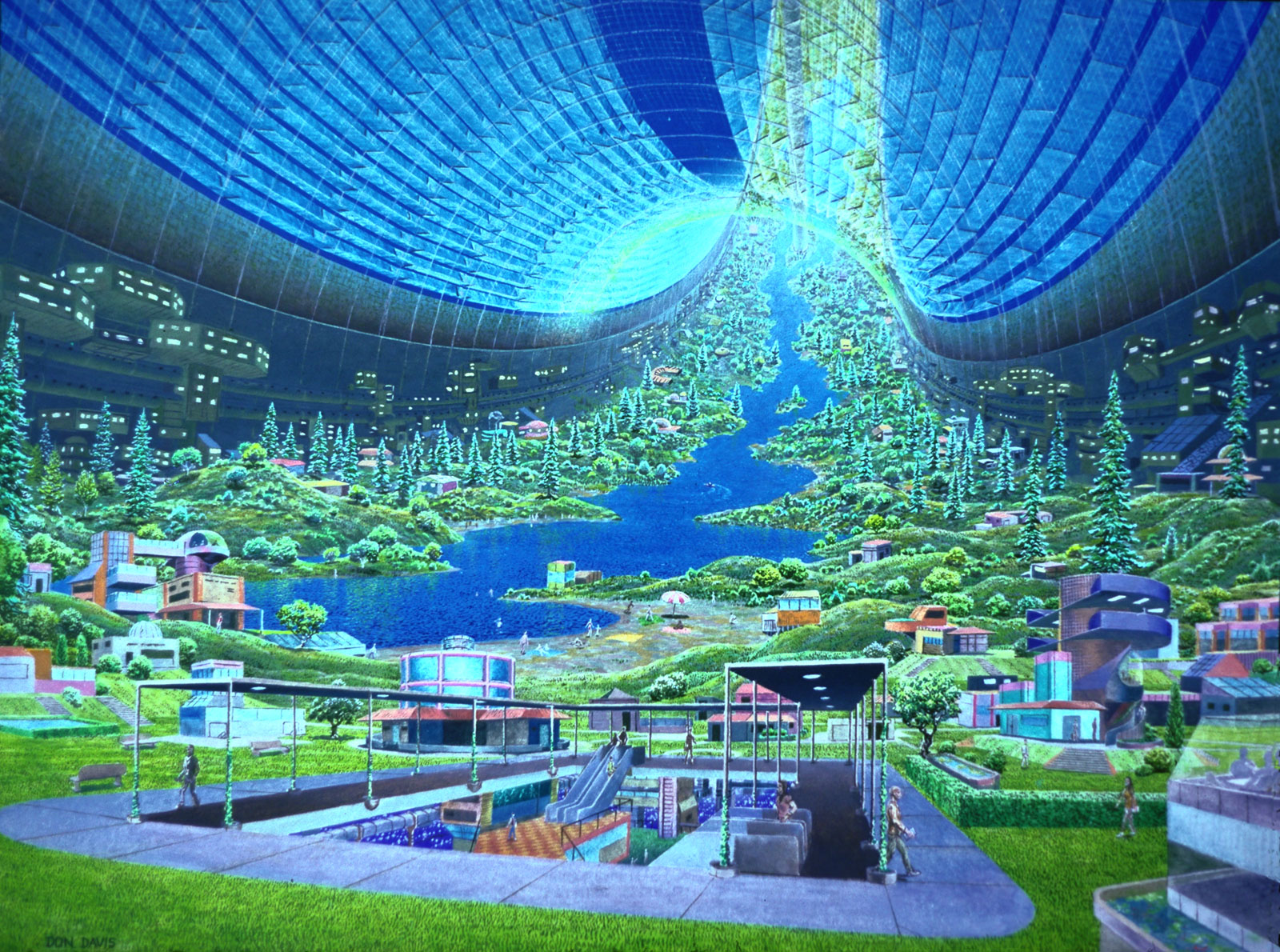
It’s very interesting to see that perspective, and the point about how Big Men With Screwdrivers (which is, I believe, a Niemeierian phrase, if inspired by Mystery Science Theater 3000) would have been fresh when it came out and moreover something that was exciting because it tied into the zeitgeist of an age which expected nuclear-powered flying cars in a decade or two. Going by descriptions of people who lived through the early post-war period, real life was a bit like living in the preface to a SciFi book. Basically, people thought of this as the near future:

It didn’t work out that way, of course. But if you think that the Stanford Torus is realistic, it makes a lot more sense why realistic tales of engineering in the near future would be so fascinating. I know for a fact a friend of mine who is very interested in space travel (he watches rocket launches over the internet and has as a bucket list item seeing one in person—a bucket list item he checked off). One of the things he loved so much about Andy Weir’s The Martian was its realism; how it was set in a plausible near future. And my friend does not really like literature; his favorite entertainment is usually about giant robots. One of his favorite giant robot shows involved robots so giant that they could hurl galaxies like frisbees and punch holes in the fabric of reality in order to get at different dimensions.

I recommend reading the rest of K-bob’s comment, because he talked about how this fresh and exciting new trend grew stale, as most fresh and exciting things do. And I’ve no doubt that the cultural marxists and the snobs had a hand in making SciFi worse—it is in their (fallen) nature to do so. It’s a bit like expecting scorpions to sting. But when that is given proper weight, I think that K-bob is onto something; that Big Men With Screwdrivers was able to push aside older and better things in part because it was fresh and new and in part because it spoke to an age that lived in very unusual conditions. Most people these days think of nuclear power in terms of weapons and disasters; those who are familiar with nuclear power (I know a nuclear engineer) think of it in terms of cheaper electricity with no carbon footprint. But in the post-war period nuclear power was going to turn us into gods and propel us to the stars. Given how detached from reality those expectations were, it is perhaps understandable why they found realism to be fantastic.

Glory to God in the highest.

Cirsova Magazine

I recently had the pleasure of interviewing P. Alexander, editor of Cirsova Magazine, over email. If you’re unfamiliar with Cirsova magazine, here’s the cover of their first issue:

They’ve got four issues out, and are working on their 2017 issues. Anyway, without further ado, here’s the interview:

Cirsova is subtitled, “Heroic Fantasy and Science Fiction Magazine”.  In modern western culture, stories of heroism are often associated, I think, with children, because children are not yet sufficiently beaten down by the all-doubt of modern culture. But as Harry Potter showed, there are plenty of adults who are not cowed, even in adulthood. So who is the audience you’re looking for with Cirsova Magazine?

Well, the appellation of Heroic Fantasy is, in part, to distinguish it from much of post-modern fantasy where there are no heroes or the heroes are so horribly flawed that they are often shown as being as bad as, or worse than, the villains. While we have the occasional exception, most of our stories are about individuals performing brave and heroic deeds in fights against injustice and absolute evils.

I think that stories of heroism may be associated with children because of the post-war movement to destroy the notion heroism as childish. During their heyday, pulps were wildly popular not with children, but adults. In fact, Argosy, the first pulp magazine, abandoned children as its target demographic very early on in an attempt to save the publication from going under; they went on to decades of success and were the home to the most iconic and influential literary hero of the 20th century – Tarzan.

By the late 40s and into the 50s, the notion of heroes was dismissed and deconstructed. Romance and heroism as it had once been understood was being undermined in and removed from many outlets of publication and media in the maelstrom created by post-war cynicism, the Cold War, and critical theoreticians in pop-culture. Heroes became the domain of cheesy and banal Comics Code censored rags of the Silver Age, making it that much easier to place SFF heroics in the ‘age ghetto’.

The desire to see heroes and heroics, however, can’t be stamped out. It’s why everyone loves and still talks about Die Hard, Star Wars, and Alien. People like it when good guys stop bad guys and monsters against all odds. Cirsova Magazine is for every person who has loved science fiction and fantasy adventure, opened a book or a magazine with a spaceship or a guy or gal with a sword on the cover, and been let down. I can’t tell you how many times people have said that they’re tired of actionless, sometimes storyless, fluffy-puff pieces of thinkery masquerading as SFF that one seems to see coming out of the more well known houses and publications. Cirsova is for those people who have been let down and want those stories about heroes again. We will not let them down.

That sounds great! You mentioned the pulps, and indeed I’ve heard Cirsova mentioned in
connection with a revival of the pulps as well. (In this article by Jasyn Jones.) Did you conceive of Cirsova as being a revival of the pulps? Or do you even think of it as a revival of the pulps now? Or is it more like a spiritual fellow-traveller to the pulps? In short, what is Cirsova’s relationship to the pulps?

I originally conceived Cirsova when I’d been reading Planet Stories and thinking “I want to create something like THAT!” We ended up leaning a bit heavier towards fantasy than the sort of Raygun Romance that PS published, but that’s really the magazine that has the most direct influence on the publication, even down to the choice of interior fonts.

That said, we aren’t really “retro pulp”, but it may not be easy to explain why. I won’t say that pulp revival is a new thing or that we’re even an important part of what’s referred to as Pulp Revival or New Pulp. Those have been going on to varying degrees of success or influence for decades now. Pulp Revolution, on the other hand, is a fairly recent term that a few of our fans have tossed around to describe us and those like us and our approach to pulp.

Here is the biggest difference in my mind: a lot of what is “Pulp Revival” and “New Pulp” seems to focus largely on the campy aesthetic aspects of pulps, almost as though playing off the assumptions one would have from merely seeing a catalog of magazine covers rather than from actually reading the stories within. It’s cheesy and fun, I suppose, but the best way I can describe it is that it’s like the little kid who puts on dad’s shoes and suit from the closet to play businessman. You also see a lot strange politicization in submissions guidelines – I’ve actually seen a recently launched “Retro Pulp” zine that specifically positions itself as a ‘progressive’ outlet, warning off a lot of common (or assumed to be common) pulp tropes. The only thing we don’t really want to see at Cirsova are Big Men With Screwdrivers SF stories or stories about elves. As a result, we’ve ended up with a pretty incredible array of stories ranging from those that could be considered “progressive” to those that HAVE been ridiculed as puerile and full of unexamined privilege.

What we’re doing with Cirsova is not about being part of “Pulp Revival” or being part of a “retro” movement. We don’t want to confine ourselves to that niche. What we really want to do is bring the kind of story that was being told in the pulps, not the aesthetic, into the mainstream conversation about SFF fiction. We’ve been accused of being “regressive” publication by those who are ignorant of pulps, those who assume that pulps were full of nothing but racist and sexist trash, but in a sense they’re right about us – we’ve embraced the idea that SFF needs to regress harder. We’re using the pulps as a starting point and going forward as though the Campbellian Revolution never happened, as though Burroughs was still held as above ‘the Big Three’, as though Leigh Brackett was still the Queen of Science Fiction rather than LeGuin or Atwood, as though fun, adventure, heroics, and romance were still a good thing in SciFi.

I have nothing against any of the Pulp Revival, New Pulp, or Retro Pulp folks or those movements; we’re just doing something different and have very different goals.

It’s interesting that you mention people whose ideas of pulps are drawn purely from a catalog of magazine covers. One thing which comes to mind is that magazine covers often have little to do with the stories they are meant to represent, and I believe were in fact often done by artists who had not read the stories but only had the barest description of what the cover should look like. And further many of those publishing sci-fi magazines were businessmen at least enough to avoid going out of business, and had some realistic notions about what would catch the eye and how different that might be from the story which captures the imagination.

Have you drawn inspiration from other places, such as, for example, the penny dreadfuls which predated pulp fiction? And either way, have you read G.K. Chesterton’s  A Defense of Penny Dreadfuls, which I think has much wider applicability than just to the penny dreadfuls of his day?

Back then, as today, artists were frequently working on the cheap and under tight deadlines. Only back then, you didn’t have digital, which is a huge time-saver for many artists today. While Anderson’s work on Planet Stories turned out some gorgeous pieces, it’s pretty noticeable that he’d re-use several of the same reference photos for poses – there are a number of covers where the only real differences are color of the dame’s hair, her outfit and what she’s holding over her head (usually a sword or a whip). It was also part of a magazine’s brand, as much as anything else. Weird Tales often had lurid and provocative danger. Planet Stories had sexy and romantic action. Astounding had “wholesome” action (i.e. no dames), and as it reshaped itself post-war, it tended to have a lot of men standing around. or floating heads to indicate how much more serious it was, I suppose. Similarly, Magazine of Fantasy & Science Fiction has often had a more abstract or impressionist aesthetic that jibed with its status as the ‘literary’ science fiction magazine.
As far as other inspirations, from the publishing end, I can’t really think of any, but from the storytelling end, I’d recommend Appendix N as a starting point for those curious to see just what it is I’d be looking for. When putting together the Dungeon Masters Guide for the 1st edition of Advanced Dungeons & Dragons, Gary Gygax, Tim Kask and others at TSR compiled a list of works and authors that had influenced the design and development of the game so that players would have a better understanding of where they were coming from. Any arguments about the cultural significance of the list itself aside, Appendix N undeniably includes many of the best action-packed SFF stories ever written. Jeffro Johnson, who has regularly contributed columns to Cirsova, recently published a bestseller on the topic.
I’d be lying if I said I was particularly familiar with the Penny Dreadfuls, though I am aware of them and did manage to make it a decent way into Malcolm Rymer’s Varney the Vampire before setting it down and not getting around to finishing it (the story itself was great, however the critical modern edition made the poor layout choice to use single column with tiny font in a volume roughly the size of a phone book).
You mentioned how modern technology helps artists to be more productive, and thus how art is cheaper for those who commission it. That segues rather nicely into the business side of things, which is, I think, a question on a lot of people’s minds. The pulps are today best known for certain types of writing and—to be blunt—a certain quality of writing. Not that reputation is more accurate here than it tends to be anywhere else in life, but one of the things which the pulps certainly were was cheap. Wood pulp paper was much cheaper than smooth, glossy paper, and so the pulp magazines could make money on fewer readers or smaller margins. Are you using a similar business model to the pulps but relying on the cheaper-still nature of digital distribution, or are you using a new sort of business model, or what?

Well, I would like to clarify that I don’t mean modern technology necessarily makes art cheaper, but it does offer a much greater degree of flexibility that did not exist in the past to collaborate and hash out what the art should look like (quick turn-around time on sketches and, in some cases, quick digital touch-ups and tweaks which were otherwise impossible).

Print on demand publishing has made indie and self-publishing more viable than it has ever been. Until fairly recently, self-publishing usually meant going to a vanity publisher and having several hundred books you’d never sell printed up only to languish in a closet. For Cirsova, Print on Demand through Createspace and Lulu means we don’t have any real overhead on stock. Our biggest per issue operating costs are paying our authors, commissioning cover art, and ordering proof copies, in that order. Once the issue is out there and we fulfill pre-orders/subscriptions, it doesn’t cost us anything.

We do have digital distribution, but Cirsova is meant to be something on your shelf. Interestingly enough, about half of our sales or more are physical, which is counter-intuitive to conventional wisdom about today’s market. Our softcovers are pretty cheap – with the exception of our first issue, which we have for $7.50, our regular issue price has settled into $8.50 on Amazon with an SRP of $10 (we did have a double-sized winter issue that’s $14.99). They’re a little over 100 pages, and 50k-60k words per issue. We do offer an edition for connoisseurs through Lulu that is hardbound with a dust jacket and foil lettering; these are a bit pricier, but they’re absolutely gorgeous. Prior to the Print on Demand revolution, putting out hardcovers with that degree of quality in those small quantities would be prohibitively expensive. This way, we can offer a quality product for a reasonable price, get a reasonable cut, and not have to be sunk out of pocket on physical copies we can’t move. Best of all, since we are not actually the ones selling physical products directly our readers, we don’t have to keep track of sales tax receipts. When I had a record label, the worst thing was having to fill out and mail in reports of 0 sales for months where we didn’t have any tables at shows or cutting checks for one or two bucks when we only sold a couple buttons or patches.

Our digital distribution includes typical eBooks and PDFs and the sort of stuff you’d expect from any sort of work published these days, but I’m not a fan and mostly make them available out of obligation to our fans and readers who prefer e-Readers or just don’t want the clutter of owning physical books. I always hate them, because to make Cirsova e-Reader friendly, we have to strip out all of the layout work that we put into it to give it a pulp magazine look and feel (columns, dropcaps, etc.).

The part about art being cheaper is more drawn from my own experience commissioning covers for my novels. A skilled digital painter can take advantage of the medium to be more efficient than, say, an oil painter can be. (Layers, undo, no need to wait for anything to dry, etc. seem to permit faster work for those who know how to take full advantage of them, allowing an artist to serve more clients.) I certainly don’t mean to suggest that digital painting has devalued art, because good art is of tremendous value. Anyway, thank you very much for your time, it’s been very interesting.
Fair point. Both have their advantages when it comes to economy. For instance, an artist working in a physical medium can sell the rights while still holding onto the physical piece, which they can then still sell; this allows for art to be more affordable for someone commissioning it because the artist can sell the rights and still have something of monetary value. As an example, I don’t own physical copies of any of the first four covers by Jabari Weathers, though I believe that one was purchased as a gift for a writer; if Jabari wanted to sell the originals, he absolutely could, and I know that’s part of why I was able to get such a great deal on his incredible artwork.
With all-digital art, it can be cheaper, as there’s no physical media required and an experienced artist can knock out a commission quickly, but there’s not an “original” that can be sold as well, so the artist makes their money solely on what they charge for the commission and whatever use rights they retain.
Interestingly enough, our cover for issue 5 is a hybrid – it’s digitally colored, but I got both the commercial use rights and the original line-art. (I was tempted to put it up on the block for this Kickstarter to defray costs, but decided I wanted to own at least one piece of original Cirsova artwork). 
Thank you for taking the time to talk with me about the Magazine!  I enjoyed it.
If you’re interested, here’s Cirsova’s 2017 kickstarter.