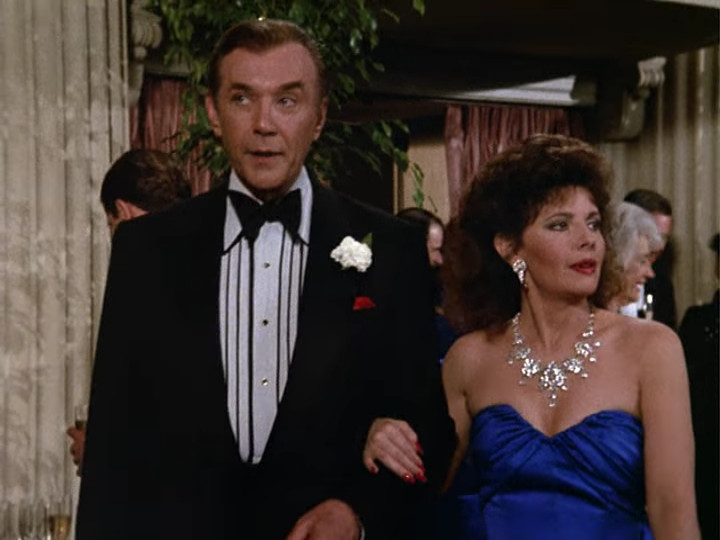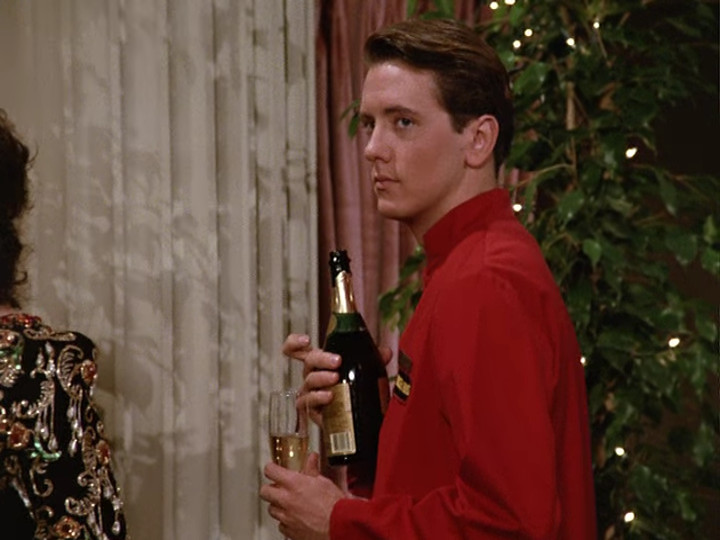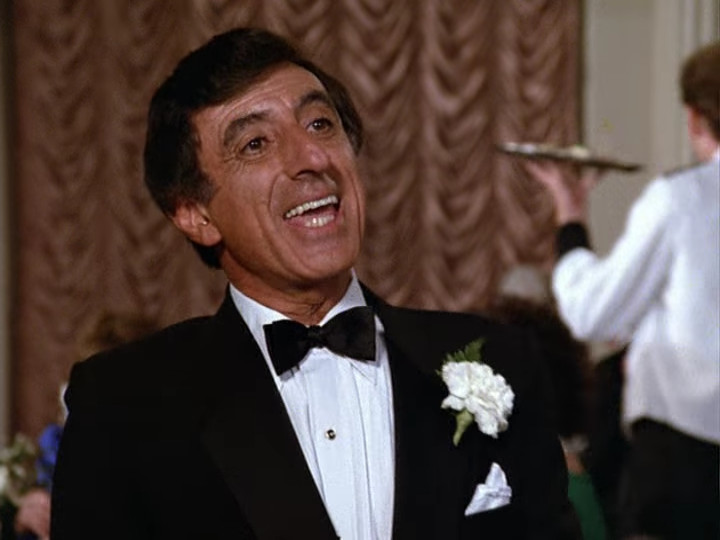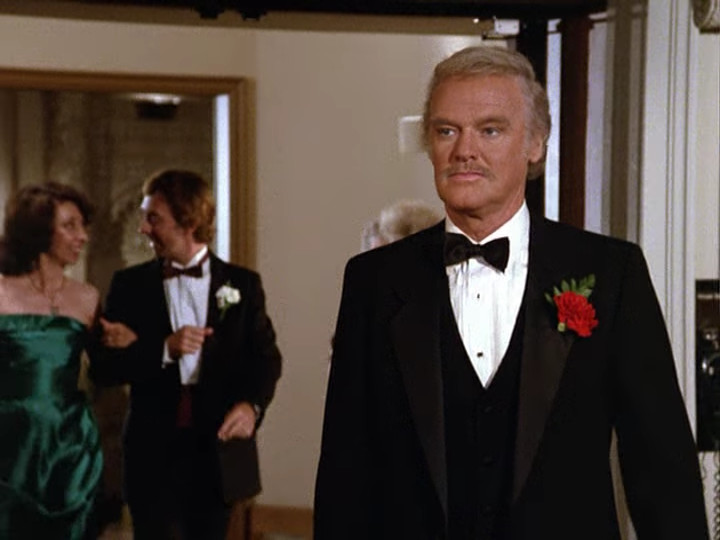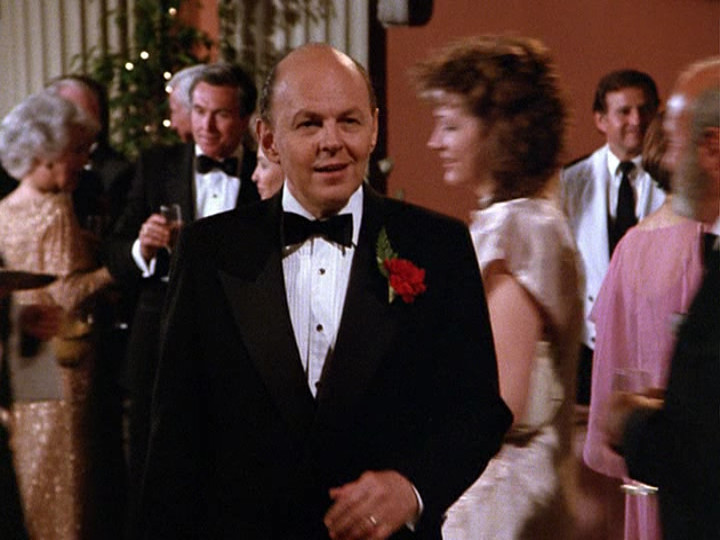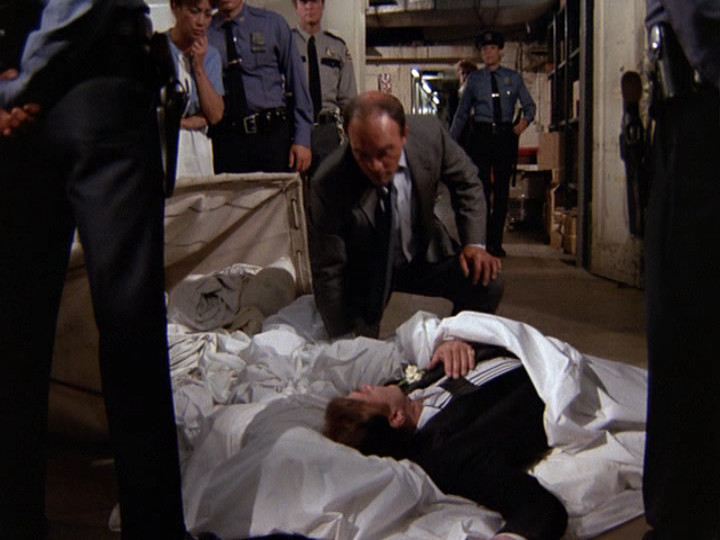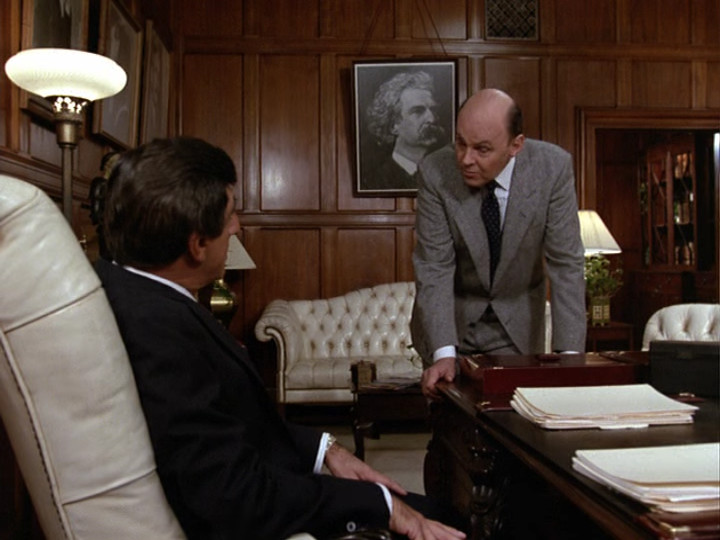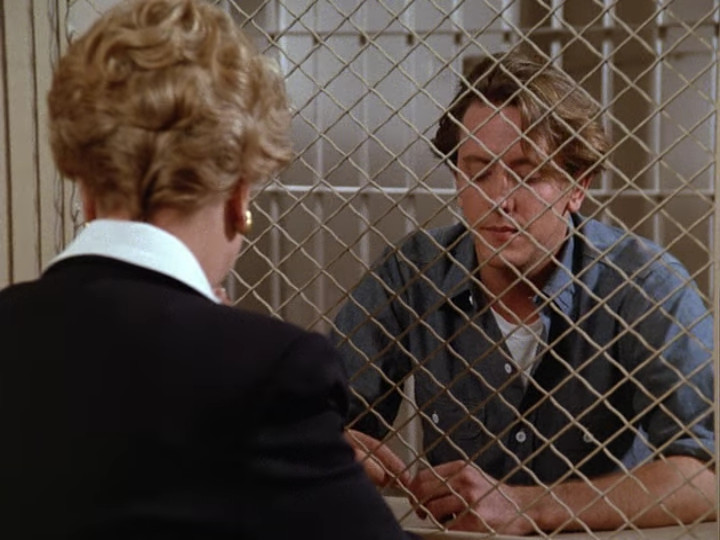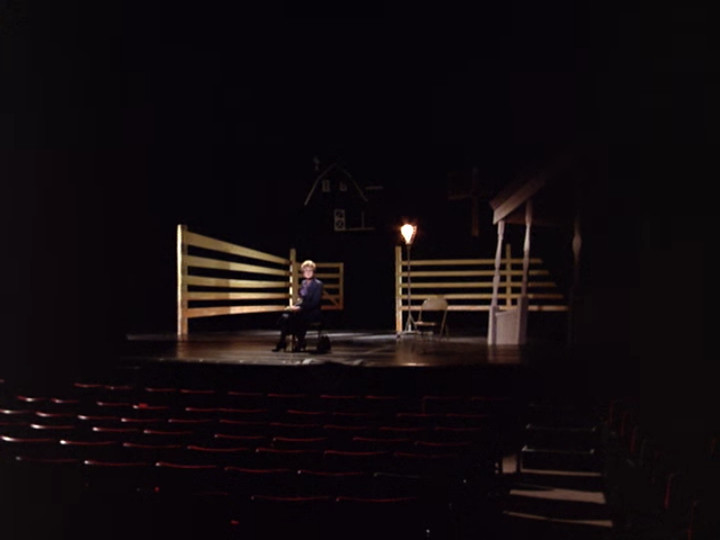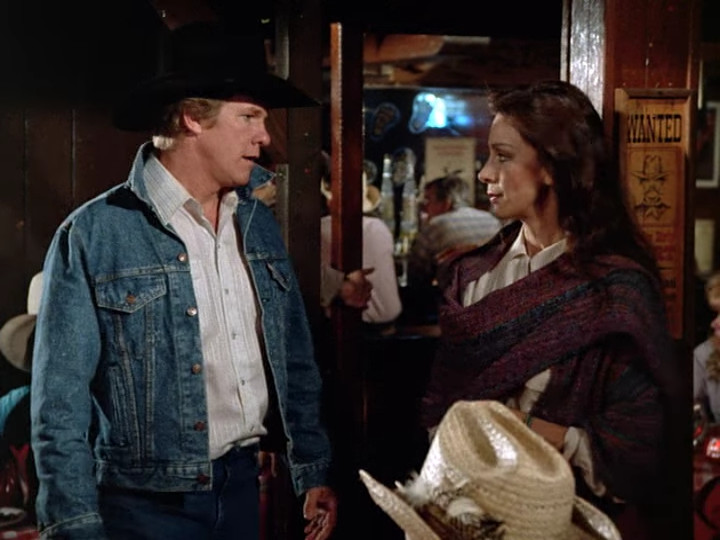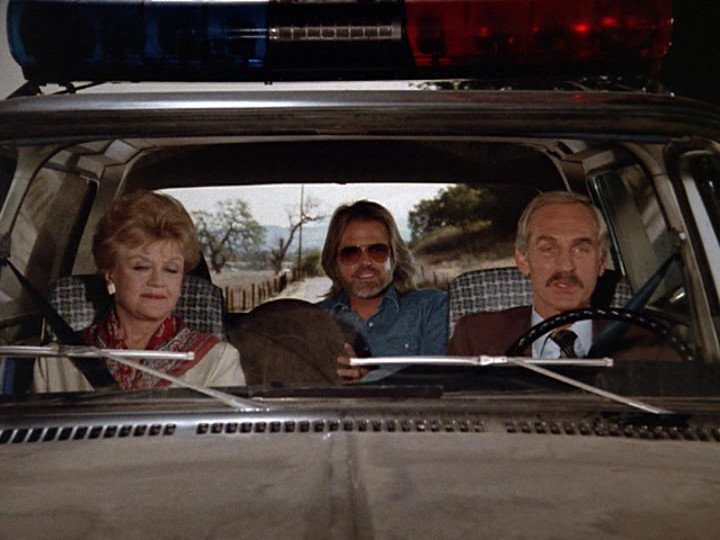
Murder She Wrote: Snow White, Blood Red

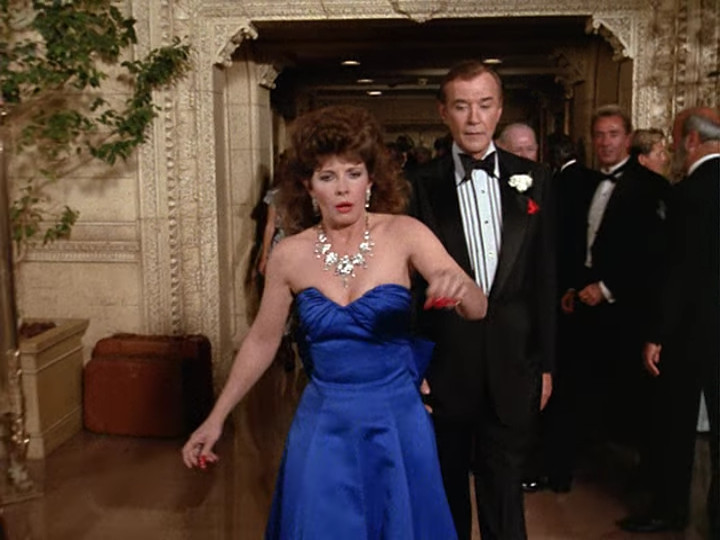
On the thirteenth day of November in the year of our Lord 1988, the Murder, She Wrote episode Snow White, Blood Red aired. It was the fourth episode of the fifth season, and it’s one of my all-time favorites. (Last week’s episode was Mr. Penroy’s Vacation.)

Jessica has come to the mountains in order to enjoy a ski vacation with her nephew, Grady, who has not yet arrived. (This is merely a setup; Grady is not in this episode.)

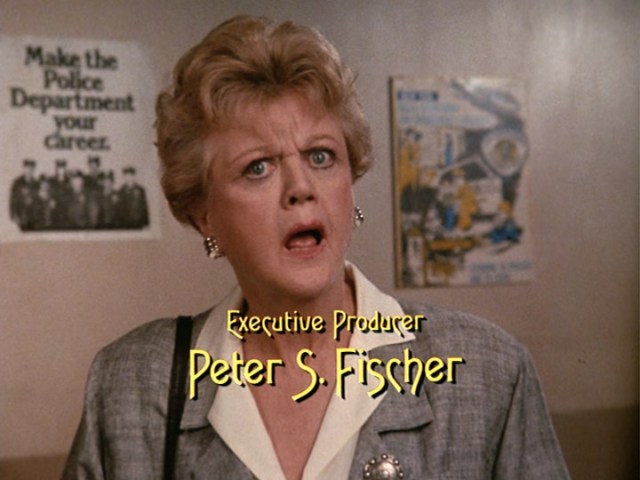
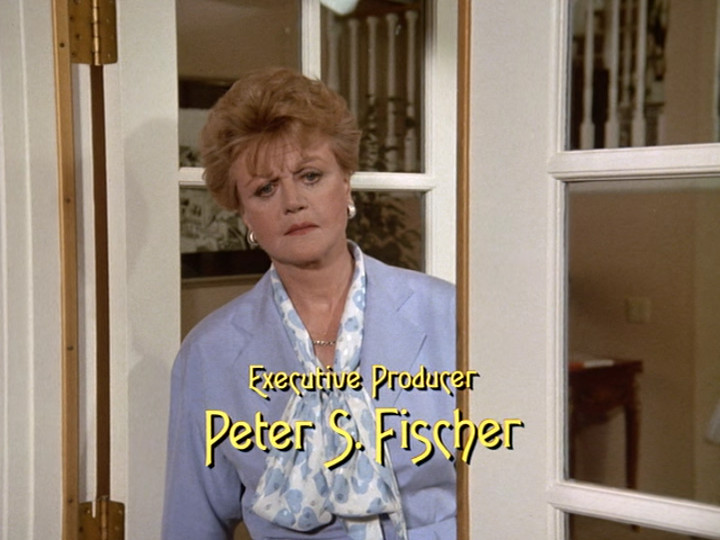
The episode starts out on a foreboding note. A figure in a red ski jacket (who turns out to be Jessica) is skiing down the slopes as opening credits and ominous music play, then another skier in a white jacket begins to follow her.

At the bottom we discover that it was only a friend of hers named Johnny.

There’s something charming about a ski scene on an indoor set with a picture of mountains behind the fake trees…

They joke a bit about Jessica being out of practice. (Johnny said she skied rather well, and, indeed, the stunt double we watched ski down the slopes did look to be in good practice.) It then comes up that there’s a big snowstorm expected the next day which will prevent all skiing, which Jessica takes relief at as she expects to pay for her heightened activity today. It’s a decent working-in of the upcoming plot point of the storm, but I’m not sure it’s really necessary. Storms, as acts of God, do not require foreshadowing in a mystery story.

It comes out that Johnny, as well as many other people present, are hopefuls for the US world cup ski team. There is one person present who has already made it, a fellow by the name of Gunnar Tilstrom. Johnny then excuses himself to help a cute young woman having trouble attaching her boots to her skis and the scene shifts to inside the pro shop.
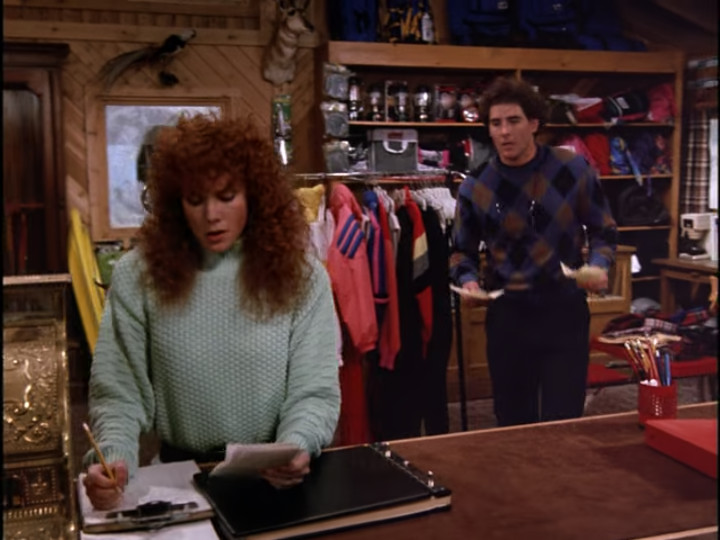
Shoulder pads under the sweater!

The woman on the left is Anne. The man is Mike. They’re married and own the place. Mike is reminding Anne that she has to keep track of the inventory and she angrily replies that she made a mistake and asks how long he’s going to keep berating her. It’s an overreaction to his gentle tone, which suggests that she’s over-sensitive for some reason.

Jessica then walks in and witnesses a bit of the fight. She’s there to pick up something she ordered, which came in about an hour ago. As Anne gets the box, Jessica notices the crossbow on the wall:

Jessica remarks on it and Anne jokes that they use it to shoot beginners who clog up the expert course.

Jessica’s order turns out to be a blue ski suit she’s bought for Grady as a present, and remarks that the entire vacation is a present to him as she hasn’t seen him for three months.

The phone rings and Anne acts about as guilty as humanly possible, saying it would be better if the caller called back later. Mike comes over and takes the phone and asks if it’s Gunnar, but the person on the other end hangs up. Jessica asks if the coat can be put on her bill and high-tails it out of there, while Anne asks Mike how he could humiliate her like that and he replies that he was about to ask her the same thing. I guess we’ve found out why she’s over-sensitive to criticism.

We then cut to the bar, where we see Gunnar returning a landline telephone he borrowed to make the call.
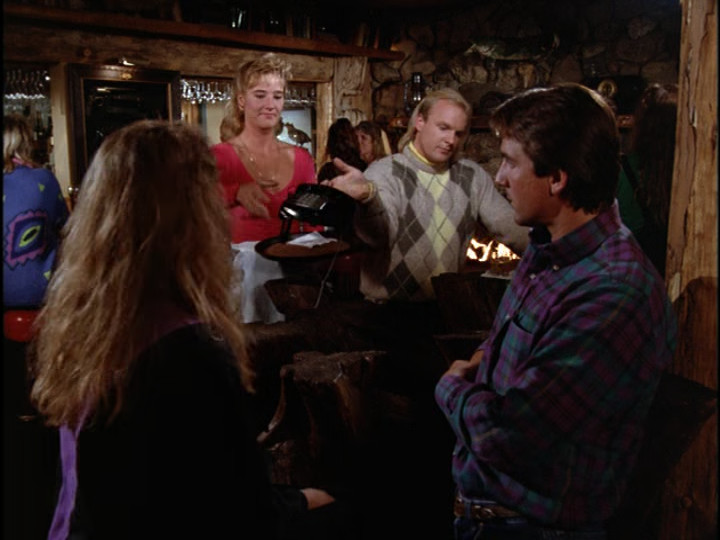
Isn’t that more of a golf sweater Gunnar is wearing?

We then cut over to a young woman named Pamela who is about to join Gunnar, having watched his disappointment as he handed back the telephone.

This sweater feels almost Nintendo-themed.

“Pitty, Gunnar. The old Swedish charm’s beginning to fail you,” she purrs in a delightful posh British accent.

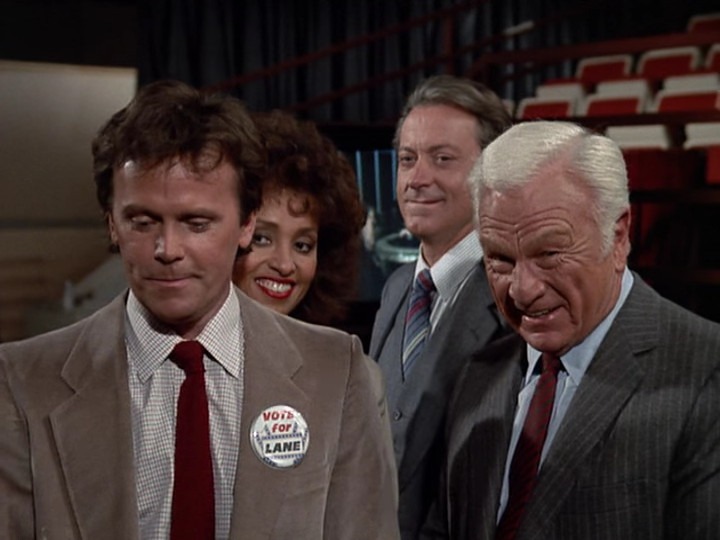
There is some banter, but it turns out that she represents a ski product company which has an endorsement deal with Gunnar that she negotiated, and she remonstrates with him because she’s heard rumors that he won’t compete in the world cup. He explains that he’s won plenty of things before now and is pushing thirty years old and could end up crippled like Mike and have to spend the rest of his years running a ski resort like Mike. (Interestingly, the actor, Eric Allan Cramer, was 26 at the time the episode aired, making this a rare case of playing older. Fun fact: five years later Cramer would play Little John in the Mel Brooks movie Robin Hood: Men In Tights)

Meanwhile, Gunnar still has some skills, such as attracting women, and he sees himself marrying a rich widow who hasn’t been too ravished by the passage of time. Pamela counters that she heard he doesn’t confine himself to widows, and offers as evidence the rumor that a month ago he had an adventure in Tahoe was with the wife of a vindictive gangster.

Gunnar tells Pamela, basically, that he’s sorry for her that she was enough of a sucker to believe in him but that doesn’t alter his plans. Pamela leaves, disappointed, while Gunnar smiles.

Next, after an establishing shot of the ski slopes, we meet Gunnar’s coach, Karl.

This episode has a lot of great sweaters. This may be my favorite.

He just spoke to Pamela and is concerned that Gunnar isn’t going to enter the world cup. They’ve worked together for two years on this! Gunnar says that he hasn’t decided what he’s going to do, but whatever it is, it will be without Karl. Karl grabs Gunnar’s arm and says, “You need me!” Gunnar shoves him to the ground and replies, “I need no one, least of all, you.”

I think we’ve got a decent number of suspects planted, now.

We now shift to evening in the hotel restaurant. Pamela is talking to a young skier named Larry McIvor.

I had a swear in those colors, though not quite that design, in the 1980s.

He’d love to endorse her products, but he wonders what she needs him for since she has a contract with Gunnar. She likens the business world to a downhill course laced with rocks. He’s her insurance policy in case something goes wrong. He golly gosh sure could use the money ma’am, and proposes that they sleep on it. When Pamela raises her eyebrows, he’s deeply embarrassed and tries to assure her that’s not what he meant. Pamela smiles at his naive wholesomeness and says that he really is a delight, and offers her hand. They shake and the camera moves on to a new couple who Jessica runs into.
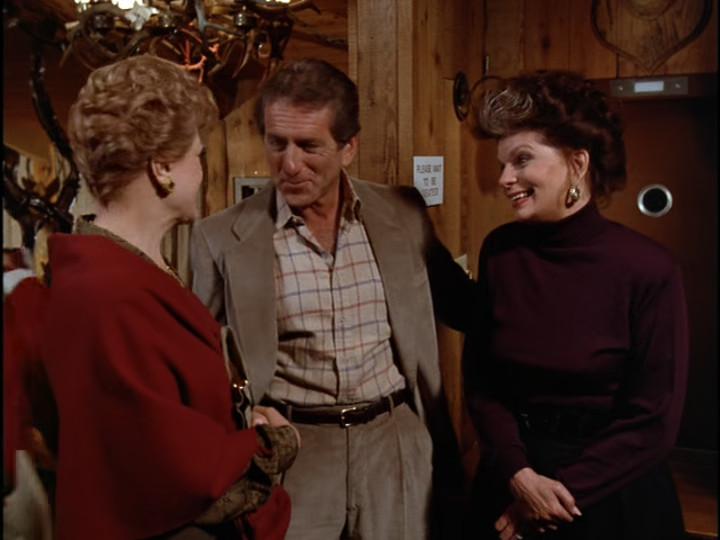
They’re husband and wife. His name is Ed McMasters, hers is Sylvia, and they’re from New York City. He invites Jessica to join them for dinner, “if you don’t mind eating with a cop.” She replies, “Not at all. They’re some of my favorite people.”

They talk over dinner for a bit, then at the end of the song that was playing the lead singer welcomes everyone to the Sable Mountain lodge and then calls out some of the world-class skiers present. “I don’t have to tell you, they stand to win a few gold medals at the next world-cup meet.” I wonder if they would have had to pay money to be able to say, “the winter Olympics.”

Anyway, they put the spotlight on the various people that he calls out for applause, and this results in everyone seeing who Gunnar was having dinner with.

Anne makes the best of this, then the camera gives a closeup of Anne picking up a highly distinctive gold lighter. These kind of closeups tell us that the thing in the center of the camera is important, so take a good look.

She looks around and here eye catches her husband staring at her from right behind Jessica, who looks and sees it. He walks off and the scene changes to outside, in the morning at first light. The storm has started and the snow is falling, but Gunnar is going for a ski.

As he’s going down on the slopes we see a crossbow raised. We then see the view through the crossbow’s scope and the crosshairs take aim at Gunnar. Right as he jumps a small rise the bolt finds its way home and Gunnar falls. He rolls to a stop, dead.

The camera fades to black and we go to our first commercial break.

When we come back from commercial break, Jessica is looking outside as a weather report says that the storm is looking to be far worse than feared and roads are becoming impassible. She walks down into the crowded lobby with her suitcases and meets Pamela, who says, “welcome to Bedlam. They say it’s going to be an hour but I suspect it’s going to be a lot longer than that.”

They’re not explicit but I suspect that everyone wants to leave because the storm has made skiing too dangerous. I’m not sure if that’s really a thing at mountain ski resorts, but it is at this one.

The van to drive people down the mountain and into town has temporarily broken, btw, and the scene shifts to Larry trying to help Mike with it. He pronounced the fuel line frozen and it is possible that the pump has gone bad too. (I’m a bit suspicious of this diagnosis since since the freezing point of gasoline is around -100F.) Mike asks Larry if he can fix it and Larry isn’t sure. Then Johnny walks in and brings the news that Gunnar has been found, dead, by some dumb teenagers who were skiing in the storm.

The scene shifts to the pro shop where the crossbow and all of its bolts is missing. The glass was shattered and a uniformed security guard reports that the back door was smashed in. Mike says that they need to get the cops up here but Anne walks in and says that there’s no way that’s going to happen. All of the roads are closed and will be until the storm lets up.

The scene shifts to Jessica’s room, where Mike and Anne ask her to investigate the death. People are beginning to panic and the appearance of something being done will help keep them calm. Jessica points out that they have a policeman staying with them—Lt. McMasters. Anne shakes her heard. The McMasters left early this morning, driving off before the storm hit.

Jessica doesn’t know what she can do but to the great relief of Mike and Anne, she agrees that whatever it is, she will do it.

The scene shifts to her taking a look at the body.

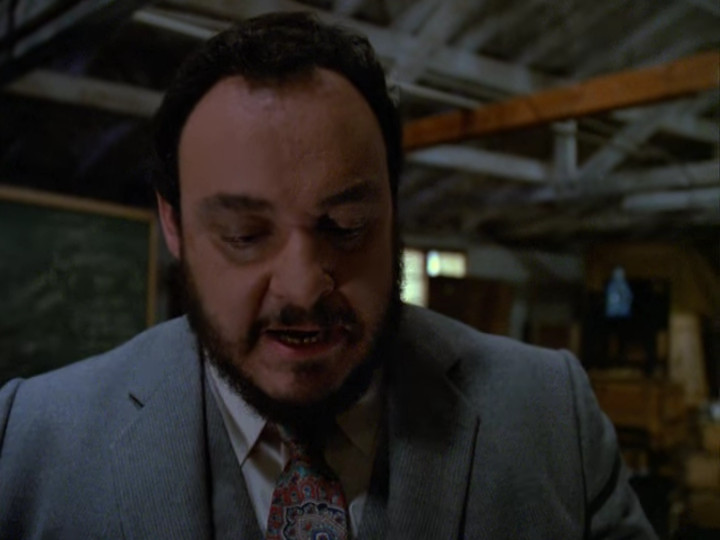
The man standing with her is a doctor. Dr. Lewis. He objects that he is a gynecologist, not a forensic pathologist, but Jessica merely answers that necessity creates strange bedfellows.

Ed McMasters then walks in through the curtain and explains that they ran into a snow bank “about the size of the Chrysler building” and turned around. He looks at the body and asks Jessica for her opinion. Jessica tries to turn the case over to him but he demurs and agrees only that he will help her. He leaves, then Dr. Lewis asks if he can go and Jessica gives him permission.

She then begins to look through Gunnar’s jacket. She finds a room key, specifically room 301. She ponders the meaning of this as a mournful clarinet considers the question with her.

The scene then shifts to Jessica coming into the main room from outside. One of the things that’s done very well in this episode is visually suggesting the strength of the storm.

Still images only partially convey how inhospitable it is outside. Part of it is the difficulty people have in opening doors and the speed with which they come in and get the door closed again. The episode does a good job of showing how much everyone is at the mercy of the storm.

Anne stops Jessica and gives her a clue. After he left a phone message came in for Gunnar. “Urgent. Call me. (702) 555-0980. Vicki.” Jessica recognizes 702 as a Nevada number. She goes to her room and calls the number. A tough-sounding male voice answers and says, “Tartaglia residence.” Jessica asks to speak to Vicki and the voice replies, “Mrs. Tartaglia isn’t here at the moment. Who’s calling?” The tough voice is insistent on asking the question, “Who is this?” when Jessica doesn’t answer. Instead, she just hangs up the phone and picks up the room key that had been in Gunnar’s pocket.

We then see Mike go into a dark room and begin looking for something.

Jessica walks out and shows him Anne’s golden cat lighter. Mike assures Jessica that Anne didn’t kill Gunnar. He left around 6am and Anne left around 7am. Mike knows because he was in an empty room at the end of the corridor watching.

These are the facts salient to the mystery; there is some interesting characterization where Mike explains that he and Ann were engaged prior to the accident which crippled him and while Anne went through with the marriage, he couldn’t bring himself to believe that she really loved him for him, rather than for the athlete he had been. This drove them apart, and you can see that he regrets it, giving some hope for the couple.

The scene shifts to a bunch of young men who are all, I assume, hopefuls for the world cup team who are drinking and sharing raucous memories of Gunnar. Larry gets up and excuses himself because he can’t drink and be merry with Gunnar dead.

Jessica walks up to Lt. McMasters, who watched the scene, and asks him what just happened (she saw Larry walking off looking upset). He replies, “I don’t know. I think it’s an Irish wake.”

Jessica then asks him if he’s made any progress on the murder weapon, but he hasn’t. Anne isn’t keen on a room-by-room search since everyone is already on edge. Neither of them point it out, but it would be a bit far-fetched for the crossbow to be in someone’s room, anyway. When you have the great outdoors to hide something in, it’s a far more sensible choice than storing it in a place which is tied to oneself.

Jessica then spies Pamela and joins her.

Pamela wastes little time in saying that she barely knew Gunnar and had no reason to kill him. Backing off from the abruptness, this turns into a conversation about Gunnar and how the list of people who wanted to kill him was long, though he could turn on the charm when he wanted to. She runs off a list of Gunnar’s flirtations with women that made the tabloids, including the one where he took up with the wife of a mobster and barely made it out of town with his life. This catches Jessica’s attention. She then asks Pamela why she sounds so bitter and Pamela admits that Gunnar was about to ruin the $3M endorsement contract with his womanizing.

Then scene then changes to a storage room where ominous music plays as gloved hands uncover the crossbow and pick up an arrow, showing it off to the camera.

Then we fade to black and go to the midpoint commercial break.

When we come back from commercial break, pamela is working out on an exercise bicycle while larry is doing overhead press on a weight machine. After a few seconds of introductory noises to let people hurry back from the bathroom, Larry says, “Maybe I’m just a dumb farm boy, but where I come from people have respect for the dead.”

Pamela tries to comfort him, saying that they didn’t mean harm and tragedy affects people differently. He’s in no mood for it, though, an accuses her of being there to make sure he will sign the contract. She denies it and he walks off to the locker room. Then Karl the trainer walks in and drunkenly accuses her of murdering Gunnar and threatens to kill her if he finds out he’s right.

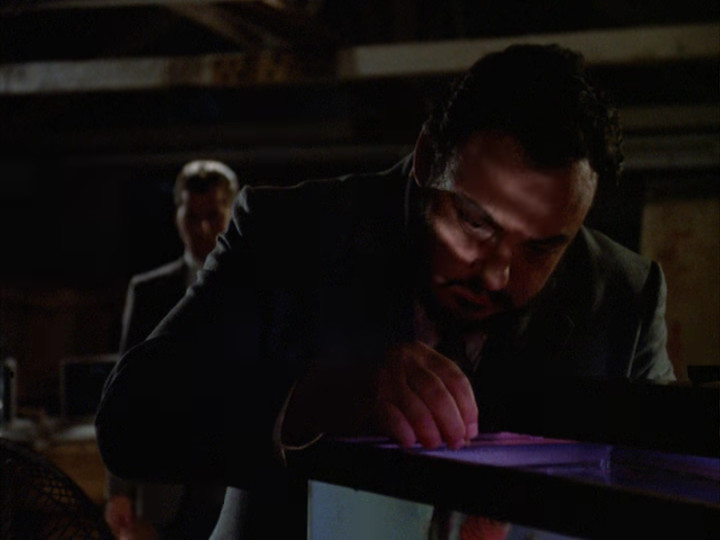
After this threat session, Pamela goes to the woman’s locker room where, to her surprise, she hears the shower running. She sees clothes on the ground and, going to inspect them, finds them soaked with blood. She then goes into the shower room and finds Larry’s corpse, dripping blood, hung by the neck with a rope tied to the shower head, the water running over him. As you might imagine, the music is extremely tense. This is probably the most dramatically tense scene that’s been in a Murder, She Wrote episode. The tension is especially heightened by the fact that the murderer had to be close by since there wasn’t much time for the crime to be committed.

Pamela does the sensible thing and screams as loud as she possibly can. (That’s not a joke. This is a situation for attracting as much attention as humanly possible.)

The scene changes to her in her bedroom with Jessica. She is distraught, wondering who could possibly want to have killed such a nice kid. Lt. McMasters then walks in and says that, as near as they can figure—the gynecologist is a bit outside of his field of expertise—Larry was knocked unconscious in the men’s locker room, dragged to the women’s locker room, stabbed with an arrow, stripped, and hung up in the shower. Jessica says that this makes no sense and McMasters replies that (of course it makes no sense) they’re dealing with a luny, a certified hazel nut.

Anne comes into the room to say that there’s more bad news—the phone lines are down. They can keep up internal communications with their generator, but they are completely cut off from the civilized world.

Jessica asks if Sylvia (Lt McMasters’ wife) can stay with Pamela for the time being. She saw a vehicle with a CB radio in it—red, with a Massachusetts license plate—and she thinks that they should try very hard to get in touch with the police. Anne says that she’ll try to find out who owns it. McMasters says that he’s going to talk to the Norwegian ski coach, who seems not entirely right in the head.

In the next scene Jessica and Mike Lowry go to the red vehicle and call the Sheriff. They manage to report the second murder, but the Sheriff says that the roads are impossible and the helicopter can’t fly in this storm. They’ve got to hang on. Then everything goes to static for some reason which isn’t obvious but doies at least get us out of the conversation.

Mike and Jessica retreat to the pro shop, where Mike laments that this could destroy their business, into which they invested every cent they had.

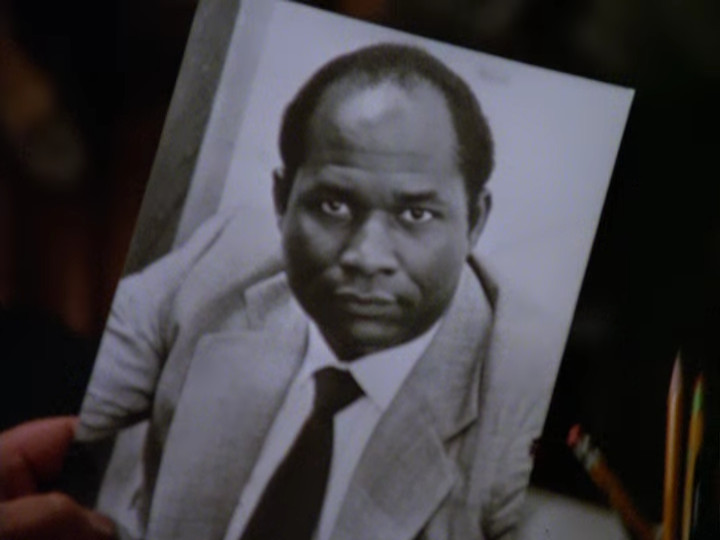
Jessica then notices the photograph of the last US World Cup team and asks if it was Mike’s idea to invite everyone up. The people in the picture are Gunnar, Larry, Johnny, and Mike (before his accident). Now two of the men in the photograph are dead. Jessica doesn’t know what it means, but there must be some reason for these killings.

Then they hear a crash and begin to investigate. As they do, Johnny comes through the door, his left arm bleeding.

In the next scene Johnny is in bed, the gynecologist tending to his wound.

At first blush the wound looks a bit low, but it could possiby be an attempt to stab Jonny in the heart. Johnny says that he was grabbed from behind and stabbed. Lt. McMasters says that they found another arrow nearby on the floor. Johnny didn’t see who it was, not even a sleeve. He fell to the ground and passed out, then woke up when he heard Jessica and Mike.

In the hall the gynecologist remarks that he used to think his practice was dull and repetitive, but has never been so eager to get back to his dull, boring routine in his life. He then quickly walks off.

Lt. McMasters remarks that he can’t blame the good doctor. It’s not much of a vacation to have some screwball going around trying to knock off the next world cup ski team.

Jessica is not so sure. The doctor said that the wound was superficial. Perhaps Johnny stabbed himself to divert suspicion?

McMasters thinks it unlikely. Jessica has done some checking up and Johnny is good but not that good; with Gunnar and Larry out of the way he’s got a much better chance of making the team. McMasters says that it’s a flimsy motive for murder, but Jessica counters that she’s heard worse.

Jessica then says that there is a third possibility—that Gunnar was the only real target. The killer probably planned to hit and run but got stuck in the snowstorm and had to create a smoke screen. McMasters says that this third one is a hell of a theory. Jessica replies that theories are easy to come by, the truth is much harder. She then says that they better hope that the weather clears up so that the police can come in the morning and take the investigation over from them.

The storm, however, rages through the night.

A few hours later Jessica, in bed, receives a call from a panicked Sylvia McMasters. With the sound of sleigh bells jingling in the background she asks if Ed is there with Jessica. Jessica, who was nearly asleep, says that he isn’t. Ed got a call a few minutes ago and rushed out. She doesn’t know who the call was from, but Ed took his gun. Jessica tells her to stay calm and that she’ll try to find Ed.

Jessica puts on her coat and braves the storm, looking for Ed.

She checks the ski shop but it’s locked. As she does Ed pops out from behind the building with his gun pointed at her and tells her to freeze. After she identifies herself he explains that some guy with a muffled voice called him and said to meet him outside the ski shop because he had information about the case. It sounded like a trap to him so he hid himself and waited.

As they talk a crossbow aims at them from the car barn and then fires, but misses, hitting the wall behind them. As they try to spot where the shot came from, the sound of a motor roars and a ski-mobile drives out of the car barn. McMasters orders the driver to stop, then fires three shots at him. The driver runs up a snow bank and topples over. They rush up and it’s Karl, the ski instructor, dead. Beside him lays the crossbow with two arrows left in its quiver.

The scene fades to black and we go to the final commercial break.

When we come back, Jessica is examining Karl’s ski jacket while Ed is telling Mike and Anne that he got the feeling, when Gunnar was pushing Karl around, that something was going to snap in the big trainer.

Mike says that it’s hard to believe, since Karl was like a father to them.

A phone call comes in with the news that the phone lines are back in operation. Ed is delighted by the news and looks forward to going home to NY. He says he’s going back to the lodge and asks Jessica if she’s coiming, but she’s nowhere to be found.

Outside Jessica is standing with Karl’s coat as the gynecologist comes running up. He begs her to promise that this is the last time she will press him into service as an amateur coroner. She asks if he got “them”, and he replies that he did. While surgery on corpses is not his long suit, he does believe that he extracted the bullets with a minimum of damage. Jessica looks at the bag he handed her and proclaims them two .38 caliber bullets, but did they come from the same gun?

The gynecologist doesn’t understand. He thought it was known that Karl was shot by Lt. McMasters. Jessica replies, “yes, but was he also shot by someone else?” The gynecologist looks confused, then horrified, then says, “You know, I’m afraid that if I ask you what you mean by that, you’re liable to tell me.” Without giving her the opportunity to say anything, he then very politely wishers her a good day and leaves, saying that he’s giving up skiing for something less rigorous, such as needle-point.

Jessica smiles, then goes into the car-barn and looks around. She then notices the jingle-bells on the wall next ot the telephone by the door.
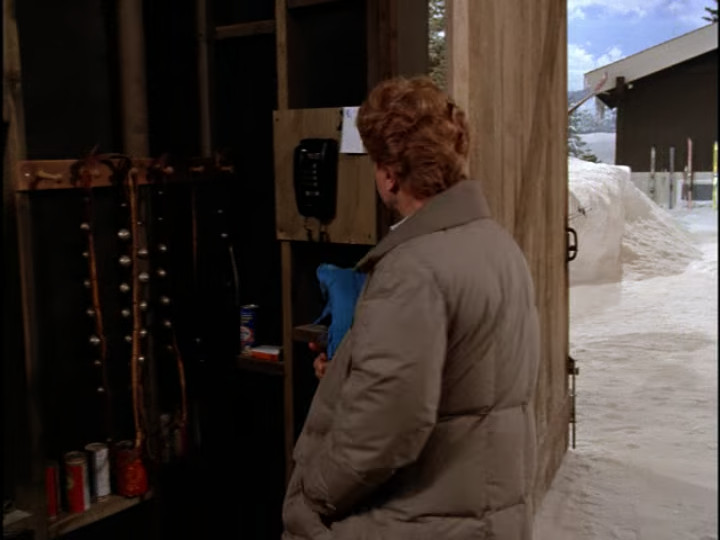
Jessica then catches Sylvia on her way to meet Ed, who is warming up the car. Jessica says that they need to talk. Jessica is surprised that Ed wants to go home so soon and Sylvia explains that she’s anxious to get back to her cat. Ed then walks up and says that they have a busted fuel line, so will be stuck for a while. Jessica then invites Ed to have a seat, saying that there’s been a development.

Jessica then reveals that Karl didn’t kill anyone, he was murdered like the rest. There were two bullets in Karl, but only one of them struck him when he was alive. (If you recall the picture of his jacket, there was only one bullet hole with blood on it. Jessica then shows a second bullet hole in the jacket which we couldn’t see earlier because there’s no blood on it.) When the police check the ballistics, they’re going to find that both bullets came from the same gun. Moreover, they’re going to find that there is no Ed McMasters who works for the NYPD. Also, it was Sylvia who fired the crossbow at them; Jessica heard the sleigh bells in the background of the telephone call and didn’t think about it until she saw the sleigh bells hanging up next to the phone in the barn, but they place Sylvia not in her room, but in the barn. Also, another question is why, having killed Gunnar, didn’t the killer leave? The only people who tried to leave were the McMasters, who only came back because the road was impassable.

Jessica surmises that he was hired by Tartaglia to take vengeance on Gunnar and got trapped by the snowstorm. The rest of the killings were a cover-up when they couldn’t get away.

As the McMasters indignantly rise to leave we can hear the sound of a helicopter overhead and two security guards come out and detain the McMasters at gunpoint. When they clearly give up trying to escape, Jessica turns to Anne, who had just announced that the police have arrived, and we go to credits.
As I said at the outset, this is one of my favorite episodes. It’s tightly plotted with good characters and an intriguing mystery. By means of a powerful act of nature we have a closed cast of characters. The ongoing murders adds tension and makes the threat of the killer being loose present, while it also creates new clues as well as new things for them to fit into, creating satisfying complexity.

That is not to say that this episode is perfect. Like all the works of man it does have mistakes. For example, we see Jessica packed and ready to leave before Grady even shows up. It’s also a bit weird that Vicki left a message for Gunnar asking him to call her at a phone number that could easily get her husband. I’m not sure what her alternative would be since this was long before cell phones and she probably didn’t have a private phone line, but it’s still a bit unlikely. Also… actually, that’s about the only mistakes which comes to mind, and the first one doesn’t even matter because the plot only needed her to be in the lobby, which required no excuse anyway, and the second one could have been a slightly different message and serve the same purpose. This may be one of the reasons I like this episode so much.

Getting back to what this episode does well, we have a good setup which introduces a large but manageable cast of characters. I think that part of what keeps the large cast manageable is that they fall into several categories. We have the owners, the adjuncts to the ski team (the business woman and trainer), and some fellow guests. This is not the only approach, of course. The best alternative I know of is to give every character a hook to make remembering them easy. That said, this is an excellent approach and gives us manageable complexity.

Another great point is the economy of the setup. We get introduced to everyone, but we also have our corpse before we go to the first commercial break. This balance maximizes the mystery involved. If we were introduced to fewer people, we would have no scope for speculation. If we waited too much longer, we would need some kind of story that would compete for time with the mystery. This point is probably specific to the short-story form (which TV resembles more than it does novels), but it’s worth bearing in mind.

Next on the list of great things about this episode is the snow storm. It is a wonderful complication in the story, both helping and hindering the murderer and the detective alike. It brings in the eternal theme of how man is subject to nature, for all of our technological mastery. It also removes the possibility for modern forensic evidence, turning the mystery into more of a classic and making it more accessible. We all have wits, we do not all have forensic tools.

The gynecologist who is brought in to do the medical work has a real function but also brings in a touch of comic relief which balances out the threat of a killer on the loose who is willing to kill again. This is part of the general excellent pacing, where moments of examination and detection alternate with moments of tension and the killer acting.

The murderer is also well done in this episode. “Ed McMasters” pretending to be a New York City cop is a good way to divert suspicion from himself, but if you pay attention he does play it in a way that’s cagey and not comfortable with the role. He will happily drop the name of recognizable places (like the Major Deegan Expressway), but he mostly refuses to actually do anything that would require the knowledge of how to do real policework. Even when he does, he makes his actions ineffective. Tasked with finding the crossbow, he proposes a room-to-room search which he knows that Anne and Mike will object to and which wouldn’t do any good anyway, while looking like he’s trying.

The one part where he really slipped up in a way that doesn’t make a lot of sense to have slipped up was in actually shooting Karl’s corpse on the snowmobile. There was no reason for him to actually aim at the corpse and he had to know that a bullet which didn’t cause any bleeding would have had to be suspicious. There are two reasonable ways to explain this, though. The first is that he had to be aiming at approximately the right place because Jessica was watching him and he got unlucky and hit the corpse when he meant to miss it. It is not easy to put your bullets where you mean to with a handgun, so this could simply have been, as the kids these days would say, a “skill issue.” The other explanation is that he thought that the most convincing thing to Jessica would be method acting—to actually try to do the thing he was pretending to do—and he expected to fool her long enough to drive away once the roads were clear and then “Ed McMasters” would disappear and it wouldn’t matter that the coroner would discover that Karl was shot after he was dead. And to be fair to this second possibility, the only reason he didn’t escape was because Jessica was quick witted enough to examine the corpse and figure out what it meant.

This episode was just great from start to finish.

In next week’s episode we’re off to the mountains of West Virginia for Coal Miner’s Slaughter.
One, Two, Buckle My Shoe

I recently read Agatha Christie’s novel One, Two, Buckle My Shoe. It is the nineteenth novel to feature Hercule Poirot and was written during a very turbulent time. Published in November of 1940, it would have been written mostly during World War 2, or entirely if Christie had started it after the publication of Sad Cypress in early 1940.

It has some vivid, if not always pleasant characters, and among other things deals with the kind of revolutionary socialists who are the counterpart to the German ones who started the second world war. Her portrayals of human beings are at times almost painfully realistic and well done. I’m inclined to agree with the reviewer Maurice Richardson, who in his review in 1940 wrote:

The Queen of Crime’s scheming ingenuity has been so much praised that one is sometimes inclined to overlook the lightness of her touch. If Mrs Christie were to write about the murder of a telephone directory by a time-table the story would still be compellingly readable.

Agatha Christie’s style is so simple it might be easy to miss the subtlety of her observation of human nature in its varied forms.

All of that said, there does seem to be a pretty big plot hole in the story, which I find quite surprising because there are usually no plot holes in Agatha Christie’s work, not even small ones. (spoilers follow.)

I can’t see any way that Alistair Blunt could have arranged for a dentist appointment shortly before Mr. Amberiotis’ appointment which was right after Miss Sainsbury Seale’s appointment. And that’s assuming we were to grant the coincidence of the two men having the same dentist as Mabelle Sainsbury Seale, which seems difficult on its face since she was of a different social class than them. Oh, and also the same dentist as “Mrs. Chapman.” (Mabelle and “Mrs. Chapman” had to have the same dentist because the switching of dental records was an important plot point. [See the second update below for more.])

The coincidences are not insurmountable; coincidences do happen and when they merely shape the result rather than make it possible, it’s not disappointing.

But what I can’t for the life of me figure out is how Alistair Blunt (or “Mrs. Chapman”) ever found out about this coincidence. People—especially foreigners who are only visiting—don’t visit the dentist often enough that one would just call around to all of the dentists asking if they had an appointment for the victim. Even if this coincidence was known, how would Alistair Blunt then get an appointment for shortly before Mr. Amberiotis? Requesting it would be far too suspicious. Not to mention that setting up having been patients would take months, at least.

And there’s no way that the entire thing could be coincidence on the day of the murders, since the murders and switching of the dental records were planned ahead of time, as was the fake telegram getting the secretary out of the way.

I can’t help but wonder if there’s something I’m missing, because this is very unlike Agatha Christie.


UPDATE: A reader brought up the timing of Amberiotis’ making an appointment with the dentist. This, I think, was in advance of the day of his murder. I’m going to quote the section in full since it’s short.

At the Savoy Hotel Mr. Amberiotis was picking his teeth with a toothpick and grinning to himself.

Everything was going very nicely.

He had had his usual luck. Fancy those few kind words of his to that idiotic hen of a woman being so richly repaid. Oh! well—cast your bread upon the waters. He had always been a kindhearted man. And generous! In the future he would be able to be even more generous. Benevolent visions floated before his eyes. Little Dimitri… And the good Constantopolus struggling with his little restaurant… What pleasant surprises for them…

The toothpick probed ungaurdedly and Mr. Amberiotis winced. Rosy visions of the future faded and gave way to apprehensions of the immediate future. He explored tenderly with his tongue. He took out his notebook. Twelve o’clock. 58, Queen Charlotte Street.

He tried to recapture his former exultant mood. But in vain. The horizon had shrunk to six bare words.

“58, Queen Charlotte Street. Twelve o’clock.”

While the text is slightly ambiguous, I think the most natural interpretation of these words would be that Mr. Amberiotis already had an appointment with the dentist, which was why upon feeling the pain, he merely looked at his notebook and there was no mention of making a telephone call.

On the other hand, this text also makes it sound like Mr. Amberiotis had just had his conversation with the real Miss Sainsbury Seale but that had to have happened at least a week before, since that was the length of time that “Miss Chapman” pretended to be Miss Sainsbury Seale.

That said, if the goal is to figure out an interpretation of these words that resolves all plot issues, this section must describe Mr. Amberiotis merely considering the anticipated fruit of having been kind to Miss Sainsbury Seale over a week ago, and then suddenly, by poking the sore place in his mouth, recollecting the appointment he made a while ago with the dentist.


UPDATE: In checking up on something, I came across the fact that Mabelle Sainsbury Seale did, by coincidence, have the same dentist as Alistair Blunt and that’s how they met in London. Approximately three months before the murders, Mabelle was coming out of the dentist’s office as Alistair was going into it and she recognized him and said that she used to be a great friend of his wife’s. So that part was a coincidence which shaped how the murder later took place. Moreover, this coincidence was revealed less than halfway into the book. With the dentist of Miss Sainsbury Seale known three months before the murder, “Sylvia Chapman” had time to become a patient of the same dentist. So there’s no plot hole on how Sylvia and Mabelle had the same dentist in order to make the switch of the records possible.

One solution for how Mr. Amberiotis had the same dentist as Blunt and Sainsbury Seale would be what the ITV version of the story starring David Suchet did, which was to have Mabelle recommend her dentist to Mr. Amberiotis. I don’t remember this being in the novel, but neither was there anything which contradicted it.

This still does not explain how they found out about Mr. Amberiotis’ appointment in order for Alistair to get an appointment on the same day. The fake Mabelle’s appointment does not require an explanation since the dentist, himself, said that it was made the day before as an emergency appointment. But how on earth did they know for which day Mr. Amberiotis had an appointment?

Mr. Holmes, They Were the Footprints of a Gigantic Hound

I recently realized that I had only seen the Jeremy Brett version of The Hound of the Baskervilles but never actually read the story, so I remedied that immediately. I really enjoyed it. As often happens in Conan Doyle’s novels it drags a little in the middle, but not to nearly the degree of A Study in Scarlet or The Sign of Four, and for me it verged on a page-turner despite my already knowing the story. It’s also, by the way, a brilliant detective story.

Spoilers will follow, so if you haven’t already read it, go do so now.

(As an interesting aside, as I was explaining what sort of story it was to my thirteen year old son in order to try to interest him in it, he ended up asking if it was basically Scooby Doo for adults. After thinking about it for a bit, I came to the conclusion that he was fundamentally correct, though of course it would be more accurate to say that Scooby Doo was The Hound of the Baskervilles for kids.)

On the whole I think that there is a very good balancing in the story of the supernatural setup and the murder mystery. The story having been published in 1902 and set in 1889 meant that everyone took the supernatural rationally, which is to say, seriously but as one part of the world and therefore possibly an explanation and possibly not an explanation. This made the story so much more interesting than it would be in a typical modern story. None of the characters defiantly state their unwavering faith in materialism. You have none of that stuffy, “I am a man of science! I will not believe in the supernatural no matter how much evidence there is for it!” which makes so many modern stories which deal with the supernatural, boring. That everyone is open to the possibility of the supernatural explanation makes the story so much more interesting because they are actually considering the evidence that they have and their tentative judgment varies as fresh evidence comes in.

This is where the line I quoted in the title of this post comes in. In the first chapter Dr. Mortimer left his cane and Holmes took it as an occasion for a little competitive deducing with Watson, then the man arrived and there was a bit of comic relief. In the second chapter we start with a lengthy exposition of the family curse of the Baskervilles and how it started with the wicked Hugo Baskerville in the late seventeenth or early eighteenth century. (The short short version is that he raped a made and hunted her down with dogs when she escaped onto the moor, at which point he was killed next to her dead body by a giant hell-hound with glowing eyes, etc. and this beast continues to exact vengeance from Hugo’s descendants.)

We then get a reasonably detailed description of the recent death of Sir Charles Baskerville, the short short version being that he died of a heart attack while strolling on his property next to the moor. Finally, at the end of the chapter, Dr. Mortimer reveals that he had discovered a piece of evidence he did not give at the inquest, because he did not see what good it could do, but he would not withhold it from Sherlock Holmes. He found footprints by the gate to the moor. When Holmes asked whether they were a man’s or a woman’s, Dr. Mortimer replied, “Mr Holmes, they were the footprints of a gigantic hound.”

This is an excellent turn of events in the story because it introduces the first piece of evidence that there may be some truth to the legend. Centuries-old family stories are easy to dismiss. Direct evidence with no obvious explanation is very different.

At this point Dr. Mortimer is inclined to the supernatural explanation, but he is not committed to it. When Holmes asks why, the phrasing of Dr. Mortimer’s reply is interesting:

Since the tragedy, Mr. Holmes, there have come to my ears several incidents which are hard to reconcile with the settled order of Nature.

Chief among these is that several people saw a gigantic glowing hound upon the moor. They are all reasonable people and the testimony of independent witnesses which agrees is hard to ignore.

“Why should he not go to the home of his fathers?”

“It seems natural, does it not? And yet, consider that every Baskerville who goes there meets with an evil fate. I feel sure that if Sir Charles could have spoken with me before his death he would have warned me against bringing this, the last of the old race, and the heir to great wealth, to that deadly place. And yet it cannot be denied that the prosperity of the whole poor, bleak countryside depends upon his presence. All the good work which has been done by Sir Charles will crash to the ground if there is no tenant of the Hall. I fear lest I should be swayed too much by my own obvious interest in the matter, and that is why I bring the case before you and ask for your advice.”

Holmes considered for a little time.

“Put into plain words, the matter is this,” said he. “In your opinion there is a diabolical agency which makes Dartmoor an unsafe abode for a Baskerville—that is your opinion?”

“At least I might go the length of saying that there is some evidence that this may be so.”

“Exactly. But surely, if your supernatural theory be correct, it could work the young man evil in London as easily as in Devonshire. A devil with merely local powers like a parish vestry would be too inconceivable a thing.”

In The Adventure of the Naval Treaty, Holmes remarked that nowhere is deduction so necessary as in religion, and that it’s an exact science. Here Holmes is showing that this is sincere. He is setting theology against superstition. It’s a thing the Church has done for millenia; people get lazy and forget to think. This is, interestingly, a theme of the Homles story. He sees what other men sees, but he observes what they ignore.

After this, the mystery gets underway fairly quickly, with curious incidents happening to the new heir to the Baskerville title and estate as soon as he arrives from America. The story proceeds in a satisfyingly twisting way with the evidence mounting for both the natural and supernatural explanation. It’s extremely well done, though I think it would be hard to pull off in a modern story because so many people are so irrational about the supernatural.

There’s Something Interesting About Murder In a Minor Key

It’s been a few years since I reviewed the Murder, She Wrote episode Murder In a Minor Key. I recently re-watched that episode and re-read my review and while I don’t take back a single thing I said in the review, I do think that I missed something, because in spite of all of the cheesiness and the plot holes, there is something captivating about that episode.

On reflection, I think that for all of its foibles (such as a tuning fork being used as a murder weapon) and plot holes (a woman carrying on an affair and saying that her lover wasn’t involved because her husband was “her problem” killing her husband in a moment of frustration because he neglected her), it did capture the sense of excitement and adventure that golden age mysteries had.

The first element of this is that it had a sense of something unusual breaking into the ordinary. This is often missing from Murder, She Wrote episodes because there are, generally, long-standing hatreds and rivalries established early on. Here, we have an apparently placid environment which suddenly breaks down. That’s much more of a golden-age feel, and also produces much more of a sense of mystery. “Which of the people who hated the victim finally got him?” is a fine question, but it’s not nearly so much a golden-age question.

Another major element of the golden-age mystery is the helplessness of the police, to the point of them barely investigating. This can be taken almost to the point of being silly, and this was remarked upon even during the Golden Age. Consider the opening of G.K. Chesterton’s short story The Mirror of the Magistrate, first published in 1925:

JAMES BAGSHAW and Wilfred Underhill were old friends, and were fond of rambling through the streets at night, talking interminably as they turned corner after corner in the silent and seemingly lifeless labyrinth of the large suburb in which they lived. The former, a big, dark, good-humoured man with a strip of black moustache, was a professional police detective; the latter, a sharp-faced, sensitive-looking gentleman with light hair, was an amateur interested in detection. It will come as a shock to the readers of the best scientific romance to learn that it was the policeman who was talking and the amateur who was listening, even with a certain respect.

“Ours is the only trade,” said Bagshaw, “in which the professional is always supposed to be wrong. After all, people don’t write stories in which hairdressers can’t cut hair and have to be helped by a customer; or in which a cabman can’t drive a cab until his fare explains to him the philosophy of cab-driving. For all that, I’d never deny that we often tend to get into a rut: or, in other words, have the disadvantages of going by a rule. Where the romancers are wrong is, that they don’t allow us even the advantages of going by a rule.”

“Surely,” said Underhill, “Sherlock Holmes would say that he went by a logical rule.”

“He may be right,” answered the other; “but I mean a collective rule. It’s like the staff work of an army. We pool our information.”

“And you don’t think detective stories allow for that?” asked his friend.

“Well, let’s take any imaginary case of Sherlock Holmes, and Lestrade, the official detective. Sherlock Holmes, let us say, can guess that a total stranger crossing the street is a foreigner, merely because he seems to look for the traffic to go to the right instead of the left. I’m quite ready to admit Holmes might guess that. I’m quite sure Lestrade wouldn’t guess anything of the kind. But what they leave out is the fact that the policeman, who couldn’t guess, might very probably know. Lestrade might know the man was a foreigner merely because his department has to keep an eye on all foreigners; some would say on all natives, too. As a policeman I’m glad the police know so much; for every man wants to do his own job well. But as a citizen, I sometimes wonder whether they don’t know too much.”

This would be taken into account in later detective stories; it became common for the amateur to work with the police and leave to the police the things that the police are good at, such as knocking on every door for three blocks and asking everyone if they saw something until they find someone who did, or asking every hardware store within a hundred miles if they recently sold a large crescent wrench to someone who did not look like a plumber. Indeed, Poirot would come to say that it is for the police to assemble the facts and for Poirot to figure out what they mean. This is eminently reasonable and in some sense an improvement in the genre, but that development did trade something for what it gained: anyone might go and investigate for himself; the police will only cooperate with a select few.

Murder in a Minor Key had that feeling of the main characters doing something that anyone could do. Chad and Jenny were just college students who happened to be friends with the composer who was accused of the crime. They had no official connections with anyone, no credentials, and until the end, no cooperation from anyone. (How they got cooperation for the re-enactment is not explained because I don’t think it could possibly have been justified. The police detective who is present says that he’s only there because the school asked him to cooperate, but why on earth did the school ask him to cooperate?)

This sort of setup is very hard to do well, but it is also very exciting, and that can make up for a lot.

Early Mistakes in Murder Mysteries

When looking closely at the plots of many murder mysteries one can see where a great deal of time was lost in there being mistakes in interpretation of the evidence which were made toward the start of an investigation. They can be explicit, like thinking that a clue belongs to one person when it actually belongs to someone else, but it can also be much bigger in scope—mistaking a murder for gain as murder for revenge, for example. It’s possible for the detective to spend the first half a book (or more!) laboring under this kind of mistake. It can be a useful way to spend time, and can also be the setup for the big reveal at the end which shows the detective to be brilliant.

However, it can, especially upon close inspection, easily seem a bit far fetched for the brilliant detective to get locked into an incorrect interpretation. Often the reason why people begin with one interpretation is trivial—it can be as little as someone making an off-hand suggestion, or even just someone assuming it. And, to be fair, it is the job of the brilliant detective to question all of the things that ordinary people take for granted. That said, even brilliant detectives are human. Human beings need some sort of interpretive framework to operate within, even if only held provisionally, and that framework will dictate what is and what is not conceivable. As long as the current evidence keeps the current framework plausible, it is reasonable for even the most brilliant of detectives to work within it. That is, until it stops working. That’s what’s being described by the phrase, “once you eliminate the impossible whatever remains, however improbable, must be the case.”

The other issue that comes up with early mistakes in a murder mystery is that, if it’s not handled very well, it can easily diminish the re-reading value of the story. Now, I know that not everyone values re-reading as much as I do, but I tend to operate on the principle that if a book is not worth re-reading ten times, it’s not worth reading once. (Obviously, the only way to find out is to read it once, and there are plenty of exceptions.) So how do you make the first three quarters of a book a waste of the detective’s time without making it a waste of the re-reader’s time?

The answer, I think, is to make it not be a waste of the detective’s time, but that’s not obvious until you arrive at the full solution.

That is, during the early part of the book when the detective is laboring under a misinterpretation of the crime he must still be collecting clues that will help in the solution without understanding how they are. This is a very tricky balance; it can get frustrating when all of the clues point one way and the detective won’t even consider it because of one small mistake. It’s best, if at all possible, for most of the clues discovered early to work within the framework of the mistake but to work better within the framework of the truth. A really good example of this which comes to mind is in the Hercule Poirot novel Five Little Pigs (spoilers ahead).

There is a piece of evidence given which seems to fit in under the prevailing interpretation that Caroline murdered Amyas, but it works better under the theory that she didn’t. That is the wiping of the bottle. Until Poirot introduces the interpretation that Caroline was protecting her little sister, who she believed killed Amyas, her wiping of the bottle (as well as other actions) seem to indicate her guilt. Poirot’s collecting of this information did prove useful.

I think that this forms the ideal, though of course like most ideals it is difficult to achieve.

Incidentally, what we have said above would seem to suggest that red herrings are a problem for re-readability, and yet it is obvious that red herrings can work well in a detective story. Certainly, there is a place for red herrings, but I think that they must be used like a spice—too many of them can hurt a story. But how to use them?

I think that this principle we have laid out for early misconceptions in a detective story also points to the best way to handle red herrings. A red herring which is just a waste of time will not be satisfying on re-reading—unless it serves some other purpose. That, I think, is the key. The best red herrings will improve somebody’s life when they are cleared up. Lovers held apart can come together, a missing item of value can be restored to its owner, somebody in danger can be made safe—there are many options, the key thing that makes this a satisfying red herring is that it is a bonus. That in addition to solving the central mystery and putting things right that were put wrong through the misuse of reason, some other problem was set right too.

Hard to achieve, certainly, but I think worth striving for.

Murder Mysteries and Traps

I’ve written before about how murder mysteries with a clever twist are less popular than they were during the golden age (see Ingenious Murders, Alibi By Recording, and Dorothy L. Sayers and Clever Murders.) There is a variant of the clever twist which I would like to consider more specifically: the trap. For the purposes of this blog post, I’ll consider traps any method of murder where the murderer does not need to be (immediately) present at the time of the murder.

The first thing to get out of the way is that there is one kind of trap which remains as popular as ever: poison. We don’t tend to think of poison as a trap because it doesn’t have any mechanical parts but it functions exactly in the same manner as a shotgun in a closet whose trigger was on a string to the door. It’s just smaller and you have to trick the victim into eating it, which is rarely necessary with a shotgun.

The main problem that traps have, from the perspective of the murderer, is that they make most alibis useless. Unless the time the trap was set up is very tightly constrained, it requires a very long alibi to ensure one could not have set it up. It’s difficult to both be a character in the story and to have an alibi for several days straight. (People can, of course, lie about when they arrived in the country, but it’s too easy to check the dates on their passport.)

There is a solution to this, though, which is to disguise the trap so that it appears that a murderer was present at the time of the death. One very popular method is for the murderer to be the first on the scene and remove critical evidence of the trap, e.g. to remove the shotgun and the string. This is very risky, though, since the police tend to take strong notice of the person who discovers the body, especially if he has any real connection to the victim.

This is a solvable problem, though. One approach to not having to be the first on the scene was done in the Sherlock Holmes story The Problem of Thor Bridge, where a simple machine hides the murder weapon. This approach has the downside of working best for disguising suicide, so it’s only available to a fairly small number of murderers.

Another solution to the problem of not having to be the first on the scene can be found in a Dr. Thorndyke story: the construction of a highly atypical weapon. In the story I’m thinking of, somebody fixed up a chassepot (a french rifle from the 1860s) to shoot a small dagger. The murderer then shot his victim from across the street. When the police looked for a man who entered the building to stab the victim—since knives or normally close-quarters weapons—various people in the building could swear that no one had entered the building since before the actual murderer was last seen in public, giving him a cast-iron alibi. This works, though its solution could easily be too technical to be widely enjoyed. The other problem with this kind of solution is that the murderer must either be very lucky and trust to his extreme luck, or else he’ll have to spend a lot of time, in private, perfecting his weapon for it to be reliable enough to be accurate at twenty or thirty yards. Accurately launching projectiles is simply not easy. If the first approach is taken, the story will lack plausibility. If the second is taken, the murderer will need access to a lot of private space for a decent amount of time, meaning he must have a fair amount of resources at his disposal. This reduces his possible motives for murder, since it can’t simply be money (it could still be money in a complex way) and whatever the motive, it must be a very long-lived one for him, not only to go to so much trouble, but to consider murder a viable solution to his problems for so long a period of time.

Of course, if all this seems too complicated to the murderer, a trap which is undisguised can be paired with framing someone else for setting the trap.

I suppose I should mention the other possibility, which is to attempt to hide the trap. This is viable so long as the trap causes death in a way that can look like something else. An example of this would be a trap that hits someone on the head at the top of the stairs, causing him to fall down the stairs. The blow to the head could easily look, post-mortem, like an injury sustained during the fall. The murderer will need to construct the trap very carefully to not be obvious, at least for a time. It’s a great risk to permanently leave the trap in place, but if it can pass without notice for a few days, that would give the murderer an opportunity to retrieve the incriminating bits later, after attention has faded from the murder scene. (Alternatively, the trap can be made with biodegradable pieces and put someplace that water or wind will eliminate the evidence.) This last part can be fun because the bits that don’t quickly pass away can catch the eye of the detective while looking like not much of anything to people with less imagination.

Considering it all, I think that, for all their difficulties, traps are still workable in a modern mystery. A fair amount of care will need to go into the construction of the murderer who employs a trap. It can easily seem unjustified. This is, to some degree, a result of murder mysteries being primarily novels rather than short stories; in short stories you can leave enough of the character up to the imagination of the reader that he can simply trust that the character’s backstory makes sense for doing murder with great self-control and resourcefulness. (This last part can be ameliorated somewhat by having the murderer copying something he read about rather than coming up with the idea himself.) Novels require greater consistency in their characters since there is more of the character in a novel than in a short story. Still, I think it can be done.

People Don’t Really Want Flawed Characters

I was recently watching some commentary on movies in which someone trotted out the complaint that none of the main characters in poorly written movies are flawed, and therefore they are boring. If I recall correctly, Rey from the Star Wars sequel trilogy was an example. I know I’ve heard this complaint many times about the main characters in Star Trek: The Next Generation, too. I’ve heard it about many boring movies and TV shows, and it’s wrong.

The first and most illustrative problem with this critique, though not the greatest problem, is that all of the characters invoked are flawed. On first meeting Finn, Rey chases him rather than trying to talk to him, hits him with a staff rather than using the minimal amount of force necessary to get him to stop fleeing, and consents to BB-8 electrically torturing Finn in order to get him to talk when he hadn’t even refused to talk. The TNG cast would be too detailed to go into, so just to use Picard as an example, the man was extraordinarily arrogant, treating a vastly superior being (Q) as a mere annoyance and trying to bully him into doing what Picard wanted. (This directly led to Q introducing Star Fleet to the Borg, and in consequence getting an extraordinary number of people killed when the Borg came to invade.)

These are not flawless characters. They’re deeply flawed characters.

What they are is uninvolved characters.

They don’t care about anything, they just do whatever is necessary in order to move the plot forward. This is to say, they are not vulnerable. Rey is a boring character because nothing is at stake for her. She will do whatever the plot requires because she’s just a puppet dancing on the writer’s strings. Picard and crew were, likewise, uninvolved, acting only for the sake of moving the plot along.

Oddly, but very interestingly, the one exception to that in TNG which I can think of is Lt. Commander Data. He did, occasionally, want things. The two examples which come to mind are The Ensigns of Command in which Data struggled to figure out how to convince primitive settlers to abandon an outpost before it was wiped out by advanced aliens in a few days, and Deja Q, where Q becomes human and Data tries to teach him how to exist as a human based on what Data has learned so far. These examples are important precisely because they are not vulnerabilities within Data, but in his love for others. (I use love, here, in the sense of the Greek ἀγάπη (agape)—willing the good of the other for his sake.) Data is not vulnerable because he will, personally, be diminished if he does not achieve his goals. He is vulnerable because the object of his love may be diminished if he does not succeed. This is also why Data is far and away the most interesting character on all of Star Trek: The Next Generation.

What was true in TNG is true elsewhere. Where you find boring characters, you don’t find flawless characters. If nothing else, writers who can’t write interesting characters sure as hell can’t write perfect ones. No, where you find boring characters, you find invulnerable characters. They are invulnerable because there is nothing that they want which they are not sure of getting. Mostly, all they want is to do whatever it is the writer needs them to do in order to move the plot forward, though there are some variants. For example, some characters only want whatever is necessary in order to set up the current joke.

In short, boring characters are boring because they are not, properly speaking, characters. They are lifeless puppets, a mere locus of dialog with a convenient label. They are boring because they have no will of their own. There is no breath of life in them. But it is important not to mistake this; having a will of one’s own does not mean being selfish. Indeed, the most interesting characters are those who love—who will the good of those who can receive good from them. They are the most interesting because they have the most at stake. Fools who are being selfish are not nearly so interesting because—painting with a broad brush—they would usually be better off if they don’t get what they want.

So can we please stop with this nonsense about flawed characters? We don’t want flawed characters. We want vulnerable characters.

Overseas Fortunes

I recently watched the David Suchet version of the Poirot story, The Clocks, and was reminded of a staple of golden-age detective fiction: the overseas fortune as motive for murder. In some ways it’s not that different from any other fortune as a motive for murder, but it does have a few special features that I think are worth considering.

One of the great things about an overseas fortune that some character inherits is how mysterious the thing intrinsically is. The family structure and how people fit into it is something no one is very likely to know. This is a bit more true in golden age detective fiction when people in different countries rarely visited each other unless they were rich, long distance phone calls were either non-existent or prohibitively expensive (depending on exactly what year we’re talking about) and camera portraiture was was rare and special. Yet it is still true even in our age. For example, I have various (second, third, etc) cousins in Greece, one of whom I’ve even corresponded with on occasion and even seen pictures of on Facebook (years ago, before I stopped using it), but I could be fooled by nearly any Greek of the correct sex and age if they were to come over here. How much more true this is of my cousins I’ve never spoken to or seen pictures of!

The inheritance of overseas fortunes also, of necessity, involves execution of the will by people who only need to be fooled for a short time. Frequently this is done because the rich decedent had no (surviving) issue and so the will must be executed by lawyers as a final act for their client. This works well, but even if some cousin or nephew or some such were made executor of the will, they would have had little enough contact before the connection (the recently deceased relative) died, so they are likely to have even less afterwards. The decease of their relative and the naming of them as executor has placed a burden on them which has no compensatory convenience, so they will likely want to get it over with as quickly as possible. Common honesty will make them want some evidence that the person to whom they are giving the money is the correct person, but this is easily dealt with by an author since, after all, it doesn’t really make any difference to the executor exactly where the money which isn’t going to them goes.

This discussion of the execution of wills makes me wonder, now, what the mechanism of enforcement is for the executor. In the normal case, I believe that the principal beneficiary tends to be named the executor, and people who receive some portion can achieve enforcement through suing the executor. This does not really apply to the case of an overseas fortune, especially to someone who has no idea that they stand to inherit anything. The executor would take possession of the money or property or what-have-you, and there would not really be anyone who would know to object. Wills are relatively private things, after all. I need to research this further, but I suspect that there is some fertile ground for finding a motive for murder that consists of the executor of a will not bothering to find the overseas inheritor, and then coming across them and murdering them in order to avoid having to give up the inheritance (especially if a large portion of it that they could not repay is already gone).

There is another advantage which golden age mysteries had, which is the simplification of the laws of inheritance which has in some places happened after the golden age has limited the pool of suspects. I actually must confess that I have no idea how intestate inheritance works in the United States; the advice I’ve generally heard is that if you have anything to leave people, one should draw up a will. Neither, come to think of it, do I know how intestate inheritance works in the present-day United Kingdom. I do, however, know that in England the Administration of Estates Act of 1925 directed that aside from a few relatively close classes of relatives, the estate of someone who died intestate would go to the Crown (this formed a major plot point of the novel Unnatural Death). Still, it’s easy enough, I should think, to have some rich person write in their will that failing the main intention, all of their money should go to their closest living relative, and provide some funds for the finding of this relative.

The most obvious way to produce a motive for murder with overseas inheritance is for someone to pretend to be the inheritor; they will have a fairly good motive for killing anyone who would recognize the deceit. The other fairly obvious motive this can produce is a more distance relative whose relationship is unknown killing a closer relative, preferably before the knowledge of the inheritance comes in (potentially when the rich overseas relative is in his last months or on his death bed, rather than after his death). Something that can combine the two is killing the actual inheritor in order to pretend to be the person who will inherit. (This was done in Peril at End House, where the will only specified the inheritor by first name, and someone of the same first name killed the actual inheritor in order to pretend that she was the person named in the will. With the relationship having been kept secret, there was no one to say otherwise.)

Less obvious, but still viable, is a person committing murder in order to clear the way to marry the person who will inherit a fortune before it is known that they will. People are less on their guard against gold diggers when they believe they don’t have any gold.

If you’re willing to have the murderer be mistaken and kill without gain under the misapprehension that they would gain, then the overseas fortune is fertile ground for a thing. A person who believes a nearer relative to already be dead might kill the only remaining closer relative, only to be surprised that it was for nothing when the closer relative shows up alive. This can be great at disguising the motive since the person’s potential for inheritance will have been forgotten about, especially if all of this happened before the rich person actually died.

Speaking of the long-lost relative who is supposed to be dead, overseas fortunes are also great for this since if the family is already spread over two countries, spreading them over three or four is no great stretch of the imagination. Golden age mysteries also benefited from being written around the height of the British Empire, when it would be normal for people to go off to dangerous places to seek fortunes and never be heard from again, presumably dead. Still, this sort of thing is not too hard to do in modern times, especially if one only needs family members to think a relative dead and not to have an actual death certificate.

This possibility could also go in the interesting direction of a person lying and saying that a nearer relative died years ago in another country when they hadn’t, only for the nearer relative to turn up years later. There certainly would be motive to kill this nearer relative when they show up, before anyone can find out that the wrong person inherited. Years later, few people would think of a connection between the money and the dead man.

The details of finance are boring to most people, which is a huge boon to murder mystery writers.


† I should explain that I include The Clocks as a golden-age story despite it being published in 1963 both because I think we can grandmother Agatha Christie’s later stories into the golden age and also because the Davis Suchet version re-set the story into the 1930s and it worked very well.

Dorothy L. Sayers and Clever Murders

Dorothy L. Sayers, with her famous detective Lord Peter Wimsey, is best known for writing literary detective novels, while Agatha Christie is known for writing clever detective novels. Until we come to Gaudy Night, however, Dorothy L. Sayers writing more literary than clever novels was not really for lack of trying. As she said in her chapter of Titles To Fame:

When in a light-hearted manner I set out, fifteen years ago, to write the forst “lord Peter” book, it was with the avowed intention of producing something “less like a conventional detective story and more like a novel.” Re-reading Whose Body? at this distance of time I observe, with regret, that it is conventional to the last degree…

Whose Body? was conventional not merely in the form of its dialog and the actions of its hero—the best example that comes to mind is that Lord Peter took measurements and examined all manner of things carefully with a magnifying glass. Whose Body? was also conventional in that the mystery had, at its heart, a clever twist. As I alluded to before, she would keep this up for most of the Lord Peter novels until she got to Gaudy Night. The thing I find curious is that, unlike Agatha Christie, the twists mostly wouldn’t have worked. (If it’s not obvious, spoilers will follow.)

Whose Body? Is the main exception to the twists not actually working, because I think it would have worked. A surgeon with access to cadavers for dissection could probably have made the switch and done the relevant dissection work well enough to get the head to look like it fit on the wrong body.

In Unnatural Death, the murder weapon—injecting air into the veins—would not be much of a problem at all unless the syringe was comically large. One estimate I saw was that it would need to be the size of a bicycle pump. Since the victim was drugged at the time of the injection, this is not an entirely insurmountable problem as the murderer had time to pump air in with many strokes, but that would be exceedingly difficult to do without making the injection site obvious, which it needed to not be.

The Unpleasantness at the Bellona Club put the twist in the domain of human relations rather than in the method of murder itself, which meant that the murder would have worked. That said, I am dubious that forensic science in 1928 could measure the amount of digitalis in a person’s blood post-mortem, especially since according to Wikipedia digitalis was first isolated in 1930.

Strong Poison relied on the murderer being able to develop a tolerance to lethal doses of arsenic and thus to give himself a lethal dose at the same time as his victim, by poisoning a shared meal. While this was believed to be possible in the 1920s and 1930s, it turns out to not be possible at all. (The evidence that had been used at the time was the “arsenic eaters” who would eat large lumps of arsenic. It turns out that the thing that saved them was not tolerance but rather the lack of bio-availability of arsenic eaten in lump form. While they were consuming large doses of arsenic, they were also excreting virtually all of it in their solid waste. This does not apply to arsenic dissolved into liquid and put in an omelette, which would have been as fatal to them as to anyone else.)

The Five Red Herrings has as its twist the forging of a railway ticket which, in some strange way, provided an alibi. This one might work out, for all I know; it depends upon the details of the working of the Scottish railway system in 1929 or 1930, which is a thing I doubt is knowable with certainty in the year of our Lord 2023. I couldn’t stand anything about this book, and I still don’t know how I feel about the twist ending making the unbearable time-tables pointless. That said, “he forged the railway ticket” isn’t really a clever twist. Anyone could do it. It’s just in the category of “This obvious thing was surprising because I thought it was against the rules.”

Have His Carcase is a brilliant book and quite possibly my third favorite Lord Peter novel (after Gaudy Night and Busman’s Honeymoon.) The twists and turns are done extremely well, with evidence of suicide and evidence of murder alternating masterfully. The solution of hemophilia is both not-obvious and well-laid. The problem, though, is that I don’t think that blood behaves the way that it was described in the book. Granted, I’ve never slashed a healthy man’s throat on a hot rock in the sun but I’ve butchered deer and not cleaned up until the next day and the blood looked liquid enough. Even if human blood behaves differently, the timing doesn’t work out. Harriet took about twenty minutes to take pictures and collect things from the body such as a shoe. It was stated that for the blood to be in the condition described the man could have been killed ten minutes before at the outside. Thus either Harriet should have noticed the blood clotting as expected before she left twenty minutes after finding the body, or else blood doesn’t actually clot that way, or else Harriet mistook what clotted blood looked like, or else something was wrong with the blood. Whichever alternative you prefer, the characters should really have known that the timing was not as tight as they thought. That said, it was great to watch the characters deal with the problem of contradictory evidence and persevere.

Murder Must Advertise doesn’t really have a twist, so it’s an exception to the rule. It does have a massive drug-gang and action which is almost more in the realm of the spy-thriller than the detective story, which I suspect take the place of the twist. That said, using a slingshot to hit someone in the head with a stone scarab in order to knock them unconscious so they die by falling down the stairs is… an uncertain way to commit murder. It could certainly work—blows to the head can be surprisingly fatal. That said, if I wanted to commit murder, hitting a moving target in the head with an irregularly shaped rock using someone else’s slingshot would not be high on my list of methods. It would be too easy to miss the vital few square inches and then there would be a lot of explaining to do.

The Nine Tailors is, perhaps, my second-least favorite of the Lord Peter stories, so I’m probably not the best person to do it justice. That said, the twist in it was that the death was accidental, not intentional. The victim had been left tied-up in a belltower and couldn’t be retreived before an hours-long bellringing event and the loud noise killed him. The problem is that a bell, even close by, isn’t nearly loud enough to kill. To rupture the eardrums, maybe. To cause long-term hearing loss, sure. But to kill with sound requires sound energy approximately on par with explosions—or being way too close to a jet engine. (Sounds with this enormous amount of energy cause air embolisms in the lungs; it does not kill through the ears.)

Then we come to Gaudy Night, which had no twist at all, and I think was also the greatest of the Lord Peter novels. It’s not perfect, but it is a masterpiece.

In fairness, I should mention that Busman’s Honeymoon did have a twist, or at least a very clever trap used to commit the murder. While it would have worked to kill the victim, I am a bit dubious that it could have been set up quite as described without the victim noticing, despite his age and it being dark. This is a minor quibble, though, since the basic premise was sound, and it would not have been too hard to have made the trap less obtrusive.

I don’t really know what to make of all of this, other than the clever mystery seems to have been been very much in the water during the golden age, so much so that even writers who set out to not write them still ended up including elements of them. I don’t mean that there’s anything wrong with the clever mystery, either—Agatha Christie did them brilliantly. To some degree I’m just “thinking out loud” as I find it curious that Dorothy L. Sayers wrote them even though it was not really her thing.

The Golden Age and Theories of Detection

One of the characteristics I’ve noticed quite a bit in detective stories from the golden age of mysteries (roughly, From 1890 until the start of World War 2) is how many detectives had a theory of detection which they discussed.

In the very early days, the detectives differentiated themselves from the police through their use of forensic investigation. In the 1890s, Sherlock Holmes performed chemical analysis to prove a stain was blood and wrote a monograph on how to identify cigar ash. In the early 1900s, Dr. Thorndyke looked at everything he could under a microscope, and what he couldn’t he would look at with enlarged photographs.

Sherlock Holmes did not long predate real forensics, though. By 1901 Scotland Yard was using fingerprints to identify people and in 1902 the first conviction was obtained with the use of fingerprint evidence. (See Fingerprints And Forensic Evidence.) It did not take the police long to make use of this kind of forensic evidence, and private detectives began to shift their methods. G.K. Chesterton would revolutionize the field of private detection in 1910 with Father Brown’s psychological approach to solving crimes, and to varying degrees this has been the primary tool of detectives ever since, so no advances in forensic technology can make psychology obsolete.

Through all of these changes, there remained an air of novelty. The brilliant detective during the golden age was not merely brilliant; he had a method. He got his results because he brilliantly followed his method while others either followed the wrong method or else had no method.

Perhaps nothing exemplifies this as well as the unjustly neglected second Poirot novel, Murder On the Links. Poirot’s method is contrasted very strongly with that of the indomitably forensic M. Giraud. Giraud examines the crime scene with the utmost care and uncovers impressively small clues. Yet Giraud dismisses a section of pipe as being of no importance because it’s not the kind of clue he’s looking for. As Poirot remarks to Hastings, “Mon Ami, a clue of two feet long is every bit as valuable as one measuring two millimetres! But it is the romantic idea that all important clues must be infinitesimal!”

Poirot considers all clues because his method is to adjust his theory until nothing is out of place; Giraud’s method is to ignore whatever does not fit his preferred kind of evidence. The point, here, is not the specifics of the contrast, but that the contrast is so important.

Another, though less important, example that comes to mind is in The Strange Case of Mr. Challoner. In it the detective, Malcolm Sage, delivers a lecture on how the Police misunderstand the evidentiary value of photographs and fingerprints. They think that photographs are for identification while fingerprints are evidence; in reality fingerprints are for identification and photographs are evidence. He took a series of photographs of the crime scene and announces that they will be the principle evidence at trial, and then uses fingerprint evidence to show that the butler is actually a wanted criminal. I don’t know that the police ever ignored the identificative value of fingerprints or the evidentiary value of photographs, but that’s not the point. In a short story written for entertainment value, the writer and editor thought that the audience of the newspaper would be entertained by a lecture on how the police don’t understand the proper use of evidence.

I’m not sure exactly when this aspect of detective fiction died off. Certainly you can’t find it in the Cadfael series, which started in the 1970s. I can’t think of any detective fiction I’ve read from the 1940s through the 1960s except for Miss Marple. I haven’t read any of the Poirot stories written after 1947 (yet). I don’t remember this in the Miss Marple stories from that time period, but then I don’t recall it in the Miss Marple stories from the golden age, either. (To be fair, that’s only one novel, though it is also most of the short stories.) Miss Marple was never really a detective, though. People told her things and then she would give them the solution. With the exception of Nemesis, and to a lesser extent A Caribbean Mystery, she never went looking for clues of any kind. On the other hand, there were her typical reminiscences of people who committed similar sins in Saint Mary Meade, which was certainly a unique style of detection.

By the time we get to television detectives like Columbo in 1971, the aspect of a unique method is missing. While it might be objected that Columbo is a policeman and therefore cannot contrast with policemen, he is still a contrast with the other officers who do not get nearly the same results.

There is similarly no trace of in the 1980s’ Murder, She Wrote.

So, what happened?

Alternatively, what was special about the golden age?

I’m really not sure which of these questions we should be asking. It is tempting to think that there was something special about the time that the golden age happened. To some degree it was the first time police forces were getting organized and police detectives were becoming a real thing. Advances in technology also made various kinds of detection newly possible, or at least newly practical, and so the whole thing had an air of novelty to it.

On the other hand, it’s also possible that there was simply a fundamental split in the mystery genre, with mysteries taking the psychological and logical aspects of detection and police procedurals taking the forensic aspects of detection.

On the third hand, it may just be that all of the possible theories of detection have been expostulated and all that remains is to do one of them well.

Perhaps it’s a bit of all three.

Poirot, ITV, and the 1920s

Something curious about the ITV version of Poirot is that (with the exception of The Mysterious Affair at Styles) all of its episodes were set in the 1920s. Not literally the 1920s, per se; I’m sure that plenty of the technology or fashions were from the 1930s, but neither the Great Depression nor the looming war due to the military buildup of Germany ever feature.

This is not true at all of the novels.

The Poirot novels are always set contemporaneously to when they were written and current events, or at least current conditions, play into the plot. The only anachronism is Poirot himself; when Agatha Christie first wrote him, she presented him as being at least in his sixties. In her autobiography she mentioned that this was an unfortunate choice on her part, but she had no idea how popular he would be or how long he would last, and as of the time of her writing about it he had to have been over 100 by then. She simply ignored this problem and made Poirot always an old man of unspecified age.

When ITV made its version of the stories with David Suchet, they chose to set all of the stories in the same few years, though rarely with anything that would date them. There were practical reasons for this, of course. For example, it would be difficult to age the actors appropriately by decades in order to follow the real stories. Wardrobe and set decoration would be far more difficult if they kept track of the changing styles. Moreover, a series of episodes (or short movies) would be far more jarring if they skipped forward by years every few weeks or months, while the books always skipped ahead by however long it had been since the last one.

However many practical reasons to set Poirot in the span of a few years, though, I suspect that the biggest reason was that the 1920s are simply far more interesting, and far prettier, than later decades. This isn’t the totality of the 1920s, of course. Poirot was a celebrity and tended to deal with clients of means. Accordingly, the stories are set largely among the prettier parts of the 1920s. This is as it should be. Detective stories are stories for the common man, and so they should deal with things that he will not normally come across. Fiction about the lower classes is the domain of the upper classes, who need to read about drudgery and difficulty to find variety from their lives.

There are complex reasons why this should be, but the one thing I think it isn’t is rose-colored glasses from anyone’s past. By the 1990s when ITV was making the Agatha Christie’s Poirot series, the 1920s were seventy years before. No one remembered them. Instead, if we look to the specifics, we will find a decent answer. The 1930s were an interesting time but heavily influenced by the world-wide Great Depression and in the later portion by the looming war on the European continent. The 1940s were dominated by the second World War, to the point where no one ever talks about the events of 1946-1950. The 1950s had a primarily industrial aesthetic, as people took refuge in the post-war plenty which was so different from the great depression and the war years. In more rarified circles, architects and designers were greatly attracted to anything which was not beautiful. This was the era of the Helvetica font and the beginning of the era of buildings which no one likes. The 1960s spiraled off into kaleidescopic colors that meant nothing but were fun and new. The 1970s were, of course, varied, but let us leave it with two words: shag carpet. That takes us to the end of when Poirot stories were written, but for completeness: the 1980s were the era of big shoulder pads and bigger hair with leather jackets and denim jackets, while the 1990s… I wonder what the style of the 1990s even was? T-shirts and jeans or shorts? It’s been thirty years since 1993, and has anyone figured out anything to be nostalgic for? Classic video games are the only thing that I can think of.

Anyway, I think that I’ve made the point. The 1920s are an era with a fascinating aesthetic that’s pleasing to look at, and it was the last time to have that for quite some time. (Portions of the 1930s were more-or-less continuous with the 1920s, but I’m counting them as part of it since they were, aesthetically, a continuation of them.) There will be others, of course. At some point our fascination with trying to see how little clothing people can wear will be over, and people will try to make their clothing interesting rather than revealing, again.

This is not the same thing as nostalgia for the 1920s, by the way. I don’t think that it being fun for Poirot to be set in the 1920s is nearly the same thing as wishing to live in the 1920s. It’s merely a recognition that the interesting parts of the 1920s were very interesting, while the interesting parts of later decades weren’t nearly so interesting.

There is also the argument to be made that the 1920s (and 30s) were the last real era of the private detective. After World War 2 we live much more in the era of the spy thriller. In the spy thriller people kill and are killed for governments and large organizations; we don’t care nearly so much for the concerns of the individual. There may be some truth to this, though for all that people still go on murdering people for their own reasons even in the 2020s, and people even still care when people are murdered. It may be fewer than in former times, but detective stories were always about unusual people.

Was She Pretty?

In the novel The A.B.C. Murders, Hercule Poirot asks an interesting question about a murder victim. There are two versions of it I’m aware of; one is the version that Agatha Christie wrote and the other the version in the ITV version starring David Suchet. I’m going to quote both versions because they’re interesting to compare.

First, the original:

“Pas ga. I wondered — if she were pretty?”

“As to that I’ve no information ,” said Inspector Crome with a hint of withdrawal. His manner said: “Really — these foreigners! All the same!”

A final look of amusement came into Poirot’s eyes.

“It does not seem to you important, that? Yet, pour une femme, it is of the first importance. Often it decides her destiny!”

Then, the ITV version (which replaced Inspector Crome with Chief Inspector Japp):

Poirot: Was she pretty?
Inspector Japp: There he goes again.
Poirot: That does not seem to be important? Mais pour un femme, it is of the first importance. It often decides her destiny.

Curiously, that’s rather different than how I remembered it, and much closer to the book. I remembered the exchange in the ITV version as something like:

Poirot: Was she pretty?
Japp: What does that matter?
Poirot: Poor girl, it mattered a great deal to her. It decided the whole course of her life.

It is interesting to me that I misremembered the ITV version so much, though to be fair to me I like my version better. Since you, dear reader, are not me, I presume that Agatha Christie’s version is the most interesting, here, and quite rightly so.

A great deal of detective fiction might be written by a male or female author, but occasionally one comes across a passage that seems like it could only have been written by one or the other. This is one such passage. I can only imagine a woman writing this. It’s not that only a woman would know it; we all know that physical beauty affects the lives of both sexes. Perhaps the best way I can describe what I mean is another example of this, from the Hamish MacBeth story Death of a Gossip.

I had mentioned to a female friend of mine that the story was very markedly written by a woman and she jokingly asked, “what, did it have no descriptions of women’s breasts?”

“Oh, no, it’s got plenty of descriptions of women’s breasts,” I replied. “Just never in admiration.”

In the exchange above, whether the woman was pretty was quite relevant to the detection. She was strangled with her own belt and it takes an unusual kind of man to charm the belt off of a pretty woman for the simple reason that she will be used to getting attention from men and so to charm her he will need to be above average. Or as Poirot puts it:

Betty Barnard was a flirt. She liked attention from a personable male. Therefore A.B.C., to persuade her to come out with him, must have had a certain amount of attraction — of le sex appeal! He must be able, as you English say, to ‘get off.’ He must be capable of the click!

Since it is directly relevant to the solving of the murder, any author might have thought of it or mentioned it. There is just something about how it was mentioned which seems distinctly feminine to me, even though it is put in the mouth of a male character. It’s hard to articulate what, since it’s subtle.

I think it’s the sympathy involved.

Males are tempted to treat beautiful women better than plain women and so it is a mark of virtue to a male to treat plain women as well as he treats beautiful women. A male recognizes the temptation otherwise, but (a virtuous one) regrets it as the effect of a fallen world. Since women are affected by this temptation but are not actually tempted by it, their primary concern is on its effects, not on avoiding it. When Poirot says that whether a woman is pretty many decide her whole destiny, it only speaks to concern with the effect.

However that goes, it is a relatively subtle point that Agatha Christie handled very deftly. Her writing tended toward the plain side, but her psychology and her plots were masterful. This may well be why she is one of the best selling authors of all time; the plain style of her writing makes it extremely accessible, while at the same time the brilliance of the plot is easy to see.

Mysteries and Changing Society

During the golden age of mysteries, a great many of the stories were (of necessity) set against the backdrop of drastic changes in society. These changes often provided motives as well as opportunities for the murders. Motives would often be the desire for money to be used on something other than maintaining the vestiges of an old way of life that the new generation is not interested in. The opportunity provided is often along the lines of a large house with few people in them. It’s that latter part that really interests me at the moment.

Large, derelict houses make great settings for mysteries, and I think that this is especially the case in mysteries for children. Scooby Doo was very frequently set in large houses with few people in them, isolated from their neighbors by large plots of land. These are things that most easily happen when societal changes make things that had been popular, or at least populous, less so. When things get abandoned, or even just partially abandoned, there become the remnants of things that people used to do without there being the people around to explain what they were. This makes such a setting is intrinsically mysterious. Whatever crimes a villain is currently committing, there are many things that need an explanation but without the people present who know what they are to give the explanation. Figuring them out, then figuring out which of these is innocuous and which nefarious can provide a wealth of things for the detective to use his intellect on.

This scope for investigation provided by the former scene of a bustling community now in some state of abandonment can be amplified by the intertwining of the current mystery with previous events. This can take the form of treasure which can be discovered or inherited, but it can also take the form of the deeds or misdeeds of the past influencing revenge in the present. It can take the form of both, separately or intertwining.

So how do we make use of this in contemporary murder mysteries? (I mean, murder mysteries set in at least approximately the time of their writing, as opposed to historical murder mysteries.) Many of the social changes which formed fertile ground for Golden Age murder mysteries are, in the twenty first century, over. The remnants of the medieval system are now pretty much entirely gone in England and, to the degree that the southern plantations and robber barons of the United States formed some counterpart, they’re gone too. We still have billionaires, of course, but for a variety of reasons they have fewer servants. (Part of this is technology, part of it is a more efficient economic system where things like cleaning and landscaping are more efficiently done by companies with specialized equipment who service multiple clients.) Even where a billionaire has something potentially interesting like a hundred million dollar yacht, the things are all new. An American billionaire’s household was assembled fairly recently. The odds are pretty good that his house was built fairly recently. The odds of a billionaire’s parents being billionaires is… not high. There are wealthy families, of course, and some of them even have history. I think these can work for this kind of murder mystery—the wealth of wealthy families tends to substantially diminish with each generation. There are exceptions, of course, but children are so frequently different from their parents that it’s rare for the grandchildren of someone who built up a fortune to have even a quarter of their grandfather’s talent for making money, and even less of his being in the right place at the right time to take advantage of that talent.

I suspect that there is more, in the contemporary United States, that can be made of institutions falling on hard times. That happens in all ages, but especially in our contemporary industrial times. Businesses, schools, hospitals, and more go out of business all the time; plenty come close to it or shrink before they’re bought out by competitors. Not every business would be ripe for this kind of setting, but I suspect a lot would. If one couples this with the advisability of Fun Settings for a Murder Mystery, there’s a lot of fertile ground, here.

Three Act Tragedy

Published in 1935, Three Act Tragedy was the eighth novel by Agatha Christie to feature Hercule Poirot. It is unusual among (early) Poirot novels in that Poirot is not the main detective in the story.

The basic setup is that Famed Actor Sir Charles Cartwright is hosting a dinner party at which Poirot is attending (I can’t recall why Poirot was in the neighborhood; he might have been retired at this point) and one of the attendees of the party—a charming older vicar—keels over dead with no obvious cause. A few months later, one of the other attendees at the party, a psychiatrist by the name of Sir Bartholomew Strange, keels over dead at a party at his own house in the same way. This time instead of attributing it to heart trouble, it is discovered that he died of nicotine poisoning. Sir Charles and another of the guests, Mr. Satterthwaite, investigate, along with a precocious young woman who goes by the nickname Egg. The three occasionally consult with Poirot during their investigation, which is his involvement until he reveals the murderer at the end.

NOTE: there are spoilers after this point.

This book was very much about the theater, or at least about theatrics. It begins and ends with theatrics, and much of it is taken up with the theatrical personality of Sir Charles Cartwright. It is even divided into three acts which are titled, in theatrical terms, Suspicion, Certainty, and Discovery. It’s a bit hard to relate to this; stage actors are a different breed from movie actors. By 1935 movies were well on their way to replacing the theater as the dominant form of acting-based entertainment, but this novel was not really about 1935. Sir Charles had retired from the stage by now; Three Act Tragedy was about the aftermath of things that had been, not things that are currently.

The most memorable scene, to me, was Sir Charles employing his acting skill to reconstruct what the butler Ellis had done based on clues and to find the sheets of paper which no other detective had found. It’s a vivid scene, but it is diminished in the recollection by the fact that Sir Charles had planted the papers there himself, and Ellis had not, in fact, been interrupted.

The story is well constructed and like most Christies, the plot is original and clever. The murder of the vicar being a dress rehearsal for the murder of Dr. Strange was certainly an original motive for murder and yet a plausible one. Not so plausible when described as Sir Charles following his actor’s instincts and doing a dress rehearsal, but if it’s not presented so theatrically, testing out a type of poisoning which is supposed to go undetected on a victim to whom one has no motive to kill him is reasonable, if diabolical. But demons still have their reason, and it makes sense.

It’s also curious that this book ends with an explanation that was probably much inquired about Poirot:

“You’ll excuse me—” said Mr. Satterthwaite.

“Yes, there is some point you wanted explained to you?”

“There is one thing I want to know.”

“Ask then.”

“Why do you sometimes speak perfectly good English and at other times not?”

Poirot laughed.

“Ah, I will explain. It is true that I can speak the exact, the idiomatic English. But, my friend, to speak the broken English is an enormous asset. It leads people to despise you. They say—a foreigner—he can’t even speak English properly. It is not my policy to terrify people—instead I invite their gentle ridicule. Also I boast! An Englishman he says often, ‘A fellow who thinks as much of himself as that cannot be worth much.’ That is the English point of view. It is not at all true. And so, you see, I put people off their guard. Besides,” he added. “it has become a habit.”

That is not the actual ending, though. A little after this comes the true ending:

Mr. Satterthwaite looked cheerful.

Suddenly an idea struck him. His jaw fell.

“My goodness,” he cried, “I’ve only just realized it. That rascal, with his poisoning cocktail! Anyone might have drunk it. It might have been me.”

“There is an even more terrible possibility that you have not considered,” said Poirot.

“Eh?”

“It might have been ME,” said Hercule Poirot.

Murder She Wrote: A Little Night Work

On the thirtieth day of October in the year of our Lord 1988, the second episode of the fifth season of Murder, She Wrote aired. Titled A Little Night Work and set in New York City, it features the introduction of the recurring character Dennis Stanton, though he may not have been intended as a recurring character in this episode. (Last week’s episode was J.B. As In Jailbird.)

The scene opens at a party in a hotel. (The party has something to do with celebrating the candidacy for the senate of business magnate Axel Weingard.) Here is Axel and his wife Marta:

Is it just me or does it look like Axel is wearing a tuxedo-printed t-shirt under his jacket?

They make it clear in a few short sentences that they are both loathesome people, the sort that make one regret that Murder, She Wrote almost never has a double-murder in it.

A couple who they know come over and the woman gushes over Marta’s necklace. The man asks if it’s wise for Marta to actually wear the necklace, especially in New York City. Axel says that normally he would agree, but in this case they live in the hotel (top floor), so Marta won’t be wearing it on the streets.

As Axel walks off, a busboy named Andy looks at him ominously:

If looks could… mildly insult people.

I think this puts the probability of one of Axel or Marta being killed at about 99%, and the odds that Andy did it at about 0.1% but the odds that he’s suspected of it at at least 80%.

Next Theo Wexler, played by Klinger Jamie Farr, comes up and introduces himself to Axel.

I don’t like to type-cast actors, but it’s weird seeing Jamie Farr in a suit.

He’s a literary agent, and, as it turns out, he’s Jessica’s new agent. He calls Jessica over as she walks into the room and introduces her to Axel (one of the businesses he’s in charge of is Windsong House, which is, presumably, a publisher). Axel is delighted to meet her, but when Theo tries to talk business he is very stern that he conducts business during business hours. I’m not sure if the idea is that he is rigorous about enforcing a work/life balance or that he’s trying to get elected to the senate right now and this is not time to discuss other kinds of business, or just that he deals with shlubs like Theo only when he has to.

After Axel excuses himself, Jessica is rather annoyed with Theo because he is not, in fact, her new agent. Her long-time agent just retired and Theo merely bought out his agency. Jessica has not signed with Theo and isn’t sure that she will. I guess that a man who tried to get out of the Korean war by wearing a dress doesn’t seem to be Jessica’s type of agent.

The star of this episode then walks in.

Even in this still shot you can feel the charisma waft off of him.

It’s interesting to pause a moment and think of the extras in a scene like this. The woman in green and the man whose arm she’s holding didn’t have speaking parts so they weren’t credited and there’s no way (for me, at least) to find out who they were. It must be an odd experience to go to Hollywood and try very hard to be an actor and to get a part that involves being on screen for all of about two seconds, and that in the background as a character with lines walks in. They act well; it’s as easy as anything to forget that they’re not actually a well-to-do couple coming to this party for whatever reason a well-to-do couple would come here. They do a good job of looking like they know each other and like each other and have the concerns of a couple at a party. The actors may well have just met this day; they could have been assigned together as a couple no more than an hour before. Each may well have taken acting classes and this was the pinnacle of getting to use those skills that they developed. I don’t know whether anyone would consider it worthwhile to go to Hollywood to be an extra in an episode of Murder, She Wrote, but it is important work, relative to the importance of any acting work. We watch for the main characters, but without the extras it would very difficult to suspend our disbelief and enter into the pretend reality of the story.

There is a useful analogy, I think, to the minor characters in novels. Characters with only three or four lines can still be very important to get right.

Back to the story, a man who was standing by himself and looking glum notices Dennis Stanton and walks over, greeting him.

By contrast, this guy sucks charisma in from nearby.

He remembers Dennis from a party at South Hampton over the summer. His name is Miles Hatcher and he’s in real estate. After some banter, Dennis walks off. We then see Miles talking with Theo and Jessica. He tries to push some luxury apartments he’s developing. They’re called Shinnecock Park. Theo says that he’ll run it past his business manager, and they arrange to meet later.

Theo notices someone he wants to try to get as a client and excuses himself. Noticing the opportunity, the busboy, Andy, comes over and offers Jessica some more coffee, then tells her that he’s an admirer of her work, and that he’s writing a novel, and he’d be just so gosh darn golly gosh grateful if she’d take a look at it. He then notices that his boss sees him bothering one of the guests and says he has to go.

If looks could fire.

This is another actor who wasn’t credited. His one scene was far more expressive than the line of some of the actors who only got one line and are thus in the credits, but we have no way of knowing who he was. Perhaps he, too, took years of acting classes and this was his biggest role. If that’s true, I have no way of knowing whether he considered them worthwhile, but at least he did a good job here. (Or perhaps he went on to be a famous actor I just don’t recognize and this was an important stepping stone in his career.)

Jessica is now alone at her table, but only for a moment. Dennis Stanton walks up, introduces himself, and asks for the honor of this dance. They flirt with each other a bit; he says that it speaks poorly of Theo’s intelligence and upbringing that he’s left the most attractive woman in the room totally alone. Jessica replies that it’s been a long time since she’s been picked up by a tall, handsome stranger. They talk as they dance, and he professes to be a fan of her work. The song ends and a more energetic one begins, and he galantly leads her through it; people on the dance floor begin making space for them.

We then fade to later that evening with Jessica alone in her room. It’s a bit past midnight but the time probably doesn’t matter much because the camera doesn’t stay on the clock long enough for us to see it clearly. As Jessica is getting ready for bed, Dennis Stanton drops down onto her balcony. Well, I say drops down, but he’s actually climbing up over the railing:

He explains that he had been outside on his balcony getting some night air when he discovered that he’d locked himself out. So he dropped down onto her balcony because it was either that or jump, and he’d misplaced his parachute. He goes to leave but before he can get out the door he suddenly comes back in (we hear some commotion outside). He asks Jessica if he can stay longer, which she is not happy about. He then explains that he was actually in the room of a married woman and her husband just returned, though he describes this in very delicate terms. For some reason Jessica is extremely understanding of this. He then checks the door again and the coast is clear, so he takes his leave of her. He says that meeting her has been a delight that he will cherish forever, kisses her on the cheek, and leaves. Jessica just laughs and goes to bed. He really is delightfully charming, and everything he does is done well.

At the bottom of the hotel, as people are leaving the party and being photographed by the press for some reason, we hear the sound of police sirens. We then see Dennis Stanton coming out of the hotel’s underground parking garage. He, too, hears the sirens and looks around the corner, then abruptly pulls back when he sees the police cars coming.

After observing where the police cars went to, he sneaks off in the other direction. Clearly Dennis has been up to something, though equally clearly (because of Murder, She Wrote conventions) it wasn’t murder.

We fade to black and go to commercial break.

When we come back it’s the morning and Andy brings Mrs. Fletcher the room service she ordered. Jessica is surprised to see him and remarks that they seem to work him twenty four hours a day. Andy laughs and says that he bribed the head waiter to let him take her food up. He hopes that she doesn’t mind and Jessica says not at all. When he starts to tell her about his novel, though, she’s distracted by the morning’s newspaper. It has an article with the headline, “Thief makes Off With Million Dollar Necklace.”

Actually, I can’t help but pause here and look at the newspaper.

I doubt that one would have been able to make out the type in the original TV broadcast, it’s quite difficult to do in this still. But here’s the left hand column:

There was a jewel robbery here at the hotel last night. And it was stolen some time between midnight and twelve thirty from Mr. Axel Weingard’s penthouse suite.
Craig reside in a facility we could use for [bringing] a wide cross-section of people closer to the museum,” Attiyah said. “The type of individuals who are really able to help us are individuals who appre-ciate the personal touch of being in the director’s home.”

Black’s housing allowance is considered taxable income, and

The columns to the right, also under the headline, are also about the purchase of a house by a museum, and how this probably doesn’t violate applicable regulations. If you look closely, the part about the jewel robbery isn’t even in the same typeface as the rest of the article and isn’t properly formatted with it; this was just pasted on top of some real newspaper article. Thanks to google, I found out it’s an article from the December 29, 1987 edition of the LA Times. I suppose that in 1988 it would have been harder to print off a newspaper page with random text than it would be today. The image was only on screen for a few seconds and there was no real danger of anyone reading the text.

Back to the story, the time of the robbery gets Jessica to thinking. She asks if Axel Weingard’s penthouse would be on this side of the building. Andy thinks about it for a bit and answers that yes, in fact it’s right above her room. Andy then tries to talk to her about his book but she is preoccupied with the theft. She gathers her things, tells him that she’ll talk to him later, and leaves.

As Jessica comes out of the elevator she sees some uniformed police offers walking with purpose, so she follows them. Axel Weingard’s body has just been found in a laundry cart (the body rolled out after the cart was dumped).

The police officer stooping over him is Lt. Bert Alfano. He says that there are bruises all over the corpse’s neck, so he must have been strangled. In another shot we can see that his right hand is bloody, though Alfano does not remark on it.

Jessica comes up and says that she may know something relevant, though she begins by asking questions. Alfano gets her back on track and she tells him about Dennis Stanton’s midnight visit to her hotel room balcony.

The scene shifts to Theo’s office, where Miles Hatcher is trying to get him to invest in the luxury apartments Miles is developing.

White leather and wood paneling are a striking contrast. The Portrait of Mark Twain is a nice touch for a literary agent.

Miles tries to convince Theo to invest, but Theo says that he talked to his business manager and he said “better I should invest in igloos in Saudi Arabia.” Miles offers to show him financial reports and Theo says that the word on the street is that Axel Weingard is in for 40% of the apartments but is about to pull out. Miles admits that he’s having trouble with Weingard, but that’s all the more reason for Theo to join in. “For God’s sake, Theo, you hate him worse than I do.” Jessica walks in right as Miles says this.

Theo, spotting Jessica, ushers Miles out. As he ushers Jessica into his office, he tells his secretary to hold all calls, “and if Norman Mailer calls, tell him I’m in conference with Rupert Murdoch.”

Rupert Murdoch, at the time, was the owner of a collection of newspapers, mostly in Australia and the UK, though in 1985 he had bought Twentieth Century Fox (a movie studio). Norman Mailer was an novelist, journalist, actor, director, playwright, etc. etc. who seems to be the sort of Extremely Important Author who doesn’t actually matter at all. As far as I can tell, he wrote two kinds of stuff: “important” (read: bad) that no one read, and sexual-when-it-wasn’t-everywhere that sold well. He’s the sort of person that Jessica should have heartily disapproved of but actually respected because he had cultural cache with the sort of people that Angela Lansbury hung out with, though not with the kind of people that Jessica Fletcher hung out with.

Be that as it may, this lie is quite interesting for several reasons. The first is that he’s telling it to impress Jessica, which is a weird kind of miscalculation. You don’t want to impress your potential clients with your dishonesty. The second reason is that it doesn’t even make sense for its primary purpose. Telling Norman Mailer that he’s in conference with Rupert Murdoch suggests that Jessica is not as important as Rupert Murdoch, while his ostensible goal (apart from the pretense that Norman Mailer might call) is to show Jessica that he thinks that she is extremely important. This certainly does not do that. It actually contains a strange insult to Jessica, because it implies that telling Norman Mailer that Theo is unavailable because he’s talking with Jessica Fletcher would be completely unacceptable.

I also find his secretary interesting.

She doesn’t have any lines, she just gives him this look, so she’s not credited. She communicates quite a bit of disdain, though, which is interesting. Why does he keep her around? You’d expect a man like Theo to have a secretary who’s—at a guess—thirty years younger, and a lot more eager to please.

In his office, Jessica tells Theo that she’s had a long and very comfortable working relationship with her former agent, which makes me wonder if the writers forgot that Jessica is a retired school teacher from Maine who only started writing after her husband died. Jessica is speaking as if he had been her agent for almost half a century, when in reality he couldn’t have been her agent for even a decade. At her age, that’s almost the blink of an eye. I’m only forty three years old and I think of people I’ve worked with for seven or eight years as recent acquaintances.

Theo begs her to not leave him as his business is hanging on by a thread. Axel Weingard recently dropped four of his clients out of personal spite for Theo. “That’s the kind of guy he is.”

Jessica corrects this to “was” and explains that Axel Weingard is dead. Theo practically jumps for joy, then immediately calls his business manager and instructs him to sell shares of Weingard’s company short. (For those unfamiliar: this means to sell shares in the future which he does not have now but will then; if the market price of the shares is lower at the time of sale than the agreed on price, the short seller makes money.) “I’ll get back everything that S.O.B. has cost me, and then some!”

Jessica is not enthused by this attitude toward murder, and in any event Theo is busy, so she departs. On her way out she runs into Dennis Stanton, who explains his presence by her having mentioned that she had a morning appointment with Theo, so he decided to take a chance. He invites her to lunch, and won’t take “no” for an answer.

Jessica insists on some straight answers, which Dennis does not give. He does mention that he has an alibi for the time Jessica identified him, which is that he was playing gin rummy from 11pm until 2pm on the night in question with his brother-in-law, who is a city counselman. Dennis shifts the subject to lunch, which he observes Jessica is not enjoying, so he invites her to come have dinner at his place where he can cook something really good for her. She declines, citing that she has a 5:00pm flight home. She promises to have a date with him the next time she comes to town.

Later on, as Jessica is packing her clothes, someone drops down from the floor above.

Jessica locks the door, but the person takes off her hat revealing that she’s a pretty young woman and thus safe because pretty young women always have someone else do the violent stuff for them, and then shows her identification.

We’re getting to the late 1980s and her cat burglar suit only has small shoulder pads.

Her name is Shannon MacBride and she works for the Susquehanna Fire & Casualty insurance company as a special investigator. They insured the diamond necklace which was stolen. She’s sure it was Dennis Stanton who stole it—she’s been on his trail for years, but she’s never been able to catch him. She gives Mrs. Fletcher her card and asks her to tell Dennis that there’s a one hundred thousand dollar reward for the return of the necklace, no questions asked. When Jessica voices her disinterest in passing on the message or ever seeing Dennis Stanton again, Shannon offers Jessica fifty thousand dollars (personally) if Dennis returns the necklace.

Jessica coldly wishes her a good day as the phone rings. It’s Lt. Alfonso. He just wants Jessica to know that he’s arrested Andy for the murder and, he doesn’t want a lawyer, he wants to talk to Jessica. She looks shocked as we fade to black and go to commercial.

When we come back, Jessica is in the police station talking to Lt. Alfonso. When she asks what evidence he has against Andy, Alfonso explains that Andy wrote a book and sent it to Weingard about a year ago. He has since accused Weingard of ripping off his book. To that end, he sent Weingard a threatening letter.

Dear Mr. Weingard,

As you steal my work so you steal my name, my very soul. I beg of you, take your fingers from my throat. I am neither rash nor vengeful but there is something in me, dangerous, which you would be wise to fear.

Jessica then goes to see Andy.

Jessica begins by asking Andy why he threatened Weingard with Shakespeare. I haven’t read every Shakespearean play, so my not recognizing the lines isn’t dispositive, but if this is actually Shakespeare and I just don’t recognize it, I find it weird that if you google any of the sentences in the letter all you come up with is a transcript of this episode. I found it strange that the writers would fake a Molière quote in Deadpan. I find it very strange to fake a Shakespeare quote, since Shakespeare is far better known.

UPDATE: Thanks to reader Dennis Hefferman who points out that it’s a paraphrase of Hamlet, Act 5, Scene 1, when Laertes comes out of Ophelia’s grave and grapples with Hamlet:

I prithee take thy fingers from my throat,
For though I am not splenitive ⟨and⟩ rash,
Yet have I in me something dangerous,
Which let thy wisdom fear. Hold off thy hand.

The way Andy wrote it could be considered a translation, though “I beg of you” isn’t a great translation of “prithee”, and “vengeful” is a poor translation of “splenitive” which meant tending towards actions of the spleen—things fiery and full of energy. The second half is a better translation. It’s very misapplied, though, since the original context was Laertes literally having his hand on Hamlet’s throat, having just lept out of Ophelia’s grave and blaming Hamlet for his sister’s death and seeking vengeance bodily. Which is decent characterization of Andy, as we’ll come to see. Thanks again to Dennis for identifying this! (end update.)

Be that as it may, Andy explains that every time he put his thoughts in his own words it just sounded dumb.

Andy then launches into telling Jessica about his book. It’s set on an asteroid in the year 3001. It’s about a tyrannical father and his four sons. The oldest is is a fortune hunter. He and his father fall in love with the same woman. The old man dies accidentally, but since the oldest son had threatened to kill the father, he’s arrested and put on trial.

Jessica remarks that this seems very familiar.

Andy brushes this aside and says that three months ago Weingard came out with a book, set in the Canadian Yukon, about a logging family which has all of the same characters and plot points. To his impassioned cry that they stole his book, Jessica points out that Andy stole his book from Dostoevsky’s book, The Brothers Karamazov. Andy protests that he didn’t steal from The Brothers Karamazov, he adapted it, and he thought of adapting it first. Jessica’s reaction is apt:

She leaves Andy and goes back to talking with Lt. Alfonso. She asks about how the thief managed to steel the jewels from around Marta Weingard’s neck. Alfonso then narrates a flashback of what happened. Around 11:30pm, Marta Weingard was feeling the effects of way too much champagne.

She wants to go outside. She and her husband argue, then Axel demands that if she goes outside she must at least give him the necklace. She pulls it from around her neck and throws it to him, then goes outside. Axel goes back to his hotel room. When Marta comes back to their suite at 12:30, she finds the safe open and the necklace missing, so she called the police.

Jessica points out that if Andy killed Weingard—which she thinks is unthinkable for some reason she doesn’t explain—the motive would have been revenge, not theft. Alfonso doesn’t even bother to point out that a person can steal after committing murder in order to try to disguise the motive of the crime, and Jessica drops the point in favor of arguing about Dennis Stanton being in her room at 12:30. I find it curious that neither of them brings up that Axel Weingard’s body was hidden in a laundry cart and, as a result, only discovered in the morning. Moving the body through the hotel involved a not-inconsiderable risk of being seen doing it. The killer had to have a motive for that. It’s hard to see a jewel thief having such a motive; his best bet would be to simply get away.

Anyway, Jessica argues with Alfonso about Dennis Stanton—Alfonso doesn’t want to upset city hall by calling the Counselman a liar—but Jessica bullies him into looking into Dennis Stanton as a suspect. Jessica suggests that she accept Stanton’s dinner invitation while wearing a listening device, and Alfonso goes along with this. Jessica calls Dennis on the phone to make the arrangements.

The scene of Dennis receiving the call is fascinating. Here’s Dennis before the phone rings:

There is taste and class, here. The gold-and-ivory telephone with separate mouth piece and ear piece is elegant and has a curious sort of timelessness to it. It looks to be of modern construction. It’s got a vinyl-covered coil cord, which as far as I can tell was first made in the 1940s, but by then phones had moved to smaller and more integrated handles. This may even have been the era when the telephone company owned the telephone and they were all black plastic and nearly indestructible. Dennis’ phone is a callback to the early mouth piece and ear cup designs, though with modern conveniences, and fits very much into Murder, She Wrote‘s theme of appreciating old things.

Also fitting into this theme, as well as into the character of Dennis, is that his leisure is spent reading a leather bound book. The camera panned over it closely enough, for a moment, that it was possible to see the gold letters on the spine proclaiming it to be The Return of the Native. It’s a novel from the late 1800s, written by Thomas Hardy. From reading the description of the plot I’m not sure that it’s a good book—it seems to be, for the most part, a bunch of people doing bad things and then suffering the miserable consequences of their iniquity. According to Wikipedia:

Because of the novel’s controversial themes, Hardy had some difficulty finding a publisher; reviews, however, though somewhat mixed, were generally positive. In the twentieth century, The Return of the Native became one of Hardy’s most popular and highly regarded novels.

The point is that Dennis is reading a classic and highly regarded novel in his leisure time when no one is watching (we don’t count). His erudite manner is no pose; he really is highly cultured.

Jessica tells Dennis that her plans have changed, and they make dinner plans for her to come over to his apartment.

On her way over, Lt. Alfonso goes over the plan, including the listening device Jessica will keep in her purse.

It’s funny now times change. Jessica asks if the transmitter is powerful enough since it’s so small. Looking at it in 2023, it looks huge. Alfonso says that she has guts and it’s not too late to back off. Jessica muses that the murder is the one thing that doesn’t fit (she doesn’t explain why).

She then double-checks about some things in the reports. In particular, a petal from a red carnation was found on the floor with minute drops of blood on it. The victim was wearing a white carnation, so the petal must have come from the murderer’s flower. There were also lacerations on the victim’s right hand. (They had showed us this in a closeup when his body was found; that they’re bringing it up again here shows that it must be a very important clue.)

At dinner, Dennis is charming as always. He asks about the change in her plans, and Jessica replies that she came on business—she conveys Shannon’s offer. Dennis laughs and says that Shannon MacBride is a persistent little terrier with the instincts of a bloodhound. He goes on, “for several years now, she’s deluded herself that I’m sort of modern-day Raffles, the gentleman jewel thief.”

This is rather interesting because, if you look up “gentleman thief” on Wikipedia, Raffles seems to be the first example (in literature). I’ve only skimmed the first of the Raffles stories, and I can’t say that I’m likely to read more. They were written by the brother-in-law of Sir Arthur Conan Doyle, apparently for money, and to some degree in imitation of Sherlock Holmes but in, as it were, photographic negative. The reference to Raffles is interesting because it serves to ground Dennis in a tradition, though I don’t know that it’s really important to do so. The “gentleman jewel thief” is a fairly self-defining thing. He must be charming to be able to gain the access he needs to rich high-class people, and he must steal from them because, as Willie Sutton was supposed to have said when asked why he robbed banks: that’s where the money is. A gentleman thief could never support his life style stealing rags and broken cooking pots from the poor.

A gentleman thief must, then, steal from the rich. If he steals from the rich, he must, then, be charming. If he steals from people he knows socially and manages to not be caught for some time, he must also be patient, clever, an observer of human beings, and a decent judge of character. From this it follows that he will almost certainly be well read and cultured, as his intellect will need something to feed upon when he is not stealing.

There are many gentlemen thieves possible, of course, but the point is that we don’t really need a prototype; the moment one hears that a person is a gentleman thief, one knows all this. It doesn’t matter, therefore, that most people will have no idea who Raffles is.

Dennis goes on to reveal his backstory, though in the guise of being hypothetical. Years ago his wife died of a catastrophic illness and the Susquehanna Fire & Casualty insurance company found a loophole and avoided paying anything, leaving him with a quarter million dollars in medical debt (in 2023 dollars, this would be about $630k). He decided to get out of debt by stealing things insured by Susquehanna Fire & Casualty. He did have a code, which is that he would never steal anything that the victim couldn’t afford to lose (which would be most anything insured) and he would never steal anything of sentimental value.

Jessica asks about the murder of Axel Wineguard. Dennis says that not only did he not kill Axel, but, “I fact, I hate to admit it, I didn’t even steal the necklace.” He then recounts what happened. He went to the roof of the hotel and lowered himself onto the balcony. He jimmied the lock and let himself in, when he heard voices. Axel and a woman’s voice he couldn’t identify. They were arguing and at one point Axel shouted, “Put that gun away. Are you out of your mind?” He started toward the bedroom door so Dennis went back out onto the balcony. Axel came in, but then went back out. Dennis waited for twenty minutes, but as he heard nothing he went to investigate. He listened at the bedroom door and didn’t hear anything, so he chanced it and opened the door. There was no one there and the wall safe was open. Just then, Marta Weinguard entered and noticed the open safe.

If this were a novel, her fingernails would be described as looking like bloody talons.

She ran to the phone and asked the desk to call the police. At this point there was nothing more to be gained by staying, so he left.

Jessica clarifies that he never actually went into the living room, and Dennis responds that he hadn’t. This doesn’t make sense to Jessica because the police report said that a petal from a red carnation was found in the living room. At the mention of the police report, Dennis figures out what’s going on.

“Oh. And are you in the habit of reading police reports?” he asks. For some reason she initially denies it, which I find weird because not only is she in the habit of reading police reports, it’s an extremely natural habit for her to be in. Her reticence tells Dennis what he needs to know, though. He snatches up her purse and pulls the transmitter out, saying, “Forgive me. This isn’t gentlemanly, I know, but this isn’t exactly ladylike.”

He steps to his balcony and observes a surprisingly high number of unmarked black cars. The police start to bang on the door. After telling Jessica, “You’ll understand if I don’t buy your next book,” Dennis leaves by the balcony. Jessica gets up and lets the police in, but it’s too late. Dennis has escaped. Then we fade to black and go to commercial.

When we come back from commercial we’re at police headquarters where Lt. Alfonso and Jessica play the tape from the recording device for Shannon MacBride, for some reason. It’s a meeting that makes no sense—at least one of Jessica and Shannon are out of place here. I think Shannon is here, as much as anything, to express disbelief at Dennis’ story. They wanted someone to do it, and if they use Shannon, that’s one less person to cast. After she leaves, Jessica and Lt. Alfonso talk a bit more. It comes up that he’s put a tap on the phone of Dennis’s brother-in-law. Jessica points out that it looks like Andy wasn’t involved, and Alfonso tells Jessica to “get the kid outta here before I get myself into a lousy mood.” I suppose Jessica has been officially deputized, by this point, so that the lower ranking police officers will take instructions for Andy’s release from her.

In the next scene Jessica is at her hotel and Alfonso calls her. The wire tap on the city councilman’s phone line paid off. Dennis called and said, “I have to leave town, but as soon as I dispose of the merchandise, I’ll send you a piece of the action.”

Jessica then looks at a red flower petal that fell from the rose in her room, considers it, then goes and looks at the newspaper on her desk.

This is from outside the hotel as a press team photographed the guests as they left. I still have no idea why the press photographed people as they left this party. The headline seems to be something like “PROMISES 2.1 MILLION POLITICAL I.O.U.’S.” So I suppose that the picture was supposed to be an illustration of a major campaign event? It all seems more than a little unlikely, especially since this was the sort of party at which pretty unimportant people like Jessica’s agent and a guy trying to peddle luxury condominiums showed up.

Be that as it may, after looking at the photograph in the newspaper, Jessica then figures out who killed Wineguard and picks up the phone as we cut to a bus station.

After a bit of sinister music and some showing to us of someone walking in only by his feet, we then discover that Miles is meeting Dennis.

Even in a incognito disguise, Dennis cuts a dashing figure.

Dennis complains that Miles is late and Miles says that he got stuck in traffic. “A couple of young hoods tried to rob a liquor store.” Dennis replies, “Crime runs rampant.”

Miles then gives Dennis the diamond necklace and says that this is where it ends. The necklace buys Dennis’s silence. If he ever tries to shake Miles down again, Miles will kill him. The announcement comes on for Dennis’ bus, and he bids Miles adieu with, “I’d wish you good luck, but the fact is, I hope they catch you.”

As he walks off, Lt. Alfonso gets in his way. As Miles tries to inconspicuously leave, the police stop him too.

The scene changes to Miles Hatcher being interrogated in the police station by Lt. Alfonso, Jessica, and Shannon MacBride. Miles protests his innocence but Alfonso tells him to not waste his effort. They have the whole picture thanks to Mrs. Fletcher.

Jessica then explains the evidence against Miles. It’s not just Dennis’ testimony, it’s also the missing carnation. If you look in the newspaper picture, the carnation is missing from Miles’ tuxedo. It was destroyed when Axel Wineguard grabbed out as he was being strangled.

They then give us a flashback to Jessica’s supposition about how Axel’s hand got mangled as he grabbed out in desperation.

One of the more gentle strangulations depicted on television. I doubt this grip could even reduce blood flow.

Alfonso suggests that if they test Miles’ tuxedo around the lapel, they’ll probably find traces of Wineguard’s blood. This does it. Miles sighs and says that they probably will.

After a recounting of the murder from his perspective, we cut to outside. Dennis walks out of a room with a tall, solemn man. He congratulates Shannon that her tenacity has paid off and his days of larceny are over. She replies, “for ten years, at least” and walks off. Dennis then remarks to Jessica that Shannon will be so disappointed when she finds out. When Jessica asks what, Dennis explains that he is to receive a suspended sentence and a few years probation because of his cooperation in prosecuting Miles.

He then changes the subject. “The thought of pursuing steady employment is absolutely terrifying and it occurred to me that there might be some profit to be made out of lending my name to a book, or a series of books, about a roguish jewel thief. A wonderful idea, isn’t it? I’ve already been contacted by an agent who wants to represent me. In fact, I think you know him—a fellow called Wexler. Says he’s been your agent for years.”

We get Jessica’s reaction, then go to credits.

This was a fun episode. Having said that, my enjoyment of this episode may be colored by how much I enjoyed Dennis Stanton when he was a detective (technically, insurance investigator) in later seasons. I find it impossible to watch this episode except through the lens of it being an introduction to an interesting character. Which brings up the question of how much Dennis Stanton was intended to be a detective in the show. He wouldn’t appear again until the eighth episode of season 6—more than a full season into the future. He wouldn’t investigate a crime on his own until the nineteenth episode of season 6, meaning that if they were setting that up now, they were playing a long game.

Trying to consider this episode without knowing that Dennis would be back, as one certainly would not when this episode first aired: it’s still good. Jessica does very little actual detecting in it but she spends most of the episode chasing a very charming red herring. The murder itself holds together well enough. Miles had a motive, and approximately everyone had the opportunity. Miles’ motive was sufficiently pressing. In fact he was nearly the only person who did have a motive, if we discount the attempt to make Theo a suspect.

I’m not sure that it’s entirely fair to discount Theo as a suspect, but he was never very plausible. His motive would have been either revenge for Weingard dropping his clients, or else to make money off of Weingard’s death. The former doesn’t really work since he now has a new, shiny client (Jessica) that Weingard won’t be able to help but want. Theo is clearly an opportunist who would not hold a grudge where he has the power to get what he wants. The latter motive would have been incredibly risky. Short-selling Weingard’s company would have been excellent evidence that he knew about Weingard’s death, and waiting for Jessica to tell him about Weingard’s death—when it was pure luck that Jessica found out about it before the newspapers did—would have been a ludicrously risky way to make money. When you put it together, he’s just not much of a suspect.

This murder does suffer from what a lot of Murder, She Wrote murders suffer from—the means of inducing decease probably wouldn’t have worked nearly as well as the murderer needed it to. In this case, strangling a taller man from the front with your bare hands is not an easy thing to do. This is not helped by Miles Hatcher being a middle-aged businessman in the 1980s when a businessman playing squash once a week was in the top 10% of athletic shape for businessmen, and Miles probably wasn’t in the top 10%. It’s not impossible to kill someone this way, it’s just very difficult. The person being strangled is close in and at a mechanical advantage, compared to the person doing the strangling who is reaching further away. (This is why effective strangulation is usually from behind.) Also, with Axel being taller than his attacker, he could out-reach him and just push him away—assuming he was being gentlemanly and didn’t attack Miles’ eyes.

All that said, there was nothing about this murder that required strangulation from the front. Axel could have turned his back and Miles surprised him, or else stabbing would have been entirely viable as well. I think, in consequence, this sort of slip-up is easy to forgive.

There are a few parts of the story that don’t hold together well, though in general they’re inconsequential. When Denis was about to leave Jessica’s room, there was no reason for him to suddenly come back in just because he heard some people talking. No one had seem him in the Weingard suite and there was no one it could have been trouble to run into in the hallway. It also was not in Denis’ interest to do this, as it just annoyed Jessica. It doesn’t really matter, but it is a little bit irksome that there is no payoff to it.

It’s also a bit annoying that the joke at the end of the episode, where Denis says that he was approached by Theo Wexler, who claims to have been her agent for years, contradicts Denis’ suave approach to Jessica at the beginning of the episode where he tells her that it speaks ill of Theo’s intelligence and breeding that he left the most attractive woman at the party totally alone. It doesn’t matter, but again, it’s irksome.

That’s about it, though, and for Murder, She Wrote that’s very tight writing.

It’s interesting to consider how the episode handled Andy, the bus boy. He was introduced in a slightly sinister way, then he was a likable youngster, then he was a plagiarizing idiot, then we heard no more about him. He wasn’t any of these things for very long; I suspect that he was just an excuse to keep Jessica in town when she would rather have gone home. But if that’s the case, why have her want to go home? I suppose it does add a little bit of drama—at least a reversal of intention or two—but the episode would have been fine without Andy at all and with Jessica in town for a few more days rather than changing her plans. It’s interesting to consider whether the unnecessary complication added anything.

Another consideration is that every moment Andy was on screen, Denis wasn’t.

Oh well, next week we’re back in Cabot Cove for Mr. Penroy’s Vacation.

Murder She Wrote: J.B. As In Jailbird

On the twenty third day of October in the year of our Lord 1988, the fifth season of Murder, She Wrote opened with the episode J.B. As In Jailbird. (Last season ended with The Body Politic.)

The episode begins with Michael Hagarty (an MI6 agent) walking through the shadows in a dingy apartment building. He cocks his revolver, then knocks on a door and claims to be the maintenance man, here to fix a bad pipe. A sweaty man (“the Bulgarian”) sitting on the bed tells him to come back later.

There’s a bit of arguing and he tries a passphrase on Michael.

It may snow in the Sierras before the weekend.

This is proper spy stuff. Unfortunately, Michael doesn’t know the countersign, so he just keeps up with the maintenance man act. The sweaty man exits out the window as Michael kicks the door open. The man fires some bullets at the door, then goes down the fire escape. Just outside the fire escape is Jessica getting out of a car.

He man demands the keys from Jessica, but she doesn’t have the keys. When he threatens to kill her if she doesn’t give him the keys, Michael shoots him dead.

Moments later, as James Bond-inspired music plays, a police car drives up. Michael, hearing the sirens, runs away. The cops see Jessica standing over the corpse and arrest her.

The camera moves over to a front business where a British man named Lancaster berates Michael.

It turns out, though, that it wasn’t Michael who shot the sweaty man, it was “The Cobra”. No one knows who he is, and even this time Michael never saw him. His theory is that The Cobra doesn’t like loose ends, and the sweaty man was a loose end, so The Cobra tied him up when he panicked.

The subject then turns to Jessica. Michael ran into her at the airport and thought that she would be good cover for him leaving the airport, so he offered her a ride to his hotel. When Lancaster called him on his car-phone and told him about the meeting, he had no choice but to leave her in the car while he went in to try to fix the Bulgarian’s plumbing. Lancaster is worried that Jessica will talk to the press but Michael says that he’s taken care of that, temporarily.

The scene then goes to the police station where Jessica is waiting to be processed. Jessica talks to a Sergeant, who asks her who she really is. The real Jessica Fletcher reported her purse and luggage stolen at the airport. They book Jessica as “Jane Doe”. Jessica says that her nephew, Grady, will vouch for her.

The scene then goes back to the place with Lancaster and Michael. They are reviewing the case “from a damage control perspective.” In two days, Leonard Matoso will give a speech at Berkeley.

He’s an opponent of his African nation’s government, but he’s too popular for them to assassinate him at home. For some reason that isn’t specified, they can do it in America, however, “with clean hands”. I guess in America any number of people might want to kill him, whereas at home only the government would? Seems a bit backwards, but I’m not a spy. Anyway, this is why there are Bulgarians in this episode—to provide the hitman. Michael suggests that Matoso’s own people might be the ones who have hired the Bulgarians, in order to be the match which sets off the powder keg back home.

Be that as it may, the word from the Bulgarian embassy is that Cobra has accepted the contract. The Americans doubt the British information, and their official position is that their security is adequate for Matoso to come give his speech ad Berkley.

There’s another British agent in the room who’s somehow involved, though it’s not at all clear how. His name is Roger Travis.

He and Michael don’t get along. He implies that Michael killed the Bulgarian contact, while Michael says something about how he (the other agent) was supposed to be guarding someone that The Cobra killed, vaguely implying (I think) that maybe this agent is actually the Cobra. Michael ends up grabbing Roger by the lapels, and Lancaster threatens them both with disciplinary action to calm things down.

The scene shifts to the police station where Grady comes in to identify Jessica, but says that he’s never seen her before in his life. We fade to black and go to commercial break.

We come back to Jessica begging Grady to identify her, and he overdoes it on the denials. After he leaves, he talks with the Sergeant, who explains that she “iced a commie agent” and they have her figured for being an enemy agent.

The Sergeant, whose name is Nash, goes back to his office, where he meets another Sergeant, Joe Santiago, from the Miami PD. He’s here to extradite someone. While he was waiting in the office, he was looking over the file about the Bulgarian. It reminded him of another case that was like this, with a Greek national iced in an alleyway and a woman who looked a bit like their Jane Doe spotted at the scene. He asks to speak to her and Nash says that’s fine.

The scene shifts to Michael and Grady walking along a street and Michael asks how it went. Grady is upset and Michael explains that it’s for Jessica’s protection. He tells Grady a bit about how there’s an assassination attempt in the works and tells Grady to go home and call him if anyone comes nosing around about Jessica.

The scene shifts back to police headquarters where the two Sergeants are interrogating Jessica. Eventually she demands to call her lawyer. They inform her that her lawyer is here now and she can talk to him. Her lawyer is, of course, Michael Hagarty, under cover as a southern lawyer Derek Dawson. I wonder if he showed up and said, “Hi, I’m Jane Doe’s lawyer. We put tracking devices on all of our clients, which is why I’m here without having been called” and instead of blinking an eye they put him in a conference room and asked him if he wouldn’t mind waiting for a few minutes while they interrogate his client without him present.

Anyway, they’re talking, and after a bit Michael drops the act and fills Jessica in on the Cobra.

When Grady goes back to his apartment a strange looking woman is knocking on his door.

Her name is Glenda Morrison, she’s a reporter from “The Chronicle”. She had an appointment to do an interview with Jessica. When Grady indicates some recognition, she says that he might have heard of her from a series she did on the Afghanistan war, or the assassination of a Nicaraguan general. Glenda leaves her number asking for Jessica to call her immediately.

Back at the British spy warehouse, Lancaster and Michael are talking about Cobra. Michael says that the Cobra is too good, like he’s working with inside information. Lancaster mentions that The Cobra made a fool of him before in Kenya. The Cobra managed to blow up a bus full of police. Lancaster wonders whether that was the reason he was exiled to California. He intends to retire in three months, though, and the Cobra will be somebody else’s problem.

They’re doing a good job of spreading around suspicion of who The Cobra is, I’ll give them that. So far it could be any of Joe Santiago, Glenda Morrison, Lancaster, or Roger Travis.

Lancaster then gives Michael a message that Roger took from Grady. Michael goes off to get lunch.

Roger Travis then walks in and talks to Lancaster, saying that his source at the Bulgarian embassy said that the sweaty man definitely took the payment with him. Yet no money was found on the body. Travis says that this is a troubling contradiction if one believes Michael’s version of events. Lancaster warns Travis not to make accusations without hard evidence. They then discuss Jessica, but don’t really say anything of substance.

Michael meets Grady. Grady tells him about Glenda Morrison. Michael is dismissive at first, but then Grady says that he phoned the chronicle and they’ve never even heard of a Glenda Morrison. Michael asks to see the phone number she gave him. While Grady is fishing it out of his pocket, a car pulls up, a tinted window lowers, and a gun with a silencer sticks out of the slit at the top.

Michael notices the gun, grabs Grady, and dives to the ground. The gun fires but doesn’t hit anything and the car speeds away. We see that Grady and Michael are fine, then fade to black and we’re off to commercial.

So far, they’ve done a pretty good job with the spy thriller elements. Suspicion is everywhere and the tension is high.

When we get back we’re at the police station. Kevin Styles, special attorney with the State Department shows up and introduces himself to Lt. Nash. He’s there unofficially, and is asking about the situation. He says that they’ve told the Bulgarians that it was a non-political robbery gone bad. He’s also certain that he’s seen Joe Santiago before. He wonders if it was in Paris last year. Joe says that he was in Paris last year on some liaison work with Interpol, but he didn’t attend any parties, and he says that if they’d met, he’d have remembered. Styles asks Lt. Nash to get him a copy of the file, and not to tell anything to the press without running it by him, first.

Back in the jail cell, Jessica is examining the book she had been holding when she was arrested—she asked if she could have it back and Sergeant Nash was indulgent. She finds a postcard in it.

She’s interrupted in her investigations by Roger Travis, who’s dressed as a uniformed policeman. He talks to Jessica, identifies himself as British counter-intelligence, and asks her to testify against Michael, but she protests that she wasn’t working with him and didn’t see him do anything. Travis tells her that she’ll never see a penny of the half million dollars, but she has no idea what half million dollars he’s talking about. She threatens to call Sgt. Nash to talk this over with him and Travis sneaks away.

The next scene is back at the hotel where Jessica is supposed to be. Glenda Morrison comes to the door, knocks, calls out Mrs. Fletcher’s name, and enters. Michael then tackles her and pins her to the couch. She admits that she exaggerated her resume and she’s just a freelance reporter who was hoping to score an interview with Jessica Fletcher which she hoped to sell to Rolling Stone, but people usually aren’t interested in talking to freelance reporters writing on spec.

Back at the station, Jessica meets with Michael (posing as her lawyer) again, where she tells him about Roger Travis’ visit. There’s some speculation, but the big piece of info is that the money would not have been passed as cash, that would be too bulky. It would have been something like a claim ticket or a swiss bank account number.

Back in her cell, Jessica looks at the post card again, this time taking a close look at the stamp.

At Jessica’s hotel, Glenda Morrison is hanging out in the lobby and Grady is watching her. Lt. Joe Santiago comes in and asks the desk clerk for Jessica’s room. Glenda casually walks up to hear the conversation. He flips his badge and tells the clerk that Mrs. Fletcher reported a robbery at the airport.

Glenda follows him. Grady follows her. Music that’s as close to James Bond music without legally infringing on its copyright plays.

Joe looks around in the room like he’s trying to find something hidden, then notices Glenda and Grady. He pulls out his gun and demands to know who they are. We fade to black and go to commercial.

When we get back there’s a bunch of prevarication but not much that’s interesting, then Joe leaves. Glenda stays and there is some comedic bickering, as well as a scene where Donna (Grady’s wife) calls and hears the voice of another woman in Grady’s room, but of course there’s no chance to explain because Glenda tries to steal the phone to talk (she thinks to Mrs. Fletcher) and accidentally unplugs it. I suppose now that she’s comic relief, we can scratch her off the suspect list.

The next scene is back in Jessica’s jail cell. For some reason Kevin Styles is talking with Jessica.

She explains that she knows a lot of influential people in Washington and needs his help to get out of jail. She points out that if he goes to any bookstore he’ll see her face on the dust cover jacket. He says that he’ll do just that. He asks if there’s anything he can do for her in the meantime, if she wants fruit or anything to read, then notices that she has a book. He proclaims that he, too, is a Zane Grey fan, though he hasn’t read this one.

He examines it very closely with his back to Jessica for some reason, then hands it back to her when Sgt. Nash and a police woman come to the cell door. Styles says that he’ll be in touch and leaves.

The woman in the cell next to Jessica is about to go for her court appearance, so Jessica asks her to make a phone call to Grady. “You might even say it’s a matter of life and death.”

The next scene is back at the spy office, where Lancaster is feeding fish.

The music is about as sinister as the lighting.

Travis explains to Lancaster that he saw Jessica in the police station and it confirms his theory that Michael Hagarty is dirty. Lancaster points out that the interview, based on Travis’ description, provides exactly no support for this theory, but sighs and says that they should get this out in the open. He asks Travis to summon Hagarty, but he’s nowhere to be found.

We then go back to Jessica’s cell, where Kevin Styles returns. His manner is entirely changed. He says that he’s really rather pressed for time and wants the stamp. He pulls a knife out and tells her to give it to him. He adds that “we have your nephew” and if he doesn’t walk out of the cell now, and with the stamp, Grady will die. Jessica says that he’s very persuasive and that it’s in the toe of her shoe. She kicks it off and it lands across the cell.

He picks it up and as he stands up, Michael Hagarty disguised as the woman who used to be in the cell next to Jessica’s reaches through the bars and grabs Styles around the neck, points a gun at his head, and tells him to relax or the next sound he’ll hear is a .38 soft nose crashing through his brain pan.

In the next scene Jessica is being released, and Nash apologizes for the mixup. Jessica is very understanding and tells him that it wasn’t all his fault. Nash asks how she knew that the stamp was the payoff to the hitman. Jessica explains that she didn’t notice it at first but then it struck her that the cancellation marks didn’t run across the stamp, but rather the stamp was on top of the marks. (For those who have never sent a letter, the post office marks stamps that are used to prevent their re-use. The mark not appearing on top of the stamp showed that the stamp was never used to pay for the post-card being used.) So she took off the stamp and replaced it with another one. When Styles came to see Jessica, he was very interested in the book, and after he left, the postcard was missing.

Michael comes up and tells Jessica that all’s well that ends well, to which Jessica enthusiastically agrees. Michael then says that she’ll be at the airport in plenty of time for her flight, and Jessica says that she hates to put Michael to all this trouble. He replies that it’s no trouble at all, but he did promise his chief that he’d pick up some microfilm from an agent in Chinatown, it will only take a minute, and it’s on their way. Jessica then tells Grady to call a cab, and we go to credits.

Well. That was a weird episode to begin the season with. It was, at least, better done than the last episode that tried to be a spy-thriller (Murder Through the Looking Glass). Like a lot of spy thrillers, though, it made a lot of interesting promises and fell apart when it came time for there to be a payoff.

The person who turned out to be the Cobra barely had any screen time and only showed up after the second commercial break. None of the characters doing suspicious things had any payoff, not even a threadbare explanation for the suspicious things that they were doing. I suppose Lancaster is an exception in that (by default) he turned out to just have been embarrassed by The Cobra before and it’s a coincidence that the Cobra showed up here. I suppose that Roger Travis is another exception; we can conclude that he just groundlessly suspected Michael Hagarty because he’s overly suspicious and not concerned with evidence. But what’s the deal with Lt. Joe Santiago?

Did he really just leaf through a report that was on Lt. Nash’s desk to pass the time? Did he really think that a Greek killed in an alleyway in Miami and a Bulgarian killed in an alley in California were actually similar enough to warrant suspicion? Was there really a woman whose description by a cab driver was similar to Jessica’s? Why did he go looking for something in Jessica’s hotel room? So far as he knew it wasn’t Jessica Fletcher who was found with the body. What could he possibly have hoped to find in her hotel room? Why did Glenda Morrison wait in the lobby for Lt. Santiago when she’d never seen him before and had no idea who he was? Why did she listen in to his conversation? How on earth did a freelance reporter working on a spec article on Mrs. Fletcher for Rolling Stone Magazine get a key to Mrs. Fletcher’s room?

None of this is answered, and given the ending, it can’t be answered. It’s all fake mystery.

Not as mysterious, but still something that needs explanation: why did someone (The Cobra?) take a shot at Grady or Michael Hagarty? Which actually was it? If this was The Cobra who shot at one of them, how did he find them? If he followed Grady, how did he know how to do it? This was before Kevin Styles got a copy of the file on the case so he had no way of knowing that the woman in the alley was Jane Doe claiming to be Jessica Fletcher or where she was staying in the city. So how did he follow Grady? Or, if he followed Michael instead, how did he follow Michael? Why did he follow Michael? Why did he take a shot at either of them? How could the death of either benefit the Cobra in any way?

The setup of the episode also bears very little scrutiny. Why did the African nation hire an extremely expensive assassin to take out Leonard Matoso? Why did this involve payment being handled by Bulgarians? Why did the handling of payment by Bulgarians involve sending it through the Bulgarian embassy in America? Why was the Bulgarian embassy in America reporting its handling of funds for assassins to the British intelligence service? Bulgaria was never part of the USSR, but in 1998 it was still within the USSR’s sphere of influence and not exactly on friendly terms with Britain. Or was there supposed to be a British spy within the Bulgarian embassy in America?

For that matter, why did The Cobra shoot the Bulgarian who was supposed to pay him? The Bulgarian had no idea who he was, all he knew was a sign and countersign to recognize the guy he was supposed to deliver payment to. From his perspective, if the Bulgarian got away, he might still get payment when a new location for the handoff was decided on. If he shot the Bulgarian in the alley, it was extremely unlikely he’d ever receive payment because dead men don’t make handoffs. And how did he even know that the guy who just ran out of the fire escape was the guy who was supposed to give him the payment? They were using a recognition code to meeting at a hotel room. Was he walking up and just assumed that a guy running out of a fire escape was the guy who was supposed to give him payment, and so needed to be shot for some reason? Had he memorized the hotel layout ahead of time so he knew which fire escape window belonged to the hotel room he was meeting his payment at? And why was The Cobra there but didn’t pick up the payment? This may come down to the prop and special effects departments more than the writers, but we can see approximately where The Cobra needed to be:

He flinches as if he was shot in the back.
Not sure how, if the bullet made it out the front, it didn’t hit Jessica.

Based on the angles, The Cobra actually should have been in view directly behind the Bulgarian. We can see that there was no entrance wound on the man’s upper back in this shot before he falls over:

So that rules out a shot from above. It almost rules out a shot from behind, too. But if you look at how close he was to Jessica when he was shot, it would have been very hard to shoot from behind her (behind her would be in front of the Bulgarian). Above and behind her might work, but then he’d be in full view of Michael Hagarty.

And, frankly, whether The Cobra was above and behind Jessica or even higher above Michael and the special effects department just got this wrong, neither place makes any sense for him to be when his purpose is to pick up a payment. Taking a sniper position in case a British agent shows up at the hotel door and the courier flees out of the window seems counter-productive to the goal of getting paid.

My point, in all of this, is not to nitpick. My point is that the air of mystery and intrigue which this episode relied on was formed by the hints that all of these details gave. If you got rid of these details, or changed them into other details that didn’t need an explanation, you wouldn’t have much of an episode.

The ending was also extremely strange. Jessica spent the entire episode angry at Michael for getting her into jail and keeping her there. Then, after catching The Cobra, all is immediately forgiven. So much so that Jessica says that she doesn’t want to put Michael to the trouble of driving her to the airport. Huh? Forgiving this quickly isn’t like Jessica at all. Especially since Michael never expressed contrition or even apologized.

And speaking of Michael, what the heck was the ending where Michael was dressed up as the woman in the cell next to Jessica? How did he get there? Jessica indicated surprised to Kevin Styles that he was back so soon. Given that he was just walking to a bookstore to look at the dust cover of a book by J.B. Fletcher, she could not have reasonably expected him to take long. And Jessica’s message went by way of someone going to a court hearing, to Grady, who got in touch with Michael, who came to the police station and… what? If people can just waltz into the cells, it’s not much of a protection for Jessica. Did Michael confide in Lt. Nash and get his cooperation? Would a California police station really let a British spy into their jail with a gun on his say-so?

Overall, this was not one of the better episodes, but it did have good qualities. They did a good job of pacing the hints in the first half of the episode to create a lot of intrigue. They didn’t have to have the thing completely fall apart; whichever writer pitched “instead of paying off anything we suggested in the first half of the episode, how about we introduce a new character and he’s the bad guy, and once he’s caught we pretend that nothing ever happened?” didn’t need to be listened to. Either of Roger Travis or Lancaster would have been a much better Cobra. So, for that matter, would Joe Santiago. Glenda Morrison as someone working for the Cobra would have been a big improvement, and would also explain her garish makeup as a disguise to make her hard to recognize, like a lone ranger mask. (Lone Ranger masks work shockingly well, since we have a tendency to focus on details that visually distinguish someone from everyone we could confuse them with, and an obvious detail like a lone ranger mask or garish makeup would do that, resulting in not paying attention to any other features that the person has.)

What probably would have been even better would be for several people to be “the Cobra.” It would have explained how “the Cobra” was too good. Roger Travis and Joe Santiago working together as “the cobra”, plus Glenda Morrison as a helper, would have been a vastly more satisfying ending and far more interesting. It might have even allowed Lancaster to have done something useful—say, catching Roger Travis—which would have been a cool arc for that character. Lancaster was an interesting character.

Next week we meet Dennis Stanton, one of the better characters of Murder, She Wrote, in the episode, A Little Night Work.

Murder She Wrote: The Body Politic

On the eighth day of May in the Year of our Lord 1988 the last episode of the fourth season of Murder, She Wrote aired. Called The Body Politic, it’s about an old friend of Jessica’s whose is running for the US senate in some unspecified state in the middle of America. (Last week’s episode was Deadpan.)

It begins with a black-and-white slideshow of the main not-Jessica character (Kathleen) for this episode as she is campaigning. Over this slideshow the sounds of a convention play as people are enthusiastically nominating someone. Then it fades to color and Kathleen is on a talk show debating with her opponent.

Kathleen’s opponent is Arthur Drelinger. He’s seated on the far right. The man in the middle, Edmund Hall, is the reporter who is moderating the show Face the Issues. We’ve come in at the end, and Edmund asks Kathleen about rumors in a newspaper that she’s sleeping with her campaign manager. She denies it. He then says that five years ago when she was governor that there were persistent rumors that she had an affair with a married man. Before she can substantively answer, he says that’s all the time they have. Drelinger interrupts Edmund’s goodbye with, “Thank you, Edmund. And I, for one, am certainly willing to overlook and forget any of Mrs. Lane’s past indiscretions.”

During the banter, we get a picture of a bunch of the characters for this episode.

On the left is Bud Johnson, Kathleen’s campaign manager, and the man she’s accused of sleeping with currently. Next to him is Nan Wynn, who also works for Kathleen’s campaign. To the right of Nan (our right, her left) is C.W. Butterfield, who runs Drelinger’s campaign. On the far right is Jackson Lane, Kathleen’s husband. Interestingly, James Sloyan, who plays C.W. Butterfield, previously played Lt. Spoletti in the episode Corned Beef and Carnage.

Bud excuses himself to go make some phone calls. The only one we see is to Cass Malone, who is at campaign headquarters.

She gives him the bad news that the speechwriter that they had been wining and dining has quit. Bud is disappointed, but takes it in stride. He then tells her that his wife is taking their children up to the farm for a few weeks, and invites Cass out to dinner. She tells him not to start. (Apparently, they have some kind of romantic history, but it’s long-dead and she wants it to remain that way.)

This does pretty effectively show that the rumors about Kathleen and Bud are false, though it doesn’t put Bud in a good light.

After the show, Jackson (Kathleen’s husband), Kathleen and Edmund talk. They complain about his attacking Kathleen, and Edmund tells Jackson to be glad that he’s digging up dirt on Kathleen and not him. Apparently there are various issues with back-taxes he owes, which he claims to have paid off.

In the next scene Butterfield and Nan talk to each other. There’s a bit of back-and-forth, but the gist is that he offers her a job in Drelinger’s campaign for the main race once he beats Kathleen. (Apparently, this is only the primary race.)

The next scene is Bufferfield talking with Edmund. Edmund says that The Post was fed the story on Kathleen and her campaign manager, but he’d really appreciate it if the next bit of dirty attack material was fed to him. Butterfield tells him that the Drelinger campaign would never smear an opponent, but if anything does get sent to Edmund—no promises—it would come from an anonymous source. Edmund says that he understands perfectly.

Next we get an establishing shot of a large and luxurious-looking hotel:

Jessica is talking to a desk clerk, who says that there is no reservation for her. She didn’t make it herself, so she doesn’t have a confirmation number. Kathleen shows up, warmly embraces Jessica (they’re old friends), and tries to deal with the problem, though she is embarrassed by assuming that the desk clerk would know who she is and he has no idea.

She and Jessica talk about the problems of running for the senate. Then she asks Jessica to write her speech for an upcoming event because her head speech writer just quit. Jessica declines, but Kathleen talks her into it.

Part of this talking Jessica into taking the job is that shortly before she tried to ad-lib a speech and nearly promised maternity leave to a group of veterans of foreign wars. I believe that this is supposed to make her endearing, but it has me questioning her qualifications as senator on several levels.

The scene cuts to a TV station and Edmund Hall gets a call from an anonymous source with dirt. He says that he’s interested, and we cut to a bus station where Edmund hall is waiting dressed in what I can only describe as a spy getup.

A phone call comes in on a pay phone and a muffled voice tells him to check the phone book. He does and in it there is a key. He asks who the guy is and he hangs up. The key turns out to be to a locker, in which there is a manila envelope. Hall opens it and looks at what’s inside (which is out of frame) and his jaw drops open.

In the next scene, Jessica is writing at Kathleen’s headquarters. She asks Bud how the speech is going (she shows him a copy) and they discuss it. Then Nan comes in and says that she left Kathleen at an elderly center, and she’ll be back late because she’s going to see the party chairman who asked her to come over for a meeting.

The scene then fades to Jessica in bed. Before the camera pans over, though, we get an establishing shot of a travel clock:

The time is going to be significant, of course, but it’s interesting how much these sorts of closeups were necessary because of the quality of broadcast TV at the time. If things were going well, on an expensive TV, it might look a lot like the picture above. On the other hand, if one had a cheaper TV, and if one wasn’t in a great place, if the weather wasn’t cooperating, if one’s antenna wasn’t well aligned, or if there was just electromagnetic interference, it might have looked more like this:

The camera pans over to Jessica, who’s reading a book. She then checks the time, sets it aside, and turns on the TV. There is a special broadcast by Edmund Hall. He has obtained photographs of Kathleen and Bud:

There’s a second picture, as well, which looks more incriminating:

“According to campaign sources, her husband was out of the country at the time.”

Jessica tries to call someone but gets no answer, so she leaves her room. She runs into Nan, who also saw the broadcast. She asks if Jessica has seen Bud, who is not in his room. Jessica answers that she hasn’t seen him and that Kathleen is not in her room, either.

The scene shifts to the front of the hotel, where Kathleen is getting out of a sedan as a police car pulls up. A large number of people are milling about an area with police tape around it. Kathleen sees Cass, and asks what’s happened. Cass replies, “Oh Kathleen, he must have fallen from the balcony.” Kathleen looks down and sees Bud on the ground in a bathrobe, he head in a pool of blood. We fade to black and go to commercial.

When we come back, Kathleen, Jessica, and Nan are sitting in a hotel room and Lt. Gowans is interrogating Kathleen. His opening question is whether she had any idea why he might have killed himself. His theory is that he saw the news, knew he had finished her chances of winning the nomination, and ended himself so he wouldn’t have to face that.

Kathleen protests that they were not lovers, but Lt. Gowans asks why he jumped from her balcony. When she can’t answer, he asks her if he recognizes a bracelet. It’s hers, and was found in his bathrobe. She last saw it when she took it off to shower. While she’s answer this question, Nan looks a bit surprised and concerned, like perhaps it concerned her somehow. Lt. Gowans doesn’t notice this, though, and goes on to say that every guest of the hotel is issues a bathrobe, all identical, but hers is missing.

Jackson calls and Gowan says that she can take the call in the bedroom. He’s then called over to look at some evidence in Bud’s room, so Jessica has a minute to inspect the door to the balcony, which a forensics man is busy with.

Jessica finds Lt. Gowans and points out that it’s strange that there were no fingerprints on the handle of the balcony door. Who goes out on a balcony to end it all but wipes his prints off of the door handle first?

Lt. Gowans does some more interrogation of Kathleen. She had gone out to meet the party chairman, but apparently the message got fowled up because no one was there. She waited for a bit, then drove back to town. Gowans points out that since the valet saw her arrive right after Bud’s body was discovered, and he was the only witness she had, she could easily have arrived earlier, threw him off the balcony, left, and came back. Kathleen angrily storms off to her new room.

On the way out of the room Lt. Gowans finds a piece of paper which says “A.D. 53|K.L. 46”. Jessica suggests that it’s poll information. Nan confirms this, saying that they’re preliminary figures from a poll taken this afternoon. Gowans asks if she gave them to Kathleen or Bud, and she didn’t. They were phoned over at 10pm and she brought them to Kathleen but she wasn’t back yet. She knocked and no one answered, so she slipped the note under the door. Jessica finds that odd—how did the note get onto the table?

The scene moves to Jackson and Kathleen talking. She explains that the photos were innocent. She had just beaten Bud at ping pong and he began to pout, so she consoled him. Jackson asks what the score was and she says twenty one to three. He encourages her to continue with her campaign. They go to bed, then the scene shifts to the next day where Kathleen is at a press conference. She denies any impropriety, and will continue running. A reporter asks Jackson about whether he was really there and he says that he was on a business trip in the Bahamas, but has total faith in his wife. He then adds that when she started she was twenty points behind Drelinger but now is only seven points behind. He predicts that Kathleen will win on primary day.

There are some more questions, and Edmund Hall argues with Kathleen a bit. He then asks, if she wasn’t at the hotel, if Bud had his own key to her room. At this, Jackson storms toward Hall to attack him, and it requires four or five people to hold him back. Jessica shakes her head, the scene fades to black, and we go to commercial.

When we come back, we’re at police headquarters. You can tell because the building actually has the words “Police Headquarters” engraved in stone above its entrance:

There’s something fascinating about establishing shots. Somehow a few seconds of the outside of some building and you really believe that the next scene takes place in it. Here’s the Lieutenant’s office, or at least half of it because the camera just panned over from him pulling darts out of a dart board:

As he took the darts out, he told Jessica, “Yeah, it’s murder, and yeah, I think she did it. But proving it: I’m not so sure about that.” Jessica replies, “Meanwhile, she’s being convicted on the front page of every newspaper in this state.” Both intone it as if they agree, but they don’t agree at all. It’s a pretty weird exchange.

Jessica suggests that she’s being framed to destroy her candidacy, and Gowans admits that it’s possible. Jessica tries to bully him into looking elsewhere because Kathleen is incapable of deceit or subterfuge or murder, etc. etc.

On her way back to her hotel, Jessica runs into Edmund Hall. He asks her to come on his Sunday show, and she says that she will consider it if he tells her who gave him the photos. He admits that he doesn’t know, and could hardly admit to getting them from an anonymous source in a bus station locker. She asks if it never occurred to him that it was Drelinger’s campaign and he levels with her—C.W. Bufferfield suggested he had something, but he doesn’t know if it was the photos.

Jessica then talks to Kathleen. She talked to the party chairman, who never asked for a meeting with Kathleen. The message came in through Nan. Jessica then goes off to see the Arthur Drelinger campaign.

Lt. Gowans beats her to it, though. He interrogates Drelinger and Butterfield. They were at the Onyx lodge for Drelinger to receive the man of the year award from 8pm-11pm, but Gowans heard that they left at 10:30. Butterfield clarifies that they were in his car at 11pm, went to Drelinger’s hotel room, and stayed there until midnight. Drelinger confirms this with an air of bewildered surprise, and Gowans says that if he needs anything more he’ll be back.

Gowans runs into Jessica coming on his way out. He says that her speech got to him and he decided to work on those loose ends, but he’s turned up nothing. She goes in to see Drelinger and Butterfield.

She accuses them of the taking the photos and giving them to the press, but they deny it. Then Nan Wynn walks in. She doesn’t notice Jessica and says that new poll numbers are out and Kathleen Lane is officially dead. Then she sees Jessica, the scene fades to black, and we go to our final commercial break.

When we come back, Nan and Jessica are walking in a park and talking. Nan insists that she was not a spy for Drelinger, and Jessica asks about the phone message. The man on the phone said that he was an aide to the party chairman.

Jessica then turns the subject to why Nan has left Kathleen’s campaign. It’s because Kathleen’s polling numbers have taken a nosedive. Jessica objects to polls as a self-fulfilling prophecy, and Nan replies that self-fulfilling or not, they’re taken and thus meaningful. She shows Jessica Kathleen’s polling over time. She started at 20 points behind, then moved on to 12, then 10, then 5. Jessica asks about that, and it was the day Bud died. Jessica points out that the poll numbers on the piece of paper were 7 points apart, and Nan says that that was a mistake. She then says that she told Jessica and Lt. Gowans and no one else.

Classic clue-face

This makes Jessica realize who the murderer is.

This is curious because there don’t seem to be many options. There are Drelinger and Butterfield, of course, but neither is very likely. Drelinger wasn’t a real character and Butterfield is too obvious. Plus, it’s not obvious that Butterfield had exhausted all his dirty tricks, which he’d certainly do before resorting to murder for the sake of his job. There’s Cass and Nan. Of the two I’d say that Cass would have been the most likely if Bud had fallen off of his own balcony. As it is… I’m not really seeing either of them. It could turn out to be either, as we just need a new bit of evidence to show that Bud tried to force himself on one of them, but we haven’t got it so far. It is possible that it will turn out that Kathleen did it, but that’s unlikely in the extreme. Jessica declared her incapable of murder, and Jessica is never wrong about that. There’s Edmund Hall, but that would make absolutely no sense. The only other character is Jackson Lane, Kathleen’s husband. He’s got no motive and while he’s gotten a fair amount of screen time it’s never been as much of a character. That said, he did make reference to a seven point spread which was the spread on the piece of paper that was the one solid clue found near the scene of the crime, and no one else is connected to it.

Anyway, this is surprisingly early in the episode for Jessica to figure out who did it: there are about nine minutes left. Which makes me wonder how they’re going to pad the episode out.

It turns out that about a minute and a half of that padding is Jessica self-righteously haranguing Edmund Hall about how journalists shouldn’t report on the crimes and bad actions of politicians that Jessica likes. Or possibly that journalists should stick to “the issues,” whatever that’s supposed to mean. Kathleen is in favor of spending enormous amounts of money, so perhaps that would mean pointing out that all of the things she’s in favor of would mean either unsustainable debt or huge tax increases? Jessica probably wouldn’t like that either.

I do remember in the late 1980s people expressed a great distaste for “mudslinging” in campaigning. I heard about how awful “mudslinging” was a lot during the Bush-Clinton campaigns. Admittedly, that was actually the early 1990s; 1987 was the Bush-Dukakis campaign, which I don’t remember as well. anyway, there was a great deal of complaining about this, as if big character flaws in elected representatives don’t matter when their actual policies were not that far apart, as they weren’t in the 1980s. This is especially the case in primaries where the candidates will mostly agree. In any event, this has aged very poorly.

It’s also weird that there’s so much complaining about mudslinging instead of focusing on “the issues” but literally the first words out of Kathleen’s mouth in this episode were, “If my opponent can’t find a way to pay back the $600,000 he owes from his last campaign, then how can the voters expect him to do anything about the federal budget?” That’s more of a personal attack than Dilinger’s response, “I certainly wish I had a millionaire spouse like Mrs. Lane, here. Perhaps the fairness doctrine would allow your husband to help repay my debts.” Kathleen’s opener was more of a personal attack and no more about “the issues” than Dilinger’s reply was. I suppose that this is one of those episodes in which if Jessica didn’t have double standards, she’d have no standards at all.

Jessica goes inside the house and finds Kathleen and Jackson. Kathleen says that she’s ending her campaign. She’s found out the hard way that the media has two stories; when she was twenty points behind they built her up as the underdog, when she closed the gap they started tearing her down. She just can’t take it anymore. Her attempt at public service cost her her dignity, her sanity, and nearly cost her her marriage.

She goes out to publicly announce the end of her campaign. Jessica asks Jackson if she can talk with him for a minute. She tells him that she knows who took the photos of Kathleen and Bud and leaked them to Channel 8. Partway through her explanation Gowans shows up, but doesn’t interrupt. Jessica explains that he is relieved that Kathleen withdrew, because his business dealings couldn’t stand the kind of media scrutiny involved in running for office. His slip was quoting Kathleen as having been seven points behind Drelinger when the only place that information ever existed was a mistaken memo slipped under Kathleen’s door.

This clinches it, and Jackson confesses. Bud had found out that he wasn’t really in the Bahamas. When the photos came out, Bud would start to put it together that Jackson was the one who took the photos and was trying to sink Kathleen’s campaign. Then it came to him that Bud’s suicide would finish off Kathleen’s campaign for good. So he got Kathleen out of the way, called Bud to his room, hit him on the head with a hammer, dressed Bud in Kathleen’s robe, and threw him off Kathleen’s balcony.

He summarizes his motive:

The people that I dealt with in those day— well, the people I deal with now… I didn’t get where I am by being a choir boy. And they were getting awfully nervous about those rumors. It wasn’t jail. I was looking at… much worse, and I couldn’t think of what else to do.

Gowans takes him away. Jessica steps out as Kathleen is finishing her announcement,

And now I’m going to step out of the goldfish bowl and once again become Mrs. Jackson Lane—the devoted wife of a wonderful, loving husband.

Jessica looks on and is sad, and we go to credits.

I really did not like this episode. It was an unpleasant subject that was mostly an excuse to complain about politics, and that complaining about politics took up so much time that there was approximately no characterization of any of the characters and very minimal plot.

To be fair, Jackson’s slip-up did at least appear on-screen, unlike the evidence in last week’s episode, but that’s about all that I can say for this. He doesn’t make any sense as the murderer. Even apart from it being absurd that he thought it would be all fun and games for his wife to try to get elected as a senator when he was involved in very illegal things. Just logistically, how did he have access to Kathleen’s hotel room? Her campaign is moving all over the place, it’s not like the hotel is a long-term headquarters that she’d have given him a key. Another weird issue is the casting. Eddie Albert, who played Jackson Lane, was 82 years old at the time the episode aired. Even if he was playing younger, Jackson Lane would be in his seventies, and he certainly didn’t look like he exercised as regularly as, say, Jack Lalanne. Are we really supposed to believe that he killed Bud with a hammer, changed his clothes (changing the close of someone who is not cooperating requires a surprising amount of strength, because it’s awkward) and threw his corpse over a balcony?

And then why on earth did he try to frame his wife when all he was doing was trying to make Bud’s death look like suicide? Sending her on a wild goose chase to keep her away, I get, since he needed her to not be on hand to interfere. But why dress Bud up in her bathrobe, and why throw him off of her balcony? Neither of those things were necessary to get Kathleen to lose the primary. Further, Jackson had a major interest in his beloved wife not being convicted of murder.

It is a relatively minor issue, but once again we also have no obvious way for Jessica and Kathleen to be good friends. We’re not told what state this is, but Jackson identifies it as “middle America.” Five years ago Kathleen was the mayor of her “home town” in this state. I get that Jessica and Kathleen being old friends is just a setup so that we can have this episode, but at the same time the writers could have spent a few seconds explaining how this unlikely friendship between a small-time politician in Middle America and a retired schoolteacher from Maine was formed in the early 1970s. Or between a housewife in middle America and a schoolteacher from Maine, given that Kathleen might not have been in politics at the time and Jessica probably hadn’t retired yet.

The whole episode was badly conceived. Even the opening makes no sense because it’s the sounds of someone being nominated for something, while the episode takes place before the primary has happened. People aren’t nominated to run in their primary. Worse, this episode is about politics. Politics is not merely the setting for a murder mystery, the murder mystery is an excuse for the setting. The complaining about mudslinging in politics gets undermined by the solution to the murder—it turns out that it wasn’t the Drelinger campaign playing dirty, it was Kathleen’s own husband trying to get her to quit. If he hadn’t been trying to sabotage her campaign, there wouldn’t have been all of the mudslinging.

I really wish I could say something good about this episode—that’s why I do these reviews—but I can’t think of anything. Eddie Albert gave a really good performance during his confession scene, but that’s just a credit to him as an actor. Oh well.

Thus ends the fourth season of Murder, She Wrote. Season 5 will begin with J.B. As In Jailbird.

Murder She Wrote: Deadpan

On the first day of May in the year of our Lord 1988, the episode Deadpan aired. It was the second to last episode of the fourth season of Murder, She Wrote. (Last week’s episode was Showdown in Saskatchewan.)

We’re in New York for the opening of a play based on Jessica’s book. The play is called Mainely Murder, based on Jessica’s book Murder Comes to Maine.

We then meet our first character.

His name is Elliot Easterbrook and he’s a TV theater critic, and has an impressively negative tone. His first line is, “It has been said that the theater is a temple. If so, it is a temple which has often worshiped false gods. Only time and astute critical judgment will tell if Mainely Murder, which opens here tomorrow night, will honor the gods or, yet again, profane them.”

He goes on to interview some of the major cast members—the cast of the episode, not the cast of the play.

The first is Shayna, the producer of the play.

Elliot says that she has brought the theater such notable works as the musical biography of King Louis XVI titled Heads You Lose. He says it as if the play was terrible, but Shayna points out that it ran for 524 performances.

Jessica is also here. The Elliot remarks in his acid tones that Jessica looks just like one would picture a mystery writer from Maine to look.

Then we meet another character:

The young man is new to writing for the theater, but is the person who adapted Jessica’s book into a play. His name is Walter Knapf. Elliot asks how it was that Jessica, an experienced writer, allowed a neophyte to adapt her play. Jessica answers that Walter was a very talented student of hers. Being a protegé of Jessica’s makes it very likely that the police will suspect him for the murder that will happen this episode, if not outright arrest him for it, poor kid.

Elliot is confrontational, trying to pin Jessica down about predicting the play’s success. She says, “Isn’t it true that the only thing you can predict about the theater is that it is unpredictable?” Elliot replies, “Oh bravo, Mrs. Fletcher. You must have stayed up all night thinking that one up.” Jessica answers, “No, actually. Molière did it for me about 200 years ago.”

It’s a good zinger, but there are a few issues with it. Molière was, if you don’t know, a French playwrite and actor (I had to look it up to find out that he was also an actor). Googling, I can’t find that Molière ever said anything like this; quotes of this episode are the only things that turn up when you search for it. That’s not dispositive but what are the odds that no one has ever talked about this quote other than this episode of Murder, She Wrote? Especially since you can find pages of Molière quotes? Also, and this is a smaller thing, Molière lived from 1622 to 1673. At the time of this episode, the most recently Molière could have said this was 315 years ago. So Jessica’s zinger was made up and off by at least a century. Now the question is: was that intentional? Was Jessica meant to be better educated than Elliot and the writers used fake facts to portray that, or was she meant to be just to be a good actress who could pull off the authority to convince Elliot that he didn’t know a fake quote which he probably should have known? Both would work for their intended purpose, with the former just being a short-cut over real research to come up with a legitimate zinger. It would be interesting to know.

Anyway, the last part of this happens as we watch it on TV:

The camera pulls back to reveal two new characters. I’m going to get to them in a moment, but I find this very interesting. Why would the people who edit Elliot’s show leave this in? There’s no way that something as unimportant and likely to involve downtime that should be edited out as a pre-show interview would be broadcast live, so the presence of this exchange had to be a deliberate decision on the part of the editor. I don’t think that there’s really any way of defending it and it’s just a cute way of segwaying into introducing the new characters—a rival theater critic and his assistant. So, about them:

I find her tiny shoulder pads disappointing. I guess all the size went into her hair.

The theater critic—his name is Danny O’Mara—is the guy in the blue sweater vest. His assistant—Denise Quinlan—is the woman sitting in the chair. He writes a column in a newspaper (“The Chronicle”). Evidently he has a strong antipathy for Elliot. The scene began with him celebrating Jessica’s put-down (“Pow! Right in the kisser!”) and ended with him saying that everyone forgets what Elliot said by the time the woman is on to give the weather. The only reviews anyone remembers are Danny’s.

The scene shifts to a restaurant where Jessica, Walter, and someone we haven’t met before but whose name turns out to be Barney Mapost and whose job is publicist are having lunch. As they discuss how much Jessica doesn’t want to do more interviews Danny comes in and introduces himself. He professes himself to be an admirer of her work, by which he means her putting down of Elliot. When he hears that she will see a dress rehearsal of the play right after lunch, he suggests that—from what he’s heard—it would be advisable to make it a light lunch, his tone implying that the play is quite bad. He leaves, but his assistant reassures them that he’ll give them a fair shot. She then says she’ll see them tonight at the party. After she leaves, Jessica expresses surprise at inviting critics to the opening night party. Barny says that it’s Shayna’s idea, then says that they need to rush over to get to the dress rehearsal. I suppose it was a very light lunch indeed, since they never ordered.

Then we go to the dress rehearsal.

The scene of the play we come into has a farm set, and on it a witch casts a spell.

The still image doesn’t convey how much she was chewing the scenery.

Double
Trouble,
Spoil the bubble!
Make the haystack
Turn to
Rubble!

The lights flash, and a pyrotechnic special effect at the top of the haystack fails.

It seems that Danny O’Mara heard correctly.

There is some humorous dialog where various people ask Jessica what she thinks and she tries her best to be diplomatic.

Then we skip to opening night. Walter is nervous and Jessica tries to calm his nerves. Danny O’Mara finds his seat as an announcer says that the part of the woodsman, normally played by Tony Jasper, will be played by Craig Donner. I must confess that I’ve never actually been to a broadway play (once, in middle school, I attended a school trip to a dress rehearsal of a broadway play, but I don’t think that’s the same thing). That said, do they really announce cast substitutions? (Update: a commenter has said that, based on their experience at Broadway plays it is, in fact, standard to announce cast substitutions.)

Elliot arrives late and Shayna personally ushers him into the play. He remarks to her, “I hope you don’t think by inviting me to your postprandial party you’ll color my reaction to your little play.” Shayna graciously replies, “No, but missing the first scene might,” and opens the door into the theater for him.

I wonder if the misuse of “postprandial” is intentional. “Postprandial” means “after a meal,” and usually refers to something happening right after a meal since human beings eat several times per day and so everything a person does, except in a famine, is normally not many hours after some meal. The opening night party of a play is going to be right after the play, not right after a meal. If anything, it’s likely to have food served at it because it’s been a while since anyone has eaten. “Postprandial” is not the word to use to describe an after-play party.

This reminds me of a joke my oldest son told me recently: “I use big words I don’t understand in order to seem more photosynthesis.”

So, is Elliot Easterbrook the sort of man who would use ten dollar words he doesn’t know the meaning of in order to impress people, or did the writers of the episode just get it wrong? Or did they just not care? In television in the 1980s writers tended to rate accuracy below everything else—it would be easy to imagine them mis-using a word because they figured that 99% of the viewers wouldn’t know what the word meant and would assume it was used correctly. This is actually a bit frustrating as it would shed more light on the character to know the answer. On the other hand, he probably won’t be alive for much longer, so it may not matter much.

We skip to the intermission, where we follow Walter on his way to the bar and pass various people who are complaining about how bad their day was. Walter takes it as a bad sign that no one is talking about the play. Danny O’Mara then walks up to Elliot Easterbrook and tells him, “all you TV blowhards know about theater is makeup and hair.” They trade insults for a while until Elliot leaves. Walter tells Jessica that he needs many more drinks that he just had (he brought Jessica white wine and had ordered, for himself, a “double anything”). He leaves, telling her that he’ll see her at the party.

The scene then fades to the party.

There’s some small talk, then a broadcast of Elliot Easterbrook’s review of the play. I question how influential his reviews can be if they’re are broadcast close to midnight, but in any event I think it’s worth quoting the review in its entirety:

It is always difficult to review a mystery without giving away the plot. This unpalatable witch’s brew is such a muddle of clichés and troll dialogue that it is impossible to figure out the plot. Neophyte playwright Walter Knapf at least has the excuse of inexperience. As for the cast, Vivian Cassell brings her usual long-in-the-tooth charm to the lead. And Barbara Blair shines briefly as a witch. Tony Jasper as the woodsman is appropriately wooden. If you’re looking for a good thriller, walk right by the Woolcott Theater. The only mystery about this one, folks, is how it ever got to Broadway in the first place.

The scene fades to later on with Jessica putting her coat on to leave. Shayna asks her to stay until the early newspaper reviews are out but Jessica protests that it’s after 1am. They then notice that Elliot Easterbrook has accepted the invitation to join the party, which everyone finds surprising. Walter then staggers in, drunk, holding an early editing of the next day’s newspaper. He proclaims that the play will run forever: Danny O’Mara wrote them a glowing review.

Mainely Murder is mainly magnificent, the one must-see of the season. This is a real audience-pleaser, just the kind of show a certain low-caliber, high ego TV critic is sure to hate. You know who I’m talking about. That Live at Five guy who thinks he’s smarter than you. If he hates this show, maybe you should let his TV station know you’ve had enough of his condescending crap.

Jessica’s reaction while Walter reads this aloud is interesting:

This review is indeed quite surprising. It doesn’t square with what O’mara’s warning to Jessica, nor with common sense.

Anyway, Elliot Easterbrook expresses outrage at this review and declares that “someone has to silence this undereducated, ill-informed windbag… permanently.” He then storms off.

The police get a call reporting that shots were fired and dispatch units to the location of the call. Two uniformed officers break down a door, then see the corpse of Danny O’Mara lying on the floor with Elliot Easterbrook standing over the corpse holding a gun pointing at the corpse. They never show the whole thing in a single shot, but I think that the most interesting part is how the gun is being held:

Very poor trigger discipline. Never put your finger on the trigger of a gun unless you intend to shoot!

After the camera pans up to Elliot’s face, which registers minor confusion and surprise, we fade to black and go to commercial.

It turns out I was wrong about who was going to get murdered. It’s easy to imagine a lot of people wanting to kill Elliot. Who would want to kill Danny?

When we come back from commercial break, Danny’s assistant, accompanied by Jessica for some reason, show up at the scene of the crime. The detective for the case, Lieutenant Jarvis, is interviewing Elliot.

Elliot claims that he arrived only moments before the uniformed police officers and picked up the gun because he was worried that the assailant was still present. Jarvis isn’t buying it, so Jessica pulls him aside and points out that Mr. Easterbrook left the restaurant only moments before they did and they came straight here, so Elliot wouldn’t have had time to kill Danny. Further, if the shots were just fired, wouldn’t there be a smell of gunpowder and furthermore, why does Danny’s skin have a bluish tint?

Jarvis, who is at the end of a double-shift and exhausted, doesn’t have time to think about these things and directs that Elliot be arrested. As Elliot is being escorted to the police station, he rudely tells Mrs. Fletcher to mind her own business and to leave his defense to more capable hands.

The next scene is back at the theater, where Shayna and the director talk about how wonderful things are, largely thanks to Danny O’Mara’s positive review. There is also some discussion of a positive review by another critic. When Barny is asked if he’d read it, he replies that he wrote it. Writing columns for reviewers in their voice makes their lives so much easier they’re much more likely to give you positive coverage in exchange for saving them the time of doing the writing themselves. Not too much is made of this but it’s clearly foreshadowing of the only possible explanation for why Danny O’Mara wrote such a glowing review of such an awful play.

There’s also some discussion of Shayna wanting Walter to make more changes, and then he privately talks to Jessica to ask for help. She just wants to get back to Cabot Cove, but he reminds her of the theme in her book upon which this play is based—not walking away from injustice. So Jessica resolves to stay and figure out who killed Danny.

This scene is quite weird. I get that Jessica wants to get away from the play as soon as possible but this is the first time I can remember that she ever wanted to desert a place more than to solve a murder, even for a moment. Usually someone is trying to get her to leave and she’s refusing. It feels out of character.

The first stop in Jessica’s quest to satisfy justice is to go to the office at his newspaper. The scene at the newspaper opens with an interesting joke about the former theater critic that Danny replaced. He was a very gentlemanly reviewer and the best theater critic that the paper ever had, but after his stroke he couldn’t handle broadway anymore and so is reviewing television programs. Murder, She Wrote doesn’t often go in for self-referential humor, but this is certainly not the first time. In Steal Me A Story, a producer suggests to Jessica doing a show called The Jessica Fletcher Mystery Hour, about the real-life exploits of a famous mystery author solving crimes. Jessica replies that she doesn’t write fist fights, bedroom scenes, or car chases, so who would watch it?

Like in that case, I think that this joke relates to the Murder, She Wrote theme of old things still being valuable. It’s a bit tangentially; the theater being so much more important than television isn’t going to be deeply relatable. Not many people born in the 1910s or 1920s (and hence be in their 60s and 70s in the 1980s) will have gone to shows on broadway, or even off-broadway. They might, as youngsters, have attended local plays before movies largely replaced them, but I doubt that they’d have remembered those as high art since they probably weren’t high art. People born in the 1930s and after almost certainly would not have gone to any meaningful number of plays.

The gentlemanliness of the former critic is also interesting. Supposing that he was seventy at the time of his stroke, and that this was five years ago, he’d have been born in 1913. The 1910s, 1920s, and 1930s were not a time people were gentlemanly—being modern was the big craze then. So his formative years would not have valued gentlemanliness. People might have tried to be gentlemanly in the 1940s and 1950s, and perhaps into the 1960s, so maybe he adopted it, but that was not a big thing in the 1970s. On balance, I’d guess that this aspect of him having been gentlemanly was pure wistfulness, without any direct reference in reality. That is, it was mere, abstract, “things were better back then”. (Of course, it can be simply explained as individual quirkiness, and need not be taken symbolicly.)

Anyway, Jessica pretends to be doing research for a new book, and pumps the editor for information. It turns out, though, that Danny didn’t come into the newspaper to write his column. He wrote from home. There’s an interesting bit where Jessica asks if it was picked up by courier, and the editor laughs and says that they’re all using computers, these days. O’Mara wrote it on his home computer and send it in via modem. The computers time stamp everything, so he can say that the review came in at 11:15pm.

Jessica next goes to visit Denise at Danny’s apartment. It’s a little odd that she should be cleaning up his effects at his apartment rather than a family member doing that, but it saves on time and casting, and Murder, She Wrote generally fits a ton into a fairly short time, to say nothing of having a cast so large they rarely get to develop a character in more than a few lines.

Denise shows Jessica Danny’s program from the night before, on which he took notes. Jessica looks it over and remarks that it’s odd that the notes are nothing like Danny’s review. Denise says that she didn’t have a chance to look at it, does so now, and remarks, “Well, this is weird. Why would his review be so favorable?”

This is a very strange question for Denise to make, seeing as how she was Danny’s assistant. Barney Mapost introduced her as “Danny’s right hand, his left hand, and entire brain.” She said that this was inaccurate and she was more like the guy who walks behind the elephant in the parade. Either way, it’s weird that she had no idea what he thought of the play since she sat next to him at the opening performance.

At Jessica’s request, Denise then shows her the original review which was on a 5 1/4″ floppy disk.

Murder.rev is a weird filename for a review of “Mainely Murder”.

This is the same thing as what Walter read out loud the night before. Curiously, it contains no reference to Jessica, despite the director remarking in the banter I summarized above that Danny had given Mrs. Fletcher “quite a nice mention.” But there’s plenty of space on the screen below the text, and nothing there. Be that as it may, Jessica looks it over and remarks that it doesn’t square with Danny’s notes.

Denise replies, “I gather you don’t write on a computer, Mrs. Fletcher.” This makes no sense as a reply; writing on a computer doesn’t make people radically change their opinions of the quality of fiction. Instead of pointing that out, Jessica merely replies that she doesn’t, and far prefers her bucket-of-bolts typewriter. It’s noisy, but comfortable. Denise then says that she should consider switching, but Jessica refuses, saying that she’s heard too many stories of people pressing the wrong button and losing everything. Denise then demonstrates that it’s not quite that easy. She deletes the review from the disk, then undeletes it to show that things are recoverable.

I wonder where the people who used computers in the 1980s got their HollywoodOS that used such TV-friendly commands.

Jessica, eagle-eyed as always, remarks on there being two files that were undeleted. They then look at the file which had been deleted before they started:

Denise is perplexed at the existence of this review, so different from the one that published. Why did he change his mind so drastically, she asks in a way that suggests she doesn’t have two brain cells to rub toghter? Jessica theorizes that whoever killed Danny O’Mara also killed his review.

The scene shifts to Police headquarters where Jessica gives his information to Lt. Jarvis. Jarvis says that the substitution of the review doesn’t rule out Easterbrook, but Jessica says that he was on the air giving his review of Mainely Murder at 11:15pm and she checked—it was a live broadcast. I find that more than a bit odd—who would watch a theater review at 11:15pm at night? And why bother broadcasting it live? That first part is probably more germane to the episode as a whole—how influential can a TV theater critic be if his reviews are broadcast live at 11:15pm at night? Granted, New York City is the city that never sleeps, but even so.

Anyway, in the conversation some weird details come out. The police got an anonymous call saying that shots were fired, but O’Mara was killed with only one bullet and no other bullets were found in the apartment. None of the other tenants ever heard any bullets being fired. And the coroner’s report indicates that O’Mara might have died earlier than he was found.

Jessica suggests that the killer must have been someone from the play, but Jarvis says that it’s likely that everyone can alibi each other at the party, and asks her to try to recall who showed up late. (Answer: Walter, but Jessica only realizes what she’s done as she walks out.) Jessica calls Walter from a pay phone at the police station but only gets his answering machine, and leaves a message saying that it’s urgent that she talk to him.

She then goes to see Elliot, who has quite an office.

Are we really to believe that a TV theater critic whose reviews are broadcast at 11:15pm at night has a corner office? Anyway, Elliot has his unpleasantness dialed up to 11, as usual. Jessica asks him if it doesn’t get tiresome being so tiresome, but he just replies in a tiresome way. They hit something of a detente and discuss the case.

Jessica wonders who wrote the fake O’Mara review, and Elliot suggests the director, since O’Mara had panned his last five plays. Jessica goes to talk to him.

The directory, though, is only interested in blaming Jessica for finding the real review of Mainely Murder, saying that now the play is doomed. I have trouble believing that a glowing review could do much to save a play as bad as Mainely Murder is supposed to be, but I guess that’s neither here nor there. The only thing that really comes up is that everyone was at the party, the whole night, except for Walter.

Jessica tries to find Walter at his apartment, but he’s not there. Jessica runs into Barney, taking down the quote from the O’Mara review. She all but accuses him of having written the fake review, but he replies that he never tried to imitate O’Mara because O’Mara wasn’t the kind of critic who appreciated being sent plugs. Walter is in the back of the theater working on rewrites. (I wonder why this theater would have office space for writers, but again this probably just a time-saving thing.)

Walter is saying that he put a lot of the original stuff back in and Shayna actually likes it. With all of the changes that went on, she doesn’t remember what she cut anymore! He thinks this will save the play. Jessica tells him to nevermind the play and to tell her where he was during the cast party. Lt. Jarvis walks in and says that the way he figures it, Walter was busy murdering O’Mara. He arrests Walter, and we go to commercial.

When we come back, Jessica and Jarvis are interrogating Walter in Jarvis’ office. Before anyone can say anything of substance, though, Jarvis sends for Mrs. Rizzo, who after some complaining says that she saw Walter in the hallway. She lives on the first floor of the building where O’Mara lived on the third. It was 11pm—she knows because the news just came on—and Walter banged on her door saying that he needed to speak to Mr. O’Mara. She told him that O’Mara lived upstairs, and Walter went away.

As a side note, I’m really curious how Walter was supposed to know what building O’Mara lived in. For that matter, why on earth did Mrs. Rizzo know that Danny O’Mara lived in her building, two floors up? A lot of people live in her building, and NYC is not a place where people get to know their neighbors, especially not their neighbors who live on a different floor.

Anyway, she leaves and Walter gives his version. He was hoping to find O’Mara and beg for mercy. When he couldn’t find O’Mara’s apartment he realized he was so drunk he couldn’t think straight, so he gave up and went out to get even more drunk. There is some general bickering, and a reference to a different casting for a part gives Jessica an idea.

She visits Martha Blair, who played the witch who, in the play, cast a spell to reduce a haystack to rubble. It turns out that she was romantically involved with Elliot Easterbrook in a very minor way. She had dinner with him, which consisted of four hours of him talking about himself. This was at Shayna’s instigation, so Jessica goes to talk to Shayna.

The conversation with Shayna doesn’t reveal much, but when she is previewing a tape of Elliot Easterbrook’s review in order to pull a few words out of context to seem favorable, it repeats the part where he said that Tony, as the woodsman, was appropriately wooden. This gives Jessica the clue she needs.

Not your typical clue-face for Murder, She Wrote.

Jessica excuses herself to Shayna, saying that she needs to see a man about a play.

It’s interesting how Murder, She Wrote has a visual language all its own. The next scene has Jessica sitting (apparently) alone, on stage. We hear a door close, which means that Jessica has invited the murderer to her impromptu accusing parlor.

She calls out to him. It’s Elliot Easterbrook. She thanks him for coming, and he assures her that it is nothing more than curiosity.

Jessica explains how Elliot did it, though she frames it in a proposal for the plot of a new book. The setting is the theater, and the killer plans his crime meticulously. After the play he kills the victim, then two hours later puts in a fake call about gun shots in order to have the police arrive with him standing over the body and frame himself. Once the time of death is established to have been two hours earlier, he’ll be exonerated and it will be extremely unlikely anyone will look his way again. He created an alibi for himself by transmitting the fake review he’d planted to the newspaper from his own office, rather than from the victim’s apartment.

Elliot says that it sounds far fetched, but like a perfect crime. Jessica said that it would be, except that Molière was right—the theater is unpredictable. There was a last-minute cast change which Elliot didn’t know about because he came late. Thus he got it wrong in his TV review, but, critically, also in the fake review.

Elliot points out that even a fictional jury wouldn’t be likely to accept this as conclusive proof. Jessica agrees, but says that they would be willing to accept his TV station’s phone log. It shows a five minute call to the Chronicle at 11:15pm.

Elliot, crestfallen, says,”Even the finest works of art have their flaws. Congratulations, Mrs. Fletcher. The only thing missing is a motive.”

Jessica says that she’s wondered about that.

Elliot decides to tell her. It’s fascinating, so I’m going to quote it in full:

Imagine a young and impressionable writer who has his first play produced off-off-off Broadway. It’s not perfect, but he has talent, and it’s a start. And imagine a critic from a second-rate newspaper trying to make a name for himself. His review of the play is devastating. So devastating the young playwright never writes another play. No, instead, he becomes a critic himself and vows to best his destroyer at his own game. But it’s not enough. It’s not enough to eradicate the pain. Only one thing can do that.

At this point Lt. Jarvis walks in from the wings (Elliot had moved onto the stage, with Jessica) and announces his presence.

Elliot looks at Jessica in surprise.

The detective in the wings, Mrs. Fletcher? I suppose I should have expected a climax so cliché.

The uniformed officers escort Elliot away. Jarvis remains and talks to Mrs. Fletcher. He asks how she knew that the TV station logged its phone calls. Jessica replies, “Well, if they don’t, they ought to.”

And on that note we go to credits.

This was an ambitious episode, so I think its many plot holes can be at least partially forgiven. That said, it has a lot of them. I think, for me, the biggest is that the key evidence—the evidence by which Jessica knew who the murderer was and the only evidence she didn’t make up when she confronted him—never appeared in the episode. At no point when the fake review was read or put on screen did it mention the actor who played the woodsman. This is unusual for Murder, She Wrote. They’re normally better about showing us all of the evidence (that Jessica doesn’t lie about—they could hardly show us that). It’s not like there was any other evidence to lose track of and no excuse can be made on account of time. They put up the text of the review a second time, so they could have put up the relevant section of the review instead of just repeating the part that Walter read aloud at the party.

There’s also the issue that—if it had done so—the fake review failing to mention the cast change hardly proves that Easterbrook was the culprit. Anyone who wrote the fake review earlier in the day would have used the name of the actor who had been cast in the role, as would anyone who just didn’t pay close attention to the announcement, was in the bathroom, etc. Since the purpose of the fake review was to be discovered and cast suspicion on someone who would benefit from the play getting a good review it didn’t deserve, it’s not like there was a motive to get the fake review right. Mistakes in the fake review would draw attention to its inauthenticity, and thus help it serve the murderer’s purpose. So, not only did they not show us this evidence, it doesn’t really point to Elliot as the murderer anyway.

The part about Elliot Easterbrook framing himself is hard to know what to make of. On the one hand, framing himself with a fake time of death that will be disproved has some merit as a way of leading suspicion away from himself, but it only really makes sense if suspicion was at all likely to go his way. There was no real connection between him and Danny O’Mara, so there’s no reason why it would have. If anything, O’Mara seemed to hate him far more than he seemed to hate O’Mara. All clumsily framing himself did was connect him to the murder more than he would have been otherwise. That said, he was a narcissist with an obsession. It’s not entirely unbelievable that he loomed much larger in his own imagination than he did in anyone else’s and so he might assume he would be suspected because he assumed that everyone thought about him all the time.

That said, his approach to framing himself was riskier than the episode made it out. Estimating the time of death is not an exact science and it was so close to when he framed himself for that there was no guarantee that he would be exonerated. Indeed, all the autopsy report showed was that the time of death could have been hours earlier. “Could have been earlier” is not a slam-dunk acquittal. The transmitting of the review at 11:15pm would be a stronger alibi, but only if the falsity of the review was discovered (only if it is false does it show that the murderer did it rather than the victim). That only happened by accident and Elliot was in no position to do it himself if no one else did it for him, so this instance of framing himself is particularly weak.

To be fair, though, given that it would have taken the police several minutes, at minimum, to arrive at Danny O’Mara’s apartment after getting a report of “shots fired,” holding that Elliot had just shot Danny would entail him standing over the body, gun in hand, for several minutes. That would be quite strange, to say the least. I suspect that a defense attorney could make a lot of that.

Perhaps oddly, I actually find the motive in this episode to be on the more believable side. Superficially, of course, it’s ridiculous. Who could want to kill a person because they wrote a scathing review of his play twenty years before? And yet, Elliot Easterbrook comes off as a man consumed by hatred. Especially as Dean Stockwell plays him, he is an Ahab character. He cares for nobody and nothing because he’s obsessed with his white whale. Indeed, the part about him dating the young woman who played the witch didn’t add anything to the plot but it did add some very interesting characterization of Elliot—he spent four hours talking about himself. A man who can spend four hours with a beautiful woman talking about himself is the sort of man who can resent a scathing review of his play to the point of murder, and hang onto this resentment for decades. Also, the time frame works well. A man like Elliot wouldn’t go for murder immediately. He would brood for a long time before going there. Having spent decades wrapped up in his hatred, trying and failing to destroy Danny O’Mara through lesser means—that might might work him up to the point of murder. Especially considering how, in his early fifties, he might be starting to reflect on how his quest for revenge deprived him of a wife and children. He would blame O’Mara for that, too. Most people would not react this way, but this sort of hatred is the kind of mistake a human being can make. There’s no such thing as a good reason to make a bad decision, so motives for murder cannot be evaluated on the basis of whether there was a good reason to commit the murder. They can only be evaluated on the basis of there being a human reason to commit the murder. Offended pride, nursed for a long time—that is a human reason.

There’s an interesting question about how this episode falsifies all sorts of details in order to fit things in. For example, there’s no way that a TV theater critic is going to do a live broadcast of his review of a new play at 11:15pm at night. Similarly, there is such a thing as the morning edition of a newspaper, but it doesn’t come out on the streets for purchase before 2:00 am. Mrs. Rizzo knowing where Danny O’Mara lived when she lived on the first floor of her building and Danny on the third is beyond improbably. In NYC, people are extremely outgoing if they know who lives in the apartments right next to them. They have no idea who lives on other floors of their building.

The fake review and the real review being on the same disk is also an issue. If Elliot brought the fake review on his own floppy disk, he would have either had to write the “real” review which accorded with Danny’s notes on his program or else he would have had to copy his fake review onto the floppy disk that Danny saved his review on (or vice versa and copied the real review onto his own disk). This would have involved copying it to the hard drive, then removing his disk and inserting Danny’s disk. Further, the name he gave the file relied on Danny misspelling his version of it. Or else he did some weird file renaming. None of which is impossible, but is oddly convoluted and I’m pretty sure was not intended by the writers since Jessica didn’t mention it. A little more plausible would be to have typed the review onto Danny’s disk, but it would still have been an oddly lucky stroke that Danny had misspelled the filename of his review (since the real review being discovered was part of Elliot’s alibi and framing of someone else for it).

Many of these things were important to the plot, and in fairly irreplaceable ways. On the other hand, many of them were just shortcuts. I think that it’s important to cut Murder, She Wrote slack on these sorts of things because it’s hard to cram so much into 48 minutes as it is. This is something that may apply to a short story, but does not really carry over into novels. Shortcuts are nowhere near as forgivable when time is not so precious. (A big part of what I seek to do in my reviews of Murder, She Wrote episodes is to see what can be learned from them to bring over to my novels; Murder, She Wrote was great in spite of most episodes having fairly large plot holes, so if we can figure out what made it great in spite of them, perhaps we can borrow some of that and have something even better when our novels don’t have plot holes.)

The way that Jessica and Denise find the deleted file may possibly be classed under the heading of “shortcut,” but I can’t help but think it could have been done much better. They segway from the review being irreconcilable with Danny’s notes on his program (to say nothing of common sense) to a demonstration of undeleting files without any kind of natural hook for the change of subject. It’s not even a single change of subject, either. Jessica complains about pressing the wrong button and losing everything, not about how easy it is to accidentally delete a file. Back in the 1980s it was common for computer programs to crash and far too many people didn’t save their work until they were done. File corruption on disk was also a not-uncommon problem. Undeleting a file doesn’t address either. The issue is not that they didn’t take the time to address all possible failure modes on a computer, but that they could have written what they meant in the same time. Instead of “pressing the wrong button and losing everything” Jessica could have said “accidentally deleting the wrong file”. And instead of the business with the program, Jessica could have just asked if Denise really liked working on a computer. I’m not sure Denise being caught completely off guard by Danny’s not liking the show is fixable, though. She sat through the play with him. How could she be under the impression that it was possible he liked it? Even if he didn’t talk about it and she never noticed a single one of his reactions, shouldn’t she have picked up on what he likes and doesn’t like in plays?

Overall, and despite the many plot holes, I think that this episode was a lot of fun. As I mentioned at the start, this was an ambitious episode. It contained a play, drama about the production of a play, and even a layer about criticism of the play. Also, while the story has plenty of plot holes, it also has things which stick together. For example, it actually makes sense that Elliot chose the play that he did to use for his murder. He needed a bad play, but it would help if it had a lot of money riding on it, as, presumably, Mainely Murder did because of J.B. Fletcher’s name would attract investors. I think that what really makes it, though, is the ending. Elliot’s explanation of why he murdered Danny was poignant. Some of this is up to the skill of the actor, of course, but the writing rings true. “It’s not perfect, but he has talent, and it’s a start.” That is how an awful lot of writers starting out feel. And I think his ending, which probably should have been the actual ending, was great.

“The detective in the wings, Mrs. Fletcher? I suppose I should have expected a climax so cliché.”

There is a sense in which this is Murder, She Wrote poking fun at itself, but there is another level to it. Elliot is just a man, and not, in truth, a special man. It is fitting that when he is caught, he is caught as other men are. The essence of sin, in a sense, is the refusal to recognize that one is man. But Elliot should, indeed, have known that.

Next week’s episode, which is the final episode of season four, is The Body Politic.

Another way to put characters above suspicion

A while ago I wrote about the problem of how to put characters above suspicion in a murder mystery so that readers could become fond of them. The problem, as I mentioned, is that golden age mysteries loved to try to put the murderer as far above suspicion as possible. However, we need some characters to be actually above suspicion so that we can have an enjoyable story. So, how do we put them above suspicion in a way that the reader can believe? I gave one answer before, but another recently occurred to me.

A reliable way to put a character above suspicion, for the reader, is to tell the reader the character’s thoughts. Obviously this relies on the story seeming to adhere to the spirit of Fr. Knox’s detective decalogue, or otherwise just that the author is honest. An author who would purport to tell us what a character is thinking but leave out the most important things that they’re thinking is just being dishonest, even if they don’t outright lie. So as long as you have the reader’s trust, telling them a character’s thoughts, which are not about the murder at a time when they would be about the murder if the character was the murderer, will enable the reader to trust the character.

This doesn’t need to be done in such a way as to turn the character into a main character, either. Perhaps an extreme example of this might be Caroline Bingley in Pride and Prejudice.

Persuaded as Miss Bingley was that Darcy admired Elizabeth, this was not the best method of recommending herself; but angry people are not always wise; and in seeing him at last look somewhat nettled, she had all the success she expected.

We are not, that I can recall, ever told Caroline’s thoughts before or after (except in the final chapter, which gives a summary of the next few years).

Like all techniques it must be used judiciously, but I think that it could be used well.

Death of a Gossip

I recently read the first Hamish MacBeth murder mystery, Death of a Gossip. It has a certain charm to it, but I must say that it was not in the least surprising that the author got her start in romance novels. I looked at the blurb on Amazon for her first novel, My Dear Duchess, written under the name Ann Fairfax. It ran:

Sloe-eyed, winsome Frederica Sayers, fresh from the schoolroom, married the Duke of Westerland–and set the Ten-thousand a-twitter! All because her social climbing stepsister, Clarissa, missed her chance to snare him, never guessing he would soon claim a coronet. Now the beautiful Clarissa again casts her shimmering nets for his lordship. And jet-haired little Frederica, wed in haste, must win her young Lord’s love…before he succumbs to Clarissa’s golden charms.

(I had to look up “sloe”. “Sloe” is another name for blackthorn, which has deep blue berries. “Sloe-eyed”, I take it, means having deep blue eyes.)

Note: spoilers follow.

While Death of a Gossip is, technically, a murder mystery, it’s really more of a romance novel in which a murder eventually happens and then a murder investigation forms the backdrop for the romance novel plot in the foreground. Except that every romance in the novel ends in disappointment. I haven’t read enough romance novels to know whether that’s common—I’ve only read one—but it’s very disappointing in a murder mystery. Romance, in a murder mystery, is best when it is a counterpoint to the murder. When the romance makes the murder look cheery by comparison, it’s just kind of a downer.

The novel, as a mystery, certainly doesn’t operate on play-fair rules. The investigation happens primarily off-screen, mostly through Hamish making telephone calls. This is a weird thing about the book being set in the early 1980s, by the way—telephone calls are common, but expensive. You will find telephone calls being expensive in mysteries from the 1920s and 1930s, but phone calls are (relatively) uncommon. Also, the 1930s does not feel modern. The setting in the 1980s feels modern, but it’s been a while since the price of phone calls mattered. This is not anything against the novel, it’s just a curious experience while reading the story.

Anyway, back to the play-fair aspect: there’s one clue we’re given, which is a torn photograph found near where the corpse was found that had a picture of a woman’s head with a tiara on it and the letters “BUY BRIT” (they ended at the tear).

For some reason Hamish gathers the suspects together, goes over everyone’s motives for committing the crime, then he reveals who did it. It turns out—Hamish learned this from a phone call—that the letters were not “BUY BRITISH” referring to a campaign in Brittain in the 1960s, but rather were “BUY BRITTELS BEER” which was a local beer made in a suburb of a city that one of the suspects came from. This beer only exists within the novel, of course, but that doesn’t matter because we only learn of the existence of “Brittels beer” during the reveal of who the murderer is.

The amount of luck involved in Hamish gathering his evidence was a bit extraordinary, but in a sense this barely matters because it was also so flimsy that Hamish just made a guess at who the murderer was, accused them, tossed in a fabricated witness, and got a confession.

As I noted in my post about play-fair rules, they don’t really work for their intended purpose of giving the reader an equal footing with the detective for solving the case, but adhering to them does a lot to make the story better because it forces the author to structure the story in a way that holds together relative to the mystery being investigated. Part of this is that, having time to think over the clues, there will be a greater urgency on the part of the author for them to make sense.

For example, in the reveal Lady Jane was murdered where she was because she had decided to torment one of the fishing students with proof of the fishing student’s past—the photograph with “BUY BRITTELS BEER”—in private. But this was at a location over a mile from the hotel, up steep terrain that had everyone exhausted when they went there as a group to fish and discovered the body. This is hardly the place one would go to have a private conversation. With all of the evidence explaining what had happened coming out in just a page or two with the suspects gathered, and Hamish managing to obtain a confession, there wasn’t time to think about that.

Then there are some basic problems with having the murderer be American. How is an American supposed to care what a British gossip columnist writes about an obscure American, in the 1980s? If the gossip columnist had gotten something really juicy about an extremely famous American, I can see this making its way over to America, mostly because someone in England would think to tell someone in America. There was no internet and no google. The London Evening Star (a newspaper which only exists within this book) was not likely to be an international newspaper; when I was a boy in the 1980s my father read a lot of newspapers and I don’t recall ever seeing a British newspaper available for sale in the US. So the odds of some secret about Americans no one in America has ever heard of passing over to the US to influence local elections in the NY metro area is… pretty much zero.

Indeed, it was so far fetched that even the author didn’t quite go there. There’s a line where Hamish says that this wasn’t really the motive, and the murderer admits it, saying, “She messed with me, that’s all. I don’t like no one messing with me.”

Somehow this led to strangling Lady Jane with a fly fishing leader—a strange thing to have on hand during a clandestine evening meeting. I suppose we are to assume the murderer had a fly fishing leader in a pocket even though this was after dinner and everyone had changed out of their fishing clothes. Granted, Lady Jane was found in the pool in her usual fishing clothes, and I suppose that would make some sense to change into in order to go walking into the woods, but why on earth did she go walking into the woods with a person to reveal their deep dark past? All she really needed was a table in the hotel restaurant where she wouldn’t be overheard if she didn’t speak loudly. Some explanation for this would have been nice. Especially since both the murderer and victim were unfamiliar with the area and had no way of knowing where the river pool was. Hiking a mile through unknown mountain wilderness just to tell someone you knew what they did for a living a decade ago is… weird.

A fly fishing leader is also a really weird thing to strangle a person with. It’s a very narrow cord. Very narrow. Looking it up, we’re talking about the thick end of the leader being less than 1/32 of an inch (that’s around .6mm, for people who like their measurements to be power-of-ten multiples of the distance light travels in a vacuum in 1/299,792,458th of a second). That’s a little thicker than dental floss, but not by a whole lot. This would cut into the hands of anyone trying to use it to strangle someone else. And I don’t just mean cause pain—unless a person had stout leather gloves on, this would cut the skin, leaving clear marks to be seen the next day.

There’s also the issue of the thin nylon cord being strong enough to do the strangling. Fly fishing leaders can hold a small animal like a trout or a salmon, but the forces involved in trying to strangle a struggling human being who’s well over 100 pounds would snap it. (The force of a struggling salmon snaps fishing lines unless the angler has skill in playing out the line when the fish is pulling, then retracting the line when the fish is tired and resting.)

And once all these problems are dealt with, how did the murder get behind Lady Jane? They’re alone in the wilderness so that Lady Jane could torment the murderer with the murderer’s past. It’s hard to picture Lady Jane turning her back and letting the murderer slip up behind her.

And then, Lady Jane somehow having been killed, the murderer wrapped chains around Lady Jane’s legs and tossed her into the river pool. The motive is straight forward enough but the means make no sense. Where on earth did the chains come from? Are we to suppose that the murderer also just happened to have them in another pocket? It’s not like there was some sort of house or building nearby from which they could have been scrounged. Again, this was a long and difficult hike away from the hotel.

Now, I’m not saying that had the author stuck to play-fair rules that she would have done all this better. I merely think it’s likely that, had she doled out the evidence to the reader at the same time as she gave it to the detective, she’d have thought about it a bit more. If nothing else, Hamish would probably have been forced to talk about it at least a little bit with someone, and one of the characters might have pointed out the problem, forcing the author to notice. (Characters have an annoying way of doing what they want to do regardless of what the author wants them to do.)

I could say more, but I suspect I’ve gone on long enough on that subject.

The character of Hamish MacBeth is also a bit weird. On the one hand, he’s a likable character. On the other hand, he’s a bit of a scoundrel. He routinely breaks the law by poaching. He mooches off of people for things like food and coffee when he’s perfectly capable of taking care of himself. He trespasses into people’s homes and places international telephone calls at their expense, without their permission. He only wanted to investigate this murder because the Detective Inspector who took over the case was rude to him. (And that only happened because the Detective Inspector took offense at Hamish not reacting to a complement with even common politeness.)

Having said all this, it is often the case that first murder mysteries are nowhere near as good as later ones. It is quite common for an author to figure out, when the first book is done, what the best parts of the detective were and to do his best to forget about the rest. I will probably read the next one in the series, Death of a Cad, but I found Death of a Gossip to be a bit of a downer and I suspect that I will need some time to get over my trust issues with Marion Chesney (the real name of M.C. Beaton).

The 4:50 From Paddington

I recently finished Agatha Christie’s Miss Marple novel, The 4:50 From Paddington. Published in 1957, it was the seventh Miss Marple novel which Agatha Christie wrote, though I’ve been reading them out of order so it’s the ninth that I’ve read. It’s an interesting story with an interesting premise. It moves quickly, with a lot of twists and turns. The odd thing is that it ends quite abruptly. In order to explain what I mean, I’m going to give a brief synopsis of, approximately, the first half of the book. If you don’t want spoilers, go read it now. (You’ve had more than 60 years to do it, so I’m going to go ahead.)

Miss Marple’s friend, Mrs. Elspeth McGillicuddy, was travelling on a train from London a few days before Christmas when another train ran next to it on a parallel track. Suddenly the curtain in one of the private compartments flew open and Mrs. McGillicuddy saw a man strangling a woman. The tracks then separated and the other train went out of view. She told the porter, who clearly thought she was dreaming, so she did the only sensible thing: she went to her friend Jane Marple and told her. Miss Marple then did the sensible thing and waited a day or so for the body to be discovered, as it probably would be. When that didn’t happen, she took the investigation on, telling Mrs. McGillicuddy that she (Mrs. McGillicuddy) has done her duty and there’s nothing more she can do.

Miss Marple then enlists the help of the Vicar’s son (grown up from the end of the first Miss Marple novel, Murder At the Vicarage, published back in 1930), who is interested in cartography. He gets for her the necessary maps where she can look at where the murder might have actually taken place and where the body could have been thrown off from the train without being found. This plus a trip on the train that had to be the one Mrs. McGillicuddy saw lead her to conclude that the only plausible place for the body to have been thrown from the moving train (without being seen) was next to the grounds of Rutherford Hall. Not up to doing the investigation herself, she hires Lucy Eyelesbarrow, who is a professional domestic and a very interesting character (more on her later) to take a post at Rutherford Hall and try to find the body. This, Lucy does (including finding the body in a rarely used spot on the Rutherford Hall grounds).

The quest becomes one of trying to identify who the corpse was, since no one recognizes it. Lucy stays on because she’s become interested, and various clues turn up. The clothes on the corpse are mainly French, so it is a working hypothesis that the victim was French or had at least lived in France until recently. One possibility that various investigations the police do turn up is a french ballerina. Another is a French woman by the name of Martine who the eldest brother in the family had said in a letter to his sister that he was going to marry shortly before he was killed in World War 2. They never heard from her until about a month ago, when she wrote a letter asking for help for her son who was the child of the dead brother, but then she wrote a telegram saying that she unexpectedly had to return to France and they never heard from her again.

There are many twists and turns, with interesting clues, and a few of the characters turn into corpses before the end, too. Right as the identification of the corpse is nearly certain, it falls to peaces. With the mystery at an extremely high pitch, Miss Marple summons Mrs. McGillicuddy who was on vacation, and when she arrives plays a trick at Rutherford Hall that catches the murderer and gets him to confess. We then get a four-page final chapter with some explanation and a little wrap-up, and we’re done.

Now, while it is abrupt, it is not unfair. The wikipedia page for the book quotes a critic by the name of Robert Barnard who says, “Miss Marple apparently solves the crime by divine guidance, for there is very little in the way of clues or logical deduction.” This is unfair. There are sufficient clues and, while Miss Marple doesn’t show her logical deduction, I was able to guess the solution before it was revealed because it was possible to logically deduce it.

My objection isn’t really to the pacing of events in the book, but to the pacing of the book, specifically, the pacing of the last few chapters. After the murderer is revealed he tries to defend himself asking why he’d kill a woman he’d never met, and Inspector Craddock reveals his motive. What we’re never told is how on earth Craddock knew the motive, since the last we had heard of him was somewhere between hours and a day before (the exact time is not specified) and he was completely bewildered about every aspect of the case when he left Miss Marple.

It just feels rushed, like the last two chapters were written in a tremendous hurry because it was a day before the deadline and she had to finish it somehow.

In one sense, this is plausible. On the other hand, by 1957 Agatha Christie was enormously popular and sold extremely well, so if she told her publisher she needed an extra week or do, I doubt the publisher was in a position to tell her, “no.”

Lucy Eyelesbarrow was an interesting character. The premise of a highly competent person who did menial labor because she could do all of it well and deal with everything, and who charged enormously high prices for it because there was so little competition, is interesting. It would be difficult to call it realistic, but then consulting detectives are not realistic, so that’s a difficult complaint to make in a murder mystery. She has the plausibility of internal consistency, which is what we can ask for.

The other curious thing about it is that its instability makes sense in context. She is a young woman who is interested in marriage and can probably make a match where she will not need to work for pay. She enjoys domesticity, too, so probably will not want to work for entertainment. She’s not a marxist, so doesn’t believe that the worth of a human being is his economic output. In short, while she is not on the lookout for a husband as soon as she can get one, the long-term viability of her profession was probably not high in her list of considerations. (To put things in perspective, if she was in her early twenties in 1957, she would be in her mid fifties in 1990.) And I must say that Lucy does make an interesting detective, at least until Miss Marple comes on the scene and takes the more prominent role.

The method of disposing of the corpse is, I think, very interesting. It’s very strongly English, since it relies upon a very specific kind of change in circumstances to produce a stone sarcophagus in a barely-used barn on a lonely estate that’s falling apart. It would not be easy to come up with that in America. You can find abandoned buildings, of course—abandoned factories come to mind—but they don’t have the aspect of people regularly using them. It’s the people inhabiting the grounds which tends to make one not think of it as a place to hide a body. It would be possible, of course, to hide a body in a rarely-used shed on the grounds of some building one has access to in a modern American story, but there is the issue of how to avoid the stench of decomposition giving away the body’s location. One solution I’ve seen is sealing the body in plastic, which I suppose would work. That lacks the style of the sarcophagus, though.

How easily one could do it in a modern story aside, it is interesting that Miss Marple really has two triumphs, the second being the uncovering of the murderer. The first is the discovery of the body, and of the two it is the most satisfying. While part of that is the abrupt way in which the murderer is discovered, I think it makes for a very interesting story that the detective has a brilliant victory early on, that victory only producing more work for the detective to do.

Overall, while I don’t think that it’s the best Miss Marple novel, I do think it was quite a good one, aside from the abruptness of the ending. It has some very interesting ideas that, I suspect, could be used profitably.

Poirot’s Broken English

At the end of Three Act Tragedy, after the murderer has been revealed and some after-discussion is happening, a character asks Poirot an interesting question:

“You’ll excuse me—” said Mr. Satterthwaite.

“Yes, there is some point you wanted explained to you?”

“There is one thing I want to know.”

“Ask then.”

“Why do you sometimes speak perfectly good English and at other times not?”

Poirot laughed.

Ah, I will explain. It is true that I can speak the exact, the idiomatic English. but, my friend, to speak the broken English is an enormous asset. It leads people to despite you. They say—a foreigner—he can’t even speak English properly. It is not my policy to terrify people—instead I invite their gentle ridicule. Also I boast! An Englishman he says often, ‘A fellow who thinks as much of himself as that cannot be worth much.’ That is the English point of view. It is not at all true. And so, you see, I put people off their guard. Besides,” he added. “it has become a habit.”

Three Act Tragedy was published in 1935, after Murder On the Orient Express and before Death in the Clouds. It is set quite late in Poirot’s life; he was, at this time, retired.

This habit of Poirot’s solves a problem that all detective writers face: a lot of people don’t like to talk to detectives. There are different solutions to this problem; Poirot in general likes to set people at ease and make them think that the easiest way to deal with him is just to humor him. This was taken even further by Columbo, many years later, but it certainly makes sense as an approach.

It also makes sense that Poirot decided to turn his disadvantage—the famous dislike of the English for foreigners, especially for French-speaking ones—into an advantage.

Coincidences in Mysteries

My recent musings on the coincidences that went into Mystery Science Theater 3000 being a success got to me to thinking about coincidences in murder mysteries. The general rule is, of course, that coincidences may not help the hero of a story, and this was codified in Fr. Knox’s decalogue in rule number six. It would be a fool’s errand to try to count up which rule was most often broken, but I suspect it might be this one.

I should clarify that I mean broken but not to the benefit of the story. Agatha Christie managed to break several of the rules in ways that produced a good story, but not this one. (There are two examples I can think of in Agatha Christie’s work that involve coincidences, one in Poirot and one in Miss Marple. In the case of Poirot, she even went to the trouble of saying that Poirot considered the case a failure because he would not have solved it except for the coincidence.)

Having said that, I don’t think it’s impossible to use coincidences in mystery stories. One tolerable example of this is a coincidence which brings the detective in to the case. A good example of this is the Lord Peter Wimsey novel Unnatural Death. Lord Peter learns of the case by the accident of being seated in a restaurant next to someone who was telling a friend about it. He then weedles his way into an acquaintance with the man who told the story and sneakily gets enough information about it out of the man that he can begin investigating. Thus even in this coincidence Lord Peter has to do work to really get started.

This kind of coincidence is tolerable, I suspect, because it’s just a somewhat exaggerated form of the sorts of coincidences which are necessary for the detective to be involved at all. If Sherlock Holmes is to be called into a case, the murder must take place in London, or at least in England. If a man murdered another in the central African jungle in the cleverest possible way, Sherlock Holmes would never hear of it. This is even clearer in terms of time; if a man in the 1980s murders another, Sherlock Holmes could not possible have heard of it, at least Holmes as written by Conan Doyle. Nor would a fiendish plot ever come to the attention of Holmes which happened upon a whaling ship at sea which was lost in a storm before it ever reached port, with all hands dying. For a detective to embark upon a case, many things need to be coincident with his location in time and space. To add on top of this someone happening to talk about the mystery at lunch with a friend at a table next to the detective is just more of the same.

So what are we to make of the sort of coincidences which are more than this but less than just giving the detective the solution?

One of the more difficult ones are coincidences which look like they help the detective but are actually misleading. Probably the best example I can think of, here, is in the story Have His Carcass. Harriet finding the fresh blood seems to be helpful in pinning down the time of the murder with unusual precision but actually confounds the investigation almost until the end of the story. It definitely was quite interesting in that story, though I think it would be difficult to pull off well.

Then there are the coincidences which only seem to be clues, but actually aren’t.

These are often quite interesting when they happen prior to the detective getting on the scene. Red herrings are probably the most obvious example of this. Finding out that the maid’s earring was in the parlor where the body was found because the butler had been stealing jewelry and secretly hiding it in the chandelier above the door (which was never used) is, properly speaking, untangling a coincidence from the main problem.

Red Herrings are not the only such coincidence, of course. Sometimes things look weird for the murderer to have done because the murderer did not do them, but at the same time the person who did is not available. There might be a book missing from the library because someone—perhaps a neighbor—borrowed it a week ago and no one (still alive) knew that or noticed it then. It’s possible that someone was mistaken about which book is missing, and the person who borrowed it didn’t say anything because they were asked about the wrong book and weren’t told why they were asked, so couldn’t tell that there might be a mistake. Perhaps the police are withholding the evidence that the book is missing because they don’t want to tip off the murderer that they know, and so the person who could have easily told them didn’t know to come forward. All of these would work well in a story.

Then we come to the cases of coincidences that do actually help the detective, though they are not merely handing him the solution. Can these work?

I want to say that they can—the safe answer is to never say never—but it’s hard to think of how it can be done. One obvious answer is for the help to be trivial. The problem with that solution is: then why bother at all?

I suspect that the answer has to be something that preserves the detective working hard and being the only person who could solve the crime even with the luck. I suspect that the best way for this to work would be for the detective to manufacture his luck. That is, it is only through his knowledge and effort that he was in the place to receive the luck at all.

A good example of this would be reasoning that if there was evidence to prove who did it, it would be of a particular kind that would then have fallen in a particular place. Since it is not there to be found, if it ever was there it must have been picked up by a particular kind of person and so if he circulates word among these people—or interviews them, or some such—the evidence will fall into his lap. I have a memory that Sherlock Holmes did this, perhaps more than once. I can’t place the story, but I have a memory of more than one person coming, hat in hand, saying that he heard that Mr. Holmes was looking for someone who saw something-or-other, and he did, and getting rewarded for it.

The other, I suspect inferior, kind of luck would be something coming completely out of the blue, but only the detective understands its true significance. An example which comes to mind, though it is a very imperfect example, since it wasn’t discovered by luck, would be the evidence given by the nanny in the Poirot story Five Little Pigs. The nanny thinks that the evidence she has proves the guilt of Caroline Crale (which is why she withheld it), when Poirot knows that it proves Caroline’s innocence. If that kind of evidence were to come to the detective, even by accident, I think it would still work.

To bring this back to where I started: I think that coincidences are acceptable only when something unusual and special went into taking advantage of them. This is very much true of Mystery Science Theater 3000. Yes, a lot of unusual circumstances came together to make it possible, but it was a special group of people who took advantage of those circumstances and made it happen. Most people would not have made something great in the same circumstances.

Murder She Wrote: Showdown in Saskatchewan

On the tenth day of April in the year of our Lord 1988, the Murder, She Wrote episode Showdown in Saskatchewan first aired. It was the third from last episode in the fourth season. As the title implies, it takes place in Canada, making it the second episode this season to be set in the Great White North. (The first was Witness For the Defense.)

After some scenes of people driving in, we meet two of our main characters:

Her name is Jill Morton. She’s one of Jessica’s many nieces, which is why Jessica is going to be in this episode.

Here’s a better picture of the man she’s with:

His name is Marty Reed. As you might be able to guess, he’s a professional cowboy. Rodeo star is probably more accurate, since he does not in fact ranch cattle but ride ornery bulls and ornery horses and such-like.

After some discussion of dinner (and after-dinner) plans, Marty leaves and we meet another character:

Her name is Carla Talbot. She’s the wife of (aging) big time rodeo star, Boone Talbot. It comes up that it was Carla who invited Jill to spend the summer with her and Boone on the circuit; this places her in a difficult spot because she’s supposed to be watching over Jill, not being a pretext for Jill to live with Marty as if she was his wife. Jill’s mother has been calling Carla, making life difficult for her.

In the next scene, Jessica gets a call from Jill’s mother (Louise).

This was right after an establishing shot of Jessica’s home. I find this extremely domestic shot of Jessica quite interesting. They could have picked nearly anything for Jessica to be doing. They could have had her working at her typewriter or reading over galley proofs or reading a book or any number of book-related things. Instead, they chose to depict her cleaning her oven.

Jessica as detective is meant to contrast with Jessica as retired schoolteacher in Maine; with Jessica going to Canada there won’t be many opportunities to establish this dynamic. Taking a moment to lay it on thickly, here, works, I think.

In the next scene Jill is called to Carla’s trailer, but when she knocks, instead of Carla, Jessica comes out. Jill is pleased to see Jessica, but then realizes what she’s there for. Jessica owns up to having come in order to spy on Jill on behalf of her mother. They go for a walk to talk to each other. Jessica is compassionate and understanding, but also points out that Jill’s mother has a right to know what sort of a man Marty is, and what the situation really is. Jill doesn’t like it, but understands that Jessica is right.

Jessica meets Marty, who is very charming to her. We then meet another character:

His name is Luke Purdue. He works with Marty as some sort of partner/assistant. Marty invites Jessica to join them all for dinner at the restaurant that night, and she accepts.

At the restaurant there’s music and dancing. A rodeo clown named Wally introduces himself to Jessica by commiserating about not being able to go all night (she had begged off dancing again as the scene began, and he has a bum leg). Then we meet a new character:

He came to be a drunk jerk and eat lollipops and he’s all out of lollipops.

His name is Doc Shaeffer. He’s the rodeo association’s official doctor, but Luke and the rodeo clown give him the reputation of not doing a good job. In fact, the rodeo clown used to be a rodeo player until he broke his leg and Doc Shaeffer set it wrong. In the present, Doc is drunk and ornery, and tries to force Carla to dance with him, but Boone intercedes, angering the doc. The Doc’s wife, Consuela, comes up to try to get him to back off. Doc does back off, though angrily, and Consuela apologizes to Boone.

It looks funny in this still, but Boone was just telling Consuela that Doc isn’t her fault.

A few minutes later, Doc comes over and issues a challenge: whichever of Boone and Marty can stay on Doc’s bull the longest gets $500 ($1206 in 2022 dollars). The bull is apparently an extremely mean bull, even by rodeo standards. Boone accepts, since it was a public challenge, despite this being an obviously stupid idea.

The bull is in an open pen and no one actually manages to get on the bull. It chases them around and hurts Luke pretty badly. In Doc’s trailer, he pronounces Luke to have a hairline fracture in his leg, and he’s going to give Luke a walking cast. Marty was also hurt, though slightly; the Doc says that he got a concussion and he’s medically disqualifying Marty for the next day at least. When Marty protests, he tells Marty to leave before he medically disqualifies him from the whole rodeo. Marty storms off. He runs into Jill, who tries to calm him, but he yells at her too and then leaves.

That evening Boone is looking pensively at the bull when he notices smoke coming from the medical trailer. He runs over to it and it turns out to be very much on fire.

A red gel over a light is much safer than a real fire, in addition to being cheaper.

After calling for help, Boone goes in, calling to Doc. Instead of finding Doc, he stumbles over Luke, on the floor, who he drags out. Others run up and he tells them that Doc and Consuela are still in the trailer, but they only find Doc, who is dead. Consuela comes running up. She cries out when she finds out that he’s dead, and she cradles his body, sadly repeating “Doc, doc.”

The scene fades to black, and we go to commercial.

When we come back it’s the next day and the rodeo is starting. Amongst others riding through the gates to kick things off are the mounties. The camera zooms in on the mounty who will conduct the investigation into Doc’s death:

His name is Inspector Roger McCabe. He begins his investigation by interrogating Boone. He seemed to think it a suspicious coincidence that Boone was up and saw the fire. He also asks about their previous altercation with Doc. When Boone asks what’s up, McCabe says that the preliminary report indicates that the fire may not have been an accident, and if it’s not, he’s going to have a lot more questions so Boone should keep himself available.

Jessica runs into Jill, who is upset because Inspector McCabe is asking questions about Boone and Marty. She doesn’t seem very concerned about Boone, but is very worried about Marty. She hasn’t seen him since their fight the previous day (this is when Marty yelled at her when she tried to calm him down when he said that Doc suspended him for a day due to concussion). She asks Jessica to investigate, for Marty’s sake.

Jessica wanders around until she finds Inspector McCabe. At first, he’s none to pleased to see her (she crossed a police tape to find him), but his manner changes completely when he discovers who she is, as he’s read most all of her books. When she explains what she’s doing there, he invites her in to the scene of the crime, to fill her in on what’s known.

The fire was started on the couch, and didn’t actually get much farther than that.

The fire marshall found traces of a “flammable liquid” sloshed on the couch. Further, a crude time-fuse fashioned out of a matchbook and a cigarette was used to ignite the flammable liquid. Jessica notices a warped piece of plastic which Inspector McCabe explains was an x-ray. Possible, he suggests, used as fuel to help start the fire, though if so the perpetrator was unaware that x-ray film doesn’t burn well. Also, the window above the couch was found shut, but not locked.

Jessica asks if his theory is that someone tossed the flammable liquid and the time-fuse in through the window and didn’t enter at all. McCabe says that it’s a possibility. Neither of them seem to consider that it would be unlikely that the perpetrator also tossed an x-ray in through the window.

Jessica asks why someone would do this. To kill the doctor? To kill Luke? To frighten someone? Just to destroy the trailer? McCabe says that the reason is immaterial; the doctor died of smoke inhalation and everyone know that he had emphysema, so any way you look at it, it’s murder. I think he missed the point of Jessica’s question, but she doesn’t press it.

In the next scene, Jill finally finds Marty, who is flirting with (or at least being flirted with by) a blond woman in a shiny red shirt.

She brings the only shoulder pads to this rodeo I’ve seen, but at least it’s still the 80s for one character.

After getting rid of the blond woman, Jill demands to know where Marty was. His story is that he was playing cards with “some of the boys”, had a few beers, and slept it off. She doesn’t entirely believe him, but he points out that she doesn’t own him.

The scene shifts to the rodeo, where Boone rides a bronco. He looks like he does a great job. The announcer says that it wasn’t a great ride. (There’s a bunch of dramatic looking from Boone to Inspector McCabe, so I suppose McCabe was supposed to have ruined Boone’s ride by making him unable to concentrate.)

The scene then shifts to the hospital, where Jessica runs into Consuela (Doc’s wife). After expressing her condolences, and just as Consuela turns to leave, Jessica remarks that it was very lucky that Consuela wasn’t in the trailer when the fire started. Conseuela says that it was unfortunate, as she never let Doc smoke his cigars. Jessica asks if there was a particular reason she wasn’t in the trailer, and she says that she wanted no part of Doc when he was drunk, so after helping him with Luke she spent the night with a friend. At this point she picks up on Jessica’s questions being pointed and asks what’s up. This is a frequent thing in Murder, She Wrote—Jessica asks remarkably non-subtle questions as if she is being subtle. I never really understand it; it mostly just makes Jessica look incompetent. Given that she’s an older woman she should be able to make being nosy look perfectly natural. Maybe it’s just that I’ve recently been reading Miss Marple stories. Miss Marple never arouses suspicions.

Anyway, Jessica tells her that the fire wasn’t an accident. Consuela isn’t surprised. Doc was a mean man and not good at what he did, so he had a lot of enemies. She mentions that before he worked at the rodeo he worked in a prison for ten years, and she wondered if he might have been on the wrong side of the bars. She’s not sorry he’s dead, she only feels relief.

That conversation over, Jessica visits Luke. He’s fine except for his leg, but when the orderly offers to get him an x-ray, he aggressively refuses it. As he’s going to leave Inspector McCabe shows up. Luke is in a hurry to get back to the rodeo, so McCabe offers to drive him there.

Rear projection is never less than delightful.

Luke scoffs at the idea that anyone was trying to kill him. His enemies would face him down with a knife, not set a fire. When Jessica asks if he remembers anything, he says that he kind of woke up at one point and heard footsteps and a jangling, like of fancy spurs. He was on a lot of pain killers, though, so he’s not sure of anything.

In the next scene Jill is giving Marty a massage while she tries to talk about their future. Marty will have none of it. Their agreement was one season on the circuit then she would go back to college and hit the books.

In the next scene Jessica talks with Carla. It comes up that Wally (the rodeo clown) had Luke as a manager when he was injured; he didn’t like the look of the bull but Luke made him ride it.

In the next scene Inspector McCabe is talking to Consuela. Jessica comes up and asks if it was generally known that Luke was heavily sedated. Consuela says that it is, but Doc kept asking Luke questions anyway, such as where Luke worked before the rodeo and where he lived. Consuela takes her leave, then Jessica tips McCabe off about the rodeo clown.

Jessica is pulled away from this conversation by Jill, who wants to talk to Jessica. She asks Jessica for advice about Marty, who she loves and she feels loves her too, but who she also suspects isn’t ready for commitment. Jessica gives her the advice to talk to Marty about her concerns, and to ask the hard question, and if he won’t answer, then that is her answer. At this point Marty steps out of his trailer and a child cries out “Daddy! Daddy!” and runs up. He picks up the child, then kisses the woman who was with the child and asks what she’s doing here.

Well, we now know why Marty is afraid of commitment (with Jill). We get a few significant looks between the various parties, and we go to commercial break.

When we get back from commercial break, we get a very strange scene:

Her name is… actually, we don’t learn her name. Based on the credits, it might be Mona. Anyway, she’s his wife. She stays home during the rodeo season because they have a little ranch back home, and Buster is too young for all of the traveling. She’s just so gosh-darn lucky to be married to Marty, who is the greatest. She’s so naive it’s cute, if completely implausible. She’s from a small town in Montana. If small town folk are known for anything, it’s for suspecting sexual interaction when attractive women are hanging around attractive men without supervision. I mean, have the people who wrote Murder, She Wrote never listened to country music? (An example that leaps to mind is Dolly Parton’s song Jolene, in which she begs a prettier woman to not steal her husband. It came out in 1973.) In the 1980s, a hick from Montana might not suspect something new like cocaine use or recently popular sexual perversions. Infidelity is as old as the hills. Be that as it may, Marty comes over to get her and she says it was nice meeting some of his friends—it’s the first time she’s ever met any of them.

The next scene is more rodeo, this time bull riding. Boone has a great ride, at least according to the announcer, though it doesn’t look any better than his bronco ride (which looked good but was called bad). Next up is Marty, who is thrown from the bull and then attacked by it while he’s on the ground. We see Boone, who hadn’t left the arena yet, start to run over and the scene goes to Jessica receiving a phone call in her hotel room (Jill is with her). It’s Carla. Boone’s been hurt. Jessica says that they’ll be right there.

The next scene is Marty talking to Boone. He asks Boone what he did that for, was he going for hero of the year? Boone asks if there’s any prize money for that, and Marty replies, “not as I’ve heard of.”

We get more of the story from the rodeo clown, who met Jessica on the way. The bull was going for Marty and Wally couldn’t distract the bull but Boone ran out in front of the bull, which then started going after Boone, and Boone is lucky to be alive.

They talk to Boone a bit, then Marty comes up, and when asked says that he feels fine except for his arm. “The medic says that it’s not broken, but what does he know?” Luke then walks up and angrily demands what Marty thinks he’s doing, pulling out of the competition. He only needs one more event to beat Boone. Marty explains that his arm hurts too much. (Marty’s arm is obviously fine, and is throwing the competition in gratitude, so that Boone will get the prize money.) Luke angrily storms off.

After this, as Jessica and Jill are walking away, a woman we haven’t seen before is in Doc’s trailer and calls out to no one in particular that someone is calling Doc long distance, and she doesn’t know what to do. (For those too young to remember, in the late 1980s telephone numbers were tied to particular locations, and telephone numbers for locations that were far away were expensive to call—often in the range of $.25/minute or more. Such calls were called “long distance”.) Jessica says that she will take the call. When she asks to whom she’s speaking, it turns out to be Warden Barnes of the Oregon State Penitentiary.

He’s been trying to return Doc Shaeffer’s phone call from last night. Doc had called at about 9pm, which Jessica says would have been 11pm Saskatchewan time. Jessica asks, and it turns out that the prison Doc Shaeffer had worked at was the Oregon State Penitentiary. He had quit 8 years ago, but for the decade prior had been the prison surgeon there. Jessica thanks the Warden, saying that he’s been extremely helpful. More than she can tell him.

Jessica then calls Inspector McCabe. She asks about whether there was oxygen in the trailer, since Doc suffered from emphysema. He checks the report, then says that there was. An oxygen tank was found on the floor inside the door, nearly empty. He remarks that it was strange that it was empty, but Jessica says, “No, not strange at all.”

The scene then shifts to a bar.

Jessica and Inspector McCabe come up. He gets Luke to identify a picture of Wally, but it was just a ruse to get his thumb print on the photo when he handled it to look at it. McCabe tells him this, saying that Mrs. Fletcher has a theory that Luke is actually an escaped prisoner from the Oregon State Penitentiary. He’s going to hold Luke in protective custody until he finds out. Luke strikes him down with a beer mug and tries to steal his gun, but police officers rush in from both entrances and point their guns at him. Luke knows that he had it and surrenders.

The explanation comes in the next scene, in Boone’s room at the hospital. Luke’s real name is Carl Mattson. He escaped from the Oregon State Penitentiary thirteen years ago. He grew his hair out and grew a beard, which is why Doc didn’t recognize him. Presumably Doc recognized his own handiwork in the x-ray he took of Luke’s leg, though, which is why the x-ray was destroyed. Luke must have heard Doc’s phone call to the penitentiary and knew he had to do something quickly. He staged the fire, ensuring that the x-ray was destroyed, and then used Doc’s oxygen tank to keep himself alive until Boone broke the door down.

Jessica then tells Jill that they need to go as they have a plane to catch. Outside, Jill worries because her Mom will kill her. Jessica says that if she does, it will be asphyxiation from excessive hugging. Then she hugs Jill and we go to credits.

This was a fun and interesting episode.

It was more complex than the typical episode, or at least the complexity was more pleasing. The character of Boone Talbot was interestingly drawn—the aging athlete who still has it but is recovering from injury and won’t have it for too much longer. This is a very real phenomenon. People do come back from injury to be on top, but it’s very hard, and over time it’s not even so much that the athletes are older as that they’ve got a lot of accumulated injuries, especially smaller ones. For a while they can work around this because they’re getting more skilled and doing fewer stupid things like staying up late drinking, but eventually the injuries add up. I like that he’s a genuinely good guy, too.

The character of Marty Reed is a great contrast to Boone, especially once we learn his true character. Initially he’s charming and has great manners and is a young up-and-comer with a very bright future. He turns out to have few morals and poor self control. Eventually this helps explain how he was working well with as bad a character as Luke. It also fit in that when his wife turned up and so his using Jill was exposed for what it was, he didn’t say anything at all to her. He was not a good man, but he was a polite man, and there was nothing polite to say.

I do wish that Carla had been given more depth. I’m not sure how old Carla was supposed to be. Cassie Yates, who played Carla, was 37 at the time the episode came out, and Larry Wilcox, who played Boone, was 41. Presumably they were both playing younger, so perhaps Boone was supposed to be in his mid thirties and Carla her early thirties? It’s a bit strange that there was no mention of children, for example, or how she got involved with Boone or even what she does other than come with him.

Jill Morton, Jessica’s niece, was also an under-drawn character. She’s foolish and a slave to her impulses, which wouldn’t be too bad as a starting point if there was some character growth from learning this about herself. There really isn’t. As she is, she’s mostly an excuse to get Jessica up to Canada and into this strange world with which she has nothing to do.

The murder itself was interesting and, by Murder, She Wrote standards, the motive was fairly plausible. Luke was a bad guy and the sort of person who would murder in order to protect himself, especially as far away from where his motive for murder would be known. He’s been a criminal and caught before, and he’s got no morals, so taking a criminal risk that didn’t look too big but turned out to be is in character. He was made just clever enough to do it but not so clever as to not do it. It was a nice touch that big prize money seemed within reach, which is why he didn’t just run away as soon as he figured out that Doc suspected him. On the other hand, that suspicion was a weak link in this plot.

Doc Shaeffer suspecting that Luke was actually an inmate at an Oregon penitentiary thirteen years ago who escaped, and suspecting this because he recognized something in Luke’s leg that showed up on an x-ray is… implausible. There’s really no aspect of this which is believable. It’s hard to believe that Luke had some sort of thing in his leg which would really stand out as so unique it would be memorable to someone who looked at a lot of x-rays. The idea that it was Doc Shaeffer’s handiwork is even less plausible unless Luke’s leg was badly damaged and the bone had to be held together with an unusually high number of titanium bolts, or something like that. Merely setting a broken leg badly isn’t likely to be as unique as a fingerprint. Moreover, even if Doc Shaeffer had seen something in Luke’s leg thirteen years ago which was highly memorable, why would he have heard about Luke escaping in a way that he would connect with what he remembered in the x-ray? Unless for some reason he knew that Luke had been in prison for a very long sentence (and why would a prison doctor know this?), on recognizing Luke in the present day from his x-ray, he’d have no reason to think that Luke had escaped. At most he’d think that he knew Luke a long time ago. On top of all this, Doc Shaeffer was a drunkard. They’re not known for their powers of recall.

All of this relates to two small plot holes: Luke’s aversion to x-rays. If, somehow, Doc Shaeffer had recognized Luke by the x-ray of his leg, this was a power unique to Doc Shaeffer. Luke had no reason to burn the x-ray Doc had taken of his leg and no reason to avoid an x-ray at the hospital. No one else could have recognized Doc Shaeffer’s handiwork from thirteen years ago when he was a prison doctor. This could be explained away, though, as Luke panicking because murdering someone makes one paranoid.

Next week we’re back to New York City for the episode Deadpan, where a critic is murdered after the opening night of a play based on one of Jessica’s books.

Ingenious Murders

Having read a fair number of Agatha Christie mysteries lately, and especially thinking about her earlier mysteries, has led me to think about ingenious murders and the related subject of ingenious plots of murder mysteries. Agatha Christie was, I think, the queen of outwitting the reader. Certainly, she broke more of Fr. Knox’s rules in a way that forced him to amend the rules than anyone else I know of. This was a trait that was much appreciated in her day, and I think still is, though I suspect less so now. Which leads me to ask how important it really is.

The main thing, it seems to me, that a really ingenious murder gives a story is the ability to present all of the evidence up front and maintain an air of mystification among the characters while keeping them reasonably intelligent. It also, of course, makes for a very satisfying reveal at the end of the story.

Of course, if this is not done well—if, for example, the solution is obvious—it makes for a particularly uninteresting murder mystery in which all of the characters seem to be idiots. The best example I can think of this is The Benson Murder Case by S. S. Van Dine. It was extremely obvious that the brother of the victim had killed him, and the entire rest of the novel until the last chapter was uninteresting filler because it obviously bore no relationship to the characters figuring out whodunnit. Worse, Philo Vance (the detective) already knew that it was the brother, too, so he was fairly explicit that he was wasting everyone’s time. The Benson Murder Case is a book that I cannot recommend too little. If you ever have the opportunity to not read it, I strongly suggest you take it.

The downside to the clever murder with the facts set out early—when it’s done well—is that re-reads have a very hard time being satisfying. This is not necessarily a problem for most people, but I prefer to read, as far as possible, only books that are worth re-reading. On this score, murder mysteries were the detective must find evidence, which leads him to the next evidence to find, etc. tend to have significant advantages.

This can be ameliorated, however, by the introduction of red herrings which require additional evidence to eliminate. If done well, the red herrings, prior to elimination, make the solution possible but improbable. Once the red herrings are gone, we get to Sherlock Holmes’ famous dictum that once you have eliminated the impossible, whatever remains, however improbable, must be the case. This, I think, tends to be far more satisfying on re-reading because the work is necessary and not merely killing time until the detective realizes the true solution.

Perhaps the best example I can think of this is my favorite Cadfael novel, Saint Peter’s Fair. (spoilers ahead.)

Once the killer of Ewan of Shotwick is found out to be Euald, on top of Turstan Fowler having given evidence against Philip Corviser and having been found by Ivo, drunk but suspiciously recovered in the morning—it is possible to guess that Ivo was responsible and Euald and Turstan were acting under his orders, but it was by no means probable. It took more evidence for Cadfael and Hugh Beringar to see Ivo’s evil as really possible. The getting of this evidence by Philip, which foreclosed other possibilities, was very helpful, and in consequence it’s one of the great things to re-read in the novel each time I do.

Miss Marple and The Moving Finger

The third Miss Marple novel, The Moving Finger, was first published in 1943. In some ways it is more of a love story than a detective story, though the two do intertwine. Miss Marple appears only at the end of the story, and then only for about as many pages as she appeared in many of the short stories featuring her. (Spoilers below.)

Miss Marple is in the book at all because, towards the end, she is called in by the vicar’s wife as a specialist in solving murders. How the vicar’s wife knows Miss Marple and further how she knows that Miss Marple is good at solving murders is completely unstated. We don’t even have a decent sense of how far away St. Mary Meade is from Lymstock.

The narrator, Jerry Burton, is a decent enough chap. The premise of the story is that he was badly injured in a plane crash and is recovering. His doctor recommends complete rest, so he rents a house for six months in a quiet little town in the English countryside (Lymstock) with his sister, Joanna, who is five years his junior. Shortly after arriving they receive a nasty letter accusing them of not being brother and sister, which is ridiculous. It turns out that many other people have had similar letters, equally inaccurate. Jerry takes an interest in this and after one woman commits suicide and another is murdered, he ends up unofficially working the police, though it is eventually Miss Marple who actually solves the case.

There are a decent number of hints given throughout the story, the narrator even sometimes calling attention to them. For example, it is mentioned that the address on a letter for Miss Burton was originally addressed to Miss Barton (the old maid from whom they’re renting the house), with the ‘a’ being changed to a ‘u’. Jerry comments that this should have been a significant clue to them, if they’d had the wit to realize it at the time. There are some clues which are not discussed, however. For example, the poison pen sends letters accusing people of things to the people themselves, rather than to the people who might be angry at the secret. That is, the poison pen will send a letter accusing a woman of cheating on her husband, not to the husband, but to the woman. Such a thing would be unpleasant, but it would not be particularly dangerous or apt to cause her any problems if the letter is promptly destroyed. This strikes me as being at least as significant as the letters all being entirely false. Miss Marple points out that the falsity of the accusations was a clue that a man had written the letters, since a woman would be more aware of the general gossip and would, thus, have come much nearer the mark. This is, I dare say, true enough, but I think it’s more important that the letters were not written in such a way as to accomplish anything, not even a deranged goal, which showed that they must be a smoke screen.

Before we got the hints, there was a decent amount of anticipation in the narrative, as until the six or seventh chapter (if I recall correctly) the story had some mild element of mystery in it as to who was writing the letters, but other than that it was just a domestic story of a young brother and sister from London finding it interesting to take up resident in a country town. I think that, ultimately, the foreshadowing did work to keep the reader’s attention, but it is interesting to consider that this was necessary.


I’ve read, at this point, most of the Miss Marple novels and all of the Miss Marple short stories, and I find myself wondering how much I like Miss Marple as a detective. In some sense this is not really even a well-formed question because (apart from Nemesis) Miss Marple is not a detective. She’s really much more of a mystery consultant. Which is fine; it suits her character. It does, however, lead to her being very little in her own stories. In consequence, Miss Marple stories are far more of one-off stories where you’ve never met the characters before and won’t meet them again. (The major exception to that is The Body In the Library.)

The Moving Finger is a good illustration of how much Miss Marple stories are one-off stories. All of the characters in it are new and we’ll never see them again. The only exception to that is Miss Marple herself, but she’s a very minor character. If this was your first Miss Marple story, you’d come away with almost no impression of her.

To be fair, it is all but necessary for most of the characters in a story to be new each time; you can’t go about having the same characters keep killing each other off. The usual counter-balance to this is to have a detective and his side-kick form a major part of the story. Contrary to popular belief, the Watson is not there merely to make Holmes look brilliant; the include not only of two recurring characters but of a recurring relationship (which is not antagonistic) provides a great deal of familiarity and stability.

The author’s voice is, of course, another constant throughout the books and one that does provide familiarity to the reader.

I don’t yet know what I think. It’s a subject I need to mull over, more.

Miss Marple Short Stories vs. Novels

In the year of our Lord 1932 the first thirteen Miss Marple stories were collected into a book, The Thirteen Problems. The 1953 edition of this book contained a forward by Agatha Christie in which she said that Miss Marple is better suited to short stories (unlike Poirot, who does better with novels). I find this quite interesting:

I enjoyed writing the Miss Marple stories very much, conceived a great affection for my fluffy old lady, and hoped that she might be a success. She was. After the first six stories had appeared, six more were requested, Miss Marple had definitely come to stay.

She has appeared now in several books and also in a play—and actually rivals Hercule Poirot in popularity. I get about an equal number of letters, one lot saying: “I wish you would always have Miss Marple and not Poirot,” and the other “I wish you would have Poirot and not Miss Marple.” I myself incline to her side. I think, that she is at her best in the solving of short problems; they suit her more intimate style. Poirot, on the other hand, insists on a full-length book to display his talents.

These Thirteen Problems contain, I consider, the real essence of Miss Marple for those who like her.

This may contain something of an explanation for why Miss Marple is so little in her own books. She is more in them than she is in her short stories—she’s often only in a page or so of the short story—but the belief that she is better at solving short problems may shape the novels so that other people do the long work and it is presented to her as only as a summary, such that for her it is a short problem.

I can also see what Agatha Christie has in mind. Miss Marple does a little investigating in A Caribbean Murder and most of the investigating in Nemesis, and as much as I liked both I have to admit that it didn’t quite feel right. People should come to her, rather than the other way around. In some sense I think that the essence of Miss Marple is not precisely that she is intimate, but that she is domestic. This relates to how Sir Henry Clithering would always tease Miss Marple about how the people in a crime remind her of people from the village; the whole point is that the public world was not really larger than the domestic world. When Miss Marple does the investigating, she ventures outside of the domestic sphere. It is right, in a sense, for someone else to do the investigating in the public world then bring it to her, where she uses her knowledge of the domestic world to solve the problems of the public world.

That said, the way she does the investigation in Nemesis does not violate this; one of the parts of the domestic world is visiting other domiciles. Old ladies visit each other, and pay calls, and chat about local and family things, and Miss Marple mostly solves the mystery in Nemesis using these tools.

All that said, of the short stories and novels, I’m inclined to say that The Body in the Library was the best of the Miss Marple stories. So I suppose I must respectfully disagree with Dame Agatha, though I will say I think that she’s right when she said that the Thirteen Problems contain the essence of Miss Marple. They give you a clear sense of who and what Miss Marple is, but I do not think that they are her at her best.

At Bertram’s Hotel

Published in 1965, At Bertram’s Hotel was the second-to-last Miss Marple novel written, though the third-from-last published. (Like with the final Poirot novel, Curtain, Agatha Christie had written the final Miss Marple novel, Sleeping Murder, in the 1940s and put it in a safe with her lawyers to be published after her death.) It is a strange story, more a light thriller about a police detective who on the trail of an organized crime syndicate than a mystery. Miss Marple, as is often the case, does not feature heavily in the story, but when she does it’s as a witness, rather than as a detective. (Spoilers below.)

In fact, we don’t even get a murder until a few chapters from the end, and there isn’t much of a mystery in the story until the murder comes along. I suppose that there is a bit of mystery about what the deal is with Bertram’s Hotel, but it seems plausible that it’s simply an expensive hotel with an old-timey gimmic. It’s not that expensive to have a dozen varieties of tea, to make real muffins with lots of butter, and to have real seed cake. Granted, these things would have been more expensive in England 1965 than in America in 2022 (which I’m used to), but food rationing had been over for 10 years by then. It doesn’t require astonishing amounts of money to have these things and old furniture.

The idea that the whole thing is a front for organized crime, and that’s where the real money comes from, is also a bit far-fetched. Crime does pay, but it rarely pays well. It has large ongoing costs, but can only opportunistically generate revenue. That revenue tends to be a small fraction of the value of the goods stolen, too, since the pool of people who will buy stolen goods is fairly small, and will tend to insist on a huge discount for the risk that it’s taking.

Crime also has higher costs than legitimate business since it has a limited labor pool and can’t outsource contract enforcement to the courts and the police. That limited labor pool also tends to have few highly talented people, since highly talented people can probably make more money through legitimate businesses. The entire labor pool—high or low talent—also has issues with reliability. Carefully planned robberies that require a dozen people or so to all do what they’re supposed to, when they’re supposed to—you can’t use just ordinary criminals for that.

When you put it all together, it makes more sense for Bertram’s Hotel to be able to run because it is expensive and serves a niche who will pay for it than because it is a front for a criminal organization. Moreover, what good did the hotel actually do for the criminal organization? They weren’t using it to store stolen goods until the heat cooled down. As far as I could tell, the mastermind more-or-less lived there, and they had a very strange habit of having character actors impersonate recognizable guests who were staying at the hotel.

Speaking of which, why did they bother with the impersonations of recognizable people who were all staying at the hotel they ran their criminal empire from? Some sort of costume makes sense, but why impersonate a specific person? Moreover, why impersonate a specific person who was staying at the headquarters of the criminal organization? They didn’t need to keep exact tabs on the whereabouts of the people being impersonated. All it did was serve to point to their headquarters by giving the police a weird and unexplained coincidence. I could see the point if they had selected some other hotel from which to choose the people impersonated; this would serve to send the police on a wild goose chase if they noticed the odd coincidence.

(I do suppose that impersonating people from Bertram’s allowed them to borrow the actual clothing of the people in question, but this is a very curious sort of cost-cutting measure.)

Also very strange is that Miss Marple is on vacation in this novel, both literally and in many ways, figuratively. She was given a two week stay at the hotel by her niece-in-law as a treat, and is in the plot mostly because her various reclinings in high backed chairs and shopping expeditions put her in places to witness things relevant to the plot. She does make deductions, of course, but no earlier than the police make them; her only assistance to them is telling to them what she saw.

I can’t help but wonder why this novel is the way that it is. It is always possible that Mrs. Christie had gotten bored and wanted a change, or else that her life was busy and she wanted to write an easy novel. In her autobiography she said that thrillers were much easier to write than murder mysteries since you could make things up as you went along in thrillers.

It is also the case that tastes change, over time. Agatha Christie wrote The Mysterious Affair at Styles in 1916 and it took her three years to find a publisher. Detective fiction was wildly popular at the time, and still quite new. Detective fiction is still extremely popular, though it is not nearly so new. The 1960s, however, were a very strange time. The mystery stories written during the inter-war period knew that they were at the end of an era and stories written in the 1950s (and set then) seem to know that they are at the transition point. In the 1960s people knew that they were at the beginning of something else, but not really of what, because it was completely unsettled. Nothing old was really appropriate, but nothing new was really any good. (You can tell this, in part, because of how bad—by which I largely mean nihilistic—popular culture became in the 1970s.) Truth be told, things haven’t really settled down even yet. If you look closely at popular culture, it’s still a rebellion even though it is in many ways a successful rebellion and should have moved on to being conservative. Bishop Barron once described it as modernity needing to constantly tell its founding myth, but I think it’s actually more that the fundamental nihilism at the core of modernity requires an enemy in order to give it a framework to define itself. (Hence, incidentally, why so many moderns are busy trying to re-tell older stories, badly. They need enemies.)

The 1960s must have been a strange time to write a murder mystery in, and Agatha Christie wrote in order to please her audience, so she would have been at least partially sensitive to the times. Especially since she wrote during the golden age of detection fiction, she would have been in a difficult place to keep writing the same kind of things. It is relatively easy for young people to look back at a golden age and say, “I want to write that kind of thing” since we will never have a sneaking suspicion that we’re simply stuck in our ways. For us, to write the good old stuff is to swim against the currents, and as G.K. Chesterton once observed, while a dead thing can go with the flow, only a live thing can swim against the current. Agatha Christie was not quite in this happy position; she must have had doubts that people still wanted the classic stories when so much else of their tastes have changed.

I don’t want to exaggerate this, of course. Nemesis, the next Miss Marple story, published in 1971, was in many ways a classic detective story, or at least much more of a classic detective story. Still, after almost fifty years, it’s not shocking that she should try something a bit different. I guess what I wonder is why Agatha Christie put Miss Marple in At Bertram’s Hotel if she didn’t intend to make it a Miss Marple story. She was quite willing to write stories which had neither Poirot nor Miss Marple in them.


This story reminds me a bit of the Dorothy L. Sayers story Murder Must Advertise. There aren’t many direct parallels, but both are quasi-thrillers about about the police taking down a massive crime syndicate. Lord Peter is far more in Murder Must Advertise than Miss Marple is in At Bertram’s Hotel, of course, but he spends a lot of his time under cover as Death Bredon and his personality is significantly shifted when he does, especially when he goes further undercover. I don’t really remember it because it’s been many years and I don’t really care for the story. It’s another mostly-action story where the murder is solved almost as an afterthought, a bit like The Maltese Falcon. For some reason the part of the story that stands out to me the most was when Lord Peter, in whatever alias he was in at the time as an underworld criminal, dives off of a statue into a shallow pool of water. I suppose Lord Peter might have picked up the skill of shallow diving at some point. To be fair, there’s really no reason that he shouldn’t. It just felt so random and out of character, and certainly never came up before or since.

A problem that I have with both is that I really don’t like the thriller genre. As such, I have no good way of determining if these are mediocre examples of it, or if they’re quite well done and I just don’t like this kind of story.

Murder With Poisons

Poisons were a common method of killing people in golden age detective stories. The two primary ones were arsenic and cyanide. I believe that this was the case primarily because of availability. (It seemed that they were commonly sold as weed killer and insect killer.) I’ve seen more than a few references, however, to people using exotic, undetectable poisons (often from South America) in murder mysteries, though I’ve never seen its actual use in them.

I’ve recently been reading some Miss Marple stories, and while the Miss Marple short stories began in 1927 and the first Miss Marple novel was in 1930, the bulk of the Miss Marple novels were in the 1950s and 1960s. Times had changed, especially with regard to poisons.

I found the description of a poison in The Mirror Crack’d From Side to Side (1962) extremely interesting:

Heather Badcock had died as a result of four grains of hy-ethyl-dexyl-barbo-quinde-lorytate, or, let us be frank, some such name.

This drug turns out to be a (fictional) anti-anxiety medication which goes by the brand name “Calmo.” It is by this name that it is typically referred to throughout the rest of the book.

A similar device was used in A Caribbean Mystery (1964):

“They found he’d had a lethal dose of something that only a doctor could pronounce properly. As far as I remember it sounds vaguely like di-flor, hexagonal-ethylearbenzol. That’s not the right name. But that’s roughly what it sounds like. The police doctor put it that way so that nobody should know, I suppose, what it really was. The stuff’s probably got some quite simple nice easy name like Evipan or Veonal or Easton’s Syrup or something of that kind. This is the official name to baffle laymen with. Anyway, a sizeable dose of it, I gather, would produce death, and the signs would be much the same as those of high blood pressure aggravated by over-indulgence in alcohol on a gay evening.”

I strongly suspect, though I can’t prove, that Mrs. Christie had no real medication in mind, in either case, and I must say that this does greatly simplify the job of the mystery writer. There is the question of whether this violates the fourth commandment of Fr. Knox’s ten commandments of detective fiction, but I think that it does not. The point of the commandment is not whether the poison is known to the reader, but whether it is known to the medical science of the people in the stories. The point is that the big reveal at the end may not be a completely made-up poison, since if it is the solution becomes completely fictional. If the poison, though fictional, is known in the middle of the story, then the reveal at the end will rely on real human things such as motive and opportunity.

This approach does leave off a few issues of verisimilitude, though. One of the great problems with a poison is the dose that is needed to kill. It’s not that hard to make people feel sick, but actually killing—especially in a reasonably short time frame—requires an accurate dose. This will vary considerably with the individual chemical, and the LD50 of a particular drug is not always easy to come across. You can often find information with google on the LD50 (lethal dose for 50% of the population) of medications for rats and mice, but human LD50s are not always available, and the values for rats and mice can vary considerably. This is not just about making the dosage appropriate in the book, for the murderer to use the poison, he probably needs to have some idea of how much he should use in order to feel confident at the attempt.

To pick an example at semi-random (I had to google about five different medications before I found one with human info), Citalopram, sold under the brand name Celexa, has a human LD50 of 56mg/kg. For 110 pound people, this means that a dose of 2,800mg would kill half of the people you gave it to. To put this into perspective, the dosing is usually about 30mg/day, though possibly up to 40mg/day. Let’s assume the source of the pills are 40mg pills, this would mean having to give a 110 pound person 70 pills in order to have a 50/50 shot at killing them. You’re not going to manage putting 70 ground up pills into someone’s coffee. You’re probably going to need something like a stew, but it’s going to have to be one heck of a stew to cover over 70 pills worth of magnesium stearate or whatever chalk-like substance makes up most of the pills. (This, incidentally, is why pills tend to be mostly inert ingredients—it is extremely effective at preventing accidental overdose in significant quantities.)

Now, I doubt that I happened to select the most dangerous drug with human LD50 information on my first few tries, but it would be quite a coincidence if the murderer did, too. This means that trying to kill someone with medicine would be very unlikely to be a spur-of-the-moment thing, and would need to be researched. (To be fair to Mrs. Christie, btw, medicine has mostly gotten safer since the 1960s, so things weren’t quite as bad for murderers in her day.)

I also suspect that, if one were doing a properly researched murder, it would be a better idea to try to play off of drug interactions. There are a lot of combinations of drugs that are far more dangerous than simply a larger dose of the one, and of course many of these also interact with alcohol which is a lot easier to get into somebody’s blood in large quantities than most medicines are, since the victim might well put the alcohol there on purpose. Though it might be more effective, this approach is, perhaps, even less of a spur-of-the-moment weapon than a simple overdose is.

There is also a curious problem on the other end of the murder mystery—identifying the stuff in a corpse. Chemicals are identified by tests with reagents, which means that they must be specifically tested for. The police lab must, therefore, have some reason to test for the medicine in order to find it. Merely having the police report that a high level of an unpronounceable poison was found is cheating. And that is, of course, supposing that the medicine would even still be in the blood to test for. All sorts of chemicals break down in the body over the course of a few hours, many medicines among them, and cannot be found even if you know to test for them unless you run the test immediately. I suppose that this later part can be hand-waved away by simply not giving the made-up medicine this property, but there’s no real way around the test needing to be specific.

Ultimately, I think that this approach to medicine-as-poisons (just making them up) is fine, but doing it right would be so much work that it probably would be easier to use a real medicine. I think better than medicines, though, are recreational drugs. LD50 information tends to be readily available on these, and owing to being illegal they are generally available (to the degree that they are available) in pure forms quite in excess of a lethal dose. Further, since they are illegal, anonymous procurement does not greatly stretch the imagination.

Of course, there would be no harm in mixing recreational drugs with other drugs for synergistic effect. As long as it was planned well ahead of time.

The Immodesty of Hercule Poirot

One of the things which comes up in Poirot novels and short stories is how immodest Poirot is. He is very willing to say that he is the greatest detective ever, since it’s an indisputable fact and is often relevant to clients. Hastings, whose ideas of modesty are more English, frequently teases Poirot about this. I find this aspect of the stories very interesting, especially because Agatha Christie seemed to think it was funny enough to include quite often.

It is also curious to consider the contrast: Poirot was immodest but humble. Captain Hastings was modest but not humble.

I’m not really sure what to make of this; sometimes Agatha Christie seemed to hold it against Poirot and other times she seemed to side with him. Poirot has asked, quite reasonably, why it is considered better for a man who is good at something to lie and say that he is not. At other times Poirot seems to stray out of merely stating relevant facts and becoming boastful. I suppose to some degree we cannot expect a character written over the course of more than forty years to be entirely consistent. For that matter, real people are not always consistent even within a day, to say nothing of being consistent in many different circumstances over the course of forty years.

(Actually, the duration of Poirot stories is not really calculable; as Agatha Christie observed in her autobiography, given how she made Poirot of retirement age in The Mysterious Affair at Styles, he must have been well over 100 by his later cases, since they were all—or at least, mostly—set contemporaneously.)

A curious contrast to this is Miss Marple, who is extraordinarily modest. In a most Victorian style, she will not allow anyone to say anything positive about her without some sort of disclaiming it; the closest she comes to acknowledging the truth is a qualification to her disclaimer (“though it is true that I’ve been of some little assistance once or twice…”).

Modesty can, of course, be an enormously useful social grace. Being boastful can come at enormous social cost. That said, there is a danger of these things being confused with the far more important moral virtue of humility. Captain Hastings, in the books, frequently thought himself far more clever than he was, though he never said so except in his memoirs. In consequence he made all sorts of mistakes and occasionally made situations worse. In contrast, Poirot’s boasting was always in service of a practical point; he wanted clients to trust him because it was to their benefit to trust him. He wanted police inspectors to trust him, because their cases would go better if they trusted him. He never boasted of his abilities for his own benefit, but only for the benefit of those to whom he boasted.

Agatha Christie was, in her temperament, closer to Miss Marple than to Poirot, though based on her biography she was not greatly like either. Still, I do wonder how much she was actually able to see Poirot’s point of view. Authors cannot give characters what they do not have, but authors can give characters what they do not know that they have. It would be curious to know how much this is a case of that.

Miss Marple

So far I’ve read 13 Miss Marple short stories (the first thirteen) and the novels Murder at the Vicarage, The Body in the Library, and A Murder Is Announced. These span 23 years (from 1927 to 1950), and while the environment of the mysteries changes quite considerably (especially in A Murder Is Announced, which is clearly set after World War II), there are some strongly consistent elements throughout.

The consistent element which strikes me the most is the degree to which Miss Marple stories are not about her. If it is the case that in Poirot stories Poirot emphasizes that he does not get down on his hands and knees to look for clues because that is the work of others, who bring what they find to Poirot so that it may be understood, nevertheless Poirot features quite heavily in Poirot stories. If he’s not in every chapter, he’s certainly in most of them.

Miss Marple is far less prominent in her stories.

The short stories, I suppose, are not so surprising in this regard. In the golden age of detective fiction short stories were quite frequently meant—and read—as decorated logic puzzles. It was common enough for them to be a recounting of the events to the detective, followed by the detective giving the solution, and these were most of the Miss Marple short stories.

Novels, however, are different. Detective novels are stories about a detective, or at least stories that involve a detective, in which the problem and its solution makes up only one thread of the story. In these, it is far more common for the story to be about the detective, to at least some degree. Miss Marple stories are not about her; in fact she’s not even the primary detective in her stories. I don’t mean that there is, technically, a police detective in charge of the case. I mean that the police detective does most of the work, and, more to the point, most of the time in the novel is spent with him (while he does it).

I find this very curious. It’s not bad, and doesn’t make the novels less enjoyable—though it does rob them of the comfort of having familiar characters. Murder mysteries necessarily involve new people in each novel—you can’t keep killing off the same victim, after all—but there is something very comforting in getting back together with familiar characters. This may be most pronounced in my experience in the Cadfael series, where after a few novels we have the familiar characters of Cadfael, Hugh Berringar, Abbot Rodulphus, Prior Robert, Brother Jerome, and several other brothers such as Edmund the infirmarer and Petrus, the cook. These characters are not only familiar, but form a community.

Part of what I find curious about this is that Miss Marple is, herself, an extremely settled character. She has spent nearly her whole life in the village of Saint Mary Mead. She has even lived in the same house during the entire time she’s been there. She is a Victorian who is well settled in her ways—though not so much that she can’t adapt to changing circumstances. It is also significant that she is a spinster. The life of a parent changes very greatly over time—there is marriage, then a child, then children; the children start out as young children and grow, their needs constantly changing with their size and age. Eventually they become adults and may well give their parents grand-children, which is yet another set of changes in the grandparents life. A spinster’s life, by contrast, changes far less, or at least has far fewer necessary changes of such direct magnitude. In short, Miss Marple, the character, is a very settled character.

I wonder whether part of this is that Miss Marple is a feminine character. Agatha Christie very much wrote Miss Marple as a woman, not merely a gender-swapped man. A great many female characters, especially in modern times, are very masculine women, or more often characters that were written as men and then cast with a woman playing the part of the man. Agatha Christie tended to write genuinely female characters for her women, and I think that this is true of Miss Marple, who has the feminine characteristic of liking to be unobtrusive. This is not at all the same thing as liking to be passive—Miss Marple is most certainly not a passive character. Like a great many women, however, she does have a marked preference for not being noticed by people too far outside of her social circle, and for not drawing too much attention to herself within it. This is a difficult thing for males to understand because people are so much less interested in us than they are in women. We like when people pay attention to us because it happens so rarely. We are also trained from a young age to be used to the downsides of publicity, because women like to use males to shield them from public interactions that they don’t want. Miss Marple was raised as a lady and thus would want her privacy; Miss Marple books being largely about others may, in a subtle way, be related to this.

Some Thoughts on Murder On the Nile

I recently watched the David Suchet version of Murder On the Nile with my oldest son, then out of curiosity read the novel so I could compare. While the movie version was quite faithful to a lot of the story, it did have some changes, I think mostly to make it shorter. Unfortunately, I think it cut some of the best parts.

The novel was published in 1937 and is, by my count, the fourteenth novel featuring Hercule Poirot. Agatha Christie would have been approximately forty six years old when she wrote it, and the depth of characterization in it reflect both her experience as a writer as well as her greater experience of life. It is still, fundamentally, a murder mystery more than a novel—in distinction to Dorothy L. Sayers later work, especially Gaudy Night. That said, it certainly has a lot more meat on its bones than does, say, The Mysterious Affair At Styles. To be clear, this is in no way a knock against Styles; for that matter Dorothy L. Sayers’ first novel, Whose Body? was, as she put it, conventional to the last degree. My point is just that Agatha Christie has really developed as a writer; this book has not only the sort of brilliant plot that Christie’s books have always had, but also several human themes.

(As a warning, spoilers follow.)

The main theme of the book, of course, is how dangerous love is. Jacqueline really loved Simon Doyle too much, so she was willing to use her brains in service of his evil ends. Simon nearly got away with murder because she loved him too much. Jacqueline was willing to murder two people—one by stabbing—in order to protect Simon and help him to get away with his murder. Poirot tried to warn Jacqueline off from her course, but it was too late because she loved Simon too much. And then, finally, at the end, where Mrs. Allerton said, “Love can be a very frightening thing,” and Poirot replied, “That is why most great love stories are tragedies.”

This is all quite true. What’s really being described, of course, is not love, but idolatry. Jacqueline would do anything for Simon because, to her, he was God. A most inadequate God, to be sure. She recognized his flaws. Yet, she made her choice and would not go back on it.

Another interesting theme in the book is the immorality of Mr. Ferguson. He has the full measure of loathesomeness of a communist, and in one sense is merely a realistic portrayal of how bad such a man is, down to complaining about everything while he takes a pleasure cruise and pretends that he is “studying conditions”. It is interesting, though, that he is not merely malign. He has a curious trick of getting to know people; he relates all sorts of personal information about various people at different times. He has no pity and cares only for himself; his communism is merely an expression of that. This can also be seen, I think, in the way that his clothes were shabby but his underclothes were high quality.

Another aspect of his evil is his refrain that it is not the past that matters, but the future. (This is evil because it can be used to justify anything, and only people who want to justify evil use justifications that will justify anything. For people who mean well, ordinary justifications will suffice.) He has no pity for anyone, and no loyalty. All that matters is what people can do for him, now.

(As a side note, I also find it curious that this—presented slightly differently—is the theme of the Star Wars sequel Episode VIII: he Least Jedi.)

It is very interesting that the book ends with Mr. Furguson, and his philosophy of life.

[News of Linnet Ridgeway’s death spread.] …and it was discussed in the bar of the Three Crowns in Malton-under-Wode.
And Mr. Burnaby said acutely: “Well, it doesn’t seem to have done her much good, poor lass.”
But after a while they stopped talking about her and discussed who was going to win the Grand National. For, as Mr. Ferguson was saying at that minute in Luxor, it is not the past that matters but the future.