The Reason for Post WW1 Revolutions

TIK has a very interesting video about HItler’s Socialism:

I’m only about 1 hour into this nearly 5 hour video, and it covers (as you might imagine) a wide range of topics, but something TIK mentioned almost casually as an aside really struck me: the reason for the revolutions after World War 1 was that the nations that took part in it took an enormous amount of wealth from its people and destroyed it. This immense destruction of wealth impoverished the people, who grew sick of it and revolted.

Something very important to understand about war is that it is bad for business. There are some select businesses that it is good for; gun makers and canon makers and the like benefit from war, though in practice only so much because they have a tendency to get very squeezed for profits since making a profit during a war is generally seen as unpatriotic, and the governments buying the weapons have far more negotiating power than the weapon-makers do, since only one gets to send the police to put the other in prison.

Apart from these extremely limited cases, most business suffers greatly from war. Raw materials get diverted from industrial uses to war-time uses, labor gets taken away, demand for goods shrinks because heavy taxation removes the money with which people would buy products, and in the 1900s there was like a 90% chance that goods would be rationed so people can’t buy as many of your products as they want to even if they had the money and weren’t off fighting in a war.

Worse for the economy, this isn’t even a temporary re-allocation of resources than can be shifted back afterwards. Tanks and battleships and the like can be scrapped for iron, but it’s a difficult and costly process and they have no value other than as scrap (or as museum pieces). Bombs and bullets simply blow up when they’re used, so they get expended in use and all of the resources and labor that went into making them literally goes up in a puff of smoke. Going to war is taking a nation’s resources and burning them (in many cases literally).

And all of this assumes that the war isn’t on your soil, so that your factories are getting demolished in the fighting. If that’s happening, it’s even more economically destructive.

War is always a waste of labor and resources (even a just war; it may simply be a necessary waste), but World War 1 was an especially wasteful war, and moreover was perceived to be an especially wasteful war. Enormous amounts of men and materiel were ground up in order to do basically nothing. For everyone but France and Germany, this largely consisted of taking one’s men and resources and sending them to far away lands to be ground up to accomplish nothing for other people.

This really helps to explain why the Russian Revolution happened. I had always wondered why a mostly agriculatural society would undergo a marxist revolution. Marxist revolutions never make sense, but they didn’t have the mass of factory workers necessary to have a worker’s revolution. And farmers don’t revolt, for the most part, unless you try to heavily tax them.

Well, there’s my answer.

You pay for wars with taxes. You pay for big wars with heavy taxes. And heavy taxes that aren’t perceived to bring massive benefits tend to produce revolutions.

Obviously this is painting the cause of a complex historical event with a ludicrously broad brush, and I’m not describing it very well. But this does make a lot more sense of the Russian Revolution than I had understood up til now.

The Baby Boom Had a Lot of Babies

I was talking with my parents, recently, about children and childhoods. My mother lamented that Halloween was on the wane, and attributed it, in no small part, to helicopter parents who won’t let their children roam the streets unattended. There may be some truth to this, but it struck me that the Baby Boomers’ childhoods were different in no small part because their generation was named for a very real boom in the number of babies. Here’s an interesting graph of the number of births in the US:

The population of the US has been far from constant, though, so let’s put that into context (births per thousand people):

One interesting thing to note is that the baby boom was only a boom relative to what came shortly before and especially what came after it. It was more common to have children in the early 1900s than during the baby boom, but that’s a subject for another day. The other key thing to consider, with regard to the baby boom, was that it lasted for a while. There aren’t hard edges on it, but it’s traditionally dated from 1945 to 1962, which is 17 years long. I think that’s significant in the experience of people like my parents, who were born in the middle of the baby boom.

Childhood, as described by people in their late sixties here in the year of our Lord 2021, was a fun time of independence and play, with children roaming neighborhoods without parental supervision. Part of that, though, was that older kids were expected (and usually did) look out for the younger kids. And I think a big reason why that worked out was that there were plenty of older kids around to do it.

Another thing that contributed to this phenomenon, I suspect, was the housing boom which happened (in America) after World War 2. Part of it was developments like Levittowns, but housing, in general, became much less labor-intensive as large machines and industrial processes replaced human labor with machine labor. The development of trucks (for World War 2) which could carry heavy things really helped with this, with more building materials able to be constructed efficiently then transported cheaply. We don’t tend to think of how trucks improve efficiency by separating things by distance but it’s far less efficient to make something on-site than in a place designed around making it.

There were also effects from the G.I. Bill which made it possible for many returning veterans to take out mortgages, which also helped to spur the market for cheap housing. That is often a cycle, as once a thing becomes cheaper you start getting additional demand from elsewhere. While that will drive prices up in the short term, it will also tend to drive up volume which (absent restricted resources) will tend to drive up economies of scale and to overall lower prices further.

When you put this all together it resulted in a lot of communities which were predominantly made up of people of child-bearing age, rather than the more normal age distribution one gets in stable communities. Baby Boomers who grew up in these communities would have experienced an especially large number of children around.

This will have effects on things like secular Halloween celebrations (Halloween is, after all, the celebration of the coming of All Saint’s Day, i.e. “All Hallows Eve”). When you have a ton of kids who will come out for candy, it becomes fun to stock up on candy and give it out. When you expected between 0 and 3 kids showing up, it takes a lot of the fun out of it. You’re just more likely to turn off your lights and pretend you’re not home.

The fewer kids who go out, the more the children who go out are alone, too. It’s one thing to send one’s children out on their own when the streets are crawling with children. It’s another thing to send them out into the night with no one around. What I’ve discovered is that, in practice, young kids really don’t want to go out alone at night when “alone” means “alone” and not “surrounded by other people, many of whom one knows, just not one’s parents”.

I think the absence of young kids also tends to discourage teenagers. It’s one thing to show up when unescorted children are around; you’re at least partially escorting them yourself by your presence. It’s another thing to be a teenager and the only person within view and be asking for candy from adults.

When you put all of this together, I think that much of how baby boomers experienced childhood differently than later generations was at least as much because they were born during a baby boom—and during a housing boom that often concentrated child-bearing families—as it was because of cultural shifts. Yes, this was before the news did its best to constantly scare parents about letting their children out of their sight, and yes this was when parents tended to have more children so they didn’t worry as much about each individual child because they had spares, and yes this was before designer children and helicopter parents. There are many threads that go together to weave a cloth.

All that said, I think that the boom in babies is an often under-estimated factor in what life was like for baby-boomers.

Are They Really Christmas Songs?

I don’t know if people still complain about Christmas songs being played early; like most things about “people” I suppose it depends on who one talks to. Anyway, while I’m sympathetic to the idea of “keep the waiting in advent,” it has occurred to me that there is a reason that recently traditional secular Christmas songs are song before Christmas and not after: if you look at them, they are really advent songs. Secular advent songs, of course, but advent songs. (I’m taking the list of Christmas songs from XKCD’s list which I discussed earlier.)

Have Yourself a Merry Little Christmas and Have a Holly Jolly Christmas both have titles (and main lyrics) in the future tense. Santa Claus is Coming To Town is technically in the present progressive tense, but all of the lyrics are anticipatory—primarily warning about present behavior in light of future rewards. Chestnuts Roasting on an Open Fire is set on Christmas Eve, but that is still, technically speaking, during Advent (unless you’re measuring days from sundown to sundown, in which case I think that the present-tense of the song would have to be taken as anticipatory).

I’ll Be Home for Christmas, though I rarely here it played or sung, is another one clearly set in the future tense and thus an advent song. I’m Dreaming of a White Christmas would most naturally be taken to be about anticipation though it could, technically, be set on Christmas. That is, until you get to the later lyrics where he dreams of a white Christmas with every Christmas card he writes. It would be absurd to suppose the song is about somebody who sends out Christmas cards after Christmas, since their purpose is to wish someone a happy Christmas.

Rocking Around the Christmas Tree is harder to place, temporally. Its subject is a Christmas party, which I’m used to being held prior to Christmas but in 1958 when it was released it might have been the custom to have Christmas parties on Christmas day itself, though I am inclined to doubt it.

Blue Christmas (which, again, I never hear anyone sing and don’t hear played) clearly talks about Christmas in the future tense in the lyrics (“I’ll have a blue Christmas without you”).

Silver Bells could be set on Christmas or even after it. That said, it’s about Christmas decorations and such which are generally put up before Christmas, so the smart money is on it being an anticipation of Christmas.

It’s Beginning to Look a Lot Like Christmas is another one whose very title shows it to be set before Christmas.

It’s the Most Wonderful Time of the Year is, like Silver Bells, not explicit, but it seems to be about the (secular) season of preparation for Christmas, placing it before Christmas.

The other songs on the XKCD list (with one exception) aren’t about Christmas at all, or at least not a present Christmas. Winter Wonderland, Let It Snow, Jingle Bell Rock, and Sleigh Ride are all just about winter. (So, for that matter, is Baby It’s Cold Outside, which is increasingly be played as if it’s a Christmas song.) Rudolph the Red Nosed Reindeer is primarily about the time before Christmas, and culminates in Rudolph’s triumph on Christmas Eve, but al of this was in the distant past. Frosty the Snowman is about a magical snowman and has nothing whatever to do with Christmas. (Admittedly, the animated movie Frosty the Snowman is set on Christmas Eve, but that’s still anticipating Christmas.)

The only real exception on the entire list is Little Drummer Boy, which is actually set after Christmas. It seems to be based on the visitation of the Magi, which is traditionally celebrated on Epiphany, which for many years in the western Church has been celebrated in January. Since the song doesn’t reference anything that sets its date, it could be anywhere from the day of Christ’s birth (e.g. when the angels gave the good news to the shepherds) to months after the Magi visited. I suspect that no one pays attention to the lyrics of this song, though, since approximately 20% of them are “pa”, 20% are “rum” and 45% are “pum”.

So, all things considered, I think we have some of the reason why these songs are all played before Christmas, rather than after it—they are, in fact, (secular) advent songs. As Chesterton often noted, the common man often has his heart in the right place, even when it’s there for the wrong reasons in his head.

Warm Feet While Hunting in Western Pennsylvania

I’m a bowhunter who hunts in western Pennsylvania, so one of the problems that I face in the late season is keeping warm when it’s cold out. Much of this is pretty easy, and is the same answer as anywhere else—layers. The only difference is that the outer layer is camouflage. That said, this does not apply as much to the feet, since most people out in the cold are doing different things than hunters are. In particular, hunters need to walk to their hunting spot, then they sit or stand still in the cold for hours on end. That last part is particularly important, because they don’t generate as much bodyheat as someone moving does.

Before I get to that, I should mention that it also doesn’t apply as much to the hands, and I’ve found some very good hunting mittens made by Hot Shot Gear. They’re called pop top hunting mittens, and they’re both warm mittens but also allow you to slide your fingers out of the mittens in thin gloves, which is essentially for your string hand. I shoot with a trigger release, so I only need one finger, though a thumb release or traditional finger guard would require more fingers and this allows that. They’re warm and very functional for archery. As a bonus, the index finger has a tab on it that can work with capacitive touchscreens, which is very helpful for texting someone to complain about the deer not coming by.

Anyway, there are two main solutions I’ve been able to find to the problem of keeping one’s feet warm. The first are enormous boots which are both heavy and cumbersome. They’re tiring to walk in and they clomp noisily as one can only really step with one’s full foot in them; the best one can do to not clomp is a mild heel-to-toe motion. On the plus side, they’re warm and waterproof.

The other main solution are thinks like mukluks. Mukluks were designed for seriously cold conditions but they are also lightweight and flexible. The only downside is that they’re not waterproof. In the places where they were developed this isn’t really a problem, since below about 15F (-9.4C) water can be relied upon to be hard and stay hard (that is, to be ice and not melt) and so being waterproof is irrelevant because the only liquid water you will be exposed to is in your water bottle. My understanding of places like North Dakota, Canada, Alaska, etc.—where people really love mukluks—15F is spring weather and people tend to wear tennis shoes and light jackets in it. I may be exaggerating slightly, but they’re concerned with whether the boots are good below -30F, not 15F. (Moreover, if the weather is frequently colder than 15F, a warm day that gets up to there or even into the 20s isn’t going to melt any ice.)

In western Pennsylvania, though, winter frequently oscillates between being a bit below freezing and just above it. Even on fairly cold days it’s not uncommon to find mud in places where the sun hits for a few hours or leaves provide some insulation, unless it’s been well below freezing every day for a few days. We need waterproof footgear, but I really don’t want to pay the penalty of clomping around in massive, inflexible boots. So I got a good idea from this post: making a winter boot out of galoshes and a thick felt bootliner plus insoles. I tried it out and it worked extremely well. The results were light, flexible, comfortable, waterproof, and warm.

I’m a size (men’s US) 11 wide and ordered the boot liner true to size and the overboot sized to 11-13 shoes. The result had plenty of room inside without being too big, and comfortable fit me wearing a thick winter socket plus a second, even thicker winter sock. I absolutely loved their performance and feel.

To give a list of the particulars that I used:

Something to note about this approach is that the total cost for the parts that weren’t the socks (which you’d have to buy separately with any boot) was $67.46 (not including tax or shipping) which is extremely cheap for a pair of insulated boots. With the socks it came to $113.36 (the Darn Tough socks were expensive, but in my experience Darn Tough socks are worth it, especially because they honor their no-questions-asked lifetime guarantee). For a comfortable way to avoid pain and possibly frostbite, I found it well worth it.

One thing I need to note is that this approach gives no “support” of any kind. I hate “support” in shoes because it mostly means some sort of uncomfortable rigid thing that prevents the foot from bending naturally and makes a natural gait extremely difficult. That said, I spent a year or two wearing vibram five-fingers, so I developed strong feet whose arch comes from the muscles and tendons in the foot, as it’s supposed to, and not from resting on top of something that pushes the middle of the foot up. If you haven’t developed the muscles and tendons in your foot to be able to walk naturally, you will probably not find this approach nearly as comfortable. If you haven’t, I recommend trying to do so. (If you can get them to fit your foot, or make do with ones that are too large as I had to, vibram five fingers are a great way to do this. Just take it slowly. You don’t want to walk through a large box store your first time out—concrete is very tiring to walk on naturally. After a few weeks, your feet will be strong enough that it’s not tiring anymore, but you have to walk a little before you can walk a lot. Once you’ve done this, though, walking is a lot more pleasurable to do, and it pays dividends for hunting where you can more easily use the ball-first walking style that allows you to feel if you’re stepping on a branch and pick your foot up, so you don’t announce to everything with ears in the forest that you’re coming.)

Thoughts on the Soul, While Hunting

A quick video I made while bow hunting while the deer weren’t coming. I share some thoughts on the soul, and how some people go wrong by thinking of the soul like a ghost in a machine, or like some sort of physical pure-energy matter that operates the body in a purely physical way, except not physical. I also talk about how everyone actually believes in the soul, because being a strict materialist would be absurd, and give examples.

Dr. Thorndyke’s Scientific Wizardry

I recently read the Dr. Thorndyke short story A Message From the Deep Sea. I’m not sure when it was first published, but it was collected in John Thorndyke’s Cases, the first short story collection of Thorndyke short stories, published in 1909. It’s a good example of the scientific wizardry that Thorndyke typified—you can loosely describe Dr. Thorndyke as “Sherlock Holmes with all of the humanity removed”. The police detective and police surgeon come to the wrong conclusion in a case where the murderer was trying to frame someone. Only Thorndyke, through his very careful examination and encyclopedia knowledge of everything, was able to see through it. The case, by the way, was that a single woman in her twenties—a German immigrant lodging in England for several years now, generally liked—was murdered in the middle of the night by having her throat slashed while she slept. In one of her hands she held a few strands of long red hair, pointing to the daughter of the landlord as the murderer because the victim stole the other woman’s fiancé from her.

I find it interesting that Thorndyke was able to see through the framing because of a setup designed to allow him to do it. In some sense, of course, this always has to be true in fiction because nothing happens without the story being written to allow it to happen. Somewhat analogous to God, nothing can happen in a story without being in at least the permissive will of the author. In this case, though, the story was really designed around Thorndyke seeing through it. That is, he required a lot of the story to be unusual in order for his scientific wizardry to work.

The titular message from the deep sea was a sand on the murdered woman’s pillow that turned out to be, under the microscrope, deep sea sand from the Mediterranean ocean. In fact, among the micro-shells of the Foraminifera in the sand, was a species that only lives near the Levant, making it possible to identify where in the Mediterranean the sand came from.

At first it seems very strange that sand from the bottom of the Mediterranean sea should show up on the pillow of a dead woman, but it turns out that the man who murdered her—her former boyfriend who she threw off for the fiancé of the landlord’s daughter—worked in a factory that imported and processed turkish sponges. In the early 1900s these would have been literal sponges from the sea floor, rather than the synthetic replicas we use today, so the collection of them would have involved copious quantities of sand being brought up along with them. And, it turned out, the murderer was a laborer in a factory that imported and processed the sponges. Since such sand is everywhere in these factories—the floors are often covered in it ankle-deep, and the men who work there get thoroughly dusted in it. If such a man were to bend over, some would naturally spill out of his pockets and the various folds of his clothing.

There were also some details about damp footprints which could only have been caused by the rain which happened for about an hour before the victim was murdered, with no rain having fallen for the preceding fortnight. Also, there were some candle-grease marks that were left and a bit of candle in a common candle-box which bore the octagonal mark of an unusual candle-holder in the victim’s room.

Oh, also, a tiny bit of the knife used to kill the victim was chipped off on one of her neck vertebrae (which Thorndyke found but the police surgeon missed) which corresponded exactly to a chip in the blade of the knife which the ex-boyfriend used to try to kill Thorndyke at the inquest once Thorndyke had proved him guilty.

Actually, I forgot to mention the part where Thorndyke explained that the victim’s hand wasn’t holding the hairs in a death-grip but only had them placed there afterwards, and also the hairs were clearly taken from a brush because there were hair bulbs on both ends, not all on the same end, and furthermore the hairs had clearly fallen out naturally because they didn’t have the surrounding part of the follicle which comes out when live hair is ripped out but doesn’t come out when it naturally sheds.

The explanation of all of the evidence which Thorndyke collected, which took several pages of slow and exacting explanation occasionally interrupted by questions from the coroner, does make Thorndyke look something like a wizard, especially when other experts in the room missed it all. I can see why it was popular at the time, especially since forensic science was quite new in 1909. Looking at stuff under a microscope to prove what it was was hot stuff at the time. Having an encyclopedia knowledge of anything is always impressive.

The thing is, these are all very strange coincidences. How often is someone murdered by a person who works in a factory that coats them with extremely distinctive powder? (One might object that they don’t change out of their work clothes, but in the early 1900s people had far less clothing and a bachelor might well not change his clothes after coming home from work.) How often is a murder committed during the one hour it rained in the last two weeks? (Something I’m less familiar with—how often does it go two weeks without rain in England?)

The knife getting chipped is not wildly out of the ordinary. (I’ve seen this fairly often with broadheads going through deer.) Without the murderer having been identified, though, it would not have been useful as evidence, except perhaps to exculpate the accused woman because her knife had no chip in it.

The hair with roots on both side struck me as the only really solid evidence of the case that was not put there merely to make Thorndyke look good. A person trying to frame someone with unusual hair might well try to plant their hair at the scene of the crime. Closing the victim’s hand on the hair but not being able to turn it into a death-grip is a mistake any murderer might make. The roots of the hair showing that they were shed and not ripped out would happen from hair that was taken from a brush, and the roots being on both sides would probably show up as well. How many murderers would take the time to orient the hairs with all of their roots on the same side?

One other curious thing about this case is that Thorndyke uses fingerprints as evidence. He found fingerprints in the discarded candle, and then matched them to fingerprints he stealthily took from the former boyfriend on a pretended chance encounter. (He gave the former boyfriend a picture to hold to help him identify, then dusted it for fingerprints.) Using fingerprints is quite unusual in detective fiction, in my experience. Indeed, Thorndyke make his first appearance in the novel The Red Thumb Mark, in which Thorndyke revealed his scientific wizardry in proving that the fingerprint in blood which was the chief evidence against Thorndyke’s client had been forged. The fingerprint is not very strong evidence, though, since it was taken from a candle in a common box, and the former boyfriend had been until very recently a lodger in the house. It wasn’t nothing, but it certainly wasn’t the main evidence used.

Incidentally, this reminds me of S.S. Van Dine’s rule of detective fiction number 20A: “[Do not use, because it has been over-used] determining the identity of the culprit by comparing the butt of a cigarette left at the scene of the crime with the brand smoked by a suspect.”

Murderers smoking exotic brands of cigarettes was common, for a while. Thorndyke, you must recall, solved the crime of the sea-sand twenty years before Van Dine wrote this list. That said, even Sherlock Holmes did not consider the butt-ends of cigarettes very often; he had trained himself in the much more difficult identification of cigar ash.

All in all, this case is entertaining, though only just. Back in 1908, when read in a magazine or newspaper, much in the same way we might watch an episode of a TV show, it would have been more entertaining. Thorndyke reminds me a bit, though, of the superhero Aquaman. Since his powers depended on water, the writers were forced to always work water into the scene of Aquaman’s fight with the bad guys. Thorndyke’s super-powers depend upon the microscopic traces of unusual conditions, so the writer must always work very unusual circumstances into his stories.

I’ve really come to appreciate Poirot’s line, in Murder on the Links, “Mon ami, a clue of two feet long is every bit as valuable as one measuring two millimetres!” He elaborates a bit later:

“One thing more, Poirot, what about the piece of lead piping?”

“You do not see? To disfigure the victim’s face so that it would be unrecognizable. It was that which first set me on the right track. And that imbecile of a Giraud, swarming all over it to look for match ends! Did I not tell you that a clue of two feet long was quite as good as a clue of two inches?”

Ultimately, I think that the clues that are two feet long have tended to win out over the clues that are two millimetres long. The clues which require a microscrope are now the domain of technicians who one hires at an hourly wage to examine crime scenes. We like to read about the people who analyze the clues, not the people who gather them up with specialized equipment.

At the end of the day, I am not surprised that I only discovered that Dr. Thorndyke ever existed from an off-hand line in a Lord Peter Wimsey story. It’s still interesting to see what’s been forgotten, though. And also interesting to see what readers will forgive when a genre is new.

Christmas Traditions

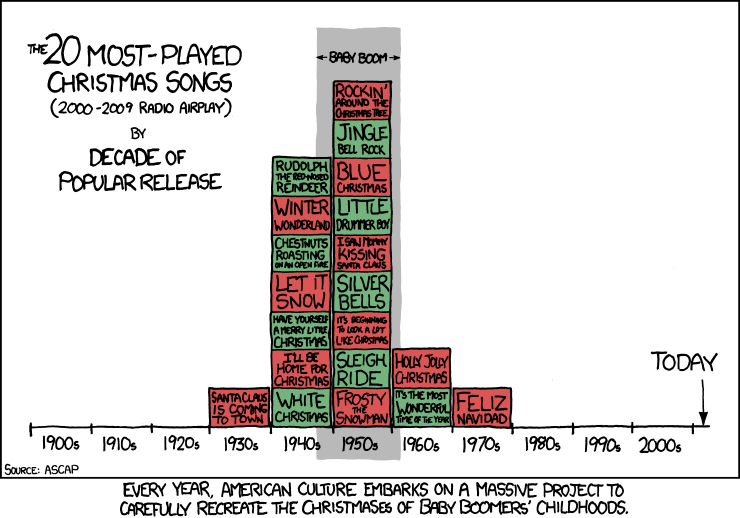
There’s an XKCD that a lot of people have seen which plots most-played Christmas songs by decade of release:

The conclusion it presents, “every year, American culture embarks on a massive project to carefully recreate the Christmases of Baby Boomers’ childhoods,” is true in a sense, but mostly wrong.

The biggest problem with it is that it’s using radio songs. There are several problems with this; they are largely technologically constrained to not have been recorded prior to the 1940s because sound recording was awful back then. Having done a fair amount of swing dancing, if you ever heard a recording made from the 1930s or worse the 1920s it’s barely listenable. You simply need to get a modern band to play those songs now in order for them to not hurt your ears. On the flip side, there just haven’t been any good popular christmas songs composed since the 1960s because of cultural shifts, but that’s a different story that I’ll get to later. The really big issue, though, is that the radio doesn’t play the really popular Christmas carols, they only play things recorded by popular recording artists. Even where popular recording artists record traditional carols, the radio will play versions by all sorts of different people, so a song which gets a lot of play time will not get it all on the same recording. To have this sort of concentration, we need the songs to still be in copyright so there’s only one or a very few versions of it available for the radio to play.

To really see the point, consider the popular Christmas carols—the ones that people actually sing—and when they were composed:

Jingle Bells: 1857
Heark! The Herald Angel Sings: 1739 (current musical arrangement: 1840)
Joy To the World: 1719 (current musical arrangement: 1848)
God Rest Ye Merry Gentlemen: traditional; at least the 16th century
O Holy Night: 1847 in french; English version by a guy who died in 1893, so before then
Silent Night: 1818 in German, English translation in 1859
O Come, All Ye Faithful: 1751
What Child Is This: 1871
Away in a Manger: 1897
The First Noel: 1833
We Three Kings: 1857

So yeah, the first problem is that if you consider stuff that can’t really have been done prior to when the baby boomers were born, you won’t find it. In a sense we’re done; the only thing which is trying to recreate the boomers’ childhood was a thing that barely pre-existed the baby boomers (commercial radio in the modern format).

Christmas songs after the 1960s tended to be either novelty songs or songs that really aren’t family friendly. As people got less religious and more sex-obsessed and so sang about having sex on Christmas with various degrees of veiling their meaning. That’s not actually going to be very interesting when it’s competing with songs about having sex five times a day, so it’s not shocking that these haven’t been popular. (In short: religious people won’t like them and irreligious people can get better).

There’s another aspect, which is that there was a short time period, as popular culture was becoming hardcore secular, where the newly secular people could enjoy the religion of their parents without participating. That’s the sort of thing that only lasts a decade or two; after that the energy just goes out of it.

Here in 2021 I think that the secular energy for Christmas is fading fast; one of the more popular things for adults to do is to agree with other adults to not exchange Christmas presents because it’s just a pain in the neck. No one really likes getting together with family to eat dry turkey and too many store-bought pies—that’s why they only do it when it’s an obligation they can’t get out of—and the concept of universal good will just doesn’t make any secular sense and has been long-since abandoned.

The grain of truth to the XKCD is that there is an attempt to LARP the most recent sincere Christmas celebration anyone can remember, which happens to be the baby boomers’ childhood Christmases. That’s mostly a coincidence, though, and in any event it includes many things which pre-dated the baby boomers. Twas the Night Before Christmas was first published in 1823 and the general depiction of Santa Claus as dressed in red and white originated at the latest with Puck magazine in the early 1900s and was set in popular imagination by the 1930s with widespread soft drink advertising campaigns (most notably Coca Cola).

So yes, the baby boomers were influential. The world did exist before them, though, and they don’t explain most of it.

The Tuskegee Experiment Was Weird

I recently read up on the Tuskegee Experiment, and it was really weird. (If you’re not familiar, it was an experiment run from 1932 to 1972 to study the effects of untreated syphilis on African Americans in which they pretended to treat 600 poor, male, African American share croppers for decades, resulting in over 100 of them dying from an entirely treatable disease.) What’s weird about it was not that it was cruel. Human beings are very frequently cruel. What’s weird about it was that it was both cruel and scientifically pointless. It’s not surprising when people do unethical things for some sort of benefit they could not get otherwise. It is very surprising when people do unethical things for no possible benefit to themselves or anyone else.

So I looked a little further, and like so many things that don’t make sense, it was the way it was because of a strange set of historical events which changed it repeatedly until it kept going because it was already going, but wasn’t something anyone would ever have started on purpose. Even more curiously, it was kept up for forty years in large part because no one would ever do another study like it again (since it was utterly pointless).

Let me explain.

(Note: I’m just using the Wikipedia page on the Tusgekee study as my source for this; take it with a grain of salt but it’s good enough for my purpose here.)

The Tuskegee experiment was motivated by a 1928 retrospective study in Oslo, Norway, called the “Oslo Study of Untreated Syphilis.” It looked at several hundred white males in various stages of untreated syphilis and documented their symptoms. This is medically important in a disease which can present differently over time (syphilis takes a long time to kill you, if it does)—if a doctor is looking at a patient and only is aware of the symptoms at one stage of the disease while the patient is at a different stage, the doctor could easily mis-diagnose the patient as not having the disease.

So, doctors had this very useful information for treating white patients, but is it also applicable to black patients? Perhaps they present differently (i.e. have different symptoms, or at least different severity of symptoms). There are some diseases more prevalent in white people than in black people, and vice versa; there isn’t really a good reason to assume that the two populations are identical. To do a good job treating black people who have the disease, doctors really would benefit from evidence that they present the same way as the white patients in the Oslo study do. (There are issues with lumping all people of European descent together as one homogeneous “white” population, just as there are with lumping all people of African descent together as “black”, though in the latter case most black Americans in the 1920s came from a small region of Africa so it wasn’t quite as bad.)

So far, this is fairly reasonable given the state of medical science in the 1920s. Now it starts to get a little iffy: the researchers at the US Public Health Service at Tusgekee decided to conduct a prospective study in order to complement the retrospective study from Oslo. This is not at all, ethically, the same thing, since not treating people and finding out the symptoms they had before you treated them are very different. Their reasoning was that the study participants, being poor share croppers, were unlikely to ever get treatment otherwise; thus it was a trade of six months of not treating them (during which time they would not have gotten treated otherwise), and after which they would give the participants treatment. Not great, but in a slow-moving disease, this could be defensible if informed consent was obtained (it wasn’t).

Something else to consider, here, is that the treatments of the time were mostly ineffective. They consisted of things like arsenic-based treatments like arsphenamine and mercury-based ointments. Penicillin, the actually effective treatment for syphilis, would only be discovered in 1928 and the technology to refine the compound into a medicine was only developed in 1940. (The first proof that it could cure a disease was an eye disease in 1930 in a laboratory setting.) So part of what needs to be considered was that in 1928, the treatments that they were temporarily withholding weren’t actually all that effective, anyway.

Somehow or other this became six months to one year, which was still in the realm of defensible if informed consent had been obtained (which, again, it hadn’t). However, this is where things really start going off the rails. Before the conclusion of the study when they were planning to administer the standard treatments they lost their funding and could not afford to treat the patients. At this point Taliaferro Clark, head of the USPHS, decided to extend the study without treatment (which involved pretending to treat the participants). He resigned before the study was actually extended, however. It’s a bit unclear (just from the Wikipedia page) who took over extending the study; various people contributed.

With the advent of penicillin as a safe and reliable treatment for syphilis, the entire study became pointless. Unlike the arsenical and mercurial treatments, if you suspected syphilis you might as well give penicillin and see if it gets better. Nevertheless, the study continued because it would never be possible to get this data again. It would never be possible because there was absolutely no point in getting the data and it was horribly unethical to get it, but for some reason that was beside the point. The fact that something was going on that could never be restarted made the people involved feel like they needed to keep it going, since once lost, it was lost forever. True, it had no apparent value, but I suspect they figured that perhaps one day someone would find the value in it that they couldn’t see right now.

In the baptismal vows a catechumen makes (or their parent makes for them at infant baptism), there are the questions: “Do you reject Satan? And all his empty promises?”

It’s interesting how good an example the Tuskegee study was of an empty promise.

Proofs for God’s Intelligence and Why Atheists Won’t Accept Them

Answering a question I’ve been asked, because there are a fair number of atheists who hear the argument from motion or the argument from contingency and necessity and then ask, “why would the uncaused cause or the unmoved mover need to be intelligent?” In this video I look into the answers to that, and why atheists won’t accept them.

And the Rock Cried Out No Hiding Place

In the third season of Babylon 5, there is the episode And the Rock Cried Out No Hiding Place. As with most Babylon 5 episodes, it’s complicated, but there’s a very interesting section of it which more-or-less explains itself. It’s the intertwining of a scene where one of the main characters, Londo Mollari, finally defeats his nemesis Reefa, with a scene of a preacher and gospel singer visiting the space station Babylon 5 and singing a gospel song:

This is apparently based on an old spiritual song; I’m not sure if they changed the lyrics. The spiritual is probably based on the sixth chapter of the Book of Revelation:

Then the kings of the earth, the princes, the generals, the rich, the mighty, and everyone else, both slave and free, hid in caves and among the rocks of the mountains. They called to the mountains and the rocks, “Fall on us and hide us from the face of him who sits on the throne and from the wrath of the Lamb!

The two scenes meld together well, though Reefa trying to run away is not necessarily realistic. A great many evil people, when they see that their time is up, basically shut down and don’t struggle. That said, many do not. Evil is always based on upon believing an illusion. As such, believing the illusion that escape is still possible fits well. And, more to the point, it’s more symbolically accurate: the evil one is evil because he believes the lies he tells himself to the end. He does not heed the instruction μετάνοιτε (metanoiete), “repent!” He does not change his mind; he does not turn himself around. He sticks to the lie he has chosen and runs as hard as he can from reality towards it.

How Can You Say Someone Is Great…

…who’s never had his picture on a bubblegum card? This is the question posed by Lucy van Pelt in A Charlie Brown Christmas. And before anyone jumps down my throat about it being too early for Christmas stuff, A Charlie Brown Christmas is clearly an advent movie, not a Christmas movie. It is set during the time when people are getting ready for Christmas (hence rehearsing a Christmas play, rather than performing it), and it was first aired on December 9, in the year of our Lord 1965.

So go ahead and jump down my throat for it being too early for advent stuff—to be fair, it is still ordinary time—but be warned that I have sharp teeth and strong jaws.

Anyway, back to the question Lucy poses: how can you say someone is great who’s never had his picture on a bubblegum card? This joke was funny back in 1965, but I think that it’s gained in humor, over the years, because bubblegum cards are no longer something children collect. I believe that they’re technically still made, or at least trading cards are. The Topps company still exists and still makes baseball cards, though I’ve no idea who buys them. I collected baseball cards for about a year, back in the 1980s, and rapidly lost interest. So far as I knew no one else collected them back then, and in the intervening three decades I’ve never heard of anyone collecting them. (There are still trading cards that are popular such as Magic: The Gathering and Pokémon, but these are not relevant because they do not feature the pictures of real people.)

This was a childish question when Lucy asked it, but it was also an ephemeral question, which she would have had no way of knowing back then. This works with the theme of the show, though; it’s all about how people were caught up in the ephemeral world and had no idea of what really matters. The way that Lucy’s question works with this theme has only become better with age.


Fun fact: if Lucy was 11 when A Charlie Brown Christmas aired she would be 67 now (in the year of our Lord 2021).

The Old Discovery Channel Ad

For those who haven’t seen it, over a decade ago the Discovery Channel made and ran this ad to promote their television shows:

Now, when it comes to advertising, a great deal of skepticism and even cynicism is warranted. I think that this is expressed nowhere so well as in what might be one of The Last Psychiatrist’s best posts, The Dove Sketches Beauty Scam. It’s well worth reading the whole thing, and gives a good perspective on supposedly wholesome advertisements. Here is possibly my favorite part, though it loses something out of context:

“Oh my God,” you might say, “I know it’s just an ad, but it’s such a positive message.”

If some street hustler challenges you to a game of three card monte you don’t need to bother to play, just hand him the money, not because you’re going to lose but because you owe him for the insight: he selected you.  Whatever he saw in you everyone sees in you, from the dumb blonde at the bar to your elderly father you’ve dismissed as out of touch, the only person who doesn’t see it is you…

I think that TLP is substantially correct.

So, all that said, I think that there is something of value in this ad, despite it being an ad. The value is two-fold, and I say this as someone who hasn’t watched TV, and hence hasn’t watched the Discovery Channel, in close to two decades now. Actually, before I get to those, let me quote the main conclusion (which is in the penultimate section) of TLP’s post:

That Dove wants you to think of it as the authority on beauty so it can sell you stuff makes sense, there’s nothing underhanded about it and hardly worth the exposition.  The question is, why do they think this will work?  What do they know about us that makes them think we want an authority on beauty– especially in an age where we loudly proclaim that we don’t want an authority on beauty, we don’t like authorities of any kind, we resist and resent being told what’s beautiful (or good or moral or worthwhile) and what’s not?…

“But I hated the ad!”  Oh, I know, for all the middlebrow acceptable reasons you think you came up with yourself.  Not relevant.  The con artists at Dove didn’t select these women to represent you because you are beautiful or ugly, any more than the street hustler selected you for your nice smile.   They were selected because they represent a psychological type that transcends age/race/class, it is characterized by a kind of psychological laziness: on the one hand, they don’t want to have to conform to society’s impossible standards, but on the other hand they don’t want the existential terror of NOT conforming to some kind of standard.  They want an objective bar to be changed to fit them– they want “some other omnipotent entity” to change it so that it remains both entirely valid yet still true for them, so that others have to accept it, and if you have no idea what I’m talking about look at your GPA: you know, and I know, that if college graded you based on the actual number of correct answers you generated, no curve, then you would have gotten an R…

“Everybody gets something out of every transaction,” said Joe, explaining why people want to be conned.  That’s what ads do for you.  They’ll let you complain that they are telling you what to want, as long as you let them tell you how to want.

Again, TLP is substantially correct. (I, personally, tended to get almost every answer on every test right, and teachers tended to ignore me as an outlier when setting curves, but that’s irrelevant to the point.) So how does the Discovery Channel ad have value when it is substantially similar to the Dove Beauty Sketches ad?

It does because of the description of human beings implicit by contrast in my favorite description of God: He who accomplishes all things according to the intentions of His will. The effects of human actions are mostly accidents, because we don’t know enough to know most of what we’re actually doing.

The Discovery Channel was trying to establish itself as the source of awesome, as being on team love-reality; much like Dove it’s trying to establish itself as an authority on what is interesting and awesome, and also as the source for these things. Yes, they’re doing these things, but that’s not all that they’re doing, because they’re human and so most of what they do they did not intend.

The goal was to present themselves as being the gateway to the awesomeness of the world, as well as having the brand identity of being on team awesome. The key distinction between this ad and the dove beauty sketches is that the latter used entirely artificial things—descriptions and a drawing—while the Discovery Channel ad uses real things—a picture of the earth from a satellite (the astronauts were, admittedly, obviously fake), real video of a great white shark flying out of the water as it tries to catch a seal, a picture of a real mummy, real video of lava and spiders, etc. While Dove was trying to sell a fiction as reality, the Discovery Channel ad has some reality in it.

The other key difference is that the Dove ad sets Dove up as the expert, while the Discovery Channel ad is largely supplicating itself to the grandeur of something else which existed before and will exist after the Discovery Channel.

Maybe the Discovery Channel is on Team The World is Awesome and maybe they’re just pretending, but if they are, then it is a case of hypocrisy being the tribute that vice pays to virtue. Either way, there is tribute being paid to virtue. And you don’t need to watch the Discovery Channel to appreciate that tribute to virtue.

I don’t watch it.

Monty Python is Very Uneven

Having recently watched Monty Python and the Holy Grail with my eleven year old son, I was reminded of how extremely uneven Monty Python was. They had quite a few absolutely brilliant sketches. They had some mediocre sketches. They had a fair number of really bad sketches. This extends to their movies, too, which are basically just loose collections of skits with a common theme. (In the case of Holy Grail, their theme was “medievalish”.)

Despite this extraordinary unevenness, Monty Python movies and sketches are held up as some of the heights of comedy. There’s a lesson, here, for writers: overall quality is good, but when it comes to being memorable, the heights you reach are more important than the average.

There is an asterisk on that, which is that it probably matters significantly what your competition is. Mitchell and Webb, for example, had a similar number of brilliant sketches, but they had far fewer really bad sketches (their snooker commentator sketches are the only ones that come to mind) and not many bad sketches either. Overall, their quality was higher, though the peaks were no higher. Had they been competing at the same time, Monty Python probably would have fared worse.

(Of course, there are other things that make the two not directly comparable. All comedy is a product of its time, and Monty Python especially so. The 1970s, in its post-world-war-2 context was a time when people hungered for different more than they hungered for quality, and many of Monty Python’s sketches reflect that. While Monty Python wouldn’t fare nearly as well against Mitchell and Webb in the 2010s, Mitchell and Webb wouldn’t fare nearly as well against Monty Python in the 1970s—the audience just would not have been in the mood for most of it.)

A Useful Recipe: Greek Yogurt with Whey Protein Powder

For those trying to get more protein into their diet, whey powder (or any protein powder) can be a great way to do it. The downside to whey powder, though is how to actually eat the stuff—it’s not exactly appetizing to eat the dry powder with a spoon. The common solution is to dissolve it into a liquid. Water is probably the most common, which is why whey powders often have a lot of sugar and flavoring in them. I strongly prefer to get plain whey powder which has only the protein and no added sugars or artificial flavors.

I have made protein shakes using some milk, a little heavy cream, whey powder, and vanilla. They work, and if served very cold can be a little like a milkshake, as long as you generally eat so little sugar that your taste buds have reset their idea of sweet so that plain milk tastes sweet to you. The problem, though, is that it’s very easy to make a lot of air bubbles in the shake during the mixing, which produces an unpleasant texture. You can get around this by mixing with a stick blender in a tall container so that the surface can’t get down to the blades, but this is a lot of work and leaves you with a stick blender to clean when you’re done with it.

Enter Greek yogurt. Greek yogurt is an unsweetened yogurt which is strained after fermentation so it’s higher in protein than normal yogurt and has very little in the way of even natural milk sugars. (Normal grocery-store yogurt has so much sugar added that it’s very nearly got the same amount of sugar per unit volume as ice cream.) You can mix whey powder into Greek yogurt at a ratio of about 1 scoop of whey powder to 1 cup of Greek yogurt. You can mix it with a spoon. As my wife described it when she was telling me about the recipe, “at first it looks like there’s no way this is going to work, then it does”. After about 30-60 seconds of mixing, the whey powder dissolves into the yogurt and you get a very thick, creamy result. I like to add about a teaspoon and a half of vanilla per cup of yogurt because the flavor complements very well. I’ve also taken to adding about 1 tablespoon of heavy cream per scoop of whey powder both for flavor and texture.

One tip I’ve found is that it tastes better when very cold, so I put the bowl with the whey powder in it into the freezer for a few minutes before adding the yogurt, so I’m adding all cold ingredients. If you want to do something kind of like making homemade frozen yogurt, put the mixed yogurt/whey back into the freezer. Take out and stir every 60 seconds or so. Keep this up until it’s the consistency you want. It will freeze against the sides of the bowl, so make sure to scrape them clean and mix the result into the middle. This would be very labor-intensive to make true fro-yo, but even getting a quarter of the way there can be pleasant.

NOTE: this also works best if you’ve avoided sugar enough that your taste buds have reset to the point where you can eat unsweetened Greek yogurt. (The whey powder makes the acidity a little more mild, but not much more mild.) If that’s not true, then you’re probably not as concerned with avoiding sugar anyway, and so you can add as much sweetener as needed to make this taste the way you want it. When it comes to flavors, sweet tends to cover over bitterness and sourness (that is, alkali and acidity), hence milk chocolate and lemonade.

Anyway, this has a lot of protein and is easier with less cleanup than protein shakes, so I mention it in case it helps anyone else, too.

My Least Favorite Kind of Internet Atheist

Of all of the various kinds of internet atheist (see Taxonomy of Atheists), my least favorite are the cult atheists who pretend to be polite and open minded. They’re very recognizable because they always introduce themselves with something like, “I haven’t seen any evidence for God, but if I did I would become a theist. Do you know of any evidence for God?” They’ll tend to start out polite, often saying things like, “perhaps I’m mistaken, can you show me where?” It sounds great.

Then when you give them what they’ve asked for, such as presenting them or directing them to one of the arguments which shows that literally all being is evidence for God (e.g. the argument from motion, or the argument from contingency and necessity), their true colors come out. They’re still gentle of speech, but they say things like, “this is an argument from ignorance,” (they love to pretend that logic is an argument from ignorance) or accuse it of some other error which it obviously doesn’t have. They’ll typically throw in some insults, at this point, though gently phrased insults. “I think you might be engaging in wishful thinking” is no less an insult for being said in tea-time language.

As you proceed, the veneer of politeness tends to drop, with accusations becoming much more direct, and everything you’ve explained to them—at their request—rejected out of hand. The more you talk to them, the clearer it becomes that they don’t believe any of their principles, and when you have finally cornered them on something, they just ignore it and tend to claim that they’ve shown something that they didn’t, a few steps back in the conversation. Sometimes they declare victory and accuse you of just not being willing to admit it, sometimes they just claim to have shown you’re irrational or whatnot. They’re an enormous waste of time, and I think that’s their goal.

I’ve dealt with more than a few of them, over the years, and I’ve learned that they all have a tell—their act like they’re new to the subject. They pretend to be fair-minded, but also completely ignorant of the subject. If pressed, they will admit that they’ve heard things about it before, but this gives the lie to their presentation of fair-mindedness. A reasonable person, on asking for evidence of something, will save the other person time by explaining what they’ve already encountered and what their problems with it are. They don’t do this because wasting someone else’s time is their goal.

The other part of this tell is that they are pretending to be the new to the subject. The only people who are completely new to the subject of whether God exists are young children and (possibly) people raised by wolves who have barely learned English. Well, that’s not quite true, since I left off the qualifier of “reasonable.” Reasonable people investigate important questions, they don’t merely ignore them until someone decides to spoon-feed them information about them. If for some strange reason a reasonable person has come across no convincing source of information on the subject of God in real life, he would not merely go onto social media and ask complete strangers for evidence that God exists. A reasonable person (in this odd circumstance) would do some online searching and find sources that seem to be high quality. Or he might even read a book or two on the subject. (And then, as I noted above, if he’s asking randos on social media, he’ll give them some idea of where he’s starting from and what he already knows.)

The Putative Arrival of Self-Driving Cars

A friend of mine was talking about how self-driving car technology is almost ready for general use and gave as evidence that this is likely to be the case that Waymo is already operating an autonomous ride-sharing service in Phoenix, Arizona, and has recently expanded to San Francisco.

So I looked into this.

It is true that Waymo is operating a driverless ride-sharing service, called Waymo One, in Phoenix Arizona, and has been doing so since 2018 (with a several month pause due to COVID-19, back in 2020). However, this is slightly misleading. According to Waymo One’s FAQ, “Our Waymo One fully autonomous ride-hailing service operates within parts of the Phoenix metropolitan area, including Chandler, Tempe, Mesa and Gilbert.”

Here’s a map of Phoenix, Arizona, which Wikipedia linked to, and I’ve circled Chandler, Tempe, Mesa, and Gilbert. (Approximately; there might be a bit of these places outside of the purple circle—I’m not familiar with Arizona geography and couldn’t find similar interactive maps for Tempe, Mesa, Gilbert, and Chandler.)

Waymo chose Phoenix because (being in the desert and pretty far south) it’s basically a place with no weather. So in this best-case scenario for the Waymo self-driving car, three years into running their autonomous service they’re still not running in most of the Phoenix metro area. Heck, they’re still not even running in Phoenix (proper).

At this rate… I’m not even sure that there is a rate of expansion. Extrapolating their progress in the last 3 years, it might be another 100 years before they offer rides in all of the Phoenix metro area.

But they’ve expanded to San Francisco!

Yeah, they have. Except that in San Francisco the Waymo One cars have an “autonomous specialists riding in the driver’s seat.” Also, the ride-sharing program is only open to people in the “trusted tester program,” which is “a confidential research program within Waymo One, where select riders will have access to our service and can share their experiences directly with our team to help shape the future of autonomous driving”. (I’m quoting from their FAQ.)

So “expanded to San Francisco” means that they are now running some number of tests, using safety drivers, and with passengers who have signed NDAs and can’t tell anyone how badly it’s going.

Don’t get me wrong. I don’t think that self-driving cars are impossible. I doubt that Waymo’s hyper-detailed maps approach is really the way forward, but as the saying goes, of all things the future is the hardest to predict.

I think it’s important to be realistic, though. There is no reason to believe that self-driving cars are just a few years away from being a standard option on cars at the dealership.

Why Talk About the Downsides of Atheism

In this video I talk about why it’s good to talk about the downsides of atheism, despite it generally being more attractive to be positive rather than negative; to make the case for something and not to merely make the case against one of its alternatives. That reason is that people often take the “cheese pizza” approach. If they think that there’s a common denominator, they will pick that to avoid conflict. By talking about the problems with atheism, it can help people to realize that there is no plain cheese pizza; that there is no common denominator.

Blue’s Clues 25th Anniversary Message And Parasocial Relationships

Recently, whoever it is that makes the show Blue’s Clues hired the original actor to deliver a message to fans. It’s quite curious:

I was too old to watch Blue’s Clues and my children didn’t come along until after Steve (the character in this message) left, and they’ve never watched Blue’s Clues anyway, so I don’t have an emotional attachment to the show, or to the character. I think I randomly found an episode of Blue’s Clues once, for a few seconds, while flipping to the channel I actually wanted to watch. That’s enough to make me aware of the show and so to recognize the actor, though (like me) he’s now much older.

From what very little I know of Blue’s Clues, it was always a highly parasocial show. The host would talk to the viewer as if they were there, so this is in keeping the format of the original show. I have my doubts that this is a good idea in a children’s show, but it is downright creepy in something aimed at adults.

Parasocial relationships supplanting real relationships is, I think, one of the great dangers of the modern world. There’s also a great temptation to it on the part of creators because there are so many lonely people who will cling to the feeling of having another person with them even though they know that it’s just a recording of someone who doesn’t even know that they exist. Even worse, many creators feel a parasocial relationship to the people they don’t know and don’t interact with except as a view/like/star/thumbs up/etc. statistic, which encourages them to participate in that parasocial relationship, inviting their viewers further into it. They will talk about highly private moments in their life, saying (I think, truthfully) that they want to bring their friends, that is, their viewers, along with them. As I mentioned in The Fundamental Principle of Science, the problem isn’t the liars, but the sincere but deluded people that an environment selects for. They sell the lie all the better for believing it themselves.

After all, the actor on Blue’s Clues left after a few years.

Awful Scientific Paper: Cognitive Bias in Forensic Pathology Decisions

I came across a rather bad paper recently titled Cognitive Bias in Forensic Pathology Decisions. It’s impressively bad in a number of ways. Here’s the abstract:

Forensic pathologists’ decisions are critical in police investigations and court proceedings as they determine whether an unnatural death of a young child was an accident or homicide. Does cognitive bias affect forensic pathologists’ decision-making? To address this question, we examined all death certificates issued during a 10-year period in the State of Nevada in the United States for children under the age of six. We also conducted an experiment with 133 forensic pathologists in which we tested whether knowledge of irrelevant non-medical information that should have no bearing on forensic pathologists’ decisions influenced their manner of death determinations. The dataset of death certificates indicated that forensic pathologists were more likely to rule “homicide” rather than “accident” for deaths of Black children relative to White children. This may arise because the base-rate expectation creates an a priori cognitive bias to rule that Black children died as a result of homicide, which then perpetuates itself. Corroborating this explanation, the experimental data with the 133 forensic pathologists exhibited biased decisions when given identical medical information but different irrelevant non-medical information about the race of the child and who was the caregiver who brought them to the hospital. These findings together demonstrate how extraneous information can result in cognitive bias in forensic pathology decision-making.

OK, let’s take a look at the actual study. First, it notes that black children’s deaths were more likely to be ruled homicides (instead of accidents) than white children’s deaths, in the state of Nevada, between 2009 and 2019. More accurately, of those deaths of children under 6 which were given some form of unnatural death ruling, the deaths of black children were significantly more likely to be rated a homicide rather than an accident than were the deaths of white children.

It’s worth looking at the actual numbers, though. Of all of the deaths of children under 6 in Nevada between 2009 and 2019, 8.5% of the deaths of black children were ruled a homicide by forensic pathologists while 5.6% of the deaths of white children were ruled a homicide. That’s not a huge difference. They use some statistics to make it look much larger, of course, because they need to justify why they did an experiment on this.

In fairness to the authors, they do correctly note that these statistics don’t really mean much on its own, since black children might have been murdered statistically more often than white children, during those time periods in Nevada. It doesn’t reveal cognitive biases if the pathologists were simply correct about real discrepancies.

So now we come to the experiment: They got 133 forensic pathologists to participate. They took a medical vignette about a child below six who was discovered motionless on the living room floor by their caretaker, brought the ER, and died shortly afterwards. “Postmortem examination determined that the toddler had a skull fracture and subarachnoid hemorrhage of the brain.”

The participants were broken up into two groups, which I will call A and B. 65 people were assigned to A and 68 to B. All participants were given the same vignette, except that, to be consistent with typical medical information, the race of the child was specified. Group A’s information stated that the child was black, while group B’s information stated that the child was white. OK, so they then asked the pathologists to give a ruling on the child’s death as they normally would, right?

No. They included information about the caretaker. This is part of the experiment to determine bias, because information about the caretaker is not medically relevant.

OK, so they said that the caretaker had the same race as the child?

Heh. No. Nothing that would make sense like that.

The caretaker of the black child was described as the mother’s boyfriend, while the caretaker of the white child was the child’s grandmother. Their race was not specified, though for the caretaker of the white child it can be (somewhat) inferred from the blood relation, depending on what drop-of-blood rule one assumes the investigators are using to determine the child is white. Someone who is 1/4 black, where the caretaker grandmother was the black grandparent, might well be identified as white, or perhaps the 1 drop of blood rule is applied at the grandmother could be at most 1/8 black for her grandchild to qualify to the racist experimenters as white. Why do they leave out the race of the caretaker despite clearly wanting to draw conclusions about it? Why, indeed.

More to the point, these are not at all comparable things. It is basic human psychology that people are far less likely to murder their descendants than they are to murder people not related to them. Moreover, males are more likely to commit violent crimes than females are (with some asterisks; there is some evidence to suggest that women are possibly even more likely to hit children than men are but just get away with it more because people prefer to look away when women are violent, but in any event the general expectation is that a male is more likely to be violent than a female is). Finally, young people are significantly more likely to be violent than older people are.

In short, in the vignette given to group A, the dead child is black and the caretaker who brought them in is given 3 characteristics, each of which, on its own, makes violence more statistically likely. In group B, the dead child is white and the caretaker who brought them in is given 3 characteristics, each of which, on its own, makes violence more statistically unlikely. For Pete’s sake, culturally, we use grandmothers as the epitome of non-violence and gentleness! At this point, why didn’t they just give the caretaker of the black child multiple prior convictions for murdering children? Heck, why not have him give such medically extraneous information as repeatedly saying, “I didn’t hit him with the hammer that hard. I don’t get why he’s not moving.” I suppose that would have been too on-the-nose.

Now, given that we’re comparing a child in the care of mom’s boyfriend to a child in the care of the child’s grandmother, what do they call group A? Boyfriend Condition? Nope. Black Condition. Do they call group B Grandma Condition? Nope. White Condition.

OK, so now that we have a setup clearly designed to achieve a result, what are the results?

None of the pathologists rated the death “natural” or “suicide.” 78 of the 133 pathologists ruled the child’s death “undetermined” (38 from group A, 40 from group B). That is, 58.6% of pathologists rules it “undetermined”. Of the minority who ruled conclusively, 23 ruled it homicide and 32 ruled it homicide. (That is, 17.2% of all pathologists ruled it accident and 24% of all pathologists ruled it homicide.)

In group A, 23 pathologists ruled the case homicide, 4 ruled it accident, and 38 ruled it undetermined. In group B, 9 ruled it homicide, 19 ruled it accident, and 40 ruled it undetermined.

This is off from an exactly equal outcome by approximately 15 out of 133 pathologists. I.e. if about 7 pathologists in group A had ruled accident instead of homicide, and 7 pathologists in group B ruled homicide instead of accident, the results would have been equal between both groups. As it was, this is a big enough difference to get statistical significance, which is just a measure of whether the random chance you see 95% of the time is sufficient to entirely explain the results. What it doesn’t do is show a pervasive trend. If 11% of the participants had reversed their ruling, the experiment would have shown that the 18.6% of forensic pathologists on an email list of board-certified pathologists who responded to the study were paragons of impartiality.

There’s an especially interesting aspect to the last paragraph of the conclusion:

Most important is the phenomenon identified in this study, namely demonstrating that biases by medically irrelevant contextual information do affect the conclusions reached by medical examiners. The degree and the detailed nature of these biasing effects require further research, but establishing biases in forensic pathology decision-making—the first study to do so—is not diminished by the potential limitation of not knowing which specific irrelevant information biased them (the race of the child, or/and the nature of the caretaker). Also, one must remember that the experimental study is complemented and corroborated by the data from the death certificates.

The first part is making a fair point, which is that the study does demonstrate that it is possible to bias the forensic pathologist by providing medically irrelevant information, such as the caretaker being far more likely to have intentionally hurt the child. Why didn’t they make all of the children white and just have half of the vignettes including the caretaker with multiple previous felony convictions, who was inebriated, repeatedly state, “I only hit the little brat with a hammer four times”? If we’re only trying to see whether medically irrelevant information can bias the medical examiner, that would do it too. But what’s up with varying the race of the child?

While it’s probably just to be sensationalist because race-based results are currently hot, it may also be a tie-in to that last sentence: “Also, one must remember that the experimental study is complemented and corroborated by the data from the death certificates.” This sentence shows a massive problem with the researcher’s understanding of the nature of research. Two bad data sources which corroborate each other do not improve each other.

To show this, consider a randomly generated data source. Instead of giving a vignette, just have another set of pathologists randomly answer “A”, “B,” or “C”. Then decide that A corresponds to undetermined, B to homicide, and C to accident. There’s a good chance that people won’t pick these evenly, so you’ll get a disparity. If it happens to be the same, it doesn’t bolster the study to say “the results, it must be remembered, also agreed with the completely-blinded study in which pathologists picked a ruling at random, without knowing what ruling they picked”.

Meaningless data does not acquire meaning by being combined with other meaningless data.

The conclusion of the study is, curiously, entirely reasonable. It basically amounts to the observation that if you want a medical examiner making a ruling based strictly on the medical evidence, you should hide all other evidence but the medical evidence from them. This, as the British like to say, no fool ever doubted. If you want someone to make a decision based only on some information, it is a wise course of action to present them only that information. Giving them information that you don’t want them to use is merely asking for trouble. It doesn’t require a badly designed and interpreted study to make this point.

Copied Little Accidents

Back in the 1980s and 1990s there was a painter by the name of Bob Ross who ran a delightful television show on PBS called The Joy of Painting. Bob Ross used an extremely fast wet-on-wet technique of oil painting in which he would paint a beautiful landscape painting in realtime during his half-hour show. He would talk to the audience in one of the most calm voices a human being has ever been given, and talk about how we’re making whatever world we want and that there are no mistakes here, just happy little accidents.

What I discovered recently was that not only did Bob Ross not invent the quick painting technique he used, he didn’t even invent the happy little accidents. Now, to be clear, this was not something that Bob Ross tried to hide. In fact, he credited his mentor. He mentioned that he got the technique from Bill Alexander in the first episode of the first least, and he dedicated the first episode of the second season to Bill Alexander:

Bill Alexander didn’t invent the concept of painting wet-on-wet with oil paint; that dates back hundreds of years. What Bill Alexander did was to create the technique of making landscapes using wet-on-wet techniques involving large brushes and a strong pallet knife so as to be able to paint a landscape in half an hour.

But Bill Alexander didn’t just invent the technique. He also taught it on his own PBS show. It was called The Magic of Oil Painting and ran from 1974 to 1982. (The Joy of Painting started in 1983, so Bob Ross was continuing what his teacher did, he wasn’t competing with him.)

It’s interesting to watch an episode of Bill Alexander’s show, as you can see that Bob Ross did copy quite a lot of it:

Bill Alexander was born Wilhem Alexander in 1915, in Germany. He was drafted into the Wehrmacht in World War 2 but was captured by the Allies and, after painting portraits of officers’ wives, made his way to the United States where he took up residence after the war was over.

He had the same positive attitude, looking at mistakes as things you just roll with and learn how to use. He was not as soft-spoken, and his German accent makes things sound more harsh than they were, which brings us to an interesting point: it is very rare that an innovator becomes famous for his innovations.

This is a pattern that ones sees the world over, and throughout history. The peculiarities and genius needed to come up with an idea that no one has had before—or at least no one in one’s culture has had before—is rarely compatible with that common touch which really helps to make it intelligible to the public at large. It is extremely common, then, that the innovator’s invention is made famous by someone who is just strange enough to understand the new idea but not strange enough to have come up with it on his own, but his not being strange enough to come up with the idea is what makes him able to communicate it to people who aren’t at all strange.

Multiple Murderers

An interesting plot element in a detective story is having multiple murderers. This can really complicate the life of the detective because each murderer may have a truly unbreakable alibi for the murder he didn’t commit. While the detective (and everyone else) labors under the assumption that one person committed both murders, the only viable suspects will probably have no motive.

As I think I’ve mentioned before, one of the really interesting ways of doing this is to have the two murderers murder each other, though one with some sort of time-delay mechanism such that he’s already dead by the time it goes off and kills the other fellow. (Poison is an excellent murder weapon for this case.)

Another scenario for multiple murderers occurred to me: a primary murderer and an after-the-fact accomplice who kills the original murderer to hide his after-the-fact involvement in the first murder. For convenience, let’s name our murderers: John and Steve.

John murders someone, let’s say his wife, Alice. John didn’t plan it out, though, and needs help disposing of the body and erasing the evidence, so he goes to his friend, Steve. Steve reluctantly helps John because he doesn’t want to turn him away, but on the other hand really wishes that John had left him out of it.

The detective begins to investigate and starts coming up with clues that point to John, but also to John having an accomplice, at least after the fact. This alarms Steve, who never wanted to be involved, who got nothing out of the murder, and who doesn’t want to see his life go up in smoke because of John’s bad decisions. Steve begins to think of how to get out of this, and the one solution he comes up with is murdering John. Only John knows it was Steve who helped him, and Steve does have an excellent alibi for when Alice was murdered. If Steve can make it look like John was killed by the same person who killed Alice, he’ll be home free.

This would make for a good mystery, I think, because the detective would first have to disentangle the two murders as not done by the same person, then figure out what happened in the first murder, and from there figure out who the second murderer was. It gives a nice progression of realizations and reveals without everything coming at once, which is the key to a really good mystery novel. (Short stories do better with a single denouement.)

A Calorie is a Calorie Doesn’t Even Work for Cars

I recently saw a discussion online about lab-grown meat (cultured muscle cells in a growth medium), in which someone was describing the potential problems with it—which boil down to it probably has a different nutrient profile and the assumption that it is equivalent to meat from a living animal is completely unjustified. Animals are phenomenally, astonishingly complex and respond in a myriad of ways to their environment. Meat grown from cells cultured in a lab would be grown under radically different conditions from meat on an actual animal, so we know that it will be different. There will be different quantities of micro-nutrients and probably of macro-nutrients, too. (Protein is a catch-all term; there are actually nine essential amino acids which we have to get from our diet, and different proteins have very different quantities of the 26 amino acids which make up proteins.) He complained that people (scientists) often regard the human body as if it was something simple, like a car, with food being a simple fuel, like gasoline, where you just put in gasoline into the car and it goes, instead of the astonishingly complex thing that it is with significant second- and third-order effects from the complexities of the food that we eat.

It struck me as funny that this overly simplistic model of cars doesn’t even work for cars. You will not get the same gas mileage from low, medium, and high octane fuels, despite them having the same energy. (The octane rating refers to the average length of the hydrocarbon chains; high octane gasoline has longer average hydrocarbon chains.) You also will not get the same acceleration from the different fuels; an engine designed for high octane gasoline will produce less power with low-octane gasoline; the reverse can be true as well. (The reason for high-octane gasoline is that it can tolerate higher compression ratios than low-octane gasoline can and so more powerful engines can take advantage of this to produce more power. In an engine with a lower compression ratio, it doesn’t matter that the higher octane gasoline can tolerate more compression because it won’t get it.)

And heaven help you if you put diesel fuel into your gasoline engine, despite it also being a long-chain liquid hydrocarbon with only slightly more energy per gallon than gasoline.

In other words, “a calorie is a calorie” doesn’t even work with cars and the fuels you can buy at the gas station.


It should be noted that there is a domain where “a calorie is a calorie,” assuming that one limits this to the sensible macronutrients such as glucose, protein, and plant and animal fats. In very minor cases does it work to consume large quantities of ethanol, despite it technically containing calories that we can extract. In no cases does it work to drink gasoline or diesel fuel despite them having plenty of calories in them. Those (I hope, obvious) caveats aside, a calorie is a calorie when you are trying to fuel hard labor.

Suppose you have a person who you want to swim for eight hours a day. Swimming can consume around 900 Calories per hours (depending very much on body size, etc), so that will take 7,200 Calories per day in addition to base metabolic needs. If we assume that the base caloric requirement is 2,000 Calories per day, then the swimmer will be consuming 9,200 Calories per day. That is, if we feed the swimmer fewer than 9,200 Calories, the swimmer will be in a Caloric deficit and will eventually starve to death. (More realistically, their ability to do work will go down and we won’t get the full 8 hours a day of swimming out of them.) When it comes to “will this person have enough energy to do the work we want them to do,” it is indeed true that “a calorie is a calorie.” They may or may not be productive of overall health, but when it comes to the question of energy balance for work performed, this is pretty accurate. This doesn’t come up much in life (unless you’re running a sports team or prison chain gang), but this is the context where it’s true.

Determinism, Free Will, and Predestination

In this video I answer a question about (atheistic, materialistic) determinism, free will, and Calvinism-style predestination.

That last part is important to point out because there is a Catholic doctrine of predestination, but it only means that God has a plan (being outside of time) and in no way contradicts human free will. I also talk about how Martin Luther denied free will as well as John Calvin, though I don’t go into great depth.

Bicep Curls are Practical, Actually

Curls and other exercises that primarily work the biceps (brachii) have something of a bad reputation; they’re frequently regarded as being non-functional exercises for insecure gym bros whose only purpose is to look good in the mirror when flexing. I’m not sure why this is the case, though, because bicep curls (with a curl bar or with dumb bells) are actually quite functional.

So, when in normal life does one pick up something a bit below one’s hips and bring it up to one’s shoulder? One does exactly that thing when picking up a child who is old enough to walk. Admittedly, sometimes one has to bend over a little because their armpits are closer to knee height than to waist height, but it becomes a bicep curl once you stand up.

The most common way to pick up a child who can walk is when they stand in front of you and lift their arms up to indicate that they want to be picked up, in which case you tend to use two hands, one under each armpit. Sometimes you’re already holding something, though, and so you need to pick then up with only one arm. This is when the bicep curls really come in handy, since all of the child’s weight is being lifted like a dumb bell. (Pro tip: have the child lift it’s leg so you’re picking them up by their femur while they hold onto your upper arm with both of their arms. If you try to do it under just one armpit it will probably hurt them unless they’re very little or can pull down with that arm hard enough that their latissimus dorsii flexes hard enough to bear the weight.)

Fun fact: little children enjoy when you do reps of bicep curls with them, though in my experience they tend to max out at around 5 reps before they want you to just hold them like normal.

Eating Carbs To Lose Weight Is Strange

(I probably should append “part 2” or “part 3” or something to the title, but I don’t recall what the number should be and I don’t think anyone will really care if I don’t look it up.)

The advice to eat carbohydrates and as little fat as possible in order to lose weight is very strange advice. I’ve talked about this before, and for people who have the dysfunction of insulin resistance (or worse) it’s downright insane advice. (I don’t use the term as hyperbole, but rather than a person who recommends people who have trouble processing carbohydrates, or worse, outright diabetics, eat primarily carbohydrates for energy is not meaningfully connected to reality. It is possible to be insane only when some subjects come up, rather than completely insane, i.e. insane about all subjects, such as the man who thinks he’s a poached egg and tries to sit, motionless, in an egg cup all day.)

(Before I proceed, I should note that there are a few caveats to what I’m saying, here, which primarily apply to athletes. If you need to maintain maximal athletic performance for competition while losing weight, you are in a specialized situation and specialized strategies will apply.)

The argument for eating primarily carbohydrates for energy when losing weight mostly come down to the observation that carbohydrates are less energy-dense than fats are. Carbs contain 4 calories per gram while fat contains 9 calories per gram. So carbs fill you up more than fat does, so you won’t be as hungry and want to eat more for the same calories!

First, this is a stupid satiety model which is entirely ignorant of how human satiety works. Anyone who has ever been to a large meal such as Christmas dinner is familiar with eating the main course until feeling complete stuffed and unable to eat another bite, then suddenly having plenty of room for desert a few minutes later, knows this. This sort of ignorance is entirely inexcusable; it would be like giving people gardening advice without knowing the plants need sunlight.

The second problem is that, even if one ignores the bad satiety model, it’s not even the right inputs. Stomach expansion is a matter of volume, not mass. Looking it up, olive oil has a density of .92 grams per cubic centimetre, while granulated sugar has a density of 1.59 grams per cubic centimetre. Thus 1 cubic centimetre of olive oil will have 8.2 Calories, while 1 cubic centimetre of granulated sugar will have 6.36 Calories. If you eat the same number of calories in olive oil and granulated sugar, the sugar will only take up 30.2% more space. (Granulated sugar, by the way, is not as dense as sugar can get, since the granules are not tightly packed.) It’s more space, but not by a lot.

A bigger problem is that it’s extremely doable to add bulk to food while adding minimal calories. 100g of butter plus 100g of baby spinach will have only a few more calories than 100g of butter (and mostly in protein, curiously), but will take up way more room in the stomach than 103g of sugar will.

The general defense of telling people to eat carbs not fat is that most people can’t handle the complexity of actual food-volume calculations. In an abstract way, this is true, but again a person is straight-up delusional if they think the average person can’t handle, “eat a certain number of calories and try to make them take up as much room in your stomach as possible.”

And then we come up to the issue of satiety-over-time. If you want to make your stomach full on few calories without concern for how long this lasts, just drink a glass of water.

The moment that we care about satiety over time, though, the fact that the human stomach takes many more hours to process fats than it does to process carbohydrates becomes relevant, even on a garbage model of satiety like pure-stomach-pressure.

When one takes a moment to consider all of the false assumptions required to make the carbs-not-fat recommendation work, it’s really quite astonishing that anyone ever had the temerity to propose it in public.

Fingerprints And Forensic Evidence

My oldest son and I recently watched The A.B.C. Murders, and at the end there was a part, as Poirot was detailing the evidence against the murderer, where he added that a fingerprint of the man Poirot was accusing was found on the typewriter that the murderer used. Later, Hasting commented that the fingerprint produced a strong effect (the suspect tried to commit suicide).

That fingerprint clinched things, Poirot,” I said thoughtfully, “He went all to pieces when you mentioned that.”
“Yes, they are useful—fingerprints.”
he added thoughtfully:
“I put that in to please you, my friend.”
“But, Poirot,” I cried, “wasn’t it true?”
“Not in the least, mon ami,” said Hercule Poirot.

One of the curious things about detective fiction is that it comes on the scene almost contemporaneously with the advent of forensics, the use of technology to catch crimes, and police forces organized in the modern manner. Francis Galton only published his statistical analysis that established fingerprints as a viable means of unique identification by the police in 1892. The first arrest and conviction of someone on the basis of fingerprint evidence was ten years later, in 1902. The golden age of detective fiction, if we include Sherlock Holmes in it (which we should), begins before the use of fingerprints as evidence in crimes.

As I mentioned in Fingerprints in Detective Stories, it’s not difficult to see why fingerprints are almost never used as real evidence in detective stories. We want detective stories to be interesting and the detective to be brilliant. “There was a fingerprint on the dagger in the victim’s back, we checked it against everyone’s fingerprints, it turns out to belong to his brother, therefore the brother is the murderer, the end” isn’t much of a story, and doesn’t require a brilliant detective.

Which actually brings me to the relationship between forensic science and fingerprints, because it is interesting to consider that while fingerprints were rarely used in detective stories, plenty of golden age detective stories were primarily about forensic science. Sherlock Holmes was often conducting scientific experiments to prove a case, though to my recollection rarely as the main story. This may have reached its apotheosis in Dr. Thorndyke. I’ve read that when the short stories were published they would include photographs of what the good doctor would have seen through his microscope as described in the story, and other such things. Thorndyke also made extensive use of enlarging photography and other forensic technologies. The stories have faded, considerably, in the public’s memory—to some degree the fate of everything whose main attraction was being on the cutting edge of science or technology. They were, so I read, immensely popular at the time. Their role is probably taken, these days, by police procedural television shows, whose stock and trade is often the cutting edge of forensic science.

I can’t help but wonder if it was G.K. Chesterton’s Father Brown that helped to move detective fiction from a focus on forensics to include psychology. Chesterton first wrote Father Brown in 1910, which was still early on in the golden age. To be sure, more than half of Sherlock Holmes had been written by then and Holmes was no slave to forensics nor was he ignorant of human psychology. Still, he was an expert. He could identify over one hundred brands of cigar by their ash and could tell where a patch of mud on the trousers was picked up in london by its composition, just from looking at it.

Father Brown was not an expert—at physical details. We was an expert in the human being, which proved far more interesting.

This move to psychological mysteries brought with it what has, I think, made the murder mystery so enduring: the puzzle. Once forensics were established as a norm, murderers began to use their cunning to fake the forensic evidence and lead the forensic detectives astray. The psychological detective was necessary to combat this newer breed of criminal. It was at once more interesting and also more accessible. It is not really worth anyone’s time to minutely study cigar ash, but anyone can (if sufficiently clever) figure out the meaning of a particular kind of cigar ash being found in a particular place.

Poirot very much represents this transition. He said many times that he does not get on his hands and knees to find the clues, as anyone can do that. His job is to understand what the clues mean. The A.B.C. Murders was published in 1935, when the fascination with forensic detection was still fresh. It’s curious to see traces of this in the Poirot stories.

Trust and Trustworthiness

A few years ago I read an article about how awesome the Sweden was because it’s such a high trust society that all sorts of things are easy and convenient and efficient. He gave as an example that there were not turnstiles on the entrance to a train, there was merely a place where you’re supposed to scan your ticket but it didn’t get in the way of the flow people. He gave other examples of how much better life was because citizens were just trusted to do the right thing without any enforcement, and wondered how we can get people in the United States to be more trusting. I thought it very telling that he never once asked how to get people in the United States to be more trustworthy.

What I find especially interesting about this is that it’s an inversion from, approximately, ever serious classical view of virtue and its effects that you can find in any culture, at any time. Trust is a choice that other people make, and therefore you cannot control it. Trustworthiness, however, is entirely within your control, and therefore is the only thing to worry about. A man should strive, always, to be trustworthy. At the same time, he should never demand that people trust him, for how can anyone but him know that he is trustworthy? Thus the trustworthy man should always be willing to give guarantees, to give proofs of what he says, and in general to require as little trust from others as possible. To not require trust from others in no way diminishes his trustworthiness, so he is in no way the loser. A trustworthy man may accept when other decline to take his collateral, or to look up his proofs, because they trust him. A trustworthy man would not demand it, though.

This is especially true when the trustworthy man is dealing with a stranger. Since the trustworthy man goes to the trouble of being worthy of trust, he knows what signs there are that he is trustworthy, and therefore knows that the stranger has not seen any evidence of his trustworthiness.

This modern obsession with being trusted without first being trustworthy is indicative, I think, of how utterly childish moderns tend to be. It arises from wanting benefits without having put in the work. It wants benefits without putting in the work because it fails to consider things from anyone else’s perspective. It doesn’t really take the existence of the rest of the world seriously. This is excusable in a child because they simply don’t know enough about the world to take it seriously, in the sense of being able to consider how it works in their absence. An adult, however, should know that there are real consequences if the people who ride a train do not pay for tickets to ride it.

Perhaps the great problem of our time is that so few people grow up, not even late.

The one good thing to say about that is that people who have not grown up when they should have still have the ability to grow up. It’s not as good as doing it when they should have, of course, but they do still have the ability. Which means that the trick is figuring out how to help them actually do it.


(Curiously, though it does not bear on the main point, a Swedish friend said that not checking the validity of your ticket is only in Stockholm, the rest of Sweden verifies your ticket.)

nVidia’s Faked Presentation

There are various news articles around about during a presentation, a few seconds of the presentation was not of the CEO, Jensen Huang, but of a computer-generated fake of him instead. What I’d like to discuss is how misleading the initial articles reporting this were. The first one was from Tech Radar, and reported on a blog post from nVidia, and had the headline, “Jensen’s Kitchen Was a Lie.”

In fact, only a second or two of Jensen Huang’s kitchen was CGI; the CGI portion (which included a digitally generated Jensen) was only in the digital kitchen for a second, then it transitioned to a nearly black, obviously computer generated set. The computer generated set and CEO only lasted for fourteen seconds and the computer generated figure was actually very small in the frame. Here’s a screenshot from that section of the video:

In context, and if you’re familiar with the state of the art in this sort of thing and how much work it normally takes, this was still an impressive demonstration of computer technology. That said, the reports of it made it sound wildly more impressive than it actually was. Which brings me to why.

First, I’m 99.9% certain that this was an honest mistake. nVidia’s blog post was written from a very tech-centered point of view. It was very detail-oriented in terms of what nVidia technologies did what. Basically, it’s how engineers tend to write, because engineers can only do what they do because of tunnel vision. But that tunnel vision also tends to make them bad at communicating with non-engineers unless they conscious frame-shift.

Then we come to the tech reporters who took the nVidia post in the most sweeping way possible. Again, I think that they did this honestly. I think it highly likely that the writer believed every word he wrote.

So, what happened?

I strongly suspect it’s just selection bias at work. Tech reporters are tech reporters because they love technology. They want technology to be amazing. If tech reporters want technology to be amazing, tech readers want that tenfold. A hundredfold. This creates a selection bias; reporters who report on technology being amazing get more readers, because they provide the thrill that the readers seek. Ordinarily, this will mean that they report the same things as others, but do so in a more thrilling way. Tech reporting benefits tremendously from the world producing news on, approximately, a schedule. The ever-increasing performance of computers on roughly a yearly schedule means that there is a steady-state supply of genuine news. (If, granted, news that only tech-enthusiasts find interesting. But, we do find it interesting.) This is one massive advantage that tech news has over regular news, who only get newsworthy events rarely and haphazardly, and so have to make up most of what they report in order to fit their schedule (they make it up mostly in the sense of inflating the importance of insignificant events more than outright fabrication, but the spirit and effect are the same).

The issue comes in when the tech news to be reported is ambiguous. The enthusiastic, optimistic reporters who readers select for will tend to interpret the ambiguities in the most optimistic, impressive way, because that’s how they are and they’re the popular ones because readers like that.

Another advantage of tech news is that it doesn’t really matter. No one is going to do anything of any lasting effect because they believed for a few days that nVidia was able to fake their CEO for longer than they did, or more convincingly than they did. Tech news also tends to be fast to correct in part because real news will come along quickly to replace any mistakes. General news may go months or even years without anything that people need to pay attention to on a daily basis.

Beware of news.

New Religions Don’t Look Like Christianity Either

To those familiar with religions throughout the world, new religions like environmentalism, veganism, wokism, marxism, etc. are pretty obviously religions and are causing a lot of damage because that’s what bad religions do. People who are not familiar with any world religions beside Christianity frequently miss this because they think that all (real) religions look like Christianity but with different names and vestments.

I suspect that the idea that all religions look like Christianity was partially due to the many protestant sects which superficially looked similar, since even the ones that did away with priests and sacraments still met in a building on Sundays for some reason. I suspect the other major part is that there is a tendency to describe other religions in (inaccurate) Christian terms in order to make them easier to understand. Thus, for example, Shaolin “monks”. There are enough similarities that if you don’t plan to learn about the thing, it works. It’s misleading, though.

You can see the same sort of thing in working out a Greek pantheon where each god had specific roles and relationships and presenting this to children in school. It’s easy to learn, because it’s somewhat familiar, but it’s not very accurate to how paganism actually worked.

All of this occurred to me when I was talking with a friend who said that the primary feature of a religion, it seemed to him, was belief in the supernatural. The thing is, the nature/supernature distinction was a Christian distinction, largely worked out as we understand it today in the middle ages. Pagans didn’t have a nature/grace distinction, and if you asked them if Poseidon was supernatural they wouldn’t have known what you meant.

Would the ancient pagans have said that there things that operated beyond human power and understanding? Absolutely, they would. Were they concerned about whether a physics textbook entirely described these things? No, not at all. For one thing, they didn’t have a physics textbook. For another, they didn’t care.

The modern obsession that atheists have with whether all of reality is described in a physics textbook is not really about physics, per se, but about one of two things:

  1. whether everything is (at least potentially) under human control
  2. whether final causality is real, i.e. do things have purposes, or can we fritter our lives away on entertainment without being a failure in life?

The first one is basically an enlightenment-era myth. Anyone with a quarter of a brain knows that human life is not even potentially under human control. That it is, is believable, basically, by rich people while they’re in good health and when they’re distracted by entertainment from considering things like plagues, asteroids, war, etc. Anyone who isn’t all of these things will reject number 1.

Regarding the second: ancient pagans didn’t tend to be strict Aristotelians, so they wouldn’t have been able to describe things in terms of final causality, but they considered people to be under all sorts of burdens, both to the family, to the city, and possibly beyond that.

If you look at the modern religions, you will find the same thing. Admittedly, they don’t tend to talk about gods as much as the ancient pagans did, though even that language is on the rise these days. In what sense the Greeks believed in Poseidon as an actual human-like being vs. Poseidon was the sea is… not well defined. Other than philosophers, who were noted for being unlike common people, I doubt you could have pinned ancient pagans down on what they meant by their gods even if you could first establish the right terminology to ask them.

As for other things, environmentalism doesn’t have a church, but pagans didn’t have churches, either. Buddhists don’t have churches, and Hindus don’t have churches, and Muslims don’t have churches. Heck, even Jews don’t have churches. Churches are a specifically Christian invention. Now, many of these religions had temples. Moderns have a preference for museums. Also, being young religions, their rites and festivals aren’t well established yet. Earth day and pride month and so on are all fairly recent; people haven’t had time to build buildings in order to be able to celebrate them well. (Actually, as a side note, it also takes time to commercialize these things. People under-estimate the degree to which ancient pagan temples were businesses.)

Another stumbling block is that modern environmentalists, vegans, progressives, etc. don’t identify these things as religions—but to some degree this is for the same reason that my atheist friend doesn’t. They, too, think of religions as basically Christianity but maybe with different doctrines and holy symbols. They don’t stop to consider that most pagans in the ancient world were not in official cults. There were cults devoted to individual gods, and they often had to do with the running of temples. Normal people were not in these cults. Normal people worshiped various gods as convenient and as seemed appropriate.

There is a related passage in G.K. Chesterton’s book The Dumb Ox which is related:

The ordinary modern critic, seeing this ascetic ideal in an authoritative Church, and not seeing it in most other inhabitants of Brixton or Brighton, is apt to say, “This is the result of Authority; it would be better to have Religion without Authority.” But in truth, a wider experience outside Brixton or Brighton would reveal the mistake. It is rare to find a fasting alderman or a Trappist politician, but it is still more rare to see nuns suspended in the air on hooks or spikes; it is unusual for a Catholic Evidence Guild orator in Hyde Park to begin his speech by gashing himself all over with knives; a stranger calling at an ordinary presbytery will seldom find the parish priest lying on the floor with a fire lighted on his chest and scorching him while he utters spiritual ejaculations. Yet all these things are done all over Asia, for instance, by voluntary enthusiasts acting solely on the great impulse of Religion; of Religion, in their case, not commonly imposed by any immediate Authority; and certainly not imposed by this particular Authority. In short, a real knowledge of mankind will tell anybody that Religion is a very terrible thing; that it is truly a raging fire, and that Authority is often quite as much needed to restrain it as to impose it. Asceticism, or the war with the appetites, is itself an appetite. It can never be eliminated from among the strange ambitions of Man. But it can be kept in some reasonable control; and it is indulged in much saner proportion under Catholic Authority than in Pagan or Puritan anarchy.