
Dr. John Watson, the celebrated friend and biographer of Sherlock Holmes, has been portrayed and regarded in many ways, though rarely have they been flattering. The attitude may, perhaps, have been best summed up in one of Fr. Ronald Knox’s ten commandments for detective fiction:
The stupid friend of the detective, the Watson, must not conceal any thoughts which pass through his mind; his intelligence must be slightly, but very slightly, below that of the average reader.
This conception of Watson as a “stupid friend” may have reached its climax in the portrayal of Dr. Watson by Nigel Bruce, who played the character opposite to Basil Rathbone’s Sherlock Holmes.
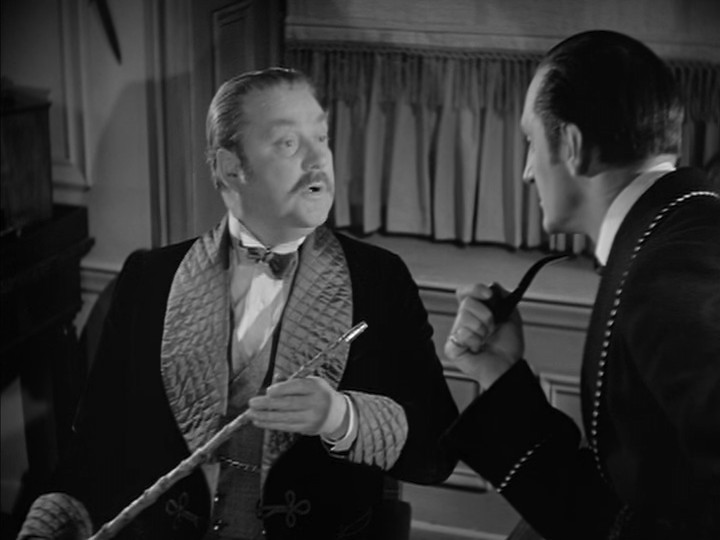
This description by Loren Estleman of Nigel Bruce’s Watson, which I saw quoted on Wikipedia, is an exaggeration, but not a great exaggeration:
If a mop bucket appeared in a scene, his foot would be inside it, and if by some sardonic twist of fate and the whim of director Roy William Neill he managed to stumble upon an important clue, he could be depended upon to blow his nose on it and throw it away.
But neither of these are really true to the character of Watson. This can be seen most clearly, I think, in The Hound of the Baskervilles, which shows Watson at his finest. Watson actively investigates, in Holmes’ absence, with intelligence and confidence. He finds useful clues. All of which makes sense, because Watson is a doctor.
If you consider what a doctor does, you will quickly see that it is very similar to what a detective does. People come to the doctor with their problems. They have a few clues as to what has gone wrong, though these are normally called by the medical jargon, “symptoms.” The doctor will then interrogate the patient about things things which have happened—things which may seem to the patient irrelevant or unimportant. He may probe the patient’s body to gain further evidence. He then uses his imagination to think of what might be wrong that caused these symptoms and gather further, more directed evidence, to prove or disprove this hypothesis. Once he is confident, he or the patient or both will act on this and—if he was right—bring a resolution to the problem, or at least as much of a resolution as the situation allows. This is also a description of what a consulting detective does.
Holmes is more intelligent than Watson; he has also developed quite a good deal more specialized knowledge than Watson, and for these reasons can solve problems which are impenetrable to Watson. But he is not completely unlike Watson. Indeed, it is this similarity, though in different fields of application, which allows Watson to appreciate Holmes’ genius. Most people were irritated by Holmes, but Watson could follow Holmes’ explanations, once he gave them, and appreciate how he could have done it if he had only done a better job. That is to say, the thing which allowed Watson to appreciate Holmes was the fact that Watson was, himself, a detective of middle-rate skill. Which is no small thing.
The modern world is so accustomed, because of the cheapness of digital reproduction, to having the best that we have lost sight of the value of anything but the best. This has gotten so bad we often turn our nose up at the second-best and treat third-best as if it meant third-rate. When we look at the Olympics we care who won the gold medal and sometimes give a thought to who won the silver medal, but often look at the bronze medal as if it was a consolation prize or participation trophy. And yet, for most groups of Olympic medalists, if you were to re-run the event ten times on ten different days, all three of the competitors would probably win gold at least once and all three would take bronze at least once. No one is so outstanding that he does not have a bad day and everyone near the top occasionally has good days. And, more to the point, the bronze medalist would, on any normal day, be able to beat virtually anyone you put him up against. That is to say, he may have taken third place, but he’s still first-rate.
This is where people go wrong with Watson, I think. Watson was not Holmes’ stupid friend. Watson was Holmes’ intelligent friend. So much so that in Watson’s area of specialization—medicine—Holmes always deferred to Watson’s judgement. Watson did not come close to the heights that Holmes could reach, within Holmes’ area of specialization, but there is a very good reason why Holmes confided in Watson and not in other men. Watson was intelligent enough, and enough of a detective, that he could appreciate Holmes.
Indeed, this is what made Watson such an excellent biographer of Sherlock Holmes. He was low enough that he could make Holmes relatable to the common man but high enough that he could understand Holmes when he explained himself—unlike the common man. Watson does not appear in a good light when standing next to Holmes, but when he was on his own many people came to Watson with their troubles and through his own intelligence and knowledge he helped them.
Watson was a doctor.
Discover more from Chris Lansdown
Subscribe to get the latest posts sent to your email.


It might have been wiser for the stories to make more use of Watson’s medical abilities. It often helps when the specialist sidekick does things like that.
LikeLiked by 2 people
Especially if his medical ministrations consisted of more than opening people’s shirt collars and giving them brandy 🙂
LikeLiked by 2 people
Pingback: Reposted: Watson Was a Doctor – A Song of Joy by Caroline Furlong
Literarily speaking, the quintessential ‘Watson’ in the Knoxian sense was Captain Hastings of the Poirot series, whose intelligence really was set ‘just below that of the average reader’ and who never did learn detective work. Poirot at one point comments that his great contribution is to see the thing exactly as the murderer wants him to see it.
LikeLiked by 1 person
This is quite true. Hastings’ complete inability to learn from the past actually rather got on my nerves. And, I think, it got on Agatha Christie’s nerves, too, which is why she stopped including him.
LikeLiked by 1 person
My nuclear hot take is that stupid Watson does in fact come from Conan Doyle just as much as smart Watson does, because Conan Doyle was not consistent in how he wrote him but adapted it to the needs of the story.
LikeLike
I think you are right that Conan Doyle was not consistent and made Watson out as a much less intelligent figure when it suited him. My only real disagreement is in proportion—I think that actually stupid Watson is more the exception than the rule. (As opposed to when Watson merely seems stupid by comparison to the genius of Holmes.)
LikeLike
Sure, I’ll cop to that. I just don’t think it’s being drawn out of thin air.
LikeLiked by 1 person
That’s fair. I didn’t mean that it came from nowhere – only that it was greatly exaggerated, especially later, as the totality of Watson.
LikeLiked by 1 person