
On the third day of March in the year of our Lord 1985, the sixteenth episode of the first season of Murder, She Wrote aired. Set someplace that isn’t Cabot Cove—they don’t specify where—it’s titled Sudden Death. (Last week’s episode was Tough Guys Don’t Die.)
The episode actually starts, not at the football stadium, but at a funeral home, where a bunch of people, mostly elderly, file out as mournful music plays.
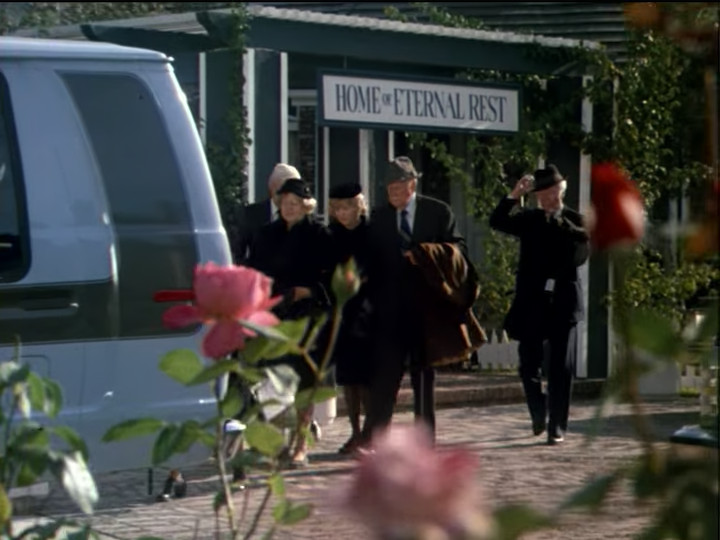
I love the name “Home of Eternal Rest.” I don’t know if anyone ever named their funeral homes like this; certainly all the ones I ever saw had less on-the-nose names. Most were just a family name; undertaking, as a profession, descended from carpenters, which had mostly been a family business.
Anyway, Jessica is among the mourners, and the funeral turns out to be for her Uncle Cyrus. As she walks out, she’s approached by a man by the name of Bradford Lockwood.

It turns out that Uncle Cyrus left Jessica some shares in a local football team called the Leopards. He tries to get Jessica to sign them away, but she wants to know what she’s selling before she’ll make any decisions, so she goes to see this team she is now part-owner of.
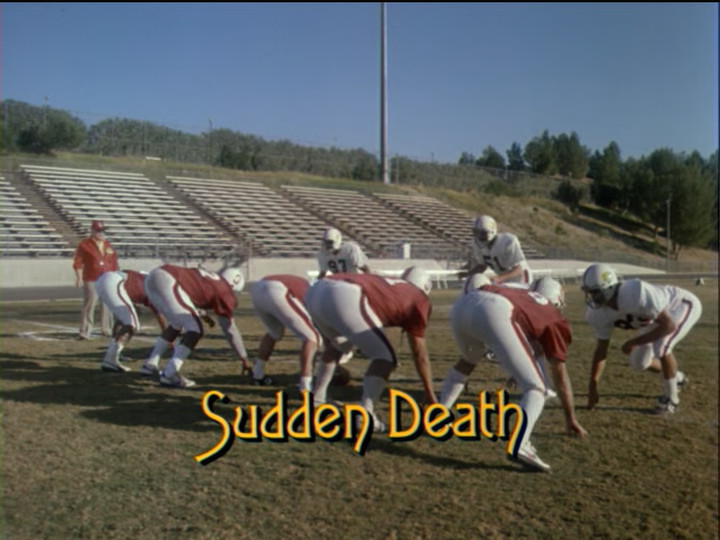
Which is when we get to the title screen.
The stadium in this episode is interesting. At a guess, it’s actually a high school football stadium; that would be much cheaper to film at than renting an actual NFL stadium would be. To compare, here’s Jessica in the bleachers of this stadium:

And here’s a picture of Sullivan Stadium, from about the same time, which was the stadium at which the New England Patriots (the closest team to Maine) played:
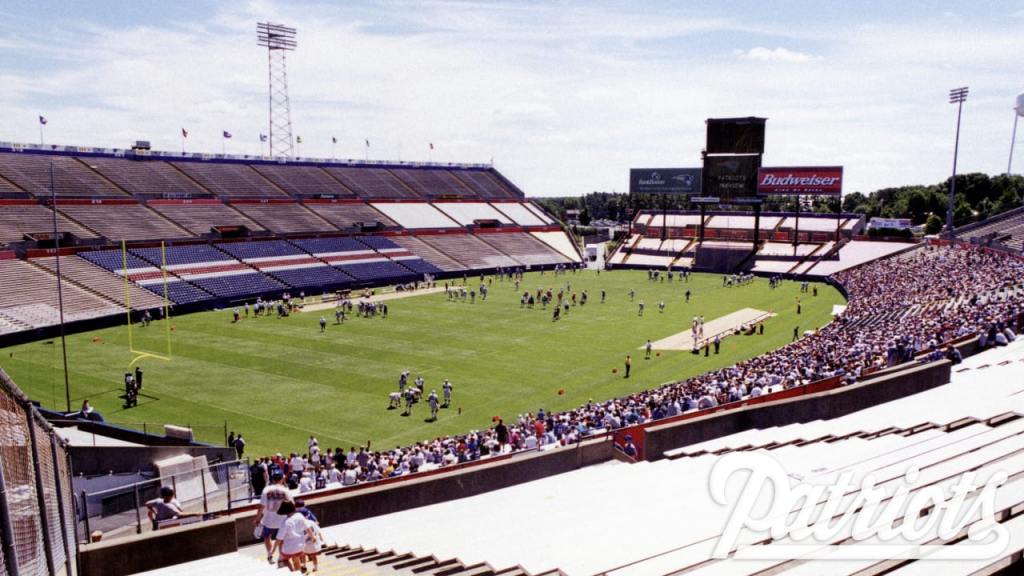
As you can see, there’s a bit of a size difference, there. Now, to be fair, NFL teams usually practice somewhere other than their home stadium, but (my understanding is that) those places don’t have bleechers. And like football stadiums, their grass isn’t mostly brown and patchy.
After various shots of people practicing football while peppy football music plays, Jessica is nearly run over by an oversided helmet on wheels.
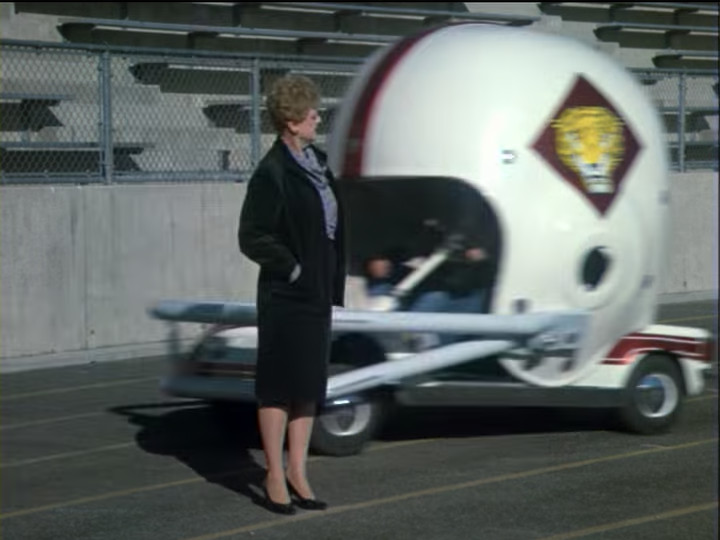
The passenger gets out and, after asking Jessica if she’s OK, introduces himself. He’s Zak Farrell.

He introduces his daughter, Jill, who was the one driving the helmet:
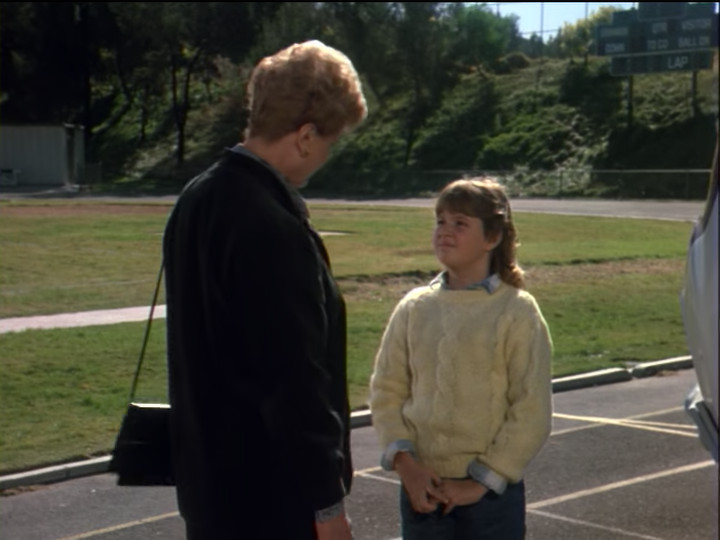
She’s deaf. She reads lips very well, and only speaks in sign language. A few bits of conversation later, Zak’s wife, Cathy, shows up:

I’ve got no idea who these people are or why we’re meeting them, but Murder, She Wrote never spends this much time on introducing people unless they’re important in the episode. Usually character introductions are a bit less random than this, though.
The scene then changes to inside of an office, possibly at the football stadium:
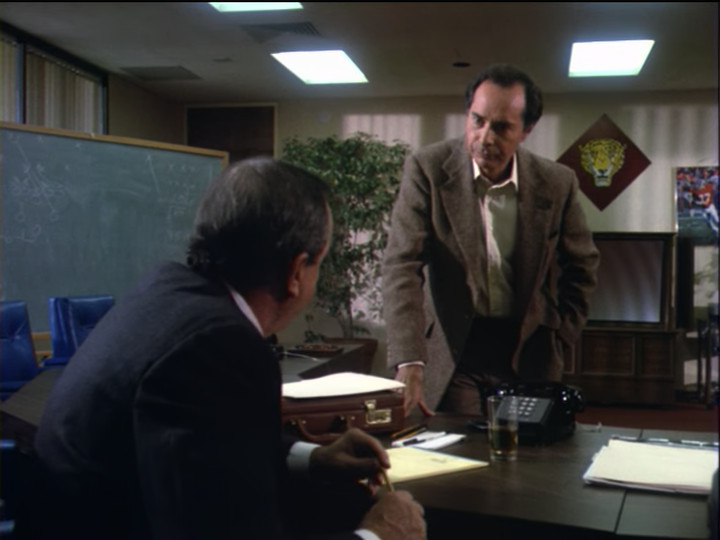
The man’s name is Phil Kreuger and he’s demanding to know from Lockwood (whose back is to us) where the proxies are. He replies that it was awkward at the funeral but he can promise them to Phil by the next morning. Phil threatens to terminate Lockwood’s “fat retainer” if he doesn’t make good on that.
Phil then goes on to berate Pat Patillo, who is the coach (they seem to have only one).

When the berating fails to have the desired effect, Phil threatens to fire Patillo if there’s one more loss.
We then meet Grover Dillon, who is in charge of equipment.

He comments that morale is pretty low on the team. Phil is unmoved by this, possibly because he likes morale to be low for some reason. It certainly seems to be his management style.
Then Tank Mason, the defensive captain, chimes in.
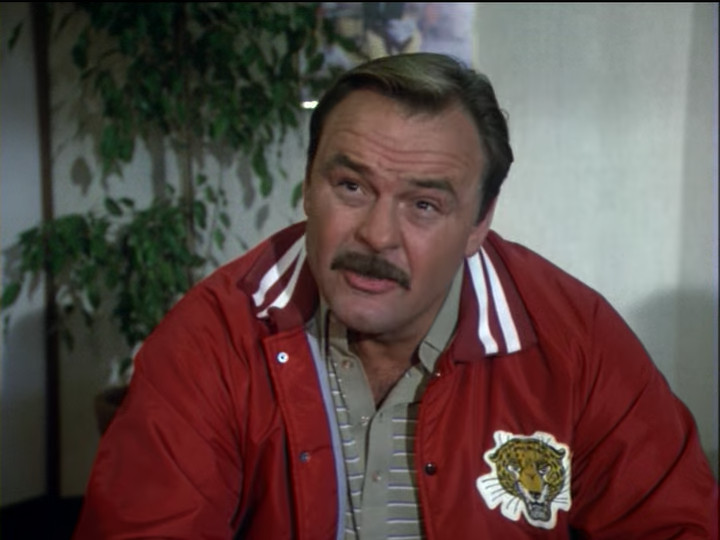
He has to speak up for the guys; there’s a lot of talk of the team leaving town, which “the commissioner” says can’t happen. Phil chews Tank out in an unpleasant manner, and is interrupted by Jessica coming in.
Before I continue, though, I just want to take a moment to note that Tank is played by Dick Butkus, who was a famous linebacker in the 1970s and at the time of this episode a sports commentator and sometimes actor. Which means that this episode has an actual former professional football player in it.
Anyway, Jessica asks if there’s a “Mr. Kreuger” here and he yells at her to get out. Then Lockwood identifies Jessica and Phil apologizes and starts being nice to her.
I really hope Phil is the one who gets murdered.
He concludes the meeting then takes Jessica on a tour.
The shot has the team practicing in the background on the field, which makes me even more suspicious that this is a high school stadium:
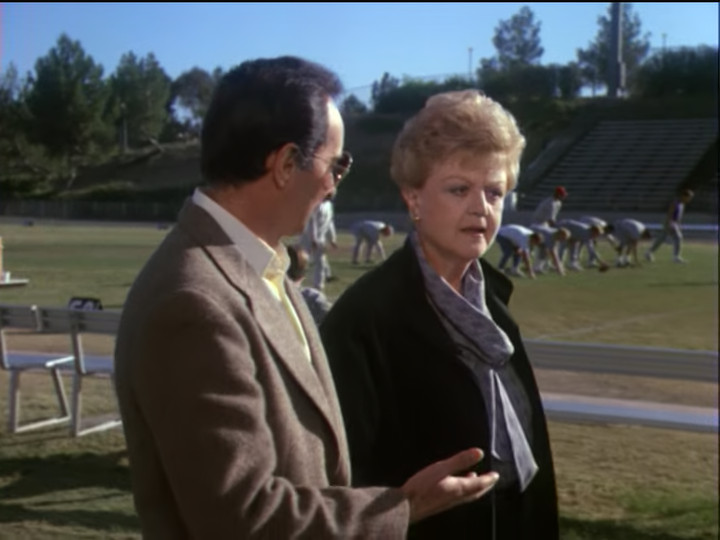
Even back in the 1980s, professional stadiums had bleachers on both sides of the field. (Also, they didn’t tend to have a running track around the field, which we’ve seen in other shots.)
Anyway, he invites her to a party for the team that evening as his guest and Jessica accepts. Also, he offers to buy her out. Jessica doesn’t have any idea what her shares are worth and he says that they last time any of the stock traded it was at $6 per share, so with 4,000 shares it would be $24,000 so he’ll offer her $30,000. Jessica says that she’ll think it over.
This is, of course, suspicious. Why does he want to buy her out? It’s a bit odd to give no motive, which suggests his motive isn’t great. Also that he’s potentially lowballing his offer.
Anyway, Jessica leaves and the scene shifts to the Farrell home, where Cathy is taking an anonymous phone call from a male voice saying that it’s not a threat, just friendly advice, that her husband should quit the team before “it comes out about your little girl,” whatever that might mean. She tells him that she’s going to call the police if he doesn’t stop calling.
Zak and Jill come in and in the small talk it comes out that he’s recovering from a shoulder injury, which he believes is a career-ending injury. He also asks who called and when she doesn’t want to say, he concludes it was another anonymous phone call. He believes that Phil is behind them, but Cathy says that they don’t know it for sure. Zak says that he’s going to put an end to it.
Back at Jessica’s hotel, Coach Pattillo is waiting for Jessica in the lobby and asks if he can talk to her. He wants to buy her out, and offers her $60,000. Jessica asks why everyone’s so eager to get her shares. He explains that Kreuger owns 48% and a rival group of investors owns 48% and her uncle Cyrus owned the other 4%. Lockwood had voting proxies for her Uncle Cyrus and threw the balance of power towards Kreuger. He wants to buy her shares so he can move it the other way, since Kreuger wants to move the team to a bigger city, while he wants to keep it here since it’s his home.
At the party Kreuger and Jessica negotiate in his car. When he learns that she’s been offered more than $40,000, his final offer is $150,000. He adds a threat, saying that football is a dangerous game and sometimes people get hurt.
Then they go in to the party where Phil introduces Jessica to Webb:
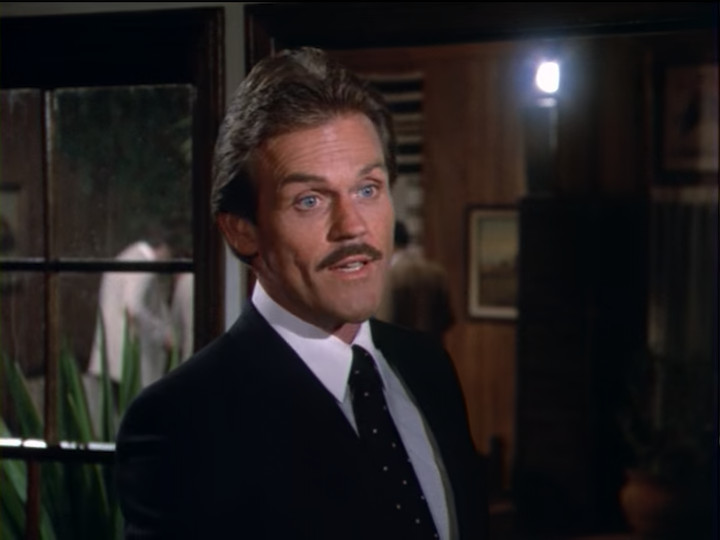
He introduces him as “he collects Leopards,” which I suppose makes him a recruiter—which I believe are called “talent scouts” in the NFL.
After saying that he’s going home to make some phone calls, Phil spots the commissioner across the room:
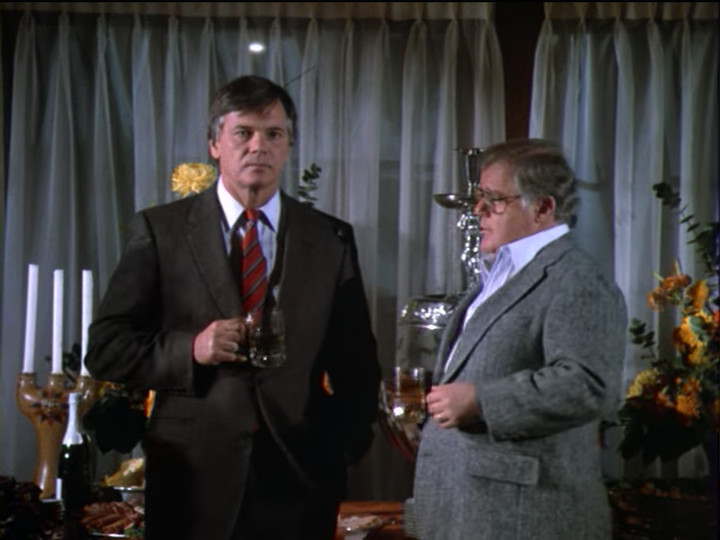
The commissioner’s name is Talmadge. After expressing his disdain for Talmadge, Phil leaves. Webb tells Jessica that Phil will be back, as he only lives a block away. Which makes me think that Phil is going to be the murder victim because this puts quite a few suspects in easy walking distance of where Phil will probably be killed.
Later that evening, after some raucous partying, Zak shows up, angry, looking for Kreuger. When he finds out Kreuger isn’t there he uses a phone at the bar to call Kreuger at his house and tell him that he wants to talk to him now and he’s going to settle this tonight. Kreuger says something and Zak responds that he’ll see Kreuger at 9:00.
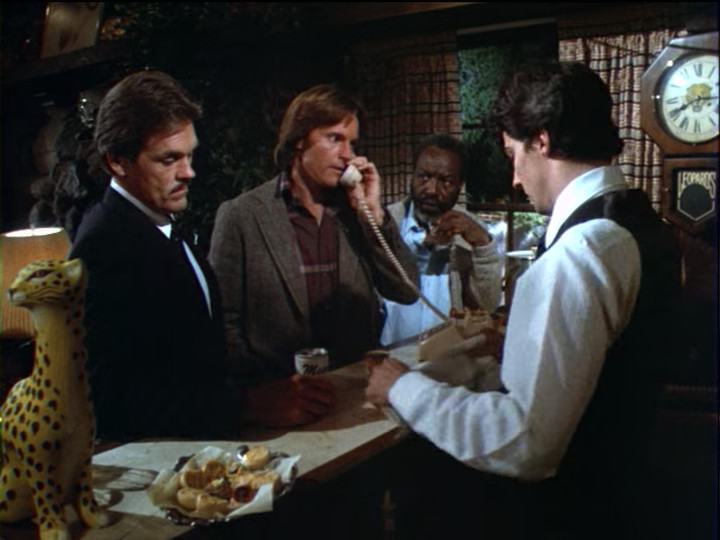
If you look at the clock behind Zak, you can see that it’s currently 8:15.
Later, Jessica runs into Talmadge, who introduces himself because, since she’s now an owner, they have things to talk about. He lets her know that he’s not going to let Kreuger move the team. Jessica is anxious to get out of this conversation, which is strange because he can probably provide her a lot of valuable information.
That said, she gets out of it pretty quickly and tries to find Zak. She finds out from one of the waiters that he just left, and the camera zooms in on the clock on the wall.

Over at Kreuger’s place Zak shows up at the door while very tense music plays. He bangs on the front door to no avail, but then finds a note taped to it, which he rips off the door.
We then get an establishing shot of the house, which is quite impressive:
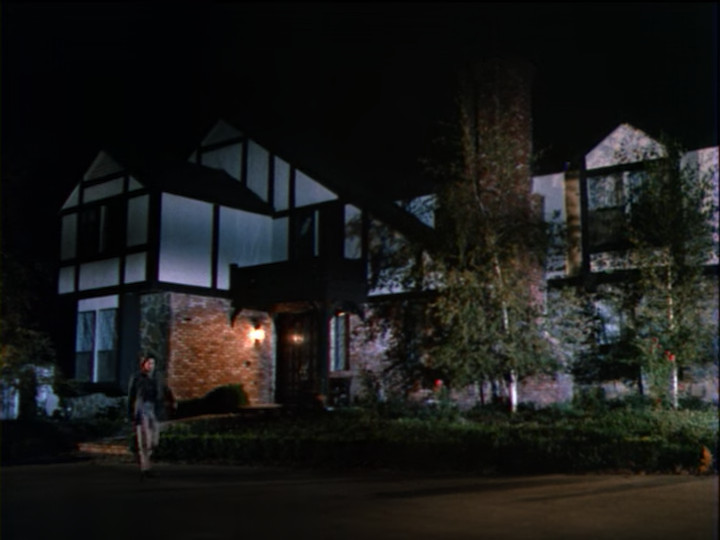
Zak walks off, and back at the party, at 9:05, Jessica is Dancing with Tank…
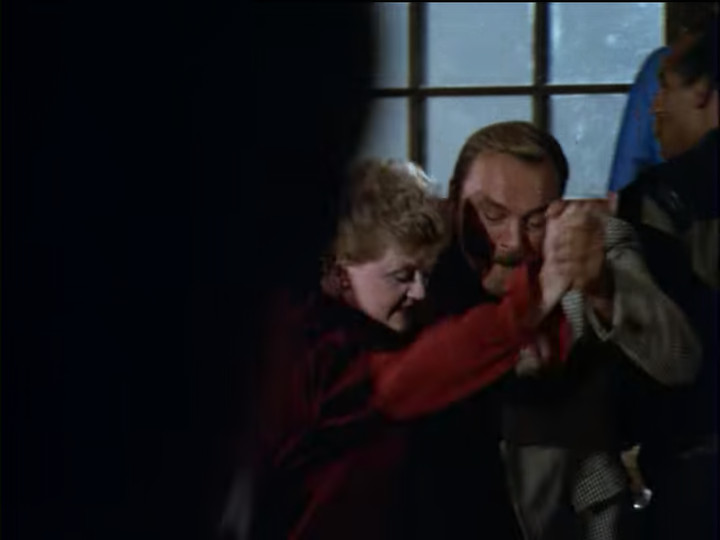
…when Webb cuts in. Jessica says that it’s a wonderful party, which is mildly surprising because it doesn’t much seem her style. Tank then talks about what a great party it is and asks where Kreuger is because he’s missing a great party. He says he will go over and get him, and Webb says that he will go with him, though he doesn’t give a reason why. Jessica runs into Mr. Dillon, who is just leaving because he has work to do in the morning.
After Jessica remarks that it’s a wonderful party and Dillon unenthusiastically agrees, the scene fades to the foodball stadium in the morning where Dillon comes in to do that work. He hears some running water, though, and goes to investage, where he finds Phil dead in some kind of pool:

The scene fades to black and we cut to commercial break.
Had you been watching in 1985, you might have seen a commercial like this:
When we get back, we meet the detective in charge of the case:

Lt. Clyde Pace is a bit of an odd homicide detective, as Murder, She Wrote goes. He’s tough, but very willing to work with Jessica and also quite into sports gambling. We actually meet him on the phone, talking to his bookie, and saying to give him $500 against the Leopards winning the upcoming game on Sunday.
He calls in a security guard who says that he didn’t see Phil come in the night before because he’s in the front while Mr. Kreuger has his own private entrance with his own key. He did see Zak Farrell coming around, angry and looking for Phil.
Jessica wanders over and looks at the pool in which Phil was found and notices something. When she calls the Lt. he says that she shouldn’t be there, but she responds that it’s OK, she’s one of the owners. Lt. Pace warms up to her instantly and comes to her summons. She points out something in the tank and he takes off his jacket and rolls up his sleeve and reaches in and gets it. It’s a watch with a smashed crystal, the time stopped at 9:04, and it’s engraved on the back with Zak Farrell’s name. Jessica doesn’t believe Zak could be a killer, but Lt. Pace is less sure. He gives instructions to have Zak picked up on suspicion of first degree murder.
The scene then shifts to the police station. I always love Murder, She Wrote‘s establishing shots, and this is no exception:

I still have no idea where in the country we are supposed to be, but this gives a small-city feel to it, which goes with the general idea that Phil Kreuger wanted to move to a bigger city.
Inside, Lt. Pace says that they may be able to reduce the charger to second degree murder, but Zak says that he didn’t do it. Lt. Pace then explains that he figures that it’s OK for Jessica to be at this interrogation because she’s one of the owners of the football team and seems to think that he didn’t do it. Zak doesn’t question this bonkers logic and the interrogation proceeds. Jessica asks him what happened after the party and, basically, he found a typed note on Kreuger’s door saying to meet him at the stadium. Zak went to the stadium but Kreuger wasn’t there, so he went home and got drunk. Zak adds that it’s lucky Kreuger wasn’t there or he might have killed him. Also, he last saw the watch days ago—he left it in his locker.
(The typewritten note is a pretty clear indication that Kreuger was already dead when Zak got there. So much so that Jessica confirms with Zak that it was typewritten.)
There’s also a bit where Jessica asks what he was trying to have out with Kreuger and the Lt. says that Zak had a no-cut contract that Kreuger was trying to break. Zak denies that was the reason, saying only that it was personal. (We were shown him talking with his wife about the anonymous calls concerning their daughter so I’m not sure why the writers are playing this like it’s a mystery.)
The scene shifts to Las Vegas where Phil Kreuger’s widow is on the phone with Bradford Lockwood (the team lawyer) who’s telling her that she might inherit everything from Phil because he died intestate and their divorce wasn’t finalized.

She is going to catch the first plane in to wherever this episode is set.
Back at Jessica’s hotel she runs into Cathy (Zak’s wife). Cathy asks her to help Zak—it would destroy Jill if Zak were sent to prison for something he didn’t do—and Jessica says that she’ll try. I’m not sure what the purpose of this scene is. Perhaps it’s to introduce the information that Jessica has been known to help solve crimes before? We’re still in the first season, so the writers might expect people to still be giving the show a try for the first time.
Jessica then visits the football stadium and there’s a wacky scene where she distracts Tank during a play and he gets injured. She and the coach then step over Tank lying on the ground and move off so they can talk. He asks if she’s going to sell her shares to him and she says she hasn’t decided. She’s here to find out what a no-cut contract is. It turns out to be a contract where he can’t be cut. (That is, he gets paid whether he plays or not, and he’s currently not playing because of his injured shoulder. But he’ll be in breach of contract if he’s in prison for murder.)
Jessica then goes into the locker room and talks with Grover Dillon.

She thinks she saw him at the funeral for Uncle Cyrus and he said that he was there—he and Cyrus go a long way back. Then there’s a comedic bit where he tells her that she’s not supposed to be in the men’s locker room right after practice but he phrases it too generally and she doesn’t understand, saying that’s fine that she’s here because she’s one of the owners.
They sit down together and Grover gives some backstory. A long time ago, Cyrus was equipment manager and Grover was a player. Times were lean, then, and sometimes they paid people in stock rather than money. Grover sold his stock to Kreuger ten years ago for $500. Cyrus was simply too ornery to sell.
I’d like to point out that if you’re giving away stock rather than money, at 4% ownership per person you could afford to pay at most 25 people if you were willing to give away 100% of the company. It’s a good attempt at backstory, but the numbers don’t add up. It would be easily fixed by making Cyrus special in some way, like being one of the few people who accepted stock in lieu of pay.
Jessica then accidentally accuses Grover of having stolen Zak’s watch and Grover angrily replies that in twenty years he’s never been accused of theft and any fool could open one of these lockers with a coat hanger (coat hangers were frequently made of metal wire, back then, and could be bent into shapes useful for other purposes).
Then the naked men walk in from the showers and Jessica is oblivious for far longer than makes any sense.

When Tank finally makes this clear to her, Jessica says, embarrassed, “Oh, would you look at the time, I have to get going.”
And on that we fade to black and go to commercial.
When we come back from commercial we’re on Web’s estate, where he, the police lieutenant, and the football commisioner are shooting skeet:
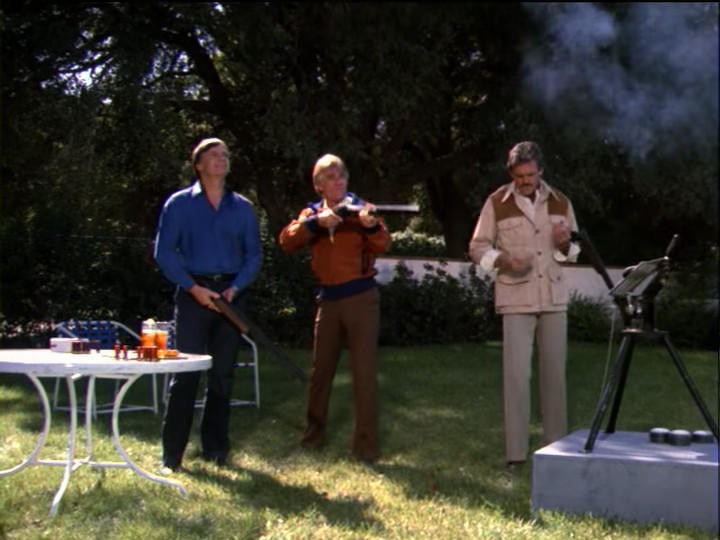
Murder, She Wrote absolutely loved trap shooting as a rich man’s activity. In real life it requires many acres of land to be able to safely fire shotguns into the air. On a TV set, where blanks will do just fine for the actors and you don’t need to actually load the clay pigeon thrower because the camera won’t capture the clay pigeon anyway, it’s far less demanding and the requirements for props are quite modest.
Jessica shows up and interrupts them. She asks the Lt. about the medical report and we find out that the time of death was around 9pm and there was a small bruise on the forehead but the cause of death was definitely drowning. The Lt. mentions that Web posted bail for him this afternoon and Web explains that Zak is a good man—innocent until proven otherwise.
There’s a bit of discussion about why Mrs. Fletcher doubts that Zak did it and it comes up that there was only one key made to the back door and it was in Kreuger’s pocket. This is an extraordinarily weak objection since the killer could easily have taken the key out of Kreuger’s pocket to unlock the back door, dragged the body in, then put the key back. But for some reason they seem to be assuming that Kreuger was killed in the office, in the pool he was found in. (While it’s not impossible that he was killed in the office, it makes more sense for him to have been killed elsewhere and moved to the office late at night when there was no chance of being seen.)
Jessica then leaves and Web remarks on the commissioner leaving the party early. This is probably meant to spread suspicion around but I refuse to believe the commissioner is any kind of suspect—as commissioner he has autocratic power over the teams, which means he can have no possible motive.
We then get an establishing shot of the stadium at night.

Jessica is wandering around inside. She makes sure that it’s possible to sneak past the security guard, which it is, then she wanders around the locker room. She tests how easy it is to pull open Zak’s locker and it’s ridiculously easy, to the point where I wonder why they bothered with locks. She hears a noise and decides to hide in the steam room.
Well, I say “steam room” but here’s the exterior:

And here’s the interior:
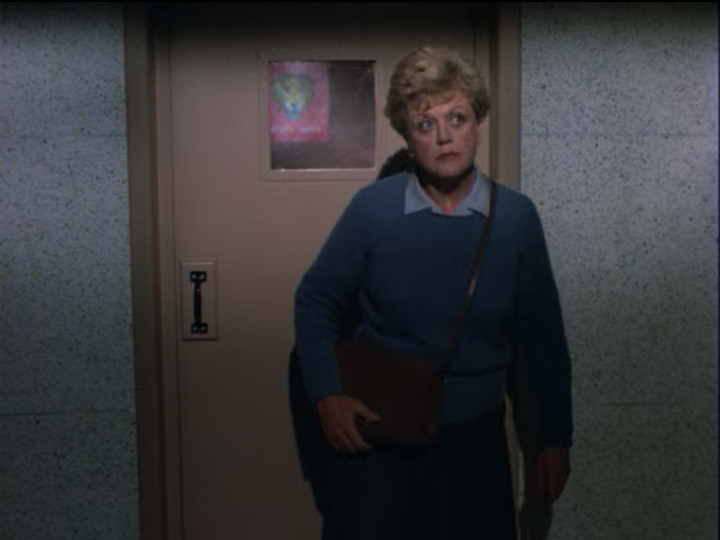
This looks like more of a door into a hallway to me. Anyway, while she’s exploring the steam room, someone locks her in:

I’ve got no idea what the other side of that bar is resting on. Perhaps the water fountain? The length doesn’t look right, but maybe it’s long enough.
Anyway, the figure in black then adjusts the temperature on the steam room control:
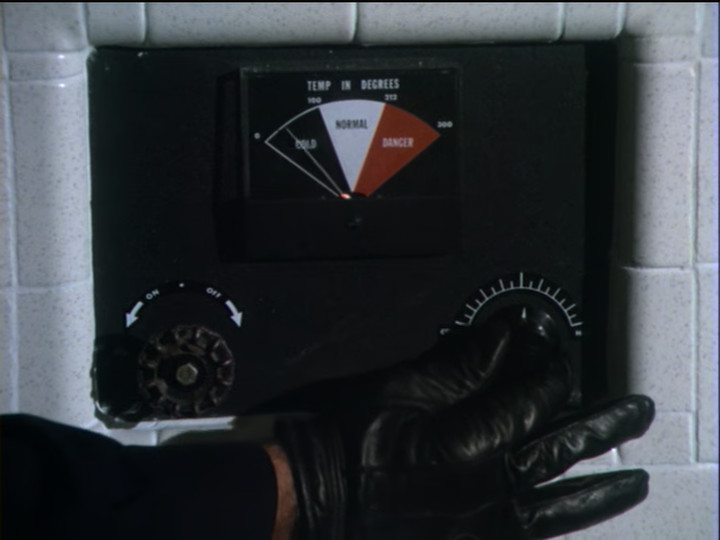
I really love this control, including its placement outside the steam room for convenient access for murderers. The figure in black turns the nob on the lower right, which immediately moves the needle on the temperature gauge. The figure turns it all the way, so that the needle on the temperature gauges maxes out the danger setting. I can’t make out the label on point between normal and danger, but looking closely the separation between normal and cold seems to be 120 and the top end of danger is 200. I wonder what the guy who designed the steam room thought the value of having a danger zone as large as the normal zone was. (A large danger zone would make sense if this were just a temperature gauge, but it’s a thermostat control—it moves synchronously with the nob the figure in black turns and before steam starts coming out of the vents.)
Anyway, the figure leaves and Jessica bangs on the door for a bit until Grover Dillon shows up and lets her out. On the way home (he gives her a ride) Grover cautions her that football can be dangerous off the field as well as on. She thinks that someone is just trying to scare her off—which she takes as a positive sign that she’s on the right track.
She also asks about his limp, and it turns out that it started as a football injury. At the time, Kreuger was the coach of the team and put Grover back in before it was healed. He’s lucky he can still walk. When Jessica notes that he didn’t like Kreuger very much, he points out that her stock is worth more if Zak Farrell is convicted of the murder since he’s the highest paid man on the team and is just dead weight right now.
The next morning Jessica talks with Tank on the field at the stadium. I find it amusing to note that there are only eleven people total on the field, including Tank, who is stretching off to the side. This is just the wrong scale for a football team. I understand that actors cost money, but would it have been that expensive to have two dozen extras in football-looking clothes off on the other end of the field?
Anyway, Jessica learns that something is up at Zak’s home, probably involving his child. (Tank is a friend of Zak’s.)
Jessica then goes to Zak’s home and after some bits of learning sign language with Jill which are supposed to be cute but I find more cringe-inducing, she runs off to play and Zak explains what the deal is. Jill was adopted. It was a private adoption, arranged by an attorney. They paid the mother a lot of money and the transaction may not have been entirely legal. Zak also explains about the anonymous phone calls and that he believes they were Kreuger.
Jessica asks if the attorney was, by any chance, Brad Lockwood. Zak, surprised, says that it was and wondered how she knew.
Bradford Lockwood is a weird character, since he seems to have been the attorney for everyone in the area and also on the side of anyone who wanted to do something underhanded.
Back at her hotel, at night, Jessica is on the phone with Amos. (This is a neat device to help connect Jessica to Cabot Cove without having to set anything there or even have Tom Bosley in the episode.) She then hears that the bathtub is almost full and says goodbye to him to run and turn the water off before it overflows. While bending over the tub to reach the handles, she notices something:

She notices an earring at the bottom of the tub. She had been wondering where it went. Right as she pulls it out, she hears a knock on her door. When she answers it, it turns out to bet the football commissioner. He called but the line was busy, and since he was flying to New York the next day, he dropped by. As commissioner, it’s part of his job to get to know the owners.
He then discusses her willingness to sell her stock—he knows of an investor who wants to keep the club where it is. Jessica asks if that’s Web McCord, but the commissioner is unwilling to say. Why, he doesn’t explain, because there’s no reason for it to be secret. There’s then some discussion about Kreuger, the commissioner says that Zak Farrel was the only one who could have killed him because it’s 45 minutes to the stadium and back, but Jessica points out that the commissioner left early. I don’t get why this matters to anyone, since he’s clearly not a real suspect. Jessica then asks him to leave so she can take her bath and he mentions, apropos of nothing, that Mrs. Kreuger is going to inherit Phil’s shares, letting Jessica know that there is a Mrs. Kreuger.
Jessica then goes and investigates Kreuger’s house. The front door is ajar and no one answers to Jessica’s calls, so she enters and walks upstairs to investigate the master bathroom. There she discovers that the floor is wet next to the bathtub. Then the camera pans up we see the shadow of someone holding a gun by the open door…
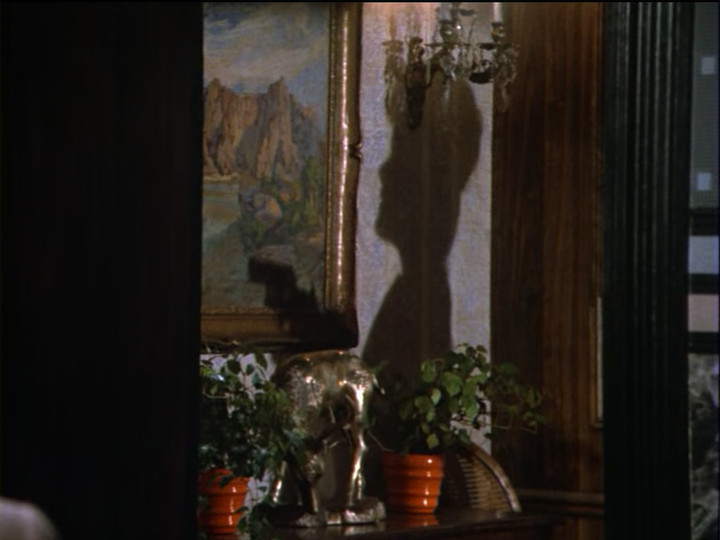
…and we fade to black and go to commercial.
When we get back, the shadow advances and turns out to be Phil Kreuger’s widow. Wearing clothes, this time:

This is an interesting mourning outfit but I suppose it’s the best she could come up with on short notice.
After a bit of chit-chat, Mrs. Kreuger says that she’s going to call the police and Jessica encourages her to do so, and to request Lt. Pace.
When Pace arrives, Jessica shows him the wet floor. He doesn’t connect this with the murder, so Jessica spells it out for him: Kreuger was probably murdered here and then brought to the stadium and put in the whirlpool later. Pace says that it’s an interesting theory and it opens up the field. But who did it? Jessica replies that part may be hard to prove.
The scene then shifts to the football stadium. Inside the lockerroom, the coach gives a speech with rousing football music playing in the background (for us, not diagetically).
Alright you guys. Listen up. I’m gonna make this short. You all know what happened this week but that doesn’t mean a damn things once we get on that field. Everybody’s figuring us for a bunch of losers and maybe we are. You guys are gonna have to decide that for yourselves. That’s all I got to say.
The music then changes to a funeral march and the players start walking out to the field. Lt Pace calls his bookie and says to put him down for his limit. On his way out, Tank tells Mrs. Fletcher that they’re going to win this one for her.
After the players leave, Jessica looks at a board full of photos that Tank took at the party the night Phil was killed. She then pulls two down and compared them:

The problem is that they’ve under-exposed the photographs and so we can’t really see anything here. I’ve tried to enhance this by upping the exposure, but there’s just no detail in the darks:

It looks like Web McCord is wearing a tie with dots on it in the photo on the left and a solid tie in the photo on the right, though that could just be lighting. Presumably this is meant to show that he changed clothing between the two photographs, indicating that he is the killer.
Up in a private box, Web and the commissioner a bunch of other people are watching the game. During the rare times they cut to the game, they use footage from a real football game, btw:

Web gets a phone call from “Sylvia down at the cleaners” who is clearly Jessica slightly disguising her voice. She says that the jacket he brought in has one brass button missing. She wants to make sure he knows that they didn’t lose it; it was in that condition when he brought it in.
Web thanks her for the call, then goes to the crime scene to see if he lost it in the drain of the bathtub where he drowned Kreuger. (He’s fishing down the drain with the kind of tool has extensible claws inside of a coiled spring wrapper that’s good at picking things up in places too tight to get hands in.)
Jessica interrupts him and explains how she tricked him. In turn, he explains why he did it. He had quietly bought up the other 48% of the club but Kreuger wouldn’t sell, so he killed him to take over the club. He goes into a bit of detail; he had originally planned to kill Kreuger after the party but when Kreuger went home early he moved his plan up. Which was actually to his benefit, as it left him with a tighter alibi. “You have to take advantage of the turnovers.” He also mentions that he had to type the note he left for Zak twice since the first one got wet.
He asks how Jessica figured it out and she explains that she figured you couldn’t drown someone in a bathtub without getting wet and Web changed his blazer. She says that he was wearing a single-breasted blazer earlier in the night and a double-breasted blazer later on. Perhaps this is true; I can’t see it in the photos and they don’t really show it in the episode, either. His blazers always just look black when they’re buttoned, and mostly we can’t see the bottom half (which is where single-vs-double breasted blazers differ).
After a brief discussion of how Web plans to get rid of Jessica’s body, Lt. Pace comes in and arrests Web. After Web is taken off by a uniformed officer, Pace complains that Jessica yapped for far longer than necessary and they’ve missed most of the game. He turns on the TV in the room to watch the end of the game but it’s already over; the Leopards managed to pull victory from the jaws of defeat in the last two minutes, coming back from being down 21-7. Jessica is delighted while Pace can think only of how much money he just lost.
There’s a final scene with Jessica and Zak and family where he says that he’s throwing in with Patillo to buy Mrs. Kreuger’s stock and Jessica reveals that she’s putting her stock in trust for Jill. Jessica explains this to Jill, who hugs Jessica and we go to credits.

This was a very silly episode. Murder, She Wrote rarely gets anything right when it comes to settings like business or sports but it at least often limits itself to superficially plausible errors that you need to know something about the subject to realize are wrong. Here it gets a ton wrong about football and I barely know anything at all about football! It’s especially a problem that the things it gets wrong are so dissonant. The Leopards are a failing team, but there’s a lot of money involved.
Speaking of money, if we throw the $150,000 Jessica was offered into an inflation calculator, that comes out to $447,204.93 in 2025 dollars. That’s an offer for 4% of the outstanding shares so that would make the entire team worth $3,750,000 ($11,180,123.25 in 2025 dollars). This seems a bit off; a bit of quick searching turned up the New England Patriots being sold for $70,000,000 in 1985. (It is true that Donald Trump bought a USFL team in 1985 for $9M, but the USFL was a much less successful startup competitor to the NFL that only began in 1983, so the Leopards couldn’t have been a USFL team.)
And yet, in spite of the numbers being way too low, they’re also far too high—for the team’s training grounds to be a high school, to have a single coach, a single janitor, and only eleven people on the team in total.
The murder also hinges on an extremely improbable event: Zak barging in to the party demanding to talk to Kreuger now, this very moment, then happily accepting an appointment for forty five minutes later and hanging around at the party for half an hour. This may be why they emphasize this so little that I originally thought that Zak immediately left for Kreuger’s house and concluded that there wasn’t time for anyone to kill Kreuger first. (I only realized that Zak hung around at the party for half an hour when I was re-watching the scene to see if I could spot where Web changed his clothes.)
Speaking of improbable: I know that the motives in Murder, She Wrote are usually a bit thin, which is fine because this is all for fun and people do occasionally do murder in real life for reasons which are no better. But even so, Web’s motive for killing Kreuger would be fine if it weren’t for the central premise of the episode—that Jessica owns a controlling share of the Leopards which she is willing to sell. Even worse for Web’s motive, Jessica would almost certainly have preferred him to Kreuger and been willing to sell him her shares, which would have given him a controlling interest in the team. This could have been mitigated somewhat by Web not knowing about Jessica since she had only shown up that day and no one had a motive to tell Web about Jessica, but he must have known that Cyrus owned shares in the Leopards and that he died recently and so the shares might well be available for purchase.
Incidentally, it’s kind of strange that Web got his blazer wet in the murder. The normal thing to do, when doing any kind of strenuous work at all, is to take your jacket off. This part doesn’t bother me very much, though, since it could easily have been Web’s tie that got wet, and it would not be as normal to take a tie off. (And even if he had, it could potentially be seen to be re-tied in the photograph.) That said, I do wonder about why drowning Kreuger was so messy. Surely he had been knocked unconscious before being drowned, and an unconscious man would not cause any great mess. A conscious man would be nearly impossible to drown in a bathtub, at least for a single man of roughly similar size.
I think part of my problem is that most of the characters didn’t land for me. I think that Jill was supposed to be a major center of sympathy within the episode but about the sum total of her personality was being deaf. I think this was more special at the time because it was extremely rare to have deaf people on TV—and it probably still is—but 1980s virtue signaling isn’t more interesting than 2020s virtue signaling. Any emotional resonance which Zak and his wife have are derived from being Jill’s parents, and we find out that they might be her parents by having illegal bought her because they were impatient, which isn’t a great basis for sympathy. Tank and Grover Dillon are the only other two major characters. Tank is likable, but mostly untouched by anything that happens in the episode. Grover is also likable, but a bit under-used and not much more affected than Tank. Oh, and there’s coach Padillo. He’s not very likable and for some reason was never much of a suspect. Truth to tell, I found him a bit forgettable. Oh, there was also Talmadge, the commissioner. He simply made no sense, since he was treated like a suspect but couldn’t have been. And Jessica had an antipathy to him which made no sense, especially given her general love for authority figures. And I suppose that there was Lt. Pace, but he was almost a comic relief character.
The only other major character in the story was Web McCord. They actually did a good job of making him always present but never noticed, which is a great characteristic for a murderer to have. So much so that I want to quote an important section from an essay G.K. Chesterton (who wrote the popular Father Brown mysteries) wrote about the subject:
The criminal should be in the foreground, not in the capacity of criminal, but in some other capacity which nevertheless gives him a natural right to be in the foreground. I will take as a convenient case the one I have already quoted; the story of Silver Blaze. Sherlock Holmes is as familiar as Shakespeare; so there is no injustice by this time in letting out the secret of one of the first of these famous tales. News is brought to Sherlock Holmes that a valuable race-horse has been stolen, and the trainer guarding him murdered by the thief. Various people, of course, are plausibly suspected of the theft and murder; and everybody concentrates on the serious police problem of who can have killed the trainer. The simple truth is that the horse killed him. Now I take that as a model because the truth is so very simple. The truth really is so very obvious.
At any rate, the point is that the horse is very obvious. The story is named after the horse; it is all about the horse; the horse is in the foreground all the time, but always in another capacity. As a thing of great value he remains for the reader the Favourite; it is only as a criminal that he is a dark horse. It is a story of theft in which the horse plays the part of the jewel until we forget that the jewel can also play the part of the weapon. That is one of the first rules I would suggest, if I had to make rules for this form of composition. Generally speaking, the agent should be a familiar figure in an unfamiliar function. The thing that we realize must be a thing that we recognize; that is it must be something previously known, and it ought to be something prominently displayed. Otherwise there is no surprise in mere novelty. It is useless for a thing to be unexpected if it was not worth expecting. But it should be prominent for one reason and responsible for another. A great part of the craft or trick of writing mystery stories consists in finding a convincing but misleading reason for the prominence of the criminal, over and above his legitimate business of committing the crime. Many mysteries fail merely by leaving him at loose ends in the story, with apparently nothing to do except to commit the crime. He is generally well off, or our just and equal law would probably have him arrested as a vagrant long before he was arrested as a murderer. We reach the stage of suspecting such a character by a very rapid if unconscious process of elimination. Generally we suspect him merely because he has not been suspected. The art of narrative consists in convincing the reader for a time, not only that the character might have come on the premises with no intention to commit a felony, but that the author has put him there with some intention that is not felonious. For the detective story is only a game; and in that game the reader is not really wrestling with the criminal but with the author.
What the writer has to remember, in this sort of game, is that the reader will not say, as he sometimes might of a serious or realistic study: “Why did the surveyor in green spectacles climb the tree to look into the lady doctor’s back garden?” He will insensibly and inevitably say, “Why did the author make the surveyor climb a tree, or introduce any surveyor at all?” The reader may admit that the town would in any case need a surveyor, without admitting that the tale would in any case need one. It is necessary to explain his presence in the tale (and the tree) not only by suggesting why the town council put him there, but why the author put him there. Over and above any little crimes he may intend to indulge in, in the inner chamber of the story, he must have already some other justification as a character in a story and not only as a mere miserable material person in real life. The instinct of the reader, playing hide-and-seek with the writer, who is his real enemy, is always to say with suspicion, Yes, I know a surveyor might climb a tree; I am quite aware that there are trees and that there are surveyors, but what are you doing with them? Why did you make this particular surveyor climb this particular tree in this particular tale, you cunning and evil-minded man?”
This I should call the fourth principle to be remembered, as in the other cases, people probably will not realize that it is practical, because the principles on which it rests sound theoretical. It rests on the fact that in the classification of the arts, mysterious murders belong to the grand and joyful company of the things called jokes. The story is a fancy; an avowedly fictitious fiction. We may say if we like that it is a very artificial form of art. I should prefer to say that it is professedly a toy, a thing that children ‘pretend’ wish. From this it follows that the reader, who is a simple child and therefore very wide awake, is conscious not only of the toy but of the invisible playmate who is the maker of the toy, and the author of the trick. The innocent child is very sharp and not a little suspicious. And one of the first rules I repeat, for the maker of a tale that shall be a trick, is to remember that the masked murderer must have an artistic right to be on the scene and not merely a realistic right to be in the world. He must not only come to the house on business, but on the business of the story; it is not only a question of the motive of the visitor but of the motive of the author. The ideal mystery story is one in which he is such a character as the author would have created for his own sake, or for the sake of making the story move in other necessary matters, and then be found to be present there, not for the obvious and sufficient reason, but for a second and a secret one.
I think that the writers did an excellent job of this with Web McCord. In every scene he was in, he was there for a very practical reason, so much so that you never really noticed him. The only problem is that never really noticing him makes him an uninteresting character—at least until the reveal. Which would have been fine if there were some other interesting characters in the story before the reveal.
Oh well. Next week we’re in New York City for Footnote to Murder.
Discover more from Chris Lansdown
Subscribe to get the latest posts sent to your email.
 Chris Lansdown
Pingback: Murder She Wrote: Tough Guys Don’t Die – Chris Lansdown
Pingback: Murder She Wrote: Footnote to Murder – Chris Lansdown