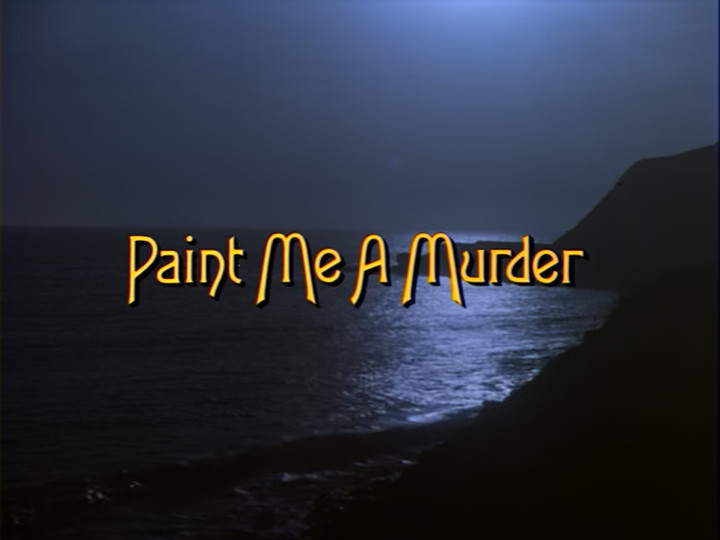
On the seventeenth day of February in the year of our Lord 1985, the fourteenth episode of Murder, She Wrote aired. Titled Paint Me A Murder, it’s set on an isolated island in the Mediterranean. (Last week’s episode was My Johnny Lies Over the Ocean.)
After an establishing shot of a large house, we get a closeup of a stone urn on a railing on a balcony. A gloved figure in black uses a hammer and chisel to loosen the urn from its base, then we fade to the next day.
Famed painter Diego Santana, played by Caesar Romero—who most of us know as the Joker from the 1960s Batman TV series—is teaching an art class to a group of children.

We then meet two of his friends, Willard and Elaine, who are watching from a distance.
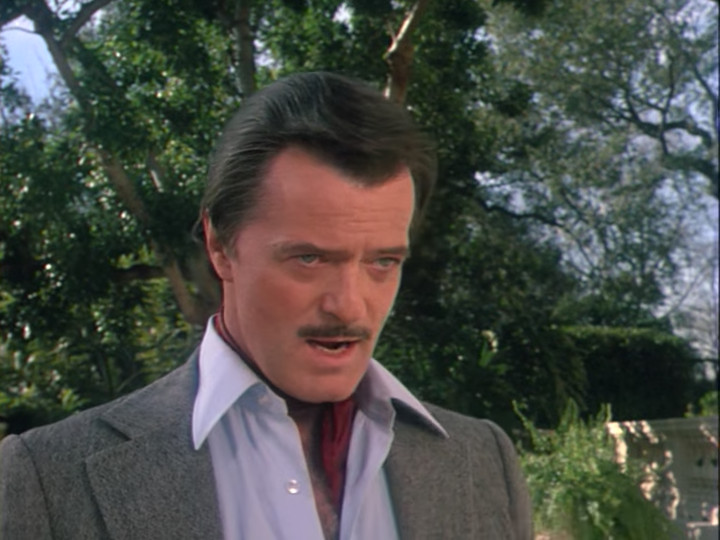
Willard is a washed-up playwrite. This is by his own account; in response to his scoffing at Diego “wasting his time” Elaine replies that it’s called “sharing your gift with others” and Willard should give it a try. He replies that his gift has been buried in the sands of time; it’s been more than a decade since his last hit.
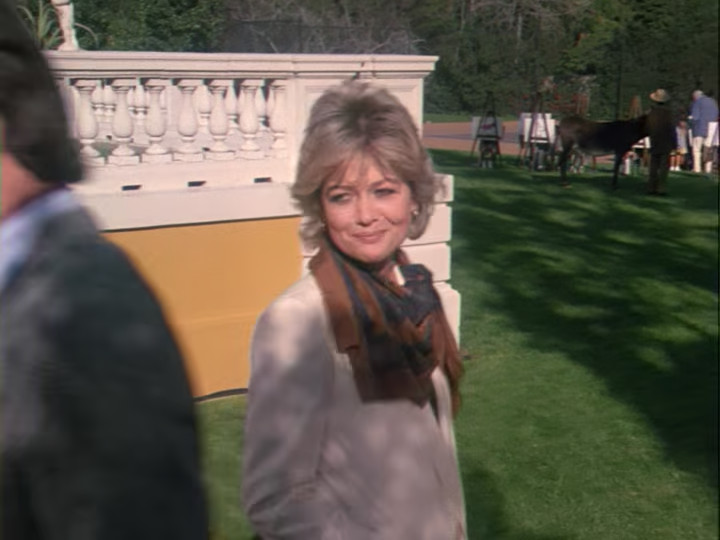
Elaine is an innocent do-gooder who spends most of her time helping “under-privileged” children in Africa.
We then meet Diego’s ex-wife, Belle.

We also get the backstory that they are all on his island to celebrate his sixtieth birthday, which is in a few days.
The idea that this is his sixtieth birthday party is a bit hard to take; Caesar Romero was seventy eight at the time this episode was filmed and while he looked a very hale and hearty seventy eight, he did very much look seventy eight.
Anyway, we then meet two more characters.
Margo, Diego’s current wife, is bringing snacks for the little children.
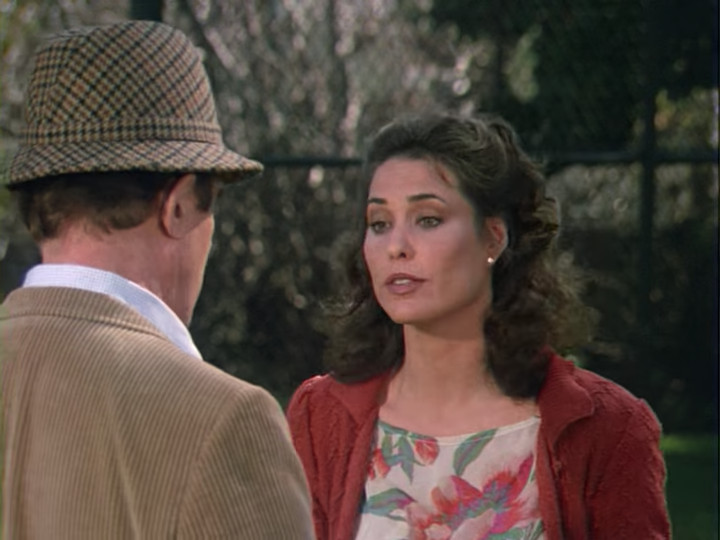
The man she’s talking to is Inspector Henry Kyle. Margo asks him to break up the fight between Willard and the other two women; Inspector Kyle remarks that Diego’s taste in old friends is so ecumenical it’s a wonder that any of them speak the same language.
This is an interesting way of hanging a lampshade on the issue of having friends who got together for a birthday party not get along with each other. I don’t mean that it’s unrealistic—it is the case that not all of a man’s friends will enjoy each other’s company—but it is a bit weird for them to actively hate each other and for him to invite them all together for a few days and for them to accept. By saying that Diego’s taste in friends is out of the ordinary, we get a sufficient explanation at the cost of making him a certain kind of person. But the episode wants him to be that kind of person, so it works out well.
When Inspector Kyle comes over to the group, Belle asks him if it’s true he owns a painting by Diego. Kyle replies that it’s a pencil sketch, but he prizes it dearly. Belle says that makes three of them who own an original Diego Santana. The other two are her and Willard. Willard asks what makes her think he owns one, and she heard from her friends that he just bought the “Gold Madonna” from them.
Elaine remarks that this leaves her the odd one out. “What I wouldn’t give to own an original Santana,” she says wistfully. However, when asked what she would do with it, she says that she would “sell it to help feed and clothe a lot of neglected children.” We’re clearly meant to think of her as extremely virtuous, but I can’t help noticing that she doesn’t actually want a Diego Santana painting, she just wants money.
We then meet Diego’s son, Miguel, who is talking on a radio-phone to “Maria” who is on an unspecified mainland nearby. Possibly Spain, since the people with the children, earlier, spoke Spanish. Anyway, Miguel tells Maria that he can’t leave without arousing his father’s suspicions, but he’ll try to think of something.
We then see the children leaving. A man apologizes to Diego saying that he’s sorry that they’re leaving so soon but they must sail before the tide turns. Unfortunately, the island is in the Mediterranean so this doesn’t work. The difference between high tide and low tide in the Mediterranean is only about a foot. A woman who was with the children asks Diego (in Spanish) if it’s true that J. B. Fletcher is coming and when Diego answers (in Spanish) that she will be there the next day, she leaves him a copy of one of Jessica’s books and asks if he’ll have her sign it, which he agrees to do.
We then go to a studio located on the island where a sculptor Diego is housing, Stefan, unveils a sculpture he made for Diego to show Margo.
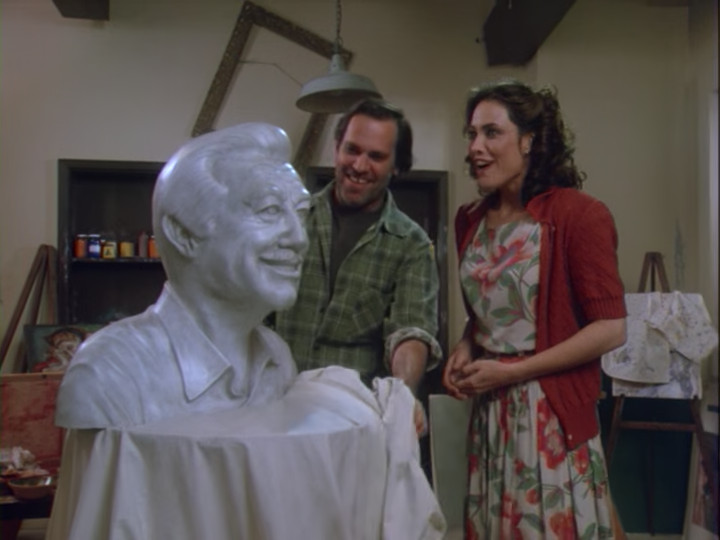
Margo is thrilled, though I can’t say that it looks that much like the Maestro (a title various characters use for Diego). She calls it an act of love and he corrects her that it was an act of respect and gratitude for his patronage. In fact, he loves her. To illustrate, he kisses her. After a moment she pulls back and says no, and Stefan is offended. She says that Diego loves her but won’t answer when Stefan asks if she loves Diego.
That night, at dinner, Diego proposes a toast in which he mentions that Jessica and another friend are coming, and also that Miguel has overcome his drug problem. Toasts are always a convenient way to work in exposition.
The room is interesting, by the way:

Whenever I hear about remote places I can never help myself and wonder how much it cost to bring all of the stuff there. It is not so easy to transport fancy fireplaces and large windows and a huge fancy table, etc. etc. etc. to the top of a cliff on a remote island. All of this would suggest that Diego was rich even if his remote island was not in such a desirable location.
Anyway, Diego then says he has a gift to unveil. He has always admired how Elaine has dedicated most of her adult life to helping underpriveleged children throughout Africa, but it’s time he gave her a more tangible token of his admiration. He then unveils a painting.
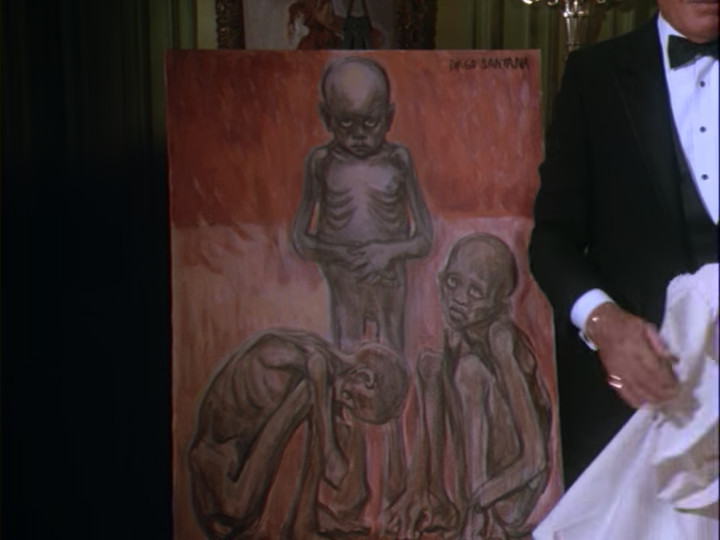
Words fail most of the guests, except for Inspector Kyle, who pronounces it magnificent. Willard closes his eyes because the greatness of the painting is too much to look at.
I can’t say that this seems like a masterpiece to me, or even particularly good, or even good, but I suppose it’s true that there is no use in arguing over matters of taste. That said, it is interesting to take note that they don’t show us the actual painting for very long. By my count, we see any substantial portion of it for about 52 frames (out of sixty per second). To put that into context, we get a reaction shot from Willard where he is overcome with the greatness of the painting for about thirty frames:

We spend a similar amount of time on Inspector Kyle pronouncing it magnificent, and again a similar amount of time on Belle gazing with admiration at it. All told, we see the reactions for more than twice as long as we see the painting itself. There’s something to learn, here; the viewer (or reader) can more easily be persuaded of something by other people’s reactions than by their own judgement. The rule we’ve all heard is “show, don’t tell,” but that’s inaccurate. There are many things you can’t actually show because you’re not good enough. To show the reader a breathtaking sonnet, you must be able to write a breathtaking sonnet. And even if you can, many readers won’t appreciate it.
So the real rule is more like: if you can show, do. But if you can’t show, tell, but have characters tell the reader (or the viewer).
Anyway, Elaine says that she doesn’t know what to say and Diego replies, “Say nothing. God has been good to me. I only wish to share his bounty.” I like this bit of characterization.
Later that night, we see a dark figure by the statue that was chiseled in the opening scene light a cigarette. In the distance we hear someone strumming on a guitar. At the sound the figure drops his matchbook and look over the balcony. Below is Diego, playing the guitar we heard.

The dark figure throws down his cigarette and gets ready by the statue. Diego stands still strumming in a way that barely counts as music but Caesar Romero has such confidence and presence that he sells it. Margo then comes to the door and calls to Diego, having a drink for him.
As he walks to her to get it, the figure pushes the statue off of the pedestal right as Diego is about to be under it. Diego hears the stone scraping, look ups and sees the urn falling…

…and jumps out of the way, unharmed.
Margo screams after the urn harmlessly crashes on the ground and runs to Diego. He comforts her, saying that it was just an accident and the old place needs repairs. They’ll get to them first thing after their guests leave.
But when she’s not looking at him, he looks back up at where the urn had been.
The next day, Willard and Elaine are fishing as the rest of the party come to the beach to meet the new arrivals and the helicopter bearing them shows up. This sort of timing is highly unlikely, but this is the kind of unlikely that doesn’t matter. There’s nothing much to be gained, by the viewer, in the characters having to be shown to be waiting around.
Out of the helicopter come Jessica and Sir John, who is a friend of Diego’s who runs an art gallery.

Jessica mentions that she met Sir John at Heathrow, which does at least confirm that we’re somewhere near Europe. He says that it was quite by chance and that Diego should have warned him that he was going to “be joined by this colonial enchantress.”
This is an interesting move because it helps to build Jessica up to the audience. Like with the painting, so much is done with reactions. It reminds me of the thing said of Fred Astaire and Ginger Rogers: “he gave her class and she gave him sex appeal.” That is, he acted like she was classy, so we bought it, and she acted like he had sex appeal, so we bought that. It’s not that uncommon to have dashing older men comment on how beautiful Jessica is, and I think that serves a similar purpose.
Diego introduces everyone to Jessica and Belle says that she’s delighted with Jessica’s books. “And you fool me every time.” Jessica replies, “Well, that is the idea” which is a bizarre response. Of course it’s the idea—that’s why Belle said it as praise. Jessica is usually better at taking a compliment than this and small town people generally have decent manners when it comes to taking compliments. Nothing comes of this, though, so I suspect it was just the writers flubbing a bit of smalltalk.
Inspector Kyle, by contrast, is a stranger to her books. He follows up with, “My loss, I’m sure.” Much better manners, that.
After this Willard staggers off into the surf while Elaine calls after him. He then falls face-first into the water. The guests rush over and pull him out and we fade to black and go to commercial.
Had you been watching back in 1985, you might have seen a commercial like this:
When we come back from commercial, Willard is being loaded into the helicopter. Miguel runs up and asks what happened, and after Diego explains, he says that he’s going back to the mainland to make sure Willard is OK. Miguel objects, saying that he must stay with his other guests, and that he (Miguel) will go with Willard.
Not having been privy to the phone call between Miguel and Maria, Diego gratefully accepts and Miguel gets into the helicopter, which departs.
They all start off back to the villa, but Diego pulls Jessica aside and says that after she’s settled, they’ll go for a walk. We then cut to that walk.
Diego says that after Liana, Miguel’s mother and Diego’s first wife, died, he vowed that one day he would find an island sanctuary. A place where he could work and commune with his God. Jessica replies that he’s created a paradise here in the Mediterranean. This is a bit of a strange vow to make, and Diego certainly seems to have taken his time with it because he got married twice and somehow got to know Jessica, too.
Anyway, Diego tells Jessica about the attempt on his life and asks her to investigate. Jessica protests that he should notify the police—I find it curious how Jessica has an iron-clad faith that no matter where she is, there are police who can be called in at a moment’s notice and that this is always the right and good thing to do. In spite of her many experiences with the police not taking attempted murder seriously and/or arresting the wrong person.
Anyway, she asks why he wants her to investigate and he replies that her talents as a detective are well known. I find it interesting that even in the first season we’ve moved away from “your experience as a mystery writer” to “your experience as a detective.” If we include the pilot episode, she’s solved fourteen murders up to this point (actually fifteen, but two were by the same murderer). She downplays this, saying that inspector Kyle is a real detective, but Diego points out that unlike her (and Sir John), Inspector Kyle was on the island the night the attempt on his life was made. The beach is overlooked by the villa, and up the island a bit there’s a small and treacherous bit of beach where a boat might be landed, but other than that the island is inaccessible, so the assassin must be one of his guests who was there the night before.
I’m not sure that this is ironclad, since it’s hardly likely that they keep a continuous watch on the beach from the villa—especially at night—but it’s good enough for TV. Besides, Diego could easily have said that he looked and the sand was undisturbed. And, of course, the writers might just want to leave the possibility of a boat landing undetected as a red herring.
Inside the villa, Belle is playing at the piano. It’s not much, but after a few moments she plays a bunch of wrong notes and stops. She clutches her fingers and, despite Elaine’s protests, says that she will play no more this night. Sir John walks in after she leaves and says that it’s a pity—she had been a very promising pianist in her day. He then congratulates Elaine on the painting Diego gave her and offers to auction it off at this gallery, forgoing his usual fees and commissions, of course.
Outside, on the balcony, Jessica is examining the area next to where the urn fell for clues. She discovers a cigarette butt. Then she discovers a matchbook which she quickly pockets when she hears her name. She turns to see Inspector Kyle coming out to meet her.

He asks if she’s found a clue. Jessica plays innocent, but Inspector Kyle cuts through it immediately, saying that everyone has heard about Diego’s so-called accident and he’s already investigated. He points out the chisel-marks on the base of the urn. Jessica admits that she noticed them too.
When Kyle asks Jessica if she is investigating on her own or if Diego confided something in her, she says that she’d rather not say, which of course is admitting that Diego did ask her. Kyle says that there’s no need to be circumspect because he fully realizes that he’s one of the suspects. Kyle begins discussing the other suspects, and says that they can rule out Belle because she’s far too fragile to handle the urn. (Which is probably fair enough.) Jessica says that Elaine isn’t too fragile, which Kyle admits is probably true, though he doesn’t seem very keen on the idea, but then Jessica says it wasn’t Elaine. She (Jessica) found cigarette butts on the ground, on top of the chips.
Inspector Kyle finishes, saying that it showed that the person smoked while they waited for Diego to make his nightly round strumming on his guitar, and finishes with, “Oh very clever, Mrs. Fletcher.”
This seems more elementary than clever; again the writers use the characters’ reaction to Jessica in order to build her up without having to do the harder work of making her be actually brilliant.
Anyway, Jessica remarks that she’s surprised that Inspector Kyle didn’t find these clues and he replies that she beat him to them; this is the first time he’s been up here. He adds that the clues don’t exculpate Elaine, though, because she’s a heavy smoker. Ah, the 1980s.
Jessica adds that she found a pack of matches with the matches were torn from the left side, indicating that the smoker is left-handed. Which narrows the list down to one: Willard.
It is a bit odd how often left-handed people commit crimes in detective stories and do so in ways that leave tell-tale signs of their being left-handed. Unlike identifying the culprit by his unique brand of cigarette, this one seems to have outlived the early 1900s.
Anyway, Jessica remarks that Willard’s heart-attack was, perhaps, rather conveniently timed. Inspector Kyle asks if she means that Willard faked the heart attack, because he didn’t think so when he looked at Willard. Jessica points out that he’s not a doctor, though. Which Inspector Kyle is quite willing to admit.
Jessica then starts to ask Inspector Kyle about the sculptor, Stefan Conrad, when they hear Diego and Stefan shouting at each other. Diego yells that his hospitality does not extend to his wife. Stefan takes offense at this, saying “You insult me, Maestro! And you insult Margo as well!” This clearly demonstrates that Stefan is a liar, and when Diego says that he is warning Stefan, Stefan shouts not to warn him, he is warning Diego, then we cut back to Jessica and Inspector Kyle, who notes that the sculptor appears right-handed (he poked Diego in the chest with his right hand).
Jessica then takes her leave and as the two move away we’re shown Elaine standing there, probably having heard much of their conversation, especially as it concerned her.

I think that this is meant to make her look suspicious, but I don’t think it does that. Anyone who hears themselves being discussed as a suspect in an attempted murder is likely to listen in, regardless of whether they did it, even if they weren’t inclined to listen in just because it’s interesting. After all, the conversation was interesting enough for us, the viewers, to listen to.
We then cut to Jessica and Inspector Kyle talking to a Doctor on the mainland on the radio phone. Inspector Kyle asks to talk to Miguel, but Miguel disappeared right after they arrived at the hospital. Anyway, Willard’s condition seems to be genuine. They found elevated respiration levels and rapid, irregular heartbeats. (I guess Spanish doctors in the 1980s would discuss the medical details of their patients with anyone who asked.)
Jessica says that they should talk to Diego. We cut to his reaction shot, where he can’t believe that Willard tried to kill him. This is not the reaction I expected; which of his guests could he believe that of? And yet he’s the one who was first who said that it had to have been one of his guests.
He asks why would Willard do such a thing and Margo says that Willard was always jealous of Diego’s success. He replies that he finds it hard to recognize the darker side of his fellow man, especially in those who are close to him. He looks at her in a way that conveys he knows of her infidelity with Stefan, and she looks away.
We then cut to later that night, where Diego is showing off his crossbow to Sir John.
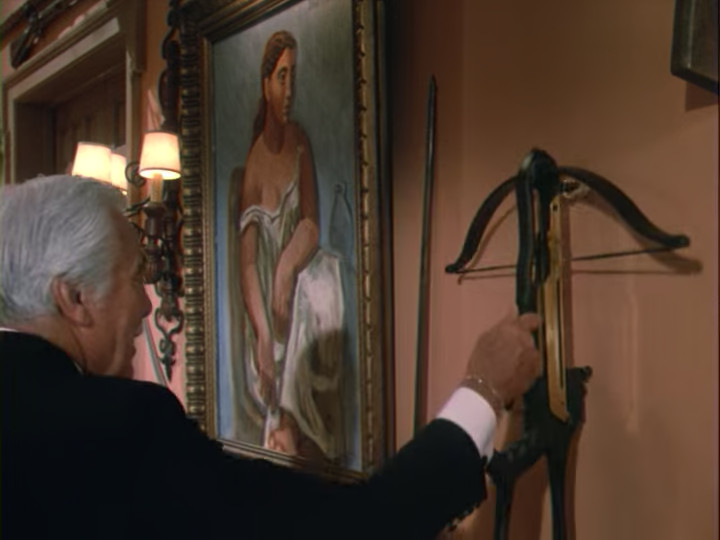
He says that as a hunting weapon, it is unequaled. Swift, silent, accurate, powerful—it can drive a bolt clear through a pheasant at fifty yards.
Speaking as an archer, this is a bit silly. First, crossbows are about the second slowest handheld projectile launcher I can think of (muzzle loading rifles being the slowest). Second, crossbows are by no means silent—even bows aren’t silent, and crossbows are much louder. Third, they’re less accurate than bows at distance because the bolts are lighter than arrows (they’re often not fletched to provide as much spin-stabilization, either). Finally, that is not a powerful crossbow. The easy way to tell is that it has no windlass or stirrup to help cock it. I’d be surprised if that’s more than a 150 pound draw weight crossbow. That might sound like a lot, but it has such a short power stroke—about eight inches, from the looks of it—that it’s likely to be the equivalent power of around a thirty pound draw weight bow. Which is not terrible—you can hunt whitetail deer with a thirty pound draw weight bow, provided you have a good hunting arrow. But that’s the absolute minimum it would make sense to hunt deer with. It’s certainly nothing to brag about.
Also, putting a bolt through a small bird at fifty yards isn’t impressive at all. I can’t imagine the hunting bow which is incapable of that.
Anyway, Belle comes in and makes fun of Diego for showing off “his toy.” Diego demurs, saying that Miguel is the real expert at it. Belle says that he’s right on Miguel’s heels and the little boy in him dies hard. Diego laughs and says that Belle always knew him the best.
Sir John asks how it all works—husband, wife, and ex-wife. How do you pull it off, he asks Diego. Diego replies, “Love, Sir John. Try it. It’s contagious.” I don’t know what this is supposed to mean since if he loved Belle, why is she not still his wife?
Elaine interrupts by asking Belle to play something at the piano, and after some refusing she finally relents. Inspector Kyle motions Jessica to come over. He just spoke to “the- some very reliable friends in London” and for the past several months Willard has been buying up Diego’s paintings. Jessica points out that Willard is supposed to be dead broke—she doesn’t explain how she knows that because I don’t think there’s any good way for her to. We accept it because we know it. (Audiences rarely ask how a main character could know what the audience knows.) Inspector Kyle says that Willard is broke, which raises two questions:
- Where did he get the money?
- Why is he buying up Diego Santana paintings?
Jessica says that the why is obvious: a painting by a living artist is one thing, but the same painting by a dead artist is worth quite a bit more.
This is interrupted by Belle slamming some keys on the piano, getting up, and walking off. Sir John asks her what’s the matter but Elaine asks him to let her go after Belle. Jessica takes the opportunity to ask Sir John if he knew that Willard was buying up Diego’s paintings. She figured if anyone would know, it would be Sir John. He says that he doesn’t know because he hasn’t seen Willard since Derby at Epsom in April, where Willard was having trouble raising enough money to make a decent bet. He then wishes Jessica a good night and goes off to his room.
Outside, Elaine is apologizing to Belle for making her play and commiserating about her hands, but Belle sadly tells her that it wasn’t her hands. She looked over at Margo and saw how she was looking at Diego—just the way that Belle used to look at Diego—and couldn’t take it. For the past three days she’s been trying very hard, but she’s not sophisticated enough to play this charade. So much for Diego’s love.
The scene fades to late at night. A mysterious figure sneaks into the hall and takes the crossbow and some bolts. Then we fade to black and go to commercial.
When we come back it’s early the next morning and Diego is out for a walk with his dog. Jessica is also out for a run, but she comes to the beach and sees a boat. She remarks how odd this is and turns around.
We then see a mysterious figure holding the crossbow high on a hill overlooking where Diego is walking with his dog. We then cut from a closeup of Diego to the figure. The crossbow is now cocked and the figure fits a bolt to it. As the figure takes aim, the camera focuses on Diego off in the distance.

That is quite considerably more than fifty yards. At a guess that’s more like 150 yards. I hope the killer put in several hours of practice with the crossbow, at least, because that’s a difficult shot when standing, unsupported, and that crossbow only has an iron sight. And Diego is a moving target and the arrow’s flight time will probably be more than a second, given the distance. The killer is going to have to be one heck of a marksman.
Jessica runs into Inspector Kyle, for some reason. He’s out of breath because he’s been hurrying—he’s been looking for her since he discovered she was missing at the villa. He asks her what’s up but he won’t say. She simply must get back to the villa. Their conversation is interrupted by Elaine screaming. We then cut to her, next to Diego.

I guess the killer did practice. She gets up and screams some more, and just then Jessica and Inspector Kyle come over the hill.

The camera then cuts to the reverse view, from where the killer was. We see Jessica and Inspector Kyle hurrying down to Elaine. This gives us a pretty good view of how far it was:

That was a seriously impressive shot with the crossbow.
Anyway, the camera continues panning and we see the crossbow on the ground with someone standing next to it. The camera pans up and we see Stefan (the sculptor) looking on:

I think that this is meant to make us think that perhaps Stefan did it, but in Murder, She Wrote it basically guarantees us that he didn’t. If you’re at all used to Murder, She Wrote, this is stronger than an airtight alibi.
They carry Diego’s body back to the house on a make-shift stretcher where there is wailing and gnashing of teeth at the sight of it.
When Sir John goes off to call the mainland, he comes back to report that the radio has been smashed and they are completely isolated. This is not greeted warmly, since it’s obvious that one of them is the killer, and people in large houses with many places to hide do not like being trapped with a murderer. Inspector Kyle points out that Miguel may come back and, failing that, they only have to wait for the following morning when the helicopter returns to bring them to the mainland.
Sir John says that he will be much happier if they can find the missing crossbow and Stefan volunteers to help him look. Inspector Kyle stays back with Jessica. When they’re alone, she tells him that she doesn’t know if she can trust him but has no choice, so she informs him of the boat she saw in the morning.
They go down and see the boat—and someone who is trying to take it out to sea. Inspector Kyle shouts and gives chase, and the man trying to launch the boat hurries too much in trying to get in and the boat capsizes, knocking him unconscious. They rescue him and a package he was carrying. The man turns out to be Miguel.
Back at the villa, they open the package and find that it contained several Diego Santana paintings. Margo comes in and angrily accuses Miguel of the murder, which he denies. He only came back to steal the paintings because there’s a warrant for Maria’s arrest and she needed money for her lawyer to bribe some important officials. He swears to the Holy Mother that he didn’t kill his father.
Sir John walks in the room holding the crossbow and says that he finds Miguel’s protests hard to believe. “Here is the murder weapon and there is the marksman,” he proclaims.
Miguel continues his protestations and Jessica suggests that if Miguel were guilty, wouldn’t he have taken the weapon to the boat rather than leave it to be found? She doesn’t elaborate on why and I can’t really imagine her line of reasoning. With the crossbow gone from the main hall, and moreover with a crossbow bolt lodged in Diego’s back, there isn’t really any question of what the murder weapon was so I can see no point in trying to hide it. And even if Miguel was the murderer and did want to hide it, throwing it into the sea would have been more practical, especially off of anyplace that one can’t reasonably get a boat to, which we’ve established is most of the island. Besides, why would Miguel (if he is the murderer) want to hide it any more than anyone else who murdered Diego?
I don’t think the point of this is the actual objection that Jessica had, though. Jessica is skeptical, which is about 95% accurate in Murder, She Wrote to signal that the person is innocent. I suspect that’s just the point; to let us know that the solution has not just been presented to us.
Inspector Kyle noncommittally says, “perhaps.”
Miguel defends himself, pointing out that he only loses by his father’s death, whereas Margo gets everything and considering how many paintings are in Diego’s workshop… And she’s not the only one who had more to gain than he did. Sir John, for example, probably has a dozen Diego Santana paintings in his gallery, now worth at least triple what they were the day before.
Sir John punches Miguel and Margo prevents Miguel from punching Sir John back. Which is really for the best, because punching a seventy year old man would be bad form. (I don’t know how old Sir John is supposed to be; Stewart Granger, the actor who played Sir John, was seventy-two at the time.)
After some grave looking reaction shots, we cut to Jessica on the beach, raking the sand.
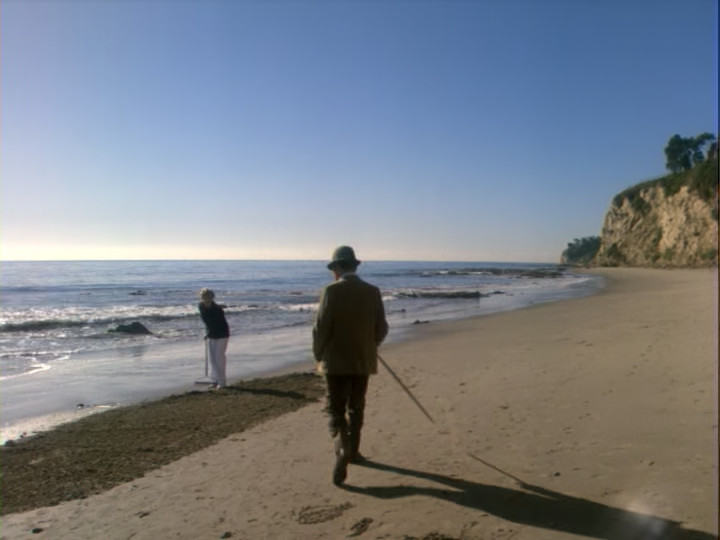
In response to Inspector Kyle asking Jessica what on earth she’s doing, Jessica says that she’s looking for a broken ampule of amyl nitrate, which she finds a moment later. I suspect she actually means amyl nitrite, because that’s the drug which can cause, according to Wikipedia, “nausea, vomiting, hypotension, hypoventilation, shortness of breath, and fainting.” Amyl nitrate, by contrast, is an additive to diesel fuel as an ignition improver. (Which, of course, doesn’t mean it has no effect if you drink it, but I suspect Jessica would know a lot more about amyl nitrite since it is, or at least was, used as a medicine.)
Sir John comes up and says that Stefan still hasn’t returned from the search and Margo says that Stefan has a small boat behind his cottage which he sometimes uses for fishing. Inspector Kyle says that they better go look. When Jessica offers to come with them, Inspector Kyle tells her that it might be dangerous and she should go look after Margo instead.
A search turns up Stefan’s cottage empty and his boat missing.
That night, after some establishing shots of the sea at night and the moon, Jessica wakes up to the sound of fire. After looking out the window and confirming it, Jessica calls the alarm of fire as she puts on her nightgown and we fade to black and go to commercial.
When we come back, we start with an establishing shot of Diego’s workshop on fire.
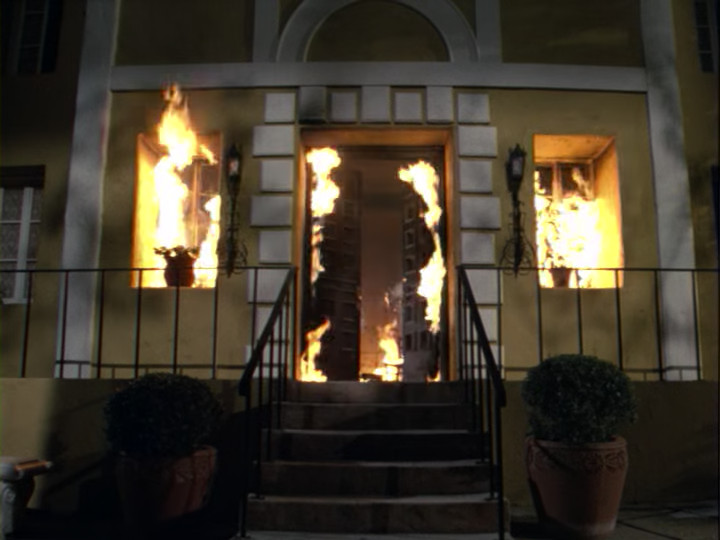
Jessica and Inspector Kyle run up. Inspector Kyle calls out to Miguel to get the hose, then pushes the door open and sees that a woman is on the floor inside. He runs in and picks her up then carries her outside. It’s Margo.
Miguel comes up with the hose and begins to spray the fire with it.
Inside the house, Margo wakes up. She doesn’t remember what happened. She couldn’t sleep so she went out for a walk. She thought she heard someone in the “shed.” (That’s quite the shed!) The door was open and the lock was smashed. She saw that a small fire had been started in the corner and she started inside towards it. Then someone grabbed her from behind and she doesn’t remember anything more.
Jessica asks if it was a man’s arm or a woman’s arm. Margo says she thinks it was a man’s arm—it was very strong.
Jessica then performs an experiment (with Margo’s permission) where she grabs Margo from behind first with her left arm, then with her right. It was the latter that’s how Margo remembers it happening. Jessica says this shows that the assailant was right-handed. When Elaine asks, “is that so unusual?” Jessica replies that it isn’t, it’s just unexpected.
The men come in and Inspector Kyle announces that it’s too dark to find anyone, they’ll have to search in the morning. Sir John adds that by that time, Stefan will have made his real escape from the island.
Margo does not believe this; she declares that Stefan is no killer. She then tells them his backstory; he’s a refugee from Bulgaria. He’s a scientist who defected over ten years ago. He changed his identity and went into hiding, but the Bulgarian secret police are still looking for him—he’s on their death list.
A little while later, Miguel and Sir John come in from having looked over the burned out studio. It was a total loss—everything was destroyed. Jessica and Sir John commiserate about what an awful tragedy the loss of the paintings is. Sir John remarks that for all they know there might have been another Gold Madonna in the studio. Sir John adds, “though, selfishly, of course, I shouldn’t complain. I was thinking of selling it, but now… Now I’ll keep it in remembrance of a good friend.”
Miguel says something biting about how the value of the painting will only increase with time and Sir John returns the favor by pointing out that Miguel no longer needs to live in the shadow of a true genius.
After the two men leave, Inspector Kyle comes up. He makes a remark about how Jessica ought to get some sleep, I think more to indicate how late it is than for any practical purpose, because Jessica just ignores it. She tells him that they were wrong about Willard. That is, he didn’t sneak back on the island to shoot Diego. (Inspector Kyle wryly remarks that theory was always unlikely.) It also wasn’t Stefan. She can say this because she knows who did kill Diego. She then asks what time the helicopter is coming and they make plans.
The next morning, Sir John comes down the stairs and the house appears to be empty. Then he runs into Jessica, sitting alone on one of the couches. If you’ve been watching Murder, She Wrote for any length of time, you know that this means that there’s a 99% chance that Sir John is the killer. That is, if you didn’t catch his odd volunteering that he owned the Gold Madonna, which it was established early in the episode that Willard bought it a few days ago.
Jessica accuses him and he laughs at this, pointing out that he wasn’t on the island when the killer made the first attempt with the urn. Jessica explains that the first attempt was made by Willard, who faked a heart attack with amyl nitrite when it failed.
Sir John and Willard had been working together for quite some time; that’s how Willard was able to buy up so many of Diego’s paintings. Willard certainly didn’t have the money so he had to be acting on someone else’s behalf. Which is what he was doing when he tried to kill Diego—he was acting on Sir John’s orders. Unable to face Sir John after his failure, he faked a heart attack to get off the island without having to talk to him.
When Sir John protests his innocence, Belle walks in and says that she heard Willard admit he had bought the Gold Madonna from some of her friends. Elaine walks in from a different door and confirms Belle’s account. Sir John says that Willard must have been lying. Jessica replies that it will be easy enough to check.
Then Inspector Kyle comes in through yet another door and points out that last night Sir John said that he owned it.
Sir John hesitates only a moment then says that he bought it from Willard right before Willard came to the island. Jessica points out that, according to Sir John, the last time he’d seen Willard was the derby at Epsom, many months ago.
Inspector Kyle says that the game is up; he used the radio in the helicopter to contact the authorities. When Sir John replies that he welcomes any interrogation, Miguel and Margo walk in through the same door Elaine came in earlier and Miguel says that they won’t be asking Sir John the questions. They’re on their way to interrogate Willard.
Jessica says that Willard will not remain silent for long, certainly not if he’s going to save his own skin.
Sir John draws breath, then says, “Well now… is this where I draw the gun and say ‘You’re never gonna take me alive?'” He looks around, then says, “It would be rather futile, wouldn’t it?”
Margo walks up to him and asks why. “He was your friend. He loved you.”
Sir John replies, “But I loved him too, Margo. But you see… Willard was not the only one who was broke. The art business is very volatile. Subject to the whims of a tasteless public. I was in grave danger of losing everything. Everything. You do see my problem, don’t you? Hmm?”
He looks around the room…

…but no one sees his problem.
The scene fades to everyone getting on the helicopter. Everyone except Jessica, who is remaining for a few days to keep Margo company. Inspector Kyle says that leaving without her is a dreary prospect and he has greatly enjoyed their acquaintance. Jessica replies that she was planning to stop over in London on her way home to visit a cousin. He promises to be at the airport to greet her, flowers in hand.
He adds, “and perhaps a murder to solve?”
Jessica laughs and says, “Oh please, no.”
Inspector Kyle replies, “Well, in our business, you never know.”
Jessica laughs and we go to credits.

I really enjoyed this episode. It had a bunch of truly classic murder mystery elements which were combined well. First and foremost was the mansion on a remote island. This has all the benefits of a dinner party in a manor house, but taken to the next level in terms of isolation creating a closed set of suspects. The collection of friends—another aspect of the classic manor house dinner party—also gives us an excellent kind of small and unique society for the murder to take place within.
As I’ve mentioned, a detective is a kind of Christ figure, who comes into a world that has been thrown into chaos through the misuse of reason (the murder) and then, through the right use of reason, restores this world to right order. The circle of friends makes for a very interesting society to be the subject of a mystery, because it has some deep connections and some very shallow ones and we don’t have a good way, at the outset, of knowing which are which. In this case, Willard looked like he had a decent connection to Belle and Elaine, while there was no reason to think there was much of a connection to Sir Henry. Henry didn’t really know anyone. Stefan’s relationships were ambiguous. This allows for a great deal of interest as well as exploration.
The setting was also a ton of fun. Who wouldn’t want to spend a few days in a mansion on a remote Mediterranean island?
It was also fun that in the climax, when Jessica is accusing Sir John of the murder, character after character keeps making a dramatic entrance, almost each through a different door, at a well-timed moment in the series of accusations. I wonder how Jessica convinced them to wait in the wings in the way they did, primed with their bit to say, but it was certainly done to great effect. With each new person accusing him, Sir John’s confidence was chipped away, until the final blow caused him to crumble and confess.
The plot was also quite tight, but Murder, She Wrote standards. There were no major plot holes and I’m not sure that there were even any minor ones. There were a few elements of the backstory that would be hard to explain, but that’s about the extent of the issues.
The main thing that would be hard to explain is how on earth Jessica got invited here. Jessica was just a school teacher in a small town in Maine who, after the death of her husband Frank, took up writing murder mysteries as a passtime. Her first book, The Corpse Danced at Midnight, became a bestseller and she became famous which led to international travel and meeting all sorts of interesting people, but how did she become a close enough friend of a famous Spanish painter to get invited to spend several days on his private island for his sixtieth birthday party? A similar question does arise for the rest of the guests with the exception of Belle and, perhaps, Sir John. Though I think that this is where we get into the aspect of Murder, She Wrote episodes being more sketches of mysteries than complete stories. This would be a solvable problem, in their various cases, to create actual backstory. Part of why this is a question is that we never see any of the guests, other than Belle, actually being friends with Diego. None of them do anything with him, or even talk with him. At the one event that they’re at, all we see are formal speeches that could be made to a room full of strangers. But this is not a flaw, in the sense of something done badly; this is a lack of detail in a sketch. And as for Jessica’s connection—I think that this could be worked out without too much trouble if they had more time. Margo, for example, could have been a big fan, and Diego could have invited Jessica as a favor to her, the invitation being delivered through her publisher. Famous people may take advantage of their fame in this way, and even if they don’t often do it, it’s certainly quite plausible that one might.
The only other thing, which wouldn’t be as hard to explain, are Willard’s actions. I don’t mean that he tried to kill Diego. That’s explained by money trouble and few scruples. I mean how he went about it. If you’re trying to make a death look like an accident, chiseling a stone urn loose than pushing it over a ledge isn’t a great plan. Apart from squirrels or birds not usually chiseling stone urns lose, stone urns don’t usually fall sideways, so how could this possibly have looked like an accident? Poison that looks like a heart attack would be, far and away, the most obvious approach. Failing that, a stone becoming dislodged on the ledge by the beach would have also made far more sense. Or a faked suicide. Who wouldn’t believe an artist killed himself? Be that as it may be, I also wonder how it was that Willard had an ampule of amyl nitrite handy. It’s not the sort of thing one normally carries about, which suggests that he expected to fail, or at least thought it sufficiently likely as to have a plan B handy in case he did.
This episode certainly has some interesting characters. Sir John had such suave manners and was so jolly. Inspector Kyle was enjoyable as a realist detective with experience, though he did end up having to play Watson to Jessica’s Sherlock. Belle was intriguing as a faded beauty whose talent on the piano had been crippled by her arthritis—was this why Diego abandoned her? Even Willard, the talented playwright who’d fallen on hard times—there was potential there. None of these were fleshed out characters, of course; I’m not saying that they were interesting as they were depicted. They were interesting as they were hinted at. The main exception is Elaine, who was victim to the Hollywood writer’s problem that they can’t conceive of do-gooders as having any personality because they (mistakenly) think of personality only in terms of flaws.
And, of course, there was Diego. I’m really not sure what we’re supposed to make of Diego. He had a great deal of joie de vivre (joy of living), but then he was a rich and famous artist with his own private island in the Mediterranean and who in his fifties while looking seventy eight could get a beautiful young wife to replace his aging wife that had replaced his dead wife. One would expect him to enjoy his life quite a bit. But he had his good side, too. He provided shelter to Stefan, who was hiding for his life. Perhaps Belle did know him best and he was just a boy who was doing his best to enjoy being extraordinarily fortunate.
Next week, we’re in Boston for Tough Guys Don’t Die.
Discover more from Chris Lansdown
Subscribe to get the latest posts sent to your email.
 Chris Lansdown
Pingback: Murder She Wrote: My Johnny Lies Over the Ocean – Chris Lansdown
Pingback: Murder She Wrote: Tough Guys Don’t Die – Chris Lansdown