
On the thirteenth day of January in the year of our Lord 1985, the tenth episode of the first season of Murder, She Wrote aired. Titled Broadway Malady, it’s set in New York City. (Last week’s episode was Capitol Offense.)

The episode begins with the retired actress Rita Bristol…

…watching an old black-and-white movie that she starred in.

A young woman named Patti walks in and guesses that the movie is “Holiday in San Jose” but it’s actually “Moon Over Rio.” Moon over Rio was not a real movie, but I suspect that the clip was from a real movie that Vivian Blaine, the actress who played Rita Bristol, was in. The clip looked quite real.
“Oh look at me,” she says. “I was always a pushover for that bilge we cranked out, even while we were doing it. Were we ever that innocent?”
The young woman objects, “Mama, that’s not bilge. It’s terrific!”
Then Rita’s other child, her son Barry, comes in.

He announces that the play with both mother and daughter is going to happen on Broadway. “Si Parrish finally came through!” Rehearsals start in six weeks.
Some time later, over in Cabot Cove, Jessica gets a phone call from Grady. He’s gotten a job as the bookkeeper on the play that Rita Bristol is in. He tells Jessica that on her upcoming trip to the city (she’s coming to meet with her publisher) he’ll get her into the rehearsals and she’ll get to meet Rita Bristol. Also, she’ll get to meet his new girlfriend, Kate.
The scene then shifts from Grady, back stage, on the phone with Jessica, to Rita Bristol on the stage complaining about the scenery being in the way. She goes on a tirade about the general lack of skill of the production. This gets her into a fight with the director, who is unimpressed by Rita.
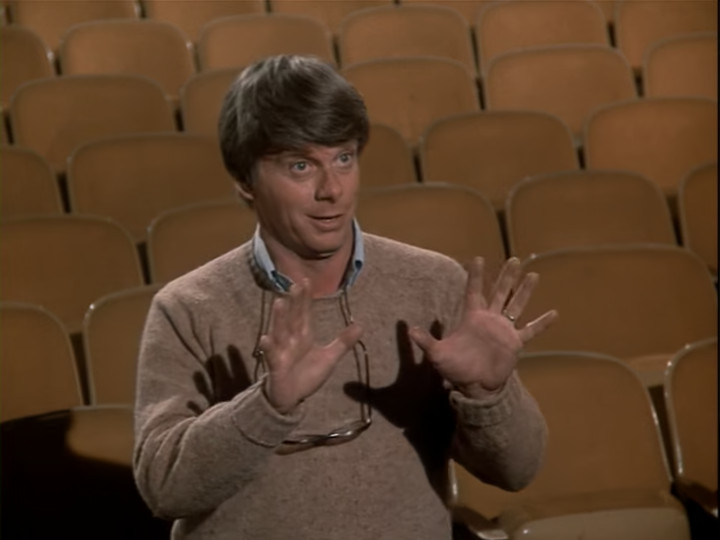
“I only know what I see, and it’s just laying there,” he says.
After this, backstage, Barry asks Rita if she wants him to fire the director, but Rita says no. Unfortunately, he’s the best there is. She does wish he’d be less hard on Patti. Rita’s not so sure about trying to make a comeback at her age, but Patti is terrific and she’ll do anything to help her career.
Later that night Jessica arrives and Grady meets her. He introduces his latest girlfriend, Kate Metcalf.
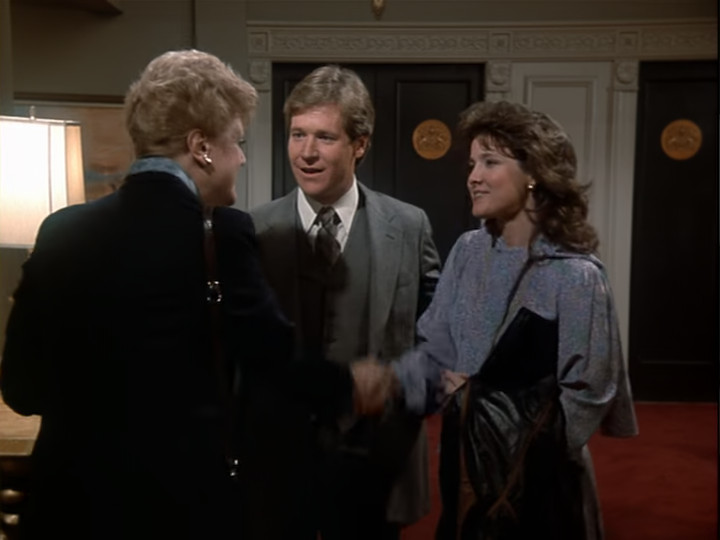
She’s Patti’s understudy.
Grady then ropes Jessica into going to a celebration dinner with Rita Bristol and the other important cast and production people. In fact, the dinner involves almost every character that will be in this episode, though we haven’t officially met them all yet. The setting is a fancy Italian restaurant, or at least I assume that it is since the waiter has a thick Italian accent.

I believe the photos on the wall are supposed to be of movie and Broadway stars. We then meet the man financing the play, Si Parrish:

Investment banking was becoming a bit of a bore, so he decided to get into theater.
Then, at the mention of Jessica being a writer, we meet the two writers of the play:
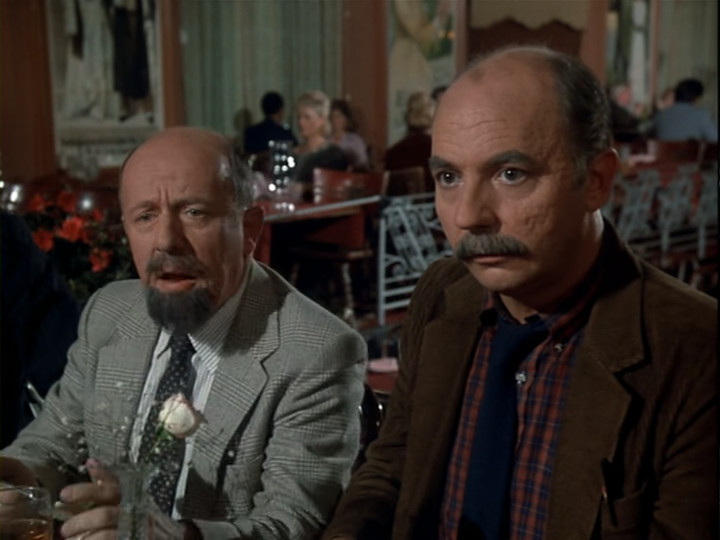
(They are worried that Jessica is being brought on to replace them.)
There’s a bit of back and forth in which Si thinks Jessica writes romance novels and Rita corrects him. I’m not sure if this is meant for humor or as a sneaky way of reminding viewers that Jessica is a mystery writer and hence why the title of the show is what it is. You’d expect people to know by now, but TV was always on the lookout for new viewers, who had no choice but to start in media res.
Barry then makes a speech in which he praises his mother and raises a toast to his sister. (The director conspicuously doesn’t raise his glass.) He also adds a small announcement, that Si is so confident in the show that they’re not going to try it out in Boston, they start Broadway previews in two weeks. The director rolls his eyes and Si, sotto voce, tells him to keep his negativity to himself.
Outside the restaurant, after dinner, Si offers Jessica a ride home, which she accepts. He also offers a ride to Barry and Patti, but Barry declines, saying that his car is only a block away.
As Barry and Patti go into an alleyway to get to the parking garage, a man jumps out.
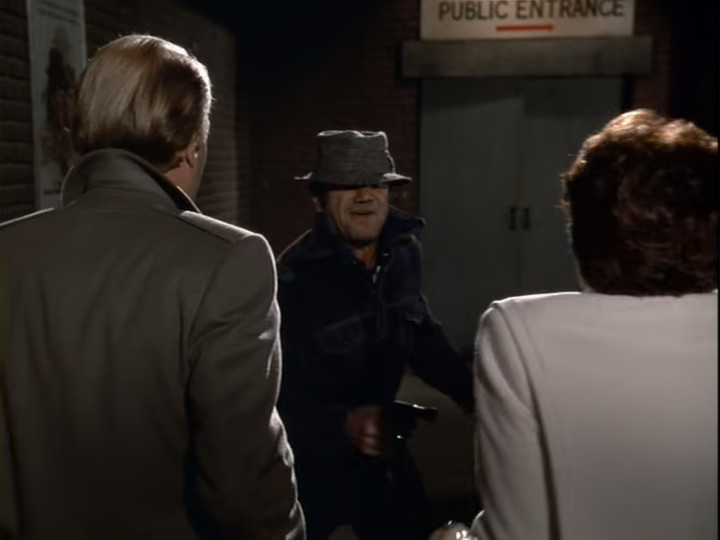
“Your Money and your jewels, lady, fast!” he says.
Before either of them can react, he shoots Patti, who falls down.
Barry looks at Patti for a moment, then pulls his own gun and shoots the man, who crumples to a heap on the ground. As Barry cradles his sister in his arms, a crowd gathers, we fade to black, and go to commercial.
Here’s a commercial you might have seen, had you been watching the episode back in 1985:
When we come back from commercial, Barry is at the police station, on the phone with his mother , to whom he says that he’ll be there as soon as bail can be arranged.
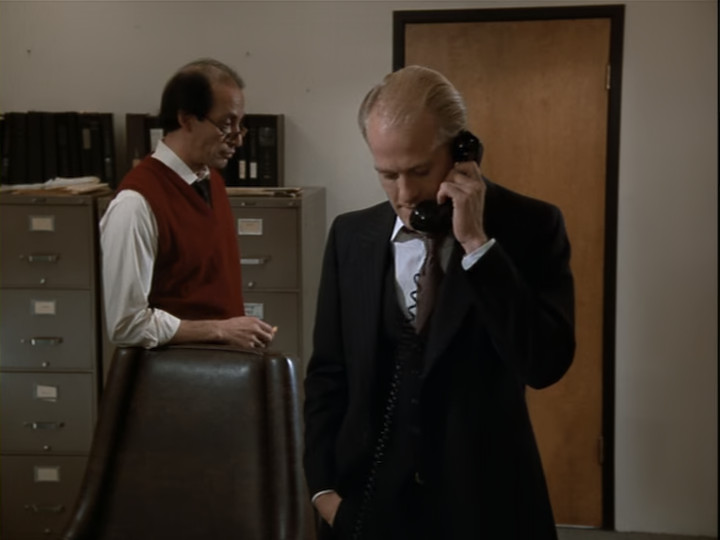
The detective is Sgt. Moreno. Barry then conveys the news that the bullet nicked Patti’s spine and they don’t know if there will be permanent damage, or even if she’ll live. Barry is in trouble for using a concealed firearm to kill the guy who shot his sister. The Sgt. tells him that had he used the bad guy’s weapon, or even his bare hands, he’d have gotten a pat on the back, but the concealed firearm is a problem. Though the Sergeant does, personally, consider him a hero. (Barry explains he bought the gun after being mugged three times in the last 8 months.)
For context, this was during the NYC crime wave of the 1960s and 1970s which carried through the 1980s. (It began reversing in the early 1990s.) This was part of a broader trend in violent crime which gave us action figures like Dirty Harry.
A uniformed officer brings Sgt. Moreno a piece of paper, which he looks at, then tells Barry that he’s free to go, as the DA knows where to find him if he wants to file charges. Barry thanks him, but he replies, “No, thank you. You gave me one less bum to worry about.”
The scene then shifts to Jessica’ hotel room, where Grady is reading a news story about the shooting.

I find it interesting that this was just a story on the inside of the paper. I suppose that even Murder, She Wrote couldn’t pretend that in New York City of the 1980s a mugging would be front-page news.
Grady is also watching a news show about it, in which a strange man who had been preaching on the street next to the alley is being interviewed by the news.
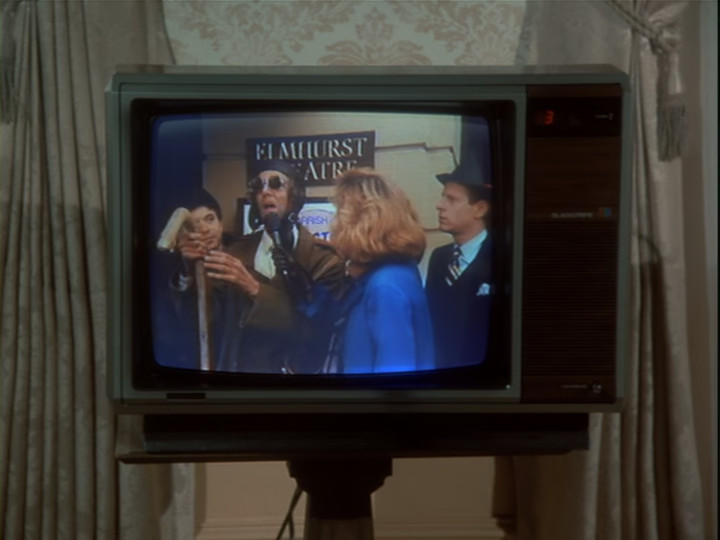
He mentions two facts which catch Jessica’s attention. The first is that the shooting started immediately, and that a three-card monty dealer was even closer and took off like a flash when the shooting started. We hear that Patti remains in critical condition and that the drifter has been identified as “Manny Farkus.”
Jessica is bothered by what the strange man said. If it’s true, Patti was shot before either she or her brother had a chance to do anything (which we in fact did see was true). Which suggests that the motive wasn’t her money or jewelry.
Jessica then goes to the police station where she harangues Sgt. Moreno about the case. He’s unmoved, though, so Jessica says that she’ll do the investigation herself.
Incidentally, we’re shown the piles of paper on his desk to convey how busy he is:

It’s a nice touch that his nameplate is all but hidden.
Also interesting is that he quotes statistics at her to disprove her assassination theory; eleven people were shot yesterday, which is the number who are supposed to be shot each day. It really drives home the context of the crime wave.
This takes the form of Jessica visiting Rita Bristol. It seems that Jessica was invited because Rita could really use company. Jessica is willing to lend a sympathetic ear, but she’s surprised Rita wouldn’t prefer a friend. Rita explains that the funny thing about stardom is that, when your star fades, you discover how few friends you actually have. And she had fallen into alcoholism, which didn’t help. The few friends who didn’t disappear she chased off. She also lost two marriages and almost drove her children away until she became sober, seventeen years ago.
She breaks down crying about Patti and Jessica comforts her.
We then cut to Jessica finding the guy who does three card monty outside of the alleyway. She does this by finding a woman who plays three card Monty, who Jessica is sure knows the guy for reasons not explained to us. She takes out a $100 bill, rips it in half, and gives it to the woman, telling her that she’ll give the guy she’s looking for the other half, and what they decide to do with their halves is up to them.

Jessica walks off looking very self-satisfied.
It works, because the next seen is of her talking to the three card monty player at some street restaurant.

He confirms that the mugger shot immediately after demanding money and jewels but before giving her any time to comply. This strikes him as very amateurish, since it would involve wasting time to have to rifle through her pockets for the stuff to steal after having drawn attention to himself with the gunshot.
Back at police headquarters, Jessica harangues Sgt. Moreno some more, and he gives her the file on Manny Farkus.
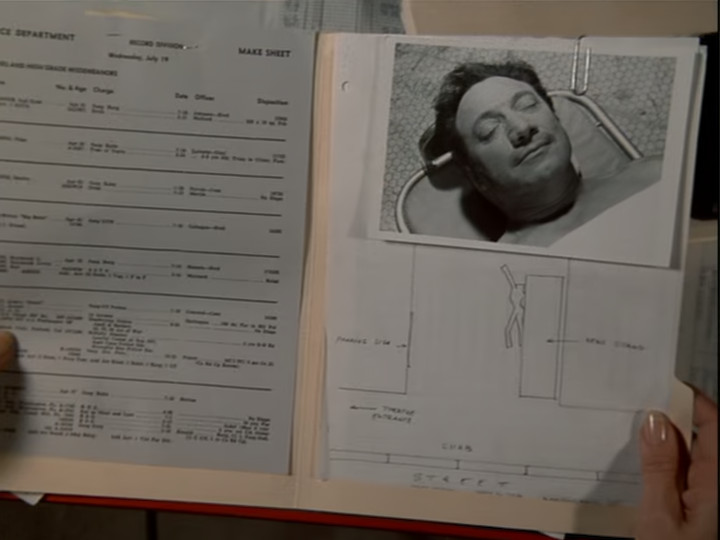
He had no known address and his fingerprints were not on file with the FBI. There was no possible connection with Patti Bristol. Sgt. Moreno thinks that the three card monty guy was right: he was just an amateur mugger. And on that bombshell, we fade to black and go to commercial.
We come back from commercial at the hospital, where Jessica and Rita are going to visit Patti. They’re met in the hallway by a doctor in scrubs who jumps straight to giving her the news that Patti is going to make a full recovery—there will be no paralysis. Rita is overjoyed and goes to see her daughter.
We then cut to Barry, on stage, giving a speech to the cast and crew thanking them for their effort and hoping that they’ll all be able to work again some day. Right as this concludes the director comes in with the famous actress, Lonnie Valerian.
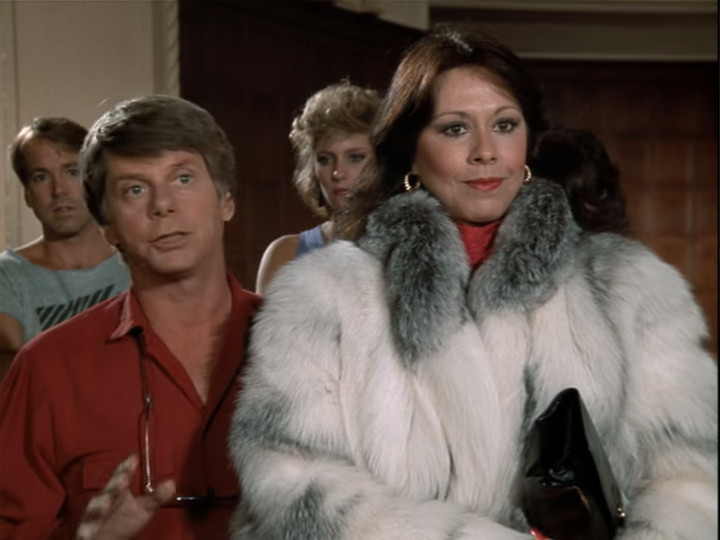
She’s willing to take over Patti’s role. Barry’s none too happy at this, but at Si’s request says that he will ask his mother if she’s willing to do it.
Back at Grady’s apartment, Jessica tells him and Kate that Patti’s first words to her mother were, “Mom, I want you to go on.” The conversation over dinner includes Grady mentioning that it seemed like the director had been planning to replace Patti for weeks. (Lonnie, in expressing her willingness to take the part, mentioned the lyrics to a song that had been cut two weeks before.)
Conversation then turns to the shooting of Patti, and Jessica just can’t get it go. Right when she admits that there’s no connection between Manny Farkus and anyone in the play, she sees him on TV.
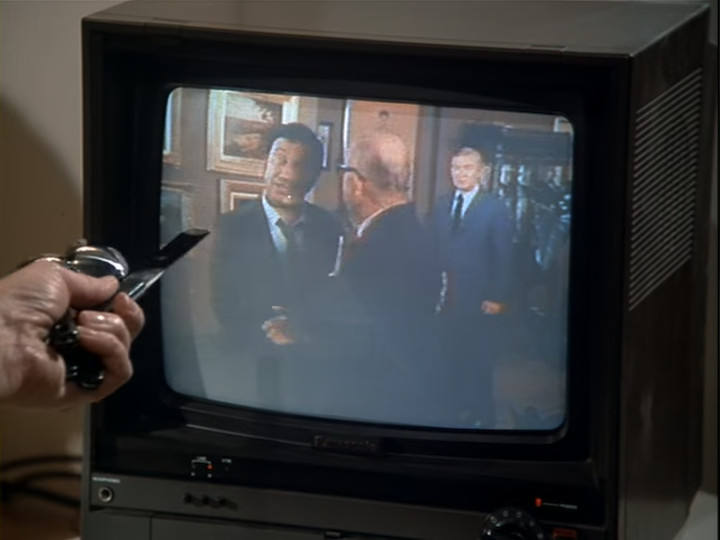
To make sure we believe her, the camera zooms in on the TV, with a much clearer shot of him:
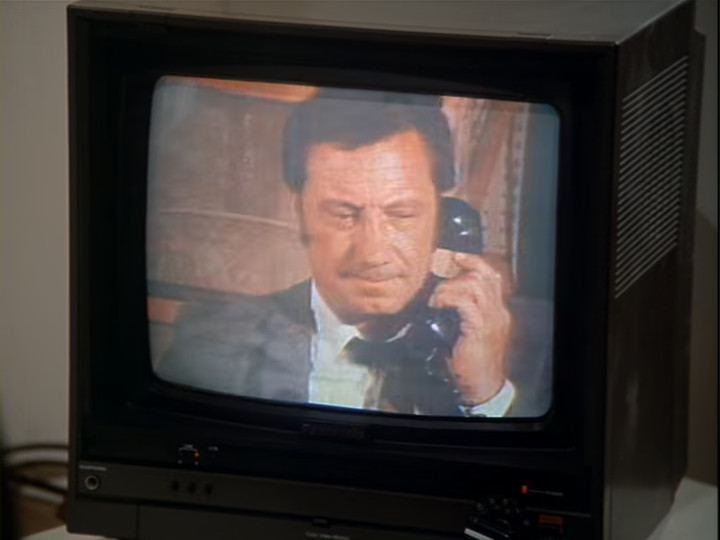
It’s interesting that they gave us two different shots, one where it’s harder for us to see but Jessica identifies him, and one where it’s quite clear that Jessica is right. This might be a technique for making us more impressed with Jessica, since she can spot the clue before we can, and we’re given immediate confirmation that she’s right in order to cement the impression.
Anyway, she goes and rents a tape of the movie and brings it to Sgt. Moreno. The movie was made fourteen years ago. He was credited as Morley Farmer, but of course that’s a stage name. The Screen Actor’s Guild gave Jessica the name of Morley’s agent. Sgt. Moreno refuses to follow this up—he’s too busy and as far as he’s concerned the case is closed—so Jessica vows to investigate herself.
Jessica meets Morley Farmer’s agent, Lew Feldman, who is played by the inimitable Milton Berle.

He last saw Morley two years ago. Like a lot of Lew’s clients his ability to get work was spotty, especially since the Catskills dried up. (The Catskills are a mountain range in southern New York, contiguous with the Poconos in eastern Pennsylvania; before air conditioning was common, people from NYC would often go to resorts in the Catskills and Poconos for the summer to escape the heat and accompanying spread of disease. This resulted in a ton of seasonal work for entertainers.)
Morley was mostly a failure as an actor. The last thing Lew saw of him was in an off-off broadway one-man act that Morley wrote for himself, which was the worst thing that Lew had ever seen. He’s confident that Morley never met Patti Bristol; the Bristols are a class act and Morley was a schlepper who failed at everything he tried. Jessica asks for a list of Morley’s credits and Lew says that will take a few hours, but he’ll get it for her.
Lew then gives Jessica the last address that he had for Morley, and Jessica goes to investigate.
While she does, the scene shifts to the stage where rehearsals are taking place. Rita is unhappy at how Patti’s part has grown considerably now that it’s not Patti’s part, and she lashes into the director for the way he clearly wanted to get rid of Patti. She points out that he and Lonnie Valerian got lucky with Patti getting shot. She asks if his plan had been to make Patti so miserable she dropped out? After storming off, Barry says that he’s pulling his mother out of the production and a big argument ensues with the director. After the director points out that Barry was riding his mother’s coat-tails just as much as his sister—he didn’t get on-broadway on his own abilities as a producer—Barry punches him. As he walks off, Grady tries to talk to him about Si Parrish, and that there seems to be a problem.
The scene shifts to Jessica and Grady in a horse-drawn cab in central park.
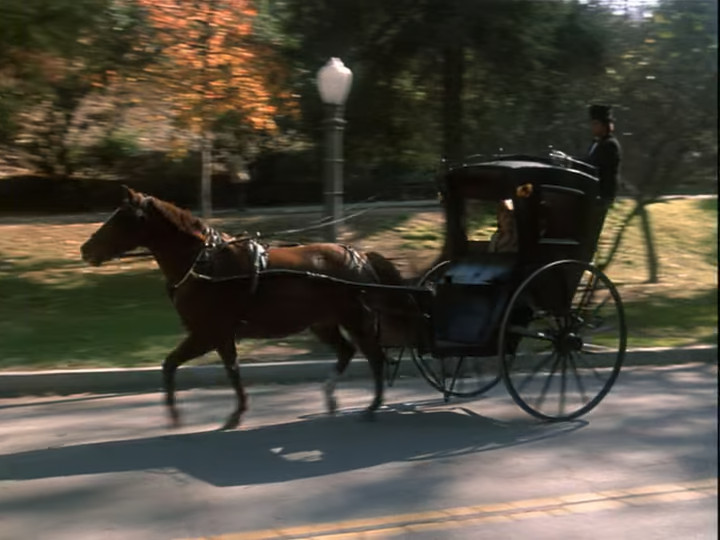
This is kind of a strange place to have a conversation, but I suppose that there is, at least, little danger of being overheard. I can’t help but wonder if this is a deliberate reference to Sherlock Holmes, since the hansom cab is Holmes’ most iconic form of transportation.
Anyway, this morning when Grady when to get the books from Si Parrish for the weekly audit, he grabbed some papers he probably wasn’t supposed to. It looks like Si Parish has double-sold the show, meaning that he will be out an enormous amount of money if the show is a success but will pocket the extra money if the show is a flop. Jessica can’t believe it, since Si Parrish seems like such a gentleman, but in any event this gives him a whopping good motive to have Patti shot.
That night, Grady drives Jessica to the address that Lew gave her for Morley Farmer.

There are two things interesting in this shot. The first is the location, which actually looks quite nice except for the poor illumination and the poster boards with writing on them. I think that this is meant to be a very bad neighborhood.
The other interesting thing is Grady’s car. Grady is normally shown as a a struggling young man, if a skilled accountant, and it’s very unclear how he would own a red convertible sports car. To say nothing why he would own it—that hardly seems like his personality, except perhaps that he does like to try to impress women.
And for once, Jessica doesn’t go into a dangerous place alone. (Grady goes with her.)

The woman—no idea who she is—is astounded by the idea that Morley had mugged someone. According to her, he had just run into an “angel.” That is, into some idiot who said he was about to come into a lot of money and that he’d produce Morley’s movie. She has no idea who it was, but the money guy was going to let Morley direct and play the lead. Jessica takes alarm at this and they leave. She sends Grady to wait at Lew Feldman’s table at the restaurant until Lew gives him all of Morley’s credits, while she takes a cab to go check on Rita Bristol, who she believes is in a great deal of danger.
At Rita’s place the doorman lets Jessica in after smelling gas they find Rita on the floor of the kitchen.
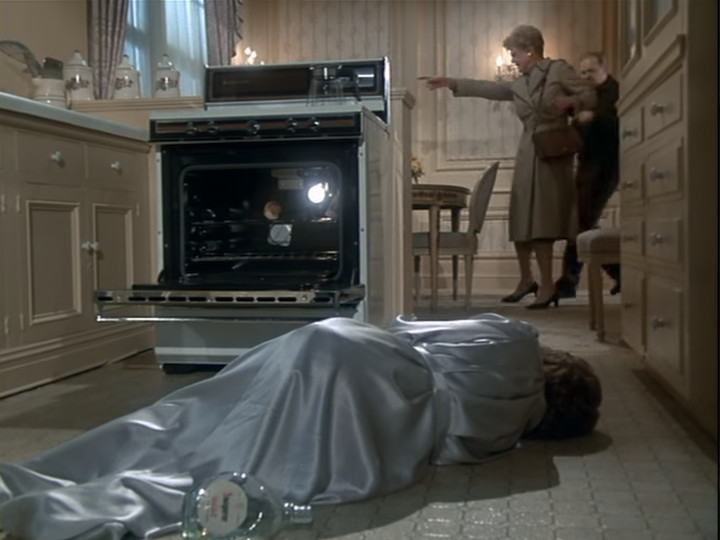
I really want to know who designed her kitchen; a free standing oven like that in front of cabinets whose doors are too close to be able to open all the way seems extremely impractical. As the doorman opens the windows, Jessica turns off the gas then bends down and takes Rita’s pulse, after which she notices an empty pill bottle next to her. After saying oh dear, we get a panning shot.

This is a very strange kitchen; as far as I can tell it has no sink. Anyway, we then fade to black and go to commercial.
When we come back from commercial, we see an ambulance driving on the street, its sirens flashing, then we cut to the hospital where most of the major characters in the episode are waiting in a hallway.

I wouldn’t normally include this screenshot, but the framing is interesting. It’s a sort of tableau of the characters, only two of whom does it make sense to be here. And i f it makes no sense for the director to be here, it makes even less sense for Lonnie Valerian to be here. This may be related to catching people up after several minutes of commercials, or possibly to making people who just switched channels feel a little more like they know the characters. Or perhaps it’s just to visually convey how important whatever is going on is, for both aforementioned groups of people.
Anyway, Grady walks in and sits down next to Jessica. Rita’s not in good condition, but apparently she’s at least not dead. Si starts asking the director if he knows anyone who can replace Rita if worse comes to worst. Barry takes offense at this and Si defensively says that he’s concerned for the actors and chorus people. Jessica then whispers to Grady that he was right; Si needs the show to start or he’ll have to give back the investor’s money. I’m not sure if that’s true, but it at least does tend to exonerate Si, since trying to kill your two leading ladies isn’t conducive to a play opening. It would have been much better for him to kill them after opening night.
Jessica adds that Si Parrish doesn’t have the money; Jessica’s “tedious attorneys” play squash with Si Parrish’s “tedious attorneys” and the word on the squash court is that Si made a number of disastrous investments lately.
The doctor then comes out and says that Rita’s vital signs have stabilized for the moment, but gas, alcohol and barbiturates are a bad combination and it could go either way. He suggests that they go wait downstairs, grab a cup of coffee, and he’ll let them know the moment that there’s any change.
Jessica then asks Grady for the list of credits for Morley Farmer from Lew, which Grady hands her:
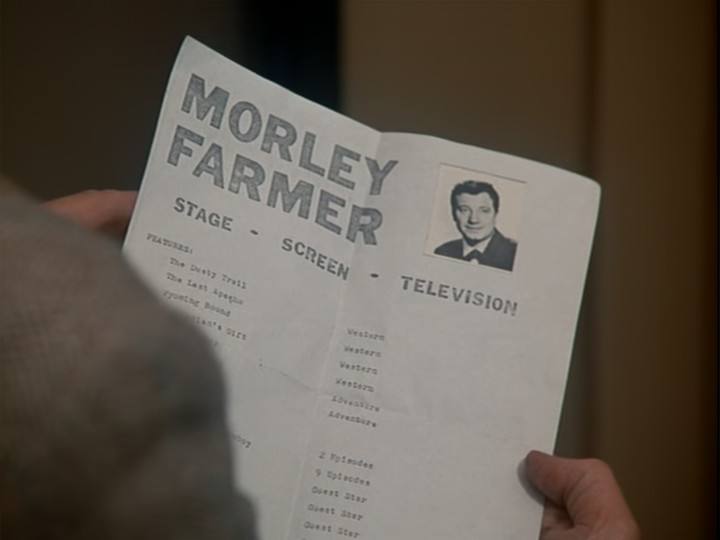
We don’t get to see the whole sheet, but Morley hardly seems like a complete failure. In the part I can read, he was in two episodes of one show, nine episodes of another, and was a guest star in a bunch of others. That’s better than many of the actors with bit parts in Murder, She Wrote episodes—the actors, I mean, not characters.
I also find it curious that this is an official-looking document and not a bunch of names scribbled on a napkin. Perhaps an agent keeps this kind of sheet for his clients to give to people who might want to cast him. Anyway, Jessica seems to recognize something from it, and we cut to the waiting room where all of the characters in the hallway, except Jessica, are. Various people say things either of blaming themselves or comfort, then Jessica comes in. Almost immediately, Barry is called to intensive care.
The scene then shifts to Rita’s apartment, where Jessica is pouring Barry coffee and he is saying that he can’t believe it. They make some small talk until Jessica starts saying (in an accusatory voice) that Rita didn’t kill herself. She always kept a coffee pot going, but when Jessica found her the coffee pot was empty and cleaned. She believes it had been laced with a strong sedative to knock Rita out. Then “alcohol was forced into her system” and the gas jets were opened. (Jessica doesn’t elaborate on how you force alcohol into the system of an unconscious person, so I suppose we are supposed to assume it’s not just possible, but practical.) Jessica then converts the accusatory tone into an outright accusation.
To that, she adds an accusation of trying to kill Patti. It was about the money. He not only wanted his mother’s money, but he wanted all of it.
When Barry denies this, Jessica starts imitating Rita Bristol, asking Barry why he’s lying to her. She reminds him of when he was a production assistant 12 years ago on Guns Over Abilene, in which Morley Farmer acted. He also worked with Farmer two years ago, “on location in Colorado.”
She keeps pestering him with facts and assertions, doing her best nagging-mother/Rita-Bristol impression, and Barry starts to forget who he’s talking to, shouting, “You can’t do this! You can’t spoil everything for me! Not anymore.” With some more nagging, he smashes the things on the mantle.
He then stares at the picture of his mother in her heyday up above the mantle.

He slowly says, “I can’t remember when I didn’t want to see her dead.”
Jessica asks if it was lucky that the director brought in Lonnie Valerian, and Barry agrees that it was.
Barry then tries to explain himself. “Do you have any idea what it was like, to be Rita Bristol’s little boy? To have a self-involved, penny-pinching lush for a mother? She never gave a damn about me. She hardly even admitted that I was alive.”
This goes on for a bit; Jessica doesn’t believe him and he explains further what a terrible mother Rita was. Finally he grabs Jessica and makes as if to throw her off of the balcony.
He’s interrupted by Rita calling his name from a door to the bedroom that just opened.
Pretending that she was dead was Jessica’s idea; the doctor cooperated and Rita was so, so sure that Jessica was wrong. He slumps and cries on her shoulder while she apologizes that he never knew how much she loved him. We then cut to the play on the stage with mother and daughter singing.

Grady is backstage and on the phone with Jessica. He holds it out so she can hear the music and singing. Jessica, back in Cabot Cove, says that it’s marvelous.
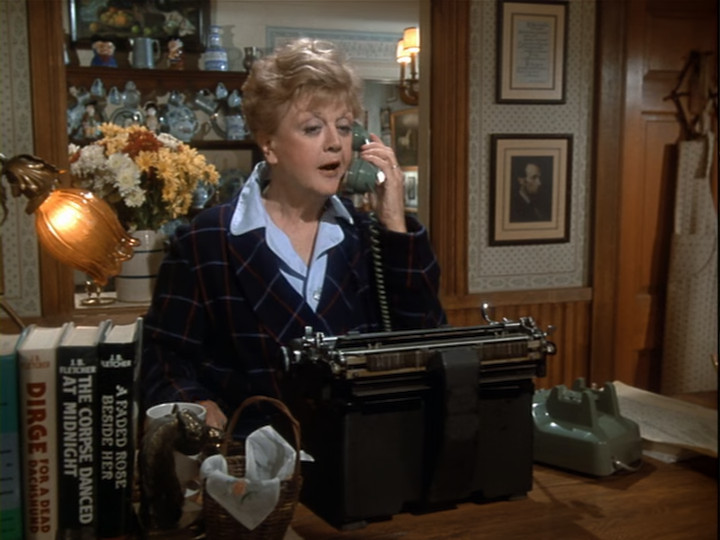
The set decoration here is interesting. Jessica has her phone immediately next to her typewriter, I believe in her kitchen, and on the desk she has her own books, though with the spines faced away from her. I presume that was for the audience’s sake, but in broadcast quality I don’t know that many people would have been able to read the spines; we can barely read them in DVD-quality.
According to Grady the show is fabulous and is going to be a huge success. Jessica observes that this is going to be big trouble for Si Parish, and Grady agrees, saying that the DA has been talking to him since 10am.
Jessica asks how Kate is doing and Grady says that there’s not much to tell. She ran off with some TV weatherman from Pittsburgh. Jessica expresses her sympathy and Grady tells her to not worry about it. She was OK; they didn’t have much in common. “But wait till you meet Francesca. Aunt Jess, she’s beyond belief.”
When Grady asks how soon Jessica can get down to New York City, she laughs and we go to credits.

This is an interesting episode. It leans very hard into the nostalgia that Murder, She Wrote was often known for. The washed up actress making a successful comeback is also very much in the dominant theme of Murder, She Wrote: that old things are still valuable.
The plot is quite solid in this one, possibly at the expense of the murderer being relatively obvious. Once it was established that Si Parrish desperately wanted the play to open (then fail) he was eliminated as a suspect. Aside from Barry, the only other person with a motive was the director. (Though if you really want to stretch things there was also Lonnie Valerian. Since she’s established as a highly successful actress, this seems too slim a motive, even for Murder, She Wrote.) And they could have gone in the direction of the director being the murderer, at least until the attempt on Rita’s life. That said, he wasn’t nearly so good a suspect. In particular, he had no plausible control over Barry and Patti going down that alleyway. (This could be worked around if it was obvious that they would, but that would really need to have been established as a pattern and that would require the mugging to have happened after a rehearsal.) Barry, by contrast, had complete control over where they would go after the dinner.
I don’t think that it was painfully obvious that it was Barry, though, and it’s a bonus that, at the end of the episode, it feels like there was only one possible suspect. I think that the actor did a good job of looking distraught over the things happening to his mother and sister, which was a good bit of misdirection. I think it also helped that the connection between Barry and Morley Farmer was obscured until the end. This does bring up some issues with fair play, but they’re not huge.
There were a few loose ends in this episode, but they were pretty minor. The main loose end, I think, is where the name “Manny Farkus” came from. Jessica said that the name “Morley Farmer” was a stage name, but it was used consistently by Morley’s agent as well as the people who knew him in the building where he lived. I almost wonder if this wasn’t more about having some name by which people could refer to him in the episode rather than being any kind of plot point. The names “Morley Farmer” and “Manny Farkus” sound similar enough that the audience might easily confuse them, and “Manny Farkus” is dropped as soon as the name “Morley Farmer” is introduced. As I said, this is a pretty minor point, though it would also have been easy enough to have fixed it.
The other loose end would have been how Barry convinced Morley Farmer to murder his sister. We’re given enough to figure it out—Barry told Morley that he would come into the money if he got rid of his sister—but it does feel a little at odds with what little of Morley’s character we’re given and a few lines about how he persuaded Morley would have been nice.
Despite this, I think my judgement is that this is a merely average episode of Murder, She Wrote. It works. It is entertaining. But it doesn’t grab one.
I think this is because there are no stand-out characters. This may be a personal quirk, of course. I don’t generally find show-business people to be sympathetic characters. Further, I generally don’t find people whose children turned out terrible to be sympathetic characters. Don’t get me wrong; children are their own people and make their own choices for which they are responsible. One bad child is easily chalked up to a personal choice. All of the children turning out bad seems… unlikely to be in spite of good parenting. Especially when the parent is known to have been a bad parent.
I do like the character of Grady Fletcher, but he’s not much in this episode and isn’t enough to redeem it. (And Grady is generally given some grating personality characteristics, too, which are a big too on-display for my taste.)
The one non-showbiz character (other than Grady) which we’re given is Sergeant Moreno, but he’s mostly just in the episode as comic relief and to provide a few bits of exposition. Still, it’s a decent enough mystery.
Next week, we’re in New Orleans for Murder to a Jazz Beat.
Discover more from Chris Lansdown
Subscribe to get the latest posts sent to your email.
 Chris Lansdown
Pingback: Murder She Wrote: Capitol Offense – Chris Lansdown
Pingback: Murder She Wrote: Murder To A Jazz Beat – Chris Lansdown
The Catskills are in New York State, not eastern Pennsylvania. The mountain range which is in eastern Pennsylvania is the Poconos. Insert obligatory apology for being so pedantic here lol.
LikeLike
Thanks! I’ve corrected the text.
I’ve actually been to the Catskills and never been to the Poconos, so I’m not sure how I made that mistake. 🙂
LikeLike