
On the thirtieth day of December in the year of our Lord 1984, the eighth episode in the first season of Murder, She Wrote aired. Called Death Casts a Spell, it is set in a resort on the shores of Lake Tahoe. (Last week’s episode was Death Takes Curtain Call.)

After some introductory shots of what could be Las Vegas if, like me, you have to look up Lake Tahoe to know what it’s about, we meet one of the main characters of the episode, The Amazing Cagliostro. His first line is, “Ladies and Gentlemen, observe the power of hypnosis!” He is a stage hypnotist, and has his volunteers pretend to be their favorite animals after he claps his hands. The volunteers do so with great enthusiasm.
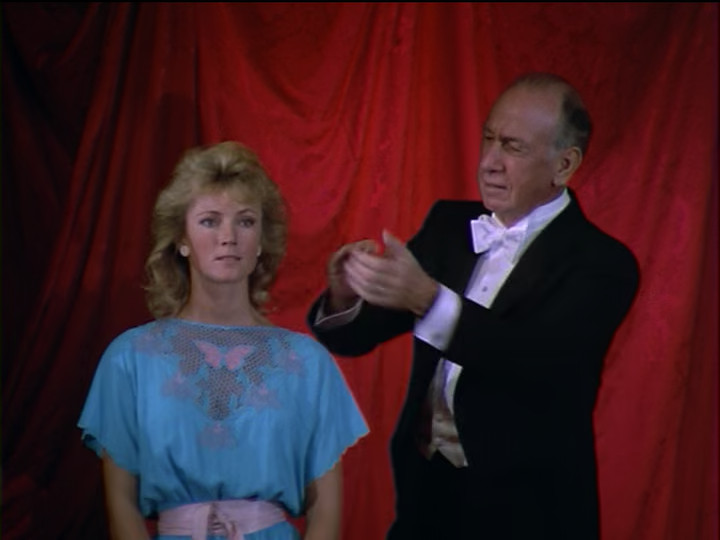
The young lady pictured pretends to be a chicken, while a woman standing next to her pretends to be an elephant, using one arm to represent its trunk.
Hypnotism is an interesting subject about which a great deal can be said, but to keep things brief, and oversimplifying: hypnosis was developed by the Scottish doctor James Braid in the mid-1800s (inspired by demonstrations from Mesmerists who claimed to have special magnetic powers). After much research he published a book called Neurypnology in which he described his research and called for others to take up research into the possible medical applications of hypnosis. I’m still not very clear on how hypnosis progressed in the public eye from there, but it seemed to have gotten a huge boost with the 1952 case of “Bridey Murphy,” where a Colorado woman under hypnosis “remembered” one of her past lives, when she was an Irish woman named Bridey Murphy. This was described in a popular book which was then made into a popular movie which inspired a bunch of horror movies using hypnosis to access past lives in various forms. Probably the best known of these was the 1957 movie I Was A Teenage Werewolf, starring Michael Landon. There was a great deal of interest in “paranormal activity” in the 1960s and 1970s and hypnosis certainly fit well enough in that category. (I can recall hypnosis showing up as the crux of a mystery at least once on Scooby Doo.)
I do not know when interest in hypnosis (as quasi-magic) waned, but I can’t remember it being talked about much in the 1990s and I suspect that Murder, She Wrote was on the tail end of the trend with this episode. Which makes sense, since its main demographic (older people, at least if you go by all the commercials that used to run with it for denture cream and term life insurance where there’s no physical and you can’t be turned down) tended to either catch trends later or else remember older trends like they were just yesterday.
Anyway, we then meet some more characters.
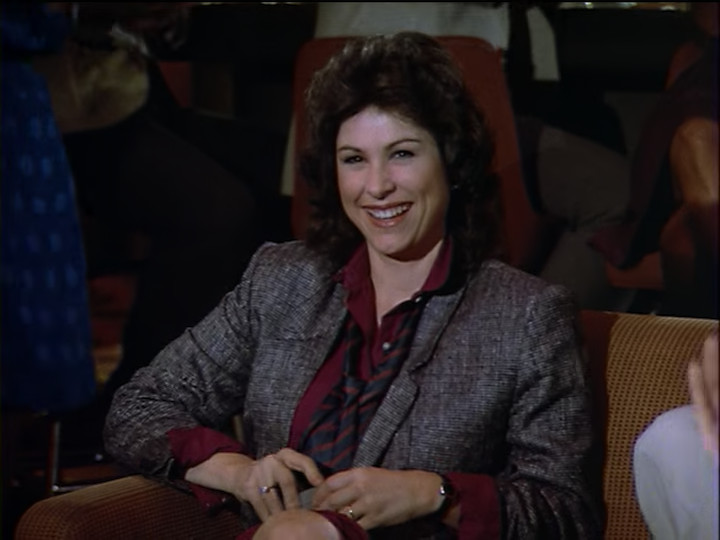
In the audience is Joan, who works for Jessica’s editor.
By the bar are two reporters:

Their names are Bud Michaels (on the left) and Andy Townsend (on the right). Bud thinks that Cagliostro is a “two bit fraud.” (According to an inflation calculator, that would make him a six bit fraud in 2024 dollars.)
We then meet two more characters:

His name is Joe Kellijian. Hers is Regina (they’re married). She’s explaining to him that the reason she’s having an affair with Cagliostro is that he’s controlling her with hypnosis. Joe doesn’t buy it, pointing out that hypnosis isn’t magic mind control and can’t make people do things they’re completely unwilling to do. She does admit that she’s attracted to Cagliostro but never intended to do anything about it. The idea that she’s attracted to Cagliostro strains credulity, but it’s not the most unrealistic thing they’ve done in Murder, She Wrote.
Anyway, Joe turns out to be the owner/manager of the hotel, and in the next scene he tells Cagliostro that this was his last night. Cagliostro points out that his contract entitles him to a million dollars over the next three years whether he performs or not. Joe thinks it’s worth it to get rid of him. Cagliostro says that this may cost him more than money, it may cost him “the fair Regina”. At this Joe attacks Cagliostro, but is stopped by Cagliostro’s bodyguard. I find it curious that Cagliostro has a bodyguard but Joe has no security staff. Joe swears “I will get you” to Cagliostro. I do not know whether Joe will get him, but I am quite confident at this point that Cagliostro is going to be killed. We’ve got at least two suspects established (Bud and Joe) and Jessica hasn’t even shown up.
That said, the very next thing that happens is that Jessica shows up at the front desk. She’s in room 1241, which has a lakeside view. They don’t need a credit card from her because they’ve arranged to bill her publisher. She asks for the room number of Miss Marilyn Dean, who is her editor. As the hotel clerk goes to look it up, Joan comes up to greet her, explaining that Marilyn won’t be there until the next day. She then takes Jessica over to the hotel restaurant, where it turns out that Joan lured Jessica over under false pretenses to suggest that Jessica write a book with Cagliostro as a character.
She doesn’t quite come out and say this; she pitches it as Marilyn’s idea and Jessica sees through her.

Joan comes clean and then starts to realize what a terrible idea this was. She even sent a telegram to the head of publishing company because she was so sure Jessica would love the idea she’d never considered what might happen if Jessica didn’t. Why she lured Jessica to an expensive lakeside resort to pitch an idea rather than just call her on the telephone, she is not asked and does not explain.
Jessica takes pity on her, though. Diana Canova, who played Joan, was thirty one at the time the episode aired but she plays the character as if she’s somewhere between twenty one and eleven, and Jessica’s soft spot for impetuous children takes hold. She tells Joan that she’ll stay the night, then the next day Joan can call up Mr. Winfield (the owner of the publishing company) and tell him that Jessica wasn’t interested. Joan is incredibly relieved, though I don’t particularly see how this is going to solve any of Joan’s problems because she’ll still need to give some explanation for why she spent the company’s money on flying Jessica out to a fancy hotel on Lake Tahoe without authorization. That’s not a minor thing.
Anyway, this conversation is broken up by Cagliostro coming into the hotel with his assistant and bodyguard. Oh, I should mention that somewhere in the conversation Joan slips in the background that Cagliostro came from England a few years ago, but no one knows anything about his past. Regina comes in and orders a drink from the bar. While she waits for it, Cagliostro motions to her to come sit next to him, but instead she leaves. Right after this Bud and Andy walk up and Bud says, in a loud drunken voice, that he’s still wait for an interview. Cagliostro says that he never gives interviews. Bud asks if this is because he has too many skeletons in his closet? What about Surrey Street? And when’s the last time he saw Reggie Downs? Cagliostro then threatens Bud with his bodyguard and Bud then blusters about how he and other reporters will eventually uncover the truth.
Cagliostro then makes Bud an offer. In his suite, in half an hour, he’ll give Bud every details of his past life, as well as any other journalists who wish to be there, providing that they can remember it—his one condition is that he will hypnotize them first. This will prove that Cagliostro is the world’s greatest hypnotist, as no other hypnotist can permanently prevent someone from remembering what they hear. And with that, Cagliostro leaves.
Joan is beside herself with excitement and says to Jessica, “What about that? You couldn’t write that scene if you tried!” Jessica agrees, though not, perhaps, in the spirit in which Joan meant it.

Joan then rushes off. Bud tells Andy that he’s not going, he’s going to go up to his room and pass out, but Andy is going. Bud tells him to “go round up some of the local boys and call his bluff.” He then staggers off.
As Cagliostro is entering his hotel room Joan rushes up and tells him that J.B. Fletcher is in the hotel. Cagliostro says that he’d be honored to have her attend and Joan is tickled pink. She promises that they’ll be there and rushes off to get Jessica.
Back in the hotel, Andy approaches Jessica and introduces herself. He tells Jessica he hopes that she’ll attend Cagliostro’s session but Jessica says that she won’t. She’s “going to go to bed the old fashioned way”. On her way to her hotel room she’s stopped by a woman playing slots who recognizes Jessica as “Nurse Beecham” from the show Doctors After Hours.

I think that the costume designer was told “turn the gaudy up to 11.” (Or would have been, had Spinal Tap not come out on December 2 of 1984, making it impossible to reference during the filming of this episode.) She’s trying to drag Jessica to meet the ladies of her bridge club who are at the craps table when Jessica thinks she spies a way out of this. She sees Andy walking to the elevator and calls his name. He doesn’t hear, though, and takes the elevator, Jessica’s chance of politely escaping going up with him. Jessica then notices that the woman has one of her books, all of which have a giant picture of Jessica on the back rather than a blurb about the book. Jessica shows it to her and insists that she is, in fact, J.B. Fletcher and wrote this book. The woman gets angry, declares she isn’t, and storms off. It’s an amusing scene, though I’m still finding the explicit comedy routines that you find int he first season a little jarring. It will be interesting to see when they get rid of them.
Joan then runs in and tells Jessica that they’re in. Jessica refuses, but Joan wins her over by saying, “as a writer, aren’t you the least bit curious?”
At Cagliostro’s room, where Jessica notably isn’t present, he begins. He hypnotizes the journalists present, testing that they are hypnotized by shoving down on each one’s outstretched arm.

Once he has verified that they are all hypnotized because they adequately resist, he tells them that they will only remember that he said important and revealing things about himself, but no details. He then tells them to lower their arms then begins his story. “Now, my story begins in a small flat in London, not far from Trafalgar Square, in 1972.”
Cagliostro has to be at least in his sixties (the actor, José Ferrer, was 72), so it’s a bit odd that his story starts a mere twelve years ago. If we conservatively place Cagliostro at 60, he would have been 48 when his story began. It doesn’t really matter, though, because we are not going to find out what his story was. At least not from him.
We cut to Jessica and Joan coming out of the elevator and running into the bodyguard who is standing outside. He apologizes but says that he couldn’t open the door if he wanted to because he doesn’t have the key. We then hear a loud crashing noise and the bodyguard becomes very concerned.
With excusably convenient timing (in a one-hour TV show) the hotel owner happens to show up in the elevator and asks what’s going on. When they explain, he uses his master key to open the door and they find out what happened.
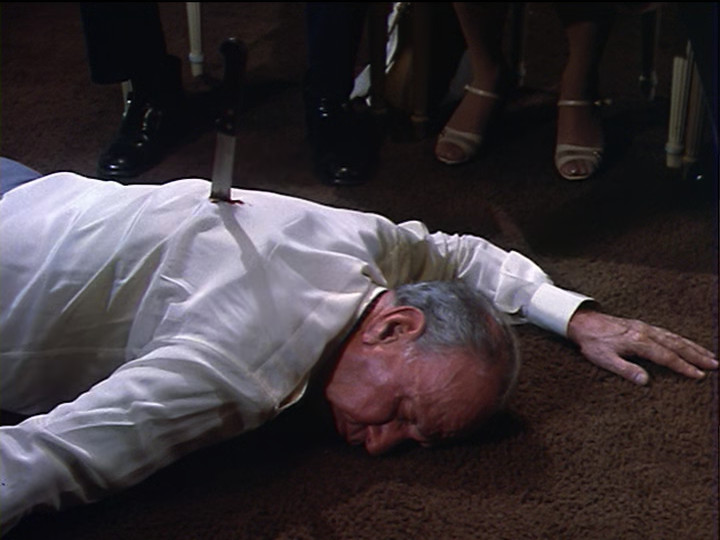
We then pan over the hypnotized journalists, Joan feints, we fade to black, and go to commercial.
Just for fun, here’s the kind of commercial you might have seen had you been watching when this was aired:
When we come back from commercial break, we see Cagliostro being zipped up in a body bag. Shortly after, we meet the detective in charge of the case, Lt. Bergkamp.

(Lt. Bergkamp is the one in the suit.) As they’re waiting for a psychologist to come bring the people out of hypnosis, Jessica comes in.
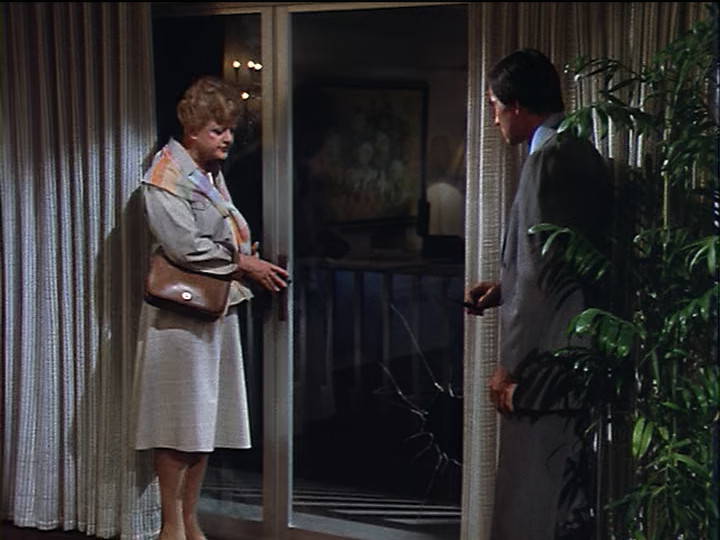
Jessica points out that it’s very odd that the glass is broken so far away from the door handle—too far away to do anyone on the outside any good. While the detective considers this the psychiatrist comes in and diagnoses the people as being under hypnosis. He’s got no ideas for how to bring them out of hypnosis, so Jessica suggests playing a tape of Cagliostro bringing people on stage out of hypnosis, and perhaps that would bring the witnesses out of hypnosis too.
I find it amusing that Murder, She Wrote is taking such a magical approach to hypnosis, as if it’s impossible to get someone out of the hypnotic state except by the person who put them into it. (Interestingly, in James Braid’s experiments, entering hypnosis wasn’t about a person’s voice at all, but rather about fixing the eyes on a slightly elevated place until exhaustion of some of the relevant nerves took place. He also found bringing people out of hypnosis to be no trouble at all.)
For those who weren’t alive in 1984 or don’t remember what the technology was like, here’s the device they used to play it back (it was the same device as had been used by Joan to record it):

This works and the journalists all wake up. They are confused, having no idea what happened or why the police are present, and Lt. Bergkamp tells them that the psychiatrist will explain everything to them if they’ll just follow him.
The next morning Joan catches up with Jessica, who is jogging in her track suit and neck towel.
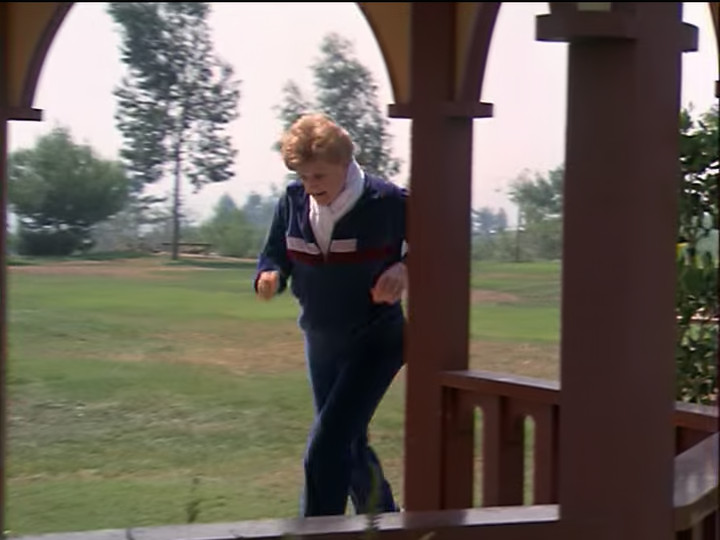
I can’t remember whether this was high fashion in the mid-1980s. I’m inclined to say that it was, but I was little at the time and have never been very fashion-minded. If I recall correctly, I had a shirt with similar horizontal stripes, though I remember this more from my mother showing me pictures than on my own.
They basically make small talk and it’s established that Jessica is interested and wants to investigate.
The scene then shifts to Dr. Yambert’s hotel. We get an establishing shot of his wall with his credential.

Yambert clarifies that the people did not have their memories erased, but blocked—by a powerful post-hypnotic suggestion. A memory lock, if you will.
His entire office is interesting, too:
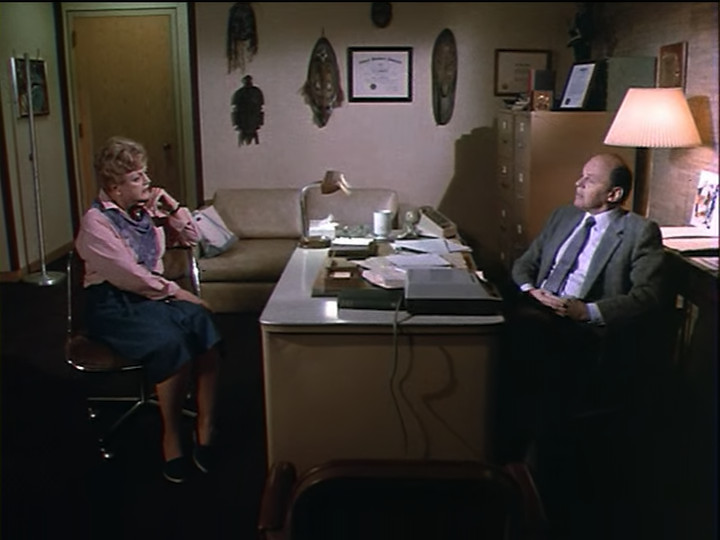
Jessica doesn’t seem to believe in hypnotism, and Yambert offers to hypnotise her, just as a demonstration. Interestingly, he has her close her eyes and listen to his voice to enter the hypnotic state, which is kind of backwards from Braid’s method. Anyway, this goes about how you’d expect if you’ve ever seen a scene of a person who doesn’t believe they can be hypnotized who then is. (If you haven’t, the person believes that they weren’t hypnotized, then is presented with the evidence that they were and is comedically embarrassed.)
In the next scene the bodyguard shows up at Regina’s room and says, “Now that he’s dead, we have a little matter of money to discuss.” And on that bombshell, we fade to black and go to commercial.
For variety, here’s a denture cream ad from 1984:
When we come back, we start with an establishing shot of beautiful Lake Tahoe.

These establishing shots don’t last long, but they’re actually quite important to the show. They help to give us a sense of being someplace special, which makes the rest of the episode work. Murder mysteries are always a little far fetched and being someplace special helps in making the suspension of disbelief easier.
These establishing shots did, of course, also give people a moment to rush back from the bathroom or the kitchen when the person still in the room would call out “it’s back on!”
After wandering through the Casino portion of the hotel a bit—Lake Tahoe straddles the border between California and Nevada and the resorts on the Nevada side feature lots of gambling—Jessica finds Andy. Jessica asks Andy about Bud Michaels—he was visibly intoxicated. Andy said that it was weird, because Bud drinks like a fish but normally never shows it, and last night he was drunk after a couple of shots.
Andy thinks that Bud was faking it in order to give Andy a shot at a big story, the way that Andy’s father used to do for Bud (presumably the giving Bud a shot at a big story, not faking being drunk).
Jessica then visits the scene of the crime where people are making an enormous amount of noise while they do something or other to the walls. Lt. Bergkamp is upset that he heard about Jessica’s book from Joan, and Jessica assures him that the book is a figment of Joan’s imagination, though if she was going to write one he wouldn’t come off like a fool since she thinks he’s doing a fine job under the circumstances. This placates Bergkamp, who then talks about the case.
They have one lead, the hotel owner. Jessica agrees he’s got a great motive but it will be nearly impossible to explain him getting off of the elevator only seconds after she and Joan and the bodyguard heard the glass break. (Oddly, Jessica knows about the affair between Regina and Cagliostro and the owner’s public threats against Cagliostro.) When Bergkamp suggests the owner had an accomplice, Jessica raises the question of how the accomplice could have gotten out of the room, as the balcony seems like the only way to do that, and that doesn’t seem very possible.
After a scene in which Bud tells Andy to stop talking to Jessica because Bud wants to solve the crime, Jessica goes to see Cagliostro’s assistant.
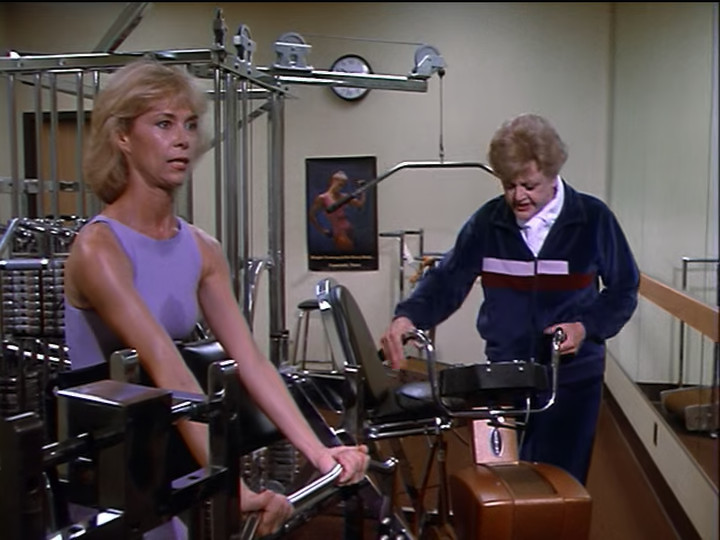
Her name is Sheri Diamond. Jessica grills her about Cagliostro, and Sheri doesn’t mind answering questions.
She explains the history between Cagliostro and Michaels. Back in London, Michaels was trying to prove that Cagliostro was using hypnosis for blackmail, but Cagliostro tricked Michaels into printing provable lies and then sued Michael’s “wire service” for libel, winning a large award. Then Michaels and his bureau chief were fired. We also find that she didn’t like Cagliostro but a job’s a job and this is better than where he found her—she was a stripper. “A daring young lady who took it all off on the flying trapeze”.
Though she describes it as a worse job than working for Cagliostro, she seems to remember it fondly as she admires her own figure in the mirror.

In the next scene Joan learns this too, by overhearing Andy talking to Sheri’s former employer on the phone, though she only hears the trapeze part, not the stripper part.
Jessica then goes to see Bud Michaels. Oddly, he’s sunning himself on a lounge chair while reading a newspaper. In the shade while wearing a full suit.
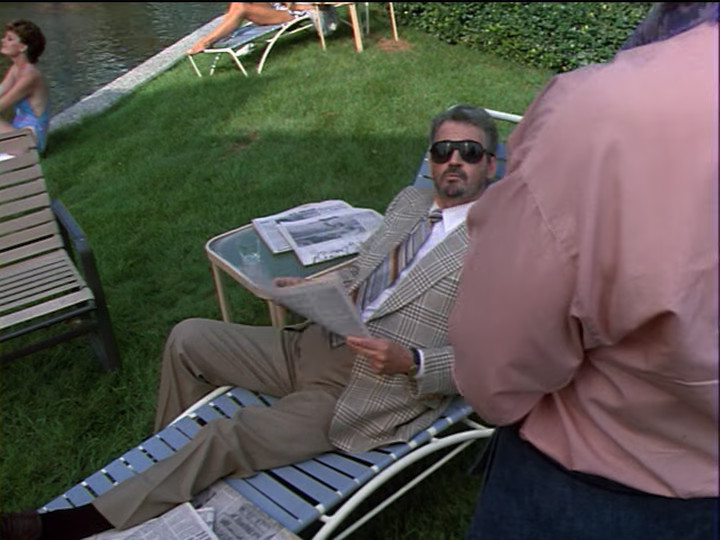
I have no idea what this is supposed to tell us about his character. He jokes that he allows himself one hour of fresh air a day and still has another fifteen minutes as Jessica sits down beside him.
Jessica asks him why he pretended to be drunk the night before and didn’t attend Cagliostro’s meeting. He laughs and says that he “knew it would be a sideshow” and didn’t want to lower himself to Cagliostro’s level. Jessica asks him if he had an alibi and he asks how he was supposed to get into the room. Then both of them have their attention attracted by something high up on the hotel building. The camera shows us the building, then zooms in.

Bud Michaels says, “I’ll be damned,” and Jessica then decides to go investigate.
Bud watches her go with that kind of face that’s meant to make us suspect him:

That said, if you’ve been watching Murder, She Wrote for any length of time, this is a major tip-off that he’s definitely not the murderer.
When Jessica gets to the top of the roof, Lt. Bergkamp is there with some men and a climbing apparatus which is presumably supporting the man who is rappelling down. Also, Joan is there for some reason.

Sheri then shows up because Joan invited her.
It then turns out that Sheri has a fear of heights and leaves. Which Joan misinterprets as guilt.
Jessica then points out that Sheri had no motive—she gained nothing but unemployment—and also it took several men a great deal of time to set up the “contraption”. How was Sheri supposed to have done that in the half hour between Cagliostro’s invitation and his death?
On the one hand, these are fair points. On the other hand, it hardly seems necessary to use such a giant machine to rappel down to Cagliostro’s balcony. On the third hand, without such a machine it would have been very hard to get back up again. On the fourth hand, she could have lowered herself to the ground after the murder, and collected the ropes (or whatever was left above) before anyone thought to check for them.
Jessica then runs into the owner of the hotel and accuses him of the crime in her usual passive-aggressive way and he replies that he didn’t need to kill Cagliostro to get back at him. He talked with his attorneys and they realized that there was a morals clause in the contract which meant that he could kick Cagliostro to the curb without paying him a cent. He also, for some reason, denies that his wife killed Cagliostro. (He says that they were together in a conjugal way right before he went up to Cagliostro’s suite.)
Later, when Jessica is talking with Joan, Jessica summarizes the problem: those inside didn’t have motives, and those with motives couldn’t get inside.
Joan excuses herself to go call a friend of a friend of a friend who may know something about Cagliostro’s bodyguard, and as she leaves Jessica then sees Regina looking extremely suspicious. Jessica asks a man on a motorcycle where to find a taxi and he says one will be around in a minute. Jessica says that will be too late because she wants to follow the cream-colored car. The man says, “like in the movies? Get on!” And he gives Jessica a ride.

This is the second bit of humor in the episode. I find it interesting to include two comedic sections, though this one mostly happens with scarier music. They follow at a distance and see the payoff from Regina to the bodyguard.
And on that bombshell, we go to commercial.
Here’s a Green Giant commercial which you might have seen, back in the day:
When we get back, Jessica confronts Regina in her hotel room. It’s quite a nice room.

I think this set decoration does a good job of establishing how rich and important Regina is. Anyway, Jessica got there under false pretenses—she told Regina she had proof of her husband’s innocence. When Jessica says that she saw the payoff to the bodyguard, Regina assumes that Jessica is blackmailing her too. There’s some discussion, but basically it turns out that Regina couldn’t get out of the affair with Cagliostro and offered the bodyguard a lot of money to kill Cagliostro. They had a meeting to discuss the details, which it turns out that the bodyguard had recorded.
Jessica then discusses the case with Lt. Bergkamp and Joan. When Jessica objects to Sheri has having no motive, Bergkamp says that when the bodyguard was nabbed at the state line with the money, he told them everything he knew and it turns out that Sheri was in love with Cagliostro but was “too available to be interesting.” Joan thinks this is a great concept, and Jessica replies that it might be a great concept for a book, but not a great case for a Jury. It’s too far-fetched.
Bergkamp then complains that he’s got no case in spite of having six eye-witnesses and five suspects. The witnesses, he adds, were intelligent, competent newspapermen but can’t say a word and might as well have been deaf, dumb, and blind.
At that, we get the music that indicates a clue just happened and Jessica gets a flash of insight. For some reason she has Bergkamp repeat the part about how the witnesses might as well have been deaf, dumb, and blind. Jessica then says, “that’s it! I think we may have found a way of solving our problem.”
In the next scene we see Joan drinking with Bud. Joan tells him that they’ve solved the case and he asks who did it. She begins to tell him about Sheri Diamond then we cut to Lt. Bergkamp asking Andy for his help, because they’ve narrowed it down to one suspect but don’t have conclusive evidence. Andy is willing to help but doesn’t remember anything. Bergkamp tells him that’s not it. They found a hypnotist who thinks he can break Cagliostro’s memory lock. He’ll need to put Andy “under.” Andy says that’s great and asks who did it. Bergkamp says that he can’t say; for Andy’s testimony to be valid he has to tell them.
They meet in Cagliostro’s room in twenty minutes, where the hypnotist then hypnotizes Andy and tells him that he remembers everything with crystal clarity, then asks Andy what happened the last time he was in this room. Andy says that he heard Calgiostro’s voice, then heard someone at the window. Then suddenly… and we see a flashback where Sheri comes in in a black outfit and stabs Cagliostro, then smashes the glass with a poker from the fireplace then leave.
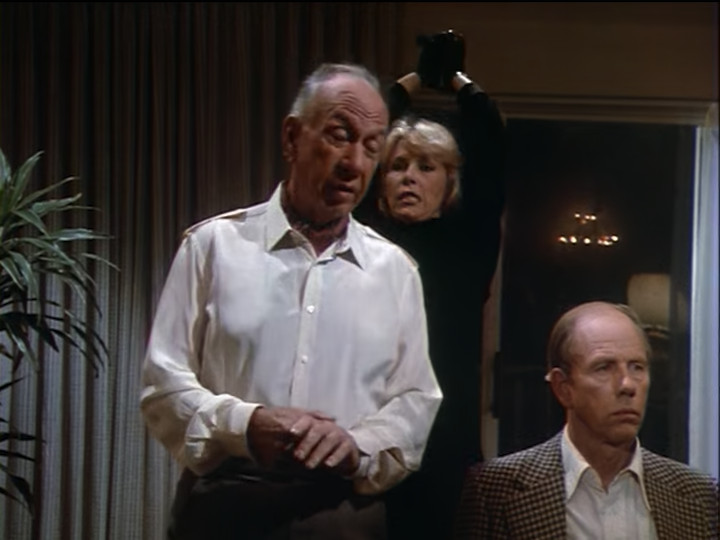
Lt. Bergkamp tells him to bring Andy out, as they’ve heard enough. The hypnotist tells him “when I snap my fingers, you will awaken and remember everything you’ve seen.”
Andy blinks and exclaims that he can remember everything that happened. It was Sheri and she escaped out that window!
Jessica then comes forward and says that it didn’t happen that way. They planted the story of Sheri with Bud Michaels since he would tell Andy about it. It couldn’t have been Sheri. After a severe fall last year, she’s been treated by a psychiatrist for a severe fear of heights.
Jessica then reveals that the hypnotist is Jake Callucci, the blackjack dealer from the casino nextdoor.
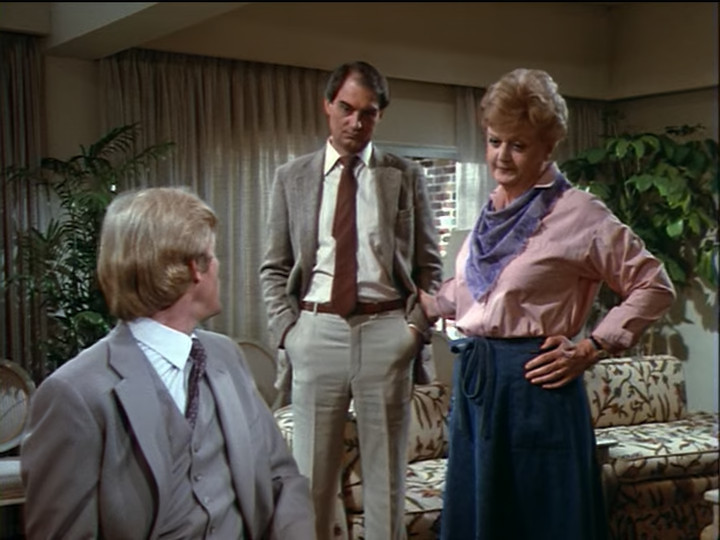
He doesn’t know the first thing about hypnosis. Dr. Yambert coached him in what to say. Andy wasn’t in a trance just now, and he wasn’t in a trance the night before. “You cleverly discovered how to outwit Cagliostro’s most powerful tool—his voice.” He put earplugs in his ears before he came up to the room, making himself temporarily deaf. (That’s why he didn’t hear Jessica calling to him during the comedy bit with the woman in the gaudy clothes.)
When Andy says, “no wonder you’re a writer, you’ve got one hell of an imagination,” Jessica replies that Lt. Bergkamp confirmed that he bought his earplugs in the giftshop. When she says that she’s sure that some digging around will turn up a connection with Cagliostro, Andy sighs and confesses. His father was Bud Michaels’ bureau chief. He OK’d the article that Cagliostro sued Michaels for, so his career was destroyed along with Bud Michaels’ career. He couldn’t face starting over again, so he killed himself. He’d wanted to kill Cagliostro for years, but could never figure out how. But when this thing dropped into his lap, the whole plan came to him, “just like that!” He snapped his fingers when he said that, then remembered the connection to hypnotism and says, sadly, “I forgot to count to three.”
We then go to a closing scene where Bergkamp is thanking Jessica as she’s leaving the hotel. He tells her that he’s probably going to call her the next time he has a tough case. After he leaves Joan comes running out and tells Jessica that the owner of the publishing house is ecstatic and the sales people are wild about the story. That is, if Jessica will write it. Jessica replies, surprisingly, “Oh, alright. I give up. Look, it’s an interesting puzzle.” Joan then says that there’s one slight problem. They hate “the new ending” and love it with Sheri as the killer. Would Jessica mind bending the truth just a little?
Jessica asks, “A little?”
Joan nods her head, then Jessica looks perplexed and we go to credits.

This episode is very difficult to separate from the subject of hypnosis. Hypnosis drives almost every aspect of the story and it’s treated largely as an effective, if limited, form of magic. I’m really not sure what to do with that, since it’s not what hypnosis is and it’s not symbolic of anything real, either.
Frankly, this episode has a lot of flash to it, but it doesn’t really hold together, even if we grant the magical nature of hypnotism. One of the big driving forces of the episode is Cagliostro’s mysterious past, but we learn nothing of his mysterious past. Moreover, given that he’s clearly demonstrated to actually be as powerful a hypnotist as he makes himself out to be, what mysterious past is he supposed to have had? There was a suggestion that he used hypnosis to blackmail people, but if so, that was just something he did and it had no bearing on anything in this story. We might as well have learned that he cheated on a test at school or had an affair with a woman who died in a plane crash or once put walnuts in brownies (culinary context: if one must put something in brownies it is acceptable to put milk chocolate chips in brownies, but never walnuts or any other kind of nut). None of this has to do with the plot because the reason Cagliostro gets murdered is about his non-mysterious, recent past.
This also brings up the issue of how Andy Townsend killed Cagliostro. One generally needs a great willingness to suspend disbelief when it comes to more intricate murders, but Andy’s method is more than a bit far-fetched. This isn’t so much of a problem to enjoying the story as a story, but it really is quite outside of the play-fair rules of mystery, which Murder, She Wrote generally presents itself as following. Hypnosis doesn’t work just by the sound of a person’s voice, and earplugs don’t completely cut out sound. There is, therefore, no way for us to know that this episode will treat hypnosis as purely about hearing the hypnotist and gift store earplugs as making a person perfectly deaf. Moreover, are we really to suppose that Andy managed to fake his way into the demonstration without being able to hear anything? Cagliostro clearly talked with him since he began by saying that it’s a pity that Bud Michaels wasn’t there, but Andy is his representative. These kill the play-fair aspect of it, but they’re not too important to just enjoying the story as a story. But are we really to suppose that Andy has wanted to kill Cagliostro for years and couldn’t think of a means? There was no obvious connection between the two men; had Andy shot him with a rifle from a few hundred yards away, it’s extremely unlikely he’d have been caught. He also could have sent him poisoned chocolates, supposedly from a female admirer. And all this could have been worked into the story; there could have been several failed attempts on Cagliostro’s life, which might also explain why he retained the services of a bodyguard.
I don’t think that we can just let the episode’s approach to hypnosis go, though. The fact that they treat it as magic is irksome. And just to be clear: they really treat it as magic. Cagliostro hypnotizes people purely with his voice, on stage, but of all of the people who hear him, only the people he means to hypnotize get hypnotized. Only the hypnotist who cast the spell on the journalists can free them from it—a fact Jessica takes advantage of in suggesting that they re-play a previous time he cast the “dispell magic” spell. At the end, they have a blackjack dealer from a nearby casino say all the correct words to hypnotize someone, but he’s not a real wizard so it doesn’t work. Hypnotist might as well be a Dungeons & Dragons player class.
Now, there’s nothing intrinsic that prevents a murder mystery from also being in the fantasy genre; with a careful design of the magic in one’s universe, as well as a design of the particular environment, one could have a viable murder mystery in a wizard school or other fantasy setting. The issue, I think, is that anyone setting out to do that would define their magic far more carefully at the outset because they would know that would be required to have an enjoyable mystery. This episode misuses the trust of the audience, since we assume that something so central to the plot is the thing we know in the real world if the writers don’t clarify. If the writer of a mystery wants to make arsenic a health cure or chocolate a deadly poison, that’s not the end of the world, as long as the writers lets us know early enough that we don’t make mistakes because we’re assuming the story is referring to the normal referents of words like “arsenic” or “chocolate”. Otherwise, it’s not playing fair. It’s not hard to fool a man who trusts you by lying to him.
The characters of this episode are fairly vivid, but I don’t think that any of them are great. For example, Bud Michaels leaps off the screen in his first scene as a washed up drunk. You instantly know the type. But then he falls apart. He tells Andy he wants to solve the crime before Jessica, but then does absolutely nothing to solve the case. When Jessica finds him, he’s sunning himself in the shade in a business suit, and after trying to look suspicious as Jessica walks off, his only other part in the episode is to collect some disinformation to feed to Andy. Joan is vividly an impetuous ingenue, but she has zero character development and character growth is the only way an ingenue is a satisfying character. Joe Kellijian is very vividly a jealous husband, but he’s never anything more than that single note. Regina Kellijian is more interesting, since she seems to actually want to be faithful to her husband and even partially achieves it. Finding out that she went so far as to try to hire a hit-man to kill Cagliostro would have added depth, if the scene where she reveals it weren’t treated simply as an exposition-dump to close out a red herring.
Something I’m really curious about is why Andy put the break in the glass so far away from the door handle. He wasn’t in a hurry until after he broke the glass and there was no discernible benefit to it—it didn’t lend itself to any kind of red herring. All it served to do was to cast doubt on someone coming in from outside. I can see no reason Andy would want to do that. And on some level the writers realized this since they never mentioned it again. I suppose it only existed to establish Jessica’s credentials with Lt. Bergkamp and, once it served its purpose, was discarded.
Looking for positives: the big thing that I think this episode has going for it is the setting. Lake Tahoe is an alpine lake with beautiful water and gorgeous surroundings, and the hotel they picked for the episode is delightfully luxurious. As I said in Fun Settings for a Murder Mystery, a fun setting can be a huge boost to a murder mystery, and in this case I think it is. The remote setting also has some of the benefits of the classic setting of a dinner party in a mansion—the closed set of suspects and a sense of community.
I think that they also had the potential for an interesting character in Regina Kellijian. A woman having an affair to wants to be faithful to her husband and will go so far as to hire a killer to get rid of her lover has the potential to be a very interesting character. And you don’t need magical hypnotism to achieve this. A far more traditional (and realistic) approach would be to have the man she’s adulterating her marriage with blackmailing her. Also traditional would be having the man have some power over someone she cares about, such as a brother or close nephew.
There were a few comedic bits in this episode, but they’re toning down the ridiculous stuff and I think after this episode things become more… grounded.
Next week we’re in Washington, D.C. for Capitol Offense.
Discover more from Chris Lansdown
Subscribe to get the latest posts sent to your email.
 Chris Lansdown
Pingback: Murder She Wrote: Death Takes Curtain Call – Chris Lansdown
Pingback: Murder She Wrote: Capitol Offense – Chris Lansdown