On the tenth day of March in the year of our Lord 1985, the seventeenth episode of Murder, She Wrote aired. Set in New York City, it was titled Footnote to Murder. (Last week’s episode was Sudden Death.)
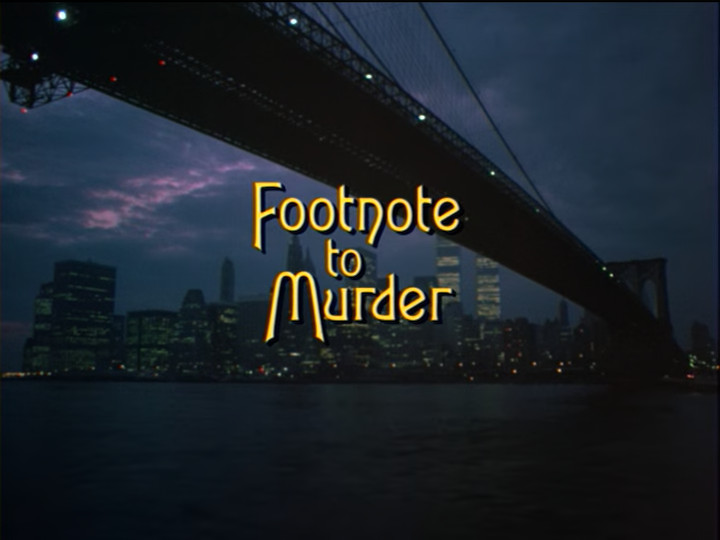
After some establishing shots of New York City while wistful piano music plays, we then come to a small diner where a poet is composing a poem:
Why go on alone, rejected…
with Cupid’s turgid rights neglected?
He then pulls out a gun and Jessica, walking in, says, “You’re going to kill yourself, Horace. Those cigarettes will be the death of you.” (The gun is revealed to be a souvenir lighter.)
It turns out that they’ve both been nominated for literary awards (Horace for poetry, Jessica for mystery), which is why they’re in town. He also asks after some women and Jessica replies that he left Cabot Cove strewn with broken hearts last summer.
After a bit of establishing that he’s got no money, they head off to the award ceremony.
Before we get there, though, we get an scene of a blue collar schlub who just came home…

…and sees something in the newspaper which upsets him. (To set the mood, the establishing shot was from outside, through his rain-covered window.) He puts the newspaper down, visibly angry, and grabs his keys. As he’s leaving, the camera zooms in on the newspaper article which so upset him:
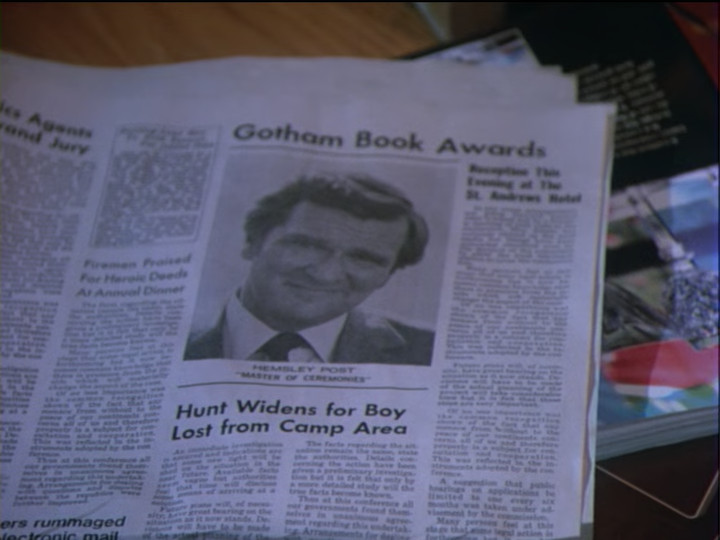
If you look very closely, you can see that under the picture of the man are the words “Hemsley Post” and “Master of Ceremonies”. We can’t make anything else out, so that must be what upset him. That said, I don’t think that anyone would have been able to read this on broadcast television during the moment it was on the screen, so it couldn’t be too important.
We then meet another character, who is doing pushups. Or rather, half-pushups. (He doesn’t get lower than his elbows.) He manages seven before a knock on his door interrupts him. The camera then switches to an establishing shot through his window, and we hear thunder.
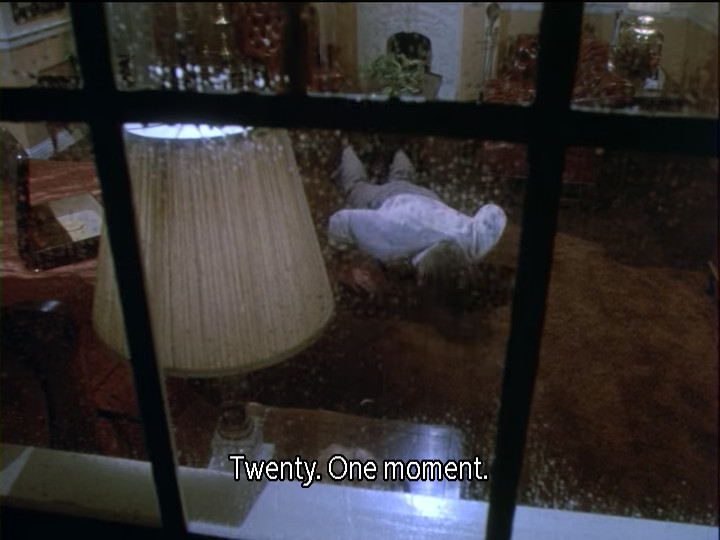
They are establishing the heck out of the rain. Perhaps someone’s umbrella is going to be significant in the episode?
The person at the door turns out to be Tiffany Harrow, the assistant awards coordinator.
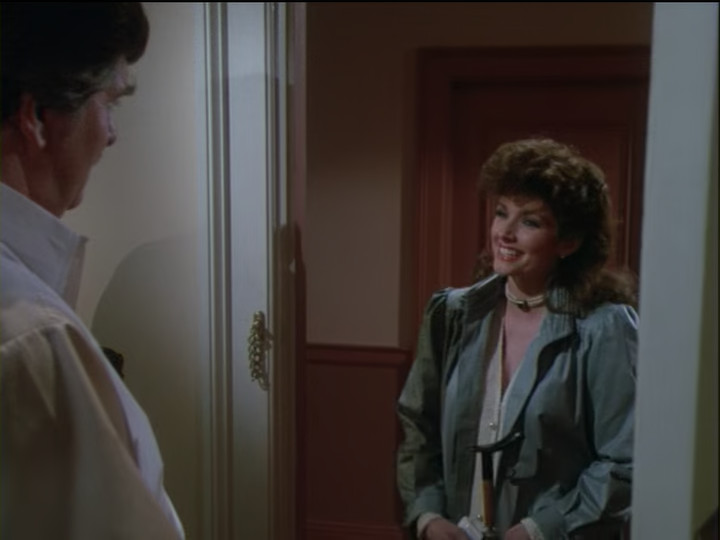
His name, by the way, is Hemsley Post. The picture of him in the newspaper must be several years old.

In addition to the detail that, upon hearing the knock at the door he skipped from seven to twenty in his count (and raised the volume at which he said “twenty”), we get a sense of his character from the enthusiastic way he helps her out of her coat, unasked.
She thanks him for being the master of ceremonies and remarks that it’s a pity that he’s not up for an award himself. He replies that even the mighty oak must let a little light fall on the saplings. (This is probably the writers’ way of letting us know that he’s a washed-up literary titan who hasn’t written anything of importance for years.)
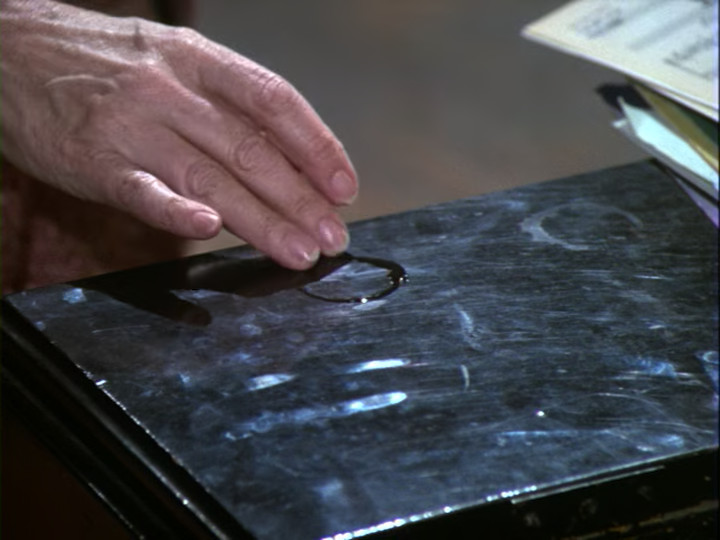
After he offers her a drink and she declines, her gaze falls on something that might well be the manuscript to a novel. We get a closeup of it, so we know it’s important:

These closeups are always interesting, but a bit conflicting. On the one hand, they mark the important clues out with no subtlety. On the other hand, they are careful to try to give us no context, so there is still something to figure out. It was necessary, given what broadcast TV was like. Don’t get me wrong; the quality of the image of broadcast TV was often pretty good, given the low resolution of TVs of the day. But it could also be fairly bad, especially if weather was unfavorable and the viewer had an cheap, old, or especially a cheap and old TV.
I tried to re-create an example of how bad it could get, going from memory:

She then remarks that everyone is talking about his new, unpublished novel. He replies that it’s quite the best thing he’s ever done. It’s the definitive novel on the Vietnam war. (He puts it back in the briefcase and closes the briefcase as he says this.) When she says that she’d love to read it, he replies that no one has read it, not even his publisher. This is, in fact, the only copy.
But then his tone changes and tender music starts playing and he says that perhaps if she came back tonight, after the party, he could read some of it to her. She replies, in a seductive voice, that she finds great literature stimulating.
Then his wife knocks at the door.
He greets her by saying, “Alexis, my darling. I wasn’t expecting you.”
To which she cooly replies, “Obviously not.”
Tiffany is delighted to meet her, then leaves. Alexis doesn’t seem to care but gets straight to the point: she heard that he got a six figure advance on his new book and she’d like to discuss the $264,000 she’s lent him over the last six years. (She wants it immediately; her lawyers have drawn up a contract.)
They reminisce a bit about old times—he brings up a safari in Kenya—but she rebuffs his invitation to come back for a drink, and leaves on a threat to have her lawyers eviscerate him in court if he doesn’t sign the contract.
The scene then shifts to the lobby of a hotel, where we meet Adrian Winslow, though only after another establishing shot of the pouring rain outside.

He’s being interviewed by a reporter asking whether his latest book, Pericles at Parnasses, is a metaphor for the communist “witch hunts” of the 1950s. (To be fair to them, before the fall of the Soviet Union in 1991, the number and extent of communist spies in the USA, particularly in the 1930s through 1950s, was not well known in the USA.) Anyway, he rebuffs this idea, having already stated that “history as literature” is a challenge suitable for his talents. A young woman comes up and asks for his autograph then asks if he’d read a short story of hers, but he declines, saying that his attorney will not let him read unsolicited manuscripts.
As a fun fact, Adrian is played by Robert Reed, who is best known for playing Mr. Brady on the show The Brady Bunch (which ran from 1969 through 1974). The way Mr. Reed plays Adrian is quite interesting. It’s hard to convey in words, but take the most pompous, full-of-himself person you know, at 50% more pomposity, and you’ll possibly imagine Adrian in his more modest moments.
The scene then shifts to the men’s room, where Hemsley is combing his hair in the bathroom mirror. The blue collar schlub from earlier walks in and tells Hemsley that he wants to speak with him. Hemsley is contemptuous until the sclub mentions that his name is Frank Lapinski. There’s a bit of a physical altercation where Lapinski proves to be far more adept at hand-to-hand combat than Hemsley is.
As he’s holding Hemsley in a painful arm-lock and reciting his complaint—that he’s waited four months for some kind of answer then suddenly reads that Hemsley has a new novel and should probably kill Hemsley and likely will if he can prove that Hemsley stole his book—a stranger walks in to the men’s room. Hemsley calls out to get security because he’s being robbed. Lapinski gets in one more threat, deftly deals with the security guard who walks in, then makes his getaway. (As an interesting detail, Hemsley detains the security guard from giving chase, explaining that he’s fine and the guy didn’t get anything. Ostensibly, it’s not worth the security guard risking his safety, though clearly Hemsley doesn’t want the guy caught.)
The scene shifts to Horace and Jessica walking in the lobby of the hotel where the conference is going on (the same lobby we saw Adrian in). The same woman who asked Adrian for his autograph approaches them, recognizes Jessica, and asks for her autograph, too.

She also asks Jessica to read her short story. Jessica is a little reluctant, but accepts. She gives Jessica the manuscript—her name and address are on the cover. Jessica reads her name, Debbie Delancy, and says that it has a certain ring to it. She replies that she thought it sounded literary when she made it up.
Jessica and Horace then make their way to a reception for the authors before the main event, and we start off seeing this through a rain-covered window, too.

There is thunder, as well. While in other shows it might just be cool atmosphere—storms are perfect for murder mysteries because they tend to isolate people—Murder, She Wrote usually doesn’t usually waste something like atmosphere when it comes to clues. The storm must be a clue.
That said, it is interesting atmosphere, too.
Anyway, we get the dialog from Adrian with the woman he’s talking to. He is congratulating her on her tenth week on the best seller list.

Her name is Lucinda Lark. We also learn that the name of her book is Woman Unleashed and it’s apparently a (somewhat) high-brow romance novel. Adrian can’t keep the politeness up for long, though, and when she says that her next book is going to be more literary, he scoffs and she, offended, excuses herself.
We then see Jessica and Horace run into Tiffany Harrow. Horace offers her a drink, calling it an offering on the altar of beauty, and she accepts it. When Jessica says that it’s nice for writers to get to meet each other like this, she explains that she’s not a writer—writers mostly starve, while the real power is in publishing. She correctly identifies Jessica as being in mystery and Horace as being in poetry, then excuses herself, handing the drink back to Horace.
We then see Hemsley, saying that the greatest novels have always been about war.

I find it interesting how much taller he is than everyone else. I don’t know that it means anything, but at the same time they chose their camera angle to emphasize it.
Anyway, Adrian hears him talking and comes over, asking him what the new book is about. When Hemsley says that it’s the definitive novel on the Vietnamese war, Adrian replies that this is remarkable since Hemsley only spent a week in Vietnam as a correspondent for Playboy. (Playboy was a pornographic magazine which was either widely regarded for its articles or else many people were willing to pretend that its articles were great in order to explain why they purchased it. I cannot say which it was from my own knowledge, but for whatever it is worth, I did not hear this claim made about other pornographic magazines of the time.)
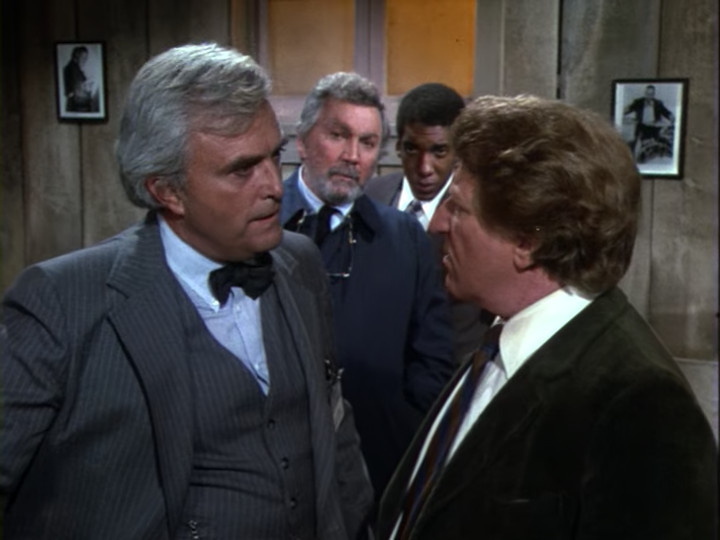
Anyway, Hemsley is not one to take this lightly. He replies, “At least it’s not that prissy drivel you write, Adrian. Greek boys, mincing about.”
After a few more barbs traded, Hemsley tells Adrian that he gave him a good trashing ten years ago and is willing to do it again. Adrian replies that ten years ago he (Adrian) didn’t have a black belt. Presumably he means the rank of black belt in Karate, rather than owning an item-of-clothing belt which is black, since most dress belts at the time were black and this minor bit of fashion trivia would not have been interesting.
After a bit of protracted staring, Hemsley merely says “Hmph” and walks away.
He walks over to the bar, where Horace is making up poetry for Lucinda, who seems enraptured.

Thunder quivers.
Wings beat.
Petals aching, parting.
Beak thrust of sunburst nectar.
When she asks what it means, Horace replies that he has no idea.
To be fair, that accurately represents a lot of poetry from the 1900s.
Hemsley then interrupts and tries to engage Lucinda in conversation, which Horace doesn’t take well. He insults Hemsley’s most recent (published) novel as having bad grammar, so Hemsley punches Horace. After another visual gag of Horace lighting a cigarette with his novelty lighter than looks like a handgun and Hemsley fearing for his life, only to become more angry when he realizes the gun isn’t real, Jessica scolds Horace and Hemsley until they stop fighting.
The scene then transitions to the next day with a vertical wipe, and after an establishing shot of the hotel, we see Jessica walk up to a door carrying an umbrella and knock. The person who opens the door doesn’t seem too happy to see her.

Jessica apologizes saying that she thought that this was Mr. Post’s room. The man says that it is, and Jessica explains that she thinks she picked up Mr. Post’s umbrella the previous night, after the party. She was hoping that he had her umbrella. I guess this is why they established the heck out of it being raining the night before.
The man says that perhaps he does, and invites her to come in.
That’s when we discover that Hemsley Post is no more.

We then get a close-up shot of the murder weapon:

I could be mistaken, but that looks like a sword-handle to an umbrella. I wonder if one of the suspects—perhaps Horace—had a sword-umbrella.
Then after a reaction shot from Jessica, we fade to black and go to commercial.
Had you been watching in 1985, you might have seen a commercial like this:
When we come back, we get another establishing shot of the building:

These establishing shots are quite interesting. They gave viewers time to run back from whatever they were doing during the commercial break, of course, but they also give a lot of feel for the location. Most episodes set in New York City could really have been set anywhere, and it’s mostly in establishing shots that we get the sense that we’re in New York City. (That and whatever actors do a New York accent—Murder, She Wrote was rarely consistent with accents.)
Anyway, the man who opened the door turns out to be Melvin Comstock, an assistant district attorney. He asks Jessica if the sword stuck in the victim is her umbrella. She tells him, sourly, that it isn’t. Anyway, he’s taking personal charge of the case, but he introduces the homicide detective who would otherwise have been in charge.
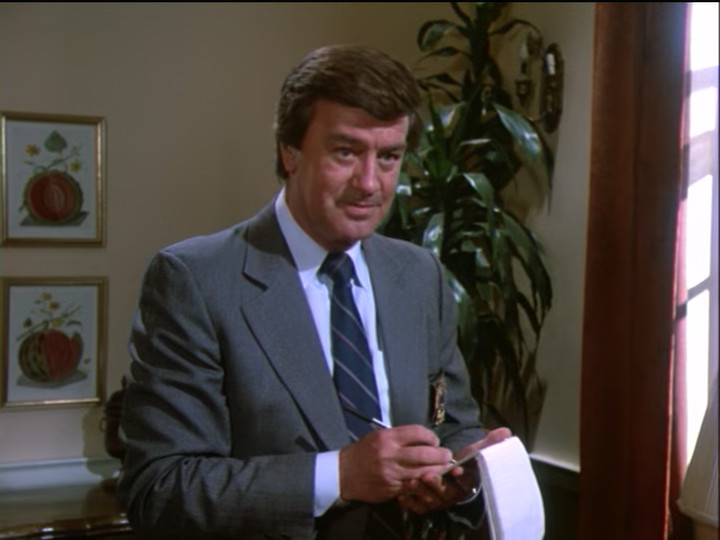
Here, his name is Lt. Meyer. Of course, if you ever watched Murder, She Wrote after the fourth season, you’ll recognize him as Sheriff Metzger, who replaced Amos after Amos retired. Given that Metzger was a cop in New York City before coming to Cabot Cove, I wonder why they didn’t just keep the character he already played. Perhaps “Meyer” didn’t have the right sound to it.
Jessica asks about the manuscript to Post’s latest novel, but it’s not in the room. In looking for it, Lt. Meyer does find a key, however. It’s to room 2441, which is in some other hotel because there’s no twenty fourth floor in this one. Jessica also notices a smudge of lipstick on the pillow on the bed, and a copy of Woman Unleashed, signed by the author, on the nightstand. (The message, “To the old master from his humble disciple, Lucinda Lark” was dated the day before, that is, the day of the awards ceremony and, presumably, the day of the murder. I don’t think that dating inscriptions is at all a common practice and Lucinda certainly didn’t seem to be the type to know what the date even was, but I doubt that this really matters.)
Jessica then finds a pair of glasses in the bed, saying that she wondered what Hemsley was reading, since there was no book in evidence. Comstock is spending most of his time on the phone arranging publicity and is uninterested in this discovery. He’s equally uninterested in the threatening letter on Hemsley’s desk from Frank Lapinski. Keeping this letter is a bit of an odd thing to do and bringing it with him on this trip—Lapinski couldn’t possibly have known the hotel that Hemsley was staying at to send it to him at the hotel—was even stranger. I can’t imagine Hemsley intended to write back, and the other possible motives for bringing this letter are even less plausible. I suppose he brought it because murder mysteries need clues, which was uncharacteristically selfless of him.
Anyway, Comstock gets tired of Jessica being around and collects her things—inadvertently putting the glasses Jessica found into her purse—and shoves her out the door. The scene then changes to Horace being interrogate in Comstock’s office. The odd thing is that we get an establishing shot of a building that I really doubt that Comstock’s office is in:
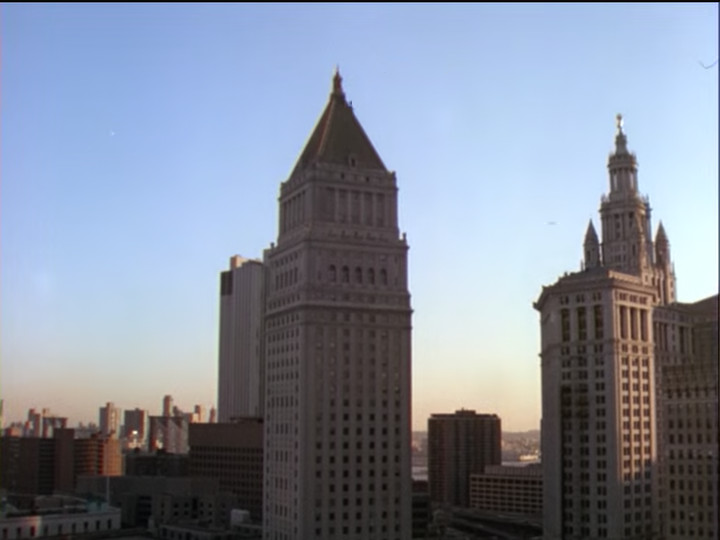
For reference, here’s the google maps view of One Hogan Plaza, which is where the NYC district attorney’s office is:

You’ll notice that it’s a wide building, with no more than five or six floors, not a skyscraper with forty or fifty floors. I suppose that there was no stock footage available of this building.
Anyway, it turns out that the sword umbrella belonged to Horace—he bought it at an antique store on second avenue because it was raining. His accounting for his whereabouts is a bit vague—he went to the hotel bar after the ceremony and then everything was blank until he woke up at noon.
Jessica then tells Comstock that it’s obvious that someone took Horace’s umbrella by mistake.
After some haranguing by Jessica, Comstock asks Meyer whose room the key was to and it turns out to be Tiffany Harrow. She’s waiting outside, so they bring her in. She gave Hemsley the key so he’d remember her room number—he’d offered to show her the manuscript and she didn’t want to go to his room. He never showed up, though. She waited, then ended up going to dinner with Adrian Winslow.
After she leaves, Comstock grills Horace and asks him whether he did or did not kill Hemsley Post. Horace replies that, to be strictly honest, he doesn’t remember. Comstock says that’s good enough for him and has Meyer book Horace on Murder One (that is, murder in the first degree).
After insulting Comstock a bit and vowing to find the real killer, Jessica follows Meyer and Horace out to the elevator and discusses the case. Meyer tells her that everyone knows that Comstock is a real jerk but he is in charge. Unfortunately, Horace had gotten into the elevator and Meyer didn’t, and the elevator closes. Meyer then notices this and runs for the stairs.
And on that bombshell, we go to commercial.
When we come back, Horace wanders out of the elevator and sees a uniformed officer, who he tells that he’s not sure he belongs here. The officer tells him to tell it to the judge and to get back in line—a line that turns out to be for some kind of prostitution bust, but they drew a judge who doesn’t want the customers, only the prostitutes. So the men are dismissed and this includes Horace—over his protests. But the officer tells him to go, so he goes.
In the next scene Jessica is in a phone booth at her hotel, leaving a message for Horace at his hotel, then she spies Tiffany Harrow. Jessica manages to get Tiffany to tell her about we saw in the opening scenes with Tiffany, Hemsley, and Hemsley’s wife (mostly off camera, but not entirely, since TV shows in their second half hour need to recap for people who were watching something else during the first half hour).
Jessica then goes to visit Hemsley’s wife. This is one of those cases where Jessica is oddly confrontational and accusatory. It’s especially odd as her intelligence of Mrs. Post visiting her husband was that she visited him before the ceremony—and he was obviously quite alive at the ceremony. Anyway, Jessica asks if she was the woman whose intimate company Hemsley had shortly before his death and she replies that writing wasn’t the only thing that Hemsley couldn’t do lately, though it didn’t stop him from trying.
Back at her hotel Jessica runs into Horace in the revolving door and there’s a comedy bit where they both revolve several times before finally ending up in the same place. He tells her that they let him go and Jessica pays no attention, saying that he’s got to go turn himself in right away.
At Mr. Comstock’s office, he’s interviewing Lucinda Lark. Jessica and Horace walk in on Comstock asking Lucinda to sign his copy of Woman Unleashed. After clearing up that Horace didn’t escape, he was lost, Jessica begins haranguing Comstock about beginning a real investigation. For example, what about the inscription in Lucinda’s book?
Lucinda explains that this was a mistake. She had signed it before and just wrote the wrong date—she’s not very good with numbers. She then adds that, while she’s sure no one would suspect her, in any event she has an alibi—she spent the evening and the entire night with Horace.
In the hallway, as Jessica and Horace are leaving, after Horace laments having spent the night with Lucinda and not being able to remember, Jessica tells Horace that Lucinda might have made up their tryst just to give herself an alibi. If so, it’s not much of an alibi since he doesn’t remember it. But it does serve to give Horace an alibi. Anyway, Jessica is off to Brooklyn.
In Brooklyn, she tracks down Frank Lapinski. After some chitchat in which he denies knowing Hemsley Post, Jessica asks him why, if he never knew Post, he was sending him threatening letters. Frank says that she has him mixed up with someone else and excuses himself.
Jessica then runs into someone who asks her if she needs help and he turns out to be an acquaintance of Frank’s. From him, Jessica learns that Frank wrote a book about Vietnam. She then asks if she can get a cab around here and the man laughs. He directs her to a phone booth. Jessica thanks him and goes to the phone book as ominous music plays.

As she looks for some coins in her purse with which to place a phone call, she notices the pair of glasses that Comstock shoved into her purse that morning and remarks that they’re not hers.
Anyway, her first phone call is to Comstock, who isn’t very impressed, but listens. The scene then shifts to Jessica walking into a bookstore and the music shifts from ominous to cheerful, with nothing having happened. We then see why Jessica went to this bookstore:

This is an interesting way of conveying that his books are not very popular.
She doesn’t even bother to buy his book; she just asks where he had dinner and confirms that it was not with Tiffany Harrow. (He explained that he had dinner at the Four Seasons and the young man with him was a newspaper reporter.) When he deduces that she’s trying to solve the case herself, he begins discussing it with her and says that Alexis Post is a much better suspect than Horace. Contrary to what she says, Hemsley dumped her, not the other way around. Which is why she gave him so much money.
It also comes up that Adrian used to be Hemsley’s private secretary. He’s then called away by someone who actually wants to buy a book and the scene ends.
Back her hotel Jessica runs into Debbie Delancy. She asks what Jessica thought of her story.
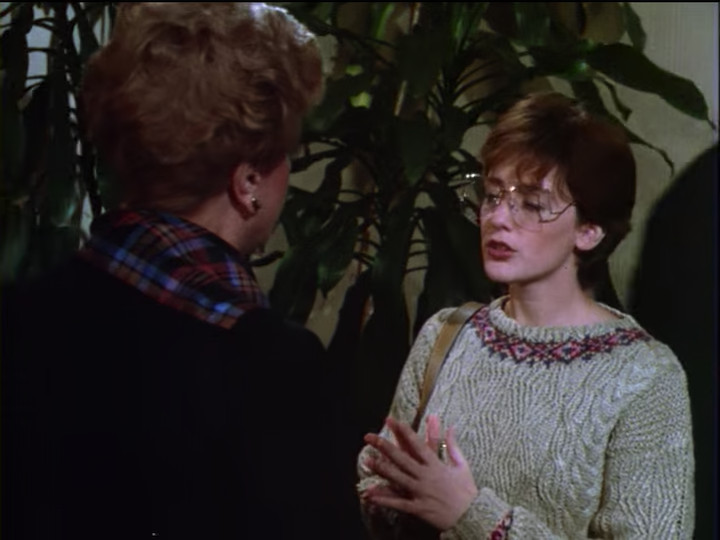
Jessica apologizes, saying that she’s been frightfully busy, and besides Debbie only gave it to her yesterday. She promises that she will read it, though.
Jessica then goes to see Tiffany Harrow, who’s reading a manuscript in her room. Jessica pushes in, past Tiffany’s protests, and asks if she has Jessica’s umbrella. Interestingly, while she doesn’t, she does have someone else’s umbrella. Jessica then confronts Tiffany with Adrian’s denial of having dinner together. Oddly, Tiffany says that she was worried about her key being found at the murder scene and that Adrian said he would tell everyone that they would have dinner together. This seems unlikely, since Adrian was surprised that Tiffany said she’d had dinner with him, but Jessica lets it go and instead asks about the manuscript she was reading.
Tiffany then shows it to her. It’s an autobiography of an old movie star. (Tiffany is considering going out on her own and representing it herself.)
Jessica then asks what Tiffany was actually doing the night before and Tiffany said that when Hemsley didn’t show up, she took some sleeping pills and went to bed. “Life in the fast lane can be a little lonely.”
The scene then shifts to Frank Lapinski’s apartment, where Comstock and Lt. Meyer show up with a search warrant. Lapinkski slams the door in their face, grabs a briefcase, then goes out the fire escape. He doesn’t make it far, though, as uniformed police offers box him in and arrest him. The briefcase contains Hemsley’s manuscript and Lapinski confesses to killing Post.
And on that bombshell, we fade to black and go to commercial.
When we come back from commercial we get an establishing shot of the New York city streets, we follow one car, then cut to rear projection of Jessica and Horace in a driverless cab.

Horace is saying that stealing someone’s novel is a dastardly thing to do and he doesn’t blame Lapinski one bit. Jessica says that, despite Lapinski’s confession, something is wrong. There are too many other people with motives covering their tracks.
Horace then asks about the manuscript that “that girl” (Debbie Delancie) gave Jessica. Is it any good, or should he not ask?
Jessica replies that it’s not bad. It’s a beginner’s story about a teenage girl remembering how she felt about her brother going off to the war. (That doesn’t sound like much of a plot, but it’s really here to draw our attention to the brother going off to war—since a novel about Vietnam has been central to much of what has happened.)
Jessica then notices the glasses that are still in her purse. She remarks that she can’t imagine how they got into her bag, but she should give them back to Mr. Comstock. She suspects that they belonged to Hemsley.
Horace takes them and looks at them, then says he doubts that. He then puts them on…
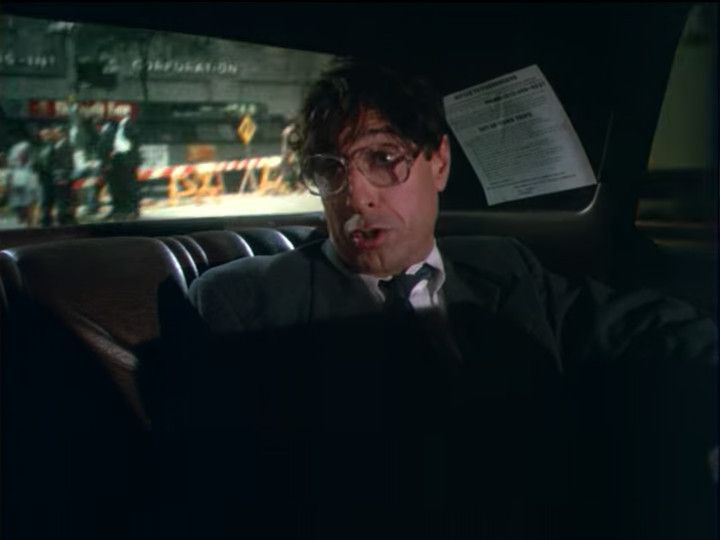
And says that if Hemsley Post had bought glasses, he would expect him to buy something more macho.
Jessica then realizes what she wasn’t able to put her finger on and asks the cabbie to stop the car. She gets out, gives Horace cab money, then goes to see an optometrist.
After some minor humor about her previous optometrist learning his craft at the Braille Institute—Jessica is pretending that the glasses are hers—Jessica asks him to mount the lenses in new frames. She then hurries off.
We then see who she went to meet—this late in the episode, there’s a 98% chance that it’s the killer—and it turns out to be Debbie Delancie. There’s a contrivance where Jessica swaps the glasses in the new frame for Debbie’s glasses and she doesn’t notice at all, confirming that the glasses at Post’s room were Debbie’s.
Jessica then confronts Debbie with the fact that Frank was arrested the night before for killing Hemsley Post—Debbie had been at a Cabin the day before and hadn’t seen any newspapers since she got back—and Debbie becomes distraught. Frank Lapinski is her brother—the brother the story is about. After Jessica reveals the deception about the glasses, Debbie tells her what happened.
She didn’t mean to kill Post. He had seen her approaching other writers about his story and so he approached her. He asked her up to his hotel room after the party. She knew what he had in mind; she wasn’t sure what she was going to do—talk to him, or just grab the manuscript and run—but she wasn’t prepared for the way that he just jumped on her like an animal. He apparently took Horace’s sword-umbrella by mistake. In the scuffle she grabbed it and tried to use it to defend herself, but when he tried to pull it away from her all he got was the umbrella part, thus unsheathing the blade. She fell back on the couch, holding it in front of her…

…then he walked forward and impaled himself on it.
After he fell over, dead, she took the manuscript and gave it to Frank. Hemsley had stolen the novel almost word-for-word.
She then says that she has to go to the police—she can’t let Frank lie for her. Jessica replies that she should tell them everything that happened and that Jessica thinks that she has a strong case for self-defense.
Jessica takes Debbie’s hand to comfort her, then the scene shifts to the awards ceremony—which I thought must have already happened since they had the pre-ceremony reception the day before—and Horace and Jessica leave the room together, both having won in their categories. Horace laments that the award is brass and wood, making it unhockable (that is, unsellable at a pawn shop).
They then go to a concession stand and Horace pulls out his souvenir pistol lighter to light his cigarette and the woman at the concession stand screams, ducks, and presses an alarm button. Jessica tells Horace that he should probably give up smoking and we go to credits.
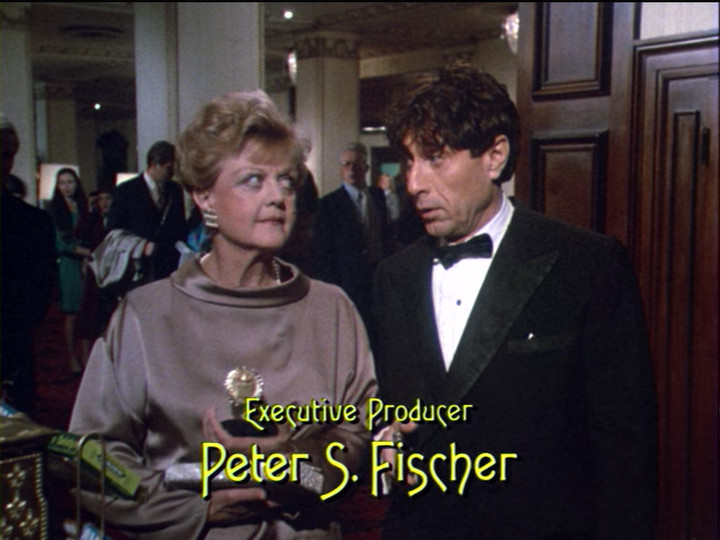
This was a fun episode. Not only was there a lot of comedy, but most of it landed. They took the idea of a gathering of literary gods on publishing’s Mount Olympus and had fun with it. I do suspect that when I first saw this episode as a young child I took all of this seriously, as an adult I can see that they leaned into the absurdity.
To be fair, while the literary world was never as much like the golden age of Hollywood stars as it is made out to be, there was a lot more money and prestige in it back in the 1980s—and in the decades preceding it, which many viewers of Murder, She Wrote in the 1980s would remember. When Hemsley said that his new novel was going to be the definitive novel on the Vietnam war, he was referring to something real. There is a sense in which Catch-22 was the definitive novel on the Vietnam war (in spite of the fact that it was set in World War 2 and published before the USA became involved in Vietnam). It shaped how people thought about the Vietnam war and gave people a language to talk about the Vietnam war through references to it.
To be fair, there aren’t really definitive novels of things as complex as wars, but there are sometimes novels that are influential enough that one might at least talk about them in this way without being ridiculous. All Quiet on the Western Front, for example, constitutes much of what many people know about the first World War—even if they haven’t actually read it and only saw parts of the movie.
And this is the sort of thing that Footnote to Murder alludes to. It’s especially interesting in this context because it has many of the hallmarks of the classic great house dinner party mystery. We have a number of important people who are mostly strangers to each other who have temporarily gathered. There is money there, though in this case it comes from whatever publisher or trade association is hosting the event. And we even get a storm, though its only purpose seems to be to establish a reason for everyone to have an umbrella.
As far as the mystery goes, I think that the choice of Debbie Delancy as the killer was interesting. On the one hand, they did a good job of making her present and unobtrusive—always there, but you don’t really think of her as a suspect. But the problem is that they didn’t connect her to the story other than by being there. Nothing happens where she knows more than she should about something related to her motivation. She never shows up to something that wouldn’t be strictly necessary for her cover story but is for her real purpose. There was never anything more to her than met the eye. To be fair, her glasses do change on the second day, but that’s a clue, not a connection.
Her actual motivation was solid. It makes sense that, Post having stolen her brother’s novel, she thought that she might have a better chance of getting it back than he did. Even if she was wrong, she could easily have believed herself more clever than him and also more capable of deceiving Hemsley Post with her feminine wiles.
While the overall story and the characters were reasonably solid, the details weren’t. About the only clue that actually makes sense were Debbie’s glasses, which Jessica found in Hemsley’s bed with no reading material around. I’ve already mentioned that it doesn’t make sense for Hemsley to have carried Frank Lapinski’s threatening letter with him and it there’s no plausible way for it to have been delivered to Hemsley’s hotel room—and a man with creditors and no income is not overly likely to have his mail forwarded to him. This is more than a little problem since without the letter, there would have been no way to find out about Frank Lapinski.
The umbrella is another problem with the story. I know that they established the heck out of it raining that night, justifying why everyone at the reception had an umbrella. So far, so good. Except for Horace’s umbrella. According to his story he bought the umbrella from an antique shop because it was raining. While this would not be impossible, and Horace is quite impulsive, he’s not the sort of person to be shopping in an antique shop and notice that it’s raining, and he’s also not the kind of person who could afford an umbrella in an antique store anyway. They were careful to establish that he had no money—he said he’d buy Jessica a cup of coffee but couldn’t afford to. Later in the episode there’s a gag where Jessica gives Horace money for cab fare and he uses it to stop at a liquor store rather than go to his destination.
There were also a number of threads which were simply never addressed, one way or another. For one thing, it seems that no one took their own umbrella home the night of the reception but no one’s umbrella was ever returned to them. That’s not critical, obviously, but it would have been nice for at least someone to get their umbrella back, or at the very least find out where it went, since it was so pivotal to the plot.
It’s also an issue that the solution to the case did nothing to satisfy Jessica’s problem with accepting Frank Lapinski’s confession. She said that it bothered her that there were so many other people with motives to kill Hemsley Post who are covering their tracks. Which is fair enough, though unless the solution was a Murder On the Orient Express style conspiracy, that objection would still apply to everyone except the killer. But with Debbie as the killer, it applies with full force—all of the people with motives who were covering their tracks had nothing to do with the death of Hemsley Post. That is a flaw with this episode in microcosm: there were a lot of threads, but they were only next to each other, not connected.
Having said that, this episode was a lot of fun to watch. It had good characters in an enjoyable setting. The premise supported the cast of interesting characters. There were also a lot of jokes, many of which landed. It wasn’t perfect, but I’d definitely put it in the top 20% of episodes.
Next week we’re nearby to Cabot Cove in Murder Takes the Bus.









 Chris Lansdown
You must be logged in to post a comment.