
On the twenty first day of April in the year of our Lord 1985, the twenty first episode of the first season of Murder, She Wrote aired. Also the last episode of the first season in was set in Wyoming and titled Funeral at Fifty Mile. (Last week’s episode was Murder At the Oasis.)

As the title screen establishes, Wyoming is a beautiful place. This helps to establish a bit of a golden-age mystery feel, since the beauty of the land will contrast with the ugliness of murder.
Right after the first establishing shot we we get another:
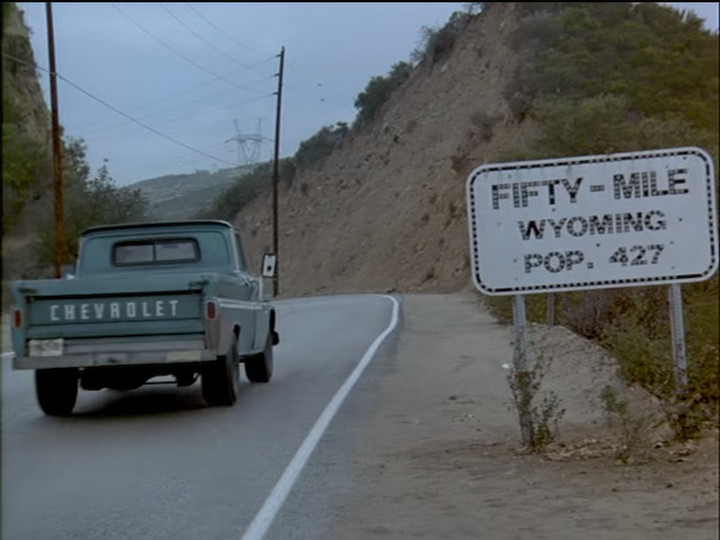
On the left we have an ancient Chevy truck driving by, which gives us the sense of a land where things move more slowly. On the right we have a sign that tells us we’re in a small town in Wyoming. A town so small, in fact, that they publish the population down to the individual. Not only are there not that many people, but the number doesn’t change so often that it’s expensive to change it when it does. (Though sometimes such signs simply reflect the population at the last census.)
After this we fade to a funeral where the preacher gives some useful introductions in his closing remarks. First is the deceased’s beloved daughter, Mary Carver:

Standing next to her is her fiance, Art Merrick.
Also is the deceased’s younger brother:

His name is Timothy Carver.
Also mentioned are Jack’s close and inseparable friends.
Doc Wallace:

Sam Breen:
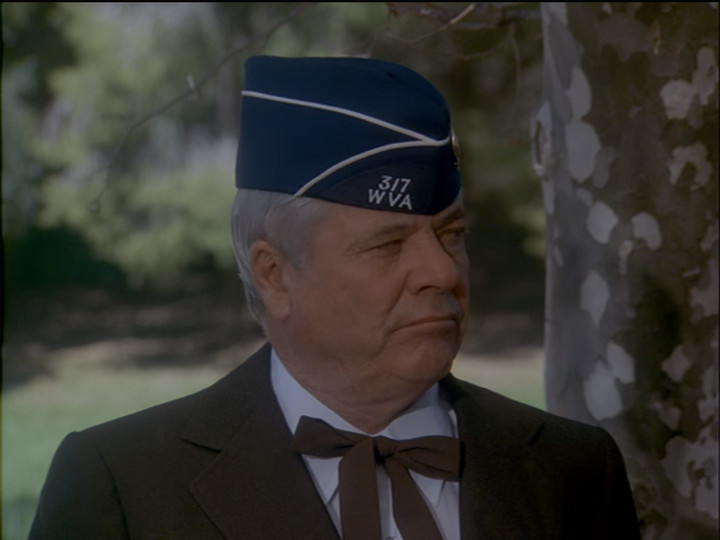
and Bill Carmody:

(If you recognize William Windom, the actor playing Sam Breen, you probably know him as Jessica’s friend Doc Hazlett. That starts in the second season of Murder, She Wrote. Right now her close friend is Captain Ethan Craig, though we haven’t seen him in a while.)
After these closing remarks we find out that the deceased’s name is John Carver, and he was apparently in the military because his coffin has an American flag draped on it. There’s a brief prayer mentioning ashes to ashes and dust to dust, then a bugle plays a mournful tune.
As the bugle plays, a strange couple drives up in a large RV. They get out and walk up to be relatively near the casket:

We get a little bit of military ceremony—a five gun salute and the flag gets folded and given to Mary—then people begin to disband. The strange man asks Carmody if he’s coming after him with that gun and Carmody replies, sourly, that it would be futile since it’s loaded with blanks. We find out that the man’s name is Carl Mestin and the woman, whose name is Sally, is Carl’s wife.
Shortly after, Jessica is walking with Mary and Art and Mary remarks that it’s strange for Carl Mestin to show up since her father never did business with him and no one around these parts can stand him.
During the conversation it comes up that Jessica is, apparently, an old friend, since she can remember when Mary was born. Well, not the actual birth, but having heard that her mother died in childbirth. “We” were so worried, she says, wondering how jack was going to manage all alone, but he did just fine. In addition to this being awkward exposition, it leaves out the really important part—how was a school teacher in Maine friends with a woman who died in childbirth in Wyoming in the 1950s (or perhaps the early 1960s)?
The scene then fades to the Carver ranch, which we can tell by the establishing shot:

A storm is moving in—we hear the sound of thunder and it forms the subject of conversation inside.
We then meet “Marshall” (actually Sheriff) Ed Potts:
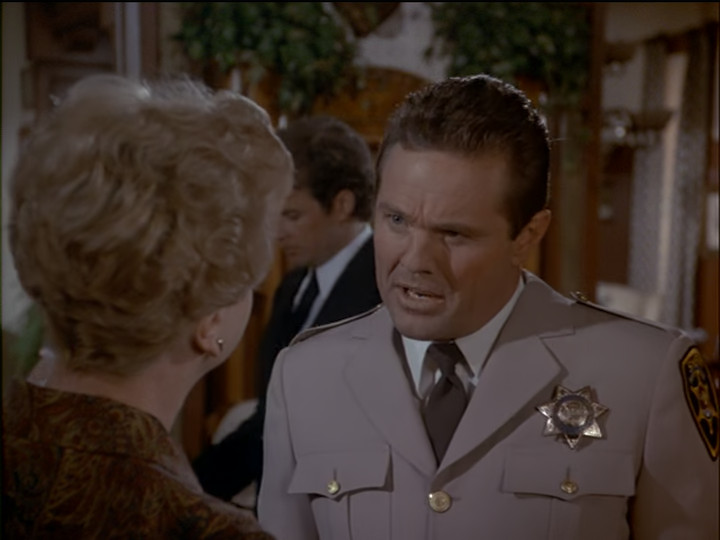
He’s read one of her books: it’s not up there with Mickey Spillane, but darn good for a woman.
I’ve never enjoyed Murder, She Wrote‘s attempts at making fun of sexist police officers and this one makes particularly little sense. While it’s true that Sir Arthur Conan Doyle (basically) created the genre of detective story with Sherlock Holmes, many of the biggest figures in the genre were women. Agatha Christie, Dorothy L. Sayers, and Ngaio Marsh were known as the “Queens of Crime.” Recent reprints of Agatha Christie’s novels often mention that she’s only been outsold by the Bible and Shakespeare. Detective fiction is, as fiction goes, probably the most 50/50 genre you can find. The only way to think that the best detective fiction is all written by males is by knowing nothing about detective fiction. (I suppose if you only like American hard-boiled detective fiction—a genre I dislike and am not sure should even count as detective fiction—this would be more defensible. And he did cite a hard-boiled detective writer. But even so. This is just annoying and dumb.)
In case you’re not familiar with Mickey Spillane—as I wasn’t until I looked him up—he wrote a series of hard-boiled detective novels featuring the detective Mike Hammer. From reading the plot synopsis of his first novel, I, The Jury, the name Mike Hammer is a bit on-the-nose as far as the kind of story it was, so just imagine the kind of story featuring a hard-boiled detective named “Mike Hammer” and you’re probably close enough, especially if you consider the various things “hammer” can be a euphemism for and go with all of them.
Jessica smiles and replies, “Yes, we all struggle under Mickey’s shadow, I suppose.”
The contrast is there for the joke they’re making, but it is very confusing with regard to the character of Marshall Potts. How on earth is a Sheriff who prefers to be called Marshall a fan of Mike Hammer stories? That said, he does immediately afterwards say that he doesn’t really read detective fiction, it’s westerns that have his heart. Like “Coop” in High Noon. (This would be a reference to the actor Gary Cooper in the movie High Noon, where Cooper plays a sheriff who stands alone against a gang of criminals.)
Jessica then says she notices that he wears his holster tied down and asks if this is for quickly drawing his gun. He replies that it is, and that he practices for half an hour every day. There’s a bit more banter where he says that he’s ready for someone to “make my day,” which is a line from the Clint Eastwood movie Sudden Impact, which came out in 1983, only two years before this episode. It’s a strange line to quote for someone who loves westerns, but I guess the point is to portray him as trigger-happy.
There’s also a minor point that Tim (Mary’s uncle) calls his own ranch, which neighbors this one, to make sure that everything is OK—that the ranch hands have everything battened down for the storm, which seems to be there already. That done, Tim brings up to Mary and Sam that he had promised to buy the ranch from Mary after John died, to make her comfortable for the rest of her life. Sam says that he doesn’t doubt that they discussed it, but the fact of the matter is that there is no will. Mary, being his only child, will inherit, but it will take longer to run it through probate than it would have been if there was a will.
This discussion is cut short by a loud honking from outside. Looking out the window, it turns out to be Carl Mestin and his wife. Mary tries to throw him out, but he produces what he claims is a copy of John Carver’s will, leaving everything to him except for a little money for Mary. This does not make Mestin’s reception any friendlier and he antagonizes people until Art Merrick has to be held back from punching him.
Mary asks Jessica why her uncle Tim and the others seem to be afraid of Mestin. Jessica doesn’t have an answer, then the Marshall comes over, warns Art that starting a fight isn’t going to help anything, then gives his condolences to Mary and takes his leave. (This is a very strange thing to do without apology, since an incendiary situation would benefit from his presence to keep things from getting out of hand.)
Jessica then talks to Mestin and remarks that Wyoming is very different than Maine. Back in Maine, she couldn’t imagine a father disinheriting his only daughter. Mestin replies that it probably has something to do with having saved John’s life back in Korea at the Inchon landing. Jessica is surprised at this and asks if he knows her husband, Tom Fletcher. He was Jack’s commanding officer. (She clearly doesn’t believe him and is testing him, since her husband’s name was Frank.)
Mestin thinks and remarks, “Oh yeah, Lt. Fetcher. He’s quite a guy. He’s a good guy.”
He then excuses himself. (In addition to not flinching at the name, Frank Fletcher was a captain, though we won’t learn that for a few more seasons.)
I should note, since I complained about it before, that we do, finally, have an explanation for how Jessica knows any of these people who never seem to have left Wyoming—Jessica’s husband and the deceased had served together in the Air Force.
Later in the afternoon, though it looks like night, after Mary is asleep courtesy of a sedative the doc gave her, her father’s friends are putting on rain coats to help batten the place down in the storm. Carl and his wife are arguing over drinking, with her calling him a lightweight and him saying that he’s not getting into a drinking contest with her. She then brags about having beaten him at an arm wrestling contest and he claims that he let her win. She bets him $500 ($1,505.46 in 2025 dollars) that she can beat him right now. She goads him into the match by accusing him of being too cheap or too chicken to do it, and he accepts. The people who were getting ready to help with tying things down in the storm stop their preparations and watch.
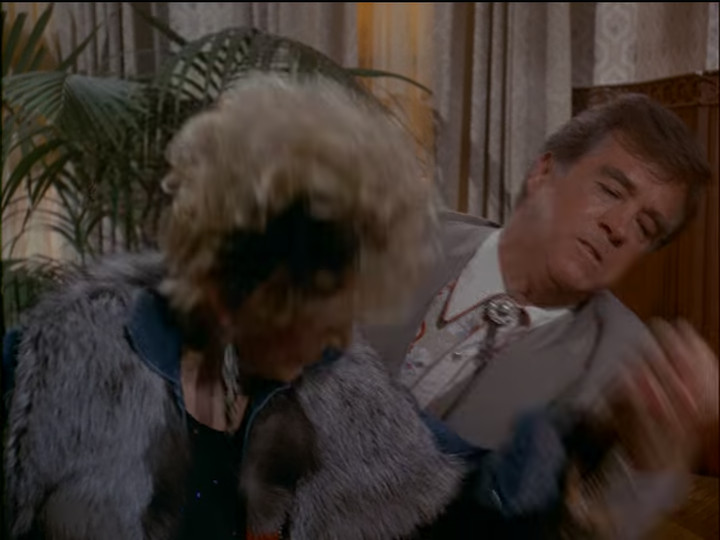
She beats him easily.
I don’t know if this will come up later, but it’s curious that they are arm wrestling left handed. It may come to nothing, of course, but it’s hard to not notice left-handed people in murder mysteries.
It should also be noted that this is very strange behavior of a woman who is supposedly his wife. It seems likely that her being is wife is another of Mestin’s lies. Anyway, he pays up, then goes and joins the people getting things prepared for the storm. As he joins them he asks whether a particular door still needs to be tied down in the wind, suggesting he knows the place.
Later in the day, after the storm has passed, Art comes back to the house having been given a ride by one of the employees named Jesús. Art greets the people inside—everyone from the funeral is still here. They ask where he was and he says that he got the pickup truck stuck in the mud on the way back. After two hours of trying to dig it out he gave up and started walking back. Jesús passed him on the road and picked him up. As Art goes to check on Mary, Jesús finds something that scares him in the barn. In a panic fetches the people from the house and they come. Then we see that the thing that terrified him was the body of Carl Mestin, hanged.

We then fade to black and go to commercial.
Had you been watching in 1985, you might have seen a commercial like this:
When we get back, the Marshall shows up. He doesn’t much know what he’s doing with a murder investigation and Jessica “subtly” helps him out. She points out that a hay bale was dragged near the body, as if to suggest suicide, but the killer seems to have changed his mind or been scared off.
Jessica also mentions that there looks to be a blood smear above his left ear, as if he was hit by something before he was hanged. (Doc checks out the body and confirms this, saying that Jessica has sharp eyes.) Jessica also notes that the rope on the beam had been splintered, suggesting that it was holding Mestin’s weight when it was pulled over.
Jessica asks Doc how long the body had been dead for and he answers 4-5 hours. Which is rather odd precision to give, even apart from not having taken the temperature of the corpse and run the relevant calculations. Anyway, the Sheriff does the math and says that it was around 3pm, when everyone has battening down the ranch.
That evening, Jessica talks with Mary. She asks Mary what she meant by Mestin shortening her father’s life. Mary explains that she was there on her daily visit and saw Mestin coming out of her father’s room. Mestin didn’t say anything to her and just looked smug. Her father was so upset he couldn’t even talk. He was never the same after that and two days later he died.
Jessica points out that the witnesses on the will were nurses. She suggests that Mestin arrived with the will prepared and pressured her father into signing it. Jessica mentions Mestin’s story about having saved her father’s life during the war, but that’s nonsense. She tripped him up with asking about knowing her husband, which he clearly didn’t. Whatever made Mary’s father sign the will, it wasn’t gratitude.
Bill Carmody then comes out and says that the Sheriff wants them assembled for questioning. Mary asks if Mestin might have been holding something over her father and Bill says he doesn’t know and didn’t know Mestin well. Mary asks about a business venture that they were in together and Carmody explains that Mestin talked into buying grain in order to open up a feed store. Bill bought the grain, then Mestin pulled out and left Bill holding the bag, causing bill to lose a lot of money.
Mary then asks why Bill did business with Mestin, since everyone she knew seemed to hate him. Bill replies that he didn’t have much choice, then says that they had better get inside.
Inside the Sheriff asks everyone where they were at the time that Mestin was killed. Doc, Uncle Tim, Sam Breen, and Bill Carmody were all working around the barn and saw each other. Mary was sleeping after Doc gave her some sleeping pills. This woman, who I presume is an employee, never left the house:

Carl’s wife was in her RV “sleeping it off.” Jessica was in her room “getting rid of jet lag.”
Jessica notes that the women are the only ones who can’t corroborate their alibis, but that don’t make no nevermind to this here Sheriff, as he doesn’t think a woman could have done Mestin in the way he was done did in. In his mind, the only possible suspect not accounted for is Art Merrick, which is good enough for him—he concludes with certainty that Art did it. Jessica shakes her head at him, and he replies, “I thought that you were smarter than that, Ma’am. There ain’t anybody else. Process of elimination.”
And on that we fade to black and go to commercial.
The Sheriff then goes over to where Art is getting his truck out of the mud. He points out that there was solid ground on either side of the mud hole, so Art clearly got himself stuck on purpose (Art says that it was raining so hard he didn’t see the hole until he was in it). The Sheriff then accuses him of the murder and arrests him.
The next day, in the morning, Mary drives Jessica over to the Sheriff’s station:

I find the interior quite interesting:

The most interesting part to me is that while the matte painting behind the set is quite good—it is appropriately out of focus for the foreground, for example, and thus looks fairly convincing—it’s entirely wrong for the environment and the external shot. (We can see based on how Jessica and Mary walk in that the door behind Jessica, here, is between the building and the hill in the exterior shot. But look more closely at what we can see through the window:

The hill is missing. Also, that looks like a fairly populous town across an empty plain.
Anyway, Jessica tries to talk some sense into the Sheriff. Mestin was struck from behind on the left side of the head, suggesting a left-handed killer, while Art is right-handed. Also, he didn’t have a motive. The only one who benefited from Mestin’s death is Sally Mestin.
The Sheriff then storms out and Sam Breen tells Jessica that bail is already in the works up at the county seat. Also, he and the boys talked and figure that they should stay close to Mary until things are settled.
He leaves and Jessica goes to Mary and Art, where Art relays what he overheard from a call that the Sheriff got from the coroner. This was more substantive than you might expect because it shook the Sheriff up enough he repeated everything the coroner said. The important part of which is that Mestin died of hanging and the blow to the head came afterward. Jessica wonders why Doc was so sure that it was the other way around, and Mary suggests Jessica ask him since his place is just down the street.

Doc’s house is interesting, partially because the shot is so close-cropped. I wonder where this really was.
Anyway, Doc isn’t in, but his nurse/receptionist/housekeeper is in.

She recognizes Jessica because she’s also the local phone operator and nothing goes on in Fifty-Mile that she doesn’t know about. Doc’s on a house call and will be back in about an hour. Jessica can’t wait and wonders if Doc made any notes about the examination he made the night before and wonders if Doc would mind if Jessica peeked in his files to see. The nurse replies that he’d skin her alive if she let Jessica look through his files—the only time Doc ever lost his temper was when he caught someone poking his nose in the Doc’s files. He threw the man out, using words that would “shame Lucifer himself,” and told him that if he ever breathed a word of what he found out it would be the last words he ever spoke.
Jessica asks if the man was a stranger, but it turns out to be Carl Mestin.
The nurse then says that, in her opinion, a man like Carl Mestin was born to hang. Jessica doesn’t agree, but also doesn’t demur.
Back at the house Jessica and Mary run into the housekeeper, who says that Mrs. Mestin requested a lot of coffee and has been on the phone all morning making calls, mostly long distance. Mary then confronts Sally and demands that she leave. Sally refuses and suggests that Mary leave, instead. Mary asks what Carl had on her dad that got him to sign the will and Sally replies that Carl never told her, but whatever it was it must have been very “juicy” because it was very profitable.
A little while later the Sheriff arrives with Art Merrick. He’s dropped the murder charge after he had a chance to think about Jessica’s arguments. Jessica tells him that it takes a strong man to admit his mistakes. The Sheriff replies that Art is still his best suspect… so if he didn’t do it, who did?
Jessica suggests that the Sheriff challenge Sally Mestin to an arm wrestling contest. He might find it illuminating.
Interestingly, he does.
In the preparation for the match, Jessica drops in and says that she wants to observe Sally’s technique. Sally replies that it’s all in the timing and body English. The women’s North American champion is just a little bitty thing, much smaller than Sally. (Sally is significantly overstating this; while technique does certainly matter in arm wrestling, as in all kinds of wrestling, there are significant limits to the strength difference it can overcome.)
They begin and at first not much happens except for the Sheriff grunting. But right before Sally wins, we get a closeup of her hand:

and then her arm:

They did this pretty quickly in the episode, so I’m not sure that it’s reasonable for them to have expected us to notice, but you can see that Sally has a tan line from her bracelet but not from her wedding ring (she’s wrestling with her left arm, so this is her left hand). So she clearly hasn’t been wearing the ring long.
Anyway, after Sally wins, the Sheriff remarks to Jessica that he never thought a woman would be strong enough to do in Mestin, but Sally is sure strong enough and she’s left-handed to boot.
Sally doesn’t take kindly to this and storms off.
That night, while Jessica is in bed, she hears some tapping on her window. She goes over and looks out the window and sees a noose hanging outside.

Jessica looks thoughtful and says, out loud, “I do believe I’m making someone nervous.”
And on that we fade to black and go to commercial.
When we come back from commercial, Sally leaves her trailer and barges in on everyone having breakfast. She’s brash and provocative, and comes on pretty strong to Art Merrick, clearly to antagonize Mary.
Right after she’s served breakfast, though, Sheriff Potts comes in and informs Sally that he has a warrant for her arrest for the murder of her husband. She complains a bunch, then when Sheriff Potts holds up a pair of handcuffs Jessica asks Sally if now isn’t the time to play her trump card, before she winds up on trial for murder.
Sally says that she doesn’t know what Jessica is talking about, but Jessica replies that she does. Her supposed motive for killing Carl is to get ownership of the ranch as his widow, but she’s not, in fact, his widow. She and Carl were never married. Jessica checked on all of the long distance phone calls and they were to quickie wedding chapels in Nevada. She figures that Sally was looking for one that would sell her a forged wedding certificate, and since Sally got so much bolder after those phone calls, she probably found one that would. Jessica suggests that the proof is that the skin under her wedding ring is as tan as everywhere else; only the skin under her bracelet has a tan line. Clearly, the wedding ring was a prop.
Sally sinks down in her chair. She sighs and says that Carl said that people around here are old-fashioned. If they pretended to be married, it wouldn’t make waves. She then gets up and says that if she’s not under arrest she’d like to leave. The Sheriff replies that there are some nice places on the edge of town where she can park the RV, but he recommends not going any further than that from town.
After she leaves, Potts sits down and expresses his frustration. Now he’s back to the beginning.
Jessica says that she can give a description of the murderer. He’s a tall, strong, ambidextrous man who had number of reasons to hate Carl Mestin but only one reason strong enough to kill him.
The Sheriff replies that there ain’t anybody like that around here, and Jessica sadly nods her head and says, “Yes. I know.”
A few minutes later Art, Mary, and Jessica are standing on the porch as Sally drives off. Art says that he can’t say that he’s sorry to wave goodbye to her and Mary replies that in a funny kind of way she feels sorry for Sally. Art then points out that now is a good time to get his truck and Mary volunteers to drive him over. She invites Jessica to come with her for some reason but Jessica declines.
When Jessica comes in, only Doc is at the table, peeling an apple. Jessica notes that he’s left-handed. He replies that he’s very left handed, but not ambidextrous. He asks her why she says the killer is ambidextrous and she replies that Mestin was struck from behind on the left, but the hangman’s noose outside her window was tied by a right-handed person. Hence, ambidextrous.
He asks Jessica if she really knows what she’s saying and Jessica replies that, unfortunately, she does. She then says that she’s going to take a walk, perhaps go down to the barn and look around.
The Doc follows her and asks her to not meddle in things she doesn’t understand. Someone could get hurt. Jessica replies that he’s not talking about her, he’s talking about Mary, isn’t he? It seems to her that Carl Mestin was killed to protect Mary from some terrible secret that’s worse than the loss of her birthright. Could any secret be worse than that?
Doc replies that one could and asks her to drop it.
When she gets to the barn Uncle Tim, Sam Breen, and Bill Carmody are waiting there.
Jessica then says that they’re four men who added up to one tall, strong, ambidextrous killer. After revealing a bunch of what she knows, she then asks about what she doesn’t. Who was Carl Mestin? He knew about the haymow door needing bracing in the wind, so he seems to have worked here in the past, but a long time ago since it was before Mary was old enough remember.
It’s Uncle Tim who finally speaks. Carl—which wasn’t actually his real name—was a randy young ranch hand at Carver ranch. He tried every way he knew to seduce Jack’s wife, but it didn’t work. One day he found her alone and raped her. Then he ran and the five of them—including John Carver—chased him down and caught him. They strung him up and were going to hang him but John said no and talked them out of it. Because he asked it, they instead turned him over to the law. Only Carl escaped and got clean away. And Ruth—John’s wife—turned out to be pregnant with Mary. She seemed to believe that the child was John’s and Doc let her believe it. After Ruth died in childbirth, John raised Mary as if she was his own. He loved her and doted on her, and his one great fear was that she would find out the truth about her parentage.
Jessica asks how Carl figured it out. Sam Breen replies that as near as they can figure out, he changed his name, stayed around near Fifty-Mile but out of their sight, and read about the birth in the paper and did the math. But he needed a clincher, so he broke into Doc’s files. Not Mary’s, but John’s. John was sterile and could never father a child of his own.
The night of the funeral, they saw the horse run into the barn where Carl was and the idea seemed to hit them all at once. They put a noose around his neck and put him up on the horse in order to scare him, but he was cocky and mocked them, saying that they didn’t have the guts. Then there was an enormous lighting flash and the horse spooked and bolted. The fall off the horse broke Carl’s neck when he finally fell to the end of the slack in the rope. It felt like divine providence. After that they knew that one man couldn’t have lynched him, so they took him down, Doc hit him because he knew where and how hard, then they strung him back up, so it could look like the work of one man. It never occurred to them that Art would be blamed. They’d had stepped in if Jessica hadn’t cleared him.
Jessica then asks, “So what happens next?”
Sam stands up and says, “Alright. We’ll go to the Sheriff. Tell him what happened. Stand trial. I don’t know what a jury will say. We’ll even go to jail if it comes to that. But there’s no way on God’s green earth Mary will ever know the reason why. Not from any of us.”
Jessica replies, “Nor from me, Sam. She’s been hurt enough already.”
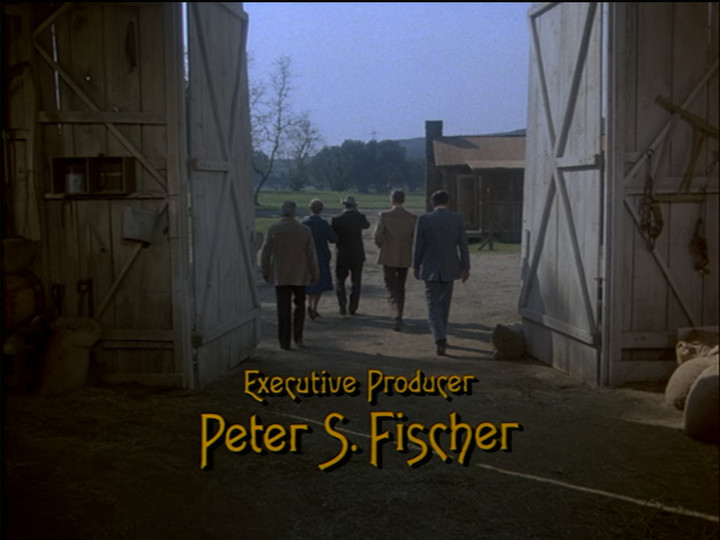
Sam then takes off his hat, offers Jessica his arm, and they all walk back to the house.
I have very mixed feelings about this episode. On the one hand, parts of it are well done. We get a good sense of the loneliness of the Carver ranch and the close-knit nature of the sort of community which is necessary to thrive where there are so few people. On the other hand, I really don’t like the ending.
The ending violates the ideal structure of a murder mystery. In an ideal murder mystery, the murder—that is, the intentional, unjustified killing—causes a disorder in the community through the misuse of reason. The detective then enters the world, temporarily becoming a part of it, and through the right use of reason restores order to the community. Plenty of mysteries don’t have this structure; however, though it’s not universal, it is common and, more importantly, it’s the structure that the best mysteries have.
The first major violation of this structure in this episode is that the killing isn’t even murder. It is more properly manslaughter, since they did not intend to kill but nevertheless did kill during the commission of a crime (assault).
The second major violation of this structure is that the death didn’t cause a rupture in the community. In fact, Carl Mestin’s presence caused the rupture in the community and his death fixed it. It didn’t perfectly fix it, but everyone was better off with Carl Mestin dead.
Worse, the part that Carl Mestin’s death didn’t fix wasn’t fixed any other way, too: Carl’s inheritance of the ranch. With Carl’s death it doesn’t go to his widow, since he wasn’t actually married, but if he doesn’t have any near relatives, it would go, not to Mary, but to the state of Wyoming. About the best case for Mary would be that, with Mestin dead, no one who will speak up on Mestin’s behalf will mention the existence of this will and consequently Mary can inherit under the rules of intestacy. If things turned out that way it would just bring us back to Carl Mestin’s death being the thing which fixed the problems that his life caused. (It would actually work for Mary to inherit as his daughter, presuming Mestin died intestate, but that just causes other problems.)
Which means that Jessica’s solving of the crime did no one any good.
And the thing is, I mean literally no one. Not even the Sheriff. Contrast this with Agatha Christie’s classic murder mystery, Murder On the Orient Express. (spoilers ahead, but, dear reader, as you’d have to be 92 years old at the time of my writing this to not have had your entire life to read it, I think you’ve had enough time and I can discuss the plot with a clear conscience.)
Murder On the Orient Express, like Funeral At Fifty Mile, has the solution that almost everyone did it together. And, further, it has the property that the victim really had it coming, and his departure from the world fixed problems caused by his wickedness while it did not introduce any new problems, except for the responsibilities given to the authorities. Which brings us to the key difference: in Murder on the Orient Express, the authorities had a real problem caused by the death. Specifically the director of the Wagon-Lit company had a murder on his train and for which he was responsible to his passengers because passengers really dislike trains on which people get murdered. And owners of companies do not like it when their customers get murdered while being customers. Poirot solved these problems for him without creating more problems. He laid out two possible solutions: an uncatchable fake assassin who crept away in the snow but who was specifically after the victim and who might have killed him anywhere, and the real solution. He laid out the assassin theory first and the director of the Wagon-Lit company at first dismissed it, but Poirot admonished him to not be so quick to dismiss it because he may come to like it after hearing the second solution. And, indeed, he did. After Poirot carefully laid out the real solution, the director said that clearly he had spoken too hastily and obviously the first solution was correct. That is, Poirot gave him a way to fulfill his duty to the rest of society and also to act justly in this case, and left the decision with him.
By contrast, Sheriff Ed Potts didn’t really have any obligation to the community to solve the killing of Carl Mestin because the general opinion in Fifty Mile was that Mestin was born to hang and the world was clearly better off without him in it. And these are the people who employ Sheriff Potts and the only people to whom he answers. Unlike the director of the Wagon-Lit, if he just left well enough alone, everyone would be happy. And it is in this context that Jessica demanded that the four friends not let the Sheriff leave well enough alone.
This brings us to one of the strange things about Jessica Fletcher as a person: her greatest faith is in civic authority. She is, perhaps, best described as a devoted believer in the American Civic Religion. (It’s an amorphous, hard to nail down religion which is vaguely deist and holds America to be something sacred and thus all its institutions are sacred.) She has notions of justice, but her devotion to the American institution of the courts is greater. Poirot, being Catholic, could hold that human institutions are fallible and not always to be trusted with the difficult cases. Jessica cannot; she must see the law carried out no matter what.
Which means that Murder, She Wrote does better when it sticks to actual murder and leaves things like manslaughter, justified homicide, etc. alone. Les Miserables would not be improved by having Javert as the protagonist.
Moving on from the ending, the characters in this episode were mostly pretty good. None of them were well fleshed out but they at least all had a few hints of a personality and the actors did a lot with those hints. William Windon as Sam Breen, in particular, was a ton of fun. This may be why he replaced Claude Akins as Jessica’s close Cabot Cove friend starting in the second season.
The main exception was Sheriff Potts. He was a caricature from the beginning, which can be a fun start if the caricature becomes a character; that is, if he gets turned into a real person who simply has some interesting quirks. That often reflects how we meet people, after all. At first we notice their unusual characteristics, then we get to know them. The problem with Ed Potts is that he never became a character. The closest they came was having him drive Art back home after dropping the charges, as that did require some sense of responsibility. But on the whole I found him annoying without any compensation for that annoyance.
The setting was also enjoyable: Fifty-Mile, Wyoming, was a nice place to visit.
Another point in this episode’s favor is that it does actually establish how Jessica is connected to the place. Over the seasons, Jessica has an oddly large number of old friends who are never really explained and are often not very plausible; attending the funeral of someone her late husband served with in the Air Force is a nice way to explain this that is plausible.
As far as plot holes go, this episode did pretty well. I think one plot hole was that the people were a bit over-concerned that Mary never find out that she was Mestin’s daughter. It would be pretty unpleasant to find out that the man you thought was your father was merely a man who loved you and raised you as his own, but your real father is a scumbag rapist. On the other hand, it’s not like anyone gets to pick his parents and having someone raise you lovingly because you’re the daughter of a good woman he loved would help her to deal with it, and it’s not like anybody in the area believes in a tainted bloodline, so she wouldn’t face any practical consequences. I don’t want to overstate that; I completely understanding not wanting to burden her with the truth, but that can easily be taken too far. Very few good things come from running from the truth. And I very much doubt it would be worth disinheriting Mary rather than telling her the truth. Especially now that she’s an adult. As a child she might worry that she will take after her real father, but as an adult she knows who she is, regardless of who her father was.
The only other real plot hole I can think of is the noose outside of Jessica’s window. That really came from nowhere and went nowhere and didn’t fit the character of any of the four conspirators. They really just did it so that they could go to commercial break on a dramatic note and couldn’t come up with anything. But at the same time it only takes a few seconds and could easily be excised from the episode without anything else having to be changed. Well, that’s not quite true. Instead of Jessica saying that the noose outside her window was tied by a right-handed man, she’d have had to say that the noose around Mestin’s neck was tied by a right-handed man. Half a line isn’t much of an impact.
Actually, there’s one more plot hole I can think of: I’m not sure that Sally not having a tan line under her wedding ring is actually proof that she wasn’t really married. Sally would, in any event, have been pretending that she and Carl got married recently, which means that even if it were true she’d have had no time to get a tan line from her wedding ring.
Well, that’s the end of the first season of Murder, She Wrote. Back in 1985 it was almost five months until Season 2 would begin with Widow, Weep For Me.
 Chris Lansdown
You must be logged in to post a comment.