A while ago I came across an interesting video from RazörFist called Hollywood Was Always Red. (A warning: RazörFist uses very salty language.)
One of the things that really struck me from it was when RazörFist pointed out that Joe McCarthy did not run the House Unamerican Activities Committee and the first clue should have been in the name: the House Unamerican Activities Committee. How, he asks, would Senator Joe McCarthy run the House Unamerican Activities Committee?
If you look it up, what Joe McCarthy ran were called the “Army-McCarthy Hearings” which were held by the “Permanent Subcommittee on Investigations of the Senate Government Operations Committee” (see here). They had nothing to do with Hollywood blacklists and, as the name would suggest, were investigating communist infiltration into the Army.
The House Unamerican Activities Committee, or more properly the House Committee on Un-American Activities, was formed in 1938—9 years before Joe McCarthy would become a senator—and was initially chaired by Martin Dies Jr, a Democrat from Texas. (Check out the Wikipedia page on it.)
When he pointed out that the first clue should have been the name and highlighted the “Senator” in Senator Joe McCarthy and the “House” in House Unamerican Activities Committee, I was stunned. It’s so obvious, just from that, and yet somehow I had never considered that and just went along with the fake history I was told about how the House Unamerican Activities Committee was part of McCarthyism and McCarthy led to blacklisting in Hollywood and the like.
I don’t get stunned watching YouTube videos often. In fact, I’m not sure I have other than with this one. But it’s so strange to have realized that something that was commonplace among everyone I knew wasn’t just wrong, but obviously wrong. Not just obviously wrong, but we had all the information to know that it was wrong and just never put it together. The “House Unamerican Activities Committee” was just a name, not a collection of meaningful words in a meaningful order. But it really should have been.
Most words have multiple meanings, but there are problems when you can’t tell the meanings apart by context. The word “feminism” has exactly this problem because it has been used to refer to people doing superficially similar things in the same contexts which are actually quite different. There have been many feminisms, some of which have been absolutely terrible (especially Marxist feminism). A full taxonomy of them would take more than a little time and probably not actually be very interesting, but there are two types that I would like to distinguish in order to illustrate this point: the feminism of the Seneca Falls Declaration of Sentiments (in 1848) and 2000s era internet feminism.
The 1848 version of feminism was about the context in which there existed places in America where women could not own property in their own name (the legal context of mid-nineteenth century America was far more heterogenous than modern America) and in some places could not be legally held accountable for their own crimes. In fact, one of the articles in the Seneca Falls Declaration of Sentiments was that it was not just that, in some places, a father or husband would be held legally liable for a woman’s crimes and not she herself. That is, they asked for a reform to the laws that would involve holding women criminally liable for their own crimes. (Please note: I am not, thereby, saying that this was all that was in the declarations of sentiments or that it was a perfect or an unalloyed good; I’m not interested in discussing that one way or another. My only point is that one of its major concerns was both legal rights and responsibilities, many of which amounted to bringing American law in line with European and especially British legal traditions, rather than innovating.)
By contrast, 2000s era internet feminism was largely selfish people telling obvious lies to justify why they shouldn’t have to treat people decently or even take the trouble of developing basic social skills. You can see this today in the wretches who complain about “emotional labor” and when you look into what they mean, it turns out that they’re talking about the work of living in a society and having to treat other people better than as chattel slaves.
Of course, I’m not saying to never use the word “Feminism.” My point is, rather, that one should rarely, if ever, use it in an unqualified way. When talking about some feminism, it would be much better to say things like “equal property rights feminism,” “suffragette feminism,” “Marxist feminism,” “sexual liberation feminism,” “2000s era internet feminism,” etc. It is more cumbersome, of course, but it drastically improves the likelihood of actually being understood; all the more so as many people are only familiar with some of these and if they’re not familiar with the one you’re talking about they’re going to assume it’s one of the ones they do know about. By adding the qualifiers, this will be especially helpful in this case as their reaction will be “what are you talking about?” rather than “you idiot.” “What are you talking about?” can be an excellent starting point to mutual understanding. “You idiot,” pretty much never is.
Kanye West (now going by “Ye,” I believe) recently came out with a song called “Nigga Heil Hitler” which has that as a refrain in it. Jonathan Pageau has a very interesting video where he talks about it in the context of the breakdown of the post-WW2 concensus:
It’s very worth watching, but the basic point is that all foundational narratives made by men contain a contradiction in them and the post-WW2 narrative of good-vs-evil necessarily exculpated Stalin, who was in reality just as bad as Hitler, in order to make the WW2 narrative good-vs-evil.
He doesn’t focus on this aspect of it in the video because he’s more concerned with other things, but this very much explains why it was that the socialism of the National Socialist German Worker’s Party is ignored by most people. This is why people pretend that they weren’t real socialists or they maybe started out as real socialists but then abandoned it once they gained power, etc. etc. They needed to explain the Nazis as a unique evil different from the evil of anyone on the Allies’ side. And since there’s not actually very much that distinguishes the Nazis from the Communists—in the 1930s people would flip flop between them to the point where the Nazis had an insult “beefsteak Nazi” meaning someone brown on the outside but red on the inside—what people came up with was the Nazis being racist. Well, that and nationalist. Sort of.
Regarding the racism, it’s not like the communists weren’t racists—they were—but racism wasn’t central to their socialism while it was central to the socialism of the National Socialist German Worker’s Party. So this one is at least a difference. And while you could find plenty of racism in 1930s/1940s America, it was, at least, a different kind of racism. And especially after the civil rights movement of the 1950s, this ceased to be such a problem.
The nationalism of the Nazis is a curious issue because it is true it’s a major distinction between the Nazis and the Communists. The Nazis were national socialists while the communists were international socialists. But that meant, in practice, that Hitler only wanted to conquer most of Europe while Stalin wanted to conquer the world. That’s not really the kind of distinction that was desired, though, so people tended to pretend that Hitler wanted to conquer the world. Certainly that was what I was taught when I was a child.
This is a very interesting point and explains a lot of the modern world.
I was recently reminded of how much of western culture, in the 1970s, was about World War 2. In that period, the second world war was only thirty years before and the people of responsible age (that is, those in their forties through their sixties) had spent many of their formative years in it. And World War 2, which was in many ways only the second great industrial war, had been a total war in a way the world had not really seen before. And I think that this total war had the effect, as few other things besides Communism have had, of turning the state into a religion. And I think that this may have had some strange effects afterwards.
When I say that the second World War turned the state into a religion, I mean that the war, and by extension the state, became the primary purpose of its citizens’ lives. (I’m going to confine my remarks to America, since I know its history best, but from what I’ve read this was largely true of many other countries as well.) This was not absolute, of course, and individuals might have maintained a better set of priorities. Still, the state tried very hard to make itself the purpose of its citizens lives. You can see this in the way that people were encouraged to do everything “for the war effort”. You can find all sorts of examples of magazine ads by companies who aren’t selling products because their factories are now making weapons, but that they will one day resume, so don’t forget them! There was also an enormous amount of propaganda produced, which covered almost everything, since the war touched on almost everything. There were ads which encouraged people to accept rationing of food. There were ads encouraging people to put all their spare money into government bonds rather than buy things for themselves. There were ads that encouraged young women to get a job in the war effort to help bring their sweethearts and husbands home sooner. And from what I recall talking to relatives to had lived through it, much of it worked. As much as people might grumble and there was a thriving black market, people did take up the spirit of the thing and often think about the war effort whose nearest land battles were many thousands of miles away.
And the thing is, while all this can be done as a matter of secondary loyalty, fallen human beings are weak and this kind of total subservience to the state had the effect, I am beginning to suspect, of supplanting God with the state in the hearts of many people. I’ve heard the explanation that many people fell away from Christianity after WW2 because Christian churches were too compliant with the governments that brought us to such an awful war. The horrors of World War 2 broke people. Christianity’s old tired answers were no longer good enough. I’ve heard many such things. And, truth be told, they’ve never sounded very convincing. Christianity made sense under the horrors of the Roman empire and Germanic barbarism but didn’t make sense after the horrors of World War 2? The secular governments of the world plunged people into war and starvation, and Christianity didn’t stand against them enough, so let’s abandon Christianity and become completely secular? These aren’t serious explanations.
The explanation that the people started worshiping an idol—the State—and as idol worship does, this caused the people to turn away from God? That does, at least, explain.
I don’t want to overstate this idea. I’m just beginning to turn it over in my mind. But it does explain a bunch of things which had always not-quite-fit.
J.D. Vance once made the observation that the real danger of social media isn’t living in an echo chamber, it’s only being exposed to the most extreme versions of the positions of people who disagree with us. I think that this is an important insight, and speaks to how it is important to seek out the reasonable version of extreme views that we see made fun of. That said, there are two kinds of extremists, and the more reasonable version is only important for one of them.
Let’s start with that kind: the extremist who is a monomaniac. This kind of extremist is extreme because he has abandoned most kinds of good in life and cares only about one kind of good. To make up an example so as to not be accidentally controversial, let us suppose that there is a man who loves the color blue. If he merely loves blue, but loves other things as well, he may well have many blue things in his house but he will not seek to paint the whole world blue, because he knows that trees and grass need to be green, and have their own value. If he was a monomaniac in his love for blue, he would not recognize the good of grass and trees and so would not care that they need to be green to achieve it (I’m speaking of photosynthesis, not of their aesthetics), and so he would seek to pain the grass and trees green, and would kill them. This kind of extremist, though highly concentrated online, is rare in real life. Most people love more than one kind of goodness, and so no matter how much free reign they are given to realize their ideal world, they will balance out competing goods and not wreck the world. These kinds of reasonable people are important to seek out. (I should also note that this highly simplified form of extremist is not what one typically meets online; I need to explain the other kind before I can clarify further.)
The other kind of extremist is a man who is dedicated to a philosophy of life and is not afraid of the opinions of his fellow man, but takes his philosophy to its logical conclusion. This is the Catholic saint, the Protestant Puritan, the Buddhist ascetic, and the Soviet dictator. People who are not extremists of this kind are not people who balance out goods, but merely people who lack the courage of their convictions. They do not live out their philosophy of life, not because they think it lacks something, but because they lack something. Most of the time, it’s social sanction that they lack. That’s why, for this kind of extremist, it is precisely the extremists you should pay the most attention to. If society were ever to adopt their beliefs, it would become more like them.
Now that I’ve explained the second kind of extremist, I can describe where you are actually most likely to meet the first kind of extremist: as someone posing as the second kind of extremist. The technical term for this is a heretic, though it’s an unpopular word with baggage, so let’s stick to “monomaniacal extremist.” For that same reason I will avoid religious examples, so let’s take a secular one: environmentalism. There are plenty of people who want to take care of the planet on which we live in a balanced way. They consider measures to ensure that we don’t poison our water supply, but also consider other goods like industrial production, nice housing, having pets, growing food, and a myriad of other goods that need to balance each other out. Then you have the monomaniac who only loves nature where it has not been affected by human beings, and so champions anything that removes human influence, at the fullness of expression being the human self-extinction project.
This example also shows the importance of distinguishing the two types of extremist. On the one hand, it is important to figure out that the monomaniacal environmentalist merely hates people, he doesn’t love the environment as one good among many, and so he does not represent the views or policies or much of anything of the people who merely consider clean air and water and an interesting variety of wildlife to be goods to balance out among other goods. On the other hand, the people who are members of the human self-extinction project are merely the monomaniacal environmentalists with the courage of their convictions. One should not ignore the human self-extinction people and seek out the more moderate “strangle the economy with regulation” environmentalists because those are only distinguished from the human self-extinction people by being unwilling to say what they really mean.
I’m hoping that enough time has passed that I can talk about Kamala Harris’s video that she sent to the Al Smith dinner in lieu of attending without it being political. Whatever you think of her or Donald Trump, or her policies or his policies, all but a few people recognize that she ran a terrible campaign. And though which was the most incompetent part of it is debatable, I think it was her video submission to the Al Smith dinner, and I think it’s interesting to look at how incompetent it was, because it was a level of incompetence we rarely see from adults. But I’ve waited until now because I want to talk about the incompetence, not the politics, of it.
For those who don’t know, the Al Smith dinner is a charity dinner hosted by the Catholic diocese of New York City which happens every four years to raise money for Catholic charities in New York. Since the 1950s, it has been a tradition for both major nominees for President to attend and for them to make jokes, both about themselves and the other candidate. Only two candidates have ever not attended. The first was Walter Mondale, who lost the election in a landslide to Ronald Reagan. (Mondale received only 40.6% of the popular vote and won only the electors of Washington D.C. and Minnesota.) The second was Kamala Harris, who sent a short, theoretically comedic, video in lieu of attending. This is the video that I want to discuss.
And to explain the point of view from which I want to talk about it: back in college, I was a writer and actor in one of our small university’s two competing sketch comedy shows (we would put on three or four shows a semester). What I want to look at is the creative decisions which went into this from the perspective of comedy and effective communication.
To begin at the meta level: the very act of sending a video instead of attending was a strange thing to do, but though it was taken as an insult by attendees of the dinner, it probably could be a defensible choice. If so, it was the last defensible choice.
The video begins with Harris saying “Your Eminence, and distinguished guests, the Al Smith dinner…” when a sixty year old woman in a Catholic schoolgirl outfit runs behind her. As Harris continues to say, “…provides a rare opportunity to set aside partisanship…” when the figure walks behind her again and says, “so cool.” At this, Harris notices and asks what’s going on and who that was. The woman runs up, shakes Kamala’s hand, and introduces herself multiple times out of excitement. She’s Mary Katherine Gallagher.
For those who don’t know—and I didn’t until looking it up—this was a character invented in 1995 for the long-running comedic TV show Saturday Night Live. The character was used until 2001, and was the star of the 1999 movie Superstar (“superstar” was a catchphrase of the character). Superstar made $30.6M on a $14M budget, which wasn’t bad, but was hardly a big hit.
So, right off the bat, we have the bizarre decision to bring in a pinch hitter. That will, necessarily, make Harris look weak, no matter how good the pinch hitter is. This is a counter-intuitive choice, given that she’s running for chief executive of the United States; a role for which virtually everyone agrees strength is a virtue. Then there’s the aspect of the pinch hitter being a long-forgotten character from SNL—a comedic show famous for going years at a stretch without being funny. Comedy rarely ages well and SNL’s brand of comedy tends to age especially badly. And it had been 23 years since the character was last a regular on SNL.
Then there’s the issue of this being a character designed to make fun of Catholics to a secular audience being used at a Catholic charity dinner. That is such an extraordinarily bad choice; it’s only a notch or two better than telling the archbishop to go “f” himself.
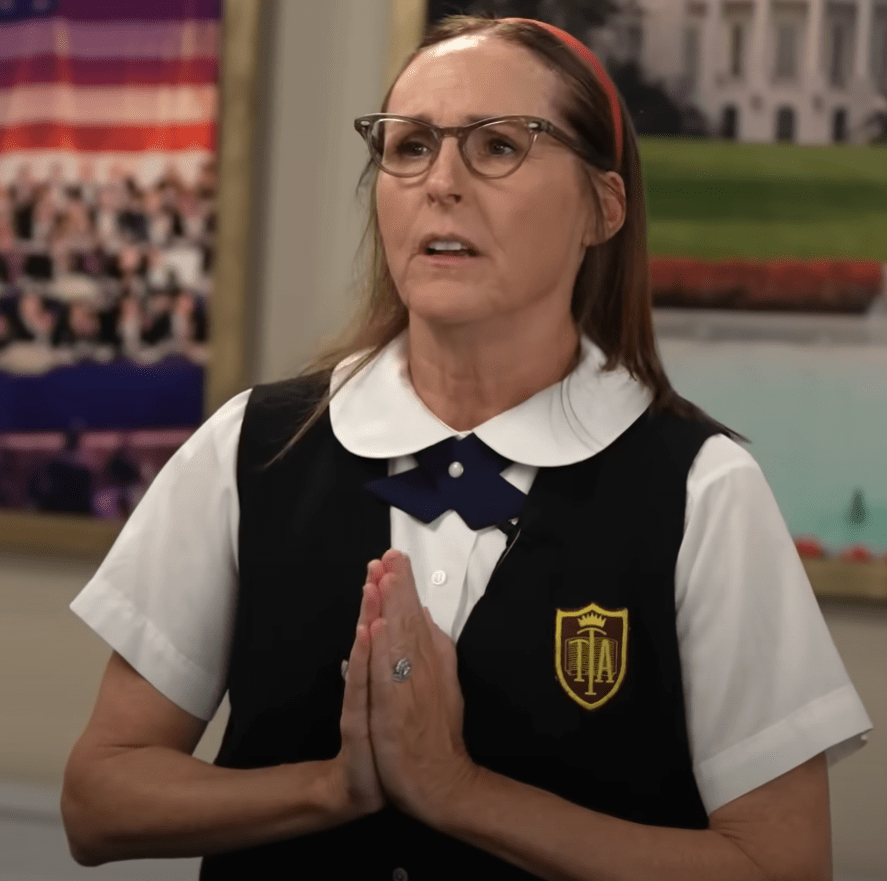
Then there’s the ancillary issue brought on by it being more than a quarter century since the character was introduced: this parody of a Catholic schoolgirl is being played by a sixty year old woman. Yes, she has professional makeup, but even professional makeup artists can’t make a sixty year old look like a sixteen year old. And there is very little that’s more pathetic than watching someone old enough to be a grandparent sincerely pretend to be a teenager. I mean, just look at this:
Having said that, I looked up some clips of the character twenty five years ago, and frankly she wasn’t convincing back then, either:
To be clear: there’s nothing in the world wrong with being a sixty year old woman. Which is why sixty year old women shouldn’t pretend to be sixteen.
Anyway, Mary Katherine is incredibly excited to meet Kamala; she can barely speak for the excitement. More collected, Kamala responds that it’s very nice to meet Mary Katherine, but right now she’s trying to record her speech for tonight’s dinner. Mary Katherine replies that she knows, she’s Catholic, and tonight is one of the biggest dinners next to the last supper.
I suspect that this was supposed to be a laugh line but there’s no actual joke there. Perhaps the joke is that she’s comparing a mere charity dinner to one of the most important events within Christianity, but then the joke is that Mary Katherine is an impious idiot. Since she shouldn’t even be here (whether you’re talking about in-story or in-reality), that’s not a joke. That’s just character development of a character meant to insult Catholics.
Kamala replies that it’s an important dinner and an important tradition that she’s so proud to be a part of.
Mary Katherine then says that sometimes when she gets nervous she sticks her fingers in her armpits, squeezes them, then smells her fingers. She suits the action to the words and Kamala looks on with a faint air of disgust. Mary Katherine then says, “but that’s gross.” Yes, in fact, it is. Which is entirely inappropriate to the entertainment of a dinner. I mean, having looked up vintage clips, it was never a good joke. But it’s a particularly bad joke now.
Kamala then says, “So tell me something. Um. I’m giving a speech. Do you have some thoughts about what I might say tonight?”
This is an awful transition into the main part of the sketch. Comedy is not supposed to be realistic, but the parts that aren’t jokes are supposed to have some kind of internal logic that the jokes get to play off of. Here the premise is that Kamala had so little idea of what to say—despite having started recording—that she’s asking a random idiot for advice merely because this random idiot happens to be Catholic. This implies that this random idiot is literally the first Catholic Kamala has been able to find. Given that about 20% of Americans identify as Catholic, the best case is that Kamala is portraying herself as hopelessly out of touch. She’s also portraying herself as recklessly unprepared. That could be a funny setup for jokes at her own expense, but that’s not at all what she’s trying to set up. “Are you here to give me advice on what I should say?” would have been way better. It would imply an appropriate level of annoyance, it would not imply she was unprepared or knows no Catholics, and it makes a certain amount of sense as possibly the fastest way to get rid of the person in front of her, which also implies superiority, not being a subordinate. And that took me two seconds to come up with. I may have some skills as a comedy writer, but there are a lot of people who are far, far better at it than I am.
And this awful transition is so unnecessary. The framing story of Mary Katherine running around and interrupting the recording was stupid. They could easily have had Mary Katherine being brought in as an expert on Catholicism and Kamala being skeptical. That would have been a massively better framing story, both for how Kamala would want to portray herself as a presidential candidate (competent) and as a setup for jokes.
Anyway, Mary Katherine replies in a rapid-fire monotone, “My feelings on what you should say tonight would be best expressed in a monologue from one of my favorite made-for-TV series.”
This is Mary Katherine’s face while she delivers the monologue:
Kamala then says, “OK, let’s hear it.” We then get the monologue:
Don’t you see, man? We need a woman to represent us. A woman brings more heart. More compassion. And think how smart she must be to become a top contender in a field dominated by men. It’s time for a woman, bro. And with this woman, we can fly.
Wow, that’s a real thigh-slapper alright. It’s a good thing they brought a comedian on as a pinch hitter to deliver jokes like that.
Kamala asks what series that’s from and Mary Katherine replies that it’s from “House of Dragons, now streaming on HBO Max”. So we get product placement in a recorded video message for a charity dinner. How can a human being have judgement that bad? Did HBO sponsor this video?
Kamala then transitions to the next joke, asking, “is there anything that you think that maybe I shouldn’t bring up tonight?”
Speaking as someone who wrote sketch comedy: transitions to different topics for jokes are not easy, so I’m not unsympathetic. At the same time, they’re important, and I don’t understand why the writer put no effort into this transition. “Is there anything I should avoid saying?” is an unnatural question, except perhaps when you’re prepping for an intimate dinner with someone and you’re expecting a wide range of subjects. Unnatural transitions ruin the suspension of disbelief that helps to make the jokes funny. A much better transition to things to not say would be to bring up something and have her say “oh no, don’t say that.” You’d want it to not be insulting, so maybe something like, “I was thinking of complementing the cardinal on his dress,” to which Mary Katherine could reply, “Oh no, don’t call them dresses, they don’t like that,” at which point the question, “is there anything else I should avoid” would be natural.
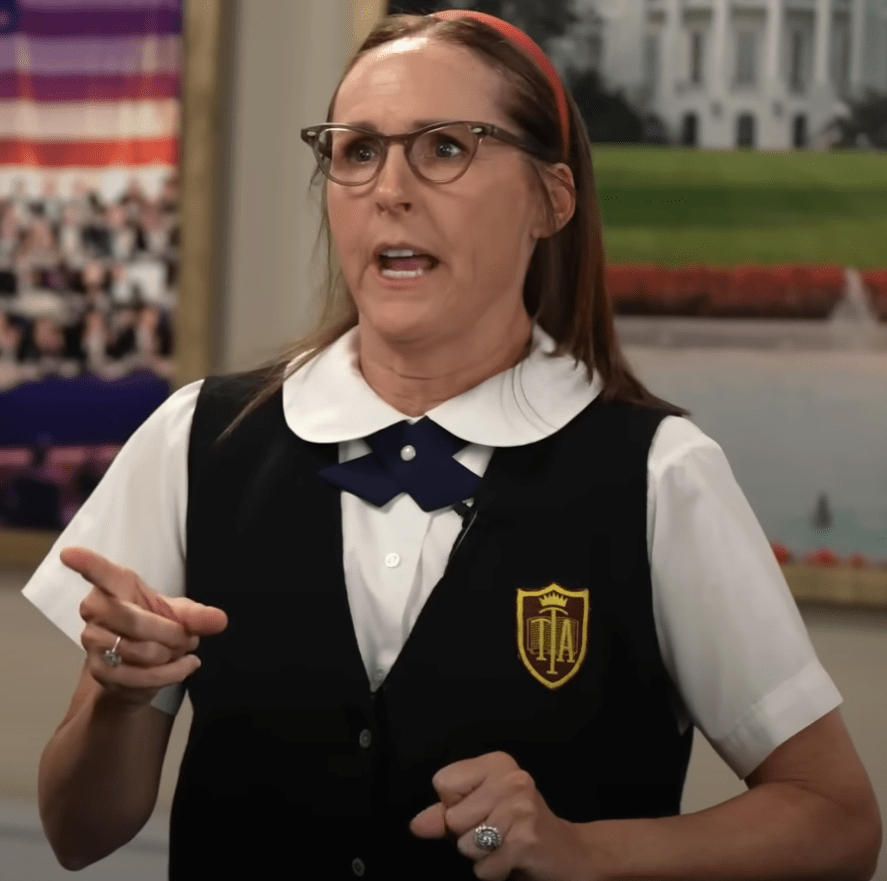
Anyway, after the unnatural transition, Mary Katherine gives a terrible setup for Kamala to make a joke. She says, “Um, well, don’t lie. Thou shalt not bear false witness to thy neighbor.”
As she misquotes the ten commandments, she folds her hands as if in prayer.
In both versions of the commandment she’s trying to quote (the Ten Commandments appear both in Exodus and Deuteronomy, slightly differently), the actual commandment is to not bear false witness against your neighbor. If you’re going to quote someone’s holy texts, it’s insulting to lazily get it wrong. And this was recorded. They could have done another take if the actress flubbed her line.
Kamala then responds, “Indeed. Especially thy neighbor’s election results.”
So we’ve gotten to the first real joke in this sketch, and it is, at least, funny. The humor is marred by the delivery not making any grammatical sense, though. I don’t mean that people listening will be picking apart the grammar; that’s not how people listen to things. But grammar that actually works makes it easy to immediately understand what’s being said, and sudden reveals are important to humor. Slowing the listener’s comprehension down with nonsensical grammar makes the reveal slower and thus less funny. There’s a reason why “wits” refers both to people who are funny and to quick thinking. And again: this is a recorded skit with multiple camera angles they cut between. If an actor flubbed her line, they could just do another take. When you are presenting something edited, the bar is higher because it’s so much easier to get everything right since you only need to get each individual part right once out of maybe twenty tries.
If you care enough to try more than once, that is.
Also, and this is a general thing: it’s an absolutely terrible idea to say that you won’t lie because to bring up the subject at all is to imply that you would lie if you thought you could get away with it. There is no way to have Mary Katherine tell Kamala to not lie that doesn’t sound like she thinks Kamala might lie. Which brings up the question: why does she think Kamala might lie?
This is especially the case given that she points her finger at Kamala accusingly when she says, “don’t lie.”
When this joke is over, Mary Katherine hastily adds, “just so you know, there will be a fact checker there, tonight.” Kamala says, “Oh, that’s great. Who?” Mary Katherine says, solemnly, “Jesus.” Kamala nods and smiles… well, look for yourself:
She doesn’t agree, or point out that Jesus is always watching, or… do anything. She just smiles awkwardly as if she doesn’t believe it and wants to move on. About the only way for this to be a joke is if the punchline is that Mary Katherine believes that Christianity is true. That my work at an atheist charity dinner, but it’s a terrible joke to try to pull off at a Catholic charity dinner.
Mary Katherine then hastily adds, “and maybe don’t say anything negative about Catholics.”
Again, this implies that, but for this advice, Kamala would say negative things about Catholics. That may well be true, but why advertise the fact to Catholics? She’s already skating on thin ice by not even showing up; suggesting that she would lie and disrespect Catholics by unnecessarily denying that she would do either is a bad idea and pointless because it’s not even part of a (funny) joke. While only a fool would shop for a vehicle at Honest Bob’s Reliable Used Cars That Definitely All Work, at least it makes for an interesting logo because there are enough words to do something with, graphic-design wise. Plus, Honest Bob only needs enough fools to pay the bills, and there’s no shortage of fools in the world. He doesn’t need the majority of the population to come buy a car from him.
Kamala then replies, “I would never do that no matter where I was.” So far, fine, though it was a bad idea to bring it up in the first place. But then it turns out that this is the setup to a joke, or at least to what I’m pretty sure someone thought was a joke:
“That would be like criticizing Detroit, in Detroit.”
This is a reference to a remark Donald Trump made in a speech to the Detroit Economic Club, where he said, “The whole country will be like — you want to know the truth? It’ll be like Detroit. Our whole country will end up being like Detroit if she’s your president.”
It’s a reference to what Trump said, but it’s not a joke about it. There’s no contrast, no twist, no juxtaposition of anything. There’s no wit. It just mentions it.
Worse, it contradicts what she just said about never insulting Catholics no matter where she was. Criticizing Detroit in Detroit is not like criticizing Catholics anywhere. If anything Kamala might do was like criticizing Detroit in Detroit, it means she will insult Catholics, just not here.
They then move on to the next bit without attempting a transition. Mary Katherine asks, “Does it bother you that that Trump guy insults you all the time? Because it really bothers my friends and me.”
This is dumb on several levels. For one thing, the character of Mary Katherine Gallagher, so far as I’ve been able to tell, doesn’t have friends. She’s a socially awkward teenager who does things like smell her armpits when she’s nervous. Further, she’s a Catholic schoolgirl. Is she really supposed to be following politics so closely that she knows what Trump says about Kamala? And at the same time, it’s ridiculously partisan; you have to have your head pretty far up the democratic party’s backside to think that Kamala doesn’t constantly insult Donald Trump. That’s not compatible with the level of naiveté involved in this question. The point of all of this is not to say that the character is unrealistic—comedy is not supposed to be realistic—but that it doesn’t have any kind of internal consistency. Now, you can violate internal consistency to make a joke, such as an when illiterate character who never wrote a book suddenly extensively quotes Aristotle, but violating internal consistency in your setup undermines your jokes.
Kamala replies, “Oh Mary Katherine, it’s very important to always remember: you should never let anyone tell you who you are. You tell them who you are.”
I mean, OK. That’s not the worst advice in the world, though taken literally it means never listening to feedback and even when not taken literally it suggests never being open to the idea that you’re wrong or should change, but it’s not good advice, and it’s not a joke.
Mary Katherine then quotes a Taylor Swift song, saying “haters gonna hate hate hate hate hate; shake it off.”
Kamala replies with the next line from the song: “Shake it off.”
After another round of each saying “shake it off,” an assistant walks on and starts to drag Mary Katherine off.
As she pulls on Mary Katherine, the assistant says, “Madam Vice President, they’re ready.”
They’re ready? “They” haven’t been ready the whole time? I guess the writers forgot that the skit started with Kamala beginning her address and being interrupted by Mary Katherine. And are we really to suppose that someone only just noticed that Mary Katherine was here? Why would Kamala want to pretend that she’s surrounded by incompetents?
And what is the story supposed to be? Were “they” not ready when Kamala started the first time? If so, why was she giving the address to people who weren’t ready? Or are we supposed to pretend that the address she’s about to give will be a live video call? But we’ve been watching this and Kamala told Mary Katherine that she was trying to record her speech “for tonight’s dinner.” So who is now ready? There’s no way that “Madam Vice President, they’re ready,” makes any sense. And that’s on top of the absurdity that Kamala was recording her speech without someone operating the camera and teleprompter, or that if there were, they weren’t ready during the ongoing recording, or that they had no reaction of any kind to Mary Katherine.
Anyway, Mary Katherine then pulls away from the assistant and says, “one more thing: don’t worry if you make a mistake because Catholic people are very forgiving.”
We all make mistakes, but that (literally) goes without saying. Bringing it up suggests that the normal level of “we all make mistakes” is insufficient. That’s not the kind of thing you want to suggest when you’re trying to impress people. Especially when you’ve already got one strike against you because you brought in a pinch hitter to help you with something that should be easy to do on your own.
Perhaps this was meant to try to encourage the Catholics at the Al Smith dinner to forgive her for not showing up?
Anyway, Mary Katherine then adds another one more thing: “don’t forget to say Supahhstaaaaaaaa!”
This is apparently a callback to the character’s catchphrase (“superstar”) which was also, you will recall, the title of the movie she featured in. I can’t imagine who fondly recalls this character from twenty five years ago, but Kamala’s reaction suggests that she does. Does she really expect anyone at the Al Smith dinner to remember this character fondly, such that her out-of-context catchphrase will bring the happiness of recalling good times?
Kamala then thanks Mary Katherine, who replies, “Thank you, Momala!” as she finally leaves. Who thought that calling Kamala “Momala” in this context was a good idea? It’s not funny, and Kamala Harris was running to be the commander in chief of the armed forces of the United States. One of her campaign planks was making the armed forces the most lethal fighting force in the world. Projecting a “mom” image is directly counter to this. (Not necessarily so a “mother” image. “Mom” is specifically about the tenderness between a mother and her children. “Mom” does not encompass the entirety of motherhood and has no suggestion of a mother willing to defend her children. “Mother” can be very different depending on context; “mom” specifies a context. If Kamala is “mom” to the whole country, this means that she’s tender and indulgent to rapists, murderers, and home-grown terrorists. It’s a political question whether she would have been indulgent to them, and I’m not here considering that political question. It’s simply a question of messaging that she was not trying to project that image in her campaigning and so projecting it here is mixed messaging.)
After Mary Katherine finally leaves, Kamala then goes up to the main camera where the sketch started and begins again, “Your Eminence, and distinguished guests, the Al smith dinner provides a rare opportunity to set aside partisanship…”
I don’t get why she’s repeating this part, as if all of this really happened and she’s now actually recording what will be played from the start. This certainly is not funny, and it’s annoying to anyone with a functioning memory.
Her serious remarks, which, including the repeated opening, last 1 minute and 13 seconds, are anodyne remarks about how the Catholic Church does good work for the poor and needy, concluding with “God bless you and may God bless America.” This part was fine. Better, in fact—no less funny and far less cringey.
I am a deeply cynical man and I still can’t believe that this video got made. How did it even get past the proposal stage? When Kamala decided to skip the Al Smith dinner but not entirely skip it, and to do this by sending a video, why didn’t she just get a scriptwriter who can do humor, or else a comedian, to just write a five minute monologue? Who on earth proposed, “let’s bring back a quarter-century old SNL parody of Catholic schoolgirls as a pinch hitter” and why wasn’t she laughed out of the room? I mean, I obviously she wasn’t laughed out of the room because no one on Kamala’s staff has a sense of humor. But why wasn’t this proposal just immediately dismissed? How can it have possibly sounded like a good idea? Is Kamala Harris so incredibly insecure that she’d rather show up next to a sixty year old woman sincerely playing a sixteen year old girl than stand in front of a camera on her own and read a few jokes? Or did someone think that getting an aged comedian with a reasonably successful career to reprise a an ancient SNL character was some kind of tour de force? Look at how socially powerful Kamala is because of who will show up to help her?
And once this got made, no one looked at the result and thought, “this is awful, let’s try again?”
What I really find astonishing is that this awful, nonsensical almost joke-free farce was considerably more work than a bland, unremarkable monologue would have been. People tend to use the term “mediocre” as a criticism, but being mediocre is, in fact, greatly superior to being abysmal.
These days one periodically hears about how someone or something is a “threat to democracy,” often from people who are also in favor of things that go against the democratically enacted constitution, laws, safeguards, popular votes, etc. of their nation. The curious thing is that they’re not hypocrites: they’re just using a different definition of democracy than you are. But it’s not a new one.
What they mean by democracy is, roughly, that their guy is in power. But not in a self-serving way. They genuinely believe that the overwhelming majority of people agree with them and so anything which goes against what they want is thwarting the will of the people.
This kind of thinking is nothing new. You see it in all of the communist dictatorships which called themselves “Democratic.” This was not mere branding; they actually believed it. The essence of democracy, they said, is not voting, but rule by the people. Wherever you have voting the people get hoodwinked, lied to, cheated, etc. Wherever they elect representatives, the representatives are bribed, lied to, etc. etc. Thus the will of the people is never enacted, but often things that they do not want are. True democracy is doing the will of the people, which requires a strong leader who is not beholden to special interests, who is immune to the lies of the rich, etc. etc.
This is the sense in which the people who scream about threats to democracy use the word “democracy.” This is in strong contrast to the understanding that the rest of us have, which is the sense that Winston Churchill was talking about when he famously said that democracy is the worst form of government, aside from all of the others that have been tried in this world of sin and woe. This sense of democracy is, basically, using voting as a non-violent proxy for war. This is why it has things like a constitution which is difficult to change which provides safeguards against the worst vicissitudes of short-term victories. If people are to agree to be bound by this proxy for a war with real weapons they may be able to win, they must be guaranteed a limit to what the people who win by voting are allowed to do. Those limitations and safeguards make no sense to the democrat who only cares about the will of the people, because they can only mean, to him, the thwarting of the will of the people.







 Chris Lansdown
You must be logged in to post a comment.