Riding With Death Was a Weird Movie

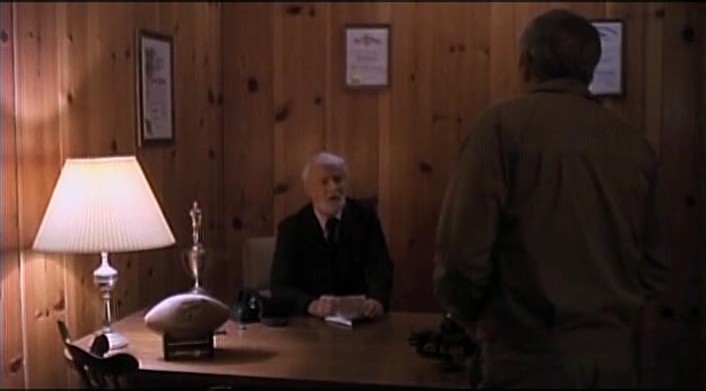
I recently watched the Mystery Science Theater 3000 episode featuring the movie Riding With Death. Many of the movies featured on MST3K are weird, but this one was particularly strange. It was a made-for-TV movie created by editing together two unrelated episodes of the short-lived TV show Gemini Man.

Gemini Man was, according to Wikipedia, a replacement show for a previous show called The Invisible Man, except with cheaper special effects. made in 1976, Gemini Man centers around the federal agent Sam Casey, who in an accident while diving to retrieve something or other from a disabled nuclear submarine was cause in the blast of an explosion and turned invisible from the radiation. Fortunately, scientists were able to turn him visible again through the use of a “DNA Stabilizer.” It’s a temporary effect, though, and he can become instantly invisible by turning it off. He can safely do this for up to fifteen minutes per day (cumulative) before being invisible will kill him. Conveniently for him, the writers, and the special effects department, it’s not just his body but anything he’s wearing that turns invisible—I think it’s got to be something he’s touching (except the ground) when he turns invisible, since he can pick up a gun and it remains visible. The government agency he’s working for is a weird kind of high tech general do-goodery kind of government agency called Intersect. It’s reminiscent of the various shadowy government agencies that would be behind Michael Knight in Knight Rider and behind Stringfellow Hawk in Airwolf, except that it seems a bit less shadowy—the main Intersect building has a large “INTERSECT” logo above its doorway.

The studio show ten episodes of Gemini Man but it was canceled after the first five aired. Based on the two I saw, I can’t say that I’m surprised. It looks to be in a similar genre to shows like Knight Rider and Airwolf, or even The Incredible Hulk: highly episodic shows about a mildly super-powered hero who fights bad guys and rights wrongs throughout America. In the case of Airwolf and Knight Rider the mild super-power comes from having a high-tech means of transportation; in The Incredible Hulk it comes from being about twice as strong as a bodybuilder (they really toned down the strength of The Hulk in that show when compared to the comic books). In Casey’s case, it comes from being able to become invisible for short stretches of time. As super-powers go, you could do worse. During one of the host segments Crow’s short time spent as the superhero Turkey Volume Guessing Man—a man who can accurate guess the volume of turkeys which would fill any three-dimensional space—demonstrates this. That said, you could also do a heck of a lot better. Being invisible makes it harder for people to shoot you, lets you sucker-punch people better, and allows you to listen in to other people’s private conversations more conveniently. That’s mostly what Casey uses his powers for, and the action is typically resolved through Casey being above average at throwing a punch despite not having all that much mass behind it. Also, he’s apparently a very skilled driver.

All good things to have in a government agent, of course, but not very interesting in themselves. Invisibility is, by its nature, not visually impressive, and guns floating in the air pretty much have to look corny. So the result is going to depend almost entirely on the charisma of the characters. Ben Murphy, who plays Casey, is charismatic enough, but the character he’s given to work with isn’t. Casey seems to kind of enjoy being able to turn invisible, but that’s about the extent to which his character is affected by nearly dying and gaining a power that makes no sense which could kill him if his wristwatch ever runs out of battery.

I should mention that I don’t mean “a power that makes no sense” as a nit-picky criticism. In a show like this it’s fine to go with “there are more things in heaven and earth, Horatio, than are dreampt of in your philosophy.” The characters do need to have a sense of wonder and mystery, though. Also, some apprehension is in order. If you don’t understand a thing and it seems to contradict what you do know, you should be aware that it could have “sharp edges.” Casey, by contrast, is easygoing and unaffected, he barely has a care in the world.

Then we come to the movie, which I really would love to hear an explanation for the existence of. Presumably it was a cynical cash-grab where there was a need for a TV movie for some slot and some entertainment hook where something about it—invisibility or trucking, for example—was hot for a few minutes and it takes a lot less time to edit together a TV movie from two fifty minute TV episodes than it does to cast and shoot something original. But it’s really weird how the two episodes were from opposite ends of the show’s short run. They were episode 1 and 10, in fact, and their plots were unrelated.

In the plot for the first episode, a scientist has supposedly invented a chemical additive to gasoline which can cause cars to get two or three times the miles-per-gallon they get with ordinary gasoline, and the big bad oil companies are trying to steal the formula and destroy it to protect their profits. Except it turns out that the additive is unstable and a powerful explosive which can be set off through fairly mild shock (such as dropping it from a foot or two). The scientist has embezzled the $10M in research money that INTERSECT gave him and has set up a plan to destroy the sample and pretend to be killed in the blast, blaming it on the greedy oil companies. This is supposed to happen while he’s riding with the sample in the back of a large moving van which Casey is driving to transport the two gallons of additive over to the department of transportation for evaluation, which has to happen by the end of the business day for some reason that’s never explained because there’s no possible explanation for it.

The scientist has several henchmen working for him and they smuggle him out while pretending to put some extra lab equipment into the truck at his facility and add a radio to the room in the back of the truck where he supposedly is. Then they get on their way for what should be about a thirty mile trip that takes many hours on highways through the mountains and when the bumps in the road don’t set off the fuel additive the scientist (who’s following by helicopter to stay within radio range so he can keep pretending to be in the truck) has one of his henchmen sabotage Casey’s brakes at a stop that he makes for no apparent reason. Along the way Casey meets another trucker nicknamed “Buffalo Bill” on the CB radio, rescues him from some highjackers, and then gets saved by Buffalo Bill who uses his truck to help Casey to stop as he’s coming down from the mountains. There’s also an “exciting” scene where Casey manages to navigate some hair-pin turns at sixty miles an hour due to his superb driving skills. Then the scientist decides that Casey as figured out that he’s not in the truck (which Casey has) and starts shooting at the truck with a sub machine gun from the helicopter. Casey drives the truck to a nearby empty field and gets out before the truck explodes, then subdues the scientist and his henchmen who landed to examine the wreckage.

If you’re wondering what Casey being able to turn invisible with the press of a button on his wristwatch has to do with any of this, the answer is not very much. Mostly it’s helpful for some fistfights and to prevent the guys with guns shooting him as he approaches. Not nothing, but it would have been very easy to work the plot to accomplish this without being invisible.

The second half of the movie is made up on a condensed version of the tenth episode of the series, where Casey runs into Buffalo Bill during an assignment. It turns out that Buffalo Bill has given up truck driving to try to live out his dream of being a racecar mechanic, and the arch villain of the series owns a race car which he personally works on and Bill just happens to have been hired by him. Bill’s girlfriend, “cupcake,” is a secret agent for the archvillain who was assigned to seduce the mechanic, for some reason never explained, and, well, let’s just say that with Casey’s help INTERSECT manages to capture the arch-villain and Buffalo Bill gets the singing career in a truck stop he’s always wanted. (It turns out that Buffalo Bill was played by a real-life country singer.)

I don’t know that I’ve done justice to how disjoint the two sections of the movie feel, or to how easily you could edit out all of the scenes of invisibility while losing very little. Not nothing, but very little.

Also, much of the first half of the movie is CB radio dialog because Casey (who goes by “Easy Rider”) and Buffalo Bill. I found this weird until I looked it up and found out that the hit novelty song Convoy was big on the charts in 1975.

While the TV series ran in 1976, the movie was edited together and released in 1981, by the way, so I suspect it would have felt a bit dated. And speaking of dates, it was set in the not-too-distant future, specifically 1983. I wonder if that was to make the “DNA stabilizer” seem very slightly more plausible.

Also, it’s incredibly jarring that Casey just happens to run into Buffalo Bill who’s made a career change right after Casey’s vacation. In the original filming, this would have felt so much more natural with eight other episodes coming in between. It’s also very strange to get a long-running arch-villain introduced two thirds of the way through a movie.

TV movies were sometimes quite good; I can only wonder what it would have been like in 1981 to have seen the absurdity that was Riding With Death. It made for a pretty good MST3K episode, though.

Looking Up MST3K Callouts Can Be Interesting

Mystery Science Theater 3000 callouts often involved references to movies, television shows, commercials, and other things in popular culture which the writers expected people to recognize. Since MST3K ran (scripted) from AD 1989 through 1999, and since people tend to assume that most people recognize things they experienced as universal, and since the writers were adults at the time MST3K started, and since people remember things since they were about five years old, this means that the writers tended to reference things from, roughly, 1965 through 1999. That’s not quite accurate, though, since in the 1970s and 1980s re-runs of television shows were quite common. So the references tended to be of things, roughly, 1960-1999. Since I grew up in the 1980s, I get a lot of these references, but there are also plenty I don’t get. And it can be very interesting to look these up.

For example, in Manhunt in Space there was the callout:

“Hazel, will you cook up something for dinner?”
“OK, Mr. B.”

Each was done in a voice that was not the host’s, especially the “OK, Mr. B,” so it was clearly a reference. I threw “Hazel OK Mr. B” into google and discovered that there was a TV show called Hazel which ran from 1961-1966. It was based on a single-panel comic strip of the same name and starred Shirley Booth as the eponymous Hazel. She was a live-in maid for the Baxter family and referred to Mr. Baxter as “Mr. B.” The comic strip upon which it was based was created by a man by the name of Ted Key in 1943. The strip finally ended in 2018. (Key was born in 1912 and died in 2008.)

Looking it up on YouTube, it looks like it was a funny show:

I Really Prefer Later MST3K

I’ve been watching a fair amount of Mystery Science Theater 3000 lately. I should say, re-watching it, as I’ve been watching episodes I’ve already seen before, often several times before. And I’ve come to the conclusion that I really prefer later seasons of MST3K. I used to think that I had preferred Mike to Joel as the host, but I’ve discovered that’s a bit of an artifact of how I saw MST3K.

I began watching MST3K in college. I would watch it in the common room of the dormitory I was in, which was how I was introduced to it (someone had put it on the TV in the common room and it caught my attention). This was towards the end of season 8. Later on I started collecting MST3K DVD box sets and that’s where I ran into Joel episodes. With a few exceptions (most notably Cave Dwellers and Manhunt in Space) I didn’t like them nearly as much as I enjoyed the Mike episodes I had seen back in college. I concluded, naturally enough, that I just preferred Mike to Joel.

Then I got even more boxed sets and watched some of the Mike episodes from seasons five and six.

While it is still true that I do generally prefer Mike to Joel, I’ve come to realize that the biggest factor is that the writers just got better over the years. Having watched some special features, they put more time and effort into the jokes as the years went on, which certainly improved the quality. More than anything else, though, the writers learned to work with the movies, rather than working against them.

In the early years, it was not uncommon for Joel or the bots to talk over important parts of the movie, making the movie hard to follow. This made the entire experience less fun, since you didn’t get a chance to enjoy any of the movie, but worse was that it eliminated the possibility for jokes about plot holes. You can’t make jokes about plot holes if no one knows what the plot is.

Allowing the audience to hear the movie had a second benefit, which was that it encouraged the jokes to be about the movie. Obviously, they weren’t always about the movie, and there were plenty of good jokes which were tangential to the movie or just based on visual coincidences or whatever. Still, a lot of the really enjoyable jokes were about the movie that we were watching, and that was a lot more fun.

I don’t want to make too much of this. Cave Dwellers is one of my favorite episodes and it’s from the third season. I also really enjoyed King Dinosaur, which was from the second season. Still, I find that the pattern holds that later seasons tended to be better, and it’s not really surprising that the MST3K crew got better at what they did when they had more practice.

Overdrawn at the Memory Bank and Maruba Fruit

Overdrawn at the Memory Bank may be my favorite episode of Mystery Science Theater 3000. There are a lot of interesting things to talk about in this episode, but I’ll have to do that later. For the moment, I want to share some interesting things I find in researching the episode.

I had a hunch, based on the apparent budget of Overdrawn, that none of the scenes of African animals were filmed for the movie. Most of them were close-cropped enough that they could have been filmed at a zoo, but it just seemed unlikely. I couldn’t find out what movie they came from, though—it’s not credited in the credits and no one seems to list it.

I then tried to find out whether “maruba fruit” is real. It turns out it is, though its actualy name is “marula fruit“. If you scroll down to the “Use by Other Species” section, you find:

In the documentary Animals Are Beautiful People by Jamie Uys, released in 1974, some scenes portray elephants, ostriches, warthogs and baboons allegedly becoming intoxicated from eating fermented marula fruit, as do reports in the popular press. While the fruit is commonly eaten by elephants, the animals would need a huge amount of fermented marulas to have any effect on them, and other animals prefer the ripe fruit.

Now that’s interesting. Jumping over to the wikipedia page for Animals Are Beautiful People, we find:

One scene depicts baboons, elephants, giraffes, warthogs and other African animals eating rotten, fermented fruit of the Marula tree. The animals are then intoxicated, and they stagger around to comic effect, before nightfall comes and they fall asleep. In the morning, we see one baboon wake up, disheveled, next to a warthog, and quietly exit the burrow, as not to wake her.

Well that’s quite promising. So jumping over to YouTube and searching for “Animals Are Beautiful People drunk animals” we find this clip:

And yes, this is definitely where they took the footage from. Some of the scenes are easy to recognize.

Interestingly, Overdrawn changed the order of the scenes. In the documentary, the elephant knocking the tree with the monkey in it happened while the marula fruit was ripe but not yet over-ripe. Later on the fruit over-ripened and started fermenting, and this when we get the drunk animals. (In Overdrawn, the drunk animals come first and the elephant knocks the tree after, which is the precipitating incident for Fingal to demand removal with override priority.)

Mystery Science Theater 3000 Could Only Have Happened When It Did

In a sense, of course, all things can only happen when they did. Still, it’s interesting to consider how much the circumstances that led to Mystery Science Theater 3000 existing. (These thoughts were triggered by coming across some DVD special features as I was curating my MST3K DVD collection.)

MST3K began when Minneapolis-local UHF station KTMA needed programming but had all but no budget.

That in itself is an interesting sentence to unpack, because a lot of younger people won’t know what a local TV station is, nor what UHF was. (It has been very interesting explaining this to my twelve year old son who has become a fan of MST3K.)

For those who don’t know, in the 1940s when television got started through the 1980s, TV was broadcast over radio waves. This meant that the station was a building with a tall tower, atop of which was a very powerful radio antenna (ranging from the kilowatts to the megawatts, depending on the station, its budget, and its radio license). A given station could reach, depending on geography and other factors, from a dozen miles to a few hundred miles. There were a few nationally broadcast channels; this meant that they sent their signal out to many stations throughout the country which would broadcast it over their radio transmitters simultaneously. (For a long time there were only three; ABC, NBC, and CBS.) Most TV channels were local, though, typically only viewable from a single city and its surrounding area.

The first radio spectrum allocated to television was higher frequency than that allocated to radio, which was in part a necessity because it needed far more bandwidth, which can only be found higher up in the spectrum. This was still all fairly low frequency, though, as the technology to easily transmit and receive at higher frequencies was harder to make and, in practice, out of reach. Early TVs could only receive these low-frequency channels, channels 2-13. Later on the technology to broadcast on higher channels came about and began to be incorporated into television sets. These channels (channels 14-83) were called UHF channels, for “ultra high frequency”. On early radio TVs these were received somewhat differently and were thus less convenient than the lower frequency channels. This coupled with the shorter propagation of high-frequency radio waves meant that UHF channels tended to have a smaller audience than the standard channels would get.

KTMA (which was the radio call-sign of the station broadcasting in the Minneapolis area on channel 23) began as a station for broadcasting local sporting events. This niche fits a UHF station fairly well since only people relatively close will care about local sporting events anyway. That said, it didn’t really work. (There were other things relating to subscription television that also didn’t work.) Thus around 1988 Jim Mallon was hired as the station director to try to make it viable. There were a few packages of movies that had been purchased to try to broadcast something but because they were the cheapest ones possible they were the worst movies available that no one else wanted.

To make KTMA financially viable, Jim Mallon needed to create some extremely cheap local programming that was at least better than the stuff they were licensing. Jim had roots in the local comedy scene and made contact with Joel Hodgeson. Joel had the idea for MST3K and KTMA having a vault of the worst movies available for license was a great fit. Joel also had contacts in the local comedy scene, and pulled in J. Elvis Weinstein and Trace Beaulieu to co-star with him. At this point all of the riffing was ad-libbed during the live broadcast. (Supposedly Trace and J. Elvis were making $25 a show.) The show was popular but not enough to save KTMA, which was heading into bankruptcy and canceled it. Joel thought that there was something to the show, though, and had enough material to put together a 4 minute pitch tape. He put this together because he’d heard that the newly forming Comedy Channel on cable TV desperately needed programming, and Joel happened to have worked with the president of the forming channel so had a contact and a path of trust.

(For those who don’t know, Cable TV largely replaced broadcast TV because it had much higher quality and, having vastly more bandwidth, it had far more channels on it. People would pay a subscription fee to their local cable TV provider to cover the cost of physically running cables out to everyone’s house. Cable Channels would broadcast their transmission over satellites which the local cable providers would receive on satellite dishes and distribute over physical cables. Adding channels didn’t require licensing radio spectrum and there weren’t issues of radio interference that caused visual and audio static.)

The Comedy Channel picked up the show; as (IIRC) Trace Beaulieu put it, they represented 90 minutes of inexpensive pre-packaged content to a network that rapidly had to create 24 hours of programming in a genre that is notoriously best when short. At first the network tried to interfere a bit, but it didn’t have time to interfere much and rapidly MST3K was popular, took care of itself, and was produced in the mid-west which was inconvenient to travel to so they mostly left it alone. (Things would change a little bit when they got canceled on the Comedy Channel and moved to the SciFi channel, but that’s beyond the scope of this post.)

This is quite a string of coincidences that could only really have happened when they did. There hasn’t really been another time when people would invest the sort of money into a TV station which needed programming like in the UHF days; enough to pay a bunch of people, not enough to pay them much. There hasn’t been the same sort of cache where talented people who dreamed of being on TV would work for peanuts because at least they were on TV. There is rarely that kind of money available to hire talented people who will work for peanuts with so little oversight. Even when you have something like this, it’s almost never the case that when the first one evanesces (as such things always will in this world) a second such opportunity, with a larger budget, shows up.

I don’t want to overstate my meaning; weird and unlikely things happen all the time. This one was just especially weird and unlikely, and extraordinarily a product of its time.

Santa Claus Conquers the Martians

At the behest of my oldest son (who is 11 years old), we watched the Mystery Science Theater 3000 featuring Santa Claus Conquers the Martians as the experiment. It’s not easy to come up with a list of the best Christmas movies, nor of the worst Christmas movies, at least if one requires a strict ranking and not merely a loose grouping, but in some sense Santa Claus Conquers the Martians might be on both.

Released in 1964, it was a low budget movie that was trying to fill an as-yet-unserved niche of sci-fi Christmas movies (the Star Wars Holiday Special would not be released for another 14 years, and is only arguably a Christmas movie or, for that matter, a movie, since it was only ever shown on TV).

The MSTK episode is pretty good, though it is a Joel episode. I should mention that I have nothing against Joel as a host, but the writing during the Joel episodes just wasn’t as good as it was during the Mike episodes, especially the later Mike episodes, for the very natural reason that the writers weren’t nearly as experienced during the Joel episodes. There were very good Joel episodes, to be sure, such as Cave Dwellers (one of my favorites). It just took the writers a while to learn how to really work with the movie rather than against it. In the Joel days it was common for Joel or the bots to talk over key plot points in the movie, making it much harder to follow and consequently making it harder to realize how bad the movie actually was.

There was also the issue that it’s hard to sit through almost two hours of a show if there is no plot one can follow to keep one’s attention during it. However bad a movie might be, finding out how it ends can help one get through it. Jokes, it turns out, just aren’t enough.

Be that as it may, this is a fun episode, and does include the memorable song A Very Swayze Christmas. It’s also got a decent invention exchange, though as usual the mads have the funnier inventions.

The movie itself is very curious. The Martians are absolutely hilarious and cannot possibly be meant seriously.

You can’t quite see it clearly, but I’m pretty sure that those hoses which go from one part of the helmet to another are the sort of flexible gas hoses one can get in the plumbing section of a hardware store for hooking up natural gas appliances. The helmets also have antennae, for some reason. Oh, and here’s their mighty robot, Torg:

(In another scene you can see that his arms and legs are just plastic dryer hoses, painted silver, and stuffed into a carboard box painted the same color.)

Of course, a movie about how Martians abduct Santa Claus because their children aren’t happy and a thousand-year-old sage tells them that they need a Santa Claus of their own to cheer up their children doesn’t sound likely to be serious.

On the other hand, the Martians do this, and Santa Claus does in fact cheer up their children. In the end a jolly Martian who wasn’t much good at being a serious Martian puts on one of Santa Claus’ spare red suits and ends up being Mars’ Santa Claus while the Martians, having learned the true meaning of Christmas, return Santa Claus to earth in time for Christmas Eve. The sci-fi element aside, it’s as serious as any other Christmas movie, which in their own way are about the most serious movies that exist. Even if they don’t explicitly mention Christ, they do all have the message that life, at its core, is about love and generosity, not power, pleasure, wealth, or honor. That message cannot stand on its own, but if you give people a little bit of credit for the ability to think minimally logically, if life is about generosity and not power, pleasure, wealth, or honor, then life is about God. That’s certainly not all of Christianity, but no movie can be.

Time Chasers

I recently came across a fascinating interview with David Giancola, director of the movie Time Chasers. A cult classic after it was aired on Mystery Science Theater 3000, Time Chasers is connected in my mind to Hobgoblins which was also an early movie from an independent director which became far more famous and made vastly more money than anyone expected once it was featured on MST3K. They’re also two of my favorite MST3K episodes.

About a year ago I started doing some research into Hobgoblins. Like all low-budget films, it made extensive use of a few locations. Then when re-watching Time Chasers, I realized how much bigger a film Time Chasers was. It had far more locations, more props, flying planes, a crashed car. The thing which really made me notice, though, was the fight scene on the wing of a flying airplane. It’s not brilliant, but all things considered it actually looks decent.

That’s hard. And not cheap.

That’s when I looked up the budgets for the movies. Hobgoblins had a budget of $15,000 while Time Chasers had a budget ten times that—exactly; it’s budget was $150,000. Though I discovered reading the interview that that’s not entirely accurate. Time Chasers originally had a $40,000 budget but then secured additional funding as it was going over budget (it took three years between the beginning of the project and the end of post-production). Still, a budget ten times as large shows.

In the interview David Giancola mentions that they get compared to movies where the catering budget was larger than the entire budget for Time Chasers. I think it’s worth noting that the reason it gets compared to big budget movies is that while it’s not nearly as good as a big budget movie, it’s comparable. Hobgoblins is not. And I think it’s impressive that David Giancola managed to accomplish that at the age of twenty (to twenty three) on such a small budget.

I’ve said before (though I forget whether I said it on this blog) that the biggest fans of Mystery Science Theater 3000 are probably people who would love to be part of making a movie. There’s a magic to movies. We enjoy MST3K so much because we know that we’d happily make a cheesy movie if that’s all we had the budget for. We’re really laughing at ourselves.

Though we also enjoy thinking about what we’d do better. For example, I wouldn’t name the main villain Generic Corporation. (It took me something like ten viewings to realize that’s what Gen Corp. stood for.)

But ultimately I think this is why Time Chasers works so well for Mystery Science Theater 3000. It feels like it’s within reach, but it’s pretty good for something that’s within reach. So, hat’s off to David Giancola. He made a much better movie than most people would have on such a small budget.

And watching it with Mike, Crow, and Tom Servo has given me many hours of enjoyment.

MST3K’s Complaints About the 80s

I was just watching one of my favorite Mystery Science Theater 3000 episodes, Space Mutiny. During the end credits, Mike and the bots are complaining about the 1980s. Actually, I’ll just quote it since the people at the MST3K wikia kindly typed it up:

Crow: You and your ’80s!
Servo: Your precious ’80s!
Crow: You know it would’ve continued to be the ’70s if not for you!
Servo: Yeah!
Mike: All right, all right, that’s it, that tears it!
[Mike attacks Crow and the three begin fighting on the floor]
Crow: You want a piece of me! It’s go time, ’80s man!
Servo: Come on cool-breeze! Ow owie ow don’t!
[After a while Mike sits up]
Mike: Wait, wait you guys, wait, this isn’t us man.
[Pause of a second]
Servo: Yes it is, you hair-feathering freak! Get him!
Crow: No, no, Servo, he’s right, he’s right. This movie has us turning on each other! It won’t end! These credits just won’t end! [sobbing]
Servo: [sobbing] It’s just like the stupid ’80s, they never ended either!
Mike: No no, actually they did end Tom, there there, it’s okay. See, see there’s the copyright, that means it’s over.
Servo: [sobbing] I’m sorry, Mike!
Crow: [sobbing] Sorry, Mike!
Mike: It’s all over, you guys. I’m sorry too.

I’ve never blinked at that, but here I am watching this in the year of our Lord’s incarnation 2018, where the 1980s are a distant memory of my childhood. And of course tons of material from the time like movies and songs and such. But MST3K has been off the air for quite some time, and it occurred to me to wonder when this episode was first aired. It turns out that it was aired in 1998. That’s just 8 years after the 80s came to a close. The 1990s weren’t the same as the 1980s, to be sure, but my recollection is that they weren’t nearly as different as the 1980s were from the 1970s.

Granted the above interaction was exaggerated for comedic effect, but it’s curious to see a perspective on the 1980s from relatively close to it.

Incidentally, my recollection of the 2000s is that, culturally, they weren’t all that different from the 1990s and that the 2010s are even less different from the 2000s. Certainly things changed, of course. People do dress somewhat differently, though among the mainstream (rather that people who live and breathe fashion) not *that* differently. And of course streaming is a huge thing these days. But at the same time I wonder if the prevalence of recorded media, both VHS/DVDs/Blu-Ray and streaming, will act to be something of a break on cultural change. There’s money to be made in back-catalogs, and new stuff tends to be more expensive. Plus most new stuff is garbage—in comparison to the best stuff of the last 50 years. (And atheists can’t tell decent stories.) This may partially be why so much of what’s made these days is remakes. This isn’t a well developed thought, just something that occurred to me.

Movie Magic

When I was a kid, there was a TV show on the discovery channel called Movie Magic. It was about special effects, I believe. I never watched it that I can recall. But its title has stuck with me all these years later. It strikes me that its title captures something fundamental about movies: movies are magic. Even bad movies. I’ve been reminded of this as I’ve been watching Hobgoblins.

hobgoblins

It was Rick Sloane’s third movie and had a budget of $15,000. According to an inflation calculator I tried, that’s the equivalent of $31,337 today. And they didn’t have digital photography or editing back then. It’s not a good movie by any stretch of the imagination, but the acting, camera work, editing, and so on were… competent. Not compared to big budget movies, but compared to other tiny-budget movies. There were characters who were written and played consistently from start to finish. And the result was that this movie—bad as it was—had that movie magic.

Movie Magic is, specifically, the creation of a world. Not merely a temporary world, but a world which lasts in the imagination of those who watched it. As cheesey as the scenes between Macready and his boss were, in some sense they happened. In some sense this was a movie studio boss’s office:

hobgoblins-boss

It doesn’t make much intuitive sense, and yet it’s true.

And I think that it’s the people who have that sense of movie magic who are the primary fans of Mystery Science Theater 3000. We’re fans of it because it’s an opportunity to laugh at ourselves. Because every one of us would jump at the chance to be part of movie magic. Every one of us would make the compromises which are unavoidable when you have a budget of $31,338. But for all those tradeoffs, the movie would still be a movie. It would still be a bit of reality with places and people we made out of thin air. Maybe we’d write better dialog, but even if we didn’t it sure would be something to be part of making a movie. And I think that we all know that on some level that’s ridiculous, which is why we enjoy laughing at ourselves so much.

Time Chasers

One of my favorite episodes of Mystery Science Theater 3000 is Time Chasers. It’s not my favorite—that’s Overdrawn at the Memory Bank—but it’s up there. I was recently reminded of the scene where Bob Evil (actual name: J.K. Robertson; President of Gencorp) quotes a clause in the contract his company has with Nick Miller (the main character) saying that if anything in the time transport project is deemed of value or a threat to national safety, the government will appoint a project supervisor, and that supervisor will have total control overriding any previous agreements established within the contract. Bob evil then goes on to say, with impressive defensiveness, “That’s a government law, not a Gencorp one.” As opposed to all those other Gencorp laws, I assume. I don’t think that was intentional self-parody; I think it really was an impressively fiction-based understanding of reality. If you like MST3K and haven’t seen this episode, I highly recommend it, it’s a huge amount of fun.