
On the seventh day of April in the year of our Lord 1985, the twentieth episode of Murder, She Wrote aired. Set in the fictional city of Desert Palms, California, it was titled Murder At The Oasis. (Last week’s episode was Armed Response.)

While we hear someone tinkering on a piano we get some establishing shots of a very fancy house with a gate and a security guard house next to the gate on the driveway. Then we then see who is tinkering on the piano and meet one of our main characters:
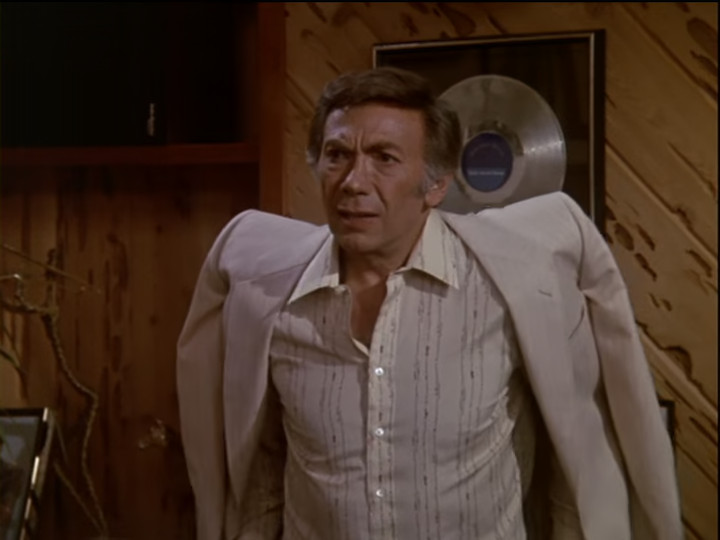
His name is Johnny Shannon and the various gold records framed on the wall suggest that he is connected to the music business and is quite successful. (Why he’s wearing his coat like a German officer is not explained.)
We also very quickly establish that he’s extremely unlikeable. He calls in his son, Mickey…

…and then berates him for composing such a terrible piece of music. We get the impression that this is a common occurrence because Mickey is only mildly disappointed and calmly tells his father to just play it at the right tempo, which he proceeds to demonstrate.
While Mickey is playing it, Johnny summons his assistant, Buster:
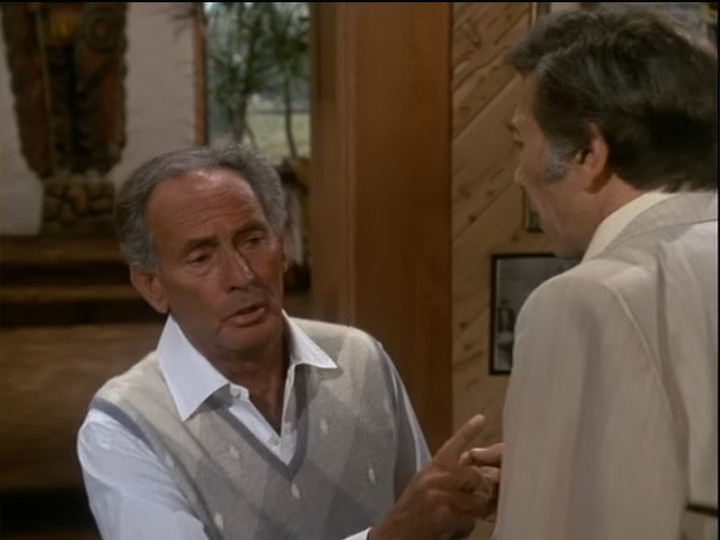
Buster makes Johnny wait a moment, though, so he can tell Mickey that he likes the piece and it’s good work.
Johnny, disappointed by this reaction, orders his car to be prepared because he has a lunch date at a tennis club. On the way there, they receive a phone call on the car phone from a major mob boss, but Johnny refuses to take the call because he’s now “protected.” He clarifies to Buster that he has “a special kind of insurance,” but then says no more about it.
At the tennis club, we actually see Jessica and her old friend Peggy, who is Johnny’s ex-wife.
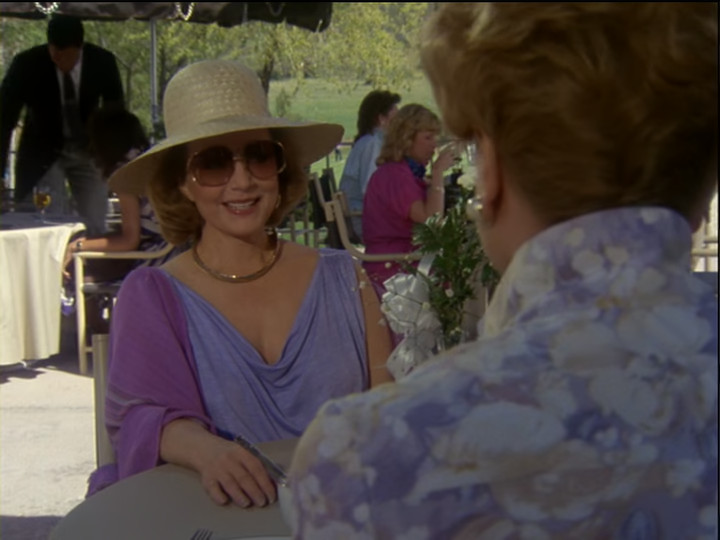
From some casual conversation we find out that they’re expecting Johnny to join them for lunch.
Which he eventually does. There’s a bit of small talk where it turns out that she recently leased a house in the area so she could visit her children since they rarely visit her anymore. Mickey is one of those children and then we meet the other: Terry.
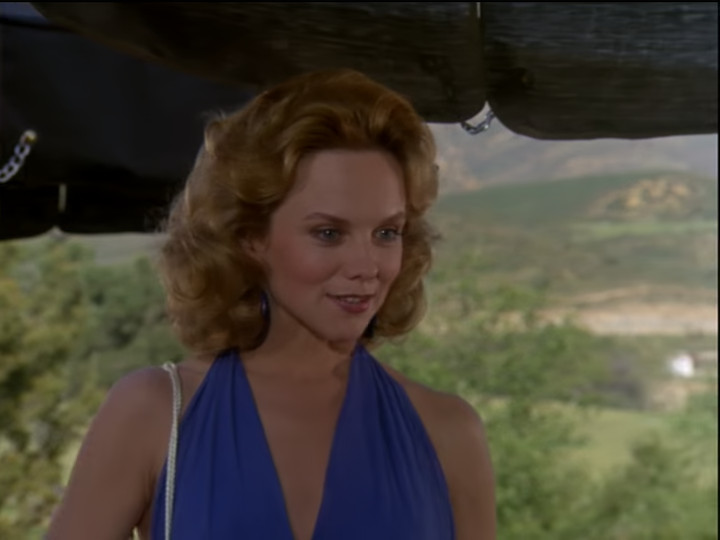
Terry then excuses herself because she has to meet a friend and Johnny expresses concern that it’s not “that tennis bum”. Her refusal to respond suggests that it is and this is confirmed by the tennis bum coming up to her table a minute later and kissing her for an extended period of time.
Johnny gets up to intervene and Peggy lays a restraining hand on his arm, saying that Terry is old enough to choose her own friends. Johnny replies that she told him this before and she was wrong, then, too.
His interfering goes about as well as one can expect it to; the tennis bum shoves Johnny and then several people whom Johnny employs comes to his aid, restraining the tennis bum.
Curiously, this is interrupted by a man who introduces himself as Sergeant Barnes of the police and asks what the trouble is. When Johnny tells Barnes that he doesn’t want the tennis bum around his daughter, Barnes replies that he doesn’t work for Johnny. Johnny then replies, “You must be new. Ask around. Somebody’ll set you straight.”
He then escorts Terry home.
With Johnny and his entourage gone, Peggy tells Jessica the backstory: when Terry was seventeen she eloped with a boy that Johnny didn’t like. Johnny sent some men after them who roughed up the boy then gave him a one-way airline ticket out of the country. Johnny had the marriage annulled and Terry never forgave him. She still lives in her father’s house to get back at him—to torment him with behavior like this.
Later that night, at Johnny’s house, Buster brings Johnny a glass of milk only to find the door locked. He knocks loudly, then even louder, but no matter his volume he gets no response. In desperation he calls Lou, Johnny’s bodyguard. Mickey, hearing the commotion, knocks on Terry’s door, finding her with the tennis bum.

Back at the door the bodyguard has arrived and breaks the door down. They go inside and find Johnny, dead.
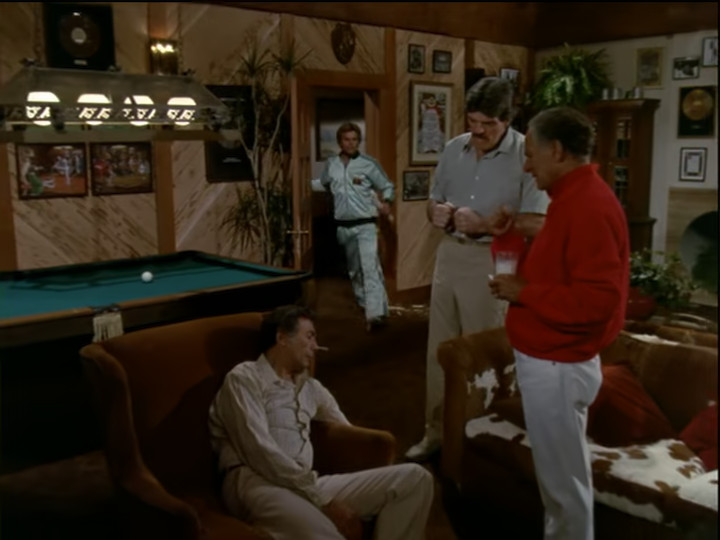
And on that bombshell we fade to black and go to commercial.
Had you been watching back in 1985, you might have seen an ad like this:
When we come back from commercial, Jessica and Peggy are driving along. After Jessica observes that Peggy is driving too fast, Jessica offers her condolences. Peggy replies that at least Jessica had a happy marriage with Frank; Peggy isn’t even a widow. She apologizes then thanks Jessica for going to the house with her because she can’t face it alone.
The scene then shifts to the men’s locker room at the… I’m not sure what this place is. Perhaps a tennis club? Anyway, she goes into the men’s lockerroom and finds the tennis bum she had been with and tells him that her brother is sure to tell the police that he was in the house the night before. She gives him money and tells him to flee the country if he doesn’t want to be part of a murder investigation. She adds that he should not try to contact her.
When the tennis bum asks, “what about us?” She scoffs and tells him to not be stupid. Now that her father is dead, she doesn’t need to play “let’s pretend” anymore. She adds that the truth is that she doesn’t even like him. (He doesn’t take this well, but nothing comes of it.)
Jessica and Peggy then arrive at the house. Oddly enough, she still goes by “Mrs. Shannon” despite being divorced from Johnny Shannon for years.
Inside the house, Mickey is glad to see his mother. He’s also glad to see Jessica, because they can use a good detective. Jessica objects that her exploits have been greatly exaggerated, but Sergeant Barnes walks into the room and answers her that he’s heard differently.
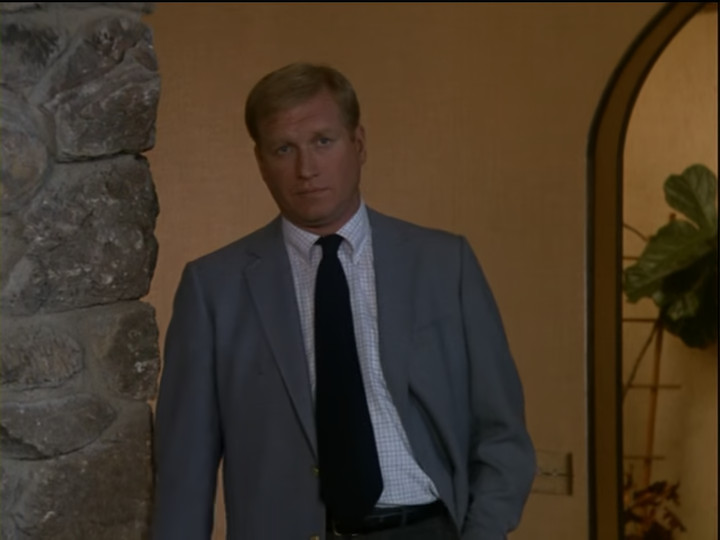
He’s the new police officer from earlier, and he explains that he’s been assigned to the case because in Desert Palms they don’t have a homicide division. He was on duty when the call came in so it’s his case.
Peggy, Mickey, and Sergeant Barnes press her to help on the case, but Jessica is reluctant. I always find this strange because if the police detective doesn’t want her on the case, she can’t be kept out. I wish that she was a bit more consistent as a character. Anyway, Barnes eventually gets her to help by telling her that she’s covered the subject of murder well in her books, even if she’s not always accurate. This piques Jessica’s interest, and she asks why he says this. When he says that he’ll explain on the way to the crime scene, she accepts. As they walk to the other room, he tells her, “You’re a little shaky on police procedure. And you always make your killers more interesting than your cops. You see, most killers are very dull people.”
They then leave the room and Mickey and Peggy discuss Terry in terms meant to make us suspect her, which, in Murder, She Wrote, means that she’s definitely innocent. It’s more reliable than a solid alibi.
In the room where Johnny was killed, Jessica notes that the door had a spring lock, so the killer must have pulled it shut on the way out.
They discuss the room as characterizing the victim:

Barnes says that Johnny was found in his favorite chair. He was shot in the back of the head and probably didn’t know he was about to be killed. Jessica wonders why he was sitting in a chair opposite to a blank TV when there was a perfectly good couch to sleep on, if that’s all he was doing.
Barnes agrees that this is puzzling. He adds another puzzling thing: no one heard a shot. The walls are thick but if you walk past the room in the hallways with the door closed, you can hear if a piano is being played, so they should have heard a gun, which is much louder than a piano.
Jessica says that she’s never seen a silencer herself, but mystery writers are addicted to them. (I think that this was true only of a certain era; but certainly this was part of that era.) Barnes objects that “mufflers” would be a better name for silencers; you can’t actually silence a gun and there’s always some noise.
Interestingly, that’s not quite true. The British developed an effectively silent gun called the Welrod.
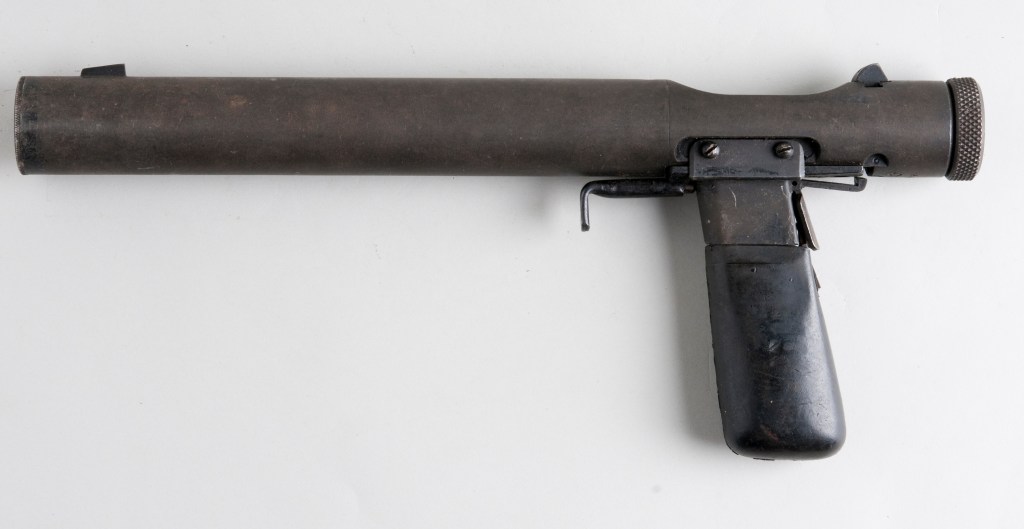
It uses a series of solid rubber wipes in addition to many baffles in order to suppress the sound down to the point where it’s quieter than people speaking conversationally. The trade off is that you can only fire a dozen or so shots from it before the wipes are too degraded to suppress the sound that effectively. Also, it fires sub-sonic ammunition. This part is critical because it doesn’t matter how well you suppress the explosion which propelled the bullet if the bullet itself creates a supersonic boom. As a result, it has an incredibly short range—measured in tens of feet. On the other hand, its purpose is incredibly close-range assassination, and it actually has a concave front to allow it to be effective when pressed up against a person, so this isn’t too much of a limitation.
That said, it’s very unlikely that a killer in California in 1985 would be using a World War 2 British special services assassination pistol. There were a few similar guns made over the years but they’re exceedingly rare because there’s basically no market for them. So, in practice, Sergeant Barnes is right.
Jessica says that if the sound was muffled and not recognizably a gunshot, it might have gone unnoticed, confused with ordinary household sounds such as radio, television, etc. Barnes agrees that might be the case, but asks how on earth the killer got through the security system. There are guards on duty 24 hours per day at the front gate and the service entrance, at the back of the house, is protected by a tall fence and a sophisticated alarm system with TV cameras. The gate is opened remotely by the guard at the front gate after confirming the identity of the service person over the camera and through an intercom for voice verification. Nobody pushed the buzzer on the back gate last night and nobody could have gotten over the gate or wall without the alarm going off.
Jessica states the obvious conclusion: the murderer came from inside the house. (This was not lost on Barnes, who had already come to that conclusion.)
Having said that, I’m not sure it’s right. It’s unlikely that the tennis bum got in through the front gate by being on the invitation list—Johnny would almost certainly have told the guards to forbid him entrance—so his presence demonstrated it is possible to get in.
The scene then shifts to Terry pulling up in a fancy car as tense music plays. I’ve no idea why this might be important since we’ve already established that Terry is definitely innocent, but it’s a good excuse to show the front gate:

Terry goes into the house and demands to know what Mickey told the cops before she realizes that her mother is there. She then switches to condoling with her mother, which Mickey doesn’t take very well. Some hot words pass and Terry runs off.
Back in the murder room, Jessica and Barnes are discussing motive. Barnes suggests the standard: someone who stood to inherit. It was the servants’ night off, so other than family only the bodyguard and Johnny’s assistant were there.
When Jessica asks if the motive could have been robbery, Barnes shows her a hidden wall safe in the room which Mickey told him about:

Barnes doesn’t think this is the motive, though, since the killer wouldn’t have shot Johnny before making him open the safe in that case. Unless, as Jessica points out, the killer already knew the combination. Barnes admits this possibility, but while the safe contains valuable things, members of the household confirm that nothing is missing. Jessica then points out that her theory is unlikely since someone who knew the combination wouldn’t need to kill Johnny to steal it, they’d only need to wait for him to be out of the room.
Jessica then wonders if the motive might have been something else. There’s an obvious spot on the wall where something that was framed was missing. Barnes says that it wasn’t anything, though—just an old picture of Johnny and his kids.
This is interrupted by Buster, who asks the Sergeant to come quickly because the bodyguard is convinced that Mickey killed his dad and is busy assaulting him by the pool.
They get there in time and Barnes knocks the bodyguard into the pool. Mickey isn’t feel great from all of the strangulation he just experienced, but he’s otherwise OK.
The bodyguard insists that Mickey needs to be arrested, and when questioned, explains that he finally remembered that he wasn’t the last one to see Johnny alive—he saw Mickey go into the den after he left it.
And on that bombshell we fade to black and go to commercial.
When we come back from commercial Sergeant Barnes asks Mickey what’s up. Mickey says that Lou (the bodyguard) had it all wrong. He did go down to the den to show his father some changes on the arrangement he was working on but his father didn’t want to see it until the arrangement was finished. So he immediately went back upstairs. He wasn’t in the den for more than a minute. (I’m not sure how the short duration is important because it takes only a few seconds to shoot someone in the back of the head. Perhaps Mickey is still groggy from being strangled.)
Mickey then goes on to say that he didn’t always get along with his father and there were times when he hated him, but when he was angry at his father he’d always think of the good times, before they moved out to the desert.
This is interrupted by Terry, who walks up with Peggy. Terry says that Mickey didn’t kill her father, there was someone else in the house—the tennis bum. She let him in at the rear service entrance. She used the master switch to turn off the alarm long enough for the tennis bum to get in and make it to the house. The guard would only notice that the system was switched off if he was paying close attention because the only indication is a tiny red light. The night man reads a lot and doesn’t check the panels often. The TV monitors are always off unless the alarm is tripped.
When Barnes remarks that she knows a lot about the security system, she replies that this isn’t the first time she’s let a man into the house.
When Terry mentions that she sent the tennis bum away and doesn’t know where he is, Barnes borrows the telephone and calls in an APB on the tennis bum.
As he’s doing this, Jessica asks where Lou (the bodyguard) was when Mickey came out of the den, that Mickey didn’t see him. He went to his room because Johnny told him to get lost. Buster says this means that he was expecting a “broad” (a woman). He always sent Lou away when he was expecting a female visitor.
Lou doesn’t think this is plausible, though, because he wasn’t given a name to call down to the front gate. Jessica mentions that perhaps the guard knew this woman on sight. When Lou said that Johnny’s rule was female guests always had to be specifically called down, Jessica looks at Peggy and says, “there are exceptions to every rule.”
Jessica and Peggy talk privately; Peggy confirms that it was her and that she wanted to talk to Johnny about Terry, but she found him in a mellow and affectionate mood and for the first time since she left him, they made love. She then discusses how Johnny always had a way with women—which was why she ended up leaving him. He was always using women and seemed genuinely surprised that Peggy cared. He even once took a girl away from Buster, who was heartbroken over it until he made a joke of it.
A bit of talk later, Jessica asks if Johnny had any enemies and Peggy said that last night Johnny was bragging about “putting one over” on a mobster named Milo Valentine (this would be the mobster who called him on his car phone, that he said he had protection against). Milo started Johnny in show business, but their relationship turned sour. Last night, Johnny said that he felt like he could nail Valentine to the wall, but didn’t explain what he meant by that.
Jessica then goes to Sergeant Barnes at the police station to give him her latest theory that Johnny was killed by a hitman. She remembers reading that shooting someone in the back of the head was part of the mob’s execution ritual. Which sounds rather inconvenient and also at odds with the mark of a professional killer being to shoot someone twice—once in the heart and once in the head. But, what do I know?
Barnes isn’t overly impressed by the idea that Johnny was killed by a hit man but he doesn’t dismiss it. When he worked in Chicago before he came here, he remembers hearing rumors that Johnny had a mob connection.
Jessica thinks that this would put the kabosh on the tennis bum theory, but Barnes disagrees. Hitmen don’t wear a t-shirt that says “professional killer”—they have some kind of cover. Tennis seems good for this, allowing him to move around. He’d have started an affair with Terry to gain access.
Back at the Shannon residence, Buster is out by the pool making a phone call to Milo Valentine, saying that he has an urgent matter to discuss. When he hears Terry draw breath in surprise (she’s listening on another phone, inside the house), he realizes the conversation is being overheard and asks who’s on the line, to no avail.
Jessica then comes up to the house in a taxi, and after questioning the security guard offscreen, she goes inside and talks with Terry, who is sitting in her father’s favorite chair and watching tapes.
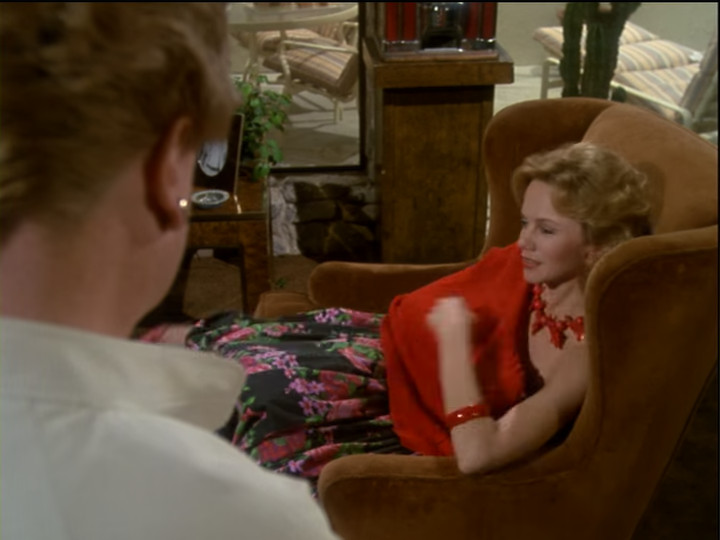
She comments on the tape that she was watching. “That Vegas showgirl nearly became my stepmother. But so did a lot of others.”

During the conversation, it comes up that Terry took the family photo that’s missing from the wall up to her room. She took it right after they found her father because she needed something of him to hold onto. The guy on the tapes is a stranger; her daddy was the man in the photo.
Jessica asks about the tennis bum and how they met. Terry says that he was the loudest, most obnoxious player in the bar at the tennis club so, knowing that her father would hate him, she picked him up. She’s fairly certain he didn’t kill her father, though, since when she told him that her father was in the den, the tennis bum was too scared to leave her room.
Terry also ends up telling Jessica about Buster’s phone call to Milo Valentine. Jessica also gets some further information about the VHS tapes above the television. Most are of Johnny’s TV shows, but a bunch are of his pool games. He had a camera installed to record the pool table so he could watch his games and figure out how to improve.

Jessica says that it’s hard to see in the dark corner where it is.
The scene then shifts to a few miles north of the Mexican border, where some police catch up with the tennis bum and arrest him. As he’s being led to the police car, he says that he didn’t kill Johnny Shannon, Terry did.
And on that bombshell, we fade to black and go to commercial.
When we come back from commercial we’re at police headquarters where the tennis bum is interrogated in front of Jessica and Johnny’s relatives.
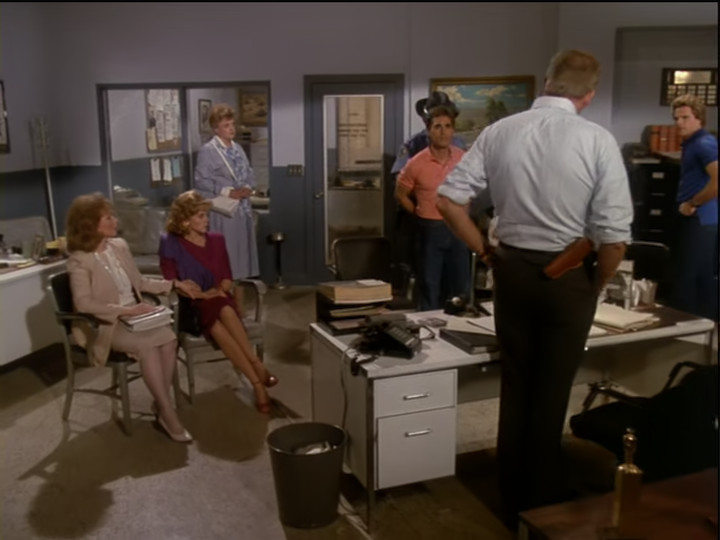
It’s strange enough when Jessica is at police interrogations; I’ve got no idea why almost everyone is here.
The upshot of the interrogation is that the tennis bum believes that Terry killed her father and used him as a patsy, which is why she paid him to leave.
Interestingly, Jessica actually tells the tennis bum to reconsider not having an attorney present, which is out of character for her. Out of character for him, he takes this advice and says that he wants a lawyer, which ends this interrogation.
Once the tennis bum is escorted out to make a telephone call, Jessica remarks to Sergeant Barnes that it seems unlikely a professional killer would have no better escape route than an unreliable van on a back road to Mexico. (She doesn’t add that it’s even stranger for him to hang around and wait to make his escape, rather than starting that night.)
Barnes replies that perhaps he’s new at it, or perhaps he’s not a pro and perhaps he’s telling the truth about Terry. Some bickering later, the Shannons leave for their home and Jessica joins them because she has something she wants to look into. Barnes asks if she’s going to let him in on it and she replies that she will once she’s sure—she’d hate to look foolish in front of the police.
Back at the house, Jessica talks to Buster, who explains that the phone call was only because he was worried that Valentine might have a contract out on Buster as well as Johnny. He also explains what the cause of the split was—Valentine got Johnny started, which gave him control over Johnny, which Johnny resented when he made it big. Johnny chafed under this and eventually started making his own moves. When Johnny failed to make an appearance at a political rally for one of Valentine’s payroll politicians, Valentine flew over and had a meeting with Johnny in the den. Buster wasn’t in the room but did hear the sounds of pool being played.
Jessica puts two and two together and concludes that Johnny taped the game with Valentine and then threatened him with the tape. The killer must have had a double mission: to kill Johnny and to retrieve the tape.
When Jessica tells him not to worry about a contract being out on him—had there been one, he’d already be dead—he tells her to say no more, he gets the picture. She asks him to repeat “I get the picture” then she announces that she knows who the killer is. She calls Sergeant Barnes to let him know that she’s solved it.
When he arrives, she begins by explaining how the killer got in. He kept a close eye on the tennis bum, figuring that he’d be brought into the house sooner or later. That night, he got lucky and followed the tennis bum in. He knew where the den was because Milo Valentine had been in the house and described the layout for him. He figured that Johnny wouldn’t help him find the tape, so he shot Johnny immediately. He then locked the door and searched through the tapes. Jessica experimented and all of the tapes up to the missing tape were played for a short time, while all of the ones after the missing tape were at the very beginning. The killer then turned off the VCR and TV, then waited. While Lou was breaking down the door, Terry turned off the alarm to let the tennis bum out. The killer went out behind him.
Barnes says that this makes sense but leaves them with the problem that they can prove that the tennis bum was in the house and can’t prove that anyone else was. Jessica demurs. The morning after the murder, Sergeant Barnes told Jessica it was his first time in the house, but he knew what was in the picture missing from the wall, despite Terry having taken it to her room right after her father was found dead.
Barnes replies, in surprise, that Jessica is good. He then takes out his gun and puts a silencer on it. He says that he never kills unless he is well paid for it, and it hurts him to make an exception in her case.
Jessica then calls to the waiting people, who come in.
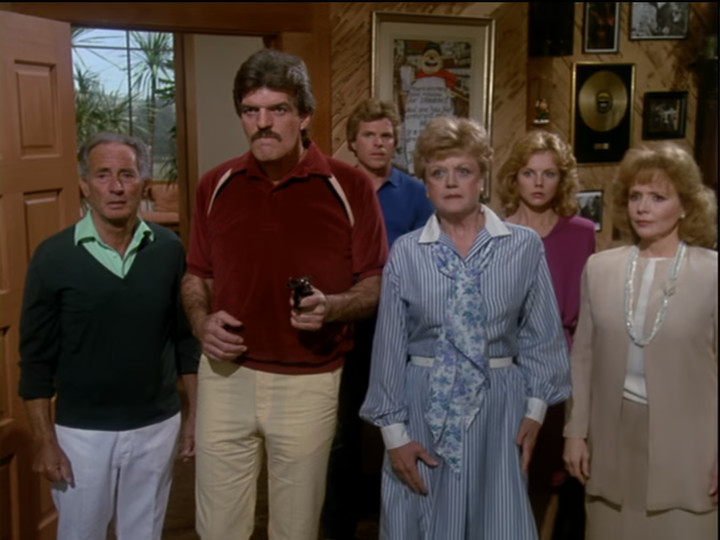
She then tells Sergeant Barnes that he would be well advised to not make any sudden moves. Lou took Johnny’s death very hard.
He thinks for a moment, then smiles and hands Jessica his gun. She thanks him, saying that it means a great deal to her. He asks if she means as a trophy, and she replies no, as the only real evidence that he killed Johnny Shannon. “Ballistics will prove that the bullet came from your gun.”
After a moment, she adds, in reference to their first conversation, “That’s police procedure.”
This was a very interesting episode. It’s most notable quality, of course, is that the police detective was the murderer. This was extremely rare for Murder, She Wrote—as it should be. But I think they did a good job of pulling it off.
The main danger of having the police detective be the murderer is that he is, with regard to the investigation and often with regard to the crime itself, super-powered. That is, the extra powers which the police are given in order to fight crime put them at a tremendous advantage for committing it. The result is that it really should be impossible to catch them, and catching them requires the writer to make them do something very dumb in order to get caught.
I think that they avoid that in this episode. Barnes knowing what was in the picture was, perhaps, not maximally convincing—I’m not sure why he ever looked at that part of room—but it wasn’t dumb. He had been in the middle of discussing the case with Jessica and he had to act the part of the police detective trying to solve the case. He had to discuss it for real in order to be convincing, and he had to reveal to her all sorts of things he learned from the family. It is plausible that he had lost track of what he knew because he was the killer and what he had learned as the police detective, even if the particular execution could, perhaps, have been improved upon.
The other golden age rule this episode broke was having a hitman as the murderer. A professional killer with no connection to the victim and no personal interest in the victim’s death is simply outside of the mystery genre. That said, this episode introduced the mobster right at the beginning and introduced the character of Sergeant Barnes before he was investigating the crime. Barnes remained a significant character throughout. The episode also introduced the idea of the hitman very early, even apart from it being implicit in a mobster being involved. Further, Jessica took the option of the hitman as a live option as soon as it was mentioned. So while it broke the rules, I think that they pulled it off.
I think it was for the best that they had a hitman be the murderer very infrequently. Having said that, I have to admit that it was the case in one of my favorite episodes (Snow White, Blood Red), so when they did it, they tended to do it well.
Another good thing about this episode was the characters. They kept the cast relatively small, which enabled them to have some character development for most of them, which they took advantage of. To be clear, the character development is mostly us learning about the characters rather than the characters having an arc; that’s simply appropriate to the format. But we get complexity on several of the characters. The character of Terry is probably the most obvious, from this perspective: she starts off seeming to be a hedonistic spoiled brat who is coolly distant from her father because he represents restraint, but we find out that she was angry at him and unable to form a real relationship with him. The moment when she tells Jessica that the showgirl in the video almost became her stepmother, but then so did a lot of other showgirls, too, reveals a lot. The moment when she said that the guy on TV wasn’t really her father, her real father is the guy in the picture of happier times was quite poignant. There’s a sense in which it’s true, but also a sense in which it isn’t. Each action that we take does shape us and is part of who we are, but it is also true that some of the actions that we take are unnatural to us—they may warp and twist us, but they are never really part of us. Which is not to say that we can’t cling to them until the original isn’t left, but the distinction remains true even if we turn it into a theoretical, rather than practical, distinction. And underneath the glitzy jewelry and promiscuous behavior, there was a little girl who wanted her father back.
Mickey is another interesting character. At first it seems like he might just be a stereotype of a son who was never good enough for his successful father, but he has real depth. Even right at the beginning, he simply doesn’t respond to his father’s bluster. I didn’t describe it in the plot summary, but Johnny even tells Mickey to let him have it, saying that he (Johnny) told his own father off more than once, but this doesn’t phase Mickey. It’s not that he’s putting up with it; he just doesn’t care. But what gives it depth is that they make it clear that he’s not intimidated. He has his own goals and is pursuing them, and even still has some affection for him. He points out that his father might be wrong because this would actually be beneficial for his father to consider. This gets reinforced later, when he says that he was deeply frustrated with his father but when he gets mad he thinks of the good times.
Peggy is probably the best fleshed out of the characters. She’s divorced from Johnny but clearly doesn’t want to be. The part where she tells Jessica that she’s not even a widow is particularly poignant. She feels a widow’s loss, but does not have the support of the community a widow would have. They do not go any deeper into it than this but it points very strongly to some of the costs of divorce and even more of society having moved to being so accepting of divorce. Worse for the character, she’s one of the people who accepts divorce and thus has no framework to make sense of her grief. She eventually fades out of the story after her reunion with Johnny is revealed in order to clear up a red herring, but had there been more time there would have been very interesting places to go with her.
Even the character of Sergeant Barnes is interesting, in this episode. On the one hand, he’s keeping an eye on Jessica because he doesn’t trust her and wants to mislead her; on the other hand he is a bit hubristic and assumes that he did such a good job that she can’t possibly catch him. This raises the question of whether he was sincere when he told Jessica that she goes wrong by making her killers too interesting while in reality most killers are very dull people. One possibility is that he’s sincere but holds himself to be far more interesting than the average killer. Another possibility is that he’s insincere and thinks that the killers are actually more interesting, and this is misdirection. Yet another possibility is that he doesn’t think of himself as interesting, for as G.K. Chesterton once observed, every man is normal to himself. Or, to quote Chesterton:
To the insane man his insanity is quite prosaic, because it is quite true. A man who thinks himself a chicken is to himself as ordinary as a chicken. A man who thinks he is a bit of glass is to himself as dull as a bit of glass. It is the homogeneity of his mind which makes him dull, and which makes him mad. It is only because we see the irony of his idea that we think him even amusing; it is only because he does not see the irony of his idea that he is put in Hanwell at all. In short, oddities only strike ordinary people. Oddities do not strike odd people. This is why ordinary people have a much more exciting time; while odd people are always complaining of the dulness of life.
Another unusual aspect of this episode is that I can’t think of any major plot holes. The one question I have is how Barnes knew what the missing photo was, since his business would not (obviously) have taken him to that wall of the room, and it was a very large room with many things on the wall. On the other hand, this could be explained by Barnes making a general search of the room before concluding that the only relevant thing was the VHS tapes. He might even have been looking for the safe in the wall and perhaps tried to get in before concluding that wasn’t a way forward. And, really, that’s it. You can ask questions about how Barnes managed to conclude his business with relatively tight timing, except that I don’t think that the timing was all that tight. Mickey was, supposedly, the last one to see Johnny alive, but Johnny had time to have Peggy over and for them to make love and her to leave; presumably after this he got dressed and, feeling wistful, went to watch some tapes of his glory days, when Peggy was still his wife, where he got shot by Barnes. There is, perhaps, a bit of explanation that would be helpful for why Buster brought Johnny a glass of milk at what must have been one or two in the morning without it having been request immediately before but something could easily have been worked out. As Murder, She Wrote goes, this is airtight.
Next week we’re in Wyoming for the last episode of Season 1, Funeral At Fifty Mile.
 Chris Lansdown
You must be logged in to post a comment.