
Stupid Things Said About Saturated Fat

Dietary saturated fat has been blamed for all manner of health problems, but the evidence for this ranges from low quality to complete garbage. That the evidence quality is low is not surprising, since there are good reasons to believe that saturated fat is healthy for humans.

The first and most important reason is that saturated fat is the kind of fat that humans make if they have extra carbohydrates or proteins around and need to store the energy. And that’s going to be a large fraction of the carbs we eat. And when I say a large fraction, I do mean large. A 200 pound athlete would be able to store about 500 grams of glycogen in his muscles and another 100 grams in his liver. (And less than 10g of glucose in his bloodstream, which tends to be nearly constant anyway, so we can ignore this.) But the thing is: these are very rarely empty, especially if one regularly eats carbs. And if you’re following any kind of normal American diet, you’re eating a lot of carbs. If you follow the USDA food pyramid and eat a 2000 Calorie diet (which is the Calorie requirements of a small person who isn’t very active) you’re probably eating at least 250 grams of carbohydrate per day. So your glycogen stores will start off mostly full, and while your body will try to get rid of the glucose by using it in muscles, in your brain, etc., it can’t do that very quickly and needs to get rid of the glucose very quickly, so the overwhelming majority of it will get converted to fat. (This is less true for people who spend most of the day moving, such as people who work some kinds of manual labor jobs, but that’s not typical. And humans love to rest after eating.)

(Whether a large fraction of the protein one eats gets converted to fat depends on whether one gets an unusually high amount of protein in one’s diet. Most people can’t use more than about 1 gram of protein per pound of lean bodymass per day, but most people also eat less than that in protein.)

Oh, I should mention that it’s actually very normal for the human body to use fat as fuel. When insulin isn’t high to try to make cells take up glucose, and in that process suppressing the fat cells from putting fatty acids into the blood, our fat cells regularly break fat (which is insoluble in water) down into fatty acids (which are soluble in water) and put them in our bloodstream so we have a constant, dependable supply of energy. Like anything which can be said about biology in human language this is a massive oversimplification, but at its level of generality it’s correct and important.

Anyway, the primary output of denovo lipogenesis (making fat from scratch) is palmitic acid, which is a saturated fatty acid. This can be converted into other fatty acids such as stearic acid (another saturated fat) and oleic acid (an omega-9 unsaturated fat) and many others, but human beings—and mammals in general—tend to leave it as palmitic acid, then take three of them and attach them to a glycerin spine, making them fat. We do this because it allows them to store very compactly without needing any water around them, which is extremely weight-efficient. This is important for animals because moving weight requires energy, so the lighter we can store the energy the more efficient it is. Saturated fats pack together especially well, which is why animals with very high energy needs like mammals prefer them.

So believing that saturated fat is bad for us requires believing that our bodies turn most of the carbohydrates we take in into something that’s bad for us.

Incidentally, this all happens in the liver. Since fats are insoluble in water (they don’t form a solution; this is why oil floats at the top of water rather than dissolving in it like salt), the liver can’t get these fats to the rest of the body by just sticking them in the bloodstream. That would be a disaster. So it creates transport crates for the fats called “lipoproteins”. These start out as VLDL—Very Low Density Lipoprotein. They’re very low density because they’re crammed full of fats, which is less dense than water. These transport crates are then dumped into the bloodstream where the proteins on the outside enable it to interact nicely with the water in our blood and move about without causing problems. These transport crates do something which can be analogized to docking at cells and then the cells take some of the fats inside. As this process happens the lipoproteins shrink and their density goes up. Thus they eventually turn into plain old “LDL” (low density lipoprotein). Interestingly, High Density Lipoprotein (HDL) is not caused by them becoming depleted; instead HDL is made empty in the liver and sent out to collect cholesterol and related molecules.

Interestingly, dietary fats get transported by a different system. The intestines create a similar but larger kind of lipoprotein transport crate called a chylomicron. These shuttle dietary fats from the intestines through the blood to our cells.

In both cases, you can see that idea that “saturated fat congeals and clogs your arteries” is nonsense, even apart from saturated fat congealing at room temperature, not body temperature. The most liquid fat in the world would be terrible to have in one’s blood since it doesn’t mix with water, and the human body doesn’t do that. The fats don’t matter at all as they’re being transported.

Where they can matter is once they’ve been added to fat cells and the fat cells break them down into fatty acids and put those into the blood. (This is a tightly regulated process to make sure that energy is available at all time.) That’s because these fatty acids, in addition to being an energy source, also are precursors for hormones and also can interact with various receptors. (This is where things like omega-3 versus omega-6 come in.)

This is also why you see claims that eating large amounts of saturated fat induces insulin resistance in rats. Now, before we proceed, I do want to mention that it’s important to remember that, while animal models can be useful, rats aren’t humans and their exact dietary requirements are a bad guide for the ideal diet for human beings. You shouldn’t feed bears, pigs, dogs, or cats like rats for optimal health, and there’s no reason to believe should feed us like rats (or bears, pigs, dogs, or cats), either. (You can’t feed us like cows—we’re not build to get a meaningful number of Calories from fibrous plant matter.) So these studies on rats are, at best, interesting. That very large grain of salt taken, what the studies find is that various kinds of fats which are pro-inflammatory, when taken in large quantities, promote inflammation which can induce insulin resistance. The study I linked to found that the effect went away for saturated fat if the rats were fed about 10% of their fat as fish oil, which is rich in omega-3 fatty acids like DHA and EPA, which are anti-inflammatory. That is, it’s all about the net effect of the entire diet, not one particular component and not about the fact that the fats are fats. (Again, in rats; how pro- or anti-inflammatory the various fatty acids are in humans may be similar or very different, on a per-molecule basis. And there’s probably significant individual variation, too.)

Inflammation, by the way, is not at all bad. Inflammation is a very useful reaction; it’s how our bodies deal with damage such as clotting in a cut, immune responses to foreign invaders, muscle damage from exercise, and so forth. The problem is when pro-inflammation factors dominate to produce more inflammation than is necessary for the circumstances. Quite a few problems happen when a balanced system becomes imbalanced.

Incidentally, while palmitic acid (the dominant fatty acid in mammal-produced fat) seems to be mildly pro-inflammatory, omega-6 fatty acids may be significantly more pro-inflammatory. And they’ve been making up a much larger proportion of western diets—especially of American diets—since the introduction of corn oil and other heavily processed seed oils.

About That Olly Murs Before-And-After Poll

I saw a bunch of commentary, back and forth, on a poll asking men and women whether Olly Murs (a British celebrity) looked better before or after he dieted down to very low bodyfat levels:

Twitter polls are hardly wonderful, but if we assume honesty, men voted 2:1 that he looked better after the transformation and women voted 3.8:1 that he looked better before the transformation. To be fair, neither is a wonderful picture of Mr. Murs; both could be done with more flattering lighting and posture.

The big problem is that neither of these photos is really the ideal body composition in the world in which we actually live. The body composition on the right shows off his musculature better, but he’s into levels of leanness which are sub-ideal for actual living. On the left, he is carrying a bit of fat more than the ideal. That said, I think he looks far more likely to be a good husband and father on the left, and I suspect that this is the question most women were answering (who would ask which photo looks better for selling underwear, or some other purpose?), and the reasons for this are interesting.

The first thing we need to consider is that the general preference people have for leanness in modern America (perhaps in the West more generally) is actually contextual. We live in a time of abundance and there are various types of being unhealthy that cause people to become fat, so not being fat is an excellent marker for generally good health (including a reasonable mental understanding of health and a general pattern of decent-enough food and exercise choices). However, in places where food is scarce, people tend to find bodyfat more attractive than leanness, and rightly so, because in a food-scarce context, bodyfat shows a lot of very good things about your health and ability to take care of a human being (you). In some studies in such cultures, men rate women with a BMI that technically makes them obese above women with a bodyfat level that we in modern America would call healthy.

So taking this into account, what does the extremely lean body composition on the right tell us in this context? Well, it’s hard to achieve and has no real benefits (unless you’re a rock climber or similar kind of athlete). Further, it’s bordering on (if not beyond) the level of leanness where health is severely impacted; it would not be surprising if his testosterone levels are depressed, for example. (If they aren’t, they will be if he gets a little leaner.) His body probably won’t like being this lean at his age, which means he’ll probably have a harder time dealing with stress and being cheerful. Also, he’s probably stronger in the photo on the left. It’s not understood why, but the typical experience of people who started out less than completely obese and lose fat is that they get weaker. I can speak to this from personal experience—I once trashed my performance at a powerlifting meet by losing around 20 pounds in 5 months (the meet was right after), and I wasn’t even lean at the end of that. The human body just really dislikes caloric deficits and really dislikes not having sufficient fat reserves. And since we are our bodies and aren’t a ghost in a machine, that affects our psyche, too.

There’s also the issue that human beings simply have limited time, effort, and willpower. We’re finite creatures. So if a man is spending a lot of his effort and willpower being extremely lean, he’ll have less left over for other things, like social interactions.

Plus there’s the issue that concern for appearance simply has different connotations in men and women. It can be taken to the point of vanity in either sex, but it takes a greater amount of concern in women to reach the level where it is the sin of vanity. There are complex reasons for this, but the easiest to understand is that since a woman directly uses her body in very intensive ways to care for her young children (especially when they’re inside of her), she needs to put more effort into ensuring that her body is in good condition. And care for appearance is a way of signaling this, including to herself. We human beings do not know ourselves perfectly and so having habits that require spare energy to do are useful signposts to ourselves that we’re taking care of all of the important stuff. If we let those things go, it might well be because there are bigger problems, warranting investigation. This is instinctual, of course, not conscious, but it’s none the less practical.

Males use their bodies to care for their wife and children too, of course, but less directly, which means that far more workarounds are possible (e.g. you can grow crops even if you have to hobble around on a wooden leg by making up for it with extra strength in your arms and cleverness in making tools). And we tend to use our bodies in fewer ways, meaning we can concentrate more energy and effort into those ways. This specialization and indirection mean that we can be tougher and also, within limits, substitute skill for health. And so we need to take less care of ourselves (not none), and consequently need to sign-post it less. Thus it takes less for males to cross the line into vanity.

Now, none of this is to say that Mr. Murs was at the peak of attractiveness in the “before” picture. In it, he’s carrying a little extra fat beyond the minimum necessary for optimal health. If he’d lost only about fifteen pounds, almost everyone would agree he looked better. But with the two options we have, he looks happy in the picture on the left and unhappy in the picture on the right. And that counts for a lot.

I think part of how to get at this is to ask the question: which guy looks like you would want him as a friend? I know that for myself, the guy on the left looks like he’d be a lot more fun to hang out with.

Calories In vs. Calories Out

When it comes to health and fitness, and in particular to reducing the amount of fat on one’s body, the dominant story within our culture, at least from the sort of people who present themselves as experts, is that fat gain or loss is just Calories-in-vs-Calories-out so just take however many Calories you burn and eat less than that until you’re thin.

Now, obviously there is something truth to this because if you stop eating you will waste away until you die, and you will be very thin shortly before your death. (Though, interestingly, if you autopsy the corpses of people who’ve starved to death you will find tiny amounts of fat still remaining.) Of course, the problem with just not eating until you’re thin is that starvation makes you unfit for pretty much any responsibilities and it’s also bad for your health. (Among many problems, if you literally stop eating your muscles will substantially atrophy, including your heart.)

So the big question is: is there a way to eat fewer Calories than you burn while remaining a functioning adult who can do what the people you have responsibilities to need you to do, which doesn’t wreck your health?

The good news is that there are methods that accomplish this balance. The bad news is that (at least as far as I can tell) there’s no one method that works for everyone.

Since this post is about the Calories-in-vs-Calories-out mantra (from here on out, Ci-Co), I’m only going to discuss moderate Calorie restriction—oversimplifying, aiming for a deficit that results in about a half a percent of bodyweight reduction per week, for a period of 6-12 weeks, before returning to maintenance for an approximately equal length of time. (This is a version of what bodybuilders do and they’re probably the experts at losing fat because bodybuilding can be described, not entirely inaccurately, as competitive dieting.)

Now, at first glance, this isn’t too far off what the Ci-Co people seems to be saying. However, it’s very different in practice, and those differences will be illuminating, because they’re all things that the Ci-Co people get wrong.

The first big problem with trying to implement Ci-Co is: what on earth is your daily Calorie expenditure? There are highly accurate ways of measuring this which are extremely expensive with most being infeasible outside of a laboratory. Apart from that, there’s no good short term way. The best way—which is what bodybuilders do—is to carefully measure your Calorie intake and your weight over a period of time, then see what your weight does, and calculate your Calorie expenditure from your intake plus what your weight did. For example: suppose you take 3000Cal/day and over 14 days lost a pound. A pound of fat contains roughly 3600 Calories, so your actual expenditure was 3000 + (3600/14) = 3257. From there you can refine your intake to achieve what you want. (Bodybuilders also have phases where they put on muscle, which means gaining weight, so they will have to eat at a surplus to provide energy for building the extra muscle tissue.)

This looks nothing like what the Ci-Co people suggest, which usually amounts to either taking the USDA random-number of 2000 or else using an online tool which estimates your Calorie expenditure from your height, weight, and some description of how active you are. These are generally accurate to +/- 50%, which is not obviously distinguishable from useless. Using myself as an example, entering 6′ and 215 pounds with high activity, it estimated my maintenance Calories as 2900 and a weight loss target of 2450. I’ve actually been using the MacroFactor app to track approximately 100% of what I eat and weighing myself every morning when I wake up. It estimates my maintenance Calories as about 3900 Cal/day and I’m losing a little over a pound a week with a target Calories of 3200 Cal/day. On days when I eat about 2800 Calories I go to bed hungry and am very hungry the next day. If I tried to lose weight at 2400 Cal/day in a week or two I’d be constantly ravenous, unable to concentrate, barely able to do my job (I’m a programmer), and miserable to be around.

Because here’s the thing: the human body can tolerate small (consistent) Calorie deficits without worrying, but if they become too large the body freaks out and concludes that something very, very bad is going on and the top priority for the foreseeable future is getting through it. That means two things, both very bad for losing fat:

  1. Spending all your waking hours trying to find enough food
  2. Reducing your Calorie expenditures as much as possible to conserve what energy we do have until the bad times have past.

The second point is probably the bigger deal. What the CiCo people don’t realize is that your Calorie expenditure is nowhere near fixed. If your body thinks it’s a good idea, you can maintain on a surprisingly large number of Calories. If your body thinks it’s a good idea, you can maintain on a surprisingly small number of Calories. The former looks like having a lot of energy and feeling good. The latter looks like being tired and cold all the time.

Even worse, there is reason to believe—though this is nowhere nearly as well established—that if you make your body freak out and think it needs to survive a famine too many times, it will start to prepare for the next famine as soon as food becomes readily available again, much as people who’ve been broke a few times and also had good times tend to live like misers and save money the next time things go well. (In the the case of your body, this means gaining the fat you will need to survive the next famine, just like bears put on a ton of fat in summertime in order to get through the coming winter.)

This is why the other critical part of how bodybuilders diet is that they only do it for 6-12 weeks at a time, then take long maintenance breaks at their new weight. (The variability because they pay attention to how their body reacts and if it seems to be starting to freak out, they stop losing weight and start maintaining so it doesn’t have to adapt to the diet—there are many factors which go into how long it’s possible to diet before the body starts to freak out.) This relatively short fat-loss window ensures that the body never goes into surviving-famine mode. And the maintenance Calories are not a fixed number, either. They can easily increase for a few weeks as your body gets used to the extra food and raises your metabolism because it seems safe to do so.

When you put this all together, it’s why the Ci-Co people give the laws of thermodynamics a bad name. It may be perfectly true that losing weight is the result of one number that’s not easy to measure being lower than another number that’s impractically expensive to measure and impossible to usefully estimate, but knowing that that’s true has no practical value.

For a much more entertaining take on a closely related subject, check out Tom Naughton’s post Toilet Humor And The HOW vs. WHY Of Getting Fat.


This post was about the problems with Calories In vs Calories Out, but I would be remiss to point out that everything I said up above about how bodybuilders reduce fat is predicated on having a reasonably well-regulated metabolism to begin with. There are all sorts of ways for the human metabolism to become disregulated and if yours is disregulated your odds of successfully reducing fat are much lower until you figure out what’s wrong and fix it. In my own case, I’m about 99% certain that at times in my life I’ve induced insulin insensitivity in my body through excessive fructose consumption. (I can eat a pound of chocolate for lunch if I let myself and there was a period back when I was in grad school when I was drinking full-sugar Mountain Dew and eating cake mix out of the box with a spoon. That stuff has more sugar and flour in it. This is during a period when I was unemployed and depressed as well as young and dumb, and I had yet shaken off being raised during the low-fat craze of the 1980s and 1990s.) I believe some extensive low-carb eating has allowed my body to mostly reset its relationship with insulin and at this point I’m only willing to eat candy/ice cream/etc. on Christmas, Easter, and my birthday. That said, when I’m cutting (reducing fat), I find it much easier and more successful if I go back to eating low carb or even keto.

That’s me; I suspect that many people are in a similar boat because fructose is way more common in processed food than people normally realize and it’s reasonably well established that extremely high fructose consumption (much higher than anything you’d get from any reasonable intake of fresh fruit, btw) can induce non-alcoholic fatty liver disease, which seems to have a causative relationship with insulin resistance/metabolic syndrome. That said, this is not everyone who’s got excess fat. There are tons of things that can go wrong to disregulate one’s metabolism/appetite, some of them dietary, some of them endocrine, and some I don’t even begin to have an idea. The human body is unbelievably complex and there are a lot of ways it can malfunction. There’s really no substitute for trying things and seeing what works. And at least we know that it’s a good idea to get regular exercise no matter how much excess fat you’re carrying. It may not make you lean, but it will certainly make you healthier and happier than if you don’t do it. After the first few months.

Oh yeah—and I’m no expert, so please do your own research and don’t take my word for it.

A Funny Place for Advice

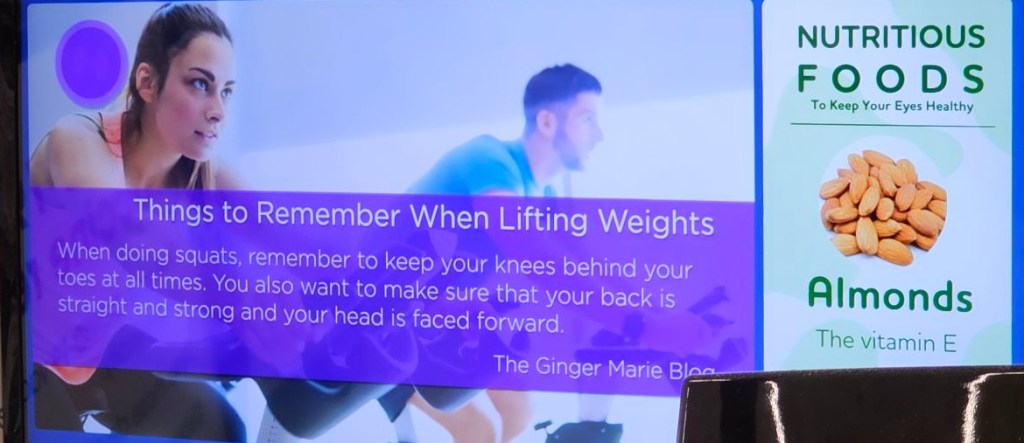
I was recently at a pharmacy where there was a small TV tucked into a corner displaying something I found rather odd:

If you have a hard time reading the text, it says:

Things To Remember When Lifting Weights
When doing squats, remember to keep your knees behind your toes at all times. You also want to make sure that your back is straight and strong and your head is faced forward.
—The Ginger Marie Blog

Those who are familiar with how to squat properly will know that the advice to always keep your knees behind your toes is a myth. Nothing bad happens if your knees go in front of your toes and many people need their knees to go in front of their toes to get full depth—especially olympic weightlifters who regularly bottom out their squat (so called “ass to grass” squatting). Like all lifting, it’s a bad idea to suddenly do it with near-maximal loads instead of working up to it, of course—but that’s true of all ways of doing all lifts. Walking up to a lift you’ve never done before and maxing out on it is a useful ingredient in maximizing your injury risk—though it should be born in mind that strength sports have pretty low injury risks compared to most other sports. But still, do work up to your maximal lift attempts. You’ll also lift more that way.

Also, does anyone really need to be told to keep their head facing forward when squatting? I’ve never seen anyone even attempt to look over their shoulder while squatting.

That’s not really why I bring this up, though. A pharmacy is a very strange place to get strength training advice in a corner overlayed on top of a picture of people on exercise bikes. To give a sense of how odd this is, imaging walking into a powerlifting gym and behind one of the machines is a TV which shows a picture of technicians putting someone into an MRI machine and the text on top says:

Things To Remember When Taking Medicine: When taking an antibiotic, always drink a large glass of whole milk with it, finish the antibiotics course unless otherwise directed by a doctor, and stand upright on the ground while taking it.

This, by the way, is the front page of The Ginger Marie Blog, as of the time I’m writing this post:

I do not say a word against Ms. Ginger Marie, but I must confess I’m curious as to why this particular site was chosen as the place from which to get advice on proper squat technique.

Though, to be fair to Ms. Marie, when I try searching the site for the word “squats” I don’t come up with anything. A google search for “The Ginger Marie Blog” and “squats” and “knees” also turns up no results, though that may not mean much since Google has been pretty bad for the last year or two. Still, it’s possible that the random TV in my local pharmacy is misattributing its dubious advice to Ms. Marie.

I wonder if we can blame AI for this? Perhaps a large language model mangled a quote from a publication like Marie Claire and then mangled the attribution, as well. This seems like the sort of thing that AI might do.

As dystopias go, this is a much nicer one than what most dystopian movies portray.