
Watson Was a Doctor

Dr. John Watson, the celebrated friend and biographer of Sherlock Holmes, has been portrayed and regarded in many ways, though rarely have they been flattering. The attitude may, perhaps, have been best summed up in one of Fr. Ronald Knox’s ten commandments for detective fiction:

The stupid friend of the detective, the Watson, must not conceal any thoughts which pass through his mind; his intelligence must be slightly, but very slightly, below that of the average reader.

This conception of Watson as a “stupid friend” may have reached its climax in the portrayal of Dr. Watson by Nigel Bruce, who played the character opposite to Basil Rathbone’s Sherlock Holmes.
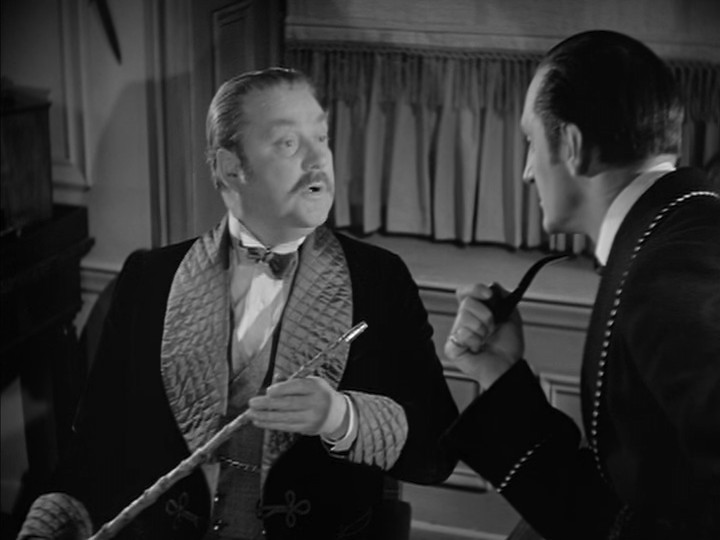
This description by Loren Estleman of Nigel Bruce’s Watson, which I saw quoted on Wikipedia, is an exaggeration, but not a great exaggeration:

If a mop bucket appeared in a scene, his foot would be inside it, and if by some sardonic twist of fate and the whim of director Roy William Neill he managed to stumble upon an important clue, he could be depended upon to blow his nose on it and throw it away.

But neither of these are really true to the character of Watson. This can be seen most clearly, I think, in The Hound of the Baskervilles, which shows Watson at his finest. Watson actively investigates, in Holmes’ absence, with intelligence and confidence. He finds useful clues. All of which makes sense, because Watson is a doctor.

If you consider what a doctor does, you will quickly see that it is very similar to what a detective does. People come to the doctor with their problems. They have a few clues as to what has gone wrong, though these are normally called by the medical jargon, “symptoms.” The doctor will then interrogate the patient about things things which have happened—things which may seem to the patient irrelevant or unimportant. He may probe the patient’s body to gain further evidence. He then uses his imagination to think of what might be wrong that caused these symptoms and gather further, more directed evidence, to prove or disprove this hypothesis. Once he is confident, he or the patient or both will act on this and—if he was right—bring a resolution to the problem, or at least as much of a resolution as the situation allows. This is also a description of what a consulting detective does.

Holmes is more intelligent than Watson; he has also developed quite a good deal more specialized knowledge than Watson, and for these reasons can solve problems which are impenetrable to Watson. But he is not completely unlike Watson. Indeed, it is this similarity, though in different fields of application, which allows Watson to appreciate Holmes’ genius. Most people were irritated by Holmes, but Watson could follow Holmes’ explanations, once he gave them, and appreciate how he could have done it if he had only done a better job. That is to say, the thing which allowed Watson to appreciate Holmes was the fact that Watson was, himself, a detective of middle-rate skill. Which is no small thing.

The modern world is so accustomed, because of the cheapness of digital reproduction, to having the best that we have lost sight of the value of anything but the best. This has gotten so bad we often turn our nose up at the second-best and treat third-best as if it meant third-rate. When we look at the Olympics we care who won the gold medal and sometimes give a thought to who won the silver medal, but often look at the bronze medal as if it was a consolation prize or participation trophy. And yet, for most groups of Olympic medalists, if you were to re-run the event ten times on ten different days, all three of the competitors would probably win gold at least once and all three would take bronze at least once. No one is so outstanding that he does not have a bad day and everyone near the top occasionally has good days. And, more to the point, the bronze medalist would, on any normal day, be able to beat virtually anyone you put him up against. That is to say, he may have taken third place, but he’s still first-rate.

This is where people go wrong with Watson, I think. Watson was not Holmes’ stupid friend. Watson was Holmes’ intelligent friend. So much so that in Watson’s area of specialization—medicine—Holmes always deferred to Watson’s judgement. Watson did not come close to the heights that Holmes could reach, within Holmes’ area of specialization, but there is a very good reason why Holmes confided in Watson and not in other men. Watson was intelligent enough, and enough of a detective, that he could appreciate Holmes.

Indeed, this is what made Watson such an excellent biographer of Sherlock Holmes. He was low enough that he could make Holmes relatable to the common man but high enough that he could understand Holmes when he explained himself—unlike the common man. Watson does not appear in a good light when standing next to Holmes, but when he was on his own many people came to Watson with their troubles and through his own intelligence and knowledge he helped them.

Watson was a doctor.

Consulting Detectives and the Police

(In this post I’m going to consider the relationship between a consulting detective and the police, from the perspective of writing about them. Nothing in this post is meant as literary criticism of any examples which are considered.)

In most murder mysteries, the police are investigating the murder, which presents the writer the problem of what the relationship between the police and the detective will be. Authors have chosen all over the spectrum, from the police seeking out the help of the consulting detective to the police actively trying to deter the consulting detective. (This has even been true of murder mysteries in which the main detective is the police! In that case it takes the form of his superiors respecting him to his superiors assigning him elsewhere and forbidding him from investigating.)

Authors will also change things up. In The Cadfael Chronicles stories, Sheriff Gilbert Prestcote is mildly antagonistic to Cadfael, whereas his successor Hugh Beringar is a good friend of Cadfael’s and though competent himself, values Cadfael’s opinion highly (it would probably be more accurate to say because he is competent himself). In Murder, She Wrote the different locations for the murder allowed them to try out the entire spectrum, though for some reason the Cabot Cove sheriffs tended to be more on the skeptical side. Perhaps the actors in question were just better at scowling than they were at smiling. Sherlock Holmes and Hercule Poirot had excellent reputations and friends in high places which tended to make the police friendly for them. Dorothy L. Sayers solved this with Lord Peter Wimsey by making the police deferential to his title of nobility. Philo Vance was a long-time friend of the district attorney. That’s only a small sampling and it’s all over the place. Clearly anything will work, but it leaves the question of which is best?

Of course, to even ask the question that way is to highlight that the real question is what sort of stories do the points on the curve allow you to tell? It’s always easiest to start at the extremes. If the police are highly antagonistic to the detective—e.g. the detective is the prime suspect and there is an arrest warrant out for the detective—this tends to be more conducive to stories with a lot of action/suspense. In the examples I can think of (The Fugitive and Minority Report come to mind) most of the focus is on whether the detective will be caught before he can prove he didn’t do it. This also tends to raise the stakes by having an innocent person in danger of being punished for a crime they didn’t commit.

On the other end of the spectrum, the police enthusiastically ask for the detective’s help and will do anything the detectives tells them to. Some episodes of Murder, She Wrote come to mind. Some of the Lord Peter Wimsey stories come close to it as well. Come to think of it, so do a few of the Sherlock Holmes stories. The stakes tend to be lower—though not always; Lord Peter had police cooperation in Strong Poison but Harriet Vane was on trial for a crime she didn’t commit—and most of the action tends to be the actual investigation. This tends to open up more space for theorizing and collaboration. Unless it’s an ongoing murder story—where live characters keep turning into dead bodies—these stories are more likely to have a slower pace and focus more on dialog than action.

(It is of course possible to change locations on this spectrum throughout the story. A detective, once cleared, can be welcomed by the police. A detective who had full access can turn into a suspect (this is especially easy to do if there are ongoing murders). A story can start more in the middle and once the detective proves useful, they can become more welcome. Etc.)

I think that my own preference is for the friendlier side of the spectrum. I enjoy collaboration more than I do conflict. Conflict can certainly be interesting, and is often easier to make interesting than collaboration, but I think that collaboration done well has a greater potential for interest. Individuals are interesting, but people are more themselves in community. Of course, it must be a true community. False community obliterates the individual for the sake of the group, while real community brings each individual to the fullness of themselves, respecting each one’s unique virtues. (As a technical note, I mean their unique natural virtues. Moral virtues are—in an ideal world, at least—not distinct between people. All men should be perfectly honest, but each one’s identical perfect honesty will have a different natural content because they know different things.)

A friendly relationship between the police and a consulting detective is not easy to pull off, however, especially if one is striving for realism. There is something of a natural antagonism between a consulting detective and the police, and further there is a natural reticence the police will have in sharing information which is not public. Still, the police will certainly consult outside experts, and police departments have been known to consult psychics for help. In The Dean Died Over Winter Break the relationship was probably more neutral than welcoming, but the police were reasonably friendly. Still, the information mostly flowed from the detectives to the police, and not the other way around. In the circumstance, it seemed the most natural thing.

One of the more plausible ways of insinuating the consulting detective with the police involves the police being short on resources. Resource shortages have a number of effects on people, most of them tending to increase flexibility. People with too few resources tend to see the upsides of shortcuts and other sorts of flexibility more clearly than do people with enough resources to get everything done. They tend to be less worried about possible downsides, because the downsides compare to the downside of simply not getting their work done. Moreover, the people who are responsible for the short-staffing cannot credibly threaten to replace the overworked person with someone else. Finding people willing to be overworked is not easy, and in any event finding new people for a job is both difficult and expensive. Worse for the person responsible for the short-staffing, since overworked people often make mistakes and don’t get everything done, disciplinary issues will have come up before, and the overworked person will probably have gotten used to the toothlessness of any threats made. Thus by the time the consulting detective comes around, offering to take some of the work off of the overworked police detective’s shoulders, the upside will be all the more obvious while the downsides will already be known to be minimal. And since the worst case is that the overworked person finally stops being overworked, the downsides will seem especially minimal.

Also viable for making police collaboration with the consulting detective plausible is for the forensic evidence to be scant. Really it’s not just the forensic evidence, but all of the evidence in which the police are the best at obtaining: cell phone records, bank records, the sort of evidence for which warrants are generally attainable, etc. If the police don’t really know anything of value, they have very little to lose in a relationship with the consulting detective. The flip side of the fairly impressive powers to subpoena phone records, etc. is that they are bound by rules which private citizens are not. Moreover the police are bound to enforce all rules, though of course in practice they don’t always do so, but this makes the police scary since in the modern age virtually everyone is guilty of some crime or other. We have so many laws its impossible to know what they all are, and some of them run counter to common sense (especially copyright laws). Children and pets offer all sorts of judgement-based ways in which the police could make a person’s life miserable even if they haven’t technically broken any laws; a great many people are rightfully wary about anyone as powerful as the police. None of this applies to a consulting detective, who has no power and is therefore relatively safe. Further, with no superiors to whom a person can complain, a consulting detective is in a less vulnerable position if they take liberties with people who have valuable information (providing those liberties are within the law).

There are of course plenty of other ways for a consulting detective to get along with the police. Friends and relatives on the police force have been used innumerable times. If a consulting detective is likable a police detective might simply take a liking to them. Having a mutual friend and helping the consulting detective for the sake of the friend is certainly possible, as is there being someone in authority over the police who wants the consulting detective working on the case.  My memory might be deceiving me, but I think I’ve even seen it work for the consulting detective to—in effect—blackmail the police detective into sharing information. Since precedent is a powerful thing, I’ve also seen it done to bootstrap the consulting detective into a relationship with the police by some means which would only work once—a relative of the deceased having (politically expensive to use) power over the police, for example—which leaves the police eager to work with the detective again. I think that the choice of these techniques, if one wants to go this way, is going to depend on the detectives. In the case of my detectives—The Franciscan Brothers of Investigation—the choice varies with who it was that called the brothers in. In The Dean Died Over Winter Break, since it was the university president, this acted as something of a middle ground. The police were neutral, but they were not hostile, while the university president’s authority gave them full cooperation with the university staff, which was probably more valuable to them. In future mysteries, it’s likely to be different based on who is asking for help.