
Disappeared From Her Home

Through a series of coincidences, some of which I will discuss soon because they come from beginning to read the compilation Rivals of Sherlock Holmes, which contains a number of detective stories from, roughly, 1892 through 1910, I discovered the existence of the novel Disappeared From Her Home by C.L. Pirkis. Published in 1877, it has been called a detective story, and though it is not a detective story in the modern sense of the term, it is not unreasonable that it is described that way. I find that very interesting.

If I had to summarize the plot to Disappeared From her Home in a sentence despite having only skimmed a half dozen chapters from it, I would say (spoilers ahead): a young woman out for her morning walk disappears and later seems to turn up dead while one of her two suitors figures out what actually happened to her, including finding her alive in France.

This makes it sound more like a modern mystery than it really is; it’s roughly equal parts melodrama and adventure story, at least as far as I can tell from the bits I’ve read. Unfortunately, I’m not really very interested in reading the whole thing because the style is so overwrought. (A metaphor I take from wrought iron that has been wrought far beyond what is necessary for beauty.) I’m far from an expert, or even knowledgeable, about Victorian melodrama, but as far as I can tell from various bits of it that I’ve read, it seems like some time after the ascension of Queen Victoria to the throne of England, English people developed a great passion for huge emotions described in complicated and somewhat understated language. This certainly wasn’t the case in the early 1800s, at the time of Jane Austen. (Pride & Prejudice was written around 1796 and published in 1813.)

It also doesn’t seem to have been an overly long-lasting style; Conan Doyle didn’t write in it, for example, so it was on the wane in the final decades of Queen Victoria’s reign. (I should note that R. Austin Freeman, writing in the first decade of the twentieth century, did write in a Victorian melodramatic style, so it didn’t entirely disappear by this time.) Another data point is that Father Brown, written in 1910, was not written in this style at all. That said, it occurs to me that the Father Brown stories were all short stories, and perhaps Victorian Melodrama was more a style of novels than of short stories. The short stories that C.L. Pirkis wrote, starting in 1893, about “Loveday Brooke, Lady Detective,” were not in a melodramatic style, or at least nowhere near to the degree that Disappeared From Her Home was.

Anyway, it’s very interesting to find a mystery story almost midway between Poe’s Murder on the Rue Morgue and Conan Doyle’s A Study in Scarlet, but while it does certainly center on a mystery, it’s not a detective story, and I have my doubts that it was part of the development of the detective story as we know it today.

An interesting feature of it, by the way, is that it did, in fact, have a detective in it. The father of the missing girl hired a detective who interviewed people and tracked down clues. This makes sense, historically, since the famous Pinkerton detective agency was founded in 1850, and though it was American, it would make sense if there were people doing similar work in England. The detective is not very important to the story, though. It is not the detective to finds the girl; in the parts I skimmed it’s not even necessarily the case that the information he found was all that useful to the suitor who actually found the girl.

The other thing that really distinguishes it from a proper detective story, in my view, is that it doesn’t seem to have anyone who is really trying to deceive the world. The daughter is convinced to go to France, but this simple, and there is a mystery about it primarily because she is convinced to not tell her father so that he doesn’t stop her. There is no effort at concealment past not bothering to send him a telegram or a letter, so far as I saw, and the suitor who solved the case did not match wits with anyone who was trying to prevent its solution. (To be fair, plenty of golden age mysteries were investigating accidents or other mysteries where there was no attempt at concealment, but these were, in general, not the best of the golden age stories.)

I do not know if I will look into Disappeared From Her Home or other such Victorian mystery stories. (It seems to be the case that a person going missing leading to the revelation of dark family secrets was a popular kind of story for a while.) Mostly, because I doubt that they actually are in the lineage of detective stories. But it is very interesting to have learned that they exist.
Watson Was a Doctor

Dr. John Watson, the celebrated friend and biographer of Sherlock Holmes, has been portrayed and regarded in many ways, though rarely have they been flattering. The attitude may, perhaps, have been best summed up in one of Fr. Ronald Knox’s ten commandments for detective fiction:

The stupid friend of the detective, the Watson, must not conceal any thoughts which pass through his mind; his intelligence must be slightly, but very slightly, below that of the average reader.

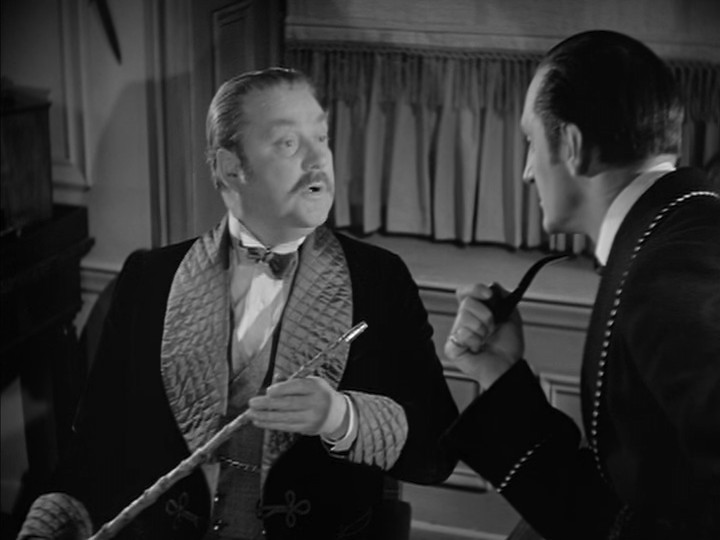
This conception of Watson as a “stupid friend” may have reached its climax in the portrayal of Dr. Watson by Nigel Bruce, who played the character opposite to Basil Rathbone’s Sherlock Holmes.

This description by Loren Estleman of Nigel Bruce’s Watson, which I saw quoted on Wikipedia, is an exaggeration, but not a great exaggeration:

If a mop bucket appeared in a scene, his foot would be inside it, and if by some sardonic twist of fate and the whim of director Roy William Neill he managed to stumble upon an important clue, he could be depended upon to blow his nose on it and throw it away.

But neither of these are really true to the character of Watson. This can be seen most clearly, I think, in The Hound of the Baskervilles, which shows Watson at his finest. Watson actively investigates, in Holmes’ absence, with intelligence and confidence. He finds useful clues. All of which makes sense, because Watson is a doctor.

If you consider what a doctor does, you will quickly see that it is very similar to what a detective does. People come to the doctor with their problems. They have a few clues as to what has gone wrong, though these are normally called by the medical jargon, “symptoms.” The doctor will then interrogate the patient about things things which have happened—things which may seem to the patient irrelevant or unimportant. He may probe the patient’s body to gain further evidence. He then uses his imagination to think of what might be wrong that caused these symptoms and gather further, more directed evidence, to prove or disprove this hypothesis. Once he is confident, he or the patient or both will act on this and—if he was right—bring a resolution to the problem, or at least as much of a resolution as the situation allows. This is also a description of what a consulting detective does.

Holmes is more intelligent than Watson; he has also developed quite a good deal more specialized knowledge than Watson, and for these reasons can solve problems which are impenetrable to Watson. But he is not completely unlike Watson. Indeed, it is this similarity, though in different fields of application, which allows Watson to appreciate Holmes’ genius. Most people were irritated by Holmes, but Watson could follow Holmes’ explanations, once he gave them, and appreciate how he could have done it if he had only done a better job. That is to say, the thing which allowed Watson to appreciate Holmes was the fact that Watson was, himself, a detective of middle-rate skill. Which is no small thing.

The modern world is so accustomed, because of the cheapness of digital reproduction, to having the best that we have lost sight of the value of anything but the best. This has gotten so bad we often turn our nose up at the second-best and treat third-best as if it meant third-rate. When we look at the Olympics we care who won the gold medal and sometimes give a thought to who won the silver medal, but often look at the bronze medal as if it was a consolation prize or participation trophy. And yet, for most groups of Olympic medalists, if you were to re-run the event ten times on ten different days, all three of the competitors would probably win gold at least once and all three would take bronze at least once. No one is so outstanding that he does not have a bad day and everyone near the top occasionally has good days. And, more to the point, the bronze medalist would, on any normal day, be able to beat virtually anyone you put him up against. That is to say, he may have taken third place, but he’s still first-rate.

This is where people go wrong with Watson, I think. Watson was not Holmes’ stupid friend. Watson was Holmes’ intelligent friend. So much so that in Watson’s area of specialization—medicine—Holmes always deferred to Watson’s judgement. Watson did not come close to the heights that Holmes could reach, within Holmes’ area of specialization, but there is a very good reason why Holmes confided in Watson and not in other men. Watson was intelligent enough, and enough of a detective, that he could appreciate Holmes.

Indeed, this is what made Watson such an excellent biographer of Sherlock Holmes. He was low enough that he could make Holmes relatable to the common man but high enough that he could understand Holmes when he explained himself—unlike the common man. Watson does not appear in a good light when standing next to Holmes, but when he was on his own many people came to Watson with their troubles and through his own intelligence and knowledge he helped them.

Watson was a doctor.