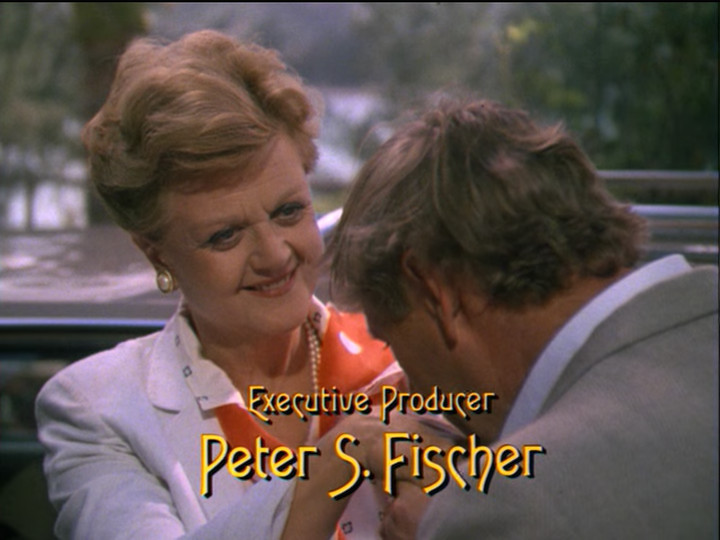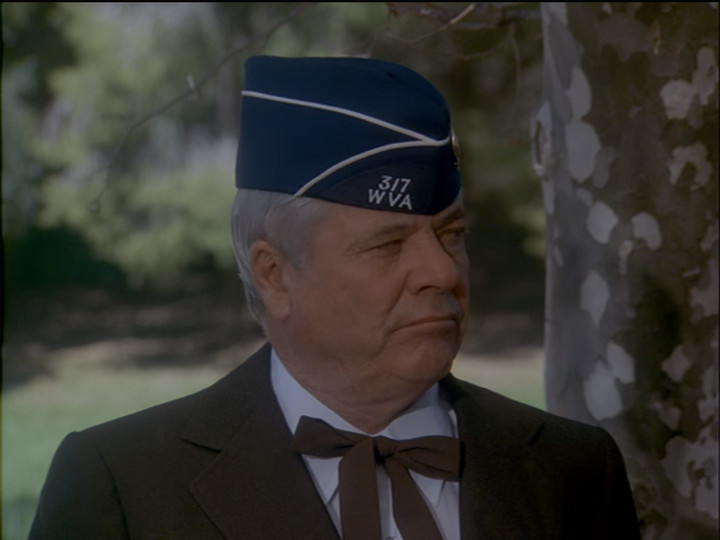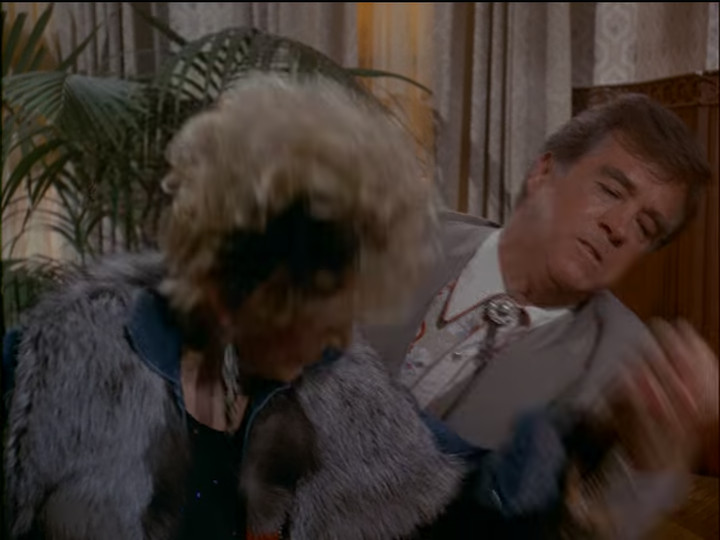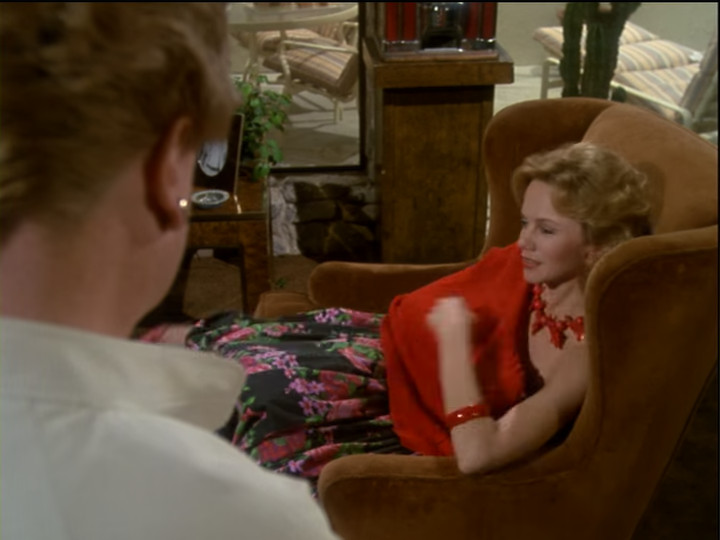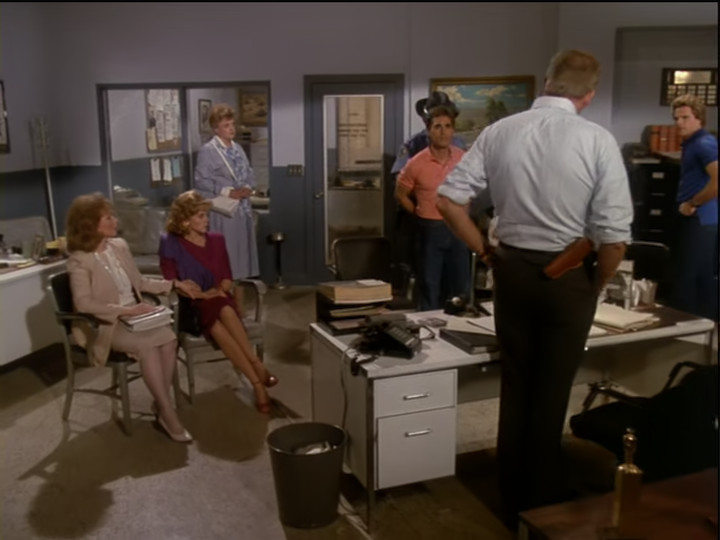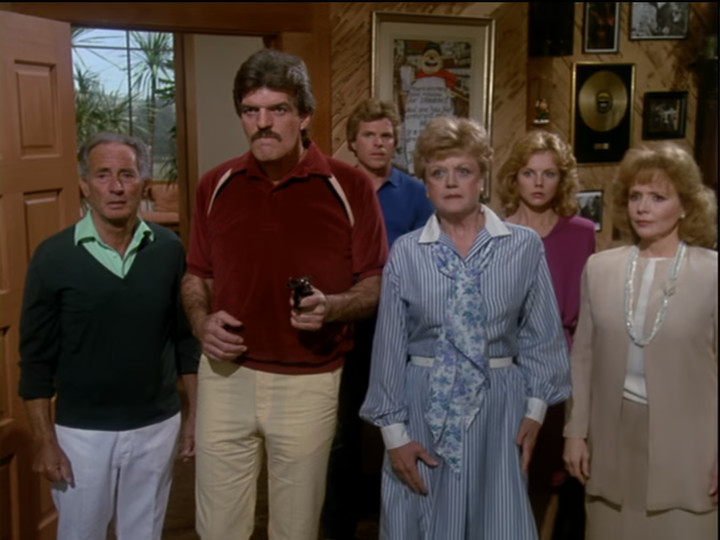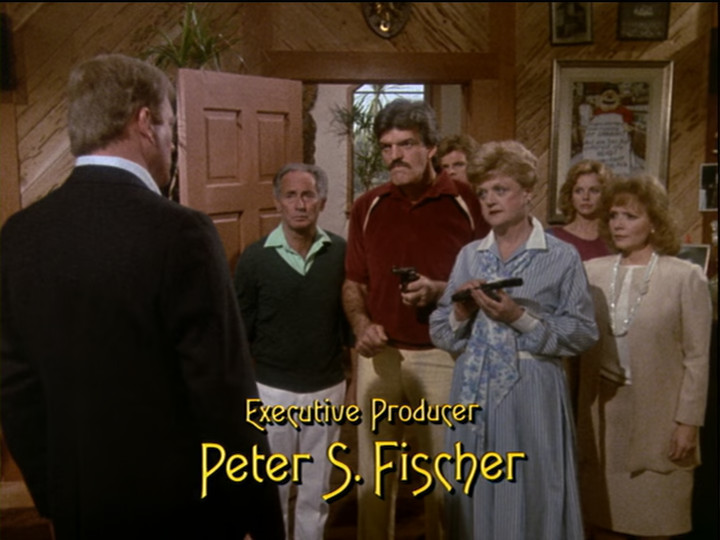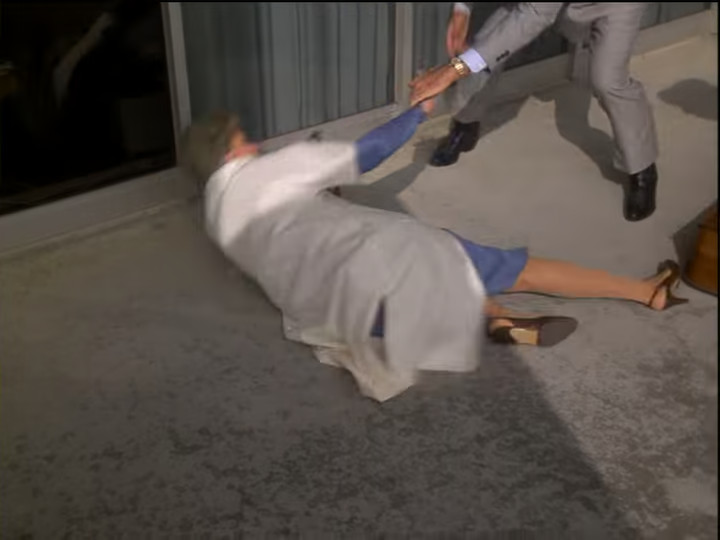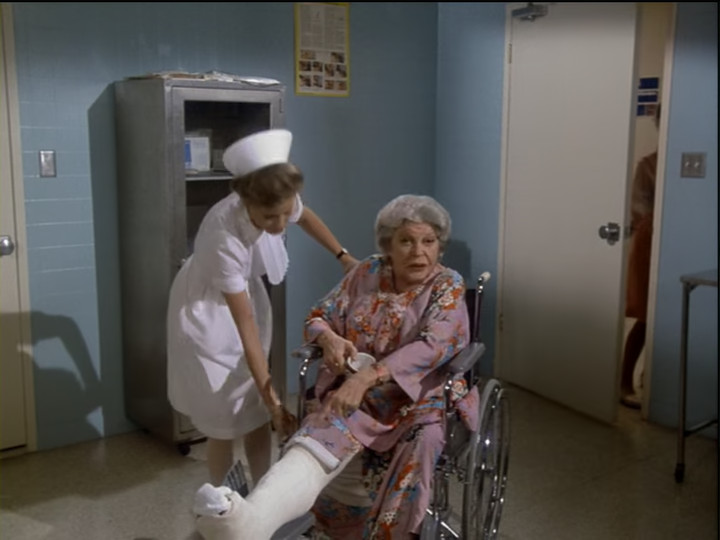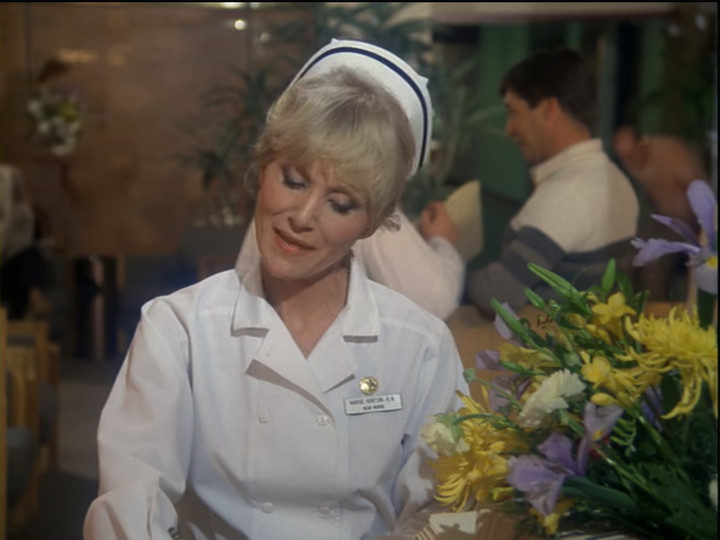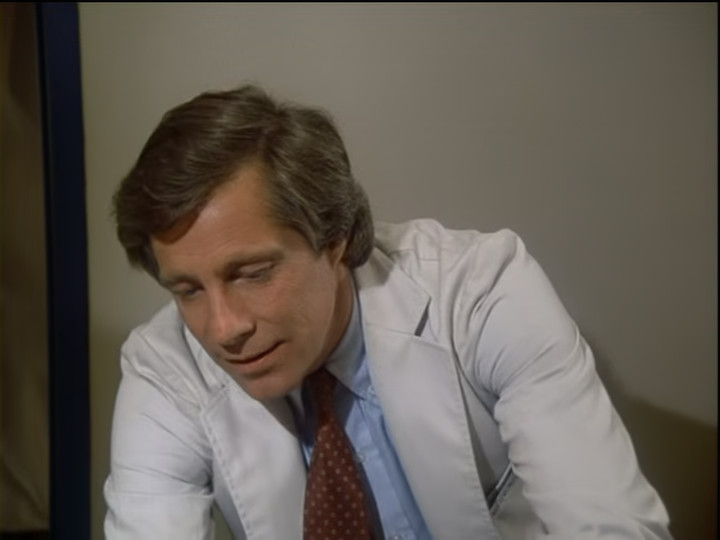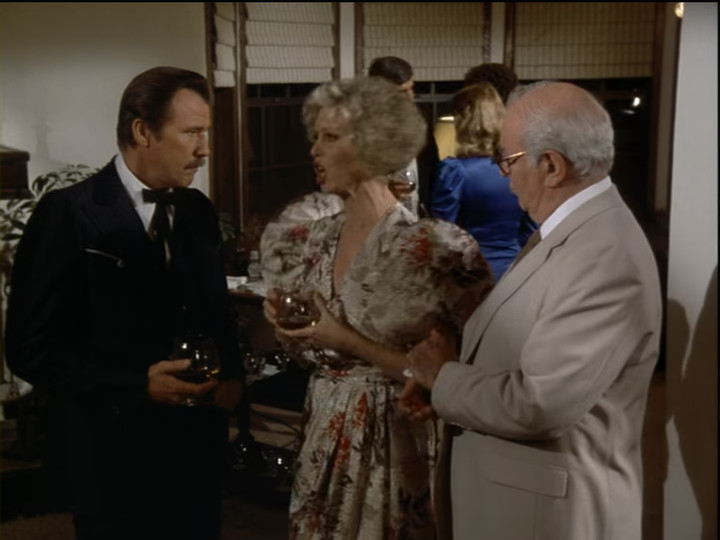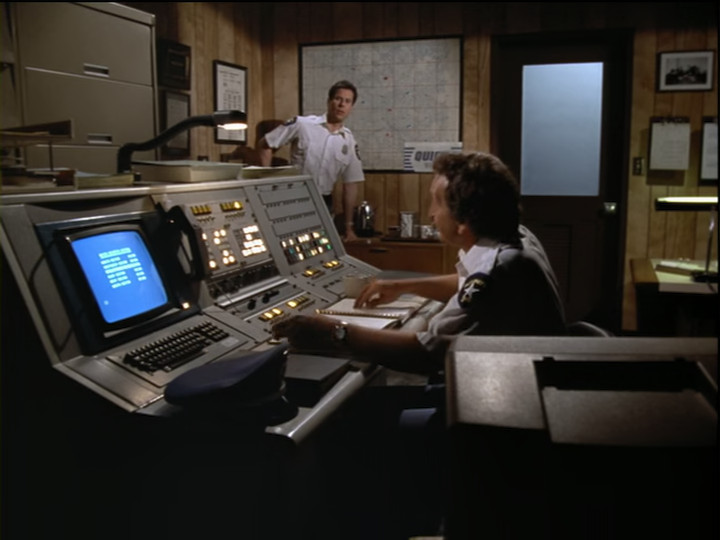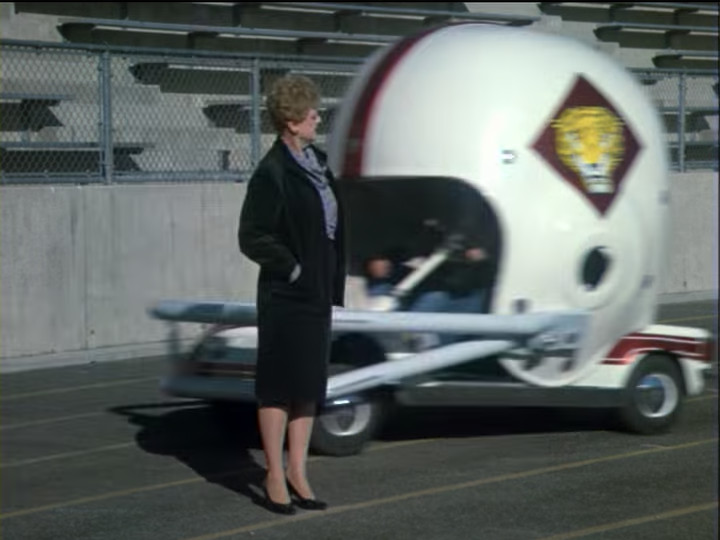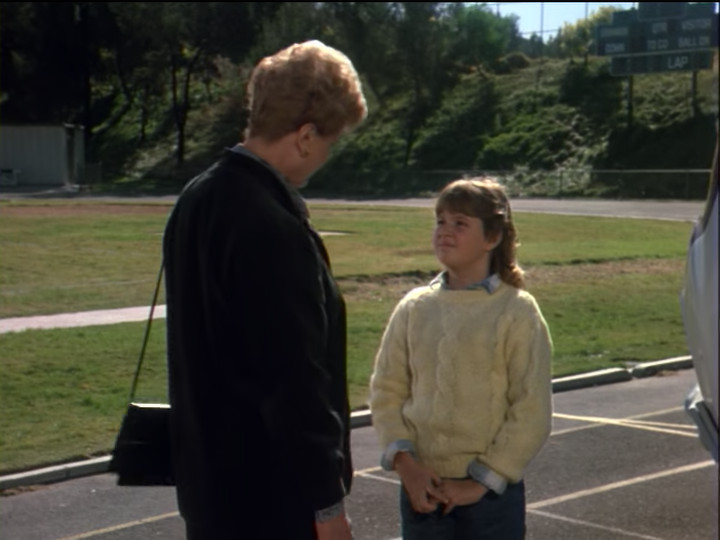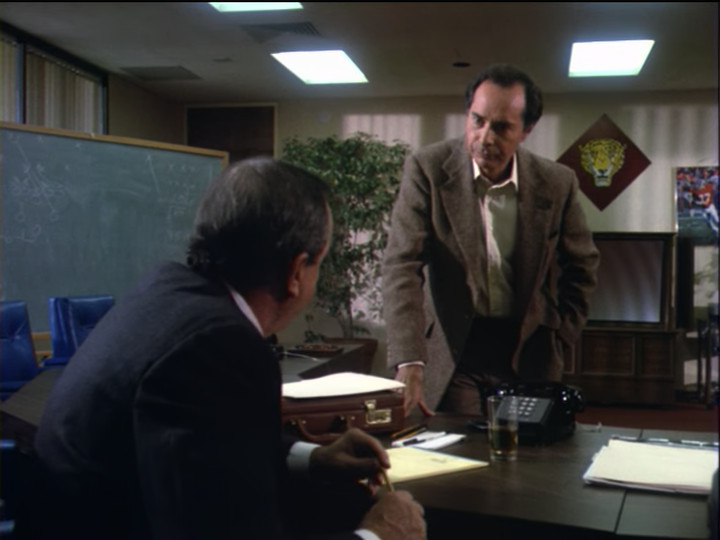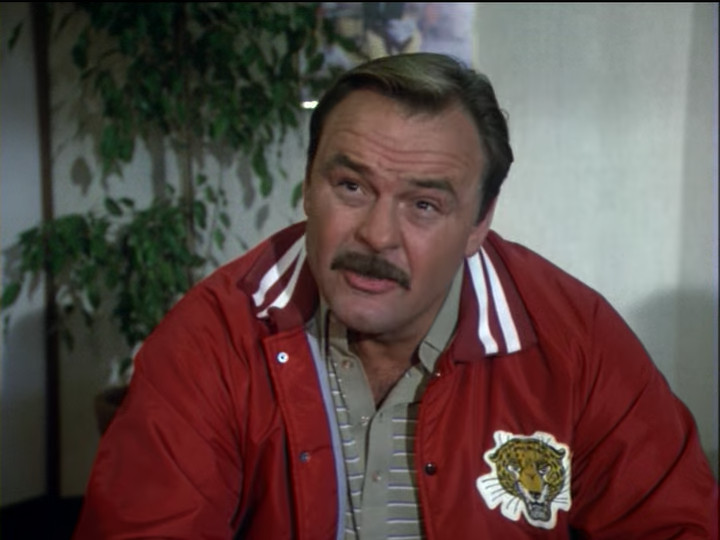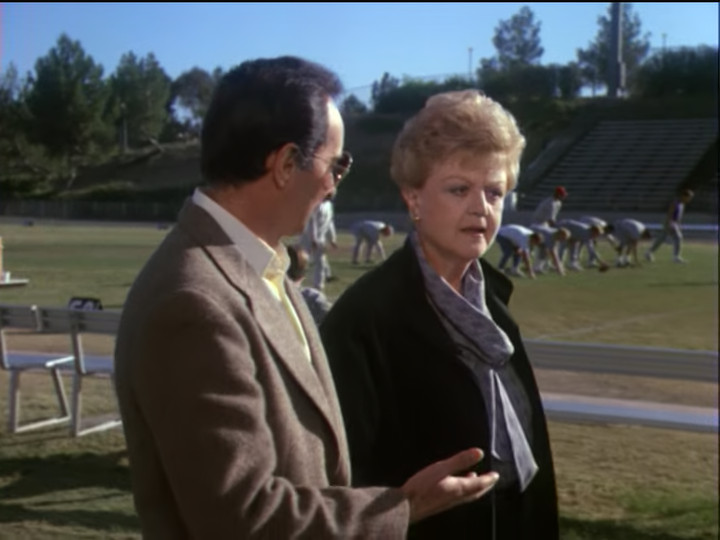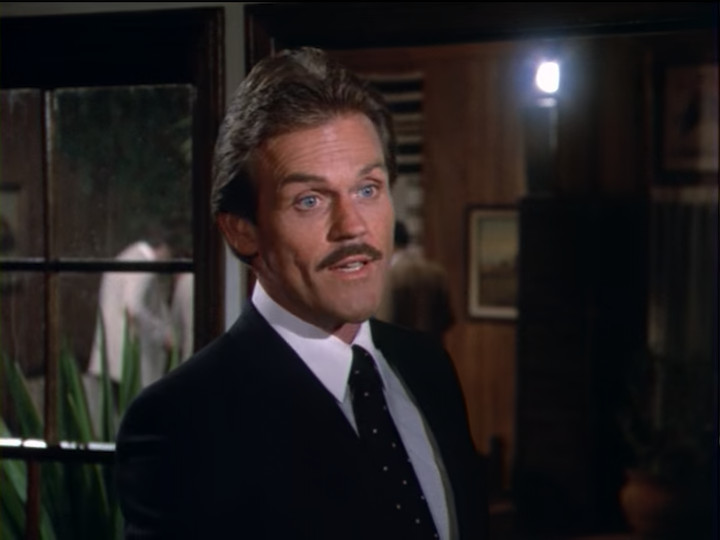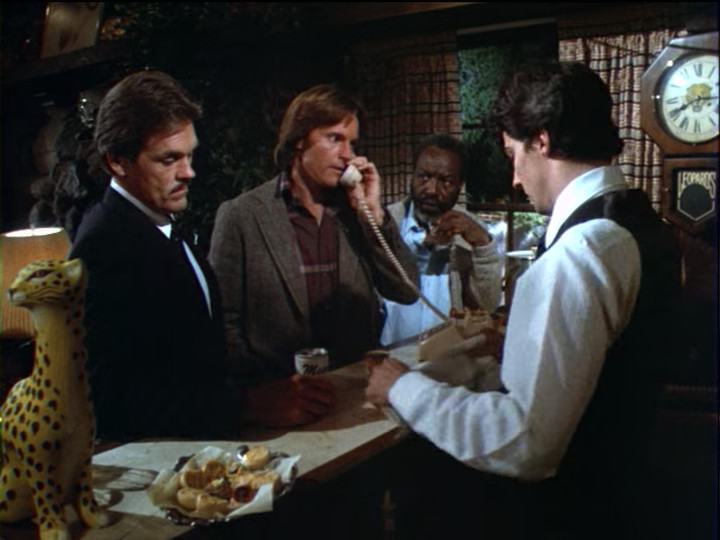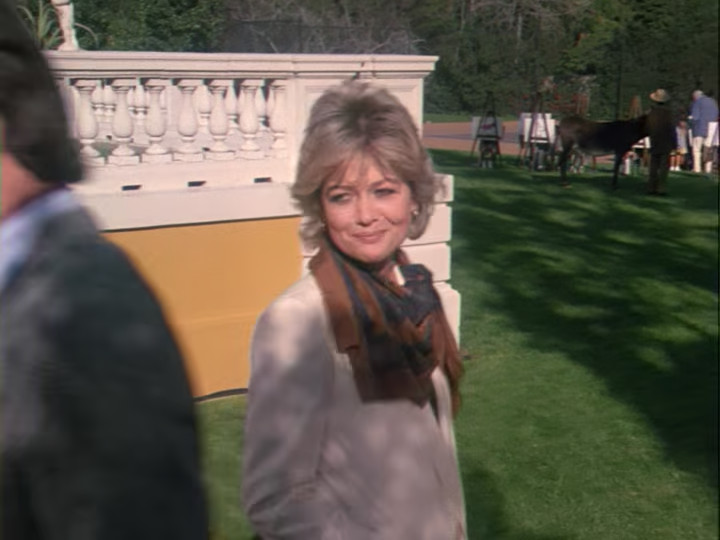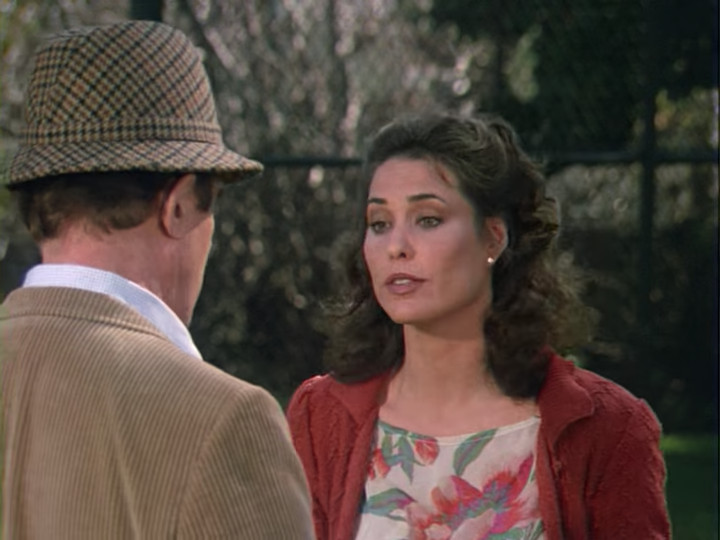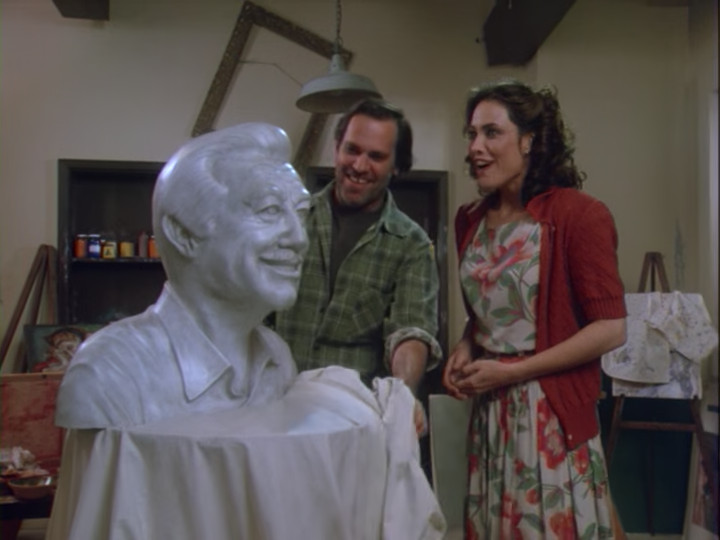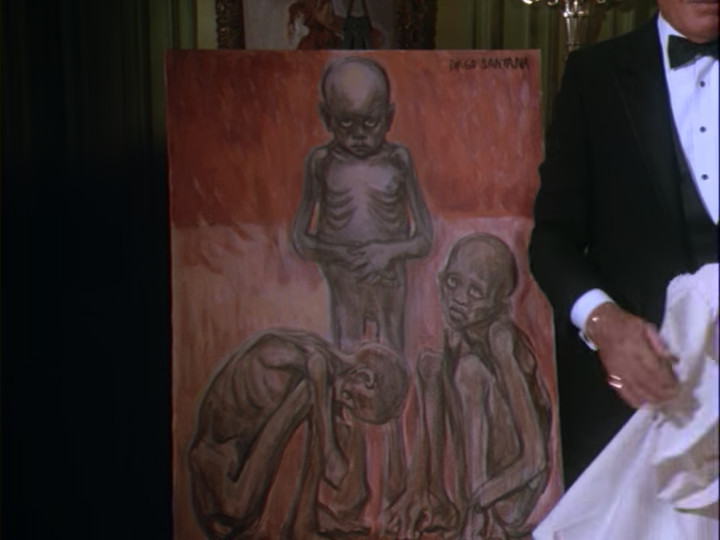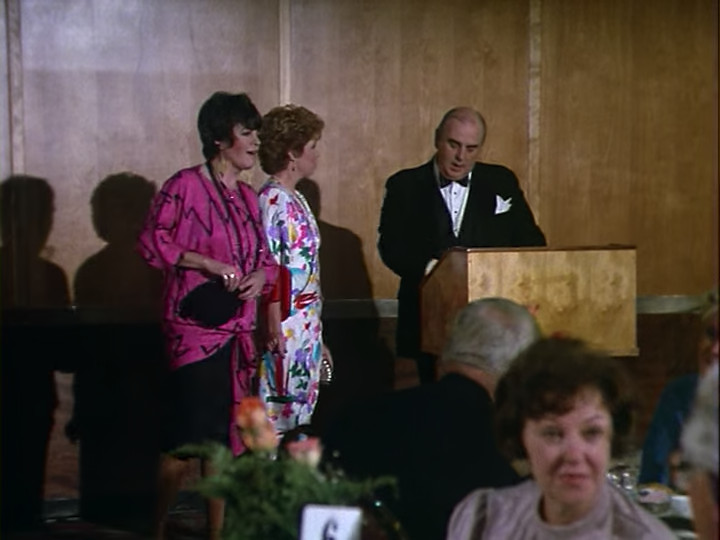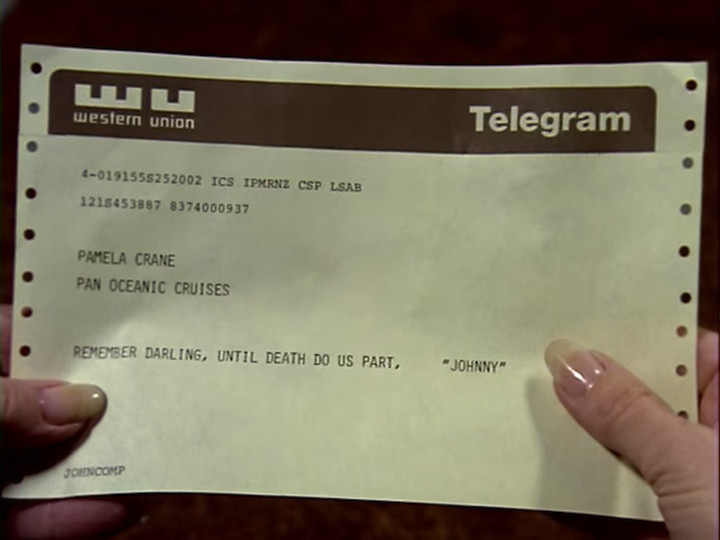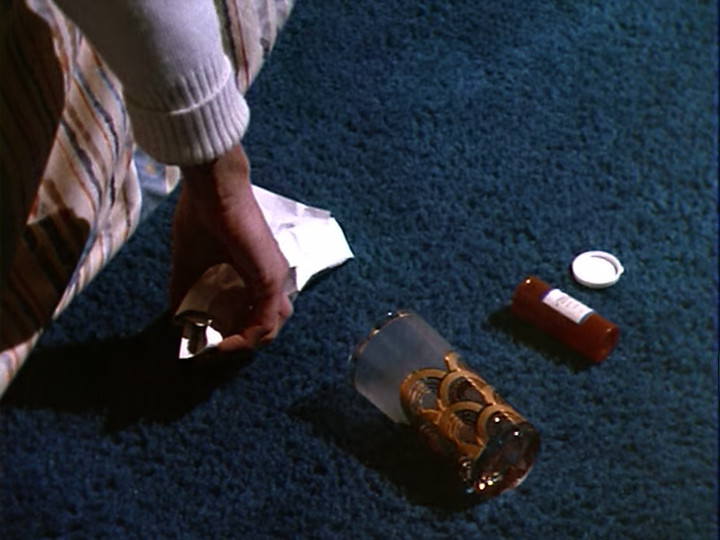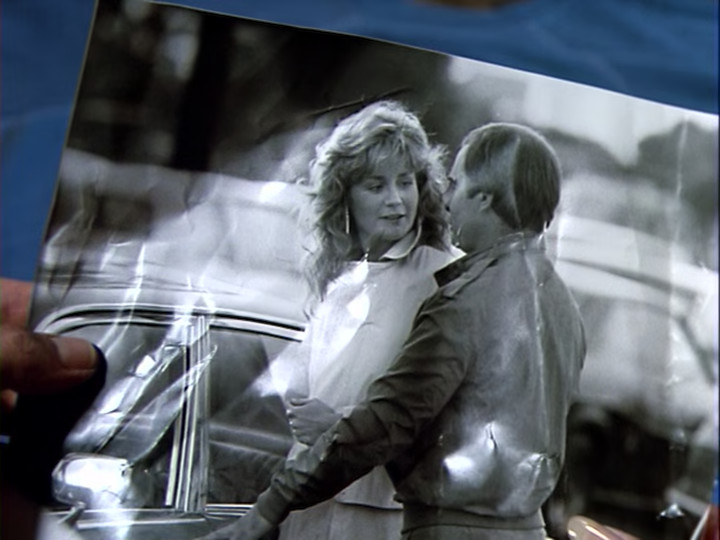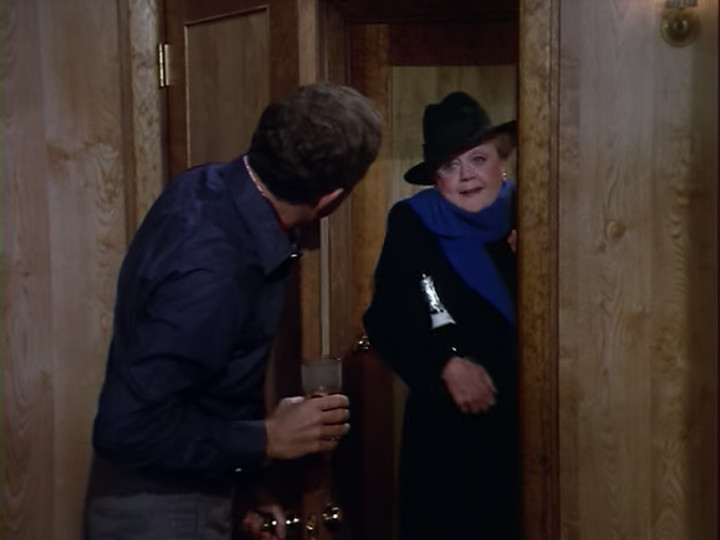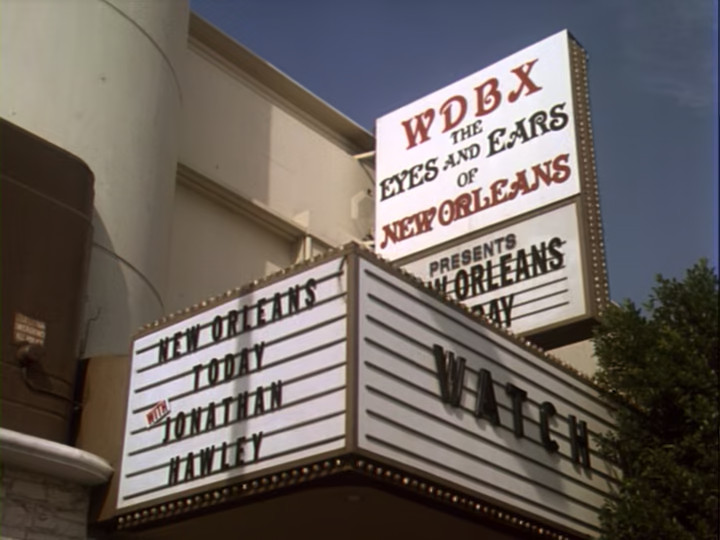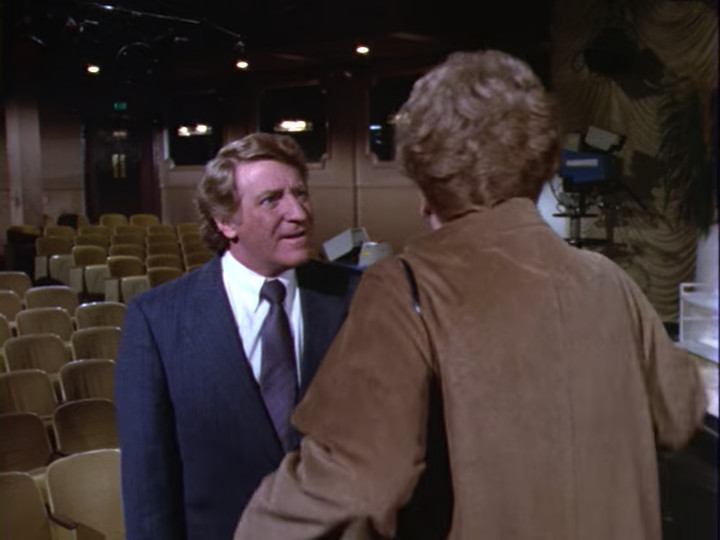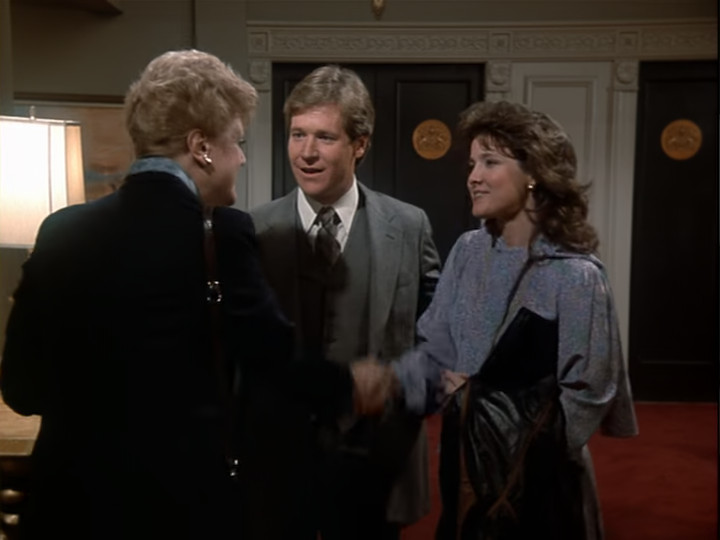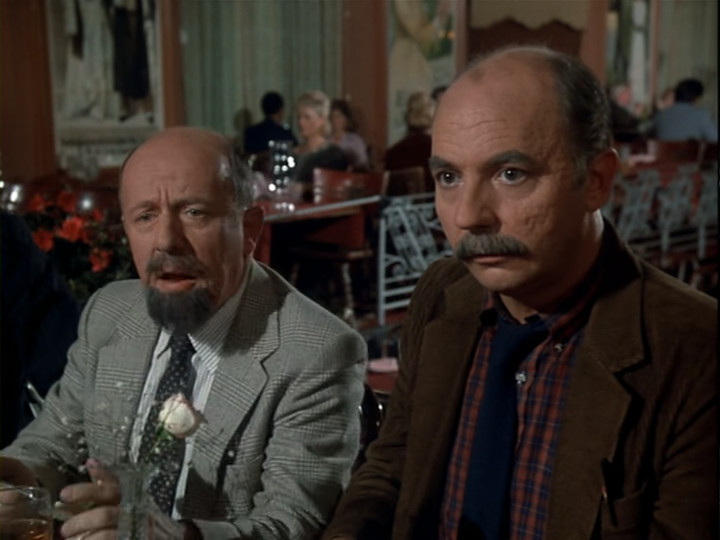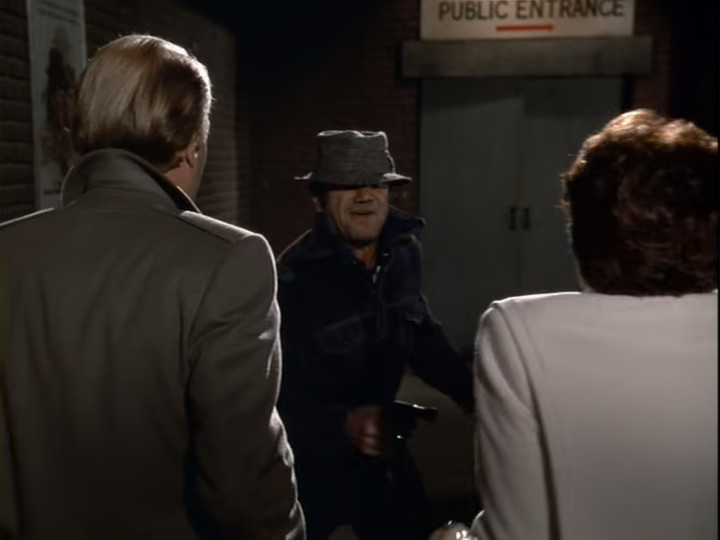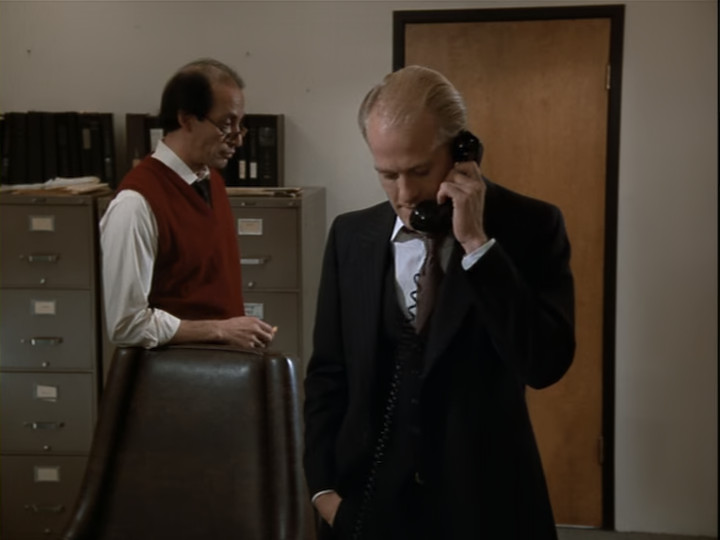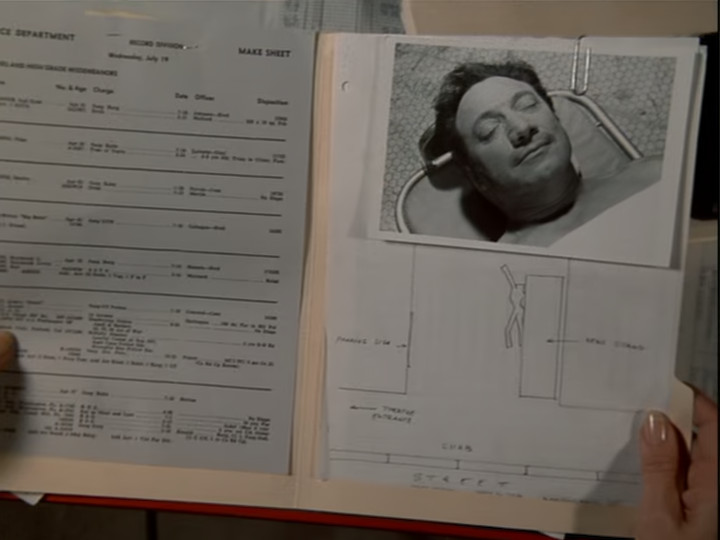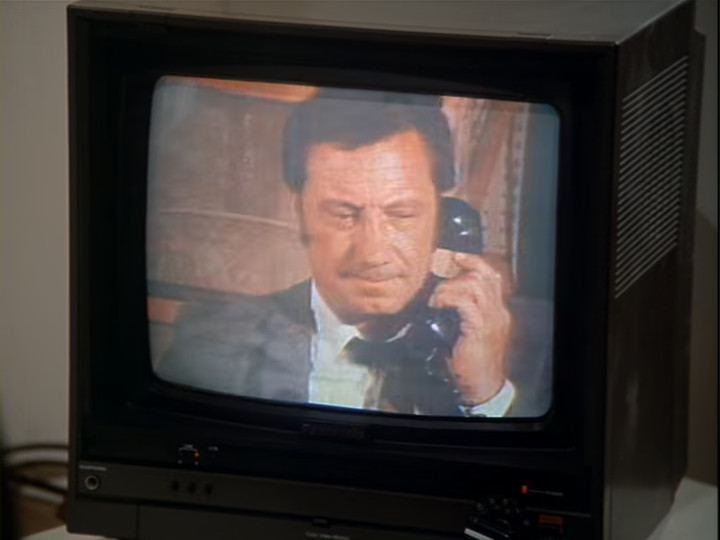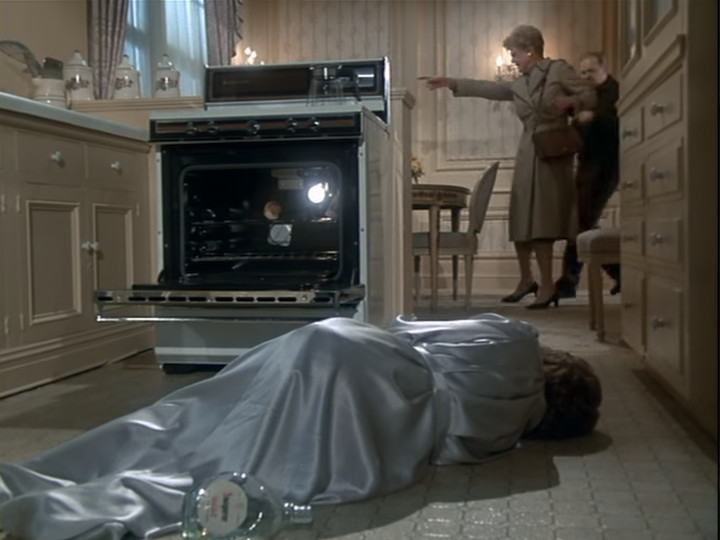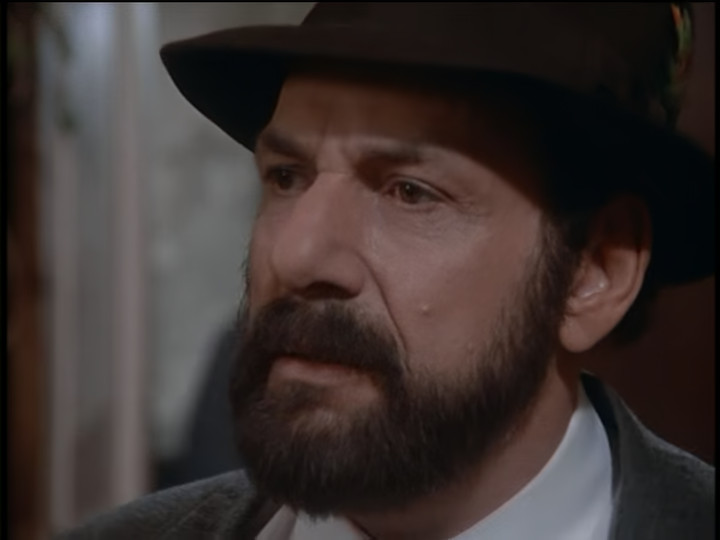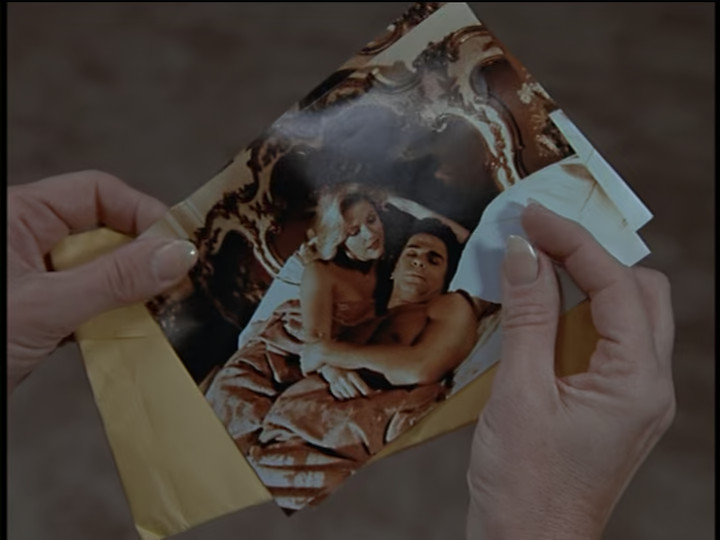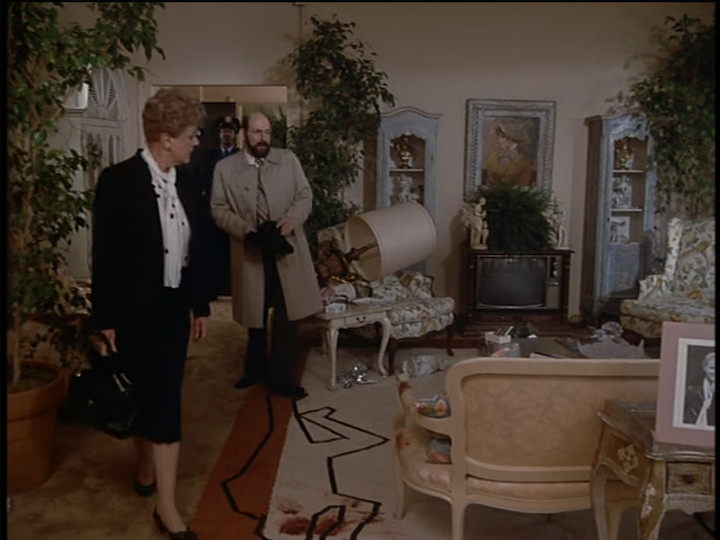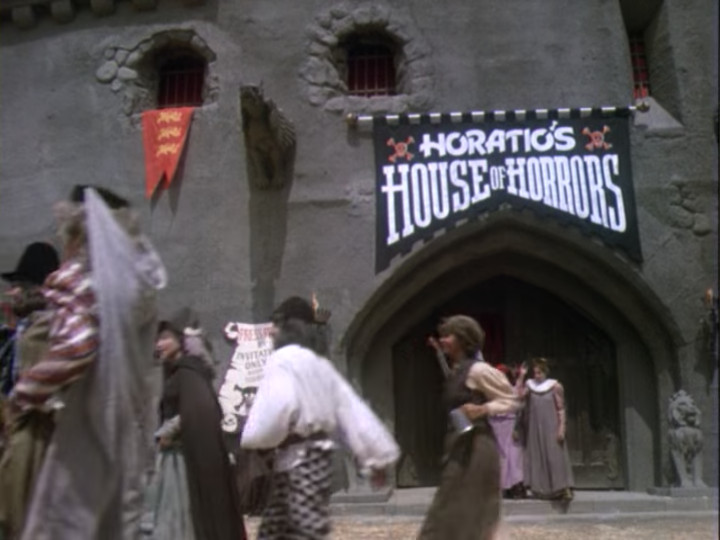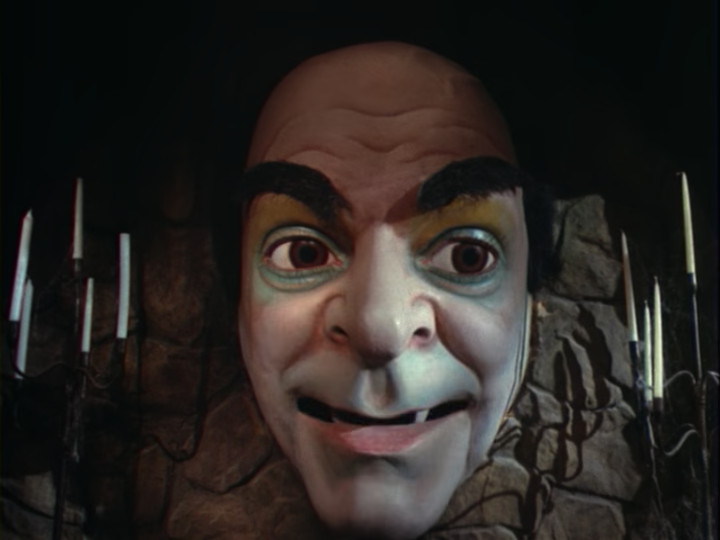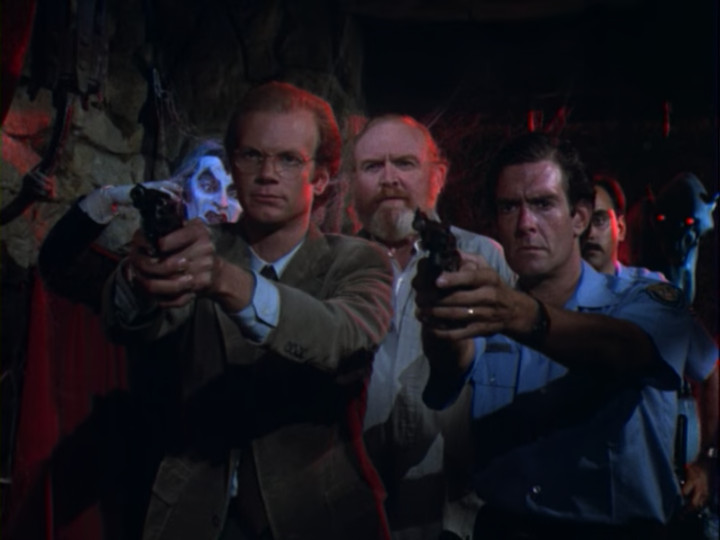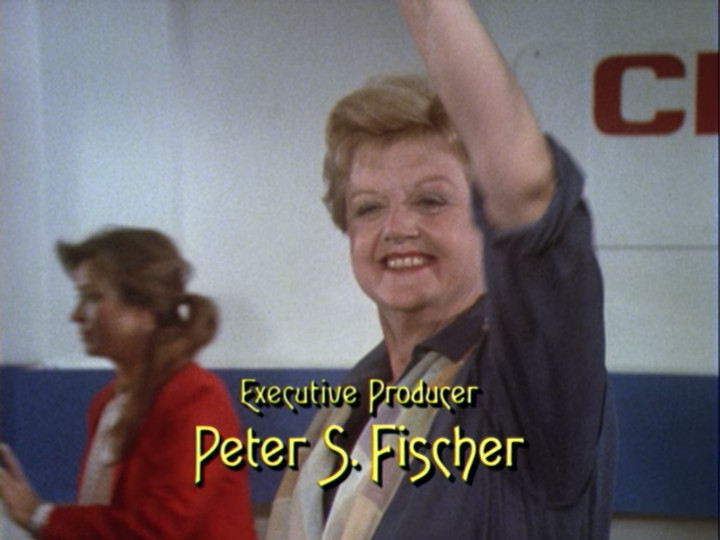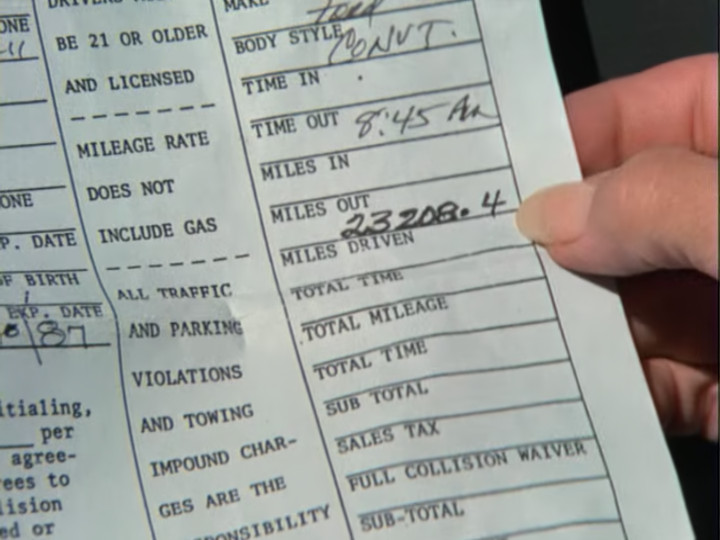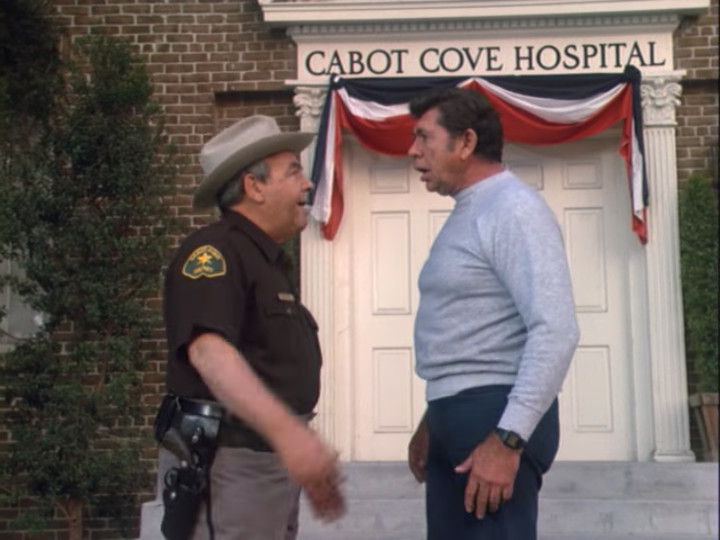
Murder She Wrote: Joshua Peabody Died Here… Possibly

On the sixth day of October in the year of our Lord 1985, the second episode of the second season of Murder, She Wrote aired. Titled Joshua Peabody Died Here… Possibly, it is set in Cabot Cove. (Last week’s episode was Widow, Weep For Me.)
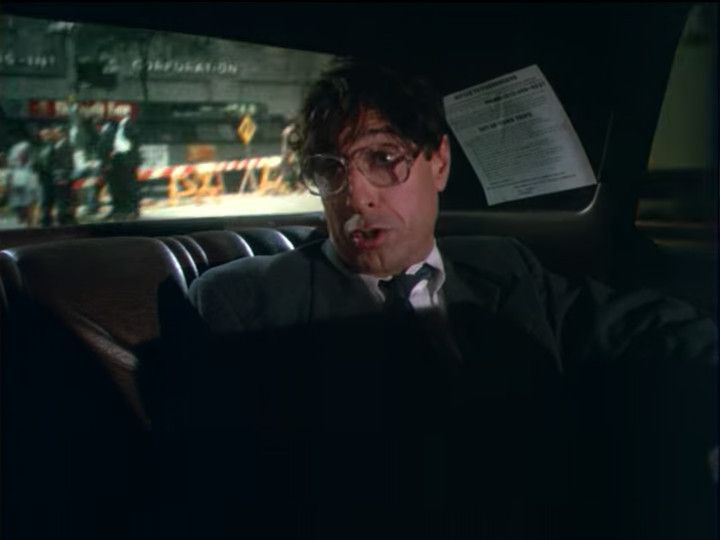
The scene opens on a construction site:

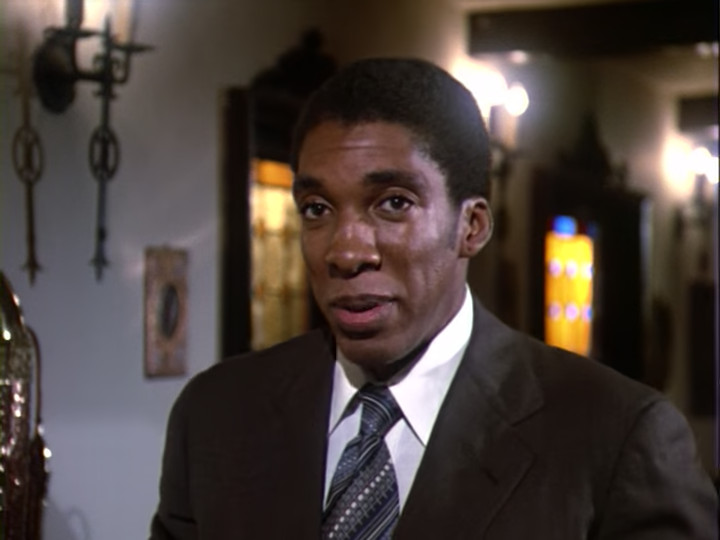
But all is not well here, as there’s a great deal of noise from the many people who are protesting it. After some general milling about and shouting, we meet one of the characters who is organizing the protest:
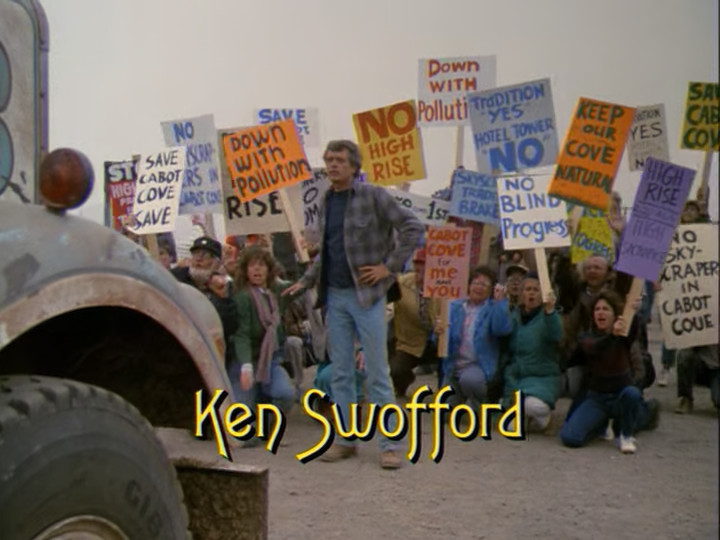
His name is David. We see him here leading everyone to sit down in front of the truck driving into the construction site.

We also meet Kowalski, who is in charge of the construction, and Harry Pierce, who is a real estate agent but is generally involved in promoting the sale and development of real estate as the plot of an episode may require and is an agent of the developer in some vague, unspecified way.
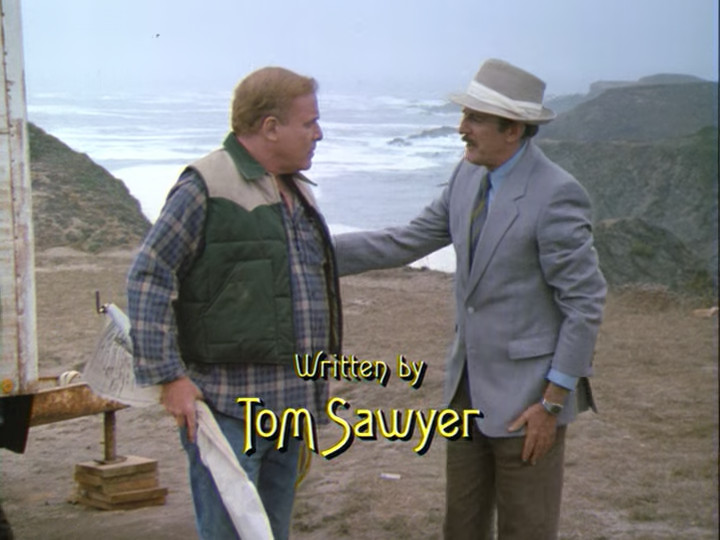
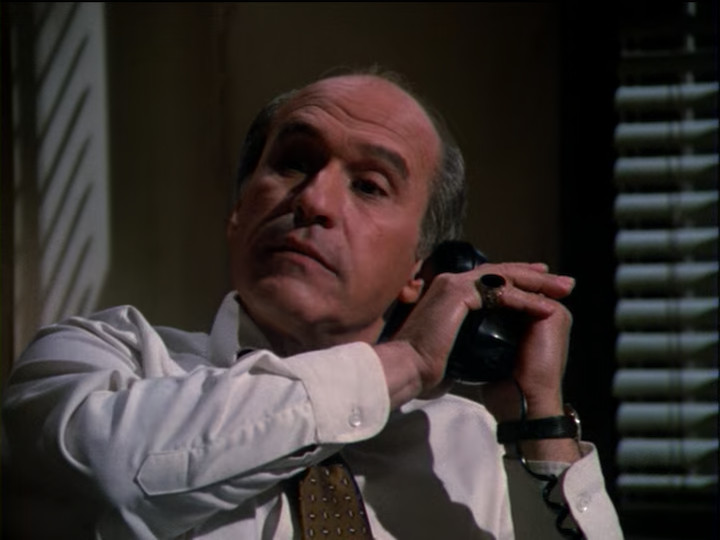
Harry Pierce is played by John Astin, by the way, who is best known for playing Gomez Adams on the TV show The Addams Family. (The Addams Family ran from 1964-1966, so by the time of this episode it had been almost twenty years since Astin had played the character.)

Harry goes over and talks to David. We establish that Harry thinks that this will be great for Cabot Cove because of all of the tourists it will bring in, though not why on earth he thinks that a twenty story luxury hotel will bring tourists in. Hotels are not usually destinations in themselves and Cabot Cove hardly seems like the kind of place to bring in more guests then residents given how little there is to do here.

David claims that Harry snuck the hotel by the zoning board when half the members were out of town. Harry takes exception to this, pointing out that they had a qorum. Which is a pretty reasonable point—quorums exist for a reason.

Sheriff Amos Tupper then arrives to deal with the uproar.

There isn’t time for a discussion, though, before somebody calls out, “Hey look! Down there!” and everyone runs to look down there.

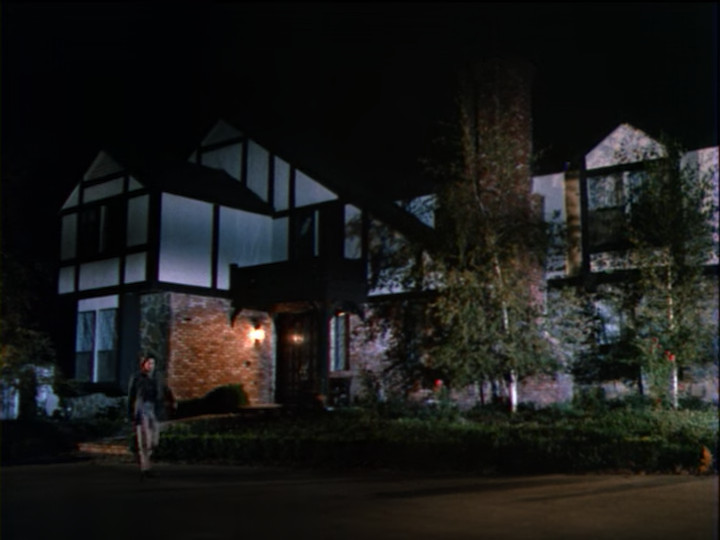
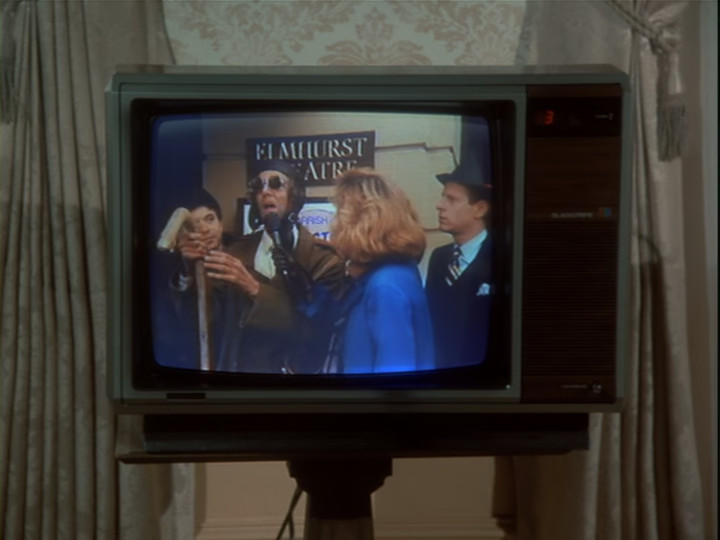
Presumably it wasn’t the camera that they were looking at, but we don’t find out because the scene then shifts to Seth’s house:
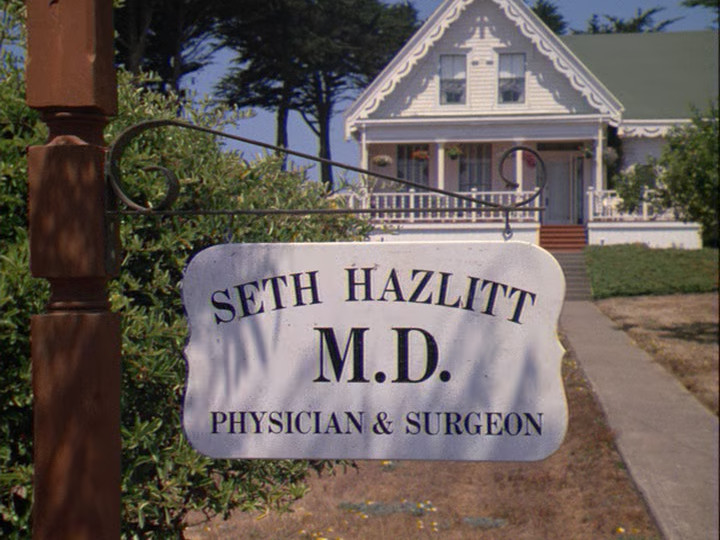
I love the “& Surgeon” as if you might be walking along the road needing an organ removed but not know where to go.

Seth replaces Captain Ethan Cragg as Jessica’s close friend for Cabot Cove episodes. Supposedly this was due in part to Angela Lansbury pushing for it because she didn’t think Jessica had anything in common with the uneducated and taciturn fisherman who often took care of her plumbing, but the town doctor does make a certain amount more sense than a fishing captain since the doctor can be called in to check out the episode’s corpse and thus is a natural part of the episode rather than a fifth wheel merely there for comic relief.

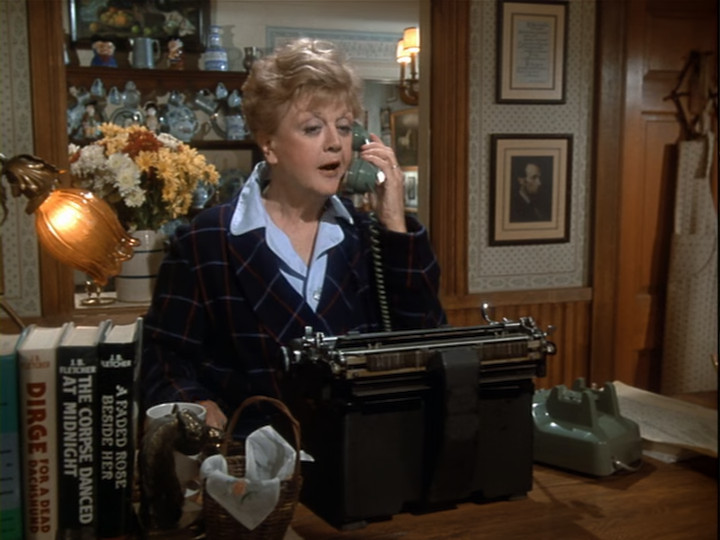
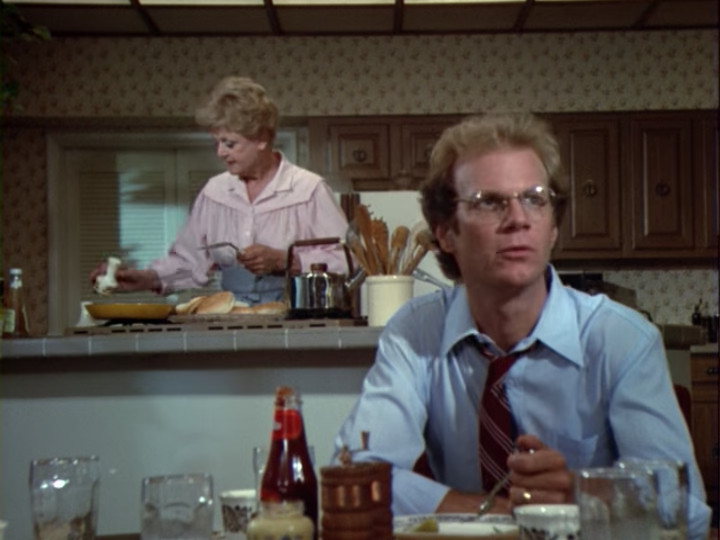
Anyway, we’re introduced to their relationship by Jessica being there looking like she’s a patient:

But despite her back pain, she’s actually here for sympathy because she’s having trouble with her book.

Arthur is trapped in the belfry. His brother Charles is on his way to the minister. Alice is in the shower. And the killer is climbing up the stairs…

Seth interrupts to ask Jessica, “Exactly how long have you had these symptoms?”

Jessica doesn’t get to respond because Amos barges in and interrupts, saying, “Listen, Seth. If you can tear yourself loose from killing off your patients you gotta get over to Main Street quick, and bring your bag.”

I’m not sure how this construction site, which doesn’t seem to be next to anything, is on “main street,” but in any event Amos drives Seth and Jessica to the construction site, where we finally find out what everyone was looking at in the hole that is, presumably, where the foundation for the hotel will one day be laid, once they dig past the loose dirt and hit rock.
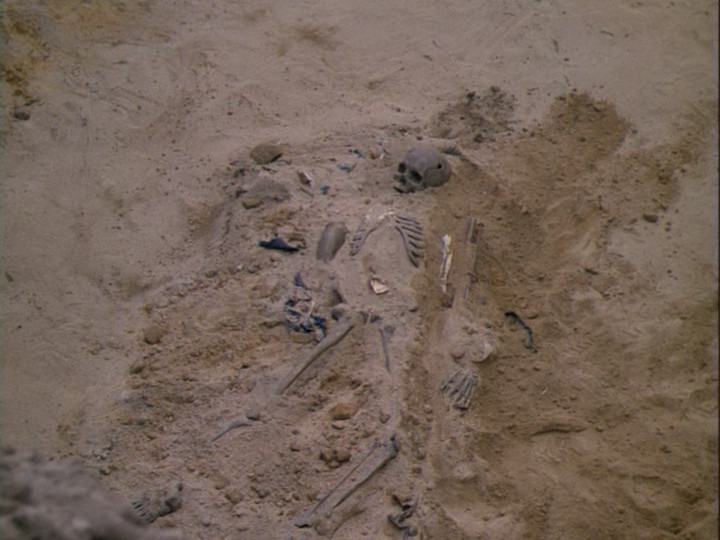
Amos figures that this has to be the remains of Joshua Peabody (Cabot Cove’s most famous revolutionary war hero—though whether he existed at all is the subject of debate, with Amos being strongly on the pro- side while Seth is partisan to the con- side).

When Harry tries to hurry things up, Jessica points out that, while it could be Joshua Peabody, it could also be a murder victim and this the site of a murder. (The skull has a large hole in it.) Amos decides that she’s right as soon as he realizes that this means that he can make the construction crew refrain from disturbing the bones.

David then goes home and we get some family life—his kid got in a fight with another kid in the gym because the other kid was making fun of David. His wife wishes David could have stayed out of these kinds of protests just once. Etc. He then gets a call from Jessica because he’s an antiques dealer. She’s examining a long rifle and reads him the inscription, “Phelps and Handley, Liverpool.” David tells her that it was issued to the British army starting in 1762. (Amos seems to regard this as evidence in favor of his Joshua Peabody theory, though why a revolutionary war soldier would have a rifle used by the British is never considered.)

The scene shifts to the other end of the call, where Jessica, Seth, Amos, and Harry are in Seth’s office as Seth takes measurements of the bones. There’s a bunch of arguing and yelling—I’m not sure why TV writers think that yelling makes for good TV—but the important part is that Jessica suggests that the corpse might be quite a lot more recent than Joshua Peabody. She suggests one of the militiamen from the recreations of the battle of Cabot Cove that used to be held until twelve years ago.

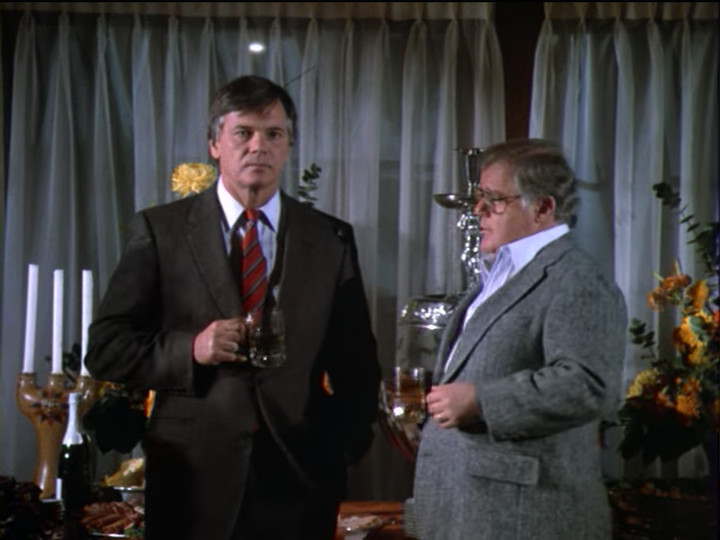
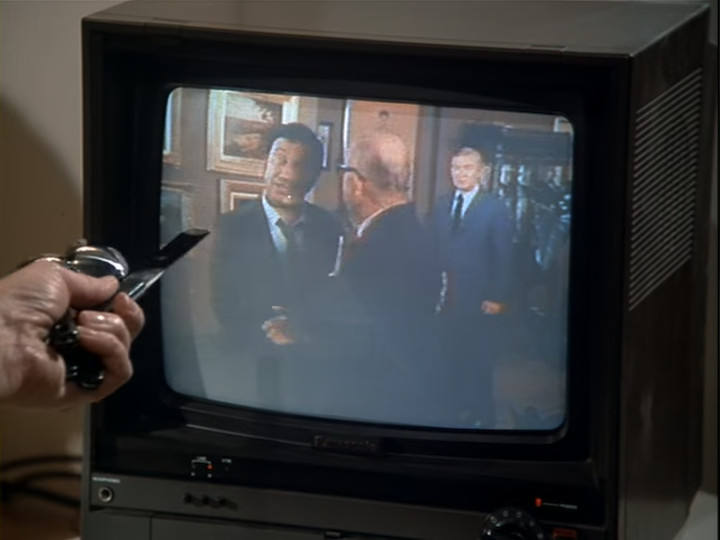
We then get a scene with Harry, Kowalski, and Henderson Wheatley (who is the developer putting up the money for the construction of the hotel). There’s some bickering amongst them which is unpleasant to watch, then finally they’re interrupted.

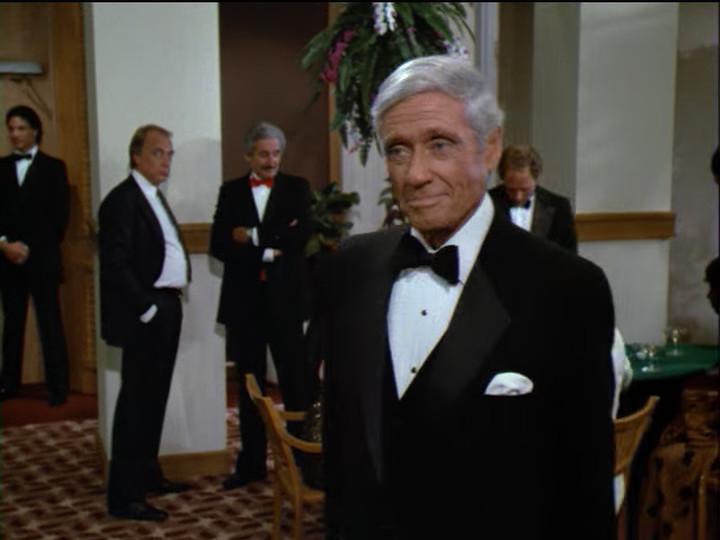
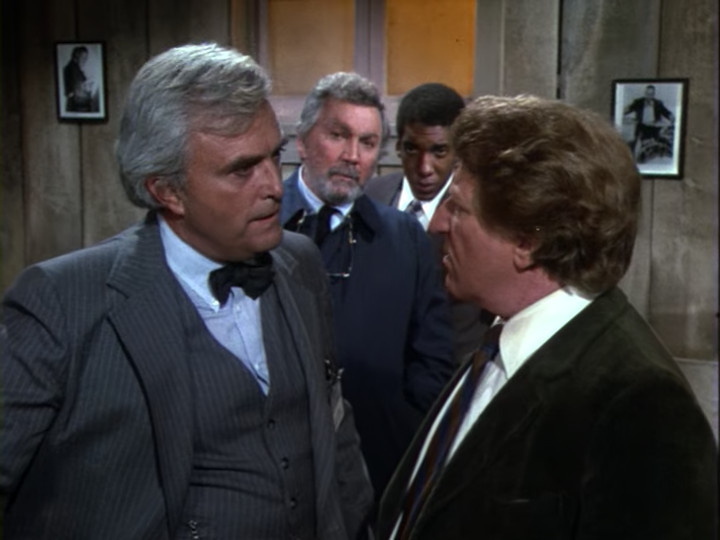
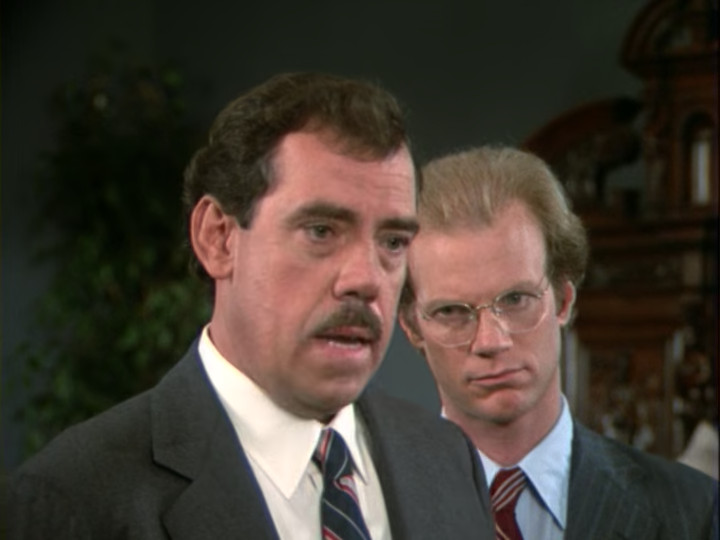
Wheatley is in the center while his laywer is on the left.

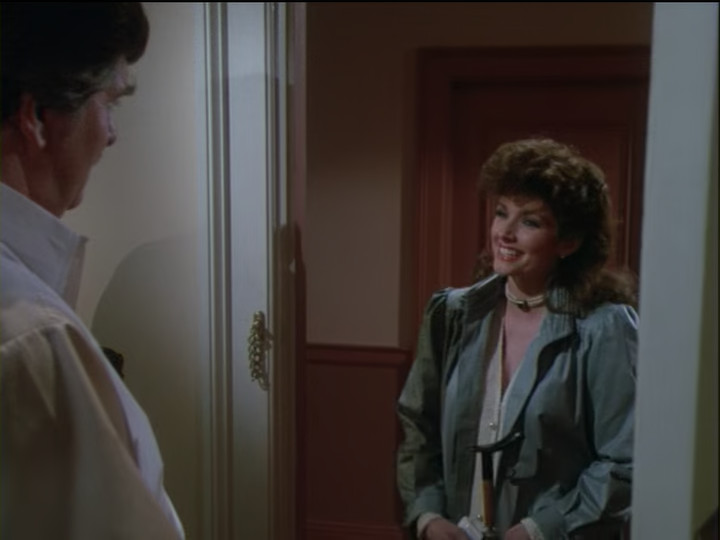
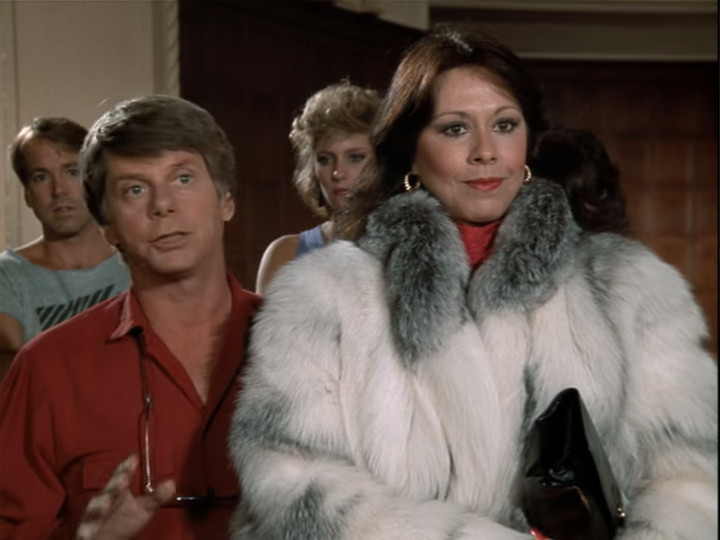
It turns out that they’re having this meeting in the hotel lobby, because we meet some more characters (they were the interruption) as they walk in to check into their rooms:

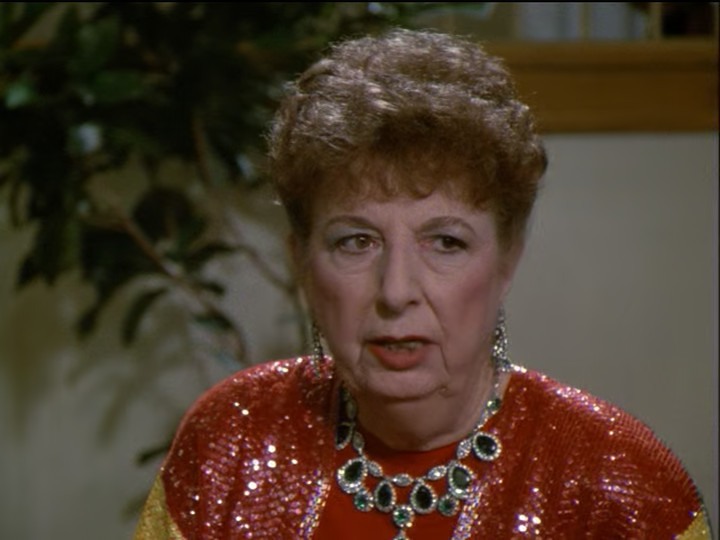
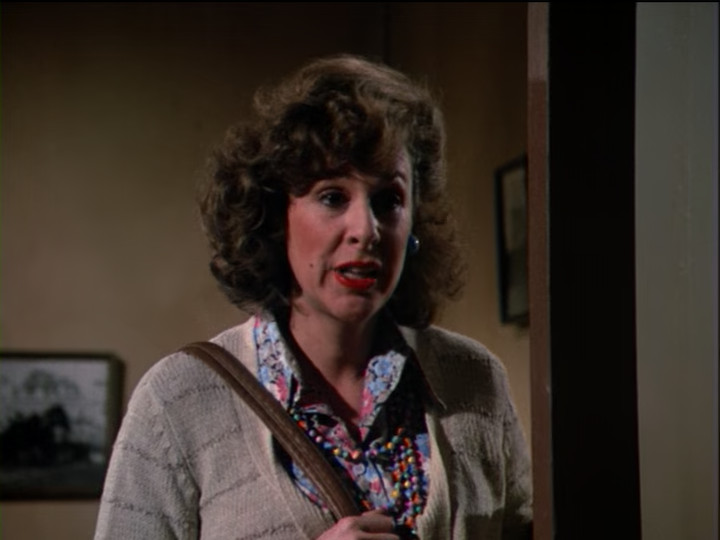
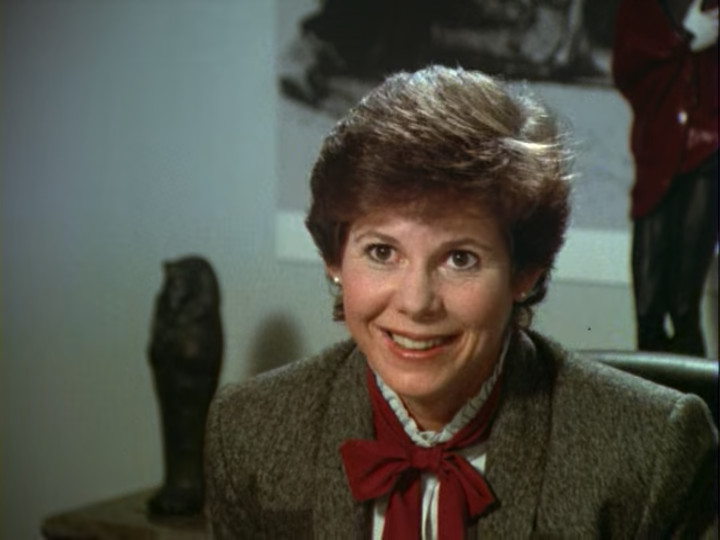
Her name is Del Scott, and she’s some kind of reporter. A hard-boiled one, specifically, who casually insults the subjects of her reporting (she repeatedly calls Wheatley a crook). The two men behind her are nameless and we never see them again.

We then get a scene of Wheatley, outside, ordering his lawyer around a bit, culminating in telling him to, by noon, get a court order to resume work immediately.

And on that bombshell, we go to commercial. Had you been watching back in 1985, you might have seen a commercial like this:

When we come back, we see Jessica coming out of the Cabot Cove courthouse for some reason.
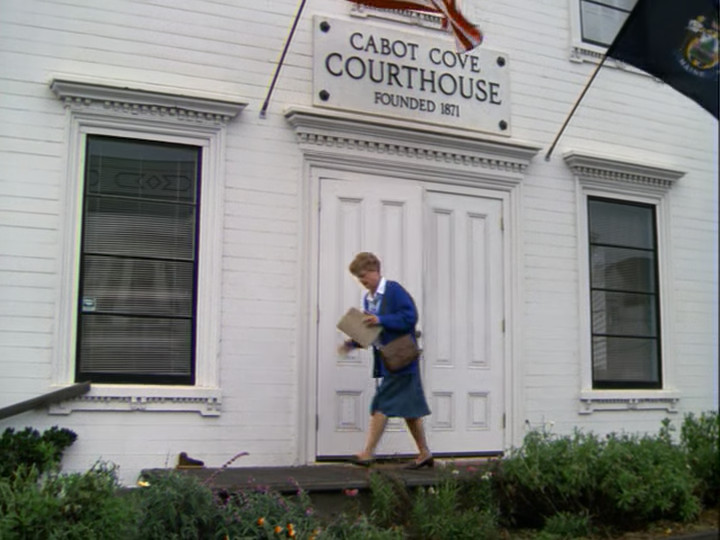
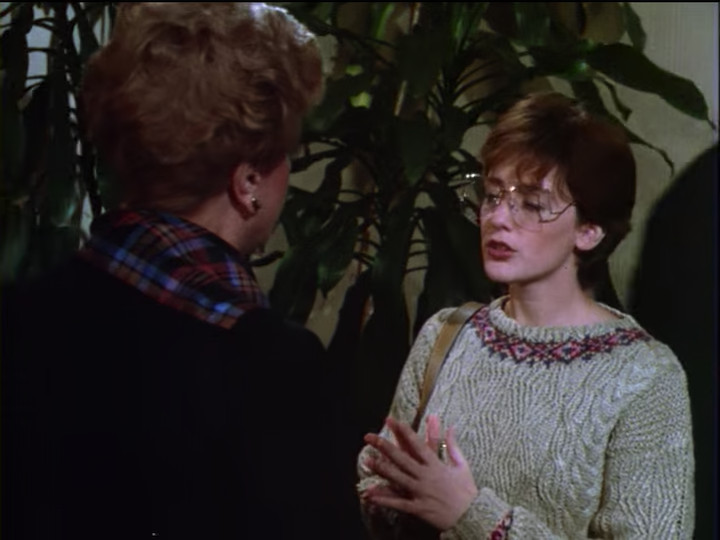
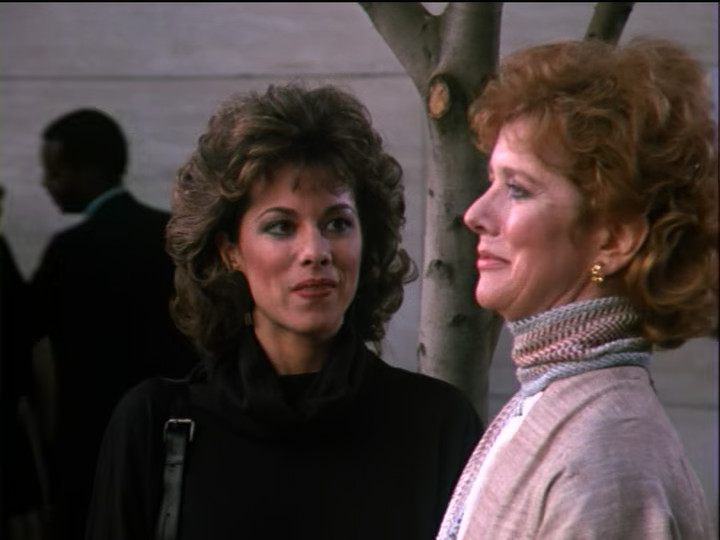
As she leaves, Del Scott stops her on the street and asks her opinion, as Cabot Cove’s most famous citizen, on Henderson Wheatley’s latest construction project. Jessica replies that she’s famous for her books, not for her opinions and, in any event, this is a town matter, not one of national interest.

As they walk, Del tells Jessica about how she’s hated Wheatley for his sub-standard construction ever since she was covering the weather in Pittsburgh (that seems like the kind of detail that often comes up later—especially because as someone covering the weather in Pittsburgh she’d only have reason to hate Wheatley if a relative was killed in one of his buildings or something like that). Jessica suggests Del talk to someone like David Marsh, who would be far more eloquent on the subject than Jessica. She already tried, though, and Marsh declined. He even requested that they not film him at the construction site, though his request was too late. (This suggests that Marsh doesn’t want to be seen on national TV, perhaps because he’s a wanted fugitive who’s living under a false identity. Alternatively, that he’s someone in the witness protection program.)

The scene then shifts to a couple of hayseeds who are telling Amos that the bones don’t belong to Joshua Peabody, but to Uriah Pickett.

When Amos asks who they’re talking about, the man says that Uriah was a farmer from over “at the Blue Hill.” He disappeared fourteen years ago come April, same time as the fighting, as she recalls. Amos then replies that Uriah didn’t disappear, he ran away to Portland with a red-haired manicurist who used to work for Thelma Hatcher. (How he knows this so clearly when a moment ago he didn’t know who Uriah was, he does not say.)

This meeting is then interrupted by Ellsworth Buffum from Kennebunkport.
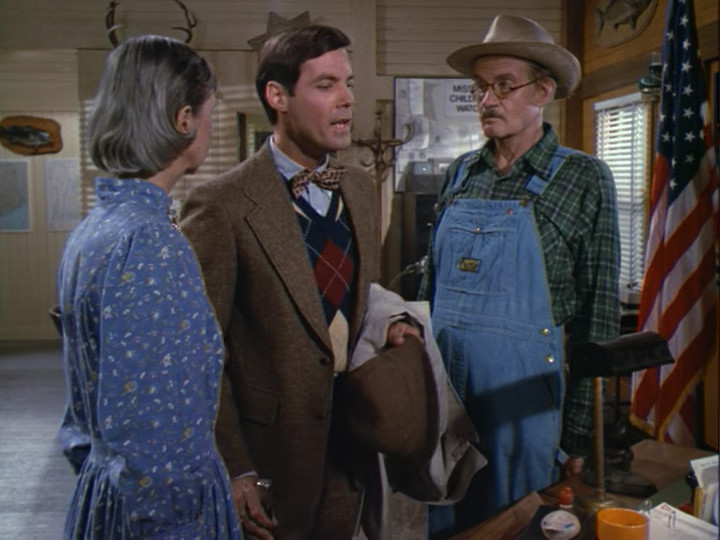
He’s the vice-president of the Joshua Peabody Society. He’s hear to take charge of the last remains of Joshua Peabody.

Amos is interrupted before he can respond by an important phone call and has to leave in a hurry.

The emergency turns out to be fighting down on the construction site. Or, rather, protesters standing in the way of heavy equipment and people shouting at each other. When Amos arrives the lawyer hands him the court order that construction should resume immediately. Ellseworth Buffum then calls attention to an injunction which he has from another court stopping all work until a historical examination is completed.

Later, at dinner in Jessica’s house, Seth and Jessica discuss the dinner Seth made (Jessica says it has too much basil while Seth says that there’s no basil in it) and also the corkscrew Jessica has, which Seth dislikes and Jessica says works perfectly well if you know how to use it. Also, Jessica couldn’t find anything in historical records to prove that Joshua Peabody actually existed and Seth says that the skeleton was of a man with a bad back—a problem with his fourth and fifth vertebrae.

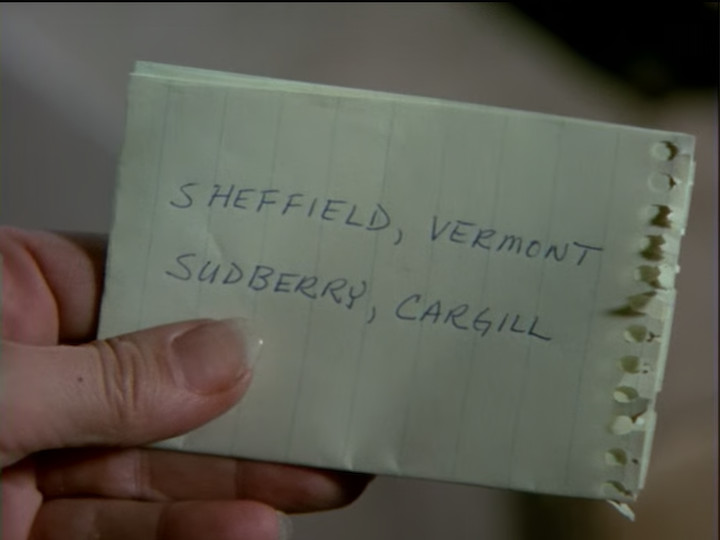
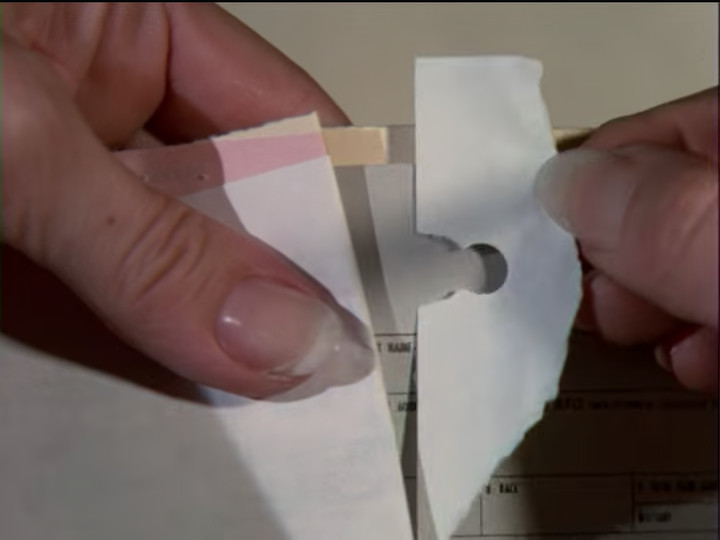
Also, David Marsh gave Seth a scrap that was pried loose from what was left of the guy’s uniform:

The idea that something this old and buried for hundreds of years would be just kept in someone’s pocket and handed around like this is absurd, but I suppose we can take this to just be the prop department saving on making some kind of realistic case for it. And, of course, what possible full sheet of paper could this have been a scrap of?

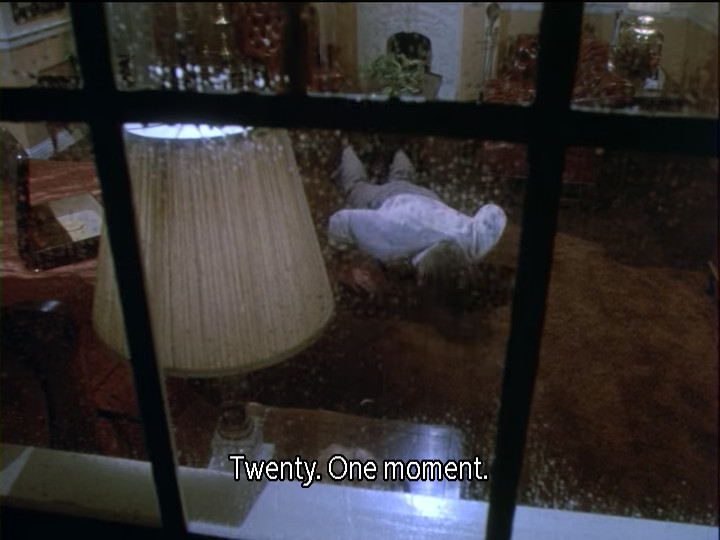
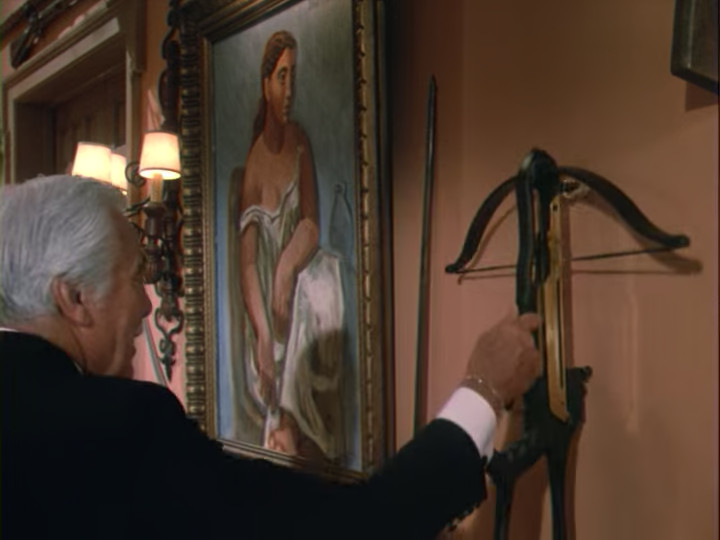
When Seth presents Jessica with a seven-layer cake that they’re going to have for desert, Jessica then gets the inspiration to dig underneath where the skeleton was found for other artifacts. How no one else came up with this idea, I can’t imagine. But it doesn’t much matter, because the actual reason that Jessica and Amos go to the site of the body is to find the murder that this episode is really about:

And on this bombshell, we fade to black and go to commercial.

When we get back from commercial, Seth is giving Amos the results of examining the fresh corpse. Wheatley probably died between 4am and 5am, having been shot at close range. (Also, it came up before the commercial break, but it started raining at 2am, at which point Amos came over and put the tarp over the place where the skeleton had been found and under which Wheatley had been found, to preserve evidence from the skeleton. They made a point of establishing it, so presumably someone is going to know something they shouldn’t about it.)

Amos also notes that Wheatley’s car is here and Kowalski sleeps in a motor home on the premises, so he’ll need to interview him.

Amos is prevented in finding Kowalski by Del Scott coming up and interviewing him.
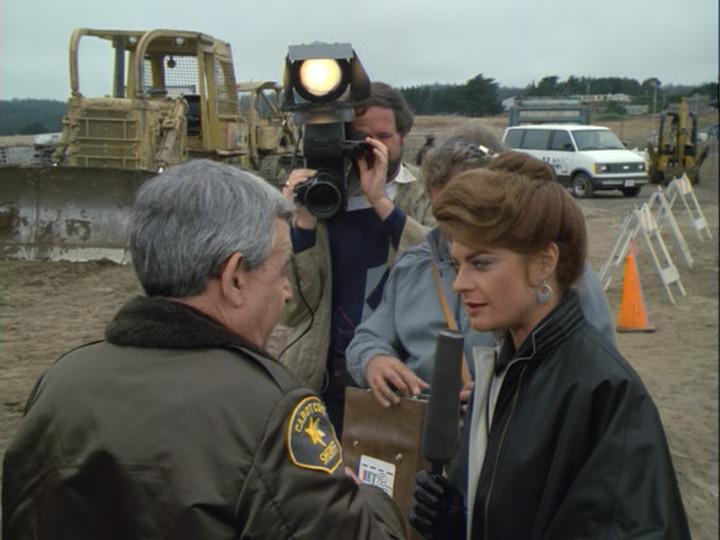
I’d ask why on earth this is in the episode except that her first question explains it:

Would you describe your feelings when you removed the tarp and discovered Mr. Wheatley’s body?

Unless she was the one who put Wheatley under the tarp, she’d have had no way of knowing that it had been under a tarp. It was clearly established that the tarp only showed up a few hours prior to the murder and Jessica and Amos thoroughly uncovered the body when they discovered it, long before Del and her film crew showed up.

In the next scene Jessica ovearhears the lawyer and Kowalski arguing in Kowalski’s trailer with the door open. The lawyer shouts:

You knew what was going on here. You knew the whole scam. Now, I’m the attorney on this corporation. You’ll get not one dime from me.

Jessica then discovers Wheatley’s tie clip, close to Kowalski’s trailer. When Amos comes up and asks what she thinks it’s doing here, her guess is that it fell off when Wheatley’s corpse was carried to the excavation. (Jessica thinks he was shot elsewhere and brought to the construction site.)

Later in the day, Jessica goes and examines the construction site and finds that one one the bulldozers has a busted tread, the wheelbarrow next to Kowalski’s trailer has a dirty handle, and Kowalski has a cut on his hand. He then tells her that she’s trespassing and she does an innocent old woman routine, then leaves.

When Jessica gets to town she’s in time to break up some fighting between David Marsh’s son and another kid. Then, as there’s general bickering, FBI Special Agent Fred Keller shows up…

…and arrests David Marsh, noting that his name is actually Daniel Martin. They’ve been after him for seventeen years.

Harry recognizes the name Daniel Martin as a “nutcase Vietnam protester”. Fred explains that, fourteen years ago, Martin bombed a federal courthouse. Amos shows up and tells Agent Keller that David is actually his prisoner, as he’s arresting him for the murder of Henderson Wheatley.

Amos explains his case—he found a note in Wheatley’s office that Wheatley discovered that David had planted the skeleton to slow down construction. David was also seen in the vicinity of the hotel at the same time that the night clerk at the hotel saw Wheatley leave the hotel. He takes David into custody, which Agent Keller isn’t too happy about, but does not stop.

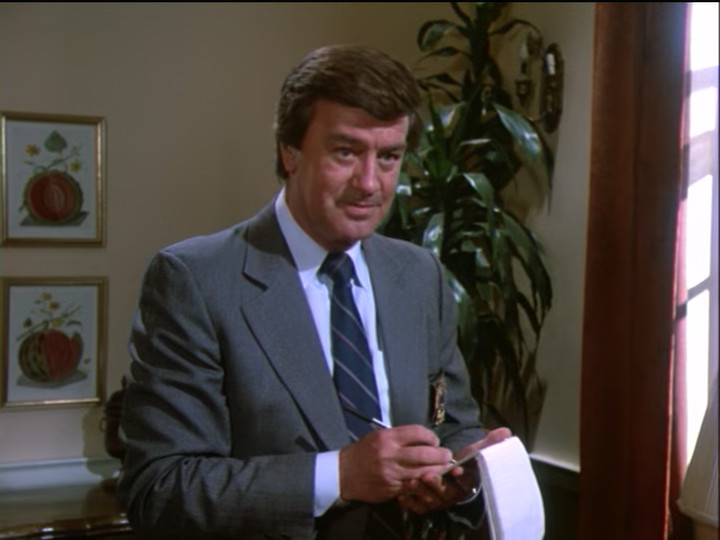
The scene then shifts to Jessica and Seth in Seth’s office when Agent Keller comes in (he had an appointment with Seth). He explains that they didn’t get a chance to fingerprint Daniel Martin, but they were able to obtain his early medical records and he’s hoping that Seth can compare them with his records of David Marsh to make a positive identification. Seth looks at the medical records, but refuses to give Agent Keller a copy of David Marsh’s medical records. Keller is frustrated but assures them that he will get his man, with or without their cooperation.

After he leaves, Seth hints to Jessica that David really is Daniel Martin, and on that bombshell we go to commercial.

When we come back, Jessica is talking with David in jail, where he admits to her that he is Daniel Martin, though he denies being involved in the courthouse bombing. (The day of the courthouse bombing, he was living in Cabot Cove.)

Jessica then goes and finds Kowalski, who has moved his mobile home to a scenic overlook for some reason. Jessica brought him a salve for the cut on his hand and she insists on applying it for him, which for some reason he agrees to.

As they talk, Jessica says that she couldn’t help but notice the shabby state of the construction equipment and that it must have been difficult working for a man with so little regard for his employees.

Kowalski said that it was. Wheatley’s poorly maintained equipment got several friends of his killed. He names two examples: Bobby Scotto in Pittsburgh and Harry Pateki in Detroit (an elevator cable rusted through and dropped him 32 floors).

Of course, it’s hard to not notice that “Scott” and “Scotto” are very similar last names.

Oh, and Wheatley never paid any of the construction workers on this job; unlike before, money now seems to have been in short supply.

Over at the Sheriff’s office, Amos hands Jessica a paper that came over what sounds like a teletype machine and says that Wheatley owed money all over town. Apparently, Amos believes that the lawyer might be responsible, but Jessica doesn’t buy it. Even if the lawyer had a motive, he had no reason to hide the body on the excavation site. Hiding it there felt almost like a symbolic gesture to her.

Amos then reflects on the case and says that it goes to show that if you have something in your past, eventually it will come out. It just doesn’t pay to try and change your name.

At the words, “change your name” Jessica perks up and, presumably, realizes that it might pay to change your name if you’re changing it to sound better as the weather girl on a Pittsburgh TV station. However, Jessica only asks Amos to stop Kowalski from leaving town and to bring him back if he’s already left.

Jessica stops by the library to get some photocopies of news stories (I assume to prove that Daniel Martin alias David Marsh had an alibi for the courthouse bombing). She then calls the hotel and asks for Del Scott’s room. She gets Del and says that she’ll make a statement on Del’s news program. She’ll meet her at the construction site in an hour.

In the interview, she ambushes Del with her relation to Robert Scotto who was killed in Pittsburgh, where Del came from. Del cuts the interview short saying that it has no news value but Jessica keeps going. Jessica phoned the Pittsburgh hall of records and Robert Scotto had a younger sister, named Della Scotto. She then tells Del what happened: at 4am she called Wheatley saying that she had evidence that David Marsh had planted the skeleton. When he let her into his room so she could show him the evidence, she shot him. (How the hotel clerk saw Wheatley leave at 4am if Del killed him in his room, Jessica doesn’t say.)

Del breaks down and says that it is true that her brother died because Wheatley was too cheap to keep his crane in good repair. It broke and dropped four tons of I-beams on her brother. She admits hating him but denies having killed him. Jessica, however, insists that she did. And that after she killed him she put him in the construction site because it seemed symbolic—a grave that he dug for himself.

When the subject of evidence comes up, Jessica points out that Del knew about the tarp despite it being placed on the grave site at 2am and having been removed before her crew got there.

Del then, through tears, says that she tried for years to prove Wheatley’s guilt honestly but every time she got close he bribed witnesses and suppliers. He bought off the people he needed to so that she could never get him. She finishes with, “I’m not proud of what I did, Mrs. Fletcher, but don’t ask me to be sorry.”

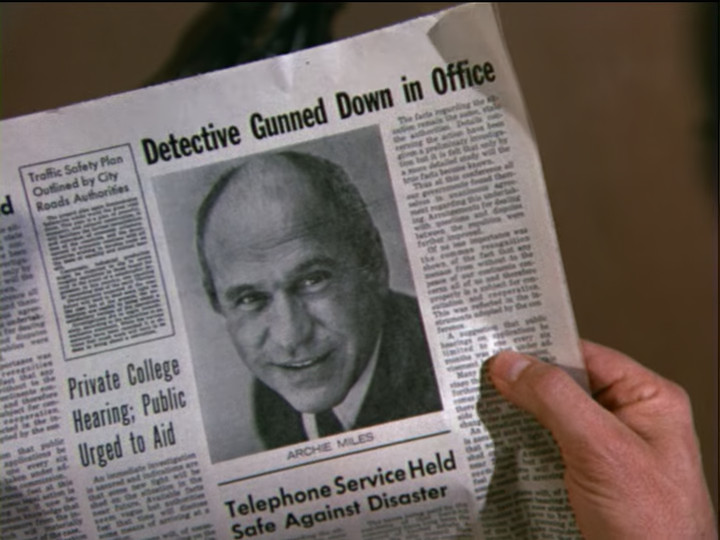
In the next scene Jessica and Seth go to the antique shop, where Agent Keller is arresting the now-free Daniel Martin/David Marsh. Jessica shows Keller a newspaper clipping that places David in Cabot Cove the day before the bombing. Jessica then shows him another clipping about a “Joey Fawcett.”
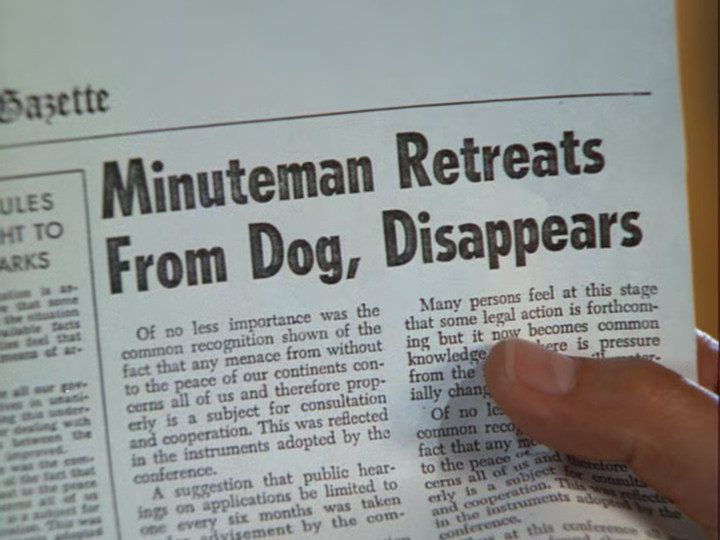
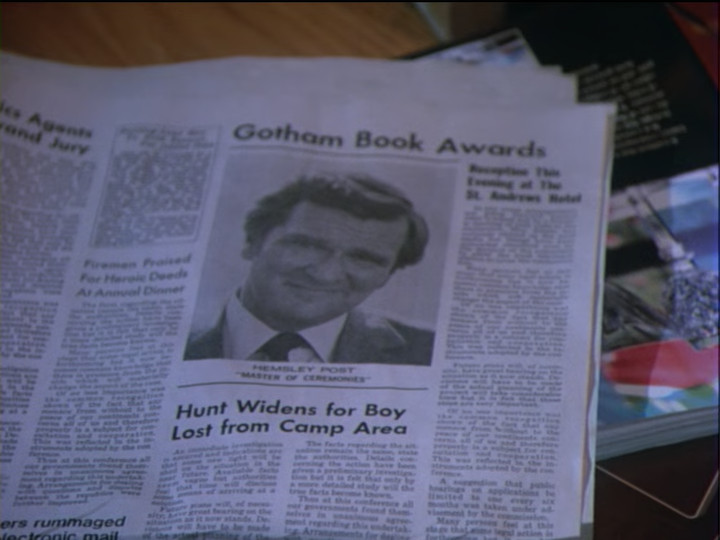
(It’s interesting that the props people didn’t bother to change the text of the newspaper that they used for this but only made up the headline.)

Jessica says that, clearly, the guy must have fallen and hit his head and died, and at least ten dozen people will swear that Joey Fawcett was actually Daniel Martin.

Agent Keller asks what happened next—the good citizens of Cabot Cove shoveled dirt over him?

Seth replies that there’s no accounting for what folks are here are libel to do.

Seth then hands Keller the fractured femur of the skeleton from the dig and invites Keller to compare it with his x-rays of Daniel Martin. Keller does so and it doesn’t match, which Seth tries to explain as the x-rays of Daniel Martin being from before he was fully grown.

Keller then says:

You know, a man must be very special to have people willing to stand up before an agent of the United States Department of Justice and each of them willing to risk charges of perjury, obstruction of justice and harboring a fugitive. Not many men have friends like that.

He then tells David that he (Keller) was wrong and has been pursuing a dead man, and leaves. Before Keller fully gets into his car, he tells Seth that he might want to brush up on his anatomy. The bone he showed Keller was an arm bone, not a leg bone.

After he drives off, Seth remarks that he didn’t think that Keller was that smart.

Seth then says that one good thing has come of this, though. Now that they’ve proved that the bones belong to Daniel Martin, they can put the Joshua Peabody nonsense to rest.

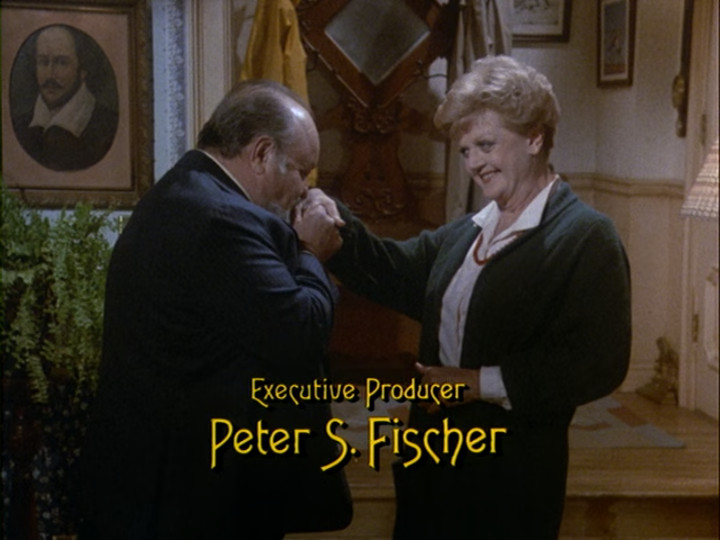
Jessica tells Seth that’s going too far and they laugh and we go to credits.
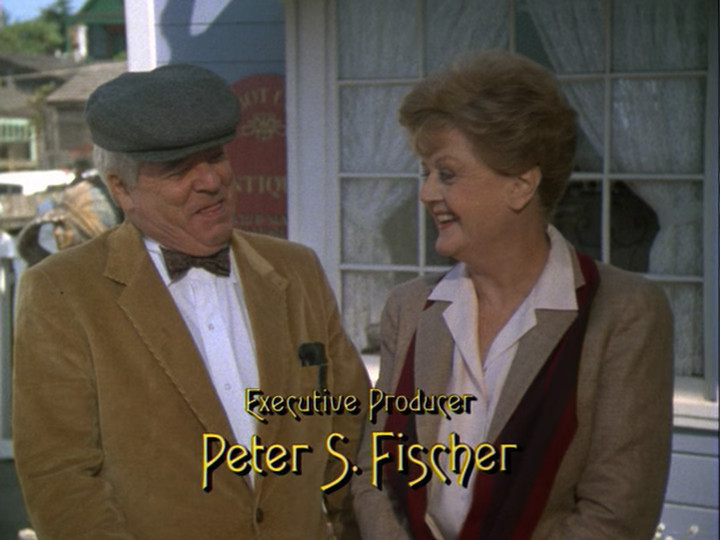
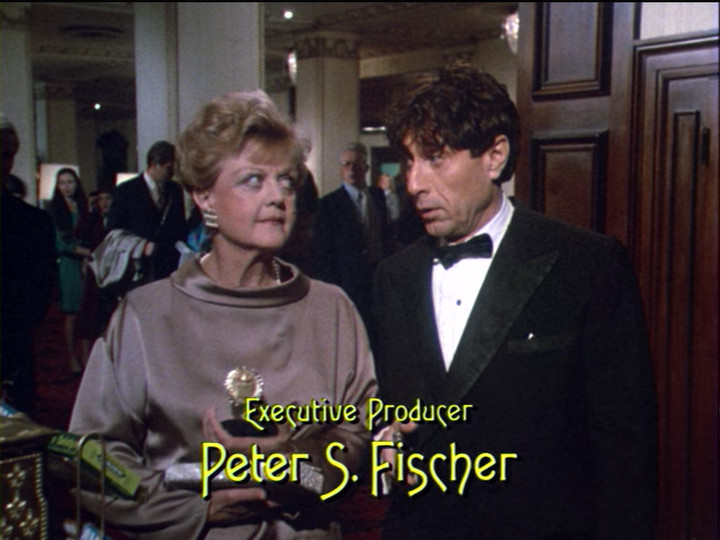
It was definitely good to be back in Cabot Cove again. Even though it’s a minority of episodes, Cabot Cove keeps Murder, She Wrote grounded. And it’s nice to meet Seth. As much as I did like Claude Akins as Captain Ethan Cragg, Seth is better. And as the town doctor he fits better with murder mysteries, too. This is discussed a bit in a New York Times article from October 27, 1985 which gives a bit of insight into this change:

The weekly arguments between Mr. Fischer and Miss Lansbury come because she wants to expand the character. When the series began, Jessica Fletcher was a substitute schoolteacher riding her bicycle in Cabot Cove, Me., who had written one detective novel. Now, as the famous author of a half-dozen best-sellers, ”She must avoid at all costs being sophisticated or jaded or superior,” says Mr. Fischer.

”She must consort with people of a certain intellectual level,” says Miss Lansbury, who fought ”tooth and nail” against Jessica’s relationship with the owner of a Cabot Cove fishing boat who also served as her handyman, a recurring character last season. ”There’s something wrong with Jessica if she enjoys spending more than 15 minutes a week with that man,” says Miss Lansbury.

The character has been dropped and replaced by a doctor (played by William Windom) with whom Jessica plays chess. Miss Lansbury has also ”fought and won a battle” against the network, which wanted to supply her with a sidekick. ”The whole basis of the show is that Jessica is a middle-aged woman alone,” says Miss Lansbury, ”and the network wanted to have a character joined at the hip who drove a car for me.” She has also resisted a serious romance, though, for a while last season, it seemed as though a different murderer was falling in love with her every week. ”I said no to those slight romantic liaisons. It makes her seem as though she has round heels,” says Miss Lansbury, using a British expression that decribes a woman who tumbles quickly into bed.

Seth being a good change is about the only positive thing I can say for this episode. The problem that most galls me is that it had far more loose ends than tied up ends. The biggest loose end, of course, being how on earth the skeleton—whoever it is—became buried under eight feet of ground on a cliff by the shore. The only way for it to have happened would have been for someone to have buried him quite remarkably deep for a grave, because dirt does not accumulate at anything like the rate of four feet per century, to say nothing of half a foot per year if this really was from a reenactor. You can easily tell this by going to a cemetery with two hundred year old tombstones and noting that they’re not buried under six feet of dirt.

And how on earth was this skeleton uncovered in a way that anyone noticed? A large, deep cut like this would be done with earth moving equipment. That doesn’t lend itself to noticing dirt-colored bones, even if by pure luck you happened to excavate right above the skeleton, exposing it, rather than picking it up in the excavator’s scoop.

And then there’s the way that the identity of the skeleton is never decided and, in fact, just dropped. The skeleton is hugely important to the episode; it drives most of what happens. And, after a few initial snippets about a British musket near to it and a scrap of paper that is oddly durable, we get nothing more. Everyone just stops caring about it.

I also don’t know why David Marsh/Daniel Martin is supposed to be a sympathetic character. All we know about him is that he’s against an absurdly large hotel in a place that would have great trouble filling it to a quarter capacity, leads a protest that Jessica is sympathetic to though it’s not clear why she should be, is always causing trouble in Cabot Cove, and fifteen years ago he did a bunch of “nutty” Vietnam war protest stuff. Oh, and his son gets into an awful lot of fights. I’m not seeing what we’re supposed to like about this guy. Are we even sure he didn’t plant the skeleton? He certainly was the person in Cabot Cove with the most access to things that can be planted to lend credibility to the “find” and we’ve established that he isn’t scrupulously honest. (Just as a side note: how would tiny little Cabot Cove support an antiques dealership?)

We also get a villain in the episode with all of the sophistication and nuance of Luten Plunder from Captain Planet. So far as I can tell, Henderson Wheatley cheats because he would rather be corrupt than honest. Are we really to believe that it costs more to settle a worker’s death, repair a broken crane, clean up dropped I-beams, suffer delays during which people get paid but work doesn’t get done, and bribe all manner of people to cover it up than it would be to just repair the crane’s cable before it breaks? People do skimp on necessary maintenance when they’re short of money and, instead of doing the things that will reliably make them more money, hope that things will work out until they have the money to cover the repairs. People don’t skimp on necessary when they’re rich because paying for maintenance is much cheaper than paying for repairs. An ounce of prevention is worth a pound of cure to the rich as well as to the poor. In fact, one of the ironic things about poverty is that it’s more expensive to be poor because the rich can avoid all sorts of major expenses by paying much smaller ones to prevent the big expenses from being necessary. All of which makes the character of Wheatley being so rich he can get away with anything not make any sense in the episode.

Especially because it’s actually a plot point that he isn’t so rich. They very clearly established that money was in short supply on this job. They even went so far as to have the lawyer angrily yell at Kowalski that he (Kowalski) knew what the scam was when he started the job. But once Kowalski shares the useful information of “Robert Scotto” having been killed through Wheatley’s negligence, this is entirely dropped.

Overall, this episode is a mess. We don’t get our body until right before the mid-point commercial break, the victim is a cardboard cutout of evil, the supposedly sympathetic characters aren’t sympathetic, and most of the interesting plot threads are dropped for no reason. Heck, we even get unambiguous evidence of who the killer is less than a minute and thirty seconds (not counting the commercial break) from finding the body, making the rest of the investigation obviously pointless.

Oh well. Next week we’re in New York City for Murder in the Afternoon.
Murder She Wrote: Widow, Weep For Me

On the twenty ninth day of September in the year of our Lord 1985, the first episode of the second season of Murder, She Wrote aired. Set in the tropics, it’s titled Widow, Weep For Me. (Last season’s finale was Funeral At Fifty Mile.)

This must have been very exciting for the cast and crew of Murder, She Wrote because a second season means that you’re a success. Of course, a second season in no way guarantees a third, and they would have no way of knowing, at this point, that Murder, She Wrote would run for a total of twelve seasons. It’s also an interesting time for viewers because TV shows would often change fairly substantially between the first and second seasons. The lead-up to the second season was a time to take stock of what worked and what didn’t, what could be improved, and what needed to be streamlined. So now we find out whether all of that made it better or worse.

After the establishing shot of someplace that’s supposed to be the tropics but could be California with a few tiki torches in the foreground, we then get an opening scene of a wealthy woman who writes a letter to Jessica, posts it in the hotel post box, then gets murdered.

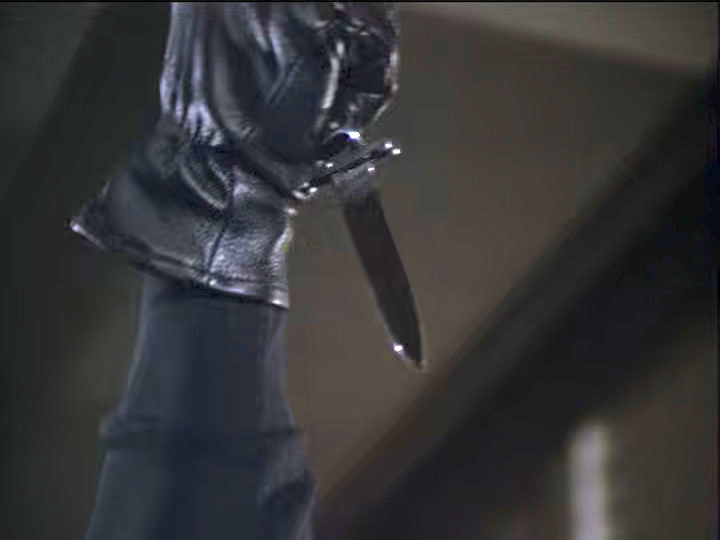
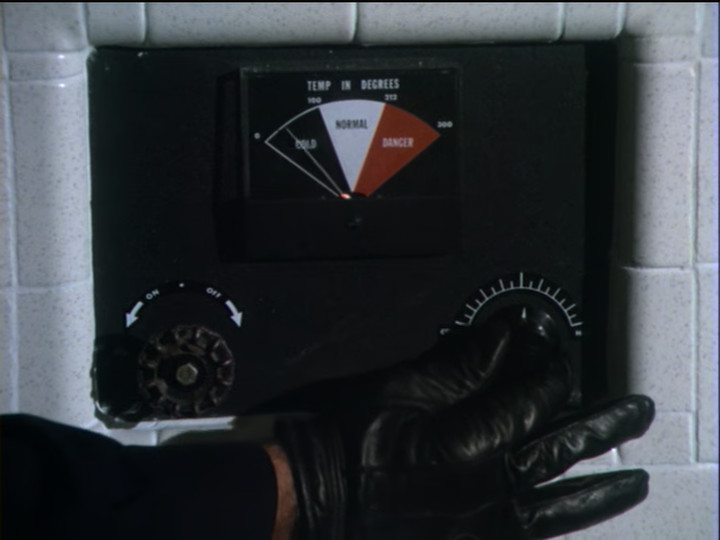
We then see the figure wearing all-black raise a knife that he had previously used to jimmy open the door from the balcony:

(I’ve upped the exposure; the original was very dark)

I love how often burglars in Murder, She Wrote wear all black clothing, including black gloves. I suppose it would, actually, help one to hide in shadows, though I can’t help but think that it would look a bit odd while you’re on your way to those shadows.

The hand plunges down and we smash-cut to a wave crashing on the rocks at Cabot Cove:

Instead of seeing Cabot Cove, though, we then cut to a white limousine pulling up to the same hotel. A moment later, Jessica gets out, speaking in her best rich-woman accent:

She asks the man in the uniform to see to her matched luggage. They’re unmarked, and she’d like to leave with them in the same condition.

At the desk, she lays it on quite thick. Evidently, she’s trying to give the impression of a rich, self-important woman.

A woman named Myrna Montclair then approaches Jessica and introduces herself.

Jessica (who is going by the name Mrs. Canfeld, from Nebraska) asks if they’ve met before and is sure that they have. Myrna suggests that Jessica might be recognizing her from her previous career—the movies.

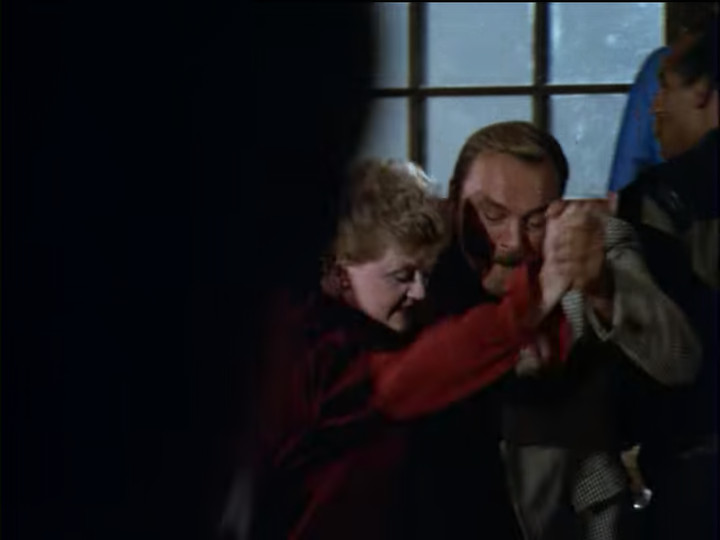
(The actress playing Myrna is Cyd Charisse, who was, perhaps, most famous for being the leading lady opposite Fred Astair in two MGM movies, though she did a lot of other things too and I’m not very familiar with her career. Here’s a clip of her dancing with Fred Astaire in the movie 1953 The Bandwagon🙂

It’s very interesting that they lamp-shade the fact that Cyd Charisse would have been recognizable by having the character be a former movie star.

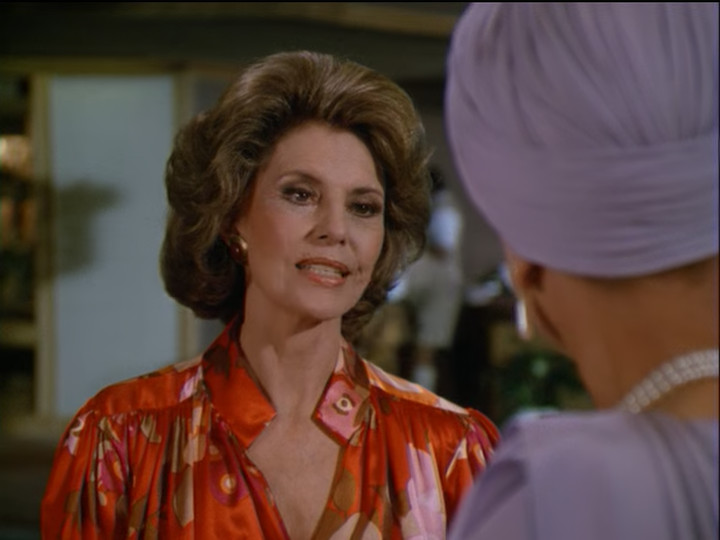
Anyway, Jessica continues to lay on the “self-important rich woman” shtick. She lays it on quite thick; this shot gives a sense of just how thick Jessica is laying it on:

Up in her hotel room, Jessica takes off the ridiculous turban and reads the letter we saw the woman in the opening write. Before I get to that, I have to say that the outfit looks better without the turban:

I really wonder why those were a thing.

Anyway, the letter says:

Jessica,
I’m in trouble. Desperately need your help and advice. I sense a terrible danger, but I can’t leave the island. Will explain when you arrive.
–Antoinette

Jessica’s thinking about what she just read is interrupted by a man who calls her “Madam Fletcher” in a French accent:

His name is Chief Inspector Claude Rensselaer, of the Island Police. He then reminds her that they spoke on the phone. (He warned her to not come.)

He’s concerned for her safety as she’s showed up in a manner designed to invite trouble. Jessica explains that Antoinette’s last act was to ask for her help and she’s not going to ignore that request. The two were very close—like sisters—until five years ago when Antoinette’s husband died and Antoinette tried to lose herself in travel, parties, love affairs, and drink.

The Chief Inspector tells her that she was killed by a thief—he’s been operating in the area recently—but Jessica cannot accept that. He says that it is widely known that the victim wrote Jessica a letter right before she died and this might put Jessica in danger. Oddly, Jessica doesn’t point out that this would only be true if the inspector is wrong and it wasn’t just a thief after jewelry who snuck into the room after the letter was posted. Instead, she just explains that’s why she came under the assumed name of Marguerite Canfield (who the Chief Inspector remarks is a famous recluse).

He also asks if she realizes that all of the gaudy jewelry makes her a target for the thief and Jessica replies that she certainly hopes so. Then she asks what they have actually found out.

He says that they have no physical evidence and those who knew Antoinette best all have alibis. Jessica then gets a list from the Chief Inspector of who those people are.

We then meet the first person on the list, Eric Brahm, the hotel manager:

He tried to put the moves on “Mrs. Canfield,” though according to the Chief Inspector he tries that on all unattached ladies in the hotel.

Speaking of unattached ladies, Jessica meets Alva Crane at the roulette table:

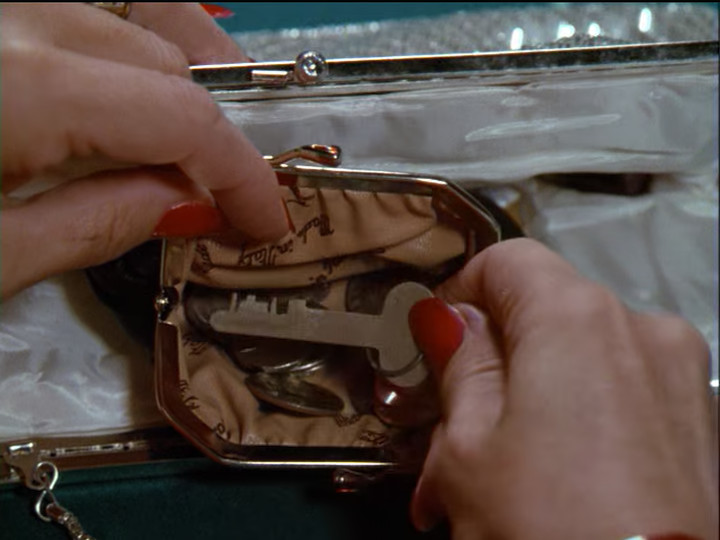
Shortly after they introduce themselves, a timer goes off and Alva says that she needs to take her blood pressure medication. As she fumbles in her purse for the medication, we get a closeup of a key in her purse:

I’ve no idea what this is supposed to be a clue for, but they never show us a closeup in Murder, She Wrote without it being important. This one is a bit odd because this was during the time when hotels would use keys rather than disposable key-cards, so we would expect her to have a key in her purse.

After she gives a bit of chatter, a couple comes up, the woman obviously drunk.

She places a bet on number seventeen, as seventeen is the number on her classroom door in Curtis Road Elementary School in Davenport, Iowa. (She loses, of course. It comes up number twenty two.)

When she tries to place another bet the man tells her that it’s time to go to bed and she marvels to the older women that this beautiful man is with her.

After they depart, a middle-aged man with an Irish accent walks up and introduces himself as Michael Haggerty.

There’s a bit of witty dialog—she asks if they’ve been introduced and he says that he believes he just accomplished that formality—then he invites Jessica (as Maggie Canfield) to join him on the terrace and for some reason she accepts. He’s charming and claims to be a man of independent means, saying something vague about the British police thinking that he and some friends of his robbed the bank of England of a million pounds.

Later on, as they’re walking, Jessica asks about the man with the schoolteacher and Michael says that he is “Sven Torvald”. A few years ago he won two gold medals for skiing. These days he a member of the international jet set. A bit of conversation later, as Michael is inviting Jessica to go tour a waterfall with him, a thief grabs Jessica’s purse and runs. Michael gives chase but is knocked down by another man who claims that it was an accident.

The man who knocked Michael down, allowing the thief to get away, turns out to be Sheldon Greenberg, the head of hotel security. When Jessica asks why he’s been watching her all evening, he says that it was because he was worried that something like this might happen because she wears her jewelry so conspicuously. He then excuses himself to go report the theft to the police.

Oddly, we don’t fade to black when going to commercial, but, regardless, had you been watching back in 1985, you might have seen a commercial like this:

When we get back, Jessica calls Inspector Rensselaer. She asks him if Sheldon Greenberg really did report the theft of her purse, and he tells her that Greenberg has not. She asks what he knows about Greenberg and Rensselaer says that he doesn’t know much, but his credentials check out. He had been a New York City policeman for twenty years with a good record.

After this phone call Jessica spies the drunk woman from the night before running along, stops her, and introduces herself. The woman’s name is Veronica Harrold. She’s on the trip because she won it at a supermarket giveaway. The funny thing is that she doesn’t even remember entering. Also, it was a vacation for one—she met Sven here.

Veronica gets on to reminiscing. The woman who died—Antoinette—was super nice to her on the first day she got here. When Jessica (still posing as Maggie Canfeld) remarks that this was very nice of her, Veronica replies that it was, but also a little strange—it was as if Antoinette had singled her out. Antoinette didn’t get along well with Sven, though.

Veronica then notices Miss Montclair standing by the tennis courts in a tennis outfit and talks about how beautiful she is and how much she (Veronica) loved her (Miss Montclair) in her movies. She saw The Sin of Andrea Crown six times. (Miss Montclair played a woman whose husband is cheating on her so she systematically kills all of his mistresses. This is invented for this episode; it has nothing to do with the movies Cyd Charisse was in, so far as I can tell.)

This is interupted by Sven coming up. He’s rented a boat at the marina and thought they might do some scuba diving. Veronica thinks this is a great idea and excuses herself to Jessica.

The scene then shifts to the hotel manager’s office, where the hotel manager tells Michael Haggerty that he’s checked and there is no Michael Haggerty associated with the whiskey importing business, which puts him in a distressing position since Michael has run up a casino obligation of more than ten thousand pounds under false credentials.

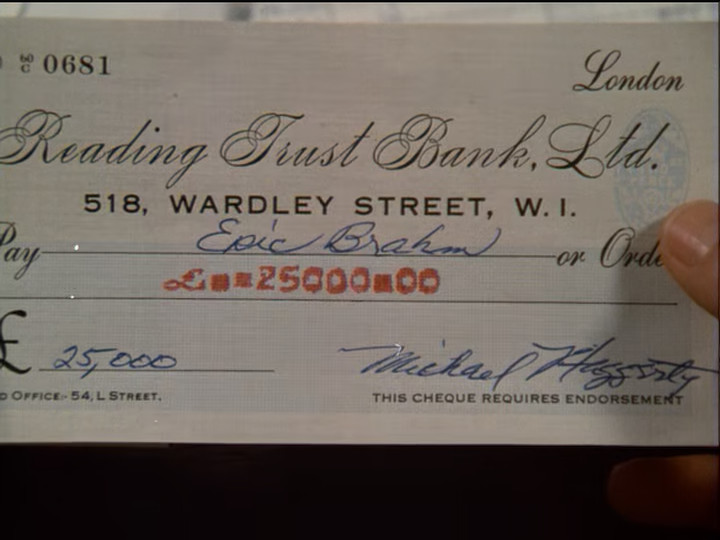
Michael replies that he won’t explain; his using an alias is a personal quirk. However, he hands the hotel manger a cashier’s check for twenty five thousand pounds and tells him that it should ease his misgivings.

It’s a bit odd that he’s made it out to the hotel manager personally, rather than to the hotel, but in any event this does ease the hotel manager’s misgivings and the scene ends.

In the next scene Jessica notices the hotel security man talking, in the lobby of the hotel, with the man who stole her purse the night before.

After the man in the striped shirt leaves and Greenberg goes into her office, Jessica goes in and confronts him. He claims that he found it (full of cash, no less) after scouring the grounds for a few hours, but Jessica asks about him talking with the thief.

Instead of answering, he shows Jessica one of her books with her picture on the back. (I love how in Murder, She Wrote all of Jessica’s books have a large picture of her on the back cover instead of a blurb or book reviews. This wasn’t super-common, though it did happen in the 1980s, perhaps most prominently with Danielle Steele.)

He had her purse stolen because he wasn’t certain she wasn’t Marguerite Canfeld and wanted to look at her passport to be sure.

The conversation then takes a strange turn as he seems to take her presence personally—that she came to make him look bad. Jessica responds by flattering him and even suggesting that she would make him a character in her next book. He takes this well, saying that he’s read all of her books and they’re good, so he offers to help her if there’s anything he can do.

Jessica then calls Inspector Rensselaer and asks if they can meet someplace where they won’t be seen. He says he will meet her in a private place in Turtle Bay in 30 minutes. (Why she can’t just say what she wants to say over the phone, which is not much less private, she does not say. Also, it’s a bit odd that he says he knows where it is but doesn’t tell her where it is.)

There’s then a scene where the hotel manager has a conversation with miss Myrna Montclair, who turns out to be his wife but they’re keeping it secret because of company policy. He tells her that they will be able to go public in few months at the most, suggesting, I think, that he’s supposed to be a suspect for the robberies. Which, of course, guarantees that he’s innocent.

We then cut to Jessica waiting for a cab but Michael Haggerty drives up and insists on giving her a ride, which for some reason she accepts. After Michael passes the correct turn, Jessica asks him to stop the car but he says that he needs a minute to lose the person following them, first. After some evasive maneuvers, he does.

He then pulls up to an overlook and talks with Jessica. She asks if he knew Antoinette and he did, including that she had two marriages, the first of which her father paid to have annulled. When Jessica says it’s curious that he knows that because her marriage to Leon Savitch was a secret she shared with no one, he remarks that it’s interesting that she knows the first husband’s name and asks who the hell she is, adding that he once met Marguerite Canfeld many years ago, and unless she’s grown five inches in the intervening time, Jessica is definitely not Marguerite Canfeld.

And on this bombshell we fade to black and go to commercial.

When we get back, Sergeant D’arcy (who was the one following them) pulls up and asks Jessica, by her real name, if she’s fine, to which she replies that she is. Haggerty takes note of the name. D’arcy shows Jessica his badge and asks her to come with him immediately. The Inspector wants to see her at the hotel—there’s been another murder.

Back at the hotel, Jessica meets up with Rensselaer, who mentions that it wasn’t luck that Sergeant D’arcy caught up with them—he took the precaution of having a homing device put into Michael Haggerty’s car before they drove off. (When Jessica replies, “of course, the doorman,” Rensselaer replies, “let’s keep that our little secret”.)

The victim is a Alva Crane, who was murdered at around six in the morning.

Jessica disagrees that this is the work of a professional thief—Alva Crane’s jewels were good fakes, but they were fakes. And if Jessica could spot that they were fakes, surely a professional thief could, too.

They then check out whether Alva Crane was merely wearing fake jewels to keep the real ones safe or if she actually had little worth stealing. They do this by taking the key which was in her purse, but now is on her dresser, which turns out to be the key for her hotel safe deposit box.

When they open the safe deposit box they don’t find anything of value—only about $1,000 in American money. Greenberg disagrees with Jessica about Alva Crane’s jewels being fakes, though. He thinks that they were real—unlike the jewels that Jessica was wearing.

The subject of fake jewels that someone can spot with the naked eye is rather interesting, because it was somewhat iffy in 1985 and certainly didn’t last much beyond it. In the late 1970s, cubic zirconia became commercially available and high quality cubic zirconia is exceedingly difficult to distinguish from real diamonds with the naked eye—and almost impossible to tell while someone is wearing them, where you can’t control the lighting and angles to see the subtle differences with diamonds. (Synthetic sapphires, rubies, and emeralds were all widely available by the 1960s and the only way to distinguish them from their natural variants is by their lack of flaws—but a lack of flaws is also what you find in more expensive natural gemstones.)

Prior to the 1970s, it was the case that glass might be used as fake diamonds and the trained eye might spot them. If you’ve seen references to “paste” jewels, by the way, it was to this. “Paste” referred to heavily leaded crystal because of the way in which it was made—the ingredients in the leaded glass were mixed as a paste prior to firing in order to ensure uniform mixing. By 1985 leaded crystal glass had largely been replaced by cubic zirconia as fake diamonds, though one might plausibly stretch this that an older lady might have fake jewels she bought at least five or six years before, and hasn’t seen the need to upgrade.

I should add, because most people’s experience with cubic zirconia is with low-grade cubic zirconia, that there are 5 basic grades which are related to the quality of manufacturing (zirconium oxide tends to be monocrystaline a room temperature, not cubic structured; dopants such as yttrium or calcium oxide are used to stabilize the cubic structure at room temperature, each manufacturer having their own recipe). The lowest grade might be sold at prices that teenagers shopping in malls could afford, and consequently his is often what people think of when they think of cubic zirconia. Not only was the recipe used in making these grades chosen for economic efficiency rather than clarify of the resulting gemstone, they were generally machine cut and received only some polishing. The stuff sold in jewelry stores as fake diamonds would be the highest grade, hand-cut, and thoroughly polished. It’s this high-end cubic zirconia that is difficult to distinguish from diamond with the naked eye. It’s also the kind that a rich woman getting a cheap copy made of real jewelry would get when she asked her jeweler to make the copy.

Considering mysteries written today: this is a plot point that isn’t plausible since the widespread commercial availability of moissanite—which simply cannot be distinguished from diamonds by the visible light spectrum, even with tools. Moissanite can be distinguished from diamond, but the tools to do so use electrical and fluorescent properties, not visible light. (Moissanite cost around 10% what diamonds did by the early 2000s and have come down even more significantly in cost since the patents on their manufacture expired in 2018.) In a mystery written today, a person would only be able to spot fake jewels if the fake jewelry was an heirloom piece, made decades before.

Getting back to the episode, Jessica asks Greenberg to explain his theory of the case and he obliges. He suspects the hotel manager, Eric Brahm. He was sucking up to both of the women who died and he’s always on the lookout to make money—always trying to put together some scheme or other.

Jessica then goes and interviews Eric Brahm, the hotel manager. He reveals that everyone knows who she really is, now, so Jessica drops the act and asks forgiveness for having been deceitful. Brahms is understanding, saying that it was probably a wise precaution. She then denies helping the police, but does have one question—could Alva Crane have been wearing paste jewels because she was in financial trouble? Brahm assures her that Alva was extremely solvent—her security holdings are worth millions. And, not only that, her checks were good.

When Jessica gets back to her room, Michael Haggerty is waiting for her. When she asks how he got in, he replies that it’s another of his talents that are best left unexplained. He asks why she was hiding letters from Antoinette and Jessica asks how he knew Antoinette. He explains that didn’t know her, he only knew of her, and says that they should go elsewhere to talk. Which turns out to be a golf course:

There is, I think, a certain wisdom in going to wide open places to have a private conversation. It would be very unlikely for people who want to listen in to have planted microphones in the grass. They are, perhaps, a bit close to the shrubbery, but then they’re moving, so no one hiding in a shrub will overhear much.

He then reveals that Antoinette gave birth to a child six months after the annulment of her marriage to the poet Leon Savitch. Her very wealthy father was furious and refused to recognize the issue of a non-marriage. He threatened to cut her off without a cent unless she gave the child up for adoption. Michael then explains that now, with “the hot breath of his maker warming down the back of his neck” he’s seeking to atone for past sins and searching for the grandchild.

Jessica says that the grandchild would be Veronica Harrold, and Michael praises her deductive skill. The contest idea was the old man’s idea. He’s dying, but still has his wits about him. When Jessica asks how long he’s been working for the old man, Michael replies, “off and on for ten years or more.” He’s done odd jobs that required discretion or involved risk.

Jessica asks, “like robbing the Bank of England?”

Haggerty replies, “You may well laugh, Ma’am, but I actually had to do that once, some years back, by order of the Prime Minister. I was attached to MI5.” (MI5 is the domestic counterpart to MI6, Britain’s more famous intelligence service.)

After thinking some things through, Jessica says that they must go to the marina at once. (Clearly, she suspects Sven, though what danger Veronica could be in I’ve no idea since Sven couldn’t inherit anything from her as a boyfriend and she’d have had no time to make out a will in his favor.)

On the way, Jessica mentions to Michael that several of the letters were mailed from alpine ski resorts. And one of the letters mentions having met a delightful young man there. They’ve spent nights sharing secrets and shutting out the rest of the world. Jessica explains that if this was Sven and Antoinette in a drunken moment told him about her daughter, this would certainly explain Sven suddenly becoming romantically involved with an Iowa school teacher and also why Antoinette and Sven didn’t get along.

When Michael points out that Sven has no reason to kill Veronica, Jessica says that it might be something worse than that. (You don’t see many references to “a fate worse than death” in the 1980s.)

They get to the docks just as Sven and Veronica’s boat is pulling in, and Veronica announces that she and Sven are going to be married in the morning.

Michael and Jessica confront Sven with his acquaintance with Antoinette. Michael adds that the wedding will have to wait until after Sven has had a chat with the police about a murder. At this, Sven tries to run. Michael heads him off and they both end up in the water with Michael holding Sven by the shirt.

And on this bombshell we fade to black and go to commercial.

When we get back, Sven is being interrogated in Inspector Rensselaer’s office, along with Michael Haggerty (Jessica is off comforting Veronica). Sven confirms that Antoinette did tell him about her daughter one night, while she was drunk. He ran into her again on this island, saw Antoinette with Veronica, and put two and two together. However, he denies killing Antoinette, and the scene ends with that.

As Jessica is comforting Veronica, Veronica recalls some useful information that Sven couldn’t have committed the first robbery as he showed up two days after it (the robbery was the day after Veronica arrived).

Jessica goes to see Eric Brahm and interrupts the ending of a meeting with an investigator from the company which insured Alva Crane’s missing jewels. This conclusively proves that the jewels were real, or at least that she owned real jewels. It does make me wonder who contacted the insurance company to file the claim, but it’s usually best not to ask after trifles like this in Murder, She Wrote. After the investigator leaves, Jessica lets Eric know that they won’t find Alva’s jewels in Sven Torvald’s room, as he didn’t arrive until three days after the first robbery.

Brahm then suspects that Jessica suspects him and tells her that he’s planning to fire Sheldon Greenberg—not only is he a total incompetent, but his accuastions against Brahm are beyond the pale. Myrna then shows up and tells Jessica that Brahm was sharing her bed and her affections at the time that Alva Crane was murdered. There’s a really funny bit where she says, “If you’re shocked, Mrs. Fletcher” and Jessica interrupts to say, emphatically, “Oh, I’m not.” Myrna goes on to say that they’re married and have been for nearly a year, which Jessica responds to with “My congratulations to you both, belatedly,” which shows she hadn’t deduced that they were married, which means that, clearly, she thought that Myrna was a loose woman. Fortunately, Myrna doesn’t seem to notice the implication.

When Myrna says that Eric has been trying to put together a hotel on the Mexican Riviera, Eric adds that it may take longer, now. The thing that’s holding it up is money—they key to everything. At the mention of a key, Jessica realizes the solution to the murders, and hurriedly excuses herself to go call Inspector Rensselaer.

She then drops in on Sheldon Greenberg, who is packing up his things—Brahm already fired him. Jessica asks if Eric Brahm had a master key to the safe deposit boxes but Greenberg says no, there’s only one and it never leaves his possession.

Jessica then reveals that it was Greenberg who killed the women, in order to steal their jewelry. Her proof is that Alva kept the key to her safe deposit box inside of a small change purse in her larger purse, but when her body was discovered the key was lying on her dresser, in plain sight. And since Greenberg hadn’t mentioned it, the user must have been him, since no one could have gotten into the box without both Alva and Greenberg’s key at the same time.

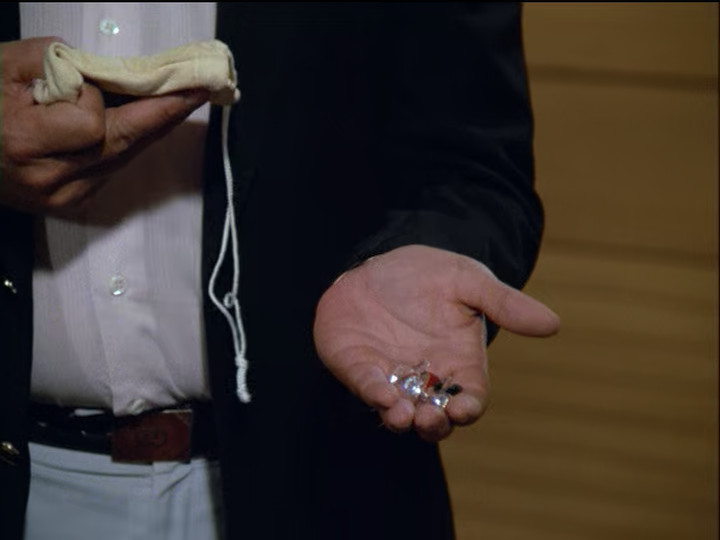
As Greenberg reaches for a gun in his desk drawer, Michael Haggerty walks in with a small cloth bag and tells him that the authorities got a search warrant and went through his luggage. Even removed from their settings, the gems will be easy enough to trace to their owners.

Why they authorities let Michael hold the jewels for this confrontation, he does not say.

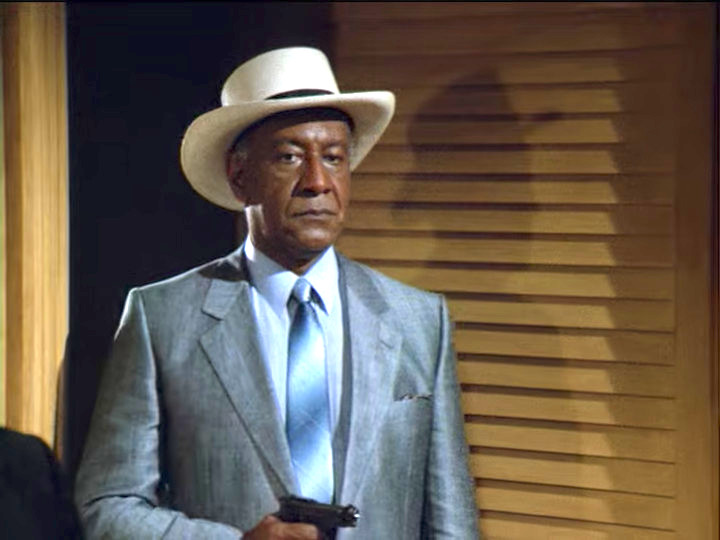
As Greenberg starts reaching for his gun again, Jessica cautions him not to, and the camera pulls up to Inspector Rensselaer, holding a gun:

(I’ve upped the exposure since the original was quite dark.)

This is dramatic but a bit silly, as he’s directly between Jessica and Michael, it would have been impossible for Greenberg to not see him as he was reaching for the gun in his drawer.

Greenberg gives up and says, “A million bucks. Thanks, lady. I could have lived like a king.”

I can’t help but mention that his math is a bit off. If he tried to live off of this for ten years, that would mean he’d have to make due on $100,000 per year (just under $302,000 in 2025 dollars). If he was staying at hotels the entire time, he’d be able to afford one that cost $273/day ($834 in 2025 dollars)—assuming he could photosynthesize or otherwise do without food. That’s hardly living like a king. To live like a king, he’d need to blow it all in one year, or perhaps in an even shorter time span.

Anyway, the next morning Jessica bids farewell to Veronica. After that, Michael bids Jessica a fond farewell, and we go to credits.

This was a curious episode to start off the second season with. On the one hand, I can see how they could have thought of it as pulling out all the stops. We have an interesting exotic location. We have Jessica pretending to be a rich recluse to solve the murder of a friend who wrote to her right before being murdered. We have the intrigue of a long-lost child. We have a jewel thief who has killed multiple times. We have a charming and mysterious Irishman. We even have a dapper police inspector with a delightful accent.

And yet, the impression I have when it’s over is not that this was a special episode. I’m not entirely sure why.

I think part of it is that I found the character of Marguerite Canfeld insufferable. To be fair, she was probably intended to be insufferable. But pretend-insufferable is still insufferable. Jessica dropped the character roughly halfway through the episode, but that was, really, far too late.

Thinking it over, though, I think that the biggest problem with this episode is that its parts do not relate to each other. Antoinette was murdered for her jewels and it was a complete coincidence that she was meeting her long-lost daughter, that her former boyfriend was now wooing her daughter, and that she sent a letter to Jessica moments before she was murdered. While it is true that red herrings are a staple of murder mysteries, they’re not supposed to be the majority of the story and they’re certainly not supposed to be the most interesting parts.

It’s even worse that this makes Jessica wrong without ever acknowledging it. Jessica repeatedly told Inspector Rensselaer that she can’t accept that Antoinette’s murder was just a coincidence after sending Jessica that the letter saying that she sensed danger. Her being convinced that the motive for Alva Crane’s murder was more than simple robbery is pretty iffy, too. About the only defense possible for it is that the motive was mildly complex robbery rather than simple robbery; that’s not an impressive defense. But Jessica goes on to say that the robbery was a cover for another motive, and here she was simply wrong. She never acknowledges either mistake, I think because it would highlight how much the solution turned out to be uninteresting. (Also, Jessica’s mistakes were not the result of the murderer being clever but simply because the unbelievable coincidences turned out to be true anyway.)

Now that I write that, it occurs to me that that may well be as big a problem as is most of the episode being a red herring. When you get down to it, the solution to the murders is that a person in a position of trust is abusing this trust to steal jewels. This is ordinary crime, and not very interesting. The only mildly clever thing about it was that the guy with the master key to the safe deposit boxes had to kill his victims in order to cover that he was using the master key. But this problem only cropped up immediately before the solution—and if you blinked, you’d miss that it even was a problem. For a mystery to be satisfying, you need to puzzle over the mystery throughout the story then receive a satisfying explanation to it. The puzzle should not be why the solution made sense, requiring you to remember seemingly unimportant bits of dialog to figure out that there was even a problem that the solution solved.

As far as characters go, there’s really only two: Michael Haggerty and Veronica Harrold, and Veronica is only barely more than a rural schoolteacher stereotype, which leaves us with Michael Haggerty. He’s a fun enough character; he does the “man of mystery” fairly well. Interestingly, Len Cariou, the actor who played him, played Sweeney Todd in the same production of Sweeney Todd: The Demon Barber of Fleet Street that Angela Lansbury played Nellie Lovett in, and reportedly the two actors became friends. It would be interesting to know if this had anything to do with Len Cariou’s casting.

Inspector Rensselaer is played by an extremely charismatic actor, but there isn’t much to the part. It feels like half his lines are “Madam Fletcher!” Shelley Greenberg is mostly annoying. Eric Brahm and Myrna Montclair are tolerable, though the attempt to use them as suspects falls flat, at least to me. “The hotel manager was seen talking to a guest” is remarkably poor evidence of… anything. And their secret marriage because of company policy couldn’t motivate anything that happened other than, perhaps, motivating robbery, but since the episode spends all of its time insisting that robbery was not the motive, they’re simply not plausible as suspects until after the real murderer has been caught. Alva Crane was fun for the one scene she was in, but all of her lines could have been cut and nothing about the episode would need to be changed, which is to say that she was just there, she wasn’t a part of the story. At least not when alive. Oh, and I nearly forgot that, technically, Sven Torvald was in this. He’s very structurally important, but he’s practically a non-entity in all of the scenes he’s in.

Which reminds me, why on earth did Sven try to run away before the last commercial break? The only thing he had to hide was his relationship to Antoinette, but the only person he had to hide that from was Veronica and running away, if anything, confirmed it to her. I mean, I get that the reason it’s in the episode was to go to commercial break on an exciting cliff hanger, but there was no payoff because, with him not being guilty of any crime, there couldn’t have been a payoff. It made life worse for Sven, and I don’t see how it could have seemed like a good idea to him at the time.

Oh well. Next week we’re back in Cabot Cove for Joshua Peabody Died Here…Possibly.

What TNG: Sub Rosa Could Have Been

I was recently talking with a friend about the Star Trek: The Next Generation episode Sub Rosa and how, while it was bad, it had some cool ideas. (I explained why it was bad in this post.) Specifically, it was interesting how it suggested, though it did not explore, what life might be like for people who had no interest in Starfleet.

In the episode, Beverly Crusher’s grandmother died and Beverly goes and visits the settlement where her grandmother had lived in order to organize her things. While there, she meets an “anaphasic entity” which behaves much like a ghost, and there are elements of gothic horror in the story, which mostly turns stupid toward the end. But before it turns stupid, the community is quite interesting, or at least hints at being quite interesting.

On the Enterprise, everyone is a member of Starfleet and shares Starfleet’s three primary values of exploration, technology, and bureaucracy. But on this small colony on a completely unimportant world that no one else cares about, there’s no great reason for them to care about any of these things, the valuing technology being the most interesting of the three. People need to do something during their day, and Starfleet officers occupy their time by using advanced technology, following orders, and filling out reports. But there’s no need, in the 24th century of The Next Generation to use advanced technology wherever possible. It’s entirely possible to only use it for the things you don’t enjoy doing the old fashioned way, while doing things the old fashioned way that you enjoy doing the old fashioned way.

Indeed, if you look around at people’s hobbies today you can see this all over the place. There are people who knit by hand rather than using knitting machines, though knitting machines certainly exist. There are people who hunt with a bow and arrow rather than with a gun. There are people who sew their own clothes and do some of the seams with a needle and thread rather than with a serger or more primitive sewing machine. Why? Because for the people who do them, these things are rewarding and enjoyable.

In the 24th century, it’s quite possible that people who live someplace where no great empire cares that they’re there would spend their time farming, weaving, making clothes, cooking, and similar things, only using replicators as a back-stop in case something didn’t go well.

Ultimately, these are the people that explorers find interesting, anyway. Explorers are not, generally, satisfied to go someplace else only to find people who don’t want to be there either and are spending all their time looking for something; they like to find new worlds and new civilizations. That is, they want to find new groups of people who actually want to be where they are.

I can see why most Hollywood writers would be terrible at writing this—they’re not happy where they are—but it would certainly be quite interesting to see it done well. Sub Rosa was never going to live up to this promise, but it would be quite interesting if some story did.

And given how much Science Fiction has been written to date, somebody probably already has and I just don’t know it.

Murder She Wrote: Funeral At Fifty Mile

On the twenty first day of April in the year of our Lord 1985, the twenty first episode of the first season of Murder, She Wrote aired. Also the last episode of the first season in was set in Wyoming and titled Funeral at Fifty Mile. (Last week’s episode was Murder At the Oasis.)

As the title screen establishes, Wyoming is a beautiful place. This helps to establish a bit of a golden-age mystery feel, since the beauty of the land will contrast with the ugliness of murder.

Right after the first establishing shot we we get another:

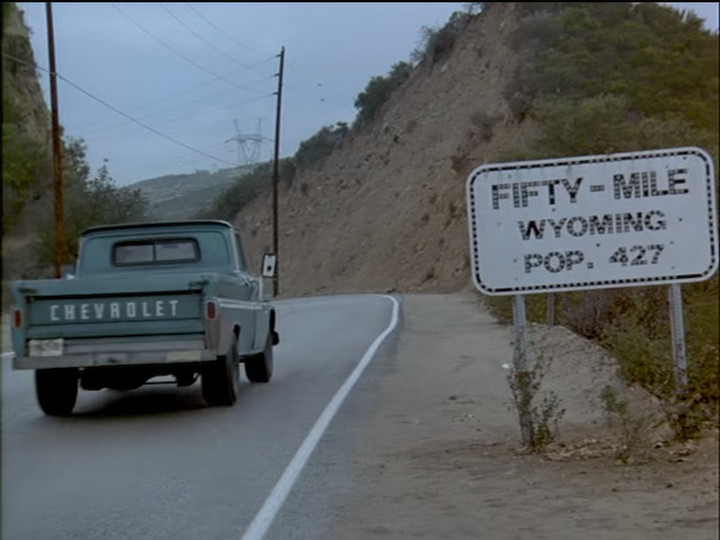
On the left we have an ancient Chevy truck driving by, which gives us the sense of a land where things move more slowly. On the right we have a sign that tells us we’re in a small town in Wyoming. A town so small, in fact, that they publish the population down to the individual. Not only are there not that many people, but the number doesn’t change so often that it’s expensive to change it when it does. (Though sometimes such signs simply reflect the population at the last census.)

After this we fade to a funeral where the preacher gives some useful introductions in his closing remarks. First is the deceased’s beloved daughter, Mary Carver:

Standing next to her is her fiance, Art Merrick.

Also is the deceased’s younger brother:

His name is Timothy Carver.

Also mentioned are Jack’s close and inseparable friends.

Doc Wallace:

Sam Breen:

and Bill Carmody:

(If you recognize William Windom, the actor playing Sam Breen, you probably know him as Jessica’s friend Doc Hazlett. That starts in the second season of Murder, She Wrote. Right now her close friend is Captain Ethan Craig, though we haven’t seen him in a while.)

After these closing remarks we find out that the deceased’s name is John Carver, and he was apparently in the military because his coffin has an American flag draped on it. There’s a brief prayer mentioning ashes to ashes and dust to dust, then a bugle plays a mournful tune.

As the bugle plays, a strange couple drives up in a large RV. They get out and walk up to be relatively near the casket:

We get a little bit of military ceremony—a five gun salute and the flag gets folded and given to Mary—then people begin to disband. The strange man asks Carmody if he’s coming after him with that gun and Carmody replies, sourly, that it would be futile since it’s loaded with blanks. We find out that the man’s name is Carl Mestin and the woman, whose name is Sally, is Carl’s wife.

Shortly after, Jessica is walking with Mary and Art and Mary remarks that it’s strange for Carl Mestin to show up since her father never did business with him and no one around these parts can stand him.

During the conversation it comes up that Jessica is, apparently, an old friend, since she can remember when Mary was born. Well, not the actual birth, but having heard that her mother died in childbirth. “We” were so worried, she says, wondering how jack was going to manage all alone, but he did just fine. In addition to this being awkward exposition, it leaves out the really important part—how was a school teacher in Maine friends with a woman who died in childbirth in Wyoming in the 1950s (or perhaps the early 1960s)?

The scene then fades to the Carver ranch, which we can tell by the establishing shot:

A storm is moving in—we hear the sound of thunder and it forms the subject of conversation inside.

We then meet “Marshall” (actually Sheriff) Ed Potts:

He’s read one of her books: it’s not up there with Mickey Spillane, but darn good for a woman.

I’ve never enjoyed Murder, She Wrote‘s attempts at making fun of sexist police officers and this one makes particularly little sense. While it’s true that Sir Arthur Conan Doyle (basically) created the genre of detective story with Sherlock Holmes, many of the biggest figures in the genre were women. Agatha Christie, Dorothy L. Sayers, and Ngaio Marsh were known as the “Queens of Crime.” Recent reprints of Agatha Christie’s novels often mention that she’s only been outsold by the Bible and Shakespeare. Detective fiction is, as fiction goes, probably the most 50/50 genre you can find. The only way to think that the best detective fiction is all written by males is by knowing nothing about detective fiction. (I suppose if you only like American hard-boiled detective fiction—a genre I dislike and am not sure should even count as detective fiction—this would be more defensible. And he did cite a hard-boiled detective writer. But even so. This is just annoying and dumb.)

In case you’re not familiar with Mickey Spillane—as I wasn’t until I looked him up—he wrote a series of hard-boiled detective novels featuring the detective Mike Hammer. From reading the plot synopsis of his first novel, I, The Jury, the name Mike Hammer is a bit on-the-nose as far as the kind of story it was, so just imagine the kind of story featuring a hard-boiled detective named “Mike Hammer” and you’re probably close enough, especially if you consider the various things “hammer” can be a euphemism for and go with all of them.

Jessica smiles and replies, “Yes, we all struggle under Mickey’s shadow, I suppose.”

The contrast is there for the joke they’re making, but it is very confusing with regard to the character of Marshall Potts. How on earth is a Sheriff who prefers to be called Marshall a fan of Mike Hammer stories? That said, he does immediately afterwards say that he doesn’t really read detective fiction, it’s westerns that have his heart. Like “Coop” in High Noon. (This would be a reference to the actor Gary Cooper in the movie High Noon, where Cooper plays a sheriff who stands alone against a gang of criminals.)

Jessica then says she notices that he wears his holster tied down and asks if this is for quickly drawing his gun. He replies that it is, and that he practices for half an hour every day. There’s a bit more banter where he says that he’s ready for someone to “make my day,” which is a line from the Clint Eastwood movie Sudden Impact, which came out in 1983, only two years before this episode. It’s a strange line to quote for someone who loves westerns, but I guess the point is to portray him as trigger-happy.

There’s also a minor point that Tim (Mary’s uncle) calls his own ranch, which neighbors this one, to make sure that everything is OK—that the ranch hands have everything battened down for the storm, which seems to be there already. That done, Tim brings up to Mary and Sam that he had promised to buy the ranch from Mary after John died, to make her comfortable for the rest of her life. Sam says that he doesn’t doubt that they discussed it, but the fact of the matter is that there is no will. Mary, being his only child, will inherit, but it will take longer to run it through probate than it would have been if there was a will.

This discussion is cut short by a loud honking from outside. Looking out the window, it turns out to be Carl Mestin and his wife. Mary tries to throw him out, but he produces what he claims is a copy of John Carver’s will, leaving everything to him except for a little money for Mary. This does not make Mestin’s reception any friendlier and he antagonizes people until Art Merrick has to be held back from punching him.

Mary asks Jessica why her uncle Tim and the others seem to be afraid of Mestin. Jessica doesn’t have an answer, then the Marshall comes over, warns Art that starting a fight isn’t going to help anything, then gives his condolences to Mary and takes his leave. (This is a very strange thing to do without apology, since an incendiary situation would benefit from his presence to keep things from getting out of hand.)

Jessica then talks to Mestin and remarks that Wyoming is very different than Maine. Back in Maine, she couldn’t imagine a father disinheriting his only daughter. Mestin replies that it probably has something to do with having saved John’s life back in Korea at the Inchon landing. Jessica is surprised at this and asks if he knows her husband, Tom Fletcher. He was Jack’s commanding officer. (She clearly doesn’t believe him and is testing him, since her husband’s name was Frank.)

Mestin thinks and remarks, “Oh yeah, Lt. Fetcher. He’s quite a guy. He’s a good guy.”

He then excuses himself. (In addition to not flinching at the name, Frank Fletcher was a captain, though we won’t learn that for a few more seasons.)

I should note, since I complained about it before, that we do, finally, have an explanation for how Jessica knows any of these people who never seem to have left Wyoming—Jessica’s husband and the deceased had served together in the Air Force.

Later in the afternoon, though it looks like night, after Mary is asleep courtesy of a sedative the doc gave her, her father’s friends are putting on rain coats to help batten the place down in the storm. Carl and his wife are arguing over drinking, with her calling him a lightweight and him saying that he’s not getting into a drinking contest with her. She then brags about having beaten him at an arm wrestling contest and he claims that he let her win. She bets him $500 ($1,505.46 in 2025 dollars) that she can beat him right now. She goads him into the match by accusing him of being too cheap or too chicken to do it, and he accepts. The people who were getting ready to help with tying things down in the storm stop their preparations and watch.

She beats him easily.

I don’t know if this will come up later, but it’s curious that they are arm wrestling left handed. It may come to nothing, of course, but it’s hard to not notice left-handed people in murder mysteries.

It should also be noted that this is very strange behavior of a woman who is supposedly his wife. It seems likely that her being is wife is another of Mestin’s lies. Anyway, he pays up, then goes and joins the people getting things prepared for the storm. As he joins them he asks whether a particular door still needs to be tied down in the wind, suggesting he knows the place.

Later in the day, after the storm has passed, Art comes back to the house having been given a ride by one of the employees named Jesús. Art greets the people inside—everyone from the funeral is still here. They ask where he was and he says that he got the pickup truck stuck in the mud on the way back. After two hours of trying to dig it out he gave up and started walking back. Jesús passed him on the road and picked him up. As Art goes to check on Mary, Jesús finds something that scares him in the barn. In a panic fetches the people from the house and they come. Then we see that the thing that terrified him was the body of Carl Mestin, hanged.

We then fade to black and go to commercial.

Had you been watching in 1985, you might have seen a commercial like this:

When we get back, the Marshall shows up. He doesn’t much know what he’s doing with a murder investigation and Jessica “subtly” helps him out. She points out that a hay bale was dragged near the body, as if to suggest suicide, but the killer seems to have changed his mind or been scared off.

Jessica also mentions that there looks to be a blood smear above his left ear, as if he was hit by something before he was hanged. (Doc checks out the body and confirms this, saying that Jessica has sharp eyes.) Jessica also notes that the rope on the beam had been splintered, suggesting that it was holding Mestin’s weight when it was pulled over.

Jessica asks Doc how long the body had been dead for and he answers 4-5 hours. Which is rather odd precision to give, even apart from not having taken the temperature of the corpse and run the relevant calculations. Anyway, the Sheriff does the math and says that it was around 3pm, when everyone has battening down the ranch.

That evening, Jessica talks with Mary. She asks Mary what she meant by Mestin shortening her father’s life. Mary explains that she was there on her daily visit and saw Mestin coming out of her father’s room. Mestin didn’t say anything to her and just looked smug. Her father was so upset he couldn’t even talk. He was never the same after that and two days later he died.

Jessica points out that the witnesses on the will were nurses. She suggests that Mestin arrived with the will prepared and pressured her father into signing it. Jessica mentions Mestin’s story about having saved her father’s life during the war, but that’s nonsense. She tripped him up with asking about knowing her husband, which he clearly didn’t. Whatever made Mary’s father sign the will, it wasn’t gratitude.

Bill Carmody then comes out and says that the Sheriff wants them assembled for questioning. Mary asks if Mestin might have been holding something over her father and Bill says he doesn’t know and didn’t know Mestin well. Mary asks about a business venture that they were in together and Carmody explains that Mestin talked into buying grain in order to open up a feed store. Bill bought the grain, then Mestin pulled out and left Bill holding the bag, causing bill to lose a lot of money.

Mary then asks why Bill did business with Mestin, since everyone she knew seemed to hate him. Bill replies that he didn’t have much choice, then says that they had better get inside.

Inside the Sheriff asks everyone where they were at the time that Mestin was killed. Doc, Uncle Tim, Sam Breen, and Bill Carmody were all working around the barn and saw each other. Mary was sleeping after Doc gave her some sleeping pills. This woman, who I presume is an employee, never left the house:

Carl’s wife was in her RV “sleeping it off.” Jessica was in her room “getting rid of jet lag.”

Jessica notes that the women are the only ones who can’t corroborate their alibis, but that don’t make no nevermind to this here Sheriff, as he doesn’t think a woman could have done Mestin in the way he was done did in. In his mind, the only possible suspect not accounted for is Art Merrick, which is good enough for him—he concludes with certainty that Art did it. Jessica shakes her head at him, and he replies, “I thought that you were smarter than that, Ma’am. There ain’t anybody else. Process of elimination.”

And on that we fade to black and go to commercial.

The Sheriff then goes over to where Art is getting his truck out of the mud. He points out that there was solid ground on either side of the mud hole, so Art clearly got himself stuck on purpose (Art says that it was raining so hard he didn’t see the hole until he was in it). The Sheriff then accuses him of the murder and arrests him.

The next day, in the morning, Mary drives Jessica over to the Sheriff’s station:

I find the interior quite interesting:

The most interesting part to me is that while the matte painting behind the set is quite good—it is appropriately out of focus for the foreground, for example, and thus looks fairly convincing—it’s entirely wrong for the environment and the external shot. (We can see based on how Jessica and Mary walk in that the door behind Jessica, here, is between the building and the hill in the exterior shot. But look more closely at what we can see through the window:

(I upped the exposure and size a bit to make the background clearer)

The hill is missing. Also, that looks like a fairly populous town across an empty plain.

Anyway, Jessica tries to talk some sense into the Sheriff. Mestin was struck from behind on the left side of the head, suggesting a left-handed killer, while Art is right-handed. Also, he didn’t have a motive. The only one who benefited from Mestin’s death is Sally Mestin.

The Sheriff then storms out and Sam Breen tells Jessica that bail is already in the works up at the county seat. Also, he and the boys talked and figure that they should stay close to Mary until things are settled.

He leaves and Jessica goes to Mary and Art, where Art relays what he overheard from a call that the Sheriff got from the coroner. This was more substantive than you might expect because it shook the Sheriff up enough he repeated everything the coroner said. The important part of which is that Mestin died of hanging and the blow to the head came afterward. Jessica wonders why Doc was so sure that it was the other way around, and Mary suggests Jessica ask him since his place is just down the street.

Doc’s house is interesting, partially because the shot is so close-cropped. I wonder where this really was.

Anyway, Doc isn’t in, but his nurse/receptionist/housekeeper is in.

She recognizes Jessica because she’s also the local phone operator and nothing goes on in Fifty-Mile that she doesn’t know about. Doc’s on a house call and will be back in about an hour. Jessica can’t wait and wonders if Doc made any notes about the examination he made the night before and wonders if Doc would mind if Jessica peeked in his files to see. The nurse replies that he’d skin her alive if she let Jessica look through his files—the only time Doc ever lost his temper was when he caught someone poking his nose in the Doc’s files. He threw the man out, using words that would “shame Lucifer himself,” and told him that if he ever breathed a word of what he found out it would be the last words he ever spoke.

Jessica asks if the man was a stranger, but it turns out to be Carl Mestin.

The nurse then says that, in her opinion, a man like Carl Mestin was born to hang. Jessica doesn’t agree, but also doesn’t demur.

Back at the house Jessica and Mary run into the housekeeper, who says that Mrs. Mestin requested a lot of coffee and has been on the phone all morning making calls, mostly long distance. Mary then confronts Sally and demands that she leave. Sally refuses and suggests that Mary leave, instead. Mary asks what Carl had on her dad that got him to sign the will and Sally replies that Carl never told her, but whatever it was it must have been very “juicy” because it was very profitable.

A little while later the Sheriff arrives with Art Merrick. He’s dropped the murder charge after he had a chance to think about Jessica’s arguments. Jessica tells him that it takes a strong man to admit his mistakes. The Sheriff replies that Art is still his best suspect… so if he didn’t do it, who did?

Jessica suggests that the Sheriff challenge Sally Mestin to an arm wrestling contest. He might find it illuminating.

Interestingly, he does.

In the preparation for the match, Jessica drops in and says that she wants to observe Sally’s technique. Sally replies that it’s all in the timing and body English. The women’s North American champion is just a little bitty thing, much smaller than Sally. (Sally is significantly overstating this; while technique does certainly matter in arm wrestling, as in all kinds of wrestling, there are significant limits to the strength difference it can overcome.)

They begin and at first not much happens except for the Sheriff grunting. But right before Sally wins, we get a closeup of her hand:

and then her arm:

They did this pretty quickly in the episode, so I’m not sure that it’s reasonable for them to have expected us to notice, but you can see that Sally has a tan line from her bracelet but not from her wedding ring (she’s wrestling with her left arm, so this is her left hand). So she clearly hasn’t been wearing the ring long.

Anyway, after Sally wins, the Sheriff remarks to Jessica that he never thought a woman would be strong enough to do in Mestin, but Sally is sure strong enough and she’s left-handed to boot.

Sally doesn’t take kindly to this and storms off.

That night, while Jessica is in bed, she hears some tapping on her window. She goes over and looks out the window and sees a noose hanging outside.

Jessica looks thoughtful and says, out loud, “I do believe I’m making someone nervous.”

And on that we fade to black and go to commercial.

When we come back from commercial, Sally leaves her trailer and barges in on everyone having breakfast. She’s brash and provocative, and comes on pretty strong to Art Merrick, clearly to antagonize Mary.

Right after she’s served breakfast, though, Sheriff Potts comes in and informs Sally that he has a warrant for her arrest for the murder of her husband. She complains a bunch, then when Sheriff Potts holds up a pair of handcuffs Jessica asks Sally if now isn’t the time to play her trump card, before she winds up on trial for murder.

Sally says that she doesn’t know what Jessica is talking about, but Jessica replies that she does. Her supposed motive for killing Carl is to get ownership of the ranch as his widow, but she’s not, in fact, his widow. She and Carl were never married. Jessica checked on all of the long distance phone calls and they were to quickie wedding chapels in Nevada. She figures that Sally was looking for one that would sell her a forged wedding certificate, and since Sally got so much bolder after those phone calls, she probably found one that would. Jessica suggests that the proof is that the skin under her wedding ring is as tan as everywhere else; only the skin under her bracelet has a tan line. Clearly, the wedding ring was a prop.

Sally sinks down in her chair. She sighs and says that Carl said that people around here are old-fashioned. If they pretended to be married, it wouldn’t make waves. She then gets up and says that if she’s not under arrest she’d like to leave. The Sheriff replies that there are some nice places on the edge of town where she can park the RV, but he recommends not going any further than that from town.

After she leaves, Potts sits down and expresses his frustration. Now he’s back to the beginning.

Jessica says that she can give a description of the murderer. He’s a tall, strong, ambidextrous man who had number of reasons to hate Carl Mestin but only one reason strong enough to kill him.

The Sheriff replies that there ain’t anybody like that around here, and Jessica sadly nods her head and says, “Yes. I know.”

A few minutes later Art, Mary, and Jessica are standing on the porch as Sally drives off. Art says that he can’t say that he’s sorry to wave goodbye to her and Mary replies that in a funny kind of way she feels sorry for Sally. Art then points out that now is a good time to get his truck and Mary volunteers to drive him over. She invites Jessica to come with her for some reason but Jessica declines.

When Jessica comes in, only Doc is at the table, peeling an apple. Jessica notes that he’s left-handed. He replies that he’s very left handed, but not ambidextrous. He asks her why she says the killer is ambidextrous and she replies that Mestin was struck from behind on the left, but the hangman’s noose outside her window was tied by a right-handed person. Hence, ambidextrous.

He asks Jessica if she really knows what she’s saying and Jessica replies that, unfortunately, she does. She then says that she’s going to take a walk, perhaps go down to the barn and look around.

The Doc follows her and asks her to not meddle in things she doesn’t understand. Someone could get hurt. Jessica replies that he’s not talking about her, he’s talking about Mary, isn’t he? It seems to her that Carl Mestin was killed to protect Mary from some terrible secret that’s worse than the loss of her birthright. Could any secret be worse than that?

Doc replies that one could and asks her to drop it.

When she gets to the barn Uncle Tim, Sam Breen, and Bill Carmody are waiting there.

Jessica then says that they’re four men who added up to one tall, strong, ambidextrous killer. After revealing a bunch of what she knows, she then asks about what she doesn’t. Who was Carl Mestin? He knew about the haymow door needing bracing in the wind, so he seems to have worked here in the past, but a long time ago since it was before Mary was old enough remember.

It’s Uncle Tim who finally speaks. Carl—which wasn’t actually his real name—was a randy young ranch hand at Carver ranch. He tried every way he knew to seduce Jack’s wife, but it didn’t work. One day he found her alone and raped her. Then he ran and the five of them—including John Carver—chased him down and caught him. They strung him up and were going to hang him but John said no and talked them out of it. Because he asked it, they instead turned him over to the law. Only Carl escaped and got clean away. And Ruth—John’s wife—turned out to be pregnant with Mary. She seemed to believe that the child was John’s and Doc let her believe it. After Ruth died in childbirth, John raised Mary as if she was his own. He loved her and doted on her, and his one great fear was that she would find out the truth about her parentage.

Jessica asks how Carl figured it out. Sam Breen replies that as near as they can figure out, he changed his name, stayed around near Fifty-Mile but out of their sight, and read about the birth in the paper and did the math. But he needed a clincher, so he broke into Doc’s files. Not Mary’s, but John’s. John was sterile and could never father a child of his own.

The night of the funeral, they saw the horse run into the barn where Carl was and the idea seemed to hit them all at once. They put a noose around his neck and put him up on the horse in order to scare him, but he was cocky and mocked them, saying that they didn’t have the guts. Then there was an enormous lighting flash and the horse spooked and bolted. The fall off the horse broke Carl’s neck when he finally fell to the end of the slack in the rope. It felt like divine providence. After that they knew that one man couldn’t have lynched him, so they took him down, Doc hit him because he knew where and how hard, then they strung him back up, so it could look like the work of one man. It never occurred to them that Art would be blamed. They’d had stepped in if Jessica hadn’t cleared him.

Jessica then asks, “So what happens next?”

Sam stands up and says, “Alright. We’ll go to the Sheriff. Tell him what happened. Stand trial. I don’t know what a jury will say. We’ll even go to jail if it comes to that. But there’s no way on God’s green earth Mary will ever know the reason why. Not from any of us.”

Jessica replies, “Nor from me, Sam. She’s been hurt enough already.”

Sam then takes off his hat, offers Jessica his arm, and they all walk back to the house.

I have very mixed feelings about this episode. On the one hand, parts of it are well done. We get a good sense of the loneliness of the Carver ranch and the close-knit nature of the sort of community which is necessary to thrive where there are so few people. On the other hand, I really don’t like the ending.

The ending violates the ideal structure of a murder mystery. In an ideal murder mystery, the murder—that is, the intentional, unjustified killing—causes a disorder in the community through the misuse of reason. The detective then enters the world, temporarily becoming a part of it, and through the right use of reason restores order to the community. Plenty of mysteries don’t have this structure; however, though it’s not universal, it is common and, more importantly, it’s the structure that the best mysteries have.

The first major violation of this structure in this episode is that the killing isn’t even murder. It is more properly manslaughter, since they did not intend to kill but nevertheless did kill during the commission of a crime (assault).

The second major violation of this structure is that the death didn’t cause a rupture in the community. In fact, Carl Mestin’s presence caused the rupture in the community and his death fixed it. It didn’t perfectly fix it, but everyone was better off with Carl Mestin dead.

Worse, the part that Carl Mestin’s death didn’t fix wasn’t fixed any other way, too: Carl’s inheritance of the ranch. With Carl’s death it doesn’t go to his widow, since he wasn’t actually married, but if he doesn’t have any near relatives, it would go, not to Mary, but to the state of Wyoming. About the best case for Mary would be that, with Mestin dead, no one who will speak up on Mestin’s behalf will mention the existence of this will and consequently Mary can inherit under the rules of intestacy. If things turned out that way it would just bring us back to Carl Mestin’s death being the thing which fixed the problems that his life caused. (It would actually work for Mary to inherit as his daughter, presuming Mestin died intestate, but that just causes other problems.)

Which means that Jessica’s solving of the crime did no one any good.

And the thing is, I mean literally no one. Not even the Sheriff. Contrast this with Agatha Christie’s classic murder mystery, Murder On the Orient Express. (spoilers ahead, but, dear reader, as you’d have to be 92 years old at the time of my writing this to not have had your entire life to read it, I think you’ve had enough time and I can discuss the plot with a clear conscience.)

Murder On the Orient Express, like Funeral At Fifty Mile, has the solution that almost everyone did it together. And, further, it has the property that the victim really had it coming, and his departure from the world fixed problems caused by his wickedness while it did not introduce any new problems, except for the responsibilities given to the authorities. Which brings us to the key difference: in Murder on the Orient Express, the authorities had a real problem caused by the death. Specifically the director of the Wagon-Lit company had a murder on his train and for which he was responsible to his passengers because passengers really dislike trains on which people get murdered. And owners of companies do not like it when their customers get murdered while being customers. Poirot solved these problems for him without creating more problems. He laid out two possible solutions: an uncatchable fake assassin who crept away in the snow but who was specifically after the victim and who might have killed him anywhere, and the real solution. He laid out the assassin theory first and the director of the Wagon-Lit company at first dismissed it, but Poirot admonished him to not be so quick to dismiss it because he may come to like it after hearing the second solution. And, indeed, he did. After Poirot carefully laid out the real solution, the director said that clearly he had spoken too hastily and obviously the first solution was correct. That is, Poirot gave him a way to fulfill his duty to the rest of society and also to act justly in this case, and left the decision with him.

By contrast, Sheriff Ed Potts didn’t really have any obligation to the community to solve the killing of Carl Mestin because the general opinion in Fifty Mile was that Mestin was born to hang and the world was clearly better off without him in it. And these are the people who employ Sheriff Potts and the only people to whom he answers. Unlike the director of the Wagon-Lit, if he just left well enough alone, everyone would be happy. And it is in this context that Jessica demanded that the four friends not let the Sheriff leave well enough alone.

This brings us to one of the strange things about Jessica Fletcher as a person: her greatest faith is in civic authority. She is, perhaps, best described as a devoted believer in the American Civic Religion. (It’s an amorphous, hard to nail down religion which is vaguely deist and holds America to be something sacred and thus all its institutions are sacred.) She has notions of justice, but her devotion to the American institution of the courts is greater. Poirot, being Catholic, could hold that human institutions are fallible and not always to be trusted with the difficult cases. Jessica cannot; she must see the law carried out no matter what.

Which means that Murder, She Wrote does better when it sticks to actual murder and leaves things like manslaughter, justified homicide, etc. alone. Les Miserables would not be improved by having Javert as the protagonist.

Moving on from the ending, the characters in this episode were mostly pretty good. None of them were well fleshed out but they at least all had a few hints of a personality and the actors did a lot with those hints. William Windon as Sam Breen, in particular, was a ton of fun. This may be why he replaced Claude Akins as Jessica’s close Cabot Cove friend starting in the second season.

The main exception was Sheriff Potts. He was a caricature from the beginning, which can be a fun start if the caricature becomes a character; that is, if he gets turned into a real person who simply has some interesting quirks. That often reflects how we meet people, after all. At first we notice their unusual characteristics, then we get to know them. The problem with Ed Potts is that he never became a character. The closest they came was having him drive Art back home after dropping the charges, as that did require some sense of responsibility. But on the whole I found him annoying without any compensation for that annoyance.

The setting was also enjoyable: Fifty-Mile, Wyoming, was a nice place to visit.

Another point in this episode’s favor is that it does actually establish how Jessica is connected to the place. Over the seasons, Jessica has an oddly large number of old friends who are never really explained and are often not very plausible; attending the funeral of someone her late husband served with in the Air Force is a nice way to explain this that is plausible.

As far as plot holes go, this episode did pretty well. I think one plot hole was that the people were a bit over-concerned that Mary never find out that she was Mestin’s daughter. It would be pretty unpleasant to find out that the man you thought was your father was merely a man who loved you and raised you as his own, but your real father is a scumbag rapist. On the other hand, it’s not like anyone gets to pick his parents and having someone raise you lovingly because you’re the daughter of a good woman he loved would help her to deal with it, and it’s not like anybody in the area believes in a tainted bloodline, so she wouldn’t face any practical consequences. I don’t want to overstate that; I completely understanding not wanting to burden her with the truth, but that can easily be taken too far. Very few good things come from running from the truth. And I very much doubt it would be worth disinheriting Mary rather than telling her the truth. Especially now that she’s an adult. As a child she might worry that she will take after her real father, but as an adult she knows who she is, regardless of who her father was.

The only other real plot hole I can think of is the noose outside of Jessica’s window. That really came from nowhere and went nowhere and didn’t fit the character of any of the four conspirators. They really just did it so that they could go to commercial break on a dramatic note and couldn’t come up with anything. But at the same time it only takes a few seconds and could easily be excised from the episode without anything else having to be changed. Well, that’s not quite true. Instead of Jessica saying that the noose outside her window was tied by a right-handed man, she’d have had to say that the noose around Mestin’s neck was tied by a right-handed man. Half a line isn’t much of an impact.

Actually, there’s one more plot hole I can think of: I’m not sure that Sally not having a tan line under her wedding ring is actually proof that she wasn’t really married. Sally would, in any event, have been pretending that she and Carl got married recently, which means that even if it were true she’d have had no time to get a tan line from her wedding ring.

Well, that’s the end of the first season of Murder, She Wrote. Back in 1985 it was almost five months until Season 2 would begin with Widow, Weep For Me.

Murder She Wrote: Murder At The Oasis

On the seventh day of April in the year of our Lord 1985, the twentieth episode of Murder, She Wrote aired. Set in the fictional city of Desert Palms, California, it was titled Murder At The Oasis. (Last week’s episode was Armed Response.)

While we hear someone tinkering on a piano we get some establishing shots of a very fancy house with a gate and a security guard house next to the gate on the driveway. Then we then see who is tinkering on the piano and meet one of our main characters:

His name is Johnny Shannon and the various gold records framed on the wall suggest that he is connected to the music business and is quite successful. (Why he’s wearing his coat like a German officer is not explained.)

We also very quickly establish that he’s extremely unlikeable. He calls in his son, Mickey…

…and then berates him for composing such a terrible piece of music. We get the impression that this is a common occurrence because Mickey is only mildly disappointed and calmly tells his father to just play it at the right tempo, which he proceeds to demonstrate.

While Mickey is playing it, Johnny summons his assistant, Buster:

Buster makes Johnny wait a moment, though, so he can tell Mickey that he likes the piece and it’s good work.

Johnny, disappointed by this reaction, orders his car to be prepared because he has a lunch date at a tennis club. On the way there, they receive a phone call on the car phone from a major mob boss, but Johnny refuses to take the call because he’s now “protected.” He clarifies to Buster that he has “a special kind of insurance,” but then says no more about it.

At the tennis club, we actually see Jessica and her old friend Peggy, who is Johnny’s ex-wife.

From some casual conversation we find out that they’re expecting Johnny to join them for lunch.

Which he eventually does. There’s a bit of small talk where it turns out that she recently leased a house in the area so she could visit her children since they rarely visit her anymore. Mickey is one of those children and then we meet the other: Terry.

Terry then excuses herself because she has to meet a friend and Johnny expresses concern that it’s not “that tennis bum”. Her refusal to respond suggests that it is and this is confirmed by the tennis bum coming up to her table a minute later and kissing her for an extended period of time.

Johnny gets up to intervene and Peggy lays a restraining hand on his arm, saying that Terry is old enough to choose her own friends. Johnny replies that she told him this before and she was wrong, then, too.

His interfering goes about as well as one can expect it to; the tennis bum shoves Johnny and then several people whom Johnny employs comes to his aid, restraining the tennis bum.

Curiously, this is interrupted by a man who introduces himself as Sergeant Barnes of the police and asks what the trouble is. When Johnny tells Barnes that he doesn’t want the tennis bum around his daughter, Barnes replies that he doesn’t work for Johnny. Johnny then replies, “You must be new. Ask around. Somebody’ll set you straight.”

He then escorts Terry home.

With Johnny and his entourage gone, Peggy tells Jessica the backstory: when Terry was seventeen she eloped with a boy that Johnny didn’t like. Johnny sent some men after them who roughed up the boy then gave him a one-way airline ticket out of the country. Johnny had the marriage annulled and Terry never forgave him. She still lives in her father’s house to get back at him—to torment him with behavior like this.

Later that night, at Johnny’s house, Buster brings Johnny a glass of milk only to find the door locked. He knocks loudly, then even louder, but no matter his volume he gets no response. In desperation he calls Lou, Johnny’s bodyguard. Mickey, hearing the commotion, knocks on Terry’s door, finding her with the tennis bum.

Back at the door the bodyguard has arrived and breaks the door down. They go inside and find Johnny, dead.

And on that bombshell we fade to black and go to commercial.

Had you been watching back in 1985, you might have seen an ad like this:

When we come back from commercial, Jessica and Peggy are driving along. After Jessica observes that Peggy is driving too fast, Jessica offers her condolences. Peggy replies that at least Jessica had a happy marriage with Frank; Peggy isn’t even a widow. She apologizes then thanks Jessica for going to the house with her because she can’t face it alone.

The scene then shifts to the men’s locker room at the… I’m not sure what this place is. Perhaps a tennis club? Anyway, she goes into the men’s lockerroom and finds the tennis bum she had been with and tells him that her brother is sure to tell the police that he was in the house the night before. She gives him money and tells him to flee the country if he doesn’t want to be part of a murder investigation. She adds that he should not try to contact her.

When the tennis bum asks, “what about us?” She scoffs and tells him to not be stupid. Now that her father is dead, she doesn’t need to play “let’s pretend” anymore. She adds that the truth is that she doesn’t even like him. (He doesn’t take this well, but nothing comes of it.)

Jessica and Peggy then arrive at the house. Oddly enough, she still goes by “Mrs. Shannon” despite being divorced from Johnny Shannon for years.

Inside the house, Mickey is glad to see his mother. He’s also glad to see Jessica, because they can use a good detective. Jessica objects that her exploits have been greatly exaggerated, but Sergeant Barnes walks into the room and answers her that he’s heard differently.

He’s the new police officer from earlier, and he explains that he’s been assigned to the case because in Desert Palms they don’t have a homicide division. He was on duty when the call came in so it’s his case.

Peggy, Mickey, and Sergeant Barnes press her to help on the case, but Jessica is reluctant. I always find this strange because if the police detective doesn’t want her on the case, she can’t be kept out. I wish that she was a bit more consistent as a character. Anyway, Barnes eventually gets her to help by telling her that she’s covered the subject of murder well in her books, even if she’s not always accurate. This piques Jessica’s interest, and she asks why he says this. When he says that he’ll explain on the way to the crime scene, she accepts. As they walk to the other room, he tells her, “You’re a little shaky on police procedure. And you always make your killers more interesting than your cops. You see, most killers are very dull people.”

They then leave the room and Mickey and Peggy discuss Terry in terms meant to make us suspect her, which, in Murder, She Wrote, means that she’s definitely innocent. It’s more reliable than a solid alibi.

In the room where Johnny was killed, Jessica notes that the door had a spring lock, so the killer must have pulled it shut on the way out.

They discuss the room as characterizing the victim:

Barnes says that Johnny was found in his favorite chair. He was shot in the back of the head and probably didn’t know he was about to be killed. Jessica wonders why he was sitting in a chair opposite to a blank TV when there was a perfectly good couch to sleep on, if that’s all he was doing.

Barnes agrees that this is puzzling. He adds another puzzling thing: no one heard a shot. The walls are thick but if you walk past the room in the hallways with the door closed, you can hear if a piano is being played, so they should have heard a gun, which is much louder than a piano.

Jessica says that she’s never seen a silencer herself, but mystery writers are addicted to them. (I think that this was true only of a certain era; but certainly this was part of that era.) Barnes objects that “mufflers” would be a better name for silencers; you can’t actually silence a gun and there’s always some noise.

Interestingly, that’s not quite true. The British developed an effectively silent gun called the Welrod.

By Askild Antonsen – Welrod Mk II, CC BY 2.0, https://commons.wikimedia.org/w/index.php?curid=56166106

It uses a series of solid rubber wipes in addition to many baffles in order to suppress the sound down to the point where it’s quieter than people speaking conversationally. The trade off is that you can only fire a dozen or so shots from it before the wipes are too degraded to suppress the sound that effectively. Also, it fires sub-sonic ammunition. This part is critical because it doesn’t matter how well you suppress the explosion which propelled the bullet if the bullet itself creates a supersonic boom. As a result, it has an incredibly short range—measured in tens of feet. On the other hand, its purpose is incredibly close-range assassination, and it actually has a concave front to allow it to be effective when pressed up against a person, so this isn’t too much of a limitation.

That said, it’s very unlikely that a killer in California in 1985 would be using a World War 2 British special services assassination pistol. There were a few similar guns made over the years but they’re exceedingly rare because there’s basically no market for them. So, in practice, Sergeant Barnes is right.

Jessica says that if the sound was muffled and not recognizably a gunshot, it might have gone unnoticed, confused with ordinary household sounds such as radio, television, etc. Barnes agrees that might be the case, but asks how on earth the killer got through the security system. There are guards on duty 24 hours per day at the front gate and the service entrance, at the back of the house, is protected by a tall fence and a sophisticated alarm system with TV cameras. The gate is opened remotely by the guard at the front gate after confirming the identity of the service person over the camera and through an intercom for voice verification. Nobody pushed the buzzer on the back gate last night and nobody could have gotten over the gate or wall without the alarm going off.

Jessica states the obvious conclusion: the murderer came from inside the house. (This was not lost on Barnes, who had already come to that conclusion.)

Having said that, I’m not sure it’s right. It’s unlikely that the tennis bum got in through the front gate by being on the invitation list—Johnny would almost certainly have told the guards to forbid him entrance—so his presence demonstrated it is possible to get in.

The scene then shifts to Terry pulling up in a fancy car as tense music plays. I’ve no idea why this might be important since we’ve already established that Terry is definitely innocent, but it’s a good excuse to show the front gate:

Terry goes into the house and demands to know what Mickey told the cops before she realizes that her mother is there. She then switches to condoling with her mother, which Mickey doesn’t take very well. Some hot words pass and Terry runs off.

Back in the murder room, Jessica and Barnes are discussing motive. Barnes suggests the standard: someone who stood to inherit. It was the servants’ night off, so other than family only the bodyguard and Johnny’s assistant were there.

When Jessica asks if the motive could have been robbery, Barnes shows her a hidden wall safe in the room which Mickey told him about:

Barnes doesn’t think this is the motive, though, since the killer wouldn’t have shot Johnny before making him open the safe in that case. Unless, as Jessica points out, the killer already knew the combination. Barnes admits this possibility, but while the safe contains valuable things, members of the household confirm that nothing is missing. Jessica then points out that her theory is unlikely since someone who knew the combination wouldn’t need to kill Johnny to steal it, they’d only need to wait for him to be out of the room.

Jessica then wonders if the motive might have been something else. There’s an obvious spot on the wall where something that was framed was missing. Barnes says that it wasn’t anything, though—just an old picture of Johnny and his kids.

This is interrupted by Buster, who asks the Sergeant to come quickly because the bodyguard is convinced that Mickey killed his dad and is busy assaulting him by the pool.

They get there in time and Barnes knocks the bodyguard into the pool. Mickey isn’t feel great from all of the strangulation he just experienced, but he’s otherwise OK.

The bodyguard insists that Mickey needs to be arrested, and when questioned, explains that he finally remembered that he wasn’t the last one to see Johnny alive—he saw Mickey go into the den after he left it.

And on that bombshell we fade to black and go to commercial.

When we come back from commercial Sergeant Barnes asks Mickey what’s up. Mickey says that Lou (the bodyguard) had it all wrong. He did go down to the den to show his father some changes on the arrangement he was working on but his father didn’t want to see it until the arrangement was finished. So he immediately went back upstairs. He wasn’t in the den for more than a minute. (I’m not sure how the short duration is important because it takes only a few seconds to shoot someone in the back of the head. Perhaps Mickey is still groggy from being strangled.)

Mickey then goes on to say that he didn’t always get along with his father and there were times when he hated him, but when he was angry at his father he’d always think of the good times, before they moved out to the desert.

This is interrupted by Terry, who walks up with Peggy. Terry says that Mickey didn’t kill her father, there was someone else in the house—the tennis bum. She let him in at the rear service entrance. She used the master switch to turn off the alarm long enough for the tennis bum to get in and make it to the house. The guard would only notice that the system was switched off if he was paying close attention because the only indication is a tiny red light. The night man reads a lot and doesn’t check the panels often. The TV monitors are always off unless the alarm is tripped.

When Barnes remarks that she knows a lot about the security system, she replies that this isn’t the first time she’s let a man into the house.

When Terry mentions that she sent the tennis bum away and doesn’t know where he is, Barnes borrows the telephone and calls in an APB on the tennis bum.

As he’s doing this, Jessica asks where Lou (the bodyguard) was when Mickey came out of the den, that Mickey didn’t see him. He went to his room because Johnny told him to get lost. Buster says this means that he was expecting a “broad” (a woman). He always sent Lou away when he was expecting a female visitor.

Lou doesn’t think this is plausible, though, because he wasn’t given a name to call down to the front gate. Jessica mentions that perhaps the guard knew this woman on sight. When Lou said that Johnny’s rule was female guests always had to be specifically called down, Jessica looks at Peggy and says, “there are exceptions to every rule.”

Jessica and Peggy talk privately; Peggy confirms that it was her and that she wanted to talk to Johnny about Terry, but she found him in a mellow and affectionate mood and for the first time since she left him, they made love. She then discusses how Johnny always had a way with women—which was why she ended up leaving him. He was always using women and seemed genuinely surprised that Peggy cared. He even once took a girl away from Buster, who was heartbroken over it until he made a joke of it.

A bit of talk later, Jessica asks if Johnny had any enemies and Peggy said that last night Johnny was bragging about “putting one over” on a mobster named Milo Valentine (this would be the mobster who called him on his car phone, that he said he had protection against). Milo started Johnny in show business, but their relationship turned sour. Last night, Johnny said that he felt like he could nail Valentine to the wall, but didn’t explain what he meant by that.

Jessica then goes to Sergeant Barnes at the police station to give him her latest theory that Johnny was killed by a hitman. She remembers reading that shooting someone in the back of the head was part of the mob’s execution ritual. Which sounds rather inconvenient and also at odds with the mark of a professional killer being to shoot someone twice—once in the heart and once in the head. But, what do I know?

Barnes isn’t overly impressed by the idea that Johnny was killed by a hit man but he doesn’t dismiss it. When he worked in Chicago before he came here, he remembers hearing rumors that Johnny had a mob connection.

Jessica thinks that this would put the kabosh on the tennis bum theory, but Barnes disagrees. Hitmen don’t wear a t-shirt that says “professional killer”—they have some kind of cover. Tennis seems good for this, allowing him to move around. He’d have started an affair with Terry to gain access.

Back at the Shannon residence, Buster is out by the pool making a phone call to Milo Valentine, saying that he has an urgent matter to discuss. When he hears Terry draw breath in surprise (she’s listening on another phone, inside the house), he realizes the conversation is being overheard and asks who’s on the line, to no avail.

Jessica then comes up to the house in a taxi, and after questioning the security guard offscreen, she goes inside and talks with Terry, who is sitting in her father’s favorite chair and watching tapes.

She comments on the tape that she was watching. “That Vegas showgirl nearly became my stepmother. But so did a lot of others.”

During the conversation, it comes up that Terry took the family photo that’s missing from the wall up to her room. She took it right after they found her father because she needed something of him to hold onto. The guy on the tapes is a stranger; her daddy was the man in the photo.

Jessica asks about the tennis bum and how they met. Terry says that he was the loudest, most obnoxious player in the bar at the tennis club so, knowing that her father would hate him, she picked him up. She’s fairly certain he didn’t kill her father, though, since when she told him that her father was in the den, the tennis bum was too scared to leave her room.

Terry also ends up telling Jessica about Buster’s phone call to Milo Valentine. Jessica also gets some further information about the VHS tapes above the television. Most are of Johnny’s TV shows, but a bunch are of his pool games. He had a camera installed to record the pool table so he could watch his games and figure out how to improve.

Jessica says that it’s hard to see in the dark corner where it is.

The scene then shifts to a few miles north of the Mexican border, where some police catch up with the tennis bum and arrest him. As he’s being led to the police car, he says that he didn’t kill Johnny Shannon, Terry did.

And on that bombshell, we fade to black and go to commercial.

(You’d only have seen this particular ad if you lived within a few hundred miles of the Pocono mountains.)

When we come back from commercial we’re at police headquarters where the tennis bum is interrogated in front of Jessica and Johnny’s relatives.

It’s strange enough when Jessica is at police interrogations; I’ve got no idea why almost everyone is here.

The upshot of the interrogation is that the tennis bum believes that Terry killed her father and used him as a patsy, which is why she paid him to leave.

Interestingly, Jessica actually tells the tennis bum to reconsider not having an attorney present, which is out of character for her. Out of character for him, he takes this advice and says that he wants a lawyer, which ends this interrogation.

Once the tennis bum is escorted out to make a telephone call, Jessica remarks to Sergeant Barnes that it seems unlikely a professional killer would have no better escape route than an unreliable van on a back road to Mexico. (She doesn’t add that it’s even stranger for him to hang around and wait to make his escape, rather than starting that night.)

Barnes replies that perhaps he’s new at it, or perhaps he’s not a pro and perhaps he’s telling the truth about Terry. Some bickering later, the Shannons leave for their home and Jessica joins them because she has something she wants to look into. Barnes asks if she’s going to let him in on it and she replies that she will once she’s sure—she’d hate to look foolish in front of the police.

Back at the house, Jessica talks to Buster, who explains that the phone call was only because he was worried that Valentine might have a contract out on Buster as well as Johnny. He also explains what the cause of the split was—Valentine got Johnny started, which gave him control over Johnny, which Johnny resented when he made it big. Johnny chafed under this and eventually started making his own moves. When Johnny failed to make an appearance at a political rally for one of Valentine’s payroll politicians, Valentine flew over and had a meeting with Johnny in the den. Buster wasn’t in the room but did hear the sounds of pool being played.

Jessica puts two and two together and concludes that Johnny taped the game with Valentine and then threatened him with the tape. The killer must have had a double mission: to kill Johnny and to retrieve the tape.

When Jessica tells him not to worry about a contract being out on him—had there been one, he’d already be dead—he tells her to say no more, he gets the picture. She asks him to repeat “I get the picture” then she announces that she knows who the killer is. She calls Sergeant Barnes to let him know that she’s solved it.

When he arrives, she begins by explaining how the killer got in. He kept a close eye on the tennis bum, figuring that he’d be brought into the house sooner or later. That night, he got lucky and followed the tennis bum in. He knew where the den was because Milo Valentine had been in the house and described the layout for him. He figured that Johnny wouldn’t help him find the tape, so he shot Johnny immediately. He then locked the door and searched through the tapes. Jessica experimented and all of the tapes up to the missing tape were played for a short time, while all of the ones after the missing tape were at the very beginning. The killer then turned off the VCR and TV, then waited. While Lou was breaking down the door, Terry turned off the alarm to let the tennis bum out. The killer went out behind him.

Barnes says that this makes sense but leaves them with the problem that they can prove that the tennis bum was in the house and can’t prove that anyone else was. Jessica demurs. The morning after the murder, Sergeant Barnes told Jessica it was his first time in the house, but he knew what was in the picture missing from the wall, despite Terry having taken it to her room right after her father was found dead.

Barnes replies, in surprise, that Jessica is good. He then takes out his gun and puts a silencer on it. He says that he never kills unless he is well paid for it, and it hurts him to make an exception in her case.

Jessica then calls to the waiting people, who come in.

She then tells Sergeant Barnes that he would be well advised to not make any sudden moves. Lou took Johnny’s death very hard.

He thinks for a moment, then smiles and hands Jessica his gun. She thanks him, saying that it means a great deal to her. He asks if she means as a trophy, and she replies no, as the only real evidence that he killed Johnny Shannon. “Ballistics will prove that the bullet came from your gun.”

After a moment, she adds, in reference to their first conversation, “That’s police procedure.”

This was a very interesting episode. It’s most notable quality, of course, is that the police detective was the murderer. This was extremely rare for Murder, She Wrote—as it should be. But I think they did a good job of pulling it off.

The main danger of having the police detective be the murderer is that he is, with regard to the investigation and often with regard to the crime itself, super-powered. That is, the extra powers which the police are given in order to fight crime put them at a tremendous advantage for committing it. The result is that it really should be impossible to catch them, and catching them requires the writer to make them do something very dumb in order to get caught.

I think that they avoid that in this episode. Barnes knowing what was in the picture was, perhaps, not maximally convincing—I’m not sure why he ever looked at that part of room—but it wasn’t dumb. He had been in the middle of discussing the case with Jessica and he had to act the part of the police detective trying to solve the case. He had to discuss it for real in order to be convincing, and he had to reveal to her all sorts of things he learned from the family. It is plausible that he had lost track of what he knew because he was the killer and what he had learned as the police detective, even if the particular execution could, perhaps, have been improved upon.

The other golden age rule this episode broke was having a hitman as the murderer. A professional killer with no connection to the victim and no personal interest in the victim’s death is simply outside of the mystery genre. That said, this episode introduced the mobster right at the beginning and introduced the character of Sergeant Barnes before he was investigating the crime. Barnes remained a significant character throughout. The episode also introduced the idea of the hitman very early, even apart from it being implicit in a mobster being involved. Further, Jessica took the option of the hitman as a live option as soon as it was mentioned. So while it broke the rules, I think that they pulled it off.

I think it was for the best that they had a hitman be the murderer very infrequently. Having said that, I have to admit that it was the case in one of my favorite episodes (Snow White, Blood Red), so when they did it, they tended to do it well.

Another good thing about this episode was the characters. They kept the cast relatively small, which enabled them to have some character development for most of them, which they took advantage of. To be clear, the character development is mostly us learning about the characters rather than the characters having an arc; that’s simply appropriate to the format. But we get complexity on several of the characters. The character of Terry is probably the most obvious, from this perspective: she starts off seeming to be a hedonistic spoiled brat who is coolly distant from her father because he represents restraint, but we find out that she was angry at him and unable to form a real relationship with him. The moment when she tells Jessica that the showgirl in the video almost became her stepmother, but then so did a lot of other showgirls, too, reveals a lot. The moment when she said that the guy on TV wasn’t really her father, her real father is the guy in the picture of happier times was quite poignant. There’s a sense in which it’s true, but also a sense in which it isn’t. Each action that we take does shape us and is part of who we are, but it is also true that some of the actions that we take are unnatural to us—they may warp and twist us, but they are never really part of us. Which is not to say that we can’t cling to them until the original isn’t left, but the distinction remains true even if we turn it into a theoretical, rather than practical, distinction. And underneath the glitzy jewelry and promiscuous behavior, there was a little girl who wanted her father back.

Mickey is another interesting character. At first it seems like he might just be a stereotype of a son who was never good enough for his successful father, but he has real depth. Even right at the beginning, he simply doesn’t respond to his father’s bluster. I didn’t describe it in the plot summary, but Johnny even tells Mickey to let him have it, saying that he (Johnny) told his own father off more than once, but this doesn’t phase Mickey. It’s not that he’s putting up with it; he just doesn’t care. But what gives it depth is that they make it clear that he’s not intimidated. He has his own goals and is pursuing them, and even still has some affection for him. He points out that his father might be wrong because this would actually be beneficial for his father to consider. This gets reinforced later, when he says that he was deeply frustrated with his father but when he gets mad he thinks of the good times.

Peggy is probably the best fleshed out of the characters. She’s divorced from Johnny but clearly doesn’t want to be. The part where she tells Jessica that she’s not even a widow is particularly poignant. She feels a widow’s loss, but does not have the support of the community a widow would have. They do not go any deeper into it than this but it points very strongly to some of the costs of divorce and even more of society having moved to being so accepting of divorce. Worse for the character, she’s one of the people who accepts divorce and thus has no framework to make sense of her grief. She eventually fades out of the story after her reunion with Johnny is revealed in order to clear up a red herring, but had there been more time there would have been very interesting places to go with her.

Even the character of Sergeant Barnes is interesting, in this episode. On the one hand, he’s keeping an eye on Jessica because he doesn’t trust her and wants to mislead her; on the other hand he is a bit hubristic and assumes that he did such a good job that she can’t possibly catch him. This raises the question of whether he was sincere when he told Jessica that she goes wrong by making her killers too interesting while in reality most killers are very dull people. One possibility is that he’s sincere but holds himself to be far more interesting than the average killer. Another possibility is that he’s insincere and thinks that the killers are actually more interesting, and this is misdirection. Yet another possibility is that he doesn’t think of himself as interesting, for as G.K. Chesterton once observed, every man is normal to himself. Or, to quote Chesterton:

To the insane man his insanity is quite prosaic, because it is quite true. A man who thinks himself a chicken is to himself as ordinary as a chicken. A man who thinks he is a bit of glass is to himself as dull as a bit of glass. It is the homogeneity of his mind which makes him dull, and which makes him mad. It is only because we see the irony of his idea that we think him even amusing; it is only because he does not see the irony of his idea that he is put in Hanwell at all. In short, oddities only strike ordinary people. Oddities do not strike odd people. This is why ordinary people have a much more exciting time; while odd people are always complaining of the dulness of life.

Another unusual aspect of this episode is that I can’t think of any major plot holes. The one question I have is how Barnes knew what the missing photo was, since his business would not (obviously) have taken him to that wall of the room, and it was a very large room with many things on the wall. On the other hand, this could be explained by Barnes making a general search of the room before concluding that the only relevant thing was the VHS tapes. He might even have been looking for the safe in the wall and perhaps tried to get in before concluding that wasn’t a way forward. And, really, that’s it. You can ask questions about how Barnes managed to conclude his business with relatively tight timing, except that I don’t think that the timing was all that tight. Mickey was, supposedly, the last one to see Johnny alive, but Johnny had time to have Peggy over and for them to make love and her to leave; presumably after this he got dressed and, feeling wistful, went to watch some tapes of his glory days, when Peggy was still his wife, where he got shot by Barnes. There is, perhaps, a bit of explanation that would be helpful for why Buster brought Johnny a glass of milk at what must have been one or two in the morning without it having been request immediately before but something could easily have been worked out. As Murder, She Wrote goes, this is airtight.

Next week we’re in Wyoming for the last episode of Season 1, Funeral At Fifty Mile.

Murder She Wrote: Armed Response

On the thirty first day of March in the year of our Lord 1985 the nineteenth episode of Murder, She Wrote aired. Set in Texas, it’s titled Armed Response. (Last week’s episode was Murder Takes the Bus.)

It opens with a voiceover of someone talking in a thick Texan accent telling the person on the other end of the phone to go to the jail and find someone. We then get a view of him:

His name is Milton Porter and I’d say that he’s a walking stereotype of a rich, predatory lawyer… except he’s sitting down. They lay it on thick, but the specifics don’t matter. He’s really just a convenience to get the plot started.

He meets Jessica at the airport. She’s come to town to testify on behalf of one of his clients. On their way to his car, some kids run into an airport employee who falls into Jessica, knocking her down. Here I have to pause to show the stunt man playing Jessica:

That’s not even the right color of wig.

“Jessica” stumbles, then loses her footing, falling to the ground:

When she’s helped back up her left leg doesn’t feel too steady, so Mr. Porter packs her off into his limousine saying that he’ll take her to the fanciest hospital in Texas and promising that he’ll be able to win at least a $50,000 settlement from the airport for gross negligence. The first half of that is the important part…

…because that’s how we get to the Samuel Garver institute, where the episode takes place.

Then we meet Dr. Sam Garver and Dr. Ellison. (Dr. Garver is the older man, in front.)

And yes, Dr. Ellison is played by Martin Kove, who played John Kreese, owner and sensei of the karate dojo Cobra Kai, in The Karate Kid (the year before).

Anyway, Dr. Garver tells Jessica that she has a small fracture in the fifth metatarsal, but the good news is that she can be fitted with a walking cast. I’m a bit suspicious of this diagnosis since the metatarsal is in the foot and Jessica didn’t put any great weight or sudden impact on her foot. I’d have expected, if anything, some kind of torsional injury to her ankle. That said, I don’t think that this is supposed to make us suspicious of the doctors; it’s probably just medical lingo thrown in to make it sound doctory.

After some banter, Dr. Garver goes to leave and the nurse—her name is Jennie Wells—stops him and says that she wants to discuss a patient on her ward—Mr. Ogden.

Ah, the days before HIPAA, when you can just discuss people’s medical conditions in front of complete strangers. Anyway, Dr. Garver tells her that there’s nothing wrong with Barney, and she says nothing that would show up on a chart, and he replies, very coldly and sternly, “How nice that we agree.”

After this, Dr. Ellison puts the cast on Jessica:

It seems to be a plaster cast, which is a little odd since they had fiberglass casts at the time and one would expect them to use more modern technology in such a high-end hospital. Anyway, he says that to be safe, they want her stay overnight. Wanting her to stay overnight for observation for a small hairline fracture strongly suggests that they bilk patients through unnecessary procedures, but Jessica seems to think that this makes sense.

She then identifies his accent as being from Chicago. She has a cousin who sounds exactly like him and was born and bred on the north side. Dr. Ellison sighs and replies that he’s from the south side. (The south side of chicago is poorer and more crime-ridden than is the north side.)

We then meet another patient:

Her name is Mrs. Sadie Winthrop and she’s loud and gregarious and loud. Also talkative.

We then meet the head nurse:

Her name is Marge Horton. She and Jessica chat about the weather in Texas vs. Maine, then Jessica tries to present her medical insurance card but Miss Horton says that they don’t deal with insurance here. (The lawyer stereotype is taking care of it and he expects the airport to take care of it.)

They then run into Dr. Wes Kenyon in the hallway:

He takes a look at the cast and sounds concerned when he hears that Dr. Ellison applied it, though he can find no fault with it.

After he leaves and Jessica is wheeled to her room, she asks about his reaction and Nurse Wells tells her that Dr. Garver has a habit of destroying the reputation of anyone he fires and there’s a rumor that he’s bringing in a replacement for one of Ellison or Kenyon.

Later that night, at a party at Dr. Garver’s house, we witness a rich hypochondriac who doesn’t get along with her husband squabble with him in front of Dr. Garver and Dr. Kenyon.

Dr. Garver excuses himself from this because of a telephone call which turns out to be from Nurse Wells, who says that she needs his authorization for some tests. He curtly answers “no” and tells her to never call him at his home again.

When he gets back from that, Dr. Kenyon tells Garver that he’s leaving as he’s on duty in 45 minutes. When he thanks Garver for inviting him, Garver replies that he’s inviting Ellison for brunch on Sunday, since he can’t play favorites.

Back at the hospital, Jessica meets Barney Ogden after unsuccessfully trying to buy something at one of the vending machines.

It seems a bit strange that she should have to buy something at a vending machine in a luxury hotel, but I suppose she needed to meet the other patients somehow. They actually lampshade this when Jessica goes to get change at the nurse’s station and Nurse Horton tells her that she shouldn’t be up and about and that they would have brought her tea. Jessica says that she didn’t want to trouble them because they’ve got too many people who are really sick. (I’m not sure that this is true.)

Just as a side note, Jessica is walking around on crutches with the leg in the cast held off the ground, despite supposedly being put in a walking cast. I doubt that’s supposed to mean anything, but it is strange.

Anyway, Doctors Ellison and Kenyon walk into the nurse’s area, arguing loudly. Kenyon then notices all of the people looking at them and tells Ellison that if he wants to talk they should do it in private. They then walk into an office and proceed to argue even louder. The walls and door are, apparently, quite thin, because everyone can still hear them.

We then fade to an establishing shot of Dr. Garver’s house, then we cut to an establishing shot of a security company, from which the episode derives its name:

I love the vinyl siding on the office building.

I can’t help but also show what the interior of the security office looks like:

So many blinkenlights! And wood paneling!

I can’t imagine that this security office is even slightly realistic, but it is very evocative.

Anyway, the alarm for Dr. Garver’s house goes off and the guard sitting at the computer places the olbigatory phone call. When no one answers, the guard who was over by the map says that he’ll check it out. On his way to Dr. Garver’s house he comes to a three-way stop sign and sees Nurse Wells stopped at the stop sign, on the street to Dr. Garver’s place as if she just came from there:

This is quite suspicious, of course, meaning that Nurse Wells is definitely innocent.

When the guard gets to Dr. Garver’s house he runs in and discovers Dr. Garver, dead:

The camera zooms in on the body in the pool, then we fade to black and go to commercial.

Had you been watching back in 1985, you might have seen a commercial like this:

When we get back from commercial we get an establishing shot of the Garver Institute, then we move inside where Jenny serves Jessica Dr. Garver’s “world-famous” apple flapjacks. After which Sadie Winthrop arrives. She asks for flapjacks and coffee. Jennie replies that she can have flapjacks but no coffee. Dr. Kenyon got the word from Dr. Sam that she’s been much too active. Until further notice, she’s being put on carrot juice. (Sadie does not like the look of the carrot juice.)

Barney Ogden then walks up and apologizes to Jessica about having been rude to her the night before. Jessica Demurs and Mrs. Winthrop tries to give him her carrot juice.

They then hear a scream and Nurse Horton runs through. Dr. Kenyon follows her but doesn’t catch up to her. When Nurse Wells asks what’s wrong, Dr. Kenyon tells her that Dr. Sam is dead. Murdered last night. The radio report he heard said that there was the possibility of someone having broken in.

When Jessica returns to her room, she meets Lt. Ray Jenkins.

He’s the homicide detective in charge of the case and he’d like Jessica’s help. He’s not sure that the killer was just an intruder. One reason why is that the body might have been moved to the fish pool since the bullet entered at a forty-five degree angle which means that he was either sitting down or killed by an NBA center.

Lt. Jenkins has a good-ol-boy, shucks-ma’am style of speaking, but you do get the sense that it’s a Columbo-style attempt to be underestimated, not a lack of intelligence. When Jessica demurs, he tells her that he just transferred in from a rough neighborhood and doesn’t know how to talk to fancy folk like the ones at the hospital.

Jessica agrees and suggests that they start at the scene of the crime. Lt. Jenkins replies that it’s only five minutes away and the scene shifts to Dr. Garver’s house. There, he explains how the alarm works. I’m actually surprised by the amount of detail given; by the mid 1980s home security systems were far from universal but also far from unheard-of. And we already saw all the important parts anyway.

We do get some times, though. The alarm went off at 11:06pm and the officer arrived at 11:15pm. A next door neighbor thought that she heard a car backfiring a few minutes into the 11:00 news. (Backfiring, which is the rapid burning of fuel in the exhaust system, was more common in cars in the days before computer-controlled fuel injection and catalytic converters; older systems of mixing the fuel and air could easily lead to over-rich fuel-air mixtures and incomplete burning which allowed for the conditions for it to ignite in the exhaust. These explosions sounded somewhat like gun shots.)

The only other clue he has to tell Jessica about is that they found Garver’s keys by the front door. When Jessica asked what they were doing here Lt Jenkins replies that he must have dropped them. When Jessica asks why, because he was already in the house. Lt. Jenkins smiles…

…then asks her, very dryly, “Got any ideas?” His manner strongly suggests that he knew perfectly well that it makes no sense that Garver’s keys were outside of his door and we’ve come to the part why he asked Jessica to come—that is, to the hard part.

Jessica chuckles as she realizes that she can’t get away with doing only the easy part then says that she’s sorry but she doesn’t have a glimmer of an idea.

Back at the hospital, Jessica is met by Dr. Kenyon, who tells her that they were just about to send a search party out for her. She says that her leg is acting up and asks for a wheelchair. Dr. Kenyon obliges and personally pushes it. On the way back to her room, he tells her that he wasn’t surprised by Dr. Garver’s death—Garver had a lot of enemies. In ensuing conversation, Dr. Kenyon says that it was generally understood that he was next in line to run the hospital. Dr. Garver didn’t say so explicitly, but the signs were clear.

Jessica brings up Dr. Ellison and Kenyon says that he’s never liked Ellison. There’s something dangerous about him—a street kid who couldn’t leave the streets behind. He also mentions that Dr. Ellison keeps a gun in his car. I’m not sure that this would seem that out of the ordinary in Texas, but Hollywood writers generally know nothing besides Hollywood. And, to be fair, Dr. Kenyon doesn’t have a Texan accent.

When Jessica asks if Kenyon is trying to suggest that Ellison killed Garver, Kenyon replies that he’s a doctor, not a policeman, and excuses himself. (In other words: yes.)

Jessica then drops in on Barney Ogden. She’s clearly curious about what’s wrong with him. Then Mrs. Winthrop drops in and tries to bully him into being happy. When she asks if he’s only here because he likes it and doesn’t he have someplace else he’d rather be, he replies that no, he doesn’t. His wife died nine years ago and he never had any children. All he’s got is a nephew who only wants his money and a few cousins in Alaska.

After this scene winds down, Jessica spots Nurse Wells being escorted into a police car. In the lobby Lt. Jenkins is thanking Nurse Horton for her help when Jessica arrives. Ray explains that she’s been taken in for questioning since the security guard spotted her about three blocks away from Dr. Garver’s house. When Jessica says that there must be some mistake, Nurse Horton tells her that one of her nurses saw Nurse Wells sneaking out the back way at around 11:00.

And on this bombshell we fade to black and go to commercial.

When we come back from commercial, the Lawyer stereotype shows up at the hospital in response to a summons from Jessica. She wants him to rescue Nurse Wells. After some back and forth, we get a bit of exposition—from an off-screen conversation that Jessica had with Nurse Wells. She did leave the hospital but only to talk to Dr. Garver. She arrived at 11:10 and there was no answer to her knock. (The lawyer stereotype balks at taking the case until Jessica threatens to not testify on behalf of his client that she’s in town to testify for.)

In the next scene Lt. Jenkins is calling Jessica from a payphone to let her know that Nurse Wells has been released. Jessica is delighted to hear this then says that she’d like another look at the crime scene.

As Jessica is waiting for Lt. Jenkins to pick her up, Dr. Ellison runs into her. She learns from him that the trustees of the hospital have named him and Dr. Kenyon to jointly run the hospital on an interim basis. She also finds out that Ellison was sure that the new doctor was to replace Kenyon. Garver didn’t like Ellison’s family tree, but he knew a good doctor when he saw one.

On the way over to Dr. Garver’s house, Lt. Jenkins tells Jessica that shortly before Dr. Garver died he called the hospital and left a message on Nurse Horton’s answering machine. He has the tape with him and plays it for Jessica.

Marge, it’s me. A couple of things for the morning. I’ll be in late. I want Peabody up and walkin’ no matter how much he complains. Second, get Sadie Winthrop on carrot juice. She’s too hyperactive for her own good. One other thing. That Nurse Wells is gettin’ to be a real problem—startin’ to think she’s a doctor. Now, find some excuse to get rid of her. Now I’m goin’ to bed. See you tomorrow. You take care now.

I really like the establishing shot of Dr. Garver’s house, by the way:

He was a rich man.

Lt. Jenkins tells Jessica that they already had Nurse Wells’ opportunity and now they have her motive. When Jessica says that this is rubbish, he asks why she’s defending Nurse Wells out of pure guesswork. Jessica replies that it’s called reading people.

This is interesting because Jessica deciding that someone is definitely innocent is a common occurrence in Murder, She Wrote. Jessica has the writers on her side so she’s always right, but it’s often hard to see what she’s going on other than the episode portraying the character as sympathetic.

Anyway, they go inside. Jessica looks around and says that the tape contradicts Jenkins’ theory that Garver was attacked while he was getting back from a walk. If he was going to bed, he must have been killed inside the house, which means that his body in the pool in the foyer was staged.

Inside they discuss some possibilities, then discuss the question of why the body was dragged out to the fish pool. Jessica says that the pond was heated because of the fish, which makes the time of death uncertain. Lt. Jenkins wonders at this because the neighbor heard the shot at 11:05 and the guard arrived at 11:16, so the time of death doesn’t seem very uncertain. Jessica then asks if he has any blanks for his gun.

They then stage the experiment where Jessica visits the neighbor while Lt. Jenkins fires the gun. They hear the shot and the neighbor says that it’s exactly like what she heard the other night. (There’s an annoying comedy bit where she’s sure that this isn’t really police business and there’s a hidden camera where she’s supposed to taste-test coffee or something.) The only thing is, Jenkins didn’t fire one shot, he fired two. The first inside the house, the second outside the house, the latter being meant to obscure the time of death.

That night at the hospital, Jessica visits Nurse Horton. After pumping her a bit, she reveals that she and Dr. Garver and an intimate relationship. She narrates how the day she learned of Garver’s death went. It’s sweet, but clearly here to give us the salient fact that she didn’t play the answering machine tape until later in the day. Then she’s interrupted by a nurse who tells her that the police are searching the locker room with a search warrant.

In the locker room Lt. Jenkins is there with some uniformed police offers and explains that he received an anonymous tip that the murder weapon was in Nurse Wells’ locker.

They find a gun—which Nurse Wells protests is not hers—in Jennie’s locker so Jenkins directs the officers to arrest and book Nurse Wells.

When Jessica tells him that he’s making a dreadful error, Jenkins replies that they have motive, opportunity, and now means. He says that they’ll let ballistics decide if it’s the murder weapon.

Jessica retorts, “Well of course it’s the murder weapon. Who ever heard of framing someone with the wrong gun?”

And on that bombshell we fade to black and go to commercial.

When we come back from commercial we’re at the lawyer Stereotype’s office. Jessica is telling him that the murder weapon was obviously planted in Jennie’s locker when Dr. Kenyon comes in. He informs the lawyer stereotype that the hospital stands behind Nurse Wells completely and that they will be responsible for any legal fees involved.

Back at the hospital, Jessica runs into Barney Ogden and Sadie Winthrop who are playing gin rummy together and clearly enjoying each other’s company. Barney is in remarkably good spirits as he wins the hand as Jessica walks up. A minute later Sadie gets carrot juice and this puts Jessica in mind of something. She goes off and calls Lt. Jenkins.

We then cut to Lt. Jenkins in front of the nurse’s station asking Dr. Ellison if the gun is his. Ellison denies even owning a gun, but Kenyon contradicts this. Ellison replies that he told Kenyon a lot of things, many of which were not true.

Jessica then barges in and begins angrily asking Lt. Jenkins what is doing. After a bit of bickering, she asks to speak to him privately and then goes into the same room that Ellison and Kenyon had their fight in. Lt. Jenkins follows her and the two begin yelling at each other.

Various people in the lobby comment on the fight, then Jessica walks up behind them and says hello, then calls out to the Lt. that he can come out now. Which he does, holding a boombox which is still playing their argument.

We cut to Dr. Ellison and Dr. Kenyon looking like they’ve been caught, but smart enough to not say anything. Then Jessica asks Nurse Horton whether they witnessed a similar scene two nights ago when Dr. Garver was killed. (She says yes, of course, since we obviously did.)

Jessica then goes on to produce the evidence: Dr. Kenyon switched Sadie Winthrop to carrot juice for breakfast on Dr. Garver’s orders but Nurse Horton didn’t play that tape until lunchtime. There was only one way he could have known about those orders: if he had still been at Dr. Garver’s house when Dr. Garver dictated them onto Nurse Horton’s answering machine. He must have killed Dr. Garver right after the phone call, but before 11:00. Then someone had to go to Dr. Garver’s house and fire the gun outside then set off the alarm during the very public argument behind closed doors.

Ellison breaks down and explains what happened. It was Kenyon’s idea but he went along with it. He then narrates what happened, which is basically what we already knew. Kenyon stayed behind and shot garver, then they staged the argument and Ellison went back and opened the door, setting off the alarm, and fired a shot into the air. He came in the same way he left.

The next day Jessica is walking to a car without crutches, talking with Nurse Wells. Jennie thanks her lucky stars that Jessica was here to help her and asks why they did it . Jessica says that it was simple survival. One was about to replaced and his career destroyed, but they didn’t know which, so they decided to put aside their differences and eliminate the threat that faced both of them. They only decided to pin the murder on Jennie after the fact. Jessica wishes Jennie well and then asks her to write and let her know how the love birds (Sadie and Barney) are doing.

As the final thing in the episode, the lawyer stereotype pulls up. He banters with Jessica and we learn that he’s taken on the case of defending Kenyon and Ellison. He wishes her farewell and as she gets into her taxi, she tells him, “See you in court!”

And we go to credits.

This episode had some really fun things in it and some really stupid things in it. Let’s start with the fun things.

The basic mystery was fun. A murder in a big, empty house with apparently tight timeline is always interesting. There were clues which weren’t obvious that turned out to be meaningful, such as the body being in the fish pool and the keys being found outside the house. The apparent alibi of the two most likely suspects was also interesting.

I also really liked Lt. Jenkins. I think that the character fell a bit short of his promise but he felt like a Columbo-like character, which is very interesting to pair with Jessica. Jessica is used to estimating the competence of the police to be very low—accurately, most of the time—so that part fits. Seeing her surprise, and the contrast of detective styles, was interesting. I wish that they had leaned into this more; it would have been fun to see Jessica having a little bit of competition and rising to the occasion.

Unfortunately, that’s about it for the stuff I liked.

I really disliked the lawyer stereotype. All of his scenes should have been replaced by more characterization of actual characters. (This is a knock against the writers, not the actor—he did a fine job with what he was given to work with.)

I also think that the character of Nurse Jennie Wells was a big mistake. Admittedly, she’s a pretty, young woman in trouble so she is automatically sympathetic, but this has to work against the character as she was written. She’s meant to be the kind of medical practitioner who cares and goes the extra mile, and we’re supposed to approve of her for it. In the end of the episode she asks Jessica how she can thank Jessica for saving her and Jessica replies she can thank Jessica by continuing in her career because medicine can use a lot more like her. The thing is, it really couldn’t. Nurse Wells never actually helps anybody—she just gets in the way of the people who are. The episode even spends several minutes showing us conclusively that Dr. Garver was right and there was nothing wrong with Barney Ogden. He didn’t need treatment, he just needed a friend. Running the tests on him that Nurse Wells wanted to run would have turned up nothing useful and created the possibility of misleading results that led to unnecessary treatment.

Moreover, calling the head doctor at home, then skipping on her shift and driving over to his house in order to talk him into tests was highly inappropriate. Doctors go off duty for several reasons. For one, they’re human beings and deserve time off. For another, they need to rest so that they can do a good job when they’re on duty. People who are burned out because they never rest don’t do a good job. It’s also the case that there is an on-duty doctor at a hospital who can handle any emergencies which come up. There’s no way to need emergency tests at 10pm at night and have to call an off-duty doctor rather than finding the on-call doctor and asking him. Even worse than this, a nurse doesn’t order tests and require someone’s permission to do it; the doctor is the one who orders tests. This is because doctors have trained extensively under supervision from other doctors in order to have a sense of what’s needed and what isn’t and the complex interplay of many different things. That’s not to say that doctors are always right and there’s nothing that would prevent a nurse from extensive study and gaining this knowledge on the side, but if she did this, it’s only reasonable to take the time to prove it to people before she asks them to trust her. But we’re given no reasons to believe that Nurse Wells has done any of this training and we are given reasons to believe that she hasn’t. The only beneficial things we actually see her do anyone are to push Jessica around in a wheelchair and serve pancakes.

Frankly, Dr. Garver was right to want to get rid of her.

Probably the worst thing about this episode was that the episode hinged on carrot juice replacing coffee. Everything about this plot point was stupid. First off, the order to put Sadie Winthrop on carrot juice makes no sense. She has a broken leg and she’s a fiesty, energetic woman who’s bored and looking for stimulation. She’s not active because she has coffee. She’s active because that’s the kind of person she is. Putting her on carrot juice will just make her more bored and make her look for more trouble to liven up her day. And it’s not even a problem if she is active—she’s got a broken leg that’s in a cast. As long as she’s not whacking things with her cast as hard as possible, she’ll be fine.

But even if we accept this, the next step was that Dr. Kenyon, who was hiding out at Dr. Garver’s house, listened to the message he left on Nurse Horton’s answering machine carefully enough to hear the instructions, then after murdering Dr. Garver, he still dutifully carried out Dr. Garver’s orders about the carrot juice when he knew that Dr. Garver had left them on an answering machine for someone else! He wouldn’t have done that if he’d just stayed late at the party because he lost his favorite tie-pin, because people don’t ordinarily rush to implement orders that were given to someone else. But after committing a daring murder, he decided that ridiculous medical instructions are the better part of valor and put the carrot juice order in himself, lest the patient have an extra cup of coffee in the morning before Nurse Horton heard the message and put the order into effect. As unscrupulous as he was to plan a murder instead of just securing another job before Dr. Garver could fire him, he couldn’t bear the thought of an excitable patient—moreover, a patient with a broken leg and not something sensitive to caffeine like a heart condition—having one extra cup of coffee. And if it weren’t for that level of dedication to his patients, he and Doctor Ellison would never have been caught!

This is almost Encyclopedia Brown levels of “you made one mistake.”

(To be clear, I like Encyclopedia Brown stories quite a lot; but they are highly simplified for their intended audience of children and mostly don’t stand up to exacting scrutiny because they rightly prioritize intelligibility to children over verisimilitude.)

Oh, well. Next week we’re in California for Murder At The Oasis.

Murder She Wrote: Footnote to Murder

On the tenth day of March in the year of our Lord 1985, the seventeenth episode of Murder, She Wrote aired. Set in New York City, it was titled Footnote to Murder. (Last week’s episode was Sudden Death.)

After some establishing shots of New York City while wistful piano music plays, we then come to a small diner where a poet is composing a poem:

Why go on alone, rejected…
with Cupid’s turgid rights neglected?

He then pulls out a gun and Jessica, walking in, says, “You’re going to kill yourself, Horace. Those cigarettes will be the death of you.” (The gun is revealed to be a souvenir lighter.)

It turns out that they’ve both been nominated for literary awards (Horace for poetry, Jessica for mystery), which is why they’re in town. He also asks after some women and Jessica replies that he left Cabot Cove strewn with broken hearts last summer.

After a bit of establishing that he’s got no money, they head off to the award ceremony.

Before we get there, though, we get an scene of a blue collar schlub who just came home…

…and sees something in the newspaper which upsets him. (To set the mood, the establishing shot was from outside, through his rain-covered window.) He puts the newspaper down, visibly angry, and grabs his keys. As he’s leaving, the camera zooms in on the newspaper article which so upset him:

If you look very closely, you can see that under the picture of the man are the words “Hemsley Post” and “Master of Ceremonies”. We can’t make anything else out, so that must be what upset him. That said, I don’t think that anyone would have been able to read this on broadcast television during the moment it was on the screen, so it couldn’t be too important.

We then meet another character, who is doing pushups. Or rather, half-pushups. (He doesn’t get lower than his elbows.) He manages seven before a knock on his door interrupts him. The camera then switches to an establishing shot through his window, and we hear thunder.

They are establishing the heck out of the rain. Perhaps someone’s umbrella is going to be significant in the episode?

The person at the door turns out to be Tiffany Harrow, the assistant awards coordinator.

Stills don’t do justice to how happy she is to meet him.

His name, by the way, is Hemsley Post. The picture of him in the newspaper must be several years old.

You can see him admiring her shoulder pads

In addition to the detail that, upon hearing the knock at the door he skipped from seven to twenty in his count (and raised the volume at which he said “twenty”), we get a sense of his character from the enthusiastic way he helps her out of her coat, unasked.

She thanks him for being the master of ceremonies and remarks that it’s a pity that he’s not up for an award himself. He replies that even the mighty oak must let a little light fall on the saplings. (This is probably the writers’ way of letting us know that he’s a washed-up literary titan who hasn’t written anything of importance for years.)

After he offers her a drink and she declines, her gaze falls on something that might well be the manuscript to a novel. We get a closeup of it, so we know it’s important:

These closeups are always interesting, but a bit conflicting. On the one hand, they mark the important clues out with no subtlety. On the other hand, they are careful to try to give us no context, so there is still something to figure out. It was necessary, given what broadcast TV was like. Don’t get me wrong; the quality of the image of broadcast TV was often pretty good, given the low resolution of TVs of the day. But it could also be fairly bad, especially if weather was unfavorable and the viewer had an cheap, old, or especially a cheap and old TV.

I tried to re-create an example of how bad it could get, going from memory:

Sometimes it wasn’t this good.

She then remarks that everyone is talking about his new, unpublished novel. He replies that it’s quite the best thing he’s ever done. It’s the definitive novel on the Vietnam war. (He puts it back in the briefcase and closes the briefcase as he says this.) When she says that she’d love to read it, he replies that no one has read it, not even his publisher. This is, in fact, the only copy.

But then his tone changes and tender music starts playing and he says that perhaps if she came back tonight, after the party, he could read some of it to her. She replies, in a seductive voice, that she finds great literature stimulating.

Then his wife knocks at the door.

He greets her by saying, “Alexis, my darling. I wasn’t expecting you.”

To which she cooly replies, “Obviously not.”

Tiffany is delighted to meet her, then leaves. Alexis doesn’t seem to care but gets straight to the point: she heard that he got a six figure advance on his new book and she’d like to discuss the $264,000 she’s lent him over the last six years. (She wants it immediately; her lawyers have drawn up a contract.)

They reminisce a bit about old times—he brings up a safari in Kenya—but she rebuffs his invitation to come back for a drink, and leaves on a threat to have her lawyers eviscerate him in court if he doesn’t sign the contract.

The scene then shifts to the lobby of a hotel, where we meet Adrian Winslow, though only after another establishing shot of the pouring rain outside.

That’s not academic garb, it’s just a flashy scarf and a dark overcoat.

He’s being interviewed by a reporter asking whether his latest book, Pericles at Parnasses, is a metaphor for the communist “witch hunts” of the 1950s. (To be fair to them, before the fall of the Soviet Union in 1991, the number and extent of communist spies in the USA, particularly in the 1930s through 1950s, was not well known in the USA.) Anyway, he rebuffs this idea, having already stated that “history as literature” is a challenge suitable for his talents. A young woman comes up and asks for his autograph then asks if he’d read a short story of hers, but he declines, saying that his attorney will not let him read unsolicited manuscripts.

As a fun fact, Adrian is played by Robert Reed, who is best known for playing Mr. Brady on the show The Brady Bunch (which ran from 1969 through 1974). The way Mr. Reed plays Adrian is quite interesting. It’s hard to convey in words, but take the most pompous, full-of-himself person you know, at 50% more pomposity, and you’ll possibly imagine Adrian in his more modest moments.

The scene then shifts to the men’s room, where Hemsley is combing his hair in the bathroom mirror. The blue collar schlub from earlier walks in and tells Hemsley that he wants to speak with him. Hemsley is contemptuous until the sclub mentions that his name is Frank Lapinski. There’s a bit of a physical altercation where Lapinski proves to be far more adept at hand-to-hand combat than Hemsley is.

As he’s holding Hemsley in a painful arm-lock and reciting his complaint—that he’s waited four months for some kind of answer then suddenly reads that Hemsley has a new novel and should probably kill Hemsley and likely will if he can prove that Hemsley stole his book—a stranger walks in to the men’s room. Hemsley calls out to get security because he’s being robbed. Lapinski gets in one more threat, deftly deals with the security guard who walks in, then makes his getaway. (As an interesting detail, Hemsley detains the security guard from giving chase, explaining that he’s fine and the guy didn’t get anything. Ostensibly, it’s not worth the security guard risking his safety, though clearly Hemsley doesn’t want the guy caught.)

The scene shifts to Horace and Jessica walking in the lobby of the hotel where the conference is going on (the same lobby we saw Adrian in). The same woman who asked Adrian for his autograph approaches them, recognizes Jessica, and asks for her autograph, too.

She also asks Jessica to read her short story. Jessica is a little reluctant, but accepts. She gives Jessica the manuscript—her name and address are on the cover. Jessica reads her name, Debbie Delancy, and says that it has a certain ring to it. She replies that she thought it sounded literary when she made it up.

Jessica and Horace then make their way to a reception for the authors before the main event, and we start off seeing this through a rain-covered window, too.

There is thunder, as well. While in other shows it might just be cool atmosphere—storms are perfect for murder mysteries because they tend to isolate people—Murder, She Wrote usually doesn’t usually waste something like atmosphere when it comes to clues. The storm must be a clue.

That said, it is interesting atmosphere, too.

Anyway, we get the dialog from Adrian with the woman he’s talking to. He is congratulating her on her tenth week on the best seller list.

Her name is Lucinda Lark. We also learn that the name of her book is Woman Unleashed and it’s apparently a (somewhat) high-brow romance novel. Adrian can’t keep the politeness up for long, though, and when she says that her next book is going to be more literary, he scoffs and she, offended, excuses herself.

We then see Jessica and Horace run into Tiffany Harrow. Horace offers her a drink, calling it an offering on the altar of beauty, and she accepts it. When Jessica says that it’s nice for writers to get to meet each other like this, she explains that she’s not a writer—writers mostly starve, while the real power is in publishing. She correctly identifies Jessica as being in mystery and Horace as being in poetry, then excuses herself, handing the drink back to Horace.

We then see Hemsley, saying that the greatest novels have always been about war.

Those are amazingly gothic windows.

I find it interesting how much taller he is than everyone else. I don’t know that it means anything, but at the same time they chose their camera angle to emphasize it.

Anyway, Adrian hears him talking and comes over, asking him what the new book is about. When Hemsley says that it’s the definitive novel on the Vietnamese war, Adrian replies that this is remarkable since Hemsley only spent a week in Vietnam as a correspondent for Playboy. (Playboy was a pornographic magazine which was either widely regarded for its articles or else many people were willing to pretend that its articles were great in order to explain why they purchased it. I cannot say which it was from my own knowledge, but for whatever it is worth, I did not hear this claim made about other pornographic magazines of the time.)

Anyway, Hemsley is not one to take this lightly. He replies, “At least it’s not that prissy drivel you write, Adrian. Greek boys, mincing about.”

After a few more barbs traded, Hemsley tells Adrian that he gave him a good trashing ten years ago and is willing to do it again. Adrian replies that ten years ago he (Adrian) didn’t have a black belt. Presumably he means the rank of black belt in Karate, rather than owning an item-of-clothing belt which is black, since most dress belts at the time were black and this minor bit of fashion trivia would not have been interesting.

After a bit of protracted staring, Hemsley merely says “Hmph” and walks away.

He walks over to the bar, where Horace is making up poetry for Lucinda, who seems enraptured.

Is her dress made from window curtains? And where are the shoulder pads?

Thunder quivers.
Wings beat.
Petals aching, parting.
Beak thrust of sunburst nectar.

When she asks what it means, Horace replies that he has no idea.

To be fair, that accurately represents a lot of poetry from the 1900s.

Hemsley then interrupts and tries to engage Lucinda in conversation, which Horace doesn’t take well. He insults Hemsley’s most recent (published) novel as having bad grammar, so Hemsley punches Horace. After another visual gag of Horace lighting a cigarette with his novelty lighter than looks like a handgun and Hemsley fearing for his life, only to become more angry when he realizes the gun isn’t real, Jessica scolds Horace and Hemsley until they stop fighting.

The scene then transitions to the next day with a vertical wipe, and after an establishing shot of the hotel, we see Jessica walk up to a door carrying an umbrella and knock. The person who opens the door doesn’t seem too happy to see her.

Jessica apologizes saying that she thought that this was Mr. Post’s room. The man says that it is, and Jessica explains that she thinks she picked up Mr. Post’s umbrella the previous night, after the party. She was hoping that he had her umbrella. I guess this is why they established the heck out of it being raining the night before.

The man says that perhaps he does, and invites her to come in.

That’s when we discover that Hemsley Post is no more.

We then get a close-up shot of the murder weapon:

I could be mistaken, but that looks like a sword-handle to an umbrella. I wonder if one of the suspects—perhaps Horace—had a sword-umbrella.

Then after a reaction shot from Jessica, we fade to black and go to commercial.

Had you been watching in 1985, you might have seen a commercial like this:

When we come back, we get another establishing shot of the building:

These establishing shots are quite interesting. They gave viewers time to run back from whatever they were doing during the commercial break, of course, but they also give a lot of feel for the location. Most episodes set in New York City could really have been set anywhere, and it’s mostly in establishing shots that we get the sense that we’re in New York City. (That and whatever actors do a New York accent—Murder, She Wrote was rarely consistent with accents.)

Anyway, the man who opened the door turns out to be Melvin Comstock, an assistant district attorney. He asks Jessica if the sword stuck in the victim is her umbrella. She tells him, sourly, that it isn’t. Anyway, he’s taking personal charge of the case, but he introduces the homicide detective who would otherwise have been in charge.

Here, his name is Lt. Meyer. Of course, if you ever watched Murder, She Wrote after the fourth season, you’ll recognize him as Sheriff Metzger, who replaced Amos after Amos retired. Given that Metzger was a cop in New York City before coming to Cabot Cove, I wonder why they didn’t just keep the character he already played. Perhaps “Meyer” didn’t have the right sound to it.

Jessica asks about the manuscript to Post’s latest novel, but it’s not in the room. In looking for it, Lt. Meyer does find a key, however. It’s to room 2441, which is in some other hotel because there’s no twenty fourth floor in this one. Jessica also notices a smudge of lipstick on the pillow on the bed, and a copy of Woman Unleashed, signed by the author, on the nightstand. (The message, “To the old master from his humble disciple, Lucinda Lark” was dated the day before, that is, the day of the awards ceremony and, presumably, the day of the murder. I don’t think that dating inscriptions is at all a common practice and Lucinda certainly didn’t seem to be the type to know what the date even was, but I doubt that this really matters.)

Jessica then finds a pair of glasses in the bed, saying that she wondered what Hemsley was reading, since there was no book in evidence. Comstock is spending most of his time on the phone arranging publicity and is uninterested in this discovery. He’s equally uninterested in the threatening letter on Hemsley’s desk from Frank Lapinski. Keeping this letter is a bit of an odd thing to do and bringing it with him on this trip—Lapinski couldn’t possibly have known the hotel that Hemsley was staying at to send it to him at the hotel—was even stranger. I can’t imagine Hemsley intended to write back, and the other possible motives for bringing this letter are even less plausible. I suppose he brought it because murder mysteries need clues, which was uncharacteristically selfless of him.

Anyway, Comstock gets tired of Jessica being around and collects her things—inadvertently putting the glasses Jessica found into her purse—and shoves her out the door. The scene then changes to Horace being interrogate in Comstock’s office. The odd thing is that we get an establishing shot of a building that I really doubt that Comstock’s office is in:

For reference, here’s the google maps view of One Hogan Plaza, which is where the NYC district attorney’s office is:

You’ll notice that it’s a wide building, with no more than five or six floors, not a skyscraper with forty or fifty floors. I suppose that there was no stock footage available of this building.

Anyway, it turns out that the sword umbrella belonged to Horace—he bought it at an antique store on second avenue because it was raining. His accounting for his whereabouts is a bit vague—he went to the hotel bar after the ceremony and then everything was blank until he woke up at noon.

Jessica then tells Comstock that it’s obvious that someone took Horace’s umbrella by mistake.

After some haranguing by Jessica, Comstock asks Meyer whose room the key was to and it turns out to be Tiffany Harrow. She’s waiting outside, so they bring her in. She gave Hemsley the key so he’d remember her room number—he’d offered to show her the manuscript and she didn’t want to go to his room. He never showed up, though. She waited, then ended up going to dinner with Adrian Winslow.

After she leaves, Comstock grills Horace and asks him whether he did or did not kill Hemsley Post. Horace replies that, to be strictly honest, he doesn’t remember. Comstock says that’s good enough for him and has Meyer book Horace on Murder One (that is, murder in the first degree).

After insulting Comstock a bit and vowing to find the real killer, Jessica follows Meyer and Horace out to the elevator and discusses the case. Meyer tells her that everyone knows that Comstock is a real jerk but he is in charge. Unfortunately, Horace had gotten into the elevator and Meyer didn’t, and the elevator closes. Meyer then notices this and runs for the stairs.

And on that bombshell, we go to commercial.

When we come back, Horace wanders out of the elevator and sees a uniformed officer, who he tells that he’s not sure he belongs here. The officer tells him to tell it to the judge and to get back in line—a line that turns out to be for some kind of prostitution bust, but they drew a judge who doesn’t want the customers, only the prostitutes. So the men are dismissed and this includes Horace—over his protests. But the officer tells him to go, so he goes.

In the next scene Jessica is in a phone booth at her hotel, leaving a message for Horace at his hotel, then she spies Tiffany Harrow. Jessica manages to get Tiffany to tell her about we saw in the opening scenes with Tiffany, Hemsley, and Hemsley’s wife (mostly off camera, but not entirely, since TV shows in their second half hour need to recap for people who were watching something else during the first half hour).

Jessica then goes to visit Hemsley’s wife. This is one of those cases where Jessica is oddly confrontational and accusatory. It’s especially odd as her intelligence of Mrs. Post visiting her husband was that she visited him before the ceremony—and he was obviously quite alive at the ceremony. Anyway, Jessica asks if she was the woman whose intimate company Hemsley had shortly before his death and she replies that writing wasn’t the only thing that Hemsley couldn’t do lately, though it didn’t stop him from trying.

Back at her hotel Jessica runs into Horace in the revolving door and there’s a comedy bit where they both revolve several times before finally ending up in the same place. He tells her that they let him go and Jessica pays no attention, saying that he’s got to go turn himself in right away.

At Mr. Comstock’s office, he’s interviewing Lucinda Lark. Jessica and Horace walk in on Comstock asking Lucinda to sign his copy of Woman Unleashed. After clearing up that Horace didn’t escape, he was lost, Jessica begins haranguing Comstock about beginning a real investigation. For example, what about the inscription in Lucinda’s book?

Lucinda explains that this was a mistake. She had signed it before and just wrote the wrong date—she’s not very good with numbers. She then adds that, while she’s sure no one would suspect her, in any event she has an alibi—she spent the evening and the entire night with Horace.

In the hallway, as Jessica and Horace are leaving, after Horace laments having spent the night with Lucinda and not being able to remember, Jessica tells Horace that Lucinda might have made up their tryst just to give herself an alibi. If so, it’s not much of an alibi since he doesn’t remember it. But it does serve to give Horace an alibi. Anyway, Jessica is off to Brooklyn.

In Brooklyn, she tracks down Frank Lapinski. After some chitchat in which he denies knowing Hemsley Post, Jessica asks him why, if he never knew Post, he was sending him threatening letters. Frank says that she has him mixed up with someone else and excuses himself.

Jessica then runs into someone who asks her if she needs help and he turns out to be an acquaintance of Frank’s. From him, Jessica learns that Frank wrote a book about Vietnam. She then asks if she can get a cab around here and the man laughs. He directs her to a phone booth. Jessica thanks him and goes to the phone book as ominous music plays.

Superman would have found this telephone booth useless.

As she looks for some coins in her purse with which to place a phone call, she notices the pair of glasses that Comstock shoved into her purse that morning and remarks that they’re not hers.

Anyway, her first phone call is to Comstock, who isn’t very impressed, but listens. The scene then shifts to Jessica walking into a bookstore and the music shifts from ominous to cheerful, with nothing having happened. We then see why Jessica went to this bookstore:

I love the headshot of Robert Reed back in the 1970s.

This is an interesting way of conveying that his books are not very popular.

She doesn’t even bother to buy his book; she just asks where he had dinner and confirms that it was not with Tiffany Harrow. (He explained that he had dinner at the Four Seasons and the young man with him was a newspaper reporter.) When he deduces that she’s trying to solve the case herself, he begins discussing it with her and says that Alexis Post is a much better suspect than Horace. Contrary to what she says, Hemsley dumped her, not the other way around. Which is why she gave him so much money.

It also comes up that Adrian used to be Hemsley’s private secretary. He’s then called away by someone who actually wants to buy a book and the scene ends.

Back her hotel Jessica runs into Debbie Delancy. She asks what Jessica thought of her story.

That’s a nice sweater.

Jessica apologizes, saying that she’s been frightfully busy, and besides Debbie only gave it to her yesterday. She promises that she will read it, though.

Jessica then goes to see Tiffany Harrow, who’s reading a manuscript in her room. Jessica pushes in, past Tiffany’s protests, and asks if she has Jessica’s umbrella. Interestingly, while she doesn’t, she does have someone else’s umbrella. Jessica then confronts Tiffany with Adrian’s denial of having dinner together. Oddly, Tiffany says that she was worried about her key being found at the murder scene and that Adrian said he would tell everyone that they would have dinner together. This seems unlikely, since Adrian was surprised that Tiffany said she’d had dinner with him, but Jessica lets it go and instead asks about the manuscript she was reading.

Tiffany then shows it to her. It’s an autobiography of an old movie star. (Tiffany is considering going out on her own and representing it herself.)

Jessica then asks what Tiffany was actually doing the night before and Tiffany said that when Hemsley didn’t show up, she took some sleeping pills and went to bed. “Life in the fast lane can be a little lonely.”

The scene then shifts to Frank Lapinski’s apartment, where Comstock and Lt. Meyer show up with a search warrant. Lapinkski slams the door in their face, grabs a briefcase, then goes out the fire escape. He doesn’t make it far, though, as uniformed police offers box him in and arrest him. The briefcase contains Hemsley’s manuscript and Lapinski confesses to killing Post.

And on that bombshell, we fade to black and go to commercial.

When we come back from commercial we get an establishing shot of the New York city streets, we follow one car, then cut to rear projection of Jessica and Horace in a driverless cab.

Maybe the Cabbie is just missing the right half of his body.

Horace is saying that stealing someone’s novel is a dastardly thing to do and he doesn’t blame Lapinski one bit. Jessica says that, despite Lapinski’s confession, something is wrong. There are too many other people with motives covering their tracks.

Horace then asks about the manuscript that “that girl” (Debbie Delancie) gave Jessica. Is it any good, or should he not ask?

Jessica replies that it’s not bad. It’s a beginner’s story about a teenage girl remembering how she felt about her brother going off to the war. (That doesn’t sound like much of a plot, but it’s really here to draw our attention to the brother going off to war—since a novel about Vietnam has been central to much of what has happened.)

Jessica then notices the glasses that are still in her purse. She remarks that she can’t imagine how they got into her bag, but she should give them back to Mr. Comstock. She suspects that they belonged to Hemsley.

Horace takes them and looks at them, then says he doubts that. He then puts them on…

Horace is right. These are quite girly.

And says that if Hemsley Post had bought glasses, he would expect him to buy something more macho.

Jessica then realizes what she wasn’t able to put her finger on and asks the cabbie to stop the car. She gets out, gives Horace cab money, then goes to see an optometrist.

After some minor humor about her previous optometrist learning his craft at the Braille Institute—Jessica is pretending that the glasses are hers—Jessica asks him to mount the lenses in new frames. She then hurries off.

We then see who she went to meet—this late in the episode, there’s a 98% chance that it’s the killer—and it turns out to be Debbie Delancie. There’s a contrivance where Jessica swaps the glasses in the new frame for Debbie’s glasses and she doesn’t notice at all, confirming that the glasses at Post’s room were Debbie’s.

Jessica then confronts Debbie with the fact that Frank was arrested the night before for killing Hemsley Post—Debbie had been at a Cabin the day before and hadn’t seen any newspapers since she got back—and Debbie becomes distraught. Frank Lapinski is her brother—the brother the story is about. After Jessica reveals the deception about the glasses, Debbie tells her what happened.

She didn’t mean to kill Post. He had seen her approaching other writers about his story and so he approached her. He asked her up to his hotel room after the party. She knew what he had in mind; she wasn’t sure what she was going to do—talk to him, or just grab the manuscript and run—but she wasn’t prepared for the way that he just jumped on her like an animal. He apparently took Horace’s sword-umbrella by mistake. In the scuffle she grabbed it and tried to use it to defend herself, but when he tried to pull it away from her all he got was the umbrella part, thus unsheathing the blade. She fell back on the couch, holding it in front of her…

If you look very closely you can kind of see the sword.

…then he walked forward and impaled himself on it.

After he fell over, dead, she took the manuscript and gave it to Frank. Hemsley had stolen the novel almost word-for-word.

She then says that she has to go to the police—she can’t let Frank lie for her. Jessica replies that she should tell them everything that happened and that Jessica thinks that she has a strong case for self-defense.

Jessica takes Debbie’s hand to comfort her, then the scene shifts to the awards ceremony—which I thought must have already happened since they had the pre-ceremony reception the day before—and Horace and Jessica leave the room together, both having won in their categories. Horace laments that the award is brass and wood, making it unhockable (that is, unsellable at a pawn shop).

They then go to a concession stand and Horace pulls out his souvenir pistol lighter to light his cigarette and the woman at the concession stand screams, ducks, and presses an alarm button. Jessica tells Horace that he should probably give up smoking and we go to credits.

This was a fun episode. Not only was there a lot of comedy, but most of it landed. They took the idea of a gathering of literary gods on publishing’s Mount Olympus and had fun with it. I do suspect that when I first saw this episode as a young child I took all of this seriously, as an adult I can see that they leaned into the absurdity.

To be fair, while the literary world was never as much like the golden age of Hollywood stars as it is made out to be, there was a lot more money and prestige in it back in the 1980s—and in the decades preceding it, which many viewers of Murder, She Wrote in the 1980s would remember. When Hemsley said that his new novel was going to be the definitive novel on the Vietnam war, he was referring to something real. There is a sense in which Catch-22 was the definitive novel on the Vietnam war (in spite of the fact that it was set in World War 2 and published before the USA became involved in Vietnam). It shaped how people thought about the Vietnam war and gave people a language to talk about the Vietnam war through references to it.

To be fair, there aren’t really definitive novels of things as complex as wars, but there are sometimes novels that are influential enough that one might at least talk about them in this way without being ridiculous. All Quiet on the Western Front, for example, constitutes much of what many people know about the first World War—even if they haven’t actually read it and only saw parts of the movie.

And this is the sort of thing that Footnote to Murder alludes to. It’s especially interesting in this context because it has many of the hallmarks of the classic great house dinner party mystery. We have a number of important people who are mostly strangers to each other who have temporarily gathered. There is money there, though in this case it comes from whatever publisher or trade association is hosting the event. And we even get a storm, though its only purpose seems to be to establish a reason for everyone to have an umbrella.

As far as the mystery goes, I think that the choice of Debbie Delancy as the killer was interesting. On the one hand, they did a good job of making her present and unobtrusive—always there, but you don’t really think of her as a suspect. But the problem is that they didn’t connect her to the story other than by being there. Nothing happens where she knows more than she should about something related to her motivation. She never shows up to something that wouldn’t be strictly necessary for her cover story but is for her real purpose. There was never anything more to her than met the eye. To be fair, her glasses do change on the second day, but that’s a clue, not a connection.

Her actual motivation was solid. It makes sense that, Post having stolen her brother’s novel, she thought that she might have a better chance of getting it back than he did. Even if she was wrong, she could easily have believed herself more clever than him and also more capable of deceiving Hemsley Post with her feminine wiles.

While the overall story and the characters were reasonably solid, the details weren’t. About the only clue that actually makes sense were Debbie’s glasses, which Jessica found in Hemsley’s bed with no reading material around. I’ve already mentioned that it doesn’t make sense for Hemsley to have carried Frank Lapinski’s threatening letter with him and it there’s no plausible way for it to have been delivered to Hemsley’s hotel room—and a man with creditors and no income is not overly likely to have his mail forwarded to him. This is more than a little problem since without the letter, there would have been no way to find out about Frank Lapinski.

The umbrella is another problem with the story. I know that they established the heck out of it raining that night, justifying why everyone at the reception had an umbrella. So far, so good. Except for Horace’s umbrella. According to his story he bought the umbrella from an antique shop because it was raining. While this would not be impossible, and Horace is quite impulsive, he’s not the sort of person to be shopping in an antique shop and notice that it’s raining, and he’s also not the kind of person who could afford an umbrella in an antique store anyway. They were careful to establish that he had no money—he said he’d buy Jessica a cup of coffee but couldn’t afford to. Later in the episode there’s a gag where Jessica gives Horace money for cab fare and he uses it to stop at a liquor store rather than go to his destination.

There were also a number of threads which were simply never addressed, one way or another. For one thing, it seems that no one took their own umbrella home the night of the reception but no one’s umbrella was ever returned to them. That’s not critical, obviously, but it would have been nice for at least someone to get their umbrella back, or at the very least find out where it went, since it was so pivotal to the plot.

It’s also an issue that the solution to the case did nothing to satisfy Jessica’s problem with accepting Frank Lapinski’s confession. She said that it bothered her that there were so many other people with motives to kill Hemsley Post who are covering their tracks. Which is fair enough, though unless the solution was a Murder On the Orient Express style conspiracy, that objection would still apply to everyone except the killer. But with Debbie as the killer, it applies with full force—all of the people with motives who were covering their tracks had nothing to do with the death of Hemsley Post. That is a flaw with this episode in microcosm: there were a lot of threads, but they were only next to each other, not connected.

Having said that, this episode was a lot of fun to watch. It had good characters in an enjoyable setting. The premise supported the cast of interesting characters. There were also a lot of jokes, many of which landed. It wasn’t perfect, but I’d definitely put it in the top 20% of episodes.

Next week we’re nearby to Cabot Cove in Murder Takes the Bus.

Murder She Wrote: Sudden Death

On the third day of March in the year of our Lord 1985, the sixteenth episode of the first season of Murder, She Wrote aired. Set someplace that isn’t Cabot Cove—they don’t specify where—it’s titled Sudden Death. (Last week’s episode was Tough Guys Don’t Die.)

The episode actually starts, not at the football stadium, but at a funeral home, where a bunch of people, mostly elderly, file out as mournful music plays.

I love the name “Home of Eternal Rest.” I don’t know if anyone ever named their funeral homes like this; certainly all the ones I ever saw had less on-the-nose names. Most were just a family name; undertaking, as a profession, descended from carpenters, which had mostly been a family business.

Anyway, Jessica is among the mourners, and the funeral turns out to be for her Uncle Cyrus. As she walks out, she’s approached by a man by the name of Bradford Lockwood.

It turns out that Uncle Cyrus left Jessica some shares in a local football team called the Leopards. He tries to get Jessica to sign them away, but she wants to know what she’s selling before she’ll make any decisions, so she goes to see this team she is now part-owner of.

Which is when we get to the title screen.

The stadium in this episode is interesting. At a guess, it’s actually a high school football stadium; that would be much cheaper to film at than renting an actual NFL stadium would be. To compare, here’s Jessica in the bleachers of this stadium:

And here’s a picture of Sullivan Stadium, from about the same time, which was the stadium at which the New England Patriots (the closest team to Maine) played:

As you can see, there’s a bit of a size difference, there. Now, to be fair, NFL teams usually practice somewhere other than their home stadium, but (my understanding is that) those places don’t have bleechers. And like football stadiums, their grass isn’t mostly brown and patchy.

After various shots of people practicing football while peppy football music plays, Jessica is nearly run over by an oversided helmet on wheels.

The passenger gets out and, after asking Jessica if she’s OK, introduces himself. He’s Zak Farrell.

He introduces his daughter, Jill, who was the one driving the helmet:

She’s deaf. She reads lips very well, and only speaks in sign language. A few bits of conversation later, Zak’s wife, Cathy, shows up:

I’ve got no idea who these people are or why we’re meeting them, but Murder, She Wrote never spends this much time on introducing people unless they’re important in the episode. Usually character introductions are a bit less random than this, though.

The scene then changes to inside of an office, possibly at the football stadium:

The man’s name is Phil Kreuger and he’s demanding to know from Lockwood (whose back is to us) where the proxies are. He replies that it was awkward at the funeral but he can promise them to Phil by the next morning. Phil threatens to terminate Lockwood’s “fat retainer” if he doesn’t make good on that.

Phil then goes on to berate Pat Patillo, who is the coach (they seem to have only one).

When the berating fails to have the desired effect, Phil threatens to fire Patillo if there’s one more loss.

We then meet Grover Dillon, who is in charge of equipment.

He comments that morale is pretty low on the team. Phil is unmoved by this, possibly because he likes morale to be low for some reason. It certainly seems to be his management style.

Then Tank Mason, the defensive captain, chimes in.

He has to speak up for the guys; there’s a lot of talk of the team leaving town, which “the commissioner” says can’t happen. Phil chews Tank out in an unpleasant manner, and is interrupted by Jessica coming in.

Before I continue, though, I just want to take a moment to note that Tank is played by Dick Butkus, who was a famous linebacker in the 1970s and at the time of this episode a sports commentator and sometimes actor. Which means that this episode has an actual former professional football player in it.

Anyway, Jessica asks if there’s a “Mr. Kreuger” here and he yells at her to get out. Then Lockwood identifies Jessica and Phil apologizes and starts being nice to her.

I really hope Phil is the one who gets murdered.

He concludes the meeting then takes Jessica on a tour.

The shot has the team practicing in the background on the field, which makes me even more suspicious that this is a high school stadium:

Even back in the 1980s, professional stadiums had bleachers on both sides of the field. (Also, they didn’t tend to have a running track around the field, which we’ve seen in other shots.)

Anyway, he invites her to a party for the team that evening as his guest and Jessica accepts. Also, he offers to buy her out. Jessica doesn’t have any idea what her shares are worth and he says that they last time any of the stock traded it was at $6 per share, so with 4,000 shares it would be $24,000 so he’ll offer her $30,000. Jessica says that she’ll think it over.

This is, of course, suspicious. Why does he want to buy her out? It’s a bit odd to give no motive, which suggests his motive isn’t great. Also that he’s potentially lowballing his offer.

Anyway, Jessica leaves and the scene shifts to the Farrell home, where Cathy is taking an anonymous phone call from a male voice saying that it’s not a threat, just friendly advice, that her husband should quit the team before “it comes out about your little girl,” whatever that might mean. She tells him that she’s going to call the police if he doesn’t stop calling.

Zak and Jill come in and in the small talk it comes out that he’s recovering from a shoulder injury, which he believes is a career-ending injury. He also asks who called and when she doesn’t want to say, he concludes it was another anonymous phone call. He believes that Phil is behind them, but Cathy says that they don’t know it for sure. Zak says that he’s going to put an end to it.

Back at Jessica’s hotel, Coach Pattillo is waiting for Jessica in the lobby and asks if he can talk to her. He wants to buy her out, and offers her $60,000. Jessica asks why everyone’s so eager to get her shares. He explains that Kreuger owns 48% and a rival group of investors owns 48% and her uncle Cyrus owned the other 4%. Lockwood had voting proxies for her Uncle Cyrus and threw the balance of power towards Kreuger. He wants to buy her shares so he can move it the other way, since Kreuger wants to move the team to a bigger city, while he wants to keep it here since it’s his home.

At the party Kreuger and Jessica negotiate in his car. When he learns that she’s been offered more than $40,000, his final offer is $150,000. He adds a threat, saying that football is a dangerous game and sometimes people get hurt.

Then they go in to the party where Phil introduces Jessica to Webb:

He introduces him as “he collects Leopards,” which I suppose makes him a recruiter—which I believe are called “talent scouts” in the NFL.

After saying that he’s going home to make some phone calls, Phil spots the commissioner across the room:

The commissioner’s name is Talmadge. After expressing his disdain for Talmadge, Phil leaves. Webb tells Jessica that Phil will be back, as he only lives a block away. Which makes me think that Phil is going to be the murder victim because this puts quite a few suspects in easy walking distance of where Phil will probably be killed.

Later that evening, after some raucous partying, Zak shows up, angry, looking for Kreuger. When he finds out Kreuger isn’t there he uses a phone at the bar to call Kreuger at his house and tell him that he wants to talk to him now and he’s going to settle this tonight. Kreuger says something and Zak responds that he’ll see Kreuger at 9:00.

If you look at the clock behind Zak, you can see that it’s currently 8:15.

Later, Jessica runs into Talmadge, who introduces himself because, since she’s now an owner, they have things to talk about. He lets her know that he’s not going to let Kreuger move the team. Jessica is anxious to get out of this conversation, which is strange because he can probably provide her a lot of valuable information.

That said, she gets out of it pretty quickly and tries to find Zak. She finds out from one of the waiters that he just left, and the camera zooms in on the clock on the wall.

Over at Kreuger’s place Zak shows up at the door while very tense music plays. He bangs on the front door to no avail, but then finds a note taped to it, which he rips off the door.

We then get an establishing shot of the house, which is quite impressive:

Zak walks off, and back at the party, at 9:05, Jessica is Dancing with Tank…

…when Webb cuts in. Jessica says that it’s a wonderful party, which is mildly surprising because it doesn’t much seem her style. Tank then talks about what a great party it is and asks where Kreuger is because he’s missing a great party. He says he will go over and get him, and Webb says that he will go with him, though he doesn’t give a reason why. Jessica runs into Mr. Dillon, who is just leaving because he has work to do in the morning.

After Jessica remarks that it’s a wonderful party and Dillon unenthusiastically agrees, the scene fades to the foodball stadium in the morning where Dillon comes in to do that work. He hears some running water, though, and goes to investage, where he finds Phil dead in some kind of pool:

The scene fades to black and we cut to commercial break.

Had you been watching in 1985, you might have seen a commercial like this:

When we get back, we meet the detective in charge of the case:

Lt. Clyde Pace is a bit of an odd homicide detective, as Murder, She Wrote goes. He’s tough, but very willing to work with Jessica and also quite into sports gambling. We actually meet him on the phone, talking to his bookie, and saying to give him $500 against the Leopards winning the upcoming game on Sunday.

He calls in a security guard who says that he didn’t see Phil come in the night before because he’s in the front while Mr. Kreuger has his own private entrance with his own key. He did see Zak Farrell coming around, angry and looking for Phil.

Jessica wanders over and looks at the pool in which Phil was found and notices something. When she calls the Lt. he says that she shouldn’t be there, but she responds that it’s OK, she’s one of the owners. Lt. Pace warms up to her instantly and comes to her summons. She points out something in the tank and he takes off his jacket and rolls up his sleeve and reaches in and gets it. It’s a watch with a smashed crystal, the time stopped at 9:04, and it’s engraved on the back with Zak Farrell’s name. Jessica doesn’t believe Zak could be a killer, but Lt. Pace is less sure. He gives instructions to have Zak picked up on suspicion of first degree murder.

The scene then shifts to the police station. I always love Murder, She Wrote‘s establishing shots, and this is no exception:

I still have no idea where in the country we are supposed to be, but this gives a small-city feel to it, which goes with the general idea that Phil Kreuger wanted to move to a bigger city.

Inside, Lt. Pace says that they may be able to reduce the charger to second degree murder, but Zak says that he didn’t do it. Lt. Pace then explains that he figures that it’s OK for Jessica to be at this interrogation because she’s one of the owners of the football team and seems to think that he didn’t do it. Zak doesn’t question this bonkers logic and the interrogation proceeds. Jessica asks him what happened after the party and, basically, he found a typed note on Kreuger’s door saying to meet him at the stadium. Zak went to the stadium but Kreuger wasn’t there, so he went home and got drunk. Zak adds that it’s lucky Kreuger wasn’t there or he might have killed him. Also, he last saw the watch days ago—he left it in his locker.

(The typewritten note is a pretty clear indication that Kreuger was already dead when Zak got there. So much so that Jessica confirms with Zak that it was typewritten.)

There’s also a bit where Jessica asks what he was trying to have out with Kreuger and the Lt. says that Zak had a no-cut contract that Kreuger was trying to break. Zak denies that was the reason, saying only that it was personal. (We were shown him talking with his wife about the anonymous calls concerning their daughter so I’m not sure why the writers are playing this like it’s a mystery.)

The scene shifts to Las Vegas where Phil Kreuger’s widow is on the phone with Bradford Lockwood (the team lawyer) who’s telling her that she might inherit everything from Phil because he died intestate and their divorce wasn’t finalized.

She is going to catch the first plane in to wherever this episode is set.

Back at Jessica’s hotel she runs into Cathy (Zak’s wife). Cathy asks her to help Zak—it would destroy Jill if Zak were sent to prison for something he didn’t do—and Jessica says that she’ll try. I’m not sure what the purpose of this scene is. Perhaps it’s to introduce the information that Jessica has been known to help solve crimes before? We’re still in the first season, so the writers might expect people to still be giving the show a try for the first time.

Jessica then visits the football stadium and there’s a wacky scene where she distracts Tank during a play and he gets injured. She and the coach then step over Tank lying on the ground and move off so they can talk. He asks if she’s going to sell her shares to him and she says she hasn’t decided. She’s here to find out what a no-cut contract is. It turns out to be a contract where he can’t be cut. (That is, he gets paid whether he plays or not, and he’s currently not playing because of his injured shoulder. But he’ll be in breach of contract if he’s in prison for murder.)

Jessica then goes into the locker room and talks with Grover Dillon.

She thinks she saw him at the funeral for Uncle Cyrus and he said that he was there—he and Cyrus go a long way back. Then there’s a comedic bit where he tells her that she’s not supposed to be in the men’s locker room right after practice but he phrases it too generally and she doesn’t understand, saying that’s fine that she’s here because she’s one of the owners.

They sit down together and Grover gives some backstory. A long time ago, Cyrus was equipment manager and Grover was a player. Times were lean, then, and sometimes they paid people in stock rather than money. Grover sold his stock to Kreuger ten years ago for $500. Cyrus was simply too ornery to sell.

I’d like to point out that if you’re giving away stock rather than money, at 4% ownership per person you could afford to pay at most 25 people if you were willing to give away 100% of the company. It’s a good attempt at backstory, but the numbers don’t add up. It would be easily fixed by making Cyrus special in some way, like being one of the few people who accepted stock in lieu of pay.

Jessica then accidentally accuses Grover of having stolen Zak’s watch and Grover angrily replies that in twenty years he’s never been accused of theft and any fool could open one of these lockers with a coat hanger (coat hangers were frequently made of metal wire, back then, and could be bent into shapes useful for other purposes).

Then the naked men walk in from the showers and Jessica is oblivious for far longer than makes any sense.

“Are you sure you’re alright? You’ve got a strange expression on your face.”

When Tank finally makes this clear to her, Jessica says, embarrassed, “Oh, would you look at the time, I have to get going.”

And on that we fade to black and go to commercial.

When we come back from commercial we’re on Web’s estate, where he, the police lieutenant, and the football commisioner are shooting skeet:

Murder, She Wrote absolutely loved trap shooting as a rich man’s activity. In real life it requires many acres of land to be able to safely fire shotguns into the air. On a TV set, where blanks will do just fine for the actors and you don’t need to actually load the clay pigeon thrower because the camera won’t capture the clay pigeon anyway, it’s far less demanding and the requirements for props are quite modest.

Jessica shows up and interrupts them. She asks the Lt. about the medical report and we find out that the time of death was around 9pm and there was a small bruise on the forehead but the cause of death was definitely drowning. The Lt. mentions that Web posted bail for him this afternoon and Web explains that Zak is a good man—innocent until proven otherwise.

There’s a bit of discussion about why Mrs. Fletcher doubts that Zak did it and it comes up that there was only one key made to the back door and it was in Kreuger’s pocket. This is an extraordinarily weak objection since the killer could easily have taken the key out of Kreuger’s pocket to unlock the back door, dragged the body in, then put the key back. But for some reason they seem to be assuming that Kreuger was killed in the office, in the pool he was found in. (While it’s not impossible that he was killed in the office, it makes more sense for him to have been killed elsewhere and moved to the office late at night when there was no chance of being seen.)

Jessica then leaves and Web remarks on the commissioner leaving the party early. This is probably meant to spread suspicion around but I refuse to believe the commissioner is any kind of suspect—as commissioner he has autocratic power over the teams, which means he can have no possible motive.

We then get an establishing shot of the stadium at night.

Jessica is wandering around inside. She makes sure that it’s possible to sneak past the security guard, which it is, then she wanders around the locker room. She tests how easy it is to pull open Zak’s locker and it’s ridiculously easy, to the point where I wonder why they bothered with locks. She hears a noise and decides to hide in the steam room.

Well, I say “steam room” but here’s the exterior:

And here’s the interior:

This looks like more of a door into a hallway to me. Anyway, while she’s exploring the steam room, someone locks her in:

I’ve got no idea what the other side of that bar is resting on. Perhaps the water fountain? The length doesn’t look right, but maybe it’s long enough.

Anyway, the figure in black then adjusts the temperature on the steam room control:

I really love this control, including its placement outside the steam room for convenient access for murderers. The figure in black turns the nob on the lower right, which immediately moves the needle on the temperature gauge. The figure turns it all the way, so that the needle on the temperature gauges maxes out the danger setting. I can’t make out the label on point between normal and danger, but looking closely the separation between normal and cold seems to be 120 and the top end of danger is 200. I wonder what the guy who designed the steam room thought the value of having a danger zone as large as the normal zone was. (A large danger zone would make sense if this were just a temperature gauge, but it’s a thermostat control—it moves synchronously with the nob the figure in black turns and before steam starts coming out of the vents.)

Anyway, the figure leaves and Jessica bangs on the door for a bit until Grover Dillon shows up and lets her out. On the way home (he gives her a ride) Grover cautions her that football can be dangerous off the field as well as on. She thinks that someone is just trying to scare her off—which she takes as a positive sign that she’s on the right track.

She also asks about his limp, and it turns out that it started as a football injury. At the time, Kreuger was the coach of the team and put Grover back in before it was healed. He’s lucky he can still walk. When Jessica notes that he didn’t like Kreuger very much, he points out that her stock is worth more if Zak Farrell is convicted of the murder since he’s the highest paid man on the team and is just dead weight right now.

The next morning Jessica talks with Tank on the field at the stadium. I find it amusing to note that there are only eleven people total on the field, including Tank, who is stretching off to the side. This is just the wrong scale for a football team. I understand that actors cost money, but would it have been that expensive to have two dozen extras in football-looking clothes off on the other end of the field?

Anyway, Jessica learns that something is up at Zak’s home, probably involving his child. (Tank is a friend of Zak’s.)

Jessica then goes to Zak’s home and after some bits of learning sign language with Jill which are supposed to be cute but I find more cringe-inducing, she runs off to play and Zak explains what the deal is. Jill was adopted. It was a private adoption, arranged by an attorney. They paid the mother a lot of money and the transaction may not have been entirely legal. Zak also explains about the anonymous phone calls and that he believes they were Kreuger.

Jessica asks if the attorney was, by any chance, Brad Lockwood. Zak, surprised, says that it was and wondered how she knew.

Bradford Lockwood is a weird character, since he seems to have been the attorney for everyone in the area and also on the side of anyone who wanted to do something underhanded.

Back at her hotel, at night, Jessica is on the phone with Amos. (This is a neat device to help connect Jessica to Cabot Cove without having to set anything there or even have Tom Bosley in the episode.) She then hears that the bathtub is almost full and says goodbye to him to run and turn the water off before it overflows. While bending over the tub to reach the handles, she notices something:

She notices an earring at the bottom of the tub. She had been wondering where it went. Right as she pulls it out, she hears a knock on her door. When she answers it, it turns out to bet the football commissioner. He called but the line was busy, and since he was flying to New York the next day, he dropped by. As commissioner, it’s part of his job to get to know the owners.

He then discusses her willingness to sell her stock—he knows of an investor who wants to keep the club where it is. Jessica asks if that’s Web McCord, but the commissioner is unwilling to say. Why, he doesn’t explain, because there’s no reason for it to be secret. There’s then some discussion about Kreuger, the commissioner says that Zak Farrel was the only one who could have killed him because it’s 45 minutes to the stadium and back, but Jessica points out that the commissioner left early. I don’t get why this matters to anyone, since he’s clearly not a real suspect. Jessica then asks him to leave so she can take her bath and he mentions, apropos of nothing, that Mrs. Kreuger is going to inherit Phil’s shares, letting Jessica know that there is a Mrs. Kreuger.

Jessica then goes and investigates Kreuger’s house. The front door is ajar and no one answers to Jessica’s calls, so she enters and walks upstairs to investigate the master bathroom. There she discovers that the floor is wet next to the bathtub. Then the camera pans up we see the shadow of someone holding a gun by the open door…

…and we fade to black and go to commercial.

When we get back, the shadow advances and turns out to be Phil Kreuger’s widow. Wearing clothes, this time:

This is an interesting mourning outfit but I suppose it’s the best she could come up with on short notice.

After a bit of chit-chat, Mrs. Kreuger says that she’s going to call the police and Jessica encourages her to do so, and to request Lt. Pace.

When Pace arrives, Jessica shows him the wet floor. He doesn’t connect this with the murder, so Jessica spells it out for him: Kreuger was probably murdered here and then brought to the stadium and put in the whirlpool later. Pace says that it’s an interesting theory and it opens up the field. But who did it? Jessica replies that part may be hard to prove.

The scene then shifts to the football stadium. Inside the lockerroom, the coach gives a speech with rousing football music playing in the background (for us, not diagetically).

Alright you guys. Listen up. I’m gonna make this short. You all know what happened this week but that doesn’t mean a damn things once we get on that field. Everybody’s figuring us for a bunch of losers and maybe we are. You guys are gonna have to decide that for yourselves. That’s all I got to say.

The music then changes to a funeral march and the players start walking out to the field. Lt Pace calls his bookie and says to put him down for his limit. On his way out, Tank tells Mrs. Fletcher that they’re going to win this one for her.

After the players leave, Jessica looks at a board full of photos that Tank took at the party the night Phil was killed. She then pulls two down and compared them:

The problem is that they’ve under-exposed the photographs and so we can’t really see anything here. I’ve tried to enhance this by upping the exposure, but there’s just no detail in the darks:

It looks like Web McCord is wearing a tie with dots on it in the photo on the left and a solid tie in the photo on the right, though that could just be lighting. Presumably this is meant to show that he changed clothing between the two photographs, indicating that he is the killer.

Up in a private box, Web and the commissioner a bunch of other people are watching the game. During the rare times they cut to the game, they use footage from a real football game, btw:

Web gets a phone call from “Sylvia down at the cleaners” who is clearly Jessica slightly disguising her voice. She says that the jacket he brought in has one brass button missing. She wants to make sure he knows that they didn’t lose it; it was in that condition when he brought it in.

Web thanks her for the call, then goes to the crime scene to see if he lost it in the drain of the bathtub where he drowned Kreuger. (He’s fishing down the drain with the kind of tool has extensible claws inside of a coiled spring wrapper that’s good at picking things up in places too tight to get hands in.)

Jessica interrupts him and explains how she tricked him. In turn, he explains why he did it. He had quietly bought up the other 48% of the club but Kreuger wouldn’t sell, so he killed him to take over the club. He goes into a bit of detail; he had originally planned to kill Kreuger after the party but when Kreuger went home early he moved his plan up. Which was actually to his benefit, as it left him with a tighter alibi. “You have to take advantage of the turnovers.” He also mentions that he had to type the note he left for Zak twice since the first one got wet.

He asks how Jessica figured it out and she explains that she figured you couldn’t drown someone in a bathtub without getting wet and Web changed his blazer. She says that he was wearing a single-breasted blazer earlier in the night and a double-breasted blazer later on. Perhaps this is true; I can’t see it in the photos and they don’t really show it in the episode, either. His blazers always just look black when they’re buttoned, and mostly we can’t see the bottom half (which is where single-vs-double breasted blazers differ).

After a brief discussion of how Web plans to get rid of Jessica’s body, Lt. Pace comes in and arrests Web. After Web is taken off by a uniformed officer, Pace complains that Jessica yapped for far longer than necessary and they’ve missed most of the game. He turns on the TV in the room to watch the end of the game but it’s already over; the Leopards managed to pull victory from the jaws of defeat in the last two minutes, coming back from being down 21-7. Jessica is delighted while Pace can think only of how much money he just lost.

There’s a final scene with Jessica and Zak and family where he says that he’s throwing in with Patillo to buy Mrs. Kreuger’s stock and Jessica reveals that she’s putting her stock in trust for Jill. Jessica explains this to Jill, who hugs Jessica and we go to credits.

This was a very silly episode. Murder, She Wrote rarely gets anything right when it comes to settings like business or sports but it at least often limits itself to superficially plausible errors that you need to know something about the subject to realize are wrong. Here it gets a ton wrong about football and I barely know anything at all about football! It’s especially a problem that the things it gets wrong are so dissonant. The Leopards are a failing team, but there’s a lot of money involved.

Speaking of money, if we throw the $150,000 Jessica was offered into an inflation calculator, that comes out to $447,204.93 in 2025 dollars. That’s an offer for 4% of the outstanding shares so that would make the entire team worth $3,750,000 ($11,180,123.25 in 2025 dollars). This seems a bit off; a bit of quick searching turned up the New England Patriots being sold for $70,000,000 in 1985. (It is true that Donald Trump bought a USFL team in 1985 for $9M, but the USFL was a much less successful startup competitor to the NFL that only began in 1983, so the Leopards couldn’t have been a USFL team.)

And yet, in spite of the numbers being way too low, they’re also far too high—for the team’s training grounds to be a high school, to have a single coach, a single janitor, and only eleven people on the team in total.

The murder also hinges on an extremely improbable event: Zak barging in to the party demanding to talk to Kreuger now, this very moment, then happily accepting an appointment for forty five minutes later and hanging around at the party for half an hour. This may be why they emphasize this so little that I originally thought that Zak immediately left for Kreuger’s house and concluded that there wasn’t time for anyone to kill Kreuger first. (I only realized that Zak hung around at the party for half an hour when I was re-watching the scene to see if I could spot where Web changed his clothes.)

Speaking of improbable: I know that the motives in Murder, She Wrote are usually a bit thin, which is fine because this is all for fun and people do occasionally do murder in real life for reasons which are no better. But even so, Web’s motive for killing Kreuger would be fine if it weren’t for the central premise of the episode—that Jessica owns a controlling share of the Leopards which she is willing to sell. Even worse for Web’s motive, Jessica would almost certainly have preferred him to Kreuger and been willing to sell him her shares, which would have given him a controlling interest in the team. This could have been mitigated somewhat by Web not knowing about Jessica since she had only shown up that day and no one had a motive to tell Web about Jessica, but he must have known that Cyrus owned shares in the Leopards and that he died recently and so the shares might well be available for purchase.

Incidentally, it’s kind of strange that Web got his blazer wet in the murder. The normal thing to do, when doing any kind of strenuous work at all, is to take your jacket off. This part doesn’t bother me very much, though, since it could easily have been Web’s tie that got wet, and it would not be as normal to take a tie off. (And even if he had, it could potentially be seen to be re-tied in the photograph.) That said, I do wonder about why drowning Kreuger was so messy. Surely he had been knocked unconscious before being drowned, and an unconscious man would not cause any great mess. A conscious man would be nearly impossible to drown in a bathtub, at least for a single man of roughly similar size.

I think part of my problem is that most of the characters didn’t land for me. I think that Jill was supposed to be a major center of sympathy within the episode but about the sum total of her personality was being deaf. I think this was more special at the time because it was extremely rare to have deaf people on TV—and it probably still is—but 1980s virtue signaling isn’t more interesting than 2020s virtue signaling. Any emotional resonance which Zak and his wife have are derived from being Jill’s parents, and we find out that they might be her parents by having illegal bought her because they were impatient, which isn’t a great basis for sympathy. Tank and Grover Dillon are the only other two major characters. Tank is likable, but mostly untouched by anything that happens in the episode. Grover is also likable, but a bit under-used and not much more affected than Tank. Oh, and there’s coach Padillo. He’s not very likable and for some reason was never much of a suspect. Truth to tell, I found him a bit forgettable. Oh, there was also Talmadge, the commissioner. He simply made no sense, since he was treated like a suspect but couldn’t have been. And Jessica had an antipathy to him which made no sense, especially given her general love for authority figures. And I suppose that there was Lt. Pace, but he was almost a comic relief character.

The only other major character in the story was Web McCord. They actually did a good job of making him always present but never noticed, which is a great characteristic for a murderer to have. So much so that I want to quote an important section from an essay G.K. Chesterton (who wrote the popular Father Brown mysteries) wrote about the subject:

The criminal should be in the foreground, not in the capacity of criminal, but in some other capacity which nevertheless gives him a natural right to be in the foreground. I will take as a convenient case the one I have already quoted; the story of Silver Blaze. Sherlock Holmes is as familiar as Shakespeare; so there is no injustice by this time in letting out the secret of one of the first of these famous tales. News is brought to Sherlock Holmes that a valuable race-horse has been stolen, and the trainer guarding him murdered by the thief. Various people, of course, are plausibly suspected of the theft and murder; and everybody concentrates on the serious police problem of who can have killed the trainer. The simple truth is that the horse killed him. Now I take that as a model because the truth is so very simple. The truth really is so very obvious.

At any rate, the point is that the horse is very obvious. The story is named after the horse; it is all about the horse; the horse is in the foreground all the time, but always in another capacity. As a thing of great value he remains for the reader the Favourite; it is only as a criminal that he is a dark horse. It is a story of theft in which the horse plays the part of the jewel until we forget that the jewel can also play the part of the weapon. That is one of the first rules I would suggest, if I had to make rules for this form of composition. Generally speaking, the agent should be a familiar figure in an unfamiliar function. The thing that we realize must be a thing that we recognize; that is it must be something previously known, and it ought to be something prominently displayed. Otherwise there is no surprise in mere novelty. It is useless for a thing to be unexpected if it was not worth expecting. But it should be prominent for one reason and responsible for another. A great part of the craft or trick of writing mystery stories consists in finding a convincing but misleading reason for the prominence of the criminal, over and above his legitimate business of committing the crime. Many mysteries fail merely by leaving him at loose ends in the story, with apparently nothing to do except to commit the crime. He is generally well off, or our just and equal law would probably have him arrested as a vagrant long before he was arrested as a murderer. We reach the stage of suspecting such a character by a very rapid if unconscious process of elimination. Generally we suspect him merely because he has not been suspected. The art of narrative consists in convincing the reader for a time, not only that the character might have come on the premises with no intention to commit a felony, but that the author has put him there with some intention that is not felonious. For the detective story is only a game; and in that game the reader is not really wrestling with the criminal but with the author.

What the writer has to remember, in this sort of game, is that the reader will not say, as he sometimes might of a serious or realistic study: “Why did the surveyor in green spectacles climb the tree to look into the lady doctor’s back garden?” He will insensibly and inevitably say, “Why did the author make the surveyor climb a tree, or introduce any surveyor at all?” The reader may admit that the town would in any case need a surveyor, without admitting that the tale would in any case need one. It is necessary to explain his presence in the tale (and the tree) not only by suggesting why the town council put him there, but why the author put him there. Over and above any little crimes he may intend to indulge in, in the inner chamber of the story, he must have already some other justification as a character in a story and not only as a mere miserable material person in real life. The instinct of the reader, playing hide-and-seek with the writer, who is his real enemy, is always to say with suspicion, Yes, I know a surveyor might climb a tree; I am quite aware that there are trees and that there are surveyors, but what are you doing with them? Why did you make this particular surveyor climb this particular tree in this particular tale, you cunning and evil-minded man?”

This I should call the fourth principle to be remembered, as in the other cases, people probably will not realize that it is practical, because the principles on which it rests sound theoretical. It rests on the fact that in the classification of the arts, mysterious murders belong to the grand and joyful company of the things called jokes. The story is a fancy; an avowedly fictitious fiction. We may say if we like that it is a very artificial form of art. I should prefer to say that it is professedly a toy, a thing that children ‘pretend’ wish. From this it follows that the reader, who is a simple child and therefore very wide awake, is conscious not only of the toy but of the invisible playmate who is the maker of the toy, and the author of the trick. The innocent child is very sharp and not a little suspicious. And one of the first rules I repeat, for the maker of a tale that shall be a trick, is to remember that the masked murderer must have an artistic right to be on the scene and not merely a realistic right to be in the world. He must not only come to the house on business, but on the business of the story; it is not only a question of the motive of the visitor but of the motive of the author. The ideal mystery story is one in which he is such a character as the author would have created for his own sake, or for the sake of making the story move in other necessary matters, and then be found to be present there, not for the obvious and sufficient reason, but for a second and a secret one.

I think that the writers did an excellent job of this with Web McCord. In every scene he was in, he was there for a very practical reason, so much so that you never really noticed him. The only problem is that never really noticing him makes him an uninteresting character—at least until the reveal. Which would have been fine if there were some other interesting characters in the story before the reveal.

Oh well. Next week we’re in New York City for Footnote to Murder.

Murder She Wrote: Tough Guys Don’t Die

On the twenty fourth day of Feburary in the year of our Lord 1985, the fifteenth episode of the first season of Murder, She Wrote aired. Titled Tough Guys Don’t Die, set in Boston. Mostly. It was also Murder, She Wrote‘s first foray into the hard-boiled American detective genre. (Last week’s episode was Paint Me a Murder.)

The scene opens with a hard-boiled private detective named Archie Miles talking on the phone. He’s telling someone about a doctor.

He’s interrupted by Alma, the agency’s secretary.

She tells him that she has to leave because she’s got a date and she’ll see him tomorrow.

He goes back to giving facts, including about a hospital administrator and a cop who worked a case. We then see who’s on the other end of the phone call: Jessica.

Unfortunately, it’s a very cold case. Archie tells her that the “Danbury Scalpel Murder” is a fine idea for a book, but the case was 25 years ago and there just isn’t much information. The only possible lead is a nurse, Martha Clay, who was on duty “that night.” The only thing is that it means driving to a small town in Vermont and he’s got two other cases. Jessica says that anything he can do would be greatly appreciated and Archie says that if it’s that important to her, he’ll do it.

I don’t know if the cold case is going to be relevant to the murder—someone killing the victim in order to stop the investigation—but if it is, this is a cool setup for that. It doesn’t make much sense for it to be Jessica’s investigation, though. She’s a fiction writer. What would she do with the details of a real case? First off, for excellent reasons of liability, all fictional works start off with a short notice saying something to the effect of “this work is fictional and any coincidence to persons living or dead is entirely coincidental.” If you base your work on the real life of recognizable people who are still alive, you open yourself up to all manner of liability. Not to mention that by potentially harming innocent people’s reputations, you’d be quite irresponsible.

On top of that, real life is almost never as entertaining as fiction. That is, after all, why we like to read fiction. The actual details of a real murder are going to be messy, with most of them not meaning anything interesting. Trying to stick overly closely to the events of real life would really hobble a good mystery writer. (True Crime, while it does exist, is a very different genre, and frankly Jessica, for all her faults, is probably too honest to write in it.)

They hang up and Archie starts dictating into a recording device about what he was doing (presumably for billing, later). He pauses when he hears the sound of keys at the door. Archie calls out to ask who’s there but gets no answer. When he goes to investigate, whoever it was shoots him twice.

After some credits, we then got an establishing shot of a construction site with a sign saying “This Building Under Construction By Santini Developers” and then the camera pans over to a small booth where Santini himself picks up a phone call. (In TV fashion, he answers a phone call with his own name rather than “hello.” While not realistic, this is very helpful to the audience.)

On the advice of the person on the other end of the phone line, Santini picks up his newspaper and thumbs through several pages to find the one he was told to look at:

He tells the person on the phone, “I think this was the guy who was following me. Whadaya know? Guess we don’t have to worry about him anymore, huh?”

The scene then cuts to a plane landing.

It’s not just any plane, it’s a Concorde. They were the first super-sonic passenger liner. They stopped being flown back in 2003, but they didn’t have a terrible run, their first commercial flight being in 1976. In 1985 they looked like they were going strong and were quite a status symbol—a ticket on a Concorde might cost two to three times as much as a first class ticket on a sub-sonic airplane. Whoever just got off of this thing is very important.

Moments later, we find out who is so important.

The woman on the right is Priscilla, and she’s the one who just got off the Concorde. She just arrived from Paris, where she made a deal for the Duvalier group to publish a French edition of her magazine, Femininity. The woman on the left is Erin Carey. She’s the magazine’s designer.

A man walks up and greets Priscilla.

His name is Gavin and Priscilla acts like he’s even more important than she is. She introduces him to Erin.

Gavin says that they need to talk. Erin goes off to wait in the limo. Gavin then explains that, a week ago, a private detective came around the university asking questions about him, her, and their marriage. He then shows her a clipping from “yesterday’s newspaper” which is the same story that the construction guy read.

He says that they need to do something—he doesn’t want all that dredged up—and she asks what? He’s got no idea since there’s nothing obvious to do, and she suggests that they just wait and see, then invites him to dinner. For old time’s sake?

He declines, saying he has to get back for a faculty meeting, but perhaps next time.

Back in Cabot Cove, Jessica spots a car conspicuously parked opposite her house with Jerry Orbach parked in it.

I’m sure we’ll learn the character’s name soon enough.

Jessica decides to go for a bike ride and slowly rides past the car. He holds his newspaper up to his face to hide it. Once she’s sufficiently gone he gets out of the car and walks into her house and starts looking around.

Jessica then asks him from another room if he’s looking for anything special.

He sighs and identifies himself as Harry McGraw, and that she’s one of his clients.

Harry fills her in on Archie’s death. He doesn’t think that Jessica killed Archie, but someone involved in her case might have. (Archie was “bird dogging” three cases.)

Harry McGraw talks in a staccato style; he’s every bit the American hard boiled detective of the kind that’s been parodied a thousand times, perhaps best by Calvin of Calvin & Hobbes:

“I’ve got eight slugs in me, one’s head and the rest are bourbon” is one of the all-time great hard-boiled detective lines. Of course, another is “dead men are heavier than broken hearts” and it’s not much of a line, so the competition isn’t very fierce.

Anyway, Jessica objects that if he wanted information from her, all he had to do was to call her and ask. He replies that that’s not his style.

There’s a bunch more to the conversation and Harry is tough and blunt and staccato, but it doesn’t add much besides the fact that Harry plans to get even with whoever killed his partner, which we could already assume from his presence. That’s one of the things I don’t like about American hard-boiled detective stories—it’s mostly atmosphere without substance.

Jessica then visits Archie’s widow, wherever in the world she is. (I assume a suburb of Boston, but they don’t say.)

She doesn’t want to talk to Jessica when Jessica expresses her condolences, to the point of rudeness. Did she murder her husband, perhaps?

We then meet another character, who’s performing surveillance on the construction site:

His name is Ray and he works for Harry, who just pulled up behind him,. Ray gets out and walks over to Harry’s car. They make some smalltalk about Santini (who is still in his tiny little office). We’re never given a shot with both the car and Santini’s shack, but when we’re shown Santini’s office from Harry’s perspective its oddly close, making me question how competent these guys are at surveillance.

Right after Ray drives off, Santini leaves his office and gets into his car. Harry follows him oddly close. He turns into an alley and Harry follows him with about three car-lengths between them into what seems exceedingly likely to be a trap.

And what turns out to be a trap, moments later. After several cars box him, construction workers (they’re wearing hard hats) pull Harry out of his car and beat him up.

The next morning Harry goes to his office where Jessica is waiting for him with all of the files on the Danbury Scalpel murder case. She wants to go through them with Harry but he’s not interested. The chit-chat does give us a little bit of backstory as to what the Danbury Scalpel murder case was: “Rich lawyer acquitted of hospital murder by sharp lawyer. Was he really innocent?” Harry answers his own question with “Who cares?” The doctor in question died nine years ago.

They also go through the other cases. Harry thinks that Santini is high on the suspect list but Jessica doesn’t buy it. Had Santini shot Archie, he’d hardly have stopped at only punching Harry.

The other case is a background investigation of Priscilla Daniels. Jessica recognizes the name because, for the past two years, she’s been asking Jessica to write an article for her magazine.

The scene then shifts to someplace that’s supposed to be a police station but vaguely reminds me of a living room in an upscale trailer park.

Jessica listens to the tape of Archie’s recording that he made when he died. We already heard this live, so there’s nothing new for us.

Lt. Starkey is the one who played the tape for her.

Jessica asks why the police investigation isn’t going more actively if Archie was as beloved as she’s been led to believe (he used to be a cop and taught at the police academy). Lt. Starkey closes the door and tells her, in words he will deny if she repeats, that everyone loved Archie and that’s precisely why they’re going to stay out of Harry McGraw’s way.

And on that bombshell we fade to black and go to commercial.

Had you been watching back in 1985, you might have seen a commercial like this:

When we come back from commercial, we get an establishing shot of a big city that zooms in on one of the top floors of a skyscraper, then we cut to Harry McGraw coming out of an elevator disguised as a Texan:

He puts on some sunglasses to hide the large bruise around his eye then walks up to a secretary. In a Texan accent he claims to be a business magnate from Texas with an appointment to see Priscilla. The secretary says that an underling will meet with him because Priscilla is tied up in an important meeting.

That important meeting turns out to be with Jessica. Priscilla is delighted that she’s finally accepted the idea of an article, which she says will be “a major coup.” I assume that this is against her rival magazines; I don’t know how much an article by J.B. Fletcher would really appeal to the sort of people who read a magazine called Femininity, but I suspect that the more important part of this is that it burnishes Jessica’s credentials in our eyes. (On the other hand, it might be such a coup. Women seem to be generally interested in other women just for being women in a way that males aren’t interested in other males.)

Priscilla then launches into a pitch for the article she wants Jessica to write. But before I describe that, I just want to mention that I love Priscilla’s office.

I don’t mean that I want this office for myself. Rather, it’s fascinating as a piece of characterization. It’s so big that it has two large oriental area rugs on top of its wall-to-wall carpet. You could subdivide it into two offices and they would both be luxuriously large. Her desk is an old fashioned writing desk with no computer on it but plenty of stationary. She has an enormous potted plant that looks lush and tropical and exotic. The other half of her cavernous room has a right-angle sofa and an armchair around an antique-looking coffee table. The large painting above the sofa seems to be abstract, and there are floor-length paintings or painted screens against one wall. The main part of the room has at least ten-foot ceilings. This is quite the room to have at the top of a skyscraper. They’re certainly laying on Priscilla’s status and success—and her desire to show it off—quite thick.

Anyway, the piece that Priscilla wants is a major piece about how a woman past forty can fend of the sharks infesting the literary waters, relying solely on her guts and her sense of identity as a woman. (I think that this is meant to be parody.)

Jessica replies that that sounds very colorful, but what she had in mind was a remembrance of her marriage. Jessica then goes on about how great Frank was. It will be interesting to find out what Jessica’s angle is, because a blind man could see this article makes no sense for the magazine she’s pitching it to.

Priscilla is, as you might imagine, unenthusiastic about Jessica’s idea for the piece. “Fem is a now magazine aimed at the now woman trying to cope in a man’s world.”

Jessica apologizes for wasting Priscilla’s time and Priscilla folds and accepts the article Jessica wants. Perhaps Jessica just wanted the article to be one she would enjoy writing, if she had to write it in order to conduct the investigation. It being such a terrible fit doesn’t seem to have had any practical consequence.

The meeting is interrupted by Priscilla’s secretary, who buzzes in and says that “Davis Randolph” is on the line and says that it’s urgent. Priscilla looks confused for a moment, then says she’ll call him back. (I’m not sure who Davis Randolph is, but I assume we’ll find out, since the only reason to have this call in the scene is to let Jessica know about him.)

Priscilla then invites Jessica to the fifth anniversary celebration the next day and she accepts.

On the way out to the elevator (Priscilla walks her) they run into Harry in his Texan disguise walking with the underling he was foisted off on. Jessica recognizes him, of course, but goes along with the act and takes her leave. This scene is a comedy bit, I believe. Pricilla asks about his black eye and he replies, “Oh, just a minor disagreement about my parentage, ma’am. Nothin’ serious.”

When Jessica gets back to her hotel room that night, Harry is waiting for her in the dark.

Jessica just switched the lights on.

When Jessica asks how he got in, he replies that a two year old with a paperclip could jimmy the lock on her door. Jessica takes this in stride, remarking that breaking in is a very bad habit of his.

This is some curious characterization—somewhat at odds with Jessica’s normal dislike of people entering her private spaces without permission—but I think it’s mostly to set the tone as American Hard Boiled.

Anyway, they then have a (verbal) fight where Harry demands that Jessica stop investigating the case because she is getting in his way. How she’s getting in his way is unspecified, because she isn’t, but I guess American Hard Boiled stories need lots of shouting and disagreement.

Anyway, the upshot is that Jessica stands up to him enough that he invites her to come over to the office the next day and they’ll look over the files together.

The next day in the office, Jessica remarks that there’s nothing in the file to say who the client is that paid for them to investigate Priscilla. Harry says that’s because they don’t know who the client is. Archie accepted a $1000 retainer in cash and all the rest of them know is that the client’s initials were “EPF”.

Jessica then mentions the call from Davis Randolph. Harry identifies him as a “political finance chairman.” (This would be somebody in charge of raising money for political campaigns.) Jessica then recalls some rumors she’s heard about Priscilla considering running for a senate seat which is coming free next year. Harry suggests that the “EPF” hired them to scrape up dirt to head off her potential senate run.

(Of course, the most probable thing is that Priscilla hired them to see what could be found out about her in order to make sure that there was a point into going to the trouble and expense of running. If the private detectives could find whatever her dark secret is, then surely the opposition could, too. If not, then she might be able to run safely.)

Ray then comes into the office and Harry introduces him to Jessica. Ray gives some info on Santini’s bank accounts and then says that they need to get another guy because they haven’t been able to run down Santini’s girl and he and Harry need some sleep.

The scene then shifts to nighttime, at the fifth anniversary party for Femininity magazine. There, Jessica is talking with Gavin, who says that he’s still in love with Priscilla and always has been, which is why they’ve enjoyed such a marvelous divorce. The problem is that he’s wedded to the halls of academia and she’s totally committed to the magazine. Jessica says she heard a rumor that Priscilla was considering running for public office and this is the first that Gavin’s heard of it.

The camera pans over to Priscilla, who was standing oddly close to this conversation, when a Judge Carter Lambert comes over and greets Priscilla.

She must know him well because she refers to him as “Carter, you old fox.”

She then introduces Judge Lambert to Jessica, and he turns cold. “Oh yes, the writer.” Jessica replies, enthusiastically, “You can’t imagine how much I’ve wanted to meet you, Judge Lambert.” It turns out that he was the defense attorney in the Danbury Scalpel murder trial. He’s got zero interest in discussing the case. She says that it was one of the highlights of his career, securing the aquittal of a prominent physician, but he replies, “while the world whispered about perjured testimony and manufactured evidence.” Which explains why he’s uninterested in discussing it. He adds, “if you go ahead with this book of yours, be sure you clearly understand our libel laws.”

I can’t help but note that this is still rather strange since Jessica is a fiction writer, not a historian. Is she going to write a fictionalization of it with some of the people still living? That sounds irresponsible, to say nothing of being legally dangerous. Is she venturing out of her normal genre to write history? Either way, I can’t help but think that this is just a red herring. His response is perfectly reasonable—who doesn’t have entirely innocent episodes in their life that they’d rather forget—and with everyone else dead, it’s hard to believe that there’s a motive. Plus, it just feels off. Jessica is spending too much time on it, and Murder, She Wrote prefers twists.

Priscilla notices the way that Judge Lambert walked off and asks what it was about. Jessica explains, then tells Priscilla about the detective and asks if he might have been hired by someone who wanted to thwart her political ambitions. Priscilla replies that she doesn’t know anything about the murdered detective. Jessica points out that she didn’t say that the detective was murdered and on that bombshell we go to commercial.

When we come back, we’re at Harry’s office. Jessica tells Harry that she knows who hired him to investigate Priscilla: Priscilla did. Jessica explains that she clearly new Archie and that EPF probably stands for “Editor and Publisher of Femininity.” Harry thinks this is plausible, since it clearly is. Well, except that “EPF” business. That would be a ridiculous way to make an acronym. Harry suggests that Jessica follow the lead on the Danbury Scalpel murder while he retraces Archie’s footsteps in the college town.

In the next scene Jessica is helping Archie’s widow to move boxes of stuff—she’s going to stay with her sister for a while until she gets her bearings—but is in a better mood and shows Jessica a note that Archie had in his jacket.

The scene then shifts to Jessica arriving by bus in Vermont to follow up on the lead. She meets a woman named Miss Cargill in an office right next to the bus stop.

Jessica asks if she ever knew Martha Clay (the nurse that Archie mentioned). At the name, Miss Cargill becomes agitated and says that she never heard the name. Jessica says that she’d be about sixty and Miss Cargill shouts that she said she doesn’t know her and wants to be left alone. She then runs off. A man comes out and asks what’s wrong.

He’s Milt Sudberry. He says that Leora (Miss Cargill) just lost both of her parents a month ago and is still grieving. They both died in a fire—they ran a nursing home. They died trying to save the others. Jessica asks if the Mrs. Cargill who died was named Martha, and she was.

When she leaves the building she runs into Judge Lambert.

Since she won’t let sleeping dogs lie, he offers to drive her back to Boston and explain the case to her. Tom Cargill was the real killer in the Danbury Scalpel murder.

When they pull up to Harry’s office in Boston, Judge Lambert asks if he’s going to see this story on the best seller list and Jessica replies that the writer in her wants to say yes, but it’s probably best if it remains an unresolved mystery. Judge Lambert takes her hand and gently says, “you’re quite a lady.”

In the office, Jessica tells Harry about the Danbury Scalpel murder and why they can cross it off. Tom Cargill was in the hospital visiting his girlfriend and recognized the victim as the man who’d rape his sister the year before but was acquitted on a technicality. The sister committed suicide a few months later. When Cargill saw the rapist he snapped and stabbed the rapist. Circumstantial evidence pointed to the physician, who was innocent. Tom Cargill had told then-just-a-lawyer Lambert, who was in a quandry because, during the War, Tom had saved his life. Which is why he faked the evidence to get the physician aquitted. Harry asks if, abbreviating the saying, “all’s fair” and Jessica replies, “Well, in this case, perhaps so.”

I’d say that this is out of character for Jessica, but since Tom Cargill is dead, I think Jessica is enough of a consequentialist that her Kantian categorical-imperative leanings can overlook something as relatively minor as faking evidence to get a definitely innocent man acquitted. And while she would probably insist that Tom Cargill turn himself into the authorities and throw himself on the mercy of the court, he’s dead so it’s a moot point.

Harry actually brings this up, asking why it’s fine for Tom Cargill to kill the rapist but not for him to kill the guy who murdered Archie. Jessica answers that Tom Cargill is now dead and beyond punishment, so it’s a moot point. So my guess was right.

After Harry mentions that Priscilla held a press conference at 6pm to deny all rumors that she’s running for political office, he gets a phone call from Ray to say that someone tried to shoot him while he was doing surveillance on Santini.

And on that bombshell we fade to black and go to commercial.

When we get back from commercial, Harry and Jessica meet up with Ray at Lt. Starkey’s office.

There’s some quick back-and-forths but the upshot is that a car pulled up, a guy got out who Ray didn’t see because he was blinded by the headlights, and he ducked just in time when he saw the guy’s arm come up in a threatening way. He thought Santini was in his office but there was a window in the back of the shed which was wide open, so Santini could have gotten out at any time. (That said, Santini doesn’t seem like the kind of guy to do his own dirty work.) Ballistics on the slugs match the ones that killed Archie.

When Harry leaves, Starkey tells him to not do anything stupid. Harry asks if that’s official or just friendly advice. Starkey replies, “both.”

Harry answers, “You know me, Starkey. I never shot a rattlesnake that didn’t bite me first,” and leaves.

Something bothers Jessica and she has Ray take her back to the office. He calls Alma, but when they get to the office she’s not there, so Ray takes his keys out and opens the door. They jangle rather conspicuously as he finds the right key.

As she asks for all three files, Alma comes in. Ray leaves to catch up with Harry as Alma offers to put on some coffee, which Jessica gratefully accepts.

As Jessica is looking through one of the files she notices something strange.

Jessica runs over to Priscilla’s apartment. Jessica asks her why she decided against seeking political office and she denies everything. When Jessica asks if she’d received a blackmail threat within the last twenty four hours, Gavin walks down the stairs and answers yes.

Priscilla’s apartment is even more remarkable than her office, by the way.

I can’t even begin to imagine living somewhere like this. I can only assume the set designers laughed the entire time they built this stage.

Gavin explains the story. Seventeen years ago Priscilla became pregnant with his child while she was a grad student and he was a young professor married to someone else. Priscilla had an abortion. The timing would place this in 1968, when abortion was still illegal in Massachusetts (and many of the surrounding states). Later, after his divorce, they were married, but complications associated with the abortion made her sterile, so they couldn’t have any more children together.

Archie did find this out and this morning a man who didn’t identify himself called her saying he had a copy of the hospital records and wanted a quarter of a million dollars to keep quiet. So she decided to not run.

Jessica goes to the police station where she runs into Lt. Starkey. Just as he’s asking if it can wait because he’s tired, Santini drives up, pulls a barely-conscious Harry out of his back seat, pushes him towards Starkey, and says “I’m pressing assault charges against this gum ball.”

In Lt. Starkey’s office, Santini explains that he just found out that his wife hired the detective agency because she worries about everything—she worries if the morning newspaper is late. He explains why he’s been disappearing a lot. Three years ago they had a sailboat down at the marina. It got destroyed in a storm. He’s been working with a boat guy to build a duplicate to surprise her with for their twentieth wedding anniversary.

When Santini leaves, Starkey notes that they just lost their best suspect in Archie’s murder. Jessica says that actually, she has an idea. Jessica borrows Harry’s keys to go back to the office and says that she’ll need some help to prove it.

Back at the office, Jessica is reading files when Ray comes in. She locked the door, forcing him to unlock it, causing the same key jangling as before. After a bit of discussion of the events with Mr. Santini, Jessica accuses him of killing Archie. He killed Archie in order to use the material in Priscilla’s file for blackmail, which Archie would never have gone along with.

When he asks if Jessica can prove it, she plays the tape of Ray coming in just now, and also the tape of Archie being killed. The sound of the keys jangling before the door is unlocked is identical. Jessica points out that Alma locked the door after leaving, as she always did, meaning that the killer had to be someone with a key.

Ray replies, “You’re a clever lady, but you’re also pretty dumb,” and pulls his gun on her.

From off-screen Harry replies, “You’re not so smart yourself, Ray.”

Ray lays down his gun and Harry says, “You better pray you get convicted, Ray, because that’s the only way you’re going to see your next birthday.”

In the final scene Harry offers to drive Jessica home to Cabot Cove rather than let her take the bus. He also suggests that she give up writing books and take up being a private detective. “McGraw & Fletcher. Your brains, my knuckles.”

Jessica says that it sounds nice, but she declines anyway. Harry then says that it’s 124 miles to Cabot Cove and he can be very persuasive. Jessica laughs and we go to credits.

I have a very hard time being objective about this episode because I really don’t like the American hard-boiled detective genre, except in brief parodies like the Calvin & Hobbes strip I quoted above. Even Dead Men Don’t Wear Plaid was a bit much for me, funny as it was. The Maltese Falcon was my favorite in the genre (the book; I haven’t seen the movie except for clips) but even that I didn’t love and this episode is far more in the style of Raymond Chandler than Dashiell Hammett. It’s all atmosphere without substance.

Take Raymond Chandler’s most famous line, “dead men are heavier than broken hearts.” (They even put it on his tombstone.) It sounds good but in context it’s just an argument for why someone had to have a good reason to move a corpse. But obviously someone has to have a good reason to move a corpse; it’s not the kind of thing you do for fun. More important than the physical exertion is the fact that you might leave traces of yourself on the corpse or get traces of the corpse on yourself and even without that it will be more than a little awkward if anyone walks in on you while you’re moving the corpse. So, yes, it does require a bit of physical exertion to move corpses around, but that’s hardly the most important observation to make about moving corpses. It’s all style without substance.

Style without substance does describe the episode, too. Take the plotline about Jessica researching a twenty five year old murder: this kind of thing can be an interesting premise for why murders are happening in the present. But Jessica researching a book makes no sense. Obscure details of the case would be useless for a work of fiction based on the real events, not the least of which reason being that they’re probably boring. The “True Crime” genre mostly deals with this by sprucing details up with interesting speculation but a work of fiction is composed of a sequence of events, not a bunch of speculation. (I don’t mean that true crime presents a single narrative as speculatively true, I mean that it indulges in a great deal of “here’s this thing where we don’t know what it means, but maybe it means X. Could it be that Y?” etc. The speculative nature is what makes it interesting.)

It’s worth noting that this is not the case because real life is boring. Real life is not boring at all. What real life is, is extremely complex. Murder mysteries, for all that their plots are complex in comparison to simpler forms of fiction like drama and comedy, are enormously simplified in comparison to everyday life. This is nowhere so evident as in how, aside from a few red herrings, most of the evidence relates in some way to the actual crime. Real life is far more complicated than that; people who single-mindedly pursue a task do a hundred unrelated things a day because no one actually pursues a single goal. They have breakfast because they’re hungry. They blow their nose because it’s stuffed. They scratch an itch because it is itchy. The multiplicity of our actions are related to the multitude of our goals.

Anyway, it’s in keeping with style-over-substance that the episode never gives the slightest consideration to Jessica being a fiction writer and this plotline making no sense.

There’s also the curious issue of Ray murdering Archie in order to blackmail Priscilla then blackmailing her at the worst possible time (from his perspective). The correct time to blackmail Priscilla would be when she’s declared her candidacy and is deeply committed and close to winning the election. When she hasn’t even announced her candidacy makes it far cheaper and easier for her to decide that politics isn’t for her and just never declare rather than pay the blackmail. (Which, in fact, she did.) And they didn’t even use this to give Ray a minute to lament that he did it all for nothing, since the blackmail didn’t even work.

Next week we’re some undisclosed not-Cabot-Cove location where Jessica inherits shares of a football team, in Sudden Death.

Spoofs Can Be The Epitome of a Genre

There’s a curious phenomenon in movies where movies which are spoofs of a genre can be some of the greatest entries in the genre and even epitomize it. Examples aren’t hard to come by: Galaxy Quest is one of the best Star Trek movies ever made. True Lies is an excellent James Bond movie. Last Action Hero is one of the great 80s action flicks. Support Your Local Sheriff is a fantastic western. Hogan’s Heroes (admittedly, TV series) is a great entry in WW2 storytelling.

Not all spoofs are good entries in their genre, though. The example which leaps to mind is Scary Movie, which wasn’t a good horror film (though this might be related to it not being all that good of a movie). Perhaps more relevant, since it was a good movie, is Spaceballs. Though a great Mel Brooks movie, it was not a good space opera movie11.

So what is the difference? Or, to shift the emphasis a bit: what is it that makes a spoof the epitome of its genre?

Truth to tell, I’m not entirely sure, but I think that the key ingredient is that the spoof must take its jokes seriously. To use Galaxy quest as an example: the central joke is that aliens watched episodes of an old Star Trek style show, thought it was real, built a copy of the ship they saw from the “documentaries”, and then found the “crew” in order to operate it in order to defeat the bad guy trying to conquer them. The hilarious absurdities in the show generally all follow from taking this premise seriously; a collection of actors tries to learn how to do what they had pretended to do in order to not be killed by the entirely serious evil alien who wants to conquer them. The movie is filled with jokes, but they always work with the story being told. For example, when the characters have to go through a hallway which has periodic jets of flame and large stomping… things… that require one to run and pause with a particular sequence, it’s absurd and the actors curse the writer who added this to an episode, but they are cursing the writer precisely because they have to now do it for real or get burned to death or stomped to death. Thus when the actors get through (with the help of a phone call to some obsessed teenage fans who have every episode on tape and walk them through the sequence), it’s genuinely exciting and means something to the characters who are now not dead but who could easily have just been dead (within the pretend of the movie, of course). While the scene is hilarious, it is also satisfying as space opera where people who are unprepared have to survive technology far outside of their normal experience.

Contrast this with the scene in Space Balls where the heroes are running away, dive through a closing door, and get captured in a nearby room. As the captain is telling them that it was a nice stunt but all for naught and they can never win, they turn around and are clearly not the main characters. He he stops mid-speech, then shouts at the guards, “these are not them, you idiots, you’ve captured their stunt doubles! Search the area!” In context, it’s extremely funny, but it is in no way satisfying as space opera. Stunt doubles are explicitly a reference to the fact that this is a movie, shattering the suspension of disbelief. Even apart from that, capturing a group of people while thinking that they’re another group of people is neither common in space opera nor related to the central theme of fantastic yet relatable worlds. Again, just to be clear, this doesn’t make it bad. It only makes it not-in-the-genre.

I think, then, that when a spoof takes its premise completely seriously and derives the humor primarily through exaggeration, often from a highly exaggerated premise, it can epitomize the genre precisely because, being a spoof, it tries to cram in as much as it can of what is common to movies in the genre. This will tend to bring in the essence of the genre.

Which is almost the opposite of what normal movies in a genre try to do.

Each real movie in a genre is trying to distinguish itself from the others in the genre. It seeks to explore something not yet explored, or to look at the genre from a new perspective. Each movie justifies its existence by being a little different. One might be tempted, therefore, to look to the first movie in a genre, but it frequently does not realize that it’s in its own genre. More rare, still, is that initial movie understanding all of the implications of its genre.

Consider Star Wars: A New Hope. Is it the first of its genre? It’s the first of a sub-genre, perhaps. It was meant by George Lucas as a throwback (or homage, if you prefer) to older science fiction stories, like Buck Rogers and Flash Gordon. But if you watch the original Buck Rogers—or go back further to the original comic strips—you’ll find that it’s not what you think of us as typical Science Fiction. There is, after all, a reason why it’s not commonly watched anymore.

Which yields the curious conclusion that if anything is going to be the epitome of a genre, the most likely movie to be the epitome of a genre is a spoof.


  1. I love Spaceballs and have watched it many times; it’s not a criticism of the film to say it wasn’t good space opera since it wasn’t trying to be. ↩︎

Murder She Wrote: Paint Me a Murder

On the seventeenth day of February in the year of our Lord 1985, the fourteenth episode of Murder, She Wrote aired. Titled Paint Me A Murder, it’s set on an isolated island in the Mediterranean. (Last week’s episode was My Johnny Lies Over the Ocean.)

After an establishing shot of a large house, we get a closeup of a stone urn on a railing on a balcony. A gloved figure in black uses a hammer and chisel to loosen the urn from its base, then we fade to the next day.

Famed painter Diego Santana, played by Caesar Romero—who most of us know as the Joker from the 1960s Batman TV series—is teaching an art class to a group of children.

We then meet two of his friends, Willard and Elaine, who are watching from a distance.

Willard is a washed-up playwrite. This is by his own account; in response to his scoffing at Diego “wasting his time” Elaine replies that it’s called “sharing your gift with others” and Willard should give it a try. He replies that his gift has been buried in the sands of time; it’s been more than a decade since his last hit.

Elaine is an innocent do-gooder who spends most of her time helping “under-privileged” children in Africa.

We then meet Diego’s ex-wife, Belle.

We also get the backstory that they are all on his island to celebrate his sixtieth birthday, which is in a few days.

The idea that this is his sixtieth birthday party is a bit hard to take; Caesar Romero was seventy eight at the time this episode was filmed and while he looked a very hale and hearty seventy eight, he did very much look seventy eight.

Anyway, we then meet two more characters.

Margo, Diego’s current wife, is bringing snacks for the little children.

The man she’s talking to is Inspector Henry Kyle. Margo asks him to break up the fight between Willard and the other two women; Inspector Kyle remarks that Diego’s taste in old friends is so ecumenical it’s a wonder that any of them speak the same language.

This is an interesting way of hanging a lampshade on the issue of having friends who got together for a birthday party not get along with each other. I don’t mean that it’s unrealistic—it is the case that not all of a man’s friends will enjoy each other’s company—but it is a bit weird for them to actively hate each other and for him to invite them all together for a few days and for them to accept. By saying that Diego’s taste in friends is out of the ordinary, we get a sufficient explanation at the cost of making him a certain kind of person. But the episode wants him to be that kind of person, so it works out well.

When Inspector Kyle comes over to the group, Belle asks him if it’s true he owns a painting by Diego. Kyle replies that it’s a pencil sketch, but he prizes it dearly. Belle says that makes three of them who own an original Diego Santana. The other two are her and Willard. Willard asks what makes her think he owns one, and she heard from her friends that he just bought the “Gold Madonna” from them.

Elaine remarks that this leaves her the odd one out. “What I wouldn’t give to own an original Santana,” she says wistfully. However, when asked what she would do with it, she says that she would “sell it to help feed and clothe a lot of neglected children.” We’re clearly meant to think of her as extremely virtuous, but I can’t help noticing that she doesn’t actually want a Diego Santana painting, she just wants money.

We then meet Diego’s son, Miguel, who is talking on a radio-phone to “Maria” who is on an unspecified mainland nearby. Possibly Spain, since the people with the children, earlier, spoke Spanish. Anyway, Miguel tells Maria that he can’t leave without arousing his father’s suspicions, but he’ll try to think of something.

We then see the children leaving. A man apologizes to Diego saying that he’s sorry that they’re leaving so soon but they must sail before the tide turns. Unfortunately, the island is in the Mediterranean so this doesn’t work. The difference between high tide and low tide in the Mediterranean is only about a foot. A woman who was with the children asks Diego (in Spanish) if it’s true that J. B. Fletcher is coming and when Diego answers (in Spanish) that she will be there the next day, she leaves him a copy of one of Jessica’s books and asks if he’ll have her sign it, which he agrees to do.

We then go to a studio located on the island where a sculptor Diego is housing, Stefan, unveils a sculpture he made for Diego to show Margo.

Margo is thrilled, though I can’t say that it looks that much like the Maestro (a title various characters use for Diego). She calls it an act of love and he corrects her that it was an act of respect and gratitude for his patronage. In fact, he loves her. To illustrate, he kisses her. After a moment she pulls back and says no, and Stefan is offended. She says that Diego loves her but won’t answer when Stefan asks if she loves Diego.

That night, at dinner, Diego proposes a toast in which he mentions that Jessica and another friend are coming, and also that Miguel has overcome his drug problem. Toasts are always a convenient way to work in exposition.

The room is interesting, by the way:

Whenever I hear about remote places I can never help myself and wonder how much it cost to bring all of the stuff there. It is not so easy to transport fancy fireplaces and large windows and a huge fancy table, etc. etc. etc. to the top of a cliff on a remote island. All of this would suggest that Diego was rich even if his remote island was not in such a desirable location.

Anyway, Diego then says he has a gift to unveil. He has always admired how Elaine has dedicated most of her adult life to helping underpriveleged children throughout Africa, but it’s time he gave her a more tangible token of his admiration. He then unveils a painting.

Words fail most of the guests, except for Inspector Kyle, who pronounces it magnificent. Willard closes his eyes because the greatness of the painting is too much to look at.

I can’t say that this seems like a masterpiece to me, or even particularly good, or even good, but I suppose it’s true that there is no use in arguing over matters of taste. That said, it is interesting to take note that they don’t show us the actual painting for very long. By my count, we see any substantial portion of it for about 52 frames (out of sixty per second). To put that into context, we get a reaction shot from Willard where he is overcome with the greatness of the painting for about thirty frames:

We spend a similar amount of time on Inspector Kyle pronouncing it magnificent, and again a similar amount of time on Belle gazing with admiration at it. All told, we see the reactions for more than twice as long as we see the painting itself. There’s something to learn, here; the viewer (or reader) can more easily be persuaded of something by other people’s reactions than by their own judgement. The rule we’ve all heard is “show, don’t tell,” but that’s inaccurate. There are many things you can’t actually show because you’re not good enough. To show the reader a breathtaking sonnet, you must be able to write a breathtaking sonnet. And even if you can, many readers won’t appreciate it.

So the real rule is more like: if you can show, do. But if you can’t show, tell, but have characters tell the reader (or the viewer).

Anyway, Elaine says that she doesn’t know what to say and Diego replies, “Say nothing. God has been good to me. I only wish to share his bounty.” I like this bit of characterization.

Later that night, we see a dark figure by the statue that was chiseled in the opening scene light a cigarette. In the distance we hear someone strumming on a guitar. At the sound the figure drops his matchbook and look over the balcony. Below is Diego, playing the guitar we heard.

The dark figure throws down his cigarette and gets ready by the statue. Diego stands still strumming in a way that barely counts as music but Caesar Romero has such confidence and presence that he sells it. Margo then comes to the door and calls to Diego, having a drink for him.

As he walks to her to get it, the figure pushes the statue off of the pedestal right as Diego is about to be under it. Diego hears the stone scraping, look ups and sees the urn falling…

…and jumps out of the way, unharmed.

Margo screams after the urn harmlessly crashes on the ground and runs to Diego. He comforts her, saying that it was just an accident and the old place needs repairs. They’ll get to them first thing after their guests leave.

But when she’s not looking at him, he looks back up at where the urn had been.

The next day, Willard and Elaine are fishing as the rest of the party come to the beach to meet the new arrivals and the helicopter bearing them shows up. This sort of timing is highly unlikely, but this is the kind of unlikely that doesn’t matter. There’s nothing much to be gained, by the viewer, in the characters having to be shown to be waiting around.

Out of the helicopter come Jessica and Sir John, who is a friend of Diego’s who runs an art gallery.

Jessica mentions that she met Sir John at Heathrow, which does at least confirm that we’re somewhere near Europe. He says that it was quite by chance and that Diego should have warned him that he was going to “be joined by this colonial enchantress.”

This is an interesting move because it helps to build Jessica up to the audience. Like with the painting, so much is done with reactions. It reminds me of the thing said of Fred Astaire and Ginger Rogers: “he gave her class and she gave him sex appeal.” That is, he acted like she was classy, so we bought it, and she acted like he had sex appeal, so we bought that. It’s not that uncommon to have dashing older men comment on how beautiful Jessica is, and I think that serves a similar purpose.

Diego introduces everyone to Jessica and Belle says that she’s delighted with Jessica’s books. “And you fool me every time.” Jessica replies, “Well, that is the idea” which is a bizarre response. Of course it’s the idea—that’s why Belle said it as praise. Jessica is usually better at taking a compliment than this and small town people generally have decent manners when it comes to taking compliments. Nothing comes of this, though, so I suspect it was just the writers flubbing a bit of smalltalk.

Inspector Kyle, by contrast, is a stranger to her books. He follows up with, “My loss, I’m sure.” Much better manners, that.

After this Willard staggers off into the surf while Elaine calls after him. He then falls face-first into the water. The guests rush over and pull him out and we fade to black and go to commercial.

Had you been watching back in 1985, you might have seen a commercial like this:

When we come back from commercial, Willard is being loaded into the helicopter. Miguel runs up and asks what happened, and after Diego explains, he says that he’s going back to the mainland to make sure Willard is OK. Miguel objects, saying that he must stay with his other guests, and that he (Miguel) will go with Willard.

Not having been privy to the phone call between Miguel and Maria, Diego gratefully accepts and Miguel gets into the helicopter, which departs.

They all start off back to the villa, but Diego pulls Jessica aside and says that after she’s settled, they’ll go for a walk. We then cut to that walk.

Diego says that after Liana, Miguel’s mother and Diego’s first wife, died, he vowed that one day he would find an island sanctuary. A place where he could work and commune with his God. Jessica replies that he’s created a paradise here in the Mediterranean. This is a bit of a strange vow to make, and Diego certainly seems to have taken his time with it because he got married twice and somehow got to know Jessica, too.

Anyway, Diego tells Jessica about the attempt on his life and asks her to investigate. Jessica protests that he should notify the police—I find it curious how Jessica has an iron-clad faith that no matter where she is, there are police who can be called in at a moment’s notice and that this is always the right and good thing to do. In spite of her many experiences with the police not taking attempted murder seriously and/or arresting the wrong person.

Anyway, she asks why he wants her to investigate and he replies that her talents as a detective are well known. I find it interesting that even in the first season we’ve moved away from “your experience as a mystery writer” to “your experience as a detective.” If we include the pilot episode, she’s solved fourteen murders up to this point (actually fifteen, but two were by the same murderer). She downplays this, saying that inspector Kyle is a real detective, but Diego points out that unlike her (and Sir John), Inspector Kyle was on the island the night the attempt on his life was made. The beach is overlooked by the villa, and up the island a bit there’s a small and treacherous bit of beach where a boat might be landed, but other than that the island is inaccessible, so the assassin must be one of his guests who was there the night before.

I’m not sure that this is ironclad, since it’s hardly likely that they keep a continuous watch on the beach from the villa—especially at night—but it’s good enough for TV. Besides, Diego could easily have said that he looked and the sand was undisturbed. And, of course, the writers might just want to leave the possibility of a boat landing undetected as a red herring.

Inside the villa, Belle is playing at the piano. It’s not much, but after a few moments she plays a bunch of wrong notes and stops. She clutches her fingers and, despite Elaine’s protests, says that she will play no more this night. Sir John walks in after she leaves and says that it’s a pity—she had been a very promising pianist in her day. He then congratulates Elaine on the painting Diego gave her and offers to auction it off at this gallery, forgoing his usual fees and commissions, of course.

Outside, on the balcony, Jessica is examining the area next to where the urn fell for clues. She discovers a cigarette butt. Then she discovers a matchbook which she quickly pockets when she hears her name. She turns to see Inspector Kyle coming out to meet her.

He asks if she’s found a clue. Jessica plays innocent, but Inspector Kyle cuts through it immediately, saying that everyone has heard about Diego’s so-called accident and he’s already investigated. He points out the chisel-marks on the base of the urn. Jessica admits that she noticed them too.

When Kyle asks Jessica if she is investigating on her own or if Diego confided something in her, she says that she’d rather not say, which of course is admitting that Diego did ask her. Kyle says that there’s no need to be circumspect because he fully realizes that he’s one of the suspects. Kyle begins discussing the other suspects, and says that they can rule out Belle because she’s far too fragile to handle the urn. (Which is probably fair enough.) Jessica says that Elaine isn’t too fragile, which Kyle admits is probably true, though he doesn’t seem very keen on the idea, but then Jessica says it wasn’t Elaine. She (Jessica) found cigarette butts on the ground, on top of the chips.

Inspector Kyle finishes, saying that it showed that the person smoked while they waited for Diego to make his nightly round strumming on his guitar, and finishes with, “Oh very clever, Mrs. Fletcher.”

This seems more elementary than clever; again the writers use the characters’ reaction to Jessica in order to build her up without having to do the harder work of making her be actually brilliant.

Anyway, Jessica remarks that she’s surprised that Inspector Kyle didn’t find these clues and he replies that she beat him to them; this is the first time he’s been up here. He adds that the clues don’t exculpate Elaine, though, because she’s a heavy smoker. Ah, the 1980s.

Jessica adds that she found a pack of matches with the matches were torn from the left side, indicating that the smoker is left-handed. Which narrows the list down to one: Willard.

It is a bit odd how often left-handed people commit crimes in detective stories and do so in ways that leave tell-tale signs of their being left-handed. Unlike identifying the culprit by his unique brand of cigarette, this one seems to have outlived the early 1900s.

Anyway, Jessica remarks that Willard’s heart-attack was, perhaps, rather conveniently timed. Inspector Kyle asks if she means that Willard faked the heart attack, because he didn’t think so when he looked at Willard. Jessica points out that he’s not a doctor, though. Which Inspector Kyle is quite willing to admit.

Jessica then starts to ask Inspector Kyle about the sculptor, Stefan Conrad, when they hear Diego and Stefan shouting at each other. Diego yells that his hospitality does not extend to his wife. Stefan takes offense at this, saying “You insult me, Maestro! And you insult Margo as well!” This clearly demonstrates that Stefan is a liar, and when Diego says that he is warning Stefan, Stefan shouts not to warn him, he is warning Diego, then we cut back to Jessica and Inspector Kyle, who notes that the sculptor appears right-handed (he poked Diego in the chest with his right hand).

Jessica then takes her leave and as the two move away we’re shown Elaine standing there, probably having heard much of their conversation, especially as it concerned her.

I think that this is meant to make her look suspicious, but I don’t think it does that. Anyone who hears themselves being discussed as a suspect in an attempted murder is likely to listen in, regardless of whether they did it, even if they weren’t inclined to listen in just because it’s interesting. After all, the conversation was interesting enough for us, the viewers, to listen to.

We then cut to Jessica and Inspector Kyle talking to a Doctor on the mainland on the radio phone. Inspector Kyle asks to talk to Miguel, but Miguel disappeared right after they arrived at the hospital. Anyway, Willard’s condition seems to be genuine. They found elevated respiration levels and rapid, irregular heartbeats. (I guess Spanish doctors in the 1980s would discuss the medical details of their patients with anyone who asked.)

Jessica says that they should talk to Diego. We cut to his reaction shot, where he can’t believe that Willard tried to kill him. This is not the reaction I expected; which of his guests could he believe that of? And yet he’s the one who was first who said that it had to have been one of his guests.

He asks why would Willard do such a thing and Margo says that Willard was always jealous of Diego’s success. He replies that he finds it hard to recognize the darker side of his fellow man, especially in those who are close to him. He looks at her in a way that conveys he knows of her infidelity with Stefan, and she looks away.

We then cut to later that night, where Diego is showing off his crossbow to Sir John.

He says that as a hunting weapon, it is unequaled. Swift, silent, accurate, powerful—it can drive a bolt clear through a pheasant at fifty yards.

Speaking as an archer, this is a bit silly. First, crossbows are about the second slowest handheld projectile launcher I can think of (muzzle loading rifles being the slowest). Second, crossbows are by no means silent—even bows aren’t silent, and crossbows are much louder. Third, they’re less accurate than bows at distance because the bolts are lighter than arrows (they’re often not fletched to provide as much spin-stabilization, either). Finally, that is not a powerful crossbow. The easy way to tell is that it has no windlass or stirrup to help cock it. I’d be surprised if that’s more than a 150 pound draw weight crossbow. That might sound like a lot, but it has such a short power stroke—about eight inches, from the looks of it—that it’s likely to be the equivalent power of around a thirty pound draw weight bow. Which is not terrible—you can hunt whitetail deer with a thirty pound draw weight bow, provided you have a good hunting arrow. But that’s the absolute minimum it would make sense to hunt deer with. It’s certainly nothing to brag about.

Also, putting a bolt through a small bird at fifty yards isn’t impressive at all. I can’t imagine the hunting bow which is incapable of that.

Anyway, Belle comes in and makes fun of Diego for showing off “his toy.” Diego demurs, saying that Miguel is the real expert at it. Belle says that he’s right on Miguel’s heels and the little boy in him dies hard. Diego laughs and says that Belle always knew him the best.

Sir John asks how it all works—husband, wife, and ex-wife. How do you pull it off, he asks Diego. Diego replies, “Love, Sir John. Try it. It’s contagious.” I don’t know what this is supposed to mean since if he loved Belle, why is she not still his wife?

Elaine interrupts by asking Belle to play something at the piano, and after some refusing she finally relents. Inspector Kyle motions Jessica to come over. He just spoke to “the- some very reliable friends in London” and for the past several months Willard has been buying up Diego’s paintings. Jessica points out that Willard is supposed to be dead broke—she doesn’t explain how she knows that because I don’t think there’s any good way for her to. We accept it because we know it. (Audiences rarely ask how a main character could know what the audience knows.) Inspector Kyle says that Willard is broke, which raises two questions:

  1. Where did he get the money?
  2. Why is he buying up Diego Santana paintings?

Jessica says that the why is obvious: a painting by a living artist is one thing, but the same painting by a dead artist is worth quite a bit more.

This is interrupted by Belle slamming some keys on the piano, getting up, and walking off. Sir John asks her what’s the matter but Elaine asks him to let her go after Belle. Jessica takes the opportunity to ask Sir John if he knew that Willard was buying up Diego’s paintings. She figured if anyone would know, it would be Sir John. He says that he doesn’t know because he hasn’t seen Willard since Derby at Epsom in April, where Willard was having trouble raising enough money to make a decent bet. He then wishes Jessica a good night and goes off to his room.

Outside, Elaine is apologizing to Belle for making her play and commiserating about her hands, but Belle sadly tells her that it wasn’t her hands. She looked over at Margo and saw how she was looking at Diego—just the way that Belle used to look at Diego—and couldn’t take it. For the past three days she’s been trying very hard, but she’s not sophisticated enough to play this charade. So much for Diego’s love.

The scene fades to late at night. A mysterious figure sneaks into the hall and takes the crossbow and some bolts. Then we fade to black and go to commercial.

When we come back it’s early the next morning and Diego is out for a walk with his dog. Jessica is also out for a run, but she comes to the beach and sees a boat. She remarks how odd this is and turns around.

We then see a mysterious figure holding the crossbow high on a hill overlooking where Diego is walking with his dog. We then cut from a closeup of Diego to the figure. The crossbow is now cocked and the figure fits a bolt to it. As the figure takes aim, the camera focuses on Diego off in the distance.

That is quite considerably more than fifty yards. At a guess that’s more like 150 yards. I hope the killer put in several hours of practice with the crossbow, at least, because that’s a difficult shot when standing, unsupported, and that crossbow only has an iron sight. And Diego is a moving target and the arrow’s flight time will probably be more than a second, given the distance. The killer is going to have to be one heck of a marksman.

Jessica runs into Inspector Kyle, for some reason. He’s out of breath because he’s been hurrying—he’s been looking for her since he discovered she was missing at the villa. He asks her what’s up but he won’t say. She simply must get back to the villa. Their conversation is interrupted by Elaine screaming. We then cut to her, next to Diego.

I guess the killer did practice. She gets up and screams some more, and just then Jessica and Inspector Kyle come over the hill.

The camera then cuts to the reverse view, from where the killer was. We see Jessica and Inspector Kyle hurrying down to Elaine. This gives us a pretty good view of how far it was:

That was a seriously impressive shot with the crossbow.

Anyway, the camera continues panning and we see the crossbow on the ground with someone standing next to it. The camera pans up and we see Stefan (the sculptor) looking on:

I think that this is meant to make us think that perhaps Stefan did it, but in Murder, She Wrote it basically guarantees us that he didn’t. If you’re at all used to Murder, She Wrote, this is stronger than an airtight alibi.

They carry Diego’s body back to the house on a make-shift stretcher where there is wailing and gnashing of teeth at the sight of it.

When Sir John goes off to call the mainland, he comes back to report that the radio has been smashed and they are completely isolated. This is not greeted warmly, since it’s obvious that one of them is the killer, and people in large houses with many places to hide do not like being trapped with a murderer. Inspector Kyle points out that Miguel may come back and, failing that, they only have to wait for the following morning when the helicopter returns to bring them to the mainland.

Sir John says that he will be much happier if they can find the missing crossbow and Stefan volunteers to help him look. Inspector Kyle stays back with Jessica. When they’re alone, she tells him that she doesn’t know if she can trust him but has no choice, so she informs him of the boat she saw in the morning.

They go down and see the boat—and someone who is trying to take it out to sea. Inspector Kyle shouts and gives chase, and the man trying to launch the boat hurries too much in trying to get in and the boat capsizes, knocking him unconscious. They rescue him and a package he was carrying. The man turns out to be Miguel.

Back at the villa, they open the package and find that it contained several Diego Santana paintings. Margo comes in and angrily accuses Miguel of the murder, which he denies. He only came back to steal the paintings because there’s a warrant for Maria’s arrest and she needed money for her lawyer to bribe some important officials. He swears to the Holy Mother that he didn’t kill his father.

Sir John walks in the room holding the crossbow and says that he finds Miguel’s protests hard to believe. “Here is the murder weapon and there is the marksman,” he proclaims.

Miguel continues his protestations and Jessica suggests that if Miguel were guilty, wouldn’t he have taken the weapon to the boat rather than leave it to be found? She doesn’t elaborate on why and I can’t really imagine her line of reasoning. With the crossbow gone from the main hall, and moreover with a crossbow bolt lodged in Diego’s back, there isn’t really any question of what the murder weapon was so I can see no point in trying to hide it. And even if Miguel was the murderer and did want to hide it, throwing it into the sea would have been more practical, especially off of anyplace that one can’t reasonably get a boat to, which we’ve established is most of the island. Besides, why would Miguel (if he is the murderer) want to hide it any more than anyone else who murdered Diego?

I don’t think the point of this is the actual objection that Jessica had, though. Jessica is skeptical, which is about 95% accurate in Murder, She Wrote to signal that the person is innocent. I suspect that’s just the point; to let us know that the solution has not just been presented to us.

Inspector Kyle noncommittally says, “perhaps.”

Miguel defends himself, pointing out that he only loses by his father’s death, whereas Margo gets everything and considering how many paintings are in Diego’s workshop… And she’s not the only one who had more to gain than he did. Sir John, for example, probably has a dozen Diego Santana paintings in his gallery, now worth at least triple what they were the day before.

Sir John punches Miguel and Margo prevents Miguel from punching Sir John back. Which is really for the best, because punching a seventy year old man would be bad form. (I don’t know how old Sir John is supposed to be; Stewart Granger, the actor who played Sir John, was seventy-two at the time.)

After some grave looking reaction shots, we cut to Jessica on the beach, raking the sand.

In response to Inspector Kyle asking Jessica what on earth she’s doing, Jessica says that she’s looking for a broken ampule of amyl nitrate, which she finds a moment later. I suspect she actually means amyl nitrite, because that’s the drug which can cause, according to Wikipedia, “nausea, vomiting, hypotension, hypoventilation, shortness of breath, and fainting.” Amyl nitrate, by contrast, is an additive to diesel fuel as an ignition improver. (Which, of course, doesn’t mean it has no effect if you drink it, but I suspect Jessica would know a lot more about amyl nitrite since it is, or at least was, used as a medicine.)

Sir John comes up and says that Stefan still hasn’t returned from the search and Margo says that Stefan has a small boat behind his cottage which he sometimes uses for fishing. Inspector Kyle says that they better go look. When Jessica offers to come with them, Inspector Kyle tells her that it might be dangerous and she should go look after Margo instead.

A search turns up Stefan’s cottage empty and his boat missing.

That night, after some establishing shots of the sea at night and the moon, Jessica wakes up to the sound of fire. After looking out the window and confirming it, Jessica calls the alarm of fire as she puts on her nightgown and we fade to black and go to commercial.

When we come back, we start with an establishing shot of Diego’s workshop on fire.

Jessica and Inspector Kyle run up. Inspector Kyle calls out to Miguel to get the hose, then pushes the door open and sees that a woman is on the floor inside. He runs in and picks her up then carries her outside. It’s Margo.

Miguel comes up with the hose and begins to spray the fire with it.

Inside the house, Margo wakes up. She doesn’t remember what happened. She couldn’t sleep so she went out for a walk. She thought she heard someone in the “shed.” (That’s quite the shed!) The door was open and the lock was smashed. She saw that a small fire had been started in the corner and she started inside towards it. Then someone grabbed her from behind and she doesn’t remember anything more.

Jessica asks if it was a man’s arm or a woman’s arm. Margo says she thinks it was a man’s arm—it was very strong.

Jessica then performs an experiment (with Margo’s permission) where she grabs Margo from behind first with her left arm, then with her right. It was the latter that’s how Margo remembers it happening. Jessica says this shows that the assailant was right-handed. When Elaine asks, “is that so unusual?” Jessica replies that it isn’t, it’s just unexpected.

The men come in and Inspector Kyle announces that it’s too dark to find anyone, they’ll have to search in the morning. Sir John adds that by that time, Stefan will have made his real escape from the island.

Margo does not believe this; she declares that Stefan is no killer. She then tells them his backstory; he’s a refugee from Bulgaria. He’s a scientist who defected over ten years ago. He changed his identity and went into hiding, but the Bulgarian secret police are still looking for him—he’s on their death list.

A little while later, Miguel and Sir John come in from having looked over the burned out studio. It was a total loss—everything was destroyed. Jessica and Sir John commiserate about what an awful tragedy the loss of the paintings is. Sir John remarks that for all they know there might have been another Gold Madonna in the studio. Sir John adds, “though, selfishly, of course, I shouldn’t complain. I was thinking of selling it, but now… Now I’ll keep it in remembrance of a good friend.”

Miguel says something biting about how the value of the painting will only increase with time and Sir John returns the favor by pointing out that Miguel no longer needs to live in the shadow of a true genius.

After the two men leave, Inspector Kyle comes up. He makes a remark about how Jessica ought to get some sleep, I think more to indicate how late it is than for any practical purpose, because Jessica just ignores it. She tells him that they were wrong about Willard. That is, he didn’t sneak back on the island to shoot Diego. (Inspector Kyle wryly remarks that theory was always unlikely.) It also wasn’t Stefan. She can say this because she knows who did kill Diego. She then asks what time the helicopter is coming and they make plans.

The next morning, Sir John comes down the stairs and the house appears to be empty. Then he runs into Jessica, sitting alone on one of the couches. If you’ve been watching Murder, She Wrote for any length of time, you know that this means that there’s a 99% chance that Sir John is the killer. That is, if you didn’t catch his odd volunteering that he owned the Gold Madonna, which it was established early in the episode that Willard bought it a few days ago.

Jessica accuses him and he laughs at this, pointing out that he wasn’t on the island when the killer made the first attempt with the urn. Jessica explains that the first attempt was made by Willard, who faked a heart attack with amyl nitrite when it failed.

Sir John and Willard had been working together for quite some time; that’s how Willard was able to buy up so many of Diego’s paintings. Willard certainly didn’t have the money so he had to be acting on someone else’s behalf. Which is what he was doing when he tried to kill Diego—he was acting on Sir John’s orders. Unable to face Sir John after his failure, he faked a heart attack to get off the island without having to talk to him.

When Sir John protests his innocence, Belle walks in and says that she heard Willard admit he had bought the Gold Madonna from some of her friends. Elaine walks in from a different door and confirms Belle’s account. Sir John says that Willard must have been lying. Jessica replies that it will be easy enough to check.

Then Inspector Kyle comes in through yet another door and points out that last night Sir John said that he owned it.

Sir John hesitates only a moment then says that he bought it from Willard right before Willard came to the island. Jessica points out that, according to Sir John, the last time he’d seen Willard was the derby at Epsom, many months ago.

Inspector Kyle says that the game is up; he used the radio in the helicopter to contact the authorities. When Sir John replies that he welcomes any interrogation, Miguel and Margo walk in through the same door Elaine came in earlier and Miguel says that they won’t be asking Sir John the questions. They’re on their way to interrogate Willard.

Jessica says that Willard will not remain silent for long, certainly not if he’s going to save his own skin.

Sir John draws breath, then says, “Well now… is this where I draw the gun and say ‘You’re never gonna take me alive?'” He looks around, then says, “It would be rather futile, wouldn’t it?”

Margo walks up to him and asks why. “He was your friend. He loved you.”

Sir John replies, “But I loved him too, Margo. But you see… Willard was not the only one who was broke. The art business is very volatile. Subject to the whims of a tasteless public. I was in grave danger of losing everything. Everything. You do see my problem, don’t you? Hmm?”

He looks around the room…

…but no one sees his problem.

The scene fades to everyone getting on the helicopter. Everyone except Jessica, who is remaining for a few days to keep Margo company. Inspector Kyle says that leaving without her is a dreary prospect and he has greatly enjoyed their acquaintance. Jessica replies that she was planning to stop over in London on her way home to visit a cousin. He promises to be at the airport to greet her, flowers in hand.

He adds, “and perhaps a murder to solve?”

Jessica laughs and says, “Oh please, no.”

Inspector Kyle replies, “Well, in our business, you never know.”

Jessica laughs and we go to credits.

I really enjoyed this episode. It had a bunch of truly classic murder mystery elements which were combined well. First and foremost was the mansion on a remote island. This has all the benefits of a dinner party in a manor house, but taken to the next level in terms of isolation creating a closed set of suspects. The collection of friends—another aspect of the classic manor house dinner party—also gives us an excellent kind of small and unique society for the murder to take place within.

As I’ve mentioned, a detective is a kind of Christ figure, who comes into a world that has been thrown into chaos through the misuse of reason (the murder) and then, through the right use of reason, restores this world to right order. The circle of friends makes for a very interesting society to be the subject of a mystery, because it has some deep connections and some very shallow ones and we don’t have a good way, at the outset, of knowing which are which. In this case, Willard looked like he had a decent connection to Belle and Elaine, while there was no reason to think there was much of a connection to Sir Henry. Henry didn’t really know anyone. Stefan’s relationships were ambiguous. This allows for a great deal of interest as well as exploration.

The setting was also a ton of fun. Who wouldn’t want to spend a few days in a mansion on a remote Mediterranean island?

It was also fun that in the climax, when Jessica is accusing Sir John of the murder, character after character keeps making a dramatic entrance, almost each through a different door, at a well-timed moment in the series of accusations. I wonder how Jessica convinced them to wait in the wings in the way they did, primed with their bit to say, but it was certainly done to great effect. With each new person accusing him, Sir John’s confidence was chipped away, until the final blow caused him to crumble and confess.

The plot was also quite tight, but Murder, She Wrote standards. There were no major plot holes and I’m not sure that there were even any minor ones. There were a few elements of the backstory that would be hard to explain, but that’s about the extent of the issues.

The main thing that would be hard to explain is how on earth Jessica got invited here. Jessica was just a school teacher in a small town in Maine who, after the death of her husband Frank, took up writing murder mysteries as a passtime. Her first book, The Corpse Danced at Midnight, became a bestseller and she became famous which led to international travel and meeting all sorts of interesting people, but how did she become a close enough friend of a famous Spanish painter to get invited to spend several days on his private island for his sixtieth birthday party? A similar question does arise for the rest of the guests with the exception of Belle and, perhaps, Sir John. Though I think that this is where we get into the aspect of Murder, She Wrote episodes being more sketches of mysteries than complete stories. This would be a solvable problem, in their various cases, to create actual backstory. Part of why this is a question is that we never see any of the guests, other than Belle, actually being friends with Diego. None of them do anything with him, or even talk with him. At the one event that they’re at, all we see are formal speeches that could be made to a room full of strangers. But this is not a flaw, in the sense of something done badly; this is a lack of detail in a sketch. And as for Jessica’s connection—I think that this could be worked out without too much trouble if they had more time. Margo, for example, could have been a big fan, and Diego could have invited Jessica as a favor to her, the invitation being delivered through her publisher. Famous people may take advantage of their fame in this way, and even if they don’t often do it, it’s certainly quite plausible that one might.

The only other thing, which wouldn’t be as hard to explain, are Willard’s actions. I don’t mean that he tried to kill Diego. That’s explained by money trouble and few scruples. I mean how he went about it. If you’re trying to make a death look like an accident, chiseling a stone urn loose than pushing it over a ledge isn’t a great plan. Apart from squirrels or birds not usually chiseling stone urns lose, stone urns don’t usually fall sideways, so how could this possibly have looked like an accident? Poison that looks like a heart attack would be, far and away, the most obvious approach. Failing that, a stone becoming dislodged on the ledge by the beach would have also made far more sense. Or a faked suicide. Who wouldn’t believe an artist killed himself? Be that as it may be, I also wonder how it was that Willard had an ampule of amyl nitrite handy. It’s not the sort of thing one normally carries about, which suggests that he expected to fail, or at least thought it sufficiently likely as to have a plan B handy in case he did.

This episode certainly has some interesting characters. Sir John had such suave manners and was so jolly. Inspector Kyle was enjoyable as a realist detective with experience, though he did end up having to play Watson to Jessica’s Sherlock. Belle was intriguing as a faded beauty whose talent on the piano had been crippled by her arthritis—was this why Diego abandoned her? Even Willard, the talented playwright who’d fallen on hard times—there was potential there. None of these were fleshed out characters, of course; I’m not saying that they were interesting as they were depicted. They were interesting as they were hinted at. The main exception is Elaine, who was victim to the Hollywood writer’s problem that they can’t conceive of do-gooders as having any personality because they (mistakenly) think of personality only in terms of flaws.

And, of course, there was Diego. I’m really not sure what we’re supposed to make of Diego. He had a great deal of joie de vivre (joy of living), but then he was a rich and famous artist with his own private island in the Mediterranean and who in his fifties while looking seventy eight could get a beautiful young wife to replace his aging wife that had replaced his dead wife. One would expect him to enjoy his life quite a bit. But he had his good side, too. He provided shelter to Stefan, who was hiding for his life. Perhaps Belle did know him best and he was just a boy who was doing his best to enjoy being extraordinarily fortunate.

Next week, we’re in Boston for Tough Guys Don’t Die.

Murder She Wrote: My Johnny Lies Over the Ocean

On the tenth day of February in the year of our Lord 1985, the thirteenth episode of Murder, She Wrote aired. Titled My Johnny Lies Over the Ocean, it’s set on an ocean cruise. (Last week’s episode was Murder to a Jazz Beat.) Unusually, the episode begins with a kind of dream sequence.

Pictured in the title sequence and with blurring around the edges because this is a dream, Pamela Crane, one of Jessica’s nieces goes for a swim in a pool. She doesn’t spend long in it, gets out, then walks into her house and finds her husband dead, with a gun in his hand.

She then wakes up in a mental hospital. The dream sequence turns out to be a nightmare of something that happened months ago. A nurse calms her down and she goes back to sleep.

The scene then shifts to the next day, where her father, Dr. McGill, is talking with the doctor in charge of Pamela’s case.

He’s releasing Pamela, and Dr. MacGill has his doubts, but he’s a surgeon, not a psychiatrist, so he’s willing to trust the unnamed doctor who’s releasing Pamela. The doctor goes on to say that the boat cruise that Dr. MacGill is sending Pamela on is just what she needs—sun, fresh air, and the companionship of her favorite aunt.

That favorite aunt is, of course, Jessica. Dr. MacGill is her brother, which means we’ve finally met an actual blood-relative of Jessica’s.

As they are discussing this they walk up to a place where Pam is waiting by a car. It’s a bit counter-intuitive that this discussion would happen after Pam is already waiting outside, but also curious is the palatial nature of this mental hospital:

I don’t think it is meant to convey much, past, perhaps, that Dr. MacGill is a successful surgeon. It may just be part of the general rule that if the setting doesn’t matter much to the plot, pick a visually interesting setting.

Dr. MacGill and his daughter greet each other and hug, and the scene shifts to the cruise ship.

Man, cruise ships were so much smaller in the 1980s. This is probably an exaggeration, but you might be able to fit this cruise ship in the on-deck pool of modern cruise ships.

(The limo isn’t for Dr. MacGill and Pamela, it’s for another set of passengers.)

Those passengers are Andrea:

And her husband, George:

Looking at the ship, she tells him, with a smile, that she’s almost glad that the talked her into this. Breaking stereotypes, she goes off to make one final call to the office before the trip to make sure that there are no emergencies. (In the 1980s, the character trait of being a work-addict who has to constantly check in at the office and can’t enjoy himself because Business is all he can think about was usually given to the husband.)

On her wait to make this call, she runs into Marshall (Dr. MacGill), Pam, and Jessica. Marshall is taking pictures of his sister and daughter:

It’s a little odd to have bothered to attach the flash to the camera for taking outdoor pictures during the day (it would normally be removed when the camera is put into the camera bag for transport), but I suppose it makes the camera look more imposing, and possibly on 1980s-era TVs, more like a camera even if there’s static.

Marshall than says he wishes he could get a picture of the three of them just as Andrea is walking by. He stops her and asks her to take the picture, which she does, but says she has no idea how to work a camera. It’s easy, though, you just aim and press the button, as Marshall assures her, and she does.

Marshall then gives Pam the camera and tells her that there are several more rolls of film in her bag. He also mentions that they’ve got developing facilities onboard the ship, I think the implication being that they should periodically send him pictures at the various ports the ship puts into.

As he’s wishing his sister and daughter a fond goodbye, two more characters come up in a taxi which pulls in hastily, tires screeching.

If you didn’t recognize the two comediennes, you would be able to tell that they’re the comic relief from the way that they bicker. (One of them thinks the boat is leaving without them and calls to it to wait for them.)

Later, as the ship is under way, Jessica and Pam are walking on deck and a young man bumps into Pam.

His name is Russell Tompkins, though we won’t learn that for a while. He apologizes and is obviously quite taken with Pam but can’t think of anything to say, so after awkwardly trying to think of something for a few moments, he excuses himself.

Pam goes off to get film developed while Jessica goes to cash some traveler’s checks. I mention this mostly because I find it interesting that it is now a historical curiosity but at the time was a commonplace activity.

For those who don’t know: traveler’s checks (or traveller’s cheques, if you prefer that spelling) were a means of bringing money while travelling to foreign places which were used before the use of international credit and debit cards became easy. The traveller would, for a fee, deposit money with a bank that would issue the checks. The checks had two lines for signatures on them, one to be signed at the time of issuance and one at the time of use. The bank guaranteed that if the signatures matched, the check would be paid, even if they were stolen. The double-signature offered some protection against theft, since the checks would be worthless unless the thief couldn’t successfully forge a signature to match, possibly in front of the merchant who would be accepting them. They could be cashed in the local currency, rather than the issuing currency, which is why foreign merchants would accept them. They were also a slightly safer way to carry cash than actual cash, because of the double-signature involved was a little more protection than cash would be. It was also the case that for higher values, traveler’s checks were less bulky can cash.

As Jessica hands the check to the purser to cash, she mentions that she hopes that she didn’t cause inconvenience—she’s sure her publisher used its influence to get her on the cruise at the last minute. The purser reassures her that she didn’t cut ahead in line—the cruise is only 90% booked.

The purser further explains that the ship is old and has just been refurbished, and this is a “shakedown” cruise which was only added to the schedule a month ago. They were taking last-minute bookings through yesterday.

When Jessica returns to her room, she finds Pam crying. She had been reading her husband’s last letter to her, which was a kind of extended suicide note. As Jessica comforts Pam we get some backstory. Johnny had financial trouble, and had always been secretive. He was adopted and was ashamed that his birth mother had been an unwed teenager—Pam had only found that out four months after their wedding.

Pam asks Jessica to read the letter—she hasn’t shared it with anyone else, yet—but after handing it to Jessica they’re interrupted by room service, who brings them a bottle of champagne. The crewman, who is a living Italian stereotype named Ramon provides a bit of comic relief for a minute, then leaves. When he’s gone Pam reads the card that came with the champagne and is trouble. It says, “Bon voyage, Pepper. Have a lovely trip.”

“Pepper” was a pet name that Pam’s deceased husband had for her—he was the only one who called her that.

One grave look and a quick establishing shot of the ship under way at sea at night later, the scene shifts to the dining room. The two comedy relief ladies walk in and see the Maitre d’, who tells them their table number.

Carla, the one in red, spots a wealthy man (“An Oklahoma Cattle King”) and bribes the Maitre d’ to assign them to his table. He complies, though it’s unclear whether he’s actually doing it because of the bribe or if it’s generally acceptable to make seating requests. Since most people on a cruise don’t know each other, it’s hard to imagine it can make much difference which table people are seated at or, for that matter, that the cruise has any way to assign people to tables other than randomly.

As they’re shown off to their table, George Reed spots Jessica and wants to meet her and introduce Andrea to her. Andrea is a little shy but goes along with it. When they get to Jessica’s table, George professes to be a big fan. He introduces Andrea, but Jessica says that they’ve already met and Andrea then recalls the photo she took for them by the dockside.

A small amount of chitchat later, Jessica invites them to join her and Pam for dinner, but George declines as he doesn’t want to intrude. As they walk off, Jessica notices that the nice young man who bumped into them earlier is eating alone and suggested inviting him to join them. Pam admonishes Jessica to not try to set her up and Jessica unconvincingly professes that the thought never entered her mind.

As they start looking at their menus, Pam notices a special, paper-clipped to her menu.

This was Johnny’s favorite meal; Pam made it up and never shared the recipe with anyone. She’s shaken and gets up, scattering silverware and knocking over a glass, drawing attention. After she runs off the Maitre d’ comes over and asks what’s wrong. Jessica asks whose idea the special was (it was clipped to her menu, too). The Maire d’ says that it was no one’s idea as it’s not on their menu and must be someone’s idea of a joke. Strangely, he seems angry at Jessica for having had the temerity to have this joke played on her, and after ripping up the card he walks off.

As much as this is an interesting part of the mystery, I do have to say that the recipe is not very complex. Stuffing chicken is a common enough idea and while cheese is probably more common than nuts, nuts aren’t too far behind. And mushrooms are well known for going well with chicken, at least if you’ve sauteed them in wine first.

Anyway, Jessica looks baffled by the news that this item was not on the menu, so much so that she takes off her glasses, then we fade to black and go to commercial.

Had you been watching back in 1985, you might have seen a commercial like this:

When we come back from commercial, after an establishing shot of the ship underway at night, Jessica is in the purser’s office, asking the purser if it’s possible to find out who sent the anonymous champagne.

The purser looks it up in her filing cabinet and it turns out that it was an unsigned note with cash enclosed. (Enclosing cash was far more common in the 1980s than it is now; it’s not odd that the purser didn’t think that suspicious.) They give us a closeup of the note:

Jessica pulls out Johnny’s suicide note and the handwriting matches. Or, I should say, seems to match. The way that Johnny was found dead, by Pam, in the opening sequence, leaves no doubt that he is genuinely dead. Jessica says that she’s going to keep the note requesting the champagne and walks off.

Later that night Pamela is walking alone on the deck when she hears the name “Pepper” whispered in what sounds like a man’s voice. We cut between eerie moments of Pam trying to find the voice and Jessica back in the cabin trying the champagne that was sent. Why, I’m not entirely sure, since if it was purchased with cash and an anonymous note, it would have been selected and delivered by the ship’s staff and couldn’t possibly be tampered with. Of course, enough strange things are happening that it may be wisest to take nothing for granted, even the seemingly impossible.

After a little bit of comic relief on deck with one of the comediennes who is walking with the “Oklahoma Cattle King,” Jessica comes up and asks if they’ve seen Pam. Jessica describes Pam as “very pretty, blonde.” I find this description interesting. Maybe I’m just being put off by the giant 1980s hair and overly red makeup, but in any event, with opinions of beauty varying so much I would have used a more objective description, such as mentioning her height and hair style. Which suggests to me that this might be a way to play up the character for the audience. Be that as it may, they’re interrupted by the sound of a woman screaming.

It turns out to be the other comedienne, who is frightened at the sight of Pam lying unconscious on the ground. I’m not sure why she screamed at this—screaming is usually a fear reaction—but it was dramatically useful. Jessica and the young man who admired Pam, Russell Tompkins, rush up and the Russell, after ascertaining that she’s alive, called out to get the ship’s doctor.

The scene then shifts into the ship’s infirmary where the doctor finishes applying a bandage to Pam’s forehead, remarking that it was a bad fall but could have been worse. As he walks off the Captain, played by Leslie Nielson, questions Pam.

At the Captain’s request Pam tells the story; the only part we didn’t see for ourselves was that she was pushed down the stairs. That said, since we just got back from commercial break this is a good way to catch up anybody who just flipped to this channel.

Jessica asks that Pam spend the night in the infirmary. The ship’s doctor says that it would be best since she lost some blood. This is convenient to the plot but a little silly—how much blood can she have possibly lost through a cut on her forehead? Anyway, the captain agrees and Jessica asks that a constant guard be posted, to which the captain reluctantly agrees. Jessica then asks if she can speak with the Captain privately.

Back in his office, Jessica shows him the notes. The Captain agrees that the handwriting on the notes is identical, though Jessica suggests it might also be an excellent forgery. Since Johnny was known to be quite unambiguously dead, that really is the only option, but Jessica doesn’t mention this. Jessica suggests that the champagne be “tested” but the Captain incredulously points out that they don’t have the kind of facility that would test for “poison” aboard. (Given that there are thousands of poisons, even if they had a forensic laboratory on board, it would be far more productive to feed some to a mouse and see if it dies. It’s one thing to test for specific poisons based on symptoms, it’s quite another to test for every possible poison.)

Anyway, the Captain is a bit taken aback by the scope of the problem. There are 680 people aboard the ship. Jessica suggests that they can narrow the suspect list down considerably. Whoever is after Pam must have booked after Jessica did, and since Jessica booked only four days ago, there can’t be that many people who did that.

The Captain looks at the records and only about a dozen people booked after Jessica did. He shows her the list, remarking that it’s amazing what computers can do, nowadays. Jessica also requests 24 hour protection for Pamela and the Captain agrees.

The next morning she runs across George and Andrea. Andrea asks after Pam and Jessica tells her that it was just an accident. Pam was climbing the stairs and just slipped. I’m not sure why Jessica is lying, but I suppose it’s less awkward than admitting the truth. Or perhaps the idea is to put the killer off his guard.

In the next scene Jessica and Pam are walking along the deck discussing the case. There’s a moment of humor about the bodyguard who’s following them—for some reason Pam wasn’t told about this—but we do get a bit of backstory. Johnny’s adoptive parents died in a car crash several years ago. There is a bit of a lead with his adoptive mother, though—several months before he died she contacted him. She wrote a note and asked to meet, but she never showed up.

Shortly after this comes out, Russell Tompkins shows up and asks Pamela how she’s feeling. Jessica invites him to join them on their walk, pressures him into accepting, then immediately remembers she has an appointment for which she is late and runs off. This is close to the least subtle I’ve seen Jessica be.

This does segue us into Jessica using the ship’s radio phone to call her brother Marshall and ask him to do some digging into Johnny’s birth mother. She suggests contacting Marshall’s drinking buddy Judge Willis and getting him to help in view of the extraordinary situation. Marshall agrees, and tells Jessica that, though it doesn’t seem to mean anything, Pam’s house was broken into a couple days ago and nothing seems to be missing.

After the phone call she and the Captain discuss the situation. If the person terrorizing Pam is Johnny’s biological mother, that narrows the list down from the original twelve who booked after Jessica to women in their 40s who booked after Jessica, which are the two comic relief women and Mrs. Andrea Reed. The Captain won’t believe that Andrea is terrorizing Pam. He’s known her for years and the Reeds even honeymooned about his ship last year. “If she’s insane then I am too,” he declares. To which Jessica responds, “That’s precisely what the Bordens said about their daughter Lizzie.”

For those who don’t know, Lizzie Borden was accused (and acquitted) of the murder of her parents, and about whom the poem was written:

Lizzie Borden took an axe
and gave her mother forty whacks.
When she saw what she had done,
she gave her father forty-one.

As Jessica prepares to leave, the Captain tells her that there is a fourth candidate: the purser, Miss Shelley. She’s forty three years old and three days ago the scheduled purser took ill and Miss Shelley volunteered to replace him and was quite insistent about it.

And on that bombshell the scene fades to black and we go to commercial.

As Pam and Russel Tompkins get acquainted, Jessica, elsewhere on the ship, receives the developed pictures Pam had put in the day before. Then the PA system pages “Passenger Pepper Crane” and directs her to the purser’s office. Pam runs off, and Jessica, hearing it, runs to the purser’s office.

In the purser’s office, the purser is confused as to why Pam is yelling at her about a practical joke, but upon hearing her name she says that she doesn’t know about any joke but they did receive a telex for her.

It says REMEMBER DARLING, UNTIL DEATH DO US PART, “JOHNNY”

Upon reading it, Pamela faints.

I’m a bit unclear as to why they paged “Pepper Crane” when the telegram is addressed to “Pamela Crane,” and it doesn’t seem like we’re going to get an explanation Perhaps this is just be a mistake that the prop department made. The scene shifts to sick bay where the Captain orders that no one is to come in or out unless it’s an emergency. Jessica then suggests that they have a talk with Miss Shelley.

Miss Shelley explains that she took the assignment because she needed an escape from a difficult relationship. The man’s name is Geoffrey Windom, but don’t call his house because his wife will answer. She also looked into the “telex” and it was placed several days ago with orders to delay transmission until today. The sender remained anonymous.

Jessica then goes off to find the two comedy relief comediennes to interrogate them in her inimitable, subtle style. By which I mean that Jessica pretends to be dim-witted and superstitious. After a bit of small-talk she tells the women that they were able to get on the ship at the last minute because it’s a “jinx ship,” which explains how many things have been going wrong for her. A mention of their travel agent prompts them to explain their backstory—they had been planning a longer vacation the following year but then the company policy changed and they couldn’t save vacation, so they had to use it or lose it. This ship was the only one they could book on such short notice.

As George Reed passes, Jessica excuses herself to talk to him. She says that it’s urgent that she talk to his wife, and he says that Andrea has been sleeping in the cabin. That alarms Jessica, since a little bit ago one of the stewards had been sent to find all of the suspects and he checked Andrea’s cabin and couldn’t find her.

They rush off to her cabin and discover that she’s dead.

We then get a closeup of the items on the floor by her hand:

Jessica takes George back to her cabin. When the Captain comes in, they’re looking through photographs. They show the Captain the paper that was clutched in Andrea’s hand. It was a photograph of Pam with Johnny:

There were a lot of other photos, all taken with a telephoto lens, in her luggage. There was also a copy of Johnny’s birth certificate and a sample of Johnny’s handwriting.

George then narrates the events of the last few hours. They were sunning themselves on the deck when they heard the page asking her and two other women to come to the Captain’s office. She suddenly became agitated and said that she didn’t want to talk to anyone, especially to the Captain. She said she was going to their cabin to lie down. He offered to go with her but she refused.

This is interrupted by Jessica getting a phone call on the radio phone in the Captain’s office. It’ turns out to be’s from Jessica’s brother Marshall with the information Jessica had requested. Johnny Crane had been born to a seventeen year old high school student named Andrea Jeffries.

George confirms that Jeffries was Andrea’s maiden name.

The Captain concludes the case is over, which Jessica seems to accept. She walks with George Reed out of the office. He remarks that she’s been very understanding, given all that Andrea put her niece through. Jessica comforts him, saying that once the authorities find the private detective who took the photos, the case will be closed. George is surprised at this and says that he’s certain that Andrea took the photos herself since she was an expert photographer. As he walks off, Jessica looks concerned.

Jessica meets Pam in the infirmary. When Pam remarks she feels bad for Andrea, to be so unhappy as to do that kind of thing, Jessica replies that Andrea wasn’t unhappy at all. She was a bright, hard-working woman who made a mistake early in her life, but she didn’t deserve to be murdered. When Pam asks by whom Andrea was murdered, Jessica says that it was by her husband, but she’s just not sure how to prove it.

And on that bombshell we fade to black and go to commercial.

When we come back from commercial Jessica tries to talk the Captain into detaining George Reed, which the Captain flatly refuses to do simply upon Jessica’s say-so. I’m really not sure why Jessica was asking for George Reed to be detained, since it was hardly likely that he would jump overboard and escape by swimming, especially when he didn’t think that anyone suspected him.

We then cut to George Reed in his cabin, pouring himself a drink and talking to a photo of his dead wife. He toasts to love and fortune, and elaborates on the fortune part, looking forward to having all the money himself. Then there’s a knock at the door and Jessica calls out to him.

When he opens the door, we see Jessica pretending to be drunk.

Angela Lansbury is a talented actress, so it’s a decent impression of someone pretending to be drunk in an over-the-top way. She accuses George of murdering Andrea, and shows him the evidence—the photo she took of Jessica, Pam, and Marshall right before the trip.

This contradicts Andrea being an expert photographer, as George said, proving that he killed her.

George says that there’s a reasonable explanation and invites her in, but she refuses. She staggers off and George grabs a bright red jacket then follows her. The chase takes surprisingly long for how slowly a pretend-drunk woman staggers, and then George finally catches up with Jessica and tries to kill her, throwing an arm around her neck. Jessica then throws him over her shoulder and Pam and Jessica step out of a nearby doorway, and Pam takes a picture of him on the ground. He looks up and the “Jessica” he tried to murder turns out to be Russell Tompkins in a blond wig and the same coat and hat Jessica had been wearing.

The next day the ship’s crew delivers George Reed to the local authorities.

I’m not sure where the cruise could have made it to where the authorities where panama hats, shorts, and knee-high socks that’s one day away from where the cruise departed, but then it’s also slightly strange that they’re handing George Reed over to the local authorities. The murder was committed, so far as we can tell, in international waters and so far as we know the ship was flying a US flag so it is the responsibility of the United States to prosecute the crime.

The Captain then greets Mrs. Fletcher. He informs her that George Reed made a full confession. Jessica says that she can’t help but think that Andrea would still be alive if they had only come to the truth sooner. The Captain doubts it; George had been planning this for months. His original plan had been to terrorize Johnny but Johnny died too soon for that. By the time he realized the plan would work just as well on Pam, Pam had entered the sanitarium, so he had to wait for her to come out.

The Captain then says he owes Jessica an apology and offers to take her to dinner. She makes a joke about one something the comic relief Italian Stewards, Ramone, had said, they both laugh, and we go to credits.

I think that this is a very clever episode. I have to admit that I thought that the culprit was the purser, and I really didn’t see it coming that George Reed was going to murder his wife. It’s actually quite rare for a Murder, She Wrote to put the first murder after the second commercial break, but even apart from that, it had me convinced that the mystery was primarily about who was tormenting Pam. It built it up well, laying in clues and keeping the suspense going.

That’s not to say that the plot was flawless. A lot of the plot hinged on the person tormenting Pam having followed them to the cruise, but how could George have done that? He could hardly have kept a twenty four hour watch on the sanitarium in order to know that she made plans with Jessica for a cruise. Are we supposed to assume that he bugged her telephone? I don’t see how he could have. Or did he bribe the psychiatrist handling Pam’s case to tell him of any travel plans Pam might make? That hardly seems likely. But that just about runs the gamut of ways he could have known about Pam’s plans. This seems especially hard to justify because he would have had no reason to assume that Pam was going to go on a cruise at all. The most natural thing would be to expect Pam to go home after her stay in the sanitarium.

Which actually brings up a curious question: why did he follow Pam onto the cruise? If we assume he somehow got the knowledge that it doesn’t seem possible for him to have had, why didn’t he just wait until Pam was back? He wasn’t in a particular rush.

That said, the cruise probably would have been better than killing his wife randomly, had Jessica not been aboard. Well, I’m not sure. On the one hand, the cruise gives a much better chance of Andrea being “caught” which really helps to explain her “suicide,” but without Jessica I’m not so sure that would have happened. It seems equally possible that without Jessica, Andrea being the one terrorizing Pam wouldn’t have been discovered, and her suicide is hard to explain apart from her being caught. That said, it might still have worked since he could present all of the evidence of her having been obsessed with Pam and on the cruise, recognizing Pam would be fairly easy since she made herself conspicuous on several occasions. On balance, if we ignore the impossibility of George knowing that Pam was going on this cruise, I think it does make sense that he followed her.

That said, I do wonder how he dealt with Andrea being paged. She would have no reason to not immediately obey the summons, since she had no idea she was implicated, and it would be difficult for George to persuade her to go to her room and have a poisoned drink first. I suppose the best explanation is that he happened to have killed her right before the summons, and was just making the most of the coincidence when he was telling Jessica and the Captain the story.

So, overall, I think the plot held together quite well except for the part where George knew that Pam was going on this cruise at the last minute. And unfortunately the entire plot depended on that. They did, at least, bury this plot hole pretty well. About the only way to have made this work that I can think of would have been to have George have taken steps to forge some kind of connection or acquaintance with Johnny and Pamela Crane, which would entail the setup having been longer. That would provide a way for them to have been notified, though it possibly could have made them more direct suspects and reduced the degree to which “it was somebody who booked after us.” On the other hand, that was only ever the assumption because they had nothing else to go on, and it could have been worked such that they still assumed that.

Leaving that aside, I think they did a great job of leading us to believe that the culprit was the purser. She always had an explanation, but also always seemed to be at the center of what was going on. It was some top-notch misdirection.

The unbelievable coincidences were also kept to a minimum. In fact, the only one I can think of was that Jessica and Pam just happened to pick, at the last minute, a cruise captained by a man that had captained many cruises that Andrea had taken, including her honeymoon cruise. That seems too much of a coincidence to be believed, but it also was kind of a throwaway line that didn’t affect the plot in any way.

Speaking of the Captain, he was an interesting character. I can’t really convey it in my description of the episode but Leslie Nielsen has tremendous charisma which he brought to the role of the Captain. So much so that it’s hard to separate out the character as written from Leslie’s portrayal of him. As the primary authority figure with which Jessica interacted, he was somewhere in between the typical two extremes of asking Jessica to investigate and asking her to keep her nose all the way out of the investigation. I can’t help but think that apart from Leslie’s charisma he wouldn’t have been very interesting. There’s a lesson, there, I think, about improving merely functional characters with interesting characterization. I think that can be overdone, though. For example, Ramone, the Italian stereotype was certainly given traits beyond what were necessary for his very minor function of delivering champagne and searching for the suspects, but it was mostly just annoying. I think that the important thing is that the characterization must be related to their function in the story. The Captain was concerned both with the individual passenger (Pam) as well as with his hundreds of other passengers, as well as his responsibility to the cruise liner. Ramone being an Italian stereotype was as relevant as having a dancing bear on stage.

I think it worth noticing, too, what the setting of the ship contributed: it gave a closed circle of suspects like you get in the classic mystery setting of the remote mansion. That always makes mysteries interesting; it reminds me of Chesterton’s dictum that the limits of an artistic work make it interesting; the frame is part of the painting. This kind of closed environment gives us something of a tight frame around the painting. It draws our attention closer to the details. Which made it especially interesting that the episode had such an element of misdirection to it as to who the victim of the episode was.

Overall, I think that this was a good episode and a very interesting one.

Next week we’re on a private Mediterranean island for Paint Me a Murder.

One-on-Several Fights

Incredibly popular in movies and other media are fights where one good guy takes on several bad guys and wins. Not quite as popular, but still popular, is explaining how unrealistic this is. And, to be fair, it is unrealistic. But it’s not as unrealistic as the critics make it out to be. After all, the entire social order of the middle ages was built around the fact that one guy, if he’s big and strong and well trained and armored and well-armed, can take on several less well-armed, less well-trained men and beat them (almost) every time.

We have, of course, all seen the classic triumph of cool-over-realistic which is a single good guy taking on a mass of bad guys in a featureless room where at least the good guy is unarmed and the bad guys helpfully wait their turn to fight the good guy one-on-one and be immediately dispatched with a single punch, not even necessarily to a vulnerable spot. And yes, this is nonsense. It mostly exists in reference to previous things, where they’ve taken what was cool about a more realistic fight and turned it up to eleven. It’s the fight-choreography equivalent of someone falling out of a building and we see them at least five feet away before we cut to commercial and when we come back someone manages to grab their arm and save them. It’s unrealistic, but it was intentionally unrealistic as a means of being more-cool-than-real. It’s cheating, basically. But this exaggeration no more means that every one-on-several fight is unrealistic than the exaggeration about falling means that people can’t stay on buildings.

An interesting example of this is from the movie Reacher:

When the head tough says that it’s five against one, Reacher (played by Tom Cruise) replies that it’s three against one. He’ll need to contend with the leader and two wingmen. The last two always run. And there’s a lot of truth here.

Before getting to the true parts, I do need to say that there is a problem with the casting of Tom Cruise as Reacher. While he’s a fantastic actor, he’s just way too physically small for the part. Tom Cruise is 5’7″ and about 150 pounds (that’s 170cm and 68kg in tyranny units). Reacher is supposed to be 6’5″ and 250 pounds (195cm and 113kg). When it comes to unarmed combat, that’s night-and-day. The amount of damage a muscular 6’5″ man can do in a single punch is so much greater. Plus all of the street toughs here look to be under six feet tall; a 6’5″ man would be able to hit them at distances they can’t hit him (the name “Reacher” actually comes from frequently being asked to reach things for people because of his heigth). He’ll also have an absurd advantage in any kind of grappling because of his substantial mass advantage. If you imagine this scene with a 6’5″ tall guy instead of Tom Cruise, as it was written to be, it will feel a lot less unrealistic.

But even with Tom Cruise, the basic psychology is correct. A lot of fight analysis and even fight choreography assumes that people in a fight are like video game enemies—all willing to fight to the death no matter how much damage they’ve taken. In reality, most human beings dislike pain and try to avoid it. Moreover, most people who become criminal toughs don’t do it because they’re hard working, disciplined, clever, capable, and adaptable and choose to not go into legitimate business because Evil is their passion. A great many people are happy to kick a man when he’s on the ground but would prefer to wait until he’s on the ground to engage. Cowardice—which is quite common—will have a very similar effect to people waiting their turn.

This aversion to getting seriously hurt will also influence the actual attacks people make. They’re going to be far more likely to only get a little close to the good guy. The downside is that they won’t be able to do much damage if they do hit him, but the huge upside—as far as they’re concerned—is that he won’t be able to do much to them. But they’ll still look like they’re doing their part.

A similar sort of thing will also explain the good guy taking bad guys out with a single punch. Now, a size, strength, and technique advantage will tend to make his punches far more effective than theirs, but the bad guys being cowards will also do a lot of that work—after getting hit, they’re going to be far more likely to exaggerate how much they were hurt. After all, they probably don’t care very much about the objectives of the evil organization for whom they work. As bullies, they’re happy to hurt people who are weaker than themselves but when it comes to fighting someone who is stronger, their chief aim is to protect themselves. This will be as much to protect themselves from the evil organization as from the good guy; if they just run away the evil organization might shoot them as a deserter. But if they fight a little bit and get a minor injury then play it up for all its worth, well, they probably won’t have done any worse than anyone else on their team. If you get hit in the head and it only hurts but you lie on the ground until the fighting is over, who is to know that you weren’t really knocked unconscious for a few minutes? Or if the good guys hits a bag guy in the stomach, will Team Evil really administer medical tests to find out if it was a genuine liver shot or if he was just lying down because it was much safer?

I know that in the movies Team Evil will capriciously shoot anyone who survived who doesn’t tell his story convincingly enough, but in real life foot soldiers aren’t unlimited and while there are certain advantages to having the people on your side believe that you’ll shoot them if they fail so they will consider fighting to the death, this has the unfortunate side-effect of encouraging desertion and never noticing the opponent because if you never start a fight you won’t get shot for not finishing it.

Also, soldiers who all fight to the death die a lot, and there are a lot of circumstances where a tactical retreat is far superior. (People who won’t retreat are very vulnerable to being picked off a few at a time because they won’t retreat to where there are superior numbers.)

Of course, the unarmed one-on-several fight is the most extreme possible example. In real life people often carry weapons and don’t tend to fight in large arenas. Somebody, like the good guy, who routinely gets into fights might well wear at least some level of body armor. Especially with modern materials, it doesn’t take a lot to get a pretty high level of protection from fists and knives. Body armor that protects against rifles is cumbersome enough that it’s questionably worth it, but armor that protects against handguns is significantly more practical. (And it works to add decorative abs and pectoral muscle bulges to body armor.) Add in a complex environment that a clever person who has practiced can take advantage of and the one-on-several fights become quite a bit more realistic.

Of course, any kind of fight is extremely dangerous and a one-on-several fight is particularly dangerous because it’s so much more likely that a mistake may get exploited. I’m just saying that they’re not laugh-out-loud implausible if written correctly.

Murder She Wrote: Murder To A Jazz Beat

On the third day of February in the year of our Lord 1985, the twelfth episode of Murder, She Wrote aired. Titled Murder to a Jazz Beat, it’s set in New Orleans. (Last week’s episode was Broadway Malady.)

The opening shot was actually a closer-in shot of the paddle boat behind the bridge. Even in the 1980s paddle boats were antiquated; screw-driven propellers are more efficient and less bulky. The paddle boat was iconic of the Mississippi river, though, so it makes perfect sense that our establishing shots have one. Mysteries frequently make use of iconography. There is something very fitting about suggestive imagery in a genre that’s all about interpreting clues. Murder, She Wrote, in particular, also made heavy use of types and archetypes to convey more in the relatively short time that it had. (Upbeat Jazz music plays over these images, solidifying the New Orleans feel.)

The episode begins with Jessica in a cab.

The cabbie, Lafayette, is explaining that the secret to good gumbo is using stale beer to make the fish stock, because that makes for an excellent roux. Jessica is polite, but not super interested. She does like his outlook on life, though, which is that if you spend your time with good food, good friends, good music, and good conversation, a man can’t die no ways but happy.

When Jessica observes that he’s a philosopher, he offers to take her on a tour of the city (off the meter) so they can keep talking and there isn’t a man alive who knows New Orleans better than he does. Jessica is tempted, but has her obligations. Specifically, she needs to be at the TV station to tape a segment for New Orleans Today. When Lafayette asks if she’s a celebrity, she replies “I sincerely hope not. But, uh, the taping starts in six minutes.” Lafayette asks her why she didn’t say so before, then takes a shortcut (which starts by going the wrong way down a one-way street).

The establishing shots in Murder, She Wrote are interesting because they do so much of the heavy lifting for the set decoration, and this one is no exception:

Lafayette screeches up with two minutes to spare. He tells Jessica that he’ll drop her luggage off at her hotel, and they’ll meet up later for sightseeing.

When Jessica gets inside, she goes to the stage, which is empty. The stage, by the way, is quite interesting from the perspective they show it:

This angle does a very good job of highlighting how fake the stage is; it’s a tiny oasis of New Orleans themed decoration in a larger sea of functional production that could be anywhere.

We then meet Jonathan, the man who is going to interview her.

He’s surprised to see her, because the taping is in two days. Jessica checks her pocket calendar and it turns out she’s transposed the dates of two engagements. At the moment, she’s supposed to be forty minutes into dedicating a new school library.

Jonathan is excited for the opportunity to show Jessica New Orleans and all it has to offer in terms of food and entertainment, since she’s clearly going to be in town for a few extra days. Which he does.

We then meet some Jazz musicians. Here’s Eddie Walters:

He appears to be a personal assistant to “Ben.” He’s got to get the coffee he’s holding to Ben while it’s still hot. Ben doesn’t like it when it’s not hot. (Eddie speaks in a halting and inarticulate way that suggests he’s got some kind of intellectual impairment.)

And then we meet Ben (Coleman), who’s giving an interview:

He’s in the middle of saying that there’s no denying that luck played a big part in his move to Vegas, but so did a lot of hard work. The woman sitting next to him is Lisa.

We then meet Dr. Aaron Kramer:

He’s Ben’s manager. And not too happy with something, though it’s not made clear what. If Lisa turns out to not be Ben’s wife, then it might be her.

Shortly after this, Jonathan comes up to the table and introduces Jessica to Ben and Aaron. There is small talk and the topic of the upcoming move to Las Vegas comes up. At the mention of this, two of Ben’s band-mates come up and angrily bring up the subject of whether they’re coming with him.

The guy on the right is named Eubie, the one on the left is Jimmy. Ben and Aaron try to avoid the subject, but eventually admit that they and another musician (Hec) are being dropped from the group in Vegas. Eubie feels betrayed. He spent sixteen years helping Ben and feels he’s owed gratitude. Instead, Ben insults him. When Eubie says that he aught to kill Ben, Ben insults him further, saying that he doesn’t even have the guts to do it.

I think we can tell who’s going to die in this episode.

Aaron promises the guys that he will take care of them—he’s got other groups. They leave, disappointed, but partially consoled.

Jonathan asks Aaron if this will interfere with the taping that night and Aaron assures them that it won’t—they’re all professionals and will fulfill their duties, whatever their private disappointments. He then invites Jessica to attend and Jonathan assures Aaron that she will.

Back stage, at the venue for the evening, if you can call it “that”back stage”, since the venue is a barn, we meet Callie.

She’s Ben’s wife. So it’s likely Aaron was indeed unhappy because Ben was fooling around with Lisa at the table earlier. Anyway, Eddie, Ben’s factotum, gives her a flower. Eddie, incidentally, speaks haltingly, and like he has some kind of mild mental impairment.

They discuss the latest news—she heard it from Eubie. Eddie is upset about Ben cheating on Callie.

Callie takes it more in stride, though. “Ben’s latest? She won’t last longer than any of the others.”

Eddie says that sometimes he doesn’t like Ben much, and Callie says that sometimes she doesn’t either. But then adds, “but we can’t help loving him, can we?”

Jessica and Jonathan have come early and go backstage to visit Ben and Aaron. On their way, they hear the two men shouting at each other in an office. (The barn has been sub-divided to provide a few rooms.) Aaron leaves and runs into them, embarrassed. After some minor talk about this, Aaron shows them to their seats.

After they’re gone, Ben comes out of the office and runs into Callie. They have some ambiguous dialog where Callie tells Ben if he wants to be free all he has to do is say so and he says that it’s not that simple and she knows why. So, yeah, Ben is definitely not long for this episode.

We then get a minute or two of the concert itself, then, at the end, there’s a special song, where Ben plays a song from his famous mentor, “Sweetman” Buddy Brunson, using Brunson’s famous clarinet. (Until this point, Ben had been playing a saxophone.) A minute or so into this song, Ben collapses. A doctor who was in the audience rushes up and, after taking his pulse, pronounces him dead.

After a few reaction shots in which everyone expresses surprise and dismay, we fade to black and go to credits.

Had you been watching back in 1985, you might have seen a commercial like this:

When we come back from commercial, Jonathan tells Jessica, “it’s like something out of one of your books.” Jessica gravely replies, “As a matter of fact, it is.”

The doctor who pronounced him dead remarks that it’s a pity for someone so young to die of a “coronary,” but Jessica is having none of it. The drained color around his lips and feint blue on the moons of his fingers suggests that it was poison, which she’s sure an autopsy will show.

When the doctor says that he’s not conversant with poisons, Jessica says that it’s unlikely that he would be with this one—it’s a very deadly, fast acting, and rare poison. Jonathan recognizes the book of hers this featured in. It’s called, “Murder on the Amazon.”

When Callie hears the word “poison,” she slips the coffee cup that Ben drank from right before he started playing into her purse. A moment afterwards, the police arrive.

They’re led by Detective Lieutenant Simeon Kershaw.

He asks who called them in and the doctor introduces himself. It doesn’t really make sense for the doctor to have called the police since he would have been with the body and wouldn’t have known where the telephone was, but I suspect that this is just TV economy—saving the money of hiring another actor to be the person who called the police. The doctor mentions Jessica’s theory, and Lt. Kershaw is extremely offended that she offered an opinion without being a medical pathologist.

In the ensuing conversation, we find out that the poison is an obscure curare derivative. This is curious because curares (curare is a family of plant alkaloids) are ineffective orally and must be introduced intravenously. Hence their popularity for being used to tip arrows and blowgun darts for hunting. (It does you no good to kill your food with a poison that will kill you when you eat it.)

Anyway, he suspects Jessica of a publicity stunt and says that an autopsy costs time and money, and if the coroner doesn’t find anything, he’s going to charge her and Jonathan with obstructing a police investigation. “Do you still say poison?”

Jessica starts to reply, “In chapter 18…” but he cuts her off and says, “Ten O’Clock tomorrow. My office.” He then walks out of the barn. It’s a dramatic exit, but more than a little strange that he evinces no interest in investigating anything at the scene of the death.

An older man, named Carl Turnbull, then walks in and talks with Jonathan.

He demands to know why he had to get a call from the cameraman instead of Jonathan. They have less than an hour to get the tape edited for the 11:00 news. Jonathan will have none of showing the footage of Ben dying on the news and they agree to see the station manager to settle the dispute. Aaron offers to drive Jessica to her hotel while the two men hurriedly walk off.

We then cut to Jessica investigating where the cup had been.

Aaron gives Jessica a ride, but they stop to have a “nightcap” since “sleep won’t come easily.”

At some restaurant they talk for a bit and Aaron explains that he wishes he could make music but can’t, all he can do is appreciate it, so he tries to help the various starving musicians make a little money, which is difficult because there are so many talented musicians in New Orleans. Many of his groups tour, as well as play locally. He lists them, and Jessica notes that Ben’s group just got back from playing in South America.

The next morning Jessica is in the Lt’s office where he plays her a tape of the 11 O’Clock news from last night where they showed the footage of Ben Coleman dying. The Lt. blames Jonathan for it, but he comes in and tells the Lt. that he (the Lieutenant) would have done well in the old west, being quick on the draw but none too bright. The station manager sided with Turnbull, so Jonathan quit.

He doesn’t seem to have gotten much sleep last night either, and looks the worse for wear.

Lt. Kershaw apologizes to him. When Jonathan tells him that he’ll be making another mistake if he doesn’t listen to Jessica, Kershaw tells him to stuff it, as he had a long night too. He pulls out a copy of Murder on the Amazon and tosses it on his desk, explaining that he roused a bookstore owner from sleep to get it. He tells Jessica that it’s not half bad. And this morning when the coroner called to say “heart attack,” he told him to check the “inner lining of the liver” and, sure enough, it was just like in her book.

Jessica graciously accepts his apology.

Oddly, no mention is made of the fact that curare paralyzes the voluntary muscles, not the involuntary muscles, so victims die of asphyxiation, not heart failure. I guess this is a very derived derivative of curare.

Lt. Kershaw also mentions that Ben had traces of narcotics in his system. The Lt. isn’t surprised; when he first met Ben, Ben was a “two bit street punk.” He adds that they were tipped that one or two of the band members might have been doing some smuggling, but they could never catch them.

Lt. Kershaw also recounts the story of how, fourteen years ago when he was just a beat cop, he had Ben and his brother dead to rights in a liquor store holdup where the clerk was killed, but they couldn’t obtain a conviction because Callie—then Ben’s girlfriend—swore that they were with her at the time. He muses that the brother died in a street fight a couple years later, and now Ben got his.

Jessica wonders how the poison was introduced. She asks if any marks were found on the body and Lt. Kershaw ridicules the idea of a poisoned dart blown from a trumpet. Jonathan asks if it could have been in his coffee. Kershaw says that he thought of that but the cup is missing. Jessica then points out that three cameras were rolling, so perhaps the killer was caught on tape.

This leads us to the next scene, at the TV station, where Jessica, Lt. Kershaw, and Jonathan (plus an extra playing the equipment operator) review the tapes. As they go over it repeatedly, Jessica notices something.

During the clarinet performance, Callie takes a drink from Ben’s cup. Which clearly proves that the coffee couldn’t have been poisoned.

And on that bombshell, we fade to black and go to commercial.

When we come back, Jonathan suggests that maybe Callie didn’t actually drink the coffee, but was just faking it. Lt. Kershaw suggests that perhaps the poison was elsewhere. But if that was the case, Jessica asks, why did the coffee cup disappear?

At this point Turnbull shows up and asks what they’re doing there since Jonathan isn’t an employee of the station anymore. Then he notices Lt. Kershaw and changes his tune. Jessica then says that she was going to make public a theory she had about Ben Coleman’s death on Jonathan’s show, but since he doesn’t have a show anymore, she’ll have to go to a competing station.

Turnbull is alarmed at this and says that shouldn’t be necessary. He’s sure that Jonathan’s program can be easily reinstated. Jessica then wishes him a good day.

This is a very strange turn of events, given that Jonathan wasn’t fired, he quit out of principle. Jessica getting him his show back suggests that his principle of not being willing to work with people who would air the footage of Ben Coleman dying on camera no longer applies. If so, Jonathan has very short-lived principles and it’s doubly weird that Jessica initiated this move which relies on his principles being so short-lived.

Jessica then walks out as Turnbull assures her that it can be straightened out and begs her to not leave. On their way out, Kershaw asks Jessica what her theory is, and Jessica replies that she’s still working on the theory, but she found Turnbull so insufferable that she just had to say something.

Later that day, Jonathan calls her from a payphone to relay the latest news on the investigation. Kershaw is checking all the chewing gum he can find at the barn. He believes Callie poisoned Ben because Ben only bought three tickets for Las Vegas. One for himself, one for Eddie, and one for his new girlfriend. Kershaw believes that Callie was going to be dumped like the rest, found out, and killed Ben in revenge. Jessica is dubious, though. You can’t get rid of a woman who saved you from a murder charge in the same way you can get rid of a trumpet player.

Jonathan invites Jessica to go have lunch to celebrate his show being back on the air, which confirms that this wasn’t just a thing to tweak Turnbull, Jonathan’s principles really didn’t last a full day.

Jessica declines, though, because she needs to make good her boast to Turnbull about having a theory to make public. Accordingly, she goes and finds Lafayette the cab driver. She asks if he knows where Eubie, Jimmy, and Hec are. Lafayette, making good his boast about knowing New Orleans better than any man living, takes her right to them. They’re in a restaurant auditioning for a spot as the restaurant’s entertainment.

They’re none too happy to talk to Jessica, and when the subject of Aaron saying that he’d get them work comes up, they explain that Aaron is a terrible businessman and can’t really get anyone work. When Jessica says that he must have something going for him, since he managed to keep on going, Eubie suggests she keep that kind of talk to herself. She might get someone in trouble with it.

Jessica then runs into Aaron outside and relays the news that the audition didn’t go wonderfully. He offers to give Jessica a lift, but Lafayette butts in. When he refers to Aaron as “Mr Kramer,” Aaron asks, “Do I know you?” Lafayette responds that there’s no reason he should, but he knows all about Aaron. Jessica tells Lafayette it’s OK and accepts the ride from Aaron.

In the car, Jessica accuses Aaron of smuggling, and he confesses to it. He’s not much of a business manager, and smuggling was a way to keep things going during lean times—to put a few dollars into the pockets of musicians when they weren’t working. Jessica says that there is no excuse for smuggling drugs, but Aaron exclaims that it wasn’t drugs—drugs are what customs always looks for. His fight with Ben Coleman was actually about drugs; Ben brought some in on almost every trip and if he’d gotten caught, it would have ruined everything.

But he didn’t kill Ben. There was no point. It wasn’t going to last anyway; the way Ben was going he was probably going to burn out in less than a year.

Aaron is also certain that Callie didn’t kill Ben. She loved him and would have gone through hell for him. In fact, that’s what she’s been doing for the last sixteen years.

That night, at a wake for Ben (which is being held at the barn where he died—I assume because it saved on set costs), Eddie puts the clarinet in the casket with Ben.

After he does this, Callie tells Eddie that it’s time to go, but Eddie doesn’t want to. Moments later, the police arrive and Aaron is arrested for smuggling. After Aaron is led away, Kershaw says that he figures Aaron killed Ben, too. He had motive and opportunity, and did it with the clarinet.

When he picks up the clarinet to collect it as evidence, Eddie gets deeply upset. He says that Ben told him to never let anyone touch it, and that Kershaw must put it back. Callie tries to calm him down but it doesn’t work; he’s inconsolable and uniformed officers are forced to restrain him.

When they drag Ben outside, Kershaw explains to Jessica and Jonathan.

It couldn’t have been the coffee, and they tested every spec of gum they could find and the poison wasn’t there, so there was only one other place it could have been: on the reed of the clarinet.

And on that bombshell, we fade to black and go to commercial.

When we come back from commercial, Jessica, Jonathan, and Lt. Kershaw are in Kershaw’s office. He lays out the case of Aaron being a smuggler, which Jessica doesn’t argue with since she knows that he is. But she still doesn’t see how that makes him a murder suspect.

Kershaw says that Aaron had a contract with Ben and Ben threatened to tell the authorities about the smuggling if Aaron didn’t let him out of it. When asked, Jonathan says that the Buddy Brunson tribute song (the one for which Ben switched to the clarinet) was Aaron’s idea.

Jessica counters that it wasn’t Aaron who smuggled in the poison, since at the time he didn’t know that he was going to be blackmailed. Her guess is that Ben Coleman was the one who smuggled in the poison. (Presumably to kill Callie, since he was planning to drop her but couldn’t leave her alive to take revenge by recanting Ben’s alibi for the convenience store murder.)

Then Kershaw gets a call from the lab. There was no trace of poison on the reed. There was nothing at all; it was absolutely clean. Kershaw is perplexed by this, as is Jessica. Why the lack of saliva doesn’t immediately indicate to them that the reed was changed out, I don’t know. Possibly because there’s still five minutes left in the episode, so it can’t end now.

The next scene is at the station where Jessica and Jonathan are going to tape the show. Turnbull shows up and says that the show is going to be aired live and he hopes Jessica is ready to deliver on her promise. I guess Turnbull has been repurposed as the station manager because that’s cheaper than hiring a another actor to play the station manager. Anyway, while Jonathan argues with Turnbull, Jessica watches a denture cleanser commercial being filmed.

(They’re showing off removing blueberry stains from dentures.)

Somehow, this commercial gives Jessica the crucial insight into how Ben was murdered. She then runs off and calls for a taxi. By coincidence, the taxi she hails is driven by Lafayette. When he asks where she wants to go, she says “Saint Charles Cemetery.”

At the cemetery the funeral is going on in New Orleans style.

The band is playing a lively version of When the Saints Go Marching In. They start marching off, and lead all of the mourners away except for Callie and Eddie.

Eddie is upset that Aaron let the police take the clarinet, and Jessica explains that Lt. Kershaw was only doing his duty. He thought that Aaron had killed Ben by poisoning the clarinet reed. Eddie says that he couldn’t have; only he and Ben were allowed to touch the clarinet. Jessica says that she knows.

Callie tries to get Eddie to leave, but Jessica tells her that she knows who killed Ben. Callie denies this, but Jessica doesn’t care and just explains. Callie took the coffee cup off of the piano. She did this, not because it was poisoned, but because it wasn’t. He was poisoned via the clarinet reed, but via the reed that was on the instrument when Ben played it, not the fresh reed that was replaced on the clarinet after the murder. (Jessica points out that Ben drank black coffee right before he played, so the reed should have been stained, but it wasn’t, proving the reed had been replaced.)

When Jessica gently tells Eddie that he replaced the reed to hide the poison, he confesses. Ben had always been a good friend to him. Ben wasn’t nice to many people, but he was never not-nice to Eddie. A long time ago, Ben, Eddie, and Ben’s brother did a real bad thing, and Callie told the police that they were with her. He and Ben loved her for it. But then Ben didn’t love her anymore. He wanted to leave Callie behind, but thought she would tell the police that she’d lied. He got the poison in South America to kill Callie so he could leave her without going to jail, and told Eddie about this plan. Eddie couldn’t let him do that to Callie. He told Ben Callie would never hurt them, but Ben wouldn’t believe him. When he told Callie about Ben’s plan, Callie didn’t believe him. So he didn’t see any other way to keep Ben from killing Callie except to kill Ben. He then says that Ben didn’t love Callie anymore, but he still did. He repeats the last part several times as he breaks down crying and puts his head on Callie’s shoulder.

And on that sad note, we go to credits.

This is an interesting episode which has a lot of strong points. The mystery features the always-fun plot element of the victim having been caught in his own trap, or at least killed because of his own plan to murder someone else. And it’s done well. Additionally, this episode has an interesting setting (mostly in terms of music) and several vivid characters.

One big issue to consider in this episode is the poison: as a rare south-American poison, it is allowed to have any properties that the author wants it to. This can be easily abused if the properties of the poison are revealed toward the end of the story, but it has no major fair-play implications if all of the properties of the poison are immediately identified, as they were in this episode. The only major consideration is that it turns the episode into fantasy, just as much as if the killer had used a ray-gun or a magic want to kill the victim. (Just as much, but far more plausibly, since there are, undoubtedly, a great many poisons that we don’t know about.) It’s also a bit annoying that the writers got the properties of curare wrong, though this could be worked around by having Eddie have known Ben had a cut in his mouth.

That said, the identification of the poison was a bit fraught. It’s extremely implausible that a poison which kills within a minute would have time to do anything detectable to the lining of the liver, since blood circulation stops at death. Also, what lining of the liver? The liver is a dense organ that processes the blood. It’s not a pouch that stores stuff on the inside that it would have a lining, like the stomach or intestines.

In any event, the major effect of the poison being an obscure South American poison is that it effectively limited the circle of suspects to the band plus Aaron, which was useful. It’s a little unfortunate that it just happens to be the same poison that Jessica wrote about in one of her books but the killer didn’t know this. It would have been more interesting if the killer had gotten the idea from Jessica.

There are several characters in this episode which are worth considering. Let’s start with Jonathan, who’s a very vivacious character but also a bit strange within the episode. He serves two main functions: on a technical level he’s the primary connector between Jessica and the mystery. That doesn’t, in itself, make him a compelling character, but his broad range of connections that enables this is played up; people who know everyone are often interesting because they’re rare and this form of social connection is a kind of power. He also adds energy because of his boundless enthusiasm for all of the culture of New Orleans. Much of a setting being powerful is about how the characters react to it; this is a bit like how it was said of Fred Astair and Ginger Rogers that she gave him sex appeal and he gave her class.

Lafayette is another fascinating character. He’s a character with far more ability than is required for the job he performs. The thing about that is that it’s very rare in efficient economies with a lot of job mobility as has existed in the United States to a great degree after the second world war. It’s not universal, so it’s possible to find someone who’s just hard up on his luck, but in post-war America while it’s not completely unbelievable it just doesn’t ring true. What you can have, though, is someone who is simply content with what he has and who works a job he doesn’t find stressful in order to pay the bills and give him as much time to spend in a way he enjoys as he likes. The actual economics of driving a cab are a bit iffy, here, but he is portrayed as someone who enjoys meeting people, so I think it works. And they do lean into this with his character; he has an easy-going manner and a marked enthusiasm for enjoying the simple pleasures of life.

Lt. Kershaw is a striking character. Police lieutenants are often one-note characters in Murder, She Wrote and he’s got far more depth than most. He takes Jessica seriously and is willing to admit when he’s wrong. He is not passive, though, and does real investigation for himself. While he certainly doesn’t carry the episode, giving the police character some depth gives the whole story far more depth. Several real characters playing against each other makes for a far richer story because it creates a lot of possibilities.

Aaron Kramer is also a curious character. I’m not sure exactly how far we’re supposed to take the things he says as reliable, but he at least portrays himself as a lover of Jazz music who will do almost anything to help out the artists he can’t help by being competent as a manager. That kind of love is interesting. They keep it from getting too dark by having him smuggle things to avoid taxes rather than smuggling harmful things such as drugs, and tax evasion is, certainly, a much nobler way to make money than are highly addictive drugs, but at the same time struggling musicians are, perhaps, a dubious cause. It is interesting that he ends up paying for this approach to supporting the music that he loves with what is likely to be a lengthy prison sentence.

Callie isn’t a major character in this story, but she is still interesting. We’re left wondering why she has such a profound devotion to Ben Coleman. We certainly didn’t see him as having any redeeming qualities. But we didn’t see a lot of him, which is why this works. Her devotion raises a question which his relatively little screen time leaves possible there’s an answer to.

Having described the many interesting characters, one unfortunate thing about this episode is that none of them get closure. We last saw Jonathan when Jessica left him right before his newly reinstated show was going to air live. We last saw Lt. Kershaw when he was arresting the wrong man. We last saw Aaron when he was arrested for smuggling and was falsely accused of murdering Ben. We last saw Lafayette when he drove Jessica to the cemetery and was still hopeful he’d get to give her a tour of New Orleans. In none of the cases does the last time we see the character feel like the last time. That’s not the end of the world, and it’s particularly forgivable in a Murder, She Wrote episode which crams quite a lot into 48 minutes of screen time.

I’m in two minds about Eddie being the murderer. I didn’t really like the character, since he had the kind of hollywood intellectual impairment which feels extremely fake. Like with Forest Gump, it’s a kind of affectation of speech rather than an actual intellectual state. Eddie’s limitations are whatever the authors want them to be in the moment. On the other hand, having the murderer be the victim’s devoted friend is very interesting when it’s done well, and it’s done reasonably well, here. Eddie’s devotion is given an explanation—Ben was never not nice to him, which might well count for a lot to someone who was often picked on because of his intellectual disability—as is his being willing to murder his friend. He just couldn’t let Ben murder Callie. And I do like the touch that they hinted at this when Jessica said she guessed that it was Ben who bought the poison.

Next week we’re going to the sea for My Johnny Lies Over the Ocean.

Murder She Wrote: Broadway Malady

On the thirteenth day of January in the year of our Lord 1985, the tenth episode of the first season of Murder, She Wrote aired. Titled Broadway Malady, it’s set in New York City. (Last week’s episode was Capitol Offense.)

The episode begins with the retired actress Rita Bristol…

…watching an old black-and-white movie that she starred in.

A young woman named Patti walks in and guesses that the movie is “Holiday in San Jose” but it’s actually “Moon Over Rio.” Moon over Rio was not a real movie, but I suspect that the clip was from a real movie that Vivian Blaine, the actress who played Rita Bristol, was in. The clip looked quite real.

“Oh look at me,” she says. “I was always a pushover for that bilge we cranked out, even while we were doing it. Were we ever that innocent?”

The young woman objects, “Mama, that’s not bilge. It’s terrific!”

Then Rita’s other child, her son Barry, comes in.

He announces that the play with both mother and daughter is going to happen on Broadway. “Si Parrish finally came through!” Rehearsals start in six weeks.

Some time later, over in Cabot Cove, Jessica gets a phone call from Grady. He’s gotten a job as the bookkeeper on the play that Rita Bristol is in. He tells Jessica that on her upcoming trip to the city (she’s coming to meet with her publisher) he’ll get her into the rehearsals and she’ll get to meet Rita Bristol. Also, she’ll get to meet his new girlfriend, Kate.

The scene then shifts from Grady, back stage, on the phone with Jessica, to Rita Bristol on the stage complaining about the scenery being in the way. She goes on a tirade about the general lack of skill of the production. This gets her into a fight with the director, who is unimpressed by Rita.

“I only know what I see, and it’s just laying there,” he says.

After this, backstage, Barry asks Rita if she wants him to fire the director, but Rita says no. Unfortunately, he’s the best there is. She does wish he’d be less hard on Patti. Rita’s not so sure about trying to make a comeback at her age, but Patti is terrific and she’ll do anything to help her career.

Later that night Jessica arrives and Grady meets her. He introduces his latest girlfriend, Kate Metcalf.

She’s Patti’s understudy.

Grady then ropes Jessica into going to a celebration dinner with Rita Bristol and the other important cast and production people. In fact, the dinner involves almost every character that will be in this episode, though we haven’t officially met them all yet. The setting is a fancy Italian restaurant, or at least I assume that it is since the waiter has a thick Italian accent.

I believe the photos on the wall are supposed to be of movie and Broadway stars. We then meet the man financing the play, Si Parrish:

Investment banking was becoming a bit of a bore, so he decided to get into theater.

Then, at the mention of Jessica being a writer, we meet the two writers of the play:

(They are worried that Jessica is being brought on to replace them.)

There’s a bit of back and forth in which Si thinks Jessica writes romance novels and Rita corrects him. I’m not sure if this is meant for humor or as a sneaky way of reminding viewers that Jessica is a mystery writer and hence why the title of the show is what it is. You’d expect people to know by now, but TV was always on the lookout for new viewers, who had no choice but to start in media res.

Barry then makes a speech in which he praises his mother and raises a toast to his sister. (The director conspicuously doesn’t raise his glass.) He also adds a small announcement, that Si is so confident in the show that they’re not going to try it out in Boston, they start Broadway previews in two weeks. The director rolls his eyes and Si, sotto voce, tells him to keep his negativity to himself.

Outside the restaurant, after dinner, Si offers Jessica a ride home, which she accepts. He also offers a ride to Barry and Patti, but Barry declines, saying that his car is only a block away.

As Barry and Patti go into an alleyway to get to the parking garage, a man jumps out.

“Your Money and your jewels, lady, fast!” he says.

Before either of them can react, he shoots Patti, who falls down.

Barry looks at Patti for a moment, then pulls his own gun and shoots the man, who crumples to a heap on the ground. As Barry cradles his sister in his arms, a crowd gathers, we fade to black, and go to commercial.

Here’s a commercial you might have seen, had you been watching the episode back in 1985:

When we come back from commercial, Barry is at the police station, on the phone with his mother , to whom he says that he’ll be there as soon as bail can be arranged.

The detective is Sgt. Moreno. Barry then conveys the news that the bullet nicked Patti’s spine and they don’t know if there will be permanent damage, or even if she’ll live. Barry is in trouble for using a concealed firearm to kill the guy who shot his sister. The Sgt. tells him that had he used the bad guy’s weapon, or even his bare hands, he’d have gotten a pat on the back, but the concealed firearm is a problem. Though the Sergeant does, personally, consider him a hero. (Barry explains he bought the gun after being mugged three times in the last 8 months.)

For context, this was during the NYC crime wave of the 1960s and 1970s which carried through the 1980s. (It began reversing in the early 1990s.) This was part of a broader trend in violent crime which gave us action figures like Dirty Harry.

A uniformed officer brings Sgt. Moreno a piece of paper, which he looks at, then tells Barry that he’s free to go, as the DA knows where to find him if he wants to file charges. Barry thanks him, but he replies, “No, thank you. You gave me one less bum to worry about.”

The scene then shifts to Jessica’ hotel room, where Grady is reading a news story about the shooting.

I find it interesting that this was just a story on the inside of the paper. I suppose that even Murder, She Wrote couldn’t pretend that in New York City of the 1980s a mugging would be front-page news.

Grady is also watching a news show about it, in which a strange man who had been preaching on the street next to the alley is being interviewed by the news.

He mentions two facts which catch Jessica’s attention. The first is that the shooting started immediately, and that a three-card monty dealer was even closer and took off like a flash when the shooting started. We hear that Patti remains in critical condition and that the drifter has been identified as “Manny Farkus.”

Jessica is bothered by what the strange man said. If it’s true, Patti was shot before either she or her brother had a chance to do anything (which we in fact did see was true). Which suggests that the motive wasn’t her money or jewelry.

Jessica then goes to the police station where she harangues Sgt. Moreno about the case. He’s unmoved, though, so Jessica says that she’ll do the investigation herself.

Incidentally, we’re shown the piles of paper on his desk to convey how busy he is:

It’s a nice touch that his nameplate is all but hidden.

Also interesting is that he quotes statistics at her to disprove her assassination theory; eleven people were shot yesterday, which is the number who are supposed to be shot each day. It really drives home the context of the crime wave.

This takes the form of Jessica visiting Rita Bristol. It seems that Jessica was invited because Rita could really use company. Jessica is willing to lend a sympathetic ear, but she’s surprised Rita wouldn’t prefer a friend. Rita explains that the funny thing about stardom is that, when your star fades, you discover how few friends you actually have. And she had fallen into alcoholism, which didn’t help. The few friends who didn’t disappear she chased off. She also lost two marriages and almost drove her children away until she became sober, seventeen years ago.

She breaks down crying about Patti and Jessica comforts her.

We then cut to Jessica finding the guy who does three card monty outside of the alleyway. She does this by finding a woman who plays three card Monty, who Jessica is sure knows the guy for reasons not explained to us. She takes out a $100 bill, rips it in half, and gives it to the woman, telling her that she’ll give the guy she’s looking for the other half, and what they decide to do with their halves is up to them.

Jessica walks off looking very self-satisfied.

It works, because the next seen is of her talking to the three card monty player at some street restaurant.

He confirms that the mugger shot immediately after demanding money and jewels but before giving her any time to comply. This strikes him as very amateurish, since it would involve wasting time to have to rifle through her pockets for the stuff to steal after having drawn attention to himself with the gunshot.

Back at police headquarters, Jessica harangues Sgt. Moreno some more, and he gives her the file on Manny Farkus.

He had no known address and his fingerprints were not on file with the FBI. There was no possible connection with Patti Bristol. Sgt. Moreno thinks that the three card monty guy was right: he was just an amateur mugger. And on that bombshell, we fade to black and go to commercial.

We come back from commercial at the hospital, where Jessica and Rita are going to visit Patti. They’re met in the hallway by a doctor in scrubs who jumps straight to giving her the news that Patti is going to make a full recovery—there will be no paralysis. Rita is overjoyed and goes to see her daughter.

We then cut to Barry, on stage, giving a speech to the cast and crew thanking them for their effort and hoping that they’ll all be able to work again some day. Right as this concludes the director comes in with the famous actress, Lonnie Valerian.

She’s willing to take over Patti’s role. Barry’s none too happy at this, but at Si’s request says that he will ask his mother if she’s willing to do it.

Back at Grady’s apartment, Jessica tells him and Kate that Patti’s first words to her mother were, “Mom, I want you to go on.” The conversation over dinner includes Grady mentioning that it seemed like the director had been planning to replace Patti for weeks. (Lonnie, in expressing her willingness to take the part, mentioned the lyrics to a song that had been cut two weeks before.)

Conversation then turns to the shooting of Patti, and Jessica just can’t get it go. Right when she admits that there’s no connection between Manny Farkus and anyone in the play, she sees him on TV.

To make sure we believe her, the camera zooms in on the TV, with a much clearer shot of him:

It’s interesting that they gave us two different shots, one where it’s harder for us to see but Jessica identifies him, and one where it’s quite clear that Jessica is right. This might be a technique for making us more impressed with Jessica, since she can spot the clue before we can, and we’re given immediate confirmation that she’s right in order to cement the impression.

Anyway, she goes and rents a tape of the movie and brings it to Sgt. Moreno. The movie was made fourteen years ago. He was credited as Morley Farmer, but of course that’s a stage name. The Screen Actor’s Guild gave Jessica the name of Morley’s agent. Sgt. Moreno refuses to follow this up—he’s too busy and as far as he’s concerned the case is closed—so Jessica vows to investigate herself.

Jessica meets Morley Farmer’s agent, Lew Feldman, who is played by the inimitable Milton Berle.

He last saw Morley two years ago. Like a lot of Lew’s clients his ability to get work was spotty, especially since the Catskills dried up. (The Catskills are a mountain range in southern New York, contiguous with the Poconos in eastern Pennsylvania; before air conditioning was common, people from NYC would often go to resorts in the Catskills and Poconos for the summer to escape the heat and accompanying spread of disease. This resulted in a ton of seasonal work for entertainers.)

Morley was mostly a failure as an actor. The last thing Lew saw of him was in an off-off broadway one-man act that Morley wrote for himself, which was the worst thing that Lew had ever seen. He’s confident that Morley never met Patti Bristol; the Bristols are a class act and Morley was a schlepper who failed at everything he tried. Jessica asks for a list of Morley’s credits and Lew says that will take a few hours, but he’ll get it for her.

Lew then gives Jessica the last address that he had for Morley, and Jessica goes to investigate.

While she does, the scene shifts to the stage where rehearsals are taking place. Rita is unhappy at how Patti’s part has grown considerably now that it’s not Patti’s part, and she lashes into the director for the way he clearly wanted to get rid of Patti. She points out that he and Lonnie Valerian got lucky with Patti getting shot. She asks if his plan had been to make Patti so miserable she dropped out? After storming off, Barry says that he’s pulling his mother out of the production and a big argument ensues with the director. After the director points out that Barry was riding his mother’s coat-tails just as much as his sister—he didn’t get on-broadway on his own abilities as a producer—Barry punches him. As he walks off, Grady tries to talk to him about Si Parrish, and that there seems to be a problem.

The scene shifts to Jessica and Grady in a horse-drawn cab in central park.

This is kind of a strange place to have a conversation, but I suppose that there is, at least, little danger of being overheard. I can’t help but wonder if this is a deliberate reference to Sherlock Holmes, since the hansom cab is Holmes’ most iconic form of transportation.

Anyway, this morning when Grady when to get the books from Si Parrish for the weekly audit, he grabbed some papers he probably wasn’t supposed to. It looks like Si Parish has double-sold the show, meaning that he will be out an enormous amount of money if the show is a success but will pocket the extra money if the show is a flop. Jessica can’t believe it, since Si Parrish seems like such a gentleman, but in any event this gives him a whopping good motive to have Patti shot.

That night, Grady drives Jessica to the address that Lew gave her for Morley Farmer.

There are two things interesting in this shot. The first is the location, which actually looks quite nice except for the poor illumination and the poster boards with writing on them. I think that this is meant to be a very bad neighborhood.

The other interesting thing is Grady’s car. Grady is normally shown as a a struggling young man, if a skilled accountant, and it’s very unclear how he would own a red convertible sports car. To say nothing why he would own it—that hardly seems like his personality, except perhaps that he does like to try to impress women.

And for once, Jessica doesn’t go into a dangerous place alone. (Grady goes with her.)

The woman—no idea who she is—is astounded by the idea that Morley had mugged someone. According to her, he had just run into an “angel.” That is, into some idiot who said he was about to come into a lot of money and that he’d produce Morley’s movie. She has no idea who it was, but the money guy was going to let Morley direct and play the lead. Jessica takes alarm at this and they leave. She sends Grady to wait at Lew Feldman’s table at the restaurant until Lew gives him all of Morley’s credits, while she takes a cab to go check on Rita Bristol, who she believes is in a great deal of danger.

At Rita’s place the doorman lets Jessica in after smelling gas they find Rita on the floor of the kitchen.

I really want to know who designed her kitchen; a free standing oven like that in front of cabinets whose doors are too close to be able to open all the way seems extremely impractical. As the doorman opens the windows, Jessica turns off the gas then bends down and takes Rita’s pulse, after which she notices an empty pill bottle next to her. After saying oh dear, we get a panning shot.

This is a very strange kitchen; as far as I can tell it has no sink. Anyway, we then fade to black and go to commercial.

When we come back from commercial, we see an ambulance driving on the street, its sirens flashing, then we cut to the hospital where most of the major characters in the episode are waiting in a hallway.

I wouldn’t normally include this screenshot, but the framing is interesting. It’s a sort of tableau of the characters, only two of whom does it make sense to be here. And i f it makes no sense for the director to be here, it makes even less sense for Lonnie Valerian to be here. This may be related to catching people up after several minutes of commercials, or possibly to making people who just switched channels feel a little more like they know the characters. Or perhaps it’s just to visually convey how important whatever is going on is, for both aforementioned groups of people.

Anyway, Grady walks in and sits down next to Jessica. Rita’s not in good condition, but apparently she’s at least not dead. Si starts asking the director if he knows anyone who can replace Rita if worse comes to worst. Barry takes offense at this and Si defensively says that he’s concerned for the actors and chorus people. Jessica then whispers to Grady that he was right; Si needs the show to start or he’ll have to give back the investor’s money. I’m not sure if that’s true, but it at least does tend to exonerate Si, since trying to kill your two leading ladies isn’t conducive to a play opening. It would have been much better for him to kill them after opening night.

Jessica adds that Si Parrish doesn’t have the money; Jessica’s “tedious attorneys” play squash with Si Parrish’s “tedious attorneys” and the word on the squash court is that Si made a number of disastrous investments lately.

The doctor then comes out and says that Rita’s vital signs have stabilized for the moment, but gas, alcohol and barbiturates are a bad combination and it could go either way. He suggests that they go wait downstairs, grab a cup of coffee, and he’ll let them know the moment that there’s any change.

Jessica then asks Grady for the list of credits for Morley Farmer from Lew, which Grady hands her:

We don’t get to see the whole sheet, but Morley hardly seems like a complete failure. In the part I can read, he was in two episodes of one show, nine episodes of another, and was a guest star in a bunch of others. That’s better than many of the actors with bit parts in Murder, She Wrote episodes—the actors, I mean, not characters.

I also find it curious that this is an official-looking document and not a bunch of names scribbled on a napkin. Perhaps an agent keeps this kind of sheet for his clients to give to people who might want to cast him. Anyway, Jessica seems to recognize something from it, and we cut to the waiting room where all of the characters in the hallway, except Jessica, are. Various people say things either of blaming themselves or comfort, then Jessica comes in. Almost immediately, Barry is called to intensive care.

The scene then shifts to Rita’s apartment, where Jessica is pouring Barry coffee and he is saying that he can’t believe it. They make some small talk until Jessica starts saying (in an accusatory voice) that Rita didn’t kill herself. She always kept a coffee pot going, but when Jessica found her the coffee pot was empty and cleaned. She believes it had been laced with a strong sedative to knock Rita out. Then “alcohol was forced into her system” and the gas jets were opened. (Jessica doesn’t elaborate on how you force alcohol into the system of an unconscious person, so I suppose we are supposed to assume it’s not just possible, but practical.) Jessica then converts the accusatory tone into an outright accusation.

To that, she adds an accusation of trying to kill Patti. It was about the money. He not only wanted his mother’s money, but he wanted all of it.

When Barry denies this, Jessica starts imitating Rita Bristol, asking Barry why he’s lying to her. She reminds him of when he was a production assistant 12 years ago on Guns Over Abilene, in which Morley Farmer acted. He also worked with Farmer two years ago, “on location in Colorado.”

She keeps pestering him with facts and assertions, doing her best nagging-mother/Rita-Bristol impression, and Barry starts to forget who he’s talking to, shouting, “You can’t do this! You can’t spoil everything for me! Not anymore.” With some more nagging, he smashes the things on the mantle.

He then stares at the picture of his mother in her heyday up above the mantle.

He slowly says, “I can’t remember when I didn’t want to see her dead.”

Jessica asks if it was lucky that the director brought in Lonnie Valerian, and Barry agrees that it was.

Barry then tries to explain himself. “Do you have any idea what it was like, to be Rita Bristol’s little boy? To have a self-involved, penny-pinching lush for a mother? She never gave a damn about me. She hardly even admitted that I was alive.”

This goes on for a bit; Jessica doesn’t believe him and he explains further what a terrible mother Rita was. Finally he grabs Jessica and makes as if to throw her off of the balcony.

He’s interrupted by Rita calling his name from a door to the bedroom that just opened.

Pretending that she was dead was Jessica’s idea; the doctor cooperated and Rita was so, so sure that Jessica was wrong. He slumps and cries on her shoulder while she apologizes that he never knew how much she loved him. We then cut to the play on the stage with mother and daughter singing.

Grady is backstage and on the phone with Jessica. He holds it out so she can hear the music and singing. Jessica, back in Cabot Cove, says that it’s marvelous.

The set decoration here is interesting. Jessica has her phone immediately next to her typewriter, I believe in her kitchen, and on the desk she has her own books, though with the spines faced away from her. I presume that was for the audience’s sake, but in broadcast quality I don’t know that many people would have been able to read the spines; we can barely read them in DVD-quality.

According to Grady the show is fabulous and is going to be a huge success. Jessica observes that this is going to be big trouble for Si Parish, and Grady agrees, saying that the DA has been talking to him since 10am.

Jessica asks how Kate is doing and Grady says that there’s not much to tell. She ran off with some TV weatherman from Pittsburgh. Jessica expresses her sympathy and Grady tells her to not worry about it. She was OK; they didn’t have much in common. “But wait till you meet Francesca. Aunt Jess, she’s beyond belief.”

When Grady asks how soon Jessica can get down to New York City, she laughs and we go to credits.

This is an interesting episode. It leans very hard into the nostalgia that Murder, She Wrote was often known for. The washed up actress making a successful comeback is also very much in the dominant theme of Murder, She Wrote: that old things are still valuable.

The plot is quite solid in this one, possibly at the expense of the murderer being relatively obvious. Once it was established that Si Parrish desperately wanted the play to open (then fail) he was eliminated as a suspect. Aside from Barry, the only other person with a motive was the director. (Though if you really want to stretch things there was also Lonnie Valerian. Since she’s established as a highly successful actress, this seems too slim a motive, even for Murder, She Wrote.) And they could have gone in the direction of the director being the murderer, at least until the attempt on Rita’s life. That said, he wasn’t nearly so good a suspect. In particular, he had no plausible control over Barry and Patti going down that alleyway. (This could be worked around if it was obvious that they would, but that would really need to have been established as a pattern and that would require the mugging to have happened after a rehearsal.) Barry, by contrast, had complete control over where they would go after the dinner.

I don’t think that it was painfully obvious that it was Barry, though, and it’s a bonus that, at the end of the episode, it feels like there was only one possible suspect. I think that the actor did a good job of looking distraught over the things happening to his mother and sister, which was a good bit of misdirection. I think it also helped that the connection between Barry and Morley Farmer was obscured until the end. This does bring up some issues with fair play, but they’re not huge.

There were a few loose ends in this episode, but they were pretty minor. The main loose end, I think, is where the name “Manny Farkus” came from. Jessica said that the name “Morley Farmer” was a stage name, but it was used consistently by Morley’s agent as well as the people who knew him in the building where he lived. I almost wonder if this wasn’t more about having some name by which people could refer to him in the episode rather than being any kind of plot point. The names “Morley Farmer” and “Manny Farkus” sound similar enough that the audience might easily confuse them, and “Manny Farkus” is dropped as soon as the name “Morley Farmer” is introduced. As I said, this is a pretty minor point, though it would also have been easy enough to have fixed it.

The other loose end would have been how Barry convinced Morley Farmer to murder his sister. We’re given enough to figure it out—Barry told Morley that he would come into the money if he got rid of his sister—but it does feel a little at odds with what little of Morley’s character we’re given and a few lines about how he persuaded Morley would have been nice.

Despite this, I think my judgement is that this is a merely average episode of Murder, She Wrote. It works. It is entertaining. But it doesn’t grab one.

I think this is because there are no stand-out characters. This may be a personal quirk, of course. I don’t generally find show-business people to be sympathetic characters. Further, I generally don’t find people whose children turned out terrible to be sympathetic characters. Don’t get me wrong; children are their own people and make their own choices for which they are responsible. One bad child is easily chalked up to a personal choice. All of the children turning out bad seems… unlikely to be in spite of good parenting. Especially when the parent is known to have been a bad parent.

I do like the character of Grady Fletcher, but he’s not much in this episode and isn’t enough to redeem it. (And Grady is generally given some grating personality characteristics, too, which are a big too on-display for my taste.)

The one non-showbiz character (other than Grady) which we’re given is Sergeant Moreno, but he’s mostly just in the episode as comic relief and to provide a few bits of exposition. Still, it’s a decent enough mystery.

Next week, we’re in New Orleans for Murder to a Jazz Beat.

Conservative vs. Progressive Artistic Talent

A debate which comes up from time to time is about why are most artists “progressives” and is this because conservatives don’t have artistic talent. There is, perhaps, something to be said for the idea that the kind of extreme creativity involved in artistic work tends to be unbalancing to a person’s sense of how the real world works, so a wildly creative person is more apt to believe absurd things (like socialism) will work in the real world, but I doubt that this explains the majority of what causes the tremendous skew towards progressivism in the arts. For that, we need to look at selective pressures, envy, and the defense against envy.

First, let’s consider selective pressures. Most of what is called conservatism is about producing the best environments possible for the raising of children. This puts all sorts of restraints on parents and communities for the sake of children. Included in these is needing to earn one’s living in a reliable way, because children (and sometimes a spouse) are relying on one to provide their living for them. The arts, in general, are an extremely unreliable way to earn a living. There’s an excellent reason that the words “starving” and “artist” go so well together. Thus there is a massive selective pressure against people who value family and the raising of children. And the talents that underlie art can, generally, be put to more practical uses, and practical uses pay better. This is especially true if the person with artistic talent has other talents, too.

From this we can see that it’s no accident that a large fraction of artists come from broken homes. Not only does coming from a broken home make a person less likely to understand the value of raising children well (though it can have the opposite effect), it also makes them more likely to seek attention. Putting the talents which underlie art to practical use tends to get you a paycheck but not nearly so often praise. (Don’t get me wrong, people can make art out of love. But it takes a lot of love. It takes a lot less love if you also have a deep-seated psychological need for approval.)

There is a secondary selective pressure on art to appeal to buyers or (in the case of advertising-subsidized art) viewers. This can be done through quality, but it is easier to do it through adding pornography. There is an absurdly large market for pornography that comes with social sanction or plausible deniability. Just check out the short film It’s Not Porn, It’s HBO. The success that this kind of pseudo-pornography brings allows for bigger budgets which makes for higher quality in the output (largely by being able to pay more people to work on it).

The other major thing to consider is envy. If you study history for even a few minutes, one of the most dominant themes you will find is that if somebody put in the work to make something worth having, someone else wants to take it from him rather than make it himself. This gets modified slightly when it comes to competition, where envy wants to win by dragging down others. “He did not deserve first place, I did.” You see this kind of envy constantly in third-rate artists. And progressivism is practical just codified envy; the progressive ideal is that all men are equal by dragging down any who are ahead, justified by fairy tales about how they only got ahead by cheating. This explains why third rates artists are so often progressives. But what of first-rate artists?

Here we come to the universal need of the successful to defend against envy. On an international scale, the primary defense against envy is a powerful army. On an international scale, if you want to steal what others have built, you must take it with an army, and their army being large enough to defeat your army protects them. This does not work within a nation, though, where the state retains to itself most of the use of violence. There are still defenses against envy using direct violence, such as front doors with locks and the police. But within a nation the envious can work within the legal system to enact laws to use this machinery of the state to take what belongs to others and give it to themselves. This is the reason why the rich are usually politically connected; as long as the laws are crafted in a way to allow loopholes, it doesn’t matter what the law is meant to achieve. And this is why, wherever you have a progressive party with enough power, the rich are always members of the progressive party. But it’s not the only reason. It also defends them against excessive envy being directed at them, personally. And this is why we see successful artists being progressives—it (partially) defends them against the envy of third rate artists.

(It should be noted that the individual political views of the artists making it don’t matter very much on collaborative projects, because most artists, and especially most progressive artists, will do whatever they are paid to do. The people who made movies were not wonderfully better people during the days of the Hayes Code, they just did what the men with the money told them to do, and that happened to be to make morally decent movies. So they did. It’s very easy to find the documentation that they didn’t want to.)

Murder She Wrote: Capitol Offense

On the sixth day of January in the year of our Lord 1985, the ninth episode of the first season of Murder, She Wrote aired. Called Capitol Offense, it takes place in the swamps of Washington, D.C. (Last week’s episode was Death Casts a Spell.)

It opens with a congressman talking with some lobbyists in a richly furnished room. We’ll find out later that the taller one is Roy Dixon and the shorter one (mostly obscured in the picture below) is Harry Parmel. The congressman (getting a drink) is Dan Keppner.

For some reason the woman serving drinks has a camera in her lighter, which she uses to take pictures of the congressman doing nothing incriminating. He’s drunk, but that won’t show up in photographs, especially photographs from tiny cameras using 1980s technology.

A few moments later Congressman Joyner shows up and tries to take Dan “home.” The lobbyists try to get him to stay and Joyner unloads into them, calling them rattlesnakes and saying that the next day he will make a full complaint to the house ethics committee. For what, I cannot imagine and he does not say because he immediately has a heart-attack and dies. (As the scene closes, someone says to call an ambulance and someone else replies, “No. No ambulance.” The waitress then takes a picture of them over the body with her cigarette lighter.)

The scene then shifts to Cabot Cove, where Jessica answers her door to an aid from the governor. Congressman Joyner was found by his housekeeper dead in his bed this morning. Why on earth the other congressman and the lobbyists moved the body will, I presume, be something Jessica has to figure out, but it seems quite absurd on its face.

Anyway, the long and short of the rest of the conversation is that Jessica is named as Joyner’s replacement on an interim basis, until an upcoming primary takes place, so Jessica is off to Washington, D.C.

Before Jessica shows up, we see her soon-to-be-secretary, Diana Simms, answering the phone:

For once, I can actually believe the set decoration.

We then see Jessica arriving in town. She’s been picked up from the airport by Joe Blinn, the Media Liaison Officer.

Joe’s job is to get her name in the papers, or to keep it out, whichever she prefers.

On the way in to her office in the capitol building, she meets congressman Keppner. He asks to stop by later to discuss the Maine cannery bill and others.

Inside her office she meets Diana. Diana tells her that her resignation is already on Jessica’s desk but she’s prepared to work closely with Jessica’s incoming staff. Jessica retains Diana, however, for pretty obvious reasons. This is portrayed as Jessica being pure and honest, but it’s a little absurd to expect a mystery writer from Maine who is only serving for a few weeks to hire her own staff.

Right after Jessica crumples up Diana’s resignation letter and throws it in the trash next to her desk, Harry Parmel comes in and introduces himself.

He tries to invite Jessica to lunch, but Diana signals to not accept. After he leaves, she tells Jessica, “Most lobbyists are good people. They know the rules. Harry not only breaks the rules, he’s never heard of them.”

Later that night, Dan Keppner calls Jessica from a payphone in a bar. He’s sorry if he woke her, but there’s something he really needs to talk to her about. Jessica asks if it can be in the morning and he says sure, and makes an appointment to have breakfast.

He goes outside the bar and runs into Marta Craig. She was the bartender with the camera-lighter.

She tells him that she’s scared about the other night and moving the body. She then hands him a photograph of Keppner and the lobbyists crouched over Joyner’s body.

We then fade to some guy.

He kind of looks like he’s following Jessica, except that he loses her and she turns up behind him. When she asks who he is, he flashes his badge and introduced himself as Detective Lieutenant Avery Mendelsohn. He tells Jessica that he’s following her in the hopes of finding out who killed Congressman Joyner. And on that bombshell, we fade to black go to commercial.

Here’s a Northwestern Mutual life insurance commercial you might have seen, had you been watching on that fateful night in January of 1985:

When we come back the Detective Lieutenant is massaging his foot while talking to Jessica in the lobby. He says that maybe Joyner wasn’t murdered, but somebody moved the body. When people move a body, he asks himself why. After a bit of a comedic routine about taking pain medicine for his bad back, his stomach gurgles, and he says that perhaps he’s making something out of nothing, but when his stomach starts to growl, it’s a sure sign there’s a fox loose in the china shop. He then pauses in perplexity as his own metaphor and takes his leave.

It’s unlike Murder, She Wrote to run an investigation of a crime we saw in the beginning of the episode, Columbo-style. I guess we’re still in early-first-season experimentation.

Later that morning congressman Keppner wakes up in an alley with a bum going through his pockets:

He chases the bum away then runs after the bum and a passing police car notices him and picks him up. They have a photo of him for some reason.

At the police station Detective Lieutenant Mendelsohn is interviewing the congressman. Apparently, Marta Craig is dead. She was beaten to death in her apartment some time the night before. His jacket was found in her apartment and his hands have blood on them, so he’s got some questions to answer.

Back at Capitol Hill, Jessica is talking with Diana about the cannery bill, which would permit the building of a fish cannery on McHenry’s Point, which is only a few miles from Cabot Cove. It’s a classic case of business interests vs. the environmentalists. (Given that this is 1985, the business interests are supposed to be the bad guys.) Congressman Joyner was going to vote against the measure. Jessica says that she may also vote against it, after she’s shifted through the testimony herself and had a chance to make up her own mind. No mention is made of the opinion of the people from the congressional district she is representing.

Jessica then asks Diana where Joyner was the night before his body was found and there was nothing on his schedule but Diana remembers that Harry Parmel invited him to a party that evening but Joyner turned him down.

There’s then a bit of congress-related stuff where Jessica attends a committee meeting where testimony is heard from one of the lobbyists. This involves some digs at how things are done in Washington, including people reading out their prepared testimony. This was very much in the style of a kind of quasi-populism that was popular in the 80s and early 90s. The post-war consensus was breaking down and people who grew up with it didn’t know what to make of what government looks like when not everyone agrees, and one popular explanation was that there was just some imperfection in the system, and if common folks with common sense were put in charge, everything would be fine.

It was certainly a seductive idea at the time, but it’s absurd if you think about it for more than a few seconds. If common folks with common sense would do such a great job, and the populace was not to blame for the failures of democracy, then why does the populace not elect these common folks with common sense?

Anyway, back in Jessica’s office, Joe Blinn is remonstrating with Jessica for not having lunch with Kaye Sheppard, who is “the empress of Washington gossip, syndicated in 98 papers.” After this bit, the Lieutenant is waiting in Jessica’s office. He asks about her breakfast date with Keppner. Jessica says that she overslept and he never showed up. It’s not like Jessica to oversleep; she’s normally a very early riser. Frankly, I’m a bit surprised that we didn’t get any shots of Jessica jogging around D.C. in her sweat suit. Anyway, he tells her that they’re holding Keppner for the murder of Marta Craig. His feet hurt, which is a sign that something isn’t exactly kosher, so he asks if she can spare him a minute.

In the next scene Jessica is talking with Keppner in the Lieutenant’s office, explaining that it was dumb to move Joyner’s body but he was too drunk to think straight. No explanation is offered for why it seemed like a good idea to him drunk, because I don’t think that there can be one. Anyway, he explains that Marta was at the party where Joyner died and last night met him at the bar he called Jessica from (he doesn’t remember which) and showed him a photograph of him over Joyner’s body. He went with her to her apartment and had a drink—ginger ale. That’s the last thing he remembers.

He says that the key to her apartment was planted on his jacket and the Lieutenant says that doesn’t explain the blood and makeup found on his shirt. He says that he doesn’t understand it but he’s not a killer. He turns to Jessica and begs her to believe him. And on that bombshell, we fade to black and go to commercial.

When we come back from commercial break, Jessica views the body. After being suitably disgusted and the Lt. saying that he told her it wasn’t pretty, Jessica says that Keppner certainly didn’t kill Marta. While there was blood and makeup on his shirt, there wasn’t that much, and there was only blood on his hands—no makeup. Had he beaten her as severely as she was beaten, he’d have had both blood and makeup on his hands.

Jessica has the Lt. take off his coat then demonstrates how the killer—who had blood and makeup on his hands—would have moved the unconscious body of congressman Keppner.

Thus explaining the blood and makeup found on Keppner’s shirt. The Lt. is impressed and says, “maybe you should have been a cop.” She replies, “I am a cop, when I’m at a typewriter.” He replies, “you’re not at a typewriter now.”

In the next scene we’re back at Jessica’s office and Diana is giving us some backstory on Keppner, with Joe filling some details in. He used to be an alcoholic, then recovered about 6 years ago—attended meetings, etc. Then a few months ago his wife left him, took the kids, and went to New York. Keppner started drinking again. Jessica then tells Diana and Joe that Keppner was framed, very clumsily, and assigns Joe to dig up everything possible on Marta Craig since he’s an expert in this town. Joe protests that he’s not a detective, but promises to do his best.

The next scene is at a restaurant where Roy Dixon (the lobbyist from the first scene) is waiting for a senator to show up and Harry Parmel comes in and tells him that his job doesn’t include covering up murders, before, during, or after the fact, and at the first sign of trouble, he covers his own rear end, not anyone else’s. This is clearly meant to implicate Dixon, who then tries to look guilty for the camera.

Which, of course, means that he definitely didn’t do it. The murderer never tries to look guilty for the camera.

In the next scene Diana gets home and is started to see a man standing there. But only for a moment, then she recognizes him. He’s a lobbyist we only saw for a few seconds who Diana directed Jessica to treat rudely. His name is Thor, and he comforts Diana about the news about Marta.

After embracing her, he tells her that some photos came in the mail. He shows her one.

She says that he showed her these photos a week ago and said that they were faked and she believed him. He then says that they came with a note.

The music then turns dramatic and we get a dramatic closeup of Diana. I don’t know what that’s supposed to mean. Possibly nothing more than this is supposed to be important. We still have almost twenty minutes to go in this episode so perhaps they will pay this off.

The scene then shifts to Marta Craig’s apartment.

Jessica observes that Marta lived very well for a secretary. Jessica says that she didn’t know the woman—all she knew was what was on the police report, which wasn’t very much.

The Lt. incredulously asks, “you call two charges of extortion and blackmail, ‘not very much?'”

While the Lt. makes small talk about how he should have been a doctor, Jessica finds a picture in a frame which has Diana in it.

Jessica has then seen enough and they leave. She asks the Lt. to drop her off at the library of congress, though the next scene is at a restaurant called Sans Souci. Apparently she accepted Kaye Sheppard’s invitation after all.

(This was in the era before people called their pets emotional support animals to bring them to places where animals weren’t allowed, so her having a cat in a restaurant (which is a health code violation) is a sign of her enormous importance.)

It turns out that Jessica is there because Kaye sent her a note saying that she has information that might help Jessica about Marta Craig’s murder. She does have a price for her information, though. When Jessica solves the case, she wants an exclusive.

Kaye’s sources tell her that Marta was playing both sides of the aisle. Also, three nights ago, Marta came running out of the Watergate hotel and Roy Dixon came running after her and looked mad enough to kill.

Back at Jessica’s office, Joe comes in and reports what he learned about Marta. She had six jobs in the last four years and did the party circuit 5-6 nights per week. That’s all he learned. Also, Diana called in sick after lunch.

After Joe leaves for a “hot date,” congressman Keppner comes in. He thanks Jessica for all she did for him but asks her to not go to any more trouble. He’s decided that he’s not going to seek reelection. He’s got a phone call into someone or other to make that official. Jessica talks him out of it, and to instead go back to New York and to see his wife and talk to her and find out what she thinks about whether he should seek reelection. “She might surprise you. Women in love do that.” Keppner hugs her and tells her that this is the first time in 8 weeks he’s felt good about himself. He then says that he’s going to cancel his call, but he will stay around an extra day to vote against whatever Ray Dixon (the lobbyist) wants him to vote for.

That night, Jessica visits Diana at home. Diana doesn’t want to let Jessica in, but Jessica politely forces herself in, saying she has some important questions about the cannery bill. She then says that perhaps they can ask Thor to help. Jessica suggests asking him to come out of the bedroom. (She points out the heavily used ashtray and the no smoking sign on the desk in Diana’s office.)

Thor asks how she knew it was him. Jessica explains that she noticed a Lion’s head tie pin Thor was wearing during the moment she met him in the hall when Diana was rude to him, then she noticed it was the same as on the cheerleading costume that Diana and Marta wore in the picture in Marta’s apartment, and went to the library of congress and dug up an old yearbook and found that the three had gone to school together.

We then get a bit of backstory: they used to be good friends with Marta, but then Marta started hanging out with the wrong crowd. She worked with Harry Parmel and men like him, working the “party circuit”. They didn’t say anything because they were scared. Thor figured he’d be at the top of the suspect list. And on that rather tepid bombshell, we fade to black and go to credits.

When we come back, Thor is showing the photos to the Lt. in his office. He points out that they’re faked, which you can tell because he’s clearly unconscious in the photo. Marta had asked him up to her place and he had one drink—she must have drugged him. Diana says that Thor wanted to show the police the photos but she stopped him since it would cost him his lobbying job at the ecological foundation at which he works since they’re very publicity-shy.

The Lt. says that they can go. But, of course, don’t leave town.

After they’re gone, he remarks that the case is very complicated, but it seems to him that with all of the bad stuff that Marta was into, it’s likely that the guy she worked for is the one who beat her to death. Jessica asks why she says “guy,” since it could just as easily have been a woman.

In the next scene Joe is driving Jessica around and gives her a bit more information on Marta. At 6:30 she had lunch with a married mid-level man from the state department. They left separately, and she picked up Keppner at around 9:30 outside the Stockman’s bar. She had no close friends and had no known associates.

In the hall of congress Dixon runs into Jessica. She presses him on Marta, he denies knowing her, Jessica says that he’s very good at lying—it’s a difficult skill—and he says that they play a game in this town. Those good at it get things done. It’s the amateurs who get hurt.

Back in her office, Jessica finds out that the vote starts in less than two hours, then says she has to go out and to not let them start the vote without her.

Some time later, when the committee meeting started, Jessica finds Joe and brings him into her office and tells him that she got a great lead from Kaye Sheppard. It seems a jilted boyfriend of Marta’s was hanging around her apartment when she brought Dan home with her. A few minutes later the boyfriend saw another man go inside. He didn’t get a good look, but Jessica says that it had to be Ray Dixon. He must have the photos that Marta took of Joyner. They need to get into his penthouse. Right now she needs to go to the committee meeting, but she wants him to meet her afterwards. They’ll talk to the Lt. and get a court order.

Jessica arrives at the committee meeting and has some brilliant idea that solves all problems (including jobs for her community) while still sticking it to Ray Dixon. And everyone claps when she’s done talking because her common-sense speech was so common-sensical and brilliant and moral and good.

Over at Ray Dixon’s penthouse, Joe breaks in to plant the photographs Jessica expects to find. Unfortunately for him, Jessica and the Lt. are waiting for him. The Lt. isn’t impressed with the hiding spot that Joe had chosen and remarks, “Give us cops a little credit. Ray Dixon would have been smarter than that.”

Jessica admits that she was baffled until this morning. She asks Joe what happened—did Marta get greedy? He still protests his innocence, so Jessica asks Joe what happened to the fancy driving gloves he had been wearing the first time she met him. He stopped wearing them after Marta was killed. Clearly that’s because he wore them when he beat Marta to death. It’s almost impossible to get blood and makeup out of suede, so he had to get rid of them.

That’s only part of it, though. He slipped up badly when he said the name of the bar that Marta picked up Keppner from. It wasn’t in the police report and Keppner didn’t remember it. They checked with the bartender and the waitress who worked at Stockman’s Bar that night and neither remember Keppner, so the only person Joe could have learned it from was Marta herself.

Joe is done in by this. His confession starts out interestingly

I’m no different than anyone else in this town, Mrs. Fletcher. You buy and you sell. People. Legislation. Influence. There’s a price tag on everything and everyone. And I was doing real well, too. Until Marta got just a little bit too big for her pantyhose.

When he’s done, Jessica asks him if he thought that he was the only one allowed to buy and sell. After he’s led away by the uniformed officer present, the Lt. asks Jessica if he can take her out to lunch. There’s a deli run by a friend of his cousin Sadie and they make a lox and cream cheese platter you could die from…

And with that, we freeze frame and go to credits.

Well, this episode definitely doesn’t make my top ten favorites list. Hollywood is never good when it touches politics, and Murder, She Wrote was no exception. It’s not that was unrealistic. It was, but TV was generally unrealistic about everything. It’s how smugly self-satisfied Hollywood always is. Hollywood is generally populated by the worst people, and they’re convinced that they’re the best, and their self-congratulations are quite grating. For example, after Jessica’s speech about re-using canneries that have closed down even if it’s less profitable and the round of applause from everyone, the committee unanimously voted against the bill. It’s really unpleasant to watch narcissists convinced that everyone loves them taking a victory lap in their own imaginations.

About the only thing to learn from this episode is: don’t do this.

The one decent thing in this episode is the character of Detective Lieutenant Avery Mendelsohn. This is as much the actor who plays him as the character, but he was quite likable. It’s also the case that non-stupid detectives who work with Jessica tend to be more fun.

As far as the plot goes, there are fewer plot holes (in a strict sense) because the episode doesn’t explain much. Why did they move Joyner’s body? The closest thing to an explanation which we’re given is, “I was too drunk to think straight.” There’s some vague hints that Keppner shouldn’t have been at the party, but there’s no obvious reason why that would have been compromising. And even if there was, all that would have to happen would be for Keppner to leave before the ambulance arrived.

We’re never given any kind of explanation for why Dan Keppner has puppydog-like faith in Jessica. It’s so strong that despite having spoken only a half dozen words with her, he drunkenly calls her up at her hotel—how on earth did he get the number and memorize it?—and plans to confess to moving Joyner’s body to her the next morning.

And why did Marta bring Keppner to her apartment and drug him? She drugged Thor to take incriminating pictures of him in bed with her. She didn’t need incriminating pictures of Keppner in bed with her since she already had incriminating pictures of him over Joyner’s dead body at, presumably, a place he shouldn’t have been.

It’s a huge coincidence that Diana and Thor happened to be friends with Marta Craig, though on the other hand nothing came of this coincidence, so it doesn’t matter much. Much more important to the plot is the enormous coincidence that Marta happened to be working for congressman Joyner’s media liaison officer. That’s part of why Joe is such a surprise murderer at the end—there was no on-screen connection to the victim other than living in the same large city. We do get on-screen clues that Joe was the murderer, though as clues go not wearing driving gloves in a later scene isn’t a great one. Especially since driving gloves weren’t really a thing in the 1980s. Cars had had steering wheels that were comfortable in bare hands for enough decades that the practice had long since died out (outside of racing).

We’re also given no explanation as to why Joe picked the night he did to kill Marta. Normally, someone getting “too big for her pantyhose” is not an urgent matter, and he didn’t pick a great time for it. (To be fair to him, we’re only on episode 9, but I’d have waited until the mystery writer who’d solved at least 8 real life murders prior to this had gone home.)

Also given no explanation is why Joe tried to frame Keppner and why, if he did frame Keppner, he dragged him out to an alley to do it. Leaving Keppner at the scene of the crime would have more directly connected him to the crime, and also would have been less risky since Joe wouldn’t risk being seen dragging an unconscious body outside.

Another loose end in the story is the threatening note that Thor got with a second copy of the picture of him with Marta. Who was supposed to have sent that? So far as I can see, the only person who had any motive was Roy Dixon (or Harry Parmel), but the only person with opportunity was Joe Blinn. And they made a big deal out of this. It was so important they showed us a closeup.

Oh, well. It must be said, one consequence of being given no explanations for anything is that none of the explanations we didn’t get contradict anything that happened—or each other. It’s not a great way to avoid plot holes, but it does, technically, work.

Next week we’re in New York City for Broadway Malady.

Introduction to Mystery!

Back in the 1980s, at least on the east coast of America (for television was broadcast over radio waves in those days, and i grew up on the east coast), there were television stations called “public television stations.” They distinguished themselves from ordinary stations in that they were (ostensibly) not-for-profit. They received funding from various places, including members, and didn’t have commercial breaks during shows. These stations were (generally) members of PBS, the Public Broadcasting Service, which made most of the programming that they showed, often in coordination with local member stations.

On such show was Mystery!, which was a spinoff of Masterpiece Theatre that focused on mystery and crime genres, mostly British-made. Mystery! was a hosted show—host segments are enormously helpful in adapting shows with their own running time to the running time of the show—and during most of the 1980s the host was Vincent Price. The show also had a fascinating opening title sequence, which was an animation based on the artwork of Edward Gorey. Someone put up a clip on YouTube which was clearly transferred from a VHS tape. The quality isn’t very good, but this isn’t too far off from how it might have been back in 1984, depending on what your reception was like, or if you were watching it taped:

The Edward Gorey intro segment is fascinatingly rich with symbolism. The murder mystery genre is very frequently decorated in symbolism, as I discussed about the cover of my Complete Sherlock Holmes. It’s night time, we have a grave stone, we have flashlights, we have a dinner party, we have a murder, we have a detective hiding behind a pillar, we have a great house—it all reminds us of the potential of the mystery genre and sets us up to be in the mood to enjoy whatever is coming.

The host segment is also interesting, as far as setting us up to enjoy what comes. First, we have the phenomenon of human attention. If one person shows interest in something, we are far more likely to find it interesting ourselves.

We also have the parasocial aspect of the host segment. We feel like Vincent is a friend who is also interested, and will watch it with us. Later, when Diana Rigg hosted Mystery!, when she’d say “Goodnight” at the end, my father would half-jokingly respond, “Goodnight, Diana.” Television in the 1980s had a very powerful parasocial aspect because, in part, of its social aspect. Especially in the early 1980s, families normally had a single television and people would gather around it to watch together. The parasocial feeling of interacting with the person on the screen was thus amplified by the real social aspect of the human beings sitting around you. It’s not just that you felt the company of fellow human beings, but also that they also “knew” the person on the screen, and that person was someone you could talk about with others. They didn’t just feel like a friend, but like a member of the family.

The introductory segment also serves to talk up what we will see. In this one, Vincent Price talks at some length about the greatness of Sherlock Holmes and even reads from a book by an expert.

And then we have the set decoration. It’s not so easy to see in this recording, but it’s a dilapidated opulence. We’re given that the sense that it’s a room in a great house, and there are a great many things in it which would have been expensive when they were bought, but that wasn’t recently and they’ve seen better days. I’ve written about this in Mysteries and Changing Society, but it’s worth pointing out again that great houses falling into disrepair are a wonderful setting for a murder mystery. The thing was designed for many more people than currently live in it, and this gives a lot of scope for people to do things unobserved, plenty of places to hide things, and plenty of things to be important without anyone knowing that they’re important.

I also think it’s worth mentioning that Mystery! also had an outro:

Goodnight, Vincent.

Bert Is My Favorite Character in Mary Poppins

Since I’m talking about the movie Mary Poppins, I’d like to mention that my favorite character in it is Bert. He shows up quite a bit, doing various things. He’s quite the jack-of-all-trades, and this competence is the basis of his character. This knowledge is not mere practical knowledge, though, he’s also wise. For example, he can read the signs of the times:

His wisdom comes up in other places; he helps Mr. Banks figure out what Mary Poppins taught him, for example.

But what I really like about Bert, more than anything else, is his humility. You can see this best when he’s a chimney sweep. Consider his song:

Chim chiminey chim chiminey chim chim chereee
A sweep is as lucky, as lucky can be.
Chim chiminey chim chiminey chim chim cheroo
Good luck will rubs off, when I shakes hands with you.
Or blow me a kiss.
And that’s lucky too.

Now as the ladder of life has been strung
you might think a sweep’s on the bottom-most rung
though I spends me time in the ashes and smoke
in this whole wide world there’s no ‘appier bloke.

Sweeping chimneys is an extremely dirty job. (It can be worse; ash is actually caustic when mixed with water.) Very few people would take it by choice and rich people always hire someone else to sweep their chimneys for them. But there is a freedom afforded in going where other men will not follow, and Bert takes the good that the life of the chimney sweep has to offer without resentment.

He also is without envy. Mr. Banks is a rich man, while Bert is a poor man, but Bert appreciates what he has and is happy. He even works to the good of Mr. Banks. When the children are afraid of their father, he reconciles them to him. He helps them to see things from their father’s perspective so that they are able to understand how he tries to love them.

In fact, Bert is the happiest character in the whole movie and his goodness is inseparable from his happiness. A character’s happiness being inseparable from their goodness is the mark of a well-done character. (Both in happy and miserable characters.)

Disney’s The Acolyte Episode 5

In this episode we look at the big light saber battle, the reveal of who Mae’s master is, various ideas of what the Jedi aren’t allowed to do in combat and why that misunderstands the nature of honor in combat, and other things.

Other episode reviews:

Bad Writing Doesn’t Work With Mystery Plots

For some odd reason I decided to watch Disney’s new show, The Acolyte. I guess all the buzz about how bad it is got me intrigued. And it’s bad, to be sure. It’s not all that fun, though, since it’s very slow. Each episode could have five to ten minutes trimmed from it without removing any plot points, dialog, or important reaction shots. Which is not to say that they wouldn’t benefit considerably from trimming some of that, too. The episodes are about forty minutes long and with decent editing for pace, I think they could easily be twenty five minutes long without feeling rushed. Which would make enjoying the badness a lot more fun.

Anyway, the point I wanted to get to is that The Acolyte is, at its core, a mystery. It’s not detective fiction; it’s more like a suspense thriller—you don’t know who the good guys are or who the main character can trust. Everyone has a story, we only know parts of them, and we don’t know if any of these stories are true.

Now, when this kind of thing is done well, the fun is that you start to figure out who you can trust because there become cracks in the stories of the people you can’t trust. Things they say or do don’t quite fit in and though they have explanations, the explanations don’t quite fit.

Frankly, I think it’s quite rare for this sort of thing to be done well because it’s very hard to pull off. But what really doesn’t work in this genre is having gaping plot holes early on. For example, having a fire break out in the vacuum of space which gets put out by smothering it with a fire extinguisher. Later on, when a stone building catches fire like it’s made of paper soaked in gasoline, you can’t say, “That couldn’t have come from the fire Mae started because there was no way for it to spread so quickly in a stone building. It must have been the Jedi and they used Mae happening to set fire to a book as a cover!” You can’t say this because the idiots who wrote a scene with metal catching fire in the vacuum of space easily might not realize that stone doesn’t catch fire as readily as paper soaked in gasoline. Then again, for all we know, they did and the pointless scene of the metal-on-fire-in-outer-space was meant to prepare us to accept stone catching fire.

I think that the way you’re supposed to watch this kind of show (that is, what the makers of it hope you will do) is to turn off the rational part of your brain and just feel whatever the music and acting is telling you to feel in the moment with no reference to having seen anything before. Which really doesn’t fit into the suspense thriller genre, in which the primary pleasure (outside of the frequent action scenes, which The Acolyte is sparse on) is intellectual.

This also makes guessing the identity of the sith master (or whatever he’s supposed to be that’s t he obvious equivalent of the sith) no fun. My best guesses—based on the psychology of the writers so far, not the plot—is either master Vernestra, mother Kora, mother Aniseya, or someone we haven’t met yet. I think that the fourth episode is trying to set us up to believe it’s Qimir (the character that Critical Drinker refers to as “discount Ezra Miller”), which means that it’s almost certainly not him because it’s too early for it to be him. Now, in a well-written show, you could consider various bits of evidence presented within the episodes. In this show, that would be a waste of time because anything that you see could easily just be the writers being incompetent. And even my guesses about who the sith is are based on the assumption that a character being in the same scene as the sith means that they definitely can’t be the sith. For all I know, that’s not true and master Sol or Yorg is the sith.

This is one thing that, for all its flaws, I have to give The Last Jedi. Rian Johnson never wrote anything that depended on you remembering anything else he wrote or thinking that it made sense.

Murder She Wrote: Death Takes Curtain Call

On the sixteenth day of December in the year of our Lord 1984, the eighth episode of Murder, She Wrote aired. Titled Death Takes a Curtain Call it’s set in both Boston and Cabot Cove. (Last week’s episode was We’re Off to Kill the Wizard.)

Unusually, the title card above is from a minute or so into the episode. The episode actually begins with an establishing shot of Jessica’s house:

(The exterior of Jessica’s house was played by the Blair House Inn in Mendocino, California, as was the coastline and many other exterior shots since shooting in rural Maine was too expensive.)

Inside the house Jessica and Ethan are listening to the news on Jessica’s kitchen television as Ethan tries a slice of apple pie which Jessica just baked.

The news reporter says that police tangled with anti-communist protesters outside the venue where the Rostov Ballet was going to give a preview performance this afternoon. Ethan asks about the slice of pie with urgency but Jessica waves him away as she gets closer and concentrates on the TV. The news then shows a woman shouting that it’s the USA, not communist Russia, and they have a right to be heard saying that the ballet should be banned. Oddly she’s named, though she isn’t shown clearly. (Her name is Velma Rodecker, and she’s called one of the protest leaders.)
After she cries out that the ballet should be banned because we don’t want red culture here, Ethan remarks that it’s enough to spoil a man’s appetite. I never took Ethan for a communist sympathizer, but you never did know about people back then.

Anyway, it comes out that Jessica is going to that performance because someone by the name of Leo Peterson invited her. After a bit of small talk of her asking how the pie is and him saying, “delicious, as always. I’d have told you if it wasn’t” and Jessica saying that she’s sure that he would, we then cut to the Boston and the title card.

Jessica and a man we presume to be Leo Peterson walk into the ballet house and as Leo presents his tickets, his gaze is caught by a gruff looking man who is watching everyone. His name will turn out to be Major Anatole Karzof.

Leo looks troubled, and the man politely tips his hat.

Inside, they meet a young man by the name of Mr. Eddington who is both the president of the arts council and also handing out programs. Jessica met him a while ago and he’s delighted to see her again. She introduces Leo, who compliments him on the choice of the Rostov ballet.

After a little small talk he hands Jessica a program and then hands Leo a program from the bottom of the deck.

It’s not subtle, but they couldn’t have been subtle back then, given television quality. I can’t help but wonder how subtle they would be if they were shooting it now, with modern high definition and no static from radio broadcasts.

Anyway, Jessica notices this completely unsubtle gesture and they walk off.

We then meet a character backstage who tells somebody how to tie a rope, then goes and hits on one of the ballerinas.

He asks her to come with him, and about ten feet over from where she was, he asks her name.

It’s Irina.

Anyway, he hits on her in an absurdly clumsy way, including pawing her to her obvious discomfort, when he’s grabbed from behind by someone his own size.

Obviously a member of the KGB sent to guard the dancers, his name is Sergei Berensky and he warns the guy to not associate with members of the company. The jerk in the argyle sweater isn’t impressed, though, and walks off.

Irina then goes into the dressing room of the star ballerina and ballerino, Natalia and Alexander Masurov (husband and wife). She embraces Natalia and asks if she’s nervous.

She is because she and her husband are going to defect to America. Irina tells her not to be afraid and Natalia thanks her for being such a good friend and that their good wishes will be with her always. They both kiss her on the cheek and wish her well in the future.

Irina seems a little embarassed by Alexander’s kiss on her cheek, but this might just be fear of the KGB because she’s already been there for like thirty seconds. At the backstage call of “three minutes” she excuses herself and runs off.

In the audience Jessica asks Leo if he’s seen the Rustov ballet before and he says yes, many years ago. She asks if this was why he was favored with a special invitation to this performance and he replies, guardedly, “perhaps.” Jessica then notices something written in his program.

I’m not sure why the single number nineteen would be written down in a program when it could be easily worked into conversation, but in any event, the plot thickens. Something is clearly up.

Jessica sees it and tries to ask him about it but he hushes her because the ballet is starting. As the curtain opens we see Alexander and Natalia, so they’re clearly not defecting quite yet.

Backstage, Sergei warns the guy in the argyle sweater to stay away from Irina again, and again to no avail.

A bit later Jessica notices the arts director wandering off and Leo notices too.

Outside, Velma Rodecker, the anti-communist protestor, bangs on a door in an alleyway and demands entry. Presumably no one is actually hearing her.

In my extremely limited experience of theaters, it’s fairly rare to have back entrances manned during a performance, since they’re really only convenient ways of making certain kinds of deliveries. Though down this large a flight of stairs, it’s probably more of a fire escape than anything else.

Anyway, after a while she concludes that this won’t work and starts to leave, but on her way out notices a second floor window being opened.

Inside, this seems to have been done by the arts director, who may have been seen by Sergei.

A moment later, Leo excuses himself to Jessica, saying that he’ll be right back.

He’s still gone when the triumphant finale comes and the lights go down and the curtains close. When they come back up a moment later, as everyone is giving them a standing ovation, the ballerinas are in a line and bow.

Then the ballerinos come out and bow.

The older KGB agent (the one with the silver beard) speaks into a walkie talkie saying that Alexander and Natalia are not on stage, and to check on their dressing room. Sergei answers in the affirmative and goes off to do it.

Just then, Velma runs on stage, calling on the people to wake up because the Russian tour is only an excuse!

An excuse for what? To bring more communists into our midst. I’m not sure, but I think that this is meant to be amusing because, at that very moment, the communists are working hard to not permit two communists to leave and go into America’s midst.

Security guards then rush on stage and drag her off.

Leo then comes in and tells Jessica that they must leave and now. He rushes Jessica off. In the lobby she protests that the parking exit is not the way that they’re going, but he tells her to nevermind.

There’s then a scene of major Karzof looking down, as if having seen them, but he doesn’t look like he’s somewhere he could have seen them. Anyway, another KGB agent rushes in and asks what happened. He tells him to clover the exits and close down the theater, because Alexander and Natalia are missing. They walk off.

The argyle sweater guy then walks in and looks at where Major Karzof was looking and the camera pans out to show us what he was looking at.

Sergei is dead!

Oddly, we don’t fade to black. Instead, we cut to Peter and Jessica rushing off in a hurry to a car.

Somehow, Jessica manages to recognize their chauffeur, despite only having seem him on stage from a distance.

When she gets into the back seat, Natalia is there. Alexander starts the car and drives off, and we fade to black and go to commercial.

When we come back, after an establishing shot of Chicago, the scene is of the car driving along is Boston in glorious rear projection:

Natalia is reaching across Jessica and saying, “it is wonderful to finally meet you, dear Uncle.” He kisses her hand and replies something in Russian.

Leo asks Jessica to forgive him for involving her; he thought that a single man—with an accent, no less!—at a ballet would arouse too much suspicion, so he invited her. Natalia thanks her, as they’ve been planning this escape since she was a little girl.

After Leo says that they must go to federal authorities to seek asylum for Alexander and Natalia, Jessica says that by now their absence must have been noticed and there might be news, so they have Alexander turn on the radio. Fortunately it’s tuned to a news station which is broadcasting the news of Sergei Berensky’s death (from stabbing) in Natalia and Alexander’s dressing room. They are being sought by federal authorities.

There’s some discussion, including Natalia translating the news into Russian for Alexander (who apparently speaks no English), and Natalia assures Leo and Jessica that they had no part in Sergei’s death. They never even went to their dressing room and never saw Berensky.

Jessica says that they should go to the police right now because if Natalia and Alexander are innocent, they have nothing to fear. For a bright, worldly woman, sometimes Jessica can be a complete idiot.

Leo points out how this is madness and if the KGB gets their hands on Natalia and Alexander they will drag them back to Russia and there is no such thing as a fair trial there.

Jessica says that if it’s a matter of delaying their surrender, she’s willing to be an accomplice to that, and says to take them back to Cabot Cove. She’ll telephone Ethan and explain the situation, then stay here and try to solve the murder (technically, she says, “find out what I can”).

Back at the theater, an FBI agent and Major Karzof are interviewing Argyle Sweater Guy when Jessica comes up and asks who’s in charge and the FBI agent and Major Karzof both reply, “I am.” The FBI guy tells Argyle Sweater Guy that they’ll talk to him later and he leaves.

The FBI guy walks up to Jessica and introduces himself. Chief Agent O’Farell of the FBI.

When he asks what he can do for her, she begins to explain that she was in the audience, and Major Karzof notes that she was with a distinguished gentleman. Anyway, it comes up that she’s J.B. Fletcher the mystery writer and Major Karzof is a huge fan. He’s delighted to meet her and introduces himself in full, Major Anatol Karzof, Committee for State Security. She corrects this to “KGB”, to which he replies “Well, if you prefer.” KGB was just an acronym for the Russian name, Комитет государственной безопасности, which is romanized to Komitet gosudarstvennoy bezopasnosti (note the initial letters in the romanized version), so he was just introducing himself in English.

Anyway, O’Farrell interrupts to say that unless she has some relevant knowledge about what happened, he’s going to have to ask her to leave. Fortunately for Jessica Major Karzof is a huge fan and says that he would welcome her observations in the matter as she has remarkable powers of deduction.

O’Farrell is not pleased by this and says, hotly, that he wouldn’t welcome them and this is his turf. Karzof begins to shout back, “I would—” but then catches himself, moderates his tone, and finishes his sentence, “hope, in the spirit of cooperation, in this instance you might defer to my request, eh?” By the end of the sentence he’s quite friendly and charming.

O’Farrell gives in, says, “suit yourself, major,” and walks off.

This places Jessica in a very interesting position since she clearly doesn’t like the KGB but on the other hand is indebted to Major Karzof for being allowed to investigate. Karzof says to her, “I feel as if I already know you from the many hours I have spent absorbed with your books.”

Jessica says that he’s very kind, but it is unfortunate that Russia doesn’t see fit to pay authors royalties. Karzof laughs and replies, “that is a capitalist invention. Come, shall we investigate the scene of the crime?”

Karzof was the first to find Berensky. He was face down, with a jeweled dagger in his back. The dagger was part of Alexander Mazarov’s costume. He sent Berensky to find Natalia and Alexander, and apparently he found them. There was a struggle with Natalia and Alexander stabbed him. He knows that there was a struggle because there were nail marks on Berensky’s face.

Jessica then says that while that is sound, surely there must be other suspects. The major, for instance. Realizing that the dancers slipped away and nothing short of murder could prevent it, he might have killed his own man to prevent their seeking asylum.

Karzof is deeply amused. It’s wrong, but brilliant, he says. He then asks if she’s staying in the city and she says that she hand’t planned to, but under the circumstances she thinks that she will. He then recommends the hotel where he’s staying, and leads the way out.

In her hotel room, Jessica pleads with Ethan, over the phone, for Ethan to take the young Russians in. Despite having been established as a communist sympathizer—or perhaps, because of it—he’s reluctant, but he never really had a chance of having it his way, and eventually agrees. (Oddly, Ethan is taking this call from a payphone.)

Jessica says goodbye as she hears someone knocking on her door. The knocking is very loud and insistent. When she opens it it’s major Karzof, who apologizes for knocking so loudly and explains it’s an old habit from his days in the militia. Some people were reluctant to answer the buzzer. Jessica replies that she’s glad she opened the door before he kicked it down. He chuckles and this and tells her that the lab reports are in he thought she might like to come with him to police headquarters. Which she would.

At police headquarters, someone dumps out the stuff which Berensky had in his pockets and Major Karzof remarks, pensively, “Isn’t it sad how a man’s whole life can be reduced to a pile of trinkets?” No one replies, but Jessica, looking through the police report, says to him, “Now here’s something interesting, Major. The victim’s handkerchief was found in his pocket, stained with his own blood.”

Jessica notes that this disproves the Major’s theory that Berensky was scratched while struggling with Natalia as Alexander stabbed him in the back. Chief Agent O’Farrell isn’t impressed, but Karzof agrees with Jessica that it’s absurd that Berensky wiped his face with his handkerchief after having been fatally stabbed, so the face scratching must have happened earlier.

Chief Agent O’Farrell does not contradict this, and instead asks if the report mentions green fibers, as from a sweater, caught on the watch band. Jessica points out that Velma Rodecker was wearing a green sweater. She’s currently locked up “upstairs” and so a sergeant is dispatched to see if the fibers caught on the watch that the Chief Agent was inspecting match her sweater. Jessica adds, sotto voce, that the sergeant might as well check under Velma’s fingernails while he’s at it. Major Karzof chuckles approvingly at this.

The scene then shifts to the hotel where Jessica and the Major are staying. While they’re in the elevator, the Major asks Jessica if this will be valuable material for a new novel. Jessica, I think aware that this research is her cover story, says that it certainly has the right ingredients. A murdered Soviet agent and the disappearnce of two world-famous ballet stars. Karzof asks her, smiling and laughing, to not forget the wise and venerable chief of state security who solves the murder and brings to justice the misguided betrayers of the homeland. The elevator stops at his floor and he asks her if she would like a nightcap. Jessica says that she’s had a very long day and needs to get to sleep, but she would like to take a rain-check. Karzof, ever-genial, replies, “You have a rain-check,” and walks off.

Jessica doesn’t go to her room, though; she instead visits Mr Eddington, the president of the arts counsel (the man who handed Leo the brochure from the bottom of the deck).

Jessica tells him about how she saw him deal with the program from the bottom of the deck, and he explains the importance of it not getting out that he was involved in the defection or the Soviets will never cooperate with the arts counsel again. Given her assurance of confidentiality, he explains that his father was the American officer who arranged for Leo’s defection from the Soviet army during the fall of Berlin in World War 2. He was, then, Leonid Petrovich, a dancer with a burgeoning reputation that was cut short by the tragic accident which gave him his limp.

This backstory doesn’t really have anything to do with the mystery, but it’s nice world-building. This kind of thing really helps to flesh out the world and make it feel more real, which helps the mystery to feel important.

His participation in the defection (which is relevant to the mystery) was relatively minor. He opened a window in the musician’s room and Leo was to bring a change of clothes for Natalia and Alexander and leave them in a locker—locker number 19, which was the significance of the number scribbled on Leo’s program. There was one small hitch—when he left the musician’s room, Berensky saw him from the far wing. He remembers because Berensky was holding a handkerchief to his face for some reason.

Jessica bids him adieu and, declining his offer of a lift, walks back to her bus. She’s followed, which she notices, and ducks into a doorway and catches up to the man following her. When he turns around she asks if he’s looking for someone, Major Karzof drives up and tells the agent to leave. He hopes she was not startled, and she replies she wasn’t and thanks him for the bodyguard. She wouldn’t have dared to walk the streets alone if she didn’t know that Mr. Nagy was following her. Karzof then tells her that it was a waste of time to interview Mr. Eddington. The fibers in his watch match those of Velma Rodecker’s sweater and traces of his skin were found under her fingernails, as Mrs. Fletcher suggested.

I don’t know how they could have confirmed it was Berensky’s skin under her fingernails, back in 1984—they didn’t have DNA analysis then. About the best they could say was that the blood types matched, but unless they gave Berensky an extremely rare blood type such as O-, that wouldn’t mean much. This may just be a matter of the writer assuring us of facts to save time over proving them, since he’s only got 48 minutes to work with.

Jessica asks if Velma has been arrested for the murder and Karzof says that she has. He adds that, while he has no sympathy for a neurotic anti-communist, he regards it as a most depressing development.

And on that bombshell, we fade to black and go to commercial.

When we come back from commercial we’re in Cabot Cove.

Amos walks over to Alexander, who is in disguise. He asks if Ethan is around, and, after pausing for a moment in obvious panic because he speaks no English, Alexander says, “Ah, yup.”

Amos then introduces himself, and Alexander guardedly answers everything with “yup.” At that moment Ethan spots this and interrupts, explaining that this is his new deck hand, since the cod are biting so well. Ethan navigates the conversation, hinting to Al whether to say “nope” or “yup” for a bit until he’s able to maneuver Amos away by offering him a cup of coffee. There’s a cute bit where Amos remarks that “Al” seems like a nice sort, and Ethan replies, “a might too gabby for my taste.” This is a fun use of the stereotype of Maine fisherman as being very reserved with people they don’t know. Amos also asks if Ethan’s seen any suspicious characters around, and explains about the “Rusky toe dancers” who’ve defected but there’s a warrant on them because they murdered someone. Ethan keeps his reply to saying that he doesn’t know if he’d know a Russian if he saw one. Amos also spots Natalia, who’s helping someone elsewhere at the docks, and gives her a cover story of her being Niels Larsen’s cousin.

I sure hope that Niels is in on this, because in a small town like Cabot Cove news would get around fast if he’s not.

The scene then shifts back to Boston where Jessica is having breakfast with Major Karzof. He jovially reports that Velma Rodecker is deriving intense pleasure from her newfound notoriety. He does think that she is guilty, though. Jessica isn’t so sure—she has reservations about how Velma got the dagger. Karzof explains she had the opportunity because the dagger—part of Alexander’s costume—is not worn in the final scene, so it would have remained in the dressing room.

Jessica notices Irina, who is at a table with some of the other ballerinas, and the Major offers to introduce them. Jessica would like that, so he politely calls her over and she comes very sheepishly—which is, I assume, how most people come when the KGB calls them. She’s very sad about Natalia and Alexander, as well, and Jessica expresses her condolences because she, too, knows what it is to lose a friend. Major Karzof thanks Irina, and she meekly leaves. Jessica then says that, with the crime solved, it’s time for her to head home. Major Karzof says that it is farewell only, not goodbye. After Jessica walks off, a KGB agent comes to Karzof and tells him that Velma Rodecker has decided to talk.

Back in Cabot Cove, Amos meets Jessica at the bus and she gives him the news about Velma. She asks about Ethan and Amos says that he’s showing his new hand the ropes. Amos says that he’s a friendly fellow, who sounds like he’s from around Bangor. (While Cabot Cove’s location was never given, it’s generally depicted as being in the south-west of Maine and certainly on the coast. Bangor is about twenty miles inland in the north-east of Maine.)

Jessica rushes off to find Ethan and after bickering with him about how he hid the Mazurovs—Amos thinks that Natalia is a Swede from Minnesota—she discusses how they have to make new arrangements because The police, the FBI, and the KGB might descend on the town at any moment, since Velma certainly isn’t the killer.

That night at dinner they’re interrupted by a young man who knocked on the door. He was looking for Ethan, as he’d just put into the harbor with a blown gasket and heard that Ethan might have one to sell him.

Ethan doesn’t and suggests that he try Gus Harker over at Rockwater Bay. The young man is disappointed and asks if he can use Jessica’s phone to call over there to make sure that they have one before he starts hitchin’ in that direction. Interestingly, he’s got a Maine accent, unlike about 90% of the inhabitants of Cabot Cove.

He notices the places at table and asks if she’s expecting company. Jessica replies that they are a bit late—you know what babies can be. She points him to the telephone and asks if he’s from Down East. He replies that no, Ma’am, he’s born and bred in Maine, up near Bar Harbor. (Not that it matters, but Bar Harbor is, as the name suggests, on the coast, a little further north-east than Bangor.)

He makes his phone call while Jessica comes out and watches the TV with Ethan. It’s a news program which reviews what we already know, and shows a clip of the curtain call of the ballet where Natalia and Alexander failed to appear. They’ve shown us this clip of the ballerinas taking their bow after the curtain more than once, so it must be important:

I showed that clip before when it was from the audience’s perspective, but it’s interesting to look at it now, as shown on a TV. If you look, you can see how round the screen was. The screen curvature was a function of the distance of the screen from the electron gun in the cathode tube since it was helpful to have every point on the screen equidistant from the electron gun. That said, it distorted things as they were viewed, which you can see pretty well here. It helps to explain the closeups on clues.

A moment later the male dancers come out, but not a single male dancer other than Alexander is a character so it must be the female dancers that hold the clue. Since about the only thing we can see in this clip is the number of dancers, there’s a good chance that that’s the clue. Let’s compare to how many dancers there were at the beginning of the ballet:

It’s not super clear, here, but there aren’t many shots where it is. There are certainly six of them, though, meaning that not every ballerina in white was on stage during the curtain call.

Anyway, the young man comes out, saying that Gus does have the seal, so he better get headed on over there now. Jessica bids him farewell and Leo comes out as soon as the door is closed because this is television and we can’t spend the time to wait a realistic amount of time for him to no longer be within earshot. I think we should assume that, had this been a book, Leo would have waited for Jessica to give a signal that all was clear.

In response to Leo’s question if he’s gone, Jessica says yes, but not to Gus Harker’s. Down East is slang for Maine (or, more specifically, the coast of Maine, at least according to Wikipedia), and someone born and bred in Maine would certainly know that. He’s not who he says he is, so who, then, is he? Jessica says that we’ll soon find out, and she’s got a strong suspicion that he’s done something to her telephone.

And on that bombshell we fade to black and go to commercial.

When we come back it’s the next day and Jessica is on the phone talking to Letitia (the local operator), saying that she needs to make a call to Boston. She’s interrupted by a heavy knocking at her door. When she opens it, it’s Amos, Major Karzof, and someone else.

(I’m sure it would be more obvious in the blu-ray if they ever make one, but even in the DVD version you can see that the backdrop is a painting. The interior of Jessica’s house is, of course, in a sound stage, so it must be this way, but I don’t think we’d have noticed in broadcast quality.) Amos mentions that it wasn’t him doing the knocking, but I think we all knew that. Major Karzof is not so jovial this time; he and his associate have a warrant to search her house.

While Amos and the KGB agent go on their fruitless search, Karzof explains why he’s searching here. Velma Rodecker had an interesting story to tell. After she struggled with Berensky he threw her out of the theater. She then discovered an open window in the musician’s room. She then saw Leo (though she didn’t know his name) slip in through the window with a viola case and take out of it two costumes which he put into a locker. He matched the description of “Mr Peterson” and a quick check with the soviet embassy revealed Leo Peterson’s real name, history, and relationship to Natalia.

Amos and the KGB agent come back to report that there is no sign of the Mazurovs and Major Karzof asks Jessica to give the Mazurovs a message, should she meet them, unlikely as that may be, that if they turn themselves in the Soviet government will give them a fair and just trial. Leo Peterson walks in at this point and finishes the sentence, saying, “after which they will be executed.” He then announces that he’s prepared to give himself up and make a full confession. He then says that he killed Berensky so that his niece and nephew would have time to escape.

Jessica tells the Major to not listen to him. It’s a noble gesture, but it’s not true. Major Karzof dryly replies, “Obviously. Arrest him anyway, Sheriff. He is guilty of obstructing justice.”

As he goes to leave (he is the last one out the door) Jessica asks him if that was really necessary. He replies, gravely, “Ours is a war of attrition, Mrs. Fletcher. That was a warning shot across your bow. Don’t be deceived by my gentle manner. I beg of you.”

Jessica, alone in the house, then makes her call to Boston, which goes to the argyle sweater guy, now wearing a pink short-sleeve button-down shirt.

Ah, the 1980s. Still not as bad as the 1970s, fashion-wise, but it certainly had its weird choices. He answers the phone, “stage manager,” which is about as close as we’ve gotten to his name. We don’t hear what Jessica says, then he merely answers, “yeah” and calls Irina, who is at the theater for some reason.

We hear the telephone call as an overlay to the young man with the Maine accent who didn’t know that “Down East” was a nickname for Maine in his boat is listening in to it over radio equipment.

This is some fairly sophisticated equipment, by the standards of 1984. Radio was quite advanced by this time, but an easily concealed transmitter powered off of a battery would require fairly sensitive equipment to pick up. Unless they’re meant to be using Soviet super-technology. In 1984 the Cold War was was still almost seven years from over and we had a tendency to over-estimate the state of Soviet technological prowess.

Anyway, Jessica tells her that Natalia asked her to call Irina and tell her that they’re safe. She adds that Alexander also sends a message (in Russian, of course, since Alexander speaks no English). She then tries to pronounce the Russian and adds she hopes that she said it correctly, she doesn’t know what it means. At this Irina perks up quite a bit. She says, “if only I could be there.” Jessica suggests that “Mr Flemming” might be able to be of some assistance. That might possibly be argyle sweater guy, though how Jessica would know his name I do not know.

The next day we get some ominous music as Jessica’s morning run is spied on.

He goes off to report to Major Karzof, who is at the Sheriff’s office becoming increasingly frustrated with, and disappointed in, Amos. Karzof then gets a phone call that Irina has gone missing, to his greater frustration.

That night we get a scene of Irina and Argyle sweater guy in a car. (They save on rear projection by having it be completely dark.) She calls him Mr. Flemming to his face, so that must be what his name is. When they get to Jessica’s house Irina gets out and goes to the door and Mr. Flemming follows. Irina declares that Natalia’s bravery has inspired her and she wants to joint Natalia and Alexander in living in freedom. Jessica says that this is great and that she needs to go make a phone call. Argyle sweater guy (I can’t get used to “Mr. Flemming”) asks what’s wrong with the phone in this room and Jessica answers, “Well, that phone isn’t bugged.”

This phone call is to Ethan. Jessica tells him to take Alexander and Natalia to his boat.

The pretend-Mainer radios to Chief Agent O’Farrell with the opening, “Flotsam to Sand Castle.” So I guess he’s American, not Russian, and the stuff I said about Soviet super-technology doesn’t apply. I guess it was FBI super-technology. (If this was the FBI, I wonder why they didn’t tap her phone at the phone office, since they would have the jurisdiction to do that and it would be easier and cleaner.)

Anyway, as Jessica is setting the table for Irina and Argyle Sweater Guy, the doorbell rings. It turns out to be Amos and Major Karzof. Jessica asks if they forgot to search her fruit cellar and Karzof cuts off Amos who was in the middle of saying “come to think of it—”. He briefly says that he was informed she has visitors from Boston, and goes to talk to Irina.

He asks her what she’s doing here and if she knows what the penalty for shielding a murderer is. Irina protests that Alexander didn’t kill anyone and tries to pin the blame on Argyle Sweater Guy. He killed Berensky out of jealousy because he wanted Irina for himself.

Jessica, however, isn’t buying it. Argyle Sweater Guy had nothing to fear from Berensky because Irina was in love with Alexander Mazurov. Major Karzof says that this is incorrect and that Alexander’s affair with Irina ended when he took up with Natalia. But Irina protests that this is wrong and Alexander still loves her. She then asks Jessica to tell him the message which Alexander gave her. Oddly, she doesn’t give Jessica a chance. She immediately repeats it in Russian, then translates to English. “I will love you always.”

Jessica then apologizes for lying. Alexander didn’t send that message. She only said he did. Leo gave her the words, so she could trick Irina into revealing her true feelings for Alexander.

As you might imagine, Irina is disappointed.

When Major Karzof asks why, Jessica explains that it was her motive for killing Berensky. This dawned on her when she finally realized what was wrong with the curtain call—it was asymmetrical because a ballerina was missing. She sensed that they were going to defect and when she saw them leave the stage, she ran after them. More specifically, she hoped to stop the man she loved from running out of her life. But she found their dressing room empty. Berensky came in shortly after her and told her that they were gone. There was still one way to prevent their escape. In her desperation she picked up Alexander’s dagger and—

“Stop!” cries Irina. “Stop. Please stop.” Through sobs she says that she just wanted Alexander back. She didn’t think and didn’t know what she was doing.

After crying a bit, she composes herself and says, resignedly, that it makes no difference anymore. She then looks at Major Karzof and says, “Take me back.” He merely looks at her, and Jessica says, “Child, he has no jurisdiction here.” She then asks Amos to be gentle with her. Amos gently replies, “Yes Ma’am. I sure will.” He escorts Irina out.

After a moment, Argyle Sweater Guy says, “Well, if no one objects, I’ll just get the hell out of here.” Jessica tartly replies, “I was about to suggest the same thing, Mr. Fleming. Goodnight.”

Major Karzof, who stayed behind, says, “So, J.B. Fletcher has wrapped up another mystery. Rather neatly done, I might say.”

Jessica demurs, since she did leave poor Mr. O’Farrell on an empty boat. But then, he shouldn’t have tapped her phone. Major Karzof laughs at this. And what of Natalia and Alexander Mazurov?

Jessica replies that they’re on their way to Portland to turn themselves in as defectors seeking sanctuary.

Karzof replies, “I thought as much.”

“You could have tried to stop them,” Jessica observes.

Karzof smiles and holds up his hands helplessly. “Well… I did what I could.” He chuckles then adds, “let them live in peace.”

Jessica asks, “and what about you, Major? Have you ever thought of living in peace?”

He looks grim and replies, “As a loyal citizen of the Soviet Union, I will pretend that I did not hear that.”

He then lightens his tone and asks, “Tell me, how is the fishing around here?” Jessica tells him that it’s marvelous and asks if he fishes. Of course he does, every chance he gets. Jessica suggests, enthusiastically, that perhaps he could stick around for a few days.

Karzof chuckles at this. “Hm. A few days.” He smiles, then sighs and says, sadly, “Unfortunately, days have a way of growing into years.”

He bids her farewell and says that he’s looking forward to her next novel. She says that she’d like to send him a signed copy, if it won’t compromise him in the Kremlin.

He laughs and says, “Sometimes, a man likes to be compromised. Eh?”

He then kisses her hand and we go to credits.

This was one of the great Murder, She Wrote episodes. A big part of that was William Conrad’s performance as Major Karzof. Conrad has a beautiful, rich, sonorous voice and if his Russian accent isn’t perfect, it’s plenty good enough for 1980s television. His performance is magnificent and he imbues the character with real depth. That said, the writers gave him a good character to play, which should not be overlooked.

Major Karzof is an ambiguous figure in a difficult position. On the one hand, you don’t become a major in the KGB entrusted with guarding performing artists in America without a decent record of being trustworthy. On the other hand, (if you’re not a fool) you don’t become a man in his sixties without developing a certain amount of cynicism of politics and human institutions. And in any event, but especially in the latter case, you don’t last into your sixties in the KGB in the Soviet Union without a reasonable amount of cunning. But, of course, you also can’t be too idealistic.

Major Karzof threads this needle well. His words, especially anywhere they can be overheard, are very officially correct. His manner is very genial, but he is also clear that this is a facade. Well, not precisely a facade. He certainly wants to be pleasant, but will not let that get in the way of doing his duty, however unpleasant that is. This reminds me a bit of Winston Churchill’s famous comment defending his politeness in the declaration of war against Japan he gave to the Japanese ambassador, that if you have to kill a man it costs nothing to be polite.

The mystery is good, though not perfect. A dagger is a weapon that can kill a man, and Irina is an athlete, not a sedentary older woman. Ballerinas, though thin, tend to be surprisingly strong for their size, and it’s quite plausible that Irina could actually kill a man with a dagger, provided of course that it was sharp. American prop weapons tend to not be sharp but it’s believable that Soviet props would be sharp. Irina’s motivation is a bit thin, of course—striking out in a moment of blind desperation to keep the man she loved in her life is unlikely, but of course murder is always unlikely. If you exclude organized crime and gang violence, murder is just extremely rare. But it does happen, unfortunately, and so all murder mysteries will be unlikely because they describe very rare events. Incidentally, that’s one reason mystery writers need to move their detectives around a lot. If you want someone to encounter a bunch of rare events, moving him around helps to make it more believable, since these rare events are still rare locally.

The solving of the mystery is done quite well, especially with the interleaving of the solving of the mystery with the hiding of the defectors. Making Major Karzof a fan of Jessica’s worked well, especially because he had his reasons to play this up in order to keep Jessica close in order to keep an eye on her, since he clearly has his suspicions of her friend. You never quite knew where you stood with Major Karzof, and he certainly liked to keep it that way. And so the mystery started off with the Mazurovs as the chief suspects, as it had to. (It’s a nice touch that it had to both because of the needs of the story but also because of the intention of the murderer, even if the intention was confused and panicked.)

Then Jessica visits the director of the arts counsel and gets evidence which she cannot share with anyone. That sets Jessica up in an interesting position because she cannot cooperate with anyone on the official investigation. Of course, at the time she doesn’t really want to, so this is no major inconvenience. But it also sets up the plot to come.

Then Major Karzof tells Jessica about the evidence pointing towards Velma Rodecker, which gives a big twist. But of course we know it can’t be Velma both because it’s way too early in the episode and because of the evidence given to Jessica by the arts counsel director. Jessica clearly knows this, but it makes a perfect excuse for her to go to Cabot Cove without looking suspicious. This is probably partially wasted because Major Karzof is habitually suspicious of everyone, but it still works very nicely.

And it gives Jessica time to prepare for when Major Karzof and his crew descend on Cabot Cove the next day.

When Major Karzof comes to Cabot Cove, we get a very interesting development of his character, and of his relationship with Jessica. Before, he had been purely genial and almost fawning on Jessica. Now, he acknowledges her as an adversary. To be fair, we got a hint of that with Karzof having an agent following Jessica and showing up himself when he said that he was going to bed. Here he becomes explicit, though he always preserves proprieties. I love, for example, his preface of the message he asked Jessica to give to the Mazurovs: “If you should, by some chance, happen to encounter the Mazurovs, as unlikely as that may be,” Of course, he knows full well that she’s taking part in hiding them. Moreover, she knows that he knows, and he’s well aware of that, too.

I also love the warning he gives her a few moments later, when she asks if having Leo arrested was really necessary: “Don’t be deceived by my gentle manner. I beg of you.”

He is a KGB agent who does not like to be cruel. But that does not mean that he will refuse to be cruel if it’s necessary. You don’t become a KGB major by being shy.

It raises the interesting question of why he brought Jessica on, and why he’s treating her as he is. They don’t spell it out—it would not be in the Major’s character to be unambiguous on the point—but my favorite theory is that solving the murder is his primary concern and he knows that he’s at a significant disadvantage in solving it here in America where the KGB is openly hated. Recognizing that Jessica is at least tied to the people hiding the Mazurovs, he knows that she’s in a position to solve the murder and that putting pressure on her about the Mazurovs will motivate her to get the job done.

Another aspect of this episode which interests me is how cruel Jessica is to Irina. Lying to her that Alexander said he still loves her in order to trick her into running to Cabot Cove so she could set her up and confront her. And whether it was her original intent or not, it was crushing Irina with the knowledge that Jessica lied and Alexander didn’t say this that got Irina to confess. She is as hard and willing to be cruel as Major Karzof. Yes, afterwards, she takes a comforting manner to Irina and asks Amos to be gentle with her, but how is this different than the gentle manner of Major Karzof? The two have more in common than Jessica would like to admit. And another point to Major Karzof as a great character, I think he knows it.

Though Jessica might know it; there’s a hint of it in her line, after she said that the Mazurovs are on their way to Portland to turn themselves in as defectors seeking sanctuary and Karzof replied, “I thought as much.” She says, “You could have tried to stop them.” There’s almost a hint of reproach in her voice.

And after this, and after he drops the mask for a moment and says, candidly, “let them live in peace,” she is genuinely affectionate towards the Major. So perhaps she does recognize having more in common with him than she’d care to admit.

Still, I think the best line is right before the end, when Jessica invites him to stay for a few days to enjoy the fishing and he is at first excited, then sadly sighs and says, “Unfortunately, days have a way of growing into years.” He does elaborate, but he has a family back home. He has friends and responsibilities back home. They would all suffer if he chose to stay. It gives Major Karzof an element of nobility and a great deal of depth.

Next week we’re in Lake Tahoe for Death Casts a Spell.

Murder She Wrote: We’re Off to Kill the Wizard

On the ninth day of December in the year of our Lord 1984, the seventh episode of Murder, She Wrote aired. It was called We’re Off to Kill the Wizard. (Last week’s episode was Hit, Run, and Homicide.)

There’s a man inside the car who is on a car phone talking to someone named Horatio.

For those who weren’t alive in the 1980s, a car phone was a cell phone actually build into the car. This worked better than hand-held cell phones for several reasons, but the primary one was that it had a better antenna and could be powered by the car’s generator. Cell phones in this era were analog devices, and not very different than talking over a radio only with private channels. They were also extremely expensive and pretty rare. This means that this guy is rich and important.

Anyway, the guy promises Horatio that he will do whatever it takes to bring Mrs. Fletcher back with him.

The scene then shifts to Jessica working on a bicycle while two kids look on.

The boy’s name is Billy. The girl’s name is Cindy. You can just see their mother in the background. She walks up a moment later, after Billy rides off on the repaired bicycle. (Apparently their father couldn’t figure out how to fix it and was ready to junk it. Jessica has one just like it back home in Maine. Given that this is a BMX-style children’s bicycle, I assume that the similarity is that her bicycle also has two wheels.)

Her name is Carol Donovan and she’s Jessica’s niece (her children share her last name). She says that Jessica’s flight to Kansas City has been confirmed, but won’t she consider staying longer?

Jessica replies that she won’t because a good guest is like Haley’s comet: seen and enjoyed seldom and briefly. Right after her lecture, she goes straight home.

This is interrupted by the car pulling up and the guy on the car phone stepping out of it. His name is Michael Gardner and he’s an ardent admirer of Jessica and her work. His employer, whose name is Horatio Baldwin, who goes by the stage name Horrible Horatio, desperately wants to meet her. Little billy is excited at the mention of Horrible Horatio. He runs theme parks throughout the country and today he’s got an opening of a new venture, Horatio’s House of Horrible Horrors (or words to that effect). Little Billy and his sister are so desperate to go that Jessica relents and accepts, despite obviously hating the idea.

It’s apparently medieval themed.

The scene opens with a monk in a cart being led to a gallows. The monk is Horatio Baldwin, and he protests that it’s all a big mistake. He keeps protesting as he’s led onto the gibbet and the noose is fitted round his neck. His cries for help are eventually answered by a robin-hood like figure standing on the wall.

He swings in on that rope and wrestles with the executioner. Unfortunately for Horatio, in their tussle they knock into the lever which operates the trap door, and Horatio falls. The crowd is aghast, but then Horatio appears, laughing, at the top of the castle and assures everyone that he’s fine. The crowd applauds.

Michael Gardner approaches Jessica and her niece and grand-niece and grand-nephew and asks how they enjoyed the show. Jessica says that she found it appalling, I think because she’s morally opposed to fun. Or perhaps it pains her to see children enjoying themselves at something other than a founder’s day picnic. Anyway, Michael says that Horatio is ready to meet her and he’ll arrange for the rest of the family to tour the park.

Horatio meets her in an underground office.

He looked better in the robes, but then most people do. He also has a kind of British accent, which is never explained. He tells her that it was good of her to come and she replies, “How could I not? I had two loaded children pointed at my head.” She says that she doesn’t want to be rude but wants to get away as soon as possible.

When he says that it must seem odd to have an office complex beneath the park, she says, “perhaps you have an aversion to sunshine.”

Jessica isn’t usually this rude and I don’t know why she’s so desperate to get away from her niece, Horatio, and the entire city. It’s an odd choice for the writers because it’s just unpleasant without adding anything. I think this may be because of the idea many screenwriters had that there must be “conflict” which they took to mean everyone hating each other, rather than somebody having some goal that they can’t easily achieve.

Horatio is then accosted by Nils Highlander.

He doesn’t care that Baldwin is busy; he’s been busy for weeks but won’t be so busy if the city shuts him down for safety violations. This upsets Nils because it’s his name on the building permits and his reputation that’s at stake. I’m pretty sure that’s not how it works unless Nils is in charge of the safety situation and directly responsible for it, making the safety violations his fault. I suppose that they’re trying to set it up that Horatio personally intervened and forced the people who report to Nils to introduce safety violations in the rides in spite of what their boss was telling them. You know, like highly successful businessmen do. Because that benefits them somehow. They enjoy micromanaging operations in order to create fodder for lawsuits.

Horatio yells at Nils and he leaves. Horatio then directs Jessica to his office and she pauses and asks if he’s lured her here in order to offer her some kind of job. Why she thinks this I can’t image unless it’s because she’s read the script. Anyway, Horatio responds, “Mrs. Fletcher. Please allow me the seduction before you cry rape.” Jessica smiles at this and they walk off to his office.

Somebody sticks his head out of the door this was said next to.

The name on the door is “Arnold Megrim” so perhaps that’s this character’s name. I’m sure we’re going to see more of him later.

The way to Horatio’s office is through an antechamber with Horatio’s secretary.

Her name is Laurie Bascomb. Horatio instructs her to see that they’re not interrupted, though before they go into Horatio’s office she mentions that he had an important call from “Mr. Carlson”.

He replies, “I’ll be the judge of which calls are important, Miss Bascomb.”

The dialog isn’t realistic, of course; the goal is to paint the characters as efficiently as possible, not to scenes in which it’s possible to suspend disbelief. That’s a pity because it’s possible to do both and many Murder, She Wrote episodes do, but at least we’ve learned that Horatio is the scum of the earth.

Before they go in, Jessica spots one of her books on Laurie’s desk and offers to sign it for her. Laurie says she’d be honored if Jessica did and mentions that she’s trying to write a book herself. Horatio is impatient at this, of course, because his success up til now has been achieved by alienating everyone he wants something from. Or because we’re supposed to hate him. One of those two. Probably the first one.

The scene then shifts to a different office where we meet another character.

His name is Phil Carlson. Arnold (the guy who stuck his head into the hallway before) comes in and says that J.B. Fletcher actually came, but Phil is unimpressed. Arnold turns out to be worried, not impressed. This means another park, more red ink, and more falsified accounts. Phil tells him that if he doesn’t like the job, he should quit. Arnold says that he can’t quit, anymore than Phil can. Phil says that he doesn’t want to quit, though, since he’s going to be made a vice president tomorrow. Arnold replies that he was promised a vice presidency two years ago, before Horatio snatched it away.

This is definitely how businesses work, especially successful businesses.

To be fair, people do sometimes cheat and do illegal things, and murder mysteries will, by their nature, tend to focus on those cases because it provides more suspects (as the above was meant to do) and more intrigue. That said, the hurried pace and frank discussions where people are entirely open about doing illegal things feels cartoonish.

Anyway, as Arnold leaves he says, “he’ll do the same to you, Phil, just watch.” Given that Phil will find this out tomorrow, this seems unnecessary. Phil will certainly find out soon enough, one way or another. Phil considers this after Arnold leaves, though, and then we go back to Jessica in Horatio’s office.

Horatio’s idea is “Horatio Baldwin Presents: J.B. Fletcher’s Mansion of Murder and Mayhem.” He promises her a panoply of blood and gore, chills and thrills. The kids will love it!

Obviously, Jessica hates this because she’s a schoolmarm scold whenever it comes to physical violence, but I find this weird because it’s a complete misunderstanding of the murder mystery genre. Jessica may be a literary titan who’s work is known to three quarters of humanity and is to (almost) everyone’s taste, but the among the one quarter who doesn’t know her work is the majority of people who want to go to haunted houses for fake gore and jump scares. It just makes no sense at all to try to base a haunted house theme park on a mystery writer’s books. Horatio should be even more against this idea than Jessica is, since he has better reason.

There’s an interesting bit of conversation in which Horatio says that violence is money in the bank and Jessica is appalled. He asks her where she gets her moral outrage from. He’s read her books and they’re in the same business. She replies that she writes her books for people who read, while he stages his bloodbaths for tots who have not yet learned to differentiate his sordid charades from the real world.

This is idiotic, of course, but I’ve finally remembered that back in the 1980s there was a kind of woman (whom Jessica is meant to portray) that was deeply upset by portrayals of violence in the media, thinking that it would destroy civilization and debase everyone into barbarians. Tipper Gore comes to mind as one of the champions of this line of thinking. They were wrong, especially in their expectation that graphic violence would become pervasive. Graphic violence is not interesting to most people; even to the people who find it interesting it doesn’t tap into any strong instincts in the way that explicitly sexual content does. And that’s where I have a real antipathy to the people who were only against graphic violence. A particularly stupid catchphrase for this kind of idiocy was, “I’d rather a child watch two people making love than two people trying to kill each other.” Jessica never said it, but she might have; this is one of those aspects of Jessica’s character which I didn’t notice when I was a child but notice all too well now—Jessica wasn’t a good woman. She was a shrewish scold with no real principles except for a strong dislike of unpleasantness. It’s a real pity, but on the plus side it only ruins the occasional episode.

Anyway, this speech by Jessica is idiotic, in particular, because children so young they can’t tell that fake blood is fake don’t buy tickets to parks. In fact, Horatio’s parks almost guaranteedly have a minimum age for admission without a parent for simple practical reasons. He’s running amusement parks, not daycares.

This stupid exchange goes on for a bit longer, giving us an excuse to find out that Horatio has a button on his desk that locks his door. He had it installed to keep people out but uses it to lock Jessica in when she tries to storm off, but relents when she threatens legal action. This is obviously only here in order to establish its existence for later. I really wish that the writer for this episode, Peter S. Fisher, had tried on this one. He wrote Lovers and Other Killers and (aside from the scene with Jessica, the baby, and the nuns) it was much better written.

After he unlocks the door Jessica leaves and Horatio calls someone by the name of “Mickey” on the phone, telling him that they’re going to need his special brand of research in order to convince Jessica to agree to the mystery-novel-blood-and-gore theme park. This is so dumb I had trouble typing it.

Fortunately things pick up in the next scene, which is that night. A security guard at the park hears a gunshot and runs off to investigate. He’s joined by another security guard and they go into the anteroom to Horatio’s office. They wonder what Horatio is doing there this late at night and where Laurie Bascomb is because she never leaves until he does.

They check the door and Horatio has it bolted from the inside. They knock, but no one answers. The security guards wonder what to do and one recalls that (Phil) Carlson is still here and so they give him a call on the phone in Laurie’s office. Why they’re consulting the architect, I don’t know, but he directs them to break down the door, using the fire ax if necessary, and he’s on his way.

The guard does as he is bid and breaks down the door with the fire ax, then enters through it.

They don’t enter very far, though, when they see Horatio.

The camera zooms in so we can see the gun in his hand. The guards then walk up and take a look.

The one asks the other if he’s dead, and the other simply replies, “I don’t know.”

As they start to lean in to take a pulse, Phil calls to them from the door.

Phil walks in, looks at Horatio, then we fade to black and go to commercial.

When we come back from commercial break, little Billy is talking to his father about how great a day he had at Horrible Horatio’s Medieval House of Horrible Horrors. He’s telling his father about how everyone thought that the guy really got hung when Jessica interrupts to correct Billy that the correct word is “hanged.” Drapes are hung, people are hanged.

(The father’s name is Bert, btw.) This important lesson over, the phone rings and it’s for Bert. Apparently he’s been assigned to the investigation of Horrible Horatio’s Suspicious Suicide. Also, the Captain wants to talk to Jessica. Jessica expresses her conviction that it’s not a suicide since Horatio was not the kind of man to kill himself, and they’re off.

When we get to the scene of the crime we meet the Captain.

Played by delightful character actor John Shuck, the character’s full name is Captain Davis (he never gets a first name).

Anyway, while the physical evidence rules out murder, Horrible Horatio took a blow to the back of the head which was the cause of death, not the gunshot. So we’ve got ourselves a locked room mystery!

The Captain wants Jessica’s opinion on it because she creates such ingenious plots in her books. She has a way of creating “impossible” murders that are not really impossible. So he’s hoping that creativity will help here.

I don’t know why, but Jessica always responds negatively to this kind of request for help. Approximately as negatively as she does to police detectives who don’t want her to stick her nose in when she offers help unasked. I don’t know why the writers thought that this was a good idea, because it was a bad idea.

In this case Jessica isn’t as bad as she was in Hooray for Homicide; all she says is, “I’m sorry to disappoint you but I don’t have a clue.” No offers of help or anything, or even an expression of interest.

The next morning as Jessica comes back from her morning run in a full body sweat suit she finds the newspaper at the door and looks at it.

(The full headline is “Mystery Surrounds Baldwin Death.” I can’t really make out the text of the article but from the words I can make out it’s clearly got nothing to do with the episode. Presumably this was just stuff pasted over a real newspaper. Also, it’s curious that they used the actress’s head shot rather than taking a picture of her with the haircut she had in this episode.)

As an amusing bit of scenery inspection, here’s the front of the house as Jessica runs up to it:

Now, here’s what we can see out the door when Jessica walks in:

Let’s do that computer-enhance stuff of what’s over Jessica’s shoulder:

Not as good as in the movies, but it will do. We can clearly see that the interior, if it’s not just a sound stage, is very much not of the building that the exterior was of. If this is a sound stage, I’m impressed with how much they were able to make it look like there’s a real outdoors outside that door.

Anyway, when Jessica comes in, she immediately picks up the phone and calls the airport reschedule her airplane flight to a later one and then get a flight returning in the evening.

We then cut to the inside of one of Horrible Horatio’s rides.

The lips move a bit as a recording of Horrible Horatio’s voice plays, telling guests that they’ll have some moments of panic but they were warned. I’m not sure whether it’s Horrible Horatio’s face and voice because he was that much of a megalomaniac/celebrity or because it saves money on casting. Maybe a bit of both.

After a few lines, it begins to slow down and eventually stops. Phil and Nils come up to it and Nils says that it’s not the relays, he’s already checked that on another machine. They open it and begin to look into its guts when Jessica walks up looking for Phil.

Jessica asks Nils if he got his problem from yesterday solved and he sourly replies that he’s got no problems, he just does his job the best he can. A phone rings and he excuses himself, explaining that he programmed his phone to forward his calls here.

Jessica talks with Phil a bit and they discuss how literally everyone who’d ever met Horatio is a suspect, at least as far as motive goes. Phil concludes by saying that, personally, he thinks that Horatio did the world a big favor, but if not, let him know who to thank. He then excuses himself as having work to do.

Jessica then goes to the airport, where Michael Gardner intercepts Jessica. He’s armed and shows her his gun by way of persuading her to come with him. Jessica does, though she protests it’s not because of the gun but because her curiosity was piqued. This is weird because she says it insincerely, but it’s completely implausible that Gardner would actually shoot Jessica in front of dozens of witnesses, so it kind of has to be true.

They board a private airplane, where Jessica meets Horatio’s widow, Erica Baldwin.

There’s some small talk in which Jessica mentions that Erica has buried four husbands so far, according to her nephew, Bert. It also comes up that she used to be a showgirl. There’s also a bit where she asks if it would surprise Jessica if she said that she loved Horatio very much, and when Jessica assures her that it would, she replies, “then I won’t say it.”

Jessica asks about Michael’s attachment to her and she explains, “for the past two years, Horatio chose a celibate life. With Michael’s cooperation, I didn’t.”

Technically “celibate” means unmarried. What she actually meant was “continent” or “abstinent.” For some reason Jessica doesn’t correct her on this point of English.

Anyway, the conversation turns to the police suspecting murder and Jessica says that she’s concerned for Laurie Bascomb, and they’re very mistaken if they think that they can get her to stop investigating. On the contrary, though, Erica so much doesn’t want her to stop that she’s prepared to offer Jessica $100k ($297,766.38 in 2024 dollars) if she can prove that Horatio didn’t commit suicide. Eleven months ago he took out a life insurance policy worth two million dollars. This won’t pay if it’s suicide. He hardly seems the kind to have paid money which would only benefit other people, but life insurance policies are necessary to murder mysteries, so it’s fine.

Oh, and when Jessica says that she neither needs nor wants Erica’s money, Erica replies, “then give it to the starving orphans. They do.”

As everyone buckles up for takeoff, Jessica says that she doesn’t have the faintest idea how she can prove Horatio didn’t kill himself.

In the next scene Jessica returns to her Niece’s house via a taxi. After some apologies about them being worried and Jessica saying she tried to call the house which explains nothing that we saw, it turns out that they have company—Laurie Bascomb. She comes up to Jessica and says that she wanted to call her and doesn’t know what to do. Jessica tells her that it’s alright, but Laurie says that it’s not alright. “Horatio Baldwin is dead and I killed him.”

And on that bombshell we fade to black and go to commercial break.

When we get back, Jessica is pouring coffee for Laurie as we clear up that it’s not actually true that she killed Horatio Baldwin, she just feels responsible because she left her desk early. This absurd justification for the cliffhanger before commercial break feebly explained, we then get a flashback as to what happened.

Laurie wanted to quit because she couldn’t stand how Horatio used people, but he threatened her. He would reveal certain things about her past if she quit. She followed him into his office, then ran out back into hers and he followed her. He told her that she’d never work again but she didn’t care, she just wanted to get away. He laughed at her and went back into his office, shutting the door behind him. She heard the bolt slam into place at a quarter to seven.

Bert picks up on the blackmail and Jessica points out that if he was blackmailing her, he might have been blackmailing others. Laurie says that he had files on Phil, Arnold, Nils—all his key people. Laurie didn’t know where they were kept, though.

Jessica suggests in his office, given all of his security precautions. This is ridiculous, of course, since he has theme parks and consequently offices throughout the country—this one is only his latest—and that doesn’t even matter because the best place to keep something like incriminating evidence you probably won’t have to use would be in a safe deposit box in a bank, not in the office of your latest theme park. That’s not very convenient for a TV episode, though, so he will have kept it here as a character quirk.

Bert and Jessica go to Horatio’s office to search for a secret compartment for the blackmail files. Captain Davis comes in and asks why Bert didn’t arrest Laurie Bascomb. Before Bert can answer, Phil comes in and asks what’s going on.

The blocking of this is kind of interesting. I’m not sure why they’d arrange these people like this, especially with Phil coming between Bert and the Captain. It feels like it suggests something, but I’m not sure what.

Anyway, Bert answers and says that they’re searching for a hiding place. Phil says that no one could have hidden in here, but Bert says that they’re searching for files. The Captain asks what files and Bert explains about the blackmail. While this is going on, Jessica examines Horatio’s desk and finds the hiding place.

Well, not quite, but she’s on the trail. She wonders why Horatio has a builtin thermostat on his desk. She then notices that it is covered in soot. Jessica then strikes a match on the strange match-holder on Horatio’s desk right next to the thermometer…

…and holds it up next to the thermostat. When the thermostat reads hot enough, his desk slides open, revealing an empty compartment. Horatio was an inveterate gadgeteer, so this is in character! Also, the compartment is empty and the files are gone!

Phil is deeply skeptical of the murder theory, then excuses himself. No one asked him to be there so there was no need to excuse himself, of course.

When he’s gone, Jessica remarks, “for a man whose career has been steeped in illusion, Mr. Carlson has a very closed mind.” Jessica then suggests that they should find whoever did the research for Horatio, since Horatio was unlikely to do his own dirty work.

The scene then shifts to the airport where Arnold Migram is trying to board a flight to Mexico City. There is apparently a sting operation to catch him, for some reason, as the woman at the desk presses a special button to signal the guards that Arnold is there. The guards then apprehend Arnold, though not without a minor chase. As part of that chase, Arnold trips and his briefcase falls, opens, and an enormous number of bills pop out and start blowing in the wind. Some onlookers come to help, but Arnold rushes to it and starts scooping up bills, saying, “This is my money!” over and over again.

Back at police headquarters he swears at the money is his because Horatio owed it to him for ten years of servitude. In the briefcase there’s also the blackmail documentation of him embezzling money, though he says he never took it, it was his associate, Wanda Perlstein. Also, he has no idea how the blackmail documentation got there.

Jessica asks why he ran. He ran because he received a phone call saying that the police had Horatio’s files on him and would be around to pick him up. Bert notes that it was also a phone call that alerted airport security to pick Arnold up. He says this as if it being a phone call suggests it’s the same person, since normally you’d expect the airport to be told by a registered letter or by someone having rented an airplane that does skywriting. This, at least, explains the sting operation to get Migram, at least if we’re willing to believe that airports in the 1980s arrested people on the say-so of anonymous phone calls.

Migram asks if he can go because he’s worried about his cat, and Bert says that’s fine but he shouldn’t go anywhere they can’t find him. You know, like he just tried to do. But Migram says that he can’t anymore because they have all of his money.

After Migram leaves, Jessica looks through the blackmail documentation and wonders if it’s accurate. For example, the dirt on Phil is that he fled to Canada during the Vietnam Crisis, which is hardly a devastating revelation. Also, there’s one person who’s conspicuously absent—Michael Gardner, the business manager.

That night Michael Gardner, wearing a bright red robe over his pajamas, in hotel room on a high floor, hears a cat mewing from his balcony and goes to investigate. When he finds that it’s a tape recorder a figure dressed in black grabs him from behind and throws him off the balcony.

The figure then retrieves the tape recorder and leaves. We fade to black and go to commercial.

The next day Bert talks it over with Carol. As a curious bit of character development, they begin their conversation with him saying that she’s sexy in the morning and her saying that he’s finally noticed. She asks whether Michael Gardner really killed himself and Bert says that there’s no way to know. Interestingly (to Bert), his real name was Mickey Baumgardner, and he was a former private investigator who worked for Horatio digging up dirt. (I’d always thought that “Mickey” was a nickname for Michael, making this not much of an alias.) Also, he was apparently trying to dig up dirt on Jessica, which amuses Carol to no end. Bert asks where Jessica is and Carol says she went over to the house of horrors.

He wants to talk to Jessica so he’s sorry to miss her. There’s a private line into the office so he calls it. It actually goes to Laurie’s desk, and the security guard who had stopped in picks it up and transfers the line in to Horatio’s office where Jessica is.

After Jessica is done with the call she’s about to leave but then gets an idea and picks up the phone, takes off the back cover, and looks at it.

One of the red wires has been cut. Jessica then gets an idea. Talking with the security guard, she establishes that there are two lines, 1998 and 1999, and if 1998 is busy, the call is automatically kicked over to 1999. Like if you use 1998 to call 1999. She demonstrates, and on Laurie’s phone 1998 doesn’t light up and in Horatio’s office the phone doesn’t ring for 1999.

Ned (the security guard) asks what this is all about and Jessica says that she just figured out who killed Horatio and how it was done.

Ned then goes and visits Phil, giving him a note saying that Mrs. Fletcher stopped by and wants him to call her at her Niece’s house. He obligingly does so. She tells him that Michael Gardner had some microfilm that he had hidden. Her nephew thinks she’s bonkers but she knows exactly where it is and so does he—in the attraction that’s not quite working right. She asks if they can meet in forty minutes with the blueprints? It will take that long to get across town. Phil says sure.

This is silly, but since it’s clearly just a setup, it’s fine.

Phil then immediately goes to the ghoulish head of Horatio and turns it on for atmosphere, because when you’re trying to find hidden microfilm you want all of the circuits to be live. Anyway, he finds something he takes to be microfilm and as he does, Jessica, off to the side, says, “How wonderful, Mr. Carlson. You’ve found our prize.”

Jessica then explains that Phil killed Horatio because Horatio didn’t make him a vice president and also had some sort of really bad dirt on him which he replaced before planting the blackmail files in Arnold Migram’s briefcase. He used call forwarding to make it seem like Horatio was killed in a locked room, as Jessica had to seem forty minutes away. That and some misdirection.

Phil says that she’s clever and pulls out a gun. Jessica tells him that he can’t expect to get away with murder and he replies, “But I already have.”

He then shoots and a sheet of glass shatters. It turns out that it was just a mirror and Jessica was safely out of harm’s way. Bert, after cocking his pistol, tells Carlson to freeze and drop the gun. There’s an entire crowd who was watching, apparently, including armed backup.

Phil complies.

Jessica walks up and, after thanking Nils because the illusion was perfect, Phil says that she got lucky that he didn’t know about the microfilm. Jessica takes it from him and says, “Oh, this? No, this is just a roll of negatives from my trip last year to Spain.”

Back in Horatio’s office, Bert explains Jessica’s theory (he gives her credit).

After Laurie left, Phil came to Horatio’s office and Horatio and he quarreled because Horatio reneged on the promotion. Somehow Horatio was struck on the head, possibly when he fell. Carlson thought quickly. He got the gun he kept in his own office, then forwarded his phone to Horatio’s office. He disconnected the light under the line in Laurie’s office. He went into the office and bolted the door. He also disconnected the bell on Horatio’s phone. He then put the gun in Horatio’s hand and shot him in the head.

When the security guards called Phil, the call was forwarded to Horatio’s office where Phil took it. He then moved to the shadows next to the bolted door (there’s a cabinet there which is quite concealing) and pulled the black turtleneck sweater he had been wearing up over his head. There isn’t a great picture of this area of the room; the best one I can find is actually from a flashback when Laurie is telling the story of her fight with Horatio when she quit:

The cabinet is big enough and that corner of the room dark enough to make concealment plausible. When the guards broke in they were focused on Horatio. After they walked up to the desk and while their attention was on Horatio he quietly left the room behind them. In the corridor he got rid of his sweater (for some reason) and rushed back towards the office, calling as he did so.

Jessica remarks that it might have worked, had it not been for their medical examiner.

Later at the airport Bert and Laurie are dropping off Jessica. (Apparently, Jessica forbade Bert from bringing Carol and the kids to say goodbye to Jessica because she hates public goodbyes.)

Laurie tries to thank her and Jessica says that the best way to do that is to start writing that book she’s wanted to write. Laurie says that unfortunately she needs to find a job, and Jessica gives her the check that Erica Baldwin gave her for proving her husband’s death wasn’t suicide. Jessica has already endorsed it over to Laurie.

Jessica then tells Bert, “see you next year” and walks off to her flight.

There’s then a very weird scene where Laurie opens the check as Jessica leaves and is overwhelmed. She hugs Bert for some reason, and mouths “thank you” to Jessica, who is a bit far away to shout to. Jessica smiles and waves back, and we go to credits.

The mystery in this episode was pretty neat. Locked room mysteries only ever have so many solutions, of course—either the room wasn’t really locked, the victim wasn’t dead until after people broke in, or the murderer hid out and left after people broke in. Each of these has variants, though, and it’s in these variations that people can be clever, which this episode was.

It did play a little unfairly with us by not really showing the part of the room that could hide the murderer until late in the episode, but it did show us the guards being focused on the body in a way that might have let someone slip out behind them, so I wouldn’t go so far as to say that it cheated.

In terms of locked-room solutions, I would say that this one is decent, though not brilliant. They do a fairly good job of piling on the evidence that Horatio was alone, or at least that Phil wasn’t in the room. In general they don’t stretch plausibility too much to do it. Phil’s hiding place was pretty concealing and if he chose his time well, he probably could have snuck out behind the guards. He was taking a big risk that they both came in but he didn’t have many options since he had never intended to kill Horatio. Probably the biggest risk was in firing the shot with no clear indication of where it came from. In an underground complex with neither of the guards nearby they’d have no way of knowing which office it came from and with Phil being the only person known to be working late one would expect them to check on him first. Him not being in his office would certainly be a problem. (And you can’t solve this by having the guards nearby since then you’d have expected them to hear Horatio and Phil fighting.) That said, since this wasn’t planned it works for him to take his best chance and the only reason that there’s a mystery is because it happened to work out. It’s fine for the murderer to be audacious and lucky… at first.

It’s also interesting that we’re seven episodes into Murder, She Wrote and have met two nieces and a (female, niece-aged) cousin of Jessica’s. (I didn’t start with the pilot, but that has Jessica’s favorite nephew, Grady, so we can bring the relatives up to four at the expense of considering this the eighth episode.) Throughout the twelve seasons of the show we would only get about twenty relatives of Jessica’s, which is an average of 1.67 relatives per season. We’re currently averaging just under one relative per two episodes. I think that this may have contributed to the perception that Jessica had hundreds of nephews and nieces, since with (around) 260 episodes, the current rate would give us almost 110 relatives. Obviously, the rate of new relatives will go down pretty quickly.

There are a few odd choices in this episode, such as having Horatio’s widow offer Jessica one hundred large to do what she was going to do anyway. It didn’t make her a suspect and I don’t know that else it was supposed to add to the story otherwise.

There’s also the ridiculous business stuff. I really don’t know what to make of it; it’s so absurd that it’s tempting to think it was meant as comedy, except that the serious part of the plot depends on it. A businessman who runs his business by hiring key people at reduced salaries because he’s blackmailing them is not, strictly speaking, impossible. But how much money could he save this way? If he pays his top people $50k instead of $100k, this isn’t much of a savings when you take into account the fifty people making $10k each for each person at the top. Amusement parks are labor-intensive, especially when you include maintenance, security guards, etc. And what sort of quality of employee will you get if you only hire people who’ve done blackmail-worthy things in their life? It would be one thing if Horatio took over a business he didn’t know how to run and was basically managing its decline, but that’s not what’s portrayed. Horrible Horatio is a celebrity who built an empire. Again, anyone can do any evil, but this is just not in character. Someone making money hand-over-fist on his way up would very believably over-extend himself then be desperate to try to cover things, but that’s not what was depicted. Horatio, as we saw him, was still on his way up.

Also, if Horrible Horatio was in financial trouble to the point of cutting corners on safety for his slow-moving flat rides past barely-moving animatronics, why did he go to the expense of building an underground office complex? Excavating enough ground to fit a dozen large offices and then putting a roof on top of it which can hold an uncovered dirt floor (that gets really heavy in the rain) and multi-story buildings would cost a fortune.

And getting back to the issue of character consistency, Horatio was simultaneously charming and went out of his way to pointlessly antagonize people. It is generally good advice to “never make enemies for free” and Horatio gave out being his enemy like he was Santa Claus, if you’ll pardon me mixing my metaphors. It was helpful in establishing suspects, but it felt very much at odds with the charming bits.

This episode was a bit rushed and a bit silly, but at least it was not wacky, so I think that we’re starting to see Murder, She Wrote settle in to what it would be for the main part of its run. It was common for TV shows to need a half dozen episodes or so to find its footing, so we’re not doing too bad.

Next week we’re in both Boston and Cabot Cove for Death Takes a Curtain Call.

Murder, She Wrote: Hit, Run, and Homicide

On the twenty fifth day of November in the year of our Lord 1984, the sixth episode of Murder, She Wrote aired. Titled Hit, Run, and Homicide, it’s set in Cabot Cove. (Last week’s episode was Lovers and Other Killers.)

After some pretty establishing shots of the California coast we’re pretending are the coast of Maine, the camera zooms in on Jessica riding her bicycle along the coast road into town. In town she nearly runs into another person on a bicycle who isn’t looking where he’s going. Jessica has to ring her bicycle bell and call out to him to avoid a collision. Despite having seen him coming from like fifty feet away and there being almost no one on the road.

The camera angles are cut very tight to ensure we don’t notice how easily Jessica could have avoided him. Anyway, his name is Daniel and he’s an inventor. He wasn’t looking where he was going because he has a ridiculous device in his bicycle which monitors his heart rate and blood pressure and tells him how fast he’s going. Unfortunately, it says 22 miles per hour while he’s stopped, so it’s not working.

We learn from this that he’s an absent-minded brilliant inventor. And from the ensuing conversation that the founder’s day picnic is coming up because actual founder’s day (which was last week) was rained out. Jessica wants him to come, but he has a house guest.

The scene shifts to the picnic. There’s various talk, including Jessica talking to someone about how the founder of Cabot Cove, Captain Joshua Wayne, was a pirate who fought on the side of the British during the revolutionary war.

This discussion is interrupted by some guy who runs up to the field shouting for help as a car chases him. He eventually tries to climb up a chainlink fence but the car drives into it (gently) and he falls onto the car’s hood. The car then drives off. A closeup allows us to see that it has no driver.

In the next scene, Captain Ethan Craig tells Sheriff Amos Tupper that there was no one driving the car but Amos thinks that Ethan was drunk. When Ethan asks if everyone at the founder’s day picnic was drunk, Amos responds that it was mass hysteria. Amos then goes into the Cabot Cove Hospital to see the victim and we meet the man who was chased.

His name is Charles Woodley and he came up from Boston to meet an old friend, Daniel O’Brian (the absent-minded inventor). According to the doctor he has no broken bones but he’s in traction for some reason. Anyway, Daniel used to work for his company, Wompco Electronics. Daniel invited Charles and his former partner up to visit. When he got to Daniel’s house Daniel wasn’t there and his cab had left, so we walked into town and a kid told him about the picnic.

In the next scene Jessica stops by Daniel’s house with a pie.

The woman’s name is Katie Simmons and she’s Daniel’s house guest.

We then meet two more characters:

His name is Tony. Her name is Leslie Alder. They just got in a few days ago, which is why Jessica didn’t know that he was in town. They’re going to get married and Leslie has read Jessica’s books and is a fan.

I love the size of her shoulder pads.

Leslie has some stops to make in Portland—she’s in sales—and will drop Tony off somewhere on her way. (They’re staying in town at the old Hanset place.)

As Jessica and Katie go into Daniel’s workshop, we get a view of it.

It’s interesting to consider what a high tech workshop looked like in 1984. Truth to tell, not that radically different from what it would look like now, at least by TV standards. Cathode ray tubes instead of LCDs in some places, and fewer circuit boards, but people still prototype with the kinds of stuff that they did back in the 1980s. Advances in electronics have tended to concentrate in production rather than in prototyping, though I don’t want to oversell this. Someone with money these days would have a high end oscilloscope and a computer-connected multimeter, not to mention small single-board computers lying about.

In the conversation that ensues we learn that Tony met Leslie a month ago and it’s been a whirlwind courtship. Given that there’s probably money in the family, this is, of course, suspicious.

Katie’s here to recruit Daniel for a job in Memphis, Tennessee. The topic shifts to the odd happenings earlier in the day and it comes out that Daniel hates Woodley and his partner Merrill. In his words, the only thing he’d invite them to was a hanging party, and only then if he had charge of the ropes. He storms out and when Jessica asks Katie what all that was about, we cut to another scene.

In this new scene, a man who we presume is Merrill shows up by a chartered boat and asks Ethan for directions to a taxi.

He’s got a southern accent and is looking for the hospital. Ethan helpfully points in the direction of the hospital, which is only a mile away (as opposed to the train station, where the taxis are, which is two miles away). I hadn’t realized that Cabot Cove was so big before, but, truth to tell, it probably won’t be so big again. This episode just wants Merrill to have to walk a long distance.

As Merill walks along the deserted road on the way to the hospital he sees the station wagon which attacked the founder’s day picnic. Once he’s sufficiently ahead of it, the driverless car starts chasing Merrill down at low speed and finally runs him over. Well, it’s about to when we fade to black and go to commercial. This is, of course, more sanitary and shows no blood, but I can’t help thinking that it’s convenient that it also requires no special effects.

When we come back from commercial, Ethan brings Jessica the news of Merrill’s death. No one saw it happen but later a kid saw the driverless car going north on a nearby road. Ethan asks Jessica to go help Amos and she agrees.

Jessica goes and talks to Amos and suggests some questions to ask in a round-about, manipulative way. (Though you could interpret this as helping Amos to save face.) She also points out that Woodley is into electronics and probably knows a lot about remote control, which is the only way that a driverless car could be operated.

(Of course, back in the early 1980s the TV showing the remote operator what the car saw so it would be possible to steer it would probably have been big enough to be seen, but I’m guessing the writers didn’t think of that.)

Also interesting to consider is that if Woodley is the killer, it means he had to have an accomplice when he had the car attack him. My top pick would be Katie, though Leslie is a definite possibility as well.

Anyway, Amos invites Jessica to join him in interrogating Woodley and Jessica agrees.

Back at the hospital, the nurse chides Woodley for having lowered his tension again.

I’m guessing that this is supposed to be him having his leg in traction. Why, I have no idea, since the doctor clearly said that he had no broken bones. That said, this isn’t at all how traction works, so I guess that kind of balances it out.

(Traction used weights on pulleys to pull on the limb on both sides of a broken bone in order to balance out the muscles contracting so that the parts of the bone, which were likely to be sharp, don’t get shoved into stuff that isn’t supposed to have sharp bone shoved into them.)

What they’ve got on Woodley is basically just a leg rest; all it’s doing is elevating his leg in the same way a stack of pillows would. If he had some sort of bruise or swelling, elevation might help (a little) to promote healing. I think that the actual purpose is just to make it look like a hospital room since there’s not much in the way of other props to convey that. Though why Woodley is even in a hospital room is a bit under-specified. Even in the 1980s I don’t think that they’d be very likely to keep someone overnight who has no injuries and just has some (unspecified) pain. I was going to say that they’d just give him Tylenol and send him home, but back then they probably would have given him opiates. They were still handing those out like candy in the 1980s.

The conversation doesn’t really turn up anything useful except that the technology for a remote control car has existed for years and in fact Daniel once built a remote control car for Woodley.

After Jessica and Amos leave, the nurse comes in. Woodley unpleasantly remarks, “Here comes little mammy sunshine,” whereupon the nurse pulls on the cord elevating Woodley’s leg further and he screams in pain. I’m guessing he has a pulled hamstring. Why he’s hospitalized for a pulled hamstring, I cannot say. I can’t even say for a story reason. Perhaps he’s the murderer and trying to distract us by giving himself an alibi. Except with a remote control car, being in a particular location isn’t an alibi.

The scene then shifts to another cookout, this time at Daniel’s house. According to Daniel, he designed a remote control car a dozen years ago. The discussion makes this sound like it’s actually an autonomous car, but I doubt it’s meant to be that. Katie remembers the car Daniel designed and it was great. Even had a built-in protection system against collisions. (Clearly the car that killed Merrill didn’t have that.)

In the next scene, Jessica talks to Letitia, who runs the local phone company, and gets Daniel’s confidential phone records (by asking Letitia to break confidentiality because trust me). Jessica then goes to confront Daniel. Instead she finds Katie and tells her about the phone records. In the last week Daniel’s house made two calls to Boston. One is just to a bank, the other was to Charles Woodley’s private office. Katie recognizes the number because she used to work for Woodley. Katie seems crestfallen that Daniel lied, but Jessica points out they only know that the calls came from the house.

Jessica then asks why Daniel was fired, and the explanation was that he was a futuristic genius. That’s not much of a cause for firing someone, but there can’t really be much of a cause that preserves Daniel as a successful genius. When he was fired, they tried to take all of his designs and Daniel hired a lawyer and lost most of his money suing to get his designs back. Katie then goes on about how Daniel couldn’t hurt a fly. To prove this point, Daniel brings out his latest invention—an ultrasonic bug deafener which is supposed to drive aphids into other people’s yards in order to protect his roses.

For some reason this ultrasonic noise makes a bunch of dogs run up and start digging around the roses, which is played for comic effect.

Later, Tony and Leslie are over at Jessica’s place for dinner with Ethan. They discuss the days’ activities, which was a large, fruitless search for the car which covered most of the area around Cabot Cove. Amos thinks that the car was smuggled out of the area in a moving truck. Jessica asks if they checked the stretch of woods just east of the old Gentry farm. Ethan is dismissive because it’s so overgrown you couldn’t hide a tricycle in it, but Jessica says that she jogs every morning and knows that there are at least a dozen ways in and out of it.

The next morning Jessica shows up at Amos’s office to argue over looking there. Amos is being a world-class idiot and refuses to investigate. Jessica decides to investigate on her own. Of course, she finds the car. In fact, she finds it riding in on a bicycle. Oddly, she’s signaled to the location by someone with a black glove using a mirror to catch Jessica’s eye.

(This screenshot was taken a moment after a blinding flash of light.)

The path Jessica is riding her bicycle on is wide enough to fit two cars side-by-side, so I have no idea what Ethan said that this area would be inaccessible even to a tricycle. Anyway, Jessica finds the car in a large clearing.

I think that this is meant to look like an artistic shot but I suspect it’s the best way to disguise that wherever this was actually shot was not an overgrown wood. As Jessica goes up to investigate, we see a black van pull up along some other, presumably nearby, road. Foolishly, Jessica gets in the murder car.

A mysterious figure with a black glove flips the “door” switch which closes the door.

I love TV control panels. This is a ridiculous user interface unless it was specifically designed to trap Jessica, in which case I wonder why it has separate door and lock switches. Anyway, the figure locks the car, Jessica finds she can’t get out, and the car starts up and begins to drive. The van follows like fifty feet behind. Jessica tries to overpower the wheel but fails. The car drives mostly at about fifteen miles per hour but we get tons of screeching tire sounds like it’s going sixty.

As Jessica is being driven through town Ethan spots her as he’s driving by in his truck, turns around, and begins pursuit. Eventually they come out the other end of town and are on the coast road.

At some point the car Jessica’s in starts driving off the road and towards the cliff by the light house. Suddenly, right as the car is about to drive off the cliff and the music has us at a fever pitch, the gloved hand in the black van flicks the brakes switch and the car stops. The gloved figure in the van turns everything off and they can open the car. The van drives off, but not before Ethan sees it.

At Sheriff Tupper’s office, Amos says that the remote control device is a lot like the one Daniel invented. They also found a bunch of Daniel’s papers in the back of the station wagon. Amos is afraid this obviously planted evidence means that he’s going to have to bring Daniel in for accusing questioning.

Back at Daniel’s house, he’s going through his files looking for the papers they found in the back of the station wagon. Jessica asks Tony if he and Leslie went directly home last night and they didn’t. They stopped off at Daniel’s house and saw Daniel and Katie. Jessica asks if they happened to mention Jessica’s idea about the location of the driverless car and he says that he did.

Daniel then finds the papers, which means that Amos has to bring him in because the device in the car looks exactly like Daniel’s designs. As Amos takes Daniel in and sad music plays, Leslie drives up.

That night Leslie tells Tony that Daniel has been acting strangely. She thinks they should arrange to have a psychiatrist examine him.

I’m really starting to think that she’s in league with Woodley and Katie is a misdirection by the writers. Leslie’s sales business is so vague it could easily be a pretense, but the problem is that the writers would be this vague even if it’s real so we can’t tell whether that’s a clue or just the writers being lazy. If she is in league with Woodley, pretending the clue is actually the writers’ laziness is pretty cheesy.

The next day Jessica discusses Daniel with Katie. We find out that Woodley and Merrill were in a 50/50 partnership where Merrill provided the money and Woodley ran the company. Now Woodley gets everything, though there are rumors that the company is in financial trouble.

Jessica visits Daniel in jail and they talk about Daniel’s troubles. Tony got him a lawyer who wants a psychiatric evaluation to try for a plea of temporary insanity. Also, they lay the grounds for a romantic sub-plot between Daniel and Katie.

In the next scene Jessica is walking her bicycle (which has a flat tire) along murder road (i.e. the same road Merrill was killed on) when Tony picks her up. They discuss the case a little, but then we get the real reason for this scene: Tony has to stop for gasoline. The gauge has been unreliable and he doesn’t know how much gasoline he has and with Leslie going back and forth to Portland, it might not be much. The gasoline only costs $7.08, which with a national average gasoline price in 1984 of $1.13 and the vehicle they’re in probably getting around 20 miles to the gallon, means that the car’s only been driven around 125 miles since it was last fueled up.

This could mean anything or nothing since Leslie might have refueled anywhere along the trip, but I think this is a clue against her and I suspect that Jessica thinks so too because she suddenly “has something in her eye” and asks if there’s a tissue in the glove box. This allows Jessica to look at the rental slip which has the mileage the car was rented at written on it.

Jessica then takes a tissue and pretends to get the pretend thing out of her eye.

Back at home Daniel looks over his workshop as sad music plays. Then Tony shows up to take Daniel to the psychiatric evaluation. Katie weeps as if he’s going off to be executed, and as they drive off we fade to black and go to commercial break.

When we get back from commercial break Jessica is buying groceries at the local grocery store. I can still remember when there were little grocery stores which looked like this:

It’s a distant memory and I far prefer modern supermarkets with their vastly better selection, but this does bring back memories of when I was a tiny child.

Anyway, there’s an arcade game in back which Ethan is playing and his loud complaining attracts Jessica’s attention. Jessica talks to Ethan as he plays and it comes up that the same van was seen at the picnic. By who, I don’t know—certainly not by us. Jessica works out that it’s the control van. I’m not sure why they have Jessica work this out so much later than we are shown it, but obviously Jessica is correct.

They then get in an argument over the video game and Jessica plays it. We see this from the perspective from the inside of the video game screen, which is a great shot:

They bicker like an old married couple as they always do. When Ethan says that Jessica should ease off the speed until she has the hang of it, she suddenly realizes the solution to the mystery and leaves.

In the next scene Tony and Leslie pull up in their rental car and ask the Sheriff “what’s this all about?” The this is explained to be a reconstruction of the events of the picnic. Mr. Woodley has agreed to help in the reconstruction. Leslie asks about this and Amos points out who he is—the guy with the cane.

Apparently they take hamstring pulls very seriously in Cabot Cove.

Anyway, the goal is to jog people’s memories and Amos thought that Tony should be here since he’s Daniel’s nephew (and Daniel is suspected of the crime). As Tony goes to talk to Jessica, the black van drives up and ominous music plays.

There’s a bit of chitchat then Amos and Woodley, who are walking over to take their places, are surprised by the driverless car coming onto the field and chasing Woodley again. He throws away his cane and runs as fast as he can away from the car, just as he did on the founder’s day picnic.

Leslie looks at the black van, then decides that she has to do something and runs over to it as Woodley is calling out to her to stop it. When she looks inside, Jessica signals to Ethan to stop the driverless car.

Jessica then asks Leslie why she rushed over to the car and Leslie said that she thought she might drive it onto the field and in the way of the driverless car to protect Woodley. She chose this one because it’s bigger than her own car. Jessica replies that it certainly is bigger, but probably doesn’t get the gas mileage of her car. Jessica then points out that she never went to Portland—the car mileage proves that.

Leslie begins to blame Woodley, who tells her to shut up because the Sheriff doesn’t have any evidence against them and they should keep it that way (he’s not quite so explicit). Leslie protests that if she goes, then Woodley goes too.

That night at dinner with Ethan, Daniel, and Katie, Jessica explains how she figured it out from the video game. She kept crashing into everything, even when she slowed down. Then she thought about the speed of the driverless car and how slow it went. Had the person remotely driving it wanted to kill Woodley, it would have overtaken him easily. While it is true that Leslie drove the car slowly so as to not hurt Woodley, Jessica’s experience with the video game actually suggested the opposite—that the driver went slow because it’s hard to drive a car remotely, not because they wanted to spare Woodley. All’s well that ends well, I guess.

Anyway, it was a simple plan motivated by money. Woodley would control the entire company with Merrill out of the way and Leslie would, as Tony’s wife, control Daniel’s estate once he was ruled insane for killing Merrill. While Daniel didn’t think the estate was worth much, there were designs in it which were the key to a multi-million dollar contract Woodley had just signed and he needed control of them. Also, it was Leslie who made the phone call to Woodley’s number in order to frame Daniel.

With everything explain, Daniel proposes marriage to Katie as Ethan and Jessica excuse themselves to go play the video game. There’s a tournament on and Ethan, as the reigning champion, feels obliged to defend his title. Jessica asks if she can join in, and warns Ethan that she’s been practicing. He asks how much practicing and we go to credits.

I really can’t tell why this feels like a stupid episode. The basic bones of it are decent—Daniel has a treasure he doesn’t know he has and Woodley and Leslie are acting in concert on a plan to get it. That’s a decent murder mystery plot worthy of a golden age mystery. I suspect that it’s the remote control car which is at the center of the story. I’m not entirely sure why, though.

I think part of it is just the high-tech nature of it doesn’t feel right. Murder mysteries are supposed to be about human nature, which doesn’t change over time. By introducing a high tech component, it breaks the feeling of universality. But I think that another part of it is that the technology wouldn’t have worked back in the day.

It’s not the remote control part—that was, in fact, doable in 1984. It would have been expensive, but it would have been doable. It would have been nearly impossible in the way that they portrayed, though, since what they showed was remotely driving a car just by looking at it from a distance. Translating vectors to frames of reference you’re not in is an incredibly difficult skill to master, especially in unfamiliar circumstances (very few people can drive toy remote control cars, which use that kind of control, without tons of practice). I seriously doubt that any normal person could accomplish it while driving their own car, as would have had to have happened when Jessica was being driven around. It’s almost a detail that it would be basically impossible to do when you can’t see the car you’re controlling because it’s around a bend, as we saw happening during parts of the scene in which Jessica is driven, or as had to have happened during the founder’s day picnic since the van certainly wasn’t following the car then.

Fun fact: at roughly the same time on TV there was a show called Knight Rider about Michael Knight and his intelligent, self-driving car Kit. The special effect for Kit driving himself around with no driver was accomplished, not with remote control, but by having a special version of the trans am they were using for Kit that had no driver’s seat and a stunt man driving the car leaning back and wearing a trans am seat cover. These days it’s really obvious on the Knight Rider blu-ray but back in the early 1980s TVs weren’t high-res or clear enough to tell. I have a suspicion that they did something similar for this episode.

I asked my teenage son why this premise seems so ridiculous, and I think he made a good point: buying a car where the license plate and registration aren’t traceable to you, getting it to Cabot Cove, and setting it up to be driven by remote control (to say nothing of sufficiently practicing controlling it) would be expensive and time-consuming. If you have this kind of time and money to commit murder, there are many better, more reliable methods. Even if you take into account the desire to frame an inventor, this should still shouldn’t crack the top ten on the murderer’s list of possible means.

Leaving that aside, there are, of course, some loose ends. How did Woodley and Leslie know each other? This plan required quite a lot on Leslie’s end—she had to marry Tony for years as well as murder Merrill. That’s a heck of a plan for two people to enter into. Woodley is the one who had the requisite knowledge to come up with it, while Leslie did approximately all of the work. I feel like it should come out that she’s actually Woodley’s daughter, or something like that. They needed some kind of strong connection in order to cooperate like this, and a romantic connection feels wrong for several reasons.

Another loose end is the question of how Leslie and Woodley knew the area well enough to hide the driverless car in a location that only Jessica knew was accessible, and only because of her jogging habits. This is so glaring a problem that it really should have been a clue. For example, Leslie having been around a lot since getting to know Tony could have explained how it wasn’t only Daniel who could have known about the hiding place. Or else that Woodley couldn’t have been acting alone, since he didn’t have time to find that hiding spot.

Their plan to kill Merrill was also a bit… improbable. I mean that even if we set aside the driverless car. The plan involved persuading Merrill to take a chartered boat into Cabot Cove and then waiting in ambush along a deserted road from the docks to the hospital. Had Merrill been able to find a taxi or even just gotten a lift from someone, they wouldn’t have been able to kill him. Again, I’m forced to wonder how they knew Cabot Cove so well.

Here, by the way, is the front of the Cabot Cove hospital:

There is about twenty five feet of building to the left of the door. This is established with a shot that follows Ethan and Amos as they walk-and-talk. This screenshot from a moment earlier might help to show this:

The bush (or small evergreen tree) you can see on the right in this screenshot is the same as the one you can see to the left of Amos in the shot with the door. It’s clearly not a big building. The way that they frame it, I wouldn’t be surprised if it was actually a single-story building and they’re trying to pretend that it’s a multi-story building. That blue thing on the left is a postal drop box. Here, by the way, is the very beginning of the scene, right before Ethan and Amos round the corner of the building:

I love the sign saying “NO PARKING DOCTORS ONLY” in front of some gravel.

I don’t really know why this hospital would be located a mile away from the docks, which seem to be the center of Cabot Cove. I suppose that this is just part of how the size of Cabot Cove changes radically depending on the needs of the episode. Sometimes it’s a small town where everyone knows each other and sometimes it’s big enough to support a high school with a full football team. In this episode they put the hospital a mile out of town along a deserted road; I expect that in some episodes the nearest hospital is going to be in another, larger own.

Another loose end is why Leslie lured Jessica into the car only in order to drive her to the edge of a cliff then stop. I can’t see how this benefited her at all and—though no one remarked on it—it probably gave Daniel an alibi since he was likely with Katie. For that matter, Katie could probably give him an alibi for the founder’s day picnic and the murder of Merrill, too, since they were constantly spending time together. Until it was revealed that there was a control van which had to be nearby, that probably didn’t matter much, but once that was revealed, that kind of alibi would be significant.

Technically it’s a loose end that they never so much as mentioned who the vehicle or license plate was registered to. On the other hand, I assume that Woodley and Leslie took the elementary precaution of not using their own vehicle for this, or at least not one traceable to them, so I’m inclined to overlook this as just saving time.

I really want to say some positive things about this episode because I think that the clues about Leslie were pretty well done and I feel like there has to be more positive things to say about this episode, but I can’t think of anything.

Well, I do like the Cabot Cove scenery. That’s always nice. The world-building of the small town where everyone knows everyone else is really fun. TV shows with recurring characters and locations leaned heavily into the parasocial aspect of television and for Murder, She Wrote that mostly meant the Cabot Cove episodes. The parasocial aspect of television is enjoyable, even if it’s not always the healthiest thing. But as long as we recognize it for what it is, I think it can be safely enjoyed.

So far, Murder, She Wrote is off to a pretty shaky start. Deadly Lady was solid, but every episode since then has featured something wacky. Lovers and Other Killers kept the wackiness to a few scenes, but in this episode we’re back to weird gimmicks. It’s been long time since I’ve seen the episodes coming up, but looking over the list I think that the show is going to settle down soon. I’m looking forward to that because wacky doesn’t work for Murder, She Wrote.

Next week we’re in Chicago for We’re Off to Kill the Wizard.

Murder She Wrote: Lovers and Other Killers

On the eighteenth day of November in the year of our Lord 1984, the fifth episode of Murder, She Wrote aired. Titled Lovers and Other Killers, it is set in a university in Seattle. (Last week’s episode was It’s A Dog’s Life.)

mpv-shot0001

The opening is unusual for Murder, She Wrote; it begins with a burglar dressed all in black and with a flashlight (that’s the bright spot in the opening card above) rummaging around. Then the burglar goes into a room with a large safe that he starts trying combinations on when a rich older woman walks in.

The burglar hides and the woman goes up to her nightstand where we get this shot of her telephone and some pictures next to it:

Presumably that’s her son, but the camera spends some time on it, possibly to give her backstory before she’s murdered in a minute. She tries to call someone but doesn’t get them. She then notices the rummaging (opened drawers and crumpled clothes) and investigates it. She picks up a very sentimental music box, whose song tinkles as the burglar creeps up behind her, waits for her to turn around and notice him…

…then strangles her with her pearl necklace.

When the old woman falls dead to the floor, we cut to an establishing shot of the Seattle airport. (The unusual thing about this opening was its length—it was over two minutes long. Well, that and actually having a murder within the first ten minutes.)

We then cut to the interior where Dr. Edmund Gerard (played by Peter Graves) is talking on the phone with his assistant, Amelia.

The subject is Jessica, who Edmund says was not on the plane. He asks her if there was any call about it and gives the background that Jessica said she was definitely going to be on this flight and might be coming with someone. He then spots Jessica and tells Amelia to ignore the call.

We then get to see Jessica and who she brought:

It’s then revealed that the person she was going to bring was Marylin Dean, her editor. The child is named Buddy, and Jessica then hands Buddy to two Chinese nuns.

At least, they’re dressed as nuns and Jessica speaks Mandarin Chinese to them and they respond in Chinese. When she introduces Edmund to them, in English, they greet him in Chinese. They then say goodbye and leave. Edmund calls off to them, “Sayonara” and Jessica scolds him that they’re Chinese, not Japanese.

I cannot imagine what the point of this scene is or how it was supposed to work; why on earth are there Chinese nuns in an airport in Seattle with a baby, and why did they randomly hand that baby to Jessica for a few minutes as they are getting off the airplane? Why would they show us something this strange with no explanation? When did Jessica learn to speak Mandarin? Why do the nuns understand English but not even attempt to speak it? Leaving aside all of the questions of how this is supposed to have happened, what on earth is it supposed to tell us about the characters? Are we supposed to believe that Jessica speaks most languages? Is this supposed to establish that Jessica has such a trustworthy face that random strangers will just hand babies to her and trust her with them to meet up with them later so that they can… I can’t even imagine what two nuns would have to do such that they can’t take turns holding the baby while the other one does it. This is just bizarre.

I suppose the best thing to do is to pretend that this didn’t happen. It’s still early days in Murder, She Wrote and perhaps they were just trying out wackiness. (Perhaps this was meant as a reference to the 1980 slapstick comedy Airplane! in which Peter Graves played the captain who got food poisoning.)

Jessica and Edmund leave and look for Jessica’s luggage. On the way to her luggage we get some backstory. Jessica is in town to deliver a lecture at the university and Edmund knows her from before she was famous. He’s now the Dean of Students at this (unnamed) major university in Seattle.

We then shift scenes to Edmund’s office at the university, where Jessica and Edmund talk with his secretary, Amelia. Apparently Jessica needs a secretary at her hotel, and while Amelia offers to help her, she explains that she needs a full time secretary and Amelia clearly has her hands full. According to the conversation which ensues, she handles Edmund’s personal bills as well as his school work. To prove this, she asks him if he really bought an inflatable raft, and he stammers that he might want to go camping some day. When she tells Jessica that it’s a wonder that Edmund has any money left, he remarks, “There she goes, acting like a wife again.”

Then we get this reaction shot (which will also serve to introduce her):

This distresses her, but then she notices Jessica and she starts laughing as if it didn’t sting. She covers by telling Jessica that she’ll post the secretarial job and one of the grad students will jump at it.

The scene then shifts to outdoors where Jessica and Edmund walk and talk. We learn that they used to hang out in the basement of Kappa Gamma Chi, which suggests that they went to university together. She spent most of her time with Frank, though, and Edmund jokes that she chose the wrong one. Jessica replies that Frank said the same thing—he had a morbid sense of humor. She also asks Edmund if he realizes that Amelia is in love with him, and he dismisses this as nonsense.

The scene shifts to Jessica’s hotel room at night, when there’s a knock on her door. She opens it, but with the chain still on. His name is David Tolliver and he’s here about the job as secretary.

Jessica is taken aback that he’s a young man; he asks if he can come in and she says no. Then she thinks better of this and lets him in. He is bold and presumptuous and apologizes for the late hour by saying that he wanted to beat the crowd and walks to her typewriter and gives a sample of his skills—he types very quickly, accurately, and without looking at the typewriter. He’s a smooth talker and takes the angle that people tend to be prejudiced against male typists.

Jessica humors him, but says that she would feel more comfortable with an older woman. Given that the actor who plays David was 29 at the time of the episodes and he certainly looks no younger than 24, I’m not sure how much older the woman was supposed to be than David is. This job was posted at a university. Did she expect one of the professors to take the job?

Anyway, he smooth talks her and she gives him the job. As he’s about to leave, she asks a curious question: “wouldn’t you rather attend the lectures?” He replies, “Well, actually, Mrs. Fletcher, my tastes in literature run from Vonnegut to Hesse.” Jessica looks a bit taken aback and he wishes her a good night.

Vonnegut is best known for Slaughterhouse Five, while Hesse is best known for Steppenwolf. If you’re not familiar with them (I had to look up Slaughterhouse Five on Wikipedia) they’re nothing at all like murder mysteries and generally quite dark. Which raises the question of why on earth David wanted the job.

Oh, David is also the guy in the pictures in the scene of the old woman getting murdered, so presumably that was his mother. This is our first glimmer of how that opening scene ties in with the rest of the episode.

The scene then shifts to the next day, with Jessica giving her lecture.

In fact this isn’t so much a lecture as a performance; she’s performing a dialog (with voices) between two characters.

We then get one of the most famous moments, or at least one that was included in the credits very memorably:

The crowd laughs, and we got a shot of the crowd. It’s large, as we might expect, though not quite the packed auditorium I had expected:

I guess we can chalk that up to extras being expensive.

Jessica then goes on for a bit explain some ludicrously complicated plot where Little Nell wasn’t deadly because she (Nell) was in a wheelchair and the victim was shot in the temple, the bullet coming out of the base of the skull, a downward trajectory.

This makes it slightly odd that Jessica points, not at her temple, but at her forehead:

She then asks the audience to say, all together, who the killer is, since it couldn’t have been Little Nell, and there was a confused bunch of different answers, to which Jessica answers, “by George, I think you’ve got it. At least some of you.” At which point she looks like she’s done and everyone applauds enthusiastically.

It’s a great showcase of Angela Lansbury’s acting talent, but it’s bewildering if you take it seriously as a lecture. Are we actually to believe that the university invited a guest lecturer to walk them through the plot of a murder mystery, acting it out as she went? This is really more of an act to be put on as student life entertainment, not an academic lecture. While it’s true that universities will give a lot of leeway on what counts as an academic lecture to famous people, even so, it’s not generally a straight-up theatrical performance.

I get that TV needs to be lively but they had the option of opening the scene with her closing remarks, rather than giving us part of the lecture. Realistically, they had a ton of options. And even TV audiences of the 1980s could stand a single relatively dry sentence which sounds sufficiently erudite to establish the lecturer’s status as an intellectual giant. Like the Chinese nuns at the beginning of the episode, this just doesn’t make any sense.

By the way, a downward trajectory through the skull ruling out the killer having been in a wheelchair doesn’t really work because the head is movable. You can get the same trajectory through the skull if the victim was looking down and the murderer was below him. Which you could easily get from a person standing in front of a person sitting in a wheelchair. (This could, of course, be excluded by the bullet having struck the ground shortly behind the victim, but she didn’t say that.) This is kind of just nitpicking, though I do have a point: TV writers of the 1980s were really lazy. Somehow, this worked for them, which I’m still trying to figure out.

And, of course, right after she’s done a bell sounds and the students start to leave. I’d say that the writers had never been to college—or perhaps the editor—but it was also a hallmark of 1980s TV that they thought that the average viewer was an idiot so they would get things wrong just because they thought that the idiots watching would expect it to be wrong.

Speaking of idiots, some guy by the name of Todd Lowery walks up and tells Jessica that her lecture was mind-boggling.

With that jacket, there’s nothing he can be but a professor, which he turns out to be—of English. He tells Jessica that he and his wife are both big fans—and his wife is very tough to fool. Jessica replies, “Well, I guess I’ll just have to try harder.” This is weird since he was complimenting her, implicitly saying that she managed to fool Emily.

Todd’s eye is then caught by a young woman who just came in the door waving at him.

Both Jessica and Todd notice this, and Todd excuses himself. Edmund walks up and congratulates Jessica, saying that her talk was a triumph.

This interests me more than it would most people, I think, because I was quite young when I first saw this and didn’t know to take it as exaggeration. A line from Tom Francis’ parody script for an episode of Murder, She Wrote might help to explain:

JESSICA’S LOVELY FRIEND:
It’s so lovely to see you Jessica! How is your book tour going?

JESSICA:
Very well, thank you. I am a literary titan known to over 75% of humanity and my work is to everyone’s taste.

When I was less than a decade old, I thought that this was an entirely realistic characterization of a novelist’s popularity. Further cementing this was how much the family I grew up in loved books; my mother, in particular, had a fierce love of (good) novels and so this kind of general love for an author just seemed realistic to me. It was only much later that I realized that, with incredibly rare exceptions, this isn’t even slightly realistic. J.K. Rowling may have had success like this, and maybe a few authors like Stephen King or Tom Clancy did. Jessica doesn’t seem nearly as exceptional as they are, though. For one thing, she’s in the mystery genre. It’s popular, but it’s only back in the golden age when someone might be literary-titan-popular in the mystery genre. And that was mostly just Agatha Christie.

I guess part of the problem is that we see Jessica too closely and she’s portrayed as too normal. She never has to deal with being famous, or with being popular; she only gets the benefits of it when it’s relevant. She never concerns herself with what people like in her books; she just writes whatever she likes and everyone loves it. She doesn’t even promote her books. There are no writers in this universe who are not as popular as her. None of this is really a criticism of Murder, She Wrote—Jessica’s being a writer was not really the point of the show. It’s just interesting for me to consider what led me as a child to conclude that this was normal for successful authors and thus the yardstick by which to measure one’s own success as a novelist. And to be clear, I’m not trying to blame Murder, She Wrote. It wasn’t a children’s show and children get all sorts of strange ideas when they watch stuff made for grown-ups. It’s mostly just interesting to see how sub-ten-year-old me misunderstood structures in the writing that were mostly there as excuses to get Jessica involved in the mystery or access to clues.

Anyway, I have a great deal of trouble believing that this talk was a triumph; very few lectures in the history of the world have been triumphs and I simply can’t believe that one which ends with play-acting a scene in which a character mistakenly accuses another of murder and then Jessica points out what’s wrong with the accusation and part of the class figures out who the murderer is with no analysis as to why could be a triumph of anything, whatever exactly the lecture was supposed to be about. (How to write murder mysteries, how to make money with murder mysteries, how to enjoy reading murder mysteries—we’re just never told what the basic subject of the lecture was.)

She asks Edmund about their dinner appointment but he has to beg off because of a faculty meeting. The idea of a same-day emergency faculty meeting is completely absurd. This could easily have been written as Jessica asking if they could do dinner and him saying that he couldn’t, or even explaining that he wasn’t able to get the faculty meeting moved because everyone’s schedules conflicted and they couldn’t find an alternate date. This is just sloppy because the writers were lazy. I suspect that part of this is that they expected that in a TV show no one would pay attention anyway, but at some point people should do their craft well just for the sake of doing it well. God sees a thing done well, even if 99% of the audience doesn’t.

The scene then shifts to Jessica getting home, where David is sitting on a couch reading a book. I wouldn’t normally bother with a screenshot of the book, but this one is very interesting:

Of course, this being television in the 1980s, everything has to be huge to be visible on most TVs. As I’ve discussed elsewhere, the resolution of less expensive TVs wasn’t great and a lot of people had to deal with static due to atmospheric conditions since the TV signals were all broadcast over radio waves. So details like the back cover being entirely a picture of Jessica rather than text meant to sell the book works to make sure that everyone understands that this is Jessica’s book. The fact that it saves trouble writing a back cover that most people wouldn’t have been able to read is purely secondary, I’m sure.

Anyway, it has to be said that The Corpse Danced at Midnight is one of the all-time great titles for a murder mystery. It’s richly suggestive and just sounds great to say. I do fear that it would be very hard to pay off in a book, so it’s good that we never get read selections from the novel or a plot synopsis, but man is it a great title.

Borrowing from the fact that I have actually seen this episode before, the character of David makes my skin crawl every time he’s on screen and he’s supposed to. The actor does a great job of making him both charming and impatient for reciprocation in a way that makes him seem predatory. This is particularly good at setting him up as a suspect in the murder of whoever it is who’s going to get killed, but it does make him an unpleasant character to watch and so I’m going to summarize the parts with him more briefly than usual.

He finished the work hours ago and doesn’t explain what he’s still doing around. He then invites Jessica to dinner, which she declines since she’s uninterested in college student food. He suggests something much fancier, and when Jessica asks if he can afford that he replies, “no, but you can.”

Somehow this results in Jessica taking David to dinner, where he romances her.

As they’re about to leave, and as Jessica tells David that it’s a very nice car he drives and replies that it’s a reflection of the man, Lt. Andrews of the Seattle police walks up and asks David if he would mind coming down to police headquarters because they would like to ask him some questions about the murder of Allison Brevard several nights ago. When David says that he does mind going to police headquarters, Lt. Andrews asks if he would like to come voluntarily or if he would prefer to be placed under arrest, and on that bombshell we go to commercial.

When we get back from commercial break David and Jessica are walking out of the police station. David assures her that it was routine questioning but Jessica objects that two hours is not routine questioning. David says that they are questioning everyone who knew Allison Brevard and he was number 48 on a list of 50. Apparently she surprised a burglar and was killed in a struggle; there were black wool fibers under her fingernails, presumably from the murderer’s sweater.

Here, by the way, is the car he drives:

A reflection of the man, indeed. He assures Jessica that it’s nothing to be concerned about and drives off. They’re followed by what I assume is an unmarked police car.

The next day Jessica goes to the police station and runs into Lt. Andrews, who she was looking for. He’s amused when she says that David said that it was merely routine questioning, but stops being amused when she says that of course it wasn’t, since he’d soon run out of unmarked police cars if he put surveillance on every casual suspect.

He says that she looks like a nice lady and warns her to stay away from David. She’s surprised that he thinks that she’s romantically interested in David and explains she’s only been in the city two days and hired him as a secretary. Notwithstanding, she doesn’t think that he’s a killer. There’s some arguing back and forth in which it comes out that David had been seeing Allison Brevard for several months and she’s the one who gave him the car. After some more bickering, Lt. Andrews angrily drives off, saying that he doesn’t know why David killed Allison, guys like that play by their own rules.

Jessica goes back to her hotel room, where she is surprised and disconcerted to discover David. He gets to the typewriter and asks if she’s ready to start and she says that they should skip today. He explains about Allison Brevard—he has a story where everything she gave him was innocent, largely paid back, and the extent of their relationship was that he found her company delightful, but that’s it. (Jessica doesn’t know about the photos of him on her nightstand, so she doesn’t ask and he offers no explanation about that.) Jessica is noncommittal and still wants to skip today. When asked about the next day, she says that she’s not sure. He asks if he should call first and she says yes. As he leaves, she asks him to never let himself into her room like that again. He replies, “Word of honor.” It is, of course, very doubtful that his word of honor is worth anything.

In the next scene she’s talking with Edmund. When they get back to his office David is waiting to talk to him. He says that he knows that the police have been to see him and he wants to assure the Dean that he had nothing to do with Allison Brevard’s death. Edmund says he’s relieved to hear it, but it’s a pity that he doesn’t have an alibi for the time of the murder. David protests that he was home, alone, studying all night. He asks for the benefit of the doubt and Jessica says that he has it as far as she’s concerned. Tonight, she’s going to do a ton of writing so the next day he’s going to have scads of typing to do.

I really wonder how that’s supposed to work, given that Jessica notoriously composes on a typewriter herself. I don’t think that we’re supposed to ask what she’s doing with a secretary given that she never uses one at home. Nor are we supposed to ask why David would bother to talk to assure the Dean of Students at a large university that he had nothing to do with the murder. It’s not like they’re going to have a personal relationship, or even have met before unless David had been in trouble.

Anyway, David thanks her and leaves, and Edmund says that that was a mistake. Jessica says that while David is obviously something of a con man and perhaps a liar, she doesn’t think that he’s a killer. If he had killed Allison, surely he would have set himself up with some kind of alibi?

In the next scene Jessica receives a phone call from the pretty girl who waved at Professor Lowery after Jessica’s triumphal lecture. She’s in a bar and says that she’s an anonymous friend of David Tolliver’s and she can prove he had nothing to do with the death of Allison Brevard. She is, supposedly, taking a hell of a chance just making the phone call and doesn’t want to give her name, but she will meet Jessica at 10pm tonight at an abandoned warehouse by the docks, number 33.

When she hangs up an angry looking man walks up and asks her who she was talking to, and if it was “that man” again.

It turns out that his name is Jack, her name is Lila, and they’re still married, though from the sound of it, not for long. They fight, then the scene ends.

That night, despite protesting that she had no intention of meeting anyone anywhere, Jessica shows up, alone, at the abandoned warehouse in a taxicab. As Jessica enters the dark warehouse, a car, off in the distance, starts up and drives away as very ominous music plays. We get more ominous music as Jessica walks through the abandoned warehouse filled with stacked boxes until she finds the body of Lila. Actually, I got a little head of myself. Lila is still alive when Jessica finds her, walking towards Jessica with a very surprised look on her face, but then she falls down dead and we see the bloody wound in her back.

And on that bombshell, the screen fades to black and we go to commercial break.

When we come back, after a few seconds of walking around to make sure that the viewer who stayed behind called to everyone else that the commercials are over and the show is back on, Lt. Andrews tells a detective named Lou to go pick up David and find out where he’s been for the last few hours. He then hands Jessica a cup of coffee and asks if she heard anything. Jessica thinks that Lt. Andrews isn’t making sense in thinking that David did it since this would mean killing his alibi. Lt. Andrews counters that David may not have had an alibi, got the girl to say that he did, then killed her so she couldn’t say otherwise. Jessica is impressed by this theory, but unfortunately for Lt. Andrews Lou comes back and says that the surveillance team say that David’s been home all night and never left.

The scene then shifts to the police station where David, in a magnificent sweater, is saying that he told Lila to not call Jessica because of her jealous husband.

Sweaters in the 1980s were amazing things. Anyway, David claims that he and Lila had been seeing each other off and on and it was finally turning into something, which is why the talk of him and Allison Brevard was so much nonsense. This, of course, presupposes that David was the kind of man to not string an old rich woman along for gifts while also seeing a young, attractive woman for her body. Which he clearly was.

The next day Jessica goes to see Edmund but he’s not in. Amelia is quite cold to her and she takes the opportunity to tell Amelia that she’s not competition. She and Edmund are old friends, but that’s it. Amelia tries to demur but Jessica points out it would take a blind person to not see Amelia’s feelings for Edmund. She asks Amelia to let her be an ally and thinks that all Edmund needs is a nudge, and encourages Amelia to give it. Amelia thanks her and says that she’s sorry about David Tolliver, she’s always liked him. Jessica advises her to not write him off just yet; she thinks he’s innocent.

Jessica then goes to see Lila’s husband (now widower). In the course of Jessica impolitely grilling him, it comes out that David and Lila were just friends. There’s also a great exchange where he says, “You ask a lot of questions,” and Jessica replies, “I’m nosy.” He then asks her if it isn’t time for her to be in class, she looks at her watch, and runs off. How on earth he knew when her lecture was, I have no idea, and I doubt that the writers do, either. This is especially weird because he’s the kind of guy to say, generically, “Don’t you have somewhere else to be?” which would have served just as well.

At the lecture, Jessica says that she wants to do something a bit different. Let’s put ourselves in the shoes of the murderer. This is, of course, highly necessary for someone who wants to write decent murder mysteries, but in this case it’s just a ploy for her to thinly veil grilling professor Lowery. I guess this is supposed to make Jessica look clever but it really just makes her look cruel. If she had any decency, she’d have waited for a private moment to do this.

When she gets home she gets a note from David that she got a phone call saying that professor Lowery wants to meet her at 9pm—it’s urgent and confidential. That night at 9pm, as she’s going through the dark, abandoned building, taking the stairs because the elevator is out of order, a shadowy figure at the top of the stairs pushes her down.

This is another scene which shows up in the opening credits. It looks cool, which is a good way to mask the switch to a stunt double to get pushed down the stairs. At the bottom of the stairs Jessica is groggy, but hears David’s voice, then sees him, but blurry, and passes out. We cut to an ambulance, where David is with her as she’s being taken to the hospital. David heard about her thing with Lowery after he left the note and she was gone by the time he got back to the apartment, so he went to follow her. He got to the English building just as she screamed. He didn’t see who pushed Jessica—he didn’t see anyone.

In the hospital room, Edmund and Lt. Andrews show up. Edmund accuses David of having attacked Jessica and he denies it. He swears that he didn’t do it. Edmund asks if he’s telling the truth, just as he’s telling the truth when he said that he was with Lila the night that Allison Brevard was murdered. When David protests that he was, Edmund replies, “No, young man, she was not with you. Because that night she was with me.” And after a few startled reaction shots, on that bombshell we fade to black and go to commercial.

The next day Jessica is with Edmund at breakfast. He summarizes. A few months ago Lila came looking for a job and Todd Lowery needed a teaching assistant so he put her in touch. (This isn’t at all how teaching assistantships work, but whatever.) After a while Lila wanted to get out of the affair but Todd wouldn’t let her—whatever that means. In an affair with a married man, it’s not the married man who has the power in the relationship. No one considers this, though. Edmund thinks that Todd Lowery is more subtle than Lila’s husband, but just as dangerous. She came to Edmund for help and somehow this turned sexual. Eventually they met at the Lumberjack Inn, which is out of town and not exactly a campus hangout. They were there on the night Allison Brevard was killed. He remembers because they were almost run off of the road by a speeding car. It was almost as if the driver were trying to threaten them, or to warn them. When queried, he doesn’t remember the color; something dark like blue or black. He was confident that they weren’t followed. Lila was so scared of her husband she was always watching to make sure that they weren’t followed.

Incidentally, he pays the check for breakfast and the camera draws our attention to the fact that he paid by credit card.

Here in the year of our Lord 2024 this would hardly be worth mentioning, but it was far more unusual back in 1984. Incidentally, I love the generic credit card, “BankMaster”. Very similar to MasterCard at the time, but just different enough for legal reasons. Incidentally, this suggests he was very likely to put the hotel bill on his credit card, which means that Amelia would have seen it. It was established early on that she read his credit card bills very carefully. Anyway, Edmund says that his affair with Lila was foolish but that it did serve a useful purpose, which is to expose David Tolliver for the liar and the killer that he is. Jessica doesn’t question the liar part but it doesn’t escape her notice that this is hardly proof that David killed Allison Brevard.

Jessica then goes and pays a visit to professor Lowery. He asks how she’s doing and says that he had nothing to do with the phone call, which Jessica says she was already sure was the case. He thanks her for her little charade the day before because it knocked sense into him and he was up all night talking with his wife and next week they’re going to go on vacation together and try to patch things up. (This is an unusual university indeed if professors can just take vacations in the middle of a semester.) Jessica is delighted for him. She asks the color of his car by way of lying that she saw a student nick his blue sedan, but his wife dropped him off this morning and they drive a yellow station wagon.

On her way across campus she’s accosted by Lt. Andrews, who tells her that David has been released. The burglary division got some leads on the jewels that were stolen from Allison Brevard. They backtracked these through a fence to a “three-time loser who was on parole.” This tree-time loser gave a complete confession to the murder.

When Jessica gets back to her hotel room, David is there, waiting for her.

Andrew Stevens, who played David, is an impressive actor. He combines so many things, here, but more than anything looks amazingly like a shark about to eat her.

Jessica is not pleased to see him having let himself in when she wasn’t there. They fight a bit, but at one point he protests that the note really was because he got a call and the person who called asked him to take a message, said it was urgent. This catches Jessica’s attention. He said, “Person” not Lowery, or even “he”. This suggests something to Jessica.

Jessica then goes to Edmund’s office. He’s not there, only Amelia is, and Jessica tells her that she needs to speak to Edmund as soon as possible. She just got back from talking with Lt. Andrews, who is going to get a warrant for Edmund’s arrest for the murder of Lila Shroeder. He has no alibi. She tries to trick Amelia into acknowledging she knew about Edmund and Lila but Amelia feigns ignorance. She does get Amelia to admit that she drives a dark blue car but she denies knowing where the Lumberjack Inn is.

Jessica stops trying to get Lila to confess and starts presenting evidence. She tells Amelia that she’s lying. She had to know about the Lumberjack Inn because she pays Edmund’s credit card bills. When she first met Amelia she was confronting Edmund about a charge on his credit card bill. She then asks why Amelia called her hotel with a disguised voice, luring her to Lowery’s office. Was it to kill her?

Amelia says no, she just wanted to frighten her. That’s why she dressed in black, to make her think it was David. The police were satisfied but Jessica just wouldn’t let it alone. She then recounts the night of the murder—she had come to confront Lila but Lila was just leaving when she got there so she followed her, all the way into the warehouse. Lila spotted her and laughed. She knew why Amelia was there and threatened to tell Edmund. Amelia flew into a rage, grabbed a longshoreman’s hook, and lashed out at Lila, apparently after Lila turned her back to Amelia for some reason. Her story is interrupted by spotting Edmund, who had silently walked up.

Edmund quietly says, “Amelia, for God’s sake… why?” Amelia almost whispers back, “because I love you.” Edmund is stunned and says, “I had no idea.” Amelia replies, “No. None at all.”

It almost looks like they’re going to go to closing credits but instead the scene shifts to the Seattle airport. As Jessica is looking at postcards David shows up with a stuffed bear for her. There’s some back and forth where he tries to push for a relationship and Jessica turns him down. He has the wits to try to part amicably and says, “even casual acquaintances find a way to say goodbye.” So Jessica says, “Goodbye, David. And I do wish you well.” He replies, “And I, you. You know, I was enjoying the writing. Send me a copy of the book when it’s finished?” She replies, “I may do better. You may end up being a character.” He laughs at this and asks, “And what would I be? A victim? A Suspect? Killer?”

Jessica replies, solemnly, “I don’t know. I haven’t made up my mind yet.” She then turns and leaves. As she walks off David’s smile is replaced by an angry stare and we go to credits.

The actor who played David Tolliver did a masterful job making him look like a manipulative psychopath (in the clinical sense). And, structurally, it was very interesting to run two concurrent mysteries—one, the mystery of David Tolliver and whether he killed Allison Brevard; the other the mystery of who killed Lila Shroeder. The only real problem with this is that a manipulative psychopath makes my skin crawl and I can barely stand to watch the scenes with David in them. In some cases I resorted to skipping a few seconds at a time with subtitles on.

I’ve got to say, that as much as the episode did have its plot holes, it had an interesting structure which suggests answers for at least some of the plot holes. For example, how did David Tolliver hear of the job posting before everyone else? Amelia thinking of Jessica as a rival and wanting to do her harm explains this beautifully. If she knew David Tolliver would try to prey on Jessica, tipping him off about the job posting—and perhaps not even making the posting public until Jessica had time to say that it was filled—makes perfect sense. It also deepens Amelia’s character nicely.

Another example of something that the structure solves is the weird fact of Allison Brevard having pictures of David on her nightstand but him being completely unmoved by her murder. At first that helps to make it look like he’s guilty, but since he’s a psychopath who tries to seduce older women, it explains both that he was successful with her and also why he was unmoved by her death despite not being involved—psychopaths, by definition, don’t have feelings like that. Further, it makes sense why he would downplay his relationship with Allison so much rather than acting shaken up by her tragic loss—he had moved on to trying to seduce Jessica and the last thing that you want, when trying to convince someone that you’ve fallen in love with them, is another recent lover.

That said, there are things which have no obvious explanation, such as why Jessica wanted a secretary at all given that she famously composed her novels on her typewriter or why she just accepted David rather than interviewing anyone else.

I have a bunch of questions about Lila, too. For one thing, what on earth qualified her to be a teaching assistant for Todd Lowery? Teaching assistants are normally grad students who work as teaching assistants (in their field) in order to pay for grad school. We have zero indication that Lila has a degree in English, and while being young and married to an ex-olympian-hopeful doesn’t rule it out, it hardly makes it more likely, either. But that’s not an arrangement that will pay her in cash—teaching assistantships are pair for by remitting tuition for grad school. Setting that aside, how on earth did she just show up to the office of the Dean of Students, and why did he know about an opening for a teaching assistant? The Dean of Students isn’t Dean of the college. He’s Dean of students. Setting that aside, how did she start an affair with Edmund when she went to him for help in breaking off an affair with Todd Lowery? “I’m trying to get out of a sexual relationship with a controlling older man” is not exactly sexy. Setting that aside, given that she had broken off the affair with Lowery and had started an affair with Edmund, why did she show up after Jessica’s first lecture and to make eyes at Todd Lowery?

Also—and this one is not at the level of plot hole—how on earth were Lila and David friends? People can happen to be friends and in a TV murder mystery we have to be ready to accept some level of coincidence, but it would be nice to have some sort of backstory explaning how the wife of a swim jock and a grad student studying unspecified studies when he’s not romancing older women ever ran into each other.

Obviously, we’re not going to get answer to those questions, so it is what it is. Leaving those things aside, I do really like the plot construction that the manipulative psychopath turns out to be totally innocent of all of the crimes in the story. He seems sinister, of course, and is the sort of person who certainly could have committed the crimes. But he didn’t need to, and in the end, didn’t. There’s a nice kind of commentary in this on human nature, that we want evil to be perpetrated by someone easily recognized as evil, when in reality evil is often done by people who look very innocent.

Not literally by fifty year old secretaries with longshoreman’s hooks, of course. In the 1980s it would have been the extremely rare fifty year old female secretary (i.e. office worker) who had the upper body strength to kill someone with a hook. It’s a great tool for lifting things but an incredibly awkward weapon, making it require far more strength than a purpose-build weapon would need, and given that they were not, generally, needle-sharp, it would require quite a lot of force to plunge it deep into a human body through clothing. (In the 1980s, an older female office worker would almost certainly never have stepped foot in a gym with dumbbells or the kind of strength training equipment necessary to develop the upper body strength required to kill a person with a longshoreman’s hook.) This isn’t as bad as the episode where the victim was killed with a tuning fork through a sweater by a middle-aged woman whose arms weren’t much thicker than the tuning fork, but it’s still well outside the realm of the probable.

But if fifty year old female secretaries very rarely kill people in a way that a twenty five year old male dock worker would find difficult, they do sometimes hate people enough to do it if they could (and get away with it). In reality they’re far more likely to use poison, and far more likely still to use passive-aggressive techniques like reputation destruction, but nice people can wish to do great evil and sometimes go fairly far in their attempts to make it real while staying safe. This is the fundamental truth that this episode gets at. If evil were limited to obvious psychopaths like David Tolliver then we’d all be safe because people like him are pretty easy to spot. He was very smooth, but not subtle. Amelia was subtle.

Next week we’re back in Cabot Cove for Hit, Run, and Homicide.

Errol Flynn’s Autobiography

I recently bought a copy of Errol Flynn’s autobiography. Supposedly he wanted to title it “In Like Me” (in reference to the famous phrase, “in like Flynn”) but his publishers insisted on a different title:

My Wicked, Wicked Ways is not a promising title, but I suppose it probably was more likely to sell more copies.

I’ve skimmed portions of it and I’m not likely to read the whole thing. From everything I can tell, Errol Flynn was not a good man and to some degree he was realistic about this. He did agree to the title—and not ironically, as far as I can tell. This is always sad. As Leon Bloy said, “The only real sadness, the only real failure, the only great tragedy in life, is not to become a saint.” It can still be interesting when the man who is (so far) a failure in life has insight and can tell you with precision where he as gone wrong. That makes it all the sadder, in one sense at least, but it rewards you for the reading. When the bad man doesn’t see where he went wrong and wants your sympathy—this is merely sad and nothing else.

At the close of the book he answers the question of where he is now. He just turned fifty and bought himself a birthday present—a house in the Caribbean. The final words are written sitting on his porch there, looking out at the sea he loved so much. And the final line is:

The second half-century looms up, but I don’t feel the night coming on.

Less than four months later, he would die of a heart attack with cirrhosis of the liver listed as a contributory factor on his death certificate and this book would be published posthumously.


According to the introduction, portions of the book are certainly fiction and some others likely to be so. Oddly, many of these parts are the more lurid stories, such as killing a man in New Guinea. The thing is very much played up—for example, before the first page there’s both lyrics from a song suggesting that young men sow their wild oats when young so they can be happy in their old age and quotes from the bible about how there is no peace but sorrow for the wicked.

Of course, the autobiography was actually written by a ghost writer by the name of Earl Conrad, so however far one trusts Errol Flynn—and I’m not sure that should be very far—there is no reason to trust Earl Conrad, whose only real motivation was to sell as many books as possible. And certainly this was the motivation of the editor, whoever that was. And of the original publisher.

The result is a book it is impossible to trust, which has no really good object anyway. Flynn was charismatic and everyone in his life used that to make money. He did, Hollywood did, and finally his publishers did. I suppose this is fitting, in a sense. He set no higher value on his life than to derive benefit from being liked and to enjoy those benefits as much as he could. Why should anyone else have set a higher value on it?

Which brings us back to the fact that the saddest thing in life is to not be a saint.

Chemistry Between Actors

Chemistry between actors—specifically romantic chemistry between a male and female actor—is a complex thing and for that reason often taken to be undefinable. While it is certainly too complex to put into precise words, this doesn’t mean that nothing profitable can be said about how to achieve “chemistry.” And we can do that by looking at the term we all use to describe it, “Chemistry,” because, as G.K. Chesterton once said

The phrases of the street are not only forcible but subtle: for a figure of speech can often get into a crack too small for a definition.

Chemistry is the study of how chemicals interact with each other, that is, how they react to each other. Some reactions are not that subtle, but most of the ones studied by chemists are. And this is the essence of “chemistry” between actors. It’s all about how they react to each other’s subtleties.

The art of chemistry, which is just faking attraction—the art of acting is, at its core, faking sincerity—consists of doing the things that people who are attracted to each other actually do. This is subtle, and is divisible into three main parts:

  1. Being extremely attentive to slight signals from the other
  2. Being very attentive to what slight signals one is giving to the other
  3. Being around the other person is just positive in its own right

Taking these in turn, the first of them consists of watching the other carefully. That’s not enough in acting, though, since we (the audience) can’t tell what’s going on in the character’s head. Which isn’t even what’s going on in the actor’s head, so even if we were telepathic it wouldn’t work. What the actor needs to do is to signal that he’s paying careful attention. That is done through reactions—mostly subtle—to the signals the other is giving. The reactions can be fake, but the paying attention can’t be. The actor needs to actually watch the other like a hawk and improvise appropriate sorts of minor reactions. A slight sign of interest should result in a slight indication of excitement or happiness. A slight sign of annoyance or frustration should result in a small sign of concern.

Of course, reactions are not necessarily linear. If the man is in a mood to flirt, the woman showing slight frustration might result in the man doubling-down on the frustrating behavior. The point isn’t the particular reaction, but that there is a reaction. (Some of this will be contained in the dialog, which is the job of the screenwriter, not the actors, but a great deal can be done with stance, facial expression, where the actor looks, etc.)

Another important part of this is that the actors do actually have to look at each other. You can’t be attentive to what is the focus of your attention without looking at it. This can be long, lingering looks; it can be sly, furtive looks stolen when there’s the least chance of them being observed. There’s a wide variety in how to do it, but it must actually get done, and it needs to be connected to the actions which follow it.

The second item—being very attentive to what slight signals one is giving the other—will typically manifest itself in a certain amount of awkwardness, though that’s by no means the only possible approach. It’s somewhat inevitable that people who are preoccupied will take very slightly longer to respond to everything. The feeling of extra care being taken in phrasing, at least some of the time is very helpful to communicate this, too. It will get more subtle the older the characters are, of course, since experience simply helps one execute better. Teenagers can stumble over their words; people in their thirties should have only slight delays if we’re to think of them as adults and not old children.

The third item—being around the other person is positive in its own right—needs to manifest in at least a slight uplift in all reactions to everything. If you’ve got a pitbull clamped onto your leg, it’s still better to have a pitbull clamped onto your leg with the love of your life around than when he’s not there. It’s not that people ignore everything—again, you can at best kind of get away with that in teenage puppy love—but that there is some improvement needs to be evident. This is going to be particularly hard to pull off because it means remembering to (slightly) lower the reactions in all scenes without the love interest, but without that the effect won’t be communicated to the audience.

These three things, if done, will go a long way to giving two actors “chemistry”. It’s not easy, but then there is a reason why people are impressed with good actors.

How Barbieland Makes Sense

Full disclosure: I haven’t seen the movie Barbie. Reading the plot synopsis on Wikipedia has ensured that I’m not going to willingly do that. That said, a defense of it has occurred to me which is kind of interesting. (If you haven’t, Barbie (the movie) rejects the idea that the sexes are complementary and meant to work with each other; Barbieland is an idyllic place where women rule and men are subjugated, and the film involves various things where the sexes are antagonistic towards each other, with an uprising of the Kens and their eventual re-subjugation.)

Barbieland is a young girl’s idea of playing with barbies before she’s old enough to know what boys are for.

I mean, even really young children get that to make new children you need a mommy and a daddy, but there is stage in development—frequently around 7 or 8 years old—where children start to figure out sex differences and it’s more than they can handle so they tend to oversimplify to make it manageable. This is an aspect of the classic “girls are annoying/boys are icky” phase.

The Barbie movie’s setting and plot does make a certain sort of sense if it’s meant to be a representation of this childish beginning-of-understanding of the world. It’s not, in general, good to represent childish mistakes in art without at least pointing to what the correction of that mistake is. And it’s a bit concerning that (apparently) many adult women found that this childish misunderstanding of the world resonated with them. That said, I’m not going to draw any conclusions because I haven’t seen the movie or talked in depth with anyone who actually liked it. (The one adult I’ve talked with who watched it said that the first half was very funny and it fell apart in the second half, which isn’t the kind of reaction I would find concerning, if the summary is accurate to the movie.)

Anyway, it’s just a stray thought that occurred to me; I offer it as a possible explanation because it makes the world seem a little less bleak.