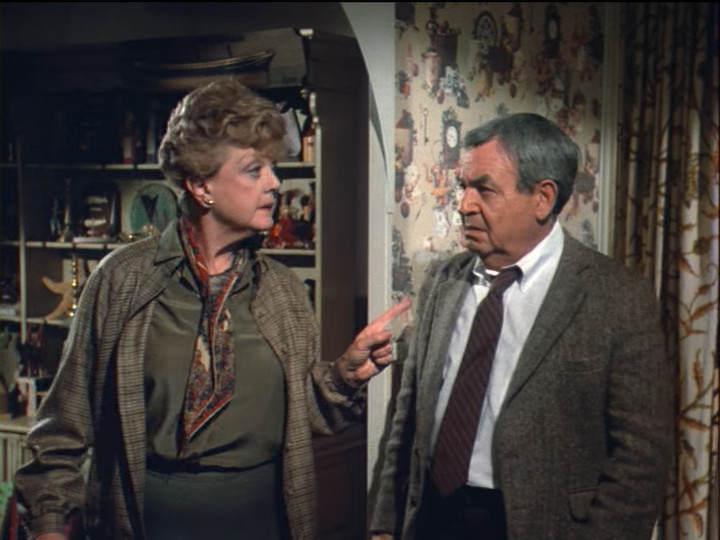
Murder She Wrote: Armed Response

On the thirty first day of March in the year of our Lord 1985 the nineteenth episode of Murder, She Wrote aired. Set in Texas, it’s titled Armed Response. (Last week’s episode was Murder Takes the Bus.)

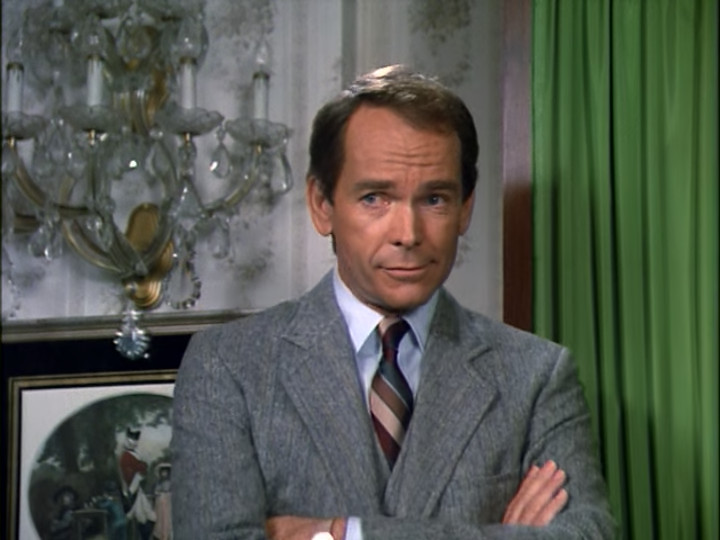
It opens with a voiceover of someone talking in a thick Texan accent telling the person on the other end of the phone to go to the jail and find someone. We then get a view of him:

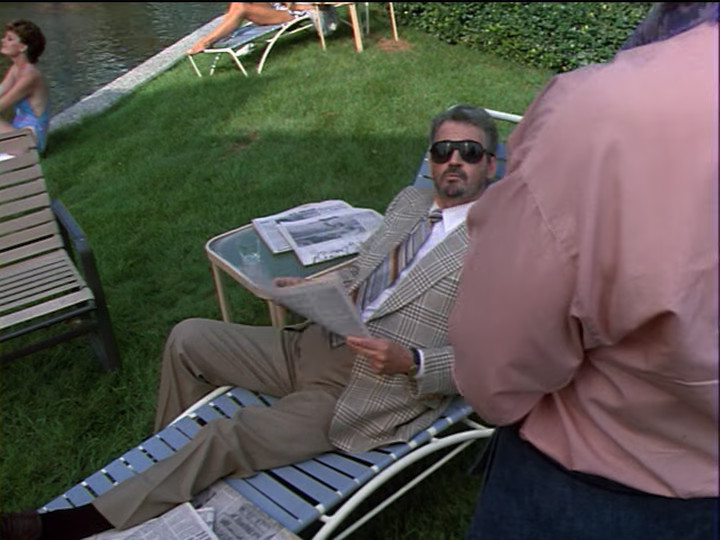
His name is Milton Porter and I’d say that he’s a walking stereotype of a rich, predatory lawyer… except he’s sitting down. They lay it on thick, but the specifics don’t matter. He’s really just a convenience to get the plot started.

He meets Jessica at the airport. She’s come to town to testify on behalf of one of his clients. On their way to his car, some kids run into an airport employee who falls into Jessica, knocking her down. Here I have to pause to show the stunt man playing Jessica:

That’s not even the right color of wig.

“Jessica” stumbles, then loses her footing, falling to the ground:
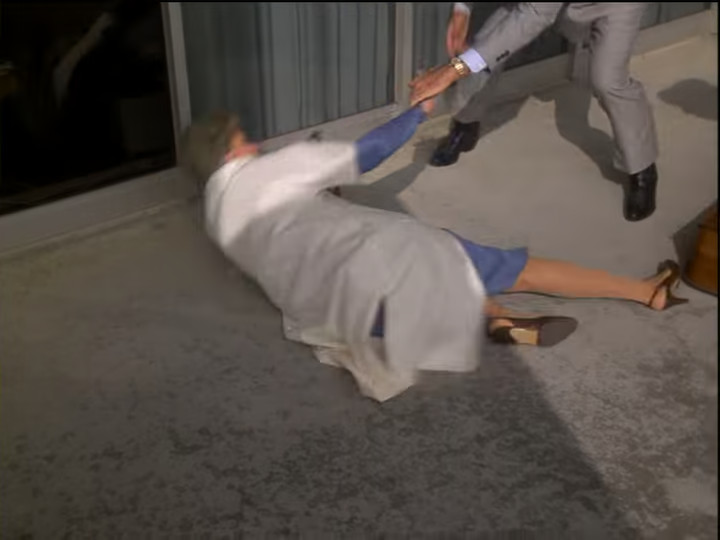
When she’s helped back up her left leg doesn’t feel too steady, so Mr. Porter packs her off into his limousine saying that he’ll take her to the fanciest hospital in Texas and promising that he’ll be able to win at least a $50,000 settlement from the airport for gross negligence. The first half of that is the important part…
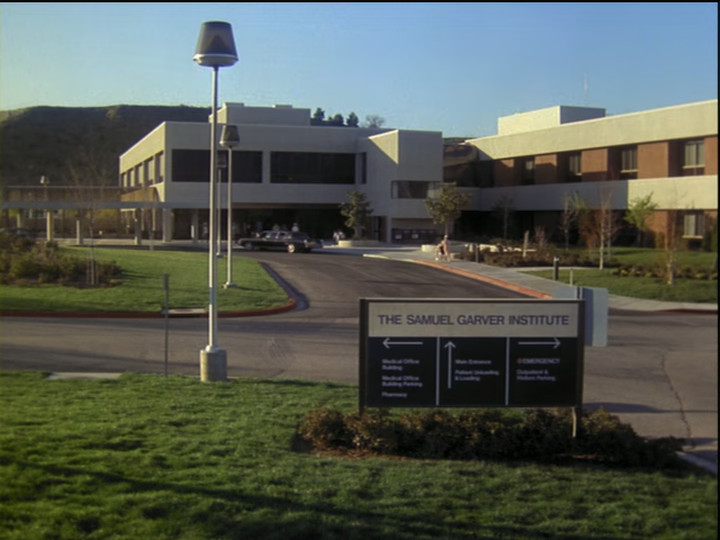
…because that’s how we get to the Samuel Garver institute, where the episode takes place.

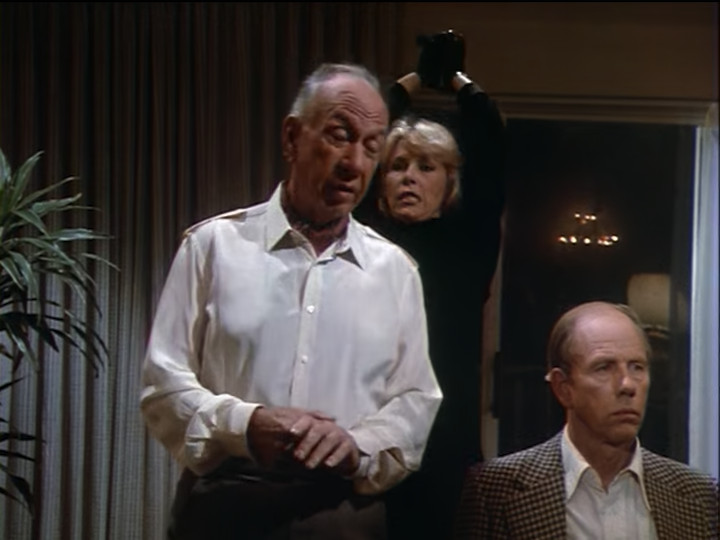
Then we meet Dr. Sam Garver and Dr. Ellison. (Dr. Garver is the older man, in front.)

And yes, Dr. Ellison is played by Martin Kove, who played John Kreese, owner and sensei of the karate dojo Cobra Kai, in The Karate Kid (the year before).

Anyway, Dr. Garver tells Jessica that she has a small fracture in the fifth metatarsal, but the good news is that she can be fitted with a walking cast. I’m a bit suspicious of this diagnosis since the metatarsal is in the foot and Jessica didn’t put any great weight or sudden impact on her foot. I’d have expected, if anything, some kind of torsional injury to her ankle. That said, I don’t think that this is supposed to make us suspicious of the doctors; it’s probably just medical lingo thrown in to make it sound doctory.

After some banter, Dr. Garver goes to leave and the nurse—her name is Jennie Wells—stops him and says that she wants to discuss a patient on her ward—Mr. Ogden.
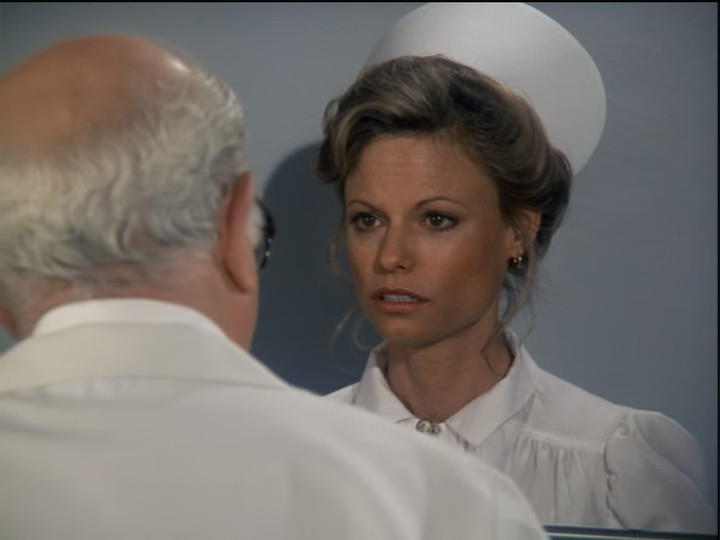
Ah, the days before HIPAA, when you can just discuss people’s medical conditions in front of complete strangers. Anyway, Dr. Garver tells her that there’s nothing wrong with Barney, and she says nothing that would show up on a chart, and he replies, very coldly and sternly, “How nice that we agree.”

After this, Dr. Ellison puts the cast on Jessica:

It seems to be a plaster cast, which is a little odd since they had fiberglass casts at the time and one would expect them to use more modern technology in such a high-end hospital. Anyway, he says that to be safe, they want her stay overnight. Wanting her to stay overnight for observation for a small hairline fracture strongly suggests that they bilk patients through unnecessary procedures, but Jessica seems to think that this makes sense.

She then identifies his accent as being from Chicago. She has a cousin who sounds exactly like him and was born and bred on the north side. Dr. Ellison sighs and replies that he’s from the south side. (The south side of chicago is poorer and more crime-ridden than is the north side.)

We then meet another patient:
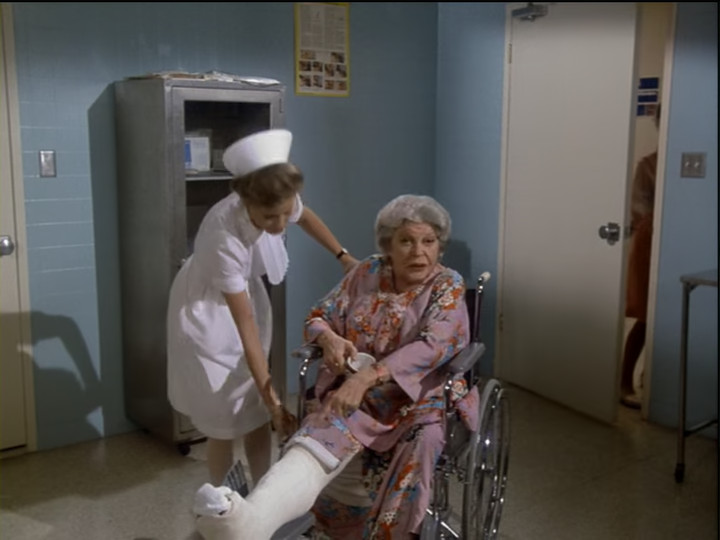
Her name is Mrs. Sadie Winthrop and she’s loud and gregarious and loud. Also talkative.

We then meet the head nurse:
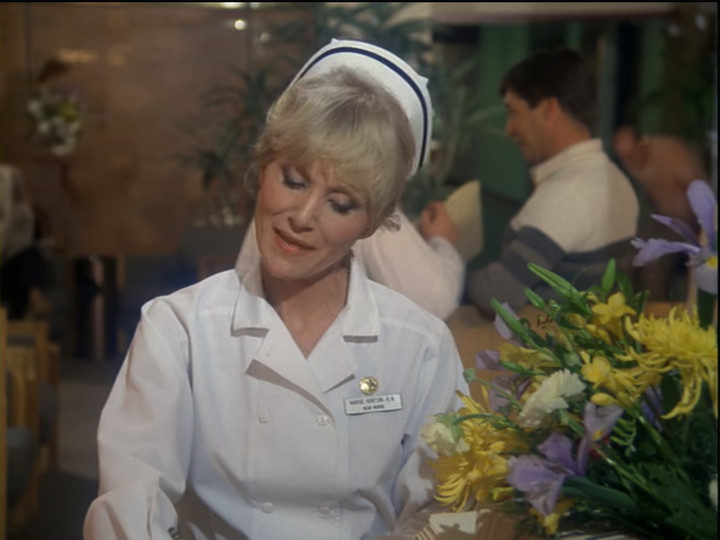
Her name is Marge Horton. She and Jessica chat about the weather in Texas vs. Maine, then Jessica tries to present her medical insurance card but Miss Horton says that they don’t deal with insurance here. (The lawyer stereotype is taking care of it and he expects the airport to take care of it.)

They then run into Dr. Wes Kenyon in the hallway:
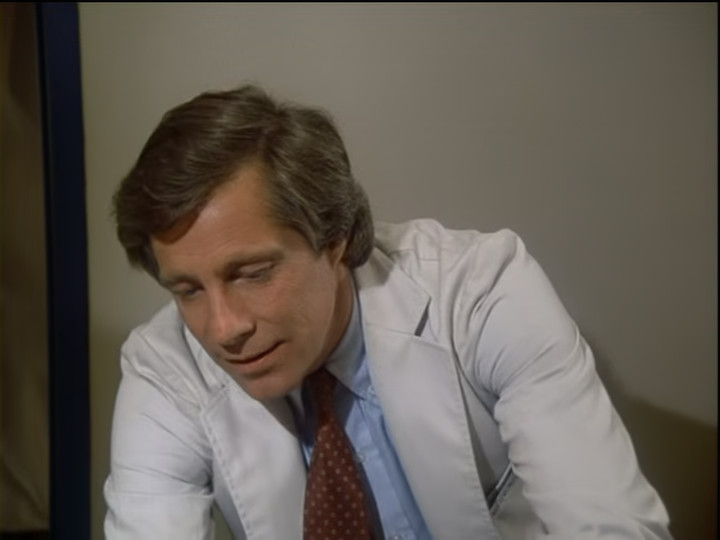
He takes a look at the cast and sounds concerned when he hears that Dr. Ellison applied it, though he can find no fault with it.

After he leaves and Jessica is wheeled to her room, she asks about his reaction and Nurse Wells tells her that Dr. Garver has a habit of destroying the reputation of anyone he fires and there’s a rumor that he’s bringing in a replacement for one of Ellison or Kenyon.

Later that night, at a party at Dr. Garver’s house, we witness a rich hypochondriac who doesn’t get along with her husband squabble with him in front of Dr. Garver and Dr. Kenyon.
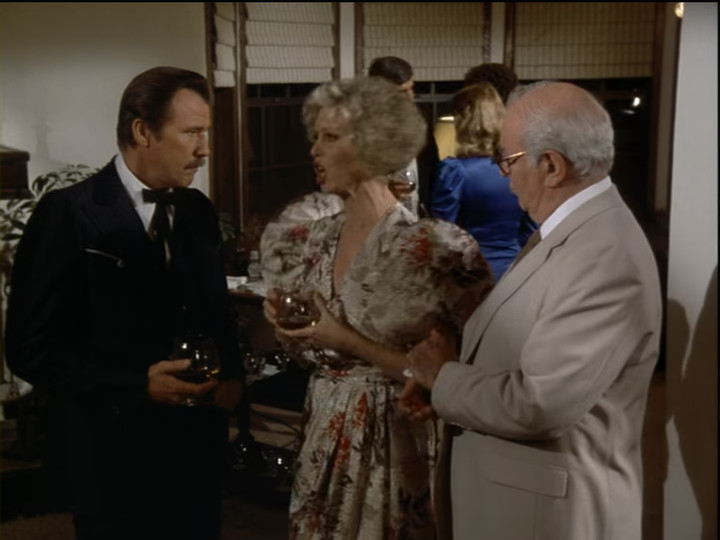
Dr. Garver excuses himself from this because of a telephone call which turns out to be from Nurse Wells, who says that she needs his authorization for some tests. He curtly answers “no” and tells her to never call him at his home again.

When he gets back from that, Dr. Kenyon tells Garver that he’s leaving as he’s on duty in 45 minutes. When he thanks Garver for inviting him, Garver replies that he’s inviting Ellison for brunch on Sunday, since he can’t play favorites.

Back at the hospital, Jessica meets Barney Ogden after unsuccessfully trying to buy something at one of the vending machines.

It seems a bit strange that she should have to buy something at a vending machine in a luxury hotel, but I suppose she needed to meet the other patients somehow. They actually lampshade this when Jessica goes to get change at the nurse’s station and Nurse Horton tells her that she shouldn’t be up and about and that they would have brought her tea. Jessica says that she didn’t want to trouble them because they’ve got too many people who are really sick. (I’m not sure that this is true.)

Just as a side note, Jessica is walking around on crutches with the leg in the cast held off the ground, despite supposedly being put in a walking cast. I doubt that’s supposed to mean anything, but it is strange.

Anyway, Doctors Ellison and Kenyon walk into the nurse’s area, arguing loudly. Kenyon then notices all of the people looking at them and tells Ellison that if he wants to talk they should do it in private. They then walk into an office and proceed to argue even louder. The walls and door are, apparently, quite thin, because everyone can still hear them.

We then fade to an establishing shot of Dr. Garver’s house, then we cut to an establishing shot of a security company, from which the episode derives its name:

I love the vinyl siding on the office building.

I can’t help but also show what the interior of the security office looks like:
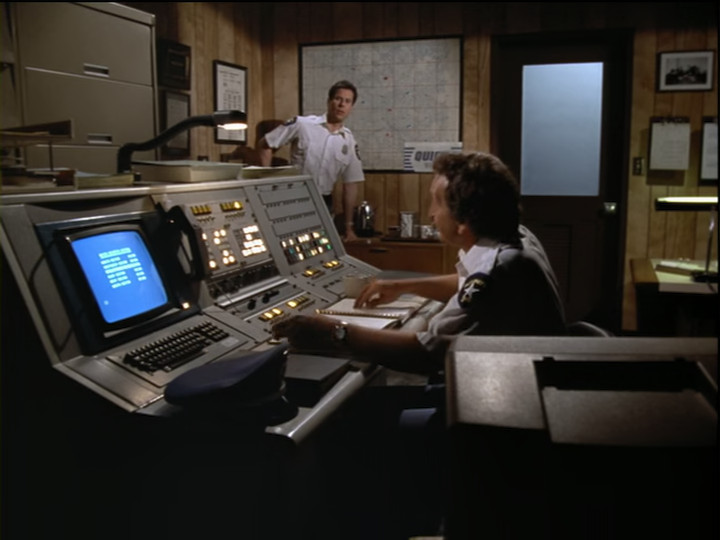
So many blinkenlights! And wood paneling!

I can’t imagine that this security office is even slightly realistic, but it is very evocative.

Anyway, the alarm for Dr. Garver’s house goes off and the guard sitting at the computer places the olbigatory phone call. When no one answers, the guard who was over by the map says that he’ll check it out. On his way to Dr. Garver’s house he comes to a three-way stop sign and sees Nurse Wells stopped at the stop sign, on the street to Dr. Garver’s place as if she just came from there:

This is quite suspicious, of course, meaning that Nurse Wells is definitely innocent.

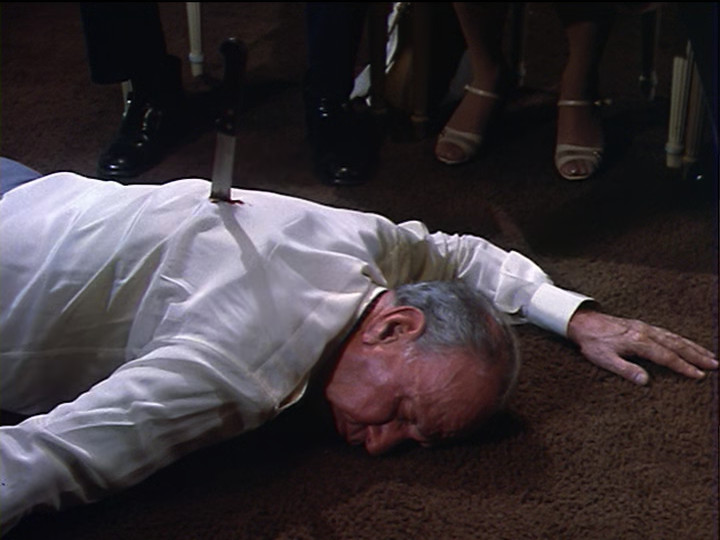
When the guard gets to Dr. Garver’s house he runs in and discovers Dr. Garver, dead:
The camera zooms in on the body in the pool, then we fade to black and go to commercial.

Had you been watching back in 1985, you might have seen a commercial like this:

When we get back from commercial we get an establishing shot of the Garver Institute, then we move inside where Jenny serves Jessica Dr. Garver’s “world-famous” apple flapjacks. After which Sadie Winthrop arrives. She asks for flapjacks and coffee. Jennie replies that she can have flapjacks but no coffee. Dr. Kenyon got the word from Dr. Sam that she’s been much too active. Until further notice, she’s being put on carrot juice. (Sadie does not like the look of the carrot juice.)

Barney Ogden then walks up and apologizes to Jessica about having been rude to her the night before. Jessica Demurs and Mrs. Winthrop tries to give him her carrot juice.

They then hear a scream and Nurse Horton runs through. Dr. Kenyon follows her but doesn’t catch up to her. When Nurse Wells asks what’s wrong, Dr. Kenyon tells her that Dr. Sam is dead. Murdered last night. The radio report he heard said that there was the possibility of someone having broken in.

When Jessica returns to her room, she meets Lt. Ray Jenkins.
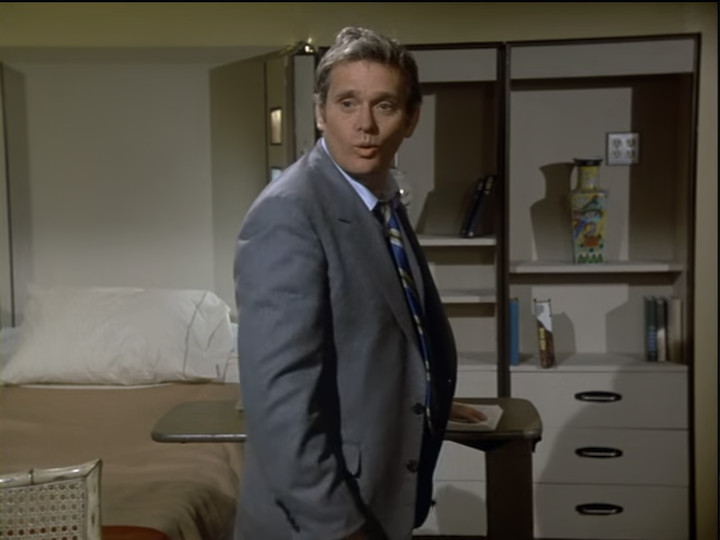
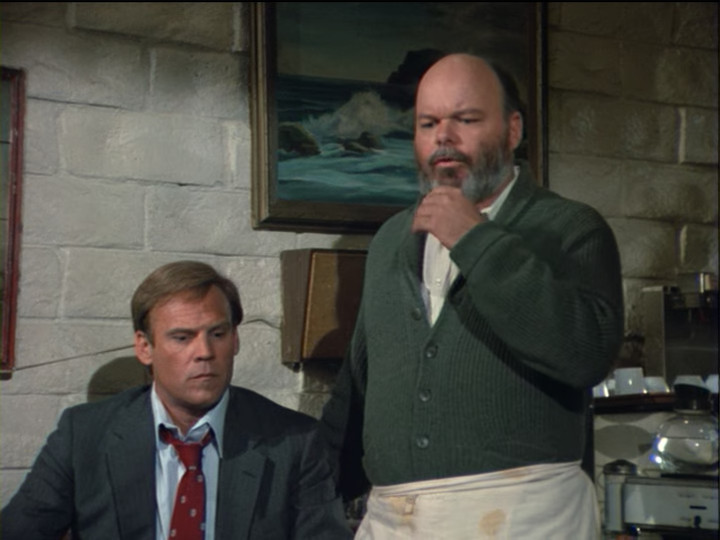
He’s the homicide detective in charge of the case and he’d like Jessica’s help. He’s not sure that the killer was just an intruder. One reason why is that the body might have been moved to the fish pool since the bullet entered at a forty-five degree angle which means that he was either sitting down or killed by an NBA center.

Lt. Jenkins has a good-ol-boy, shucks-ma’am style of speaking, but you do get the sense that it’s a Columbo-style attempt to be underestimated, not a lack of intelligence. When Jessica demurs, he tells her that he just transferred in from a rough neighborhood and doesn’t know how to talk to fancy folk like the ones at the hospital.

Jessica agrees and suggests that they start at the scene of the crime. Lt. Jenkins replies that it’s only five minutes away and the scene shifts to Dr. Garver’s house. There, he explains how the alarm works. I’m actually surprised by the amount of detail given; by the mid 1980s home security systems were far from universal but also far from unheard-of. And we already saw all the important parts anyway.

We do get some times, though. The alarm went off at 11:06pm and the officer arrived at 11:15pm. A next door neighbor thought that she heard a car backfiring a few minutes into the 11:00 news. (Backfiring, which is the rapid burning of fuel in the exhaust system, was more common in cars in the days before computer-controlled fuel injection and catalytic converters; older systems of mixing the fuel and air could easily lead to over-rich fuel-air mixtures and incomplete burning which allowed for the conditions for it to ignite in the exhaust. These explosions sounded somewhat like gun shots.)

The only other clue he has to tell Jessica about is that they found Garver’s keys by the front door. When Jessica asked what they were doing here Lt Jenkins replies that he must have dropped them. When Jessica asks why, because he was already in the house. Lt. Jenkins smiles…
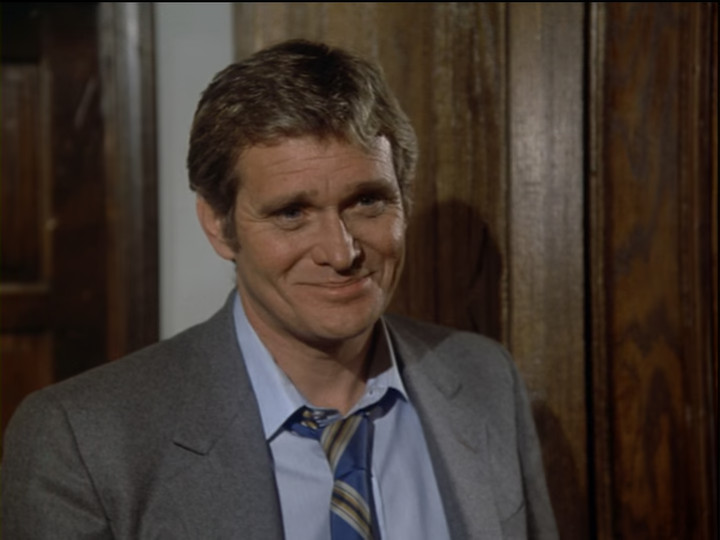
…then asks her, very dryly, “Got any ideas?” His manner strongly suggests that he knew perfectly well that it makes no sense that Garver’s keys were outside of his door and we’ve come to the part why he asked Jessica to come—that is, to the hard part.

Jessica chuckles as she realizes that she can’t get away with doing only the easy part then says that she’s sorry but she doesn’t have a glimmer of an idea.

Back at the hospital, Jessica is met by Dr. Kenyon, who tells her that they were just about to send a search party out for her. She says that her leg is acting up and asks for a wheelchair. Dr. Kenyon obliges and personally pushes it. On the way back to her room, he tells her that he wasn’t surprised by Dr. Garver’s death—Garver had a lot of enemies. In ensuing conversation, Dr. Kenyon says that it was generally understood that he was next in line to run the hospital. Dr. Garver didn’t say so explicitly, but the signs were clear.

Jessica brings up Dr. Ellison and Kenyon says that he’s never liked Ellison. There’s something dangerous about him—a street kid who couldn’t leave the streets behind. He also mentions that Dr. Ellison keeps a gun in his car. I’m not sure that this would seem that out of the ordinary in Texas, but Hollywood writers generally know nothing besides Hollywood. And, to be fair, Dr. Kenyon doesn’t have a Texan accent.

When Jessica asks if Kenyon is trying to suggest that Ellison killed Garver, Kenyon replies that he’s a doctor, not a policeman, and excuses himself. (In other words: yes.)

Jessica then drops in on Barney Ogden. She’s clearly curious about what’s wrong with him. Then Mrs. Winthrop drops in and tries to bully him into being happy. When she asks if he’s only here because he likes it and doesn’t he have someplace else he’d rather be, he replies that no, he doesn’t. His wife died nine years ago and he never had any children. All he’s got is a nephew who only wants his money and a few cousins in Alaska.

After this scene winds down, Jessica spots Nurse Wells being escorted into a police car. In the lobby Lt. Jenkins is thanking Nurse Horton for her help when Jessica arrives. Ray explains that she’s been taken in for questioning since the security guard spotted her about three blocks away from Dr. Garver’s house. When Jessica says that there must be some mistake, Nurse Horton tells her that one of her nurses saw Nurse Wells sneaking out the back way at around 11:00.

And on this bombshell we fade to black and go to commercial.

When we come back from commercial, the Lawyer stereotype shows up at the hospital in response to a summons from Jessica. She wants him to rescue Nurse Wells. After some back and forth, we get a bit of exposition—from an off-screen conversation that Jessica had with Nurse Wells. She did leave the hospital but only to talk to Dr. Garver. She arrived at 11:10 and there was no answer to her knock. (The lawyer stereotype balks at taking the case until Jessica threatens to not testify on behalf of his client that she’s in town to testify for.)

In the next scene Lt. Jenkins is calling Jessica from a payphone to let her know that Nurse Wells has been released. Jessica is delighted to hear this then says that she’d like another look at the crime scene.

As Jessica is waiting for Lt. Jenkins to pick her up, Dr. Ellison runs into her. She learns from him that the trustees of the hospital have named him and Dr. Kenyon to jointly run the hospital on an interim basis. She also finds out that Ellison was sure that the new doctor was to replace Kenyon. Garver didn’t like Ellison’s family tree, but he knew a good doctor when he saw one.

On the way over to Dr. Garver’s house, Lt. Jenkins tells Jessica that shortly before Dr. Garver died he called the hospital and left a message on Nurse Horton’s answering machine. He has the tape with him and plays it for Jessica.

Marge, it’s me. A couple of things for the morning. I’ll be in late. I want Peabody up and walkin’ no matter how much he complains. Second, get Sadie Winthrop on carrot juice. She’s too hyperactive for her own good. One other thing. That Nurse Wells is gettin’ to be a real problem—startin’ to think she’s a doctor. Now, find some excuse to get rid of her. Now I’m goin’ to bed. See you tomorrow. You take care now.

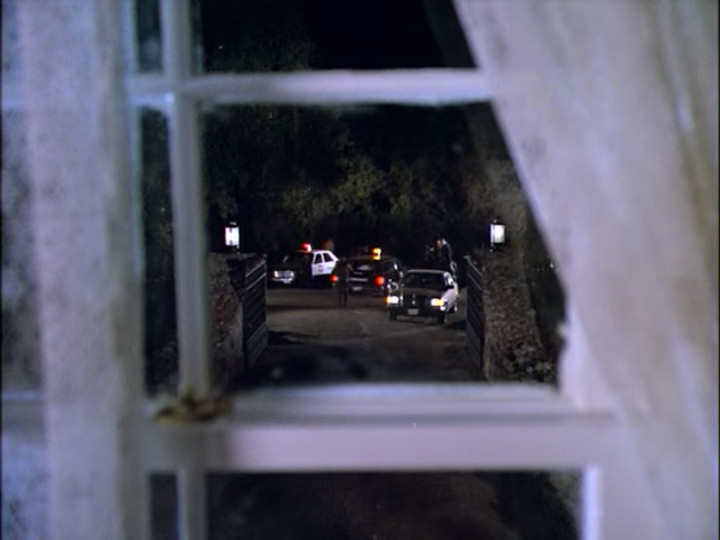
I really like the establishing shot of Dr. Garver’s house, by the way:

He was a rich man.

Lt. Jenkins tells Jessica that they already had Nurse Wells’ opportunity and now they have her motive. When Jessica says that this is rubbish, he asks why she’s defending Nurse Wells out of pure guesswork. Jessica replies that it’s called reading people.

This is interesting because Jessica deciding that someone is definitely innocent is a common occurrence in Murder, She Wrote. Jessica has the writers on her side so she’s always right, but it’s often hard to see what she’s going on other than the episode portraying the character as sympathetic.

Anyway, they go inside. Jessica looks around and says that the tape contradicts Jenkins’ theory that Garver was attacked while he was getting back from a walk. If he was going to bed, he must have been killed inside the house, which means that his body in the pool in the foyer was staged.

Inside they discuss some possibilities, then discuss the question of why the body was dragged out to the fish pool. Jessica says that the pond was heated because of the fish, which makes the time of death uncertain. Lt. Jenkins wonders at this because the neighbor heard the shot at 11:05 and the guard arrived at 11:16, so the time of death doesn’t seem very uncertain. Jessica then asks if he has any blanks for his gun.

They then stage the experiment where Jessica visits the neighbor while Lt. Jenkins fires the gun. They hear the shot and the neighbor says that it’s exactly like what she heard the other night. (There’s an annoying comedy bit where she’s sure that this isn’t really police business and there’s a hidden camera where she’s supposed to taste-test coffee or something.) The only thing is, Jenkins didn’t fire one shot, he fired two. The first inside the house, the second outside the house, the latter being meant to obscure the time of death.

That night at the hospital, Jessica visits Nurse Horton. After pumping her a bit, she reveals that she and Dr. Garver and an intimate relationship. She narrates how the day she learned of Garver’s death went. It’s sweet, but clearly here to give us the salient fact that she didn’t play the answering machine tape until later in the day. Then she’s interrupted by a nurse who tells her that the police are searching the locker room with a search warrant.

In the locker room Lt. Jenkins is there with some uniformed police offers and explains that he received an anonymous tip that the murder weapon was in Nurse Wells’ locker.

They find a gun—which Nurse Wells protests is not hers—in Jennie’s locker so Jenkins directs the officers to arrest and book Nurse Wells.

When Jessica tells him that he’s making a dreadful error, Jenkins replies that they have motive, opportunity, and now means. He says that they’ll let ballistics decide if it’s the murder weapon.

Jessica retorts, “Well of course it’s the murder weapon. Who ever heard of framing someone with the wrong gun?”

And on that bombshell we fade to black and go to commercial.

When we come back from commercial we’re at the lawyer Stereotype’s office. Jessica is telling him that the murder weapon was obviously planted in Jennie’s locker when Dr. Kenyon comes in. He informs the lawyer stereotype that the hospital stands behind Nurse Wells completely and that they will be responsible for any legal fees involved.

Back at the hospital, Jessica runs into Barney Ogden and Sadie Winthrop who are playing gin rummy together and clearly enjoying each other’s company. Barney is in remarkably good spirits as he wins the hand as Jessica walks up. A minute later Sadie gets carrot juice and this puts Jessica in mind of something. She goes off and calls Lt. Jenkins.

We then cut to Lt. Jenkins in front of the nurse’s station asking Dr. Ellison if the gun is his. Ellison denies even owning a gun, but Kenyon contradicts this. Ellison replies that he told Kenyon a lot of things, many of which were not true.

Jessica then barges in and begins angrily asking Lt. Jenkins what is doing. After a bit of bickering, she asks to speak to him privately and then goes into the same room that Ellison and Kenyon had their fight in. Lt. Jenkins follows her and the two begin yelling at each other.

Various people in the lobby comment on the fight, then Jessica walks up behind them and says hello, then calls out to the Lt. that he can come out now. Which he does, holding a boombox which is still playing their argument.

We cut to Dr. Ellison and Dr. Kenyon looking like they’ve been caught, but smart enough to not say anything. Then Jessica asks Nurse Horton whether they witnessed a similar scene two nights ago when Dr. Garver was killed. (She says yes, of course, since we obviously did.)

Jessica then goes on to produce the evidence: Dr. Kenyon switched Sadie Winthrop to carrot juice for breakfast on Dr. Garver’s orders but Nurse Horton didn’t play that tape until lunchtime. There was only one way he could have known about those orders: if he had still been at Dr. Garver’s house when Dr. Garver dictated them onto Nurse Horton’s answering machine. He must have killed Dr. Garver right after the phone call, but before 11:00. Then someone had to go to Dr. Garver’s house and fire the gun outside then set off the alarm during the very public argument behind closed doors.

Ellison breaks down and explains what happened. It was Kenyon’s idea but he went along with it. He then narrates what happened, which is basically what we already knew. Kenyon stayed behind and shot garver, then they staged the argument and Ellison went back and opened the door, setting off the alarm, and fired a shot into the air. He came in the same way he left.

The next day Jessica is walking to a car without crutches, talking with Nurse Wells. Jennie thanks her lucky stars that Jessica was here to help her and asks why they did it . Jessica says that it was simple survival. One was about to replaced and his career destroyed, but they didn’t know which, so they decided to put aside their differences and eliminate the threat that faced both of them. They only decided to pin the murder on Jennie after the fact. Jessica wishes Jennie well and then asks her to write and let her know how the love birds (Sadie and Barney) are doing.

As the final thing in the episode, the lawyer stereotype pulls up. He banters with Jessica and we learn that he’s taken on the case of defending Kenyon and Ellison. He wishes her farewell and as she gets into her taxi, she tells him, “See you in court!”

And we go to credits.
This episode had some really fun things in it and some really stupid things in it. Let’s start with the fun things.

The basic mystery was fun. A murder in a big, empty house with apparently tight timeline is always interesting. There were clues which weren’t obvious that turned out to be meaningful, such as the body being in the fish pool and the keys being found outside the house. The apparent alibi of the two most likely suspects was also interesting.

I also really liked Lt. Jenkins. I think that the character fell a bit short of his promise but he felt like a Columbo-like character, which is very interesting to pair with Jessica. Jessica is used to estimating the competence of the police to be very low—accurately, most of the time—so that part fits. Seeing her surprise, and the contrast of detective styles, was interesting. I wish that they had leaned into this more; it would have been fun to see Jessica having a little bit of competition and rising to the occasion.

Unfortunately, that’s about it for the stuff I liked.

I really disliked the lawyer stereotype. All of his scenes should have been replaced by more characterization of actual characters. (This is a knock against the writers, not the actor—he did a fine job with what he was given to work with.)

I also think that the character of Nurse Jennie Wells was a big mistake. Admittedly, she’s a pretty, young woman in trouble so she is automatically sympathetic, but this has to work against the character as she was written. She’s meant to be the kind of medical practitioner who cares and goes the extra mile, and we’re supposed to approve of her for it. In the end of the episode she asks Jessica how she can thank Jessica for saving her and Jessica replies she can thank Jessica by continuing in her career because medicine can use a lot more like her. The thing is, it really couldn’t. Nurse Wells never actually helps anybody—she just gets in the way of the people who are. The episode even spends several minutes showing us conclusively that Dr. Garver was right and there was nothing wrong with Barney Ogden. He didn’t need treatment, he just needed a friend. Running the tests on him that Nurse Wells wanted to run would have turned up nothing useful and created the possibility of misleading results that led to unnecessary treatment.

Moreover, calling the head doctor at home, then skipping on her shift and driving over to his house in order to talk him into tests was highly inappropriate. Doctors go off duty for several reasons. For one, they’re human beings and deserve time off. For another, they need to rest so that they can do a good job when they’re on duty. People who are burned out because they never rest don’t do a good job. It’s also the case that there is an on-duty doctor at a hospital who can handle any emergencies which come up. There’s no way to need emergency tests at 10pm at night and have to call an off-duty doctor rather than finding the on-call doctor and asking him. Even worse than this, a nurse doesn’t order tests and require someone’s permission to do it; the doctor is the one who orders tests. This is because doctors have trained extensively under supervision from other doctors in order to have a sense of what’s needed and what isn’t and the complex interplay of many different things. That’s not to say that doctors are always right and there’s nothing that would prevent a nurse from extensive study and gaining this knowledge on the side, but if she did this, it’s only reasonable to take the time to prove it to people before she asks them to trust her. But we’re given no reasons to believe that Nurse Wells has done any of this training and we are given reasons to believe that she hasn’t. The only beneficial things we actually see her do anyone are to push Jessica around in a wheelchair and serve pancakes.

Frankly, Dr. Garver was right to want to get rid of her.

Probably the worst thing about this episode was that the episode hinged on carrot juice replacing coffee. Everything about this plot point was stupid. First off, the order to put Sadie Winthrop on carrot juice makes no sense. She has a broken leg and she’s a fiesty, energetic woman who’s bored and looking for stimulation. She’s not active because she has coffee. She’s active because that’s the kind of person she is. Putting her on carrot juice will just make her more bored and make her look for more trouble to liven up her day. And it’s not even a problem if she is active—she’s got a broken leg that’s in a cast. As long as she’s not whacking things with her cast as hard as possible, she’ll be fine.

But even if we accept this, the next step was that Dr. Kenyon, who was hiding out at Dr. Garver’s house, listened to the message he left on Nurse Horton’s answering machine carefully enough to hear the instructions, then after murdering Dr. Garver, he still dutifully carried out Dr. Garver’s orders about the carrot juice when he knew that Dr. Garver had left them on an answering machine for someone else! He wouldn’t have done that if he’d just stayed late at the party because he lost his favorite tie-pin, because people don’t ordinarily rush to implement orders that were given to someone else. But after committing a daring murder, he decided that ridiculous medical instructions are the better part of valor and put the carrot juice order in himself, lest the patient have an extra cup of coffee in the morning before Nurse Horton heard the message and put the order into effect. As unscrupulous as he was to plan a murder instead of just securing another job before Dr. Garver could fire him, he couldn’t bear the thought of an excitable patient—moreover, a patient with a broken leg and not something sensitive to caffeine like a heart condition—having one extra cup of coffee. And if it weren’t for that level of dedication to his patients, he and Doctor Ellison would never have been caught!

This is almost Encyclopedia Brown levels of “you made one mistake.”

(To be clear, I like Encyclopedia Brown stories quite a lot; but they are highly simplified for their intended audience of children and mostly don’t stand up to exacting scrutiny because they rightly prioritize intelligibility to children over verisimilitude.)

Oh, well. Next week we’re in California for Murder At The Oasis.

Murder She Wrote: Murder Takes the Bus

On the seventeenth day of March in the year of our Lord 1985 the eighteenth episode of the first season of Murder, She Wrote aired. Set just outside of Cabot Cove, it was titled Murder Takes the Bus. (Last week’s episode was Footnote to Murder.)

The episode actually begins with Jessica and Amos discussing their travel plans to some kind of meeting of the Maine Sheriff’s Association. Since the car isn’t working and they’ll have to take the bus, they’re likely to miss the hors d’oeuvres, which disappoints Amos greatly.

But they should be there in time for the drawing—they’re giving away a big screen TV—and Amos feels that it’s his lucky night. (At the time, a “big screen TV” would have been a large, heavy cathode ray tube TV whose screen measured around thirty inches, or perhaps a little bigger. There were projection televisions of the time that might measure up to sixty inches, but they were extremely uncommon, especially because they had pretty poor picture quality, even by the standards of the day.)

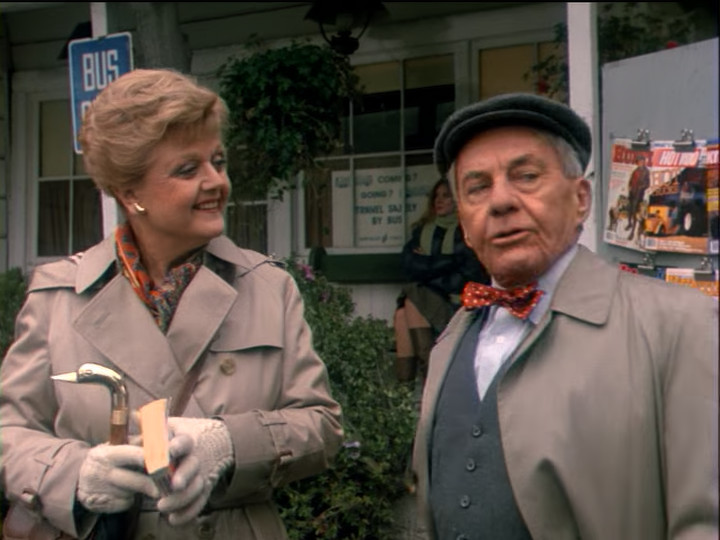
At the bus stop we meet a few characters. Here’s Cyrus Leffingwell. He’s got a thick Maine accent and likes local busses because you can sit back and enjoy yourself.

Also, from the smell of the air (and the occasional bit of thunder that we can hear) he predicts that it will be raining in twenty minutes.

A moment later the bus comes and people begin to board. Jessica is surprised to see a new bus driver, as a fellow named Andy Reardon normally runs this route. The bus driver explains that Andy has the flu.

There are not a great many people on the bus, but we get a look at a few of them.

This is Kent and Miriam Radford. Kent is a professor. Miriam recognizes Jessica—she’s a fan.

Sure enough, the storm overtakes the bus and it begins to rain hard before long.

Also, probably not entirely by coincidence, but unusual for Murder, She Wrote, the first shot we get of the bus driver’s face coincides with the guest star credit for the actor playing him.

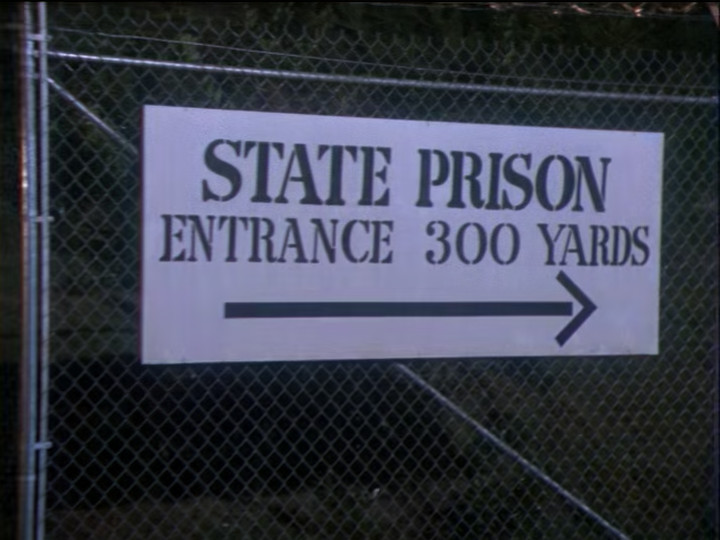
As the bus makes its way through the stormy night, it comes up to the state prison, where a man who has been standing in the rain hails the bus. We know it’s the state prison because of an establishing shot of a helpful sign:

The man gets on looks around, noticing something that gives him pause.

He’s going to Portland and doesn’t have a ticket, but apparently on this bus line you can pay the fair in cash. Which he does. After receiving his change, he silently walks to an available seat and sits down.

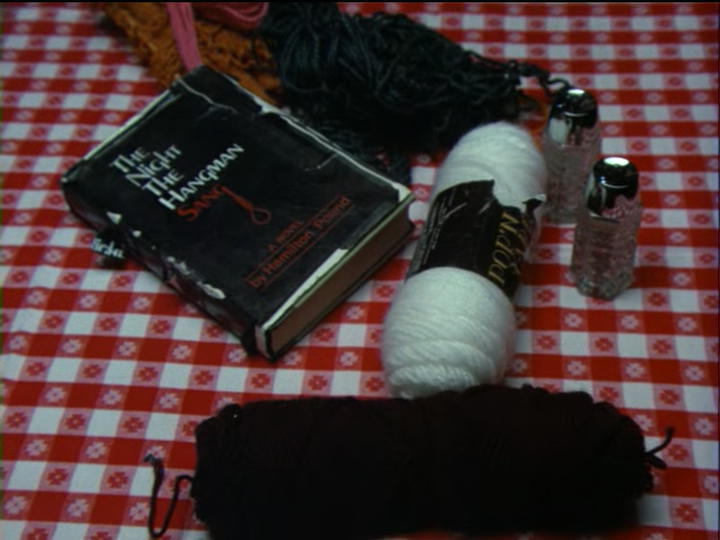
Jessica notices the book he’s holding.

The original shot was very dark and I could barely make out the title, so I edited it to increase the exposure. It’s a well-worn copy of The Night the Hangman Sang. (So far as I can tell, that’s not a real book.)

A bit later, they run into an obstruction. A man in a yellow raincoat boards the bus for a moment to explain that powerlines are down and while they can get through, they need to be very careful. There is also a fair amount of flooding. The road is open, but the guy doesn’t know for how long it will remain so.

Quite unusually for Murder, She Wrote, we’re about five minutes into the episode and still getting the occasional credit. This is quite the slow opening, though the suspensful music helps by letting us know that it is going somewhere.

After a while of the bus continuing on its journey, Miriam gets up from her seat and sits in one behind Jessica and introduces herself. She’s a huge fan and tells Jessica that she’s in Miriam’s top ten most stolen list—Miriam is a librarian. They’ve had to replace Jessica’s books dozens of times over the years.

Some time later, a man who just got out of a broken-down car hails the bus. He gets on and inquires the fair to Portland.

The bus driver asks if he was the one following the bus for quite some time and he replies that he was—he thought it would be safer with the bus taking the brunt of the storm. He adds that he’s now sorry that he passed the bus and finds a seat.

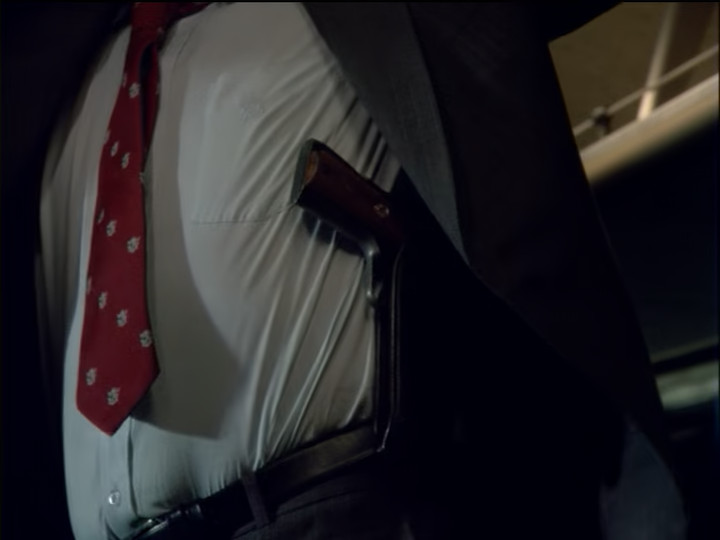
As he puts his coat into the overhead compartment, he inadvertently reveals that he’s carrying a gun.

Jessica notices, and some sinister music plays.

Some time later, the bus pulls up to a diner. The bus driver calls back to the passengers that they seem to be having some engine trouble. They’re welcome to get out and stretch their legs while he checks it out.

As the passengers shuffle off the bus, Jessica notices the name of the bus driver.

Inside the diner, as the people from the bus file in, we get some characterization. The owner of the diner is surprised to see them—he heard on the radio that the road was closed—but friendly. The professor (Kent) says some extremely nerdy things which confirm his professorhood. There’s also a little bit of bickering, which helps to establish how much people would rather get to their destination than be inconvenienced.

When Amos gets up to look at the menu, Jessica notices something in the bus out the window.

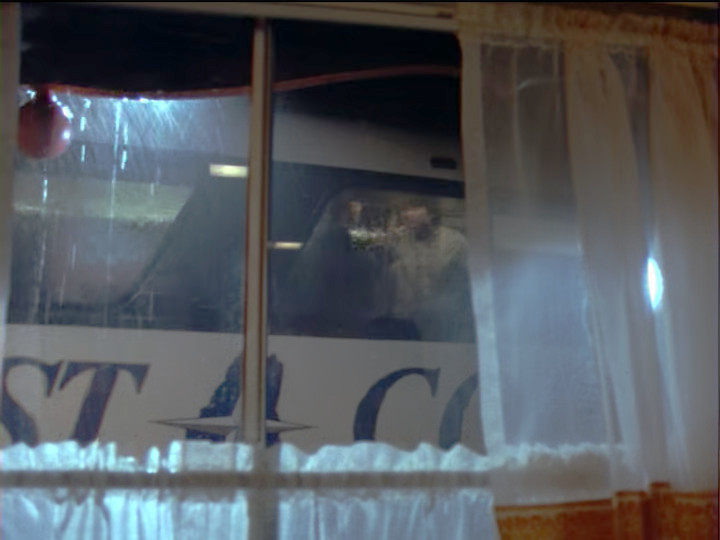
I’ve upped the brightness in the dark areas a bit, but even so, you can’t really tell who those people are. They do seem to be having a bit of an argument, though—there are some angry gestures.

A while later, after Jessica and Amos finished the pie that they ordered shortly after coming in, the bus driver comes in and says that they’re not leaving soon, he just needs to rest for a bit. Amos goes to a payphone outside to call Portland and let them know what’s up—it turns out Jessica is supposed to give a speech at the event—and Jessica goes out to the bus to get the book she was reading and forgot to bring in with her.

On the bus there is only the man who was picked up just outside of the prison, apparently asleep. When Jessica tries to wake him for some reason, his head lolls over and it turns out that he’s dead.

And on that bombshell, we fade to black and go to commercial.

Had you been watching in 1985, you might have seen a commercial like this:

When we come back from commercial break, Jessica has brought Amos and they’re examining the body. He suggests notifying the bus driver and not moving anything until the coroner arrives. Jessica convinces Amos to at least do a little investigating, even though he’s out of his jurisdiction, because the killer had to be one of the people on the bus and it will be some time until the authorities arrive.

Amos consents and checks the corpse’s pockets, but there’s nothing in them.

Jessica remarks that it’s ironic that the man should be killed the very day he’s released from prison. I don’t see how it’s ironic in any way, but they had to work in that he was recently released from prison somehow. Anyway, Amos objects that he could have been a visitor or a weekend guard. Jessica doubts it, though. He’s wearing a new suit, he has on new shoes, and paid for his bus fair with crisp new bills.

Looking around, they find his wallet on the floor. It contains the man’s release paper—his name turns out to be Gilbert Stoner—some money, an out-of-date driver’s license, and a photograph. Jessica concludes that someone was looking for something. Then she notices that Gilbert’s suitcase is missing.

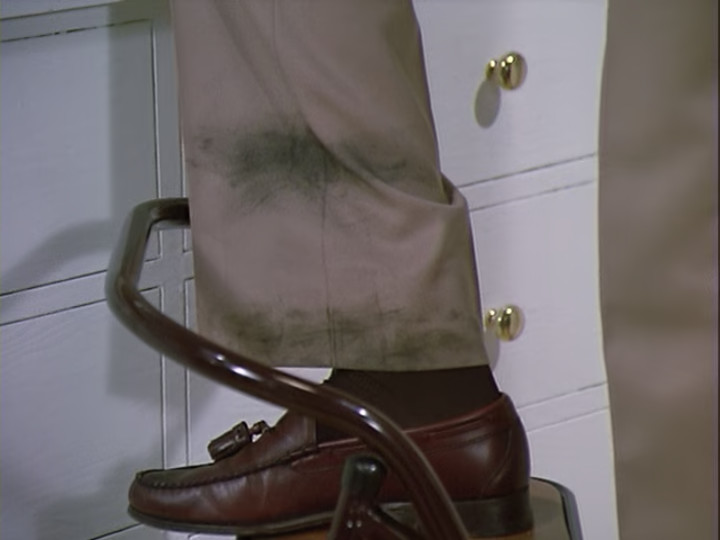
She then looks down at the body and in a flash of lightning she notices some smudge marks on his neck and on the collar of his shirt.

Just then Miriam comes onto the bus to get a book. She then sees the corpse, screams, and nearly faints.

The scene then shifts to some time later with Kent comforting his wife and her crying about how awful it was. Cyrus then walks in and says that he tried to call the police but the phone line appears to be dead.

The owner of the store brings out some coffee for everyone and tells them that it’s on the house (an expression meaning that the store is paying for and there’s no charge to the people receiving it).

Amos then gets up and introduces himself. While he has no jurisdiction here, he has an obligation to assume authority until the local police arrive, and he hopes that they will cooperate.

Jessica then remembers where she heard the name “Gilbert Stoner” before. It was during some research she did for a book. He was involved in a robbery in a bank in Augusta. (Augusta is a town in Maine, about fifty miles north-east of Portland.) This rings a bell for Amos—the Danvers Trust Company.

The owner of the diner speaks up, saying that he remembers that being all over the TV for weeks…

…about fifteen years ago.

Kent then rattles off some information about it. Three men pulled it off but were apprehended. Cyrus concurs, though he says, “at least one of them was.”

At Jessica’s prompting, Amos then asks for everyone’s names, why they were on the bus, and where they were at the time of the killing. There is some grumbling at this and someone remarks that, “Obviously, he thinks that one of us killed him.”

Amos replies, “I think ‘obvious’ is the right word, sir. Unless, of course, this Stoner fellow somehow managed to reach up behind his head and stab himself in the back of the neck with a 10-inch screwdriver.”

Amos sometimes has a way with words.

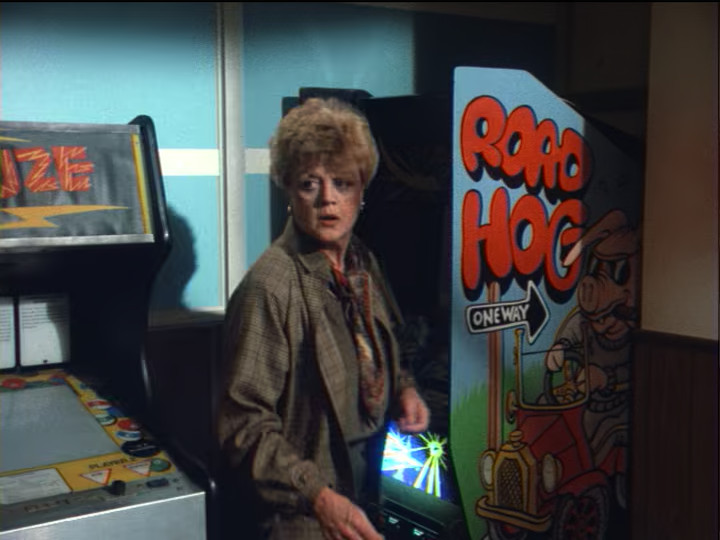
Kent and Miriam introduce themselves—he’s an associate professor of Mathematics and she’s a college librarian (the head librarian, she points out). They’re on their way to Boston to do some research. Kent says that he was in the “video alcove” playing “Road Hog.”

Cyrus says that Kent is telling the truth—he heard Kent playing the game while he (Cyrus) was in the gift shop. Why a diner would have a gift shop, no one says. Cyrus mentions that he’s from Woonsocket, Rhode Island, is a retired mailman, and has no idea who the poor dead fellow is.

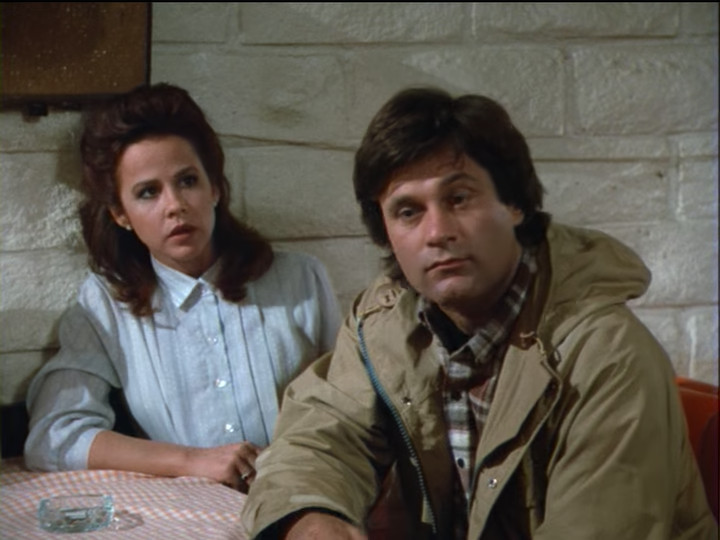
We then meet a young couple who have been on the bus and occasionally bickered in terms sufficiently suspicious-sounding that I was immediately convinced that they’re red herrings.

He’s Steve Pascal and the woman is his wife. Her name is Jane. He’s a computer engineer and they’re on their way to Portland. She was inside the whole time and he was outside trying to use the public phone. He couldn’t get through and eventually the line went dead.

Jessica interrupts to say that she saw him through the window having a heated discussion with Stoner on the bus. Pascal replies that it wasn’t heated at all—they just exchanged a few words, no more.

We then meet Joe Downing.

He’s captain of the fishing trawler MarySue, out of Gloucester. (Somebody had fun with the names, here.) He’s going back to his boat after having visited family, and like Cyrus, had never heard of Stoner before. He was in the bar, having a drink. (Earlier, he asked the owner of the diner if it was possible to get a drink and the diner owner said yes, but he’d need a few minutes to open the bar. This diner has a remarkable number of amenities.)

We then meet the guy who got on the bus after his car broke down. His name is Carey Drayson. He was in the men’s room drying off his clothes on the radiator. He adds that if his car hadn’t skidded off of the road, he wouldn’t have been there.

Jessica asks why he’s carrying a gun and in response he shows Amos his permit to carry a concealed weapon. He’s a jewelry salesman and needs to protect himself since he carries valuable jewels in the case he keeps with him.

The Sheriff then asks the bus driver about the screwdriver. He replies that he left the toolbox open in the front of the bus and anybody could have taken the screwdriver out. He was working on the engine the entire time so he wouldn’t have seen. He thought he heard some people get on and off the bus, and he heard some raised voices, but he didn’t pay attention.

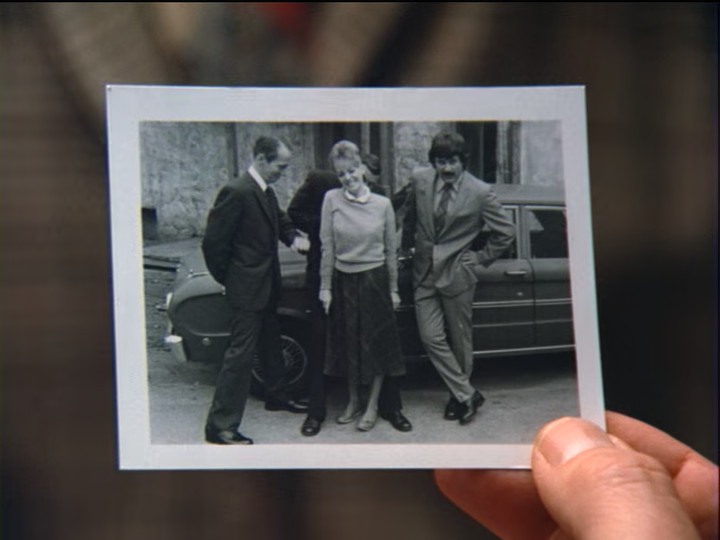
Jessica then questions Steve Pascal. She says that he was lying about his conversation with the victim being peaceful. She further says that his resemblance to one of the people in the photograph that the victim was carrying is probably more than coincidental.

Without saying anything Steve gets up and takes a look at the photo.

I can’t say that I see the resemblance.

He looks for a bit, then says that he doesn’t have to answer Jessica’s questions, or anybody else’s either and walks off.

Jane (his wife) comes and looks at the photo. She protests that she knows that Steve didn’t kill Stoner. Amos asks who the man in the photograph is—he doesn’t specify which of the three he means—and she replies that “he” was Steve’s father. He was killed in the Danvers robbery along with an innocent bystander. The innocent bystander was a woman, but she doesn’t know more than that. Stoner and the other man got away, but they caught stoner three days later. They never caught the other man and never recovered the money from the robbery.

Jessica goes to investigate and we get some shots of various parts of the diner.

Jessica ascertains that the Road Hog video game makes plenty of noises as if one is playing even while no one is there—that was fairly common for arcade games of the time.

We also see a bit of what I assume is the gift shop:

Down at the end of the hallway is a door leading to the outside:

Amos counts it up and nearly every area anyone was in at the time of the killing has a door to the outside (the bar and kitchen do as well). Which means that anyone could have done it. They then decide to check outside.

In the bus, Amos notices a light on that concerns him. It suggests that a “damper switch” is on. (Amos mentions that he worked as a bus driver for a summer before he joined the police force.) Jessica then goes around checking the doors and finds that the door to the kitchen is unlocked. She checks the next door (the one to the hallway) but before she can open it she notices some clothing on the ground. As she investigates the door open and Steve is there, glaring at her and looking as ominous and menacing as humanly possible.

And on that bombshell, we fade to black and go to commercial.

When we get back from commercial Steve says that he wanted to talk to Jessica and she replies that she thought he might. He apologizes for losing his temper but he didn’t kill Stoner. She doesn’t acknowledge this but instead asks him to help her get the suitcase inside—it is Stoner’s, and getting wetter by the minute.

Inside, she and Amos inspect the clothing while Steve and his wife watch. After they don’t find anything, Jessica asks what the argument was about.

Steve said that the bank robbery ruined his life—he was in junior high when his father died and from that moment on he was the son of a thief—and he took the bus because he wanted to meet Stoner and demand his father’s share of the money. But when he met Stoner, he found that he was a wreck of a man. The robbery destroyed Stoner’s life as it had Steve’s father’s, and he (Steve) decided then and there that he wasn’t going to let it destroy his, so he just walked away.

Jessica asks how Steve knew that Stoner would be released today. In reply, Steve pulls out the newspaper clipping that announced it. Amos reads the clipping aloud, as it gives some more details. The innocent bystander who was killed was Julie Gibbons, who was 16.

The coincidence of the girl’s last name and the bus driver’s last name is not lost on anyone. And Amos tells Jessica that he had figured out who did it half an hour ago—presumably a reference to what he found out when he investigated the bus.

Back in the main part of the diner, Amos makes a citizen’s arrest of Ben Gibbons. He explains that he noticed that the damper switch was thrown—and explains that the damper switch is to be used only in an emergency of the engine running away. Once it is thrown, the engine cannot be restarted until the damper switch is reset by hand. The damper switch reset is way in the back of the bus and cannot be reached except by some kind of tool like a very long screwdriver. Which Amos takes to mean that the bus driver needed to take the screwdriver out himself and so no one else took it because he had it the whole time.

There are some flaws in this logic. While the damper switch being thrown does suggest that Ben threw it in order to waylay the bus, if the damper switch had not yet been reset by the time Amos inspected it, that means that Ben did not reset the damper switch and so there was no reason to conclude that he must have had the screwdriver. Also, Ben wearing a rain coat suggests that he was working outside the bus, and Amos seemed to go outside when he saw the damper switch light and excused himself to go look at something. So to murder Stoner inside the bus, Ben would have had to take out the long screwdriver then go inside the bus to murder Stoner then leave the screwdriver there for some reason. All quite possible, but none of that is an obvious conclusion from Ben having sabotaged the bus.

Anyway, Jessica interrupts to ask Ben a question about the Danvers case—she points out the last name of the girl who was killed. He admits that Julie Gibbons was his daughter. He dreamed about revenge every day since she died. When he heard about Stoner’s release he switched routes with the regular bus driver and did fake the breakdown. He worked on the damper until Stoner was alone. Then when he went back in the bus, Stoner was sleeping like a baby. This enraged him so much that he stabbed Stoner in the neck with the screwdriver.

When Cyrus says thanks God that this ordeal is over, Jessica gives him the bad news that it isn’t. Ben may be convinced that he killed Stoner, but Stoner wasn’t sleeping when Ben stabbed him. He was already dead. There was very little blood on the screwdriver and around the wound because he had been dead at least fifteen or twenty minutes already and the blood had begun to settle in the lower parts of the body. She’s convinced that the coroner’s report will show that Stoner died of strangulation.

After Amos goes outside to try the pay phone again (the line is still out) the Diner owner remembers that his son has a CB radio in the back room. He has no idea how to use it but if anyone here does, they’re welcome to try. Carey Drayson, the jewel seller, says that he knows. He, Amos, and the owner of the diner go off to try. Jessica notices that Carey left his briefcase on the table.

Some time later, when Carey is alone in the room trying to hale someone on the CB, Jessica comes in and remarks that he’s awfully careless with his jewels, if indeed there are any in his briefcase, which she doubts. When she asks if Sheriff Tupper can take a look in it, he says not to bother and hands her his real business card.

This diner has an amazing variety of rooms in it.

He’s an investigator for the company which insured the Danvers Trust robbery. He was assigned to follow Stoner in the hopes of being led to the money. That’s been made more difficult, but he holds out hope that if they find the killer it might lead to the money. Jessica, however, isn’t so sure that it’s that simple.

Back in the main room Jessica and Amos discuss the case over coffee. Clearly, somebody was looking for something in Stoner’s briefcase, but did they find it? And where was the overcoat and the book? Why weren’t they with the suitcase?

On a hunch, Jessica says that they need to go back to the bus. There, Jessica realizes that Stoner’s body isn’t in the seat he was sitting in on the trip. He had been sitting several rows back. In that seat, Jessica finds the overcoat and the book.

Back inside, Jessica examines the book. She finds it very strange that while the dust jacket is in tatters, some of the pages aren’t even cut. (Books printed in print runs, as all of the books back in the 1980s were, use extremely large sheets of paper that are then folded up into signatures and cut. This cutting process is occasionally imprecise and leaves a folded edge intact, requiring the reader to cut it himself. By the 1980s this kind of manufacturing defect was rare, but not unheard of. I can recall having to cut a page, once.)

The power then fails. The owner of the diner tells everyone to not worry—he has a generator out back. He and Amos go together to get it started. In the dark, someone leaves the room but we can’t see who. Moments later, a shot rings out and Jessica says that it came from the office where Mr. Drayson is. The power comes back on as she gets to the office. As Amos arrives, we see Jessica examining a wound in Mr. Drayson’s arm.

This has to be the most spacious storage closet a diner has ever had.

As others come in, the diner owner notices that someone smashed up the CB radio.

Jessica adds that whoever it is now has the gun. And on that bombshell, we fade to black and go to commercial.

When we come back, Amos searches each person but no one has the gun.

As Jessica is bandaging up Casey, Captain Downing takes over the work when Casey complains of pain, explaining that a sailor needs to know how to care for himself and his mates, since when you’re at sea you’re an island unto yourself, so to speak. Jessica admires his work. I can’t help but think that this means that he’s the culprit and gave himself away by tying a landlubber’s knot rather than a seaman’s knot, or something like that, but Jessica doesn’t say.

She then notices that Stoner’s book has disappeared. After a bit of discussion, Jessica accuses Miriam of stealing it because it was rare and she knew its value. (Miriam has made small talk more than once about how little money she and her husband have.) Insulted, Kent dumps Miriam’s knitting bag out on the table to prove Jessica wrong, only to prove her right.

Miriam took it because it’s extremely rare and worth nearly $2,000. It would be worth more but the dust jacket and binding are in terrible condition.

Jessica finds the part about the binding interesting because Stoner clearly didn’t buy the book to read it. She examines the binding and finds that a safe deposit key had been stashed in it.

Jessica then asks Captain Downing if that’s what he had been looking for. She then adds, “Or should I say Mr. Downing, or whatever your name really is. I think you can drop the pretense of being a sailor. A real sailor would have tied a square not, not a granny, as you did.”

(Square knots and granny knots are very similar, but the square knot reverses the direction of the second wrap-over from the first and results in a more secure knot.)

Captain Downing then pulls the gun out of Amos’ overcoat—Amos exclaims at this and Captain Downing replies that he figured Amos wouldn’t look in his own pocket. A gust of wind blows open the door, distracting Downing, and Amos and Steve, working together, manage to overpower him.

When the situation is resolved, Downing exclaims that they won’t be able to pin Stoner’s murder on him. Stoner was already dead when he searched his things for the key. He admits to being the third partner, but Stoner double-crossed him and hid the money. He protests that it is absurd to think that he killed Stoner under these circumstances, though, when he’s stuck here like a rat in a cage. All the authorities needed to do was find out who he was and his motive would put him away.

Jessica then figures it out. She says that Downing is telling the truth and Amos was right all along. It was Ben Gibbons who killed Stoner. She thinks he didn’t mean to kill Stoner, but it can be proved. There were grease marks on Stoner’s collar—which never would have been there if Ben had merely stabbed Stoner, as he said.

Ben sits down and confesses. He hadn’t originally meant to kill Stoner. He just wanted him to know how much hurt he had caused. But Stoner was cold. He said he didn’t care about some dumb kid that got in the way and he’d done his time and there was nothing anybody could do. This enraged Ben so much he grabbed Stoner by the neck and didn’t let go until Stoner was dead. When the rage passed he realized what he had done and that he was no better than Stoner had been. When he saw the Captain get on the bus he figured he was a goner, but to his amazement the captain only rifled through Stoner’s things and stole his suitcase. After a few minutes of wondering what to do, he realized that he needed to stab Stoner with the screwdriver. The coroner would figure out that wasn’t how Stoner died, so that was the only way to escape, since the police would surely look into people’s backgrounds and prior relationships.

The next day, in better weather, the local police take Ben into custody. Cyrus Leffingwell remarks to Jessica that he feels sorry for Ben. Jessica concurs, saying that a good lawyer may be able to make the case of temporary insanity, and that perhaps it would be justified. Leffingwell asks if she and Sheriff Tupper will be joining them on the bus but she informs him that they’re going back to Cabot Cove so he bids her a fond farewell and she says that the pleasure of their acquaintance was all hers.

Amos then comes up and fills her in on what they missed in Portland. When Jessica didn’t show up one of the Sheirffs who loves the sound of his own voice ad-libbed a speech for over an hour. And he knew that they should have been there for the drawing for the big-screen TV. When Jessica tells him that she’s sorry for him, but he’ll survive without it, he replies that it wasn’t his name which came up, it was hers.

And on Jessica’s reaction to that we go to credits.

I really liked this episode. I mean, how do you not love a mystery set on a dark and stormy night?

Actually, it’s not that hard, given that plenty of bad mysteries have been set on dark and stormy nights, but none the less it is a great element to a story. And the broken down bus at the diner really cements the isolation and gives us the fun of a very limited cast of characters and short windows of opportunity. It even has a minor flavor of Murder on the Orient Express to it, in how many characters turn out to be related to the dead man.

The downside to the great setting with the tight constraints that really increase the intrigue is that it makes the writer’s job much harder, and they were at the limits of their ability. For example, why did the bus driver wait until Stoner was alone? There was no great likelihood of him ever being alone. It was established that Stoner was afraid of his former partner and the best way to avoid being alone with his former partner was to avoid being alone. Now, there was no way for the bus driver to know that Stoner’s former partner would be on the bus, but people in storms don’t usually try to isolate themselves.

I do think that this can be worked out, though. If the bus driver had done research and found out that this diner was the world’s largest diner with a maze of rooms, after enough hours waiting it would have been reasonable for him to take breaks from working on the engine and people will eventually find some way to entertain themselves, so he could probably have eventually found a way to get at Stoner that at least wasn’t too likely to be overheard, even if just because everyone had drifted to different places and nowhere had more than a few people in it. Which should have been sufficient for his purposes, if he really only wanted to tell Stoner how much pain he had caused and wasn’t originally planning to kill him.

But why did Stoner remain alone on the bus? He had no reason to and significant motivation to not do that. Speaking of people who probably shouldn’t have been on the bus, why did Steve bring his heavily pregnant wife on the bus to confront Stoner? Also, why did he wait until the bus broke down? He’d have had no way to know that the bus would brake down and it would be far more natural to go sit next to Stoner shortly after he got on the bus. That would have prevented Stoner from getting away, while waiting for a bus station would have made it easy for Stoner to refuse to talk to Steve.

The safe deposit box key is also a problem. Safe deposit boxes require the regular payment of a fee to maintain them. There are grace periods and such, but there’s no way that Stoner was able to pay them from prison for fifteen years. Among other things, if he tried, the authorities would have found out about the safe deposit box and issued a warrant for it. And while there are grace periods for abandoned safe deposit boxes, after fifteen years the contents of the box would have been long-ago escheated to the state. Even before that, the bank would have opened and inventoried the abandoned safe deposit box. Since that would have been only a year or so after a notorious bank robbery, there’s a good chance they’d take a look for obvious things like consecutive serial numbers and contacted the police to check. Banks are required to report transactions over $10,000, so the discovery of $500,000 in cash would certainly raise a few eyebrows. This last part is pretty fixable, though—instead of a key to a safe deposit box Jessica could have found a map to where the money was wrapped in several layers of sealed plastic bags and buried in a chest. That would have been a lot more fun, too.

Which brings me to the question of who killed Stoner. I think that it was a pity that it turned out that the bus driver actually killed Stoner. It would have been more fun if it had been the Captain. A simple revenge killing isn’t properly the subject of a murder mystery. A proper murder mystery is based on the misuse of reason towards some end that should be thwarted. (Revenge for a killing that the criminal justice system will never address is enough of a grey area to make it less fun.) Had the captain been the murderer, it would have been more fitting in this regard. And despite the captain’s protestations, it would not have been stupid to have killed Stoner at the diner. No one knew that there was any connection between them—that’s the whole reason that the captain was never caught. He could also have had a double-motive: he could have been reasonably prosperous and afraid of Stoner blackmailing him. The statute of limitations would have been up but it coming out that he had been part of a bank robbery gang that got an innocent girl killed would have cost him quite a lot—respectable people would have wanted nothing to do with him. Some people will do a lot to avoid losing social status.

One final nit I have to pick is the question of how did everyone know that Stoner would take this bus? They established that it was made public when Stoner would be released, but in 1985 it would not have been easy to find out that the only thing someone released from that prison can do is to take the bus and that there’s only one bus which comes through in the evening. Which is, itself, a bit odd, since prison releases usually happen in the morning and one could reasonably expect some kind of regular transportation to and from the prison for staff and visitors. Those would mostly be local busses, of course, so this could probably be fixed by having people in the know aware that Stoner needed to get to Portland as fast as possible and so would wait for the one bus coming through that would take him there. I do understand why, for brevity, they didn’t address this—I like to describe Murder, She Wrote as a sketch of a murder mystery—but even under the best of conditions it is a bit of a problem.

Speaking of it being a sketch of a murder mystery, they never explained Stoner’s relationship to Julie Gibbons’ death. Jane describes it as, “[Steve’s father] was killed during the Danvers robbery. Along with an innocent bystander. A woman.” The newspaper article that talks about Stoner’s release says, “During the thieves’ escape attempt, an innocent bystander, Julie Gibbons, 16, was killed, along with one of the criminals, Everett Pascal.” They’re both rather conspicuously in the passive voice, but it sounds more like Julie was shot by the police when they were shooting at the robbers, not like the robbers killed her. Which would still make the robbers morally responsible for her death, but probably wouldn’t make them responsible for it in their eyes, making Stoner’s provocative response unlikely. “Hey, I’m sorry about your daughter’s death, but I wasn’t the one who shot her—the people who shot her were shooting at me, and I really wish she hadn’t been near us. She seemed like a good kid.” That kind of thing can go a long way to making an angry father less dangerous, and Stoner certainly gave the impression of a coward. Plus, had he actually directly killed the girl during an armed bank robbery, he probably would not have gotten out of prison after just fifteen years.

Setting the plot aside, there were a number of good characters in this episode. Cyrus Leffingwell was a lot of fun. It’s always nice to have an imperturbable character with sense in a murder mystery (other than the detective). Steve was played a bit too angry for my taste, but I very much liked his character arc. Carey Drayson had the beginnings of a good character, though after establishing him the episode mostly just uses him as a plot point and nothing more. The characters of Kent and Miriam were also interesting—they were big characters full of personality, but who had nothing to do with the murder. It’s helpful to have some counterpoint characters in a story. It’s both good for the story and also serves the practical point of not making the murderer obvious by being the only character. Of course, the temptation for the writer is often in the opposite direction—of making the murderer barely a character at all. Which is closer to what we got here—Ben Gibbons didn’t have much of a personality, though Michael Constantine did convey a lot of anguish non-verbally.

Next week we’re in Texas for Armed Response.

Murder She Wrote: Death Casts a Spell

On the thirtieth day of December in the year of our Lord 1984, the eighth episode in the first season of Murder, She Wrote aired. Called Death Casts a Spell, it is set in a resort on the shores of Lake Tahoe. (Last week’s episode was Death Takes Curtain Call.)

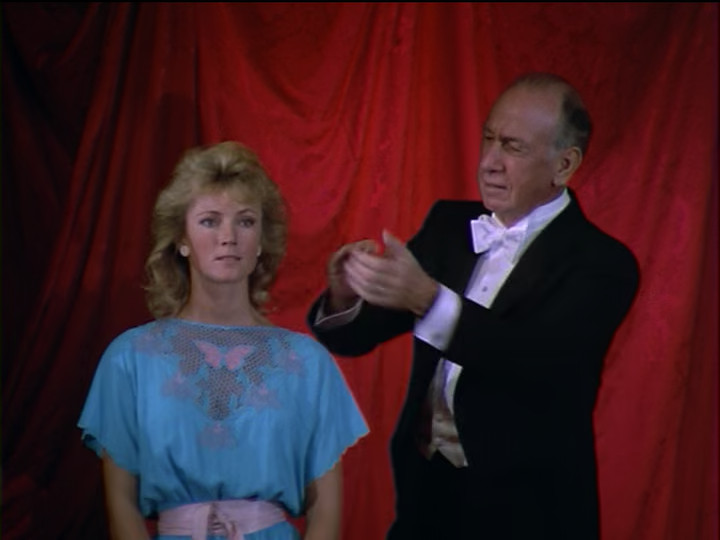
After some introductory shots of what could be Las Vegas if, like me, you have to look up Lake Tahoe to know what it’s about, we meet one of the main characters of the episode, The Amazing Cagliostro. His first line is, “Ladies and Gentlemen, observe the power of hypnosis!” He is a stage hypnotist, and has his volunteers pretend to be their favorite animals after he claps his hands. The volunteers do so with great enthusiasm.

The young lady pictured pretends to be a chicken, while a woman standing next to her pretends to be an elephant, using one arm to represent its trunk.

Hypnotism is an interesting subject about which a great deal can be said, but to keep things brief, and oversimplifying: hypnosis was developed by the Scottish doctor James Braid in the mid-1800s (inspired by demonstrations from Mesmerists who claimed to have special magnetic powers). After much research he published a book called Neurypnology in which he described his research and called for others to take up research into the possible medical applications of hypnosis. I’m still not very clear on how hypnosis progressed in the public eye from there, but it seemed to have gotten a huge boost with the 1952 case of “Bridey Murphy,” where a Colorado woman under hypnosis “remembered” one of her past lives, when she was an Irish woman named Bridey Murphy. This was described in a popular book which was then made into a popular movie which inspired a bunch of horror movies using hypnosis to access past lives in various forms. Probably the best known of these was the 1957 movie I Was A Teenage Werewolf, starring Michael Landon. There was a great deal of interest in “paranormal activity” in the 1960s and 1970s and hypnosis certainly fit well enough in that category. (I can recall hypnosis showing up as the crux of a mystery at least once on Scooby Doo.)

I do not know when interest in hypnosis (as quasi-magic) waned, but I can’t remember it being talked about much in the 1990s and I suspect that Murder, She Wrote was on the tail end of the trend with this episode. Which makes sense, since its main demographic (older people, at least if you go by all the commercials that used to run with it for denture cream and term life insurance where there’s no physical and you can’t be turned down) tended to either catch trends later or else remember older trends like they were just yesterday.

Anyway, we then meet some more characters.

In the audience is Joan, who works for Jessica’s editor.

By the bar are two reporters:

Their names are Bud Michaels (on the left) and Andy Townsend (on the right). Bud thinks that Cagliostro is a “two bit fraud.” (According to an inflation calculator, that would make him a six bit fraud in 2024 dollars.)

We then meet two more characters:

His name is Joe Kellijian. Hers is Regina (they’re married). She’s explaining to him that the reason she’s having an affair with Cagliostro is that he’s controlling her with hypnosis. Joe doesn’t buy it, pointing out that hypnosis isn’t magic mind control and can’t make people do things they’re completely unwilling to do. She does admit that she’s attracted to Cagliostro but never intended to do anything about it. The idea that she’s attracted to Cagliostro strains credulity, but it’s not the most unrealistic thing they’ve done in Murder, She Wrote.
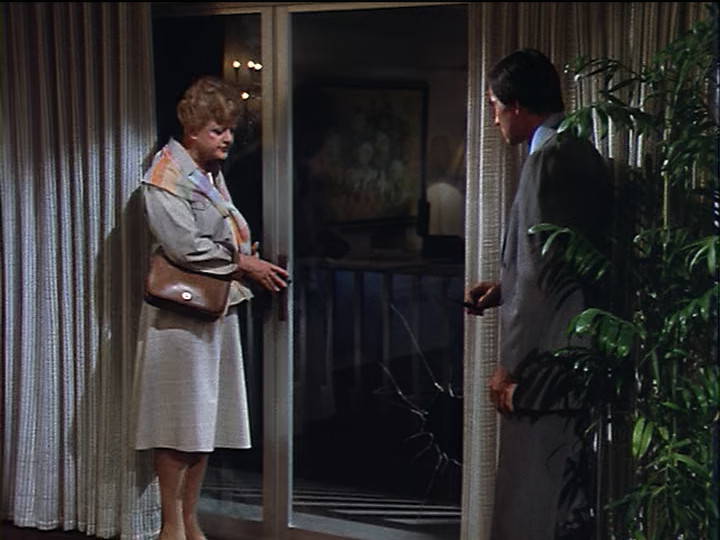
Anyway, Joe turns out to be the owner/manager of the hotel, and in the next scene he tells Cagliostro that this was his last night. Cagliostro points out that his contract entitles him to a million dollars over the next three years whether he performs or not. Joe thinks it’s worth it to get rid of him. Cagliostro says that this may cost him more than money, it may cost him “the fair Regina”. At this Joe attacks Cagliostro, but is stopped by Cagliostro’s bodyguard. I find it curious that Cagliostro has a bodyguard but Joe has no security staff. Joe swears “I will get you” to Cagliostro. I do not know whether Joe will get him, but I am quite confident at this point that Cagliostro is going to be killed. We’ve got at least two suspects established (Bud and Joe) and Jessica hasn’t even shown up.

That said, the very next thing that happens is that Jessica shows up at the front desk. She’s in room 1241, which has a lakeside view. They don’t need a credit card from her because they’ve arranged to bill her publisher. She asks for the room number of Miss Marilyn Dean, who is her editor. As the hotel clerk goes to look it up, Joan comes up to greet her, explaining that Marilyn won’t be there until the next day. She then takes Jessica over to the hotel restaurant, where it turns out that Joan lured Jessica over under false pretenses to suggest that Jessica write a book with Cagliostro as a character.

She doesn’t quite come out and say this; she pitches it as Marilyn’s idea and Jessica sees through her.

Joan comes clean and then starts to realize what a terrible idea this was. She even sent a telegram to the head of publishing company because she was so sure Jessica would love the idea she’d never considered what might happen if Jessica didn’t. Why she lured Jessica to an expensive lakeside resort to pitch an idea rather than just call her on the telephone, she is not asked and does not explain.
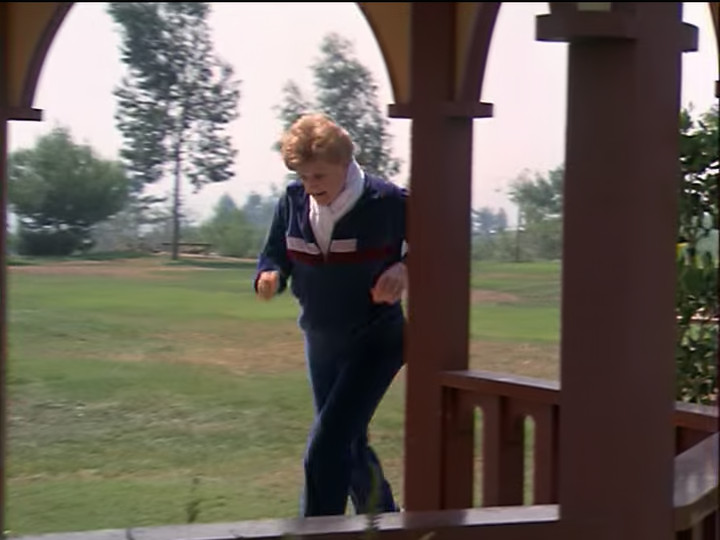
Jessica takes pity on her, though. Diana Canova, who played Joan, was thirty one at the time the episode aired but she plays the character as if she’s somewhere between twenty one and eleven, and Jessica’s soft spot for impetuous children takes hold. She tells Joan that she’ll stay the night, then the next day Joan can call up Mr. Winfield (the owner of the publishing company) and tell him that Jessica wasn’t interested. Joan is incredibly relieved, though I don’t particularly see how this is going to solve any of Joan’s problems because she’ll still need to give some explanation for why she spent the company’s money on flying Jessica out to a fancy hotel on Lake Tahoe without authorization. That’s not a minor thing.

Anyway, this conversation is broken up by Cagliostro coming into the hotel with his assistant and bodyguard. Oh, I should mention that somewhere in the conversation Joan slips in the background that Cagliostro came from England a few years ago, but no one knows anything about his past. Regina comes in and orders a drink from the bar. While she waits for it, Cagliostro motions to her to come sit next to him, but instead she leaves. Right after this Bud and Andy walk up and Bud says, in a loud drunken voice, that he’s still wait for an interview. Cagliostro says that he never gives interviews. Bud asks if this is because he has too many skeletons in his closet? What about Surrey Street? And when’s the last time he saw Reggie Downs? Cagliostro then threatens Bud with his bodyguard and Bud then blusters about how he and other reporters will eventually uncover the truth.

Cagliostro then makes Bud an offer. In his suite, in half an hour, he’ll give Bud every details of his past life, as well as any other journalists who wish to be there, providing that they can remember it—his one condition is that he will hypnotize them first. This will prove that Cagliostro is the world’s greatest hypnotist, as no other hypnotist can permanently prevent someone from remembering what they hear. And with that, Cagliostro leaves.

Joan is beside herself with excitement and says to Jessica, “What about that? You couldn’t write that scene if you tried!” Jessica agrees, though not, perhaps, in the spirit in which Joan meant it.

Joan then rushes off. Bud tells Andy that he’s not going, he’s going to go up to his room and pass out, but Andy is going. Bud tells him to “go round up some of the local boys and call his bluff.” He then staggers off.

As Cagliostro is entering his hotel room Joan rushes up and tells him that J.B. Fletcher is in the hotel. Cagliostro says that he’d be honored to have her attend and Joan is tickled pink. She promises that they’ll be there and rushes off to get Jessica.

Back in the hotel, Andy approaches Jessica and introduces herself. He tells Jessica he hopes that she’ll attend Cagliostro’s session but Jessica says that she won’t. She’s “going to go to bed the old fashioned way”. On her way to her hotel room she’s stopped by a woman playing slots who recognizes Jessica as “Nurse Beecham” from the show Doctors After Hours.

I think that the costume designer was told “turn the gaudy up to 11.” (Or would have been, had Spinal Tap not come out on December 2 of 1984, making it impossible to reference during the filming of this episode.) She’s trying to drag Jessica to meet the ladies of her bridge club who are at the craps table when Jessica thinks she spies a way out of this. She sees Andy walking to the elevator and calls his name. He doesn’t hear, though, and takes the elevator, Jessica’s chance of politely escaping going up with him. Jessica then notices that the woman has one of her books, all of which have a giant picture of Jessica on the back rather than a blurb about the book. Jessica shows it to her and insists that she is, in fact, J.B. Fletcher and wrote this book. The woman gets angry, declares she isn’t, and storms off. It’s an amusing scene, though I’m still finding the explicit comedy routines that you find int he first season a little jarring. It will be interesting to see when they get rid of them.

Joan then runs in and tells Jessica that they’re in. Jessica refuses, but Joan wins her over by saying, “as a writer, aren’t you the least bit curious?”

At Cagliostro’s room, where Jessica notably isn’t present, he begins. He hypnotizes the journalists present, testing that they are hypnotized by shoving down on each one’s outstretched arm.

Once he has verified that they are all hypnotized because they adequately resist, he tells them that they will only remember that he said important and revealing things about himself, but no details. He then tells them to lower their arms then begins his story. “Now, my story begins in a small flat in London, not far from Trafalgar Square, in 1972.”

Cagliostro has to be at least in his sixties (the actor, José Ferrer, was 72), so it’s a bit odd that his story starts a mere twelve years ago. If we conservatively place Cagliostro at 60, he would have been 48 when his story began. It doesn’t really matter, though, because we are not going to find out what his story was. At least not from him.

We cut to Jessica and Joan coming out of the elevator and running into the bodyguard who is standing outside. He apologizes but says that he couldn’t open the door if he wanted to because he doesn’t have the key. We then hear a loud crashing noise and the bodyguard becomes very concerned.

With excusably convenient timing (in a one-hour TV show) the hotel owner happens to show up in the elevator and asks what’s going on. When they explain, he uses his master key to open the door and they find out what happened.

We then pan over the hypnotized journalists, Joan feints, we fade to black, and go to commercial.

Just for fun, here’s the kind of commercial you might have seen had you been watching when this was aired:

When we come back from commercial break, we see Cagliostro being zipped up in a body bag. Shortly after, we meet the detective in charge of the case, Lt. Bergkamp.

(Lt. Bergkamp is the one in the suit.) As they’re waiting for a psychologist to come bring the people out of hypnosis, Jessica comes in.

Jessica points out that it’s very odd that the glass is broken so far away from the door handle—too far away to do anyone on the outside any good. While the detective considers this the psychiatrist comes in and diagnoses the people as being under hypnosis. He’s got no ideas for how to bring them out of hypnosis, so Jessica suggests playing a tape of Cagliostro bringing people on stage out of hypnosis, and perhaps that would bring the witnesses out of hypnosis too.

I find it amusing that Murder, She Wrote is taking such a magical approach to hypnosis, as if it’s impossible to get someone out of the hypnotic state except by the person who put them into it. (Interestingly, in James Braid’s experiments, entering hypnosis wasn’t about a person’s voice at all, but rather about fixing the eyes on a slightly elevated place until exhaustion of some of the relevant nerves took place. He also found bringing people out of hypnosis to be no trouble at all.)

For those who weren’t alive in 1984 or don’t remember what the technology was like, here’s the device they used to play it back (it was the same device as had been used by Joan to record it):

This works and the journalists all wake up. They are confused, having no idea what happened or why the police are present, and Lt. Bergkamp tells them that the psychiatrist will explain everything to them if they’ll just follow him.

The next morning Joan catches up with Jessica, who is jogging in her track suit and neck towel.

I can’t remember whether this was high fashion in the mid-1980s. I’m inclined to say that it was, but I was little at the time and have never been very fashion-minded. If I recall correctly, I had a shirt with similar horizontal stripes, though I remember this more from my mother showing me pictures than on my own.

They basically make small talk and it’s established that Jessica is interested and wants to investigate.

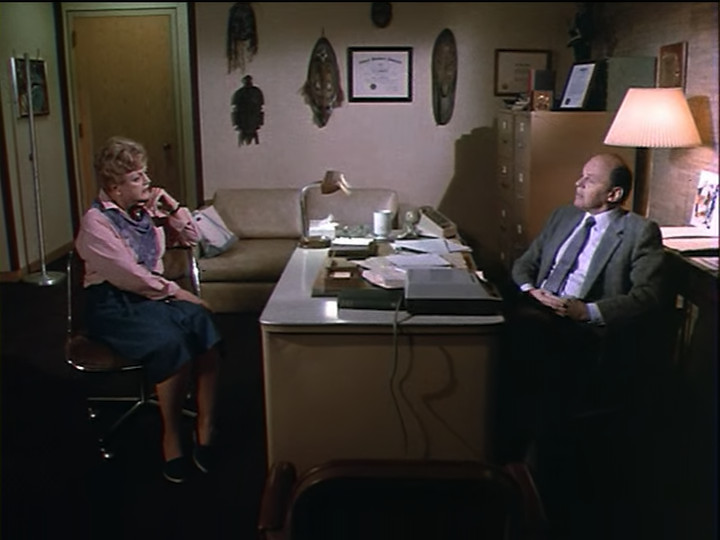
The scene then shifts to Dr. Yambert’s hotel. We get an establishing shot of his wall with his credential.

Yambert clarifies that the people did not have their memories erased, but blocked—by a powerful post-hypnotic suggestion. A memory lock, if you will.

His entire office is interesting, too:

Jessica doesn’t seem to believe in hypnotism, and Yambert offers to hypnotise her, just as a demonstration. Interestingly, he has her close her eyes and listen to his voice to enter the hypnotic state, which is kind of backwards from Braid’s method. Anyway, this goes about how you’d expect if you’ve ever seen a scene of a person who doesn’t believe they can be hypnotized who then is. (If you haven’t, the person believes that they weren’t hypnotized, then is presented with the evidence that they were and is comedically embarrassed.)

In the next scene the bodyguard shows up at Regina’s room and says, “Now that he’s dead, we have a little matter of money to discuss.” And on that bombshell, we fade to black and go to commercial.

For variety, here’s a denture cream ad from 1984:

When we come back, we start with an establishing shot of beautiful Lake Tahoe.

These establishing shots don’t last long, but they’re actually quite important to the show. They help to give us a sense of being someplace special, which makes the rest of the episode work. Murder mysteries are always a little far fetched and being someplace special helps in making the suspension of disbelief easier.

These establishing shots did, of course, also give people a moment to rush back from the bathroom or the kitchen when the person still in the room would call out “it’s back on!”

After wandering through the Casino portion of the hotel a bit—Lake Tahoe straddles the border between California and Nevada and the resorts on the Nevada side feature lots of gambling—Jessica finds Andy. Jessica asks Andy about Bud Michaels—he was visibly intoxicated. Andy said that it was weird, because Bud drinks like a fish but normally never shows it, and last night he was drunk after a couple of shots.

Andy thinks that Bud was faking it in order to give Andy a shot at a big story, the way that Andy’s father used to do for Bud (presumably the giving Bud a shot at a big story, not faking being drunk).

Jessica then visits the scene of the crime where people are making an enormous amount of noise while they do something or other to the walls. Lt. Bergkamp is upset that he heard about Jessica’s book from Joan, and Jessica assures him that the book is a figment of Joan’s imagination, though if she was going to write one he wouldn’t come off like a fool since she thinks he’s doing a fine job under the circumstances. This placates Bergkamp, who then talks about the case.

They have one lead, the hotel owner. Jessica agrees he’s got a great motive but it will be nearly impossible to explain him getting off of the elevator only seconds after she and Joan and the bodyguard heard the glass break. (Oddly, Jessica knows about the affair between Regina and Cagliostro and the owner’s public threats against Cagliostro.) When Bergkamp suggests the owner had an accomplice, Jessica raises the question of how the accomplice could have gotten out of the room, as the balcony seems like the only way to do that, and that doesn’t seem very possible.

After a scene in which Bud tells Andy to stop talking to Jessica because Bud wants to solve the crime, Jessica goes to see Cagliostro’s assistant.

Her name is Sheri Diamond. Jessica grills her about Cagliostro, and Sheri doesn’t mind answering questions.

She explains the history between Cagliostro and Michaels. Back in London, Michaels was trying to prove that Cagliostro was using hypnosis for blackmail, but Cagliostro tricked Michaels into printing provable lies and then sued Michael’s “wire service” for libel, winning a large award. Then Michaels and his bureau chief were fired. We also find that she didn’t like Cagliostro but a job’s a job and this is better than where he found her—she was a stripper. “A daring young lady who took it all off on the flying trapeze”.

Though she describes it as a worse job than working for Cagliostro, she seems to remember it fondly as she admires her own figure in the mirror.

In the next scene Joan learns this too, by overhearing Andy talking to Sheri’s former employer on the phone, though she only hears the trapeze part, not the stripper part.

Jessica then goes to see Bud Michaels. Oddly, he’s sunning himself on a lounge chair while reading a newspaper. In the shade while wearing a full suit.

I have no idea what this is supposed to tell us about his character. He jokes that he allows himself one hour of fresh air a day and still has another fifteen minutes as Jessica sits down beside him.

Jessica asks him why he pretended to be drunk the night before and didn’t attend Cagliostro’s meeting. He laughs and says that he “knew it would be a sideshow” and didn’t want to lower himself to Cagliostro’s level. Jessica asks him if he had an alibi and he asks how he was supposed to get into the room. Then both of them have their attention attracted by something high up on the hotel building. The camera shows us the building, then zooms in.

Bud Michaels says, “I’ll be damned,” and Jessica then decides to go investigate.

Bud watches her go with that kind of face that’s meant to make us suspect him:

That said, if you’ve been watching Murder, She Wrote for any length of time, this is a major tip-off that he’s definitely not the murderer.

When Jessica gets to the top of the roof, Lt. Bergkamp is there with some men and a climbing apparatus which is presumably supporting the man who is rappelling down. Also, Joan is there for some reason.

Sheri then shows up because Joan invited her.

It then turns out that Sheri has a fear of heights and leaves. Which Joan misinterprets as guilt.

Jessica then points out that Sheri had no motive—she gained nothing but unemployment—and also it took several men a great deal of time to set up the “contraption”. How was Sheri supposed to have done that in the half hour between Cagliostro’s invitation and his death?

On the one hand, these are fair points. On the other hand, it hardly seems necessary to use such a giant machine to rappel down to Cagliostro’s balcony. On the third hand, without such a machine it would have been very hard to get back up again. On the fourth hand, she could have lowered herself to the ground after the murder, and collected the ropes (or whatever was left above) before anyone thought to check for them.

Jessica then runs into the owner of the hotel and accuses him of the crime in her usual passive-aggressive way and he replies that he didn’t need to kill Cagliostro to get back at him. He talked with his attorneys and they realized that there was a morals clause in the contract which meant that he could kick Cagliostro to the curb without paying him a cent. He also, for some reason, denies that his wife killed Cagliostro. (He says that they were together in a conjugal way right before he went up to Cagliostro’s suite.)

Later, when Jessica is talking with Joan, Jessica summarizes the problem: those inside didn’t have motives, and those with motives couldn’t get inside.

Joan excuses herself to go call a friend of a friend of a friend who may know something about Cagliostro’s bodyguard, and as she leaves Jessica then sees Regina looking extremely suspicious. Jessica asks a man on a motorcycle where to find a taxi and he says one will be around in a minute. Jessica says that will be too late because she wants to follow the cream-colored car. The man says, “like in the movies? Get on!” And he gives Jessica a ride.

This is the second bit of humor in the episode. I find it interesting to include two comedic sections, though this one mostly happens with scarier music. They follow at a distance and see the payoff from Regina to the bodyguard.

And on that bombshell, we go to commercial.

Here’s a Green Giant commercial which you might have seen, back in the day:

When we get back, Jessica confronts Regina in her hotel room. It’s quite a nice room.

I think this set decoration does a good job of establishing how rich and important Regina is. Anyway, Jessica got there under false pretenses—she told Regina she had proof of her husband’s innocence. When Jessica says that she saw the payoff to the bodyguard, Regina assumes that Jessica is blackmailing her too. There’s some discussion, but basically it turns out that Regina couldn’t get out of the affair with Cagliostro and offered the bodyguard a lot of money to kill Cagliostro. They had a meeting to discuss the details, which it turns out that the bodyguard had recorded.

Jessica then discusses the case with Lt. Bergkamp and Joan. When Jessica objects to Sheri has having no motive, Bergkamp says that when the bodyguard was nabbed at the state line with the money, he told them everything he knew and it turns out that Sheri was in love with Cagliostro but was “too available to be interesting.” Joan thinks this is a great concept, and Jessica replies that it might be a great concept for a book, but not a great case for a Jury. It’s too far-fetched.

Bergkamp then complains that he’s got no case in spite of having six eye-witnesses and five suspects. The witnesses, he adds, were intelligent, competent newspapermen but can’t say a word and might as well have been deaf, dumb, and blind.

At that, we get the music that indicates a clue just happened and Jessica gets a flash of insight. For some reason she has Bergkamp repeat the part about how the witnesses might as well have been deaf, dumb, and blind. Jessica then says, “that’s it! I think we may have found a way of solving our problem.”

In the next scene we see Joan drinking with Bud. Joan tells him that they’ve solved the case and he asks who did it. She begins to tell him about Sheri Diamond then we cut to Lt. Bergkamp asking Andy for his help, because they’ve narrowed it down to one suspect but don’t have conclusive evidence. Andy is willing to help but doesn’t remember anything. Bergkamp tells him that’s not it. They found a hypnotist who thinks he can break Cagliostro’s memory lock. He’ll need to put Andy “under.” Andy says that’s great and asks who did it. Bergkamp says that he can’t say; for Andy’s testimony to be valid he has to tell them.

They meet in Cagliostro’s room in twenty minutes, where the hypnotist then hypnotizes Andy and tells him that he remembers everything with crystal clarity, then asks Andy what happened the last time he was in this room. Andy says that he heard Calgiostro’s voice, then heard someone at the window. Then suddenly… and we see a flashback where Sheri comes in in a black outfit and stabs Cagliostro, then smashes the glass with a poker from the fireplace then leave.

Lt. Bergkamp tells him to bring Andy out, as they’ve heard enough. The hypnotist tells him “when I snap my fingers, you will awaken and remember everything you’ve seen.”

Andy blinks and exclaims that he can remember everything that happened. It was Sheri and she escaped out that window!

Jessica then comes forward and says that it didn’t happen that way. They planted the story of Sheri with Bud Michaels since he would tell Andy about it. It couldn’t have been Sheri. After a severe fall last year, she’s been treated by a psychiatrist for a severe fear of heights.

Jessica then reveals that the hypnotist is Jake Callucci, the blackjack dealer from the casino nextdoor.

He doesn’t know the first thing about hypnosis. Dr. Yambert coached him in what to say. Andy wasn’t in a trance just now, and he wasn’t in a trance the night before. “You cleverly discovered how to outwit Cagliostro’s most powerful tool—his voice.” He put earplugs in his ears before he came up to the room, making himself temporarily deaf. (That’s why he didn’t hear Jessica calling to him during the comedy bit with the woman in the gaudy clothes.)

When Andy says, “no wonder you’re a writer, you’ve got one hell of an imagination,” Jessica replies that Lt. Bergkamp confirmed that he bought his earplugs in the giftshop. When she says that she’s sure that some digging around will turn up a connection with Cagliostro, Andy sighs and confesses. His father was Bud Michaels’ bureau chief. He OK’d the article that Cagliostro sued Michaels for, so his career was destroyed along with Bud Michaels’ career. He couldn’t face starting over again, so he killed himself. He’d wanted to kill Cagliostro for years, but could never figure out how. But when this thing dropped into his lap, the whole plan came to him, “just like that!” He snapped his fingers when he said that, then remembered the connection to hypnotism and says, sadly, “I forgot to count to three.”

We then go to a closing scene where Bergkamp is thanking Jessica as she’s leaving the hotel. He tells her that he’s probably going to call her the next time he has a tough case. After he leaves Joan comes running out and tells Jessica that the owner of the publishing house is ecstatic and the sales people are wild about the story. That is, if Jessica will write it. Jessica replies, surprisingly, “Oh, alright. I give up. Look, it’s an interesting puzzle.” Joan then says that there’s one slight problem. They hate “the new ending” and love it with Sheri as the killer. Would Jessica mind bending the truth just a little?

Jessica asks, “A little?”

Joan nods her head, then Jessica looks perplexed and we go to credits.

This episode is very difficult to separate from the subject of hypnosis. Hypnosis drives almost every aspect of the story and it’s treated largely as an effective, if limited, form of magic. I’m really not sure what to do with that, since it’s not what hypnosis is and it’s not symbolic of anything real, either.

Frankly, this episode has a lot of flash to it, but it doesn’t really hold together, even if we grant the magical nature of hypnotism. One of the big driving forces of the episode is Cagliostro’s mysterious past, but we learn nothing of his mysterious past. Moreover, given that he’s clearly demonstrated to actually be as powerful a hypnotist as he makes himself out to be, what mysterious past is he supposed to have had? There was a suggestion that he used hypnosis to blackmail people, but if so, that was just something he did and it had no bearing on anything in this story. We might as well have learned that he cheated on a test at school or had an affair with a woman who died in a plane crash or once put walnuts in brownies (culinary context: if one must put something in brownies it is acceptable to put milk chocolate chips in brownies, but never walnuts or any other kind of nut). None of this has to do with the plot because the reason Cagliostro gets murdered is about his non-mysterious, recent past.

This also brings up the issue of how Andy Townsend killed Cagliostro. One generally needs a great willingness to suspend disbelief when it comes to more intricate murders, but Andy’s method is more than a bit far-fetched. This isn’t so much of a problem to enjoying the story as a story, but it really is quite outside of the play-fair rules of mystery, which Murder, She Wrote generally presents itself as following. Hypnosis doesn’t work just by the sound of a person’s voice, and earplugs don’t completely cut out sound. There is, therefore, no way for us to know that this episode will treat hypnosis as purely about hearing the hypnotist and gift store earplugs as making a person perfectly deaf. Moreover, are we really to suppose that Andy managed to fake his way into the demonstration without being able to hear anything? Cagliostro clearly talked with him since he began by saying that it’s a pity that Bud Michaels wasn’t there, but Andy is his representative. These kill the play-fair aspect of it, but they’re not too important to just enjoying the story as a story. But are we really to suppose that Andy has wanted to kill Cagliostro for years and couldn’t think of a means? There was no obvious connection between the two men; had Andy shot him with a rifle from a few hundred yards away, it’s extremely unlikely he’d have been caught. He also could have sent him poisoned chocolates, supposedly from a female admirer. And all this could have been worked into the story; there could have been several failed attempts on Cagliostro’s life, which might also explain why he retained the services of a bodyguard.

I don’t think that we can just let the episode’s approach to hypnosis go, though. The fact that they treat it as magic is irksome. And just to be clear: they really treat it as magic. Cagliostro hypnotizes people purely with his voice, on stage, but of all of the people who hear him, only the people he means to hypnotize get hypnotized. Only the hypnotist who cast the spell on the journalists can free them from it—a fact Jessica takes advantage of in suggesting that they re-play a previous time he cast the “dispell magic” spell. At the end, they have a blackjack dealer from a nearby casino say all the correct words to hypnotize someone, but he’s not a real wizard so it doesn’t work. Hypnotist might as well be a Dungeons & Dragons player class.

Now, there’s nothing intrinsic that prevents a murder mystery from also being in the fantasy genre; with a careful design of the magic in one’s universe, as well as a design of the particular environment, one could have a viable murder mystery in a wizard school or other fantasy setting. The issue, I think, is that anyone setting out to do that would define their magic far more carefully at the outset because they would know that would be required to have an enjoyable mystery. This episode misuses the trust of the audience, since we assume that something so central to the plot is the thing we know in the real world if the writers don’t clarify. If the writer of a mystery wants to make arsenic a health cure or chocolate a deadly poison, that’s not the end of the world, as long as the writers lets us know early enough that we don’t make mistakes because we’re assuming the story is referring to the normal referents of words like “arsenic” or “chocolate”. Otherwise, it’s not playing fair. It’s not hard to fool a man who trusts you by lying to him.

The characters of this episode are fairly vivid, but I don’t think that any of them are great. For example, Bud Michaels leaps off the screen in his first scene as a washed up drunk. You instantly know the type. But then he falls apart. He tells Andy he wants to solve the crime before Jessica, but then does absolutely nothing to solve the case. When Jessica finds him, he’s sunning himself in the shade in a business suit, and after trying to look suspicious as Jessica walks off, his only other part in the episode is to collect some disinformation to feed to Andy. Joan is vividly an impetuous ingenue, but she has zero character development and character growth is the only way an ingenue is a satisfying character. Joe Kellijian is very vividly a jealous husband, but he’s never anything more than that single note. Regina Kellijian is more interesting, since she seems to actually want to be faithful to her husband and even partially achieves it. Finding out that she went so far as to try to hire a hit-man to kill Cagliostro would have added depth, if the scene where she reveals it weren’t treated simply as an exposition-dump to close out a red herring.

Something I’m really curious about is why Andy put the break in the glass so far away from the door handle. He wasn’t in a hurry until after he broke the glass and there was no discernible benefit to it—it didn’t lend itself to any kind of red herring. All it served to do was to cast doubt on someone coming in from outside. I can see no reason Andy would want to do that. And on some level the writers realized this since they never mentioned it again. I suppose it only existed to establish Jessica’s credentials with Lt. Bergkamp and, once it served its purpose, was discarded.

Looking for positives: the big thing that I think this episode has going for it is the setting. Lake Tahoe is an alpine lake with beautiful water and gorgeous surroundings, and the hotel they picked for the episode is delightfully luxurious. As I said in Fun Settings for a Murder Mystery, a fun setting can be a huge boost to a murder mystery, and in this case I think it is. The remote setting also has some of the benefits of the classic setting of a dinner party in a mansion—the closed set of suspects and a sense of community.

I think that they also had the potential for an interesting character in Regina Kellijian. A woman having an affair to wants to be faithful to her husband and will go so far as to hire a killer to get rid of her lover has the potential to be a very interesting character. And you don’t need magical hypnotism to achieve this. A far more traditional (and realistic) approach would be to have the man she’s adulterating her marriage with blackmailing her. Also traditional would be having the man have some power over someone she cares about, such as a brother or close nephew.

There were a few comedic bits in this episode, but they’re toning down the ridiculous stuff and I think after this episode things become more… grounded.

Next week we’re in Washington, D.C. for Capitol Offense.

Wishful Drinking is a Depressing Book

I recently read Carrie Fisher’s memoirs, Wishfully Drinking.

If in the medium you’re reading this the blurb on the front is too small, it reads, “Funny as hell… Get someone to read this rollicking book aloud to you.” This quote is attributed to Entertainment Weekly.

I don’t know what’s wrong with Entertainment Weekly, but if you have any capability for sympathy with a human being who is suffering, this book is anything but funny or rollicking. Yes, Carrie Fisher makes jokes about her various experiences. Yes, she was witty. But I think that, with a few exceptions, to laugh at it you’d need a heart of stone.

And I thought that My Wicked, Wicked Ways was depressing. (Admittedly, I only read about 10% of that; it’s a much longer book.)

Of course, not everyone in Hollywood is awful. It just seems that way because modern media with it’s almost free reproduction means that the only thing that matters in Hollywood is charisma in front of a camera. (because slight advantages can translate to enormous increases in sales, with no major downsides.) When you select that hard for a single trait that isn’t the product of a constellation of virtues, it’s unsurprising that you won’t get specially virtuous people. And of course fame is very dangerous to the soul; ordinary people do not do well with it.

I really need to move on to more cheerful books.

Murder She Wrote: It’s A Dog’s Life

On the fourth day of November in the year of our Lord 1983, the fourth episode of Murder, She Wrote aired. Titled It’s a Dog’s Life, it’s set in Tennessee, or at least some Tennessee-like place. (Last week’s episode was Hooray for Homicide.)

mpv-shot0001

It’s set on a horse farm, specifically, as an establishing shot of horses frolicking on rolling fields, well… establishes. We also get an establishing shot of a grand house where I assume most of the action will take place.

mpv-shot0002

Though I am a mite suspicious, given this camera angle, that the house is not in fact all that big and is just wide but narrow. Not that it matters; uneducated actors play professors, so there’s no reason that houses can’t play mansions.

We then get an establishing shot of some stables which I believe are actually big and ominous music plays. A figure clad all in black, including wearing black gloves, sneaks up and feeds a horse named Sawdust some kind of pill.

mpv-shot0013

Sawdust eats it as ominous music plays.

When the horse has completely finished eating the pill, the camera cuts to inside the house and a string quartet is playing classic music as a large, expensive party takes place.

mpv-shot0003

There are so many servants that two maids just stand around. They’ve spent something like four different shots establishing that there is a lot of money here, so that will, presumably, be important.

As the camera pans around we see that most of the people are in fox-hunting clothes. We then meet some characters. First is Trish and Anthony.

mpv-shot0005

Then comes in her brother, Spence.

mpv-shot0004

He tells Anthony that the family is sorry that his wife couldn’t make it.

Both Trish and Spence speak their lines like they hate each other, which is impressively poor manners in front of guests, especially for the South. We then get another relative who walks up and asks if they’re having a good fight.

mpv-shot0006

Her name is, apparently, “Echo,” or at least her nickname is. She’s Trish’s niece, not sure whether Spence is her father, but I can guess how much hair spray she uses a day. Boy is it ever the 80s. She and Trish are extremely catty at each other then Spence asks for peace, if not for his sake, than for the sake of his father. At this, Trish leaves.

We then meet another of Spence’s sisters.

mpv-shot0007

Her name is Morgana, and she’s very fond of her astral projectionist. Spence is appropriately rude, by which I mean he makes a gratuitous and unnecessarily mean-spirited comment which is carefully calculated to accomplish nothing whatever, then he walks off.

And then we come to the main characters.

mpv-shot0008

His name is Denton and he’s a famous lady’s man about whom Jessica has been warned. They move on and Denton introduces a friend of his—the owner of a nearby horse farm, and Denton’s old drinking buddy. His name is Tom Cassidy.

mpv-shot0009

His small talk explains why Jessica is here—she’s visiting her cousin, Abby, who works on Denton’s horse farm. It also comes up that he owns a neighboring 600 acres, which is described as small, though in a tongue-in-cheek way. Tom leaves to get Jessica a refill on her coffee, and we meet Jessica’s cousin.

mpv-shot0010

They make a little small talk; she tells Denton, in an English accent, to not be “an old lech.” Tom returns and interrupts the banter by saying “how about a toast?” Before he can propose one, though, Spence interrupts from across the room to say that a toast is a marvelous idea.

mpv-shot0011

I find the blocking of this shot interesting. The characters are in a line to be easily seen by the camera, but it makes no sense at all as a grouping of people who had been talking to each other, and not much more as a group of people who hate each other’s company and are standing next to each other in embarrassed silence for no reason.

He proposes a toast to his father, on his 80th birthday, and many more. Morgana adds a note of affection. Denton rudely takes no notice and merely looks about and asks, “where’s that damn dog of mine?” That damn dog of his is a beagle named Teddy, who comes running from across the house. Spence and his siblings look crestfallen. I guess we can see where Denton’s children got their bad manners from. Oddly, no one else in the crowd seems to have noticed any of this, despite everyone having spoken in a loud, clear voice, to be heard.

Then a man comes in and announces, Ladies and Gentlemen: to horse.

Outside as people are getting on, Trish walks up to her horse with a champagne glass in land, takes a sip, then throws the partially full glass on the ground and mounts her horse. Abby runs over, grabs the bridle, and says, “Trish, you shouldn’t be riding in your condition. It’s dangerous to the horse.”

Trish merely tells her to go away and kiss up to Father while she has the chance. “The day he goes, Honey, so do you.”

Denton calls out to Jessica and Abby, telling him that he’s picked out their horses for them. Jessica thinks that Sawdust is for her, but he tells her that Sawdust is only fit for him; he hasn’t broken out of a trot for years (the horse). He then presses a button and tells Barnes, a security guard, that they’re ready to go and he should open the gates. Barnes, who is sitting in a room filled with monitors and controls, obliged by pressing the Gate 1 button (there are four) which opens the main gates, which we can see on video camera from two different angles.

We then get scenes of the fox hunt over beautiful countryside with swelling music. At one point Denton tells Abby, who is riding next to him, to go on because it can’t be much fun to ride next to an old slowpoke like him. Right after he says this, Trish comes up right next to Denton spurring her horse into a gallop with loud cries, which alarms Sawdust, causing him to bolt. Denton tries to reign sawdust in, but to no effect. Sawdust eventually runs at a bench in front of a hedge and jumps over it. Denton does his best during this, shouting “Tally Ho!”

mpv-shot0012

The camera then cuts away during the landing.

Many people run up, deeply concerned, because this kind of thing can be easily fatal to an eighty year old man.

As, indeed, it proves to be. We cut to Denton lying dead on the ground and a moment later we screen wipe to a police deputy covering the corpse with his jacket.

After a bit of mourning, Jessica, Abby, and Tom go talk to the Sheriff, who says that it was a terrible accident but Denton led a full life. Jessica says that she thinks that Denton didn’t want to take the jump and Tom agrees, saying that Denton was under Doctor’s Orders to take it easy.

The vet is standing next to the Sheriff and Jessica asks if there’s a test he can perform on the horse. He understandably has no idea what Jessica is talking about, so Abby explains that a calm old horse like Sawdust doesn’t suddenly go wild. The Sheriff asks if Jessica is suggesting foul play and instead of answer we cut to Denton’s children getting into a police car (presumably to drive them home) and then we then cut to the cottage where Abby is staying.

Jessica is looking over papers saying to Abby, “I was so certain that there was something wrong with that horse. I feel so foolish. But, tests don’t lie.”

Abby asks, “Don’t they?” She points out that it was hours before they found the horse and there are drugs which leave no trace. Jessica acts like Abby is just being emotional, but of course she’s right. In fact, we know she’s right since we saw somebody give Sawdust a pill shortly before the hunt. This is an interesting choice, both in the showing us and in having Jessica act contrary to what we know to be true. She was wrong when she felt foolish, but we know that she’s now being foolish. Perhaps this is meant to make Jessica relatable by “not being too perfect”? Another possible explanation is putting the investigation on hold in order to get the episode to last the approximately 47 minutes it needs to.

Abby then goes on about what a great man Denton was, but underneath it all he was unhappy because of his selfish relatives.

Which brings up an uncomfortable issue: if Denton’s children are all awful, why didn’t he raise them better? I know that children are their own people and make their own decisions. Great sinners can be the children of great saints, and great saints can be the children of great sinners. That said, being raised well helps and being raised badly does make being a saint harder, and if all of a man’s children are terrible, it’s only fair to ask whether he raised them in a way that made being good, hard.

Anyway, there’s a bit of odd dialog which implies that Abby was in love with Denton and Jessica offers to stay with her for a few days. Abby asks her to stay until the will is read.

Which is necessary to keep Jessica around for the investigation, of course, but it’s really weird. Why would Abby be sticking around for the reading of the will?

We then cut to the day of the reading of the will, or maybe it’s the hour. The exact amount of time that’s passed isn’t specified, and all we get by way of that is an establishing shot of the front door with a black wreath on it.

Spence and Trish fight a bit, but they do establish that “Boswell,” presumably the family lawyer, is expected any minute. After some more bickering, he comes.

mpv-shot0014

Denton’s will is done on video. This was quite a new technology in 1983. The first VHS player came to the United States in the summer of 1977 and they would become popular pretty quickly, but consumer video cameras that recorded onto VHS took longer. The first consumer ones actually came out in 1983. A rich man like Denton could afford to rent professional video equipment to make his will, but the thing would have felt very cutting edge at the time. Boswell describes it as “cutting edge will technology.”

Denton starts out by saying that it’s all legal as hell, so don’t get any ideas. This sets the tone. He then has a hate message for each of his children and grand daughter (it turns out that Morgana is Echo’s mother). That parting spite finished, he gets down to brass tacks.

He gives a shotgun that Tom admired to Tom (his old drinking buddy) and there are cash gifts to each of the servants with something extra for the guard. All of the paintings in the house go to the national gallery. He then says, gleefully, “that’s right, Children, a fast three million in oils now on the way to Washington.” Bosley looks remarkably smug at this.

mpv-shot0015

There’s so much wrong here, but I don’t think that we’re supposed to notice.

Anyway, the rest of his estate comes to about fifteen millions dollars and, except for a modest family trust, goes to his dog, Teddy. Denton’s descendants are upset at this but Boswell assures them that they won’t be able to break the will and if Teddy dies of anything but natural causes, the entire fortune (including the family trust) goes to the SPCA.

And on that bombshell, we go to commercial break.

When we get back, Jessica is on the phone with Ethan, telling him she’ll be gone for a few more days, and adds that Abby is convinced that somebody murdered Denton. And Jessica is afraid that she just might be right.

We then move to a scene where Abby has a pointless fight with Trish, but it is at least established that Teddy is her employer and as such only Marcus Bosley can fire her, and she’s not going anywhere until she finds out who killed Denton.

Interestingly, Morgana warns Abby to be careful of Trish. She does it with some astrological mumbo jumbo, though, so Abby takes no notice. (I say mumbo jumbo because really doubt that the writers got the astrology right, quite apart from my belief that there is nothing to astrology.)

Then there’s yelling, a horse runs out, and Spence is in a horse stall defending himself from Teddy. The scene shifts to the vet examining Teddy and holding up a test tube of clear liquid and saying, “giving this stuff to a dog is like giving loco weed to a horse,” though when asked he didn’t find any in Sawdust. The vest asks who Teddy bit, since he found blood on his collar. The Sheriff then pulls up with a man in the passenger seat who identifies Teddy as his assailant.

mpv-shot0016

In the next scene Marcus Boswell is on the phone with Abby, telling her that Teddy has been released on his own recognizance and she can pick him up from the Sheriff at any time.

Jessica and Abby talk about the situation and Jessica thinks that they need to talk to Marcus to get more information. The shot of them waiting in his office is interesting, especially with how large and posh the office is.

mpv-shot0017

To drive the point home, Jessica remarks that Marcus has done very well working for the Langley estate.

After a minute, Marcus and another lawyer come out. The lawyer says that he could drive a freight train through “that loophole” and Marcus replies that his clients need to consider the costs; it could be a long and bloody battle. Then Morgana walks out of Marcus’ office and says goodbye.

To highlight just how much of a suspect Marcus is, as Jessica and Abby enter the office, his secretary tells him, in an exasperated tone, that it’s his broker and it’s the third time he’s called today. That could, of course, mean anything—and in real life would most likely mean that the broker was trying very hard to sell something to Marcus. In Murder, She Wrote, though, it almost certainly means that Marcus is in financial trouble.

Marcus’ office is even more impressive than his waiting room:

mpv-shot0018

They get down to business. Jessica asks about whether the man who Teddy bit has filed a lawsuit and Marcus says that while he’s made noises, he hasn’t yet and Marcus intends to head him off (whatever that means). They then switch subjects to the will, and the fancy lawyer’s supposed loophole is the question of “sound mind.” Not Denton’s mind, but the dog’s. If a court rules Teddy mentally incompetent…

He doesn’t finish his sentence and I can’t imagine what the end of it might be. You don’t need to be of sound mind to inherit under a will. If Teddy was ruled not of sound mind, he’d require a guardian appointed for him. But he’s a dog, so he needs a guardian anyway. This could only be an issue of the dog literally, rather than figuratively, inherited the money. But that would be nonsense. Animals can’t own property. I assumed that what Denton meant was that a trust was set up with Marcus as the administrator for the benefit of Teddy. That would certainly be, in colloquial English, Teddy inheriting, but it would make legal sense and the fact that Teddy requires a guardian would be irrelevant. I can’t believe that the episode is trying to claim that a dog has literally inherited money and land. You don’t need a loophole, that would be simply impossible. You can only give your property, in your will, to some kind of legal entity capable of owning it. (It can be a fictional person, as in the case of giving it to a corporation, but it has to be some kind of legal person.) I wouldn’t bring this up except that they’re actually making a plot point of it having been done in an impossible way.

Anyway, Marcus says that Denton’s descendants won’t win, but it might take long years and a lot of legal feels to win the battle. He leaves off how much this would benefit him and also explain away the missing money he’d embezzled. (I’m just guessing about that last part, of course.)

He’s interrupted by yet another call from his broker, who insists on speaking to him. Why his secretary seems to work for the broker and not for her employer is not explained. Anyway, he takes the call and after some embarrassing half-phrases, he promises his broker that he’ll send a check today and even put a stamp on the envelope this time.

After hanging up, Marcus tells the women to never, ever buy stock touted by Spencer Langley. His only consolation is that Spencer bought more of it than Marcus did.

This can, in no way, explain why his broker needs a check. No matter how badly a stock does, you’ve paid all of the money when you bought it and can only recoup some money, even if far less, after its sale. Between the purchase and the sale, you do not use money for anything. The only possible way for stock transactions to need cash quickly is if you sold futures and need to buy the stock to cover the future. There’s no way that’s what happened, though.

Jessica only picks up that Spencer is in debt, and Marcus replies, “right up to his Adam’s apple.”

This is not even slightly how stocks work. The only way for a stock doing badly to sink you into debt is… well, there is no direct way. You simply have to take on the debt separately. But you can take on debt in order to buy stock, which you intend to pay off and get profits from when you sell the stock at a higher price. But in that case it would be your banker, not your broker, who is calling you demanding money.

I’m really not sure which is more ridiculous: a dog literally inheriting property or a broker calling demanding money because a stock you bought is doing badly.

Oh well.

We then get a shot of the moon at night to establish that it’s nighttime. Since all pictures of the moon are basically the same, I’ll use one that I took instead of a screenshot. It’s not exactly the same, but you get the idea, and I only use screenshots when they’re necessary for my commentary on the episode:

wp-1709233371763672911081908387795

We then cut to Barnes, the security guard, sitting in front of his collection of monitors. I wonder if the idea is that he lives here in the cave of security cameras on twenty four hour duty. No wonder he got something extra from Denton’s will.

He then hears a sound and the door and goes to open it. It’s Teddy. Barnes says something about “like clockwork,” implying that Teddy always comes to be with Barnes at this time. “I guess you know you’re safe in here,” Barnes explains.

He then notices Trish’s car pulled up to the front gate. He comments that she shouldn’t be allowed to drive. On the security camera she stumbles out of her car and buzzes for Barnes to open the gate. He presses the button and as the gate begins to open she falls down with her head between the gates that just opened.

Barnes puts Teddy down saying that he needs to go check that she’s OK. He leaves, with Teddy remaining behind on his chair.

When Barnes gets near, the gates start to close. Barnes runs to try to save her but he’s too late. The gates crush her head (off camera, of course). We then cut back to Teddy in the guard room, partially standing on the console, wagging his tail.

mpv-shot0019

And on that bombshell, we go to commercial break. (I think that the implication is that Teddy pressed the button and killed Trish.)

When we get back from commercial break, we’re outside by the gate while a bunch of police cars are in the area, presumably investigating. Inside the guard room, someone is dusting for fingerprints on the gate button.

Then in a large room with the Sheriff and the family gathered, Morgana says that she saw her sister’s ghost rising from her earthly form and crying like a morning dove. We get some other backstory about her aura thriving on moonlight and such-like, but we also learn that her bedroom has the only clear view of the gate, and she looked out because she heard a car’s horn.

The doorbell rings and it’s Marcus. He’s come as soon as he heard, for some reason.

Then the Sheriff’s deputy comes in and tells him that they found a print on the gate button, but not a fingerprint—a paw print.

Given that they found it by dusting, blowing away the dust and then using tape to pick up the dust which remained after being blown away, I guess we’re supposed to believe that the digital pads on a dog’s paws leave oil residue? I can’t easily find out whether dogs even have oil pores in their digital pads (they do have sweat pores) but my experience of dog feet is that they are very, very dry. I really doubt that they have sufficient skin oil as to leave enough residue to be able to lift a paw print. It’s not impossible, so far as I know, but it’s still a bit… far fetched. And even so would leave entirely open the possibility that someone used Teddy’s paw to press the gate button so as to leave no fingerprints. It can’t be supposed that Teddy understood that pressing the button would hurt Trish as a human could.

Anyway, there’s some arguing and bickering over how this gets rid of the will—I guess everyone has forgotten that if Teddy dies of anything but natural causes, all of Denton’s money goes to the SPCA. Though I don’t see how that would come into play since the dog would likely just be put into prison for life—even if he got sentenced to death, it takes so long to work through the appeals and so on that he would die of natural causes anyway.

I can’t believe I’m actually thinking that through. Why is this episode demanding that we take a dog seriously as a human being?

Anyway, Marcus shouts, “Sheriff, you cannot possibly believe that a dog is capable of murder!” At that, Abby says, “of course not. He’d have to be trained.” Then everyone stairs at her since she’s an animal trainer.

The scene shifts to Jessica going down to the front gate. She runs into Tom driving up in an old blue pickup truck. He asks how the family is doing then says he came as soon as he heard on the police band on his CB radio. He then drives on up to see what he can do to help.

Jessica wanders on down and meets Will, who’s trying to get the victim’s coat into a large plastic bag. Jessica offers to help and examines the coat in the process. Will gratefully accepts the help because he feels that the coat requires a “lady’s touch” to fold.

mpv-shot0020

As you can see, the deputy is a young man and Jessica comes on with a matronly tone. This part actually feels quite realistic. Also, Jessica’s examination shows that the coat is quite new but the seams are split, just like her “car coat.”

After a bit of small talk, Jessica then walks around, examining the ground. After that she goes and interviews Barnes in the security room.

He left Teddy alone and the door automatically locks when it’s closed. He’s got the only key, and Teddy was left alone in the room. When he asks Jessica if she really thinks that Teddy pushed the button, she replies that she’s quite sure of it. She asks if he heard anything unusual while he was on his way to the gate and he replies no, just the usual. Crickets and a night bird calling.

She then asks the way to Morgana’s room.

mpv-shot0021

Morgana’s room does, indeed, have a decent view of the gate. While Jessica is looking, we also hear some music which suggests that this is an important clue.

Jessica then joins Abby in the kitchen for tea. (When stressed, the English always go for tea.) When Marcus comes in to fetch ice because everyone in the main room needs a drink, Jessica notices that he has a nasty grease mark on his trousers. It’s important to the plot because we get the kind of closeup necessary in 1980s televsion to make sure we can see the clue even if there’s interference in the signal.

mpv-shot0022

He says that he had a flat tire on the way over and he supposed that he got some grease off of the jack. A jack is a device for lifting the car up so that one can put the wheel on and take it off, which a human could not possibly do if the weight of the car is still on the tire. They look something like this:

(Not shown is a bar that goes through the hole and is used to give the mechanical advantage necessary to turn the screw.)

There is no realistic way those grease marks came from a jack. Given that this episode has several impossible things already, I’d have figured that this was yet one more unrealistic thing, but the fact that they gave us a close-up suggests that it’s meant to be a clue and not a plot hole.

Jessica then asks where he got it and how long he stopped. He figured about half a mile away and he stopped for about twenty minutes. Jessica asks if that means that anyone who left the house would have had to pass by him.

Marcus says that Jessica is right, but that no one passed by him. Abby says that that means that the killer had to be someone in the house, and Marcus concurs.

After he leaves, Jessica asks Abby how one would go about training a dog to press a button. The answer is endless repetition, and the command could be anything. A voice, snapping your fingers, a whistle—at that Jessica perks up. A whistle was just the kind of thing she had in mind.

Some bickering later, Jessica is forced to explain her theory to everyone, including the Sheriff. Basically, it’s that someone impersonated Trish—whoever got out of the car never spoke on the intercom. At this point Trish was inside the car. After a minute the person impersonating Trish got up, dragged Trish (who was drunk or unconscious) to the spot where her head was in the way of the gate, then gave Teddy the signal over the intercom.

The Sheriff then asks if a whistle like the one he’s holding would do it. When Jessica says that it’s possible, the Sheriff asks if anyone in the house has the initials A.B.F. and Abby replies “Abigail Benton Freestone.” The Sheriff adds that they found the whistle down by the driveway.

The scene then shifts to the Sheriff’s office, where both Abby and Teddy are in jail.

I really don’t know what, if anything, we’re expected to take seriously anymore.

We cut from Abby bemoaning her fate to Teddy to Jessica being angry at the Sheriff. After she insults him and complains at him, he says that the inquest is on Friday and until then Teddy is going to be held as an accessory after the fact. Which is not what he would be. An accessory after the fact is somebody who did not take part in the crime but did take part in trying to help the person who committed the crime to evade justice. Even if you ignore the fact that Teddy is a dog, that’s not what he did. He took part in the commission of the crime, which would make him an plain old accessory. At this point I’m starting to wonder if they’re just getting things wrong on purpose. I guess we should count our blessings that on the fox hunt they rode the horses and followed the hounds, rather than riding the hounds and having the horses follow the scent trail.

In the next scene Jessica is given a lift back to the house by Marcus. She has him drop her off about a half mile away from the house, saying that she needs some exercise. He drives off and she looks at his tire tracks.

mpv-shot0023

I’m going to guess that the issue is that both tires are bald, or else both tires are the same size, meaning that Marcus did not, in fact, have a flat tire recently. It’s a bit of a problem for this clue to show us that because we’re only seeing the marks of two tires (kind of next to each other, from when the car was turning slightly to get back onto the road). The flat could have been on the other side of the car, which stayed on the road and whose tracks we don’t see. Marcus never said which tire went flat. However, the fact that they’re showing this to us pretty much means that the flat tire had to be disproved. Things are not looking good for Marcus; we’ve had two close-ups on clues related to him.

As Jessica is looking around, the nice young deputy Will shows up and asks her what’s up. He asks if she’s looking for something and she said just a hunch. She asks if he has one of the Sheriff’s new metal detectors and he says that he can get it. She’s looking for a bicycle clip. A plain, ordinary bicycle clip. He doesn’t know what she means and she says that he’ll know it when he sees it.

Later on Jessica is mounted on a horse when Echo comes up. She asks where Jessica is going, and she says that she’s going to see a man about a dog bite. (Jessica asks about Spencer, whose horse is missing.)

We cut to Potts operating a chainsaw while his arm bandage is on a shotgun. Jessica rides up the horse then sneaks up and steals Potts’ arm bandage. When she gets back to her horse it’s actually Spencer’s horse, he took the liberty of putting her horse in the stable. He then calls Potts.

Potts and Spencer interrogate Jessica at gunpoint. Potts is in favor of killing her and hiding the body, but she talks him out of it, saying that his little scheme of fraud will hardly be noticed once she reveals who killed Trish. There’s a bit of bickering, but then we cut to a court house. Well, some kind of building in which court is in session. It feels more like a gymnasium.

mpv-shot0024

I’m not sure what it’s supposed to actually be. When the deputy brings in a speaker on a long wire, the judge—or whoever he is—asks what’s going on and Jessica says that this is part of her presentation. I suppose that this is actually supposed to be an inquest, and I must confess that I need to do more research on them to get a sense of whether this set makes any sense. It doesn’t feel like it, and from the rest of this episode I would guess that it doesn’t.

The judge indicates that the proceeding is going to begin with Mrs. Fletcher acting as an amicus curiae. He then says that, for the yahoos in the back, that’s a friend of the court.

Jessica get up, makes an introductory remark, and then says that to keep this short she’s only going to call one witness: Teddy.

Sure. Whatever. I don’t see any way to care at this point that an Amicus Curiae presenter (they’re more normally written briefs, but this is TV) would have no right to call witnesses. She’s calling a dog as a witness and everyone is OK with it, so I guess we’re just in clown world.

Teddy is carried in by a deputy and put in the chair next to the small table. Jessica then has the deputy blow on the whistle that was found by the gate. No one hears it but Teddy because it’s an ultrasonic whistle. She then has the deputy go into the other room and blow the whistle over the speaker. After he says that he blue the whistle, Jessica notes that Teddy didn’t react, because the whistle is above the range of the speaker. She actually says “any loudspeaker” which is probably wrong, but it probably would be above the range of a speaker system used in a security system, even back in the 1980s when they were all analog. (Most modern digital systems have a hard cutoff at either 22.05 or 24KHz, while according to Wikipedia most dog whistles are in the 23-54KHz range, so for most dog whistles it would be impossible to record or transmit them over normal digital systems. I only bring this up because it relates to adapting this kind of idea to modern stories.)

Jessica then explains that it was Marcus—he desperately needed the money years of litigation would bring him. He persuaded Trish to drug Denton’s horse by lying to her about whether she would inherit under Denton’s will. Trish was, of course, furious when she found out the truth, but he had prepared for this and trained Teddy long in advance.

She then starts interrogating him. Does he own a bicycle, does he ride out by the Langley manor, etc. When he denies having ridden by the Langley manner on the night of Trish’s death, Jessica then confronts him with the bicycle clip. While he quite reasonably points out that the bicycle clip could have belonged to anyone, she counters with her observation of the characteristic grease stains of a bicycle chain being on his pants that night. When he claims it came from changing a tire as he said that night, she counters that all four of his tires had identical tread, while a spare tire should have had deep, new tread. She then suggests settling the matter by looking in his trunk.

Before he can answer, she calls out to Will to “go ahead, please” and places the gate button next to Teddy. When a mockingbird whistle plays over the loudspeaker, Teddy presses the button several times, then goes over to Marcus and looks to him for a treat.

mpv-shot0025

Jessica in fact asks him, “why don’t you feed him his treat? Just like you did when you trained him to help you murder Trish.” Marcus looks around and seeing no way out sinks into a chair, crying, his face in his hands.

Back at the Langley manner Jessica and Abby are talking. Abby confesses that she doesn’t understand why Marcus did it and Jessica points out the obvious that he would have found a hundred ways to bleed off as much money as he needed from Teddy.

Then Tom drives up and takes Teddy, while Abby and Jessica say that Teddy will be very happy in his new home. After a bit of small talk in which he promises to do absolutely nothing for Denton’s children, he drives off with Teddy in the back of his pickup truck and we go to credits.

mpv-shot0027

What an episode.

I have no idea what to make of this—is it supposed to be a parody? It’s early enough in the first season that they may well have tried several different kinds of episodes to see what felt right or hit it off with fans. If this wasn’t meant to be a campy parody-type episode, a lá the 1960s Batman series starring Adam West, then this was a really stupid episode. If it was supposed to be a campy parody, it wasn’t very funny.

I really don’t know what to say about it.

If we ignore all of the asinine stuff about the dog actually inheriting the money directly, being charged with murder, etc. we do have the skeleton of a decent murder mystery. The family lawyer needed money and convinced one of the millionaire’s heirs to murder him, then when she found out she wasn’t inheriting, he murdered her. That’s pretty solid. Training a dog to do it isn’t wonderful, but it does have a bit of a golden-age “clever twist” feel to it.

Unfortunately, the dog training doesn’t really make sense in this story. For one thing, how on earth did Boswell train Toby to scratch on the door every night? He’d have to be there to do it, and are we really to believe that the security guard didn’t notice Boswell there giving Toby treats every time he scratched on the door? For another, dog training isn’t a context-independent thing. When you train a dog to a command in a place, it mostly only responds to the command in that place. This is why police dogs get trained to a command in about twenty different contexts—that’s what’s necessary to get them to respond to a command in any context. And the specificity of pressing a specific button out of a collection of buttons—that’s doable, but it would basically require training Toby in the security guard’s office. All of which might possibly be a stretch of the imagination if Boswell lived on the grounds and had constant access to the contexts necessary to train Toby. As somebody who did not have regular access either to Toby or to the grounds? That’s just not how dog training works.

Of course, I don’t know why I’m bothering with that because this is an episode where a dog inherits money and is arrested for murder.

Ultimately, I’m inclined to write this episode off as an early episode where the writers hadn’t decided on the tone for Murder, She Wrote yet. It had some nice visuals and the hint of a decent mystery, but if this was what Murder, She Wrote was generally like, well, I don’t think I’d be writing these reviews, forty years later.

Next week we go to Virginia for Lovers and Other Killers.

Review: Unnatural Death by Dorothy L. Sayers

Unnatural Death is the third Lord Peter Wimsey mystery novel which Dorothy L. Sayers wrote, following Whose Body? and Clouds of Witness. We are still several books away from Sayers’ best work—the Harriet Vane trilogy—but Unnatural Death is still very good. It is a solid, though flawed, mystery filled with interesting characters which Sayers writes extremely well.

The premise of Unnatural Death is that Lord Peter and Inspector Parker accidentally make the acquaintance of a doctor in a restaurant. Their interest is piqued when he tells them the story of trouble he had because he insisted on a post-mortem (examination) for a woman with cancer who died suddenly, several months at least before the disease should have taken her. No cause of death was found in the post-mortem but Lord Peter suspects murder and sets out to prove it, as well as to figure out who murdered her and why.

Unnatural Death is very much worth the read and I do recommend it, though it does have its flaws. The biggest of these flaws is that much of the mystery hinges on the murder method, and once it is revealed it would not work as described. However, something similar, if far less practical, would work, so I think that the book can be forgiven on those grounds. The pacing is also somewhat off. Progress is made in the case and then stalls out in an unsatisfying way, only to plunge us into an almost breathless final act. Patience with this is rewarded with a satisfying ending, however. In short it is not one of Sayers’ masterpieces, but if one goes into it with the right expectations it is a very enjoyable mystery.


If you like murder mysteries and especially if you like Dorothy L. Sayers’ Lord Peter Wimsey stories, you might like murder mystery, The Dean Died Over Winter Break.

tddowb


(If you haven’t read the story and don’t want spoilers, stop reading here.)

(In what follows, I discuss the structure and execution of Unnatural Death with the purpose of learning from it because it is a good story. Everything I say should be understood as an attempt to learn from a master mystery writer. Criticism should in no way be taken as disparagement, as I dearly love the Lord Peter stories.)

Sayers starts out Unnatural Death in a manner she would repeat more than once in her short stories: by not naming Lord Peter for quite some time. If I recall correctly, Lord Peter’s name isn’t mentioned until the end of Chapter 2. I’m not sure what the purpose of this is within Unnatural Death as it’s fairly obvious who the pair discussing crime in a restaurant are. It’s possible that it was just Sayers being playful. Also possible was that it was meant to tell the story partially from the perspective of the doctor. This approach I really can’t figure out. I’ve never liked it when Sayers did it, but evidently she did given how often she used it. I can’t help but wonder at the purpose.

The first mystery which Lord Peter needs to solve is the identity of the doctor and his patient. This is an interesting choice on Sayers’ part because it didn’t serve any large structural purpose in the plot; Lord Peter would have had to send Miss Climpson to visit Leahampton anyway, so it was not necessary in order to bring her into the story. This may serve simply for realism, then, as doctors tend to be reticent to give details of their patients to strangers.

And of course Unnatural Death introduces us to Miss Alexandra Katherine Climpson, whose most famous performance is probably in Strong Poison. She is a very interesting character both in herself and in her broader role. For various reasons, a great many of the early detectives in fiction were male, though quite often written by women. In fact three of my favorite detectives (Poirot, Lord Peter, and Brother Cadfael) are male detectives written by women. But however good the reasons were for most of the very early detectives being male, they were not essential. Women are inquisitive and social, but what they tend to lack, which a detective requires, is free time. One obvious solution to this problem is age: old women have social skills sharpened over many decades and quite a lot of free time to go with them. And with this observation, we have Miss Climpson. (Lord Peter put it in a more in-character way, but I think you can see the wheels turning in the authoress’s head as he explains it.)

It’s also interesting to note that Miss Marple would first appear in a short story a year after Unnatural Death was published and would first appear in a novel two years after that. The characters are not particularly similar past both being old spinsters, but it would be interesting to know if there was any influence.

Miss Climpson represents a very interesting complementarity to Lord Peter. They are both clever with great skill at conversation, yet they engage in very different conversations. Both also command instant respect; Lord Peter because of his rank and Miss Climpson because of her age. They are also both experts at sizing people up in a few sentences, within their respective spheres.

On the other hand, she might be better considered a counterpoint to Charles Parker. Both of them get saddled with the grunt work of things like looking up every death certificate in a county or every lawyer in a London neighborhood. They are both at the direction of Lord Peter, though Inspector Parker has some modest independence.

Putting them together, I think that Miss Climpson is something new. Looking over the various roles played by people in detective stories, her’s bares some resemblance to partner and some resemblance to subordinate who gets stuck with the gruntwork. Yet her role is not quite either of those (in spite of her being on Lord Peter’s payroll). She might be best described as a sort of sub-contractor. It’s an interesting role.

Speaking of roles within a detective story, Inspector Charles Parker’s role stays much the same as it was in Clouds of Witness and Whose Body?, though it is slightly diminished because there is not an official crime as far as the police are concerned. And here we come to a bit of a limitation of Parker as a constant companion to Lord Peter. Being a policeman grants him all sorts of privileges and access Lord Peter would not have on his own, but it also comes with limitations. If Parker were more of an equal to Lord Peter intellectually, this would not be a problem as Parker could at least converse with Lord Peter about the problem. And to be fair, a bit of that does go on, but Parker simply doesn’t contribute much. His main contribution is to throw cold water on all of Lord Peter’s conjectures. And that’s not really long-term sustainable.

That said, most murder mysteries do eventually feature a body, so it’s hardly an insurmountable obstacle for Inspector Parker as a companion to Lord Peter. Ultimately I suspect that he was replaced by Harriet Vane because she was simply a better fit.

Miss Climpson’s investigations prove very useful, though the downside to her mode of intelligence gathering being gossip means that one needs to read through a fair amount of gossip. Sayers does a good job of rendering it tolerable, but at least to me it was not the highlight of the book.

With the advertisement Lord Peter puts in for the Gotobed sisters and the subsequent murder of Bertha Gotobed, the plot shifts gears. What had started as a cold case mystery suddenly became an ongoing mystery. I have mixed feelings about ongoing mysteries, though I should note that they’re popular for good reason. They are, however, not nearly as calm as mysteries about crimes which are completed by the time the narrative begins. Much of that will come down to mood and temperament on the part of the reader. Having, as I do, three young children, I always appreciate calm since every day of real life is an adventure.

In this case the ongoing murders make good something Lord Peter says several times in the book—that murderers can cover up their tracks so excessively as to leave more clues than had they not covered their tracks. And indeed this happens here, with each murder (or attempt) getting progressively more daring and sloppy. This is very well for Lord Peter and Inspector Parker, who in the end do not have enough evidence to charge Miss Whittaker for her original crime.

Which brings up the issue of the method which Miss Whittaker used to kill her victims.  It is true that air bubble introduced in the blood stream can kill a person, but from everything I’ve heard and read they have to be very large bubbles. Small bubbles—I was once assured by a nurse—are no problem at all and simply dissolve away without causing any harm. The reason why one always sees doctors (in TV, anyway), holding syringe up and flicking it to get the air bubbles out has to do with accurate dosing, not with the bubbles themselves being a problem. Ultimately I don’t know the exact quantity of air which would be necessary to kill a person, but it’s large. This is not an insurmountable problem for a murderer, as one could ultimately hook up a bicycle pump to an IV. Such an apparatus would be a bit silly and take away some of the sinister element of a merely empty syringe, but it would be doable. One would tend to suspect that such a thing would be detectable by the large quantity of air to be found in the circulatory system, but Miss Whittaker did tend to kill people in ways where their body would not be examined for some time, and I suspect that between blood settling and gas absorption, it seems at least plausible that such a method of killing would be hard to spot unless it was looked for.

On the other hand, I can’t recall ever having heard of this method of killing people since, either in fiction or in reality, which suggests that it is not really a practicable method of killing people. Which, it must be noted, is just as well, since it’s good for people to be hard to kill without leaving a trace. Both for the sake of fiction and for the sake of reality.

The other curious element of Unnatural Death is the way that in the end, Miss Climpson is very nearly murdered. What’s particularly curious about this choice is that she is both put in danger by a series of coincidences and saved literally at the last moment also by coincidence. Had Wimsey and Parker been sixty seconds later in breaking into “Mrs. Forest’s” flat, Miss Climpson would have been dead. Given that they had no idea that Miss Climpson was in any danger, this is very fortunate indeed. But on the other hand, it was pure luck that Vera Findllater had confessed to a priest that she had lied for Mary Whittaker and moreover written down notes to her confession complete with an street name in London, and moreover had dropped the note in a place that Miss Climpson found because she had dropped something in the same place. And had this string of coincidences not been enough, she still would have been safe had she not spotted Mary Whittaker (dressed in her disguise as Mrs. Forest) on the street. And that would not have been sufficient had Miss Climpson had an unerring memory for backs.

I must confess that I’m very dubious about the claim that while faces may be confusing, backs are unmistakable even in disguise. I’ve mistaken enough strangers from the back that this just doesn’t seem plausible to me.

So, ultimately, what to make of this string of improbably coincidences culminating in a last-moment salvation from death? Sayers did make it work, but I don’t think that it’s something to emulate. Improbably coincidences are most at home in comedies and Greek tragedies. The events starting with the faked gang-attack are probably my least favorite part of the book, as they really feel like they’re part of a different story. They’re well written, of course, but when I re-read Unnatural Death I tend to read this part very quickly.

In the final act of the story, Mary Whittaker kills herself. This seems to happen fairly often in Lord Peter stories, and I’m really not sure what to make of it. It’s seems far more accepted than makes sense for a putatively Christian society, though really devout Christians seem pretty thin on the ground among people of action in Lord Peter stories. I find this part very distasteful, though I’m not sure that there’s much to learn from it other than “don’t do it”. Dorothy L. Sayers was, from what I’ve read, a devout Christian, so I’ve really no idea what to make of suicide coming up so often and so little remarked upon. Perhaps Brittain of the 1920s was more pagan than is appreciated today.

Clouds of Witness by Dorothy L. Sayers

Clouds of Witness is the second novel featuring Lord Peter Wimsey, following Whose Body?. While my general recommendation is to start with Strong Poison, as my favorite Lord Peter novels are the Harriet Vane quadrilogy, Clouds of Witness would also be a good place to start with Lord Peter Wimsey if you’re new to him.

Clouds of Witness is a good, solid armchair cozy. There is a dead body in the first chapter, at an English hunting lodge rented by the Duke of Denver (Lord Peter’s brother) and occupied by several friends. The Duke was the first to discover the body, and is put on trial for having been the one who put it there. The victim was engaged to the Duke’s sister, and he can give only a very unsatisfactory account of his whereabouts at the time of the murder. In fact, most everyone at the hunting lodge contradicts the story of everyone else there. It is from this tangled situation that the title comes: the whole situations is fogged by clouds of witness.

Clouds of Witness has everything you expect in a Lord Peter Wimsey story:  detection, reasoning, speculation, wit, engaging characters, and 1920s England. I highly recommend it.


If you like Lord Peter Wimsey mysteries even half as much as I do, then you might enjoy my murder mystery, The Dean Died Over Winter Break.

tddowb


(If you don’t want spoilers, stop reading here.)

Analysis

(This analysis is an attempt to learn from a master. Anything which may sound critical should be read in the spirit of being a close examination of an excellent novel.)

Clouds of Witness is very interesting both as a second novel about a detective and as a followup to Whose Body?. There’s a lot to talk about, but what stands out to me the most is the character of Inspector Charles Parker. As in Whose Body? he is both Lord Peter’s sidekick and his partner in detection. This is a curious choice as the requirements of sidekick are different and to some degree contradictory to those of a partner.

That’s not to say that such a thing is impossible to pull off. Sayers pulled it off in the character of Harriet Vane, for example. But it feels like she hasn’t quite gotten the balance right in Charles Parker; one can never quite be sure which he’s being in any given scene. And the difference was really in the personality of the characters themselves. Or perhaps it would be better put that the difference was in their skill sets.

Harriet Vane was a mystery writer and her strengths were aligned with this. She understood human behavior well, she was clever, imaginative, and had a great command of language. She was quite intelligent, though not the match of Lord Peter. But the advantage which he really had over her was in experience. Being older and richer, he had a far broader experience of humanity than Harriet did. It made for an extremely good pairing.

Charles Parker’s skills were far more similar to Wimsey’s. Wimsey was established as being more observant than Parker, but Parker was observant. Wimsey had a lot of experience of humanity, but Parker—as a policeman—had a great deal of experience of humanity as well. Wimsey was skilled at research, but Parker was also good at research and had the resources of Scotland Yard behind him. There’s nothing in this which is inherently a problem, but it doesn’t allow the character to be strong at times and weak at times. Watson—the character who needs things explained to him—can’t be played by an equal. It will simply feel wrong that he needs explanations—or it will feel wrong when he doesn’t.

Now, I don’t want to overstate what I mean, because there is a significant personality difference between Parker and Wimsey—Parker is more methodical and cautious, while Wimsey is more inclined to speculate and take up theories provisionally. This has the benefit of making Wimsey need to prove his steps—to Parker, if not to himself—which helps to move the investigation along in a more orderly way which is easier for the reader to follow.

Above and beyond this, though, I suspect that Sayers became a bit surprised by Charles Parker. Especially in Whose Body? but continued in Clouds of Witness, it feels like his original purpose was to be an assistant to Lord Peter. Every writer of an amateur detective has the fundamental problem of why on earth the detective is permitted to go where he goes and do what he does. For much of the detection there can be trade-offs, because the amateur is not restricted by rules of evidence in the way the police are. But there are some places the detective really needs to go which are hard to explain. Viewing the body and scene of the murder being two of them.

There are a variety of solutions to this problem, but the author does need to solve it for the mystery to have any plausibility. And a friend in the police force who is in charge of the case does solve this problem very handily. And while in a certain (very limited) sense this is cheating, I suspect most readers don’t care because what they want to read is detection, not a spy thriller in a deerstalker hat. I know that, as a reader, I’m quite forgiving of improbable though logically possible things which let me get to the good parts.

And this felt like the role that Charles Parker was meant to fulfill. He had many of the requisite attributes—other than being a police inspector, I mean. He looked up to Lord Peter as a genius, thought Lord Peter highly likely to catch clues which he himself missed, and even told Wimsey about his cases.

But then a curious thing happened—Parker also turned out to be a close friend of Wimsey’s. This introduced a tension which built over the course of the novels: brilliant, well educated men don’t have dumb friends. And Parker wasn’t a dumb man. But the more intelligent Parker becomes, the less need he has of Lord Peter.

I want to say that Clouds of Witness was the high-water mark for Charles Parker, but I’m not sure why I want to say that because it’s not true, or at best true from a very narrow perspective. He features very prominently in the next book—Unnatural Death—in fact he’s on the very first page. But then a decent chunk of the book is about a detective in the employ of Lord Peter—Miss Climpson—rather than about Parker or Lord Peter.

After Unnatural Death comes The Unpleasantness at the Bellona Club, which also features Charles Parker heavily, but only in (roughly) the second half. Then comes Strong Poison, which is the last novel in which he really features heavily. He’s all but not in The Five Red Herrings and Have His Carcass. He is somewhat more present in Murder Must Advertise, then has a small role in The Nine Tailors. He isn’t in Gaudy Night and is only mentioned briefly in Busman’s Honeymoon.

So while Inspector Parker does have a fairly long run, he peters out in the end. I can’t help but wonder if his role as the official access-granter prevented the further development of his role as friend. The problem with being an access-granter is that he can’t be everywhere. A friend might visit a friend anywhere, but a police inspector would not have jurisdiction throughout the entire country and be assigned every interesting case throughout the country. It’s only a speculation, of course, but it’s something to think about in the construction of friends and assistants for a detective.

Setting aside the question of Charles Parker, the construction of Clouds of Witness is very interesting too. It begins with a brief connection to the previous novel, then jumps into a long recital of the facts of the case by way of a transcription of the inquest over the murder victim. This is an interesting approach to handling the exposition necessary in a mystery. Though it should be noted that mysteries have an enormous advantage over most other genres when it comes to exposition since at least some of the characters in a mystery don’t know what happened and want to know. So straight-up information dumps are often in-character.

But the same is true of a British inquest, at least as presented in Lord Peter novels, and that’s the device Sayers used. And I have to say that it was pretty efficient at communicating the setup in detail. Though not very quickly; it did drag on a little. It felt like we could have used a little more investment into the story before that many pages of facts delivered in rapid succession. Still, it is an interesting approach. In America we don’t have inquests, but we do have the grand jury which serves a similar function. Unfortunately, our grand juries our secret (I believe to protect the innocent in case the grand jury returns the verdict that there is not enough evidence to bring a trial). Probably the closest American version of this would be to have a trial end in a hung jury and a new trial scheduled. (Though Sayers had that option, too, in British courts and took advantage of it in Strong Poison.)

It is also interesting that given us all of the principle evidence, Lord Peter still has detection to do when he arrives. This is arranged in two stages because Inspector Parker has already done some of the investigation, but only after the local police have bungled the initial investigation, leading to the Duke of Denver being charged. This sequence of events sets up the main jeopardy of the story—the Duke’s life—while still putting the Parker and Wimsey in charge.

This also respects an observation of Chesterton’s (in The Mirror of the Magistrate):

“Ours is the only trade,” said Bagshaw [a police detective], “in which the professional is always supposed to be wrong. After all, people don’t write stories in which hairdressers can’t cut hair and have to be helped by a customer; or in which a cabman can’t drive a cab until his fare explains to him the philosophy of cab-driving.

By the arrangement of the local police bungling and Scotland Yard swooping in to help, the professional is given some of his due. It certainly is in keeping with the elements of realism Sayers weaves in to the Lord Peter stories. (Which, it must be said, form a counterpoint to Lord Peter himself, and keep him grounded.)

Parker and Wimsey of course find a number of clues which the local police overlooked, which is simply necessary to the story being a detective story at all. Their hottest clue is the footprints of Mary’s second fiance, Goyles, who wears a number 10 shoe, but I find it hard to be as enthusiastic as Lord Peter and Mr. Parker in their hunt for the fellow. It’s just not very plausible that a stranger came from far away to kill Cathcart whom he expected to find outside using the Duke of Denver’s revolver.

To some degree this must be chalked up to the eagerness of Lord Peter and Inspector Parker to exonerate the Duke of Denver, but I think it would have felt better if they were pursuing the owner of the number 10 shoes as an important witness since that was the overwhelming likelihood of what he was.

These investigations bring Lord Peter to meet Mr. and Mrs. Grimmethorpe of Grider’s Hole. Mr. Grimmethorpe is a curious character. He is a man so consumed by jealousy that he has become almost pure rage. I’ve always found him an intensely unpleasant character, though that is the point of him. And I suspect that he is actually realistic, given how often jealousy has led to murder.

I suspect that my dislike of the character is because he is a little out of place in an armchair cozy mystery. He is certainly not cozy. And he is important to the plot. He’s not quite central, but at the same time he’s not far from the center of the mystery and is at least tangentially related to (perhaps) half the plot. Given his relevance to the mystery, it would have been very difficult for him to be less involved in the plot. But there’s another reason why he had to show up once again towards the end, and it relates to the fundamental structure of murder mysteries.

A murder mystery is the story of a man who distorts the natural order by the wrong use of reason, put right by the detective’s right use of reason. It is the salvation of the world, in the manner of a medieval miniature. At the end of every good murder mystery, then, what is wrong must be put right. And Mr. Grimmethorpe of Grider’s Hole is very wrong. The book cannot end with him continuing to be the monster that he is, and it doesn’t. In the end he is killed trying to kill the Duke of Denver. (Or possibly Mrs. Grimmethorpe; I’ve read the passage several times and still can’t figure out exactly what happened.) There is not really any other possible outcome given the constraints of the situation.

Though it must be said that Mrs. Grimmethorpe is not right either. She has committed adultery. And indeed, so has the Duke. I find it odd how much this is passed over as inconsequential. Its only real significance seems to be that the Duke won’t say where he was when Cathcart was killed. Neither repents in any way of their sin; they basically simply agree to forget about it. Which is a resolution of sorts, but a very cheap resolution that is not really fitting. But leaving that aside, it’s rather strange just how cavalier everyone else is about the Duke having committed adultery. The characters all seem to think it inconsequential that he adulterates he marriage, and completely inconsequential whether news of his infidelity reaches his wife. No one seems to think any less of him for it.

I don’t know what to make of it. Perhaps it was plausible at the time. The 1920s is known as a very immoral time—a reaction against the stricter Victorian era, which was itself a reaction against the more morally lax Georgian period. (Clouds of Witness was published in 1926.) And that itself was a reaction against the era which came before it. And moreover every era is a combination of many threads; people are never uniform. (Also, curiously, the greatest saints tend to show up during the generally worst times.)

The conclusion of the mystery is also interesting, where Lord Peter tracks down Cathcart’s former lover in America then has a harrowing and dangerous trans-Atlantic flight to bring the evidence back to the trial. The audacity of this flight is, I think, lost on modern people who can safely travel the Atlantic in a jet which cruises several miles above the clouds for $100 per seat (one way, on a really good sale). As I mentioned, Clouds of Witness was published in 1926. The first non-stop trans-Atlantic flight was made in 1919 (and of the three teams making the attempt on the same day, two didn’t make it across). Charles Lindbergh had not yet become the first to cross the Atlantic solo—he would do that the next year in 1927. In 1926 going between New York and London by airplane was only just slightly more realistic than science fiction. It’s a curious thing to stick into a detective story. Consulting detectives are already quite unrealistic, though, so perhaps it does go together.

The one part of Clouds of Witness which I think was a mistake in what was otherwise an excellent book is the very end, where Inspector Sugg finds Lord Peter and Inspector Parker slobbering drunk—one comatose, the other talking with a statue. It’s not that I disapprove of drunkenness—I do, but that’s not my issue here—since after all saving the life of one’s brother after nearly dying excuses a lot. It’s that it’s very out of character for Lord Peter to want to lose himself in the manner that one loses himself in drunkenness. And if it’s out of character for Lord Peter, it’s even more out of character for Charles Parker. I suspect that it was meant as a comedic note to end on. Another possibility is that it was meant to humanize Lord Peter and make him more relatable. I don’t think it really does either. It would have felt far more in character if Lord Peter took Parker out to an opera or even if Parker invited Lord Peter to go with him to church and after all of the emotional exhaustion, Lord Peter went with him. (Of the two, the opera would be more likely.) Or even brought Parker to his flat and played music and sang into the wee hours of the night. And even if Lord Peter got drunk, Parker really shouldn’t have. A moment of sober conversation between Parker and Sugg over the drunk Lord Peter would have been more interesting than Sugg calling Peter and Parker a cab.

Review: Whose Body?

Whose Body? is the first of Dorothy L. Sayers’ novels featuring her justly famous sleuth, Lord Peter Wimsey. There’s something which might almost be called a tradition in detective fiction that the first novel featuring the detective is not the place to start reading them, and though it is a good book, Whose Body? is not an exception. The author doesn’t really know his character in the first book, or more properly, characters—half of what makes a detective great are usually his friends and occasionally his enemies. As such things go, Lord Peter does come onto the scene in Whose Body? close to fully formed. Still, I would recommend start with Strong Poison or Cloud of Witness first.

With that out of the way, Whose Body? is a good mystery as well as a good Lord Peter story. It has a great deal of wit in it, both in wry observations as well as some excellent scenes involving Lord Peter’s mother, the Dowager Duchess of Denver. The mystery unfolds at a good pace, with new things for the reader to think about coming regularly. There is also the pleasure of reading about Lord Peter’s 1920s luxury. Though set contemporaneously, they are now period fiction, and Dorothy L. Sayers paints the scene vividly enough to work as period fiction for the modern reader. It is certainly a must-read for any Lord Peter fan.

(If you don’t want spoilers, don’t read any further.)

Analysis of the Story

(Note: please take everything that I say following in light of Whose Body? being a good novel. The purpose of this section is to try to learn from a master (Sayers) at work. Anything which sounds like harsh criticism should be taken merely as economy of speech.)

In light of some of Sayers’ later triumphs—such as Have His Carcass and Gaudy night—in Whose Body? she is clearly still finding her way with Lord Peter and detective fiction in general in. It is important to bear in mind the relativity of that statement, because Whose Body? is still superior to most other writers’ polished detectives. But none the less, Whose Body? is more conventional and ultimately a little hesitant.

By more conventional, I mean that it follows the conventions of detective fiction more closely than do the other Lord Peter novels. Though that is a somewhat strange thing to say given that in 1923, detective fiction wasn’t that old. A Study in Scarlet (the first Sherlock Holmes story) was published in 1887, a mere 36 years earlier. Granted, detective fiction exploded after Sherlock Holmes, but the explosion was still in its relatively early days in the 1920s. But none the less there were plenty of conventions at the time, and Sayers did follow them more closely than she would later.

Part of this is also related to the distinction between short story mysteries and mystery novels. I’ve talked about his before, but the short explanation is that short story mysteries are quite commonly brain teasers, while novels are the story of a detective at work. This follows necessarily from the length. In the quintessential mystery short story, the detective comes onto the scene of a crime, takes in the clues, then realizes the solution to the problem and explains it. The shortness of the story allows the reader to take in all of the clues, then pause to consider them before finding out whether he guessed correctly. (This, by the way, is why in television shows the detective suddenly realizing the solution to the problem after somebody says something which stirs his imagination is so common. I.e. why there’s the classic, “wait, say that again. You’ve solved it!” moment. After laying out the clues, they had to give the audience time to think about it, and it can’t be a new clue which solves the case for the detective, so something has to be the trigger for the detective realizing who did it so we can get to the reveal.)

This is structurally impossible in a novel, however. If the reader is given all of the information he needs in order to solve the mystery in the first ten pages of the novel, the rest of the novel becomes pointless and the brilliance of the detective becomes impossible to believe when it takes him 200 pages to figure out what any intelligent reader already figured out. Accordingly, the clues have to be revealed slowly, throughout the book, for the book to remain interesting. That forces the book to be about the process of finding the clues, rather than purely about understanding the clues presented in a jumble.

(This, incidentally, is one of the problems in the first Filo Vance novel, The Benson Murder Case. The author presented us with all the evidence we needed to know who the murderer was in the first chapter, and so the rest of the book dragged on a bit. Granted, Philo Vance also figured out who the murderer was in the first chapter, which made it a little odd that he didn’t tell anyone until the last chapter.)

Whose Body? does not give us all the evidence we need up front, but it does give us enough evidence early on so that we can make an educated guess fairly early. This does not spoil the fun as subsequent evidence is required to really substantiate the guess, and we get the fun of finding it out along with Lord Peter. It does, however, lessen the impact of the red herrings. The biggest of which is Cripsham and his pince-nez which were found on the corpse. There are several pages spent on speculating about Cripsham after he answers the advertisement Lord Peter put in the newspapers, but none of it is really credible at this point. There’s far too much we already know and/or suspect about Sir Reuben Levy’s connection to the corpse in the bathtub, and the latter’s connection to—if not yet to Sir Julian Freke, at least to the hospital next door to the corpse. Granted, it’s a little unfair to hold against a book that it’s too well written to have the second half of the book make the first half of the book a waste of time, but mystery has always been a self-conscious genre. And it is, so the idea that the murder was committed by a character as yet completely unknown and wholly unrelated to anyone already in the novel is not really credible. The result is that the extensive speculations about Cripsham just feel like a waste of time. In fact the whole affair of the pince-nez was over-played. Since the body was clearly arranged by the murderer, it was not plausible that the pince-nez were any sort of solid clue. Since they had to be either a practical joke by, or an attempt at misdirection on the part of, the murderer, they were never going to lead anywhere directly. The only really plausible connection they could have to the murderer was pointing to the murderer’s enemy. As soon as the owner of the pince-nez was utterly unconnected with anything or anyone else in the book, they couldn’t really have pointed to the murderer’s enemy, so they had to be merely a practical joke.

The character of Inspector Charles Parker was very interesting in this book—it is perhaps his best role in any Lord Peter book. I can’t help but think that Sayers never really thought that Parker worked. He continued to appear in Lord Peter stories, but he got ever-smaller roles. I wonder whether this may have stemmed from the fundamental contradiction in the role which Sayers gave him and the way she began to characterize him. Parker read theology in his spare time, which was an extremely interesting thing for a police inspector to do. It also set things up wonderfully for him to be a contrast in personality with Lord Peter who, while well educated, was an instinctive atheist. As Sayers put it more than once, Lord Peter would have thought it an impertinence to believe he had a soul. That would be a fascinating contrast.

Unfortunately, Parker’s main role was to be the Watson to Lord Peter’s Holmes. What makes this so unfortunate for the characterization which Sayers started to give Parker is that the ninth rule of Ronald Knox’s 10 Commandments for Detective fiction is commonly held to be true:

The “sidekick” of the detective, the Watson, must not conceal from the reader any thoughts which pass through his mind: his intelligence must be slightly, but very slightly, below that of the average reader.

That simply does not work for an interest in theology.

I should note that this is not actually a strict requirement for a Watson. The purpose behind this rule is that the detective must have some reason to explain himself. A beloved sidekick who doesn’t understand what’s going on and who constantly asks for explanations works very well for this job, hence it’s popularity. However, merely thinking differently will suffice. Thus an intelligent person with a different background from the detective works well. “I would have assumed it meant [plausible inference], but I’m guessing you conclude something different from it?” It’s more difficult since there must generally be two plausible inferences to pull this off, but it’s very doable. In fact, Sayers herself did this with the introduction of Harriet Vane. While not Lord Peter’s equal, she was generally the most intelligent person in any room he wasn’t in. But she had a very different background and personality from him, and so they complemented each other in just this way.

The only other thing I want to remark on was the interactions with Sir. Julian Freke. Lord Peter’s obsession with fair play and giving the murderer a chance to commit suicide before being taken was something I was glad that Sayers abandoned. I think she did it in only two cases. One was of course Whose Body? and the other was The Unpleasantness At the Bellona Club. It was perfectly fair to give Lord Peter his weaknesses, but this one just didn’t work. It wasn’t out of character, exactly, but neither did it feel like it was in character. Granted, Lord Peter tended to approach mysteries purely as a game, but  anguish at realizing that it was real was probably as unpleasant for the reader as it was for the character. The big problem being that this is all a game for the reader. Consulting detectives are not realistic. If one is going to indulge in them at all, one should see the fantasy through to the end. The detective has undertaken to put right, by a right use reason, what was put wrong through a misuse of reason. He may conclude that justice would be better served by letting the murderer go, but it is not right for him to conclude that justice would be better served by not serving it.

And to be fair to Sayers, she did abandon this line of thought pretty quickly. Whose Body? is the only time Lord Peter gave the murderer the opportunity of escape. In The Unpleasantness At the Bellona Club, he merely gave the murderer the opportunity to shoot himself before he was taken for murder and hanged. Granted, this is offensive to my Christian principles which holds suicide to be intrinsically evil, but it did at least still serve justice, if it served nothing better. And fortunately Sayers abandoned it entirely in her other stories.

Sir Julian Freke’s letter to Peter was also a little odd. First, it was strange he hadn’t prepared the bulk of it immediately after the murder on the assumption he would get away with it and the details should be preserved immediately for their scientific value. Second, it was largely a recapitulation of what we had already learned. Rather than being satisfying, I found it made for dull reading since we learned very little from it. It served in place of the denouement in an Agatha Christie where Poirot gathers everyone together and explains what happened, but with none of the revelation of when Poirot does it. There were no details commonly assumed to be one way but then put straight. There were barely any details even filled in—unless you count such trifles as the cotton wool placed under the surgical bandage to avoid bruising. Or that the bath running was to cover the sound of work rather than to actually bathe one of the corpses. And I think it’s telling that Sayers never repeated the many-page confession in her other books. Except possibly Inspector Sugg—who wasn’t really a character—no one learned anything from this confession.

In conclusion, Whose Body? is a fascinating first story for a detective. It clearly did a good job of introducing Lord Peter in 1923, and set the stage for some true masterpieces of detective fiction. It wasn’t uniformly great, as were some of Sayers later works, but where it was good it was very good. And I find it interesting that the character which changed the least in subsequent books was the Dowager Duchess. While Lord Peter took a little refinement through the books, Sayers really nailed the Dowager Duchess from the first page which contained her.


If you enjoy Lord Peter Wimsey stories even half as much as I do, please consider checking out my murder mystery, The Dean Died Over Winter Break.

tddowb

The Adventurous Exploit of the Cave of Ali Baba

The Adventurous Exploit of the Cave of Ali Baba is a very strange Lord Peter story. It’s primarily an adventure story, though it has minor elements of mystery to it. The mystery is primarily about how Lord Peter plans to get out of the trap he walked into, so in a sense it’s backwards from the normal situation in which somebody has used their intellect to mess things up and the detective uses his intellect to put them back together; here Lord Peter has used his intellect and we watch the villains try to match wits with him. As I’ve noted in other reviews of short stories, this will contain spoilers. That said, I don’t think that the story will be all that surprising.

The story begins with the announcement of the death of Lord Peter Wimsey on a hunting trip in Tanganyika. I don’t really like that sort of device, myself, though it’s really just an annoyance because no one believes for a moment that Lord Peter was actually killed off at the beginning of a Lord Peter Wimsey story. But this device also stretches one’s imagination to the breaking point. It seems very out of character for Lord Peter Wimsey to pretend to be dead for over two years in order to catch a criminal gang. Granted, it is supposed to be a superlative criminal gang, but at the same time it is limited to 50 members who don’t know each other. And this presents real problems.

Even granted that most of its members are among the most capable in the world—and Lord Peter got in pretending to be an ex-footman whose only real value was in knowing the household routine of a number of great houses—fifty people is still not enough to silently carry out executions in prisons and other things like that. To carry out executions in a jail one would need at an absolute minimum two men on the inside. But they can’t work together if they don’t know each other, since they would have to act with the authority they have. The rule that no one knows who anyone else is (save Number One, who knows everyone) severely limits the sorts of conspiracies which can be undertaken. Also a problem for the gang is that there is more than one jail in London. I suppose this could be solved by having assassins who can sneak into and out of the jail to perform an execution, but that does nothing to restore credibility to the story. The society does not train people in secret schools and with only fifty members most of whom are skilled at performing robberies, they will have more than a hard time recruiting uber-assassins. The problems go on; fifty men can do a lot, but they can’t be everywhere, especially in England during the interwar period when telephones were relatively new inventions.

Which brings us to the science fiction element of the story: the voice-activated sliding door. Certainly this is very possible today, and if one is willing to stretch a bit it is possible that it could have been done using the technology of the 1920s. How one could do it using the technology of the 1920s that allows more than one try, I don’t know, and certainly the explanation of a needle tracing vibrations gives no clue. That mechanism could work once, perhaps by depositing a conductor. Actually, come to think of it, if the needle and the trace were conductive, the thing could be hooked up to a timer which will activate if the needle closes the circuit for a minimum amount of time. That could give most of the desired properties, though I will also note that the thing would require an enormous amount of precision. Granted, Lord Peter could pay for such precision, but delicate and experimental machinery is an odd thing to gamble a man’s life on. Granted, a very bad man. In any event such technology lacks the wow factor it would have had to readers in the 1920s. And further, it seems a bit gratuitous. Maybe it’s just a long history of wildly complicated plans in fiction together with most plans that are even mildly complicated going terribly wrong in real life, but the whole thing seems needlessly elaborate without having a corresponding coolness to make the reader not care about the over-elaboration. This may perhaps be related to the way that such a door would now just be expensive but not at all technologically difficult; that would remove the coolness but not the original elaborateness. Alas, not all stories are meant for the ages. On the plus side, the ones that aren’t tell us more about the time period they were written in, since they don’t transcend their time.


If you enjoy Lord Peter Wimsey stories even half as much as I do, please consider checking out my murder mystery, The Dean Died Over Winter Break.

Review: The Rage Against God

I just finished reading Peter Hitchens’ book, The Rage Against God. It’s an interesting book—and I do recommend it—but it’s very much not what I expected. For one thing, it’s a far more personal book than I expected. Which may well speak more to my expectations than to the book; the subtitle is “how atheism led me to faith.” But what I think I was more legitimately surprised about was how much the book was about culture.

The Rage Against God is divided into three parts:

  1. A Personal Journey Through Atheism
  2. Addressing the Three Failed Arguments of Atheism
  3. The League of the Militant Godless

Chapters 1-5 are about England’s (I suppose technically I should say Brittain’s, but I’m not sure) declining society, and how much Christianity was woven into England’s culture so that as people became disillusioned with their culture they threw Christianity out as well. In many ways in these chapters the eponymous rage against God seems to be primarily a displaced rage against parents. In fact Mr. Hitchens mentions something I’ve seen noted by many other rebels born in the generation he was: they never expected to get away with it. And they seem to carry with them a deep sense of betrayal that the adults let them get away with their rebellion. In essence, they are angry at the authority figures in their young lives for being so small. This is very specific to England, but while America did not suffer the decline of its status as a once-great power, it did suffer from the realization of how awful racism is that had a very similar effect in undermining authority, and at approximately the same time. And I’m told that other european countries had their own losses in confidence because of the authority figures who led them into devastating wars.

None of this is something I can relate to; having grown up in the 1980s there was no longer anyone left to respect so it was not possible to lose my respect for them, and I think that this is true of others of my generation as well. It is an interesting window into the atheism of an older generation, though.

Interestingly the three arguments which Hitchens addresses in part 2 are largely cultural ones:

  • “Are conflicts fought in the name of religion conflicts about religion?”
  • “Is it possible to determine what is right and what is wrong without God?”
  • “Are atheist states not actually atheist?”

The second question need not be cultural, but his answer is largely cultural, in that he draws the answers from failed societies. Which is, of a course, a legitimate and persuasive answer, but it is a social answer rather than a personal one.

The third part is a more in-depth look at what the viciously atheist regime of the Soviet Union was like, and the degree to which modern atheists seem to be calling for exactly what was done there, though without being willing to admit that it’s what they’re calling for. This is a problem I’ve encountered with atheists myself. They’re generally quite unwilling to think through their ideas and more infuriatingly often pat themselves on the back for being unwilling to do so, though usually with some sort of positive spin. But Mr. Hitchens brings up, if obliquely, a very pressing problem in a democracy, or really anywhere with changing demographics: how people behave when a minority may have no predictive value whatsoever as to how they will behave if they are in the majority. And as any even casual student of history knows, every regime requires an executive branch—whatever it is named—and that executive branch will be staffed not by the general population but by people who desire power. The question, therefore, is not what the average person will do if given power, but what they will tolerate a co-believer with power doing.

Review: A Not So Friendly Guide to the Ghetto

In a sense this is a companion review to my review of How to Catch and Kill a Crackhead.(check it out for disclaimers/full disclosure). You can get Ed Latimore’s A Not So Friendly Guide to The Ghetto in a bundle with How to Catch and Kill a Crackhead for $9.97 (at the time of this writing) here.

A Not So Friendly Guide to the Ghetto is an interesting book. Of course, I suspect I would find anything Ed writes interesting, so that’s not really saying anything which distinguishes it from his other books. However, unlike Ed’s other books, I’m not sure how to review this one. It seems to be one part travel guide, one part ethnography, and eight parts social commentary. The social commentary is about a community I’m not now, nor have ever been, a part of, so I don’t really have anything to say about it. It’s interesting to read because Ed is a thoughtful guy, but that’s about it, for me specifically.

The travel guide aspect of the book can be summarized very briefly: don’t go there. That’s also nearly a direct quote.

The ethnography aspect of A Not So Friendly Guide to the Ghetto is probably the most interesting part to an outsider like me, or at the very least the most accessible part. And it does not paint a pretty picture. The most noticeable characteristics described in the ghetto is the presence of extremely violent people who make life difficult and dangerous for everyone else. They are violent on a very high level precisely because they don’t lead long-term sustainable lives. Ed mentions that many of these violent people have a life expectancy of about 23. He doesn’t say so explicitly, but one gets the sense it’s that long in part because such people spend most of their time after the age of about 16 in prison where they don’t get to shoot or stab each other (nearly so often).

This reminds me of the Coolio song, Gangsta’s Paradise. All of it is an interesting song, but I’m especially reminded of the lyric, “I’m 23 now will I live to see 24 the way things is going I don’t know.”

Where this hyper-violence comes from is an interesting question. Ed doesn’t give answers, but he seems to (implicitly) reject the cycle-of-violence answer which a lot of people like. I don’t mean that he suggests it’s causeless, but rather he doesn’t seem—and this is my read of him, not anything he said explicitly—to believe that the violence is an unavoidable trap that those trapped by it can do nothing to escape. Some of the social critique may be relevant here, and can be more broadly applicable than just to the specific community being directly discussed by considering what behaviors and trends in the reader’s community—whatever community that might be—might lead to similar encouragements to violence in the least stable members of that community.

And while the book is certainly an interesting one, it is not without flaws. In the copy I bought the typography changed in chapter 7 and from then on the chapters had two numbers, both their correct number and a number starting over from 1. I asked Ed and he said that he would probably fix this going forward. It also feels like chapter eight might have originally been meant as the first chapter, in that it reads like an introduction that was not re-written when it was moved. I found that a bit jarring. It is also a short book—distributed in PDF format it has 35 pages, and would have fewer if the last third wasn’t double-spaced. And while I’ve certainly read enough business books to be appreciative of  an author not padding them out in order to justify a higher price, there were things I wish that Ed had covered. For example, he discussed in some detail how little money many of the bad-decision-makers he talks about come into possession of each year, but he never explains how they make it work. A person who takes in $5000 per year and has to pay $250 per month in rent has only $166 per month left over to afford food. If they make further bad decisions such as buying $2000 rims for their aged lexus, it’s unclear how they can survive since they now have $-0.67 per month for food and can’t photosynthesize. (Further, even if they could photosynthesize, the year-round uniform of sweatshirt, jeans, and timberland boots Ed describes would prevent sufficient light from reaching their skin.) Some explanation of how this actually works out in practice would have been very interesting.

Another fascinating question which gets no treatment here is why the normal human tendency in chaotic situations towards organization by a warlord doesn’t operate here. This of course is the problem with anarcho-capitalism, or really any form of anarchism. The moment you have anarchy, you will get government emerging in the form of weak people supporting the best warlord around, making him strong enough to subdue the other war-lords or keep them at bay so that the important parts of life which require stability (growing food, raising children) can happen. After a generation or two, the warlords will provide enough functions of government as to be indistinguishable from government. After a few more generations, they will simply be government.

The suggestion that no one in the hood has a job (which I take to be painting with a very broad brush) may account for not needing peace to grow food, but however critical Ed is of the parenting which goes on in the hood, parenting does go on, which means that a fair number of people have a huge incentive to support whoever will bring enough peace to let that parenting happen. So why doesn’t this work? Does the presence of police from outside the hood remove the preferable warlords inside the hood? Do the skills required to be such a warlord also enable one to just ditch the whole problem, leaving behind only those incapable of such organization? This last possibility has some resonance with Ed’s advice on how to deal with loud bad-decision-makers in a movie theater: go to a different movie theater. I think it would be grossly unfair to demand Ed have all the answers to why things are they way they are, but some speculation on the subject would have been very welcome since he’d probably have come at the problem from an interesting angle.

It would also have been interesting had there been a section on how people who don’t make exclusively bad decisions but who nevertheless grow up in the hood—people like Ed himself—navigate the violent environment they can’t escape from until later in their lives.

Before I conclude, the modern world being what it is, there is a warning I should probably give about A Not So Friendly Guide to the Ghetto. A good introduction to that warning is the disclaimer found at the beginning of the book:

Please note that the use of the term “nigga”, “nigger”, and other close synonyms are in reference to uneducated, unemployed, unmotivated, ignorant black individuals, not the African American race as a whole.

On the plus side, if this bothers you, I can report that according to my calculations the word “nigga” only makes up 2.5% of the words used (by contrast, 3.8% are “the”). That’s slightly misleading in that I didn’t count usages of variants such as “niggernomics” or “nig worth”, but it gives you a rough idea, I think. Basically, this is not a book for people with delicate eyes. (Nor delicate ears, if you tend to sound words out to yourself, I suppose, but in that case you could probably put your fingers in your ears when you see the words you dislike coming up.)

And all joking aside, it did make me uncomfortable. I’m not used to language like this and it is jarring to hear it used frequently. If you can’t guess, I’m a white guy who grew up in the suburbs where most everyone over the age of 14 got along with each other well enough that for the most part that the only thing the police did was give people traffic tickets. This fortunate circumstance does come with some limitations of experience, and in my relatively sheltered youth it would have been less shocking to hear someone declare their fealty to their lord Satan than it would have been to hear somebody sincerely use racial epithets as a criticism. However incomplete—or if you prefer, unrealistic—a view of the world this gave me as a child, it should speak to how weird it felt to me to read a book where at least 2.5% of the words were some variant of “nigger”. On the other hand I’m confident that Ed is not a racist and I was willing to trust him that there were good reasons for his choices. And having finished the book, I think that there were. I’d say it kept it real, but I don’t know if that would be using the phrase correctly. So instead let me quote the movie A Man for All Seasons, where Will Roper asked Sir Thomas More for permission to marry More’s daughter:

More: Roper, the answer is no and will be no as long as you’re a heretic.

Roper: Now that’s a word I don’t like, sir Thomas.

More: It’s not a likable word; it’s not a likable thing.

Ultimately, so long as people know what words mean, unlikable things will be described by unlikable words. So there’s some value in using unlikable words; it keeps one from getting too complacent in the mere sound of speech and forgetting what is really meant. Ed is describing the sort of people who have attacked him throughout his childhood and nearly killed him more than once. That’s not something one should be comfortable with. Plus, as Ed said later in his disclaimer:

Besides, I’m black. I think that means I can get away with it.

In summary, though it is a book with some production issues which is ultimately disappointing in its brevity, I recommend A Not So Friendly Guide to the Ghetto. Half of $9.97 is not much money to get a perspective on a part of America which (statistically) most of us have never experienced, written by someone who’s read Aristotle extensively. Unless you’re a superhero of thrift, you will probably have often spent more money to get less value. If you’re interested in following my advice and buying the bundle, instructions are here.

Review: How to Catch and Kill a Crackhead

Ed Latimore’s book How to Catch and Kill a Crackhead is an interesting book. Currently it’s only available as an ebook bundle with A Not So Friendly Guide to the Ghetto, which I haven’t read yet. (As of this writing the bundle costs $9.97, available at the link above.)

To give context to my review, like many people, I’ve become familiar with Ed through Twitter. He largely tweets about what you might call self-improvement, if you can get past the hackneyed phrase. But to put this in context, I once asked him if he had a favorite Greek philosopher and he replied that he’s only read Aristotle and Seneca extensively. In my reading of him, he’s about achieving excellence (ἀρετή) by dominating one’s passions through reason, not blowing sunshine up people’s asses in the form of “motivation.” I rather like that. Also, he did an interview with me about making wisdom intelligible. So, if you can’t guess, I’m a fan of his. If you want to call that a bias, I won’t object to the term. I am, in general, biased in favor of anyone with wisdom to share.

How to Catch and Kill a Crackhead is, if the title didn’t give it away, not a serious book. It is properly called farce, I believe. Certainly much of its humor is intentionally absurd, which I enjoyed because I delight in absurdity. Ed also delivers it in a deadpan style somewhat reminiscent of British comedy like Monty Python. I happen to be very fond of deadpan humor, as well, so I laughed out loud while reading it more than a few times. In fact he pulled this dead-pan tone off so well that it took me a little while to figure out that it wasn’t merely an attention-getting mechanism prior to getting down to the serious part. Once I figured that out I started thoroughly enjoying myself.

The basic conceit of the book (stated nearly on the first page) is that crackheads are not mere drug addicts, but in fact an alternative sort of vampire. He takes this premise completely seriously throughout the book, describing the crackhead’s powers of flight and sleeping upside-down by their feet, and how to deal with the problems that can cause when one is in areas they inhabit. The  later part of the book is for aspiring vampire crackhead hunters, giving tips on required equipment as well as the ideal party to assemble for battling vampires crackheads.

There are amusing references to pop culture as well as role playing games, comic books, and literature, generally used to good effect, though I missed some of the pop culture references. A few of them are also dated; I asked Ed and he wrote his circa 2007. That also means that he wrote the book in his very early 20s, which does show occasionally in the humor. That is to say, the jokes are occasionally a little juvenile, though mostly I think in cases where Ed couldn’t resist the joke rather than as a crutch, which makes them less cringey since there’s a sort of innocence to them. (At he time of this writing I’m in my late thirties, so naturally I only have limited appreciation for jokes which speak most to late teenagers. We all have our weaknesses.) That said, this is a small minority of the jokes and I think the humor will appeal to most everyone with a sense of humor.

Some of the humor also seems to rely on some familiarity with what Ed calls—in this book—the ghetto. I can only say it seems that way since utterly lacking this familiarity I can only guess that such familiarity would help (that is, it would require knowledge I don’t have in order for me to know for sure). However, this is also a minority of the jokes, and though I sometimes felt like I was just missing something, the book was mostly accessible without this background. Certainly, it would be hard to speak English and have less familiarity than I do with “the hood,” so if you also lack such familiarity,  I wouldn’t let it deter you from giving the book a read. It might be better for someone with such familiarity, but it was still quite good without it.

The times being what they are, I probably should mention that there are some jokes which reference what might be called statistical observations about ethno-linguistic groups of people (both people of color and people of transparency). If you use a sensible definition of racism like “regarding an individual not primarily as an individual but primarily as a member of a group”, then there is nothing racist in this book, because Ed is far too sensible a person to make that sort of stupid, elementary mistake. On the other hand, if you use a definition of racism which is basically anything that professional tut-tutters would tut-tut one for, this might not be the book for you. On the third hand, if you use a definition of racism which involves formulas, then the fact that Ed identifies as black might be significant in your calculations, which I will leave to you to work out.

In summary, this is a unique and funny book which I recommend giving a try if you like absurdist humor with the occasional nerdy reference delivered with a straight face that wouldn’t be out of place in a poker tournament.

God’s Blessings on January 19, 2017

God’s blessings to you on this the nineteenth day of January in the year of our Lord’s incarnation 2017.

I recently read Brian Niemeier’s free short story, Izcacus. It was an interesting read, both while I was reading it and afterwards. It’s a good use of fifteen minutes. Unfortunately short stories lend themselves to short reviews, because (when well written) they’re so tightly written that talking about them gives away too much information. At least I have that problem. Russell Newquist would probably find a way around it, as he’s very good at writing reviews, I’ve noticed.

But I am going to talk about Izcacus, so this is your warning that there will be spoilers. If you don’t like spoilers, stop reading here (until you’ve gone and read the story, at which point please come back).


Or here, that would work too.


Even here, really. But that’s it. The next paragraph will have spoilers in it, so stop reading now if you haven’t read it and don’t want to encounter spoilers.


I should begin by saying that I went in knowing that Izcacus was written as an attempt to bridge the gap between religious vampires and scientific vampires. So I didn’t some at it with perfectly fresh eyes, as it were. That will naturally color my thoughts on the story, but probably it has a bigger impact on my reaction to it than my considered thoughts about it.

The first thing I find interesting about Izcacus is that it uses what my friend Michael referred to as epistolary narration. That is, several characters narrate the story in the form of emails, letters, blog posts, journal entries, and most interestingly letters to a dead brother. It’s by no means an unheard of device, but it’s not overly common, and as Michael reminded me, it is also the narrative device in Dracula, by Bram Stoker. I doubt that coincidence is accidental, though I haven’t asked Brian about it. He uses the device well and avoids its weakness—it can easily become very confusing to have multiple narrators—while taking advantage of its strength. In particular, it allows a lot of character development in few words, since the voice of the character tells you a lot about them. Not merely the words they choose or their commentary, but also what they choose to talk about and what they leave out. Editorial decisions tell you as much about a person as creative decisions, if they tell it to you more subtly.

Second is that one of the problems that every horror author is faced with in the modern world is that horror and modern technology don’t blend well. I don’t mean that they can’t, but a person with a cell phone can—in normal circumstances—call for help so that they won’t feel alone. Of course, that doesn’t always do much. (There was a news story a while back about a russian teenager who called her mother on the phone while a bear was eating her. She died before any help could arrive. More locally, there was a hunter who shot himself with a crossbow and called 911 but was dead before they arrived. If a broadhead cuts a major blood vessel, you can bleed to death in as little as about 45 seconds. I’ve seen a deer pass out in about 20 seconds.) But there is still a big difference in mood between knowing that help is on its way and won’t arrive in time versus not even being able to call for help. By setting the story on a remote mountain without cell service, and further where they had to trespass russian law to even be, this problem was solved very neatly. There are plenty of very remote places in the world and if you haven’t told anyone that you’re going there, no one will ever come looking for you there. (One reason why the Pennsylvania hunter safety course emphasizes telling people where you are going hunting and when you will be back, every single time.) Structurally, I really like this.

The mood is done well about isolation and danger and so on, but in general I’m far more interested in structure than mood—possibly because I have a very powerful and active imagination and can imagine the mood for myself even if it is not described, but my philosophical side rebels against plot holes. Pleasantly, there are no plot holes in Izcacus, which I appreciated. And the structure is very interesting indeed when we come to the central point of the story: vampirism. Izcacus, we find out, means “blood-drinker” in the local dialect, and the mountain climbers eventually find a cave with some old but suspiciously fresh corpses. And here is where Brian marries religious with scientific vampires. Vampirism is a form of demonic possession, but possession requires the cooperation of the possessed. And so the demons have created a virus—which walks the line between living and inanimate—as a means of entering healthy hosts. The virus acts in its natural fashion to weaken the host; by putting them in extremes of pain and weakness, the host becomes more willing to accept the possession which will rid them of the pain. And as the story (or rather, one of its characters) noted, after death the body becomes merely material. This is a very interesting take on vampirism, adding some very interesting technical detail to the mechanism of becoming a vampire. It’s not as blood-centric as vampirism traditionally is, and in fact one weakness of the story is that it isn’t made very clear why the vampires are called blood-drinkers at all. No one is exsanguinated that I can recall, and any wound seems to suffice for entrance of the virus. Granted, one of the characters was bitten on the neck, but another seemed to be infected by a cut on her shoulder. And this is somewhat inherent in the nature of blood-born viruses. If saliva will work for transmission, blood-to-blood contact will as well. (As will semen-to-blood transmission, but fortunately Izcacus is not that sort of story.) So while it’s an interesting step forward for the mechanics of vampirism, it seems to come somewhat at the expense of some of the (recent) traditional lore of vampirism. (Update: Brian clarified what I misunderstood.)

(That is not in itself bad, of course; I gather one staple of horror is re-interpreting older horror stories so as to create fresh lore; essentially producing a sense of realism by treating previous fiction as existing but inaccurate. Horror is not one of the genres I normally seek out, so I’m not very familiar with its conventions—or perhaps I should say its unconventions. And if you want to take that as a semi-punning reference to the undead, I’m powerless to stop you. But if you do, please feel a deep and lasting sense of shame because of it. That’s not really a pun.)

But, what it sacrifices in traditional vampire lore, it makes up for in the reason why anyone is going near the wretched things in the first place. My two favorite vampire stories are Dracula (by Bram Stoker) and Interview with the Vampire (the movie; I’ve never read the book, which a good friend has told me isn’t as good; the screenplay for the movie was written by Ann Rice who wrote the book, so it is plausible that her second try was better than her first). In both cases the vampires can pass as living men and come into human society on their own, though in Dracula he does at first lure Jonathan Harker to his castle in Transylvania by engaging his legal services. But it is really Harker’s legal services which are required, there, he isn’t interested in Harker as food (at least not for himself). In Izcacus the vampires are not nearly so able to pass in human society, so the humans must come to them. This is in line with other stories (most of which I haven’t seen or read) where the humans venture into the vampire’s territory. I think that there the lure is some sort of treasure, whether real or actual, but while greedy protagonists make for relatively pity-free vampire chow, they don’t make for sympathetic protagonists. In Izcacus there are really two motives which drive the characters; a noble motive which drives all but one of them, and a far more sinister motive which drives her. The official reason for this clandestine meeting is to recover the bodies of people who had died trying to summit Izcacus, while the hidden reason is to recover samples of the disease which was the reason the Russians sealed off access to Izcacus in the first place. Thus it is the backers of terrorism who are funding the expedition in the hope of retrieving such a virulent virus to be used as a bio-terrorism weapon (thinking of it only as deadly, and not as diabolical). I find that very satisfying because instead of a pedestrian tale like greed going wrong (who doesn’t know greed will go wrong?), it’s the much more richly symbolic tale of the problem with making deals with the devil. As Chesterton noted, the devil is a gentleman and doesn’t keep his word. The devil may promise power, but has no interest in delivering on it. I’m told there’s a line in one of the tellings of Faust where after selling his soul for knowledge, mephistopheles tells faust he doesn’t have that knowledge to give, whereupon Faust is indignant that he had been lied to. As I understand it, Mephistopheles basically said, “I’m a devil, what did you expect?” It’s one of the reasons why I’m so fond of the short form of the baptismal vows in the Catholic rite of baptism. “Do you reject Satan? And all his works? And all his empty promises?” It’s a terrible idea to expect the devil to keep his promises; it’s more his style to bite the hand he’s shaking.

Glory to God in the highest.

You Have the Right to Remain Innocent

I recently saw the news that the defense attorney / law professor who made the videos Don’t Talk to Cops (part 1, part 2) wrote a book on the subject. It’s called You Have the Right to Remain Innocent, and it’s a short and easy to read book which covers much of the same material, but in greater depth, with updates for recent caselaw, and without the speed-talking.

Since the basic thesis of the book is stated in its title, which is also a reasonably summary of the book’s actionable advice, it is reasonable to ask what is in the book which justifies opening the book to look at its pages. There’s actually a lot.

The book does starts with some caveats, perhaps most notably that he clarifies he’s talking about speaking with the police when they come to you, unsolicited, to ask you questions about the past. It is both a legal requirement and good sense to readily comply with the request to identify yourself and explain what you are doing in the moment, where you currently are. One of his examples is if you are breaking into your own house because you locked yourself out and a policeman asks you what you are doing, do tell him that this is your house and you don’t have your key. He mentions some other cases when you must talk with the police.

The other very notable caveat is that he takes some pains to point out that every member of society owes a great debt to the men and women who serve as police, who take personal risk to do a difficult job that keeps us safe. Throughout the book, he makes it clear that he isn’t talking about bad people, but (in the main) good people in a bad situation, which is the present criminal legal system in the United States. It is a system which sometimes convicts innocent people along with guilty people, and for reasons he makes clear throughout the book, his primary concern is giving innocent people the tools needed to avoid the pitfalls of this dangerous system. Good people make mistakes, and the mistake of a police officer or a prosecutor or a judge can cost an innocent person decades in prison. (He uses more than a few cases where the person convicted was later conclusively proved innocent by DNA evidence (often decades later) to show how wrong things can go for innocent people.)

The book has more than a few interesting insights into problems with the criminal justice system—perhaps most notably being the way that no living person has any idea even how many crimes are defined by the law, let alone what they all are—but I think its greatest value lies in the examination of particular cases where he goes on to show how even very trivial statements, which are true, can become damning evidence in light of other things which a person may not know and has no control over. The case where a man admitted to having dated a woman some time before the crime he was convicted of happened, in the neighborhood where that crime happened, helped to send a man later exonerated by DNA evidence to prison. Coincidences happen, but not all juries believe that they do.

And it is this sort of thing which is the main value of reading the entire book, I think. It is so very easy to slip into the mindset of wanting to give into the urge to cooperate, to be helpful, to be willing to answer any question which is not directly incriminating (and if I’m innocent, how could any question be directly incriminating?) which takes more than a little beating down by seeing over and over again how even minor admissions of completely true and innocent things can be disastrous. The book presents information, but I think equally reading it constitutes training. If one were ever to face a police interview it would be a very stressful situation, and when stressed we tend to forget what we know and fall back on our habitual reactions. Only through training ourselves by seeing many situations we could all too easily be in is it likely that we will remember to do what we should.

The final two chapters of the book, which are much shorter than the first, deal with the specifics of how to go about exercising one’s right to remain innocent in a practical sense. He covers many instances of how people have accidentally incriminated themselves when invoking their fifth amendment right, as well as how people have accidentally failed at refusing to talk to the police and asking for a lawyer. And again, it’s not so much knowing what to do that’s the real benefit of reading this book, but learning what not to do, and why not to do it.

The book is a short, easy read which is well written, and I think valuable for anyone living in America. I found it a valuable read even after watching the videos I linked above, and strongly recommend it.

Review: The Benson Murder Case

Having become interested in American writers during the Golden Age of Detective Fiction (primarily because of research into the phrase The Butler Did It), I came across S. S. Van Dine and his detective Philo Vance. Since Philo Vance had been described as one of the most popular American detectives of the 1920s and 1930s, I bought a copy of The Benson Murder Case. Though I thought that it was merely OK as a story, it was certainly historically interesting.

The first thing which struck me about Philo Vance was how very reminiscent of Lord Peter Wimsey he is (Whose Body was published three years before The Benson Murder Case). Vance was educated at Oxford, at around the same time as Lord Peter, and has many of the same mannerisms, such as ending a declarative sentence with the question, “what?” Vance also uses a monocle, though he doesn’t wear it constantly as Lord Peter does. He is fashionable, wealthy, travels in high society, and dresses extremely well, just like Lord Peter. Whereas Lord Peter is knowledgeable about art and his real passion is music, Vance is knowledgeable about music and his real passion is art. Both like to quote classic literature while investigating cases. If so far the main difference between them seems to be their name, that is misleading. There is a significant, though subtle, difference, and I think that it traces back to their authors.

Willard Huntington Wright (S.S. Van Dine was a pen name) was a Nietzsche scholar. Dorothy L. Sayers was a devout Anglican, and even published some theology. Both detectives seem to lack any belief in God, and Sayers even went so far as to say, in private correspondence, that she thought Lord Peter would think it an impertinence to believe that he had a soul. Yet there is something religious in the character of Lord Peter. He did not believe in God, but he did believe in beauty. He might have been a worldling, but he knew somewhere in the back of his mind that it wasn’t true that the world is enough, and it saddened him because the better thing which beauty hinted at seemed unattainable. By contrast, Philo Vance might have been a celebrated art critic and collector, but he gave no indication that he actually saw any beauty in the world. The proof of it was that there was no sadness in his character. Lord Peter had suffered; Lord Peter’s heart had been broken, not just serving in World War I, but in other parts of life, as well. Philo Vance, by contrast, seemed to have an intact but very small heart. He does not seem to have suffered anything besides boredom, and as Rabbi Abraham Heschel said, “The man who has not suffered, what can he possibly know, anyway?” Joy is a greater wisdom than sadness, but there is no wisdom at all in being bored. As Chesterton put it:

There is no such thing on earth as an uninteresting subject; the only thing that can exist is an uninterested person.

There is also the curious element in the story of how Philo Vance lectures his friend, the district attorney, on the nature of investigation. This was a common feature of early detective fiction, especially contrasting proper investigation with how the police went about investigating. It started with Poe’s explantion of C. Auguste Dupin’s ratiocination in Murders in the Rue Morgue,  was a common feature of Sherlock Holmes stories, and featured in a great many others of the time, too. So much so that Chesterton wrote a very interesting conversation about the very phenomenon in The Mirror of the Magistrate, published in The Secret of Father Brown:

“Ours is the only trade,” said Bagshaw, “in which the professional is always supposed to be wrong. After all, people don’t write stories in which hairdressers can’t cut hair and have to be helped by a customer; or in which a cabman can’t drive a cab until his fare explains to him the philosophy of cab-driving. For all that, I’d never deny that we often tend to get into a rut: or, in other words, have the disadvantages of going by a rule. Where the romancers are wrong is, that they don’t allow us even the advantages of going by a rule.”

“Surely,” said Underhill, “Sherlock Holmes would say that he went by a logical rule.”

“He may be right,” answered the other; “but I mean a collective rule. It’s like the staff work of an army. We pool our information.”

“And you don’t think detective stories allow for that?” asked his friend.

“Well, let’s take any imaginary case of Sherlock Holmes, and Lestrade, the official detective. Sherlock Holmes, let us say, can guess that a total stranger crossing the street is a foreigner, merely because he seems to look for the traffic to go to the right instead of the left. I’m quite ready to admit Holmes might guess that. I’m quite sure Lestrade wouldn’t guess anything of the kind. But what they leave out is the fact that the policeman, who couldn’t guess, might very probably know. Lestrade might know the man was a foreigner merely because his department has to keep an eye on all foreigners…”

Philo Vance takes it one step further than this, claiming that the police methods are not just ineffective, but counter-productive. It’s a theme which Vance hits upon so often as to come across as supercilious. Typical murders are not fiendishly cunning, and forensic evidence, though circumstantial, is actually useful. (I’m going to get into spoilers at this point, so if you want to read the novel for yourself without knowing who did it, I suggest you go read it now.)

Much of Vance’s point is made by the police being rather unbelievably thick-headed. Their first suspect is a woman whose handbag and gloves were found at the scene of the crime, and who chucked two cigarette buts into the fireplace. The victim, Benson, was known to have gone out with some woman the night he was killed (he was killed shortly past midnight), and that’s the sum total of evidence which the police have upon which they conclude she must have murdered him. That plus she got home at around 1am, might possibly have gotten the murder weapon from her fiancé, who presumably owned a military colt automatic pistol because he had been in the Great War.  Oh, and Benson was known to make inappropriate advances to women. Somehow this added up to her cold-bloodedly shooting him in the forehead from six feet away while he was seated. Had he been killed defensively, this might have been plausible, but why a woman who went to dinner with him would execute him in this fashion is never so much as broached.

There is also the evidence of who the real killer is, which is rather conclusive. Benson normally wore a toupee and was never seen without it; ditto his false front teeth. Both were on his nightstand, and he was wearing his comfortable slippers and an old smoking jacket on top of his evening clothes without a collar. (In clothing of the time, collars were separate items from the shirts, and would attach by a button. It was therefore possible to take the collar off, and in fact when someone was at leisure and didn’t need to be presentable, they would often do that very thing for comfort’s sake.) The housekeeper is positive that the door was locked, for it automatically locked, and moreover that the doorbell was never rung. The windows were barred against break-in. Despite all of this evidence that the victim was on intimate terms with his murderer—he let the murderer in himself while in a state of comparative undress, without bothering to put his toupee and false teeth back on and was sitting down and even reading a book when he was shot—the police never ask what any of this evidence means, even when Vance more-or-less points it out to them. No explanation for this incredible thickness on the part of the police is given, except when Vance mentions that there are height and weight requirements to joint the police force, but no intelligence requirement.

This also basically gives away who the murderer is. This goes doubly so because of the form of the fiction. Vance is a genius who is always right, and Vance declares he knows who the murderer is five minutes after looking at the crime scene. Granted, it is revealed later on that Vance knew the murderer for many years, and thus knew his personality—which I would normally call cheating—but the evidence which points to the murderer is so clear apart from odd psychological theories that this foreknowledge on the part of Vance is fairly irrelevant. As of chapter 2 or 3, I forget which, there is only one suspect, and all that remains for the rest of the book is to watch Vance disprove the red herrings for the district attorney. In general it would be possible for some other character to be introduced who also knew the victim on such intimate terms, but since Vance was always right, and Vance knew who the murderer was, that possibility was foreclosed.

It is especially interesting to consider this in light of Van Dine’s Twenty Rule for Writing Detective Stories, published in 1928 (two years after The Benson Murder Case). You can argue that he violated #3 (no love interest) because there was an affianced couple who would have not been able to marry had either of them been executed for the murder. He borders on violating #4 (none of the official investigators should be the culprit), since the old friend who asked the district attorney to personally investigate turned out to be the murderer. He violates #16 (no literary dallying with side-issues) a few times blathering on about his theories on art at such a length I skimmed the section. Also curious is that his adherence to rule #15 (the clever reader should be able to finger the culprit as soon as the detective does) made the book rather anti-climactic. In essence he took a short-story murder mystery and then inserted an entire book’s worth of padding in between the investigation and the revelation of the murderer.

As an addendum, as I was googling around to see whether anyone else talked about the similarity between Vance and Lord Peter, I found this blog post about S.S. Van Dine and his sleuth Philo Vance, which is a different take than mine, to be sure, and has some interesting historical information in it.