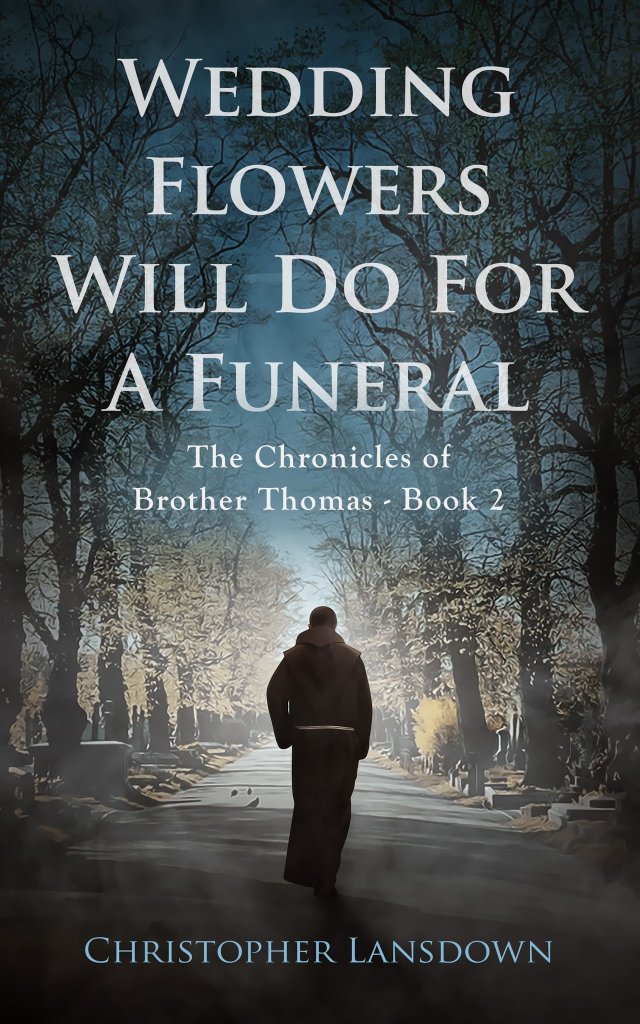
Wedding Flowers Will Do for a Funeral is Now Available

Presently available on my publisher’s website (and, in print, generally cheaper there after it goes to wide distribution), I’m pleased to say that Wedding Flowers Will Do for a Funeral is now in print!

It’s even available in hardcover, though admittedly it’s a bit pricey in that form. But it’s a nice hardcover where the cover art is printed directly onto the book itself and there’s no dust jacket to rip or lose, or as so often happens, rip then lose.

The One Clue Which Just Doesn’t Fit

In a great many detective stories, the detective will seize upon a single clue that, to him, does not fit, but—if we’re being honest—readily has an innocuous explanation. A partially drunk cup of tea, a single dumbbell, no bookmark in his book—it can be anything. The people around him will often scoff that there are many simple explanations, but he will persevere. Until that detail is adequately explained, we do not have the real solution.

This trope is often quite a lot of fun, but it can be a tricky rope to walk.

On the one hand, if the clue is too readily explained, the detective is not justified in clinging so tightly to it. On the other hand, if there is no reasonable explanation for the clue, then it becomes an obvious clue and no one is justified in scoffing at the detective. The main fun of this sort of clue consists in walking right on the edge—the detective being justified in clinging to it, but just barely.

A fun variant of this approach is for the detective to set the irksome clue aside and focus on other things, only to discover, in the end, what the meaning of the irksome clue was. This, I suspect, works best in detective stories that have the structure of a short story—clues, then turn the page for a denouement. (TV murder mysteries tend to have this structure, spread out over a little more time. This is why the detective so often figures out who did it after some almost meaningless clue which gets him thinking of things the right way—it’s the pretext used to give the audience some time to consider the clues presented up to this point and guess before the detective reveals it.) I suspect that the Poirot-style mystery where the clues are gathered in a confusing order and then Poirot sets everything straight in the accusing parlor would work to.

I tend to favor a more gradual process, where the reader is closer to the detective’s thoughts, so I haven’t used this sort of clue in my murder mysteries yet. I’ve also tended to stay away from solutions that hinge in a single piece of physical evidence. That’s not a policy, it’s just where I’ve gone. The critical piece of physical evidence is very tricky to pull off right—it’s very difficult to make it both conclusive and yet non-obvious.

The one clue which doesn’t fit is even harder to pull off in a novel, since it (more or less) has to be the key to looking at things from the correct perspective. From the correct perspective, things make sense and the evidence to get leaps to mind; in a novel it is hard to have this perspective but never have anyone consider it. It is, of course, doable—the key seems to be to have an alternative perspective which seems more plausible and almost makes sense, in which the detectives can labor until they come at the problem from the right angle. The problem with this approach is that though it does have the effect of startling the reader, I think that it diminishes the enjoyment of re-reading the story, since one knows that the detective is walking down useless paths. (To make them non-useless basically requires lucky discoveries, and luck is not what fun is made of in a detective story.)

It is interesting to consider how to use this sort of clue well. It can be a lot of fun, and I would enjoy working one into a novel that I write.

The Problem With Fair Play In Mysteries

In the golden age of mystery writing there was the idea that a murder mystery was a game between the author and the reader. The author would give all of the clues necessary and would win if the reader couldn’t guess the solution before the detective reveals it; the reader would win if he guessed first.

The idea was all over the place at the time. For example, you can see aspects of this in Fr. Ronald Knox’s 10 Commandments of Detective Fiction. Most of the rules ensure that the necessary evidence is actually given to the reader.

Fair play is a great idea, and makes for good books. The only problem is that it—mostly—doesn’t actually work for its intended purpose.

The problem with “fair play” in murder mysteries, as a game, is that there are usually too many degrees of freedom. Ambiguity can be resolved in too many ways. For example, it is possible that the murderer managed to pretend to come into the room he was already in, but then it was also possible someone in the séance circle holding hands with the victim could have let go and stabbed the victim before he could cry out. Neither is probable and neither is impossible. Which is more likely? The reader is not really solving the problem, but instead reading the mind of the author.

This sort of ambiguity comes up a lot because ambiguity is the heart of mystery. If there’s only one interpretation, there’s nothing to detect, or at least there’s no value in the detective being brilliant. More than that, there is always ambiguity so long as there is a next page—it is always possible that the next page will contain new evidence which changes the meaning of evidence which showed up before.

On the flip side, if sufficient evidence to obtain a criminal conviction is given prior to the suspects gathering in the accusing parlor, the game will be too easy. If there is insufficient evidence for a conviction, the solution will be unsatisfying. It seems like there should be a happy medium, but there isn’t. The most common attempt is for the detective to withhold from the reader some conclusive peace of evidence and only present it when the formal accusation is made. This does not solve the problem, though, because it is almost always the case that a different piece of conclusive evidence could be given for at least one other suspect. In short, if there is any point in guessing, there will always be more than one reasonable guess.

Fair play doesn’t really work for its intended purpose, but it does make for good book.

There are two main reasons for this. The first is that fair play unites the reader with the detective. The second is that fair play forces the writer to make the mystery mysterious because it is clever.

When the author hides clues from the reader, it means that the reader doesn’t know why the detective does what he does. The detective, himself, becomes a mystery. In this case the reader is united, not to the detective, but to the Watson. (To some degree this explains the original Watson, who was, in theory, the author of the stories and hence they were from his perspective.) On the plus side, this multiplies the mysteries. The downside is that it makes the detective an unsympathetic character, in the strict sense that the reader cannot sympathize with him.

Interestingly, Sherlock Holmes was originally meant to be an unsympathetic character in the other sense—aloof, unapproachable, eccentric in the extreme. It did not last; Holmes was humanized, over time. Part of this was that there were often sub-mysteries which Holmes would explain, allowing us to get close to the detective.

The other aspect of fair play—that it forces the writer to write good mysteries—is also important to a good novel. A mystery in which the mystery is maintained only by withholding clues is, generally, a very simple mystery. If there is nothing much for the detective to think about, the solution will not be very satisfying when it is finally offered.

Another effect fair play has on plot construction is that it forces the author to be careful with the rate at which clues are given, and the circumstances which produced them. If the author has to reveal what the clue is when the reader has time to think about it, it being unreasonable for the culprit to have left the clue will stand out more.

For these reasons, and probably for others, too, fair play is as important now as it ever was. I think we merely lack the societal explanation which was never really adequate, even in its own day.

Wedding Flowers Will Do for a Funeral Due in Mid-March

Russell, one of the owners of Silver Empire Publishing, the publisher of The Dean Died Over Winter Break, said that he should have Wedding Flowers Will Do for a Funeral (the second chronicle of Brother Thomas) available in Silver Empire’s bookstore in mid-March, with wide availability (Amazon, etc) by the end of March. I will, of course, post when it is actually up.

Murder for Quid Pro Quo

It has been said that the two main motives for murder as sex and money, especially money. The problem this produces is that it tends to make it relatively obvious who the murderer is—whoever gets the money or gets the lover.

One of the traditional solutions to this problem is for the murderer to invent a clever way to kill the victim without being there. Another is for them to fake an alibi, or to fake the time of death so that they can establish an alibi.

The final of the classical solutions is for the murderer to have an accomplice. This produces the problem of motive for the accomplice.

Probably the simplest solution is economic—for the accomplice to share in the proceeds through the primary murderer’s discretion afterwards. Other motives involve love, a shared desire for revenge, and being tricked into it without understanding what was going on (then either not being aware of the significance of the help or being afraid to speak up).

An interesting alternative was used in the Death in Paradise episode, A Dash of Sunshine (Series 2, Episode 6). Here, the murder was perpetrated entirely by an accomplice, in exchange for the murderer having murdered the accomplice’s victim in another country, several months before. That is, each murder was committed by a person with no connection to the victim, as a quid pro quo. This was a very interesting setup, as it led to some unusual qualities in the murder.

Ordinarily, a murderer who has no connection to the victim is impossible to catch. In these modern days of DNA evidence, that may be somewhat less true, if the murderer has been foolish enough to use an online DNA service, or if a close relative has. Even there, though, that isn’t tremendously useful if there was no other evidence linking the murderer to the crime. Moreover, it’s not overly likely to be present.

There was a time, in the dawn of forensic science, where fingerprints were new technology and criminals did not know to wear gloves. That time did not last long. Similarly, there was a time when criminals did not know to avoid letting their DNA get onto a crime scene, but they do know it now. Admittedly, avoid fingerprints is easier than avoiding leaving any DNA, but at the same time, it’s not that hard. Gloves will do it for anything that one touches, and beside that, some simple precautions like wearing pants and a long-sleeved shirt, and ensuring that one’s hair doesn’t shed (a hat, a hair net, etc) will generally suffice. It’s not like the police are going to swab every inch of the floor in the hope of catching a stray skin cell. Tests cost money.

DNA evidence is much more of a problem for the mystery writer in crimes of passion, where the murderer would not have thought to take precautions beforehand. On the other hand, it is far more likely in crimes of passion that here will be an innocent excuse for why the murderer’s DNA is present at the crime scene. If a man lives in the same mansion as the victim, it is of no significance that his DNA was found in the same room as the victim. It would almost be odd to not have found it.

All that allowed for, it is still nearly impossible to catch a murderer with no connection to his victim. This makes the quid-pro-quo murderer very difficult to catch—unless the murderer makes a mistake and leaves physical evidence, the only way to catch him is through his connection to his partner—the one who benefits.

Interestingly, in the Death in Paradise episode, the killer made mistakes and left forensic evidence and this is how the detectives caught the pair. Perhaps the biggest of these mistakes was killing the victim in his own rental house. This was especially odd as the other murderer had made the reservations at the rental house, meaning that they cooperated in the terrible decision to proceed with a link from the murderer to the victim. It was explained, and I think reasonably, that the murderers were careless because they were arrogant. They assumed that across the ocean, in a country with a minimal police force, a staged robbery would be accepted as such and murder would not be suspected. It was still a terrible idea, and one that they didn’t make with the first murder, back in England.

I can’t think of any examples of the other way around—of finding the connection between the murderers then finding the connection between the killer and the victim. Given how many murder mysteries have been written in the last 100+ years, it probably has been written, of course, but it would be interesting to write the second.

Poirot’s Voice

In Masters of Mystery, by H. Douglas Thomson, there’s a chapter called The Orthodox Detective (as opposed to “the realistic detective story,” “the domestic detective story,” “the thriller,” etc). Curiously, it is entirely about Agatha Christie. I suppose that this is almost fitting, as in 1930 she was something of a genre unto herself.

In some ways, she still is.

Anyway, there’s a section where Thomson talks about Poirot’s voice, in the sense of how he speaks, and he translates a small section from the Sherlock Holmes story Silver Blaze into how it would read as a Poirot story. I think he does a excellent job of it, so I wanted to quote it here as it’s very interesting to compare and contrast.

In Silver Blaze:

“Is there any other point to which you would wish to draw my attention?”
“To the curious incident of the dog in the night-time.”
“The dog did nothing int he night-time.”
“That was the curious incident.”

In translation:

“Is there any other point to which you would wish to draw my attention?”
“There is the dog,” he said. “Always I think of that dog in the night. Always it perplexes, that one. It is of a mystery the most profound.”
“But the dog did nothing in the night-time.”
Précisément,” he replied softly. “That is the mystery, mon ami.”

Thomson goes on to note that when Poirot is in the thick of things, his language becomes more direct and even “mon ami” gets softened to “my friend”.

This is intentional on the part of Christie, she talked about it outside of the stories and even Poirot occasionally talked about it within his stories. Poirot tended to speak in Frenglish in one of two circumstances:

  1. When he wanted to disarm people. A man who has difficulty speaking the language will presumably have difficulty understanding the language and so he can’t be much of a threat.
  2. When he was dealing with people who disliked foreigners. He found that with such people the best way forward was to be very frankly a foreigner and so to give them the opportunity of forgiving him for it.

To some degree Poirot’s being a Belgian refuge from “The War” (i.e. World War I) served to explain why he was a private detective rather than a police officer—he had been a police officer in his native country but could hardly become a police detective in England.

His being a Belgian refuge also helped to make him interesting, and moreover, exotic enough to feel realistic in the unrealistic genre of the murder mystery. Unfortunately—or fortunately, as one sees it—crimes are rarely plotted out with brilliant intricacy and still less often are they unraveled by a brilliant detective who puts together the clues which other people miss. Whether this is because of the rarity of the brilliant crime or simply the rarity of catching the brilliant criminal, we cannot say for we do not know. It may be that brilliant people never commit carefully planned out murders. It may be that carefully planned murders happen all the time and people either do not suspect that the deaths are murders or the patsy who was framed is framed successfully and pays for the crime he didn’t commit, or perhaps these are just unsolved crimes where we know the crime was committed but have no leads.

Be that as it may, the brilliant detective solving a murder simply does not happen in real life (or at least nowhere near often enough for a man to build up a reputation, to say nothing of supporting himself on the proceeds of investigating such crimes). This creates a sort of tension in detective fiction because the fun comes from most of the story being realistic.

The solution generally seems to be to make the detective eccentric in some fashion. Not just any eccentricity will do, however. It has to be an eccentricity which pervades his interactions with his fellow creatures. If the reader’s normal experience of the detective is outside of the reader’s normal experience of real life, then the unreality of him being a detective at all is much easier to forget.

Starting a Cast List

So despite the fact that I’m supposed to be taking a break, I’ve begun work on the characters and plot of the third chronicle of Brother Thomas, tentatively titled He Didn’t Drown in the Lake.

The murder takes place at a rustic resort in the Adirondack mountains of upstate New York where there is no internet, no cell reception, and not even any electricity. I’ve worked out who the victim is, who the murderer is, and why it was done. I’ve still to figure out how it was done, but I’m working on the other characters, first, since that may well impact how it was done.

So now I’m working out a list of who will be vacationing at the mountain resort. There are a lot of possibilities. So far, I’m considering having two novelists on a writing retreat, one in his twenties and the other in his forties.

Fun times.

Forgotten Literary Influences

As I’ve mentioned, I’m reading the book Masters of Mystery: A Study of the Detective Story, written by H. Douglas Thomson in 1931. One of the things which I’ve been getting out of it is an idea of what the popular mystery novels were at the time, which I’ve never heard of.

For full disclosure, the mystery authors I’ve actually read something by, from the early days and the golden age of mystery, are, in no particular order: Edgar Allen Poe, Sir Arthur Conan Doyle, G.K. Chesterton, Fr. Ronald Knox, Dorothy L. Sayers, Agatha Christie, S.S. Van Dine, and Mary Roberts Rinehart.

It’s not a long list, and not all of them have been by recommendation. I read Poe’s Murders in the Rue Morgue because it was the first detective story. I read S.S. Van Dine’s The Benson Murder Case out of curiosity since Van Dine had written up a set of rules of detective fiction I’ve seen referenced numerous times on Wikipedia. I read The Door by Mary Roberts Rinehart because it was supposed to be the origin of the phrase, “The Butler Did It”. (See my series on that phrase, if you haven’t read it yet.) And I’ve read most of Fr. Knox’s mysteries, but I started because he was a friend of G.K. Chesterton and because he wrote a famous ten commandments of detective fiction.

So if we subtract those, the mystery writers from that era which I’ve actually read because someone recommended them to me are: Conan Doyle, Chesterton, Sayers, and Christie. In my youth, that was my impression of the time period.

As I grew older, I realized that there must be other mystery writers of the time period that I was just unfamiliar with, but it was only in recent years that I came to appreciate just how popular a genre mystery was in those days, both to read and to write.

The thing which really drove it home to me was a short story entitled What, No Butler? about the accidental detective, Broadway. Here’s what I wrote about it at the time:

Incidentally, I looked up the two works cited. “What, No Butler?” seems to be a short story by Damon Runyon. I can’t find much information about it; according to Wikipedia it was in a book called Runyon on Broadway. It was performed on radio in 1946 and that performance is available on youtube. I don’t know when it was originally published. The story does have humor in it, but to call it satire seems like quite a stretch. Early in the story, the character Broadway (who I believe is a theater critic) says authoritatively upon finding out that a man was murdered that the butler did it. When he’s told that the victim didn’t have a butler, he insists that they have to find the butler, because in every play he sees with a murder in it, the butler did it.

What caught my attention was the reference, not to novels or even to magazine stories, but to plays. I know of literally one detective play, The Mousetrap, by Agatha Christie, which I only know about only because I was reading the wikipedia article about Ms. Christie. (Incidentally, it is the longest running play ever put on, being continually put on since 1952. Its 25,000th performance was in 2012.) There is evidence, though, that detective plays were fairly common.

This escaped me in no small part because plays have largely gone away as a form of common entertainment. Aside from high schools and community theater, plays are mostly a broadway affair for wealthy people and tourists in NYC. (This is not quite true, as there are actually plays elsewhere, but it is approximately true.) Back in the day, however, they seem to have had more of the role of television, these days, with plays being frequently written and performed for only a short time to be replaced by others. Television is a superior medium for this sort of fast-paced churn of mediocre writing, so it is natural that it would have eliminated it. But in that vane, we might take all of the episodes of a show like Murder, She Wrote to be somewhat representative of what plays of the era might have been like. Here today, gone tomorrow, and only meant for an evening’s entertainment.

Another blind spot in my knowledge of the time were short stories printed in magazines. Because novels are the dominant form of written fiction in our day, I tend think primarily of the novels written during the early days of detective fiction, or of collections of short stories. But in the late 1800s and early 1900s, magazines had enormous circulations and were apparently where the real money was in writing fiction. Even novels which we read today as novels, from the time period, were frequently originally published as serializations in a magazine. But of course short stories were extremely popular.

Of these blind spots, I was to some degree cognizant. What Masters of Mystery really drove home to me was the great number of popular detectives even available in novels which I had never heard of.

I had seen a few references to Dr. Thorndyke in the Lord Peter Wimsey stories—it turns out that he was a character in Dr. Austin Freeman’s popular detective stories. There were many others I had not heard of, though, and the push and pull of what constitutes the ideal detective story, as each writers takes in his turn to write his own detective, is quite interesting to see.

Possibly the most interesting to me at the moment is Mr. A.E.W. Mason’s Inspector Hanaud. First appearing in a story published in 1910, he is thought to have had some influence on Agatha Christie’s Hercule Poirot, especially when it comes to physical description, but also to brilliant intuition and a psychological approach. Interestingly, in looking this up to confirm some points on Wikipedia, I ran into this:

Poirot’s name was derived from two other fictional detectives of the time: Marie Belloc Lowndes’ Hercule Popeau and Frank Howel Evans’ Monsieur Poiret, a retired Belgian police officer living in London.

So it seems that perhaps the second most famous detective of all time (the most famous being Sherlock Holmes) drew very heavy inspiration from a number of sources, most of which (aside from Holmes) have been long forgotten.

It is yet more evidence that it is not originality which matters, but the quality of execution.

That said, Agatha Christie was a very original writer. Not, precisely, in her subject matter, but in her approach to it. She managed to pull off things which others could not. Perhaps the greatest example of this is The Murder of Roger Ackroyd. Prior to this, Fr. Knox, in his decalogue, had given two rules which are here relevant:

  1. (1) The criminal must be mentioned in the early part of the story, but must not be anyone whose thoughts the reader has been allowed to know.
  2. (7) The detective himself must not commit the crime.

The Murder of Roger Ackroyd broke both, and did so not only well, but even fairly. So well and so fairly that in a 1938 commentary on his rules, Fr. Knox said:

The second half of the rule is more difficult to state precisely, especially in view of some remarkable performances by Mrs. Christie. It would be more exact to say that the author must not imply an attitude of mystification in the character who turns out to be the criminal.

One such ingenious story would be enough for everyone, but Mrs. Christie pulled off at least a second, with her Murder on the Orient Express. This one did not break one of the rules of the decalogue, but it did break the generally unstated rule that there should be one or two murderers. Instead, Mrs. Christie pulled off a story in which everyone (with a few minor exceptions) did it. Every suspect (and several non-suspects) turned out to be guilty. Her originality consisted not in the idea—”everyone did it” is the sort of thing anyone might think of—but in figuring out how to make it work.

This is something those of us writing today should take to heart. In English class in high school we hear much about originality and genius. The reality of writing novels is that what really matters is doing a good job.

One of the Great Mystery Endings

As I’ve mentioned, I’m reading the book Masters of Mystery: A Study of the Detective Story, written by H. Douglas Thomson in 1931. It’s an interesting book that I will share more from soon(-ish), but there was one little snippet which stands on its own and which I just have to share.

The reprint of The Leavenworth Case attracted some attention. A post-prandial pronouncement of Mr. Baldwin was presumably the origin of this venture, for on the jacket we read in bold black type from some continental foundry:

“Mr. Baldwin—speaking at a dinner of the American Society in London on the 29th of November, 1928, said: ‘An American Woman, the successor of Poe, Anna K. Green gave us The Leavenworth Case, which I still think one of the best detective stories ever written.'”

Something must have been wrong with the dinner. The Leavenworth Case is not by any means a first-class detective story. The detection is singularly elementary. The plot is hopelessly drawn out, and the melodrama is a sample of unnatural and stilted writing. It may be unfair to cut out a sentence or two from its context, but the climax cries aloud for glorious isolation:

“A silence ensued which, like the darkness of Egypt, could be felt. Then a great and terrible cry rang through the room, and a man’s form, rushing from I knew not where, shot by me and fell at Mr. Gryce’s feet shrieking out, ‘It is a lie! A lie! Mary Leavenworth is innocent as a babe unborn! I am the murderer of Mr. Leavenworth. I! I! I!”

I know nothing about The Leavenworth Case, and even my deep curiosity about all things will likely not involve me actually reading the thing. It is interesting to contemplate, however, that such a story was not only written, but published, and a room full of people who had just eaten was told that it was one of the finest detective stories ever written.

There is hope for us all.

The Early Days of the Detective Story

As I mentioned, I’ve been reading the book Masters of Mystery: A Study of The Detective Story. The first chapter deals with the question of whether the detective story is literature, and if so, whether it is good literature. There are two things that particularly caught my attention: the enormous popularity of the detective story, and the basic morality of the detective story.

The first is very interesting because I’ve seen it in detective fiction from the era, but I never knew what to make of that. The example which most leaps out at me is Harriet Vane’s reception by the dons in Gaudy Night. A great many of them had read her books and were fans. It almost has the same feeling as the near-universal name recognition of Jessica Fletcher in Murder, She Wrote. In Jessica’s case, however, we know this to be a tremendous exaggeration. It was more plausible in the case of Harriet Vane, though, because television had not yet been invented and talkies (movies with recorded dialog) were only in their infancy. It is, therefore, interesting to see a description, if, granted, from an interested party, of how widespread was the interest in detective stories around the time of 1930. It was popular with educated people, with common people, with respectable people—in short, there was no notable group of people not reading detective stories at this time.

The other interesting thing which leapt out at me was the critique of the detective story as dangerous to morals, and the response that the detective story was, fundamentally, a moral story. That is, the detective story takes as given the ordinary moral framework of right and wrong and man’s duty to do right and to refrain from doing wrong. This interests me so much, not because it is a revelation—it is, after all, obviously true—but because I’ve seen it used as an explanation for why the detective story is so enduringly popular even until our own times (I write this at the end of the year of our Lord 2019).

It has been argued (possibly even by me) that the detective story and its modern television cousin, the police procedural, is the only modern story in which basic morality is taken for granted. It is curious to see that this was to some degree true even in the early days of detective stories.

An example given as contrast was An American Tragedy, which was the only assigned reading in highschool I never finished. I just couldn’t stand the book; I made it about halfway through and gave up, reading the Cliff’s Notes instead of finishing the wretched thing. The short short version of it is that a young man makes all sorts of awful life choices during the great depression and is eventually executed for murdering a woman he seduced (in order to be available to marry a rich woman). The main character is a bad man who learns nothing, and the book does not even appreciate the justice of him paying for his crime.

It was published in 1925.

Bad books have been around for quite a long time.

Talking of the Past in the Past

A few years ago a dear friend of mine gave me the book Masters of Mystery: A Study of The Detective Story, and I’ve finally started reading it. I’ll be writing about what it says about the detective story in another post; here I want to talk about something interesting in the timing of the book, and of the introduction which came later, as the copy I was given is actually a reprint.

Masters of Mystery was written by H. Douglas Thomson and originally published in 1931. The reprint and its foreward were made in 1978, three years short of the book’s fiftieth anniversary.

The book itself was written at an interesting time, given that 1931 was only the middle of the golden age of detective fiction and had yet to see most of the work of Agatha Christie, Dorothy L. Sayers, to name just two giants of the genre.

Further making it an interesting time, detective fiction was not that old. Granted, the first detective stories are generally reckoned to be Edgar Allen Poe’s Dupin stories, the first of which, Murders in the Rue Morgue, being published in 1841. There seems to be fairly little—in English—before Conan Doyle published Sherlock Holmes in 1887. 1931 was a scant 44 years later. That is enough time for much to have happened, but it was still early days.

We come, now, to the foreward which interests me, being written a slightly longer time in the future, and taking a historical look at how Masters of Mystery held up. It was written by a E.F. Bleiler, who according to Wikipedia was “an American editor, bibliographer, and scholar of science fiction, detective fiction, and fantasy literature.” He worked as an editor at the American publisher Charles Scribner’s Sons at the time of the reprint, but as he only left Dover in 1977 and it was Dover that did the reprint, it is possible that he wrote it while an editor at the publisher. He may have been, therefore, less an expert sought out for his opinion and more a man who happened to be around.

He praises the book, but also notes some weaknesses. Some may be fair, such as noting that Thomson leaves off much about the early days of detective fiction—for the understandable reason that not much was known, especially then and even now, of it.

He makes the somewhat odd claim that Detective mysteries were at the time Thomson wrote predominantly “house party” crimes. This is odd in that it’s simply false if predicated of the famous stories of the time. It was a common enough setting, but among the detective stories which have come to us at the time of my writing, it certainly did not predominate. How common it was amongst the stories which have long since been forgotten, I cannot say.

The really interesting claim, though, is rooted firmly in its time:

Thomson’s critical standards were often a function of his day, but two more personal flaws in his work must be mentioned. His worst gaffe, of course, is his failure to estimate Hammett’s work adequately. While Hammett-worship may be excessive at the moment, it is still perplexing that Thomson could have missed Hammett’s imagination, powerful writing, and ability to convey a social or moral message. Related to this lacuna is Thomson’s lack of awareness of the other better American writers of his day, men who stood just as high as the better English writers that he praises. It was inexcusable to be unaware of the work of Melville D. Post, F.I. Anderson and T.S. Stribling. It is also surprising, since all three men were writers of world reputation at this time.

To deal with the last, first: I’ve never heard of Post, Anderson, or Stribling. F.I. Anderson does not even have a wikipedia page. Such is the short duration of fame, I suppose, that a man can be castigated for not talking about famous men 48 years after his book that, 44 years later, are generally unknown.

Dashiell Hammett, I do of course know of. That said, it is funny to me to speak of Hammett as some sort of master that everyone must talk about. I’ve met exactly one person who seriously likes Dashiell Hammett’s writing, and I don’t even know his name—I struck up a conversation with him while waiting to pick up Chinese food one night.

I suspect that Hammett’s reputation in the 1970s was a product of the success of the movies based upon his books. The casting for The Maltese Falcon and The Thin Man were excellent, and anyone having seem them—as an editor working for Dover in 1977 almost certainly would have—cannot help but read the tremendous performances of the actors into the words on the page. If one does not picture Humphrey Bogart as Sam Spade, much of the magic is lost.

Again, I should note that in the main Blieler’s foreward is positive and mostly about how Masters of Mystery is worth reading. I was merely struck by how much the retrospective criticisms of it were a product of their time, but were phrased as if they were now timeless.

Taking a Page from Scooby Doo

It strikes me that an interesting plot for a murder mystery would be to borrow a page from Scooby Doo and to have the murderer disguise a murder by taking advantage of a local legend.

Of course, this is hardly original to Scooby Doo. This basic structure for a plot can be found in The Hound of the Baskervilles, published some 67 years before Scooby Doo began his crime fighting in the classic TV show, Scooby Doo, Where Are You!

We live in a different time from either, which would make a somewhat different approach necessary, but I think it’s interesting to consider how, and why.

Scooby Doo originated at a time when there was tremendous interest in the “paranormal.” I’m not sure exactly when it started, and I think it had mostly died down by the 1990s, but for a while, in America at least, there was great interest in things like the Loch Ness monster, the Bermuda triangle, alien abductions, big foot, and such-like. I think that there was a relationship to the great popularity of self-help, self-actualization, consciousness-raising, and other such things that gave rise to a lot of cult activity. People knew that there was more to the world than the official explanation (that is, what they learned in public school and what was said in newspapers), and searched for it in some very strange places.

Scooby Doo, Where Are You! took this cultural pervasiveness as a starting point, and just ran with it. The eagerness of people to believe in more than the oversimplification they learned as children made for a ready setting to find strange things behind every tree and under every rock. (Scooby Doo was also a comedy, of course, so the American preference for exaggeration in comedy must also be taken into account.)

The Hound of the Baskervilles, by contrast, comes from an age which is more content with the simplistic answers that a rationalist oversimplification tends to give. Coming before the two world wars, when technology turn on its creators and the promised heaven-on-earth of Science became hell-on-earth, people had a different sort of relationship to Science than they did shortly after the second world war, which was when Scooby Doo was written and set. Given the long stretch of comparative peace within the United States, our modern time has come much more to hope in Science once again, and accordingly to be more content with rationalistic oversimplifications, so I think that we are culturally closer to The Hound of the Baskervilles. So we must look closer to the roles that the putatively supernatural plays.

Rationalistic ages tend to reject superstition, but very curiously they do it for a very different reason than Christian ages do. To the Christian, superstition is sinful because it is primarily a means of trying to step outside the natural order to control it. Bear in mind, that in a Christian context things like Angels are natural; a properly Christian distinction between natural and super-natural is created and creator. To a Christian, only God is super-natural. So stepping outside of the natural order largely means things like consorting with fallen angels, who are willing to abuse their power for their own dark ends. Superstition is sinful, then, because it is trying to be something one is not, and abusing the natural order in order to do it.

So to take an example of a superstition, trial by combat or trial by ordeal are both superstitious because they are an attempt for force the hand of God’ to serve men’s purposes. This is inverting the natural order; we were given senses to find out who is guilty, but the superstitious does not want to use our senses and our reason to determine guilt. So the superstitious man resorts to something which he thinks will give him control and force the world to do his will, that is, to tell him guilt without taking the trouble to determine it.

(Laziness is very ingrained in fallen humanity, and it took the Church many centuries to finally extirpate trial by combat and trial by ordeal.)

Also worth noting is that the first casualty in such abuse will tend to be a person’s reason; in order to act badly one must also think badly. Thus superstition always goes along with lousy reasoning; it must in order to seem like a good idea. Hence also why we get the sort of immense practicality of the monk who was trying to help a woman who said that she had the power to fit through keyholes. He locked his door, took the key out, then chased her around the room hitting her with a stick and telling her to get out of the room if she could. It might be difficult to get past a Human Subjects Review Board these days, but it’s a sound experimental design, and proved the point quite well.

Rationalistic ages, by which I mean ages which believe themselves to know everything, and approximate this by refusing to acknowledge the existence of anything they do not know, hold a radically different view of superstition. To them, superstition is anything which is super-natural where nature is defined as, basically, what they know. Thus to a rationalist, the super-natural is anything outside of his knowledge. (This is why things like big-foot will be considered supernatural even though they are supposed to be exactly as much flesh-and-blood as a Spaniard or an orangutan.)

The problem which rationalists have is that on some level they do know that they do not, in fact, know everything. They are confident, but they know that their confidence has no basis in reality. The only way to prove a negative is by contradiction; the Christian has a contradiction to people being able to achieve total power by stepping outside the natural order. (That contradiction is the providence of God; demons tremble at the name of Christ, etc.) But the rationalist has only the fallacy of ignorance (assuming that an absence of evidence is evidence of absence). Material fallacies are not very comforting at night, when it’s cold and hard to see, and one hears a sound which one cannot identify.

Thus rationalistic ages will always lend themselves to superstition (in both senses, really). Fear will never leave a man forever, and if he has no comfort from a higher power, he has no protection. There’s a section from Chesterton’s The Everlasting Man which describes it quite well:

Superstition recurs in all ages, and especially in rationalistic ages. I remember defending the religious tradition against a whole luncheon table of distinguished agnostics; and before the end of our conversation every one of them had procured from his pocket, or exhibited on his watch-chain, some charm or talisman from which he admitted that he was never separated. I was the only person present who had neglected to provide himself with a fetish. Superstition recurs in a rationalist age because it rests on something which, if not identical with rationalism, is not unconnected with scepticism. It is at least very closely connected with agnosticism. It rests on something that is really a very human and intelligible sentiment, like the local invocations of the numen in popular paganism. But it is an agnostic sentiment, for it rests on two feelings: first that we do not really know the laws of the universe; and second that they may be very different to all we call reason. Such men realise the real truth that enormous things do often turn upon tiny things. When a whisper comes, from tradition or what not, that one particular tiny thing is the key or clue, something deep and not altogether senseless in human nature tells them that it is not unlikely.

So when it comes to writing a story about someone using a legend as a disguise, the best place to put it will be in a group of rationalists. Some will violently protest against it, but all will be liked to be haunted by it. You can see this sort of thing in Chesterton’s story The Blast of the Book, where there is a book which is supposed to have some dark power to make the people who read it disappear. It is followed around a bit, with various people disappearing from it, and it turns out to be a practical joke by the subordinate the main character of the story (Professor Openshaw, which is, of course, a rationalist).

There was another long silence and then Professor Openshaw laughed; with the laugh of a great man who is great enough to look small. Then he said abruptly:

‘I suppose I do deserve it; for not noticing the nearest helpers I have. But you must admit the accumulation of incidents was rather formidable. Did you never feel just a momentary awe of the awful volume?’

‘Oh, that,’ said Father Brown. ‘I opened it as soon as I saw it lying there. It’s all blank pages. You see, I am not superstitious.’

Chesterton might, I suppose, be accused of poking fun at his enemies in this fashion, but it is actually rather good psychology. In the same way that one cannot write a devout Catholic racked by guilt—if he is so racked, he will go to confession and discharge the guilt—it does not work to write a devout Christian trembling in superstition. If one is really devout, one would make the sign of the cross, invoke the name of Christ, and open the thing one is not supposed to open. Or, failing that, take it to a priest to have a blessing said over it or perhaps an exorcism performed. A simple nameless dread does not make sense because the Christian has a definite idea of what to do with things he does not personally understand, because while he doesn’t know all the particulars, he does know the hierarchy.

Now, there is what might be called a middle ground, which we can described as undiscovered beasts. It is possible that there is a sixty foot long alligator swimming in the swamps by some campground, and the thing to do with alligators, even with large ones, is to not stand next to them. Everyone should be cautious of an insect with a poison so deadly one sting can kill twelve grown men. While these things would be superstition to the rationalist, they would not be superstition to the Christian, and would be things to investigate the within the ordinary course of probability. Demons do not leave footprints, but sixty foot alligators do.

Legends of a species of sixty foot alligators in a deep, unexplored swamp are of course possible, but do not lend themselves as well to detection, I think, for the simple reason that faking their presence requires the sort of effort that a single person is not likely to be able to put into things. Making footprints that big, and tail-tracks, and such-like would be time consuming and difficult.

This sort of unknown beast is very doable, but is more problematic in that it’s the sort of thing which should be observable, and moreover would make a lot of people interested in observing them. And since they should be observable, the perpetrator will be almost obligated to provide some physical evidence of the beastie. If there is a hyper-deadly wasp in the area, blaming deaths on it will not be very plausible unless somebody swats one of the things and it can be analyzed to find its hyper-deadly poison. Moreover, by the time one is faking the cause of death in a remote area, one might as well fake a more conventional cause of death, or even just find a way to inject the poor victim with a real disease, like tetanus or malaria or what-not. Or poison them plus give them a real disease.

So I think that the thing one would want to fake, as a murderer, would be the sort of supernatural which would not leave physical evidence of its crimes. Ghosts, etc. are a much better patsy than an undiscovered beast; they leave off all sorts of problems of having to produce evidence afterwards.

I think that the time is ripe for such stories again.

Sherlock Holmes and the Valley of Fear

I recently read the fourth and final Sherlock Holmes novel, The Valley of Fear. It’s an interesting book, or in some sense two books, the first of which I know to be interesting and the second I’m not really interested in reading.

(If anyone doesn’t want spoilers, now’s the time to stop reading.)

The book begins with Sherlock Holmes working out a cryptogram by reasoning to the key from the cipher. It’s a book cipher, which has many pages and two columns, so Holmes is able to guess that it’s an almanac. This is clever and enjoyable; the message decodes that something bad is going to happen to a Douglas in Birlstone. Shortly after they decrypt it, a detective from Scotland Yard arrives to consult Sherlock Holmes about the brutal murder of Mr. Douglas of Birlstone. The plot thickens, as it were. This is an excellent setup for what is to follow.

When Holmes arrives, we get the facts of the case, that Mr. Douglas lives in a house surrounded by a moat with a drawbridge, and was found in his study with his head blasted off with a sawed-off shotgun fired at close range. Any avid reader of detective fiction—possibly even at the time, given how detective fiction had taken off in short story form by 1914, when The Valley of Fear was written—will immediately suspect that the body is not the body it is supposed to be. However, Conan Doyle forestalls this possibility by the presence of a unique brand on the forearm of the corpse, which Mr. Douglas was known to have had. This helps greatly to heighten the mystery.

The mystery is deepened further by the confusing evidence that Mr. Douglas’s friend forged a footprint on the windowsill which was used to suggest that the murderer escaped by wading in the moat—which was only 3′ deep at its deepest—and ran away. Further confusing things, Dr. Watson accidentally observes Mrs. Douglas and Mr. Douglas’ friend being lighthearted and happy together.

Holmes then finds some additional evidence which convinces him of what really happened, which he does not tell us or the police about, which is not exactly fair play. He then he sets in motion a trap where he has the police tell Mr. Douglas’ friend that they is going to drain the moat. This invites the reader to guess, and I’m not sure that we really have sufficient evidence at this point to guess. That’s not entirely true; we have sufficient evidence to guess, but not to pick among the many possible explanations of the facts given to us. It turns out that the dead man was the intruder, but it could have turned out otherwise, too. The facts, up till then, would have supported Mr. Douglas’ friend having been in on the crime, for example. That said, the explanation given does cover the facts very well, and is satisfying. It does rely, to some degree, on happenstance; none of the servants heard the gunshot, except for one half deaf woman who supposed it to be a door banging. This is a little dubious, but investigation must be able to deal with happenstance because happenstance is real.

We then come to the part where Mr. Douglas is revealed and the mystery explained, and which point the narrative shifts over to explaining his history in America and why it was that there were people tracking him from America to England in order to murder him. This, I find very strange.

It is the second time in a novel that Conan Doyle did it. The first time was in A Study in Scarlet, where the middle half of the book (approximately) took place in America. I really don’t get this at all.

I suspect it makes more sense in the original format of the novels, which were serialized in magazines. It would not be so jarring, in a periodical magazine, to have to learn new characters, since one would to some degree need to reacquaint oneself with the already-known characters anyway. Possibly it also speaks to Conan Doyle having not paced himself well, being more used to short stories, and needing to fill the novel with something else.

The very end of the book, when we return in the present in England, is a very short epilogue. Douglas was acquitted as having acted purely in self defense, but then is murdered by Moriarty when it was taking Holmes’s advice to flee England because Moriarty would be after him.

That the book takes such an interest in Moriarty is very curious, given that it was written in 1914 while Holmes killed Moriarty off in 1893. Actually in 1891, but The Final Problem was published in 1893. Holmes was brought back in 1903, in The Adventure of the Empty House, where it is confirmed that Moriarty died at the Reichenbach Falls. So we have a novel which is clearly set prior to the death of Moriarty, establishing him as a criminal mastermind, almost 15 years after he was killed off. What’s even stranger about it is that Moriarty barely features in the story. He’s in the very beginning, mentioned only in connection to the cryptogram and as having something to do with the murder, but he nor his men actually tried to carry out the murder. His involvement was limited to finding out where Douglas was, so the American who was trying to murder Douglas could try. He naturally makes no appearance in the story of Douglas’ adventures in America, and only shows up in a note at the end of the book:

Two months had gone by, and the case had to some extent passed from our minds. Then one morning there came an enigmatic note slipped into our letter box. “Dear me, Mr. Holmes. Dear me!” said this singular epistle. There was neither superscription nor signature. I laughed at the quaint message; but Holmes showed unwonted seriousness.

Moriarty is indicated to have killed Douglas off the cape of South Africa, and the book ends with Homles’s determination to bring Moriarty to justice.

Which would be a great setup for Holmes bringing Moriarty to justice in a later book, but we already read about it in an earlier book. It doesn’t really help to flesh the character out, it’s not really needed for the plot of the book, and it serves to end the book on a note of failure rather than of triumph. I do not understand it. Perhaps its purpose is to help increase the grandeur of Holmes’ previous victory over Moriarty? But that is a strange thing to do. Perhaps it was the reverse—a note of caution to fans of Holmes that no man, not even Sherlock Holmes, is omnipotent?

Investigating Suicides

One of the popular plots in detective stories is the investigation of a murder which has been—so far—successfully disguised as a suicide. It’s a popular plot for a reason, offering some very interesting possibilities for stories. It does, however, come with some requirements on the stories containing it, which I’d like to discuss.

The first and most obvious requirement which faux-suicide poses is that of means. People tend to kill themselves in one of a limited number of ways, and in any event must kill themselves in a way that is plausible to do alone. A man cannot shoot himself in the back with a rifle from a great distance. Further complicating the faux suicide, the murder weapon must be plausibly accessible to the victim when the body is found. Dead men do not move murder weapons. The murderer must then have access to the body after the murder in order to plant the murder weapon in some fashion. This precludes, or at least makes very difficult, the locked room murder.

Of course, that’s really just a challenge to the writer, and there have been some clever solutions. I think my favorite is a room that had both a deadbolt and a latch; the murderer locked the dead bolt but left the latch unlocked then broke the door open, staged the suicide, then locked the latch. When the detectives broke in, they assumed that the deadbolt was broken then, and not already broken. That was quite clever. (This is the Death In Paradise episode at a nursing home.)

The limitations on the means of suicide are more strict, though. For example, any poisons used must be very fast acting. Poisons like arsenic which cause pain for days before death finally comes are simply not plausible as a means of suicide. Elaborate traps which catch the victim by surprise are also implausible. Simple drowning is right out.

Additionally, the means of murder have to be something one can force on a person without leaving bruising that will contradict the idea of suicide. It will not work to knock a man unconscious with a frying pan before staging his suicide with a gun. Sedatives are the easy way out, but they’re a gamble because a toxicology report will then prove that it was not murder. Another alternative is providing an explanation for bruising will also work, such as pre-mortem bruising, faking the victim changing his mind at the last minute, or damaging the body post-mortem such as by throwing it off of a cliff.

The second sort of requirement which faux-suicide imposes is on the conditions of the victim, pre-mortem. The victim must have some sort of plausible reason to have killed himself. This significantly limits the sort of victims one can have. It would be very difficult to disguise the murder of a successful man in good health as suicide, for example. It’s not impossible, of course, but the attempt will tend to involve faking a scandal which would ruin the man’s life. It’s doable—it’s certainly doable—it just introduces other problems which need to be solved in order to make it work.

The final requirement imposed by a faux-suicide is about the detective: why on earth is he investigating the crime? If it’s suicide, what is there to investigate? The perpetrator of the crime is already known.

Proximally, there’s only one reason: because someone thinks that the faux suicide was not suicide. In a sense this is just a sub-case of the more general case of there being someone who is widely accepted as guilty, but there is someone who does not accept their guilt. In both cases, there can even be a confession (a suicide note, in the case of the faux suicide). That said, I think that there are enough differences to consider the faux-suicide on its own, rather than just as a special case of the more general pattern.

The reasons for the detective investigating the faux-suicide seem to me to come in roughly two main classes:

  1. Some of the facts of the scene of the crime are inconsistent with the suicide theory.
  2. Someone who knows the victim does not believe they could have killed themselves.

There is a very good example of #1 in Death in Paradise. Detective Richard Poole does not believe that a woman could have killed herself because she had only drank half of her cup of extremely expensive tea. (He also thinks it unlikely she could have drowned herself by sheer force of will, and she drowned but had no bruising anywhere on her, nor any sedatives in her system.)

Another example of this is the death of Paul Alexis in Have His Carcass. His blood being liquid and there being only one set of footprints—his—up to the flatiron rock suggest suicide, but on the other hand it seems implausible for a man with a full beard to buy a cutthroat razor, then take a train (with a return ticket) and walk 5 miles to sit on a hot rock for several hours before cutting his own throat with the razor.

Have His Carcass also gives an example of the latter category—a wealthy widow who was engaged to Paul Alexis thinks it is impossible that he killed himself and begs Harriet Vane to find out who murdered her intended husband.

The first category is, I think, far more common than the second sort. I can’t, off hand, think of any examples in which a detective investigated a murder solely on the strength of someone thinking it impossible their friend committed suicide. The closest I can come to that may be Five Little Pigs, in which Poirot investigates an old murder because the convicted woman’s daughter is certain her mother is innocent. Her certainty comes from a letter from her mother assuring her daughter she is innocent. This, and that her mother always told the truth. In that story, though, Poirot did not accept the mother’s innocence and was explicit that he would tell her if his investigation made him think the mother did it.

It seems, then, that a faux suicide usually requires some amount of inconsistent facts in order to be a viable story. The question then becomes how to balance these facts such that the detective understands their meaning but the authorities do not. In a sense, this is just a sub-class of the problem of how to give clues the detective understands but others don’t; still, again, I think that it is worth looking into the specific case.

I think that, as a rule, the evidence in favor of suicide should be the main physical evidence, while the evidence against should be the more subtle psychological evidence. This is certainly the common pattern, at least, but I think it makes sense since small psychological inconsistencies are easier to brush away as explained by information not present. People occasionally do strange things, and suicide is almost definitionally the strangest. No one kills himself more than once in his life.

But, then, why does the detective—who knows better than anyone that life is sometimes just unaccountably strange—place such high value on the evidence which others dismiss?

One common answer is that the detective has a compulsion to make sure that everything is neat and orderly and makes sense and is explained. This is not very satisfying, though, since this trait must be selectively applied as life is very rarely neat and orderly, with everything having an explanation which makes sense.

Another approach, which is better but still not great, is that the detective has a hunch. It’s not really satisfying because it violates rule #6:

No accident must ever help the detective, nor must he ever have an unaccountable intuition which proves to be right.

That said, this is a fuzzy line. One man’s unaccountable hunch which proves right is another man’s feeling that he can’t articulate but bears further examination.

One variation of this which is not so much a hunch is giving the detective highly domain specific knowledge. “No deep sea diver would ever drink tea at this time of day”—that sort of thing. The problem is that unless one can prevent the authorities checking up on this, they will be immediately forced to conclude the suicide was not suicide. (This is sometimes dealt with by making the authorities very pig-headed or otherwise very budget-constrained, so that they will jump at the chance to classify every death as a suicide so as to avoid having to investigate it. It an be pulled off, of course.)

I think what probably works out the best is inconclusive evidence that the suicide is fake combined with someone other than the detective acting as the driving force. The detective may not have unaccountable hunches, but others may. This sets up the interplay that the other person is sure that it wasn’t suicide, while the detective can only see some evidence which supports this conclusion but at least does justify further investigation. By making the motive force a hunch, there does not need to be sufficient evidence to justify the hunch. This allows the faux suicide to be generally taken as suicide without all of the people involved being dimwits. Unless the murder mystery is also a comedy, it is preferable to populate the world with reasonably intelligent people.

Dragnet

Something I find interesting on occasion is to look up the history of television shows. Television is a very young medium. Though the device itself was invented in the 1930s, the Great Depression and the second World War and its attendant economic privations meant that televisions were not widely owned until the late 1940s. Without an audience, not much was made to broadcast to it. It was, therefore, really the early 1950s in which television got its start.

This makes it easy to research, but also makes the chain of influences fairly short.

Dragnet actually started as a radio drama, starring Jack Webb as Detective Joe Friday. In 1951, it became a television show, with much the same cast as the radio drama, though his partner had to be changed out part way through. This show lasted until 1959. It was later revived in 1967, this time in color. This is the version which I think most people are familiar with, that stars Harry Morgon as Detective Bill Gannon alongside Jack Webb reprising his role as Joe Friday. Certainly it’s the version I’m most familiar with. It lasted until 1970.

There were other versions made, but none with Jack Webb since he died in 1982 (at the age of 62). In 1987 there was a comedic movie starring Dan Ackroyd and Tom Hanks. It’s almost a parody of the original, though it is not a mean-spirited parody and I can testify that it is a lot of fun. In 1989 there was a short-lived series called The New Dragnet, and in 2003 there was an even shorter-lived revival series called LA Dragnet.

Though Dragnet was not able to survive in the modern world of police procedurals, or possibly just it was not able to outlive its star, Jack Webb, it did have an enormous impact on television. Counterfactuals are impossible to state with certainty, but it seems likely that police procedurals would not have the form they have today if Dragnet had never happened.

Episodes of Dragnet, which are (surprisingly) easily found on YouTube, are interesting to watch. The detectives are in the homicide division, so in a very technical sense the cases are murder mysteries. However, they are not detective stories in the sense of Poirot or Agatha Christie. The detectives do a lot of work, of course, but they don’t really do anything particularly clever. They just keep talking to people until they get enough facts to convict the murderer.

What I find curious—given that I’m a huge fan of detective fiction with genius detectives and write some of it myself—is that, bare-bones as Dragnet is, it still satisfies the impulse to see a mystery solved. This is true of modern police procedurals as well. In both cases, they feel somewhat like empty calories—enjoyable while watching but they don’t really have any substance which sticks with one.

This is not true of the great detective stories. Murder on the Orient Express, Have His Carcase, Saint Peter’s Fair—these stories really stick with one. There are interesting ideas in them to chew on long after one’s read them.

But it’s a testament to the human craving for the solving of mysteries that even Dragnet, which was told in an almost deliberately un-entertaining style, still makes you want to watch to the end to find out what happens, if you watch the beginning. This may partially be a testament to the power of charisma, though. I can watch Harry Morgan in just about anything.

The Two Kinds of Evidence in Murder Mysteries

In murder mysteries, there are two kinds of evidence: evidence which tells the detective what happened, and evidence which can get a practical result from society. The practical result is often a criminal conviction, but it need not be; a wedding being called off, the payment of an insurance policy, or the settling of a will all require similar sorts of evidence.

Of the two, it is the former type of evidence, not the latter type, which is of interest to the reader.

The main distinction between the two types of evidence is not really one of the strength of the evidence, that is, of the level of certainty which it conveys. In fact, one of the common features of murder mysteries is the early presence of highly convincing evidence which will convict an innocent person unless the detective uncovers the truth. No, the distinction is not in certainty. The distinction is, rather, what is required knowledge and understanding is required to apprehend the true meaning of the evidence.

Convenient names for the sorts of evidence of which we are speaking might be complex evidence and simple evidence. Complex evidence requires extensive background knowledge and understanding of human nature. Simple evidence does not; it tells its story plainly. (Using this terminology, we can say that it is common for murder mysteries to, early on, have complex evidence which appears to be simple evidence.)

In order to achieve societal action, such as convicting the murderer in a court of law or getting some other legal effect, one must have simple evidence. However, simple evidence is, in murder mysteries, hard to come by. This is, of course, a selective effect. In the case where the murderer’s fingerprints are on the murder weapon, and the murderer was seen killing the victim by multiple witnesses who know the murderer personally, and the murderer was caught immediately afterwards—these are not the stuff of murder mysteries.

Detective stories have the structure of story-within-a-story: the murder is the interior story while its detection is the outer story. Within the outer story, it is frequently the detective’s main purpose in his investigation to try to uncover simple evidence about the inner story. This makes it curious that his success or failure at achieving this goal is (almost) irrelevant to whether the story is a good story.

An excellent example of this is the Poirot story Five Little Pigs. In it, the daughter of a woman who was hanged for murdering her father, seventeen years ago, comes to Poirot asking him to uncover the truth. She just received a letter from her mother, written immediately prior to her execution but entrusted by lawyers to be delivered on her daughter’s 25th birthday, telling her that her mother was innocent.

Poirot undertakes the investigation and interviews all of the people principally concerned. At the end, he explains how all of the evidence which had pointed to the guilt of the woman’s mother actually pointed to the guilt of someone else. That person speaks alone with Poirot, afterwards, and asks him what he intends to do. Poirot says that he will give his conclusions to the authorities, but that it is unlikely that they will pursue it and very unlikely that they will get a conviction. And that’s fine. It’s a very satisfying ending to the story.

But why?

I suspect that the answer (which may be obvious) is that complex evidence is fun, while simple evidence is not fun. It takes brainwork to understand complex evidence, while simple evidence is too easy to be interesting. What matters in a murder mystery is being interesting, not achieving results. Achieving results is, really, the domain of an action story, or possibly a drama. This is why detectives tend to hand their cases off to the police at the end of the story. It’s best if the tedious work happens off-screen.

But there’s an interesting complication to this.

It is not a good story if the detective (and hence the reader) merely finds out what happens without anyone else learning it. Why this is so relates to the detective’s role within the story. As I’ve said before, the detective is Christ figure: the world has been corrupted by the misuse of reason, and the detective enters it in order to restore order to the world through the proper use of reason. So while society need not act, something must be put right. That is, someone beside the detective must learn the truth and be better off for it.

A good example of this is the Sherlock Holmes story The Blue Carbuncle*. It begins with a curious set of coincidences which place the key evidence in front of Sherlock Holmes, and with some investigation he discovers who it was who stole the gemtsone. He invites the man to his room, and he comes. After Holmes confronts him with the evidence, he falls apart and confesses, sobbing. I’ll quote just the last part:

“Get out!” said he.

“What, sir! Oh, Heaven bless you!”

“No more words. Get out!”

And no more words were needed. There was a rush, a clatter upon the stairs, the bang of a door, and the crisp rattle of running footfalls from the street.

“After all, Watson,” said Holmes, reaching up his hand for his clay pipe, “I am not retained by the police to supply their deficiencies. If Horner were in danger it would be another thing; but this fellow will not appear against him, and the case must collapse. I suppose that I am commuting a felony, but it is just possible that I am saving a soul. This fellow will not go wrong again; he is too terribly frightened. Send him to jail now, and you make him a jail-bird for life. Besides, it is the season of forgiveness. Chance has put in our way a most singular and whimsical problem, and its solution is its own reward. If you will have the goodness to touch the bell, Doctor, we will begin another investigation, in which, also a bird will be the chief feature.”

Here there are two aspects to the world which Sherlock Holmes has put right, even though he has produced no evidence for a jury. In the first, the man wrongly accused of the crime will not be convicted of it because the principle witness against him has fled. The second is less certain, but the true criminal may well repent of his crime since he’s seen what evil he’s capable of and still has a chance to make his way in society honestly.

This satisfies the role of the detective as Christ figure. In fact, it even has a curious echo (perhaps intentionally) of the story of Christ and the woman caught in adultery, and how he releases her from the punishment for her crime on the condition that she sins no more. Neither is, strictly speaking, a satisfying story, but they have something else to them—the idea that there is something better than justice. That’s a very tricky notion, because mercy should never be unjust—but at least in the story of the Blue Carbuncle, what was stolen is returned, and so justice is at least mostly satisfied in restitution.

Be that as it may, the primary point under discussion is satisfied. Holmes collects complex evidence which tells him (and thus the reader) the tale, and this is the interesting part. Achieving a practical effect from society is of minor concern.

(I suspect that part of the reason why The Adventure of the Blue Carbuncle ends as it does is that, though it predates Fr. Knox’s decalogue, it violates rule #6 (“no accident must ever help the detective, nor must he ever have an unaccountable intuition which proves to be right”). The Adventure of the Blue Carbuncle is predicated upon a series of accidents, all of which help the detective. If he achieved a practical societal effect, his reputation would benefit by pure chance. By letting the criminal go, he remains in anonymity and so the accidents which help him produce only an interesting set of circumstances.)


*A carbuncle is a red gemstone, most often a garnet, so a blue carbuncle is something of a contradiction in terms. The story suggests it is a blue diamond, though it could be a blue garnet or even a blue sapphire.

Sherlock Holmes on Flowers

I like the Sherlock Holmes stories, though for some reason they’re almost never what I go back to re-read, while I do go back to Cadfael, Lord Peter, and Father Brown quite frequently. I think that part of it is that they are a bit intentionally antisceptic (moreso than most fans tend to admit). But there is in the story The Naval Treaty a part of which I am very fond and do very occasionally go back to:

“Thank you. I have no doubt I can get details from Forbes. The authorities are excellent at amassing facts, though they do not always use them to advantage. What a lovely thing a rose is!”

He walked past the couch to the open window, and held up the drooping stalk of a moss-rose, looking down at the dainty blend of crimson and green. It was a new phase of his character to me, for I had never before seen him show any keen interest in natural objects.

“There is nothing in which deduction is so necessary as in religion,” said he, leaning with his back against the shutters. “It can be built up as an exact science by the reasoner. Our highest assurance of the goodness of Providence seems to me to rest in the flowers. All other things, our powers, our desires, our food, are all really necessary for our existence in the first instance. But this rose is an extra. Its smell and its colour are an embellishment of life, not a condition of it. It is only goodness which gives extras, and so I say again that we have much to hope from the flowers.”

I like this scene, both for itself, and for the light it throws on the character of Holmes. He is so often, in the modern age, portrayed like a logic machine, except in the case of religion.

It is a great mistake that moderns make to think that logic is on the side of atheism. Indeed, atheism is, in a very real sense, little else but the denial of logic. Atheism is the denial that our reasoning actually works, when we look on creation and see the unmistakable hand of the creator. Atheism is the denial that we are capable of thinking logically, when it comes to explaining away our own minds as just sex robots that happened, by an odd coincidence, to fall under the delusion we could think.

There is another way to see this. If you look at the beginning of the gospel of John, you have:

ἐν ἀρχῇ ἦν ὁ λόγος, καὶ ὁ λόγος ἦν πρὸς τὸν θεόν, καὶ θεὸς ἦν ὁ λόγος. οὖτος ἦν ἐν ἀρχῇ πρὸς τὸν θεόν. πάντα δι᾽ αὐτοῦ ἐγένετο, καὶ χωρὶς αὐτοῦ ἐγένετο οὐδὲ ἕν.

In the beginning was the word, the word was with God, and the word was God. He was in the beginning. Through him all things came to be, and not one thing came to be but through him.

Now, the word translated as “word” is “λόγος” (“logos”), and it means an awful lot more than just “word”. If you look it up in an Ancient Greek-English dictionary, you’ll find it also means thought, argument, speech, rationality, and other, related things.

There is a very important relationship to the creation story in Genesis, where God spoke the world into existence. “God said, ‘Let there be light’, and there was light.” etc. That is, the world was created according to a rational idea. This is what makes the world rationally intelligible. This is why human reason works to know truth—because the world was created according to reason.

If the world was not created according to reason, but was merely a cosmic accident of unthinking [there’s no actual word that means the irrational being that has to go here in the sentence because words are intrinsically rational], then human reason is a phantasm that does not work.

Human beings reject logic not because they are hard-nosed logicians who want evidence, but because they are soft-headed people who do not think adequately or because they are hard-hearted people who prefer darkness to the light.

If you ever find a man who is ruthlessly logical, you will find a man who believes in God.

Useless Murders?

There’s an interesting episode of the TV show Death in Paradise where one of the characters tells detective Poole to remember the 5 “BRMs,” the “Basic Rules of Murder”:

  1. If it’s not about sex, it’s about money.
  2. If it’s not about money, it’s about sex.
  3. A wife is always most likely to kill a husband.
  4. A husband is always most likely to kill a wife.
  5. The last person you should discount should be the one you least suspect.

This is, obviously, an incomplete list; among other things it says nothing about revenge. It is surprisingly complete, though, for being such an incomplete list; especially the first two cover the vast majority of murders in mystery fiction. If one were to inquire into this it would be a chicken-and-egg problem, since seeming rational and being guessable are two criteria for the murders in murder mysteries.

It would be quite possible to have murders where someone picks names out of a phone book using dice, but these would be effectively unsolvable, and moreover, uninteresting. They are the domain of horror stories, not mystery stories.

This requirement for being rational and guessable does limit the scope for murder considerably, and hence why the first four BRMs are so widely applicable. So when considering other motives for murder besides sex and money, the murder mystery writer needs to consider whether they can be made to fit these criteria.

Revenge is obviously a possible motive that is both rational and guessable, but I’m wondering if it is possible to make a murder work that is, essentially, useless. Not purely random, of course, since that would satisfy neither criteria. But a murder where no one benefits.

The three ways that this has been worked, that I’ve seen, are:

  1. Where someone does benefit, but the benefit is secret.
  2. Where someone thought that they could benefit, but turned out to be wrong.
  3. Where someone benefits, but the benefit is not widely regarded as a benefit.
  4. Nobody actually dies.

An example of the first would be a Brother Cadfael story in which the murderer was the bastard son of the victim, but the manor was in Wales where bastards can inherit (provided the father acknowledges paternity). The location of the manner together with this quirk of Welsh law were not known to any single person (and hence to the reader) until the end of the book.

I’m having trouble thinking of a specific example for the second case, but I’ve seen several cases where the murderer expected to inherit from the death but turned out to not be in the will.

An example of the third would be the death of the American millionaire in The Secret Garden. Valentin killed him to keep him from putting large amounts of money into the promotion of the Church in Europe; that an atheist could care that deeply about the cause of atheism was not widely credited by those who were not Father Brown.

An example of the fourth would be a person killing off merely an identity of his, in order to take up a new identity elsewhere. Admittedly, this is often about money in the sense of escaping debts, but it can be done for other reasons. In one Sherlock Holmes story it was actually done as an attempt at murder, by framing the intended victim for the fake crime. This is also a way of making in a random murder intelligible, because the one faking his own death frequently supplies an unrecognizable corpse to make the story convincing.

The first of these methods is probably best classified as being about murder or sex, so I’m not sure, in the end, I should have included it. It is, however, important to keep around as a way of disguising the others.

The case of a person thinking that they will benefit from a murder, there does of course need to be some sort of rational reason why a person might have had this expectation. A mistress who was fed lies by a married man, a cult who thought that someone was more in their power than was, or even a wife who didn’t know about a mistress could all do it. That last, though, does illustrate a problem with the approach—the benefit has to be someone no one else would expect, or it’s irrelevant that the person didn’t actually benefit. A wife who was cut off without realizing it would be a normal suspect.

Someone who expected to benefit in a will is probably the most common example, but I think that there can be others. I know that there was an Agatha Christie story in which someone didn’t benefit from a murder because the actual mechanism was uncertain and so didn’t actually kill the victim until after the victim had written the murderer out of her will, and informed her of it.

The same can also work for a sexual motivation, of course. A person who kills a rival only to discover that the object of their affection won’t choose them even when free of their spouse.

Still, it seems that there must be some way to have another motive than expected sex or money. Power and prestige can work, I think. Though really this just gets us back to the beginning, in finding alternatives. But it’s worth pursuing. Bishop Barron noted that Saint Thomas identified four things a fallen human being can substitute for the love of God in this life:

  1. power
  2. pleasure
  3. wealth
  4. honor

Sex can, roughly, be identified with pleasure, in this list—though in some ways it’s more complicated than that. Wealth and murder for money are obviously connected. Power and Honor seem far less common than the other two.

The relative paucity of killing for the sake of power may be related to the commonality of democracy in the modern world, together with the way that people switch jobs so commonly in the modern economy that it would be hard to envision someone killing for one.

I do not think that this is an insuperable barrier, though; there are plenty of jobs at which a person only really has one shot in their life. Academic jobs are a good example; they are incredibly hard to come by, these days. At the same time, they are also hard to guarantee getting; it is not easy to have a guaranteed line of succession. That can play into the “falsely expected to benefit” angle.

Control of a business can work for this purpose; it may be enough to dilute a foe’s control by having his shares spread among his descendants. Even killing a competitor can be sufficient for this purpose. As soon as I say that, these do pop up more often, at least recently, as red herrings—theories which a bull-headed police detective clings to while the detective pursues the real theory.

And, to be fair to this approach, we live in a time when people’s lives are guided to an extraordinary degree by their crotches. In some sense, making all murders at the direction of people’s genitalia has a certain essential realism about it.

I don’t think that this realism is worth it, though. Mystery fiction is intrinsically unrealistic, and one of the legitimate purposes of reading fiction is to escape, for a time, to a better world than this one, where we can refresh ourselves to rejoin the fight in this world. I think that can apply to murders, too—to live, for a time, where people murder for better reasons than The Crotch Shall Not Be Denied.

With regard to honor, I have definitely seen this in the form of people killing blackmailers and whistle blowers. Gaining honor through murder is much rarer, from what I’ve seen. It’s nowhere near as easy to accomplish, which makes it a curious subject to think on. It may have the problem that gaining honor necessarily involves fame, which means that it cannot be quiet—and I prefer quiet mysteries to ones with high stakes. Still, both Conan Doyle and Agatha Christie managed to pull it off that the detective was quietly in the shadows, so this is not a fatal objection.

Honest Detectives

One of the curious subjects that comes up in detective stories is the honesty of the detective. Specifically, that they’re often not honest. Their dishonesty is typically curtailed to what is in service of the investigation, of course, but this forms a very curious problem with the theory that the detective is a Christ figure who uses reason to undo the evil caused through the misuse of reason. Christ did not sin.

It should be noted that I’m taking the requirement for honesty for granted, and it is generally accepted that there are exceptions to the general rule of “let your yes mean yes, your no mean no, any more than this comes from the evil one”. The overview of the exceptions is that there are times and places where a man will misunderstand the truth but understand a lie such that he will end up being more correct about the world if he’s lied to than if he’s told the truth. In such a case the lie is to the benefit of the one being lied to, and acts somewhat like the lenses in a pair of corrective glasses—by falsifying the image to the eye in an exactly counter way to how the eye itself falsifies the image to the brain, the image presented to the brain is accurate to the real world. In like way, telling the gestapo agent that the Jew he is seeking is far away when he’s actually hiding in the cupboard is communicating to him the truth that there is no one he should kill nearby. And one can draw analogies here to detectives, but such a thing is a very slippery slope. It’s extraordinarily easy to convince oneself that helping one is in the other person’s best interests and thus mis-informing them to that end is justified. The ease of mis-using this principle should caution against its frequent use.

Probably the most extreme example I can think of is Poirot, who in the book Five Little Pigs was described as preferring to get the truth by a lie even if he could get it honestly. But even when not that extreme, it’s quite common for detectives to lie about why they’re present, why they’re asking their questions, what use the information they’re given will be put to, and so on. (The only two exceptions which come to mind are Cadfael and Scooby Doo.)

I’m not sure what to make of this trend. Some possible explanations are:

  1. An attempt at realism—people don’t give out information to just anyone who asks
  2. Making the detective’s life harder—as the protagonist, the detective must face obstacles
  3. Showing the detective off as clever—it takes greater art to lie convincingly than it does to tell simple truth
  4. Making the detective more special—the detective must be someone special and not merely an everyman; being a good actor is more special
  5. To create excitement—the detective might get caught!

I think that all of these can be described as taking the easy way out. They’re analogous—though not as bad—as making the story mysterious by having the detective not share clues with the reader (see commandment #8).

That said, I think that some detectives do this merely out of tradition—it has been done so often that some people take deception to be one of the integral skills of the detective, like how getting beaten up and not needing to go to the hospital is one of the skills of the hard boiled detective. (I didn’t put this on the list above because the in-story reason is one of the above; this is a meta-reason.)

I think that this is a very unfortunate tradition. I prefer detectives who are also heroes. They will have their faults, but I prefer when they don’t simply approve of doing what they know that they shouldn’t.

William Gillette: The First To Play Sherlock Holmes

Thanks to frequent commenter Mary, I recently learned about the existence of William Gillette, the first man to play Sherlock Holmes, mostly on the stage but also in a silent film.

Born in 1853, in Connecticut, William Gillette was a stage director, writer, and actor in America. In 1897, his play, Secret Service, was sufficiently successful in America that his producer took it to England. There, a Sherlock Holmes play written by Conan Doyle—who wrote it because he needed money after killing Holmes off but before he brought him back—was not having success at getting produced. It happened to come to Gillette’s producer, who recommended Gillette for extensive re-writes. The deal was made and Gillette began the rewrites.

The story of when Gillette and Conan Doyle met for the first time is quite interesting:

Conan Doyle’s shock was understandable… when the train carrying Gillette came to a halt and Sherlock Holmes himself stepped onto the platform instead of the actor, complete with deerstalker cap and gray ulster. Sitting in his landau, Conan Doyle contemplated the apparition with open-mouthed awe until the actor whipped out a magnifying lens, examined Doyle’s face closely, and declared (precisely as Holmes himself might have done), “Unquestionably an author!” Conan Doyle broke into a hearty laugh and the partnership was sealed with the mirth and hospitality of a weekend at Undershaw. The two men became lifelong friends.

(Undershaw was the name of Conan Doyle’s home.)

The play which Gillette wrote, or rather, rewrote, was enormously successful, both in America and in England. In total, Gillette performed it approximately 1,300 times, while it was put on under license—and not infrequently, without license—by actors in other countries.

Perhaps most interesting is the effect which Gillette had on the image of Sherlock Holmes. It was Gillette who introduced the curved briar pipe—prior to Gillette, the famous illustration in Strand magazine had depicted Holmes with a straight pipe. He also performed in the deerstalker hat and ulster coat, which seem likely to have had a strong impact on depictions of Holmes in those particular clothes. His use of a magnifying glass as a stage prop also likely helped to cement the iconography of the magnifying glass with the detective.

Also curious is that Gillette, as a writer, may have had an influence on the classic phrase, never to be found in the actual Holmes stories, “Elementary, my dear Watson.” Gillette’s Holmes never said the exact phrase, but he did say, “Oh, this is elementary, my dear fellow.” This line, which would have been well known in the late 1920s and early 1930s when the first Sherlock Holmes talkies were made (starring Clive Brook), may well have led to the final version, which appeared in a Sherlock Holmes talkie starring Clive Brook. (At least according to Wikipedia; I haven’t watched any of the Clive Brook Holmes movies, though apparently at least parts of them are available on YouTube. A task for another time, perhaps. The first few minutes of part 1 of 6 weren’t encouraging.)

The Woman in Green

I recently watched the Basil Rathbone / Nigel Bruce Sherlock Holmes movie, The Woman in Green. Released on the 27th of July, 1945, it was the eleventh Sherlock Holmes film in the series starring Rathbone and Bruce.

Interestingly, there were fourteen films in the series and they were released between 1939 and 1946. Though it wasn’t on a perfectly regular schedule, that’s an average of one movie per 6.85 months. It’s also curious that this ran from very slightly before World War II to very slightly after it—it’s curious in particular because the second world war is generally taken as the end of the golden age of detective fiction. With it, tastes changed.

In fact, the Wikipedia article on the series says something about this—the first two films were made by 20th Century Fox while the remaining twelve were made by Universal Studios, and part of the explanation given for why Fox lost interest was:

their decision to withdraw from further productions was also because the Second World War meant that “foreign agents and spies were much more typical and topical than the antiquated criminal activities of Moriarty and the like”.

Anyway, it was very interesting seeing the series I’d heard about before, with Basil Rathbone being the definitive Sherlock Holmes until Jeremy Brett came along. Supposedly there are those who still prefer Rathbone, but for my money Jeremy Brett perfectly captured the Holmes of the stories. Or at least in the first two series; Brett’s declining health did negatively affect the later Holmes films.

But even with Jeremy Brett being the better Sherlock Holmes, Basil Rathbone had a larger impact, and in that sense was definitive. This is especially true of references in other works, including parodies and spoofs; people who have never seen Basil Rathbone’s portrayal of Sherlock Holmes have seen imitations of it. It’s probably also a large contributor to the phrase “Elementary, my dear Watson” being well known (since it never appears in the original stories).

The Basil Rathbone / Nigel Bruce Sherlock Holmes movies are especially curious, as the definitive Sherlock Holmes, because they’re not at all faithful to the original Conan Doyle stories. They sometimes borrow plot elements from the original stories, but are mostly just original creations.

Also very interesting is that after the first two, they were updated to modern times—modern at the time they were made, that is. People drove around in cars, rather than horse-drawn cabs, and made frequent use of the telephone. This has a curious effect since the mid-1940s is a time which is now a historical setting for us. Instead of being in the distant past of the Victorian times, it’s in the distant past of the 1940s; it still feels quite old. In fat, 1945 is 55 years away from 1890 but 73 years away from March of 2019, in which year I’m writing this post. The updated setting is still closer, culturally and technologically, to the original stories than it is to the modern day.

As to the specifics, I think that Basil Rathbone does a good job as Holmes. I do dislike the bufoonish character that Watson was turned into, though Nigel Bruce did play that character well.

The story is a curious one. Since readers will have had at least 73 years to have seen the movie, I will not withhold spoilers. And there isn’t much of a point to it; figuring out what’s going on takes up only about the first third of the story.

There is a series of murders of young women going on in London, with nothing to connect the women except that in each case the right forefinger is surgically removed after death. The police can make nothing of it and call Sherlock Holmes in to investigate. As Inspector Gregson is talking with Sherlock Holmes over a drink in a particular bar, they see Sir George Ferrick with a young lady. He leaves with the young lady, goes to her (remarkably luxurious and spacious) apartment, they talk over music and wine, and then Sir George wakes up in a cheap boarding house right next to the scene of one of the murders. He goes back to the apartment of the young woman and asks what happened last night. She tells him that he seemed offended and left in a distracted mood. Then a man enters the apartment and talks with Ferrick. He claims to have seem Ferrick murder the young woman and returns something which he claims Ferrick dropped when putting the severed finger into his pocket. He blackmails Ferrick.

Then a young woman who turns out to be the daughter of Sir George comes to Sherlock Holmes and tells him the story of her seeing her father bury something in the garden and how she dug it up and it turned out to be a woman’s finger, and she’s worried, and won’t he come to help. He does, but it’s too late—Sir George was murdered in his library, clutching a packet of matches from the establishment where Holmes saw him with the young woman.

Holmes deduces that the murders are set-ups to blackmail men who are somehow made to believe that they committed the murders, and that professor Moriarty is behind it.

This is about halfway through the movie, the rest of the movie is about how Holmes catches professor Moriarty.

Catching professor Moriarty involves a visit from the professor at Sherlock Holmes’s apartment, an attempt on Sherlock Holmes’s life by a hypnotized sniper from the empty building opposite, a visit to the Mesmer club, meeting the young woman who lured Sir George into the trap and hypnotized him, pretending to let her hypnotize him, and then the police rushing in to save the day, followed by Moriarty’s off-screen demise while trying to escape.

The main mystery of the story is an interesting device. The question which occupies a good ten minutes of the film—I still find it a little odd that the mystery is only half the movie, if that—is what could possibly connect these seemingly random murders. And the answer is a curious one: what connects them is nothing about the victim, but rather about the marks—the people who are being set up to be blackmailed for the crimes. It’s a clever and a workable mystery, though its solution depends almost entirely on Sherlock Holmes happening to have witnessed the titular woman in green seducing Sir George Ferrick. It does at least happen prior to the knowledge doing Holmes any good, but it’s still pure happenstance, which makes it not very satisfying.

Ultimately, the movie is not really about the mystery nearly so much as it is about showing off Basil Rathbone playing Sherlock Holmes. Which works for a movie, since Basil Rathbone is very charismatic.

Ultimately, I wouldn’t recommend the movie except for historical purposes, but I will say that it is quite interesting for those purposes.

Mystery Commandment #10: Disguises

In this series, I examine the Mystery Decalogue of Fr. Ronald Knox.

The tenth commandment of Detective fiction is:

Twin brothers, and doubles generally, must not appear unless we have been duly prepared for them.

In his 1939 commentary on his decalogue, Fr. Knox said:

The dodge is too easy, and the supposition too improbable. I would add as a rider, that no criminal should be credited with exceptional powers of disguise unless we have had fair warning that he or she was accustomed to making up for the stage. How admirably is this indicated, for example, in Trent’s Last Case!

A few of these commandments have, over the years, become less applicable simply because people have developed the good sense to not violate them. I think that this commandment may be the one for which that is most the case. I can’t think of a story I’ve read—good or bad—in which twins and other doubles appear.

Well, that’s not quite true. There’s an episode of Scooby Doo where a woman was being framed as a witch by her (unknown) twin sister. And there was a Poirot where a murderer established her alibi by having a famous impersonator pretend to be her at a dinner party—but that certainly follows the commandment since the main thing we know about the impersonator is that she was extraordinarily skilled at pretending to be other people. But those are the only two examples which come to mind.

I should note that I’m thinking about really skillful disguises, where a person can interact with others, in person, for quite some time, and be taken to be someone else who wasn’t really there. Minor disguise, by contrast, is a fairly common device in mysteries. It’s a time-honored tradition to have the murderer pretend to be the victim so as to fake the time of death to a later time for which the murderer has an alibi. So much so that these days if a person overhears a conversation the victim was having through a closed door, or saw the victim doing something but at a great distance and with his face obscured but you could tell it was him because of the bright red scarf he always wore, one’s first thought is that it was the murderer pretending to be the victim. In such a case, woe to anyone who has an alibi for the time the murder is supposed to have happened.

With regard to twins, Fr. Knox’s commentary is interesting: “The dodge is too easy, and the supposition too improbable.” These are two different objections, and not particularly related to each other, though I think the conjunction is important here.

The first objection—that the dodge is too easy—is interesting because it is in a sense the essence of a twist that it is something which explains a lot once you know it. But this is not an intellectual twist; it is, rather, a natural twist. It is an oddity of nature that there should be such things as identical twins. And it is the essence of a mystery that the thing unraveled should have been twisted by the hand of man, not of God. It is legitimate to try to understand the mysteries of God, but it is a very different book in which that is done.

The second objection—the supposition is too improbable—is also interesting because it is the heart and soul of a mystery that the obvious solution is not the correct solution. And twins are not that uncommon. According to the statistics I found when googling, about 1 in 250 births is of identical twins. It’s possible that it’s a little less common in England, but this is not so uncommon that no one would think of it. It’s not nearly as esoteric as, say, a poison which hasn’t been discovered by science yet.

I think it’s the combination of being uncommon and explaining everything which makes it unfair. It’s not the sort of thing so likely that anyone in the story will do anything to rule it out, and it certainly will explain away just about anything inconvenient in the story. As such it’s a perennial possibility that the reader has no good way to rule out. That being the case, it should be ruled out as a matter of course and positive hints as to its possibility included if one is going to go down that route.

Mystery Commandment #9: The Watson

In this series, I examine the Mystery Decalogue of Fr. Ronald Knox.

The ninth commandment of Detective fiction is:

The stupid friend of the detective, the Watson, must not conceal any thoughts which pass through his mind; his intelligence must be slightly, but very slightly, below that of the average reader.

In his 1939 commentary on his decalogue, Fr. Knox said:

This is a rule of perfection; it is not of the esse of the detective story to have a Watson at all. But if he does exist, he exists for the purpose of letting the reader have a sparring partner, as it were, against whom he can pit his brains. ‘I may have been a fool,’ he says to himself as he puts the book down, ‘but at least I wasn’t such a doddering fool as poor old Watson.’

This is an interesting commandment because, as Fr. Knox notes in his commentary, a Watson is entirely optional. Plenty of good detective stories have no Watson. In fact, thinking over my favorite detective series, the only one which has a Watson is Sherlock Holmes—that is, the only Watson in my favorite detective stories is the original.

Occasionally Poirot had Captain Hastings, but he’s much rarer in the actual Poirot stories than he is in the David Suchet TV series. In the Lord Peter Wimsey stories Charles Parker was more of a co-detective than a Watson and Harriet Vane certainly was a co-detective. Hugh Berringar was a co-detective with Cadfael. Jessica Fletcher usually didn’t have anyone investigating with her and the gang in Scooby Doo was a team.

Interestingly, I’ve also read all but one of Fr. Knox’s Miles Bredon mysteries and there is no Watson character in those, either. His wife is sometimes his foil, but she is generally a co-detective, using very complementary skills to his.

As something of an aside, but also somewhat on point, police characters who occupy an in-between state as a sort-of Watson and a sort-of co-detective don’t seem to last. I’m basing this on an admittedly small sample size, but in Lord Peter Wimsey Charles Parker was a major character in the first two books, a fairly prominent character in the third, then progressively dwindled in significance until he becomes just a minor footnote in the last few (he married Lord Peter’s sister before his slide into irrelevance).

In the Miles Bredon stories, Inspector Leyland is a major character in the first two novels, then a mostly ancillary character in the third, and absent entirely from the fourth and fifth novels.

By contrast, the at first under-sheriff and later sheriff Hugh Beringar is absent from only a few Cadfael stories—The Summer of the Danes and Brother Cadfael’s Penance come to mind—which are, admittedly, later on, but The Holy Thief is between them and Hugh is a significant character in it.

It’s interesting to contrast the character of Hugh Beringar with Charles Parker and Inspector Leyland because it gets somewhat to the problems with a partial-Watson. By contrast to the other two, Hugh Beringar was intelligent and quick-witted. A scene which particularly stands out in my memory was from Saint Peter’s Faire, where after telling Cadfael that he too had deduced something Cadfael did, he said, “I may not pick up on all the subtleties but since knowing you’ve I’ve had to keep my wits about me” (or words to that effect). Since he was intelligent he was allowed to have a personality.

Charles Parker and Inspector Leyland, by contrast, partially serving the function of a Watson, couldn’t really have much in the way of personality. An everyman simply can’t be very distinctive or he ceases to be an everyman. It’s not, of course, strictly true that Charles Parker had no personality—we did learn that he read theology in his off hours to relax from his official duties. But we never found out that he learned anything from it; this passtime never informed anything he said.

Leyland didn’t even have any hobbies that I can recall reading about.

What makes these police inspectors different from Watson was, I think, the nature of their attachment to the detective—happenstance. Watson, by contrast, was attached to Holmes by friendship. Oh, granted, Charles Parker was in theory a friend of Wimsey, but we never saw any of it and Wimsey wasn’t really the sort of man to have friends. Holmes and Watson, by contrast, really loved each other and were comrades. Watson accompanied Holmes purely because he was devoted to him and Holmes brought him because Watson was his friend.

Cadfael and Hugh form an interesting comparison to both; Hugh was an officer of the law but also a close friend of Cadfael. In fact, Hugh and Cadfael were close enough that Cadfael was godfather to Hugh’s first son. Even when Hugh had no part in an investigation he might show up to spend Cadfael merely for the pleasure of company. And therein we see what’s necessary for a police friend to stay a character—his office must be his secondary connection to the detective, even if it was his original connection.

It is not viable, long-term, to have the same police inspector working with the same detective on every case. (Though I will grant that Monk made it work to some degree, since Monk was a consultant. Ditto for Sean Spencer in Psyche. That said, police consultants come with their own problems since they need to operate under police rules, and there’s an inherent tension with the police constantly hiring someone to do their job for them. Psych got around this by being a comedy and playing this tension for laughs.)

So coming back to the Watson in a story—I think that Fr. Knox is mostly correct, but a true Watson is the exception rather than the rule. It is common for detectives to not act entirely on their own—it is not good for man to be alone—but co-detectives are far more common and I think generally a better choice. And co-detectives should be intelligent; they are characters on their own, but they are also somewhat of a stand-in for the reader helping the detective and who would prefer to think himself incompetent?

Either way, it works much better for the detective and his associates to have a genuine affection for each other.

Detective Commandment #8: Clues

In this series, I examine the Mystery Decalogue of Fr. Ronald Knox.

The eighth commandment of Detective fiction is:

The detective must not light on any clues are not instantly produced for the inspection of the reader.

In his 1939 commentary on his commandments, Fr. Knox said:

Any writer can make a mystery by telling us that at this point the great Picklock Holes suddenly bent down and picked up from the ground an object which he refused to let his friend see. He whispers ‘Ha!’ and his face grows grave – all that is illegitimate mystery – making. The skill of the detective author consists in being able to produce his clues and flourish them defiantly in our faces: ‘There!’ he says, ‘what do you make of that?’ and we make nothing.

I agree with this commandment, though with some reservations.

Before I get into that, I want to mention a fun fact about where the word “clue” comes from: it was originally “clew,” which meant a ball of yarn or thread. It came to have its current meaning from the story of Theseus and the Minotaur, when Ariadne gave Theseus a ball of yarn—a clew—which enabled him to get out of the maze in which the Minotaur lived. A clew was thus, by metaphor, something which enabled someone to get out of a maze of confusion by following it. (The spelling “clue” came about in the 16th century.)

To begin with my agreement: something I’ve talked about before in my discussion of these commandments is the difference between mystery and mere obscurantism. A mystery is a thing which internal consistency. This internal consistency makes it is possible, through learning some of the pieces, to figure out the rest. Mere obscurantism is just a form of “I’m thinking of a number, try to guess which. It was 7.73792555161789434!” There’s no skill involved in defying someone else to read your mind.

This, along with Commandment #6 (accidents), may be one of the most often broken commandments. Writing mysteries is hard, and resorting to cheap tricks is a perennial temptation. That said, there are ways to break this commandment which are not cheating.

The one which comes to mind first is where the clue is mere confirmation of the detective’s theory. It does have to be a theory which is not only supported by the evidence but the only theory which is—otherwise it violates Commandment #6—but as long as the clue is merely confirmation of what the reader should have guessed, its being withheld is only a way of being playful and signaling to the reader that all of the requisite clues have now been shown.

This does (basically) require a Watson character that the detective is encouraging to guess the solution; if the story is told from an omniscient perspective rather than the perspective of the Watson, this is harder to pull off. The author may have to resort to speaking directly to the reader, as Sayers did in my least favorite of her books (The Five Red Herrings), “Here Lord Peter Wimsey told the Sergeant what he was to look for and why, but as the intelligent reader will readily supply these details for himself, they are omitted from this page.”

The other way to violate this commandment—fairly—which I can think of is not very significant, but is probably worth mentioning. There is nothing wrong with the detective withholding clues for a short time. If the detective finds several things and refuses to reveal them in the presence of witnesses but waits until he’s alone with his confidant, there is no harm in this. There is no great benefit either, of course, but it can be used to create some drama because of suspicion falling on whoever it was the detective did not want to see the clue.

It is also possible to separate the finding of a clue and the realization that it was a clue as long as the detective is also in the dark at the time it was found. Supposing that there was a penny on a night stand which was a clue, and it was hidden among some other coins, the detective could pick them all up and put them into a bag without noticing the penny, only to realize that the penny might be significant and then to look into the bag to look at the dates on all the coins present. In a technical sense the clue would have been discovered earlier, but only revealed later. This is fair enough in a mystery novel, so long as the detective reveals the clue when he finally looks closely enough at it to notice its significance.

Mystery Commandment #7: Detective Murderers

In this series, I examine the Mystery Decalogue of Fr. Ronald Knox.

The seventh commandment of detective fiction is:

The detective must not himself commit the crime.

In his 1939 commentary on his decalogue, Fr. Knox said:

This applies only where the author personally vouches for the statement that the detective is a detective; a criminal may legitimately dress up as a detective, as in The Secret of Chimneys, and delude the other actors in the story with forged references.

In many ways this is a counterpart to the first commandment, specifically the part about “but must not be anyone whose thoughts the reader has been allowed to know”, so some of that analysis will apply here.

Incidentally, I can’t help but wonder what Fr. Knox would have thought of the final Poirot novel, Curtain. (Technically, it should be noted, the detective in the novel is Captain Hastings, not Poirot, and there is more than one murderer in the story.) It seems like Agatha Christie made a habit of violating Fr. Knox’s ten commandments and doing it in a way that worked.

Be that as it may, I agree whole-heartedly with this commandment. Having the detective commit the crime destroys the basic structure of a detective story and turns it into a weird mockery of itself; a detective who merely investigates himself becomes nothing but an empty puzzle with no meaning or value.

Having said that, this commandment is one of the least transgressed commandments in detective fiction. There’s a highly practical element to this: most people write series of detective stories featuring the same detective. Having the detective be the murderer once will ruin the enjoyment for the readers of any subsequent stories; having him be the murderer more than once will ruin even the surprise. Who would read a story in which the central mystery was the foregone conclusion of a twist which can be relied upon? So the mere fact that mysteries are written as series tends to safeguard writers from this bad decision. It is true that sometimes self-interest will do the work of virtue.

Mystery Commandment #6: Accidents

In this series, I examine the Mystery Decalogue of Fr. Ronald Knox.

The sixth commandment of detective fiction is:

No accident must ever help the detective, nor must he ever have an unaccountable intuition which proves to be right.

In his 1939 commentary on his decalogue, Fr. Knox said:

That is perhaps too strongly stated; it is legitimate for the detective to have inspirations which he afterwards verifies, before he acts on them, by genuine investigation. And again, he will naturally have moments of clear vision, in which the bearings of the observations hitherto made will become suddenly evident to him. But he must not be allowed, for example, to look for the lost will in the works of the grandfather clock because an unaccountable instinct tells him that that is the right place to search. He must look there because he realizes that that is where he would have hidden it himself if he had been in the criminal’s place. And in general it should be observed that every detail of his thought – process, not merely the main outline of it, should be conscientiously audited when the explanation comes along at the end.

This may be the commandment in Fr. Knox’s decalogue with which I agree most strongly (with a few caveats). Curiously, along with Commandment #8 (the detective must not conceal evidence from the reader), this may be the commandment which is most often broken in detective fiction.

I agree with it because the whole point of a detective is to detect, not merely to be the recipient of pure luck. Pure luck is the domain of comedies or, in some curious cases, of tragedies. It is not the domain of detective fiction. And I should note that this is true whether one is talking about play-fair detective fiction or not. Even if the reader has no earthly way to guess the solution to the problem, the detective should.

This really gets to the question of what a detective story is. A Franciscan friar to is a good friend of mine suggested that the fundamental structure of a detective story is that some villain, through the misuse of reason, has disturbed the natural order of things and that the detective, through the right use of a superior reason, restores the right ordering of things. It is, fundamentally, the Christian story—humanity has messed up the world and God condescends with us to restore it.

This structure to the detective story only works if it is the detective whose right use of reason restores the natural order. Luck and unaccountable intuitions are to detective fiction what the Gnostic and later Arian heresies were to Christianity. Just as those heresies turned Christ into a creature and thus from a savior into a mere conduit of information, luck and unaccountable intuitions turn the detective from a savior into a mere conduit of information. If Christ is a creature, and the detective merely a lucky fool, neither is capable of saving himself, let alone us.

This rule is violated so often precisely because writing detective fiction is hard. This is especially true of mystery novels. As I’ve mentioned elsewhere, mystery novels and mystery short stories are fundamentally different creatures. The short story is a puzzle at the end of which—preferably on the next page—is a solution. The novel must be the tale of the assembly of all the clues necessary to solve the problem or the author must pick whether he wants the story to be unsolvable or to drag on long after it should have finished.

But to make a mystery novel the tale of the assembly of all the necessary clues, there must be some reason why the clues satisfy two opposing conditions:

  1. They are not readily available
  2. They are available

There are a variety of ways to satisfy these two—if not, there would be no detective fiction—but they tend to boil down to a few generalities:

  1. You have to figure out where to look.
  2. The clue doesn’t exist yet.
  3. You already have the clue but it doesn’t mean anything until you find additional evidence satisfying some other condition on this list.

(To be clear, how one goes about doing these things are what make the story, and there are endless ways to do these in fresh and interesting ways.)

The second type of clue—the clue only coming into existence later in the story—requires a certain type of story to work; specifically, one where the murderer is still active. It’s a great type of story, but if it’s not the story one is writing, it’s not an available option. And in that case, we’re left with #1 and #3. And the obtaining of clues which make other clues significant in #3 will resolve into #1, most of the time, because otherwise it’s a police procedural, not a detective story.

So the big trick to writing a mystery story is really figuring out where to look for clues. And the mystery writer is hung, to some degree, on the horns of a dilemma: if the location of the clues are obvious, anyone could follow them up. If the location of the clues are not obvious, why on earth would the detective think to look for them where they are?

There are, of course, ways to unhook oneself from the horns of this dilemma; this commandment forbids the author from simply waving the problem away.

This post is already long enough, but I will mention the ways to unhook oneself from this dilemma, if briefly (and, I should note, they generally work best when combined):

  • Specialized knowledge—this runs the risk of being simply esoteric, rather than mysterious, but in a detective story which is more educational than adventurous, the detective giving away the requisite knowledge when he comes across the clue can make for an enjoyable story. Detectives are, after all, supposed to be not merely brilliant, but also learned. And mystery readers do, as a rule, enjoy learning things. They do need to be real things, though (see rule #4, poisons).
  • Psychological insight—Probably the best example of this is Chesterton’s Father Brown mysteries. If the detective can think like the criminal he will be able to predict what the criminal did and therefore where to look for clues.
  • Gaining the trust of people who have clues—this can easily be done badly (chiefly where the person shouldn’t need his trust to be gained), but it is an extremely workable way to withhold clues for a time. This all too often is an occasion for the detective to become a liar, though; gaining trust under false pretenses is distressingly common in detective fiction.
  • Legwork needed—This is a case where the insight of the detective leads to knowing, not exactly where a clue is, but a small number of places to look. It will take time to explore all of the possibilities until finding the clue. (This works best when there is some reason the possibilities must be investigated by the detective himself, generally to be found elsewhere on this list.)
  • Labwork, police work, etc—chemical analysis of substances, the interviewing of every lawyer in London or everyone living within three blocks of the murder, etc. all take a lot of time. When this is done off-screen, it produces space in which the detective can be doing something interesting. N.B. That interesting thing that the detective does while the poor off-screen laborers toil in the clue-mines should be something that either explains the clue when it comes in or else the arrival of the clue should have no value other than to explain what the detective found while he was occupying the reader’s attention. Anyone can cavort with an attractive member of the opposite sex for a few days until the solution to the problem they have not advanced a wit falls into their lap.
  • Delayed clues—this needs to be used with extreme care because it can easily become cheating, but clues which only show up once the post office has delivered them, or after some device with a timer reveals them, can work. The clue absolutely has to be mysterious on its own, and require everything the detective did in the interim to be meaningful, or the author has wasted the reader’s time until the clue shows up. The reverse could, in theory, work; but it doesn’t work. That is, the previous work being mysterious until the clue shows up in the mail will always feel like a cheap deus ex machina. In either case, there has to be a very good reason why the clue was intentionally delayed, and moreover, it absolutely cannot be the clue which solves the mystery.

There are probably other ways, too, though they’re likely to be some sort of variant on the methods above. And I want to stress again that giving a general description of the structure in no way implies that the stories must be formulaic or un-creative; the beauty of any story is in its specifics. It is no more saying that a story is formulaic because there are only so many workable structures for their plots than it saying that all people look alike to say that all men have the same bones in their skeleton. A man without a skull is not bold and daring, and a man with a skull is not boring and repetitive. It’s what’s inside his skull that really counts.

Mystery Commandment #5: Chinamen

In this series, I examine the Mystery Decalogue of Fr. Ronald Knox.

The fifth commandment of mystery fiction is:

No Chinaman must figure in the story.

In his 1939 commentary on his decalogue, Fr. Knox said:

Why this should be so I do not know, unless we can find a reason for it in our western habit of assuming that the Celestial is over-equipped in the matter of brains, and under-equipped in the matter of morals. I only offer it as a fact of observation that, if you are turning over the pages of a book and come across some mention of ‘the slit-like eyes of Chin Loo’, you had best put it down at once; it is bad. The only exception which occurs to my mind—there are probably others—is Lord Ernest Hamilton’s Four Tragedies of Memworth.

This is a rule that, in its specifics, is really only about a time and place in which most of us do not live (England in the 1920s and 1930s). But I think we can both generalize it and answer the question of why it was so at the same time.

Let’s start by looking at the phrase which Fr. Knox suggests is a sufficient warning-sign of a bad book: “the slit-like eyes of Chin Loo”.

The first thing to notice about this phrase is that it’s simply wrong. The epicanthic fold typical of the Chinese (and others) looks different than the eyes of those who don’t have them, but it really does not make the eye look like a slit. Eyes look like slits when the eyelid is mostly closed, and this is true of all human beings. Saying that the Chinese were “slit-eyed” was a sort of cant, not an actual description.

One of the curious things about literary traditions (whether in the printed word or in movies and television) is how much it is possible for storytelling to reference other stories, rather than real life. It can be a valuable sort of short-hand, but it can also perpetuate entirely fake atmospheres and backstories.

And the slit-eyed Chin Loo is, I suspect, exactly this sort of reference to an evocative but bad story. I have no idea where the unrealistic Chinaman first appeared in English fiction, but I strongly suspect that it was in a very vividly told story, all the more vivid for being new. This will have impressed people, who borrow elements of the story for themselves, and among those whose experience of the world—or at least of the Chinese—comes primarily from books rather than from people, this becomes its own sort of reality.

So we have the first element of why a book which references “the slit-like eyes of Chin Loo” is a bad book—it is a book which is fictionalizing, not real life, but another book. This is fine for satires, of course, since that’s what a satire is—but a satire is all about the distance between another book and reality. As we have a copy of a copy of a copy, the distance to reality will get further and further without the author realizing it.

(There is, also, the simple correlation that lazy authors rarely write good books, but I pass that observation as uninteresting.)

The other thing we can see in the phrase “the slit-like eyes of Chin Loo” is a cheap form of exoticism which, in detective stories, is often a means of obscurantism. By obscurantism, I mean making the story appear mysterious, not by creating a tangle, but simply by referring to knowledge not commonly held, but if known, makes the entire thing clear from the beginning. For example, if you knew at the outset of a story that the Mexican mocking tarantula leaves a bite that looks exactly like the byte of the (east Asian) king cobra and moreover that it is driven into a fury whenever a red-headed woman sings “hush little baby” at night, the death of a red-headed woman whose window was open and who bears what looks like the bite of a king cobra, and who moreover was in the habit of singing “hush little baby” each night for some reason, would not be a mystery at all. No more than a person who died of a dog bite where there is a vicious dog nearby would be.

A mystery requires an apparent contradiction, at least of the evidence to a probably innocent person, but better yet an apparent contradiction to telling us who the murderer is. In extreme cases it can be an apparent contradiction to there being a murder at all. It should not be, simply, the ignorance of the reader to the obvious solution.

The worst form of obscurantism, it should be noted, is the obscurantism of purely fictitious knowledge. It is bad enough when a man looks to have died of natural causes but was actually poised by a rare but real poison that, had the reader known of it, would have been obvious from the start. It’s simply intolerable when the poison doesn’t really exist. (But about poisons specifically, that’s rule #4.) And this goes equally well for motives. The specifics of the motive will, necessarily, be fictitious. This is owing to the fact that all the people in the story are fictitious. But the type of motive must be real. If the victim transgressed a point of honor which is not a point of honor among any real people, this is simply cheating.

And here we come to Mr. Loo, who, in being so exotic, can be made to be anything the author needs in the moment. He can kill because he’s a member of a sect whose dark god demands it, or because of some arcane business deal back in China, or because of some strange rule in the triad in which Mr. Loo is an agent. He has easy access to poisons we don’t know about, ways of killing use hair-thin needles or even just properly applied pressure, and all sorts of other means of killing about which the reader can know nothing because they are made up, but which the author does not necessarily feel is cheating because they were first made up in other books. He may interfere with evidence for arcane reasons of Chinese superstition. In short, being completely fake, he may be anything and the reader has no way of guessing what.

So I think that the other generalization of this rule is also a generalization of rule #4—the people must be fake but the motivations, tools, reactions, etc. of those fake people must all be real.

Mystery Commandment #4: Poisons and Devices

In this series, I examine the Mystery Decalogue of Fr. Ronald Knox.

The fourth commandment of mystery fiction is:

No hitherto undiscovered poisons may be used, nor any appliance which will need a long scientific explanation at the end.

In his 1939 commentary on the commandments, Fr. Knox said, about this:

There may be undiscovered poisons with quite unexpected reactions on the human system, but they have not been discovered yet, and until they are they must not be utilized in fiction; it is not cricket. Nearly all the cases of Dr. Thorndyke, as recorded by Mr. Austin Freeman, have the minor medical blemish; you have to go through a long science lecture at the end of the story in order to understand how clever the mystery was.

With regard to poisons, building on my earlier musings on poisons, I think the poisons really in question are those which ape death by natural causes. A heretofore undiscovered poison which kills in a way that is unmistakably by poison—if the victim’s face turns neon yellow, then he can’t breathe and, gasping, dies, then afterwards his entire body becomes fluorescent green and glows int he dark for two full days—I suspect that this would be cricket. It would be odd, to be sure, but there is certainly no clue being hidden from the reader. The author would just about have to go out of his way to have the detective recognize this fictional poison but not tell the reader about how it can be obtained and administered.

The real problem, I think, is a fictional poison which mimics natural causes. The fictional poison is, in this case, indistinguishable from magic, as far as the reader is concerned. The author can invent any fictional poison with any properties that he wants, so there is no way for the reader to guess what fictional poison the author invented.

Even this could be managed, though, with a bit of work. The trick would be to require that some poison must be deducible, and further, what innocent place the murderer hid the poison must also be deducible. I think it would have to culminate in the detective trying to force the murderer to eat the innocent thing and having him refuse. (Probably an alternative is trying the food out on a guinea pig, but in these sensitive days animal testing may not go over well with audiences.)

I think the case against the long science lecture at the end is more self-evident. The purpose of mystery fiction is to be fun, not to take the place of a college course. The other problem with coming at the end is that the mystery was thus cheating; if the long science lecture couldn’t have come earlier without giving away the plot, the mystery was mysterious only by being esoteric. There is no real difference here with require a long lecture in art history or reading the Chinese language; if the solution is easy given a certain set of background knowledge, the mystery is mysterious only by being obscure. And being obscure is the easiest thing in the world.

It is sometimes possible to work in a long science lecture at the beginning or in the middle of a work of detective fiction, since this becomes more interesting by clearly being a possible key to the problem, and moreover its placement prevents the author from being merely obscure instead of mysterious. That said, it’s probably still best to avoid it, or at least break it up into pieces.

Mystery Commandment #3

In this series, I examine the Mystery Decalogue of Fr. Ronald Knox.

The third commandment of mystery fiction is:

Not more than one secret room or passage is allowable.

Fr. Knox’s 1939 commentary was:

I would add that a secret passage should not be brought in at all unless the action takes place in the kind of house where such devices might be expected. When I introduced one into a book myself, I was careful to point out beforehand that the house had belonged to Catholics in penal times. Mr. Milne’s secret passage in The Red House Mystery is hardly fair; if a modern house were so equipped – and it would be villainously expensive – all the countryside would be quite certain to know about it.

The secret passage was a common feature of detective fiction in the golden age of detective fiction (the inter-war period, roughly, 1919-1939), at least in English detective fiction. It’s far less common in American detective fiction for the reason which Fr. Knox mentions—it would be extraordinarily expensive to build a secret passage into a modern house. In very modern times it’s probably a little more doable, though it likely would have difficulty passing building codes and inspection (especially since inspections for house construction happen in phases, before the drywall is put up to conceal the interior of the walls).

But more to the point, there isn’t really much of any reason to put a secret passage into a house built at pretty much any time in America. In medieval England they were built into castles because castles were military fortifications and having an escape hole can be a good idea in a siege. During the time when the English monarchy was persecuting Catholic priests and executing them, recusant Catholics (in the aristocracy) would install priest holes and secret passages for getting priests into and out of their houses because getting the sacraments was worth a lot of money and trouble.

Houses in America were never designed as military fortifications—American houses were all constructed in the age of the canon—and it was never so illegal to be a Catholic in America that one had to hide priests in secret rooms to protect their lives from a police force which actively searched for them.

Basically, while in old English buildings secret passages might be a holdover from a time when they made sense, there was never a time in America where a secret passage in a house was anything but an eccentricity.

It is just doable to put a secret passage in an American house as an eccentricity—a rich old man who liked to spy on his guests, that sort of thing—but about the only place one can actually find secret passages in American buildings are related to the speakeasies during prohibition. However, those will pretty much all have been disassembled by now since commercial architecture (in America) doesn’t tend to last. The other problem is that a secret passage from, say, a nickel-and-dime store into what used to be a speakeasy and is now a storage room or perhaps a jewelry store or a hair salon doesn’t have a ton of possibility.

It has some possibility, of course. I don’t think it would work for two businesses which are open at the same time, but perhaps going from a closed business to kill someone in the open business could work. That said, the field of possible suspects is likely to be either too big or too small, depending on whether the store was broken into (or, equivalently, a customer stayed behind closing) or someone had to have the key to it.

Having said all of this, secret passages serve an odd function even in English mysteries. One of their principle uses is as a solution to a locked room mystery. The problem with them as such a solution is that they border on magic. The author can put the secret passage from anywhere to anywhere—with respect to the plot, if not precisely with respect to the architecture of the house—much like a magic spell can overcome any limitations (such as a locked room) without giving away anything about the sorcerer.

That said, a secret passage can still be interesting if it has some sort of complicated lock and there are clues to how to solve the lock to open the secret passage. And I’m happy to say that such a mystery would comply with Fr. Knox’s rule, since the existence of the secret passage must be known in order for the clues as to how one finds and opens the secret passage to make any sense at all.

Forensic Detection

It just occurred to me that in the matter of detective fiction, during the early days of mysteries, the private detective was often on the forefront of forensic analysis of evidence. Sherlock Holmes ran all sorts of chemical analyses and Lord Peter Wimsey dusted for fingerprints. Holmes was famous for examining things with his magnifying glass and Lord Peter would send all sorts of samples off to chemists he knew for analysis. With plenty of exceptions, the police tended to content themselves with taking witness statements, seeing who got the most money in the victim’s will, and jumping to conclusions.

The forensic habits of modern detectives seem, by contrast, muted. Again, I’m sure that there are plenty of exceptions, but I think that modern police have acquired a reputation for having forensic teams which are very professional and thorough, and moreover have access to forensic labs which have extraordinarily expensive equipment.

I’m not sure why this should spoil the fun; there are professionals who made all of the gadgets which MacGyver made during his adventures, yet it was always interesting when MacGyver made them.

I suspect that the answer actually lies in the realm of genre, rather than structure. There is an entire genre of mystery called the “police procedural”. In it the story isn’t really so much of a mystery as merely following the police on the twists and turns as new evidence shows up, much of it forensic in nature. If one still watched broadcast television, I believe one could watch a different show each night in which the police sequence DNA to identify people.

If one really likes that sort of thing, one can get far more of it from police procedurals. As a result, there’s less fun in including it in mystery novels.

There’s another element, which is that DNA sequencing is a bit too much like magic to really fit into a detective story. Granted, it’s not all that conceptually different from fingerprints, but I don’t think that fingerprints really lasted long as a denouement—if they ever were much of one. Fingerprints because a standard part of police procedure in the west in the very early 1900s, so in the 1910s a detective dusting for them had at least the element of novelty to it.

They’re not really interesting, however. In the structure of a story, a fingerprint or DNA sample which proves who the murderer was is not really any different from a witness who was found at the end of the book. If that’s the solution, the detective did not really solve anything, he merely found someone who knew the answer and asked.

As such in modern detective stories, fingerprints and DNA evidence become like cell phones in horror movies—a nuisance which the author must spend a little effort to explain away. In modern horror movies there tends to be a scene where the main character either doesn’t have cell reception or his phone has run out of battery. In mystery novels our culprits must wear gloves and possibly scrub the floor with bleach.

Mystery Commandment #2

In this series, I will be examining the Mystery Decalogue of Fr. Ronald Knox.

The second commandment of mystery fiction is:

All supernatural or preternatural agencies are ruled out as a matter of course.

Father Knox’s 1939 commentary on this was:

To solve a detective problem by such means would be like winning a race on the river by the use of a concealed motor-engine. And here I venture to think there is a limitation about Mr. Chesterton’s Father Brown stories. He nearly always tries to put us off the scent by suggesting that the crime must have been done by magic; and we know that he is too good a sportsman to fall back upon such a solution. Consequently, although we seldom guess the answer to his riddles, we usually miss the thrill of having suspected the wrong person.


When it comes to committing the murder, I think that this is a fairly non-controversial rule. If there are ghosts who can kill people in the story, then one of two possibilities must be the case:

  1. We know about this from the beginning.
  2. We find out about it later.

If #1 is the case, there is no mystery to a locked-room mystery, or really any murder in the haunted house at all. If #2, this violates the first commandment, since we will not have met the murderer early on in the story.

There is the further problem that the demands of justice do not obtain. If there are spirits who are free to kill the living wandering around, they do not have any particular obligation to us to leave us alive. And as a matter of practice, the solution to the mystery is entirely academic, since one cannot put a ghost in prison.

Similarly, the detective receiving the solution to the problem from omniscient or clairvoyant beings is simply not interesting as an intellectual puzzle. One can try to match wits with the detective, but not with God. And really, there’s no difference between between having a ghost tell the detective the solution to the problem and having a living witness to the crime. And no one would write a murder mystery in which the solution was someone who saw the murder came and told the solution to the detective. After all, in that case, he’s at best a stenographer, not a detective.

There is, however, an exception to the rule, if one wants to put a book simultaneously into both mystery and paranormal genres—it would work to have a ghost be the client of the detective. There are some limits to this, of course—it would be hard to have the ghost unaware of who stabbed him to death, for example. But it could certainly work to have the ghost want to know who poisoned him, or who set a trap which killed him, etc. It would offer a fair amount of leeway, too, for how paranormal one wanted the story to be. The ghost could have no interaction with the detective other than kicking off the mystery, in which case it could be questionable whether there even is a ghost. On the other end of the spectrum, the ghost could become the side-kick of the detective, taking advantage of his ability to walk through walls to do detection which is too dangerous or simply unavailable to the detective, but the detective providing the brains of the operation. As a matter of personal taste, it’s not the sort of story I want to write, but it’s definitely doable.

Though it’s not about the command itself, I think a work is in order about Fr. Knox’s commentary on Chesterton’s Father Brown mysteries. I think he slightly mischaracterizes what Chesterton was doing when characters in the story would suggest magic or ghosts as the solution. I do not think that Chesterton was trying to fool the reader, any more than Scooby Doo was trying to fool the audience. Rather, I think Chesterton was setting an atmosphere.

There are two environments in which a detective can operate: one of ignorance, and one of confusion. The people can know nothing, and turn to the detective, or the people can be mistaken, and need the detective to correct them. Many of the classic detective stories are the former. A body is found, there are no witnesses and no fingerprints—who did it? But there is the other sort, where people are sure that someone did it, and the detective must prove them wrong. And this is what Chesterton was setting up.

There is also simply the fun of the thing. Chesterton loved to play with the stereotype of faith-vs-reason and the hard-headed skeptic vs. the credulous priest. And it’s fun because the stereotype is wrong. It is, generally, the skeptics who are credulous. And quite often, it should be added, the priests who are skeptical.

This may be best summed up in one of my favorite passages from the Father Brown mysteries, specifically in the first, The Blue Cross. (To give context, Flambeau is the arch criminal who tried to steal the eponymous blue cross from Fr. Brown but was foiled, and Fr. Brown explained various thieves’s tricks which to defend the blue cross he employed or was prepared for Flambeau to try, some of which even Flambeau hadn’t heard of.)

“How in blazes do you know all these horrors?” cried Flambeau.
The shadow of a smile crossed the round, simple face of his clerical opponent.
“Oh, by being a celibate simpleton, I suppose,” he said. “Has it never struck you that a man who does next to nothing but hear men’s real sins is not likely to be wholly unaware of human evil?”


If you like murder mysteries, you might like murder mystery, The Dean Died Over Winter Break.

tddowb