Don Quixote & Easy Virtue

I’ve finally started reading Miguel de Cervantes’ famous novel, The Ingenious Gentleman Don Quixote of La Mancha. I’m reading it in translation because my Spanish is nowhere near up to the task, but from the little I was able to compare (reading the dictionary more than the Spanish version), the translation I got from Penguin Classics is very good. (Amazon link.) I’m only a few chapters in but there’s something very interesting right in the first few chapters. Though before getting into it, I want to mention that, at least so far, it is absolutely hilarious. The humor is just amazing. Cervantes really is a master.

In case, dear reader, you are like me some weeks ago and have read none of Don Quixote, I’ll just give an extremely brief summary of the plot so far: Alonso Quixano (Quixano is pronounced “key hano”) is a gentleman with a small farm who spends almost all of his money to buy books of chivalry and almost all of his time reading them. The books become his life to the point where he confuses them for reality. He then decides that he will live out the books for himself and become a knight errant, winning glory for himself and improving the world through his mighty deeds. He pulls out an antique suit of armor still in his family’s possession, renames himself to Don Quixote de La Mancha (La Mancha is the area where he lives), and sallies forth into the world riding his farm horse who he renamed Rocinante and who he has convinced himself is a mighty war-horse.

In his first real adventure (after he has been knighted by an inn-keeper) he comes across a farmer who is beating a boy who works for him. Don Quixote intervenes and the boy says that he is not so negligent as the farmer claims and that, moreover, the farmer owes him money. Don Quixote takes the side of the boy and demands of the farmer that he stop beating the boy and moreover that he pay the boy what he owes him. The farmer, intimidated by Don Quixote’s armor and lance, promises that he will. Don Quixote accepts this promise in spite of the boy’s protestations that the farmer will just go back to beating him as soon as Don Quixote is out of sight, assures the boy that everything will be fine, and rides off. As he rides off, Don Quixote thinks no more of the boy but only about the great deed which he just performed. And just as the boy predicted, as soon as Don Quixote was out of sight and earshot, the farmer goes back to beating the him.

Alonso Quixano’s goal of helping people is a noble one but his method is all too common among people who are trying to be good: they do easy things that they think should help rather than hard things that actually will help. What this amounts to is that they want to be good on their own terms. But being good is something that we cannot do on our own terms, because being good means conforming ourselves to reality.

Don Quixote takes this to an absurd extreme, of course, because this is a comedy, but it’s a thing that can be seen all the time in real life. For example: consider nagging. Nagging consists of asking a person to do something many times, the goal being that they will eventually do the thing out of irritation so that they will no longer have to suffer being asked. Of course, if the goal is only to achieve the result for one’s own sake, this may simply be a safer means than hitting the person until they do the thing desired, but no one considers this to be a good deed. The kind of nagging people consider to be a good deed is usually when the thing is to the other person’s benefit. And, again, if the only thing that’s required is that the person do something once, then nagging may possibly be a reasonably way to achieve it. If someone really needs to get around to repairing the leak in the gas pipe in their basement, almost any means of making them do it is probably justifiable. But very few things in life are like this; most things that a person needs to do that someone might nag them about are things they will need to do well, or else will need to do again in the future when the nagger isn’t around. Both of those require a person to see the good of what they’re doing and will to do that good. Nagging a person will not encourage them to do that; if anything, it tends to discourage it since their attention is focused on eliminating the irritation. Nagging, in this case, is a way for a person to feel like they’re making the world a better place while actually making the world a worse place.

It’s not hard to find other examples of this kind of thing. Consider people who give unsolicited advice. It’s very easy to tell someone what to do; the less you know of their circumstances the easier it is. It’s also the case that the less you know of their circumstances, the less useful the advice will be (except by accident, of course). Giving them unsolicited advice can thus seem like doing a good deed, but it’s very unlikely to do any good. This is, incidentally, related to how it’s very unlikely to be taken; the person receiving the unsolicited advice is very likely to see the mismatch between the advice and their circumstances—the mismatch the person giving it hasn’t taken the trouble to find out about. For very little investment of effort and only a little investment of imagination, a person giving unsolicited advice can feel very virtuous while doing no one any good.

We’re each given a great deal of good to do in the world but we often find it unsatisfying because the good that we’re given to do is only a part of what produces a visible result. There’s a common expression when trying to help someone that perhaps one at least planted a seed, but “planting a seed” is, often, far closer to a visible effect that what we’re actually given to do. Sometimes we’re given to till the soil so that someone else will be able to plant the seed. Sometimes our job is to remove rocks so that someone else may till the soil so that a third person can plant the seed. Probably more often, what we’re given to do is to remove two or three of the rocks, and the rest are given to others to remove, so that, later, several people can each till part of the soil.

Doing only the part we’ve been given to do requires trusting God that once we’ve done what we can, that’s enough, for whatever the overarching purposes that we can’t even know, is. The common mistake, which Don Quixote so humorously exemplifies, is to not be content with trusting, and to try to pretend that we’ve actually been given the whole thing. To do the good we’re given to do requires becoming familiar with reality as far as we can, and the more we learn the more we become aware of how limited our role is. This is why, to really do good, we must give up trying to get the glory from it. This is why there is the extremely practical, if mildly hyperbolic, saying: there’s no limit to what a man can achieve so long as he doesn’t care who gets the credit for it.

A Few Quotes About Flowers

A few quotes about flowers inspired by this flower I saw growing as a weed on the side of the road.

“What a lovely thing a rose is!”

He walked past the couch to the open window, and held up the drooping stalk of a moss-rose, looking down at the dainty blend of crimson and green. It was a new phase of his character to me, for I had never before seen him show any keen interest in natural objects.

“There is nothing in which deduction is so necessary as in religion,” said he, leaning with his back against the shutters. “It can be built up as an exact science by the reasoner. Our highest assurance of the goodness of Providence seems to me to rest in the flowers. All other things, our powers our desires, our food, are all really necessary for our existence in the first instance. But this rose is an extra. Its smell and its colour are an embellishment of life, not a condition of it. It is only goodness which gives extras, and so I say again that we have much to hope from the flowers.”

And why are you anxious about clothing? Consider the lilies of the field, how they grow; they neither toil nor spin; yet I tell you, even Solomon in all his glory was not clothed like one of these. But if God so clothes the grass of the field, which today is alive and tomorrow is thrown into the oven, will he not much more clothe you, O you of little faith?

Hell Is Purgatory Where You Don’t Let Go Of the Sins?

In his excellent book The Great Divorce, C.S. Lewis depicts Hell and Purgatory as the same place, with the difference being whether people consent to leave or whether they decide to stay. Truth to tell, it’s a bit of timid description of purgatory because Lewis was trying to be non-denominational and so he was trying to avoid offending people who are rabidly anti-Catholic in their biases (possibly including himself—He was born in Belfast where anti-Catholicism was in the water). But it’s a very interesting idea which could really use a bit more development, especially with regard to the more fiery depictions of Hell and the more actively unpleasant depictions of Purgatory.

Purgatory is an oft-misunderstood doctrine, but its etymology is a good place to start understanding it. “Purgatory” comes from the same root as the word “purge,” as in “to clean” or “to make clean”. The doctrine of purgatory is a straightforward logical deduction from starting off sinful at death and being sinless in heaven. Something must happen between those two steps, and the thing that happens which cleanses people of their sins was called, very practically, “cleaning,” except it happened to come from the Latin rather than the German roots of English, and hence, “purge”→”Purgatory”.

If you consider how cleaning normally works, on physical objects, you do it by abrading the surface until all of the dirt is gone. If you want to do a thorough job, you often have to be rough with the thing being cleaned—which is why children do not like baths, especially baths which get them thoroughly clean, including, for example, under their fingernails. If we move from the physical to the spiritual, how much more invasive must the cleaning be which cleanses your soul from things like lust, greed, envy, hatred, etc?

From here, it’s a relatively short jump to the metaphor of using fire to purify metal. If you heat metal up roughly to its melting point, any organic contamination will burn away and you will be left with pure metal. (In practice, it will probably need a polishing afterwards, but this doesn’t matter to the metaphor.) And this metaphor for cleaning happens to work very well with the description of Hell as a burning grounds.

That Hell is a burning grounds with constant fire is taken to be metaphorical for the obvious reason that it can’t actually be completely literal. Quite apart from literal fire requiring the afterlife to be just more of the same, rather than different in important ways, if the fire consumes the damned, then they’re not there later be burnt anymore. If the fires don’t consume the damned, they’re not being burnt. It would be, at worst, like chili peppers—awful at first, but if you spend enough time with them you get used to them because you know the sensation doesn’t actually mean anything bad. Since orthodox Christians do not presume God to be incompetent, the fires must be, to some degree at least, metaphorical.

If you put these together, it produces an interesting version of C.S. Lewis’s presentation of Hell in The Great Divorce: if all of the souls go through something which is incompatible with sin, analogous to a bath or purifying metal with fire, and they let go of their sins, this is Purgatory, and they emerge from that process made fit for being perfectly happy being eternally in God’s presence. (Let me emphasize, due to the context of some odd heresies existing, that we are made clean entirely by God’s grace, and entirely by his power. This cleaning is purely receptive on our part and we merely cooperate with it.)

But if the person refuses to let go of their sin, this cleaning never finishes, and therefore becomes eternal—specifically, eternal punishment.

This actually goes quite well with the idea I saw somewhere (I think in G.K. Chesterton) that the fires of Hell are actually the burning love of God, rejected. Bishop Barron used the analogy of a person at a party who doesn’t want to be there, who hates everything that is making the people who do want to be there happy. But if we stick with the metaphor of fire, the light of God’s truth works quite well as a purifying fire that burns away all impurities, since all sin is some kind of lie, and light also heats. In the fullness of the light of God’s truth, unveiled, all lies will burn away, and if a person lets them go, they have been cleaned of the dirt of these lies. But if they will not let go, if they shield the dirt from the burning light of God with their own bodies, then they eternally are tormented by trying to do what they can’t—believe the lies.

This is all, of course, highly speculative metaphor. I’m not trying to say that this is exactly what will happen after we die. For one thing, I have no special revelation so I don’t know. For another, I doubt that any language we humans have on this side of death even contains the words needed to describe what actually happens after death. (The fact that our Lord never tried to tell us strongly suggests, to me, at least, that this is so.)

But I think that this does at least suggest an answer, or at least part of an answer, to the question of how eternal punishment can be just. The point isn’t really to identify the answer, though of course that would be nice. The point is to show that an answer is possible, and therefore any argument which relies on it being impossible is wrong.

A Modern Retelling of The Parable of The Good Samaritan

The parable of the Good Samaritan is well known, but I think that it is common, these days, to miss a large fraction of what it’s about. The most common interpretation, in my experience, focuses entirely on the aspect of seeing people outside of one’s group as human. In particular, that the “good guy” in the story is a Samaritan, which is the last person a Jew in Jesus time would expect to be the “good guy.” This is certainly true, and no true interpretation of scripture is invalid because every true interpretation of scripture was intended, since God, in His eternity, as he inspires it sees every moment of everyone interpreting scripture simultaneously with the moment of its writing. But there’s a great deal more to it than just that (now trite) truth, and I want to present a more modern retelling which I think will help us to notice some of these other truths in it.

Just to make sure we’re all on the same page, let’s start with the original (including the context of why it was told).

And behold, a lawyer stood up to put him to the test, saying, “Teacher, what shall I do to inherit eternal life?” He said to him, “What is written in the law? How do you read?” And he answered, “You shall love the Lord your God with all your heart, and with all your soul, and with all your strength, and with all your mind; and your neighbor as yourself.” And he said to him, “You have answered right; do this, and you will live.”

But he, desiring to justify himself, said to Jesus, “And who is my neighbor?” Jesus replied, “A man was going down from Jerusalem to Jericho, and he fell among robbers, who stripped him and beat him, and departed, leaving him half dead. Now by chance a priest was going down that road; and when he saw him he passed by on the other side. So likewise a Levite, when he came to the place and saw him, passed by on the other side. But a Samaritan, as he journeyed, came to where he was; and when he saw him, he had compassion, and went to him and bound up his wounds, pouring on oil and wine; then he set him on his own beast and brought him to an inn, and took care of him. And the next day he took out two denarii and gave them to the innkeeper, saying, ‘Take care of him; and whatever more you spend, I will repay you when I come back.’ Which of these three, do you think, proved neighbor to the man who fell among the robbers?” He said, “The one who showed mercy on him.” And Jesus said to him, “Go and do likewise.”

The key word, neighbor, in the original Greek.

The first problem most of us encounter is: what on earth is a Samaritan? Most of the time we’re only told that they are people that the Jews looked down on, but we’re never told why. The thing is, it was for a good reason: the Samaritans were descendants of Abraham, Isaac, and Jacob who intermarried with pagans and took up the worship of pagan gods alongside the God of Israel. They weren’t just a different ethnicity—in fact, they weren’t really a different ethnicity. They were idolaters who flagrantly broke God’s commandment to have no other gods before him and taught their children to do so. And the pagans of the time had some pretty awful practices—this was not all theoretical.

Also important to know is that the Samaritans were not an oppressed minority. Samaria was, for many hundreds of years, a separate kingdom from Judea and the two often warred with each other. By the time of Jesus the two had only recently been both brought under a unified rule, but (oversimplifying) this was only because of Roman domination, not because of any unity between the two. They were still separate places, with Jews rarely going to Samaria and Samaritans rarely going to Judea. Yes, the Jews didn’t like the Samaritans, but equally importantly, the Samaritans didn’t like the Jews.

In not mentioning that last part, we miss a great deal of what this parable is about.

So I’d like to offer a modern retelling, which captures the relationships as first centuries Jews would have understood them when listening to this parable:

Back in the 1960s, in Michigan, a black man was walking in a bad part of Detroit when some robbers caught him, beat him, and took everything he had, leaving him half dead in the street. By chance, a civil rights leader walked by and, seeing the man, moved to the other side of the road and walked by. Similarly, a baptist minister happened to be there and saw the man, switched to the other side of the road and walked past. But a KKK member who was driving by saw the man and was deeply moved. He pulled his car over, treated the man as best he could with the first aid kit he had, gently moved him into his car and drove him to the hospital. At the hospital he told them that if the man didn’t have insurance he himself would pay the bill.

Who, of the three, was the neighbor of the beaten man? If you answer, the one who took him to the hospital and paid his bills, go and do likewise.

The way Jesus’ question is often translated, “who proved neighbor” or “who was neighbor” doesn’t, it seems to me, capture all of the meaning of the Greek verb which is used. It’s more literally “who came to be neighbor”—the verb is the same verb used in the prologue of the Gospel of John where it says “all things came to be through him and not one thing came to be except through him.”

This also seems related to how the context is often forgotten about. The context is the lawyer saying that the way to eternal life is (secondarily) to love his neighbor as himself, and asking the clarificational question, “who is my neighbor?” That is, he’s asking who it is that he should love in the same manner that he loves himself. And I think it’s important to take note of the fact that Jesus never (directly) answers this question.

If you examine the parable with an eye towards the question of who had the obligation to love another in the manner he loved himself, the most direct answer that you get is that the man who was beaten by the robbers—the Samaritan became his neighbor. But that’s not what Jesus says; he does not say who anyone owes anything to. He only says to go and do like the Samaritan did.

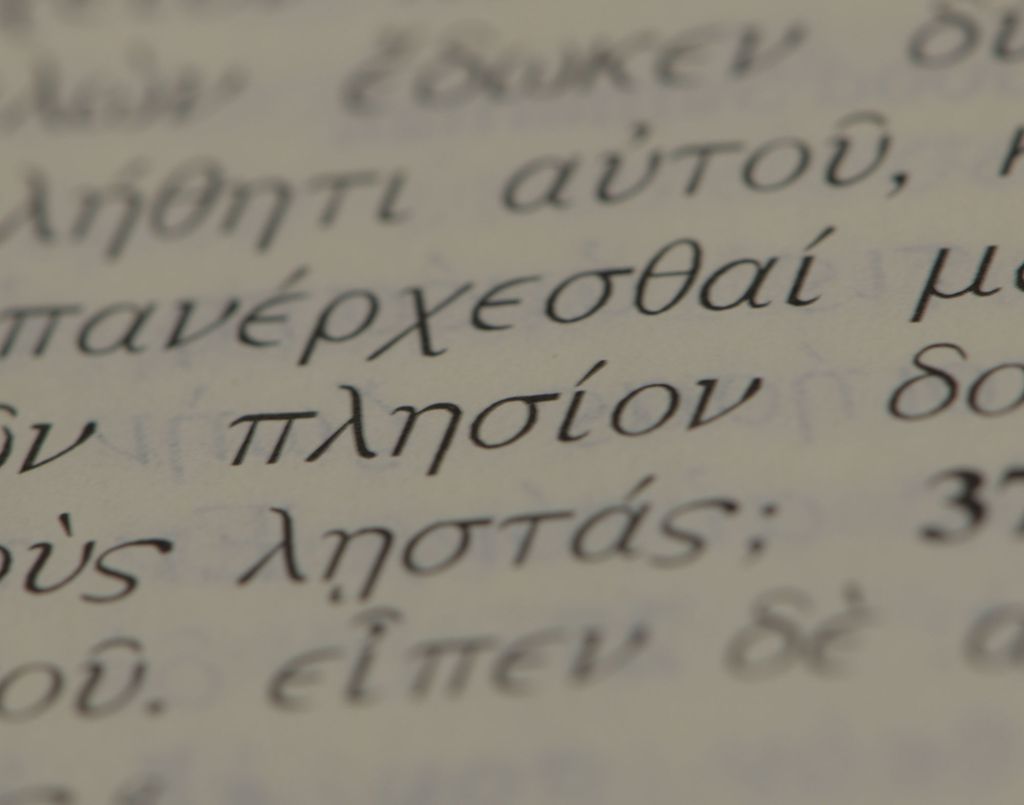
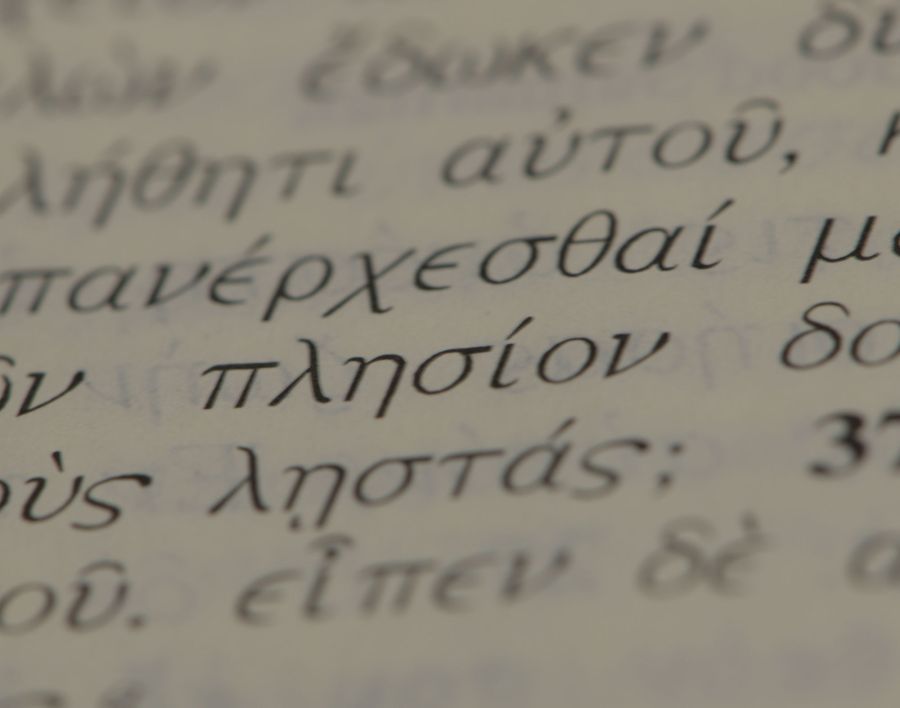
There’s an interesting aspect to this if you look at the original Greek. The word always translated as “neighbor” is “plesion” which is actually an adverb being used as a noun. As an adverb, it means “near” or “close.” In the parable, the priest and the Levite both stayed away from the man who was beaten. Upon seeing him, they walked on the other side of the road. Only the Samaritan, upon seeing him, came close enough to touch him.

And a final thing about the parable worth considering when this happened: why was the Samaritan there? It’s actually quite strange, since Jerusalem, Jericho, and the path between them are all in Judea and not close to Samaria. The Samaritans worshiped on their own mountain, they didn’t go to Jerusalem. So it’s really rather strange that he was there. All we are told was that he was journeying—he was on his way to somewhere. That is, he was going about his own business. He was not a do-gooder who scoured the countryside looking for Jews who had been beaten up. He also wasn’t at home with a sign up that any beaten Jews should stop by. And, furthermore, he also kept going about his own business, whatever that was. He didn’t give up his journey, he only gave the innkeeper money and told him that he would repay him any further expenses on his return.

A final thought about the passage worth considering is Jesus’ final instruction: go and do likewise. He didn’t say that the Samaritan was righteous, or that the Samaritan’s idolatry was less important than his good works, or even that the Samaritan did a single other decent thing in his entire life. All Jesus said was that the lawyer should do as the Samaritan did in this particular case.

That is, he told him: show mercy to someone in your path who needs it.

The Parable of the Dishonest Steward

The parable of the dishonest steward appears in the Gospel of Luke, and is very interesting:

Then he also said to his disciples, “A rich man had a steward who was reported to him for squandering his property. He summoned him and said, ‘What is this I hear about you? Prepare a full account of your stewardship, because you can no longer be my steward.’ The steward said to himself, ‘What shall I do, now that my master is taking the position of steward away from me? I am not strong enough to dig and I am ashamed to beg. I know what I shall do so that, when I am removed from the stewardship, they may welcome me into their homes.’ He called in his master’s debtors one by one. To the first he said, ‘How much do you owe my master?’ He replied, ‘One hundred measures of olive oil.’ He said to him, ‘Here is your promissory note. Sit down and quickly write one for fifty.’ Then to another he said, ‘And you, how much do you owe?’ He replied, ‘One hundred kors of wheat.’ He said to him, ‘Here is your promissory note; write one for eighty.’ And the master commended that dishonest steward for acting prudently. “For the children of this world are more prudent in dealing with their own generation than are the children of light. I tell you, make friends for yourselves with dishonest wealth, so that when it fails, you will be welcomed into eternal dwellings.”

This is a perplexing parable because Jesus is drawing a lesson from a dishonest man, which presents the difficulty of figuring out which parts we’re supposed to copy and which parts we’re not. And other questions like, “why did the master praise the dishonest steward for giving away his property?” To figure this out, we need to look at what actually happened: yes, the dishonest steward gave away some of his master’s property by canceling some of the debt, but he didn’t give it all away. And he could have.

In modern times, when a person is fired, the usual procedure is to lock them out of all of the computer systems of a business before telling them that they’re fired, so they can’t do anything bad on their way out. But the master doesn’t do this with the dishonest Steward. Instead, he leaves him Steward until he has drawn up a full account of his stewardship. Why?

Because the master didn’t know what he had.

In order to know what was his, he needed the dishonest steward to tell him. The dishonest steward was thus in a position to give away everything. If he told his master, “I’m sorry, but you’re broke” the master did not know better.

Further, since he was still steward, he was within his rights to entirely cancel the debts of the people whose debts he partially forgave. It was not honest, but it was his right. So why didn’t he entirely cancel out the debt of those debtors?

We’re not told, of course, but there is a strong hint in the fact that he did not forgive the same amount to both debtors. He forgave one half his debt and the other a fifth of his debt. Since he was praised for being prudent, we must assume that he forgave different amounts because of reasons specific to each, that is, because it was prudent. Perhaps the one could only repay half anyway, and the other could repay four fifths. Perhaps the one who was forgiven half had done something for the master earlier while the one who was forgiven a fifth hadn’t. We don’t know, but we must presume that the actions made sense in context.

And what about this from the master’s perspective, when he hears about it? Had the Steward canceled the entire debt, he would be very angry at the dishonest steward. But he was left with two thirds of what he was owed, which was far better off than he might have been. It’s not optimal, but if the master was realistic—and he seems to have been realistic—he got rid of the steward far more cheaply than he might realistically have and better than many have. (Just look up the history of how many sports figures were left penniless by dishonest business managers.) Moreover, he might even have received some small benefits from the forgiveness of the debt in addition to the money he got back. If the one who was forgiven half of his debt had done something for the master, that debt is now paid. If the debtor was only able to pay half, he might now get the half promptly. If nothing else, in not making a fuss over the canceled portion of the debt, he might at least receive good will from the debtor in case the situation is ever reversed and the master is the one who owes. It’s possible that he got rid of the dishonest steward even more cheaply than we know.

This also shows a great deal of understanding of human nature on the part of the dishonest steward, because consider what happens next: he’s going to ask the people whose debts he reduced for a job. That’s a delicate thing to do when he was just fired for dishonesty. Sure, they have reason to like him, but at the same time a job for many years can easily cost a lot more than twenty kors of wheat, especially if the guy is dishonest. Critically, he shows that while he’s dishonest, he’s not too dishonest. If the debtors are at all reasonable, they know that it’s very hard to find a completely honest man—consider how long Diogenese looked without finding one—so one who is only a bit dishonest is a reasonable choice. And he proved himself to be only somewhat dishonest by his actions when the metaphorical fecal matter had hit the artificial wind generator, i.e. when he was deeply stressed and might have been desperate or resentful.

Putting this all together, we can see what Christ referred to when he said that the children of his world are more prudent in dealing with this generation. The dishonest steward knew how people thought and acted, and acted accordingly. In modern terms, his psychology was good, even if his morals were not. He knew how to effectively manipulate people; he manipulated them with the truth. The great advantage of manipulating people with the truth is that, when they find out, they are not angry with you.

And here we come to the part to imitate: the common name for manipulating a person to his own benefit is “supporting” him. We, each of us, have an influence on the people we meet in this life, and if we will their good, we should support them. To do that, we must be able to understand things from their perspective, and how we and they and the things under our control relate, and then use the truth to manipulate them to their benefit. That is, to effectively support them.

I think that this also sheds some light on what Jesus says after—to use dishonest wealth to make friends so we will be welcomed into eternal dwellings. All wealth—all possessions—always have some dishonesty about them because we never do a perfect job. Everything we make, or deliver, or do for another is always, because of our human weakness, at least slightly less than it should be. But this does not completely invalidate it; there is still good that we can do with it and if we use it well—that is, prudently—it can make people better off and it’s worth doing this. And it’s not easy to do this and it’s worth putting the effort into doing it well.

This stands against the mistake of being “so good that you’re good for nothing,” that is, so fixated on purity that you never accomplish anything good. That’s not to say that one should choose to be dishonest; heaven forbid. But it does mean that there are limits to how much one should allow the fear of what is technically called “remote material cooperation” to prevent one from ever doing anything.

Mary Harrington on Lily Phillips and Possession

Mary Harrington wrote about our modern day Messalina, Lily Phillips, who recently and famously fornicated with 100 men in a day as a PR stunt for her pornographic OnlyFans channel. This event would be fairly unremarkable, given what society is presently like, except that a documentary film was being made of it and her immediate reaction upon finishing was deep distress, which has spawned a great deal of commentary. In the face of most people arguing about individual responsibility vs. responsibility to others, Ms. Harrington’s piece suggests an unusual framing: that of possession. (Demonic if you are tough enough for solid food, symbolic if you haven’t yet been weaned, though of course she doesn’t put it that way and for all I know doesn’t think of it that way.) This is a very interesting framing, and I’d like to explore it a bit.

Before I get into the main part, I do want to make some notes about demons, possession, and demonic influence which I think will be helpful to ensure that we’re all on the same page because popular culture tends to depict demons in egregiously stupid ways.

The first thing that I want to note is that within Catholic philosophy, the symbolic interpretation of things like demonic possession is not exclusive of the literal interpretation of them. They can be both at the same time, just in the way that a father can feed his child when the child is hungry as a simple physical act but, at the same time, this also archetypally represents all manner of things from God’s act of creation to a teacher teaching a student. None of these is wrong or one real while the others are fake. They’re different, but all legitimate as themselves.

The second thing is that full-on possession2 is not the same thing as a person being influenced by a demon; demons are capable of subtlety. Demons are simply angels who reject the good; they are beings of pure spirit and greater intelligence than humans, so they’re capable of more subtlety and cunning than human beings are. They can make bad ideas seem good and let us do the rest. If you are taking the symbolic interpretation alone, the complexities of social interactions are more complex than an individual, and can mislead us without completely overwhelming us.

The third thing to note is that demonic possession is not necessarily adversarial with the person possessed. A human being is capable of cooperating with a demon, in whole or in part. Demons make promises, which are usually empty, and people may well cooperate with the demon because of them. In the purely symbolic interpretation, you can see this in something like a person who takes foolish risks or a reality show contestant.

The fourth and perhaps most important thing to note is that demonic possession is not exclusive of things like psychological or social pressures. A person can be possessed by a demon and also worry about what his neighbor will think of him and be anxious about how to pay his bills.

OK, so that common ground established, I’d like to consider Ms. Harrington’s framing of Lily Phillips’ stunt as possession, or the alternative phrase she offers, an “egregore”. (An egregore is “a concept in Western esotericism of a non-physical entity or thoughtform that arises from the collective thoughts and emotions of a distinct group of individuals”.) Put very abstractly, the question which arises when one hears of Lily Phillips’ stunt and how predictably bad she felt afterwards is: how could anyone choose to do something so foolish? And the answer of possession or an egregore is, basically, that she didn’t choose this, she is a slave to a wicked master, and that master chose it for her.

To modern ears this can sound like trying to shift blame. And indeed, some people are trying to do that; to some degree that’s what Louise Perry’s article, The Myth of Female Agency, is about (though it is more complex than that). Properly understood, though, demonic possession is not about shifting blame. It’s about understanding that we are not gods. We must serve something; the most important choice in our lives is who or what we will serve.

Ms. Harrington quotes the story from the gospel of Luke where Jesus asks a demon its name and it replies, “My name is Legion, for we are many.” More illustrative is when Jesus describes what happens when an unclean spirit is driven out:

When an unclean spirit goes out of someone it wanders through waterless country looking for a place to rest, and not finding one it says, “I will go back to the home I came from.” But on arrival, finding it wept and tidied, it then goes off and brings seven other spirits more wicked than itself, and they go in and set up house there, and so that person ends up worse off than before.

If you merely reject a spirit because you don’t like it—even if you just want to think of it as the zeitgeist or spirit of the age or an egregore—if you do not replace it with something, you will remain empty until it comes back. But nature abhors a vacuum, and your emptiness will pull in more than just what you drove off, because you will take in several things hoping they’ll fill the emptiness. You’ll probably think that you’re just trying them or considering them, but you’ll take them in.

On a technical level, this is because your life must have some kind of purpose for you to do anything at all. People who have merely absorbed their purpose from the zeitgeist will often doubt this because they’ve never paused to consider what the purpose of their life is and so can foolishly believe they don’t have a purpose, but they eventually tend to notice this as they get older and especially if they’re successful at the purpose they absorbed. “I’ve gone to school and gotten a job and paid for therapy so I can be better at my job so I can afford more therapy so I can be better at my job—but what’s it all for? Is this it?”

The only people who make their own purpose are madmen—this is necessarily so on the technical level since people who make their own purpose cannot work toward the same goals as others except accidentally and cannot be intelligible to others who do not share their purpose. Moreover, we find ourselves in a physical world we did not create with physical properties we did not create that requires us to do things we do not choose in order to stay alive. Whatever purpose we create for ourselves must necessarily include these things that we did not choose, which is a simple contradiction. You can’t create something you didn’t choose. If you are to survive, you must discover a purpose, not create it. And our purpose is just another way of saying who or what we serve. Which brings us back to Lily Phillips and possession.

Lily claimed, in the weeks leading up to her stunt, that she was serving herself. She wanted to bang 100 men in a day, was excited for it and looking forward to it, etc. etc. etc. Then when it happened, she was devastated. There’s a good reason why my favorite part of the Catholic baptismal promises are “Do you reject Satan? And all his empty promises?” Lilly Phillips was not serving herself, since that’s not really possible, and, critically, she was not serving anyone she held to be worth serving. Feminism told women that it was there for them, that if they just gave it their souls, they would not die, but would be gods. It turns out that’s an old story. Truly, there is nothing new under the sun3.

So, ultimately, I think that Ms. Harrington is right to frame this in terms of possession, though it is important to understand that this is a voluntary possession. Lily became an OnlyFans prostitute because of the spirit of the age meeting her particular circumstances; she came up with this stunt for some reason then felt an obligation to her fans to go through with it and to not let them down—she served many masters, and none of them were good. And there is only one outcome to serving a bad master.


1 . Wife of Emperor Claudius, who famously held a contest with a prostitute to see who could copulate with the largest number of men in a day. (Messalina won.)

2. Technically, there is a form of possession where there is no cooperation and the demon literally possesses the body of the person against their will. Philosophically speaking, this is very akin to a viral infection and, from reports by exorcists, is incredibly rare and far more akin to the kind of thing you see in a movie like The Exorcist. An unfortunate person in this state may be confusable with someone in the throws of deep mental illness, but not with a normal person making bad choices, so this kind of thing is irrelevant. I will be using the term “possession” in the sense of persistent influence or cooperative possession, rather than this sense, because Ms. Harrington does and because this sense is so sui generis that no reasonable person will mistake the two.

3. Except Christianity. True or false, before Christianity no one had the idea of God taking on flesh and becoming his own creature in order to offer himself as an innocent blood sacrifice to atone for the sins of his creatures and so make them fit to become incorporated into the divine life.

Secular People Still Need to Explain Religious Truths

There are a lot of stupid secular theories abounding today, such as red pill dating advice or mimetic-rivalry-hoe-phase-theory, which receive a lot of criticism from people who are sane. But this criticism usually has no effect because, to believers in these theories, it amounts to nitpicking. This is because they are secular people trying to explain religious truths. Their theories are (necessarily) secular and when you try to explain religious truths with secular theories, the theories have to be idiotic, for the same reason that if you jam a square peg into a round hole, it will end up as a very funny looking square.

The religious truths that people are trying to explain are the necessity of having ideals and the impossibility of achieving the ideals, or to give them their proper names, everything has a nature and it is a fallen world. God created the world to be perfect, but the world chose sin over perfection, but God has not abandoned the world and is working to save it. Within this religious framing, it’s easy to explain why it is that we must strive to achieve perfection and also why we must accept quite a bit of imperfection. You do not need to throw out the ideal for one which seems achievable, and you do not need to worry (overmuch) about not achieving it.

This framework is not available to secular people. Secular people can, of course, have lofty ideals and, in pure pragmatism, accept that no one achieves it and keep going anyway. Most people want some kind of rational relationship between their thoughts and actions, even if they are completely incapable of expressing that rational relationship in words. So for the vast majority who can’t just hold incompatible beliefs with no explanation, they either come up with an explanation (which doesn’t make sense if you look at it too closely) or alter the beliefs.

Red pill dating and hoe-phase-theory are the same basic philosophical move of throwing out the ideal and substituting one that they think is achievable. The benefit to this is that trying to achieve the ideal is actually a rational activity since the ideal is achievable. The downside, of course, is that it’s an evil ideal.

Modern ideas about marriage are the opposite, though with a bit of a twist. Modern ideas of marriage demand the perfect realization of the ideal, which is no small part of why so many people aren’t marrying (though by no means the only cause). The twist is that the ideal is modified to one which makes sense within the secular worldview, so we get marriage not as a covenental relationship or as the mutual self-sacrifice of the parents for the sake of their children, but as a thing which is supposed to be mutually fulfilling. That is, marriage is supposed to fill both parties up so that they are happy. And this happiness is increasingly demanded; where it is lacking this is taken as a sign that the marriage isn’t real and so divorce is just recognizing the reality of the failure to form a real marriage. This is not particularly more sane than the red pill dating ideas, though its insanity is less spectacular.

I am reminded of a wonderful section of G.K. Chesterton’s novel Manalive, about being happy in marriage:

“But really, Michael, really, you must stop and think!” cried the girl earnestly. “You could carry me off my feet, I dare say, soul and body, but it may be bitter bad business for all that. These things done in that romantic rush, like Mr. Smith’s, they– they do attract women, I don’t deny it. As you say, we’re all telling the truth to-night. They’ve attracted poor Mary, for one. They attract me, Michael. But the cold fact remains: imprudent marriages do lead to long unhappiness and disappointment– you’ve got used to your drinks and things–I shan’t be pretty much longer–“

“Imprudent marriages!” roared Michael. “And pray where in earth or heaven are there any prudent marriages? Might as well talk about prudent suicides. You and I have dawdled round each other long enough, and are we any safer than Smith and Mary Gray, who met last night? You never know a husband till you marry him. Unhappy! of course you’ll be unhappy. Who the devil are you that you shouldn’t be unhappy, like the mother that bore you? Disappointed! of course we’ll be disappointed. I, for one, don’t expect till I die to be so good a man as I am at this minute– a tower with all the trumpets shouting.”

“You see all this,” said Rosamund, with a grand sincerity in her solid face, “and do you really want to marry me?”

“My darling, what else is there to do?” reasoned the Irishman. “What other occupation is there for an active man on this earth, except to marry you? What’s the alternative to marriage, barring sleep? It’s not liberty, Rosamund. Unless you marry God, as our nuns do in Ireland, you must marry Man–that is Me. The only third thing is to marry yourself– yourself, yourself, yourself–the only companion that is never satisfied– and never satisfactory.”

(It must be born in mind that Michael Moon is his own character and not a mouthpiece for Chesterton; Michael does have some good points among his mad ramblings, even if he doesn’t have the fullness of appreciation of the committed single vocation.)

But his fundamental point is quite sound: it is a mistake to try, as one’s primary goal, to be happy in that earthly sense of the word happiness. There will always be pain and sorrow and trials, and worst of all we will let ourselves and each other down. The big thing is whether we always pick ourselves up again. But happiness is a terrible goal in marriage, because marriage exists to accomplish wonderful things—making new people and teaching them how to be human—and trying to be happy gets in the way of accomplishing things. There’s so much more to aim for in this life than happiness.

Happiness in the sense of smiling and having a good time and enjoying yourself, that is. Happiness in the sense of the Greek makarios, which can also be translated as “blessed”—that’s quite a different thing. But in that sense, it’s important to remember that this is a painting of the happiest man alive:

I’m sure that Chesterton has said it before me, but the problem with reasonable goals is that they always end up being completely unreasonable. And that’s because this world is about God, and so doesn’t make sense on its own. And every attempt to make sense of it in itself, without reference to God, will fail in one of only a few ways.

Abstract Goodness Allows Actual Evil

C.S. Lewi’s book The Screwtape Letters is a real masterpiece when it comes to modern wisdom literature. It’s filled with psychological insights into how we go wrong and fool ourselves while doing it. There’s one insight in particular I want to talk about, though it also is found, at least in part, in Lewis’s essay The Dangers of National Repentance, which is included in the collection God in the Dock. That insight is: when we concentrate our effort on abstract goodness, we give ourselves the space for actual evil.

Though it’s not ideal—being a saint is ideal—most of us keep a mental tally sheet of good that we do vs. bad that we do, and as long as the good column has significantly more marks in it than the bad column, we figure that we’re doing already. We could stand some improvement, but everyone can, so if there’s hope for anyone, there’s probably hope for us, too. A major weakness of this approach is how it makes all good and evil equivalent—it all comes down to a tally mark. When we put down a tally mark in the good column for something abstract like being “in favor” of something good, like reducing pollution, and also a tally mark in the bad column for something real, like being rude to a family member and making their day worse, this comes out even in our mind. But being “in favor” of reducing pollution does no one any good, while being rude to our family member does a real person real harm.

Of course, our abstract good is usually not quite that abstract. We can come up with trivial and easy but concrete things to do ostensibly in aid of our abstract good, such as (to continue my example) recycling a piece of paper or remembering to turn off the lights when we leave a room. The actual amount of good from this is absolutely trivial, but it counts as a tally mark and the technically-greather-than-zero effort we put in makes it feel justified to put it down as a tally mark.

I think that this is becoming increasingly important as so much of life moves online and ignoring the real people that we interact with becomes ever easier, together with abstractions all requiring greater-than-zero effort like posting about something. You can call it “raising awareness” or “owning the libs” or “calling out stupidity” or any other flavor of virtual-doing-something, but if you never pause to consider the actual amount of good done to actual people—and social media’s making disconnect of not knowing who’s reading what we post makes it easy to not do this—it’s way, way too easy to fool yourself into thinking that you’re being good when you’re only pretending to be good, and to use this pretend good to justify the real harm that you do, especially if it isn’t bad enough to cause permanent physical damage to anyone.

To give this a vivid image to summarize what I mean: the people I know who are in favor of increasing taxes and putting that money into public welfare programs have walked past 100% of the beggars in the street asking for help that we’ve passed together without giving them anything.

Frustrations Can Be Very Frustrating

I’ve been trying to work out a way to use a teleprompter to be able to read scripts for my YouTube channel without having to do any editing. (My traditional scripted videos, which use an audio track with pictures meant for illustration is extremely time-consuming and I just don’t have the time right now.) I’m trying the teleprompter because I’ve found that if you can see a human being speaking, it’s not a big deal if they occasionally correct themselves, but it feels really weird for that if it’s a disembodied voice.

Unfortunately, when it comes to figuring out how to read a script off of a teleprompter, there’s no substitute for actually trying the thing and seeing how it goes. Which means I’ve had various takes of five to twenty minutes that were no good and had to be thrown out. In several cases these got junked by having the teleprompter settings off (too slow/wrong font size) or the AI teleprompter which uses speech recognition to advance the words losing track and giving up. In some cases, it was finding all of the settings on my laptop to have it stop going to sleep automatically. And in one case I had a complete take where I accidentally left something in frame which ruined the take.

All of this was very, deeply frustrating. I lost hours to this stuff at a time in my life when minutes are precious.

But that’s just how life goes, sometimes.

If you spend enough time doing creative work to do anything worthwhile, you’re going to encounter frustrations and wastes of time. For this reason, a man’s ability to make worthwhile creative things is only partially determined by his skill. That’s necessary, of course, but it’s not enough on its own. Equally necessary is the ability to not give up in the face of great frustration.

This is, of course, the lesson of the tortoise and the hare. If life is thought of as a race, it is won, not by whoever happens to be fastest at the moment, but by those who do not give up.

This is also why forgiveness is such a critical skill, particularly being able to forgive oneself. It does matter greatly how often one stumbles and falls so long as one gets up every time. Indeed, the man who gives up the first time he falls will fall only once—and will not finish the race.

It’s also the same idea as Woody Allen’s quip that “80 percent of success is showing up.” It’s not so much showing up the first time that’s hard, but showing up all the time.

What Should Christians Make of AI?

In this video, I answer a viewer’s question about what Christians should make of AI. (It’s really the same thing that everyone should make of AI.

Basically, there are two senses of AI:

  1. Like us
  2. Something that does what we would do by intelligence.

All AI that exists is AI in sense 2, not in sense 1, though sense 1 wouldn’t be a massive problem if it did exist.

How to Balance Gratitude With Ambition

I was watching a Chris Williamson Q&A video recently and a question he was asked was how to balance gratitude with ambition (or aspiration for improvement, if you dislike the term ambition). The exact phrasing of the question was:

How do I manage the dichotomy between being grateful for how far I’ve come and wanting to become more? The dichotomy between working for my future and being present in the moment.

There are several answer to this, and the thing is, they’re all primarily religious. It’s actually kind of interesting how often hard-won, top-level secular wisdom is beginning religious education. The Jewish sabbath is exactly this. God created the heavens and the earth in six days, and on the seventh day God rested, so human beings will work for six days and rest on the seventh. (Bear in mind that rest implies contemplation, not merely sleeping.) There you go, there’s your management of the dichotomy between working and gratitude. (The Christian moving of the day of rest to Sunday is an interesting and rich topic, but all of that rich symbolism doesn’t materially affect the current subject.) To put this in secular terms, a regular 6-to-1 balance of time dedicated to work with time dedicated to contemplation will keep your balance. If you keep it regular (that is, according to a rule), it will ensure that the effects of contemplation do not wear off. And guess what: you need to impose rules on yourself to make yourself do it because human beings don’t perfectly auto-regulate. (Just don’t make the rules so rigid you can’t live; the sabbath was made for man, not man for the sabbath.)

Another answer, here, is to keep God always in mind. This will make you strive to be perfect as your Father in heaven is perfect and also make you grateful for all that He’s already given you.

Here’s where Jordan Peterson’s language of “God is the highest good” falls a bit short, since keeping the highest good in mind will stimulate ambition, but it doesn’t tend nearly so much to gratitude. For gratitude you need to keep in mind the nothingness from which you came and which you could, apart from the positive action of The Good, become again. This requires a leap of faith that the world is not evil, though. If you can do this, you’re not going to be secular for long, and the whole exercise of trying to put this into secular language will be unnecessary. If you can’t take this leap of faith that the world exists because of good, then you’ll never actually be grateful anyway. People try to use “grateful” as an intransitive verb, but it’s not. It’s a transitive verb. You don’t have to conceive of God as a person to be grateful to Him, though it helps. But if the world is just a cruel joke with no punchline which no one told, gratitude is nonsensical. But here’s the thing: if you aren’t sure whether life is a cruel joke with no punchline that no one has told, that is equally paralyzing.

To see why, consider this thought experiment: you receive a text message from a friend which says something complementary about you, but there are enough odd word choices that you think it might just be his phone unlocked in his pocket interacting with auto-correct. Try to feel grateful for this message which you think might be a real compliment and might just be random noise that accidentally looks like a message. You will find that you can’t do it.

Nevertheless, it can still be interesting to say what is true, even if it will do no one any good: the way you keep perspective is by comparing, not to one thing, but to two things. If you want to keep perspective on your achievements, you must compare them both to the fullness of what you can achieve as well as to the nothing which is the least you could have achieved. Comparing to only one will not give you a proper perspective, because neither, on its own, is the full picture. Only by looking at the full picture will you have a correct perspective on where your achievements are within it. This is as true of metaphorical photographs as it is of literal photographs.

Tzvi Reading The Lantern Bearers

My friend Tzvi put up a video in which he gave a reading of the Robert Louis Stevenson essay, The Lantern Bearers. You can watch it on his substack.

It’s an interesting essay and Tzvi reads it well. I especially like the part where Stevenson discusses the interior life of the miser, though it’s only next to the main point of the essay. The main point, or at least what I take to be the main point, is that the makers of art are too apt to think themselves full, because they know themselves, and to think other men empty because they do not know them. (Admittedly, Part 1 of the essay is a little slow, though it was appropriate to the style of the day, which was necessary to make the point it made in the time in which it was written. It very much rewards bearing with it.)

This is a bit of a tangent, but the essay calls to mind this section out of G.K. Chesterton’s book The Well and the Shallows:

It is not an idle contradiction to say that Mr. Shaw is flippant because he is serious.  A man like Mr. Shaw has the deliberate intention of getting people to listen to what he has to say; and therefore he must be amusing.  A man who is only amusing himself need not be amusing.  Generally, when he is a perfect and polished stylist, he is not.  And there is a good deal of misunderstanding about the relative moral attitude of the two types; especially in connection with the old morality of modesty.  Most persons, listening to these loud flippancies would say that Mr. Bernard Shaw is egotistical.  Mr. Bernard Shaw himself would emphatically and violently assert that he is egotistical; and I should emphatically and violently assert that he is not.  It is not the first time we have somewhat tartly disagreed.  And perhaps I could not more effectively perform the just and necessary public duty of annoying Mr. Shaw than by saying (as I do say) that in this matter he really inherits an unconscious tradition of Christian humility.  The preaching friar puts his sermon into popular language, the missionary fills his sermon with anecdotes and even jokes, because he is thinking of his mission and not of himself It does not matter that Mr. Shaw’s sentences so often begin with the pronoun “I.” The Apostles Creed begins with the pronoun “I”; but it goes on to rather more important nouns and names.

Father Ronald Knox, in his satire on Modernism, has described the courteous vagueness of the Oxford manner which

….  tempering pious zeal
Corrected, “I believe” to “One does feel.”

And though I have much of such courtesy to be thankful for, both in conversation and criticism, I must do justice to the more dogmatic type, where I feel it to be right.  And I will say firmly that it is the author who says, “One does feel,” who is really an egoist; and the author who says, “I believe,” who is not an egoist.  We all know what is meant by a truly beautiful essay; and how it is generally written in the light or delicate tone of, “One does feel.” I am perfectly well aware that all my articles are articles, and that none of my articles are essays.  An essay is often written in a really graceful and exquisitely balanced style, which I doubt if I could imitate, though I might try.  Anyhow, it generally deals with experiences of a certain unprovocative sort in a certain unattached fashion; it begins with something like.  .  .  .

“The pond in my garden shows, under the change of morning, an apprehension of the moving air, hardly to be called a wave; and so little clouding its lucidity as to seem rather vacuity in motion.  Here at least is nothing to stain the bright negation of water; none of those suburban gold-fish that look like carrots and do but nose after their tails in a circle of frustration, to give some sulky gardener cause to cry ‘stinking fish’.  The mind is altogether carried away upon the faint curve of wind over water; the movement is something less solid than anything that we can call liquid; the smoke of my light Virginian cigarette does not mount more unsubstantially towards the sky.  Nor indeed inaptly:  it needs some such haven of patriarchal mildness to accent sharply the tang of mild tobacco; alone perhaps, of all the attributes of Raleigh’s red-haired mistress, rightly to be called virginal.”

I think I might learn to do it some day; though not by a commercial correspondence course; but the truth is that I am very much occupied.  I confess to thinking that the things which occupy me are more important; but I am disposed to deny that the thing I think important is myself.  And in justice not only to myself but to Mr. Shaw and Mr. Belloc and Mr. Mencken and many another man in the same line of business, I am moved to protest that the other literary method, the method of, “One does feel,” is much more really arrogant than ours.  The man in Mr. Shaw’s play remarks that who says artist says duellist.  Perhaps, nevertheless, Mr. Shaw is too much of a duellist to be quite an artist.  But anyhow, I will affirm, on the same model, that who says essayist says egoist.  I am sorry if it is an alliteration, almost a rhyme and something approaching to a pun.  Like a great many such things, it is also a fact.

Even in the fancy example I have given, and in a hundred far better and more beautiful extracts from the real essayists, the point could be shown.  If I go out of my way to tell the reader that I smoke Virginian cigarettes, it can only be because I assume the reader to be interested in me.  Nobody can be interested in Virginian cigarettes.  But if I shout at the reader that I believe in the Virginian cause in the American Civil War, as does the author of The American Heresy, if I thunder as he does that all America is now a ruin and an anarchy because in that great battle the good cause went down — then I am not an egoist.  I am only a dogmatist; which seems to be much more generally disliked.  The fact that I believe in God may be, in all modesty, of some human interest; because any man believing in God may affect any other man believing in God.  But the fact that I do not believe in gold-fish, as ornaments in a garden pond, cannot be of the slightest interest to anybody on earth, unless I assume that some people are interested in anything whatever that is connected with me.  And that is exactly what the true elegant essayist does assume.  I do not say he is wrong; I do not deny that he also in another way represents humanity and uses a sort of artistic fiction or symbol in order to do so.  I only say that, if it comes to a quarrel about being conceited, he is far the more conceited of the two.  The one sort of man deals with big things noisily and the other with small things quietly.  But there is much more of the note of superiority in the man who always treats of things smaller than himself than the man who always treats of things greater than himself.

Dogmatists, being fallen creatures, have faults. But I think it worth saying that among their faults, one does not find that they assume other men’s interior lives to be empty merely because they do not know them. Dogmatists are the great democrats of life, in the Chestertonian sense of the word “democrat”—they believe all men equal before the Law. Quite annoyingly to their neighbors, they also have a tendency to believe that all men are equally interested in the law. This may annoy their neighbors, but at least it does not insult them.

Science vs. Religion Show Why Heresy Matters

The “war between science and religion” does not really exist according to those English words in that order, and was a terrible name for what it actually did refer to. What it really should have been called was “the war between science and a particular widespread-in-the-english-speaking-world Christian heresy.” Because that’s what it actually was. I’m going to explain, briefly, before I get to the main point, which is that heresy matters.

The Book of Beginnings (more commonly known as the Book of Genesis since it frequently gets left untranslated) is obviously not meant to be anything like a science textbook, for the very obvious reason that it contains, back-to-back, two creation stories which disagree with each other about the sorts of things that a science textbook primarily concerns itself with. Whether Human Beings are the pinnacle of material creation as the end of a triumphant process or whether they are the pinnacle of creation as being given the right to name everything does not much matter to the central point of Human Beings being the pinnacle of material creation, but it matters very much to the question of which came first: the human or the chicken? It does not take a genius to figure out that the book can’t have been written primarily to answer questions it treats as irrelevant.

It doesn’t take a genius, but it does take someone who has thought about this a bit and can understand things like literary purpose. That’s not everyone. And here we come to the heresy of Sola Scriptura.

Sola Scriptura, which is the doctrine that scripture is the only authority, requires a somewhat lengthy treatment to be dealt with in full. This lengthy treatment can be found in many places so I’m not going to present it here. The relevant part to the moment is that Sola Scriptura means, as a necessary consequent, that any person (of good will/faith) who reads the bible must understand it fully and completely. (Martin Luther tried to get around this problem, in On the Bondage of the Will, by claiming that the parts of scripture that are hard to understand say the same thing as other parts, just less clearly, and so it’s not necessary to understand any part that’s hard to understand. Setting aside the astonishing hubris of claiming to fully and completely understand scripture, that doesn’t actually help anyway.)

This means that people who don’t get the concept of literary purpose, metaphor, etc. must be able to entirely understand scripture. Worse, this must be without any learning, because there are plenty of uneducated people in the world and even if there weren’t the educators would then have some of the authority since they would be teaching how to properly interpret.

The unintended consequence of this is that people who believe Sola Scriptura and who know any uneducated people or people who otherwise don’t understand things like literary intent and metaphor are forced to hold that the Book of Genesis is in fact meant as a science textbook. This puts them at war with actual science, because actual science disagreeing with the parts of Genesis which were never meant to be a science textbook will show that Sola Scriptura is false. This is “the war between science and religion.”

And this is where we come to the part where ideas have consequences: “the war between science and religion” has hurt a lot of people. Sola Fide has hurt even more people, since Sola Scriptura is just a consequence of Sola Fide. Sola Fide wouldn’t even be so bad except for Martin Luther having redefined faith from meaning, roughly, “acting according to truths we know but for which the evidence is no longer apparent” to “the will creating reality.” More colloquially, “trusting someone trustworthy” to “generating an interior feeling of certainty.” Moving faith from an act of the intellect and will in harmony to an act of the will against the intellect is, in essence, rejecting truth. And here’s the thing: Jesus is the way, the truth, and the life. What Martin Luther tried to do, with Sola Fide, was to have Christianity without Christ. But you can’t do that. Which is why Martin Luther’s protestantism is proto-atheism. At some point you can’t keep up the pretense of having Christianity without Christ. Or to put it more simply: the fact that, within Christianity, there is nothing more important than the truth will eventually reassert itself. The bible cannot be the only authority because it cannot be any kind of authority. It’s a book. It is the thing authored, it is not an author itself. If the bible is the only authority, then there is no authority, and that this is logically necessary can only be evaded by an act of the will for so long. Historically, that turned out to not be very long.

It is not pleasant to call a heresy a heresy. When Saint Thomas More called William Roper, who had just asked for the hand of Sir Thomas’s daughter, a heretic, Roper replied, with great feeling, “Now that’s a word I don’t like.” To which Sir Thomas replied, “It’s not a likable word. It’s not a likable thing.” That gets to the heart of it: it’s not a likable word because it’s not a likable thing. It’s natural that people don’t like things which are not likable, but it remains important none the less.

Ideas have consequences. It is not pleasant to fight over ideas, but if we don’t fight over ideas we will still end up fighting. We will just fight over the consequences.

Requiescat In Pace, Michael F. Flynn

I recently learned from a post on his blog by his daughter that Michael F. Flynn, perhaps better known in the blogosphere as TOF, has passed away. Her post includes a tribute to him which is worth reading if you ever encountered him or his writing.

I must confess that when it comes to his fiction I only read a few of his short stories, which were extremely well written. The thing he wrote which I think everyone should read, though, is his fantastic history of the Copernican revolution called The Great Ptolemaic Smackdown. It is absolutely excellent history, very well written, engaging, and enlightening about the scientific revolution of going from the Ptolemaic model to the Copernican model of the solar system. It’s not a short read but it is absolutely, unquestionably worth the time.

Having said that, join me, if you would, in praying for Michael Flynn, with this prayer I remember from many funerals I attended in my youth:

Lord God, have mercy on your servant Michael. Forgive him his sins and grant him eternal life. This we ask through Christ, our Lord. Amen.

A Weird Take on the Thief on the Cross

Somehow Instagram (a social media site for looking at pictures of reptiles, though I believe some people look at it for photos of other things) recommended a video to me of a guy who was talking about the thief on the cross. Specifically, the one that upbraided the one who was abusing Jesus, and who asked Jesus to remember him when He came into His kingdom, and Jesus said, “this night you will be with me in paradise.” The guy asked, “how does this square with your theology? He wasn’t baptised, didn’t receive communion or confirmation, didn’t give anything to the poor, Jesus didn’t take away his suffering, he didn’t speak in tongues, etc.”

It’s a fairly obvious point, though one worth making from time to time that the ordinary ways that God gives to us to live are not the only ways he gives to people, and while he works through his sacraments he is not bound by them, etc. etc. etc. This is certainly a doctrine of orthodox theology, and you can see it in things like the baptism of blood, the baptism of desire, and so forth. But this guy is making a really big deal of it like he’s the first one to think of it, and also like it’s revolutionary. Somehow he doesn’t seem to take into account that the good thief was nailed to a cross. People tend to focus on the death in excruciating agony part of dying on a cross—reasonably enough—but it’s also a feature of the cross that a person nailed to it can’t do anything. The good thief didn’t do anything for the poor, but he also couldn’t. You can’t extrapolate from that to people who can do things for the poor. It’s just possible that Jesus’ words about the importance of caring for the poor might have some applicability. In short, just because it’s possible to be saved while nailed to a cross doesn’t mean that no one should bother with anything other than what a person nailed to a cross can do.

Then he went full-heretic (never go full-heretic). He said that the only thing that the thief had to offer Jesus was his belief.

This is dead wrong.

It is true that people can’t buy salvation with their good works. It is equally true that people can’t buy salvation with their belief. People simply can’t buy salvation.

Salvation is a gift from God freely given to us. The thing is, we have to accept it. And this is where we come to the part where Jesus said, “It is not everyone who says to me, ‘Lord! Lord!’ who enters the kingdom of heaven but he who does the will of my Father.” Good works are the content of faith. It is possible for one to have faith without works where those works are prevented, but for most of us this is academic. Most of us are not nailed to a cross. Most of us have the opportunity to live according to the truth of Christ’s death and resurrection.

I find it really weird that there are people who are still trying to peddle the idea that salvation is a matter of pledging allegiance to Team God or having some sort of emotional experience of “belief”. I get why Martin Luther tried to redefine faith so as try to get rid of the need to trust God without having to get out of having the word; it made sense in the context in which he found himself. These days, there are much easier ways of not being Christian.

Lord, Have Mercy on Me, A Sinner

In which I discuss that referring to myself as a sinner is simply true and not rhetorical, as well as draw some lessons to when others (such as Bishop Barron) refer to themselves as sinners and how that should be taken seriously (but without speculating as to the specifics).

The title of the video is a reference to one of my favorite prayers, the Jesus prayer, “Lord Jesus Christ, Son of God, have mercy on me, a sinner.” (This prayer is, itself, a reference to the publican in the story of the pharisee and the publican.)

God Made the Mountains

I was talking with a friend about the subject of Christian Esotericism after watching a video in which Jonathan Pageau talked with a few others about the subject and he mentioned the old esoteric idea that King Solomon used the power of God to force demons to build the Temple. I found this a very strange idea not merely for the obvious reasons, but also because it just doesn’t make sense. If God wanted to delegate the construction of the temple to some creatures and it wasn’t to men, why would he give this privilege to demons? Why wouldn’t he give this privilege to angels?

God certainly doesn’t need to delegate the construction of the temple to anyone. Aside from it being the obvious consequence of God’s omnipotence, it’s also quite visible in the way that God was often worshiped on mountains, and God made the mountains. God had no qualms about making places to worship Him, he just refrained from making all of them, giving it as a privilege to some creatures to imitate, in a small way, the mighty places of worship that God made.

Why on earth would God force this privilege of imitating Him onto angels who rejected Him, rather than give it to angels who would want it?

This, ultimately, seems to be the problem with Christian esotericism—it’s just esotericism, with Christian trappings. At the end of the day, there’s no good reason to make a deal with a devil, even if you think you can cheat the devil. (Yes, the magicians thought that they were merely forcing the devil to do their bidding rather than making a deal with it, but really that’s just a deal in which the devil doesn’t get anything. If God were actually guaranteeing the devil’s good behavior, then you’re actually forcing God to do your bidding and the demon is just a puppet. It’s an even worse idea to try to control God than it is to try to make a deal with a devil.)

Contingency and Space

The natural theology argument for the existence of God from contingency and necessity rests on the existence of something contingent. This is remarkably easy to supply, since any telling of this argument is, itself, contingent, and supplies the necessary contingent thing. However, explaining why it is contingent sometimes confuses people, because the non-existence of the contingent thing at some point in time is most typically used.

There’s nothing intrinsically wrong with this, but it can accidentally mislead people into thinking that the causal chain that must be finite (since there cannot be an actual infinity) is a temporal chain of causation. E.g. I’m here because of my parents, who are here because of their parents, and so on back to the Big Bang, which is here because of God. This can be helpful to illustrate the concept of a causal chain, but it’s not the kind that’s actually used in the argument, since it’s not the sort referenced by “actual infinity”. What’s discussed is why the contingent thing is here, now, as in, what is giving it the power to exist this moment. It cannot be something that doesn’t exist, because things which don’t exist have no power. So it must be something that also exists right now. That thing which exists right now can either be contingent or necessary, and if contingent, it too must be dependent for its existence on something else which also exists right now. And so on; this is what must terminate in something necessary because there cannot be an actual infinity.

Something that my attention was drawn to by a commentor asking me a question in one of my videos is that one can use the existence of a thing in one part of space but not another as a demonstration of contingency. If a thing were necessary and not contingent, it would exist at every point in space, since a particular location cannot cause a necessary thing to not exist. Thus anything which is someplace but not another must be contingent. The advantage to demonstrating contingency in this fashion is that space is simultaneous, and a temporal sequence will not be suggested. It is possible, then, that a person will not be accidentally led astray into thinking of a temporal sequence of events where the argument about how an actual infinity cannot exist is less clear, since the moments of time don’t exist side-by-side. (From our perspective; all moments are present to God in His eternity, of course.)

Thoughts on the Soul, While Hunting

A quick video I made while bow hunting while the deer weren’t coming. I share some thoughts on the soul, and how some people go wrong by thinking of the soul like a ghost in a machine, or like some sort of physical pure-energy matter that operates the body in a purely physical way, except not physical. I also talk about how everyone actually believes in the soul, because being a strict materialist would be absurd, and give examples.

It’s never Too Late at Amatopia

Over at Amatopia Alexander Hellene has an interesting post about repentance with the fascinating (if long) story of Saint Mary. It’s worth a read.

I must confess that the intellectual problem of repentance has never really bothered me; I can’t conceive of a sin being stronger than God’s ability to fix it. But, for that reason, I do really like stories of repentance, because they demonstrate the mighty power of God.

Faith is Sometimes a Practical Virtue

Back in the fall, as the weather was getting cold and plants were dying off I bought some flower bulbs and planted them in a newly open spot by my house. This spring, they’ve bloomed, justifying the effort involved. (Already done are some crocus, in the foreground, and not yet done is some weeding.)

I also planted some tulips next to some rhododendron bushes.

Back when I planted them things were cold and there was not much green to be seen. The bulbs I planted were brown and gave no visual hint of the flowers that would come forth from them. In order to get the tulips in spring, I needed to trust that the brown balls I was planting in the cold dirt were alive, and would stay alive, and would in fact put forth beautiful flowers come spring-time.

It is often under-appreciated how practical a virtue faith is. For some reason people talk as if the practical virtue of faith and the theological virtue of faith were somehow utterly unlike each other. In both cases they amount to trust in previously known evidence during the immediate absence of that evidence. We trust that God’s purposes are good because we know that His purposes are good because He is good, even though we can’t see that in the moment because all we can see is suffering or pain, such as weeds growing among the flowers or deer eating the leaves on one’s recently planted apple trees. This is not really different in kind from knowing that a brown ball is alive despite looking dead and when planted in the cold dirt will take root and put forth beautiful flowers when—despite the world growing colder and darker—it will one day be warm enough for flowers to bloom.

Chemical Composition, or, Substance and Accidents

The Catholic doctrine of transubstantiation means that in the Eucharist, when the priest speaks Christ’s words of consecration (“this is my body”, “this is my blood”) over the bread and wine on the alter, the power of Christ is invoked, by the authority he gave to his apostles and they delegated to their successors and they delegated to the priests whom they consecrate, and it changes the bread and wine on the alter to become the body and blood of Christ. (This is sometimes called the “real presence.”) Much difficulty arises over exactly what is meant because the bread doesn’t turn into muscle tissue and the wine doesn’t develop red blood cells.

The Eastern Orthodox basically just say “it’s a mystery” and leave it at that. (I liked the styling I saw someplace, “eeeet’sss aaaaa myyyysssterrrryyyyy”.) The Catholic Church says that it’s a mystery, but it gives a few helpful details. You can actually see this in the word “transubstantiation.”

“Transubstantiation” is derived from two words: “trans” and “substance”. “Trans” meaning “change” and “substance” being that part of being which is not the accidents. Accidents, in this case, not meaning “something unintended” but rather the properties a thing has which, if they were changed or removed, would not make the thing something else. A chair might be made out of wood, but if you made it out of plastic it would still be a chair. The ability to hold up someone sitting is the substance of a chair, the material it is made out of is an accident (again, not in the colloquial sense of accident but in a technical sense). You can also do the reverse. You can take the wood a chair is made out of and rearrange it into a collection of splintery spikes protruding up. It has the same accidents (the wood), but the substance has changed. “Transubstantiation” just means that the accidents (the gluten, starch, etc. in the bread and the water, sugar, alcohol, etc. in the wine) remain the same but the substance—what it is—is what has changed.

Or, to put this more simply: in the Eucharist, the body and blood of Christ has the same chemical composition as bread and wine. Something to consider, when trying to understand this, is that a living human being has exactly the same chemical composition as a human corpse.