There are a great many young men who feel lost and hopeless in the modern world and many of them spend a lot of time on the internet complaining about it. This tends to rub older, moderately successful men wrong—very, very wrong. (Very roughly: men in their mid-thirties or older who have a wife and at least one child.) I’ve wondered about this for a while because I find this reaction in myself—I start out sympathetic but I verge on angry most times I try to interact with such men. I think I’ve finally figured it out: it has to do with the traditional role of adult men in raising other people’s young men into manhood.
Good parents love their children unconditionally and this is incredibly important to children and their healthy development. However, as children make their way to being adults, they are going to have to face other environments than the environment of home; they will have to face indifferent and even adverse environments. For most of human history (and much of the present, outside of some atypical but decreasingly atypical situations), this was especially true of boys. Somebody had to fight the wild animals who wanted to eat one’s children; somebody had to fight the other human beings who wanted to kill one and take one’s things. Defending against these and many other threats were usually best done in groups, often of people near in age, and that means working with people who were not one’s parents and who love one only conditionally. Preparing a boy for these environments is usually best done not by the boy’s father, but by friends of the boy’s father, or at least other adults males of good will. These are mentors.
Mentors do not love the boy unconditionally, as his father does (in the ideal, at least), but are willing to be more generous to the boy than the boy is yet capable of deserving. This mentorship forms a bridge for the boy to become a man. When a mentor demands more independence of the boy, this does not prevent the boy going to his father for unconditional love; by giving the role of being generously and patiently harsh to another man, the father can be a source of support for his son when that is too difficult, restoring the son’s strength, and enabling the son to go back to his difficult work of becoming a man.
This role of mentor is a bit tricky, since it does involve carefully gauging what the boy is currently capable of and only asking of him what he can do—as opposed to asking of the boy what would most benefit the mentor, as one does with, for example, a plumber1. But it does involve challenging the boy and pushing him to be able to deal with circumstances in which he has no support right now, to get him to use his “emotional muscles” to self-regulate and be able to deal with difficult circumstances, so that those “emotional muscles” grow. Because the time is coming when it will not matter how the now-boy feels, it only matters how he will fight in a battle and protect his fellow soldiers, or chase away the wolves, or do the unpleasant work before bad things happen because the work is not done.
Older men who are at least moderately successful (I mean in absolute terms, not as a euphemism for being rich) have the instinct that they should look for older boys and young men who need this kind of mentorship to transition into being fully independent men, and to provide this kind of supportive-challenging environment to help them to grow.
But the thing is, this relationship is very much a mutual one. The boy has to enter into it wanting to become a man. He has to want to be challenged. He has to want to rise to that challenge. All students must, in the end, learn for themselves; a teacher can only give the student what he needs in order to learn.
When you put all this together, I believe this explains why young men complaining about how unfair society is in its current configuration rubs us older men so wrong. This may all be true, but it’s not helpful in learning how to become a man. And a boy is better off becoming a man even in a bad society—there is no society where boys are better off staying permanently childish. Coming to us rubs us so wrong because we’re not the ones that young men should come to for this kind of sympathy. In fact, it would (often) be actively harmful to them to if we gave it to them, because it would discourage them from finishing growing up.
We all have our roles in society according to our station in life. For older men, our role is to act as mentors like this to young men. When young men come to us for sympathy, it feels a bit like coming to us for what they’re supposed to—mentorship—but then they reject attempts at mentorship, which confuses and frustrates us. Young men aren’t supposed to look to mentors for sympathy—they’re supposed to look elsewhere for that. It may be entirely legitimate that they are looking for sympathy everywhere because they can’t find it anywhere, but it’s a problem that this actively gets in the way of us fulfilling our proper role of mentor.
I don’t know what the solution to this is. I doubt it’s for us older men to just to give up on mentorship and become surrogate fathers to younger men, because that would still leave them stunted in their development and unable to fulfill their potential. God knows the answer; I don’t. At least, not yet. But identifying a problem is the first step towards solving it, and I think that this is, at least, a correct identification of the problem.
This is perfectly fair with tradesmen because the tradesman is a full adult who trades what is best for the customer in exchange for money, which the tradesman needs more than whatever minor comfort he gives up in doing the work he is skilled at. ↩︎
Clue, which goes by the name Cluedo in Britain, is a very fun game that has had an enormous number of versions and a very enjoyable, if quite odd, movie based on it.
If you don’t know, the presmise of Clue is that Mr. Boddy has been murdered in a mansion by one of the six guests: Mrs. White, Mr. Green, Mrs. Peacock, Professor Plum, Colonel Mustard, and Miss Scarlet. (The characters in the screenshot are in that order, left-to-right.) Each player (the game works for three to six players) plays one of the suspects and goes around the board collecting clues, and trying to figure out who killed Mr. Boddy, in which room they killed him, and with what weapon.
This may make a little more sense if you look at the board:
When you consider the problem of trying to make a murder mystery board game that remains interesting when played more than once, the game mechanic is rather brilliant. Each suspect, room, and weapon has a card. You group each kind of card together and shuffle them, then you randomly pick one of each kind and, without looking, put it in the solution envelope (placed in the center of the board). You then, to the best of your ability, evenly distribute the rest of the cards (now combined and reshuffled) among the players. They then take turns rolling a die and moving that many squares, going to the various rooms of the mansion. From a room you can guess that room and any player or weapon that you like (officially, you “suggest” them); you then go counter-clockwise and the first player that has one of the three shows one of the cards that matches the guess to the guesser (without revealing it to the other players). Who answered the query gives limited information to the other players, depending on what they already know and what cards they have, giving material for logical deductions. When a player thinks they know the solution they state it as an accusation, then (without showing them to the other players) look at the cards in the solution envelope. If they’re right, they win. If they’re wrong, they’re now out of the game except for answering the suggestions of other players. If everyone understands the rules and pays attention, the game moves quickly and is a lot of fun, since you stand to learn something on every person’s turn. Indeed, if you’re good, you learn more from the rest of the players’ turns (taken together) than from your own.
The game was developed by Anthony E. Pratt in 1943 while he worked in a tank factory during the second world war. He was inspired by a game called “Murder” that he and friends would play during the inter-war years where people would sneak around rooms and the murderer would sneak up behind them and “kill” them. That and the great popularity of detective fiction at the time.
It would take a number of years before it was actually published, though. He brought it to Waddingtons, a British maker of card and board games founded in 1904 as a general printer that got into games in 1922. It was eventually bought out by Hasbro in 1994. Waddingtons made a number of changes to the initial concept, most of them being to simplify it a bit (such as reducing the number of characters down to six). Something I find very interesting is that its initial marketing focused on the detective aspect, to the point where they even licensed Sherlock Holmes’ likeness from the estate of Sir Arthur Conan Doyle:
Another change by Waddingtons was the name. Pratt had simply called his game “Murder,” after the house party game that he and his friends used to play during the inter-war period. The name Cluedo was a portmanteau of Clue and Ludo, the later being the popular name in England of a board game Americans tend to know better as Pachisi. (Ludo is Latin and means, “I play.”) Since Ludo was not well known in America—the game was licensed to Parker Brothers for distribution in the US—the name was shortened to Clue for the American version.
There have been many editions of Clue since the original, many of them updated and more modern. The one that I own (pictured earlier) is a “classic” edition which comes in a wooden fake book. (It was a gimmick used for a variety of classic board games but works particularly well for Clue.) There’s a great deal to be said for the classic version because the game is so suggestive of the golded-age detective stories which inspired it and upon which it is (ever so loosely) based. The dinner party in a mansion is rather tied to this time period because people don’t really have dinner parties anymore. There’s so much more to do, these days.
This was actually an interesting needle that the movie needed to thread. Why would there be a dinner party with such different people in a large house? The movie partially solved this by using an earlier time period—the mid 1950s (it was specifically set in 1954). The other thing it did (spoilers ahead) was to make them all blackmail victims who were meeting each other for the first time. This was an interesting approach to giving everyone a motive for killing Mr. Boddy.
The other problem that the movie had, and only partially solved, was how on earth can it be a mystery whether a man was shot, stabbed, strangled, or bludgeoned to death? This is a place where, I think, the movie could have done a little better. It is a solvable problem, at least in the context of trying to solve the crime before the police arrive. (The solution would be to have people trying to frame others and so attack the fresh corpse with someone else’s weapon.)
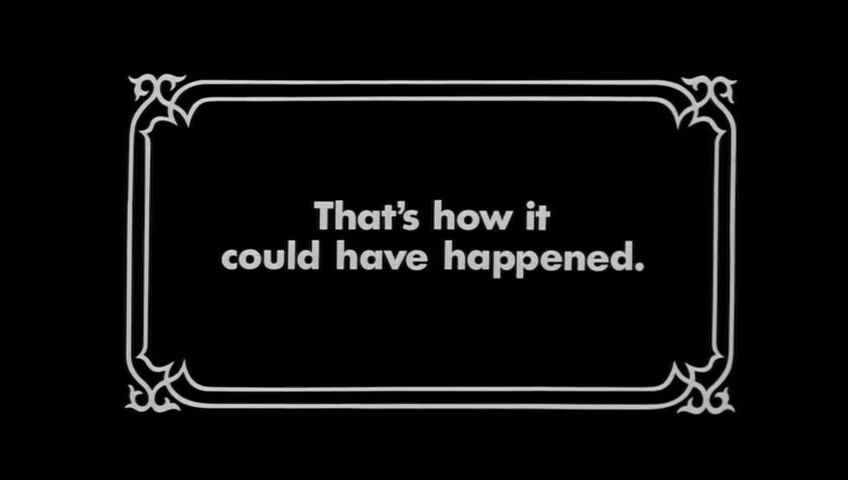
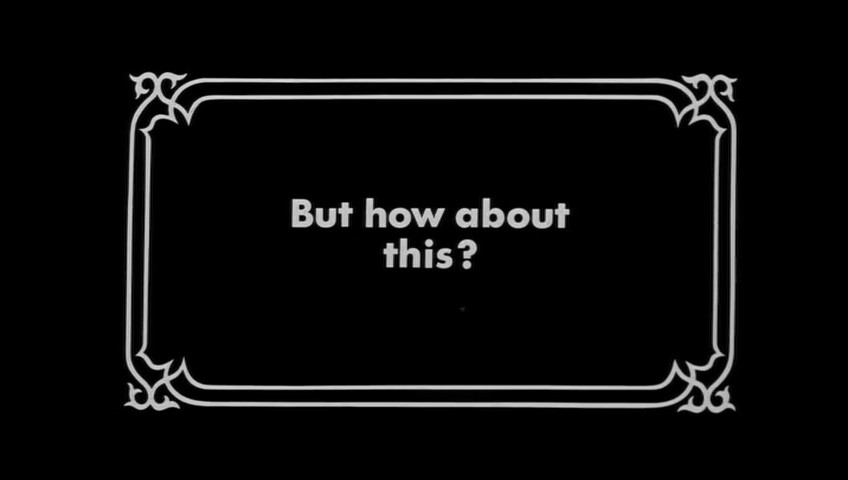
The movie is rather interesting for another reason, though: it has a nod towards the replayability of the board game. Instead of having a single ending, it actually has three endings. As a gimmick during release, each movie theater was sent one of the endings at random. Fortunately for the recorded version, it was released on VHS long before DVDs were a thing and so they had to figure out something to do for the VHS version. What they came up with was to present one ending, then put in a silent-movie style text cards saying:
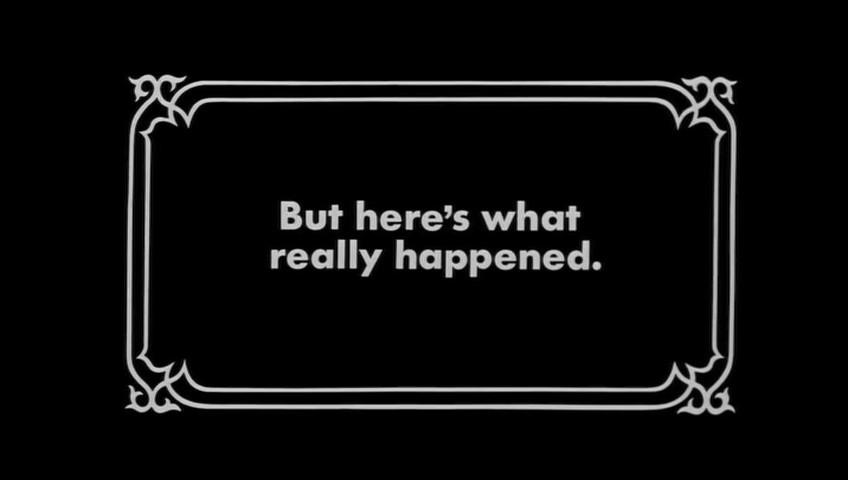
And then, after the second ending, we get:
I really like this version. It has style, it’s cool, and it also is an interesting way of poking fun at how mysteries are often indeterminate until some clinching evidence at the reveal. But it also is a great nod to how the board game doesn’t have a single solution.
I don’t know how much the movie led to interest in the board game—I can say that it did for me, but I don’t know many other people for whom it did. But I do know that there were versions of the board game which used art from and based on the movie. And in the 1980s it was kind of a big deal to have a feature film based on your thing—not many things did.
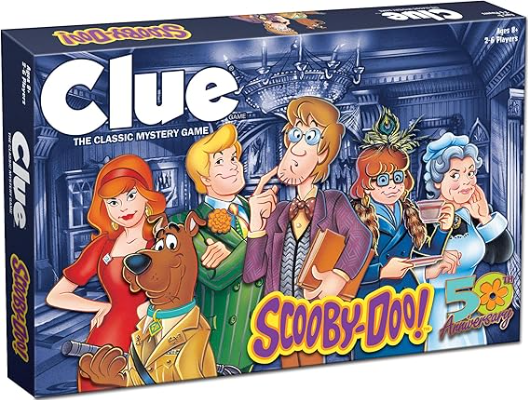
And that does point, too, to the answer to what got me looking into this in the first place: the game changed its art and style fairly often throughout its history. There were, in the last few decades, a rash of various brands trying to distance themselves from their history and from the past, but Clue was not, so far as I can tell, meaningfully caught up in that. It started with an aesthetic that was, at the time it was developed, relatively modern (except for the Sherlock-Holmes-alike, but that was a specific character rather than meant to be referencing a time period) and it changed throughout its history in ways that were contemporary. It also had a variety of tie-in versions, perhaps the most obvious being the Scooby-Doo version (still for sale on Amazon as of the time of this writing):
Having said that, I’ll take the classic version any day.
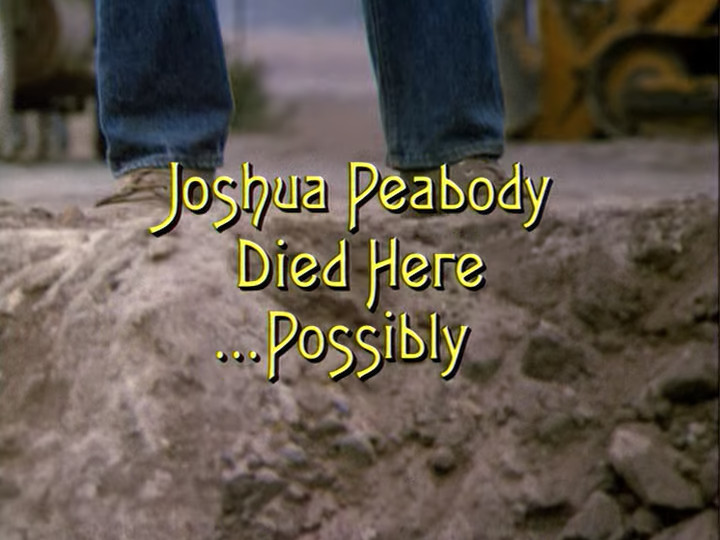
On the sixth day of October in the year of our Lord 1985, the second episode of the second season of Murder, She Wrote aired. Titled Joshua Peabody Died Here… Possibly, it is set in Cabot Cove. (Last week’s episode was Widow, Weep For Me.)
The scene opens on a construction site:
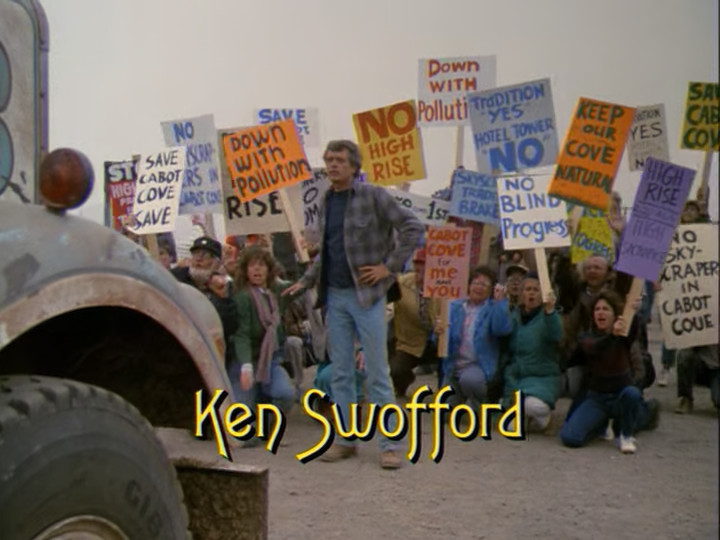
But all is not well here, as there’s a great deal of noise from the many people who are protesting it. After some general milling about and shouting, we meet one of the characters who is organizing the protest:
His name is David. We see him here leading everyone to sit down in front of the truck driving into the construction site.
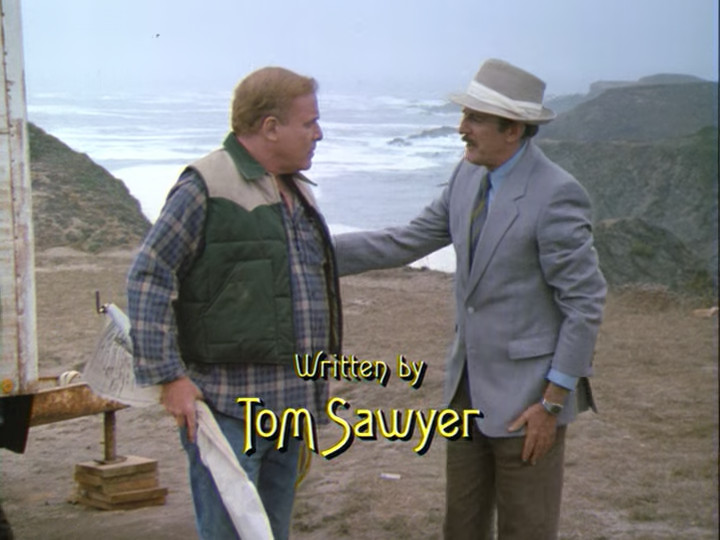
We also meet Kowalski, who is in charge of the construction, and Harry Pierce, who is a real estate agent but is generally involved in promoting the sale and development of real estate as the plot of an episode may require and is an agent of the developer in some vague, unspecified way.
Harry Pierce is played by John Astin, by the way, who is best known for playing Gomez Adams on the TV show The Addams Family. (The Addams Family ran from 1964-1966, so by the time of this episode it had been almost twenty years since Astin had played the character.)
Harry goes over and talks to David. We establish that Harry thinks that this will be great for Cabot Cove because of all of the tourists it will bring in, though not why on earth he thinks that a twenty story luxury hotel will bring tourists in. Hotels are not usually destinations in themselves and Cabot Cove hardly seems like the kind of place to bring in more guests then residents given how little there is to do here.
David claims that Harry snuck the hotel by the zoning board when half the members were out of town. Harry takes exception to this, pointing out that they had a qorum. Which is a pretty reasonable point—quorums exist for a reason.
Sheriff Amos Tupper then arrives to deal with the uproar.
There isn’t time for a discussion, though, before somebody calls out, “Hey look! Down there!” and everyone runs to look down there.
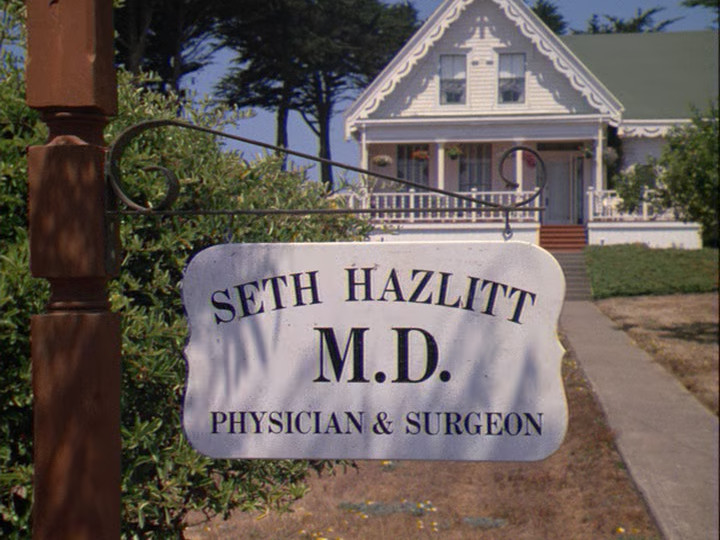
Presumably it wasn’t the camera that they were looking at, but we don’t find out because the scene then shifts to Seth’s house:
I love the “& Surgeon” as if you might be walking along the road needing an organ removed but not know where to go.
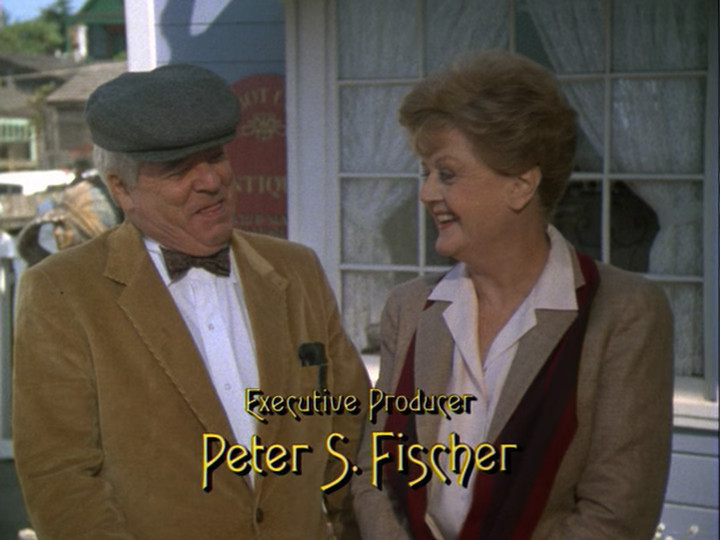
Seth replaces Captain Ethan Cragg as Jessica’s close friend for Cabot Cove episodes. Supposedly this was due in part to Angela Lansbury pushing for it because she didn’t think Jessica had anything in common with the uneducated and taciturn fisherman who often took care of her plumbing, but the town doctor does make a certain amount more sense than a fishing captain since the doctor can be called in to check out the episode’s corpse and thus is a natural part of the episode rather than a fifth wheel merely there for comic relief.
Anyway, we’re introduced to their relationship by Jessica being there looking like she’s a patient:
But despite her back pain, she’s actually here for sympathy because she’s having trouble with her book.
Arthur is trapped in the belfry. His brother Charles is on his way to the minister. Alice is in the shower. And the killer is climbing up the stairs…
Seth interrupts to ask Jessica, “Exactly how long have you had these symptoms?”
Jessica doesn’t get to respond because Amos barges in and interrupts, saying, “Listen, Seth. If you can tear yourself loose from killing off your patients you gotta get over to Main Street quick, and bring your bag.”
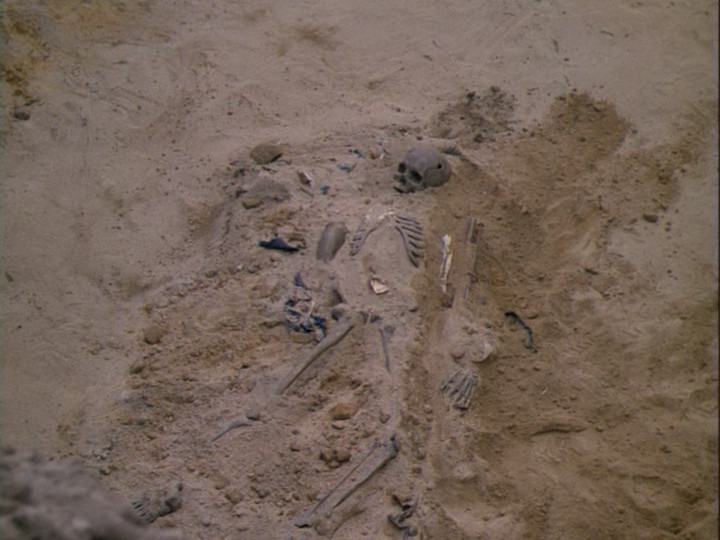
I’m not sure how this construction site, which doesn’t seem to be next to anything, is on “main street,” but in any event Amos drives Seth and Jessica to the construction site, where we finally find out what everyone was looking at in the hole that is, presumably, where the foundation for the hotel will one day be laid, once they dig past the loose dirt and hit rock.
Amos figures that this has to be the remains of Joshua Peabody (Cabot Cove’s most famous revolutionary war hero—though whether he existed at all is the subject of debate, with Amos being strongly on the pro- side while Seth is partisan to the con- side).
When Harry tries to hurry things up, Jessica points out that, while it could be Joshua Peabody, it could also be a murder victim and this the site of a murder. (The skull has a large hole in it.) Amos decides that she’s right as soon as he realizes that this means that he can make the construction crew refrain from disturbing the bones.
David then goes home and we get some family life—his kid got in a fight with another kid in the gym because the other kid was making fun of David. His wife wishes David could have stayed out of these kinds of protests just once. Etc. He then gets a call from Jessica because he’s an antiques dealer. She’s examining a long rifle and reads him the inscription, “Phelps and Handley, Liverpool.” David tells her that it was issued to the British army starting in 1762. (Amos seems to regard this as evidence in favor of his Joshua Peabody theory, though why a revolutionary war soldier would have a rifle used by the British is never considered.)
The scene shifts to the other end of the call, where Jessica, Seth, Amos, and Harry are in Seth’s office as Seth takes measurements of the bones. There’s a bunch of arguing and yelling—I’m not sure why TV writers think that yelling makes for good TV—but the important part is that Jessica suggests that the corpse might be quite a lot more recent than Joshua Peabody. She suggests one of the militiamen from the recreations of the battle of Cabot Cove that used to be held until twelve years ago.
We then get a scene with Harry, Kowalski, and Henderson Wheatley (who is the developer putting up the money for the construction of the hotel). There’s some bickering amongst them which is unpleasant to watch, then finally they’re interrupted.
Wheatley is in the center while his laywer is on the left.
It turns out that they’re having this meeting in the hotel lobby, because we meet some more characters (they were the interruption) as they walk in to check into their rooms:
Her name is Del Scott, and she’s some kind of reporter. A hard-boiled one, specifically, who casually insults the subjects of her reporting (she repeatedly calls Wheatley a crook). The two men behind her are nameless and we never see them again.
We then get a scene of Wheatley, outside, ordering his lawyer around a bit, culminating in telling him to, by noon, get a court order to resume work immediately.
And on that bombshell, we go to commercial. Had you been watching back in 1985, you might have seen a commercial like this:
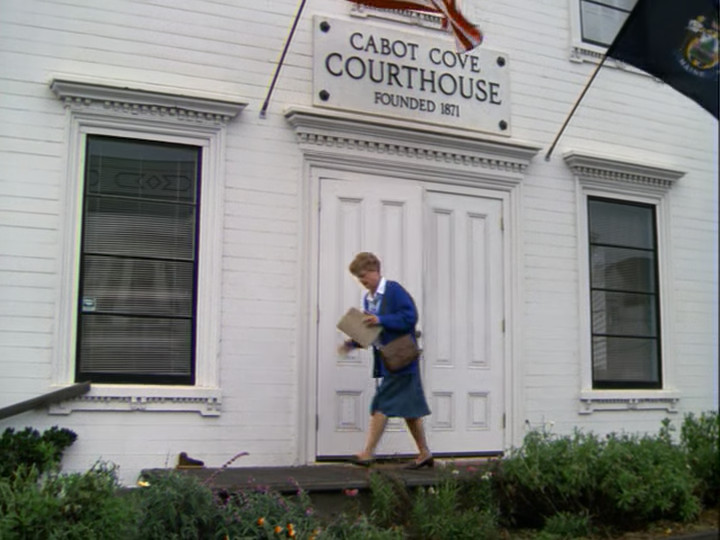
When we come back, we see Jessica coming out of the Cabot Cove courthouse for some reason.
As she leaves, Del Scott stops her on the street and asks her opinion, as Cabot Cove’s most famous citizen, on Henderson Wheatley’s latest construction project. Jessica replies that she’s famous for her books, not for her opinions and, in any event, this is a town matter, not one of national interest.
As they walk, Del tells Jessica about how she’s hated Wheatley for his sub-standard construction ever since she was covering the weather in Pittsburgh (that seems like the kind of detail that often comes up later—especially because as someone covering the weather in Pittsburgh she’d only have reason to hate Wheatley if a relative was killed in one of his buildings or something like that). Jessica suggests Del talk to someone like David Marsh, who would be far more eloquent on the subject than Jessica. She already tried, though, and Marsh declined. He even requested that they not film him at the construction site, though his request was too late. (This suggests that Marsh doesn’t want to be seen on national TV, perhaps because he’s a wanted fugitive who’s living under a false identity. Alternatively, that he’s someone in the witness protection program.)
The scene then shifts to a couple of hayseeds who are telling Amos that the bones don’t belong to Joshua Peabody, but to Uriah Pickett.
When Amos asks who they’re talking about, the man says that Uriah was a farmer from over “at the Blue Hill.” He disappeared fourteen years ago come April, same time as the fighting, as she recalls. Amos then replies that Uriah didn’t disappear, he ran away to Portland with a red-haired manicurist who used to work for Thelma Hatcher. (How he knows this so clearly when a moment ago he didn’t know who Uriah was, he does not say.)
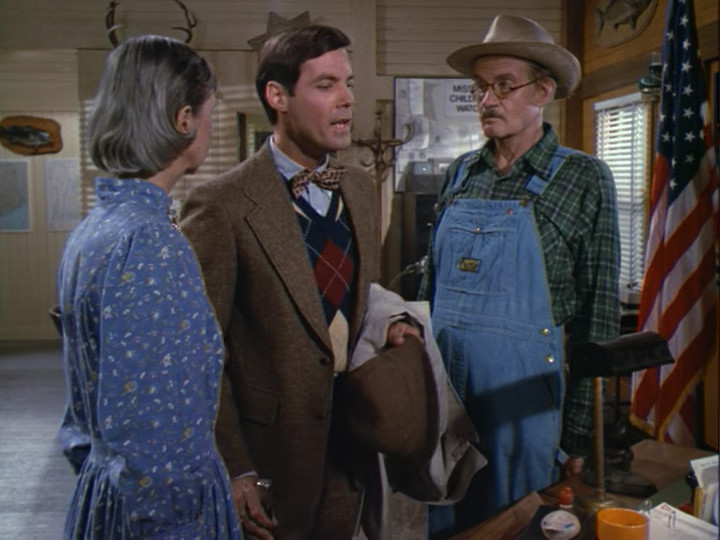
This meeting is then interrupted by Ellsworth Buffum from Kennebunkport.
He’s the vice-president of the Joshua Peabody Society. He’s hear to take charge of the last remains of Joshua Peabody.
Amos is interrupted before he can respond by an important phone call and has to leave in a hurry.
The emergency turns out to be fighting down on the construction site. Or, rather, protesters standing in the way of heavy equipment and people shouting at each other. When Amos arrives the lawyer hands him the court order that construction should resume immediately. Ellseworth Buffum then calls attention to an injunction which he has from another court stopping all work until a historical examination is completed.
Later, at dinner in Jessica’s house, Seth and Jessica discuss the dinner Seth made (Jessica says it has too much basil while Seth says that there’s no basil in it) and also the corkscrew Jessica has, which Seth dislikes and Jessica says works perfectly well if you know how to use it. Also, Jessica couldn’t find anything in historical records to prove that Joshua Peabody actually existed and Seth says that the skeleton was of a man with a bad back—a problem with his fourth and fifth vertebrae.
Also, David Marsh gave Seth a scrap that was pried loose from what was left of the guy’s uniform:
The idea that something this old and buried for hundreds of years would be just kept in someone’s pocket and handed around like this is absurd, but I suppose we can take this to just be the prop department saving on making some kind of realistic case for it. And, of course, what possible full sheet of paper could this have been a scrap of?
When Seth presents Jessica with a seven-layer cake that they’re going to have for desert, Jessica then gets the inspiration to dig underneath where the skeleton was found for other artifacts. How no one else came up with this idea, I can’t imagine. But it doesn’t much matter, because the actual reason that Jessica and Amos go to the site of the body is to find the murder that this episode is really about:
And on this bombshell, we fade to black and go to commercial.
When we get back from commercial, Seth is giving Amos the results of examining the fresh corpse. Wheatley probably died between 4am and 5am, having been shot at close range. (Also, it came up before the commercial break, but it started raining at 2am, at which point Amos came over and put the tarp over the place where the skeleton had been found and under which Wheatley had been found, to preserve evidence from the skeleton. They made a point of establishing it, so presumably someone is going to know something they shouldn’t about it.)
Amos also notes that Wheatley’s car is here and Kowalski sleeps in a motor home on the premises, so he’ll need to interview him.
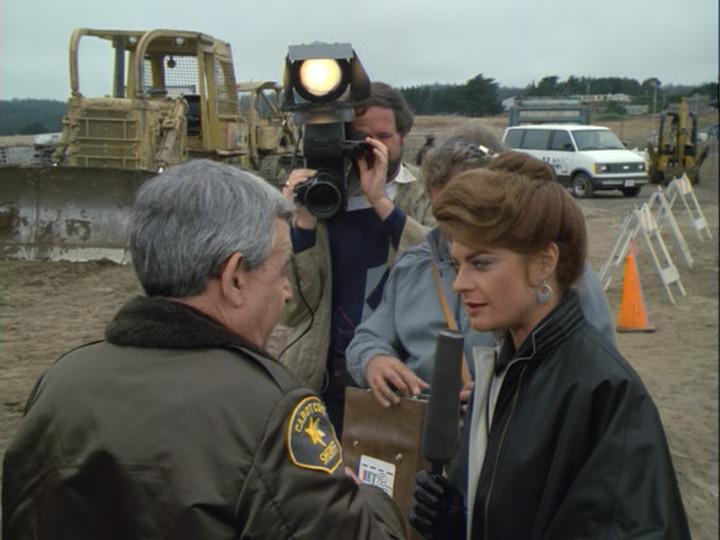
Amos is prevented in finding Kowalski by Del Scott coming up and interviewing him.
I’d ask why on earth this is in the episode except that her first question explains it:
Would you describe your feelings when you removed the tarp and discovered Mr. Wheatley’s body?
Unless she was the one who put Wheatley under the tarp, she’d have had no way of knowing that it had been under a tarp. It was clearly established that the tarp only showed up a few hours prior to the murder and Jessica and Amos thoroughly uncovered the body when they discovered it, long before Del and her film crew showed up.
In the next scene Jessica ovearhears the lawyer and Kowalski arguing in Kowalski’s trailer with the door open. The lawyer shouts:
You knew what was going on here. You knew the whole scam. Now, I’m the attorney on this corporation. You’ll get not one dime from me.
Jessica then discovers Wheatley’s tie clip, close to Kowalski’s trailer. When Amos comes up and asks what she thinks it’s doing here, her guess is that it fell off when Wheatley’s corpse was carried to the excavation. (Jessica thinks he was shot elsewhere and brought to the construction site.)
Later in the day, Jessica goes and examines the construction site and finds that one one the bulldozers has a busted tread, the wheelbarrow next to Kowalski’s trailer has a dirty handle, and Kowalski has a cut on his hand. He then tells her that she’s trespassing and she does an innocent old woman routine, then leaves.
When Jessica gets to town she’s in time to break up some fighting between David Marsh’s son and another kid. Then, as there’s general bickering, FBI Special Agent Fred Keller shows up…
…and arrests David Marsh, noting that his name is actually Daniel Martin. They’ve been after him for seventeen years.
Harry recognizes the name Daniel Martin as a “nutcase Vietnam protester”. Fred explains that, fourteen years ago, Martin bombed a federal courthouse. Amos shows up and tells Agent Keller that David is actually his prisoner, as he’s arresting him for the murder of Henderson Wheatley.
Amos explains his case—he found a note in Wheatley’s office that Wheatley discovered that David had planted the skeleton to slow down construction. David was also seen in the vicinity of the hotel at the same time that the night clerk at the hotel saw Wheatley leave the hotel. He takes David into custody, which Agent Keller isn’t too happy about, but does not stop.
The scene then shifts to Jessica and Seth in Seth’s office when Agent Keller comes in (he had an appointment with Seth). He explains that they didn’t get a chance to fingerprint Daniel Martin, but they were able to obtain his early medical records and he’s hoping that Seth can compare them with his records of David Marsh to make a positive identification. Seth looks at the medical records, but refuses to give Agent Keller a copy of David Marsh’s medical records. Keller is frustrated but assures them that he will get his man, with or without their cooperation.
After he leaves, Seth hints to Jessica that David really is Daniel Martin, and on that bombshell we go to commercial.
When we come back, Jessica is talking with David in jail, where he admits to her that he is Daniel Martin, though he denies being involved in the courthouse bombing. (The day of the courthouse bombing, he was living in Cabot Cove.)
Jessica then goes and finds Kowalski, who has moved his mobile home to a scenic overlook for some reason. Jessica brought him a salve for the cut on his hand and she insists on applying it for him, which for some reason he agrees to.
As they talk, Jessica says that she couldn’t help but notice the shabby state of the construction equipment and that it must have been difficult working for a man with so little regard for his employees.
Kowalski said that it was. Wheatley’s poorly maintained equipment got several friends of his killed. He names two examples: Bobby Scotto in Pittsburgh and Harry Pateki in Detroit (an elevator cable rusted through and dropped him 32 floors).
Of course, it’s hard to not notice that “Scott” and “Scotto” are very similar last names.
Oh, and Wheatley never paid any of the construction workers on this job; unlike before, money now seems to have been in short supply.
Over at the Sheriff’s office, Amos hands Jessica a paper that came over what sounds like a teletype machine and says that Wheatley owed money all over town. Apparently, Amos believes that the lawyer might be responsible, but Jessica doesn’t buy it. Even if the lawyer had a motive, he had no reason to hide the body on the excavation site. Hiding it there felt almost like a symbolic gesture to her.
Amos then reflects on the case and says that it goes to show that if you have something in your past, eventually it will come out. It just doesn’t pay to try and change your name.
At the words, “change your name” Jessica perks up and, presumably, realizes that it might pay to change your name if you’re changing it to sound better as the weather girl on a Pittsburgh TV station. However, Jessica only asks Amos to stop Kowalski from leaving town and to bring him back if he’s already left.
Jessica stops by the library to get some photocopies of news stories (I assume to prove that Daniel Martin alias David Marsh had an alibi for the courthouse bombing). She then calls the hotel and asks for Del Scott’s room. She gets Del and says that she’ll make a statement on Del’s news program. She’ll meet her at the construction site in an hour.
In the interview, she ambushes Del with her relation to Robert Scotto who was killed in Pittsburgh, where Del came from. Del cuts the interview short saying that it has no news value but Jessica keeps going. Jessica phoned the Pittsburgh hall of records and Robert Scotto had a younger sister, named Della Scotto. She then tells Del what happened: at 4am she called Wheatley saying that she had evidence that David Marsh had planted the skeleton. When he let her into his room so she could show him the evidence, she shot him. (How the hotel clerk saw Wheatley leave at 4am if Del killed him in his room, Jessica doesn’t say.)
Del breaks down and says that it is true that her brother died because Wheatley was too cheap to keep his crane in good repair. It broke and dropped four tons of I-beams on her brother. She admits hating him but denies having killed him. Jessica, however, insists that she did. And that after she killed him she put him in the construction site because it seemed symbolic—a grave that he dug for himself.
When the subject of evidence comes up, Jessica points out that Del knew about the tarp despite it being placed on the grave site at 2am and having been removed before her crew got there.
Del then, through tears, says that she tried for years to prove Wheatley’s guilt honestly but every time she got close he bribed witnesses and suppliers. He bought off the people he needed to so that she could never get him. She finishes with, “I’m not proud of what I did, Mrs. Fletcher, but don’t ask me to be sorry.”
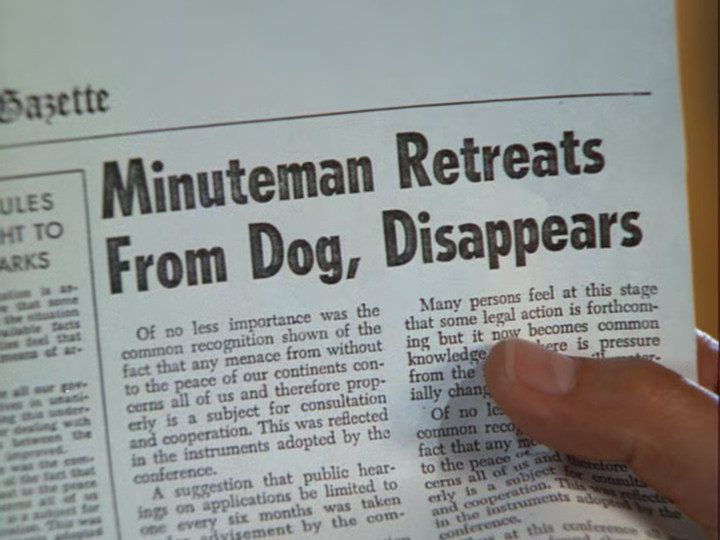
In the next scene Jessica and Seth go to the antique shop, where Agent Keller is arresting the now-free Daniel Martin/David Marsh. Jessica shows Keller a newspaper clipping that places David in Cabot Cove the day before the bombing. Jessica then shows him another clipping about a “Joey Fawcett.”
(It’s interesting that the props people didn’t bother to change the text of the newspaper that they used for this but only made up the headline.)
Jessica says that, clearly, the guy must have fallen and hit his head and died, and at least ten dozen people will swear that Joey Fawcett was actually Daniel Martin.
Agent Keller asks what happened next—the good citizens of Cabot Cove shoveled dirt over him?
Seth replies that there’s no accounting for what folks are here are libel to do.
Seth then hands Keller the fractured femur of the skeleton from the dig and invites Keller to compare it with his x-rays of Daniel Martin. Keller does so and it doesn’t match, which Seth tries to explain as the x-rays of Daniel Martin being from before he was fully grown.
Keller then says:
You know, a man must be very special to have people willing to stand up before an agent of the United States Department of Justice and each of them willing to risk charges of perjury, obstruction of justice and harboring a fugitive. Not many men have friends like that.
He then tells David that he (Keller) was wrong and has been pursuing a dead man, and leaves. Before Keller fully gets into his car, he tells Seth that he might want to brush up on his anatomy. The bone he showed Keller was an arm bone, not a leg bone.
After he drives off, Seth remarks that he didn’t think that Keller was that smart.
Seth then says that one good thing has come of this, though. Now that they’ve proved that the bones belong to Daniel Martin, they can put the Joshua Peabody nonsense to rest.
Jessica tells Seth that’s going too far and they laugh and we go to credits.
It was definitely good to be back in Cabot Cove again. Even though it’s a minority of episodes, Cabot Cove keeps Murder, She Wrote grounded. And it’s nice to meet Seth. As much as I did like Claude Akins as Captain Ethan Cragg, Seth is better. And as the town doctor he fits better with murder mysteries, too. This is discussed a bit in a New York Times article from October 27, 1985 which gives a bit of insight into this change:
The weekly arguments between Mr. Fischer and Miss Lansbury come because she wants to expand the character. When the series began, Jessica Fletcher was a substitute schoolteacher riding her bicycle in Cabot Cove, Me., who had written one detective novel. Now, as the famous author of a half-dozen best-sellers, ”She must avoid at all costs being sophisticated or jaded or superior,” says Mr. Fischer.
”She must consort with people of a certain intellectual level,” says Miss Lansbury, who fought ”tooth and nail” against Jessica’s relationship with the owner of a Cabot Cove fishing boat who also served as her handyman, a recurring character last season. ”There’s something wrong with Jessica if she enjoys spending more than 15 minutes a week with that man,” says Miss Lansbury.
The character has been dropped and replaced by a doctor (played by William Windom) with whom Jessica plays chess. Miss Lansbury has also ”fought and won a battle” against the network, which wanted to supply her with a sidekick. ”The whole basis of the show is that Jessica is a middle-aged woman alone,” says Miss Lansbury, ”and the network wanted to have a character joined at the hip who drove a car for me.” She has also resisted a serious romance, though, for a while last season, it seemed as though a different murderer was falling in love with her every week. ”I said no to those slight romantic liaisons. It makes her seem as though she has round heels,” says Miss Lansbury, using a British expression that decribes a woman who tumbles quickly into bed.
Seth being a good change is about the only positive thing I can say for this episode. The problem that most galls me is that it had far more loose ends than tied up ends. The biggest loose end, of course, being how on earth the skeleton—whoever it is—became buried under eight feet of ground on a cliff by the shore. The only way for it to have happened would have been for someone to have buried him quite remarkably deep for a grave, because dirt does not accumulate at anything like the rate of four feet per century, to say nothing of half a foot per year if this really was from a reenactor. You can easily tell this by going to a cemetery with two hundred year old tombstones and noting that they’re not buried under six feet of dirt.
And how on earth was this skeleton uncovered in a way that anyone noticed? A large, deep cut like this would be done with earth moving equipment. That doesn’t lend itself to noticing dirt-colored bones, even if by pure luck you happened to excavate right above the skeleton, exposing it, rather than picking it up in the excavator’s scoop.
And then there’s the way that the identity of the skeleton is never decided and, in fact, just dropped. The skeleton is hugely important to the episode; it drives most of what happens. And, after a few initial snippets about a British musket near to it and a scrap of paper that is oddly durable, we get nothing more. Everyone just stops caring about it.
I also don’t know why David Marsh/Daniel Martin is supposed to be a sympathetic character. All we know about him is that he’s against an absurdly large hotel in a place that would have great trouble filling it to a quarter capacity, leads a protest that Jessica is sympathetic to though it’s not clear why she should be, is always causing trouble in Cabot Cove, and fifteen years ago he did a bunch of “nutty” Vietnam war protest stuff. Oh, and his son gets into an awful lot of fights. I’m not seeing what we’re supposed to like about this guy. Are we even sure he didn’t plant the skeleton? He certainly was the person in Cabot Cove with the most access to things that can be planted to lend credibility to the “find” and we’ve established that he isn’t scrupulously honest. (Just as a side note: how would tiny little Cabot Cove support an antiques dealership?)
We also get a villain in the episode with all of the sophistication and nuance of Luten Plunder from Captain Planet. So far as I can tell, Henderson Wheatley cheats because he would rather be corrupt than honest. Are we really to believe that it costs more to settle a worker’s death, repair a broken crane, clean up dropped I-beams, suffer delays during which people get paid but work doesn’t get done, and bribe all manner of people to cover it up than it would be to just repair the crane’s cable before it breaks? People do skimp on necessary maintenance when they’re short of money and, instead of doing the things that will reliably make them more money, hope that things will work out until they have the money to cover the repairs. People don’t skimp on necessary when they’re rich because paying for maintenance is much cheaper than paying for repairs. An ounce of prevention is worth a pound of cure to the rich as well as to the poor. In fact, one of the ironic things about poverty is that it’s more expensive to be poor because the rich can avoid all sorts of major expenses by paying much smaller ones to prevent the big expenses from being necessary. All of which makes the character of Wheatley being so rich he can get away with anything not make any sense in the episode.
Especially because it’s actually a plot point that he isn’t so rich. They very clearly established that money was in short supply on this job. They even went so far as to have the lawyer angrily yell at Kowalski that he (Kowalski) knew what the scam was when he started the job. But once Kowalski shares the useful information of “Robert Scotto” having been killed through Wheatley’s negligence, this is entirely dropped.
Overall, this episode is a mess. We don’t get our body until right before the mid-point commercial break, the victim is a cardboard cutout of evil, the supposedly sympathetic characters aren’t sympathetic, and most of the interesting plot threads are dropped for no reason. Heck, we even get unambiguous evidence of who the killer is less than a minute and thirty seconds (not counting the commercial break) from finding the body, making the rest of the investigation obviously pointless.
Oh well. Next week we’re in New York City for Murder in the Afternoon.














 Chris Lansdown
You must be logged in to post a comment.