A few quotes about flowers inspired by this flower I saw growing as a weed on the side of the road.
“What a lovely thing a rose is!”
He walked past the couch to the open window, and held up the drooping stalk of a moss-rose, looking down at the dainty blend of crimson and green. It was a new phase of his character to me, for I had never before seen him show any keen interest in natural objects.
“There is nothing in which deduction is so necessary as in religion,” said he, leaning with his back against the shutters. “It can be built up as an exact science by the reasoner. Our highest assurance of the goodness of Providence seems to me to rest in the flowers. All other things, our powers our desires, our food, are all really necessary for our existence in the first instance. But this rose is an extra. Its smell and its colour are an embellishment of life, not a condition of it. It is only goodness which gives extras, and so I say again that we have much to hope from the flowers.”
And why are you anxious about clothing? Consider the lilies of the field, how they grow; they neither toil nor spin; yet I tell you, even Solomon in all his glory was not clothed like one of these. But if God so clothes the grass of the field, which today is alive and tomorrow is thrown into the oven, will he not much more clothe you, O you of little faith?
In his excellent book The Great Divorce, C.S. Lewis depicts Hell and Purgatory as the same place, with the difference being whether people consent to leave or whether they decide to stay. Truth to tell, it’s a bit of timid description of purgatory because Lewis was trying to be non-denominational and so he was trying to avoid offending people who are rabidly anti-Catholic in their biases (possibly including himself—He was born in Belfast where anti-Catholicism was in the water). But it’s a very interesting idea which could really use a bit more development, especially with regard to the more fiery depictions of Hell and the more actively unpleasant depictions of Purgatory.
Purgatory is an oft-misunderstood doctrine, but its etymology is a good place to start understanding it. “Purgatory” comes from the same root as the word “purge,” as in “to clean” or “to make clean”. The doctrine of purgatory is a straightforward logical deduction from starting off sinful at death and being sinless in heaven. Something must happen between those two steps, and the thing that happens which cleanses people of their sins was called, very practically, “cleaning,” except it happened to come from the Latin rather than the German roots of English, and hence, “purge”→”Purgatory”.
If you consider how cleaning normally works, on physical objects, you do it by abrading the surface until all of the dirt is gone. If you want to do a thorough job, you often have to be rough with the thing being cleaned—which is why children do not like baths, especially baths which get them thoroughly clean, including, for example, under their fingernails. If we move from the physical to the spiritual, how much more invasive must the cleaning be which cleanses your soul from things like lust, greed, envy, hatred, etc?
From here, it’s a relatively short jump to the metaphor of using fire to purify metal. If you heat metal up roughly to its melting point, any organic contamination will burn away and you will be left with pure metal. (In practice, it will probably need a polishing afterwards, but this doesn’t matter to the metaphor.) And this metaphor for cleaning happens to work very well with the description of Hell as a burning grounds.
That Hell is a burning grounds with constant fire is taken to be metaphorical for the obvious reason that it can’t actually be completely literal. Quite apart from literal fire requiring the afterlife to be just more of the same, rather than different in important ways, if the fire consumes the damned, then they’re not there later be burnt anymore. If the fires don’t consume the damned, they’re not being burnt. It would be, at worst, like chili peppers—awful at first, but if you spend enough time with them you get used to them because you know the sensation doesn’t actually mean anything bad. Since orthodox Christians do not presume God to be incompetent, the fires must be, to some degree at least, metaphorical.
If you put these together, it produces an interesting version of C.S. Lewis’s presentation of Hell in The Great Divorce: if all of the souls go through something which is incompatible with sin, analogous to a bath or purifying metal with fire, and they let go of their sins, this is Purgatory, and they emerge from that process made fit for being perfectly happy being eternally in God’s presence. (Let me emphasize, due to the context of some odd heresies existing, that we are made clean entirely by God’s grace, and entirely by his power. This cleaning is purely receptive on our part and we merely cooperate with it.)
But if the person refuses to let go of their sin, this cleaning never finishes, and therefore becomes eternal—specifically, eternal punishment.
This actually goes quite well with the idea I saw somewhere (I think in G.K. Chesterton) that the fires of Hell are actually the burning love of God, rejected. Bishop Barron used the analogy of a person at a party who doesn’t want to be there, who hates everything that is making the people who do want to be there happy. But if we stick with the metaphor of fire, the light of God’s truth works quite well as a purifying fire that burns away all impurities, since all sin is some kind of lie, and light also heats. In the fullness of the light of God’s truth, unveiled, all lies will burn away, and if a person lets them go, they have been cleaned of the dirt of these lies. But if they will not let go, if they shield the dirt from the burning light of God with their own bodies, then they eternally are tormented by trying to do what they can’t—believe the lies.
This is all, of course, highly speculative metaphor. I’m not trying to say that this is exactly what will happen after we die. For one thing, I have no special revelation so I don’t know. For another, I doubt that any language we humans have on this side of death even contains the words needed to describe what actually happens after death. (The fact that our Lord never tried to tell us strongly suggests, to me, at least, that this is so.)
But I think that this does at least suggest an answer, or at least part of an answer, to the question of how eternal punishment can be just. The point isn’t really to identify the answer, though of course that would be nice. The point is to show that an answer is possible, and therefore any argument which relies on it being impossible is wrong.
I came across another very interesting post by Caroline Furlong which can probably best be described as explaining to women why men’s fiction has so much action and so little emotional talk, but there’s quite a lot more in it—including some interesting discussion of people being trustworthy vs. people who abuse trust, for example—and I recommend reading it in full:
Something I think worth mentioning is that people (I do not mean Ms. Furlong) often confuse what takes up most of the words of a story with what the story is about. I think that there’s a very useful analogy to be had, here, from a physical lens: a lens is a large piece of glass whose purpose is to focus a large quantity of light down to a small point. Similarly, a story is very often a large quantity of words whose focus is a scene or two. But the whole point of all of those words is to earn that scene.
This can easily be shown by taking any truly great scene and showing it to someone who doesn’t know the story. It will, invariably, mean nothing to them. Or you can even see this in jokes: if you tell someone the punchline of a joke without its setup, it’s not funny.
The emotional scenes in men’s fiction are much like this: the extremely rare times when manly men talk about their feelings with each other are incredibly important, but only if you earn them by properly setting up the extremely rare circumstances where this is natural and healthy and manly. A really great example of this is the ending of Casablanca. The speech that Rick gives Victor Laszlo is an example of it; in it he tells him how he feels about Ilsa. It’s also subtle but you can see Victor Laszlo tell Rick how he feels; his almost-smile as he accepts what Rick tells him without believing it, and the way he welcomes Rick back to the fight. Much of the ensuing dialog between Rick and Captain Renault conveys how they feel, even if you have to read between the lines see it. But then you get the magnificent final line, “Louis, I think this is the beginning of a beautiful friendship.” It is magnificent precisely because it is earned by the entirety of the movie that led up to it.
You can also see this in well-written male characters which are written by women, by the way. Consider Mr. Darcy from Pride & Prejudice. It is precisely his reserve that makes it so striking that he says to Elizabeth, “I must tell you how ardently I admire and love you.” It is this reserve that makes the letter he wrote to Elizabeth so meaningful. It’s what makes this line so powerful:
“If you will thank me,” he replied, “let it be for yourself alone. That the wish of giving happiness to you, might add force to the other inducements which led me on, I shall not attempt to deny. But your family owe me nothing. Much as I respect them, I believe, I thought only of you.”
More properly, it’s his reserve combined with all the rest of what he’s done and what happened, that all of these things are earned and we learn of his feelings in conditions that make it reasonable and manly of him to communicate them in those very unusual moments.
All of this stands in contrast to that women’s fiction which is mostly “fluff.” That’s Ms. Furlong’s term for it, but I think it’s well chosen, because the emotions are mostly very transient—like the lilies of the field, they are here today and tomorrow thrown into the fire. This reflects the feminine orientation toward maintaining a household, which involves keeping track of many people and their current relationships to each other. Speaking as someone who does a lot of this himself because he has three children, you need to keep track of how everyone’s doing because the day-to-day changes in people are significant. When someone is suddenly quieter, there’s a good chance that they’re sick—or have some other problem that they need help with. If they’re suddenly louder, they might have a problem they need help with or they might be getting more caffeine than they realize. If they feel lousy and are lethargic about things that they want to do, they’re probably sick, whereas when they just feel lousy they might be having a stress reaction to something they don’t want to do. Similarly, some problems between kids they need to work out on their own, but some you need to step in and guide them to work out because they’re not doing it on their own and you don’t want to let problems fester. Letting problems fester leads to less well-developed social skills than when you step in and fix the problems they can’t, because people will mal-adapt to bad circumstances. Those women who have a facility for this—and it’s probably most of them—find the application of this facility to fiction satisfying, in a very analogous way to how many men find carving, or woodworking, or beating a video game very satisfying to their facility for problem solving. Thus the fluff—tons of transient emotions on display—gives lots of scope for refining one’s reading of people based on their trivial actions and comparing to the feelings that they express. (This is, of course, an oversimplification of what’s appealing about it to the people to whom it appeals.)
I came across this very interesting post by Caroline Furlong when I noticed that she had linked to my post Women Want Men To Show Emotion. I recommend reading her post in full, it’s very interesting:
The one thing I would note about her description of how men deal with anger is that—for very understandable reasons, given that her primary focus is writing fiction—she is mostly describing how young men deal with anger. (Oversimplifying: finding a legitimate target for aggression like a punching bad or wood that needs to be chopped.)
Turning into an adult greatly amplifies the intensity of the feelings one experiences (this is one reason why it’s so hard to be a teenager) and young men aren’t used to this yet. Also, if they’ve been raised at all well they’ve been taught self control, but it’s still a relatively new skill. So finding a legitimate target for aggression serves a purpose they mostly don’t realize it does: physical exhaustion. When an angry man hits a legitimate target over and over until he’s exhausted, this doesn’t directly help him to process the emotions. What it does is physically exhaust him. This counteracts the physical arousal that comes with anger, giving him the ability to think clearly—at least until he recovers his energy. Which is why it’s so important for him to actually do some thinking once he’s tired. This is also why this is where you usually see the older man come talk to him and he’s somewhat receptive. Once he’s tired, he can think, and the older man gets him to do it. Then he leaves and gives the young man time to think about what was just said. But very frequently the scene ends with the young man, who is now somewhat physically recovered, hitting things again. That’s because the physical arousal that returns as his exhaustion dissipates is clouding his ability to think again.
As men get older and more experienced, the physical arousal diminishes slightly but more importantly it’s familiar. In the same way that older men tolerate pain better than younger men do because it doesn’t scare them, older men deal with anger better because it doesn’t distract them so much. This allows them to get to the part that actually helps with the feelings more directly: thinking about the problem. Thinking it through, thinking about whether it was perceived correctly, thinking about how to handle it, thinking about how to handle all of the possible outcomes, etc. This is what actually helps a man deal with the emotion of anger: understanding what caused it and how to deal with it; having a plan for dealing with it.
It is possible that there’s too much to think through for a short time, of course, in which case one needs to think about it in the back of one’s mind while doing other things. When this is the case, thinking about it in the foreground of one’s thoughts is helpful occasionally—almost to check in on one’s progress in figuring it out—but it’s unhelpful or even counter-productive most of the time. In these cases a man will need to distract himself, and will usually do so with some kind of problem solving. Preferably, by doing something useful, but things like video games can also work. The critical thing to understand about this is that it’s not the man refusing to deal with his problems. It is, in fact, the man dealing with this problems. It’s just him dealing with the problems slowly, because that’s the only way that will work. It’s a bit like sleeping on a big decision like buying a house or a car. It’s not that your internal monologue is all about the purchase, but you are none the less doing something useful; if no objections occur to you in that time period it is much more likely to be a good decision. In like manner, when there’s some really big problem making a man angry, shoving it to the back of his consciousness and focusing on other things helps his mind to sort it out. Sometimes what you need are to make connections to things you don’t remember, but over time will think of and then see the connection. But the critical thing to realize is that this is actually quite constructive. If you force to him only think in the foreground of his mind about the thing making him angry, he won’t be able to pull together the various threads of his knowledge and thoughts necessary to really understand his problem and formulate a plan to deal with it. And he will feel awful until he does that. This is why a man talking about his feelings is often not just unhelpful but outright counter-productive. It’s getting in the way of doing the thing that will make him feel better, and emphasizing all of the stuff that makes him feel bad.
Anyway, that’s just an addendum to what Ms. Furlong said. Go read the post, it’s very much worth the time.
A few days ago a tweet went viral about men showing emotion:
wish men understood how attractive it is when they can feel & openly show their emotions instead of acting like a sociopathic brick wall
A great many people objected to this because, if a man follows this simply as described, the results are pretty much always a disaster. That’s because there’s a communication gap going on. What she wants is not, in fact, men “openly showing their emotions.” Men have very big emotions and many of them women would find terrifying if exposed to the full force of them. Also, if you’re speaking in the context of people who are merely dating, a man blubbering, out of control, will probably kill any attraction that the woman felt to him.
What she’s actually talking about but not saying clearly is that she wants communication. There’s an old saying in writing fiction that when people give feedback about your story, they’re usually right in what the problem is and wrong about what the solution is. This is a good example of that. If you ignore the suggested solution and focus on the problem, you can see that it’s a real problem.
instead of acting like a sociopathic brick wall
If you focus on this part, you can see that this is a legitimate problem. If a man does not communicate anything about his emotional state, at any time, to any degree, his wife will have no idea what’s going on, where he stands, where they stand, whether she can support him, whether it’s a good time to ask for things that eventually need to be done, etc. etc. etc.
And bear in mind that when I talk about her supporting him, I’m not primarily talking about giving him a shoulder to cry on so he can “get it out.” Men mostly don’t work that way. We don’t “get it out.” Talking about feelings does not exhaust them, or reduce them, or put them in perspective. If anything, it amplifies them and makes them harder to deal with. But within a marriage, there are many things each spouse does to support the other. This can range from things like getting the other one a food they particularly like to spending time with them in a way that’s relaxing or fun to letting them know that you’re fine with any outcome. (“Even if it doesn’t work out, we’ll be fine” can take a lot of stress out of many situations.)
For this and other reasons, reliable communication about how the man is doing, emotionally, is extremely helpful to his wife. (I’m talking about wives; all of this is merely prospective when it’s about a girlfriend because she is subconsciously evaluating what life will be like as a wife.) But the key things about this communication is that it is reliable and intelligible. None of this requires it to be performative. You do not need to cry to tell a woman that you’re feeling sad. You do not need to shout to tell her that you’re angry or laugh giddily to tell her that you’re happy. There is substantial individual variation, of course, but it is, in general, quite sufficient to simply describe your feelings in kind and magnitude. Things such as, “I’m not looking forward to work today. Nothing’s wrong, I’m just tired and I haven’t had a break in a while,” and “This problem at work is really stressing me. We’re going to be fine, but the customer is losing $1000 a day and calls us like every hour to see how it’s going” are usually quite sufficient, so long as they’re said with an intonation consonant with the meaning. (All bets are off if you sound like an android when you speak.)
This communicates what she needs to know in order to be a loving wife who works with you to try to make a happy household in which you are raising happy children. However much you deal with your own problems, doing so will inevitably use some of the resources you have for dealing with other problems such as family members making mistakes and being annoying or hurtful or whatever; when they know that you’re dealing with something big they can take extra trouble to not bother you and be extra tolerant if you snap. This is exactly the same as how you treat a person who has a headache or a cold with extra care and are more tolerant—which is why it’s important to tell people when you have a headache or a cold.
But that’s the thing—you want to tell them. The goal is not to simply give up all control and show people exactly how you’re feeling. You want to communicate like a rational human being who trusts the people to whom he is communicating.
And, indeed, this is attractive to women. If you communicate in a controlled way, she will feel that she is able to actually bond with you and form a relationship with you but will not feel that you are weak. Indeed; by letting her know how you feel, she is better able to gauge your strength. Weak people need to conceal their weakness for fear that it will be exploited, just as injured animals like to curl up in a place where no one can get at them and snarl viciously at anything that comes near so it doesn’t get closer. If you do not communicate at all, that can come across as being afraid of her getting close to you, which is weakness. Which is fair, because it often is. It is only strong people who are willing to be vulnerable. The key to the whole thing is: vulnerable in a rational, self-controlled way. What women want is communication, not emotional incontinence.
On the thirty first day of March in the year of our Lord 1985 the nineteenth episode of Murder, She Wrote aired. Set in Texas, it’s titled Armed Response. (Last week’s episode was Murder Takes the Bus.)
It opens with a voiceover of someone talking in a thick Texan accent telling the person on the other end of the phone to go to the jail and find someone. We then get a view of him:
His name is Milton Porter and I’d say that he’s a walking stereotype of a rich, predatory lawyer… except he’s sitting down. They lay it on thick, but the specifics don’t matter. He’s really just a convenience to get the plot started.
He meets Jessica at the airport. She’s come to town to testify on behalf of one of his clients. On their way to his car, some kids run into an airport employee who falls into Jessica, knocking her down. Here I have to pause to show the stunt man playing Jessica:
That’s not even the right color of wig.
“Jessica” stumbles, then loses her footing, falling to the ground:
When she’s helped back up her left leg doesn’t feel too steady, so Mr. Porter packs her off into his limousine saying that he’ll take her to the fanciest hospital in Texas and promising that he’ll be able to win at least a $50,000 settlement from the airport for gross negligence. The first half of that is the important part…
…because that’s how we get to the Samuel Garver institute, where the episode takes place.
Then we meet Dr. Sam Garver and Dr. Ellison. (Dr. Garver is the older man, in front.)
And yes, Dr. Ellison is played by Martin Kove, who played John Kreese, owner and sensei of the karate dojo Cobra Kai, in The Karate Kid (the year before).
Anyway, Dr. Garver tells Jessica that she has a small fracture in the fifth metatarsal, but the good news is that she can be fitted with a walking cast. I’m a bit suspicious of this diagnosis since the metatarsal is in the foot and Jessica didn’t put any great weight or sudden impact on her foot. I’d have expected, if anything, some kind of torsional injury to her ankle. That said, I don’t think that this is supposed to make us suspicious of the doctors; it’s probably just medical lingo thrown in to make it sound doctory.
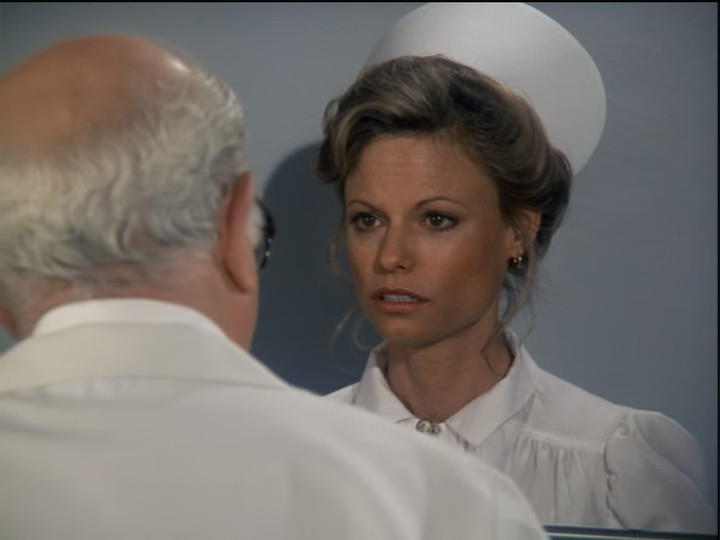
After some banter, Dr. Garver goes to leave and the nurse—her name is Jennie Wells—stops him and says that she wants to discuss a patient on her ward—Mr. Ogden.
Ah, the days before HIPAA, when you can just discuss people’s medical conditions in front of complete strangers. Anyway, Dr. Garver tells her that there’s nothing wrong with Barney, and she says nothing that would show up on a chart, and he replies, very coldly and sternly, “How nice that we agree.”
After this, Dr. Ellison puts the cast on Jessica:
It seems to be a plaster cast, which is a little odd since they had fiberglass casts at the time and one would expect them to use more modern technology in such a high-end hospital. Anyway, he says that to be safe, they want her stay overnight. Wanting her to stay overnight for observation for a small hairline fracture strongly suggests that they bilk patients through unnecessary procedures, but Jessica seems to think that this makes sense.
She then identifies his accent as being from Chicago. She has a cousin who sounds exactly like him and was born and bred on the north side. Dr. Ellison sighs and replies that he’s from the south side. (The south side of chicago is poorer and more crime-ridden than is the north side.)
We then meet another patient:
Her name is Mrs. Sadie Winthrop and she’s loud and gregarious and loud. Also talkative.
We then meet the head nurse:
Her name is Marge Horton. She and Jessica chat about the weather in Texas vs. Maine, then Jessica tries to present her medical insurance card but Miss Horton says that they don’t deal with insurance here. (The lawyer stereotype is taking care of it and he expects the airport to take care of it.)
They then run into Dr. Wes Kenyon in the hallway:
He takes a look at the cast and sounds concerned when he hears that Dr. Ellison applied it, though he can find no fault with it.
After he leaves and Jessica is wheeled to her room, she asks about his reaction and Nurse Wells tells her that Dr. Garver has a habit of destroying the reputation of anyone he fires and there’s a rumor that he’s bringing in a replacement for one of Ellison or Kenyon.
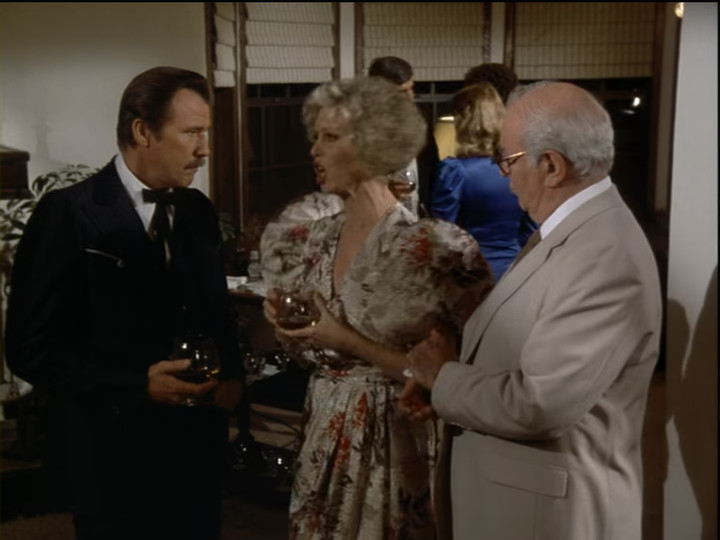
Later that night, at a party at Dr. Garver’s house, we witness a rich hypochondriac who doesn’t get along with her husband squabble with him in front of Dr. Garver and Dr. Kenyon.
Dr. Garver excuses himself from this because of a telephone call which turns out to be from Nurse Wells, who says that she needs his authorization for some tests. He curtly answers “no” and tells her to never call him at his home again.
When he gets back from that, Dr. Kenyon tells Garver that he’s leaving as he’s on duty in 45 minutes. When he thanks Garver for inviting him, Garver replies that he’s inviting Ellison for brunch on Sunday, since he can’t play favorites.
Back at the hospital, Jessica meets Barney Ogden after unsuccessfully trying to buy something at one of the vending machines.
It seems a bit strange that she should have to buy something at a vending machine in a luxury hotel, but I suppose she needed to meet the other patients somehow. They actually lampshade this when Jessica goes to get change at the nurse’s station and Nurse Horton tells her that she shouldn’t be up and about and that they would have brought her tea. Jessica says that she didn’t want to trouble them because they’ve got too many people who are really sick. (I’m not sure that this is true.)
Just as a side note, Jessica is walking around on crutches with the leg in the cast held off the ground, despite supposedly being put in a walking cast. I doubt that’s supposed to mean anything, but it is strange.
Anyway, Doctors Ellison and Kenyon walk into the nurse’s area, arguing loudly. Kenyon then notices all of the people looking at them and tells Ellison that if he wants to talk they should do it in private. They then walk into an office and proceed to argue even louder. The walls and door are, apparently, quite thin, because everyone can still hear them.
We then fade to an establishing shot of Dr. Garver’s house, then we cut to an establishing shot of a security company, from which the episode derives its name:
I love the vinyl siding on the office building.
I can’t help but also show what the interior of the security office looks like:
So many blinkenlights! And wood paneling!
I can’t imagine that this security office is even slightly realistic, but it is very evocative.
Anyway, the alarm for Dr. Garver’s house goes off and the guard sitting at the computer places the olbigatory phone call. When no one answers, the guard who was over by the map says that he’ll check it out. On his way to Dr. Garver’s house he comes to a three-way stop sign and sees Nurse Wells stopped at the stop sign, on the street to Dr. Garver’s place as if she just came from there:
This is quite suspicious, of course, meaning that Nurse Wells is definitely innocent.
When the guard gets to Dr. Garver’s house he runs in and discovers Dr. Garver, dead:
The camera zooms in on the body in the pool, then we fade to black and go to commercial.
Had you been watching back in 1985, you might have seen a commercial like this:
When we get back from commercial we get an establishing shot of the Garver Institute, then we move inside where Jenny serves Jessica Dr. Garver’s “world-famous” apple flapjacks. After which Sadie Winthrop arrives. She asks for flapjacks and coffee. Jennie replies that she can have flapjacks but no coffee. Dr. Kenyon got the word from Dr. Sam that she’s been much too active. Until further notice, she’s being put on carrot juice. (Sadie does not like the look of the carrot juice.)
Barney Ogden then walks up and apologizes to Jessica about having been rude to her the night before. Jessica Demurs and Mrs. Winthrop tries to give him her carrot juice.
They then hear a scream and Nurse Horton runs through. Dr. Kenyon follows her but doesn’t catch up to her. When Nurse Wells asks what’s wrong, Dr. Kenyon tells her that Dr. Sam is dead. Murdered last night. The radio report he heard said that there was the possibility of someone having broken in.
When Jessica returns to her room, she meets Lt. Ray Jenkins.
He’s the homicide detective in charge of the case and he’d like Jessica’s help. He’s not sure that the killer was just an intruder. One reason why is that the body might have been moved to the fish pool since the bullet entered at a forty-five degree angle which means that he was either sitting down or killed by an NBA center.
Lt. Jenkins has a good-ol-boy, shucks-ma’am style of speaking, but you do get the sense that it’s a Columbo-style attempt to be underestimated, not a lack of intelligence. When Jessica demurs, he tells her that he just transferred in from a rough neighborhood and doesn’t know how to talk to fancy folk like the ones at the hospital.
Jessica agrees and suggests that they start at the scene of the crime. Lt. Jenkins replies that it’s only five minutes away and the scene shifts to Dr. Garver’s house. There, he explains how the alarm works. I’m actually surprised by the amount of detail given; by the mid 1980s home security systems were far from universal but also far from unheard-of. And we already saw all the important parts anyway.
We do get some times, though. The alarm went off at 11:06pm and the officer arrived at 11:15pm. A next door neighbor thought that she heard a car backfiring a few minutes into the 11:00 news. (Backfiring, which is the rapid burning of fuel in the exhaust system, was more common in cars in the days before computer-controlled fuel injection and catalytic converters; older systems of mixing the fuel and air could easily lead to over-rich fuel-air mixtures and incomplete burning which allowed for the conditions for it to ignite in the exhaust. These explosions sounded somewhat like gun shots.)
The only other clue he has to tell Jessica about is that they found Garver’s keys by the front door. When Jessica asked what they were doing here Lt Jenkins replies that he must have dropped them. When Jessica asks why, because he was already in the house. Lt. Jenkins smiles…
…then asks her, very dryly, “Got any ideas?” His manner strongly suggests that he knew perfectly well that it makes no sense that Garver’s keys were outside of his door and we’ve come to the part why he asked Jessica to come—that is, to the hard part.
Jessica chuckles as she realizes that she can’t get away with doing only the easy part then says that she’s sorry but she doesn’t have a glimmer of an idea.
Back at the hospital, Jessica is met by Dr. Kenyon, who tells her that they were just about to send a search party out for her. She says that her leg is acting up and asks for a wheelchair. Dr. Kenyon obliges and personally pushes it. On the way back to her room, he tells her that he wasn’t surprised by Dr. Garver’s death—Garver had a lot of enemies. In ensuing conversation, Dr. Kenyon says that it was generally understood that he was next in line to run the hospital. Dr. Garver didn’t say so explicitly, but the signs were clear.
Jessica brings up Dr. Ellison and Kenyon says that he’s never liked Ellison. There’s something dangerous about him—a street kid who couldn’t leave the streets behind. He also mentions that Dr. Ellison keeps a gun in his car. I’m not sure that this would seem that out of the ordinary in Texas, but Hollywood writers generally know nothing besides Hollywood. And, to be fair, Dr. Kenyon doesn’t have a Texan accent.
When Jessica asks if Kenyon is trying to suggest that Ellison killed Garver, Kenyon replies that he’s a doctor, not a policeman, and excuses himself. (In other words: yes.)
Jessica then drops in on Barney Ogden. She’s clearly curious about what’s wrong with him. Then Mrs. Winthrop drops in and tries to bully him into being happy. When she asks if he’s only here because he likes it and doesn’t he have someplace else he’d rather be, he replies that no, he doesn’t. His wife died nine years ago and he never had any children. All he’s got is a nephew who only wants his money and a few cousins in Alaska.
After this scene winds down, Jessica spots Nurse Wells being escorted into a police car. In the lobby Lt. Jenkins is thanking Nurse Horton for her help when Jessica arrives. Ray explains that she’s been taken in for questioning since the security guard spotted her about three blocks away from Dr. Garver’s house. When Jessica says that there must be some mistake, Nurse Horton tells her that one of her nurses saw Nurse Wells sneaking out the back way at around 11:00.
And on this bombshell we fade to black and go to commercial.
When we come back from commercial, the Lawyer stereotype shows up at the hospital in response to a summons from Jessica. She wants him to rescue Nurse Wells. After some back and forth, we get a bit of exposition—from an off-screen conversation that Jessica had with Nurse Wells. She did leave the hospital but only to talk to Dr. Garver. She arrived at 11:10 and there was no answer to her knock. (The lawyer stereotype balks at taking the case until Jessica threatens to not testify on behalf of his client that she’s in town to testify for.)
In the next scene Lt. Jenkins is calling Jessica from a payphone to let her know that Nurse Wells has been released. Jessica is delighted to hear this then says that she’d like another look at the crime scene.
As Jessica is waiting for Lt. Jenkins to pick her up, Dr. Ellison runs into her. She learns from him that the trustees of the hospital have named him and Dr. Kenyon to jointly run the hospital on an interim basis. She also finds out that Ellison was sure that the new doctor was to replace Kenyon. Garver didn’t like Ellison’s family tree, but he knew a good doctor when he saw one.
On the way over to Dr. Garver’s house, Lt. Jenkins tells Jessica that shortly before Dr. Garver died he called the hospital and left a message on Nurse Horton’s answering machine. He has the tape with him and plays it for Jessica.
Marge, it’s me. A couple of things for the morning. I’ll be in late. I want Peabody up and walkin’ no matter how much he complains. Second, get Sadie Winthrop on carrot juice. She’s too hyperactive for her own good. One other thing. That Nurse Wells is gettin’ to be a real problem—startin’ to think she’s a doctor. Now, find some excuse to get rid of her. Now I’m goin’ to bed. See you tomorrow. You take care now.
I really like the establishing shot of Dr. Garver’s house, by the way:
He was a rich man.
Lt. Jenkins tells Jessica that they already had Nurse Wells’ opportunity and now they have her motive. When Jessica says that this is rubbish, he asks why she’s defending Nurse Wells out of pure guesswork. Jessica replies that it’s called reading people.
This is interesting because Jessica deciding that someone is definitely innocent is a common occurrence in Murder, She Wrote. Jessica has the writers on her side so she’s always right, but it’s often hard to see what she’s going on other than the episode portraying the character as sympathetic.
Anyway, they go inside. Jessica looks around and says that the tape contradicts Jenkins’ theory that Garver was attacked while he was getting back from a walk. If he was going to bed, he must have been killed inside the house, which means that his body in the pool in the foyer was staged.
Inside they discuss some possibilities, then discuss the question of why the body was dragged out to the fish pool. Jessica says that the pond was heated because of the fish, which makes the time of death uncertain. Lt. Jenkins wonders at this because the neighbor heard the shot at 11:05 and the guard arrived at 11:16, so the time of death doesn’t seem very uncertain. Jessica then asks if he has any blanks for his gun.
They then stage the experiment where Jessica visits the neighbor while Lt. Jenkins fires the gun. They hear the shot and the neighbor says that it’s exactly like what she heard the other night. (There’s an annoying comedy bit where she’s sure that this isn’t really police business and there’s a hidden camera where she’s supposed to taste-test coffee or something.) The only thing is, Jenkins didn’t fire one shot, he fired two. The first inside the house, the second outside the house, the latter being meant to obscure the time of death.
That night at the hospital, Jessica visits Nurse Horton. After pumping her a bit, she reveals that she and Dr. Garver and an intimate relationship. She narrates how the day she learned of Garver’s death went. It’s sweet, but clearly here to give us the salient fact that she didn’t play the answering machine tape until later in the day. Then she’s interrupted by a nurse who tells her that the police are searching the locker room with a search warrant.
In the locker room Lt. Jenkins is there with some uniformed police offers and explains that he received an anonymous tip that the murder weapon was in Nurse Wells’ locker.
They find a gun—which Nurse Wells protests is not hers—in Jennie’s locker so Jenkins directs the officers to arrest and book Nurse Wells.
When Jessica tells him that he’s making a dreadful error, Jenkins replies that they have motive, opportunity, and now means. He says that they’ll let ballistics decide if it’s the murder weapon.
Jessica retorts, “Well of course it’s the murder weapon. Who ever heard of framing someone with the wrong gun?”
And on that bombshell we fade to black and go to commercial.
When we come back from commercial we’re at the lawyer Stereotype’s office. Jessica is telling him that the murder weapon was obviously planted in Jennie’s locker when Dr. Kenyon comes in. He informs the lawyer stereotype that the hospital stands behind Nurse Wells completely and that they will be responsible for any legal fees involved.
Back at the hospital, Jessica runs into Barney Ogden and Sadie Winthrop who are playing gin rummy together and clearly enjoying each other’s company. Barney is in remarkably good spirits as he wins the hand as Jessica walks up. A minute later Sadie gets carrot juice and this puts Jessica in mind of something. She goes off and calls Lt. Jenkins.
We then cut to Lt. Jenkins in front of the nurse’s station asking Dr. Ellison if the gun is his. Ellison denies even owning a gun, but Kenyon contradicts this. Ellison replies that he told Kenyon a lot of things, many of which were not true.
Jessica then barges in and begins angrily asking Lt. Jenkins what is doing. After a bit of bickering, she asks to speak to him privately and then goes into the same room that Ellison and Kenyon had their fight in. Lt. Jenkins follows her and the two begin yelling at each other.
Various people in the lobby comment on the fight, then Jessica walks up behind them and says hello, then calls out to the Lt. that he can come out now. Which he does, holding a boombox which is still playing their argument.
We cut to Dr. Ellison and Dr. Kenyon looking like they’ve been caught, but smart enough to not say anything. Then Jessica asks Nurse Horton whether they witnessed a similar scene two nights ago when Dr. Garver was killed. (She says yes, of course, since we obviously did.)
Jessica then goes on to produce the evidence: Dr. Kenyon switched Sadie Winthrop to carrot juice for breakfast on Dr. Garver’s orders but Nurse Horton didn’t play that tape until lunchtime. There was only one way he could have known about those orders: if he had still been at Dr. Garver’s house when Dr. Garver dictated them onto Nurse Horton’s answering machine. He must have killed Dr. Garver right after the phone call, but before 11:00. Then someone had to go to Dr. Garver’s house and fire the gun outside then set off the alarm during the very public argument behind closed doors.
Ellison breaks down and explains what happened. It was Kenyon’s idea but he went along with it. He then narrates what happened, which is basically what we already knew. Kenyon stayed behind and shot garver, then they staged the argument and Ellison went back and opened the door, setting off the alarm, and fired a shot into the air. He came in the same way he left.
The next day Jessica is walking to a car without crutches, talking with Nurse Wells. Jennie thanks her lucky stars that Jessica was here to help her and asks why they did it . Jessica says that it was simple survival. One was about to replaced and his career destroyed, but they didn’t know which, so they decided to put aside their differences and eliminate the threat that faced both of them. They only decided to pin the murder on Jennie after the fact. Jessica wishes Jennie well and then asks her to write and let her know how the love birds (Sadie and Barney) are doing.
As the final thing in the episode, the lawyer stereotype pulls up. He banters with Jessica and we learn that he’s taken on the case of defending Kenyon and Ellison. He wishes her farewell and as she gets into her taxi, she tells him, “See you in court!”
And we go to credits.
This episode had some really fun things in it and some really stupid things in it. Let’s start with the fun things.
The basic mystery was fun. A murder in a big, empty house with apparently tight timeline is always interesting. There were clues which weren’t obvious that turned out to be meaningful, such as the body being in the fish pool and the keys being found outside the house. The apparent alibi of the two most likely suspects was also interesting.
I also really liked Lt. Jenkins. I think that the character fell a bit short of his promise but he felt like a Columbo-like character, which is very interesting to pair with Jessica. Jessica is used to estimating the competence of the police to be very low—accurately, most of the time—so that part fits. Seeing her surprise, and the contrast of detective styles, was interesting. I wish that they had leaned into this more; it would have been fun to see Jessica having a little bit of competition and rising to the occasion.
Unfortunately, that’s about it for the stuff I liked.
I really disliked the lawyer stereotype. All of his scenes should have been replaced by more characterization of actual characters. (This is a knock against the writers, not the actor—he did a fine job with what he was given to work with.)
I also think that the character of Nurse Jennie Wells was a big mistake. Admittedly, she’s a pretty, young woman in trouble so she is automatically sympathetic, but this has to work against the character as she was written. She’s meant to be the kind of medical practitioner who cares and goes the extra mile, and we’re supposed to approve of her for it. In the end of the episode she asks Jessica how she can thank Jessica for saving her and Jessica replies she can thank Jessica by continuing in her career because medicine can use a lot more like her. The thing is, it really couldn’t. Nurse Wells never actually helps anybody—she just gets in the way of the people who are. The episode even spends several minutes showing us conclusively that Dr. Garver was right and there was nothing wrong with Barney Ogden. He didn’t need treatment, he just needed a friend. Running the tests on him that Nurse Wells wanted to run would have turned up nothing useful and created the possibility of misleading results that led to unnecessary treatment.
Moreover, calling the head doctor at home, then skipping on her shift and driving over to his house in order to talk him into tests was highly inappropriate. Doctors go off duty for several reasons. For one, they’re human beings and deserve time off. For another, they need to rest so that they can do a good job when they’re on duty. People who are burned out because they never rest don’t do a good job. It’s also the case that there is an on-duty doctor at a hospital who can handle any emergencies which come up. There’s no way to need emergency tests at 10pm at night and have to call an off-duty doctor rather than finding the on-call doctor and asking him. Even worse than this, a nurse doesn’t order tests and require someone’s permission to do it; the doctor is the one who orders tests. This is because doctors have trained extensively under supervision from other doctors in order to have a sense of what’s needed and what isn’t and the complex interplay of many different things. That’s not to say that doctors are always right and there’s nothing that would prevent a nurse from extensive study and gaining this knowledge on the side, but if she did this, it’s only reasonable to take the time to prove it to people before she asks them to trust her. But we’re given no reasons to believe that Nurse Wells has done any of this training and we are given reasons to believe that she hasn’t. The only beneficial things we actually see her do anyone are to push Jessica around in a wheelchair and serve pancakes.
Frankly, Dr. Garver was right to want to get rid of her.
Probably the worst thing about this episode was that the episode hinged on carrot juice replacing coffee. Everything about this plot point was stupid. First off, the order to put Sadie Winthrop on carrot juice makes no sense. She has a broken leg and she’s a fiesty, energetic woman who’s bored and looking for stimulation. She’s not active because she has coffee. She’s active because that’s the kind of person she is. Putting her on carrot juice will just make her more bored and make her look for more trouble to liven up her day. And it’s not even a problem if she is active—she’s got a broken leg that’s in a cast. As long as she’s not whacking things with her cast as hard as possible, she’ll be fine.
But even if we accept this, the next step was that Dr. Kenyon, who was hiding out at Dr. Garver’s house, listened to the message he left on Nurse Horton’s answering machine carefully enough to hear the instructions, then after murdering Dr. Garver, he still dutifully carried out Dr. Garver’s orders about the carrot juice when he knew that Dr. Garver had left them on an answering machine for someone else! He wouldn’t have done that if he’d just stayed late at the party because he lost his favorite tie-pin, because people don’t ordinarily rush to implement orders that were given to someone else. But after committing a daring murder, he decided that ridiculous medical instructions are the better part of valor and put the carrot juice order in himself, lest the patient have an extra cup of coffee in the morning before Nurse Horton heard the message and put the order into effect. As unscrupulous as he was to plan a murder instead of just securing another job before Dr. Garver could fire him, he couldn’t bear the thought of an excitable patient—moreover, a patient with a broken leg and not something sensitive to caffeine like a heart condition—having one extra cup of coffee. And if it weren’t for that level of dedication to his patients, he and Doctor Ellison would never have been caught!
This is almost Encyclopedia Brown levels of “you made one mistake.”
(To be clear, I like Encyclopedia Brown stories quite a lot; but they are highly simplified for their intended audience of children and mostly don’t stand up to exacting scrutiny because they rightly prioritize intelligibility to children over verisimilitude.)
One of the causes that you will see put forward as to why so many people are overweight, fat, or obese is that we evolved for a food-scarce environment and now live in a food-rich environment, so our natural inclination to eat everything available and store fat for the lean times is no longer adaptive. This hypothesis has a natural conclusion about how to not get fat: limit what you eat and always be hungry. To lose weight, limit what you eat even more and always be hungrier until you’re thin, then just limit what you eat and always be hungry.
Like the idea that carbs are more filling that fats because carbs have 4 Calories per gram while fats have 9 Calories per gram, so carbs take up more room in your stomach, this is one of those ideas that’s strange that anyone says with a straight face, at least if they’ve spent more than a few days living as a human being. Because if you have any experience of living as a human being, this is just obviously false. And there’s a super-obvious thing which disproves both: dessert.
Observe any normal people eating dinner and they will eat until they are full and don’t want to eat anymore. Then bring out some tasty treats like pie, ice cream, etc. and suddenly they have room in their stomach after all. This simple experiment, which virtually all people have participated in themselves in one form or another, irrefutably disproves both of those hypotheses.
You can also easily see this if you have any experience of animals which actually do eat all food that’s available until they physically can’t, such as the cichlid fish called the Oscar.
You feed oscars feeder fish, and they will keep eating them until there is no more room left in their stomach, throat, and mouth. They, literally, only stop eating once their mouths are full and fit nothing more in them. They then swim around with several tails sticking out of their mouth until their stomach makes room and they can move everything down.
That’s what a hunger signal with no feedback mechanism to stop because the creature evolved in a food-scarce environment looks like. (Oscars who are fed a lot grow extremely rapidly and very large.)
But you can also disprove this from the other direction. Yes, lots of people are fat, but they’re not fat-mouse fat.
Fat mouse was created by lesioning the part of the brain responsible for satiety. Fat mouse then kept eating and eating, without stop, rapidly ballooning into nearly being spherical. (Incidentally, are we to believe that normal mice eat have a satiety limit to their eating because mice evolved in a food-rich environment? When you look at field mice, is “abundant food” really the first thing that comes to mind?)
Now, it’s possible to attempt to save the food-scarce-environment hypothesis by modifying it, saying that we’re genetically predisposed to being fat and unhealthy because that worked out in a food-scarce environment, but not too fat, for whatever reason. This suffers from being arbitrary, but then it is the prerogative of evolution to be arbitrary (obviously nothing needs to make any sense if you’re an atheist, but for the rest of us the influence of fallen angels on evolution, within the limits God permits them to work, has the same result—that’s one of the things that confuses atheists).
Of course, the problem with even this modified hypothesis is that there are plenty of naturally thin people and if you talk to them they’re not constantly hungry and denying themselves the food needed for satiety at every moment.
There’s also the problem of the timing of the rapid fattening of the population. Yes, it took place at a time when food was abundant, but there have been sections of the population for whom food is abundant as far back as there is recorded history. They were not all obese. More recently, in the 1800s, upper middle class and rich people could easily afford enough food to get fat on, yet they were not all obese. And in much of history, when food was scarce, people’s preferences in women were for plump women. Just look up paintings of Venus:
Which makes sense in that context—when people mostly don’t have enough food, women who manage to be plump in this environment are healthier, can have more children, survive the rigors of pregnancy, take care of the children, etc. Hence when painting a goddess of beauty, they painted her to the standards of their day and made her plump. But they didn’t make her obese.
But this dates to a time (30,000 years ago) from which food was supposed to be scarce and—so the hypothesis goes—no one actually looked like that because they were in the environment their constant food cravings were adapted to.
Ultimately, what I find so odd about the programmed-to-overeat hypothesis of modern obesity is not that it’s obviously false. It’s that it’s obviously false and the people who push it have clearly never considered the evidence against it.
You don’t see this with, for example, Young Earth Creationists. They have explanations for why radio-isotope dating doesn’t work and how geology is all wrong and fossil records are being misinterpreted because the dinosaurs were all animals that didn’t make it onto the Ark, etc. etc. etc. Say what you want about Young Earth Creationists, they at least take their ideas seriously.
As far as I can tell, the people saying that we’re programmed to overeat are just saying things.
The Red-Headed League is, justly, one of the most famous Sherlock Holmes stories. But while it is mostly known for the cleverness of the plot, I really appreciate that its structure shows how thieves are often their own worst enemies.
The most notable quality of a thief is that they are not willing to do the just work to get what they want. Outside of a highly developed economy this mostly means that they are not willing to build, or husband animals, or plant crops, or spin or weave or whatever it takes to get what they want. Within a developed economy this means that they’re not willing to pay for what they want with money that they have earned. And while most of the time this means that they take money from others, it also means that they are not above getting people to do work and then not paying them. And this was the downfall of the Red-Headed League.
The reason that Sherlock Holmes foiled the bank robbery for which the Red-Headed League was set up is that Mr. Jabez Wilson came to him to find out what the Red-Headed League was about. The reason that Mr. Jabez Wilson came to Sherlock Holmes was because the Red-Headed League was summarily dissolved and all efforts to try to contact the representative of the Red-Headed League showed that something underhanded had taken place. The reason that the Red-Headed League was dissolved was because the tunnel that they were digging into the bank had been completed. They no longer needed Mr. Wilson out of the way so they invested no more time or money in him. I think it is not coincidence that this took place on the day that Mr. Wilson was to be paid for the previous week’s work. Had Mr “Duncan Ross” of the Red-Headed League showed up and paid Mr. Jabez Wilson the four pounds, Mr. Wilson would have gone home happy that Saturday and not contacted Holmes.
Saving four pounds cost the thieves £30,000.
On its face this might sound stupid but the brilliant part of the story is that it is stupid in exactly the sort of way that thieves often are. It’s not that they didn’t think of this at all; they did and just thought it sufficient for Vincent Spaulding to tell Mr. Wilson to wait for a letter in the mail. That is, they trusted that instead of spending money (and thereby doing work) they could instead trick Mr. Wilson into doing what they wanted.
This is excellent symbolic structure in the story because the fundamental problem with stealing is that it does not actually work; stealing is killing the goose that lays the golden eggs. If only the criminals had been a bit more diligent, they would have gotten away with it… means, in the end, that they would have succeeded if they were not the sort of people who are thieves.
(There are always exceptions; the world is only ever partially fallen because, to be completely fallen, it would have to not exist. You will occasionally find people who are oddly virtuous in pursuit of some vice, but it is always a temporary thing. Vice is a degenerative disease because virtue is only ever maintained through constant renewal, and the renewal comes from aiming at something higher. When someone gives up on the higher aim to the point of becoming a career criminal, they have abandoned the source of renewal that will maintain their virtue. And so they will degenerate.)

























 Chris Lansdown
You must be logged in to post a comment.