I ran across an interesting TikTok on Twitter which I think is a useful jumping-off point to some practical aspects of how to interpret low-context things on the internet:
I am not alone in this experience. Many women have been in this exact same position. The work required to manage a home and a family is not something that one person should ever have to carry alone. It is possible to change these dynamics. It is hard but with the right tools and support it’s possible and it’s so much better on the other side. #marriageadvice#mentalload#mentalloadofmotherhood#divorced#divorcedmom#parentingadvice#default
The first question you need to ask about anyone making almost any kind of argument is who are they and why are they making this argument. In theory this shouldn’t be necessary because arguments are supposed to stand on their own. And some in fact do. It doesn’t matter who is making the argument for God from contingency and necessity because that argument actually does stand on its own. You can simply examine its premises and the logical links in it and that’s sufficient. But for most arguments that people make, when you examine the argument, you will see that people use themselves as an authority in their argument. In technical language, their argument uses premises whose truth value can only be known by themselves, so you can only know it by trusting them when they vouch for it. The TikTok above is exactly such a thing; the premises in her argument are very much things no viewer can evaluate apart from her trustworthiness.
So the first question is: who is this woman? Of course, I’ve no idea who this particular woman is, but we do know a few things about her just from the video. First, we know that she is publicly complaining about her spouse, so we know that she has bad judgement. Second, if you’re familiar with human beings, you don’t even need the sound on to see that she is neurotic, but if you do turn the sound on, you can tell with near-certainty that she is highly neurotic. (You can also tell from how she’s dressed and the house that she filmed this in that she’s upper middle class and very concerned with status.) All of which means that she is not to be trusted on any premises she offers which require good judgement, stability, courage, or humility to be correct about.
She begins by talking about how she does all of the household work, and while I don’t necessarily doubt that she does almost all of the work that she notices, what I don’t trust her in the slightest about is that most of this work needs to be done.
Don’t get me wrong, kids are a lot of work. I’ve got three so I’m quite familiar with this. What I’m also quite familiar with is that it’s easy to multiply the work that needs to be done if you set up rules for yourself that don’t match reality. And this is where her bad judgement and neuroticism come in. It is not even a little plausible that her workflow is streamlined and matches reality. Indeed, her evident desire for status and suspiciously immaculate kitchen very strongly suggest that much of her workload in the morning is about conforming to rules that, in her mind, gives her the status she craves.
A very strong indication that what she wants is not, in fact, help with the labor is the that she complains that, when she told her husband she was overwhelmed, that he asked her what she wanted him to do (i.e. how he could help). If her actual problem was more work than she can do, the last thing in the world she would want would be someone just starting to do things without coordinating with her. No rational person wants someone to take over randomly selected jobs from them without coordinating first. Equally, no rational person thinks that another person magically knows, without communication, everything he does and how he does it and how all of the details fit into each other. Moreover, any even slightly competent adult who is overwhelmed by work and who wants help will identify which tasks they can offload with less work than doing them themselves and directly ask for help with those. The woman in this video may be unpleasant, but she’s clearly an adult and not a complete idiot, so the obvious conclusion is that what she wants is not, in fact, help with some of the household work.
(Some additional evidence of this is the particular example she cites of when she considered divorcing her husband: a particular time he didn’t take out the trash in the morning because he was running late and so she took it out and ended up being late to work as a result. Now, the odds that she was late to work because she took out the trash are, in themselves, tiny, unless their garbage cans are a quarter mile hike over difficult terrain away. But even more to the point is that she can’t possibly have needed to take out the trash in order to do anything necessary in the morning. In a reasonable worst-case scenario if she needed to throw something out that couldn’t just be left on a counter she could have just pulled out another garbage bag and left it on the floor. If they didn’t have a spare garbage bag, she could have put it in a spare plastic grocery bag. Or in a ziplock bag. Nothing irreparable or unsanitary will happen to garbage left in a bag on the floor of an empty house for eight hours. She can only have been forced to take out the trash and therefore be late to work by some unnecessary rule she has imposed on herself.)
Given that she’s got bad judgement and is almost certainly neurotic and status-seeking, what she almost certainly actually wants is someone to force her to calm down. That is, she wants someone to override her worrying so she doesn’t worry so much.
In theory this could be her husband, if he’s sufficiently manly and confident and she’s willing to trust him. Far more likely to be successful, though, is another woman that she respects. A good friend might work, but an older female relative that she respects would probably be the most effective at it. She needs to feel like she has permission from the society whose status she craves to not do these things, such that she won’t lose status for doing them. So it needs to be someone who, in her mind, can grant her that permission.
There are, of course, almost certainly some other things going on too. She’s going to want to feel valued and appreciated, but she probably can’t feel those things as long as her life and her interactions with others are dominated by status-seeking unnecessary work because very few people are any good at thanking somebody for them wasting their time, in theory on your behalf but in reality for their own sake. But this is only probable based on how human beings behave; it is less in evidence from the video.
But, to bring it back to the general: when you’re not dealing with someone wise, the problem is almost never the stated problem. As a Lindy Hop instructor of mine once put it: when you see something go wrong, the problem is usually two steps earlier.
On the twenty fourth day of Feburary in the year of our Lord 1985, the fifteenth episode of the first season of Murder, She Wrote aired. Titled Tough Guys Don’t Die, set in Boston. Mostly. It was also Murder, She Wrote‘s first foray into the hard-boiled American detective genre. (Last week’s episode was Paint Me a Murder.)
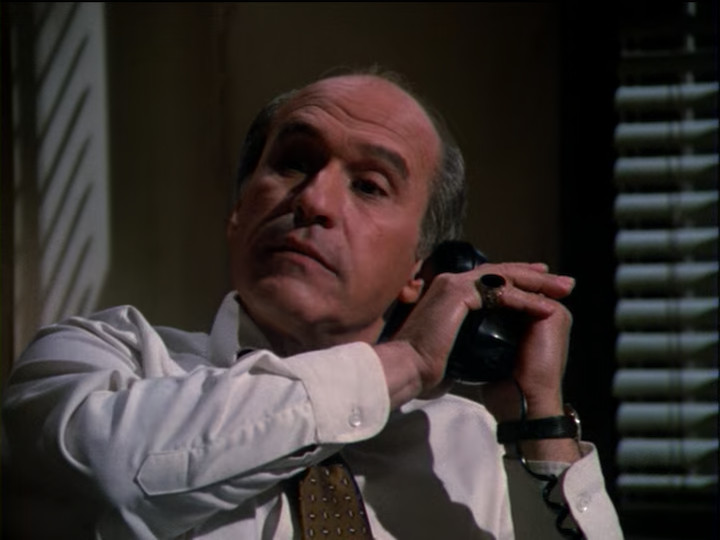
The scene opens with a hard-boiled private detective named Archie Miles talking on the phone. He’s telling someone about a doctor.
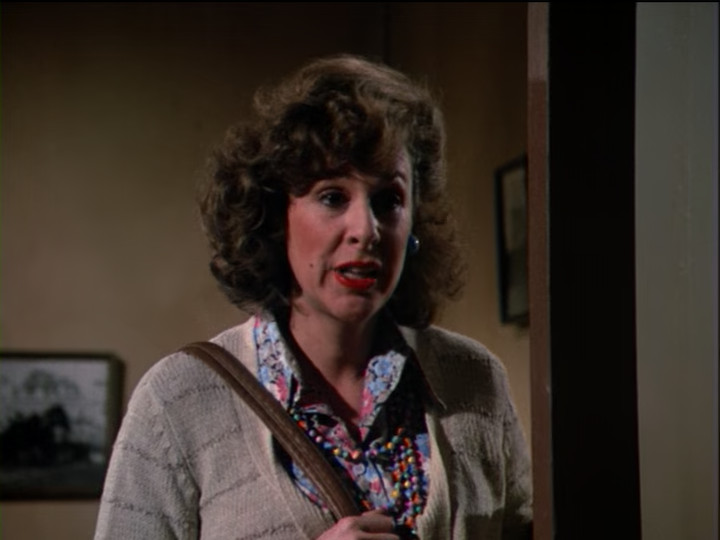
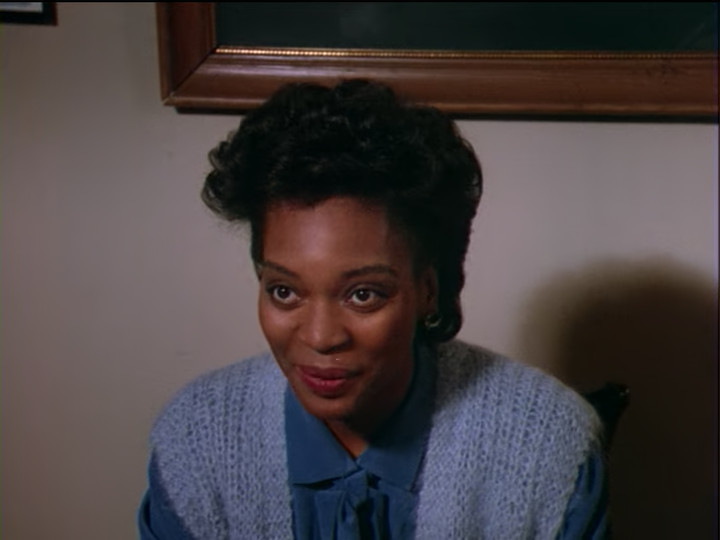
He’s interrupted by Alma, the agency’s secretary.
She tells him that she has to leave because she’s got a date and she’ll see him tomorrow.
He goes back to giving facts, including about a hospital administrator and a cop who worked a case. We then see who’s on the other end of the phone call: Jessica.
Unfortunately, it’s a very cold case. Archie tells her that the “Danbury Scalpel Murder” is a fine idea for a book, but the case was 25 years ago and there just isn’t much information. The only possible lead is a nurse, Martha Clay, who was on duty “that night.” The only thing is that it means driving to a small town in Vermont and he’s got two other cases. Jessica says that anything he can do would be greatly appreciated and Archie says that if it’s that important to her, he’ll do it.
I don’t know if the cold case is going to be relevant to the murder—someone killing the victim in order to stop the investigation—but if it is, this is a cool setup for that. It doesn’t make much sense for it to be Jessica’s investigation, though. She’s a fiction writer. What would she do with the details of a real case? First off, for excellent reasons of liability, all fictional works start off with a short notice saying something to the effect of “this work is fictional and any coincidence to persons living or dead is entirely coincidental.” If you base your work on the real life of recognizable people who are still alive, you open yourself up to all manner of liability. Not to mention that by potentially harming innocent people’s reputations, you’d be quite irresponsible.
On top of that, real life is almost never as entertaining as fiction. That is, after all, why we like to read fiction. The actual details of a real murder are going to be messy, with most of them not meaning anything interesting. Trying to stick overly closely to the events of real life would really hobble a good mystery writer. (True Crime, while it does exist, is a very different genre, and frankly Jessica, for all her faults, is probably too honest to write in it.)
They hang up and Archie starts dictating into a recording device about what he was doing (presumably for billing, later). He pauses when he hears the sound of keys at the door. Archie calls out to ask who’s there but gets no answer. When he goes to investigate, whoever it was shoots him twice.
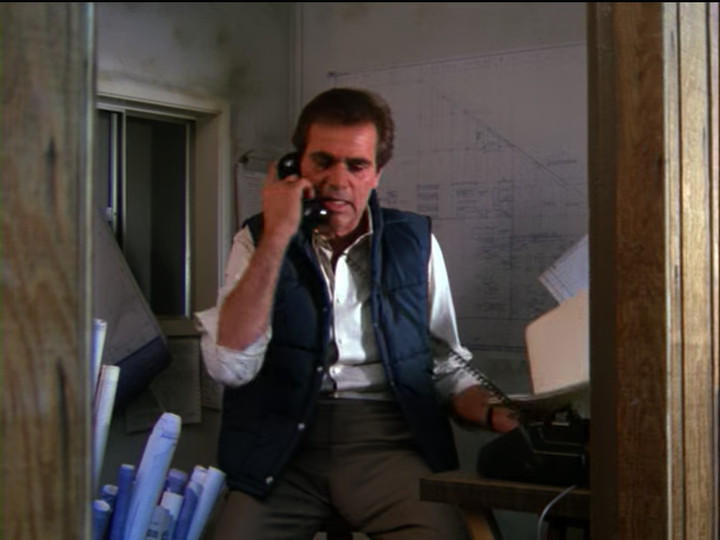
After some credits, we then got an establishing shot of a construction site with a sign saying “This Building Under Construction By Santini Developers” and then the camera pans over to a small booth where Santini himself picks up a phone call. (In TV fashion, he answers a phone call with his own name rather than “hello.” While not realistic, this is very helpful to the audience.)
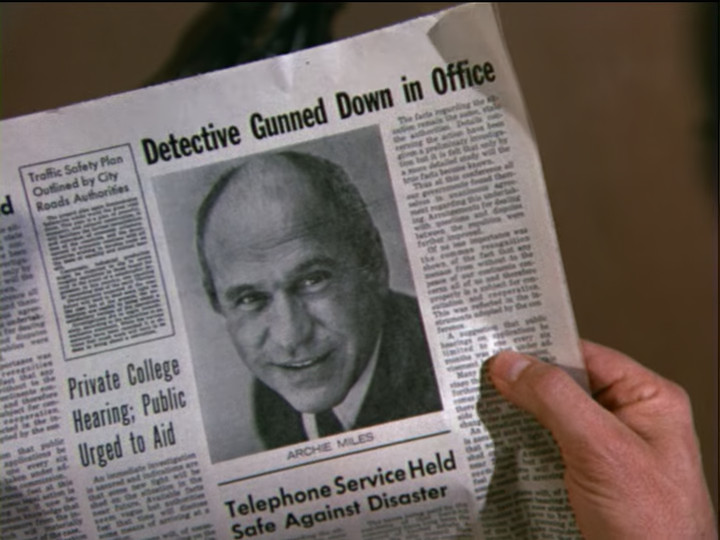
On the advice of the person on the other end of the phone line, Santini picks up his newspaper and thumbs through several pages to find the one he was told to look at:
He tells the person on the phone, “I think this was the guy who was following me. Whadaya know? Guess we don’t have to worry about him anymore, huh?”
The scene then cuts to a plane landing.
It’s not just any plane, it’s a Concorde. They were the first super-sonic passenger liner. They stopped being flown back in 2003, but they didn’t have a terrible run, their first commercial flight being in 1976. In 1985 they looked like they were going strong and were quite a status symbol—a ticket on a Concorde might cost two to three times as much as a first class ticket on a sub-sonic airplane. Whoever just got off of this thing is very important.
Moments later, we find out who is so important.
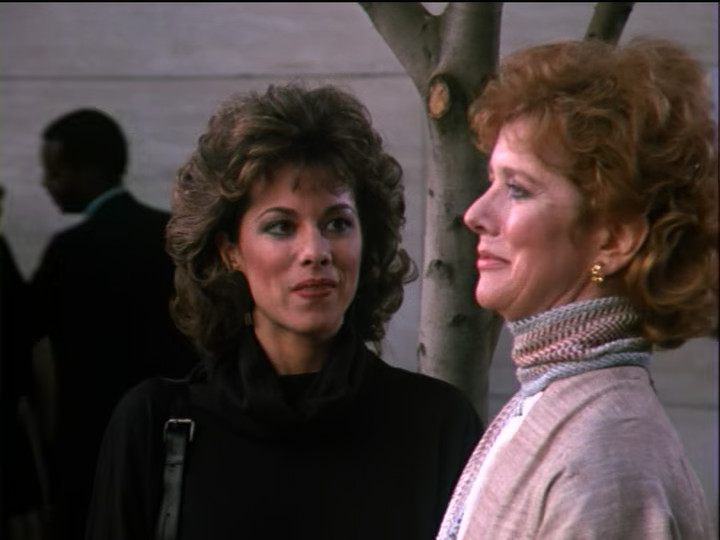
The woman on the right is Priscilla, and she’s the one who just got off the Concorde. She just arrived from Paris, where she made a deal for the Duvalier group to publish a French edition of her magazine, Femininity. The woman on the left is Erin Carey. She’s the magazine’s designer.
A man walks up and greets Priscilla.
His name is Gavin and Priscilla acts like he’s even more important than she is. She introduces him to Erin.
Gavin says that they need to talk. Erin goes off to wait in the limo. Gavin then explains that, a week ago, a private detective came around the university asking questions about him, her, and their marriage. He then shows her a clipping from “yesterday’s newspaper” which is the same story that the construction guy read.
He says that they need to do something—he doesn’t want all that dredged up—and she asks what? He’s got no idea since there’s nothing obvious to do, and she suggests that they just wait and see, then invites him to dinner. For old time’s sake?
He declines, saying he has to get back for a faculty meeting, but perhaps next time.
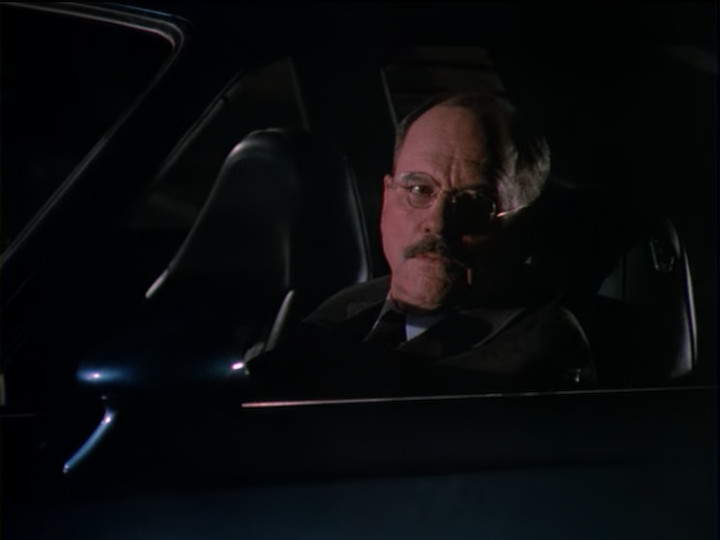
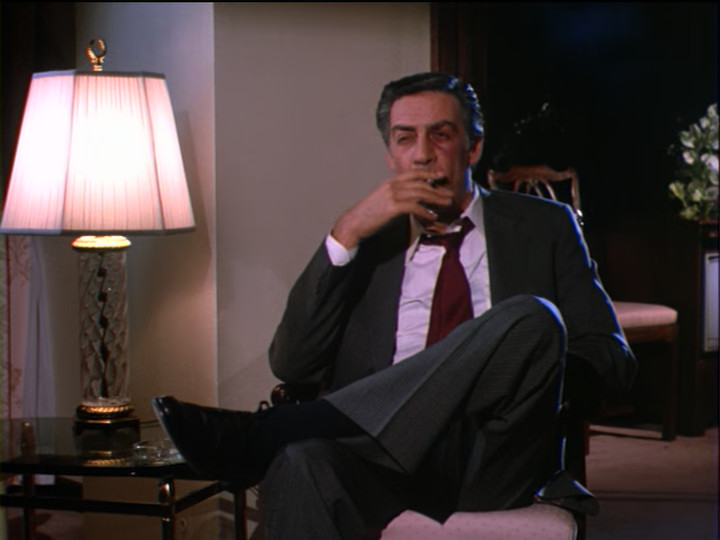
Back in Cabot Cove, Jessica spots a car conspicuously parked opposite her house with Jerry Orbach parked in it.
I’m sure we’ll learn the character’s name soon enough.
Jessica decides to go for a bike ride and slowly rides past the car. He holds his newspaper up to his face to hide it. Once she’s sufficiently gone he gets out of the car and walks into her house and starts looking around.
Jessica then asks him from another room if he’s looking for anything special.
He sighs and identifies himself as Harry McGraw, and that she’s one of his clients.
Harry fills her in on Archie’s death. He doesn’t think that Jessica killed Archie, but someone involved in her case might have. (Archie was “bird dogging” three cases.)
Harry McGraw talks in a staccato style; he’s every bit the American hard boiled detective of the kind that’s been parodied a thousand times, perhaps best by Calvin of Calvin & Hobbes:
“I’ve got eight slugs in me, one’s head and the rest are bourbon” is one of the all-time great hard-boiled detective lines. Of course, another is “dead men are heavier than broken hearts” and it’s not much of a line, so the competition isn’t very fierce.
Anyway, Jessica objects that if he wanted information from her, all he had to do was to call her and ask. He replies that that’s not his style.
There’s a bunch more to the conversation and Harry is tough and blunt and staccato, but it doesn’t add much besides the fact that Harry plans to get even with whoever killed his partner, which we could already assume from his presence. That’s one of the things I don’t like about American hard-boiled detective stories—it’s mostly atmosphere without substance.
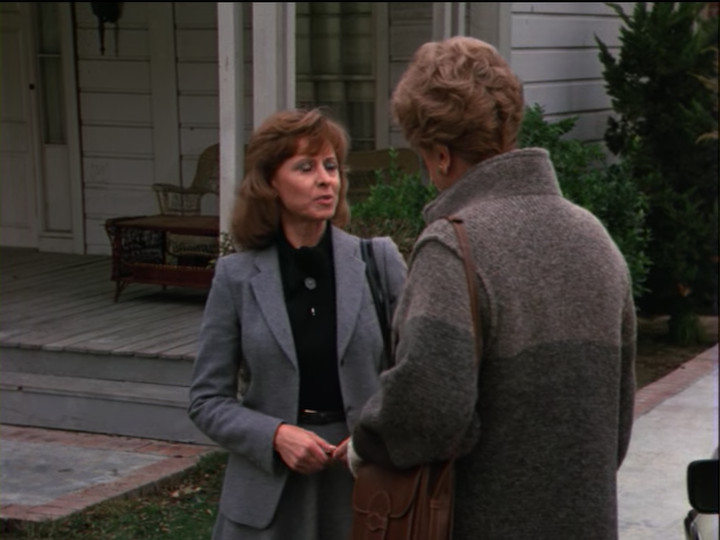
Jessica then visits Archie’s widow, wherever in the world she is. (I assume a suburb of Boston, but they don’t say.)
She doesn’t want to talk to Jessica when Jessica expresses her condolences, to the point of rudeness. Did she murder her husband, perhaps?
We then meet another character, who’s performing surveillance on the construction site:
His name is Ray and he works for Harry, who just pulled up behind him,. Ray gets out and walks over to Harry’s car. They make some smalltalk about Santini (who is still in his tiny little office). We’re never given a shot with both the car and Santini’s shack, but when we’re shown Santini’s office from Harry’s perspective its oddly close, making me question how competent these guys are at surveillance.
Right after Ray drives off, Santini leaves his office and gets into his car. Harry follows him oddly close. He turns into an alley and Harry follows him with about three car-lengths between them into what seems exceedingly likely to be a trap.
And what turns out to be a trap, moments later. After several cars box him, construction workers (they’re wearing hard hats) pull Harry out of his car and beat him up.
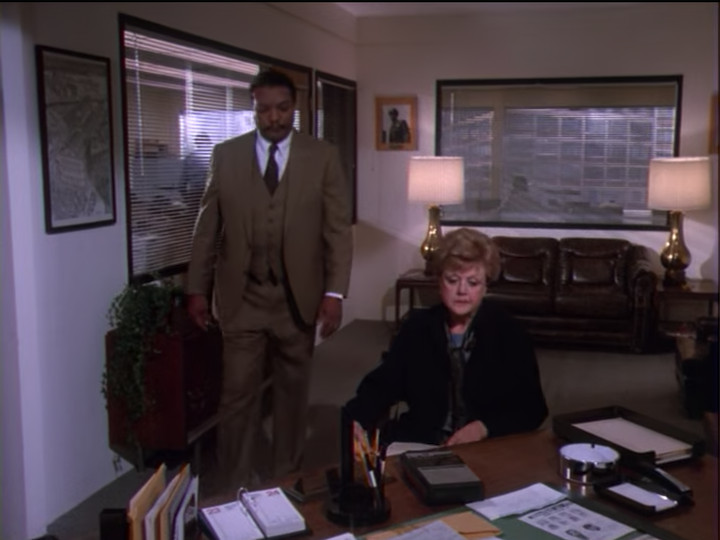
The next morning Harry goes to his office where Jessica is waiting for him with all of the files on the Danbury Scalpel murder case. She wants to go through them with Harry but he’s not interested. The chit-chat does give us a little bit of backstory as to what the Danbury Scalpel murder case was: “Rich lawyer acquitted of hospital murder by sharp lawyer. Was he really innocent?” Harry answers his own question with “Who cares?” The doctor in question died nine years ago.
They also go through the other cases. Harry thinks that Santini is high on the suspect list but Jessica doesn’t buy it. Had Santini shot Archie, he’d hardly have stopped at only punching Harry.
The other case is a background investigation of Priscilla Daniels. Jessica recognizes the name because, for the past two years, she’s been asking Jessica to write an article for her magazine.
The scene then shifts to someplace that’s supposed to be a police station but vaguely reminds me of a living room in an upscale trailer park.
Jessica listens to the tape of Archie’s recording that he made when he died. We already heard this live, so there’s nothing new for us.
Lt. Starkey is the one who played the tape for her.
Jessica asks why the police investigation isn’t going more actively if Archie was as beloved as she’s been led to believe (he used to be a cop and taught at the police academy). Lt. Starkey closes the door and tells her, in words he will deny if she repeats, that everyone loved Archie and that’s precisely why they’re going to stay out of Harry McGraw’s way.
And on that bombshell we fade to black and go to commercial.
Had you been watching back in 1985, you might have seen a commercial like this:
When we come back from commercial, we get an establishing shot of a big city that zooms in on one of the top floors of a skyscraper, then we cut to Harry McGraw coming out of an elevator disguised as a Texan:
He puts on some sunglasses to hide the large bruise around his eye then walks up to a secretary. In a Texan accent he claims to be a business magnate from Texas with an appointment to see Priscilla. The secretary says that an underling will meet with him because Priscilla is tied up in an important meeting.
That important meeting turns out to be with Jessica. Priscilla is delighted that she’s finally accepted the idea of an article, which she says will be “a major coup.” I assume that this is against her rival magazines; I don’t know how much an article by J.B. Fletcher would really appeal to the sort of people who read a magazine called Femininity, but I suspect that the more important part of this is that it burnishes Jessica’s credentials in our eyes. (On the other hand, it might be such a coup. Women seem to be generally interested in other women just for being women in a way that males aren’t interested in other males.)
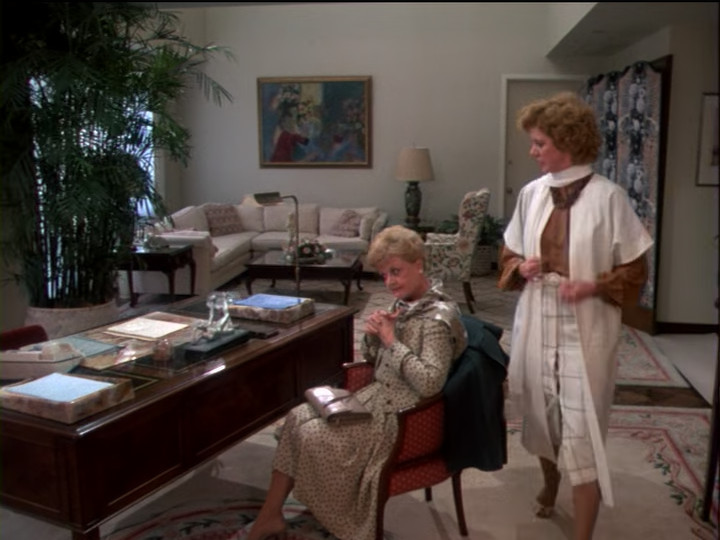
Priscilla then launches into a pitch for the article she wants Jessica to write. But before I describe that, I just want to mention that I love Priscilla’s office.
I don’t mean that I want this office for myself. Rather, it’s fascinating as a piece of characterization. It’s so big that it has two large oriental area rugs on top of its wall-to-wall carpet. You could subdivide it into two offices and they would both be luxuriously large. Her desk is an old fashioned writing desk with no computer on it but plenty of stationary. She has an enormous potted plant that looks lush and tropical and exotic. The other half of her cavernous room has a right-angle sofa and an armchair around an antique-looking coffee table. The large painting above the sofa seems to be abstract, and there are floor-length paintings or painted screens against one wall. The main part of the room has at least ten-foot ceilings. This is quite the room to have at the top of a skyscraper. They’re certainly laying on Priscilla’s status and success—and her desire to show it off—quite thick.
Anyway, the piece that Priscilla wants is a major piece about how a woman past forty can fend of the sharks infesting the literary waters, relying solely on her guts and her sense of identity as a woman. (I think that this is meant to be parody.)
Jessica replies that that sounds very colorful, but what she had in mind was a remembrance of her marriage. Jessica then goes on about how great Frank was. It will be interesting to find out what Jessica’s angle is, because a blind man could see this article makes no sense for the magazine she’s pitching it to.
Priscilla is, as you might imagine, unenthusiastic about Jessica’s idea for the piece. “Fem is a now magazine aimed at the now woman trying to cope in a man’s world.”
Jessica apologizes for wasting Priscilla’s time and Priscilla folds and accepts the article Jessica wants. Perhaps Jessica just wanted the article to be one she would enjoy writing, if she had to write it in order to conduct the investigation. It being such a terrible fit doesn’t seem to have had any practical consequence.
The meeting is interrupted by Priscilla’s secretary, who buzzes in and says that “Davis Randolph” is on the line and says that it’s urgent. Priscilla looks confused for a moment, then says she’ll call him back. (I’m not sure who Davis Randolph is, but I assume we’ll find out, since the only reason to have this call in the scene is to let Jessica know about him.)
Priscilla then invites Jessica to the fifth anniversary celebration the next day and she accepts.
On the way out to the elevator (Priscilla walks her) they run into Harry in his Texan disguise walking with the underling he was foisted off on. Jessica recognizes him, of course, but goes along with the act and takes her leave. This scene is a comedy bit, I believe. Pricilla asks about his black eye and he replies, “Oh, just a minor disagreement about my parentage, ma’am. Nothin’ serious.”
When Jessica gets back to her hotel room that night, Harry is waiting for her in the dark.
Jessica just switched the lights on.
When Jessica asks how he got in, he replies that a two year old with a paperclip could jimmy the lock on her door. Jessica takes this in stride, remarking that breaking in is a very bad habit of his.
This is some curious characterization—somewhat at odds with Jessica’s normal dislike of people entering her private spaces without permission—but I think it’s mostly to set the tone as American Hard Boiled.
Anyway, they then have a (verbal) fight where Harry demands that Jessica stop investigating the case because she is getting in his way. How she’s getting in his way is unspecified, because she isn’t, but I guess American Hard Boiled stories need lots of shouting and disagreement.
Anyway, the upshot is that Jessica stands up to him enough that he invites her to come over to the office the next day and they’ll look over the files together.
The next day in the office, Jessica remarks that there’s nothing in the file to say who the client is that paid for them to investigate Priscilla. Harry says that’s because they don’t know who the client is. Archie accepted a $1000 retainer in cash and all the rest of them know is that the client’s initials were “EPF”.
Jessica then mentions the call from Davis Randolph. Harry identifies him as a “political finance chairman.” (This would be somebody in charge of raising money for political campaigns.) Jessica then recalls some rumors she’s heard about Priscilla considering running for a senate seat which is coming free next year. Harry suggests that the “EPF” hired them to scrape up dirt to head off her potential senate run.
(Of course, the most probable thing is that Priscilla hired them to see what could be found out about her in order to make sure that there was a point into going to the trouble and expense of running. If the private detectives could find whatever her dark secret is, then surely the opposition could, too. If not, then she might be able to run safely.)
Ray then comes into the office and Harry introduces him to Jessica. Ray gives some info on Santini’s bank accounts and then says that they need to get another guy because they haven’t been able to run down Santini’s girl and he and Harry need some sleep.
The scene then shifts to nighttime, at the fifth anniversary party for Femininity magazine. There, Jessica is talking with Gavin, who says that he’s still in love with Priscilla and always has been, which is why they’ve enjoyed such a marvelous divorce. The problem is that he’s wedded to the halls of academia and she’s totally committed to the magazine. Jessica says she heard a rumor that Priscilla was considering running for public office and this is the first that Gavin’s heard of it.
The camera pans over to Priscilla, who was standing oddly close to this conversation, when a Judge Carter Lambert comes over and greets Priscilla.
She must know him well because she refers to him as “Carter, you old fox.”
She then introduces Judge Lambert to Jessica, and he turns cold. “Oh yes, the writer.” Jessica replies, enthusiastically, “You can’t imagine how much I’ve wanted to meet you, Judge Lambert.” It turns out that he was the defense attorney in the Danbury Scalpel murder trial. He’s got zero interest in discussing the case. She says that it was one of the highlights of his career, securing the aquittal of a prominent physician, but he replies, “while the world whispered about perjured testimony and manufactured evidence.” Which explains why he’s uninterested in discussing it. He adds, “if you go ahead with this book of yours, be sure you clearly understand our libel laws.”
I can’t help but note that this is still rather strange since Jessica is a fiction writer, not a historian. Is she going to write a fictionalization of it with some of the people still living? That sounds irresponsible, to say nothing of being legally dangerous. Is she venturing out of her normal genre to write history? Either way, I can’t help but think that this is just a red herring. His response is perfectly reasonable—who doesn’t have entirely innocent episodes in their life that they’d rather forget—and with everyone else dead, it’s hard to believe that there’s a motive. Plus, it just feels off. Jessica is spending too much time on it, and Murder, She Wrote prefers twists.
Priscilla notices the way that Judge Lambert walked off and asks what it was about. Jessica explains, then tells Priscilla about the detective and asks if he might have been hired by someone who wanted to thwart her political ambitions. Priscilla replies that she doesn’t know anything about the murdered detective. Jessica points out that she didn’t say that the detective was murdered and on that bombshell we go to commercial.
When we come back, we’re at Harry’s office. Jessica tells Harry that she knows who hired him to investigate Priscilla: Priscilla did. Jessica explains that she clearly new Archie and that EPF probably stands for “Editor and Publisher of Femininity.” Harry thinks this is plausible, since it clearly is. Well, except that “EPF” business. That would be a ridiculous way to make an acronym. Harry suggests that Jessica follow the lead on the Danbury Scalpel murder while he retraces Archie’s footsteps in the college town.
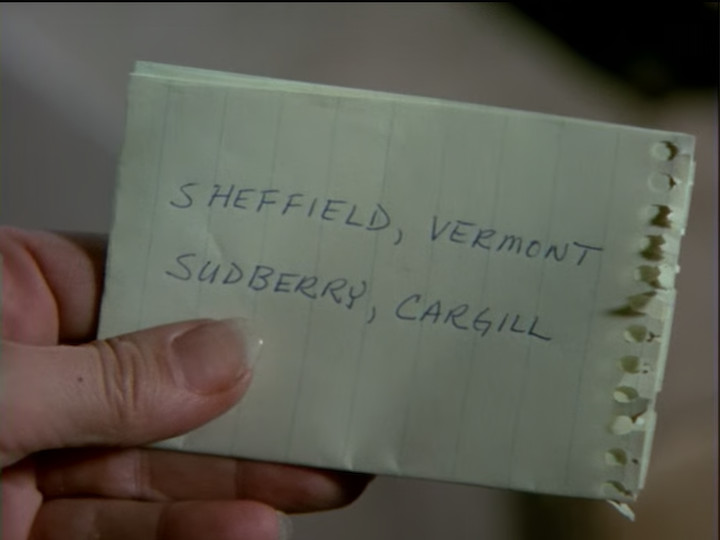
In the next scene Jessica is helping Archie’s widow to move boxes of stuff—she’s going to stay with her sister for a while until she gets her bearings—but is in a better mood and shows Jessica a note that Archie had in his jacket.
The scene then shifts to Jessica arriving by bus in Vermont to follow up on the lead. She meets a woman named Miss Cargill in an office right next to the bus stop.
Jessica asks if she ever knew Martha Clay (the nurse that Archie mentioned). At the name, Miss Cargill becomes agitated and says that she never heard the name. Jessica says that she’d be about sixty and Miss Cargill shouts that she said she doesn’t know her and wants to be left alone. She then runs off. A man comes out and asks what’s wrong.
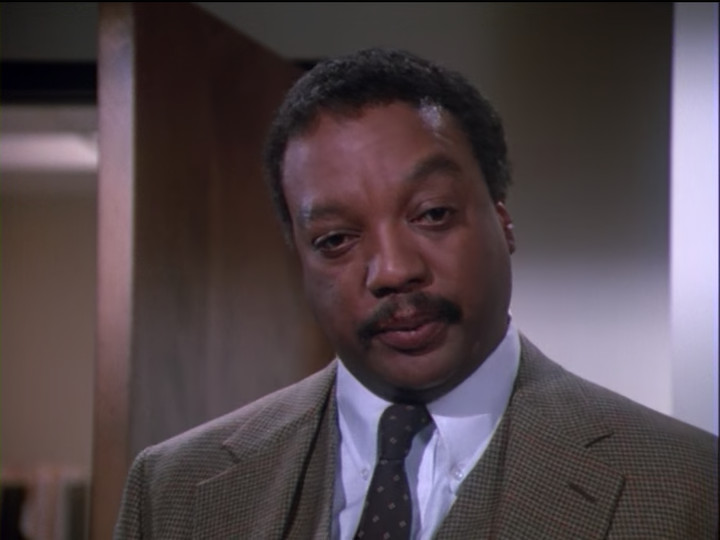
He’s Milt Sudberry. He says that Leora (Miss Cargill) just lost both of her parents a month ago and is still grieving. They both died in a fire—they ran a nursing home. They died trying to save the others. Jessica asks if the Mrs. Cargill who died was named Martha, and she was.
When she leaves the building she runs into Judge Lambert.
Since she won’t let sleeping dogs lie, he offers to drive her back to Boston and explain the case to her. Tom Cargill was the real killer in the Danbury Scalpel murder.
When they pull up to Harry’s office in Boston, Judge Lambert asks if he’s going to see this story on the best seller list and Jessica replies that the writer in her wants to say yes, but it’s probably best if it remains an unresolved mystery. Judge Lambert takes her hand and gently says, “you’re quite a lady.”
In the office, Jessica tells Harry about the Danbury Scalpel murder and why they can cross it off. Tom Cargill was in the hospital visiting his girlfriend and recognized the victim as the man who’d rape his sister the year before but was acquitted on a technicality. The sister committed suicide a few months later. When Cargill saw the rapist he snapped and stabbed the rapist. Circumstantial evidence pointed to the physician, who was innocent. Tom Cargill had told then-just-a-lawyer Lambert, who was in a quandry because, during the War, Tom had saved his life. Which is why he faked the evidence to get the physician aquitted. Harry asks if, abbreviating the saying, “all’s fair” and Jessica replies, “Well, in this case, perhaps so.”
I’d say that this is out of character for Jessica, but since Tom Cargill is dead, I think Jessica is enough of a consequentialist that her Kantian categorical-imperative leanings can overlook something as relatively minor as faking evidence to get a definitely innocent man acquitted. And while she would probably insist that Tom Cargill turn himself into the authorities and throw himself on the mercy of the court, he’s dead so it’s a moot point.
Harry actually brings this up, asking why it’s fine for Tom Cargill to kill the rapist but not for him to kill the guy who murdered Archie. Jessica answers that Tom Cargill is now dead and beyond punishment, so it’s a moot point. So my guess was right.
After Harry mentions that Priscilla held a press conference at 6pm to deny all rumors that she’s running for political office, he gets a phone call from Ray to say that someone tried to shoot him while he was doing surveillance on Santini.
And on that bombshell we fade to black and go to commercial.
When we get back from commercial, Harry and Jessica meet up with Ray at Lt. Starkey’s office.
There’s some quick back-and-forths but the upshot is that a car pulled up, a guy got out who Ray didn’t see because he was blinded by the headlights, and he ducked just in time when he saw the guy’s arm come up in a threatening way. He thought Santini was in his office but there was a window in the back of the shed which was wide open, so Santini could have gotten out at any time. (That said, Santini doesn’t seem like the kind of guy to do his own dirty work.) Ballistics on the slugs match the ones that killed Archie.
When Harry leaves, Starkey tells him to not do anything stupid. Harry asks if that’s official or just friendly advice. Starkey replies, “both.”
Harry answers, “You know me, Starkey. I never shot a rattlesnake that didn’t bite me first,” and leaves.
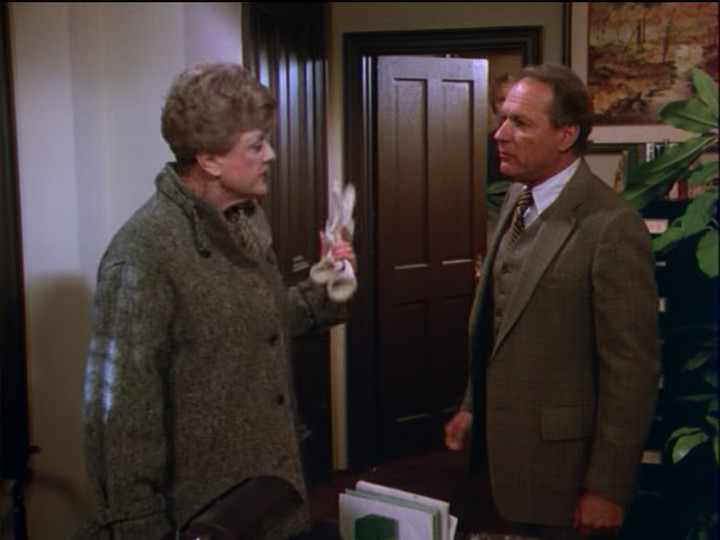
Something bothers Jessica and she has Ray take her back to the office. He calls Alma, but when they get to the office she’s not there, so Ray takes his keys out and opens the door. They jangle rather conspicuously as he finds the right key.
As she asks for all three files, Alma comes in. Ray leaves to catch up with Harry as Alma offers to put on some coffee, which Jessica gratefully accepts.
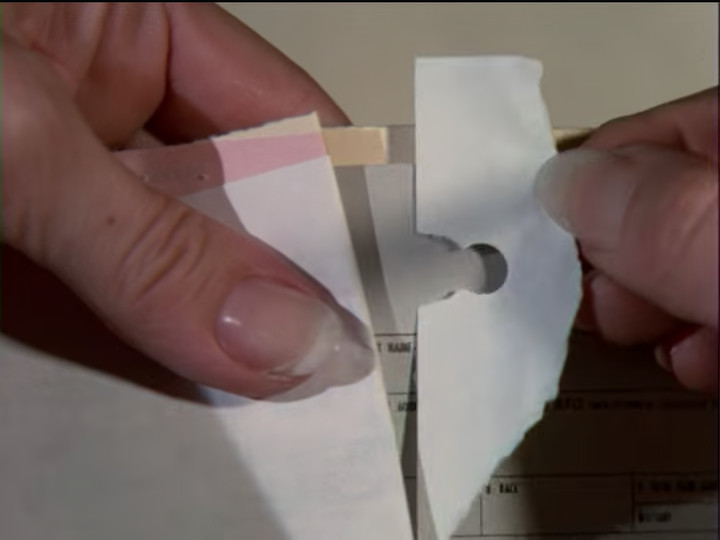
As Jessica is looking through one of the files she notices something strange.
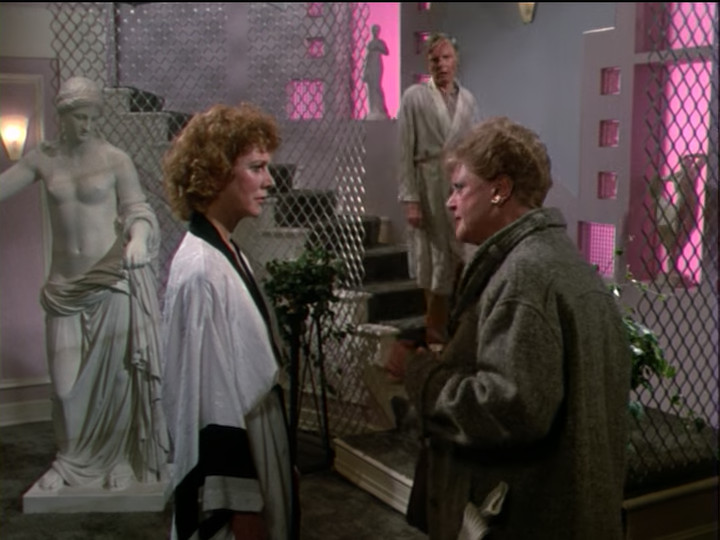
Jessica runs over to Priscilla’s apartment. Jessica asks her why she decided against seeking political office and she denies everything. When Jessica asks if she’d received a blackmail threat within the last twenty four hours, Gavin walks down the stairs and answers yes.
Priscilla’s apartment is even more remarkable than her office, by the way.
I can’t even begin to imagine living somewhere like this. I can only assume the set designers laughed the entire time they built this stage.
Gavin explains the story. Seventeen years ago Priscilla became pregnant with his child while she was a grad student and he was a young professor married to someone else. Priscilla had an abortion. The timing would place this in 1968, when abortion was still illegal in Massachusetts (and many of the surrounding states). Later, after his divorce, they were married, but complications associated with the abortion made her sterile, so they couldn’t have any more children together.
Archie did find this out and this morning a man who didn’t identify himself called her saying he had a copy of the hospital records and wanted a quarter of a million dollars to keep quiet. So she decided to not run.
Jessica goes to the police station where she runs into Lt. Starkey. Just as he’s asking if it can wait because he’s tired, Santini drives up, pulls a barely-conscious Harry out of his back seat, pushes him towards Starkey, and says “I’m pressing assault charges against this gum ball.”
In Lt. Starkey’s office, Santini explains that he just found out that his wife hired the detective agency because she worries about everything—she worries if the morning newspaper is late. He explains why he’s been disappearing a lot. Three years ago they had a sailboat down at the marina. It got destroyed in a storm. He’s been working with a boat guy to build a duplicate to surprise her with for their twentieth wedding anniversary.
When Santini leaves, Starkey notes that they just lost their best suspect in Archie’s murder. Jessica says that actually, she has an idea. Jessica borrows Harry’s keys to go back to the office and says that she’ll need some help to prove it.
Back at the office, Jessica is reading files when Ray comes in. She locked the door, forcing him to unlock it, causing the same key jangling as before. After a bit of discussion of the events with Mr. Santini, Jessica accuses him of killing Archie. He killed Archie in order to use the material in Priscilla’s file for blackmail, which Archie would never have gone along with.
When he asks if Jessica can prove it, she plays the tape of Ray coming in just now, and also the tape of Archie being killed. The sound of the keys jangling before the door is unlocked is identical. Jessica points out that Alma locked the door after leaving, as she always did, meaning that the killer had to be someone with a key.
Ray replies, “You’re a clever lady, but you’re also pretty dumb,” and pulls his gun on her.
From off-screen Harry replies, “You’re not so smart yourself, Ray.”
Ray lays down his gun and Harry says, “You better pray you get convicted, Ray, because that’s the only way you’re going to see your next birthday.”
In the final scene Harry offers to drive Jessica home to Cabot Cove rather than let her take the bus. He also suggests that she give up writing books and take up being a private detective. “McGraw & Fletcher. Your brains, my knuckles.”
Jessica says that it sounds nice, but she declines anyway. Harry then says that it’s 124 miles to Cabot Cove and he can be very persuasive. Jessica laughs and we go to credits.
I have a very hard time being objective about this episode because I really don’t like the American hard-boiled detective genre, except in brief parodies like the Calvin & Hobbes strip I quoted above. Even Dead Men Don’t Wear Plaid was a bit much for me, funny as it was. The Maltese Falcon was my favorite in the genre (the book; I haven’t seen the movie except for clips) but even that I didn’t love and this episode is far more in the style of Raymond Chandler than Dashiell Hammett. It’s all atmosphere without substance.
Take Raymond Chandler’s most famous line, “dead men are heavier than broken hearts.” (They even put it on his tombstone.) It sounds good but in context it’s just an argument for why someone had to have a good reason to move a corpse. But obviously someone has to have a good reason to move a corpse; it’s not the kind of thing you do for fun. More important than the physical exertion is the fact that you might leave traces of yourself on the corpse or get traces of the corpse on yourself and even without that it will be more than a little awkward if anyone walks in on you while you’re moving the corpse. So, yes, it does require a bit of physical exertion to move corpses around, but that’s hardly the most important observation to make about moving corpses. It’s all style without substance.
Style without substance does describe the episode, too. Take the plotline about Jessica researching a twenty five year old murder: this kind of thing can be an interesting premise for why murders are happening in the present. But Jessica researching a book makes no sense. Obscure details of the case would be useless for a work of fiction based on the real events, not the least of which reason being that they’re probably boring. The “True Crime” genre mostly deals with this by sprucing details up with interesting speculation but a work of fiction is composed of a sequence of events, not a bunch of speculation. (I don’t mean that true crime presents a single narrative as speculatively true, I mean that it indulges in a great deal of “here’s this thing where we don’t know what it means, but maybe it means X. Could it be that Y?” etc. The speculative nature is what makes it interesting.)
It’s worth noting that this is not the case because real life is boring. Real life is not boring at all. What real life is, is extremely complex. Murder mysteries, for all that their plots are complex in comparison to simpler forms of fiction like drama and comedy, are enormously simplified in comparison to everyday life. This is nowhere so evident as in how, aside from a few red herrings, most of the evidence relates in some way to the actual crime. Real life is far more complicated than that; people who single-mindedly pursue a task do a hundred unrelated things a day because no one actually pursues a single goal. They have breakfast because they’re hungry. They blow their nose because it’s stuffed. They scratch an itch because it is itchy. The multiplicity of our actions are related to the multitude of our goals.
Anyway, it’s in keeping with style-over-substance that the episode never gives the slightest consideration to Jessica being a fiction writer and this plotline making no sense.
There’s also the curious issue of Ray murdering Archie in order to blackmail Priscilla then blackmailing her at the worst possible time (from his perspective). The correct time to blackmail Priscilla would be when she’s declared her candidacy and is deeply committed and close to winning the election. When she hasn’t even announced her candidacy makes it far cheaper and easier for her to decide that politics isn’t for her and just never declare rather than pay the blackmail. (Which, in fact, she did.) And they didn’t even use this to give Ray a minute to lament that he did it all for nothing, since the blackmail didn’t even work.
Next week we’re some undisclosed not-Cabot-Cove location where Jessica inherits shares of a football team, in Sudden Death.








 Chris Lansdown
You must be logged in to post a comment.