
Retriculated pythons—especially the dwarf varieties—make very interesting pets. In addition to their fun personality, their yawns are really something to see. Below is a picture of my pet 50% superdwarf retic, Aristotle, yawning:
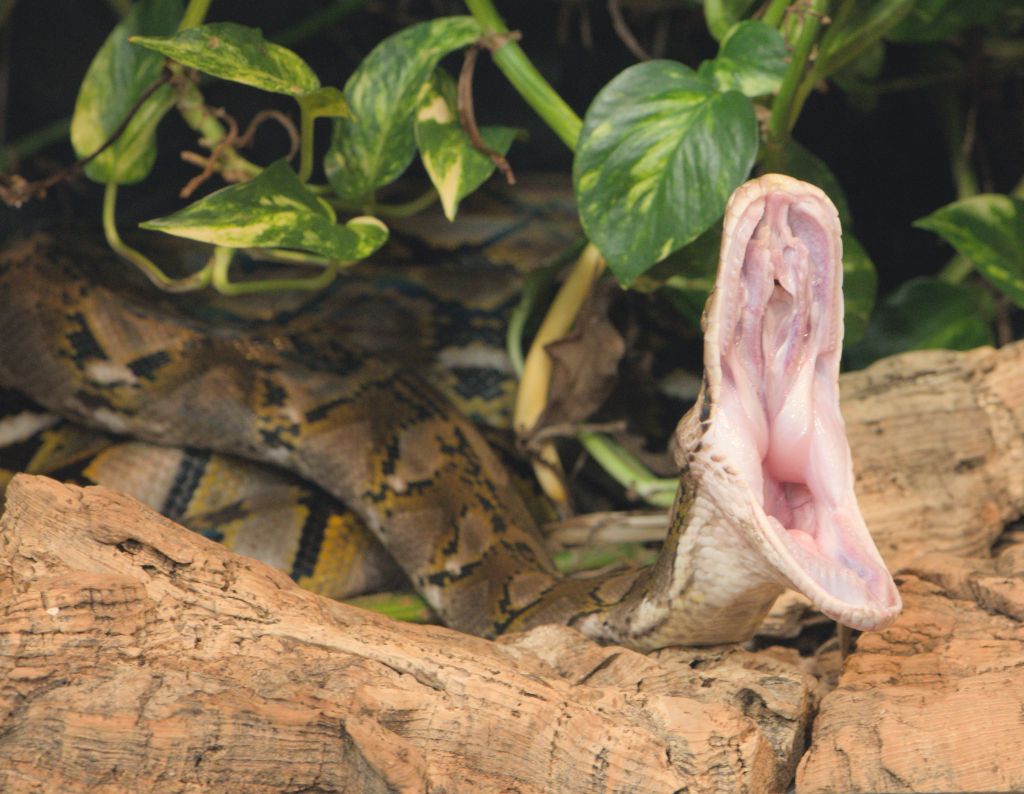
This yawn lasted several seconds, which is what enabled me to grab my camera. This isn’t nearly as wide as he can yawn, too. I’ve seen him actually extend his jaws slightly past 180 degrees, though he usually doesn’t hold that.
This isn’t a perfect picture—unfortunately it was handheld, and I don’t have the steadiest hands—but even so you can see a lot of the physiology of his mouth. For example, you can see how distinct the muscles which pull his jaws closed at the top are from the ones that pull the lower jaws closed. Further, you can see how, like all squamates (this includes lizards), he has two distinct sets of upper jaws (the outer upper jaws are larger than the inner upper jaws), though only one set of lower jaws. You can also quite clearly see that none of his jaws are fused with their corresponding jaws on the other side, as ours are. Snake heads are, as Clint from Clint’s Reptiles describes them, very kinetic. Most of the bones in our skulls have fused together at their various joints, the joints of where our lower jaws connect to our skull being the only obvious joints in our skull. (That’s not to say that there aren’t actually others, just that we don’t notice them. Also, fun fact: this is more true of adults than babies. Neonates have many of the joints in their skull still as flexible joints, which aids in being born; they fuse together over the next several years.)
Another fun fact about snake biology, though you can only barely see it in this photo: their trachea extends all the way into their mouths. It’s the pink, bulbous thing that you might be mistaking for his tongue (his actual tongue is dark and hidden by his lower teeth). It can close, just as ours can, to avoid liquid and solids going into their lungs, but they can actually extend it quite far forward if they want to in order to be able to breath during the middle of swallowing food.
Also on display is that their teeth, which are actually fairly needle-like, are contained within a fleshy sheath. I have no idea why it is, but it’s a feature of many pythons and I believe of many other snakes as well.
Discover more from Chris Lansdown
Subscribe to get the latest posts sent to your email.
 Chris Lansdown