
On the tenth day of February in the year of our Lord 1985, the thirteenth episode of Murder, She Wrote aired. Titled My Johnny Lies Over the Ocean, it’s set on an ocean cruise. (Last week’s episode was Murder to a Jazz Beat.) Unusually, the episode begins with a kind of dream sequence.
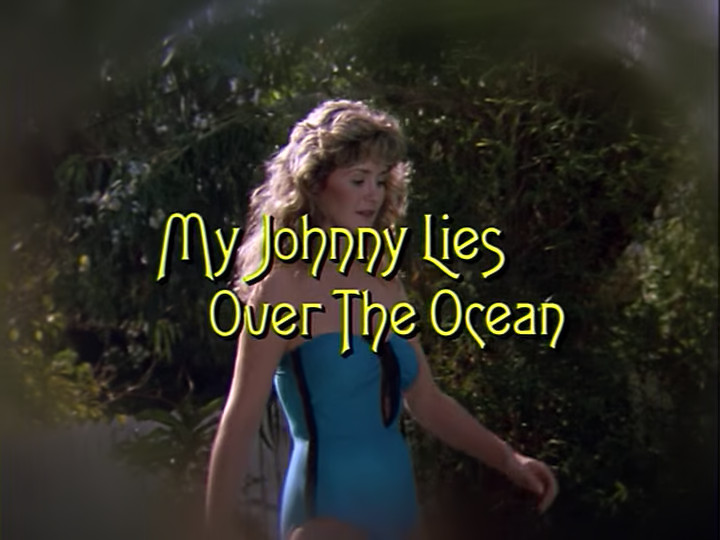
Pictured in the title sequence and with blurring around the edges because this is a dream, Pamela Crane, one of Jessica’s nieces goes for a swim in a pool. She doesn’t spend long in it, gets out, then walks into her house and finds her husband dead, with a gun in his hand.
She then wakes up in a mental hospital. The dream sequence turns out to be a nightmare of something that happened months ago. A nurse calms her down and she goes back to sleep.
The scene then shifts to the next day, where her father, Dr. McGill, is talking with the doctor in charge of Pamela’s case.

He’s releasing Pamela, and Dr. MacGill has his doubts, but he’s a surgeon, not a psychiatrist, so he’s willing to trust the unnamed doctor who’s releasing Pamela. The doctor goes on to say that the boat cruise that Dr. MacGill is sending Pamela on is just what she needs—sun, fresh air, and the companionship of her favorite aunt.
That favorite aunt is, of course, Jessica. Dr. MacGill is her brother, which means we’ve finally met an actual blood-relative of Jessica’s.
As they are discussing this they walk up to a place where Pam is waiting by a car. It’s a bit counter-intuitive that this discussion would happen after Pam is already waiting outside, but also curious is the palatial nature of this mental hospital:
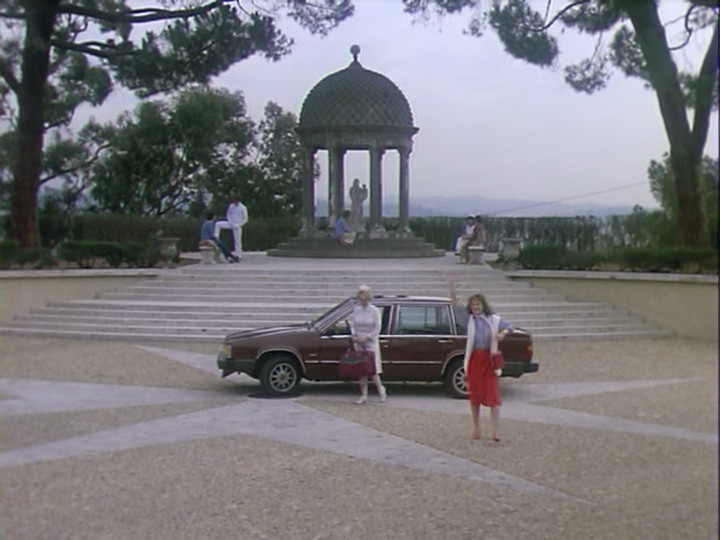
I don’t think it is meant to convey much, past, perhaps, that Dr. MacGill is a successful surgeon. It may just be part of the general rule that if the setting doesn’t matter much to the plot, pick a visually interesting setting.
Dr. MacGill and his daughter greet each other and hug, and the scene shifts to the cruise ship.
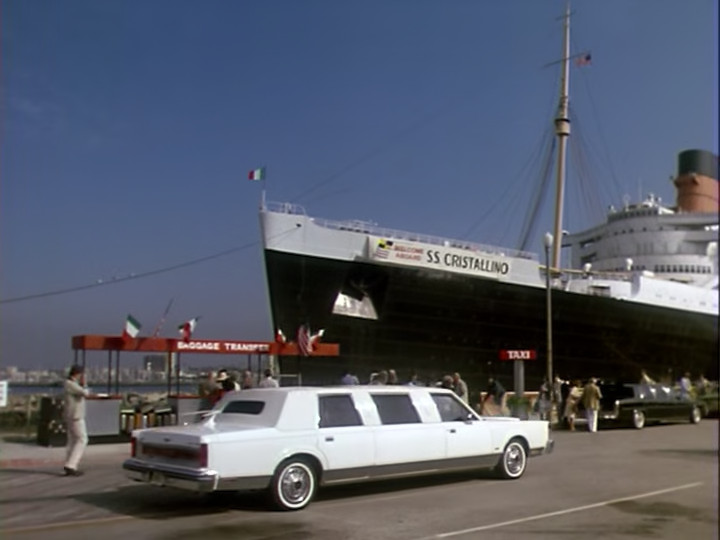
Man, cruise ships were so much smaller in the 1980s. This is probably an exaggeration, but you might be able to fit this cruise ship in the on-deck pool of modern cruise ships.
(The limo isn’t for Dr. MacGill and Pamela, it’s for another set of passengers.)
Those passengers are Andrea:

And her husband, George:
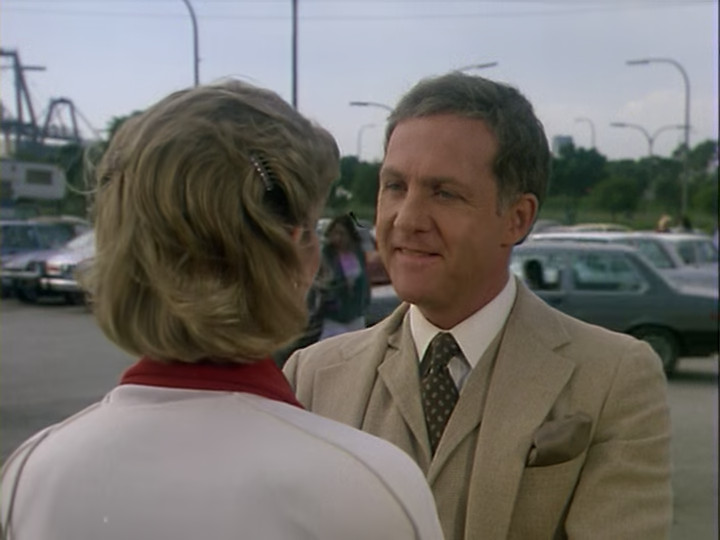
Looking at the ship, she tells him, with a smile, that she’s almost glad that the talked her into this. Breaking stereotypes, she goes off to make one final call to the office before the trip to make sure that there are no emergencies. (In the 1980s, the character trait of being a work-addict who has to constantly check in at the office and can’t enjoy himself because Business is all he can think about was usually given to the husband.)
On her wait to make this call, she runs into Marshall (Dr. MacGill), Pam, and Jessica. Marshall is taking pictures of his sister and daughter:

It’s a little odd to have bothered to attach the flash to the camera for taking outdoor pictures during the day (it would normally be removed when the camera is put into the camera bag for transport), but I suppose it makes the camera look more imposing, and possibly on 1980s-era TVs, more like a camera even if there’s static.
Marshall than says he wishes he could get a picture of the three of them just as Andrea is walking by. He stops her and asks her to take the picture, which she does, but says she has no idea how to work a camera. It’s easy, though, you just aim and press the button, as Marshall assures her, and she does.
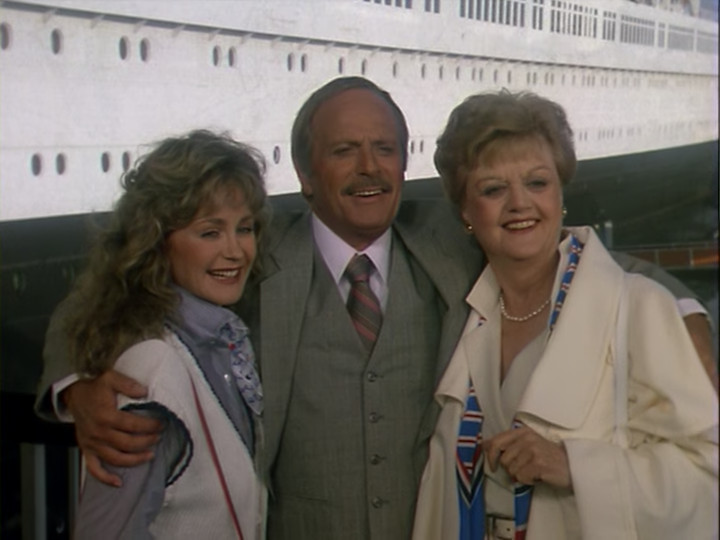
Marshall then gives Pam the camera and tells her that there are several more rolls of film in her bag. He also mentions that they’ve got developing facilities onboard the ship, I think the implication being that they should periodically send him pictures at the various ports the ship puts into.
As he’s wishing his sister and daughter a fond goodbye, two more characters come up in a taxi which pulls in hastily, tires screeching.

If you didn’t recognize the two comediennes, you would be able to tell that they’re the comic relief from the way that they bicker. (One of them thinks the boat is leaving without them and calls to it to wait for them.)
Later, as the ship is under way, Jessica and Pam are walking on deck and a young man bumps into Pam.

His name is Russell Tompkins, though we won’t learn that for a while. He apologizes and is obviously quite taken with Pam but can’t think of anything to say, so after awkwardly trying to think of something for a few moments, he excuses himself.
Pam goes off to get film developed while Jessica goes to cash some traveler’s checks. I mention this mostly because I find it interesting that it is now a historical curiosity but at the time was a commonplace activity.
For those who don’t know: traveler’s checks (or traveller’s cheques, if you prefer that spelling) were a means of bringing money while travelling to foreign places which were used before the use of international credit and debit cards became easy. The traveller would, for a fee, deposit money with a bank that would issue the checks. The checks had two lines for signatures on them, one to be signed at the time of issuance and one at the time of use. The bank guaranteed that if the signatures matched, the check would be paid, even if they were stolen. The double-signature offered some protection against theft, since the checks would be worthless unless the thief couldn’t successfully forge a signature to match, possibly in front of the merchant who would be accepting them. They could be cashed in the local currency, rather than the issuing currency, which is why foreign merchants would accept them. They were also a slightly safer way to carry cash than actual cash, because of the double-signature involved was a little more protection than cash would be. It was also the case that for higher values, traveler’s checks were less bulky can cash.
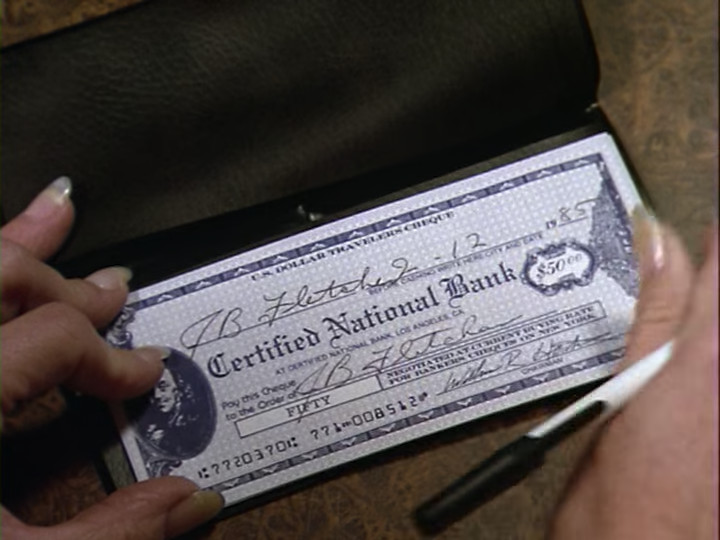
As Jessica hands the check to the purser to cash, she mentions that she hopes that she didn’t cause inconvenience—she’s sure her publisher used its influence to get her on the cruise at the last minute. The purser reassures her that she didn’t cut ahead in line—the cruise is only 90% booked.

The purser further explains that the ship is old and has just been refurbished, and this is a “shakedown” cruise which was only added to the schedule a month ago. They were taking last-minute bookings through yesterday.
When Jessica returns to her room, she finds Pam crying. She had been reading her husband’s last letter to her, which was a kind of extended suicide note. As Jessica comforts Pam we get some backstory. Johnny had financial trouble, and had always been secretive. He was adopted and was ashamed that his birth mother had been an unwed teenager—Pam had only found that out four months after their wedding.
Pam asks Jessica to read the letter—she hasn’t shared it with anyone else, yet—but after handing it to Jessica they’re interrupted by room service, who brings them a bottle of champagne. The crewman, who is a living Italian stereotype named Ramon provides a bit of comic relief for a minute, then leaves. When he’s gone Pam reads the card that came with the champagne and is trouble. It says, “Bon voyage, Pepper. Have a lovely trip.”
“Pepper” was a pet name that Pam’s deceased husband had for her—he was the only one who called her that.
One grave look and a quick establishing shot of the ship under way at sea at night later, the scene shifts to the dining room. The two comedy relief ladies walk in and see the Maitre d’, who tells them their table number.
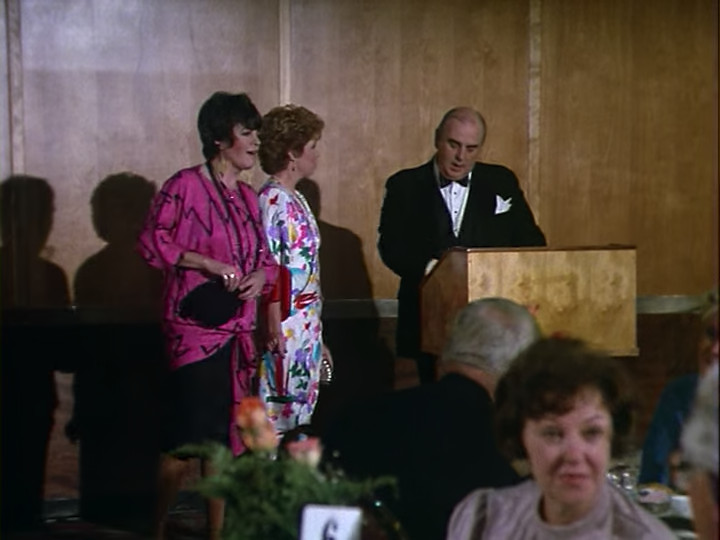
Carla, the one in red, spots a wealthy man (“An Oklahoma Cattle King”) and bribes the Maitre d’ to assign them to his table. He complies, though it’s unclear whether he’s actually doing it because of the bribe or if it’s generally acceptable to make seating requests. Since most people on a cruise don’t know each other, it’s hard to imagine it can make much difference which table people are seated at or, for that matter, that the cruise has any way to assign people to tables other than randomly.
As they’re shown off to their table, George Reed spots Jessica and wants to meet her and introduce Andrea to her. Andrea is a little shy but goes along with it. When they get to Jessica’s table, George professes to be a big fan. He introduces Andrea, but Jessica says that they’ve already met and Andrea then recalls the photo she took for them by the dockside.
A small amount of chitchat later, Jessica invites them to join her and Pam for dinner, but George declines as he doesn’t want to intrude. As they walk off, Jessica notices that the nice young man who bumped into them earlier is eating alone and suggested inviting him to join them. Pam admonishes Jessica to not try to set her up and Jessica unconvincingly professes that the thought never entered her mind.
As they start looking at their menus, Pam notices a special, paper-clipped to her menu.

This was Johnny’s favorite meal; Pam made it up and never shared the recipe with anyone. She’s shaken and gets up, scattering silverware and knocking over a glass, drawing attention. After she runs off the Maitre d’ comes over and asks what’s wrong. Jessica asks whose idea the special was (it was clipped to her menu, too). The Maire d’ says that it was no one’s idea as it’s not on their menu and must be someone’s idea of a joke. Strangely, he seems angry at Jessica for having had the temerity to have this joke played on her, and after ripping up the card he walks off.
As much as this is an interesting part of the mystery, I do have to say that the recipe is not very complex. Stuffing chicken is a common enough idea and while cheese is probably more common than nuts, nuts aren’t too far behind. And mushrooms are well known for going well with chicken, at least if you’ve sauteed them in wine first.
Anyway, Jessica looks baffled by the news that this item was not on the menu, so much so that she takes off her glasses, then we fade to black and go to commercial.
Had you been watching back in 1985, you might have seen a commercial like this:
When we come back from commercial, after an establishing shot of the ship underway at night, Jessica is in the purser’s office, asking the purser if it’s possible to find out who sent the anonymous champagne.
The purser looks it up in her filing cabinet and it turns out that it was an unsigned note with cash enclosed. (Enclosing cash was far more common in the 1980s than it is now; it’s not odd that the purser didn’t think that suspicious.) They give us a closeup of the note:

Jessica pulls out Johnny’s suicide note and the handwriting matches. Or, I should say, seems to match. The way that Johnny was found dead, by Pam, in the opening sequence, leaves no doubt that he is genuinely dead. Jessica says that she’s going to keep the note requesting the champagne and walks off.
Later that night Pamela is walking alone on the deck when she hears the name “Pepper” whispered in what sounds like a man’s voice. We cut between eerie moments of Pam trying to find the voice and Jessica back in the cabin trying the champagne that was sent. Why, I’m not entirely sure, since if it was purchased with cash and an anonymous note, it would have been selected and delivered by the ship’s staff and couldn’t possibly be tampered with. Of course, enough strange things are happening that it may be wisest to take nothing for granted, even the seemingly impossible.
After a little bit of comic relief on deck with one of the comediennes who is walking with the “Oklahoma Cattle King,” Jessica comes up and asks if they’ve seen Pam. Jessica describes Pam as “very pretty, blonde.” I find this description interesting. Maybe I’m just being put off by the giant 1980s hair and overly red makeup, but in any event, with opinions of beauty varying so much I would have used a more objective description, such as mentioning her height and hair style. Which suggests to me that this might be a way to play up the character for the audience. Be that as it may, they’re interrupted by the sound of a woman screaming.
It turns out to be the other comedienne, who is frightened at the sight of Pam lying unconscious on the ground. I’m not sure why she screamed at this—screaming is usually a fear reaction—but it was dramatically useful. Jessica and the young man who admired Pam, Russell Tompkins, rush up and the Russell, after ascertaining that she’s alive, called out to get the ship’s doctor.
The scene then shifts into the ship’s infirmary where the doctor finishes applying a bandage to Pam’s forehead, remarking that it was a bad fall but could have been worse. As he walks off the Captain, played by Leslie Nielson, questions Pam.

At the Captain’s request Pam tells the story; the only part we didn’t see for ourselves was that she was pushed down the stairs. That said, since we just got back from commercial break this is a good way to catch up anybody who just flipped to this channel.
Jessica asks that Pam spend the night in the infirmary. The ship’s doctor says that it would be best since she lost some blood. This is convenient to the plot but a little silly—how much blood can she have possibly lost through a cut on her forehead? Anyway, the captain agrees and Jessica asks that a constant guard be posted, to which the captain reluctantly agrees. Jessica then asks if she can speak with the Captain privately.
Back in his office, Jessica shows him the notes. The Captain agrees that the handwriting on the notes is identical, though Jessica suggests it might also be an excellent forgery. Since Johnny was known to be quite unambiguously dead, that really is the only option, but Jessica doesn’t mention this. Jessica suggests that the champagne be “tested” but the Captain incredulously points out that they don’t have the kind of facility that would test for “poison” aboard. (Given that there are thousands of poisons, even if they had a forensic laboratory on board, it would be far more productive to feed some to a mouse and see if it dies. It’s one thing to test for specific poisons based on symptoms, it’s quite another to test for every possible poison.)
Anyway, the Captain is a bit taken aback by the scope of the problem. There are 680 people aboard the ship. Jessica suggests that they can narrow the suspect list down considerably. Whoever is after Pam must have booked after Jessica did, and since Jessica booked only four days ago, there can’t be that many people who did that.
The Captain looks at the records and only about a dozen people booked after Jessica did. He shows her the list, remarking that it’s amazing what computers can do, nowadays. Jessica also requests 24 hour protection for Pamela and the Captain agrees.
The next morning she runs across George and Andrea. Andrea asks after Pam and Jessica tells her that it was just an accident. Pam was climbing the stairs and just slipped. I’m not sure why Jessica is lying, but I suppose it’s less awkward than admitting the truth. Or perhaps the idea is to put the killer off his guard.
In the next scene Jessica and Pam are walking along the deck discussing the case. There’s a moment of humor about the bodyguard who’s following them—for some reason Pam wasn’t told about this—but we do get a bit of backstory. Johnny’s adoptive parents died in a car crash several years ago. There is a bit of a lead with his adoptive mother, though—several months before he died she contacted him. She wrote a note and asked to meet, but she never showed up.
Shortly after this comes out, Russell Tompkins shows up and asks Pamela how she’s feeling. Jessica invites him to join them on their walk, pressures him into accepting, then immediately remembers she has an appointment for which she is late and runs off. This is close to the least subtle I’ve seen Jessica be.
This does segue us into Jessica using the ship’s radio phone to call her brother Marshall and ask him to do some digging into Johnny’s birth mother. She suggests contacting Marshall’s drinking buddy Judge Willis and getting him to help in view of the extraordinary situation. Marshall agrees, and tells Jessica that, though it doesn’t seem to mean anything, Pam’s house was broken into a couple days ago and nothing seems to be missing.
After the phone call she and the Captain discuss the situation. If the person terrorizing Pam is Johnny’s biological mother, that narrows the list down from the original twelve who booked after Jessica to women in their 40s who booked after Jessica, which are the two comic relief women and Mrs. Andrea Reed. The Captain won’t believe that Andrea is terrorizing Pam. He’s known her for years and the Reeds even honeymooned about his ship last year. “If she’s insane then I am too,” he declares. To which Jessica responds, “That’s precisely what the Bordens said about their daughter Lizzie.”
For those who don’t know, Lizzie Borden was accused (and acquitted) of the murder of her parents, and about whom the poem was written:
Lizzie Borden took an axe
and gave her mother forty whacks.
When she saw what she had done,
she gave her father forty-one.
As Jessica prepares to leave, the Captain tells her that there is a fourth candidate: the purser, Miss Shelley. She’s forty three years old and three days ago the scheduled purser took ill and Miss Shelley volunteered to replace him and was quite insistent about it.
And on that bombshell the scene fades to black and we go to commercial.
As Pam and Russel Tompkins get acquainted, Jessica, elsewhere on the ship, receives the developed pictures Pam had put in the day before. Then the PA system pages “Passenger Pepper Crane” and directs her to the purser’s office. Pam runs off, and Jessica, hearing it, runs to the purser’s office.
In the purser’s office, the purser is confused as to why Pam is yelling at her about a practical joke, but upon hearing her name she says that she doesn’t know about any joke but they did receive a telex for her.
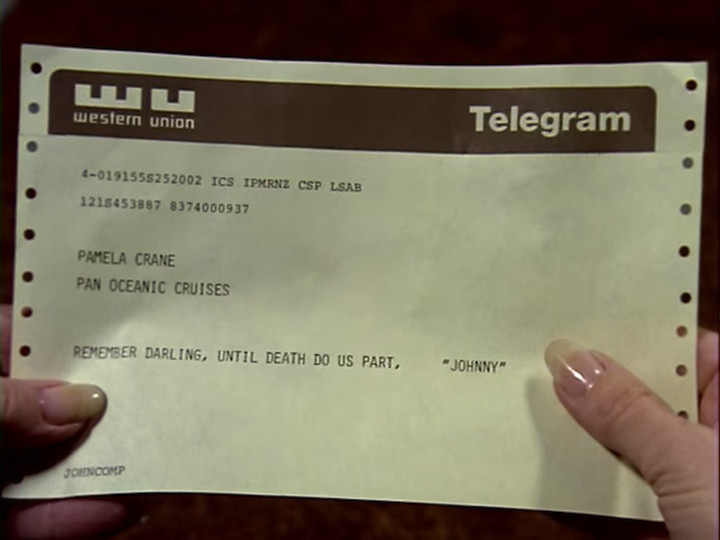
Upon reading it, Pamela faints.
I’m a bit unclear as to why they paged “Pepper Crane” when the telegram is addressed to “Pamela Crane,” and it doesn’t seem like we’re going to get an explanation Perhaps this is just be a mistake that the prop department made. The scene shifts to sick bay where the Captain orders that no one is to come in or out unless it’s an emergency. Jessica then suggests that they have a talk with Miss Shelley.
Miss Shelley explains that she took the assignment because she needed an escape from a difficult relationship. The man’s name is Geoffrey Windom, but don’t call his house because his wife will answer. She also looked into the “telex” and it was placed several days ago with orders to delay transmission until today. The sender remained anonymous.
Jessica then goes off to find the two comedy relief comediennes to interrogate them in her inimitable, subtle style. By which I mean that Jessica pretends to be dim-witted and superstitious. After a bit of small-talk she tells the women that they were able to get on the ship at the last minute because it’s a “jinx ship,” which explains how many things have been going wrong for her. A mention of their travel agent prompts them to explain their backstory—they had been planning a longer vacation the following year but then the company policy changed and they couldn’t save vacation, so they had to use it or lose it. This ship was the only one they could book on such short notice.
As George Reed passes, Jessica excuses herself to talk to him. She says that it’s urgent that she talk to his wife, and he says that Andrea has been sleeping in the cabin. That alarms Jessica, since a little bit ago one of the stewards had been sent to find all of the suspects and he checked Andrea’s cabin and couldn’t find her.
They rush off to her cabin and discover that she’s dead.

We then get a closeup of the items on the floor by her hand:
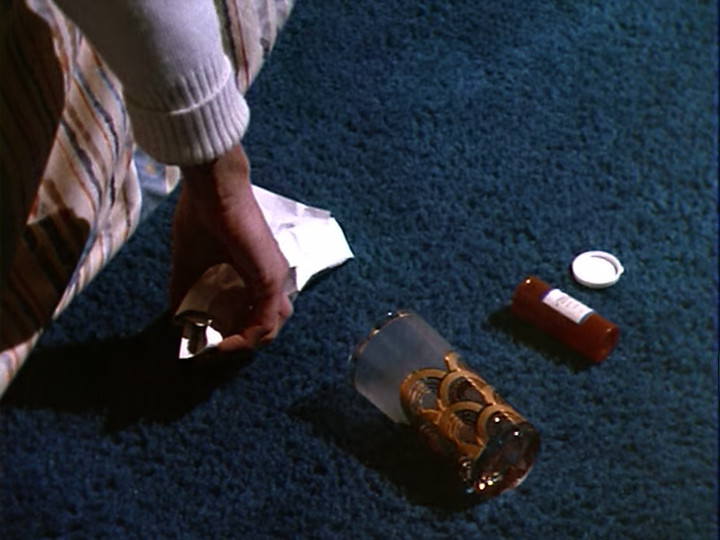
Jessica takes George back to her cabin. When the Captain comes in, they’re looking through photographs. They show the Captain the paper that was clutched in Andrea’s hand. It was a photograph of Pam with Johnny:
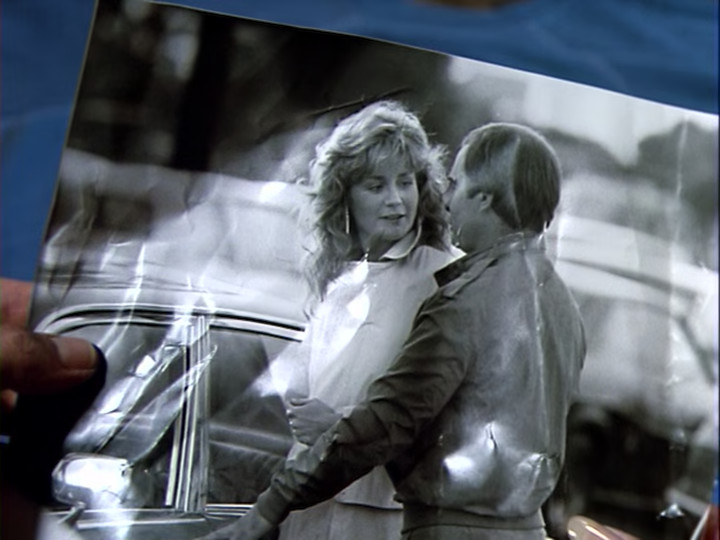
There were a lot of other photos, all taken with a telephoto lens, in her luggage. There was also a copy of Johnny’s birth certificate and a sample of Johnny’s handwriting.
George then narrates the events of the last few hours. They were sunning themselves on the deck when they heard the page asking her and two other women to come to the Captain’s office. She suddenly became agitated and said that she didn’t want to talk to anyone, especially to the Captain. She said she was going to their cabin to lie down. He offered to go with her but she refused.
This is interrupted by Jessica getting a phone call on the radio phone in the Captain’s office. It’ turns out to be’s from Jessica’s brother Marshall with the information Jessica had requested. Johnny Crane had been born to a seventeen year old high school student named Andrea Jeffries.
George confirms that Jeffries was Andrea’s maiden name.
The Captain concludes the case is over, which Jessica seems to accept. She walks with George Reed out of the office. He remarks that she’s been very understanding, given all that Andrea put her niece through. Jessica comforts him, saying that once the authorities find the private detective who took the photos, the case will be closed. George is surprised at this and says that he’s certain that Andrea took the photos herself since she was an expert photographer. As he walks off, Jessica looks concerned.
Jessica meets Pam in the infirmary. When Pam remarks she feels bad for Andrea, to be so unhappy as to do that kind of thing, Jessica replies that Andrea wasn’t unhappy at all. She was a bright, hard-working woman who made a mistake early in her life, but she didn’t deserve to be murdered. When Pam asks by whom Andrea was murdered, Jessica says that it was by her husband, but she’s just not sure how to prove it.
And on that bombshell we fade to black and go to commercial.
When we come back from commercial Jessica tries to talk the Captain into detaining George Reed, which the Captain flatly refuses to do simply upon Jessica’s say-so. I’m really not sure why Jessica was asking for George Reed to be detained, since it was hardly likely that he would jump overboard and escape by swimming, especially when he didn’t think that anyone suspected him.
We then cut to George Reed in his cabin, pouring himself a drink and talking to a photo of his dead wife. He toasts to love and fortune, and elaborates on the fortune part, looking forward to having all the money himself. Then there’s a knock at the door and Jessica calls out to him.
When he opens the door, we see Jessica pretending to be drunk.
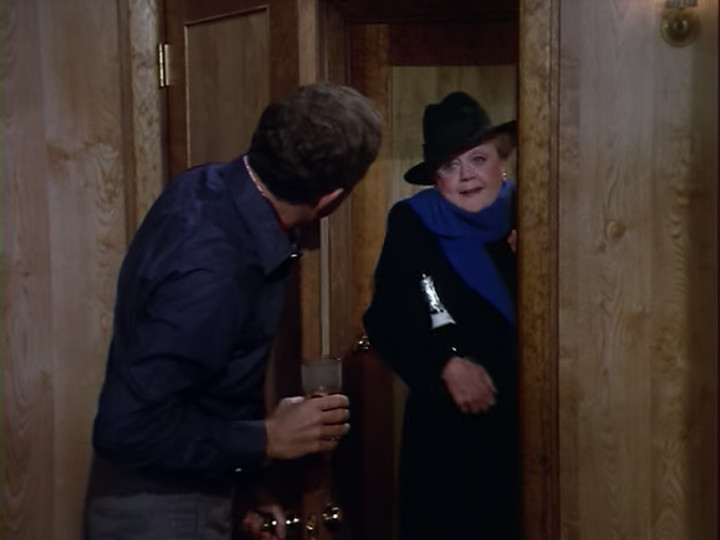
Angela Lansbury is a talented actress, so it’s a decent impression of someone pretending to be drunk in an over-the-top way. She accuses George of murdering Andrea, and shows him the evidence—the photo she took of Jessica, Pam, and Marshall right before the trip.

This contradicts Andrea being an expert photographer, as George said, proving that he killed her.
George says that there’s a reasonable explanation and invites her in, but she refuses. She staggers off and George grabs a bright red jacket then follows her. The chase takes surprisingly long for how slowly a pretend-drunk woman staggers, and then George finally catches up with Jessica and tries to kill her, throwing an arm around her neck. Jessica then throws him over her shoulder and Pam and Jessica step out of a nearby doorway, and Pam takes a picture of him on the ground. He looks up and the “Jessica” he tried to murder turns out to be Russell Tompkins in a blond wig and the same coat and hat Jessica had been wearing.
The next day the ship’s crew delivers George Reed to the local authorities.
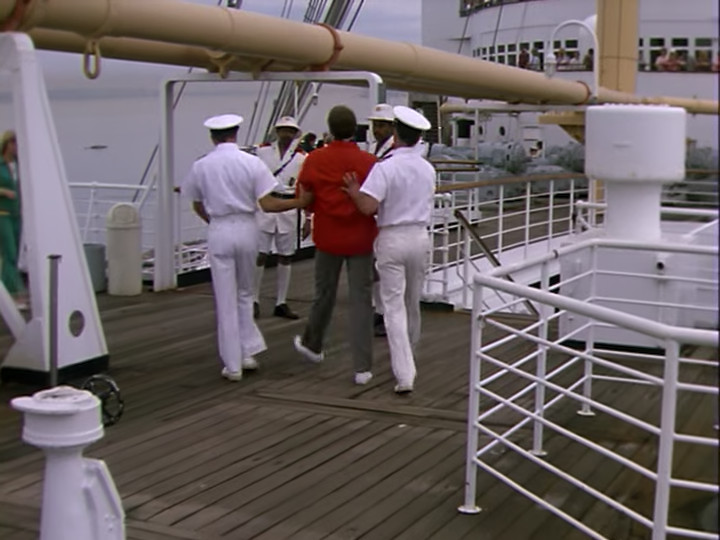
I’m not sure where the cruise could have made it to where the authorities where panama hats, shorts, and knee-high socks that’s one day away from where the cruise departed, but then it’s also slightly strange that they’re handing George Reed over to the local authorities. The murder was committed, so far as we can tell, in international waters and so far as we know the ship was flying a US flag so it is the responsibility of the United States to prosecute the crime.
The Captain then greets Mrs. Fletcher. He informs her that George Reed made a full confession. Jessica says that she can’t help but think that Andrea would still be alive if they had only come to the truth sooner. The Captain doubts it; George had been planning this for months. His original plan had been to terrorize Johnny but Johnny died too soon for that. By the time he realized the plan would work just as well on Pam, Pam had entered the sanitarium, so he had to wait for her to come out.
The Captain then says he owes Jessica an apology and offers to take her to dinner. She makes a joke about one something the comic relief Italian Stewards, Ramone, had said, they both laugh, and we go to credits.

I think that this is a very clever episode. I have to admit that I thought that the culprit was the purser, and I really didn’t see it coming that George Reed was going to murder his wife. It’s actually quite rare for a Murder, She Wrote to put the first murder after the second commercial break, but even apart from that, it had me convinced that the mystery was primarily about who was tormenting Pam. It built it up well, laying in clues and keeping the suspense going.
That’s not to say that the plot was flawless. A lot of the plot hinged on the person tormenting Pam having followed them to the cruise, but how could George have done that? He could hardly have kept a twenty four hour watch on the sanitarium in order to know that she made plans with Jessica for a cruise. Are we supposed to assume that he bugged her telephone? I don’t see how he could have. Or did he bribe the psychiatrist handling Pam’s case to tell him of any travel plans Pam might make? That hardly seems likely. But that just about runs the gamut of ways he could have known about Pam’s plans. This seems especially hard to justify because he would have had no reason to assume that Pam was going to go on a cruise at all. The most natural thing would be to expect Pam to go home after her stay in the sanitarium.
Which actually brings up a curious question: why did he follow Pam onto the cruise? If we assume he somehow got the knowledge that it doesn’t seem possible for him to have had, why didn’t he just wait until Pam was back? He wasn’t in a particular rush.
That said, the cruise probably would have been better than killing his wife randomly, had Jessica not been aboard. Well, I’m not sure. On the one hand, the cruise gives a much better chance of Andrea being “caught” which really helps to explain her “suicide,” but without Jessica I’m not so sure that would have happened. It seems equally possible that without Jessica, Andrea being the one terrorizing Pam wouldn’t have been discovered, and her suicide is hard to explain apart from her being caught. That said, it might still have worked since he could present all of the evidence of her having been obsessed with Pam and on the cruise, recognizing Pam would be fairly easy since she made herself conspicuous on several occasions. On balance, if we ignore the impossibility of George knowing that Pam was going on this cruise, I think it does make sense that he followed her.
That said, I do wonder how he dealt with Andrea being paged. She would have no reason to not immediately obey the summons, since she had no idea she was implicated, and it would be difficult for George to persuade her to go to her room and have a poisoned drink first. I suppose the best explanation is that he happened to have killed her right before the summons, and was just making the most of the coincidence when he was telling Jessica and the Captain the story.
So, overall, I think the plot held together quite well except for the part where George knew that Pam was going on this cruise at the last minute. And unfortunately the entire plot depended on that. They did, at least, bury this plot hole pretty well. About the only way to have made this work that I can think of would have been to have George have taken steps to forge some kind of connection or acquaintance with Johnny and Pamela Crane, which would entail the setup having been longer. That would provide a way for them to have been notified, though it possibly could have made them more direct suspects and reduced the degree to which “it was somebody who booked after us.” On the other hand, that was only ever the assumption because they had nothing else to go on, and it could have been worked such that they still assumed that.
Leaving that aside, I think they did a great job of leading us to believe that the culprit was the purser. She always had an explanation, but also always seemed to be at the center of what was going on. It was some top-notch misdirection.
The unbelievable coincidences were also kept to a minimum. In fact, the only one I can think of was that Jessica and Pam just happened to pick, at the last minute, a cruise captained by a man that had captained many cruises that Andrea had taken, including her honeymoon cruise. That seems too much of a coincidence to be believed, but it also was kind of a throwaway line that didn’t affect the plot in any way.
Speaking of the Captain, he was an interesting character. I can’t really convey it in my description of the episode but Leslie Nielsen has tremendous charisma which he brought to the role of the Captain. So much so that it’s hard to separate out the character as written from Leslie’s portrayal of him. As the primary authority figure with which Jessica interacted, he was somewhere in between the typical two extremes of asking Jessica to investigate and asking her to keep her nose all the way out of the investigation. I can’t help but think that apart from Leslie’s charisma he wouldn’t have been very interesting. There’s a lesson, there, I think, about improving merely functional characters with interesting characterization. I think that can be overdone, though. For example, Ramone, the Italian stereotype was certainly given traits beyond what were necessary for his very minor function of delivering champagne and searching for the suspects, but it was mostly just annoying. I think that the important thing is that the characterization must be related to their function in the story. The Captain was concerned both with the individual passenger (Pam) as well as with his hundreds of other passengers, as well as his responsibility to the cruise liner. Ramone being an Italian stereotype was as relevant as having a dancing bear on stage.
I think it worth noticing, too, what the setting of the ship contributed: it gave a closed circle of suspects like you get in the classic mystery setting of the remote mansion. That always makes mysteries interesting; it reminds me of Chesterton’s dictum that the limits of an artistic work make it interesting; the frame is part of the painting. This kind of closed environment gives us something of a tight frame around the painting. It draws our attention closer to the details. Which made it especially interesting that the episode had such an element of misdirection to it as to who the victim of the episode was.
Overall, I think that this was a good episode and a very interesting one.
Next week we’re on a private Mediterranean island for Paint Me a Murder.
 Chris Lansdown
You must be logged in to post a comment.