J.D. Vance once made the observation that the real danger of social media isn’t living in an echo chamber, it’s only being exposed to the most extreme versions of the positions of people who disagree with us. I think that this is an important insight, and speaks to how it is important to seek out the reasonable version of extreme views that we see made fun of. That said, there are two kinds of extremists, and the more reasonable version is only important for one of them.
Let’s start with that kind: the extremist who is a monomaniac. This kind of extremist is extreme because he has abandoned most kinds of good in life and cares only about one kind of good. To make up an example so as to not be accidentally controversial, let us suppose that there is a man who loves the color blue. If he merely loves blue, but loves other things as well, he may well have many blue things in his house but he will not seek to paint the whole world blue, because he knows that trees and grass need to be green, and have their own value. If he was a monomaniac in his love for blue, he would not recognize the good of grass and trees and so would not care that they need to be green to achieve it (I’m speaking of photosynthesis, not of their aesthetics), and so he would seek to pain the grass and trees green, and would kill them. This kind of extremist, though highly concentrated online, is rare in real life. Most people love more than one kind of goodness, and so no matter how much free reign they are given to realize their ideal world, they will balance out competing goods and not wreck the world. These kinds of reasonable people are important to seek out. (I should also note that this highly simplified form of extremist is not what one typically meets online; I need to explain the other kind before I can clarify further.)
The other kind of extremist is a man who is dedicated to a philosophy of life and is not afraid of the opinions of his fellow man, but takes his philosophy to its logical conclusion. This is the Catholic saint, the Protestant Puritan, the Buddhist ascetic, and the Soviet dictator. People who are not extremists of this kind are not people who balance out goods, but merely people who lack the courage of their convictions. They do not live out their philosophy of life, not because they think it lacks something, but because they lack something. Most of the time, it’s social sanction that they lack. That’s why, for this kind of extremist, it is precisely the extremists you should pay the most attention to. If society were ever to adopt their beliefs, it would become more like them.
Now that I’ve explained the second kind of extremist, I can describe where you are actually most likely to meet the first kind of extremist: as someone posing as the second kind of extremist. The technical term for this is a heretic, though it’s an unpopular word with baggage, so let’s stick to “monomaniacal extremist.” For that same reason I will avoid religious examples, so let’s take a secular one: environmentalism. There are plenty of people who want to take care of the planet on which we live in a balanced way. They consider measures to ensure that we don’t poison our water supply, but also consider other goods like industrial production, nice housing, having pets, growing food, and a myriad of other goods that need to balance each other out. Then you have the monomaniac who only loves nature where it has not been affected by human beings, and so champions anything that removes human influence, at the fullness of expression being the human self-extinction project.
This example also shows the importance of distinguishing the two types of extremist. On the one hand, it is important to figure out that the monomaniacal environmentalist merely hates people, he doesn’t love the environment as one good among many, and so he does not represent the views or policies or much of anything of the people who merely consider clean air and water and an interesting variety of wildlife to be goods to balance out among other goods. On the other hand, the people who are members of the human self-extinction project are merely the monomaniacal environmentalists with the courage of their convictions. One should not ignore the human self-extinction people and seek out the more moderate “strangle the economy with regulation” environmentalists because those are only distinguished from the human self-extinction people by being unwilling to say what they really mean.
I recently read The Communist Manifesto (in English translation, of course) since from time to time I read primary sources and I literally have great difficulty actually believing how bad it is. It does not really contain either a political philosophy or an economic philosophy; it has a few scant elements of these, and is about as much a considered work of political philosophy as is Star Trek: The Next Generation.
For those not familiar, Star Trek: The Next Generation was a TV show set in the twenty fourth century where it is a post-scarcity world in which everyone has an unlimited amount of whatever they want without effort. In TNG (as it is commonly called for brevity) this is accomplished through free energy by unspecified means coupled with “replicators” that can make anything, instantly, with no cost. (I believe various unauthoritative technical manuals suggest there is some hidden feed-stock of protons, neutrons, and electrons, but there is never any kind of limit to what replicators can replicate, and there are episodes where feed stock is clearly not required.) I bring this up not as a tangent, but as oddly similar: it is fairly clear, from TCM (as I will call The Communist Manifest, for brevity) as well as several FAQs (which Marx called a “catechism”) that Marx believed that the industrial revolution was bringing about a post-scarcity world.
TCM was published when Marx was 30 years old, and I’ve been told it’s not why he was influential—that was Capital, or Das Kapital, as it is often known, or Capital: A Critique of Political Economy, which is it’s full title. That book is around 1,000 pages long, and I don’t find it even slightly plausible that communists read the whole thing, so I’m still quite unsure of what to make of it. I’m willing to believe that Capital did flesh Marx’s ideas out somewhat, since they were basically only a few partial bones in TCM. Capital was published when Marx was 48, and presumably the intervening 18 years and the extra 970 pages lent themselves to a little more thought. I have trouble believing much, since the author of TCM was clearly not a thoughtful man.
It’s difficult to even critique TCM because there’s so little to it. It begins with the idea that the key to understanding history is class conflict, which is just wrong. That’s not the key. It mostly doesn’t even apply. It’s like saying that the key to understanding history is belts. I mean, yeah, you can identify belts at times and places in history, but if you think that they’re the key to understanding history you’re just a moron (assuming you’re older than fifteen; if you are fifteen you just need to think about this more). There is no single key to understanding history, because human history is as complex as human beings. And if there was a single key, interdependence would unlock quite a lot more of history than class conflict would.
Marx’s arguments are often beyond asinine, too. When he tries to address objections to abolishing the family, he starts by saying that families don’t really exist anyway so nothing will be lost. He defends all women being held in common, rather than marrying, by saying that the bourgeoisie has extramarital affairs so often that they effectively hold all women in common anyway. This is just rhetoric, not an argument, and it’s not even good rhetoric. Moreover, it’s rhetoric where actual ideas would be most natural, highlighting that there are no ideas.
To give another example of idiocy: among the general points that a communist system would have (there are only 10), Marx says that factories will be interspersed with agriculture such that there will no longer be a town/country distinction. This is only starting to become sort-of possible in certain types of manufacturing with modern high-end 3D printers in low-volume markets. In Marx’s time, when factories were enormous and required the labor of a huge number of people, this was pure insanity. Ignoring how factories would get in the way of farmers, this would require either factories so small as to be unproductive or absolutely enormous commutes to work at a time when horse was the dominant form of transportation. To say nothing of the great difficult of transporting raw materials to random locations and finished goods from them. (Factories were often on rivers because river transport is so much cheaper than overland transport; they were often near each other because one factory’s output might be used as an input by another, and not needing to transport these goods hundreds of miles was far more efficient.) If you even begin to try to work through what randomly locating factories throughout the countryside would entail in terms of transport and coordination, of the running of rail lines through farm fields and so on, it becomes immediately clear that Marx never gave a moment’s thought to what this goal would entail.
And that’s a theme of TCM. There is zero thought given to how to accomplish… anything. For example, he states that all property will be owned by the state, but he never so much as raises the question of how the state will say what will be done with its property, let alone provide even a hint of an outline of an answer to the question.
Incidentally, this is a point which a lot of people sympathetic to socialist rhetoric seem to miss: any form of socialism where the means of production are owned by The People is necessarily totalitarian, for the simple reason that if The People own the means of production, they clearly will have to say what gets done with their means of production. That computer in the apartment in which you live—that can be used to write things, so the people should get to say what their computer gets used to write. The oven in the common area of the apartment building in which you live produces cooked food, so The People should say what food their oven is used to cook.
Socialist-sympathizers will balk at this and say that all manner of things are excluded from ownership by The People, but all they’re doing is saying that what they actually want is only a little bit of socialism—often, in practice, only socialism of the things that they don’t want to own, but then most human beings are hypocrites.
Anyway, Marx says nothing in TCM about how The People (or The State) will say what happens with all of its property. He gives not a word to how this will, in his way of looking at things, only set up a new class conflict between the bureaucrats and the civilians, or between the politicians and the civilians, since clearly you can’t say what happens to everything by direct democracy. Especially since nations will fade away and there will only be one worldwide government.
A world government is, of course, a recipe for minimum accountability, but that requires some minimum of knowledge of how human beings work, which was clearly beyond Marx, or perhaps against his beliefs; but I would have expected him to at least give some vague hints about how the world government is supposed to work, even if it was beyond him to say how it wouldn’t work and what to do to correct against its failings.
There’s a popular myth that science progressed because of a revolution in the way people approach knowledge. This is a self-serving myth that arose in the 1600s by people who wanted to claim special authority. This is why they came up with the marketing term “The Enlightenment” for their philosophical movement. If you look into the actual history of science, scientific discoveries pretty much invariably arose a little while after the technology which enabled their discovery was invented.
There is a reason we did not get the heliocentric (really, Copernican) theory of the solar system until a little while after the invention of the telescope. There is a reason why we did not get cell biology until a little while after the invention of the microscope. If you dig into the history of specific scientific discoveries, it’s often the case that several people discovered the same thing within months of each other and the person we credit with the discovery is generally the one who published first.
This is not to say that there are never flashes of insight or brilliance. So far as I can tell Einstein’s theory that E=mc2 was not merely the obvious result of measuring things using new technology. That said, it would almost certainly never have happened had radioactivity not been discovered a decade earlier, which would not have been possible without certain kinds of photographic plates existing (radioactive decay was discovered by Henri Becquerel and Marie Curie in the 1890s as they were studying phosphorescence and exposed photographic plates wrapped in black paper, which showed that something else was going on besides phosphorescence, many further experiments clarified what was going on by the time Einstein was working on the mass-energy equivalence).
Which gets me to modern science: there are a lot of things that we want to know, for which the relevant technology does not seem to exist. Nutrition is a great example. What are the long-term health effects of eating a high carbohydrate diet? How can you find out? It’s not practical to run a double-blind study of one group of people eating a high carbohydrate diet and the other eating a low-carbohydrate diet for fifty years. The current approach follows the fundamental principle of science (assume anything necessary in order to publish): it studies people for a few weeks or months, and measures various things assumed to correlate perfectly to good long-term health. That works for publishing, but if you’re more concerned with accuracy to reality than you are with being able to publish (and if you’re reading the study, you have to be), that’s more than a little iffy. Then if you spend any effort digging into the actual specifics, let’s just say that the top ten best reasons to believe these assumptions are all related group-think and the unpleasantness of being in the out-group. (Please actually look into this for yourself; the only way you’ll know what happens if you don’t just take people’s word for something is by not taking their word for it, including mine.)
And the problem with science, at the moment, when it comes to things like long-term nutrition is that the technology to actually study it just isn’t there. (It’s different if you want to study things like acute stimulation of muscle protein synthesis related to protein intake timing or the effects on serum glucose in the six hours following a meal.) And when the technology to do good studies doesn’t exist, all that can exist are bad studies.
This is why we see so much of people turning to anecdotes and wild speculation. Anecdotes and wild speculation are at least as good as bad studies. And when the bad studies tend to cluster (for obvious reasons unrelated to truth) on answers that seem very likely to be wrong, anecdotes and wild speculation are better than bad studies.
That doesn’t mean that anecdotes and wild theories are good. It would be so much better to have good studies. But we can’t have good studies just because we want them, just as people before the microscope couldn’t have cell biology no matter how much they wanted it. The ancient Greeks would have loved to have known about bacteria and viruses, but without microscopes, x-ray crystallography, and PCR, they were never going to find out about them.
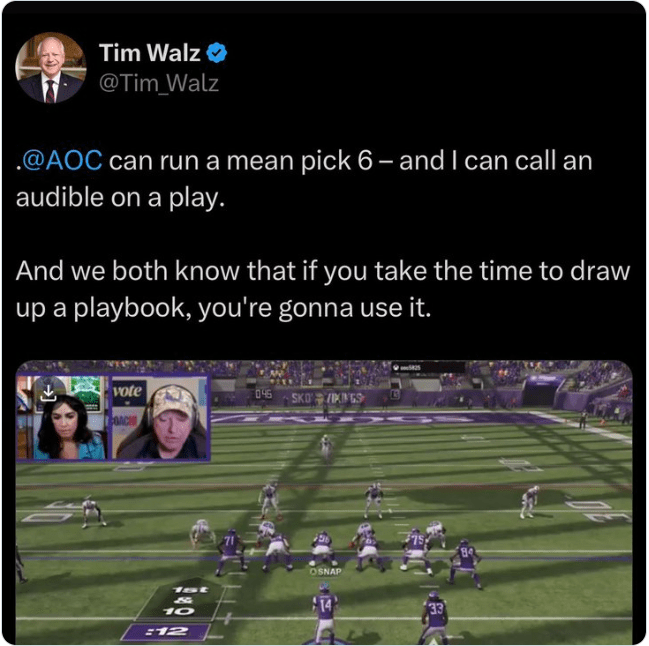
As in Astonishing Incompetence, I’ve waited until now to talk about this so that my post can be about the incompetence and not the politics: Tim Walz, when he was a Vice Presidential candidate, played a game of Madden Football with Alexandra Ocasio Cortez which was streamed on the streaming service Twitch. Afterwards, Tim Walz put out a hastily-deleted tweet:
The text was:
@AOC can run a mean pick 6—and I can call an audible on a play.
And we both know that if you take the time to draw up a playbook, you’re gonna use it.
I’m going to explain a bit of backstory before we get into the barely-believable incompetence of this tweet as messaging. The context unavoidably mentions politics, but I will do my absolute best to present the context in a completely neutral way, I promise, because the politics is not at all the point of this post.
The second half of the tweet was a reference to “Project 2025” which was a plan drawn up by the think-tank The Heritage Foundation, which President Trump disavowed and Democrats claimed was his plan. (Who is more correct about this is not the subject of this post.) This tweet was part of the effort of Democrats to convince people that Project 2025 was, in fact, Trump’s plan.
A further bit of backstory is that Tim Walz claimed to have been a football coach. (It turned out that he was an assistant high school football coach. For the sake of non-Americans: in both cases I mean American football.) This use of Madden, and of Walz’s putative familiarity with football, was generally understood to be part of the Democrats’ strategy to appeal to male voters.
So we finally come to the first half of the tweet, which defies belief. I have seen very little football and don’t know much about the game, so I had to look the terms up. To “run” a play is to have a plan, communicated to the players, which they then implement. A “pick 6” is where the football is thrown by the team who has possession and intercepted by the opposing team, who then conveys it to the throwing team’s end zone, scoring 6 points. (Most of the time, teams only score points when they begin play with possession of the ball.) You cannot “run a pick 6” of any kind, mean or otherwise. (“Mean,” in this context, is a metaphor for being well-planned and well-executed.) I mean, technically you could, but that would constitute trying to lose the game, since it would mean having your quarterback throw the ball not to your players, but to the opposing team, and then stand aside to let them get to your end zone. There is no normal circumstance in which you do that intentionally, and letting your opponent score points can never be described as “mean,” not even metaphorically. He clearly had no idea what the term meant. (Making it even worse, by the way, is that “pick 6” definitionally requires the scoring of six points, while the Madden football game that Walz and AOC streamed ended a 0-0 tie, meaning that no pick 6 happened, intentional or otherwise.)
That was widely talked about because it’s absurd in any context, but the incompetence of communication doesn’t stop there. I also looked up what it means to “call an audible.” It means for the quarterback to throw out the planned play in part or in whole in favor of what he’s making up on the spot and telling people. (Hence, “audible”—he has to say the new plan because it wasn’t a pre-arranged one.) While it is quite possible for a quarterback to intentionally call an audible, the coach can’t, by definition, and moreover this is exactly the opposite of what the second half of his tweet is saying. It makes exactly no sense to cite your ability to throw out a plan in favor of improvisation as your source of knowledge that “if you take the time to draw up a playbook, you’re gonna use it.”
I don’t know football well enough to say whether there were worse terms that Walz could have picked in order to make his point, but there can’t be many. It boggles the imagination as to how Walz (or an intern who clearly knows nothing about football) wrote this tweet. If you just check out Wikipedia’s page on American football plays, there is a long list of plays, by name, with descriptions. It would take only a few minutes to scroll through and find two plays which sound kind of cool. Also of note: neither the words “audible” nor “pick” appear on the page. So how did this tweet get written? How did someone go to the trouble of finding out that “pick 6” and “audible” are words associated with football without taking the extra ninety seconds to find out what they mean?
Like with the Al Smith dinner video (linked in the first paragraph), this level of incompetence is right at the border of my ability to believe it. Well, it used to be beyond it, but then this clearly happened, so I had to adjust the border of what level of incompetence I find believable. But wow. I’m a cynical man, and yet it turns out: not cynical enough.
I’m hoping that enough time has passed that I can talk about Kamala Harris’s video that she sent to the Al Smith dinner in lieu of attending without it being political. Whatever you think of her or Donald Trump, or her policies or his policies, all but a few people recognize that she ran a terrible campaign. And though which was the most incompetent part of it is debatable, I think it was her video submission to the Al Smith dinner, and I think it’s interesting to look at how incompetent it was, because it was a level of incompetence we rarely see from adults. But I’ve waited until now because I want to talk about the incompetence, not the politics, of it.
For those who don’t know, the Al Smith dinner is a charity dinner hosted by the Catholic diocese of New York City which happens every four years to raise money for Catholic charities in New York. Since the 1950s, it has been a tradition for both major nominees for President to attend and for them to make jokes, both about themselves and the other candidate. Only two candidates have ever not attended. The first was Walter Mondale, who lost the election in a landslide to Ronald Reagan. (Mondale received only 40.6% of the popular vote and won only the electors of Washington D.C. and Minnesota.) The second was Kamala Harris, who sent a short, theoretically comedic, video in lieu of attending. This is the video that I want to discuss.
And to explain the point of view from which I want to talk about it: back in college, I was a writer and actor in one of our small university’s two competing sketch comedy shows (we would put on three or four shows a semester). What I want to look at is the creative decisions which went into this from the perspective of comedy and effective communication.
To begin at the meta level: the very act of sending a video instead of attending was a strange thing to do, but though it was taken as an insult by attendees of the dinner, it probably could be a defensible choice. If so, it was the last defensible choice.
The video begins with Harris saying “Your Eminence, and distinguished guests, the Al Smith dinner…” when a sixty year old woman in a Catholic schoolgirl outfit runs behind her. As Harris continues to say, “…provides a rare opportunity to set aside partisanship…” when the figure walks behind her again and says, “so cool.” At this, Harris notices and asks what’s going on and who that was. The woman runs up, shakes Kamala’s hand, and introduces herself multiple times out of excitement. She’s Mary Katherine Gallagher.
For those who don’t know—and I didn’t until looking it up—this was a character invented in 1995 for the long-running comedic TV show Saturday Night Live. The character was used until 2001, and was the star of the 1999 movie Superstar (“superstar” was a catchphrase of the character). Superstar made $30.6M on a $14M budget, which wasn’t bad, but was hardly a big hit.
So, right off the bat, we have the bizarre decision to bring in a pinch hitter. That will, necessarily, make Harris look weak, no matter how good the pinch hitter is. This is a counter-intuitive choice, given that she’s running for chief executive of the United States; a role for which virtually everyone agrees strength is a virtue. Then there’s the aspect of the pinch hitter being a long-forgotten character from SNL—a comedic show famous for going years at a stretch without being funny. Comedy rarely ages well and SNL’s brand of comedy tends to age especially badly. And it had been 23 years since the character was last a regular on SNL.
Then there’s the issue of this being a character designed to make fun of Catholics to a secular audience being used at a Catholic charity dinner. That is such an extraordinarily bad choice; it’s only a notch or two better than telling the archbishop to go “f” himself.
Then there’s the ancillary issue brought on by it being more than a quarter century since the character was introduced: this parody of a Catholic schoolgirl is being played by a sixty year old woman. Yes, she has professional makeup, but even professional makeup artists can’t make a sixty year old look like a sixteen year old. And there is very little that’s more pathetic than watching someone old enough to be a grandparent sincerely pretend to be a teenager. I mean, just look at this:
Having said that, I looked up some clips of the character twenty five years ago, and frankly she wasn’t convincing back then, either:
To be clear: there’s nothing in the world wrong with being a sixty year old woman. Which is why sixty year old women shouldn’t pretend to be sixteen.
Anyway, Mary Katherine is incredibly excited to meet Kamala; she can barely speak for the excitement. More collected, Kamala responds that it’s very nice to meet Mary Katherine, but right now she’s trying to record her speech for tonight’s dinner. Mary Katherine replies that she knows, she’s Catholic, and tonight is one of the biggest dinners next to the last supper.
I suspect that this was supposed to be a laugh line but there’s no actual joke there. Perhaps the joke is that she’s comparing a mere charity dinner to one of the most important events within Christianity, but then the joke is that Mary Katherine is an impious idiot. Since she shouldn’t even be here (whether you’re talking about in-story or in-reality), that’s not a joke. That’s just character development of a character meant to insult Catholics.
Kamala replies that it’s an important dinner and an important tradition that she’s so proud to be a part of.
Mary Katherine then says that sometimes when she gets nervous she sticks her fingers in her armpits, squeezes them, then smells her fingers. She suits the action to the words and Kamala looks on with a faint air of disgust. Mary Katherine then says, “but that’s gross.” Yes, in fact, it is. Which is entirely inappropriate to the entertainment of a dinner. I mean, having looked up vintage clips, it was never a good joke. But it’s a particularly bad joke now.
Kamala then says, “So tell me something. Um. I’m giving a speech. Do you have some thoughts about what I might say tonight?”
This is an awful transition into the main part of the sketch. Comedy is not supposed to be realistic, but the parts that aren’t jokes are supposed to have some kind of internal logic that the jokes get to play off of. Here the premise is that Kamala had so little idea of what to say—despite having started recording—that she’s asking a random idiot for advice merely because this random idiot happens to be Catholic. This implies that this random idiot is literally the first Catholic Kamala has been able to find. Given that about 20% of Americans identify as Catholic, the best case is that Kamala is portraying herself as hopelessly out of touch. She’s also portraying herself as recklessly unprepared. That could be a funny setup for jokes at her own expense, but that’s not at all what she’s trying to set up. “Are you here to give me advice on what I should say?” would have been way better. It would imply an appropriate level of annoyance, it would not imply she was unprepared or knows no Catholics, and it makes a certain amount of sense as possibly the fastest way to get rid of the person in front of her, which also implies superiority, not being a subordinate. And that took me two seconds to come up with. I may have some skills as a comedy writer, but there are a lot of people who are far, far better at it than I am.
And this awful transition is so unnecessary. The framing story of Mary Katherine running around and interrupting the recording was stupid. They could easily have had Mary Katherine being brought in as an expert on Catholicism and Kamala being skeptical. That would have been a massively better framing story, both for how Kamala would want to portray herself as a presidential candidate (competent) and as a setup for jokes.
Anyway, Mary Katherine replies in a rapid-fire monotone, “My feelings on what you should say tonight would be best expressed in a monologue from one of my favorite made-for-TV series.”
This is Mary Katherine’s face while she delivers the monologue:
Kamala then says, “OK, let’s hear it.” We then get the monologue:
Don’t you see, man? We need a woman to represent us. A woman brings more heart. More compassion. And think how smart she must be to become a top contender in a field dominated by men. It’s time for a woman, bro. And with this woman, we can fly.
Wow, that’s a real thigh-slapper alright. It’s a good thing they brought a comedian on as a pinch hitter to deliver jokes like that.
Kamala asks what series that’s from and Mary Katherine replies that it’s from “House of Dragons, now streaming on HBO Max”. So we get product placement in a recorded video message for a charity dinner. How can a human being have judgement that bad? Did HBO sponsor this video?
Kamala then transitions to the next joke, asking, “is there anything that you think that maybe I shouldn’t bring up tonight?”
Speaking as someone who wrote sketch comedy: transitions to different topics for jokes are not easy, so I’m not unsympathetic. At the same time, they’re important, and I don’t understand why the writer put no effort into this transition. “Is there anything I should avoid saying?” is an unnatural question, except perhaps when you’re prepping for an intimate dinner with someone and you’re expecting a wide range of subjects. Unnatural transitions ruin the suspension of disbelief that helps to make the jokes funny. A much better transition to things to not say would be to bring up something and have her say “oh no, don’t say that.” You’d want it to not be insulting, so maybe something like, “I was thinking of complementing the cardinal on his dress,” to which Mary Katherine could reply, “Oh no, don’t call them dresses, they don’t like that,” at which point the question, “is there anything else I should avoid” would be natural.
Anyway, after the unnatural transition, Mary Katherine gives a terrible setup for Kamala to make a joke. She says, “Um, well, don’t lie. Thou shalt not bear false witness to thy neighbor.”
As she misquotes the ten commandments, she folds her hands as if in prayer.
In both versions of the commandment she’s trying to quote (the Ten Commandments appear both in Exodus and Deuteronomy, slightly differently), the actual commandment is to not bear false witness against your neighbor. If you’re going to quote someone’s holy texts, it’s insulting to lazily get it wrong. And this was recorded. They could have done another take if the actress flubbed her line.
Kamala then responds, “Indeed. Especially thy neighbor’s election results.”
So we’ve gotten to the first real joke in this sketch, and it is, at least, funny. The humor is marred by the delivery not making any grammatical sense, though. I don’t mean that people listening will be picking apart the grammar; that’s not how people listen to things. But grammar that actually works makes it easy to immediately understand what’s being said, and sudden reveals are important to humor. Slowing the listener’s comprehension down with nonsensical grammar makes the reveal slower and thus less funny. There’s a reason why “wits” refers both to people who are funny and to quick thinking. And again: this is a recorded skit with multiple camera angles they cut between. If an actor flubbed her line, they could just do another take. When you are presenting something edited, the bar is higher because it’s so much easier to get everything right since you only need to get each individual part right once out of maybe twenty tries.
If you care enough to try more than once, that is.
Also, and this is a general thing: it’s an absolutely terrible idea to say that you won’t lie because to bring up the subject at all is to imply that you would lie if you thought you could get away with it. There is no way to have Mary Katherine tell Kamala to not lie that doesn’t sound like she thinks Kamala might lie. Which brings up the question: why does she think Kamala might lie?
This is especially the case given that she points her finger at Kamala accusingly when she says, “don’t lie.”
When this joke is over, Mary Katherine hastily adds, “just so you know, there will be a fact checker there, tonight.” Kamala says, “Oh, that’s great. Who?” Mary Katherine says, solemnly, “Jesus.” Kamala nods and smiles… well, look for yourself:
She doesn’t agree, or point out that Jesus is always watching, or… do anything. She just smiles awkwardly as if she doesn’t believe it and wants to move on. About the only way for this to be a joke is if the punchline is that Mary Katherine believes that Christianity is true. That my work at an atheist charity dinner, but it’s a terrible joke to try to pull off at a Catholic charity dinner.
Mary Katherine then hastily adds, “and maybe don’t say anything negative about Catholics.”
Again, this implies that, but for this advice, Kamala would say negative things about Catholics. That may well be true, but why advertise the fact to Catholics? She’s already skating on thin ice by not even showing up; suggesting that she would lie and disrespect Catholics by unnecessarily denying that she would do either is a bad idea and pointless because it’s not even part of a (funny) joke. While only a fool would shop for a vehicle at Honest Bob’s Reliable Used Cars That Definitely All Work, at least it makes for an interesting logo because there are enough words to do something with, graphic-design wise. Plus, Honest Bob only needs enough fools to pay the bills, and there’s no shortage of fools in the world. He doesn’t need the majority of the population to come buy a car from him.
Kamala then replies, “I would never do that no matter where I was.” So far, fine, though it was a bad idea to bring it up in the first place. But then it turns out that this is the setup to a joke, or at least to what I’m pretty sure someone thought was a joke:
“That would be like criticizing Detroit, in Detroit.”
This is a reference to a remark Donald Trump made in a speech to the Detroit Economic Club, where he said, “The whole country will be like — you want to know the truth? It’ll be like Detroit. Our whole country will end up being like Detroit if she’s your president.”
It’s a reference to what Trump said, but it’s not a joke about it. There’s no contrast, no twist, no juxtaposition of anything. There’s no wit. It just mentions it.
Worse, it contradicts what she just said about never insulting Catholics no matter where she was. Criticizing Detroit in Detroit is not like criticizing Catholics anywhere. If anything Kamala might do was like criticizing Detroit in Detroit, it means she will insult Catholics, just not here.
They then move on to the next bit without attempting a transition. Mary Katherine asks, “Does it bother you that that Trump guy insults you all the time? Because it really bothers my friends and me.”
This is dumb on several levels. For one thing, the character of Mary Katherine Gallagher, so far as I’ve been able to tell, doesn’t have friends. She’s a socially awkward teenager who does things like smell her armpits when she’s nervous. Further, she’s a Catholic schoolgirl. Is she really supposed to be following politics so closely that she knows what Trump says about Kamala? And at the same time, it’s ridiculously partisan; you have to have your head pretty far up the democratic party’s backside to think that Kamala doesn’t constantly insult Donald Trump. That’s not compatible with the level of naiveté involved in this question. The point of all of this is not to say that the character is unrealistic—comedy is not supposed to be realistic—but that it doesn’t have any kind of internal consistency. Now, you can violate internal consistency to make a joke, such as an when illiterate character who never wrote a book suddenly extensively quotes Aristotle, but violating internal consistency in your setup undermines your jokes.
Kamala replies, “Oh Mary Katherine, it’s very important to always remember: you should never let anyone tell you who you are. You tell them who you are.”
I mean, OK. That’s not the worst advice in the world, though taken literally it means never listening to feedback and even when not taken literally it suggests never being open to the idea that you’re wrong or should change, but it’s not good advice, and it’s not a joke.
Mary Katherine then quotes a Taylor Swift song, saying “haters gonna hate hate hate hate hate; shake it off.”
Kamala replies with the next line from the song: “Shake it off.”
After another round of each saying “shake it off,” an assistant walks on and starts to drag Mary Katherine off.
As she pulls on Mary Katherine, the assistant says, “Madam Vice President, they’re ready.”
They’re ready? “They” haven’t been ready the whole time? I guess the writers forgot that the skit started with Kamala beginning her address and being interrupted by Mary Katherine. And are we really to suppose that someone only just noticed that Mary Katherine was here? Why would Kamala want to pretend that she’s surrounded by incompetents?
And what is the story supposed to be? Were “they” not ready when Kamala started the first time? If so, why was she giving the address to people who weren’t ready? Or are we supposed to pretend that the address she’s about to give will be a live video call? But we’ve been watching this and Kamala told Mary Katherine that she was trying to record her speech “for tonight’s dinner.” So who is now ready? There’s no way that “Madam Vice President, they’re ready,” makes any sense. And that’s on top of the absurdity that Kamala was recording her speech without someone operating the camera and teleprompter, or that if there were, they weren’t ready during the ongoing recording, or that they had no reaction of any kind to Mary Katherine.
Anyway, Mary Katherine then pulls away from the assistant and says, “one more thing: don’t worry if you make a mistake because Catholic people are very forgiving.”
We all make mistakes, but that (literally) goes without saying. Bringing it up suggests that the normal level of “we all make mistakes” is insufficient. That’s not the kind of thing you want to suggest when you’re trying to impress people. Especially when you’ve already got one strike against you because you brought in a pinch hitter to help you with something that should be easy to do on your own.
Perhaps this was meant to try to encourage the Catholics at the Al Smith dinner to forgive her for not showing up?
Anyway, Mary Katherine then adds another one more thing: “don’t forget to say Supahhstaaaaaaaa!”
This is apparently a callback to the character’s catchphrase (“superstar”) which was also, you will recall, the title of the movie she featured in. I can’t imagine who fondly recalls this character from twenty five years ago, but Kamala’s reaction suggests that she does. Does she really expect anyone at the Al Smith dinner to remember this character fondly, such that her out-of-context catchphrase will bring the happiness of recalling good times?
Kamala then thanks Mary Katherine, who replies, “Thank you, Momala!” as she finally leaves. Who thought that calling Kamala “Momala” in this context was a good idea? It’s not funny, and Kamala Harris was running to be the commander in chief of the armed forces of the United States. One of her campaign planks was making the armed forces the most lethal fighting force in the world. Projecting a “mom” image is directly counter to this. (Not necessarily so a “mother” image. “Mom” is specifically about the tenderness between a mother and her children. “Mom” does not encompass the entirety of motherhood and has no suggestion of a mother willing to defend her children. “Mother” can be very different depending on context; “mom” specifies a context. If Kamala is “mom” to the whole country, this means that she’s tender and indulgent to rapists, murderers, and home-grown terrorists. It’s a political question whether she would have been indulgent to them, and I’m not here considering that political question. It’s simply a question of messaging that she was not trying to project that image in her campaigning and so projecting it here is mixed messaging.)
After Mary Katherine finally leaves, Kamala then goes up to the main camera where the sketch started and begins again, “Your Eminence, and distinguished guests, the Al smith dinner provides a rare opportunity to set aside partisanship…”
I don’t get why she’s repeating this part, as if all of this really happened and she’s now actually recording what will be played from the start. This certainly is not funny, and it’s annoying to anyone with a functioning memory.
Her serious remarks, which, including the repeated opening, last 1 minute and 13 seconds, are anodyne remarks about how the Catholic Church does good work for the poor and needy, concluding with “God bless you and may God bless America.” This part was fine. Better, in fact—no less funny and far less cringey.
I am a deeply cynical man and I still can’t believe that this video got made. How did it even get past the proposal stage? When Kamala decided to skip the Al Smith dinner but not entirely skip it, and to do this by sending a video, why didn’t she just get a scriptwriter who can do humor, or else a comedian, to just write a five minute monologue? Who on earth proposed, “let’s bring back a quarter-century old SNL parody of Catholic schoolgirls as a pinch hitter” and why wasn’t she laughed out of the room? I mean, I obviously she wasn’t laughed out of the room because no one on Kamala’s staff has a sense of humor. But why wasn’t this proposal just immediately dismissed? How can it have possibly sounded like a good idea? Is Kamala Harris so incredibly insecure that she’d rather show up next to a sixty year old woman sincerely playing a sixteen year old girl than stand in front of a camera on her own and read a few jokes? Or did someone think that getting an aged comedian with a reasonably successful career to reprise a an ancient SNL character was some kind of tour de force? Look at how socially powerful Kamala is because of who will show up to help her?
And once this got made, no one looked at the result and thought, “this is awful, let’s try again?”
What I really find astonishing is that this awful, nonsensical almost joke-free farce was considerably more work than a bland, unremarkable monologue would have been. People tend to use the term “mediocre” as a criticism, but being mediocre is, in fact, greatly superior to being abysmal.
There are two things which are meant by inflation, the first being the primary cause of the second. The first is an increase in the money supply. This is the straightforward meaning of “inflation,” it’s like more air being blown into a balloon—the balloon gets bigger. The second meaning is a universal increase in prices. An increase in the amount of money without an increase in the amount of goods and services to buy with them means that more money is chasing the same amount of goods and services, so the prices of them will rise until an equilibrium is reached.
How It Happens
The main cause of inflation is the creation by a government of money faster than the increase of goods and services. (The latter is, generally, caused by increases in economic productivity, chief of which is an increase in population.) Colloquially this is referred to as governments “printing money,” though it’s been many decades since the majority of money existed as printed currency. This is possible because virtually all people use what is called a “fiat currency,” that is, a currency which exists because a government said that it does. This is a reference to the latin translation of the first words of God after creating the heavens and the earth, when the earth was a formless void and darkness was over the deep: fiat lux. (“Let there be light,” is the common English translation.)
Prior to fiat currencies, which were widely adopted in the 1900s, precious metals tended to be used as currencies. These do increase, though their increases are limited by the amount of them that can be found. That said, while it is far harder to inflate a currency through mining precious metals, it has happened in history, though usually only on a local scale.
Why It’s Bad
If a government announced a date on which it would double the money supply and on that date doubled the money supply instantly and instantly handed the money out uniformly to people according to how much they already had, such that everyone received an extra dollar for every dollar he had, everyone would double their prices and other than the math for transactions being slightly harder and everyone selling anything facing the inconvenience of printing up new price tags, nothing would change. That is not, however, how governments do it.
What they universally do, because it is a fallen world, is to give themselves the money and not tell anyone that they did. They then spend this in order to be able to buy more than what the taxes they brought in would allow them to. This slowly filters into the economy, raising prices first in the places where they are buying things, then rippling out as those people buy from their suppliers. (Since governments rarely do this exactly uniformly, it also has a tendency to create economic bubbles where increased demand gets met with increased production and then demand falls off, but that’s a story for another day.) If they stop making the new money, eventually these ripples go throughout the economy, everyone has more money, prices are increased, and a new equilibrium is reached. But people are impacted; the people who have not yet received income increases have to pay more before they receive more, and often have to dip into their savings to make up the difference. Anyone who has saved is penalized for this savings, because they receive nothing extra for their savings and their savings is now worth less. Thus governments inflating the currency is a kind of stealth taxation. (This is why it was an excellent idea, when it became clear that the government’s response to COVID was to create massive amounts of new money, to make any large purchases of durable goods with one’s savings, locking in that value before the stealth taxation hit. E.g. buying a weight set, a new car, a new water heater, re-roofing one’s house now rather than in a year, etc.)
Other Causes of Universal Price Increases
There is another causes of universal price increases besides inflation: a contraction in the amount of goods and services available for purchase while the supply of money stays the same. This can be caused by the population shrinking, but that has been (so far) pretty uncommon in human experience. Not unheard of, but uncommon.
A more common cause of the contraction in goods and services are wars: wars consume large fractions of the productive capacity of people and literally throw the results away. Granted, they often throw them away for military purposes, as in the shooting of bullets or the dropping of bombs. Still, bullets and bombs are not economically productive. Further, soldiers at war are not part of the economy, and thus their labor is removed from the economy.
Another cause of a contraction in goods and services is the expansion of the regulatory state. Regulators do not produce anything (besides regulation). People who are employed as regulators are, therefore, not contributing to economic production and the more people who are shifted from the economy to the regulatory state, the smaller the pool of laborers and the fewer goods and services there will be to purchase. (This is not a value judgement on regulation; experience has shown that some regulation is necessary for the common good; it just must be understood that regulation is in no sense free.)
Another cause of a contraction in goods and services is the limitation of the resources to produce them. For example, if energy policy reduces the amount of energy available to the economy, fewer goods and services will be able to be produced. This can be effected either through the direct limitation of energy production or by the taxation of energy production.
One of the great things about science is that, when done properly, it’s easy to scrutinize it. So whenever you see someone cite a scientific study, always look into it. A friend recently gave me a link to this article in the NY Post titled, A Third of Women Only Date Men Because of the Free Food: Study. (note: he didn’t endorse it, just provided it for context).
If you look at the article, it links to this article in The Society for Personality and Social Psychology. This article describes the study in slightly more detail, but we need to look at the actual study, which is titled Foodie Calls: When Women Date Men for a Free Meal (Rather Than a Relationship).
So, first question: what was the study? (There were actually two, since my purpose is to illustrate why one should read the original paper critically, for brevity I’m going to only discuss the first study; go read the paper for the second one.) It was a survey of 820 women on Amazon’s Mechanical Turk service who were paid $.26 to answer a survey. (If you’re not familiar, Mechanical Turk is Amazon’s service where people are paid small amounts to do extremely short, simple tasks; it works because Amazon streamlines the process of getting many small tasks in succession so it’s worth it to the people doing it.) These were then filtered down to 698 self-identified heterosexual women. They were given personality questions as well as the question which makes the headline.
Have you ever agreed to date someone (who you were not interested in a relationship with) because he might pay for your meal?
Right off the bat, I dislike the phrasing on this because I’m used to “date” as a transitive verb meaning to be in a relationship with someone where the couple regularly go on dates. Which would make this question nonsense because it would be asking whether the women have been in a relationship with someone they were not interested in a relationship with. Clearly, by “date someone” they mean “go on a date with someone,” but this weird usage is going to influence how people respond. Among the possible reactions is to interpret the question more loosely, which means that both “yes” and “no” answers will mean a wider variety of things depending on how the responder interpreted the question.
And that’s apart from the way that people may well vary in interpreting the question. I could easily see women interpreting this to mean, “Did you ever go on a date with a man who hadn’t piqued your interest but, since he was paying for the meal, you thought you’d give him a chance to see if he improved on acquaintance?”
If what they wanted to ask was whether the woman ever intentionally misled a man into thinking she was open to a relationship with him when all she wanted as free food, why didn’t they ask that? Because such harsh language would color the results? Because if they said what they actually meant women might be embarrassed to admit it? So what was the goal? To try to trick them into revealing the truth?
I’m going to get back to that in a moment, but let’s take a short break to point out that when you read the paper, a third of women answered positively to the question, which only asks if they’ve ever done this even once. The study had a followup question about frequency; 20% of the women who went on a “foodie call” did so frequently or very frequently; since that’s 20% of 33%, that works out to 6.6% of all women. This is a long ways away from “a third of women only date men because of the free food.”
But back to the question: I imagine that people would try to defend the ambiguous language because words lie “deceive” imply judgement, and so will discourage respondents. Perhaps, but that’s because the thing being described is bad. Anyway way that the person understands of describing the intentional deception of a person to defraud them out of material goods will sound bad, because it is bad. The only way to make it sound not-bad is to phrase it in such a way that the respondent doesn’t know what you’re talking about.
Which gets me to the bigger point about this kind of psychological research: the simple expedient of phrasing your question ambiguously guarantees you publishable results. There’s no need to engage in p-hacking or other statistical tricks. Unlike with some of the stricter sciences like biology, getting fake results can be done with everything being completely above-board. It’s a great racket, which is why it will keep going for quite some time. Which is why you should never trust a summary of the results. Always track down the study and find out what the actual questions were.
Always question science. Good science is made to be questioned.









 Chris Lansdown
You must be logged in to post a comment.