
On the third day of February in the year of our Lord 1985, the twelfth episode of Murder, She Wrote aired. Titled Murder to a Jazz Beat, it’s set in New Orleans. (Last week’s episode was Broadway Malady.)

The opening shot was actually a closer-in shot of the paddle boat behind the bridge. Even in the 1980s paddle boats were antiquated; screw-driven propellers are more efficient and less bulky. The paddle boat was iconic of the Mississippi river, though, so it makes perfect sense that our establishing shots have one. Mysteries frequently make use of iconography. There is something very fitting about suggestive imagery in a genre that’s all about interpreting clues. Murder, She Wrote, in particular, also made heavy use of types and archetypes to convey more in the relatively short time that it had. (Upbeat Jazz music plays over these images, solidifying the New Orleans feel.)
The episode begins with Jessica in a cab.

The cabbie, Lafayette, is explaining that the secret to good gumbo is using stale beer to make the fish stock, because that makes for an excellent roux. Jessica is polite, but not super interested. She does like his outlook on life, though, which is that if you spend your time with good food, good friends, good music, and good conversation, a man can’t die no ways but happy.
When Jessica observes that he’s a philosopher, he offers to take her on a tour of the city (off the meter) so they can keep talking and there isn’t a man alive who knows New Orleans better than he does. Jessica is tempted, but has her obligations. Specifically, she needs to be at the TV station to tape a segment for New Orleans Today. When Lafayette asks if she’s a celebrity, she replies “I sincerely hope not. But, uh, the taping starts in six minutes.” Lafayette asks her why she didn’t say so before, then takes a shortcut (which starts by going the wrong way down a one-way street).
The establishing shots in Murder, She Wrote are interesting because they do so much of the heavy lifting for the set decoration, and this one is no exception:

Lafayette screeches up with two minutes to spare. He tells Jessica that he’ll drop her luggage off at her hotel, and they’ll meet up later for sightseeing.
When Jessica gets inside, she goes to the stage, which is empty. The stage, by the way, is quite interesting from the perspective they show it:

This angle does a very good job of highlighting how fake the stage is; it’s a tiny oasis of New Orleans themed decoration in a larger sea of functional production that could be anywhere.
We then meet Jonathan, the man who is going to interview her.
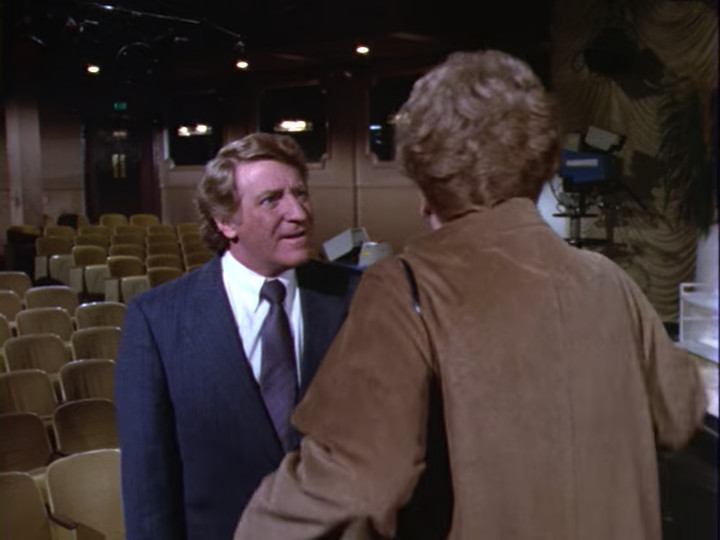
He’s surprised to see her, because the taping is in two days. Jessica checks her pocket calendar and it turns out she’s transposed the dates of two engagements. At the moment, she’s supposed to be forty minutes into dedicating a new school library.
Jonathan is excited for the opportunity to show Jessica New Orleans and all it has to offer in terms of food and entertainment, since she’s clearly going to be in town for a few extra days. Which he does.
We then meet some Jazz musicians. Here’s Eddie Walters:
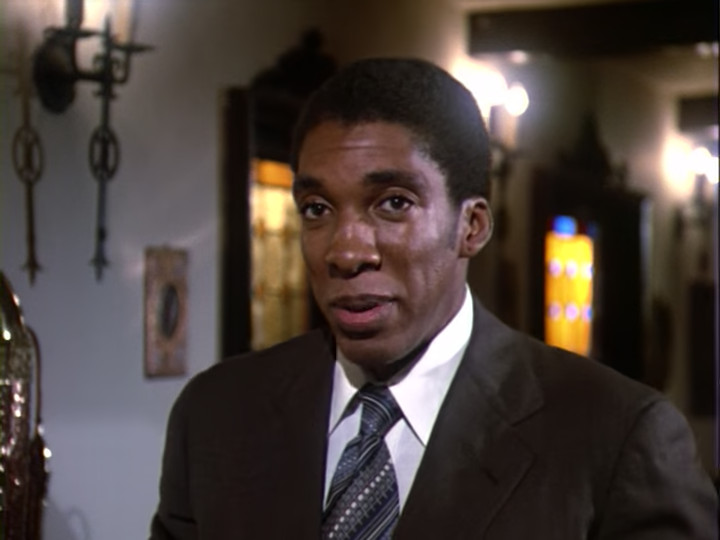
He appears to be a personal assistant to “Ben.” He’s got to get the coffee he’s holding to Ben while it’s still hot. Ben doesn’t like it when it’s not hot. (Eddie speaks in a halting and inarticulate way that suggests he’s got some kind of intellectual impairment.)
And then we meet Ben (Coleman), who’s giving an interview:

He’s in the middle of saying that there’s no denying that luck played a big part in his move to Vegas, but so did a lot of hard work. The woman sitting next to him is Lisa.
We then meet Dr. Aaron Kramer:

He’s Ben’s manager. And not too happy with something, though it’s not made clear what. If Lisa turns out to not be Ben’s wife, then it might be her.
Shortly after this, Jonathan comes up to the table and introduces Jessica to Ben and Aaron. There is small talk and the topic of the upcoming move to Las Vegas comes up. At the mention of this, two of Ben’s band-mates come up and angrily bring up the subject of whether they’re coming with him.

The guy on the right is named Eubie, the one on the left is Jimmy. Ben and Aaron try to avoid the subject, but eventually admit that they and another musician (Hec) are being dropped from the group in Vegas. Eubie feels betrayed. He spent sixteen years helping Ben and feels he’s owed gratitude. Instead, Ben insults him. When Eubie says that he aught to kill Ben, Ben insults him further, saying that he doesn’t even have the guts to do it.
I think we can tell who’s going to die in this episode.
Aaron promises the guys that he will take care of them—he’s got other groups. They leave, disappointed, but partially consoled.
Jonathan asks Aaron if this will interfere with the taping that night and Aaron assures them that it won’t—they’re all professionals and will fulfill their duties, whatever their private disappointments. He then invites Jessica to attend and Jonathan assures Aaron that she will.
Back stage, at the venue for the evening, if you can call it “that”back stage”, since the venue is a barn, we meet Callie.

She’s Ben’s wife. So it’s likely Aaron was indeed unhappy because Ben was fooling around with Lisa at the table earlier. Anyway, Eddie, Ben’s factotum, gives her a flower. Eddie, incidentally, speaks haltingly, and like he has some kind of mild mental impairment.
They discuss the latest news—she heard it from Eubie. Eddie is upset about Ben cheating on Callie.
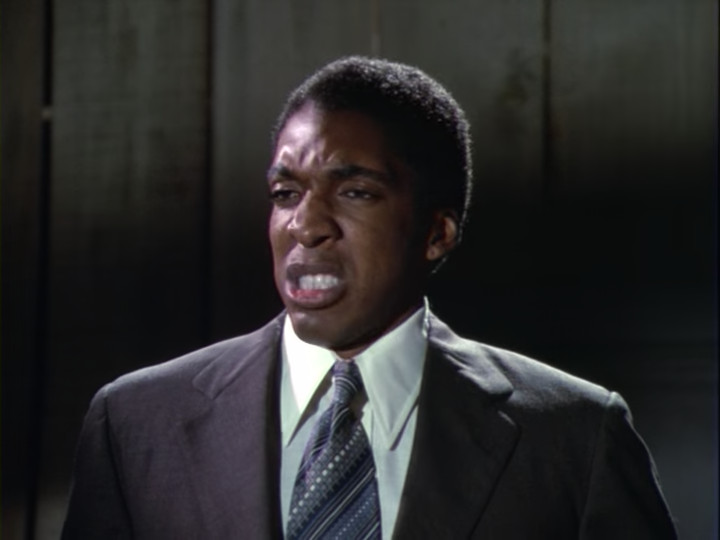
Callie takes it more in stride, though. “Ben’s latest? She won’t last longer than any of the others.”
Eddie says that sometimes he doesn’t like Ben much, and Callie says that sometimes she doesn’t either. But then adds, “but we can’t help loving him, can we?”
Jessica and Jonathan have come early and go backstage to visit Ben and Aaron. On their way, they hear the two men shouting at each other in an office. (The barn has been sub-divided to provide a few rooms.) Aaron leaves and runs into them, embarrassed. After some minor talk about this, Aaron shows them to their seats.
After they’re gone, Ben comes out of the office and runs into Callie. They have some ambiguous dialog where Callie tells Ben if he wants to be free all he has to do is say so and he says that it’s not that simple and she knows why. So, yeah, Ben is definitely not long for this episode.
We then get a minute or two of the concert itself, then, at the end, there’s a special song, where Ben plays a song from his famous mentor, “Sweetman” Buddy Brunson, using Brunson’s famous clarinet. (Until this point, Ben had been playing a saxophone.) A minute or so into this song, Ben collapses. A doctor who was in the audience rushes up and, after taking his pulse, pronounces him dead.
After a few reaction shots in which everyone expresses surprise and dismay, we fade to black and go to credits.
Had you been watching back in 1985, you might have seen a commercial like this:
When we come back from commercial, Jonathan tells Jessica, “it’s like something out of one of your books.” Jessica gravely replies, “As a matter of fact, it is.”
The doctor who pronounced him dead remarks that it’s a pity for someone so young to die of a “coronary,” but Jessica is having none of it. The drained color around his lips and feint blue on the moons of his fingers suggests that it was poison, which she’s sure an autopsy will show.
When the doctor says that he’s not conversant with poisons, Jessica says that it’s unlikely that he would be with this one—it’s a very deadly, fast acting, and rare poison. Jonathan recognizes the book of hers this featured in. It’s called, “Murder on the Amazon.”
When Callie hears the word “poison,” she slips the coffee cup that Ben drank from right before he started playing into her purse. A moment afterwards, the police arrive.
They’re led by Detective Lieutenant Simeon Kershaw.

He asks who called them in and the doctor introduces himself. It doesn’t really make sense for the doctor to have called the police since he would have been with the body and wouldn’t have known where the telephone was, but I suspect that this is just TV economy—saving the money of hiring another actor to be the person who called the police. The doctor mentions Jessica’s theory, and Lt. Kershaw is extremely offended that she offered an opinion without being a medical pathologist.
In the ensuing conversation, we find out that the poison is an obscure curare derivative. This is curious because curares (curare is a family of plant alkaloids) are ineffective orally and must be introduced intravenously. Hence their popularity for being used to tip arrows and blowgun darts for hunting. (It does you no good to kill your food with a poison that will kill you when you eat it.)
Anyway, he suspects Jessica of a publicity stunt and says that an autopsy costs time and money, and if the coroner doesn’t find anything, he’s going to charge her and Jonathan with obstructing a police investigation. “Do you still say poison?”
Jessica starts to reply, “In chapter 18…” but he cuts her off and says, “Ten O’Clock tomorrow. My office.” He then walks out of the barn. It’s a dramatic exit, but more than a little strange that he evinces no interest in investigating anything at the scene of the death.
An older man, named Carl Turnbull, then walks in and talks with Jonathan.
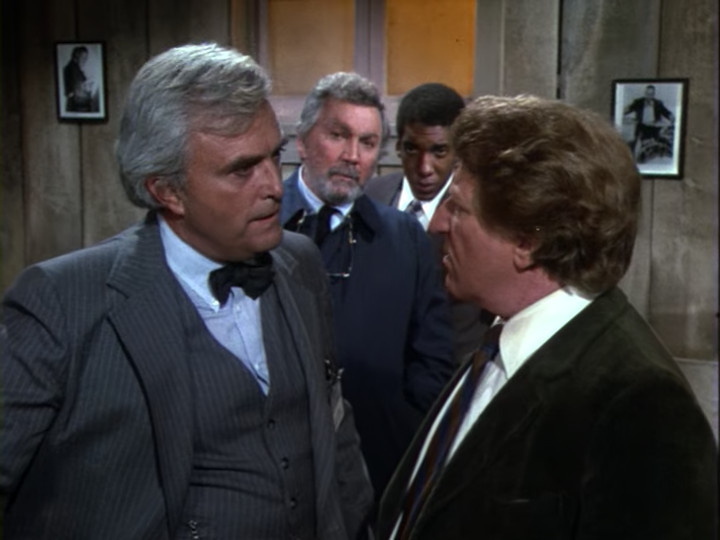
He demands to know why he had to get a call from the cameraman instead of Jonathan. They have less than an hour to get the tape edited for the 11:00 news. Jonathan will have none of showing the footage of Ben dying on the news and they agree to see the station manager to settle the dispute. Aaron offers to drive Jessica to her hotel while the two men hurriedly walk off.
We then cut to Jessica investigating where the cup had been.
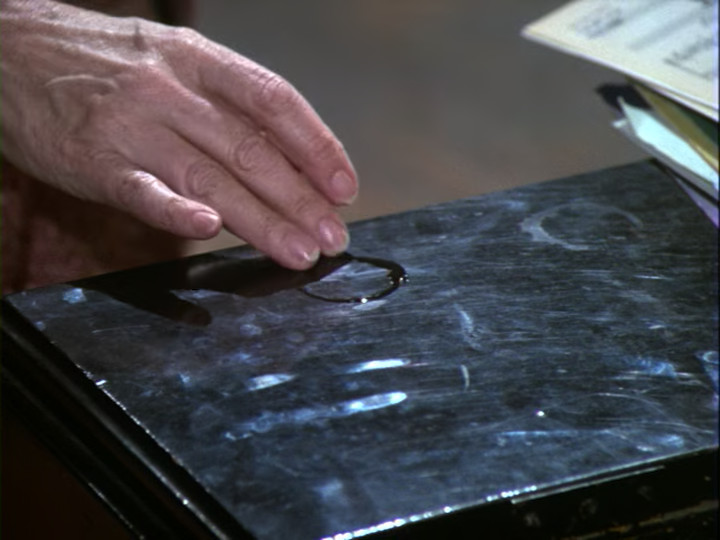
Aaron gives Jessica a ride, but they stop to have a “nightcap” since “sleep won’t come easily.”
At some restaurant they talk for a bit and Aaron explains that he wishes he could make music but can’t, all he can do is appreciate it, so he tries to help the various starving musicians make a little money, which is difficult because there are so many talented musicians in New Orleans. Many of his groups tour, as well as play locally. He lists them, and Jessica notes that Ben’s group just got back from playing in South America.
The next morning Jessica is in the Lt’s office where he plays her a tape of the 11 O’Clock news from last night where they showed the footage of Ben Coleman dying. The Lt. blames Jonathan for it, but he comes in and tells the Lt. that he (the Lieutenant) would have done well in the old west, being quick on the draw but none too bright. The station manager sided with Turnbull, so Jonathan quit.
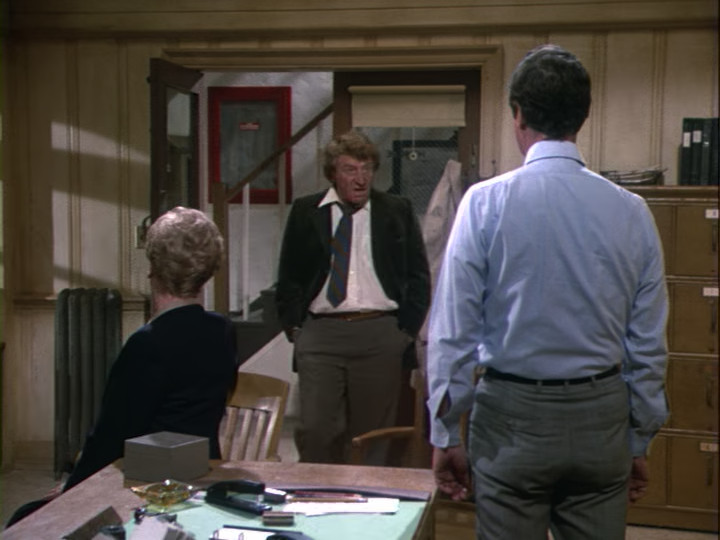
He doesn’t seem to have gotten much sleep last night either, and looks the worse for wear.
Lt. Kershaw apologizes to him. When Jonathan tells him that he’ll be making another mistake if he doesn’t listen to Jessica, Kershaw tells him to stuff it, as he had a long night too. He pulls out a copy of Murder on the Amazon and tosses it on his desk, explaining that he roused a bookstore owner from sleep to get it. He tells Jessica that it’s not half bad. And this morning when the coroner called to say “heart attack,” he told him to check the “inner lining of the liver” and, sure enough, it was just like in her book.
Jessica graciously accepts his apology.
Oddly, no mention is made of the fact that curare paralyzes the voluntary muscles, not the involuntary muscles, so victims die of asphyxiation, not heart failure. I guess this is a very derived derivative of curare.
Lt. Kershaw also mentions that Ben had traces of narcotics in his system. The Lt. isn’t surprised; when he first met Ben, Ben was a “two bit street punk.” He adds that they were tipped that one or two of the band members might have been doing some smuggling, but they could never catch them.
Lt. Kershaw also recounts the story of how, fourteen years ago when he was just a beat cop, he had Ben and his brother dead to rights in a liquor store holdup where the clerk was killed, but they couldn’t obtain a conviction because Callie—then Ben’s girlfriend—swore that they were with her at the time. He muses that the brother died in a street fight a couple years later, and now Ben got his.
Jessica wonders how the poison was introduced. She asks if any marks were found on the body and Lt. Kershaw ridicules the idea of a poisoned dart blown from a trumpet. Jonathan asks if it could have been in his coffee. Kershaw says that he thought of that but the cup is missing. Jessica then points out that three cameras were rolling, so perhaps the killer was caught on tape.
This leads us to the next scene, at the TV station, where Jessica, Lt. Kershaw, and Jonathan (plus an extra playing the equipment operator) review the tapes. As they go over it repeatedly, Jessica notices something.

During the clarinet performance, Callie takes a drink from Ben’s cup. Which clearly proves that the coffee couldn’t have been poisoned.
And on that bombshell, we fade to black and go to commercial.
When we come back, Jonathan suggests that maybe Callie didn’t actually drink the coffee, but was just faking it. Lt. Kershaw suggests that perhaps the poison was elsewhere. But if that was the case, Jessica asks, why did the coffee cup disappear?
At this point Turnbull shows up and asks what they’re doing there since Jonathan isn’t an employee of the station anymore. Then he notices Lt. Kershaw and changes his tune. Jessica then says that she was going to make public a theory she had about Ben Coleman’s death on Jonathan’s show, but since he doesn’t have a show anymore, she’ll have to go to a competing station.
Turnbull is alarmed at this and says that shouldn’t be necessary. He’s sure that Jonathan’s program can be easily reinstated. Jessica then wishes him a good day.
This is a very strange turn of events, given that Jonathan wasn’t fired, he quit out of principle. Jessica getting him his show back suggests that his principle of not being willing to work with people who would air the footage of Ben Coleman dying on camera no longer applies. If so, Jonathan has very short-lived principles and it’s doubly weird that Jessica initiated this move which relies on his principles being so short-lived.
Jessica then walks out as Turnbull assures her that it can be straightened out and begs her to not leave. On their way out, Kershaw asks Jessica what her theory is, and Jessica replies that she’s still working on the theory, but she found Turnbull so insufferable that she just had to say something.
Later that day, Jonathan calls her from a payphone to relay the latest news on the investigation. Kershaw is checking all the chewing gum he can find at the barn. He believes Callie poisoned Ben because Ben only bought three tickets for Las Vegas. One for himself, one for Eddie, and one for his new girlfriend. Kershaw believes that Callie was going to be dumped like the rest, found out, and killed Ben in revenge. Jessica is dubious, though. You can’t get rid of a woman who saved you from a murder charge in the same way you can get rid of a trumpet player.
Jonathan invites Jessica to go have lunch to celebrate his show being back on the air, which confirms that this wasn’t just a thing to tweak Turnbull, Jonathan’s principles really didn’t last a full day.
Jessica declines, though, because she needs to make good her boast to Turnbull about having a theory to make public. Accordingly, she goes and finds Lafayette the cab driver. She asks if he knows where Eubie, Jimmy, and Hec are. Lafayette, making good his boast about knowing New Orleans better than any man living, takes her right to them. They’re in a restaurant auditioning for a spot as the restaurant’s entertainment.
They’re none too happy to talk to Jessica, and when the subject of Aaron saying that he’d get them work comes up, they explain that Aaron is a terrible businessman and can’t really get anyone work. When Jessica says that he must have something going for him, since he managed to keep on going, Eubie suggests she keep that kind of talk to herself. She might get someone in trouble with it.
Jessica then runs into Aaron outside and relays the news that the audition didn’t go wonderfully. He offers to give Jessica a lift, but Lafayette butts in. When he refers to Aaron as “Mr Kramer,” Aaron asks, “Do I know you?” Lafayette responds that there’s no reason he should, but he knows all about Aaron. Jessica tells Lafayette it’s OK and accepts the ride from Aaron.
In the car, Jessica accuses Aaron of smuggling, and he confesses to it. He’s not much of a business manager, and smuggling was a way to keep things going during lean times—to put a few dollars into the pockets of musicians when they weren’t working. Jessica says that there is no excuse for smuggling drugs, but Aaron exclaims that it wasn’t drugs—drugs are what customs always looks for. His fight with Ben Coleman was actually about drugs; Ben brought some in on almost every trip and if he’d gotten caught, it would have ruined everything.
But he didn’t kill Ben. There was no point. It wasn’t going to last anyway; the way Ben was going he was probably going to burn out in less than a year.
Aaron is also certain that Callie didn’t kill Ben. She loved him and would have gone through hell for him. In fact, that’s what she’s been doing for the last sixteen years.
That night, at a wake for Ben (which is being held at the barn where he died—I assume because it saved on set costs), Eddie puts the clarinet in the casket with Ben.
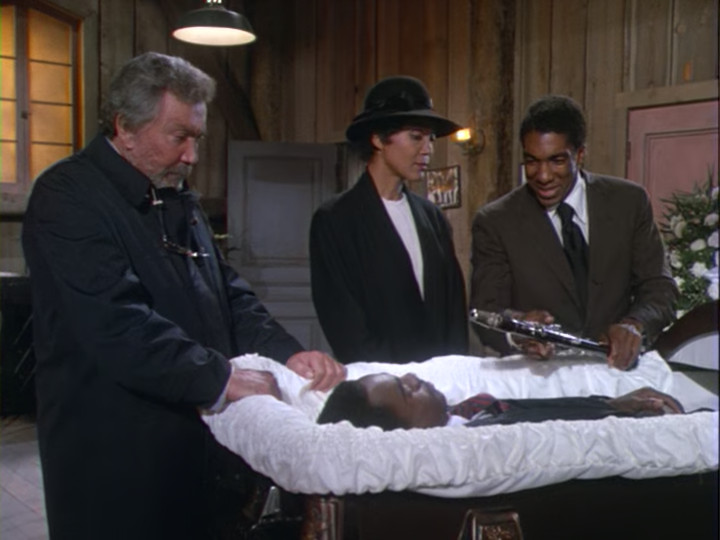
After he does this, Callie tells Eddie that it’s time to go, but Eddie doesn’t want to. Moments later, the police arrive and Aaron is arrested for smuggling. After Aaron is led away, Kershaw says that he figures Aaron killed Ben, too. He had motive and opportunity, and did it with the clarinet.
When he picks up the clarinet to collect it as evidence, Eddie gets deeply upset. He says that Ben told him to never let anyone touch it, and that Kershaw must put it back. Callie tries to calm him down but it doesn’t work; he’s inconsolable and uniformed officers are forced to restrain him.
When they drag Ben outside, Kershaw explains to Jessica and Jonathan.

It couldn’t have been the coffee, and they tested every spec of gum they could find and the poison wasn’t there, so there was only one other place it could have been: on the reed of the clarinet.
And on that bombshell, we fade to black and go to commercial.
When we come back from commercial, Jessica, Jonathan, and Lt. Kershaw are in Kershaw’s office. He lays out the case of Aaron being a smuggler, which Jessica doesn’t argue with since she knows that he is. But she still doesn’t see how that makes him a murder suspect.
Kershaw says that Aaron had a contract with Ben and Ben threatened to tell the authorities about the smuggling if Aaron didn’t let him out of it. When asked, Jonathan says that the Buddy Brunson tribute song (the one for which Ben switched to the clarinet) was Aaron’s idea.
Jessica counters that it wasn’t Aaron who smuggled in the poison, since at the time he didn’t know that he was going to be blackmailed. Her guess is that Ben Coleman was the one who smuggled in the poison. (Presumably to kill Callie, since he was planning to drop her but couldn’t leave her alive to take revenge by recanting Ben’s alibi for the convenience store murder.)
Then Kershaw gets a call from the lab. There was no trace of poison on the reed. There was nothing at all; it was absolutely clean. Kershaw is perplexed by this, as is Jessica. Why the lack of saliva doesn’t immediately indicate to them that the reed was changed out, I don’t know. Possibly because there’s still five minutes left in the episode, so it can’t end now.
The next scene is at the station where Jessica and Jonathan are going to tape the show. Turnbull shows up and says that the show is going to be aired live and he hopes Jessica is ready to deliver on her promise. I guess Turnbull has been repurposed as the station manager because that’s cheaper than hiring a another actor to play the station manager. Anyway, while Jonathan argues with Turnbull, Jessica watches a denture cleanser commercial being filmed.

(They’re showing off removing blueberry stains from dentures.)
Somehow, this commercial gives Jessica the crucial insight into how Ben was murdered. She then runs off and calls for a taxi. By coincidence, the taxi she hails is driven by Lafayette. When he asks where she wants to go, she says “Saint Charles Cemetery.”
At the cemetery the funeral is going on in New Orleans style.

The band is playing a lively version of When the Saints Go Marching In. They start marching off, and lead all of the mourners away except for Callie and Eddie.
Eddie is upset that Aaron let the police take the clarinet, and Jessica explains that Lt. Kershaw was only doing his duty. He thought that Aaron had killed Ben by poisoning the clarinet reed. Eddie says that he couldn’t have; only he and Ben were allowed to touch the clarinet. Jessica says that she knows.
Callie tries to get Eddie to leave, but Jessica tells her that she knows who killed Ben. Callie denies this, but Jessica doesn’t care and just explains. Callie took the coffee cup off of the piano. She did this, not because it was poisoned, but because it wasn’t. He was poisoned via the clarinet reed, but via the reed that was on the instrument when Ben played it, not the fresh reed that was replaced on the clarinet after the murder. (Jessica points out that Ben drank black coffee right before he played, so the reed should have been stained, but it wasn’t, proving the reed had been replaced.)
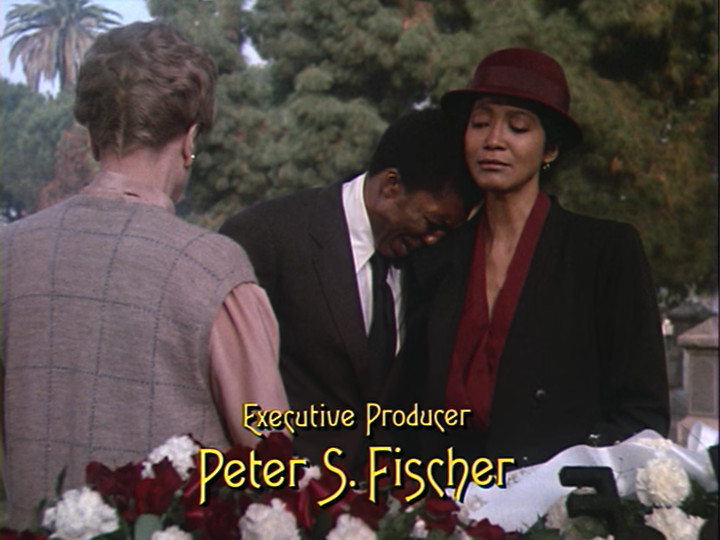
When Jessica gently tells Eddie that he replaced the reed to hide the poison, he confesses. Ben had always been a good friend to him. Ben wasn’t nice to many people, but he was never not-nice to Eddie. A long time ago, Ben, Eddie, and Ben’s brother did a real bad thing, and Callie told the police that they were with her. He and Ben loved her for it. But then Ben didn’t love her anymore. He wanted to leave Callie behind, but thought she would tell the police that she’d lied. He got the poison in South America to kill Callie so he could leave her without going to jail, and told Eddie about this plan. Eddie couldn’t let him do that to Callie. He told Ben Callie would never hurt them, but Ben wouldn’t believe him. When he told Callie about Ben’s plan, Callie didn’t believe him. So he didn’t see any other way to keep Ben from killing Callie except to kill Ben. He then says that Ben didn’t love Callie anymore, but he still did. He repeats the last part several times as he breaks down crying and puts his head on Callie’s shoulder.
And on that sad note, we go to credits.
This is an interesting episode which has a lot of strong points. The mystery features the always-fun plot element of the victim having been caught in his own trap, or at least killed because of his own plan to murder someone else. And it’s done well. Additionally, this episode has an interesting setting (mostly in terms of music) and several vivid characters.
One big issue to consider in this episode is the poison: as a rare south-American poison, it is allowed to have any properties that the author wants it to. This can be easily abused if the properties of the poison are revealed toward the end of the story, but it has no major fair-play implications if all of the properties of the poison are immediately identified, as they were in this episode. The only major consideration is that it turns the episode into fantasy, just as much as if the killer had used a ray-gun or a magic want to kill the victim. (Just as much, but far more plausibly, since there are, undoubtedly, a great many poisons that we don’t know about.) It’s also a bit annoying that the writers got the properties of curare wrong, though this could be worked around by having Eddie have known Ben had a cut in his mouth.
That said, the identification of the poison was a bit fraught. It’s extremely implausible that a poison which kills within a minute would have time to do anything detectable to the lining of the liver, since blood circulation stops at death. Also, what lining of the liver? The liver is a dense organ that processes the blood. It’s not a pouch that stores stuff on the inside that it would have a lining, like the stomach or intestines.
In any event, the major effect of the poison being an obscure South American poison is that it effectively limited the circle of suspects to the band plus Aaron, which was useful. It’s a little unfortunate that it just happens to be the same poison that Jessica wrote about in one of her books but the killer didn’t know this. It would have been more interesting if the killer had gotten the idea from Jessica.
There are several characters in this episode which are worth considering. Let’s start with Jonathan, who’s a very vivacious character but also a bit strange within the episode. He serves two main functions: on a technical level he’s the primary connector between Jessica and the mystery. That doesn’t, in itself, make him a compelling character, but his broad range of connections that enables this is played up; people who know everyone are often interesting because they’re rare and this form of social connection is a kind of power. He also adds energy because of his boundless enthusiasm for all of the culture of New Orleans. Much of a setting being powerful is about how the characters react to it; this is a bit like how it was said of Fred Astair and Ginger Rogers that she gave him sex appeal and he gave her class.
Lafayette is another fascinating character. He’s a character with far more ability than is required for the job he performs. The thing about that is that it’s very rare in efficient economies with a lot of job mobility as has existed in the United States to a great degree after the second world war. It’s not universal, so it’s possible to find someone who’s just hard up on his luck, but in post-war America while it’s not completely unbelievable it just doesn’t ring true. What you can have, though, is someone who is simply content with what he has and who works a job he doesn’t find stressful in order to pay the bills and give him as much time to spend in a way he enjoys as he likes. The actual economics of driving a cab are a bit iffy, here, but he is portrayed as someone who enjoys meeting people, so I think it works. And they do lean into this with his character; he has an easy-going manner and a marked enthusiasm for enjoying the simple pleasures of life.
Lt. Kershaw is a striking character. Police lieutenants are often one-note characters in Murder, She Wrote and he’s got far more depth than most. He takes Jessica seriously and is willing to admit when he’s wrong. He is not passive, though, and does real investigation for himself. While he certainly doesn’t carry the episode, giving the police character some depth gives the whole story far more depth. Several real characters playing against each other makes for a far richer story because it creates a lot of possibilities.
Aaron Kramer is also a curious character. I’m not sure exactly how far we’re supposed to take the things he says as reliable, but he at least portrays himself as a lover of Jazz music who will do almost anything to help out the artists he can’t help by being competent as a manager. That kind of love is interesting. They keep it from getting too dark by having him smuggle things to avoid taxes rather than smuggling harmful things such as drugs, and tax evasion is, certainly, a much nobler way to make money than are highly addictive drugs, but at the same time struggling musicians are, perhaps, a dubious cause. It is interesting that he ends up paying for this approach to supporting the music that he loves with what is likely to be a lengthy prison sentence.
Callie isn’t a major character in this story, but she is still interesting. We’re left wondering why she has such a profound devotion to Ben Coleman. We certainly didn’t see him as having any redeeming qualities. But we didn’t see a lot of him, which is why this works. Her devotion raises a question which his relatively little screen time leaves possible there’s an answer to.
Having described the many interesting characters, one unfortunate thing about this episode is that none of them get closure. We last saw Jonathan when Jessica left him right before his newly reinstated show was going to air live. We last saw Lt. Kershaw when he was arresting the wrong man. We last saw Aaron when he was arrested for smuggling and was falsely accused of murdering Ben. We last saw Lafayette when he drove Jessica to the cemetery and was still hopeful he’d get to give her a tour of New Orleans. In none of the cases does the last time we see the character feel like the last time. That’s not the end of the world, and it’s particularly forgivable in a Murder, She Wrote episode which crams quite a lot into 48 minutes of screen time.
I’m in two minds about Eddie being the murderer. I didn’t really like the character, since he had the kind of hollywood intellectual impairment which feels extremely fake. Like with Forest Gump, it’s a kind of affectation of speech rather than an actual intellectual state. Eddie’s limitations are whatever the authors want them to be in the moment. On the other hand, having the murderer be the victim’s devoted friend is very interesting when it’s done well, and it’s done reasonably well, here. Eddie’s devotion is given an explanation—Ben was never not nice to him, which might well count for a lot to someone who was often picked on because of his intellectual disability—as is his being willing to murder his friend. He just couldn’t let Ben murder Callie. And I do like the touch that they hinted at this when Jessica said she guessed that it was Ben who bought the poison.
Next week we’re going to the sea for My Johnny Lies Over the Ocean.

 Chris Lansdown
You must be logged in to post a comment.