Murder She Wrote: It’s A Dog’s Life

On the fourth day of November in the year of our Lord 1983, the fourth episode of Murder, She Wrote aired. Titled It’s a Dog’s Life, it’s set in Tennessee, or at least some Tennessee-like place. (Last week’s episode was Hooray for Homicide.)

mpv-shot0001

It’s set on a horse farm, specifically, as an establishing shot of horses frolicking on rolling fields, well… establishes. We also get an establishing shot of a grand house where I assume most of the action will take place.

mpv-shot0002

Though I am a mite suspicious, given this camera angle, that the house is not in fact all that big and is just wide but narrow. Not that it matters; uneducated actors play professors, so there’s no reason that houses can’t play mansions.

We then get an establishing shot of some stables which I believe are actually big and ominous music plays. A figure clad all in black, including wearing black gloves, sneaks up and feeds a horse named Sawdust some kind of pill.

mpv-shot0013

Sawdust eats it as ominous music plays.

When the horse has completely finished eating the pill, the camera cuts to inside the house and a string quartet is playing classic music as a large, expensive party takes place.

mpv-shot0003

There are so many servants that two maids just stand around. They’ve spent something like four different shots establishing that there is a lot of money here, so that will, presumably, be important.

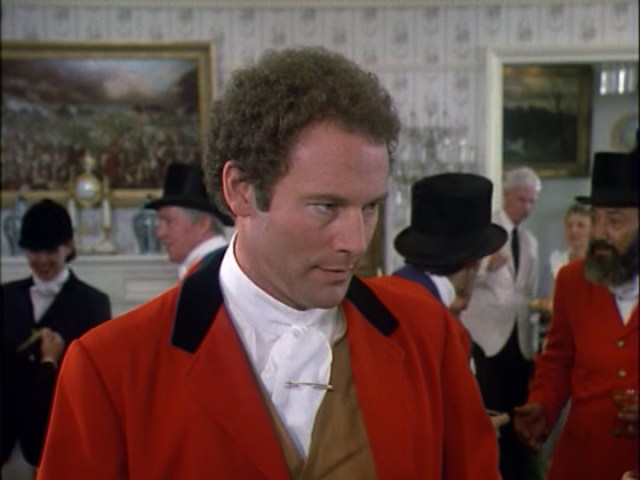
As the camera pans around we see that most of the people are in fox-hunting clothes. We then meet some characters. First is Trish and Anthony.
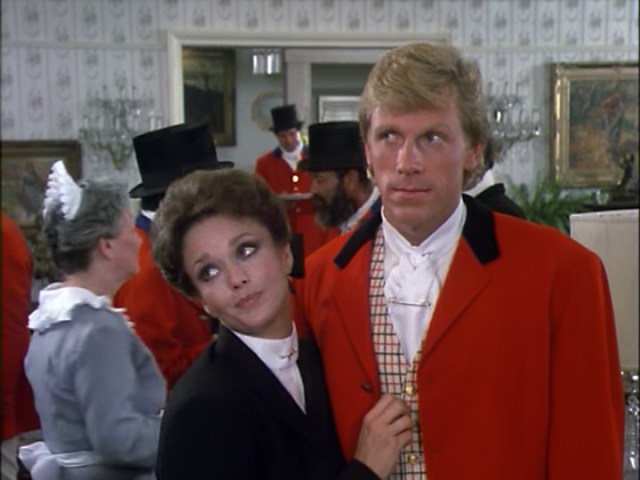
mpv-shot0005

Then comes in her brother, Spence.

mpv-shot0004

He tells Anthony that the family is sorry that his wife couldn’t make it.

Both Trish and Spence speak their lines like they hate each other, which is impressively poor manners in front of guests, especially for the South. We then get another relative who walks up and asks if they’re having a good fight.

mpv-shot0006

Her name is, apparently, “Echo,” or at least her nickname is. She’s Trish’s niece, not sure whether Spence is her father, but I can guess how much hair spray she uses a day. Boy is it ever the 80s. She and Trish are extremely catty at each other then Spence asks for peace, if not for his sake, than for the sake of his father. At this, Trish leaves.

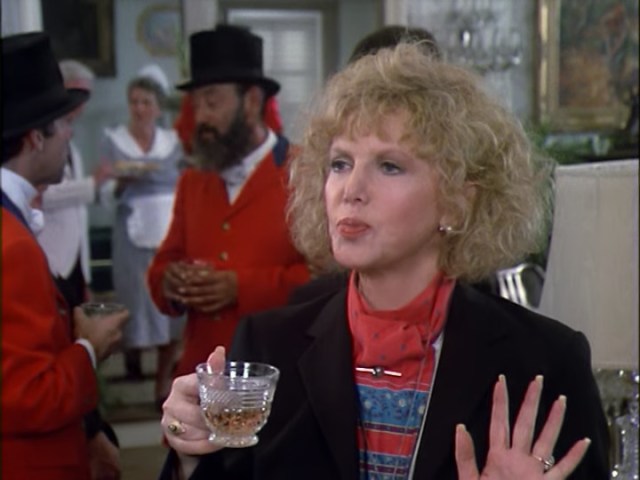
We then meet another of Spence’s sisters.
mpv-shot0007

Her name is Morgana, and she’s very fond of her astral projectionist. Spence is appropriately rude, by which I mean he makes a gratuitous and unnecessarily mean-spirited comment which is carefully calculated to accomplish nothing whatever, then he walks off.

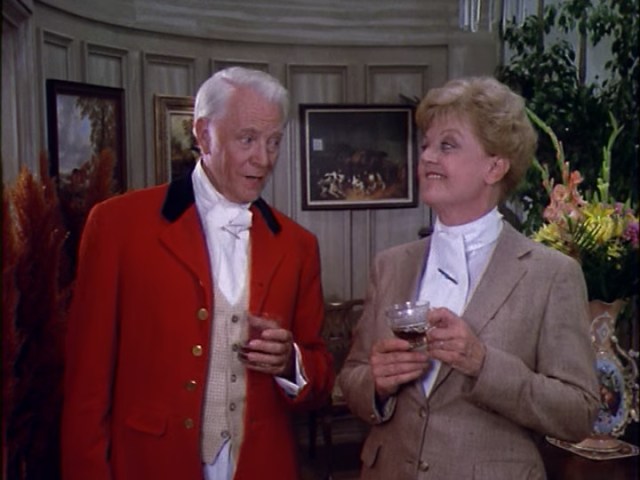
And then we come to the main characters.
mpv-shot0008

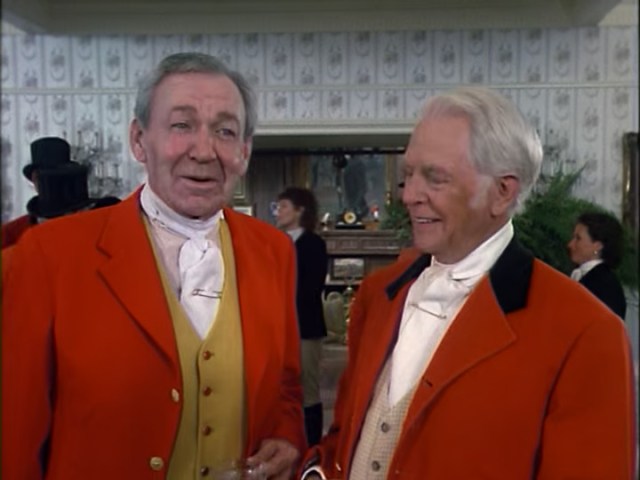
His name is Denton and he’s a famous lady’s man about whom Jessica has been warned. They move on and Denton introduces a friend of his—the owner of a nearby horse farm, and Denton’s old drinking buddy. His name is Tom Cassidy.
mpv-shot0009

His small talk explains why Jessica is here—she’s visiting her cousin, Abby, who works on Denton’s horse farm. It also comes up that he owns a neighboring 600 acres, which is described as small, though in a tongue-in-cheek way. Tom leaves to get Jessica a refill on her coffee, and we meet Jessica’s cousin.

mpv-shot0010

They make a little small talk; she tells Denton, in an English accent, to not be “an old lech.” Tom returns and interrupts the banter by saying “how about a toast?” Before he can propose one, though, Spence interrupts from across the room to say that a toast is a marvelous idea.

mpv-shot0011

I find the blocking of this shot interesting. The characters are in a line to be easily seen by the camera, but it makes no sense at all as a grouping of people who had been talking to each other, and not much more as a group of people who hate each other’s company and are standing next to each other in embarrassed silence for no reason.

He proposes a toast to his father, on his 80th birthday, and many more. Morgana adds a note of affection. Denton rudely takes no notice and merely looks about and asks, “where’s that damn dog of mine?” That damn dog of his is a beagle named Teddy, who comes running from across the house. Spence and his siblings look crestfallen. I guess we can see where Denton’s children got their bad manners from. Oddly, no one else in the crowd seems to have noticed any of this, despite everyone having spoken in a loud, clear voice, to be heard.

Then a man comes in and announces, Ladies and Gentlemen: to horse.

Outside as people are getting on, Trish walks up to her horse with a champagne glass in land, takes a sip, then throws the partially full glass on the ground and mounts her horse. Abby runs over, grabs the bridle, and says, “Trish, you shouldn’t be riding in your condition. It’s dangerous to the horse.”

Trish merely tells her to go away and kiss up to Father while she has the chance. “The day he goes, Honey, so do you.”

Denton calls out to Jessica and Abby, telling him that he’s picked out their horses for them. Jessica thinks that Sawdust is for her, but he tells her that Sawdust is only fit for him; he hasn’t broken out of a trot for years (the horse). He then presses a button and tells Barnes, a security guard, that they’re ready to go and he should open the gates. Barnes, who is sitting in a room filled with monitors and controls, obliged by pressing the Gate 1 button (there are four) which opens the main gates, which we can see on video camera from two different angles.

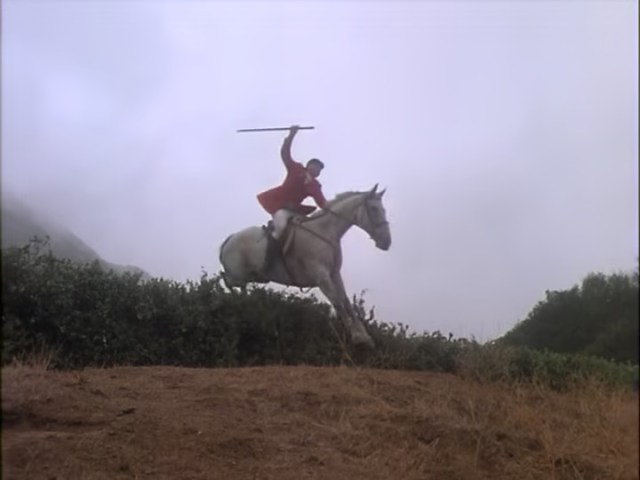
We then get scenes of the fox hunt over beautiful countryside with swelling music. At one point Denton tells Abby, who is riding next to him, to go on because it can’t be much fun to ride next to an old slowpoke like him. Right after he says this, Trish comes up right next to Denton spurring her horse into a gallop with loud cries, which alarms Sawdust, causing him to bolt. Denton tries to reign sawdust in, but to no effect. Sawdust eventually runs at a bench in front of a hedge and jumps over it. Denton does his best during this, shouting “Tally Ho!”
mpv-shot0012

The camera then cuts away during the landing.

Many people run up, deeply concerned, because this kind of thing can be easily fatal to an eighty year old man.

As, indeed, it proves to be. We cut to Denton lying dead on the ground and a moment later we screen wipe to a police deputy covering the corpse with his jacket.

After a bit of mourning, Jessica, Abby, and Tom go talk to the Sheriff, who says that it was a terrible accident but Denton led a full life. Jessica says that she thinks that Denton didn’t want to take the jump and Tom agrees, saying that Denton was under Doctor’s Orders to take it easy.

The vet is standing next to the Sheriff and Jessica asks if there’s a test he can perform on the horse. He understandably has no idea what Jessica is talking about, so Abby explains that a calm old horse like Sawdust doesn’t suddenly go wild. The Sheriff asks if Jessica is suggesting foul play and instead of answer we cut to Denton’s children getting into a police car (presumably to drive them home) and then we then cut to the cottage where Abby is staying.

Jessica is looking over papers saying to Abby, “I was so certain that there was something wrong with that horse. I feel so foolish. But, tests don’t lie.”

Abby asks, “Don’t they?” She points out that it was hours before they found the horse and there are drugs which leave no trace. Jessica acts like Abby is just being emotional, but of course she’s right. In fact, we know she’s right since we saw somebody give Sawdust a pill shortly before the hunt. This is an interesting choice, both in the showing us and in having Jessica act contrary to what we know to be true. She was wrong when she felt foolish, but we know that she’s now being foolish. Perhaps this is meant to make Jessica relatable by “not being too perfect”? Another possible explanation is putting the investigation on hold in order to get the episode to last the approximately 47 minutes it needs to.

Abby then goes on about what a great man Denton was, but underneath it all he was unhappy because of his selfish relatives.

Which brings up an uncomfortable issue: if Denton’s children are all awful, why didn’t he raise them better? I know that children are their own people and make their own decisions. Great sinners can be the children of great saints, and great saints can be the children of great sinners. That said, being raised well helps and being raised badly does make being a saint harder, and if all of a man’s children are terrible, it’s only fair to ask whether he raised them in a way that made being good, hard.

Anyway, there’s a bit of odd dialog which implies that Abby was in love with Denton and Jessica offers to stay with her for a few days. Abby asks her to stay until the will is read.

Which is necessary to keep Jessica around for the investigation, of course, but it’s really weird. Why would Abby be sticking around for the reading of the will?

We then cut to the day of the reading of the will, or maybe it’s the hour. The exact amount of time that’s passed isn’t specified, and all we get by way of that is an establishing shot of the front door with a black wreath on it.

Spence and Trish fight a bit, but they do establish that “Boswell,” presumably the family lawyer, is expected any minute. After some more bickering, he comes.
mpv-shot0014

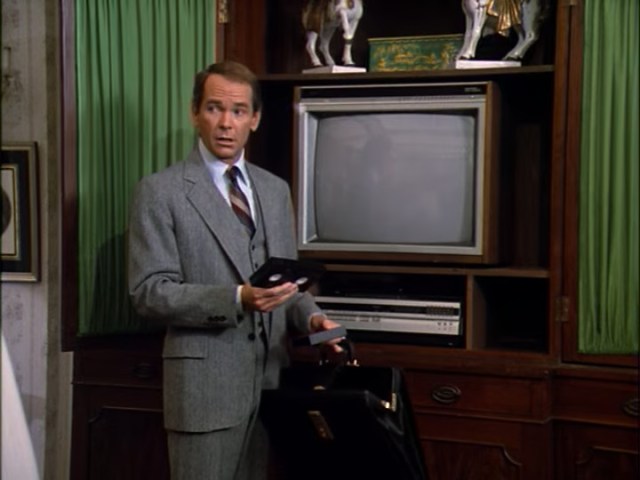
Denton’s will is done on video. This was quite a new technology in 1983. The first VHS player came to the United States in the summer of 1977 and they would become popular pretty quickly, but consumer video cameras that recorded onto VHS took longer. The first consumer ones actually came out in 1983. A rich man like Denton could afford to rent professional video equipment to make his will, but the thing would have felt very cutting edge at the time. Boswell describes it as “cutting edge will technology.”

Denton starts out by saying that it’s all legal as hell, so don’t get any ideas. This sets the tone. He then has a hate message for each of his children and grand daughter (it turns out that Morgana is Echo’s mother). That parting spite finished, he gets down to brass tacks.

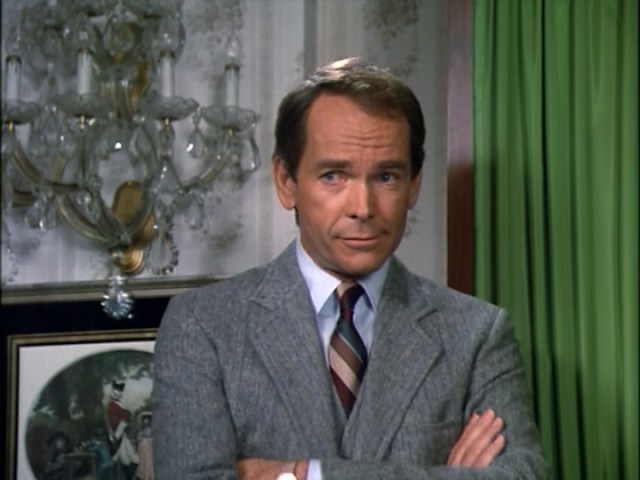
He gives a shotgun that Tom admired to Tom (his old drinking buddy) and there are cash gifts to each of the servants with something extra for the guard. All of the paintings in the house go to the national gallery. He then says, gleefully, “that’s right, Children, a fast three million in oils now on the way to Washington.” Bosley looks remarkably smug at this.
mpv-shot0015

There’s so much wrong here, but I don’t think that we’re supposed to notice.

Anyway, the rest of his estate comes to about fifteen millions dollars and, except for a modest family trust, goes to his dog, Teddy. Denton’s descendants are upset at this but Boswell assures them that they won’t be able to break the will and if Teddy dies of anything but natural causes, the entire fortune (including the family trust) goes to the SPCA.

And on that bombshell, we go to commercial break.

When we get back, Jessica is on the phone with Ethan, telling him she’ll be gone for a few more days, and adds that Abby is convinced that somebody murdered Denton. And Jessica is afraid that she just might be right.

We then move to a scene where Abby has a pointless fight with Trish, but it is at least established that Teddy is her employer and as such only Marcus Bosley can fire her, and she’s not going anywhere until she finds out who killed Denton.

Interestingly, Morgana warns Abby to be careful of Trish. She does it with some astrological mumbo jumbo, though, so Abby takes no notice. (I say mumbo jumbo because really doubt that the writers got the astrology right, quite apart from my belief that there is nothing to astrology.)

Then there’s yelling, a horse runs out, and Spence is in a horse stall defending himself from Teddy. The scene shifts to the vet examining Teddy and holding up a test tube of clear liquid and saying, “giving this stuff to a dog is like giving loco weed to a horse,” though when asked he didn’t find any in Sawdust. The vest asks who Teddy bit, since he found blood on his collar. The Sheriff then pulls up with a man in the passenger seat who identifies Teddy as his assailant.

mpv-shot0016

In the next scene Marcus Boswell is on the phone with Abby, telling her that Teddy has been released on his own recognizance and she can pick him up from the Sheriff at any time.

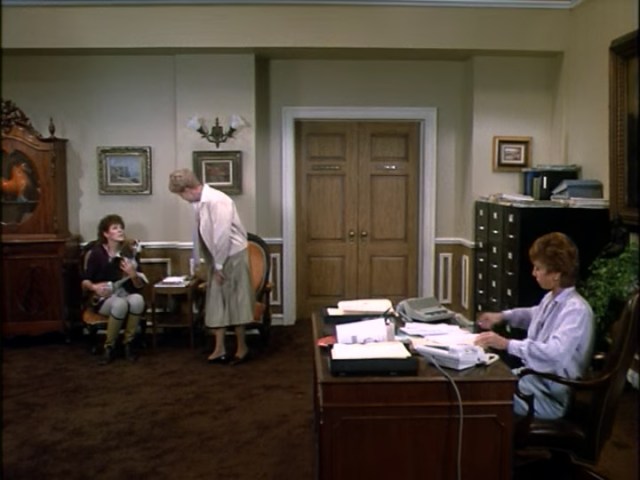
Jessica and Abby talk about the situation and Jessica thinks that they need to talk to Marcus to get more information. The shot of them waiting in his office is interesting, especially with how large and posh the office is.
mpv-shot0017

To drive the point home, Jessica remarks that Marcus has done very well working for the Langley estate.

After a minute, Marcus and another lawyer come out. The lawyer says that he could drive a freight train through “that loophole” and Marcus replies that his clients need to consider the costs; it could be a long and bloody battle. Then Morgana walks out of Marcus’ office and says goodbye.

To highlight just how much of a suspect Marcus is, as Jessica and Abby enter the office, his secretary tells him, in an exasperated tone, that it’s his broker and it’s the third time he’s called today. That could, of course, mean anything—and in real life would most likely mean that the broker was trying very hard to sell something to Marcus. In Murder, She Wrote, though, it almost certainly means that Marcus is in financial trouble.

Marcus’ office is even more impressive than his waiting room:

mpv-shot0018

They get down to business. Jessica asks about whether the man who Teddy bit has filed a lawsuit and Marcus says that while he’s made noises, he hasn’t yet and Marcus intends to head him off (whatever that means). They then switch subjects to the will, and the fancy lawyer’s supposed loophole is the question of “sound mind.” Not Denton’s mind, but the dog’s. If a court rules Teddy mentally incompetent…

He doesn’t finish his sentence and I can’t imagine what the end of it might be. You don’t need to be of sound mind to inherit under a will. If Teddy was ruled not of sound mind, he’d require a guardian appointed for him. But he’s a dog, so he needs a guardian anyway. This could only be an issue of the dog literally, rather than figuratively, inherited the money. But that would be nonsense. Animals can’t own property. I assumed that what Denton meant was that a trust was set up with Marcus as the administrator for the benefit of Teddy. That would certainly be, in colloquial English, Teddy inheriting, but it would make legal sense and the fact that Teddy requires a guardian would be irrelevant. I can’t believe that the episode is trying to claim that a dog has literally inherited money and land. You don’t need a loophole, that would be simply impossible. You can only give your property, in your will, to some kind of legal entity capable of owning it. (It can be a fictional person, as in the case of giving it to a corporation, but it has to be some kind of legal person.) I wouldn’t bring this up except that they’re actually making a plot point of it having been done in an impossible way.

Anyway, Marcus says that Denton’s descendants won’t win, but it might take long years and a lot of legal feels to win the battle. He leaves off how much this would benefit him and also explain away the missing money he’d embezzled. (I’m just guessing about that last part, of course.)

He’s interrupted by yet another call from his broker, who insists on speaking to him. Why his secretary seems to work for the broker and not for her employer is not explained. Anyway, he takes the call and after some embarrassing half-phrases, he promises his broker that he’ll send a check today and even put a stamp on the envelope this time.

After hanging up, Marcus tells the women to never, ever buy stock touted by Spencer Langley. His only consolation is that Spencer bought more of it than Marcus did.

This can, in no way, explain why his broker needs a check. No matter how badly a stock does, you’ve paid all of the money when you bought it and can only recoup some money, even if far less, after its sale. Between the purchase and the sale, you do not use money for anything. The only possible way for stock transactions to need cash quickly is if you sold futures and need to buy the stock to cover the future. There’s no way that’s what happened, though.

Jessica only picks up that Spencer is in debt, and Marcus replies, “right up to his Adam’s apple.”

This is not even slightly how stocks work. The only way for a stock doing badly to sink you into debt is… well, there is no direct way. You simply have to take on the debt separately. But you can take on debt in order to buy stock, which you intend to pay off and get profits from when you sell the stock at a higher price. But in that case it would be your banker, not your broker, who is calling you demanding money.

I’m really not sure which is more ridiculous: a dog literally inheriting property or a broker calling demanding money because a stock you bought is doing badly.

Oh well.

We then get a shot of the moon at night to establish that it’s nighttime. Since all pictures of the moon are basically the same, I’ll use one that I took instead of a screenshot. It’s not exactly the same, but you get the idea, and I only use screenshots when they’re necessary for my commentary on the episode:

wp-1709233371763672911081908387795

We then cut to Barnes, the security guard, sitting in front of his collection of monitors. I wonder if the idea is that he lives here in the cave of security cameras on twenty four hour duty. No wonder he got something extra from Denton’s will.

He then hears a sound and the door and goes to open it. It’s Teddy. Barnes says something about “like clockwork,” implying that Teddy always comes to be with Barnes at this time. “I guess you know you’re safe in here,” Barnes explains.

He then notices Trish’s car pulled up to the front gate. He comments that she shouldn’t be allowed to drive. On the security camera she stumbles out of her car and buzzes for Barnes to open the gate. He presses the button and as the gate begins to open she falls down with her head between the gates that just opened.

Barnes puts Teddy down saying that he needs to go check that she’s OK. He leaves, with Teddy remaining behind on his chair.

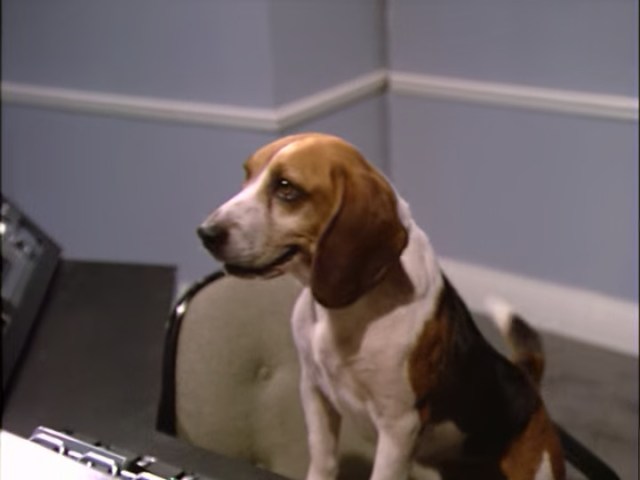
When Barnes gets near, the gates start to close. Barnes runs to try to save her but he’s too late. The gates crush her head (off camera, of course). We then cut back to Teddy in the guard room, partially standing on the console, wagging his tail.
mpv-shot0019

And on that bombshell, we go to commercial break. (I think that the implication is that Teddy pressed the button and killed Trish.)

When we get back from commercial break, we’re outside by the gate while a bunch of police cars are in the area, presumably investigating. Inside the guard room, someone is dusting for fingerprints on the gate button.

Then in a large room with the Sheriff and the family gathered, Morgana says that she saw her sister’s ghost rising from her earthly form and crying like a morning dove. We get some other backstory about her aura thriving on moonlight and such-like, but we also learn that her bedroom has the only clear view of the gate, and she looked out because she heard a car’s horn.

The doorbell rings and it’s Marcus. He’s come as soon as he heard, for some reason.

Then the Sheriff’s deputy comes in and tells him that they found a print on the gate button, but not a fingerprint—a paw print.

Given that they found it by dusting, blowing away the dust and then using tape to pick up the dust which remained after being blown away, I guess we’re supposed to believe that the digital pads on a dog’s paws leave oil residue? I can’t easily find out whether dogs even have oil pores in their digital pads (they do have sweat pores) but my experience of dog feet is that they are very, very dry. I really doubt that they have sufficient skin oil as to leave enough residue to be able to lift a paw print. It’s not impossible, so far as I know, but it’s still a bit… far fetched. And even so would leave entirely open the possibility that someone used Teddy’s paw to press the gate button so as to leave no fingerprints. It can’t be supposed that Teddy understood that pressing the button would hurt Trish as a human could.

Anyway, there’s some arguing and bickering over how this gets rid of the will—I guess everyone has forgotten that if Teddy dies of anything but natural causes, all of Denton’s money goes to the SPCA. Though I don’t see how that would come into play since the dog would likely just be put into prison for life—even if he got sentenced to death, it takes so long to work through the appeals and so on that he would die of natural causes anyway.

I can’t believe I’m actually thinking that through. Why is this episode demanding that we take a dog seriously as a human being?

Anyway, Marcus shouts, “Sheriff, you cannot possibly believe that a dog is capable of murder!” At that, Abby says, “of course not. He’d have to be trained.” Then everyone stairs at her since she’s an animal trainer.

The scene shifts to Jessica going down to the front gate. She runs into Tom driving up in an old blue pickup truck. He asks how the family is doing then says he came as soon as he heard on the police band on his CB radio. He then drives on up to see what he can do to help.

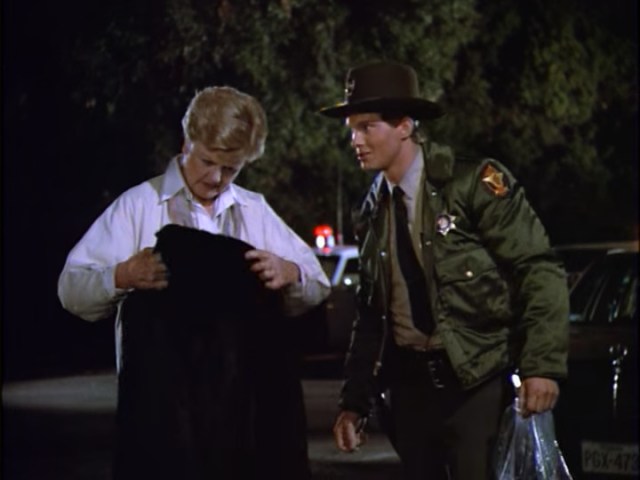
Jessica wanders on down and meets Will, who’s trying to get the victim’s coat into a large plastic bag. Jessica offers to help and examines the coat in the process. Will gratefully accepts the help because he feels that the coat requires a “lady’s touch” to fold.
mpv-shot0020

As you can see, the deputy is a young man and Jessica comes on with a matronly tone. This part actually feels quite realistic. Also, Jessica’s examination shows that the coat is quite new but the seams are split, just like her “car coat.”

After a bit of small talk, Jessica then walks around, examining the ground. After that she goes and interviews Barnes in the security room.

He left Teddy alone and the door automatically locks when it’s closed. He’s got the only key, and Teddy was left alone in the room. When he asks Jessica if she really thinks that Teddy pushed the button, she replies that she’s quite sure of it. She asks if he heard anything unusual while he was on his way to the gate and he replies no, just the usual. Crickets and a night bird calling.

She then asks the way to Morgana’s room.
mpv-shot0021

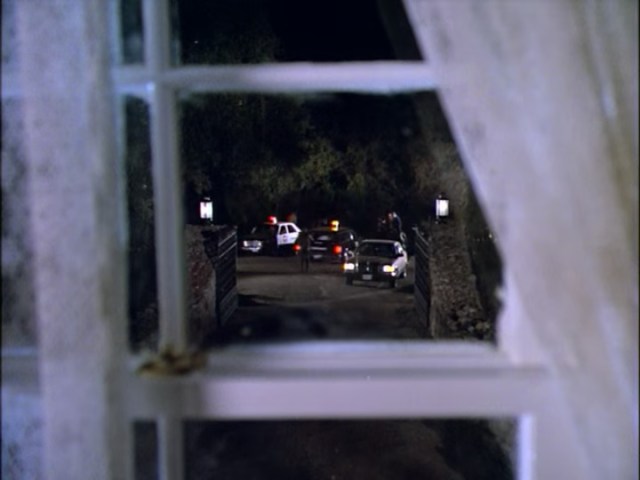
Morgana’s room does, indeed, have a decent view of the gate. While Jessica is looking, we also hear some music which suggests that this is an important clue.

Jessica then joins Abby in the kitchen for tea. (When stressed, the English always go for tea.) When Marcus comes in to fetch ice because everyone in the main room needs a drink, Jessica notices that he has a nasty grease mark on his trousers. It’s important to the plot because we get the kind of closeup necessary in 1980s televsion to make sure we can see the clue even if there’s interference in the signal.
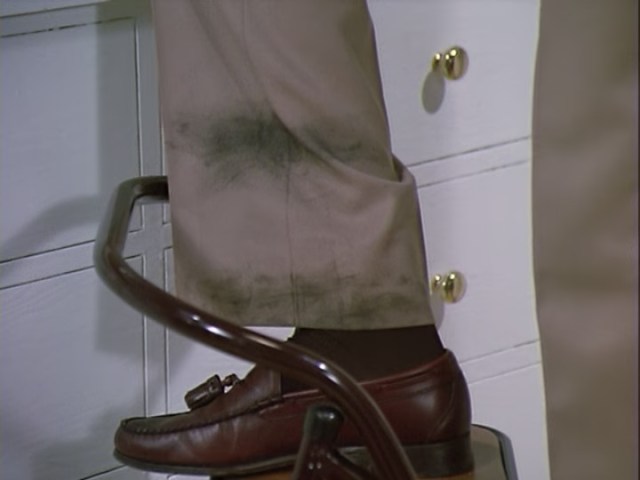
mpv-shot0022

He says that he had a flat tire on the way over and he supposed that he got some grease off of the jack. A jack is a device for lifting the car up so that one can put the wheel on and take it off, which a human could not possibly do if the weight of the car is still on the tire. They look something like this:

(Not shown is a bar that goes through the hole and is used to give the mechanical advantage necessary to turn the screw.)

There is no realistic way those grease marks came from a jack. Given that this episode has several impossible things already, I’d have figured that this was yet one more unrealistic thing, but the fact that they gave us a close-up suggests that it’s meant to be a clue and not a plot hole.

Jessica then asks where he got it and how long he stopped. He figured about half a mile away and he stopped for about twenty minutes. Jessica asks if that means that anyone who left the house would have had to pass by him.

Marcus says that Jessica is right, but that no one passed by him. Abby says that that means that the killer had to be someone in the house, and Marcus concurs.

After he leaves, Jessica asks Abby how one would go about training a dog to press a button. The answer is endless repetition, and the command could be anything. A voice, snapping your fingers, a whistle—at that Jessica perks up. A whistle was just the kind of thing she had in mind.

Some bickering later, Jessica is forced to explain her theory to everyone, including the Sheriff. Basically, it’s that someone impersonated Trish—whoever got out of the car never spoke on the intercom. At this point Trish was inside the car. After a minute the person impersonating Trish got up, dragged Trish (who was drunk or unconscious) to the spot where her head was in the way of the gate, then gave Teddy the signal over the intercom.

The Sheriff then asks if a whistle like the one he’s holding would do it. When Jessica says that it’s possible, the Sheriff asks if anyone in the house has the initials A.B.F. and Abby replies “Abigail Benton Freestone.” The Sheriff adds that they found the whistle down by the driveway.

The scene then shifts to the Sheriff’s office, where both Abby and Teddy are in jail.

I really don’t know what, if anything, we’re expected to take seriously anymore.

We cut from Abby bemoaning her fate to Teddy to Jessica being angry at the Sheriff. After she insults him and complains at him, he says that the inquest is on Friday and until then Teddy is going to be held as an accessory after the fact. Which is not what he would be. An accessory after the fact is somebody who did not take part in the crime but did take part in trying to help the person who committed the crime to evade justice. Even if you ignore the fact that Teddy is a dog, that’s not what he did. He took part in the commission of the crime, which would make him an plain old accessory. At this point I’m starting to wonder if they’re just getting things wrong on purpose. I guess we should count our blessings that on the fox hunt they rode the horses and followed the hounds, rather than riding the hounds and having the horses follow the scent trail.

In the next scene Jessica is given a lift back to the house by Marcus. She has him drop her off about a half mile away from the house, saying that she needs some exercise. He drives off and she looks at his tire tracks.

mpv-shot0023

I’m going to guess that the issue is that both tires are bald, or else both tires are the same size, meaning that Marcus did not, in fact, have a flat tire recently. It’s a bit of a problem for this clue to show us that because we’re only seeing the marks of two tires (kind of next to each other, from when the car was turning slightly to get back onto the road). The flat could have been on the other side of the car, which stayed on the road and whose tracks we don’t see. Marcus never said which tire went flat. However, the fact that they’re showing this to us pretty much means that the flat tire had to be disproved. Things are not looking good for Marcus; we’ve had two close-ups on clues related to him.

As Jessica is looking around, the nice young deputy Will shows up and asks her what’s up. He asks if she’s looking for something and she said just a hunch. She asks if he has one of the Sheriff’s new metal detectors and he says that he can get it. She’s looking for a bicycle clip. A plain, ordinary bicycle clip. He doesn’t know what she means and she says that he’ll know it when he sees it.

Later on Jessica is mounted on a horse when Echo comes up. She asks where Jessica is going, and she says that she’s going to see a man about a dog bite. (Jessica asks about Spencer, whose horse is missing.)

We cut to Potts operating a chainsaw while his arm bandage is on a shotgun. Jessica rides up the horse then sneaks up and steals Potts’ arm bandage. When she gets back to her horse it’s actually Spencer’s horse, he took the liberty of putting her horse in the stable. He then calls Potts.

Potts and Spencer interrogate Jessica at gunpoint. Potts is in favor of killing her and hiding the body, but she talks him out of it, saying that his little scheme of fraud will hardly be noticed once she reveals who killed Trish. There’s a bit of bickering, but then we cut to a court house. Well, some kind of building in which court is in session. It feels more like a gymnasium.

mpv-shot0024

I’m not sure what it’s supposed to actually be. When the deputy brings in a speaker on a long wire, the judge—or whoever he is—asks what’s going on and Jessica says that this is part of her presentation. I suppose that this is actually supposed to be an inquest, and I must confess that I need to do more research on them to get a sense of whether this set makes any sense. It doesn’t feel like it, and from the rest of this episode I would guess that it doesn’t.

The judge indicates that the proceeding is going to begin with Mrs. Fletcher acting as an amicus curiae. He then says that, for the yahoos in the back, that’s a friend of the court.

Jessica get up, makes an introductory remark, and then says that to keep this short she’s only going to call one witness: Teddy.

Sure. Whatever. I don’t see any way to care at this point that an Amicus Curiae presenter (they’re more normally written briefs, but this is TV) would have no right to call witnesses. She’s calling a dog as a witness and everyone is OK with it, so I guess we’re just in clown world.

Teddy is carried in by a deputy and put in the chair next to the small table. Jessica then has the deputy blow on the whistle that was found by the gate. No one hears it but Teddy because it’s an ultrasonic whistle. She then has the deputy go into the other room and blow the whistle over the speaker. After he says that he blue the whistle, Jessica notes that Teddy didn’t react, because the whistle is above the range of the speaker. She actually says “any loudspeaker” which is probably wrong, but it probably would be above the range of a speaker system used in a security system, even back in the 1980s when they were all analog. (Most modern digital systems have a hard cutoff at either 22.05 or 24KHz, while according to Wikipedia most dog whistles are in the 23-54KHz range, so for most dog whistles it would be impossible to record or transmit them over normal digital systems. I only bring this up because it relates to adapting this kind of idea to modern stories.)

Jessica then explains that it was Marcus—he desperately needed the money years of litigation would bring him. He persuaded Trish to drug Denton’s horse by lying to her about whether she would inherit under Denton’s will. Trish was, of course, furious when she found out the truth, but he had prepared for this and trained Teddy long in advance.

She then starts interrogating him. Does he own a bicycle, does he ride out by the Langley manor, etc. When he denies having ridden by the Langley manner on the night of Trish’s death, Jessica then confronts him with the bicycle clip. While he quite reasonably points out that the bicycle clip could have belonged to anyone, she counters with her observation of the characteristic grease stains of a bicycle chain being on his pants that night. When he claims it came from changing a tire as he said that night, she counters that all four of his tires had identical tread, while a spare tire should have had deep, new tread. She then suggests settling the matter by looking in his trunk.

Before he can answer, she calls out to Will to “go ahead, please” and places the gate button next to Teddy. When a mockingbird whistle plays over the loudspeaker, Teddy presses the button several times, then goes over to Marcus and looks to him for a treat.

mpv-shot0025

Jessica in fact asks him, “why don’t you feed him his treat? Just like you did when you trained him to help you murder Trish.” Marcus looks around and seeing no way out sinks into a chair, crying, his face in his hands.

Back at the Langley manner Jessica and Abby are talking. Abby confesses that she doesn’t understand why Marcus did it and Jessica points out the obvious that he would have found a hundred ways to bleed off as much money as he needed from Teddy.

Then Tom drives up and takes Teddy, while Abby and Jessica say that Teddy will be very happy in his new home. After a bit of small talk in which he promises to do absolutely nothing for Denton’s children, he drives off with Teddy in the back of his pickup truck and we go to credits.

mpv-shot0027

What an episode.

I have no idea what to make of this—is it supposed to be a parody? It’s early enough in the first season that they may well have tried several different kinds of episodes to see what felt right or hit it off with fans. If this wasn’t meant to be a campy parody-type episode, a lá the 1960s Batman series starring Adam West, then this was a really stupid episode. If it was supposed to be a campy parody, it wasn’t very funny.

I really don’t know what to say about it.

If we ignore all of the asinine stuff about the dog actually inheriting the money directly, being charged with murder, etc. we do have the skeleton of a decent murder mystery. The family lawyer needed money and convinced one of the millionaire’s heirs to murder him, then when she found out she wasn’t inheriting, he murdered her. That’s pretty solid. Training a dog to do it isn’t wonderful, but it does have a bit of a golden-age “clever twist” feel to it.

Unfortunately, the dog training doesn’t really make sense in this story. For one thing, how on earth did Boswell train Toby to scratch on the door every night? He’d have to be there to do it, and are we really to believe that the security guard didn’t notice Boswell there giving Toby treats every time he scratched on the door? For another, dog training isn’t a context-independent thing. When you train a dog to a command in a place, it mostly only responds to the command in that place. This is why police dogs get trained to a command in about twenty different contexts—that’s what’s necessary to get them to respond to a command in any context. And the specificity of pressing a specific button out of a collection of buttons—that’s doable, but it would basically require training Toby in the security guard’s office. All of which might possibly be a stretch of the imagination if Boswell lived on the grounds and had constant access to the contexts necessary to train Toby. As somebody who did not have regular access either to Toby or to the grounds? That’s just not how dog training works.

Of course, I don’t know why I’m bothering with that because this is an episode where a dog inherits money and is arrested for murder.

Ultimately, I’m inclined to write this episode off as an early episode where the writers hadn’t decided on the tone for Murder, She Wrote yet. It had some nice visuals and the hint of a decent mystery, but if this was what Murder, She Wrote was generally like, well, I don’t think I’d be writing these reviews, forty years later.

Next week we go to Virginia for Lovers and Other Killers.

Travelin’ Man

There’s a song by Ricky Nelson which was on a mix tape that my mother used to play for me when I was a child. Called Travelin’ Man, it’s got fairly simple lyrics but it’s an interesting song:

In case you don’t have time to listen, here are the lyrics:

I’m a travelin’ man and I’ve made a lot of stops
All over the world
And in every port I own the heart
Of at least one lovely girl

I’ve a pretty señorita waiting for me
Down in old Mexico
If you’re ever in Alaska stop and see
My cute little Eskimo

Oh, my sweet Fraulein down in Berlin town
Makes my heart start to yearn
And my China doll down in old Hong Kong
Waits for my return

Pretty Polynesian baby over the sea
I remember the night
When we walked in the sands of the Waikiki
And I held you, oh so tight

(It repeats the last two verses and then has a coda where he repeats that he’s a travelin’ man, whoa a travelin’ man, etc.)

Ricky’s performance is interesting, as he imbues the vocals with a tinge of boasting and a tinge of sadness which seems very appropriate. The boasting is appropriate to the natural virtue of being attractive. The sadness is appropriate to the moral vice of being deceptive and unfaithful.

The character in the song is going to greatly disappoint all but one of these women, and since they’re waiting for him they’re not just going to be disappointed, they’re going to waste possible years of their life in finding their real vocation. This could easily result in not having as many children or not getting as good a father for their children as they could.

And in practice, we know that he’s going to disappoint all of them, of course, because he’s not the kind of man to make a good husband to anyone.

All of this does serve as an interesting kind of observation on just how powerful romantic attraction can be. It’s often easier, in art, to highlight the magnitude of something by illustrating how terrible it can be, rather than how great it can be, and this song makes subtle use of that.

The World’s Fastest Indian

The Critical Drinker recently put an interesting review of a movie his Dad recommended to him twenty years ago and he finally watched a few weeks ago:

Indian, here, refers to an Indian brand motorcycle. If you didn’t watch the review I linked above, the tl;dw is that it’s the story of Burt Monro who is a New Zealand retired farmer, motorcycle salesman, farmer, and motorcycle racer (he did various things to earn his living) who now, in his sixties, spends much of his time tinkering on his old Indian motorcycle. He dreams of traveling to the Bonneville salt flats and setting a world record, eventually saves up barely enough money to try, goes, and eventually succeeds. (It’s based on a true story.)

In the Drinker’s review, there’s an interesting quote (salty language warning):

The story of a little guy with big dreams given a once-in-a-lifetime shot at glory is the stuff of cinema legend at this point and it’s been done so many times that it’s easy to become cynical about movies like World’s Fastest Indian. What, prey tell, is the angle? You might ask. What makes it stand out from the crowd? How does it subvert the tropes of the genre? The answer, quite simply, is that it doesn’t. And fuck you for asking. Because it doesn’t need to. Because not every movie needs to reinvent the wheel just to get your attention.

This is an interesting point. I think that this is related to the difference between watching movies as a reviewer and watching them as an ordinary human being. Reviewers watch a ton of movies, and moreover they watch them with an eye to evaluating them. That is, they watch the movies for the sake of the movies. Ordinary human beings watch movies for entertainment or enjoyment or to witness art—in short, as a means to something else. We watch movies for the sake of humor, or to have pretend friends for a few hours, to be inspired, to be reminded that happiness is possible, to consider human sadness, for the thrill of romance or the romance of adventure—whatever it is, we watch movies for the things that they depict. If what we want is to be inspired by seeing a man defy the world for the sake of something nobler or even if we just want to see a proud man humbled by being hit in the balls, the things that we want are timeless. Different movies will bring out different aspects of these timeless things, and some will do them better than others. Variation helps us because at times we need different help in contemplating the timeless truths, whether they’re big or small. But the variation is only helpful because the help we need in contemplating the timeless things varies. The variation is not good in itself and variation from what we need at the moment is anti-helpful.

A man who has watched a thousand movies about two a man and a woman falling in love may be desperate to be reminded that there is humor in a man being hit in the crotch with a baseball, but very few of us watch a thousand movies about two people falling in love. We watch however many we need to be reminded of what we wanted to remember, then we get on with life.

So the Critical Drinker is right. Movies don’t need to surprise people who are tired of their genre to be good. They just need to be good at their genre. If a genre has gotten less popular, that means that there will be fewer people who are interested in it, but that’s OK. Sometimes you have to wait twenty years until you’re in the mood for it a movie. The nice thing about movies is that they’ll still be there when you’re ready.

The Development of Psycho-Analysis Makes Sense if you Assume it Doesn’t Work

I recently read the transcript of Freud’s lectures explaining to a Clark University audience what Psycho-Analysis is (Five Lectures on Psycho-Analysis). One of the things that struck me was that the development of Psycho-Analysis that he outlined makes sense if you assume that Psycho-Analysis doesn’t work.

The background we need was provided by Freud in the first lecture: a description of hysteria, which was the condition he was trying to treat. Basically, it’s a catch-all for severe ideopathic symptoms in a female. That is, if there’s something really wrong in a woman and doctors can find no physical cause, that’s then called hysteria. This isn’t trivial stuff—one example Freud gave was a woman who suffered paralysis in part of her body for extended periods. But, here’s the background we need: according to Freud, instead of despairing, doctors tended to give a good, if indefinite, prognosis. That is, the symptoms often went away on their own, though on their own time frame and not a predictable one.

So before we look at Psycho-Analysis, let’s look at the properties that a scheme of treatment which doesn’t work needs to have in order for the person developing it to be able to convince himself that it works, if it’s applied to conditions which tend to eventually get better on an unpredictable time frame.

The first and most obvious property it needs to have is that it can’t be supposed to work immediately. If it was supposed to work immediately, it would be obvious that it doesn’t work. Any such scheme of treatment must, therefore, be a process. However, it cannot be a definite process, because the patient might get better before the process is finished (which would not be a disaster because it could be credited to the process working extra well, somehow, though it would sew seeds of doubt) or else they might still be ill when the definite process has finished. It must, therefore, be an indefinite process.

What sort of properties would an indefinite process need to have, given that it’s not actually doing anything? Well, it will be tremendously helpful if it consists of a series of steps, each of which does have a definite conclusion, since that will give a feeling of accomplishment. If the indefinite process were just endless repetition of the same thing (e.g. identical breathing exercises), most people will get bored. By breaking the process up into steps, the feeling of completion of each step will give a sense of accomplishment, even if the total number of steps are not known. There will be a feeling that something has happened.

It would also be helpful if at least parts of this process are enjoyable or fulfill some other human need such as companionship, sympathy, etc. People will be a lot more inclined to believe that a process is doing what they want if it’s at least doing something that they want. This one you nearly get for free, though, since it’s hard to have a human being who sees you on a recurring basis and not have this feel like some amount of companionship. As long as the process doesn’t feel entirely adversarial, most any process that involves regularly meeting another human being will check this box.

The indefinite process also needs to be able to be explained as completed whenever the patient gets better. If you were supposed to keep doing something forever and the patient gets better, that creates a big credibility problem. And remember that we’re not talking about credibility to the patient, but credibility to the practitioner. A patient can just think he got lucky and who wants to question being well too soon? But a practitioner can only get lucky so many times before he starts to think that there’s something wrong with his theory.

If the indefinite process consists of some kind of peeling back of layers, that will do a pretty good job with this, so long as there’s no way to tell how many layers there are before you hit the last layer. Each layer being peeled back will feel like an accomplishment, and whenever the patient gets better anyway, you can declare that the layer you most recently peeled back was the last layer and this explains why the patient is cured.

Another requirement for the indefinite process is that the steps involved need to be something that everyone can do. You can only remove a splinter from the skin of someone who has a splinter, but you can massage anyone who has a body. If the process is a peeling back of layers, the process needs to be something where anyone can think that they have those layers.

OK, so, given all of that, what do we see in Psycho-Analysis?

The basic premise is that the patients’ symptoms are caused by unresolved conflicts from the past which they have purposely forgotten in order to not have to deal with them (“repressed”). These must be dealt with in reverse chronological order, that is, you have to resolve the most recent first. There are various techniques for uncovering the memories so that the patient can deal with the repressed conflict but one of the chief ones is doing free association with dreams, guided by the therapist.

So, how does this correspond to what we’d expect to see in a treatment that doesn’t work for a condition which will eventually get better on its own?

Perfectly.

We have an indefinite process with distinct steps—the uncovering of each individual repressed conflict (and its resolution, though that’s often easy once it’s faced directly). This allows a feeling of accomplishment with each step. We also check the box of fulfilling some other need—regularly spending time with someone who is interested in us usually feels good. Indeed, a noted feature of psychotherapy is “transference,” which is the patient feeling for the therapist feelings that they “actually” have for someone else. Often this is sexual attraction, but it can be anything—friendship, a parent-child relationship, etc. Of course, another interpretation of this is that the patient, who is lonely in some way, is starting to believe that the therapist is meeting this need. That will certainly provide the reason to keep coming back.

We also have a peeling back of layers. Each repressed conflict must be dealt with before the next one, starting from the most recent to the oldest. This can be terminated at any time—once the symptoms stop, you conclude that you’ve finally uncovered the original repressed conflict. We also have the feature that anyone can do the work. One of the main techniques is to free associate on the substance of one’s dreams. We all dream, and anyone can say whatever comes into one’s head when thinking of some part of the dream. The analyst’s chief job in this free association is to direct it. The analyst picks up on the key parts and asks for more free association on that, as well as asking questions about the subject. Whenever that stops working, there are always more dreams and more free associations to be made. Truly, anyone can do it.

In short, I could not have predicted Psycho-Analysis merely by the assumption that it doesn’t work at treating conditions which tend to get better on their own, but nothing about it surprised me at all.

Well, that’s not quite true. I didn’t expect Freud to redefine “sexual”to mean “sensory.” Which means that a lot of his theories about things like the oedipal complex aren’t nearly as whackadoodle as they sound when you first hear them. I’m dubious that they’re true, but they’re not “had your brains surgically replaced with rat droppings” insane.

Unsustainable Things Give the Biggest Short-Term Benefits

Change in dynamic systems always brings with it opportunities, and, in particular, unsustainable opportunities. These opportunities come from the mismatch between the parts of the system adapted to the new system and the parts which have not yet adapted. And unsustainable things usually give the biggest short-term benefits, which creates an incentive for people to instigate change in order to take advantage of the huge short-term benefits available before the system has adapted.

A simple example can be seen in the inflation or deflation of a currency. Let’s take deflation since it’s less common and less likely to have negative associations. In deflation, money is removed from an economy. The same amount of economic activity can go on as long as the price of everything lowers, and indeed this is what will eventually happen as the people who still have money offer less of it to others for goods and services and out of desperation they take it. The money then flows from the people who have it to the people who don’t, prices tend to lower, and we’re eventually back to where we started but with different numbers. Instead of the average wage being one Florentine per hour, it’s now half a Florentine per hour, and instead of a loaf of bread costing one Florentine it now costs half a Florentine. (Florentine is, I hope, a made-up currency purely for the purpose of illustration. It can be paper or gold or platinum, it doesn’t matter.) So the same amount of labor buys the same amount of bread, but the numbers have changed. We’re back to a stable situation, because a human economy needs (roughly) a certain relationship between the price of labor and the price of bread in order to function. It will go back to that. But what happened along the way? A lot of things, including a lot of suffering, but the relevant part here is a lot of opportunity.

If a person foresees the coming deflation, he will do what he can to save money, knowing that it will go up in value. He will forgo luxury goods and save, while he works extra hours to amass even more money. Then when the deflation hits he finally pays himself back, with all the money he saved buying twice what it would have back when he earned it. His new riches will only last with his savings; eventually he will have to go back to work and there will be the same relationship between his labor and the things he can buy with it as before the inflation. But while it lasts, he’s living high. And people who realize this will have a motivation to try to influence government policy to create deflationary periods. If his country is on a gold standard, he will have a temptation to help revolutionaries who want to sink ships carrying other people’s gold.

(We don’t see deflation nearly as often because far more people appreciate the potential for personal short-term benefit in inflation, but that’s a discussion for another day.)

You see similar opportunities for short-term gain in social changes as you do in economic ones, though because society is more complex and also more subtle than economics, these are often better disguised. Let’s take a simple case, though. Suppose a man in the 1950s desires to insert his penis to the vaginas of many women who, unlike him, are not interested in being promiscuous. The number of promiscuous women is irrelevant to this man since promiscuous women are, by hypothesis, not the object of his desire. If you need a story to make this more plausible, suppose that he is attracted to the feeling of conquest in bedding a woman who is saving herself for marriage, or if that is too old fashioned for you, who only feels sexual attraction within the context of what she beliefs to be a long-term relationship. In stable times, this will not work. His dreams of many such penis-insertions will result in very few actual insertions, and most of those will end up being with women who deceived him while he was trying to deceive them. He may, however, have the opportunity to realize his dream during times of social change.

If the social norms protecting women who are only interested in coitus within the confines of marriage or at least a long-term relationship are shifting, some of these women will rely on the old social protections while they are no longer being afforded and will, because of that, be easily deceived. To give a concrete example, suppose that women no longer tend to stay near family members but instead are exposed to unrelated young men whose reputation they do not know. Let us suppose, for example, that public schooling as been instituted and that automotive transport has brought a large number of people together, and moreover it has become normal for teenagers to use cars to go to places where none of their family are. While people are still getting used to this new normal, some young women may rely on reputation and their family not allowing males of ill intent near them to filter out the males of ill intent, and so a pretty face coupled with charming words may well convince her that she is consummating a marriage with him that they effected (the sacrament of marriage is confected by the couple, not by any priest or officiant) while he has simply lied to her because he is a bad man.

This state of affairs will not last; young women will, fairly quickly, learn to rely on different things to vet males than applied in their old environment. But during this transition, they will have none of these things, and some will be easy prey.

It is interesting to note, though few will care because people are naturally less sympathetic to males and even less so to bad males, that the changing social norms will also result in young women who are eager to be promiscuous having a better shot at this hypothetical male who only desires to insert his genitalia into women who wouldn’t want him if they knew what he was doing. During these hypothetical changes in social norms, he will be far more easily misled into thinking that all women are shrinking violets who object to using sexual intercourse like heroin because that might as well have been the case under the previous social norm and the exceptions were easy to spot.

When everyone gets used to the new circumstances, things will return to their previous difficulty, albeit with small modifications for differences in exact circumstance. People will develop new ways of getting to know a person’s reputation, people will treat strangers as unfiltered by people they trust, etc. etc. etc. There will be no lasting benefit, but there can be huge short-term benefits.

(Bear in mind that this example was a change in social circumstances that didn’t alter people’s fundamental preferences. It’s not an example of temporary sterilization. That will still cause changes that can be taken advantage of, but it also alters people’s fundamental preferences and the changes that will be adapted to are in things affected by it but not its direct consequences.)

The example I gave above was of a social change induced by a shift in (transportation) technology, which our hypothetical cad had no real control over. Yet even there, you can imagine, if he was sufficiently far-sighted, how he could champion government funding for roads as well as mandatory public schooling.

In practice, of course, the sorts of advocacy that people can have on social changes tend to be far more limited in effect and tend to look far more like simple bad advice. Loosen up, don’t be such a prude, you only want to treat sex like it’s not a safer form of heroin because the mean Christians are trying to control you, etc. etc. etc. These people are not, in the main, Machiavellian masterminds who are trying to create chaos to take advantage of it before they settle down. Mostly they are fools who think that the good times will last forever. In ten or fifteen years they’ll probably be writing op-eds about how great jumping off the cliff was but you don’t want to take things to their logical conclusion, you just want to keep falling forever because it’s a lot more fun. What they’re trying to do is to get the advantages of the change.

A big part of why they don’t realize that this is what they’re doing is because a lot of people never consider that human beings have two phases: childhood and adulthood. Childhood is a time of change, when human beings are easily molded. People can still change in adulthood, but nowhere nearly as easily. Accordingly, if you institute a social change in all of society, it will take far more hold in the young than in older people. The young will take it to its logical conclusions because they’re not held back by being stuck on adaptations to a previous order.

To give an example (painted with an absurdly broad brush), social norms were changed in the 1970s to where family, friends, and aquaintances no longer protected young women from the sexual advances of bad men. So for a decade or so, bad men could sexually harass women to their heart’s content and it was a cad’s paradise. But then young women who were raised without the expectation of social connections helping them adapted to the circumstance and sought the protection of law, and we had the crime of sexual harassment, as well as all sorts of corporate policies against it. And things went back to more-or-less normal.

As a brief aside, it is amusing to see people who grew up at just the right time think that the 1970s were representative of how society worked throughout all of human history up until some people agitated for legal protections. These people have clearly never watched movies from before the 1970s! Back then, important customers could get thrown out of an office for making advances on a secretary in terms sufficiently veiled that they’d never get past the initial stages of filing a sexual harassment lawsuit. Heaven help an employee who was sexually aggressive with fellow employees! This weird historical myopia is a subject for another day, but it is funny how people have managed to continuously think of their grandparents as downtrodden slaves and themselves as the first generation to be free for several generations in a row.

Anyway, the amnesiac attitude towards the developmental stages of human beings is often behind quite a bit of agitation for social change; the people doing the agitating only ever think about what things will be like when people set in the old ways partially change over, and are always shocked at what people who grow up with the changes do in order to lead human lives within the new order.

Admittedly, part of that is that people rarely adapt to change well within a single generation. They go to excess on some things and utterly miss out on others. It takes time to refine complex systems. The people having to do the adapting often suffer for it, too. Adults have fewer needs because their lives are already largely set; children have a ton of work to do in setting up their lives and will often do less of it due to the uncertainty of tumultuous times. The adults who advocate for social change thus reap more of the rewards and pay fewer of the costs, then blame the new generation for not doing as well as them. It’s a bit cheeky to burn the furniture then complain that people don’t sit down, but then most people are not philosophers.

One final note I should add is that none of the above means that social change is always and everywhere bad. Much of it is inevitable with a changing environment (such as is caused by developments in technology). Some of it is needed merely in order to fix the mistakes of the past. Indeed, as the paradox of Chesterton’s post states, you need constant change merely to be conservative. As he so rightly said, if you leave a white post alone, it will, in short order, become a dirty grey post. Only by continually repainting it white will you and future generations have a white post.

Change there must be, but it’s often best to limit it to fixing mistakes. And have a thought for the people who have to grow up in the new system because they won’t have the advantages of having grown up in the old one. Only their descendants will have that advantage, and only if the people who have to grow up in the new system don’t change it again.

I Became Medically Obese By Drinking a Glass of Water

A while ago the medical definition of obesity became a certain Body Mass Index (BMI). Thirty or higher, to be specific. And the body mass index is a remarkably crude formula. It’s just the mass (in kilograms) divided by the height (in meters) squared. Since I’m six feet tall (that’s 1.8288 meters), the cutoff for a BMI of 30 is (depending on how you round the inputs) 100 kilograms even. This morning, when I woke up, I weighted 99.9kg, classifying me as “overweight.” Then I drank a glass of water and was 100.1kg, classifying me as obese. The moral of the story is, of course: don’t drink water because it will make you fat.

If You Have To Believe It, Maybe It’s Not False

A video in which I look at the relationship of pragmatism to truth as inspired by an exchange between Chris Williamson and Jordan Peterson on the Modern Wisdom podcast. I emphasize it in the video, but to be clear: this is a reflection on something that Chris Williamson said and something that Jordan Peterson did NOT say, but might have. Their discussion was just a springing-off point, and this is not any kind of criticism of either man.

Psycho-Analysis Began in Hypnosis

In my (low-key) quest to understand how on earth Freud’s theories were ever respected, I’ve recently read Five Lectures on Psycho-Analysis. It’s definitely been interesting. (If you don’t know, this is the transcript of five lectures he gave on five consecutive days at Clark University in Worcester, Massachusetts in 1909 which were meant to give a concise summary of Psycho-Analysis.)

Something I did not realize, but which makes perfect sense in retrospect, is that Psycho-Analysis began in hypnosis. A tiny bit of background is necessary, here: In the 1800s and early 1900s, the term “hysteria” seems to refer to any idiopathic problem in women with severe physical symptoms. Basically, when a woman developed bad symptoms and called in a doctor and he could find no physical cause, the diagnosis was “hysteria,” which basically meant “I don’t know, in a woman.” At this point, since the symptoms don’t have physical causes it is assumed that they must have mental causes and so doctors of the mind would step in to try to help, supposing, of course, that the patient or her family could afford it.

Freud begins with an interesting story about a patient that a colleague of his, Dr. Breuer, was treating. It was a young woman under great stress (nursing her dying father) who started developing a bunch of really bad symptoms that sound, to my ear, like a series of small strokes. She couldn’t use her right arm or leg for a while, sometimes she couldn’t use her left side, she forgot her native language (German) and could only speak English, etc. She also developed a severe inability to drink water and survived fro several weeks on melons and other high-water foods. And here’s where it gets interesting. Dr. Breuer hypnotized her and in a hypnotic state she related the story of having gone into a companion’s room and seen the woman’s dog drinking from a glass. This disgusted her terribly but she gave no indication of it because she didn’t want to offend the woman. He then gave the young woman a glass of water, brought her out of hypnosis, and she was able to drink normally from then on.

Freud moved away from hypnosis for several reasons, but the big one seems to be that most people can’t be hypnotized, which makes it a therapeutic tool of dubious value. The particulars of how he moved away is interesting, but I’ll get to that in a little bit. Before that, I want to focus on the hypnosis.

The history of hypnosis is interesting in itself, but a bit complex, and the relevant part is really how it was more popularly perceived than by what it was intended as. In its early stages, hypnosis was seem as something very different from normal waking life and, as a result, excited an enormous amount of interest from people who desired secret knowledge of the universe’s inner secrets. There were plenty of people who wanted to believe in a hidden world that they could access if only they had the key (spurred on, I suspect, by the many discoveries of the microscope in the late 1600s and the continued discoveries as a result of better and better microscopes). Hypnotism, where a man’s mind seemed to alter to a completely different state, and in particular where it could receive commands that it would obey without remembering in a subsequent waking state, was perfect for just such a belief. Here there seemed to be another behind, behind the mind we observe, which seemed to govern the observable mind’s operation. This is the sort of stuff out of which real power is based—if you can control the real source of the mind, you can control the mind!

This context really makes Pysho-Analysis’s model of the compartmentalized mind and further its insistence on the power of the sub-conscious mind make sense.

As I said, Freud abandoned hypnotism, and the means by which he did it really should have been a tip-off to his whole theory being wrong. What led him to discard hypnotism were some experiments he became aware of in which a person who could not remember what he did under hypnosis could be induced, without any further hypnosis, to remember. Freud only took this instrumentally rather than considering that it undermined the whole idea of the powerful subconscious and went about bringing up the “repressed” memories which were (putatively) causing physical symptoms by talking with the patient without hypnotism. I suppose that the idea of this secret knowledge was too attractive to give up.

How to Balance Gratitude With Ambition

I was watching a Chris Williamson Q&A video recently and a question he was asked was how to balance gratitude with ambition (or aspiration for improvement, if you dislike the term ambition). The exact phrasing of the question was:

How do I manage the dichotomy between being grateful for how far I’ve come and wanting to become more? The dichotomy between working for my future and being present in the moment.

There are several answer to this, and the thing is, they’re all primarily religious. It’s actually kind of interesting how often hard-won, top-level secular wisdom is beginning religious education. The Jewish sabbath is exactly this. God created the heavens and the earth in six days, and on the seventh day God rested, so human beings will work for six days and rest on the seventh. (Bear in mind that rest implies contemplation, not merely sleeping.) There you go, there’s your management of the dichotomy between working and gratitude. (The Christian moving of the day of rest to Sunday is an interesting and rich topic, but all of that rich symbolism doesn’t materially affect the current subject.) To put this in secular terms, a regular 6-to-1 balance of time dedicated to work with time dedicated to contemplation will keep your balance. If you keep it regular (that is, according to a rule), it will ensure that the effects of contemplation do not wear off. And guess what: you need to impose rules on yourself to make yourself do it because human beings don’t perfectly auto-regulate. (Just don’t make the rules so rigid you can’t live; the sabbath was made for man, not man for the sabbath.)

Another answer, here, is to keep God always in mind. This will make you strive to be perfect as your Father in heaven is perfect and also make you grateful for all that He’s already given you.

Here’s where Jordan Peterson’s language of “God is the highest good” falls a bit short, since keeping the highest good in mind will stimulate ambition, but it doesn’t tend nearly so much to gratitude. For gratitude you need to keep in mind the nothingness from which you came and which you could, apart from the positive action of The Good, become again. This requires a leap of faith that the world is not evil, though. If you can do this, you’re not going to be secular for long, and the whole exercise of trying to put this into secular language will be unnecessary. If you can’t take this leap of faith that the world exists because of good, then you’ll never actually be grateful anyway. People try to use “grateful” as an intransitive verb, but it’s not. It’s a transitive verb. You don’t have to conceive of God as a person to be grateful to Him, though it helps. But if the world is just a cruel joke with no punchline which no one told, gratitude is nonsensical. But here’s the thing: if you aren’t sure whether life is a cruel joke with no punchline that no one has told, that is equally paralyzing.

To see why, consider this thought experiment: you receive a text message from a friend which says something complementary about you, but there are enough odd word choices that you think it might just be his phone unlocked in his pocket interacting with auto-correct. Try to feel grateful for this message which you think might be a real compliment and might just be random noise that accidentally looks like a message. You will find that you can’t do it.

Nevertheless, it can still be interesting to say what is true, even if it will do no one any good: the way you keep perspective is by comparing, not to one thing, but to two things. If you want to keep perspective on your achievements, you must compare them both to the fullness of what you can achieve as well as to the nothing which is the least you could have achieved. Comparing to only one will not give you a proper perspective, because neither, on its own, is the full picture. Only by looking at the full picture will you have a correct perspective on where your achievements are within it. This is as true of metaphorical photographs as it is of literal photographs.

Socially Awkward Women Have a Really Hard Time

I came across the subject of how women interact with each other socially when studying female bullying, originally with the books Queen Bees and Wannabes and Odd Girl Out. (They’re both very interesting books and I recommend them.) I’ve studied more about it since then and one of the conclusions I’ve come to is that socially awkward women have an incredibly hard time. (This probably includes, but certainly is not limited to, women on the autism spectrum.)

The background you need to know (and will probably know better than I am if you are female, in which case please bear with me) is that women tend to prefer, within social interactions, subtle interactions to explicit ones. You can tell Just So evopsych stories about women being more vulnerable and needing to not offend people to explain it if you like, but the preference for more subtle nudging than direct confrontation means that women are (as a rule) highly attuned to subtle signals. (None of this comes with any value judgement attached; like all natural substrates it is the canvas upon which moral virtues are painted—in other words, it can be used well or badly.) In general this works out, in much the same way that if you have a quiet speaker and a sensitive microphone, you get a recording at a normal volume. Or to vary the metaphor, if you have a dim light and a wide-open pupil, your eye sees clearly.

By contrast—and of course I’m painting with a broad brush—men tend to dislike subtlety in social interactions. We value openness and directness. It does need to be said that that’s not the same thing as being a bull in a china shop. You can be direct, quiet, and precise—hence Teddy Roosevelt’s famous advice to speak softly and carry a big stick.

Now, it’s fairly obvious that these two strategies don’t mesh perfectly; when the male is trying to communicate to the female this can be like shouting into a sensitive microphone, and when the female is trying to communicate to the male this can be like whispering into a mic with the gain turned really low. This often causes problems to males and females who are just starting to communicate with each other (i.e. teenagers) but women pretty quickly learn to stop looking for subtle queues from men, often with the explanation that “men are simple” or “men are dumb.” A similar phenomenon happens when a woman is first married—she’ll often be trying to figure out what’s wrong all the time until she figures out that if something’s wrong the man will say, and most of the time she can’t figure out what’s going on with him, it’s not that he’s being too subtle or she not sensitive enough, it’s that nothing (relevant) is going on. This is the classic case of the woman wondering why the man is staring off into space and trying to guess why he’s angry at her while he’s just trying to figure out whether he thinks it’s actually plausible that batman could be superman in a fight. I mean, superman has super-speed, so even if batman has cryptonite…

And, again, after a while most young wives figure out that a husband staring off into space probably doesn’t mean anything, and “men are just weird/simple/stupid/big children/different”.

All well and good for women interacting with males.

But for the most part, it seems that women can’t learn to make these allowances for other women.

And this causes enormous problems for women who need them.

I’m speaking, of course, of socially awkward women. They don’t give off appropriate subtle queues, especially the positive ones, which often causes other women to take offense. This probably needs some explanation.

Often, the way women communicate that they have been offended is to somewhat reduce the amount of positive signals they’re giving, or to still give them but to make them less enthusiastic. Since the other woman is hyper-vigilant and analyzes her behavior in great detail to see where she might have given offense, she’ll probably figure this out and take action to repair the relationship. If the woman does not do this analysis and take that action, this communicates her disinclination to a close relationship, i.e. is an insult. Hence the offense.

A socially awkward woman may or may not notice the subtle variations in the other woman’s positive signals, but if she does she’ll have no idea how to respond and so the other woman is highly likely to take offense when she gets it wrong.

There’s also a pretty good chance that the socially awkward woman will have no idea how to respond properly to when her female friends try to do collaborative emotional processing with her, making the experience unsatisfying for them if they don’t interpret her actions as being judgmental or all negative and taking offense when this doesn’t seem right.

All of this will cause female friendships to be very stressful for the socially awkward woman, and in all likelihood, short-lived.

None of these problems apply to friendships with males, though, so there’s a pretty good chance that you’ll find socially awkward women having mostly male friends. This has its own pitfalls, of course, because a woman who shares a man’s interests and likes talking to him about them is extraordinarily attractive to males who are looking for a wife. There’s the further issue that women of marriageable age usually won’t talk (extensively) to males of marriageable age unless they’re open to romantic interest because they’re very sensitive to whether there’s interest and careful to not encourage it. Again, I’m painting with a very broad brush and there are tons of exceptions to that—especially in contexts which are not purely social, such as workplaces. But the point is, there’s a real danger in her friendships with males that the male will develop romantic interest in the socially awkward woman and if she’s not interested that will kill the friendship.

So we come back to the title of this post. Life is really hard for socially awkward women, and I think they deserve more sympathy than they often get.