
On the twelfth day of January in the year of our Lord 1986, the Murder, She Wrote episode Trial By Error aired. It was the thirteenth episode of the second season. (I’m reviewing this one out of order because I just served on a jury, though in a civil trial, not a criminal trial, so I thought it would be fun to review this episode while the memory is still quite fresh.)

The show opens at the scene of an accident. A red sports car has slammed into a telephone pole. The driver is out, not very injured, and seems to have sustained only minor injuries. The passenger is his wife and is in very bad condition. There’s a tense moment as the rescuers use the jaws of life to remove the door so that they can get her out. When they get the door off, she’s alive but very injured.

She doesn’t seem able to move. They put her on a gurney and move her towards the ambulance. As they do, the distraught husband asks repeatedly if she’s going to die while no one answers him.
Laying on the gurney, she sobs to her husband, “I don’t understand.” He replies, “it was the kid on the bike. I swerved to avoid him.”
The scene then shifts to the hospital while some guy in green scrubs (possibly a doctor) talks to the distraught husband. He says that, according to the EMTs, he fractured his collarbone. The husband says that he’s fine. The doctor then asks the husband if he wants to be with his wife and he says no.

“I can’t look at her, knowing that I’m the one who…”
The doctor says that he understands. He then relays that if the guy’s wife wakes up, it won’t be for several hours. She does have a good chance of pulling through, but it’s also likely that she’ll never walk again due to severe spinal damage.
The husband, whose name turns out to be Mark Reynolds, exclaims, “Oh, my God!” and runs away.
We next see the husband in a bar. He takes a seat next to a woman in red, who is concerned for him.

She has absolutely enormous shoulder pads, since this is the mid 80s. As they’re talking to each other about the accident, a weird creepy guy comes into the bar and looks intently at them.

A few moments later, when a waiter comes up and asks for his order, he asks, “Who’s that talking to Becky Anderson?”
Several hours later Becky notices the time and says she has to go. She offers to give him a lift to the hospital but he says that he can’t face his wife until the morning. She then offers to make him a cup of coffee, and at first he refuses, but then he accepts and the two leave together.
The creepy guy comes and sits down where they were and we learn from the bartender that his name is Mr. Detweiler. He says that this looks like a sympathy jump in the making and the bartender disagrees. Detweiler asks for another beer then goes and makes a phone call.

The call is for the man in blue, whose name is Cliff. It turns out that Becky is his estranged wife on a trial separation and he’s very incensed when Detweiler tells him that she just picked up some guy at the bar and they’re going back to her place. As he leaves the apartment he announces that he’s going to “kill that broad.”
The scene fades to an establishing shot of a courthouse, then we go to the interior where a judge is charging a jury. Apparently, Reynolds is charged with the murder of Cliff Reynolds, while his defense is that he killed Reynolds in self defense. It’s a TV charging of the jury, containing information that the audience needs but making no reference to the law that the jury must consider, nor any instructions on how to consider testimony, etc.
As the judge is speaking, the camera slowly pans over the jury. Then we find out why.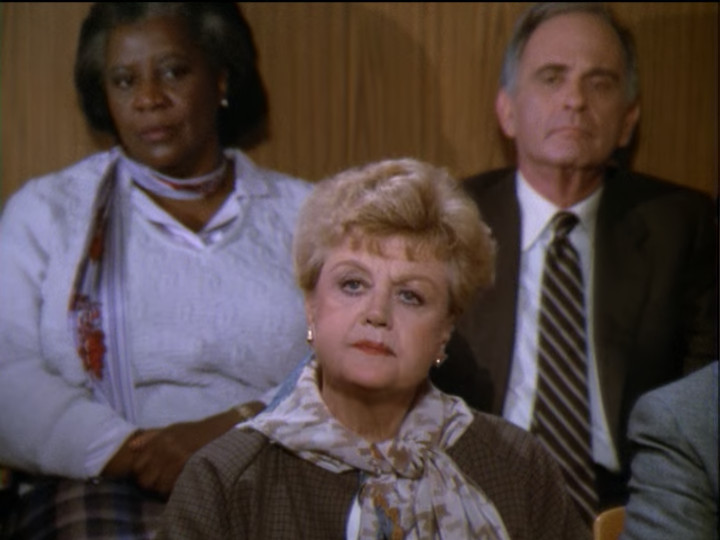
Somehow Jessica is already the foreman of the jury, despite deliberations not having started yet. (That’s not impossible, since the jury could have decided on who their foreman was at any time when they were together outside of the courtroom, but I don’t see how the judge would have known that since judges are careful to not talk to the jury about the case except inside the courtroom and on the record.) The judge then sends them out to deliberations.

There is some initial discussion, wherein several people firmly express the opinion that it’s an open-and-shut case and they’ll be done with their deliberations very soon. Jessica then takes charge of the discussion since she’s the foreman—which, as far as I can tell, is just a TV thing. Perhaps it’s different on criminal juries, but our instructions were that the foreman’s only role was to write any questions we had for the judge (they had to be submitted in writing) and to read the verdict. Turning the foreman into an authority figure makes the scene more tense, or at least makes it easier for Jessica to take charge, but this seems to be purely a dramatic thing.
One of the jurors suggests that everyone is in agreement so they should just take a vote immediately. Jessica replies, “Don’t you think that we should examine the evidence first?”
This makes a ton of sense from the perspective of a TV show which skipped to the jury room and needs to tell the story in flashbacks. In real life it would be very reasonable for any of the jurors to reply that they already examined the evidence during the trial, as it was being presented. Important evidence does not go by in a flash during a trial. Trials are slow and methodical even when there is no repetition. If the lawyers involved are even slightly competent, any important evidence will be repeated and there’s plenty of time to examine the evidence presented during the trial itself, plus plenty of time to think about it after one goes home for the day. I found it hard to think about anything else when I went home, and that was just a civil trial over breech of contract.
That’s not to say that deliberation is pointless. On the contrary, thinking things through with other people can be highly profitable. My issue, here, is that Jessica says what she did as if no one at the table knows what the evidence is. That’s absurd. There were more realistic ways to try to get the flashbacks started.
Anyway, another juror declares that the evidence shows that Mark is innocent, and this begins some general discussion. One juror declares that the only thing that Reynolds is guilty of is picking the wrong time to go bed with another man’s wife. At this point another juror objects that this is putting too little weight on the fact that Mark was in bed with another man’s wife—and killed that man when he walked in.
They end this commotion by taking a vote. They do this anonymously, with folded pieces of paper. I’m not sure why they do this; presumably because it’s more dramatic. In real life, since the next step is for people to try to persuade each other of their point of view, it’s very helpful to know who you’re talking to and of whom you’re asking questions. It is the duty of a jury to try to reach a verdict so it’s not like staying out of the fray is a responsible option. And once you start arguing for a conclusion, everyone will know how you voted anyway.
The vote is nine in favor of not-guilty, two in favor of guilty, and one undecided.
Jessica suggests that they start reviewing the evidence now that they know where they stand. Finally, the flashbacks can begin.
They start with a flashback to some testimony about how Mark Reynolds felt and why he went to the bar. He felt guilty and wanted to die and went to the bar to get drunk and drown out reality. On cross-examination, the DA asks him why he went to that particular bar, since there were six closer to the hospital. He asks if it was to meet Becky Anderson.
Several jurors discount this for some reason which is not clear to me, then they move on to recalling Mark’s later testimony. He and Becky went back to Becky’s place, then as they were naked in bed together they heard a noise. Mark got up and put his pants on, then Becky’s husband barged through the door holding a gun. Mark fought him for it.
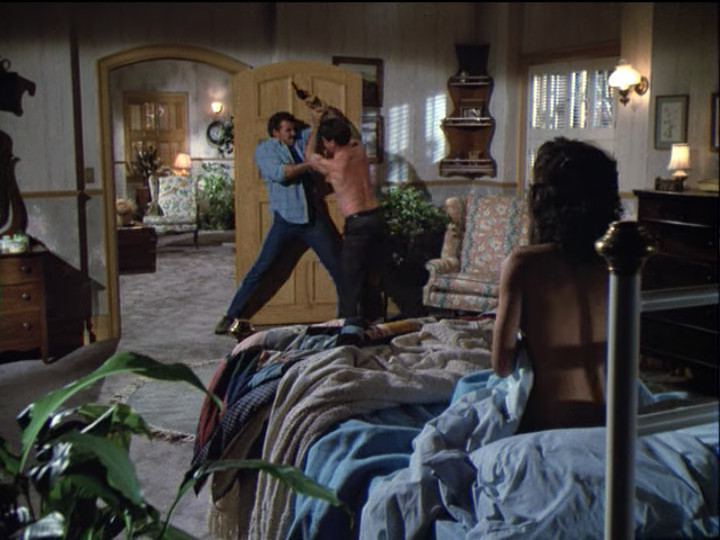
They struggled into the next room and over to the fireplace. In the struggle the gun went off, then Mark picked up a poker from the fireplace and hit Cliff on the head with it, hard. Then Becky called the police and they came and picked Mark up. He used his phone call, not to call a lawyer, but to call the hospital, where they told him that his wife had died without regaining consciousness.
We come back from the flashback to some fighting among the jury. One of the jurors is utterly convinced that Mark Reynolds is guilty as sin and lying, though he only knows it by his gut. He says that they can stay there until Christmas if everyone wants, but he will never change his mind. (They go to commercial break on this statement.) I wish I could say that this part sounds like dramatic exaggeration but something similar happened on the jury on which I served. It didn’t have as much impact because the jury in a civil trial in Pennsylvania only requires ten jurors to agree in order to reach a verdict, but I can say from experience it is possible to have people who are convinced of a conclusion and will neither listen to persuasion nor attempt to persuade others, and their inability to even begin to try to convince others (possibly due to a lack of relevant social skills) can make them angry. I could easily see how the heightened tension of a murder trial could make them even more angry.
Anyway, after a bunch of angry shouting, Jessica talks them into reviewing more evidence.
They go to a flashback of Becky Anderson’s testimony. Becky says that not only was she separated from her late husband, but she had a restraining order against him. This is a bit remarkable since a restraining order generally requires evidence of physical danger to get. Further, the DA presses her on the reason for the divorce. She says that it was irreconcilable differences but the DA then asks if Cliff counter-sued for divorce on the grounds of infidelity. All of this is dramatic, but at the same time hard to square with Cliff having believed that they were only on a trial separation. I don’t see how one can counter-sue for divorce on the grounds of infidelity and expect that you’ll remain married and get back together in a few months. The existence of a restraining order is also hard to square with a “trial separation.” There’s then some pointless questioning about how many men she’s picked up from bars. The defense objects and the judge sustains it, admonishing the DA. The odd thing about this is that the only point which makes sense for the DA to make is that she never picks up men, making his theory that she and Mark already knew each other more likely. It’s played as if he was trying to paint her as a slut, but that’s the opposite of what he would want to do.
Back in the jury room they fight a bit more. Someone refers to Mark as rich and used to having his own way and another juror objects that it was the wife who was rich, not Mark. After some bickering and insults, they go to a flashback of the testimony of a Mr. Fenton Harris (played by Alan Hale Jr. who is probably best known for playing the Skipper on Gilligan’s Island).
Incidentally, while this part of my experience is not something to generalize from, while some jurors did express offense, none of us ever insulted any of the other jurors. The one juror who picked her words badly and gave offense made a point, after she realized it, of being more careful. This is only practical; in order to get out of deliberations and in order to get a verdict which one thinks is just, one needs to persuade the people to whom one is speaking. Open insults are too obviously a way to spend a long time then return no verdict, making the whole thing a colossal waste of time. It’s one thing to give up a lot of time and inconvenience one’s family and co-workers to help justice be done. It’s another thing to do it for no benefit to anyone. That said, after we decided on a verdict and were waiting around to return it some people compared this experience of jury duty to other times that they’d served and one told of a time she was on a criminal trial where some of the jurors were openly accusing other of the jurors of being racists. (They did not return a verdict and it was declared a mistrial.)

Mr. Fenton runs a motel called the Bide-A-Wee. It’s located about fifteen miles out of town, on Route 37. In his business it’s a good practice never to recognize the customers, but he does recognize Mark. He came to the hotel somewhere between four to six times. He thinks he saw Becky once with Mr. Reynolds, but she didn’t come into the office; she stayed outside in the car.
This generated a ton of talking in the courtroom and the judge had to bang his gavel, calling for order in the court. (I don’t know if the judge in our trial even had a gavel; he certainly never banged it nor did anyone lack the self control talk audibly about what a witness just said.)
The DA concluded by asking about the timing, which put it about three months before Mark Reynolds and Becky Anderson claim to have met for the first time.
We then come back to the jury room, where they discuss the fact that Mr. Fenton only thinks that he saw her but isn’t sure. I’m not sure why no one brings up how difficult it would be, from inside an office, to recognize someone sitting in a car. For one thing, this would require the office to have a clear view of where Mark parked. This would be entirely under Mark’s control (assuming he was driving), which would mean that Mark was unbelievably careless while trying to be discrete. Even apart from that, seeing someone you don’t know, inside a car, well enough to be able to recognize them months later, in a different context—that’s really hard to do even under favorable circumstances.
Anyway, they argue and bicker for a while.
Eventually Jessica points out that if Becky and Mark knew each other beforehand, that their pretending to meet at a bar where Becky was a regular and where many of Cliff’s friends were known to hang out meant that they meant to be seen and to attract Cliff’s attention.
They then flash back to the testimony of the guy Cliff was living with (they were fishing buddies). When questioned, he said that Cliff had no gun when he left to confront Becky.
Jessica says that this is puzzle piece number one: where did Cliff get the gun? It was midnight when he got the call. He couldn’t have bought it.
With the help of some flashbacks to the testimony of a ballistics expert as well as just general recall, Jessica establishes that the gun had the fingerprints of both Mark and Cliff on it but no other fingerprints, that a nitrate test showed that both men had held the gun when it was fired, that only one shot was fired, and that a matching bullet had been taken out of the wall.
After some more bickering and insults (which, frankly, are beginning to feel like an attempt to pad out the episode), they then proceed to consider the testimony of Becky Anderson’s neighbor.
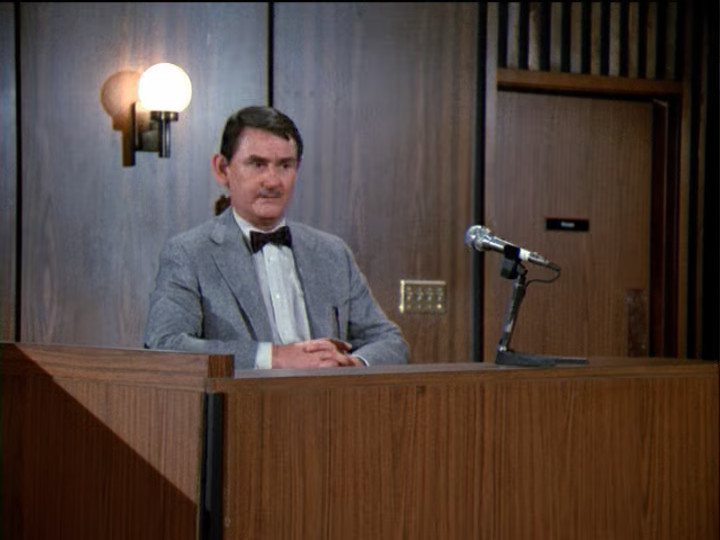
When he came home Cliff’s car was in the way and he had to park in the street. He didn’t say anything because Cliff Anderson had a volatile temper; it was a good thing that Mark Reynolds grabbed that poker because if he hadn’t, when he looked through the window a few hours later it would have been Mark’s body taken out on a stretcher, not Cliff’s.
No one remarks on the several hours between when the guy tried to park and when he was looking through the window and seeing Cliff’s body being removed. Instead, we just get some remarks on how reliable it was to get Cliff to show up angry, then a flashback of the DA’s closing argument where he gives his theory of what happened. The two were not in bed, they were waiting for Cliff. Cliff came in, then as he went to talk to his wife, Mark killed him in cold blood. Mark had the gun, not Cliff, and used it after Cliff was dead to create a claim of self defense.
We come back to the jury room and as people are starting to agree that it was murder, Jessica says that the one thing that she’s willing to believe is that Cliff did bring the gun himself. She reminds them about the testimony of a traffic officer from a year ago who stopped Cliff and confiscated a gun in his glove box. Jessica says that a man like Cliff would almost certainly have gotten another gun soon after. Jessica doesn’t explain why she’s only just thought of that now when she listed it as a puzzle piece only a few minutes before.
After some more bickering and insults, which have crossed the point of being tiresome, Jessica points out that they’ve been overlooking something. According to the paramedics, Mark had broken his collarbone in the accident. How, then, was he able to successfully struggle with Cliff for the gun? The paramedics testified that his left arm was practically useless, yet the powder traces were on his left hand.
They then go back to a bunch of angry bickering.
Then Jessica says that one of the people made a good point, that it seems a bit ludicrous that these two people with Mark’s wife lying critically ill in a hospital bed chose this particular night to lure Becky’s husband to his death.
They then go back to a bunch of angry bickering.
Jessica then says that there is a third possibility between Mark murdering Cliff and Mark killing him in self defense, which none of them have yet considered. Instead of stating it, she brings up the time discrepancy between Mark and Becky’s timeline and what the neighbor said. She then says that this leads to only one inescapable conclusion, and only one possible verdict.
We then go to the court, where the jury returns the verdict of Not Guilty.
They get the basic procedural stuff wrong, I think just because they want to skip it for the sake of brevity.
Jessica then approaches the DA, who says that he guesses he might as well not bother going after Becky Anderson. Jessica says that it’s more important now than ever and asks if they can meet in his office in thirty minutes. She then asks him to have Becky and her lawyer present. He asks what this is about and Jessica explains off-camera.
The next scene is thirty minutes later, in the DA’s office. Jessica is late for some reason which is never explained and doesn’t add anything. They might really have wanted to pad this episode out, which is the opposite of most episodes of Murder, She Wrote where they don’t have the time to fit everything in.

The DA’s office has a curious layout, with his desk in an anteroom to the conference table (I think that this is just a standard Murder, She Wrote set that they repurposed to be the DA’s office). Anyway, over a fairly protracted discussion with a lot of interruptions by Becky and her lawyer, Jessica explains what really happened. For brevity I’m going to present it together with bits that Becky added toward the end:
Mark and Becky were lovers but Mark’s wife of less than a year had all the money. Mark wanted both, so he tried to murder his wife, who never wore a seatbelt, by slamming their car into a telephone pole, passenger-side first. This is what she meant by asking him “Why?”—she was asking him why he tried to kill her. Later, at the hospital, when he heard that she might regain consciousness (and incriminate him), he panicked and called the one person whose help he could rely on—Becky. They arranged to meet at the bar then for her to take him home so she—a supposed stranger—could give him an alibi for when he had to go back to the hospital and finish his wife off.
Unfortunately for them, Cliff found out and came to Becky’s apartment demanding to know where the man was. When he finally believed that no one was there, he demanded to know who the man was. Cliff became abusive and threatened to find the man and kill him, and then to kill her. As part of this, he threw Becky to the ground she picked up the poker and struck him in self defense. Half an hour later Mark came back from finishing his wife off in the hospital by smothering her with a pillow. He told Becky that, in his wife’s weakened condition, she died almost instantly. Their problem now was that they couldn’t let anyone know that Cliff had found Becky alone so they came up with the idea that Mark had been the one to kill Cliff in self defense. In fact, this was an even stronger alibi than just spending time with her.
Becky admits everything and takes a plea deal from the DA because he really wants Mark.
After this, in some building which I assume is meant to be the same building as both the courthouse and where the DA’s office is, Mark runs into Jessica and thanks her for her verdict. She says that there’s no need—the satisfaction is knowing that the right thing has been done. Mark then says that he’ll always remember her. Jessica replies, “Oh yes, I’m quite sure you will.”
He makes it about ten steps towards the exit when two police officers arrest him. He looks over his shoulder at Jessica.

She looks at him.

Then she turns and begins to walk away and we go to credits.
This was an interesting episode, and not just because I got the chance to compare it with my recent service on a jury. As Murder, She Wrote goes, it’s more of a pure puzzle than many of the episodes are. As a puzzle, it’s well constructed. The story is set up in such a way that we’re operating within a framing that the murderer chose, though with some additional clues that came about despite the murderer’s efforts. Within the framing the murderer provided, the story together with the facts the murderer tried to exclude don’t really make sense. That’s an excellent setup for a murder mystery.
My biggest complaint about this episode is the incessant bickering. It got so bad that they even gave one of the characters the role of the audience in telling one of the worst offenders to shut up. To some degree this is an artifact of the medium; television needed to be maximally compelling at all times out of the constant fear that viewers would change the channel. One way writers tried to cope with this was to create as much conflict as possible, since conflict tends to demand the attention of people who see it and makes us want to see if it’s resolved. It’s a cheap trick and hurt the episode, but the temptation to it was, perhaps, understandable. It’s a good lesson, I think, in how the accidents that can give rise to good things can also impose limitations on them.
A much smaller complaint is that the episode didn’t entirely take its premise of being about jury room deliberations seriously. This is always forgivable in little things for practical reasons, such as the judge’s instructions being for the audience, not the jury. A skilled writer could have done a better job making it for both, but forgiveness is a highly practical virtue in a fallen world, and this is a very minor thing, more or less on the level of how characters don’t need to use the bathroom on television. Less minor is that the jury tended to act like they hadn’t heard a piece evidence until a flashback of it happened. This was practical, but false to how juries actually work. Unless jurors are shirking their duty, they are actively listening to testimony and trying to fit it in and make sense of it as they hear it. This is part of why each side in the case has an opening statement—in their opening statement they explain the framing of the evidence that they propose so that jurors can do this kind of analysis. The jurors in this case, except for Jessica, had conclusions, but no independent thoughts.
Well, that’s not quite true. A Mr Lord made the point that picking the night of Mark’s car accident which killed his wife to lure Cliff Anderson to his death would have been a crazy plan. He didn’t explain, but he was right that it was too filled with contingencies that had to happen correctly for Cliff Anderson to die at all, and if they didn’t work out, the couple would have then been in a terrible position to try to kill Cliff again.
Other than that, I can’t think of an example of a juror having an independent thought from Jessica. Which is a pity, because Jessica navigating actual thoughts instead of meaningless ranting and insults would have been more interesting.
All that said, the presentation of the case was quite interesting. We get about six minutes of the case as it happens, which throws a lot at us, then we move to a retrospective examination in the jury/court room. This change of perspective is, on its own, an interesting setup. There’s less to keep track of and it presents itself as more of a challenge to try to remember it. The flashbacks which follow, and present further evidence, are also very clearly delineated as evidence being presented. In a normal Murder, She Wrote episode, while clues are given, they are disguised as being part of the action which is there to move the plot forward (while red herrings tend to be held out as obvious evidence). In a normal episode it’s easy to sit back and watch the action, as it were. Here, our attention is focused.
I also like how the episode misdirects us on the question of who the principle murderer is and who the accomplice is. With the initial setup, if Mark and Becky had actually planned to kill Becky’s husband, she would be the murderer and Mark the accomplice. The reversal to Mark being the principal murderer and Becky the accomplice, and for a different death, was an extremely well-done bit of misdirection.
I’m not sure whether a jury-room setting could be made to work for a novel. As I’ve mentioned, TV is really, structurally, a short story. I think a jury-room short story would be very doable. It would be difficult to actually get a detective on to a jury for a murder trial—previous experience that might bias you is a for-cause strike and both sides have an unlimited number of for-cause strikes. Still, it could be fun. I think that the main thing to take from this episode in terms of story construction—since very few people are writing short stories these days—is the interesting structure of the framing provided by the murderer vs. the correct framing, especially with regard to a putative victim and a real victim and a putative principal murder vs. the real principal murderer.
Just as a side note, I found it amusing that two of the witnesses had Maine accents (Mr. Fenton and the next-door neighbor) while the rest had standard Californian accents. That’s typical of Murder, She Wrote episodes set near Cabot Cove. So few people try for Maine accents that it sounds a bit weird when someone actually does one. It makes me wonder how the few guest actors who did Maine accents ended up doing them.
Oh, one final thought on the episode: a big part of the mystery and twists and turns of the case was done by how the episode directed our attention throughout. We saw Mark when his shoulder was injured but then we saw him months later, healed up, before we saw the flashback in which we saw the actor (with a perfectly good shoulder) wrestling for the gun. This made it a lot easier to forget this crucial piece of evidence and for it to be a revelation when Jessica reminds us of it. It’s a good lesson in the importance of being careful to direct the audience’s attention away from the important things so they will feel fooled when the detective reveals the solution.
A second final thought on the episode: while most episodes feel rushed, this episode actually took its time, which I think also helped. It took its time so much it may have run into the opposite problem of a normal episode, and actually included things for padding. Towards the end the bickering felt really pointless. That said, the bickering was annoying but not too hard to ignore, and I really appreciated the less rushed pace. It could have been used better, but it gave characters more time for characterization, making the episode feel a bit richer, I think.
 Chris Lansdown
You must be logged in to post a comment.